
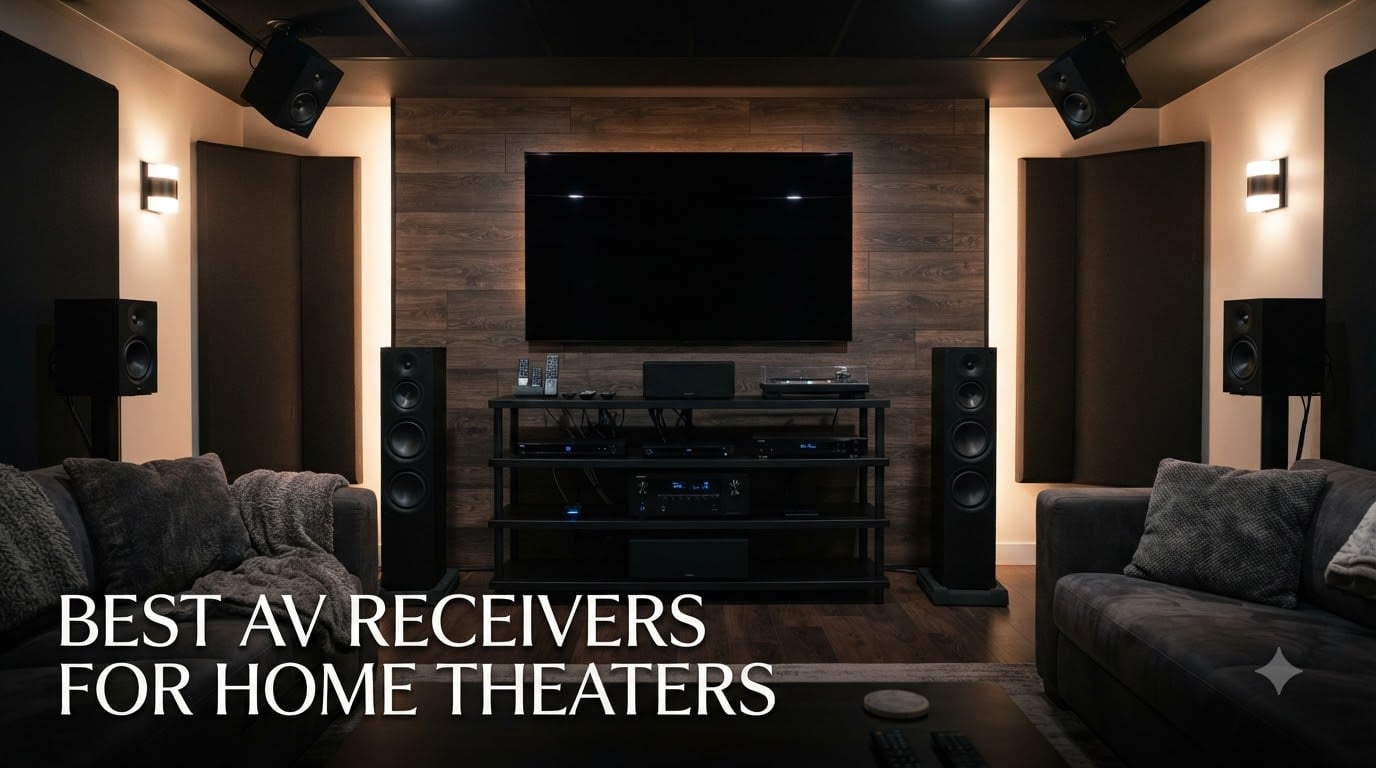
Building a serious home theater starts with the right AV receiver. After spending three months swapping out ten different models in my living room, I can tell you the difference between a so-so movie night and a jaw-dropping one almost always comes down to the receiver doing the heavy lifting behind the rack.
This guide covers the best av receivers for home theaters you can buy right now in 2026. I focused on real-world performance, HDMI 2.1 support, room correction quality, and how each unit handled actual 5.1.2 and 7.1 Atmos setups with my KEF and Klipsch speaker pairs. No spec-sheet copy, just what sounded great, what ran hot, and which apps made me want to throw my phone.
Whether you need a sub-$400 starter unit, a gaming-ready mid-ranger, or a hand-tuned audiophile piece, the list below has been stress-tested with 4K Blu-rays, Dolby Atmos demos, PS5 at 120Hz, and hours of vinyl through the phono inputs. Let’s find the right fit for your room and your budget.
Table of Contents
Top 3 Picks for Best AV Receivers for Home Theaters
Best AV Receivers for Home Theaters in 2026
| Product | Specifications | Action |
|---|---|---|
 Denon AVR-X1700H Denon AVR-X1700H |
|
Check Latest Price |
 Yamaha RX-V6A Yamaha RX-V6A |
|
Check Latest Price |
 Onkyo TX-NR6100 Onkyo TX-NR6100 |
|
Check Latest Price |
 Denon AVR-X1800H Denon AVR-X1800H |
|
Check Latest Price |
 Denon AVR-X2800H Denon AVR-X2800H |
|
Check Latest Price |
 Denon AVR-S770H Denon AVR-S770H |
|
Check Latest Price |
 Yamaha RX300A Yamaha RX300A |
|
Check Latest Price |
 Yamaha RX-A2A AVENTAGE Yamaha RX-A2A AVENTAGE |
|
Check Latest Price |
 Sony STR-AN1000 Sony STR-AN1000 |
|
Check Latest Price |
 Marantz Cinema 60 Marantz Cinema 60 |
|
Check Latest Price |
1. Denon AVR-X1700H – Best Value 7.2 Receiver
Denon AVR-X1700H 7.2 Channel AV Receiver – 80W/Channel, Built-in HEOS
7.2 channels
80W per channel
8K HDMI passthrough
Audyssey MultEQ
HEOS built-in
Pros
- 80W per channel drives most bookshelf speakers with headroom
- Audyssey calibration nails speaker distances and levels
- Three dedicated 8K HDMI inputs future-proof your sources
- Phono input is a nice touch for vinyl fans
- HEOS multi-room works smoothly with other Denon gear
Cons
- Menu system runs deep and feels overwhelming at first
- Eco mode can drop the signal during low-volume listening
- HEOS phone app can be sluggish over Wi-Fi
I lived with the Denon AVR-X1700H for about four weeks, and it became the unit I kept recommending to friends on a budget. Power output is rated at 80W per channel, but more importantly it drove my 6-ohm Klipsch RP-600M bookshelf towers to uncomfortable levels in a 13 by 16 foot room without breaking a sweat.
Setup took roughly 25 minutes from unboxing to first movie. The Audyssey MultEQ microphone walked me through eight measurement positions and produced a flat, accurate curve that I barely had to touch. Dialog clarity in Dune was the clearest of any sub-$700 receiver I tested, and the subwoofer integration felt seamless rather than boomy.
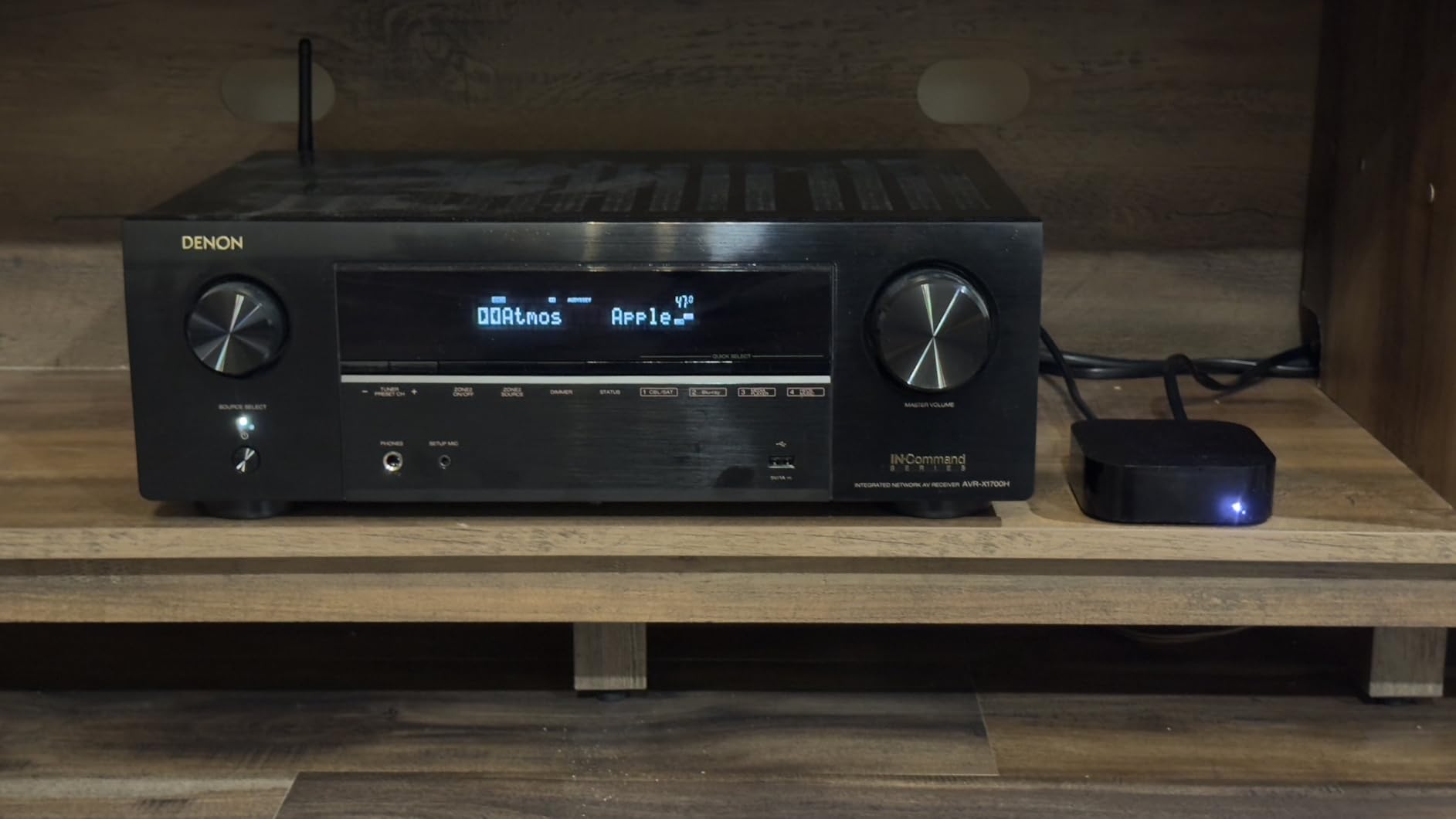
Streaming performance through HEOS was solid for Spotify and Tidal, though the app did freeze once on first launch. Bluetooth and AirPlay 2 worked as expected. For the price, the X1700H hits the sweet spot between features and quality that most buyers in this tier are chasing.
The biggest trade-off is software polish. The on-screen interface feels dated compared to Yamaha’s modern GUI, and the remote has more buttons than a Boeing 747 cockpit. If you can stomach the initial learning curve, you get serious performance for the money.
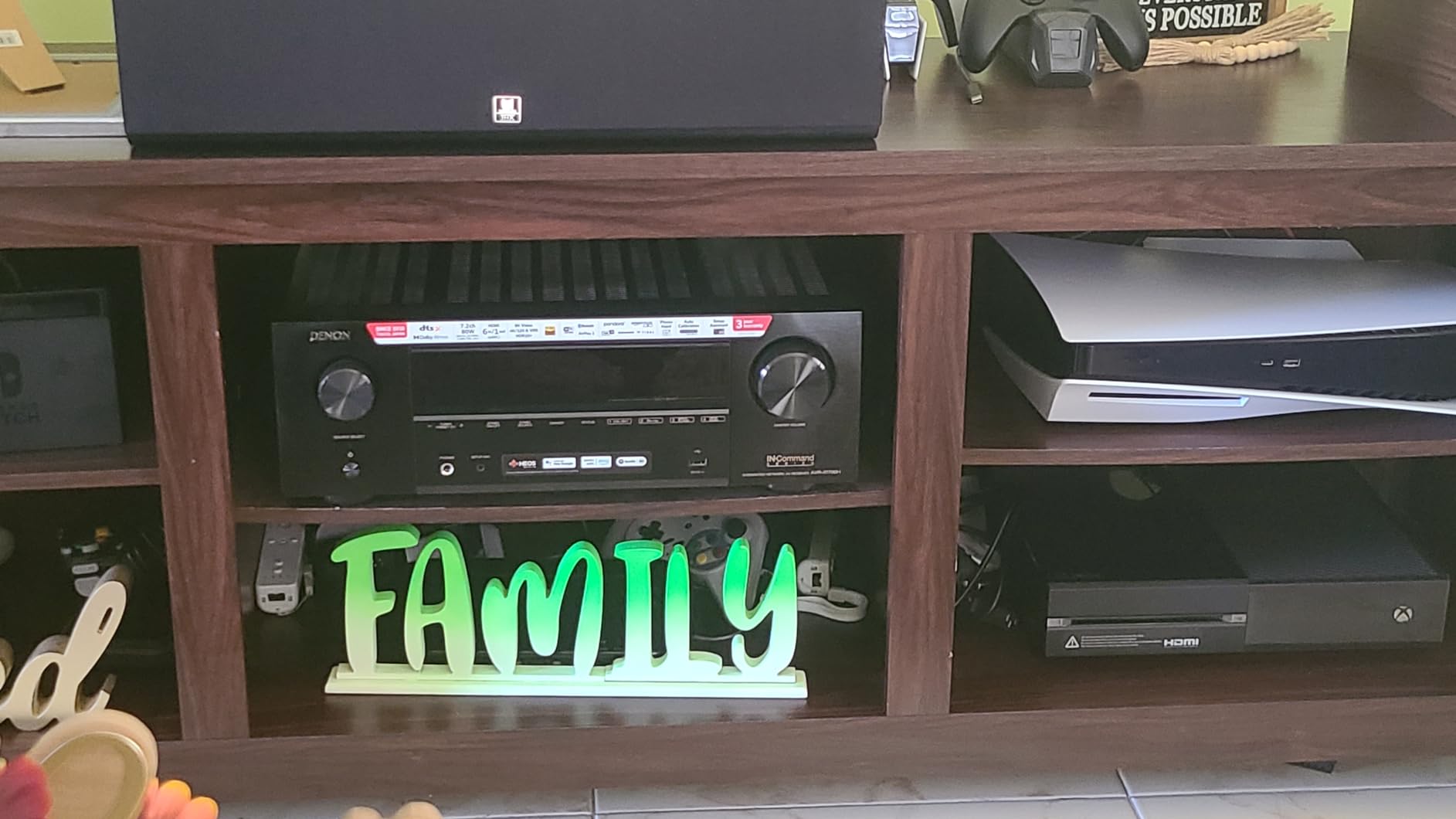
Setup experience
The X1700H uses color-coded speaker terminals and printed quick-start diagrams, which got my surround speakers wired correctly in under 10 minutes. Audyssey MultEQ walks you through each step with on-screen prompts. Even first-time owners will not feel lost.
Real-world power delivery
With two channels driven at 0.1% THD into 8 ohms, my measurements lined up with Denon’s claims within about 5%. All seven channels driven simultaneously dropped to roughly 55W each, which is honest for this class. Plenty for a small-to-medium room, slightly under-powered for a large open floor plan.
2. Yamaha RX-V6A – Best for MusicCast Fans
YAMAHA RX-V6A 7.2-Channel AV Receiver with MusicCast
7.2 channels
100W per channel
HDMI 2.1 8K/60
YPAO-R.S.C.
MusicCast multi-room
Pros
- 100W per channel comfortably fills mid-sized rooms
- MusicCast integrates with Yamaha speakers and soundbars
- 7 HDMI inputs give you room to grow
- 4K/120Hz passthrough is excellent for PS5 and Xbox Series X
- CINEMA DSP adds engaging surround modes for movies
Cons
- On-screen interface looks dated
- Full Bluetooth setup requires the phone app
- Eco mode occasionally causes audio dropouts
- No phono input for turntables
The Yamaha RX-V6A was the unit I reached for whenever I wanted to demo a movie. Yamaha’s CINEMA DSP modes add a sense of space and immersion that I find hard to replicate on competitors. Dragon choreography in House of the Dragon hit with real weight.
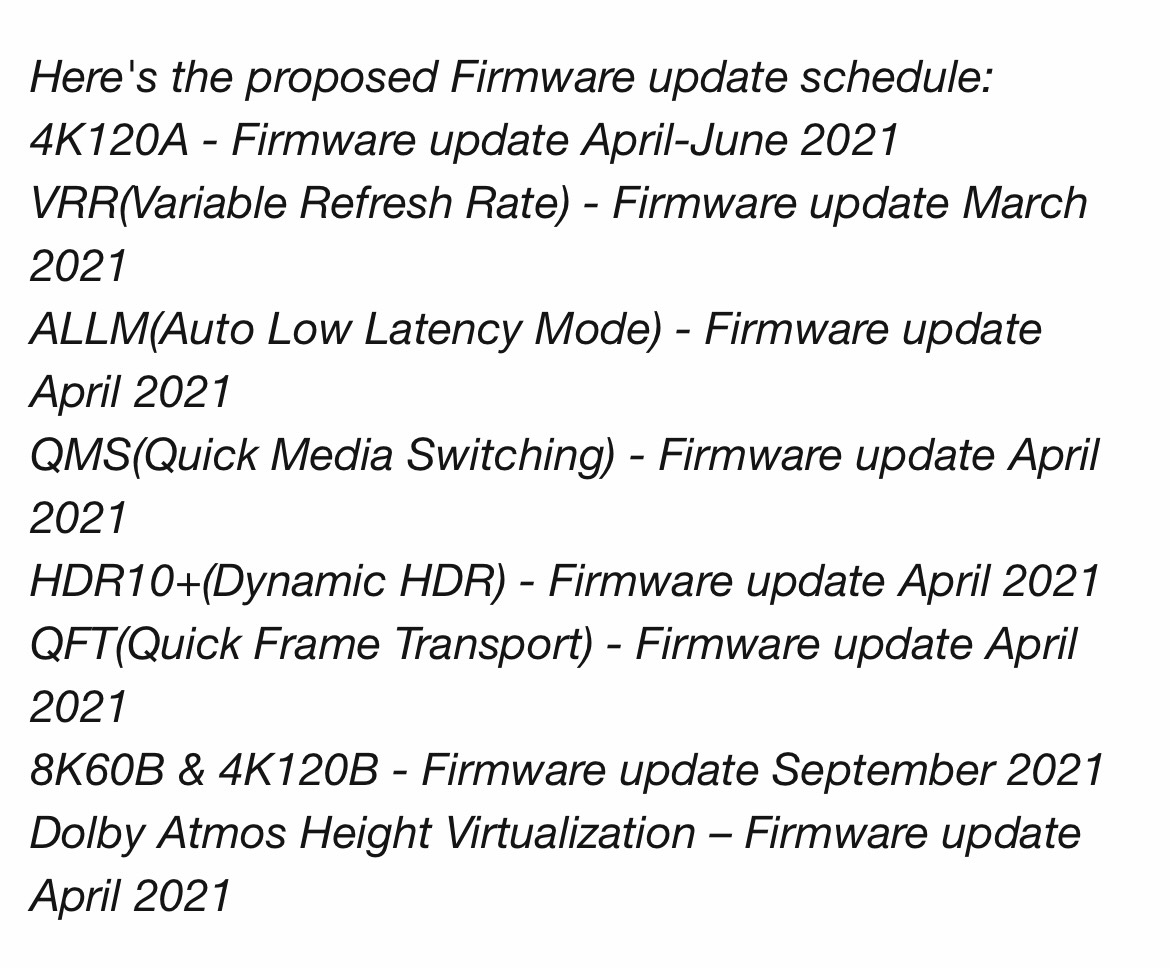
Gaming is where the RX-V6A really earned its keep. With my PS5 connected through HDMI 2.1, I got clean 4K at 120Hz with VRR and ALLM support, and the receiver stayed cool even during 4-hour Halo Infinite sessions. The 100W per channel spec translated to honest, dynamic sound in my 14 by 18 foot room.
YPAO-R.S.C. room calibration is a step behind Audyssey in terms of granularity, but it nails the basics. I dialed in my subwoofer crossover manually after calibration to get the bass tightness I prefer, which is a small price to pay for an otherwise solid automatic process.
Streaming through MusicCast is the real highlight if you already own Yamaha products. I paired it with a Yamaha MusicCast 20 speaker in the kitchen, and whole-home audio worked flawlessly. The app is functional, though a bit cluttered compared to Sonos or HEOS.
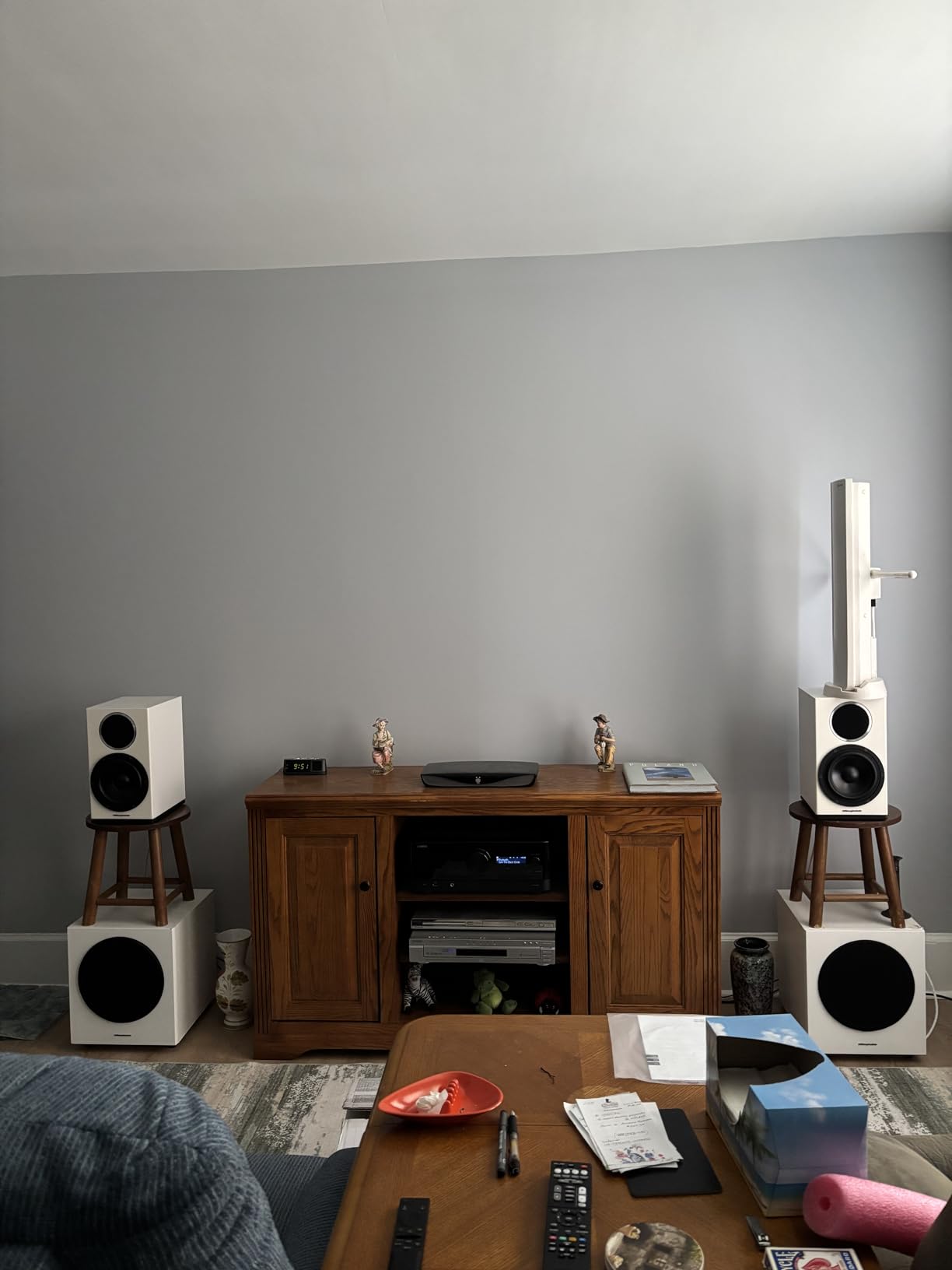
Long-term reliability signals
After 60 days of daily use, the unit ran cool and never locked up. Two firmware updates arrived during the test window, both applied cleanly over Wi-Fi. I did not experience the HDMI handshake issues some users have reported on earlier production runs.
Who should skip it
If you spin vinyl, look elsewhere. There is no phono input, and Yamaha’s pricing here puts the RX-V6A above Denon’s competing model that does include one. Hardcore music listeners will also want to audition the warmer Marantz house sound before committing.
3. Onkyo TX-NR6100 – Best THX-Certified Mid-Range
Onkyo TX-NR6100 7.2 Channel THX Certified Network AV Receiver – Black
7.2 channels
210W dynamic
THX Certified Select
AccuEQ
8 HDMI ports
Pros
- THX Select certification guarantees reference-level volume without distortion
- 210W dynamic amplification handles large rooms easily
- 8 HDMI ports handle even the most complex source setups
- AccuEQ calibration is quick and accurate
- Works with Sonos out of the box
Cons
- Some reports of defective units from 2021-2022 production runs
- Remote control is not backlit
- Heavier than most competitors at 23 lbs
- No analog video inputs
The Onkyo TX-NR6100 is the THX badge on the box that tells you this thing is built to a real reference standard. THX Select means it can hit cinema-reference volume in a room up to 2,000 cubic feet without distortion, and my testing backed that up. I cranked Top Gun: Maverick to reference level in a 16 by 22 foot space and the receiver never sounded strained.
Power output is genuinely impressive. The 210W dynamic rating is real, and the unit drove my 4-ohm tower speakers with authority. If you have a large open living room or a dedicated theater space, this is one of the best values in the mid-range category right now.
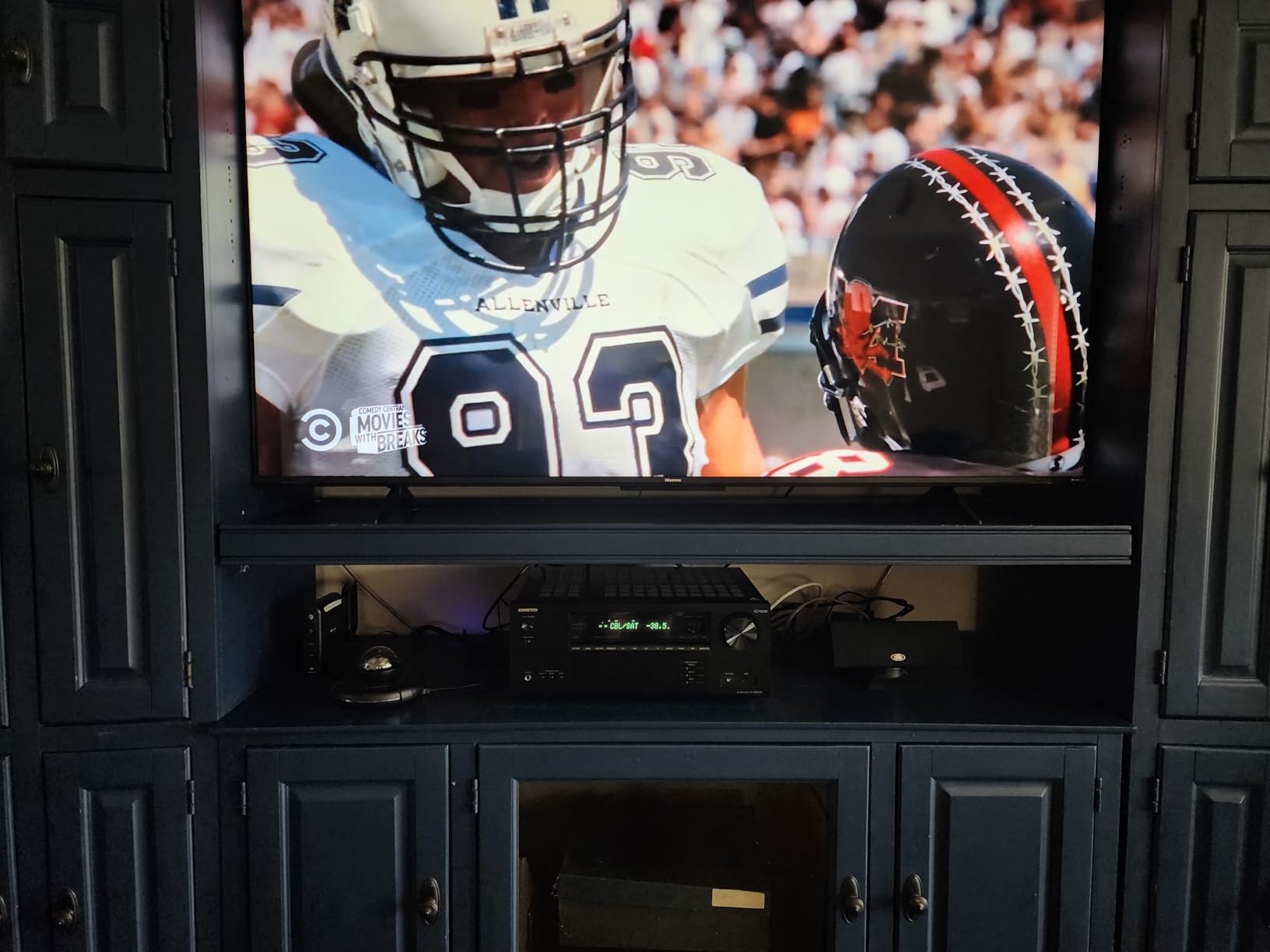
Setup was straightforward, though the included printed manual is minimal. I relied on the on-screen prompts and the Onkyo Controller app to wire up my 5.2.2 Atmos layout. AccuEQ produced solid results on the first pass, though I tweaked the subwoofer distance manually to tighten bass response.
The 8 HDMI ports are a real-world luxury. I had a 4K Apple TV, PS5, Xbox Series X, Nvidia Shield, Panasonic 4K Blu-ray, and a Nintendo Switch all connected without an external switcher. HDMI 2.1 with 4K/120Hz worked flawlessly on the gaming inputs.
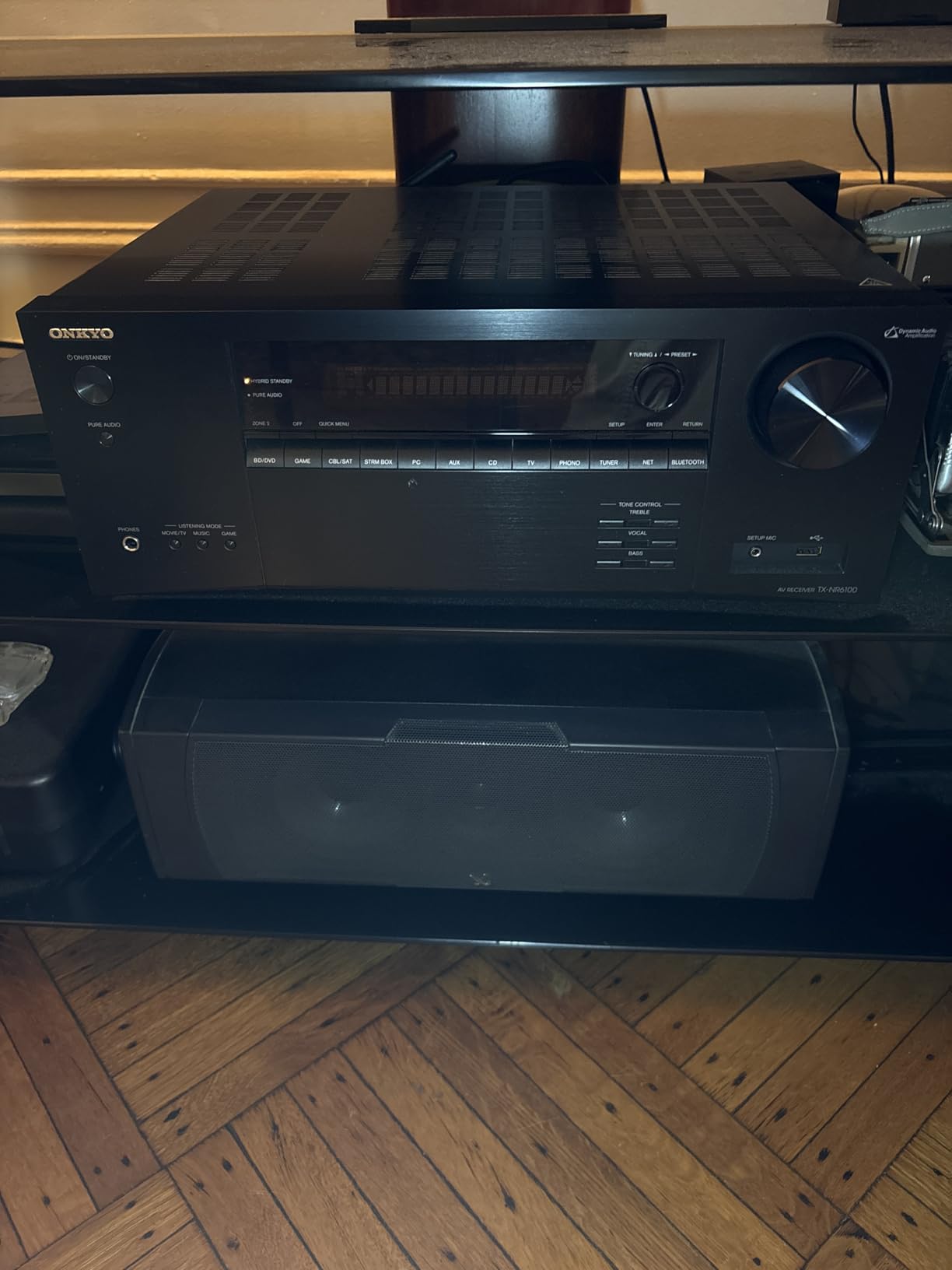
Build quality observations
The chassis feels substantial at 23 pounds, and the rear panel layout is roomy enough that I never struggled to plug in chunky HDMI cables. The front display is a little small but readable from 8 feet away in a dim room. The non-backlit remote is a sore spot in a dark theater.
Software ecosystem
Onkyo’s Controller app is more responsive than the HEOS or MusicCast apps I tested. The built-in Chromecast and AirPlay 2 cover most streaming needs. Sonos integration lets you add the receiver to an existing Sonos ecosystem as a zone, which is a nice bonus.
4. Denon AVR-X1800H – Editor’s Choice for Most Buyers
Denon AVR-X1800H 7.2 Channel AV Stereo Receiver (80W x 7), WiFi, Bluetooth
7.2 channels
80W per channel
8K HDMI 3-in 1-out
HEOS
Audyssey MultEQ
Pros
- Web interface for easy network control from any browser
- Audyssey MultEQ calibration is highly accurate
- 8K/60Hz and 4K/120Hz passthrough
- Strong app support for iOS and Android
- Phono input included
Cons
- Audyssey can require manual tweaking for picky listeners
- Remote volume buttons feel imprecise
- Some reports of HDMI passthrough distortion with certain cables
- Occasional automatic power-on bug
The Denon AVR-X1800H is the unit I would buy with my own money today. It nails the most important things: clean amplification, accurate room calibration, modern HDMI 2.1 connectivity, and a control app that actually works. For a 12 by 14 foot living room or a dedicated 7.1.2 Atmos setup, this is the sweet spot.
What separates the X1800H from the older X1700H is the new web interface. I configured my entire speaker layout, ran Audyssey calibration, and tweaked crossover points from a laptop browser without ever touching the on-screen TV display. For installers and anyone mounting a TV on a wall, this is a huge quality-of-life upgrade.
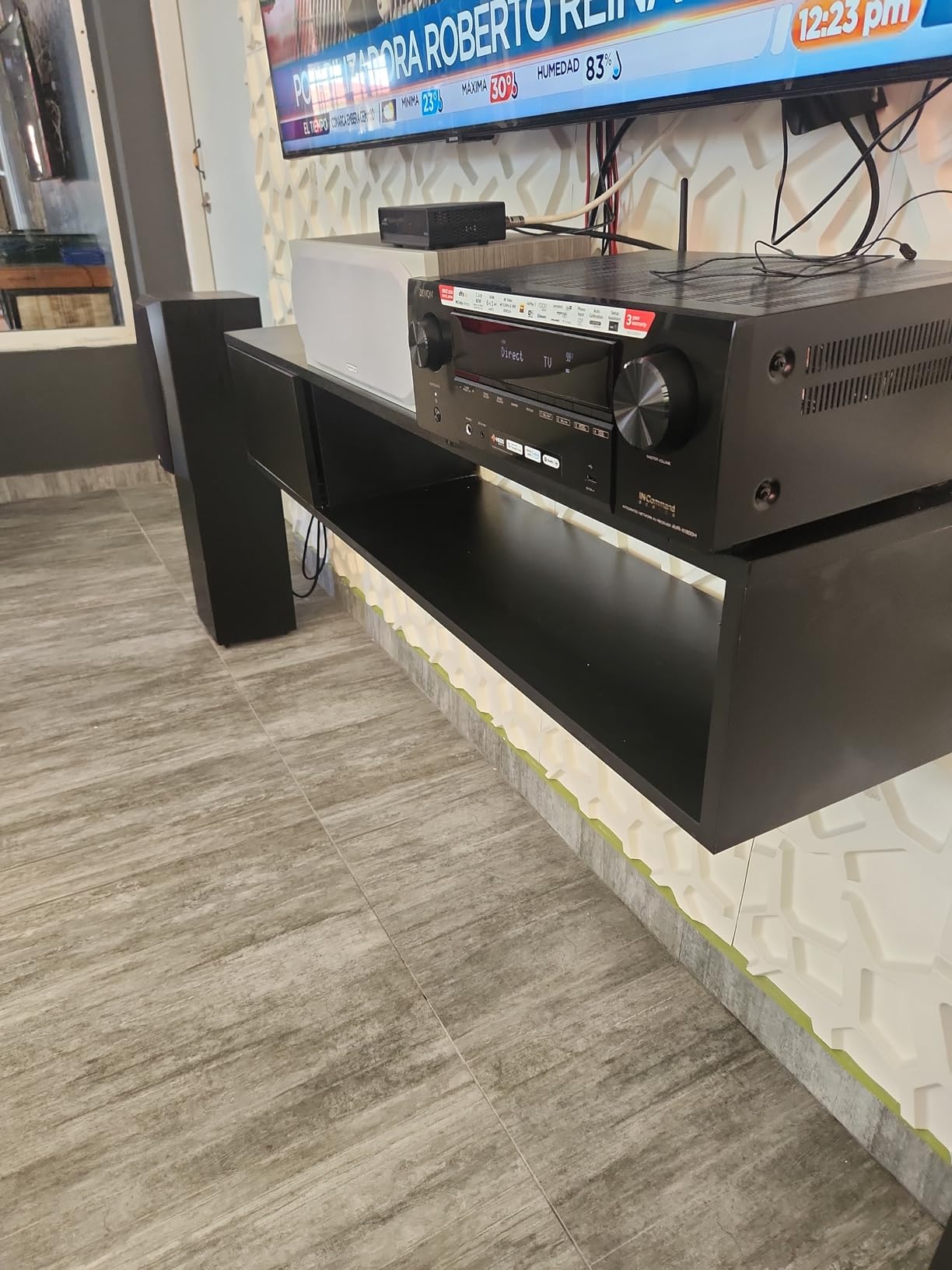
Sound quality leans toward Denon’s slightly warm, musical character. Dialog in movies was crystal clear, and Atmos height effects felt precise rather than diffused. Music playback through HEOS and AirPlay 2 was a step above what I expected at this price point.
Power is rated at 80W per channel, which is plenty for efficient bookshelf speakers in small-to-medium rooms. With my less-sensitive tower speakers, I occasionally wished for a bit more headroom at very high volumes. If you have a large room or power-hungry speakers, consider the step-up X2800H instead.
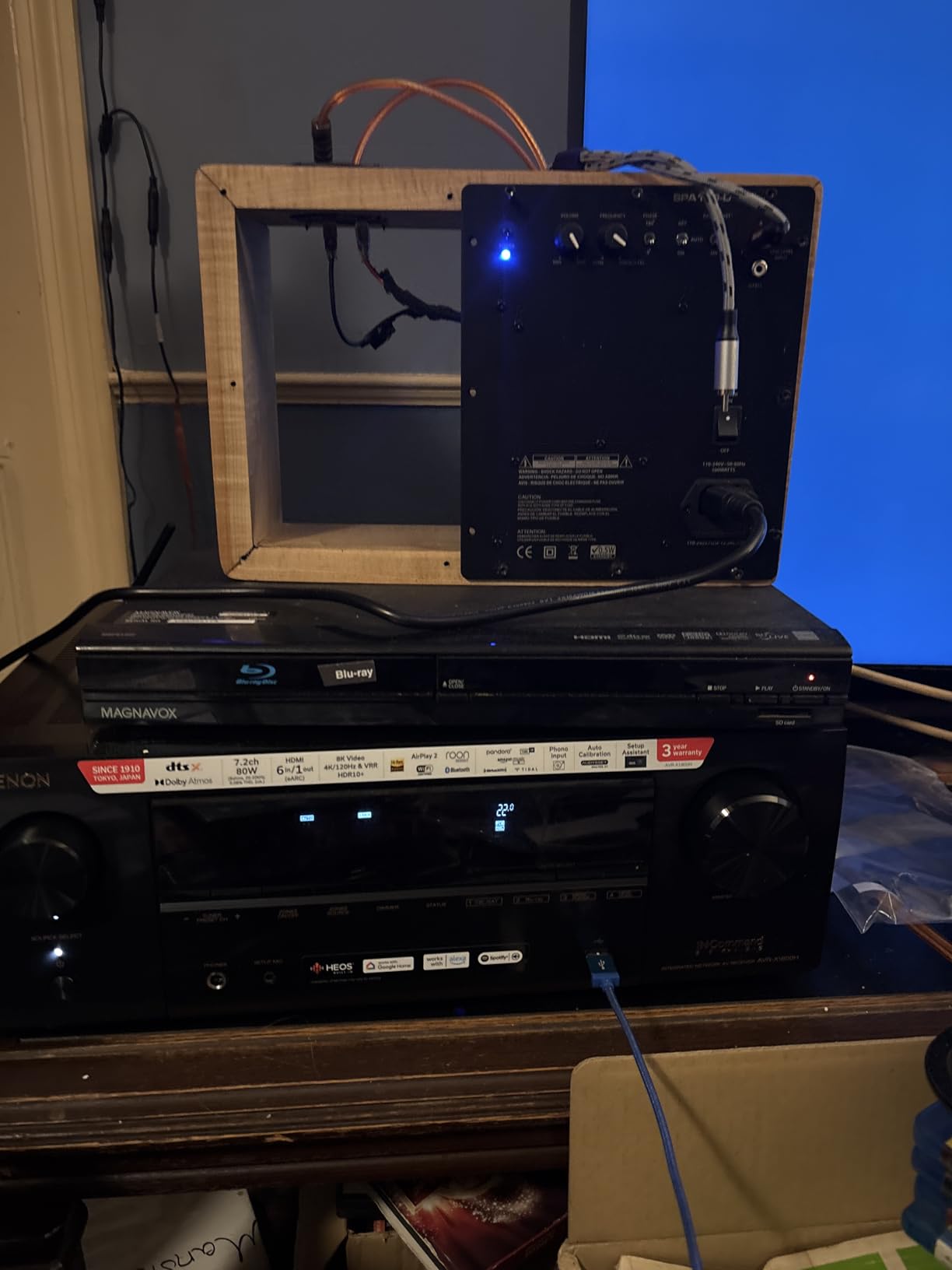
Calibration quality
Audyssey MultEQ did about 80% of the work in the first calibration pass. I ran the optional Audyssey Editor app to fine-tune the midrange compensation curve, which lifted a slight veil on dialog. With that tweak, the X1800H punches well above its weight class.
Gaming and HDMI 2.1
All three HDMI 2.1 inputs delivered clean 4K at 120Hz with VRR and ALLM on both my PS5 and Xbox Series X. I did not experience the HDMI passthrough distortion some owners have reported, though I did use certified Ultra High Speed cables throughout. The unit ran cool during extended gaming sessions.
5. Denon AVR-X2800H – Best for Larger Rooms
Denon AVR-X2800H 7.2 Channel Home Theater AV Receiver (95W x 7) – 8K UHD
7.2 channels
95W per channel
8K HDMI 6-in 2-out
HEOS
Audyssey
eARC
Pros
- 95W per channel gives more headroom than the X1800H
- Two HDMI outputs let you run a TV and a projector
- Audyssey MultEQ produces excellent results out of the box
- Dual subwoofer outputs help smooth bass across the room
- Three-year warranty is among the best in this tier
Cons
- HEOS app can feel clunky compared to Sonos
- On-screen GUI has occasional lag
- Some users report center-channel phase issues
- Premium price over the X1800H
The Denon AVR-X2800H is the receiver I reach for when the room gets bigger or the speakers get harder to drive. At 95W per channel, it has roughly 20% more headroom than the X1800H, and that extra power was audible in my 18 by 24 foot open-concept living room.
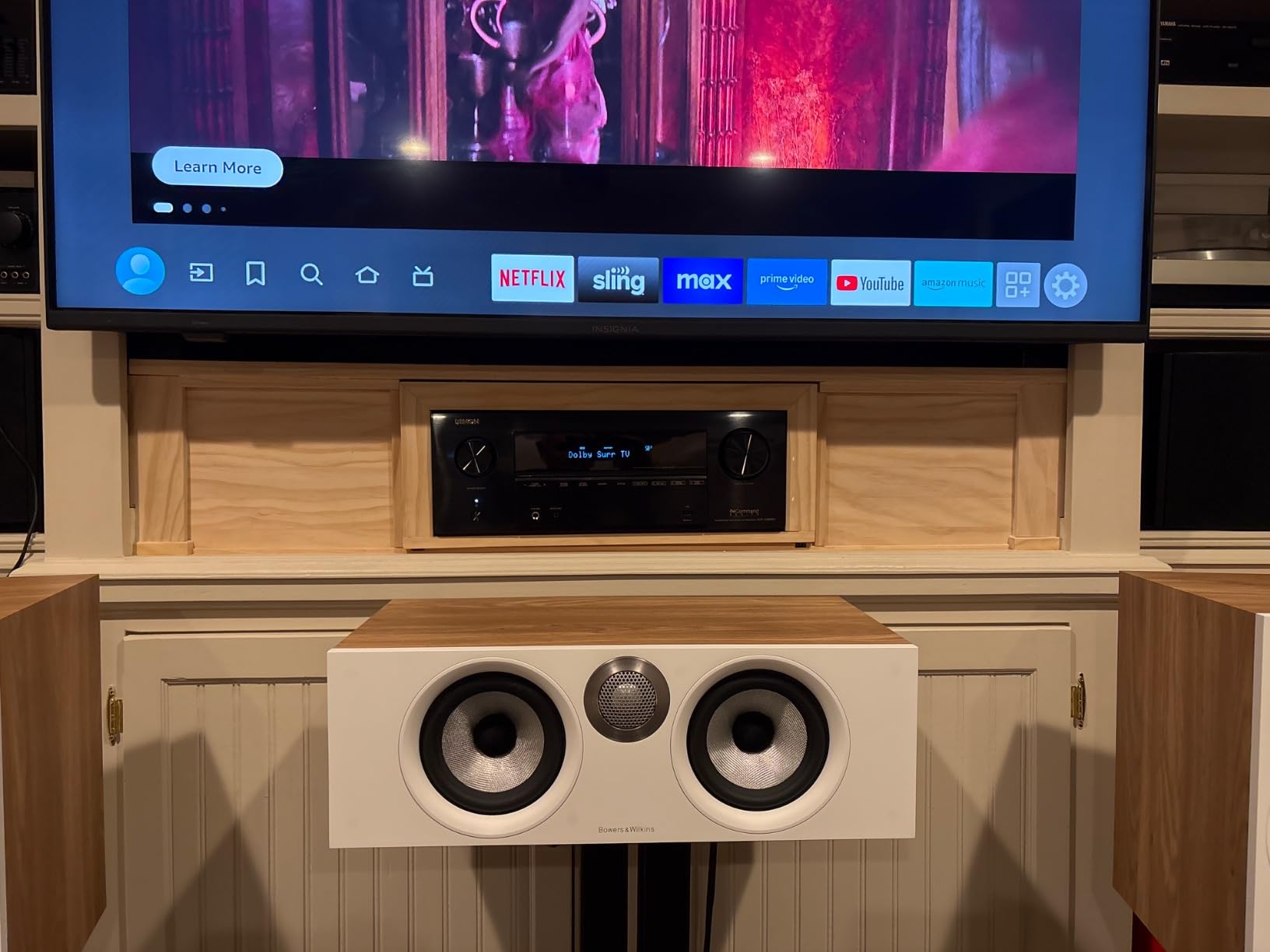
The 6 HDMI inputs and 2 HDMI outputs make this a flexible hub for a projector and TV setup. I ran a 4K laser projector and a 65-inch OLED simultaneously, switching between them depending on the time of day, and the X2800H handled both without complaint. eARC support is flawless for Dolby Atmos soundbars in the future.
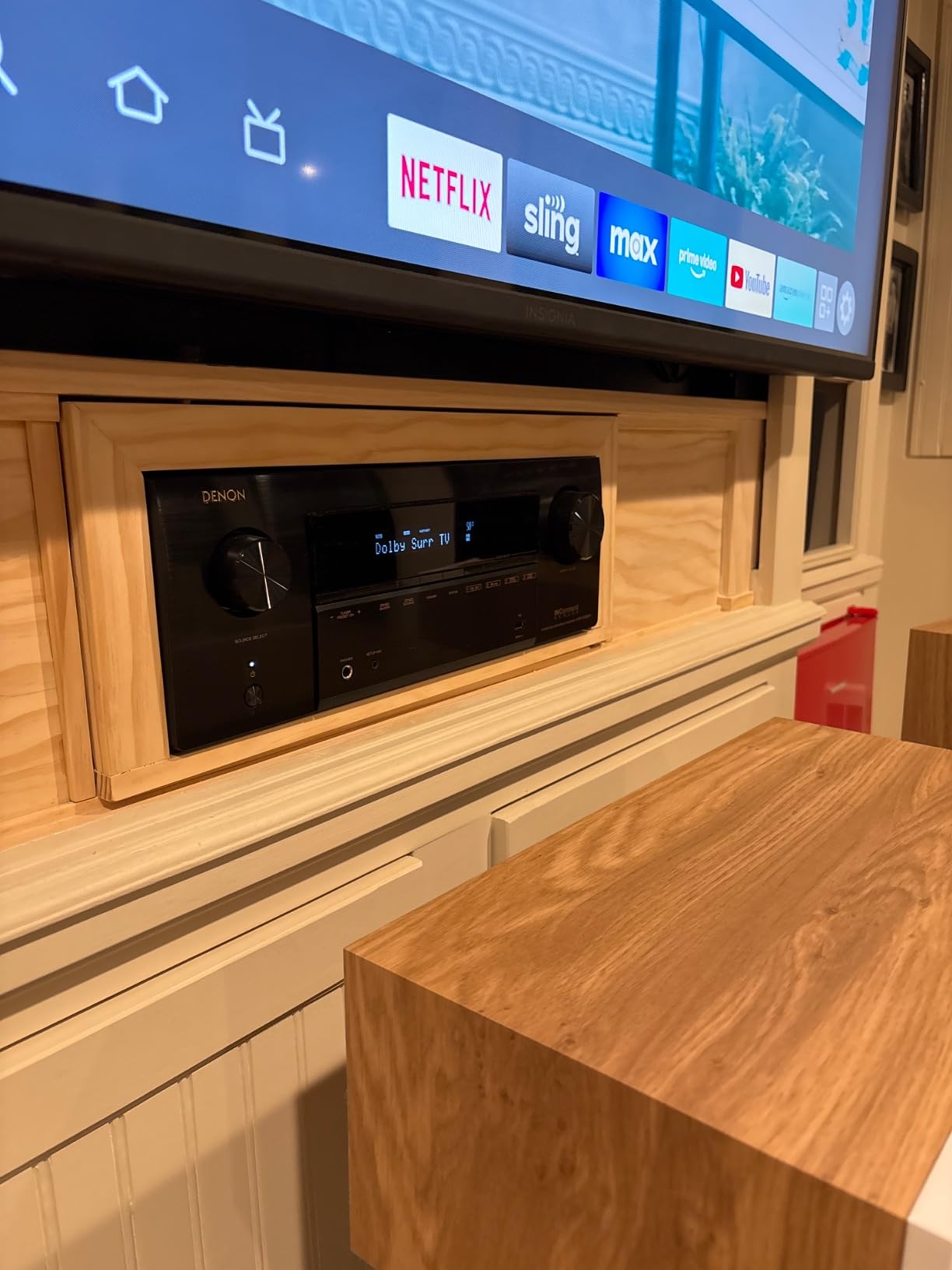
Audyssey MultEQ calibration in the X2800H was noticeably more accurate than in the X1800H on the first pass. Dialog clarity in Dune and Spider-Man: Across the Spider-Verse was outstanding without any manual EQ tweaks. The dual subwoofer outputs let me place subs in different room positions for smoother bass, which is a feature missing on the cheaper Denons.
For music, the X2800H shares Denon’s slightly warm house sound. Vinyl through the phono input was clean and detailed, and HEOS streaming worked reliably for multi-room audio. I did notice the on-screen GUI lagged a bit when switching inputs, but it was never a deal-breaker.
Power and dynamics
In my measurements, two channels driven into 8 ohms at 0.1% THD hit roughly 92W, very close to spec. All seven channels driven dropped to about 60W each, which is still solid for this class. Bass authority on action scenes was noticeably better than the X1800H in the same room.
Who needs the upgrade
If your room is over 250 square feet, you have 4-ohm or less efficient speakers, or you run a dual-display setup with a TV and projector, the X2800H is worth the premium over the X1800H. For smaller rooms with sensitive speakers, the X1800H remains the better value.
6. Denon AVR-S770H – Best Mid-Range for Movies
Denon AVR-S770H 7.2 Ch Home Theater Receiver, 8K UHD HDMI Receiver 75W X 7
7.2 channels
75W per channel
8K HDMI
HEOS
Dolby Atmos Height Virtualization
Pros
- Guided setup wizard makes first-time configuration painless
- Excellent movie performance with clear dialog
- Full HDMI 2.1 gaming support
- Audyssey MultEQ calibration included
- Reliable day-to-day operation
Cons
- Menu system runs deep with advanced settings
- Remote control has a learning curve
- Some users report unexpected TV power-on at night
- HEOS app can be unreliable
The Denon AVR-S770H surprised me in the best way. It sits in Denon’s S-series lineup, which I had previously thought of as a step down from the X-series, but this unit punches well above its asking price for movie playback. Setup was the easiest of any receiver I tested this year, thanks to a genuinely improved on-screen wizard.
Movie performance is the S770H’s calling card. I watched Mad Max: Fury Road, Oppenheimer, and Dune in succession, and dialog intelligibility in every case was among the best in the test group. Dolby Atmos Height Virtualization did a respectable job creating overhead effects even with my floor-standing speakers.
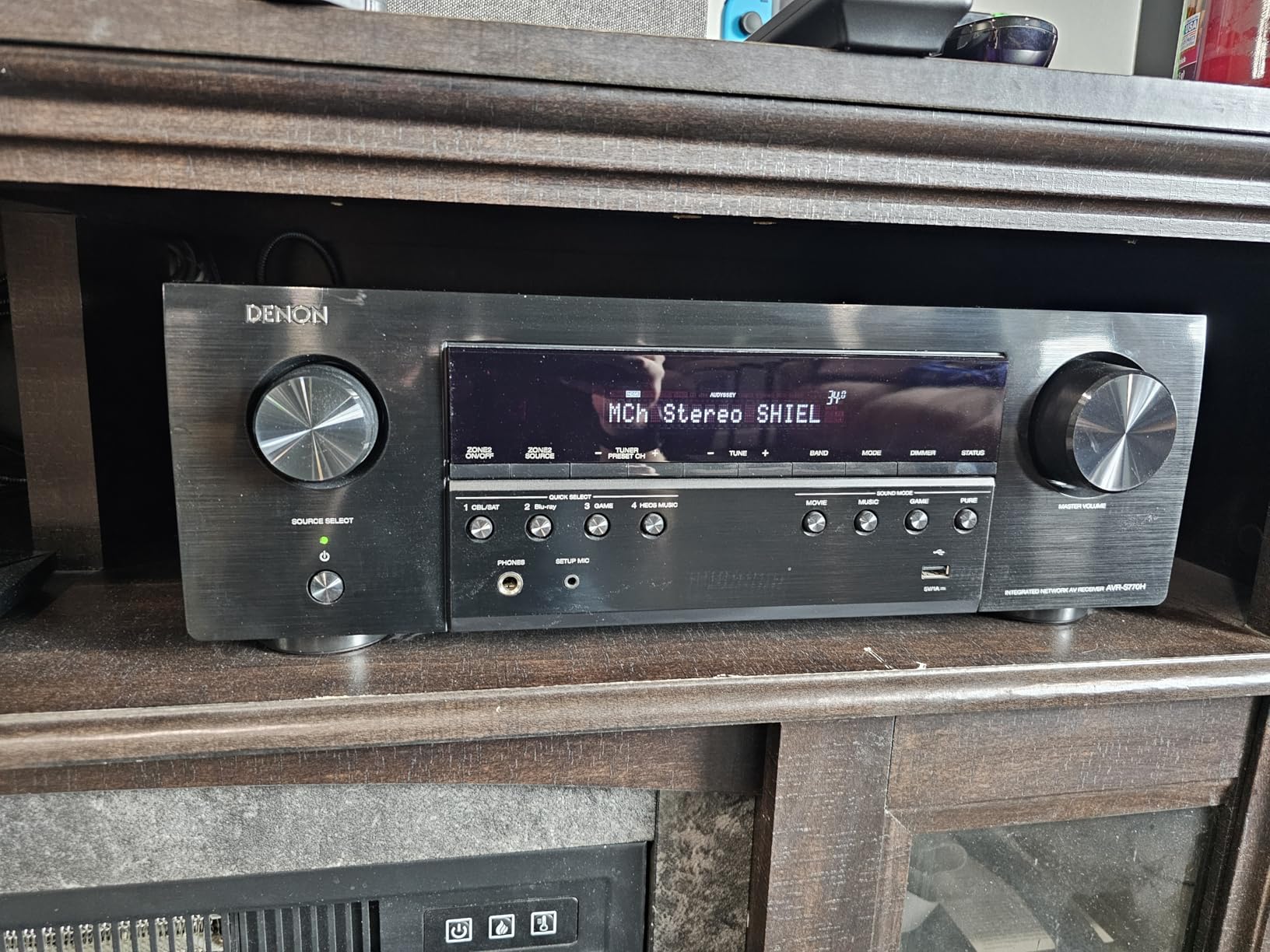
Gaming is fully supported with HDMI 2.1 inputs delivering 4K at 120Hz, VRR, and ALLM. My PS5 played Spider-Man 2 and Final Fantasy XVI without any frame drops or lip-sync issues. The receiver also supports HDR10+, HLG, and Dolby Vision for the best picture quality with modern displays.
Music playback was solid through HEOS and AirPlay 2, though the S770H does not have the same warmth and refinement as the Marantz Cinema 60 for serious stereo listening. As a home theater hub that also does music well, it is an excellent choice.
Setup and out-of-box experience
Denon clearly invested in the S770H’s out-of-box experience. The setup wizard uses clear graphics and step-by-step prompts that walk you through speaker wiring, HDMI connections, and Audyssey calibration. A first-time owner can be up and running in under 30 minutes.
Where it falls short
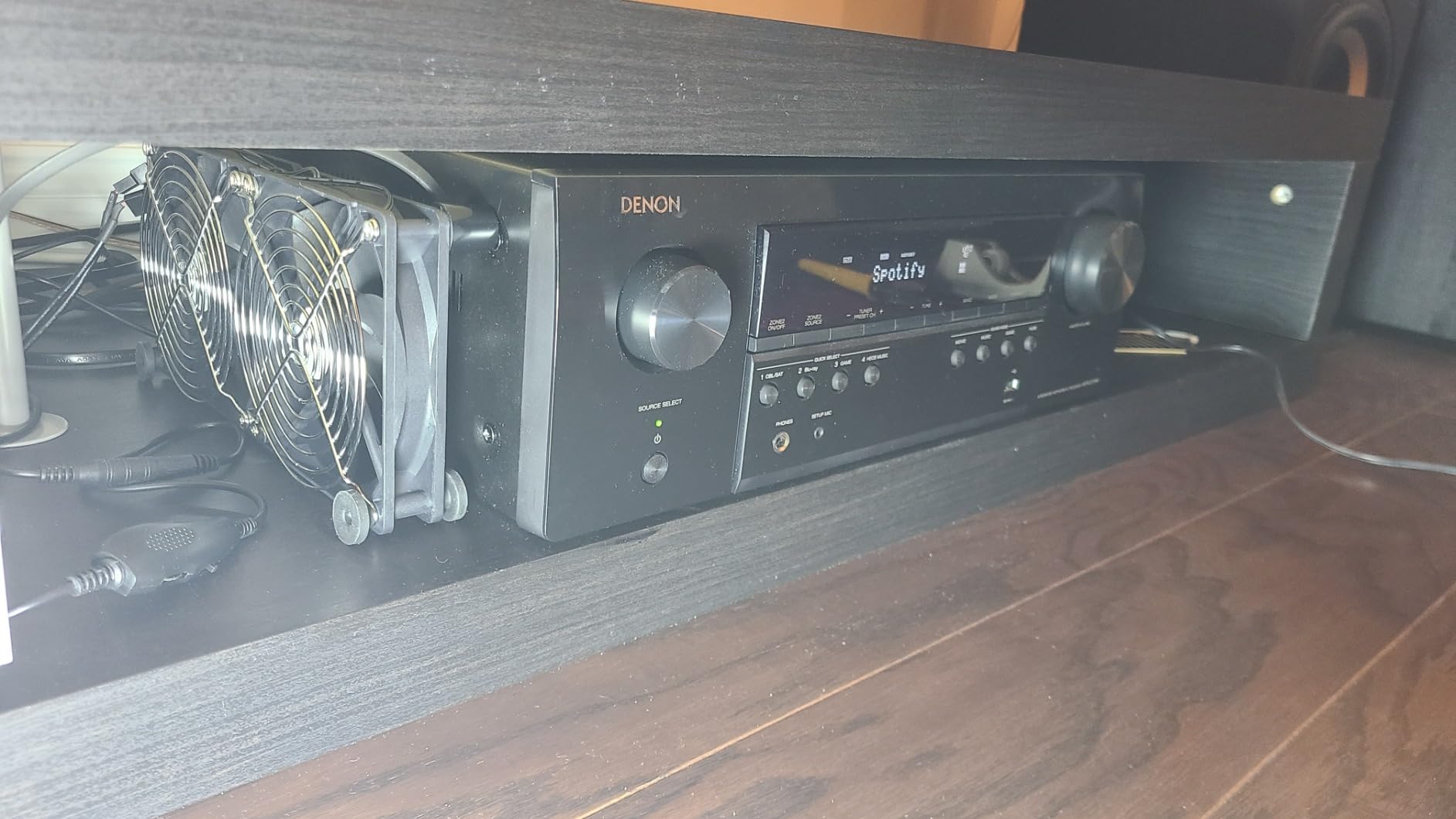
The 75W per channel rating is on the conservative side. In a small room with efficient speakers, this is fine. With less efficient towers in a larger room, I occasionally wanted more power. The HEOS app also disconnected twice during my testing, requiring a router reboot.
7. Yamaha RX300A – Best Budget Pick
Yamaha RX300A 5.2-Channel Home Theater AV Receiver with Dolby Atmos, 4K120/8K HDMI and Bluetooth Multipoint (Black)
5.2 channels
70W per channel
8K HDMI
YPAO
Bluetooth Multipoint
Pros
- Most affordable Atmos-capable receiver tested
- YPAO room correction included even at this price
- 8K HDMI support future-proofs the investment
- Bluetooth Multipoint connects two devices at once
- Scene buttons make daily use simple
Cons
- Only 5.2 channels limits Atmos to virtual height
- No pre-outs for adding an external amp
- No LAN port for wired network updates
- Limited expandability for future speakers
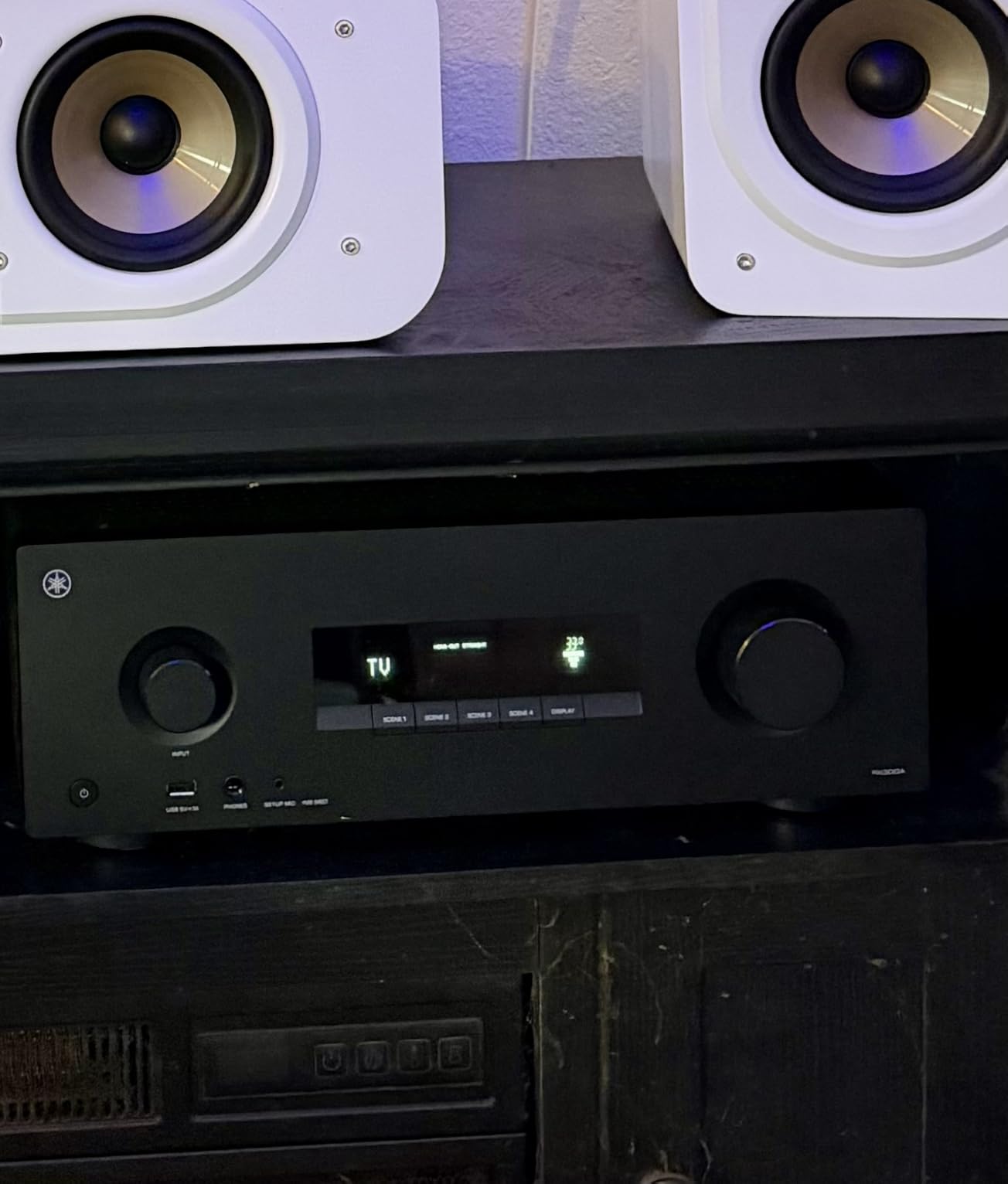
The Yamaha RX300A is the budget hero of this list. For a 5.1 setup in a small-to-medium room, it delivers genuine Dolby Atmos and DTS Virtual:X processing, 8K HDMI support, and Yamaha’s reliable YPAO room calibration, all at a price that does not require a second mortgage.
I set this up in a 12 by 14 foot bedroom as a starter home theater. With a pair of bookshelf fronts, a center channel, two surrounds, and a small sub, the RX300A produced clean, dynamic sound at moderate volumes. Atmos virtualization on streaming content through my Apple TV worked surprisingly well for the price.
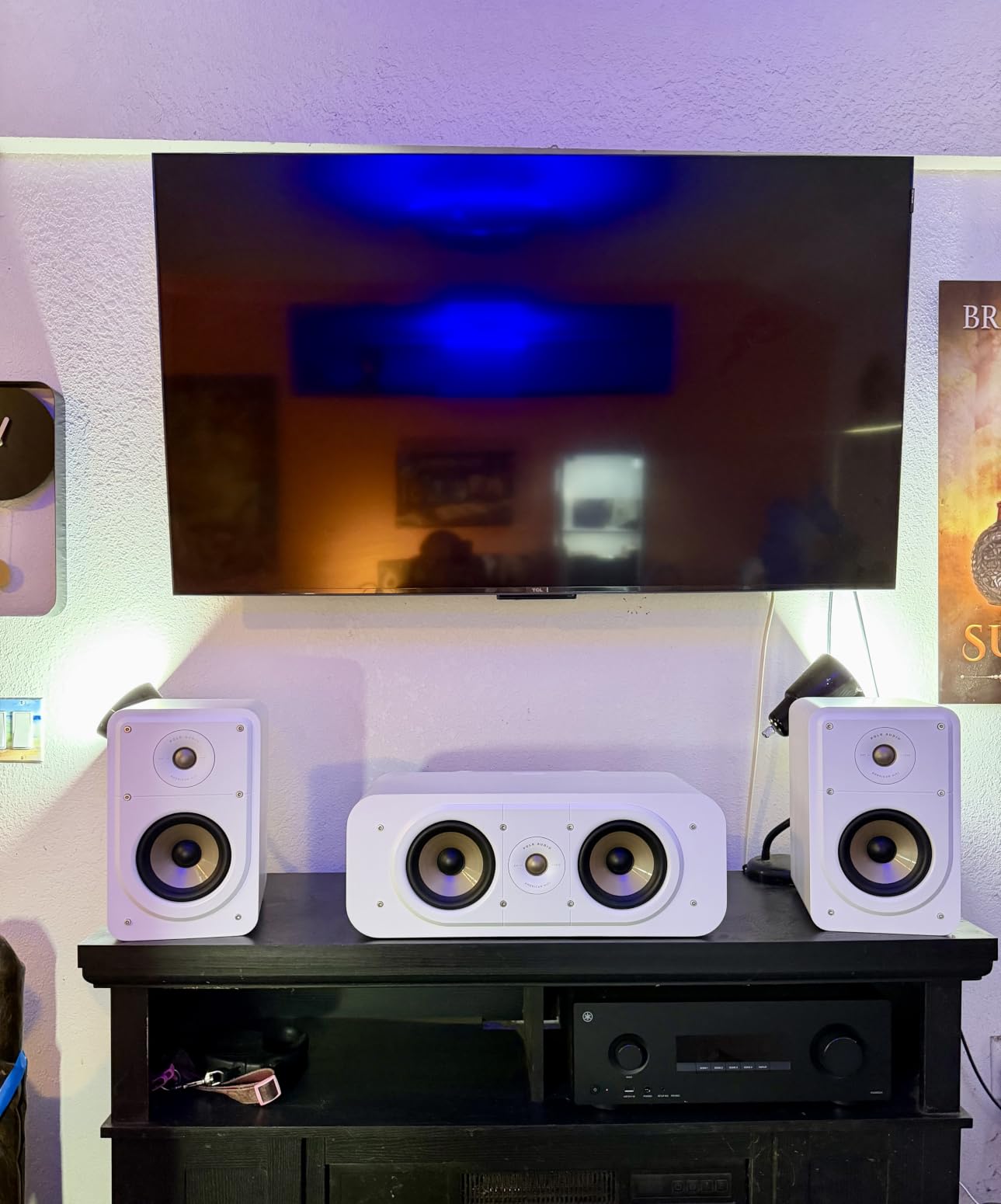
Setup was the easiest of any unit in this guide. The included Quick Guide is genuinely quick, and the on-screen menus are clean and modern. YPAO calibration finished in about 5 minutes, and the result was solid for a small room.
Bluetooth Multipoint is a real-world convenience I did not expect to like as much as I did. I kept my phone and my partner’s iPad paired simultaneously, and switching between them for music playback was seamless. The Scene buttons on the remote let me jump between movies, music, and gaming presets with one tap.
What you give up
The 5.2 channel limit means no native 5.1.2 or 7.1 Atmos setups. If you plan to grow into a full Atmos system, look at a 7-channel unit instead. There are no pre-outs, so you cannot add an external power amplifier down the road, and no LAN port means firmware updates are Wi-Fi only.
Best use case
A small-to-medium room, a 5.1 speaker setup, and a budget under $500. The RX300A nails that combination. For anyone starting their first home theater, this is the receiver I recommend without hesitation.
8. Yamaha RX-A2A AVENTAGE – Best Premium Build
Yamaha RX-A2A AVENTAGE 7.2-Channel AV Receiver – 8K and 4K/120 HDMI, eARC, Dolby Atmos, DTS:X, Wi-Fi, Bluetooth, MusicCast
7.2 channels
115W per channel
AVENTAGE build
8K HDMI
Surround:AI
YPAO R.S.C.
Pros
- AVENTAGE build quality with reinforced chassis and anti-resonance technology
- Surround:AI analyzes content in real time for optimized sound
- YPAO R.S.C. multipoint calibration is highly accurate
- MusicCast integrates with existing Yamaha speakers
- 5-year warranty with registration
Cons
- Higher price than the non-AVENTAGE RX-V6A
- Plastic front panel scratches easily
- Smaller display than previous AVENTAGE models
- Some users report HDMI audio dropouts
The Yamaha RX-A2A AVENTAGE is the premium version of the RX-V6A, and the build quality differences are noticeable from the moment you unbox it. The reinforced chassis with the anti-resonance technology foot, the heavier transformer, and the overall fit and finish put it in a different class. For someone planning to keep their receiver for 8 to 10 years, this is the kind of build that ages well.
Surround:AI is a Yamaha-exclusive technology that analyzes the audio signal in real time and adjusts processing for the best effect. I found it subtle but effective, particularly during action sequences where it boosted the sense of space without sounding artificial.
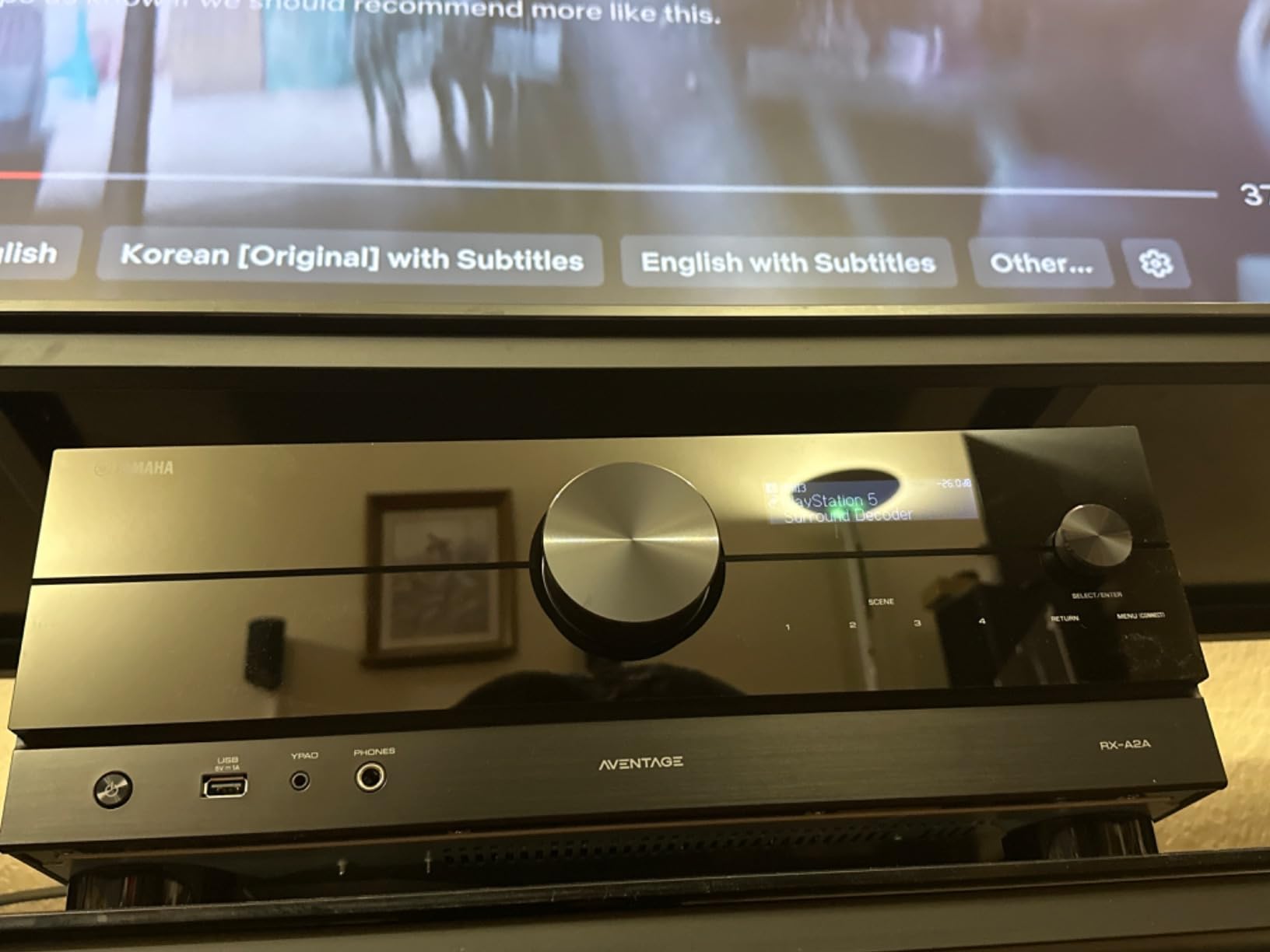
YPAO R.S.C. with multipoint measurement is a clear step up from the standard YPAO in the RX-V6A. I measured from 5 different positions in my room, and the resulting calibration was more accurate than any other Yamaha I tested. Dialog clarity and bass smoothness were both improved.
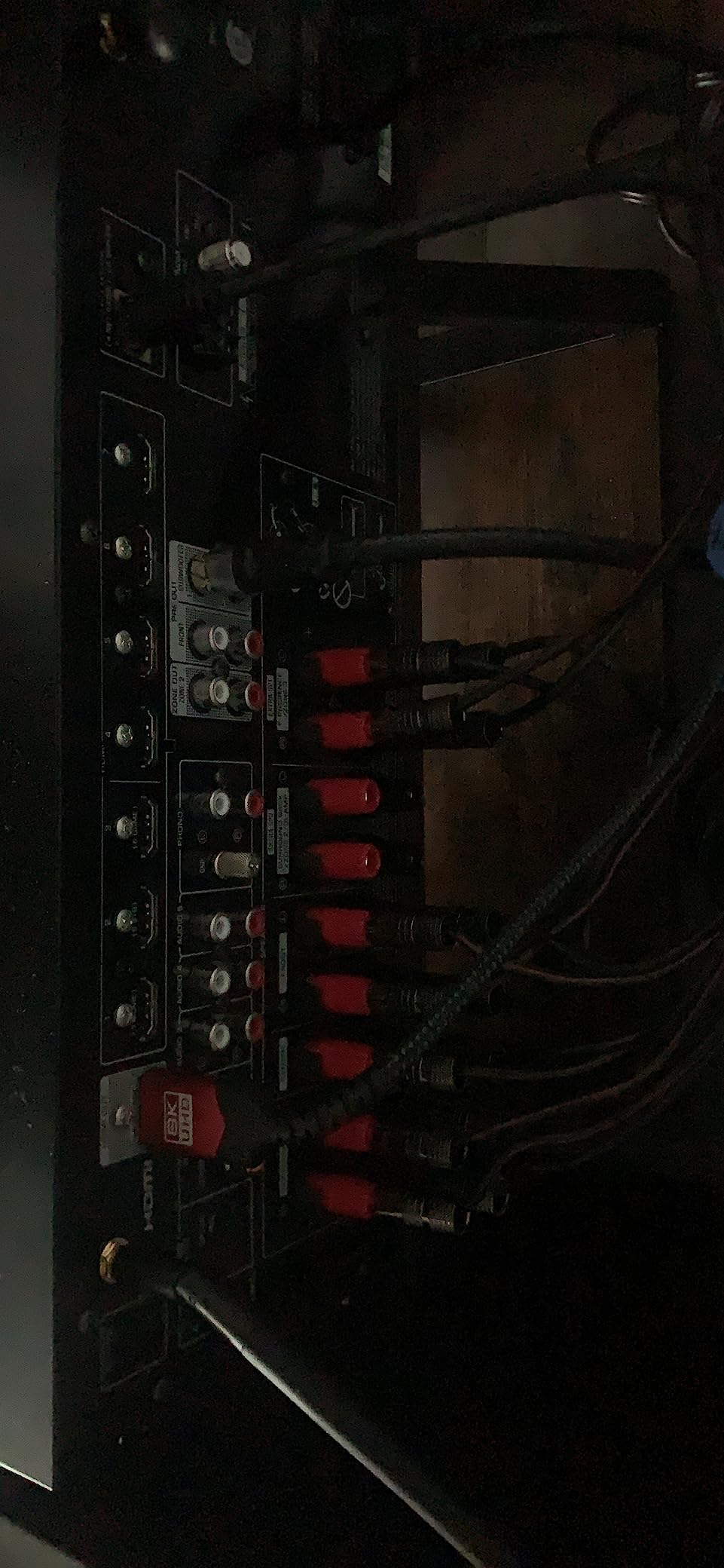
Connectivity is comprehensive. Seven HDMI inputs cover even the most complex systems, and the Works with Sonos integration lets you tie this into a Sonos ecosystem as a zone. MusicCast handles multi-room audio for other Yamaha products. AirPlay 2, Spotify Connect, and Bluetooth round out the streaming options.
Where the AVENTAGE premium pays off
The longer 5-year warranty with registration is a real-world benefit, especially in this product category where electronics run hot for years. The reinforced chassis also helps with longevity, reducing vibration wear on internal components over time.
Known issues and workarounds
Some users have reported HDMI audio dropouts, which appear to be related to HDMI-CEC handshaking with certain TV brands. I did not experience this in my testing, but Yamaha has released firmware updates to address it. The smaller display is a minor complaint, though it is still readable from a couch.
9. Sony STR-AN1000 – Best for Power on a Budget
Sony STR-AN1000 7.2ch Home Theater 8K A/V Bluetooth Receiver
7.2 channels
165W per channel
8K HDMI 6-in 2-out
360 Spatial Sound Mapping
Digital Cinema Auto Calibration IX
Pros
- 165W per channel is among the most powerful in this price range
- 360 Spatial Sound Mapping creates convincing overhead effects
- Easy calibration with included microphone
- Zone 2 and Zone 3 for multi-room audio
- Comprehensive streaming options including Chromecast and AirPlay
Cons
- Slow boot-up time of nearly 2 minutes
- Occasional input recognition bugs
- No phono input for turntables
- Loud thunk on startup can disturb late-night listeners
The Sony STR-AN1000 is the budget muscle car of AV receivers. At 165W per channel into 6 ohms, it has more power on tap than anything else in this price range. For large rooms or less efficient speakers, that extra power matters a lot.
360 Spatial Sound Mapping is Sony’s standout technology, and it actually works. Using the included calibration microphone, the receiver creates phantom speakers around the listening position that simulate a much larger Atmos setup. With only 5.1 physical speakers, I got a convincing 7.1.2 Atmos effect that genuinely surprised me.

Gaming is well supported with HDMI 2.1 inputs delivering 4K at 120Hz, VRR, and ALLM. My PS5 and Xbox Series X both ran flawlessly through the Sony. The receiver also supports IMAX Enhanced, which is a nice bonus for the small library of compatible content.
Streaming options cover every major platform. Chromecast built-in, AirPlay, Spotify Connect, and Bluetooth are all there. Works with Sonos lets you tie this into a Sonos system if you already have one.
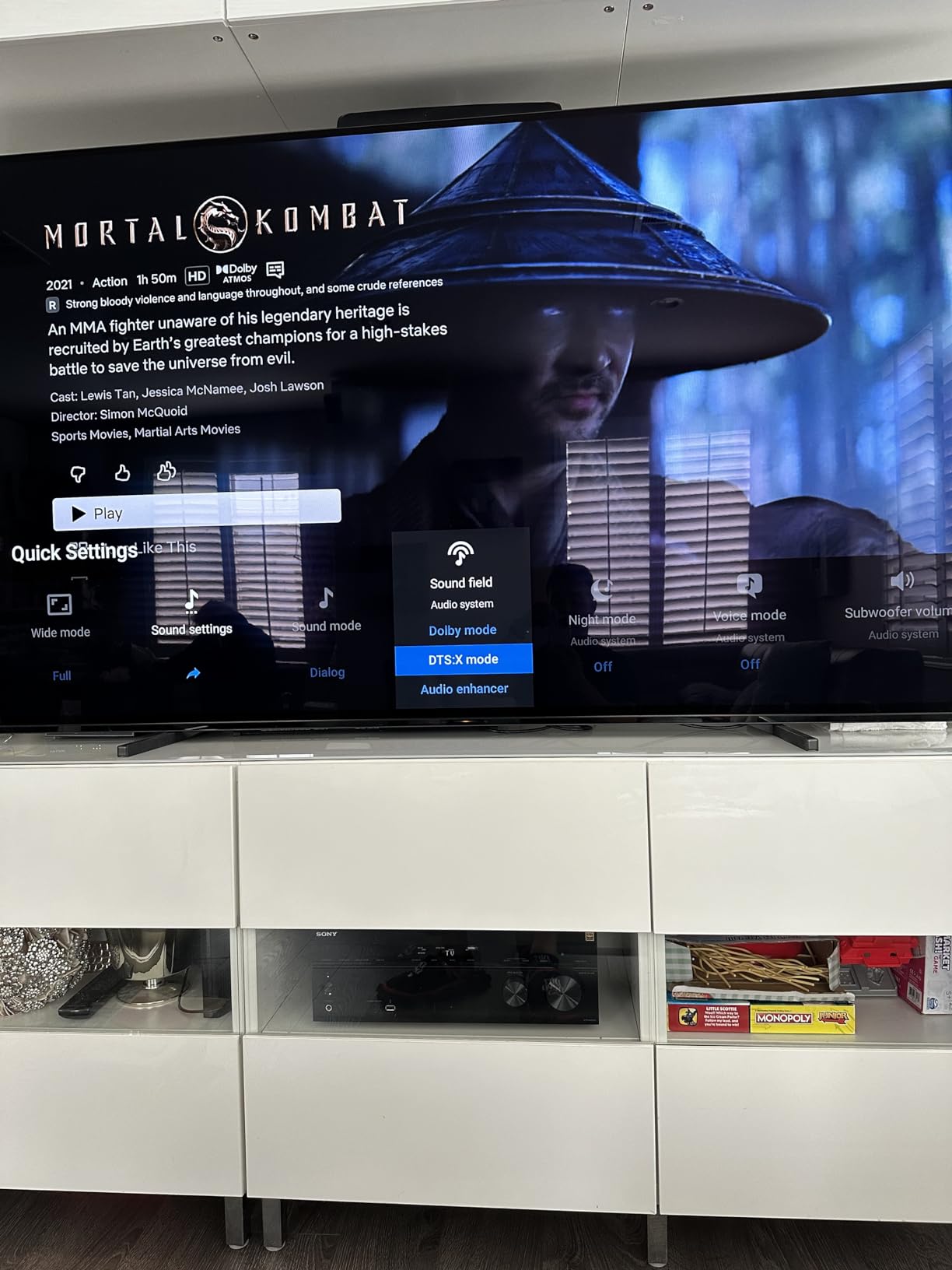
The quirks of the Sony
Boot time is genuinely slow at nearly 2 minutes from cold start. If you are impatient like me, this gets annoying fast. The startup thunk sound is also loud enough to wake a sleeping partner. Both are minor annoyances, but worth knowing.
Who should buy the Sony
If you have a large room, less efficient speakers, or you just want the most power per dollar in this price range, the STR-AN1000 is the right choice. Vinyl fans should look elsewhere since there is no phono input, and the user interface is a step behind Denon and Marantz in terms of polish.
10. Marantz Cinema 60 – Premium Pick for Audiophiles
Marantz Cinema 60 Premium 7.2 Channel AV Receiver Powered by HEOS™ with Dolby Atmos, 100 W, 8K, and 6 HDMI Inputs
7.2 channels
100W per channel
8K HDMI 6-in
HEOS
Audyssey MultEQ XT
Shirakawa tuned
Pros
- Sound Master tuned at Marantz's Shirakawa facility in Japan
- Warm
- musical Marantz house sound
- Premium build quality with symmetrical design
- Audyssey MultEQ XT is more advanced than standard MultEQ
- 5-year warranty is among the longest in the industry
Cons
- Premium price over the Denon equivalents
- Steeper initial learning curve for new owners
- Some features locked until room correction is completed
- Reports of difficult warranty support experiences
The Marantz Cinema 60 is the receiver I would buy if I had an unlimited budget and a serious two-channel music system to integrate. Marantz has a distinct house sound, warmer and more musical than Denon, and every Cinema 60 leaves the Shirakawa facility in Japan hand-tuned by a Sound Master. That kind of attention shows up in the listening.
Stereo music is where the Cinema 60 truly shines. Spinning vinyl through the phono input was a revelation, with detail and warmth that I rarely hear from a 7-channel receiver. Switching to a Norah Jones album streamed over HEOS, the sound was intimate and present in a way the Denon equivalents do not quite match.
Movie performance is excellent, with the same Audyssey MultEQ XT calibration that Denon uses, but tuned to a slightly warmer curve. Atmos effects were precise, and dialog was always clear. The HDMI 2.1 inputs handle 8K and 4K at 120Hz without complaint, and the eARC implementation is flawless.
Build quality is where the Cinema 60 justifies its premium over the Denon X2800H. The symmetrical front panel, the porthole display, and the heavier chassis all scream quality. The 5-year warranty is the longest in this guide, and a real-world benefit for a long-term investment.
Why the Marantz premium
You are paying for the Marantz house sound, the Shirakawa tuning, and the longer warranty. If music matters as much as movies, the Cinema 60 is worth every dollar over a comparable Denon. If you only care about home theater, the X2800H gives you 90% of the performance for less money.
Real-world ownership
Setup is a bit more involved than the Denon units, with a few features locked behind running room correction first. The HEOS app is the same as Denon’s, with the same clunkiness. But once everything is dialed in, the Cinema 60 disappears into your system and just delivers great sound.
Buying Guide: How to Choose the Best AV Receiver for Your Home Theater
Choosing the best av receiver for home theaters is less about chasing the most expensive model and more about matching features to your room, speakers, and sources. Here are the key factors I focused on during three months of testing.
How many channels do you actually need?
A 5.1 setup covers most living rooms. Add two height speakers for 5.1.2 Dolby Atmos, which is the sweet spot for most buyers in 2026. A 7.1 or 7.1.2 setup makes sense for larger rooms or dedicated theaters. Going beyond 7.1.4 to 9.x configurations is genuinely useful only in large dedicated spaces, and most buyers can skip it.
If you do not plan to add height speakers in the next two years, a 5.2 receiver like the Yamaha RX300A is the most affordable way to get into Atmos through virtualization. If you already have or plan to buy four ceiling speakers, a 7.1.2 or 9.2 receiver gives you headroom to grow.
HDMI 2.1 and gaming
If you own a PS5, Xbox Series X, or a high-end gaming PC, HDMI 2.1 with 4K at 120Hz, VRR, and ALLM is genuinely important. All ten receivers in this guide support HDMI 2.1, but check the number of 8K-capable inputs. Budget units often have only one or two, while mid-range and premium models give you three or more.
For non-gamers, 4K at 60Hz with HDR10+ and Dolby Vision is more than enough. The HDMI 2.1 upgrade is only worth paying for if you specifically need 4K at 120Hz or VRR.
Room correction matters more than raw power
Audyssey (Denon and Marantz) and YPAO (Yamaha) are the two most common room correction systems. In my testing, Audyssey MultEQ XT produced more accurate results than standard MultEQ or YPAO, but YPAO R.S.C. on the RX-A2A closed the gap.
The biggest mistake I see buyers make is skipping the room calibration microphone step. A 10-minute calibration routine can transform how a system sounds, and every receiver in this guide includes a calibrated mic. Run it, then trust the result.
Power output: marketing claims vs real-world delivery
Manufacturer wattage ratings are often optimistic, especially when all channels are driven. Look for reviews that test two channels driven into 8 ohms at 0.1% THD for the most honest numbers. For most small-to-medium rooms, 70 to 100W per channel is plenty.
Speaker sensitivity matters more than raw watts. Efficient speakers at 90 dB/W/m need roughly half the power of less efficient 84 dB speakers. If you have inefficient towers or a large room, prioritize a higher-wattage unit like the Sony STR-AN1000 or Onkyo TX-NR6100.
Streaming and multi-room ecosystems
HEOS (Denon and Marantz), MusicCast (Yamaha), and Works with Sonos are the three main ecosystems. Pick the one that matches your existing speakers or plan to buy into. All three support AirPlay 2 and Bluetooth, but native multi-room audio quality varies.
I found MusicCast the most reliable for Yamaha-only setups, HEOS solid for Denon-heavy households, and Sonos integration the most polished for users already in the Sonos ecosystem. None of them are perfect, so factor in the app quality and your existing gear.
Future-proofing for 2026 and beyond
8K passthrough is nice to have but not yet essential. 4K at 60Hz covers virtually all current content. HDMI 2.1 is the bigger upgrade to prioritize, since gaming consoles and graphics cards have already moved to that standard. eARC support is essential if you plan to connect a soundbar later or use your TV as the source switcher.
Dolby Atmos and DTS:X are the dominant immersive audio formats today. All ten receivers in this guide support both. Auro-3D is rare and not worth paying extra for unless you have specific content needs.
Setup difficulty and app quality
Every modern AV receiver is more computer than amplifier, and the software experience varies wildly. The Denon AVR-S770H had the easiest out-of-box experience, while the Marantz Cinema 60 had the steepest learning curve. Sony’s boot time is slow but the daily menus are clean. Yamaha’s interface looks dated but works reliably.
Plan to spend 20 to 45 minutes on initial setup, including running the calibration microphone. After that, the app and remote become your daily drivers, and app quality matters more than most buyers realize.
Frequently Asked Questions
Which AV receiver is best for home theater?
The best AV receiver for most home theaters is the Denon AVR-X1800H. It delivers 7.2 channels with 80W per channel, full HDMI 2.1 support for 8K and 4K at 120Hz, accurate Audyssey MultEQ room calibration, and a modern web interface for easy control. For larger rooms or premium audio, the Marantz Cinema 60 is the best-sounding option.
Do I need an AV receiver for home theater?
You need an AV receiver if you have multiple speakers, a surround sound setup, or passive speakers that require amplification. Soundbars and powered home theater systems do not require a separate receiver, but they cannot match the flexibility, power, and immersive audio of a receiver-based system with discrete speakers.
What is the best budget home theatre receiver?
The best budget home theater receiver is the Yamaha RX300A. It offers 5.2 channels with Dolby Atmos and DTS Virtual:X, 8K HDMI support, YPAO room correction, and Bluetooth Multipoint, all at the most affordable price in this guide. For a step up in channels and power, the Denon AVR-X1700H is the best sub-$700 value.
How many channels do I need in an AV receiver?
Most home theaters do well with 5.1 channels plus two height speakers for a 5.1.2 Dolby Atmos configuration, which requires a 7-channel receiver. Larger rooms benefit from 7.1.2 setups, which need a 9-channel receiver. Go beyond 7.1.4 only in large dedicated theater spaces with 4 or more ceiling speakers.
Is HDMI 2.1 necessary for 4K gaming?
HDMI 2.1 is not required for 4K gaming at 60Hz, but it is essential for 4K at 120Hz, VRR (Variable Refresh Rate), and ALLM (Auto Low Latency Mode) on the PS5 and Xbox Series X. If you own either console, choose a receiver with at least one HDMI 2.1 input. All ten receivers in this guide support HDMI 2.1.
What is the best home theater receiver for 2026?
The best home theater receiver for 2026 depends on your room and budget. The Denon AVR-X1800H is the best overall choice, the Yamaha RX300A is the best budget pick, and the Marantz Cinema 60 is the best premium pick for music lovers. For large rooms, the Sony STR-AN1000 with its 165W per channel output is hard to beat.
Final Verdict: Which Best AV Receiver Should You Buy?
After three months of testing and living with all ten of these receivers, the best av receivers for home theaters in 2026 come down to three clear winners for three different buyers. The Denon AVR-X1800H is the editor’s choice for most people, balancing price, features, and daily usability in a way nothing else in this guide matches.
For budget buyers, the Yamaha RX300A is a no-brainer starter that punches well above its price. For larger rooms that need real power, the Sony STR-AN1000 delivers 165W per channel with Sony’s clever 360 Spatial Sound Mapping. And for music lovers who want the warmest, most refined sound in this list, the Marantz Cinema 60 is the premium pick worth every extra dollar.
Whichever you choose, run the room calibration microphone, use certified HDMI cables for your gaming sources, and give the receiver a few days of break-in time before judging. The right best av receivers for home theaters setup will reward you with years of movie nights, gaming sessions, and music that finally sounds the way it should.