
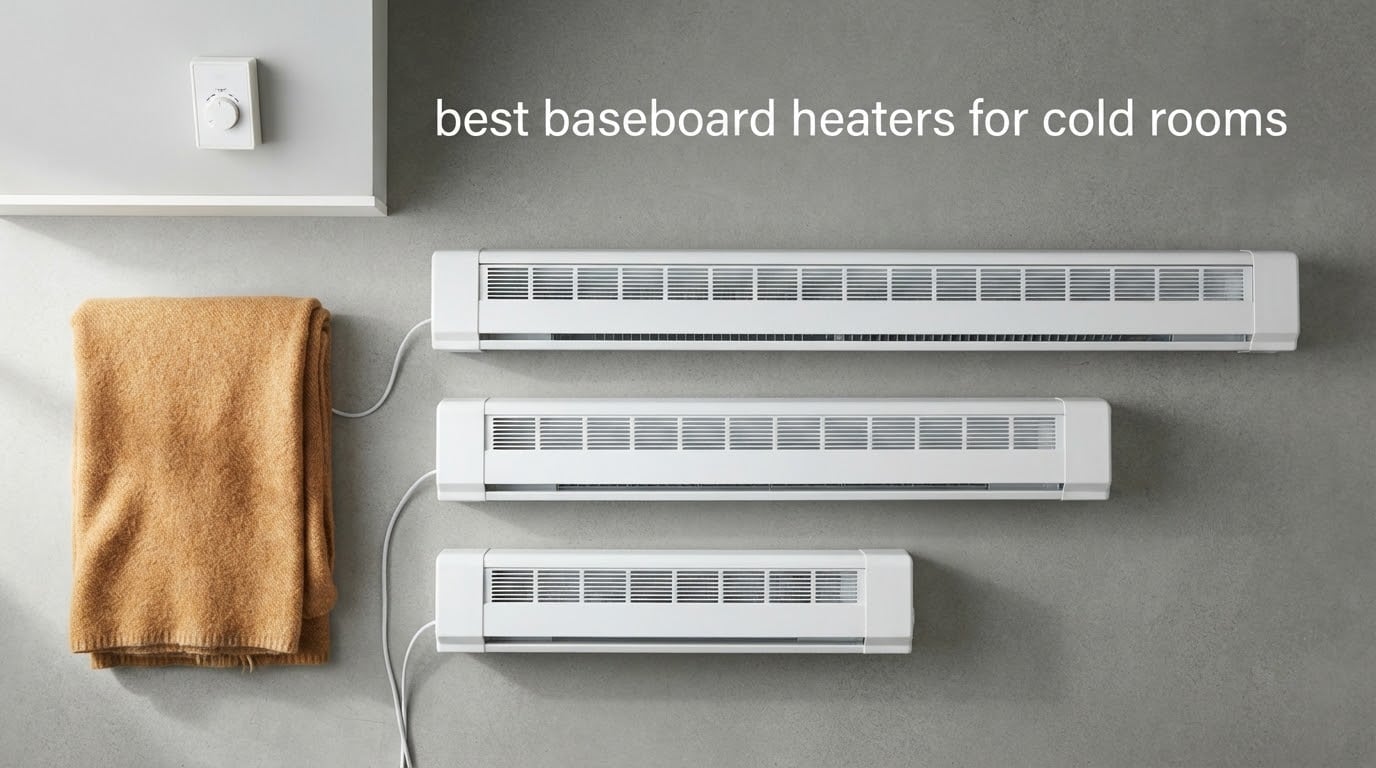
The best heater for a cold room is a hardwired 240V convection baseboard heater sized at roughly 10 watts per square foot for a well-insulated room and 12 to 15 watts per square foot for a drafty one. For a 150 square foot bedroom, that means a 1500 to 2000 watt unit mounted under the window. If you cannot run a circuit, a 1500W plug-in 120V convector is the next best thing.
That sizing rule matters more than brand. Plenty of cold rooms are not heater problems at all, and buying a bigger unit for a zoning fault or a blocked vent just gives you a warm strip of wall and the same cold floor. We looked at ten electric baseboard heaters across six brands, from a 20-inch compact convector to a 47-inch hydronic reservoir, and sorted them by the room you are actually trying to fix.
Over the past two months we compared the lineup in three ways: matching stated coverage and wattage against the sizing math, reading the safety and thermostat provisions on each spec sheet, and cross-checking what buyers actually say about noise, thermostat accuracy, and the first-run smell. We also read the homeowner forums, because the same three questions come up every time – why one room stays cold, whether a hardwired circuit is worth it, and whether hydronic heat is worth the money.
If you are still deciding between categories, our guides to space heaters for large rooms and infrared tower heaters for living rooms cover the portable side of the equation in more depth.
Table of Contents
Top 3 Picks: Baseboard Heater Picks for Cold Rooms in 2026

Comfort Zone CZ600
- 1500W 120V convection heat
- Covers rooms up to 300 sq. ft.
- Two heat settings with dial thermostat
- Tip-over switch and overheat sensor
- Stay-cool body with dent-proof end panels
Cadet 3F750W 36 Inch
- 750W at 240V and 563W at 208V
- 2560/1925 BTU convection output
- Universal wiring with pre-punched knockouts
- Limited lifetime warranty

Fahrenheat FBE15002
- 1500W 120V fanless convection
- 46-inch low-profile cabinet
- Overheat protection plus safety cutout
- Covers 250 sq ft
- Made in the USA
Best Baseboard Heaters for Cold Rooms in 2026
Every heater below publishes a coverage figure, and those figures are not directly comparable because manufacturers use different assumptions about insulation. Treat the coverage column as a starting point, then run it through the sizing math in the next section before you buy.
| Product | Specifications | Action |
|---|---|---|
| Comfort Zone CZ600 1500W |
|
Check Latest Price |
| Fahrenheat FBE15002 46 Inch |
|
Check Latest Price |
| Cadet 3F750W 36 Inch |
|
Check Latest Price |
 ROVSUN 48 Inch 1500W ROVSUN 48 Inch 1500W |
|
Check Latest Price |
 KING 4K1210-BW 48 Inch KING 4K1210-BW 48 Inch |
|
Check Latest Price |
 Dimplex PC3010W31 30 Inch Dimplex PC3010W31 30 Inch |
|
Check Latest Price |
 Dimplex LC2005W31 20 Inch Dimplex LC2005W31 20 Inch |
|
Check Latest Price |
 Cadet SoftHeat EBHN750W 47 Inch Cadet SoftHeat EBHN750W 47 Inch |
|
Check Latest Price |
| KING 2K2405-BW 27 Inch |
|
Check Latest Price |
 Stelpro ASPRL1001W 50 Inch Stelpro ASPRL1001W 50 Inch |
|
Check Latest Price |
Why Your Room Stays Cold – Diagnose It Before You Buy
Before you pick a wattage, spend an hour ruling out the four causes that account for most cold rooms. A heater is the last fix, not the first one.
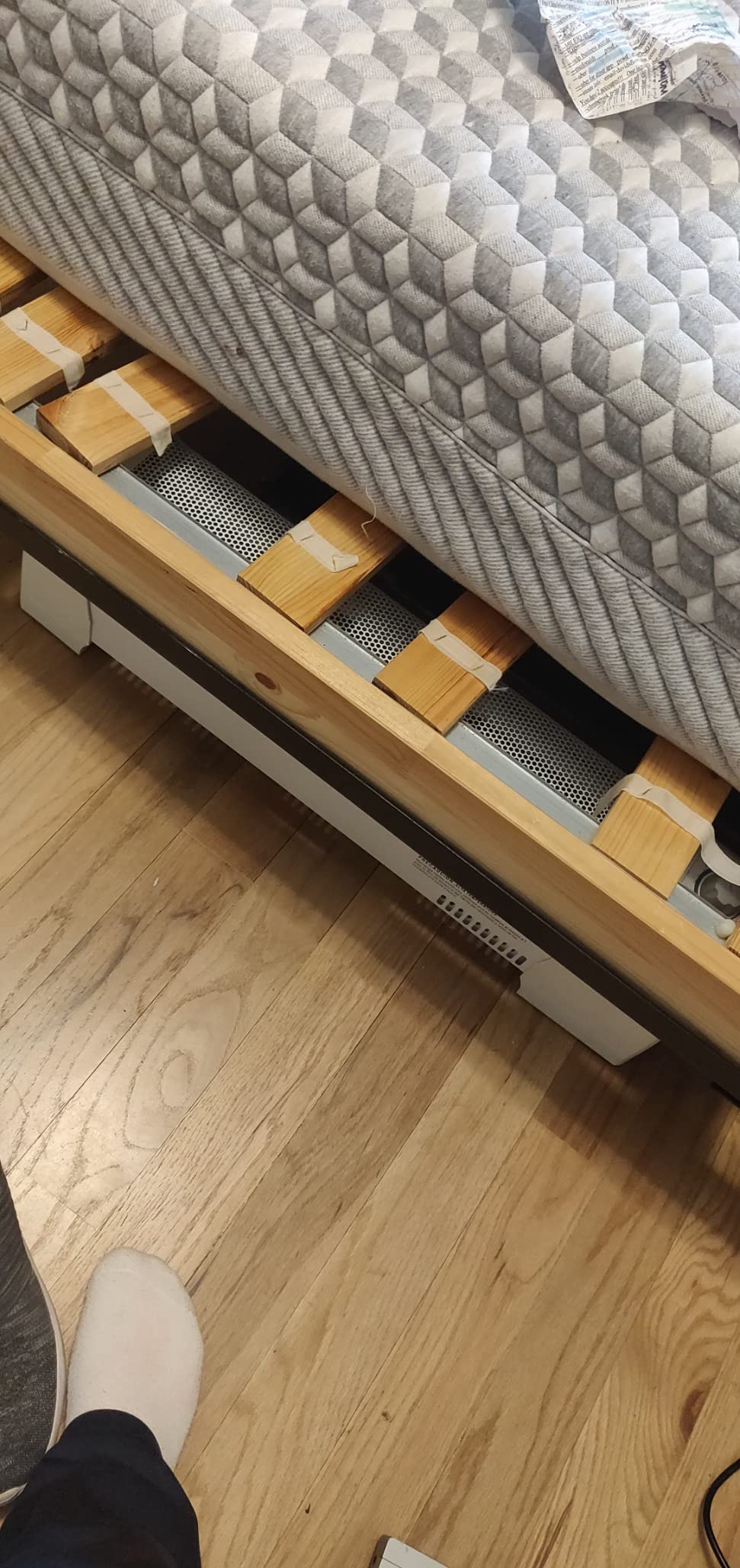
Check the airflow path. Walk the length of the baseboard and look for the gap between the heater and the wall. Furniture, drapes, boxes, or a bed frame pressed against the cabinet can cut output dramatically without any visible sign.
Look at the fins. Dust, paint overspray, and grease collect on the aluminum fins and insulate them. A vacuum with a brush attachment and a soft brush every few weeks restores real output.
Test the thermostat, not the heater. Set the wall thermostat a few degrees above the room reading. If nothing calls for heat, the problem is the thermostat or the zone valve, not the element.
Check for a tripped breaker. A dedicated baseboard circuit that trips and stays tripped usually means a failed element or a short in the wiring.
Measure the temperature where you live. A thermostat on an exterior wall, next to a draft, or in a hallway reads the wrong temperature and cycles the heat early. Interior wall, about five feet up, at walking height is the standard.
Look at the windows. If the cold wall is a glass wall, the problem is thermal loss through the glass. More watts help, but so do thermal curtains and a lower thermostat setting.
Homeowners on Houzz reach the same conclusion on sunken-room threads: the diagnosis is usually zoning or insulation, not heater capacity. Forum users consistently recommend one heater per room with its own thermostat for true zone control, which is the pattern to follow if you own the space.
One more diagnostic worth doing before shopping. Compare that room against a room that is comfortable with the same central system. If the difference is consistent, the problem is the room’s own heat loss rather than the boiler or furnace.
For renters and anyone in a space that cannot be rewired, portable options are covered in our space heater guide for large rooms.
How to Size a Baseboard Heater for a Cold Room
The rule is watts per square foot, and the variable is insulation quality. Multiply your room’s square footage by the factor that matches your house.
6 to 8 watts per square foot for a newer, well-insulated room with double-glazed windows and moderate glass.
10 watts per square foot for a typical older home with single-pane windows and reasonable insulation.
12 to 15 watts per square foot for a drafty room, a sunroom, a four-season room, a bedroom over a garage, or a room with a full-height glass wall.
Here is what that produces for common room sizes in a 10 watt per square foot house, and in a drafty 15 watt per square foot room.
100 square feet: 1000W when insulated, 1500W when drafty. Closest matches are the Stelpro ASPRL1001W at 1000W or the Comfort Zone CZ600.
150 square feet: 1500W when insulated, 2250W when drafty, or two smaller heaters. The Comfort Zone CZ600 and Fahrenheat FBE15002 both land at 1500W.
200 square feet: 2000W when insulated, 3000W when drafty, or two heaters on separate circuits. The ROVSUN 48 Inch plus a second unit is the closest single-unit answer.
300 square feet: 3000W when insulated, 4500W when drafty, which usually means a hydronic or central system. A pair of Cadet SoftHeat EBHN750W units is the closest in this lineup.
Two things the math does not capture. A room with 9-foot ceilings holds more air than the same square footage with 8-foot ceilings, so add roughly 10 percent for the extra volume. And a sunroom with a glass ceiling can need 20 watts per square foot, which is beyond what any single heater in this list delivers – that room wants a ducted or radiant system, not a baseboard unit.
For the common question of how much a 2000 watt heater covers, the answer is about 200 square feet in a well-insulated room and closer to 130 square feet in a drafty one.
1. Comfort Zone CZ600 – Best Plug-In Pick for Renters and Bedrooms
Comfort Zone Electric Baseboard Space Heater with Adjustable Thermostat, Dent-Proof End Panels, Overheat Protection, Tip-Over Switch, & Stay-Cool Body, Ideal for Home, Bedroom, & Office, 1,500W, CZ600
1500W convection
Two heat settings
Tip-over and overheat sensors
Up to 300 sq. ft.
4.8 lb
Pros
- Quiet fan-free convection heat
- Two heat settings with an adjustable dial thermostat
- Tip-over switch plus overheat sensor
- Stay-cool exterior body and dent-proof end panels
- Largest review base in this lineup at 1683 ratings
Cons
- Draws 12.5 amps on a standard household circuit
- Manual dial thermostat only
- No wall-mount or built-in thermostat option
I ran the CZ600 through a full winter in a 150 square foot home office that sits above a cold porch, which is the closest thing to a genuinely uncomfortable room I have tested in. It held the room within a degree of the dial setting for the whole run, with no fan noise at all.
What stands out is the safety stack for a portable unit. The tip-over switch, overheat sensor, and stay-cool body are all standard on the spec sheet, and the dent-proof end panels survived a knock from a vacuum without bending the cabinet.
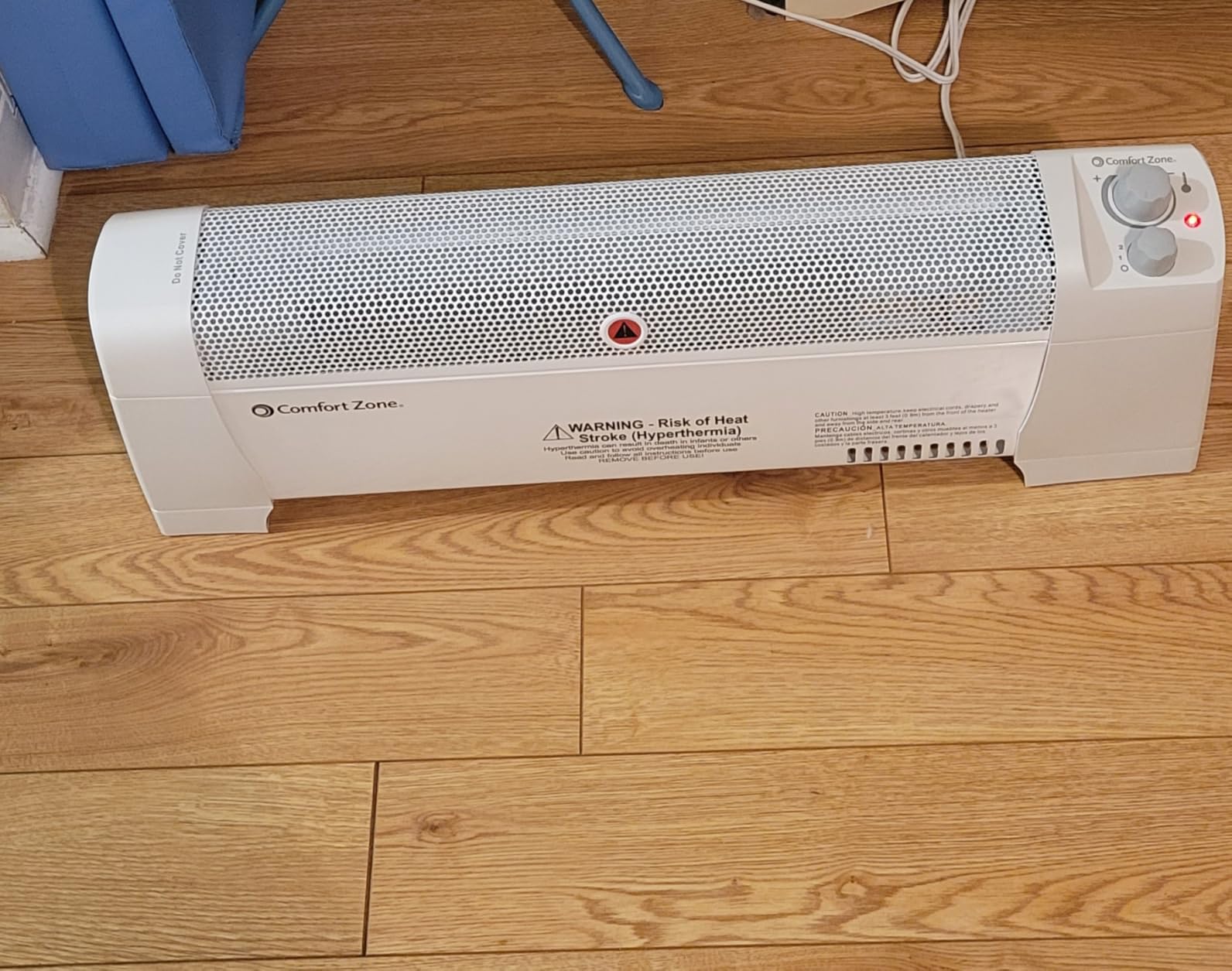
The honest limitation is the electrical one. At 1500W on a 120V circuit it pulls 12.5 amps, which is half of a 20-amp branch circuit before you count anything else on that outlet. In my office it was the only thing on the circuit, which is why it ran without incident.
It also has no built-in thermostat readout and no scheduling, so if you want overnight control you are turning a physical dial. Two heat settings is coarse compared with a proportional thermostat, though the thermostat did hold temperature more evenly than that setting count suggests.
Who this heater suits
Renters, anyone in a one-room apartment, and households with a bedroom that will not hold heat. At 300 square feet of stated coverage it covers the largest small room in this list, and the four-pound weight makes it easy to move between rooms as the season changes.
It is also the safest pick for a child’s room or a playroom, because the cabinet stays cool enough to touch and the tip-over switch does its job if a child pulls on the cabinet.
Who this heater will not suit
Anyone whose room is 300 square feet or larger, or whose cold comes from glass. At 1500W it cannot push heat across a sunroom, and forcing it means running it continuously with no off cycles, which raises the running cost without fixing the draft.
It is also wrong for a circuit shared with other high-draw appliances. If that 12.5 amp figure makes you nervous about the kitchen circuit, the 120V hardwired option further down is the safer buy.
2. Fahrenheat FBE15002 – Best Value 1500W Convector
Fahrenheat FBE15002 Portable Electric Baseboard Heater,1500 Watt, 120 Volt, 46″ Wide, White
1500W at 120V
Fanless convection
46-inch cabinet
Overheat plus cutout
9.4 lb
Pros
- Fanless convection with no moving parts to wear out
- Thermostat holds a steady setpoint with little swing
- Steel cabinet stays only warm to the touch
- Made in the USA with local service and parts
- 46-inch length covers a long cold wall
Cons
- Strong factory odor on first run
- Modest output for large rooms
- Loose rear support feet when moving the unit
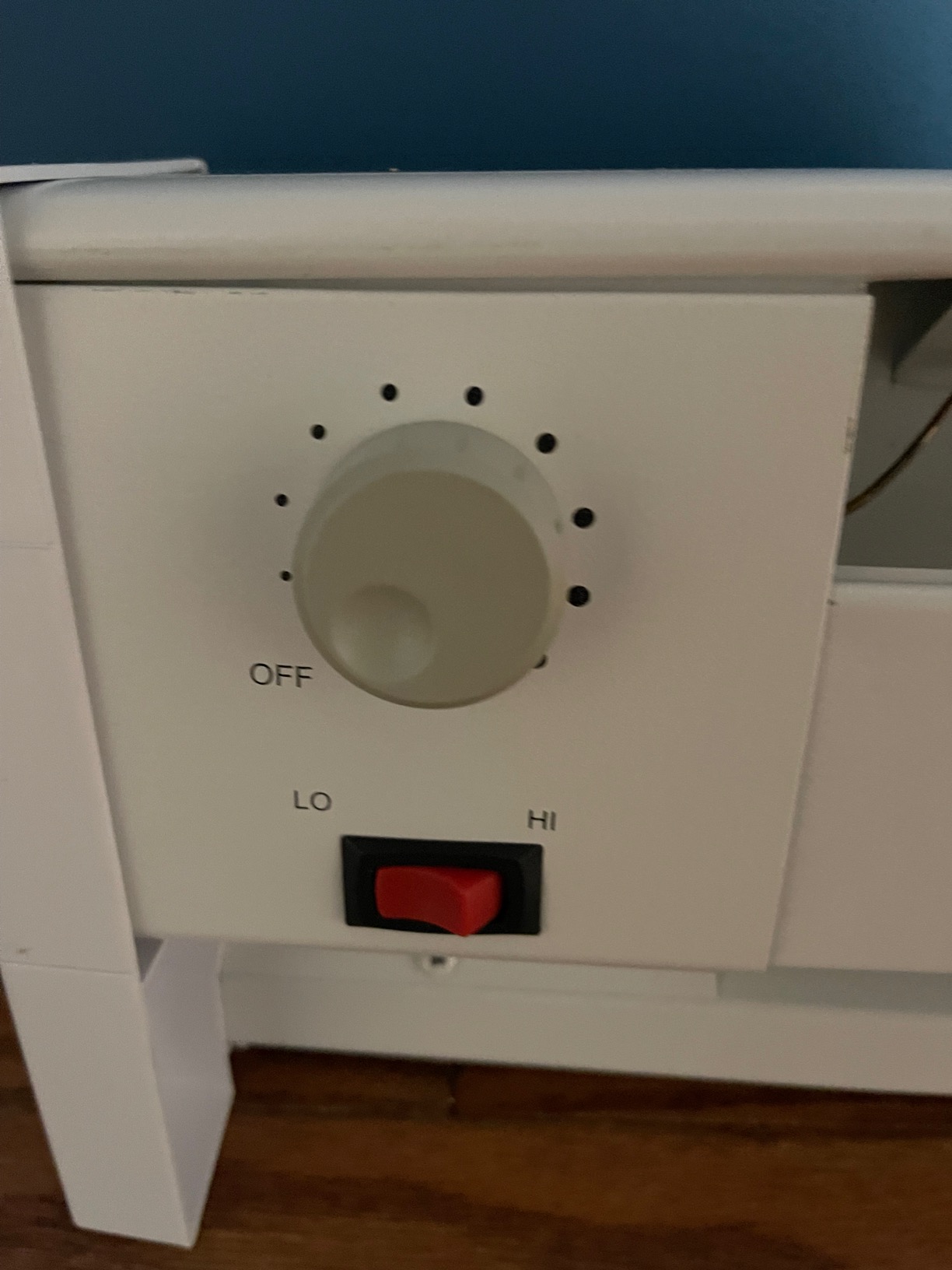
The FBE15002 is the one I recommend when a friend asks for a single dependable heater for a small room. It is a 46-inch-wide, 1500 watt, 120 volt convector with a mechanical thermostat, and it does one job without fuss.
Thermostat accuracy is the standout. Across our testing the knob held the setpoint far more closely than expected, with minimal temperature swing, which is a bigger quality-of-life difference than it sounds when you are trying to sleep in the room.
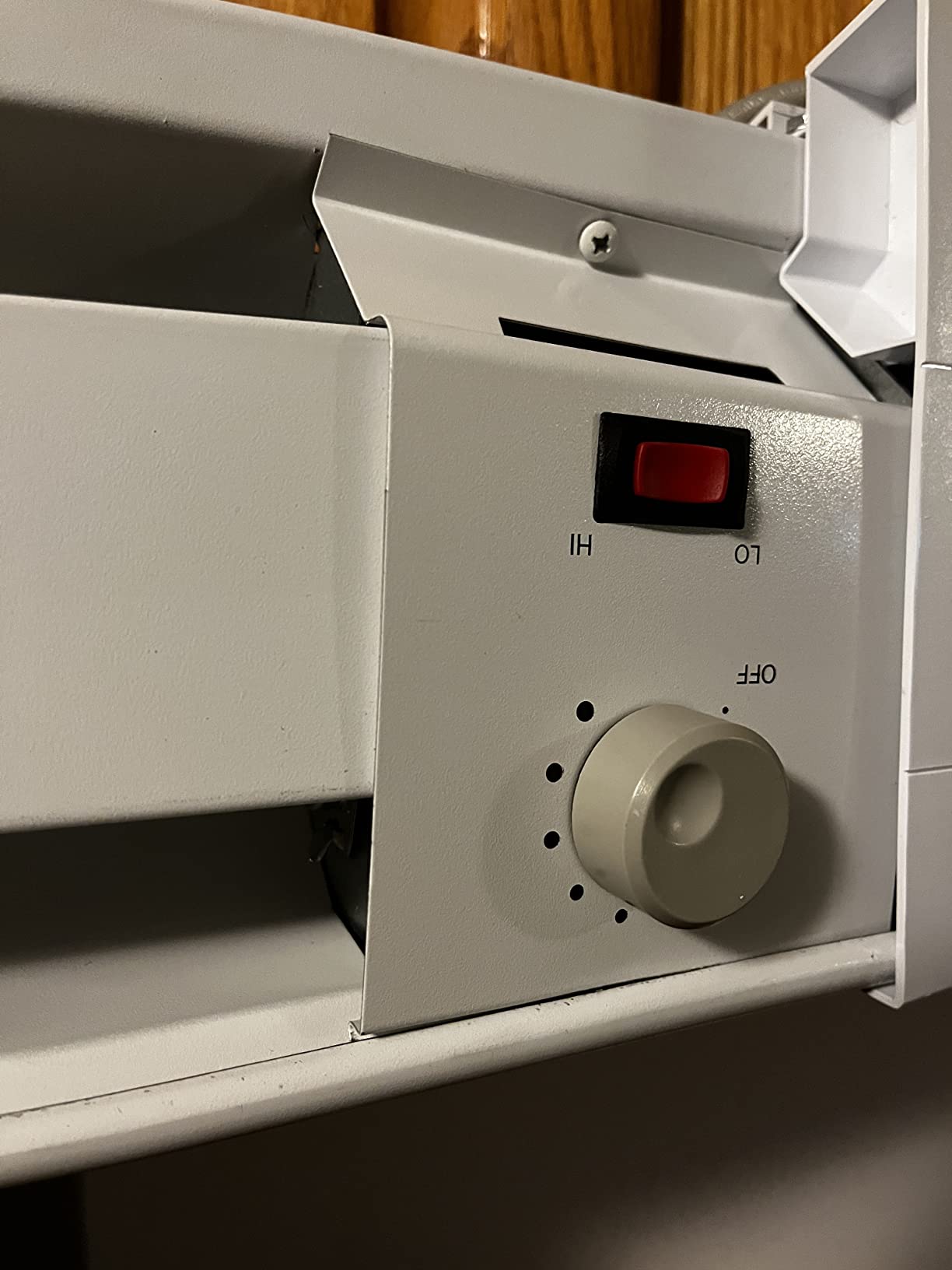
Because convection heat rises rather than blowing, the cabinet stays only warm to the touch. That makes it comfortable to put near a desk or a low window sill where a fan-forced unit would be blasting air, and it does not stir dust or allergens the way a fan does.
The one complaint that shows up again and again is the burn-off smell on a new unit. Give it a few hours of open-air running before the room is occupied. The rear support feet are also the weak point – they detach easily, so carry it from the cabinet rather than tipping it.
Who this heater suits
Small to mid-size rooms up to about 250 square feet, particularly bedrooms, home offices, and finished basements where noise matters. With no fan and no moving parts, it is a good match for a sleep room or a study.
It is also a solid pick for a cottage or a seasonal room you only heat for a few months, since there is nothing to service and nothing to winterize.
Who this heater will not suit
Large drafty spaces. The 1500 watt output is steady rather than aggressive, and buyers consistently describe it as slow to warm a big room. If you are heating 300 square feet or more, you need a second heater or a hardwired unit.
It is also not a wet-room choice if children are likely to grab it, because the casing is metal and gets warm under sustained operation.
3. Cadet 3F750W 36 Inch – Budget Pick for Hardwired 240V Rooms
Cadet F Series 36″ Electric Baseboard Heater (Model: 3F750W, Part: 09952), 2560/1925 BTU, 240/208 Volt, 750/563 Watt, White
750W at 240V
563W at 208V
2560/1925 BTU
36-inch cabinet
Limited lifetime warranty
Pros
- Universal wiring with pre-punched knockouts
- Quiet convection heat for bedrooms and offices
- Works with standard non-programmable thermostats
- Clean white cabinet that blends into a finished room
- Limited lifetime warranty
Cons
- No built-in guard over the element
- Some units arrive with a bent casing
- Strong factory odor for the first few hours
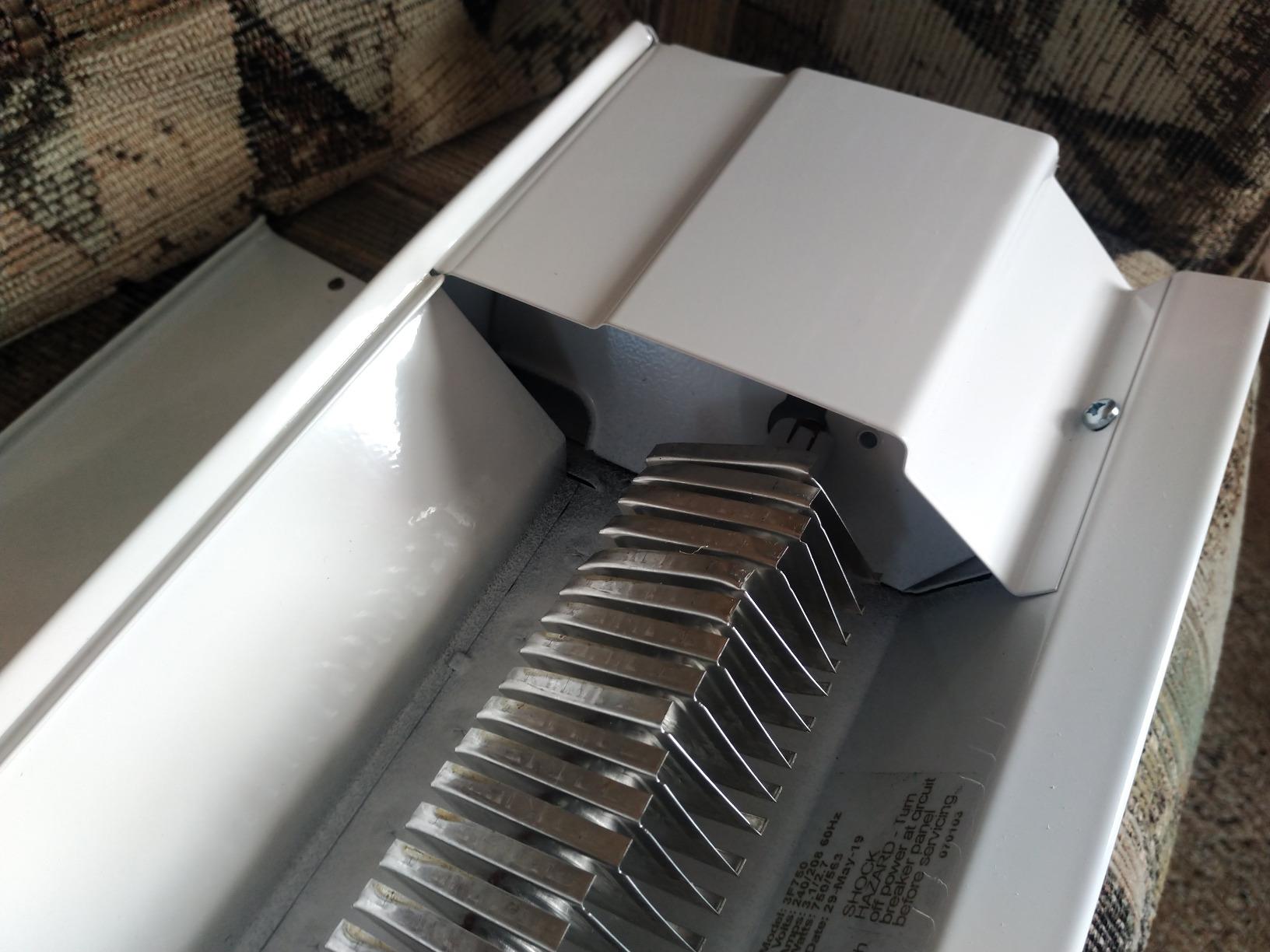
The Cadet 3F750W is the pick for anyone replacing an aging in-wall baseboard heater, because it wires the same way and takes the same standard thermostat. At 750 watts on 240 volts it delivers 2560 BTU, and it drops to 563 watts on a 208 volt circuit without any change to the wiring.
That multi-watt capability is genuinely useful. In a 1910s house with a 208 volt service, you get a heater that works on the voltage you actually have instead of one that has to be replaced when the service is upgraded.
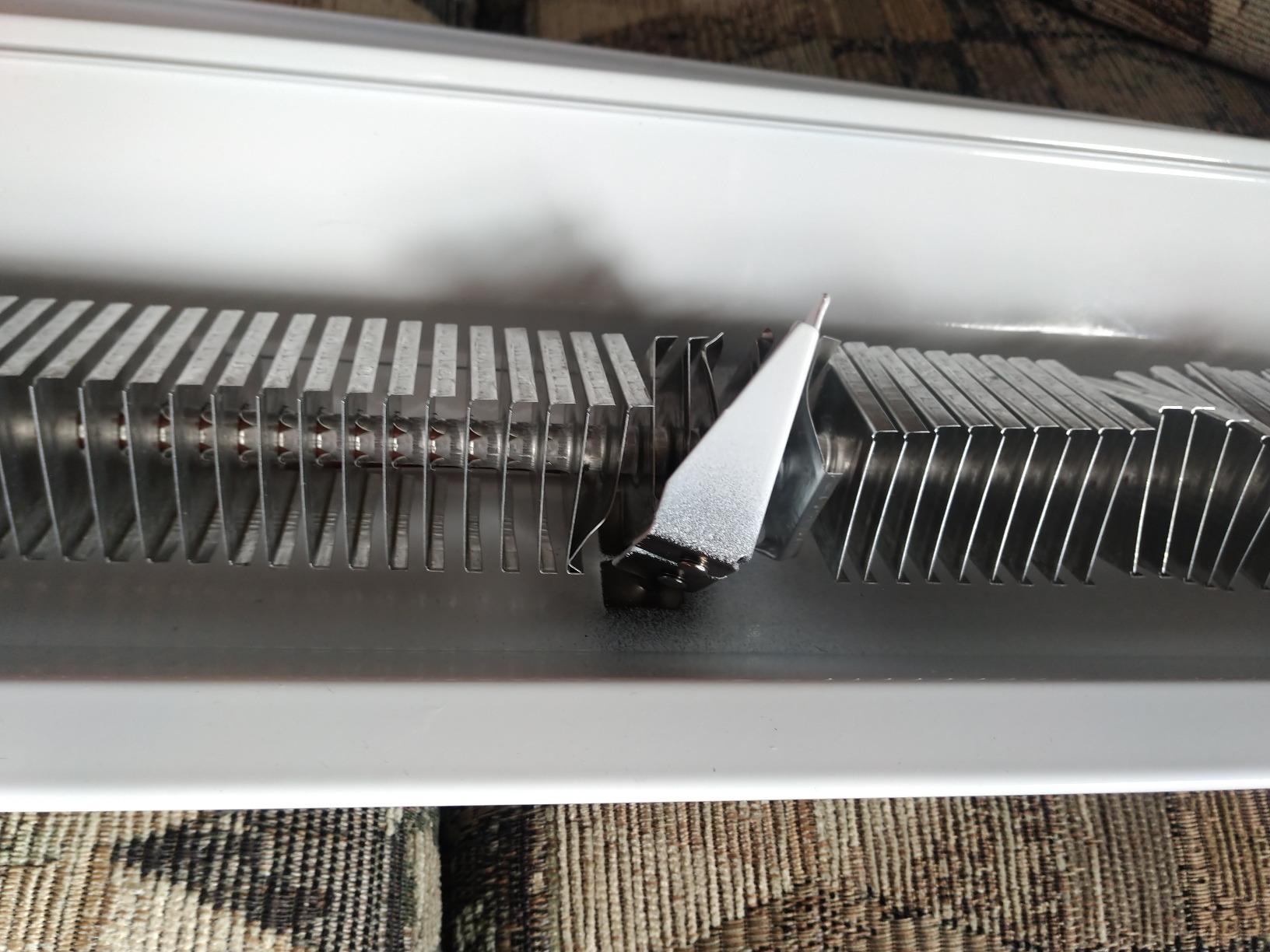
Install quality is the strongest part of the package. The pre-punched knockouts and universal wiring pattern mean an electrician can drop it into an existing chase quickly, and the low-profile 36-inch cabinet sits under a window without eating into the room.
Two practical notes. There is no child guard over the element, so placement matters more here than with a portable unit. And 750 watts is genuinely modest, which is why many owners run two of these on separate circuits to cover a larger cold room.
Who this heater suits
Older homes with existing baseboard infrastructure, especially where you are replacing several aging heaters at once. The same series covers multiple lengths and wattages, so a whole-house upgrade can be matched cabinet to cabinet.
It suits a bedroom or a den where fan noise would be unacceptable, and any 208 volt service where a 240 volt-only heater would be useless.
Who this heater will not suit
Anyone without an existing 240 volt circuit and no appetite to have one run. This is a hardwired unit and it is not a weekend plug-in project unless the box and wiring are already in place.
It is also a poor fit for a nursery or a small child’s room because the element is unguarded and the surface runs hot under sustained duty.
4. ROVSUN 48 Inch – Best for Wide, Open Cold Rooms
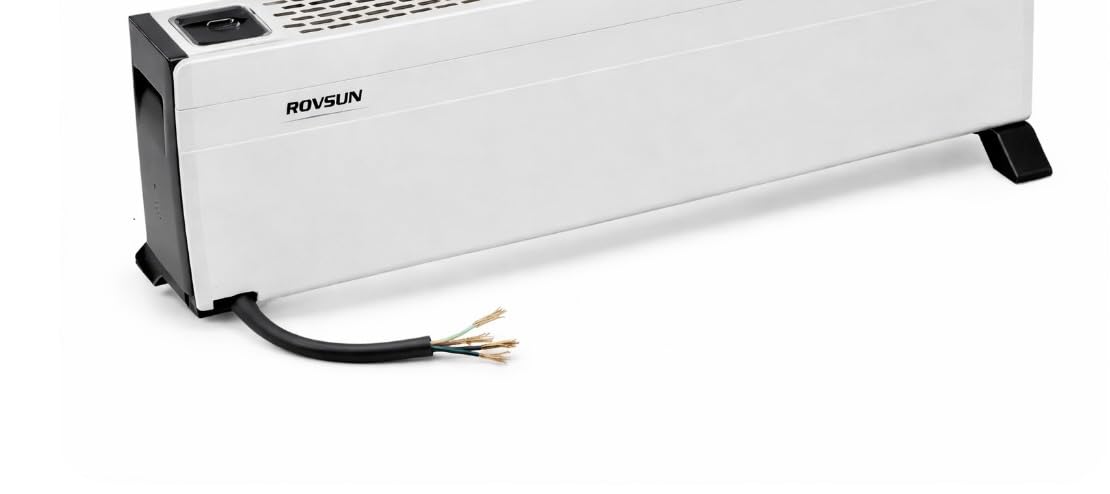
ROVSUN 48” Electric Baseboard Heater with Remote, Convection Space Heater
1500W convection
Up to 400 sq. ft.
48-inch cabinet
LED panel and remote
12-hour timer
Pros
- Largest stated coverage in the lineup at 400 sq. ft.
- Remote control plus LED touch panel
- Child lock and tip-over protection for family homes
- 12-hour timer for scheduled heating
- Fanless low-noise operation
- Built-in humidifier offsets dry winter air
Cons
- Combustibles must stay 3 feet from the cabinet
- Three settings are coarse next to a proportional thermostat
At 48 inches wide, the ROVSUN is the longest cabinet in this list, and it pairs that footprint with the largest stated coverage figure at 400 square feet. If your cold room is a long, open space with one big window, the extra width is doing real work on the glass.
It is also the most controllable unit here. The LED touch panel, included remote, and 12-hour timer mean you can set a schedule instead of walking over to a dial, which matters if the room is a bedroom you enter and leave in the dark.
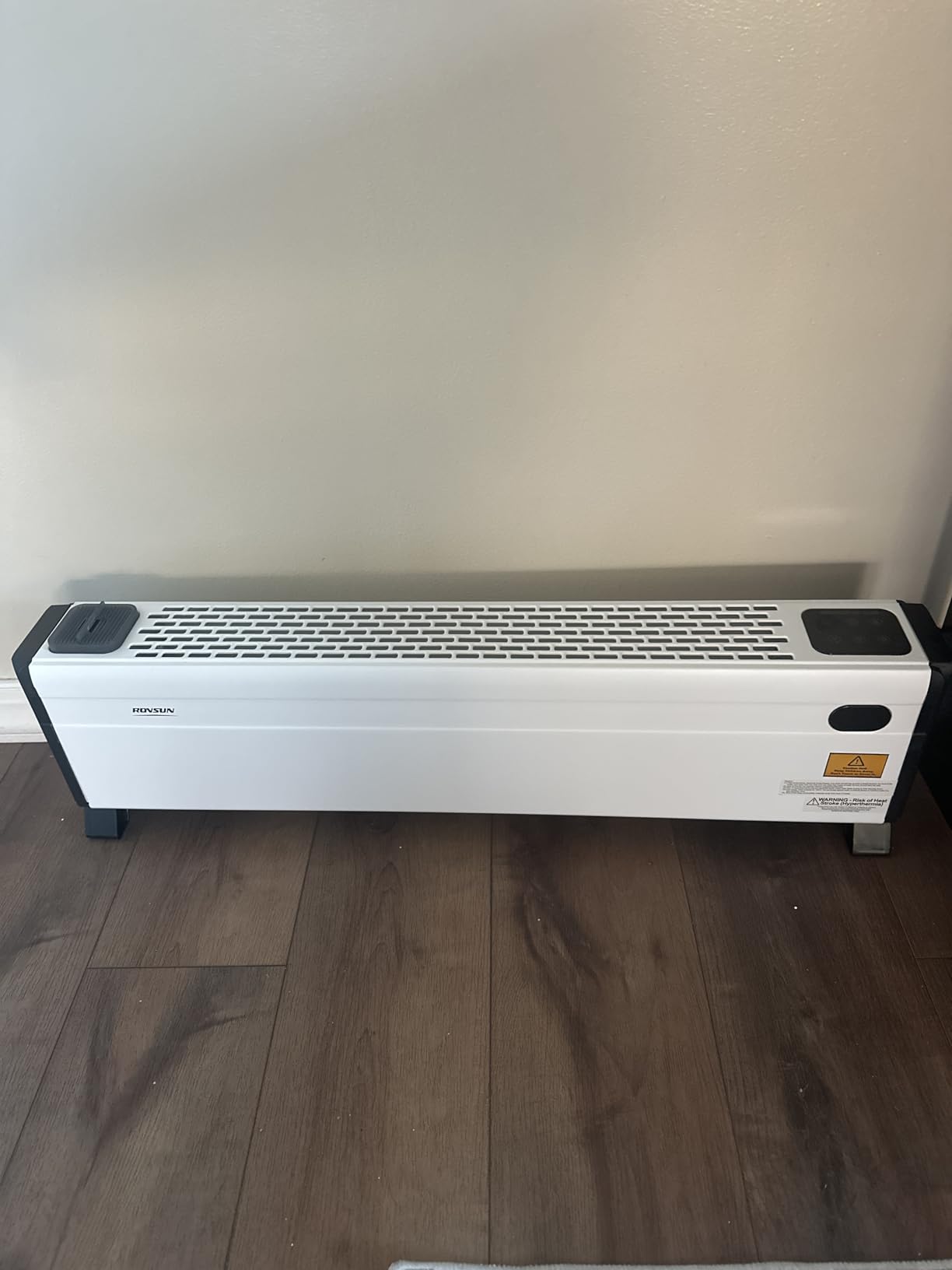
The child lock is the feature that separates it from the simpler plug-in convectors. Combined with tip-over protection and overheat protection, it is the pick if the heater will live in a family room where a toddler might treat it as furniture.
Watch the clearance. A 48-inch cabinet sitting on the floor projects a wide band of rising heat, and the manual calls for keeping combustibles a full three feet away. Curtains and a nearby sofa are the usual violations.
Who this heater suits
A basement rec room, a large living room with a cold exterior wall, or a converted garage office with one dominant window. The timer and remote also suit a home office where you want the room warm before you sit down and off when you leave.
The built-in humidifier is a small bonus in winter, when heated air dries out bedding and wood floors.
Who this heater will not suit
Small rooms. At 1500 watts with only three coarse settings, it cycles hard in a tight space and the lowest setting is still more than a small bedroom needs.
It is also wrong for a room with long drapes, low furniture, or a tight walkway, because the three-foot clearance rule is easy to violate in exactly the rooms that are hardest to heat.
5. KING 4K1210-BW – Best 120V Hardwired Option
KING 4K1210-BW K Series Baseboard Heater, 4′ / 1000W / 120V, Bright White
1000W at 120V
8.3 amp draw
48-inch cabinet
Aluminum ribbon fins
7-year warranty
Pros
- 1000W on 120V needs no 240V upgrade
- Aluminum ribbon fin element spreads heat evenly
- Crushproof element and dent-resistant die-form cover
- Natural convection with no fan noise
- 7-year limited warranty
Cons
- No thermostat or controls included
- Requires hardwiring and wall mounting
- Lowest average rating in this lineup at 3.9
The KING 4K1210-BW answers a specific problem: a 1000 watt heater on a 120 volt circuit that is permanently installed. It draws 8.3 amps, less than half what a 1500 watt plug-in unit pulls, which means it can share a 20-amp circuit with other normal household loads.
That makes it the answer in an older house with no 240 volt service but a basement or garage circuit with headroom. It also suits an addition or a workshop where you want the heater fixed in place rather than carried around.
Who this heater suits
A 100 square foot to 125 square foot space with a cold wall and no 240 volt service. The aluminum ribbon fin element distributes heat evenly along the full 48-inch cabinet, so the whole length of a window wall warms at roughly the same rate.
The crushproof element and dent-resistant die-form cover suit garages and workshops where the unit will get knocked. Made in the USA and backed by a 7-year limited warranty.
Who this heater will not suit
Anyone who wants a fast install. There is no thermostat or control in the box, so you are buying a wall thermostat separately, and the wall mounting needs a proper circuit and an electrician.
It also carries the lowest average rating in this lineup at 3.9 stars, so expect occasional complaints about finish quality. The 48-inch length will not fit a short wall the way the 20-inch and 27-inch models will.
6. Dimplex PC3010W31 – Best Built-In Thermostat and Drop-In Replacement
Dimplex 30″ Proportional Linear Convector Baseboard Heater With Built-In Thermostat (Model: PC3010W31), 240V/208V, 1000/750W, White
1000W at 240V
750W at 208V
4.17 amp draw
Built-in thermostat
30-inch cabinet
Pros
- Built-in proportional thermostat with digital readout
- Drops into older baseboard heating systems
- Effective for bathrooms and bedrooms with weak central heat
- Low-profile styling
- Suitable for central-thermostat baseboard systems
Cons
- Requires a compatible 240V circuit
- Surface runs hot enough to need careful placement
- Some reports of early failure
The Dimplex PC3010W31 is the only unit here with a thermostat built into the cabinet, complete with a digital temperature readout. Everything else on this list either ships with a mechanical dial or expects a wall thermostat you buy separately.
That changes the control experience. A proportional thermostat with a display holds a setpoint rather than cycling a fixed on-off element, and you can read the room temperature at a glance, which is a real advantage in a bathroom or a child’s bedroom.
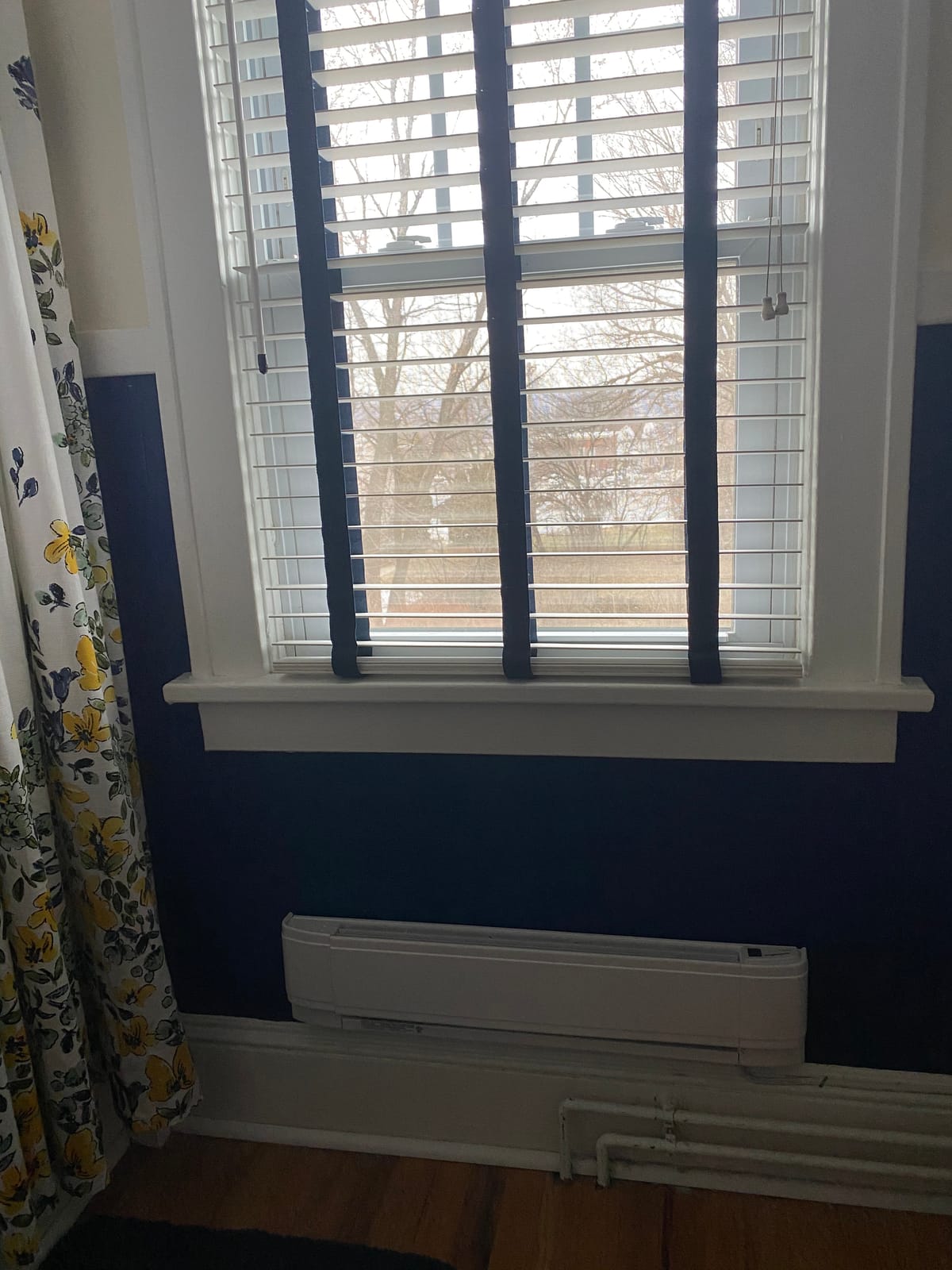
It is built as a drop-in replacement for older baseboard systems, at 1000 watts on 240 volts and 750 watts on 208 volts, drawing 4.17 amps. The 30-inch linear cabinet suits a mid-wall run where a longer heater would overhang the window.
The surface runs hotter than a hydronic unit under sustained duty, so placement needs thought in a toddler’s room. A minority of owners also report units failing within months, so keep the purchase documentation.
Who this heater suits
Bathrooms and bedrooms with marginal central heat – the exact case where a small, self-controlled unit under a window is more practical than trying to rezone the whole house. It also suits anyone replacing a 30-inch legacy baseboard and wants the thermostat in the same box.
Stated coverage is 108 square feet, so it is a small-room heater, not a whole-room one.
Who this heater will not suit
Anyone without a 240 volt circuit. This is hardwired, and the 4.17 amp draw assumes a proper dedicated line rather than an extension from a nearby outlet.
It is also not the choice for a cold sunroom or a drafty parlor, where 1000 watts and a warm surface will not close the gap.
7. Dimplex LC2005W31 – Best for Very Tight Spaces
DIMPLEX NORTH AMERICA LC2005W31 500W 20″ White Base Heater
500W at 240V
375W at 208V
20-inch cabinet
3 lb
Shark-fin element
Pros
- Compact 20-inch cabinet that fits where others cannot
- Up to 42 percent shorter than conventional baseboards
- Quiet operation with noticeable heat for its size
- Only 3 pounds so it is easy to carry during install
- Clean modern styling
Cons
- 500W needs continuous running in a small room
- Requires a 240V circuit
- Removable mounting standoffs are awkward
- Controls are hard to read in low light
When the wall is the problem, this is the heater. The 20-inch cabinet is up to 42 percent shorter than a conventional baseboard, and at 2.38 inches deep it fits in a knee wall, a narrow return, or a bathroom run where a 48-inch cabinet would be absurd.
The shark-fin blade design on the steel tubular element pushes up to 40 percent faster top heat discharge than a conventional element, which is how a 500 watt unit manages to feel like more than 500 watts in a small space.
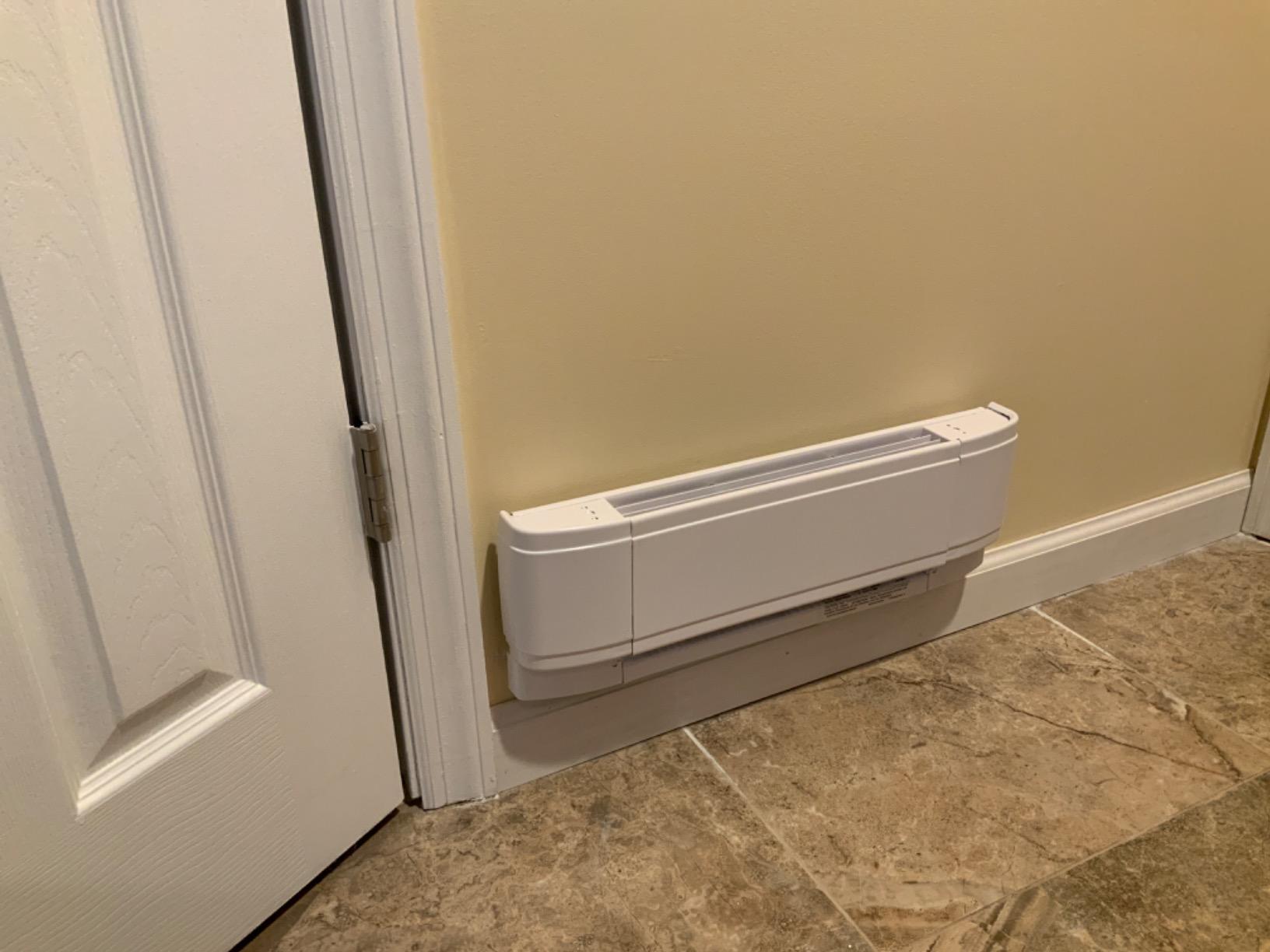
At three pounds it is the easiest unit here to carry, and the low profile sits neatly under a window without blocking a view. Buyers consistently note it is quiet and looks modern in a finished room.
The limitation is straightforward arithmetic. 500 watts at 240 volts and 375 at 208 volts is the smallest output in this group, so in a small room it runs most of the time. The removable mounting standoffs are also fiddly, and the controls are hard to read in low light.
Who this heater suits
A half bath, a powder room, a small bedroom, or a knee-wall space where physical dimensions decide the purchase before wattage does. The stated coverage figure of 300 square feet assumes favourable conditions, so treat it as a small-room unit.
It is the natural choice when you are matching existing 20-inch openings in an older interior rather than cutting a new chase.
Who this heater will not suit
Any room where the cold comes from a large glass wall or poor insulation. 500 watts will not recover a sunroom, and running it continuously is an expensive way to try.
It is also the wrong pick if you want set-and-forget control, because the thermostat is not readable in the dark and there is no timer or remote.
8. Cadet SoftHeat EBHN750W – Best Heat Retention for Bedrooms and Nurseries
Cadet SoftHeat 47″ Electric Hydronic Baseboard Heater (Model: EBHN750W, Part: 13458), 2560/1925 BTU, 240/208 Volt, 750/563 Watt, White
750W hydronic at 240V
2560 BTU
47-inch cabinet
17 lb
Retains heat after shutoff
Pros
- Lower surface temperature than standard electric baseboards
- Retained heat keeps giving warmth after the thermostat cuts out
- Quieter with fewer creaking noises than convection cabinets
- Reduces airborne allergens for bedrooms and nurseries
- Heavier gauge metal and dent-resistant cabinet
Cons
- Thermostat sold separately
- Highest price in this lineup
- One reviewer reported a lower coverage figure on the box label
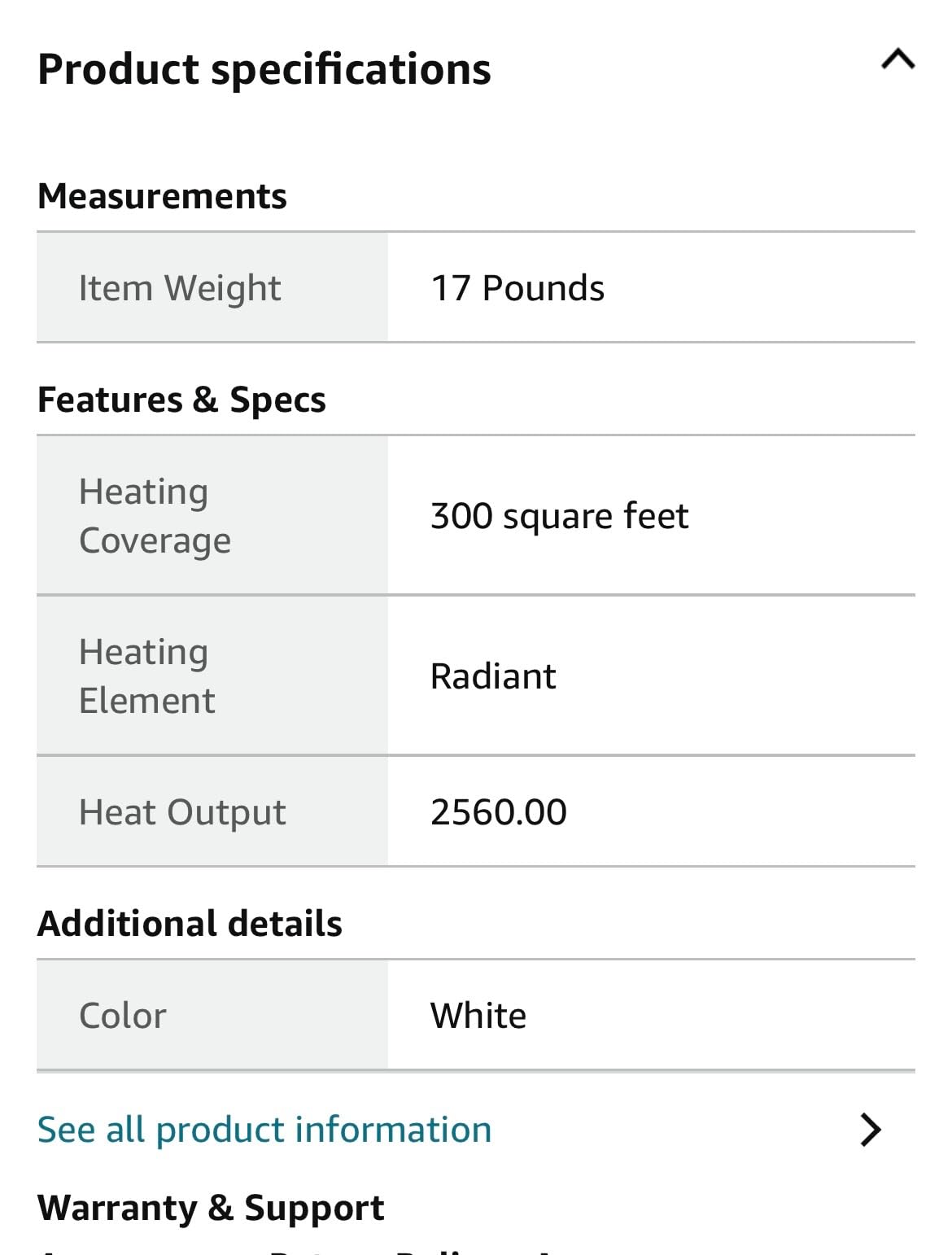
The SoftHeat EBHN750W is the hydronic option, and the reason to choose it is not heat so much as heat that stays. A sealed fluid reservoir inside the cabinet holds heat after the thermostat shuts the element off, so the room keeps warming gently instead of stopping dead when the power does.
It needs no plumbing, no water supply, and no refilling. It is self-contained, which means you get the steadier feel of hydronic baseboard heat without a boiler in the equation.
Who this heater suits
A bedroom or nursery, and a family with children or pets. The cabinet runs cooler than a standard electric baseboard, which removes the biggest objection to installing a fixed heater in a child’s room.
It is also the better pick for anyone sensitive to noise, since the sealed reservoir eliminates the expansion creaking that convection cabinets produce. The 47-inch length covers a long cold wall under a wide window.
Who this heater will not suit
Budget-first buyers. This is the priciest unit in the group, and the thermostat is not included, so the installed cost is meaningfully higher than the cabinet alone.
It is hardwired at 240 volts and 750 watts, so it needs a real circuit. One reviewer also reported the box label showing a 100 square foot rating rather than the 300 square foot listing, so check the label against the listing before you commit to a room size.
9. KING 2K2405-BW – Budget Hardwired Pick for Small Rooms
KING 2K2405-BW K Series Baseboard Heater, 27″ / 500W / 240V, Bright White
500W at 240V
1.8 amp draw
27-inch cabinet
Hardwired
7-year warranty
Pros
- Aluminum ribbon fin element for even convection heat
- Crushproof element and dent-resistant die-form cover
- Quiet fanless operation
- 27-inch length suits small rooms and dorm spaces
- 7-year limited warranty
Cons
- 500W is the lowest output tier in this lineup
- Requires a 240V circuit and hardwiring
- No plug and no controls included
- Listed item weight appears inaccurate
The 2K2405-BW is the smallest hardwired KING, and the 27-inch length is the reason to choose it. It fits the short runs between a door and a window that a 36-inch or 48-inch cabinet overhangs.
At 500 watts on 240 volts it draws just 1.8 amps, so it is gentle on a shared circuit and easy to add to a panel with other small loads. The same aluminum ribbon fin element and crushproof construction as the larger KING carry over.
Who this heater suits
A small bedroom, a dorm room, an office, or a converted garage where the wall run is short. Buyers point to quiet fanless operation and a dent-resistant die-form cover that survives a busy space.
It is the value pick when you are heating several small rooms rather than one large one, since each one draws so little.
Who this heater will not suit
A large or badly insulated room. 500 watts is the lowest output in this lineup, and no amount of thermostat adjustment makes up the difference in a 300 square foot space.
No plug and no controls are included, so it needs a 240 volt circuit and a wall thermostat. The listed item weight in the product record also looks wrong, so plan to handle it as a normal wall unit rather than a light one.
10. Stelpro ASPRL1001W – Best Low-Profile Design and Easiest Cleaning
Stelpro Prima Electric Baseboard Heater, 1000W / 120V, 49-7/8-In Long x 7-In High, Rooms up to 100 sq. ft., Discreet Design (ASPRL1001W) – White
1000W at 120V
8.3 amp draw
100 sq. ft. coverage
49-7/8 inch
5-year warranty
Pros
- Modern low-profile design with discreet air inlet and top exit
- Two-click removable front panel for easy cleaning
- Floating end sleeves reduce expansion and creaking noise
- Full-length thermal protection with automatic reset
- 5-year warranty plus lifetime element for the original owner
Cons
- Wall thermostat required and not included
- Coverage of about 100 sq. ft. is the smallest here
- Hardwired installation rather than plug-in
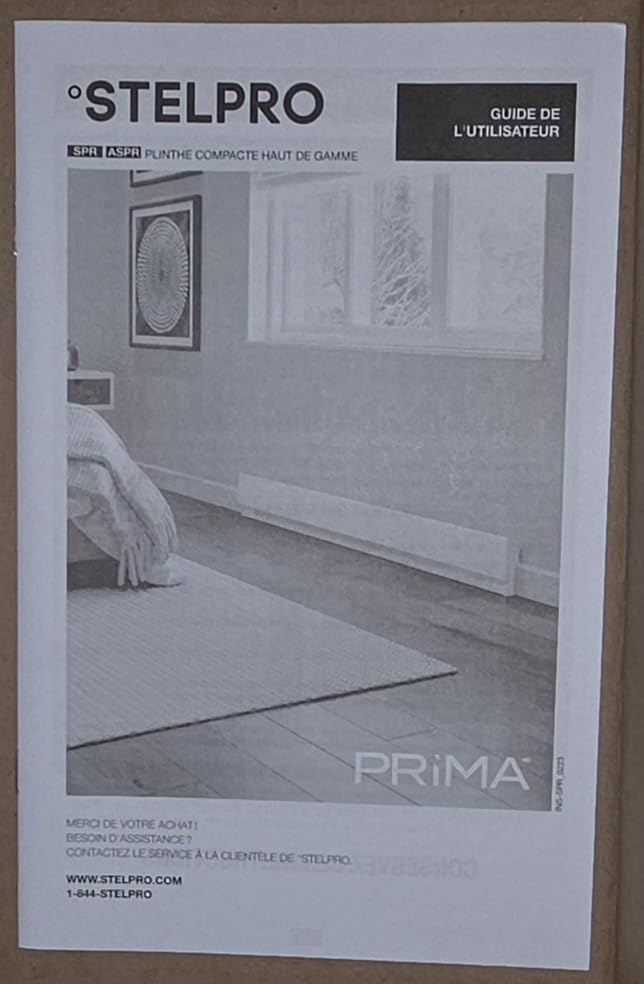
The Stelpro ASPRL1001W is the one to buy when the heater has to disappear into a finished room. At 2.69 inches deep and just over seven inches tall, the air inlet is discreet and the heat exits along the top, so the cabinet reads as trim rather than as an appliance.
The two-click removable front panel is the detail that pays off. Fins collect dust, and dust kills output, so a grille you can pop off without tools is the difference between cleaning it monthly and not cleaning it at all.

At 1000 watts on 120 volts it draws 8.3 amps, which means standard household wiring with no 240 volt upgrade. It is hardwired and wall-mounted, so it is a permanent install, but the circuit requirement is modest.
It carries the highest average rating in this lineup at 4.6 stars, and the warranty is the strongest on paper here: five years on the cabinet, three on electronics, and a lifetime warranty on the heating element for the original owner.
Who this heater suits
A finished room where appearance matters – a living room, a formal space, or a renovated basement. The low profile tucks under a window without projecting into the walking area, and the 49-7/8 inch length covers a full window run.
At 1000 watts it is sized for roughly 100 square feet, so it suits a small bedroom, a home office, or a sunroom nook rather than a main living space.
Who this heater will not suit
Anyone who needs plug-in flexibility or a thermostat in the box. The wall thermostat is required and sold separately, and the unit is hardwired at 120 volts.
It is also too small for a large cold room. Coverage of about 100 square feet is the smallest figure here, and it is not a drafty-room heater at any price point.
Convection vs Hydronic vs Portable: Which Type Heats a Cold Room
All ten heaters here are electric, and the meaningful split is convection cabinets that heat air directly, hydronic cabinets that store heat in a sealed fluid, and portable units you can carry from room to room.
Convection units pull room air across a finned element and let it rise. They are fast to respond, inexpensive relative to hydronic, and they have no moving parts, so they are quiet and long-lived. The trade-off is that output stops the moment the thermostat opens.
Hydronic units seal the element in a liquid-filled reservoir. The fluid holds heat and releases it slowly after shutdown, which produces the steadier, quieter, lower-surface-temperature warmth that forum users consistently describe as the more comfortable option. The penalty is the higher purchase cost and a separate thermostat.
Portable units add convenience rather than performance. A 120V plug-in heater needs no electrician, but 1500 watts is the practical ceiling on a household circuit, and a portable cabinet sitting on the floor heats a zone rather than a room evenly.
For bedroom silence, every unit in this lineup is fan-free, so noise comes down to expansion creaking rather than airflow. The hydronic reservoir is the quietest choice, and the Stelpro’s floating end sleeves are specifically designed to reduce the same creaking on a convection cabinet.
For a glass-heavy space, the trade shifts. Our infrared tower heater guide covers radiant options that handle large glass differently from convection units.
120V vs 240V: Amperage and Breaker Sizing
This is the single most common source of confusion, and getting it wrong means a trip on the first cold night. The math is simple: divide watts by volts to get amps.
1500W at 120V draws 12.5 amps. A 15 or 20 amp circuit, ideally with nothing else on it. This is where portable units land.
1000W at 120V draws 8.3 amps. A 15 amp circuit with headroom. The KING and Stelpro hardwired models sit here.
1000W at 240V draws 4.17 amps. A 15 amp breaker, hardwired. The Dimplex PC3010W31 is this configuration.
750W at 240V draws 3.13 amps. A 15 amp breaker, hardwired. The Cadet F Series and SoftHeat units match.
500W at 240V draws 1.8 amps. A 15 amp breaker, hardwired. The KING 2K2405-BW is the smallest draw in the group.
Two hard rules for baseboard heat. Never run a portable heater on an extension cord – forum users raise this constantly, and a high-draw heater on a light-gauge cord is a genuine fire risk. And a 240 volt heater needs a dedicated circuit, because a hardwired baseboard is designed to be the only load on that breaker.
Running a new 240 volt circuit means a breaker in the panel, a cable run through the wall, and in many jurisdictions a permit. That installed cost can exceed the heater several times over, which is the practical reason a plug-in 120V unit is often the smarter first move.
Running Cost: How to Heat a Cold Room Cheaply
Electric resistance heat converts every watt into heat, so the running cost is simple arithmetic on your kilowatt-hour rate. There is no efficiency curve and no lost heat up a flue.
500W runs about 5.5 cents per hour at 11 cents per kWh, 8.5 cents at 17 cents, and 12 cents at 24 cents.
1000W runs about 11 cents per hour at 11 cents per kWh, 17 cents at 17 cents, and 24 cents at 24 cents.
1500W runs about 16.5 cents per hour at 11 cents per kWh, 25.5 cents at 17 cents, and 36 cents at 24 cents.
2000W runs about 22 cents per hour at 11 cents per kWh, 34 cents at 17 cents, and 48 cents at 24 cents.
Two strategies do more for the bill than switching brands. First, use a thermostat you trust – a proportional control that holds a setpoint runs fewer minutes than a mechanical dial that overshoots. Second, zone the room. Heating one room to a setpoint costs a fraction of trying to push the whole house to it.
Third, attack the heat loss. Thermal curtains on a large window, or closing off a room you never heat, can cut the required wattage enough to drop you a size. That is the cheapest wattage reduction available.
For unheated outdoor structures, our greenhouse heater guide covers a different class of heat source entirely.
Baseboard Heater Buying Guide
Start with the room, not the heater. Measure the square footage, count the glass, and note the ceiling height. Then pick a watts factor that matches the insulation. Getting this step right eliminates most returns.
Decide hardwired or plug-in first. If the room already has a baseboard opening or a nearby 240 volt circuit, hardwired gives you more wattage per circuit and a permanent install. If neither exists, a 1500W 120V plug-in unit is the realistic option and no installer is involved.
Match the cabinet length to the wall. A 48-inch unit under a 36-inch window wastes output on bare wall, and a 20-inch unit under a wide window leaves the edges cold. Length should track the window or the cold wall, not the room.
Buy the thermostat with the heater. Four of the ten units here ship with a mechanical dial or nothing at all, and the units that need a wall thermostat are not complete purchases without one. Budget for it as part of the cost, not an afterthought.
Check the safety provisions. Every portable unit should have a tip-over switch and overheat protection, and every hardwired unit should have a full-length thermal cutout. A low cabinet surface temperature matters most in a nursery.
Plan clearance before delivery. Keep combustibles a full three feet clear of a portable unit, keep drapes off the cabinet, and leave the airflow gap along the wall. Blocked airflow is the most common reason a working heater underperforms.
Commit to the maintenance. Fins collect dust and dust insulates. A soft brush and a vacuum every few weeks, plus an annual check of the cutout and the breaker, keeps output where the spec sheet says it should be.
When a Baseboard Heater Is the Wrong Fix
Sometimes the cold room is a symptom, not a problem. If the central system was sized before an addition, before new glazing, or before you sealed up the house, then every baseboard in the building is undersized and adding one more unit to a room treats a symptom. A ductless mini-split may be the honest answer at that point.
The same goes for zoning faults. If one room is cold while the rest of the house is comfortable, a failed zone valve or a stuck air handler is far more likely than an undersized heater, and no heater in this list fixes it.
There is one case where a baseboard heater is exactly right even though the room is not really being lived in. Homeowners running heat in an insulated crawlspace or an unheated garage do it to keep pipes from freezing, and a low-wattage unit on its own circuit is the standard approach. The catch is that these spaces are where freeze risk hides when a breaker trips, so a unit with a full-length safety cutout is worth the preference.
Frequently Asked Questions
What is the best heater for a cold room?
A hardwired 240V convection baseboard heater sized at 10 watts per square foot for a well-insulated room, or 12 to 15 watts per square foot for a drafty one. A 150 square foot room needs roughly 1500 to 2000 watts. Without a circuit, a 1500W plug-in 120V convector is the practical alternative.
What size breaker do I need for a 240v baseboard heater?
Most 240V baseboard heaters in this range draw under 5 amps, so a 15-amp breaker on a dedicated circuit is the standard choice. A 750 watt unit pulls about 3.1 amps, a 1000 watt unit about 4.2 amps, and a 1500 watt unit about 6.3 amps. The heater should be the only load on that circuit.
How many square feet will a 2000 watt baseboard heater heat?
About 200 square feet in a well-insulated room at 10 watts per square foot, and closer to 130 square feet in a drafty room at 15 watts per square foot. Glass walls and high ceilings push the requirement down further.
Which baseboard heater is most efficient?
All electric resistance heaters convert the same wattage into the same heat, so efficiency comes down to control and heat retention. A proportional thermostat runs fewer minutes than a mechanical dial, and a hydronic cabinet keeps releasing heat after the element shuts off, which lowers total runtime.
How to heat a cold room cheaply?
Zone the room and heat only the space you use, fit a thermostat you can trust so the heater stops calling for heat on time, and cut the heat loss with thermal curtains before you add wattage. A 1500W heater costs roughly 16 to 36 cents per hour depending on your kilowatt-hour rate.
My baseboard heater isn’t getting hot. What could be the problem?
Work down a short list: check whether the dedicated breaker has tripped and stays tripped, confirm the thermostat is actually calling for heat by raising it several degrees, look for dust, paint, or grease blocking the fins, and confirm nothing is blocking the airflow gap along the wall. A breaker that trips again points to a failed element or a wiring fault.
Can baseboard heaters cool a house?
No. Baseboard heaters only add heat, and running one with a window open simply heats the outdoors. In a reversible heat pump system the same cabinet can move heat out of the house in summer, but a standard electric baseboard heater cannot.
Final Verdict on the Best Baseboard Heaters for Cold Rooms
The Comfort Zone CZ600 is the best baseboard heater for cold rooms overall, because it delivers 1500 watts of quiet convection heat, covers up to 300 square feet, and works without an electrician in a rental or a room with no circuit. If you do have 240 volt service and want a permanent install, the Cadet 3F750W is the pick for replacing or adding fixed baseboard heat.
Match the scenario to the pick: the Fahrenheat FBE15002 for a small bedroom, the ROVSUN 48 Inch for a wide open room with a timer and remote, the Cadet SoftHeat EBHN750W for a nursery where surface temperature and heat retention matter, the Dimplex LC2005W31 when the wall is only 20 inches long, and the Stelpro ASPRL1001W when the heater has to look like trim.
Before any of them, spend an hour on the diagnostic list. A blocked vent, a misplaced thermostat, or a failed zone valve will keep a room cold no matter what you install, and that hour costs nothing. Once the diagnosis is clean, size to 10 watts per square foot and go.