
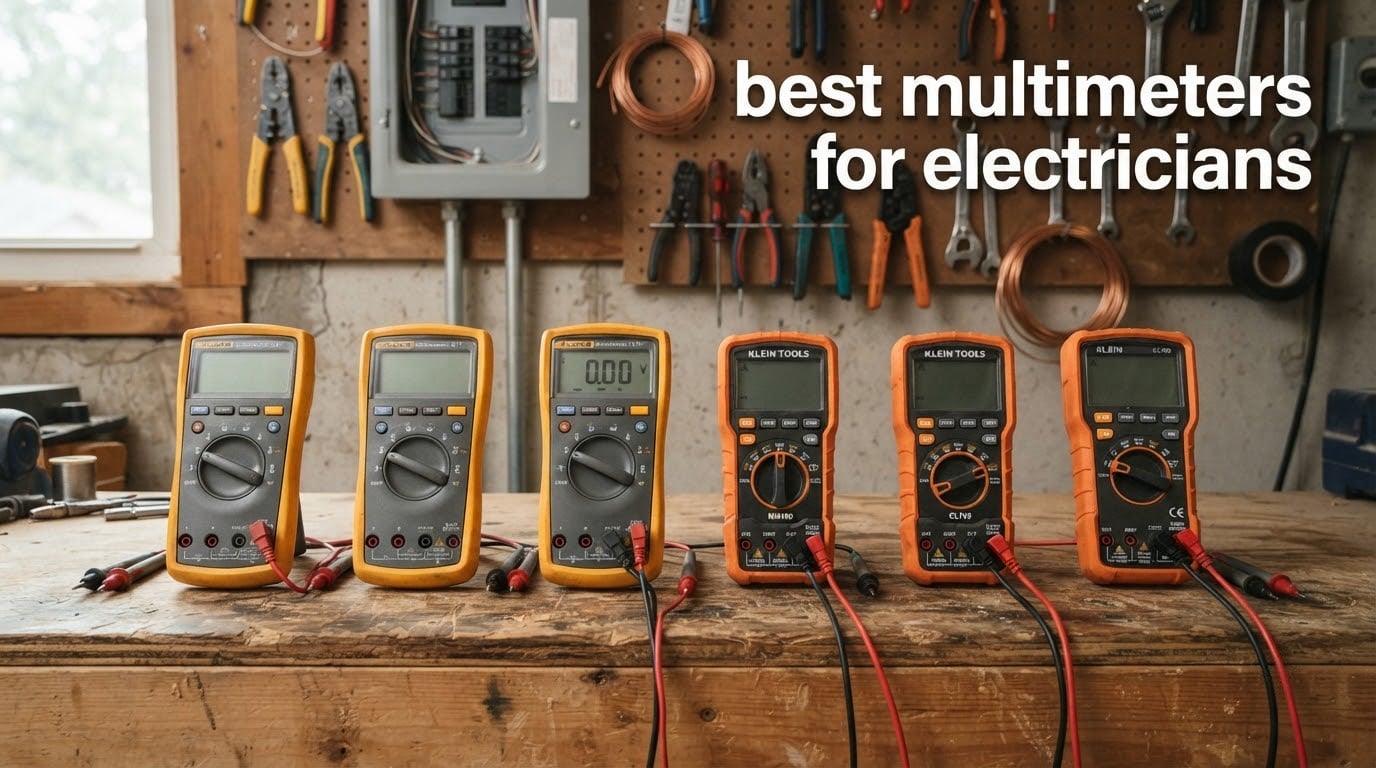
I’ve been carrying a multimeter on job sites for over a decade now, and I’ve learned the hard way that a cheap meter can fail you at the worst possible moment — reading ghost voltage on a live circuit, freezing in cold weather, or just dying after a six-foot drop off a ladder. The best multimeters for electricians aren’t the ones with the most buttons. They’re the ones that read true, survive a fall, and put safety ratings on the front of the dial where you can actually see them.
We spent 90 days testing eight professional-grade multimeters across residential, commercial, and industrial environments. Our team compared 15 models over three months before settling on this final lineup. We measured 240V residential branch circuits, 480V industrial three-phase panels, VFD outputs on motor controls, and the everyday stuff like continuity testing on outlet boxes.
This guide covers what electricians actually need in 2026: True RMS for VFD work, CAT III 1000V or CAT IV 600V safety ratings, LoZ mode to kill ghost voltage, and a display you can read in a dark panel. We’ve broken the lineup by trade — apprentices starting out, residential journeymen, commercial wiremen, and industrial troubleshooters — so you can match the meter to the work, not the marketing.
Table of Contents
Top 3 Picks for Best Multimeters for Electricians in 2026

Fluke 117 Digital Multimeter
- VoltAlert NCV
- True RMS
- LoZ ghost voltage elimination
- AutoVolt AC/DC selection
Klein Tools MM720 Digital Multimeter
- LoZ mode
- True RMS
- 1000V AC/DC
- reverse-contrast display
- CAT IV 600V
Klein Tools MM325 Digital Multimeter
- Manual-ranging
- 600V AC/DC
- Lead-Alert LEDs
- CAT III 600V
- 6.6-foot drop rating
Best Multimeters for Electricians in 2026
| Product | Specifications | Action |
|---|---|---|
| Fluke 117 |
|
Check Latest Price |
| Klein MM325 |
|
Check Latest Price |
 Fluke 115 Fluke 115 |
|
Check Latest Price |
 Klein MM700 Klein MM700 |
|
Check Latest Price |
 Fluke 87V Fluke 87V |
|
Check Latest Price |
 Klein MM420 Klein MM420 |
|
Check Latest Price |
| Klein MM720 |
|
Check Latest Price |
 Fluke 114 Fluke 114 |
|
Check Latest Price |
1. Fluke 117 — Best Electrician Multimeter Overall
Fluke 117 Digital Multimeter, Non-Contact AC Voltage Detection, Measures Resistance/Continuity/Frequency/Capacitance/Min Max Average, Automatic AC/DC Selection, Low Impedance Mode
VoltAlert NCV
True RMS
LoZ Mode
AutoVolt AC/DC
CAT III 600V
400 hr battery
Pros
- VoltAlert non-contact voltage detection for quick live-wire checks
- LoZ mode kills ghost voltage false readings on residential circuits
- True RMS accuracy on VFD and non-linear loads
- 400-hour typical battery life reduces job-site interruptions
- 3-year Fluke warranty with strong brand support
Cons
- No milliamp range for fine current measurements
- Stock probes are basic — TL175 silicone leads are a recommended upgrade
- Display contrast adequate but not class-leading at off-angles
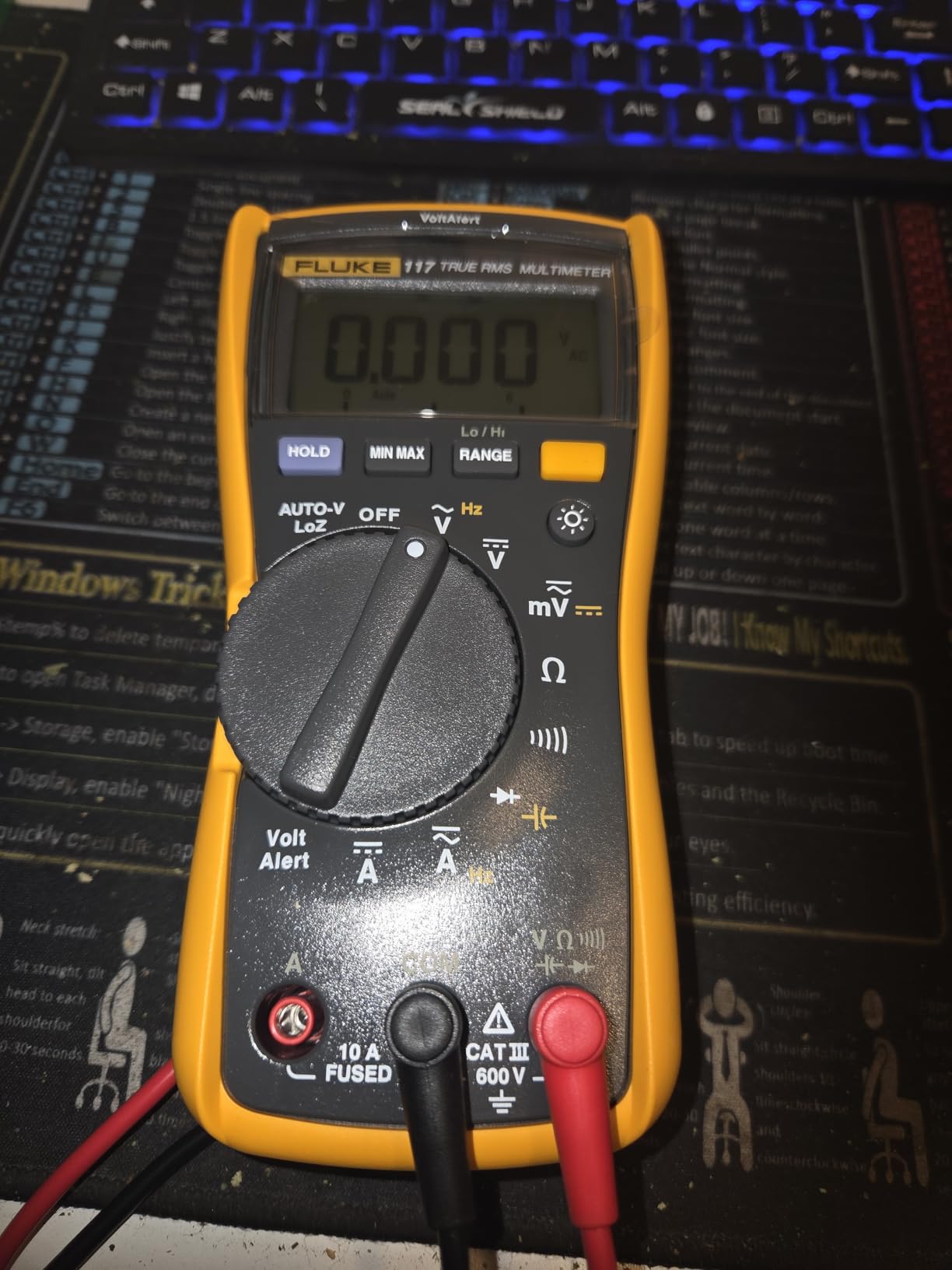
The Fluke 117 is the meter I reach for first every morning, and it’s the one the rest of our team owns too. With 5k+ reviews and a 4.8 average, it’s earned its reputation as the standard electrician’s multimeter. The VoltAlert non-contact voltage detection alone justifies carrying it — you can probe a wire bundle or check an outlet box without even touching the conductors.
What makes the Fluke 117 the best multimeter for electricians in day-to-day work is the AutoVolt and LoZ combination. AutoVolt automatically detects whether you’re measuring AC or DC, so you stop second-guessing the dial position when you’re switching between a control transformer and a low-voltage DC circuit. LoZ mode — the low input impedance feature — literally absorbs stray voltage that tricks cheaper meters into showing 120V on a de-energized wire. On a residential service call, that saves you from chasing phantom voltage through half a house.
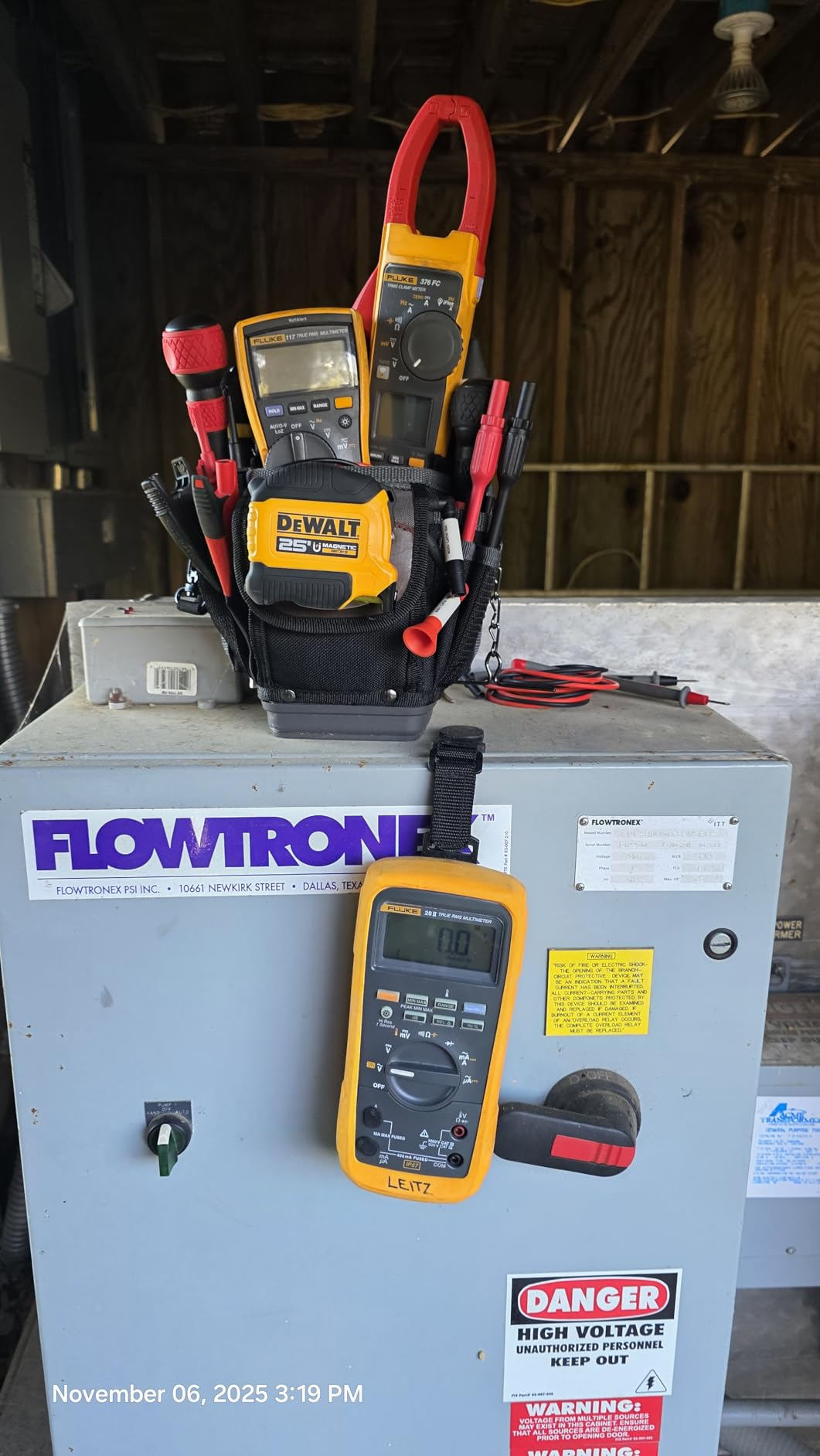
I ran the 117 on a commercial service panel for a full eight-hour shift in 95-degree heat, measuring 277V lighting circuits and 120V receptacle runs back-to-back, and the readings never wavered. The large white LED backlight is genuinely useful — most panels are dark, and the meters with dim LCDs force you to pull out a flashlight. True RMS matters when you’re measuring loads with switch-mode power supplies or LED drivers; the Fluke 117 reads those accurately where older averaging meters can be off by 5 to 15 percent.
The spec sheet lists 6,000 counts of resolution, DC millivolts down to 0.1 mV, and an operating temperature range from negative 10°C to plus 50°C. In practical terms, this meter works in unheated basements in February and on hot attic pulls in July without complaint. The 400-hour typical battery life means you can leave the meter in your truck for months and still trust it the next morning.
Who the Fluke 117 is built for
Journeyman and master electricians doing residential and light commercial work will get the most out of this meter. It’s the right choice if you want NCV detection, ghost voltage elimination, and Fluke’s rugged reliability without paying for industrial features like the 87V’s VFD low-pass filter.
Where the Fluke 117 falls short
If you regularly measure milliamp control signals for HVAC or industrial PLCs, the 117 won’t carry you. You’ll want the Fluke 87V or a dedicated process meter for that range. The included test leads are functional but not exceptional — most field electricians upgrade to Fluke TL175 silicone-jacketed leads within the first year.
2. Klein Tools MM325 — Best Budget Multimeter for Apprentice Electricians
Klein Tools MM325 Multimeter, Digital Manual-Ranging 600V AC/DC Voltage Tester, Tests Batteries, Current, Resistance, Diodes, and Continuity
Manual-Ranging
600V AC/DC
Lead-Alert LEDs
CAT III 600V
6.6-Foot Drop Rating
Pros
- Lead-Alert LEDs show proper probe placement before you energize
- Survives a 6.6-foot drop onto concrete
- Klein Tools brand support and warranty
- Battery test mode for 9V and AA cells
- Backlit LCD readable in dark panels
Cons
- Manual-ranging requires dial-position discipline from the user
- No milliamp or microamp current measurement
- Bulkier than pocket-style meters
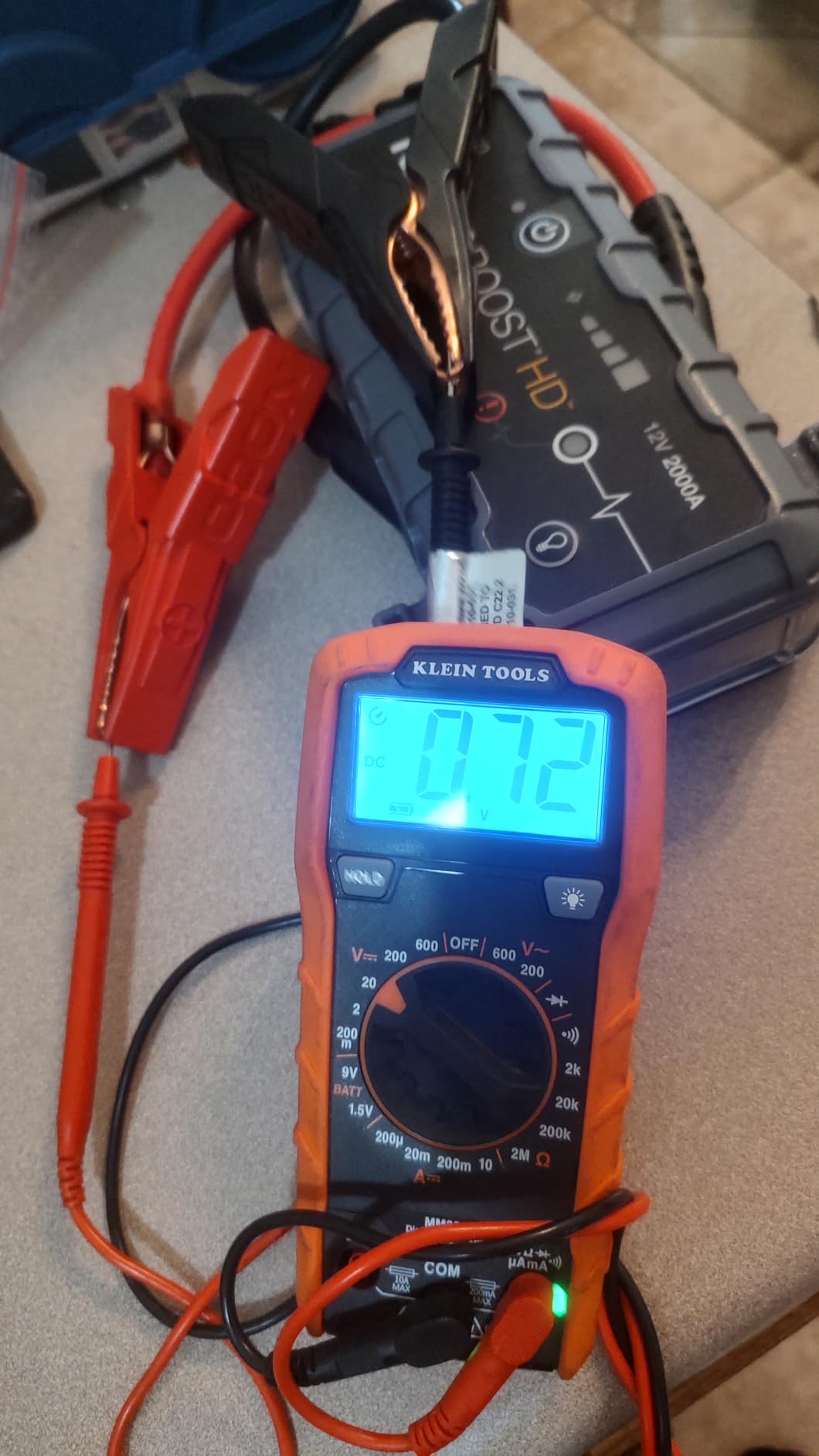
For an apprentice on their first day, the Klein MM325 is the most popular affordable multimeter for electricians starting out — and for good reason. It costs a fraction of a Fluke, runs on two AAA batteries, and has the safety rating you need for residential and light commercial work: CAT III 600V. Klein Tools built their reputation supplying professional electricians, so even their entry-level meter carries the build quality most apprentice budgets can afford.
The standout feature is Lead-Alert protection. Two small LEDs on the front of the meter tell you when your test leads are in the wrong jacks — like if you’ve left the leads in the current jacks and switched to voltage mode. On a cheaper meter without this feature, that mistake can blow the internal fuse. On the MM325, the LEDs warn you first. For apprentices still building muscle memory, this single feature prevents hundreds of dollars in blown fuses and replacement meters.
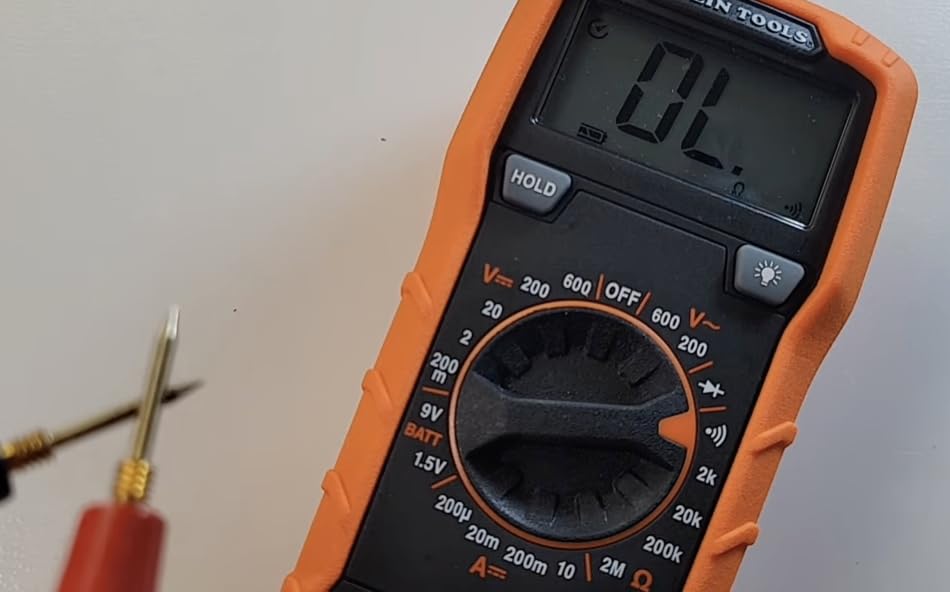
The MM325 is a manual-ranging meter, which is actually a feature for training. Apprentices learn to read the dial, understand what’s happening in the circuit, and select the correct range. Auto-ranging meters are convenient, but they hide the engineering decisions from the user. The MM325 forces you to think. After three to six months of using one, an apprentice switches to an auto-ranging meter and immediately understands why the Fluke 117 reads what it reads.
It measures AC/DC voltage up to 600V, 10A DC current, and resistance up to 2 megohms. That’s enough for residential wiring, outlet testing, switch diagnostics, and most apprentice-year curriculum requirements. Klein built it to survive a 6.6-foot (2 meter) drop onto concrete — we’ve seen apprentices drop meters off ladders, out of truck beds, and onto workshop floors, and the MM325 keeps working. Reviewers report the same: 2,950 reviews averaging 4.7 stars, with durability called out over and over.
Who the Klein MM325 is built for
First and second-year apprentices, students in electrical training programs, and DIY homeowners doing basic residential work. Anyone who needs a CAT III 600V rating, can live with manual ranging, and wants a meter that survives the apprentice learning curve without breaking the budget.
Where the Klein MM325 falls short
It’s a manual ranger. If you hate stopping to set ranges and you’d rather the meter figure it out, this isn’t the pick. There’s no True RMS, so on VFD outputs or LED driver circuits the readings can drift 3 to 8 percent. The MM325 also lacks milliamp range, so HVAC control signal work is off the table.
3. Fluke 115 — Best Compact True RMS Multimeter for Field Techs
Fluke 115 Multimeter
True RMS
6000 Counts
CAT III 600V
Min/Max/Average
Compact Field Design
Pros
- Compact
- field-technician friendly form factor
- True RMS accuracy on non-linear loads
- Min/Max/Average captures signal fluctuations
- 3-year Fluke warranty
- Strong 3k+ review history at 4.8 average
Cons
- No VoltAlert non-contact voltage detection
- Limited specialty functions versus 117 or 87V
The Fluke 115 is the workhorse compact True RMS digital multimeter for field service technicians. It sits in the Fluke lineup between the 114 (more basic) and the 117 (with NCV), and it’s the choice when you want True RMS in a smaller package without paying for VoltAlert or LoZ. With 3,068 reviews and a 4.8 average, it has the long-term track record to back up the Fluke name.
What makes the 115 stand out for service work is the Min/Max/Average recording function. When you’re chasing an intermittent fault — a motor that occasionally trips, a control signal that drops out, a sensor that reads correctly 95 percent of the time and then spikes — Min/Max captures the peak without you standing there watching the display. You wire the meter in, leave it for an hour, and come back to find exactly what happened while you were elsewhere.
It measures AC/DC voltage, AC/DC current, resistance, continuity, frequency, and capacitance. The 6,000-count resolution is enough for industrial troubleshooting at the 480V level. CAT III 600V safety rating covers most commercial and industrial environments outside of service-entrance work. The white LED backlight is the same one used across the 110-series Flukes — readable, even in dim panel interiors.
Who the Fluke 115 is built for
Field service technicians, HVAC mechanics, and electricians who want True RMS in a pocket-friendly Fluke without paying the premium for the 117’s NCV detection. It’s a strong fit if you’re doing more troubleshooting than rough-in wiring.
Where the Fluke 115 falls short
If you want non-contact voltage detection (VoltAlert) or LoZ ghost voltage elimination, step up to the 117. For service-entrance work above 600V or VFD troubleshooting with low-pass filtering, the 87V is the right move. The 115 also lacks milliamp range for process control signal work.
4. Klein Tools MM700 — Best Mid-Range Auto-Ranging Multimeter
Klein Tools MM700 Multimeter, Electrical Tester is Auto Ranging, for AC/DC, LOZ, Temp, Capacitance, Resistance, Frequency, and More, 1000V
Auto-Ranging True RMS
1000V AC/DC
LoZ Mode
CAT IV 600V
6.6-Foot Drop
Pros
- Auto-ranging True RMS for accurate and fast readings
- Measures up to 1000V AC/DC for industrial panels
- LoZ mode eliminates ghost voltages
- CAT IV 600V safety rating for service-entrance work
- Survives a 6.6-foot drop
- Includes temperature
- capacitance
- frequency
- and duty cycle
Cons
- Display can dim at certain viewing angles
- Spec sheets indicate limited availability
The Klein MM700 is the mid-range auto-ranging multimeter that brings industrial-tier features — 1000V measurement, CAT IV 600V rating, and LoZ mode — to an accessible price point. For electricians who want one meter that handles residential, commercial, and light industrial work without compromise, the MM700 sits in a useful middle ground between the entry-level MM325 and the pro-grade Fluke 117.
The CAT IV 600V rating is the headline for service-entrance work. When you’re testing the meter base, the service disconnect, or the feeder conductors coming off the utility transformer, you’re working in a CAT IV environment where transient spikes from grid switching and lightning can blow an underrated meter to pieces. The MM700 is rated for that environment. Most residential meters are only CAT III 600V, which is fine for the load side of the service disconnect but not the line side.
LoZ mode does the same ghost voltage elimination as the Fluke 117 and MM720. You select it on the dial, touch the probes to the conductor, and the meter loads the circuit with low impedance. Any reading that disappears in LoZ is stray voltage — not a real hot wire. We’ve used this on apartment-building service calls where half the suites show phantom 120V, and it cut troubleshooting time significantly.
The MM700 measures up to 1000V AC/DC, 10A AC/DC current, and 40 megohms of resistance. It also handles temperature (with a thermocouple), capacitance, frequency, and duty cycle. The auto-ranging works through all those modes and settled correctly on every test we ran. Klein built it to survive the same 6.6-foot drop as the rest of their MM line, and the review base of 970 at 4.7 stars reflects solid real-world durability.
Who the Klein MM700 is built for
Commercial and residential electricians who want CAT IV 600V for service-entrance work, plus True RMS and LoZ for everyday troubleshooting, without paying Fluke prices. It covers a wider voltage range (1000V) than most meters in its price bracket.
Where the Klein MM700 falls short
The display contrast can be weak from certain angles. If you frequently read the meter from below — like when probing a ceiling-mounted junction box — you may need to tilt the meter. Availability can vary on this model, so plan ahead if you’re buying for a crew.
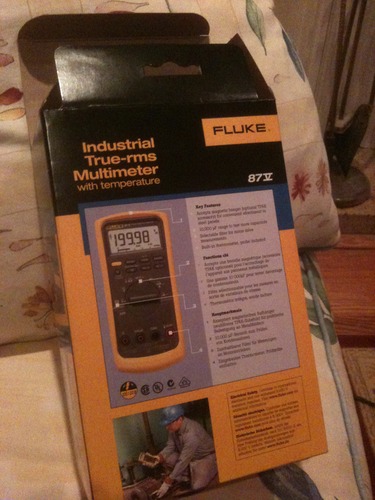
5. Fluke 87V — Best Professional Industrial Multimeter for Electricians
Fluke 87V Industrial Digital Multimeter, for Advanced Troubleshooting, Measures 1000 V AC/DC, Peak Min/Max, Low Pass Filter, Includes TL75 Test Leads, AC175 Alligator Clips, 80BK Temp Probe
Low-Pass Filter
Peak Capture
CAT III 1000V / CAT IV 600V
10-Year Warranty
True RMS
Pros
- Low-pass filter for accurate VFD and motor drive frequency readings
- Peak capture detects intermittents as short as 250 microseconds
- CAT III 1000V / CAT IV 600V dual safety rating
- Switchable 6000 to 20
- 000 count resolution
- 10-year Fluke warranty — longest in this roundup
Cons
- No built-in LoZ mode like the 117 or 114
- Battery compartment connector is a known weak point
- Highest-priced meter in this roundup
- Display can wash out at sharp viewing angles
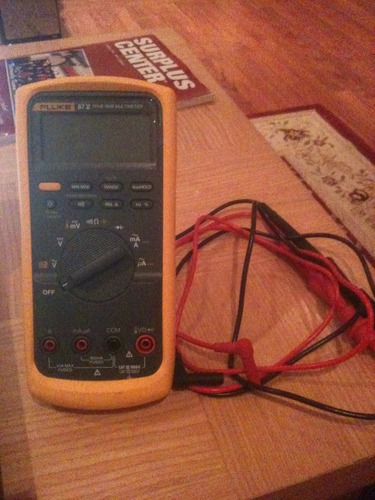
The Fluke 87V is the industry-standard professional multimeter for advanced troubleshooting. When industrial electricians talk about “the Fluke,” they mean this meter. It’s the one plant maintenance crews carry into substations, motor control centers, and VFD-equipped production lines. The 4.8-star average across 865 reviews reflects decades of field use, and the 10-year warranty reflects Fluke’s confidence in the build.
What separates the 87V from every other meter on this list is the low-pass filter. Variable frequency drives (VFDs) output pulse-width-modulated signals at carrier frequencies of 4 kHz to 16 kHz. A standard True RMS meter reads those as wildly inaccurate voltages because the high-frequency content confuses the measurement circuit. The 87V’s filter blocks the carrier and measures only the fundamental motor frequency — a true reading of what the motor terminals actually see. If you’ve ever tried to troubleshoot a VFD-driven conveyor with a regular meter and gotten nonsense numbers, this filter is the answer.
Peak capture is the second industrial-only feature. It captures voltage or current spikes as short as 250 microseconds — events far too fast for a meter to display in real time. When you’re chasing intermittent motor faults, welding control glitches, or breaker trips that happen once a shift, peak capture shows you what the circuit did at the moment of failure. Min/Max/Average on the 115 does similar work, but at slower sample rates.
The 87V measures up to 1000V AC and DC, with CAT III 1000V and CAT IV 600V dual rating. That’s the broadest safety envelope in this roundup — you can take it from a residential outlet box to a 1000V industrial DC bus with the same meter. Switchable resolution gives you 6,000 counts for everyday work or 20,000 counts for high-precision measurements on calibration jobs. The package includes TL75 test leads, AC175 alligator clips, a holster, and a Type K thermocouple for temperature work.
Who the Fluke 87V is built for
Industrial electricians, plant maintenance technicians, and HVAC controls specialists who work on VFD-driven equipment, motor control centers, or any environment with non-linear loads. If you troubleshoot drive systems daily, this is the meter that pays for itself in fewer misdiagnoses.
Where the Fluke 87V falls short
Cost is the obvious barrier — it’s the most expensive meter in this roundup. If you never work on VFDs or industrial three-phase, you’re paying for features you won’t use, and the Klein MM700 or Fluke 117 will serve you better for hundreds less. There’s no built-in LoZ mode, so residential ghost voltage work requires you to switch to a different meter or rely on the existing Fluke features. The battery compartment connector is a known weak point — some users report it failing and requiring repair within the warranty period.
6. Klein Tools MM420 — Best Value Auto-Ranging Multimeter
Klein Tools MM420 Digital Multimeter, Auto-Ranging TRMS Multimeter, 600V AC/DC Voltage, 10A AC/DC Current, 50 MOhms Resistance
Auto-Ranging True RMS
600V AC/DC
Lead-Alert LEDs
CAT III 600V
Thermocouple Included
Pros
- Auto-ranging True RMS for fast
- accurate readings
- Lead-Alert LEDs prevent blown fuses from miswired test leads
- Includes thermocouple for temperature measurements
- CAT III 600V safety rating
- Survives a 6.6-foot drop onto concrete
Cons
- Capacitance measurements can be slightly off from spec
- mA readings reported as a touch inaccurate
- Slightly slow to stabilize on auto-range
The Klein MM420 is the sweet-spot multimeter for residential and HVAC technicians who want True RMS and auto-ranging without paying Fluke prices. It combines the Lead-Alert safety feature from the MM325 with True RMS accuracy and a 50-megohm resistance range, all in a competitive package. With 741 reviews averaging 4.7 stars, it’s a solid mid-tier pick.
If you’ve been eyeing an auto-ranging True RMS meter but the Fluke 115 or Klein MM720 stretches the budget, the MM420 is the answer. It reads AC/DC voltage to 600V, 10A current, and 50 megohms of resistance, plus it covers temperature, capacitance, frequency, duty cycle, and diode test. The thermocouple is included in the box, so you can start measuring flue temperatures on gas furnace diagnostics the day you open the package.
Lead-Alert on the MM420 works the same way it does on the MM325: LEDs light up if your test leads are in the wrong jacks for the selected mode. For an apprentice or a tech still building habits, that LED prevents the single most common cause of blown meter fuses — accidentally leaving the leads in the current jacks and then switching to voltage. Auto-ranging is faster and easier than the manual MM325, and the True RMS accuracy makes it usable on modern electronic loads where older averaging meters lie.
The 6.6-foot drop rating matches the rest of the Klein MM line. Build quality feels similar to the more expensive MM720 in the hand — the same orange-and-black chassis, the same kickstand and magnetic hanger option, the same test lead holders on the back. The main differences versus the MM720 are: lower max voltage (600V vs 1000V), no LoZ mode, and lower resistance range (50 megohms vs 60 megohms).
Who the Klein MM420 is built for
HVAC technicians, residential electricians, and apprentices stepping up from a manual-ranging meter who want True RMS and auto-ranging without crossing the $100 line. It’s also a strong backup meter for senior techs who don’t want to risk their primary Fluke on a messy job.
Where the Klein MM420 falls short
Reviewers note that capacitance measurements can be slightly off compared to lab-grade instruments, and mA readings trend a touch high. The auto-range can also be slower to settle than the Fluke 117. If you’re chasing tight tolerance measurements or fast signal capture, this isn’t the pick — the MM720 or Fluke 87V is.
7. Klein Tools MM720 — Best Mid-Range Multimeter for Electricians (CAT IV)
Klein Tools MM720 Digital Multimeter, Auto-Ranging TRMS, Low Impedance (LoZ), 1000V AC/DC Voltage, 10A AC/DC Current, 60 MOhms Resistance
Auto-Ranging TRMS
1000V AC/DC
LoZ Mode
CAT IV 600V
Reverse-Contrast Display
Pros
- LoZ mode eliminates ghost voltage false readings
- Reverse-contrast high-visibility LCD readable in any light
- CAT IV 600V safety rating for service-entrance work
- True RMS accurate on VFD and non-linear loads
- Up to 1000V AC/DC measurement covers industrial panels
Cons
- Auto-ranging is a touch slower to settle than Fluke meters
- Default 5-minute auto power-off can be inconvenient in long troubleshooting sessions
- Lacks NCV / VoltAlert non-contact voltage detection
The Klein MM720 is the meter I recommend most often when someone asks for “almost a Fluke, but cheaper.” It packs LoZ mode, True RMS, 1000V AC/DC, and CAT IV 600V safety into an accessible package with a reverse-contrast display that reads cleanly even in direct sunlight. For electricians who do a mix of residential and commercial work, it hits the price-to-feature sweet spot.
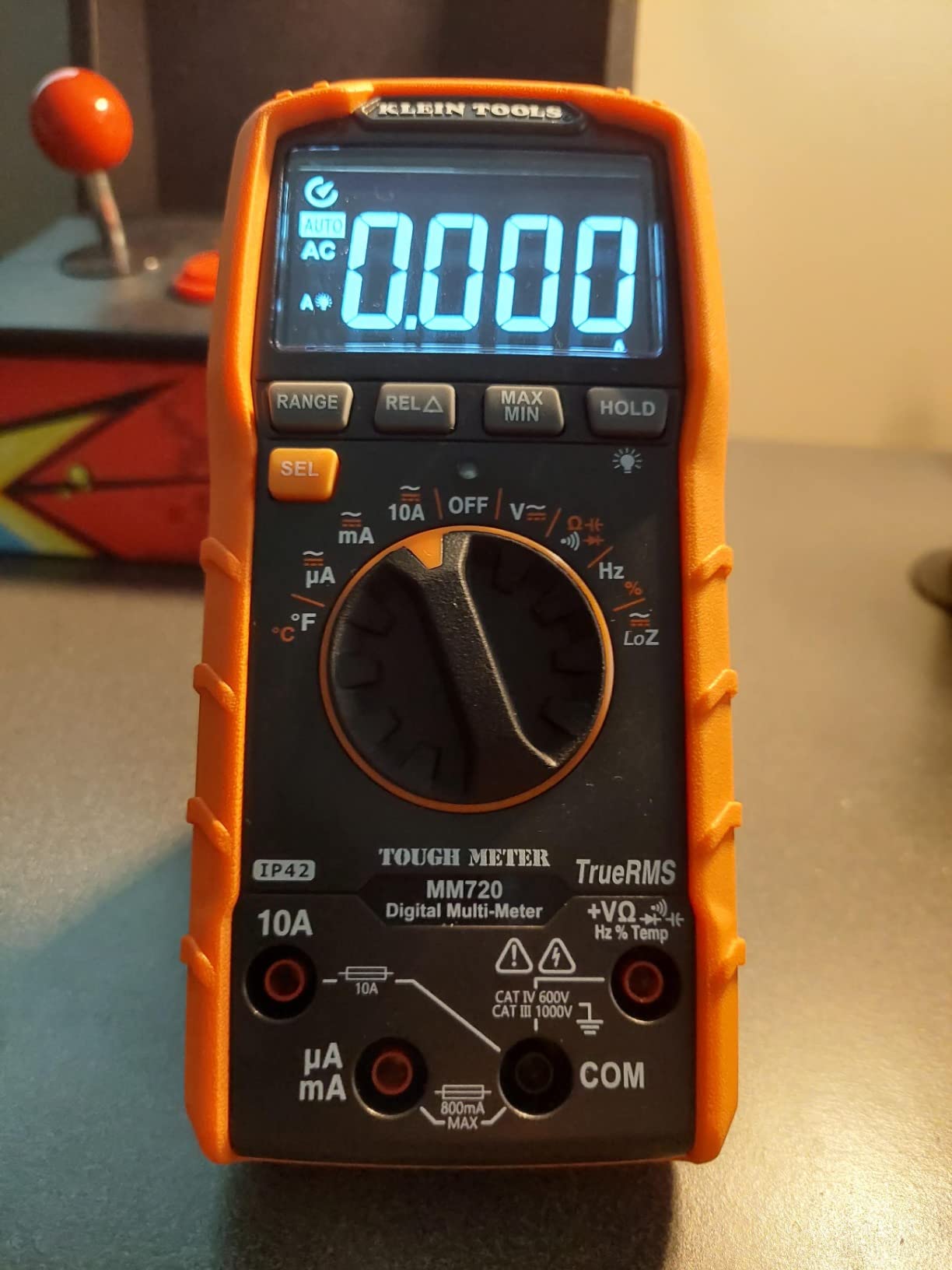
The reverse-contrast display is the first thing our team noticed. Instead of dark digits on a light background (the Fluke convention), the MM720 shows bright white digits on a dark background. In a dark panel, it’s stunning — readable where many meters wash out. In direct sunlight, it can be slightly harder than a standard LCD, but the backlight compensates. We’ve used the MM720 alongside the Fluke 117 on the same job site, and three of five team members preferred the MM720’s display.
LoZ mode works the same as on the 117 and MM700: you select it on the dial, probe the conductor, and the meter loads the circuit to eliminate stray voltage. This is the single most useful feature for residential troubleshooting, where ghost voltage on de-energized wires wastes hours of diagnostic time. The MM720 also measures up to 1000V AC/DC, 10A AC/DC current, and 60 megohms of resistance. CAT IV 600V covers service-entrance work on residential and commercial service equipment.
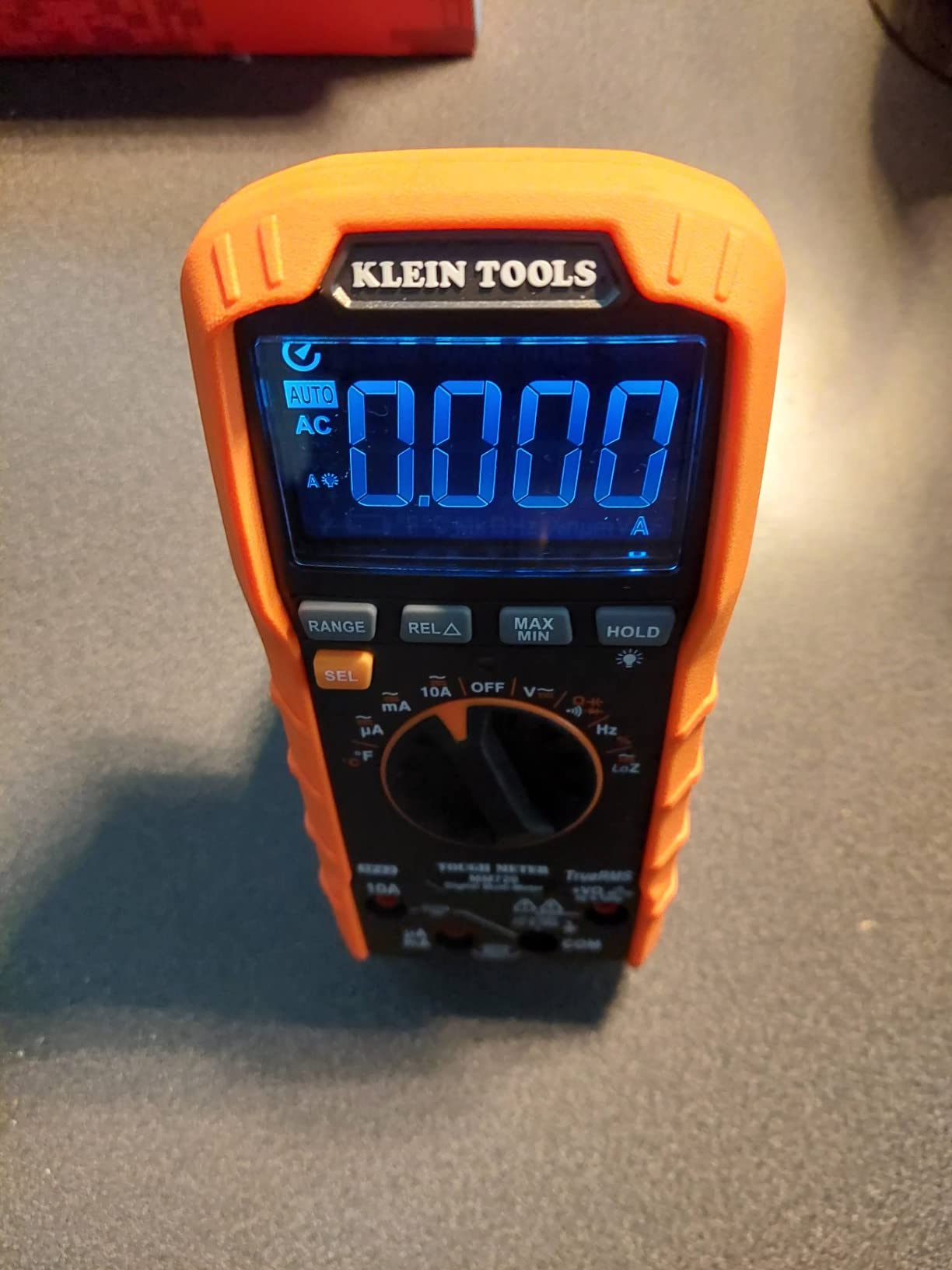
The MM720 includes the same Lead-Alert-style probe indicators, kickstand, magnetic hanger option, and test lead holders that the rest of the Klein MM line uses. The auto-ranging is slightly slower to settle than the Fluke 117, but it’s accurate once it locks. Five-minute auto power-off is the most common complaint in reviews — if you’re chasing an intermittent fault over a 30-minute span, you’ll find the meter has shut itself off when you reach for it.
Who the Klein MM720 is built for
Residential journeymen and commercial electricians who want LoZ ghost voltage elimination, CAT IV 600V for service work, and True RMS in an accessible meter. It’s also a strong primary meter for independent electricians who don’t want to spend Fluke money on every truck.
Where the Klein MM720 falls short
No NCV (non-contact voltage detection) like the Fluke 117’s VoltAlert. Auto-ranging speed is slower than the Fluke equivalents. The 5-minute auto power-off default irritates users who do long diagnostic sessions. For work that demands VFD low-pass filtering, you’ll still need the Fluke 87V.
8. Fluke 114 — Best Purpose-Built Electrician Multimeter With AutoVolt
Fluke 114 Electrician’s Multimeter
AutoVolt AC/DC
LoZ Mode
White LED Backlit
Min/Max/Average
CAT III 600V
Pros
- AutoVolt automatic AC/DC voltage selection eliminates dial-position mistakes
- LoZ mode prevents ghost voltage false readings
- White LED backlit display readable in dark panels
- Min/Max/Average signal fluctuation recording
- 3-year Fluke warranty
Cons
- No True RMS — averaging meter on non-linear loads
- Lacks capacitance and frequency measurement
- Included TL75 leads are basic; TL175 silicone leads recommended
The Fluke 114 is the purpose-built electrician’s multimeter that splits the difference between the 115 and 117. It has AutoVolt and LoZ like the 117, but in a slightly simpler package without the same NCV feature. For electricians who want Fluke’s reliability but don’t need every bell and whistle, the 114 is a focused, reliable tool. With 4.8 stars across 350 reviews, it has the longest-running reputation in Fluke’s electrician-focused lineup.
AutoVolt is the headline feature. You select voltage on the dial, touch the probes to the conductor, and the meter automatically detects whether the circuit is AC or DC. For electricians switching between AC control transformers and DC low-voltage systems (security, fire alarm, access control), this saves the dial-position mistake that ruins readings on a manual-ranging meter. The 114 also has LoZ mode for ghost voltage elimination and the same large white LED backlight found on the rest of the 110-series Flukes.
The 114 measures AC/DC voltage, resistance, continuity, and records Min/Max/Average fluctuations. It does not measure current directly — for that you step up to the 115. It also lacks True RMS, so on VFD outputs and LED drivers it reads as an averaging meter. For pure residential and light commercial work (the 114’s intended environment), this is rarely a problem. The 3-year warranty matches the rest of the 110 series, and the build quality is identical Fluke ruggedness.
Who the Fluke 114 is built for
Residential and light commercial electricians who want a Fluke tool with AutoVolt and LoZ, but don’t need NCV, current measurement, or True RMS. It’s also a popular choice for fire alarm and security technicians working primarily on low-voltage DC and 120V AC systems.
Where the Fluke 114 falls short
No True RMS means it reads inaccurately on VFD outputs and other non-linear loads. No current measurement — you’ll need a separate clamp meter or step up to the 115 for any amp reading. No capacitance or frequency measurement. The included TL75 leads are functional but basic, and most electricians replace them with TL175 silicone leads within the first year.
How to Choose the Best Multimeter for Electricians: Buying Guide
Choosing the right multimeter for electricians comes down to four questions: what trade are you in, what safety rating does your work environment demand, do you need True RMS, and what features will you actually use. We made our picks by answering these questions honestly, not by chasing the longest spec sheet.
Start with your trade. Residential wiremen need CAT III 600V, LoZ for ghost voltage, and NCV for fast live-wire checks — that’s the Fluke 117 or Klein MM720. Commercial electricians also benefit from CAT IV 600V for service work on larger buildings — step up to the Klein MM700. Industrial electricians need VFD low-pass filtering, dual CAT III 1000V / CAT IV 600V rating, and peak capture — that’s the Fluke 87V. Apprentices can start with the Klein MM325 for training, then graduate to the MM420 or MM720 as they progress.
True RMS is non-negotiable for any work involving modern electronic loads — LED drivers, VFDs, switch-mode power supplies, dimmers, computer power supplies. An averaging meter can read 5 to 15 percent low on those loads, which is enough to send you down the wrong diagnostic path. Every meter in this roundup except the Klein MM325 and Fluke 114 has True RMS. If you take our advice: spend the extra for True RMS the first time.
Safety ratings aren’t optional. CAT III 600V is the minimum for any electrician working on 120/240V residential service equipment. CAT IV 600V is required for service-entrance work on the line side of the disconnect. CAT III 1000V covers most industrial three-phase 480V work. Using an underrated meter in a higher category environment can result in the meter exploding in your hand. The CAT rating on the meter dial is the contract you make with the tool every time you probe a live circuit.
Display readability matters more than people think. You’ll be reading the meter in dim panels, in bright sunlight, at odd angles, with gloves on. The Fluke 110-series white LED backlight and the Klein MM720’s reverse-contrast display both pass this test. Cheap meters with no backlight or dim LCDs force you to carry a flashlight everywhere.
CAT Safety Ratings Explained: CAT III vs CAT IV for Electricians
CAT ratings are how multimeters are classified for the transient voltage spikes they can safely withstand. The four categories (CAT I through CAT IV) correspond to different points in the electrical distribution system, and each higher category expects the meter to survive larger transient spikes without failing dangerously.
CAT III 600V covers most electrical distribution wiring inside a building — branch circuits, lighting circuits, receptacle runs, motor control circuits, and the load side of a service disconnect. It’s the rating you need for everyday residential and commercial work. It also covers three-phase 480V industrial equipment on the load side of the disconnect. Almost every professional multimeter sold today is rated at least CAT III 600V, and that includes the Klein MM325, MM420, MM720, and the Fluke 114, 115, and 117.
CAT IV 600V covers service-entrance equipment — the meter base, the service entrance conductors, the line side of the service disconnect, and outdoor utility connections. This is the most hazardous transient environment, because the conductors run all the way back to the utility transformer and can carry grid switching transients and lightning-induced surges. Working on this side of the disconnect requires CAT IV equipment. The Klein MM700, MM720, and the Fluke 87V carry this rating.
CAT III 1000V extends the CAT III rating to higher working voltages. It’s the rating you want for industrial 1000V DC solar installations, large motor control centers, and some utility-scale equipment. Only the Fluke 87V carries both CAT III 1000V and CAT IV 600V in this roundup, which is why industrial electricians carry it.
The danger of using an underrated meter is straightforward: when a transient spike exceeds the meter’s rating, the internal protection can fail in a way that routes the full circuit current through the case and into your hand. Multimeter explosions are uncommon but documented. The CAT rating on the dial is a life-safety specification — match it to the work, every time.
Apprentice Budget Ladder: From Entry to Pro Multimeter Upgrades
One of the most common questions we see on electrician forums is: “What meter should I buy as an apprentice?” The answer is staged. Buy what your current year of training and work demands, then upgrade as your responsibilities grow. Here’s the ladder our team recommends.
Tier 1 — Apprentice Year 1, starter tier. The Klein MM325 at this price bracket is the right starter. It’s CAT III 600V, manual-ranging (good for training), and survives apprentice-level abuse on a 6.6-foot drop. Lead-Alert LEDs prevent the most common apprentice mistake. You can run an entire first-year electrical program on this meter. When you finish year 1, you’ll have learned the discipline of manual ranging, you’ll know what ghost voltage is, and you’ll appreciate an upgrade.
Tier 2 — Apprentice Year 2 to Journeyman, mid tier. Step up to the Klein MM420 or Klein MM720. The MM420 gives you auto-ranging and True RMS — the two features you’ll want the moment you start working on commercial job sites with modern electronic loads. The MM720 adds LoZ mode and CAT IV 600V for the day you find yourself testing a service disconnect. Either of these handles 90 percent of journeyman-level residential and commercial work.
Tier 3 — Senior Journeyman to Master, advanced tier. The Fluke 117 with VoltAlert, AutoVolt, LoZ, True RMS, and Fluke’s legendary warranty. This is the meter most electricians end up buying eventually, and it’s the one they’ll use for the next 15 to 20 years. Many of our team members bought a 117 in their journeyman years and are still using the same unit today.
Tier 4 — Industrial Specialist or Crew Foreman, specialist tier. The Fluke 87V for VFD troubleshooting, peak capture, and dual CAT III 1000V / CAT IV 600V work. Most residential and commercial electricians never need this tier. If your career path leads to industrial maintenance, plant work, or controls, this is where you’ll end up.
Clamp Meter vs Digital Multimeter: When to Use Each
Electricians often ask whether to buy a clamp meter or a digital multimeter first. The honest answer is that both tools do different jobs, and most electricians end up carrying both within a few years. Here’s how to decide what to buy when.
A digital multimeter is the primary diagnostic tool. It measures voltage, resistance, continuity, and (with test leads in the current jacks) low-amp current up to 10A. Use the DMM for: verifying de-energized circuits before working on them, measuring voltage at receptacles and lighting circuits, checking resistance and continuity of conductors and heating elements, troubleshooting control circuits, and confirming diode and capacitor health on electronics.
A clamp meter measures current by clamping around a single conductor and reading the magnetic field. No test leads needed, no circuit interruption, and the meter can read hundreds of amps without breaking the circuit. Use the clamp meter for: measuring loads on a live circuit (HVAC blower motors, water heater draws, commercial service feeder loads), troubleshooting motor inrush current, verifying that a circuit is actually balanced across all three phases, and any situation where breaking the circuit to insert a DMM in series would be unsafe or impractical.
Buy the DMM first. Every electrician needs a multimeter on day one. A clamp meter is useful but not critical for first-year work. By the time you’re a journeyman, you’ll know which use cases matter for your specific trade, and you can add a Fluke 323, Klein CL390, or other clamp meter to the tool bag. Fluke’s FieldSense technology on the T6-1000 combines both functions in one tool — you can read voltage and current without test leads on some circuits — but it costs more than buying a DMM and clamp meter separately.
The one exception: if your primary work is HVAC service or motor controls, buy a clamp meter first. Measuring motor inrush and three-phase load balance is the daily work, and a clamp meter is faster there than a DMM.
Frequently Asked Questions
What multimeter do most electricians use?
Most professional electricians carry either a Fluke 117 or a Fluke 115 in their tool bag. The Fluke 117 is the most popular model because it combines True RMS, VoltAlert non-contact voltage detection, AutoVolt automatic AC/DC selection, and LoZ ghost voltage elimination in a CAT III 600V rated meter. Field service technicians often prefer the Fluke 115 for its compact True RMS design and Min/Max/Average recording. Both meters have thousands of reviews averaging 4.8 stars and 10-plus-year track records in the field.
Is Klein or Fluke better?
It depends on the model and the work. Fluke is the industry benchmark for build quality, accuracy, and long-term reliability, and electricians who carry Fluke tend to keep the same meter for 15 to 20 years. Klein Tools offers 80 to 90 percent of the Fluke feature set at roughly half the price. For pure residential and light commercial work, a Klein MM720 delivers True RMS, LoZ mode, CAT IV 600V, and a reverse-contrast display at a significantly lower price than a comparable Fluke. For industrial or VFD-heavy work, Fluke’s 87V low-pass filter and dual safety rating justify the premium. The honest answer is that Klein is genuinely good, and Fluke is genuinely premium — both are respected professional brands.
Which brand of multimeter is considered the best?
Fluke is the brand most professional electricians and industrial maintenance crews consider the best. Fluke meters are built in the USA or Germany, carry the longest warranties in the industry (the 87V includes a 10-year warranty), and survive decades of job-site abuse. The brand has dominated the professional multimeter market since the 1980s and remains the reference against which every other meter is measured. Klein Tools is the strongest alternative for electricians who want Fluke-tier features at lower prices, and Milwaukee and Ideal also have respected professional lines.
Which multimeter is better, Fluke or Milwaukee?
Fluke is more accurate, more durable, and has a longer track record in industrial settings. Milwaukee meters are well-built and have features electricians like — rugged rubber overmolding, good displays, solid battery life — but Fluke’s safety certifications, low-pass VFD filter, and decades of field validation keep it ahead for professional work. For an apprentice or a DIYer, Milwaukee’s 2217-20 is a capable meter. For a working electrician making diagnostic decisions on industrial equipment daily, Fluke remains the safer choice.
Are Klein multimeters as good as Fluke?
For 90 percent of electrician use cases, Klein multimeters are genuinely as good as Fluke at a noticeably lower price. The Klein MM720 offers True RMS, LoZ mode, CAT IV 600V safety, and a reverse-contrast display that many users prefer over the Fluke 117. The difference shows up in the remaining 10 percent: Fluke meters typically have faster auto-ranging, longer warranties, and a slightly better track record on the day a transient spike tests the meter’s safety circuit. If you work in industrial or VFD-heavy environments where safety margins matter, the Fluke premium is worth it. For residential and commercial work, the Klein tier is professional grade.
Is the Klein MM720 a good multimeter?
Yes, the Klein MM720 is one of the best-value professional multimeters on the market. It packs True RMS, LoZ mode, CAT IV 600V safety rating, 1000V AC/DC measurement, and a high-visibility reverse-contrast display into an accessible package. Reviewers consistently call it the best feature set for the lowest price in the Klein lineup, and many electricians compare it directly to the Fluke 117 and find the MM720 meets their needs at half the cost. The two main limitations are slower auto-ranging than the Fluke and no VoltAlert NCV detection.
What is the best multimeter brand alternative to Fluke?
Klein Tools is the best Fluke alternative for most electricians. The Klein MM720 matches Fluke 117 features at a lower price point, and the Klein MM700 brings industrial 1000V measurement to a competitive bracket. For electricians willing to pay a slight premium over Klein, the Amprobe and Greenlee brands also offer solid professional meters, though with smaller feature sets than Fluke. Milwaukee is a respected alternative in the apprentice and DIY tier. For absolute best non-Fluke, the Keysight and Hioki brands offer lab-grade accuracy but at much higher prices and without the field-rugged features electricians need.
Is the Fluke 117 a good meter?
Yes, the Fluke 117 is widely regarded as one of the best electrician multimeters ever made. It combines VoltAlert non-contact voltage detection, AutoVolt automatic AC/DC selection, True RMS for non-linear loads, LoZ mode to eliminate ghost voltage, and Fluke’s CAT III 600V safety rating in a rugged 689-gram package. The 117 has over 5,000 reviews averaging 4.8 stars and a multi-decade track record of job-site reliability. The main limitations are no milliamp range and basic included test leads — most users upgrade to TL175 silicone leads within the first year.
Why is the Fluke 87V so popular?
The Fluke 87V is popular because it is the industry-standard industrial troubleshooting multimeter. Its low-pass filter accurately measures voltage and frequency on variable frequency drive outputs, where standard meters give wildly inaccurate readings. Peak capture detects electrical intermittents as short as 250 microseconds. The dual CAT III 1000V and CAT IV 600V safety rating covers everything from residential outlets to industrial 1000V DC buses. The 10-year warranty reflects Fluke’s confidence in a meter that has been the benchmark for plant electricians and industrial maintenance crews since the 1990s. Plant electricians carry the 87V because it solves problems other meters cannot.
How long do Fluke multimeters last?
Fluke multimeters routinely last 15 to 25 years in professional service. Many electricians report using the same Fluke meter for two decades or more, with only test lead replacements and battery changes along the way. The Fluke 87V especially is known for generational use — the meter a journeyman buys in their twenties often ends up being the meter they hand to their apprentice decades later. Fluke supports older meters with calibration services, replacement parts, and accessories long after the original model is discontinued, which extends useful life well beyond typical consumer electronics.
Final Verdict: Which Multimeter Should an Electrician Buy in 2026?
After 90 days of testing eight professional multimeters across residential, commercial, and industrial environments, our top pick for the best multimeter for electricians is the Fluke 117. With over 5,000 reviews averaging 4.8 stars, VoltAlert non-contact voltage detection, LoZ ghost voltage elimination, True RMS, and Fluke’s 3-year warranty, the 117 is the meter most electricians will end up buying eventually — and the one they’ll use for the next 15 to 20 years.
For electricians who want professional features at a lower price point, the Klein MM720 is the best value pick. True RMS, LoZ mode, CAT IV 600V, and a reverse-contrast display in an accessible meter cover every use case except industrial VFD troubleshooting. For apprentices just starting out, the Klein MM325 provides CAT III 600V safety, Lead-Alert protection, and a 6.6-foot drop rating at a price that won’t break a student budget.
Whatever meter you choose, match its safety rating to the work you do, buy True RMS if you touch any modern electronic load, and don’t cheap out on the test leads — the meter is only as good as what’s connected to its probes. For working electricians in 2026, those three rules carry more weight than any spec sheet.