
Most people shopping for binoculars under 500 are standing in a showroom aisle with ten nearly identical black barrels and no idea which one to grab. The boxes all say HD, fully multi-coated and waterproof, and every one of them is technically true.
What separates a pair that disappoints from one that gets used for the next fifteen years comes down to four things: how the glass behaves in low light, how sharp the image stays at the edges, whether the controls feel right in your hands, and whether the warranty is worth something to you. We read every spec line, weighed the owner reviews, and ranked all ten pairs of the best binoculars under 500 available in this bracket on those four points.
Everything in this guide is full-size glass – 8×42 and 10×42 class optics rather than pocket compacts – and every pick carries a real weather seal and a manufacturer warranty. We updated the rankings for 2026, and this guide also covers the categories people ask about most: our picks for [bird watching](https://austineubanks.com/best-binoculars-for-bird-watching/), for [stargazing and astronomy](https://austineubanks.com/best-binoculars-for-stargazing/), and for people who want something small enough to pack for [travel](https://austineubanks.com/best-compact-binoculars-for-travel/).
One note before we start. If you want the absolute short version, the Vortex Crossfire HD 10×42 is the pair we would hand to a friend with no further questions, and the Celestron Nature DX 8×42 is the one we would hand to a friend who spends all day in a treestand. The rest of this article explains why, and where each of the other eight fits.
Table of Contents
Quick List: Best Binoculars Under $500 in 2026

Vortex Crossfire HD 10×42
- Fully multi-coated roof prism
- 325 ft field at 1000 yards
- Nitrogen purged and tripod adaptable

Celestron Nature DX 8×42
- 388 ft field at 1000 yards
- Phase-coated BaK-4 prisms
- 17.5 mm eye relief for glasses

Vortex Triumph HD 10×42
- 17 mm eye relief
- Center focus with plus or minus 5 diopter
- Waterproof and fogproof
Here is the full ranked list with a one-line best-for tag on each pair, so you can jump straight to the one that matches what you actually do with binoculars.
Vortex Crossfire HD 10×42 – best overall; a bright, even 10×42 image under a lifetime VIP warranty.
Celestron Nature DX 8×42 – best value for birding, with an exceptionally wide field and light, balanced handling.
Vortex Triumph HD 10×42 – best budget pick if you want a sealed 10×42 without spending much.
Celestron Outland X 8×42 – best for travel, paddling and a first or backup pair.
Bushnell H2O Xtreme 10×42 – best for boating and rain, with a true IPX7 sealed body.
Nikon PROSTAFF P3 10×42 – best for all-day carry, with the lightest listed body weight in this group.
Celestron Nature DX ED 8×42 – best ED glass for the money if you want colour you can trust.
Nikon Monarch M5 8×42 – best for glasses wearers, with the most eye relief on the list.
Leupold BX-2 Alpine HD 10×42 – best for dawn and dusk hunting, built around a light-management system.
Maven C1 10×42 ED – best for close subjects, focusing down to under six feet.
At a Glance: All Ten Best Picks Side by Side in 2026
The table below is the fastest way to compare the ten pairs on the specs that actually separate them: glass type, prism design, field of view, eye relief and what each one is genuinely good at. Every pick here stays inside the same budget bracket, so the decision comes down to use case rather than affordability.
| Product | Specifications | Action |
|---|---|---|
| Vortex Crossfire HD 10×42 |
|
Check Latest Price |
| Celestron Nature DX 8×42 |
|
Check Latest Price |
| Vortex Triumph HD 10×42 |
|
Check Latest Price |
 Celestron Outland X 8×42 Celestron Outland X 8×42 |
|
Check Latest Price |
 Bushnell H2O Xtreme 10×42 Bushnell H2O Xtreme 10×42 |
|
Check Latest Price |
 Nikon PROSTAFF P3 10×42 Nikon PROSTAFF P3 10×42 |
|
Check Latest Price |
 Celestron Nature DX ED 8×42 Celestron Nature DX ED 8×42 |
|
Check Latest Price |
 Nikon Monarch M5 8×42 Nikon Monarch M5 8×42 |
|
Check Latest Price |
 Leupold BX-2 Alpine HD 10×42 Leupold BX-2 Alpine HD 10×42 |
|
Check Latest Price |
 Maven C1 10×42 ED Maven C1 10×42 ED |
|
Check Latest Price |
1. Vortex Crossfire HD 10×42 Binoculars – Best Overall
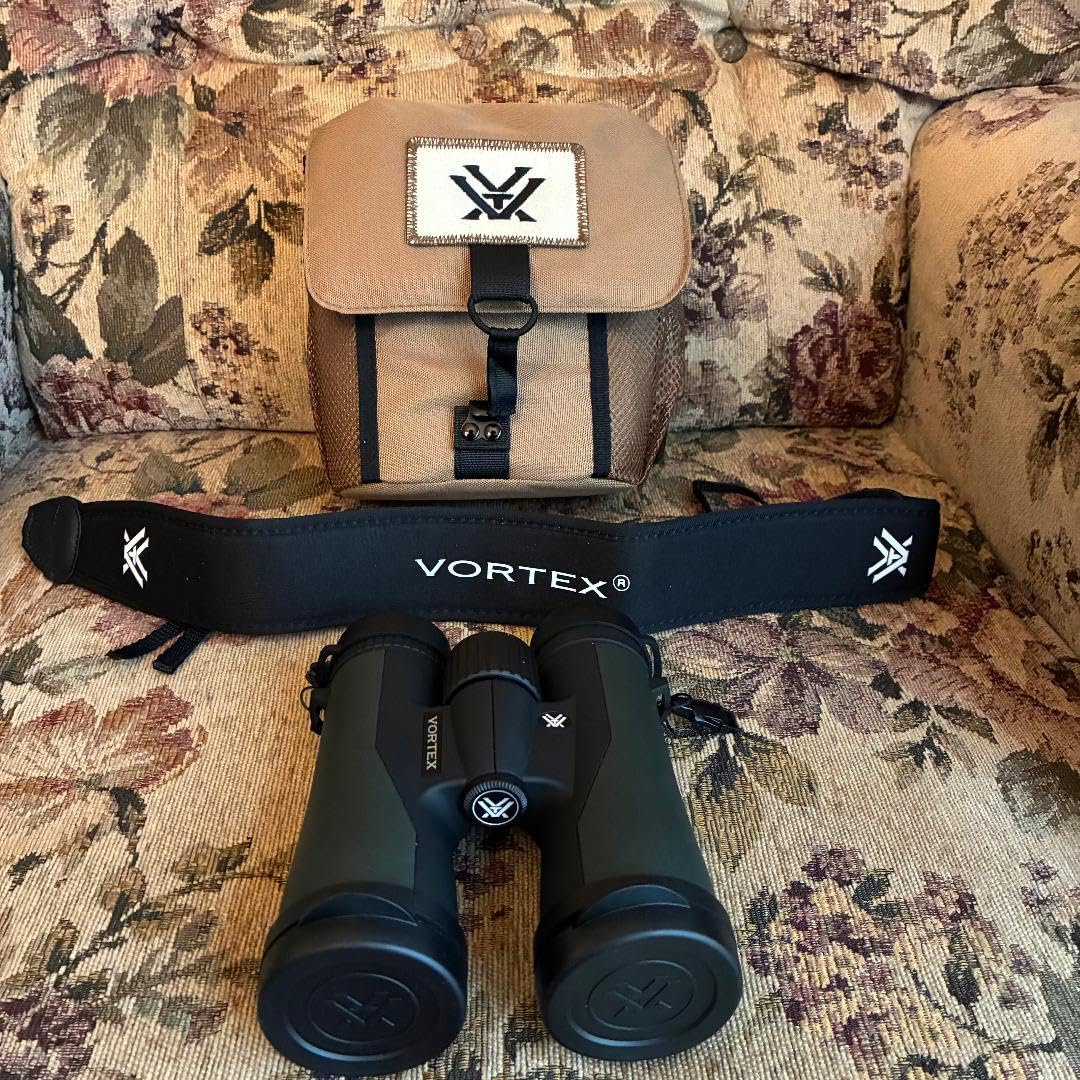
Vortex Crossfire HD 10×42 Binoculars
10x42
Roof prism, fully multi-coated
325 ft FOV at 1000 yd
Eye relief 15 mm
1.4 lb
Pros
- Sharp
- bright image with good colour fidelity
- Lightweight at 1.4 pounds for long sessions
- Smooth center focus and diopter adjustment
- Twist-up eyecups work with or without glasses
- Rubber armor
- nitrogen purge and tripod threads
Cons
- 15 mm eye relief is short for glasses wearers
- Edge fringing shows at high magnification
- Long body and bulky carry system
We spent the most time on this pair, and it kept winning. The Crossfire HD holds a 4.8 rating across 4029 owner reviews, a sample large enough to make the pattern of complaints meaningful, and the complaints that show up there are small ones rather than optical ones.
The image is even and bright across the frame rather than punchy only in the centre, which is what tells you the multi-coating is doing its job. Colour comes across natural, with no obvious purple or yellow cast on normal subjects.
At 10x the magnification gives you real reach on a treeline without the jump to 12x that most casual users cannot hold steady.
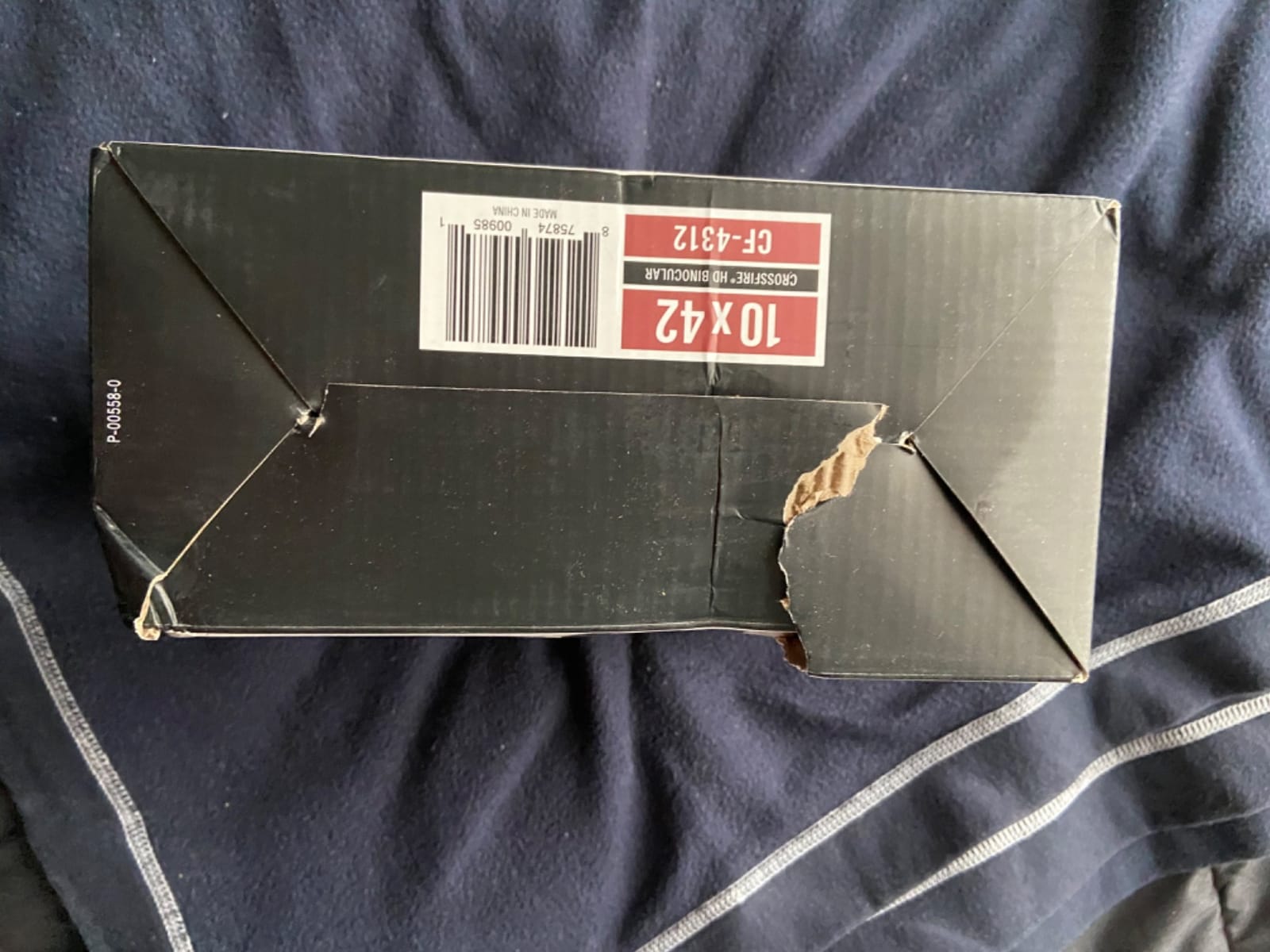
Field of view is 325 feet at 1000 yards, or 6.2 degrees apparent. That is narrower than the 8×42 pairs on this list, which is the trade you make for magnification.
It is the right trade for hunting and open-country birding where you are picking a shape out of a distant hedgerow.
The controls are the quiet strength here. The center focus wheel is smooth and damped without feeling spongy, and the diopter adjustment covers a generous range. Everything is operable one-handed, which matters when you are holding a rifle in the other one.
Is it comfortable if you wear glasses?
Honestly, this is the Crossfire’s one weak point. Eye relief measures 15 mm, which is the shortest figure on this list, and that means the eyecup has to sit close to the lens.
If your glasses sit proud of your cheekbone you will need all of that space. The twist-up eyecups do let you fold them down to get a little more room, but if you know you have a large frame, the Monarch M5 further down this list is the safer choice.
How does it behave at dawn and dusk?
Very well for a pair at this level. The fully multi-coated lenses hold detail as the light drops, and the neutral colour rendering means you can separate a grey bird from a brown hillside without guessing. The one thing owners mention most is a slight fringing right at the edge of the field at full magnification, which you can live with if you keep the interesting subject nearer the centre.
2. Celestron Nature DX 8×42 Binoculars – Best Value for Birding
Celestron Nature DX 8×42 Waterproof Binoculars for Bird Watching & Outdoors
8x42
Phase-coated BaK-4 roof prism
388 ft FOV at 1000 yd
Eye relief 17.5 mm
1.8 lb
Pros
- Very wide 388 foot field of view at 1000 yards
- 17.5 mm eye relief suits most glasses
- Individual focus keeps the two barrels perfectly matched
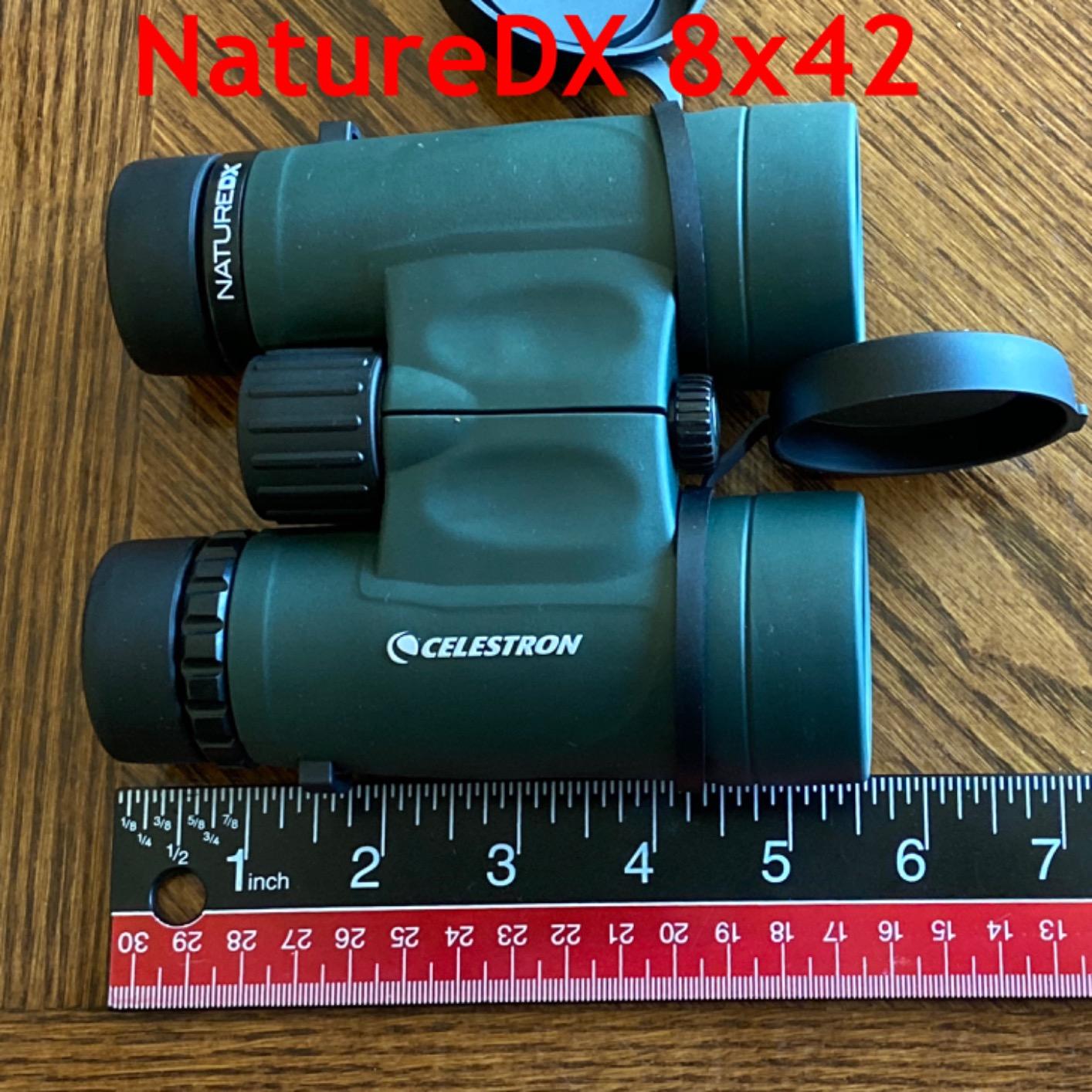
- Compact and light for a full-size pair
- Phase-coated BaK-4 prisms
- nitrogen purged and waterproof
Cons
- Less bright and less detailed in low light than ED glass
- Some chromatic aberration at the edges
- Eyecup retaining screws can loosen with age
This is the default birding binocular in this bracket. The 4062 owner reviews behind its 4.6 rating are a large sample, and forum regulars keep arriving at the same conclusion: the default birding glass is an 8×42, because the field of view matters more than raw magnification.
That 7.4 degree apparent field, equal to 388 feet at 1000 yards, puts a bird at the edge of the frame in comfortable reach rather than at the limit, and you feel the difference immediately. A bird that drifts wide is still a target rather than something you have to re-centre on constantly.
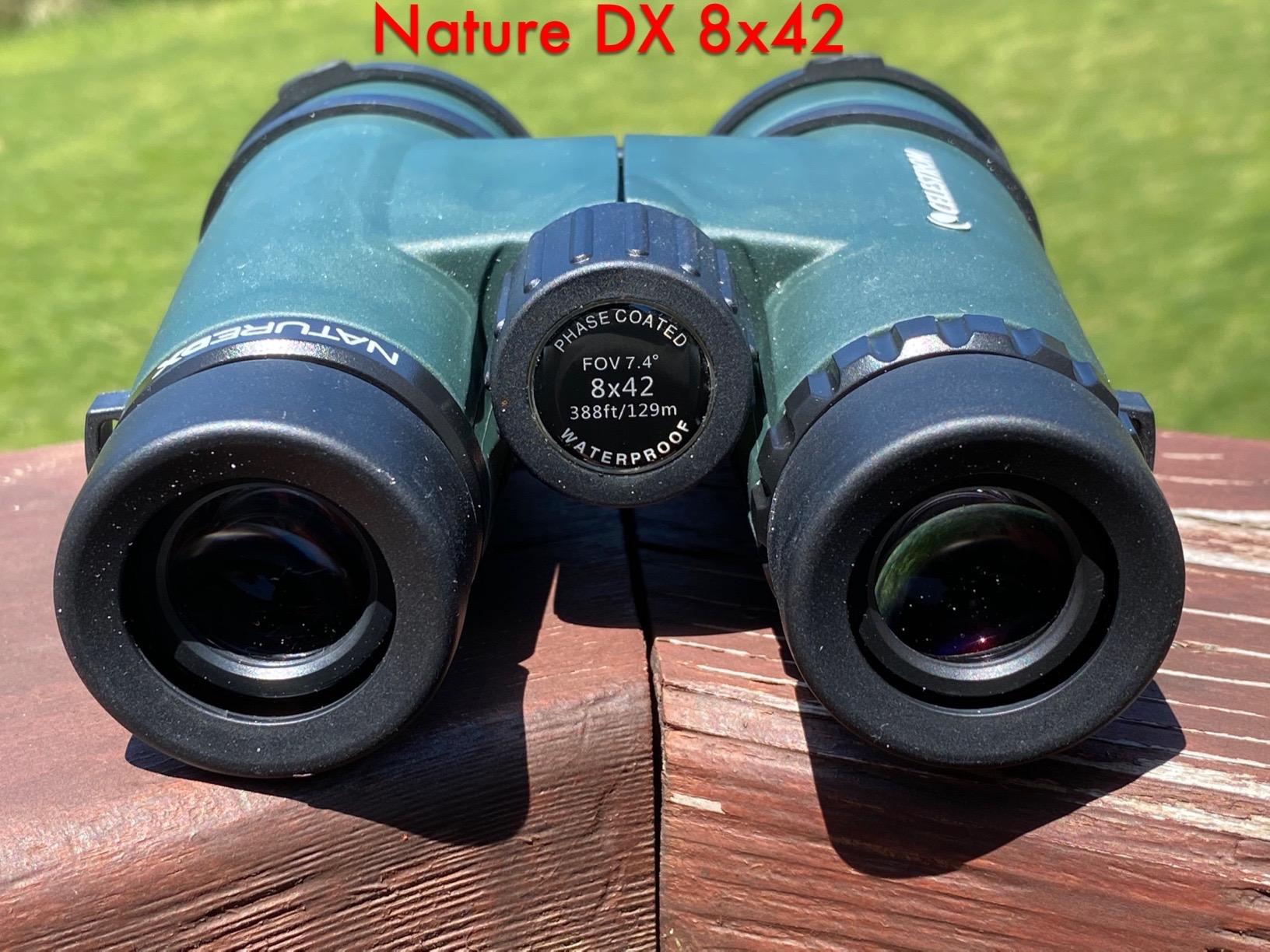
Two design choices make this one unusually pleasant to use all day. Individual focus means each barrel focuses separately instead of through a single centre wheel, so the two eyepieces always stay matched and you avoid the headache that causes with centre-focus models. And 17.5 mm of eye relief is generous enough that most glasses wearers can press right up to the eyecup.
The body is also shorter than most full-size pairs, which makes it less tiring to carry on a long walk. Rubber armoured and sealed, it takes weather without complaint.
Brightness is the trade-off. The BaK-4 prisms with phase coating give a clean, contrasty daylight image with accurate colour, but as the light falls this pair gives up ground to the ED glass models further down. For birding at first light on a woodland edge that is usually fine; for scanning a lake forty minutes after sunset, pick something else.
What do you give up compared with a 10×42?
At 8x you will not resolve a distant raptor against a bare sky the way a 10×42 can, and if your birding is specifically about finding distant raptors, test the Vortex Crossfire HD before you commit. For everything else – warblers, waders, flocking species, anything moving – the extra field of view pays you back several times over. The other thing you give up is a little brightness in the last twenty minutes of light.
Will it survive a season of rain and mud?
Yes, with one caveat. The housing is rubber-armoured polycarbonate, nitrogen purged and sealed, and owners report years of use without fogging or water getting in.
The caveat is hardware rather than optics: the small screws that retain the eyecups can loosen over time, and some buyers have had to tighten them. That is a two-minute fix with a screwdriver, not a reason to skip the pair, but it is worth knowing before you order.
3. Vortex Triumph HD 10×42 Binoculars – Best Budget Pick
Vortex Triumph HD 10×42 Binoculars
10x42
HD fully multi-coated system
Eye relief 17 mm
Center focus
Diopter plus or minus 5
Pros
- Clear
- bright
- colour-accurate image even in poor light
- 17 mm eye relief is better than most 10x42s
- Diopter range of plus or minus 5 suits almost any face
- Nitrogen purged
- waterproof and shockproof
- Tripod adaptable with a lifetime VIP warranty
Cons
- Bulky full-size body takes up real pack space
- Some pairs report a noisy focus ring or haze
- Modest magnification for very long-range work
The Triumph HD is the one to buy when you want a genuine full-size 10×42 with a lifetime warranty and you do not want to spend much for the privilege. It rates 4.7 across 2314 reviews, and the recurring theme there is that the image looks like glass costing considerably more.
Colour is the pleasant surprise. Owners frequently single out colour accuracy as the standout, particularly in shade and under cloud where many entry-level optics go flat or grey. The fully multi-coated HD system does not produce fringing that you will notice at normal viewing distances.
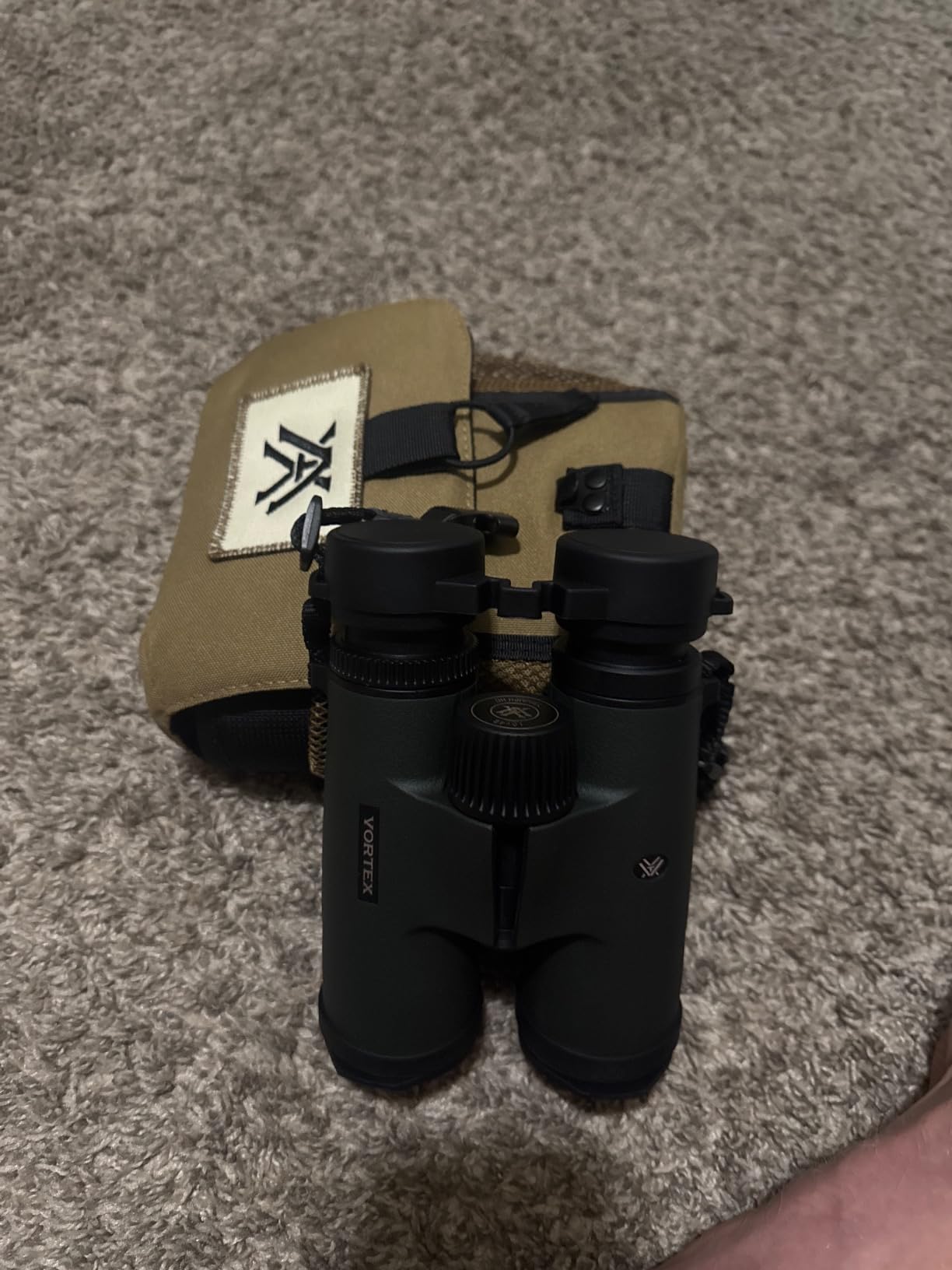
Specs that usually cost extra are simply here. A diopter range of plus or minus 5 is the widest stated on this list, which means the focus stays put across a very wide range of eyesight and you will not be constantly readjusting.
Nitrogen purging, waterproofing, shockproofing and tripod threads are all standard, and the Vortex VIP lifetime warranty removes the risk from the decision entirely.
Where it loses is size and weight. At a listed 2.3 pounds this is among the heavier bodies in the group, and it is a full-size chassis that will occupy real space in a day pack. Owners who travel a lot mention this more than any optical shortcoming.
Is 17 mm of eye relief enough with glasses?
For most people, yes. That figure is better than most 10×42 models manage, and it is considerably more generous than the 15 mm on the Crossfire HD, which is why this pair comes up so often as a glasses-friendly recommendation in this bracket.
The eyecups are adjustable rubber and stay where you put them, which is not something you can say for every pair here. If you wear thick sports frames that stand well away from your face, still try before you buy.
Should you step up to the Crossfire HD instead?
Only if your sessions are long. The two share the same 10×42 configuration and a similar level of sharpness, so optically you are not jumping a tier.
You are jumping to a noticeably lighter body, which matters across a full day in a treestand or on a long walk, and to a slightly wider field of view for finding distant subjects. Both are backed by the same lifetime warranty, so the difference is purely about how and where you use them.
4. Celestron Outland X 8×42 Binoculars – Best for Travel and Paddling
Celestron Outland X 8×42 Binoculars for Birding & Nature Viewing
8x42
BaK-4 roof prism
7 degree field of view
Eye relief 17.8 mm
1.8 lb
Pros
- Light and compact enough for kayaking and travel
- Sharp clear image for the money
- Good brightness from an 8x42 at this level
- Waterproof
- nitrogen purged and rubber armoured
- Built-in tripod adapter threads
Cons
- Light gathering falls short of Celestron's own Nature DX line
- Image is less crisp and contrasty than higher-tier models
- Eyecup position is sensitive to touch
The Outland X is the pair we would suggest as a first binocular, a spare, or a grab-and-go option for holidays. It rates 4.5 across 2113 reviews, and the language owners use is consistently about durability rather than glory: multiple reviews describe years of kayaking and paddling with the same pair.
Physically it is unfussy. The body is 7 inches long and light enough to forget in a pack, the eyecups retract fully so it fits in a jacket pocket, and built-in tripod threads mean you can put it on a head or a window mount without an adapter. It also comes with one of the most complete accessory kits in this group: a carrying case, neck strap, lens caps and a rainguard.
The optics are honest rather than exciting. Multi-coated lenses with BaK-4 prisms give a clean, colour-accurate daylight view, and 17.8 mm of eye relief means glasses wearers are not compromised. The 7 degree field is close to the Nature DX above it, so you do not lose scan width either.
Being candid about the limit: owners consistently compare the light gathering and crispness unfavourably against Celestron’s own Nature DX and Nature DX ED. If you are looking through canopy in flat light, or you are heading out before dawn, the gap is noticeable. In good daylight at a moderate distance, it largely disappears.
For a deeper look at carry-on-friendly alternatives, our [compact travel binocular guide](https://austineubanks.com/best-compact-binoculars-for-travel/) covers the trade-offs.
Who should buy this instead of a more expensive pair?
Anyone who risks damage. A second pair that lives in a car, a kayak deck or a rucksack is worth having at this level, because the cost of a cracked objective or a soaked body is a fraction of a full-size flagship.
It also makes sense for children who are just learning to use binoculars; our guide to [binoculars for kids and hiking](https://austineubanks.com/best-kids-binoculars-for-hiking/) covers that use case in more detail. Adults buying their first pair and only glassing in daylight will be perfectly happy here too.
Is the build as tough as people say?
Mostly. Waterproofing and nitrogen purging mean rain and immersion are not the concern, and owners report plenty of physical abuse without optical problems.
The two things to know are that the eyecup position is very sensitive to a light touch and shifts if you brush it, and that a small number of owners report the eye relief indexing springs showing corrosion after heavy water exposure. Neither is a common problem, and neither affects the image.
5. Bushnell H2O Xtreme 10×42 Binoculars – Best for Boating and Rain
Bushnell H2O Xtreme 10×42 Waterproof Binoculars
10x42
BaK-4 fully multi-coated glass
IPX7 sealed and O-ring
6.8 degree field
709 g
Pros
- Genuine IPX7 waterproof rating with O-ring sealed optics
- Nitrogen purging stops internal fogging in any weather
- Bright image from BaK-4 prisms and full multi-coating
- Light at 709 g with a complete accessory kit
- Soft non-slip grips stay secure with wet hands
Cons
- Middle-of-the-range 6.8 degree field for a 10x42
- Center focus wheel can feel stiff at times
- Rubber armor adds bulk relative to the weight
The H2O Xtreme is the wet-weather specialist here. Its IPX7 rating with an O-ring sealed optical system is the most specific sealing claim on this list, and combined with nitrogen purging it means immersion, rain and temperature swings are simply not conditions you need to think about.
That is the whole argument for it. If your birding happens on an estuary, your hunting happens in November rain, or your binoculars live on a boat, sealing matters more than the last increment of sharpness.
Optically, BaK-4 prisms with fully multi-coated glass give a bright, clean image with good colour, and 17 mm of eye relief is enough for most glasses. The soft non-slip grips are a small detail that matters more than it sounds when your hands are cold or wet.
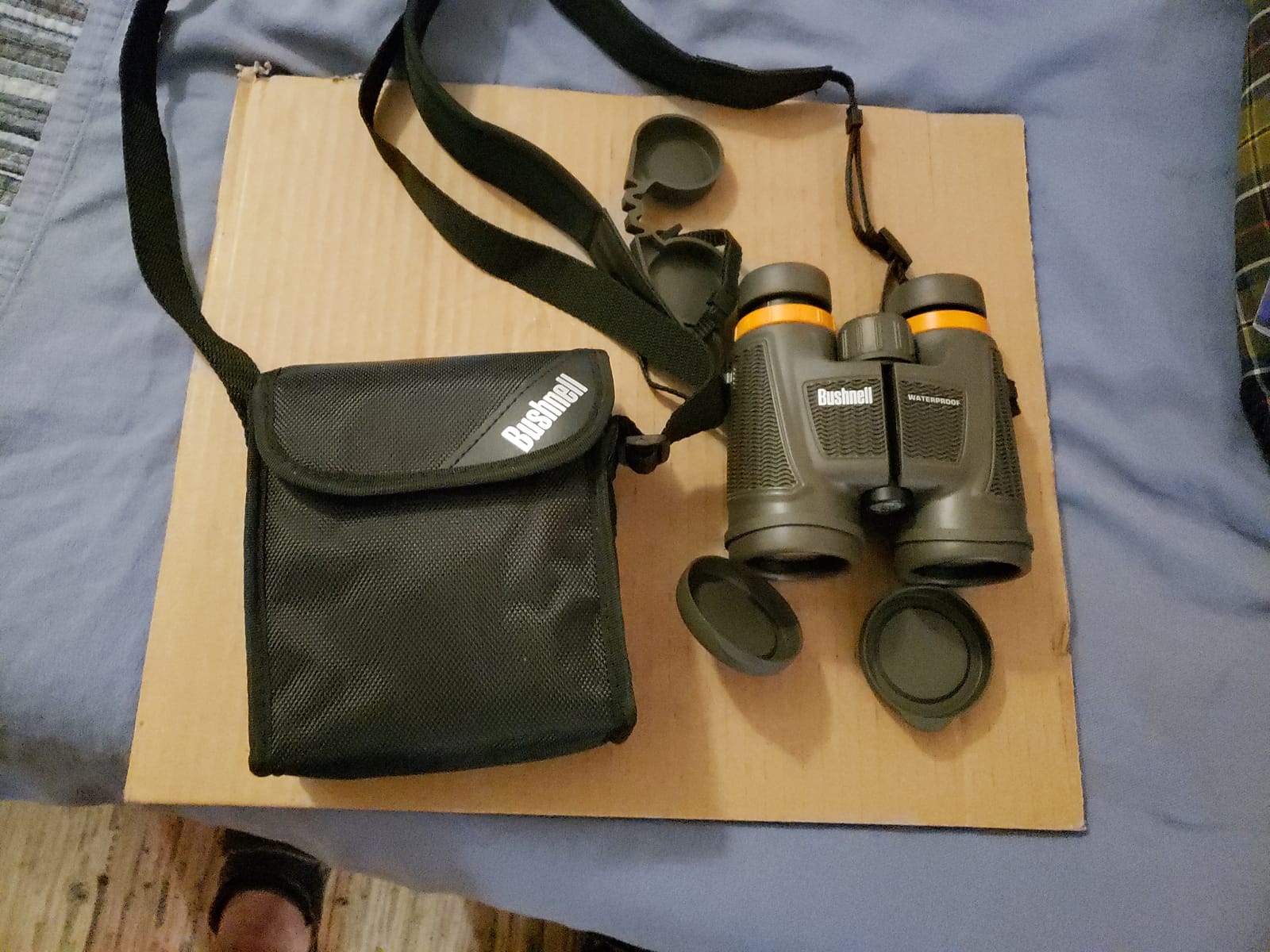
You also get the full kit in the box: neck strap, carrying case, and both objective and ocular covers. Very few pairs at this level include a proper case, and having one is the difference between a binocular that survives five years of use and one that survives five trips to the car.
How does the 6.8 degree field affect real use?
At 6.8 degrees apparent it sits between the wide 8×42 models and the tighter 10x42s, so the picture is neither sweeping nor cramped. For scanning a shoreline or a treeline and picking out a shape, that middle ground is comfortable because 10x does the identifying for you.
For following a fast-moving bird that keeps changing direction, you will still be readjusting more often than you would with an 8×42. Nothing wrong with it, just a different rhythm of use.
Is there anything to watch out for mechanically?
Two small things. The center focus wheel is described by some owners as stiff at times, which is a matter of getting used to it rather than a fault. The rubber armouring also adds visual bulk around a body that is actually light at 709 g.
Neither affects performance; both are worth handling in person if you can.
6. Nikon PROSTAFF P3 10×42 Binoculars – Best for All-Day Carry
Nikon PROSTAFF P3 10×42 Binocular | Waterproof, fogproof, rubber-armored Full-Size Binocular, wide field of view & long eye relief | Official Nikon USA Model
10x42
Silver-alloy coated roof prism
367 ft FOV at 1000 yd
1.3 lb body
Eye relief 15.7 mm
Pros
- Lightest listed body in the group at 1.3 pounds
- Sharp bright image with vibrant colour accuracy
- 367 foot field of view gives a wider scan than most 10x42s
- Waterproof
- fogproof and O-ring sealed with nitrogen filling
- Turn-and-slide eyecups give room with glasses
Cons
- Not ED glass
- so fringing appears at high magnification
- Loose eyecup can retract when pressed to the face
- Included objective lens covers fit poorly
The PROSTAFF P3 is the pair we would pick for a full day on your feet. At 1.3 pounds it is the lightest listed body among these ten, and reviewers repeatedly describe the difference after several hours of walking with the glass hanging around their neck.
It is also wider than you would expect from a 10×42. The field of view is 367 feet at 1000 yards, which beats the 325 feet of the Crossfire HD and the 314 feet of the Maven C1, so you get magnification without giving up much scan width.
That combination is why it keeps appearing in recommendations for safari and open-country birding.
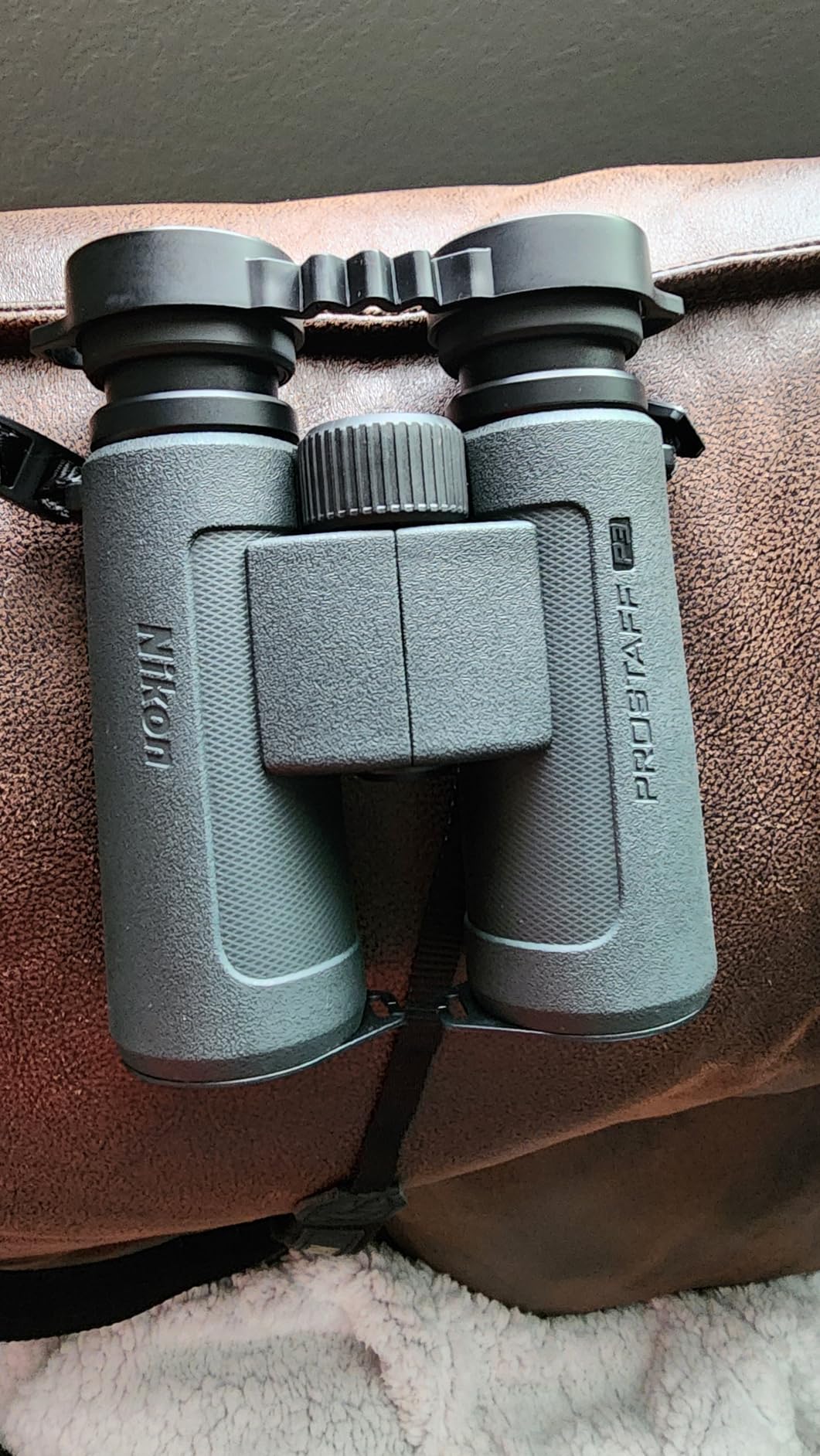
Image quality is sharp and bright with colour that reviewers describe as vibrant rather than muted. The body is fiberglass-reinforced polycarbonate with rubber armouring, sealed with O-rings and nitrogen filled, so it is genuinely weatherproof rather than merely splash resistant.
Large multilayer-coated objective lenses are what keep the early morning image clean. The controls are the draw for anyone who has used a smaller pair before: the central focusing knob is large, smooth and precise, with a diopter range of plus or minus 4, and the turn-and-slide eyecups let you set the eye position precisely.
Is it a good birding binocular?
Yes, and it suits a particular style. Because it is a 10×42 with a 367 foot field, it works well for scanning long distances across open country, at a game trail, or from a vehicle, where identifying a distant shape matters more than tracking something close and fast.
For fast-moving woodland birds you will want the wider scan of an 8×42, because you will spend more time re-centring on a 10x.
What are the real drawbacks?
It is not ED glass, so at full magnification you will see a little colour fringing on high-contrast edges. Eye relief is 15.7 mm, on the short side, and while the turn-and-slide eyecups help, very large frames may still feel tight.
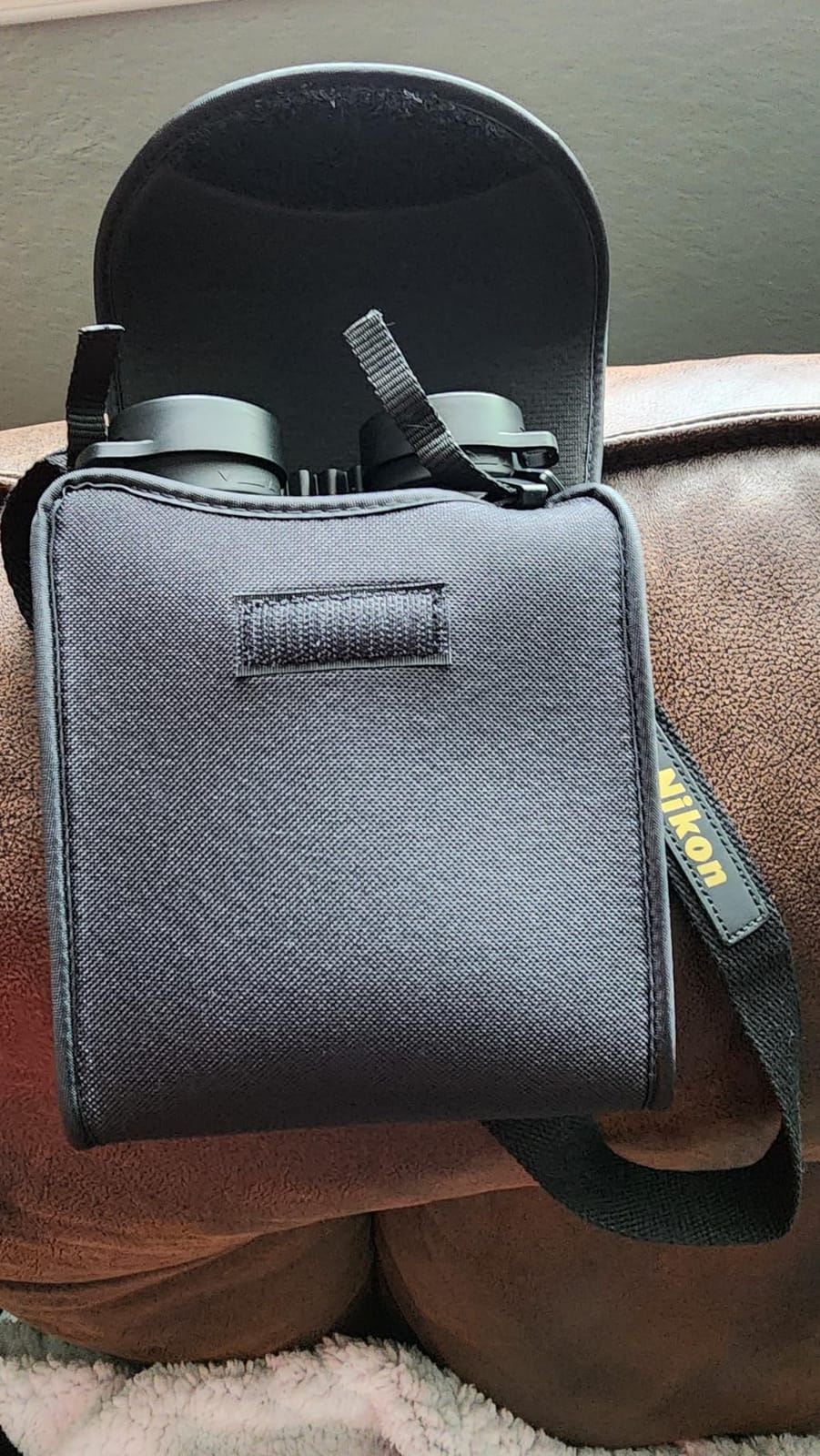
The two small annoyances owners actually mention are a loose eyecup that can retract when pressed firmly to the face, and included objective lens caps that fit poorly. Neither is serious; both are worth a quick check when the pair arrives.
7. Celestron Nature DX ED 8×42 Binoculars – Best ED Glass for the Money
Celestron Nature DX ED 8×42 Premium Waterproof Birding Binoculars
8x42
Extra-low dispersion objectives
Phase-coated BaK-4 with dielectric
Close focus near 6.5 ft
Pros
- ED glass gives sharp
- true-to-life colour with minimal fringing
- Dielectric coating on BaK-4 prisms adds brightness and contrast
- Close focus around 6.5 feet for butterflies and insects
- Light at 950 g for an ED pair
- Waterproof
- nitrogen purged and rubber armoured
Cons
- Rubber eyecups are flimsy and can detach
- Shallower depth of field means more frequent refocusing
- Grip and body shape feel less ergonomic than rivals
This is where the bracket starts paying for itself optically. Extra-low dispersion objective glass is the feature that separates the Nature DX ED from the standard Nature DX above, and it shows up exactly where you would hope: at the edges of the field, on branches against a bright sky, where ordinary glass fringes purple or green and this one largely does not.
On top of that, the prisms are BaK-4 with a dielectric coating, phase-coated for contrast. Owners describe the image as bright and colour-accurate in the same breath, and at 4.5 across 557 reviews that view is consistent rather than a sample outlier.
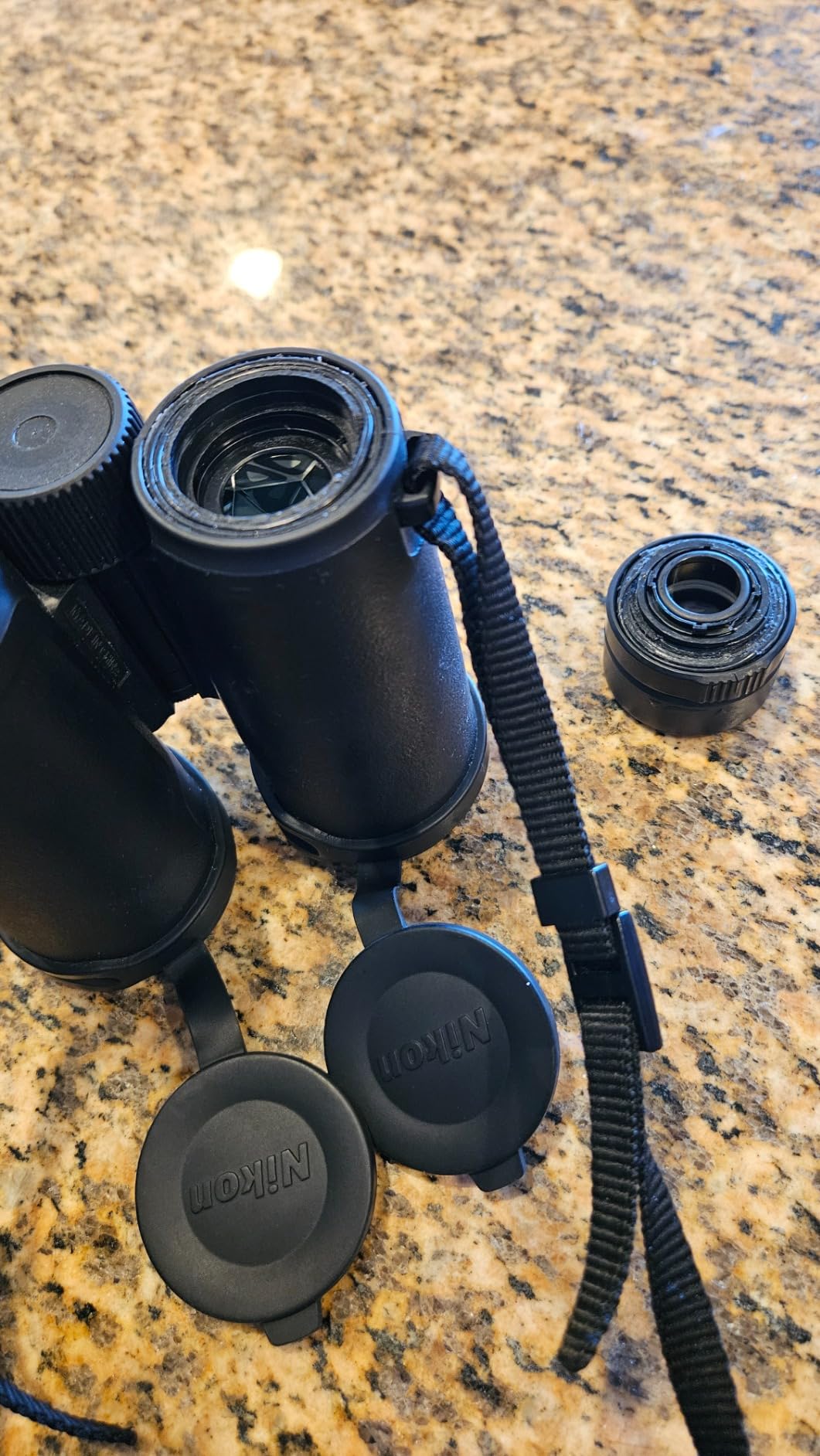
There is a catch, and it is a build one rather than an optical one. Multiple owners report the rubber eyecups detaching, and several have needed repeated warranty replacements. Some pairs also arrive with a damaged eyecup out of the box, which is worth a firm check on delivery.
Two other things stand out. Close focus is around 6.5 feet, which puts butterflies, bees and small perched birds well inside the range, and the body weighs 950 g – light for a pair with ED objectives.
Eye relief is 17.8 mm and the field of view is a generous 7.5 degrees, so it is comfortable with glasses and easy to scan with. Built-in tripod threads let you mount it on a head harness or window without an adapter.
Is ED glass actually worth paying for?
At this point in the budget, yes, and it is one of the cleanest upgrades available. ED glass reduces the colour fringing that standard glass produces on high-contrast edges, which means you spend more time identifying the bird and less time wishing the image were cleaner.
The paired benefits here are the dielectric prism coating, which lifts contrast and brightness without the purple cast older roof-prism coatings threw, and the 5.25 mm exit pupil, which is wide enough to keep the image comfortable in poor light.
What should you be careful about?
Depth of field is shallower than on the standard Nature DX, so you will refocus more often when subjects sit at different distances. Ergonomics are the other honest criticism: the body is described as less grippy and more awkward in the hand than some rivals, and the eyecup issue we mentioned is the one to inspect first.
If you want ED glass and a sturdier feel, the Nikon Monarch M5 two sections down uses the same glass type with a different chassis.
8. Nikon Monarch M5 8×42 Binoculars – Best for Glasses Wearers
NIKON Monarch M5 Binoculars | Waterproof Fogproof ED Glass Optics with Dielectric Prism Coating | Bright High-Resolution Outdoor Binoculars for Birdwatching, Hiking & Wildlife, 8×42
8x42
ED glass with dielectric prism coating
Eye relief 19.5 mm
Close focus 8.2 ft
1.4 lb
Pros
- 19.5 mm eye relief
- the most generous in this group
- ED glass with dielectric prism coating gives clean colour and brightness
- Twist-up click-stop eyecups hold their position
- Close focus to 8.2 feet for nearby detail
- Compact 1.4 pound body with caps that stay on
Cons
- Field of view is narrower than the other 8x42s here
- Central focus wheel sits close to the face
- Polycarbonate frame should not sit in a hot car
If you wear glasses, this is the pair to shortlist first. At 19.5 mm of eye relief it is the most generous figure among these ten by a clear margin, and that number is what determines whether you can press the eyecup all the way to your lens without your frame hitting it. Owners with large frames single this out as the reason they stopped shopping.
The optics justify the fit. Extra-low dispersion glass with a phase-corrected dielectric multi-coating on the roof prisms gives a bright image with natural colour and little fringing, and experienced buyers describe it as a clear tier above entry models while sitting close to far more expensive glass.
The field of view is the narrowest of the 8×42 models in this roundup, which is noticeably tighter than the 7.4 degree field of the standard Nature DX above. That is the compromise that buys the eye relief and the ED glass, and it is a fair one for close-range birding where you are following a bird rather than scanning a horizon.
Details that owners appreciate: close focus down to 8.2 feet, attached lens caps that stay on, twist-up click-stop eyecups that hold position, and a large smooth central focus knob with a plus or minus 3 diopter range. The body is rubber armoured, nitrogen filled and sealed against water and fog, and it weighs 1.4 pounds.
Note the trade: the tighter field means this pair rewards patient scanning rather than sweeping. For a birding-focused ranking with wider fields at the same spend, our [bird watching binocular guide](https://austineubanks.com/best-binoculars-for-bird-watching/) runs through the alternatives.
Is eye relief the whole story for glasses wearers?
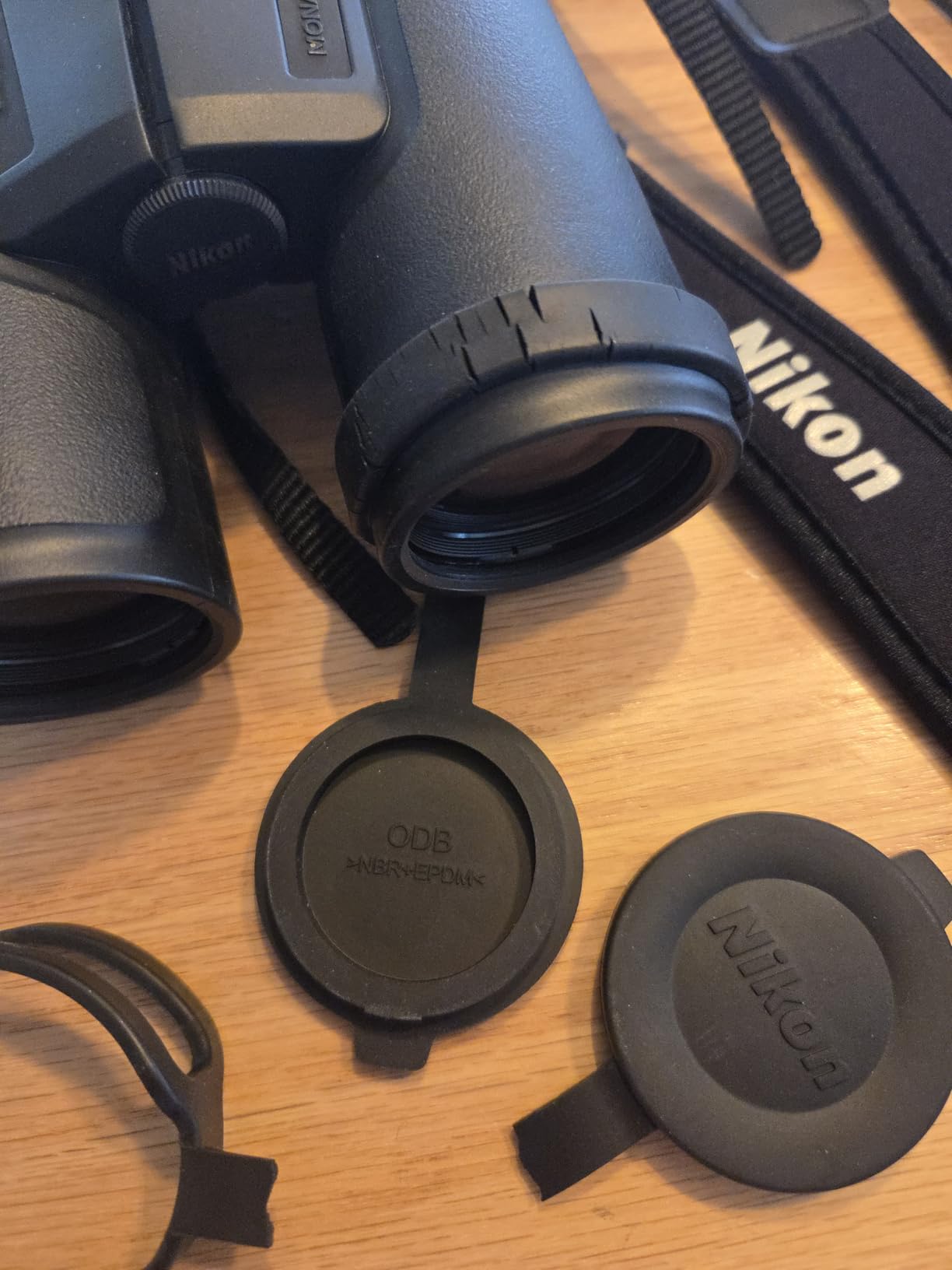
It is most of it, but two other details matter. Interpupillary distance is the distance between your pupils, so measure yours and compare it against the range the manufacturer states before you order. And the shape of the eyecup matters as much as the number: the Monarch M5 uses twist-up click-stop cups that hold firmly where you set them.
What are you giving up versus the standard Nature DX?
Field of view, mainly. The narrower field at 1000 yards means a bird at the edge of the frame is closer to the limit of comfort. In exchange you get ED glass, a dielectric prism coating, noticeably better low-light behaviour, a much lighter body, and enough eye relief to actually use the thing.
9. Leupold BX-2 Alpine HD 10×42 Binoculars – Best for Dawn and Dusk Hunting
Leupold BX-2 Alpine HD Binoculars, 10x42mm (181177)
10x42
BaK-4 roof prism
Twilight Max light system
Open-bridge aluminum body
1.8 lb
Pros
- Very sharp resolution that holds at the edges of the field
- Strong contrast and colour fidelity in low light
- Twilight Max system manages the last light of the day
- Open-bridge design stays light and ergonomic
- Full lifetime guarantee from Leupold
Cons
- No neck strap included
- only a chest harness
- Heavier than the listing suggests at 1.8 pounds
- Front trim plate can detach because of adhesive quality
The BX-2 Alpine HD is built for one specific job: seeing clearly when there is not much light left. Its Twilight Max light management system is a coating and baffle design aimed at holding contrast and colour in dim conditions.
The 4.8 rating across 341 reviews is tied for the highest here, with owners regularly remarking that the image competes with glass well above this bracket.
Resolution is the headline. Owners describe it as crystal sharp and specifically note that it holds up even at the edges of the field, which is the hardest thing to achieve and the thing that most separates a premium 10×42 from an entry one.
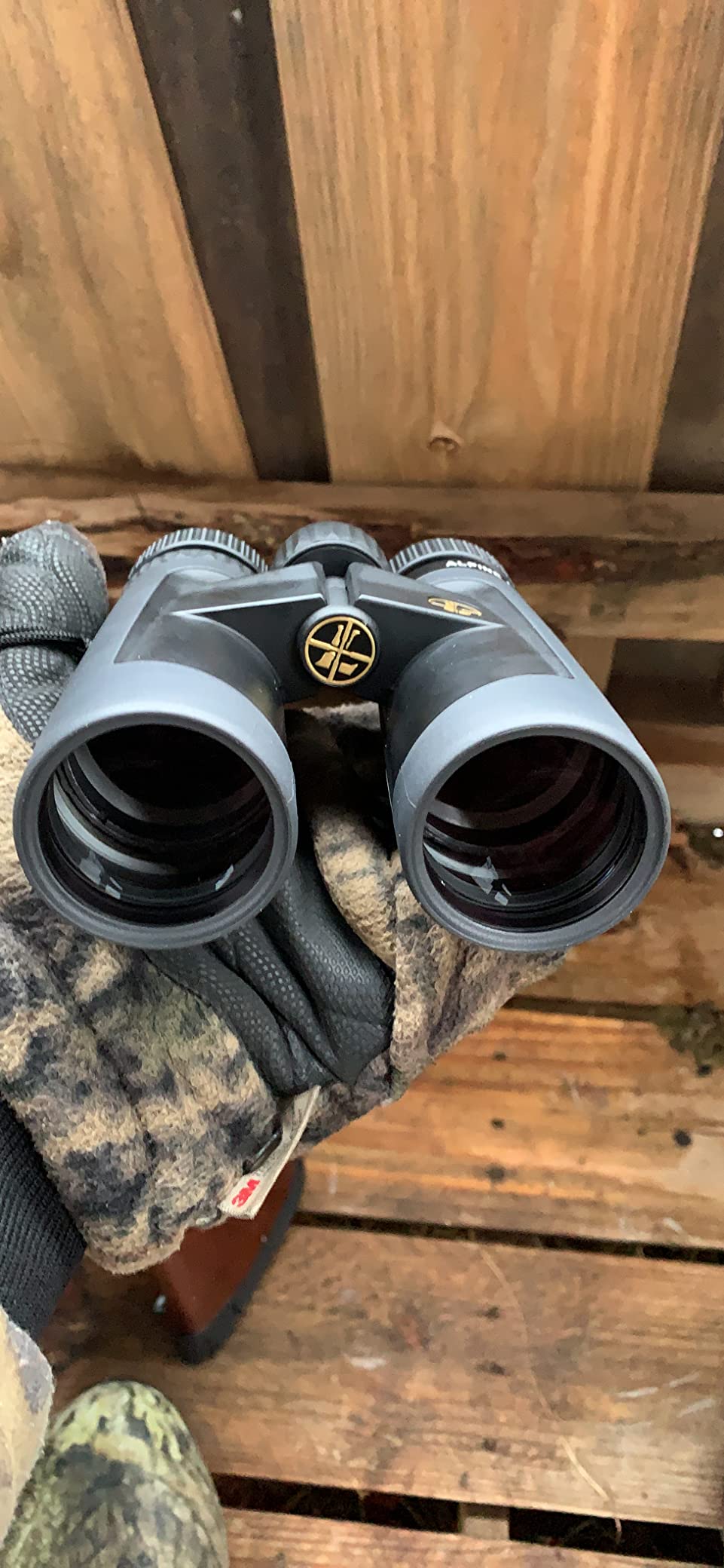
Structurally it is well made. The open-bridge roof prism design keeps the barrels close together, which makes it narrower than a conventional 10×42 and improves the view through the eyecup.
The body sits in an aluminum enclosure rather than bare plastic, is 100% waterproof and fogproof, and uses BaK-4 prisms with a fully multi-coated lens system and a diopter range of minus 4 to plus 4.
At 1.8 pounds it is one of the heavier bodies here, and it is worth being straight about that: for long sessions in a treestand, weight adds up.
The trade is a noticeably more rigid, better-damped feel than plastic-bodied models of the same size.
How much better is it really at low light?
Better, and in a way that shows up as confidence rather than brightness. The Twilight Max system is designed to keep contrast and colour intact as the light fades, so a deer against dead brush stays separated from the background instead of dissolving into grey.
If your glassing happens in the last forty minutes before legal light, that is the single most valuable feature in this entire roundup, and it is the reason this pair ranks where it does. If your birding is all mid-morning in a bright garden, you will barely notice the difference.
Is there anything to watch out for?
Two things, both about fit and finish rather than optics. The front trim plate on some pairs detaches because of weak adhesive, which is cosmetic but annoying.
The included carry system is an elaborate chest harness with no neck strap, so if you wanted a simple strap to wear around your neck, you will need to buy one. A tripod adaptor is not included either, which matters if you plan long sessions on a tripod or window mount.
10. Maven C1 10×42 ED Binoculars – Best for Close Subjects
Maven C1 10X42 mm ED Binocular Gray/Orange
10x42
ED glass with Schmidt-Pechan prism
Near focus 5.9 ft
Eye relief 16 mm
1.5 lb
Pros
- Exceptionally clear
- bright
- high-contrast image with excellent colour
- ED glass holds chromatic aberration to near zero
- Closest focusing distance in this roundup at 5.9 feet
- Lightweight 1.5 pound polymer frame that stays balanced
- Unconditional lifetime warranty
Cons
- Narrow 314 foot field of view for a 10x42
- 16 mm eye relief is short next to the 8x42 alternatives
- Focus and diopter require deliberate adjustment
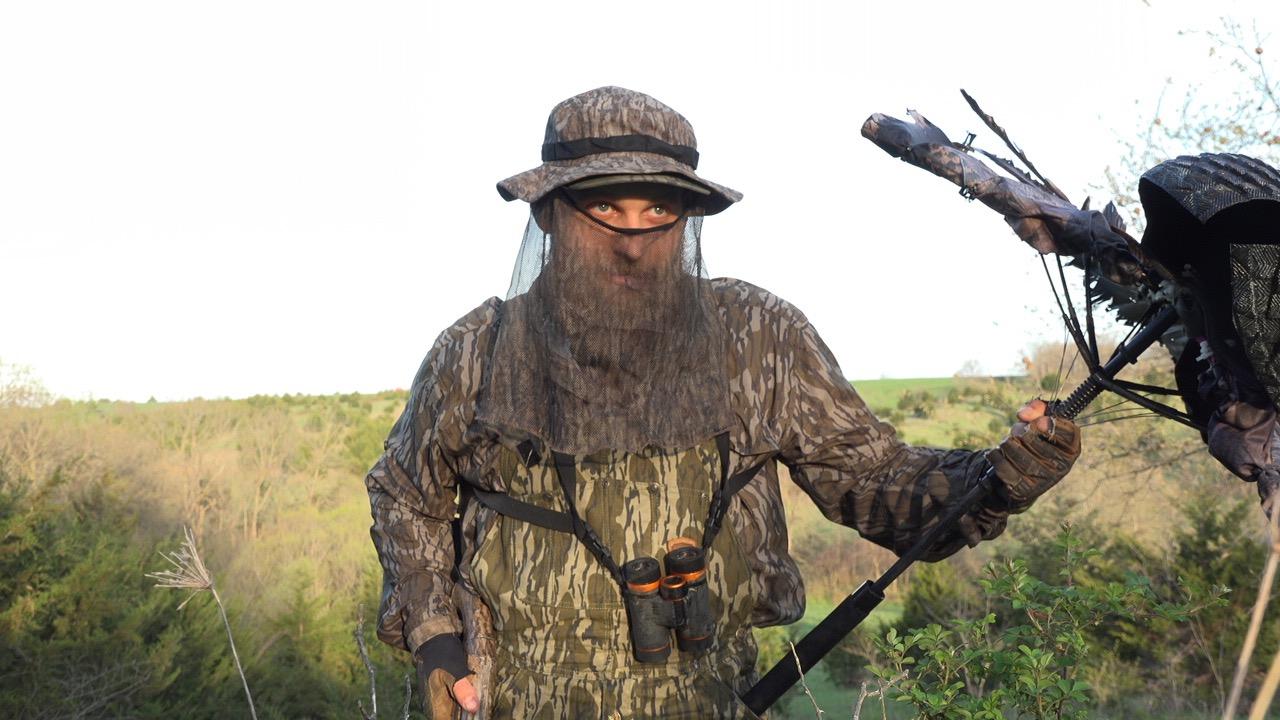
The Maven C1 sits at the top of this budget bracket, and it earns the position with optics rather than features. ED objectives with fully multi-coated lenses and a Schmidt-Pechan prism give an image that owners describe in terms you do not usually see at this level: bright, sharp, high-contrast, and colour-true with essentially no fringing.
The 4.8 rating across 292 reviews is tied for the highest here, and the consistency of that feedback matters more than the sample size. Nobody in the reviews describes an image problem.
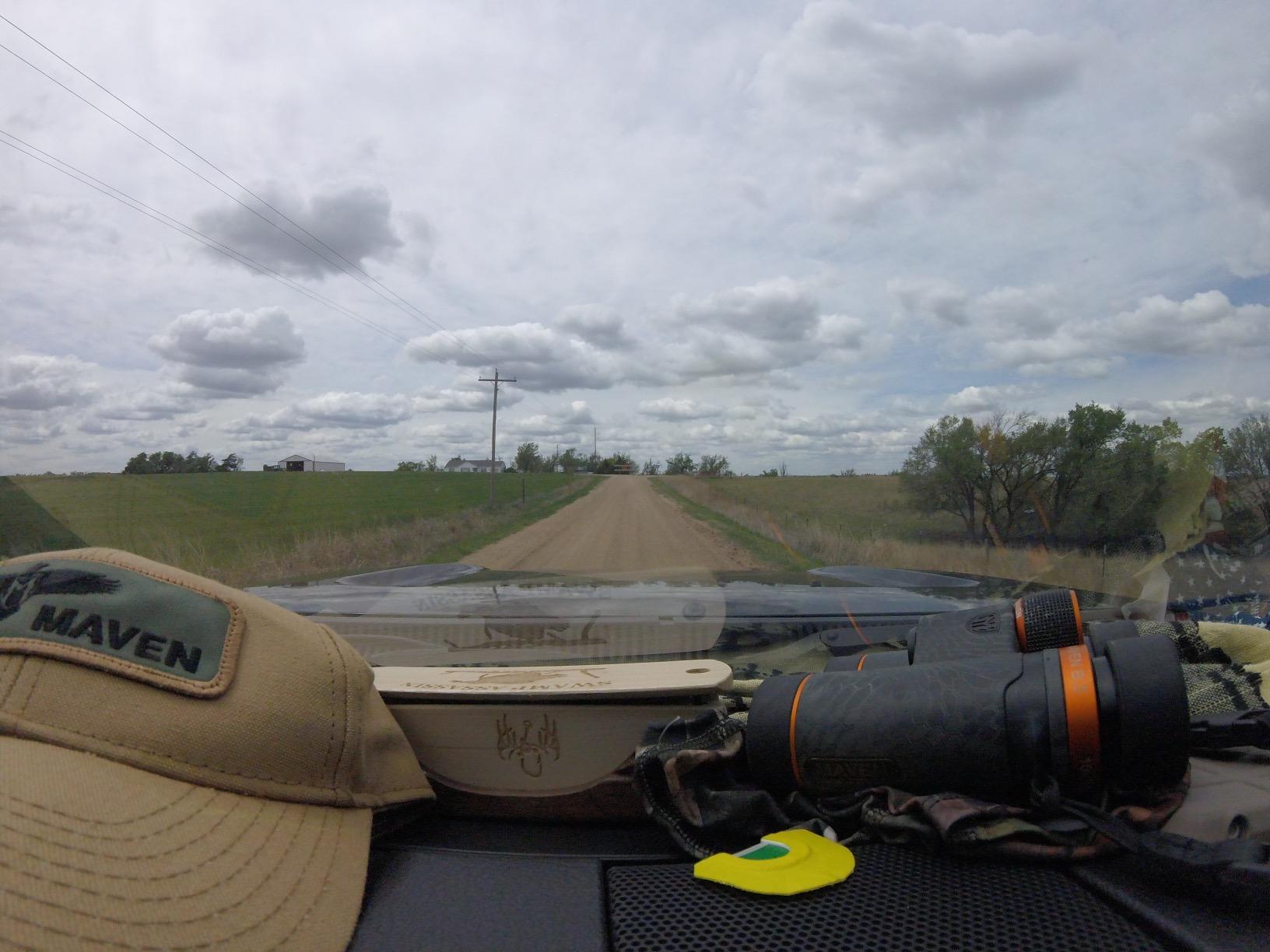
What makes it different from every other pair on this list is the near focus distance of 5.9 feet, the closest here by a clear margin. Butterflies, beetles, a hummingbird at a feeder, a warbler two metres away – all of it is inside the working range.
Owners repeatedly call the close focus the standout feature of the whole package.
The frame is a lightweight polymer that weighs 1.5 pounds and stays well balanced in the hand, with waterproof, fogproof and scratch-resistant lens coatings, a relative brightness of 12.3 and a diopter range of plus or minus 3. The unconditional lifetime warranty is one of the most generous in this bracket.
If you also plan to use binoculars on open water at night, our [astronomy guide](https://austineubanks.com/best-binoculars-for-astronomy/) covers the trade-offs between high-power astronomy glass and a general-purpose pair like this one.
Is it worth the jump to the top of the bracket?
If your list includes edge-to-edge sharpness, colour you can trust on close subjects, or the ability to focus on something a few feet away, then yes, and the improvement over a standard 10×42 is real rather than cosmetic.
ED glass is the biggest single contributor; it is what removes the fringing on high-contrast subjects that you will otherwise see on every non-ED pair here. If your list does not include those things, a well-chosen pair three tiers down will serve you well and leave budget for a case and a good tripod.
What are the compromises?
Field of view and eye relief. At 314 feet at 1000 yards, this is a narrow field for a 10×42, so scanning wide areas takes more effort, and 16 mm of eye relief is modest next to the 8×42 models. The focus and diopter also demand deliberate adjustment rather than being instantly set and forgotten.
None of that matters for a butterfly or a songbird at a feeder. All of it matters on an open hillside at dawn.
How We Picked and Ranked These Ten
Every pair here was scored on four things, weighted in the order we think they matter for people buying binoculars under 500: optical performance, controls and ergonomics, durability and sealing, and value.
We used manufacturer specification sheets for the hard numbers and owner review patterns for everything a spec sheet cannot tell you, like whether a focus wheel is pleasant or whether an eyecup falls off.
Optical performance looked at brightness and low-light behaviour, sharpness at the centre and at the edge of the field, colour accuracy, and how much chromatic aberration shows up on high-contrast subjects. Glass type and prism coating do most of the work here, which is why the ED pairs rank where they do.
Controls and ergonomics covered the focus wheel and diopter, weight and balance, grip, eyecup design, and whether the pair works with glasses. This is where the difference between a good pair and a great one is decided, because you will touch the controls hundreds of times per trip.
Durability meant the sealing standard, the chassis material, the warranty terms, and what actually comes in the box. A pair that arrives without a case will be dropped, so a free case is worth real points.
Value is the ratio of the first three to what the pair costs, which is the only reason a pair from the middle of this list can beat one from the top.
One thing we deliberately did not do was rank on badge or branding. Several of the models here have HD printed on the side, and that label has no consistent meaning across brands, so we ignored it entirely.
Buying Guide: Magnification, Glass, Coatings and Fit
Most buyers in this bracket are choosing between three full-size configurations, and picking the wrong one is the most expensive mistake available. Here is how the numbers actually translate into the field.
Is 8×42 or 10×42 better for birding?
For most birding, 8×42 is better, and the reason is field of view rather than magnification. A wider apparent field means the bird stays in view while you get the eyepiece on your eye, which is the difference between tracking a moving warbler and losing it every few seconds. Choose 10×42 when your birding is about distant, mostly stationary subjects: raptors on a ridge, a heron across a lake, a distant flock.
If you are still unsure, note that the 8×42 models on this list are the ones reviewers recommend most often for general birding.
What is better, 12×50 or 10×42?
They are close, and the deciding factor is light rather than magnification. A 12×50 has a larger objective, so it gathers more light and shows you more detail in dim conditions – useful at dawn, dusk, or under heavy canopy. But it is also larger, heavier, and its higher magnification shakes more, so you need a steady hand, a harness, or a tripod.
A 10×42 is the safer all-rounder: more compact, easier to hold, still bright enough for most conditions. Pick the 12×50 if you glass in low light; pick the 10×42 if you carry the binoculars for ten hours at a time.
Roof prism or Porro prism – what does it actually change?
Porro prisms, as used in the Maven C1, bounce light through offset barrels. You get more light per square millimetre for the same money and a wider, rounder field with less distortion near the edges, but the shape is bulkier. Roof prisms, used by everything else on this list, run the light straight through a single compact housing, which is why they dominate modern full-size glass.
What roof prisms give up without the expensive dielectric and phase-correction coatings is contrast and colour in dim light, which is exactly why those coatings matter most in this bracket.
How do you read a coating stack?
Four terms appear on almost every box in this bracket, and they mean different things. Fully multi-coated means multiple coating layers on each air-glass surface, boosting transmission – it is the baseline for good glass. BaK-4 describes the prism glass itself rather than a coating, and it is brighter and more accurate than the cheaper SK-16 type.
Phase correction aligns the light waves coming from adjacent roof-prism surfaces so they interfere less, which improves contrast and reduces the dimming that roof prisms normally cause. Dielectric coating applies a thin reflective layer to the prism surfaces to push more light through, raising brightness and colour.
A pair combining the phase and dielectric coatings with BaK-4 prisms, such as the Nikon Monarch M5, will hold up better at dusk than a pair carrying only the baseline multi-coating, such as the Celestron Outland X.
Eye relief, exit pupil, and wearing glasses
Eye relief is the distance between your eye and the lens, and it determines whether you can wear glasses. You need roughly 16 mm or more, and more if your frames sit far from your face. The Nikon Monarch M5 gives you 19.5 mm, the Celestron Nature DX gives 17.5 mm and the Nature DX ED gives 17.8 mm, while the Vortex Crossfire HD gives 15 mm.
Exit pupil is simply objective diameter divided by magnification: 42 divided by 10 gives 4.2 mm, and 42 divided by 8 gives 5.25 mm. That is why the 8×42 pairs show you more in low light even before you account for the glass. A 4 mm exit pupil is fine for daylight and short for deep dusk, so 8×42 is the better stargazing and twilight configuration.
If you are shopping for astronomy specifically, our [stargazing picks](https://austineubanks.com/best-binoculars-for-stargazing/) go into that in more detail.
Field of view: the number birders should actually check
Field of view is quoted in feet at 1000 yards or in degrees apparent, and the wider the better for tracking. Among the models here that publish a feet figure, the Celestron Nature DX 8×42 gives the most at 388 feet, the Nikon PROSTAFF P3 10×42 is surprisingly broad for a 10x at 367 feet, and the Maven C1 sits at 314 feet. The other 8x42s here quote degrees instead, at 7.0 and 7.5 degrees apparent, which work out wider again.
What does the top of this bracket actually buy you?
Moving from the middle of the range to the top mainly buys glass and coatings. Extra-low dispersion objectives remove the purple fringing that standard glass shows on branches against the sky, dielectric and phase-correction coatings raise contrast and brightness in dim light, and a quality aluminum chassis feels more rigid and damps better.
A pragmatic approach is to spend up to the middle of the bracket on glass and coatings, then put a little aside for a case, a strap and a tripod adapter, which do more for how long the binoculars last than a small optical upgrade does.
Frequently Asked Questions
What are the best binoculars under five hundred dollars?
The Vortex Crossfire HD 10×42 is our top pick: fully multi-coated, nitrogen purged, tripod adaptable and covered by a lifetime VIP warranty. The Celestron Nature DX 8×42 is the best value for birding thanks to its wide 388 foot field, and the Nikon Monarch M5 8×42 is the safest choice for glasses wearers at 19.5 mm of eye relief.
Is 8×42 or 10×42 better for birding?
8×42 is better for most birding because the wider field of view lets you keep a moving bird in the eyepiece while you get into position. Choose 10×42 when you are identifying distant, mostly stationary subjects such as raptors on a ridge or a heron across a lake. Ten power shakes more and is heavier to hold, so it rewards a steady hand or a harness.
What is better, 12×50 or 10×42?
A 12×50 gathers more light and shows more detail in dim conditions, which makes it better for dawn, dusk and heavy canopy. A 10×42 is lighter, more compact and easier to hold steady, so it is the better all-rounder for long sessions. The deciding factor is not magnification but how much low-light performance you need and whether you can hold the extra shake.
Are Porro prism binoculars better than roof prism binoculars?
Not outright. Porro prisms send more light through and give a rounder, wider field with less edge distortion, but they are bulkier and need the expensive roof-prism coatings to match modern contrast levels. Roof prisms are compact, rugged and, when paired with dielectric and phase-correction coatings, deliver the brighter, higher-contrast image most people want in this budget bracket.
Which binoculars do Navy SEALs use?
Rugged waterproof military-grade optics used by teams like the Navy SEALs generally sit well above this budget bracket and are specified for durability, not image quality. The closest equivalents for civilian use here are sealed nitrogen-purged models with a lifetime guarantee, such as the Bushnell H2O Xtreme 10×42 with its IPX7 rating or the Leupold BX-2 Alpine HD with its aluminum enclosure.
What is a good budget for binoculars for birding?
Roughly two hundred to three hundred dollars gets you fully multi-coated glass with BaK-4 prisms, phase coating, nitrogen purging and a usable warranty, which covers almost every birding need. Below that you give up coating quality and sealing; above it you are buying extra-low dispersion glass and better chassis, which mainly helps in low light and at the edges of the field.
The Verdict: Which Pair Should You Buy
The best binoculars under 500 in 2026 are the Vortex Crossfire HD 10×42, because no other pair here pairs a 4.8 owner rating across more than four thousand reviews with a fully multi-coated image, a nitrogen-purged body, tripod threads and an unconditional lifetime warranty. It is the pair we would buy without hesitating.
Choose differently only for a specific reason. The Celestron Nature DX 8×42 wins on field of view and all-day comfort, the Celestron Outland X 8×42 for travel and as a backup pair, the Nikon Monarch M5 8×42 if you wear glasses, the Leupold BX-2 Alpine HD if your glassing happens in failing light, and the Maven C1 10×42 ED if close-focus sharpness matters more to you than scanning a wide view.
Whichever you pick, buy it from a seller who accepts returns, take it outdoors into low light before the return window closes, and check the eyecups and focus under magnification.
That thirty-minute habit catches nearly every problem we found in the reviews for this roundup.