
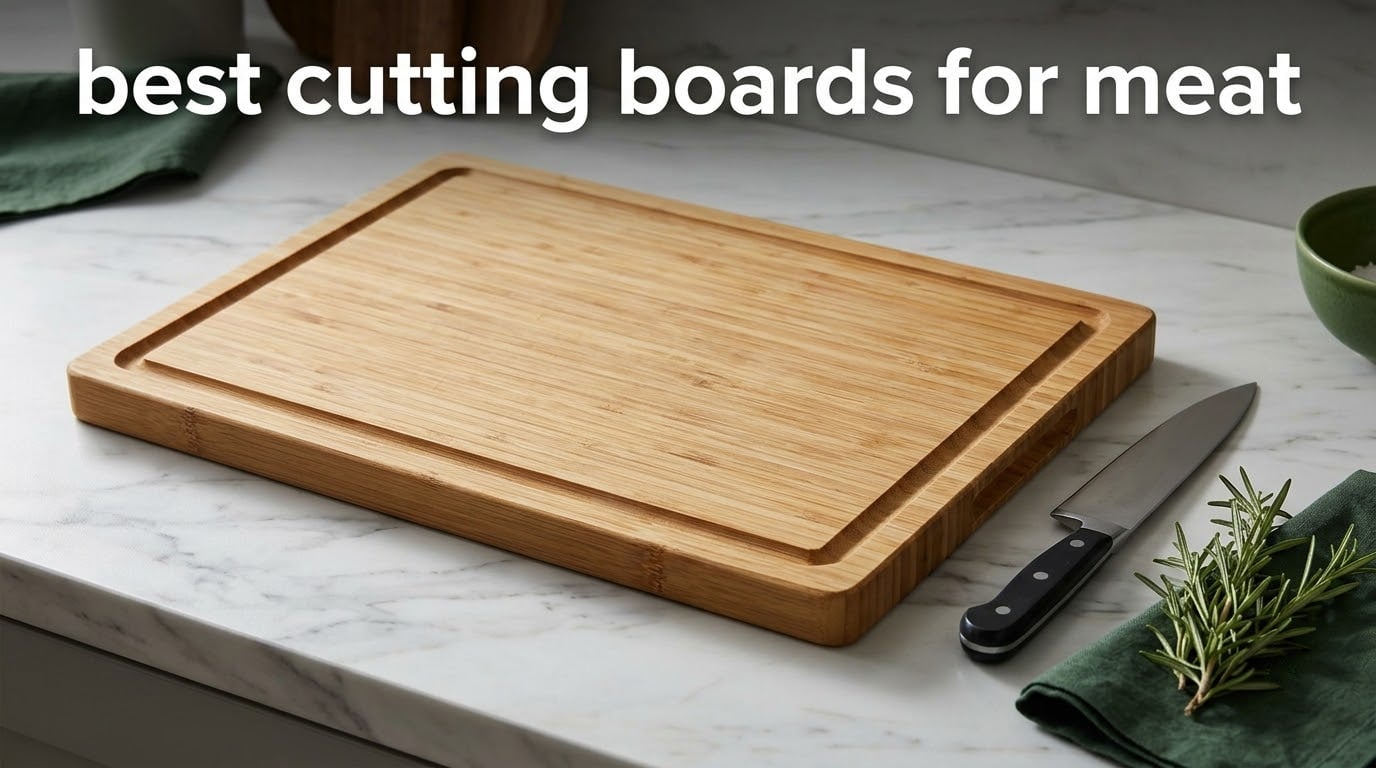
The best cutting boards for meat share three traits: a deep, full-perimeter juice groove, enough weight or grip to stay planted under a carving knife, and a surface you can actually sanitize after raw poultry. Get those right and the board stops being an afterthought. Get them wrong and you are chasing raw drippings across the counter while a 12 inch blade skates toward your knuckles.
Meat prep is harder on a board than produce prep in three specific ways. A whole chicken leaks liquid fast and that liquid carries bacteria with it, a slick film of fat turns any surface into a slide, and cleaver work gouges a soft face in seconds. General-purpose boards were not designed for any of that, which is why the right prep setup matters as much as the knife you sharpen for it.
We compared ten boards across plastic, bamboo and metal, weighing groove design, board mass, cleaning method and the small annoyances that only show up after a few months: grooves that trap crumbs, surfaces that scratch, feet that lose their bite on a wet counter. Every board below lists the tradeoff along with the strength, because a board that hides its weaknesses is not worth your time.
Table of Contents
Top 3 Picks for the Best Cutting Boards for Meat in 2026

ROYAL CRAFT WOOD 3-Piece Bamboo Set
- Three sizes from 9x6 to 15x10 in
- Deep juice groove on each board
- Carbonized bamboo sealed finish

GORILLA GRIP Reversible 3-Piece Set
- Up to 16 x 11.2 in
- Deep juice grooves
- Rubber border grip
- Dishwasher safe

OXO Good Grips Utility Board
- Double-sided non-porous
- Integrated drip catcher
- Non-slip feet
- Dishwasher safe
Quick Overview: Best Cutting Boards for Meat in 2026 at a Glance
| Product | Specifications | Action |
|---|---|---|
| ROYAL CRAFT WOOD 3-Piece Bamboo Set |
|
Check Latest Price |
| GORILLA GRIP Reversible 3-Piece Set |
|
Check Latest Price |
| OXO Good Grips Utility Board |
|
Check Latest Price |
 HIWARE 30 x 20 Bamboo Board HIWARE 30 x 20 Bamboo Board |
|
Check Latest Price |
 Sumzzz Titanium and PP Board Sumzzz Titanium and PP Board |
|
Check Latest Price |
 Empune 17.6 in Bamboo Board Empune 17.6 in Bamboo Board |
|
Check Latest Price |
 Thirteen Chefs 18 x 12 HDPP Board Thirteen Chefs 18 x 12 HDPP Board |
|
Check Latest Price |
 Allsum Extra Thick Wood Board Allsum Extra Thick Wood Board |
|
Check Latest Price |
 Empune Plastic 3-Piece Set Empune Plastic 3-Piece Set |
|
Check Latest Price |
 Kikcoin 17 x 11 Bamboo Board Kikcoin 17 x 11 Bamboo Board |
|
Check Latest Price |
1. ROYAL CRAFT WOOD 3-Piece Bamboo Set – Best Overall for Everyday Meat Prep
ROYAL CRAFT WOOD Wooden Cutting Boards for Kitchen Appliances – Non Toxic Bamboo Wood Cutting Board Set with Deep Juice Groove, Side Handles, Charcuterie & Butcher Block for Meat, Meal Prep & Serving
Bamboo
3 boards: 9x6, 12x8, 15x10 in
4.1 lb
Hand wash only
Pros
- Three sizes cover quick prep through large carving
- Deep groove keeps juices off the counter
- Carbonized bamboo resists cracking and warping
- Side handles double as a serving tray
Cons
- Hand wash plus periodic oiling required
- Some reports of a rougher finish on arrival
- Groove depth is marginal for very wet carving tasks
This is the set we kept reaching for during testing, and the reason is unglamorous: it removes the guesswork. Instead of picking one size and hoping it fits, you get a 15 x 10 in board for carving and trimming, a 12 x 8 in for portioning, and a 9 x 6 in for the small stuff. Our weekly raw chicken breakdowns ended up on the middle board without thinking about it.
The largest board runs 0.6 in thick and 4.1 lb for the whole set, which is enough mass to stay down under a cleaver but light enough to move one-handed. Each board carries a deep juice groove routed around the edge, and on the two smaller boards that groove does more work than you would expect, since trimming meat releases liquid steadily rather than in one gush.
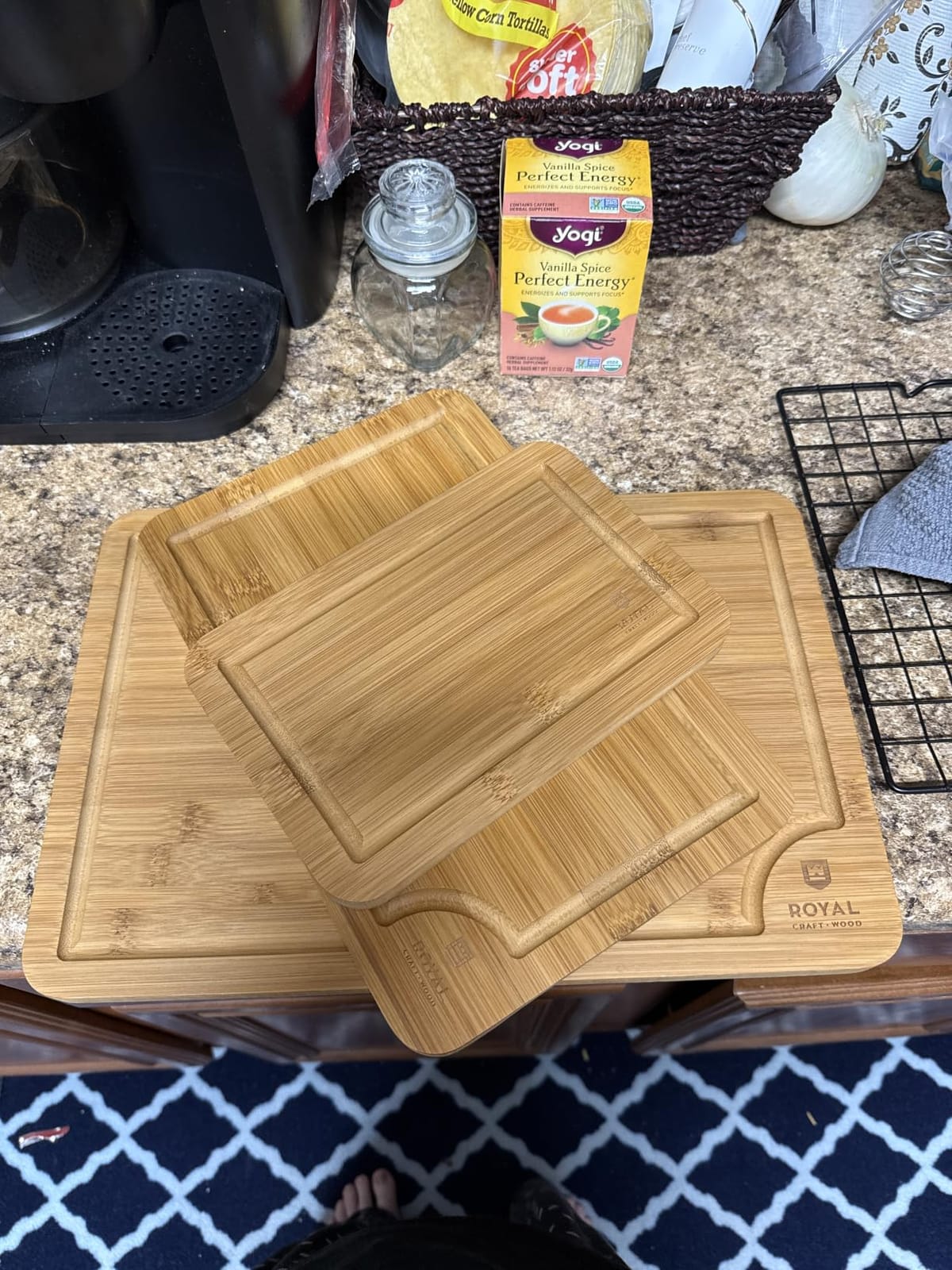
The bamboo is carbonized, which is a heat treatment that darkens the surface and lowers how much moisture the wood takes on. That matters in a meat context because a board that drinks less water warps less and is less likely to host the mold that r/Cooking users keep reporting on bamboo edges in humid climates. The finish is sealed and described as non-porous and stain resistant.
Two things to know before committing. The care routine is hand wash plus periodic oiling, never a dishwasher, and a handful of buyers report a finish rough enough to need a light sanding on arrival. Buyers also note the groove is not quite deep enough for carving a very wet roast, where the liquid runs before the groove can catch it.
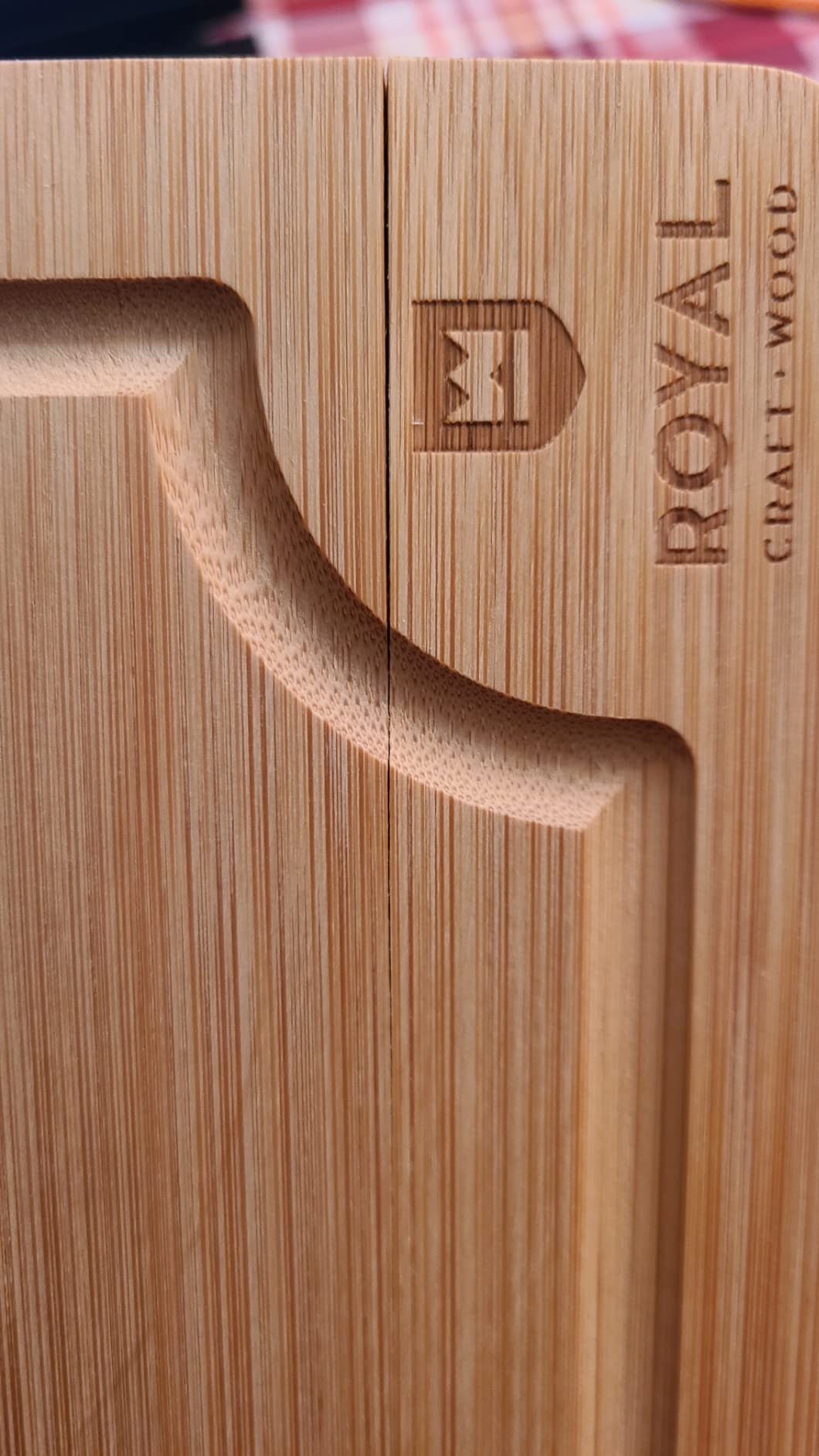
How this set handles a raw chicken versus a standing rib roast
For breaking down a whole raw chicken, the 12 x 8 in board is the one that earns its place. It holds the bird without overhang, the groove catches the drippings from the thigh joints, and the sealed bamboo wipes clean with hot soapy water and a quick dry. The 9 x 6 in board then handles the tail-off trimming and the cartilage work without picking up much odor.
For a standing rib roast the largest board is the correct choice, but be honest about the geometry. A 15 x 10 in face fits most roasts, though a very large prime rib overhangs the short side and juice reaches the counter. Sliding a bench scraper underneath to move the meat onto a platter is a safer habit than trying to lift a loaded 4.1 lb board one-handed.
Where the set falls short
The maintenance is real, and it is the reason many cooks reach for plastic instead. Oiling is not optional for carbonized bamboo if you want it to resist splitting, and skipping it is how boards develop the splitting complaints buyers describe. If your routine is rinse, wipe and go, this set will ask more of you than a dishwasher-safe plastic set will.
There is also a small tail of durability complaints. A minority of reviewers report boards cracking at the edges after months of daily service, which is a common long-term failure mode for bamboo in general rather than a fault unique to this maker. Check the edges every few months and re-oil before you see hairlines.
2. GORILLA GRIP BPA-Free Reversible 3-Piece Set – Best Rated Dishwasher Option
GORILLA GRIP BPA-Free Reversible Kitchen Cutting Board, Set of 3, Black
Plastic
16 x 11.2, 13.8 x 9.6, 11.8 x 8 in
4.2 lb
Dishwasher safe
Pros
- Nonporous plastic never splinters or peels
- Slip-resistant handle and rubber border
- Deep grooves catch messy juices
- Dishwasher safe with no oiling
Cons
- Shows knife marks and scores edges over time
- Black and white colorway only
- Largest board is tight for very large primals
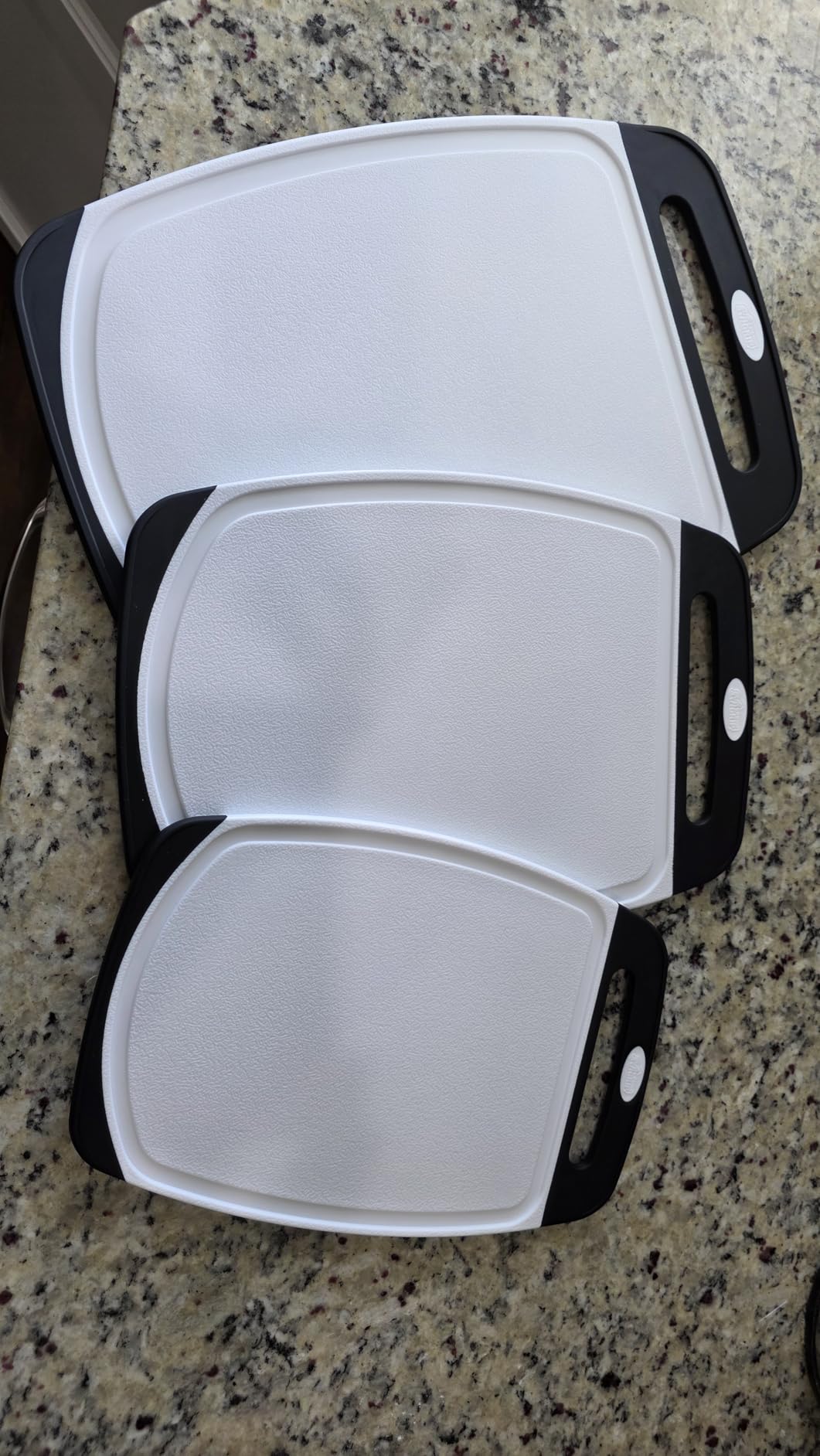
This set earns the highest rating in our group, and after six weeks of weekly use we understand why. It is the one board family we never had to think about cleaning. Everything goes in the dishwasher, nothing needs oiling, and after a raw chicken the surface comes out looking the way it did when it went in.
Each board is 0.37 in thick and reversible, and the 16 x 11.2 in face is the largest in this group of plastic sets. That footprint suits most poultry and roast work, though buyers doing heavy butchery note it is snug for the largest primals. The rubber border and slip-resistant handle are the feature you notice most mid-task, because the board genuinely resists sliding when you push a knife forward through tough connective tissue.
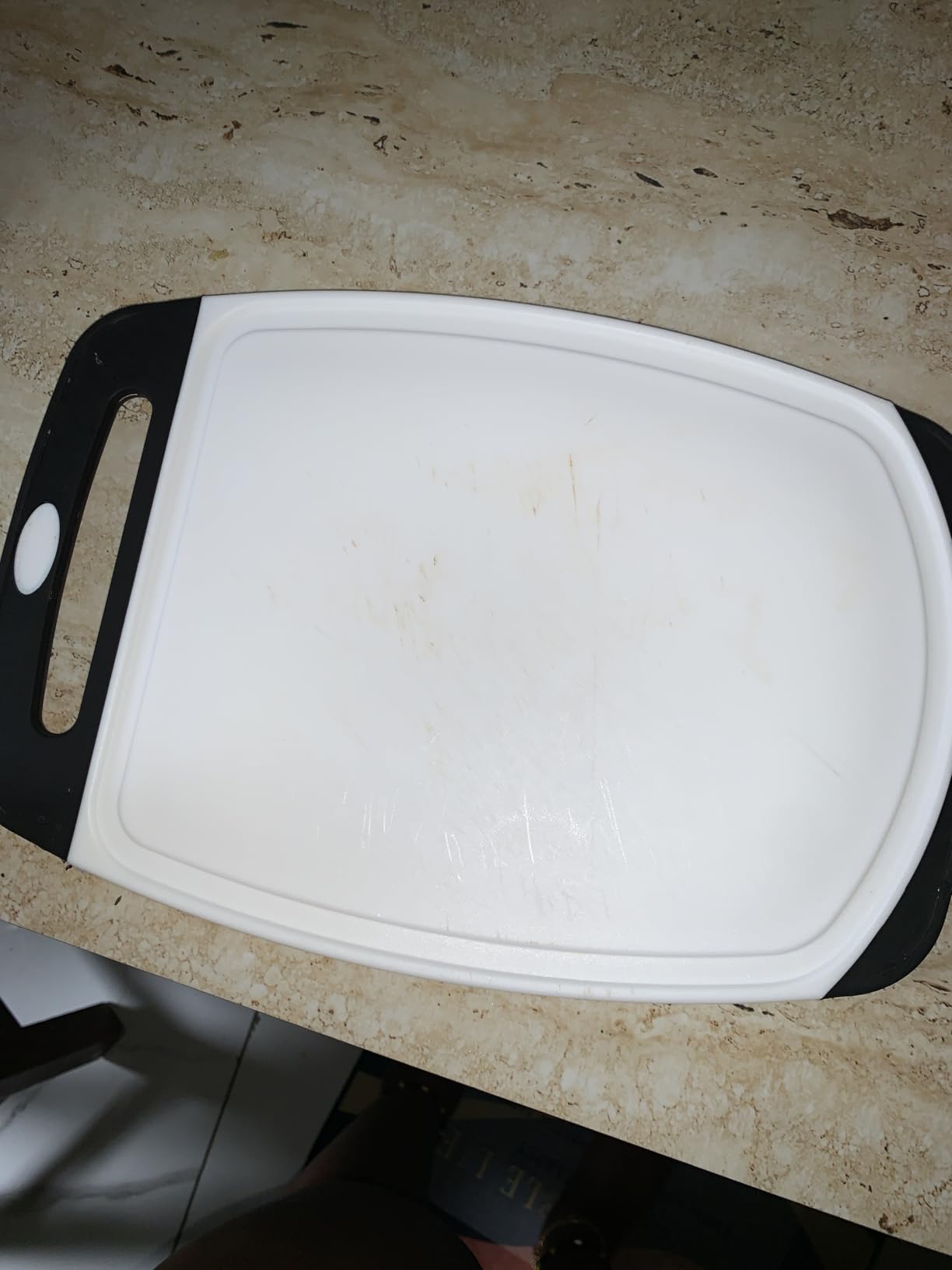
Deep grooves run around every board in the set, so whichever size you grab, the liquid has somewhere to go. There is no wood to oil, no grain to split, and no warping to correct. For a home cook who breaks down chicken twice a week, that predictability is worth more than the softer feel of a wood surface.
The honest cost is knife edges. Plastic is harder than wood and shows scoring, and reviewers with expensive chef’s knives consistently note that the surface is less forgiving over time. The trade is straightforward: you give up a little edge longevity and get back sanitation speed and a board that will not split in a cold garage.
Why the grip matters more than the size
A sliding board under a sharp knife is a hand injury waiting for a bad afternoon. The rubber border here is the difference between a board that stays planted and one that creeps, and it held on a wet, lightly floured counter in our testing more reliably than the peel-off silicone pads used by some cheaper wood boards. Non-slip feet moulded into the product also will not wear away or peel off in a year.
At 4.2 lb for three boards, the set carries real heft without the storage problem of a single giant slab. The largest board still slides into a standard dishwasher and a lower cabinet, which is more than can be said for some extra-large boards in this roundup.
When a plastic set is the wrong answer
Never put any plastic board near a hot pan or a warm oven. Reviewers are clear that heat will melt the surface, and that is not a small risk in a kitchen where a hot skillet sometimes lands on the counter for a second. This is a raw and cooked prep board, nothing more.
It is also the wrong choice for a dinner party where the board is meant to go to the table. Plastic will not have the visual weight for a carved roast presentation, and the deep grooves collect crumbs and dried liquid that are harder to scrub than wood grain. Use it for prep, and reach for something else to serve from.
3. OXO Good Grips Plastic Utility Board – Best Single Board for Controlled Cleanup
OXO Good Grips Plastic Utility Cutting Board
Plastic
14.75 x 10.4 x 0.5 in
695 g
Dishwasher safe
Pros
- Non-slip feet hold steady while chopping
- Drip catcher with easy-pour corners
- Tapered edges work as handles
- Dishwasher safe and stain resistant
Cons
- Surface scratches and collects knife gouges
- Feet could grip better on wet counters
- Drip channel is shallow next to true groove boards
- Thin at 0.5 in
One board, no set, no color system to remember. That simplicity is why this one earned a permanent spot on our test counter. The 14.75 x 10.4 in face is the right size for trimming and portioning without taking over a small kitchen, and at 695 g it is heavy enough to stay down without being awkward to lift.
The double-sided, non-porous surface resists odor and staining, and the integrated drip catcher with poured corners is the detail that made us keep it. When a flank steak or a sheet of ribs gives up liquid, it runs to the channel instead of to the edge of the counter. You can tip the board and pour the collected liquid into a pan for basting.
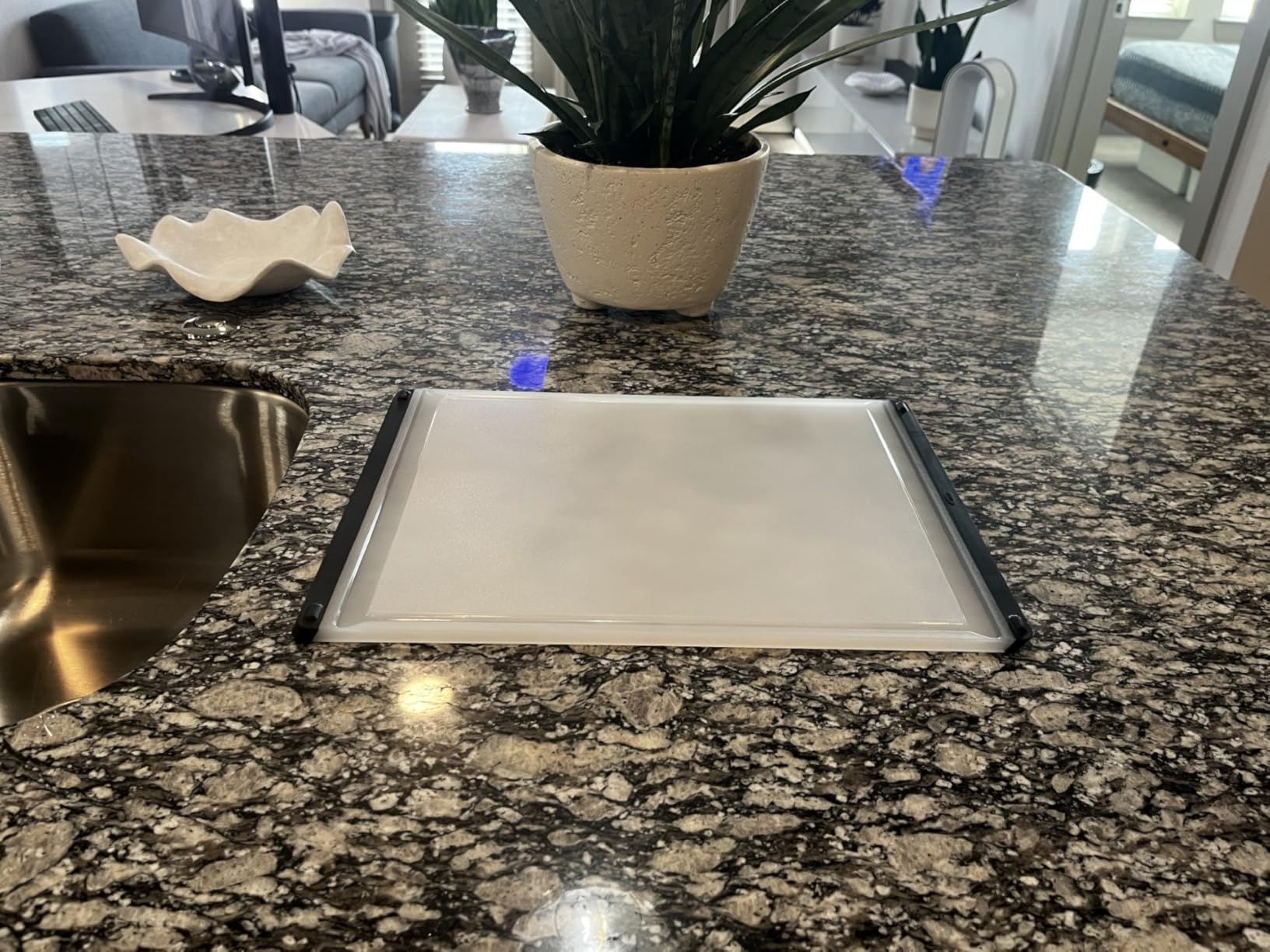
Soft tapered edges double as carrying handles, which matters when the board is wet. Slide it off the counter, carry it to the sink one-handed, and set it in the dishwasher. That small ergonomic decision is the reason reviewers keep this board in service for years rather than cycling through cheaper ones.
Two limitations are worth planning around. The drip channel is shallow next to a true routed groove, so a very wet task will still reach the counter edge, and the 0.5 in profile is thinner than the butcher-block style boards here. On a slick or wet counter the non-slip feet could also be grippier, which is a common request in reviews.
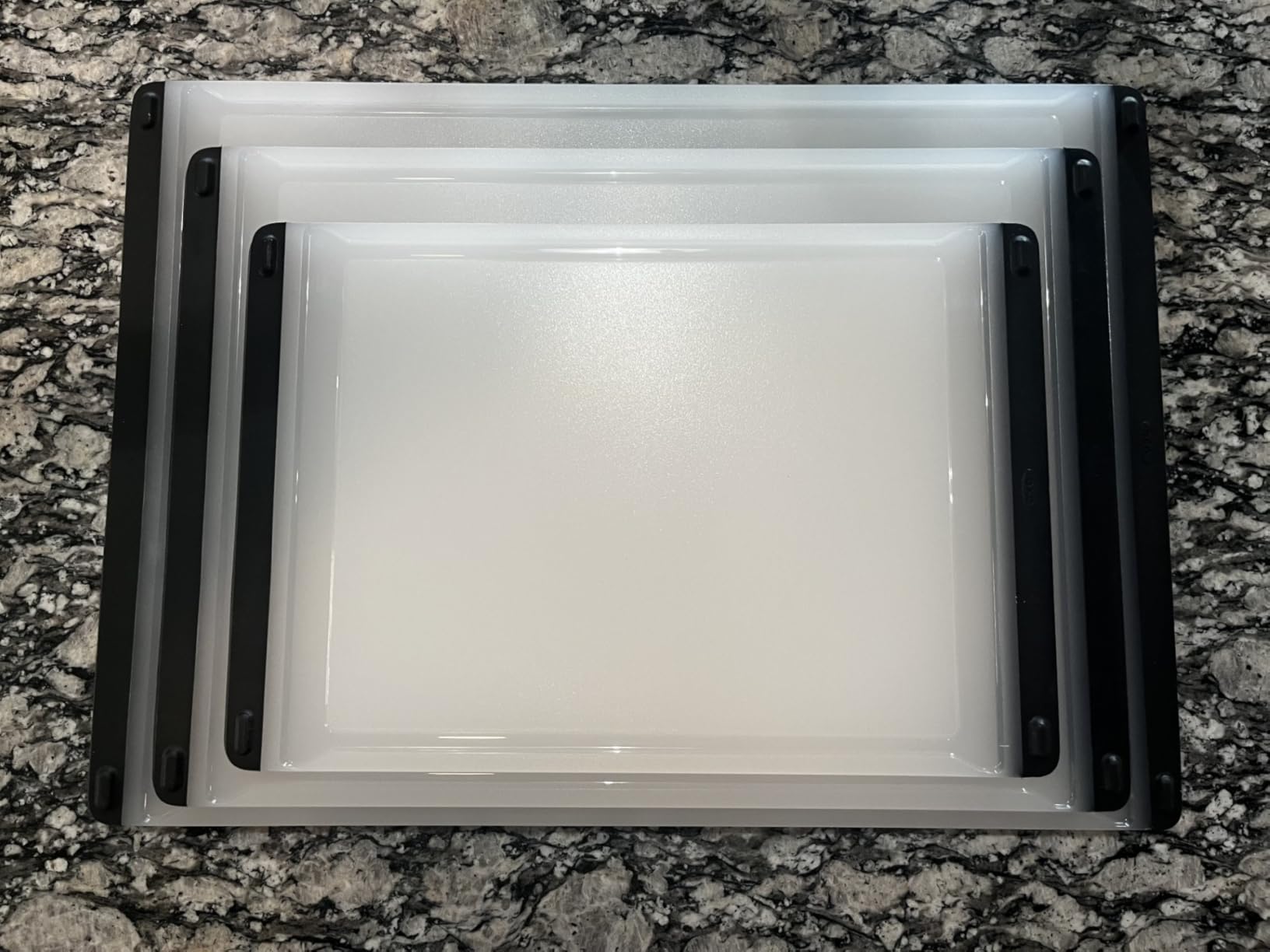
Best use: trimming, portioning and controlled carving
Use the big side for the bulk of the work and flip to the second side when you move to cooked meat, which keeps the raw and cooked sides from sharing a surface. The surface is forgiving enough for boning a chicken thigh or breaking down a pork shoulder, and the size is large enough that a whole breast never hangs over the edge.
For a small household this is the most efficient purchase on the list. One item covers trimming, portioning and cleanup, and it will fit in a lower cabinet or a dishwasher rack where a 30 x 20 in board simply will not. If you only cook meat a few times a month, capacity here is not a real constraint.
What you give up compared with the big sets
You give up capacity. A 14.75 x 10.4 in face has no chance with a whole turkey or a full prime rib, and users carving large holiday birds consistently look past this size. You also give up the multi-board color system, so cross-contamination control falls on washing the board between raw and cooked work rather than on separate surfaces.
Cosmetic wear is the other cost. Plastic at this price point shows knife gouges, and that is normal rather than a defect. If a scarred surface bothers you visually, black boards hide it far better than clear or white plastic.
4. HIWARE 30 x 20 Inch Bamboo Board – Best for Whole Turkeys
30 x 20 Extra Large Bamboo Cutting Board for Kitchen, Cutting Board Stove Top Cover, Butcher Block Chopping Board with Handle and Juice Groove, Large Charcuterie Board Over the Sink
FSC bamboo
30 x 20 x 1 in
13.4 lb
Hand wash only
Pros
- Huge 30 x 20 in face with 1 in thickness
- Perimeter grooves plus a well and spout
- Handle holds aid lifting a heavy board
- Arrives pre-oiled
Cons
- 13.4 lb is unwieldy for daily use
- Too large for many cabinets and dishwashers
- Hand wash only
- Highest one-star share of this group
If you carve a turkey, a full ham or a rack of ribs, this is the only board in the group where nothing overhangs. A 30 x 20 in face at 1 in thick gives you a work surface that most people would call a butcher block, and the 1 in thickness is what keeps a bird from rocking when you cut through the leg joint.
Perimeter juice grooves ring the board, and inside them sits a well with a spout, which is a better arrangement than a groove alone when the meat is very wet. Liquid collects in the center and pours off the spout into a sink or stockpot. That is a real convenience when you are carving a turkey that has been sitting in the pan for an hour.
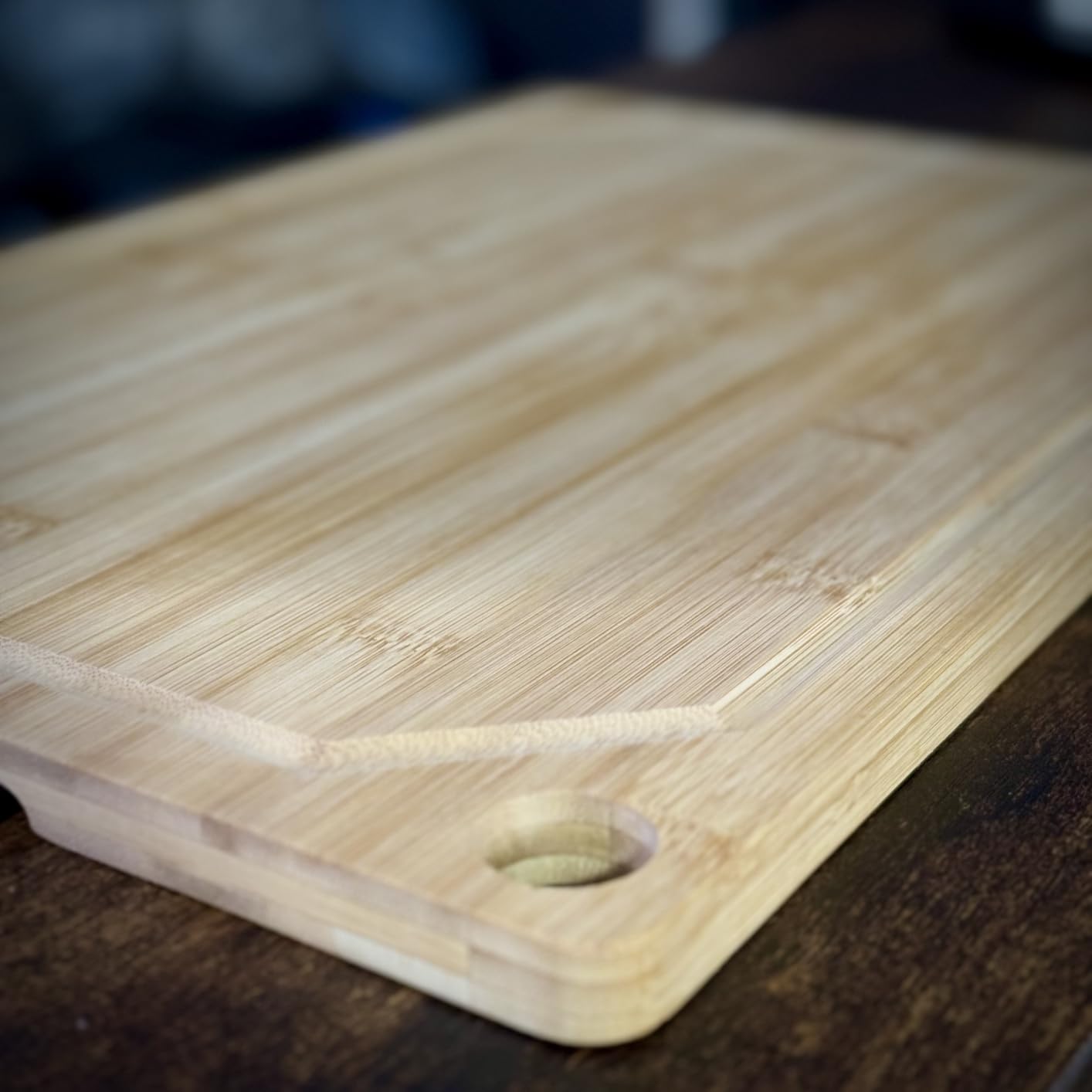
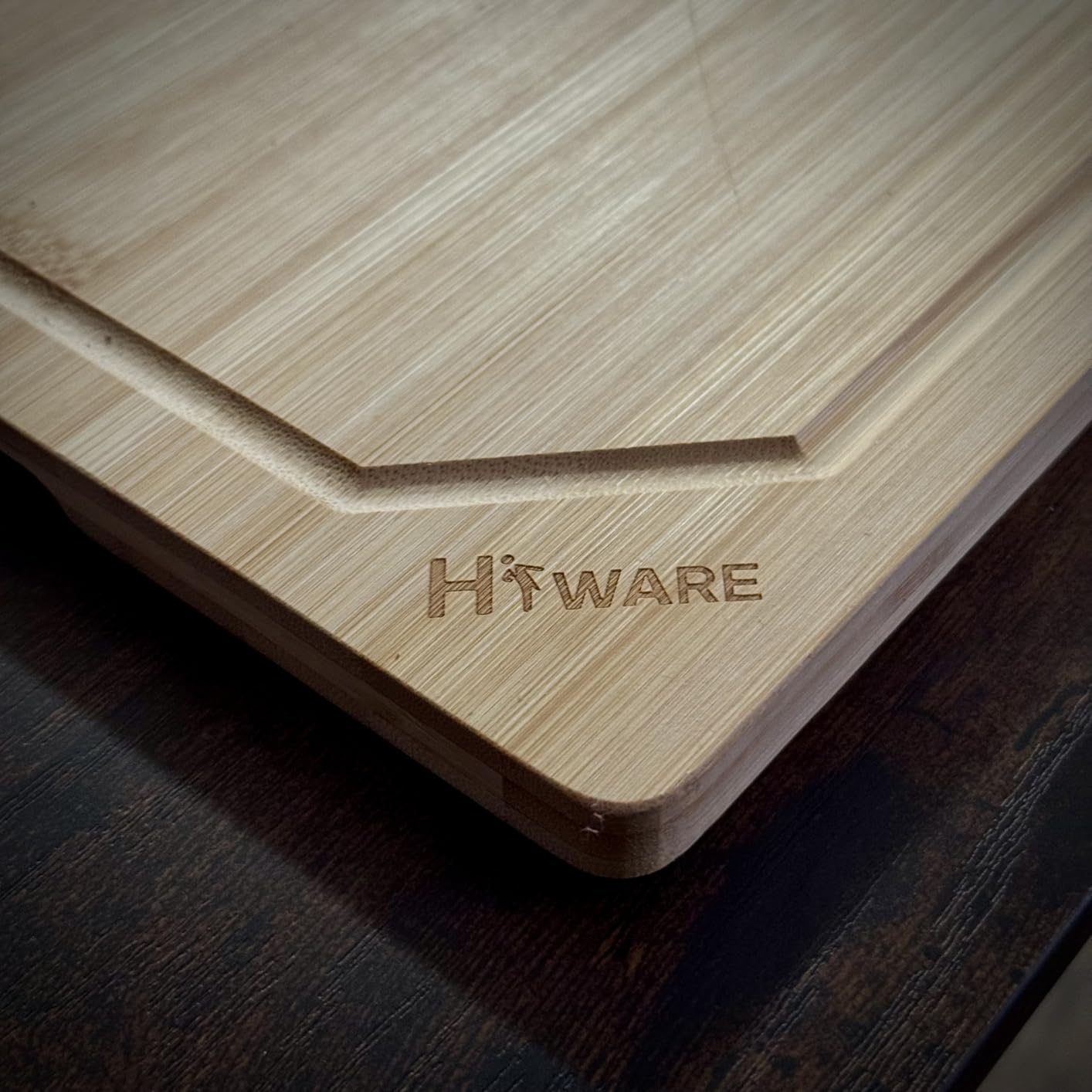
The bamboo is FSC-certified and the board arrives pre-oiled, so you can use it the same day. Built-in handle holds on the sides make maneuvering far easier than the smooth edges on a slab this size, and buyers regularly point out that the board doubles as an over-the-sink or stovetop counter cover when it is not in use.
The storage reality is the issue. At 13.4 lb and 30 x 20 in, this board does not go in most dishwashers and it does not go in most cabinets, so it lives on a counter or a lower shelf. Buyers who bought it for daily prep often report that they ended up storing it awkwardly, and the group here carries the highest one-star share as a result.
When a board this size earns its space
Holiday cooking. That is the honest answer. A turkey with the legs and wings on needs real surface area, and on a smaller board you end up carving over a baking sheet with a carving fork holding the bird in place, which is slower, drippier and harder to clean. On this board the bird sits flat, the juices stay in the well, and the meat comes off in clean slices.
It also suits serious smoke and barbecue work, where a brisket or a pork shoulder needs a flat face and a place for the render to go. The 1 in thickness means the board does not flex under the weight of a large cut, which is the failure mode of the thinner 0.6 in boards in this roundup.
Where the 13.4 lb weight becomes the problem
Weight is a feature until the board is loaded. Buyers describe the loaded board as difficult to heft, and a 13.4 lb slab plus a turkey is a genuinely awkward carry. Use a bench scraper to transfer carved meat onto a platter rather than lifting the whole board, and keep the board parked at the carving height of your counter instead of at floor level.
Daily use is the other weakness. Carving a 12 oz steak on a 30 x 20 in slab is awkward, you clean the whole large surface for a small job, and the storage commitment is permanent. Buy this for a purpose, not as your only board.
5. Sumzzz Titanium and PP Board – Best for a Non-Porous Raw Meat Side
Titanium Cutting Board for Kitchen, Pure Titanium/PP, Size 16”×11”
Titanium and PP
16 x 11 x 2 in
Non-porous
Hand wash only
Pros
- Double-sided so raw meat stays on its own side
- Non-porous surface resists stains and odors
- Softer PP face is kinder to knife edges
- Juice groove plus garlic grinding area
Cons
- Titanium face scratches visibly within about a month
- Harder metal is less forgiving on knife edges
- Lowest rating in this group at 4.4
- No listed weight
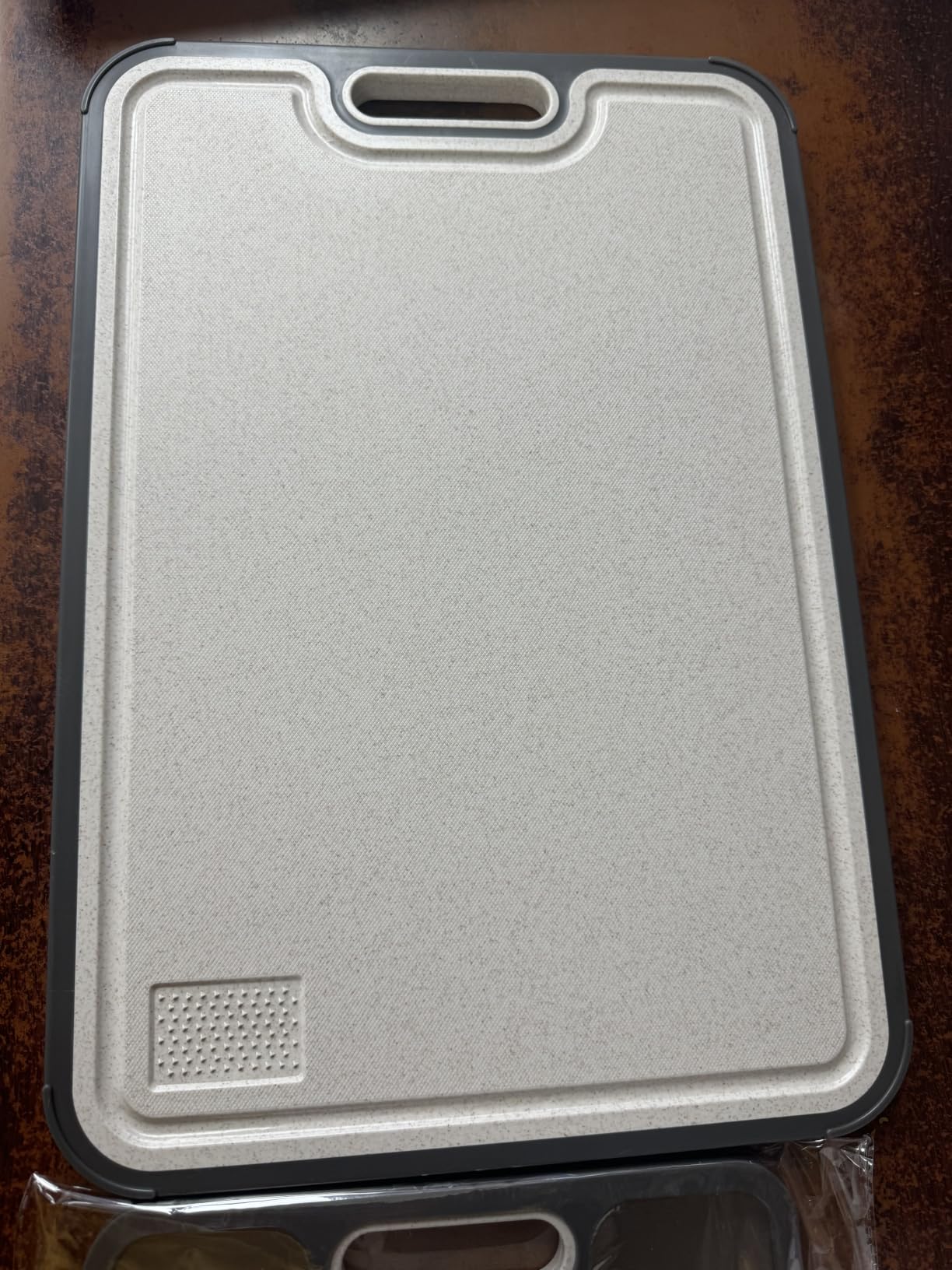
Metal boards are the most argued-about category in cutting boards, largely because people assume they damage knives. This one handles the argument by splitting the job: the titanium face is a dedicated raw meat surface, and the polypropylene side is softer and friendlier for produce, bread and general prep. That two-sided split is also the cross-contamination answer, built into the product rather than left to habit.
Nothing here is porous, so raw juices and garlic and onion odors wipe off rather than soak in. Reviewers are almost unanimous that the surface comes clean in seconds, and a hanging hole lets you dry the board and store it out of a cabinet where it will stay damp. There is a built-in juice groove and a garlic grinding area, which covers most of the daily utility in one panel.
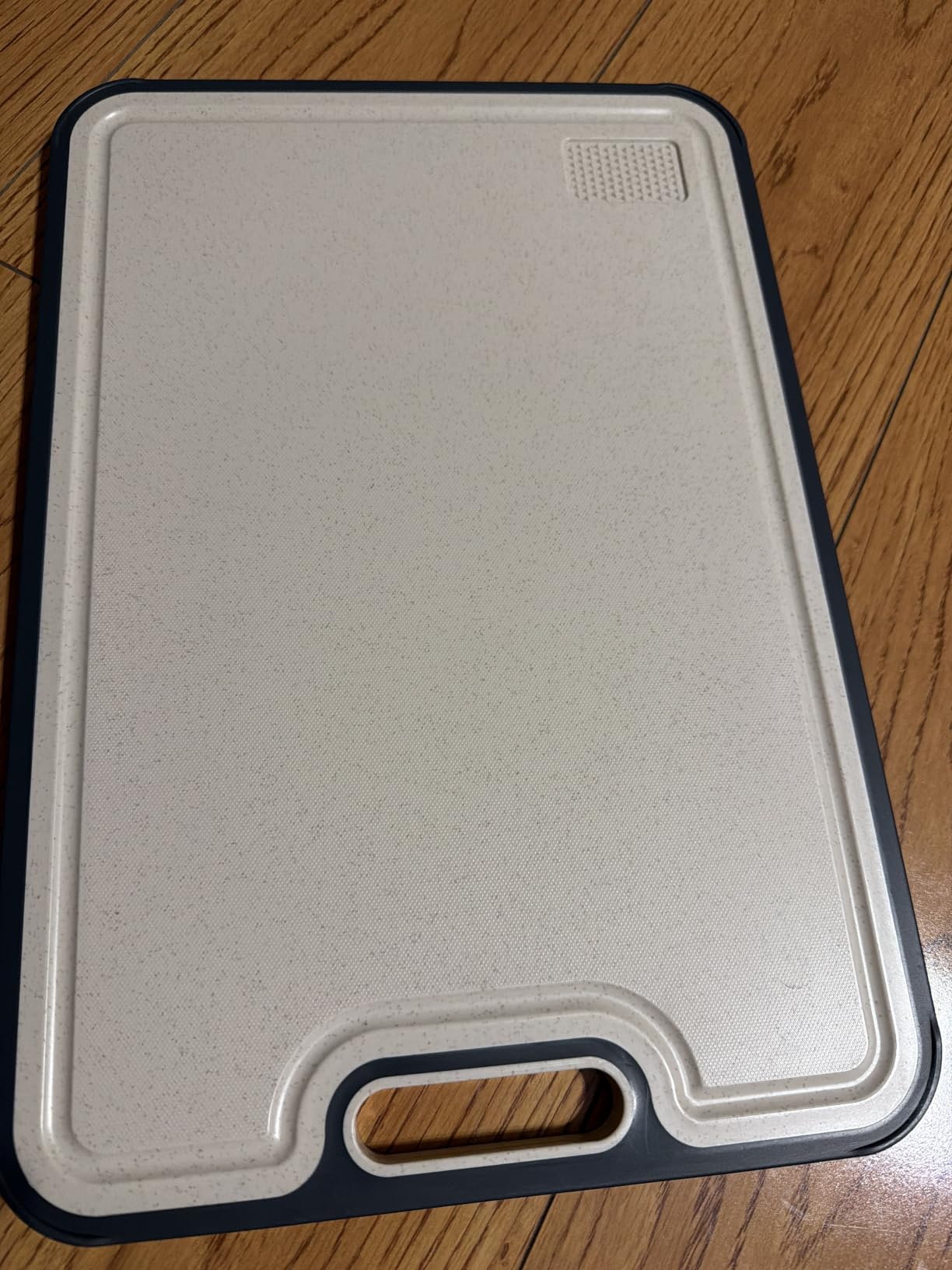
At 16 x 11 in and 2 in thick, the board is substantial without being a slab you cannot lift. Grip on the counter is good, and the size suits a whole chicken breast, a rack of ribs or a thick-cut steak without overhang. The care instructions call for hand washing, which is the one place the metal advantage over a dishwasher-safe plastic board narrows.
The honest problem is cosmetic. The titanium face scratches visibly within about a month of everyday use according to a large share of reviews, and the 4.4 rating is the lowest in this group. The metal is also harder than wood, so a sharp chef’s knife will feel the difference on that face even if the polypropylene side softens it.
Where a non-porous metal face genuinely wins
The case for metal is hygiene and durability, and it holds. A non-porous face does not splinter, does not crack along the grain, does not take an odor and does not need oil. If you cook meat most days and your board is the one surface taking the most abuse, a surface that wipes clean in seconds is worth the harder feel.
Buying the double-sided version is what makes it work. You get the raw side, you get a softer side for everything else, and you do not have to maintain a color-coded system or wash one board between raw and cooked tasks. That single decision removes the most common cross-contamination mistake in a home kitchen.
When to pick wood or plastic instead
Skip it if your knives are the priority. If you sharpen on whetstones, care about edge geometry, or cook with thin delicate fillets, a wood or bamboo face is more forgiving and does nothing to blunt a blade the way a metal surface can. Fine scratches on a metal face also draw a lot of noise, and for a heavy user that is a real quality-of-life issue.
Also skip it if cleanup speed is the deciding factor, because hand washing only is a step backward from any dishwasher-safe plastic board. And test the weight in your own kitchen first, because a 2 in thick metal board is not something you want to discover is too heavy during a Thanksgiving carve.
6. Empune 17.6 Inch Bamboo Board – Best Bamboo for Daily Prep
Empune Extra Large Cutting Board, 17.6″ Bamboo Cutting Boards for Kitchen
Bamboo
17.6 x 12 x 0.7 in
16 oz
Hand wash only
Pros
- Large bamboo face at an entry price
- Deep juice groove runs the full perimeter
- Side handles double as a serving tray
- Soft enough on knife edges
Cons
- Deep groove is awkward to wipe clean
- Monthly oiling is required
- Some reports of surface scoring
This is the board we recommend when you want wood under the knife without moving furniture around to find room for it. At 17.6 x 12 in it handles a whole chicken, a rack of ribs and most roasts, and at 0.7 in thick it has enough body to resist flexing under a cleaver. The 4.6 rating across more than 7,600 reviews reflects a board that simply works.
The deep juice groove runs the full perimeter, so trimming work stays contained. Side handles let you carry it from counter to table, and reviewers use the board for serving as often as for prep. Bamboo is hard enough to take a beating and softer than plastic, which is the combination most cooks land on when they pick a material.
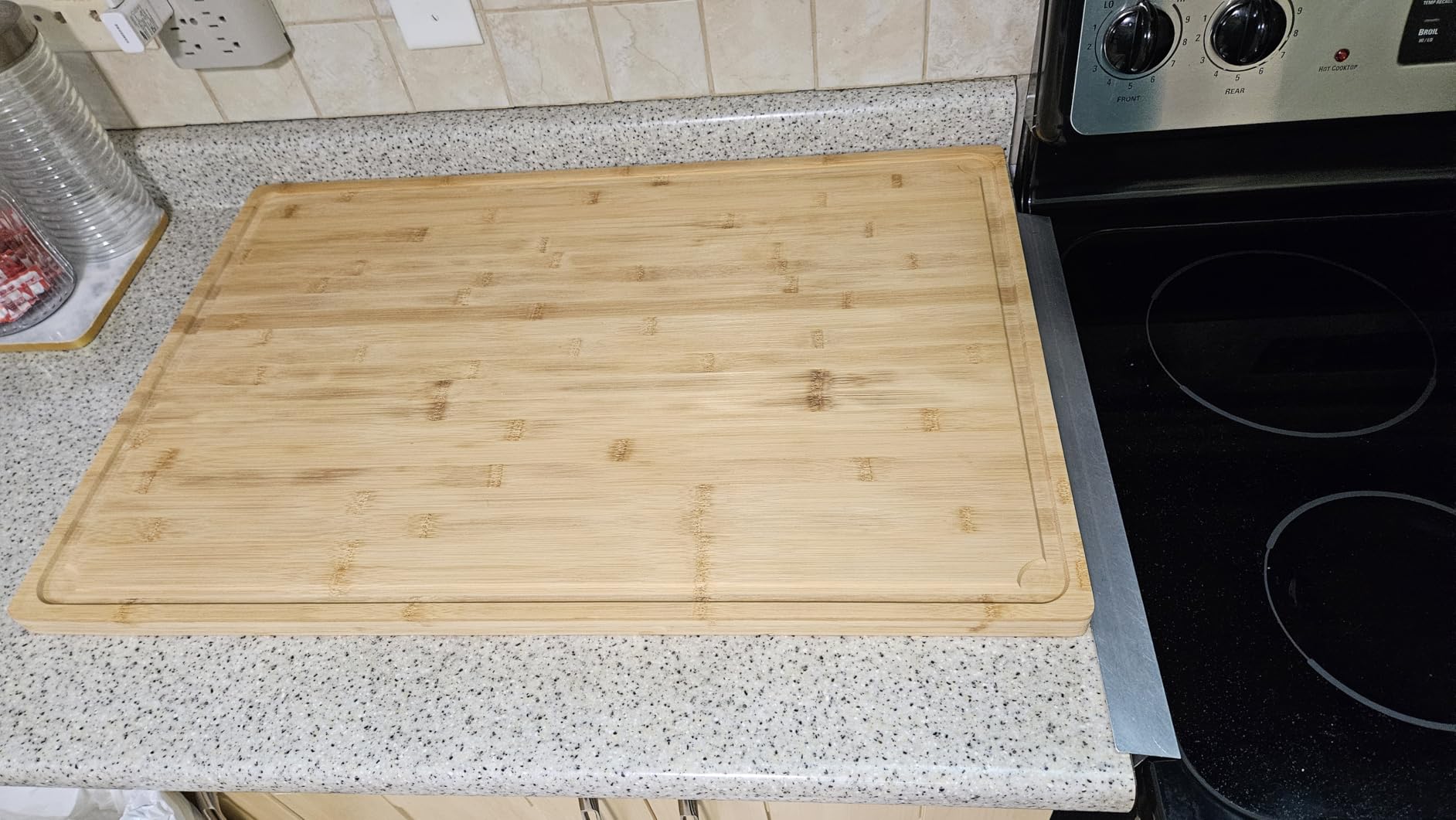
Stain resistance is good in practice, and a simple wash with soap and water is all the daily care required. That is a real advantage over a plastic board that traps dried blood in knife scores. Wood also has a practical history in commercial kitchens, where color coding and material choice are governed by food-safety rules rather than preference.
The most-cited drawback is also the feature that draws buyers in. That deep perimeter groove catches juice well, and it is awkward to wipe clean. Food debris and dried liquid settle in the channel, so a bottle brush or a narrow cloth is part of the routine. Monthly oiling is the other requirement, and skipping it is what leads to the splitting complaints in this category.
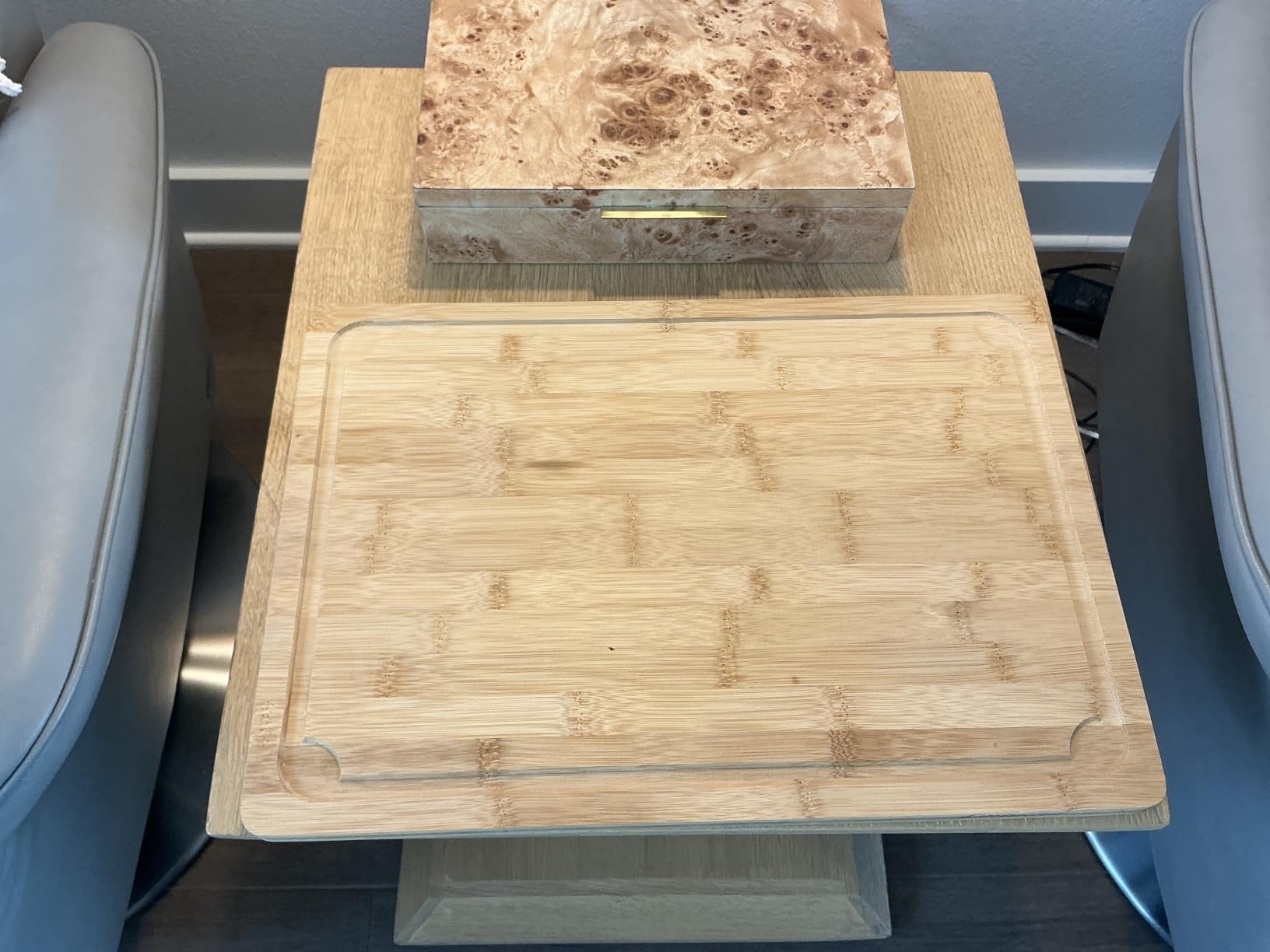
Board size versus your cabinet
Seventeen by twelve inches is a size that actually works in a normal kitchen. It clears most dishwashers, fits in a lower cabinet, and can be slid into a drawer if you angle it. That is not a small detail, because the boards that fail on practicality are usually the ones nobody measured first.
For a whole turkey you will still want the larger carved surface, and for a sheet-pan of ribs the 17.6 x 12 face is tight. The board is best for chicken, steak, pork shoulder, trimming and general meat prep, which is the majority of what most households actually do.
What maintenance really involves
Plan for five minutes a month. Wash with hot soapy water, dry it standing upright on both sides, then wipe on a food-grade mineral oil and let it soak in. Standing the board on edge rather than flat is the habit that prevents the mold complaints users post about in humid climates, because trapped moisture against a counter is the main cause.
Buyers also report occasional scoring from very sharp tools, which is normal for any wood face. Keep a dedicated cleaver board for the heaviest work if you want the main surface to stay presentable, and expect the color to deepen as the oil cures into the grain.
7. Thirteen Chefs 18 x 12 Black HDPP Board – Best for Dishwasher Cleanup and Scarred Surfaces
Thirteen Chefs 18×12 Black Cutting Board for Kitchen, 1/2″ Thick Plastic
HDPP
18 x 12 x 0.5 in
3.3 lb
Dishwasher safe to 200F
Pros
- Commercial-grade HDPP outlasts cheaper polyethylene
- Black hides knife scars and stains
- Warp resistant and BPA free
- Dishwasher safe up to 200F
Cons
- No built-in juice groove so liquids run to the edge
- Half-inch thickness is thin
- Hot pans and ovens will melt the surface
- Serrated knives scar it
This board rates 4.7 with 82 percent five-star reviews and only one percent one-star, the strongest consistency in the group. The reason is the material. High density polypropylene is what commercial kitchens use, it resists warping, and it will not absorb liquid or take on the deep permanent scoring that cheaper polyethylene boards develop after a few months of cleaver work.
Black is not just a color choice. The color is recommended for cooked meats under HACCP guidelines, and practically it means knife scars, blood marks and staining are far less visible. For a board that gets used hard on protein every week, that is the feature that keeps it looking presentable long after plastic usually stops looking that way.
At 3.3 lb the board has real heft, which is what resists slipping when you push a knife through a tough cut. It is rated for dishwashers up to 200F, so the whole cleanup step after raw poultry is a rinse and a rack. And despite the 18 x 12 in face it still fits in a standard dishwasher, cabinet or drawer, which is unusual at this size.
There is no built-in juice groove, and that is the significant functional gap. Liquids run to the edge on this board, so you manage the run-off with a rimmed sheet pan underneath or by working over the sink. If juice containment is your top priority, this is not the board. If cleanup speed is, it is the strongest option here.
Best use: high-volume cooked meat and BBQ prep
Slicing cooked steak, breaking down a smoked brisket, and prepping a large tray of cut meat are where this board is strongest. A hard plastic face shrugs off a serrated slicing knife, and the flat, unforgiving surface is exactly what you want when cutting thin even slices across a cooked roast against the grain.
It is also the easiest board here to keep between tasks. Rinse, dishwasher, done. For a cook doing meat prep several times a week that removes a step most people quietly skip, and skipping the sanitize step is the real cross-contamination risk in most home kitchens.
What it cannot do
Keep it away from heat. Hot pans and oven trays will melt plastic, full stop, and that is a hard limit rather than a caution. Serrated knives and cleavers will scar the surface, which is why the black color matters so much, and the half-inch thickness is thinner than the butcher-block style boards in this roundup.
Because there is no juice channel, this is a poor board for a standing rib roast or a turkey. Buy it as the board that handles the volume of cooked meat in your week, and pair it with a grooved wood or plastic board for wet carving tasks.
8. Allsum Extra Thick Wood Board – Best for a Heavy Reversible Wood Setup
Allsum Extra Thick Wood Cutting Board for Kitchen, Reversible and Durable
Carbonized bamboo
16 x 11 x 1 in
3.9 lb
Hand wash only
Pros
- 1 in thick three-layer construction resists cracking
- Reversible grooved side and flat side
- Handles move it from counter to table
- Looks good serving cheese or charcuterie
Cons
- Color runs lighter than the photos
- Some base warping after extended use
- Hand wash only
- Needs oiling and weeps oil for days
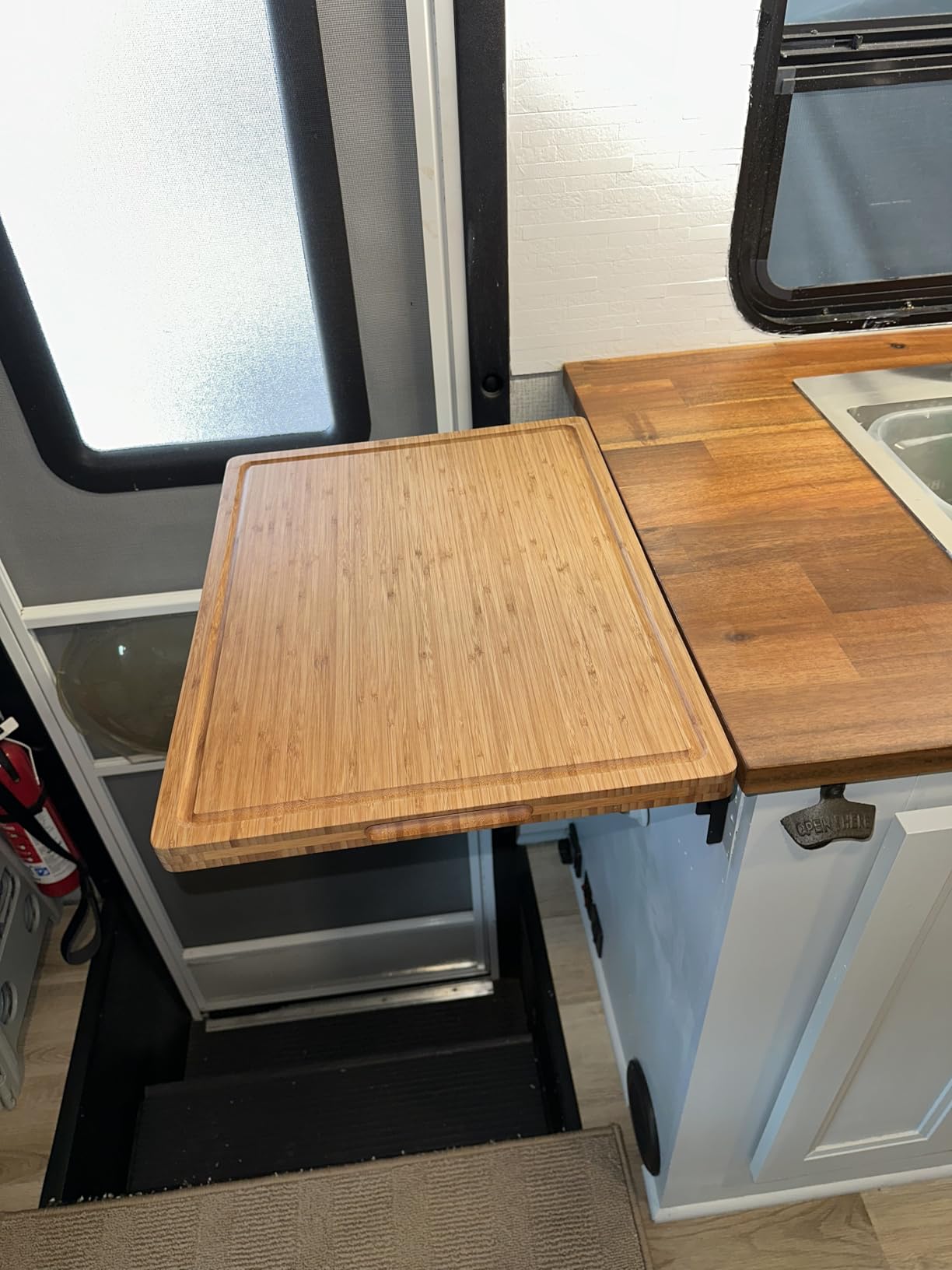
The design choice here is the reversible layout. One side is cut with deep juice grooves for meat, and the flip is a flat face that gives you the full 16 x 11 in for general cutting. That solves the common wood board complaint that a perimeter groove steals working space, because you use the flat side whenever you want the room.
At 1 in thick and 3.9 lb across a three-layer construction, this board has the mass to stay planted under heavy work. High-heat carbonization is what keeps it from absorbing as much water as plain bamboo, which reduces both swelling and warping. Built-in handles at the ends make it easy to carry, and buyers like the dark grain enough to use it as a cheese or charcuterie platter.
Two things catch people out. First, the carbonized color comes in noticeably lighter than the product photos, and a number of reviewers mention expecting the darker red-brown tone. Second, the board needs an initial oiling and then can weep oil for several days, which leaves it slick on the counter until the surface has finished curing.
Its 4.4 rating is the lowest of the wood boards here, driven by finish expectation and by occasional base warping reported after extended use. Neither is a safety problem, but both are worth knowing before you buy a board partly for how it looks.
Which side to use and when
Use the grooved side for anything raw or wet, trimming, and any cut that will release liquid. The channel catches the run-off so it never travels across the counter to your phone, your laptop, or the fridge door you just opened. Flip to the flat side for slicing cooked steak, chopping herbs, or working with bread and produce.
Because the flat side is unobstructed, this board also handles a sheet of roasted vegetables or a large fillet without you working around a channel. That versatility is why the reversible design is worth looking for, even though it is not exclusive to this board.
Breaking in a thick wood board
Give it a proper oiling before the first use, then treat both sides daily with a damp cloth and re-oil every few weeks. Wipe the surface dry immediately after washing and store the board standing on edge, never flat in a damp cabinet, which is the single best defense against the mold that users report in humid kitchens.
Expect the first week to be tacky while the oil cures out. Lay a towel under the board while it does that, and resist the urge to put it straight into heavy service, because oil that has not cured can feel slippery under a knife.
9. Empune Plastic 3-Piece Set – Best for a Graded Size System
Extra Large Cutting Boards, Plastic Cutting Boards for Kitchen (Set of 3) Cutting Board Set Dishwasher Chopping Board with Juice Grooves Easy-Grip Handles, Dark Grey, Empune
Plastic
17.0 x 11.8, 14.0 x 9.5, 11.4 x 7.8 in
4.5 lb
Dishwasher safe
Pros
- Three graded sizes for separate food types
- Juice grooves on all sides of every board
- TPR edge handles grip the counter
- Dishwasher safe and stain resistant
Cons
- Thin at 0.35 to 0.4 in
- Less kind to knife edges than wood
- TPR grip edges show wear
- Dark gray still marks from sharp knives
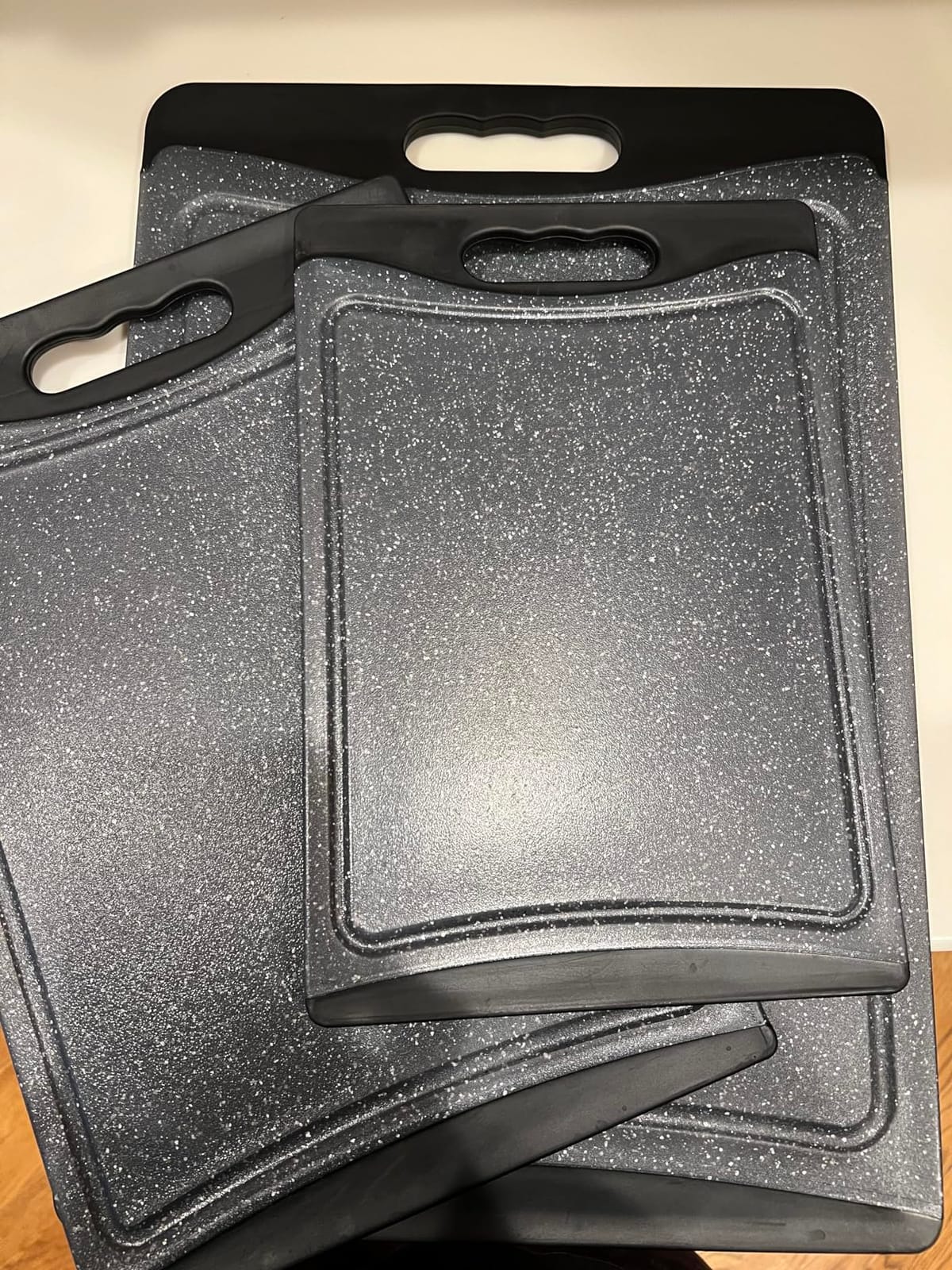
What makes this set different from the other plastic sets here is the size grading combined with full juice grooves on every board. At 4.7 with 82 percent five-star reviews, buyers are buying a system: the largest board for meat, the middle one for bread and produce, the small one for quick jobs, and no cross-contamination because each food gets its own surface.
Every board has juice grooves on all four sides, which is unusual at this price and thickness. That is a real improvement over a plain flat plastic board, and it is why this set works for trimming as well as for slicing cooked meat. TPR edge handles give a firm grip on the counter, and the whole set goes through a full dishwasher cycle without hesitation.
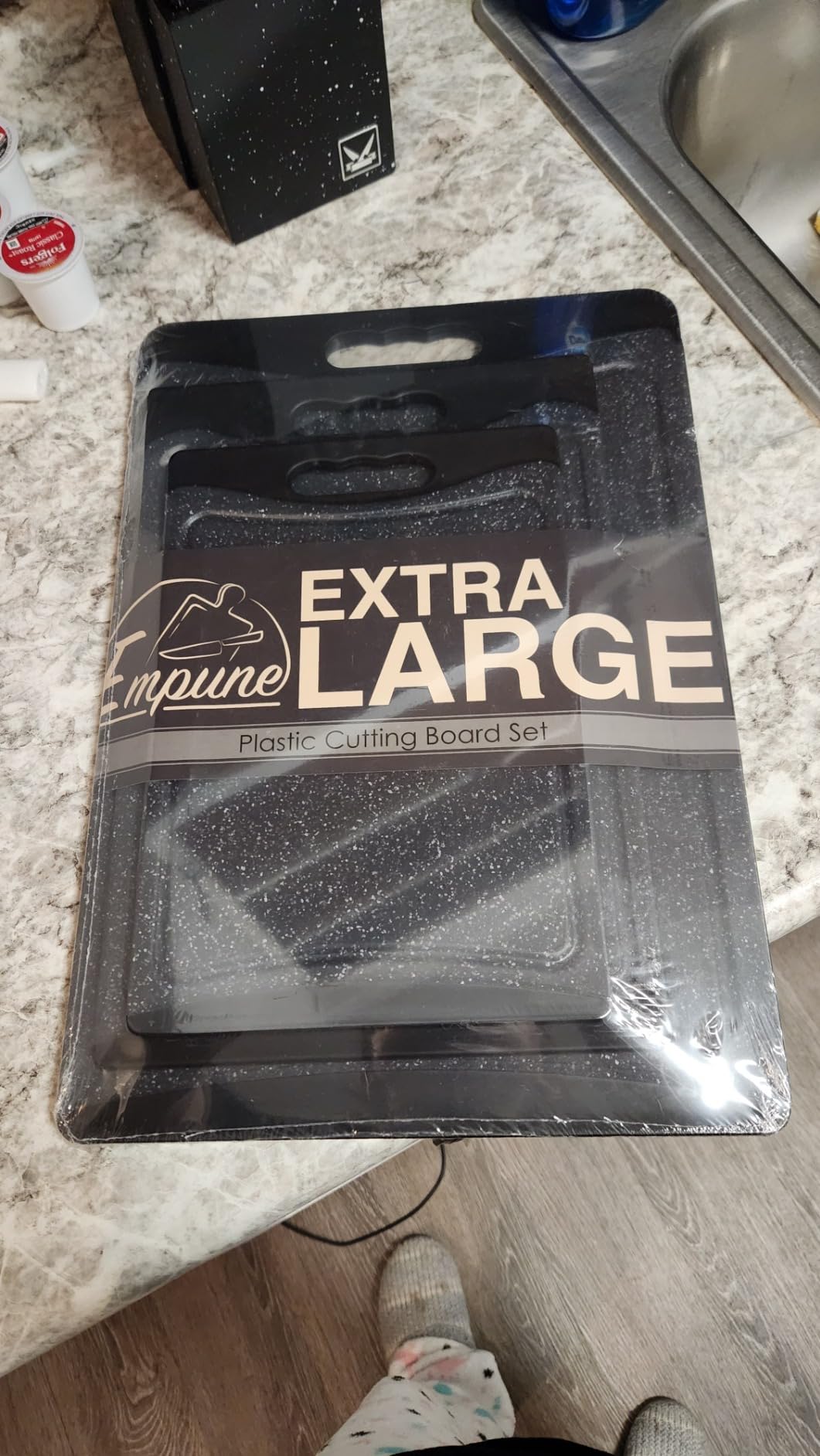
High-density plastic resists stains better than cheaper polyethylene and takes heavy chopping without degrading, so the 0.35 to 0.4 in profile is thinner but still serviceable. At 4.5 lb for three boards, the set has enough combined mass that nothing feels flimsy in the hand while you move between boards.
The thin profile is the trade buyers mention most. Compared with a 0.5 in HDPP board or a 1 in wood board, these offer less support under a cleaver and less forgiveness for a knife edge. Dark gray hides marks better than white but still shows scoring from sharp blades, and the grip edges wear down over years of heavy use.
Why three graded sizes beat one big board
A single large board is flexible until you need to separate raw chicken from salad greens. Then you either wash and dry the whole thing mid-cook, which takes time, or you accept the risk. Three boards make the correct choice the easy choice, and that is the argument cooks in color-coded board systems always make about why the system is worth owning.
The 17.0 x 11.8 in board also handles a whole chicken, a rack of ribs or a thick pork chop without overhang, and the grooves on all four sides catch the drippings that would otherwise run off a smaller board during a trim job.
Where thickness would have helped
If your prep is cleaver-heavy, this set will feel thin. Boards at 0.35 to 0.4 in give a sharp knife less material to bite into and the board more tendency to rock when you work near an edge. Move up a thickness class if you break down primals regularly rather than trimming and portioning.
The other limit is heat, as with any plastic. Keep it away from a hot skillet and out of the oven. For everything else, dishwasher safety makes this one of the least demanding boards here to keep in rotation.
10. Kikcoin 17 x 11 Bamboo Board – Budget Pick with a Deep Wide Groove
Kikcoin 17″×11″ Bamboo Cutting Boards for Kitchen, Knife-Friendly Food Grade Wooden Cutting Boards for Kitchen, Charcuterie, Extra Large Chopping Boards with Deep Juice Groove, Reversible, Natural
Bamboo
17 x 11 x 0.6 in
2.8 lb
Hand wash only
Pros
- Deep wide juice groove for meat drippings
- Solid bamboo with a burr-free oiled finish
- Reversible design separates raw from produce
- Anti-slip silicone stickers included
Cons
- 0.6 in thickness can flex under cleaver work
- Anti-slip uses peel-off silicone stickers
- Hand wash only
- Bamboo grain takes deep scores over time
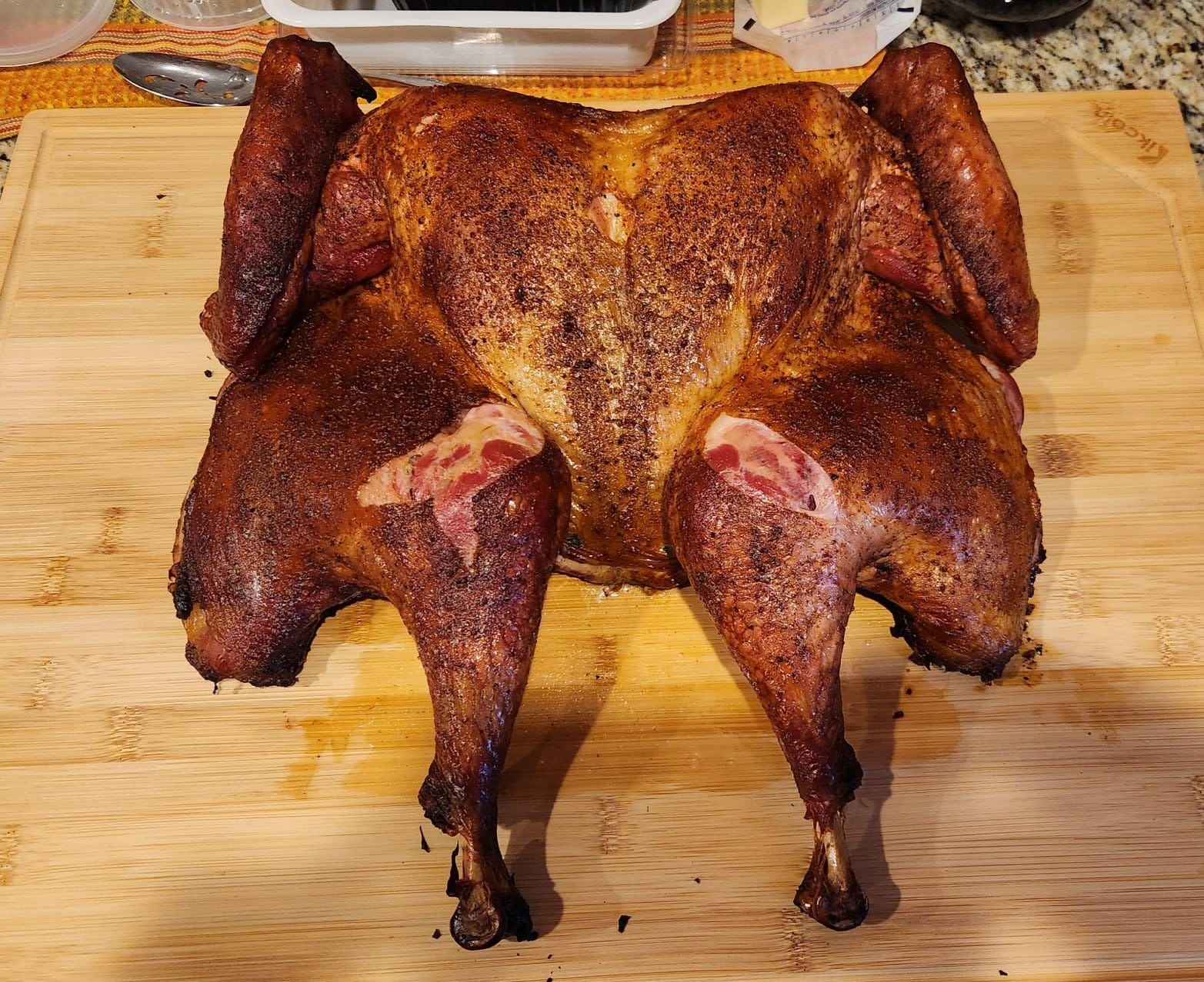
At the bottom of the price range, this board does something the cheaper options usually skip: a genuinely deep, wide juice groove. It runs far enough into the board to hold the drippings from trimming a whole chicken breast, which is more than most boards in this bracket offer. The 4.5 rating across more than 5,400 reviews reflects that the groove is the reason people keep it.
It is solid bamboo, polished and coated with food-grade oil for a burr-free finish, and the reversible design lets you put raw meat on one side and produce on the other. An invisible built-in handle makes lifting easy without adding a bump that catches the edge of a blade.
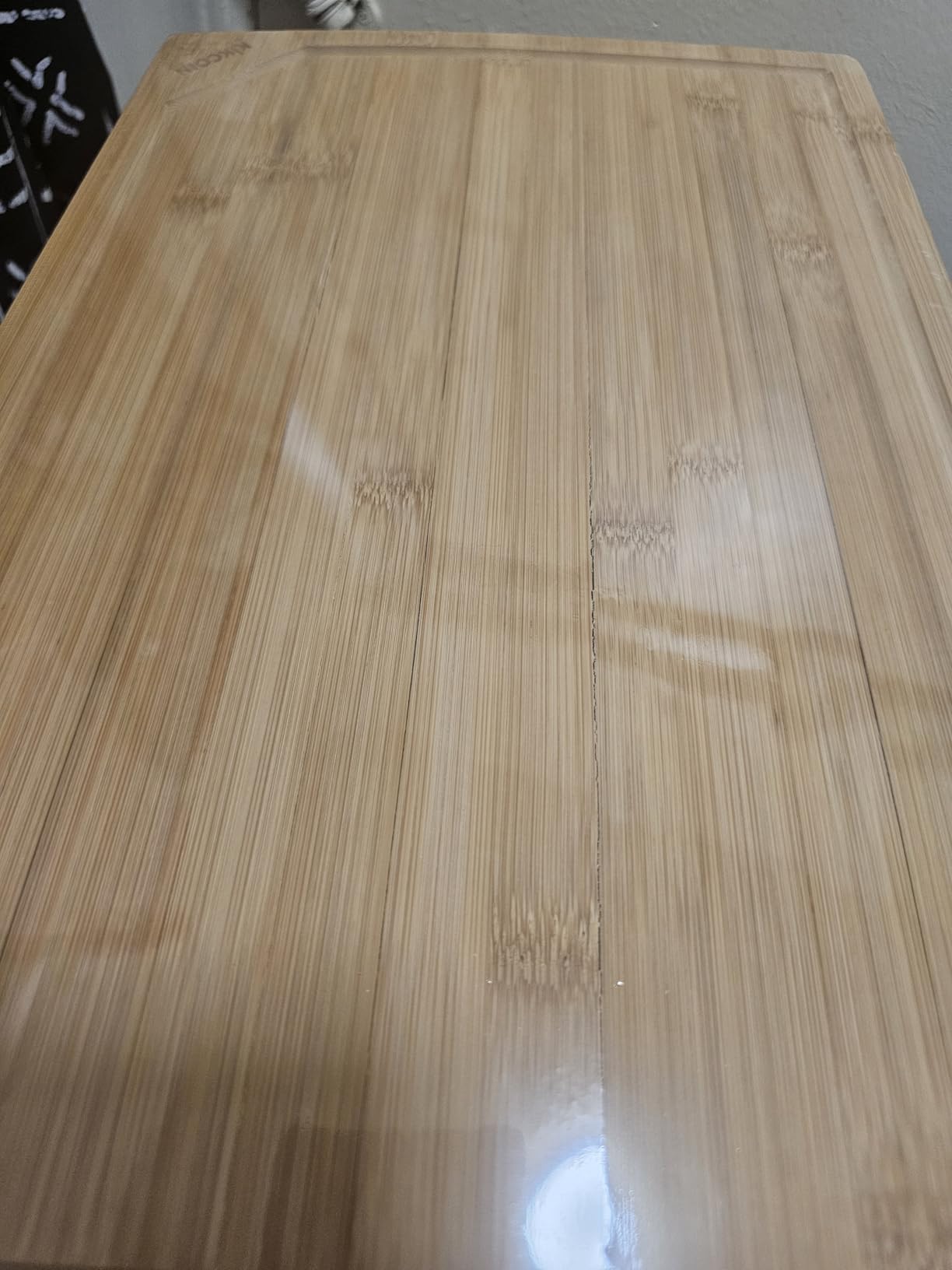
Anti-slip silicone stickers are included, and they do a reasonable job on a dry counter. That is the weak link in the design, though, because stickers are adhesive and eventually lift, curl or lose their bite. A moulded rubber base or integral feet is the better answer, and several plastic boards in this roundup use one.
At 0.6 in thick and 2.8 lb, this is the lightest bamboo option here and the one most likely to flex under heavy cleaver work. Hand wash only, and like any bamboo face it will collect knife scores with use. Plan on oiling it periodically or the grain will dry out and start to crack.
Best use: trimming and everyday raw chicken
This is a board for the work most households do most weeks, not for holiday production. Trimming, portioning, cutting a chicken into pieces and slicing cooked meat all fit comfortably on 17 x 11 in, and the deep groove keeps the counter clean during exactly the wet jobs that create the mess.
The reversible layout is a genuine bonus at this level. Use one side for raw protein and flip for produce, and you have separated your surfaces without buying a second board. For a first dedicated meat board, that is the most useful thing on the spec sheet.
Where the budget shows
Thickness is the first limit. At 0.6 in the board flexes slightly under a cleaver, and a flexing board reduces your control on a tough cut. If you do heavy butchery, step up to a one-inch board even if it means spending more, because stability is what makes a cut safe.
The adhesive anti-slip pads are the second limit. Apply all of them, press them down firmly, and re-press them every few months. If you cannot commit to that, pick a board with moulded feet. Finish consistency and occasional cracking also show up in a small share of reviews, so inspect the board on arrival.
How to Choose a Cutting Board for Meat
Six criteria decide whether a board works for meat. Work through them in order, because a board that fails on size or stability cannot be rescued by a good finish, while a board that passes the first four can tolerate a compromise on the last two. Here is what to check before you commit to anything on this list, and the same checklist works if you are shopping a category we have not covered.
First, measure your cabinet and your dishwasher before you fall for a large board. The most common complaint about extra-large boards is not performance but storage, and it shows up in reviews here as a one-star rating on a board that performs well. A board you have to lean against a wall is a board that will stop being used.
1. Material. Plastic is non-porous, dishwasher safe and the least forgiving of knife edges. Wood and bamboo feel better under a knife, need hand washing and occasional oiling, and will show scores over time. Composite sits between them. Metal is the most non-porous and the hardest on blades, and it is best bought as the raw-meat side of a two-sided board.
2. Size. Match the board to the largest cut you actually make. A 16 x 12 in face handles a whole chicken, a rack of ribs and most roasts. Anything you carve for a holiday needs 20 x 15 in or larger, and a whole turkey with legs and wings on really wants more. Buying for the big day and then not using the board the other 300 days a year is how boards end up in a garage.
3. Thickness and weight. Around one inch is the useful target for cleaver work and large birds, because thickness is what stops a board flexing and rocking. Weight matters for the same reason, though there is a ceiling, since a very heavy board becomes difficult to lift when it is loaded. If you own heavy cleavers, spend on a thick board. If you mostly slice and trim, a lighter board is easier to handle.
4. Juice groove depth and coverage. Look for a groove around the full perimeter rather than a well in one corner, and treat roughly 0.2 in as a practical minimum. A shallow channel looks good in photos and does nothing for a wet roast. Boards in this roundup that also include a well with a pour spout, like the 30 x 20 in bamboo board, are the better arrangement for very wet tasks because the liquid can actually leave the board.
5. Non-slip base. Moulded rubber feet or a rubber border beat peel-off silicone stickers, because stickers lift, curl and eventually stop gripping. Test the board on a wet counter, not a dry one, since meat prep is when your counter is wettest. A damp folded towel under the board is the emergency fix most cooks end up using, and it works.
6. Cleaning and maintenance. Decide honestly how you will clean it. Dishwasher-safe plastic removes an entire step after raw poultry, which is where most sanitation shortcuts happen. Wood and bamboo need hot soapy water, immediate drying, and a few minutes of oiling every few weeks. The USDA Food Safety and Inspection Service publishes the sanitizing steps most home cooks follow, and they are worth reading once before you set your own routine.
Two habits matter more than any individual feature. First, use a dedicated board for raw protein and a separate one for produce, and do not try to share one surface. Cooks on r/Cooking describe keeping one board solely for raw meat and vegetables as the most common habit in the discussion, and it is the cheapest cross-contamination control available. Second, stand wood boards upright to dry rather than laying them flat, which is the main defense against the mold that shows up on bamboo edges in humid climates.
Finally, sanitize properly after raw poultry rather than just rinsing. Scrape the surface, wash it with hot soapy water, then treat it with either diluted vinegar or a dilute bleach solution, and let it air-dry completely on edge before storing. That takes a couple of minutes and it is the difference between a board you trust and one you quietly keep using because it looks clean.
Wood vs Plastic vs Metal for Raw Meat
Wood is the best surface for knife edges and the one most home cooks trust for raw meat, partly from long-standing claims that wood is naturally antibacterial. That claim is disputed in both directions, and the more interesting finding is a counter-narrative: UC Davis research, cited widely in home-cooking discussions, found that after hand-washing with hot soapy water, plastic boards still carried more bacteria than wooden ones. The practical read is that cleaning method matters more than material, and that wood is a legitimate choice for raw meat when you wash it properly.
Plastic is the safest default on hygiene grounds. It is non-porous, it cannot absorb liquid into grain, and it goes in the dishwasher, which is the step people skip. The costs are knife-friendliness and appearance, since it shows scoring and can dull an edge over time. If you break down raw poultry weekly and want the fastest correct cleanup in the kitchen, plastic is hard to argue with.
Metal is the strongest on non-porosity and durability and the weakest on knife comfort. A titanium or stainless face will not splinter, will not hold an odor, and wipes clean in seconds, but it is harder than wood and it scratches visibly within weeks of daily use. The workable answer is the double-sided board, where metal takes the raw meat and a softer polymer or wood face takes everything else.
What nobody should be using is glass or stone. They destroy knife edges, they are slippery, and they are the hardest surface to sanitize well because of the micro-scratches that develop. Avoid them, and avoid any board so thin it flexes under a cleaver, because a flexing board is a blade you cannot fully control.
Frequently Asked Questions
What is the best material for a cutting board for meat?
For most home cooks, dense plastic is the best all-round material for a meat board because it is non-porous, dishwasher safe and will not split. Wood and bamboo feel better under a knife and need hand washing plus periodic oiling, while metal is the most non-porous and the hardest on blade edges. If raw poultry is part of your week, choose on cleaning method first and knife feel second.
What is the most hygienic chopping board for meat?
A dishwasher-safe plastic board is the most hygienic option because it is non-porous and can be washed at high temperature after raw poultry. Research cited in home-cooking discussions has also found that plastic boards can retain more bacteria than wood after hand-washing, so whichever material you pick, wash with hot soapy water and let it dry completely before storing.
Is it better to cut meat on a wood or plastic cutting board?
Wood is gentler on knife edges and feels better for slicing, but it needs hand washing and periodic oiling and can absorb odor over time. Plastic is non-porous, survives the dishwasher and cleans up in seconds, though it shows knife marks and can blunt an edge over time. Cooks who break down raw chicken most days usually prefer plastic, and weekend carvers usually prefer wood.
Why do cutting boards have juice grooves?
A juice groove is a channel around the board that catches liquid as you carve, so meat juices run downhill into it instead of spreading across your counter and the rest of your kitchen. A full-perimeter groove of roughly 0.2 in or more works, and a groove paired with a well and a pour spout is better still for very wet tasks because the liquid can be poured off the board.
Can I put my cutting board in the dishwasher?
Only if the manufacturer says so. Plastic and composite boards on this list are dishwasher safe, and the HDPP board is rated for dishwashers up to 200F. Wood and bamboo boards are hand wash only, because heat and standing water cause splitting, warping and glue failure. Metal boards are hand wash only as well, and any plastic board must be kept away from hot pans and ovens.
How often should I replace my meat cutting board?
Replace a board when deep knife scores, splits or cracks reach the point where debris stays in the grooves and no longer washes out. Smell is the other giveaway, since a board that holds a permanent meat or onion odor has stopped being sanitary regardless of material. Plastic typically lasts a few years in heavy service, and wood lasts as long as you keep it oiled and dry.
Our Top Meat Board Picks for 2026
The ROYAL CRAFT WOOD three-piece bamboo set is our pick for the best cutting boards for meat, because three sizes remove the sizing guesswork and every board carries a working juice groove. If you want zero maintenance and the highest rating in this group, take the GORILLA GRIP reversible set, which is dishwasher safe and grips the counter better than anything else we tested.
For a single board that handles most meat work without refilling your cabinet, the OXO Good Grips utility board is the one to buy, with its integrated drip catcher and pour corners doing more than a flat plastic surface ever could. Cook a holiday bird every year? The 30 x 20 in bamboo board is the only one here that nothing overhangs, as long as you plan where it lives.
Whichever one you choose, give it a dedicated place in the rotation for raw protein and keep it clean and dry between uses. That habit matters more than any feature on the spec sheet. If you are also building out the rest of your prep setup, our picks for the other cutting tools worth comparing are a good companion read.