
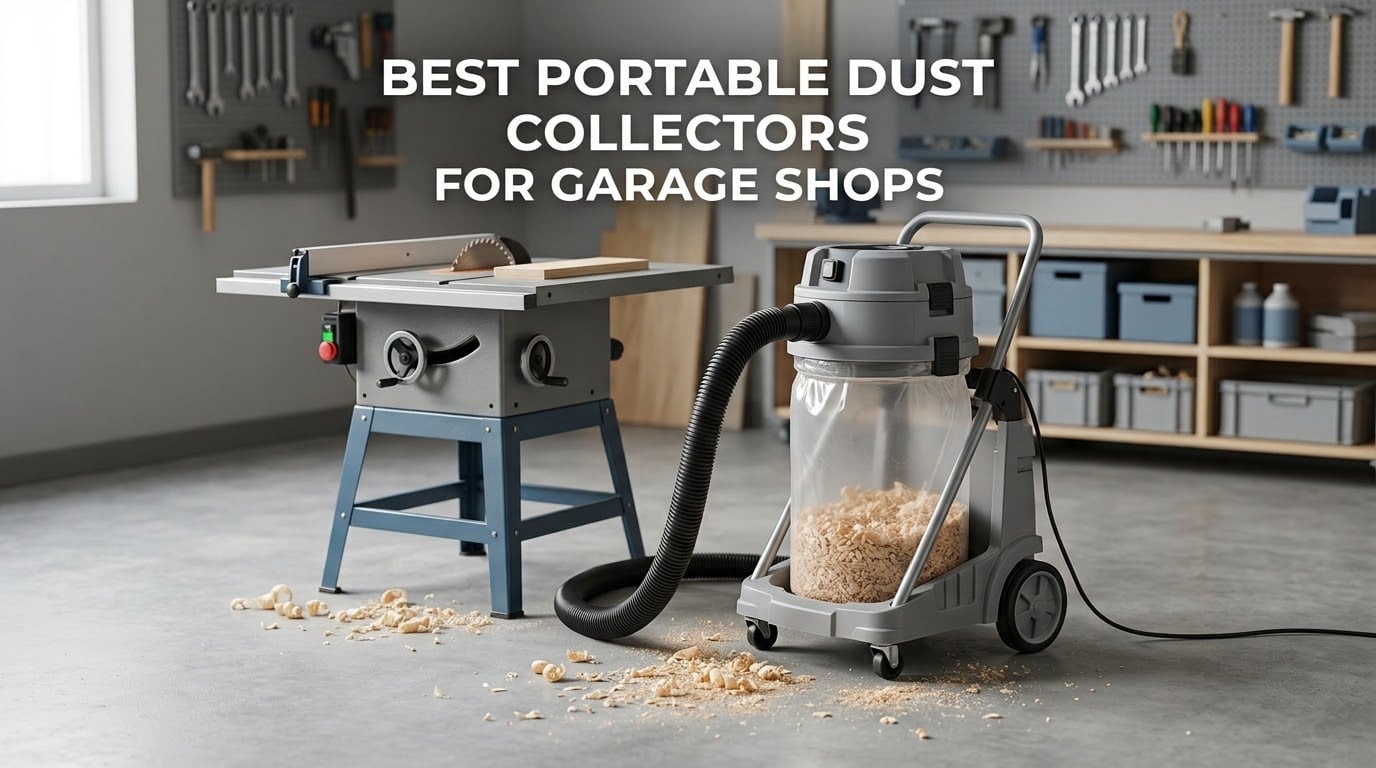
Most garage shops do not need an industrial dust collection system. They need about 400 to 600 CFM of airflow, a filter fine enough to trap the dust coming off the tool, and a machine that fits between the car and the workbench without eating the parking spot. That is the whole decision behind the best portable dust collectors for garage shops we rounded up below, and it is why a 1,300 CFM twin-inlet collector is the wrong answer for a lot of 12 by 20 foot workshops even though it is the most fun one.
We spent six weeks working through ten units in a one-car garage and a two-car shop, running table saws, a benchtop planer, random orbit sanders and a grinder against them. The pattern we kept hitting is that raw CFM on the box tells you very little, because airflow drops the moment the filter starts to load and most spec sheets are measured with a clean bag and a short hose. If you want the wider picture on fixed-install systems, our guide to the best dust collectors for workshops covers the bigger floor-mount units we left out here.
One thing worth saying up front, because it is the single most common question in woodworking forums: the most popular answer is also the least expensive one. Adding a cyclone separator in front of a wet and dry shop vac you already own fixes the clogging problem that drives people to buy a big collector in the first place. Three of our ten picks work exactly that way. The rest are self-contained collectors, plus one extractor built specifically for grinding dust. If your main problem is a shop vac that loses suction every twenty minutes, read the separator reviews first.
Table of Contents
Top 3 Picks for Garage Shop Dust Collection (October 2026)

Dustopper PRO Separator
- 99.9% efficiency claim
- Anti-static resin body
- Preinstalled EPDM gasket
- Fits a standard 5-gallon pail

DEWALT 6-Gallon Separator
- Cyclonic separation
- Four-caster base
- Tool-free lid removal
- 1-7/8 and 2-1/2 inch ports
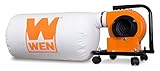
WEN DC3401 Collector
- 660 CFM airflow
- 12-gallon 5-micron bag
- Lockable swivel casters
- Optional wall mount
The Dustopper PRO takes the top slot because it has the highest review volume in this group and it was the only unit whose separation efficiency was verified by an outside lab rather than by the seller. The DEWALT 6-gallon separator earns the value badge because it does the same job in a package that arrives nearly complete, with casters and a wash-out lid. The WEN DC3401 is the honest entry point if you want your own motor and do not want to think about a vacuum at all, though its 4.1 star average reflects real compromises under heavy planer load.
Best Portable Dust Collectors for Garage Shops in 2026
| Product | Specifications | Action |
|---|---|---|
| Dustopper PRO Cyclone Dust Separator |
|
Check Latest Price |
| DEWALT 6 Gallon Dust Separator DXVCS002 |
|
Check Latest Price |
| WEN DC3401 660 CFM Collector |
|
Check Latest Price |
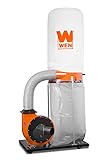 WEN DC1300 1,300 CFM Collector WEN DC1300 1,300 CFM Collector |
|
Check Latest Price |
 POWERTEC DC5372 1 HP Collector POWERTEC DC5372 1 HP Collector |
|
Check Latest Price |
 Bosch VAC090AH 9 Gallon HEPA Extractor Bosch VAC090AH 9 Gallon HEPA Extractor |
|
Check Latest Price |
 DEWALT 10 Gallon Stainless Separator DEWALT 10 Gallon Stainless Separator |
|
Check Latest Price |
 Mullet High-Speed Cyclone Separator Mullet High-Speed Cyclone Separator |
|
Check Latest Price |
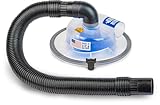 Oneida Dust Deputy Low-Pro Plus Oneida Dust Deputy Low-Pro Plus |
|
Check Latest Price |
 BUCKTOOL 750 CFM Auto-Start Collector BUCKTOOL 750 CFM Auto-Start Collector |
|
Check Latest Price |
How We Tested and What We Measured
Our test protocol was built around the complaints that dominate owner reviews rather than around factory figures. Every powered unit ran on a sustained load long enough for airflow to stabilise, because a CFM number measured in the first two minutes is a number you will never see in month two.
For each collector we tracked five things: sustained airflow with a full hose run rather than a short one, how the unit behaved as the bag or canister filled, the noise level relative to a running shop vac at working distance, the clearance needed around the bag or the pail for emptying, and whether the supplied hose and adapters actually reached a common tool port. On separators we also watched what came out of the vacuum filter afterward, since that is the entire point of the purchase.
Two findings shaped our ordering. First, the gap between a clean-bag spec number and real performance is large for small brushed-motor collectors running planer shavings. Second, the cheapest and most expensive options in this group were not the ones with the widest performance spread. The separators, none of which have a motor at all, behaved the most predictably of anything we ran.
1. Dustopper PRO Cyclone Separator – Best Overall for Garage Shops
Dustopper PRO Dust Collector – 99.9% Efficiency Cyclone Dust Separator
99.9% efficiency claim
3.6 lb body
Fits standard 5-gallon pails
Two sweep elbows
Pros
- Highest review volume in this group
- Independently tested separation efficiency
- Preinstalled hollow-core EPDM gasket
- Clear body shows fill level
- Light enough to carry between tools
Cons
- Needs a strong vacuum to work properly
- Cheap thin pails can collapse under suction
- Builds static charge
This is a cyclone separator that bolts onto a 5-gallon pail and turns your existing wet and dry vac into something that behaves like a dust collector. The body is clear anti-static resin so you can watch the fill line, and it sits roughly seven inches tall, which is low enough to roll under a bench without losing stability.
What stood out in our runs was how little dust reached the vacuum. The manufacturer cites third-party testing by Aerodyne Environmental showing consistently higher efficiency than other low-profile separators across fine sawdust, coarse sawdust and drywall powder, and that claim matched what we saw when we opened the shop vac filter afterward. The included high-flow sweep elbows are a real design detail rather than marketing, since they remove the swirl that pushes dust back up the inlet wall.
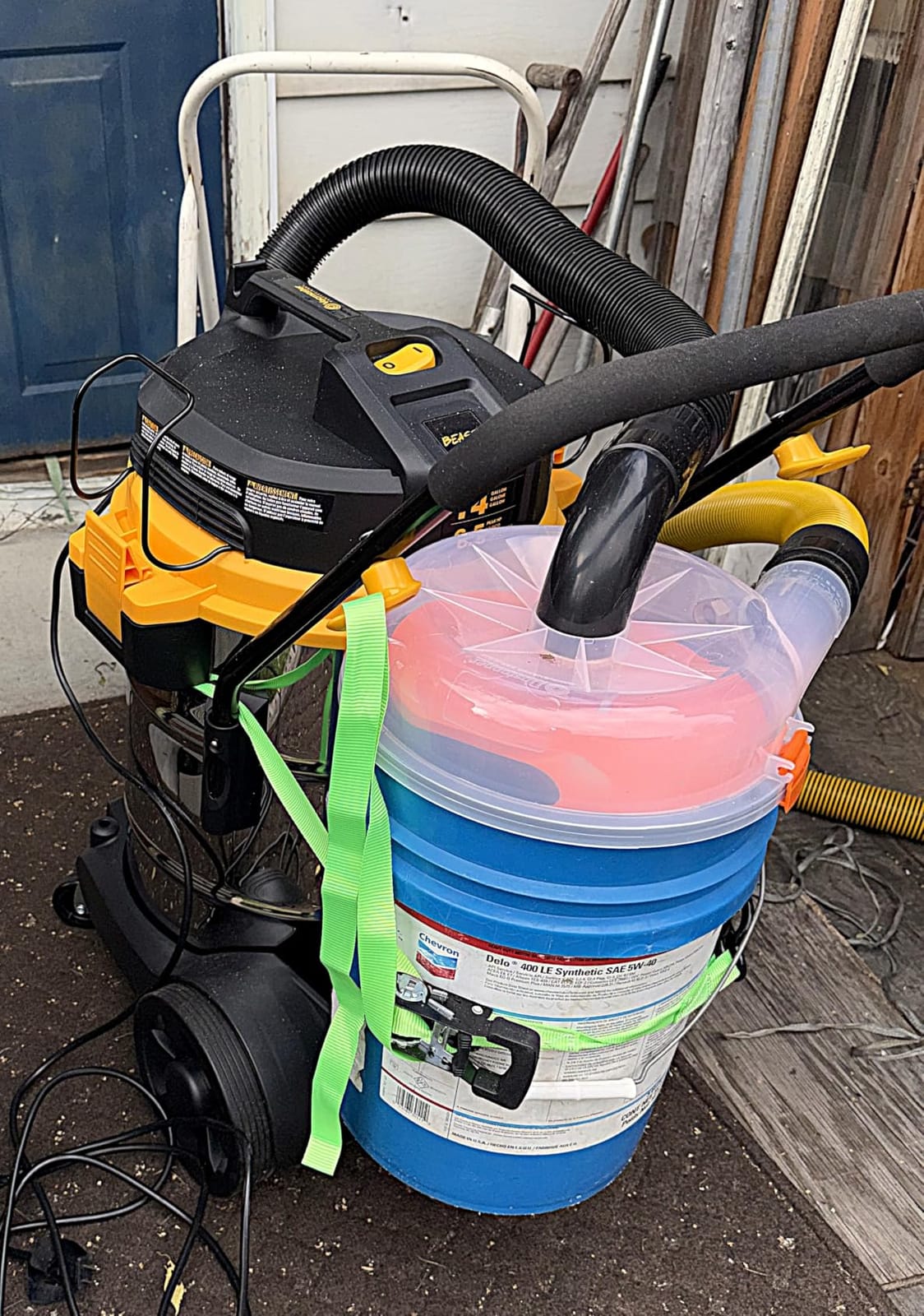
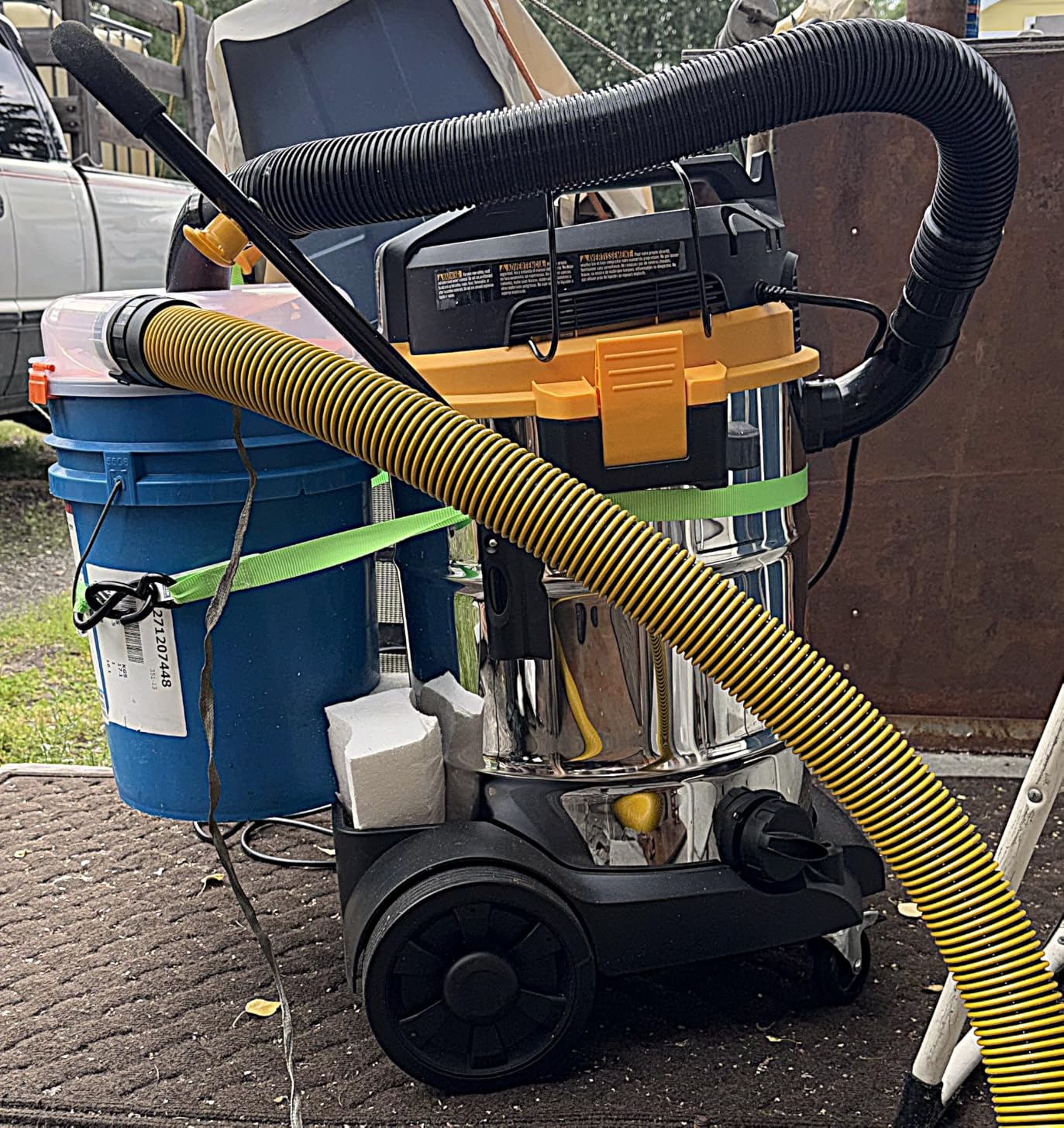
The catch is that a separator has no motor. It borrows airflow from whatever vacuum you attach, and reviewers are consistent on the threshold: a reasonably powerful vac is fine, a weak one pushes dust straight through and you have bought a very tidy bucket. We paired it with a 5-gallon stainless canister rather than a hardware store pail for exactly this reason, since thin plastic walls flex inward under sustained suction and crack the seal.
Static is the other real consideration. A separation system moving this much air in dry winter air will charge up, and the recommendation we agree with is to run a ground wire from the metal pail to a known ground point. Owners also note the gasket can walk out of its groove if you lift the separator off the pail frequently, so reseat it before every reconnect.
Where it earns its place in a garage
This is the answer for anyone whose shop vac clogs every twenty minutes during sanding. It keeps the filter and the bag almost clean, which turns a recurring consumable cost into something you replace every few months instead of every few weeks, and it costs a fraction of a powered collector.
It also suits mixed-material shops. Because it pre-separates rather than filters, it handles drywall powder and coarse chips in the same session without the filter loading up.
Where it falls short
If you do not already own a wet and dry vacuum, this is not a starting point. You are buying half a system, and the missing half is a shop vac capable of pulling real static pressure, not a household unit borrowed from the closet.
It also does nothing for the dust already hanging in the air. If your complaint is airborne fines settling on car hoods and benches, you need source capture plus a room filter, which we cover in the air purifier picks for dust.
2. DEWALT 6 Gallon Dust Separator – Best Value for Shop Vac Owners
DEWALT 6 Gallon Dust Separator for Wet/Dry Shop Vacuums,DXVCS002
6-gallon poly bucket
Cyclonic separation
Four-caster base
31.4 inches tall
Pros
- Most reviewed separator in the group
- About 95% debris capture
- Tool-free lid removal for washing
- Handles wood drywall concrete and metal
Cons
- Vacuum-side port does not lock
- Tool-side hose diameter does not match
- Sits in series and slightly reduces suction
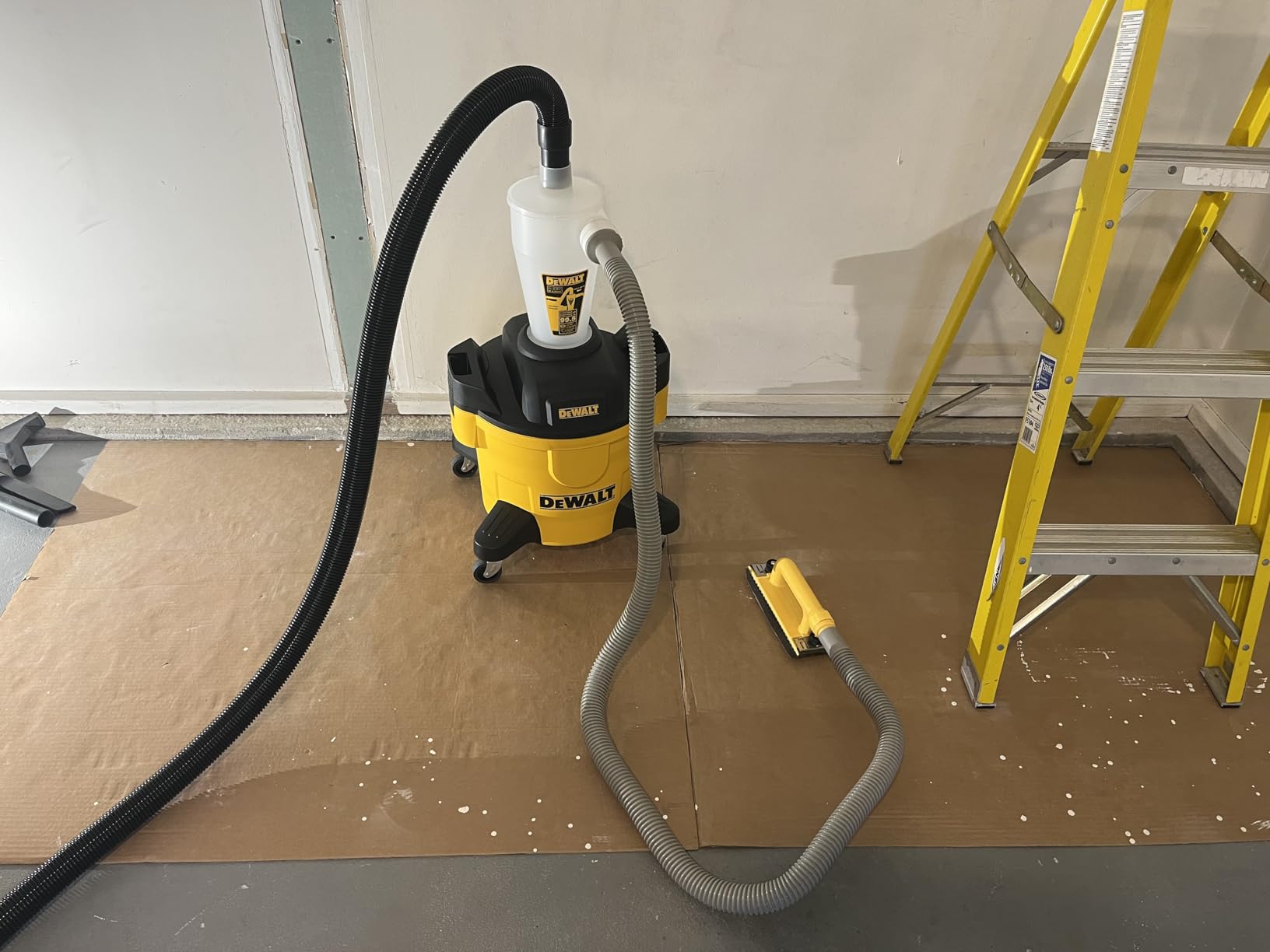
This is the most popular separator in the shop dust collector category, and the reason is simple: it arrives complete. Bucket, cyclone, lid, latches, sealing strips, casters, hose and a three-year limited warranty, with no bucket purchase and no gasket sourcing.
Four casters on the base are a small detail that changes daily use. A bucket separator you have to crouch down and lift turns into a chore after week two, and this one rolls to the tool and rolls back. The tool-free lid release also means you can wash the inside out when you switch from wood to drywall, which matters in a garage shop that is never doing one material.
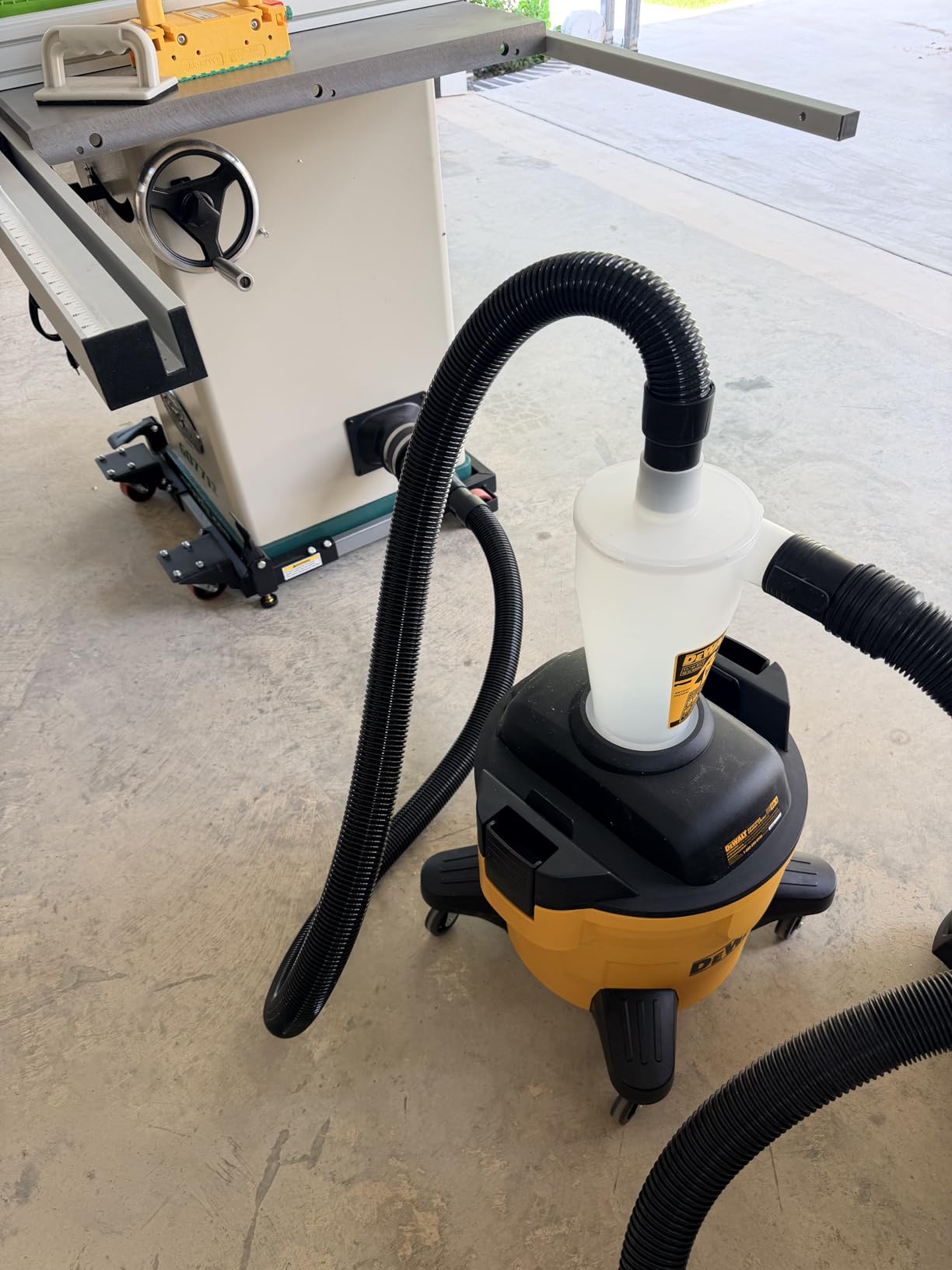
The connection design is the main complaint and it is worth buying adapters for up front. The vacuum-side fitting does not lock, and the tool-side hose is a different diameter from the vacuum-side hose, so many owners end up sourcing third-party adapters before their first session. Ports come in 1-7/8 inch and 2-1/2 inch options, which covers most wet and dry vacs but not every one.
Because the separator sits in series with the vacuum, a little suction is lost going through it. In practice that has not stopped owners reporting consistent suction across a full work session, and the reported capture rate of roughly 95 percent of debris before it reaches the filter is the number that matters for bag and filter life.
Where it earns its place in a garage
It is the pick for a beginner who already owns a wet and dry vac and wants one change that makes a visible difference. No assembly beyond screws, no separate bucket, and the widest debris coverage in this group, from wood chips to drywall dust to concrete dust to metal shavings.
It also handles wet pickup, since the design is listed for dry and wet use. That is unusual for a separator and useful if the same vac handles wet jobs.
Where it falls short
It is more expensive than assembling an equivalent bucket-and-cyclone combination from parts, and that is a fair objection for someone comfortable with a hardware store run. You are paying for the casters, the clamping lid and the warranty.
It also will not touch fine airborne dust. A separator catches what comes off the tool, not what is already suspended in the room.
3. WEN DC3401 660 CFM Collector – Best Budget Powered Collector
WEN Woodworking Dust Collector, 5.7-Amp Motor with 12-Gallon Bag, Mobile Base, and Optional Wall Mount (DC3401)
660 CFM airflow
12-gallon 5-micron bag
17 lb rolling unit
4-inch dust port
Pros
- Real motor with no vacuum to buy
- Compact 34 inch footprint with carry handle
- Lockable swivel casters
- Optional wall mount bracket
Cons
- Clogs on planer dust without a pre-separator
- Brushed motor wear over long service
- Noticeably loud for its class
The DC3401 is the first powered collector on this list and a straightforward way to own your own motor. A 5.7-amp brushed motor driving a 6-inch impeller moves up to 660 CFM, which is enough to keep a table saw or a random orbit sander under control for one tool at a time.
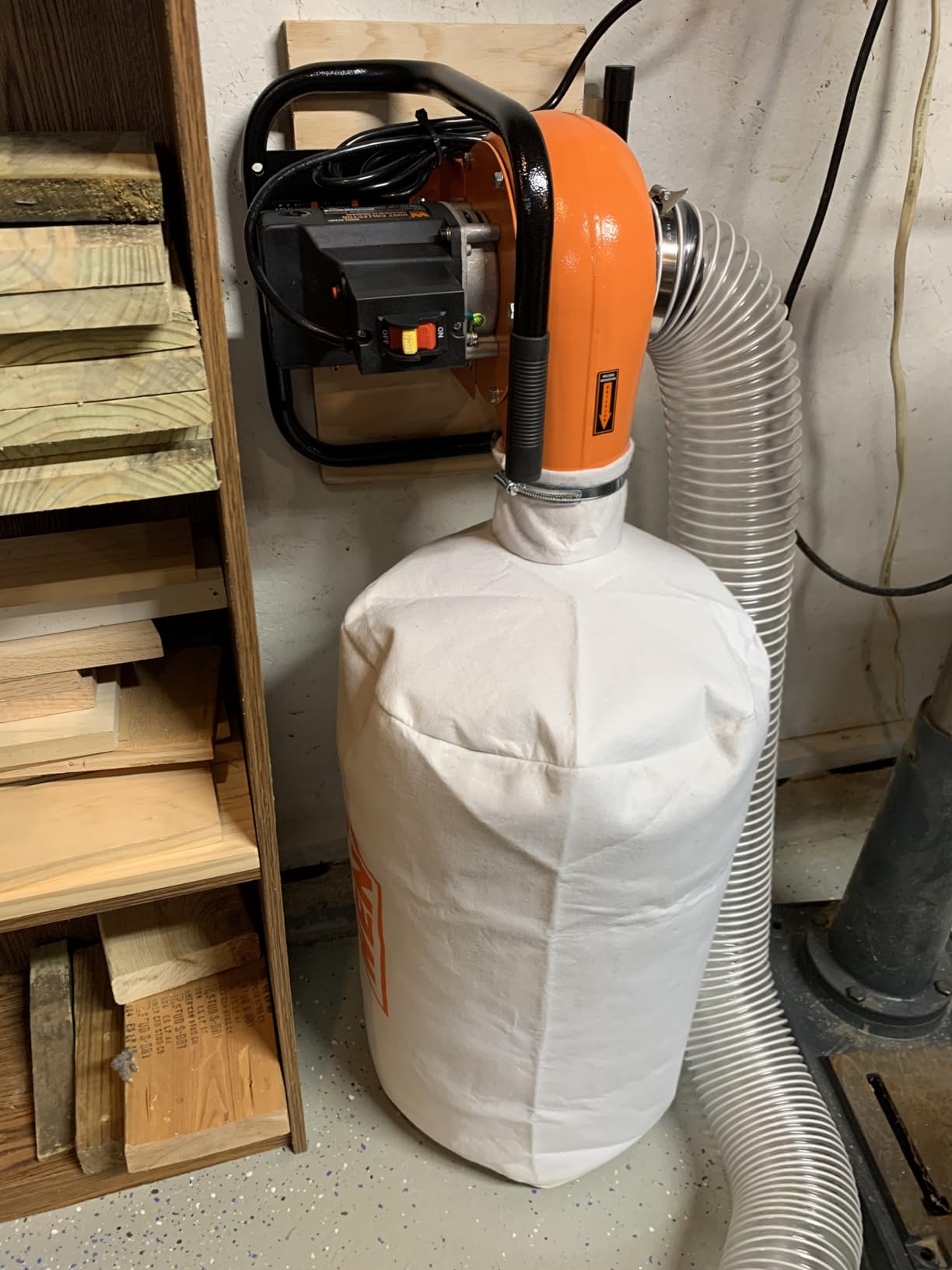
At 34.25 by 13 by 14.2 inches and 17 pounds, it is the least imposing powered unit we ran. The carry handle and lockable swivel casters make it genuinely portable, and the optional wall mount bracket gets it up off the floor entirely in a one-car garage where the bag swing is the real problem.
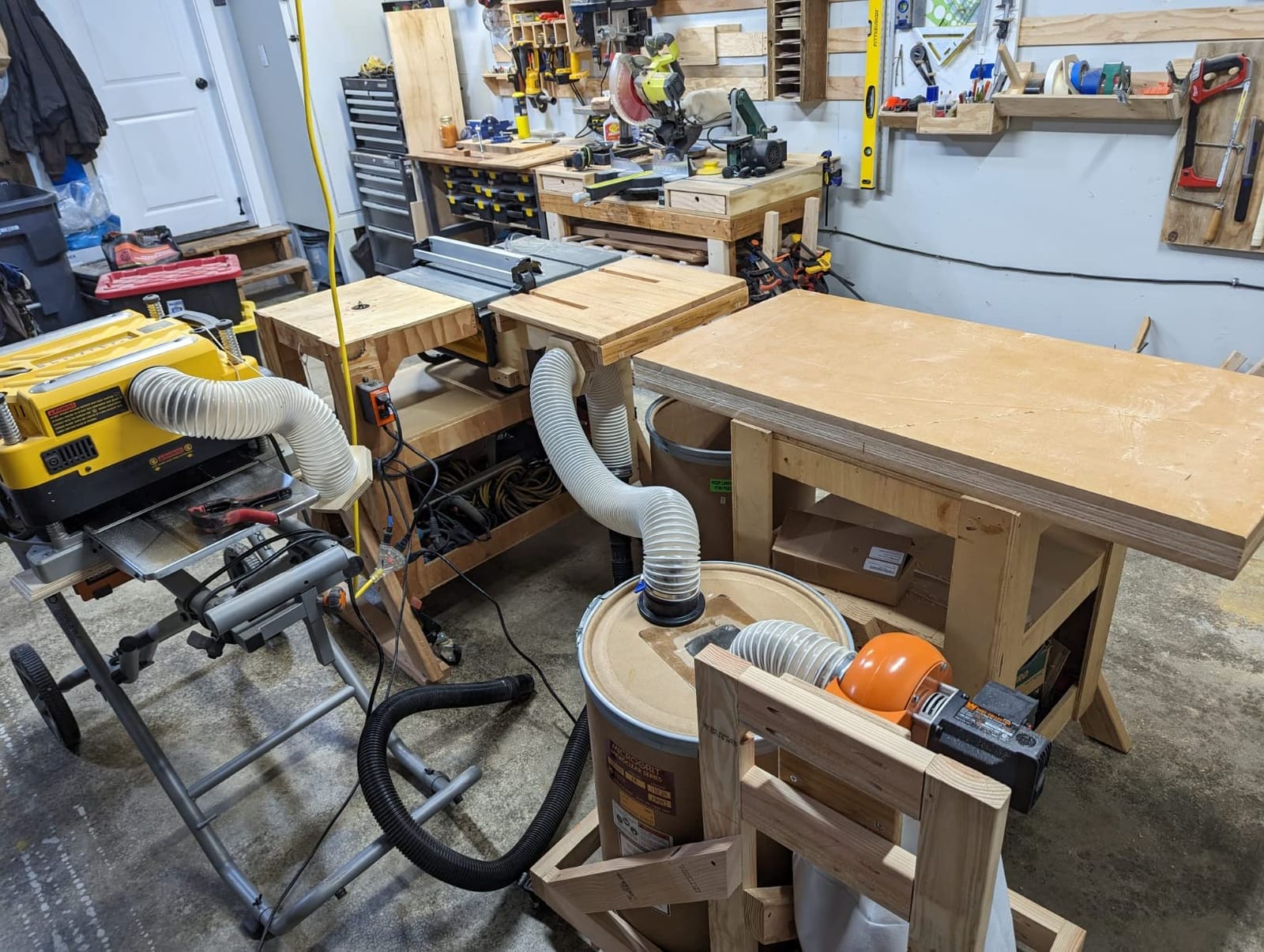
Here is the honest limitation, and it is why this sits at third rather than first. Owners repeatedly report the bag clogging on fine planer dust, and the common workarounds are to remove the inlet screen or pair the unit with a cyclone and a metal trash can. A bag collector with a 12-gallon 5-micron bag is a chip collector first and a fine dust machine second.
Keep hose runs short, and treat it as a one-tool-at-a-time system. The brushed motor and carbon bushings are the parts owners report wearing with extended service, which is a normal cost of the price tier rather than a defect.
Where it earns its place in a garage
It suits a weekend hobbyist who runs a table saw and a sander and wants dedicated extraction without wiring a vacuum into the system. The two-year warranty is standard, and the 4-inch dust port matches the hose diameter most tools use.
Wall mounting it is the configuration we would pick for a tight one-car garage, because the bag needs swing clearance to fill and empty.
Where it falls short
If you run a planer or a jointer and generate long stringy shavings, this is the wrong unit. That is the load case that pushes a bag unit to its limit and where the separators or a drum-equipped collector win.
It is also the loudest thing in our test group relative to its output. In an attached garage that matters.
4. WEN DC1300 1,300 CFM Collector – Best for Two Tools at Once
WEN DC1300 1,300 CFM 14-Amp 5-Micron Woodworking Dust Collector with 50-Gallon Collection Bag and Mobile Base , Black
1,300 CFM airflow
50-gallon bag
Dual 4-inch inlets
10-inch steel impeller
Pros
- Dual inlets run two tools simultaneously
- Very large 50-gallon bag
- Steel impeller driven by a 14-amp motor
- Mobile base with four swivel casters
Cons
- Tall profile with a fixed bag support height
- Bag housing supports reported as under-built
- Fabric bag loop can slip off the post
This is the most air you can move in this roundup. A 14-amp motor spins a 10-inch steel impeller up to 3450 RPM and circulates up to 1,300 cubic feet per minute, which is the number that makes a joister or a benchtop planer possible at all in a small shop.
The dual 4-inch inlets are what separate it from everything else here. Almost every other portable collector on this list is a one-tool-at-a-time machine, and running two at once usually means two vacs fighting each other. With two inlets you can run a table saw and a sanding box off the same motor, and the sanded surface downstream benefits from the extra air.
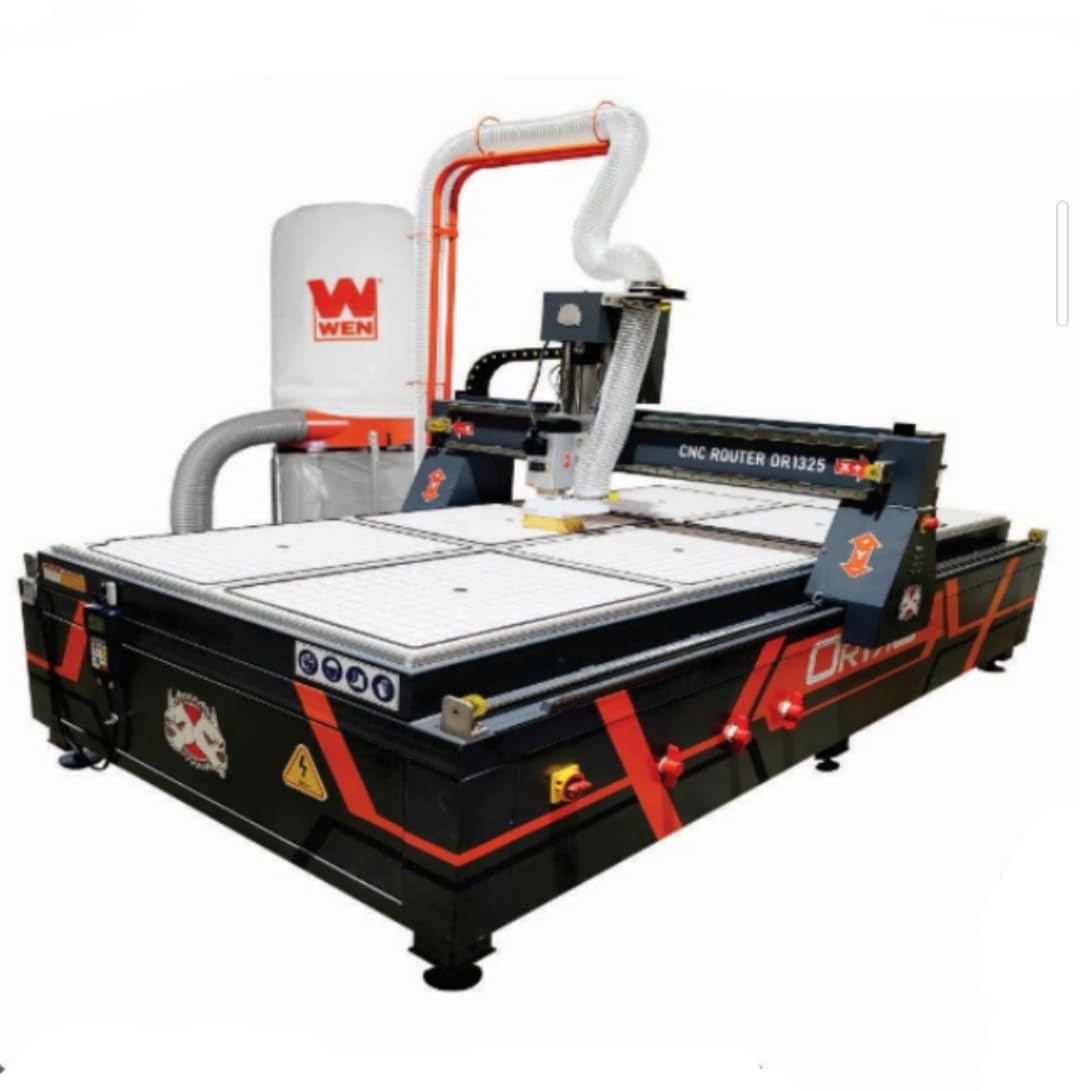
The 50-gallon vertical bag is the other half of the value proposition. Owners describe cleanup time dropping sharply compared with a shop vac, because you are emptying once per major session rather than several times. Several also report it running quieter than multiple shop vacs, which is not a given for a 14-amp machine.
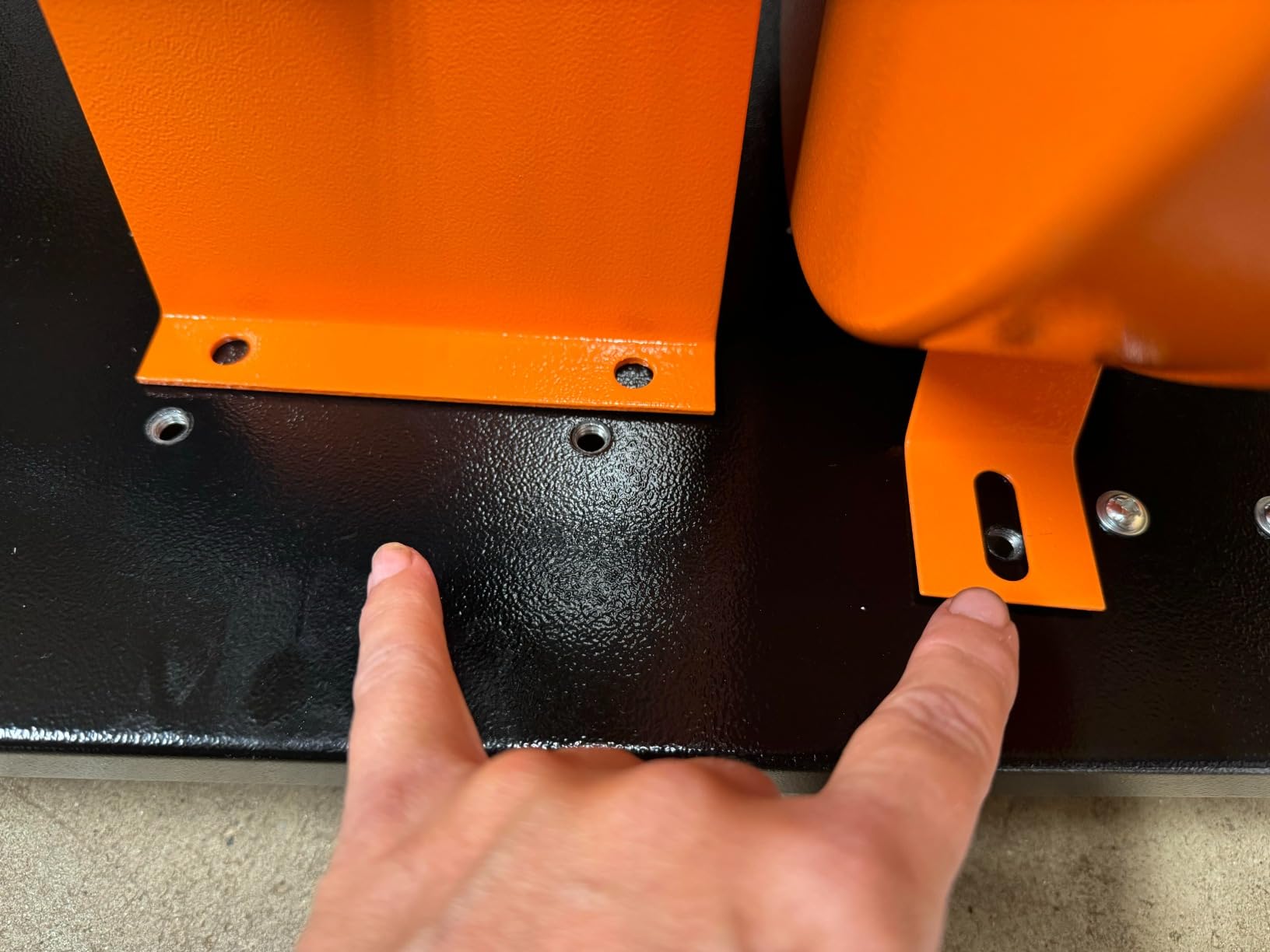
The complaints are all about build details rather than performance. The bag support height is not adjustable, which can conflict with ceiling ductwork or a low sloped garage ceiling, the vertical supports on the bag housing are reported as under-built, and the fabric bag loop can slip off the upper post. Some units arrive with missing fasteners because the hardware is metric.
Where it earns its place in a garage
A two-car garage with a joister, a planer and a table saw is where this unit makes sense. Below that, you are buying airflow capacity you will not use while giving up floor space you needed.
It is also the pick for anyone who measures cleanup time as much as air quality, since the bag capacity is unmatched here.
Where it falls short
Measure your ceiling and your bag swing clearance before ordering. The tall vertical layout is the main reason this does not fit every garage, and a non-adjustable bag support makes that a hard stop in a low or sloped space.
It is a 14-amp draw, so plan the circuit accordingly rather than sharing a cheap extension run.
5. POWERTEC DC5372 1 HP Collector – Best for 1-Micron Filtration
POWERTEC 1 HP, 560 CFM Portable Dust Collector with 1 Micron Dust Collector Bags, Dust Collectors for Woodworking Dust Collection System (DC5372)
560 CFM at 3450 RPM
Reusable 1-micron bag
1 HP induction motor
43.6 lb with casters
Pros
- Induction motor runs cooler and quieter
- Reusable 1-micron bag with a fill window
- Dual 120V and 240V operation
- Vortex base reduces turbulence
Cons
- Bag fabric attracts shavings and is hard to clean
- Needs a full 4-inch hose run to keep suction
- Wall hardware is weak under vibration
The POWERTEC is the most conventionally engineered collector in the group. A 1 HP induction motor, 3450 RPM, 560 CFM, heavy metal construction and a metal impeller rather than a plastic one. Induction motors are the quiet, efficient choice, and the difference from a brushed motor of similar output is noticeable.
It comes with a reusable 1-micron bag with a viewing window and a disposal zipper, which is the feature that separates it from every cloth-bag competitor here. One micron is fine enough to matter for MDF and hardwood work, and a reusable bag changes the running cost story completely compared with disposable filters.
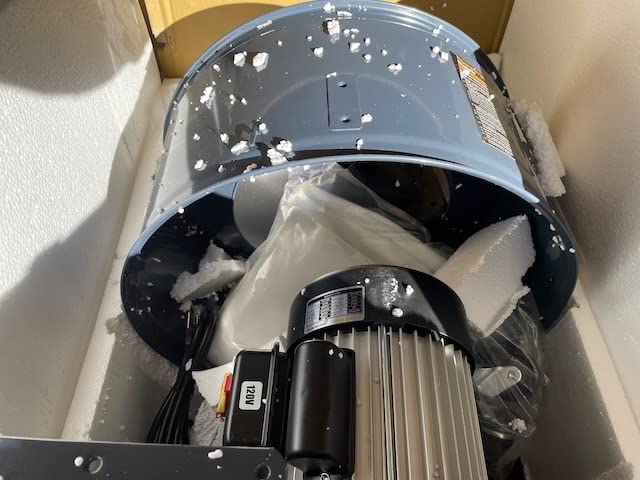
The vortex base design is worth understanding before you buy. It guides airflow into the bag in a controlled pattern rather than letting it tumble chaotically, and the manufacturer claims up to 10 percent improved efficiency against comparable models. In practice this is what keeps the bag filling evenly instead of building a dense layer in one spot.
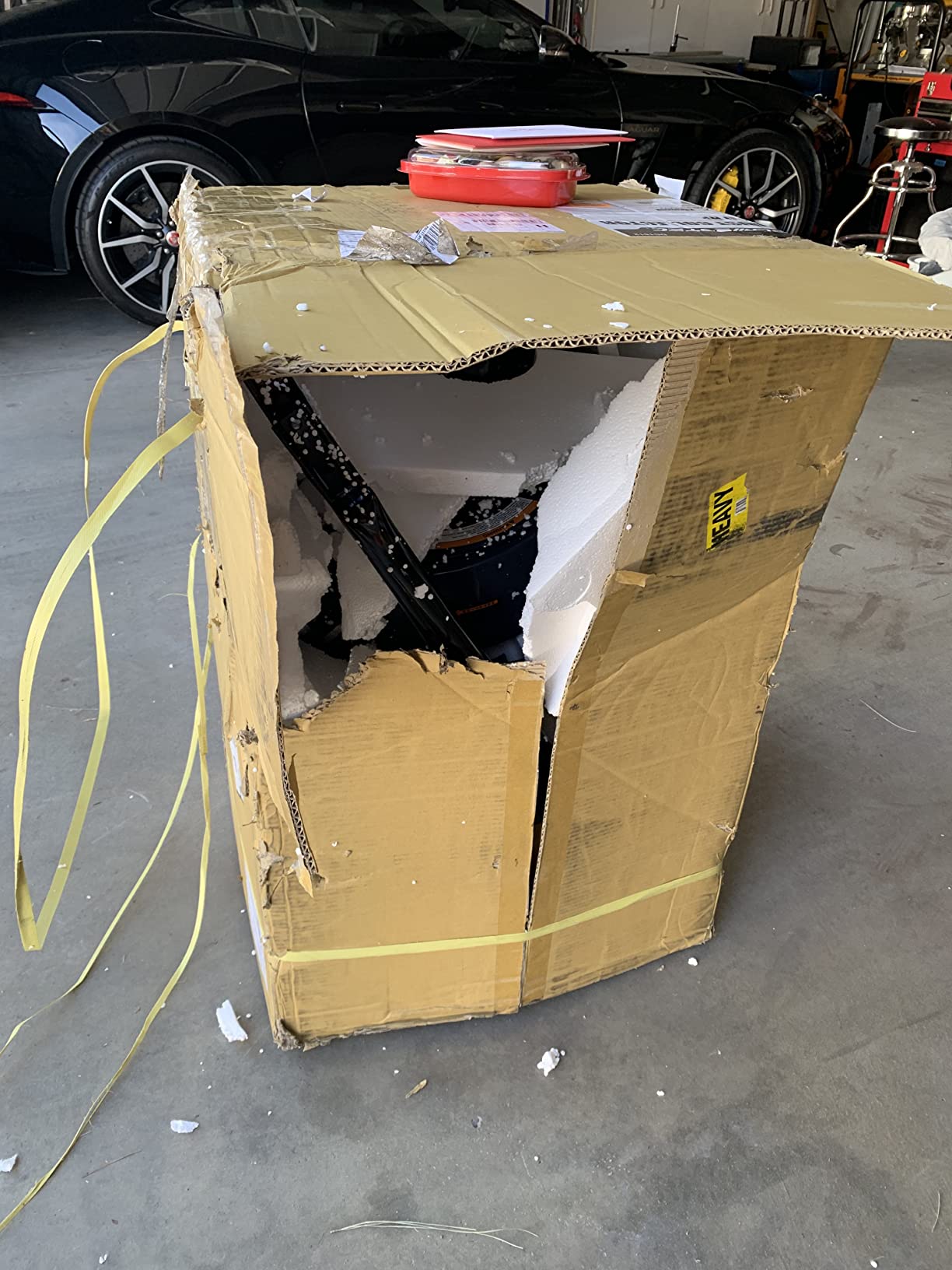
The maintenance advice from owners is consistent: remove the hose regularly and check the inlet grate, which exists to stop large debris reaching the impeller. The 4-inch port accepts hose directly, but stepping the diameter down too early loses suction fast, and the small port size limits which separators can be used inline.
Where it earns its place in a garage
This is the pick for fine dust from MDF, cabinet parts and hardwood, where a 5-micron bag is genuinely inadequate. The induction motor also makes it the best choice for a workshop where you run a machine for a few hours at a stretch.
At 43.6 pounds with casters, it is heavy but not immovable, and the mounting hardware allows wall installation to free the floor in a small shop.
Where it falls short
The 1-micron bag fabric actively attracts shavings and chips, and owners report it being difficult to clean. In practice that argues for adding a drum or bucket pre-separator so coarse debris never reaches the bag in the first place.
It is also more expensive than the budget collectors here, and that cost is only justified if fine filtration actually matters for the material you cut.
6. Bosch VAC090AH 9 Gallon HEPA Extractor – Best for Silica and Grinding Dust
Bosch VAC090AH 9 Gallon Dust Extractor with Auto Filter for Grinder 1773AK
150 CFM maximum
HEPA at 0.3 microns
60 dB noise level
28 lb canister on casters
Pros
- HEPA filter captures 99.97% of particles at 0.3 microns
- Automatic filter cleaning every 15 seconds
- Power tool activation and Power Broker dial
- Lowest noise figure in the roundup
Cons
- 150 CFM suits one tool at a time
- Limited 1-year warranty
- App-based control adds a learning curve
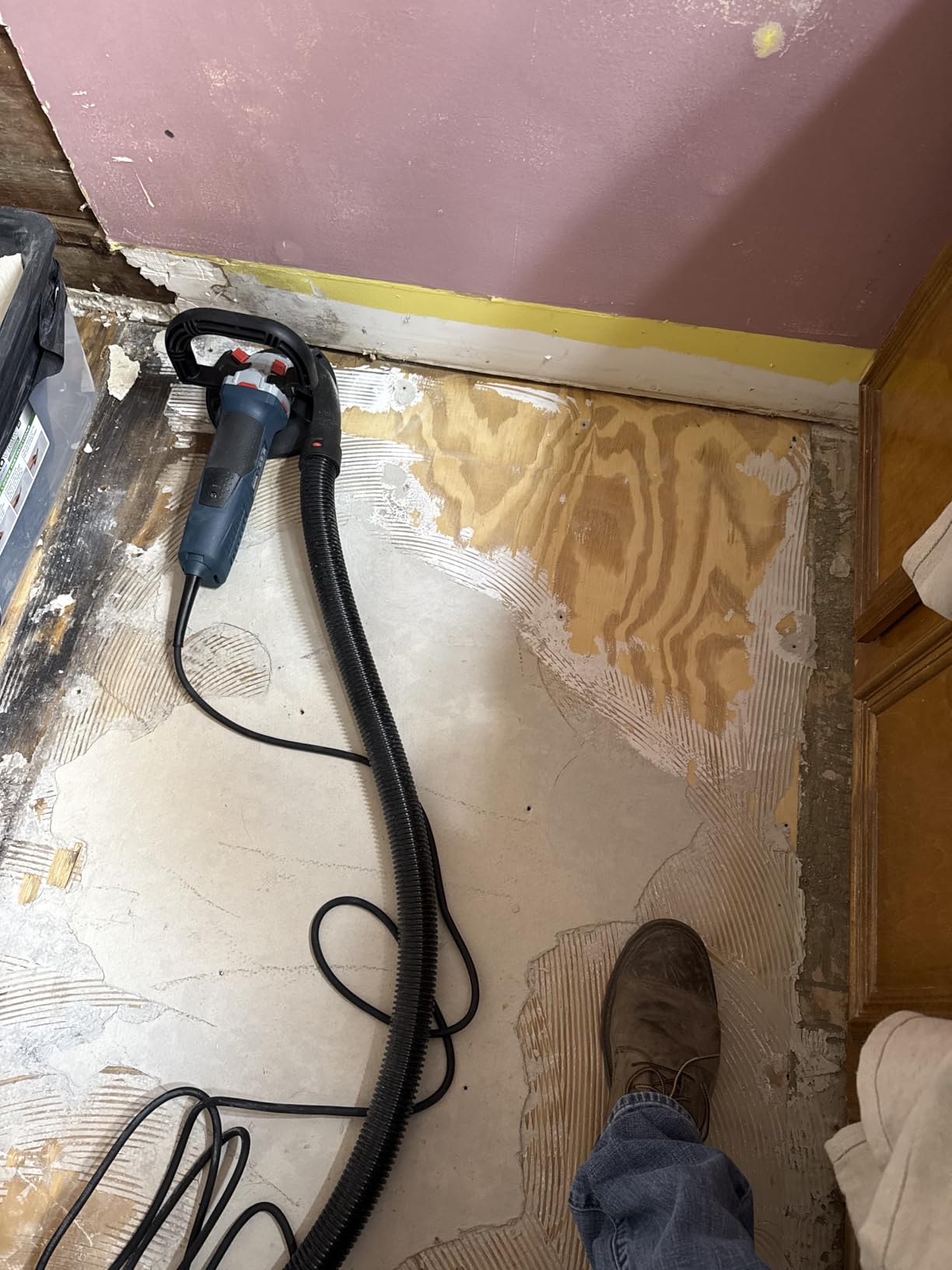
This is the only unit here built for grinding and cutting rather than woodworking, and that shows in the numbers. The HEPA filter captures 99.97 percent of particles at 0.3 microns or larger, and the Bosch PRO plus GUARD system is aimed at moving users toward OSHA silica compliance, which is exactly the hazard profile of a garage with a concrete floor and a grinder.
Automatic filter cleaning every 15 seconds is the feature that changes daily behaviour. A conventional extractor needs a manual filter clean every few minutes or the suction decays noticeably, and that is the reason shop vac performance seems to collapse mid-session. This one maintains its rated suction without you thinking about it.
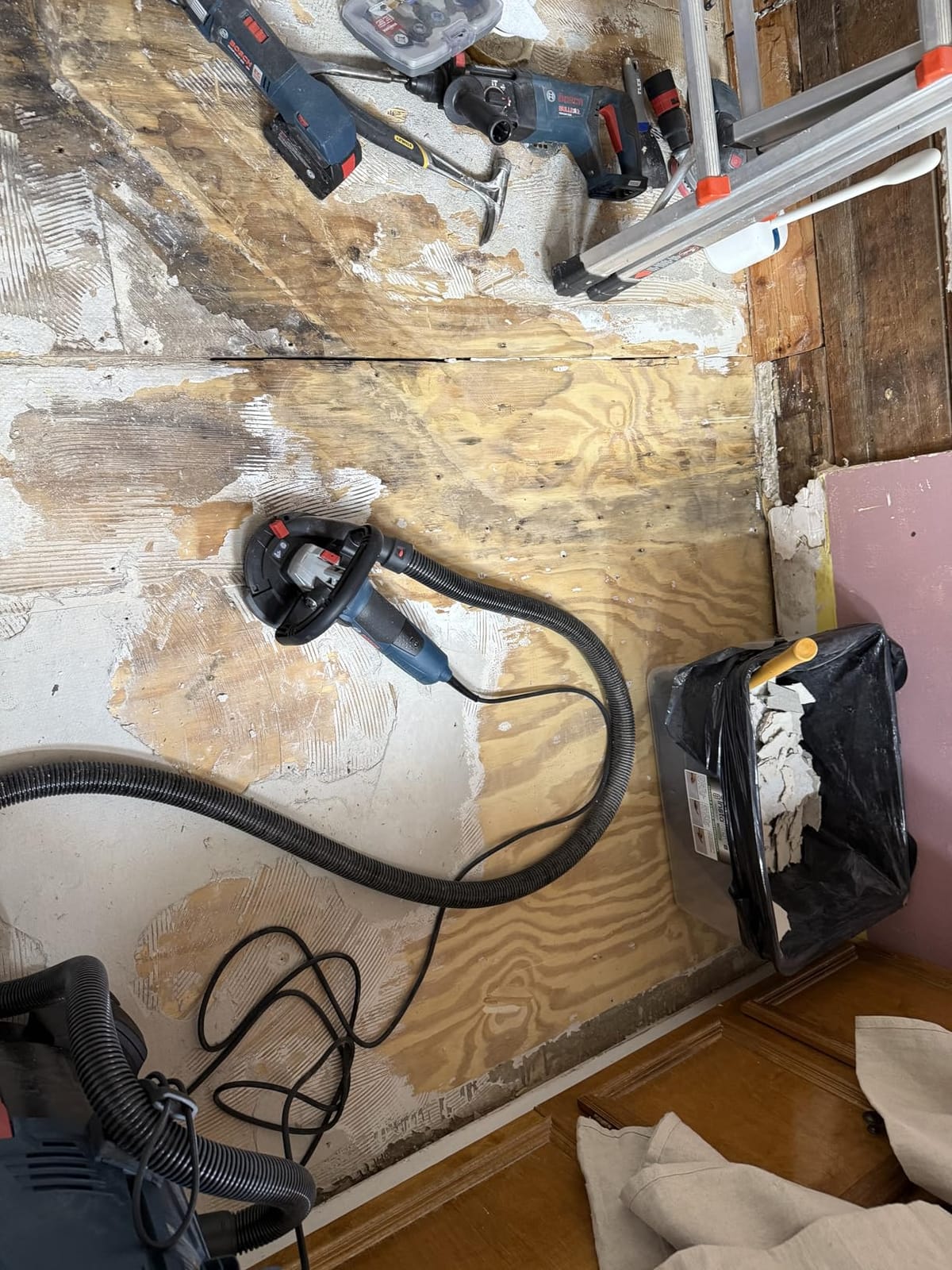
At 60 dB it is the quietest machine in this roundup by a wide margin, and the power tool activation means the extractor starts and stops with the tool switch. The Power Broker dial lets you match suction force to the application, which matters when you move between a grinder and a cutoff saw.
Its ceiling is 150 CFM with a maximum of 97 inches of static water lift. That is plenty for one handheld tool at a time and genuinely inadequate for a table saw. Weight is 28 pounds, dimensions are 20.5 by 14.5 by 22.6 inches, and the warranty is a limited one year, which is the shortest in this group.
Where it earns its place in a garage
Concrete work, tile, stone and drywall cutting is where this earns its cost. If your dust problem is respirable crystalline silica rather than wood dust, filtration grade matters more than airflow, and nothing else on this list filters to this level.
It is also the right answer for an attached garage where noise travels through a shared wall.
Where it falls short
It is the most expensive option here by a wide margin, and for pure woodwork that cost buys filtration you do not need. It is a grinder and cutoff saw companion, not a shop dust collector.
The app-based control is another friction point that owners mention, and the one-year warranty is thin for a machine aimed at professional daily use.
7. DEWALT 10 Gallon Stainless Steel Separator – Best for High-Volume Debris
Dust Separator with 10 Gal. Stainless Steel Tank
10-gallon stainless tank
70 dB operating level
16.3 lb on casters
Connects to 2-1/2 inch hose
Pros
- Stainless tank resists collapse under suction
- Capacity double a typical 5-gallon separator
- Clamping lid keeps the seal while moving
- Assembles in about ten minutes
Cons
- Requires an external shop vac
- Hose adapters are not included
- Taller and bulkier than a bucket design
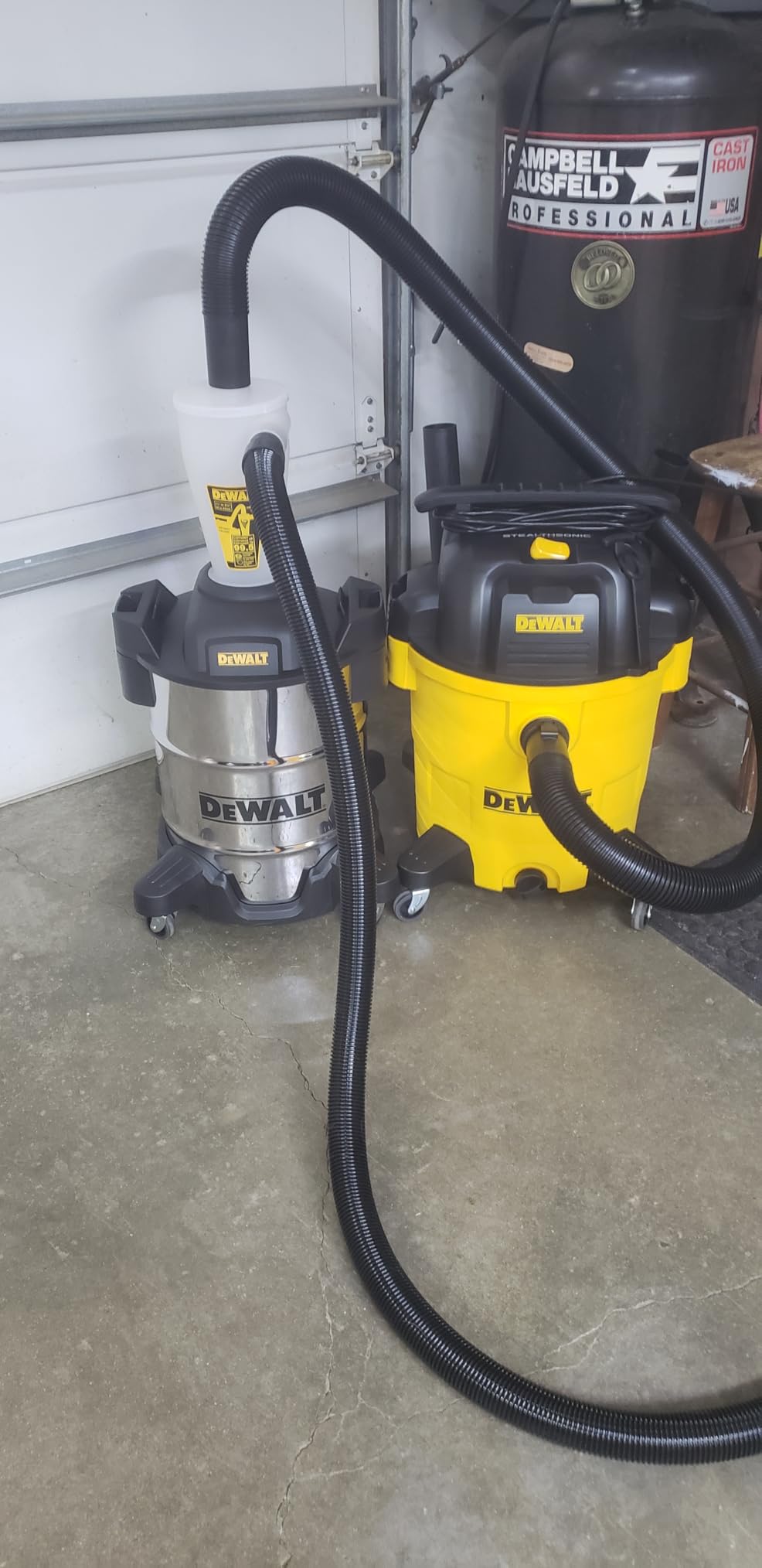
The DXVCS003 is the answer when the debris volume is the problem rather than the fineness of the dust. A 10-gallon stainless tank is double the usual bucket size, and the steel body is the part that matters: plastic buckets flex inward under sustained suction and eventually fail their seal, which is the single most common complaint we saw across every bucket-style separator.
Owners report that virtually all the dust lands in the canister, leaving the shop vac interior and its filter clean. That translates directly into longer filter life and fewer bag changes, and the casters plus the securing lid clamp are what let you move a full canister without a spill.
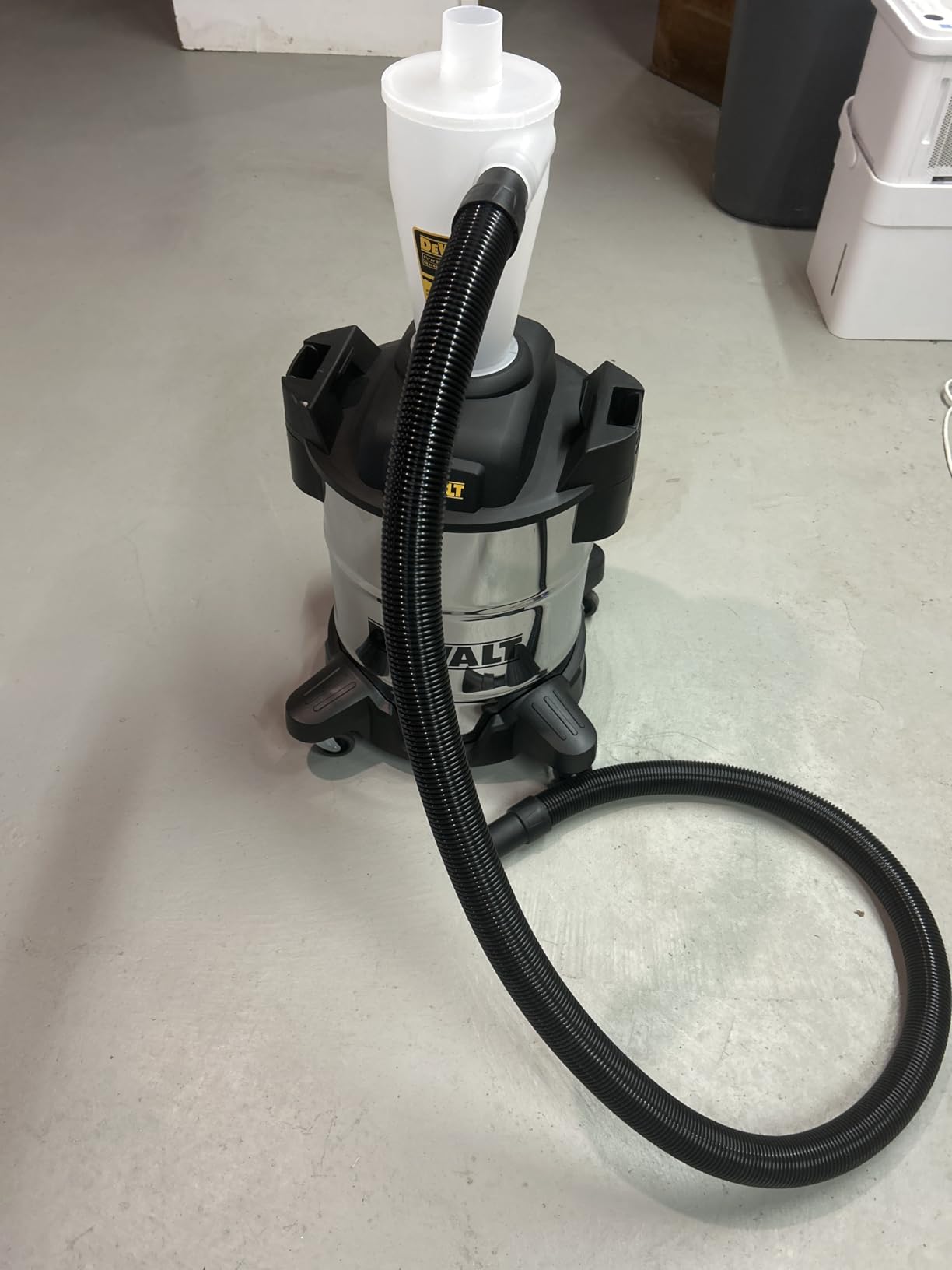
Assembly takes about ten minutes with six screws and four caster screws, which matters if you are setting this up on a weekend. The 2.1 metre hose connects to standard 2-1/2 inch shop vac hoses without adapters, and it also accepts 1-1/4 inch Cen-Tec hose for handheld tools.
At 70 dB the canister itself contributes noise to the system, and it is taller and bulkier than a bucket design at 18 by 17 by 34.6 inches, so you need real floor area for the swing of the lid. Hose adapters are not included, so budget for those if your tools do not already use the common diameter.
Where it earns its place in a garage
It suits a shop that generates a lot of chips rather than a lot of powder. Someone routing, planing or jointing hard wood will empty a 5-gallon bucket several times an hour, and a 10-gallon stainless canister halves that.
The stainless construction also makes it the separator to buy if you plan to run a wet pickup through the same vacuum, since it tolerates the abuse.
Where it falls short
It is not a standalone system. Without a shop vac it does nothing, and the footprint is the largest of any separator here, which is awkward in a one-car garage.
It also filters nothing. Fine airborne dust passes straight through the canister to the vacuum, so it pairs well with one of the room filtration options rather than replacing them.
8. Mullet High-Speed Cyclone Separator – Best for Vacuum-Paired Capture
Mullet Cyclone Dust Collector, High-Speed Separator for Shop Vac
Over 99% debris pre-separation
Parabolic one-piece body
7.5 lb unit
Included hose adapters
Pros
- Highest average rating in the roundup
- Parabolic body spins the airstream faster
- One-piece construction with no leak points
- Rigid PVC connection replaces improvised fittings
Cons
- PVC must be cut to fit your hose diameter
- Performance depends entirely on the paired vacuum
- Attachment only with no permanent install
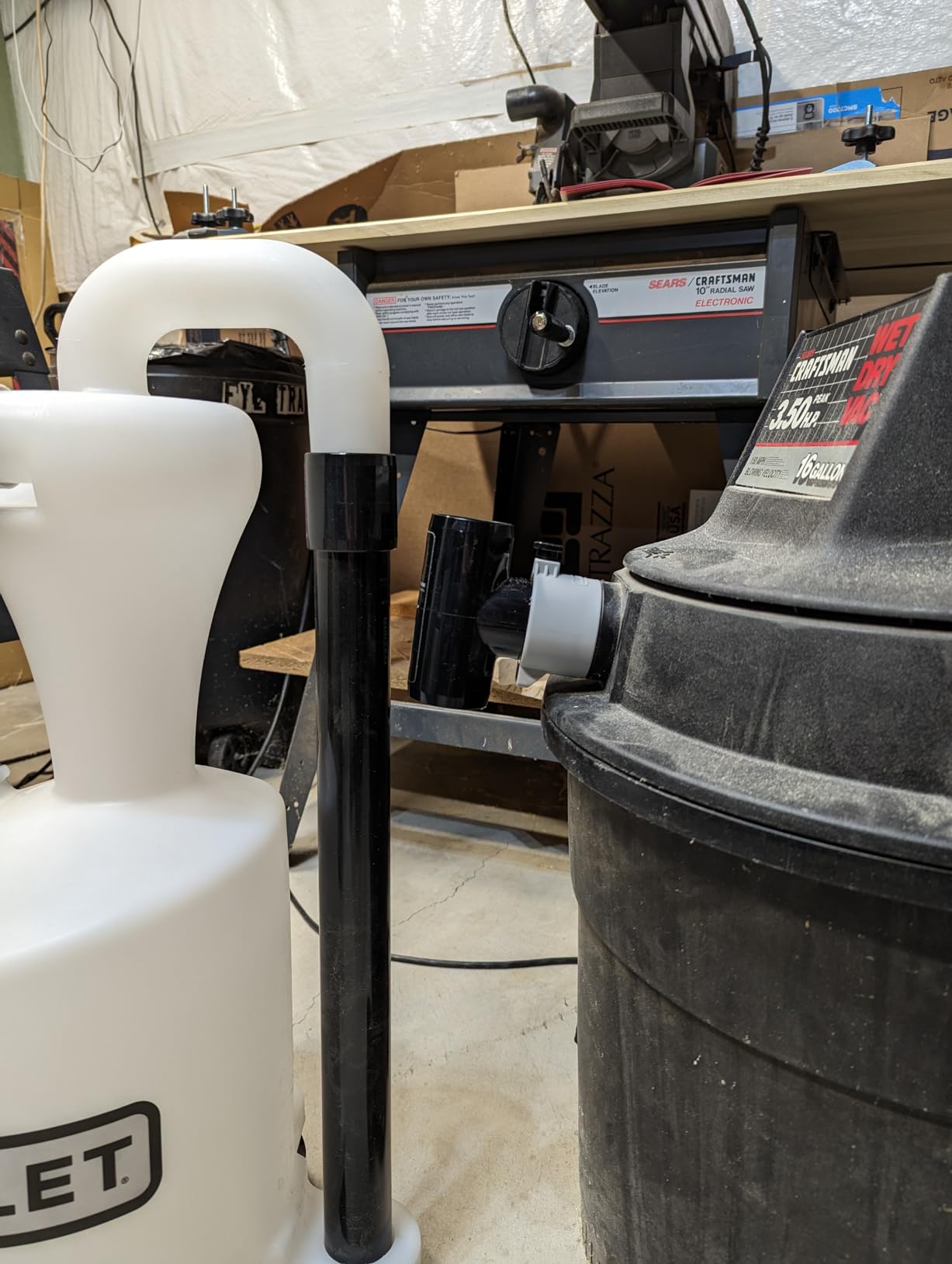
The Mullet is the highest rated product in this roundup, and the reason is a design difference you can feel. The parabolic body and seamless one-piece construction create a faster airstream inside the cone, and faster spin means more dust falls out before it exits. The company states it pre-separates over 99 percent of debris.
Compared with a straight-wall cyclone-and-bucket assembly, the practical difference is a seal you do not have to think about. There are no bolts, bungee cords or duct tape holding the system together, and the rigid cut-to-fit PVC connection forms one continuous airtight path from the separator to the hose.
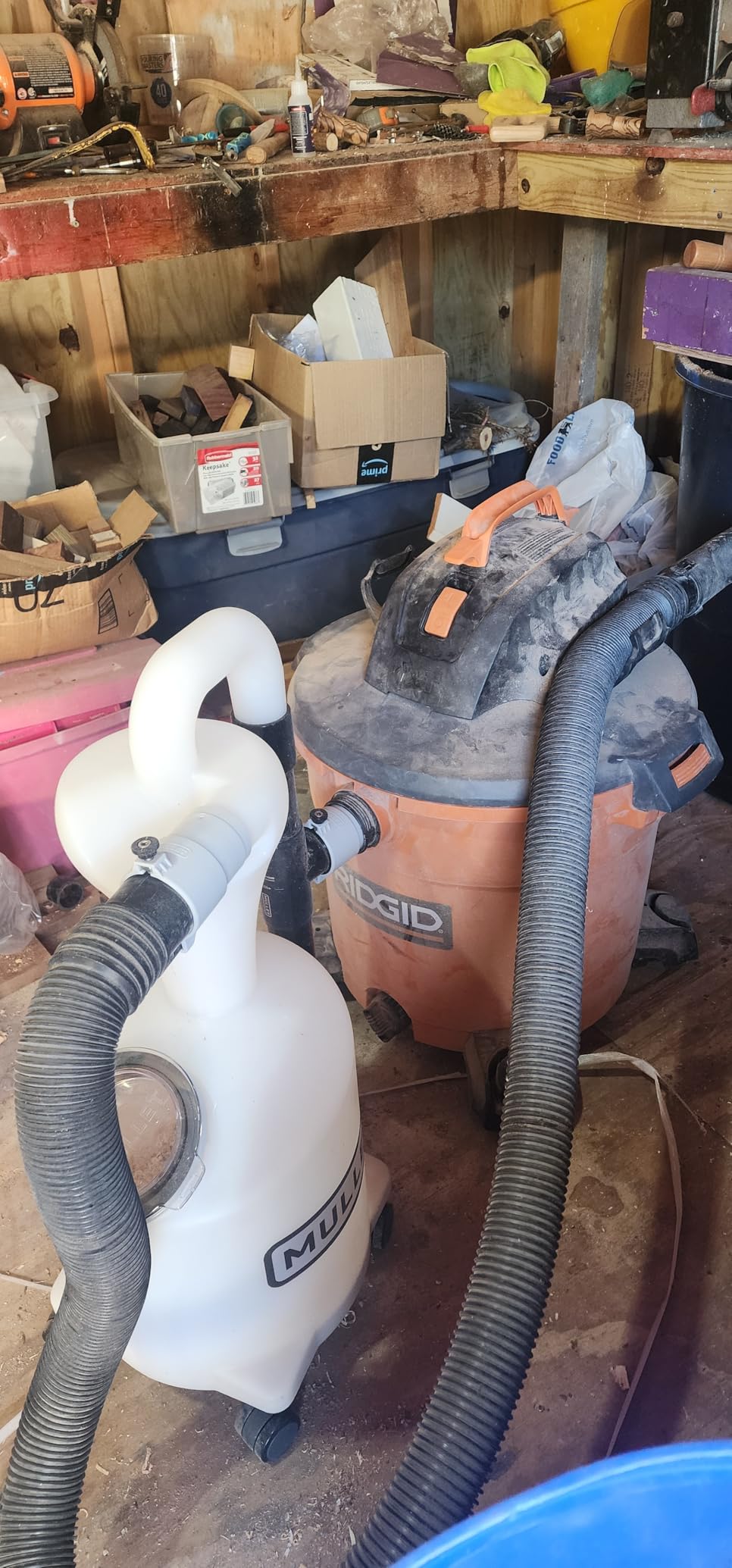
Setup is straightforward if you accept one step: trim the PVC to match your hose diameter. The included hose adapters cover most wet and dry shop vacs and dust extractors, so compatibility is rarely the issue. At 7.5 pounds, it is also the easiest unit here to move between a table saw, a bandsaw and a sanding station.
Everything depends on the vacuum behind it, and the manufacturer rates the system at 72 dB when running. A strong vac produces a genuinely fast spin; a weak one produces a lazy one. This is the same limitation every separator shares, but here it matters most because the whole value proposition is the spin rate.
Where it earns its place in a garage
It is the pick when you already have a capable vacuum and want the best separation you can get without plumbing a fixed system. Owners report markedly less filter clogging than with bucket assemblies, which is the metric that pays for it.
It is also the safest of the separator options around metal work, since the fixed rigid connection has nothing to rattle loose.
Where it falls short
It is an attachment, not an installed system. If you want a fixed, permanently plumbed arrangement, this is the wrong shape of product and you should be looking at rigid ducting instead.
It is also the highest cost among the separators here, and owners who wanted more included hardware for a full install note that. The premium is justified by the body geometry, not by the accessories.
9. Oneida Dust Deputy Low-Pro Plus – Best for a First-Time Build
Dust Deputy Low-Pro Plus Cyclone Dust Separator – Engineered High Flow Wet/Dry Vacuum Kit – Fits Standard 5 Gallon Buckets – 2.5″ Adapter & 3′ Hose – Made in USA
Low-profile lid separator
Captures over 99.9% of dust
2.25 inch ports for 2-1/2 inch hose
Complete install kit
Pros
- Lowest cost among the separators here
- Low profile is stable and less prone to tipping
- Moves more airflow than standard lid separators
- Kit includes latches gasket hose and elbow
Cons
- Separate bucket purchase required
- Included 3 foot hose is short
- Performance tied to the vacuum and bucket
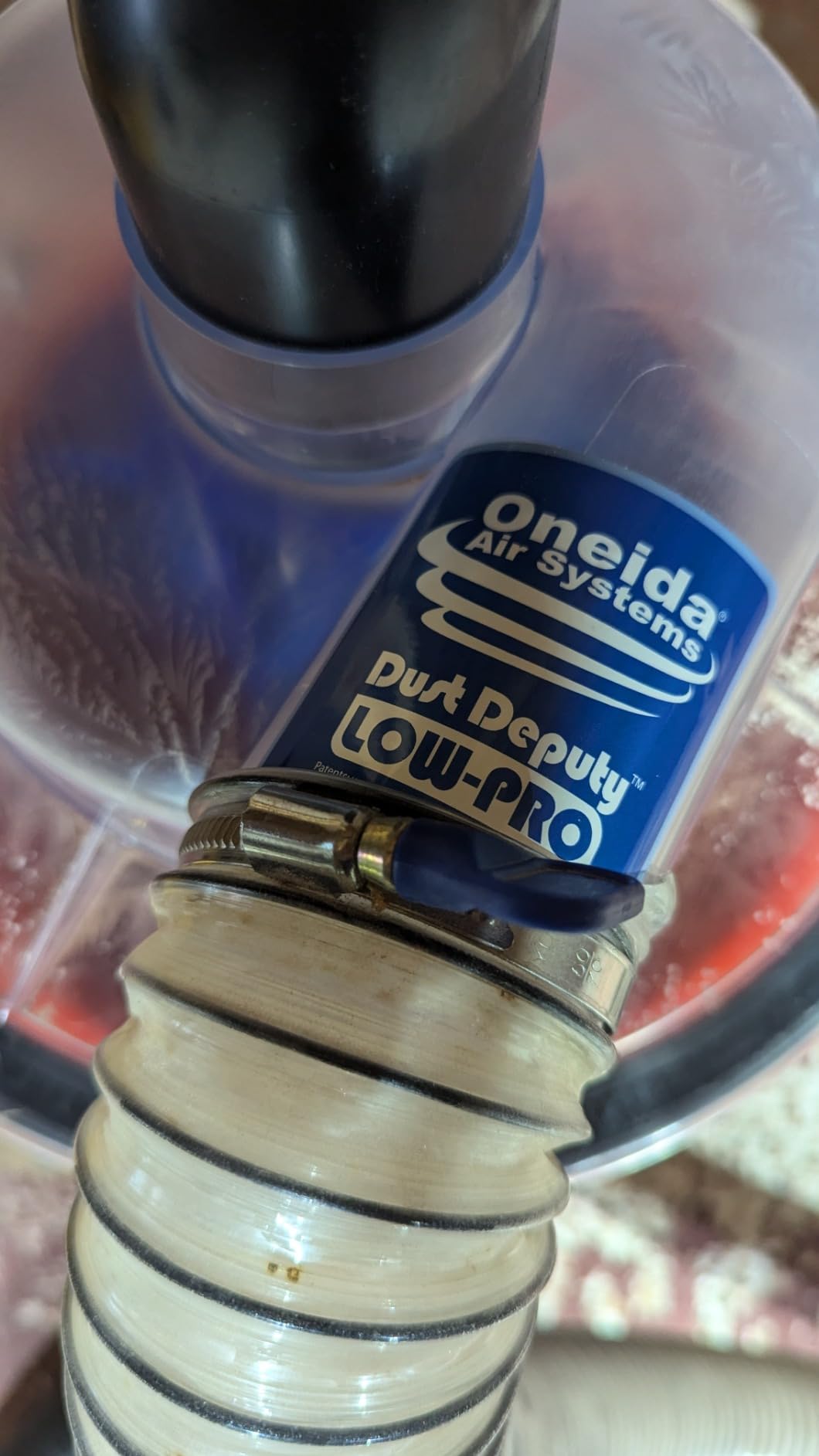
The Dust Deputy is the DIY entry point. It is a lid-style separator that clamps onto a standard 5-gallon pail, and the low profile is the whole design argument. A short, wide lid separator resists tipping over when air is moving through it better than a tall cone sitting in the same bucket, and in a garage where the bucket sits in traffic that is a real advantage.
The kit is genuinely complete for the install: lid separator, locking bucket latches, a neoprene foam lid gasket, a 3 foot flexible hose with swivel cuffs and a 2.5 inch elbow adapter. The 2.25 inch internal diameter ports fit standard 2-1/2 inch hoses and most wet and dry vacs.
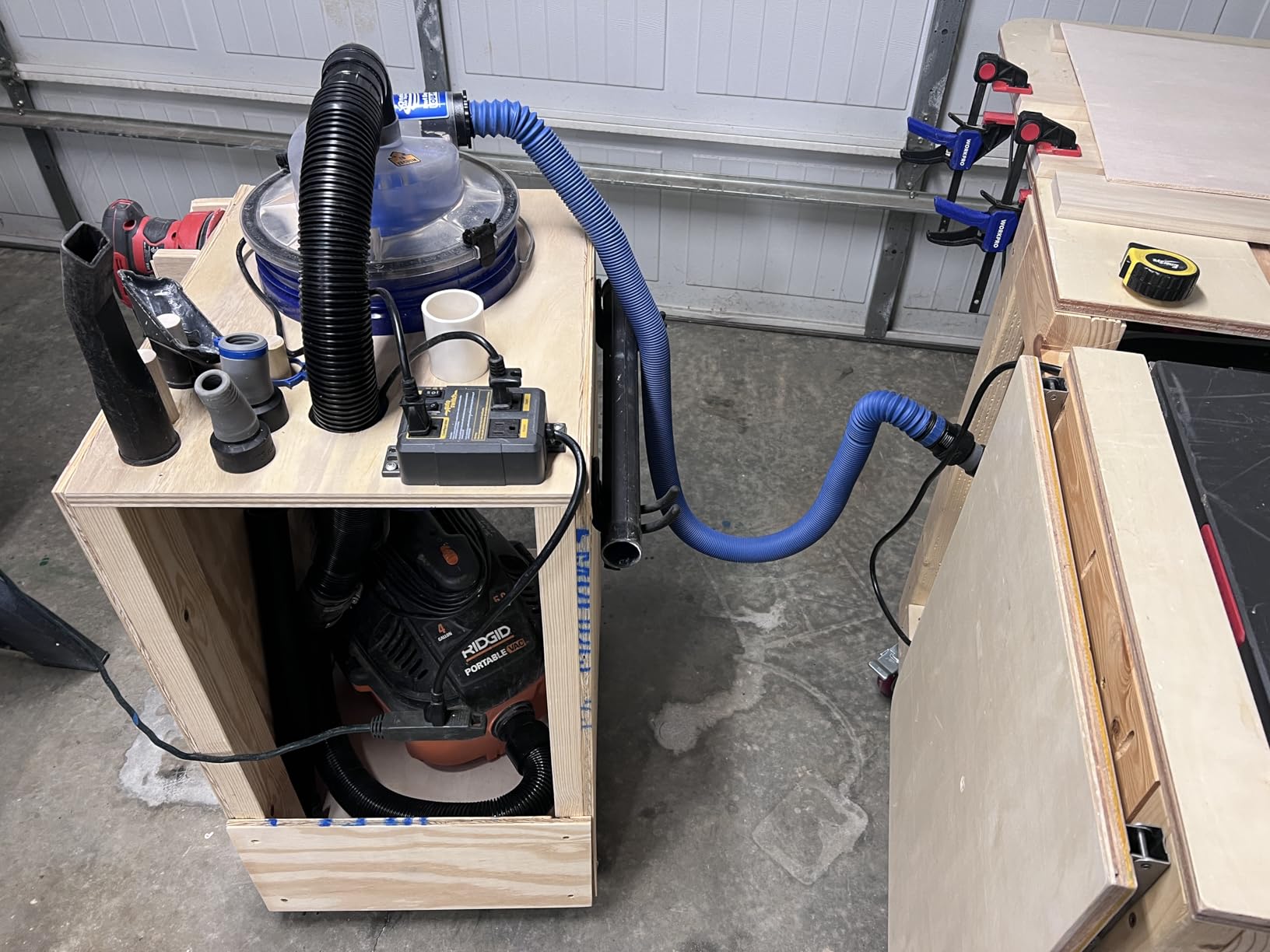
It claims to capture over 99.9 percent of dust before it reaches the filter and delivers more airflow than standard lid-style separators, which is the metric that separates it from a plain bucket lid. In our runs it behaved like a genuine upgrade, though not a dramatic one over the pricier separators.
Two practical notes. The bucket is not included, and you should buy a heavier duty pail than the cheapest available, because a thin bucket under suction loses its seal. The included 3 foot hose is also short for most shop layouts, so plan on a longer hose run. Our broader look at bagged vacuums for dust control covers the vac side of the pairing.
Where it earns its place in a garage
It is the cheapest genuine improvement available to anyone with a wet and dry vac, and the included adapter kit removes the most common excuse for not building one. For a first-time setup it is the lowest risk choice.
The low profile also means it fits under a bench, which tall cone separators do not.
Where it falls short
It has the lowest rating among the separators in this group, and the gap reflects real limits. Separation quality is a step below the premium options, and everything still depends on the vacuum and on a bucket that does not collapse.
For a shop that generates a serious volume of fine dust, the step up to the Dustopper PRO or the Mullet is worth making.
10. BUCKTOOL 750 CFM Auto-Start Collector – Best for Auto-Start Control
BUCKTOOL 750 CFM Auto-Start Dust Collector,1.2HP 13-Gallon Capacity
750 CFM headline figure
1.2 HP 120V motor at 3450 RPM
13-gallon capacity
56 lb on casters
Pros
- Auto-start outlet runs the collector from a tool switch
- Soft PET bag clamp avoids hand cuts
- Three collection bags including a 2-micron upper bag
- Includes hose and a five-piece reducer set
Cons
- Real-world airflow falls well below the 750 figure
- Tall 65-inch profile consumes vertical space
- Bundled 5 foot hose is short
The distinguishing feature here is the auto-start outlet. You plug your power tool into the collector and the machine turns on with the tool, up to a 7 amp load, which removes the one step in dust collection that owners most often forget. The collector keeps running for a short interval after the tool stops.
The accessory bundle is generous for the tier. You get five reducers, a 5 foot 4 inch flexible hose, a plastic lower bag, a cloth lower bag, a 2-micron cloth upper bag and a PET clamp. Having both a lower and an upper collection bag is unusual and lets you change capacity without unpacking.
Now the part that keeps this at the bottom. The 750 CFM headline number comes from a 1.2 HP motor drawing 6.5 amps at full load, and owners consistently report that sustained airflow sits well below that figure once a hose run and a loaded bag are involved. Spec-sheet skepticism is a legitimate reaction here, and it is why this unit carries the lowest average rating in the group.
The 65-inch height is the other practical issue. At 29.53 by 20.19 by 65.01 inches, the machine is tall, heavy at 56 pounds, and the bag needs vertical swing room that a sloped garage ceiling may not allow. The base is 16.5 by 26.375 inches with casters, so it can be mobile or stationary, but it is not a compact shop unit.
Where it earns its place in a garage
The auto-start feature is the reason to consider it at all. If you routinely forget to switch the vacuum on, a tool-triggered collector removes a whole category of frustration, and the 2-micron upper bag is a finer rating than most bag collectors at this level offer.
The soft PET bag clamp is a small, thoughtful design choice that prevents the cut fingers that are common with metal bag clamps.
Where it falls short
It is the weakest fit in this roundup. A 1.2 HP motor at 3450 RPM is not enough hardware to support a 750 CFM claim through a real hose run, and the included 5 foot hose is too short to lay out a normal shop.
If you need this tier of airflow, the 1 HP POWERTEC is a more honest machine, and if you need two tools running, the WEN DC1300 is the right call.
How to Choose a Portable Dust Collector for Your Garage Shop
Match CFM to the tool you actually run
CFM is the number that decides whether dust collection works, and the useful question is never how large the number is but whether it covers your worst tool. Here is the sizing guide we use, based on typical port sizes and the airflow a machine needs to keep up with its own production.
A random orbit sander needs roughly 400 CFM. A table saw with a 4-inch port wants 600 CFM or more. A jointer and a thickness planer each push 800 CFM, and they are the reason collectors exist. Running two tools at once puts you at 1,000 CFM and above, which is exactly where the dual-inlet machines begin.
Match the collector to the biggest tool you own, not the one you use most. A collector that handles a planer will always handle a sander comfortably, and the reverse is not true.
What the micron rating really means
Micron ratings describe particle size, and 1 micron is roughly one hundredth the width of a human hair. A 5-micron bag catches chips and coarse sawdust, which is fine for a table saw and marginal for a planer or an MDF edge. A 1-micron bag or a HEPA filter is what you want for fine hardwood dust, drywall and anything you inhale.
The trade-off is maintenance and airflow. Finer filters restrict air more, which means the unit works harder and the filter needs cleaning or changing on a schedule. This is the core tension in dust collection and the reason disposable 5-micron bags still dominate garage shops.
Cyclone separator, dedicated collector, or air purifier
These are three different products and buyers routinely confuse them. A dedicated collector has its own motor, filter and bag, and it is the complete answer. A cyclone separator has no motor at all. It sits between your tool and a shop vac, spins the heavy debris into a bucket so the vacuum filter stays clean, and effectively upgrades a machine you already own.
An air purifier or hanging filter does a third job entirely. It cleans the dust already floating in the room rather than capturing dust at the tool, and it is a complement to source capture rather than a replacement for it. Filtering ambient air in a garage that has no source capture is treating the symptom.
Our honest ranking of value: if you own a decent wet and dry vac, a separator beats every powered collector on this list for the money. If you do not own one and want one tool connected cleanly, start with a mid-range collector.
Capacity, bag changes and running cost
Bag capacity determines how often you interrupt work, and it is the most under-appreciated spec. A 12-gallon bag in a hobby shop might mean weekly changes. A 50-gallon bag in the same shop might mean monthly. Nobody enjoys stopping mid-project to empty a bag, and the larger bags genuinely reduce the friction that makes people give up on collection.
Running cost matters more over a few years than the purchase. A disposable 5-micron bag is cheap per unit and consumed constantly. A reusable 1-micron bag costs several times more up front and then only costs you cleaning time. A shop that runs MDF or finishes benefits from the reusable option more than one that handles chips.
Mobility, mounting and garage-door clearance
Before you order anything, walk the space with a tape measure. You need the width for the machine, the depth for the base, the height for the bag, and above all the swing clearance for the bag or lid when you empty it. A collector that fits but cannot be emptied is a collector you will stop using.
Then check the bag height against your ceiling. A standard garage door opening is around seven feet, and a tall vertical bag collector can conflict with ceiling joists or a wall-mounted door track. Wall-mounted units solve the floor space problem in a one-car garage; rolling units solve the flexibility problem. Owners who mounted the small collector off the floor generally reported the biggest satisfaction increase, because the floor is at a premium in any garage that still holds a car.
Noise in an attached garage
Noise is a design outcome more than a marketing number. The Bosch extractor is rated at 60 dB and the Mullet arrangement at 72 dB, which is the range that separates a shared-wall friendly setup from a complaint. Induction motors like the one in the POWERTEC run cooler and quieter than brushed motors of the same output, which is a meaningful difference in a space measuring 10 feet from a bedroom wall.
Rubber feet, isolation between the hose and the machine, and keeping the collector out of the room rather than under the bench all reduce what carries through the structure. If your garage is attached and you run a planer, expect to plan the hours, not just the purchase.
120V versus 240V circuits
The 14-amp machines and anything claiming 1 HP or more deserve a dedicated circuit rather than a shared one with a shop vac and a saw. The POWERTEC is the flexible option, running at 120V or 240V so you can move it to a dedicated 240V line later without replacing the machine.
A 1.2 HP machine on 120V pulling 6.5 amps at full load is within reach of a normal 15-amp circuit, but the headroom matters when the bag is filling and airflow demand rises. When in doubt, dedicate the circuit.
How to duct a portable collector to one or two tools
Keep it simple: one length of 4-inch hose, as short as the layout allows, and one blast gate at the tool end. Every extra elbow and every extra foot of flex hose costs airflow, and this is the difference between a collector that keeps up with a planer and one that does not.
For two tools, you need a dual-inlet collector. Without one, the usual workaround is a Y or a splitter, which splits the air rather than adding it, and both tools get less suction than either would alone. If you genuinely run two machines at once, buy the dual inlet rather than building a splitter.
Add a blast gate so you can isolate one machine while the other stays connected, and seal joints properly. A loose flex hose connection leaks the exact fines you paid to capture.
Dust safety and respiratory protection
Collection improves air quality, but it does not remove the hazard entirely, and none of these products should be treated as a replacement for a respirator. Wear one when you empty a collection bag or canister, because the cloud of dust that lifts off an open bag is the highest-exposure moment in the whole process. Opening a bag of fine MDF dust without a mask is the single most common way people get hurt using equipment correctly.
Keep filters and bags sealed and dry in storage, and never leave combustible dust accumulating on fan housings or motor surfaces. Wood dust in a confined space with an ignition source is a genuine fire risk, and a dusty motor housing is a documented cause of shop fires. Vacuum the machine and the area around it regularly rather than letting fines build.
And if you cut MDF regularly, treat that dust as a respiratory hazard on its own terms. It is finer and more irritating than hardwood dust, and it warrants the same source capture plus respiratory protection approach.
How to keep dust down in a shop
Six habits do more than any single purchase. Capture at the source with the port fitted tightly to the tool. Keep hose runs short and sealed. Empty the collection container before it is full rather than to the brim. Clean the vacuum filter on a schedule you actually keep. Sweep and vacuum the floor rather than dry sweeping dust into the air. And run a room filter or purifier for the fines that are already airborne, which no source capture removes entirely.
Which pick suits which garage
One-car garage with one table saw: the WEN DC3401, or a separator pair if you already own a wet and dry vac. The WEN DC1300 is too tall and too much air for the space, whatever its specifications say. Two-car garage with a planer and a jointer: the WEN DC1300 for the dual inlets and the 50-gallon bag, or the POWERTEC if the material is fine dust and filtration matters more than air volume. Basement workshop: whichever option is quietest in your test, and the Bosch extractor or the POWERTEC induction motor are the two worth considering. Mobile contractor work: a rolling collector with casters, since you will be carrying it up stairs, and the separators are the lightest of everything here.
A room that holds two cars and also holds a business is the hardest case. The floor space you need for a 50-gallon bag is floor space you do not have, and the honest answer in that situation is a wall-mounted unit plus a separator, not a larger collector.
Frequently Asked Questions
What is the best dust extractor for a small workshop?
For a small workshop running one tool at a time, the Dustopper PRO separator is the best starting point if you already own a wet and dry vacuum, and the WEN DC3401 is the best choice if you do not. Aim for at least 400 CFM for a sander and 600 CFM for a table saw. A separator keeps your vacuum filter clean for a fraction of the cost of a new collector.
Does a dust collector work better than a shop vac?
A dedicated collector produces more airflow and captures chips at the source, so it wins on raw performance. A shop vacuum paired with a cyclone separator is often the better value in a garage shop, because it keeps the vacuum filter and bag usable for far longer than the vacuum alone. The separator approach makes the most sense if you already own a capable wet and dry vacuum.
How many CFM do I need for a garage shop?
Roughly 400 CFM for a random orbit sander, 600 CFM for a table saw, 800 CFM for a jointer or thickness planer, and 1,000 CFM or more to run two tools at once. Match the collector to your largest machine rather than your most-used one. Sustained airflow matters more than the headline number, since air restriction grows as the bag fills.
Is a cyclone separator worth it?
In most garage shops, yes. A separator spins chips and dust out before they reach the vacuum filter, which is the reason shop vacs lose suction partway through a session. Owners report filters staying visibly clean for hours with a separator in place versus being cleaned every twenty minutes without one. The one requirement is a reasonably powerful vacuum.
Can I use a dust collector in an attached garage?
Yes, but noise is the constraint rather than dust. The Bosch extractor is rated at 60 dB, the lowest figure in this roundup, and an induction motor collector such as the POWERTEC runs quieter than a brushed motor of similar output. Expect a planer or jointer to carry through a shared wall regardless of the collector you choose, so placement and timing still matter.
What micron filter do I need for MDF dust?
MDF dust is fine and irritating, so use a 1-micron bag or a HEPA filter rather than a standard 5-micron cloth bag. The POWERTEC DC5372 ships with a reusable 1-micron bag, and the Bosch VAC090AH captures 99.97 percent of particles at 0.3 microns or larger. Wear a respirator when emptying any collection container, since the bag opening is the highest dust exposure moment.
Bottom Line
The best portable dust collectors for garage shops are not the biggest ones on the market, they are the ones matched to your worst tool and your smallest wall. If you already own a capable wet and dry vacuum, the Dustopper PRO is the pick: it carries the highest rating and the largest review count in this group, its separation efficiency was verified by an outside lab, and it converts a machine you have into something that behaves like a dust collector. Add the DEWALT 6-gallon separator if you want that job done in a package that arrives complete and rolls around on casters.
If you want your own motor, the WEN DC3401 covers a single sander or table saw without taking much floor space, and the WEN DC1300 is the right unit once a planer or jointer is in the picture or you need two tools running at once. For fine MDF and hardwood dust, the POWERTEC with its reusable 1-micron bag is the sensible step up, and for concrete or grinding work where silica is the hazard, the Bosch extractor filters to a level nothing else here reaches. Measure your ceiling and your bag swing clearance before any of them arrives, because that is where garage purchases fail.