
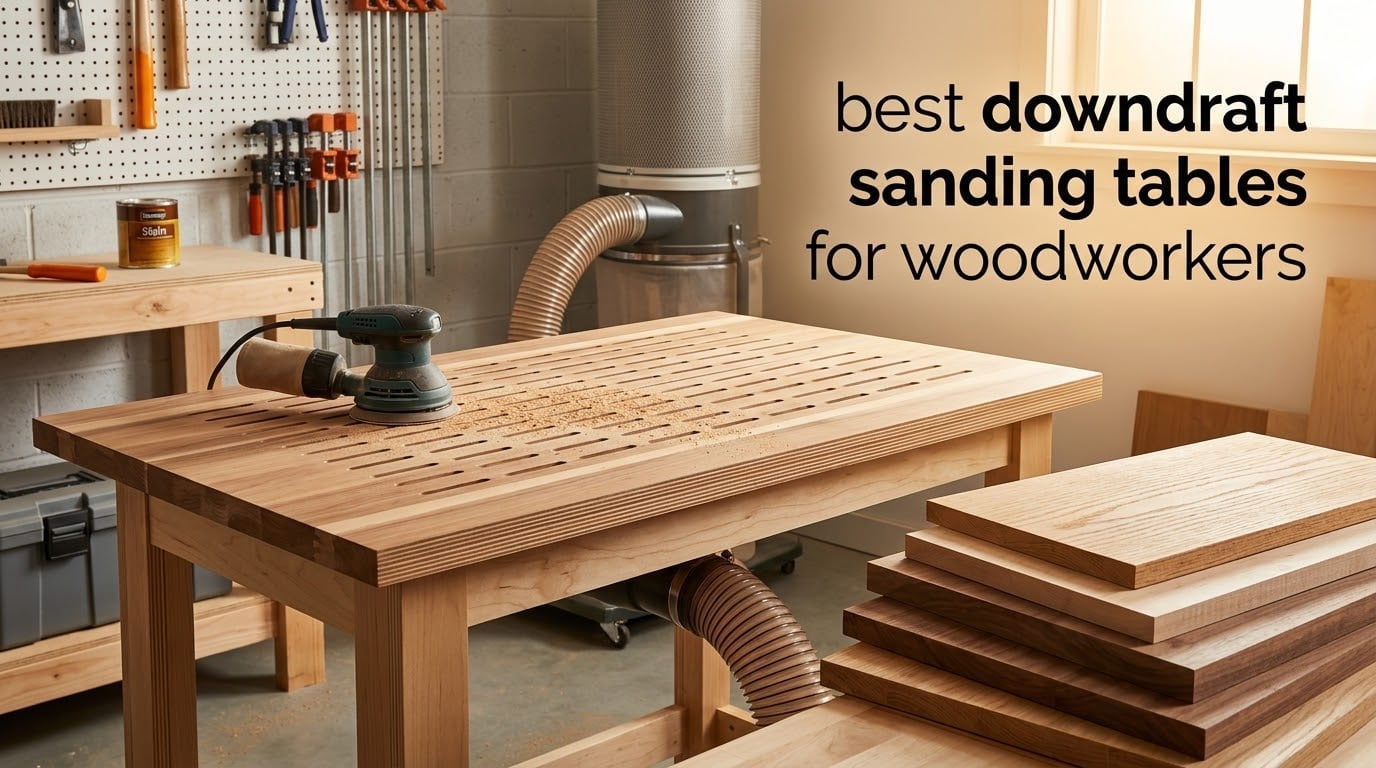
Most of what comes up when you search for a downdraft table is built for metal. Sparks, grinding swarf, welding fume, wet systems with spark arrestors. That is not your problem if you are finishing walnut panels or face frames, because your dust is lighter, bulkier, and behaves completely differently from metal particulate. This roundup covers the six real downdraft sanding tables for woodworkers that we could find and actually stand behind, from a 16.5 by 20 inch benchtop station to a 48 by 96 inch cabinet-shop unit.
A downdraft sanding table is a workbench with a slotted or perforated top that pulls airborne dust straight down through the surface into a dust collector or a built-in blower, so fine wood dust is captured at the source instead of settling on your finished surfaces, your tools, and in your lungs. The work happens directly over the slots, dust drops through before it can rise, and the filtered air exhausts back into the shop or vents outdoors. That is the entire idea, and the whole quality of the machine comes down to how much air you can move through the top.
We spent weeks reading owner feedback, comparing slot layouts and dust port sizes, and matching each table to the collector a real shop would own. A word of honesty first: this is a thin category. Only a handful of listings on the market are genuine woodworker downdraft tables, and most of the bigger ones have no published owner reviews at all. So we lean on published specifications for those, and we say plainly which ones we could not verify with real-world feedback. If you want a broader look at shop furniture before you commit, our picks for the [best welding tables for fabricators](https://austineubanks.com/best-welding-tables-for-fabricators/) and the [best fish cleaning tables for anglers](https://austineubanks.com/best-fish-cleaning-tables-for-anglers/) cover very different but equally specification-driven buying decisions.
Table of Contents
Top 3 Picks for Downdraft Sanding Tables in 2026

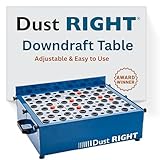
Rockler Dust Right Station
- 16.5x20 in surface
- Adjustable sides and back
- 6 material stops
- Dust port included

Grizzly G0631 28×79
- 1437 x 2 CFM
- Twin 1 HP 110V motors
- 490 lb load capacity
- 76-1/4 in long top
Those three cover the realistic range for most woodworkers: a proven mid-size benchtop table with the largest body of owner feedback, the highest-rated compact station for orbital sanders, and a dual-motor monster for shops that sand sheet goods all day.
Best Downdraft Sanding Tables for Woodworkers in 2026
| Product | Specifications | Action |
|---|---|---|
| Shop Fox W1733A Downdraft Table 20-Inch by 40-Inch |
|
Check Latest Price |
| Rockler Dust Right Downdraft Sanding Station 16.5×20 |
|
Check Latest Price |
 South Bend SB1090 Downdraft Table 37 x 53 South Bend SB1090 Downdraft Table 37 x 53 |
|
Check Latest Price |
| Grizzly Industrial G0631 Extra-Long Downdraft Table |
|
Check Latest Price |
 Dynabrade 64208 Downdraft Sanding Table 33 x 41 Dynabrade 64208 Downdraft Sanding Table 33 x 41 |
|
Check Latest Price |
 Dynabrade 64657 Downdraft Sanding Table 48 x 96 Dynabrade 64657 Downdraft Sanding Table 48 x 96 |
|
Check Latest Price |
1. Shop Fox W1733A Downdraft Table – the One Most Shops Actually Buy
Shop Fox W1733A Downdraft Table 20-Inch by 40-Inch
20 x 40 in slotted top
4 in rear dust port
Non skid top and feet
28.2 lb, 120V
Pros
- Pulls fine sanding dust down effectively
- Sturdy build that takes shop abuse
- Light enough to move around
- Generous surface for the size
Cons
- Rubber feet can mark finished workpieces
- Needs a capable collector
- Fine dust settles between the vents
The W1733A is the unit I keep coming back to, because it is the one with the deepest pool of real owner experience behind it. Seventy-five reviews at a 4.3 average is a lot of signal in a category where most listings show nothing. Owners are consistent about one thing: hooked to a proper collector, this table does exactly what it promises and the air in the room stays noticeably cleaner during finish work.
At 20 by 40 inches, it is big enough for a pair of cabinet doors side by side or a good chunk of a plywood sheet, and small enough to sit beside a machine without eating the shop. The 4 inch dust port on the rear is the detail that matters most here, and it is why this table pairs far better with a real collector than a narrow port would. Everything runs off your existing dust collection, so there is no blower, no filter cartridge, and no filter replacement cost down the line.
The build is heavier than its listed 28.2 pound weight suggests once assembled, which is a good thing. It does not flex under a door or a face frame laid flat, and the non-skid top keeps a workpiece from creeping while you work. Package dimensions are 42 by 23.2 by 8.5 inches, so it arrives in one manageable box.
The honest complaints match the owner feedback we read. The rubber feet can transfer black marks to a freshly finished surface, so finished work belongs on a scrap or a thin pad. And performance collapses if you plug it into a small household vac, which is the single most common reason owners say a downdraft table does nothing.
Will it sand a full sheet of plywood or a cabinet door?
Two standard doors fit side by side on the 20 by 40 top with room to turn them, and a 4 by 4 sheet of plywood or MDF is comfortable. A full 4 by 8 sheet needs a second support on the floor, so the back half of the panel cantilevers. For most finish work that is fine because you are working the near edge, but plan on a sacrificial stand for full-sheet passes.
What collector does it need to actually pull dust?
Treat it as high volume, low pressure. You want a collector rated in the several-hundred-CFM range connected by the shortest, straightest duct you can manage, because every elbow and extra foot of hose steals capture. A 1.5 to 2 HP unit handles this table well; a small shop vac will make you think the table is a gimmick.
2. Rockler Dust Right Downdraft Sanding Station – Small Shop and Orbital Sander Work
Rockler Dust Right Downdraft Table 16.5×20″ Sanding Station with Dust Port
16.5 x 20 in slotted top
Raising sides and back
Dust port included
6 material stops
Pros
- Highest owner rating in this roundup
- Gentle airflow clears orbital sander dust
- Adjustable dust containment
- Powder-coated steel with carrying handles
Cons
- Small surface limits workpiece size
- Package is only 19 by 19 by 7 in
This is the highest-rated table in the group at 4.8 across sixteen reviews, with eighty percent of those ratings at five stars. That is a small sample, but it is a clean one, and owners credit it with one specific thing: dramatically cleaner air while running a random orbital sander. That is exactly the job most hobbyist woodworkers are trying to solve.
The design is more clever than the spec sheet suggests. The sides and back of the station raise to help contain dust, and drop or come off when you need to fit a bigger workpiece. Six orange material stops hold small parts in place while you sand, which directly answers the complaint we hear constantly about downdraft tables sucking small pieces off the surface. A dusty woodworker losing a pile of shims mid-grit will not enjoy that problem, and this station solves it.
Airflow is gentle by design. The station generates downward airflow that carries dust off the work and down through the chute to your collector rather than blasting it off the bench, and the included dust port feeds straight into a hose. Powder-coated metal and integrated carrying handles mean it moves between the sander and the miter saw without any drama.
The trade-off is size. Sixteen and a half by twenty inches is a genuine limit if you work on doors or panels, and the package dimensions of 19 by 19 by 7 inches tell you how compact this is. If your sanding is small parts, mouldings, and touch-up on assembled pieces, that is a feature rather than a compromise. You can compare its ergonomics to our write-up of the [best sewing tables for quilters](https://austineubanks.com/best-sewing-tables-for-quilters/), where a small work surface is likewise the whole point.
Is it strong enough for a real random orbital sander?
Yes, and that is its design center. The downward flow was built to pull the fine dust an orbital sander throws, which is lighter and finer than what a belt sander generates. Owners running 5 inch random orbitals report clearing the air well; nobody in the feedback describes it handling coarse stock removal.
Can I sand anything bigger than a cutting board?
Raise a side and a small shaker frame or a drawer front fits comfortably. A full cabinet door does not, unless you sand it in sections or rest the overhang on a bench alongside. Keep it as a detail and finish-sanding station rather than a panel station, and pair it with a larger table for sheet work.
3. South Bend SB1090 Downdraft Table – A Wide Middle-Size Panel Surface
South Bend SB1090-37″ x 53″ Downdraft Table
37 x 53 in table surface
Welded steel frame
Panel sized work area
No motor listed in specs
Pros
- Much wider surface than benchtop models
- Steel frame for a rigid top
- Good middle step between bench and cabinet-shop sizes
- Slotted top over a rear dust outlet
Cons
- No published owner reviews to verify performance
- Frame and top are basic
- Passive design needs a good collector
The SB1090 fills a gap the rest of this list leaves open. Thirty-seven by fifty-three inches is a genuinely useful panel surface: a pair of doors plus working room, or a good section of a four by eight sheet with the far end on a stand. For a one-person shop moving from benchtop tables to full cabinet work, it is the natural middle step.
The frame is welded steel, which is the right material for a table that has to resist racking while you push a panel across it. No motor or filter is listed in the published data, so plan on supplying the airflow yourself from an external collector through a rear port. That simplicity is a genuine advantage for a shop that already has good collection.
Here is where I have to be straight with you: this listing shows no published customer ratings or reviews, so there is no owner feedback to lean on. I am reading the manufacturer specification and the physical logic of the design, nothing more. The dimensions and the steel frame are verifiable; the real-world capture performance is not something anyone has documented.
You will also find this table is utilitarian rather than refined. There is no adjustability, no material stops, no height control, and no stated load capacity in the published data. Buyers who want a refined bench-height hand-sanding station should look at the Rockler instead; buyers who want surface area for panel work at a mid-size will find the SB1090 straightforward.
Is 37 by 53 inches enough for cabinet work?
It handles two doors side by side, drawer fronts, face frames, and most of a standard door slab without overhang. A full four by eight sheet still needs support behind the table, and at 53 inches wide you get most of the useful width of a door slab. For a shop building kitchens in batches, that is the dimension that matters.
What should I check before buying a table with no owner reviews?
Ask the manufacturer for the dust port diameter, the slot pattern, and the top load capacity in writing, then confirm the port matches your collector. Check that the frame is welded rather than bolted. And budget a scrap test with a fine pass over a scrap panel to see the capture before you commit the panel you care about.
4. Grizzly Industrial G0631 Extra-Long Downdraft Table – Dual Motor Airflow for Big Shops
Grizzly Industrial G0631-28″ x 79″ Extra-Long Downdraft Table
25-1/4 x 76-1/4 in top
Twin 1 HP 110V motors
1437 x 2 CFM
490 lb load capacity
Pros
- Enormous surface area for long parts
- Very high combined airflow
- Two standard-voltage motors
- High published load capacity
Cons
- 468 lb and immovable once placed
- No published owner reviews
- Occupies a large floor footprint
The G0631 is the table for a shop that sands long parts and feels the dust. A 25-1/4 by 76-1/4 inch top is not a workbench, it is a production surface, and the airflow behind it is specified at 1437 CFM per motor for a combined 2874 CFM without filters. Two 1 HP 110-volt single-phase capacitor-start induction motors do the work, drawing 12 amps each.
That motor arrangement matters more than it looks. Both motors run on standard household voltage, so you do not need a three-phase service or an electrician. In a big shop, that alone can be the difference between a table you install in an afternoon and a project that stalls for a month waiting on a power upgrade.
The published load capacity of 490 pounds and a 31-1/2 inch table height tell you what kind of machine this is. You can roll a heavy assembly across it, stand on your own two feet comfortably, and lay out a run of parts without shifting them. The wood frame and flat base are built for a fixed location, not for rearranging the shop.
Be clear-eyed about the two big negatives. The table weighs 468 pounds, so once you find the spot it stays there. And this listing carries no published owner ratings, so the specification sheet is the only evidence we have. The numbers are specific and from the manufacturer, but nobody has written down their experience of running it.
Does it fit a standard garage or a small shop?
At 78.75 inches wide by 27.75 inches deep, with a total height near 40 inches, it eats a wall. It works in a two-car garage, a basement workshop with clear floor, or a production room with a dedicated aisle, provided the aisle is planned around the table rather than after it. A one-car shop will feel it immediately.
Is dual motor overkill for finish sanding?
For a single door, yes, and it will be loud. The airflow makes sense when you have two people finishing parts at once, or a long queue of panels waiting, or a surface that doubles as a general purpose finishing bench. Buying this for occasional weekend touch-up work in a small room is overspending on the wrong axis.
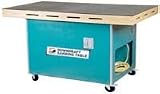
5. Dynabrade 64208 Downdraft Sanding Table – For Shops With Three-Phase Power
Dynabrade 64208: 33″ (84 Cm) W X 41″ (104 Cm) L Downdraft Sanding Table
230 V three-phase 60 Hz
33 x 41 in working area
Built for durability
Single 230 V feed
Pros
- 230 V three-phase suits industrial shops
- Compact 33 x 41 in work area
- Self-contained
- so no separate collector
Cons
- Requires three-phase service
- No published owner reviews
- Built for industrial rather than hobby use
The Dynabrade 64208 is the one to look at if your shop already runs on 230-volt three-phase power, which in the United States usually means a commercial or institutional shop rather than a garage. It runs on 230 V, three-phase, 60 Hz, and the published working area is 33 by 41 inches, a useful panel size that fits between the benchtop units and the full cabinet-shop tables.
The 64208 is listed as a stand-alone sanding table with no external collector called for in the published data, which is the single most important difference from the Shop Fox, the Rockler, the South Bend, and the G0631. There is no separate collector to buy and no duct to run. Dynabrade frames the benefit as improved operator safety, shorter process time, and better finishes, and the table is built for durability with a limited warranty.
For a school shop, a cabinetry trade program, or a two-shift operation, a decent work area with no external infrastructure is worth planning around. What you are committing to first, though, is the electrical service.
What I cannot do is vouch for it from owner experience, because this listing shows no published ratings or reviews. The electrical requirement is the deciding factor and it is a hard one: a residential shop with only a 120-volt circuit cannot run this table, so many hobbyists should skip past it and look at the 110-volt options above.
Can I run this in a home shop with normal power?
No. Three-phase 230 V service is the requirement as published, and a typical residential panel does not provide it. Installing it means a service upgrade or a separate commercial feed, and in most cases that upgrade costs more than the table itself. Plan the electrical before the floor space.
Is a stand-alone blower unit worth the extra cost?
Worth it if you do not own good dust collection. You skip the collector entirely and capture still works, which removes the single most common failure in this category. Not worth it if you already have a strong central system, because that money is better spent on collector capacity and a blast gate for your machines.
6. Dynabrade 64657 Downdraft Sanding Table – Full 48 x 96 In Footprint With Fine Filtration
Dynabrade 64657 48″ (122cm) W x 96″ (244cm) L Downdraft Sanding Table, 115V, 1 Phase, 60 Hz
48 x 96 in working area
1-micron dual filtration
TEFC twin motors
970 lb, 115V single phase
Pros
- Handles full 4x8 sheets flat
- Up to 70 percent more filter area
- 115V single phase so no service upgrade
- Pre-filter blanket adds filter life
Cons
- 970 lb footprint and weight
- No published owner reviews
- Enormous for a small shop
This is the biggest table in the roundup, and the one sized so a full four by eight sheet of plywood or MDF lies flat on the working surface. Forty-eight by ninety-six inches of CNC-milled three-quarter inch MDF top on an all-metal base, at 970 pounds, is a dedicated piece of equipment rather than a bench accessory.
The filtration specification is the part that gets past the woodworking crowd. Dual filtration with a pre-filter blanket and one-micron paper filters, with up to seventy percent more filter area than competing brands, is aimed squarely at shops that finish composite panels. MDF and similar engineered products produce far finer dust than solid hardwood, and fine dust is what gets past a modest filter and into the air you breathe.
Power is the pleasant surprise in an otherwise enormous machine. It runs 115 V single-phase at 60 Hz, so no three-phase service is required, and the reverse-incline blowers are driven by heavy-duty TEFC twin electric motors. TEFC means totally enclosed fan-cooled, which in plain terms is a sealed motor that runs cooler and lasts longer in a dusty environment than an open-frame motor would.
The honest caveat is size and silence of feedback. Ninety-six inches deep means it needs a room, not a corner, and the same absence of published owner reviews applies here. Treat the specification as well documented and the real-world longevity as unverified. If your shop cannot give up that floor area, our write-up of the [best prep tables for restaurants](https://austineubanks.com/best-prep-tables-for-restaurants/) covers the layout thinking behind large fixed work surfaces in a different context.
Do I really need 48 by 96 inches?
Only if you sand full sheets routinely. A 37 by 53 inch table with a folding stand behind it handles most four by eight sheet work in a smaller shop, because you only ever work the near two feet. The extra three feet here buys you the ability to lay a sheet flat with nothing cantilevered, and to line up a batch of panels side by side.
Is one-micron filtration necessary for solid wood?
Not for solid hardwood. It matters when you work MDF, melamine, or plywood with resin in the face, where the dust is finer and more airborne, and where the adhesive binders make dust more irritating to work around. Pure hardwood dust at 180 grit is bulkier and easier to capture, and a cartridge filter handles it well.
Downdraft Sanding Table Buying Guide for Woodworkers
Everything below assumes you sand wood. That assumption changes the answer to almost every question people ask about downdraft tables, because most published guidance is written for metal and measures the wrong things for your dust.
Are downdraft sanding tables worth it?
Worth it when dust is generated in quantity and the work happens over a surface big enough to sand on. The value is not the table, it is the dust that never enters your shop. Owners on woodworking forums describe the satisfaction benchmark plainly, which is that you finish a session and cannot smell sawdust in the air. A woodworker on r/woodworking put the reasoning better than any spec sheet, noting that downdraft works because it is a high volume, low pressure problem, and that pairing it with good direct collection from the machine is better still. The same forum consensus ranks a downdraft table first, an air cleaner second, and open shop air third. That ordering matches what we see in owner feedback.
Not worth it when you sand a few small items a month, when your real problem is a machine with no dust port, or when your collector is undersized. In those cases, spend the money on a random orbital sander with a bag, or on a blast gate for your table saw, and you will see a bigger improvement for far less outlay. We would rather tell you that than sell you a table that disappoints.
How much CFM do you actually need for wood dust?
Wood dust is bulkier and lighter than metal particulate, so the high static pressure that suits a grinding booth is less important than sheer volume. The working rule most shops converge on is roughly 100 CFM per square foot of slotted table area as a starting point, and then testing with a scrap pass. Multiply the table area by 100, and that is the collector rating you are aiming to put behind it.
Worked example, using the G0631 because its area is published precisely. A 25.25 by 76.25 inch top is about 13.4 square feet. At 100 CFM per square foot you need roughly 1,340 CFM. The published rating of 1437 CFM per motor clears that, which is exactly why two motors are fitted. Apply the same math to the Shop Fox W1733A: 20 by 40 inches is 5.6 square feet, so about 560 CFM, and a 1.5 to 2 HP collector with a 4 inch port sits in that range comfortably.
Three practical rules follow from that math. Keep the duct run short and straight, because friction is what kills capture. Match the port diameter to your hose, because a reducer at the table wastes more than most owners expect. And test before you commit, by throwing a coarse-grit pass at a scrap panel and watching where the dust actually goes. If it drifts sideways off the surface, you need more volume, not more pressure.
Passive or self-contained: which one fits your shop?
Passive tables such as the Shop Fox W1733A, the Rockler station, the South Bend SB1090, and the Grizzly G0631 draw their airflow from a collector you supply or from high-CFM blowers feeding a remote collector. Self-contained tables such as the Dynabrade 64208 are sold as stand-alone units that need no separate collector.
Buy passive if you have a real dust collection system. It is cheaper, quieter per dollar of captured dust, and it lets one collector serve several machines. Buy self-contained if you have no collector at all, because it removes the entire ducting question from the decision, or if your shop is far enough from a central system that running a line back is impractical. The cost is filters to replace and a louder machine, and those running costs are the item most buyers forget.
How big should a downdraft sanding table be?
Size the table to your largest typical workpiece, not to your largest possible one. A 20 by 40 inch benchtop handles doors and small panels. Around 37 by 53 inches covers doors plus a working margin. Forty-eight by ninety-six inches is a production surface for full sheet work and is the point where a downdraft table becomes a dedicated machine that owns a room.
Two ergonomics questions matter more than most buyers ask. How high is the surface, and can you work supported? The Shop Fox sits at 6-1/4 inches, which is benchtop height for bench-height hand sanding with good forearm support. The Grizzly stands at 31-1/2 inches, closer to standard machine height, which is better for leaning and pushing but worse for seated detail work. And check the foot material against your work, since rubber feet that grip hard can also mark a finished panel.
When a downdraft sanding table is not worth it
Three situations. If your collector is a household vac or a small benchtop unit, a downdraft table will underperform no matter which one you buy, and the fix is collection capacity before it is the table. If you sand rarely, a quality random orbital sander with a cloth bag captures most of the dust at the source for a fraction of the outlay. And if you build in MDF or composite panels in volume, remember that those boards also need a proper dust-producing machine, and a downdraft table will not solve that problem.
A homemade box is a legitimate fourth option, and it is the top video result for this search for a reason. A plywood carcass, a slotted top, and a 4 inch port to your collector can be built in an afternoon. What DIY builds usually skip is the ducting math, and a build with a long hose run and an undersized fan performs worse than a commercial table, which is exactly the disappointment we hear described on forums. If you build, buy the fan that is right, not the one that is cheap.
Frequently Asked Questions
Are downdraft tables worth it?
A downdraft sanding table is worth it when you sand panels, doors, or cabinet parts regularly and the dust would otherwise fill the room. The value is capture at the source, so dust never lands on finished surfaces or in the air you breathe. It is not worth it for occasional small work, and it will not perform if your collector is undersized. Fix your dust collection capacity before buying a table.
What is a Grizzly downdraft table?
A Grizzly downdraft table is a workbench with a slotted top that pulls dust downward into a collector or built-in blowers. The G0631 model in this roundup has a 25-1/4 by 76-1/4 inch surface, twin 1 HP 110-volt single-phase motors, and a published suction capacity of 1437 CFM per motor. It runs on standard household voltage, so no three-phase service is needed.
What do you use a downdraft table for?
Woodworkers use a downdraft table for finish sanding hardwood panels, cabinet doors, face frames, drawer fronts, plywood sheet goods, mouldings and trim, and veneer. Fine dust from orbital and hand sanding is drawn down through the slotted surface into a collector. Because the workpiece is worked directly over the slots, most of that dust is captured before it rises into the room.
How much CFM do I need for a downdraft sanding table?
A common starting rule for wood dust is about 100 CFM per square foot of slotted table area, because wood dust is bulkier and lighter than metal particulate and needs volume more than pressure. Multiply the table dimensions to get the area, then by 100. Keep the duct run short and straight, match the port diameter to your hose, and confirm with a test pass on a scrap panel.
Does a downdraft table work with a shop vac?
Only in the sense that the connection will physically fit. Small shop vacs and household vacuums move too little air to create useful downward velocity through a table surface, which is the most common reason owners report that a downdraft table does nothing. Pair any table with a collector rated in the several-hundred-CFM range and connect it with the shortest, straightest duct you can manage.
The Best Downdraft Sanding Table for Woodworkers in 2026
The best downdraft sanding table for most woodworkers in 2026 is the Shop Fox W1733A. It has the deepest well of owner feedback in this category at 4.3 across seventy-five reviews, a 20 by 40 inch surface that suits doors and panels, and a 4 inch rear port that pairs with the collector you probably already own. The Rockler Dust Right station takes the compact slot with the highest rating, and the Grizzly G0631 is the answer once a shop is sanding long parts two shifts at a time.
Whatever you choose, buy the collector first, or at least measure it against the 100 CFM per square foot rule. A downdraft sanding table is only as good as the air moving behind it, and that is the one variable that decides whether your money was well spent.