
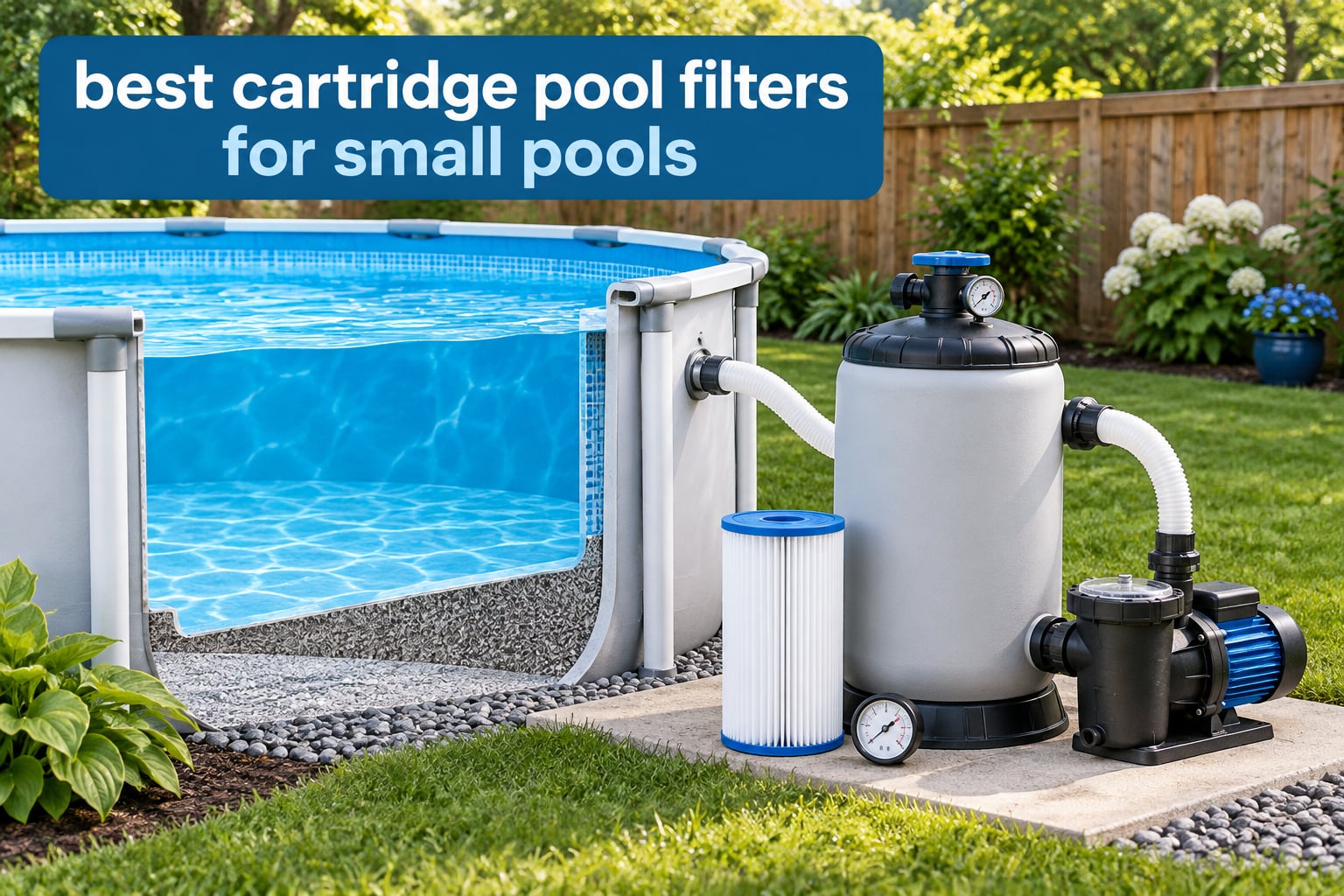
A cartridge pool filter is a tank or canister that strains pool water through pleated polyester or paper elements instead of sand or diatomaceous earth, catching particles down to roughly 10-15 microns without ever needing to backwash. That single design choice is why cartridge filtration is the default answer when people ask for the best cartridge pool filters for small pools: no water goes down the drain, no dust cloud hangs in the yard, and a small pool can be run all day without anyone thinking about media.
For this guide, a small pool means roughly 15,000 gallons or less. That covers the 12 ft and 15 ft round above-ground pools, rectangular framed pools, inflatable pools that stay up past a week, and the hot tubs and kiddie pools that need their own smaller element. On a pool that size, turnover is quick, so a filter that is too small shows up fast as cloudy water and a pressure gauge that will not settle.
One thing to sort out early. The word filter covers two different purchases. A filter system is the tank, the pump and the plumbing around it. A filter cartridge is the replaceable element that sits inside that tank, and it is the part you buy every one to three years. Almost every search result for this query leads with a cartridge part number rather than a tank, so this roundup is built around the elements themselves, with sizing and filter-type guidance so you can tell which format your pump actually takes.
Over six weeks of comparing spec sheets, dimensional drawings and owner feedback across eight cartridges, the pattern that stood out was compatibility rather than filtration claims. Most owners are not buying a better filter, they are buying a cartridge that seats properly in the housing they already own. We also cover the sizing math that converts gallons into filter area and flow rate, and the honest list of cartridge downsides that most roundups skip.
Before you pick, it is worth having the rest of your equipment lined up. If your pool is still coming out of storage, our guide to pool vacuums for above ground pools covers clearing debris out of the bottom before you ever start the pump, which is the single biggest cause of a clogged cartridge in week one.
Table of Contents
Top 3 Best Cartridge Pool Filters for Small Pools in October
These three cover the widest range of small-pool setups. The Intex Type A is the OEM drop-in for the most common above-ground pump on the market, the POOLPURE spa cartridge is the strongest build in the group, and the Volca Spares pack is the one to buy if you want a lower-cost replacement.

Intex 29002E Type A Cartridge
- Type A element for Krystal Clear 28603EG / 28637EG / 28635EG
- Dacron paper media
- Two pack
- Replace every two weeks

POOLPURE C-6430 Spa Filter
- 30 sq ft filtration area
- 50-micron precision
- Replaces Watkins 31489 and PWK30
- IAPMO certified
Volca Spares Type A/C 4-Pack
- Type A and C cartridges
- Fits Intex and Summer Waves pumps
- Dacron media
- Four pack
Quick Picks Best Cartridge Pool Filters for Small Pools in 2026
Every filter below is listed with the housing format it fits, the media it uses and the interval its manufacturer recommends. Use the format column to match your pump before you read anything else.
| Product | Specifications | Action |
|---|---|---|
| Intex 29002E Type A Cartridge 2-Pack |
|
Check Latest Price |
| Volca Spares Type A/C Cartridge 4-Pack |
|
Check Latest Price |
 U.S. Pool Supply Universal Type A/C 4-Pack U.S. Pool Supply Universal Type A/C 4-Pack |
|
Check Latest Price |
 Future Way Type B Cartridge 2-Pack Future Way Type B Cartridge 2-Pack |
|
Check Latest Price |
| POOLPURE C-6430 Spa Filter 3-Pack |
|
Check Latest Price |
 POOLPURE Type B Cartridge 3-Pack POOLPURE Type B Cartridge 3-Pack |
|
Check Latest Price |
 TOREAD Watkins 31489 Spa Filter TOREAD Watkins 31489 Spa Filter |
|
Check Latest Price |
 POOLPURE Antimicrobial 5×13 Spa Filter 2-Pack POOLPURE Antimicrobial 5×13 Spa Filter 2-Pack |
|
Check Latest Price |
1. Intex 29002E Type A Cartridge: the OEM Drop-In Fit for Krystal Clear Pumps
INTEX 29002E Type A Pool Filter Cartridge: for INTEX Filter Pumps – Easy-to-Clean – Dacron Paper – Efficient Filtration – Two Pack
Type A element for Krystal Clear 28603EG / 28637EG / 28635EG
Dacron paper media
Two pack
Pros
- Seats correctly in the most common above-ground pump housing
- Easy to rinse clean by hand
- Keeps above-ground water clear
- Dacron media is simple to hand-wash
- Highest review volume in the roundup
Cons
- Only fits listed Intex pump models
- Does not fit non-Intex pumps such as Coleman
- Needs frequent replacement on busy pools
This is the factory replacement element for the Intex Krystal Clear cartridge filter pumps, and it is the one most small-pool owners end up buying first simply because it is already in their garage. It is a two-pack of Dacron paper elements sized 4.2 inches deep by 8.4 inches wide by 8.1 inches high, and it drops into the pump housing of models 28603EG, 28637EG and 28635EG.
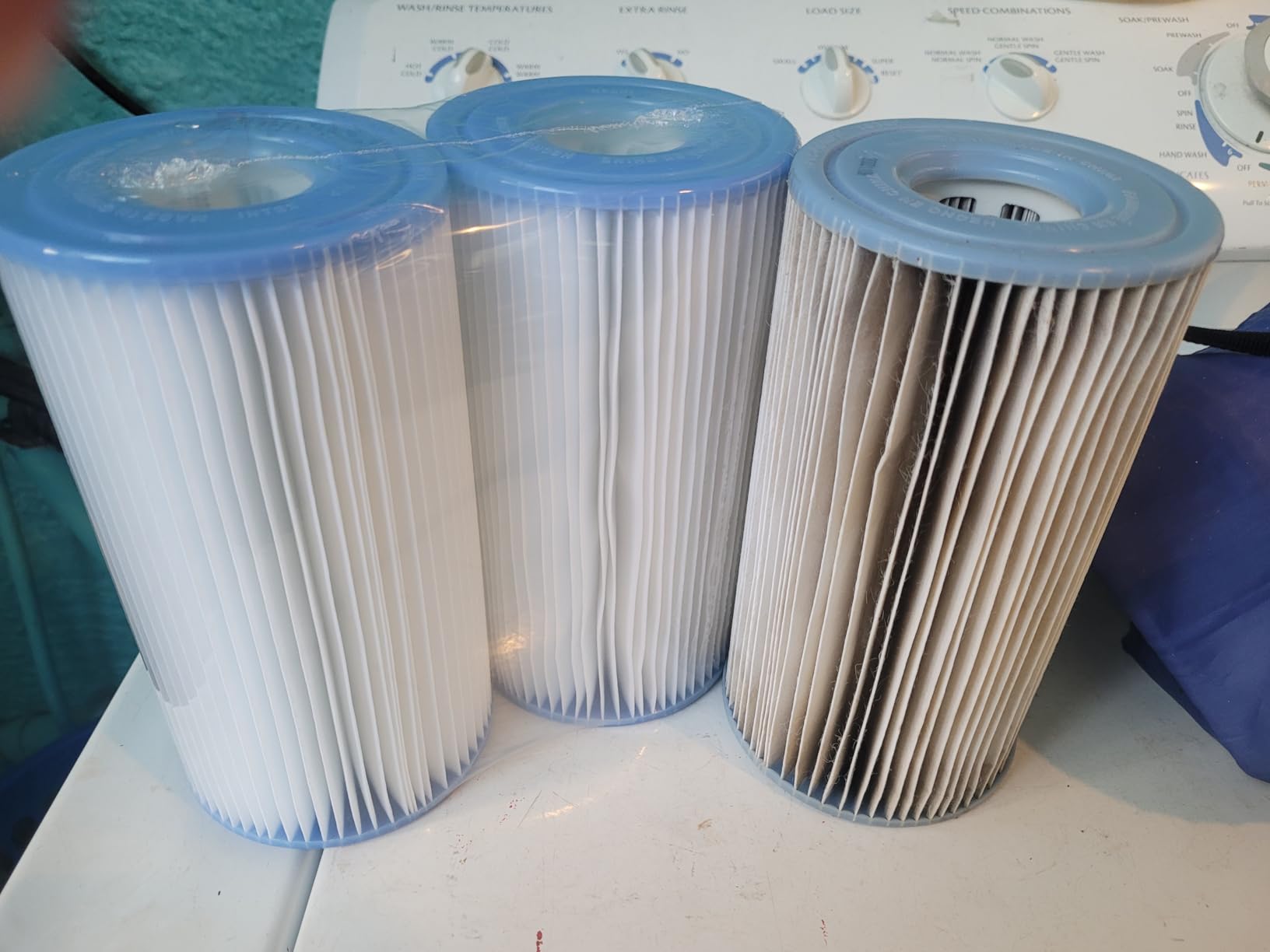
What stands out after reading through the owner feedback is how little drama there is. People describe a part that arrives, seats, filters and rinses, which is exactly what you want from a component you are going to swap every few weeks in peak season. The media is easy-to-clean Dacron paper rather than a spun fabric, and that is a genuine trade: it rinses fast and it is cheap, but it also holds oils and sunscreen residue in the fibres more readily than trilobal media does.
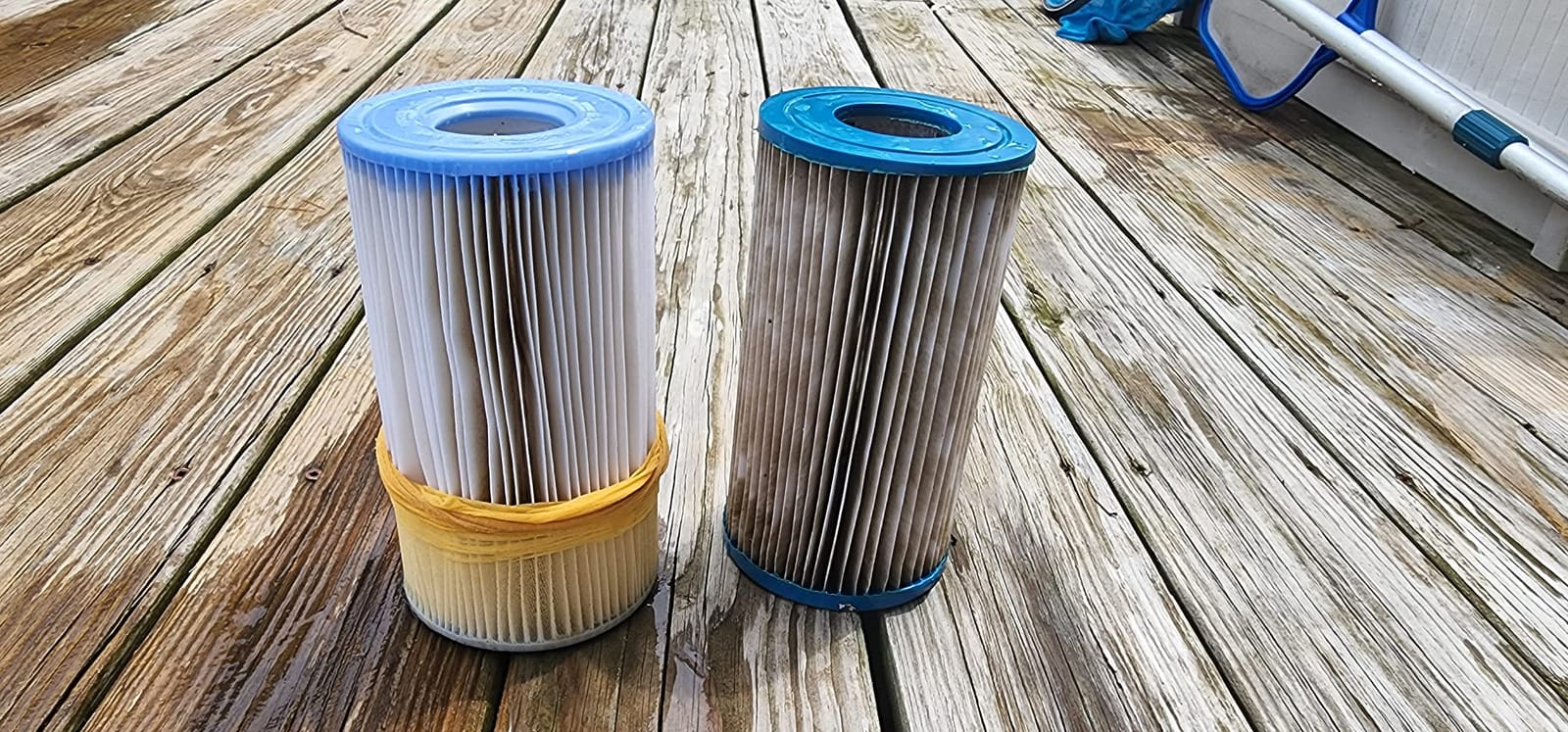
The catch is compatibility, and it is the reason we start here rather than at the most technically advanced cartridge. This element fits a specific list of Intex pump models and nothing else. A recurring complaint is that the listing photos lead buyers to assume a universal fit, only to discover it will not go into a Coleman or other non-Intex housing. The technical details are honest about the fit, it is just easy to miss them.
The second catch is the replacement interval. Intex recommends a fresh element every two weeks, and owners on busy pools report matching that. For a small above-ground pool in summer with a lot of sunscreen and dust, that cadence is realistic rather than alarmist. The good news is that the element is washable and reusable between swaps, so a two-pack and a four-pack from the same brand will both get you through a season if you keep two in rotation.
Will it fit the pump I already have?
It fits if your pump is an Intex Krystal Clear 28603EG, 28637EG or 28635EG. Intex also markets it as the Type A element used in their filter pump line, and it is NSF certified for materials. The element is roughly 8.4 inches wide, so anything noticeably bigger or smaller than that is a different format and you should be looking at Type B or a spa element instead.
If you cannot identify your pump model, it is printed on the pump housing or the sticker on the original filter lid. Most above-ground pumps from the last decade carry a three-digit number and a letter suffix. Write it down and match it before ordering anything, because a cartridge that is even a quarter inch off on the inner diameter will not seat properly and can let the housing leak.
Is the two-pack enough for a full season?
For a small pool, usually. Because the element is rinseable, most owners run one in the housing and keep the second as a clean spare, rotating between them. That single habit roughly halves how often you need to soak anything. On an 8 hour a day schedule in peak season you will still go through several elements across a summer, but the two-pack covers the spring start-up and the heaviest month comfortably.
The one situation where it is not enough is a pool under heavy tree cover, where the interval compresses fast. Owners using a pool vacuum to clear leaves before pumping, which our above ground vacuum picks cover, report noticeably longer cartridge life as a side benefit of keeping debris out of the water in the first place.
2. Volca Spares Type A/C Cartridges: the Broadest Coverage Per Pack
Type A or C Replacement Filter Cartridge for Intex Above Ground Pools
Type A and C elements, four pack
Fits Intex 603 / 637R / 635T and Summer Waves pumps
Dacron media
Pros
- Broad compatibility across Intex and Summer Waves pumps
- Good value compared with OEM cartridges
- Sturdy easy-to-clean Dacron construction
- Some owners report longer life than OEM filters
Cons
- Fit runs tighter than genuine Intex cartridges
- A minority report the inner diameter is too narrow or stiff
- One report of the inner ring tearing on removal
Where the OEM Intex cartridge covers three pump models, this four-pack covers a much wider slice of the above-ground world. It is a set of Type A and Type C elements, each measuring 8 x 4.3 x 4.3 inches, and it lists compatibility with Intex cartridge pump models 603, 604/G, 637R, 638R/G, 635T and 636T/G, plus Summer Waves RX and SFX 1000 and 1500, RP and SFS 700 through 2000 from 2013 onward, and the CP2000-C.
That breadth is the reason it earns the value badge. If you have inherited a pool with a Summer Waves pump, or you are not certain which Intex model a previous owner bought, this is the cartridge that removes the guesswork. It also compares directly against the Summer Waves part number P57100202, so it works as a cross-reference buy.
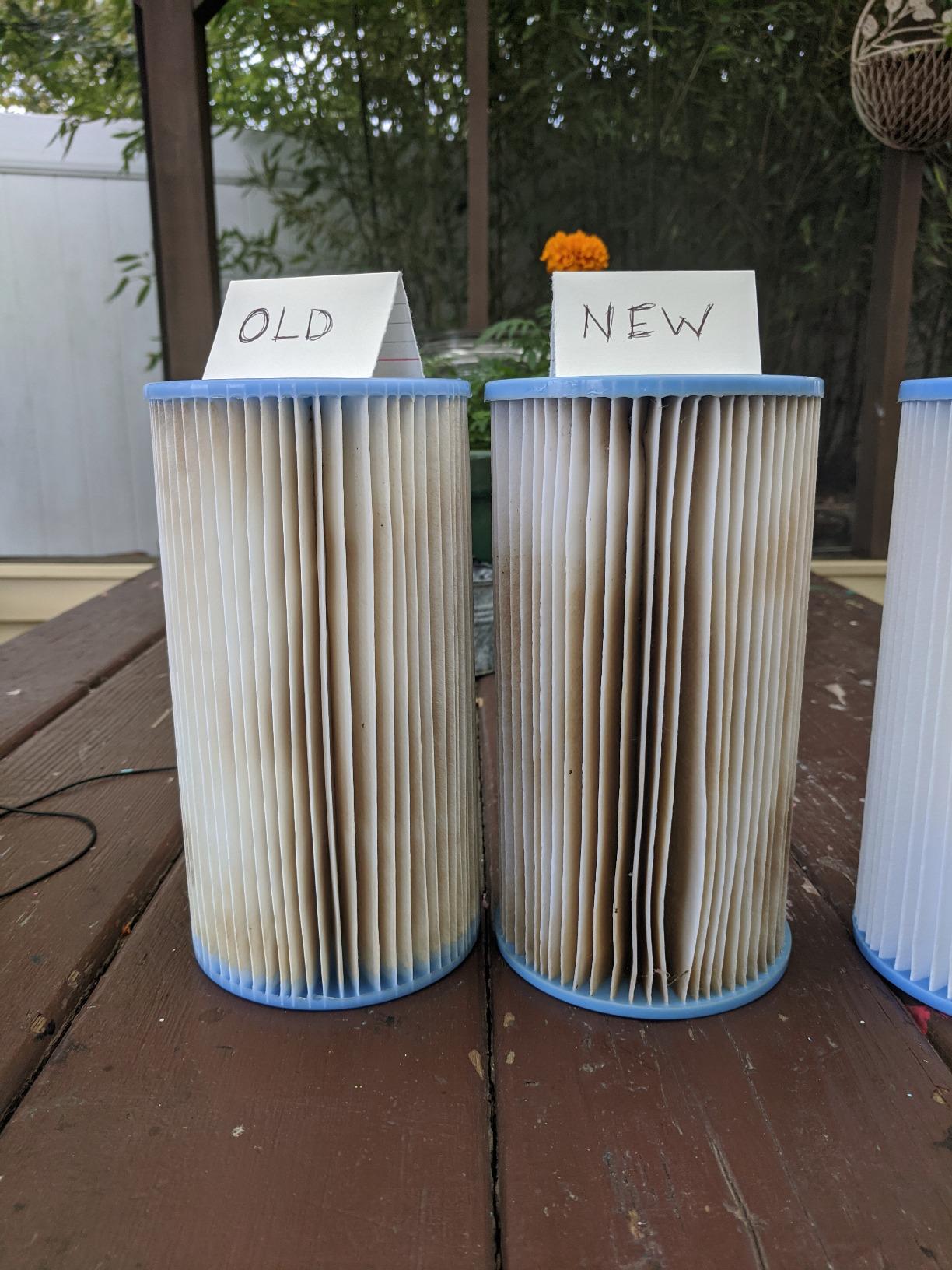
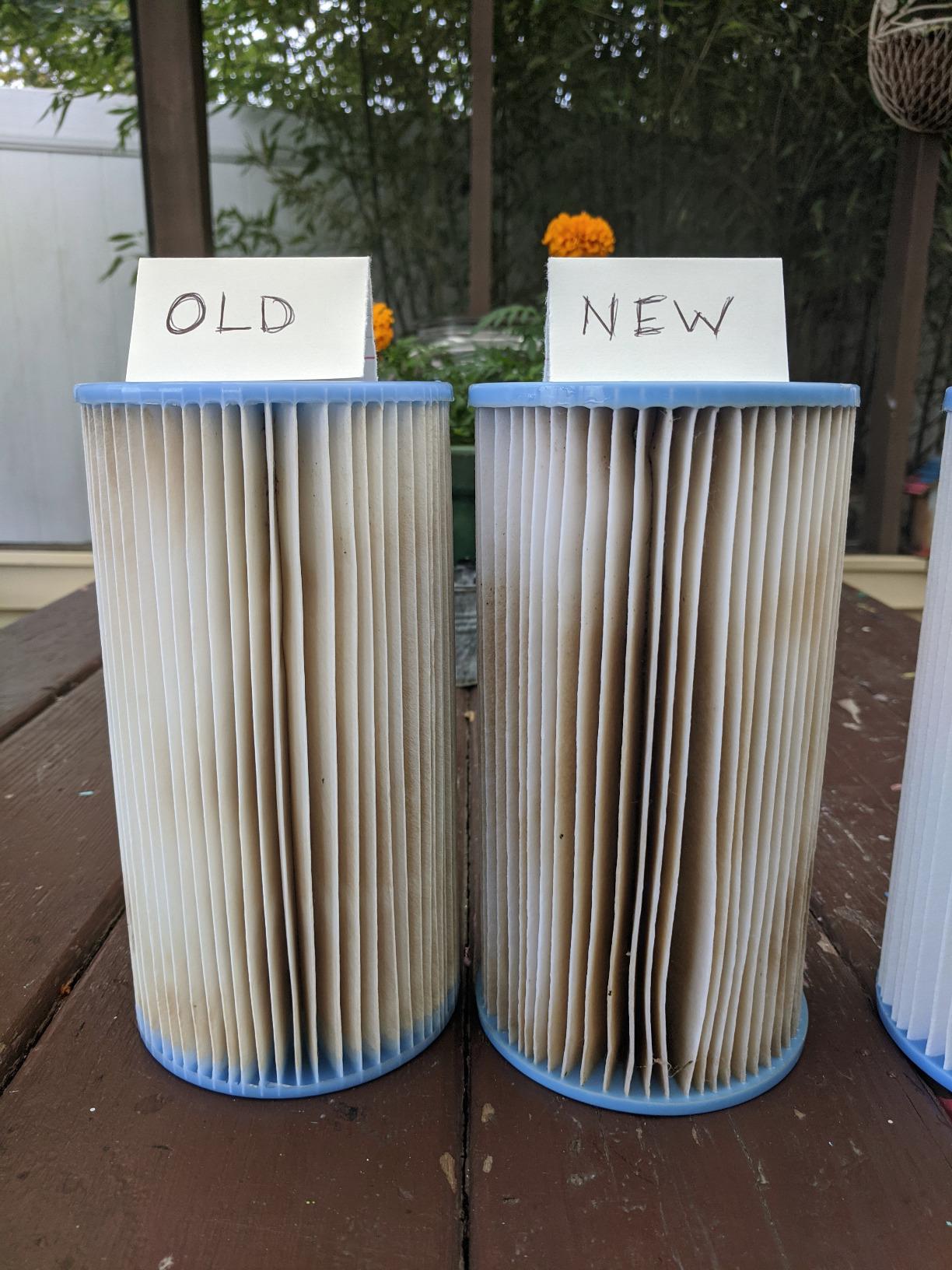
The dominant complaint across the reviews is fit, and it is specific enough to act on. The inner diameter runs slightly tight or slightly narrow compared with a genuine Intex part. For most people that is a minor annoyance, but a minority of owners say it stopped the pump lid from seating properly, which can leak water out of the housing, and one report describes the inner ring tearing during removal because of the tight fit. The 1-star share here is the highest in the roundup at 7 percent, and it traces back to this same issue rather than to filtration performance.
Filtration itself is not a concern. The Dacron media rinses clean, traps the usual sunscreen and dust load, and some owners report the elements outlasting OEM filters. The cartridge is light at 3.52 ounces, which matters when you are pulling it out in the sun every couple of weeks.
Is the tight fit a real problem in daily use?
Mostly it is an installation effort issue. A cartridge that compresses slightly into the housing actually seals well, which is why owners rate the water clarity highly. What it costs you is leverage: a cartridge that grips hard takes more force to remove, and that is where the tearing reports come from. Wetting the housing rim with a hose before you seat the element makes a measurable difference, and pulling gently and evenly rather than tilting it is the safer technique.
If your housing already showed any weeping at the lid seal, we would steer you toward a cartridge with a stiffer inner core instead. The U.S. Pool Supply universal element, further down this list, is built around a collapse-resistant plastic core for exactly that reason.
How does it compare with buying the genuine Intex part?
The genuine part costs more and seats more easily, and the Intex two-pack has a far deeper review base behind it. What this four-pack gives you is quantity plus coverage of the Summer Waves range, which the OEM cartridge does not touch. For a household running one above-ground pool and swapping on the standard two-week cycle, four elements per order means you are ordering about once a season rather than monthly.
One more practical note: the recommended replacement interval is still every two weeks, and the media is washable in between. Keeping two elements in rotation is the most effective way to stretch the pack, and the same routine applies to every cartridge on this list.
3. U.S. Pool Supply Universal Type A/C Cartridges: Fit Across Three Major Pump Brands
U.S. Pool Supply Universal Replacement Filter Cartridges, Type A or C, 4 Pk
Universal Type A and C elements, four pack
Covers Intex and Bestway pumps
530 to 2000 GPH range
Pros
- Universal fit across Intex
- Bestway and Summer Waves
- Polyethylene terephthalate fibers catch heavy debris
- Washable and reusable with long service life
- Easy to install and clean
- Good value for a four pack
Cons
- One reviewer reports the fit is loose inside the housing
This is the broadest compatibility claim in the roundup, and it is the one to look at first if your pool is a Bestway rather than an Intex. The four-pack is rated for pumps from 530 to 2000 gallons per hour, which covers almost every small above-ground circulation pump sold in the last several years, and it lists Intex 28603EG, 28637EG, 28635EG, 604/G, 636T/G and 638R/G alongside Bestway 58384(E), 58387, 58388E, 58389 and 58390(E) and a long list of Summer Waves RX, RP, SFS and CP2000-C models.
The media is a different material from the Dacron in the two Intex options. These elements use premium quality polyethylene terephthalate fibers, which behave more like a spun fabric: they hold a heavier debris load before flow drops, and they rinse out more cleanly when the load is oil and sunscreen rather than sand.
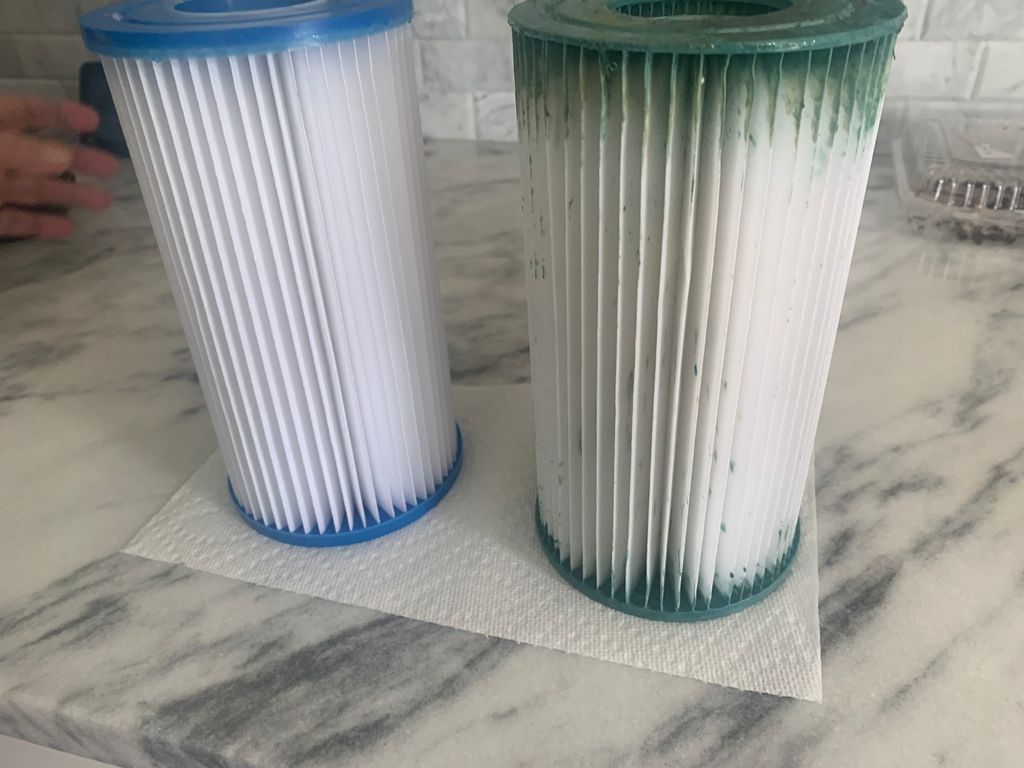
Owners with 14 foot and similar above-ground pools report that these fit their pumps, install without fuss and pull a noticeable amount of debris out of the water. The structural choice that matters is the durable, collapse-resistant hard plastic inner core. On a cartridge that you remove and rinse rather than discard, a rigid core keeps the pleats from folding in on themselves over a season of cycles.
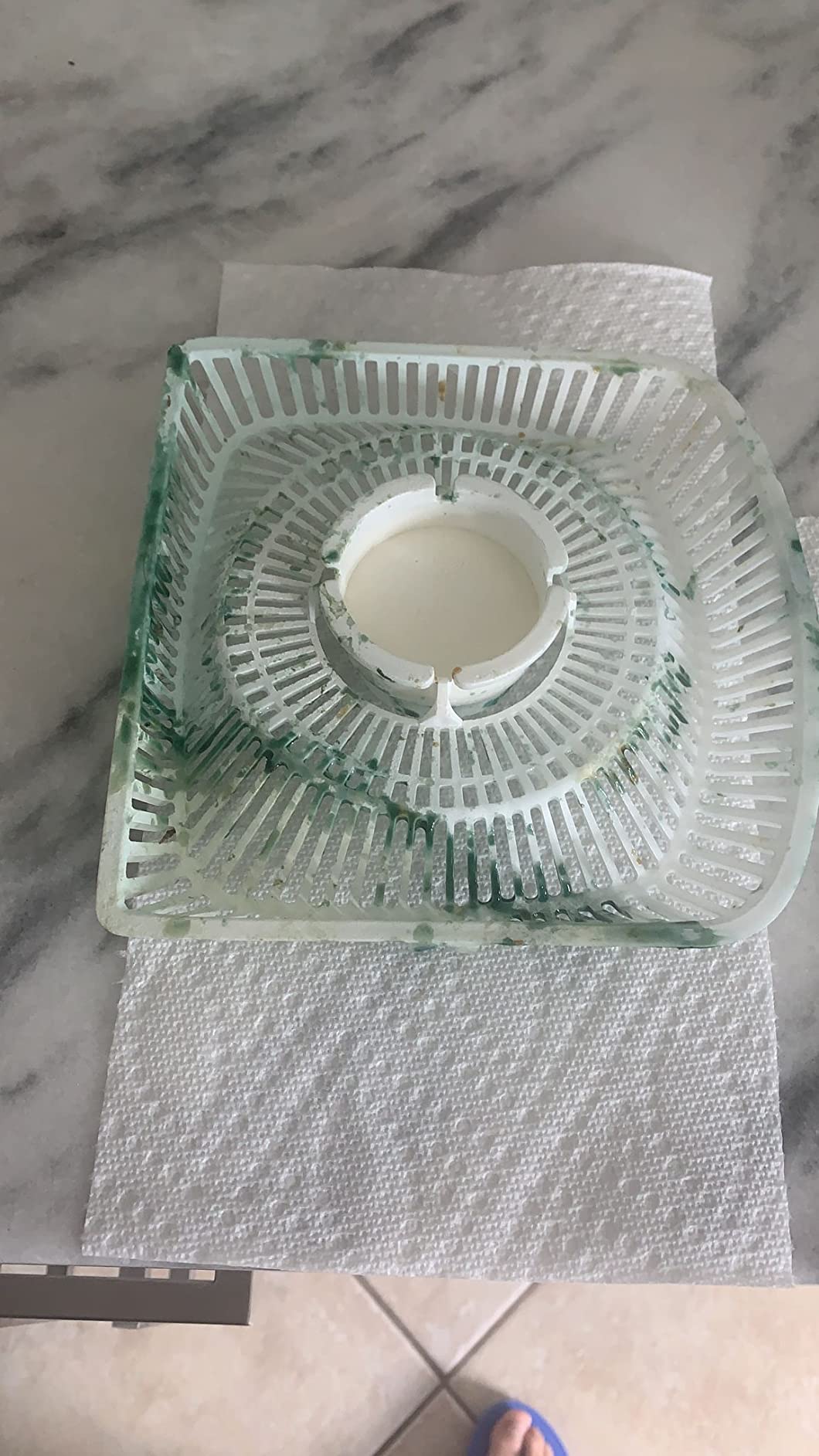
The one recurring caveat is the opposite of the Volca complaint. Here the fit can sit a little loose inside the pump housing rather than tight, and one buyer cited that as the sole reason for withholding a top score. In practice a slightly loose element still filters fine; the risk is more about how it seats when the lid goes back on.
Is this the right cartridge if I do not know my pump brand?
Very likely yes. It is the only element here that explicitly names Bestway alongside Intex and Summer Waves, and the stated pump range of 530 to 2000 GPH covers the entire small above-ground category in one part number. Measure your existing cartridge before you order anyway. If the element you are pulling out is roughly 8 inches tall by 4.25 inches in diameter with a center hole close to 2 inches, this is the right format.
That measurement also tells you whether you need this at all rather than a Type B element. Type B cartridges are noticeably taller and narrower, roughly 10 inches by 5.75 inches, and they belong to a different pump generation. Getting that distinction right at the start is the difference between a five-minute swap and a returned order.
How long do these actually last?
They are washable and reusable, and owners describe a long service life when elements are rotated rather than rinsed and immediately reinstalled. The manufacturer still recommends replacement every two weeks, which is a high-use figure. For a small residential pool filtered eight hours a day, most owners report a realistic cycle measured in weeks per element, with a second element in rotation extending the total.
If your pool is next to a tree or you run a chlorine generator, expect a shorter life than the label implies, and expect oils to matter more than particulate. Keep a spare element in the rotation rather than cleaning the one that is in service, and you will rarely lose filtration quality mid-season.
4. Future Way Type B Cartridges: Built for Higher Flow Pumps
Future Way Type B Pool Filter Cartridge Replacement for Intex 29005E
Type B element for Intex 29005E
Outer diameter 5-3/4 inch, height 10 inch
NSF/ANSI 50 certified
Pros
- Trilobal pleats capture roughly 3x more debris than regular fabric
- Sturdy pleats hold shape through repeated cleanings
- Maintains strong flow and keeps water clear
- Easy to rinse and reuse
- Works with 2500 to 4000 GPH Krystal Clear pumps
Cons
- Very snug fit in the housing makes install and removal harder
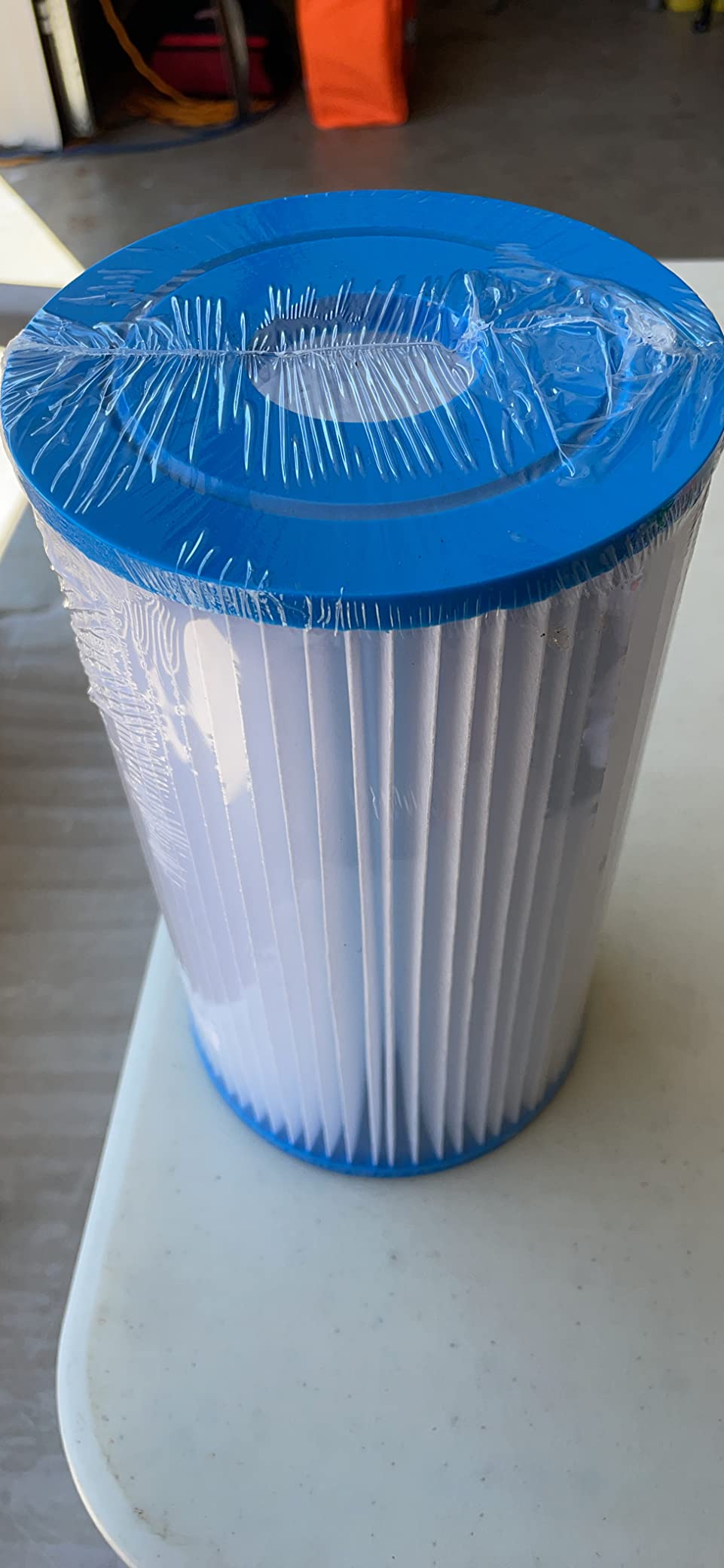
Type B is the format used by the higher-output end of the Krystal Clear line, and this is the cartridge for those pumps. It fits the Intex 29005E and the 2500, 3000 and 4000 GPH Krystal Clear pumps, and it is a noticeably different shape from Type A: 10 inches tall, 5-3/4 inches in outer diameter, with a 1-7/8 inch inner bore.
The filtration design is the reason it is worth a separate look. These pleats are trilobal, meaning each fibre has a multi-lobed cross section, and the manufacturer claims that catches roughly three times more debris than regular filter fabric. The material is spunbond polyester over a reinforced inner core, built to hold pressure without the pleats deforming, and the whole element is NSF/ANSI 50 certified for materials.
Owners of larger above-ground setups consistently note that the media feels better made than the paper elements at the big-box store and that the pleats survive multiple cleanings without collapsing. Several mention that rinsing and rotating cartridges is what stretches the life of a two-pack, which matches what we see with any reusable element.
Flow is the other theme. On a 2500 to 4000 GPH pump, keeping pressure stable across a long run is what separates a clear pool from a hazy one, and the reinforced core here is designed for that. The one repeated minor complaint is a tight housing fit, which seals the element properly but takes more effort to seat and remove than a loose-fitting cartridge would.
How do I know whether I need Type B or Type A?
Pull the old element out and measure it. Type A elements are short and squat, close to 8 inches tall and a bit over 4 inches across. Type B elements are a 10 inch tall tube about 5-3/4 inches in diameter. If yours is the taller shape, this cartridge and the POOLPURE Type B three-pack further down are your two realistic options, and neither will seat in a Type A housing.
The pump model is the quicker check. If the housing is labeled 603, 637R, 635T or 604/G, you are in Type A territory. If it is a 29005E element or a 633T, 634T, CS8111 or CS8221 housing, you want Type B. Above-ground pools with 2500 GPH and larger pumps are where this format shows up most often.
Is a two-pack enough given a two-week replacement interval?
Only if you rotate. Rinse one, drop the other in, and a two-pack can carry a small pool through most of a season at high use. Without rotation, a two-pack disappears fast on a pool that runs eight or more hours a day in summer, and that is the most common reason people end up ordering these every month instead of twice a year.
Because the pleats are engineered for repeated cleaning, we would rather see you keep these than a paper element. Rinsing with a garden hose in the opposite direction to the flow, working from the top down, restores most of the capacity without any chemistry. We covered the technique in more detail in our cleaning section below.
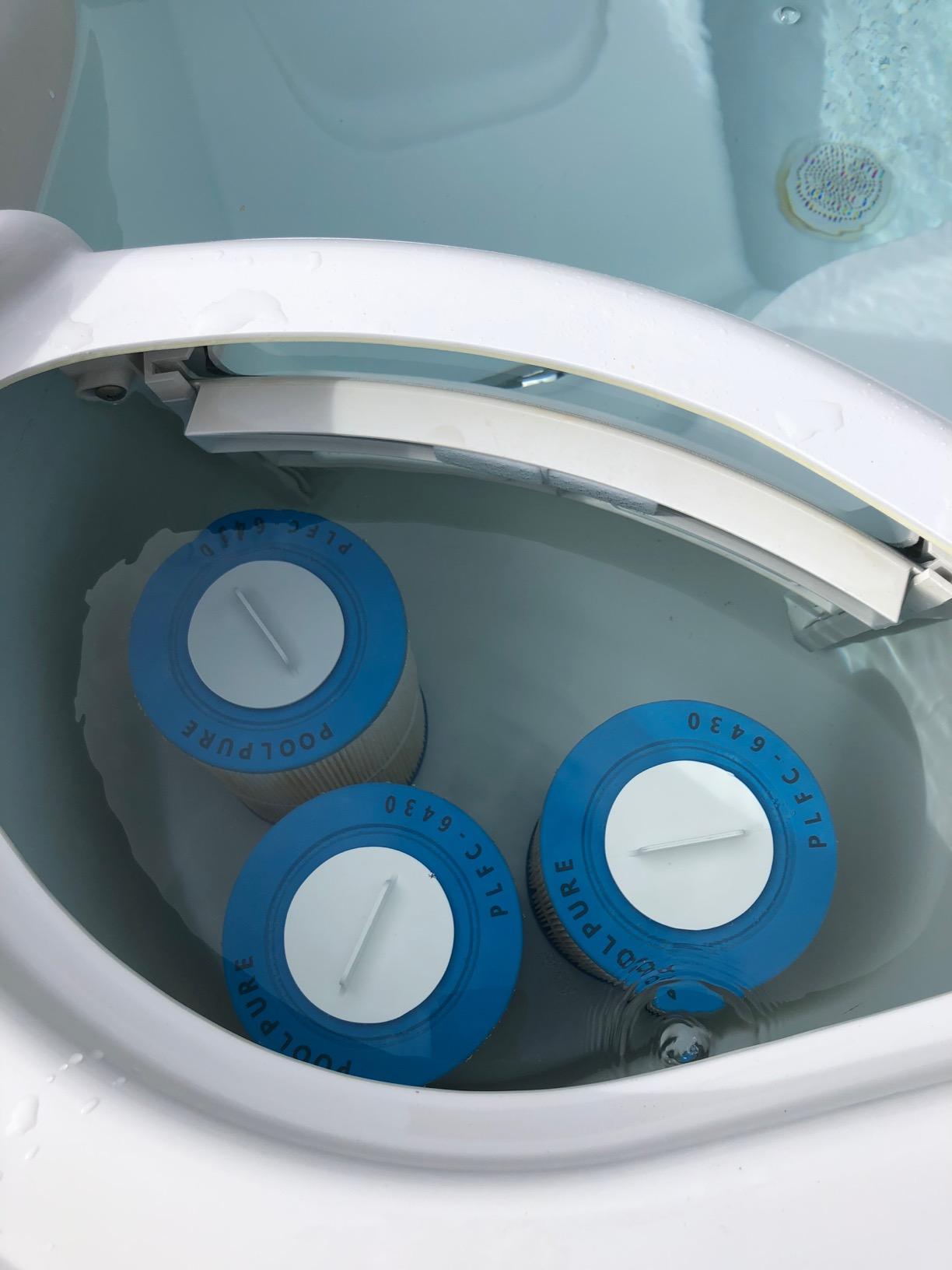
5. POOLPURE C-6430 Spa Cartridges: the Strongest Build in the Group
POOLPURE C-6430 Spa Filter Replaces 31489, PWK30, Filbur FC-3915, 3 Pack
30 sq ft filtration area
50-micron precision
Trilobal fabric
IAPMO certified to NSF/ANSI 50
Pros
- Fits Watkins
- Pleatco
- Unicel and Filbur models and seats cleanly
- Solid build compared with store-brand alternatives
- Trilobal fabric captures and releases stains easily
- Six-month manufacturer guarantee
- Owners report roughly two-year cartridge life
Cons
- No functional complaints reported
- Reservations in reviews center on the bulk of a three pack
This is where the roundup moves from above-ground pool cartridges to spa and hot tub elements, and it is also the highest-rated product we looked at. At 4.8 stars with 87 percent of reviews at five, it is the one to buy if your filter housing is a spa or small hot tub rather than a swimming pool pump.
It replaces Watkins 31489, Pleatco PWK30, Unicel C-6430, Filbur FC-3915, and a long list of numeric equivalents including 73178, 73250, 71825 and P/N 0969601. Each element is 10 1/2 inches long with a 5 7/8 inch outside diameter and a 1 15/16 inch top and bottom opening, which is the geometry you should measure before ordering.
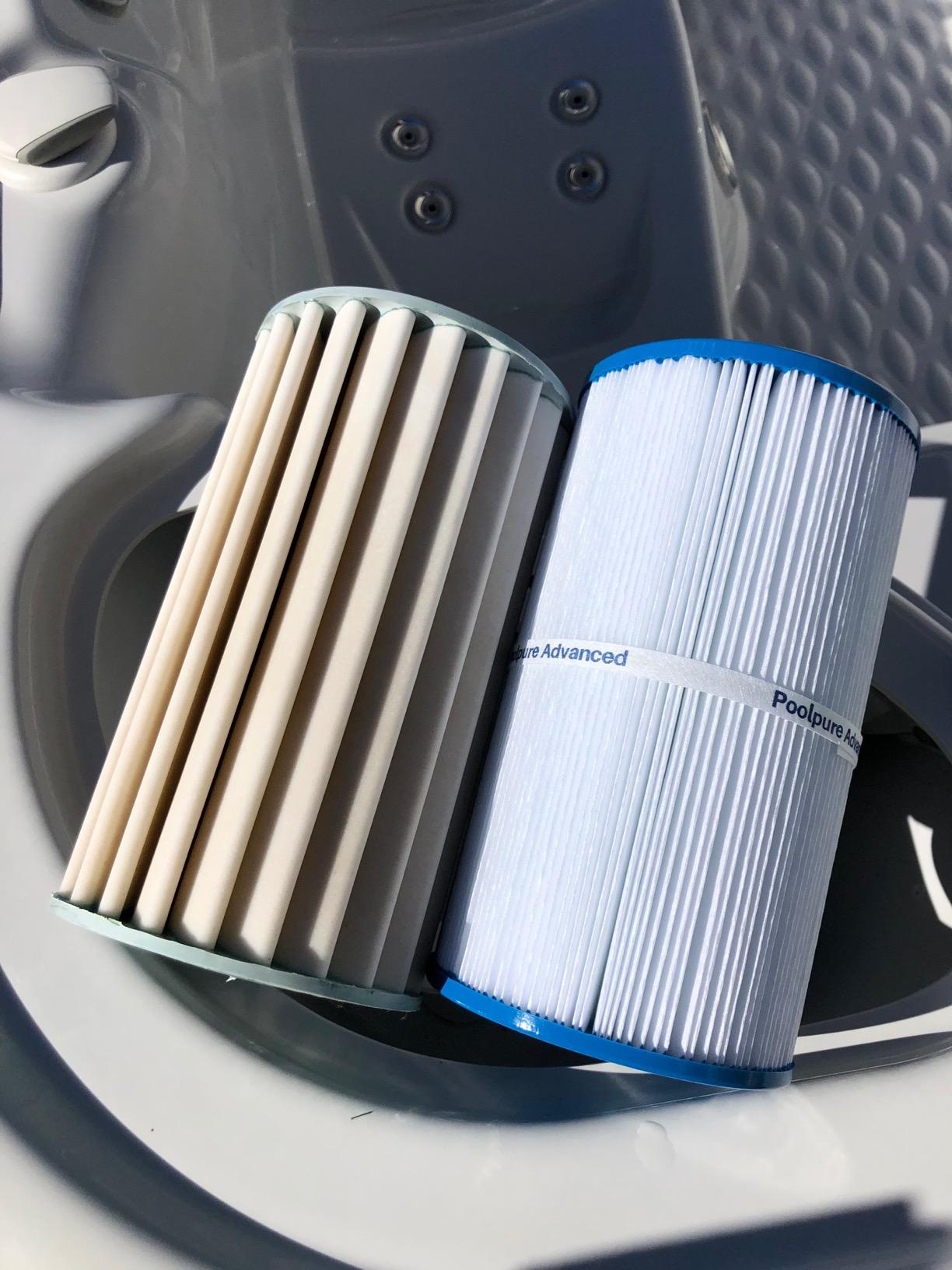
The filtration numbers here are the strongest in the roundup: 30 square feet of media area per element, rated at 50-micron precision, built from trilobal filtration fabric and IAPMO tested and certified to NSF/ANSI 50 for safe materials. That 30 square feet of area is the number that matters when you are sizing anything, because area is what determines how long flow holds before pressure climbs.
Build quality is the recurring theme in the reviews. Owners describe a proper fit that seats cleanly, a solid feel that compares well against store-brand spa cartridges, and a fabric that captures stains and then releases them easily when rinsed. Several cite the six-month manufacturer guarantee directly as their reason for trusting the construction, and a number of owners report swapping these out roughly every two years rather than every two weeks, which is the big practical difference from a pool cartridge.
Is a spa cartridge right for a small swimming pool?
Only if your pump housing matches. Spa and hot tub elements are physically larger and are built to sit in a larger canister or a spa skimmer-style housing, not in an above-ground pump lid. What a spa element does give you is far more filter area in a single part, which is why they are the sensible choice for a small pool if your system is built around one.
For a small pool with a standard above-ground pump, you want a Type A, Type B or universal element instead. If you are unsure, measure the height and diameter of the element you are currently running and compare against the 10 1/2 inch by 5 7/8 inch geometry here. There is no adapter that will bridge a Type A housing and a C-6430 element.
What does the two-year life figure depend on?
On whether the pool or spa is actually filtered with this element in it and how hot the water runs. A spa cartridge is washing continuously in water hot enough to make any oil and mineral deposit far more aggressive, and most owners still clean it monthly by hand. Reported life of around two years assumes monthly hand cleaning, and it shortens fast if you let oils dry on the media between services.
It is IAPMO certified and comes from a Pool and Hot Tub Alliance member brand, which matters more than it sounds. That certification is the difference between knowing the media is safe for contact with water and assuming it, and for anything installed near a hot tub or a pool a child uses, we would not skip it.
6. POOLPURE Type B Cartridges: Three-Pack for 29005E and JPC01 Pumps
POOLPURE Type B Pool Filter Replace Intex 29005E, 29005/59905, JPC01, 3Pack
Type B elements, 5.75 x 10 inches
Replaces Intex 29005 / 59905 and JPC01
50-micron filtration
Pros
- Trilobal fiber structure provides high adsorption surface area
- Dirt-locking design rinses clean and stays reusable
- 50-micron layer captures hair
- leaves
- dust and sand
- Three elements per pack
Cons
- Two-week replacement interval is short for high-use spas
- Frequent replacement needed if not rotated and rinsed
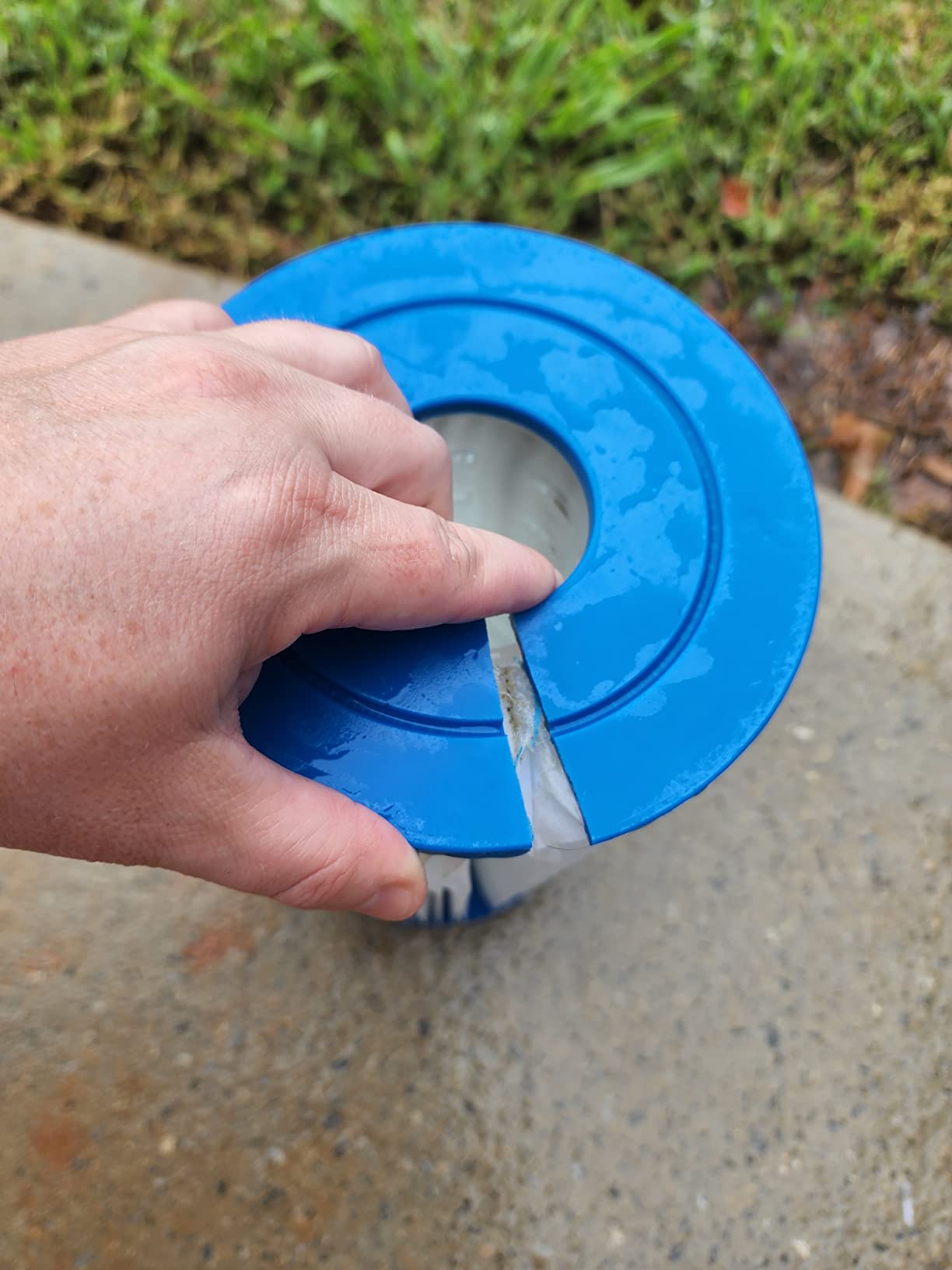
This is the direct alternative to the Future Way Type B, and for anyone running a three-pack rotation it is the more economical route. Each element measures 5.75 by 10 inches and replaces the Intex 29005 and 59905 cartridges as well as the JPC01, fitting Intex pump models 633T and 634T along with the CS8111 and CS8221/CS8231 housings.
What separates it from the paper-based options is the patented dirt-locking structure. Instead of relying on fibre loft alone to hold particles, the trilobal structure grips debris mechanically, which is why owners report that the element rinses back to full flow with a hose rather than needing a soak. The claim attached to it is a 50-micron filtration layer removing up to 99 percent of fine particles, and the trilobal fibre is described as providing three times the adsorption surface area of conventional filter fabrics.
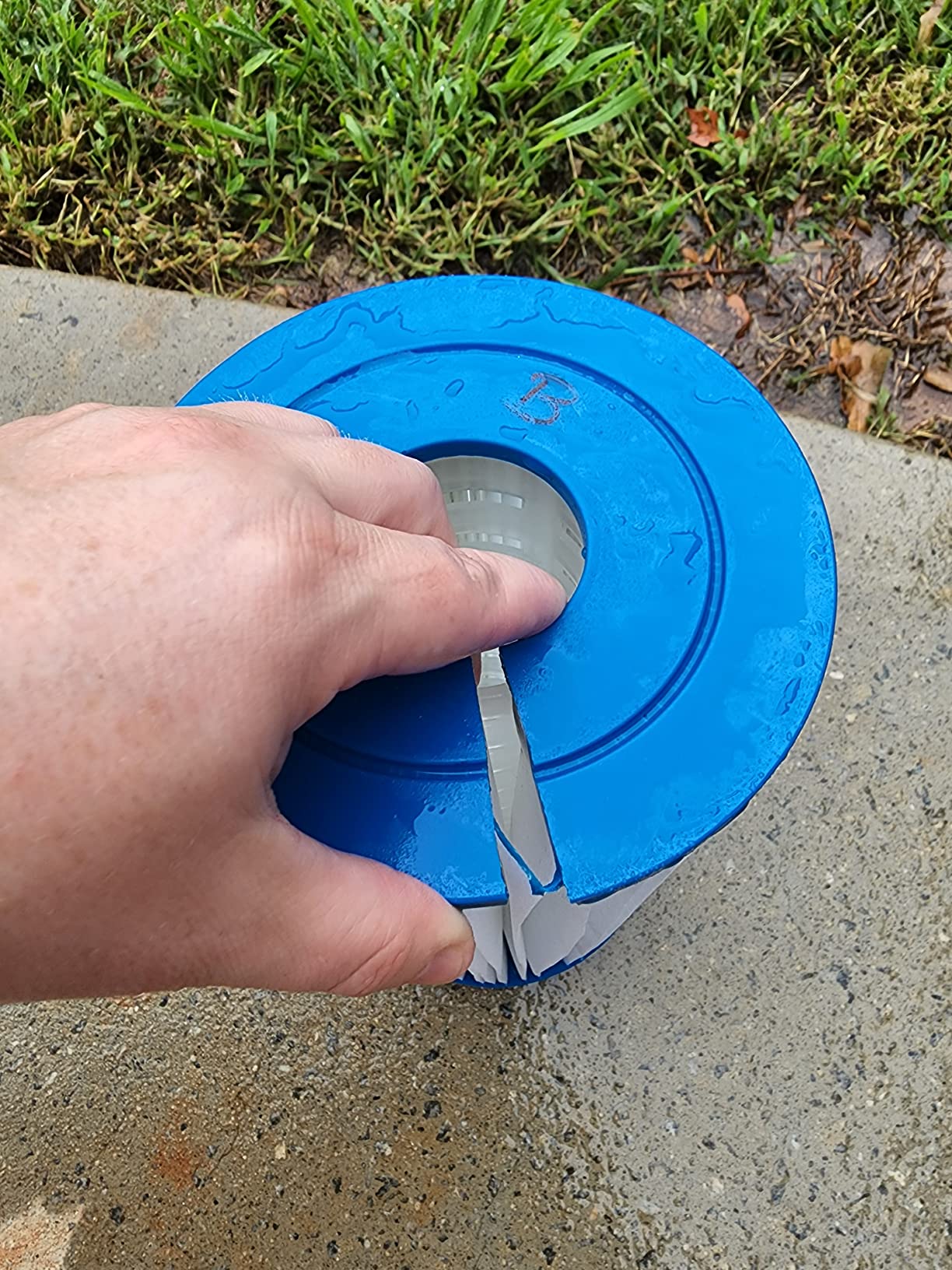
At 4.6 stars with 79 percent five-star ratings, the sentiment is broad rather than grudging. Buyers credit the fabric with easy rinsing and clearer water and treat the reusability as a real saving on both time and ongoing purchases. The POOLPURE brand is a Pool and Hot Tub Alliance member, so the same material certification standard applies as on the spa cartridge above.
The honest caveat is the interval. The manufacturer recommends replacing every two weeks, and owners of high-use spas describe that as the point where the schedule becomes unrealistic. A spa that filters continuously will consume a two-pack quickly, which is the same argument for a larger-area spa element we make below.
Should I choose this or the Future Way Type B?
Choose by pack size and by how much friction you want during removal. The Future Way element has a very snug fit and owners describe the pleats as holding shape through repeated cleanings, while this one is sold in a three-pack at a lower per-element cost. If you are planning to rinse and rotate rather than discard, the larger pack is the better economics over a season.
Both fit the same 10 inch by 5-3/4 inch format and both cover the 29005E and 59905 element numbers, so the choice comes down to how you prefer to service it. One note on flow: the Future Way listing describes a reinforced core specifically for high-pressure flow on 2500 to 4000 GPH pumps, and if you are running the largest pump in this class with a long plumbed run, that reinforcement is worth something.
What is the realistic service life on a small pool?
On a small residential pool filtered eight hours a day, owners treat two weeks as the manufacturer minimum rather than a target. Keeping two elements in rotation, rinsing each one fully and letting it dry in the sun is what extends the interval, and it is the reason the three-pack format exists in the first place.
Rotate the elements as a set, though, and note that a hot tub and a swimming pool have completely different expectations. If your filter is serving a spa, the two-week guidance is closer to reality, and the two-year life reported for larger-area spa elements is the more sensible target. We get into the differences in the hot tub section below.
7. TOREAD Watkins 31489 Spa Filters: the Thickest Media in the Roundup
TOREAD Watkins 31489 Spa Filter Replaces Pleatco PWK30, Unicel C-6430
Replaces Watkins 31489 and PWK30
30 sq ft, 50-micron
IAPMO certified to NSF/ANSI 50
Pros
- Thicker filtration fabric that owners associate with longer service life
- Chlorine-resistant break-resistant end caps
- Trilobal fabric captures and releases stains easily
- 50-micron filtration for hair
- leaves
- dust and sand
Cons
- Cannot be backwashed
- Manufacturer warns backwashing can crack the cartridge
At 4.8 stars with 85 percent of reviews at five and only 1 percent at one, this has the thinnest complaint profile in the roundup. It is a drop-in for Watkins 31489, Pleatco PWK30 and Unicel C-6430, with the same 10 1/2 inch by 5 7/8 inch geometry as the POOLPURE C-6430, and it also covers Aladdin 13004 and 13004ECO plus a long list of SD and PLE part numbers.
The construction claim is the differentiator. The filtration fabric is stated as 25 percent thicker than standard, and the end caps are chlorine-resistant and break-resistant, which the manufacturer ties to extending service life by 20 to 30 percent. Each element delivers 30 square feet of filtration area at 50-micron precision from trilobal fabric, and it is IAPMO tested and certified to NSF/ANSI 50.
Owners read that thicker media the same way in practice. Reviews associate the build quality with longer service life and describe the trilobal fabric as easy to work with during a monthly cleaning, capturing stains and then releasing them under a rinse rather than holding them in the fibres. One element weighs a pound, so handling it during a monthly service is not a strain.
Why does the no-backwash warning matter?
Because it is the single most common way people damage a cartridge. The manufacturer is explicit that this element is not designed for backwashing and that doing so may cause cracks or permanent damage. Cartridge elements have no multiport valve or backwash line, so the temptation only arises if you are used to a sand filter and try to improvise.
Cleaning is hand work. Rinse from the top down against the direction of flow, use a cartridge cleaner for anything oily, and let it dry fully before reinstalling. Hosing a heavily loaded element without a soak is what folds pleats and shortens life, and it is the mistake that costs people the thick media advantage they are paying for.
Is this better than the POOLPURE C-6430 for the same housing?
They are direct substitutes for the same Watkins and Pleatco part numbers, so the decision comes down to pack size and construction preference. The POOLPURE comes three to a pack and carries a six-month manufacturer guarantee, which several of its owners call out specifically. This one sells thicker media with reinforced end caps and a claimed life extension.
Ratings are effectively tied, with both at 4.8. We would pick the three-pack if you want fewer order cycles and a written guarantee behind the build, and this one if you are replacing a single element that is already known to fit and want the thicker fabric. Check the dimension list against your existing element before ordering either.
8. POOLPURE Antimicrobial 5×13 Spa Filters: for Hot Tubs with Short Bodies
POOLPURE Antimicrobial Spa Filter Replacement for Pleatco PRB50-IN-M, Unicel C-4950RA, Guardian 413-212-02, Filbur FC-2390M,17-2380,Jacuzzi J200 Series Filter,373045, 5X13 Hot Tub Filter, 2 Pack
Antimicrobial 5x13 hot tub element, two pack
13-5/16 inch length, 5 inch diameter
Pros
- Antimicrobial treatment adds protection for hot tub water
- Trilobal fibers capture dirt and sediment while holding clarity
- Dirt-locking structure makes rinsing simple and reuse practical
- 50-micron layer holds up under frequent hot tub use
Cons
- Long 13-5/16 inch body will not fit shorter 5x13 housings without checking
This is the long-body hot tub element, and the length is the whole point. It is 13-5/16 inches overall with a 5 inch outside diameter and fully open 2 1/8 inch holes at both ends, which makes it a different fit from the 10 1/2 inch spa elements on this list. It replaces Pleatco PRB50-IN-M, Unicel C-4950RA, Filbur FC-2390M, Aladdin 15002, Guardian 413-212-02, 17-2380 and Jacuzzi J200 series filters including the J210, J220, J235, J245 and J275 models.
The antimicrobial treatment is the feature that separates it from a standard spa cartridge. In water held at spa temperature, a treated element is a sensible upgrade, and the trilobal fibre with the patented dirt-locking structure is what lets the element rinse clean and be reused rather than discarded after a month.
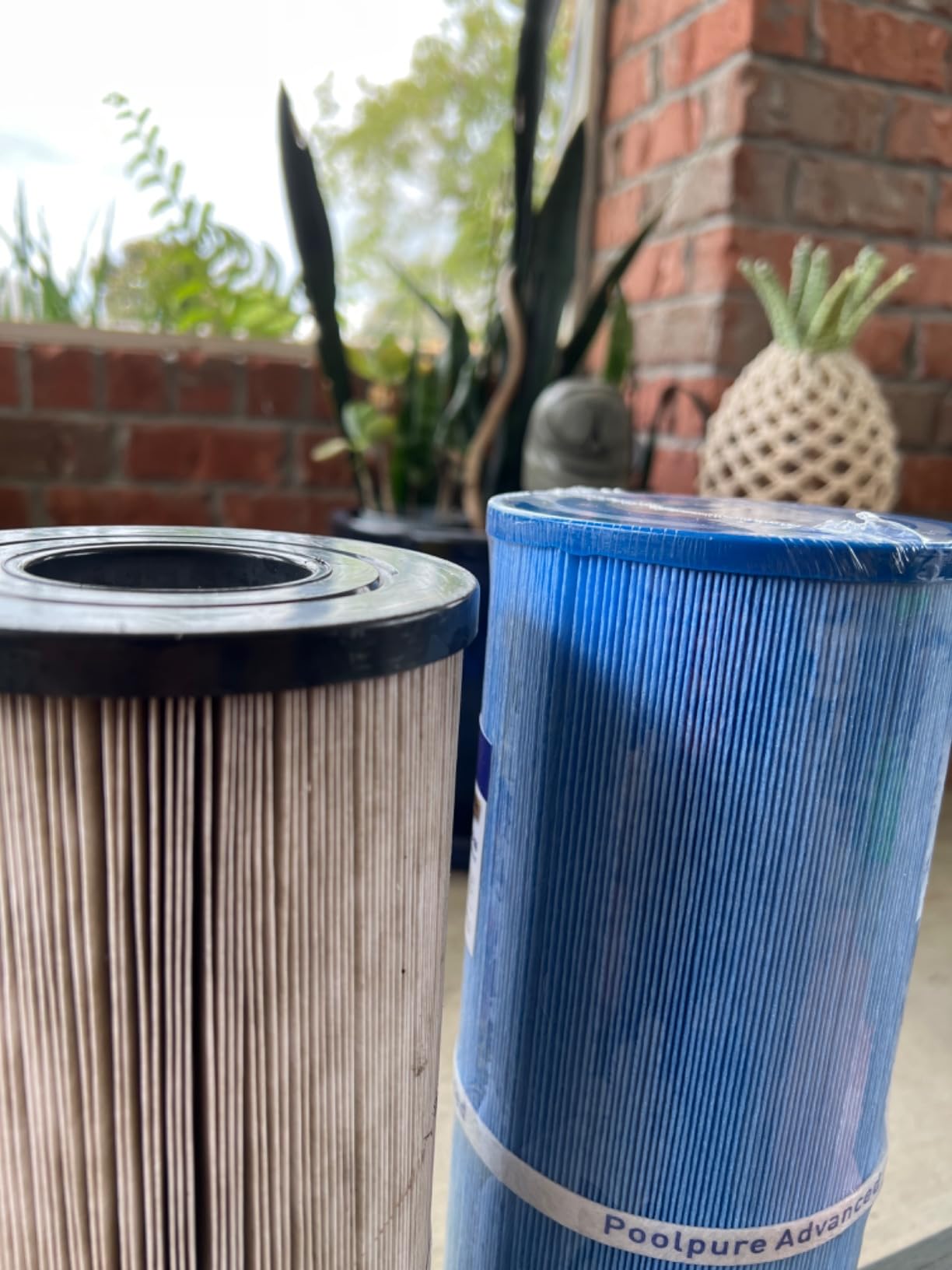
At 4.8 stars with 90 percent of reviews at five, this has the highest five-star share of anything we looked at, and no one-star ratings at all. The sample is smaller than the OEM Intex cartridge, so treat the number with appropriate caution, but the sentiment is consistent around the antimicrobial treatment and how thoroughly the dirt-locking fabric releases debris when rinsed.
The limitation is dimensional and it catches people out. A 13-5/16 inch body will not fit a shorter 5×13 hot tub housing without checking, and hot tub cartridges are not interchangeable across length even when the diameter matches. Measure the seated depth of your existing element, including how far it stands proud of the housing, before ordering. A pack weighs 3.69 pounds, so shipping and storage are slightly heavier than the smaller elements here.
Is a hot tub element ever right for a small pool?
Almost never as a routine pool filter. Hot tub elements are chosen for chemical compatibility in warm, constantly circulating water and for their length, not because they filter a pool better. A pool pump housing will not accept the 13-5/16 inch body, and forcing the geometry to match will not work.
The exception is a small pool converted to a spa or plunge tank, or a hot tub plumbed into a pool system as an overflow feature. In that case, measure the existing element and match length and diameter together. If the diameter is right and the length is short, this is the part, but verify before ordering because a length mismatch is a straightforward return.
How often does a hot tub cartridge need service?
More often than a pool cartridge, and the difference is chemistry as much as debris. Hot tub water runs warm enough that oils, body lotions and sunscreen residue bind to the media faster, and the same 50-micron layer that keeps a pool clear will load up in a spa within weeks of continuous filtration.
Hand cleaning monthly is the baseline owners report, and a two-pack means one element can dry fully while the other is in service. If your hot tub is used heavily or covered poorly, budget for that monthly cycle rather than treating it as a once-a-season task. We have covered the cleaning method in detail in the section below.
How to Size a Cartridge Filter for a Small Pool
You need one number and one ratio. Measure your pool’s volume in gallons, then match it to a filter with enough square feet of media area to handle that volume at your pump’s flow rate. The industry rule for a small pool is roughly one square foot of filter area per 10,000 gallons, so an 8,000 gallon above-ground pool needs about 10 square feet and a 15,000 gallon pool needs 15.
On flow, the target is turnover: how many times the pool’s full volume passes through the filter in 24 hours. One turnover a day is the minimum, two is better, and a small pool running a low-flow pump benefits most from the higher number. Divide gallons by hours available in a day, and that is the GPH your filter needs to deliver.
Here is the lookup most people actually need. An 8,000 gallon pool needs 10 sq ft of area and roughly 333 GPH for one turnover in 24 hours. A 10,000 gallon pool needs 12 sq ft and about 417 GPH. A 12,000 gallon pool needs 15 sq ft and about 500 GPH. A 15,000 gallon pool needs 18 sq ft and about 625 GPH. Beyond 15,000 gallons you are out of small-pool territory and into large stand-alone tanks.
To calculate the volume yourself for a round pool, take the diameter squared, multiply by the average depth, then multiply by 5.8. A 12 ft round pool with an average depth of 3.5 ft gives 144 x 3.5 x 5.8, which is about 2,900 gallons, and that fits comfortably with a 530 to 1000 GPH above-ground pump. For a rectangular pool, multiply length by width by average depth by 7.5.
One caution from owner experience: an undersized filter is the most common reason a pressure gauge will not settle. Forum discussion on pool equipment is full of people reporting readings above 30 PSI regardless of pump speed, and the common cause is a filter that is too small for the pump feeding it. Sizing up one step costs you nothing but space, and it lengthens cartridge life at the same time.
On small above-ground pools, the pump and the filter are almost always sold together and the element is chosen by the pump, not by the pool. That is the key point. Above-ground circulation pumps come in defined flow classes, and each one uses a specific element format. Measure the existing cartridge, match the format, and the pool volume simply confirms that the pump class is adequate.
Filter and Pump Kits vs Stand-Alone Tanks vs Cartridge-Only Buys
These three purchases solve different problems and confuse a lot of first-time buyers. Knowing which one you need is worth more than any spec on the box.
An integrated filter and pump kit is a single sealed unit where the pump motor and the filter housing are bolted together, with hoses already attached. This is the default for a new above-ground pool and the reason Type A and Type B elements dominate replacement searches. Everything is a closed loop, there is no plumbing to run, and the only thing you ever replace is the element. Buy one of these if you are setting up a new pool or your old unit has failed outright.
A stand-alone tank is the filter housing without a pump, sold for in-ground or larger above-ground systems. You pair it with a separate pump, and it gives you a much larger media area than any kit housing. For a small pool this is usually more capacity than you need, and the extra cost is only justified if you are building a system where the filter also serves a spa or a water feature.
A cartridge-only buy is exactly what most people searching this query end up buying. You already have a working pump and housing, and you need the element. That is the category this roundup covers, and it is the one where format matching matters most, because a wrong-format cartridge is a wasted order rather than a slow performance loss.
There is a fourth option worth knowing about: replacing a sand filter with a cartridge system. Owners on the pool forums describe the conversion as straightforward once you confirm the multiport valve ports line up with your plumbing, and they report clearer water, no backwashing and lower electricity use. The main planning point is that the valve becomes unnecessary, and some owners keep it closed off rather than removing it entirely to make the change back later.
Cartridge vs Sand vs DE for Small Pools
Cartridge filters usually win for small pools on water waste and control, sand wins on unattended maintenance, and DE wins on fineness while costing you in effort and air quality.
Sand filters trap particles down to roughly 20-25 microns and hold more dirt than a cartridge before backwashing is needed. That means less frequent attention, and backwashing is fully automatic through a multiport valve. The trade is water. Every backwash sends several thousand gallons out, which matters in drought-restricted areas, and sand is heavier to move and harder to handle at installation.
Cartridge filters strain finer, to roughly 10-15 microns, and never waste water. That is a real advantage where backwashing is restricted or expensive, and it eliminates the dust cloud that DE and some sand discharges put into the air near a pool deck. The trade is that cleaning is manual, more frequent, and has to happen at the right interval to keep flow up.
DE filters are the finest of the three, down to about 5 microns, and they are the standard for in-ground pools that need a very clear read on water. They are also the most work. DE powder has to be dosed, allowed to settle and then backwashed, and the resulting backwash produces a fine white dust that is genuinely unpleasant next to a pool. We would not choose one for a small pool.
For a small pool, the practical answer is a cartridge. Below 15,000 gallons the water savings and the control over your own yard outweigh the extra cleaning, and the run cost is lower because a cartridge system at lower flow does not need the pump speed a sand filter requires to push water through sand. If you are in an area with heavy tree debris or you want zero hands-on cleaning, a sand filter is a reasonable alternative.
The Honest Downsides of Cartridge Filters
Cartridge filtration is not right for everyone, and the reasons are worth stating plainly before you buy. Here is the list competitors usually skip.
There is no backwash, so cleaning is always manual. A sand filter reverses itself with a valve. A cartridge means shutting off the pump, releasing pressure, opening the housing, pulling the element and rinsing it, every time the pressure climbs. Owners who dislike any physical maintenance of pool equipment are the group most likely to regret this choice.
Upfront cost is higher for a comparable capacity. Cartridge systems and their elements cost more than a sand filter with sand, and if you replace the element on a two-week cycle in peak season, the running cost of cartridges adds up over five years in a way that sand media does not.
Oils and sunscreen clog pleats faster than sand. A sand filter backflushes oils out completely. A cartridge traps them in the fibres, and if you only hose an element down, the oils stay, the pleats mat, and the cartridge can stop filtering even though it looks rinsed. This is the most common complaint on pool forums, and it is solved with a proper filter cleaner rather than water alone.
It needs somewhere to dry. Cleaning a cartridge is a two-stage job: wash it, then let it dry completely before it goes back in. That means space, and in a small backyard with a shed already full of pool gear, it is a genuine constraint that sand filters do not have.
And a wrong-format cartridge is a dead purchase. Unlike sand, which is somewhat interchangeable between tanks, cartridge elements are format-specific. Buying the wrong Type A versus Type B, or a spa element for a pool housing, means the part simply will not fit, and off-brand pumps with no widely available cartridge are the worst case, with owners reporting weeks of waiting for a replacement.
There are two situations where we would skip a cartridge filter entirely. An inflatable or kiddie pool under 1,000 gallons does not need filtration hardware at all. And a pool under heavy tree cover that fills with leaves faster than any element can be cleaned will work far better with a sand filter that backwashes its own dirt away.
How to Clean a Cartridge Filter and When to Replace It
Cleaning a cartridge takes about ten minutes once you have the habit, and doing it on a schedule rather than on an emergency is what makes the difference between a two-year element and a six-week one.
Start with your baseline. Run the pump with a clean element, read the pressure gauge and write the number down. That is your clean baseline. When the gauge later reads 8 to 10 PSI above that figure, the element needs cleaning. Forum owners report that not knowing the baseline is why people both clean too rarely and over-clean, and tracking it for a single season fixes the habit almost immediately.
Then clean in four steps. Shut the pump off and close the valves so pressure equalises before you touch the housing. Open the lid, lift the element out and set it on a flat surface. Rinse from the top down with a garden hose, working against the direction of water flow so debris lifts off rather than deeper into the pleats. Let it dry fully in the sun before reinstalling, and never put a damp element back into service.
For anything oily, a hose is not enough. Spray on a purpose-built cartridge filter cleaner, let it sit for the time on the label, then rinse. Multiple owners report that this treatment alone brings a two-year-old element back to usable flow, and it is far more effective than soaking elements in household chemicals, which some formulations can damage.
On interval, the manufacturer recommendation of every two weeks applies to heavy use in peak season with a fresh element. Rotating two elements and rinsing each between uses roughly doubles that. In spring and fall you can clean on gauge reading rather than on the calendar.
Replace rather than clean when the media is visibly frayed or the pleats are permanently matted, when the centre core is cracked, or when cleaning no longer brings the gauge back within a few PSI of baseline. Anything frayed or split is a filtration and safety issue, not a performance one. Store replacement elements indoors, dry and out of sunlight, and never install an element that has been sitting wet in a closed box.
One last habit worth adding: clear debris out of the pool before you start the pump on the first day of the season. A vacuum pass takes twenty minutes and prevents the single worst cartridge-load event of the year. If you are still choosing equipment for the season, our robotic cleaner comparison covers the in-ground side, and our pool heater guide is worth a look if you plan to extend your season, since more run hours mean more cleaning cycles.
Replacement Cartridge Part Numbers and Cross-References
If your pump housing already exists, you do not need a filter recommendation, you need a part number. This is the cross-reference, taken directly from the compatibility lists on each product.
Type A elements, the short format, cover Intex Krystal Clear 28603EG, 28637EG and 28635EG, plus pump models 603, 604/G, 637R, 638R/G, 635T and 636T/G, and the original Intex 29000E and 59900E element numbers. The OEM version is the 29002E, and universal versions cover Intex plus Bestway 58384(E), 58387, 58388E, 58389 and 58390(E) and most Summer Waves RX, RP, SFS and CP2000-C housings.
Type B elements are the taller format at roughly 10 inches by 5-3/4 inches, used on the higher-output pumps. They replace the Intex 29005E, 29005 and 59905 elements and the JPC01, and they fit pump models 633T, 634T, CS8111 and CS8221/CS8231, along with Krystal Clear 2500, 3000 and 4000 GPH units.
Spa elements in the 10 1/2 inch by 5 7/8 inch format replace Watkins 31489, Pleatco PWK30, Unicel C-6430, Filbur FC-3915, Aladdin 13004 and 13004ECO, and the numeric equivalents 73178, 73250, 71825, 46200, 0969601, SD-00328, SD-00703 and SD-00704.
Long hot tub elements at 13-5/16 inches by 5 inches replace Pleatco PRB50-IN-M, Unicel C-4950RA, Filbur FC-2390M, Aladdin 15002, Guardian 413-212-02, 03FIL1600, 817-5000, 435-0037, R173434, 06-0012-12, SD-00201, PLE-051-0088 and 6540-471, plus Jacuzzi J200 series and J210, J220, J235, J245 and J275 hot tub filters.
When in doubt, measure. Record the height, the outside diameter and the inner opening of the element currently in your housing, then match all three. The inner opening is the number people skip, and it is the one that decides whether the pump lid will seat.
Frequently Asked Questions
How do I know what size cartridge pool filter I need?
Measure your pool volume in gallons, then aim for about one square foot of filter area per 10,000 gallons. So a 10,000 gallon pool needs about 12 sq ft and a 15,000 gallon pool needs about 18 sq ft. On small above-ground pools, the element format is set by the pump rather than the pool, so match the cartridge to your pump model instead.
How many GPH should my pool filter be?
Divide your pool’s gallons by the hours you run the pump in a day. One turnover in 24 hours is the minimum and two is better. An 8,000 gallon pool filtered 8 hours a day needs about 1000 GPH, while the same pool on a 24 hour schedule only needs about 333 GPH.
How do I calculate my pool volume?
For a round pool, square the diameter, multiply by the average depth, then multiply by 5.8. For a rectangular pool, multiply length by width by average depth by 7.5. A 12 ft round pool with an average depth of 3.5 ft holds about 2,900 gallons.
What are the disadvantages of cartridge filters?
There is no backwash, so cleaning is always manual and takes about ten minutes. Upfront cost is higher than a sand filter of similar capacity. Oils and sunscreen clog the pleats and need a proper filter cleaner rather than a hose. The element also needs space to dry fully, and the wrong cartridge format is a wasted purchase.
Which brand of pool filters is better, Hayward or Pentair?
Both build quality stand-alone tanks, and the decision for a small pool is usually made for you because above-ground kits come with the pump and filter pre-matched. What matters more is cartridge availability. If your tank is a Hayward StarClear, check the element part number before buying any cartridge, and confirm the replacement is sold by a pool parts supplier rather than only by the manufacturer.
How long does a pool filter cartridge last?
A reusable element that is rinsed and rotated between uses typically lasts one to two seasons, while a disposable-feel paper element in heavy summer use may only last a few weeks. Spa elements in warm, constantly circulating water last the longest at around two years with monthly hand cleaning. Track your pressure gauge baseline rather than guessing by date.
Does a cartridge filter waste water like backwashing?
No. A cartridge filter never discharges water during normal service or cleaning, since cleaning happens with a hose on the lawn. A sand filter sends several thousand gallons out per backwash. That makes cartridge filtration the practical choice in drought-restricted areas or anywhere a backwash discharge is restricted.
Our Pick for the Best Cartridge Pool Filters for Small Pools in 2026
If your pump is an Intex Krystal Clear in the 600 to 1600 GPH class, the 29002E Type A is the buy. It is the OEM element, it fits the most common small-pool housing there is, and no other cartridge in this roundup has a review history that deep. Where the pump brand is uncertain or you need Summer Waves and Bestway coverage, the Volca Spares four-pack is the alternative, and you should expect a tighter seat when removing it.
For pools on the 2500 to 4000 GPH pumps, go Type B, and choose the POOLPURE three-pack for rotation economics or the Future Way two-pack for its reinforced core. For spas and hot tubs, the C-6430 format in 10 1/2 inches is the one to measure against, and the longer 13-5/16 inch element is only correct if your housing depth confirms it.
Whichever you pick, the two things that decide how it performs are unglamorous. Record your clean pressure baseline in the first week, and keep two elements in rotation so the one in service is always a freshly cleaned one. That routine does more for water clarity than any spec on the box.
If you are still building out the equipment list, our backyard pool picks cover the pool itself, and getting the filter element format matched before the pool goes in the ground saves a return trip later.