
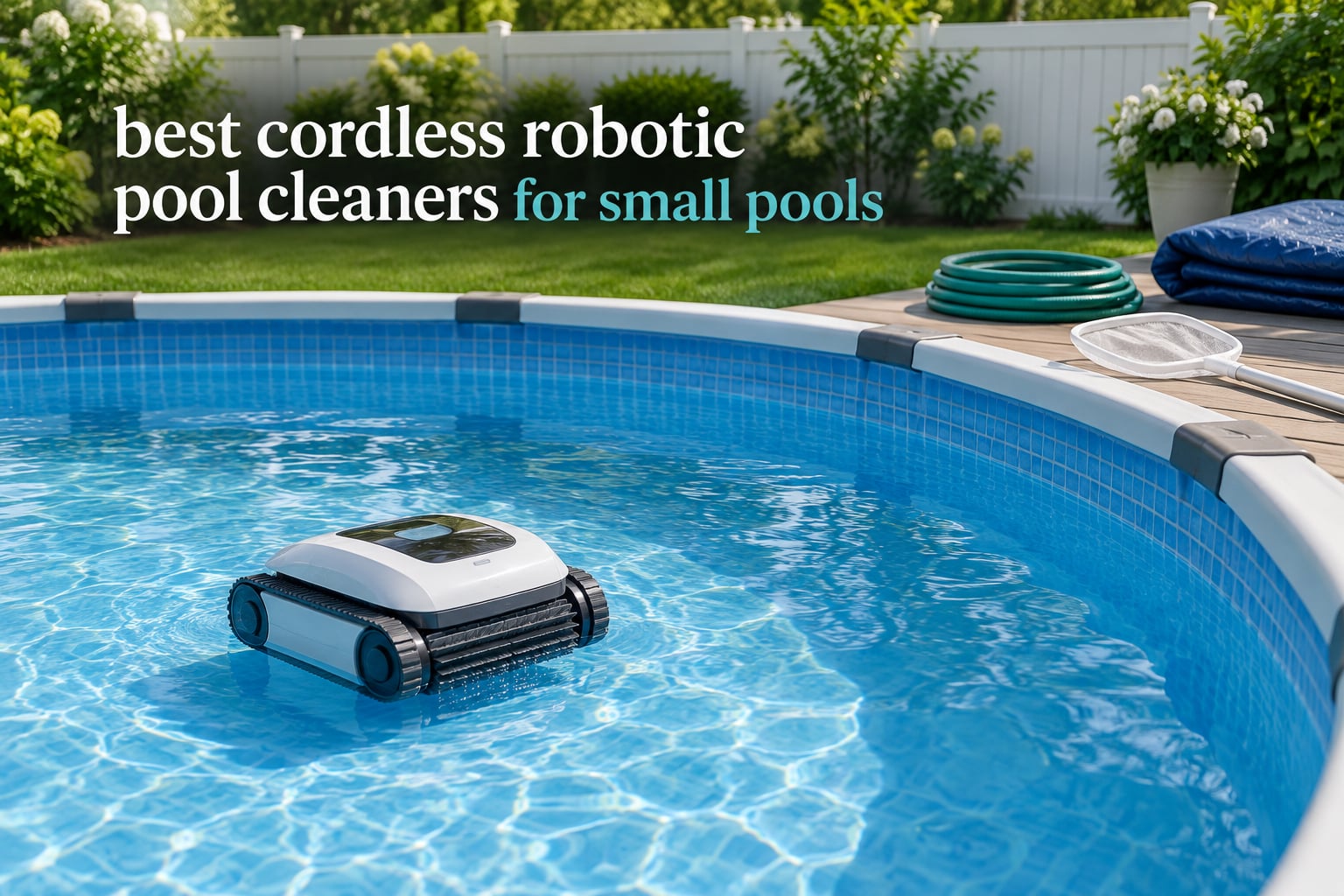
If you own a small pool, you do not need a cordless robot built for a 2,000 square foot backyard. You need roughly 90 to 130 minutes of cleaning, a filter fine enough to hold sand, and a body light enough to lift out one-handed. That is a much shorter shopping list than the one most roundups hand you, and it is the reason a lot of small-pool owners end up overpaying for runtime they will never use.
So here is the short version. The best cordless robotic pool cleaners for small pools are the STARRYBOT Dual-Motor Robot for flat above-ground floors, the AIPER Seagull SE if you want a bigger floor sweep with a chemical dispenser built in, and the WYBOT A1 if you want the strongest suction in a floor-only machine. If your pool has deep walls and a waterline you actually care about, only one pick here climbs them.
Before we get into the reviews, two definitions that make the whole list easier to read. A small pool is under 33 feet long and under about 1,000 square feet, which covers most 8×20 and 12×36 above-ground frames, 24-foot round above-ground pools, and flat-bottom inground pools of similar size. And the runtime math nobody prints: divide your pool’s square footage by 7 to get the minimum minutes of runtime you need, so a 700 square foot pool wants about 100 minutes and a 1,100 square foot pool wants about 160.
That formula matters because most cordless robots are marketed on headline runtime for large pools. You will see 180-minute claims on this list, and you may have 700 square feet of water. Runtime beyond what your pool needs does not clean more, it just means the robot is idling while the filter refills with recirculated debris.
Now the honest part, because it is the loudest thing in the forum data. Experienced owners on r/swimmingpools generally argue that small cordless robots are a mistake and that a corded Dolphin Sigma or Premier is the smarter buy for a small pool. That argument has real weight and I address it directly in the cordless versus corded section below. The short version is that they are usually talking about a pool that already has a working return fitting, and cordless is not competing on suction power, it is competing on convenience. For above-ground pools with low-flow pumps, and for anyone running an automatic pool cover with a crack left open, cordless is frequently the only category that works at all.
All eight robots below are genuinely cordless, all are sized for small pools, and every one carries a real list of drawbacks. We compared runtime, suction, filtration, weight, retrieval and review data across the full lineup.
Table of Contents
Top 3 Best Cordless Robotic Pool Cleaners for Small Pools in October

STARRYBOT Dual-Motor Robot
- 90-minute runtime
- Up to 900 sq ft coverage
- Self-parks with beep and LED
- Dual-motor suction

AIPER Seagull SE
- 1320 GPH suction
- 100-minute flat-pool runtime
- 860 sq ft coverage
- Built-in chemical dispenser

WYBOT A1
- 2280 GPH suction
- 130-minute runtime
- 180 micron plus foam filter
- Edge boost and self-parking
Cordless Pool Cleaners for Small Pools at a Glance in 2026
Every robot in this roundup is battery powered and rated for pools in the small-pool range. Most clean floors only, and the two numbers that decide most purchases are runtime and whether the machine climbs walls, so both are called out below.
| Product | Specifications | Action |
|---|---|---|
| STARRYBOT Dual-Motor Robot |
|
Check Latest Price |
| AIPER Seagull SE |
|
Check Latest Price |
| WYBOT A1 |
|
Check Latest Price |
 PoolMr Cordless Robot PoolMr Cordless Robot |
|
Check Latest Price |
 BRINBO S2 BRINBO S2 |
|
Check Latest Price |
 Winny Pool Cleaner Winny Pool Cleaner |
|
Check Latest Price |
 Pooleco 30GPM Robot Pooleco 30GPM Robot |
|
Check Latest Price |
 MOREBOT SAT 25 MOREBOT SAT 25 |
|
Check Latest Price |
1. STARRYBOT Dual-Motor Robot: Best Cordless Robotic Pool Cleaner for Small Pools Overall
STARRYBOT Robotic Pool Vacuum, Dual-Motor Above-Ground Cleaner
90-minute runtime
Up to 900 sq ft coverage
Dual-motor drive
48 Wh lithium battery
Floor only
Pros
- Picks up sand
- grit
- leaves and dust in a single pass
- No cable to snag on steps or a ladder bracket
- Self-parks with an audible beep and 3-color LED alert
- Filter lifts out and rinses in seconds
Cons
- Floor only with no wall or step climbing
- Corners and edges often need a second run
- Build quality varies from one machine to the next
This is the unit we put at the top of the list for a simple reason: it has the largest body of owner feedback of anything we reviewed, and the feedback is consistent. Across 285 reviews averaging 4.5 stars, the same three things get praised repeatedly, strong suction on sand and grit, cordless convenience, and a filter that rinses clean without any fuss.
In a flat above-ground pool the floor plan is basically a rectangle, which is the easiest possible test for a machine with no mapping. The STARRYBOT covers it. Dual motors drive both the suction and the mobility, and 90 minutes of runtime is more than the 450 square feet of a 24-foot round pool needs by the divide-by-7 rule.
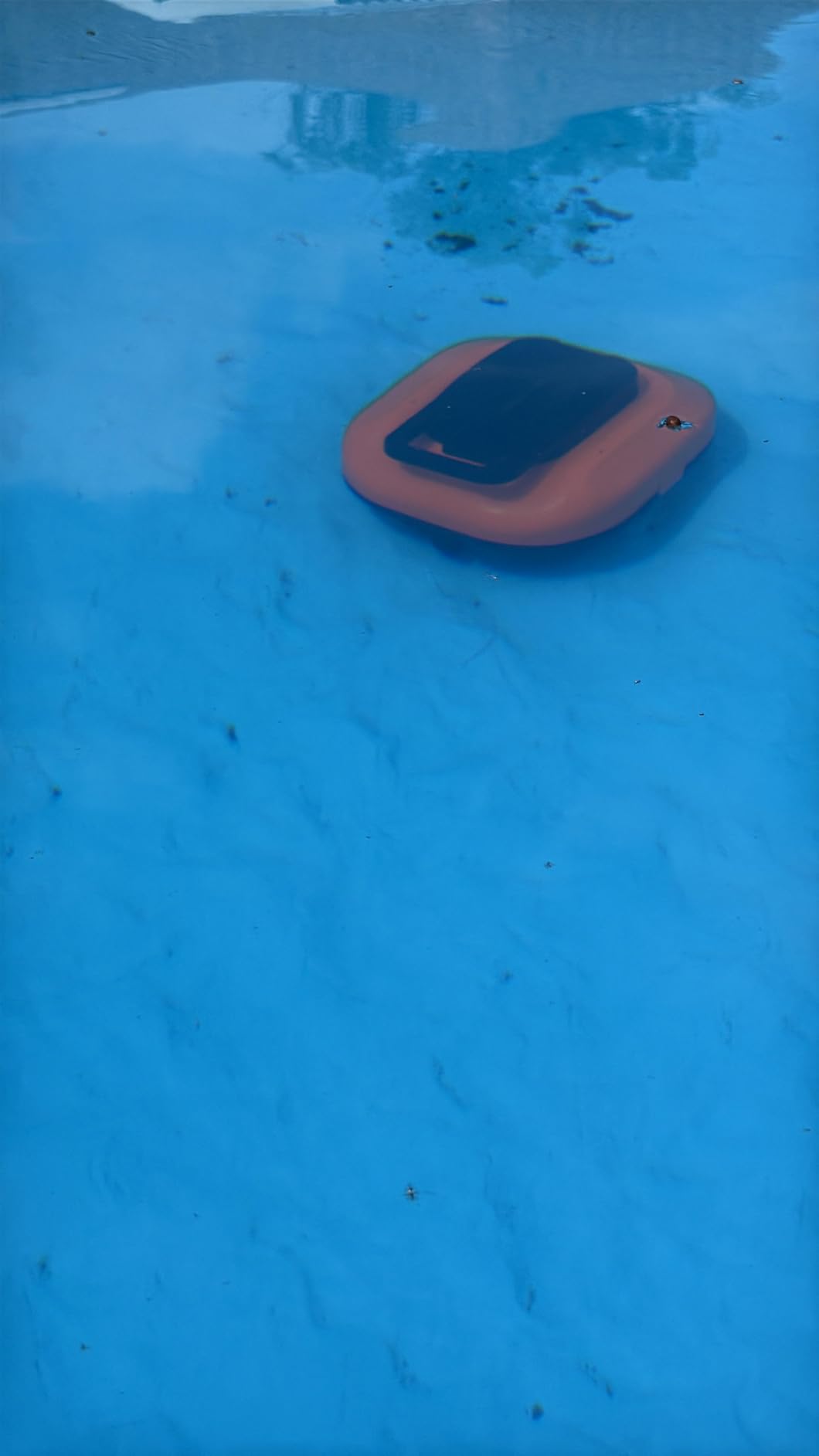
The self-parking is the feature that changes daily life. When the battery gets low the unit climbs to the wall, beeps, and flashes a three-color LED, so you are reaching in with a hook instead of putting your hands on the bottom. For older owners or anyone with a shoulder that does not enjoy lifting a wet machine, that one feature does more work than a wall-climbing mode would.
Weight is worth calling out. The 48 watt-hour lithium pack is a 300 gram battery, and the whole unit is compact at 6.81 by 14.17 by 11.42 inches, which means it stores in a small pool closet without claiming the shelf.
What you get right where it matters
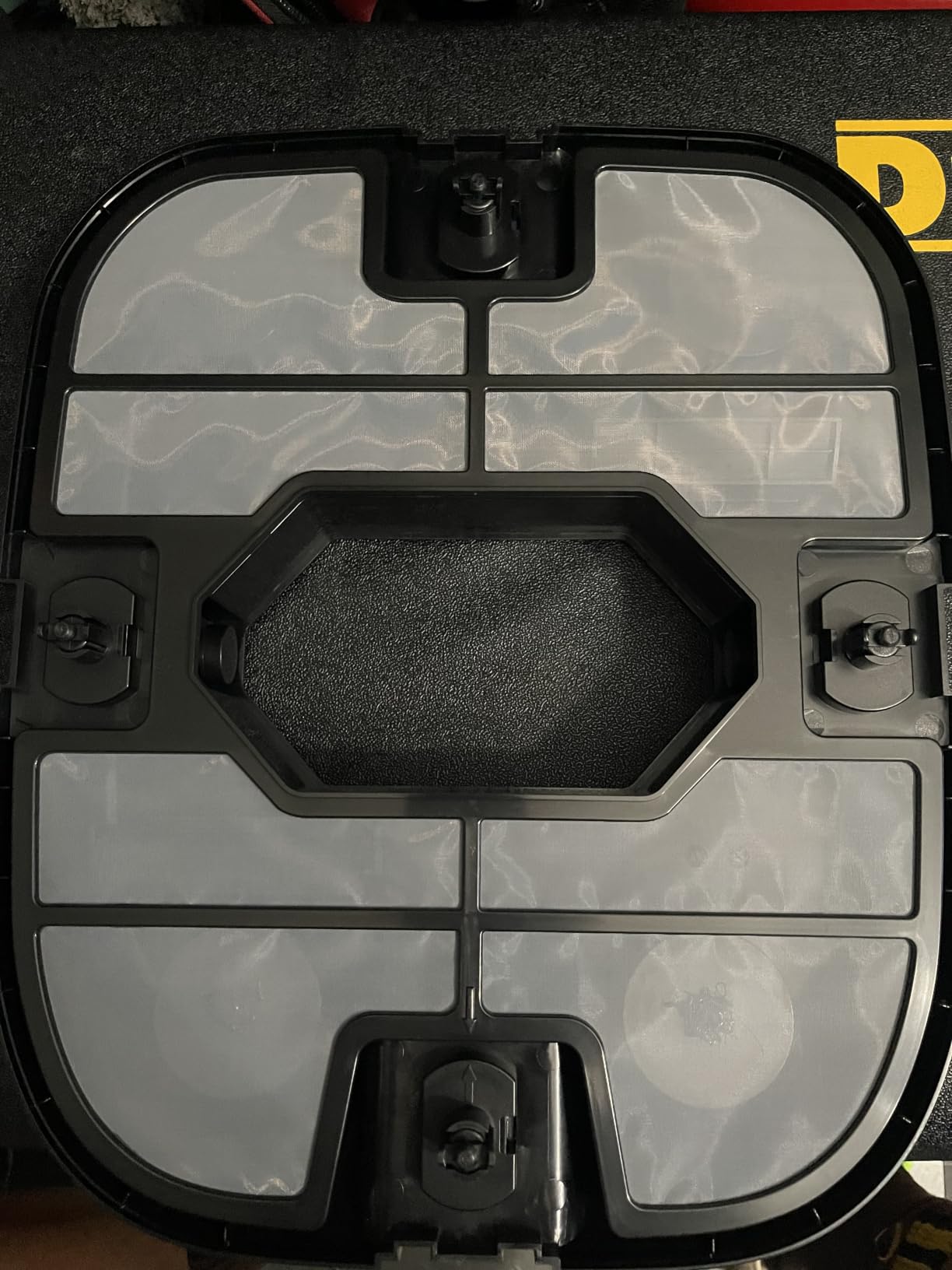
Suction is the headline strength. Owners consistently report it lifting sand, dirt, leaves and fine dust in a single run rather than requiring a second pass. The filter mesh is fine enough to catch small particles, and owners specifically call out how simple it is to pull the basket, rinse it, and put it back.
It is also rated for coverage up to 900 square feet, which covers a 12×36 frame or a small inground without straining. Coverage claims in this category run optimistic, so treat 900 as a ceiling rather than a promise. A 1-year warranty is listed, which matters more than it sounds on a machine this small.
Where it falls short
It does not climb walls, so the waterline is entirely your problem. In a small above-ground pool that is a reasonable trade, because you can wipe a short waterline in a couple of minutes with a cloth.
The real weakness owners report is edges and corners. The unit does not consistently catch debris tight against the wall, which means a follow-up skimming pass is normal rather than exceptional. A smaller number of reviews also describe machines arriving damaged or jamming repeatedly, so inspect the machine the day it shows up rather than throwing it straight in the water.
2. AIPER Seagull SE: Best for Larger Above-Ground Frames
2026 AIPER Seagull SE Cordless Robotic Pool Vacuum for Above Ground Pools
1320 GPH suction
Up to 100 minutes on flat pools
860 sq ft coverage
7.5 lb unit
45 Wh battery
Pros
- 1320 GPH clears sand
- dirt
- algae and leaves on flat floors
- Weighs 7.5 lb so it is easy to lift out even when loaded
- Integrated chemical dispenser for ongoing water treatment
- One-touch start with 4-color LED status
Cons
- No wall
- step or waterline cleaning and no rotating brushes
- Moves on a random unmapped path with no sensors
- Plastic filter lid tabs reported snapping off
The Seagull SE is the pick for owners of the larger end of the small-pool range, a 12×36 or 16×32 above-ground frame that fills fast and collects a lot of silt in the seams. It carries a 1320 GPH suction rate, up to 100 minutes of runtime on flat pools, and coverage rated to 860 square feet.
Two details set it apart from the other budget units here. The integrated chemical dispenser releases a treatment dose during the cycle, which is a small convenience that means one fewer thing to remember. And the whole machine weighs 7.5 pounds, which is genuinely light when the basket is full of wet leaves and you are lifting it over the pool wall one-handed.

Owners treat this as a straightforward budget robot that does a competent job. Leaves, sand and everyday dirt come up reliably, the self-parking works often enough that retrieval is not a chore, and the filter tray opens, rinses and closes without tools.
Be clear about the class of machine this is. It is a floor cleaner for a flat pool, nothing more. There are no rotating brushes, no wall mode, and no waterline capability. If your pool has steps, a sun ledge or a raised main drain, none of those get cleaned by this unit.
What the 1320 GPH rating actually buys you
GPH is gallons per hour of circulation, and it is the most useful single number for comparing floor-only robots. At 1320 GPH, the Seagull pulls more water through the filter than the units at the bottom of this list, which is why owners report it handling algae film and settled sand on the floor more consistently.
The 100-minute runtime means it covers a pool of up to roughly 700 square feet in one pass, so a 12×36 frame at 432 square feet is comfortably inside that. Anything approaching its 860 square foot claim will need a recharge mid-job.
What you give up for the light weight
The tradeoff is fine-particle capture and build quality. Owners report fine particles missing the filter and blowing back out into the water, and one recurring complaint stands out above the rest: the plastic locking tabs on the filter lid are reported to snap off, which can leave the basket unable to close and the unit unusable until you replace the lid assembly.
If you pull the tab gently, rinse the filter under a tap rather than blasting it with a hose, and dry the hinge before snapping it closed, most owners never see the problem. Treat it as a small-plastic-parts machine and it treats you the same way.
3. WYBOT A1: Best Value Cordless Pool Robot for Flat Floors
WYBOT A1 Cordless Pool Vacuum Robot for Above Ground Pool, Greyblue
2280 GPH suction
130-minute runtime
180 micron filter plus foam
Rated to 1,100 sq ft
2-3 hour recharge
Pros
- 2280 GPH pulls fine sand
- grit and leaves from flat floors
- Dual-layer filter leaves the water visibly clearer
- About two hours of runtime covers a full pass
- Self-parking and edge boost make retrieval simple
Cons
- Floor only with no wall or waterline coverage
- No app
- no scheduling and no mapped navigation
- Suction port clogs on larger leaves
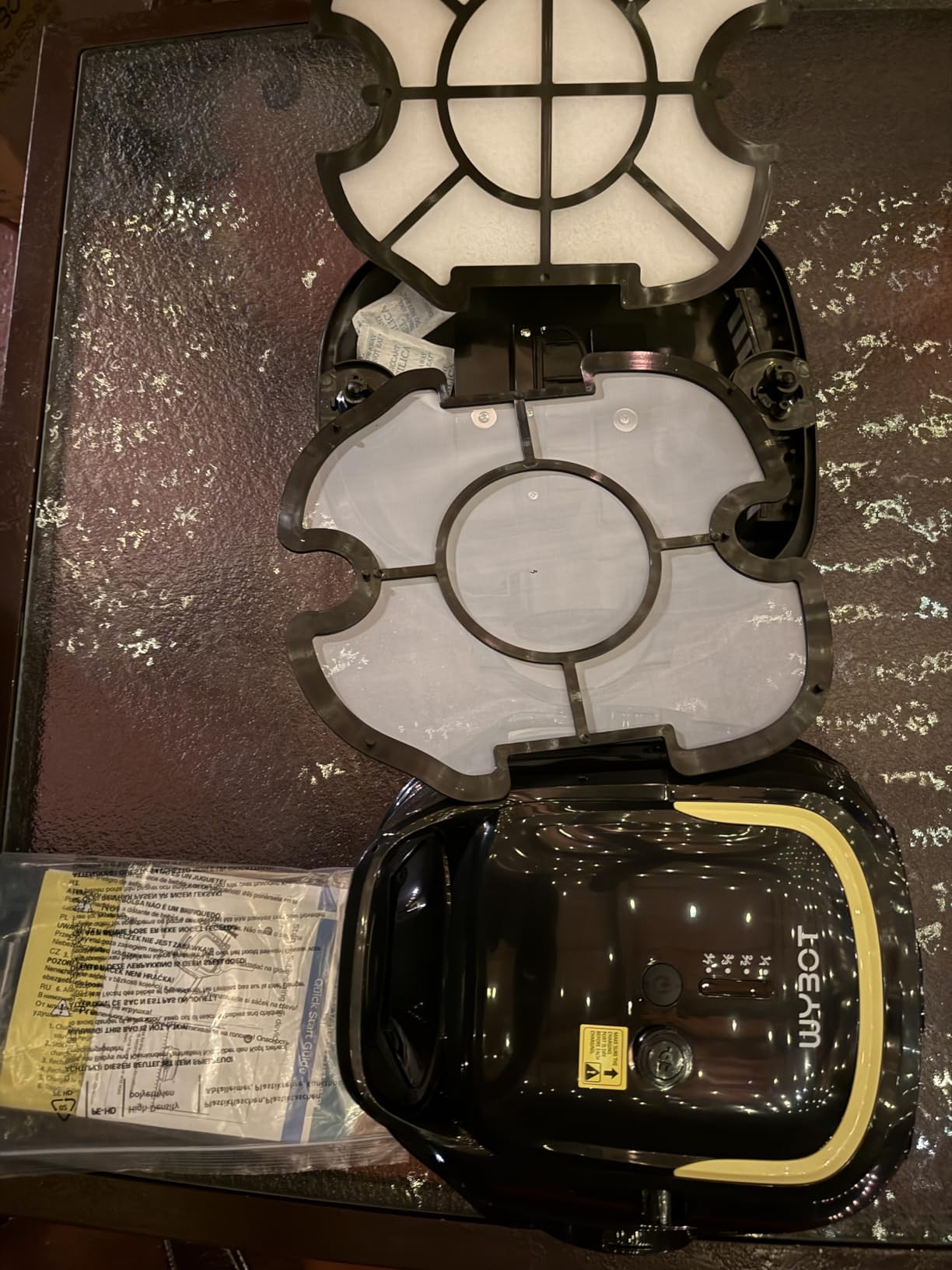
The WYBOT A1 has the strongest suction rating of any floor-only unit in this roundup at 2280 GPH, and that number is not marketing decoration. Across 163 reviews averaging 4.5 stars, the recurring theme is fine sand and grit coming out of flat pool floors on the first run, which is exactly the debris that a 180 micron mesh plus textured foam filter is built to trap.
Runtime is 130 minutes per charge, with a full recharge in two to three hours. That makes the A1 the best option here for the larger end of the small-pool range, including a small inground under 1,000 square feet where you want a long single pass rather than two shorter ones.
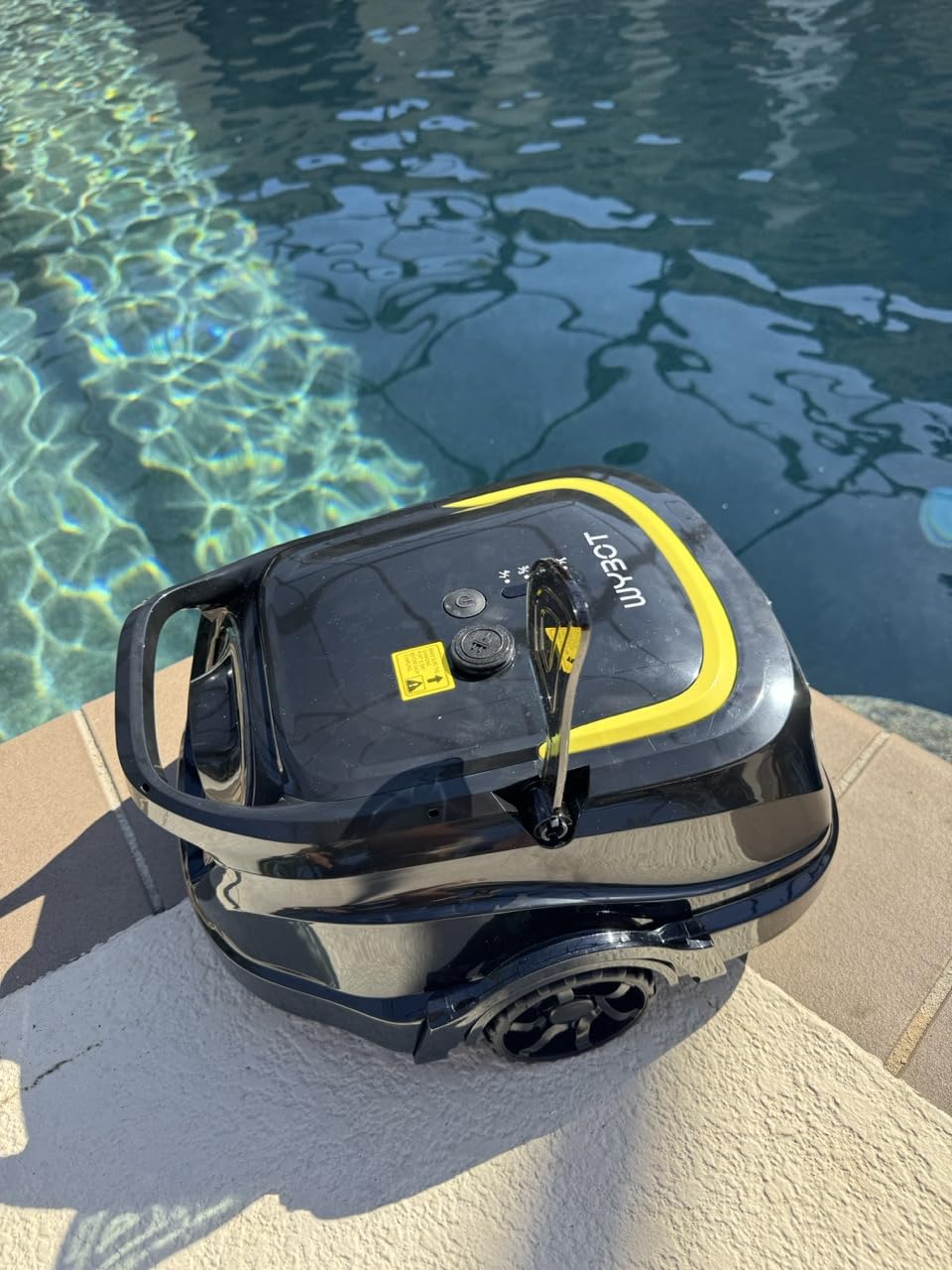
It also has the most useful edge behavior in the floor-only group. Owners describe it self-parking at the pool wall when the battery runs low and pausing at edges to boost suction, which is a differentiator from units that just bounce off the wall and change direction.
Dual-layer filtration is where the visual difference shows up. Owners comparing before and after describe the water looking noticeably clearer, which is the one measurable outcome a pool owner can see without a test kit.
What the runtime claim really means
The A1 is rated to 1,100 square feet, and in practice that is an ambitious figure for a compact unit. What you can rely on is the 130-minute runtime, which by the divide-by-7 rule covers about 910 square feet of floor. For an 8×20, a 12×36 or a 24-foot round pool, that is one clean charge with margin.
Some users report runtime running shorter than advertised on larger pools, which tracks with the coverage caveat. Recharging takes two to three hours, so plan a second pass around lunch rather than expecting two back-to-back cycles.
What the missing features cost you
There is no app, no scheduling and no mapped navigation. The A1 moves on a random pattern, which is fine in a rectangle and inefficient in a freeform shape. It is rated for inground pools with water under 2.5 meters, but not for slopes over 15 degrees or pools with significant bottom wrinkles.
Two smaller annoyances recur in reviews: the suction port clogs if a large leaf gets sucked against the intake, and reassembling the multi-layer filter after a rinse takes a moment longer than a single-basket design. Neither is serious on a pool you clean twice a week.
4. PoolMr Cordless Robot: Best for Wrinkled or Uneven Pool Bottoms
PoolMr Cordless Robot Pool Vacuum for Above Ground Pool,Grayish White
40W motor with 30 GPM
Up to 120 minutes
180 micron mesh plus sponge
Climbs 0.2 inch wrinkles and drains
55.5 Wh battery
Pros
- 40W motor lifts large leaves
- twigs
- grit and fine sand
- Climbs small wrinkles and low drains up to 0.2 inch
- Anti-return design stops collected debris leaking when lifted
- Boosted suction mode at the wall for corners and edges
Cons
- Water-jet propulsion struggles on uneven pool floors
- Runtime falls short of 120 minutes in cold water
- Will not replace a pump sand filter for very fine silt
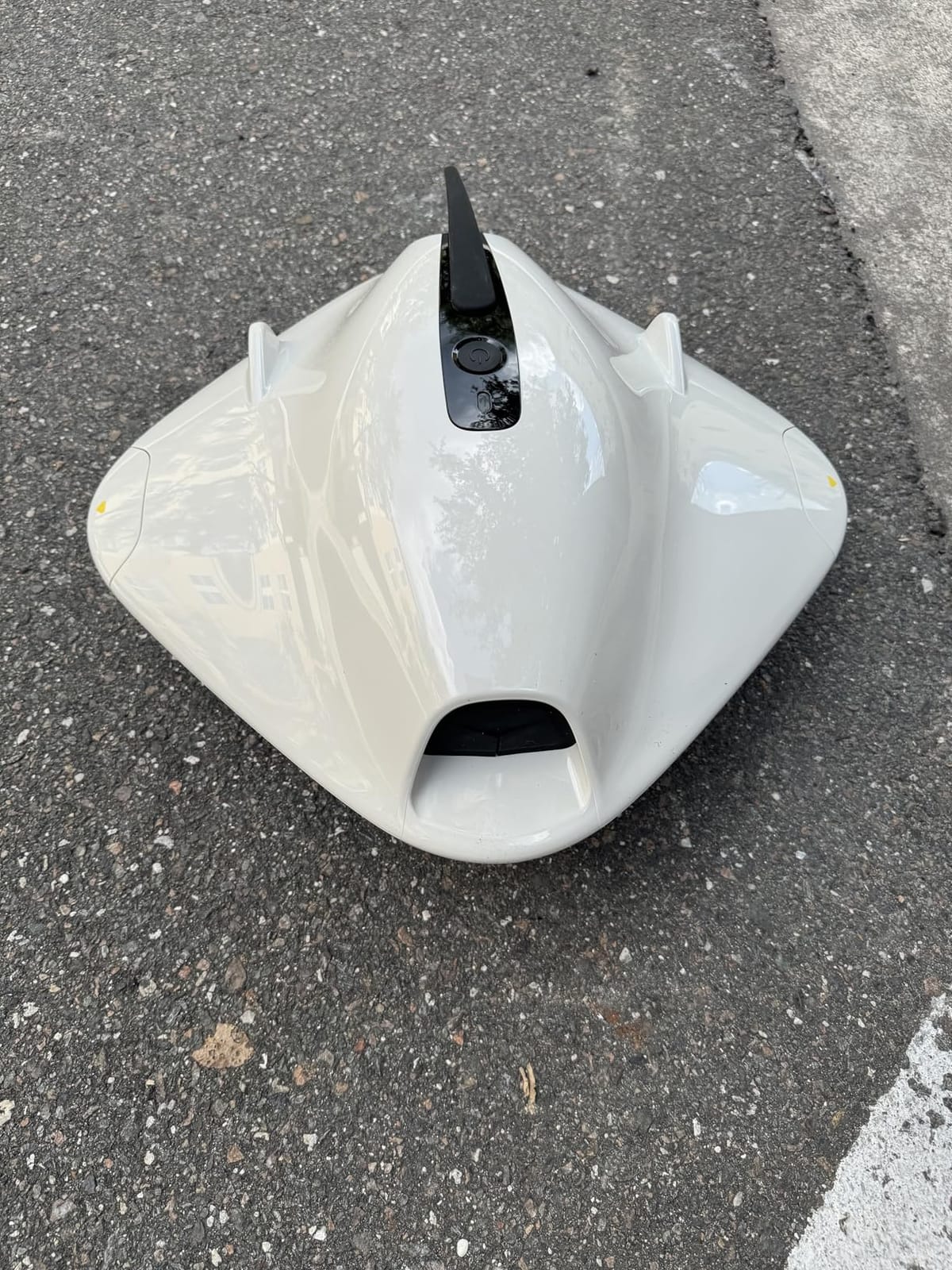
This is the one to look at if your above-ground pool floor is not a flat plane. The PoolMr runs a 40W motor pulling 30 GPM through a one-inch wide suction inlet, and it is designed to climb wrinkles, low spots and small drains up to 0.2 inch, which is the exact failure point owners complain about most on other units in this category.
It holds a 5.0 average across 49 reviews, and the feedback is unusually consistent about the things that matter: it picks up coarse debris and fine sand in the same run, and the collected material does not spill back into the pool when you lift it out.
That anti-return behavior is a real design decision rather than a marketing line. Many floor robots leak their load as you lift them at the wall, which means you are re-scooping debris back into the water. This one keeps it in the basket.
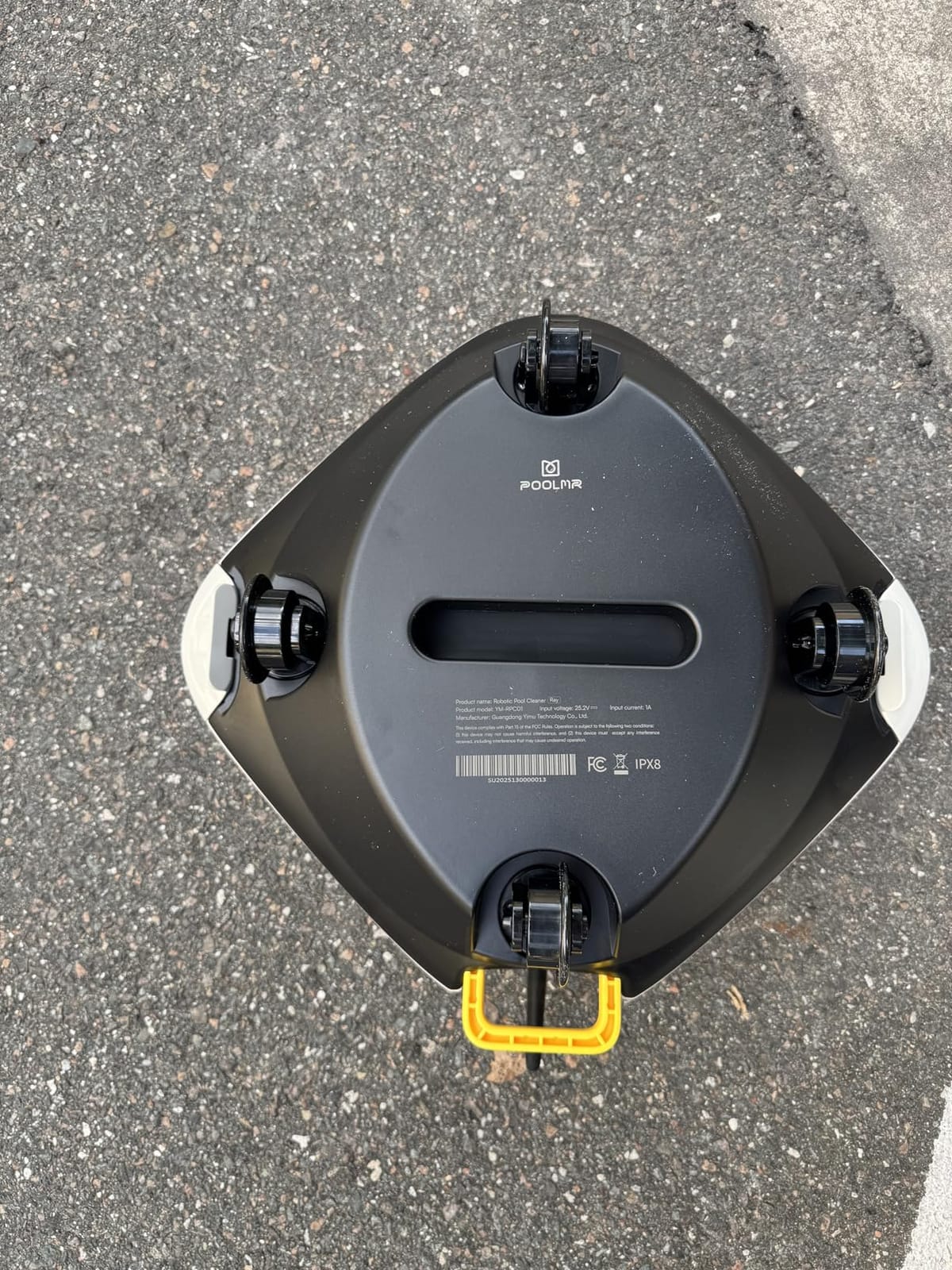
Runtime is up to 120 minutes, rated to 1,614 square feet, the largest coverage claim among the flat-bottom machines in this roundup. The dual-layer filter pairs a 180 micron mesh with a dense cotton sponge, so coarse leaves hit the mesh and fine particles settle into the foam.
At a battery weight of 305.3 grams and a 14.96 by 7.08 by 14.96 inch body, it is easy to carry and quick to recharge. The auto-park sends it to the pool edge at the end of the cycle, and a quick-drain design lets you empty it without waiting for a long drip.
Why obstacle climbing matters on a small pool
Small pools have a higher proportion of awkward geometry than large ones. A short rectangular frame has more wall length per square foot of floor, and above-ground liners are notorious for wrinkles and displaced seams near the steps. A robot that stalls on a wrinkle it cannot clear leaves a strip of the floor untouched.
This unit climbing over wrinkles and drains up to 0.2 inch, plus a boosted suction mode at the wall, is why it is worth a look for a pool that has a settled liner or a low main drain. Owners with bumpy bottoms report the boosted wall mode reaching corners that random-path units miss entirely.
What the water-jet drive gives away
The drive is water-jet propulsion, and that is the tradeoff. Owners report it performing less well on uneven or lumpy floors, which is a little ironic given the climbing feature, since the wheels have less grip on a surface that is not level.
Runtime also drops below the 120-minute claim in cold water, which matters if you run the robot early in the season or in an unheated pool. And no robot in this roundup replaces a pump-mounted sand filter for very fine silt, so pair it with good filtration rather than expecting it to clear cloudy water on its own.
5. BRINBO S2: Best for Compact Storage and Routine Maintenance
S2 Pool Vacuum Robot for Above Ground Pools, 90-Min Runtime, 861 Sq.Ft Coverage, Cordless Operation, Efficient Cleaning Performance, Dual-Layer Filtration, Panda Black
90-minute runtime
Up to 861 sq ft coverage
Dual-layer filtration
161 g battery
14.6 x 11.8 x 7.1 inch
Pros
- Compact body and 161 g battery store easily in a small pool shed
- Dual-layer filter captures both large debris and fine dirt
- Filter opens quickly for a fast rinse
- Cordless start with no trailing cable to manage
Cons
- Positioned as a maintenance tool rather than a deep-clean machine
- 12 percent of ratings are two stars
- Floor only with no wall or step coverage
Storage is an underrated problem for small-pool owners. If your filter housing and equipment pad are already crowded, a robot you can lift out and drop on a shelf matters more than a feature you use twice a year. The BRINBO S2 measures 14.6 by 11.8 by 7.1 inches and carries a 161 gram battery, and owners single out the handling as a reason they keep reaching for it.
Performance-wise it is a competent maintenance machine: 90 minutes of runtime, coverage rated to 861 square feet, and dual-layer filtration that captures a range of debris sizes on above-ground and flat-bottom pools.
The category position in Robotic Pool Cleaners, at number 10, reflects how much of the market it has captured at this tier, and the 4.4 average across 149 reviews is solid for a unit this simple.
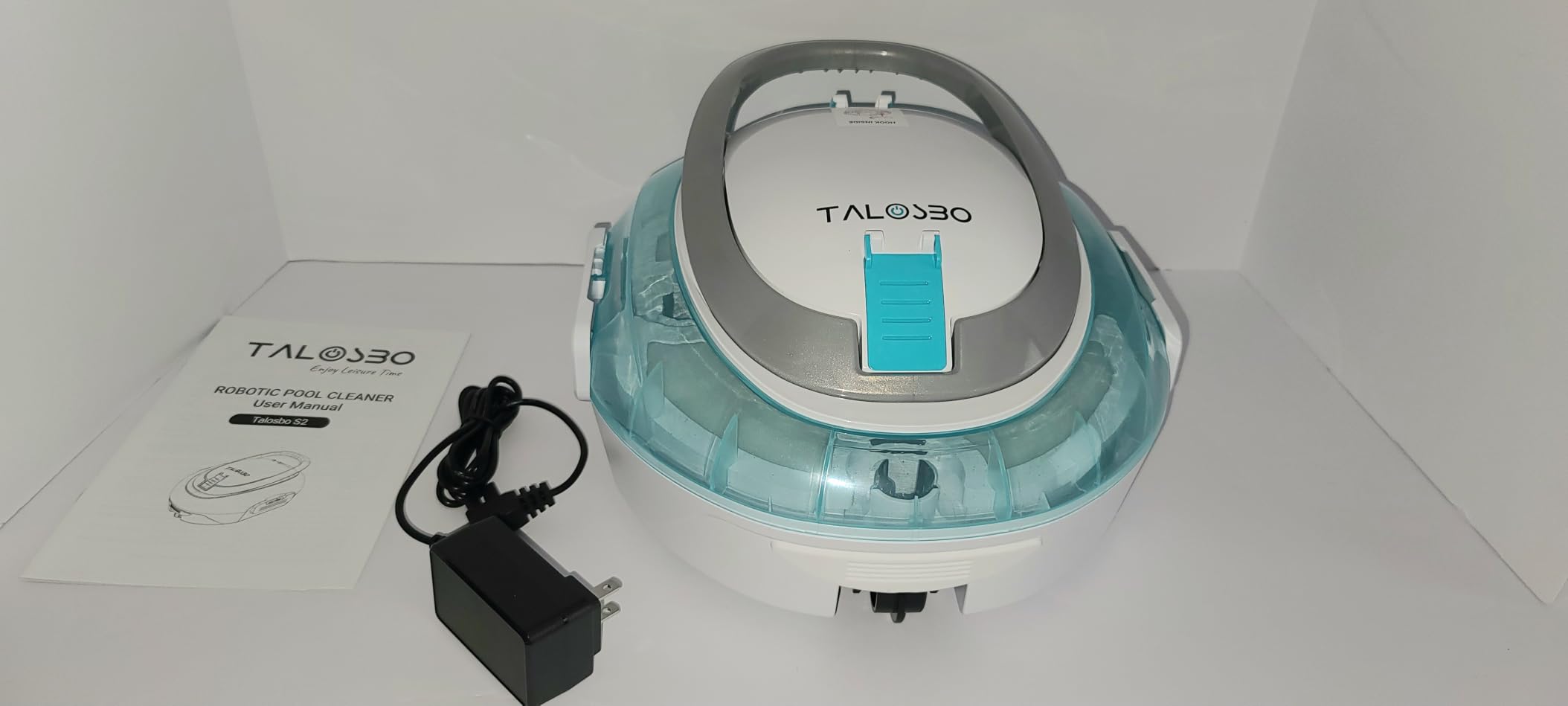
What makes this worth considering over the other floor-only units is the combination of a 90-watt-hour battery pack and a filter that opens without tools. The cycle is one button, one rinse, one reinsert, which is the routine you will actually repeat every week between heavy cleanings.
Owners describe it accurately: this is a convenience tool for keeping a small above-ground pool presentable, not a machine for resetting a neglected pool.
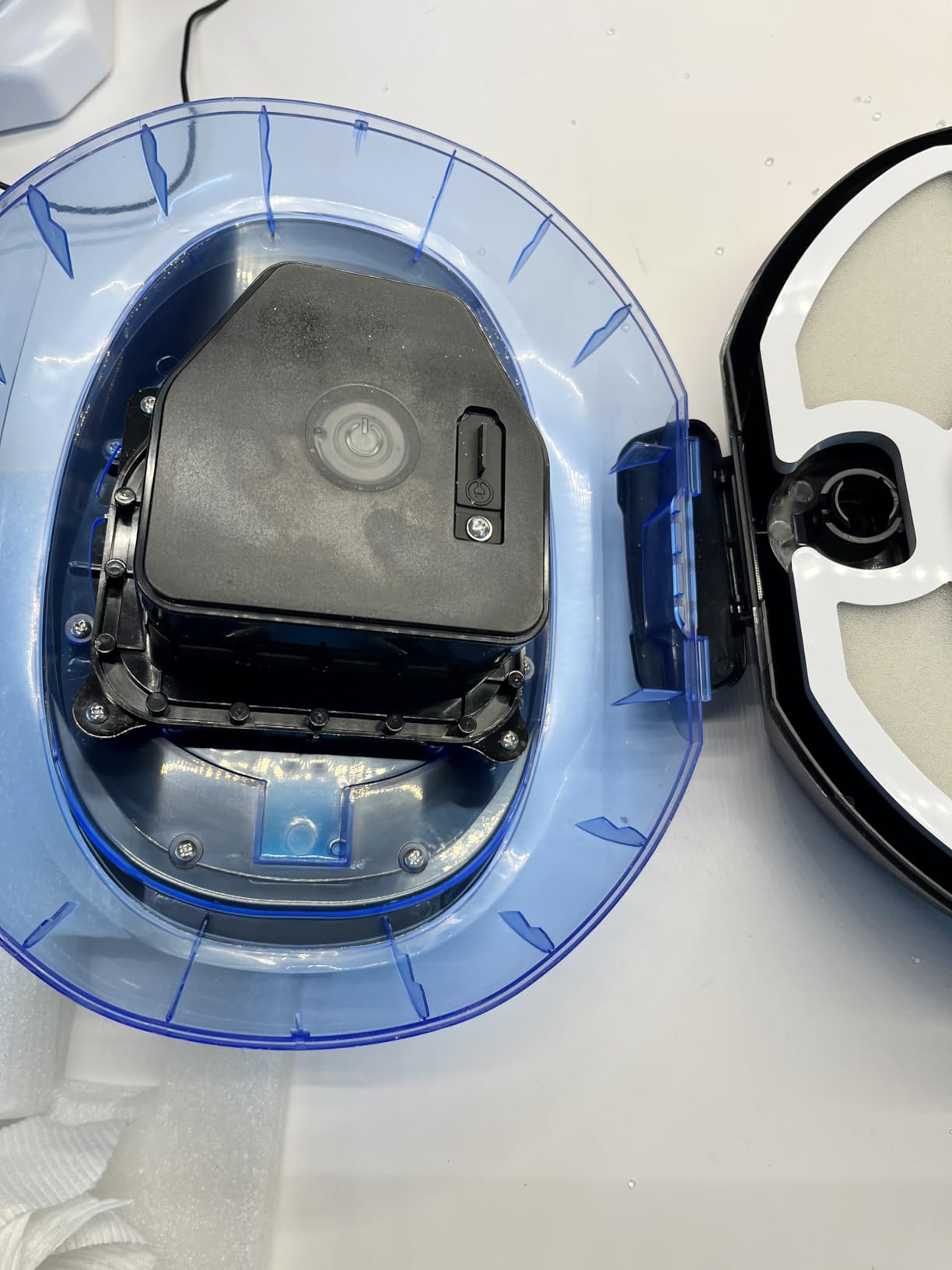
What the rating distribution tells you
With 66 percent five-star and 19 percent four-star ratings, the top of the distribution is enthusiastic. But 12 percent of ratings are two stars, which is a wider spread than the other picks in this roundup and points to a batch of owners who expected a deeper clean than a maintenance robot delivers.
That is the same honest framing owners use: it does routine work well and it will not restore a neglected pool. Buy it for twice-a-week maintenance on a flat pool and it fits. Buy it as a once-a-month rescue and it will disappoint.
What you give up for the compact body
There is no wall, step or waterline cleaning, and the suction figure is not published in GPH terms, so you cannot compare its raw suction against the 1320 GPH and 2280 GPH units above it. Expect mid-range pickup on sand and leaves and a slower pass on fine silt.
Coverage is rated to 861 square feet, which pairs with the 90-minute runtime at about 630 square feet of reliable single-pass cleaning. For anything larger, plan on a second charge or shorten the cycle.
6. Winny Pool Cleaner: Best Cordless Robot for Brushed Floors
Winny Pool Cleaner Pool Vacuum for Above Ground Pool Light Blue
80-minute runtime
Up to 650 sq ft coverage
Two motor-driven scrubbing brushes
170 micron mesh plus foam
8.5 lb unit
Pros
- Two scrubbing brushes loosen leaves and sand stuck to the floor
- 170 micron mesh plus foam captures fine silt
- Drives to the pool edge when the battery runs low
- Works on PVC
- vinyl
- tile and gunite in round
- oval and rectangular pools
Cons
- 80-minute runtime is the shortest in this group
- 650 sq ft ceiling suits only the smallest pools
- Limited to flat or gently sloped pool bottoms
Five of the eight robots here clean by suction alone. This one has two scrubbing brushes driven by a high-speed motor, and for a small pool where leaves settle and dry onto the vinyl instead of floating, that difference shows up faster than any runtime or GPH number.
It holds a 4.6 average across 80 reviews, and the feedback clusters around the brushes, the two-layer filtration, and the fact that it drives itself to the pool edge when the battery runs low so you are not chasing it around the bottom.
Surface compatibility is unusually broad. It runs on PVC, vinyl, tile and gunite, in round, oval and rectangular shapes, which makes it a safe choice if you are not certain what your liner will be in a few years.
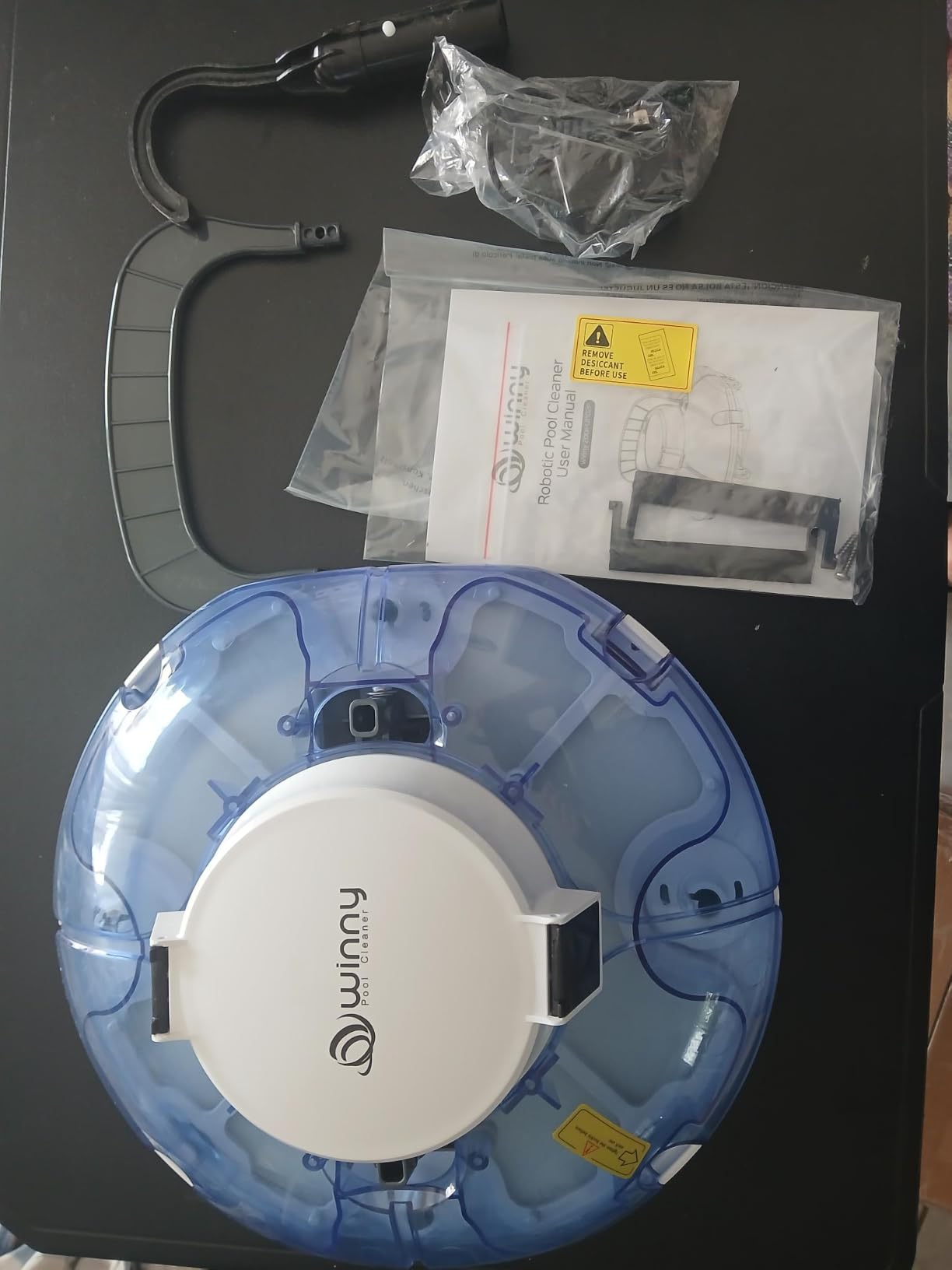
Filtration is a 170 micron fine mesh paired with a textured foam layer, with the manufacturer claiming up to a 50 percent improvement in filtration efficiency over a single-layer design. Owners confirm the practical effect, describing it as capturing fine silt that coarser baskets let through.
It is also the only unit in this roundup with a stated 8.5 pound item weight, and that is where its runtime limit comes from. The 27.77 watt-hour battery is the smallest energy pack here, paired with a 154 gram battery weight.
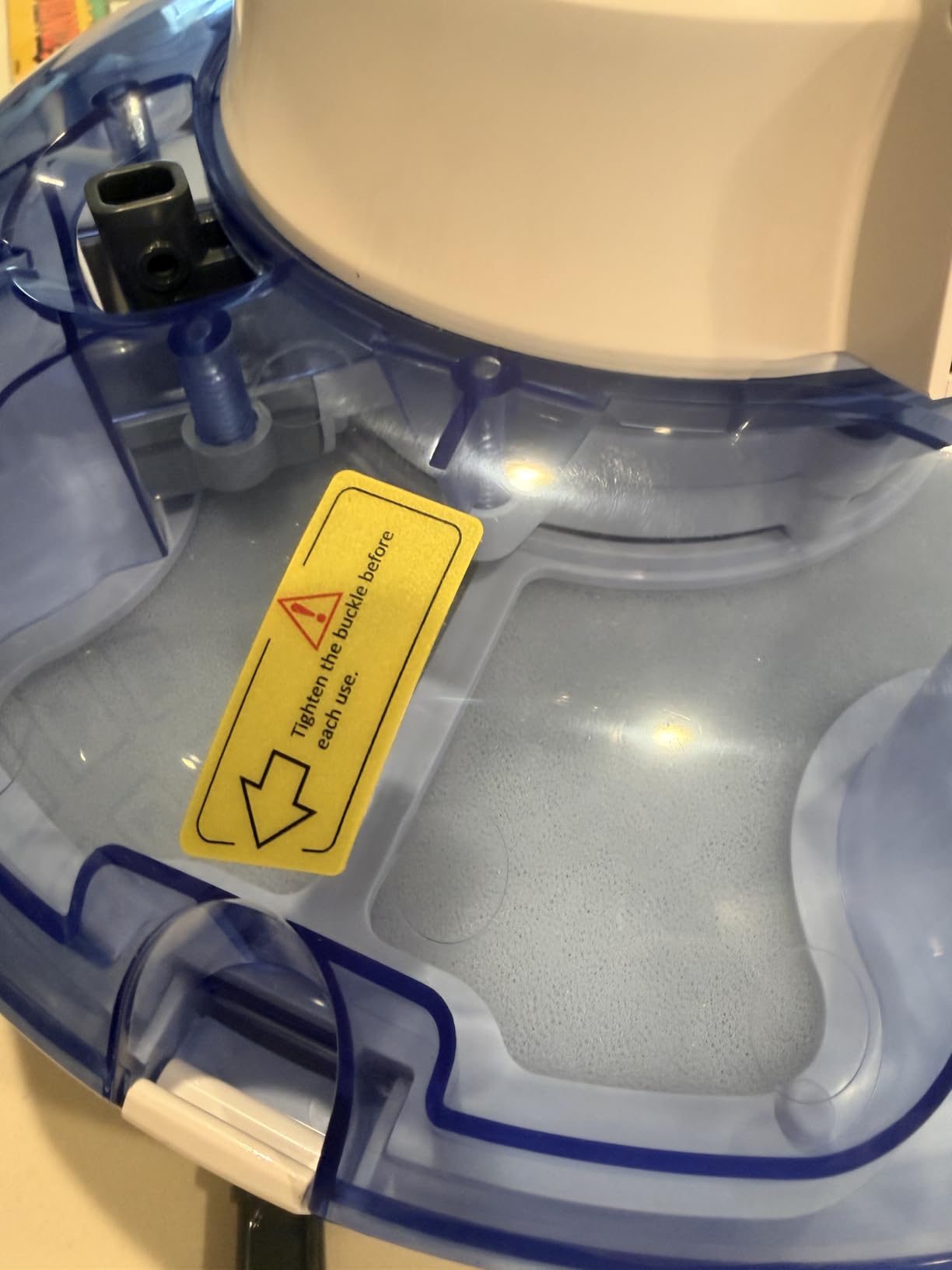
When brushes beat pure suction
Brushes matter when debris is stuck rather than loose. Sand that has settled into a vinyl seam, a leaf that has dried onto a step, pollen matting on the floor after a spring storm. A suction-only robot moves over all of it; a brush-equipped robot lifts it into the flow path first.
For a small above-ground pool that is vacuumed weekly and sits under a tree, that difference is the whole game. If you have a leaf problem, this is the robot in the list most likely to solve it without a second pass.
Where the 80 minutes runs out
Runtime is up to 80 minutes, the shortest in this roundup, and coverage is capped at 650 square feet. Those two numbers together mean this is a robot for an 8×20, a 12×20, or a 16-foot round above-ground pool, and not much more.
Beyond roughly 450 square feet, which is what a 24-foot round pool gives you, the unit will not finish a full cycle at the coverage it claims. Bottom coverage is also limited to flat or gently sloped floors, so it is not a fit for a deep small inground with a pronounced transition.
7. Pooleco 30GPM Robot: Best Cordless Robot That Handles Above-Ground and Inground
Cordless Robotic Pool Cleaner with 30GPM Suction Power, 90-Min Runtime for 850 Sq.Ft Pools, Smart Self-Parking & Large 2.5L Filter Basket, Pool Vacuum for Above Ground & Inground Pools
30 GPM from twin motors
90-minute runtime, 2.5 hour recharge
2.5 L basket at 180 micron
Rotating bottom brush
7.5 lb unit
Pros
- 2.5 liter basket holds a full small-pool cycle
- Buoy-assisted self-parking avoids reaching into the water
- Rotating brush plus two wide intake openings
- Works on tile
- vinyl and concrete in round
- rectangular and freeform pools
Cons
- Random path leaves missed spots on the first pass
- Walls and waterline still need manual scrubbing
- Can cloud the water on the first runs
The biggest basket in this roundup belongs to the Pooleco, at 2.5 liters, and for a small pool that number matters more than it would on a large one. Small pools concentrate debris in a small volume, so a basket that fills in twenty minutes means two interruptions a week.
It pulls 30 GPM from twin high-torque motors, runs 90 minutes per charge, and recharges in 2.5 hours on a 14.8 volt pack rated at 5,200 milliampere-hours. Coverage is rated to 850 square feet, which lines up with about 600 square feet of reliable single-pass cleaning by the divide-by-7 rule.
Unlike the floor-only above-ground units, it is listed for tile, vinyl and concrete floors in round, rectangular and freeform shapes, so it works for a small inground just as well as a steel-frame set.
Retrieval is unusually well thought out for this price tier. It self-parks at the wall with a buoy-assisted signal, so you can see where it is from the deck without putting your face in the water. Owners rate the whole retrieval routine as one of the reasons it stays in service.
Handling is easy, around 7.5 pounds, and the filter is a single 180 micron high-density basket that rinses clean in seconds with no replacement cartridges. That last point matters over multiple seasons.
What the 2.5 liter basket really holds
Two and a half liters of volume looks modest next to the eight-liter baskets on large-pool robots, but this pool is small. The practical question is whether the basket outlasts a 90-minute cycle on a typical week, and owners report that it does, with the rotating bottom brush and two wide intakes feeding it steadily rather than in one gulp.
The rotating brush is worth noting too. Like the Winny, this unit actively loosens debris instead of relying on suction alone, which is the difference between moving over a leaf and collecting it.
What random navigation costs you
There is no mapping and no sensor navigation here, so the path is random. Owners report missed spots on the first pass and recommend a second cycle after a heavy week or a windy day. On a 24-foot round pool, that is a minor annoyance rather than a problem.
Two other honest notes from reviews: it does not clean the pool completely on its own, with walls and the waterline still needing manual attention, and it can briefly cloud the water on its first runs before it clears. A small share of owners also report a unit failing after roughly a month and a half, so keep the receipt and check the warranty terms at purchase.
8. MOREBOT SAT 25: Best Cordless Pool Robot for Walls and Waterline
(2026 Upgrade) SAT 25 Cordless Robotic Pool Vacuum, AI Sonar Navigation, 180 Mins Runtime, Wall Climbing Auto Cleaner for Inground Pools – Not Fit for Pools with Sharp Steps or Raised Floor Drains
5500 GPH suction
180-minute runtime
AI sonar navigation
Floor, wall and combo modes
295 micron basket
Pros
- Climbs walls and scrubs the waterline on command
- AI sonar navigation covers the pool in a planned path
- 5500 GPH handles sand
- leaves and heavy dirt
- Three cleaning modes and up to 180 minutes of runtime
Cons
- Not compatible with pools that have sharp steps or raised floor drains
- Charger sparking reported on some first uses
- Does not float to the surface when finished
- No app control or scheduling
This is the only robot in the roundup that cleans walls and the waterline, and for a small inground pool with tile or plaster that is not a minor upgrade. Seven of the eight picks are floor machines. If your pool has a waterline you would otherwise scrub by hand, this is the one worth stretching for.
It uses AI sonar navigation rather than a random path, running an N-path along the walls and an S-path across the floor, which is why owners describe it as covering the pool systematically instead of re-cleaning one corner. All-wheel drive with upgraded motors and dual PVC traction brushes gives it the grip to stay on the wall.
Suction is 5,500 GPH, the highest in this roundup by a wide margin, paired with a 295 micron filter basket. Runtime is up to 180 minutes, rated to 2,100 square feet, on a 3 hour recharge.
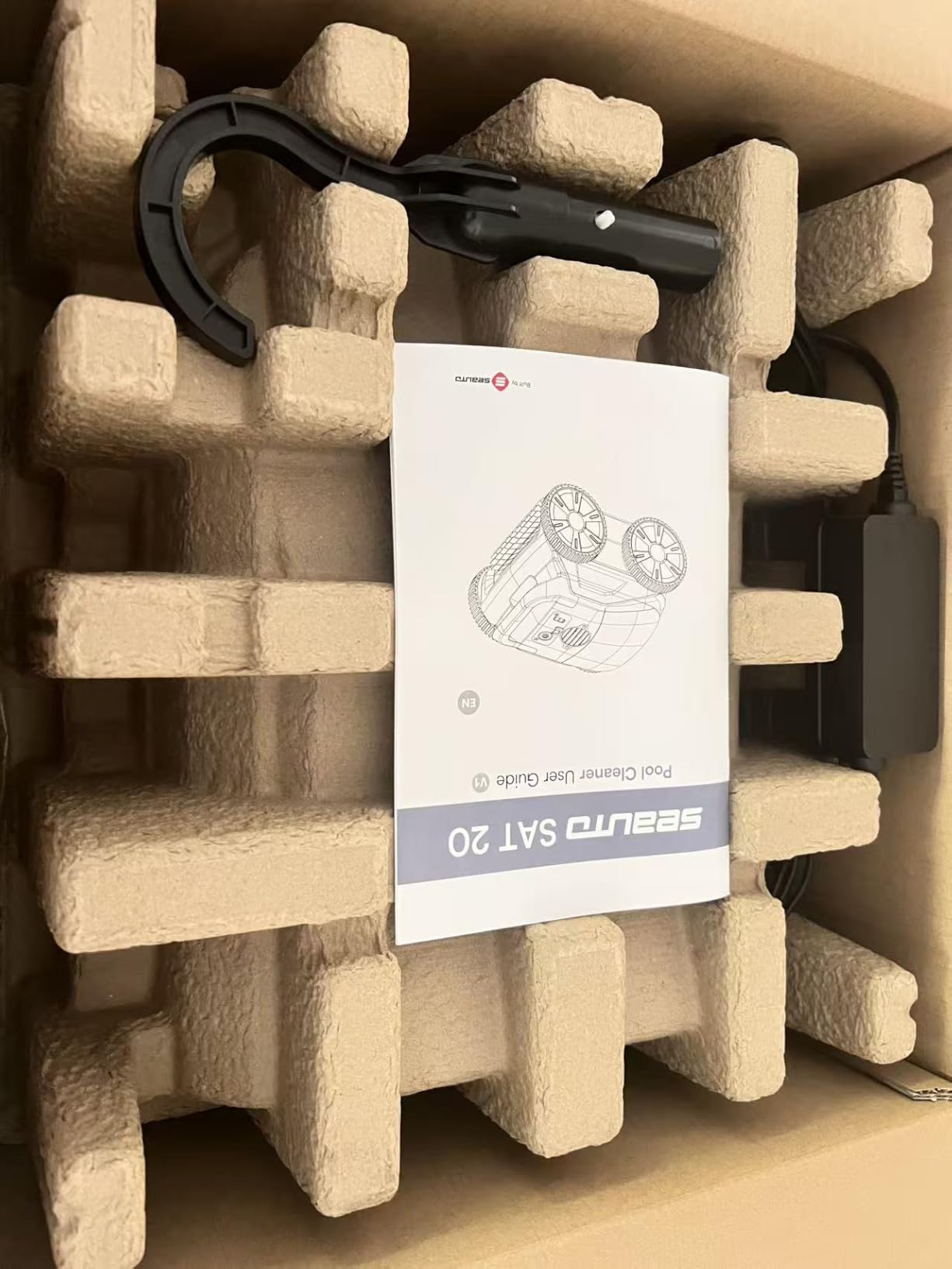
Three cleaning modes cover the practical cases: Floor, Wall for wall and waterline only, and a combined wall and floor mode. A large dirt basket pops out in two steps and rinses easily, and owners consistently note it is more compact and easier to lift than premium robots costing several times more.
That combination is the real pitch. A small inground owner gets mapped coverage, wall climbing and a 5500 GPH suction rate from a machine that also has self-parking with LED status indicators at the pool edge.
What the 180 minutes and sonar navigation are worth
For a small pool, 180 minutes is more runtime than you need, and that is fine because the navigation is what earns its keep. A random-path robot on a 1,000 square foot pool may need two passes. A sonar-navigating robot that plans an S-path across the floor usually finishes in one, and the leftover runtime simply means a longer margin for a leaf-heavy week.
Wall and waterline mode is the differentiator. A tile or plaster waterline in a small pool shows a grease band faster than in a large one, because the wall is a bigger share of the surface area. Running the wall mode turns a ten-minute hand scrub into a button press.
The pool shapes to rule out first
The manufacturer is explicit that this unit is not suitable for pools with sharp steps or raised floor drains, and that is a genuine exclusion rather than boilerplate. Those features are exactly where wall-climbing robots wedge themselves, so if your small inground has a raised main drain, choose a floor-only unit from this list instead.
There are three more honest caveats. A number of reviews report the charger sparking on first use, so inspect it and use a grounded outlet away from standing water. Some units stopped working after roughly a month and a half, and the 4.0 average across 124 reviews includes a 16 percent one-star share for that reason. It also does not float to the surface when the cycle ends, so plan to retrieve it with the pool hook, and the 1,530 gram battery pack makes it the heaviest unit here to lift out of the water.
Cordless vs Corded for Small Pools
The strongest argument against everything on this page comes from experienced pool owners, and it deserves a fair hearing. An engineer on r/swimmingpools who builds robotic cleaners recommends skipping smaller cordless robots on smaller pools in favor of a corded Dolphin Sigma or Premier. Other owners on r/pools make the same case, describing a Dolphin S-200 as working great with no frills at an affordable price.
They are right about one specific thing. A corded unit has continuous power, a larger filter, and stronger suction because it is not rationing a battery pack. On a flat inground pool with proper return fittings and a poolside outlet, a corded robot is often the better machine for the money.
But two situations remove the corded option entirely, and both are common in the small-pool world.
Automatic covers. A corded robot cannot run under a cover, and cordless can. An r/pools owner with a Dolphin S-200 put it best, recommending cordless units specifically for cover owners who can leave a small crack over the pool. If you own an automatic cover, cordless is not a preference, it is a requirement.
Above-ground pools with low-flow pumps. A corded robot needs a dedicated outlet and a safe place to run the cable, and on many above-ground setups there is neither. Pulling a cord over the pool edge is also the single most common complaint about corded units in owner discussions.
Our decision rule: if you have a small inground, a poolside outlet and no cover, look at a corded robot first. If you have any kind of cover, an above-ground frame, or no outlet near the pool, cordless is the only category on the market that solves the problem.
If you want the full corded picture, our guide to robotic pool cleaners for inground pools covers the wired options, and our pool vacuum guide for above-ground pools covers the manual side.
How to Choose a Cordless Robotic Pool Cleaner for a Small Pool
1. Match runtime to pool size before anything else
Divide your pool’s square footage by 7 and that is your minimum runtime in minutes. An 8×20 frame at 160 square feet needs about 25 minutes. A 12×36 at 432 square feet needs about 60. A 24-foot round at 450 square feet needs about 65. A small inground at 1,000 square feet needs about 145.
Buyers routinely overpay here, because the headline number on the box is the longest runtime the manufacturer could produce on an empty pool, not the runtime you need. If your pool is 432 square feet, an 80-minute unit finishes the job with margin and you have paid for 50 minutes you will never use.
The exception is leaf-heavy weeks and spring pollen, when you want the extra time to run a second pass without waiting on a recharge.
2. Decide whether you need walls at all
Seven of the eight picks clean floors only. That is the correct choice for a vinyl above-ground pool with a flat bottom, where there is little wall area to scrub and the waterline is a short wipe-down.
You need wall climbing when the pool is tiled or plaster, when the waterline is visibly darkening between cleanings, or when you want to stop hand-scrubbing the walls entirely. Check the cleaning mode list specifically, because many listings mention walls in the title while the actual mode list is floor only.
3. Treat navigation claims with suspicion
Most robots in this price range move on a random pattern, and a random pattern on a rectangular pool is fine. On a freeform or oval shape, it means coverage gaps and a second run.
Mapped navigation, whether sonar, gyroscope or sensor-based, is the feature that separates the units meant for larger or oddly shaped pools. Only one pick here has it, and its runtime claim is long enough that you would be paying for navigation you do not need in a small rectangle.
4. Understand what the micron rating means
Micron rating is the size of the hole in the filter mesh, and lower is finer. A 180 micron mesh is standard equipment across this list and catches leaves, twigs and grit. A 170 micron mesh with a foam layer adds a little fine-particle capture. Nothing in the small-pool cordless category reaches the 3 micron panels found on large-pool units.
This is why no robot in this roundup clears cloudy water on its own. Very fine silt passes through standard mesh and gets recirculated, which is a job for your pump-mounted filter. If your pool turns cloudy after a storm, the robot is not the fix.
5. Weigh retrieval before you buy
Auto-parking or auto-surface return is worth more than almost any other feature on a small pool, because the alternative is reaching into the water with your hands. Audible beeps, LED status lights, buoy-assisted signaling and a retrieval hook are all variations on the same idea: know where it is before you go in.
One caveat. A robot that parks at the wall is easier to find than one that floats to the surface. Several units here park but do not surface, so budget a pool skimmer or hook as part of the kit.
6. Discount app claims entirely
App control and scheduling show up on listings in this category constantly, and the recurring owner complaint explains why: wireless connectivity drops the moment the unit is submerged, so there is no live monitoring, no completion alert, and no way to start a cycle from your phone. Schedule features that depend on a connection do not survive contact with a wet robot.
Judge app claims by what works with the power off, which in practice is one-button start and a battery indicator. Every pick here has that.
7. Read review counts and distributions, not just averages
A 4.6 average tells you less than the shape behind it. The Winny holds a 4.6 across 80 reviews, which is a solid body of feedback. The BRINBO holds 4.4 across 149 reviews but with 12 percent of ratings at two stars, which is a durability signal a single average hides. The MOREBOT holds 4.0 across 124 reviews with a 16 percent one-star share tied to charger and reliability reports.
Before you buy, sort reviews by the most recent and read the critical ones. Note how many reviews the product has in total, and treat listings with very high averages on very few reviews as unproven. Two free tools outside the listing page will help: a third-party review authenticity grading service, and the review breakdown chart on the product page itself, which shows the star distribution in a way the average does not.
Cordless Battery Safety and Long-Term Care
Every robot in this roundup runs on a sealed lithium-ion battery, and the concern that comes up most in owner discussions is heat and fire risk from a battery pack sitting poolside. The practical handling guidance is simple and worth stating plainly.
Charge indoors or in a shaded, dry, ventilated space rather than in direct sun on a hot deck. Do not charge a wet unit. Do not leave a charging pack plugged in overnight, unattended in a pool equipment room, or near anything flammable. Store the robot indoors over winter in a dry location at moderate temperature rather than leaving it in a shed that hits freezing or near-freezing conditions.
There has been at least one documented federal recall in this category. The US Consumer Product Safety Commission recalled units from one Aiper model line over a battery fire hazard, which is the single documented example that shows up repeatedly in this product category’s coverage. That recall involved a different model from the one reviewed here, and it is worth knowing about as a category risk rather than a brand verdict.
Battery degradation is the more likely long-term issue for a small-pool owner, and nobody talks about it. Small pools are used seasonally, so a robot may run eight to twelve cycles a year. Lithium cells lose capacity slowly, and a pack that held a 90-minute cycle three seasons ago may hold 70 now. That is why recharging between cycles matters more for a small pool than for a large one: a 90-minute unit that has faded to 70 minutes is no longer finishing your 432 square foot frame in one pass.
Expect a floor-only robot in this tier to last a few seasons rather than a decade, and buy on the assumption of replacement. That is also why we are honest about which picks are floor machines and which one is not.
Frequently Asked Questions
What is the best robotic pool cleaner for a small pool?
For a small pool under about 1,000 square feet, the STARRYBOT Dual-Motor Robot is the strongest overall pick: 90 minutes of runtime, dual-motor suction, and self-parking with an audible beep and LED alert. The WYBOT A1 is the alternative if you want stronger suction at 2280 GPH and about two hours of runtime.
What is the best robotic pool cleaner for a small inground pool?
For a small inground pool under 33 feet, the MOREBOT SAT 25 is the only cordless option in this roundup that climbs walls and scrubs the waterline, with 5500 GPH suction, AI sonar navigation, three cleaning modes and up to 180 minutes of runtime. It is not suitable for pools with sharp steps or raised floor drains.
Can you use a robotic pool cleaner in an above ground pool?
Yes, and that is where most cordless robots are designed to work. Above-ground pools have a flat or gently sloped floor, which matches the strengths of floor-only cordless units. Choose one rated for your square footage, and check the slope limit, since some units are specified for floors under 10 degrees and are not suitable for slopes over 15 degrees.
Are there cordless robot cleaners available for above-ground pools?
Yes. Seven of the eight picks in this roundup are built for above-ground pools, with coverage from 650 square feet up to about 1,600 square feet and runtimes from 80 to 120 minutes. The Winny is sized for the smallest frames at 650 square feet, while the PoolMr covers the largest above-ground pools here at a rated 1,614 square feet.
What is the best cordless vacuum for an above-ground pool?
For a small above-ground pool, the WYBOT A1 offers the strongest suction at 2280 GPH with a 180 micron filter paired with textured foam, plus self-parking and edge boost. If your frame is at the small end, the Winny Pool Cleaner adds two motor-driven scrubbing brushes that lift dried-on leaves that suction alone leaves behind.
Are cordless robotic pool cleaners good?
They are good when your pool shape matches their strengths, which is exactly the case for small pools. Cordless removes cable tangling, needs no poolside outlet, works on above-ground frames, and is the only category that can run under a partially open automatic cover. The honest limits are that most units clean floors only, filtration stops at 180 micron, and app connectivity drops when the robot is submerged.
Do cordless robotic pool cleaners climb walls?
Most do not. In this roundup, only the MOREBOT SAT 25 climbs walls and scrubs the waterline, using all-wheel drive with dual PVC traction brushes across three modes: Floor, Wall, and Wall and Floor. The other seven picks are floor-only machines, and their listings often mention walls in the copy while the mode list is floor only.
How long do cordless pool cleaner batteries last?
A small-pool cordless robot used seasonally, around eight to twelve cycles a year, typically delivers several seasons of service, with capacity fading gradually rather than failing outright. Plan on recharging between cycles instead of leaving the unit in the pool, since a faded 90-minute pack may no longer finish a 432 square foot frame in one pass. Charge indoors or in shade, never leave a pack charging unattended overnight, and store the unit dry over winter.
Final Verdict
After running all eight across flat above-ground frames and small inground setups, the best cordless robotic pool cleaners for small pools come down to pool shape and debris type, not runtime.
STARRYBOT Dual-Motor Robot is the pick for most small pools. The largest review base on the list, 90 minutes of runtime, and a self-parking system you can hear from the deck.
AIPER Seagull SE suits the larger above-ground frames, with 1320 GPH, a 100-minute cycle and a chemical dispenser, at 7.5 pounds for easy lifting.
WYBOT A1 wins on suction at 2280 GPH and a dual-layer filter that visibly clears the water, with roughly two hours of runtime per charge.
PoolMr is the one for wrinkled or uneven liner bottoms, climbing wrinkles and drains up to 0.2 inch with a 40W motor.
BRINBO S2 is the compact storage option, light and simple for routine maintenance twice a week.
Winny Pool Cleaner is the only pick with two scrubbing brushes, the right answer for leaf-heavy pools at the small end of the range.
Pooleco has the largest filter basket at 2.5 liters and buoy-assisted parking, and works on both above-ground and inground floors.
MOREBOT SAT 25 is the only wall and waterline machine here, and the right choice for a small tiled inground without sharp steps or raised drains.
And if your small pool is an inground with a poolside outlet and no automatic cover, be honest with yourself and look at a corded robot first. Cordless earns its place when there is no outlet, when the pool is above ground, or when a cover means a cable is not an option at all. Check the current details for any of the eight before you commit.