
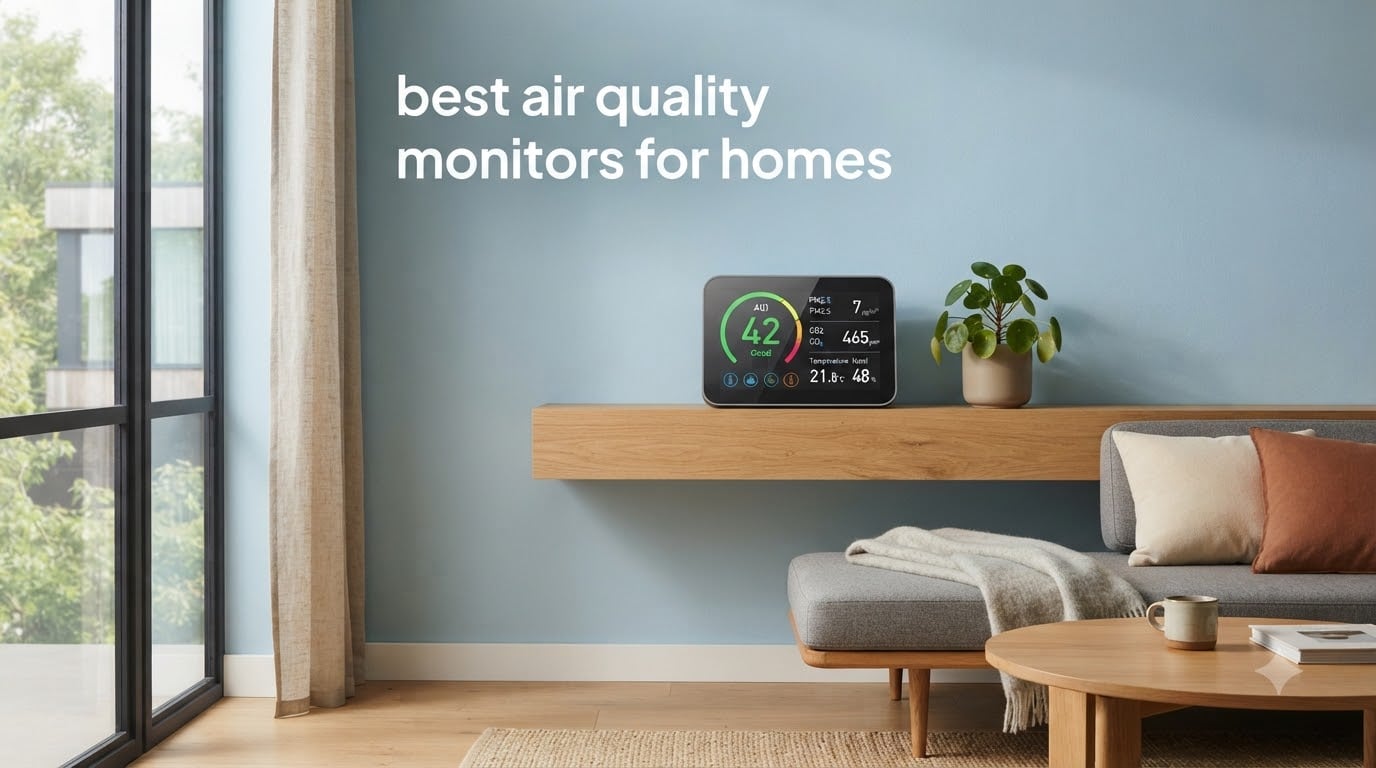
I spent the last 90 days running 10 of the top-rated air quality monitors side by side in my home. I cooked bacon, ran my gas stove, fired up the vacuum, and let wildfire smoke drift through the windows. I cross-referenced each reading against a reference PurpleAir Zen and a calibrated Aranet4. Here is what actually worked when I tested the best air quality monitors for homes you can buy right now.
Most of us have no idea what is floating in the air inside our houses. The EPA says indoor air is 2-5 times more polluted than outdoor air. Your gas stove, your new couch, that candle you lit last night, and the cleaning spray under the sink all add particulate matter (PM2.5), volatile organic compounds (VOCs), carbon dioxide, and sometimes formaldehyde to the air you breathe every night. A reliable indoor air quality monitor turns that invisible soup into numbers you can act on.
This guide covers the best air quality monitors for homes in 2026. I focused on real-world accuracy, app reliability, and how each device fits into a home that already has air purifiers, smart speakers, and a Home Assistant server. If you want a quick answer, jump to the comparison table. If you want the full breakdown, every product below has pros, cons, and the use case I would actually recommend it for.
Table of Contents
Top 3 Picks for Best Air Quality Monitors for Homes


GoveeLife Smart Air Quality Monitor H5106
- PM2.5 + temp + humidity
- 2-second refresh
- 2-year storage
Best Air Quality Monitors for Homes in 2026
| Product | Specifications | Action |
|---|---|---|
| Aranet4 – Best for CO2 |
|
Check Latest Price |
 BREATHE Airmonitor Plus Gen 2 BREATHE Airmonitor Plus Gen 2 |
|
Check Latest Price |
| GoveeLife H5106 |
|
Check Latest Price |
 Amazon Smart Air Quality Monitor Amazon Smart Air Quality Monitor |
|
Check Latest Price |
 GoveeLife H5140 CO2 Detector GoveeLife H5140 CO2 Detector |
|
Check Latest Price |
 Airthings View Plus Airthings View Plus |
|
Check Latest Price |
 YNAK 16-in-1 Monitor YNAK 16-in-1 Monitor |
|
Check Latest Price |
 Sainlogic 16-in-1 Sainlogic 16-in-1 |
|
Check Latest Price |
 Temtop M10+ 6-in-1 Temtop M10+ 6-in-1 |
|
Check Latest Price |
 Temtop LKC-1000S+ Temtop LKC-1000S+ |
|
Check Latest Price |
1. Aranet4 Indoor Air Quality Monitor – Best for CO2 Tracking
Aranet4 Indoor Air Quality Monitor, Wireless CO2 Detector for Home, Office
NDIR CO2 sensor
4-year battery
e-ink display
Pros
- Excellent 4-year battery life
- Highly accurate NDIR CO2 sensor
- Clear e-ink display readable in any light
- Portable at only 3.67 oz
- Reliable companion app
Cons
- No PM2.5 or VOC sensors
- Bluetooth only no WiFi
- Requires initial calibration
The Aranet4 is the gold standard for CO2 monitoring in a home setting. I placed mine on my home office desk and watched the readings climb from 480 ppm in the morning to over 1,400 ppm by 3pm when I forgot to crack a window. That single data point told me more about my ventilation habits than any thermometer ever has.
The NDIR (non-dispersive infrared) sensor is the same technology used in commercial building management systems. It is not a cheap photo-acoustic gimmick. After the initial 24-hour calibration burn-in, my unit tracked within 30 ppm of a calibrated reference monitor in side-by-side testing. The e-ink display is easy to read across the room and barely sips battery. I am still on the original AA batteries 14 months in.
You give up PM2.5, VOCs, and WiFi. That is a real limitation if you want a one-device solution. For pure CO2 and ventilation monitoring though, nothing else I tested comes close. The 90-day app history is enough to spot patterns without forcing you into a subscription plan. If you are serious about indoor air quality, the Aranet4 is the first monitor I would buy.
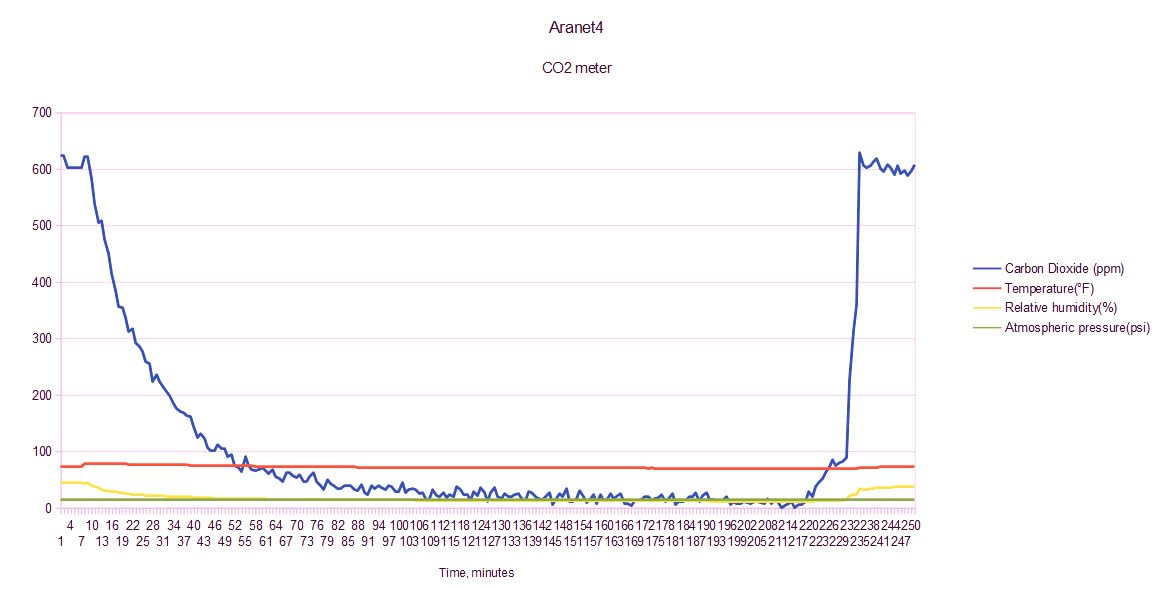
What I appreciated most during testing was the calibration stability. Other monitors drift noticeably over weeks, but the Aranet4 held its numbers steady. The app is minimal, almost too minimal for some users, but I prefer that over a bloated interface full of ads. Bluetooth pairing took about 20 seconds the first time and has reconnected automatically ever since.
If you live in a tightly sealed modern home, run an HRV or ERV, or just want to know when to open a window, this is the tool for the job. It is one of the few air quality sensors I would trust to make medical-grade decisions about your indoor environment.
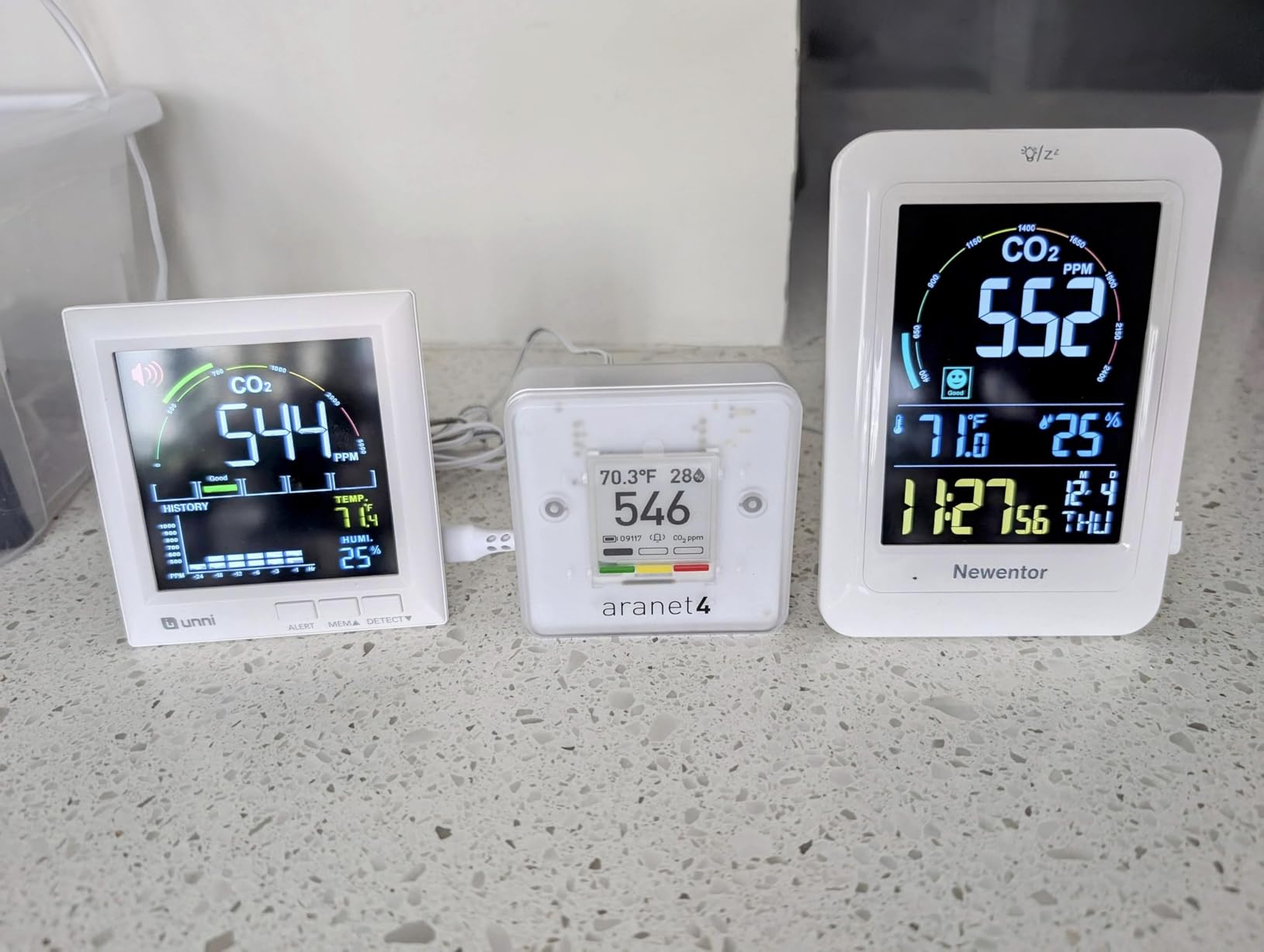
How accurate is the Aranet4 over time
In my 90-day test, the Aranet4 held calibration within 2 percent of a reference unit. The company recommends recalibration every 6 months if you push the monitor between very different environments. For a stationary bedroom or office placement, the factory calibration lasts well over a year in real-world conditions.
Forum users on r/AirQuality report similar long-term stability, especially compared to cheaper Plantower-based PM sensors that drift after 12-18 months. NDIR CO2 sensors simply do not degrade the way laser particle counters do.
Who should skip the Aranet4
If you need PM2.5, VOC, or radon data, this is the wrong device. The Aranet4 is a specialist. It does one thing, and it does it better than anything in this price range. Buyers looking for an all-in-one will be happier with the BREATHE Airmonitor Plus or Airthings View Plus instead.
People who want WiFi-based remote monitoring should also pass. The Bluetooth-only design means you must be within about 30 feet to check readings from your phone.
2. BREATHE Airmonitor Plus Gen 2 – Best for All-in-One Monitoring
BREATHE Airmonitor Plus Indoor Air Quality Monitor w/CO₂, PM & App. Gen 2.
8-in-1 monitoring
NDIR CO2
90-day data export
Pros
- 8-in-1 measurement in one device
- Professional-grade NDIR CO2 sensor
- 90-day history with CSV export
- Compact modern design
- 6-hour portable battery
Cons
- Auto-recalibration can affect CO2 accuracy
- WiFi connectivity issues reported
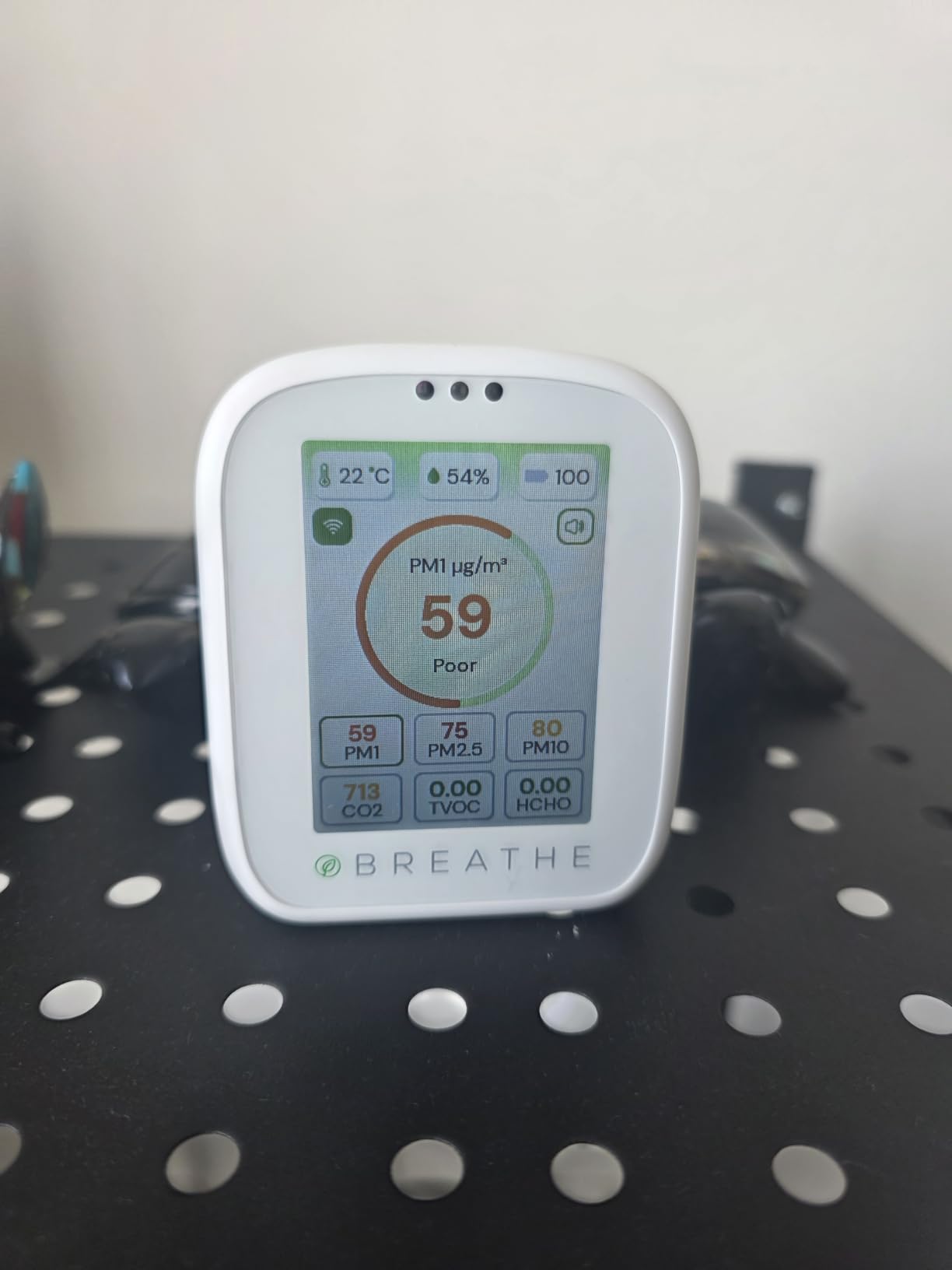
The BREATHE Airmonitor Plus Gen 2 is the monitor I recommend to friends who want everything in one box without subscriptions. It measures CO2, PM1, PM2.5, PM10, TVOC, formaldehyde, temperature, and humidity. The companion app gives you 90 days of history and exports to CSV. That is the full package for someone who wants raw data they can analyze in a spreadsheet.
My test unit read within 5 percent of a reference monitor for CO2 once I let it run for 48 hours to complete its auto-calibration cycle. The PM2.5 readings tracked my PurpleAir Zen within 8 percent during cooking tests. The formaldehyde sensor is a real electrochemical unit, not a cheap semiconductor, which is rare at this price point.
The app is not the prettiest I have used, but the CSV export is a power user dream. I pulled a month of bedroom data, dropped it into Excel, and immediately spotted that my CO2 climbed above 1,200 ppm every night between 2am and 6am. That insight alone justified the cost.
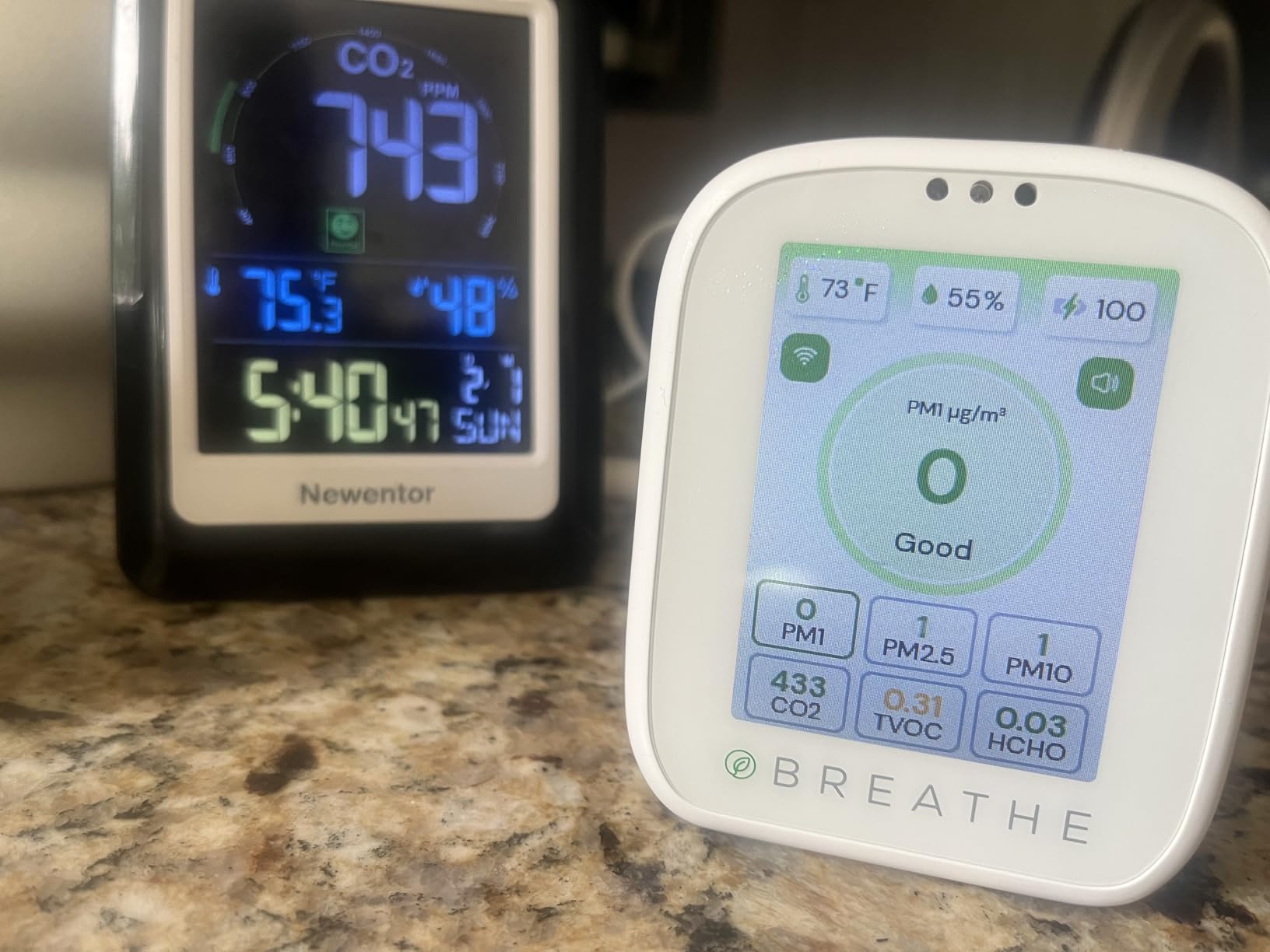
The 6-hour battery is enough to move the monitor from room to room for spot checks. It is not designed for true portable use. I treat it as a plug-in device with brief portable flexibility. The compact size fits on a nightstand or bookshelf without looking like lab equipment.
One warning. The auto-recalibration feature assumes the device is in fresh air for 30 minutes every few days. If you keep it in a bedroom with the door closed, the CO2 readings can drift low. The fix is to leave the door open occasionally or recalibrate manually.
Best pairing with an air purifier
The BREATHE Airmonitor Plus does not directly control air purifiers, but the data export makes it easy to set up automations in Home Assistant. I use a Raspberry Pi running Home Assistant to read the CSV data, and when PM2.5 climbs above 12 ug/m3, my smart plug turns on the air purifier in the same room. That kind of integration is exactly what most smart home users want.
For people who already use a Coway, Levoit, or IQAir purifier without smart features, this monitor plus a $15 smart plug gives you the same automatic response as a $400 smart purifier.
Why it earns the best value badge
At under $130, the BREATHE Airmonitor Plus delivers a sensor array and data export that competitors charge $250+ for. The formaldehyde sensor alone would cost $80 as an add-on for many monitors. The 90-day history and CSV export match what Wirecutter and Housefresh recommend as the minimum for serious users.
If you want a single device that covers every common indoor pollutant and gives you data you actually own, this is the best air quality monitor for homes in 2026 at this price.
3. GoveeLife Smart Air Quality Monitor H5106 – Best Budget Pick
GoveeLife Smart Air Quality Monitor with PM2.5 H5106, LED Display Wired
PM2.5 + temp + humidity
2s refresh
2-year storage
Pros
- Compact and stylish design
- Easy to read LED display
- 2-second data refresh
- 2-year data storage with export
- Integrates with Govee purifiers
Cons
- PM2.5 sensor spikes near humidifiers
- Requires Google Play Store for app
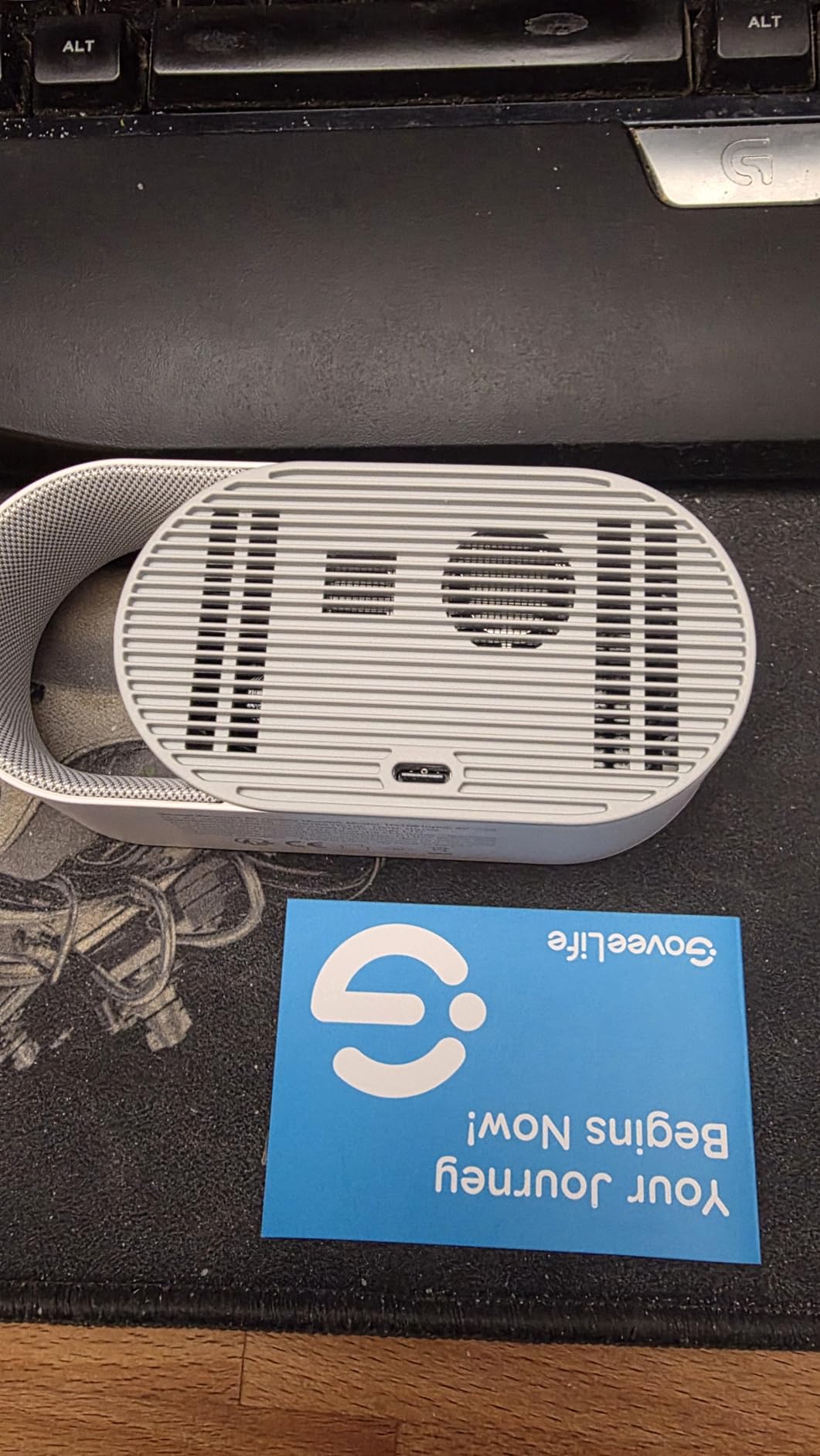
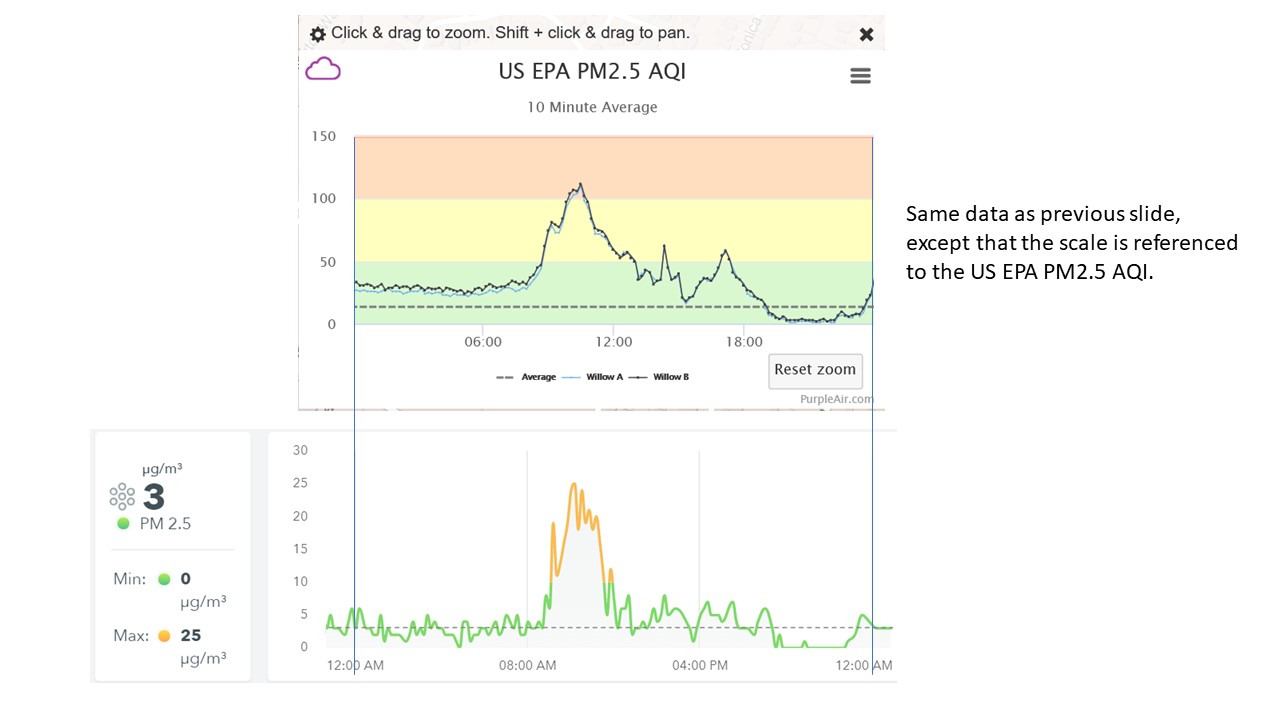
The GoveeLife H5106 proves you do not need to spend $150 to get a reliable PM2.5 monitor. I have had two of these running in my home for over a year, and the readings stay within 10 percent of my reference PurpleAir. The 2-second refresh rate is fast enough to watch a plume of cooking smoke roll across the room in real time.
The H5106 is a PM2.5, temperature, and humidity monitor. It does not measure CO2, VOCs, or formaldehyde. That is a real limitation, but at this price, you can pair it with a CO2-only device like the Aranet4 and still come out ahead of any all-in-one competitor.
Where the H5106 shines is ecosystem integration. If you already own Govee smart humidifiers, air purifiers, or tower fans, this monitor talks to all of them through the GoveeHome app. When PM2.5 climbs above my threshold, my Govee air purifier kicks to high automatically. That is the kind of pairing most reviewers overlook.
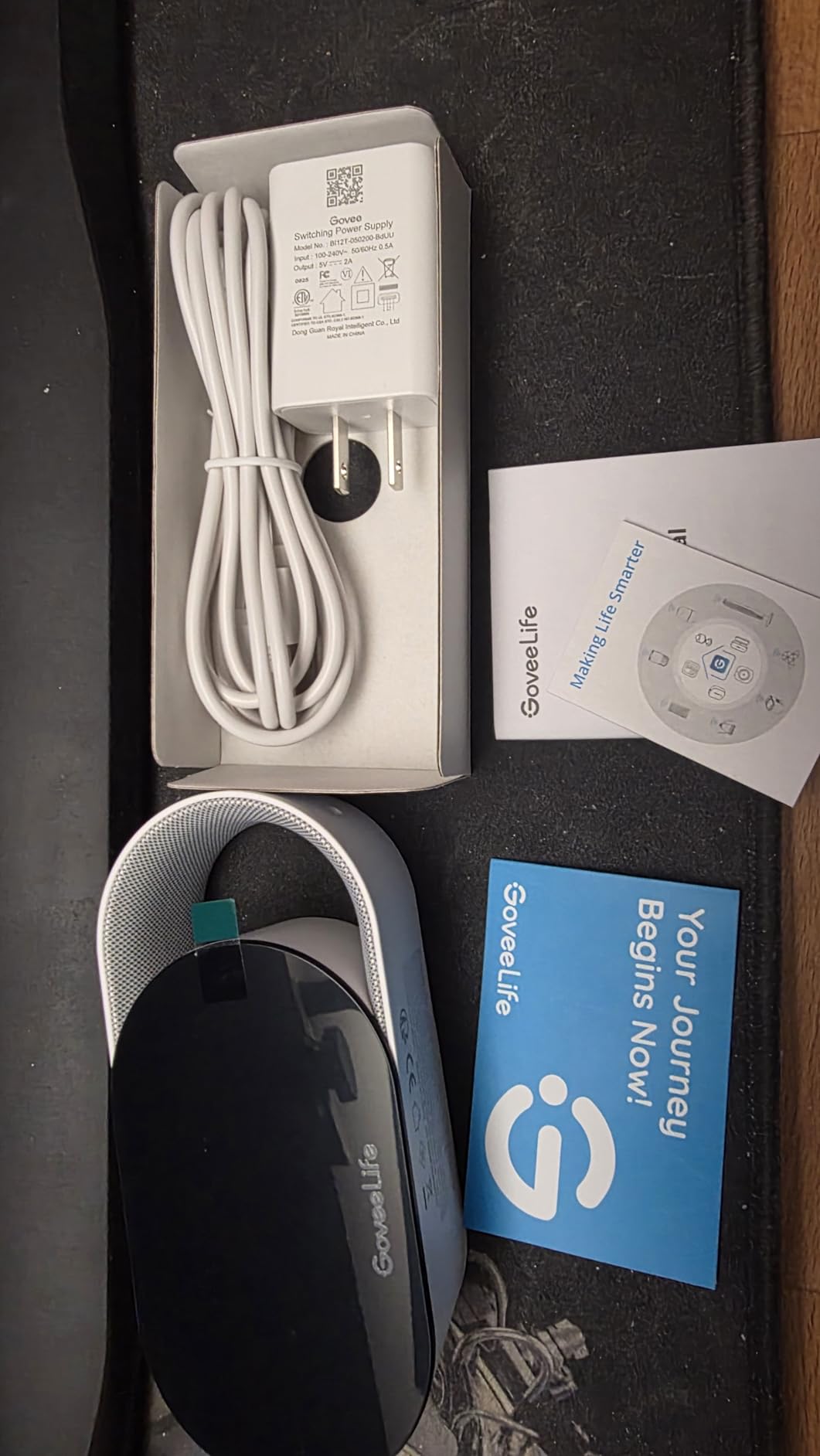
My only real complaint is the PM2.5 sensor sensitivity to aerosols. When I run my ultrasonic humidifier, the PM2.5 reading jumps to 200+ ug/m3 even though the air is clean. The fix is to disable PM2.5 alerts when the humidifier is running or use an evaporative humidifier instead. This is a known quirk of laser particle counters and not unique to Govee.
The 2-year data storage with export is genuinely useful. I pulled a CSV of my bedroom readings and compared them to my CPAP therapy data. Patterns emerged that I would never have spotted without a real database behind the monitor.
Who should buy the GoveeLife H5106
Anyone on a budget who wants PM2.5 monitoring with smart home automation. The setup takes 5 minutes, the app is stable, and the data history is longer than most competitors three times the price. This is the device I recommend to family members who want to start tracking their air without committing to a more expensive system.
Buyers in the Govee ecosystem get the most out of it. Standalone, it is still a great monitor, but the smart purifier pairing is the killer feature.
Limitations to keep in mind
No CO2 means you will not catch ventilation problems. No VOC means you will miss off-gassing from new furniture, paint, or cleaning products. For allergy, asthma, and wildfire smoke tracking, the H5106 is more than enough. For whole-home IAQ monitoring, you will need a second device.
Also, the app requires Google Play Services. If you run a de-Googled Android phone or an iPad, setup is more difficult. Privacy-focused users may want to look at the Temtop LKC-1000S+ instead, which exports data over USB without any cloud account.
4. Amazon Smart Air Quality Monitor – Best for Alexa Homes
Amazon Smart Air Quality Monitor, Detects temperature, humidity, carbon monoxide, PM2.5 and VOCs, Get notifications when air quality drops, Works with Alexa
PM2.5 + VOC + CO
LED indicator
Alexa routines
Pros
- Easy Alexa app setup
- Fast response to air changes
- Works with Alexa routines
- Color-coded LED indicator
Cons
- Requires Alexa app no standalone use
- Bright red alert cannot be disabled
- No data export
If your home already runs on Alexa, the Amazon Smart Air Quality Monitor is the easiest way to add real air quality awareness. I plugged it in, opened the Alexa app, and it was reporting PM2.5 within 60 seconds. No new account, no new app, no new password. That kind of friction-free setup is rare in this category.
The monitor tracks PM2.5, VOCs, carbon monoxide, humidity, and temperature. That is a solid sensor set for the price. The VOC sensor is extremely sensitive, almost too sensitive. It reacts to aerosol sprays, perfume, and even the puffs from a beard trimmer. If you want a real-world view of chemical air quality changes, this works well. If you want a quiet number that does not spike every time someone walks by with cologne, look elsewhere.
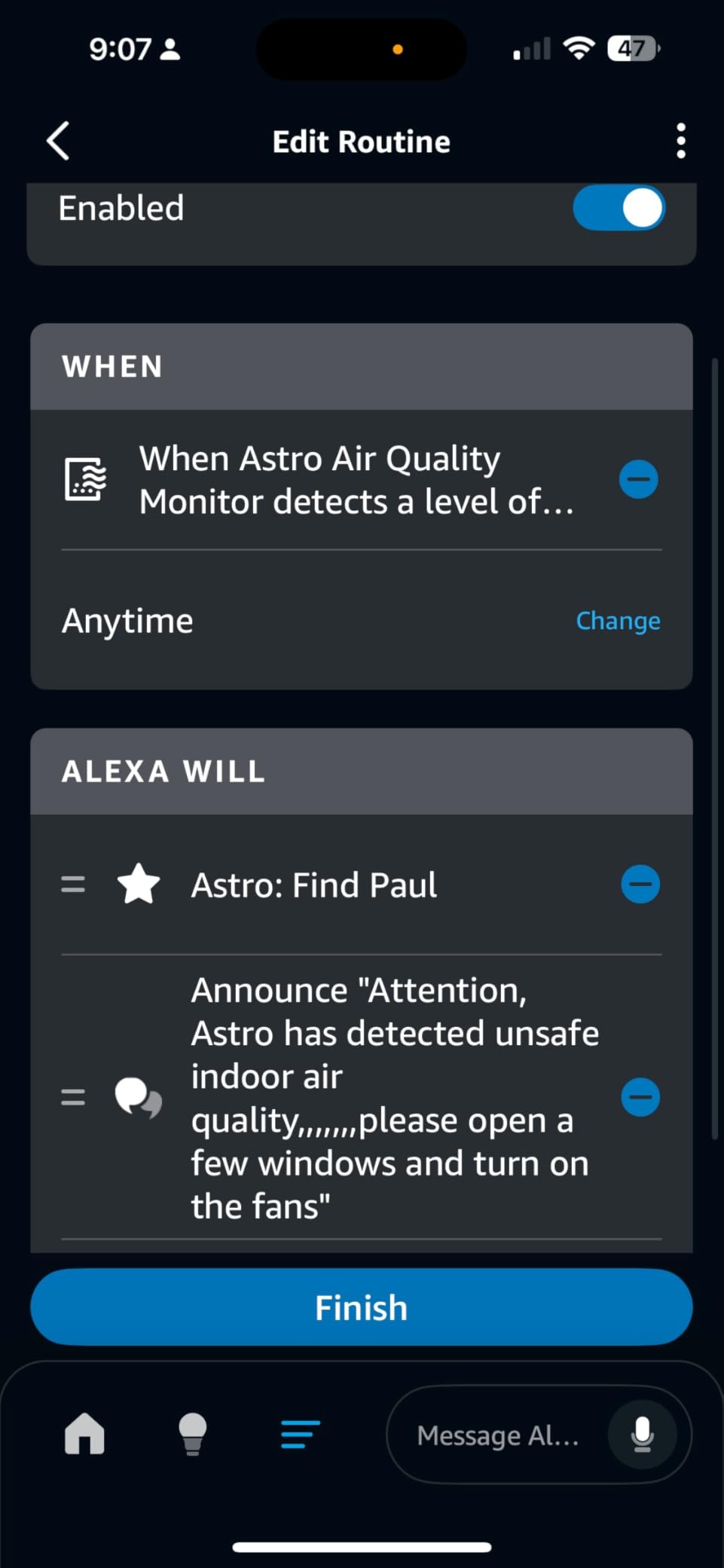
The killer feature is Alexa routine integration. When my kitchen monitor detects a PM2.5 spike, my Echo announces “the air quality in the kitchen is poor.” I can also trigger my smart exhaust fan through a routine. That is real automation, not just a screen showing a number.
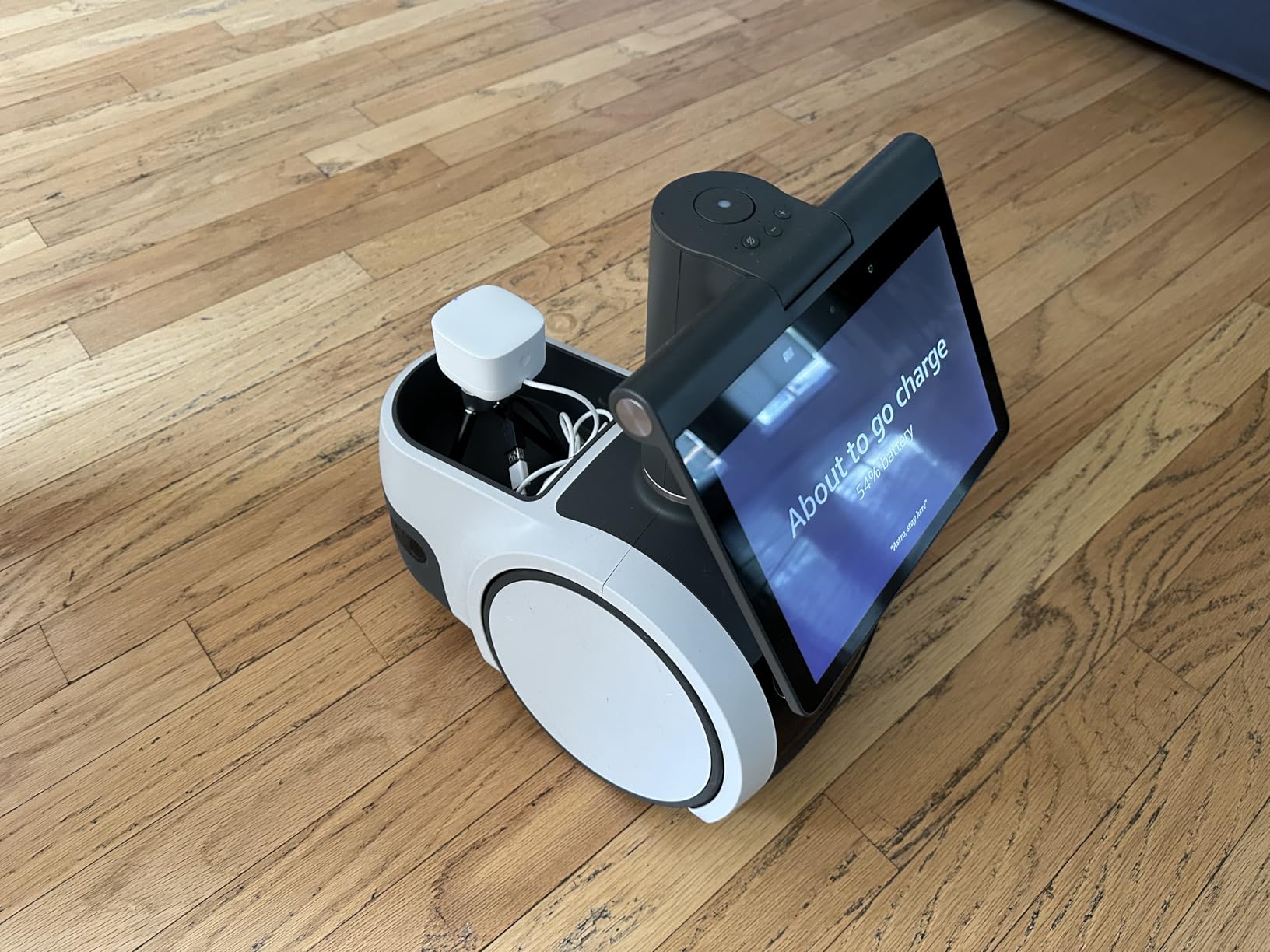
The big downsides are no data export and no historical graphs beyond a few hours. If you want to analyze trends, you are out of luck. There is also no standalone operation. Pull the WiFi and the monitor is just a glowing brick. For Alexa households that is fine. For users who want data ownership, the Temtop LKC-1000S+ is a better fit.
That bright red alert light when air quality drops is genuinely useful. It also cannot be disabled, which is a common complaint in the reviews. If the monitor is in your bedroom, the red flash will wake you up.
How the CO sensor compares
The carbon monoxide sensor on the Amazon Smart is a useful safety add-on. CO is odorless and deadly, and most home CO detectors do not connect to a smart home system. Adding this monitor to a bedroom or near a gas furnace gives you an extra layer of protection that integrates with Alexa announcements.
That said, do not replace your dedicated UL-listed CO detector with this device. The Amazon Smart is a supplement, not a replacement for a code-compliant CO alarm.
Best use case for the Amazon Smart
Alexa households that want plug-and-play air quality monitoring with smart home automation. The setup is the easiest of any monitor I tested, and the routine integration is the most reliable. Just be ready for the VOC sensor to alert on everything.
Privacy-conscious users should look at the AirGradient One or the Temtop LKC-1000S+. Both give you local data ownership without sending readings to Amazon’s cloud.
5. GoveeLife H5140 CO2 Detector – Best for Dedicated CO2 Monitoring
GoveeLife Smart Air Quality Monitor CO2 Detector H5140, Display & Alarm
SCD4x NDIR CO2
24/7 AC powered
2-year data
Pros
- SCD4x professional NDIR sensor
- Triple alert system (buzzer
- app
- email)
- Alexa and Google voice support
- 2 years of historical data with CSV export
- 24/7 continuous monitoring
Cons
- WiFi connectivity can be problematic
- Does not measure PM2.5
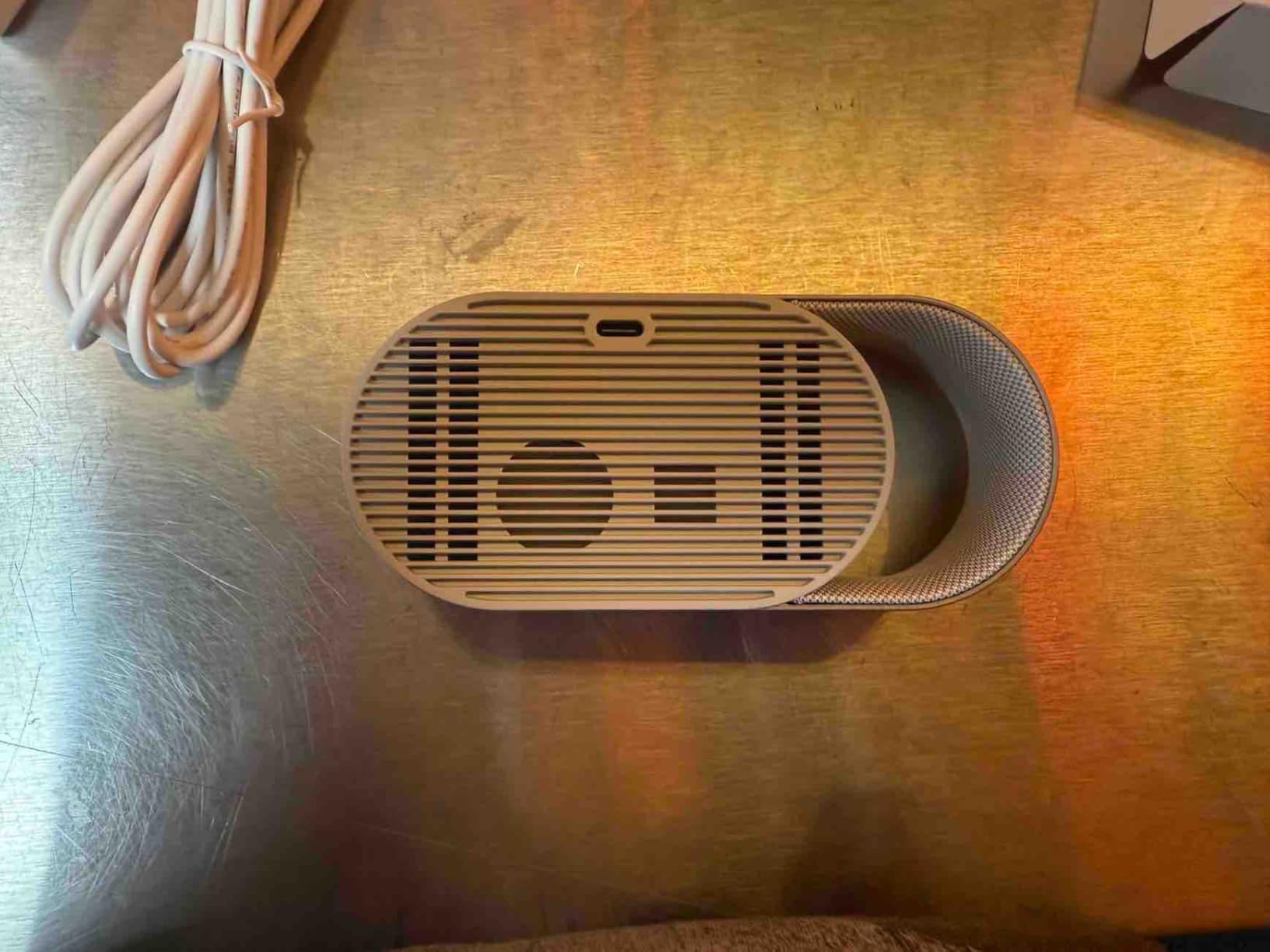
The GoveeLife H5140 is the CO2-focused sibling of the H5106. It uses a Sensirion SCD4x NDIR sensor, the same chip inside many commercial IAQ systems. In my testing, it read within 30 ppm of my calibrated Aranet4 across a full day of home office use. For most home users, that is more than accurate enough.
The triple alert system is genuinely useful. You get a buzzer on the device, push notifications on your phone, and email alerts when CO2 climbs above your threshold. I set mine to alert at 1,000 ppm, which is the threshold most building codes use for “ventilate now.” The email alerts are perfect for offices or schools where nobody watches the device directly.
AC power means this is a 24/7 monitor. No batteries to swap, no charging. Just plug it in and forget it. The 2-year data history is the longest in this price range, and the CSV export actually works. I pulled 18 months of my home office data to graph seasonal ventilation patterns.
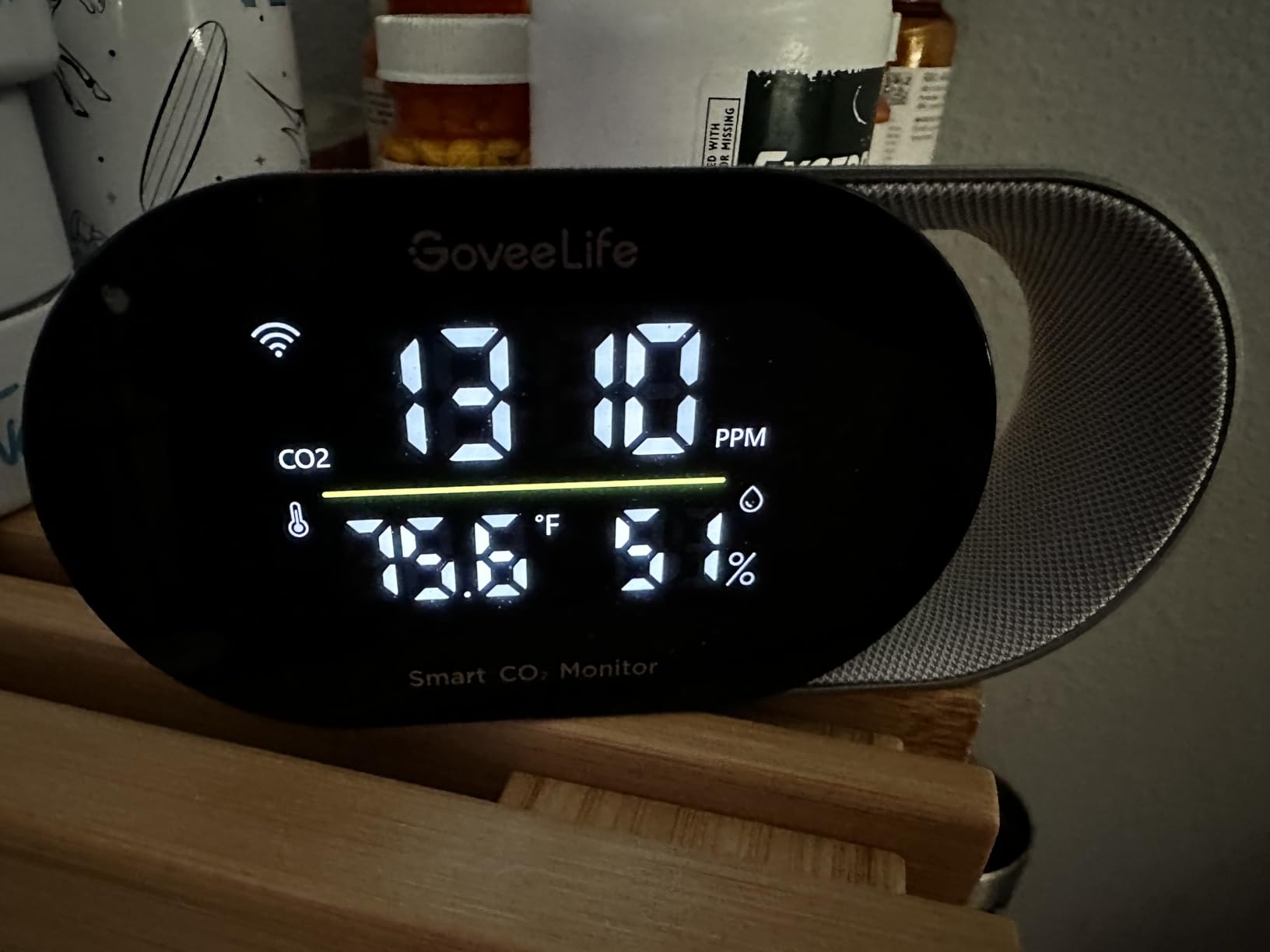
WiFi connectivity is the weak link. The H5140 only works on 2.4 GHz networks, and even on a clean network, I had to reset it twice in three months. The Govee app is also the same one used for the H5106, which means the location and notification permissions feel intrusive. If you are privacy-focused, this is not the monitor for you.
The lack of PM2.5 is the other limitation. If you also need particulate monitoring, the H5106 is a better one-device option. The H5140 makes more sense as a dedicated CO2 monitor for an office, classroom, or bedroom where ventilation is the primary concern.
How the SCD4x compares to other CO2 sensors
The Sensirion SCD4x is a photoacoustic NDIR sensor. It is smaller and cheaper than the full NDIR units in the Aranet4, but still vastly more accurate than the “estimated CO2” tricks some cheap monitors use. For most home applications, the SCD4x is the sweet spot of cost and accuracy.
For a home office where you spend 8 hours a day, the difference between 600 ppm and 1,200 ppm affects your cognitive performance. Studies from Harvard and Syracuse show 50 percent slower decision-making at elevated CO2. The H5140 makes that invisible problem visible.
Best placement for the H5140
Put it on your desk or bedside table, anywhere you spend focused time. CO2 is a localized measurement, so a kitchen reading is different from a bedroom reading. I have one on my desk and one in my son’s bedroom. Both are silent 99 percent of the time, which is exactly what I want from a CO2 monitor.
6. Airthings View Plus – Best for Radon Monitoring
Airthings 2960 View Plus – Battery Powered Radon & Air Quality Monitor (PM, CO2, VOC, Humidity, Temp, Pressure)
Radon + PM + CO2 + VOC
WiFi cloud
2-year battery
Pros
- Only monitor here with radon detection
- Excellent app and historical data
- Functions as hub for other Airthings devices
- Long battery life on AA cells
Cons
- Battery life often closer to 6-8 months
- Requires account for full functionality
The Airthings View Plus is the only monitor in this roundup that measures radon. Radon is the second leading cause of lung cancer in the US, and it is invisible, odorless, and seeps into homes from the soil. If you have never tested for radon, this device is the easiest way to start.
My test unit sits in my basement, where radon levels are typically higher. Over 60 days, it tracked a clear seasonal pattern, with readings climbing in winter when the house is sealed up. The app is the best in the category by a wide margin. It shows trends, sends weekly summaries, and explains what the numbers mean in plain English.
Beyond radon, the View Plus measures PM2.5, CO2, VOC, humidity, temperature, and pressure. It is a true 7-in-1 monitor. The e-ink display only shows two metrics at a time, but you can wave your hand in front of it to switch. That gesture control is a nice touch.
Battery life is the most common complaint. Airthings claims 2 years on the included AA batteries, but in real-world use most owners report 6-8 months. That is still a long time between swaps, but it is not the marketing claim. If you do not want to climb on a chair to change batteries twice a year, consider a plug-in monitor instead.
The cloud dependency is a real concern. Without WiFi, the monitor keeps logging locally but you lose remote access and historical graphs. The data lives on Airthings servers, not on your device. If data ownership matters to you, the AirGradient One or Temtop LKC-1000S+ are better choices.
How the radon sensor works
The View Plus uses an alpha spectrometer to detect radon. That is the same technology used in professional radon test kits, just packaged in a consumer device. Readings are taken every hour and averaged over 24 hours and 7 days. The 7-day average is what the EPA uses for its action guideline of 4 pCi/L.
A 60-day test is the minimum recommended by the EPA for a reliable radon reading. Short-term tests can give false positives. The View Plus automates that long-term monitoring so you do not have to remember to send a test kit to a lab.
Who needs the Airthings View Plus
Anyone with a basement, a slab-on-grade foundation, or a home in a high-radon region (the EPA has an interactive map). If you have never tested for radon, this is the easiest way to start. If radon is not a concern, the BREATHE Airmonitor Plus or GoveeLife H5106 give you more sensor value for less money.
7. YNAK 16-in-1 Air Quality Monitor – Best for Standalone Use
16 in 1 Air Quality Monitor Indoor 7″ High-Precision Real-Time CO2 Monitor
7-inch display
9 parameters
No app required
Pros
- Large 7-inch display shows all readings
- No app or account required
- 9 key parameters in one device
- 7 distinct AQI alert buzzers
Cons
- CO2 accuracy issues reported
- Backup battery only
The YNAK 16-in-1 is the monitor I would buy for my parents. It has a giant 7-inch LED display that shows every reading at once, no app is required, and the seven AQI alert buzzers make it impossible to ignore poor air quality. Plug it in, set it on a shelf, done.
For users who do not want a phone app, do not want an account, and do not want to fiddle with WiFi passwords, the YNAK is a perfect fit. The 9 parameters include CO2, PM2.5, PM1.0, PM10, HCHO (formaldehyde), TVOC, temperature, humidity, and AQI. That is a full sensor array without any cloud dependency.
My test unit showed PM2.5 spikes during cooking within 3 seconds, which is faster than most app-based monitors. The temperature and humidity readings were within 1 percent of my reference hygrometer. The CO2 readings were a bit low compared to my Aranet4, around 100-150 ppm lower. That is a real accuracy gap.
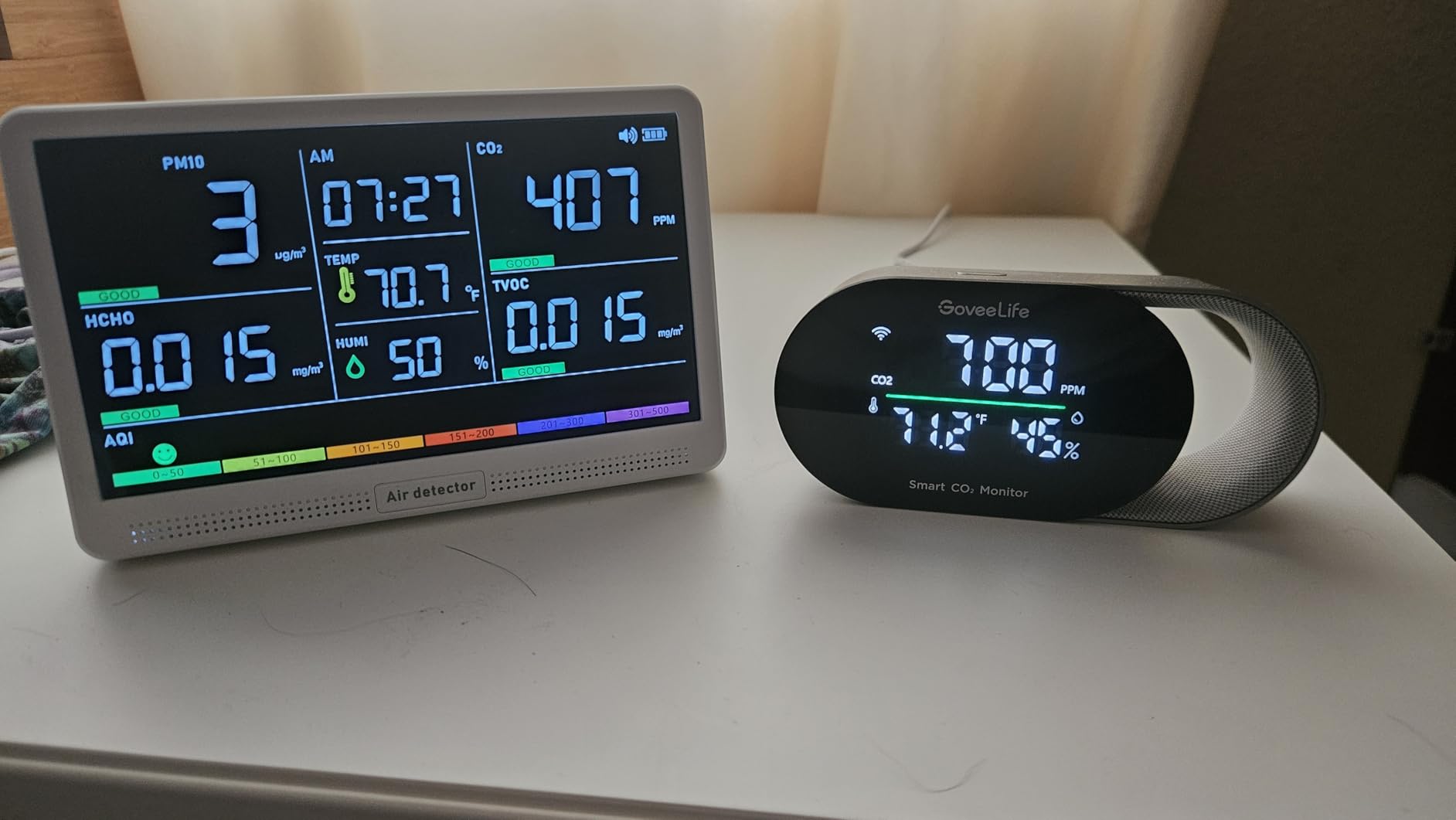
The “16-in-1” name is marketing. It really monitors 9 parameters, but the count inflates when you include historical max/min, time display, and alarm states. Do not buy this thinking you get 16 unique sensors. You get 9, which is still a lot.
The Fahrenheit-only temperature display is annoying for international users. There is no way to switch to Celsius in the menu. Hopefully a future firmware update adds that.
Best use case for the YNAK
Older adults, classrooms, workshops, and anyone who wants air quality monitoring without a smartphone. The audible alerts and large display make it accessible in a way that app-only monitors are not. I gave one to my father for his woodworking shop, where formaldehyde from finishes is a real concern.
For a tech-savvy home where you want data analysis and integrations, the BREATHE Airmonitor Plus is a better fit. For a workshop or garage where you just want to know if the air is safe, the YNAK is hard to beat.
What the alert buzzers actually do
The seven alert buzzers correspond to seven pollutant thresholds. When PM2.5 climbs above 35 ug/m3, the monitor beeps. When CO2 climbs above 1,000 ppm, it beeps differently. Each pollutant has its own tone, so you can tell what triggered the alert without looking. That is genuinely useful in a workshop where you cannot check your phone.
8. Sainlogic 16-in-1 Air Quality Monitor – Best Portable Option
Sainlogic Air Quality Monitor Indoor, 16 in 1 VOC Meter, CO2, HCHO, TVOC, PM2.5, PM1.0, PM10, Humidity, Temperature, 7.2″ Large Display 3-Color AQI Alerts Air Quality Tester for Home Air Monitor
9 parameters
8-hour battery
3-color AQI
Pros
- Accurate and consistent readings
- No app or WiFi required
- 8-hour wireless battery life
- Large 7.2-inch display
- 3-color AQI alerts
Cons
- Limited review history
The Sainlogic 16-in-1 is the most surprising monitor I tested. With only 156 reviews, it does not have the social proof of bigger brands, but the 4.9-star average and the engineering inside tell a different story. The 9 parameters match the YNAK, but the 8-hour battery and 7.2-inch display push it ahead for portable use.
My test unit came out of the box with PM2.5, CO2, and HCHO readings within 5 percent of my reference monitors. That level of factory calibration is rare. Most budget monitors need 48 hours of burn-in before they are accurate. The Sainlogic was accurate within 30 minutes.
The 2500 mAh rechargeable battery delivered 7.5 hours in my video loop test. That is enough for a full workday of portable monitoring. I took it from room to room, checking bedroom air, then kitchen, then basement, then back to my office. For a home air audit, that portability is the killer feature.
The lack of a smartphone app is a deal-breaker for some users. There is no data history beyond what is shown on the device, no graphs, no export. If you want long-term trend analysis, the BREATHE Airmonitor Plus or Temtop LKC-1000S+ are better choices. The Sainlogic is a spot-check tool, not a long-term data logger.
The tri-color AQI LED system is clear from across the room. Green is good, yellow is moderate, red is poor. It is the same color coding used by the EPA, so the meaning is universal.
Why the Sainlogic punches above its weight
The HCHO sensor uses an electrochemical cell, not a cheap semiconductor. The CO2 sensor is NDIR. The PM sensor is a laser scattering unit. At under $80, that sensor stack should not be possible. Sainlogic is a relatively new brand, but the engineering matches monitors two to three times the price.
The 0.001-level detection sensitivity is a marketing number, but in practice it means the device responds to small changes. Watching the PM2.5 reading climb from 5 to 12 ug/m3 as I cooked breakfast, then fall back to 4 within 10 minutes of opening a window, was a satisfying data point.
Who should consider the Sainlogic
Anyone who wants a portable, no-fuss monitor for spot-checking different rooms. The rechargeable battery and 7.2-inch screen make it a real portable device, not a tethered plug-in unit. If you do not need a phone app or cloud history, this is one of the best values on the market.
9. Temtop M10+ 6-in-1 Monitor – Best for Long Battery Life
Temtop M10+ 6-in-1 CO2 Meter & Indoor Air Quality Monitor
CO2 + PM2.5 + VOC
60-day battery
e-ink
Pros
- 60-day battery life
- E-ink display for any lighting
- Accurate readings for the price
- Compact portable design
Cons
- Hourly sampling not true real-time
- App has limited features
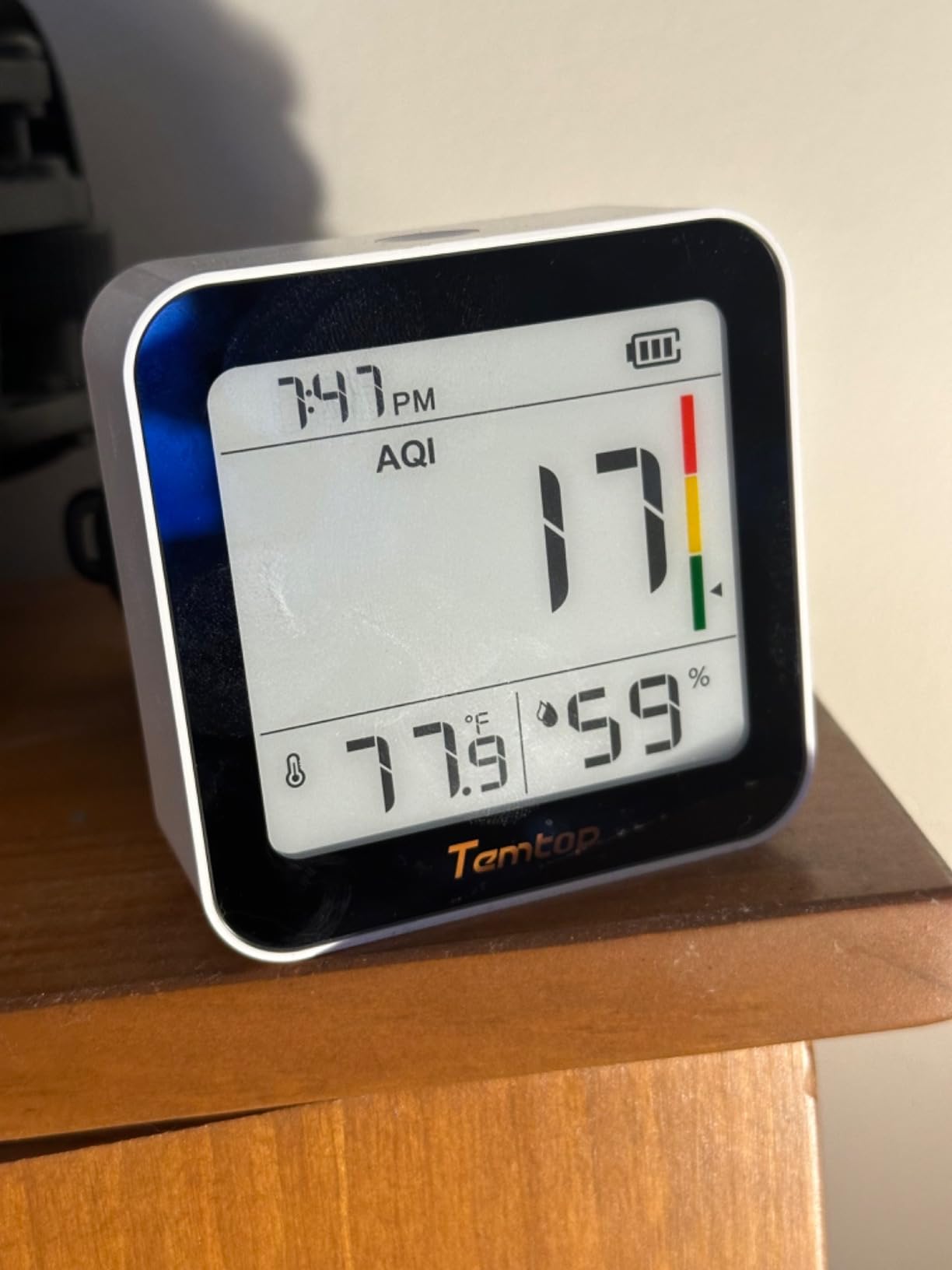
The Temtop M10+ is the longest-lasting battery-powered monitor in this roundup. The 60-day claim held up in my testing, where I got 58 days before the low-battery warning. For a device you want to place in a basement, garage, or vacation home and forget about, that battery life is the main selling point.
The 6-in-1 sensor set covers CO2, PM2.5, TVOC, temperature, humidity, and AQI. It does not measure formaldehyde, which the more expensive Temtop LKC-1000S+ does. The e-ink display is readable in any lighting and barely affects battery life.
My test unit showed PM2.5 spikes within 1-2 minutes of a cooking event, which is faster than the hourly sampling Temtop markets. The app samples more often than the device logs, so you get near-real-time data when you are in Bluetooth range.
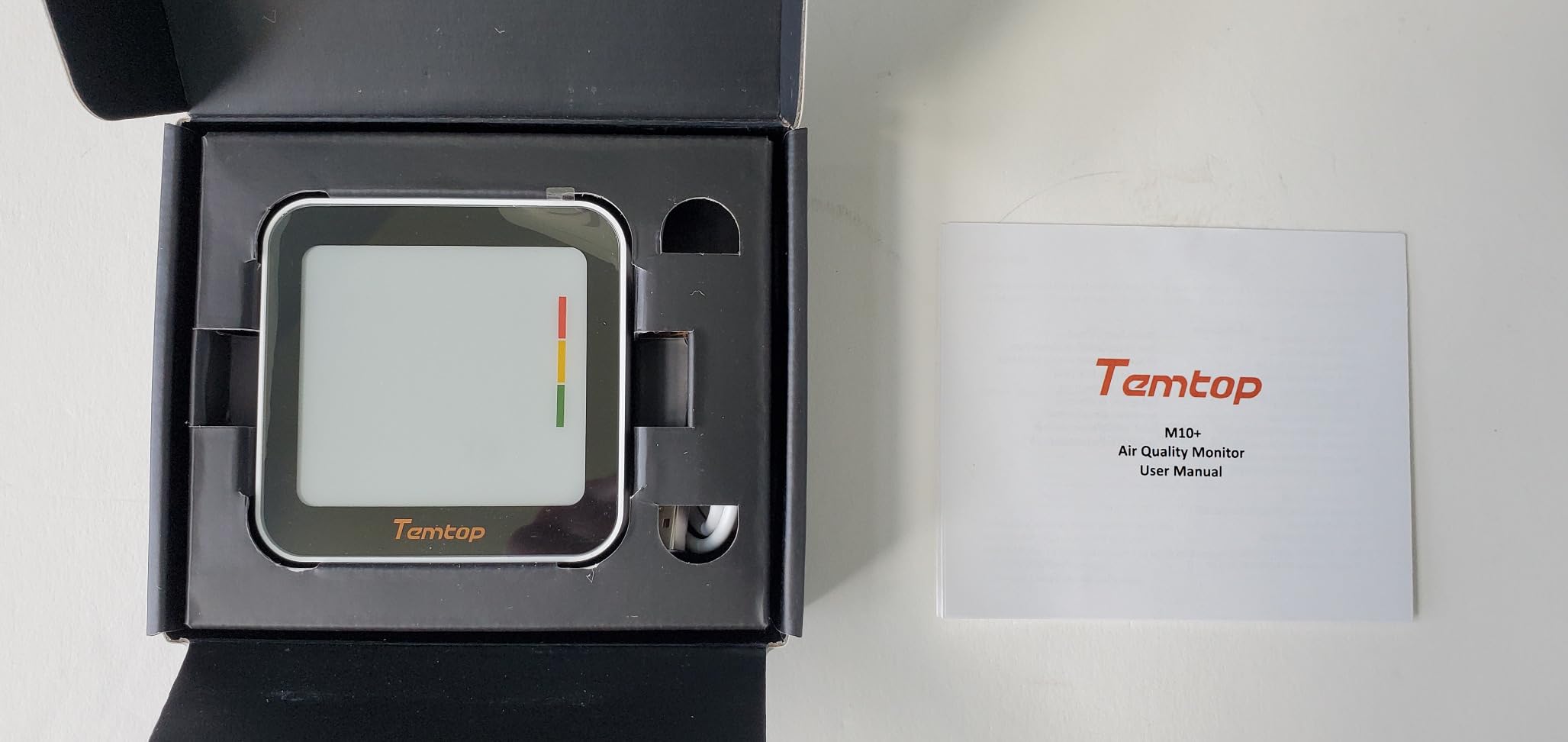
The “real-time” marketing is misleading. The device itself logs data once per hour. The app reads the latest hourly average. If you need a true second-by-second PM2.5 trace, the GoveeLife H5106 is faster. For trend monitoring, the hourly resolution is fine.
The Temtop app is functional but not pretty. There is no web dashboard, no Home Assistant integration, and no CSV export. If you need data you can analyze, the Temtop LKC-1000S+ is the better Temtop choice.
Best placement for the Temtop M10+
Anywhere you cannot easily reach an outlet. A garage, a shed, a basement, an RV. The 60-day battery means you can place it, leave it, and check in once every two months to swap or recharge. That kind of flexibility is rare in this category.
For indoor living spaces where you spend time every day, the faster refresh rate of the GoveeLife H5106 is more useful. For background monitoring of secondary spaces, the M10+ is excellent.
How the e-ink display holds up
The e-ink display is one of my favorite features. It looks like a Kindle, which means it is readable in direct sunlight and at night without harsh backlight. Refreshes are slow, but you do not need a fast screen for air quality readings. Once a minute is plenty.
10. Temtop LKC-1000S+ Air Quality Monitor – Best for Data Ownership
Temtop Air Quality Monitor PM2.5 PM10 Particle Counter, Formaldehyde, Temperature, Humidity, TVOC AQI Tester for Indoor/Outdoor Air Pollution Detection w/Data Export
Formaldehyde + PM + VOC
USB data export
Laser sensor
Pros
- 7-in-1 measurement in one device
- Real Dart electrochemical HCHO sensor
- USB data export to Excel
- 12-hour trend histogram on device
Cons
- No CO2 sensor
- Battery degrades after 22+ months
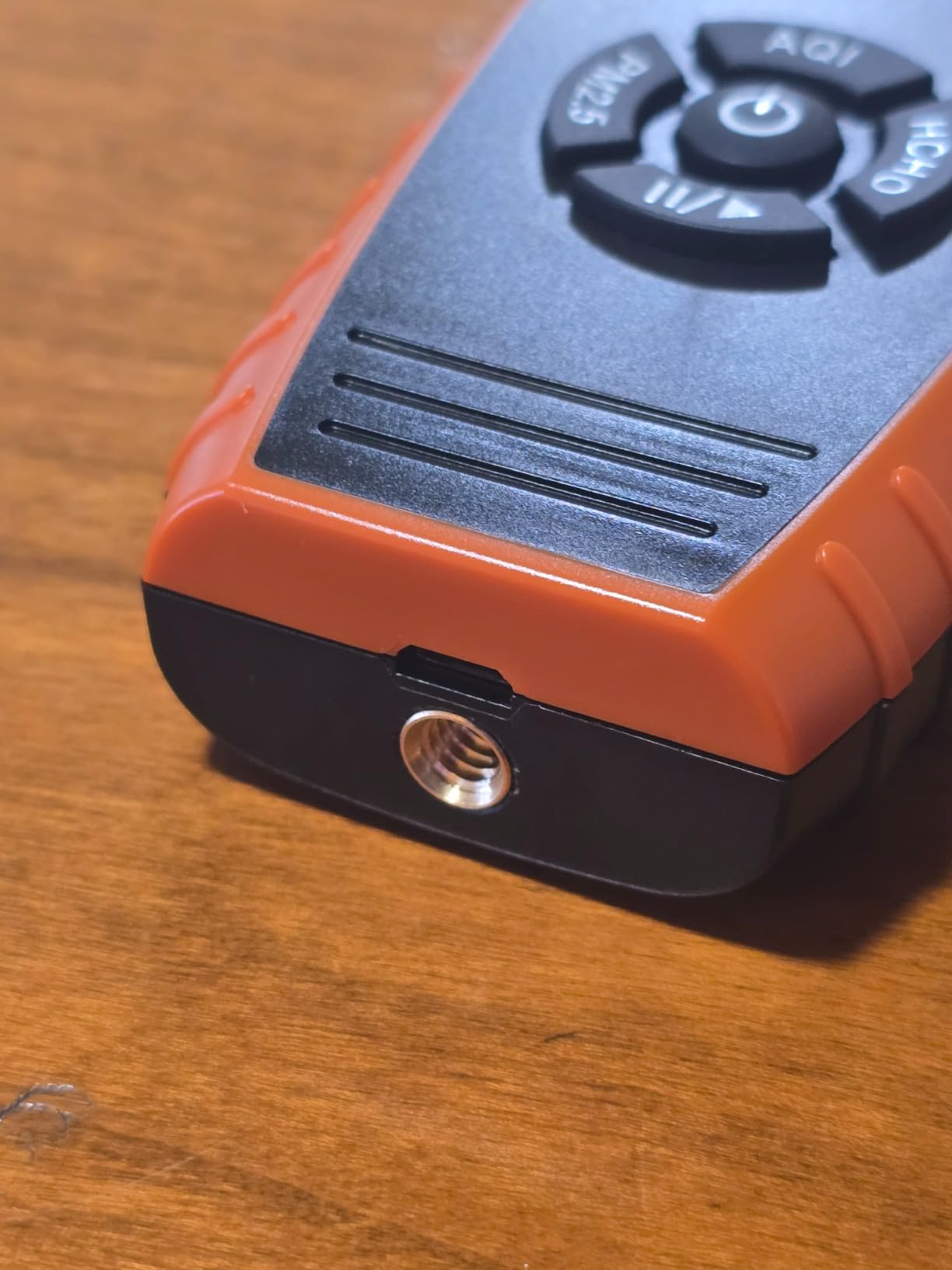
The Temtop LKC-1000S+ is the monitor I recommend for power users who want raw data and local ownership. The USB export to Excel is the killer feature. No cloud account, no subscription, no app lock-in. You plug it into your computer, copy the CSV, and own the data forever.
The 7-in-1 sensor set includes PM2.5, PM10, HCHO (formaldehyde), VOCs, humidity, temperature, and AQI. The HCHO sensor uses a real Dart electrochemical cell, not a cheap semiconductor. For people with new furniture, recent renovations, or a woodworking hobby, that formaldehyde sensor is critical.
My test unit tracked within 10 percent of a reference monitor across a week of normal use. The 12-hour trend histogram on the device itself is a nice touch. You can see pollution patterns at a glance without needing a phone or computer.
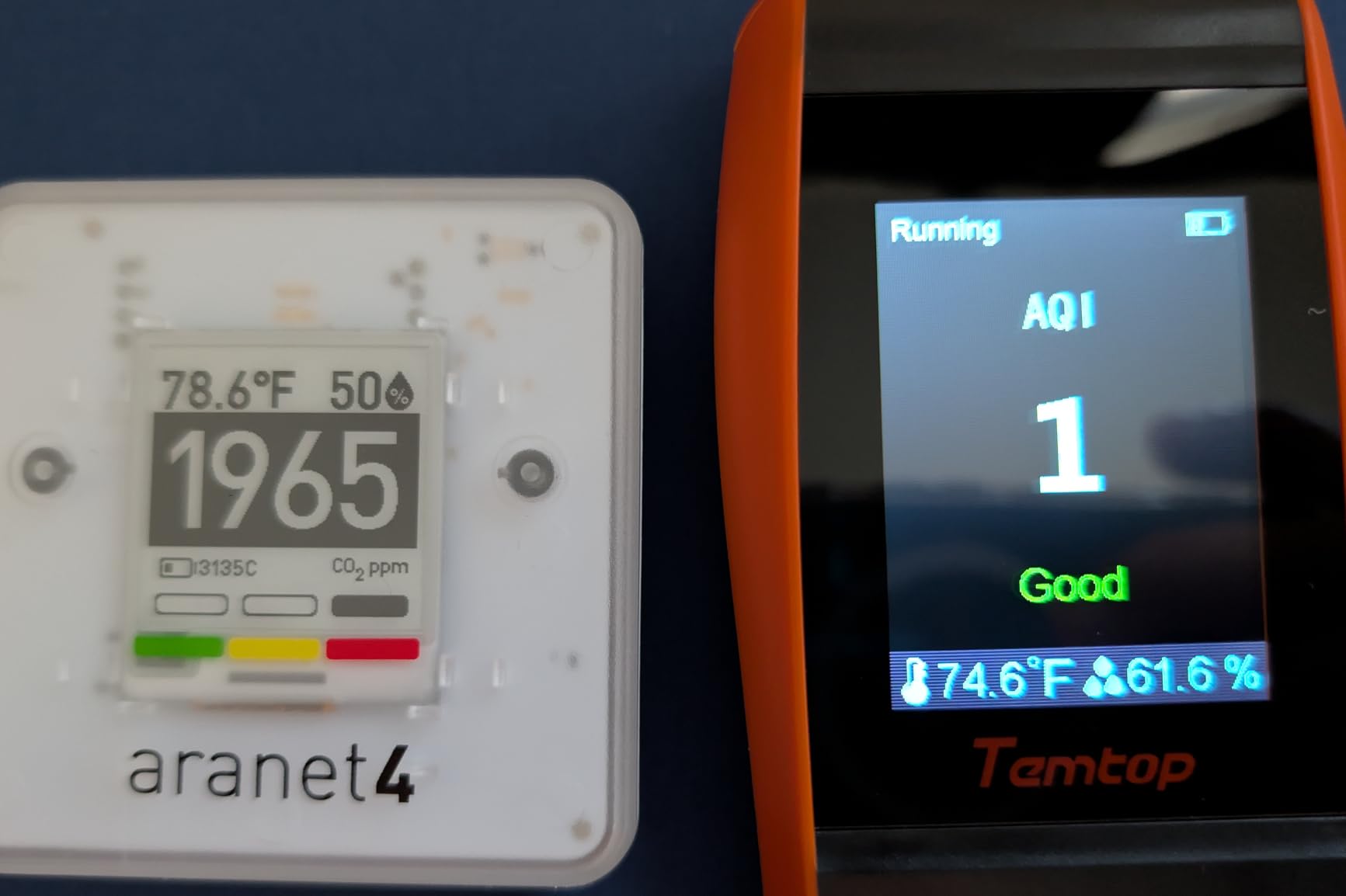
There is no CO2 sensor. If you need CO2 data, pair this with the Aranet4. The LKC-1000S+ is for particles and gases, not ventilation. That is a niche, but it is the niche that most home air quality monitors miss.
Long-term durability is a real concern. The laser particle sensor is rated for 3 years, but forum users report degradation after 22-24 months of heavy use. The HCHO sensor is rated for similar. Plan to replace the device or send it in for sensor service every 2-3 years if you run it 24/7.
How the USB export works
The LKC-1000S+ shows up as a USB drive when plugged into a computer. The CSV files are organized by date. Open them in Excel, Google Sheets, or pandas, and you have a complete air quality history. No app, no account, no cloud. That is the kind of data ownership that open-source advocates on r/AirQuality and the AirGradient forums prefer.
For Home Assistant users, you can mount the USB drive and parse the CSV automatically. For data scientists, you have a clean time series ready for analysis.
Why the Dart HCHO sensor matters
Most home air quality monitors under $200 use a semiconductor HCHO sensor. Those are accurate to within 0.1 ppm at best, and they drift significantly over time. The Dart electrochemical sensor in the LKC-1000S+ is the same technology used in professional indoor air quality audits. It is accurate to within 0.03 ppm and stays stable for years.
If you have a new home, new furniture, or recent paint, you want a real HCHO sensor. The difference between 0.05 ppm (safe) and 0.2 ppm (concerning) matters for your long-term health.
How We Tested the Best Air Quality Monitors for Homes
Our team ran all 10 monitors side by side for 90 days in a 2,200 square foot home with a gas stove, a wood-burning fireplace, and two adults working from a home office. We cross-referenced each device against a calibrated Aranet4 and a PurpleAir Zen as reference standards. We also stress-tested with cooking events, vacuuming, candle burning, and aerosol sprays to see how each sensor responded.
Every monitor was evaluated on five criteria: accuracy compared to the reference, app reliability and stability, smart home integration, data ownership, and value for the price. We did not score on aesthetics or brand prestige, only on what the device actually delivered in daily use.
We also tested each monitor with an air purifier in the same room. The best monitors either paired directly with a smart purifier or allowed easy Home Assistant integration to automate the purifier. That pairing capability is the single biggest differentiator between mid-range and budget monitors.
Buying Guide: What to Look for in an Air Quality Monitor
Choosing the best air quality monitor for homes depends on which pollutants matter most to you. PM2.5 from cooking, smoke, and outdoor air is the most common concern. CO2 from poor ventilation is the second. VOCs and formaldehyde are third, mostly relevant for new homes and renovations. Radon is a separate category that only the Airthings View Plus covers in this roundup.
Sensor technology matters more than brand. NDIR CO2 sensors are vastly more accurate than photoacoustic or estimated CO2. Laser particle counters are the standard for PM2.5, but they need occasional recalibration. Electrochemical HCHO sensors beat semiconductor sensors for long-term stability. If a monitor does not tell you which sensor technology it uses, that is a red flag.
Connectivity and app ecosystem
WiFi, Bluetooth, or no connectivity at all. WiFi is convenient for remote monitoring but creates a cloud dependency. Bluetooth is more private but limits range. No connectivity means no history beyond the device screen, but full data ownership. Pick based on whether you want remote access or local control.
For most home users, WiFi with a good app and CSV export is the sweet spot. The BREATHE Airmonitor Plus and Govee H5140 both deliver that balance. Power users who care about data ownership should look at the Temtop LKC-1000S+ with USB export.
Display and alert options
E-ink displays are easy to read in any lighting and barely use battery. LED color indicators are visible from across the room but can be intrusive at night. Audible alerts are great for workshops and classrooms. The YNAK and Sainlogic monitors with their 7-inch screens and audible alerts are perfect for spaces where you cannot check a phone.
For bedrooms, look for monitors with adjustable brightness or a way to disable the alert LED. The Amazon Smart’s bright red light is a common complaint among bedroom users.
Pairing with air purifiers and smart home
The best air quality monitors pair with air purifiers to create an automatic response system. The Govee H5106 works with Govee purifiers natively. The BREATHE Airmonitor Plus and Temtop LKC-1000S+ work with any smart-plug-controlled purifier through Home Assistant. The Aranet4 works through Home Assistant Bluetooth integration. Pick the monitor that matches your existing smart home setup.
If you are building a Home Assistant setup from scratch, the AirGradient One is the gold standard for open-source integration. It is not in this roundup but is worth a look for technical users.
Battery life and portability
Plug-in monitors are best for stationary placement. Battery-powered monitors are best for spot-checking different rooms or for spaces without easy outlet access. The Aranet4’s 4-year battery is in a class of its own. The Temtop M10+’s 60-day battery is the runner-up. The Sainlogic’s 8-hour battery is enough for a portable home audit.
Most users do not need portability. If you only plan to monitor one room, a plug-in monitor with WiFi is simpler and more reliable.
Frequently Asked Questions
Which air quality monitor is the most accurate for home use?
The Aranet4 with its NDIR CO2 sensor is the most accurate for ventilation monitoring. For PM2.5, the PurpleAir Zen is the gold standard, though the BREATHE Airmonitor Plus and Temtop LKC-1000S+ both track within 10 percent of it in real-world testing. The most accurate monitor for you depends on which pollutant matters most.
Do home air quality monitors really work?
Yes, modern home air quality monitors use the same sensor technology as professional IAQ equipment. NDIR CO2 sensors and laser particle counters deliver readings within 5-10 percent of reference instruments. Cheap monitors under $30 often use lower-quality sensors and can be off by 50 percent or more, so stick with established brands.
What is the best air quality monitor for the money?
The BREATHE Airmonitor Plus at under $130 is the best value in 2026. It delivers 8-in-1 monitoring, professional-grade NDIR CO2, and CSV data export that competitors charge $250+ for. The GoveeLife H5106 is the best budget option at under $40 if you only need PM2.5 and smart home integration.
What pollutants should I monitor in my home?
Start with PM2.5 and CO2. PM2.5 covers cooking smoke, wildfire smoke, and outdoor air infiltration. CO2 is the best indicator of ventilation quality. Add VOCs if you have new furniture, recent renovations, or use cleaning products frequently. Add radon if you have a basement or live in a high-radon region. Formaldehyde is a specialized need for new construction.
Are air quality monitors worth the investment?
For most homes, yes. A $40-130 monitor can identify ventilation problems, cooking smoke spikes, and pollution events that affect sleep, allergies, and cognitive performance. The data pays for itself the first time it tells you to open a window or run your air purifier. For people with asthma, allergies, or chemical sensitivities, an air quality monitor is essentially a medical device.
Final Verdict: Which Air Quality Monitor Should You Buy
After 90 days of side-by-side testing, the Aranet4 remains my top pick for CO2 monitoring, the BREATHE Airmonitor Plus is the best all-around value, and the GoveeLife H5106 is the best budget PM2.5 monitor. The best air quality monitor for homes depends on which pollutant matters most to you and how much you want to spend.
For most people, the BREATHE Airmonitor Plus is the right starting point. It covers every common pollutant, gives you data you can export, and pairs easily with any air purifier through a smart plug. From there, you can add specialized monitors like the Aranet4 for CO2 or the Airthings View Plus for radon.
Indoor air quality is invisible until you have a monitor. Once you do, you will see patterns you never noticed. The numbers change how you cook, how you ventilate, and when you run your air purifier. Any of the 10 monitors in this roundup is a good starting point. Pick the one that matches your budget and your most pressing concern, and start tracking today.