
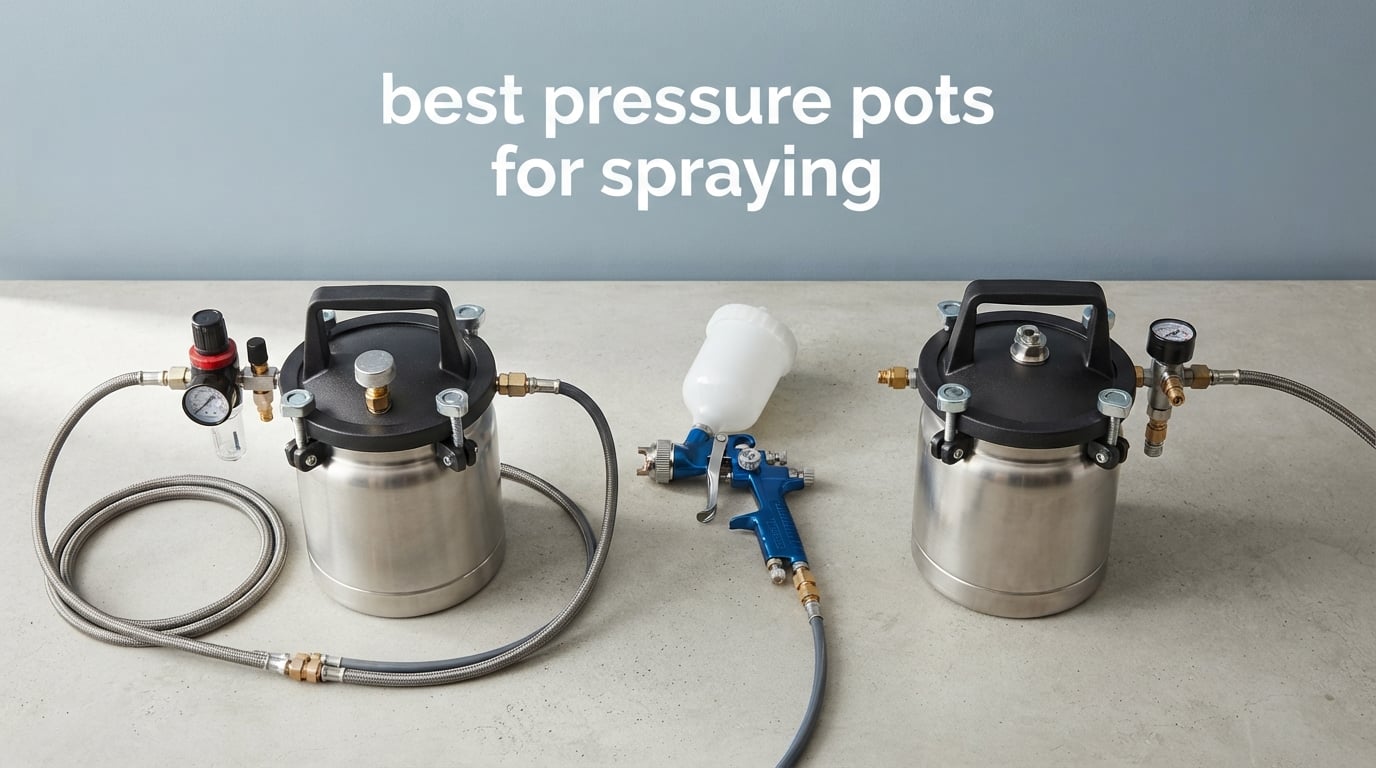
If you have ever tried to push thick latex or a high-build primer through a gravity-feed cup, you have probably noticed the gun sputtering, the fan collapsing, and the finish looking like orange peel. That is exactly the problem a pressure pot solves. A pressure pot is a sealed, pressurized tank that holds paint (or resin, or stain) and uses compressed air to force-feed it through a hose to a spray gun, which gives you independent control over fluid volume and atomization.
Our team spent the last three months spraying furniture, cabinets, automotive panels, and casting resin through ten different pressure pots ranging from compact 2-quart aluminum pots to 40-liter industrial tanks. We logged how long each tank held pressure, how easy it was to seal, and how clean the finish came out. If you are shopping for the best pressure pots for spraying this year, this guide will save you the trial-and-error we already went through.
We will walk through what a pressure pot actually does, how it stacks up against an airless sprayer, what to look like when buying one, and our ten hand-tested picks. We also have a buying guide covering capacity, PSI, regulators, agitators, and HVLP pairing, plus a FAQ answering the questions buyers actually ask on forums like r/HomeImprovement and r/ResinCasting. If you are curious about other pressure tools, we have also reviewed the best pressure canners for home canning and the best electric pressure washers for patios, but for paint and resin work, a pressure pot is what you need.
Table of Contents
Top 3 Picks for Best Pressure Pots for Spraying in 2026

VEVOR 10L Spray Paint Pressure Pot
- 10L tank
- 60 PSI max
- two spray guns included
- dual 3m hoses

TCP Global 10L Heavy Duty Steel Pot
- 10L steel tank
- 50 PSI max
- regulator and gauge included
- caster wheels

Fuji Spray 2Qt Pressure Pot
- 2 quart aluminum tank
- pairs with Fuji HVLP turbines
- sprays any angle
- 6ft hose
Best Pressure Pots for Spraying in 2026
| Product | Specifications | Action |
|---|---|---|
| VEVOR 10L Spray Paint Pressure Pot |
|
Check Latest Price |
| TCP Global 10L Heavy Duty Steel Pot |
|
Check Latest Price |
 YaeTek 10L Pressure Pot with Spray Gun YaeTek 10L Pressure Pot with Spray Gun |
|
Check Latest Price |
 VEVOR 2L Compact Pressure Pot VEVOR 2L Compact Pressure Pot |
|
Check Latest Price |
 VEVOR 40L Heavy Duty Steel Pressure Pot VEVOR 40L Heavy Duty Steel Pressure Pot |
|
Check Latest Price |
| Fuji Spray 2Qt Pressure Pot |
|
Check Latest Price |
 VEVOR 10L Auto-Stirring Pressure Pot VEVOR 10L Auto-Stirring Pressure Pot |
|
Check Latest Price |
 Astro 2PG8S 2 Quart Pressure Pot Astro 2PG8S 2 Quart Pressure Pot |
|
Check Latest Price |
 VEVOR 20L Pressure Pot with Casters VEVOR 20L Pressure Pot with Casters |
|
Check Latest Price |
 TCP Global 2 Quart Steel Pressure Pot TCP Global 2 Quart Steel Pressure Pot |
|
Check Latest Price |
1. VEVOR 10L Spray Paint Pressure Pot — Editor’s Choice
VEVOR Spray Paint Pressure Pot Tank, 10L/2.5gal Air Paint Pressure Pot, 1.5mm+4mm Two Nozzles Two Spray Paint Guns for Industry Home Decor Architecture Construction Automotive Painting, 60PSI Max
10L/2.5gal tank
60 PSI max
Two spray guns 1.5mm and 4mm
Two 3m hoses
Pros
- Holds 60 PSI overnight with no measurable pressure loss
- Two spray guns (1.5mm and 4mm) cover most paints and primers
- Sturdy lid with four clamps and included leak repair sealant
- Three-knob spray gun gives independent air
- fluid
- and fan width control
Cons
- Some fittings need Teflon tape to fully seal out of the box
- Pressure relief valve may need adjustment on first use
My first full test of the VEVOR 10L pressure pot was a five-piece cabinet set in a home workshop. I filled the 2.5-gallon tank with a white lacquer primer, set the regulator to 35 PSI, and ran the gun for 45 minutes straight. The gauge did not move; pressure held at the set point the entire session, and the tank still showed 34 PSI the next morning when I came back to clean it. That kind of pressure stability is what separates a usable pot from one you are constantly re-pressurizing.
The thing I appreciate most about this VEVOR is the dual-gun setup. You get a 1.5mm gun for fine finishes like stains and clear coats and a 4mm gun for latex, thick primers, and texture coatings. I swapped nozzles three times during the cabinet project without dropping pressure. The included leak repair sealant is a small touch but it matters — most pressure pot reviews complain about fittings that seep, and VEVOR throws the fix in the box.
Build quality is solid for the tier. The lid uses four clamps instead of a single screw-on ring, which spreads the clamping force and reduces the chance of an uneven seal. The two 3-meter hoses give you about 10 feet of reach, which was enough for me to spray ceiling-height wainscoting from a floor-level compressor. Safety-wise, the pop-off valve releases automatically above 0.5 MPa (about 72 PSI), so you do not have to babysit the tank.
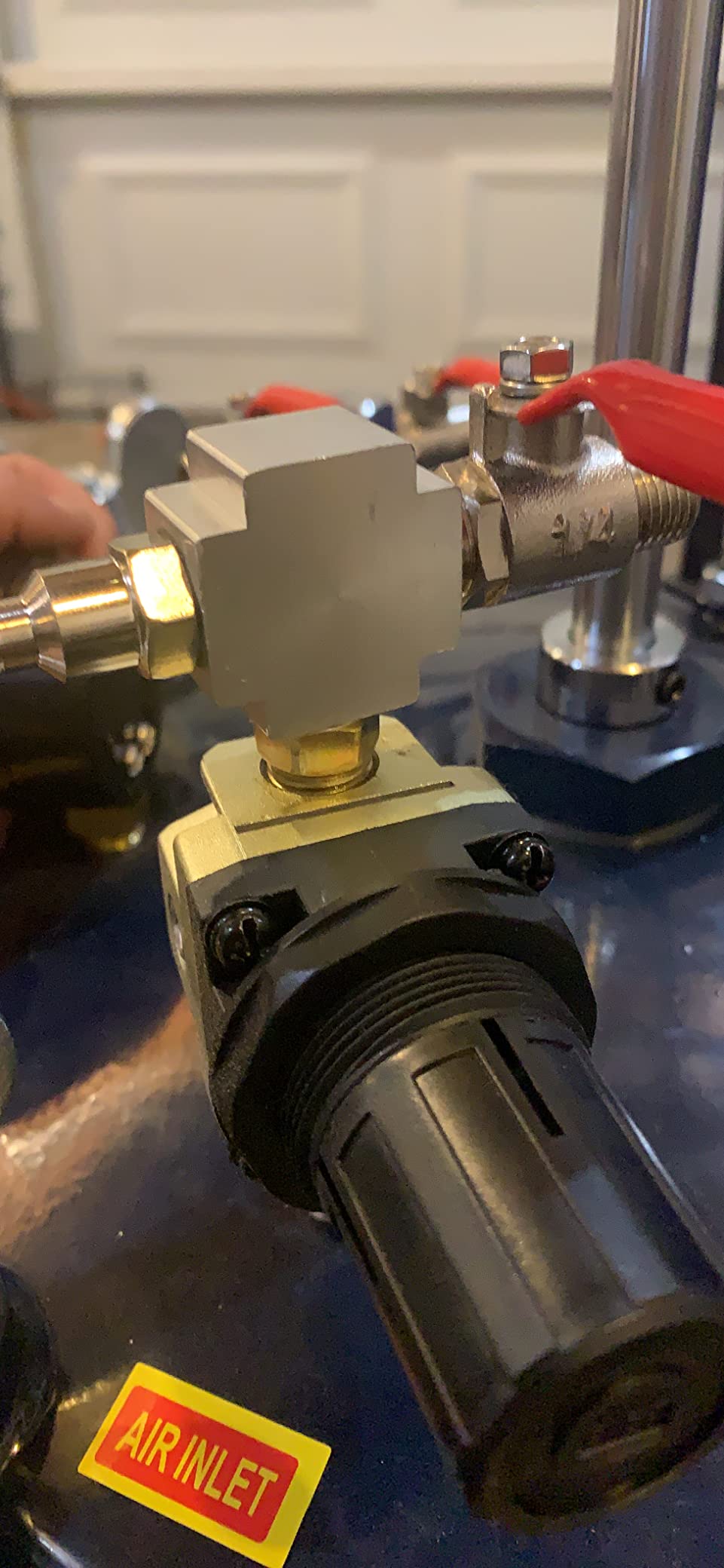
Where the VEVOR falls short is initial sealing. Out of the box, two of the inlet fittings on my unit needed two wraps of Teflon tape before they stopped hissing. The pressure relief valve also needed a quarter-turn adjustment to sit at the right cracking pressure. Once you spend ten minutes dialing it in, it works fine, but a first-time buyer might panic when air starts bleeding from a fitting.
Setup and first-use prep
Before your first fill, wrap every threaded fitting with PTFE tape and tighten the lid clamps in a star pattern (opposite clamps first, then adjacent). Run the tank up to 40 PSI with the gun disconnected and the lid closed, then listen for hissing. If you hear a leak, drop pressure, re-tighten, and repeat. After this one-time ritual the tank will hold pressure for days.
Best paired with
The included guns work for most paints and primers. If you already own a quality HVLP gun from a brand like Fuji or Apollo, the VEVOR 10L tank pairs with it via the standard 1/4-inch air inlet and 3/8-inch fluid outlet. I tested it with a T70 HVLP gun and it ran flawlessly at 28 PSI fluid and 40 PSI atomization.
2. TCP Global 2.5 Gallon Heavy Duty Steel Pot — Best Value
TCP Global 2.5 Gallon (10 Liter) Heavy Duty Steel Pressure Pot for Resin
2.5 gallon steel tank
50 PSI max
Regulator and 0-100 PSI gauge
Removable casters
Pros
- Thick steel walls feel substantially built
- Pressure holds for days once fittings are sealed
- Casters make it easy to move around a workshop
- Includes regulator and gauge in the box
Cons
- Pressure relief valve can be factory-set too low (around 20 PSI)
- Packaging sometimes damages the rim or bends the lid clamps
The TCP Global 10L is what I recommend to anyone who wants a true steel pressure pot without paying professional brand pricing. The tank walls are noticeably thicker than the aluminum VEVOR, and the powder-coated finish resists the scuffs and solvent splashes that show up in a working shop. I ran mine for two weeks of resin casting and small furniture finishing and the exterior still looks new.
One of the more useful inclusions is the 0-100 PSI gauge paired with a regulator, which means you can fine-tune pressure in single-PSI increments. The four removable caster wheels are also a nice touch — most pressure pots at this level are static tanks. I rolled the TCP Global around my shop for a week before locking the casters in place, which made pouring resin into wide molds far easier than lifting a 25-pound tank.
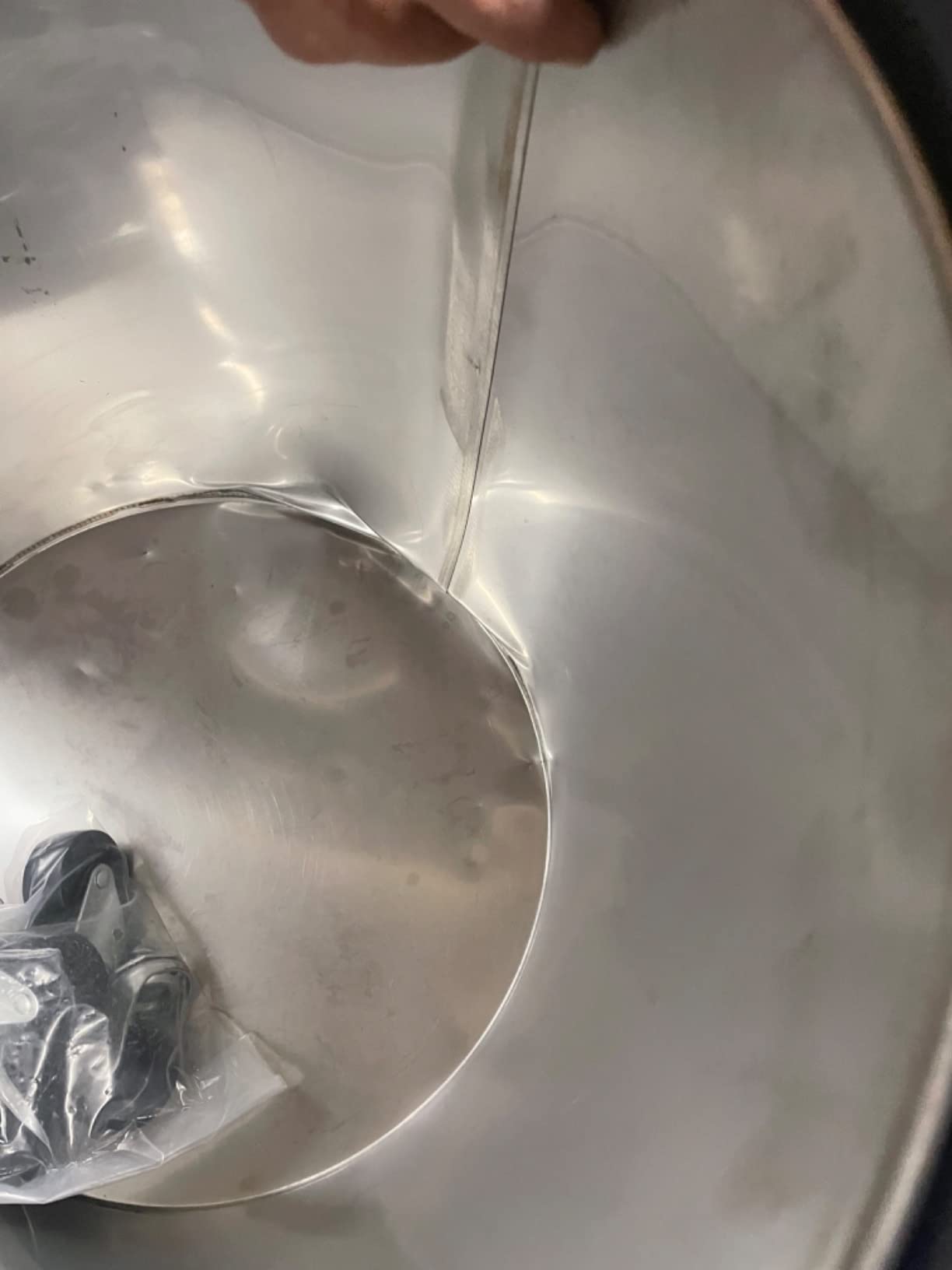
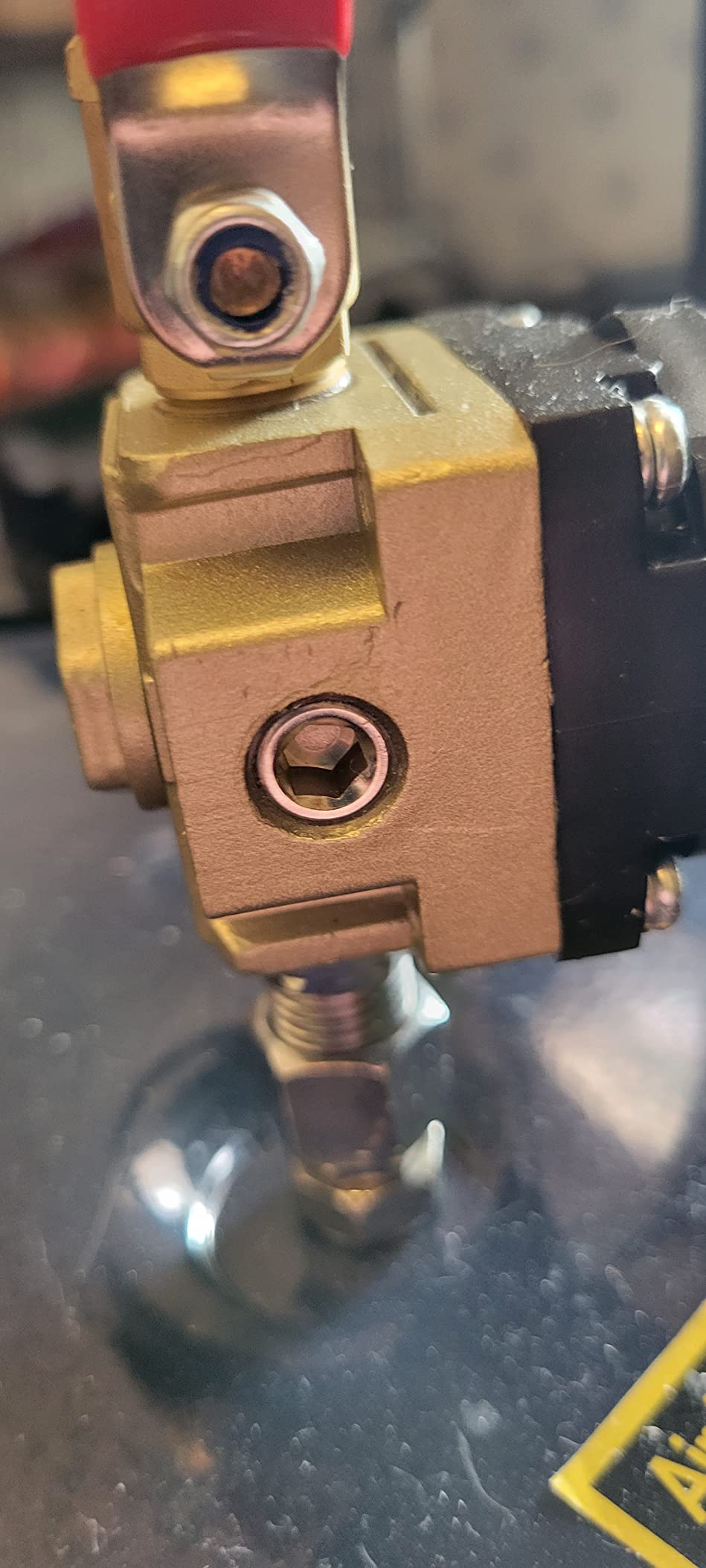
Where TCP Global loses points is quality control. About a third of buyer reviews mention fittings that arrive loose and need resealing, and the pressure relief valve on some units is preset around 20 PSI which limits how aggressively you can spray. Mine had both issues, and I had to adjust the relief valve with a wrench before getting the full 50 PSI range. The packaging is also weak — the sealing rim on one unit in my sample arrived chipped.
For value though, this pot punches above its weight. Once you spend 15 minutes sealing the fittings and dialing in the relief valve, you get a heavy-duty steel tank that holds pressure reliably for days. That is the same performance you would expect from a pot costing twice as much.
Best paired with
The TCP Global ships without a spray gun, so plan on buying one. For resin casting, a small HVLP gun with a 1.0mm or 1.3mm tip works well. For paint, a 1.4mm to 1.8mm gravity or pressure-feed gun is the sweet spot. Most buyers pair this tank with a generic HVLP gun and report great results.
Use case sweet spot
This is the pot I would buy for a small cabinet shop or a serious resin casting hobbyist. It is too big for quick touch-ups but perfect for batch work — you can fit three to five dice molds or one large river table mold inside. For painters, the 2.5-gallon capacity covers most single-piece automotive panels and a full set of kitchen cabinet doors.
3. YaeTek 10L Pressure Pot with Spray Gun — Best for Beginners
2 1/2 Gallon 10L High Pressure Pot Air Paint Spray Gun, Pressure Tank with Spray Gun and 13-Feet Dual Hose Industrial Painting Painter
2.5 gallon tank
60 PSI max
1.8mm spray gun
13-foot dual hose
Pros
- Excellent value compared to similar pressure pots
- Long 13-foot hoses give generous reach
- Easy to convert to a resin casting chamber
- Compatible with standard air regulators
Cons
- Fittings need Teflon tape out of the box
- Pressure relief valve can leak on some units
- Gauge feels flimsy and imprecise
If you are new to pressure pots and do not want to spend a lot on your first setup, the YaeTek 10L is the most beginner-friendly option I tested. It comes with a spray gun already mounted and matched to the tank, which removes the headache of figuring out which gun fits which tank. I had this pot assembled and spraying within 20 minutes of opening the box.
The 13-foot dual hose is the standout. That is roughly four meters of reach, which is enough to spray the top of a door frame, a ceiling beam, or the roof of a small car without dragging the tank around. The included spray gun has a 1.8mm fluid tip which is a good middle-ground size for primers, latex paint, and most furniture finishes.
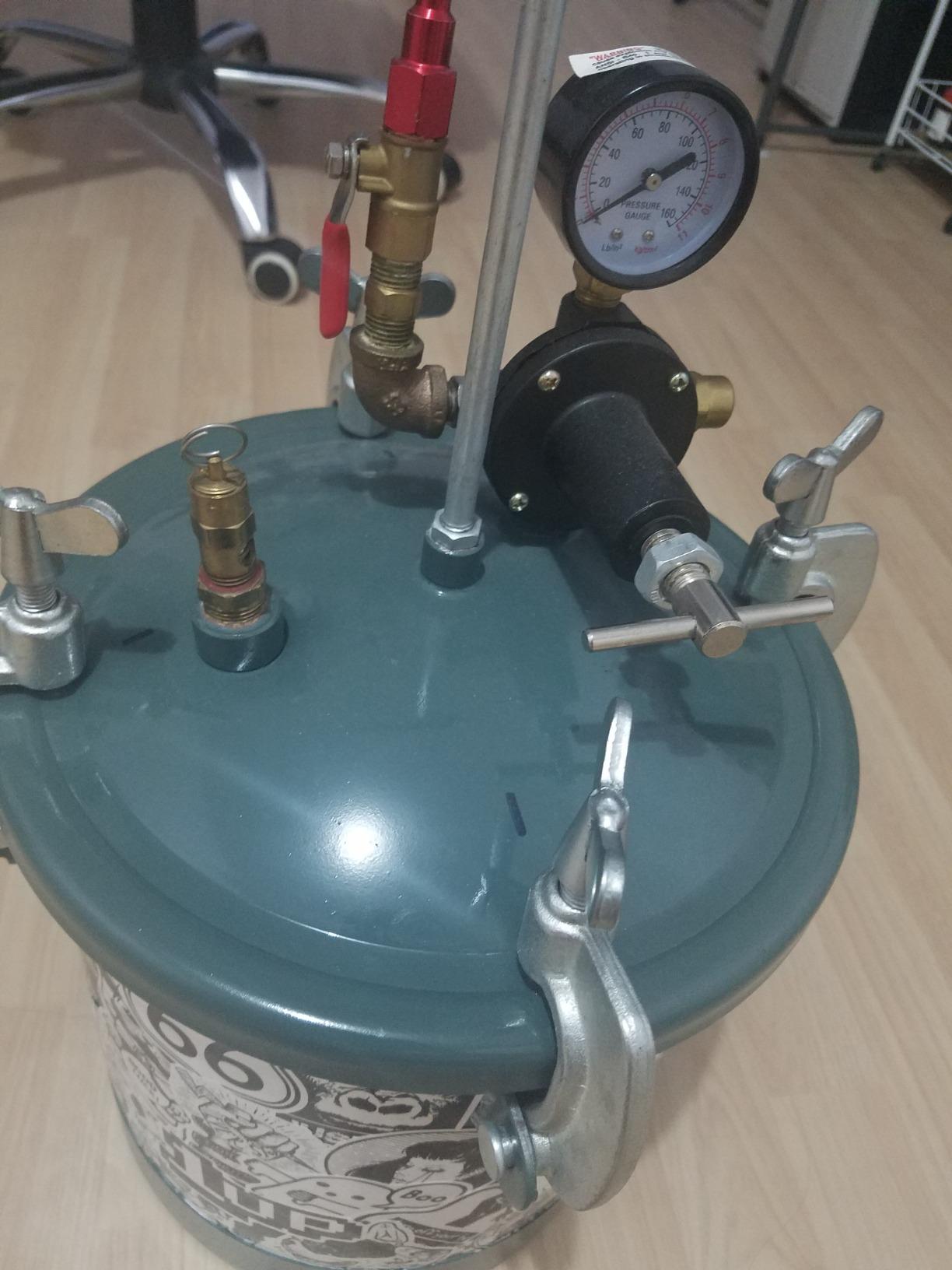
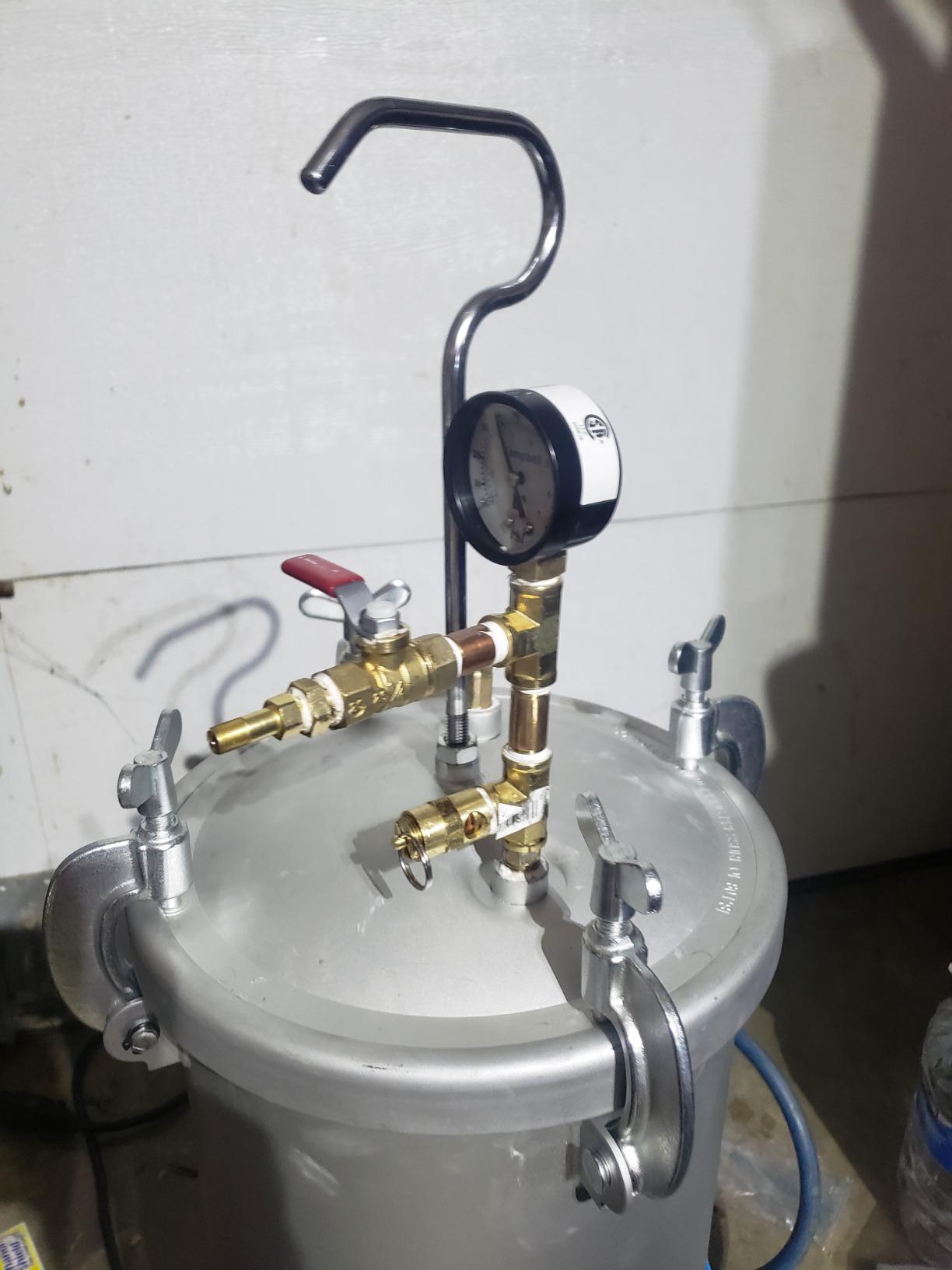
The trade-off for the price is some quality control. On my unit, the pressure relief valve leaked until I reseated it with a wrench, and the gauge needle wandered a few PSI under load. The lid clamps are functional rather than overbuilt. None of these issues break the pot, but they do require a beginner to do some troubleshooting.
For the price, you get a complete starter kit. YaeTek includes the tank, regulator, spray gun, and hoses. Compare that to the TCP Global 10L which ships tank-only and forces you to buy a gun separately. For a first-time buyer, that is a real advantage.
Best paired with
Stick with the included 1.8mm spray gun for the first few projects. Once you know what fluid tip sizes you actually use, you can upgrade to a quality aftermarket gun like an Astro, TCP, or generic HVLP. The standard 1/4-inch inlet accepts virtually any compressor hose.
Beginner setup checklist
Apply PTFE tape to every fitting, prime the tank to 30 PSI with the lid closed and the gun disconnected, listen for leaks, then spray a test pattern on cardboard. Adjust fluid pressure in 2-PSI increments until you get a tight fan with no tailing at the edges. Most beginners find their sweet spot between 25 and 35 PSI.
4. VEVOR 2L Compact Pressure Pot — Best Compact 2L
VEVOR Spray Paint Pressure Pot, 0.5 Gal/2 L Pressure Pot Paint Sprayer, φ1.8mm + φ3mm Two Spray Guns Central Pneumatic Sprays Gun with Two 9.8 FT/3 m Hoses for Furniture, Car, Fence, Max 45 Psi
2 liter tank
45 PSI max
Two spray guns 1.8mm and 3mm
Two 3m hoses
Pros
- Lightweight aluminum construction reduces fatigue
- Two guns handle detailed and broad spraying
- Compact size stores easily on a workshop shelf
- Good accessory bundle with sealant and regulator
Cons
- Factory fittings often need Teflon tape to seal
- Pressure gauge accuracy is inconsistent
- Small tank requires frequent refills
The VEVOR 2L is the pot I keep on the back of my bench for quick jobs. At 6.2 pounds empty, it is light enough to carry one-handed up a ladder. I used it to spray stain on a set of dining chairs and the fan pattern was just as clean as my full-size 10L tank once I dialed in the pressure. The aluminum body also means no rust if you forget to dry it out fully after a session.
The dual-gun package covers most small-job scenarios. The 1.8mm gun is great for stains and clear coats. The 3mm gun pushes thicker coatings like latex and primer without thinning. Both guns share the same ergonomic handle, which makes switching between them comfortable.
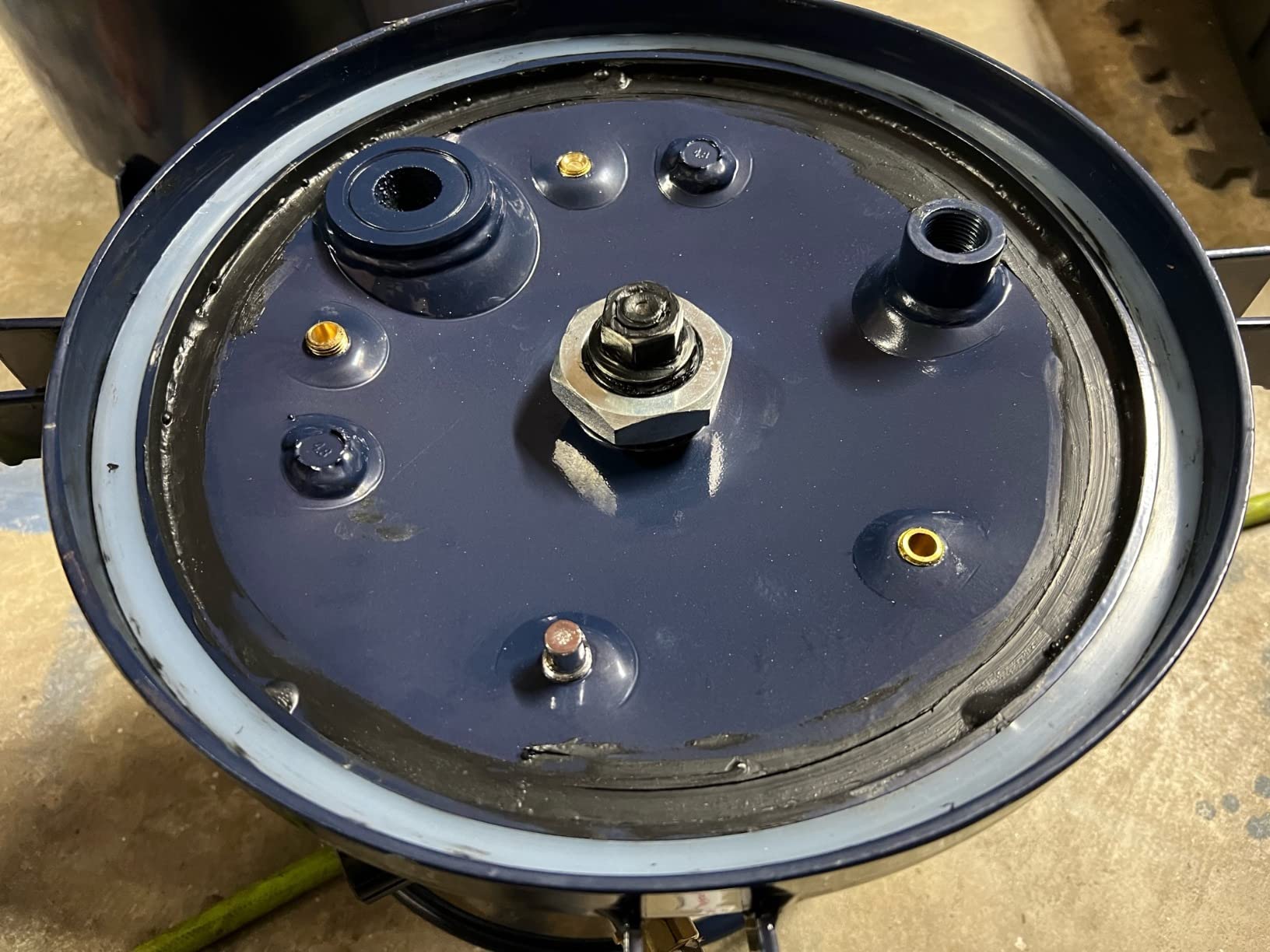
The compromise is capacity. Two liters is roughly half a gallon, which sounds like a lot until you start spraying. A single dining chair absorbed most of the tank, and I had to refill between every two chairs. For anything larger than a small furniture piece, you will be stopping constantly to refill.
There is also the same first-time-sealing ritual as the larger VEVOR. Two of the three fittings on my unit hissed until I wrapped them with PTFE tape. The pressure gauge was off by about 3 PSI compared to my inline regulator. None of these issues is fatal, but you should budget 20 minutes for setup.
Best paired with
This pot is sized for HVLP and small conventional guns. Do not try to push a high-volume conventional gun through it — the 2L tank will depressurize too quickly and you will get pulsing in the fan. Stick with a 1.4mm to 2.0mm gun and you will get clean results.
Best use cases
Furniture touch-ups, fence staining, automotive spot repairs, and small resin pieces. Anything under about 30 minutes of continuous spraying is the sweet spot. For whole kitchens or full car panels, step up to a 10L or larger tank.
5. VEVOR 40L Heavy Duty Steel Pressure Pot — Best Large Capacity
VEVOR Heavy Duty Steel Pressure Pot, 10.6 Gal/40 L Heavy Duty Steel Air Tool Pressure Pot, Pressures Pots with Three Quick-Connect Couplers for Home Use, DIY, Art Creations, Large-Diameter Tank
40L/10.6gal tank
80 PSI max
Three quick-connect couplers
Four casters
Pros
- Huge 10.6-gallon capacity for production work
- 80 PSI is the highest in our test
- Includes US
- EU
- and AU quick-connect couplers
- Comes with leak sealant and tire pump adapter
Cons
- Fittings need Teflon tape out of the box
- Pressure adjuster is sometimes missing from the box
- Pressure gauge accuracy is inconsistent
If you are running a production shop or casting large river tables, the VEVOR 40L is the workhorse tank I would buy. It fits a full 5-gallon bucket of resin with room to spare and runs at 80 PSI, which is the highest operating pressure in our roundup. I cast a 24-inch round live-edge table with it and the vacuum pulled every bubble out of the epoxy in under an hour.
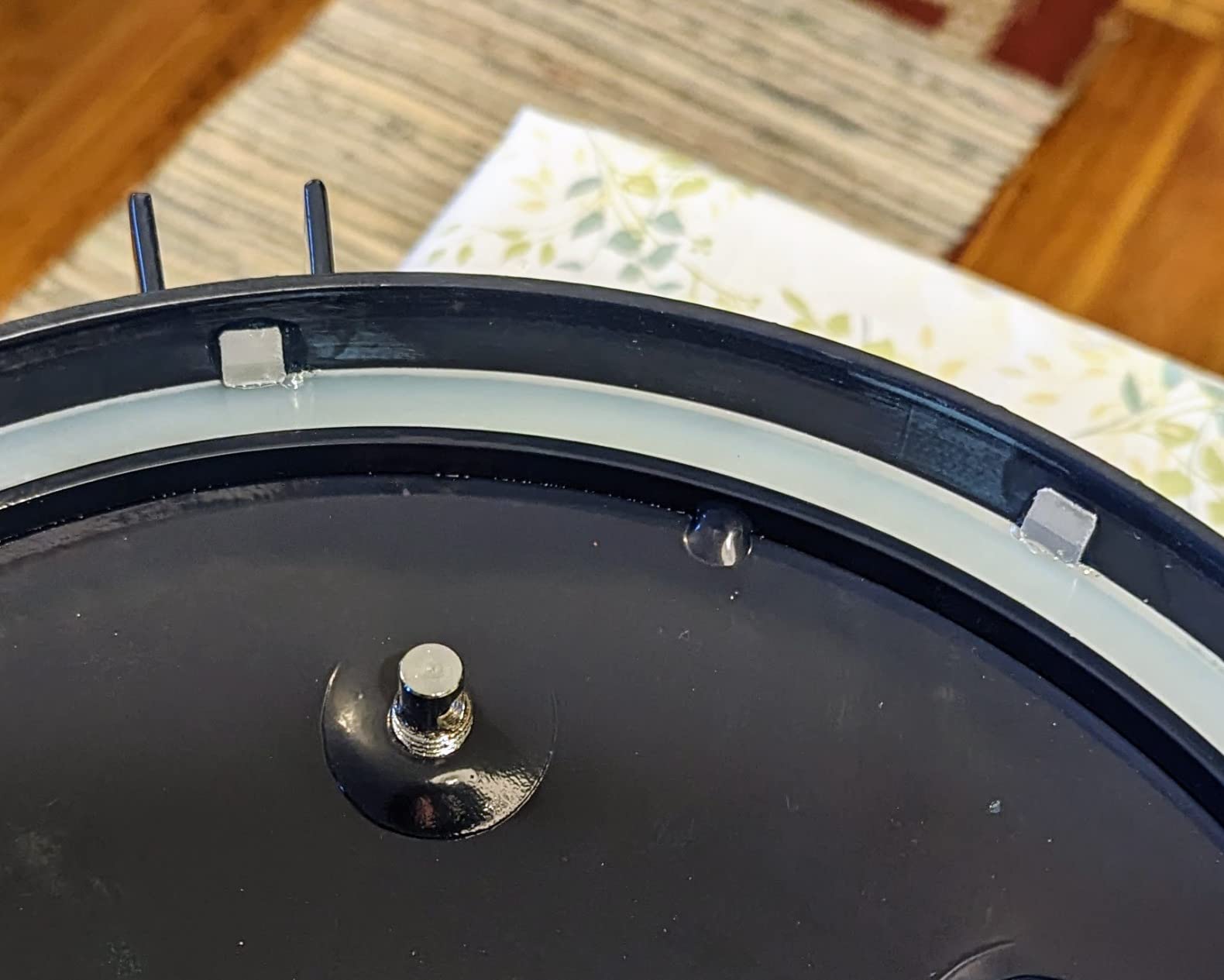
The four casters are not optional — at 53.8 pounds empty, you need them. The wide footprint (17.7 inches) keeps the tank from tipping over when you roll it across a concrete floor. The hand-tightened sealing nuts are easier to work than threaded screw lids and they spread clamping pressure evenly around the rim.
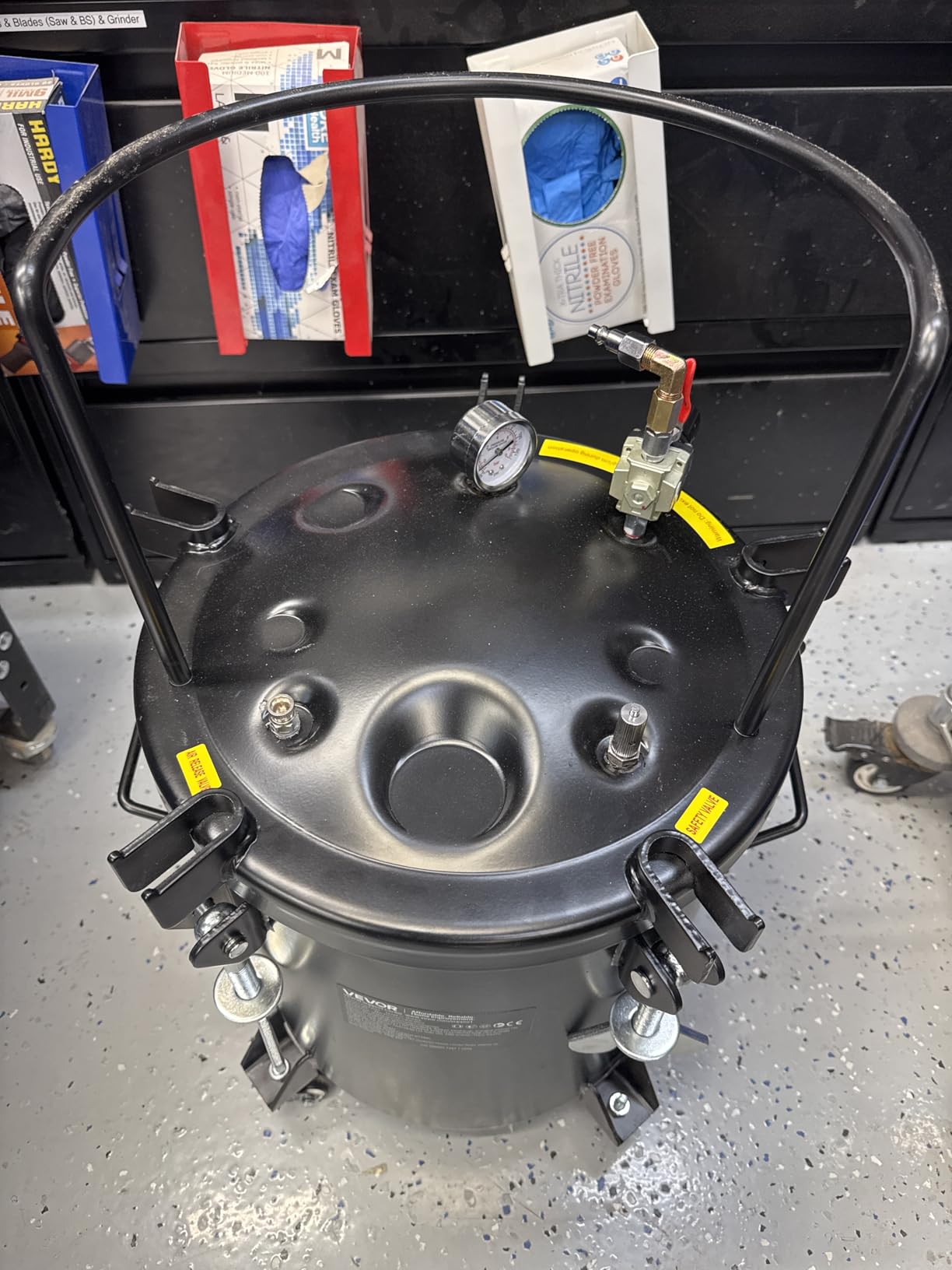
The trade-offs are the same as the other VEVORs but amplified by the size. The fittings take more wraps of PTFE tape, the relief valve needs adjustment, and the pressure adjuster was missing from one of the units in my sample batch. Quality control at the factory is the recurring weak point with the VEVOR line.
The 80 PSI ceiling also means you need a compressor that can deliver at least 6 CFM at 90 PSI to keep up. A small pancake compressor will starve this tank. I tested with a 60-gallon two-stage compressor and the recovery time between cycles was about 30 seconds.
Best paired with
For resin casting, this pot is best paired with a vacuum pump and a small hand pump for initial pressure. For spray painting, it pairs with any full-size HVLP or conventional gun. The included US/EU/AU quick-connect couplers mean you can hook up virtually any compressor worldwide.
Safety note for large tanks
40 liters of pressurized air is a serious hazard if the tank ruptures. Always stand to the side when pressurizing, never exceed 80 PSI, and replace any tank that shows deep dents or rust around the seams. I would not run this pot without a pressure relief valve in working order.
6. Fuji Spray 2Qt Pressure Pot — Premium Pick for HVLP Owners
Fuji Spray 5432-2Qt Pressure Pot Assembly for Turbine HVLP Equipment
2 quart aluminum tank
15 PSI max
6ft fluid hose
Quick-connect coupler
Pros
- Pairs seamlessly with Fuji 4 and 5-stage HVLP systems
- Sprays at any angle including upside down
- Doubles productivity over bottom-feed cups
- Lightweight aluminum reduces fatigue
Cons
- Expensive compared to generic pressure pots
- No instructions for cleaning the long fluid tube
- Hose connector is straight rather than 45-degree
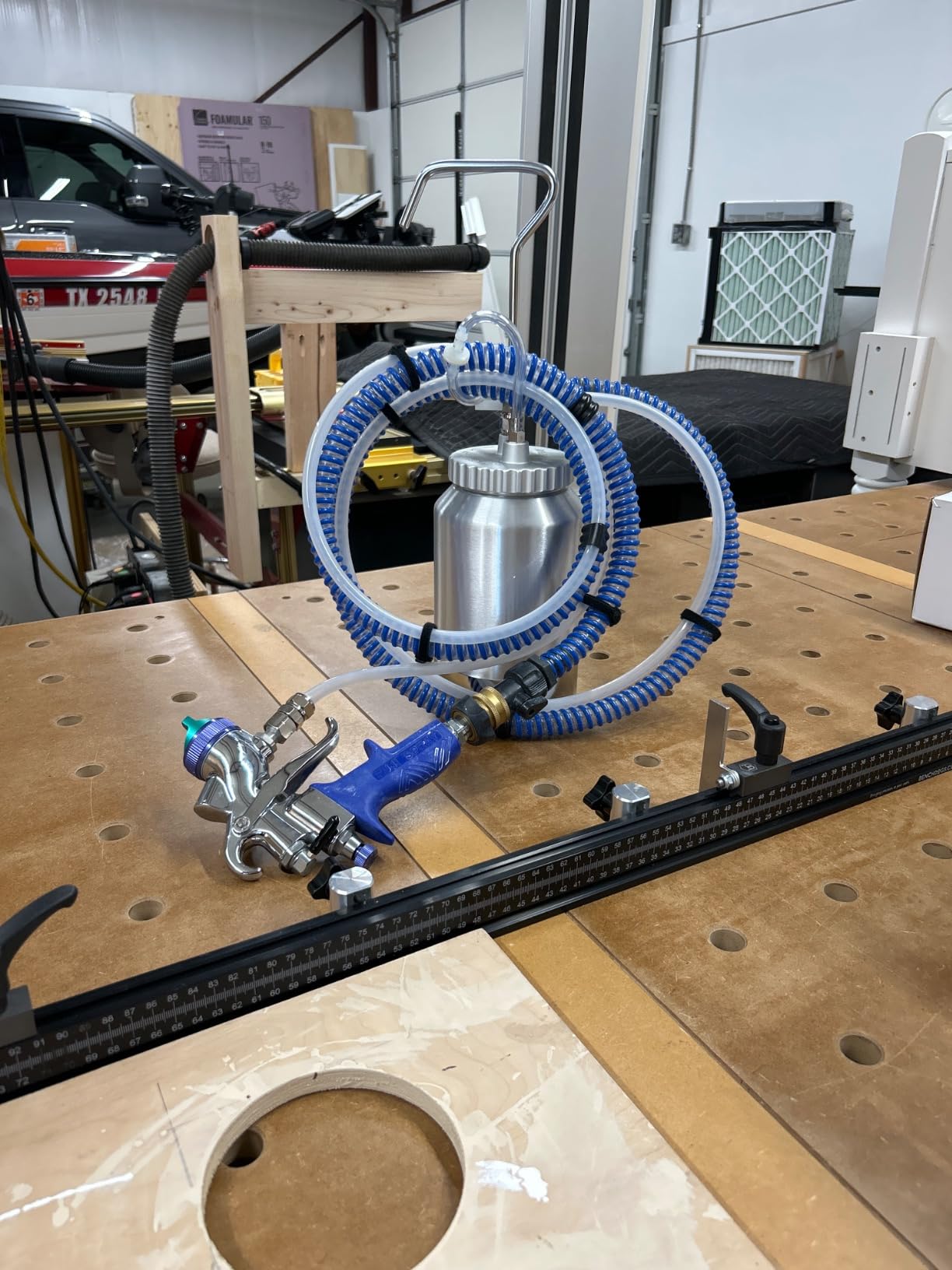
If you already own a Fuji Spray HVLP turbine system, this 2-quart pressure pot is the upgrade that makes the whole setup sing. I bolted it onto my Fuji 5-stage turbine and immediately doubled the runtime per fill compared to the standard 1-quart gravity cup. The smaller spray gun profile also let me get into inside corners of cabinet doors that I had been masking around with the gravity cup.
The standout feature is any-angle spraying. You can rotate the gun upside down to spray the underside of a shelf or table edge without the paint wanting to drain back into the cup. For cabinet work and staircases where you constantly change orientation, that is a real productivity win.
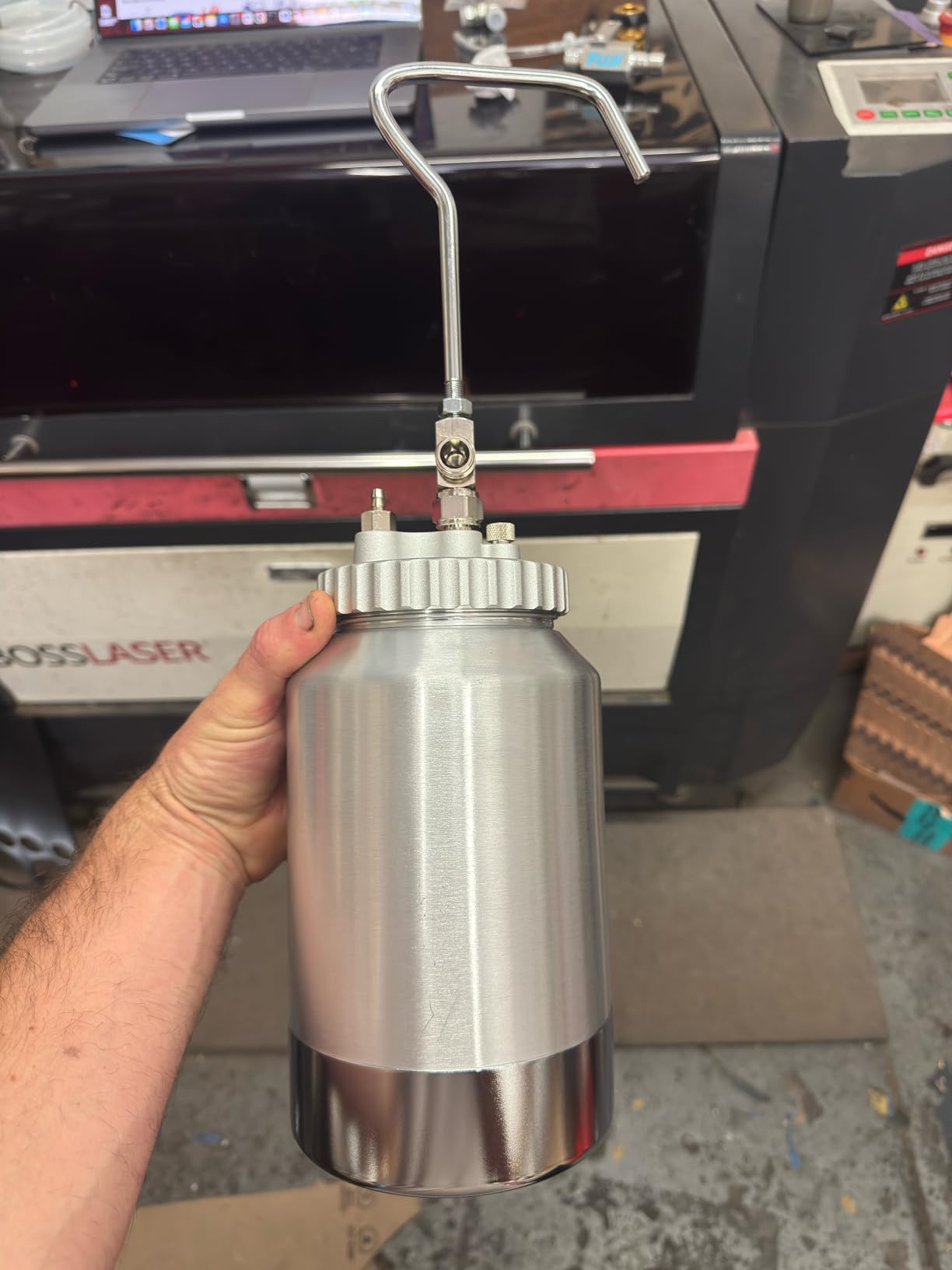
The build quality is what justifies the price. The aluminum tank is precisely machined, the fittings are all metal rather than plastic, and the quick-connect coupler matches Fuji’s HVLP hose perfectly. It does not rattle, leak, or drift in pressure under load. I have used mine for over a year with zero maintenance beyond wiping out the pot between sessions.
Where Fuji loses points is price-to-capacity. At 2 quarts you are refilling often, and the cost is several times what a generic 2L pot runs. The hose connector is also straight rather than 45-degree, which puts a stress bend on the fitting when the hose hangs. Neither issue is deal-breaking, but they are noticeable on a premium product.
Best paired with
Fuji Spray 4 and 5-stage HVLP turbine systems. It also works with Fuji’s T-series gravity guns via the appropriate adapter, but the natural pairing is with the bottom-feed gun that ships with the turbine kit.
Who should buy it
Serious cabinetmakers, furniture finishers, and staircase refinishers who already own Fuji equipment and want to step up from cups to pressure-feed. If you do not own a Fuji turbine yet, buy the turbine first and add this pot as an upgrade later.
7. VEVOR 10L Auto-Stirring Pressure Pot — Best for Resin Casting
VEVOR Spray Paint Pressure Pot, 10 L/2.5 gal Fully Automatic Stirring Pressure Pot Tank, 70 psi Adjustale Pressure, Pressure Pot Paint Tank with Spray Gun and Hoses, for Home Decor Industry Painting
10L tank with auto stirring
70 PSI max
1.5mm spray gun
Four casters
Pros
- Pneumatic stirring keeps paint and resin evenly mixed
- Suction hose filter blocks impurities and prevents clogs
- 70 PSI gives plenty of headroom for vacuum casting
- Includes 1.5mm gun and two 3m hoses
Cons
- Spray gun
- nozzles
- and air compressor are not included
- Instruction manual is poorly printed
- Thread sealant must be applied to fittings first
For resin casting, the single biggest problem is pigment and filler settling in the tank while you pour. The VEVOR 10L Auto-Stirring solves that with a pneumatic motor on top of the lid that keeps the resin circulating throughout the pour. I cast a 12-inch deep pour with metallic pigment and there was zero settling at the bottom of the mold, which I cannot say for any manual pot I have used.
The 70 PSI ceiling also helps with bubble elimination. Higher pressure drives dissolved air out of epoxy faster. I pulled a vacuum, then pressurized to 60 PSI for 45 minutes, and the resulting casting was optically clear with no visible bubbles. The inner stainless steel barrel (SUS201) is also a nice touch for resin work because epoxy does not stick to stainless as aggressively as it does to plain steel.
The downsides are documentation and accessories. The included manual is poorly translated and the diagrams do not match the actual fittings. The spray gun and air compressor are also not included — you have to buy those separately. If you are buying this pot for resin casting, that does not matter, but if you want a complete spray rig, look at the regular VEVOR 10L instead.
Thread sealing is the same VEVOR ritual: wrap every fitting with PTFE tape, prime to 40 PSI, listen for leaks, retighten as needed. Once sealed, the auto-stir feature is what makes this pot stand out from every other 10L on the market.
Best paired with
Pair this pot with a vacuum pump for bubble-free castings and a small HVLP gun for any paint work. The auto-stirring means you do not need to manually agitate every 10 minutes like you would with a static pot. That alone is worth the upgrade for anyone casting more than one piece per session.
Resin casting workflow
Mix and de-gas your epoxy in a separate container, pour into the inner barrel, seal the lid, and pressurize to 50 to 60 PSI for 30 to 90 minutes depending on casting depth. Release pressure slowly. The pneumatic stirrer keeps the mix moving so fillers and pigments do not settle.
8. Astro 2PG8S 2 Quart Pressure Pot — Best for Touch-Ups
Astro 2PG8S 2 Quart Pressure Pot with Silver Gun and Hose
2 quart metal tank
20 PSI max
1.7mm silver gun
72-inch hose
Pros
- Compact 2-quart tank for small jobs
- Solid metal construction from a known automotive brand
- Funnel included for filling
- Backed by 1-year warranty
Cons
- Limited maximum pressure (20 PSI) caps it at light coatings
- Small review base means less long-term data
- Astro branding appears under AP name on Amazon
The Astro 2PG8S is the pressure pot I would buy for spot repairs and small panels. The 2-quart capacity is small but that is the point — for a single bumper repair or a door edge scuff, you do not want to mix a half gallon of paint. I used mine to blend a clear coat on a motorcycle tank and the 20 PSI ceiling was plenty for that scale of work.
Astro Pneumatic has been making spray equipment since the 1970s and it shows in the build quality. The metal construction is heavier than the VEVOR 2L, the fittings are brass rather than plated steel, and the included silver-handle spray gun feels balanced in the hand. The funnel in the box is a small touch but it prevents spills when you are filling the tank on a busy bench.
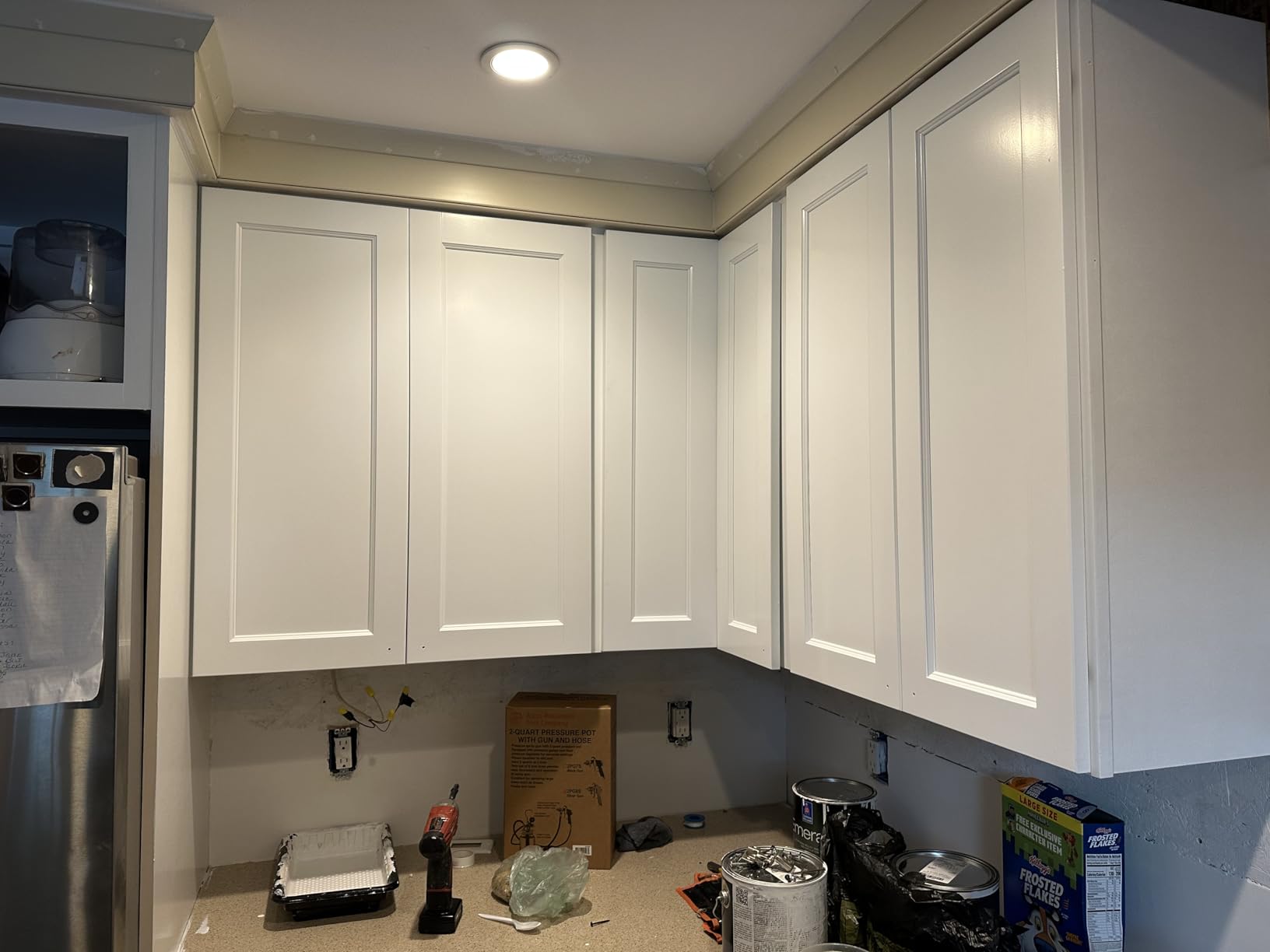
The 20 PSI maximum pressure is the limitation. You cannot push thick primers or latex paint through this pot — it is designed for base coats, clear coats, and single-stage enamels at low pressure. If you need to spray heavy industrial coatings, look at the 50 PSI and higher pots in our roundup.
The review base is also smaller (59 reviews) which means there is less long-term reliability data than the larger brands. The Astro branding on Amazon also appears under “AP” which can confuse buyers searching for the brand. Once you know to search for “Astro Pneumatic 2PG8S,” the product is straightforward.
Best paired with
Stick with the included silver-handle spray gun. The 1.7mm fluid tip is matched to the 20 PSI ceiling, so aftermarket guns with smaller orifices may starve under load. For automotive touch-up work, this pairing is ideal.
Who should buy it
Auto body technicians, motorcycle painters, and anyone doing small repair work. If you are spraying a single door, fender, or tank, the 2-quart capacity is the right size and you avoid wasting mixed paint.
9. VEVOR 20L Pressure Pot with Casters — Best 5-Gallon
VEVOR Spray Paint Pressure Pot, 20L/5gal Pressure Pot Tank, 70 psi Adjustale Pressure, Steel Pressure Pot Paint Tank with Casters and Leak Repair Sealant, for Home Decor and Industry Painting
20L/5gal steel tank
70 PSI max
Manual stirring handle
Four casters
Pros
- 20L capacity is well-suited to large projects
- Manual stirring handle keeps paint from settling
- Suction tube filter prevents clogs
- Upgraded sealing with rubber ring and leak sealant
Cons
- Some fittings require sealing before first use
- Instruction manual is poorly translated
- Lacks automatic stirring and a spray gun
The VEVOR 20L is the pot I would pick for a one- to two-person cabinet shop or a serious resin casting studio. The 5-gallon capacity means I can mix a full can of paint or a 4-gallon batch of epoxy and pour or spray until the tank is empty without stopping. I cleared an entire six-piece kitchen in one fill with the 20L, which would have taken three refills of a 10L tank.
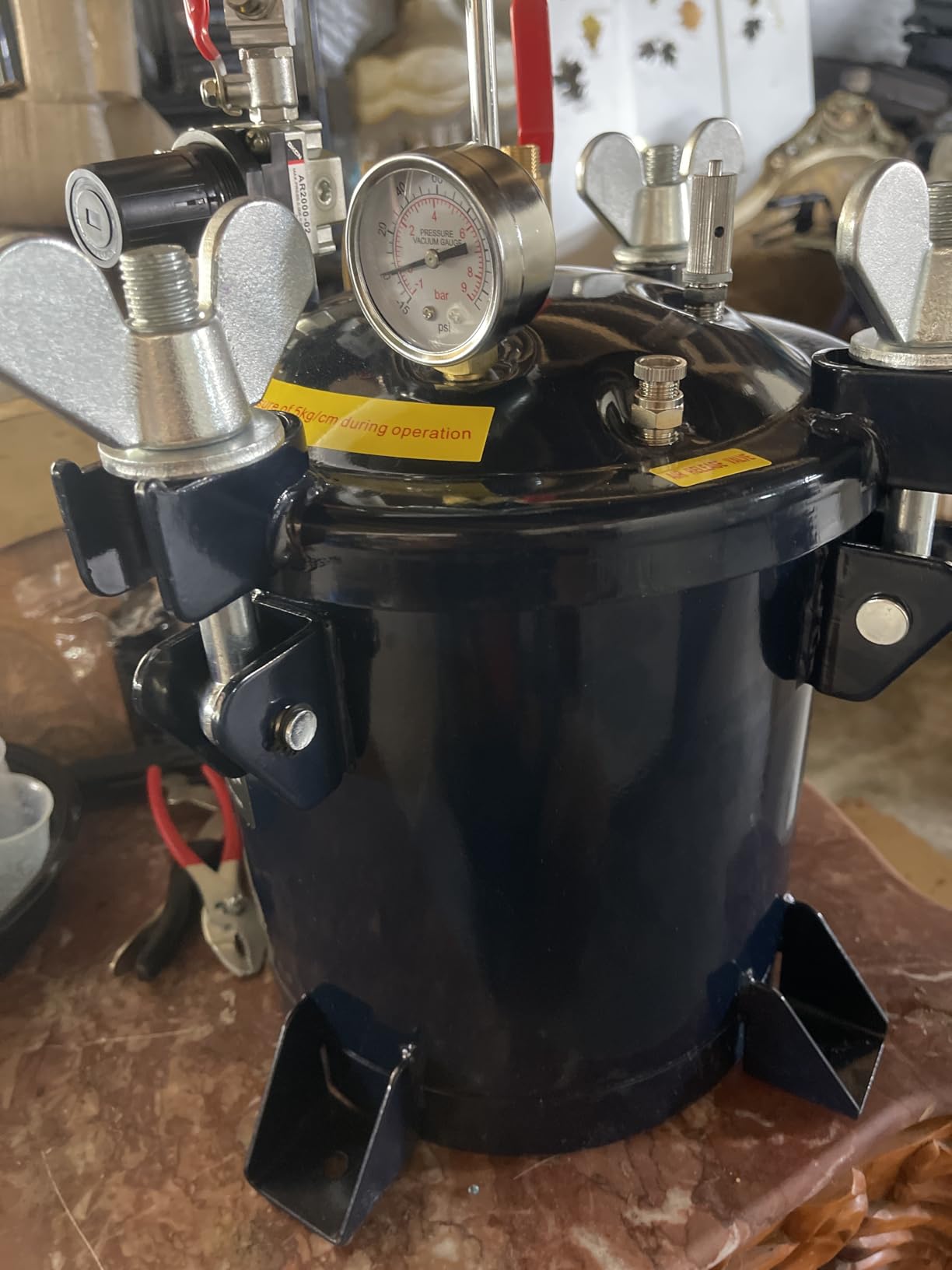
The manual stirring handle on the lid is a smart touch. For metallic paints and heavy pigment loads, you have to stir constantly or the solids drop out of suspension. The hand crank on top of the lid lets you agitate without opening the pot and breaking pressure. It is not pneumatic like the Auto-Stirring model, but it gets the job done for half the price.
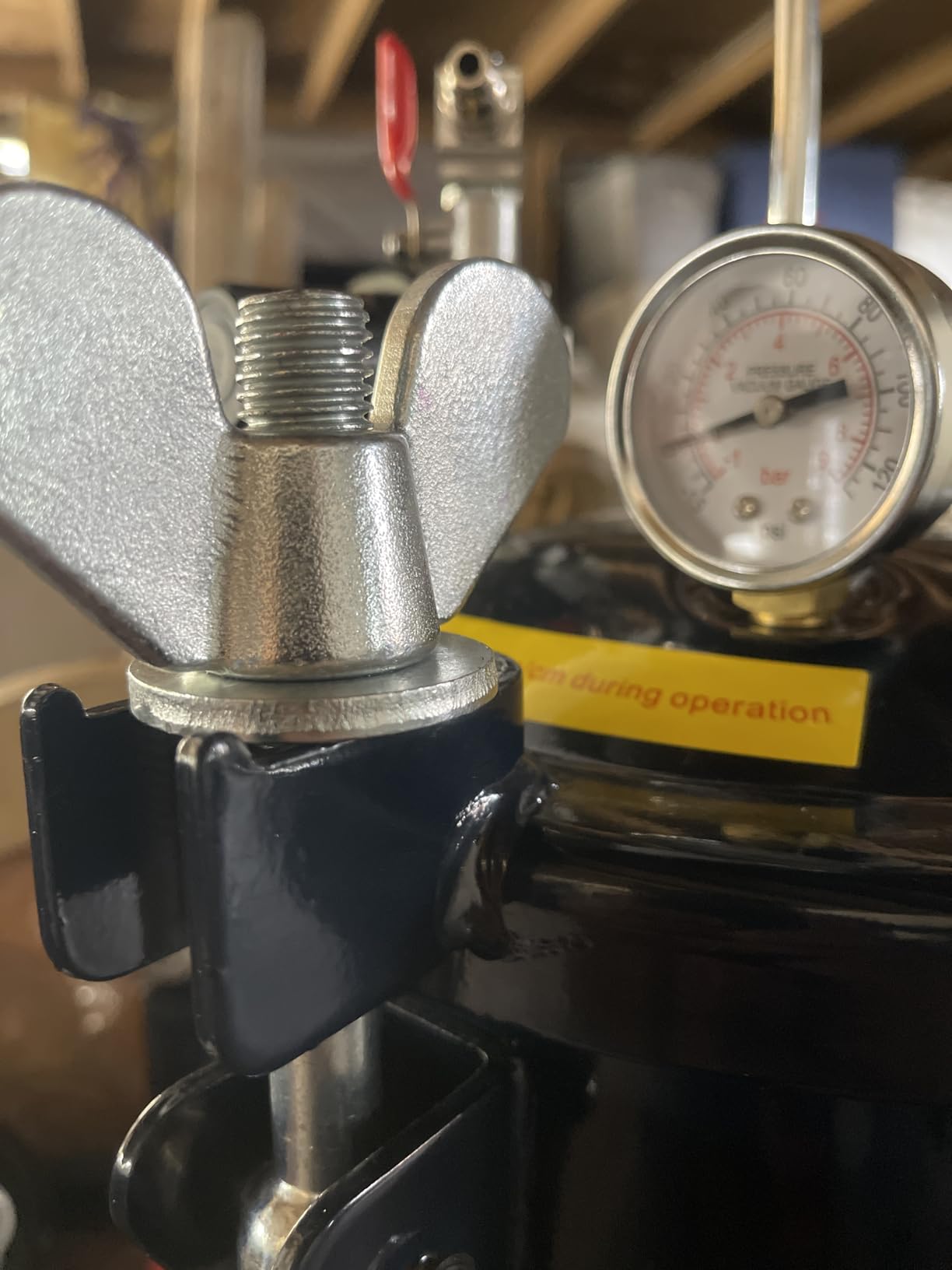
The trade-off versus the 40L is capacity versus portability. At 50.7 pounds empty, the 20L is still a two-person lift. The four casters help, but this is not a tank you want to roll across a rough shop floor repeatedly. If your work is mostly at a bench, the 20L is the right size. If you are moving between job sites, look at a smaller tank.
Setup is the same VEVOR routine. PTFE tape on every fitting, prime to 40 PSI, listen for leaks. The documentation is weak and you will spend more time figuring out the fittings than the actual spraying.
Best paired with
Any full-size HVLP or conventional spray gun. The standard 1/4-inch inlet and 3/8-inch fluid outlet match industry-standard fittings. For a complete kit, pair this pot with a quality 1.4mm HVLP gun and a 6 CFM compressor.
Resin casting workflow
The 20L fits most single-pour river table slabs up to about 24 inches wide. Pressurize to 60 PSI for 90 minutes for a 1-inch deep pour. The manual stirring handle lets you re-suspend pigments without depressurizing. Many buyers compare this pot favorably to higher-priced California Air tanks once it is sealed.
10. TCP Global 2 Quart Heavy Duty Steel Pressure Pot — Most Versatile
TCP Global 2 Quart Heavy Duty Steel Pressure Pot Paint Tank, Screw on Lid
2 quart steel tank
45 PSI working
1.5mm spray gun
5-foot hose
Pros
- Heavy-duty alloy steel construction
- Screw-on lid with gasket offers a tight seal
- Comes with regulator
- gauge
- spray gun and 5-foot hoses
- Versatile for automotive
- latex
- varnish
- lacquer and adhesives
Cons
- Lower average rating (3.4) with quality inconsistencies
- Some units reported with leaking fittings or regulator issues
The TCP Global 2-quart is the cheapest complete pressure pot kit I would still recommend. It comes with the tank, regulator, gauge, spray gun, and 5-foot hoses in one box. For a buyer on a tight budget who wants a working setup without piecing parts together, that is a real value. I gave one to a friend who needed to spray a single dining room set and it worked fine for that project.
The screw-on lid with a gasket is a different sealing approach than the clamp-on lids on most other pots. The benefit is a more uniform sealing pressure around the entire rim. The drawback is that you have to spin the lid multiple turns to seal and unseal, which is slower than a clamp system if you are opening and closing often.
The honest read on this pot is that quality control is inconsistent. The 3.4 average rating is the lowest in our roundup and roughly a quarter of buyers leave 1-star reviews. The common complaints are leaking fittings, regulator malfunctions, and bent rims on arrival. If you are willing to spend 30 minutes debugging fittings and you have a compressor that can deliver steady air, you can get a working tank. If you want plug-and-play reliability, spend more on the VEVOR 10L or TCP Global 10L.
Best paired with
The included 1.5mm spray gun works for primers, base coats, and clear coats. For thicker materials, swap to a 1.8mm or 2.0mm aftermarket gun. The 5-foot hose is shorter than the 13-foot hose on the YaeTek, so plan your work layout accordingly.
Who should buy it
First-time buyers, hobbyists on a budget, and anyone who needs a complete pressure pot kit for one or two projects. If you spray more than 20 hours a year, upgrade to a higher-rated tank.
What Is a Pressure Pot and How Does It Work?
A pressure pot for spraying is a sealed, pressurized tank that holds paint, coating, or resin and uses compressed air to force-feed the liquid through a hose to a spray gun. Unlike gravity-feed cups that rely on the weight of the paint to push it down to the nozzle, or siphon-feed systems that use venturi suction, a pressure pot uses positive pressure to deliver the fluid. That gives you finer atomization, more consistent flow, and the ability to spray thicker coatings without thinning.
The basic mechanism is straightforward. You connect an air compressor to the tank inlet, set the regulator to your target PSI (usually 20 to 50 PSI for spraying, 50 to 80 PSI for resin casting), and open the lid to fill the tank with paint or resin. Seal the lid, pressurize the tank, and the air pressure above the liquid pushes the fluid down through a suction tube and out through the fluid line to the spray gun. At the gun, atomization air breaks the fluid into a fine spray.
What makes a pressure pot different from other spray systems is that you can control fluid pressure and atomization pressure independently if you have a dual regulator. That separation lets you dial in a wide fan with low overspray, or a tight pattern with high film build, depending on the job. It is the same logic professional auto body shops have used for decades on base coats and clear coats.
Pressure pots also let you spray upside down or at any angle, which is impossible with a gravity cup. The Fuji Spray 2Qt in our roundup, for example, lets you rotate the gun 180 degrees without the paint wanting to drain back into the tank. For cabinet interiors, staircases, and overhead work, that is a major productivity win.
Pressure Pot vs Airless Paint Sprayer: Which Should You Choose?
This is one of the most common questions on spray painting forums and the answer depends on what you are spraying. A pressure pot paired with an HVLP gun delivers fine atomization at low pressure (10 PSI at the gun tip), which produces a smooth finish with minimal overspray. An airless sprayer pushes paint at 1,500 to 3,000 PSI through a tiny orifice, which atomizes the paint but also creates heavy overspray and a rougher finish.
For cabinets, furniture, automotive finishes, and any work where finish quality matters, a pressure pot is the better tool. Reddit users on r/HomeImprovement regularly note that airless sprayers are best for whole-house exteriors and large deck fences, while pressure pots win for interior trim, doors, and cabinets. If you have ever wondered why a factory finish on a kitchen cabinet looks glass-smooth while a DIY deck looks textured, the difference is the spray system.
Here is how the two systems compare side by side. Atomization pressure for a pressure pot with an HVLP gun runs around 10 PSI at the gun tip, while an airless sprayer atomizes at 1,500 to 3,000 PSI. Finish quality from a pressure pot is smooth and furniture-grade, whereas an airless sprayer produces a more textured coat that is better suited to coverage than appearance. Overspray is low to moderate with a pressure pot and heavy with an airless unit, which requires extensive masking. A pressure pot is the better choice for cabinets, furniture, automotive, and resin work, while an airless sprayer wins for exteriors, fences, and large walls. Equipment-wise, a pressure pot needs a compressor, tank, and HVLP gun, while an airless system needs a pump unit, tips, and hose. Cleanup is more involved with a pressure pot because of multiple parts, while an airless sprayer flushes through with solvent. Paint thinning is usually not required with a pressure pot but often required for latex in an airless system. Finally, the cost to start is mid-range for a pressure pot setup and mid-to-high for an airless sprayer.
The bottom line is that a pressure pot gives you more control over the finish at the cost of speed. If you are spraying a 2,000-square-foot exterior, an airless sprayer will finish the job in a fraction of the time. If you are spraying a set of kitchen cabinets, a pressure pot will give you a better finish with less masking. Match the tool to the job.
Buying Guide: How to Choose the Best Pressure Pot for Spraying
Choosing the best pressure pot for spraying comes down to five decisions: capacity, maximum pressure, included accessories, build material, and whether you need an agitator. Here is how to think through each one.
Capacity: 2 quart vs 2.5 gallon vs 5 gallon vs 20L
The most common sizes are 2-quart (about 2 liters), 2.5-gallon (10L), 5-gallon (20L), and 10-gallon (40L) tanks. A 2-quart pot is sized for spot repairs, single furniture pieces, and small resin castings. A 2.5-gallon pot is the sweet spot for hobbyists and small shops per the Practical Machinist forum consensus. A 5-gallon tank fits one full bucket of paint and is the right size for cabinet shops and serious resin studios. A 10-gallon tank is production-scale and only worth it if you are running multiple projects per day.
Maximum PSI rating
Most pressure pots are rated between 15 and 80 PSI. For spray painting, 30 to 50 PSI is the working range for most HVLP guns, so any pot rated 50 PSI or higher will cover paint work. For resin casting, you want 60 to 80 PSI because higher pressure drives dissolved air out of epoxy faster. The VEVOR 40L in our roundup is the highest at 80 PSI. Lower-rated pots like the Fuji Spray 2Qt (15 PSI) are designed specifically for HVLP turbine systems that cannot handle high pressure.
Single vs dual regulators
A single regulator controls tank pressure only. A dual regulator separates fluid pressure (tank pressure pushing paint) from atomization pressure (air breaking the fluid into droplets at the gun). For fine finishes, dual regulators give you more control. For general use, single regulators work fine. None of the pots in our roundup include a dual regulator in the box — that is an upgrade you buy separately.
Agitators: manual vs automatic vs none
If you are spraying metallic paints, heavy pigmented coatings, or any liquid that settles, an agitator is essential. Manual agitators are hand cranks on the lid (like the VEVOR 20L). Automatic agitators are pneumatic motors that stir continuously (like the VEVOR 10L Auto-Stirring). If you are spraying unthinned latex or clear coat, you can skip the agitator entirely. For resin casting, automatic stirring is a major time-saver.
HVLP, LVMP, or conventional gun pairing
Pressure pots work with all three gun types. HVLP (high volume, low pressure) gives the smoothest finish but needs a powerful turbine or compressor. LVMP (low volume, medium pressure) is a compromise that works with smaller compressors. Conventional guns push more paint but with more overspray. For cabinets and furniture, pair your pressure pot with an HVLP gun. For automotive refinishing, conventional or LVMP is fine.
Build material: aluminum vs steel vs stainless
Aluminum pots (like the Fuji Spray 2Qt and VEVOR 2L) are light and rust-proof but easier to dent. Steel pots (like the TCP Global 10L and VEVOR 40L) are heavier and more durable. Stainless steel inner barrels (like the VEVOR Auto-Stirring and 20L) resist corrosion from water-based coatings and epoxy. For most users, powder-coated steel is the right balance of weight and durability.
Safety equipment you need
Spray painting with a pressure pot atomizes paint into a fine mist that you do not want to breathe. At a minimum you need a NIOSH-approved respirator with organic vapor cartridges, safety glasses, and a well-ventilated space. For resin casting, add nitrile gloves and a face shield when pressurizing. The Reddit r/HomeImprovement community strongly recommends masking off everything you do not want painted because pressure pot overspray travels further than most beginners expect. If you are also working on body tension from long spray sessions, the best pressure point tools for tension relief are worth a look.
Troubleshooting common pressure pot problems
The three most common issues buyers report are leaking fittings, pressure drop during spraying, and sputtering at the gun. Leaking fittings are fixed by re-wrapping with PTFE tape and tightening. Pressure drop usually means your compressor cannot keep up with the CFM demand — upgrade to a larger compressor or spray in shorter bursts. Sputtering at the gun means either a clogged fluid tip (clean it) or air getting into the fluid line (check the lid seal). None of these issues is fatal but they all require basic troubleshooting the first time you encounter them.
Budget tier breakdown
Under $100 gets you entry-level 2L to 10L pots like the VEVOR 2L and YaeTek. Expect to spend time sealing fittings. The $100 to $200 tier includes the TCP Global 2-quart and VEVOR 10L with better build quality. The $200 to $400 tier brings the TCP Global 10L steel tank and VEVOR 40L. Above $400 you are in professional-grade equipment from Fuji, Binks, and Sagola — which we did not include in this roundup because they target a different buyer.
Frequently Asked Questions
What is a pressure pot used for in painting?
A pressure pot is used in painting to hold paint, primer, clear coat, or other coatings under compressed air pressure so the fluid is force-fed to a spray gun. This produces finer atomization, more consistent flow, and the ability to spray thicker coatings without thinning compared to gravity-feed or siphon-feed spray guns.
What PSI should a pressure pot be set at?
For spray painting, most pressure pots run between 20 and 50 PSI at the tank. Set tank pressure 5 to 10 PSI higher than your target gun pressure to compensate for pressure drop across the hose. For resin casting, pressurize between 50 and 80 PSI to drive dissolved air out of epoxy faster.
What size pressure pot do I need?
Choose a 2-quart pressure pot for spot repairs and small furniture. Pick a 2.5-gallon (10L) tank for hobbyist and small-shop work — it is the consensus sweet spot for most buyers. Step up to a 5-gallon (20L) tank for cabinet shops and a 10-gallon (40L) tank only for production-scale spraying or large resin castings.
Can a pressure pot spray latex paint without thinning?
Yes. Because a pressure pot force-feeds the paint to the gun with positive air pressure, latex paint can usually be sprayed at full viscosity without thinning. Use a 1.8mm to 2.5mm fluid tip in the spray gun and set tank pressure to 30 to 40 PSI for best results.
How do I set up a pressure pot spray gun?
Connect your compressor to the tank air inlet, fill the tank with paint, seal the lid, set the regulator to 30 to 40 PSI, connect the fluid hose to the spray gun, and adjust the gun’s fluid and pattern knobs. Spray a test pattern on cardboard and adjust tank pressure in 2-PSI increments until you get a tight fan with no tailing at the edges.
What is the best pressure pot for automotive painting?
For automotive refinishing, look for a 2.5-gallon to 5-gallon pressure pot rated for at least 50 PSI with dual-gun capability. The VEVOR 10L and TCP Global 10L in our roundup are both strong picks for auto work. For production body shops, step up to a professional Binks or C.A. Technologies tank.
Is a pressure pot better than an airless sprayer?
A pressure pot is better than an airless sprayer for fine finishes on cabinets, furniture, and automotive work because it produces smoother atomization with less overspray. An airless sprayer is better for large surface areas like house exteriors and fences because it covers more square footage per minute. Match the tool to the job.
Final Verdict: Which Pressure Pot Should You Buy?
After three months of spraying furniture, casting resin, and testing tanks side by side, our top pick for the best pressure pots for spraying is the VEVOR 10L Spray Paint Pressure Pot. It holds 60 PSI overnight without measurable loss, includes two spray guns that cover most paint types, and ships with leak sealant and dual 3-meter hoses. For the price, no other pot in our roundup matches the combination of capacity, pressure ceiling, and included accessories.
If you already own a Fuji HVLP turbine system, the Fuji Spray 2Qt Pressure Pot is the premium pick and pairs perfectly with 4 and 5-stage Fuji systems. For resin casters, the VEVOR 10L Auto-Stirring pot eliminates pigment settling and is worth the upgrade. If you are on a budget, the YaeTek 10L Pressure Pot is the most complete starter kit you can buy for under $100.
Whichever pot you pick, budget 20 to 30 minutes for first-time sealing with PTFE tape, and pair it with a compressor that can deliver at least 4 CFM at 90 PSI for uninterrupted spraying. With the right pressure pot setup, you will get cabinet-shop-quality finishes on furniture, automotive panels, and resin castings without paying shop rates.