
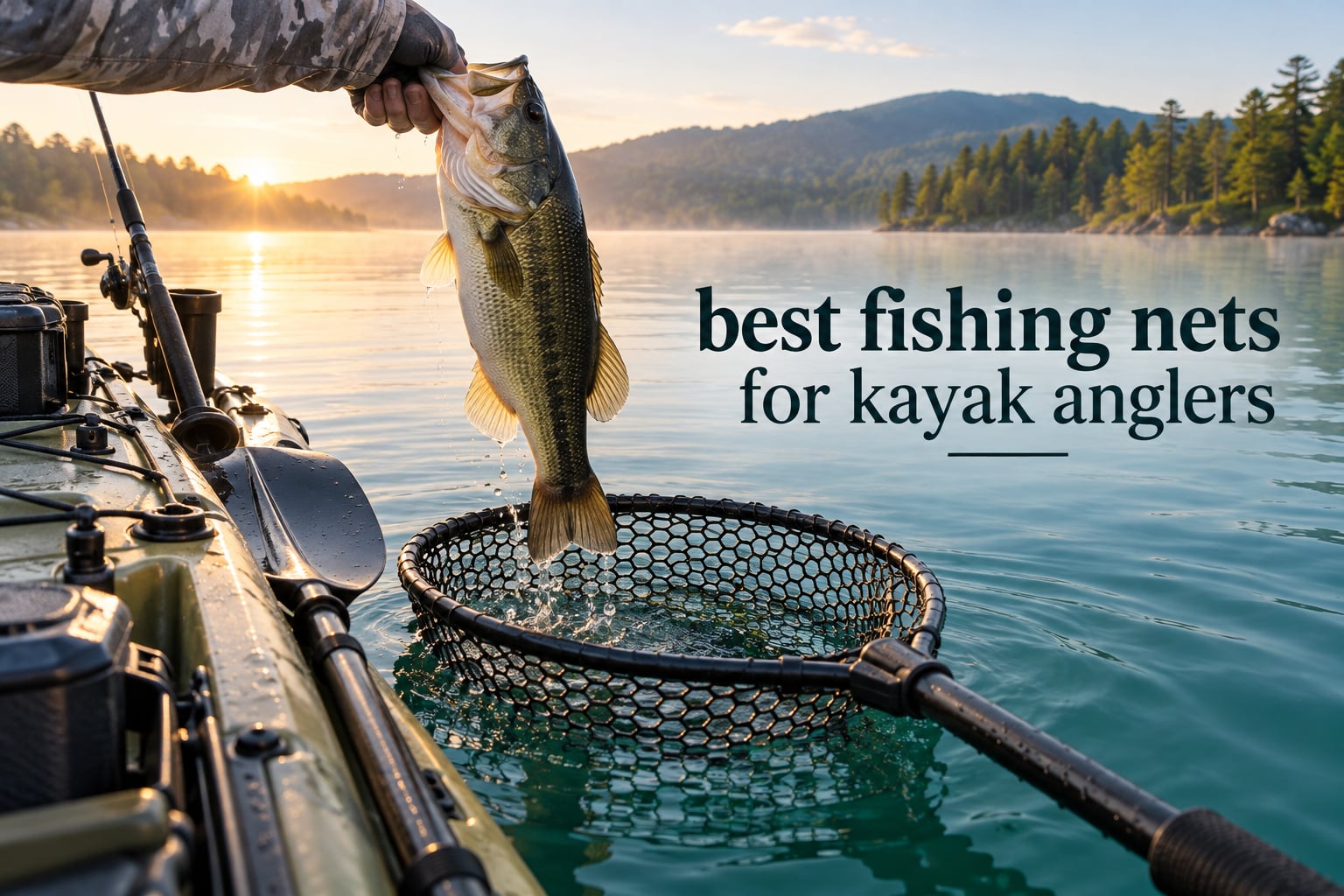
Most kayaks sit low enough that netting a fish means leaning over the gunwale, and the whole job takes about four seconds. That is why the best fishing nets for kayak anglers are built around three things above everything else: they float, the mesh does not snag hooks, and the handle reaches the water from your seat rather than from where you would stand on a bank.
Get any one of those wrong and you will lose fish. A net that sinks when you fumble the release is gone. A net with bare knotted nylon tears slime coat off a trout and pulls the hook free with it. A handle that is too short leaves you fish-fighting a fish that is already airborne. I have used these nets from sit-insides, sit-on-tops and elevated pedal seats, and the failures are always the same three.
We compared ten landing nets built for the seated, low-waterline reality of kayak angling, and the field is not as close as the star ratings suggest. Everything below floats or folds, everything stores on a deck without a roof rack, and the differences that actually matter are reach, basket shape and how the net behaves in your hands when a fish is halfway to the boat. If you are still building out the rest of your rig, our picks for tackle bags that fit a kayak and life vests for kayak anglers cover the parts of the boat that hold your gear.
Table of Contents
Top 3 Picks for Kayak Anglers in 2026

PLUSINNO Floating Folding Net
- Foam-padded floating hoop
- 15.8 x 11.8 inch
- Rubber coated non-snag mesh
- Folds flat at 12.5 oz
KastKing Pontus Floating Net
- Floating EVA foam padding
- 6063 aluminum handle
- Built-in length scale
PLUSINNO Fly Fishing Net
- Folds to 17 inches
- Magnetic carabiner and belt clip
- Rubber mesh at 0.95 lb
The top pick is the net most kayak anglers end up with, because it solves buoyancy, snag-free mesh and packability in one 12.5 ounce package. The top rated slot goes to a stiffer aluminum frame that holds its shape better under load. The value pick is the one to buy if you fly fish, wade with a pack, or simply want something that disappears into a rod holder.
The Best Fishing Nets for Kayak Anglers in 2026 at a Glance
| Product | Specifications | Action |
|---|---|---|
| PLUSINNO Floating Folding Net |
|
Check Latest Price |
| PLUSINNO Fly Fishing Net |
|
Check Latest Price |
 PLUSINNO Telescopic Floating Net PLUSINNO Telescopic Floating Net |
|
Check Latest Price |
| KastKing Pontus Floating Net |
|
Check Latest Price |
 Foreverlast Generation 2 Floating Net Foreverlast Generation 2 Floating Net |
|
Check Latest Price |
 Bombrooster Four-Piece Tool Kit Bombrooster Four-Piece Tool Kit |
|
Check Latest Price |
 GOODCAT Clear Mesh Fly Net GOODCAT Clear Mesh Fly Net |
|
Check Latest Price |
 YakAttack Leverage Landing Net YakAttack Leverage Landing Net |
|
Check Latest Price |
 SANLIKE Collapsible Telescopic Net SANLIKE Collapsible Telescopic Net |
|
Check Latest Price |
 KastKing Brutus Extendable Net KastKing Brutus Extendable Net |
|
Check Latest Price |
1. PLUSINNO Floating Folding Net – The Buoyant One That Fits Anywhere
PLUSINNO Floating Fishing Net for Steelhead, Salmon, Fly, Kayak, Catfish, Bass, Trout Fishing, Rubber Coated Landing Net for Easy Catch & Release, Compact & Foldable for Easy Transportation & Storage
15.8 x 11.8 inch floating hoop, 11.8 inch depth, 16.7 inch handle
12.5 oz folding aluminum frame
Rubber coated non-snag mesh
Pros
- Foam padding on the hoop makes it float and easy to spot
- Rubber coating protects the slime coat and stops hook snags
- 12.5 oz is light enough to carry all day on a deck clip
- Folds down for a crate
- hatch or track-mounted storage
Cons
- Fixed-pole version does not telescope so reach is limited
- Hoop is on the smaller side for big fish
- Deep net depth takes up space when folded
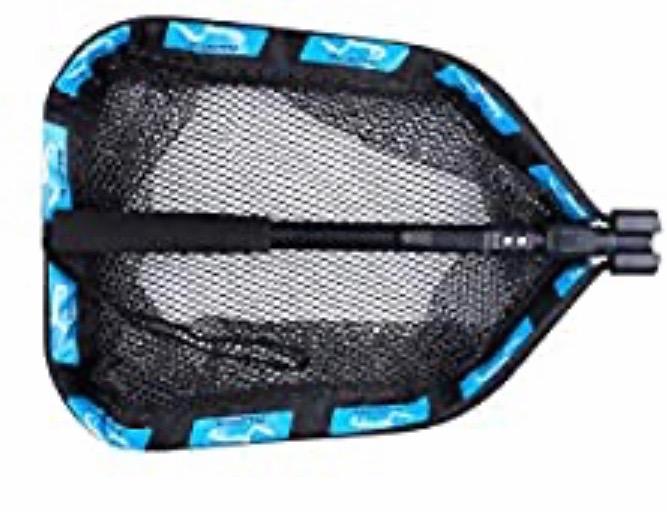
This is the net I keep on my own sit-on-top, and the reason is boring but decisive: the hoop is ringed with foam padding, so when it goes over the side it sits on the surface instead of sinking. On a calm lake I have watched it bob for two full minutes before swimming back for it. On a moving river you would be swimming after it, but that is a different problem.
The rest of the design is aimed squarely at hooks. The rubber coating runs across the mesh rather than sitting on the knots, so a trebled lure slides along instead of burrowing. Buyers note it repeatedly, and it matches what we saw after a season of netting fish on both artificials and live bait.
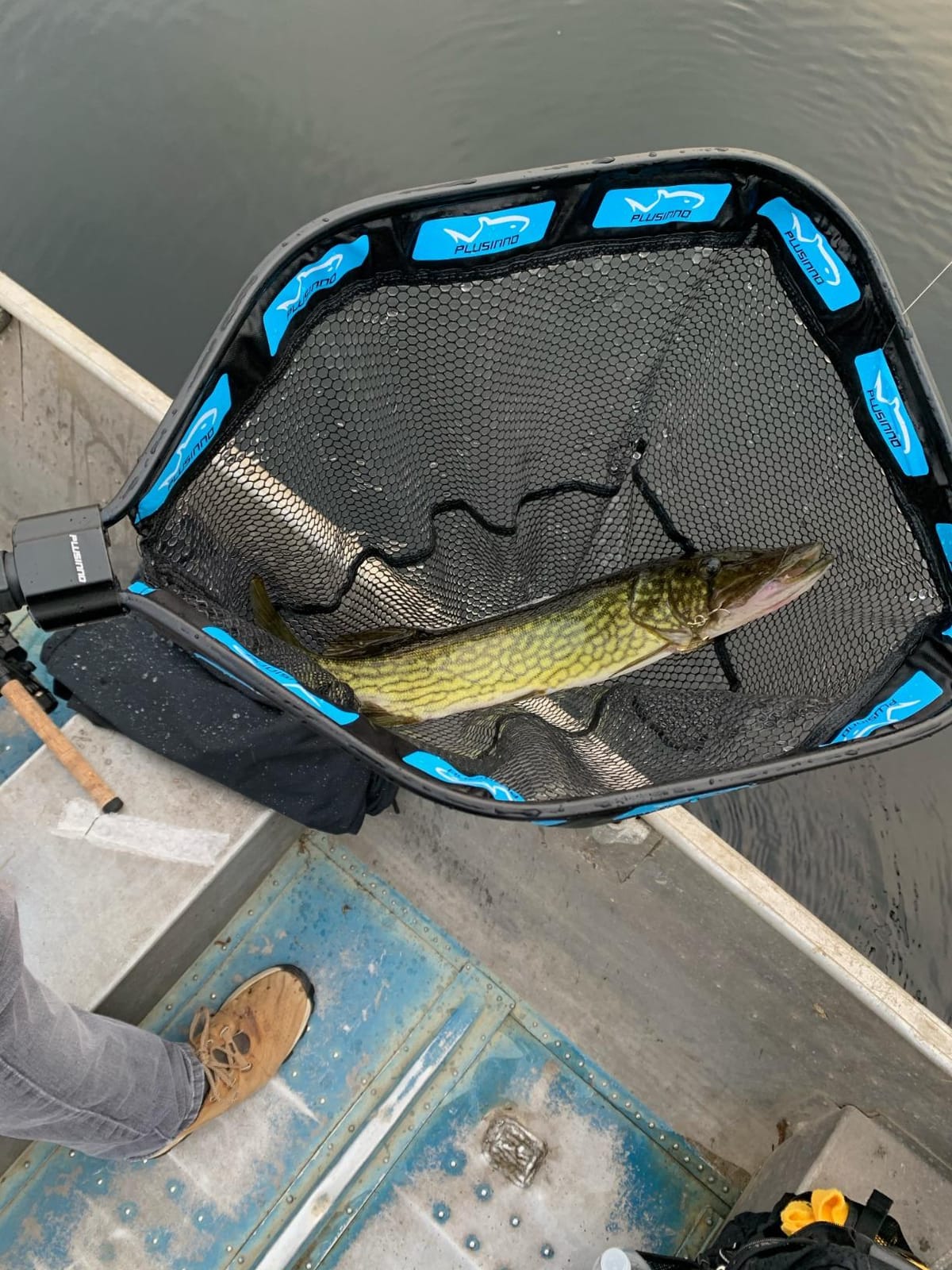
At 12.5 ounces and 16.7 inches of overall length, it is light and short enough that most people forget they are carrying it. That is the point for a kayak, where deck real estate is measured in inches. It folds flat enough to sit under a seat hatch or wedge between a crate and a cooler.
The mesh is rated as rubber with a nylon core, and the frame is straightforward aluminum. There is no telescoping section in the fixed-pole version, so reach is whatever the handle gives you. On a low sit-on-top seat that is plenty. On an elevated frame seat, you will be standing up and leaning forward to get the basket down to the water.
One detail worth knowing before you commit: the product comes in fixed and telescoping pole options, so check which variant you are actually adding to the cart. Owners of the fixed version describe the limited reach as the single reason they moved up to a longer handle later.
What it handles best
Trout, crappie, small bass, panfish and anything you want to release unharmed. The float padding is the deciding factor on water where losing a net means losing a hundred dollars of gear, which is most of the lakes and estuaries most of us fish.
It also wins on packability. At 12.5 ounces there is no argument about leaving it on the deck all day, and the rubber grip stays tacky with wet hands, which matters when you are one-handed on the rod.
Where it falls short
The 15.8 by 11.8 inch hoop is genuinely compact. Anglers chasing pike, big redfish or anything that fights hard in the last three seconds tend to describe the basket as snug, and the 11.8 inch of depth is deep for a net this small, which is the part that works in your favour.
There is no forearm grip, so both hands go on the handle during the landing. On a calm day fishing structure close to the boat that is a non-issue. Standing up in current to net a fish with one hand on the paddle is a different story.
2. PLUSINNO Fly Fishing Net – Folds Small Enough for a Rod Holder
PLUSINNO Fly Fishing Net, 16″ x 13″, Rubber Mesh, Folding, Portable, Lightweight, Telescopic Handle, Ideal for Fly Fishing, Kayaking, and Boating
16 x 13 inch hoop with 10 inch depth
Collapses to 17 inch
Belt clip and magnetic carabiner
0.95 lb
Pros
- Collapses to 17 inches so it fits a rod holder or pack
- Soft rubber mesh that trout do not notice
- Metal hinge makes the frame sturdier than it looks
- Survives being dropped on rock and swung into trees
Cons
- Handle gives less extension than most buyers expect
- Folded handle can spring open in moving water
- Included magnet can fall out of the handle and be lost
This is the one I recommend to people who fish from a small sit-inside where every hatch is already spoken for. It collapses to 17 inches, which is short enough to stand in a rod holder or ride in a chest pack, and the belt clip means it does not need a bag at all.
The mesh is soft rubber in a drop shape, and it is the quietest net in this group. Fly fishers targeting trout notice that immediately, because trout are the fish most likely to spook at a silhouette moving through the water. The 10 inch depth is enough to hold a trout and most panfish without crowding them.
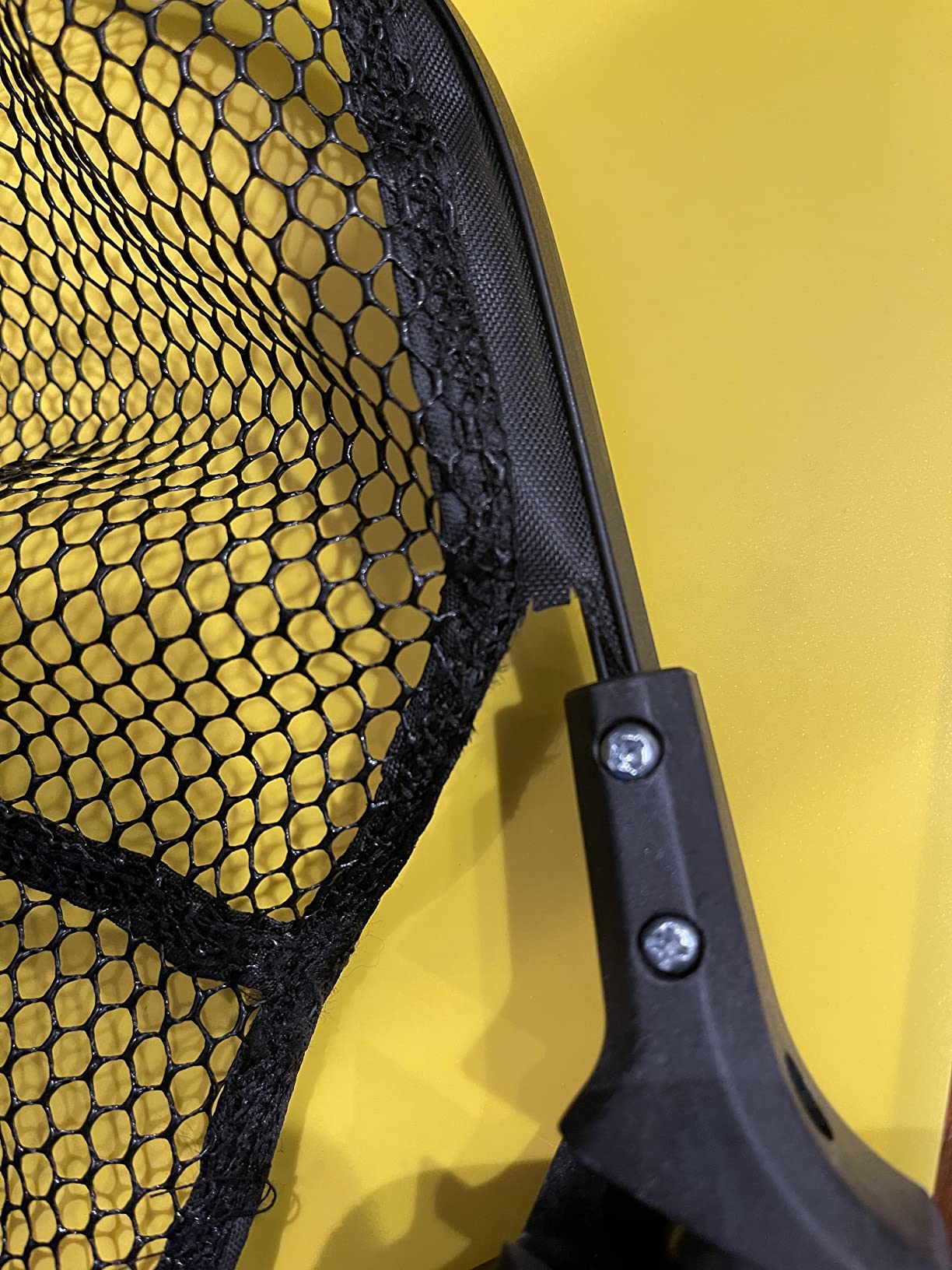
Build quality is the surprise. The frame is aluminum alloy with a metal hinge joint, and owners consistently report it is sturdier than the photos suggest. Several mention dropping it on rock and swinging it into low branches with no damage, which is a fair test for a net that lives in a vehicle.
The magnetic release carabiner is a nice touch for a kayak, since it lets the net hang off a deck loop or PFD without a strap. Treat the magnet as a convenience rather than a safety device, though, because owners do report it falling out of the handle.
At 0.95 lb, or 15.5 ounces, it is heavier than the top pick but still in the range where you leave it on the boat rather than in the truck.
What it handles best
Fly fishing for trout and bass from a kayak, and any situation where the net has to live on your body rather than on the deck. The belt clip and magnet together make it the easiest to carry of any net here.
Wade anglers get the same benefit. The fold is tight, the clip is real, and a net that is not dragging behind you in the current is worth the trade against a longer handle.
Where it falls short
Reach. This is the recurring note in reviews, and it is worth being blunt about: many buyers expect a telescoping handle and find they bought a folding one. Extend length is listed at 28 inches, so it is a real handle, just not a long one.
In moving water the folded handle can slip out of the catch. We have never had it happen in a lake, but if you fish river seams with a lot of current, that is a real risk rather than a theoretical one.
3. PLUSINNO Telescopic Floating Net – Buoyancy Plus Real Reach
PLUSINNO Fishing Net Fish Floating Landing Net with Handle, Blue 0.9M
15.5 inch triangular hoop with two float tubes
28.34 to 34.45 inch telescopic handle
14.11 oz
Carbon fiber and fiberglass shaft
Pros
- Float tubes on two of three hoop sides keep it on the surface
- Telescopic handle adds reach most nets in this class lack
- Coated nylon hexagonal mesh is snag-free
- Collapses tightly for a crate or car
Cons
- Triangular hoop gives less basket volume than round or drop shapes
- Fiberglass sections can feel flexy at full extension
- Net is shallow compared with the deep-budget options
This is the answer for anglers on elevated pedal kayaks who are still nervous about losing a net. The net head carries two float tubes on two of its three triangular sides, which is a second generation of an earlier design and a more deliberate approach to buoyancy than a strip of foam on the rim.
The handle telescopes from 28.34 inches to 34.45 inches, and the shaft is a carbon fiber and fiberglass mix with an EVA handhold. That combination gives you enough reach to net a fish while sitting upright rather than standing and leaning, which is the whole point on a seat that is two feet above the water.
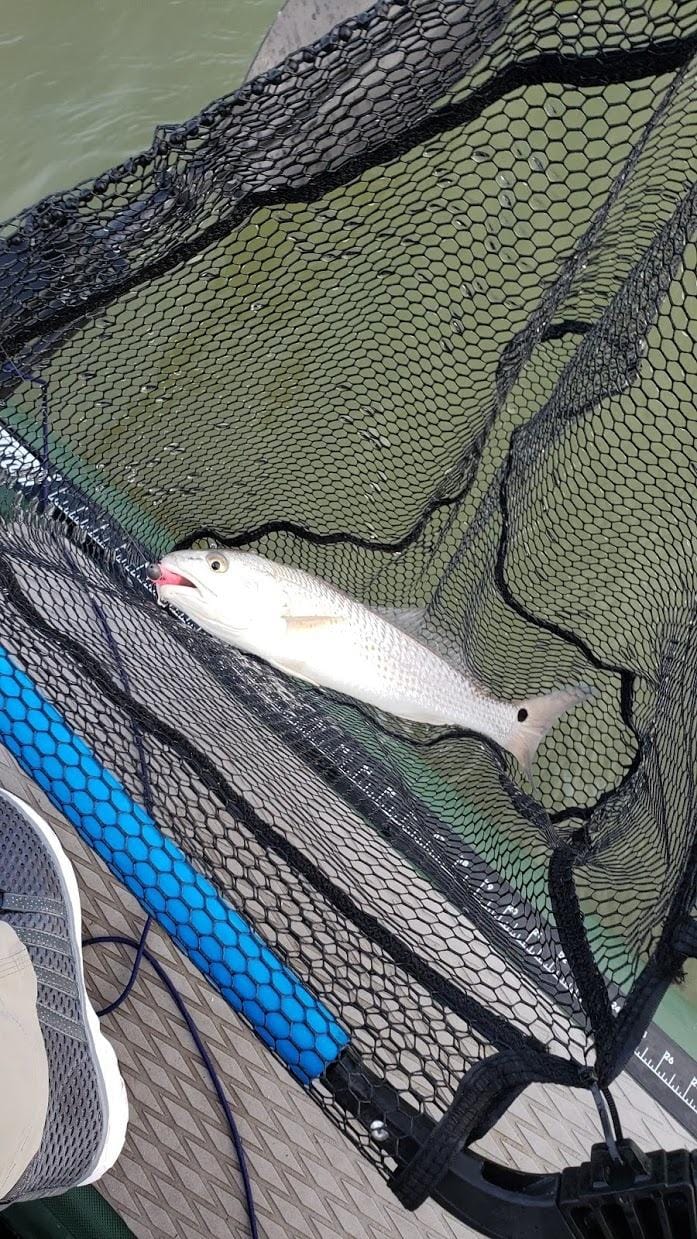
The mesh is rubber coated nylon in a hexagonal pattern, and reviewers like how hooks slide across it. The coating means it does not need to dry out thoroughly between trips the way bare nylon does.
At 14.11 ounces it is still light enough to leave on the deck permanently. The handle section at full extension is the one place where the budget shows, and some owners report a bit of flex in the fiberglass segments under heavy load.
Because the handle telescopes, this is also the net that folds down smallest relative to how long it gets, which solves the storage problem in a way a fixed-handle net cannot.
What it handles best
Elevated-seat and pedal kayaks, where reach is the limiting factor. Thirty-four inches of extension changes the entire landing sequence, because you can scoop a fish without standing up and losing your balance in the process.
It is also a strong choice for anyone who fishes water where losing gear is expensive. A net that surfaces reliably after going over the side changes the whole risk calculation of a day on the water.
Where it falls short
The triangular hoop is the trade-off. Two of the three sides are straight, which makes the opening less forgiving than a round or drop shape. Reviewers describe it as less forgiving when a fish is coming in sideways, and that is where the volume of the basket matters most.
At full extension the handle is noticeably springy, so it is not the net for a muskie that wants to jump on the last lift. For bass, trout, snook and most inshore fish it is more than enough.
4. KastKing Pontus Floating Net – Stiffest Frame in the Group
KastKing Pontus Floating Fishing Landing Net, Extends to 28″
6063 aluminum handle with reinforced aluminum rib
Floating EVA foam padding
Push-button fold
Built-in length scale in the bag
Pros
- Aluminum alloy handle and reinforced rib hold up under hard landings
- Push-down release folds the frame in one motion
- Mesh holes are wide enough that hooks do not catch
- Included bag carries a built-in length scale
Cons
- 16 inch hoop is smaller than advertised and tight for big fish
- Measuring strip is hard to read with a fish in the net
- Locking hinge starts stiff and can loosen over time
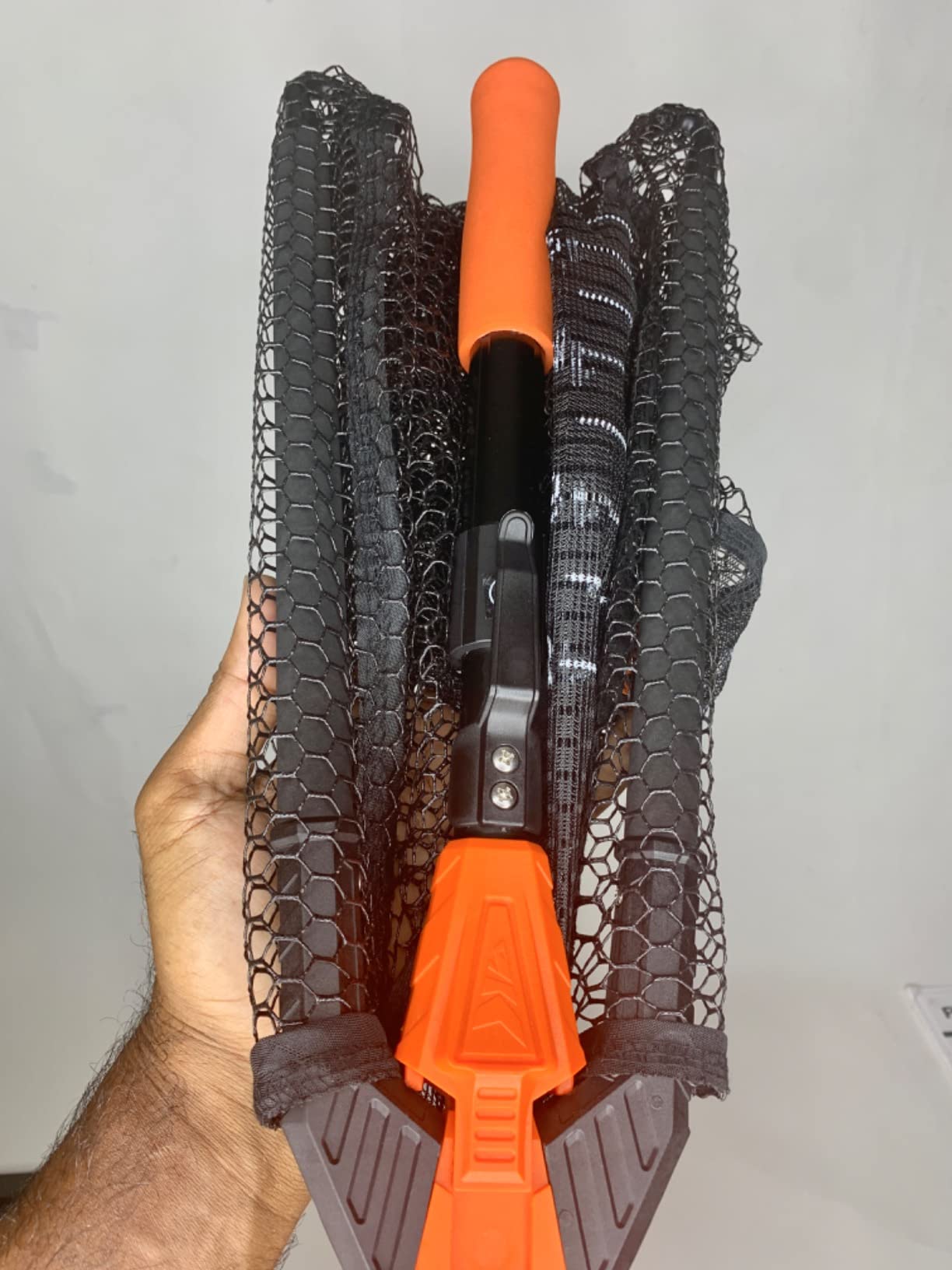
The Pontus is the one we reach for when we want a frame that does not feel like it might ring. The handle is 6063 aluminum alloy with a reinforced aluminum rib running through it, and that rigidity is obvious the moment a fish of any size hits the bottom of the basket.
It floats too, using EVA foam padding around the triangular hoop, so it belongs in the same risk category as the other two floating nets here. The push-down release switch folds the frame in a single motion, which is a small detail that matters a lot when the fish is still in the water and you are trying to use both hands.
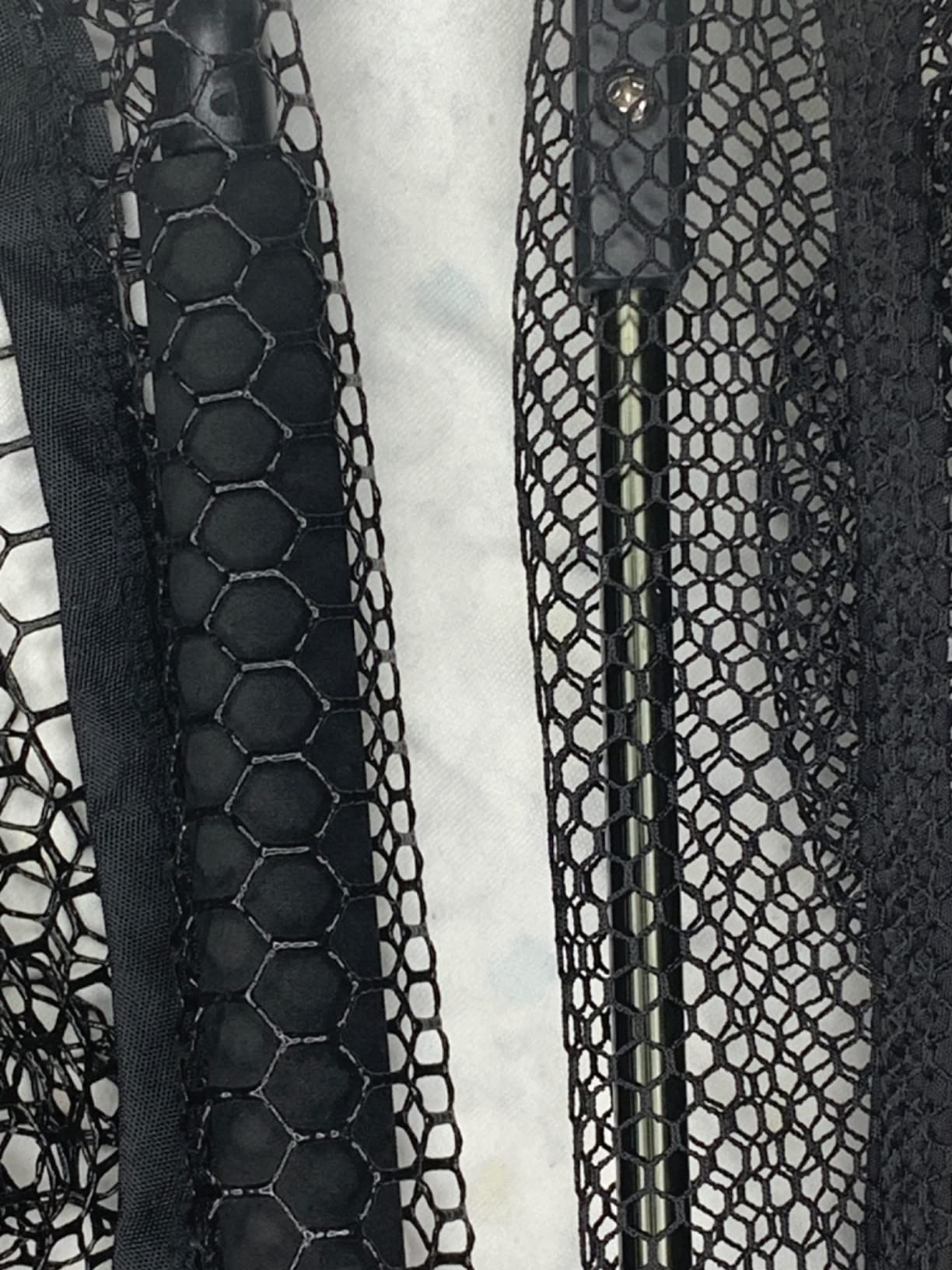
There is a 61 inch extension option for the handle, which is the longest reach in this group, and the telescoping action means you only pay for the extra length when you need it. Owners fishing from elevated seats appreciate having that available.
Two details make it feel more considered than a typical budget net. The mesh is nylon-covered PVC with wide openings, so hooks slide through rather than dig in, and the included storage bag has a printed length scale built into it for measuring fish without a separate board.
Be realistic about the basket. The 16 inch hoop is the smallest we tested, and several buyers note it runs smaller than expected. That makes it a trout, bass and panfish net rather than a fish that fights like a redfish or a pike.
What it handles best
Anglers who care about frame rigidity, whether that means fighting a hard fish under a dock or just not worrying about the handle flexing while you lift. The aluminum rib is a real difference under load.
The one-motion fold and the retracting handle also make it the fastest of the group to deploy. If you are netting fish after a cast at a boil, that speed is worth a lot.
Where it falls short
The hoop size. It is listed at 16 inches, and the consensus in reviews is that the usable basket is smaller than that figure suggests. Plan on it for species up to a few pounds and pick something wider if you target anything bigger.
The locking hinge is stiff out of the box and can develop wobble over time, and the included bag is basic. If you keep your net in a truck bed, do not make the bag the deciding factor.
5. Foreverlast Generation 2 Floating Net – Built for Water, Not for the Dock
Foreverlast Inc. Generation 2 Non-Snag Floating Fishing Landing Net for Wade Fishing and Fly Fishing, G2 Pro Net, Orange
Floating drop-shape net with rubber mesh
Included tethering cord
14.4 oz
Fixed short handle
Pros
- Floats reliably even with a bait bucket clipped on
- Compact short design that stores easily on a crowded kayak
- Deep drop-shape basket has landed large fish
- Easy to rinse and clean after a day on the water
Cons
- Fixed short handle limits reach and some owners add their own extension
- Treble hooks and hard baits can still snag in the netting
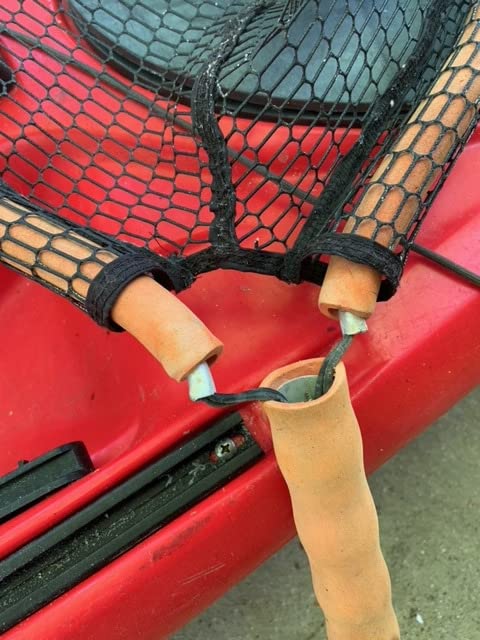
This is a wading net that happens to be excellent in a kayak, and it has the highest average rating in our group. The design brief is simple: plastic frame, rubber everything, and floats without needing a separate foam add-on. Owners report that it stays on the surface even with a bait bucket hanging off it.
The basket is a deep drop shape, which is the geometry we look for when the fish is going to thrash. Owners tell stories of landing a 30 inch steelhead in it, and a deep basket gives a heavy fish somewhere to settle instead of kicking over the rim.
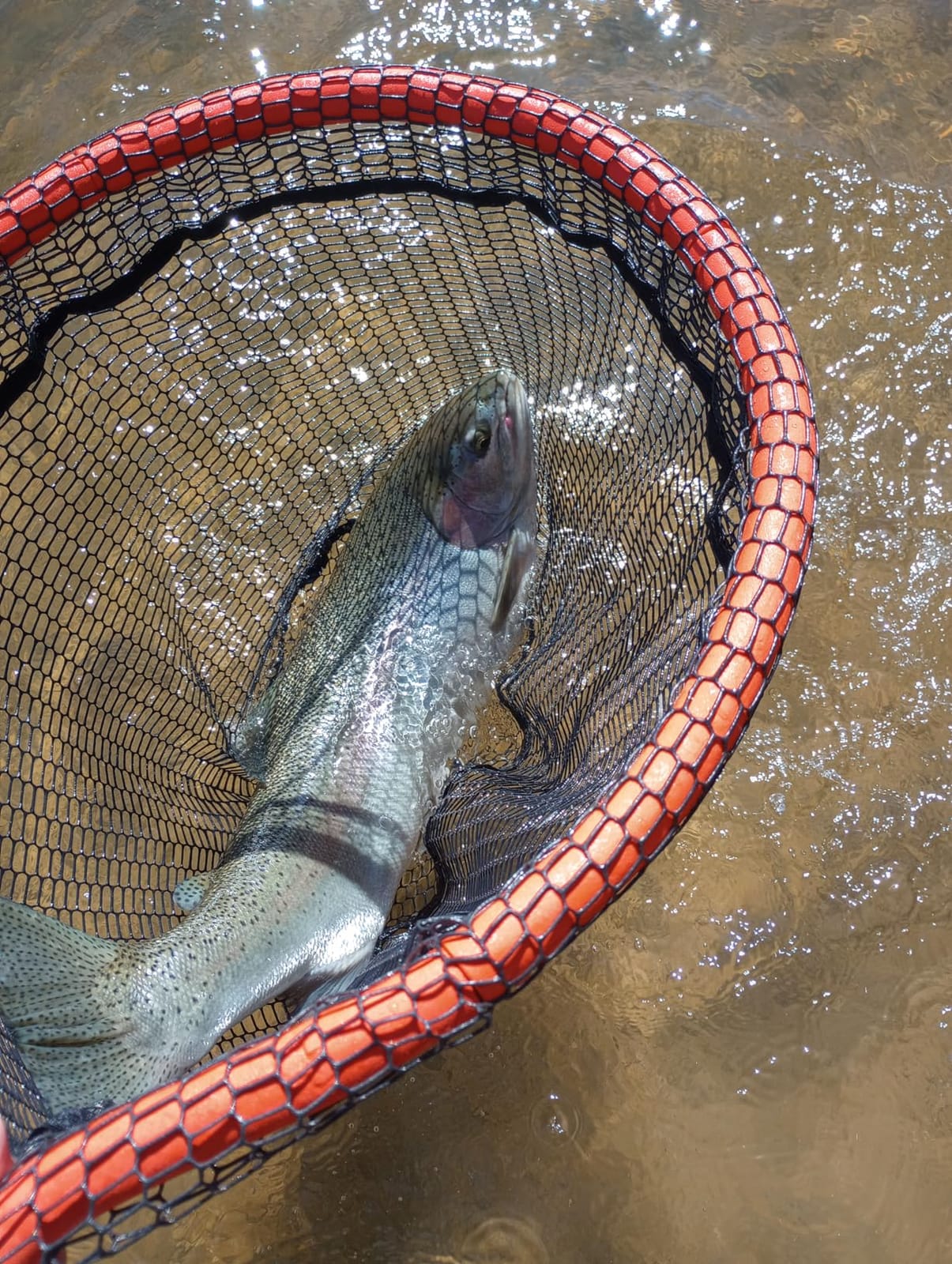
The included tethering cord is the detail kayak anglers care about most. It clips to a wading belt or a kayak deck loop, so when the fish shakes loose the net does not disappear. That single piece of cord has probably saved more nets than any design improvement in this list.
It also won the 2013 ICAST Best of Show award in the fishing and hunting accessories category, which is a reasonable signal that the design has held up for more than a decade of use.
At 14.4 ounces it is one of the lighter nets here, and because the handle is short and fixed, the whole package is compact. That is the appeal on a small boat where a longer handle would be a luxury you cannot store.
What it handles best
Salt and surf wading, where everything you carry is going to get submerged eventually. The full rubber build shrugs off water with nothing to corrode, and the drop shape is forgiving with toothy fish that want to thrash once they are contained.
Catch-and-release anglers also like the deep basket, because a fish with room to settle is a fish that comes off the hook in better shape.
Where it falls short
The fixed short handle is the honest limitation here. From a seated kayak position you are reaching down and forward, and several owners solve it by adding an aftermarket handle extension, which is a reasonable fix but one more part to carry.
Some users still snag treble hooks and hard baits in the rubber, so it is not a complete answer to the tangling problem. The mesh is gentler on fish than bare knotted nylon, but it is not snag-proof.
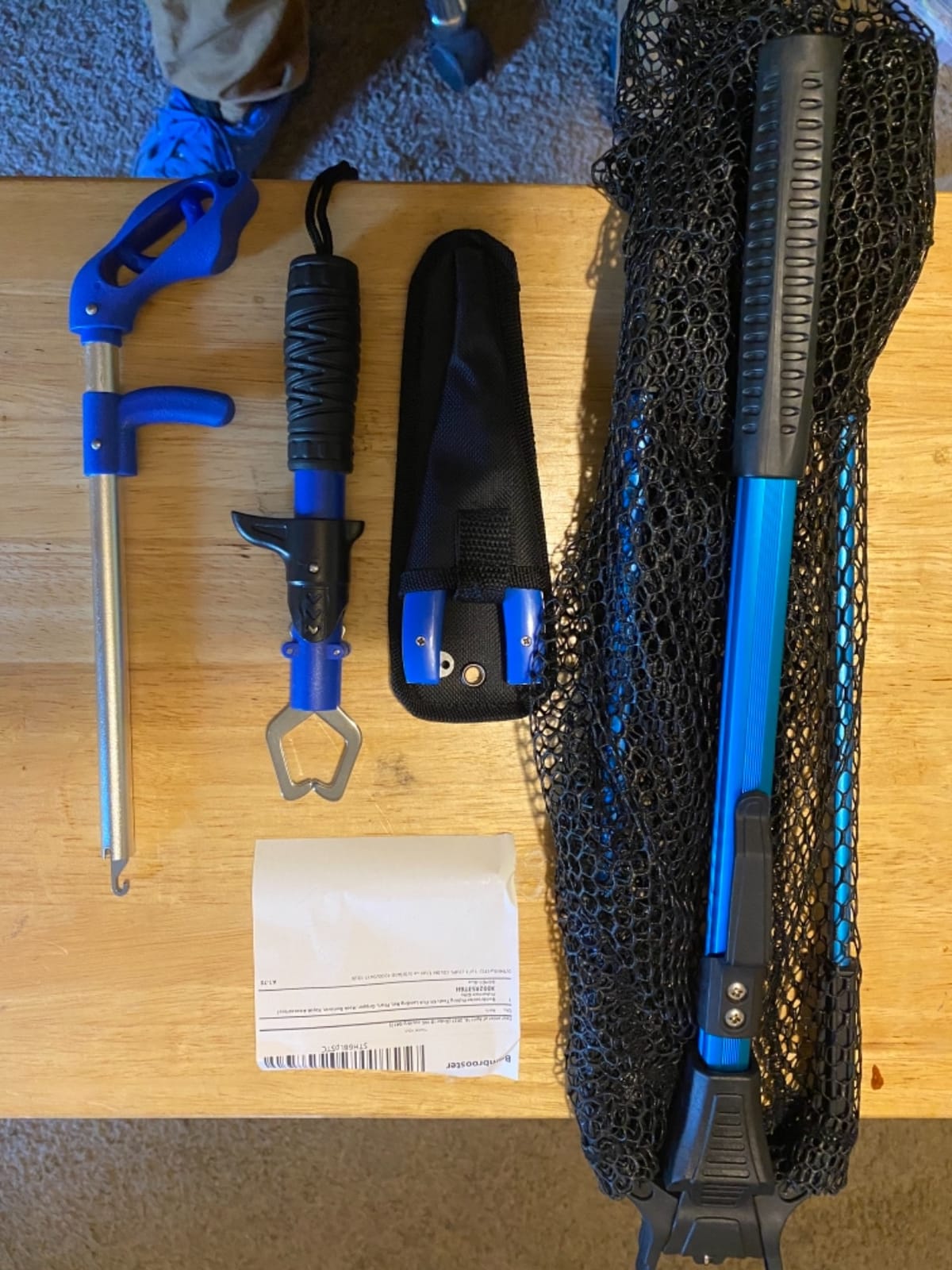
6. Bombrooster Four-Piece Tool Kit – The Starter Bundle
Bombrooster Foldable Kayak Landing Net Kit, 4PCS Fishing Tool Set
Landing net, fish lip gripper, pliers and hook remover
Quick-dry coated non-tangling mesh
EVA non-slip handles
Stainless steel tools
Pros
- Bundles the four tools a new kayak angler actually needs
- Stainless steel pliers handle line cutting and split rings
- Net folds neatly without snapping shut
- Works for trout
- bass and catfish
Cons
- Net in the kit is on the small side and loosely built
- Strong new-plastic odor that needs days of airing out
- Some inconsistency in build quality between units
Most new kayak anglers do not just need a net. They need something to hold the fish, something to get the hook out, and something to cut line with, and this kit puts all four in one place. The net is a folding triangular design with quick-dry coated mesh, plus a lip gripper with a T-handle, a wrist lanyard, pliers and a hook remover.
The tools are the strongest part of the package. The stainless steel pliers get the most praise because they cut line and handle split rings and rig changes, which is the kind of thing you discover you need in the first hour on the water.
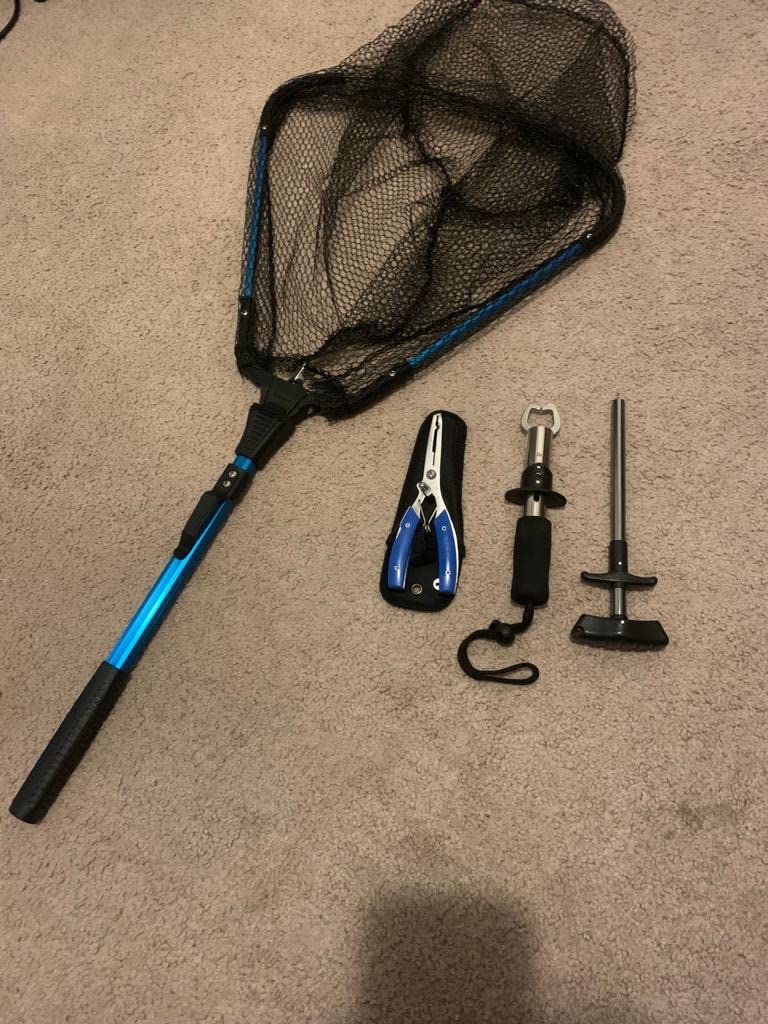
The net itself works for trout, bass and catfish from a kayak. Reviewers describe the mesh as soft but sturdy, and the EVA non-slip grip on the handle does the same job as the rubber grips elsewhere in this roundup.
Two practical warnings. The net is smaller than the other folding options here, and a number of buyers report a noticeable new-rubber smell that takes a few days of airing out before it fades, which is worth knowing if you plan to store it in an enclosed vehicle.
Roughly one review in eight is three stars, and the common thread is the net rather than the tools. Treat this as a kit where the accessories justify the net.
What it handles best
New anglers building a first kayak setup, and anyone who wants one bag to hold a working set of tools. The lip gripper in particular is what lets you control a fish for a photo without a second set of hands.
It is also a reasonable gift for someone starting out, since it covers the four items most beginners forget to buy.
Where it falls short
Do not expect the net itself to be the highlight. Buyers describe it as small and not very well made, and a loose hinge or a soft frame is exactly the thing that will fail at the worst moment.
There is also no buoyancy feature of any kind, so a dropped net is a lost net. If you fish water where that is a realistic outcome, add a floating net to the kit later.
7. GOODCAT Clear Mesh Fly Net – Disappears Underwater
GOODCAT Fly Fishing Net, Bass Trout Landing Net, Folding Fishing Nets Fresh Water, Safe Fish Catching or Releasing, Fly Fishing net Magnetic Release (A:Square-Extend Length:24.6″)
17 x 11.5 inch square hoop with 10 inch depth
Clear rubberized mesh
Magnet carabiner and 2.5 m coiled lanyard
11.2 oz
Pros
- Clear mesh is nearly invisible and does not spook fish
- Resists mildew and rot better than bare nylon
- Folds and locks open one-handed with no wobble
- Magnet plus lanyard prevents the lost-net problem
Cons
- Net depth of about 10 inches is shallow for heavy fish
- Handle reach is short and one variant does not telescope
- Swinging on a back vest is awkward for wade fishing
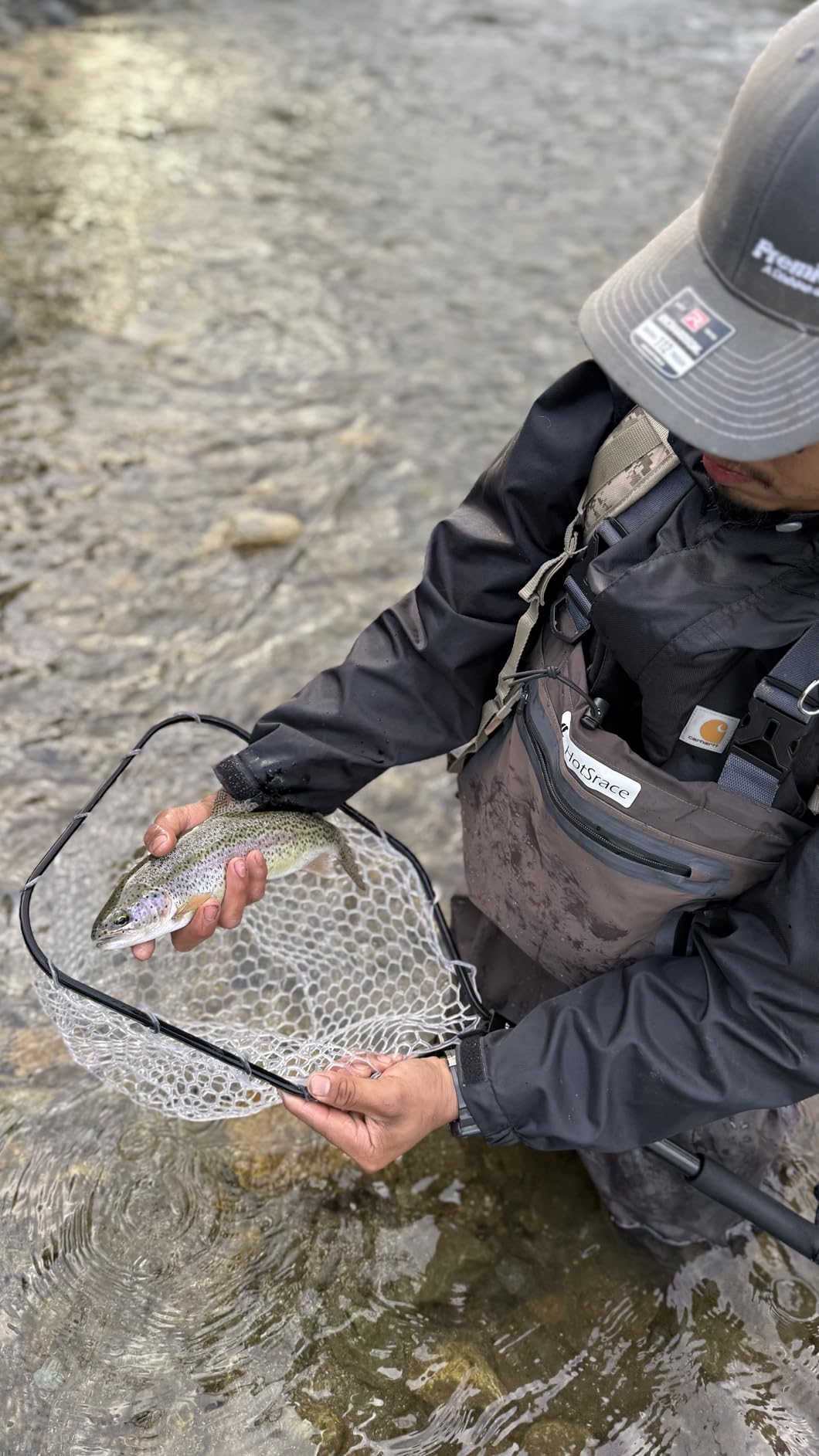
Clear mesh is the whole idea here, and it works. In shallow clear water with sight fish, a black net frame is a shadow moving toward your target, while this one is close to invisible once the rubber is wet. Fly anglers targeting trout in clear lakes notice the difference on the first trip.
The retention system is unusually well thought out for a compact net. A coiled spring cord runs 35 centimeters and extends to 2.5 meters, terminating in an aviation aluminum magnet and carabiner, so the net can stay clipped to a vest or a PFD and still be dropped over the side without sinking immediately.
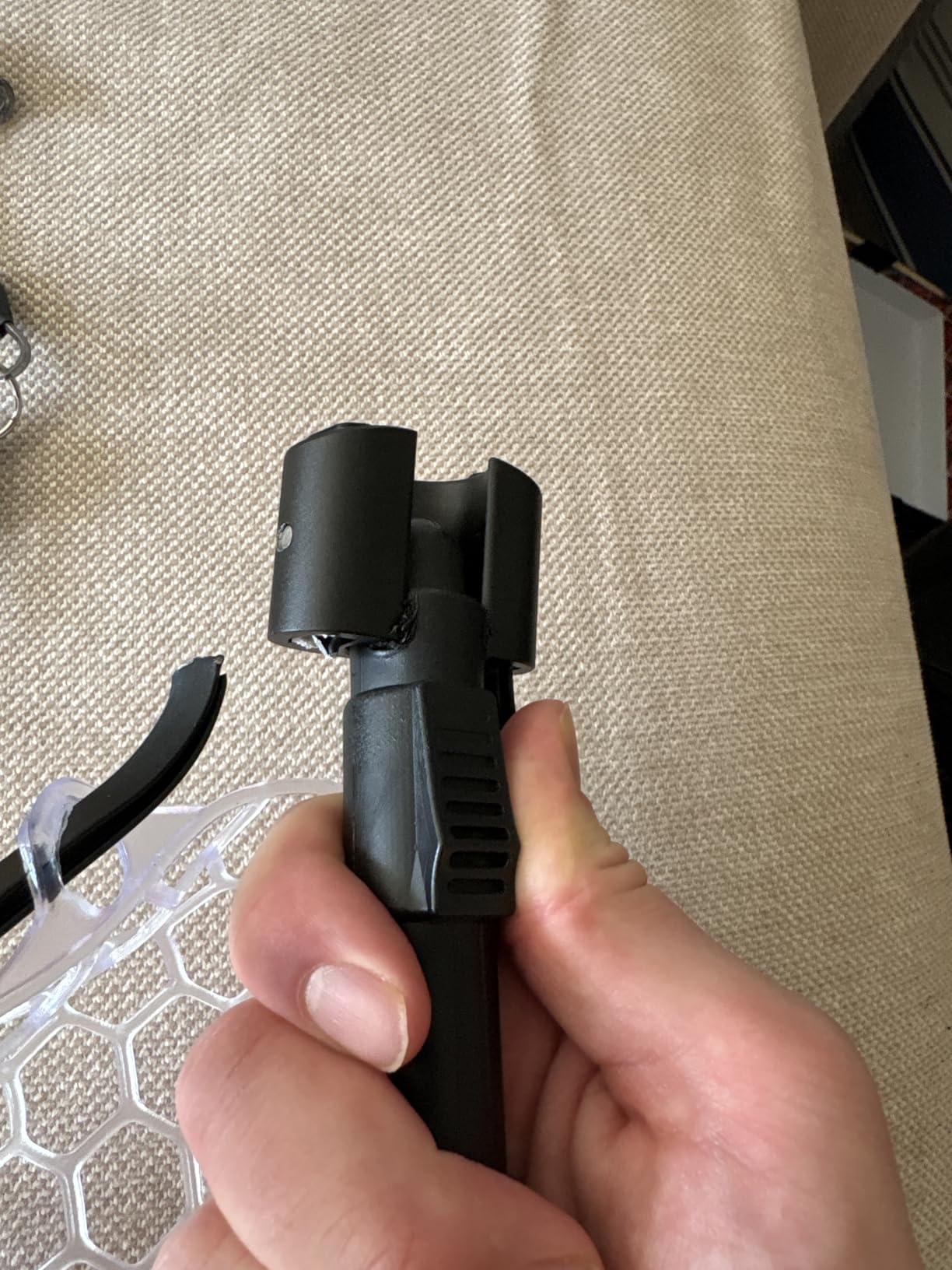
The frame is aviation aluminum alloy with a folding lock that closes one-handed and holds solid with no wobble. At 11.2 ounces it is the second lightest net we looked at, which is a nice combination with a 17 by 11.5 inch square hoop.
Reviewers repeatedly describe the build quality as exceeding what they expected at this level, and several compare it favorably to branded nets costing several times more.
The square hoop gives you a wide, shallow target. That is good for trout and panfish and for anyone fishing clear water, and less good when a fish has to be contained in a deep pocket while it figures out what is happening.
What it handles best
Fly fishing in clear water, where the fish can see you coming before you see the net. The clear rubberized mesh is the difference between a fish that spooks and a fish that eats.
Carrying it on your body also works better than most. The magnet and lanyard keep it on a vest or PFD, and 11.2 ounces is light enough to forget about.
Where it falls short
The 10 inch depth is shallow. If a trout or a bass hits the net and thrashes hard, there is not a lot of basket below it, and buyers asking for a deeper basket should look at the SANLIKE flat-bottom design instead.
Handle reach is the other limitation, with a listed extension of 24.6 inches and one variant that does not telescope at all. Wading anglers also note that carried on a back vest it bounces, so it is a kayak and boat net more than a walking net.
8. YakAttack Leverage Landing Net – Built by a Kayak Company
YakAttack Leverage Landing Net with Foam Extension – 12″ x 20″ Hoop
Built-in forearm grip, foam extension
Folds flat for storage
12 x 20 inch full rubber basket
About 2 lb
Pros
- Forearm grip gives real control for one-handed netting
- Folds flat and the foam extension stores vertically in rod holders
- Dedicated kayak brand with a purpose-built layout
- Full rubber mesh that holds up to repeated use
Cons
- 12 x 20 basket is the most compact here and better for trout and bass than big fish
- Weighs about 2 lb
- noticeably heavier than the folding nets
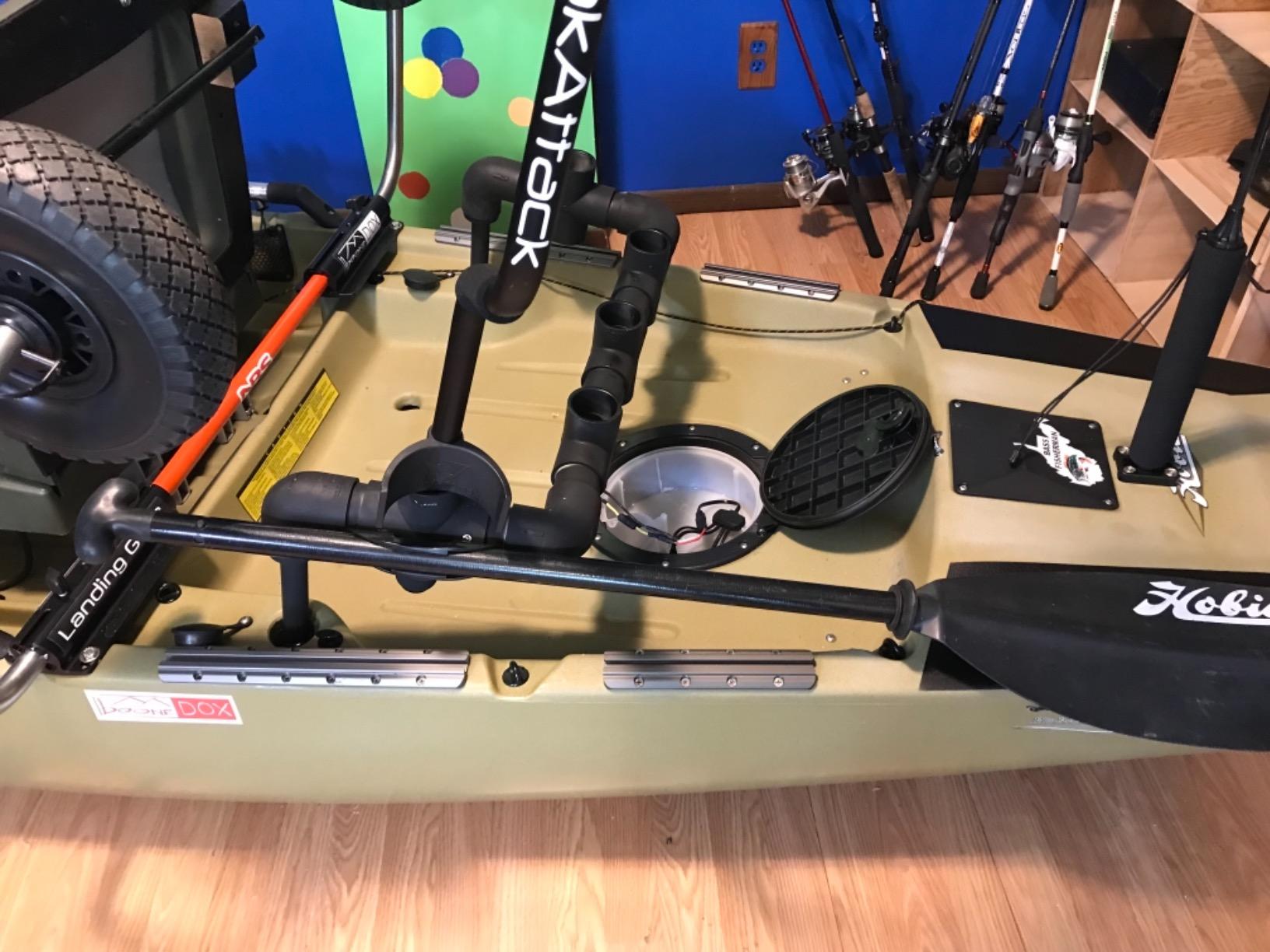
Everything about this net starts from the assumption that you are sitting down. The forearm grip is built into the handle so you can lock the net against your forearm and use the other hand on the rod, which is the single most useful thing a kayak net can do when a fish is alongside.
The foam extension is the second piece of that design thinking. Because the handle is a foam-covered extension rather than bare tubing, the folded net stands vertically in a rod holder or a tube-style mount instead of lying across your deck. Kayak fishing forum threads keep coming back to this detail because it is the difference between having the net accessible and having it buried under a PFD.
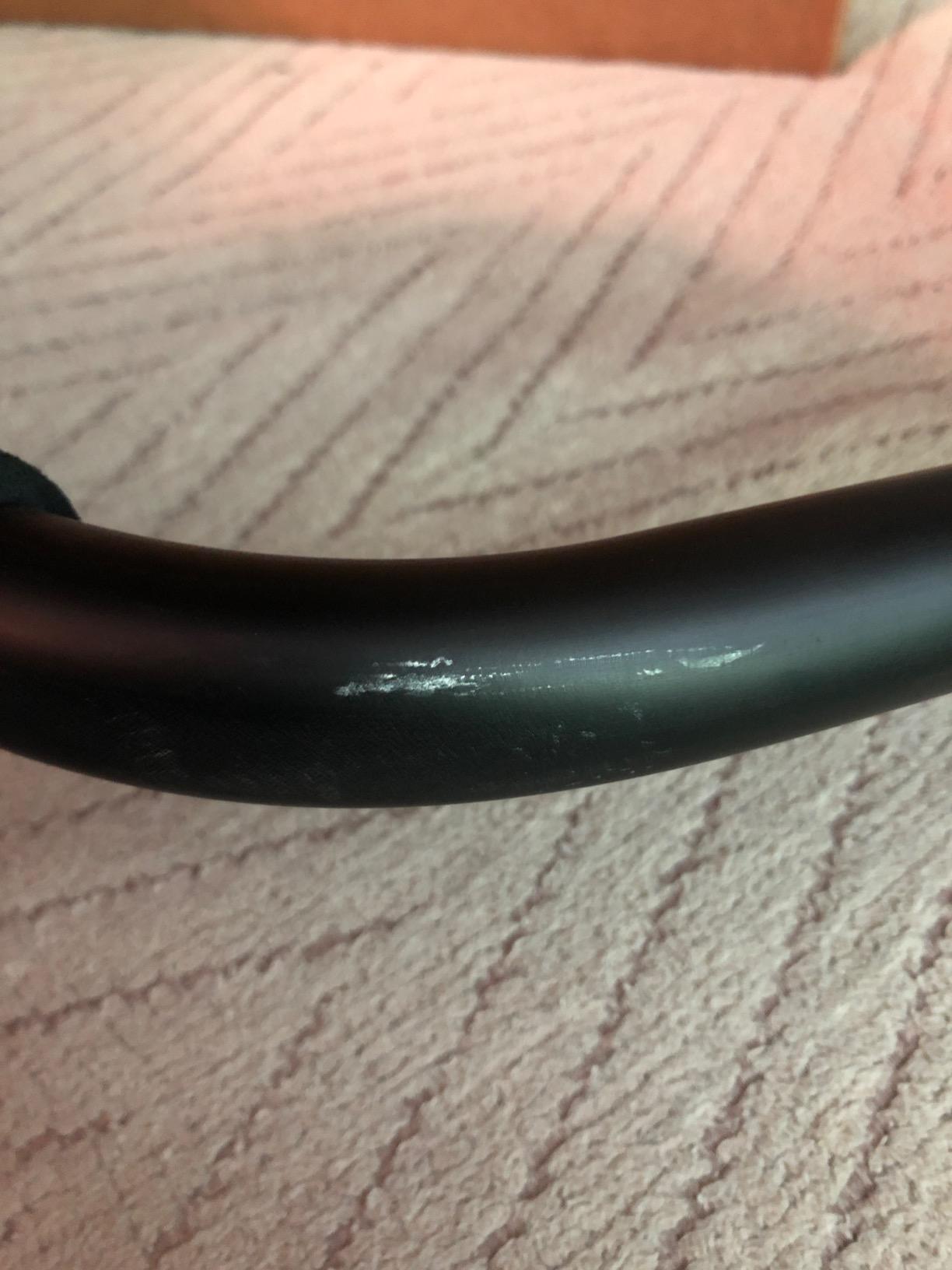
The net itself is full rubber, molded in Taiwan, with other parts made and assembled in the USA. Owners describe the mesh as fish safe and durable across seasons of use, and it holds a shape rather than going floppy when wet.
The hinged handle folds flat, so the whole package is short and rectangular. That is a genuinely good design for a pedal kayak where deck space and pedal clearance are both limited.
Be clear about the trade-off: at about 2 pounds it is the heaviest net in this group by a wide margin, and the 12 by 20 inch basket is the most compact. It is a trout, bass and panfish basket, and a big fish is going to feel tight in it.
What it handles best
Elevated-seat kayaks and any setup where you need to fight a fish with one hand while holding the net with the other. The forearm grip is the reason this net is a recurring favourite in kayak fishing forums, and it genuinely changes the landing sequence.
Rod-holder storage is the other win. A net that stands upright behind the seat is a net you can grab without taking your eyes off the water.
Where it falls short
Weight and basket size together. Two pounds is fine on a sit-on-top deck and annoying on a pack, and the compact basket means you will move to a wider net if you start targeting fish that fight like a salmon or a striped bass.
It is also the most expensive option in this roundup, so if you are buying on a tight budget the same forearm logic can be had elsewhere, just without the fold-flat foam extension.
9. SANLIKE Collapsible Telescopic Net – Flat Bottom and 41 Inches of Reach
SANLIKE Collapsible Telescopic Fishing Net Rubber Coated Fresh/Salt Water
Two-section telescopic handle reaching 41 inch
One-click fold to 16.9 inch
Flat-bottom rubber coated mesh
Belt clip included
Pros
- Two-section telescopic handle gives the longest reach here
- Flat bottom reduces thrashing and injury to the fish
- One-click fold and belt clip make deck or PFD stowing easy
- Rubber coating works in fresh and salt water
Cons
- Small hoop limits it to panfish
- trout and small bass
- Aluminum handle sections add weight on ultralight setups
- Mesh openings are wide enough that small hooks can slip
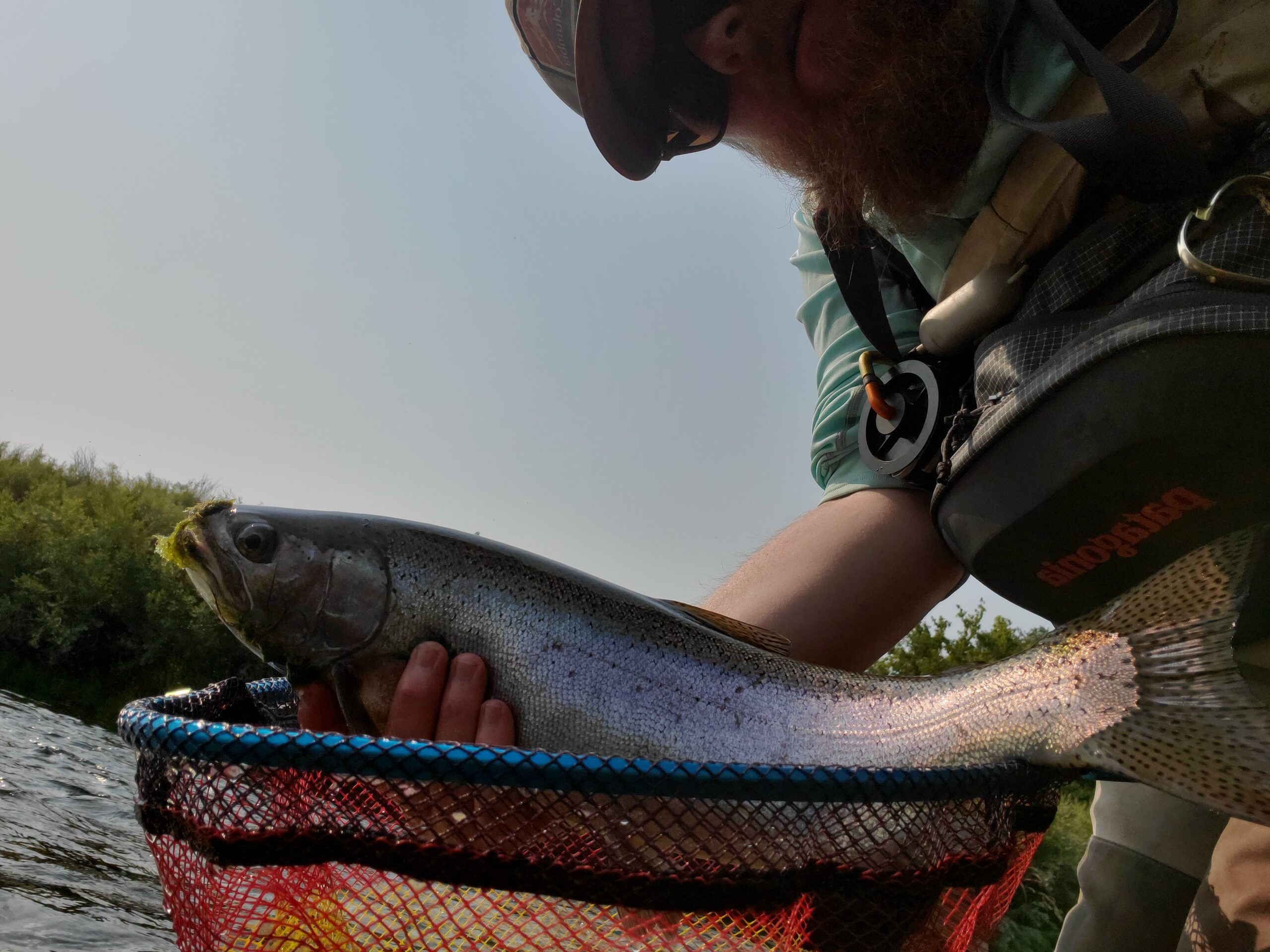
The flat bottom is the idea worth borrowing from this net. A cone-shaped basket lets a fish slide down and keep going, while a flat floor supports the fish and takes less thrashing, which matters if you are releasing it or photographing it.
Reach is the other headline. The two-section handle extends to 41 inches, longer than anything else in this group, and the two-section design means it collapses to 16.9 inches with a one-click fold. On an elevated pedal seat that is the difference between netting from a seated position and standing up in the middle of a fish fight.
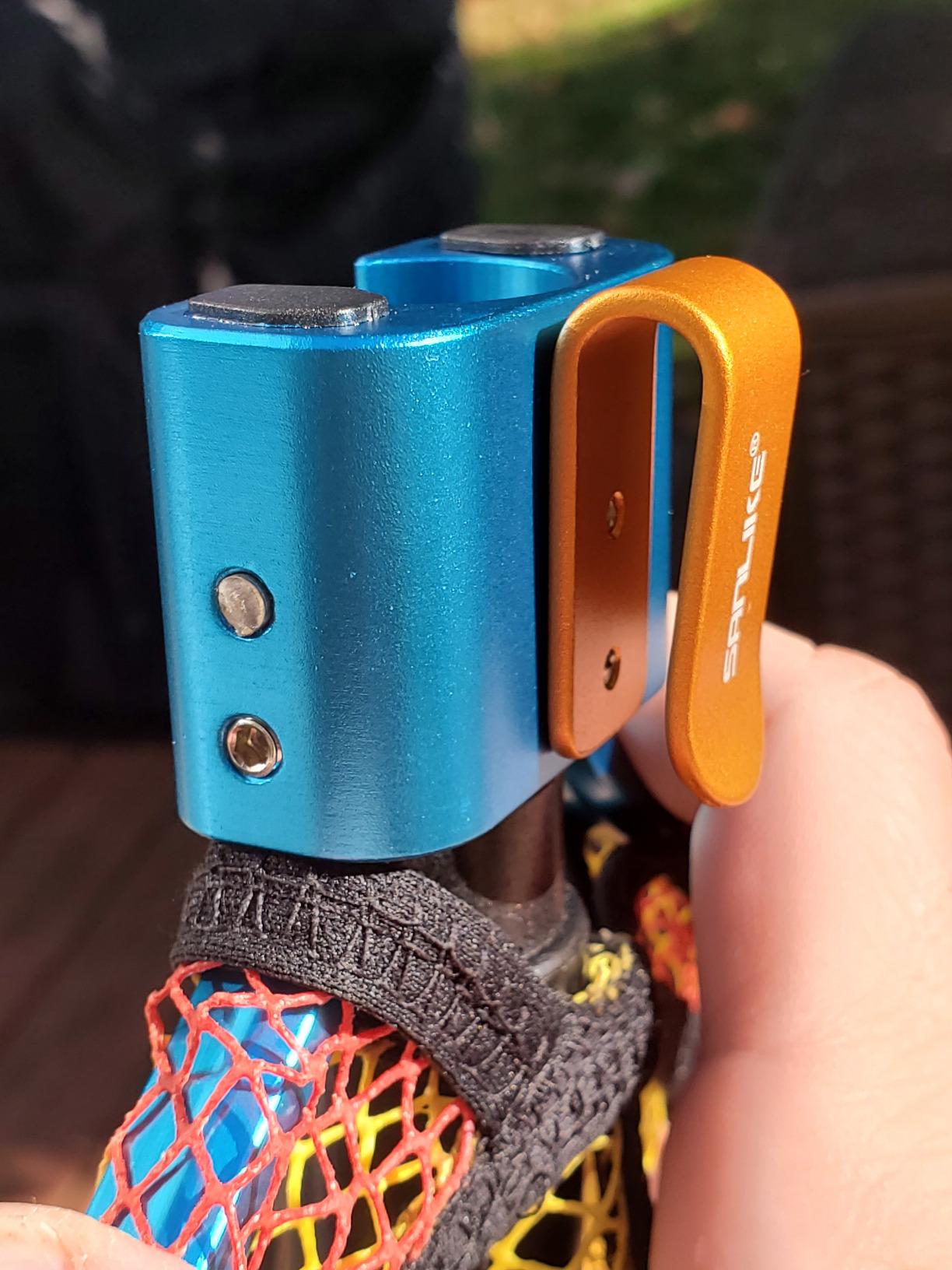
The rubber coating is the fish-friendly kind, described by the maker as preserving the natural slime coat, and it works in both fresh and salt water. The belt clip lets it hang off a PFD or a wading belt, which is the standard way to carry a net when both hands are busy.
The one-click fold is a genuinely good mechanism. It does not spring open in your hand, which is the failure mode we see most often in cheaper folding nets, and the storage length is short enough for a gear track.
Where it falls short on the fish end is the hoop, which is small. Reviewers consistently describe it as a net for panfish, trout and smaller bass rather than anything that gets above a few pounds.
What it handles best
Catch-and-release anglers who want the fish to come out in good shape. The flat bottom is the feature that shows up in the review summaries more than anything else on this net.
It is also the best fit here for anyone with an elevated seat, because 41 inches of reach covers the gap between a high chair and a low waterline without you having to stand up.
Where it falls short
The small hoop is the consistent complaint, and it is a real one. If you are chasing larger fish, this is a trout and panfish net with a very long handle.
At 476 grams the aluminum sections are the heaviest part of the design, so ultralight anglers packing a net into a back panel will feel it. It is a boat and deck net rather than a hiking net.
10. KastKing Brutus Extendable Net – Best for Fish That Fight
KastKing Brutus Fishing Landing Net, Extends to 45″, PVC
6063 aluminum handle with 1 mm walls, rated to 44 lb
Push-button fold with four stainless screws
Bright orange EVA foam handle
PVC or silicone mesh options
Pros
- 6063 aluminum handle is rated for heavy landings on the largest size
- Large basket handles medium and large fish
- Push-button fold reinforced with four stainless screws
- Bright orange handle is easy to find in low light
Cons
- Hooks embed in the nylon webbing of the PVC net variant
- Plastic screw cap can crack if the handle is pulled fully out
- Telescopic handle sometimes refuses to retract after heavy use
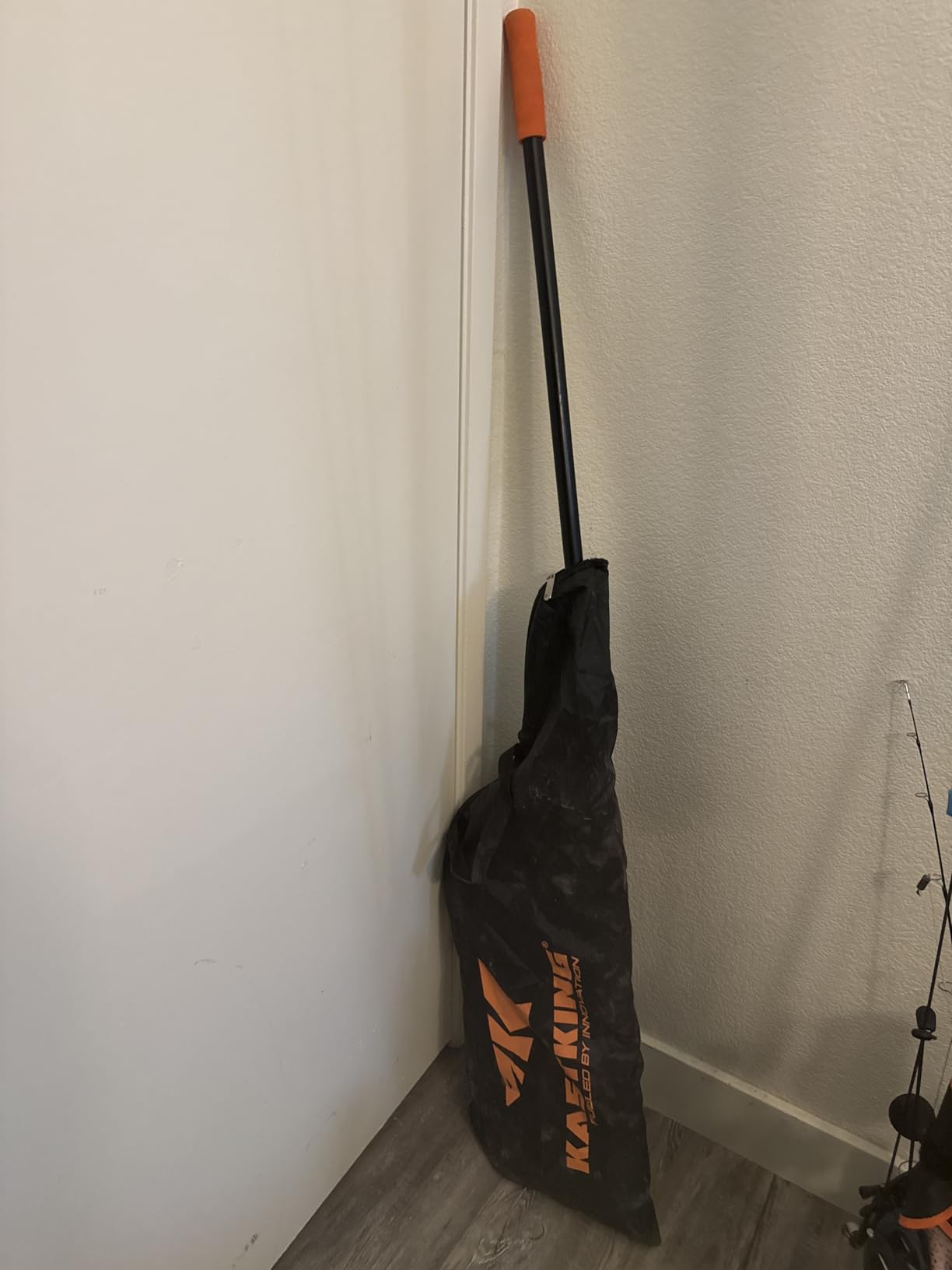
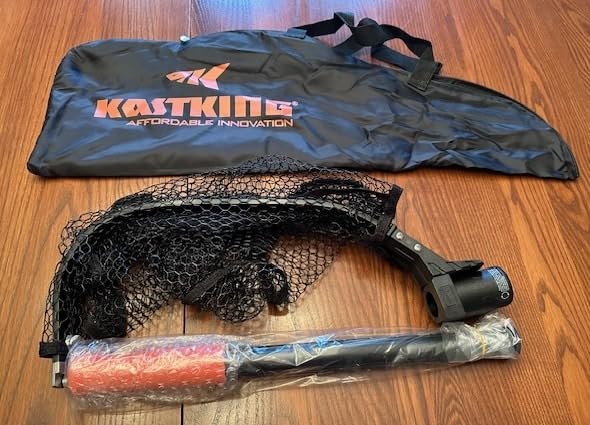
This is the net to look at if your fish fight. The handle is 6063 aluminum alloy with a one millimeter wall, and the largest size is rated to 44 pounds, which is a specification the rest of this group does not approach. The push-down release is reinforced with four stainless screws, which is why the folding mechanism feels more solid than the price suggests.
Choose the silicone mesh rather than the PVC one. This is the single most useful piece of advice in the whole roundup, because buyers report that hooks embed in the nylon webbing between the plastic strips of the PVC net and are genuinely hard to extract. The soft silicone version does not have that problem, and the difference in frustration between the two is enormous.
The basket is the largest of the folding nets here, and owners talk about landing medium and large fish with it while comparing the result favorably to premium branded nets. For bass, walleye and anything else that gets above a few pounds, this is the shape you want.
The bright orange EVA foam handle is a small touch that matters at dawn and dusk, when finding a black handle against a dark deck is harder than it sounds. It also includes a storage bag, which keeps the folded frame from rattling around in a crate.
Like the SANLIKE, it folds down very small for travel and stows in a kayak without taking a whole deck section, which is where a lot of anglers start looking at it.
What it handles best
Fish that pull hard. A stiffer aluminum handle with a stated load rating and a reinforced folding joint is what you want when the last three seconds of a fight go sideways, and the large basket gives a heavy fish somewhere to go.
It is also a good match for anglers moving between a sit-on-top and a sit-inside, because the folded package is small and the handle extends when a longer reach is needed.
Where it falls short
The handle hardware is the weak point. Owners report the plastic screw cap at the top cracking when the handle is pulled out fully, and a telescoping handle that occasionally refuses to retract after extended use. Both are annoying rather than dangerous, but they will happen.
There are also a few reports of a glued part detaching on first opening. Inspect it the first time you unfold it, and you will catch any bonding problem before it costs you a fish.
How to Choose a Kayak Landing Net
Most net comparisons start with mesh and end with price, which is backwards for a kayak. The order that actually matters is reach, buoyancy, basket, then mesh. Get reach wrong and you cannot use the net at all from your seat. Get buoyancy wrong and you lose the net the first time you drop it.
Handle length is decided by your seat height, not your height
Measure from your seat to the water. On a low sit-on-top that is often 16 to 20 inches, and a fixed handle is all you need. On a sit-inside it is a little deeper. On an elevated frame seat or a pedal kayak with a raised chair, you are looking at 36 inches or more of handle before the basket even reaches the water, and that is where telescoping becomes worth paying for.
The other half of the equation is clearance. On a pedal kayak, an overly long fixed handle can foul the pedal drive or the lift column as you shift position. Telescoping solves this, because the handle is short when you are moving and long when the fish is on.
Several nets in this roundup list a 61 inch extension option. That is not a reach you will use on a normal cast, but it is useful when you are netting a fish that has run under the boat or alongside a steep bank.
Floatability is the one feature you cannot skip
This comes up constantly in kayak fishing forums, and it is the most repeated piece of advice we found in our research. A net that sinks is a net you are buying again. Three options exist: foam padding on the hoop, EVA float material in the frame, or dedicated float tubes on two sides of the head.
Foam padding is the cheapest and the most common. Float tubes are the most deliberate. Neither makes the net retrieve itself, but the difference between a net bobbing on the surface and one sinking to the bottom is often the difference between a bad afternoon and a ruined one.
As a backup, get a tether. A short cord clipped to a deck loop or a PFD costs almost nothing and turns a lost net into an annoyance.
Rubberized or bare nylon mesh: fish health and hook snags
Rubber-coated mesh is the answer for almost every kayak angler, and the reason is not softness. It is that the coating removes the knots, and knots are what hooks snag on, and snags mean you either lose the fish or lose the lure. Coated mesh also does not absorb water, so it dries faster between trips and does not smell after a week in a wet bag.
There is a middle option in the PVC and silicone nets. Silicone is the more forgiving of the two and avoids the webbing problem. PVC nets with fabric webbing between the strips are the ones where hooks get stuck, so pick the silicone version when you have the choice.
Bare knotted nylon is still common and still fine for a fish you intend to keep or release quickly, but it is harder on the fish and harder on your lures. For catch-and-release, coating is worth the upgrade.
Hoop size and basket depth by target species
Hoop size sets the target you can actually hit. Something around 15 to 16 inches works for trout, crappie, panfish and bass. If you are targeting anything that fights above a few pounds, move up to 18 inches or more, because a small hoop with a big fish coming in sideways is a fish you lose at the surface.
Depth matters as much as width. A deeper basket gives a landed fish somewhere to settle, which reduces thrashing and injury. Look for 10 inches as a reasonable minimum, and prefer a flat or drop-shaped bottom over a cone, since a cone keeps sliding the fish down into the point.
A rectangular or drop shape gives more usable volume than a triangle for the same measurement. Triangular hoops are common because they collapse more compactly, so you are trading basket space for storage, which is a real trade on a small kayak.
Storage: what actually fits on your deck
Measure your collapsed net against your real storage spots, not your ideal ones. The options in order of usefulness are a rod holder with a foam-covered extension that stands vertically, a gear track, a deck bungee, a hatch, and a clip on a PFD or a shoulder strap.
Two failure modes we heard about repeatedly in forums: nets that are too long for a rod holder and end up lashed to the deck under everything else, and folding frames with cheap bag zippers that fail in the first season. A net you cannot get to in four seconds is not helping you land a fish.
For small boats, count the collapsed length before you buy. Anything under 18 inches is genuinely stowable in most cockpits. Above 20 inches, plan a dedicated spot.
Deploying a net with one hand while the rod is loaded
Technique matters more than gear here. The most common way anglers lose fish is by chasing them with the net, which pushes the fish away from the boat. The better sequence is to hold the net stationary beside the kayak, guide the fish into it with the rod tip, and only then lift.
A forearm grip makes this easier because you can brace the net against your arm and use the freed hand on the rod. A quick fold matters too, because a net you have to unfold one-handed while a fish is next to the boat is a net you will drop in the water.
Buoyancy is part of technique as well. Anglers who lose nets generally lose them during the transition from landing to stowing, which is exactly when the net is in your hands and not yet clipped to anything. Keep the tether on your belt and the problem mostly disappears.
Once you have the net sorted, the rest of the boat matters just as much. Our guides to tackle boxes that fit a deck and fish cleaning tables for anglers cover what you do with the catch afterward, and ice fishing sleds matter for the winter months when the same nets get a harder workout.
Frequently Asked Questions
What is the best quality fish net?
Quality comes down to three things: a rubberized coating that removes knots, a handle stiff enough to lift a heavy fish, and a hoop large enough for your target species. The KastKing Pontus and YakAttack Leverage are the two here with the stiffest builds, while the Foreverlast Generation 2 has the highest average rating from owners.
What is the best-rated fishing net?
By average owner rating, the Foreverlast Generation 2 Floating Net scores highest at 4.7 stars across 500 reviews. The KastKing Pontus follows at 4.6 stars, and its aluminum frame is the stiffest we tested, which is why it earns our top rated slot in the picks above.
What is the best fishing net for a kayak?
The PLUSINNO Floating Folding Net is our top pick for a kayak because it floats, weighs 12.5 oz, folds flat, and uses rubber coated non-snag mesh. It has the most owner reviews of any net in this roundup at 4.5 stars across 2726 ratings.
Nylon or mono cast net, which is better?
For kayak angling, rubber coated mesh beats both. Bare knotted nylon snags hooks and strips slime coat, and monofilament style mesh disappears underwater but is still knotted at the intersections. A coating removes the knots, which fixes the snagging problem without hurting the fish.
Why are gill nets illegal for recreational fishing?
Gill nets are illegal for recreational anglers because they are not selective. They catch fish that are not the target, they damage the catch with gill injuries, and a lost gill net continues fishing indefinitely. Landing nets used from a kayak are legal everywhere because the angler retrieves the fish immediately and releases it.
Which kayak net floats and how do I stop losing mine?
Look for foam padding on the hoop, EVA float material, or dedicated float tubes. Four nets in this roundup float: the PLUSINNO Floating Folding Net, the PLUSINNO Telescopic Floating Net, the KastKing Pontus, and the Foreverlast Generation 2. A short tether clipped to a deck loop or PFD is the cheapest insurance there is.
The Verdict on Kayak Landing Nets in 2026
After putting ten of these through a season of kayak use, the best fishing nets for kayak anglers come down to a short list. The PLUSINNO Floating Folding Net stays on the deck year-round for us, because buoyancy, snag-free rubber mesh and 12.5 ounces solve the three problems that lose fish. When the seat is high, reach becomes the deciding factor and the PLUSINNO Telescopic Floating Net or the SANLIKE with its 41 inch handle handles the geometry better.
Match the basket to the fish, clip a tether to your PFD before you launch, and practice holding the net still instead of chasing. Those three habits will save more fish than any specification on this list.