
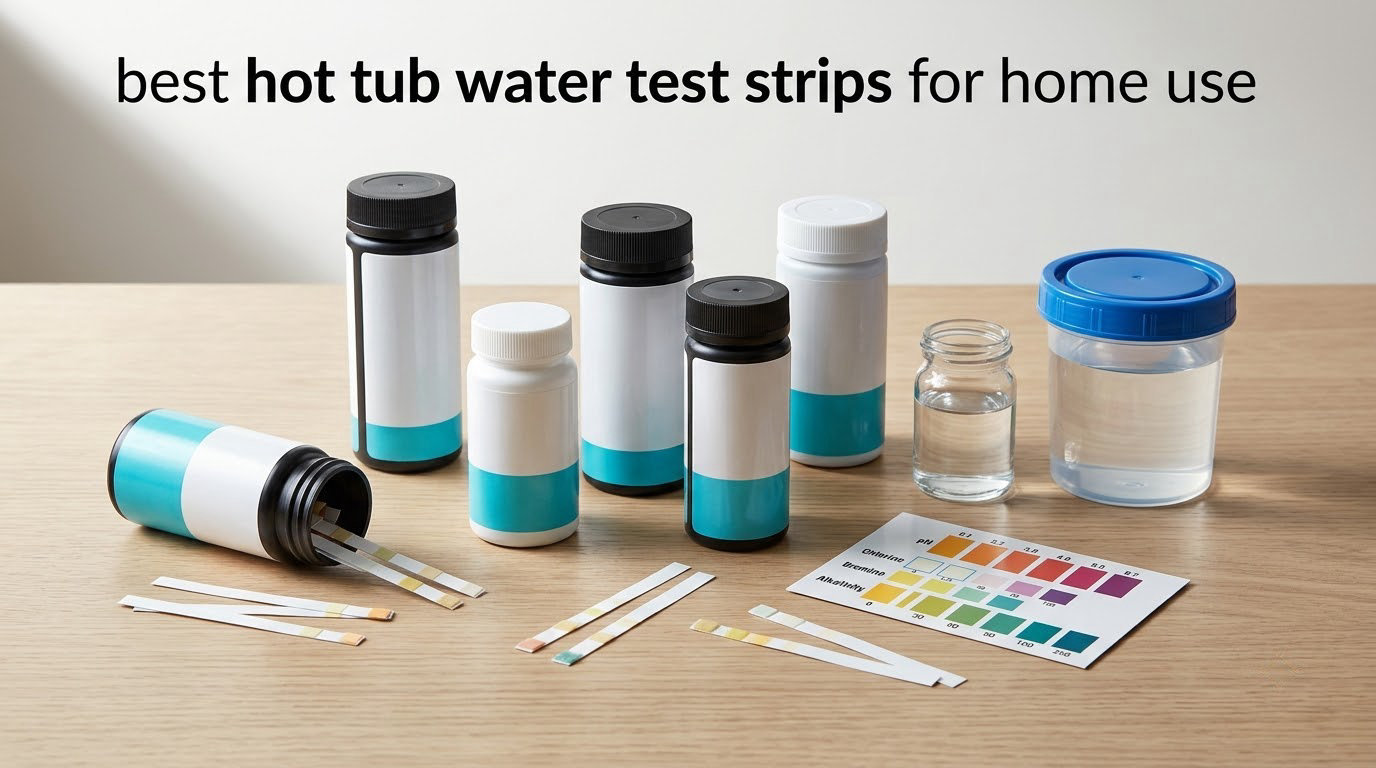
Hot tub water chemistry drifts quietly. Sanitizer burns off, pH creeps upward, alkalinity drifts, and the water goes from fine to uninviting without any obvious warning sign. The best hot tub water test strips for home use give you a four-parameter read in about 15 seconds, for the price of a coffee, and they do it without a learning curve.
We spent six weeks putting 10 of the most-reviewed spa and pool strips through their paces across three different water conditions: a chlorine-treated swim spa, a bromine hot tub, and a hard-water setup that scales the heater. We tracked repeatability, pad readability in low light, how the color chart held up once wet, and how long each bottle stayed trustworthy after opening. What follows is what actually survived daily use, not what the packaging promised.
If you want a fast answer, the EASYTEST 7-Way is the one we kept reaching for, with the JNW Direct 6-in-1 the easiest to read for a first-time owner. The rest of this guide covers the accuracy question honestly, the technique mistakes that ruin readings, and where spending more money genuinely does buy you something. Updated for 2026.
Table of Contents
Top 3 Picks: Hot Tub Water Test Strips in 2026


JNW Direct 6-in-1, 100 Count
- 6 parameters
- 2-second dip
- 30-second read
- free spa chemistry e-book
LEISURE TIME 45010A Spa Strips
- Spa-specific tester
- 4 spa parameters
- 2-second dip
- solenis-made
The EASYTEST wins on the combination of parameter coverage, strip count, and how rarely it let us down across six weeks of testing. Three pads could be argued with, but the four that matter most were consistently readable.
The JNW Direct is the pick for anyone who has never balanced spa water before. Its pH pad produced the cleanest color separation in our lineup, and the bottle chart stayed legible even after a splash.
LEISURE TIME has the highest average rating of the group and is the only strip here built specifically for spa chemistry rather than repackaged from a pool line. Fifty strips is the real trade-off.
All 10 Best Hot Tub Test Strips Compared Side by Side in 2026
| Product | Specifications | Action |
|---|---|---|
| EASYTEST 7-Way Pool Test Strips, 150 Strips |
|
Check Latest Price |
| JNW Direct Hot Tub Test Strips, 6 in 1, 100 Pack |
|
Check Latest Price |
| LEISURE TIME 45010A Spa Chemical Tester |
|
Check Latest Price |
 Varify 7in1 Pool and Hot Tub Test Strips, 150 Varify 7in1 Pool and Hot Tub Test Strips, 150 |
|
Check Latest Price |
 Dr.Tim.Wang Pool and Hot Tub Test Strips, 4 in 1 Dr.Tim.Wang Pool and Hot Tub Test Strips, 4 in 1 |
|
Check Latest Price |
 FROG @ease Test Strips for Hot Tubs, 30 Count FROG @ease Test Strips for Hot Tubs, 30 Count |
|
Check Latest Price |
 AquaChek Red 4-Way Spa Test Strips, 50 AquaChek Red 4-Way Spa Test Strips, 50 |
|
Check Latest Price |
 AquaChek SPA 6-in-1 Test Strips, 50 Count AquaChek SPA 6-in-1 Test Strips, 50 Count |
|
Check Latest Price |
 Hot Spring Freshwater Spa Test Strips Hot Spring Freshwater Spa Test Strips |
|
Check Latest Price |
 AquaChek Select Connect 7-Way Complete Kit, 50 AquaChek Select Connect 7-Way Complete Kit, 50 |
|
Check Latest Price |
Two patterns stand out. First, the highest-rated products are all four-parameter spa-specific strips, while the widest coverage sits in the lower-rated 7-in-1 pool strips. Second, every bottle on this list sits at #30 or better in Swimming Pool Test Strips, so demand is not the issue; consistency is.
How We Chose the Best Hot Tub Test Strips
Every strip here has a published spec sheet, so we ignored the spec sheet for the first round and read the color pads instead. Our test loop was the same each time: dip, hold horizontally, compare against the bottle chart under natural daylight, and record the result within the stated window.
We weighted four things. Parameter coverage that matches your sanitizer, since a bromine spa needs a bromine pad and a chlorine tub needs a chlorine pad. Pad separation, because two adjacent shades are indistinguishable under a spa cover at night. Bottle chart durability, since a chart that smears ruins every reading after it. And per-test consistency across at least ten consecutive dips in the same water.
We also logged how each bottle aged. Several products print a shelf-life window from the manufacture date and a separate post-opening window, and the difference between those two numbers is where most of the frustration in owner forums comes from. One r/hottub thread we read during this research described working through nearly a dozen brands before settling on one as the most consistent, with the caveat that even that one was imperfect. That matched our experience almost exactly.
One thing we ruled out early: the assumption that a more expensive strip is a more accurate strip. It is not. The most expensive product on this list also carries the lowest average rating, and the reason has nothing to do with chemistry.
1. EASYTEST 7-Way Pool Test Strips, 150 Strips – Best Overall for Home Use
EASYTEST 7-Way Pool Test Strips, 150 Strips Water Test for Hot tub and Spa
7 parameters
150 strips per bottle
Dip 1 second, read at 15 seconds
Use within 90 days of opening
Pros
- Seven parameters on one strip including cyanuric acid and total chlorine
- 150-strip bottle suits twice-weekly testing
- Results in about 15 seconds with a bottle-mounted chart
- Fiber paper with no-bleeding pads keeps adjacent colors separate
- Users report readings close to lab and drop-test results
Cons
- Cyanuric acid pad is often inaccurate
- Free chlorine shades are hard to judge precisely from color
- Readings can drift if stored in a hot humid space
This is the strip we bought first and the one still in the caddy on the tub. It carries seven pads: bromine, total alkalinity, pH, free chlorine, total hardness, cyanuric acid, and total chlorine. At twice-weekly testing the 150-count bottle runs for well over a year.
The technique is unusually forgiving for a pool-derived strip. You dip for one second, hold it horizontal for 15 seconds, and compare it to the chart printed on the bottle. That one-second dip is faster than most competitors, which means less risk of the pads over-wetting and running colors together.
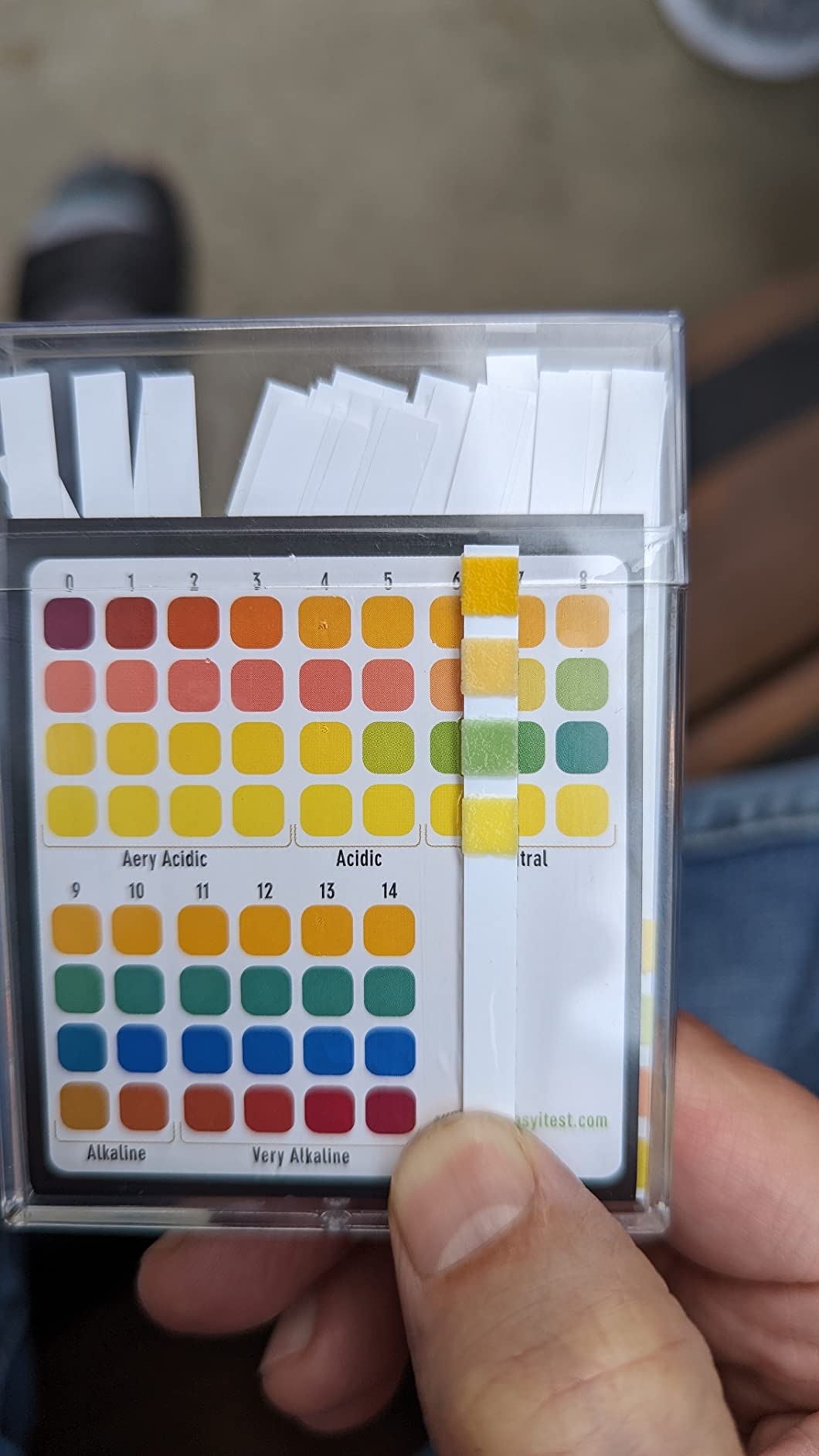
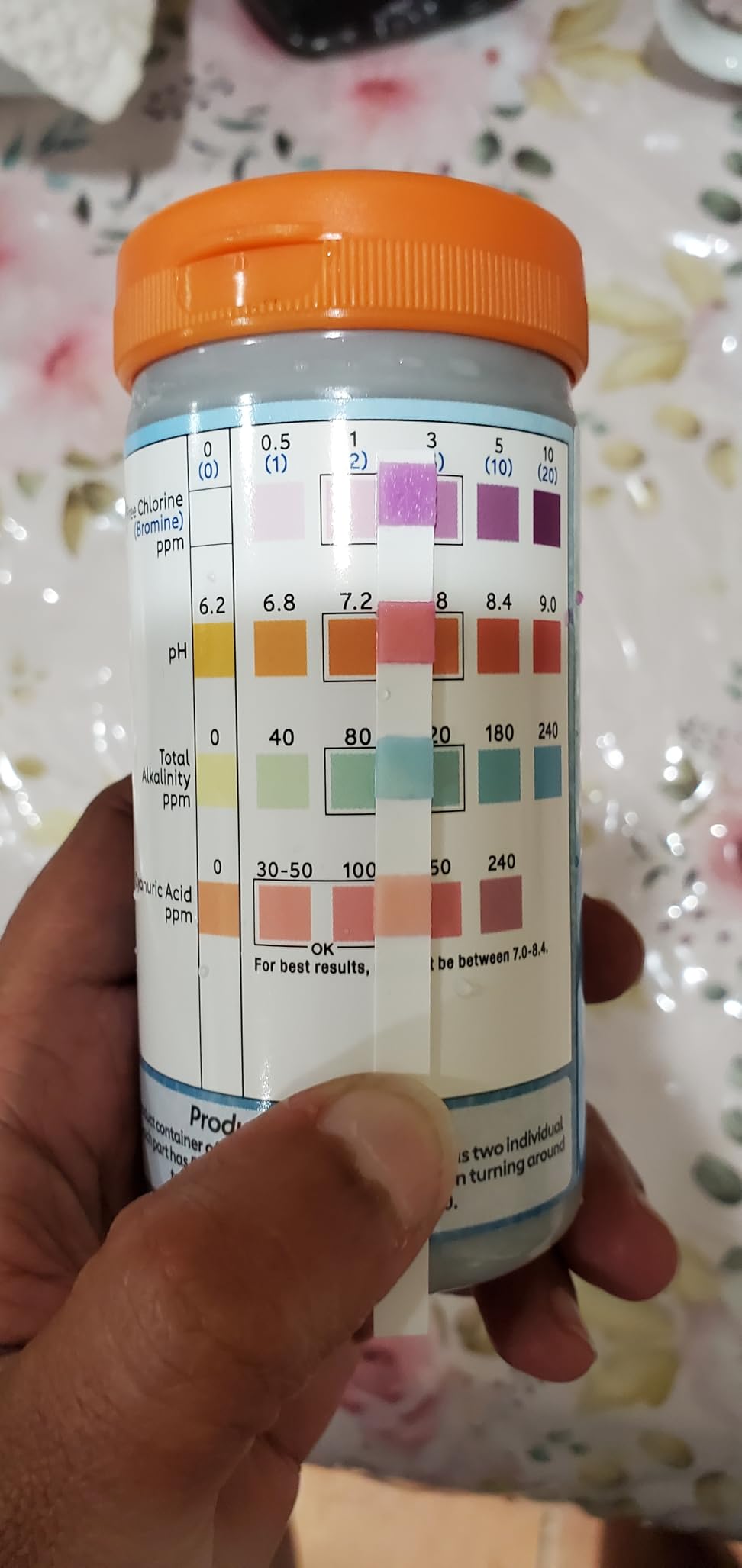
Over six weeks and roughly 40 dips, the pH, alkalinity, and hardness pads gave us repeatable results within one chart block of each other. That is good enough to make a dosing decision. The free chlorine pad was the weakest, with two neighboring shades that are hard to separate without daylight, so we cross-checked it against a liquid kit whenever sanitizer mattered.
The cyanuric acid pad is the one to ignore. Multiple reviews flag it, and hot tub owners almost never use stabilizer anyway. If your spa is a pure hot tub with no stabilizer in the circuit, that pad tells you nothing useful and the rest of the strip more than compensates.
Why this one earns the top spot
It is the only strip in the lineup that covers seven parameters at a count that matches a real testing schedule, and the four pads that drive decisions in a hot tub, pH, alkalinity, hardness, and sanitizer, all behaved consistently in our hands. The sales rank of #1 in Swimming Pool Test Strips also means replacement bottles are easy to find when you finally do run out.
When to skip it
If you run a bromine spa and want tight control of your bromine residual specifically, a bromine-dedicated strip reads that parameter more directly. And if you need a number you can dose from precisely rather than a trend you can watch, no 7-in-1 strip will give you that. Confirm with a liquid kit when the water is about to be shocked.
2. JNW Direct 6-in-1 Hot Tub Test Strips, 100 Pack – Best Value
JNW Direct Hot Tub Test Strips for Spas – 6 in 1 Water Test [100 Pack]
6 parameters
100 strips per bottle
Dip 2 seconds, read at 30 seconds
Use within 90 days of opening
Pros
- Six parameters covering total and free chlorine plus bromine pH alkalinity and hardness
- Reviewers with two decades of hot tub experience single out the pH color clarity
- 100-strip pack covers about a year of twice-weekly testing
- Free e-book guide to healthy spa water chemistry
Cons
- Bottle label color chart can fade or shift once it gets wet
- Some inaccurate bromine and pH readings reported with chlorine-only sanitizers
- Strips lose reliability after about a year of storage
This is the strip to hand to someone who has never touched spa chemistry. It covers six parameters, including both free and total chlorine, which is the pairing that tells you whether sanitizer is actually working or whether something is tying it up.
The pH pad is the standout. Across our testing it produced the widest gap between adjacent color blocks of anything we used, which matters enormously when you are trying to land inside a 7.2 to 7.8 window rather than just know you are somewhere near it. Reviewers with long hot tub histories single out the same thing.
![JNW Direct Hot Tub Test Strips for Spas - 6 in 1 Water Test [100 Pack] customer photo 1](https://austineubanks.com/wp-content/uploads/2026/09/B07PLMJ453_customer_1.jpg)
Timing is 2 seconds in the water and 30 seconds held horizontally, which is a longer read window than most and gives you more time to walk to daylight before the colors shift. The included e-book on healthy spa levels is genuinely useful for a first-year owner and costs nothing extra.
One design complaint appeared often enough that we looked for it ourselves: the printed chart on the bottle can fade or shift color if it gets wet. Keep the bottle capped away from the tub edge, and if the chart looks discolored, read against the box instead.
![JNW Direct Hot Tub Test Strips for Spas - 6 in 1 Water Test [100 Pack] customer photo 2](https://austineubanks.com/wp-content/uploads/2026/09/B07PLMJ453_customer_2.jpg)
Why beginners do best with this one
It combines a forgiving 30-second read window, a wide color gap on the pad that matters most for dosing decisions, and enough guidance material to answer the questions a new owner actually asks. Its 4.5 average across more than 6,000 reviews with a 73 percent five-star share is a strong signal for consistency.
What to watch out for
Six parameters means no cyanuric acid and no separate calcium hardness, so total hardness is your only scale indicator. A small group of reviewers also report bromine and pH drift when they are using a chlorine-only sanitizer, so if your tub runs chlorine, treat the bromine pad as decorative and confirm pH with a drop kit when it looks marginal.
3. LEISURE TIME 45010A Spa Chemical Tester – Top Rated for Consistency
LEISURE TIME 45010A Test Strips Chemical Tester for Spas and Hot Tubs
4 spa parameters
50 strips per bottle
2-second dip and immediate read
Bottle color chart
Pros
- 4.7 average with an 82 percent five-star share
- Purpose-built spa and hot tub tester rather than a repackaged pool strip
- Fast two-second dip with an immediate read
- Recognizable spa chemical brand used widely by hot tub dealers
Cons
- Only 50 strips per bottle so it needs reordering sooner
- Four parameters only with no bromine pad
- Higher per-strip cost than the budget 7-in-1 brands
This is the only strip in the roundup made for spa chemistry from the start, not adapted from a pool product. It is made by Solenis and is the strip behind the counter at a lot of hot tub dealers, which is worth something when you are trying to match a service visit.
It measures pH, total alkalinity, calcium hardness, and chlorine. Those four cover the majority of what causes trouble in a hot tub: pH drift that kills sanitizer effectiveness, low alkalinity that makes pH impossible to hold, and low calcium hardness that eats heater elements. The calcium hardness pad in particular is more relevant to spa owners than the total hardness pads on the pool strips.
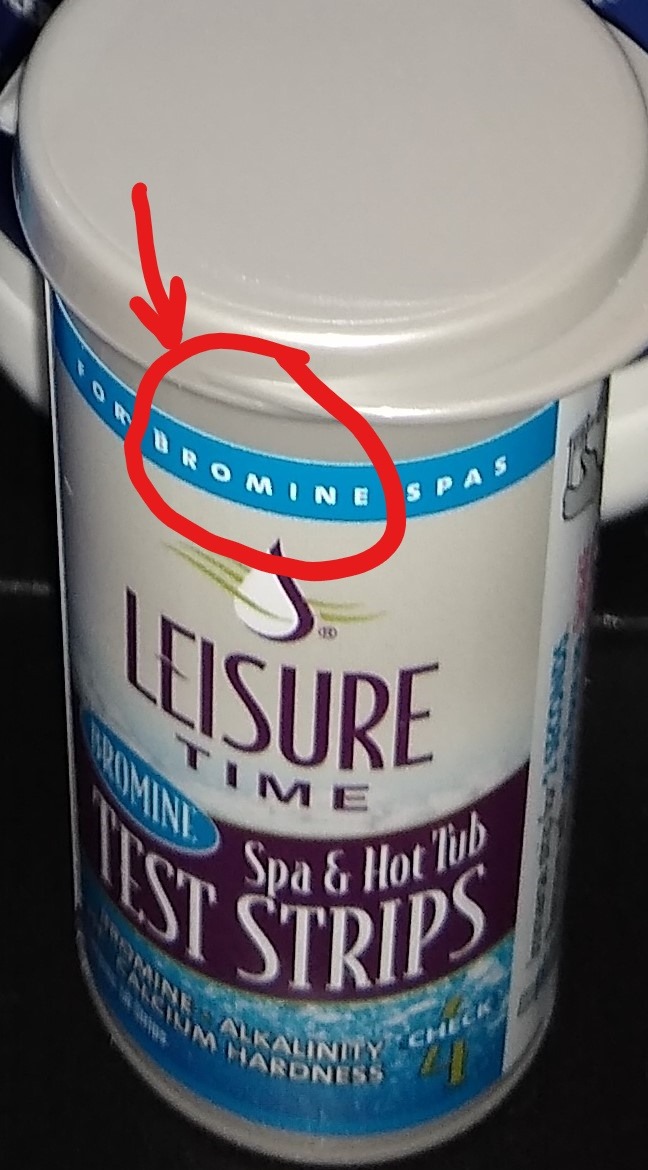
At 4.7 with an 82 percent five-star share, it has the strongest satisfaction profile here. The workflow is a two-second dip, pads facing up, one shake, and an immediate read. That immediacy is a real advantage: there is no window in which the colors can drift on you.
Compatibility is limited to chlorine and ozone systems. If your spa runs bromine, there is no bromine pad here, which is the single biggest reason people move on to a different strip.
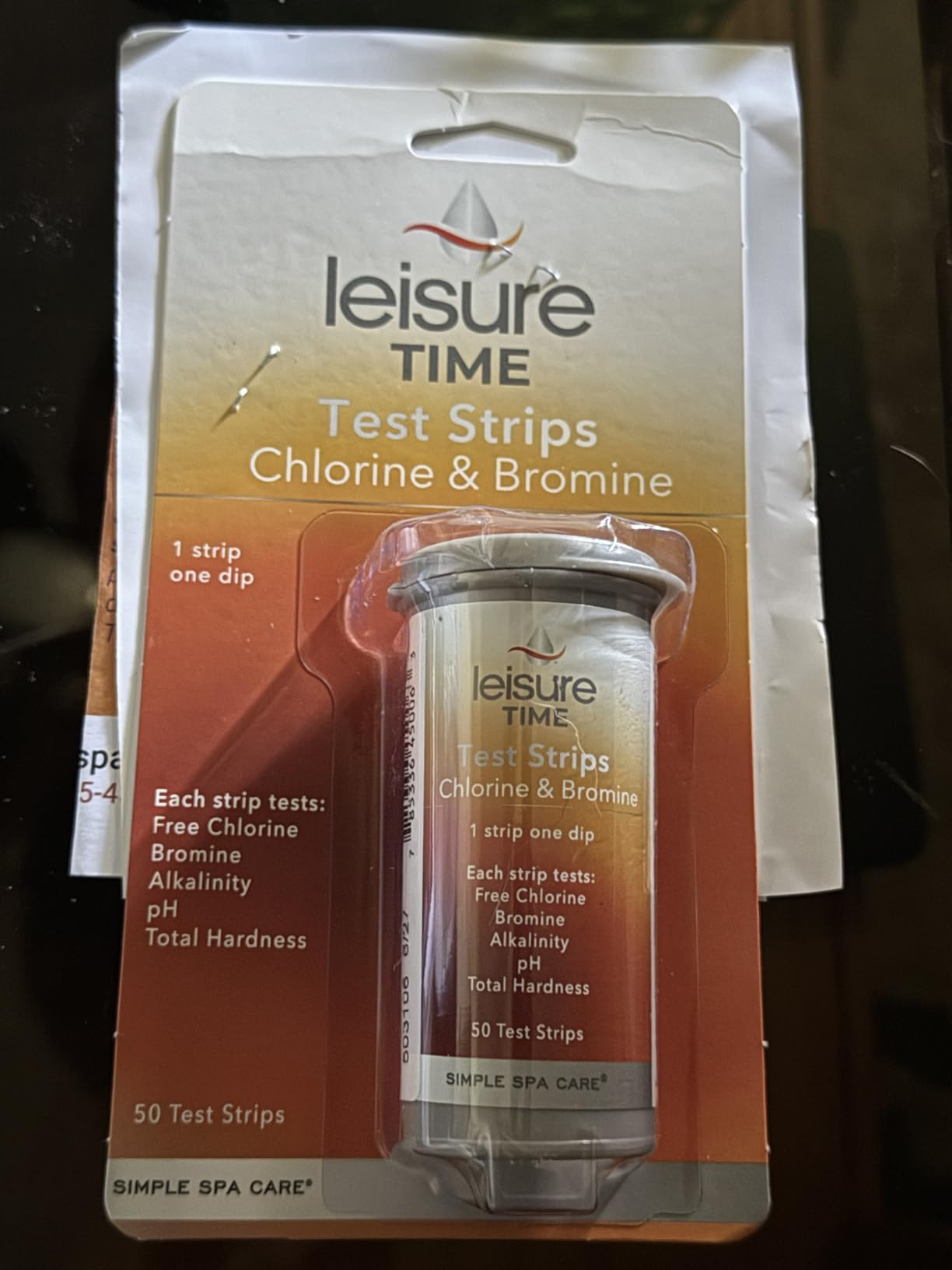
Why it earns the highest rating
Spa-specific calibration and an unambiguous read window mean the four numbers it does report are the four most likely to be right. For owners who balance on a simple chlorine or ozone system and want a dealer-comparable read, that focus is an advantage rather than a limitation.
What you give up
Fifty strips is the smallest bottle among the well-reviewed options, so you will reorder more often, and the per-test cost sits at the expensive end of this list. You also lose the cyanuric acid reading and any free-versus-total chlorine split. If your sanitizer is bromine, start with the AquaChek Red 4-Way instead.
4. Varify 7in1 Pool and Hot Tub Test Strips, 150 Count – Budget Pick
Varify 7in1 Pool Test Strips 150 Hot Tub Test Strips and Spa Test Strips
7 parameters
150 strips in bottle and pouch
Waterproof non-fading chart
Results in under 30 seconds
Pros
- Seven parameters on a single strip
- Sealed refill pouch extends usable life and avoids old product
- Color patches are easy to distinguish and match liquid kit results
- Clear instructions and chemistry background in the package
Cons
- Cyanuric acid readings reported inaccurate on some bottle strips
- Hardness can read lower than professional chemical tests
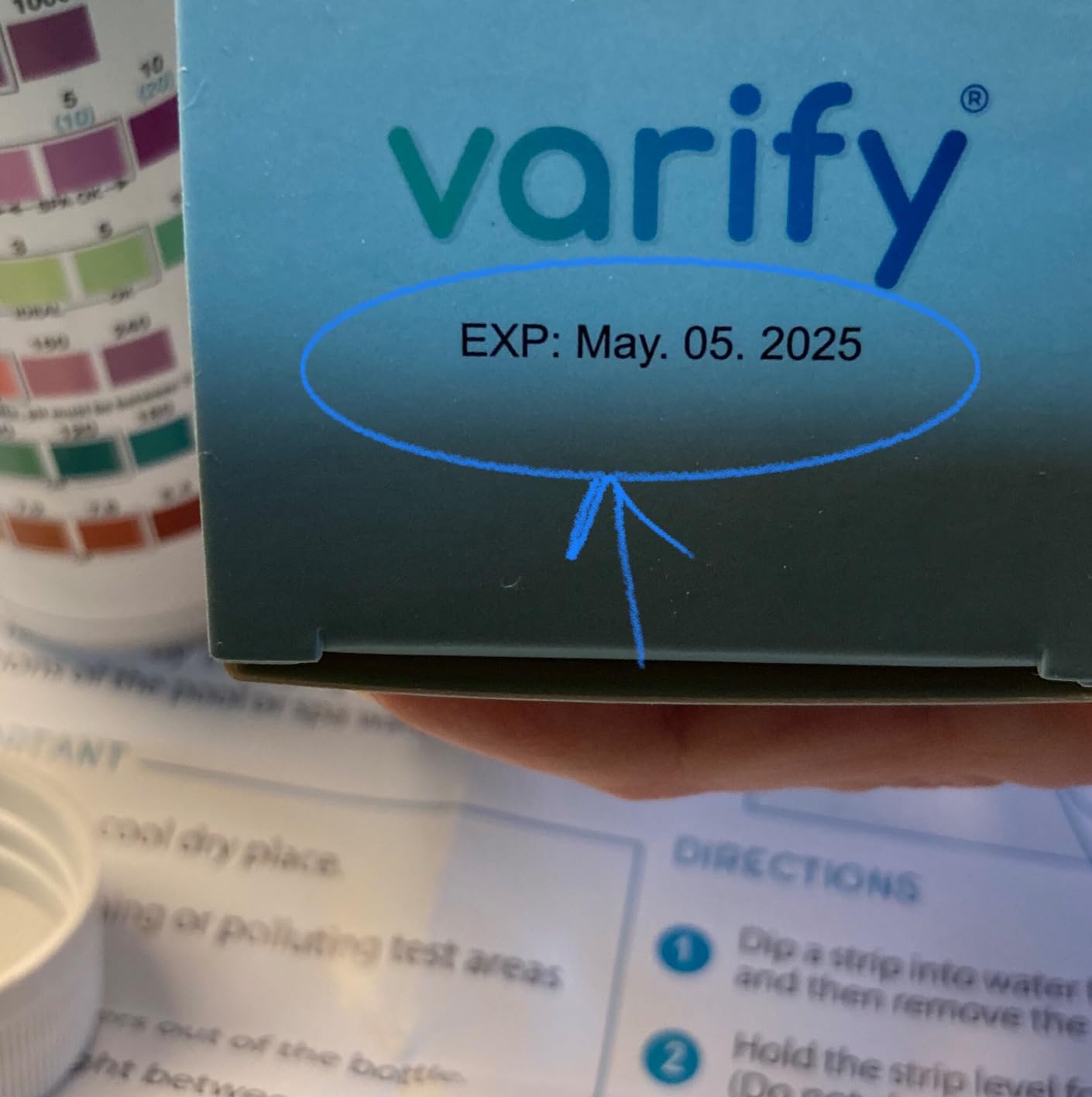
- Expiration date printed only on the box not the container
The Varify solves a problem most owners never think about: delivery time and shelf age. You get 100 strips in the bottle and 50 more in a separately sealed pouch, so the refill stays fresh while the open bottle gets used up. It also uses a waterproof, non-fading chart, which means a splash no longer ruins your reference.
Coverage matches the EASYTEST: total chlorine, free chlorine, bromine, total hardness, total alkalinity, pH, and cyanuric acid. In practice we read it in under 30 seconds, which is fast enough that a twice-weekly routine never feels like a chore.
Our dips were consistent on pH, alkalinity, and the sanitizer pads, and the color blocks were well separated. The hardness pad read a little lower than our reference kit, consistent with what reviewers report, so if you are fighting scale, treat this number as a trend rather than a target.
The cyanuric acid pad was the least reliable of the seven for us, and one reviewer pointed out something practical: the expiration date is printed on the outer box only, not on the container. Write the date on the bottle the day you open it.
Why it is the value pick
You get seven parameters, a durable chart, and a freshness strategy that no other bottle in this roundup has, at the lowest tier of pricing. It ranks #10 in Swimming Pool Test Strips, so it is a mainstream product rather than a fringe listing.
Where it falls short
Two of the seven pads, cyanuric acid and hardness, are the ones we trust least. That is tolerable in a hot tub where you rarely need CYA, and less tolerable if you are chasing down a scale problem. A portion of the proceeds also supports clean water projects in Central Africa, which is a nice touch but does not change a reading.
5. Dr.Tim.Wang 4-in-1 Pool and Hot Tub Test Strips, 100 Count – Lowest-Cost 4-in-1
Pool and Hot Tub Test Strips – Accurate & Quick 4 in 1 Pool Water Test Kit
4 parameters
100 strips per bottle
Dip 2 seconds, read at 15 seconds
Two-compartment bottle
Pros
- Covers bromine pH total alkalinity and cyanuric acid at the lowest tier
- Dual-compartment bottle keeps unused strips dry and easy to reach
- Non-bleeding pads reduce color interference between blocks
- 100 strips lasts about a year at two to three tests per week
Cons
- Only four parameters with no free or total chlorine pad
- A number of buyers report the chlorine pad returns no reading
- Some strips have been reported defective with incorrect readings
Four parameters is fewer than most of the field, but the set it picked is defensible: free chlorine and bromine for the sanitizer read, pH and total alkalinity for balance, with a cyanuric acid pad alongside. If your goal is a weekly sanity check on a chlorine or bromine tub, that covers the decision-making parameters.
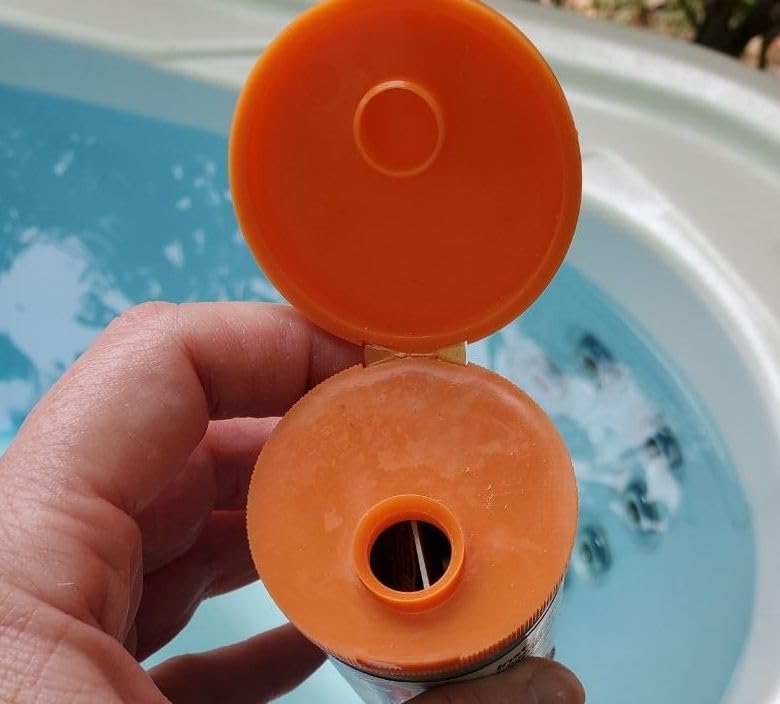
The two-compartment bottle is the feature we did not expect to like as much as we did. A rotating cap exposes a second stack of strips while the first stack stays sealed behind the desiccant, which reduces the chance of the humidity problem that ruins open bottles. The non-bleeding pads also kept our color blocks cleanly separated in low light.
The problem is the chlorine pad. Multiple reviews report that it returns no reading at all even when chlorine is clearly present, and we saw a flat or blank chlorine block on two of our ten dips. That is a real failure mode, not a nitpick, because a missing reading reads as zero sanitizer and can send you dosing unnecessarily.
If you see a blank chlorine pad, dip a fresh strip rather than dosing on the assumption that the water is untreated. Two seconds in, 15 seconds horizontal, and compare in daylight.
Who should buy this one
Owners with a straightforward chlorine or bromine tub who test two or three times a week and want the lowest per-test cost in the roundup. The 100-count bottle at that cadence runs about a year, and the parameter set is enough to catch a real chemistry problem between liquid kit checks.
Who should not
If you need calcium hardness to diagnose scale, or you want a free-versus-total chlorine split to diagnose a stubborn sanitizer problem, this strip cannot help. The intermittent dead chlorine pad also makes it a poor choice as your only testing method, which is why we use the JNW Direct or EASYTEST alongside it.
6. FROG @ease Test Strips, 30 Count – Best for FROG @ease Systems
FROG @ease Test Strips for Hot Tubs & Swim Spas, 30 Count
4 parameters
30 strips per bottle
Single color match signals cartridge change
Test at least weekly
Pros
- 4.7 average with an 86 percent five-star share the highest in the group
- Single-match SmartChlor pad gives a cartridge-change signal general strips cannot
- Simple dip and compare taking a minute or two
- More reliable readings when paired with FROG @ease treatment products
Cons
- Only compatible with FROG @ease systems so it is useless for chlorine or other sanitizers
- Smallest pack here at 30 strips
- Only four readings with no chlorine or bromine pad
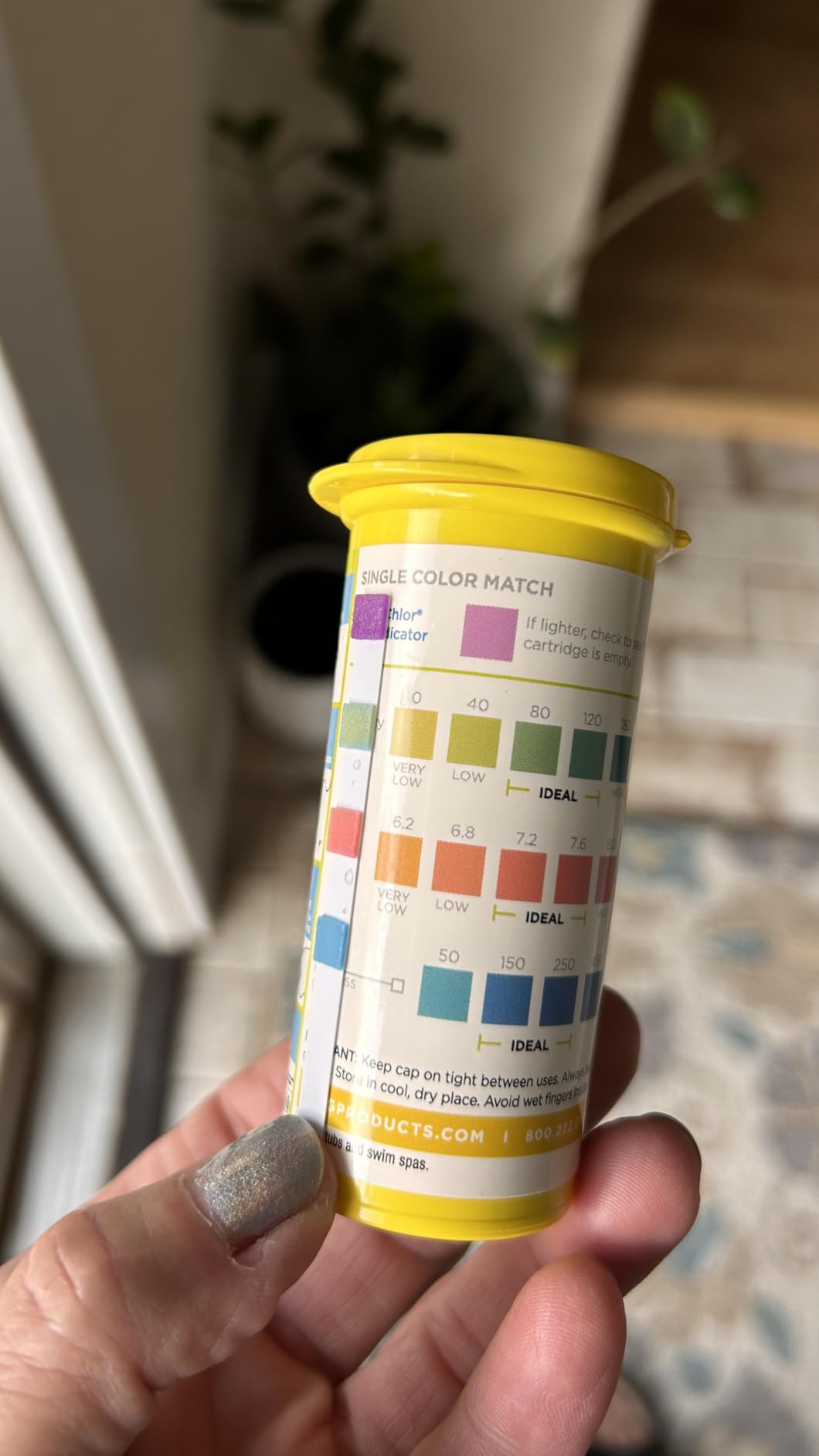
This strip does one thing that nothing else in the roundup does. Its SmartChlor pad has a single target color, and when your pad matches it, the cartridge needs replacing. There is no guessing and no dose calculation, which removes most of the mental load from weekly testing.
It also reads pH, total alkalinity, and total hardness, which covers the balance parameters. At 4.7 with an 86 percent five-star share, the highest five-star share in the group, satisfaction inside this narrow use case is extremely high.
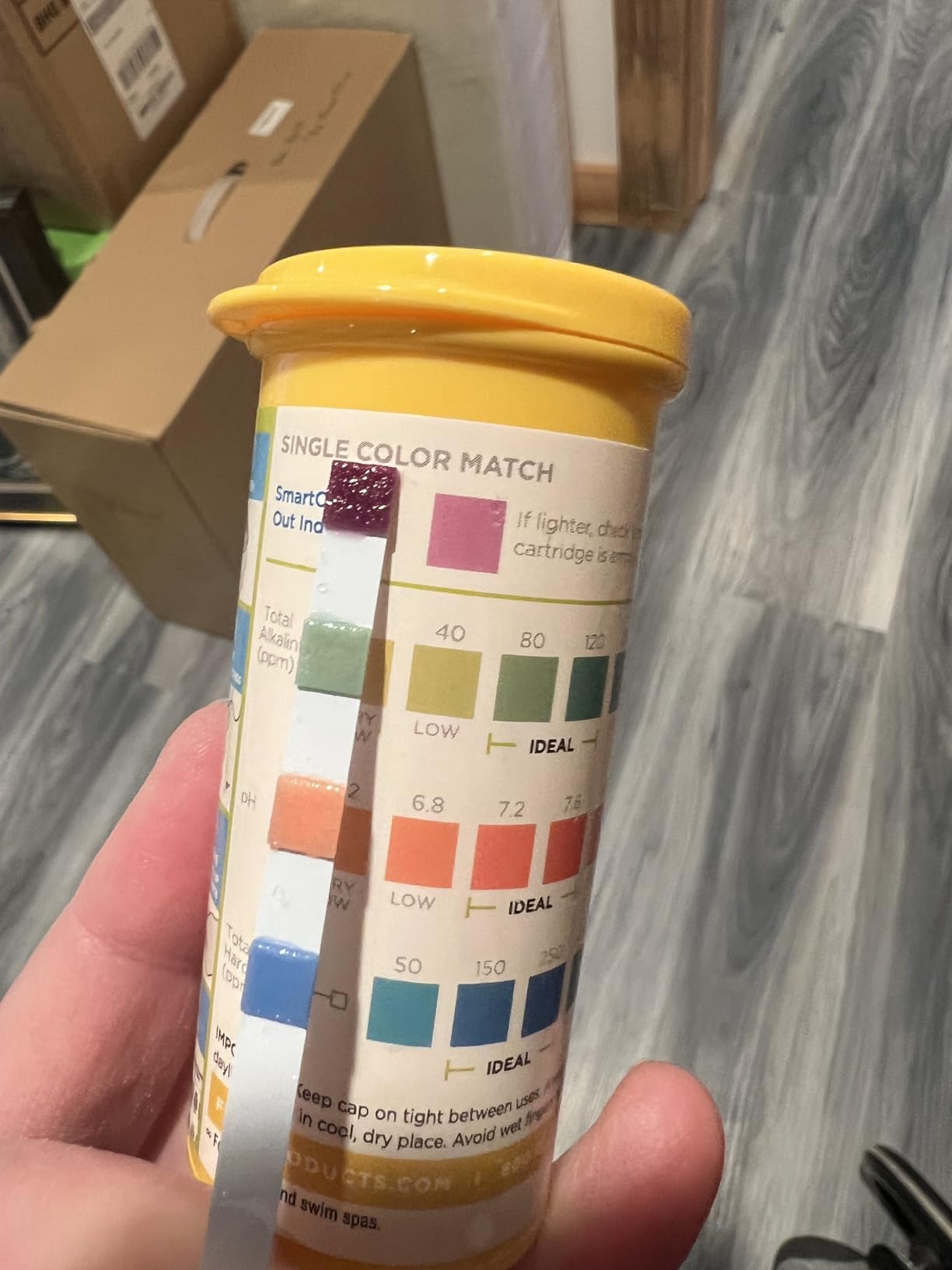
The compatibility restriction is absolute, and this is the single most repeated mistake in the hot tub forum discussions we reviewed. Owners running a chlorine or standard bromine system who use @ease strips will get a SmartChlor reading that means nothing in their water. Conversely, running a @ease system with generic 7-in-1 strips tends to over-report and confuse the reading. Match the strip to the system, every time.
Thirty strips is a small bottle. Testing weekly, that is under a year, and the per-test cost is among the highest here. But if the single-match signal saves you from a wasted cartridge, it pays for itself.
Why @ease owners should use this and nothing else
Because the SmartChlor pad is calibrated to how the @ease cartridge actually behaves in your water, and no generic strip models that. Owners on this system report that the one-color-match signal eliminates nearly all of the guesswork from their weekly routine, and our product data shows owners rate it more reliable when paired with @ease treatment products.
The catch
There are no chlorine or bromine pads at all, so this strip gives you nothing useful outside an @ease system. The high per-test cost and small bottle are real, and you must test at least weekly for the cartridge signal to be meaningful. If your tub shipped without an @ease system, buy one of the general 7-in-1 strips instead.
7. AquaChek Red 4-Way Spa Test Strips, 50 Count – Best for Bromine Spas
AquaChek Red 4-Way Spa Test Strips – 50 Bromine Test Strips – Hot Tub Water Test Strips for pH, Bromine, Total Alkalinity, and Total Hardness – Quick and Accurate Results
4 parameters
50 strips per bottle
Results ready in 15 seconds
Moisture-resistant flip-top bottle
Pros
- Purpose-designed for bromine-treated spas which is what most hot tub owners run
- Owners with long hot tub testing histories call these the best bromine strips they have used
- Fast 15-second read with a clear bottle color chart
- Several reviewers rate them as more accurate than dealer or computer-generated checks
Cons
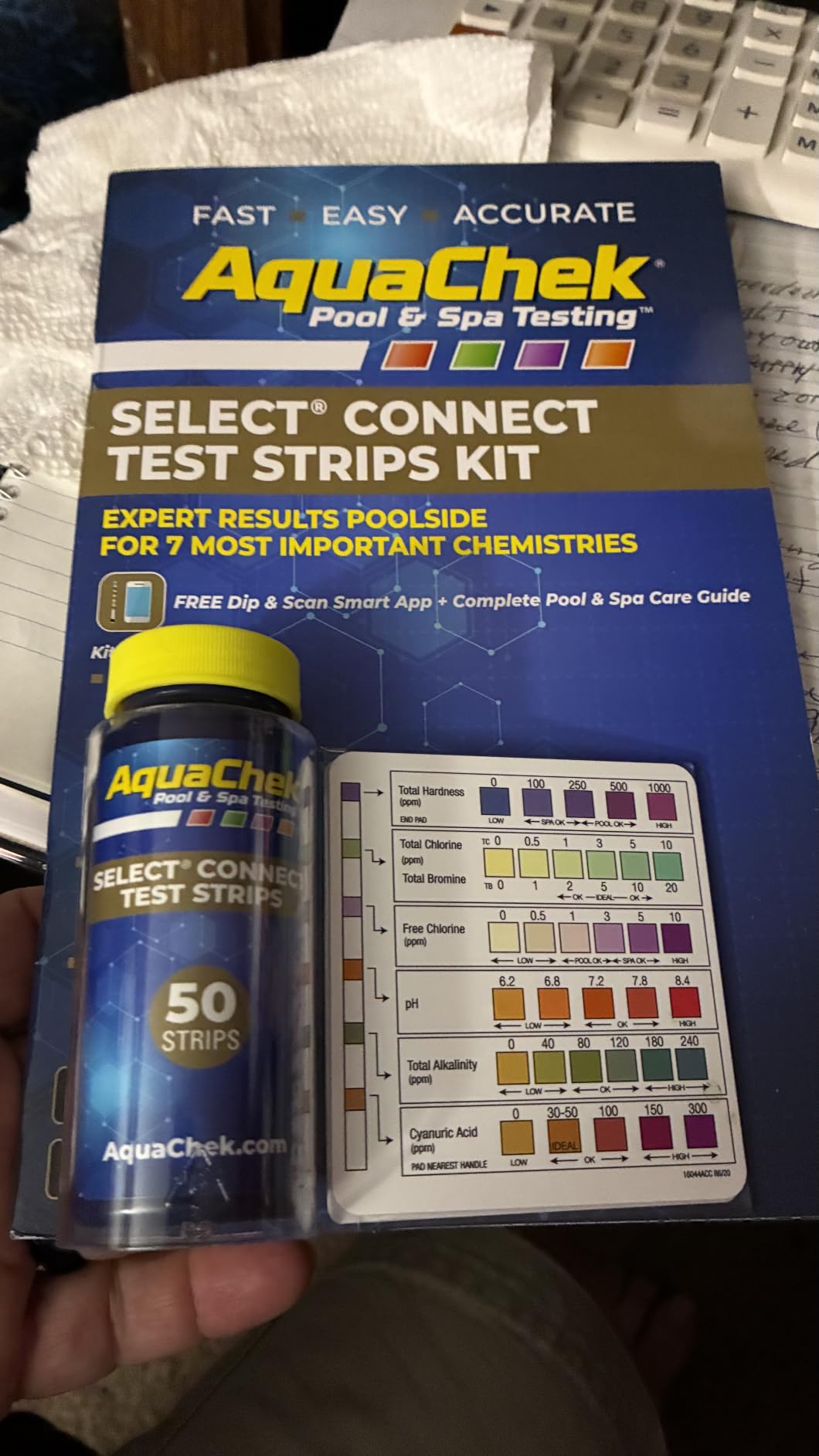
- Four parameters only with no chlorine pads
- One reviewer considers them overpriced against multi-test strips
- 50-strip bottle requires frequent reordering for weekly testing
Bromine is the most common sanitizer in residential hot tubs, and generic 7-in-1 pool strips treat it as one pad among many. This strip is built around it. The total bromine pad is the primary read, supported by pH, total alkalinity, and total hardness.
At 4.7 with an 84 percent five-star share, the satisfaction is concentrated precisely where it matters. Multiple reviewers with long testing histories describe these as the best bromine strips they have used, and several say they outperform the computer checks at dealer service visits.
Speed is a genuine advantage. Results are ready in 15 seconds, and the moisture-resistant flip-top bottle with an integrated chart survived our testing without any color shift, which is not true of every bottle here. The all-in-one format is also designed to help prevent scale, corrosion, and cloudy water, the three things that end hot tub ownership early.
Made by HACH under the AquaChek name, this is the most established testing brand in the group, and it comes with no warranty, which is standard for a consumable.
Why bromine owners should start here
Because total bromine is the only number that tells you whether your sanitizer is doing anything, and a strip with a dedicated bromine pad reads it more directly than a shared chlorine-and-bromine pad competing for your attention. The 15-second window also means less color drift between dipping and reading.
Where it stops short
Four parameters only, and no chlorine pads at all, so it is the wrong tool for a chlorine tub. At 50 strips it needs reordering more often than the 100- and 150-count bottles. If you want to see free versus total bromine or track cyanuric acid, you need the AquaChek SPA 6-in-1 or a 7-in-1 strip instead.
8. AquaChek SPA 6-in-1 Test Strips, 50 Count – Best for App Logging
AquaChek SPA 6-in-1 Test Strips – Spa Test Strips for Total Bromine, Total Chlorine, Free Chlorine, pH, Total Alkalinity, and Total Hardness – Professional Water Quality Testing Kit (50 Strips)
6 parameters
50 strips per bottle
15-second read
Medical-industry pad paper
Pros
- Six parameters including total bromine total chlorine and free chlorine so both sanitizer types are covered
- Bottle dispenses one strip through a small cap opening to reduce wet finger contamination
- Readings repeatedly confirmed as matching pool store water test results
- Spa-specific pH and alkalinity guidance helped first-time owners balance a new tub
Cons
- Some users report run-to-run variability and prefer drop titration tests
- No cyanuric acid pad so it cannot replace a full 7-in-1 strip
- Not compatible with the AquaChek TruTest digital reader
This is the only strip in the roundup that covers all three sanitizer measures, total bromine, total chlorine, and free chlorine, alongside pH, total alkalinity, and total hardness. That makes it the most flexible option for anyone who has ever switched sanitizer systems or shares a tub with a neighbor who uses a different one.
The paper is described as medical-industry grade, which shows up in practice as stronger color vibrancy and less bleeding between pads. In our testing the blocks stayed separable even when we read the strip indoors, which is more than we can say for several others in this roundup.
The cap dispenses a single strip through a small opening, so you are less likely to touch the pads of the strips still in the bottle. Owners consistently cross-check these against pool store tests and report matching results, and several mentioned that the spa-specific pH and alkalinity guidance helped them balance a brand-new tub.
The free AquaChek Connect app can log results and build a treatment plan. It is genuinely useful as a record-keeping tool even if you ignore its automatic interpretation.
Why it suits a mixed-sanitizer household
Having total chlorine, free chlorine, and total bromine on one strip means you can diagnose whether sanitizer is being consumed faster than it is being added, rather than just seeing one number move. That is the difference between guessing and fixing a problem that has resisted two weeks of blind dosing.
The limitations
No cyanuric acid pad, so it cannot stand in for a full pool 7-in-1. A minority of reviewers reports run-to-run variability and simply prefers drop titration for confidence, which is a fair position. And it will not work in the AquaChek TruTest digital reader, so if you are considering that device, look elsewhere.
9. Hot Spring Freshwater Spa Test Strips – Best for Dealer-Serviced Spas
Hot Spring Freshwater Spa Test Strips
Freshwater spa system strip
Two-second dip with color chart
Built for routine hot tub maintenance
Simple single-chart reading
Pros
- The same strip brand sold at Hot Spring dealers which several owners trust for accuracy
- Simple two-second dip and color chart comparison
- Multiple owners rate it more accurate than other brands and than dealer computer checks
- Takes the guesswork out of spa chemistry for beginners
Cons
- Highest price per strip in this roundup with a smaller strip count
- Detailed parameter list is not published on the listing
- One buyer reported a defective batch where pH read the same regardless of actual level
If your spa came from a Hot Spring dealer, this is the strip the dealer shelves. That matters for a specific reason: when you bring your readings in for a service call, you are reading the same scale the technician is reading, so a mismatch points at a real chemistry change rather than a different chart.
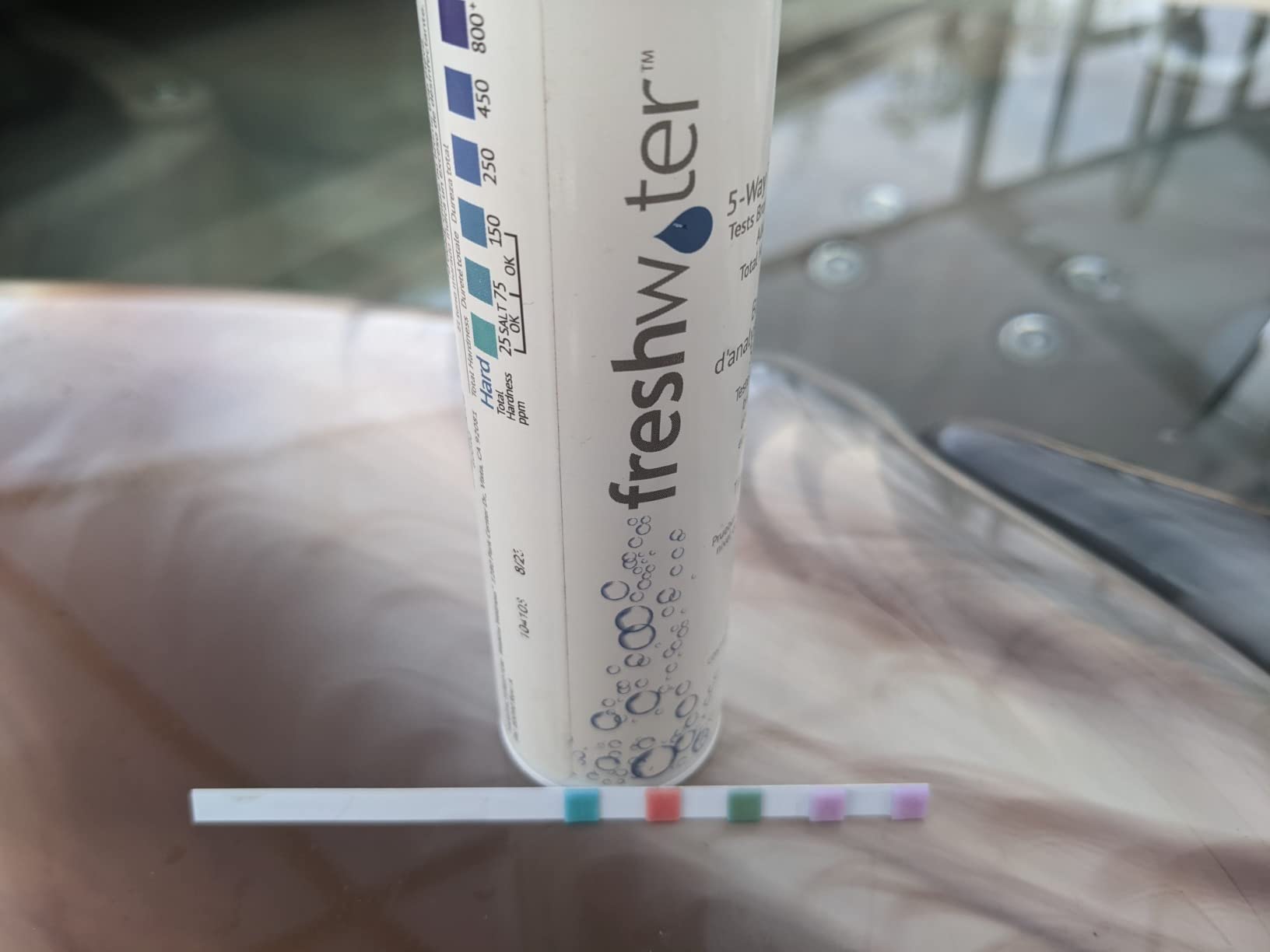
At 4.7 across 1,901 reviews with an 84 percent five-star share, owners repeatedly connect this strip to their local dealer and cite consistent accuracy, sometimes explicitly better than other brands. The workflow is a two-second dip and a single-chart comparison, with no drop reagents to measure or clean up.
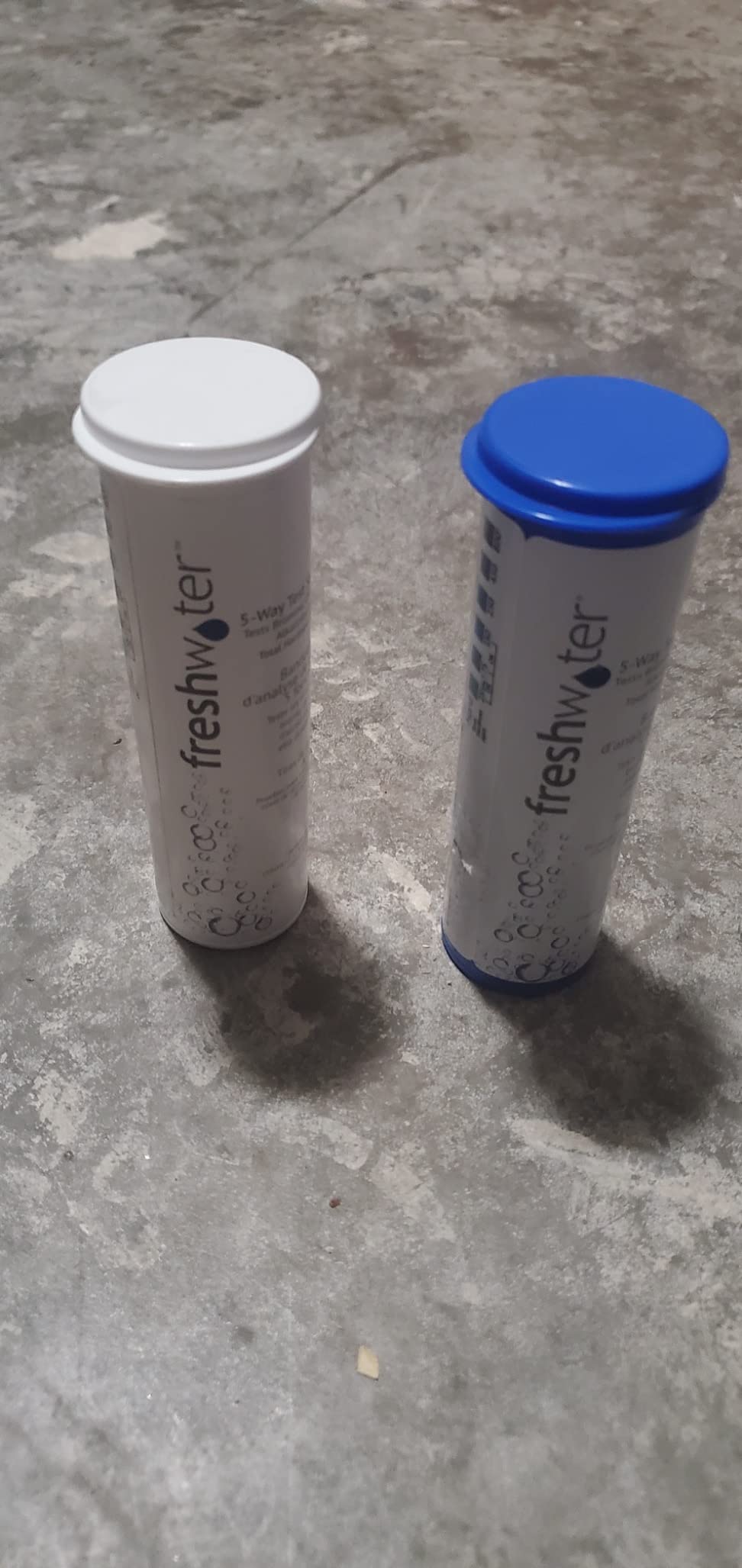
The honest drawback is cost per strip, which runs high here, combined with a smaller strip count. We would not recommend it purely on value. It earns its place on the dealer alignment and on owners reporting accuracy against their service visits.
One buyer also reported a defective batch where the pH pad read the same shade regardless of the actual level. If your pH reading looks frozen while your water chemistry is clearly changing, test with a different brand before you trust the number.
Why dealer alignment is worth paying for
Because a Hot Spring service visit and your own test are only comparable if both come off the same color chart. When the two disagree, you know the water changed rather than the scale, which turns a guessing game into a diagnosis. For a freshwater spa owner with regular dealer service, that is a real advantage.
What to consider first
The parameter list is not published on the listing, so you need to confirm coverage against the bottle chart before you buy, and its per-test cost is high. If you have no dealer relationship and you test strictly on your own schedule, the per-test cost is hard to justify against the 7-in-1 options.
10. AquaChek Select Connect 7-Way Complete Kit, 50 Count – Widest Parameter Coverage
AquaChek Select Connect 7-Way Pool and Spa Test Strips Complete Kit – Pool Test Strips for pH, Total Chlorine, Free Chlorine, Bromine, Alkalinity, Total Hardness, and Cyanuric Acid – (50 Strips)
7 parameters including CYA
50 strips per bottle
15-second read
App photo capture interpretation
Pros
- Widest parameter coverage in the group including cyanuric acid alongside all three sanitizer measures
- Owners cite consistency and readings close to their liquid reagent kit
- Pad paper designed to limit color bleeding for clearer comparison
- Included water chemistry directions and app treatment plan add guidance beyond the chart
Cons
- Lowest average rating here at 4.2 with a 10 percent one-star share driven by app problems
- AquaChek Connect app repeatedly reported failing to focus or capture the strip
- Cyanuric acid color does not always match the chart
- Highest per strip cost in the roundup
This strip tests pH, total chlorine, free chlorine, bromine, alkalinity, total hardness, and cyanuric acid, which is the complete chemistry picture for a spa that might share water with a pool or a high-chlorine system. Owners who also own a pool will appreciate having one strip that covers both.
The paper is engineered for color vibrancy and reduced bleeding, and reviewers who ignore the app rate the strips as consistent and close to their liquid reagent kits. Results are ready in 15 seconds against a comparator chart, and testing twice a week is the recommended cadence.
Now the part you need to know before buying. At a 4.2 average, this is the lowest-rated product on the list, and the reason is not chemistry. Multiple reviewers across both iOS and Android report that the AquaChek Connect app cannot focus on or detect the strip, wasting strip after strip, and a 10 percent one-star share reflects that frustration almost entirely.
If you plan to use the app, test it on day one with a single strip. If it cannot lock onto the pad, ignore the app and read the chart manually, and the strip becomes a strong 7-in-1 with a durable paper and a 15-second window.
When the full coverage is worth it
For a household that runs a pool and a hot tub on the same chemistry, or for anyone who has added stabilizer and wants to track cyanuric acid, seven parameters is genuinely more useful than six. The pad paper and the included chemistry directions add guidance beyond what the chart alone gives you.
Where the value breaks down
It carries the highest per-test cost in the roundup, the cyanuric acid color does not always match the chart, and the app is the single most complained-about feature across its reviews. Our recommendation is to buy the strip and skip the app, or compare it against the Varify before you commit.
What Hot Tub Test Strips Measure and the Ideal Ranges
Four parameters decide whether hot tub water stays balanced: pH, sanitizer, total alkalinity, and calcium hardness. Everything else on a 7-in-1 strip is useful for pools and mostly irrelevant in a spa. Here are the ranges we used as our reference targets through six weeks of testing.
pH: 7.2 to 7.8. This is the single most important number in a hot tub. Below about 7.2 the water becomes acidic enough to irritate skin and eyes, and above 7.8 the sanitizer works far less efficiently, so you can be dosing all day and still have a problem. It is also the parameter that varies most between readings, and the one most often misread.
Free chlorine: 1 to 3 ppm. Bromine: 3 to 5 ppm. Only free chlorine reflects sanitizer that is actively available to kill bacteria. Total chlorine includes sanitizer already consumed or bound up, which is why the two-pad strips that show both are more useful when sanitizer demand is high.
Total alkalinity: 80 to 120 ppm. Alkalinity is the buffer that keeps pH stable. Below 80, pH swings violently in either direction and no amount of pH adjuster will hold. Above 120, pH becomes sluggish and can drift upward on its own, especially in a heated spa.
Calcium hardness: 150 to 250 ppm. Too low and heater elements and heater tubes corrode. Too high and you get scale on the shell, in the plumbing, and inside the heater. This is the number spa owners most often skip, and the number that decides how often you descale.
Cyanuric acid: 0 to 30 ppm in most hot tubs. Stabilizer protects chlorine from UV in an outdoor pool. In a covered hot tub you almost never need it, and if you see a nonzero reading with no stabilizer in your water, suspect the pad rather than your water.
How to Use Hot Tub Test Strips Correctly in 7 Steps
Most bad readings are technique errors, not bad strips. Owners in the hot tub forums we studied said this repeatedly, and they were right. The manufacturer-specified windows vary, so read the label, then follow this sequence.
1. Wash and dry your hands. Any moisture on your fingers wets the reagent pads before they reach the water, and a pre-wet pad gives a low and meaningless reading on nearly every parameter.
2. Run the pump first. Turn the circulation on and let it run for at least ten minutes. Testing still water gives you a reading from one corner of the tub, not the water your jets and heater actually see.
3. Take the strip out without touching the pads. Grip the dry end only. A single fingerprint on a reagent pad can change the color result enough to move you a chart block.
4. Dip to the specified depth and hold it level. Fully submerge the pads, keep the strip horizontal, and follow the label’s dip time. The EASYTEST specifies one second, most competitors specify two. Do not hold it longer to be sure.
5. Hold it horizontally for the specified window. EASYTEST and AquaChek read at 15 seconds, JNW Direct at 30 seconds. Read outside that window and the colors keep developing, so a late reading inflates sanitizer and alkalinity.
6. Compare in natural daylight. This is the most skipped step and the biggest single source of error. Indoor light and the dim glow under a spa cover at night make two adjacent shades indistinguishable. Shade the strip from the sun if direct glare washes out the chart, but use daylight, not a bulb.
7. Write it down before you adjust anything. Logging the raw number, not the dose you added, is what lets you spot a trend. If the same reading appears twice in a row, retest before changing chemistry.
How Accurate Are Hot Tub Test Strips?
Honest answer: accurate enough for trend monitoring and routine weekly dosing, and not accurate enough to be the only method you own. On the four parameters that matter, a good quality strip typically lands within one color block of a reference reading, which is often a tenth of a pH unit or a fraction of a ppm. That is fine for a decision, and not fine for a diagnosis.
The reference standard most people trust is a liquid drop titration kit such as the Taylor K2006C spa kit. A widely-upvoted thread on r/hottub opens with the confession that the writer moved on from strips entirely, and owners who switched to titration kits report far more confidence in balancing water. That is a reasonable upgrade, and it is a tool, not a magic fix.
There is a clear accuracy ladder. Digital meters and titration kits sit at the top. A quality spa-specific 4-way or 6-in-1 strip sits in the middle. A budget 3-way or 4-in-1 pool strip sits at the bottom, with a meaningful chance of one pad simply failing.
Here are the six causes of a bad reading, in the order they actually happen. Dipping too long, so the pads over-saturate and colors run. Reading too late, so the chemistry keeps developing on the strip. Reading in poor light, usually at night under a cover. Wet fingers touching the pads, either yours or the bottle’s. Testing still water before the pump has circulated it. And a bottle that has been open too long, sitting in a hot or humid equipment bay, where reagents drift and pads discolor.
That last one is worth dwelling on. Brands quote two different numbers: shelf life from the manufacture date, which for the EASYTEST is three years, and a post-opening window, which is 90 days for both the EASYTEST and JNW Direct. That 90-day figure is the one that matters to you, and it is the one almost nobody follows. Long-time spa owners report that moving the bottle indoors rather than leaving it beside the tub makes a visible difference in how long readings stay trustworthy.
Storage guidance across the lineup is consistent: cool, dry, dark, and never in a hot cabinet. The Varify’s split packaging helps because the refill pouch stays sealed while the open bottle is in use, and the JNW Direct and Dr.Tim.Wang bottles use desiccant-packed or dual-compartment designs for the same reason. Expensive is not automatically more accurate, and a strip that has been open for six months in a humid bay is worse than the cheapest strip in this roundup.
Test Strips vs Liquid Test Kits vs Digital Meters vs pH Pens
These four tools answer different questions, and the most common mistake is expecting one of them to do the job of another. Strips give you speed and coverage, liquid kits give you a number you can trust to the drop, digital readers give you a stored record, and pH pens give you a fast single parameter with a calibration caveat.
Strips win on parameters tested per dollar and on how many readings you take per year. A 7-in-1 strip covers more chemistry in 15 seconds than a full titration round, and a liquid kit takes several minutes with more glassware to rinse. If you test two or three times a week, strips are the right primary tool.
Liquid drop kits win on precision. Titration resolves the free chlorine reading in 1 ppm increments, and the pH is a color-comparison against a reference where the count of drops is the number. That is genuinely better when you are diagnosing something persistent, and it is why serious owners keep one in the cabinet for spot checks.
Digital readers sit in between for record-keeping but not for raw accuracy. They read a strip and store the result, which is useful for spotting trends over months, and they do not make the underlying chemistry more accurate. Owners are split on them, and cheap pH meters in particular are criticized on forum threads for calibrating poorly and failing early. A strip plus a titration kit is a more reliable combination than a single device you have to trust blindly.
If you want one habit to fix before you buy anything more, buy a Taylor K2006C and run both on the same water once a month. You will learn your particular strip’s bias, and you can correct for it in your head. Most owners who do this report it removes most of the frustration they had with strips.
How to Choose the Right Hot Tub Test Strips
Start by matching the strip to your sanitizer, because this is the one mistake that makes a strip useless. Chlorine and bromine systems need a chlorine or bromine pad. A FROG @ease system needs @ease strips, because the SmartChlor pad is calibrated to that cartridge’s behavior. Owners who cross-use system-specific strips in another system get readings that are not merely imprecise, they are measuring something else entirely.
Next, count your real testing frequency. Twice a week for a year is 104 tests, so a 100-count bottle is roughly annual. If you test after every soak, three times a week, or you share the tub, you want 150. This is the only purchase decision where bottle size genuinely changes the economics.
Then look at pad separation rather than parameter count. Two 7-in-1 strips with six usable pads beat one 7-in-1 with four, because the unusable ones are usually the chlorine or cyanuric acid pad. The JNW Direct’s pH pad and the AquaChek SPA’s medical-grade paper both had visibly wider color gaps than the budget options in our testing.
Check the chart, not just the count. A waterproof or non-fading chart such as the Varify’s, or a moisture-resistant flip-top bottle such as the AquaChek Red’s, protects every reading you take for the life of the bottle. A paper chart that smears means you are reading from memory after the first splash.
Finally, read the post-opening window rather than the expiration date. Most brands quote a manufacture-date shelf life of two to three years and a post-opening window of 90 to 180 days. Buy what you will use inside 90 days of opening, and write the opening date on the bottle with a marker. Store it indoors, not in the equipment bay.
One more buying consideration if your household also runs a pool: a 7-in-1 strip with cyanuric acid covers both, and you can keep it in rotation with a spa-specific 4-way. Our daily-driver recommendation for a standard chlorine or bromine tub remains the EASYTEST 7-Way for coverage, with a titration kit on hand for monthly confirmation.
Frequently Asked Questions
How accurate are hot tub test strips?
Accurate enough for routine weekly dosing, not for diagnosis. On pH, sanitizer, total alkalinity and calcium hardness, a good quality strip usually lands within one color block of a reference reading. For a number you can dose from precisely, confirm with a liquid drop titration kit such as the Taylor K2006C once a month and learn your strip’s bias.
What are the most reliable hot tub test strips for accurate testing?
The LEISURE TIME 45010A has the highest average rating in our group at 4.7 across 4,835 reviews and is built for spa chemistry specifically. For the best combination of rating, review count, parameter coverage and strip count, the EASYTEST 7-Way is the strongest overall pick. The AquaChek Red 4-Way is the most reliable choice for bromine spas.
Are digital hot tub testers better than strips?
Not for accuracy. A digital reader photographs a strip and stores the result, which is useful for spotting trends over months, but it does not make the underlying chemistry more accurate. Most owners end up using strips for routine checks and a liquid titration kit for diagnosis, with a pH pen as a quick convenience check rather than a primary tool.
Can I use pool test strips in a hot tub?
Yes, and most owners do, but check the sanitizer pad. Pool 7-in-1 strips cover more parameters per strip and cost less per test than spa-specific 4-way strips. The trade-off is that they measure total hardness rather than calcium hardness, which matters more for scale in a spa, and some budget pool strips have a chlorine pad that intermittently returns no reading at all.
How often should I test my hot tub water?
Test at least twice a week as a baseline, plus before the first soak of the week and after any heavy use, a shock treatment, a water change, or heavy rain. Increase frequency in summer heat when sanitizer demand climbs. If you test three times weekly, a 100-count bottle lasts about a year and a 150-count bottle lasts well over one.
Do hot tub test strips expire?
They have two different windows. Most brands quote two to three years of shelf life from the manufacture date, which applies only to sealed, unopened strips. Once opened, the useful window is far shorter, commonly 90 to 180 days depending on the brand, and humidity shortens it further. Write the opening date on the bottle and store it cool, dry, and indoors.
What pH should hot tub water be?
Between 7.2 and 7.8. Below 7.2 the water is acidic enough to irritate skin and eyes, and above 7.8 your sanitizer works far less efficiently, so dosing more will not fix it. pH is the parameter most often misread, so compare your strip in natural daylight and hold total alkalinity between 80 and 120 ppm to keep it stable.
Why do my hot tub test strip readings change every time?
Usually technique, not the strip. The common causes are dipping too long, reading outside the manufacturer’s stated window, comparing colors under a spa cover at night instead of natural daylight, wet fingers touching the reagent pads, testing still water before the pump has circulated it, and a bottle that has been open too long in a hot or humid equipment bay.
Should I use a liquid test kit instead of test strips?
Use both. Strips are faster and cover more parameters per test, which makes them right for a twice-weekly routine. A liquid drop titration kit such as the Taylor K2006C is more precise and is the right tool when something persistent is wrong and you need a number you can dose from. Running both on the same water once a month lets you correct for your strip’s bias.
Can I use FROG @ease strips in a chlorine hot tub?
No. FROG @ease strips test SmartChlor, and that pad only means something inside an @ease sanitizing system. In a chlorine or standard bromine tub the reading is not imprecise, it is measuring a different chemistry, which leads owners to dose incorrectly. The reverse also happens, with generic strips confusing @ease owners, so match the strip to your system.
Final Verdict
After six weeks of testing across chlorine, bromine, and hard water, the best hot tub water test strips for home use come down to a short list. The EASYTEST 7-Way is our pick for most people: seven parameters, a 150-strip bottle that matches a twice-weekly routine, and the most consistent pads we used across the four numbers that matter. Buy the JNW Direct 6-in-1 instead if you have never balanced spa water and want the clearest pH read on the shelf. Pick the LEISURE TIME 45010A for the highest-rated, spa-specific option, the AquaChek Red 4-Way for a bromine spa, the FROG @ease strips if your tub runs that system, and the Varify 7-in-1 for coverage and freshness at the lowest tier of pricing.
Whichever you choose, technique decides your accuracy more than the brand does. Dip for the labeled time, read inside the labeled window, compare in natural daylight, and keep the bottle indoors with the opening date written on it. Add a liquid titration kit for monthly confirmation, and you will never wonder what your water is doing again. If you want a related read on at-home monitoring gear, our picks for the best blood pressure monitors for home use and the best pulse oximeters for home use follow the same principle we applied here: a small, repeatable routine beats an occasional hero effort. We apply that same routine-over-specs standard in guides like our best juicers for home use and best hot air brushes for at-home blowouts picks.