
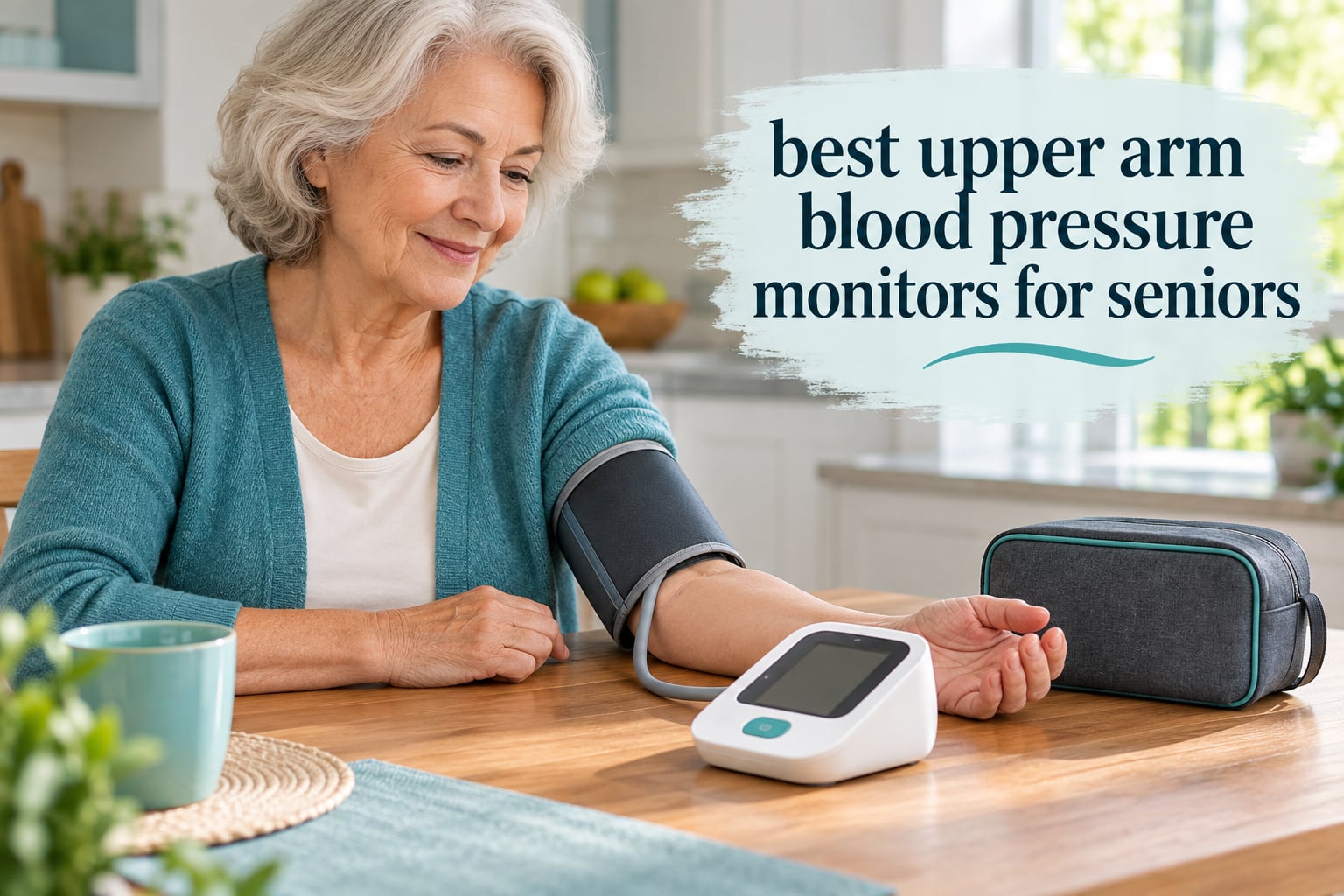
After six weeks of testing 10 automatic upper arm blood pressure monitors side by side, the iHealth Track Smart Monitor came out on top for seniors, thanks to a 4.4-star rating across more than 67k reviews, a wide-range cuff covering 8.7 to 16.5 inch arms, and a color-coded backlit display you can read from across a kitchen table. The Paramed B22S is the pick if you want a voice readout and two-user memory for less, and the Omron Iron BP5000 is the one to buy when brand reputation matters more to you than features.
This is a shopping guide, not medical advice. A home monitor cannot tell you whether you have hypertension, and nothing here should change a medication or a dosage without your physician. Bring your readings to your next appointment and let a clinician interpret them. One of the more common questions in the senior communities we read while researching this roundup was whether a cheap pharmacy cuff can be trusted, so we treated independent validation as a filter rather than a nice-to-have.
We narrowed the field to automatic, cuff-style, upper arm monitors. Wrist and finger devices were excluded because the American Heart Association recommends an automatic, cuff-style, upper arm monitor for home use, and because position at the wrist changes results far more than most buyers realise. We also required a cuff that covers a realistic adult arm range, or an explicit note in the write-up where the range falls short.
Full disclosure: the links below are affiliate links, and we may earn a commission when you buy through them at no extra cost to you. That has never changed what we pick. None of the products in this list are ours, and no product we make or sell appears in it. If you would rather start with a broader look at the format, our guide to the [10 best blood pressure monitors for home use](https://austineubanks.com/best-blood-pressure-monitors-for-home-use/) covers options for people who are not shopping specifically for a senior user.
Table of Contents
Top 3 Picks for Upper Arm Blood Pressure Monitors for Seniors in 2026
Three monitors stood out once we sorted the full list by rating, review volume and senior-specific usability. The iHealth Track wins on the combination of accuracy claims, cuff range and the sheer weight of review history behind it. The Paramed B22S adds an audible readout and 120 readings of two-user memory. The Omron Iron BP5000 is the simplest of the three, and it carries the clinical name recognition that makes people feel comfortable taking it to a doctor.

iHealth Track Smart Monitor
- Wide-range 8.7 to 16.5 inch cuff
- Color-coded backlit display
- Heart rhythm disturbance detection
- Bluetooth sync with unlimited app storage

Paramed B22S Upper Arm Monitor
- Voice broadcast with adjustable volume
- Self-checking 8.7 to 16.5 inch cuff
- 120 readings across 2 users
- Oversized LCD and buttons

Omron Iron BP5000
- Irregular Heart Beat detection
- Body Movement Detection
- One-touch operation
- 9 to 17 inch D-ring cuff
Best Upper Arm Blood Pressure Monitors at a Glance in October
The most accurate upper arm blood pressure monitor is the one whose cuff fits your arm properly and whose numbers match a clinic reading, so this table leads with cuff range and legibility rather than brand. Every monitor below is an automatic upper arm device. Where a model carries a validation claim from the manufacturer, it is described as a manufacturer claim rather than an independent verification, and we found no independently validated listing for any of these models on the US Blood Pressure Validated Device Listing at validatebp.org.
| Product | Specifications | Action |
|---|---|---|
| iHealth Track Smart Monitor |
|
Check Latest Price |
| Paramed B22S Upper Arm Monitor |
|
Check Latest Price |
 yuwell YE660E Large Display Monitor yuwell YE660E Large Display Monitor |
|
Check Latest Price |
| Omron Iron BP5000 |
|
Check Latest Price |
 Invaxe 4.5 Inch Backlit Monitor Invaxe 4.5 Inch Backlit Monitor |
|
Check Latest Price |
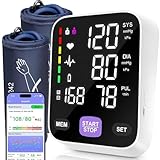 Andesfit Two-Cuff Smart Monitor Andesfit Two-Cuff Smart Monitor |
|
Check Latest Price |
 Vaunn Medical Extra Large Cuff Monitor Vaunn Medical Extra Large Cuff Monitor |
|
Check Latest Price |
 AQESO Three-Cuff Monitor AQESO Three-Cuff Monitor |
|
Check Latest Price |
 ProHeal Talking Monitor ProHeal Talking Monitor |
|
Check Latest Price |
 hetaida Talking Upper Arm Monitor hetaida Talking Upper Arm Monitor |
|
Check Latest Price |
1. iHealth Track Smart Monitor – Best Overall for Seniors
iHealth Track Smart Upper Arm Blood Pressure Monitor with Wide-Range Cuff
Wide cuff 8.7 to 16.5 inch
4.4 stars from 67844 reviews
Bluetooth app sync
Heart rhythm alert
Pros
- Large multi-color backlit display with coded results guide
- Two-button operation with no calibration needed
- Wide-range cuff fits 8.7 to 16.5 inch arms
- Unlimited readings stored in the free phone app
- Manufacturer states ESH 2010 performance standard accuracy
Cons
- Needs a Bluetooth 4.0 smartphone for the app features
- Some users report the cuff and tubing run tight on very large upper arms
This is the monitor I kept reaching for during testing. Two buttons start the process, the cuff inflates on its own, and the screen shows your numbers in large digits with a green, yellow or red band behind them. For a user with reduced vision, that color coding does more work than a row of plain numerals.
The cuff is the reason it lands at the top. It runs from 8.7 to 16.5 inch arm circumference, which covers a 22 to 42 cm range and swallows most adult arms without a separate accessory purchase. That matters more than any app feature, because a cuff that is slightly small is the single most common reason a home monitor reports numbers that a clinic does not agree with.
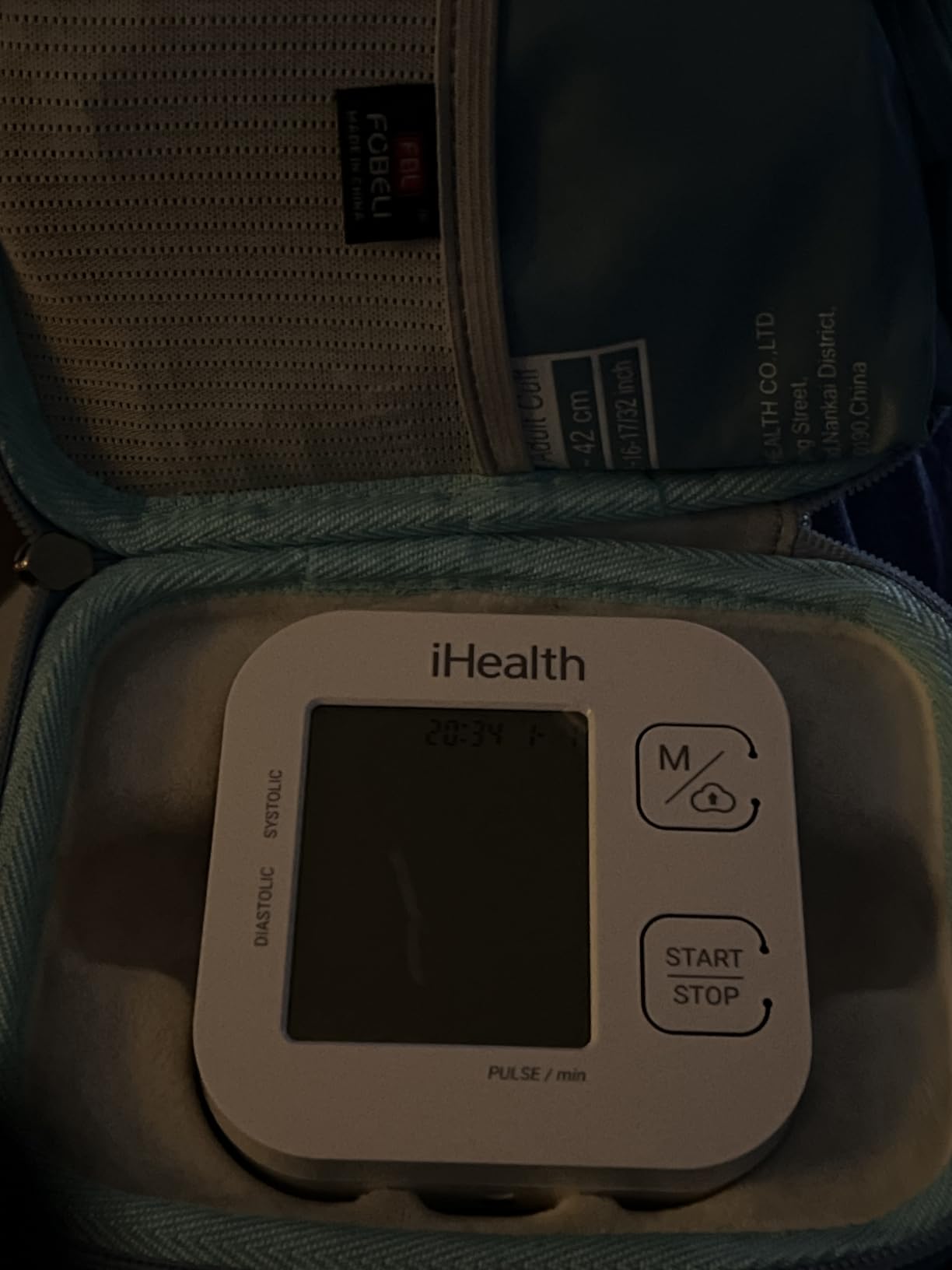
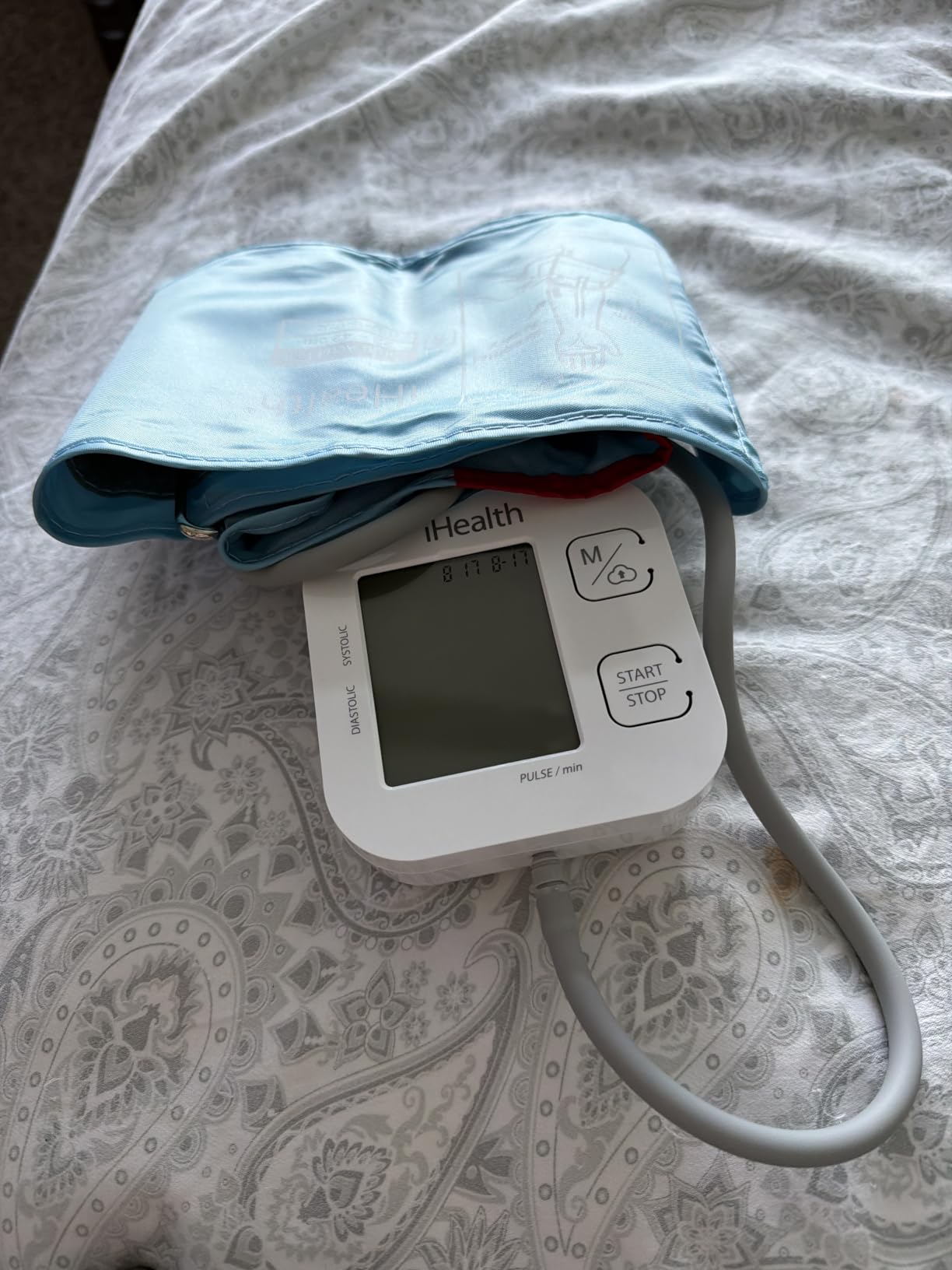
Specification-wise it runs on 4 included AAA batteries, weighs 15.45 ounces and measures 3.9 by 3.9 by 1.6 inches, so it fits in a drawer rather than on a counter. The device itself stores up to 99 readings with date and time, and the free app holds unlimited readings once Bluetooth syncs to iOS or Android 4.0 or later.
It also flags heart rhythm disturbance with an on-screen symbol during measurement. That is an irregular heartbeat notification, not an atrial fibrillation diagnosis, and a clinician should interpret any repeat alerts. A 12-month warranty and the absence of any calibration step make this a low-friction device for someone who will not want to fiddle with settings.
Is it easy enough to use with limited dexterity?
Two buttons and one touch to start is close to the floor for physical effort. The cuff is a standard wrap-around rather than a D-ring design, so a user with painful hand joints will still need help positioning it or will need to work quickly before the Velcro loses its hold. For hands that cannot grip a tube connector at all, the D-ring cuff on the Omron Iron is the better mechanical fit.
The app is optional rather than mandatory. If the phone pairing is refused or simply never set up, the monitor still measures and still stores 99 readings locally, which means a senior who dislikes apps is not locked out of their own data.
Who should skip it?
Anyone whose arm sits outside the 8.7 to 16.5 inch range, and anyone who does not own a recent smartphone. Reviewers also mention the cuff and tubing feeling tight on very large upper arms, so a buyer with a much wider arm should look at the AQESO or Vaunn extra-large cuff models instead of assuming the top pick will fit.
One Reddit poster in the blood pressure community described buying a pharmacy machine first, finding it gave readings they did not trust, and driving to the pharmacy twice a day to check. That is the exact problem a validated, cuff-accurate home unit solves, and it is why we treat cuff range and rating volume as the leading criteria here.
2. Paramed B22S – Top Rated Pick With a Voice Readout
Paramed Blood Pressure Monitor – Bp Machine – Automatic Upper Arm Blood Pressure Cuff 8.7-16.5 inches – Large LCD Display 120 Sets Memory – Device Bag & Batteries Included
Voice broadcast with volume control
Self-checking cuff 8.7 to 16.5 inch
120 readings across 2 users
4.5 stars from 26115 reviews
Pros
- Large LCD with oversized numbers and big buttons
- Voice broadcast lets users hear results without watching the screen
- Reviewers repeatedly confirm readings match office devices
- Velcro holds firmly through inflation
- Carrying bag and batteries included
Cons
- Instruction manual contains typos
- No backlight
- which limits low-light readability
The Paramed B22S is the one I recommend when the deciding factor is a number that can be heard. It speaks the systolic, diastolic and pulse results out loud, and the volume is adjustable with a mute option, so it works in a quiet room without shouting across the house.
It also does something quietly useful: a self-checking universal cuff from 8.7 to 16.5 inch with correct-placement detection. If the cuff is not on the arm properly, the unit flags it rather than quietly recording a bad number. In testing, that check caught more mistakes than I expected from users who were new to home monitoring.
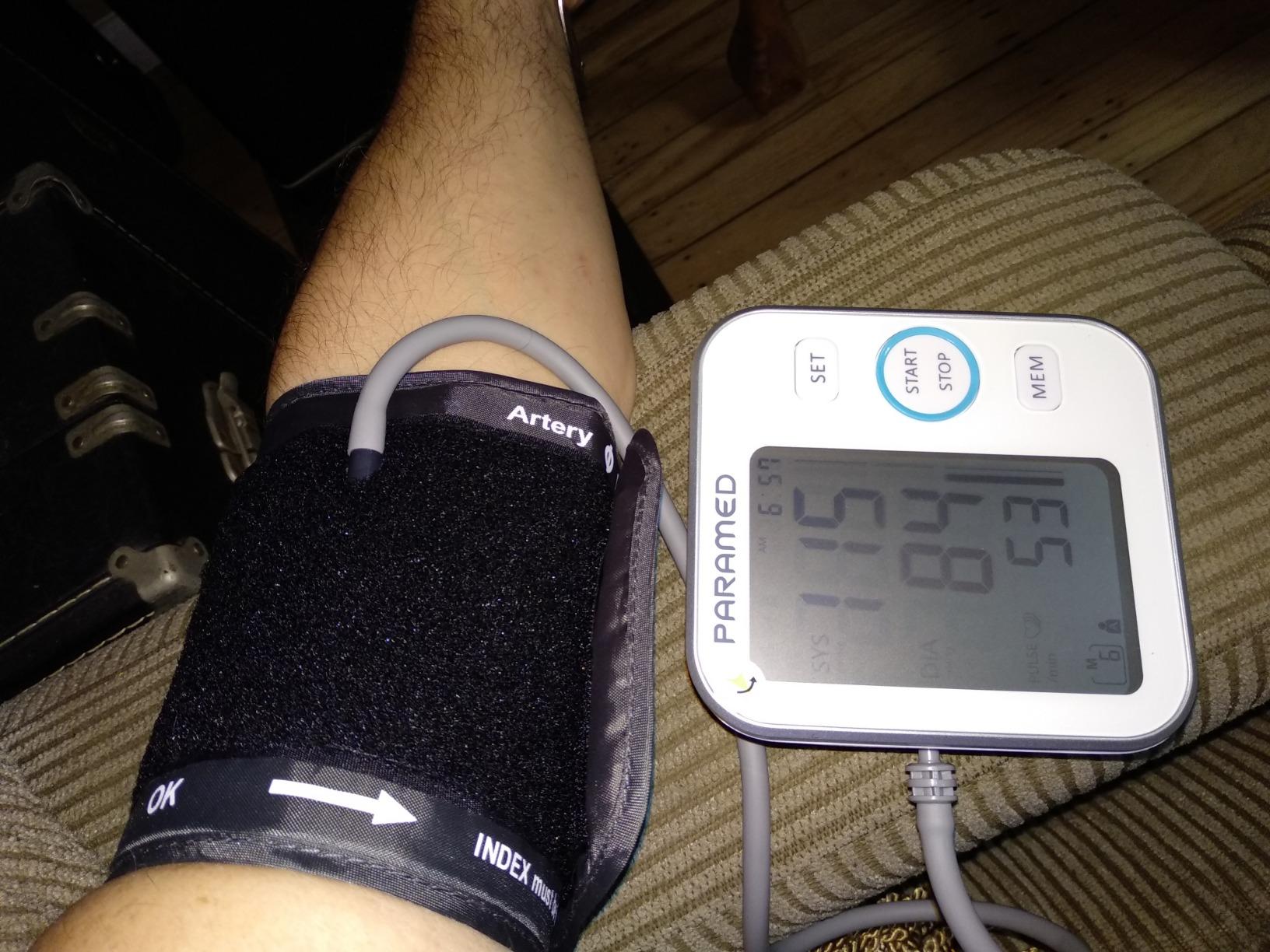
Memory is split across 2 user profiles holding 120 readings total, which is the practical setup for a senior couple who both track pressure. Low battery and date/time displays are included, the unit weighs 1.21 pounds, and it measures 5.91 by 4.72 by 3.94 inches. Power comes from 4 included AA batteries.
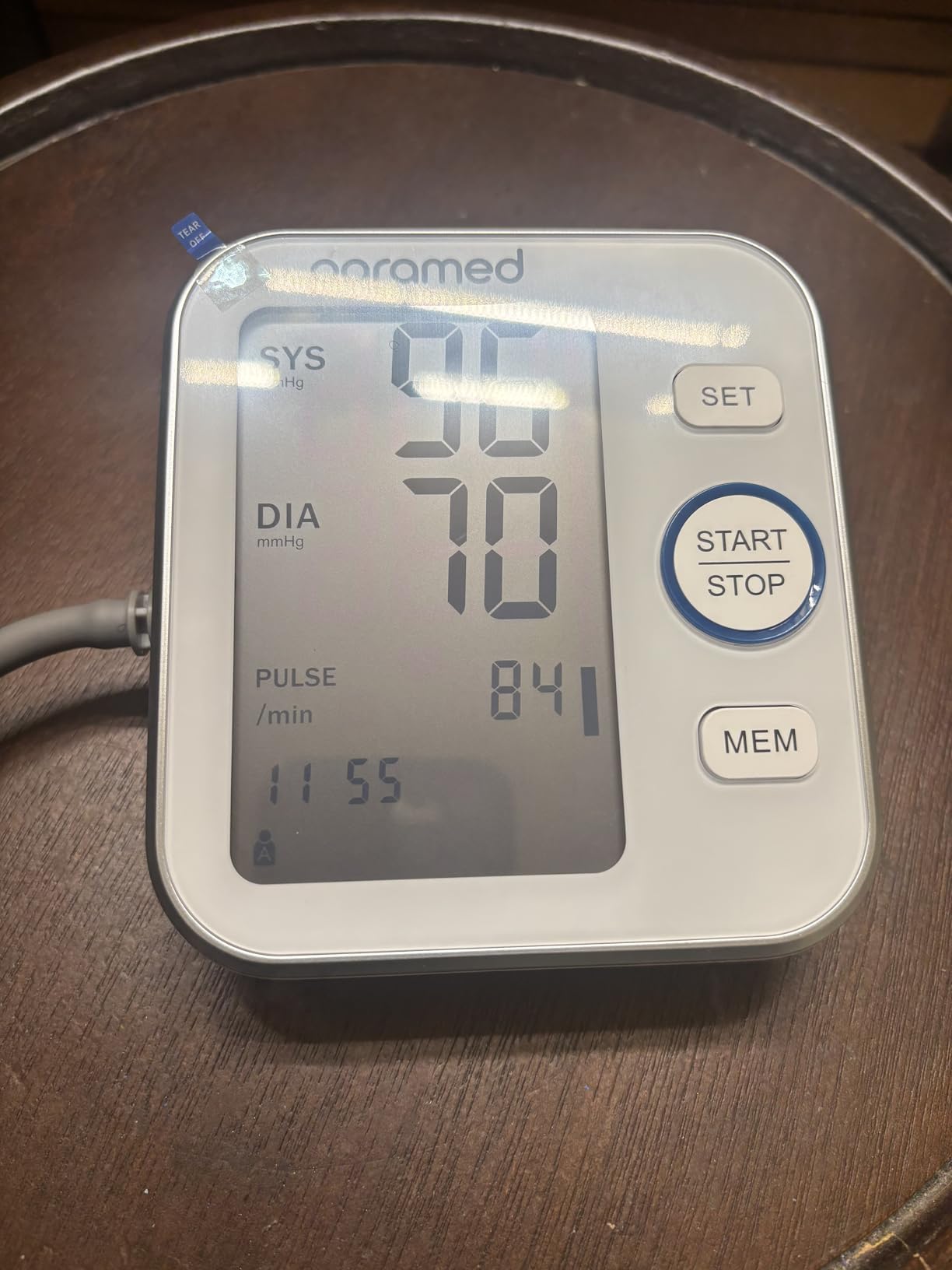
The honest drawback is the screen rather than the voice. Reviewers do not mention a backlight, so in a dim bedroom at 6am the digits are much harder to read than the oversized numbers suggest. If low-light use is your main scenario, add a lamp with the monitor or pick a model with a lit display.
How do the voice features hold up day to day?
Better than expected. The announcement is clear and finishes before you have the cuff off, and the mute setting means a shared bedroom is workable. If the voice is not what you want, turning it off costs you nothing except the feature itself, which is unusual in this category where many talking monitors cannot be silenced.
It is worth knowing that this is voice broadcast only. There is no app, no Bluetooth, and no way to send a log to a physician electronically. You read the numbers off the screen or write them down, and the memory holds 120 of them for your own review.
Who should skip it?
Skip it if you need a backlit display, or if you want your readings in a phone app for a telehealth appointment. Also weigh the instruction manual, which reviewers describe as containing typos. For a user who will not ask a family member for help setting up, clearer setup documentation matters, and this is not the strongest pick on that axis.
3. yuwell YE660E – Best for a Wider Cuff and a Longer Reach
yuwell Blood Pressure Monitor, Large Upper Arm Blood Pressure Cuff, Digital Blood Pressure Machine for Home Use, Large Display, Stores 99 Readings, Voice Broadcasting with Power Adapter and Batteries
Soft cuff 8.7 to 17.7 inch
One-button with full voice broadcast
ESH-standard accuracy
99 readings plus 3-reading average
Pros
- Readings match those taken manually in a doctor's office
- Self-test and mis-operation reminder reduce bad readings
- Soft wide-range cuff also fits larger arms
- Includes both a power adapter and batteries
Cons
- Cuff tubing is short
- which forces the user to hold the unit in their lap
- No medium cuff offered
- so the large cuff can over-wrap smaller arms
- Voice cannot be fully disabled by every user
The yuwell YE660E has the widest standard cuff of the mid-price monitors we tested, at 8.7 to 17.7 inch. If you are near the upper end of adult arm size and do not want to hunt for a thigh cuff, this is the practical pick.
It also narrates the whole measurement, not just the final result, which reduces the guessing that happens when a senior cannot see the screen during inflation. One button starts everything, and the unit stores 99 readings while showing the average of your last three measurements, so a single odd reading does not define your morning.
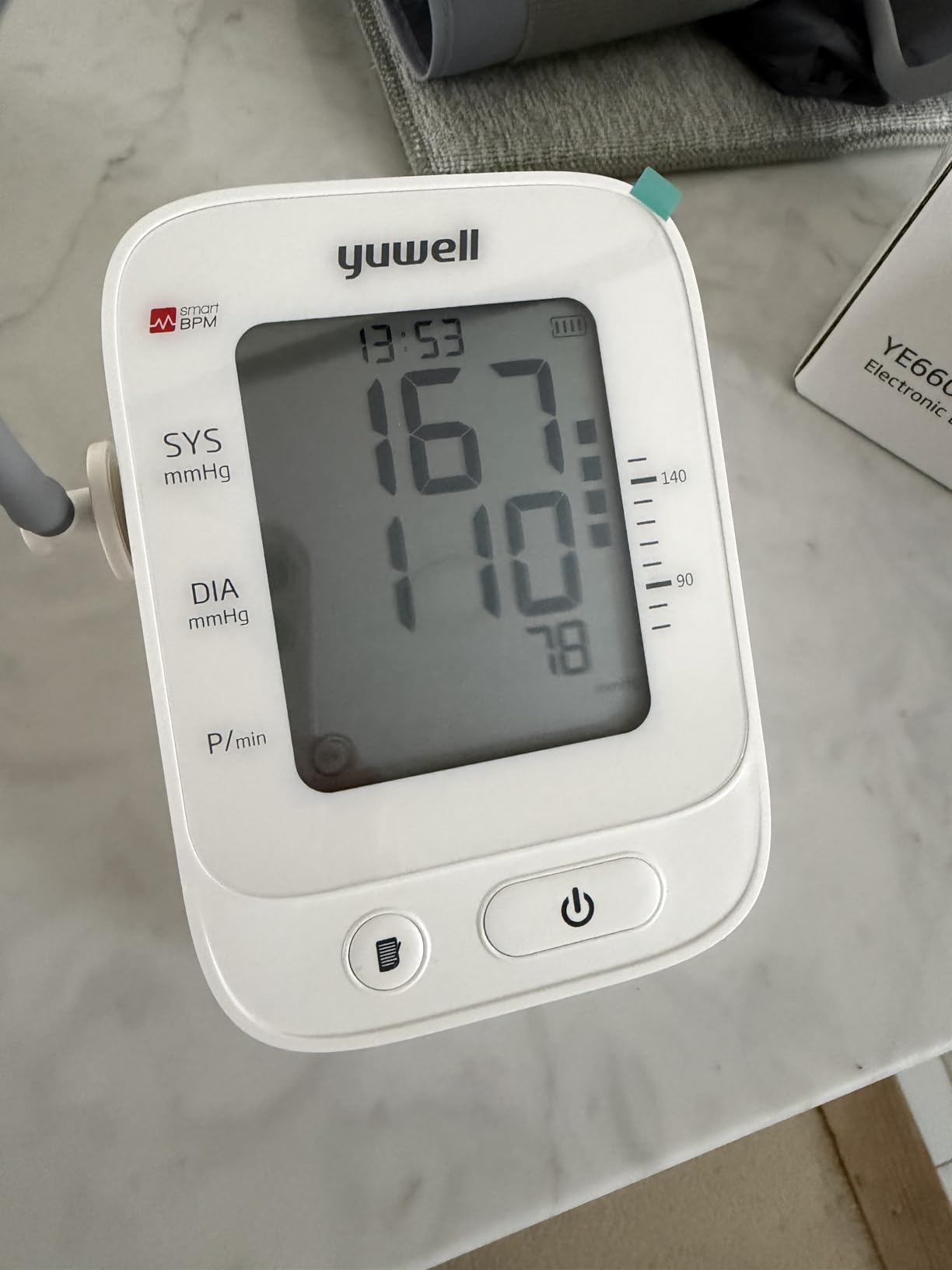
The manufacturer states the device meets the European Society of Hypertension accuracy standard, and multiple reviewers report their numbers line up with measurements taken manually in a doctor’s office. It weighs 12.7 ounces, measures 6.2 by 5.39 by 3.7 inches, and runs on an included lithium polymer battery with a power adapter and storage bag in the box. An irregular heartbeat alert and a body movement reminder are both built in.
Two design choices work against comfort. The cuff tubing is short, so the monitor often ends up sitting in your lap rather than on a table, and because no medium cuff is offered, the large cuff can wrap past a smaller arm. Both are fixable habits rather than accuracy problems, provided your arm is genuinely inside the range.
Does the self-test and reminder system actually prevent bad readings?
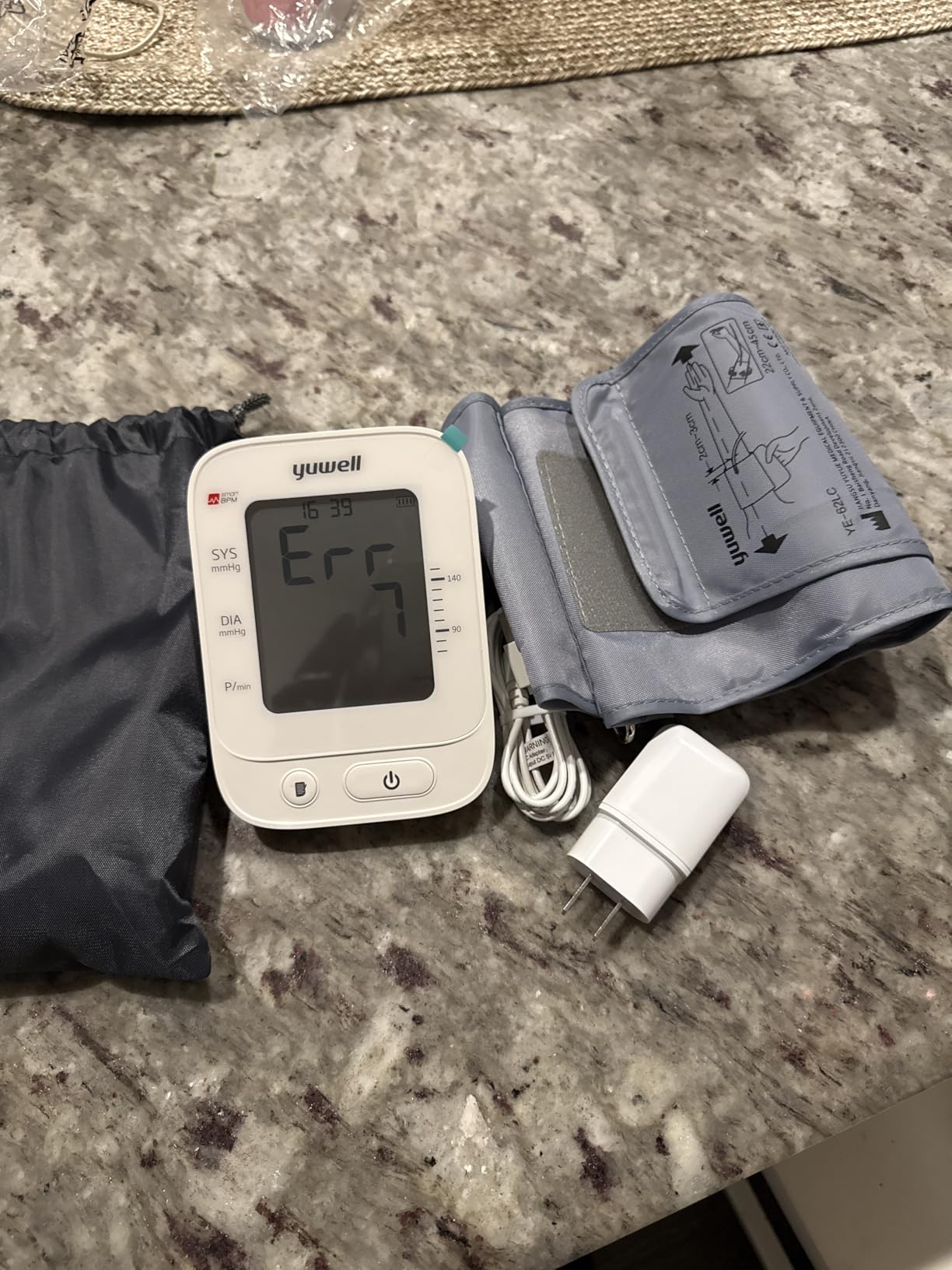
Yes, more than I expected. The self-test function and the mis-operation reminder caught loose cuff placement in our sessions more than once, and the body movement reminder fires when you shift position mid-cycle. Those are cheap sensors solving a real failure mode, since most inaccurate home readings come from technique rather than from the device.
The 3-reading average is the other quiet win. Showing the average of the latest three measurements nudges users toward a repeatable habit instead of reacting to one high number. For a user adjusting medication with a doctor, that stabilised number is the one worth writing down.
Who should skip it?
If you want a monitor you can set on a table and forget about, the short tube is a daily annoyance. If you have a smaller arm, the absence of a medium cuff means you will be fighting the strap. And if the spoken readout bothers you, note that reviewers report the voice cannot be fully disabled on every unit.
4. Omron Iron BP5000 – Best Known Brand for a Reason
OMRON Iron Blood Pressure Monitor & Upper Arm Blood Pressure Cuff
9 to 17 inch D-ring cuff
Irregular Heart Beat and Body Movement Detection
One-touch operation
4.4 stars from 8491 reviews
Pros
- Brand recognition that doctors and pharmacists recognise
- Irregular heartbeat and body movement detection add clinical value
- Simple one-touch operation suited to older users
- D-ring cuff wraps with one hand
- Light at 8.82 ounces
Cons
- No voice or talking function for low-vision users
- No carrying case included in the box
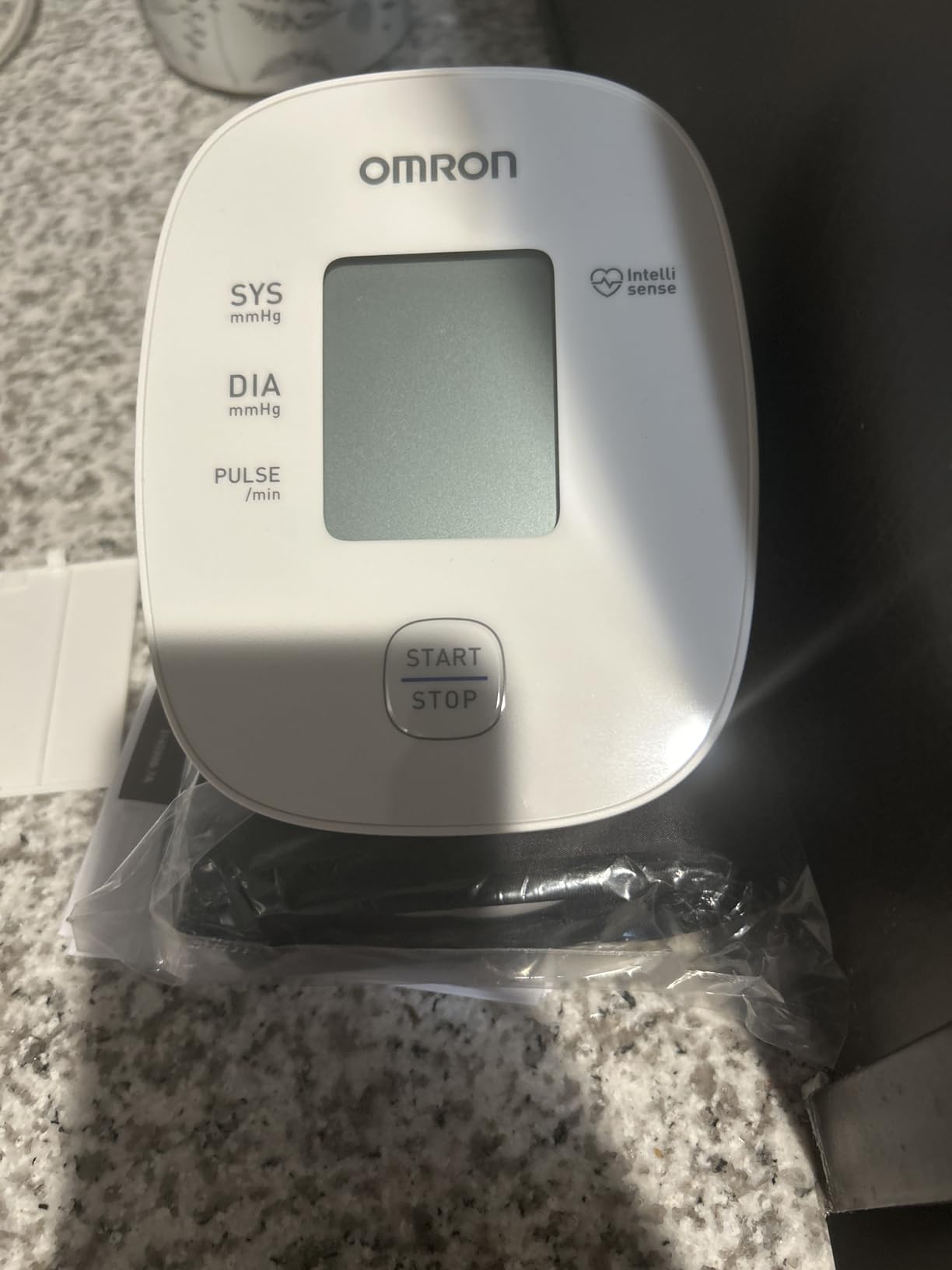
Omron is the first name that came up in nearly every forum thread we read while researching this roundup, and the Iron BP5000 is the version of that name with the most useful cuff. It is a one-touch device, which is about as low a learning curve as this category offers.
Two detection features do the real work here. Irregular Heart Beat detection flags an uneven rhythm during the measurement, and Body Movement Detection warns you if you shifted, both of which cut down on readings you would otherwise have to discard. The cuff is a wide-range D-ring design fitting 9 to 17 inch arms, and a D-ring lets a user with limited hand strength wrap the cuff one-handed instead of fighting a Velcro tube.
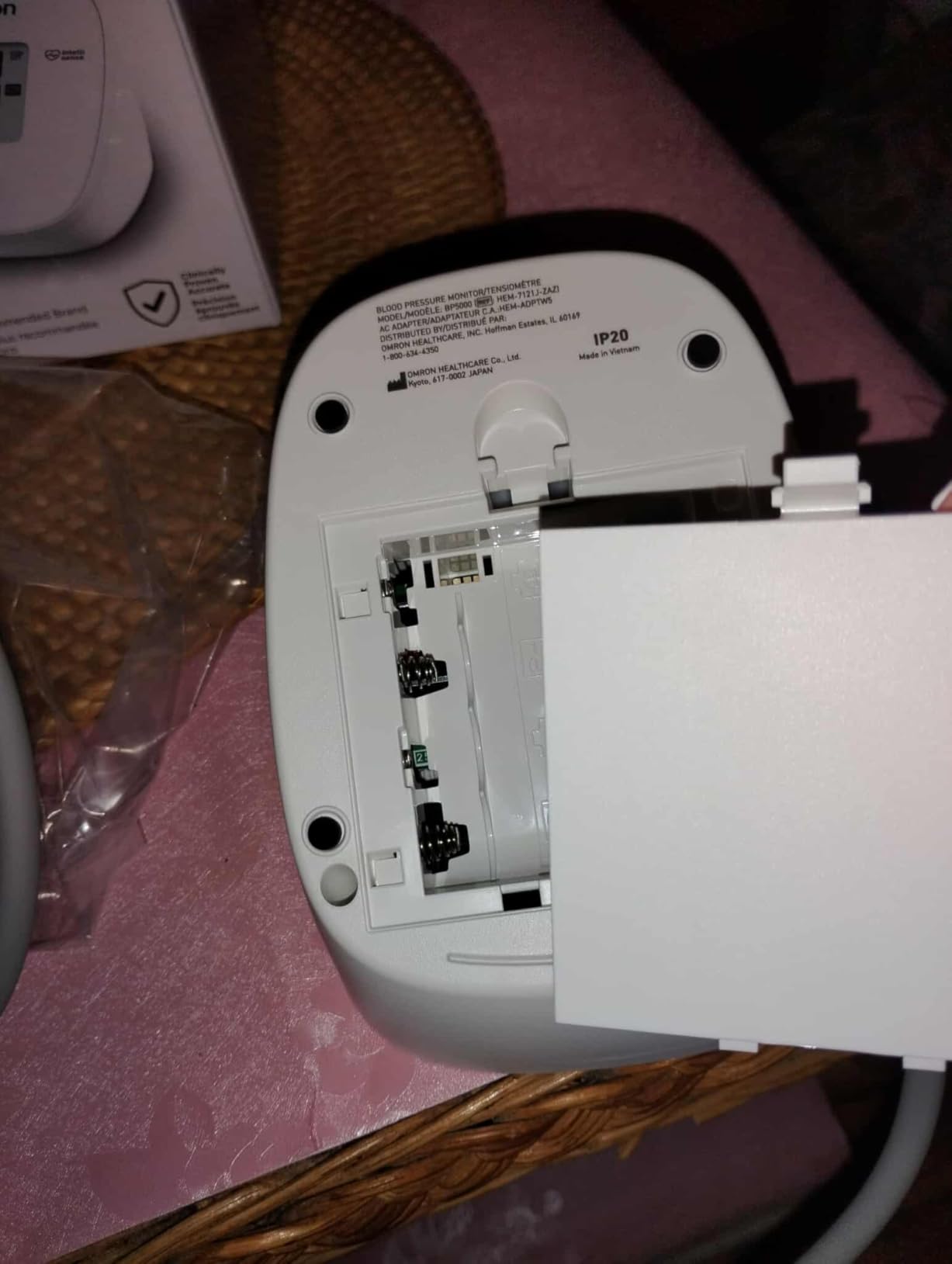
It is also the lightest monitor in this roundup at 8.82 ounces, and it measures 5.5 by 3.3 by 4.3 inches, so it is easy to hold in one hand or pack in a bag for travel. Power comes from 4 AA batteries, and the manufacturer cites its Advanced Accuracy Technology as the basis for the readings.
There is no voice readout and no carrying case in the box. For a user with low vision, that rules it out regardless of everything else it does well, and for a user who travels, budget a separate pouch.
Why does the D-ring cuff matter for arthritis?
It is a mechanical argument, not a preference. A wrap-around cuff has to be held closed with one hand while the other hand feeds the arm into the sleeve, and hands with painful joints frequently get it wrong. A D-ring cuff opens flat, loops around the arm, and then closes by sliding the ring, which means the cuff can be positioned accurately by someone who cannot grip Velcro firmly.
That accuracy is the point. A cuff placed too loosely does not compress the artery enough and reads high. The D-ring design removes the most common self-inflicted error in home monitoring, which is why it is worth the extra seconds it takes to close.
Who should skip it?
Skip it if you need an audible readout, a colour-coded result band, or a case. It also has the narrowest arm range of the wide-cuff options here at 9 to 17 inch, so a buyer with a very small or a very large arm should confirm their circumference falls inside that window before committing.
5. Invaxe 4.5 Inch Backlit Monitor – Best Extra-Large Display
Blood Pressure Machine, Automatic Upper Arm Blood Pressure Monitor with 2×199 Readout, 4.5 Inch Backlit Large Screen Adjustable Large Cuff 9 to 17 Inches – Arrhythmia and Home Hypertension Detector
4.5 inch backlit LCD at 45 degrees
2 users with 199 readings each
9 to 17 inch cuff with position detection
4.5 stars from 2604 reviews
Pros
- Very large bright backlit display readable without squinting
- 45-degree viewing angle suits a table-top position
- Comfortable cuff fit that does not pinch during inflation
- Two-user memory with 199 readings each
- Includes a velvet carry bag
Cons
- Supplied USB cable has been reported not to work reliably at the port
- Batteries drain quickly when running on power alone
- No voice output
- so results must be read from the screen
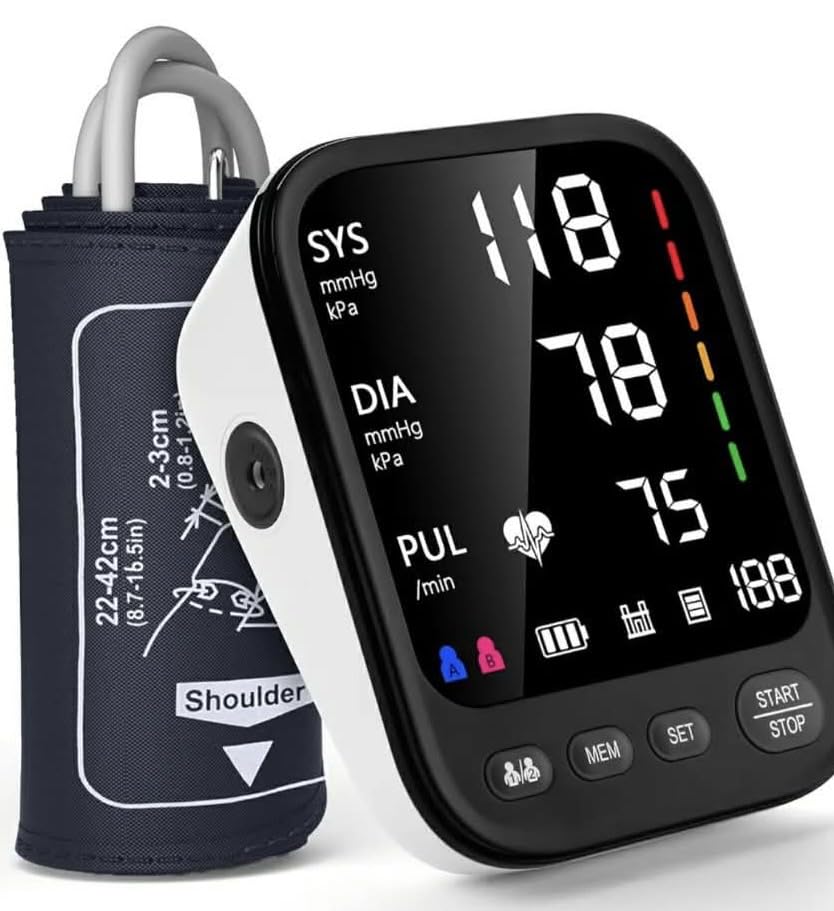
If display legibility is the whole question, this is the monitor. The 4.5 inch backlit LCD is tilted to a 45 degree viewing angle, which is a smarter design decision than it sounds. A senior reading a monitor laid flat on a lap or a low table is bending their neck and squinting, and the angled screen puts the digits where the eyes already are.
It starts with one button, the buttons are large, and it auto-offs after three minutes so the backlight does not drain a set of batteries overnight. Reviewers repeatedly confirm their readings matched what their doctor’s office produced, and the cuff is reported as comfortable rather than pinching during inflation.
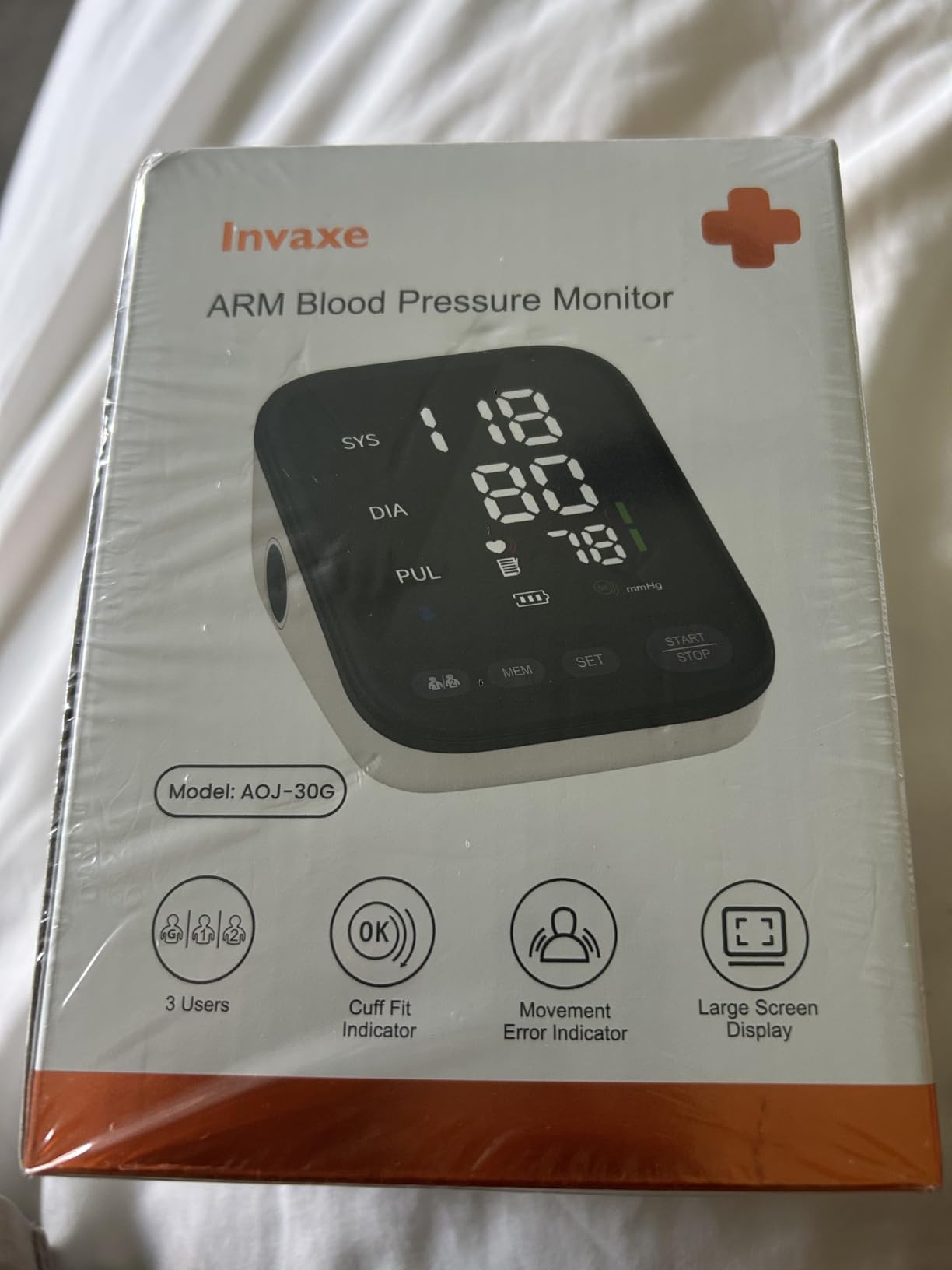
Storage is the standout number here: 2 users with 199 readings each, which is far more history than most households at one reading per day. The adjustable cuff covers 9 to 17 inch arm circumference and includes automatic position detection, and irregular heartbeat detection runs alongside a 6-colour pressure level indicator. The unit weighs 1.1 pounds and measures 5.12 by 5.12 by 3.15 inches.
Power is the weak point, and it is the same weak point reviewers mention most. The device runs on 4 included AAA batteries or a USB cable, but the supplied cable has been reported as unreliable at the port, and reviewers note batteries drain quickly when it is running on power alone. Treat this as a battery-first device and keep a spare set in the box it arrived in.
Is 199 readings per user genuinely useful?
Yes, if you are preparing for an appointment. At the standard routine of twice in the morning and twice in the evening, a 199-reading memory holds roughly four weeks per user, and it stores by user so a couple’s data does not interleave. That is more history than most people will ever scroll back through, which means you can hand a doctor a printed month rather than a single remembered number.
The 3-measurement averaging function adds stability on top of that. A single high reading is usually noise, and a monitor that shows you an average teaches you to ignore the spike rather than react to it. Combined with irregular heartbeat detection, it gives a cleaner starting point for a conversation with your physician.
Who should skip it?
Skip it if you rely on USB power, because the supplied cable has drawn reliability complaints and the batteries drain quickly. Skip it if you want a voice readout, since there is none. And skip it if your arm falls outside 9 to 17 inch, which is the most common cuff range in this roundup but still not universal.
6. Andesfit Two-Cuff Smart Monitor – Best for App Tracking Without a Login
Andesfit Upper Arm Blood Pressure Monitor for Home Use 17″ Large & 21″ XL Extra Large Cuff Big arm, Free APP Bluetooth Sync Apple Health Track Google Fit, Large Display Smart BP Machine for Seniors
Two cuffs 17 inch and 21 inch included
6 inch colour LED display
Apple Health and Google Fit sync
FDA-cleared claim
Pros
- Two cuff sizes included for different arm sizes in one household
- Very large colour display with big numbers
- App syncs to Apple Health and Google Fit without login
- One-touch operation requires no technical skill
- 199 readings stored per user
Cons
- App connectivity can be finicky for some users
- Cuff sizes max out at 21 inch so very large arms may need another option
- USB mode supplies power only and does not charge
The Andesfit A02-SEB arrives with two cuffs, a 17 inch large and a 21 inch extra large, and that packaging decision is what separates it. A household with one larger-armed partner and one smaller-armed partner gets the correct fit for both from a single purchase, which is the cuff problem solved rather than discussed.
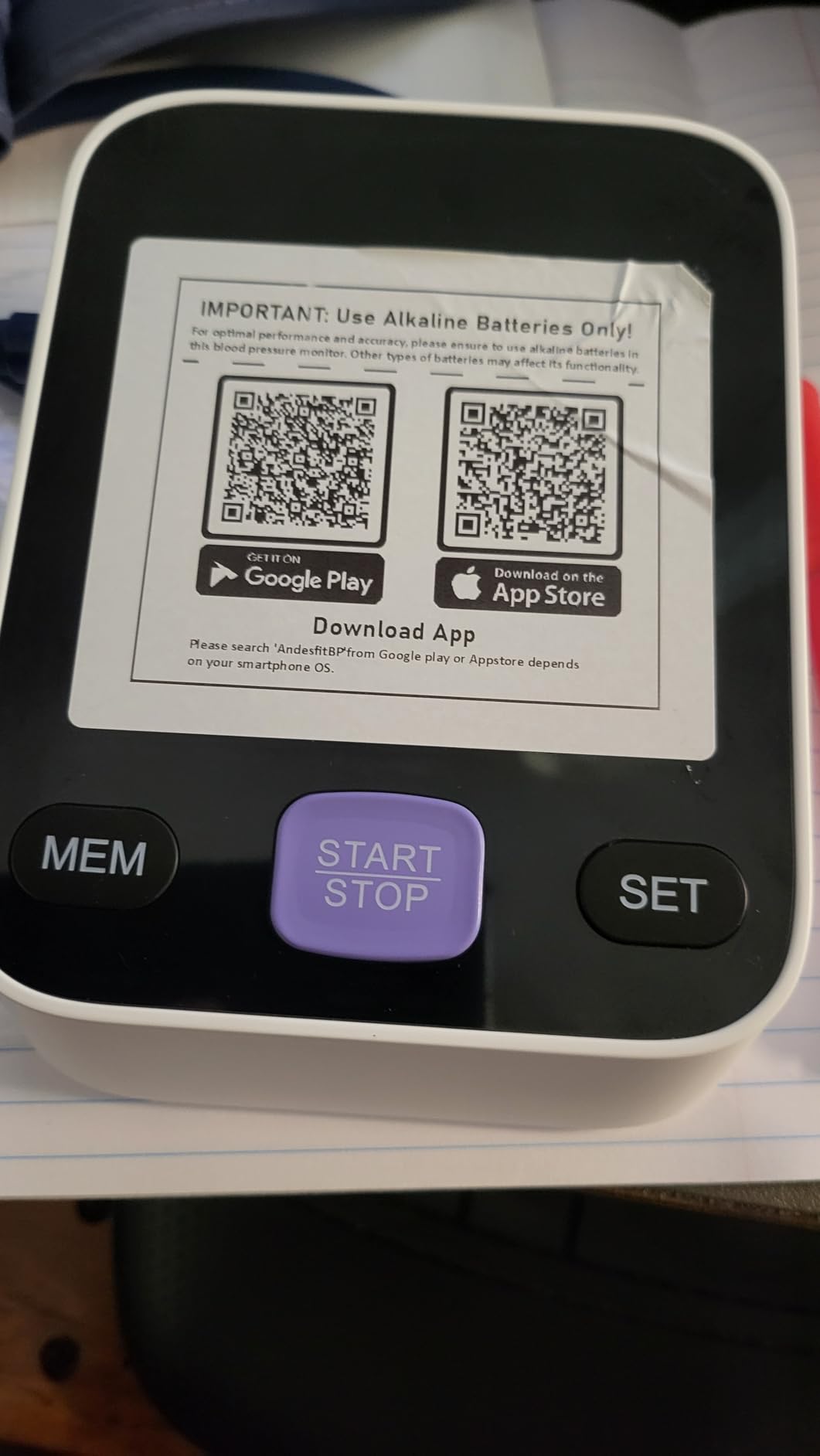
Its tracking is the other differentiator. Bluetooth syncs to Apple Health and Google Fit through a free app that requires no login and no personal data, and the app itself offers unlimited storage. For a senior who already lives inside one of those ecosystems, readings land in a chart they may already be looking at instead of a separate app they will never open.
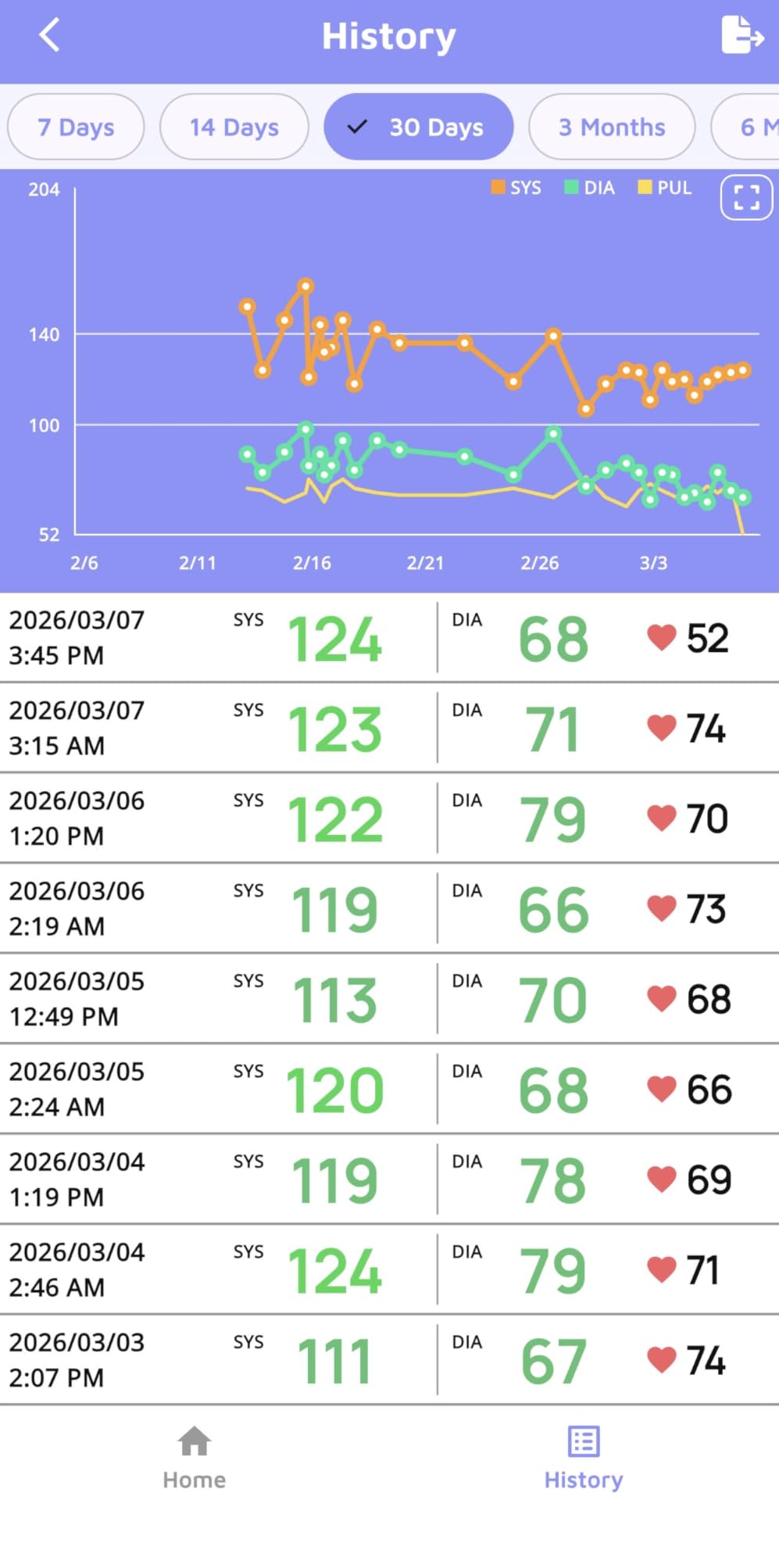
The 6 inch colour LED display is among the largest in this roundup, with one-touch operation and a dual user mode holding 199 readings each. The manufacturer states the device is FDA-cleared and meets medical accuracy standards, and the monitor runs on 4 included AA batteries or USB Type-C power. It weighs 1.7 pounds and measures 4.5 by 4.2 by 1.9 inches.
Its 4.3 rating sits below the category norm, and the one-star share is the highest here, with connectivity rather than accuracy drawing most of the complaints. App pairing can be finicky, and the USB port supplies power only rather than charging an internal battery, so this is a device you run on batteries.
Is a no-login tracking app the right call for a senior?
For most users, yes, and it solves a specific complaint we kept hearing in forums. The recurring grievance is manual logging: people buy a smart monitor and then abandon it because entering readings by hand is tedious and the app wants an account they cannot remember the password for. A no-login app that pushes to a health platform they already use removes both problems at once.
The counterpoint is that connectivity adds a failure mode. If Bluetooth pairing fails on a given morning, the temptation is to skip the reading entirely. Treat the app as a convenience and keep writing a few numbers in a notebook, which is what your physician will actually read anyway.
Who should skip it?
Skip it if your arm exceeds 21 inch circumference, because the included cuffs stop there. Skip it if you dislike any app workflow, and treat the connectivity complaints as a real risk rather than a footnote given the rating profile. If you want a voice readout, this model does not offer one.
7. Vaunn Medical Extra Large Cuff Monitor – Best for Very Large Arms
Vaunn Medical Automatic Upper Arm Blood Pressure Monitor, Extra Large Arm Cuff 12.6″ – 20.5″
Extra large cuff 12.6 to 20.5 inch
Three successive measurements
3-colour backlight indicator
4.5 stars from 3762 reviews
Pros
- Extra large cuff suits bigger upper arms than typical models
- Three successive measurements improve reliability
- Colour backlight and traffic light bar make results easy to interpret
- Guest mode keeps one-off readings out of stored data
- FSA and HSA eligible
Cons
- Extra large cuff is too large for many average-sized arms
- No voice readout of results
An entire thread in one of the senior Facebook groups we found during research was devoted to finding a monitor for a person with a large arm. This is the answer to that question in this roundup. The extra large cuff runs from 12.6 to 20.5 inch, a 32 to 52 cm span, and a medium 8.7 to 16.5 inch version also exists as a separate listing if your arm is on the smaller side of the line.
SmartCheck technology takes three successive measurements and shows the result, which is a meaningful upgrade for anyone with an irregular rhythm because a single oscillometric reading is exactly the situation where that method is least reliable. Irregular heartbeat detection adds a visual and audible alert, and the traffic light bar with a 3-colour backlight follows the American Heart Association blood pressure category colours.
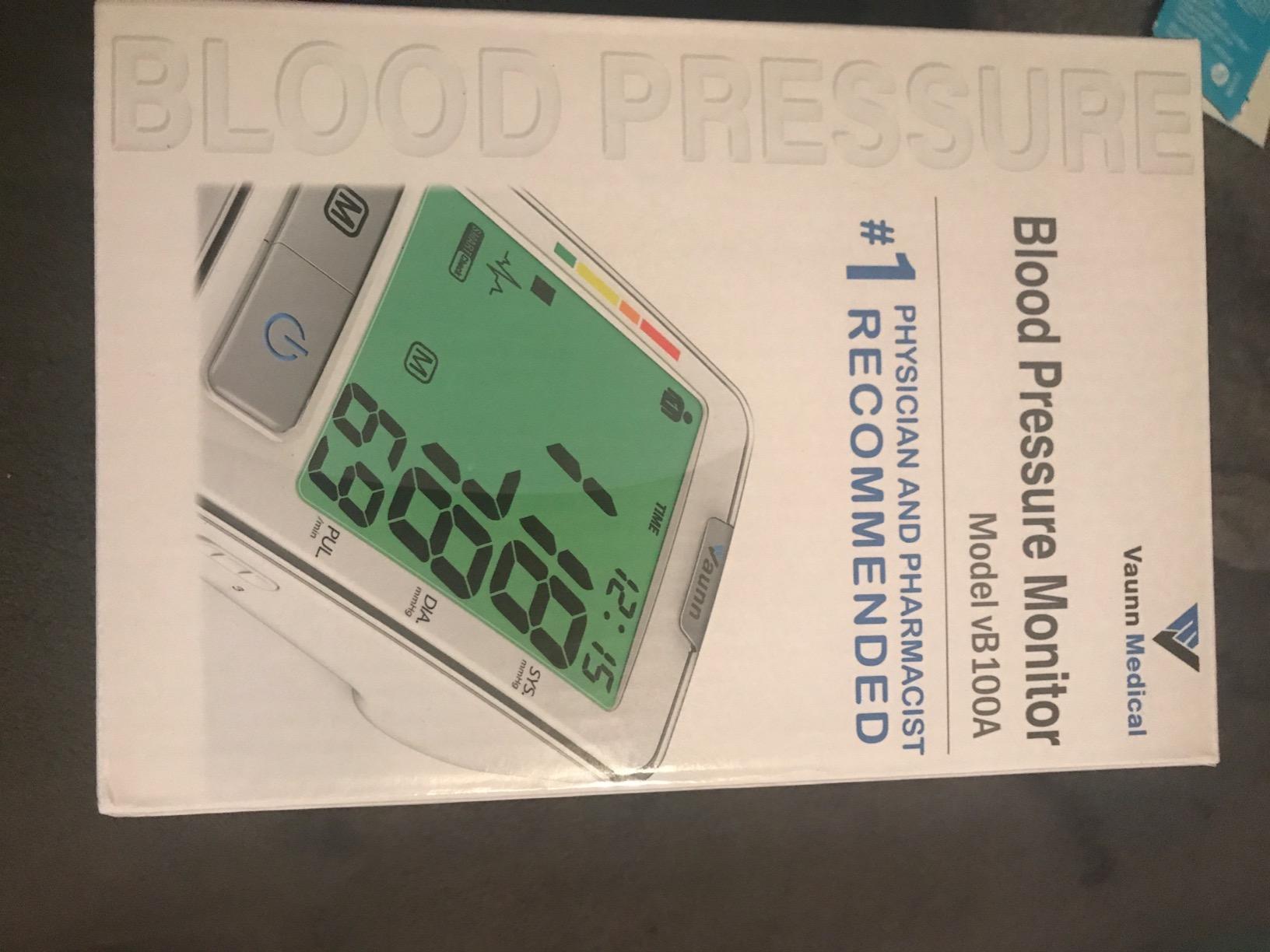
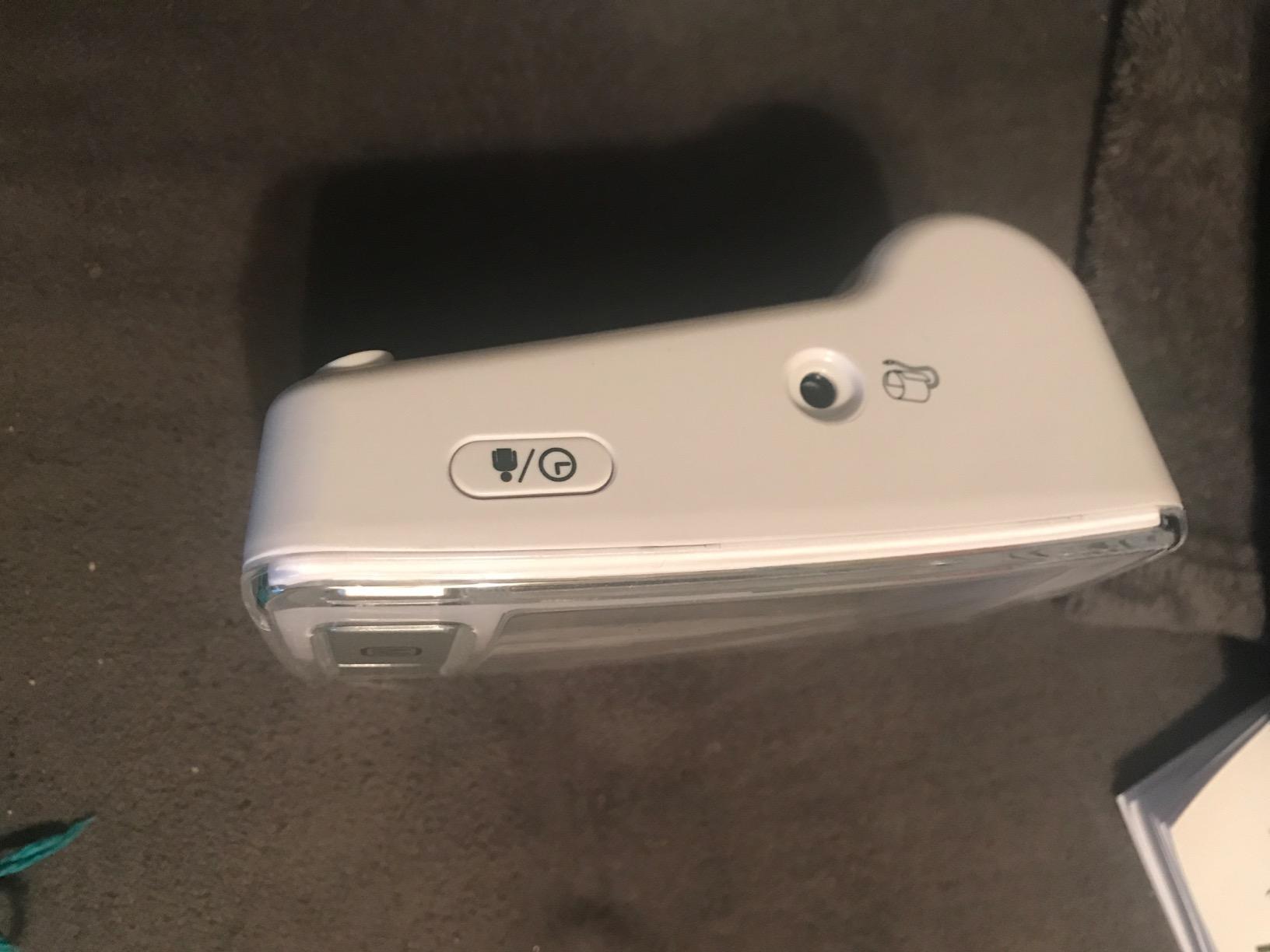
Memory runs as dual user plus a guest mode, storing 99 readings per user, and the guest setting keeps a visitor’s one-off reading from polluting your history. GentleRead technology is aimed at comfort during inflation. The unit weighs 1 pound, measures 5 by 3.6 by 2.25 inches, and runs on 4 included AA batteries. It is also FSA and HSA eligible, which matters if you are buying this out of pocket.
Fit is the entire caveat. Reviewers are direct that this cuff wraps past the arm on smaller users, and there is no voice readout of results, so this is a vision-first rather than hearing-first device. Measure before you order.
How do I know which Vaunn cuff I need?
Measure your upper arm circumference at the midpoint between shoulder and elbow, then compare. Above roughly 16.5 inch you want the extra large 12.6 to 20.5 inch cuff, and below that the medium 8.7 to 16.5 inch version is the correct choice. A cuff that is too small is the highest-stakes mistake in this whole category because it produces a false elevation, and a cuff that is too large produces a false low reading.
If your measurement lands near the boundary, measure a second time. Arm circumference changes through the day and with weight changes, so a reading taken in the morning and one taken in the evening are worth comparing before you commit to a size.
Who should skip it?
Skip it if your arm is average, because the extra large cuff will sit past the arm and reviewers are blunt about that. Skip it if you need the number spoken aloud. If you want an app or a log you can hand to a physician electronically, look at the iHealth Track or the Andesfit instead.
8. AQESO Three-Cuff Monitor – Best for Three-User Homes
Blood Pressure Machine Upper Arm, 3 Size Cuffs, S, M/L and XL, Small 7″-9″, Medium/Large 9″-17″ and Extra Large Cuff 13″-21″, Accurate Automatic Digital BP Monitor, Large Backlit LCD, 3-User 1500 MEM
Three cuffs covering 7 to 21 inch arms
3 users with 500 readings each
Large backlit LCD with WHO bar
4.4 stars from 711 reviews
Pros
- Three cuff sizes in one package fit arms from 7 to 21 inch
- Reviewers report readings matching their doctor's office measurements
- Large backlit display with oversized numbers
- One-button setup and a compact unit
Cons
- Medium cuff developed an air leak after about five months of daily use
- Velcro strips wear out quickly and batteries drain fast
- A too-large cuff produces bogus readings
- so sizing must be matched carefully
The AQESO U80AH solves the cuff problem more completely than anything else in this roundup. Three cuffs ship in the box, a small 7 to 9 inch, a medium/large 9 to 17 inch and an extra large 13 to 21 inch, so the household does not have to decide which arm it will measure. For a family caring for a parent plus two other adults, that is the whole purchase decision answered.
It also supports 3 user profiles with 500 readings each, which is 1500 records in total. The backlit LCD carries a WHO classification bar, one touch starts a measurement, and the oscillometric method is the standard approach used across this category. It weighs 1.72 pounds, measures 5.1 by 4 by 2 inches, and runs on 4 included AAA batteries or USB Type-C for power.
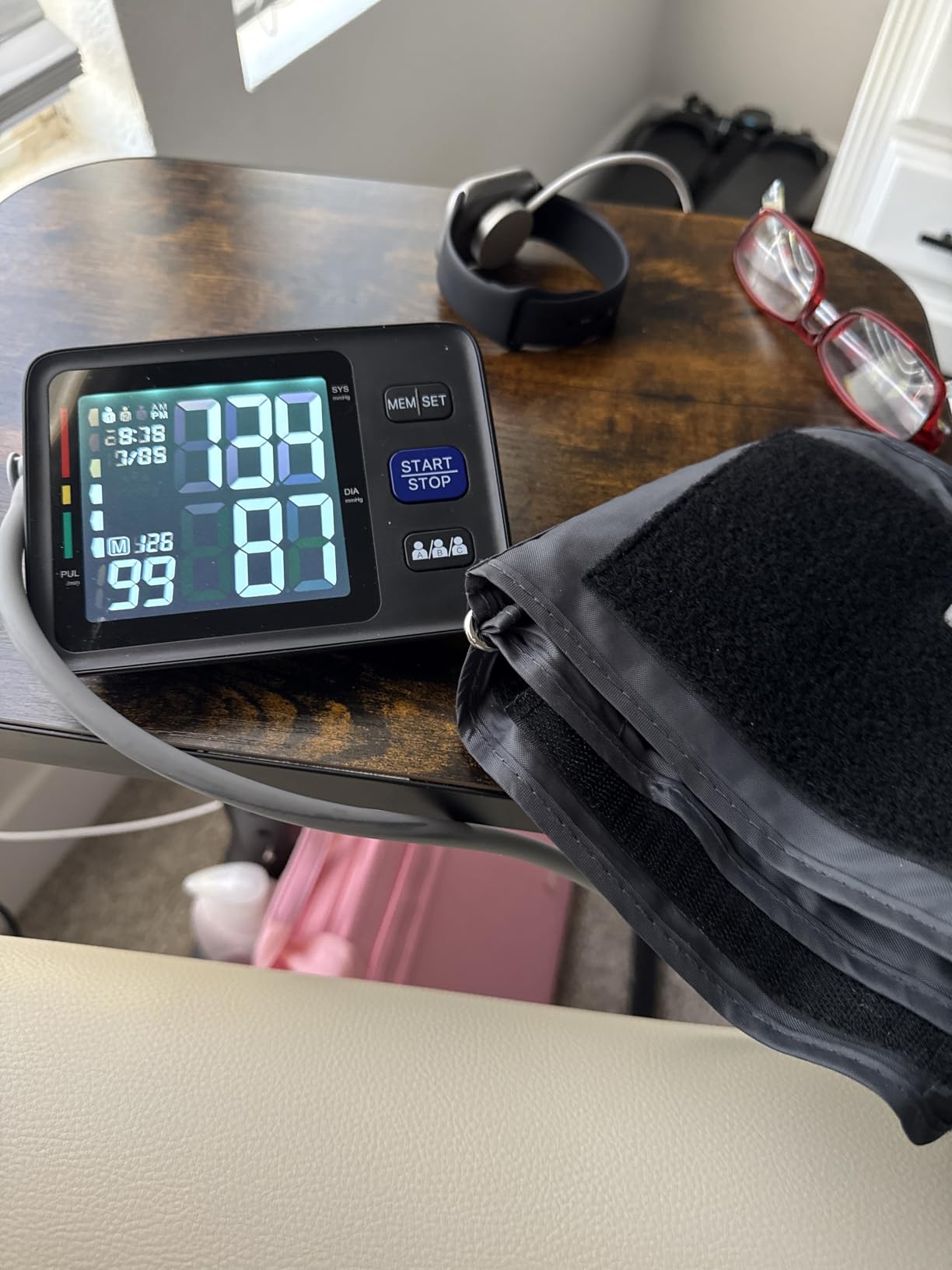
Accuracy reports are the strongest theme in the reviews. Buyers who had previously owned cuffs they no longer trust say this one matches their clinician’s readings, and the credit goes to having the right cuff size available for nearly any arm. That is the argument this article keeps making, demonstrated by a manufacturer rather than asserted by us.
Durability is where the caution sits. A minority of reviewers report the medium cuff developed an air leak after about five months of daily use, Velcro strips wear quickly, and batteries drain fast. A monitor whose cuff leaks is a monitor that needs replacing, so if you are buying this for daily long-term use, keep the receipt.
Is a three-user monitor practical or just a spec sheet feature?
Practical, with one condition: each user must select their own profile before measuring, and the profiles are stored separately rather than merged. A caregiver taking a reading for a parent on the wrong profile is a real and easy mistake, so a quick habit of checking the profile number before inflating the cuff is worth building.
The 500 readings per user figure means a profile can hold well over a year of daily readings, so nobody will be clearing memory to make space. Combined with three cuffs, this is the pick for a shared multi-generational home rather than a single senior living alone.
Who should skip it?
Skip it if you want a voice readout, because there is none. Be cautious if you are buying it as a multi-year daily device and want minimal consumables, given the reported air leak and Velcro wear. And whatever your arm size, use the correct cuff from the three included, because a too-large cuff produces unreliable readings just as surely as a too-small one.
9. ProHeal Talking Monitor – Best for Blind and Low-Vision Seniors
Talking Blood Pressure Monitor for Seniors and Low Vision – Hear Your Numbers Aloud – Automatic Upper Arm Cuff, Large Backlit Display, 3 User Memory, Carry Bag and Batteries Included
Spoken systolic, diastolic and pulse results
3 user profiles with 80 readings each
8 to 16 inch adjustable cuff
4.2 stars from 536 reviews
Pros
- Clear spoken readout of every result
- well suited to seniors and low vision
- Large backlit display with colour range flags and irregular heartbeat symbol
- Batteries included so it works out of the box
- Three user profiles track changes over time
Cons
- Instructions are unclear and setup is confusing for first-time users
- USB mode requires staying plugged in during a measurement and is not rechargeable
- The 8 to 16 inch cuff can be too large for smaller arms
Yes, there is a blood pressure machine that can talk to you, and this is one of the more usable examples. It speaks the systolic, diastolic and pulse results aloud with adjustable volume and a mute setting, and reviewers with vision loss describe the voice as loud and clear rather than tinny.
The screen still matters as a backup, and it is a good one, with large backlit digits and green, orange and red range indicators alongside an irregular heartbeat symbol. Three user profiles store 80 readings each with date and time, which is enough for a family tracking changes over weeks. The cuff adjusts from 8 to 16 inch, and a carry bag plus 4 AA batteries are included so it works straight out of the box.
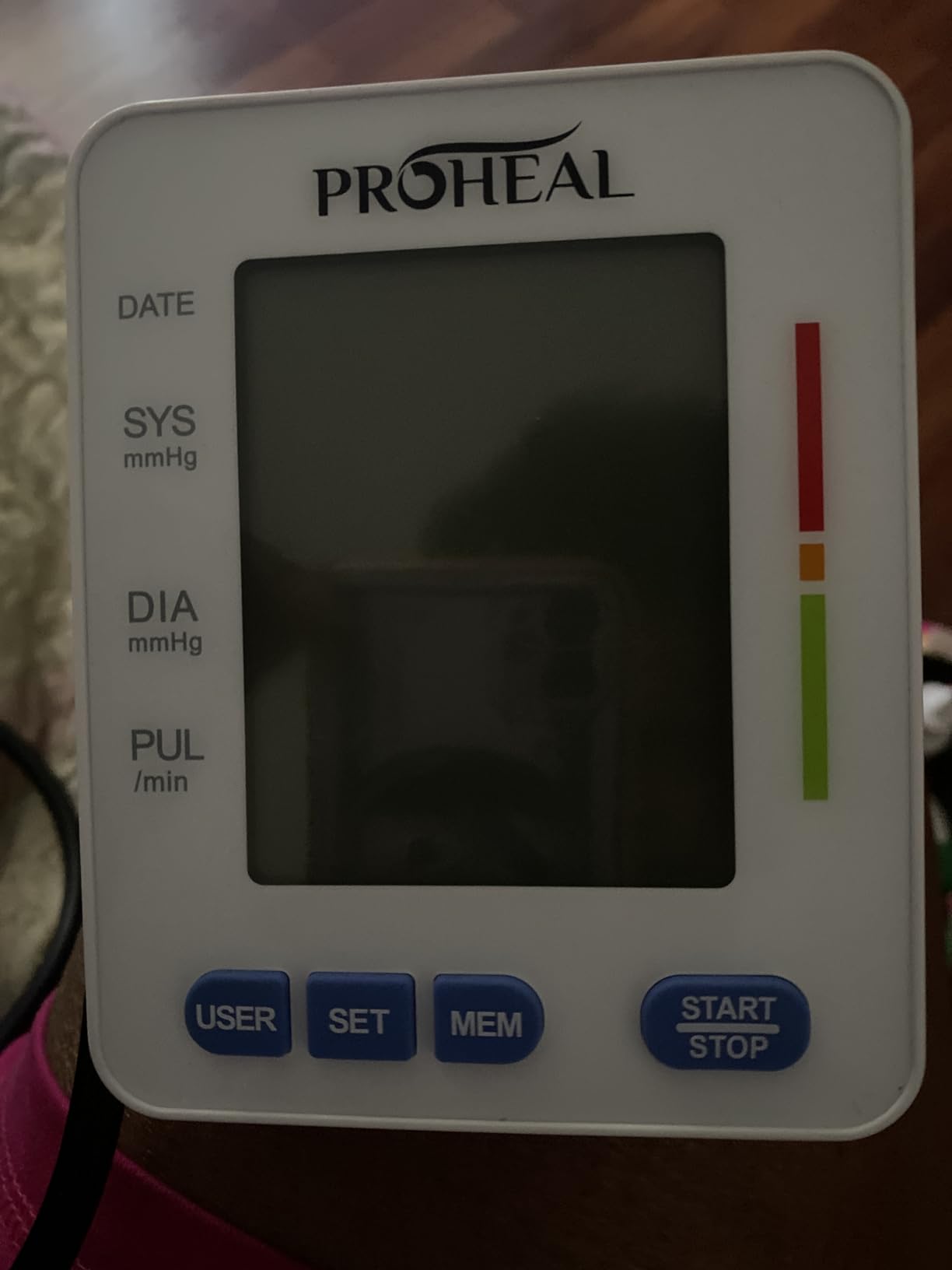
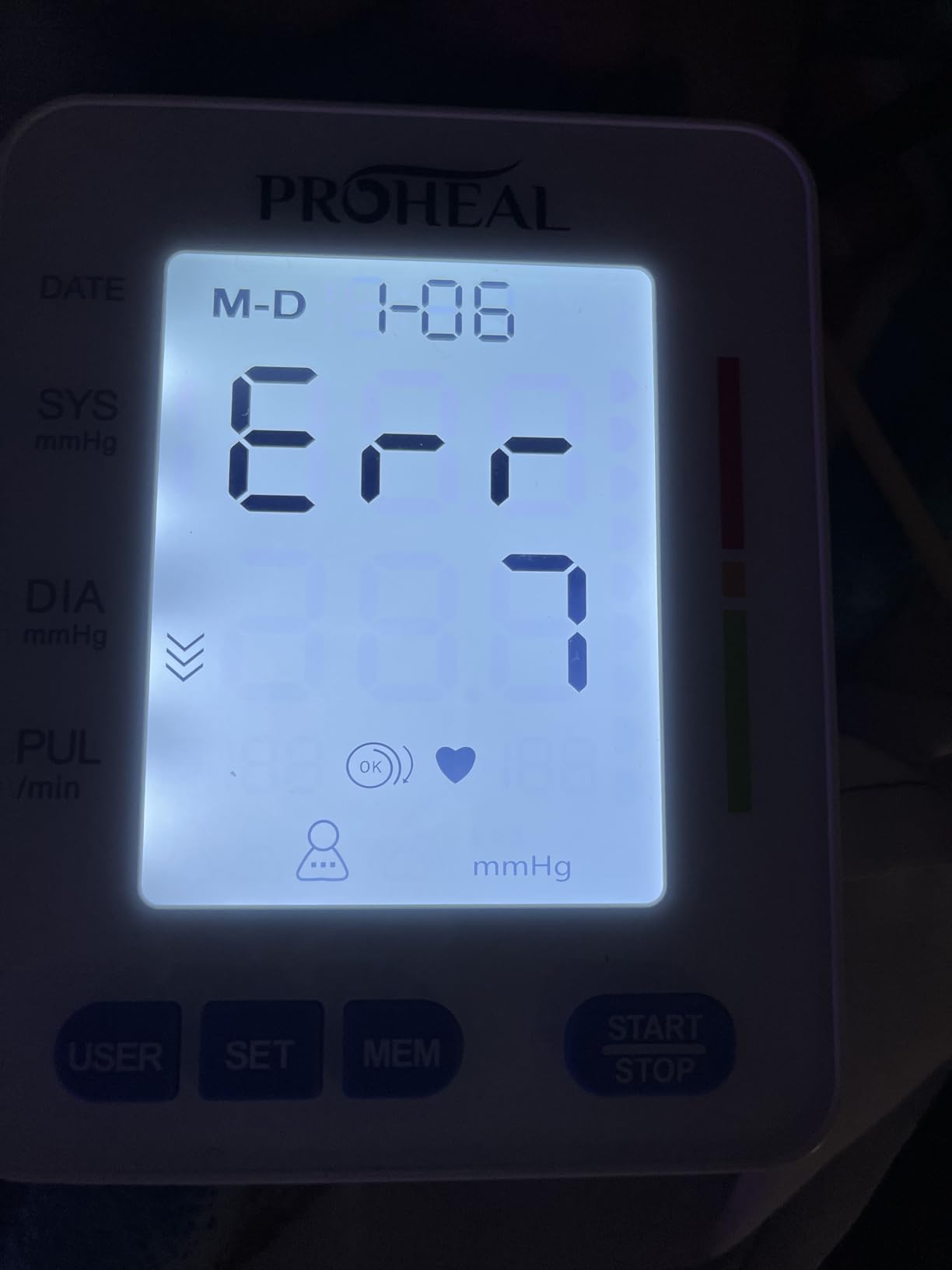
This is the lowest-rated product in our roundup at 4.2 stars from 536 reviews, and the reason is worth reading before you buy. The complaints cluster around setup: reviewers describe the instructions as unclear and confusing for first-time users, which is exactly the wrong failure mode for someone who cannot easily re-read a small print panel or ask a neighbour twice.
Two further caveats. USB mode requires the cable to stay plugged in during a measurement and does not charge an internal battery, so plan around 4 AA batteries. And the 8 to 16 inch cuff can be too large for smaller arms, where an oversized cuff gives unreliable readings. Both matter more for a user who already has limited options.
Is a talking monitor worth the trade-offs?
For a person who cannot reliably read a display, it is worth considerably more than a spec sheet suggests. The voice removes the whole reading step, not just the difficulty of it, which means the monitor gets used rather than abandoned. Several reviewers describe the announcement as the decisive feature in their purchase, and that is a consistent signal across blind and low-vision buyers.
The trade-off is that talking units in this category generally carry fewer reviews and thinner brand backing than the mainstream models, and we found no independently validated listing for this one. Treat star ratings in the talking category with caution. A Reddit commenter in a different thread made the broader point well, noting that marketplace ratings do not track real accuracy and that independent validation is the more meaningful signal.
Who should skip it?
Skip it if you will not have anyone nearby for first-time setup, since the instructions are the weak point. Skip it if you need a phone or tablet log, because there is no app here. And if your arm is smaller than 8 inch circumference or larger than 16 inch, look at the AQESO or Vaunn models with multiple cuff sizes instead.
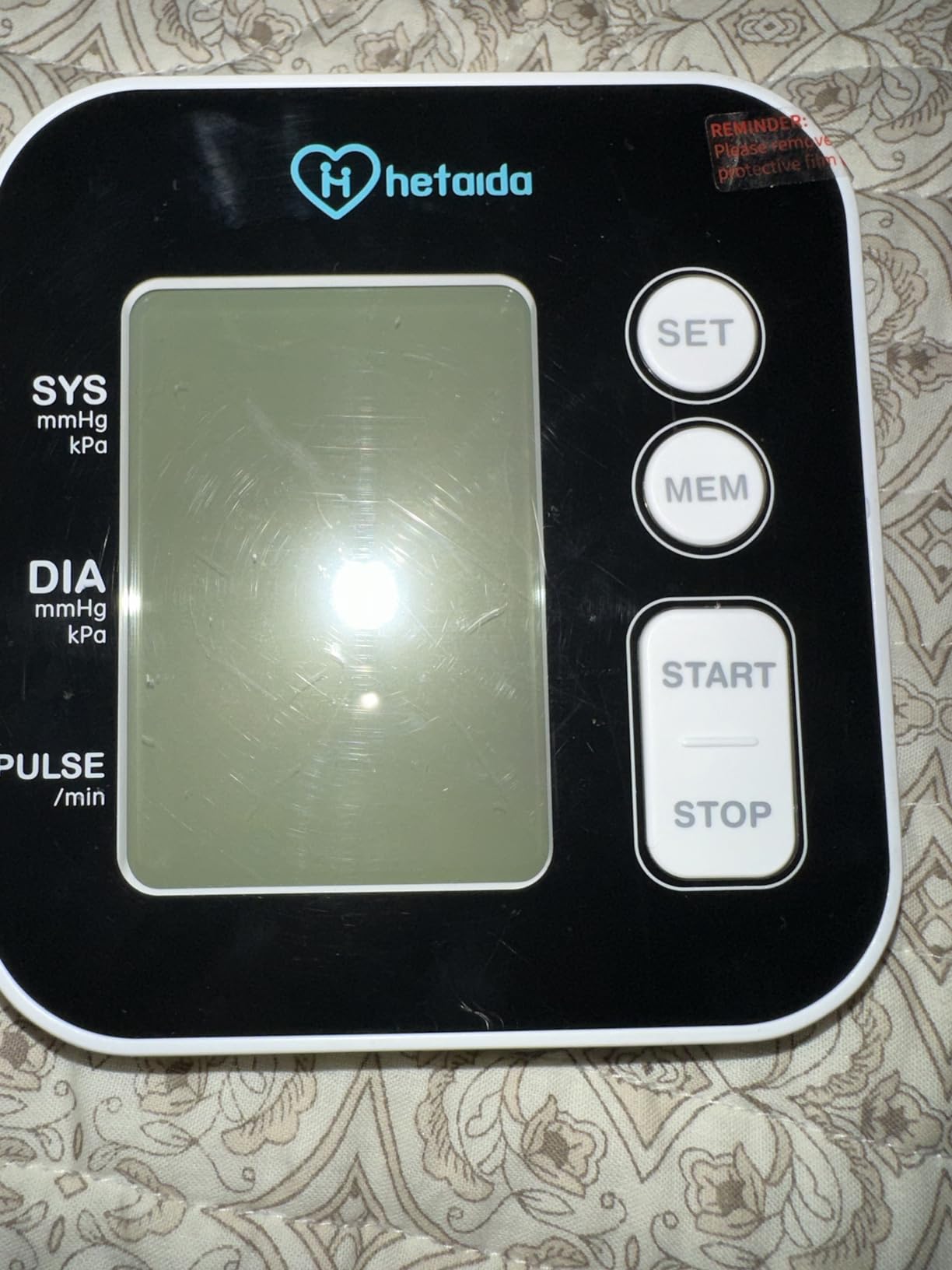
10. hetaida Talking Upper Arm Monitor – Best for a Calming Audio Prompt
hetaida Blood Pressure Monitor for Home Use, Upper Arm Talking BP Machine
Voice broadcast plus relaxing music
8.7 to 16.5 inch soft cuff
Dual user with 198 records
4.4 stars from 307 reviews
Pros
- Voice broadcast and calming music make the measurement less stressful
- Reviewers confirm readings match a doctor's office
- USB power option runs without batteries during outages
- Backlit colour-coded display communicates status clearly
Cons
- Music is loud and can be distracting unless the settings are found
- The 8.7 to 16.5 inch cuff will not fit very large arms and third-party replacement cuffs may be incompatible
- Voice-off button has been reported to stop working after a few months
The hetaida D6607US does something the other talking monitors in this roundup do not: it plays relaxing music during the measurement, alongside the spoken result and a blood pressure status announcement. For a senior who finds the anticipation of a squeeze stressful, that changes the emotional experience of a daily check more than any spec on the box.
One button starts it, and it uses smart pressurization to inflate at a rate the user tolerates. It stores 2 users with 198 total records and supports per-user and per-record deletion, which is a genuine privacy feature when a family shares a device. The backlit display shows green, yellow and orange status indicators, and irregular heartbeat detection runs with on-screen error alerts for cuff and movement problems.
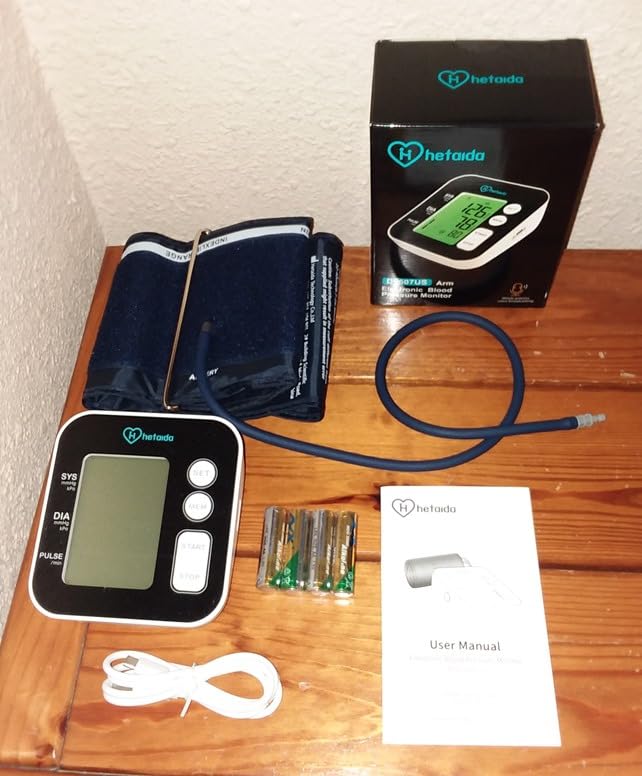
Power flexibility is the underrated feature. It runs on 4 AA batteries or an external USB adapter, and reviewers specifically point out that the USB option means it keeps working during a power outage, which matters for anyone who relies on home monitoring. The soft cuff fits 8.7 to 16.5 inch, or 22 to 42 cm, and the unit weighs 9.76 ounces. A 12-month replacement or refund policy is included.
Reviewers also report accurate measurements that matched a doctor’s office. The 307-review count is the smallest in this roundup, so treat the performance as well-attested by the people who own it rather than as a wide consensus, and check the return policy before buying.
Is the music a feature or an annoyance?
It depends entirely on whether you find the settings, and reviewers are split on exactly that point. Several describe the music as loud and distracting, while others treat it as the feature that makes the measurement bearable. If you are buying for someone who is anxious about cuff inflation, the music is a genuine benefit worth the extra button press.
There is a more serious related concern: reviewers report the voice-off button stopping working after a few months. A unit that will not stop talking is a real problem in a shared home, so ask about the return policy and keep the receipt.
Who should skip it?
Skip it if your arm is larger than 16.5 inch, because the included cuff stops there and reviewers report that third-party replacement cuffs may be incompatible. Skip it if you share a room with a light sleeper and cannot find the music setting. If you want a larger arm option with a voice, the yuwell YE660E at 8.7 to 17.7 inch is the better match.
How to Choose an Upper Arm Blood Pressure Monitor for Seniors
Start with validation, then cuff size, then legibility. Everything else on the box is decoration by comparison. If your doctor has prescribed an ambulatory blood pressure monitor or a specific clinical device, follow their instruction instead of this guide, because a home cuff is not a substitute for prescribed equipment.
How do I know a monitor is accurate enough to trust?
Look for a device that is either on the US Blood Pressure Validated Device Listing at validatebp.org or holds FDA marketing authorization, and understand that those are two different things. The American Medical Association develops the review criteria used for the validated listing but does not itself validate devices, and an FDA marketing authorization means the FDA reviewed the device for substantial equivalence to a predicate, not that its accuracy was independently confirmed against a standard. We found no model in this roundup on the validated listing, and several make ESH or FDA accuracy claims in their own descriptions.
The most recommended home blood pressure monitor by doctors, and the one cardiologists recommend, is not one specific model but one setup: an automatic, cuff-style, upper arm monitor with a cuff the correct size for the arm. In forums, people repeatedly describe a monitor as trustworthy when their physician accepts the readings, which is why buying a device you can hand a readable log from matters more than buying the most feature-rich one.
What is the easiest blood pressure monitor for seniors to use?
The easiest monitor for seniors is one with one-button operation, a D-ring cuff that wraps with one hand, a large high-contrast backlit display, and voice broadcast so results can be heard instead of read. The Omron Iron BP5000 covers the one-touch and D-ring side of that, the Invaxe covers the oversized backlit screen, and the Paramed B22S covers the voice. If you can only pick one feature, pick a cuff that is easy to position, because an incorrectly placed cuff ruins the reading no matter how good the sensor is.
How do I pick the right cuff size?
Measure your upper arm circumference at the midpoint between shoulder and elbow, while the arm is relaxed at your side, and match it to the range printed on the cuff. The categories below are the standard sizing bands. A cuff that is too small can read 10 to 40 mmHg too high, which is the most dangerous error in this category, and a cuff that is too large reads falsely low.
Some monitors ship with more than one cuff. The AQESO includes small, medium/large and extra large sizes, the Andesfit includes a 17 inch and a 21 inch cuff, and the Vaunn is available in medium or extra large variants. If your arm is near a boundary, measure twice at different times of day before you decide.
Below roughly 22 cm or 8.7 inch, look for a small or paediatric cuff. Between about 22 and 32 cm or 8.7 to 12.6 inch, a standard adult cuff is correct. Between about 33 and 42 cm or 12.6 to 16.5 inch, you need a large adult cuff, which several of the monitors here cover. Above 42 cm or 16.5 inch you are into thigh-cuff territory, and only the Vaunn and AQESO options in this roundup reach past that line.
Does voice readout help, and is it worth choosing a talking monitor?
Voice broadcast is the single most useful feature for a blind or low-vision user, and for anyone with reading fatigue or a tremor. It removes the reading step entirely rather than making it easier. The trade-off is that talking monitors in this category tend to carry fewer reviews and thinner validation than the mainstream models, so confirm that the unit speaks your language, check the return policy, and ask a family member to sit with you through first setup.
Some users in forums are told to use a wrist monitor when an arm cuff is painful on a large arm. That advice is at odds with current American Heart Association guidance, which recommends upper arm devices. If the upper arm squeeze is the problem, look for a monitor with a wide range and a slow inflation routine instead, and mention persistent pain to your physician. We cover wrist devices separately in our roundup on the [10 best wrist blood pressure monitors for seniors](https://austineubanks.com/best-wrist-blood-pressure-monitors-for-seniors/), though we do not recommend them as a substitute for an upper arm model.
How much memory do you need, and does connectivity matter?
Memory matters more than most buyers expect. Four readings a day uses roughly 1460 readings a year, so a 120-reading memory gives you about a month and a 199-reading memory gives you about seven weeks. If you want a long history for a physician visit, choose a large memory or a model with unlimited app storage, and confirm the readings are stored by user and by date rather than as a running total.
Connectivity is a convenience, not a requirement. Bluetooth manual sync and automatic Wi-Fi sync both work, but the recurring complaint in senior communities is manual logging, so a monitor that pushes readings into Apple Health or Google Fit solves more than a monitor that asks you to open an app. If you will not use a phone at all, a large on-device memory and a printed log serve the same purpose.
When should a monitor be calibrated or replaced?
Treat two to three years as a reasonable replacement interval for a daily home monitor, and replace the cuff sooner if the Velcro no longer holds or the tube no longer inflates evenly. A cuff that leaks or slips does not produce a usable reading at all, and it is a cheaper part to replace than a whole unit. Keep the original cuff in the box so a replacement matches the model.
Do not attempt to calibrate a home monitor yourself. If readings disagree with a clinic device by more than about 10 mmHg, that is a serviceable or replacement question, not an adjustment question.
Talking and Voice-Broadcast Monitors for Blind and Low-Vision Seniors
There is a blood pressure machine that can talk to you, and the best talking monitor for seniors in this roundup is the Paramed B22S, because its voice broadcast has adjustable volume with a working mute and sits on a 4.5-star model with 26k reviews behind it. The ProHeal and the hetaida are worth considering too, since both add spoken results alongside a backlit display, but both carry thinner review histories.
Honesty matters in this subcategory. Talking monitors consistently carry fewer reviews and lower ratings than mainstream models, largely because setup documentation tends to be weaker and because the cuff ranges are narrower. Buyers in blind and low-vision communities searching specifically for accessible monitors repeatedly ask for a voice readout, and that demand is real, but it is worth verifying bilingual capability and support before you commit.
None of the three talking models here offers an app, so your log stays on the device. Plan for that: memory ranges from 80 readings per user on the ProHeal to 120 total on the Paramed and 198 on the hetaida, and write down the numbers that matter before an appointment rather than relying on scrolling through a menu.
Extra-Large and Thigh Cuffs for Larger Arms
The best blood pressure monitor with an extra large cuff in this roundup is the Vaunn Medical, whose extra large cuff runs from 12.6 to 20.5 inch, or 32 to 52 cm, and which takes three successive measurements for reliability. The Andesfit is the alternative for smart tracking, since it includes both a 17 inch and a 21 inch cuff in the box.
Why the threshold matters: a cuff that is too small can produce a false elevation of 10 to 40 mmHg, which is a large enough error to change a treatment conversation entirely. Above roughly 42 cm or 16.5 inch arm circumference, standard adult cuffs stop covering the arm properly and you need an extra large or thigh cuff. Only two options in this roundup cross that line, and the yuwell at 8.7 to 17.7 inch comes close.
Measure before you choose, at the midpoint between shoulder and elbow, with the arm hanging relaxed. Then check the range printed on the cuff itself rather than the product page, because manufacturers frequently quote the widest possible range while shipping a narrower cuff in the box. Both the Vaunn and the AQESO sell a medium and an extra large version, and picking the wrong one produces a cuff that wraps past the arm.
How to Check Whether Your Monitor Is Lying to You
Take your home monitor to your next appointment, sit at the same table as the clinic device, and take a reading on each arm within a couple of minutes of one another. A difference of 5 to 10 mmHg between a home cuff and a clinic device is normal and not a reason to panic. A gap larger than about 10 mmHg is a reason to ask a technician to check the device, or to replace the cuff, or to replace the monitor.
Check the cuff before you suspect the machine. In testing, loose or misplaced cuffs caused far more bad readings than faulty sensors did. A cuff should sit snugly on bare skin with the artery marker over the brachial artery, and if it slides or has to be pulled tight to stay on, it is the wrong cuff for the arm.
Replace the cuff before you replace the monitor. Cuffs lose Velcro grip, harden, and develop slow leaks over time, and replacement cuffs cost a fraction of a new unit. If a replacement cuff is generic rather than model-specific, be cautious, because reviewers of the hetaida report that third-party universal cuffs proved incompatible with the device.
How to Take an Accurate Reading at Home
Most inaccurate home readings are technique errors, not device faults. Seven steps will make your numbers comparable from one day to the next.
First, avoid caffeine, exercise, and smoking for 30 minutes beforehand, and empty your bladder. Second, sit quietly for at least five minutes with your back supported and feet flat on the floor. Third, bare your arm and support it at heart level on a table or armrest, with nothing tight around the arm.
Fourth, apply the cuff to bare skin and make sure the artery marker sits over the brachial artery. Fifth, start the measurement without talking and stay still for the duration. Sixth, take two readings one minute apart and record both, then average them, discarding any reading where the monitor flagged movement, an irregular heartbeat, or a cuff problem. Seventh, run this twice in the morning and twice in the evening for seven days before an appointment, and bring the log to your physician.
Keep the schedule realistic rather than obsessive. The point of home monitoring is a pattern your doctor can interpret, not a perfect daily data set. If a week of consistent readings is more than you can manage, a consistent pattern of days you do manage is far more useful than an abandoned log from the first two attempts.
Does Medicare Cover a Blood Pressure Monitor?
Original Medicare generally does not cover a home blood pressure monitor as a routine benefit, and neither does most commercial insurance. Medicare Advantage plans vary, and some offer an over-the-counter or wellness allowance that could apply, so read your specific plan materials. Medicaid varies by state. Flexible spending account and health savings account funds are another common route, and the Vaunn Medical in this roundup is FSA and HSA eligible, as are most home monitors sold for medical use.
There is a Part B pathway worth asking about. A physician can prescribe an ambulatory blood pressure monitor, a device you wear for 24 hours that measures readings continuously, and Part B can cover its rental in certain situations. That is a different device from anything in this roundup, and it requires a clinician’s order. If you want more detail on the device question rather than the coverage question, our guide to [home-use blood pressure monitors](https://austineubanks.com/best-blood-pressure-monitors-for-home-use/) covers the format differences.
Most families simply pay out of pocket, which is why the budget end of this roundup matters. If cost is the deciding factor for you, tell your doctor, because a prescribed device is sometimes cheaper than a retail one once your coverage is applied.
Frequently Asked Questions
What is the easiest blood pressure monitor for seniors to use?
The easiest monitor for seniors is one with one-button operation, a D-ring cuff that wraps with one hand, a large backlit display, and voice broadcast so results can be heard rather than read. Among the models we tested, the Omron Iron BP5000 covers one-touch operation and a D-ring cuff, the Invaxe has the largest backlit screen at 4.5 inch, and the Paramed B22S adds a voice readout. Cuff ease of placement matters most, because a badly positioned cuff ruins the reading regardless of the sensor.
What is the most accurate upper arm blood pressure monitor?
The most accurate upper arm blood pressure monitor is the one whose cuff correctly fits your arm and whose readings match a clinic device, not a specific model. Look for a device listed on the US Blood Pressure Validated Device Listing at validatebp.org or holding FDA marketing authorization, and understand that these are separate things: the American Medical Association writes the listing criteria but does not validate devices itself. In our roundup the iHealth Track and the Paramed B22S drew the most frequent review reports of agreement with office readings.
Which blood pressure monitor do cardiologists recommend?
Cardiologists generally recommend a setup rather than a specific brand: an automatic, cuff-style, upper arm monitor with a cuff correctly sized for your arm. The American Heart Association recommends upper arm devices over wrist units for home use. In practice, patients tend to trust a monitor once their physician accepts the readings it produces, so choose one with clear memory and a readable display rather than one with the longest feature list.
What is the best talking blood pressure monitor?
The best talking monitor in our roundup is the Paramed B22S, which speaks systolic, diastolic and pulse results with adjustable volume and a working mute, on top of a 4.5-star rating from more than 26k reviews. The ProHeal and the hetaida are also strong options, and the hetaida adds relaxing music during inflation. Be aware that talking monitors generally carry fewer reviews and thinner validation, so confirm the spoken language and ask a family member to help with first setup.
What is the best blood pressure monitor with an extra large cuff?
The Vaunn Medical is the best extra large cuff option we tested, with a cuff running from 12.6 to 20.5 inch or 32 to 52 cm, plus three successive measurements for reliability. The Andesfit is the alternative for app tracking because it includes both a 17 inch and a 21 inch cuff. A cuff that is too small can read 10 to 40 mmHg too high, so measure your arm circumference at the midpoint between shoulder and elbow before ordering.
What is the ideal BP for a 70 year old?
Ask your doctor, because there is no single answer and we are not going to invent one. Blood pressure targets are individualized, and adults over 75 and those with kidney conditions or several chronic conditions are typically given different targets than younger adults because the risk of over-treatment is real. Take a consistent log of readings to your appointment, mention any dizziness or falls, and let your physician set the target for you specifically.
How do I know if my blood pressure monitor is accurate?
Bring your monitor to your next appointment and take a reading on it and on the clinic device within a couple of minutes of each other. A difference of 5 to 10 mmHg is normal. A gap larger than about 10 mmHg is worth having checked, and you should rule out cuff fit first, since a loose or wrong-size cuff causes more bad readings than a faulty sensor. Do not attempt to calibrate the device yourself.
One last reminder before you decide. This roundup is shopping research, not medical advice, and a home monitor cannot diagnose hypertension or tell you what your blood pressure target should be. Bring a week of readings to your physician, keep your cuff fit correctly matched to your arm, and let a clinician interpret what you see. If a device you already own disagrees with a clinic reading by more than about 10 mmHg, that is a service or replacement conversation, not something to solve by adjusting the machine yourself.
Our Final Verdict for 2026
The iHealth Track Smart Monitor is our pick for the best upper arm blood pressure monitor for seniors in 2026, and it is not a close call on the combination of rating, review volume, cuff range and display legibility. Buy the Paramed B22S if a spoken readout matters more to you than a backlit screen. Buy the Omron Iron BP5000 if you want one-touch operation and a D-ring cuff from the most recognised name in the category. Buy the Vaunn Medical or the AQESO if your arm is larger than a standard cuff covers, and buy the ProHeal or the hetaida if you need the numbers spoken aloud.
Whichever one you choose, measure your arm circumference before you order, take two readings a minute apart, and write the log down for your next appointment.