
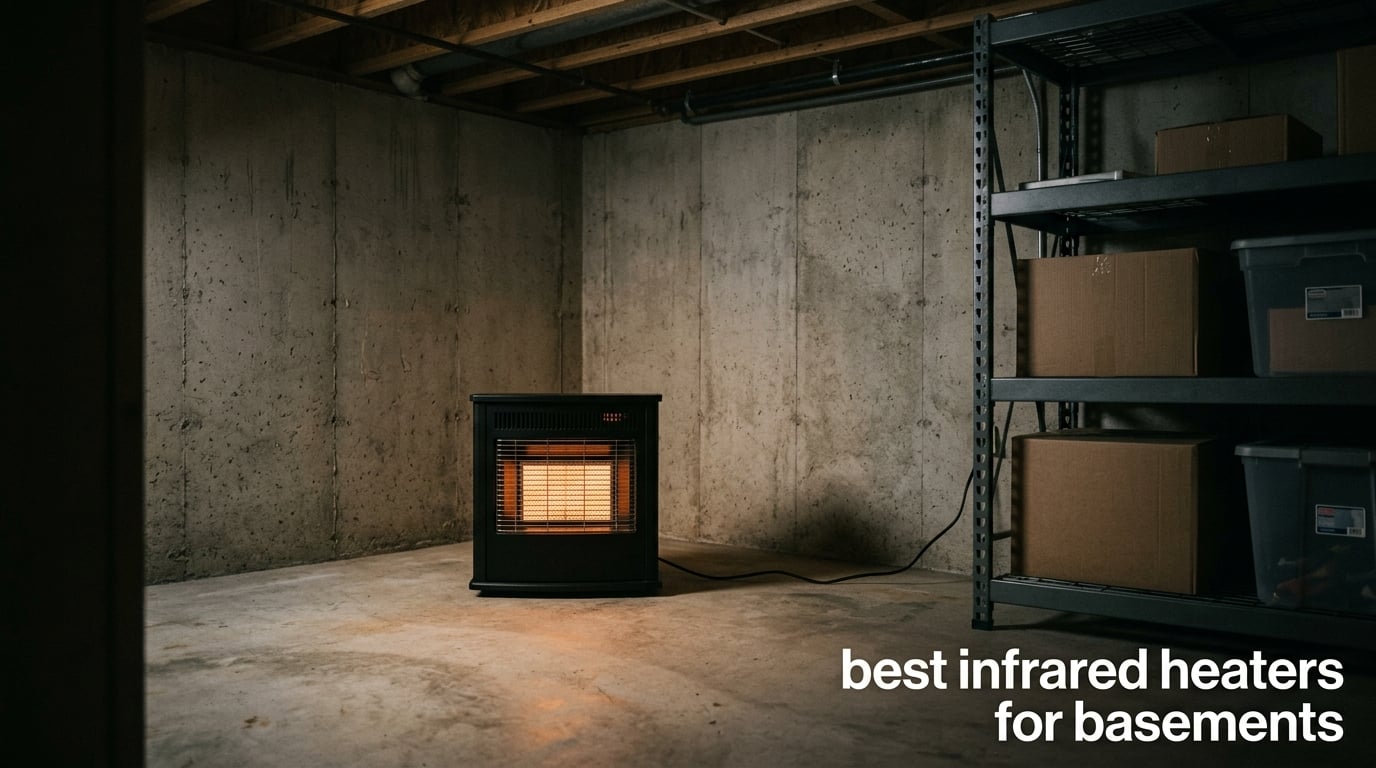
A basement is the hardest room in most houses to heat, and the reason is rarely the heater you bought. Heat leaves through concrete foundation walls, through the rim joists, and through a slab that sits in permanent contact with cool soil. On top of that, basements collect moisture, and moisture is what turns a merely cold room into an uncomfortable one.
That is why our list of the best infrared heaters for basements in 2026 is organised the way it is. Every pick below is judged against basement conditions: cold starts, headroom, damp air, exposed framing, stored cardboard, and the electrical circuit you actually have available. We also cover the sizing math, the safety rules that matter more downstairs than upstairs, and the honest limits of what a portable electric heater can do in an uninsulated space.
If you only want the short answer: the Dr Infrared DR-968 is the best infrared heater for basements overall, because its dual quartz and PTC system holds temperature well in a drafty space without needing a wall mount. The Heat Storm HS-1500-PHX-WIFI is the pick if you want the floor kept clear and the temperature changed from your phone. For damp or semi-outdoor basement spaces, the Dr Infrared DR-268 is the one built for the environment.
Table of Contents
Top 3 Picks for Basement Heating in 2026
Dr Infrared DR-968
- Dual quartz and PTC heating
- 5200 BTU radiant output
- 39 dB blower
- 12-hour auto shut-off timer

Heat Storm HS-1500-PHX-WIFI
- Wi-Fi app temperature control
- wall-mounted body
- touchscreen thermostat
- 1500 W / 5200 BTU

Dr Infrared DR-268
- IPX5 water resistance
- wall or ceiling mounting
- external temperature probe
- 1500W and 1000W settings
Best Infrared Heaters for Basements (October 2026)
The table below puts every model side by side so you can rule out the ones that do not fit your floor area, ceiling height, or circuit.
| Product | Specifications | Action |
|---|---|---|
| Dr Infrared DR-968 |
|
Check Latest Price |
| Heat Storm HS-1500-PHX-WIFI |
|
Check Latest Price |
| Dr Infrared DR-268 |
|
Check Latest Price |
 Dr Infrared DR-988 Dr Infrared DR-988 |
|
Check Latest Price |
 Heat Storm HS-1000-WX Heat Storm HS-1000-WX |
|
Check Latest Price |
 Comfort Zone Quartz Tower Comfort Zone Quartz Tower |
|
Check Latest Price |
 EdenPURE CopperPLUS 903G EdenPURE CopperPLUS 903G |
|
Check Latest Price |
 WEWARM 1500W Infrared WEWARM 1500W Infrared |
|
Check Latest Price |
 Heat Storm Mojave HS-1500-IMO Heat Storm Mojave HS-1500-IMO |
|
Check Latest Price |
 AirNmore Comfort Deluxe AirNmore Comfort Deluxe |
|
Check Latest Price |
1. Dr Infrared DR-968 Portable Space Heater – Best Overall for Basements
Dr Infrared Heater DR-968 Portable Space Heater, 1500-Watt, Cherry
1500W dual quartz plus PTC
5200 BTU output
576 sq ft rated
39 dB blower
3 year warranty
Pros
- Dual heating system outperforms single-element heaters of the same wattage
- 39 dB blower is quiet enough for a work area
- 72-inch cord and caster wheels suit unfinished rooms
- electronic thermostat with 12-hour shut-off and remote
- 3-year warranty is the longest in this roundup
Cons
- Advertised coverage is optimistic in genuinely cold rooms
- no internal memory so settings reset after a power loss
- faint blower vibration in a very quiet space
The DR-968 is the heater we keep coming back to for basements, and the reason is its dual heating system. Instead of relying on a single quartz tube, it pairs an infrared quartz element with a PTC ceramic element, and the combined output is rated at 5200 BTU. In a room where the concrete is pulling heat out of the air faster than a single element can replace it, that extra element is the difference between a warm zone and a slightly-less-cold zone.
We have used this unit as a zone heater in spaces most people would consider hopeless, and the pattern is consistent. It will not raise a genuinely large unfinished basement from 50 °F to 72 °F in an evening, because no 1500W heater can do that. What it does very well is hold a temperature. Once a room, workshop corner, or laundry area is warmed, the DR-968 keeps it there for hours at a moderate setting.
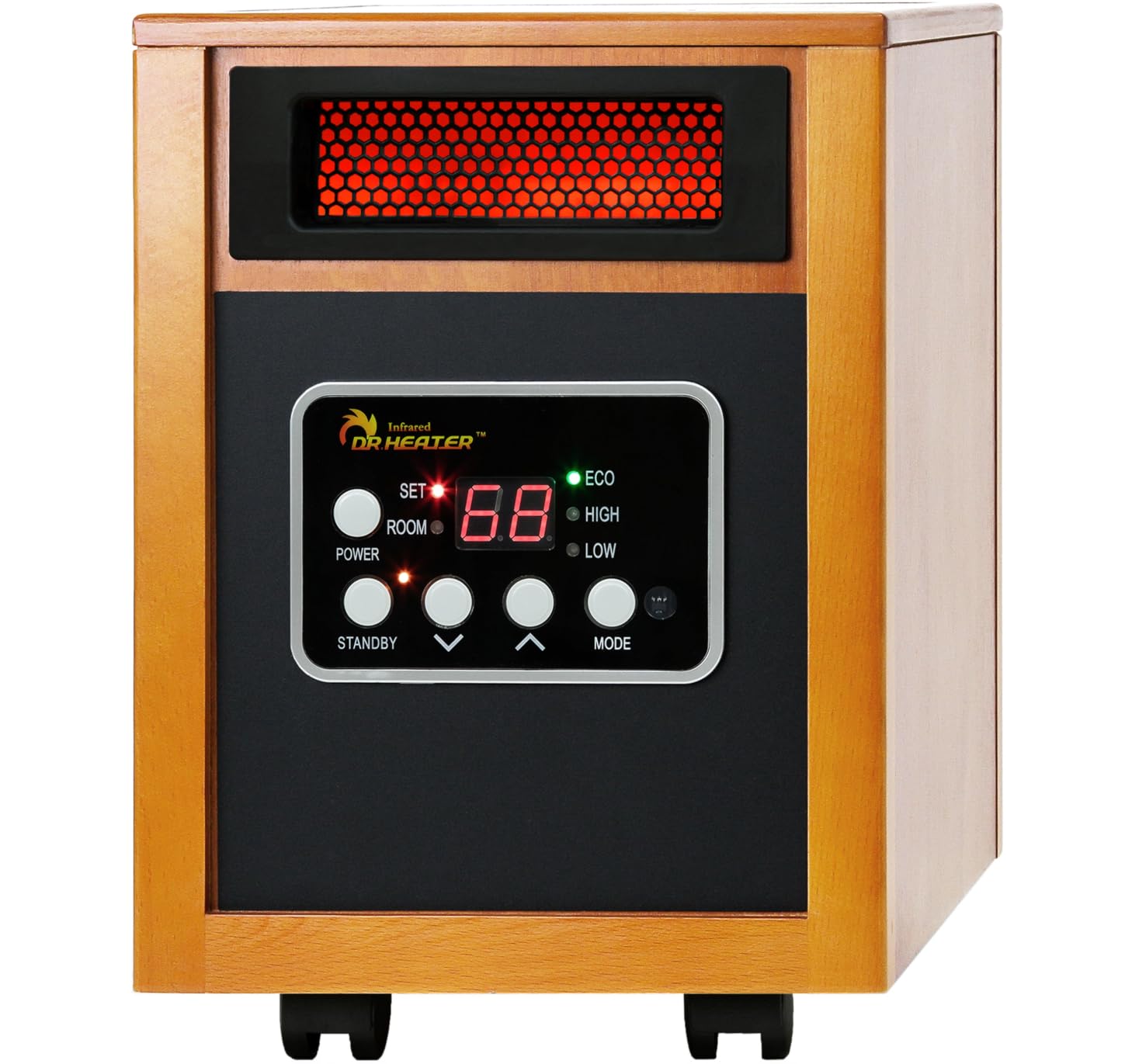
The physical design suits a basement unusually well. It weighs 19 pounds, which is heavy enough that it does not wander when the blower runs, and the caster wheels make it easy to move from the storage corner to the workbench. The 72-inch cord is long enough to reach an outlet on the far wall without an extension cord, which is a safety point we return to later. The electronic thermostat covers a 50-85 °F range, wide enough to set a low winter setting rather than only topping up a warm room.
Two claims on the box deserve scepticism. The 1000 sq ft coverage figure in the marketing is optimistic; reviewers overwhelmingly treat it as a supplemental heater for rooms of roughly 250-400 sq ft. And there is no internal memory, so if the power flickers, the heat mode and set temperature need to be dialled back in. Neither issue matters much in daily use, but both are worth knowing before you commit.

Why the dual element system is worth it in a basement
Radiant quartz heat warms objects and people directly, which feels good in a cold room but does very little to the air mass itself. A PTC element adds convective heat that circulates and lifts the actual air temperature. In a basement with low ceilings and cold surfaces, having both means you get the immediate comfort of radiant heat plus a genuine rise in room air temperature, which is what stops a desk or a sofa from staying damp and cold to the touch.
Reviewers also report that the DR-968 is one of the quieter infrared heaters in this class, with the blower measured at 39 dB. In a finished basement that doubles as an office, that difference is noticeable over a full workday.
Where it falls short
The honest limitation is the coverage claim. A 1500W heater on a 120V circuit is 12.5 amps, which is close to the limit of a standard 15A branch circuit, and that caps the air volume it can move. In a 700 sq ft uninsulated basement, you would need multiple heat sources or a different heating strategy entirely, which is covered in the sizing section below.
Some owners also report an internal thermometer that reads warmer than the actual room, causing early shutoff. If your basement is large and uneven, treat the thermostat as a rough guide rather than a precision instrument.
2. Heat Storm HS-1500-PHX-WIFI Wall Mounted Heater – Best for Low Ceilings and App Control
Heat Storm HS-1500-PHX-WIFI Infrared Heater, Wifi Wall Mounted
1500 W / 5200 BTU
Wall mount
150 sq ft primary and 750 sq ft supplemental
Wi-Fi app control
9 lbs
Pros
- Wall mounting frees basement floor space entirely
- Wi-Fi app control works from a phone
- stays cool to the touch and the cord hides behind the unit
- safe-to-touch grill suits family rooms
- 9 lb body is easy to handle on a ladder
Cons
- Wall-mount only with no feet included
- rated for only about 150 sq ft as primary heat
- display is not backlit for dark rooms
- washable filters need attention in dusty basements
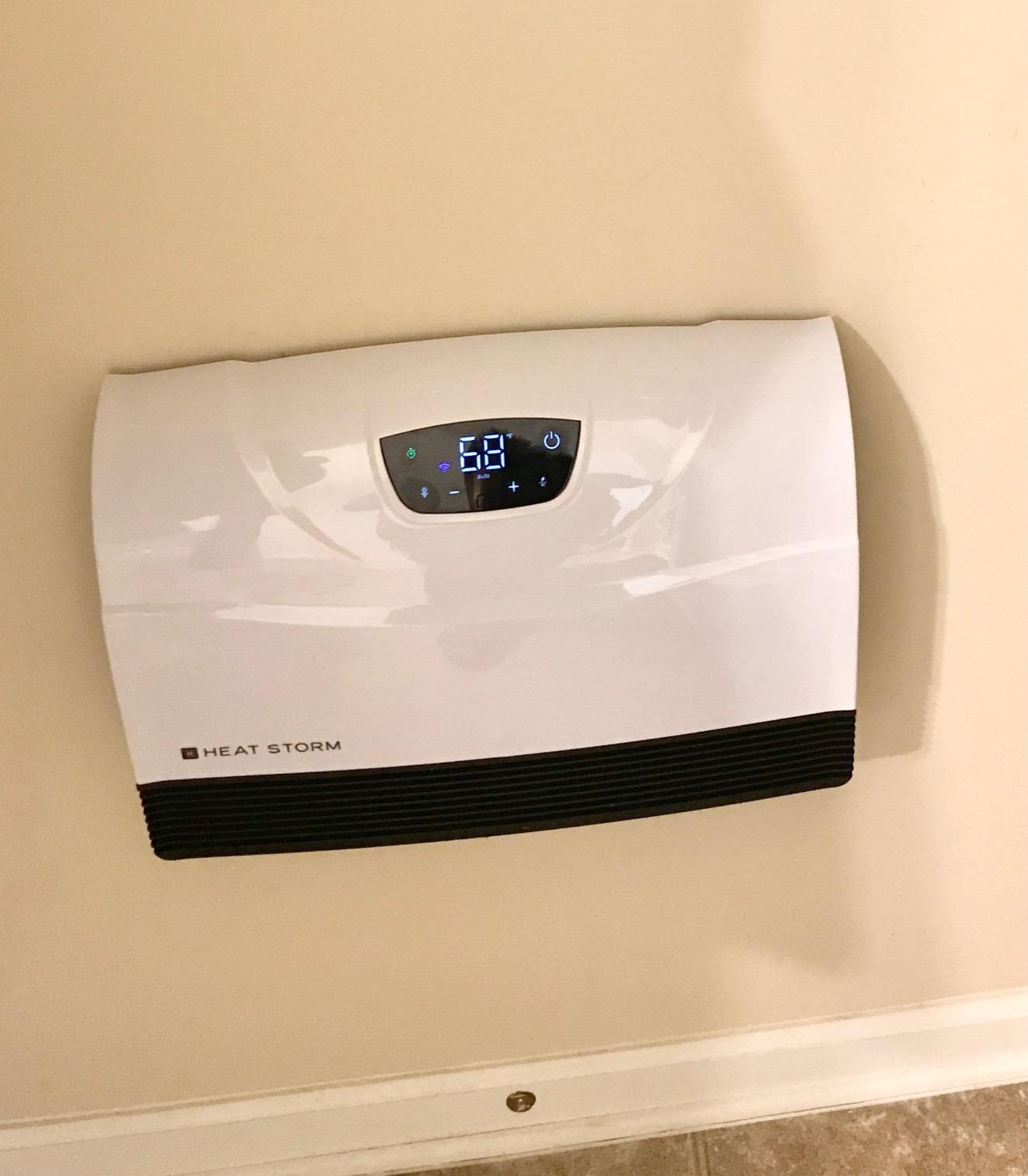
Basement ceilings are frequently seven feet or less, and a floor cabinet heater in a low room is a trip hazard and a dust collector. The HS-1500-PHX-WIFI removes the floor unit from the equation entirely. It mounts to the wall on a bracket, and when it is installed directly over the outlet the cord disappears behind the body.
At 1500 W and 5200 BTU this is the same power envelope as the DR-968, but the manufacturer rates it at about 150 sq ft as primary heat and up to 750 sq ft as supplemental. That is a deliberately conservative rating, and we would plan on the same realistic figure: a small finished room, a converted bedroom, or a seated corner of a larger space.
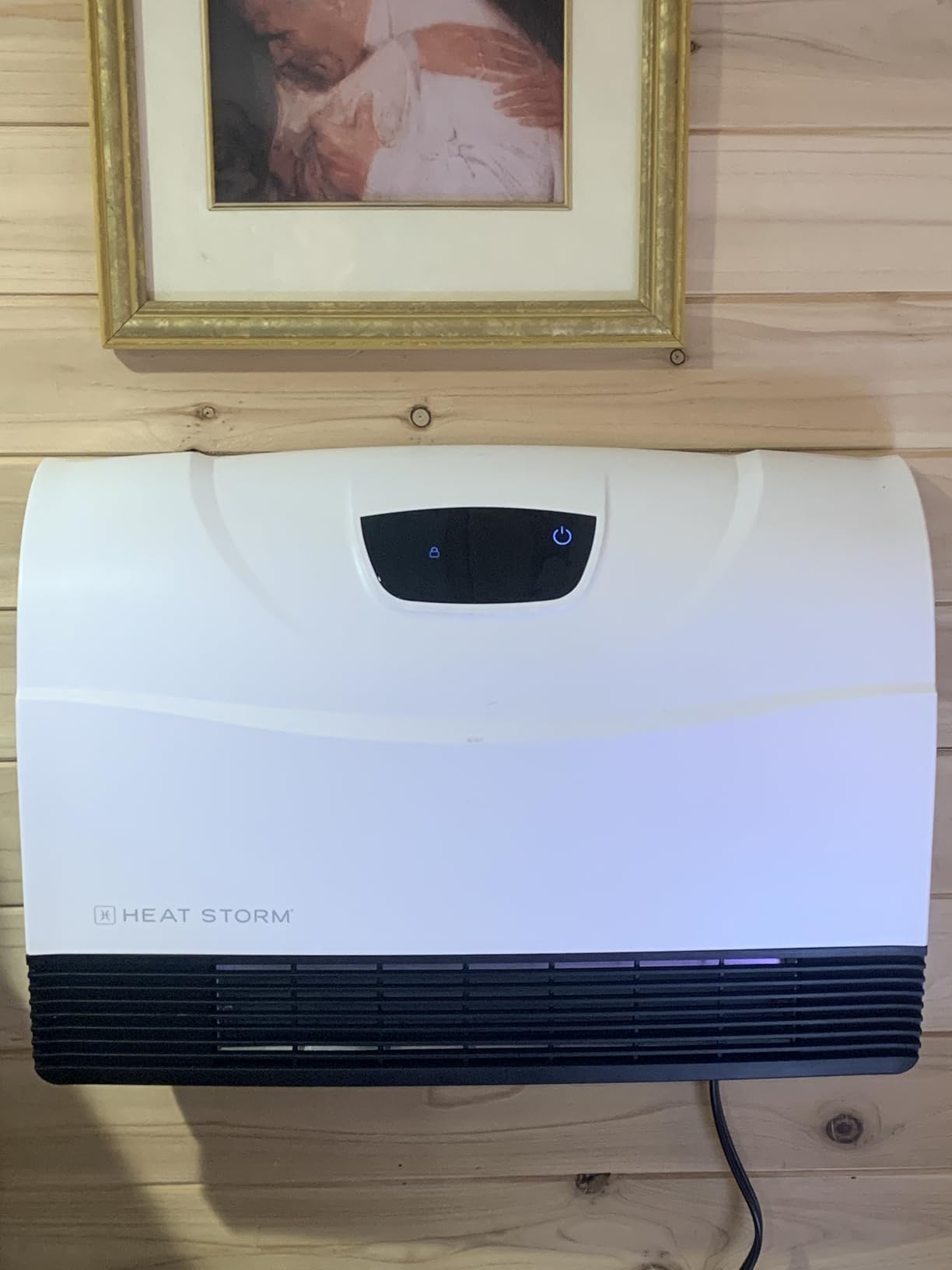
The Wi-Fi and app control is the feature that changes daily behaviour. You can set the temperature from your phone before you walk downstairs, which means you are not standing in a cold room waiting for a room to warm up. The unit also has a touchscreen digital thermostat and an included remote for people who would rather not open an app.
Safety is a genuine strength here. Reviewers highlight that both the unit and the wall behind it stay cool to the touch, and the grill is safe-to-touch, which matters in a finished basement where children or a pet might be around. Tip-over safety shutoff is included as well, even though a wall-mounted unit is not going to tip.
When wall mounting is the right call in a basement
Wall mounting solves three basement-specific problems at once. It keeps the floor clear for storage, it keeps the heater away from dust and stored cardboard that a floor unit would draw in, and it positions the radiant element at roughly chest height, where the warmth is felt rather than wasted at floor level. For a laundry room, a finished rec room, or a small basement bedroom, that positioning is the difference between heating a person and heating a room.
The washable filters are worth noting in an unfinished space. Basement air carries a lot of particulate, and a dirty filter reduces output noticeably.
Where it falls short
This variant is wall-mount only, and attachable feet are not included. If you want the option to pull it down and use it elsewhere, you are buying the wrong unit. The digital display and touchscreen controls are also not backlit, which reviewers flag as awkward in a dark basement with no overhead lighting.
Finally, the 1-year manufacturer warranty is shorter than the 3 years on the Dr Infrared DR-968, a fair consideration for a unit intended to run through a whole heating season.
3. Dr Infrared DR-268 Wall and Ceiling Mount Heater – Best for Damp and Semi-Outdoor Spaces
DR. INFRARED HEATER Portable Infrared Indoor and Outdoor Space Heater for Patio, Garage, Commercial & Residential With Remote Control, With Thermostat, Black
1500W radiant
IPX5 water resistance
Wall, ceiling or chain mount
150-200 sq ft
30-120 F range
Pros
- IPX5 water resistance tolerates damp and humid air
- mounts on a wall
- ceiling
- or hanging chains
- corded remote temperature probe reads the room more accurately
- extruded dual-layer aluminium housing
- ETL certified with overheat protection
Cons
- Rated for only about 150-200 sq ft
- long 34.6 inch bar needs clear wall or ceiling space
- remote probe and remote add parts that can be lost
- needs a nearby 120V outlet
Most indoor space heaters are not built to tolerate a damp basement. The DR-268 is, and that is the entire reason it is on this list. It carries an IPX5 water resistance rating, which means it is approved for indoor and outdoor use including covered porches, greenhouses, and sheds, and it tolerates the higher humidity levels common in below-grade spaces far better than a standard indoor cabinet.
The mounting flexibility is what makes it work in a typical basement. It can be fixed to a wall, mounted to a ceiling, or hung from chains, and it draws just 1500 W with a 1000W lower setting. The two-layer extruded aluminium housing is a sensible choice in a room where corrosion is a legitimate concern over a multi-year lifespan.
The feature we like most is the corded remote temperature probe. A cable runs from the heater to a small sensor you can place at desk height or on the far wall, and the digital display reports that reading rather than the temperature immediately around the element. Several competing heaters use an internal thermostat that reads warm and shuts down early, and this one largely avoids that problem.
It is also genuinely dual-use. If you have a basement workshop that opens to a covered porch or an unheated stairwell landing, this is the type that can stay out there without concern. The thermostat range is unusually wide at 30-120 °F, so it can hold a storage space just above freezing.
Why damp basements need a different heater
Humidity and heat are related in a way that surprises people. Warm air holds more moisture than cool air, so once you start adding heat to a damp basement, the amount of water vapour in the air rises quickly, and that extra moisture has to go somewhere. It condenses on the coldest surfaces: cold water pipes, ductwork, the back of the foundation wall, and window glass. Adding heat to a wet basement without controlling moisture is the fastest route to dripping pipes and musty odours.
A heater with an IPX5 rating is not a dehumidifier and will not lower relative humidity on its own. It simply will not degrade in an environment where a standard indoor unit would. Pair it with a properly sized unit from our dehumidifier roundup and the problem becomes manageable rather than permanent.
Where it falls short
Coverage is the honest limit. At 150-200 sq ft, this is a zone heater, not a whole-basement solution, and anyone hoping it will heat 500 sq ft of unfinished space will be disappointed. The 34.6 inch bar shape also needs a clear run of wall or ceiling to mount, which is not always available in a basement with exposed joists.
Finally, the remote and the temperature probe are two extra pieces of hardware that can be mislaid or fail, and the cord limits how far from the outlet the unit can serve.
4. Dr Infrared DR-988 240V Industrial Heater – Best for Workshops and Uninsulated Spaces
DR. INFRARED HEATER DR-988 240V Electric Industrial Garage, Workshop, Warehouse, Construction Heater, 5600W, Thermostat 37-113 °F, Portable, Wall Ceiling Mount
5600W radiant and forced air
240V and 30 amps
600 sq ft coverage
37-113 F thermostat
UL and C-UL listed
Pros
- 5600W covers roughly 600 sq ft including uninsulated spaces
- powerful balanced fan mixes air and kills cold spots
- wide 37-113 F thermostat range
- portable
- wall-mount
- or ceiling-mount with cord storage
- all-metal housing and steel safety grille
Cons
- Requires a dedicated NEMA 6-30R 30 amp 240V circuit
- internal thermostat reads near the unit so an external one is better
- high wattage is an expensive way to heat a space
- fan is louder than a 120V portable
Every other heater in this roundup runs on 120V and draws around 12.5 amps. The DR-988 runs on 240V, draws 30 amps, and puts out 5600 watts. That is nearly four times the power of a standard portable heater, and it is the only unit here that can credibly take the chill off a genuinely large, poorly insulated basement workshop or garage over winter.
The heating method is both forced air and radiant, which matters in a cold space. A high-output fan moves air through the room quickly so warm air reaches the far corners, while the radiant element gives you immediate warmth at close range. Owners running a winter project downstairs consistently report strong air movement and steady temperature holding, with several noting that it protected pipes and paint from freezing.
Build quality is above what you get in a household portable heater. The housing is all metal, the front is a steel safety grille, the fan blades are aluminium, and the unit is UL and C-UL listed with an automatic overheat cut-off. The thermostat runs from 37 °F to 113 °F, and there is ON/AUTO fan control plus compatibility with an external wall thermostat.
It also mounts three ways: freestanding, wall-mounted, or ceiling-mounted, with built-in cord storage. In a basement where a low ceiling and a storage-heavy floor make a floor unit impractical, that flexibility is valuable.
When a 240V circuit is worth installing
Installation is the decisive factor here. This heater requires a dedicated NEMA 6-30R 250V 30 amp outlet and an appropriate two-pole breaker, and in an older house with an unfinished basement that often means an electrician and a panel upgrade. If you already have a 240V dryer or range circuit nearby, the conversation is much shorter.
Our honest view is that insulation almost always pays back faster than a 5600W heater. A recurring theme in r/homeowners and r/HomeImprovement discussions is that spending first on rim joist and subfloor insulation, then adding a smaller heater, beats running a very large heater in a leaking envelope. Where the big heater is clearly right is a workshop where you genuinely need the air temperature up while you work.
Where it falls short
The electrical requirement is the dominant downside. A 30 amp dedicated circuit is a real installation cost and rules the unit out for many renters and for basements on older wiring. The fan is also noticeably louder than a 120V portable heater, which is fine in a workshop and annoying in a finished room.
There is no on/off power switch on the unit itself, so control depends on the thermostat or an external switch, and the internal thermostat reads the air near the element rather than across the room.
5. Heat Storm HS-1000-WX 1000W Wall Mount – Best for Small Finished Rooms
Heat Storm Deluxe Space 1000 Watt Infrared Wall Mount Electric Heater, White
1000W infrared quartz
100 sq ft primary and 500 sq ft secondary
Wall mount under 2 sq ft
3 modes with Eco
8 lbs
Pros
- Wall mount takes almost no floor space and installs in under ten minutes
- LED display dims to dark mode so it will not glow at night
- true safe-to-touch grill verified by owners with children
- three modes including an Eco setting
- long-term owners report six-plus years of service
Cons
- 1000W is a modest heat ceiling for a cold basement
- loud beep on every button press with no way to disable it
- no on-unit power switch so shutdown depends on the remote
- displayed room temperature often needs calibration
Not every basement room needs 1500 watts. A finished basement bedroom, a small bathroom, a mudroom, or a converted storage nook can be made comfortable with considerably less, and the HS-1000-WX is the unit we would put in those spaces. At 1000W it is rated for about 100 sq ft as primary heat and up to 500 sq ft as supplemental.
It mounts on the wall using under 2 sq ft of space, and reviewers report the install is genuinely quick: a wall template and a level bubble are included, and most people finish in under ten minutes. It plugs into a standard 110V outlet, so no electrical work is involved at all.
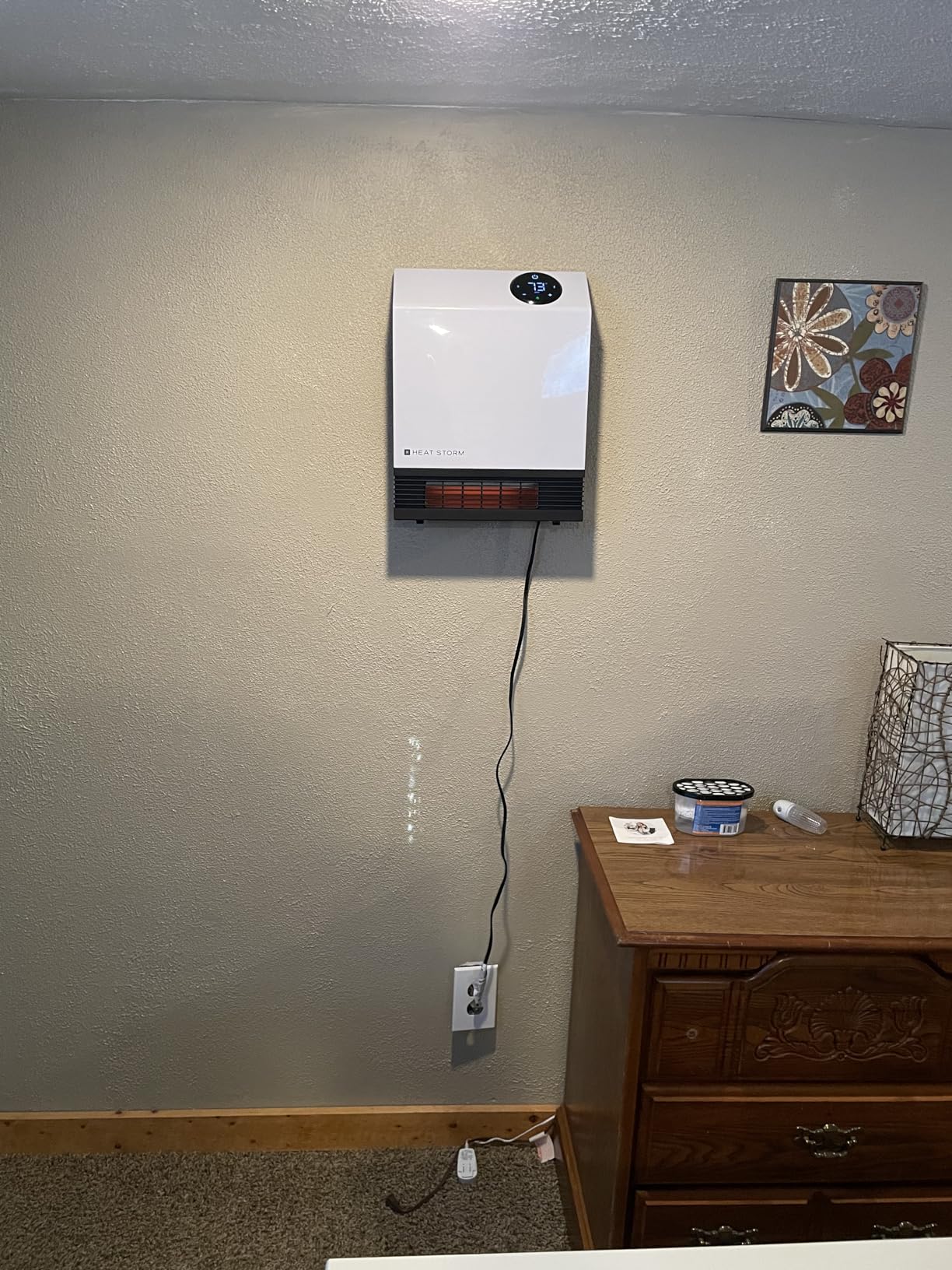
Two design details stand out for basement use. The LED display switches to a dark mode after five minutes of inactivity, which matters in a windowless room with no other light source. And the grill is genuinely safe to the touch, confirmed by owners with young children, so the front of the unit can be at a comfortable working height without posing a burn risk.
Durability is the other strength. Long-term owners report more than six years of continuous service through cold Iowa winters, which is a meaningful data point for a heater that will run for months at a time in an uninsulated room.
Where 1000W is the right amount of heat
Lower wattage is an advantage in a basement, not just a compromise, in two situations. If your concern is a cold pipe in an exterior wall or a laundry area in shoulder seasons, 1000W run on a thermostat is plenty and cheaper to operate. And in a small finished room, a 1500W unit on a high setting cycles off constantly, which is harder on the elements and wastes electricity.
The Eco mode drops consumption further, and the washable air filters help keep output steady in a dusty unfinished space.
Where it falls short
The heat ceiling is the obvious limit. In a genuinely cold unfinished basement, 1000W will not raise the temperature much, and it is best understood as a comfort heater for an already-small, semi-insulated space.
Control is also fussier than it should be. There is a loud beep on every button press with no way to disable it, and no on-unit power switch, so switching off means reaching for the remote. Several owners have had a remote fail, which leaves a heater that is awkward to turn down.
6. Comfort Zone Dual Quartz Tower – Best Budget Pick for a Basement Zone
Comfort Zone Space Heaters for Indoor Use, Portable Electric Heater, Adjustable Thermostat, Infrared Heat, Quartz Tower Space Heater with 2 Heat Settings, Bedroom Heater, Black
1500W with dual quartz tubes
200-300 sq ft coverage
22.5 inch tower
Floor mount
6.1 lbs
Pros
- Dual quartz tubes give strong radiant heat for the money
- 6.1 lb body with a stay-cool handle and slim footprint
- tip-over switch and overheat protection add real safety margin
- fan-assisted heat spreads rather than creating a hot spot
- simple top-mounted knob controls
Cons
- Fan is loud and some owners disconnect it
- thin metal reflectors rattle for the first minutes of use
- manual knob thermostat with no timer or remote
- tip-over switch is very sensitive to small knocks
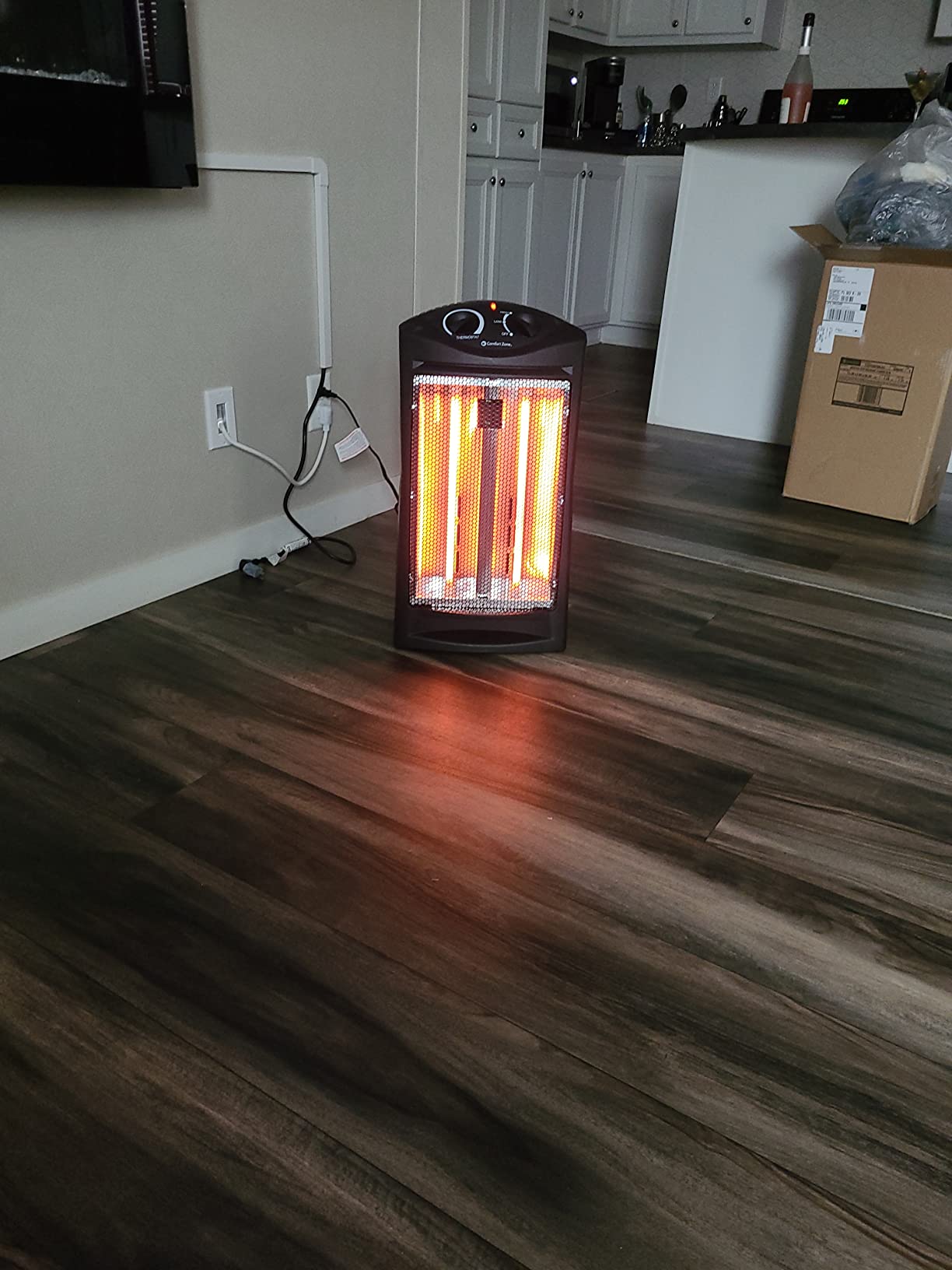
The Comfort Zone quartz tower is the value option in this roundup, and the value proposition is real heat per pound. It uses dual quartz tubes with a fan-assisted design, rated at 1500W and covering 200-300 sq ft, and a number of owners report it outperforming more expensive cabinet heaters in the same test conditions.
For a basement it is a sensible first machine: 6.1 pounds, a stay-cool molded handle, a slim 22.5 inch tower footprint, and both tip-over and overheat protection. That combination of a light body and a stable base is a good match for a room where you will be carrying the heater up and down steps regularly.
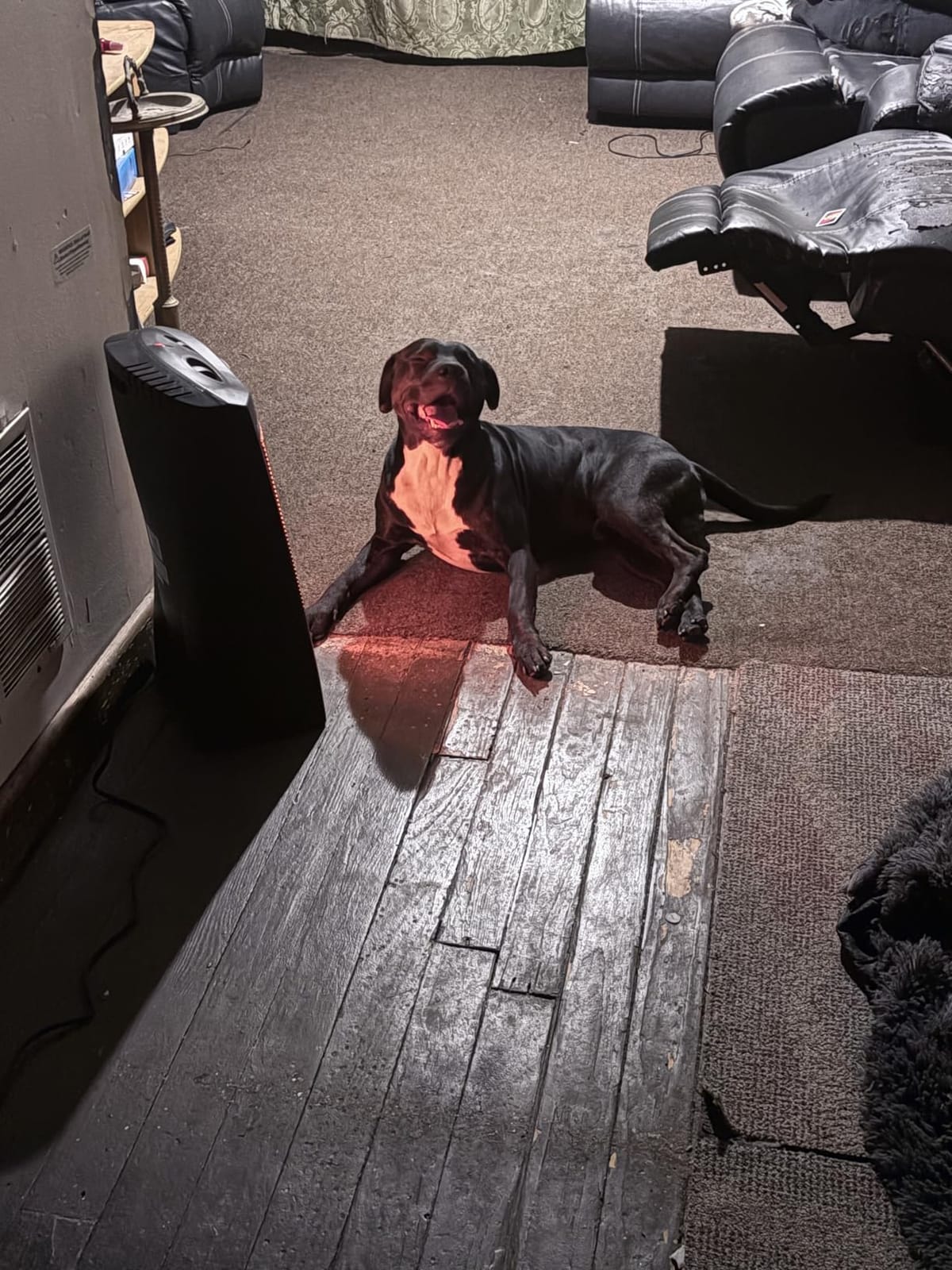
The fan-assisted design does something for basements that pure radiant heaters do not. Air is moved across the tubes and into the room rather than simply rising, so warmth is distributed more evenly and you are less likely to have a hot zone directly in front and a cold zone four feet away.
Controls are the simplest of any heater here: two top-mounted knobs, one for the thermostat and one for the heat setting. Nothing to program, nothing to learn.
Where a budget tower earns its place
This is the right pick for a single cold corner rather than a whole room. A basement workshop bench, a spot near the sump pump, a corner you use as a gym, or a secondary heater that covers a second zone while a larger unit runs elsewhere. Two units placed diagonally in an open basement, each handling a zone, is a common and effective arrangement among the owners we read.
Owners also commonly use it to cut the chill in shoulder seasons, when a full heating setup is more than the space needs.
Where it falls short
Noise is the standout drawback. The fan is loud enough to distract during television, and several owners disconnect it entirely. The thin metal reflector panels can also rattle loudly for the first few minutes after startup, which is unpleasant in a quiet room at night.
Control is bare-bones: a manual knob thermostat with no timer, no remote, and no memory. The tip-over switch is also unusually sensitive, cutting off at the slightest bump, which in a working basement with a busy floor can be an irritation rather than a safety feature.
7. EdenPURE CopperPLUS 903G – Best for Large Finished Rooms
EdenPURE CopperPLUS Infrared Heaters for Indoor Use Portable 1000 Sq Ft
1500W and 5000 BTU
Rated up to 1000 sq ft
Copper PTC surface
24 settings from 40-90 F
cETL approved
Pros
- Largest claimed coverage in this roundup at 1000 sq ft
- 3.5+ sq ft copper PTC surface needs no replacement bulbs
- quiet enough for a bedroom
- 24 precise settings with auto-reset memory
- lifetime washable filter
- dual overheat sensors and cETL approval
Cons
- Expensive relative to other infrared heaters of similar wattage
- heavy at 24 lb so it is awkward to move
- bulky cabinet for a small basement nook
- only a 1-year warranty
The EdenPURE CopperPLUS is built differently from every quartz heater here. Rather than infrared tubes or bulbs, it uses more than 3.5 sq ft of copper PTC surface, which means there are no lamps to burn out and no replacement parts to hunt for in a few years. For a heater you plan to run in a basement through many winters, that is a meaningful durability argument.
It also carries the largest claimed coverage figure in this roundup at 1000 sq ft, and the 1500W output is rated at 5000 BTU. We would still treat that as an aspirational maximum for a well-insulated, closed space rather than an unfinished concrete basement, but among household heaters here it is the one most likely to serve a large finished rec room or a full converted basement.
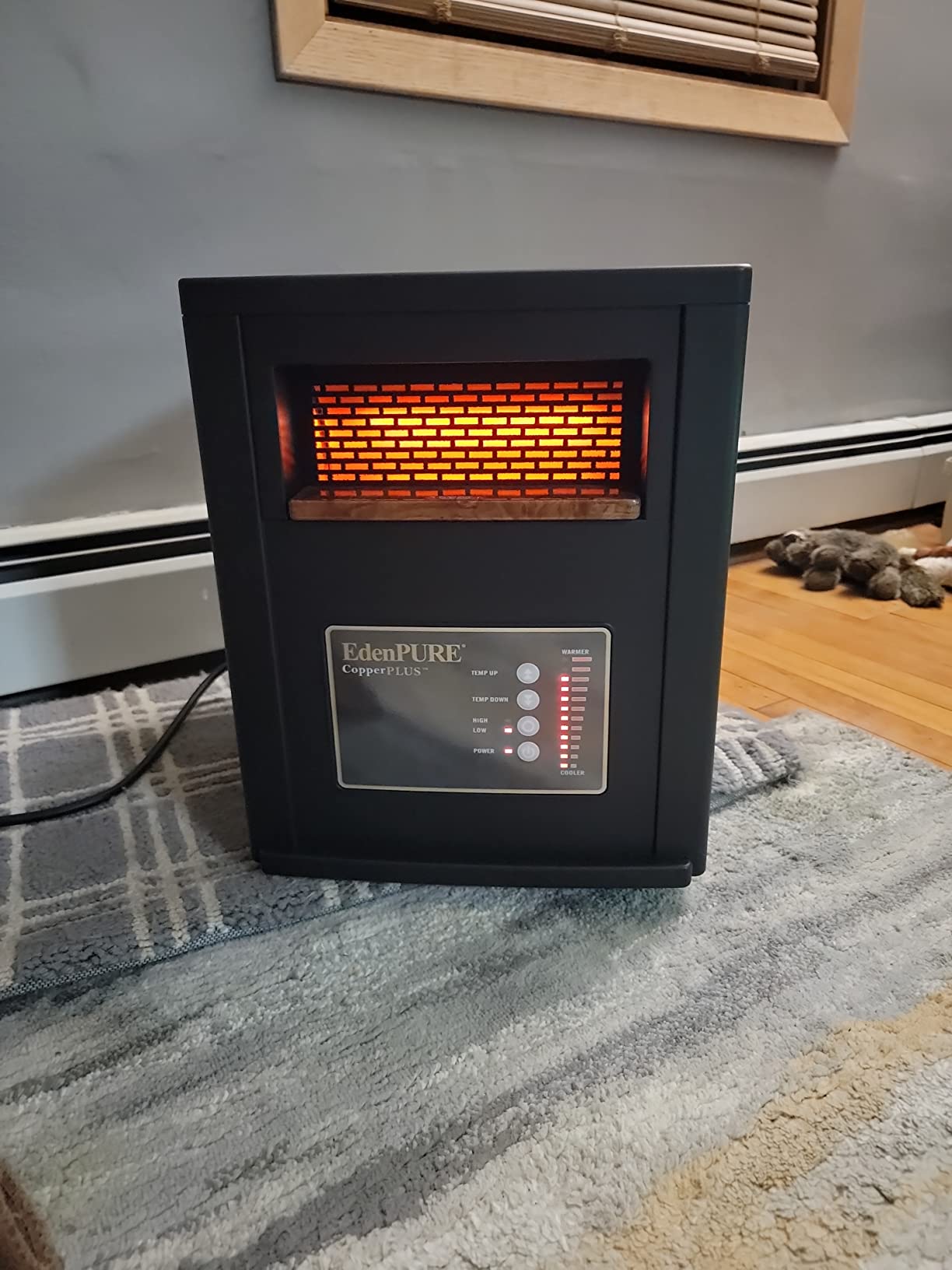
Control is the most granular we have seen. There are 24 heat settings from 40 °F to 90 °F, with high 1500W and low 1000W modes and an auto-reset memory that restores your last setting after a power interruption. That last detail is exactly what a basement needs, since power interruptions in below-grade spaces are not unusual.
It is also quiet, which reviewers consistently highlight, and it does not dry the air. That matters for anyone in the house with allergy or respiratory sensitivity. The lifetime washable filter removes a recurring cost, and safety hardware includes dual overheat sensors, tip-over shut-off, a touch-safe front grill, and cETL approval.
Why copper PTC suits a damp basement
PTC elements produce heat as a side effect of current flowing through a resistive ceramic surface, and a copper plate spreads that heat across a much larger area than a glowing tube does. The practical result in a basement is gentler, more even radiant output with no extremely hot filament near the air intake. There is also nothing incandescent to degrade in humid conditions, and nothing that dries the air the way a high-velocity forced-air heater does.
For a finished basement used as a bedroom or office, quietness and evenness matter as much as raw output, and this is the quietest large-room option we list.
Where it falls short
At 24 pounds it is heavy, and the cabinet is bulky. Moving it between a rec room and a workshop takes two people or a dolly, which undercuts the zoning flexibility a portable heater is supposed to offer.
The cost is also high relative to other heaters of the same wattage in this list, and the warranty is only one year. Reviews offer limited long-term durability data on the copper surface, so we would treat the multi-year claim as plausible but unproven rather than established.
8. WEWARM 1500W Six-Element Infrared Heater – Best for Quiet Rooms
Space Heater 1500W Infrared Heater for Indoor Use WEWARM
1500W with 6 quartz elements
300 sq ft coverage
34 dB operation
12-hour timer
TUV certified
Pros
- 1500W in a 6.4 lb cabinet
- 34 dB operation is effectively silent unless you are standing at it
- ECO mode and low setting let a room be held on less power
- no odour from the unit
- TUV certified with V-0 flame-retardant housing
- child lock and cool-touch exterior
Cons
- Some units have short-circuited after a short time of use
- coverage limited to about 300 sq ft
- thermostat range of 50-90 F is fairly narrow
- compact size works best aimed at one spot
The WEWARM is the quietest heater in this roundup, with a stated 34 dB operating level. If your basement doubles as a home office, a study, or a bedroom, that number is the feature that matters most, because the alternative is listening to a blower all winter.
It manages 1500W from six quartz elements inside a cabinet that weighs just 6.4 pounds. At 9.84 by 10.03 by 12.6 inches it is small enough to sit on a shelf or a workbench rather than taking floor space, and it carries a 12-hour timer, a digital thermostat from 50-90 °F, an ECO mode, and a remote control with an LED indicator.
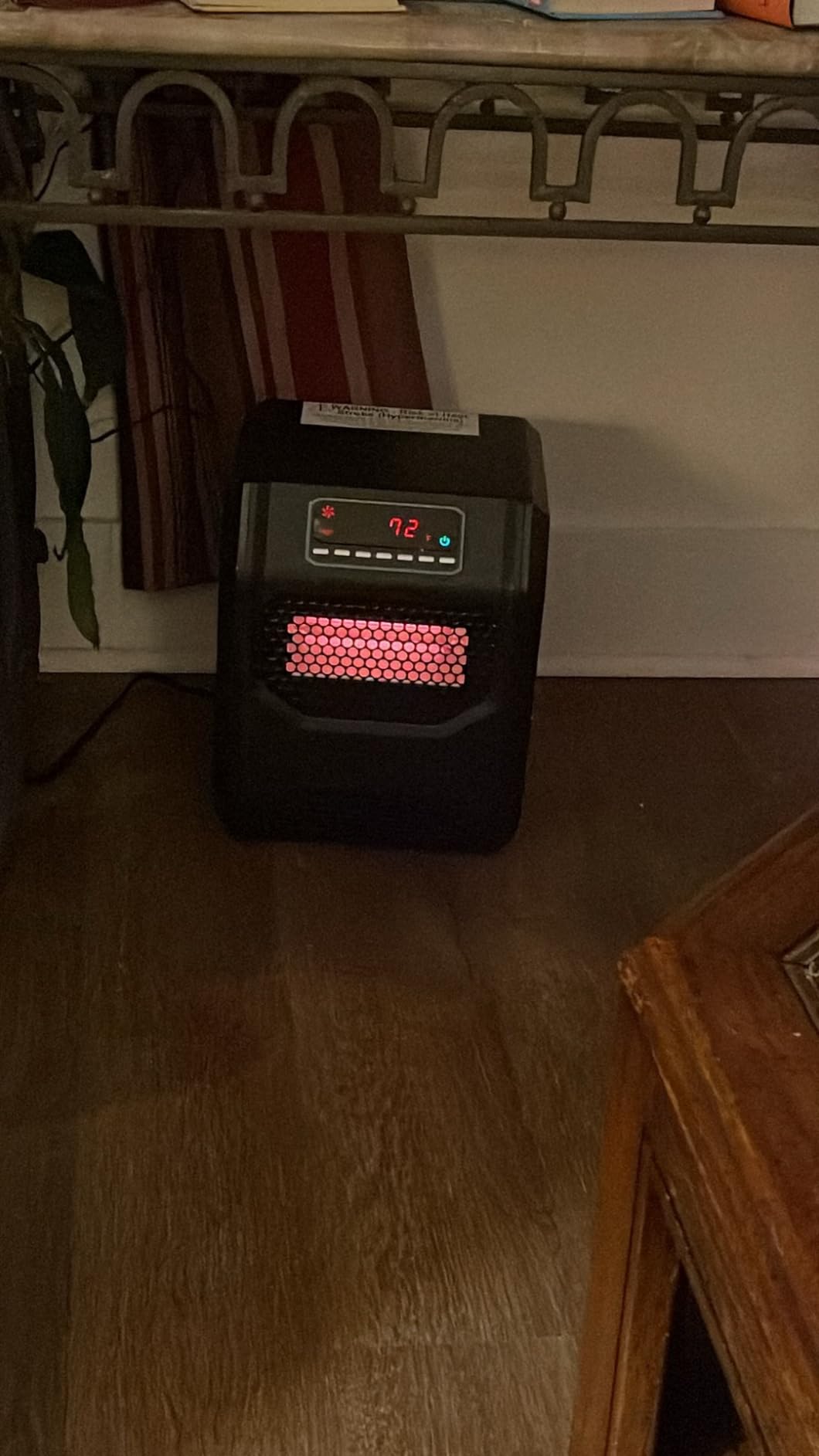
On the safety side it is well specified for a basement: TUV certification, V-0 flame-retardant materials, overheat protection, tip-over auto shutoff, a cool-touch exterior, and a child lock. Owners also report no odour from the unit, which is worth noting in a small room where a burnt-plastic smell would be unpleasant.
Typical basement uses are targeted rather than whole-room: holding off a cold spot, warming a family room in spring and autumn, and keeping well-house piping from freezing during a cold snap.
Why quiet matters more downstairs
Noise is easy to dismiss until you consider where a basement heater actually runs. A rec room with a sectional and a television, a home office on a shared wall, or a basement bedroom at night all turn a 39 dB blower into a real annoyance. Dropping from 39 dB to 34 dB is a small number on paper and a clear difference in a quiet room.
Because the unit is light and small, it is also easy to reposition so it is not directly beside your desk, which is another quiet-room technique that costs nothing.
Where it falls short
Reliability is the concern we would weigh most. A minority of reviews report units that began short-circuiting after a short period of use, and with only a few hundred reviews on record the long-term picture is not well established.
Coverage is limited to about 300 sq ft, and the narrow 50-90 °F thermostat range does not give fine control at the cold end. The compact cabinet also means it works best aimed at a specific area rather than distributing heat evenly across a large room.
9. Heat Storm Mojave HS-1500-IMO – Best for Homes with Kids and Pets
Heat Storm Mojave Indoor Ultra Lightweight Portable Infrared Space Heater – 1500 Watts – Built in Thermostat & Overheat Sensor – Remote Control
1500W and 5200 BTU
300 sq ft primary and 1000 sq ft supplemental
HMS heat exchanger
Wide stable base
about 9 lbs
Pros
- Wide low base and low centre of gravity make it very hard to tip over
- patented heat exchanger adds humidity rather than drying the room
- cool-touch exterior
- energy mode drops from 1500W to 750W
- two side air filters that are easy to clean
Cons
- Internal thermostat often reads warmer than the room and shuts off early
- audible clicking when cycling and some fan noise
- 1000 sq ft figure is a supplemental rating
- some units arrive non-functional or with weak elements
Tip-over risk is the first question in a basement playroom, a family rec room, or any space a dog can reach. The HS-1500-IMO answers it with geometry: a low, wide base and a low centre of gravity that make it extremely difficult to knock over, combined with a knock-over switch and overheat protection as a backstop. The cool-touch exterior adds a second layer, since there is no exposed hot metal to the touch.
The heat output is 1500W and 5200 BTU, rated at about 300 sq ft as primary heat and up to 1000 sq ft as supplemental. The 300 sq ft figure is the realistic planning number for a finished room.
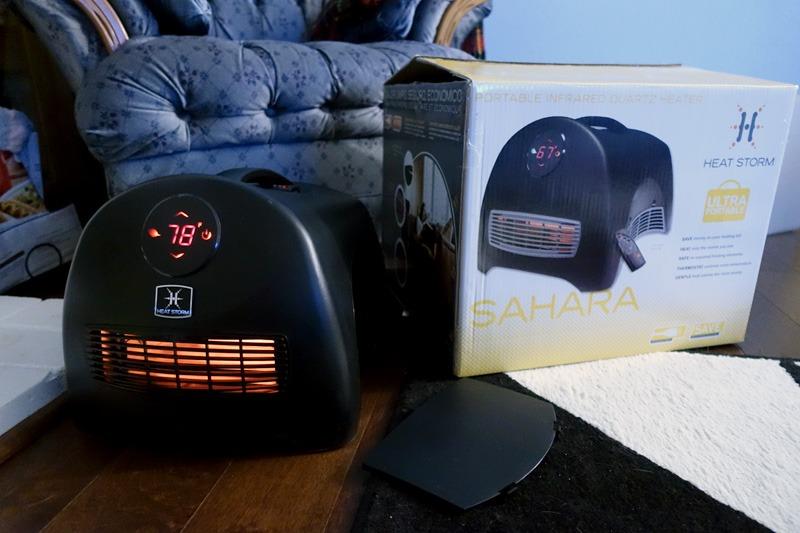
The patented heat exchanger with HMS technology is unusual here. Rather than simply moving air past a hot element, it uses the room’s humidity to produce soft heat while adding moisture rather than stripping it. In a basement that already runs dry in winter when the heating system runs, that behaviour is welcome, and it is the reason this unit is comfortable in a space where a forced-air heater would feel harsh.
It weighs about 9 to 11 pounds with a top handle for carrying between rooms, and there are two side air filters. Keeping those filters clean makes a noticeable difference to output, which is easy to do in a dusty unfinished space.
Why a wide base matters more in a basement
Basement floors are uneven, cluttered, and often have a step somewhere in the route between the outlet and where you want the warmth. A tall cabinet heater in that environment tips over more easily than it would on a level upstairs floor. A wide, low base is a mechanical fix rather than a software one, and it is why this cabinet is the one we would put in a room where a child or a large pet is present.
The energy mode dropping from 1500W to 750W is also useful for holding a room at a lower temperature overnight without running full power.
Where it falls short
The most repeated complaint is thermostat accuracy. Owners report the internal sensor reading substantially warmer than the actual room, which causes premature shutoff. In a large or uneven space, calibrate the setting well above the displayed temperature and expect to adjust it.
There is also audible clicking as it cycles, some fan noise, and the glowing element doubles as a night-light, which some people like and some find irritating. A minority of units have arrived non-functional or with elements too weak to heat past about 50 °F, so purchase protection is worth having on an order this size.
10. AirNmore Comfort Deluxe Copper PTC Heater – Best for a Bulb-Free Design
Comfort Deluxe by Airnmore, with Copper PTC, Infrared Space Heater with Remote,1500W,ETL Listed with High and Low Settings, Good for Small to Large Room’s, 2-year warranty.
1500W copper PTC
About 250 sq ft coverage
ETL listed
Cool-touch body
2-year warranty
Pros
- Copper PTC design means no infrared bulbs to burn out or replace
- retains humidity rather than drying the air
- quiet enough for a bedroom or office
- cool to the touch with no exposed element
- on wheels and hard to tip
- 2-year warranty is the joint longest here
Cons
- Expensive for the wattage
- no numeric temperature readout so settings must be calibrated by feel
- fan and cabinet can rattle or vibrate noticeably
- listed 250 sq ft coverage is modest for the size
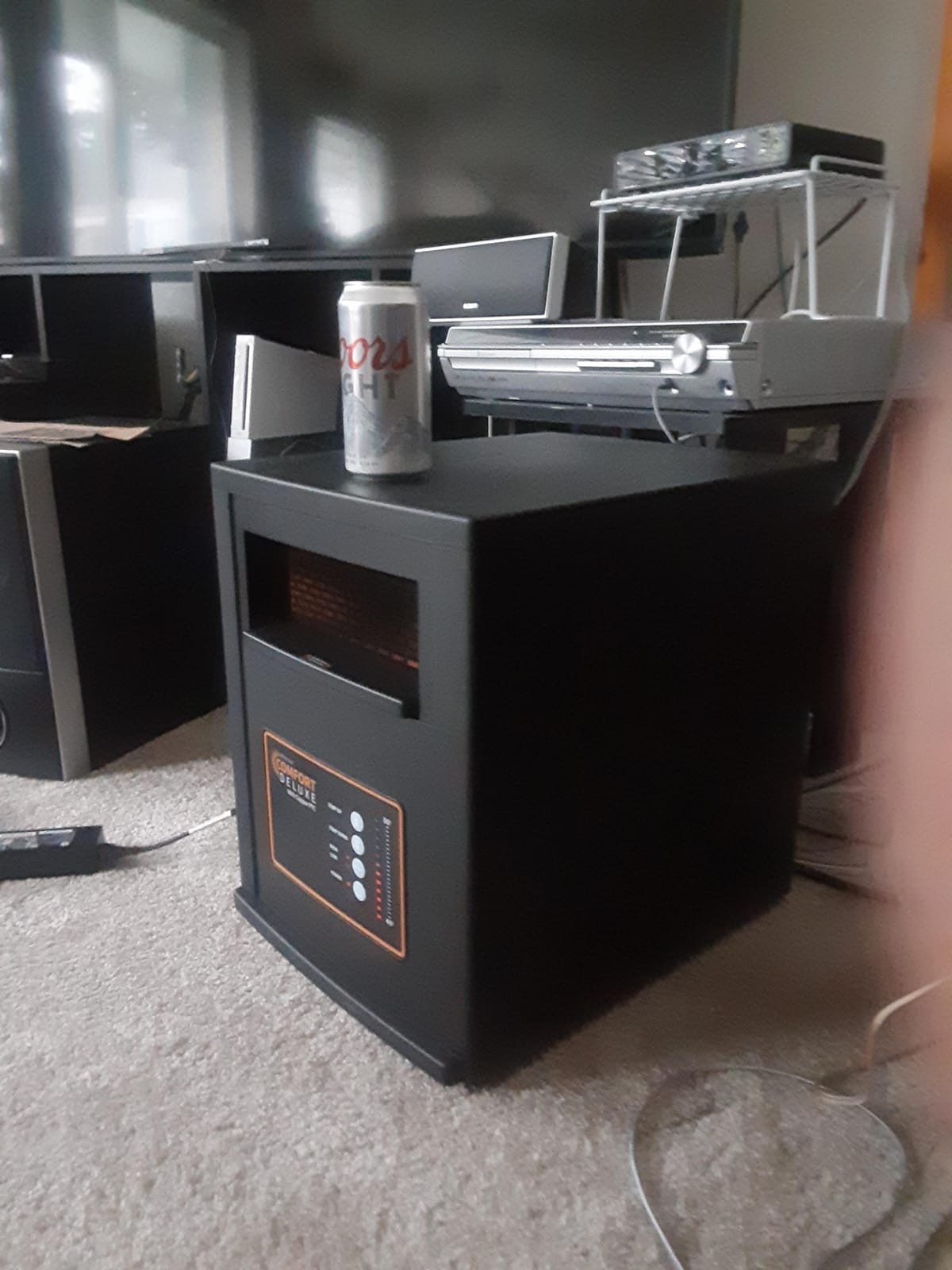
The AirNmore Comfort Deluxe is the same basic idea as the EdenPURE CopperPLUS: a copper PTC element instead of infrared bulbs, so there is nothing incandescent to burn out. Owners frequently compare the two directly and generally rate them equal or better for the same use. Where it differentiates itself is the two-year warranty, the joint longest in this roundup, and USA-based customer support including direct phone contact.
Output is 1500W with high and low settings, rated for about 250 sq ft. That is a smaller footprint than the EdenPURE, so it suits a basement bedroom, a home office, or a defined zone rather than a large open room.
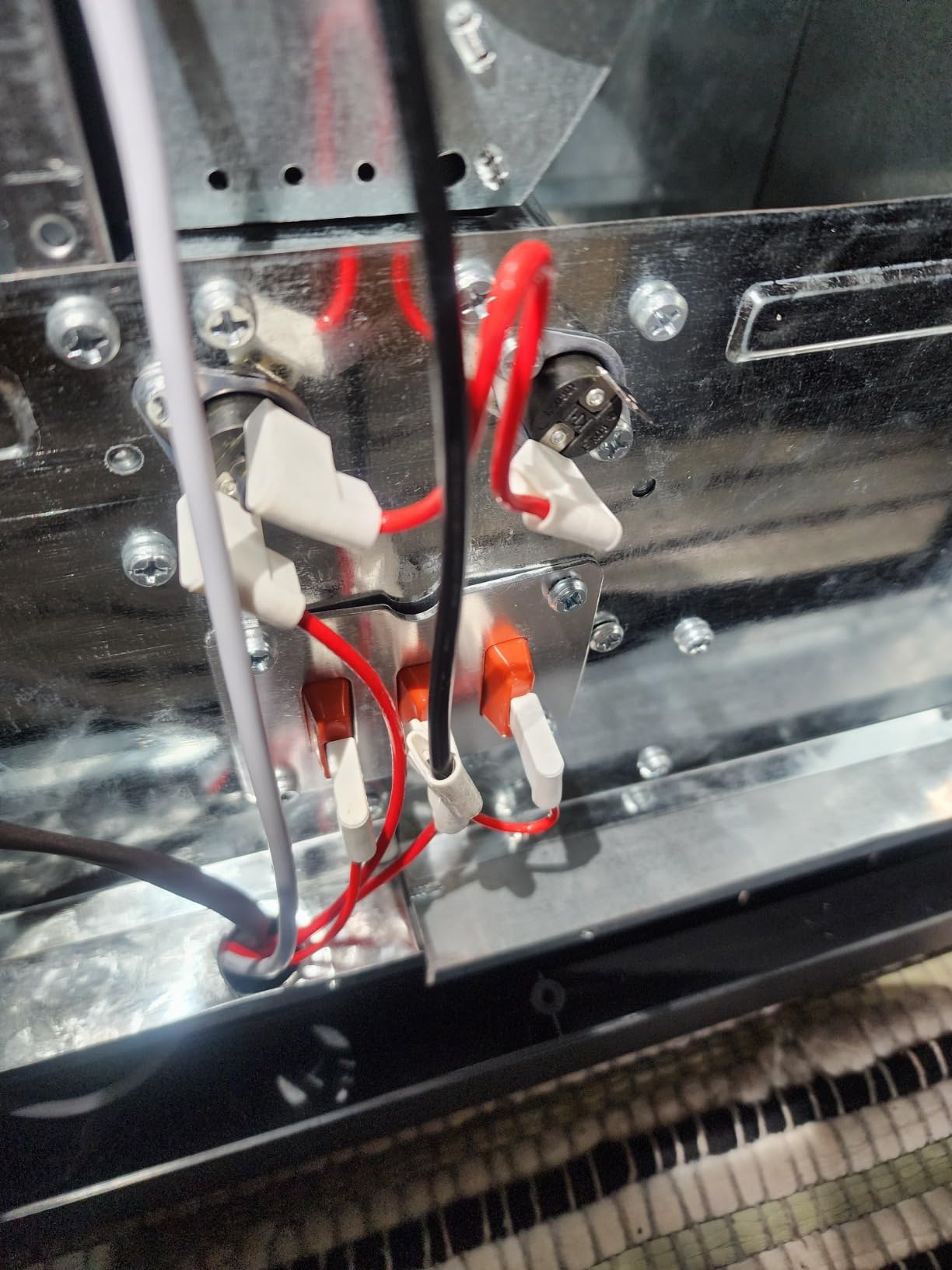
Everything about the design is aimed at leaving a heater running unattended. The exterior is cool to the touch with no exposed heating element, it sits on wheels, and it is hard to tip. The unit cycles on and off automatically to hold the set temperature, so you can set it and leave it.
Like the EdenPURE, it retains humidity rather than drying the air, which is comfortable in a basement where the air is already working hard.
Why bulb-free elements matter over a decade
Quartz and halogen infrared bulbs are consumables. They run hot, they degrade, and when one fails the heater is dead until a replacement is fitted. In a finished rec room that is an inconvenience; in an unfinished basement workshop with cardboard and dust nearby, a cooler-running element with no filament is simply a safer long-term proposition.
The copper PTC approach also spreads heat across a broad surface, so the output is steadier than a single tube that cycles from cold to very hot. For someone running a heater all winter in a space used as a daily office, that consistency is the main benefit.
Where it falls short
The temperature control is the weak point. There is no numeric readout, so the setting is shown by lit red dots and must be calibrated by feel, and some owners report needing to adjust it more often than they would like. The fan and cabinet can also rattle or vibrate, with a few owners describing a squeaky, out-of-balance sound.
At 250 sq ft of listed coverage for a full-size cabinet, the specification is modest, and the cost is high for the wattage compared with the quartz heaters earlier in this list.
How to Size an Infrared Heater for a Basement
The first rule of basement heater sizing is that you size for the room, not the whole basement. A 1500W heater on a standard 15A 120V circuit is the practical ceiling for a portable unit, and the watts-per-square-foot guidance below tells you what that can realistically cover.
A finished, insulated basement typically needs about 10 watts per square foot. An uninsulated or unfinished space with concrete walls and a bare slab needs more like 12 to 15 watts per square foot, because the heater is fighting continuous loss rather than a closed room.
200 sq ft finished: about 2000 W, so one 1500W heater as primary plus careful placement, or two smaller heaters placed apart.
300 sq ft finished: about 3000 W, so two 1500W heaters positioned diagonally in the space.
500 sq ft uninsulated: about 6000 to 7500 W, which means two 1500W heaters plus a 240V model, or a properly designed fixed system.
800 sq ft uninsulated: 9600 W or more. This is beyond portable heaters, and a mini-split or ducted system is the realistic answer.
1000 sq ft uninsulated: 12000 to 15000 W. Zone heating with a fixed system, not a portable cabinet.
Two practical rules follow from that. First, two smaller heaters placed diagonally in a room outperform one heater in the centre, because radiant heat falls off quickly with distance and distance is the enemy in a basement. Second, and more importantly, insulation changes the maths more than heater selection does. Rim joist insulation and a subfloor with a proper R-value reduce the required wattage substantially, and the money saved there is usually larger than the money saved on the heater itself.
You can read more about the quieter, longer-lived alternative approach in our guide to oil-filled radiator heaters for basements.
Heating a Damp Basement Without Making It Worse
Heating a basement does not remove moisture, and in a damp space it can make the problem more visible. Warm air holds more water vapour than cool air, so adding heat raises the absolute amount of moisture in the air. That extra moisture has to condense somewhere, and it will condense on whatever is coldest: supply pipes, ductwork running through the slab, the back of the foundation wall, and any single-pane glass.
The practical sequence is straightforward. Control the moisture first, with a dehumidifier or a dedicated dehumidification circuit, and target relative humidity of 50% or below. Then address vapour control, because a vapour barrier installed on the wrong side of the foundation wall can trap moisture in the wall assembly and quietly reduce the effectiveness of the insulation. Then insulate the rim joists and the underside of the subfloor. Only after that is a heater going to deliver what you paid for.
A recurring theme on r/homeowners and in diychatroom discussions is the musty basement, and the consensus is that a dehumidifier holding relative humidity around 50% or less does more than any heater. Our basement dehumidifier roundup covers that side of the problem. If water is actively entering the basement, fix drainage and a sump pump before spending on heat, since a heater cannot dry a wall that is wet from the outside.
Basement Electrical and Safety Checklist
Basements carry more fire risk than the rest of the house because of what gets stored in them and how long a heater may run unattended. Before you plug anything in, work through this list.
Use a GFCI-protected outlet. Basements are treated as wet locations for electrical purposes, and GFCI protection is the single most important safeguard.
Give the heater a dedicated circuit. A 1500W unit draws 12.5 amps, which is most of a 15A branch circuit. Sharing that circuit with anything else is a common cause of nuisance tripping.
Never use an extension cord. This is the most frequently repeated warning in every forum thread we read on the topic, and it is not negotiable. A 6-foot cord is included for a reason.
Keep three feet of clearance from the front and sides, and never place a heater under a low ceiling with stacked storage above it.
Check for UL, ETL, or cETL listing. Certification is only meaningful for unattended operation if the listing is there.
Confirm tip-over and overheat protection, and confirm the thermostat actually cycles the element.
Do not run a heater unattended overnight in an uninsulated space. Every safety mechanism on these units is a backup, not a guarantee.
If you need more than 1500W, use a properly installed 240V circuit. A heater in a renter situation should be approved by the property owner first, which is a recurring point of friction on r/Renters.
Who Should Not Buy a Space Heater for Their Basement
We would rather lose a sale than watch this go wrong. There are four situations where an infrared space heater is the wrong answer.
If your basement is larger than about 600 sq ft and uninsulated, a portable heater is a comfort device, not a heating system. You will spend a lot of electricity for a partial result. Fix the envelope and install a fixed heat source, ideally a mini-split heat pump, which is far more efficient per watt and heats a large open space evenly.
If you have active water intrusion or a persistently musty smell, heat is the third step, not the first. A heater running in a wet basement will accelerate corrosion, encourage mould, and give you condensation on every cold pipe in the room.
If you rent, check with your property owner first. Basement heaters are a common source of conflict over fire safety and electricity, and it is better to have a documented conversation than to remove a tripped breaker later.
And if you need the basement at a stable temperature day and night, a thermostat-controlled space heater at 12.5 amps is not designed for that duty cycle. Ask about a hardwired baseboard or a ducted system instead.
Frequently Asked Questions
What is the best heater to heat a basement?
For most basements the best heater is a 1500W infrared or radiant cabinet heater on a dedicated GFCI circuit. It delivers usable comfort to a defined zone at a fraction of the cost of heating the whole house. For an open space over 600 sq ft, a mini-split heat pump is the better system.
What are the downsides of using infrared heaters?
Infrared heaters warm objects and people more than air, so a large cold room may never reach a comfortable air temperature. They do not remove moisture and can cause condensation on cold pipes. They draw high current, so a 1500W unit needs a dedicated circuit, and they must never run off an extension cord.
Are infrared heaters suitable for unfinished basements?
Yes, with caveats. An unfinished basement needs more wattage per square foot than a finished one, and a standard indoor heater can degrade in humid air, so an IPX5-rated model is better. Place it away from stored cardboard and exposed framing, and keep three feet of clearance on all sides.
Is 70% humidity in a basement bad?
Yes. Sustained relative humidity above 60% encourages mould, mildew, and dust mites, and it damages wood and paper. Aim for 50% or below with a dehumidifier, fix any water intrusion, and consider a heater with a humidity-preserving element that does not strip moisture from already dry air.
What takes dampness out of a basement?
A dehumidifier does the work, not a heater. Keep relative humidity at 50% or below, repair grading and drainage, install or service a sump pump, and place vapour barrier on the warm side of the foundation wall. A heater alone can make a damp basement worse by driving moisture into cold pipes and ductwork.
Should you heat your basement in the winter time?
Heat it selectively if you use the space. Heating only the finished rooms or workshop you occupy, and leaving storage areas cooler, costs far less than heating the full volume. Keep the whole basement just above freezing to protect pipes if you are not using it, and do not heat an uninsulated basement you never enter.
Our Final Picks for Basements in 2026
After working through the specs, the reviews, and the basement-specific constraints, the Dr Infrared DR-968 is our pick for the best infrared heaters for basements in 2026. Its dual quartz and PTC system holds temperature in a drafty space better than any other 120V unit here, the 39 dB blower is quiet enough for a work area, and the three-year warranty is the longest in the group.
Take the Heat Storm HS-1500-PHX-WIFI if your basement has a low ceiling or you want the temperature on your phone, and take the Dr Infrared DR-268 if humidity is your main problem. For a workshop that needs serious heat, the DR-988 on a properly installed 240V circuit is the only one of the ten that can carry the load.
Whatever you choose, deal with moisture and insulation first, run the heater on a dedicated GFCI circuit, and never use an extension cord. Our other basement guides cover sump pumps and infrared tower heaters for upstairs rooms if you are heating the whole house in zones.