
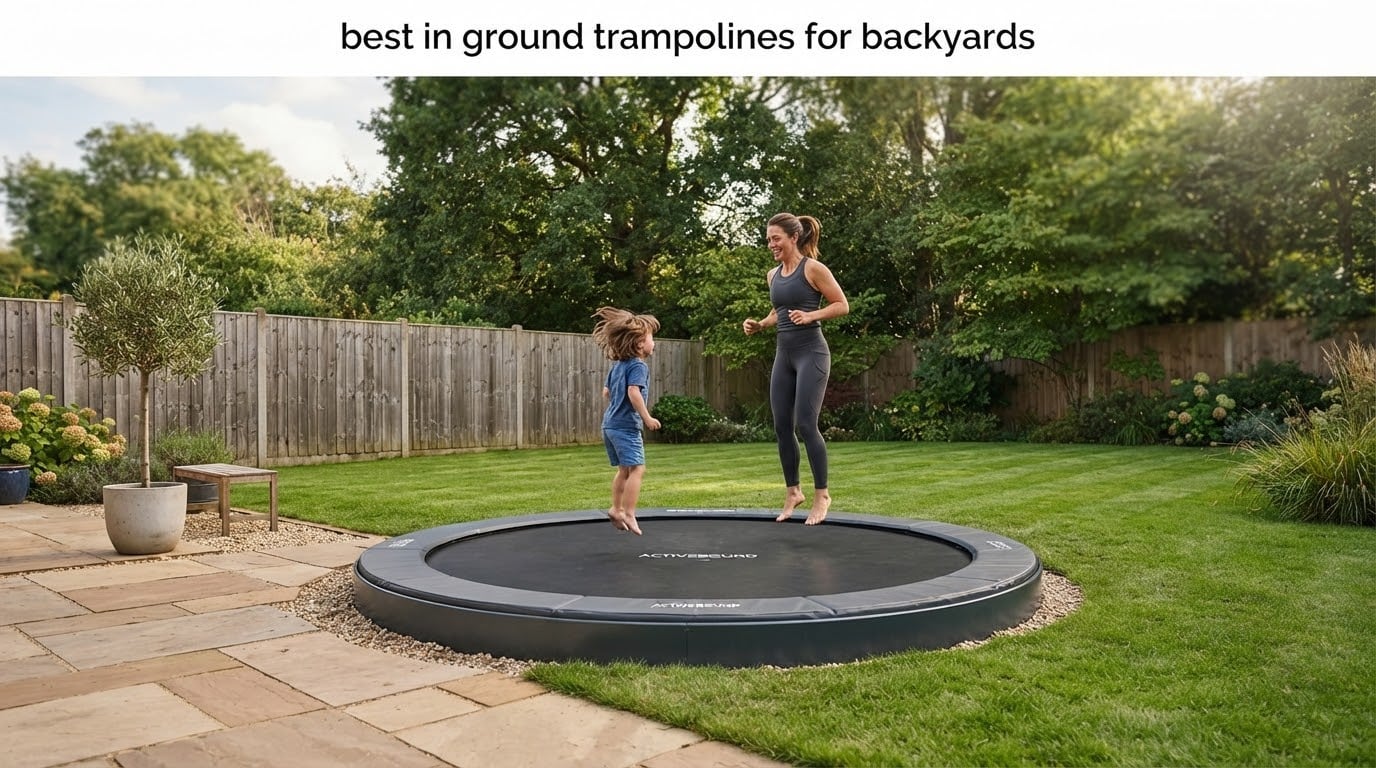
Most people searching for the best in ground trampolines for backyards do not want a trampoline. They want their lawn back. An in-ground trampoline is a full-size jumping system set into a pit so the mat sits level with the grass, which means no frame standing three feet off the deck, no ladder, and no metal eyesore dominating a yard that you also use for dinner on the patio.
That idea sounds simple until you start shopping. Above-ground models are everywhere and cheap to compare, but genuine flush-to-ground systems are a thin category, and most roundup pages online quietly pad their lists with above-ground trampolines, mini rebounders, and kiddie bounce toys that have nothing to do with burying a pit.
We pulled only the systems that are actually designed to be installed into the ground, and we kept the list short rather than inflate it.
What we landed on is six systems, and the differences between them matter more than the similarities. Two are budget flush mounts with open jump surfaces and no net. One is a round unit designed in the Netherlands around a 1750 lb capacity, and it also ships with a safety enclosure.
The remaining three are a commercial-grade rectangle with a retaining wall in the kit, a 14 foot model with a net included, and a brand new listing with an enclosed design and no owner feedback yet.
We spent weeks reading the spec sheets, the warranty terms, and the customer reviews, and we broke the roundup down by who is jumping, what your soil does with rain, and how much of the work you are willing to do yourself. If you are still weighing an above-ground model, our [guide to the best trampolines for kids](https://austineubanks.com/best-trampolines-for-kids/) covers the cheaper route, and our [mini trampoline picks](https://austineubanks.com/best-mini-trampolines-for-home-cardio/) work if your real goal is cardio rather than a backyard play surface.
Table of Contents
Top 3 In-Ground Trampoline Picks for (2026)
Three of the six stand out, and the reasoning differs for each one. The Avyna wins on engineering and family capacity, the rectangular kit wins for anyone doing flips or gymnastics drills, and the round flush mount wins on simplicity and a low barrier to entry.
Avyna Premium In-Ground
- 11-gauge galvanized frame rated to 1750 lbs
- True flush-to-ground finish with no ladder
- Air X-TREAM mat with 70% more airflow
- Lifetime frame coverage plus enclosed safety layer

Anything Sports Rectangle Kit
- 10 foot rectangle with even spring tension
- Flush mount with ladder-free access
- Kit includes frame springs padding and anchors
- 12-month no-questions-asked warranty

Anything Sports Round Kit
- Round flush mount that directs jumpers inward
- Galvanized frame with reinforced springs
- UV-resistant mat with thick edge padding
- Quiet spring cover for neighborhood use
Best In-Ground Trampolines at a Glance (October 2026)
All six systems in the running, with the deciding spec for each. Every one of them requires a pit, a frame anchored into soil, and drainage planning before a single pad gets unboxed.
| Product | Specifications | Action |
|---|---|---|
| Avyna Premium In-Ground Trampoline |
|
Check Latest Price |
| Anything Sports Rectangular In-Ground Kit |
|
Check Latest Price |
| Anything Sports Round In-Ground Kit |
|
Check Latest Price |
 BERG Champion InGround 14ft with Net BERG Champion InGround 14ft with Net |
|
Check Latest Price |
 Capital Play Inground Rectangle Kit Capital Play Inground Rectangle Kit |
|
Check Latest Price |
 ExacMe No-Gap In-Ground 14 12 10 8ft ExacMe No-Gap In-Ground 14 12 10 8ft |
|
Check Latest Price |
An In-Ground Trampoline Is Worth It for Families With Young Kids
Yes, when the household includes children under about eight, when the lawn is the main play space, and when the visual break of a metal frame would bother you every day. The pit removes roughly three feet of fall height and deletes the ladder, which are the two factors behind most backyard trampoline injuries involving small children.
It also removes the mowing problem. It is less worth it for renters, for anyone on heavy clay with poor drainage, and for adults who mostly want a rebounder, because digging is the expensive part and it does not move with you.
1. The Avyna Premium Is Our Best Overall In-Ground Trampoline
Avyna Premium Round In-Ground Trampoline, 15, 14, 12 FT
Round flush mount
96 springs
1750 lb capacity
11-gauge galvanized frame
Pros
- Flush-to-ground finish with no ladder
- 1750 lb listed capacity suits mixed ages
- Air X-TREAM mat moves 70% more airflow
- Spring cover and lockable enclosure included
- Lifetime frame coverage
Cons
- Assembly took about five days for one reviewer
- Heavy frame needs several strong adults to place
- Replacement pad sourcing was a reported issue
The Avyna Premium is the strongest all-round system in this roundup, and the reason is that it addresses the two things every other unit here has to compromise on. The first is bounce, and the Air X-TREAM vented mat is built around airflow, with the manufacturer claiming up to 70% more airflow than a standard mat.
Air that escapes less easily means the mat does not fight the jumper, and owners consistently describe the bounce as responsive rather than dead. The second problem is the jump itself, and a round mat with 96 springs on a frame rated to 1750 pounds is a combination that holds up when a small child and a full-grown adult are on it at the same time.
The engineering detail that matters most for a buried unit is the frame material, because everything below grade sees damp soil and seasonal wet-dry cycles. This one is 11-gauge hot-dip galvanized high-tensile steel, which is a heavier wall than most trampoline frames and is the main reason the warranty is lifetime on the frame with 10 years on springs and 3 years on the pad and mat.
That split-coverage structure is honest rather than generous marketing, and it matches how these parts actually fail. The frame does not move, the springs loosen over a decade, and the pad and mat degrade from UV exposure long before either of those.
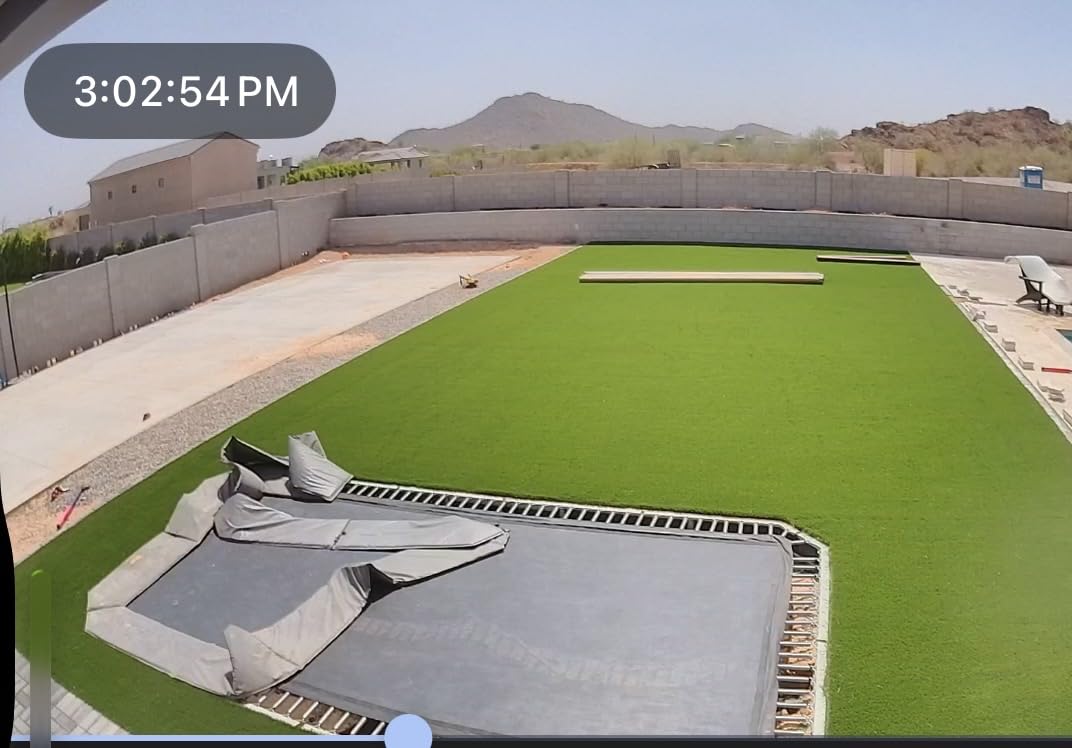
The safety package is the most complete in the roundup. You get a weather-treated enclosure with a lockable entrance, a thick UV-protected foam pad, and full spring coverage, so the two things a child most often lands on are both covered.
The lockable entrance is a small touch with real value in a yard that borders a street or a neighbor’s fence line, because it keeps the mat from becoming an open invitation. Round shape also has an independent safety benefit here: the geometry naturally pushes an off-centre jumper back toward the middle rather than toward the springs.
The catch is honest and worth stating plainly. At 235 pounds for this configuration, this is not a two-person job, and one reviewer reported spending close to five full days on assembly solo.
Our own read is that the pit preparation is the slower half of the job, because the frame has to be leveled before the surround is finished, and a frame that is a fraction of an inch off will read as a trip hazard every single time somebody steps on. Budget a weekend plus a rental weekender, or pay for an installer.
Buyers have also reported friction getting a replacement safety pad through warranty, which is the one service complaint in the reviews.
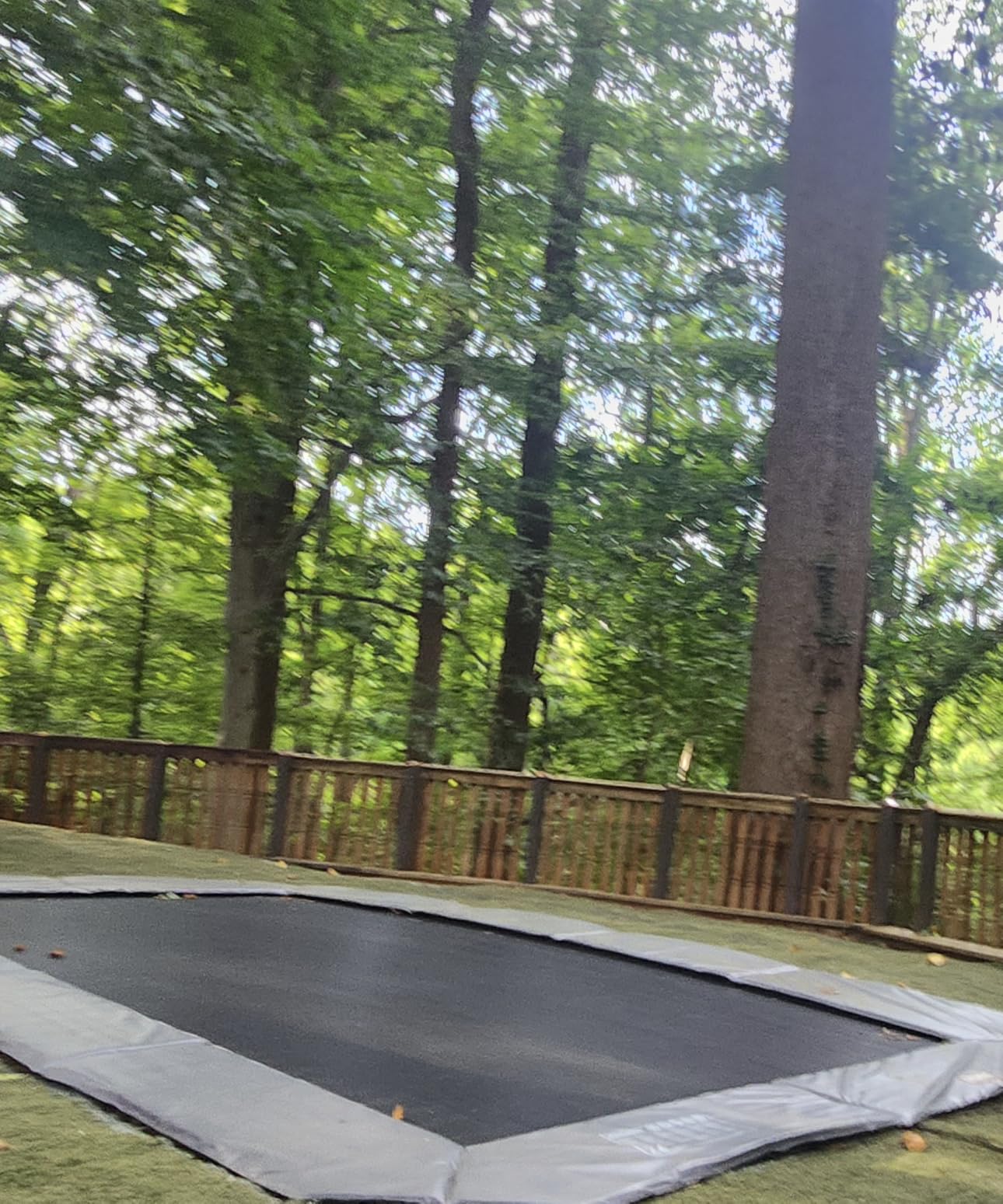
Who the Avyna Premium Fits Best
This is the unit to buy when the trampoline will be used by the whole household rather than one age group, because the 1750 pound figure is a listed recommendation rather than a guess. It also fits yards where a 14 foot above-ground frame would visually eat the space, since a flush round unit leaves the grass as the dominant surface.
If your youngest children are still under five, the enclosed version is the safest configuration in the list and removes the supervision question that comes up in every parent forum.
It is a poor fit for a renter, obviously, and for anyone who wants a trampoline they can put in a truck and take to a new house. It is also a poor fit if you are unwilling to deal with an assembly that reviewers describe as multi-day.
Buy it if you own the yard, plan to stay, and want one unit that a teenager and a toddler can share without you buying a second system.
Where the Avyna Falls Short
The 235 pound frame weight is the practical limit on this product. You need multiple capable adults on installation day, and if you are a single person with a spade and a free weekend, this is not the kit.
The Avyna brand is also less common in the United States than European above-ground names, which means the installer network is thinner in some regions. The replacement pad experience we saw in reviews is a symptom of that, not a one-off.
Finally, the ratings sit on a small pool. Fourteen reviews with 90 percent at five stars tells you early owners are very happy, but it is a thin base for a purchase that involves a hole in your yard. Treat the engineering claims as strong and the long-term durability picture as still forming.
2. The ANYTHING SPORTS Rectangular Kit Is Best for Athletes and Flips
Rectangular In-Ground Trampoline – Heavy-Duty Flush-to-Ground Outdoor Jumping Mat, Safety Padding & Easy Install Kit | Ideal for Kids, Families & Athletes | 7×10 Without Enclosure
10 foot rectangle
Metal frame and aluminum hardware
120 by 84 inch footprint
Frame pad included
Pros
- Even rectangular spring tension across the whole surface
- Well suited to flips and gymnastics drills
- Frame springs padding and anchors all included
- 12-month no-questions-asked warranty on all parts
Cons
- Supplied springs can feel soft and dull the bounce
- No enclosure included in the base kit
- Excavation and soil preparation are on the buyer
The reason to choose a rectangle is tension distribution. A round trampoline concentrates its spring count around the perimeter, which is fine for bouncing but produces inconsistent resistance near the edge of the jumping area.
This kit spreads 10 feet by roughly 7 feet into a flat, evenly tensioned surface, which is exactly what you want for a backflip progression, a tuck jump drill, or a teenager filming content on a phone clipped to a fence. The listed dimensions of 120 by 84 inches leave a usable interior that feels larger than the frame size suggests once you are moving on it.
This is also the more approachable of the two budget flush mounts, and the difference is mostly in the box. The box includes the support frame, springs, safety padding, and ground anchors, so the only thing you are sourcing separately is soil, gravel, and a weekend.
The frame is metal with aluminum hardware, the mat is a durable woven type, and the perimeter padding covers the spring channel so a missed landing does not land on bare steel. The 12-month no-questions-asked warranty is the shortest in the roundup, but for a first in-ground unit it removes the anxiety of a first season with no backup.
What we would fix before installing it is the spring set. Several reviewers describe the included springs as soft or smoshy and report replacing them to recover the response they expected. That is a straightforward, cheap fix and one of the few upgrades in this category that reliably pays for itself, so treat the spring swap as part of the install rather than a repair.
Weight is listed at 50 kg, which is a very different handling experience from the Avyna. Two people can realistically move this into position, and that is a genuine advantage on a weekend install.
One thing to be clear about: the base kit has no enclosure, and the jump surface sits low, so an adult should be within reach when small children are on it. That is a fair tradeoff for the geometry you get, and it is why we placed this second as a specialist pick rather than a general recommendation.
If your household is mixed with a three year old on it, either add a net or put the round unit in that role.
Who the Rectangular Kit Fits Best
It fits households where somebody is training rather than just playing. Gymnastics, parkour basics, circuit cardio, and jump-rope-style conditioning all benefit from an even surface, and a rectangle also gives you more usable jumping area per foot of pit edge than a round of the same nominal size.
It also suits a narrow side yard, because a 120 by 84 inch footprint tucks into a strip of lawn where a round unit would need clearance on all sides.
It suits first-time in-ground buyers who want a simple install and are willing to buy their own net later. Read our [above ground pool guide](https://austineubanks.com/best-above-ground-pools-for-backyards/) if you are also reworking a small yard, because a compact rectangle pairs well with a tight plan.
Where the Rectangular Kit Falls Short
The soft springs that come with the kit are the main complaint and they are repeated often enough that we treat them as a known trait rather than bad luck. The lack of an included enclosure is the second, and for families with toddlers that matters enough to change your decision.
The 12-month warranty is the shortest in the roundup, and it covers parts rather than the labor you will spend on the pit.
Finally, a rectangle is unforgiving about installation precision. The frame corners need to sit at consistent depth for the tension to feel right, and if the pit floor is not level the mat will feel uneven in a way a round mat partly hides. Budget more care time on the hole than the assembly itself.
3. The ANYTHING SPORTS Round Kit Is the Best Value Flush Mount
ANYTHING SPORTS Premium Round In-Ground Trampoline, 12FT and 14FT Diameters (14 FT Without Enclosure)
10 foot round mount
50 kg listed weight
100 inch footprint
Frame pad and anchors included
Pros
- Round geometry guides jumpers back to the center
- Low profile that looks intentional in a garden
- Quiet operation thanks to the spring cover
- Galvanized frame with reinforced heavy-duty springs
Cons
- No shield or enclosure included so it suits teens and adults
- Included springs can feel soft until replaced
- Needs digging and leveling with several adults
This is the round sibling of the rectangular kit and it makes a different argument. Where the rectangle sells tension and geometry for training, this one sells safety geometry and quiet.
The round shape is the reason many in-ground buyers convert in the first place: there is no straight edge to overshoot, and the shape naturally returns a drifting jumper to the center. Parents describe the ladder-free access as the feature they notice daily, because nobody in the household has to be lifted up or climbed over.
The build is more serious than the price suggests in one specific way, and that is the frame. Rust-resistant galvanized steel with reinforced heavy-duty springs matters enormously for a unit living in a pit, where the frame sits in damp soil and the failure mode of an ungalvanized frame is a brown streak and then a crack.
The mat is UV-resistant, which is the second attribute that extends life underground, since the jumping surface takes direct sun all day. The thick protective edge padding covers the spring channel, and the spring cover is why owners call it quiet, which matters more than most buyers expect in a yard that sits near a neighbor’s bedroom wall.
The honest drawback is the same one as its sibling, and it is the springs. The 4.4 average comes with 71 percent five-star, 16 percent four-star, and 13 percent two-star, and the recurring note across those reviews is that the supplied springs feel soft enough to flatten the response until you swap them.
One reviewer also reported a lifetime frame warranty on their unit, which is worth chasing in writing rather than assuming.
We also want to be straight about the two-star reviews. The pattern in that review data points to a delivery problem rather than a fault in the unit itself, and delivery damage on a heavy steel frame is common in this category. Inspect the frame and springs the day it arrives, photograph everything before you assemble, and that risk shrinks a lot.
Who the Round Kit Fits Best
It fits households with older children and adults, and it fits yards where appearance is the deciding factor, because once the grass grows in around a flush mount the only thing visible from the house is a circle of mown lawn.
It is also a good pick if you are converting a small lawn and want the lowest possible profile, since a round 10 foot pit can sit closer to a fence line than a rectangle of comparable area.
It fits people who want the cheapest honest path into flush-to-ground ownership and accept doing the net question separately. If you want indoor cardio instead of a backyard surface, our [home cardio trampoline picks](https://austineubanks.com/best-mini-trampolines-for-home-cardio/) cover that use case without a pit.
Where the Round Kit Falls Short
No enclosure, which makes it a poor solo choice for a child under five. The listing does not publish a user capacity figure for this unit, so check the spec sheet before two adults plan to jump together.
Installation still needs several strong adults, because 50 kg is manageable for two and awkward for one. And if your soil is heavy clay, this is the configuration most likely to leave you with standing water under the mat, because an open pit with a tight frame and no sidewall cavity is where trapped water shows up first.
Read the drainage section below before you order.
4. The BERG Champion 14ft Is Best for Families Who Want a Net in the Box
BERG Champion InGround 14ft Trampoline with Safety Net, Trampoline for Kids, High Performance & Safety Features, Jump Higher with Airflow
14 foot round frame
96 TwinSpring gold springs
Safety net enclosure included
330 lb max user weight
Pros
- Net enclosure included with the unit
- Low step-on threshold of about 20 cm
- TwinSpring gold springs rated for long service
- Air Flow mat with 50% more breathability
Cons
- Roughly 394 lb so install needs professional help
- US support slow on replacement nets and mats
- Freight carrier means a booked delivery window
The BERG Champion is the one unit here where the safety net arrives as part of the standard package, and that single fact changes who should buy it. If your youngest jumpers are between about four and nine, the enclosure removes the most contested question in the category, because a net is what actually keeps a child from landing in the springs or bouncing out of the mat rather than simply lowering how far they fall.
It also has a 330 pound listed capacity, which is a family-use number rather than an adult-and-teen number, and it is one of the larger systems here at 14 feet, which matters if multiple teenagers will use it.
The step-on threshold is the detail owners praise most. At about 20 cm, the mat edge is low enough for a small child to climb on unassisted and low enough that an adult does not need to lift a toddler up and over. That sounds trivial until you have watched a five year old struggle onto a 36 inch above-ground frame, which is where most backyard trampoline frustration actually comes from.
The springs are TwinSpring gold, a heavier gauge wire rated for long service, and the Air Flow mat claims 50% more breathability than a standard mat, which reduces drag and lets jumpers get higher for the same effort.
Now the part that pulled this rating down to 3.9, and we would be doing you a disservice to skip it. The 3.9 average comes from a ratings split of 53 percent five-star, 14 percent four-star, 18 percent three-star, and 15 percent one-star, and the negative reviews are consistently about parts and support rather than the product.
Buyers report long waits with no clear timeline for replacement nets and jump mats through US support, and some were advised to purchase an entire new net and pole kit instead of a replacement net. On a unit that weighs roughly 394 pounds, professional installation is close to mandatory, and the freight carrier means you will be booking a delivery window as well.
The warranty is the strongest on paper in the roundup, at 12 years limited when registered on the BERG website, which adds three years to the standard ten. Register it.
A warranty that only extends on registration is easy to forget, and the extension is exactly the kind of thing that matters on a frame you cannot easily replace.
Who the BERG Champion Fits Best
It fits families who want a complete, safe, buy-it-once purchase and would rather not source a net separately. It fits buyers with enough yard to hold a 14 foot round pit, and buyers who can absorb a heavy freight delivery and a professional install bill.
Older children and adults who jump hard also like the 20 cm threshold because it takes almost no effort to step on.
If you already own water equipment and are planning a bigger yard build, our [water trampoline picks](https://austineubanks.com/best-water-trampolines-for-lakes/) cover the lakeside version of the same idea at a very different scale.
Where the BERG Champion Falls Short
Support and replacement parts in the US market are the real weakness, and they are documented across several reviews rather than a single outlier complaint. Plan on buying a new net as a line item in year three or four if something tears, because the support route is slow.
The 394 pound weight also means this is the least DIY-friendly product here. And at 3.9 it is the lowest rated unit in the roundup, which is worth putting next to the fact that the engineering and warranty are strong: the score reflects service friction, not a bad trampoline.
If you are not comfortable with that tradeoff, the Avyna gives you a comparable enclosed setup at a much higher listed capacity, though its own review history includes a pad replacement complaint.
5. The Capital Play Rectangle Is Best for Buyers Who Want Heavier Steel
Capital Play Inground Trampoline 11ft x 8ft Rectangle | High Jump Trampoline Unique Airflow Vented Pads | Heavy Duty Commercial Grade | Long Warranty | Enclosure Available. (Green Pads)
11 by 8 foot rectangle
80 springs
2mm double-dip galvanised frame
Retaining wall included
Pros
- Double-strength double frame from 2mm galvanised steel
- Retaining wall included in the kit
- Thicker TDU vented safety padding
- Minimal soil disposal during installation
Cons
- Kit supplies about half the material of comparable kits
- Enclosure has to be ordered separately
- Only four ratings so far so feedback is thin
Capital Play takes a different structural approach from the other rectangles, and it is the one we would look at first if the pit is going into ground that gets wet. The frame is a double-strength double-frame system built from 2mm thick double-dip galvanised steel, which is a heavier wall than a single-frame kit at the same nominal size.
Double-dip galvanising is the process where steel is coated twice, and the second layer is what keeps the frame from going chalky and then rusty after a few seasons of sitting in damp soil. That is exactly the failure owners worry about with in-ground units, and it is structural rather than cosmetic.
The retaining wall is included in the kit, which is the second thing that separates this from the budget rectangles. A retaining wall solves the soil problem that trips up most DIY in-ground installs, where loose earth around the frame settles and the mat frame creeps upward over a season.
Holding the sidewalls in place with a proper wall means the jump surface stays at the height you set it. The flush rectangular layout is also designed to keep soil disposal low, which matters because soil removal is the one cost that scales with the size of the hole.
Safety padding is thicker here than on the budget kits, using TDU vented pads paired with a commercial-grade heavy-duty mat, and the vented construction is the right call on a mat that sits in a pit where air has nowhere to go. A 10-year frame warranty is a solid commitment for a pit installation.
Flush mounting also removes the ladder and the zipper step of above-ground models, so access is the same walk-on experience.
Two things temper all that. The enclosure is not included and has to be ordered separately, which moves cost and assembly to you.
And the kit draws a specific complaint about material volume, with a reviewer feeling the bundle supplies roughly half the material of comparable kits for the money, which is worth checking against what you would otherwise have to buy separately.
Who the Capital Play Kit Fits Best
It fits buyers in wet or variable soil who want a frame that will not corrode and a sidewall solution already in the box. It fits anyone whose yard has had trouble with a settling pit before, because the retaining wall is the fix for the most common long-term complaint about in-ground units.
It also fits rectangular-training households who want more jumping area than a 10 foot budget rectangle provides.
It is a sensible pick for a yard that gets a hard winter, because a double-coated frame and a wall that does not shift are both about surviving freeze-thaw cycles rather than surviving a mild season.
Where the Capital Play Kit Falls Short
Four ratings is not enough to make a confident long-term claim about anything, and the data makes that clear. Three of those four are five-star and one is three-star, so you are reading a very small sample and should not treat the 4.4 as a durability verdict.
The separate enclosure purchase adds an assembly step and an extra cost line for anyone with young children. And a full retaining wall takes more excavation care than a vented open pit, so this is a job where an installer pays for itself.
6. The ExacMe No-Gap Design Covers the Widest Size Range
ExacMe No-Gap Design 14 12 10 8FT In-Ground Trampoline for Kids, with Safety Enclosure Net and Ladder, Round Outdoor Backyard Trampoline for Family Play Equipment (12FT)
Round in-ground model
8 to 14 foot options
Galvanized steel frame
250 lb max user weight
Pros
- Available from 8 to 14 feet to fit any yard
- No-gap inner enclosure separates jumpers from springs
- Enclosure spacing reduces pole collisions on falls
- 5-year manufacturer frame warranty
Cons
- New listing with no ratings or reviews yet
- 250 lb listed capacity is lower than most rivals
- Enclosure and spring set add assembly steps
The ExacMe listing is the newest product in this roundup and it carries no customer ratings at all, so we are going to treat it differently from the other five. Everything we can say comes from the manufacturer’s description rather than from owners who have lived with it.
What that description claims is worth knowing: an 8, 10, 12, and 14 foot size range, a heavy-duty galvanized steel frame, and a 5-year manufacturer warranty on the frame.
The design detail that makes this interesting is the no-gap inner enclosure. Instead of netting that sits close to the jumpers, this layout holds space between the net and the poles, so a child who falls sideways has somewhere to go before meeting a pole.
It is also positioned to keep children’s feet off the springs, which is the specific mechanism behind a lot of trampoline foot injuries. The box includes a ladder along with the trampoline, spring tools, and anchors, which tells you the assembly expects two people and some mechanical work.
Two cautions are worth stating clearly. The listed maximum user weight of 250 pounds is lower than most competing in-ground models, so this is a family and children product rather than an adult-and-teen product, and two adults should not plan to use it together.
An assembly with an enclosure plus spring tools also has more parts than an open kit, which means more opportunity to assemble something slightly out of alignment.
Our honest recommendation is that this one is worth a look if the size range is the deciding factor, because an 8 foot in-ground pit is genuinely hard to source and is the right answer for a very small yard.
Otherwise, wait for the first wave of owner feedback before committing a hole in your lawn to an unrated product.
Who the ExacMe Design Fits Best
It fits buyers in genuinely small yards, where an 8 foot flush mount is the difference between fitting the layout and not. It fits parents who want an enclosed configuration but do not want to source a net separately, and it fits buyers who want an enclosed in-ground unit at the lower end of what these systems cost.
It fits a household where one child at a time is the realistic use pattern, which matches the listed capacity and the enclosed design.
It also fits a yard where the 8 foot option is the largest pit the layout can take, which is the main reason to consider this listing over a bigger enclosed system.
Where the ExacMe Design Falls Short
There is no independent feedback, and that is the entire issue. Every durability and bounce claim in this section rests on a product description, and we will not pretend otherwise.
A first-generation listing with a new enclosure geometry deserves a season of owners before a major purchase.
The 250 pound listed capacity rules out the multi-adult use case, and the extra assembly complexity is real. If you want an enclosed in-ground trampoline with a documented support history today, the BERG Champion is the safer decision even with its own support complaints.
What an In-Ground Trampoline Really Costs Comes Down to Four Line Items
The kit is the number everyone looks at and the least reliable total, because a genuine in-ground purchase is four separate costs.
Start with the kit, which is where the six systems in this roundup differ most widely. Then add excavation, which is a labor cost that depends on your soil and on how you handle the displaced dirt. Then add drainage, which is optional in theory and non-optional in practice on clay.
Then add access work, meaning paving, edging, or a rebuilt surround so nobody trips on the lip.
On excavation, the difference between systems is real and worth planning around. Vendors in this category quote roughly 3 cubic yards of soil for a shallow-flush system against about 15 cubic yards for a deeper fully flush design, so the hole you dig varies enormously between styles.
That gap decides whether you can do the dig with a weekend and a wheelbarrow or whether you are hiring an excavator and a soil hauler.
On drainage, treat it as part of the build rather than an upgrade. A gravel bed, a soakage pit, or a run of perforated drainage pipe under the mat will keep standing water from becoming a permanent feature, and the work is far cheaper before the frame goes in than after.
On access work, remember that the surround is the last thing you do and the thing that decides whether the install looks professional. If you are also planning other yard work this season, our [ground blind picks](https://austineubanks.com/best-ground-blinds-for-turkey-hunting/) sit in the same seasonal project cycle.
The current listing for each system carries the live figures, and we would rather point you there than quote numbers that shift week to week. What we will say is that the four line items above, not the kit, are where the budget surprises come from, and budgeting only for the kit is how owners end up with a finished trampoline sitting in mud.
You Still Need a Safety Net, and Here Is How to Decide
In-ground does not mean safe on its own, and this is the point most marketing misses. Going flush removes roughly three feet of fall height and removes the ladder, both of which help, but the jump surface is still an elastic sheet a few inches above the dirt with steel springs and a metal frame channel around it.
Owner discussions report that bad landings and head collisions persist on in-ground units long after the family assumed the fall height change had solved the problem.
Our rule is simple. Under about age five, or with any child who does not reliably follow a one-jumper rule, buy the enclosed configuration.
The BERG Champion and the ExacMe both arrive enclosed, and the Avyna includes a weather-treated enclosure with a lockable entrance, so half the list is ready for that household on day one. The three open kits in this roundup are fine for teens and adults, and any of them can be retrofitted, but plan on that cost.
Whatever you choose, the operating rules are what keep people off the springs. One jumper at a time, no flips or twists for anyone who cannot already do them on the ground, and no jumping onto the mat from a patio or deck edge.
Inspect the mat and springs before every session for debris, exposed spring ends, and damage, and never let anyone climb the net. If you want a rule of thumb for the rest of the yard, our [backyard pool guide](https://austineubanks.com/best-above-ground-pools-for-backyards/) covers the sibling problem of hard surfaces near play areas.
In-Ground Beats Above-Ground on Safety and Looks, Not on Cost or Portability
It is better to put a trampoline in the ground when the yard is the primary play space, when young children use it, and when the visual break of an above-ground frame would bother you enough to resent it.
The flush surface eliminates the side-fall entirely because there is no side to fall off, the mat is walk-on with no ladder, and the fall height drops by roughly three feet. On all three of those points in-ground wins outright and there is no argument.
Above-ground wins on everything logistical. It costs far less, it assembles in an afternoon, and it moves with you when you move, so you can drag it to a different part of the lawn in twenty minutes.
If you rent, if you expect to be in the house for under five years, or if your budget genuinely cannot absorb excavation plus drainage plus access work, an above-ground model with a net is the correct answer and you should buy one without regret.
One more edge case worth naming: a sloped or uneven lot. In-ground handles slope better for access, since a flush surface can be cut into a hillside and still be walked onto, but the retaining side on the uphill edge becomes a real engineering job and drainage becomes a pump rather than a soakage pit. Owner discussions describe scouring for local help specifically for sloped installations, which tells you the labor market for this work is thin in many regions.
Match the Shape and Size to Your Youngest Jumper and Your Yard
Shape first, because it drives everything else. Round shapes return drifting jumpers to the center and are the safer default for a mixed-age family. Rectangles give even tension for flips and training but put jumpers closer to the spring channel on the short ends, so they demand a better-behaved user.
For a household with a five year old and a teenager on the same mat, round wins. For a household with a gymnast, rectangle wins.
Size second, against two variables: the youngest jumper and the yard. A 5 year old gets more usable play out of a 10 foot unit than most parents expect, because the fall height is already low.
The 8 foot option exists in this roundup and is genuinely useful in a small yard where a 14 foot circle would not fit with any surrounding space. The 14 foot option is for households with multiple simultaneous jumpers or teenagers, and it needs a pit with clear space on all sides.
Capacity third, and read it as a family-use signal rather than a stunt limit. A unit listed for 1750 pounds is built for a parent and a child at the same time, a unit listed for 330 pounds is a family unit, and a unit listed for 250 pounds is a children-first unit. Anyone planning two adults on one mat should stay in the higher groups.
Also plan the clearance: leave working room around the pit so the net, if you add one, has somewhere to stand, and so you can get a shovel in later.
And check your lawn’s condition before the shape, honestly. A pit on ground that regularly holds water, or on a slope, or within reach of a retaining wall or a patio edge, is a different project from a pit on flat, well-drained ground.
One owner reported scratching the finish of an existing covered patio while anchoring an in-ground unit, which is a reminder that drilling and excavation happen in a space you also care about.
Plan the Pit Before You Buy, Starting With 811 and Drainage
Call 811 before anything else, and wait the required lead time before you touch a shovel. This is the one step that has legal consequences, and utility locating takes a couple of days to schedule.
Irrigation lines, buried electric, and gas runs are all common in a back half of a yard, and a spade finds them without warning.
Measure the pit, not the trampoline. The manufacturer’s footprint is the jumping unit, and the hole needs clearance around it for the frame, the surround, and your hands. Decide your finish level before you dig, because a pit that ends up a few inches too shallow leaves the frame proud of the lawn, which defeats the entire reason for going flush.
Drainage is the section that decides whether you are happy in year two. Air under the mat needs to move, so a vented mat or a gap around the pit edge matters more than most buyers think, and trapped air makes a jump surface feel dead.
Water needs somewhere to go, so a gravel bed under the pit and a soakage pit or perforated pipe running away from it are the standard answer. On clay soil or a high water table, a pump is the answer some owners land on, and it is a permanent addition rather than a one-time fix.
Then think about what traps water above the mat. Dirt and grass clippings packed into the perimeter gap hold moisture against the frame and are the most common cause of long-term complaints about rust and mat sag.
Sweep the surround monthly, keep the gap clear rather than filling it with mulch, and pull standing water after heavy rain. A fitted mat cover does the same job for pollen and leaf debris, which matters in a yard with trees.
A simple annual routine covers most of the rest. Inspect every spring and fall for exposed spring ends, mat wear at the perimeter, and frame movement. Check the frame is still sitting at the height you set.
Look at the surround lip for settlement and re-level packed soil, and skim debris and leaves. That is an hour or two twice a year, and skipping it is how a warranty-covered frame becomes a rust claim.
Frequently Asked Questions
Is an in-ground trampoline worth it?
Usually yes for families with young children and owners who want their lawn to stay looking like a lawn. Going flush removes roughly three feet of fall height, deletes the ladder, and ends the mowing problem. It is less worth it for renters, for anyone moving within a few years, and for yards with heavy clay or poor drainage, because the excavation is the expensive part and it does not travel with you.
What is the safest trampoline to use in the backyard?
Safety comes from three things together: a low jump surface, an enclosure, and strict use rules. In-ground units win on the first by cutting fall height, but they are not automatically safe on their own. For children under about five, choose a model that ships with a net, such as the BERG Champion or the ExacMe no-gap design. Keep to one jumper at a time and inspect the mat and springs before every session.
What is the average cost of an in-ground trampoline?
The kit is only one of four costs. Add excavation and soil removal, drainage such as a gravel bed or soakage pit, and access work like paving or edging around the surround. Excavation volume varies enormously by style, with vendors quoting roughly 3 cubic yards for a shallow-flush design against about 15 cubic yards for a deeper fully flush pit. Check the current listing for live kit figures.
Is it better to put a trampoline in the ground?
In-ground is better on safety and appearance: no side to fall off, no ladder, a mat you walk onto, and no metal frame dominating the yard. Above-ground is better on cost, setup time, and portability. Choose in-ground if you own the yard, plan to stay, and have children using it. Choose above-ground if you rent, move soon, or want a trampoline assembled in an afternoon.
How deep do you dig for an in-ground trampoline?
Depth depends on how flush you want the finish and on the system design. Shallow-flush models sit only a few inches above grade and need a much smaller hole, while fully flush designs sit level with the lawn and need a deeper, wider excavation with clearance for the frame and surround. Set your finish height before digging, because a pit that comes out too shallow leaves the frame proud of the grass.
Do in-ground trampolines get water in them?
They can, and it is the most repeated complaint in owner discussions. Water pools under the mat when the soil is heavy clay, the water table is high, or the pit has no drainage path. The standard fixes are a gravel bed, a soakage pit or perforated drainage pipe under the mat, and keeping the perimeter gap free of dirt and grass clippings so the frame can dry out.
What size in-ground trampoline is right for a 6 year old?
For a child around six, a 10 to 12 foot round unit is usually plenty because the fall height is already low, so the perceived size of the pit matters more than the label. Choose round over rectangular for a mixed-age family, since round geometry returns drifting jumpers to the center. If the child is younger or does not reliably follow a one-jumper rule, add an enclosure regardless of size.
How long does an in-ground trampoline take to install?
Plan on a full weekend for a smaller flush mount and considerably longer for a larger unit or one with a retaining wall. The Avyna reports span about five days of assembly for one reviewer, and its 235 pound frame needs several capable adults to place. A rectangular kit with a retaining wall adds excavation and levelling time, and hiring a professional installer is often the difference between a smooth install and a frustrating one.
Our Verdict on the Best In-Ground Trampolines for 2026
After working through all six, the Avyna Premium takes the top spot for 2026 because it is the only system here that pairs a 1750 pound listed capacity with a vented mat and a full enclosed safety layer in one package. If your priority is training rather than family play, the ANYTHING SPORTS rectangle is the pick for even spring tension. If you want the simplest, quietest flush mount for older kids, the ANYTHING SPORTS round kit is the value choice, with the caveat that you will want to replace its springs.
Check your soil and call 811 before you buy anything, because the pit is the part you cannot undo. Then pick the shape that matches your youngest jumper and finish it properly.