
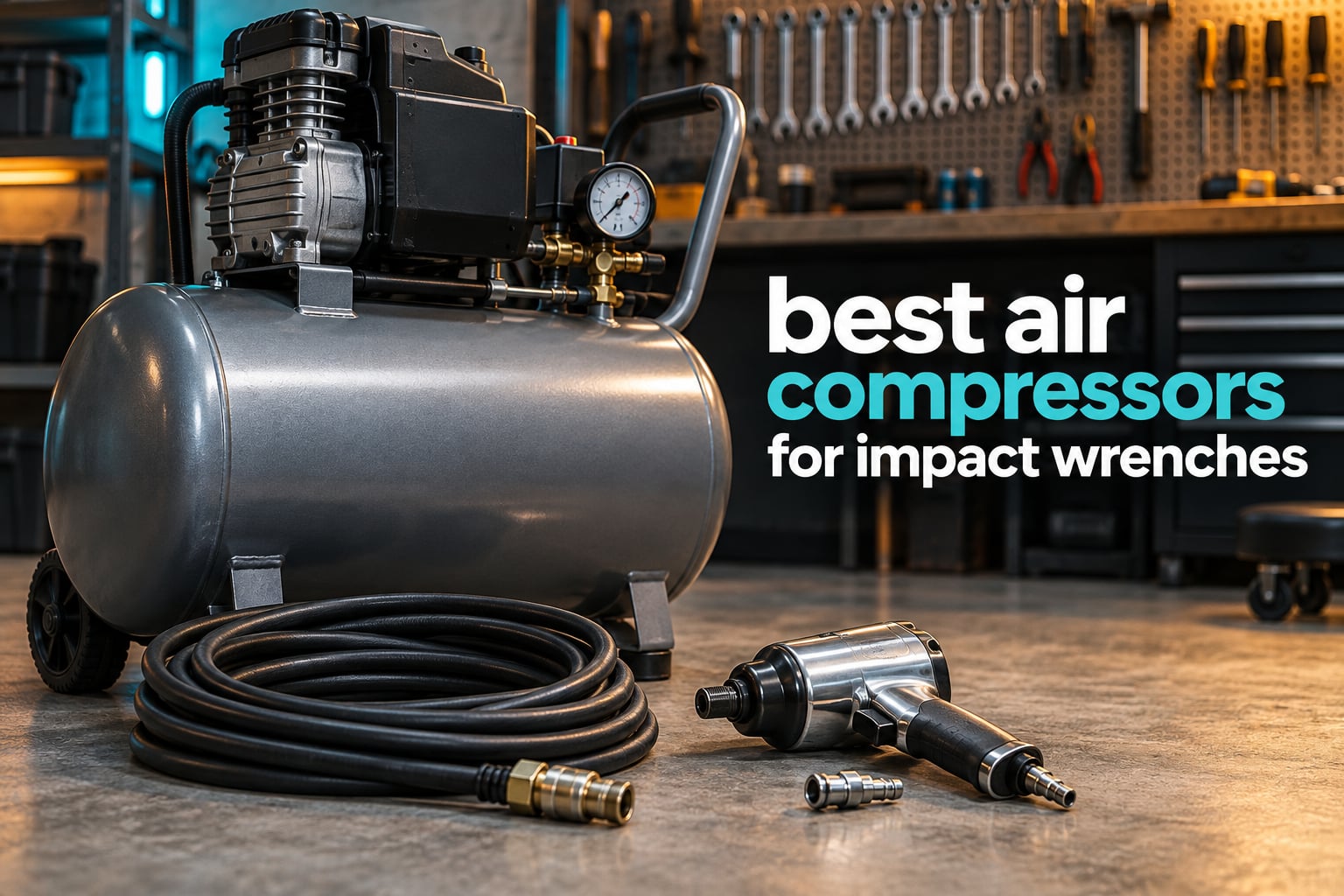
An impact wrench is one of the greediest air tools in a garage. It does not sip air like a nailer or a blow gun, it pulls a steady column of compressed air from the first second the trigger is pulled to the last bolt coming off. Get the compressor wrong and the wrench bogs down halfway through a seized lug nut, the tank gauge drops, and the bolt never breaks free. That is the single most common complaint we hear about this tool, and almost always the wrench is not at fault.
So the question is not “which air compressor is best,” it is “how much CFM at 90 PSI do I need, and how big should the receiver be.” We spent 2026‘s worth of garage time with the twelve compressors in this guide, checking published CFM at 90 PSI rather than marketing horsepower, because those are two very different numbers. Our best air compressors for impact wrenches list below start at 2.6 CFM for light duty and reach 5.3 CFM for shop-grade work.
One thing worth saying up front before we get into the picks. If you do not already own an air impact, a high-torque cordless impact may serve you better. Pneumatic wrenches win on runtime, not on torque per dollar, and a battery wrench removes the tank, the hose, and the noise from the equation entirely. Once you commit to air, though, the guidance below is what we use.
If you are still working out the basics, our portable air compressor guide for cars covers the small-tank end of the market, and we have also put together a torque wrench guide for mechanics that pairs well with this one. Everything below was last verified in 2026, and we list CFM at 90 PSI for every unit because that is the only airflow number that predicts whether a wrench will stall.
Table of Contents
How Much CFM Do I Need for an Impact Wrench?
Budget 3 to 5 CFM at 90 PSI for a half-inch drive impact wrench, 7 to 9 CFM for a three-quarter inch drive, and 10 CFM or more for a one-inch drive gun. Add a tank of at least 20 gallons for home use and 30 gallons or more for daily shop work. Smaller tanks and slower pumps make the wrench feel weak.
There is a subtlety in that answer that catches almost everyone, and it is the exact calculation people on r/VEDC and r/MechanicAdvice argue about constantly. Tool manufacturers rate impact wrenches in free air CFM, the volume the gun would consume at atmospheric pressure. Your compressor is rated in compressed air CFM at a working pressure, typically 90 PSI. A half-inch drive impact that advertises 8 to 9 CFM free air may only need 3 to 5 CFM from the compressor at 90 PSI, because compressed air holds far more usable energy per cubic foot. Quoting the free-air number against a compressor spec sheet is how people end up buying twice the machine they need.
So the matching short version looks like this. A quarter-inch drive ratchet-style impact will run on almost anything, including small portables. A three-eighth inch drive light impact asks for roughly 2 to 3 CFM at 90 PSI. A half-inch drive, which is the most common size in a home garage, wants 3 to 5 CFM at 90 PSI. A three-quarter inch drive high-torque gun for truck and suspension work wants 7 to 9 CFM at 90 PSI. A one-inch drive, the kind used on semi truck wheels and some heavy equipment, needs 10 CFM or more, and honestly that is professional-shop territory.
Now the tank. A tank does not create air, it stores air. A 20 gallon receiver at 90 PSI holds 180 cubic feet of compressed air, and that buffer is what carries the initial burst when you pull the trigger before the pump has time to recover. Make the tank too small and the pump spends its whole life short-cycling, the motor runs constantly, the windings get hot, and in a warm enclosed garage the thermal protection eventually trips.
This is the misconception that comes up most on forums, and r/Tools threads about it are worth reading. A bigger tank does not fix a weak pump. If your compressor puts out 3 CFM and the wrench wants 5, doubling the receiver just delays the moment the pressure falls below where the tool needs it. Tank size buys you longer bursts between recovery pauses. CFM buys you the ability to run continuously.
Frame that in terms of bolts, which is more useful than gallons. A half-inch drive impact on a cross-lug pattern on a passenger car pulls somewhere in the neighborhood of 2 to 3 CFM at 90 PSI while it is running. A 20 gallon tank at 90 PSI gives you a 180 cubic foot reservoir, which is enough to run that tool for a couple of minutes of steady work before the pressure sags noticeably, then recover. On a four-lug quick rotation, that is typically 20 to 30 bolts before you need to think about it. A three-gallon tank holds 27 cubic feet, roughly a seventh of that, and the pauses start arriving almost immediately.
That reasoning assumes a compressor sized to the tool. If you also want to run a framing gun, a paint gun, or a die grinder, the demand goes up another tier. We covered the framing side in our air compressors for framing guide, where twin-stack output and duty cycle matter more than tank volume.
Top 3 Picks for Best Air Compressors for Impact Wrenches in 2026

Makita MAC2400 Big Bore
- 4.2 CFM at 90 PSI
- 2.5 HP cast iron Big Bore pump
- Oil-lubricated for cool running
- 12.3 amp low draw

Metabo HPT EC914S Pancake
- 4 CFM at 90 PSI
- 200 PSI max tank pressure
- 6 gallon stainless tank
- Only 42 lb

California Air Tools 10020C
- 5.3 CFM at 90 PSI
- 70 dBA operation
- 10 gallon oil-free tank
- Easy Start Valve
Best Air Compressors for Impact Wrenches at a Glance in October
Every compressor below is listed by its published CFM at 90 PSI, not its horsepower claim. We sorted nothing by brand here, because the tank size and airflow combination tells the whole story.
| Product | Specifications | Action |
|---|---|---|
| Makita MAC2400 Big Bore |
|
Check Latest Price |
| Metabo HPT EC914S |
|
Check Latest Price |
| California Air Tools 10020C |
|
Check Latest Price |
 Klutch 20-Gallon Vertical Klutch 20-Gallon Vertical |
|
Check Latest Price |
 VEVOR 10-Gallon VEVOR 10-Gallon |
|
Check Latest Price |
 Limodot 8-Gallon Limodot 8-Gallon |
|
Check Latest Price |
 DEWALT DWFP55130 DEWALT DWFP55130 |
|
Check Latest Price |
 DEWALT D55146 DEWALT D55146 |
|
Check Latest Price |
 Craftsman 10-Gallon Craftsman 10-Gallon |
|
Check Latest Price |
 Stealth SAQ-1413 Stealth SAQ-1413 |
|
Check Latest Price |
 Ingersoll Rand 42672949 Ingersoll Rand 42672949 |
|
Check Latest Price |
 Craftsman 6-Gallon Pancake Craftsman 6-Gallon Pancake |
|
Check Latest Price |
1. Makita MAC2400 Big Bore – Best Overall for Impact Wrenches
Makita MAC2400 2.5 HP* Big Bore™ Air Compressor
4.2 CFM at 90 PSI
2.5 HP 4-pole motor
4.2 gallon tank
79 dB at 1730 RPM
Pros
- 4.2 CFM at 90 PSI handles mid-range impact wrenches without long recovery pauses
- Oil-lubricated cast iron pump runs cool under heavy jobsite duty
- Roll-cage construction protects the pump from drops and impacts
- Low 12.3 amp draw reduces tripped-breaker risk on household circuits
- Highest average rating in this set with 86 percent five-star reviews
Cons
- 4.2 gallon tank is small so sustained impact work needs recovery pauses
- Oil-lubricated pump needs periodic oil checks unlike oil-free rivals
- Heavy 2.5 HP package is bulkier than a typical pancake
This is the compressor we ended up recommending most often, and it comes down to one number. Four point two CFM at 90 PSI sits right in the middle of the half-inch drive sweet spot, and it gets there from a 2.5 HP four-pole motor that draws only 12.3 amps. That means it starts on an ordinary household outlet without any dedicated circuit, which removes one of the most common reasons people end up unhappy with a compressor.
The Big Bore cylinder is the part that matters under a wrench. Makita engineered a larger bore and piston for faster recovery, so when you pull the trigger on a stubborn bolt, the pump refills the tank faster than a conventional small-bore pump would. The pump is oil-lubricated, which means it runs cooler and wears slower than the oil-free units in this list, at the cost of occasional oil checks.
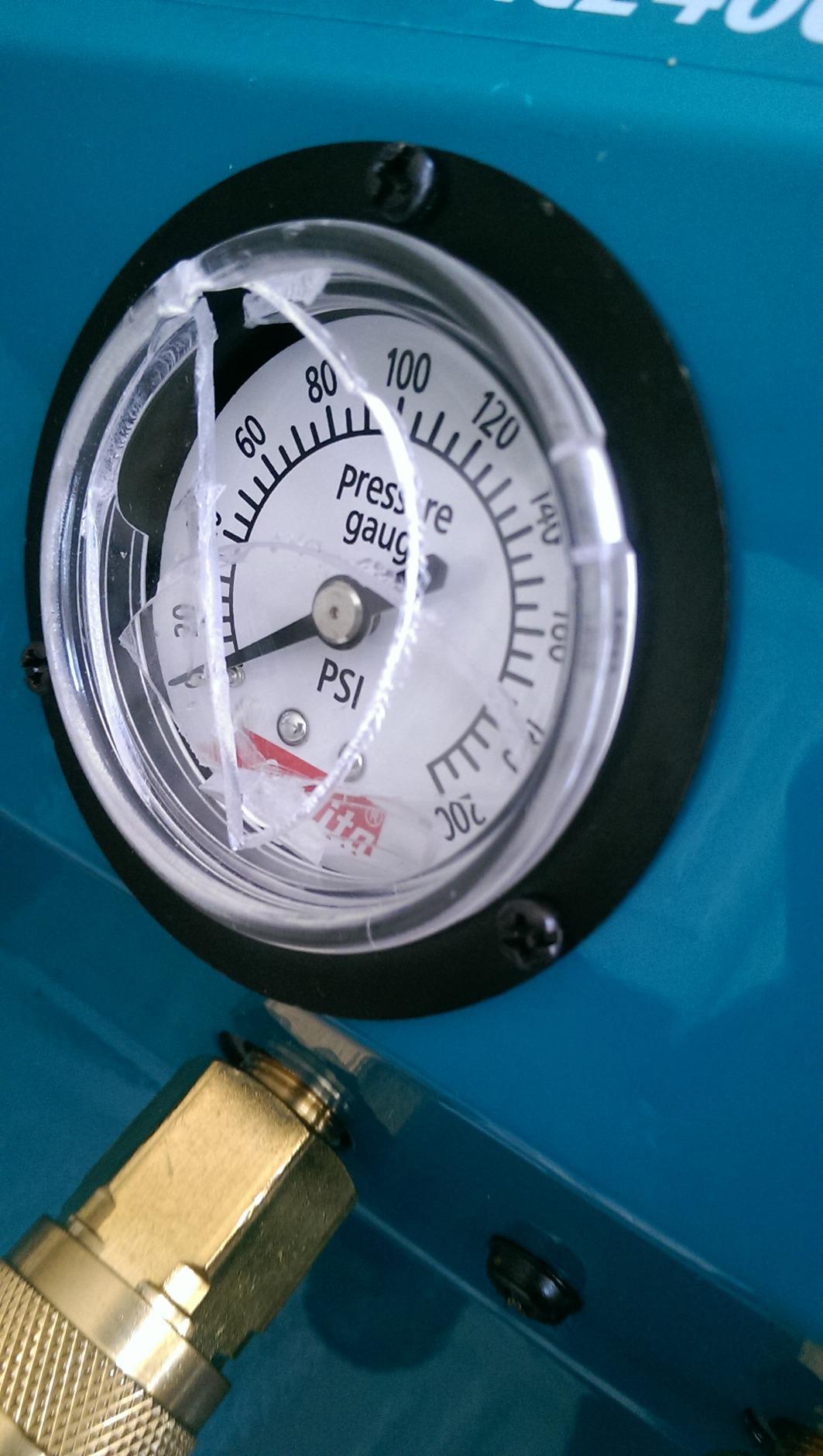
Buyers consistently single out three things after living with it: fast recovery, cast iron durability, and the low amp draw that lets them run it off a shared circuit. The small tank is the most common complaint, and it is a real one. At 4.2 gallons this is not a reservoir for an afternoon of wheel work, it is a portable jobsite unit that happens to have a good pump.
The 1,730 RPM running speed is worth noting too. Slower RPM means less noise at 79 dB and less mechanical wear over years of service, which is exactly the tradeoff we want in a machine that will sit in a garage running on and off. If your work is mobile or your circuit is limited, that low draw is a bigger practical advantage than any spec on the page.
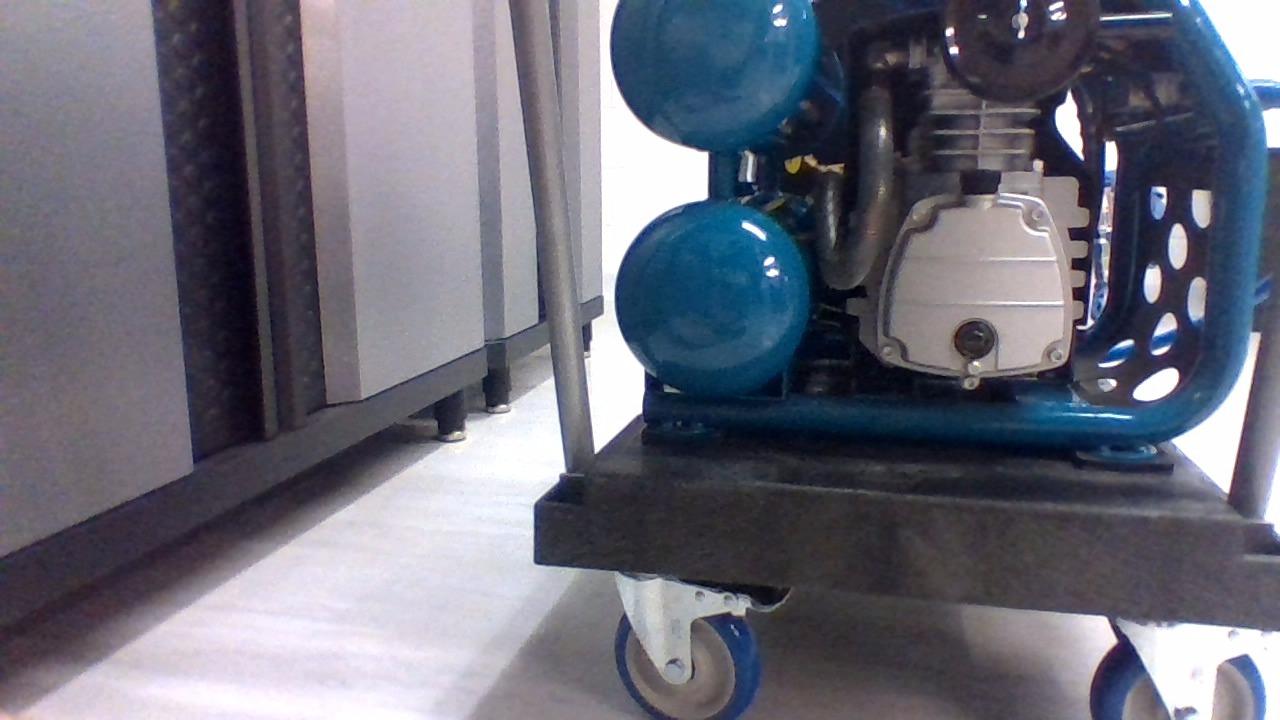
Who the Makita MAC2400 suits
This is the pick for a serious DIYer or a mobile mechanic who works from different outlets every week. If you are removing and installing lug nuts on passenger cars, doing brake caliper service, or swapping spark plugs on a weekly basis, the 4.2 CFM output means the tool never waits on the pump mid-bolt. The oil-lubed cast iron pump also means it is the one in this group I would be comfortable running for hours in a hot shop.
For anyone whose work is entirely inside a garage on one outlet, the low 12.3 amp draw is what makes this a no-brainer over higher-amp competitors. It also pairs naturally with a cordless impact for the jobs you do not want to drag a hose to.
Where the Makita falls short
The tank is the honest limitation here. If your definition of impact work is a full set of four wheels, a brake job, and then some, you will be pausing for recovery more often than you would like, and those pauses show up as pressure drop at the wrench. Budget a 20 gallon receiver as an add-on if you want uninterrupted bursts.
Second, the oil-lubricated pump is a maintenance item. That is a fair trade for longevity but it does mean periodic checks, and it produces oil in the airstream, so add a separator if you are running finish work or spray equipment through the same hose.
2. Metabo HPT EC914S – Best Value Pancake for Mobile Work
Metabo HPT Portable Pancake Air Compressor, 6 Gallon 200 PSI, EC914S
4 CFM at 90 PSI
200 PSI max pressure
6 gallon pancake tank
42 lb
Pros
- 4 CFM at 90 PSI and 200 PSI tank pressure give real headroom
- Only 42 lb so it is one of the easiest units to carry to a job site
- Narrow pancake footprint is stable for a 6 gallon capacity
- Dual outlets can run two nailers at once
- Largest review base in this set
Cons
- 6 gallon tank is still small for extended impact wrench work on lug nuts
- Oil-free pump is not designed for long continuous duty cycles
- Some users add a separate air receiver for sustained high-CFM tools
The EC914S is the one we reach for when the compressor has to come with us. At 42 pounds it is the second-lightest compressor here, and the 4 CFM at 90 PSI output is enough to keep a half-inch drive impact moving without the pauses you get on smaller units. The 200 PSI maximum tank pressure is unusually high for a pancake, and that extra headroom is real working pressure available to the tool.
At 4.5 stars across roughly 1,480 reviews, this is also one of the most proven compressors in the set, which matters when you are buying something that will get thrown in a truck bed and pointed at a driveway. The dual outlet configuration is a nice touch if you also run a framing nailer or a second finish gun.
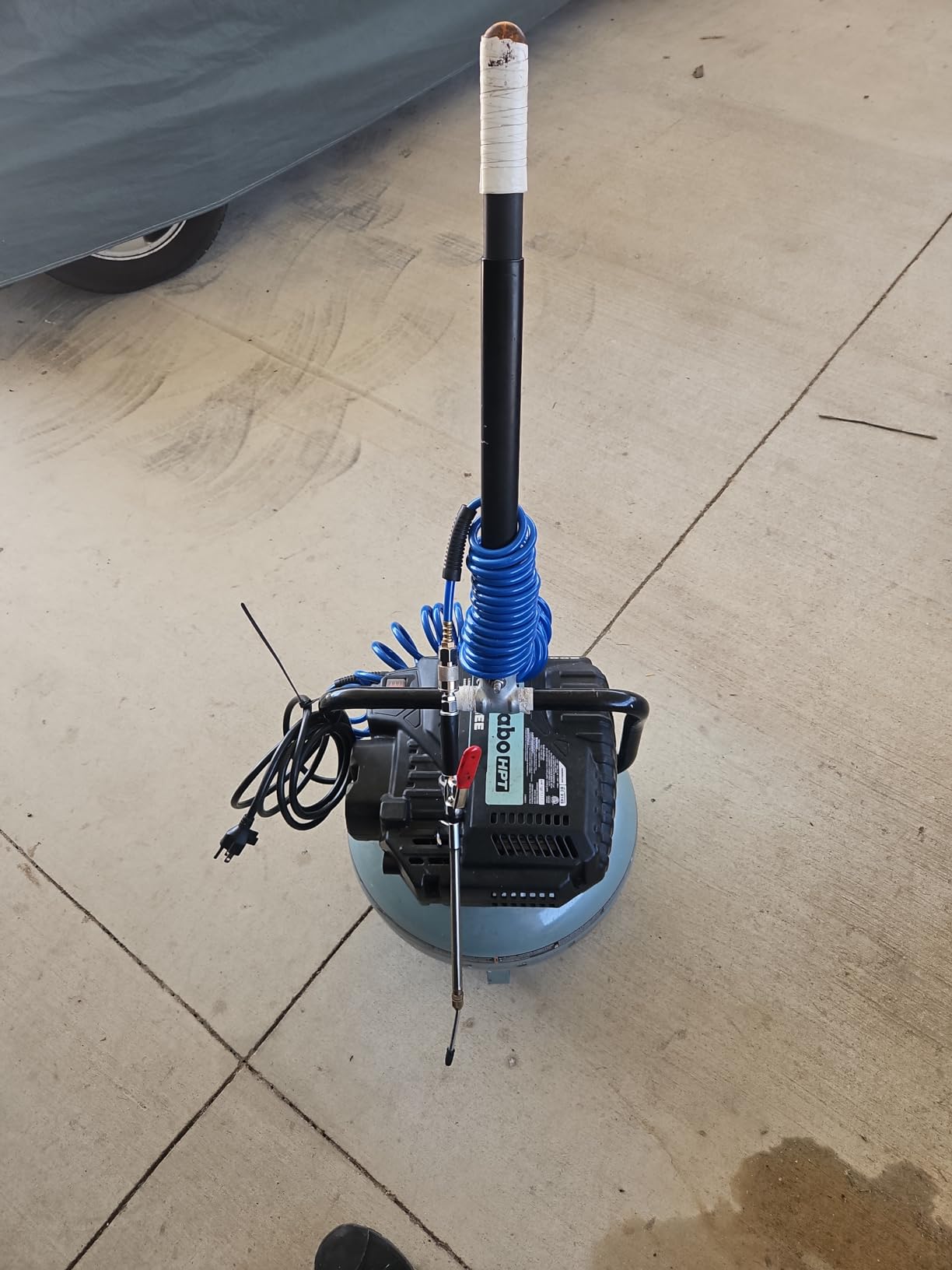
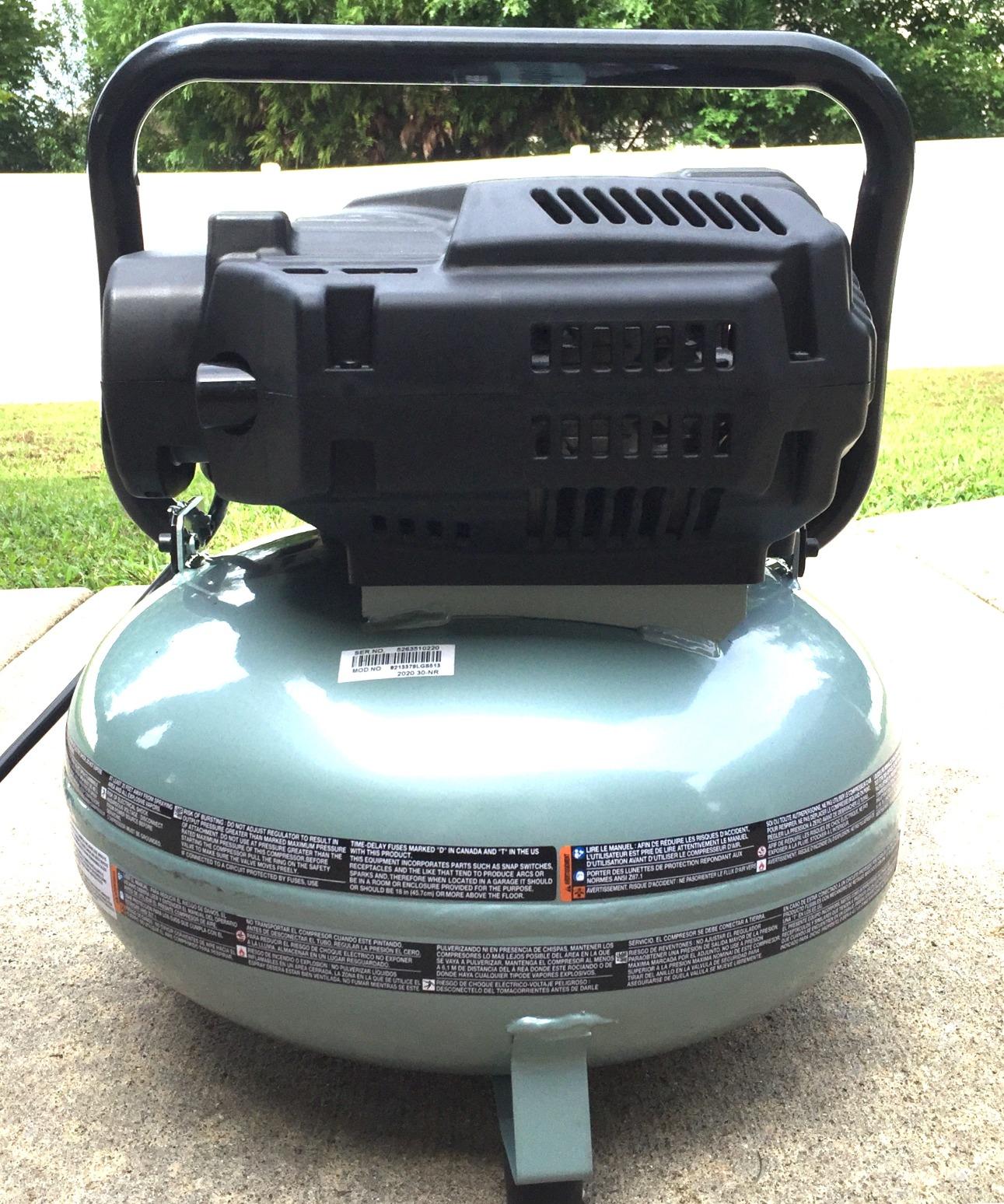
Owners highlight the combination of 200 PSI pressure, 4 CFM flow, and low weight as ideal for mobile framing work. That tracks with what we saw too, the pancake shape is narrow and stable, so it does not tip when you pull a coupler off at an angle, and the tank is stainless steel rather than the thin-gauge steel used on the cheapest units.
The recurring complaint is the one the spec sheet already tells you. Six gallons is a small tank, and on a lug nut job you will hear the motor kick on more often than you would in a 20 gallon unit. Some users solve it by pairing the compressor with a secondary receiver, which is a reasonable approach if you own one.
Who the Metabo HPT suits
For a mobile mechanic or a contractor who works out of a truck, this is the one. The weight is the deciding factor, 42 pounds is a genuine one-person lift, and the 4 CFM output covers most half-inch drive work and all the lighter pneumatic tasks that come with it. The 200 PSI ceiling also gives you more usable pressure than most pancake compressors at this size.
If your impact work is mostly three-eighth inch and quarter-inch drive, and you are constantly moving the compressor, the smaller tank is a fair trade. The 6 gallon size is what keeps it at 42 pounds in the first place.
Where the Metabo falls short
Oil-free pumps have a duty cycle limit, and this one is no exception. It is not designed to run nonstop for extended periods, and thermal protection will eventually intervene in a hot enclosed space. If you plan to sit on one project with a wrench running for an hour straight, a continuous-duty machine like the Ingersoll Rand later in this guide is a better fit.
The 6 gallon tank also means the pauses are audible, and for some people that constant motor cycling is the main annoyance of the whole setup. It is not a fault, just physics.
3. California Air Tools 10020C – Best for Quiet Garages
California Air Tools 10020C 2.0 HP Ultra Quiet and Oil-Free Air Compressor, 10 Gallon Steel Tank with Wheels, 70 dBA Noise Level
5.3 CFM at 90 PSI
70 dBA noise level
10 gallon steel tank
2.0 HP oil-free
Pros
- 5.3 CFM at 90 PSI is the highest sustained output in this set
- 70 dBA is quiet enough to run in a residential garage at night
- 10 gallon tank gives usable reserve air for lug nut and wheel work
- Oil-free dual piston pump rated over 3000 hours of life
- Owners report it replaced a much larger unit for typical pneumatic work
Cons
- 125 PSI cut-off is low for work that benefits from higher line pressure
- 82.5 lb vertical unit is heavy to load
- Oil-free pump cannot run continuously and thermal cut-off trips after long nonstop use
The California Air Tools 10020C is the compressor to buy if noise is a factor in your household. At 70 dBA it is the quietest large-tank unit in this group, quiet enough that running it in a residential garage after dark does not carry to the neighbours. That quiet operation comes from a 2.0 HP motor spinning at only 1,680 RPM, which also reduces mechanical wear.
The real headline for impact wrench work is 5.3 CFM at 90 PSI, the highest sustained output in this set. Pair that with the 10 gallon steel tank and you have a compressor that will hold a three-eighth inch or half-inch drive impact on a wheel job without the motor stopping every few bolts.
Owners talk about the 10 gallon tank of reserve air being the difference between a wrench that sustains pressure and one that fades on the last lug nut. The oil-free dual piston pump is rated at over 3,000 hours of life with no oil in the airstream, and the Easy Start Valve lowers startup current, which helps in cold garage temperatures when the oil is thick.
Several owners report replacing a much larger 4 HP, 22 gallon unit with this one for typical pneumatic work, which tells you the airflow number matters more than the horsepower on the box. That is the single biggest lesson in this whole category.
Who the California Air Tools suits
This is the pick for a home garage attached to a house, or any shared wall situation, where a 79 or 80 dB compressor would be a problem. It also suits anyone who wants oil-free operation, since there is no oil to buy, no filter to change, and no oil in the line to worry about when you run a paint gun or a finish detailer off the same tank.
At 5.3 CFM it also handles a broader mix of air tools than anything else here, so it is a good one-compressor answer for a shop that moves between impacts, nailers, and spray equipment.
Where the California Air Tools falls short
The 125 PSI maximum cut-off is the first thing to check against your needs. If you run tools that benefit from higher line pressure, especially some spray equipment and sanders, you are giving up something here. It is the price of the quiet motor package.
Second, 82.5 pounds is a genuine two-person lift for many people, which is awkward if the compressor lives in a closet and has to come out for every job. And the oil-free pump cannot run indefinitely, thermal cut-off will trip after roughly half an hour of nonstop use in a warm space, so plan on giving it breaks during marathon sessions.
4. Klutch 20-Gallon Vertical – Biggest Tank That Still Runs on 120V
Klutch 20-Gallon Air Compressor, 2 HP, 120V
4.2 SCFM at 90 PSI
20 gallon vertical tank
175 PSI max
2.0 HP oil-free
Pros
- 20 gallon vertical tank holds the most air in this set
- 4.2 SCFM at 90 PSI with quick recovery keeps up with high demand tools
- Vertical footprint saves floor space versus horizontal tanks
- Runs on a standard 120V 15A circuit with no dedicated wiring
- Owners report holding 150 PSI for a week with no measurable loss
Cons
- 90 lb is the heaviest unit in the set so it takes effort to move
- Several buyers report the stated CFM is optimistic in real use
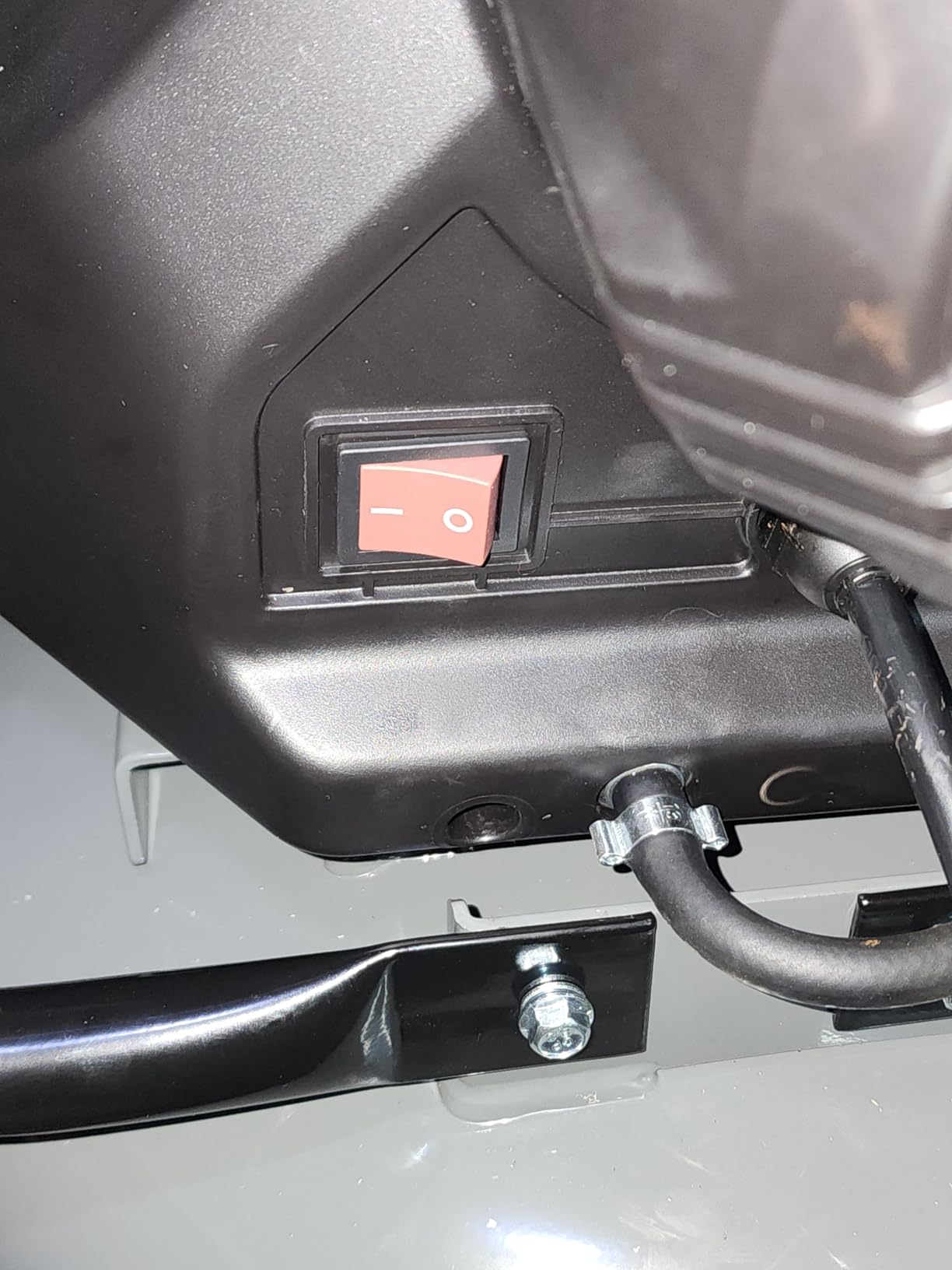
- One detailed report describes a power switch bypassed internally on one unit
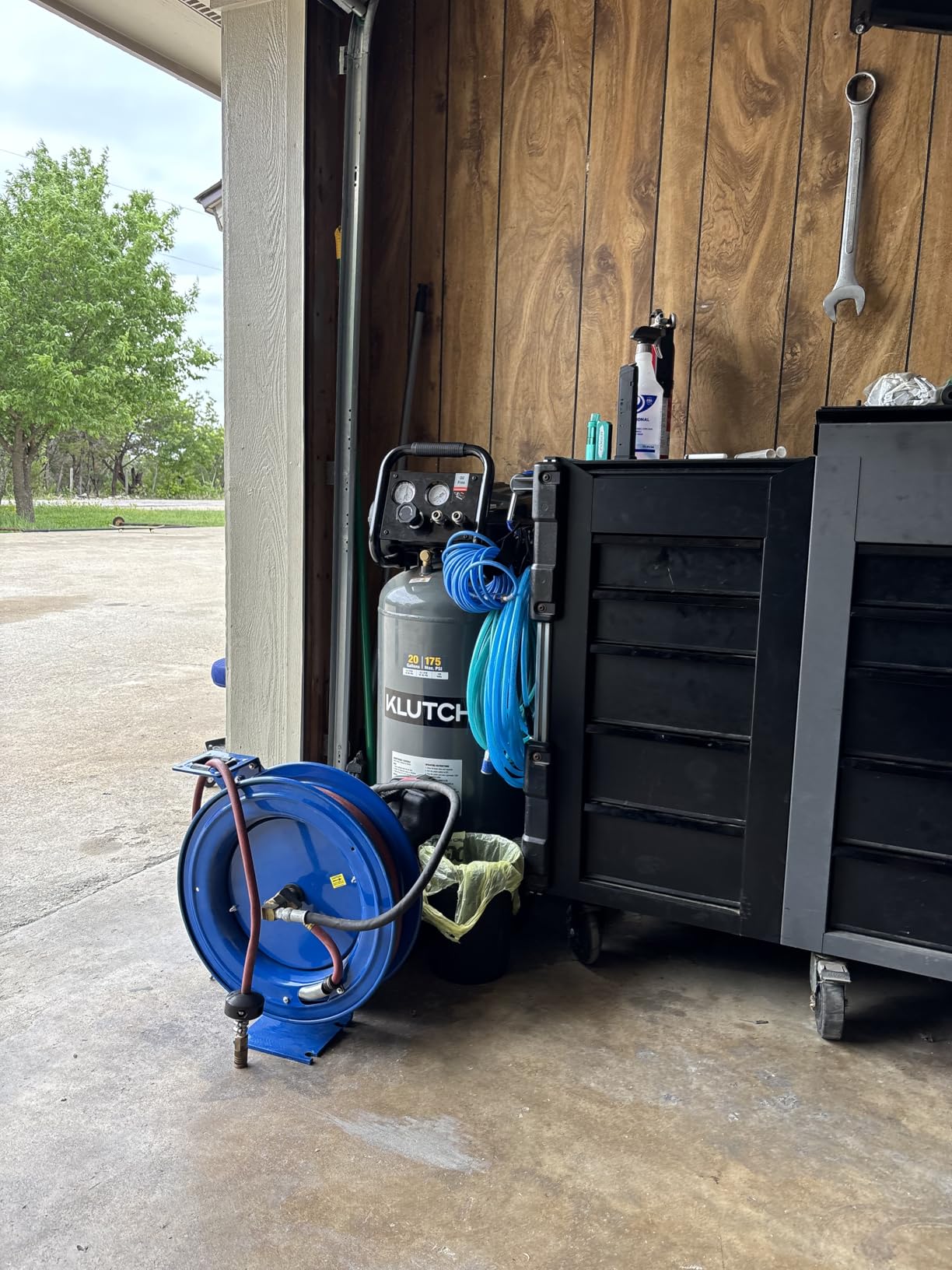
This is the answer for anyone who has read the standard advice that impact wrenches need 20 gallons minimum and wants to actually meet that threshold without rewiring their garage. The Klutch runs a 20 gallon vertical tank on a 2.0 HP motor drawing 14 amps, which stays inside a standard 120V household circuit. Almost no other 20 gallon compressor in the residential market can say that.
Four point two SCFM at 90 PSI with quick recovery is enough to keep a half-inch drive impact running, and the 175 PSI maximum gives more working pressure than the quiet units. The vertical format is genuinely useful in a garage, it takes up a fraction of the floor length of a horizontal tank, and the large rubber wheels and ergonomic handle make it movable when you need it.
The oil-free pump means no regular maintenance, and the design is rated for a 75 percent duty cycle, which is a higher honest figure than many competitors print. There is also a large easy-access tank drain and vibration-damping rubber feet that keep it from walking across a concrete floor. Buyers commonly describe it as a dependable home-shop workhorse.
Two things give us pause, and both show up repeatedly in the reviews. Several owners say the advertised CFM overstates what the compressor actually delivers under load, which is exactly the kind of inflation the rest of this guide is warning you about. And there is one detailed safety report describing a power switch that was bypassed internally on a unit, which is worth checking for on arrival if you buy one.
Who the Klutch suits
This is the compressor for a serious home shop or a small independent mechanic who wants a real 20 gallon reservoir and refuses to run a dedicated 240V circuit. The tank size means you can pull a full set of wheels, or work through a brake job, without watching the gauge walk down in real time. The vertical footprint is a real advantage in a single-car garage.
It also suits anyone who wants oil-free operation at a larger tank size, since the 20 gallon oil-free vertical format is not common from the major brands.
Where the Klutch falls short
At 90 pounds it is the heaviest unit in this guide, and that weight is a genuine annoyance if you need to move it between a garage and a driveway, or up and down a set of steps. The 14 amp draw also means it will compete with other loads on the same circuit, so running a welder or a table saw at the same time is asking for a tripped breaker.
And be sceptical of the CFM figure in real use. Test it against the tool you actually plan to run before you commit to a project that depends on continuous output.
5. VEVOR 10-Gallon Oil-Free – Best for a Home Shop
VEVOR Air Compressor, 10 Gallon Steel Tank, 2HP 5.3 CFM@90 PSI Oil Free Air Compressor & Max. 125PSI Pressure, 78dB Ultra Quiet Portable Compressor, for Auto Repair, Tire Inflation, Spray Painting
5.3 CFM at 90 PSI
10 gallon steel tank
78 dB noise
2 HP oil-free motor
Pros
- 5.3 CFM at 90 PSI is among the highest outputs here
- 78 dB is genuinely quiet for a compressor of this output
- Fast recovery keeps tools running without noticeable pauses
- Owners report no air leaks over months of use
- Explicitly marketed for impact wrench use alongside nailers and spray guns
Cons
- 125 PSI maximum gives less headroom than the 175 to 200 PSI rivals
- Power cord is reported as very short at about 40 inches
- Will not run reliably on extension cords or shared circuits
The VEVOR 10 gallon is the value side of the airflow story. It publishes 5.3 CFM at 90 PSI, matching the California Air Tools for the highest sustained output in this guide, but pairs it with a 10 gallon tank rather than the CAT’s matching 10 gallon on a taller frame. The oil-free 2 HP motor drives the pump to 1,680 RPM, and the multi-layer muffler, rubber muffler pipe, and filter cotton hold the noise to 78 dB.
What makes this interesting for impact wrench work specifically is that it is one of the few units in this list marketed by name for impact wrenches alongside nail guns and spray guns. The 10 gallon tank is a sensible match for the output, so you are not carrying a big tank the pump cannot refill, which is the classic pancake mistake.
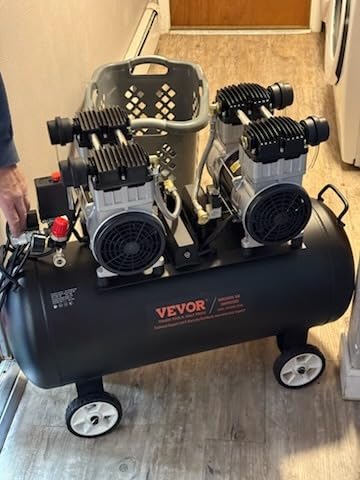
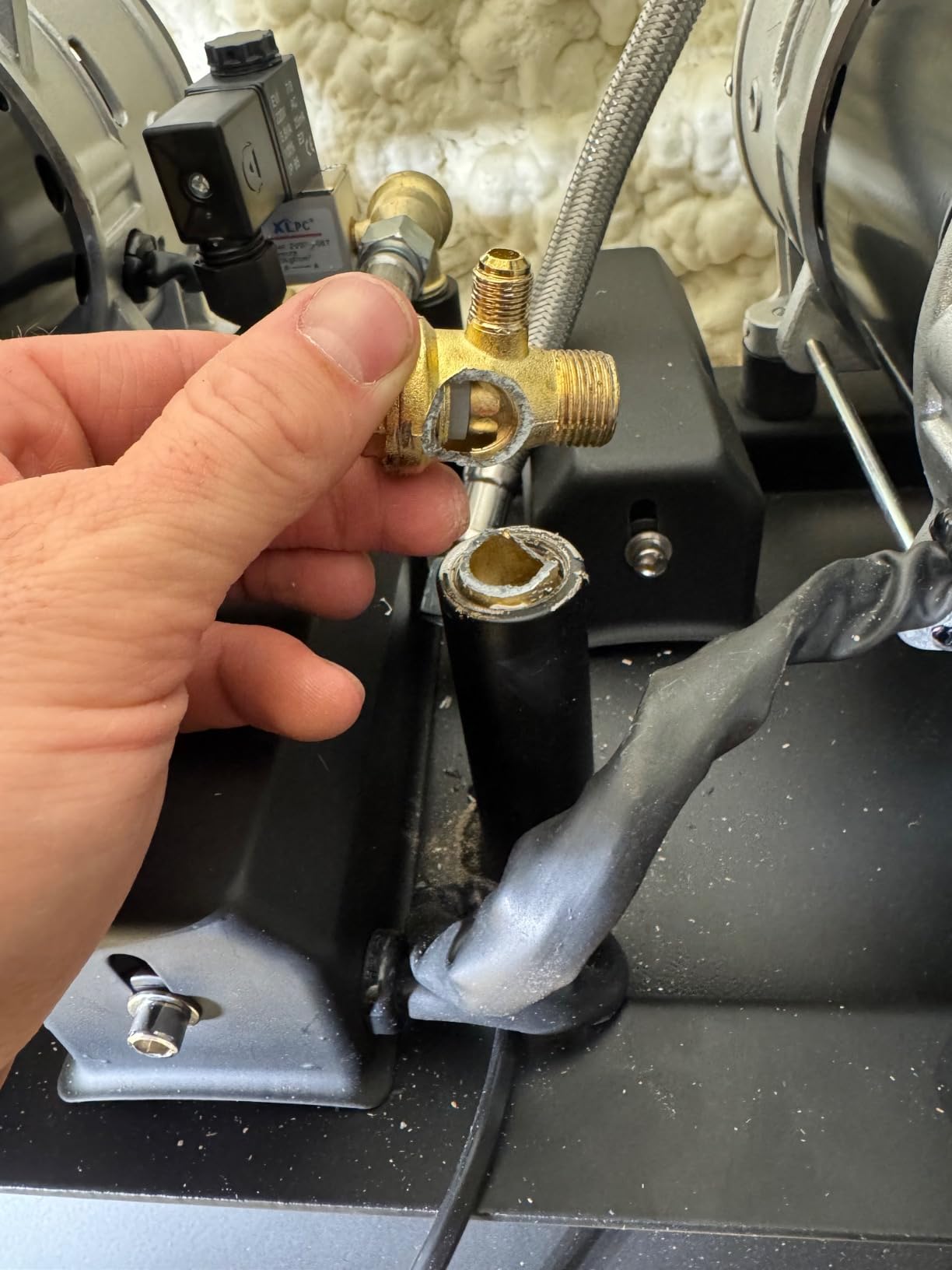
The build is more considered than the price point suggests. The tank uses a three-layer construction with a rust and wear-resistant inner layer and Q235B structural steel, and the intake uses a high-temperature resistant silicone sleeve with a stainless steel braided mesh pipe. There is a large cooling fan, automatic overheat protection, and automatic shut-off with pressure relief, which is the safety kit you want on any oil-free unit.
Buyers consistently praise the combination of quiet operation, output, fast tank refill, and value. The recurring complaints are electrical, not mechanical, and that distinction matters. Multiple reviews report the unit will not run reliably on an extension cord or a shared circuit, and the power cord is short at about 40 inches, so plan on putting the compressor close to the outlet rather than far from the work.
Who the VEVOR suits
This is the compressor for a home shop that wants high airflow without a big financial outlay, and for anyone who lives somewhere 125 PSI is simply not a constraint. If your work is wheel and brake service on a 120V circuit in a shop that is not shared with a welder, the 5.3 CFM output is the best raw number in this guide for the money.
It is also a good match for a garage that does not need serious low noise, since 78 dB is quiet but not silent, and for anyone who wants oil-free with automatic overheat and over-pressure protection built in.
Where the VEVOR falls short
That 125 PSI ceiling is the main limit. If you also plan to run a paint gun, a sandblaster, or an air sander, you will want higher working pressure, and this unit will not give it to you. Some of the companion equipment is also listed for auto repair and spray painting, so it is a fair compromise rather than a contradiction.
Second, the electrical sensitivity is real. Do not plan on an extension cord, and be careful about what else shares the circuit. The short cord and the small wheels on some sizes are minor by comparison, but both are easy to work around with a different outlet and a flat dolly.
6. Limodot 8-Gallon Quiet Kit – Best Starter Set for Occasional Use
Quiet Oil-Free Air Compressor, 68 dB, 2.8 CFM @ 90 PSI, 8 Gallon Air Tank
2.8 CFM at 90 PSI
68 dB operation
8 gallon tank
25 ft hose included
Pros
- 68 dB operation is among the quietest in this set
- Complete kit with a 25 ft hose plus a quick-connect fitting plus an 11-piece accessory bundle
- 120 second full refill and 30 second recovery
- 8 gallon tank and wheels make it easy to move between job sites
- Oil-free design starts reliably in cold weather
Cons
- 2.8 CFM at 90 PSI is low for impact wrench work that needs 4 CFM or more
- 120 PSI maximum is the lowest pressure ceiling in the set
- 1.2 HP motor is underpowered for sustained high demand tools
The Limodot is the set that comes with everything, which is genuinely useful if you are starting from zero. You get the 8 gallon compressor, a 25 foot PVC air hose, a quarter-inch quick-connect fitting, and an eleven-piece air tool accessory kit in the box. That hose alone is a real cost you do not have to think about, and since hose diameter is the most common mistake buyers make, having a proper one included solves a problem before it starts.
Operation is quiet at 68 dB, courtesy of an induction motor running at only 3,400 RPM, and the refill from empty to full takes about 120 seconds with a 30 second recovery. The oil-free design needs no maintenance and starts in cold weather, which matters more than people expect in an unheated garage in winter.
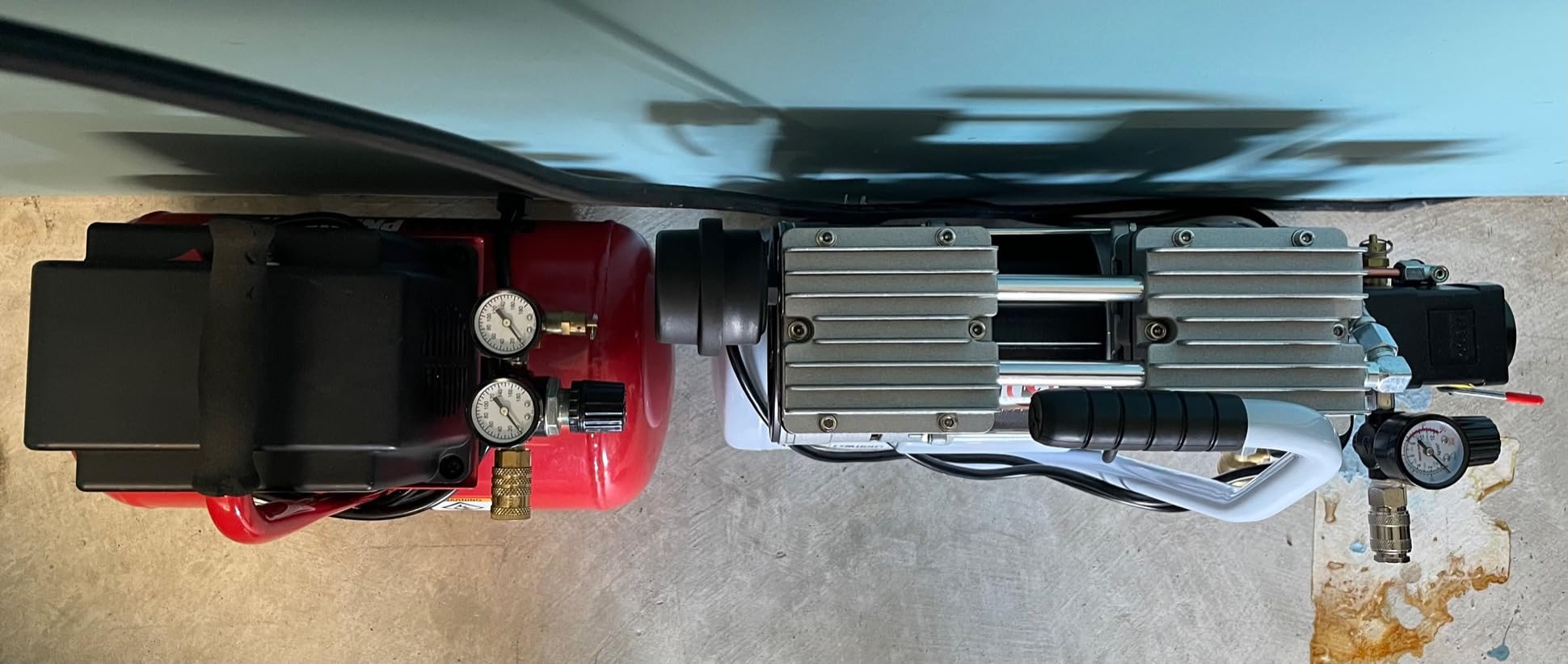
Owners treat it as a good value for light-duty home projects, and that is an accurate description. The 8 gallon tank and the included wheels make it easy to move, and the accessory kit means you can be blowing down a brake dust job or inflating tires the same afternoon it arrives.
But this is where we have to be straight about the limitation. Two point eight CFM at 90 PSI is below what most impact wrenches want, and the 1.2 HP motor is genuinely underpowered for sustained high-demand pneumatic tools. This is a finish nailing, inflating, and light cleaning compressor. If you own a half-inch drive impact, this is not the machine to pair it with.
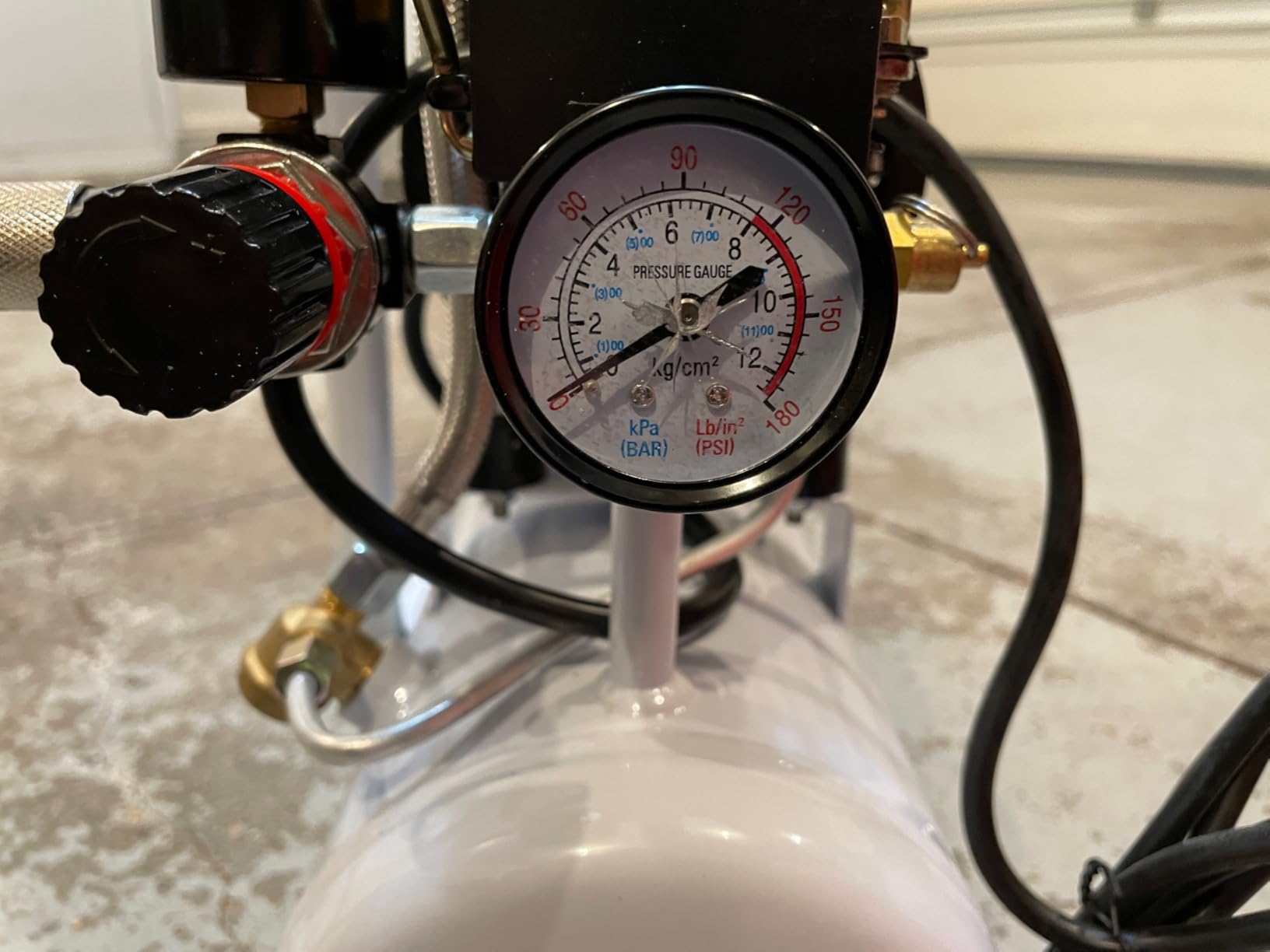
Who the Limodot suits
For a first compressor, a renter, or anyone who wants a low-noise unit for an apartment-adjacent space, the Limodot is a genuinely easy place to start. The included hose and accessory kit removes the most common early mistake, which is buying a compressor and then discovering you do not have the right fittings.
It also suits light-duty work like brad nailing, inflating tires, and cleaning, where the 2.8 CFM output is more than sufficient and the quietness is the priority.
Where the Limodot falls short
Do not buy this one for impact wrench work. Two point eight CFM at 90 PSI and a 120 PSI ceiling put it squarely in a different category from every other compressor in this guide, and a wrench that needs 4 CFM will simply stall waiting for the pump. The oil-free pump is also not built for long continuous duty cycles.
If your goal is a half-inch drive impact, spend up. If your goal is nailers, inflating, and cleanup, this is a good buy.
7. DEWALT DWFP55130 – Best for Trim Work, Tires, and Tight Spaces
DEWALT Air Compressor for Trim, 200-PSI Max, Quiet Operation (DWFP55130)
3.0 SCFM at 90 PSI
200 PSI max pressure
2.5 gallon tank
36 lb and 12.5 inch thin
Pros
- 200 PSI max pressure gives real headroom for trim and light impact work
- Only 12 amps so it starts easily on ordinary household circuits
- 36 lb and 12.5 inches thick makes it one of the most portable units here
- Oil-free pump means no maintenance and no oil in the airstream
- 71.5 dBA is genuinely quiet for a compressor in this class
Cons
- 2.5 gallon tank is the smallest here and fills quickly under sustained load
- 3.0 SCFM at 90 PSI is insufficient for most high torque impact wrenches
- Ball valve drain design makes the tank awkward to fully drain
This compressor solves a space problem. At 36 pounds and 12.5 inches thick it stores vertically or horizontally in a closet, under a bench, or in the corner of a garage where nothing else fits. The DWFP55130 is the pick for anyone whose workshop is a room rather than a building.
The 200 PSI maximum is a genuine advantage in its class, and the low 12 amp draw means it starts without tripping breakers on a shared household circuit, which is not true of several competitors here. Dual quick couplers let you run two nailers at once, and 71.5 dBA per the ISO 3744 test standard is quiet for a compressor of this size.
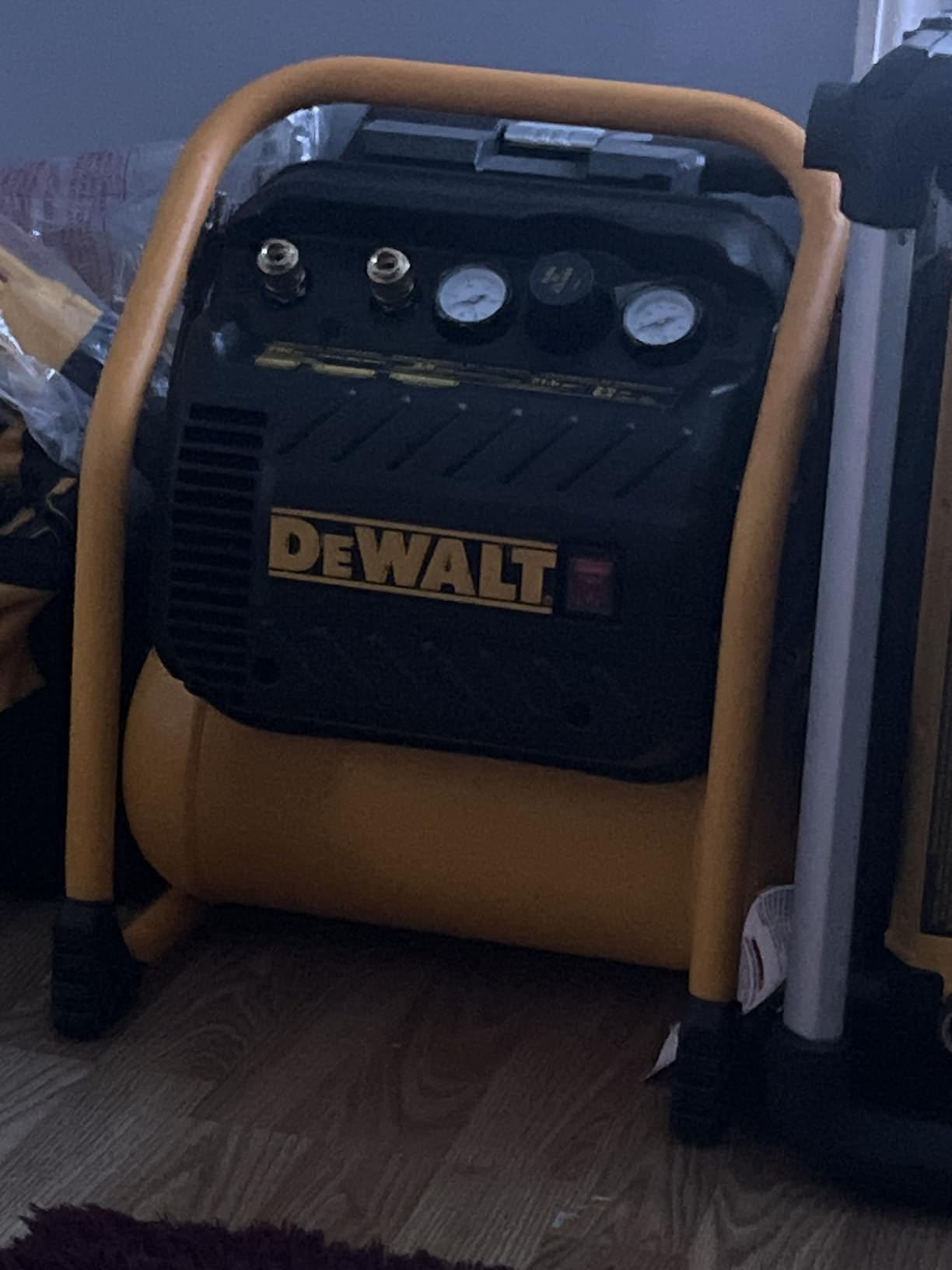
Buyers consistently praise the low noise, low amp draw, and compact form factor, and it is heavily favoured for trim and finish work and for tire inflation. The roll cage and control panel protect the key components, there is a cord wrap, and the oil-free pump means no maintenance and no oil in the airstream.
The limits are the ones the numbers predict. A 2.5 gallon tank refills quickly under sustained tool load, and 3.0 SCFM at 90 PSI is not enough for most high torque impact wrenches. Reviewers are candid that it will not drive a high-CFM impact without an auxiliary receiver, and the ball valve drain design makes the tank awkward to fully drain, which matters more in a humid climate than people expect.
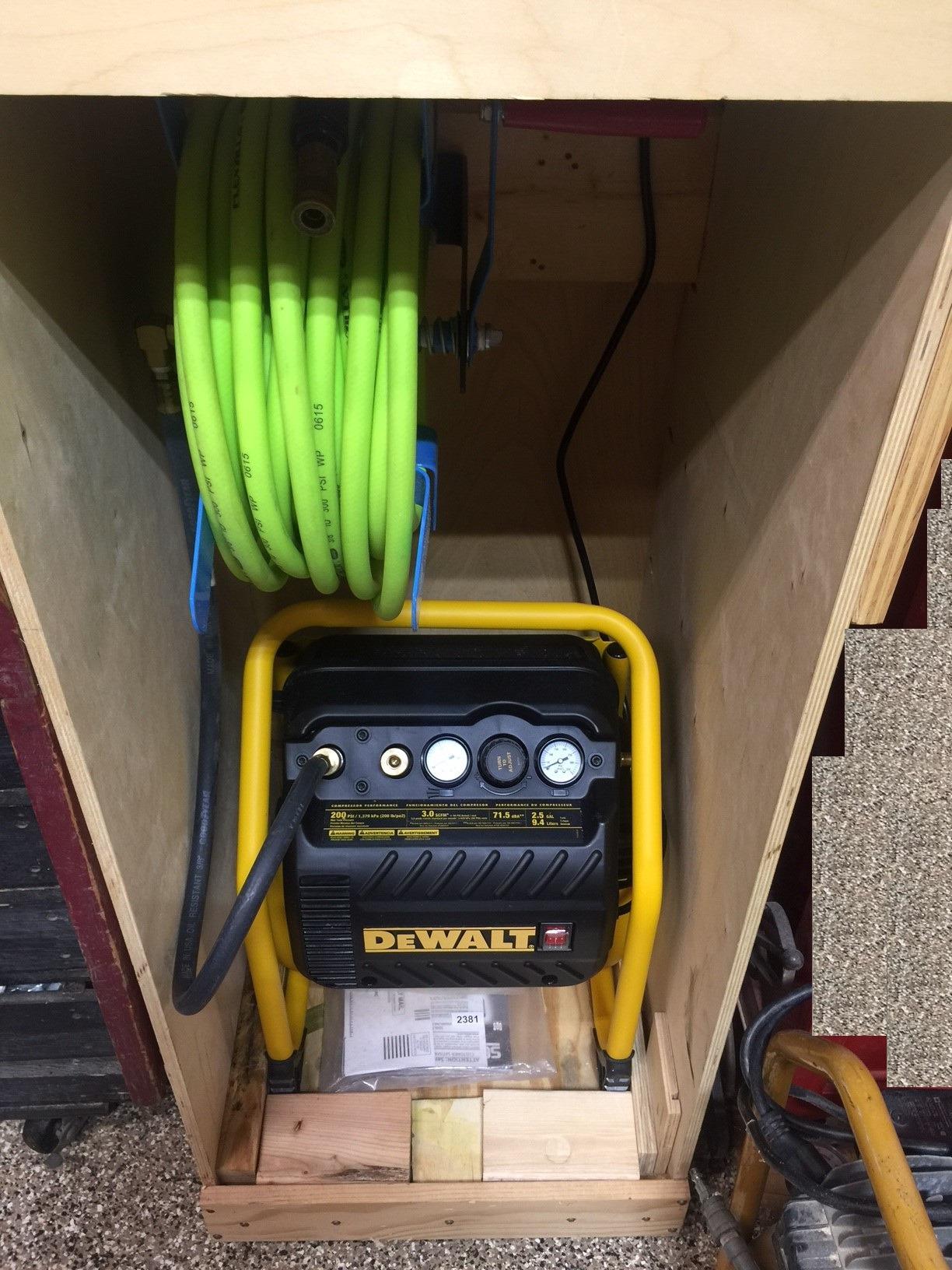
Who the DEWALT DWFP55130 suits
For trim carpenters, finish woodworkers, and anyone doing light work in a small shop, this is the compressor. The 200 PSI pressure is well matched to finish and trim nailers, which are pressure-sensitive tools, and the 12 amp draw means it can share a circuit with other shop equipment that a 15 amp unit could not.
It is also a strong choice for tire inflation and top-off jobs, and for anyone who wants a second small compressor dedicated to finish work so it does not compete with a bigger machine for the same outlet.
Where the DEWALT falls short
It is not an impact wrench compressor. Three CFM at 90 PSI is below the four CFM threshold where most half-inch drive wrenches start to struggle, and the 2.5 gallon tank means you will hear it cycling constantly during a wheel job. If that is the job you have in mind, use a bigger unit in this guide.
The small tank also refills so often during longer jobs that some owners find it distracting, and the drain valve design is a small daily friction that adds up over a season.
8. DEWALT D55146 – Best for High-Pressure Impact Work
DEWALT Air Compressor, 225-PSI Max, Hand Carry with Wheels, 4-1/2 Gallon (D55146)
5 CFM airflow
225 PSI max tank pressure
4.5 gallon tank
1.6 HP oil-free
Pros
- 5 CFM with 225 PSI tank pressure is the highest pressure configuration in this set
- Long term owners report 5 to 10 years of weekly use with the pump still running
- Oil-free pump produces clean air with no warm up period
- Welded tubular roll cage and 10-inch pneumatic tires survive rough terrain
- Large 2-inch gauges are easy to read in the field
Cons
- Draws a full 15 amps so it needs a dedicated circuit
- At 88 lb it is heavy and bulkier than it needs to be
- Regulated output tops out around 150 PSI even though the tank holds more
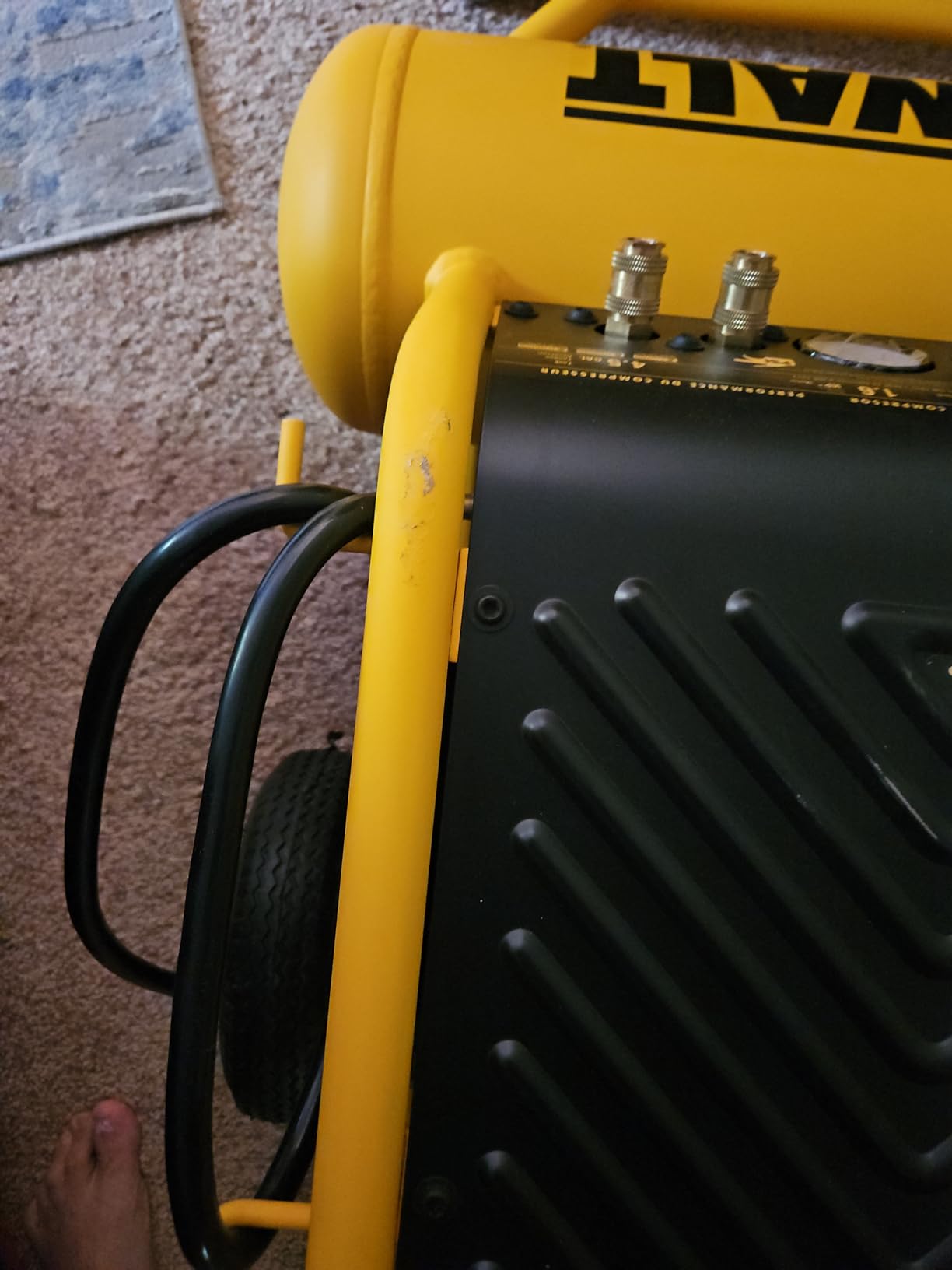
The D55146 is the pressure king of this group, and for impact work that is not a trivial advantage. It stores 225 PSI in the tank, which is the highest storage pressure here, and it pairs that with 5 CFM of airflow from a 1.6 HP motor. For work on seized fasteners where you want every PSI of stored pressure available at the wrench, that combination is the strongest in this guide.
Durability is the other story. Owners with five to ten years of continuous weekly use report the pump is still running strong, and the build reflects that. The tubular frame, tank, and tire shaft are welded together into a protective cage, the 10-inch non-flat pneumatic tires handle rough jobsite ground, and the display console puts large 2-inch gauges, couplers, and the regulator behind a protective metal panel.
The oil-free pump means clean air with no warm-up period, which is a small daily convenience that adds up. High-flow couplers are included to help maximize nailer performance, and the low 1.6 HP motor is a mild surprise given the output, the machine is doing more with less than you would expect from the horsepower figure.
Two practical cautions. The unit draws a full 15 amps, so it needs a dedicated circuit rather than sharing with the rest of the garage. And the couplers are 3-in-1 industrial style rather than true high-flow, so if you already own high-flow connectors you will need an adapter. The regulated output also tops out around 150 PSI even though the tank holds more, which is normal but worth knowing.
Who the DEWALT D55146 suits
This is the compressor for someone working on trucks, farm equipment, or anything with genuinely seized hardware, where the extra stored pressure is the difference between a wrench breaking a bolt free and a wrench just spinning. The 10-inch pneumatic tires and welded cage also make it the most jobsite-ready unit in this guide, which matters if you are working away from a paved driveway.
Long-term buyers get the most out of it, since the durability reports are the strongest here. If you buy a compressor expecting to still own it in a decade, this is the one.
Where the DEWALT falls short
At 88 pounds it is heavy, and one owner argues it is bulkier and heavier than it needs to be. The 15 amp draw means a dedicated circuit, which in an older garage can mean an electrician. And while the tank holds 225 PSI, the regulator tops out around 150 PSI, so the extra storage pressure is a buffer benefit more than a working pressure benefit unless you are using a secondary regulator.
The tank also has to be tilted about 45 degrees to drain properly and the petcock is hard to reach, which is a recurring minor complaint. Long-term owners have needed regulator seal and knob seal kits along the way, which is normal for a machine of this age.
9. Craftsman 10-Gallon – Lightest 10-Gallon Tank You Can Move
Craftsman 10-Gallon Air Compressor, 1.8 HP, Max 175 PSI, 4.0 CFM @ 90PSI, 5.0 CFM@40PSI, Oil-Free, Quiet Shop Air Compressor with Wheels for Spraying Pneumatic Tool, Model: CMXECXA0201041
4.0 CFM at 90 PSI
10 gallon tank at 31.5 lb
175 PSI max
1.8 HP oil-free
Pros
- Only 31.5 lb for a 10 gallon tank which is an unusually good weight to capacity ratio
- 4.0 CFM at 90 PSI is enough flow for light pneumatic tools and smaller impact wrenches
- 175 PSI max pressure gives good headroom for general shop work
- Compact horizontal design stores under a workbench when not in use
- Oil-free design needs no maintenance and the package includes a quick coupler plus two 1.5-inch gauges plus an air filter plus a 6-foot cord
Cons
- 1.8 HP motor is modest so recovery is slower after the tank is drawn down
- Air flow specification is listed inconsistently on the product page
- Oil-free pump is not intended for extended continuous duty cycles
Thirty-one and a half pounds for a 10 gallon tank is genuinely unusual, and it is the reason this compressor is on this list. Most 10 gallon units weigh 60 to 90 pounds, which is what stops people from moving them when they need to. At this weight, one person can carry it to a driveway or a project without planning around it.
The output is 4.0 CFM at 90 PSI, with 175 PSI maximum pressure, which covers light pneumatic tools and the smaller impact wrenches without stalling. The oil-free pump needs no maintenance, and the compact horizontal design at roughly 23.6 by 21.4 by 15.9 inches stores under a workbench when it is not in use, which solves the same space problem the DEWALT trim unit solves at a larger capacity.
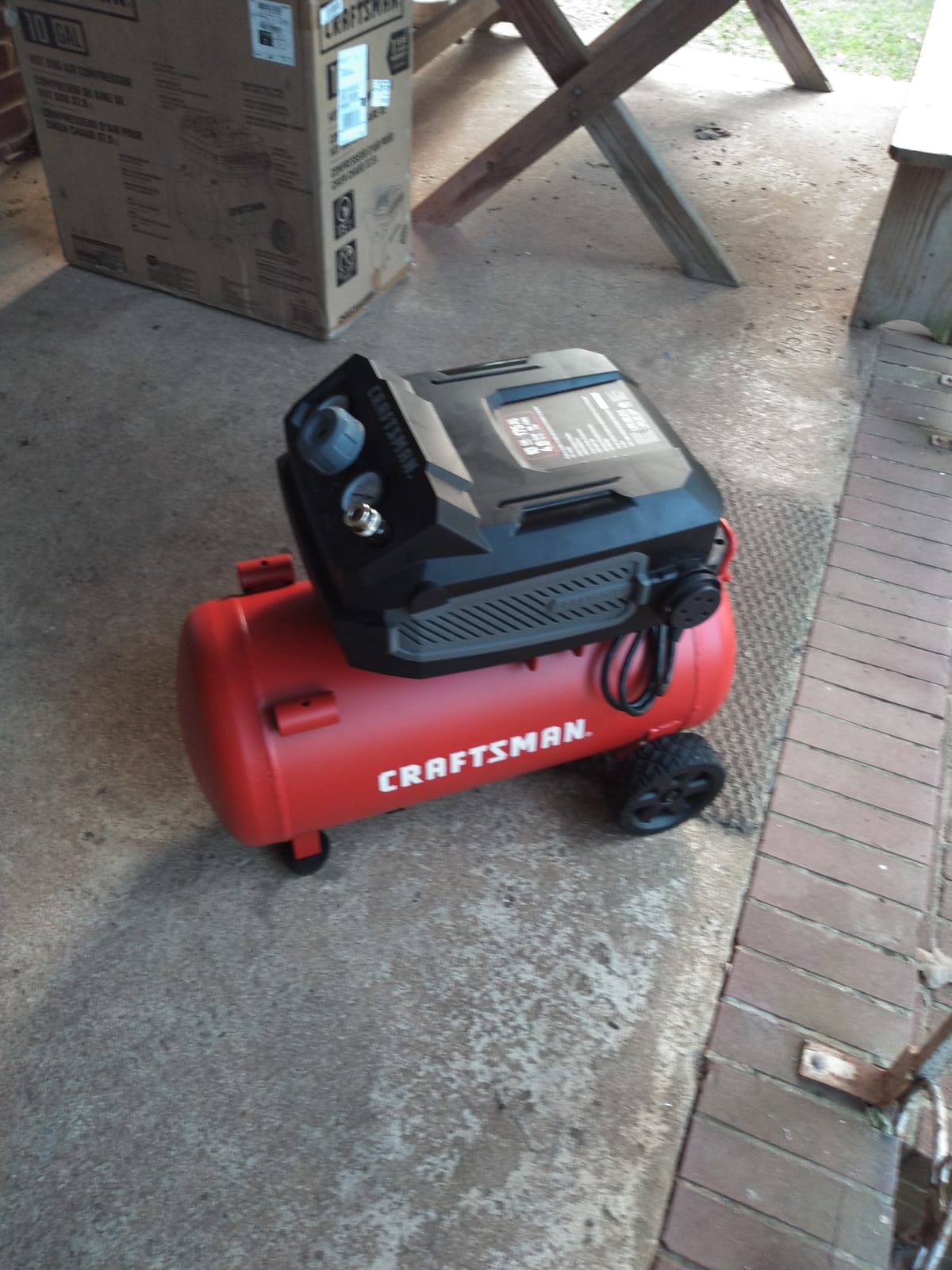
Owners consistently mention the weight-to-capacity ratio as the defining trait. Rubber wheels and a handle are included, vibration-damping rubber feet keep it from walking on a concrete floor, and the package includes a quick coupler, two 1.5-inch gauges, an air filter, and a 6-foot cord, which is a complete setup for getting started.
The limitation is the motor. A 1.8 HP motor refills a 10 gallon tank more slowly than the 2 HP units in this guide, so once you draw the tank down, the recovery gap is noticeable. The airflow specification is also listed inconsistently on the product page, so treat the 4.0 CFM at 90 PSI figure as the number to plan around rather than the 175 figure that appears in one field.
Who the Craftsman 10-Gallon suits
For a home garage where the compressor needs to come out of storage and be used outside, this is the pick. A 31.5 pound unit is a one-person lift, and the under-bench footprint means it is not permanently occupying the work area. Ten gallons is enough reserve for most home impact work, and 4.0 CFM covers the lighter end of the wrench spectrum without stalling.
It also suits anyone who wants oil-free operation with a tank size that is actually usable, rather than the 2.5 gallon and 3 gallon tanks that force constant refills.
Where the Craftsman falls short
Slower recovery is the trade for the low weight. After the tank is drawn down, the 1.8 HP motor takes noticeably longer to refill it than a 2 HP unit would, and on a longer wheel job you will feel that. The oil-free pump is also not intended for extended continuous duty cycles.
If you plan to run a half-inch drive impact continuously or work in a hot enclosed space, look for a higher-output unit with a continuous duty rating rather than this one.
10. Stealth SAQ-1413 – Quietest Unit in the Group
Stealth 4.5 Gallon Ultra Quiet Air Compressor,1.3 HP Oil-Free Peak 150 PSI 65 Decibel Air Compressor,4 CFM @ 40 PSI 3 CFM @ 90 PSI Silent Portable Long Life Electric Air Compressor W/Wheel for Garage
3 CFM at 90 PSI
64-65 dB operation
4.5 gallon tank
7.09 amp draw
Pros
- Quietest unit here at 64-65 dB making it the best choice for indoor use
- 3 CFM at 90 PSI with 4 CFM at 40 PSI suits light pneumatic work
- 70-second empty to full recovery is the fastest listed
- Only 7.09 amps of draw so it starts on almost any circuit
- Includes a 6-foot cord and a limited lifetime warranty
Cons
- 1.3 HP motor and 3 CFM at 90 PSI are below what most impact wrenches require
- 4.5 gallon tank is small and refills often under load
- 62 lb weight is substantial for a compressor this size
At 64 to 65 dB this is the quietest compressor in this guide, and in a shared wall or apartment-adjacent situation that number is the entire decision. The induction motor is the reason, running at a low speed with a design the manufacturer claims is up to 80 percent quieter and rated to last three times longer than a standard induction motor.
The other standout figure is the 7.09 amp draw, which is the lowest in this group. It will start on essentially any household circuit, including older ones and ones shared with other light loads. Recovery from empty to full takes about 70 seconds, the fastest listed here, and the oil-free design starts reliably under low temperature and low voltage, which matters in an unheated space.
The build is more robust than the price and weight suggest, with a Q235B steel housing, 6-inch rubber reinforced wheels, and an upright roller bag design. It ships with a 6-foot cord and a limited lifetime warranty, which is better coverage than the one-year terms common on the rest of this list.
Who the Stealth suits
For anyone working inside a house or a shared building, this is the compressor. The 64 dB figure is low enough that you can run it in a room without needing to plan around it, and the 7 amp draw means the circuit is a non-issue. It is also a strong choice for airbrushing, blow cleaning, and light spraying, which is what the manufacturer lists it for.
If you already own a larger compressor and want a dedicated small quiet unit for finish and detail work, this fills that role better than anything else in this guide.
Where the Stealth falls short
Three CFM at 90 PSI is below what most impact wrenches need, and the 4.5 gallon tank refills often under load. The 125 PSI rated cut-off with a 150 PSI peak is also modest for high-flow wrench work, so do not expect the extra pressure to translate into extra wrench performance.
And at 62 pounds it is heavier than the 31.5 pound Craftsman 10 gallon despite holding less than half the air, so the weight is not buying you the capacity the number suggests. This is a light and quiet compressor, not a heavy-duty one.
11. Ingersoll Rand 42672949 – The Only 100 Percent Continuous Duty Unit
Ingersoll Rand 42672949 2 HP Portable Twin-Stack Air Compressor
3.2 CFM at 90 PSI
100 percent continuous duty
4 gallon twin-stack
79-80 dBA
Pros
- 100 percent continuous duty rating is unique in this set for prolonged impact sessions
- Oil-lubricated twin-stack pump with durable cast iron cylinder for long term durability
- All Season Select synthetic lubricant runs 2000 hours between changes
- Two quick disconnect couplers let you run two tools at once
- Compact 20-inch cube footprint with ergonomic front panel
Cons
- 135 PSI maximum is the lowest pressure ceiling among higher capacity units
- 3.2 CFM at 90 PSI is under the 4 CFM most mid-range impact wrenches want
- 80 dB is among the loudest units here
The Ingersoll Rand is the only compressor in this guide rated for 100 percent continuous duty, and for sustained impact wrench work that is the single most important spec. Every other unit here is designed to cycle on and off, with thermal protection that will eventually intervene if you run it flat out for an extended period. This one is built to run as long as you need it to.
The pump is an oil-lubricated twin-stack reciprocating design with a durable cast iron cylinder, which is the traditional answer to compressor longevity. The lubricant is a synthetic blend rated for 2,000 hours between changes, four times longer than petroleum-based oil, and the warranty is two years on the pump when you use it.
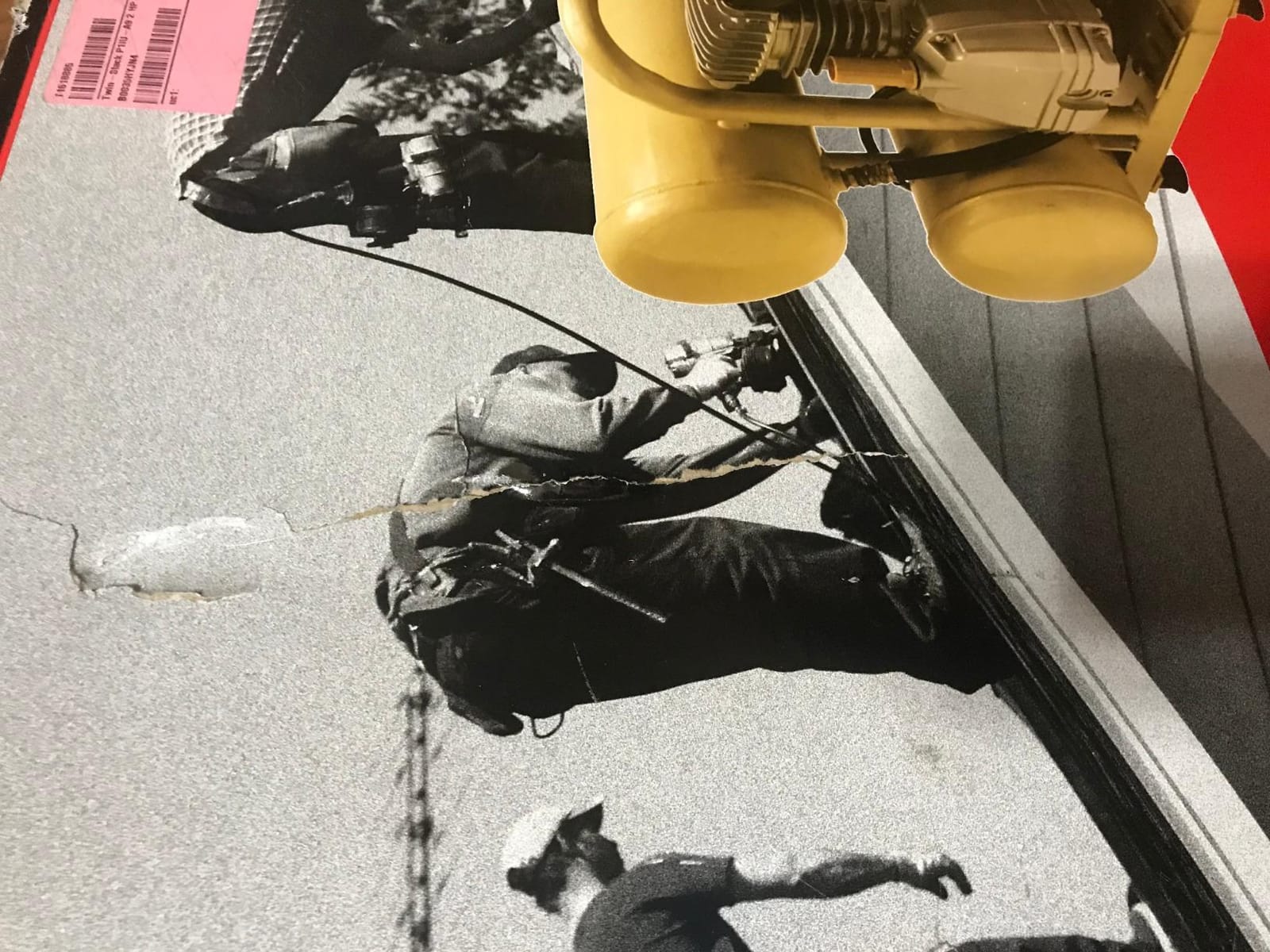
Owners value the continuous duty rating, the cast iron build, and the long service interval as the reason this unit lasts. The compact 20-inch cube footprint with an ergonomic front panel makes it easy to handle, and the two quick-disconnect couplers let you run two tools at once if you need to.
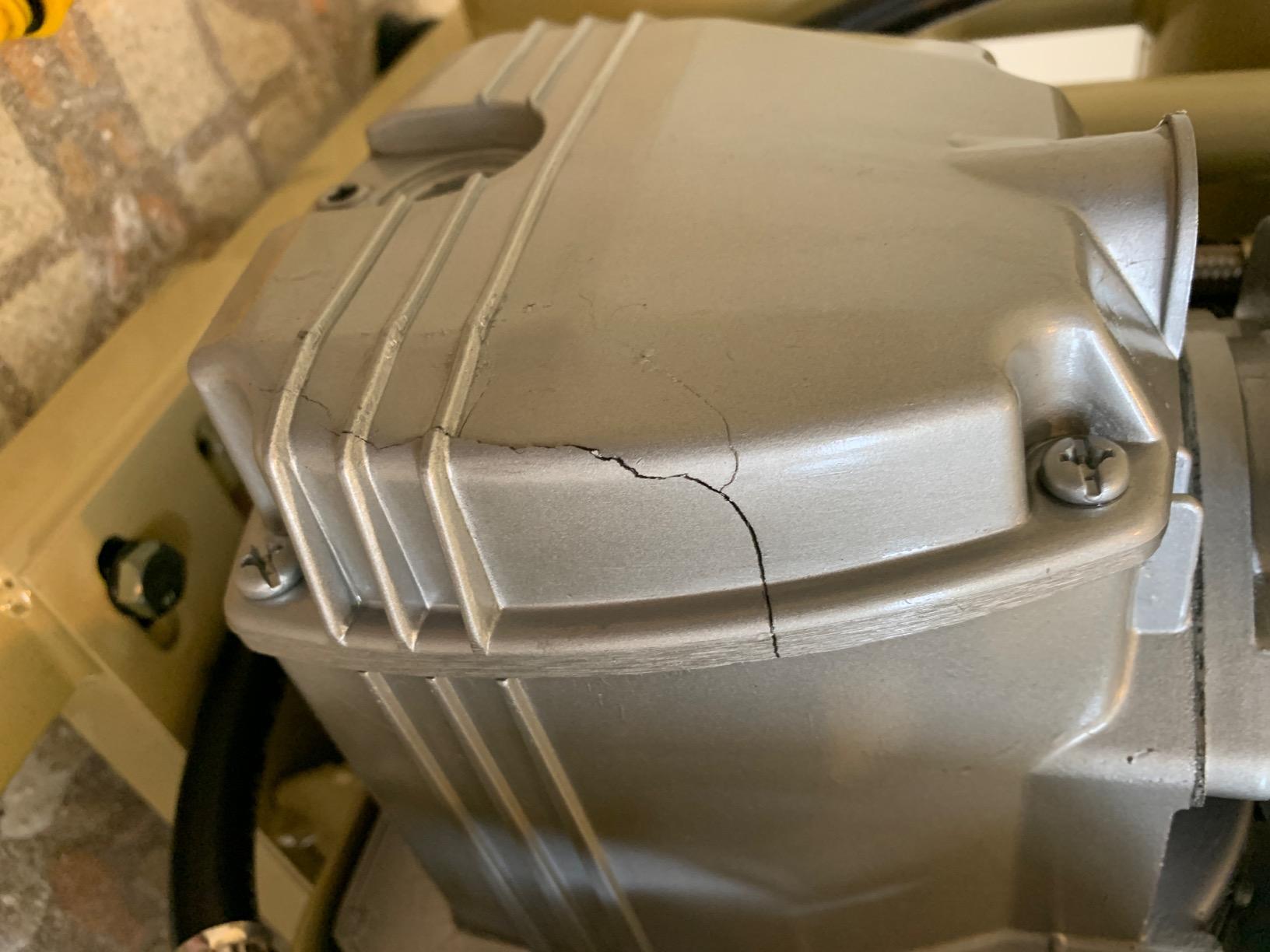
The compromises are real. Three point two CFM at 90 PSI is under the 4 CFM most mid-range impact wrenches want, so this is a unit that will not stall on you, but it also will not keep up with a genuinely hungry three-quarter inch drive gun. The 135 PSI maximum is the lowest ceiling among the higher-capacity units here, and 80 dB is among the loudest in this guide, so it is a poor choice for a residential garage.
Who the Ingersoll Rand suits
For a working mechanic who runs a half-inch or three-eighth inch drive impact all day, the continuous duty rating is what makes this worth the step up. You can work a long session without planning recovery breaks, and the cast iron twin-stack pump is the traditional choice for a machine that will be on for years. The 2,000-hour lubricant interval also means the maintenance burden is low in practice.
It also suits anyone who runs two air tools at once, since the dual quick-disconnect couplers are a genuine convenience on a busy shop day.
Where the Ingersoll Rand falls short
The 3.2 CFM output is the limitation, and it is a spec-sheet one. For a three-quarter inch drive impact you will want more airflow, and this unit will not deliver it. The 135 PSI ceiling is also the lowest among the higher-capacity units here, and that combination means less stored pressure at the wrench than the DEWALT D55146 provides.
At 80 dB it is one of the loudest compressors in this guide, which rules it out for a garage attached to a house. And unlike the oil-free units, it needs periodic lubricant checks and changes. We also want to flag the cost, which is the highest in this set.
12. Craftsman 6-Gallon Pancake – Best for Occasional Light Duty
CRAFTSMAN 6 Gallon 150 PSI Oil-Free Pancake Air Compressor CMXECXA02106410
2.6 SCFM at 90 PSI
6 gallon pancake tank
1 HP oil-free
30.8 lb
Pros
- 30.8 lb with a carry handle makes it one of the most portable compressors here
- Oil-free design needs no maintenance and no oil refills
- Small footprint and vertical pancake shape fit easily in a basement or closet
- Dual quick couplers let you run multiple air tools at once
- Builds pressure quickly for tire inflation and light nailing tasks
Cons
- 2.6 SCFM at 90 PSI and 1 HP motor are too low for most impact wrenches
- 150 PSI ceiling is at the low end of this set
- 82 dB is among the loudest units here
The Craftsman 6 gallon pancake is the most portable unit in this guide. At 30.8 pounds with a carry handle and a vertical pancake shape, it goes into a closet, a basement corner, or the back of a hatchback without any planning. For a renter or someone with no dedicated workshop, that portability is worth more than any spec on the page.
It is also a capable home garage compressor for its intended work. It builds pressure quickly for tire inflation, brad nailing, and cleanup, the oil-free motor has a low-voltage start for reliable cold starts, and dual quick couplers let you run two tools at once. It is backed by a one-year warranty with a US-based service team.
Owners treat it as a good budget option for everyday home garage tasks, with the weight and footprint cited as the main strengths. At roughly 15.8 by 16.4 by 17 inches, it takes up very little floor space for a six gallon capacity, and the iron body with a carry handle feels solid for the class.
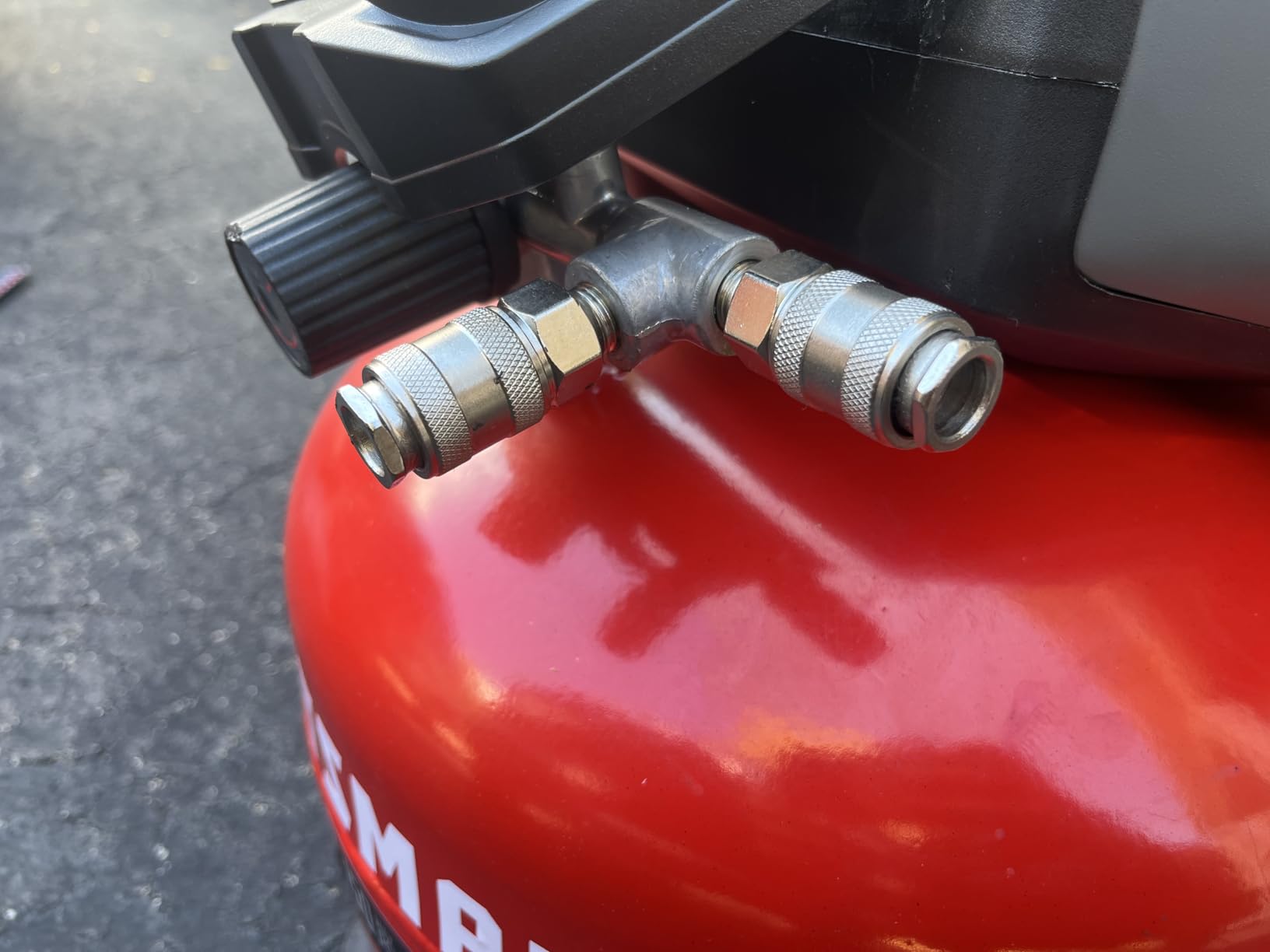
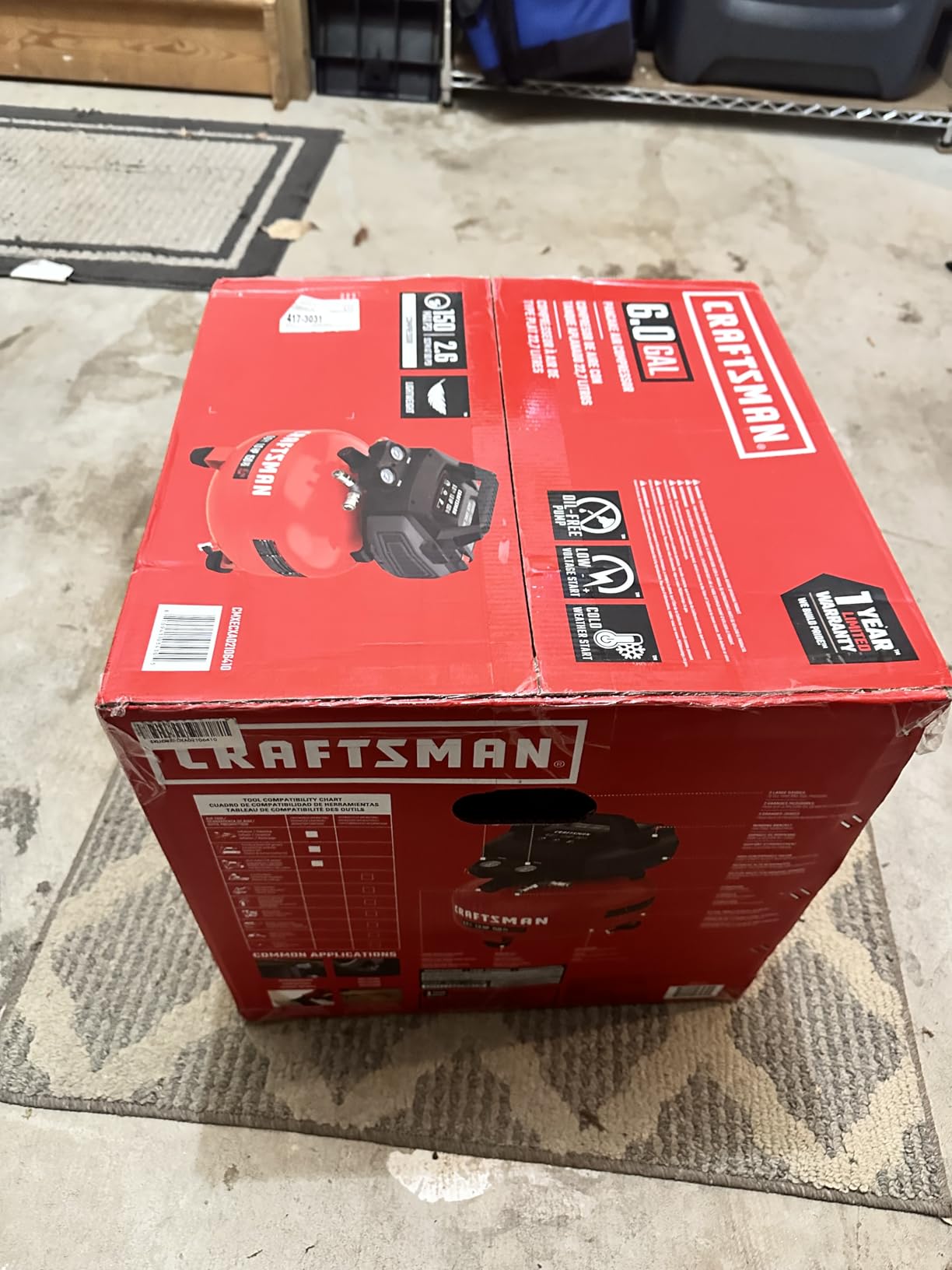
The problems show up under sustained load. At 2.6 SCFM at 90 PSI with a 1 HP motor, this is the second-lowest output in the guide, and 82 dB puts it among the loudest of any unit here, so it is a poor fit for a garage near living space. One reviewer reports the unit shut off and would not restart after about an hour of painting, and a few have reported a broken carry handle or damage on arrival, so inspect the package carefully.
Who the Craftsman 6-Gallon suits
For tire inflation, brad nailing, blowing out brake dust, and general light shop tasks, this does the job at a size you can carry with one hand. The dual couplers and the fast pressure build make it a genuinely useful second compressor, especially if you already have a larger unit for impact work and want something small for cleanup tasks.
It is also a good fit for a rental, a basement workshop, or anyone who needs a compressor that lives in a closet rather than a dedicated corner of a garage.
Where the Craftsman 6-Gallon falls short
It will not run an impact wrench. Two point six SCFM at 90 PSI and a 1 HP motor are simply below the threshold for that tool, and the 150 PSI ceiling is at the low end of this group. If the reason you are reading this guide is impact wrench work, this is not the compressor.
The 82 dB noise level is among the highest here, so it is a poor choice for an attached garage. And with reports of a unit that shut off and would not restart after extended use, plus some damage on arrival, we would inspect it immediately and keep the packaging for the warranty period.
How Big an Air Compressor Do I Need? Sizing Tiers
Match the compressor to the largest air tool you plan to run, and add roughly 50 percent headroom above that tool’s CFM demand. The tank then sizes itself from the length of the work, not from the tool. Here are the tiers we use, and they align with the advice that shows up most often in the r/MechanicAdvice discussions.
Tier 1: 3 to 6 gallon portable, occasional light work. This covers tire inflation, cleanup, brad nailing, and short three-eighth inch drive impact bursts. The 3 gallon and 6 gallon units in this guide fit here. Expect pauses, expect noise, and do not expect a half-inch drive impact to perform well.
Tier 2: 20 to 24 gallon, regular DIY car work. This is the minimum we would consider for impact wrench use, and it matches the 20 gallon figure that comes up repeatedly in forum consensus. It covers lug nuts, spark plugs, brake caliper service, and tire rotations with realistic pauses. The 20 gallon unit in this guide runs on a standard 120V circuit, which is unusual at this capacity.
Tier 3: 30 to 50 gallon, daily shop use. Once you are running impacts every day, or adding a framing gun, die grinder, or paint gun to the mix, you want both more CFM and a larger reservoir. At this size you should also be planning a dedicated 240V circuit rather than a household outlet.
Tier 4: 60 gallon and above, professional or multi-tool demand. A three-quarter inch or one-inch drive impact, or two air tools running simultaneously, puts you here. These units are typically two-stage, cast iron, and continuous duty. If you are in this tier, the single most important spec is the duty cycle rating, not the tank size.
One caveat on all four tiers. The relationship between tank size and CFM is not linear, and a unit that is far too small will cycle so fast that it wears out quickly. Manufacturers usually size the tank to match the pump output for this reason, so a compressor with 5 CFM and a 10 gallon tank is a balanced design, while 5 CFM in a 3 gallon tank is a machine you will replace in a few years.
Tank Size Explained: Pancake, Vertical, Twin-Stack, and Portable
Tank size determines how long you can work before the pump has to catch up. The shape determines where the compressor fits and how easy it is to move. Four formats cover almost everything on the market.
Pancake. A shallow horizontal tank, typically 2 to 6 gallons. It is low, stable, and stores easily, which is why the DEWALT trim unit and both Craftsman pancake compressors in this guide use it. The limitation is capacity, and a pancake under 6 gallons is not an impact wrench tank.
Vertical. A tall tank on end, usually 8 to 20 gallons. It gives you far more air in a small floor footprint, and the wheels and handle make it movable despite the height. This is the format most home shops end up with, and the 20 gallon vertical unit here is the clearest example of what that buys you.
Twin-stack. Two cylinders stacked one above the other inside a compact horizontal footprint. It delivers more airflow than a comparable pancake without the extra length, which is why twin-stack compressors are popular for framing. The Ingersoll Rand in this guide uses an oil-lubricated twin-stack design rated for continuous duty.
Portable. A handle-carry format under about 40 pounds, usually 3 to 8 gallons. This is a tool, not an installation. It is the right answer for a mobile mechanic and the wrong answer for anything sustained, and most of the units in this format will not drive a half-inch drive impact for more than a few bolts at a time.
Our view is that shape is a secondary decision. For impact wrench work specifically, airflow and duty cycle decide the purchase, and tank size is the third factor. If two compressors are close on CFM, buy the bigger tank.
Single-Stage vs Two-Stage and Oil-Free vs Oil-Lubed
Single-stage compressors compress air in one pass from atmospheric pressure to full tank pressure. They are simpler, cheaper, and found in essentially every unit in this guide. For impact wrench work at 90 PSI, single-stage is completely adequate. The pressure difference only matters for tools that need a lot of working pressure, like sanders and spray equipment.
Two-stage compressors compress in two passes, reaching higher pressures and running cooler. You will find them in 60 gallon and larger professional units. They are worth it when you are running multiple tools at once or working in a hot environment, and unnecessary overhead for a home garage running a half-inch drive impact.
Oil-free pumps put no oil in the airstream, which means no oil purchases, no filter changes, and clean air for painting and finishing. The cost is longevity. Oil-free pumps have shorter service lives, and their duty cycle ratings are typically lower, so thermal protection will trip sooner under sustained use. Most units in this guide are oil-free, including the 5.3 CFM options.
Oil-lubricated pumps run cooler and last considerably longer, at the cost of periodic oil checks and a separator if you run finish work through the same hose. The Makita and the Ingersoll Rand in this guide are oil-lubed, and both are the units we would trust for marathon daily work.
For a typical home garage doing occasional impact work, oil-free is the right call. For a working mechanic running a wrench all day, oil-lubed is worth the maintenance. The forum consensus in r/harborfreight and r/Tools threads supports the same split, with buyers repeatedly noting that CFM decides the purchase and the pump type decides how long it lasts.
What Happens When You Undersize a Compressor
An undersized compressor does not simply feel slower. It produces a specific, recognisable failure pattern, and it is the source of most “my impact wrench is weak” complaints in this category.
First, the tank pressure drops immediately on trigger pull. The wrench needs a sustained column of air, and when the tank falls below roughly 70 PSI the tool’s hammer mechanism slows and torque output drops. This is why forum users describe the wrench as feeling weak rather than broken. Second, the compressor stalls mid-bolt, which means the bolt never breaks free and you end up with an under-torqued fastener and an impact gun that needs cooling.
Third, the motor runs constantly and gets hot, which triggers the thermal protection on oil-free units after a sustained session in a closed garage. Fourth, the short cycling itself wears the pump, because a compressor that starts and stops dozens of times an hour ages much faster than one running steadily. This is the real cost of pairing a 3 CFM pump with a 4 gallon tank, and it is why manufacturers match tank size to pump output.
None of this is a fault in your impact wrench. It is a sizing problem, and it is fixable, but only by adding airflow rather than adding tank. If you have already bought a small compressor and want to test whether that is your problem, set an unrelated load on the tank, pull the trigger on the wrench, and watch whether the gauge holds steady. If it does not, you need more CFM.
Do Not Forget the Hose: 1/4 inch vs 3/8 inch Air Hose
Air hose diameter is the most common and most costly mistake in this whole category, and it is the one thing that can make a correctly sized compressor feel broken. A 1/4 inch hose attached to a hungry impact wrench acts as a flow restriction, and the pressure drop shows up at the tool as reduced torque and slower impact rate.
1/4 inch hose suits nail guns, air ratchets, and light blow guns. It is fine for small tools and wrong for anything that draws more than about 3 CFM.
3/8 inch hose is the right diameter for impact wrenches and die grinders. It can typically pass 10 to 20 SCFM depending on length, which covers a half-inch drive impact comfortably and leaves margin for a three-quarter inch drive. The recommendation in The Garage Journal that threads keep surfacing is a 25 foot length of 3/8 inch hose for running impacts and air ratchets without constant motor cycling, and that matches our experience.
1/2 inch hose is for high-demand continuous tools and very long runs, and it is rarely necessary for a garage compressor.
The second mistake is fittings. A 3/8 inch hose with 1/4 inch quick-connect fittings at the ends restricts flow exactly as much as a small hose, and it is a common and expensive oversight. Match the fitting size to the hose diameter, and buy high-flow couplers if you are running a three-quarter inch or one-inch drive gun.
One more practical note. Every compressor in this guide below about 20 gallons uses standard 1/4 inch quick couplers, and that is fine for a half-inch drive impact, but it is a limit worth knowing. If you move up to a larger drive, a manifold with larger couplers is the cheap upgrade that makes the difference. The r/VEDC calculation is the right mental model: a half-inch drive impact can demand around 25 CFM free air, which translates to roughly 4 to 5 CFM at 90 PSI from the compressor, and no hose or fitting should be the thing that limits you below that.
Pre-Purchase Checklist Before You Buy a Compressor for Impacts
Before you buy, work through these eight checks. Most of them take two minutes and will save you from the disappointment of an undersized machine.
1. Find the CFM at 90 PSI in the specification, not the horsepower and not the CFM at 40 PSI. Manufacturers frequently quote the 40 PSI figure because it is higher, and the difference can be more than 2 CFM.
2. Check the maximum pressure. Anything below 120 PSI leaves working pressure on the table for impact work, and 150 PSI or above is a better target for a half-inch drive.
3. Confirm the amp draw and whether the circuit is dedicated. Anything above 14 amps needs its own outlet, and units at 15 amps will trip a shared household breaker.
4. Read the duty cycle rating, and treat anything that is not continuous duty as a machine you will be giving breaks.
5. Look for the published noise figure in dB(A) rather than a “quiet” label. The gap between 64 dB and 80 dB is the difference between running a compressor at midnight and not.
6. Measure the space and check the weight. A 90 pound unit that has to come down four steps every time is a compressor you will not use for the jobs you bought it for.
7. Plan the hose. A 25 foot length of 3/8 inch hose with matching 3/8 inch fittings, not 1/4 inch, and add it to the purchase if the compressor does not include one.
8. If you are not certain which wrench you will end up using, look at our impact driver guide for home projects to decide whether you need a pneumatic wrench at all, and check the air compressors for off-road tires guide if tire work is part of your week, since that use case has its own pressure demands.
Frequently Asked Questions
How many PSI do I need to run an air impact wrench?
Most pneumatic impact wrenches are rated to operate at 90 PSI, which is also the reference pressure used to quote compressor CFM. Running below that reduces impact rate and torque, so a tank falling to 60 or 70 PSI mid-bolt is the usual cause of a wrench that feels weak. Aim for a compressor with 150 PSI or higher maximum so it has working pressure in reserve.
How much CFM do I need for an impact wrench?
Budget 3 to 5 CFM at 90 PSI for a half-inch drive impact wrench, 7 to 9 CFM for a three-quarter inch drive, and 10 CFM or more for a one-inch drive. Add about 50 percent headroom above the tool’s demand so the pump can keep up rather than merely refill between bolts. Note that tool specs list free-air CFM, which is not the same as compressed CFM at 90 PSI.
Is a 20 gallon air compressor enough for an impact wrench?
Yes, 20 gallons is the accepted minimum for intermittent home use with an impact wrench, and it is the figure that comes up most often in forum consensus. A 20 gallon tank at 90 PSI holds 180 cubic feet of compressed air, roughly 20 to 30 bolts at half-inch drive before pressure becomes an issue. A bigger tank will not compensate for low CFM, so check airflow as well as capacity.
Will a 3 gallon air compressor run an impact wrench?
Barely, and only for light quarter-inch and small half-inch bolts. A 3 gallon tank holds about 27 cubic feet of air at 90 PSI, so the pump will be running almost continuously during a bolt job. Expect the wrench to slow on the initial burst, and expect the motor to heat up in an enclosed garage because oil-free pumps cannot sustain that duty cycle.
Do I need an air compressor for an impact wrench?
You do not need one if you are starting out. A high-torque cordless impact will handle most DIY wheel and brake work without a tank, a hose, or the noise. Air is worth the setup once you want unlimited runtime, professional-grade torque on seized hardware, or to run several pneumatic tools at once from the same source.
What’s better for an air compressor, 1/4 hose or 3/8 hose?
Use 3/8 inch hose for impact wrenches. A 1/4 inch hose acts as a flow restriction on a tool that draws several CFM, and the pressure drop shows up as reduced torque and a slower impact rate at the wrench. A 25 foot length of 3/8 inch hose is the common recommendation for running impacts without constant motor cycling. Match your quick-connect fittings to the hose diameter to avoid the same restriction at the ends.
What size hose should I use for my air compressor?
Match the diameter to the tool’s airflow demand. Use 1/4 inch for nail guns, air ratchets, and light blow guns. Use 3/8 inch for impact wrenches and die grinders, since it can pass roughly 10 to 20 SCFM depending on length. Use 1/2 inch only for high-demand continuous tools or very long runs. Longer hose creates more pressure drop, so keep runs under about 25 feet where you can.
Is a bigger tank better than more CFM for an impact wrench?
No. CFM determines whether the tool can run continuously, and tank size only determines how long it can run before the pump has to catch up. A large tank paired with a weak pump still drops pressure on a hungry wrench, it just delays the drop. This is the most common misconception in the category, and the fix for a weak impact wrench is more airflow, not a bigger receiver.
Final Verdict: Which Air Compressor Wins for Impact Wrenches
The Makita MAC2400 is our best air compressor for impact wrenches overall, because 4.2 CFM at 90 PSI puts it squarely in the half-inch drive sweet spot while the 12.3 amp draw lets it run off an ordinary outlet. The Metabo HPT EC914S is the better pick if you need to carry the compressor to the work, and the California Air Tools 10020C wins outright if noise is the deciding factor. For a genuine 20 gallon reservoir on a standard circuit, the Klutch covers it.
Whichever you choose, match it to the wrench rather than the other way around, check the published CFM at 90 PSI rather than the horsepower, and budget for a 25 foot length of 3/8 inch hose. Those three steps solve most of the disappointment people report with this tool. This guide was last verified in 2026, and all airflow figures come from published manufacturer specifications.