
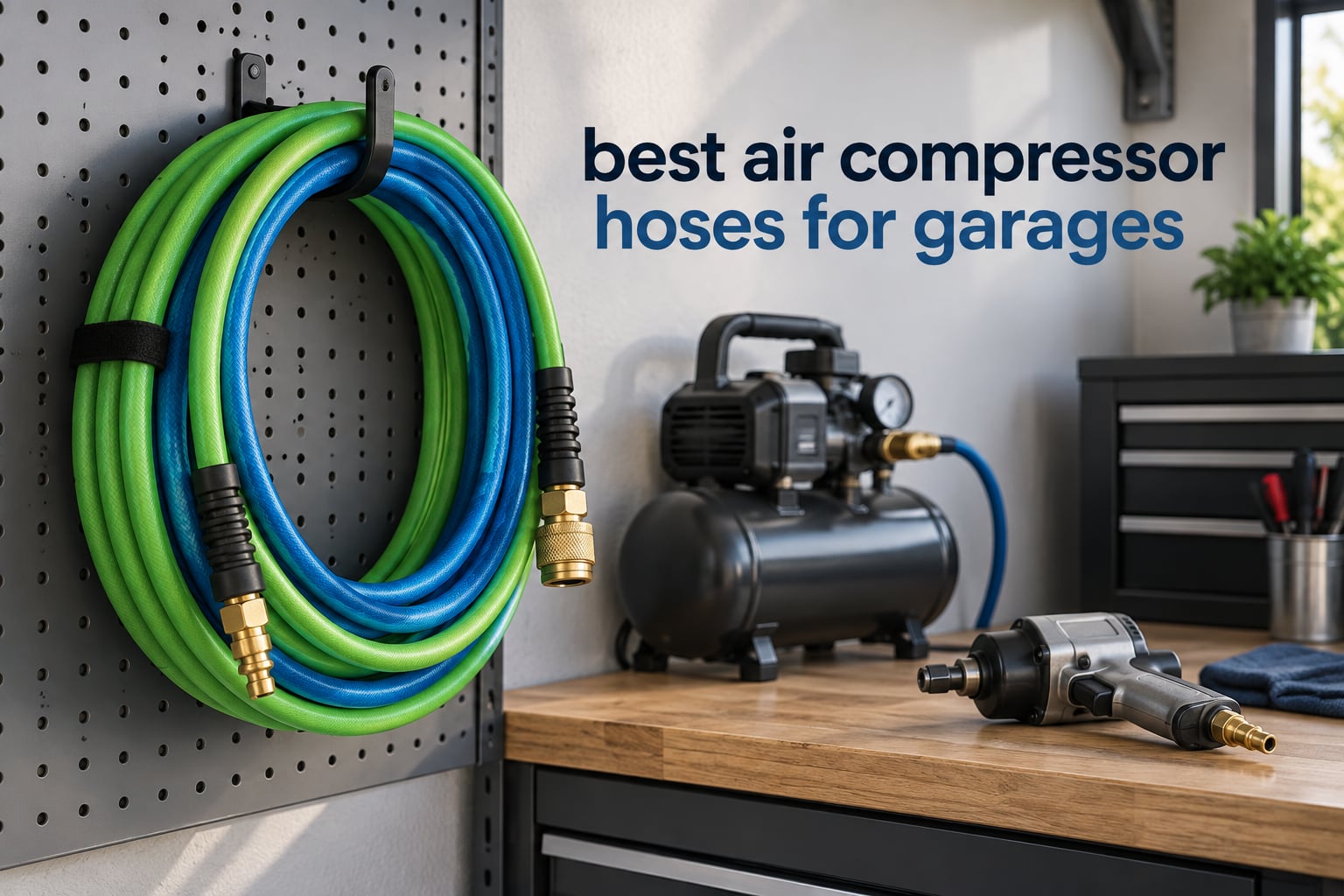
The best air compressor hoses for garages share four traits, and they are not subtle: a 3/8 inch inside diameter, a 300 PSI working pressure rating, solid brass 1/4 inch NPT fittings, and a rubber or hybrid construction that stays soft in an unheated building. Pick a hose that meets those four marks and the rest is preference. Miss one of them and you will spend your weekends wondering why a 5/8 inch impact wrench bogs down on a compressor that should have plenty of air in the tank.
Here is the thing almost every garage gets wrong. People size a hose to the port on the end of their tool, which is always 1/4 inch, so they buy a 1/4 inch bore hose and call it done. The fitting size and the bore size are two different numbers, and only one of them decides how much air reaches the tool. A 1/4 inch bore over 50 feet will starve a tool that a 3/8 inch bore feeds happily at the same tank pressure. That single decision, made before you care about color or brand, decides whether your compressor feels powerful or feels weak.
We compared ten air compressor hoses side by side, weighing bore, length, material compound, pressure rating, fitting hardware, cold-weather behavior and the complaints owners actually report. Our verdict: 3/8 inch bore, 25 to 50 feet, 300 PSI, brass fittings, rubber or hybrid. Anything narrower belongs on a nail gun or a tire inflator, not on the main shop line. We also looked hard at where each hose came from and who makes it, because enthusiasts on Garage Journal, GM SquareBody and DIYChatroom treat the rubber compound and the country of manufacture as the real quality markers, and after reading those threads we agree with them.
If your compressor is the piece that worries you more, we covered portable air tanks for garages separately. This guide is about the plumbing downstream of the tank, which is where most of the pressure mysteriously disappears.
Table of Contents
Top 3 Best Air Compressor Hoses for Garages in October

Flexzilla 3/8 in x 50 ft Hybrid
- 3/8 in bore and 50 ft length
- 300 PSI working pressure
- Flexible from -40F to 140F
- Aircraft aluminum crush-resistant fittings

YOTOO 1/4 in x 25 ft Recoil
- Self-coiling polyurethane
- 1/4 in bore and 25 ft length
- Flexible from -40F to 150F
- Removable quick coupler and bend restrictors
Estwing 3/8 in x 50 ft Hybrid
- 3/8 in bore and 50 ft length
- 300 PSI working pressure
- Solid brass NPT fitting and coupler
- All weather from -40F to 164F
Best Air Compressor Hoses for Garages in 2026 Quick Overview
Every hose below carries a 300 PSI working rating except the two polyurethane recoil lines, which we list with their own ratings and why they still make the list. Prices move daily, so use the buttons to check the current figure for each one.
| Product | Specifications | Action |
|---|---|---|
| Flexzilla 3/8 in x 50 ft Hybrid |
|
Check Latest Price |
| YOTOO 1/4 in x 25 ft Polyurethane Recoil |
|
Check Latest Price |
| Estwing 3/8 in x 50 ft PVC Rubber Hybrid |
|
Check Latest Price |
 YOTOO 3/8 in x 50 ft Heavy Duty Hybrid YOTOO 3/8 in x 50 ft Heavy Duty Hybrid |
|
Check Latest Price |
 WYNNsky 3/8 in x 100 ft Hybrid WYNNsky 3/8 in x 100 ft Hybrid |
|
Check Latest Price |
 Hromee 1/4 in x 50 ft Hybrid Hromee 1/4 in x 50 ft Hybrid |
|
Check Latest Price |
 BLUBIRD 3/8 in x 100 ft All Rubber BLUBIRD 3/8 in x 100 ft All Rubber |
|
Check Latest Price |
 JACO FlexPro 3/8 in x 50 ft Hybrid JACO FlexPro 3/8 in x 50 ft Hybrid |
|
Check Latest Price |
 EADUTY 1/4 in x 50 ft Polyurethane Recoil EADUTY 1/4 in x 50 ft Polyurethane Recoil |
|
Check Latest Price |
 FYPower 1/4 in x 50 ft Reinforced Polyurethane FYPower 1/4 in x 50 ft Reinforced Polyurethane |
|
Check Latest Price |
1. Flexzilla 3/8 in x 50 ft Hybrid Hose: The Best Air Compressor Hose for Most Garages
Flexzilla Air Compressor Hose, 3/8 in. x 50 ft., 1/4 in. MNPT Fittings, No-Kink, All Weather, Lightweight, Premium Hybrid Polymer, 300 PSI, ZillaGreen
3/8 in bore x 50 ft
300 PSI working
16 oz weight
Flexible -40F to 140F
Pros
- Stays usable in deep cold
- Will not kink under pressure
- Aircraft aluminum crush-resistant fittings
- High visibility ZillaGreen color
- Fits standard 50 ft reels
Cons
- Holds tight coils that need untwisting before storage
- Bright green shows grime readily
This is the hose we keep coming back to after looking at every option. Three-eighth inch bore, 50 feet, 300 PSI working pressure, and a hybrid polymer body rated from -40F to 140F. Those four numbers cover essentially every pneumatic tool a garage owner owns, from a 1/2 inch ratchet to a mid-size impact wrench, and the 50 foot length reaches from a compressor on one wall to the far side of a single-car bay without dragging the compressor along.
Flexzilla built this one around a hybrid polymer rather than natural rubber, and that choice is why it weighs 16 ounces. It is light enough to pull across a concrete floor one-handed, which matters more than any spec sheet when you are dragging a line back to a car at midnight. The crush-resistant aircraft aluminum fittings with a bend restrictor at each end are the detail we would point at first, because the fitting is where hoses normally fail, and a good hose is wasted on a cheap end.
Owners report multi-year durability, including abrasion exposure outdoors and near the coast, and the ZillaGreen color is genuinely useful in a dim garage. A coiled green line against a gray floor is far easier to see than a black one, and a hose you can see is a hose you do not trip over. Forum owners on Garage Journal and DIYChatroom describe Flexzilla as the most flexible hose they have used, and the DIYChatroom thread specifically calls it easy to work with, which matches what we saw in person.
The one persistent complaint is coil memory. Despite the zero-memory claim on the packaging, owners say the hose will hold a tight twist and needs to be un-twisted before it will hang properly. If you are the type who coils the line and hangs it on a hook every night, spend thirty seconds straightening it. If you are not, this matters very little.
The other recurring note is cosmetic. A high visibility color shows every oil spot and scuff, so the hose will not look new after a year of shop use. That is a fair trade for visibility in a dark bay, and it is the reason we keep this one on the short list above hoses that stay cleaner looking.
One note on fitting standard, because it trips up a lot of people. The ends are 1/4 inch male NPT, which is the thread standard for virtually every wall compressor outlet and hose reel in North America. If your setup uses quick-connect couplers at the wall rather than threaded ports, you will need a pair of 1/4 inch NPT to quick-connect adapters, and PTFE thread seal tape on the male threads.
Who should buy the Flexzilla
Buy this hose if you run a mix of tools, work in a garage that is not heated, and want one line that handles anything from an air ratchet to a light-duty die grinder. It is also the safest pick for a two-bay garage, because 50 feet is the length where pressure loss stays acceptable at 3/8 inch bore.
Skip it if you store your hose on a hook in a tight twist every single day, or if you work in a bay where an oil-black floor is part of the aesthetic. Those are the only two scenarios where owners regularly wish they had chosen differently.
Watch out for the coil memory
Hybrid hoses are lighter than rubber because they have less rubber in them, and the trade is a memory that holds a twist longer than a heavy rubber coil would. If you coil loosely from the coupler end, or hang the hose in a wide loop rather than a tight circle, you will not notice the difference at all.
Also expect the green to show wear. That is not a defect, and a scuffed hose is still a working hose, but do not buy this one for appearance. If appearance is the priority, the JACO FlexPro further down has a neutral gray finish and the same zero-memory behavior.
2. YOTOO 1/4 in x 25 ft Polyurethane Recoil Hose: Best for Small Garages and Mobile Work
YOTOO Polyurethane Recoil Air Hose, Air Compressor Hose 1/4″ Inner Diameter by 25′ Long with Bend Restrictor, 1/4″ Industrial Quick Coupler and Plug, Purple
1/4 in bore x 25 ft
Polyurethane, self-coiling
Listed 300 PSI, 150 PSI working
0.59 kg weight
Pros
- Self-coiling design saves floor space
- Lightweight and abrasion resistant
- Stays flexible from -40F to 150F
- Removable coupler and bend restrictors
Cons
- 150 PSI working pressure is well below 300 PSI hybrid hoses
- 25 ft is short for reaching around a vehicle
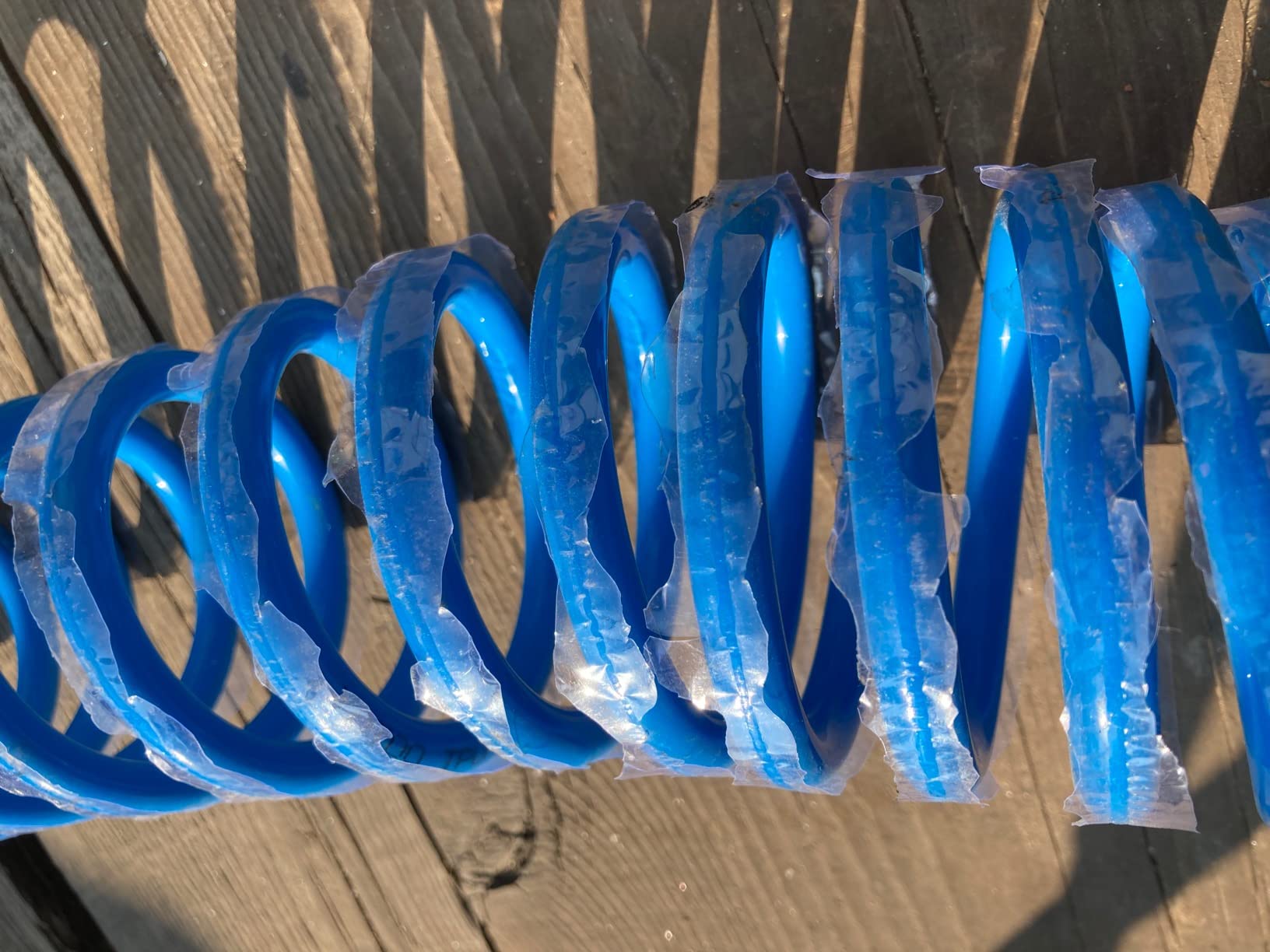
This is the hose for people whose garage is also their truck bed. It extends 25 feet and snaps back into a coil about the size of a garden hose, which means no snaking across the floor and no wall hook to install. The 0.59 kg weight is the lightest thing in this roundup, and if you move your air tool setup more than once a week, that is the feature that matters most.
The polyurethane body is the reason it coils. Polyurethane has a memory that actively pulls the hose back into a coil instead of letting it sit in a flat S-shape on the floor, and it resists abrasion and kinking without the weight of rubber. Rated from -40F to 150F, it will not stiffen in a cold garage the way a PVC line does.
Owners consistently single out the removable fittings as the best part. A 1/4 inch heavy duty industrial quick coupler and plug come pre-installed and come off with a wrench, so you can swap in a different fitting type if your tools disagree with what is on the box. That single feature has saved people from buying a second hose entirely.
The compromise is honest and worth stating plainly. This is a 1/4 inch bore hose with a 150 PSI working pressure, so it is a light-duty line. It is right for a blow gun, a tire inflator, a small nailer, and a brake bleeder. It is the wrong line for a 1/2 inch impact wrench working on lug nuts, and buyers who tried it that way report the tool slowing under load.
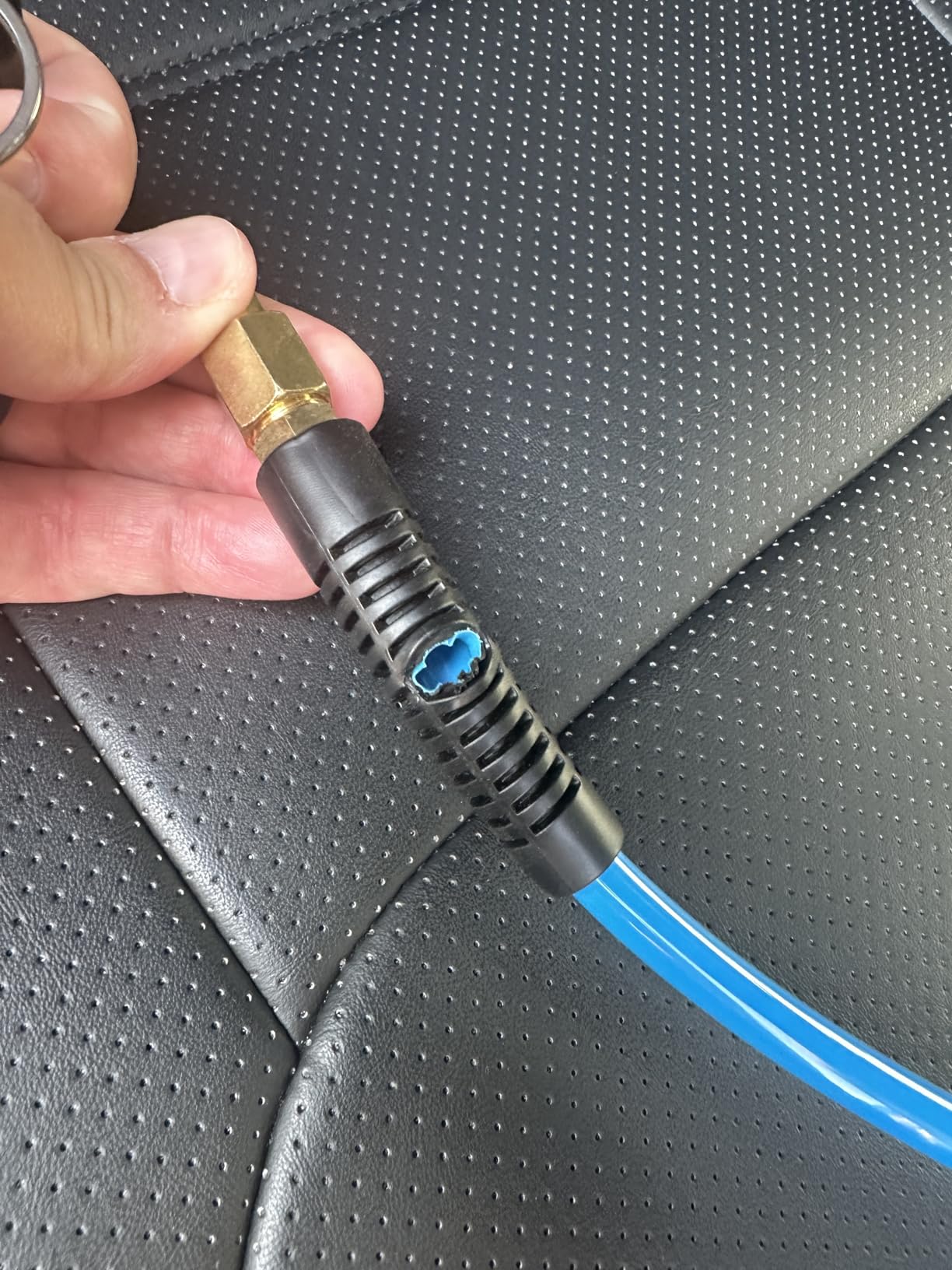
Owners also note the 25 ft length is short when the compressor is in one corner and the work is under a car in the opposite corner. The workaround most people use is a short 1/4 inch lead-in hose from the tank to a wall or ceiling drop, then this line from the drop. That way the 25 ft of recoil is doing the last stretch, and the fixed run is the part you do not have to drag.
There is one listing quirk worth flagging. The product page shows 300 PSI in the specifications field while the feature copy describes 150 PSI working pressure. Treat 150 PSI as the working figure and assume the higher number is a burst or listing artifact, because a coil hose that contracts under pressure should not be trusted at full tank pressure.
Where this hose earns its place
Buy it if your garage is a one-car space, if you work from a service truck, or if you mainly run air for cleanup, inflation and small trim tools. The self-coiling format is unmatched in this group, and nothing else here stores that small without going up on a reel.
It also makes a good secondary line. Keep a 3/8 inch hybrid on the shop spool for heavy tools and hang this one for everything else, so the light-duty work never drags the main hose across the garage floor.
What you give up for the coil
You give up bore and working pressure, and both matter. A 1/4 inch bore moves materially less air than a 3/8 inch bore over the same run, and 150 PSI working leaves very little headroom above a regulator set at a typical shop pressure.
If you need reach and pressure but not the coil, look at the FYPower 50 foot reinforced polyurethane later in this list. It is 1/4 inch bore as well, but it does not recoil, and it is rated for 300 PSI working with a 900 PSI burst.
3. Estwing E3850PVCR 3/8 in x 50 ft PVC Rubber Hybrid: Brass Fittings and a Wide Temperature Range
Estwing E3850PVCR 3/8″ x 50′ PVC/Rubber Hybrid Air Hose with 1/4″ Brass Fittings , Blue
3/8 in bore x 50 ft
300 PSI working
Solid brass fitting and coupler
2.5 kg weight
Pros
- Solid brass fittings that resist corrosion
- Kink resistant with bend resistors at both ends
- Covers -40F to 164F
- Light without losing strength
Cons
- Heavier than comparable polyurethane hoses at 2.5 kg
- Blended cover picks up dirt more readily than all rubber
The Estwing E3850PVCR is the one we recommend to people who have been disappointed by plastic fittings. It ships with a solid brass 1/4 inch NPT industrial fitting and a 1/4 inch universal coupler, and brass is the hardware that enthusiasts on forum threads ask for by name. Brass does not corrode, it does not strip when you back it off with a wrench for the fifth time, and it seals more reliably than plated steel or plastic.
Specs are the garage default done right. Three-eighth inch bore, 50 feet, 300 PSI maximum working pressure, and a blended PVC and rubber body that stays flexible from -40F all the way to 164F. That upper figure matters more than most people think, because a hose that softens and bulges near a hot engine bay or a welding-adjacent bench is a hose you will eventually replace early.
Estwing rates it for HVLP paint sprayers alongside impact wrenches, ratchet wrenches, air drills and die grinders, so it is a general shop line rather than a specialty one. Owners in the reviews describe the fittings as the strongest point, holding up in daily shop use, and several note the bend resistors at each end doing real work on the connection points where hoses normally crack.
Weight is the honest drawback. At 2.5 kg, this is one of the heavier hoses in the group, and you feel that across 50 feet when the line is stretched. Heavier hoses also resist abrasion better and sit flatter, so the extra pounds buy something real, but the Flexzilla at 16 ounces is easier to move.
The rubber coating on the blend is described as protecting against abrasive surfaces, chemicals, electricity and oil, which covers most automotive work. Oil resistance is the detail to remember when you are blowing off parts with an air gun and the line gets oversprayed every week, because a PVC-only line can go slick and attract dust within months.
It also sits at the top of the rating group here, with 4.7 stars across several thousand reviews, which tells us the brass fittings and the temperature range are not claims buyers found hollow. When thousands of owners converge on the same strengths, those strengths usually hold up.
Who buys the Estwing
Buy it if fittings have been your recurring problem, if you spray paint in the same space you wrench in, or if your shop sees summer heat and winter cold on the same hose. The brass hardware and the wide temperature envelope make it the choice for people who would rather replace the hose than the coupler.
It is also a good match for HVLP sprayers that need a dedicated line, because the manufacturer rates it for that application rather than leaving it as an afterthought in the feature list.
The weight and the dirt trade
Two things get less rosy with use. The 2.5 kg weight adds drag on a long run, and the blended PVC and rubber cover has a reputation for picking up grime faster than an all-rubber construction. Wipe it down periodically and neither issue becomes serious.
If weight is your top concern, the JACO FlexPro at a lighter build does the same 3/8 inch by 50 foot job, and the all-rubber BLUBIRD goes further in the other direction with a colder temperature floor.
4. YOTOO 3/8 in x 50 ft Heavy Duty Hybrid: The Best Value for a Two-Bay Garage
YOTOO Air Hose 3/8 in x 50 ft, Heavy Duty Hybrid Air Compressor Hose, Flexible, Lightweight, Kink Resistant with 1/4″ Industrial Quick Coupler Fittings, Bend Restrictors, Blue
3/8 in bore x 50 ft
300 PSI working, 1200 PSI burst
2.44 kg weight
Two year warranty
Pros
- Rolls up neatly for storage
- Couplers hold pressure without leaks
- Handles a splitter running two nailers
- Bend restrictors on both ends
Cons
- A small number of buyers report fittings leaking after a couple of months
- Can stiffen noticeably near 0F
This is the hose we hand to someone who wants the right bore and length without overthinking it. Three-eighth inch bore, 50 feet, 300 PSI maximum working pressure and a 1200 PSI burst figure, which is a solid four-to-one safety margin. The rubber and PVC blend is described as heavy duty, lightweight and abrasion resistant, and in practice it behaves like the hybrid category is supposed to.
Owners talk about it rolling up neatly, and that phrase comes up often enough to matter. A hose that coils into a clean loop takes up a fraction of the wall space a rubber coil needs, and it is one of the reasons a 50 foot hybrid in this price band is such a common garage purchase. Several reviewers also mention running a splitter off it to power two nail guns at once in summer heat without a pressure complaint.
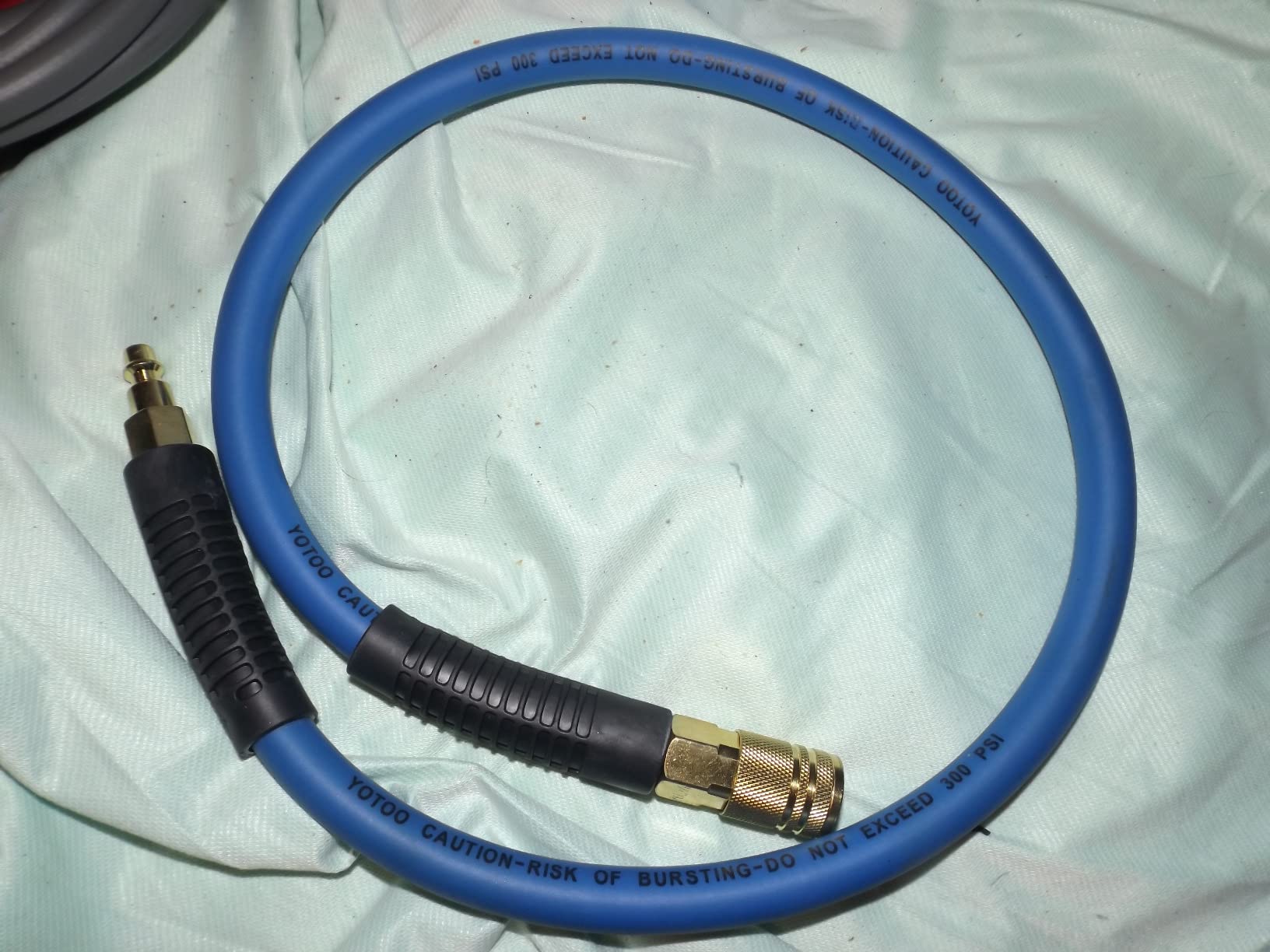
The fittings arrive pre-installed, which means no assembly and no chance of a bad crimp on day one. A 1/4 inch industrial NPT fitting and a quick coupler are already on both ends, and bend restrictors at each end reduce the flexing that cracks fittings. That matters for anyone running impact wrenches, where the whip load at the connection is the highest in the whole system.
Two cautions. A minority of buyers report the fittings beginning to leak after a couple of months of use, so check the connections with soapy water when you set it up and again after the first month. And buyers in unheated space report noticeable stiffening near 0F, which is a real limitation in a Minnesota winter but not an issue in a climate-controlled shop.
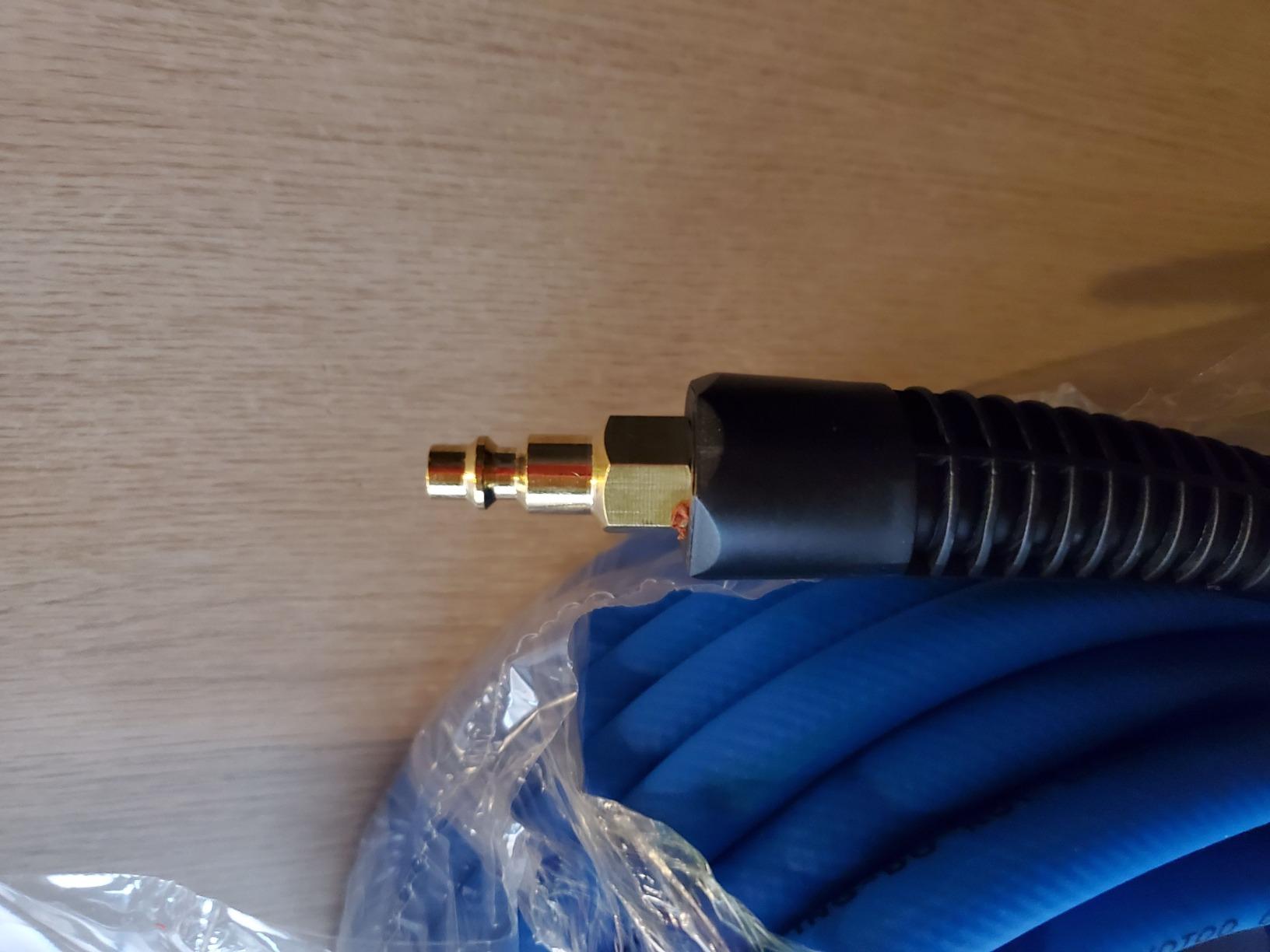
One more detail worth knowing: this line comes in sizes from 3 feet to 100 feet in the same construction, so if you end up wanting a 25 foot version for a lead-in or a matching 100 foot run for a two-car shop, the fittings and compound stay identical. Matching construction across lengths is a small thing that makes a garage look and behave like a system instead of a collection of parts.
That consistency is also why we rate it as the value pick. The specification sheet here matches what a premium hybrid in this roundup offers, and the only material difference owners report is the fittings over the long term.
Where this one fits
Buy it for a two-bay garage, a mobile repair setup, or a shop that splits one line between two nailers. It is the configuration most people are trying to build when they search for an air compressor hose for the garage, and it lands there cleanly.
It also works as the lead-in line from a wall-mounted reel to a bench, which frees the reel for the hose you actually drag around.
Watch the fittings in the first month
The fitting leak reports are a minority, not a pattern, but they are the kind of problem that gets blamed on the hose. If a coupler seeps, tighten it and check the thread seal tape before you start suspecting the rubber.
For a garage that never sees freezing temperatures, the stiffening complaint disappears. For a garage that does, the all-rubber hose later in this list stays flexible down to -50F and is the safer winter choice.
5. WYNNsky 3/8 in x 100 ft Hybrid Hose: Best for Large Garages and Long Runs
WYNNsky Hybrid Air Hose 3/8 in.X 100ft, 1/4″MNPT Fittings, 300 PSI Max Working Pressure,Non-Kinking, Lightweight, Flexible In Extreme Cold Weather, Excellent UV, Oil and Abrasion Resistant
3/8 in bore x 100 ft
300 PSI working
4.67 kg weight
Two year warranty
Pros
- Full-room reach without moving the compressor
- Bend restrictors reduce kinking
- UV and oil and abrasion resistant
- Double brass MNPT fittings
Cons
- Heavy to drag around a garage at 4.67 kg
- Large coil needs more wall or reel space
Reach is the whole pitch. One hundred feet of 3/8 inch bore means a compressor sitting in the back corner of a shop can serve a lift at the door, a bench at the far wall and a car outside, without anyone picking the compressor up and carrying it. For a large shop, that convenience is worth more than the weight it costs.
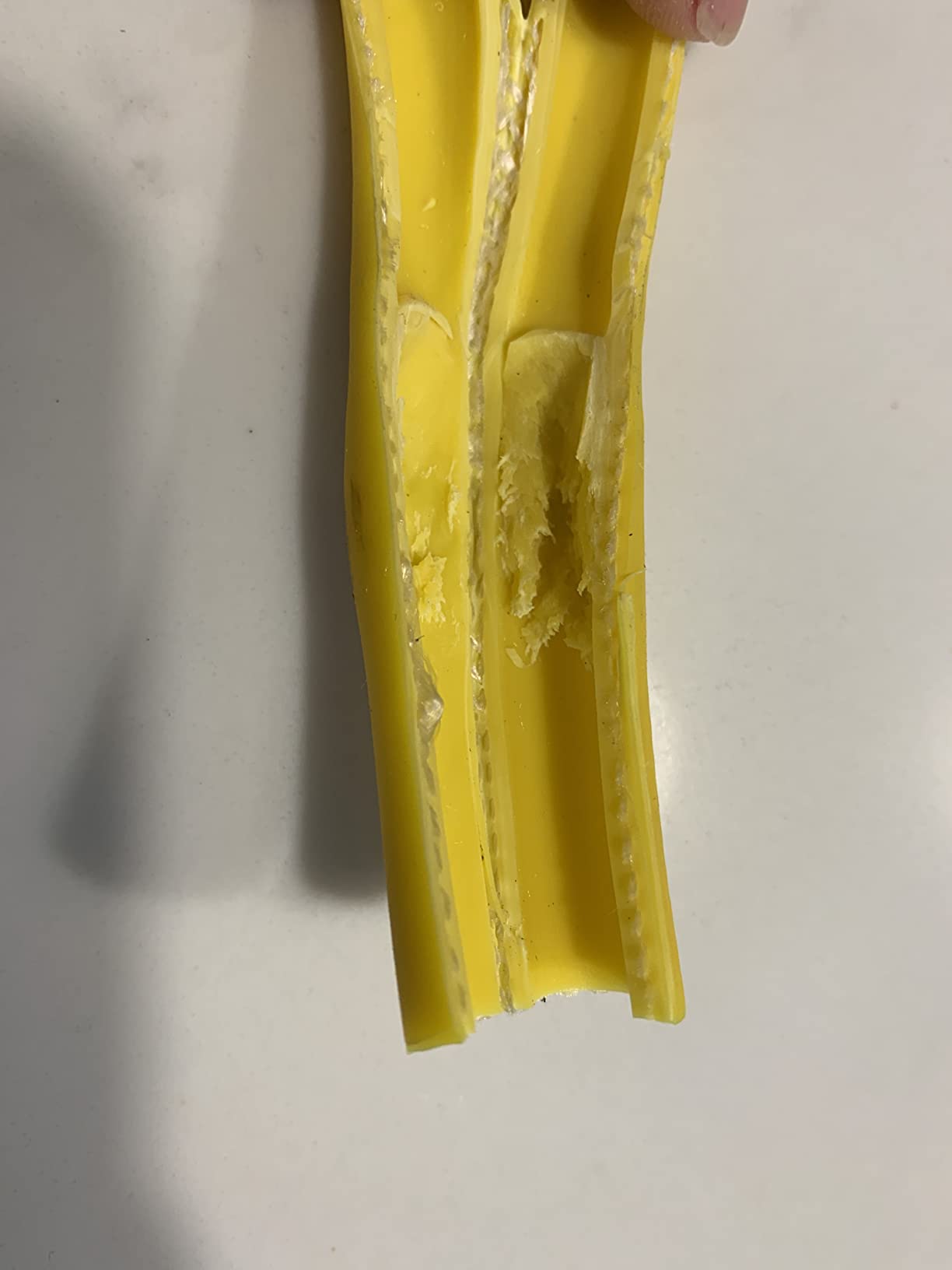
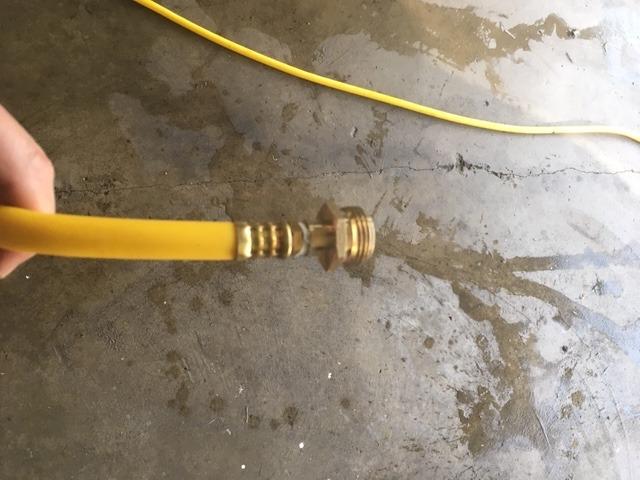
The compound is a PVC and rubber blend rated to 300 PSI working pressure with double brass 1/4 inch male NPT fittings at both ends. Owners cite the brass as the standout feature, noting that it seals better and corrodes less than aluminum, steel or zinc. It is also listed as UV, oil and abrasion resistant, which makes it the more defensible choice for a hose that lives outdoors or near a busy work area.
Cold-weather flexibility is a stated strength of the blend, and owners in unheated spaces confirm the hose stays workable in winter. The same owners are honest about the other side of a 100 foot run, which is that at 4.67 kg you are dragging a substantial coil across the concrete every time you move.
Bend restrictors are fitted to reduce kinking at the fittings, which is where a long hose spends most of its stress cycles. Combined with a kink-resistant blend, that is what keeps a 100 foot line from failing at the 20 foot mark where the connector flexes most.
If your shop is large enough to need 100 feet, the alternative is fixed piping, and that is a real comparison. Hard line has no drag weight and no pressure loss along the run, but it costs more, takes installation, and leaves you with wall outlets instead of a hose you can carry outside. For most home garages, a long hose is the cheaper and more flexible answer.
For most of our readers, 100 feet is more than they need. The right length is the shortest one that reaches the far corner of the workspace, because every extra foot is drag weight and a little extra pressure drop.
Who should buy a 100 foot hose
Buy it if you have a shop with more than one work position, a vehicle lift, or a compressor that sits far from where the work happens. One hundred feet is also the length people choose when the alternative is moving a full-size compressor across the floor, which is a much worse use of an afternoon.
Pair it with a reel mounted high on the wall or overhead if you can, and the weight problem largely disappears.
Where the length works against you
Storage and handling. A 100 foot coil takes up real wall space or needs a reel rated for the weight, and the 4.67 kg will drag over gravel, grass and uneven concrete. If your work happens in one tight bay, this hose will be an annoyance more often than a help.
Watch the pressure penalty too. Three-eighth inch bore keeps 100 feet workable, but adding a half inch bore would be better still if you plan to run large impact wrenches the full length of the run. No hose in this roundup is 1/2 inch bore, so that upgrade means a different category of product.
6. Hromee 1/4 in x 50 ft Hybrid Hose with Coupler and Plug Kit: Best for Cleanup and Light Duty Work
Hromee Air Compressor Hose 1/4 Inch x 50 Feet Hybrid Hose with Fittings, 1/4″ Industrial Quick Coupler and Plug Kit
1/4 in bore x 50 ft
300 PSI working, 900 PSI burst
3.4 lb weight
Working range -40F to 150F
Pros
- Light and easy to coil compared with old rubber
- Soft outer layer will not scratch floors
- Seals airtight at both connections
- High visibility yellow reduces tripping
Cons
- 1/4 in bore starves larger pneumatic tools
- Puncture risk from hot work or sharp tools
The Hromee is the hose we recommend when the real job is cleanup. Fifty feet of 1/4 inch bore at 300 PSI working pressure, 900 PSI burst, and a blend of PVC, aluminum, rubber, steel and brass that stays flexible from -40F to 150F. It is built for a blow gun, an air nozzle, a small sander and inflation work, and it does those jobs without complaint.
The soft outer layer is worth calling out. A number of owners specifically mention that it does not scratch garage floors, and on a painted or sealed slab that is the difference between a hose you drag freely and one you keep lifting to avoid marks. High visibility yellow does the same job that green does on other hoses here, which is making the line visible when it is lying under a car.
You also get a complete connection kit in the box, with a 1/4 inch NPT brass coupler, an I/M type steel plug and a heavy duty bend restrictor on each end. The review consensus is that the fittings seal airtight on both the compressor side and the tool side, which removes the single most common source of leaks in a new setup.
The limitation is the bore, and it is not a small one. A 1/4 inch bore moves materially less air than a 3/8 inch bore, so on a long run with a large tool, the tool slows down. Buyers who expected a general shop line report that disappointment directly. It is also more vulnerable to puncture from hot work or sharp objects than a thicker hybrid.
There is a lighter construction here too, with a woven middle layer that makes it abrasion resistant without going heavy. At 3.4 pounds for 50 feet it sits in the middle of this group, closer to the polyurethane lines in feel than to the all-rubber hose.
One buyer reported an initial odor that needed airing out. That is worth knowing if you are sensitive to it, and it is a one-time issue rather than a recurring one.
Where it fits
Buy it as a dedicated cleanup line, a second hose for a workbench, or a line dedicated to a nailer so you are not dragging the shop hose across the floor for small jobs. The included fittings mean it works standalone with a standard compressor outlet.
It is also a reasonable first hose for someone who inflates tires, cleans tools and runs a small pneumatic nailer but has not committed to a full shop line yet.
When to step up to 3/8 inch
Step up when you attach a tool that pulls real airflow, an impact wrench above roughly 3/8 inch drive, a die grinder, or a paint sprayer that needs a steady feed. Once you are there, the 3/8 inch bore hoses earlier in this list are the correct choice and the 1/4 inch bore stops making sense.
Also watch for heat and sharp edges. If the hose runs near welding, grinding sparks or a hot exhaust, a 1/4 inch line is the first thing in the garage to get punctured, and the puncture shows up as a leak you cannot find.
7. BLUBIRD BB38100 3/8 in x 100 ft All Rubber Hose: Best for Freezing Garages
BLUBIRD BB38100 3/8″ x 100′ Rubber Air Hose, 100% Rubber, Lightest, Strongest, Most Flexible, 300 PSI, 50F to 190F Degrees, Ozone Resistant, High Strength Polyester Braided
3/8 in bore x 100 ft
300 PSI working, 1200 PSI burst
10 lb weight
Flexible from -50F to 190F
Pros
- Stays flexible far below most hybrids
- Does not get sticky or pick up dirt
- Easy to wipe clean and resists oil and chemicals
- Brass ends with polyester braid
Cons
- Heaviest hose here at 10 pounds for a 100 ft run
- Tied to a reel or heavy hook to store
- Longer listed dimension is shorter than other 100 ft hoses
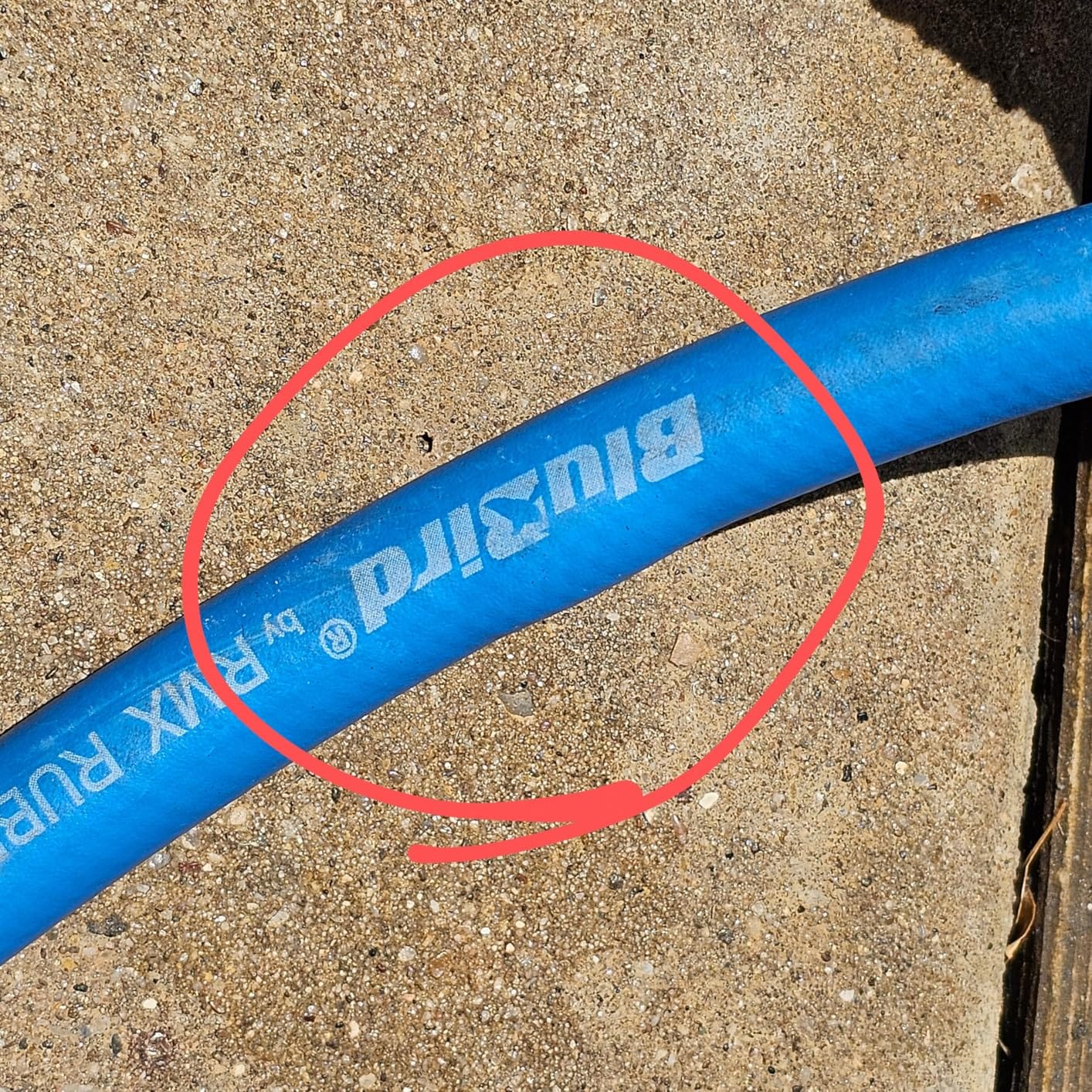
If your garage is genuinely cold, this is the one. One hundred percent rubber reinforcement, 300 PSI working pressure and a 1200 PSI burst rating, rated usable from -50F to 190F. No hybrid or PVC line in this roundup has a temperature floor that low, and that single number is why this hose exists.
The rubber compound question comes up constantly on Garage Journal, where the consensus is clear that EPDM is a better quality rubber than Buna-N nitrile for air hoses. That is the same argument that matters here. A synthetic or hybrid hose stiffens as the temperature falls and eventually refuses to straighten, while a quality rubber hose keeps its pliability and lays out where you put it.
Owners also value how the surface behaves. This hose lays flat, does not kink under pressure, and does not get sticky or hold dirt the way plastic and hybrid covers can. It wipes clean with a rag, which matters in a shop where the hose crosses a greasy work area on the way to every job.
The manufacturer states the rubber is roughly 40 percent lighter than standard industry rubber hoses of the same size, which is worth noting because 100 feet of conventional rubber is a genuinely miserable object to move. Even so, at 10 pounds this is the heaviest hose in the roundup, and you feel every pound of it on concrete.
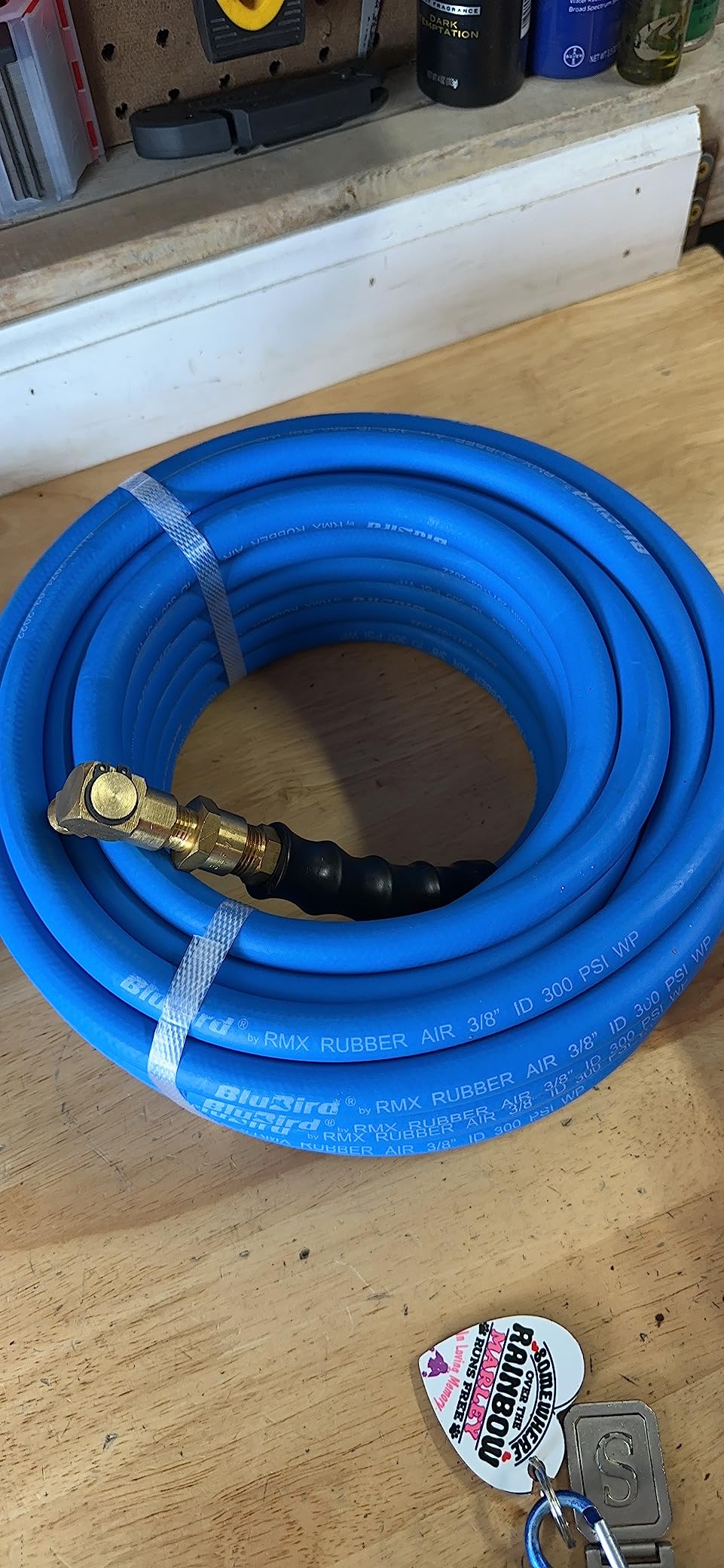
Brass end fittings are specified, which owners praise as better against rust than steel and stronger than aluminum. The polyester braid is what gives the burst figure, and it is also why the hose stays round at high pressure instead of ballooning.
Several buyers note that this hose outperforms cheaper hybrids specifically in freezing conditions, which is the whole argument. If you are not dealing with deep cold, the trade is harder to justify and a 50 foot hybrid is the sensible buy.
Who should spend more for rubber
Buy it if your garage is unheated, if you work through winter, or if you have been disappointed by hoses that stiffen into a shape you cannot straighten. A hose you cannot straighten is a hose that kinks at the same spot every time, and that is how inner liners get damaged.
It is also the pick for anyone doing heavy oil and chemical work, because rubber wipes clean and does not attract the grime that makes a garage floor slippery.
The weight problem is real
Ten pounds across 100 feet is a lot to drag, and it is why this hose usually ends up on a reel rather than in someone’s hand. If you buy it, plan the storage around the weight instead of discovering the problem every time you pull it out.
Cost is the other factor. This is the most expensive hose in the roundup, and for occasional use that money is hard to justify. For a working shop in a cold climate, the same money buys a hose that never stiffens, which changes the calculation.
8. JACO FlexPro 3/8 in x 50 ft Hybrid Hose: Best for Kink-Free Daily Storage
JACO FlexPro Hybrid Air Compressor Hose (3/8″ x 50 ft)
3/8 in bore x 50 ft
300 PSI working
Hybrid polymer
Storm gray finish
Pros
- Holds no coil memory and resists kinking
- Stays soft in freezing temperatures where PVC stiffens
- Survives drags across concrete and gravel
- Lighter than rubber and more flexible than PVC
Cons
- Lighter build can feel less rugged than all-rubber
- Storm gray is harder to see on a floor than bright colors
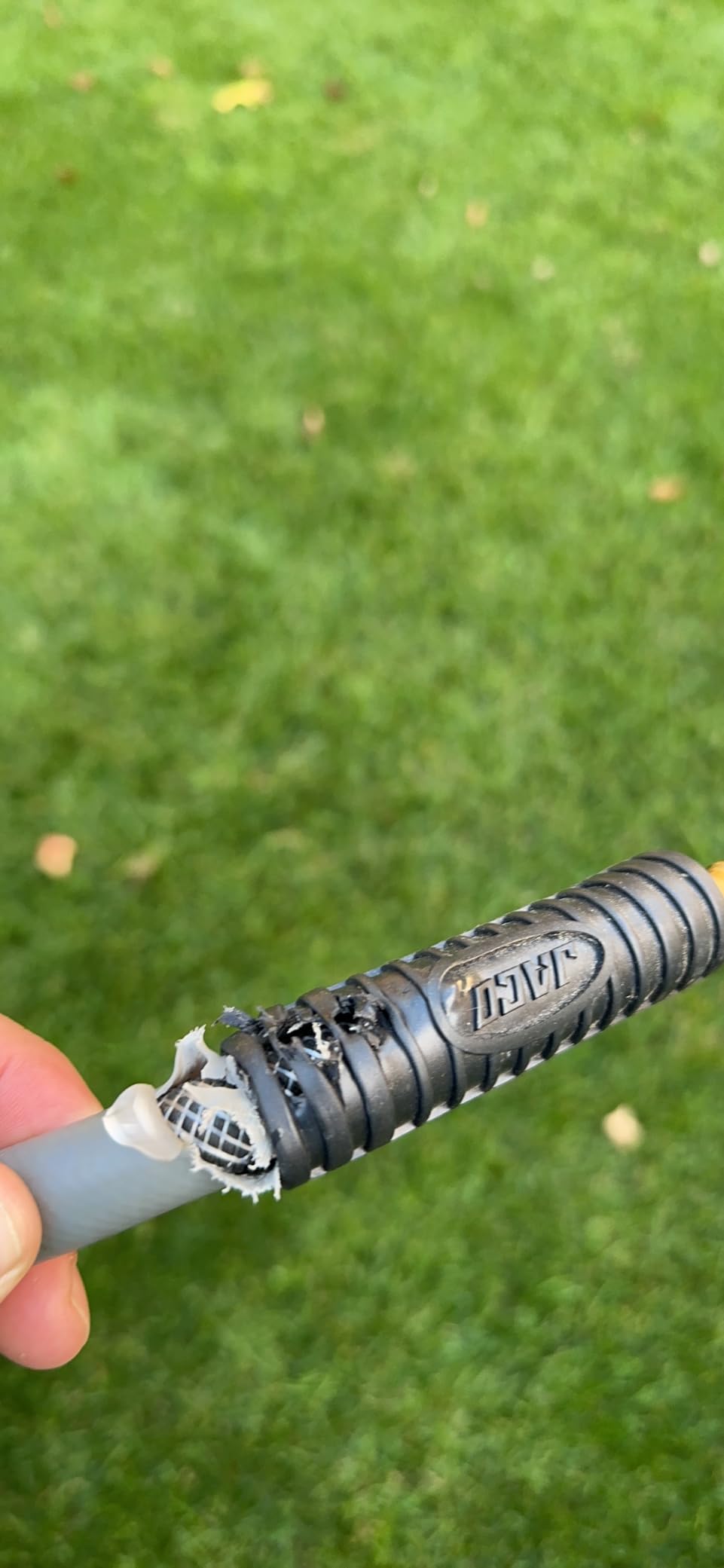
Kinks are the most repeated complaint in every garage forum we read, and the JACO FlexPro attacks the problem directly. It is built to lay flat, resist kinking under pressure and hold no coil memory, which means when you pick it up off the floor it does not come up twisted and folded. For people who coil the line and hang it every night, that is the trait that gets noticed on day one.
The 3/8 inch bore, 50 foot length and 300 PSI working pressure put it in the garage default configuration, so it runs impact wrenches, nailers and air ratchets at full shop pressure. Owners describe it surviving drags across concrete and gravel in daily service, which is a fair proxy for a shop floor that is not a showroom.
Cold behavior is the other headline. The hybrid polymer stays soft and flexible in freezing temperatures, in the range where rubber and PVC hoses stiffen up. It is also lighter than rubber and more flexible than PVC or polyurethane, so it sits between the heavy and the synthetic options rather than picking a side.
JACO backs it with a lifetime warranty, which is the clearest signal of manufacturer confidence we saw in this category. Most hoses in the roundup carry one or two years, and one carries five.
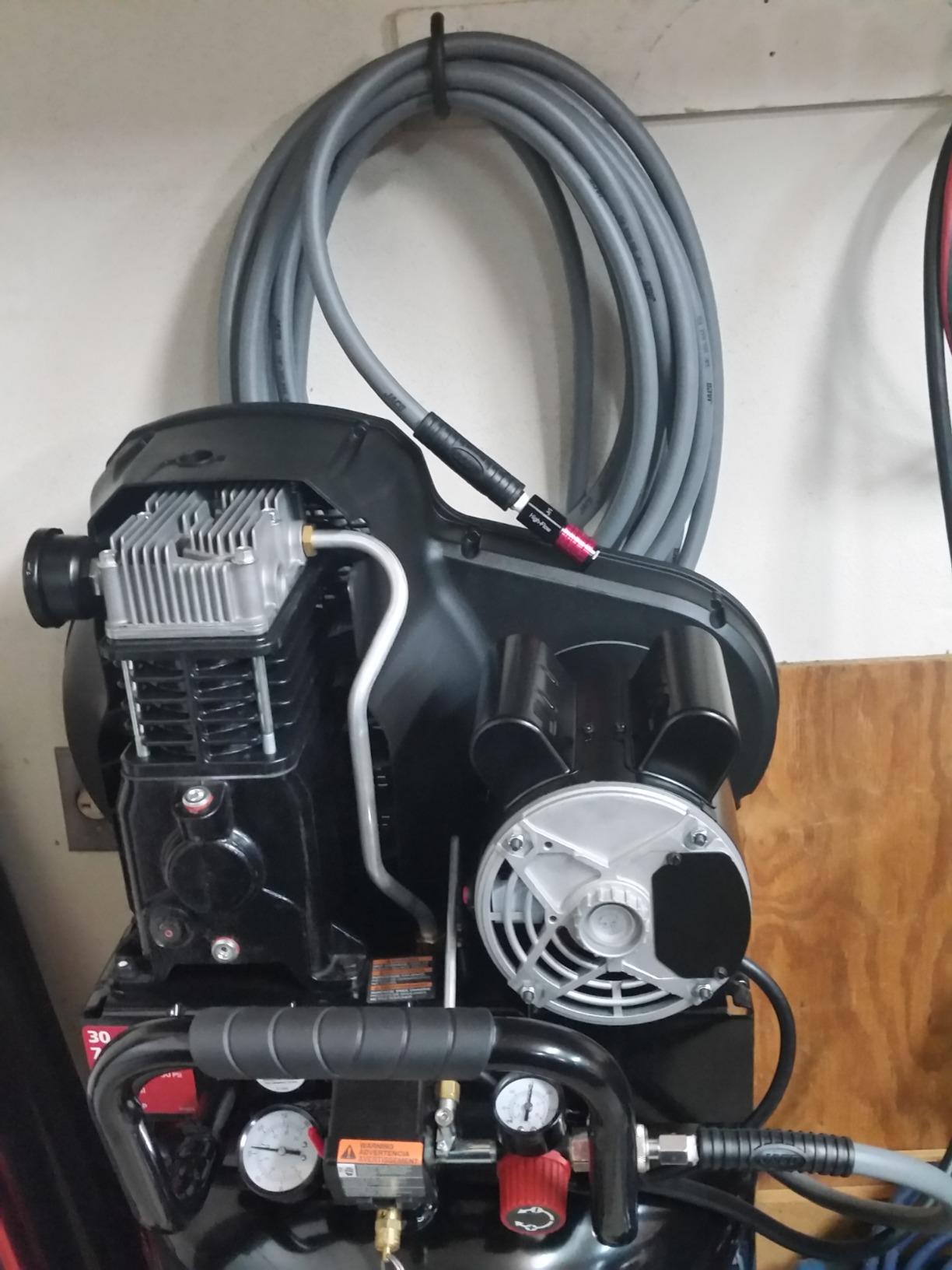
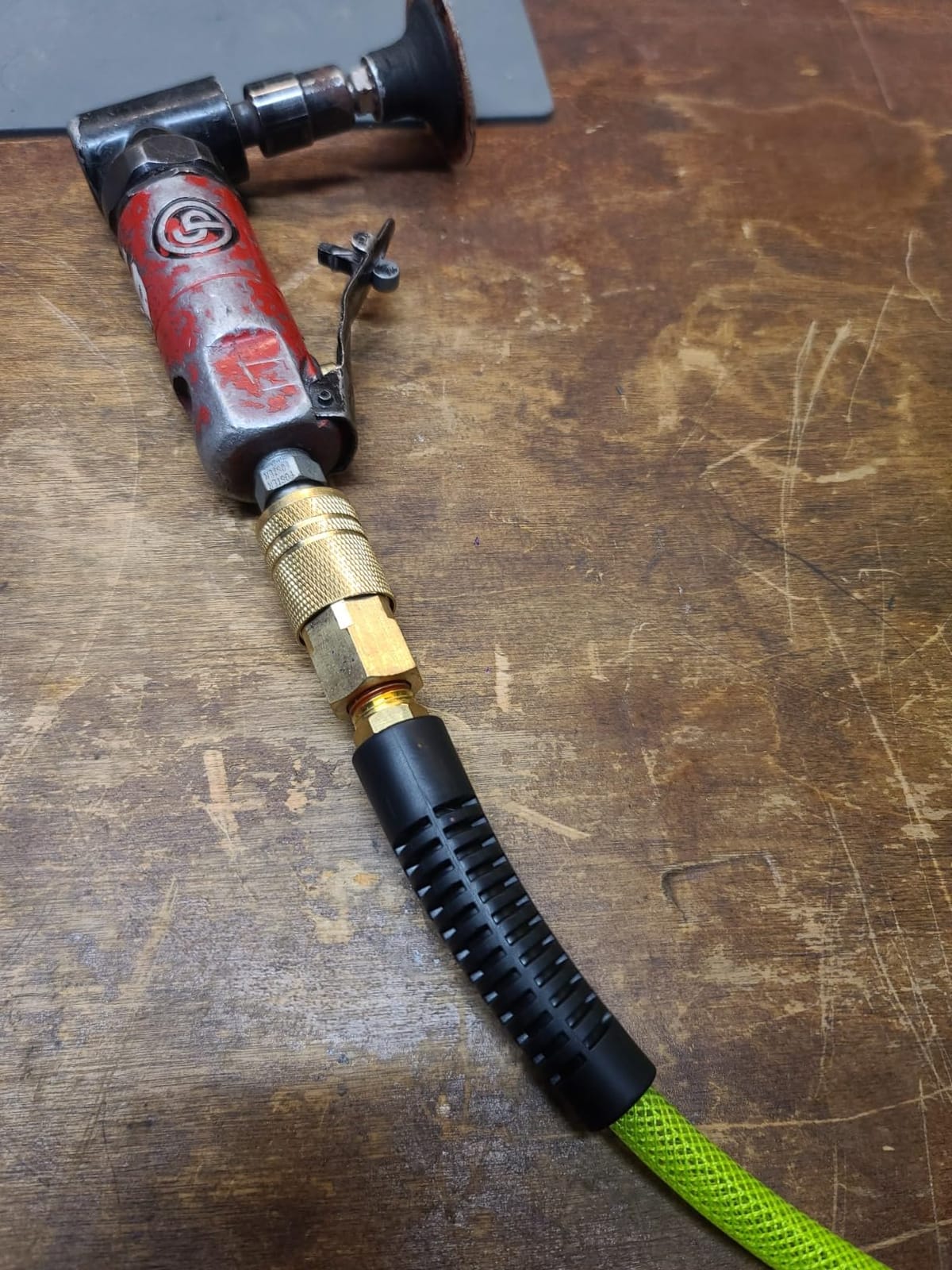
Dual 1/4 inch male NPT end fittings mean it connects straight to standard quick-connect fittings and air tools, so it slots into an existing setup without adapters. The fittings were designed for the standard quick-connect system that nearly every garage already has on the wall.
One practical note on the storm gray color. It looks clean and it does not show every scuff, but it is the hardest hose here to see on a dark floor. If your garage lighting is poor, that is a real usability factor and the brighter options make more sense.
Why this one for neat storage
Buy it if you are the person who hangs the hose on a hook every night, or if a permanently kinked hose has been an ongoing annoyance. Zero coil memory means the line comes off the hook in the shape you hung it, which is a small daily pleasure in a space you use constantly.
It is also a good fit for a garage shared with a vehicle, where the hose is dragged over the same concrete patch every weekend.
Where the lighter build shows
Some owners say the lighter construction feels less rugged than a heavy all-rubber hose, particularly if you are used to a thick coil that feels substantial in the hand. That is a matter of habit as much as material, and it does not show up in the ratings.
The visibility issue is the more practical drawback. A gray line on a gray floor is a trip hazard that no warranty covers, so pair it with a wall hook at a height where it is seen, or choose a high visibility color instead.
9. EADUTY 1/4 in x 50 ft Polyurethane Recoil Hose: Best Budget Line for Blow Guns and Nailers
EADUTY Heavy Duty Polyurethane Recoil Air Hose 1/4 in x 50 ft, Lightweight, Flexible Compressor Hose with Universal Quick Coupler, Plug and Bend Restrictors, Gray
1/4 in bore x 50 ft
150 PSI working, 450 PSI burst
1.06 kg weight
Flexible from -40F to 150F
Pros
- Self-coiling to save garage space
- Very light for a 50 ft run
- Push-to-connect coupler fits I/M T and ARO plugs
- Ball swivel improves handling
Cons
- 150 PSI working pressure limits high-demand use
- Recoil hoses can whip under pressure when connected horizontally
This is the budget pick, and the reason is a fitting rather than the hose. The push-to-connect universal quick coupler fits I/M, T and ARO plugs, three plug standards that between them cover nearly every air tool and most cheap compressor outlets in circulation. If you have ever assembled a new tool and could not get it to connect, this solves that in seconds.
It extends to 50 feet and recoils automatically, which is longer reach than the other recoil hose in this roundup. At about 1 kg for the whole 50 foot run, it is the second lightest option here and easy to lift into a service truck without thinking about it.
The ball swivel is the feature owners mention most. When a coupler cannot pivot, a connected tool fights the hose, and on a blow gun or a nailer that shows up as wrist fatigue over a long afternoon. A swivel lets the tool sit at whatever angle the work needs.
The working pressure rating is 150 PSI with a 450 PSI burst, so like the other polyurethane coil hose here this is a light-duty line. It is rated for air blowguns, air nailers, air spray guns and tire inflator gauges, which is a sensible list of jobs and not an oversight.
Polyurethane is anti-kink and abrasion resistant by design, and the temperature range of -40F to 150F means it will not stiffen in a cold garage. The recoil format is the reason it disappears when you are not using it, which matters more in a small workspace than in a large shop.
Owners are clear that the space saving and the coupler are the reasons they are happy, and clear that 150 PSI is the qualification. Nobody describes regretting the purchase for the pressure limit, because nobody bought it for high-demand work.
Where a budget recoil hose works
Buy it for cleanup, inflation, bristle brushes, small trim nailers and spray work in a small garage. Fifty feet of reach with automatic retraction is genuinely useful in a one-car space where a full coil would block the only place to stand.
It is also the easiest hose in this roundup to move between the compressor and a workbench, which makes it a good second tool line.
Know the pressure limit before you buy
If your garage air exceeds 150 PSI at the regulator, this hose is not the right choice, full stop. A compressor that cuts in above that level will be running this line over its working rating, and polyurethane does not forgive overpressure the way a thick hybrid or rubber line does.
Also expect recoil hoses to whip when they are connected horizontally and the line is under pressure, which is a genuine handling consideration in a tight space. Keep the tool end lower than the compressor end when the line is not in use.
10. FYPower 1/4 in x 50 ft Reinforced Polyurethane Hose: Best Complete Kit for a First Setup
FYPower Air Hose 1/4 Inch x 50 Feet Reinforced Polyurethane (PU)
1/4 in bore x 50 ft
300 PSI working, 900 PSI burst
1.01 kg weight
Pliable from -10F to 150F
Pros
- Complete kit with brass coupler plug and PTFE tape
- Light and easy on the wrist
- Micro-shield resists abrasion oil and chemicals
- Connectors reported leak free
Cons
- Ships in a tight coil that leaves memory kinks
- -10F temperature floor is warmer than most rivals
This is the hose to buy if you are building a first air setup and do not yet know what fittings you need. The box contains the hose, a 1/4 inch NPT brass female coupler, a 1/4 inch industrial series brass plug, and a roll of PTFE thread seal tape. That last item is the one people forget, and it is the difference between a fitting that seals and one that weeps air at 90 PSI.
It is a 1/4 inch bore, 50 foot reinforced polyurethane hose tested to 300 PSI working with a 900 PSI burst, which is unusual for this diameter. Most 1/4 inch lines in this roundup are rated 150 PSI working, so this one can sit on a compressor that runs well above 100 PSI without argument.
Owners like the weight at about 1 kg for 50 feet. It is easy on the wrist across a long run, and the reinforced construction with a micro-shield layer handles abrasion, oil and chemicals, which suits automotive work where the hose gets hit and soiled constantly.
The most repeated complaint is the shipping coil. Buyers report the hose arrives wound tight enough to hold persistent memory kinks, and while some say the memory relaxes after the hose warms up, others still have to work it out by hand. Store it loosely from the start and this is a non-issue.
The temperature floor is the second limitation, and it is the one that matters in winter. Rated pliable from -10F to 150F, this hose is stiffer than the competition in deep cold. If your garage drops below that regularly, choose a line rated to -40F or lower.
One buyer also had to replace the female connector end, which is rare across thousands of reviews but is exactly the kind of report that tells you to check both fittings before you put tools away on day one.
Why the kit format matters
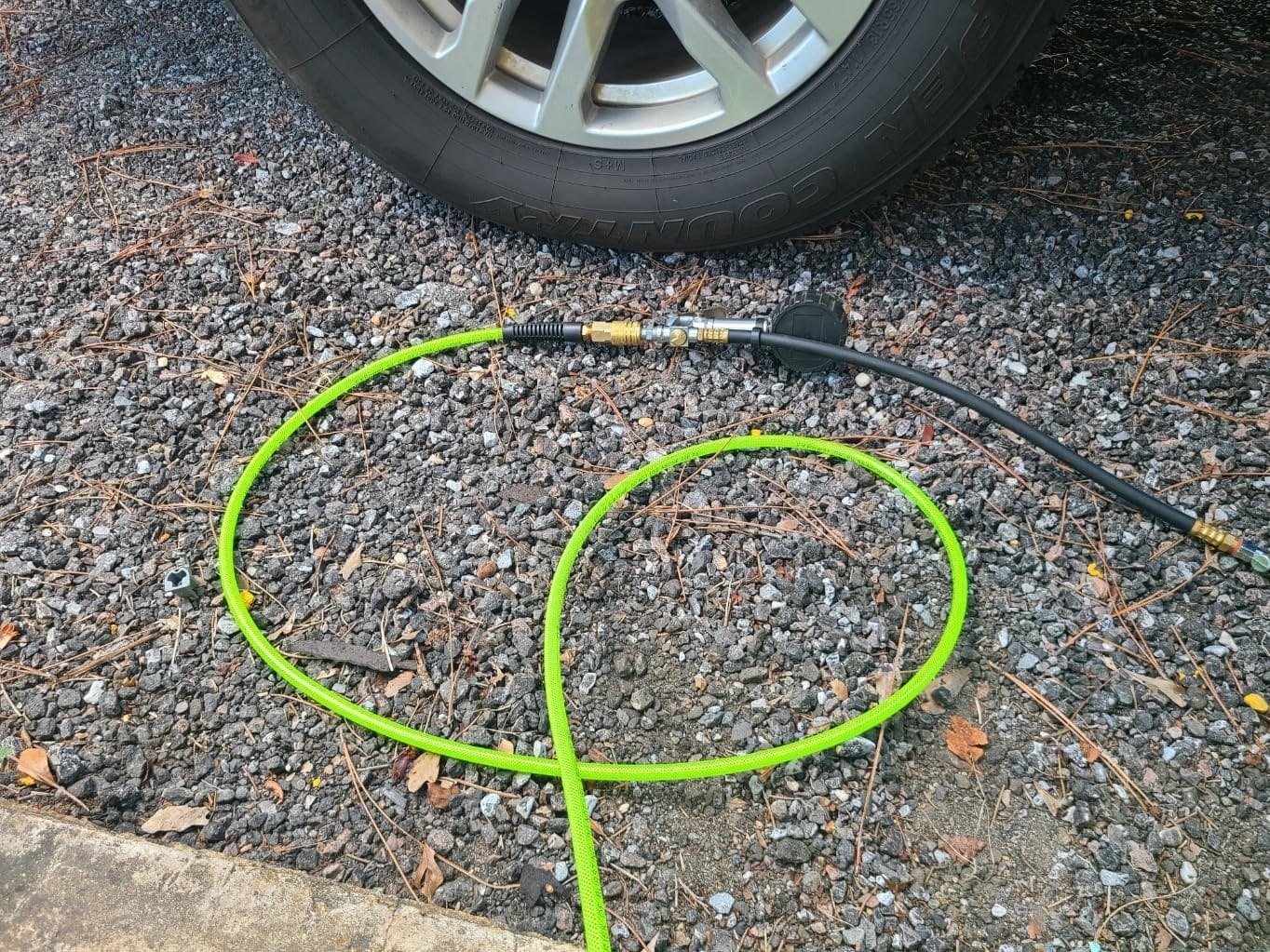
Buying a bare hose and discovering you also need a coupler, a plug and thread seal tape turns a ten-minute setup into a second hardware run. Everything needed to go from a threaded compressor outlet to a quick-connect tool is in the box, and that completeness is what this pick is for. The two recoil hoses further up cost less, but neither ships a full brass fitting set plus tape.
It is also a good bench line in an established garage, because a light 1/4 inch hose that coils small is easy to keep at the workstation.
Cold weather and coil memory
At -10F, this hose is at the bottom of its range, and stiff polyurethane in a freezing garage is a miserable thing to handle. For an unheated garage in a cold climate, the same money spent on a hybrid or rubber line rated to -40F or -50F will serve better.
For coil memory, the fix is storage habit. Hang it in a wide loop rather than a tight circle, and do not leave it compressed in the shipping coil. The kink complaints in the reviews cluster on hoses that got stored tight rather than hoses that were faulty.
Bore Size: The Decision That Matters Most
Size the hose to the airflow the tool actually pulls, not to the 1/4 inch port on the end of the tool. Every pneumatic tool has a 1/4 inch fitting, and that number tells you nothing about how much air the tool wants. Bore is the inside diameter of the hose itself, and it is the number that decides whether your tool runs at full pressure or slows down under load.
One-quarter inch is for low-demand work: blow guns, tire inflators, small bristle brushes, air nozzles and light trim nailers. Three-eighth inch is the garage default and handles impact wrenches, ratchets, air drills, die grinders and most paint sprayers over runs of 25 to 50 feet. Half inch is for 1 inch impact wrenches, large sanders and spray equipment on long runs, and it costs more and is harder to find. No hose in this roundup is 1/2 inch bore, which is why this category tops out at 3/8.
The rule we would apply is simple: go up one bore size before you add length, not after. A 100 foot run on a 1/4 inch bore will starve a big tool even if the compressor is large enough to supply it. If you can only choose one upgrade, choose bore. The rule of thumb is to size the bore to CFM demand first and run length second, and to keep the total run as short as your floor plan allows.
Material: Rubber, Hybrid, Polyurethane or PVC
Rubber is the traditional shop default. It stays flexible in the cold, lays flat, resists abrasion, wipes clean and shrugs off oil. The cost is weight, roughly three times a polyurethane line of the same length, and on 50 feet or more you feel that. Garage Journal members treat the rubber compound as the real quality marker, and their consensus is that EPDM is a better air hose rubber than Buna-N nitrile, for the same reason it outlasts nitrile on water lines.
Hybrid tries to hold the middle, taking rubber flexibility and adding PVC abrasion resistance and lower weight. This is where most of the hoses in this roundup sit, and for a general garage hose it is the balance we would pick. Polyurethane is the lightest and coils on its own, which makes it the best choice for a service truck or a small garage, but it stiffens sooner in the cold and usually carries a lower working pressure. PVC is the cheapest and the least forgiving: light and abrasion resistant, but it goes stiff and can crack near the fittings in a cold garage.
Two properties matter more than the rest. Cold weather flexibility decides whether the hose straightens when you pick it up in January. Coil memory decides whether it lives on a wall or in a heap. Weight decides whether you drag it willingly or resent it, and oil resistance decides whether it survives automotive work. Check those four first and the material name is only a summary of the answer.
Fittings, Threads and Quick-Connects
Brass is the fitting material to want. Forum owners ask for it by name because it does not corrode, it holds a seal through repeated assembly, and it does not strip when a wrench slips. Aluminum is a reasonable second choice and crush-resistant, and steel is fine for a lead-in line that gets moved rarely.
Understand the thread standard before you buy. 1/4 inch NPT is the North American standard for compressor outlets and hose reel inlets, and most hoses here ship with 1/4 inch male NPT ends. A 1/4 inch quick-connect coupler is a different interface entirely, not a thread, and mixing the two is the reason new hoses leak immediately. If your wall fitting is threaded, wrap two wraps of PTFE thread seal tape on the male thread before tightening.
Check that both ends are 1/4 inch regardless of the hose bore. A 3/8 inch bore hose with 1/4 inch ends is correct and normal, because the bore refers to the inside of the hose while the fitting is the tool interface. Bend restrictors at both ends are worth having, since the connector is where hoses crack, and removable fittings are worth paying a small premium for because they let you change systems without buying a new hose.
Length and Storage: Coiled Hose, Recoil Hose or Reel
Buy the shortest hose that reaches the far corner of your work area. Every extra foot is drag weight and a little more pressure loss, and most garages have a 25 foot spot where a 50 foot hose is the better answer. Two-bay shops and shops with a lift are the exception, where 50 or 100 feet removes the need to move the compressor.
Storage format follows the workspace. A standalone coil hangs on a wall hook and costs nothing, but it becomes a trip hazard on the floor. A recoil hose stores in a small bundle and suits a service truck or a one-car space. A retractable reel keeps the floor clear and pays for itself in a two-bay shop, and it is worth mounting the reel on the compressor rather than the wall so the hose always has a home. Keeping the garage organized is the same problem as rod racks for garages in most homes: a place for everything means nothing ends up on the floor.
If a shop is large enough for fixed piping, that is a different purchase, not a hose upgrade. Hard line has no drag weight and no pressure loss along the run, but it costs more, needs installation, and leaves you at wall outlets instead of carrying air outside. Reaching a high shelf or a roof load is the other half of the same problem, and attic ladders for garages cover that side of garage setup.
Air Hose Safety in the Garage
A pressurized hose can part at a fitting and become a whip hazard, which is why bend restrictors and proper retention matter. Never connect a hose to a tool and then walk away from a pressurized line, and never use a hose whose working pressure is below your compressor output. Eye protection is the standard when any pneumatic tool is in use, and hearing protection once you are running impact wrenches and grinders for any length of time.
Keep the regulator set around the pressure your tools are rated for rather than matching full tank pressure. A lower working pressure reduces the energy stored in the line and makes the hose last longer, and it also means a 150 PSI rated hose is a reasonable choice in a system regulated down from a higher tank pressure.
The rest of a working garage follows the same discipline. Parasitic draws on the electrical side are checked with battery load testers for garages, and long-term storage is handled with chest freezers for garages when a compressor is stored for the season. A hose that is coiled properly, at the right pressure, in a dry corner will outlast one that is left kinked under full tank load.
Frequently Asked Questions
What is the best quality air compressor hose?
Quality comes down to four numbers: 3/8 inch inside diameter, 300 PSI working pressure, solid brass 1/4 inch NPT fittings, and a rubber or hybrid body that stays flexible in cold conditions. Most garage hoses are rated to 300 PSI working with a burst figure near 1200 PSI, a four to one safety margin. At that specification you are choosing between brands, not between quality levels.
Which is better, a rubber or hybrid air hose?
Rubber wins on cold weather flexibility, flat lay, cleanability and oil resistance, and it is the traditional shop default. Hybrid wins on weight and abrasion resistance while keeping most of the rubber flexibility, which makes it the better all-round choice for a general garage hose. In an unheated garage, choose rubber. In a heated shop or for a hose you carry a lot, choose hybrid.
Should I get 1/4 or 3/8 air hose?
Choose 1/4 inch for blow guns, tire inflators, air nozzles and small nailers. Choose 3/8 inch for impact wrenches, ratchet wrenches, air drills, die grinders and paint sprayers, which is most garage work. Size the hose to the airflow the tool pulls, not to the 1/4 inch port on the tool, and step up one bore size before adding length.
What is the best brand of air hose?
In the rubber and hybrid category Flexzilla is the most established, Estwing is the choice when brass fittings matter most, and Goodyear and Continental are the names enthusiasts most often praise for rubber compound and country of manufacture. In polyurethane, YOTOO and FYPower cover the light-duty and coil formats well. Brand matters less than the four numbers, but within a specification Flexzilla and Estwing have the largest owner bases.
Which brand of air hose connector is best?
Choose solid brass 1/4 inch NPT fittings with a matching 1/4 inch quick-connect coupler, and add a universal coupler if your tools use mixed plug standards. Brass corrodes less and seals more reliably than plated steel or plastic. Keep PTFE thread seal tape on hand for any threaded male connection, and fit bend restrictors on both ends to protect the joint where hoses normally crack.
Final Verdict on the Best Air Compressor Hoses for Garages in 2026
The Flexzilla 3/8 inch by 50 foot hybrid is the best air compressor hose for most garages, and it wins on the combination of bore, working pressure, weight and cold rating rather than on any single number. Buy the Estwing if brass fittings are the deciding factor, the BLUBIRD if your garage freezes, and a polyurethane recoil hose like the YOTOO if the floor space matters more than the pressure rating.
Get the bore right first, buy brass fittings, and match the material to your coldest day. The rest is preference. We updated this roundup in 2026 with the latest ratings, and you can check the current price on any of the hoses above.