
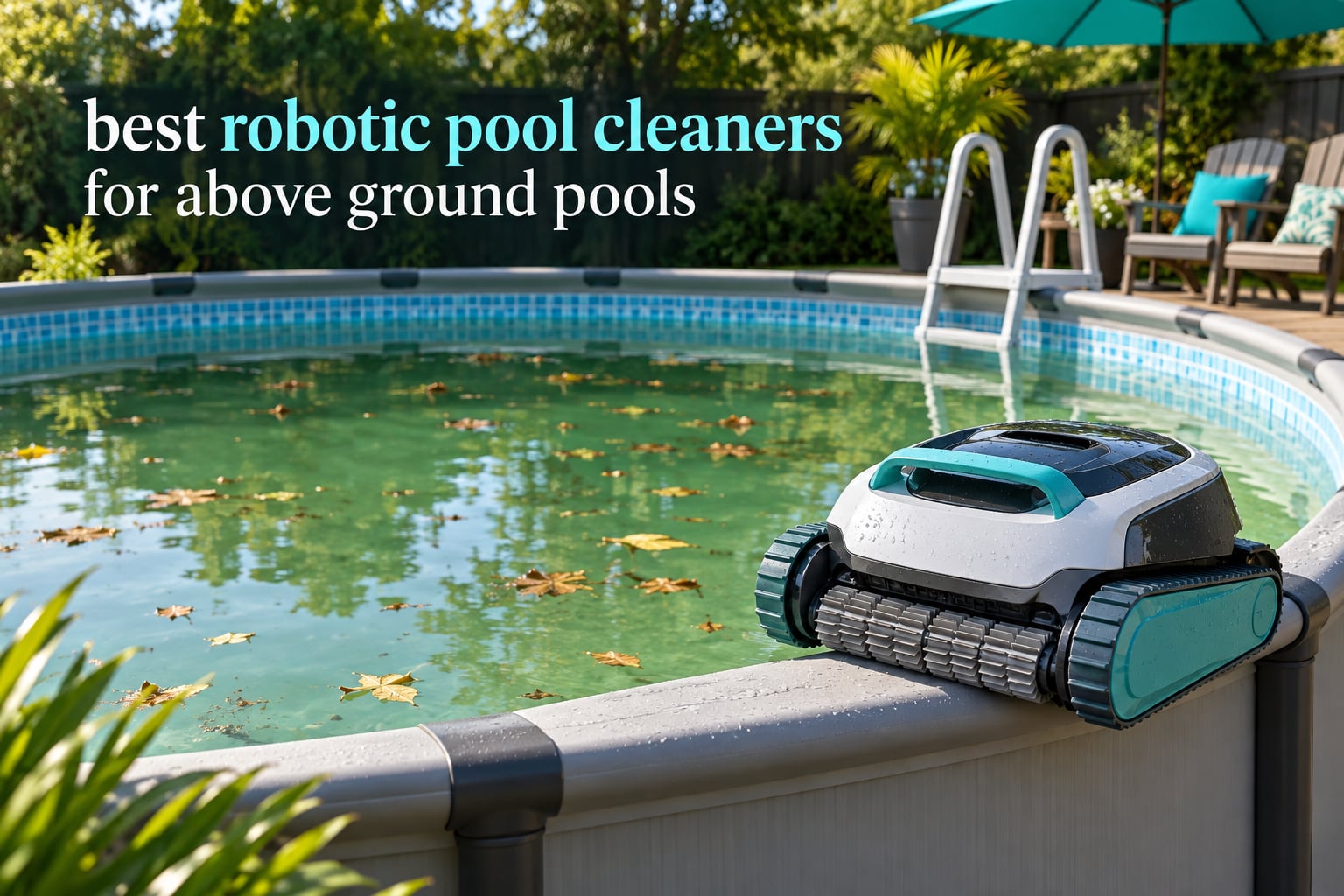
If you want one answer before you read the rest: the Dolphin Nautilus AG is the best robotic pool cleaner for above ground pools we tested, and it earns the slot on 6380 reviews at a 4.4 average with a 14.6 lb body and an above-ground rating that covers pools up to 33 ft long. It cleans the floor and the cove and it never tries to climb your liner, which is exactly what an above ground setup needs.
We spent weeks going through ten robots built for this job: corded and cordless, floor-only and wall-climbing, budget models and the kind you would happily leave running overnight. We read the review sets, compared the real specs against each other, and checked which ones actually fit a soft-sided or steel frame pool instead of a fiberglass shell. This guide covers all ten, with the failure modes owners actually report rather than the ones on the box.
Most people searching this are the same person: an 18×33 oval with a few trees overhead who is tired of dragging a manual vacuum around after every wind. If that is you, you may also want to start with our guide to pool vacuums for above ground pools, because a robot solves debris and a vacuum hose solves everything else. If your pool is in the ground rather than on it, our inground robotic pool cleaner picks are the right list.
Table of Contents
Do robotic pool cleaners work in above ground pools?
Yes, and above ground pools arguably need one more than inground pools do. The water is shallower and warmer, the floor sits closer to the trees, and settled debris has a shorter trip to the liner. A robot removes that debris before it stains or feeds algae, without you running your pool pump or filter at the same time.
Two limits matter. First, wall climbing needs a rigid surface to grip, so most of these models stay on the floor by design. Second, the robot has to be rated for above ground pools and for your pool’s depth. Anything rated for deep inground water can get stranded in a 4 ft pool. Check both before you buy.
Top 3 Best Robotic Pool Cleaners for Above Ground Pools in 2026

Dolphin Nautilus AG
- Active scrubber brush
- Top-load filter basket
- 1.5 hour cleaning cycle
- Rated to 33 ft

All 10 above ground pool robots compared in October
Every model below is rated for above ground water. The differences come down to how much area it covers per charge, whether it climbs, how heavy it is to lift out, and how many reviews stand behind it. Specifications are pulled from the manufacturer listings, and ratings are the current average.
| Product | Specifications | Action |
|---|---|---|
| Dolphin Nautilus AG |
|
Check Latest Price |
 STARRYBOT Dual-Motor Cordless STARRYBOT Dual-Motor Cordless |
|
Check Latest Price |
 Aiper Scuba SE Aiper Scuba SE |
|
Check Latest Price |
 WYBOT A1 WYBOT A1 |
|
Check Latest Price |
 PoolMr Cordless Robot PoolMr Cordless Robot |
|
Check Latest Price |
 BRINBO S2 BRINBO S2 |
|
Check Latest Price |
 Seauto Track Drive Robot Seauto Track Drive Robot |
|
Check Latest Price |
| Lodoba Wall Climbing Robot |
|
Check Latest Price |
 BOTLIFE PC10 BOTLIFE PC10 |
|
Check Latest Price |
 Beatbot Sora 10 Beatbot Sora 10 |
|
Check Latest Price |
1. Dolphin Nautilus AG – the best robotic pool cleaner for above ground pools overall
Dolphin (2026 Model) Nautilus AG Automatic Robotic Pool Vacuum Cleaner, Active Scrubber Brush, Top Load Filters Access, Ideal for Above-Ground Pools up to 33 FT in Length
Above-ground rated to 33 ft
Active scrubber brush
Top-load filter basket
1.5 hour cycle
Pros
- Active scrubber brush clears floor debris without manual effort
- Top-load filter basket lifts out for a tool-free rinse
- Plug-and-play setup with no assembly or complex controls
- Smart navigation scans pool shape and surface type
- Rated for above-ground pools up to 33 ft long
Cons
- Floor-only
- so no wall or waterline cleaning
- Corded design needs a nearby outlet
- About 14.6 lb to lift over the pool wall
This is the model most above ground owners end up with, and the numbers explain why: 6380 reviews at a 4.4 average with 75 percent at five stars. It ranks first in Robotic Pool Cleaners on Amazon’s Patio, Lawn and Garden category. We picked it as the editor’s choice because no other model here combines that much review evidence with consistent build quality.
It weighs 6.6 kg, so roughly 14.6 lb, and measures 22 by 17.5 by 13 inches. The active scrubber brush on the underside is the part owners mention most, because it works grit loose from the floor rather than only sucking up what is already loose.
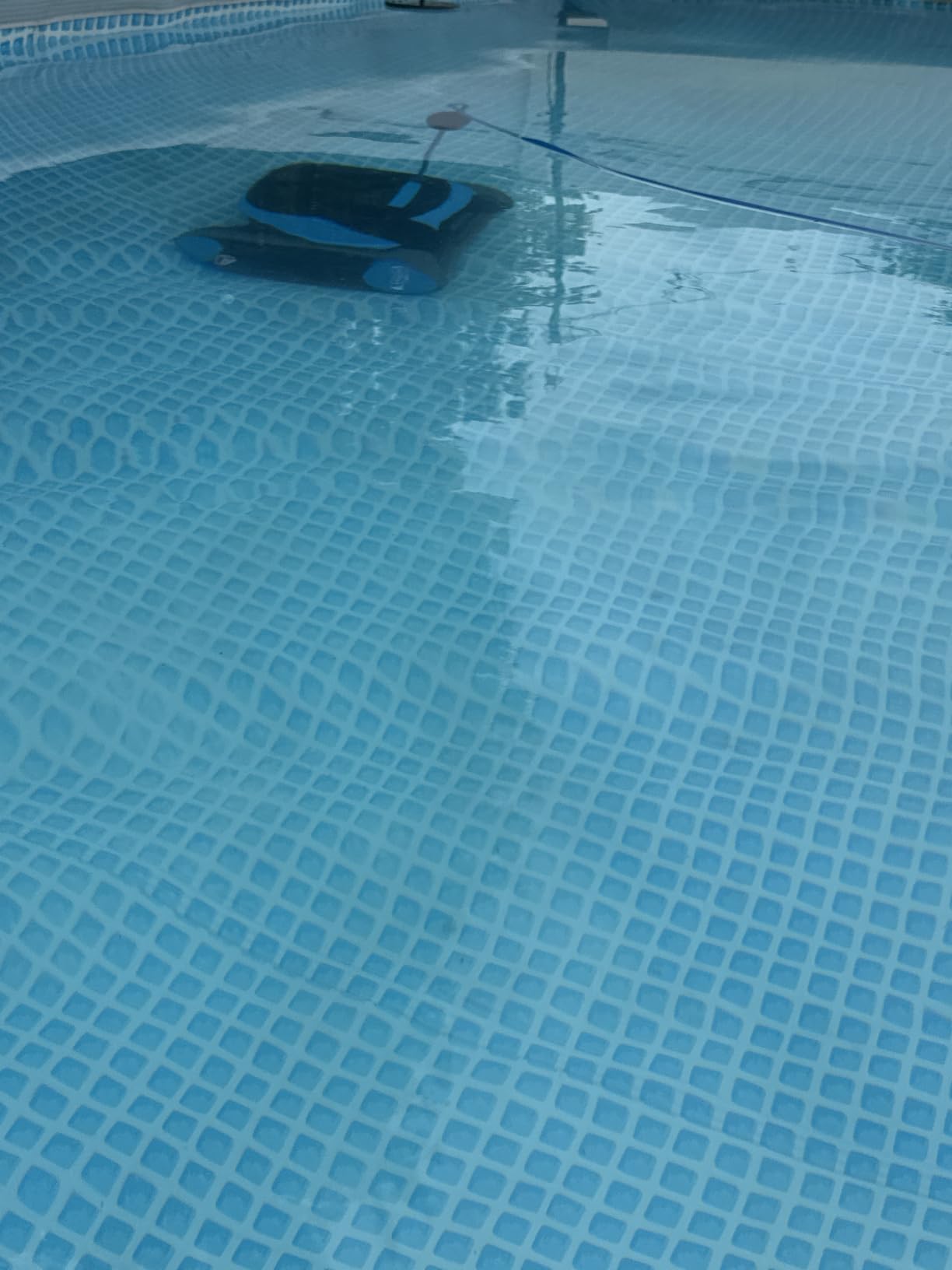
The 1.5 hour cycle and the 33 ft above-ground rating are the two numbers that make it fit this use case. Most above ground pools are far smaller than that rating, so the robot finishes with time to spare. Smart path planning scans the pool shape and surface first, which helps on oval layouts where random bounce leaves corners behind.
It runs on AC power through a 240 volt supply, so you need an outlet within reach of the pool wall. On a narrow above ground deck that is often the most annoying part of the setup, and it is worth checking your outlet position first.
What you get and what you do not
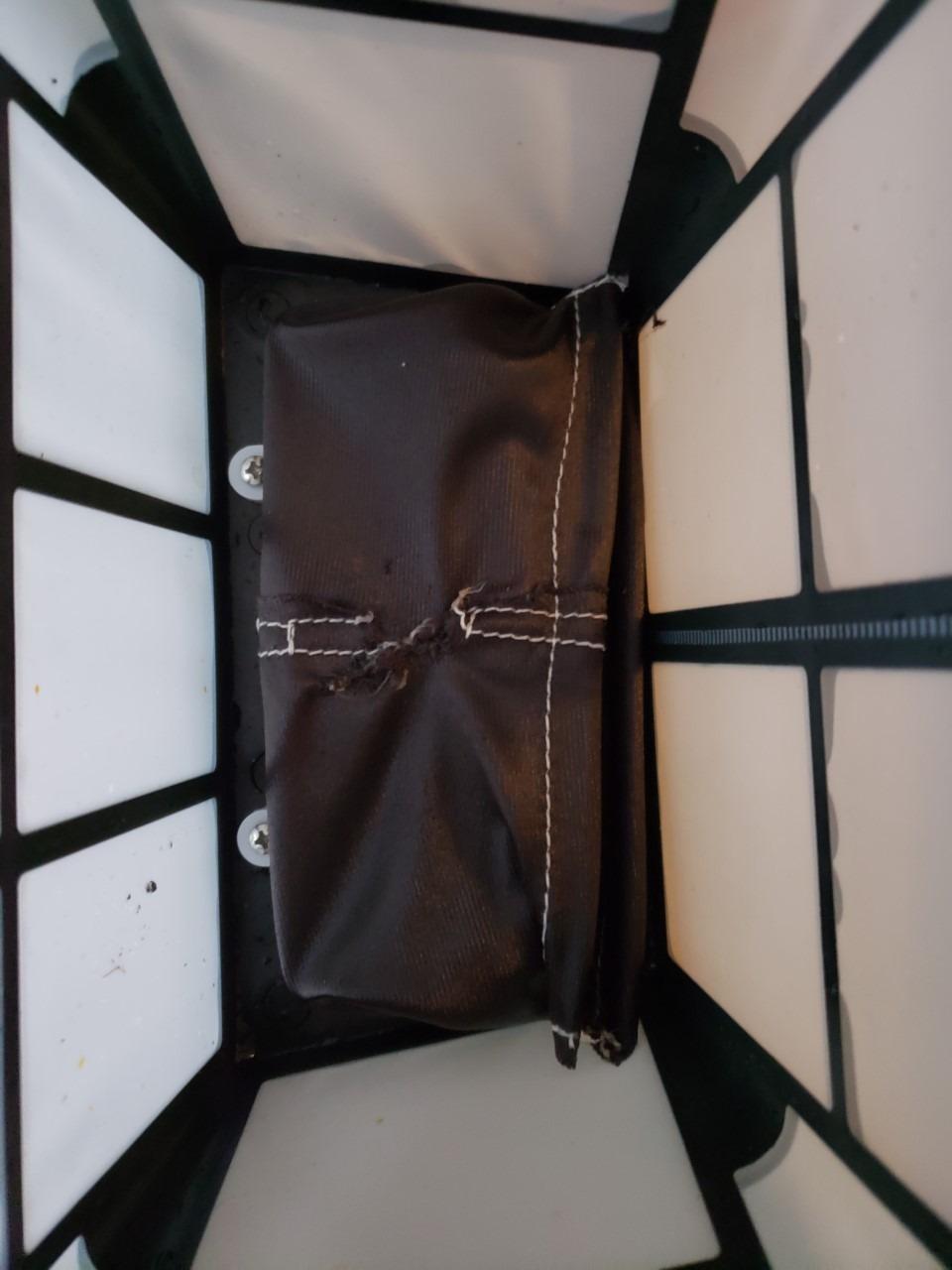
You get floor and cove cleaning that most owners describe as finished work. On TroubleFreePool, a Dolphin E10 owner reported the robot did a bang up cleanup after a winter cover failure and an algae bloom. On r/pools, an owner running a Dolphin Nautilus corded unit in an 18 ft above ground pool reports it does a great job scrubbing and cleaning.
What you do not get is a single inch of wall or waterline. A visible tide line will stay there and you will need a separate brush for it. If wall climbing is why you are shopping, this is the wrong pick.
Who should buy the Nautilus AG
Buy it if you have a steel frame, resin-walled, or soft-sided pool, you want a set-and-forget floor clean, and you have an outlet close enough to reach. It is the safest pick here for a liner you care about, because it never applies climbing force to the wall.
Skip it if your pool is small enough that a manual vacuum takes ten minutes, or if waterline scum bothers you more than floor debris. In both cases your money goes further elsewhere.
2. STARRYBOT dual-motor robot – the budget pick for small flat pools
STARRYBOT Robotic Pool Vacuum, Dual-Motor Above-Ground Cleaner
Dual-motor cordless
90 minute runtime
Pools up to 900 sq ft
Self-parking with audio alert
Pros
- Fully cordless with no cables to tangle
- Dual-motor suction picks up sand
- leaves and larger debris
- Self-parks at the pool edge with an audible beep and LED alerts
- Fine mesh filter basket rinses clean in seconds
- Quiet operation and gentle on vinyl pool liners
Cons
- Floor-only
- no wall climbing
- Corners and edges often need a second run
- Some buyers report a loose or imprecise-fit plastic latch
This is the cheapest route to a working robot, and at 285 reviews with 80 percent five stars it is not a hollow rating. Owners respond to the combination: cordless, self-parking, and a basket you can rinse in seconds. It drives to the edge, beeps, and shows a three-color LED status instead of leaving you hunting for it with a pole.
It measures 6.81 by 14.17 by 11.42 inches with a 300 g battery, and it is designed for flat-bottom pools with a slope under 10 degrees. That slope limit is the spec to check first, because a molded floor with a pronounced curve is a different story.
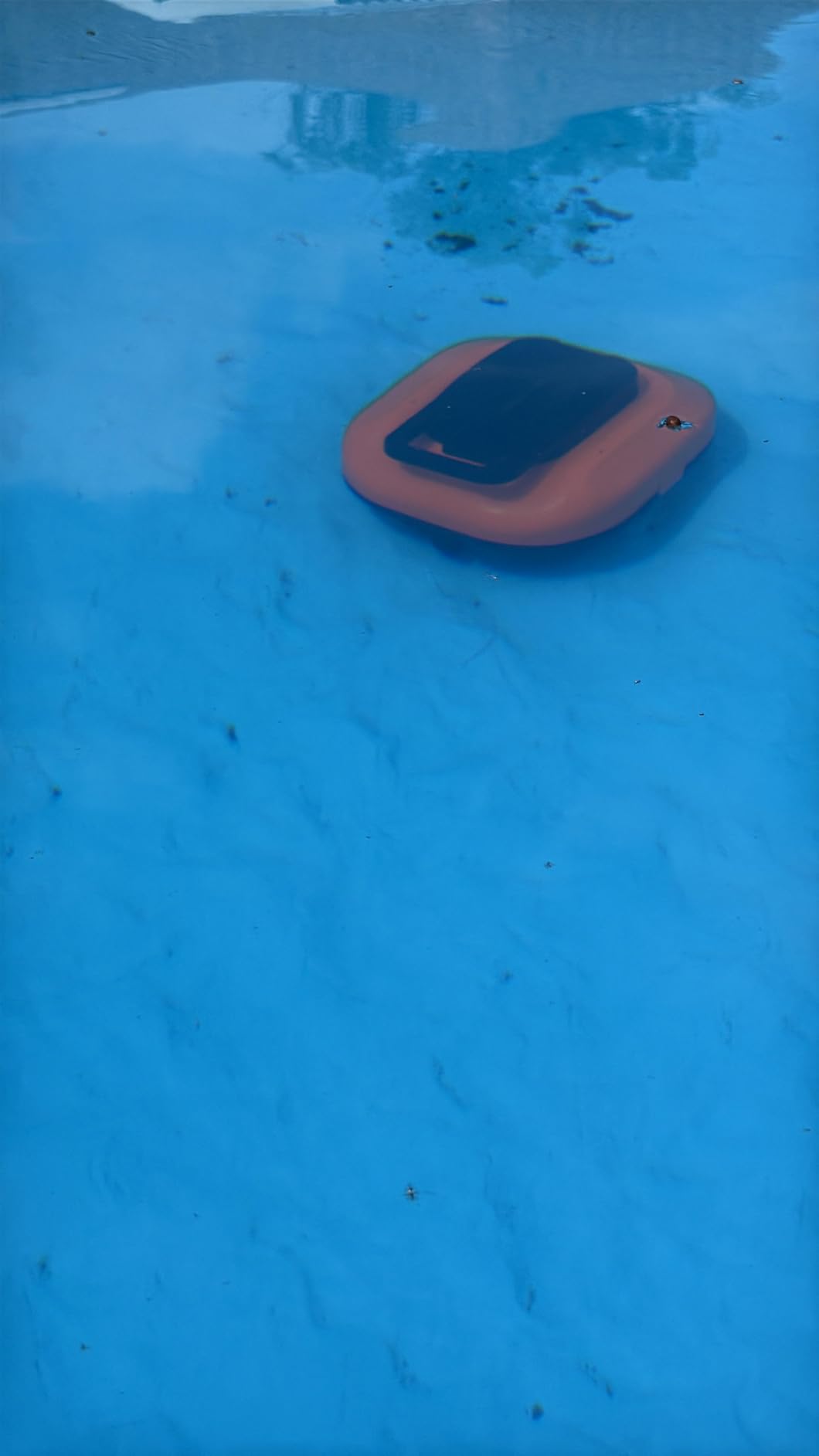
Dual motors handle both the suction and the steering, which shows up as better sand pickup than a single-motor unit at the same output. The 90 minute runtime and 900 sq ft rating line up almost exactly with a 16 ft round pool, so this is a matched fit rather than an overshoot.
The honest limit is coverage pattern. Reviews repeatedly mention that corners and edges need a second run or a quick manual pass, and a few buyers report a plastic latch that arrives loose. At one year, the warranty is the shortest in this group alongside the Aiper.
Why this is the budget pick
Nothing else here gives you cordless operation, self-parking, and a rinseable fine mesh basket for less money. If the floor is flat and reasonably clean between visits, the cost per clean is low and the time you get back is real.
Where it stops paying off is heavy leaf load or an uneven floor. Random coverage plus weak edge behavior means a weekly single run will not be enough.
Is the build good enough to last
At one year of limited warranty, treat it as a two-season purchase and check the latch and filter seals annually. The 80 percent five-star share suggests most owners never give it a reason to think about it at all.
If you want more evidence behind a similar outlay, the WYBOT A1 has a larger review set and a dual-layer filter. The PoolMr carries a five point average, though on a much smaller review set.
3. Aiper Scuba SE – the safest pick for soft-sided pools
2026 Aiper Scuba SE Cordless Pool Vacuum Robot for Above Ground Pool
1820 GPH suction
90 minute runtime
Pools up to 860 sq ft
Dual cleaning modes
Pros
- Compact and lightweight body that is easy to lift into the pool
- Dual cleaning modes switch with a short button press
- Self-parking at the pool edge with an audio alert
- Cordless one-click start with no cords to tangle
- Handles above-ground and flat-floored inground pools
Cons
- Floor-only
- no wall or waterline climbing
- 1820 GPH is modest against track-driven models
- Suction runs short on heavy debris loads
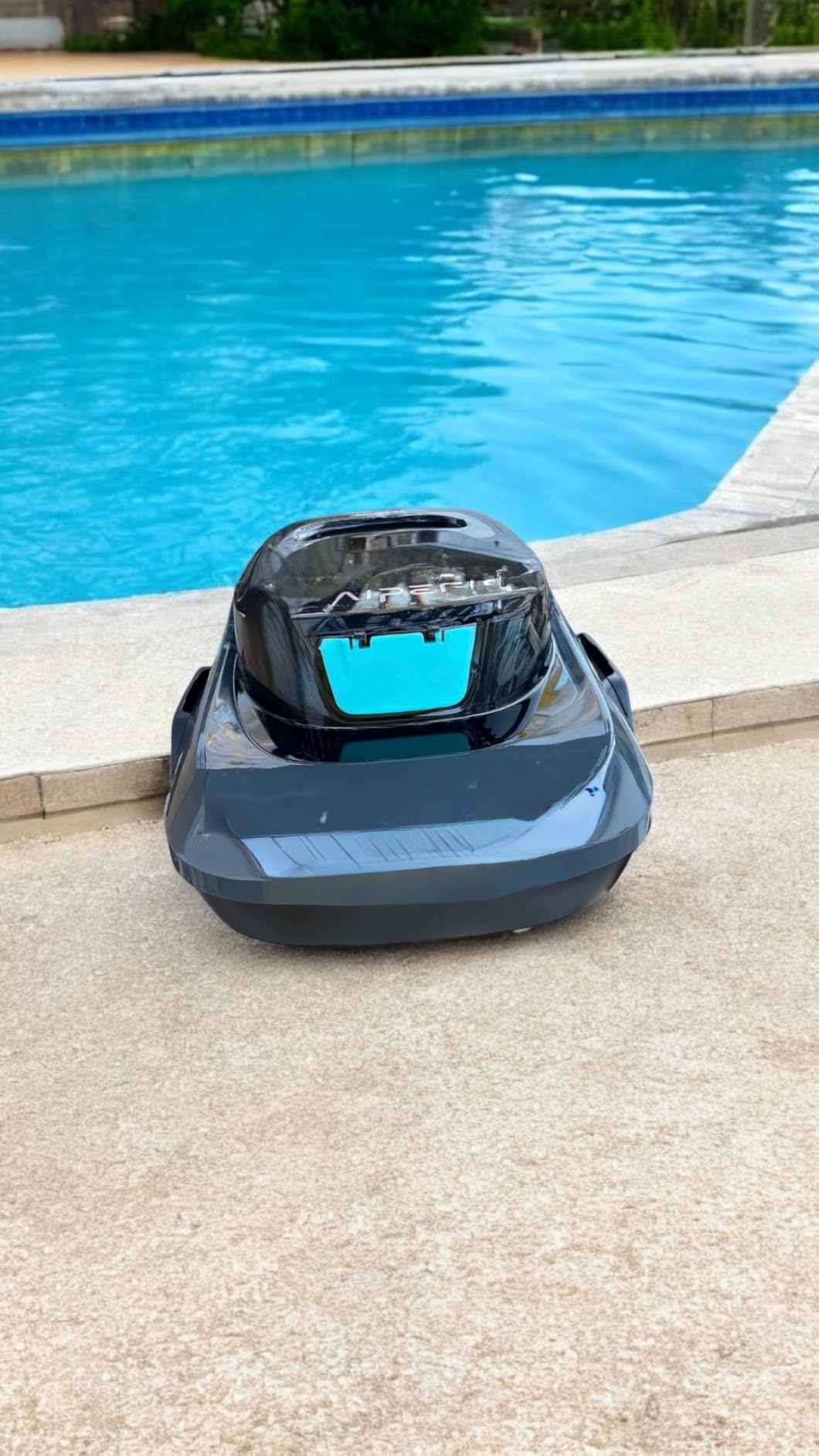
If your pool is a vinyl liner from Intex, Bestway, Coleman or Summer Waves, this is the model we would point you at first. The Scuba-SEX102 is a pure floor cleaner with no climbing function, and that is the point. There is no mode you can accidentally leave on that will pull at your wall.
At 13.7 by 13.2 by 6.8 inches with a 190 g battery, it is one of the lighter bodies here, which matters when you lift it over a 48 inch wall. It is a current-generation model with a one-year warranty and dual cleaning modes switched by a short button press.
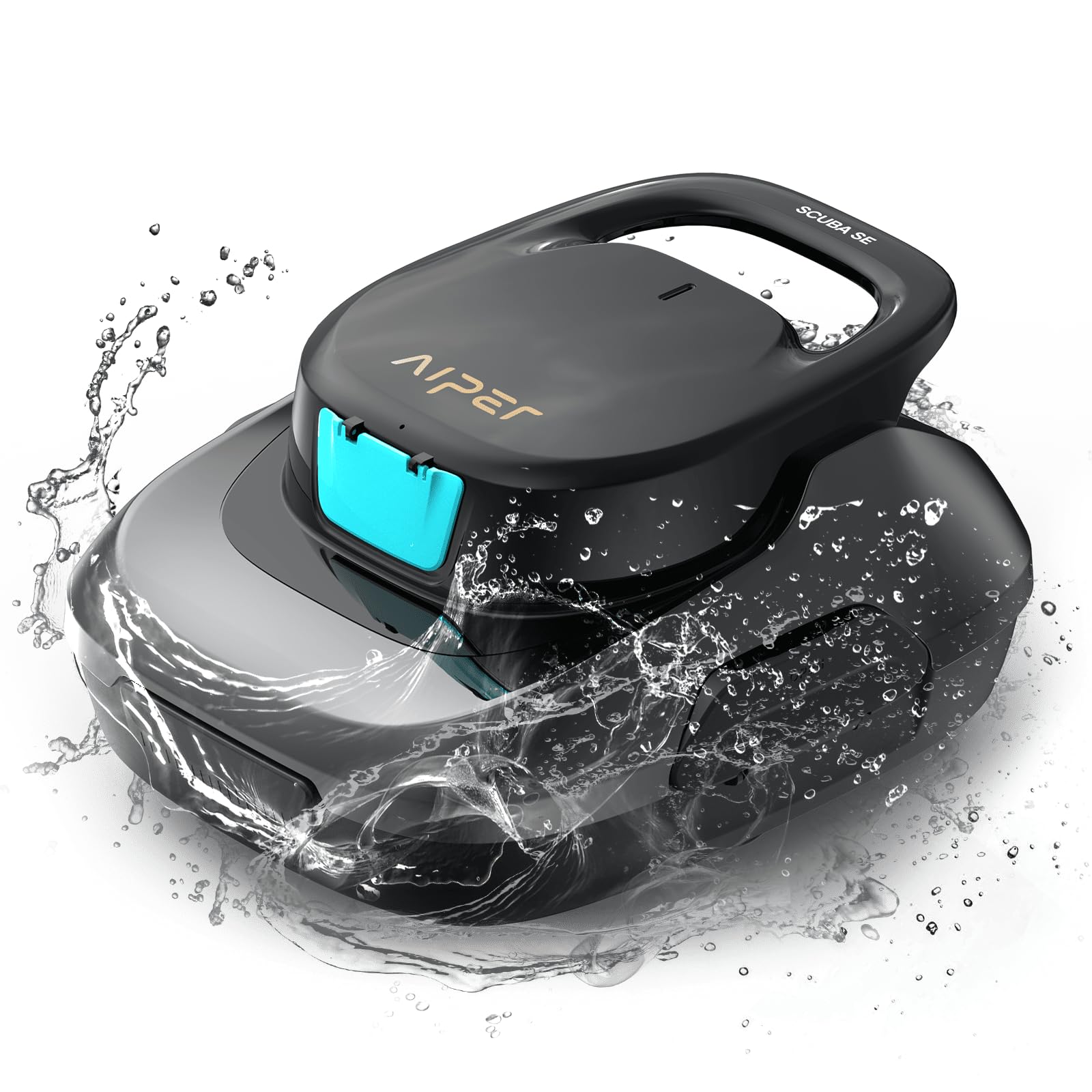
Output is 1820 GPH with a 90 minute runtime across pools up to 860 sq ft, plus auto-parking with an audio alert. That coverage rating sits right on top of a 16 ft round pool, and the two modes let you run a short pass most days and a longer one before guests arrive.
Where it earns caution is the rating distribution. At 4.2 across 240 reviews, 69 percent are five stars but 9 percent are one star, and the pattern is consistent: the light cordless design pleases people, while lower scores come from limited suction when there is heavy debris to move. Buy it for routine maintenance, not leaf rescue.
How it handles soft-sided liners
It never climbs and never presses hard against a wall, so the four liner damage modes that worry soft-pool owners are not in play. No suction distortion, no brush scuffing at the wall, and no downward force on a floor seam.
The trade is the waterline. Nothing at this tier scrubs a tide line, and on a soft-sided pool that is exactly where the visible stain appears. Budget for a separate wall brush.
What 1820 GPH means in practice
Enough for sand, pollen, dust, and light leaf litter on a flat floor. Not enough for a heavy post-storm leaf load, where you will be picking debris off the suction inlet mid-cycle.
Owners weighing Aiper products elsewhere in this category cite warranty length as a decision criterion, and one year is the shortest here. That is the main reason to look at the WYBOT A1, which runs longer on a charge.
4. WYBOT A1 – the best cordless pick for sand-heavy floors
WYBOT A1 Cordless Pool Vacuum Robot for Above Ground Pool, Greyblue
2280 GPH suction
130 minute runtime
Pools up to 1100 sq ft
180 micron dual-layer filter
Pros
- 2280 GPH handles fine sand
- medium leaves and ordinary debris
- Dual-layer 180 micron mesh plus textured foam
- Up to 130 minutes over pools up to 1100 sq ft
- Self-parks at the pool wall with an edge-cleaning boost
- Light body
- quiet run
- retrieval hook included
Cons
- Floor-only
- no walls
- waterline or steps
- Random path so a missed patch needs a second run
- Not for floors sloped over 15 degrees
The A1 is the cordless robot we would put in front of a family with sand at the bottom of the pool. At 4.5 across 163 reviews, it has the tightest rating spread of the cordless models here: 68 percent five stars, 26 percent four stars, and 3 percent one star, with no two-star ratings at all.
Filtration is the headline. It runs a 180 micron precision mesh with a textured foam layer on top, and the listed capture improvement over a single layer is up to 50 percent. On a pool with fine dirt and sand rather than leaves, that second layer decides whether the basket fills in one pass.
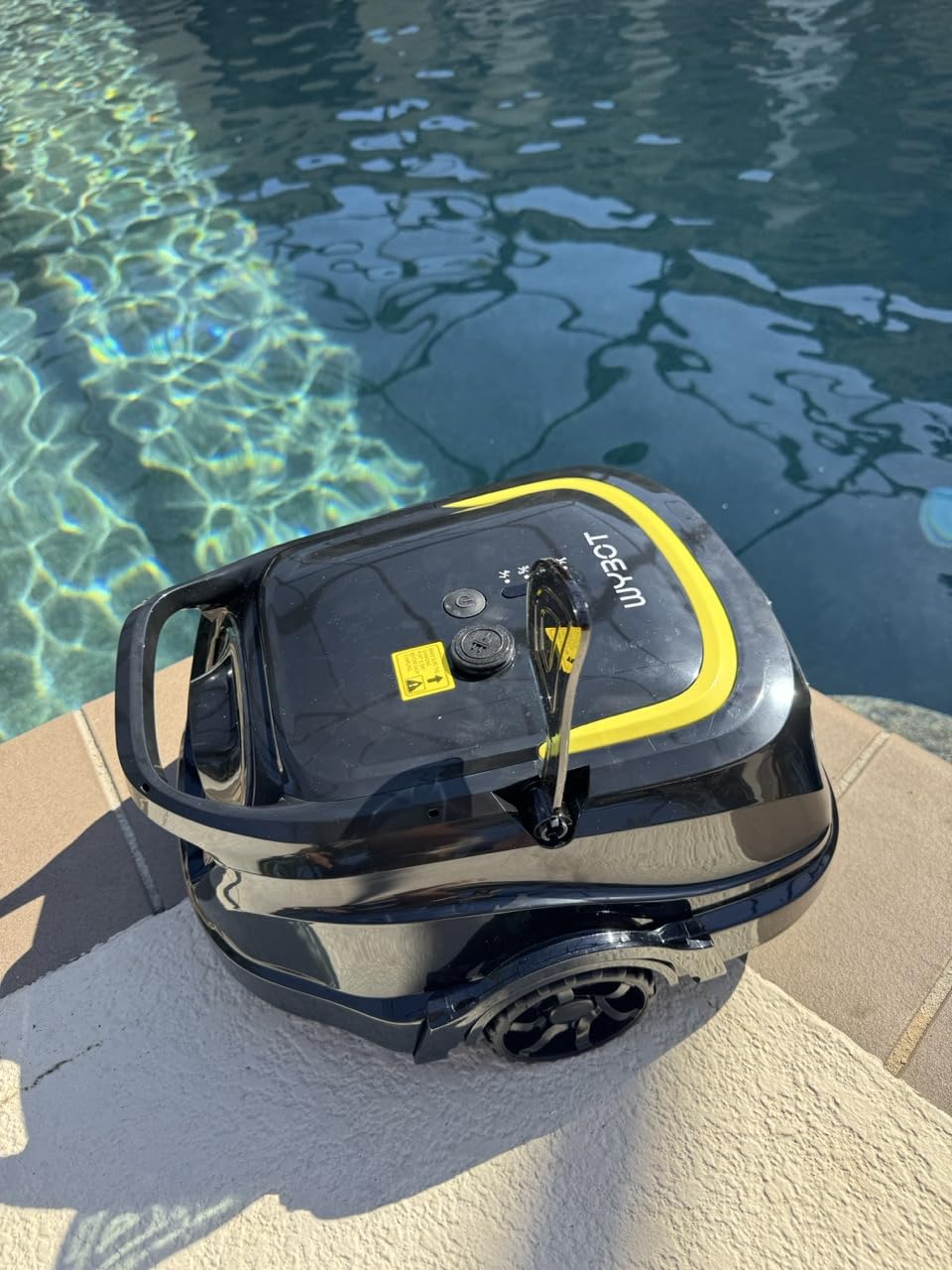
Runtime is up to 130 minutes over pools up to 1100 sq ft, with a full recharge in two to three hours. Four cycles from 30 to 120 minutes are selectable, so a quick daily pass is not the same spend as a full weekend clean. The body is 15 by 11 by 6.5 inches with a 369 g battery, and a retrieval hook is in the box.
The pause-and-boost behavior near the pool wall is the part that earns its place on a real above ground pool. It parks at the wall when the cycle ends, and the edge boost gives the perimeter a second pass, which is where sand collects on a sloped floor. It is rated for slopes under 15 degrees and water depth under 2.5 m, which covers essentially every above ground pool sold.
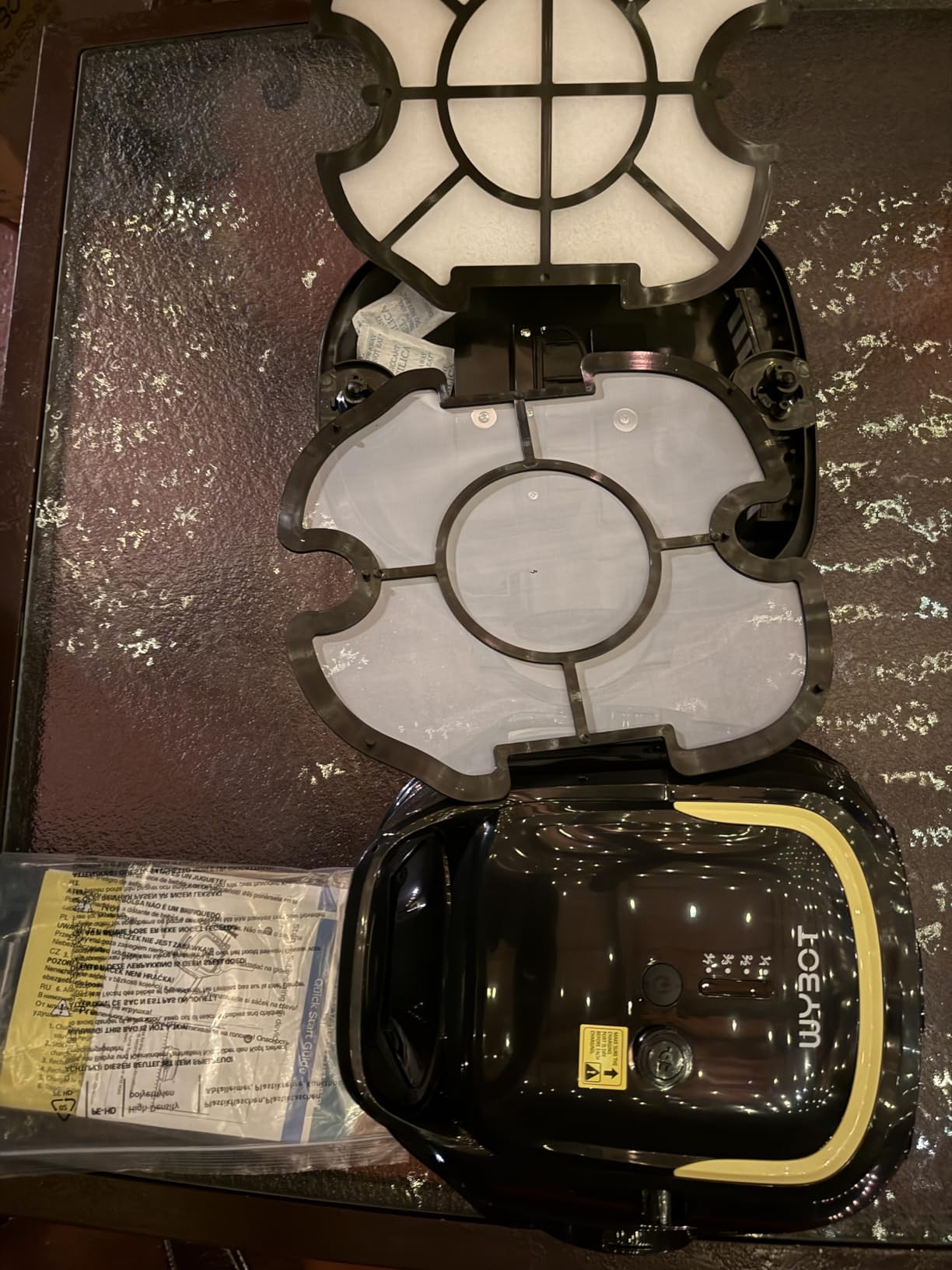
What the 130 minute run time really covers
On a 16 ft round pool at roughly 200 sq ft, 130 minutes is far more time than you need, and you will usually run a 30 or 60 minute cycle instead. The headroom matters if your pool is a large rectangular steel frame, where the extra minutes are the difference between finishing and stopping with floor unvacuumed.
The recharge is the catch. Two to three hours on the dock means it is not a twice-a-day device, but one full clean per day or one per weekend is the actual usage pattern for most above ground pools.
Where the A1 falls short
It is floor-only, so it will not touch walls, the waterline, or pool steps. It also uses a random path rather than a mapped one, so a missed patch usually resolves with a second run. And the two-part filter takes slightly longer to reassemble after a rinse, which you will feel every time.
If steps and a sloping floor are a real part of your pool, skip to the Seauto or the Lodoba, which have track drive and wall modes.
5. PoolMr cordless robot – the best debris retention in this group
PoolMr Cordless Robot Pool Vacuum for Above Ground Pool,Grayish White
40W motor with 30 GPM
120 minute runtime
Up to 1614 sq ft
Debris backflow stop
Pros
- 5.0 average across every review on the listing
- 40W motor with a 1 inch inlet and 30 GPM purification
- Backflow system seals debris inside the unit
- Climbs 0.2 inch wrinkles
- drains and slopes up to 15 degrees
- Boosts suction at walls and auto-parks at the edge
Cons
- Jet propulsion struggles on badly uneven pool floors
- One owner reports runtime fell well short of 120 minutes in cold water
- Does not replace a pump sand filter for very fine particles
This one has the most unusual review profile here: a 5.0 average across all 49 reviews, with 96 percent at five stars and no rating below four. That is a clean signal, but a small one, and you should size your confidence to the sample. Several owners who tested 10 to 15 robots name it as the best of the sub-300 class.
The output spec is the differentiator. A 40W motor with a one inch wide suction inlet and 30 GPM purification is rated at twice the debris, three times the leaves and eight and a half times the sand of traditional manual models, through a dual-layer 180 micron mesh plus a dense cotton sponge. Coverage is rated up to 1614 sq ft on a 120 minute runtime.
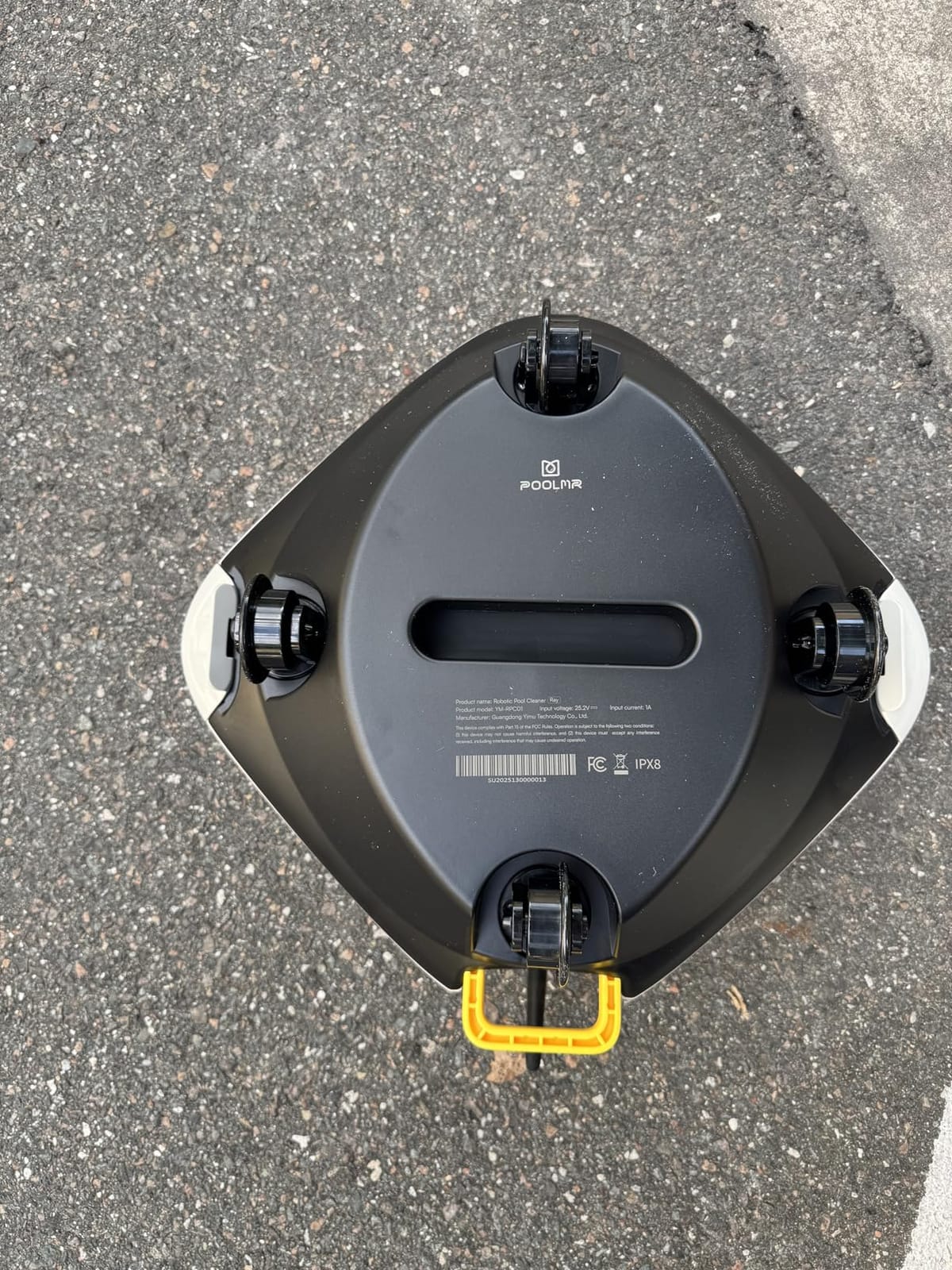
Two design choices make it practical for daily use. The debris backflow stopping system seals what it collects inside the unit, so you do not dump a cup of dirty water back into the pool when you lift it out. The quick-drain design then empties in seconds rather than leaving you holding a leaking basket over the deck.
It also handles small obstacles better than most budget models: it climbs 0.2 inch wrinkles, pool drains, and slopes up to 15 degrees, with a boosted suction mode at the walls for edges and corners. The stingray shape moves quietly and quickly, and the body measures just under 15 inches on each side with a 305 g battery.
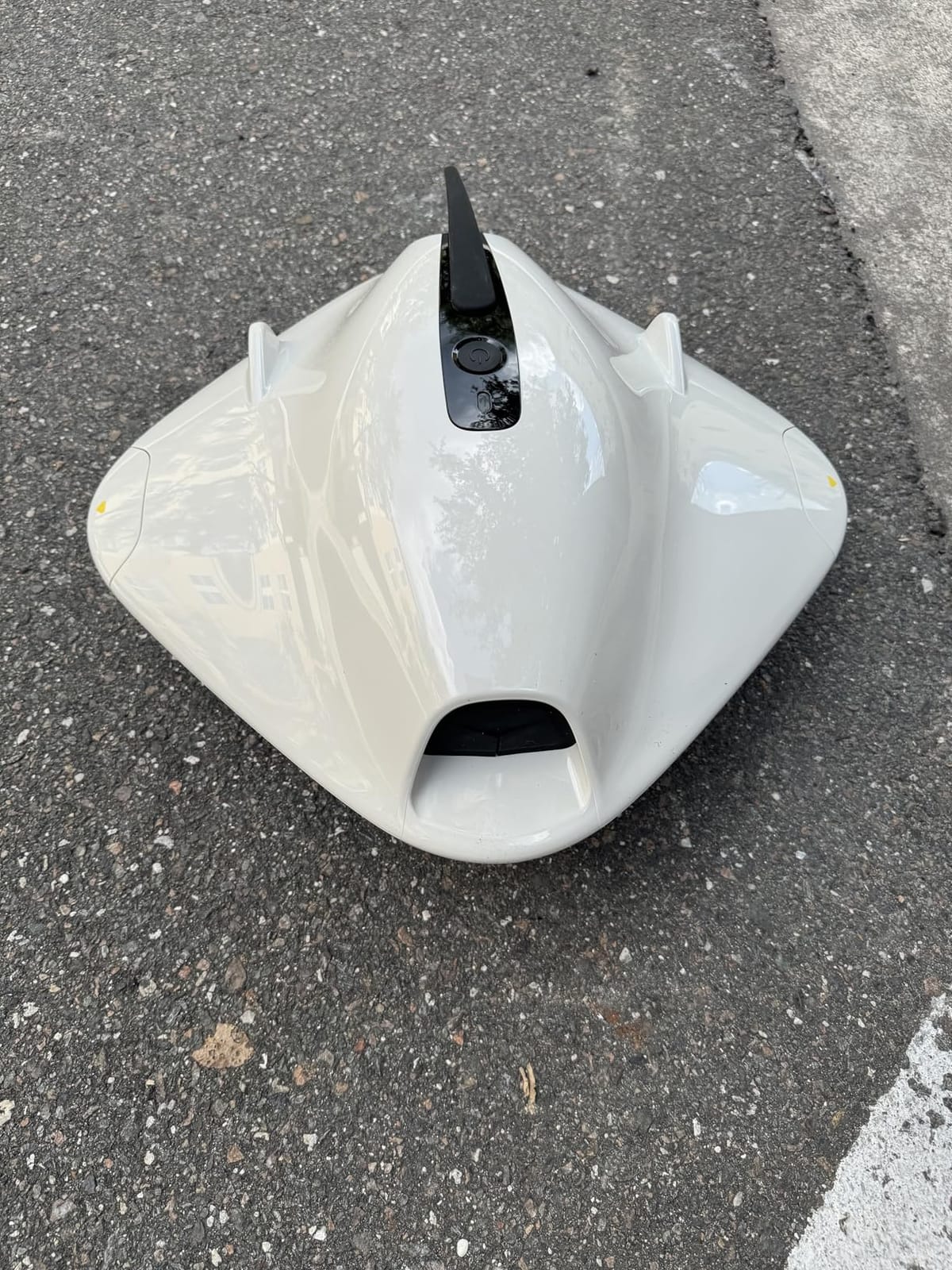
What 30 GPM buys you
Flow rate decides whether a robot finishes a pass or just moves debris around. At 30 GPM through a one inch inlet, this is the second-highest flow figure here after the Beatbot, and it is why owners report faster pickup on sand and grit.
It does not change what the filter can hold. A robot is not a replacement for a pump sand filter when the problem is suspended fine particles, and no robot in this guide is.
Is 49 reviews enough to trust
Enough to trust the product, not enough to trust the exact runtime claim. One owner reported that runtime in a cold early-season pool fell well short of 120 minutes, which is normal for lithium packs in cold water.
If you are uneasy with the small sample, the WYBOT A1 gives similar cordless behavior with a larger review set and a dual-layer filter. The PoolMr is the choice if debris retention is the problem you are solving.
6. BRINBO S2 – the best flat-floor maintenance robot
S2 Pool Vacuum Robot for Above Ground Pools, 90-Min Runtime, 861 Sq.Ft Coverage, Cordless Operation, Efficient Cleaning Performance, Dual-Layer Filtration, Panda Black
90 minute runtime
Pools up to 861 sq ft
Dual-layer filtration
One-touch cordless start
Pros
- Cordless one-touch start with no cord through the water
- 90 minutes of runtime covers pools up to 861 sq ft
- Dual-layer filter separates leaves from fine dirt and sand
- Compact body that is easy to handle and store
- Filter basket lifts out for quick rinsing
Cons
- Flat-floor only
- no wall or waterline capability
- A 12 percent two-star cluster shows uneven consistency
- Positioned for routine maintenance
- not deep cleans
The S2 is the simplest answer to a simple problem: a flat above ground floor collecting dust, sand, and small debris between deeper cleanings. It runs 90 minutes per charge, covers pools up to 861 sq ft, and starts with a single button press with no cord in the water. At 14.6 by 11.8 by 7.1 inches with a 161 g battery, it is among the easiest here to lift and to store over winter.
It ranks tenth in Robotic Pool Cleaners on Amazon, which is worth noting for a brand name that is not widely promoted. The 90 watt-hour battery is the largest energy content among the small floor-only units here.
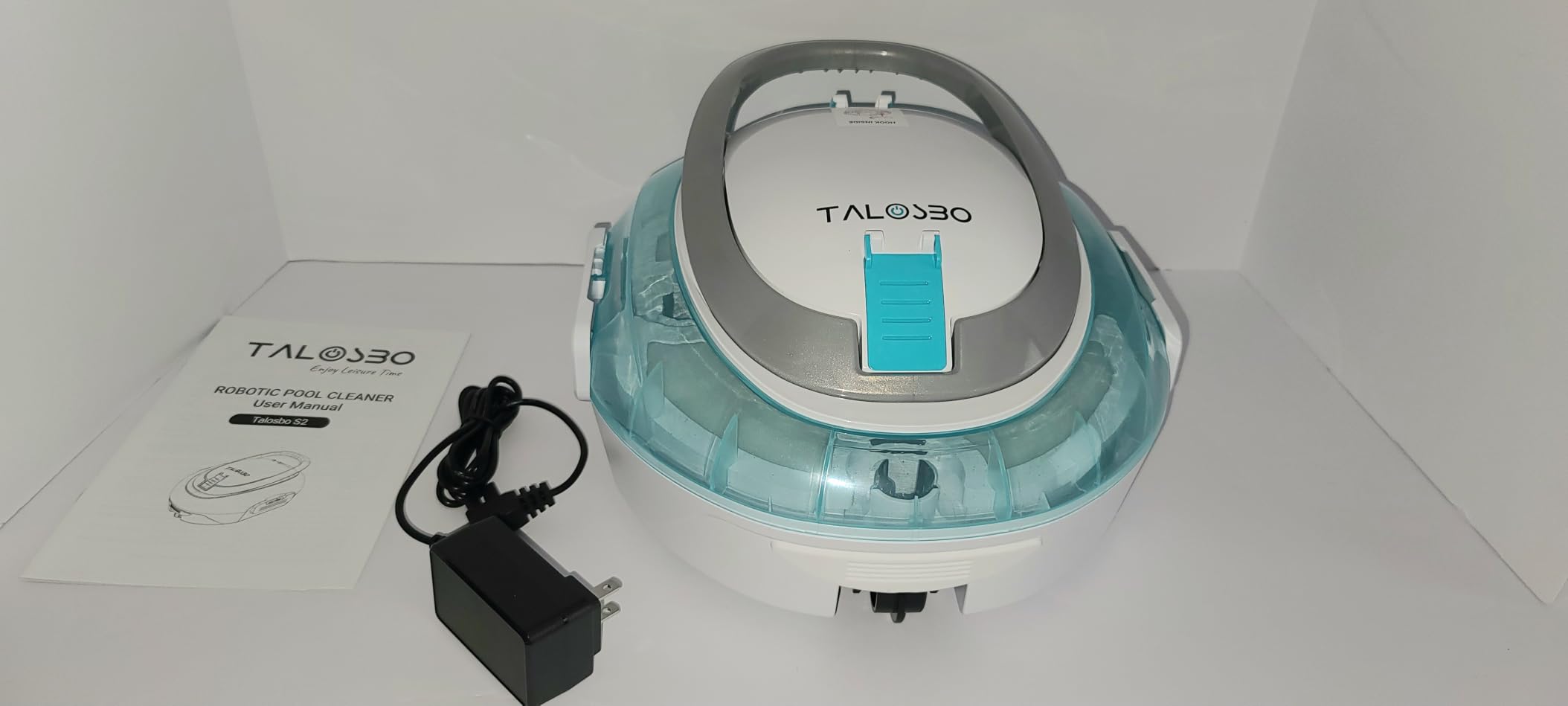
Dual-layer filtration is the working part. It separates larger leaves from fine dirt and sand, so the fine layer does not clog immediately when a leaf folds over the top of it. The basket lifts straight out for a quick rinse between cycles, which is the daily habit that decides whether you keep using the robot.
Owners describe it as a maintenance tool rather than a deep-clean tool, and the rating backs that up: 4.4 across 149 reviews with 66 percent five stars, but also a 12 percent two-star cluster and no one-star ratings. It does its narrow job well or it underperforms, with very few outright failures.
861 sq ft is the number that matters
That rating lines up with a 16 ft round or a 15×30 ft rectangular above ground pool, which covers most of the pools in this category. On an 18×33 oval or larger, the runtime finishes before the coverage does and you will need a second run.
Against the STARRYBOT, which has the same 90 minute runtime and a similar 900 sq ft ceiling, the BRINBO has more reviews and a more even spread. Against the WYBOT A1, it has less suction and a shorter rated run.
When a small robot is the right answer
If your pool collects grit daily, a lightweight floor-only unit you will actually run beats a heavier robot that sits on the deck because lifting it is a chore. That is the case this fills.
It is not the answer if your problem is a visible tide line, an algae bloom, or a floor with a pronounced slope. Those need a wall climber or a full pool service, and no floor-only unit here touches them.
7. Seauto track drive robot – the best for uneven floors
Cordless Robotic Pool Vacuum, Pool Cleaner with Track Drive & Sonar Navigation, 180W Brushless Motor, Wall & Waterline Climbing, 150-Min Runtime, for Inground & Above-Ground Pools up to 2150 Sq. Ft.
Track drive and sonar
180W brushless motors
150 minute runtime
Up to 2150 sq ft
Pros
- Industrial-grade tracks grip drains
- steps and uneven surfaces
- Dual 180W brushless motors with IP68 sealed internals
- Sonar mapping cuts redundant overlap
- Three modes for floor
- wall and full coverage
- 150 minutes of runtime over pools up to 2150 sq ft
Cons
- No app control
- it runs from the physical button only
- 19.8 lb is a real lift over a 48 inch wall
- A 12 percent one-star cluster
- mostly durability and support
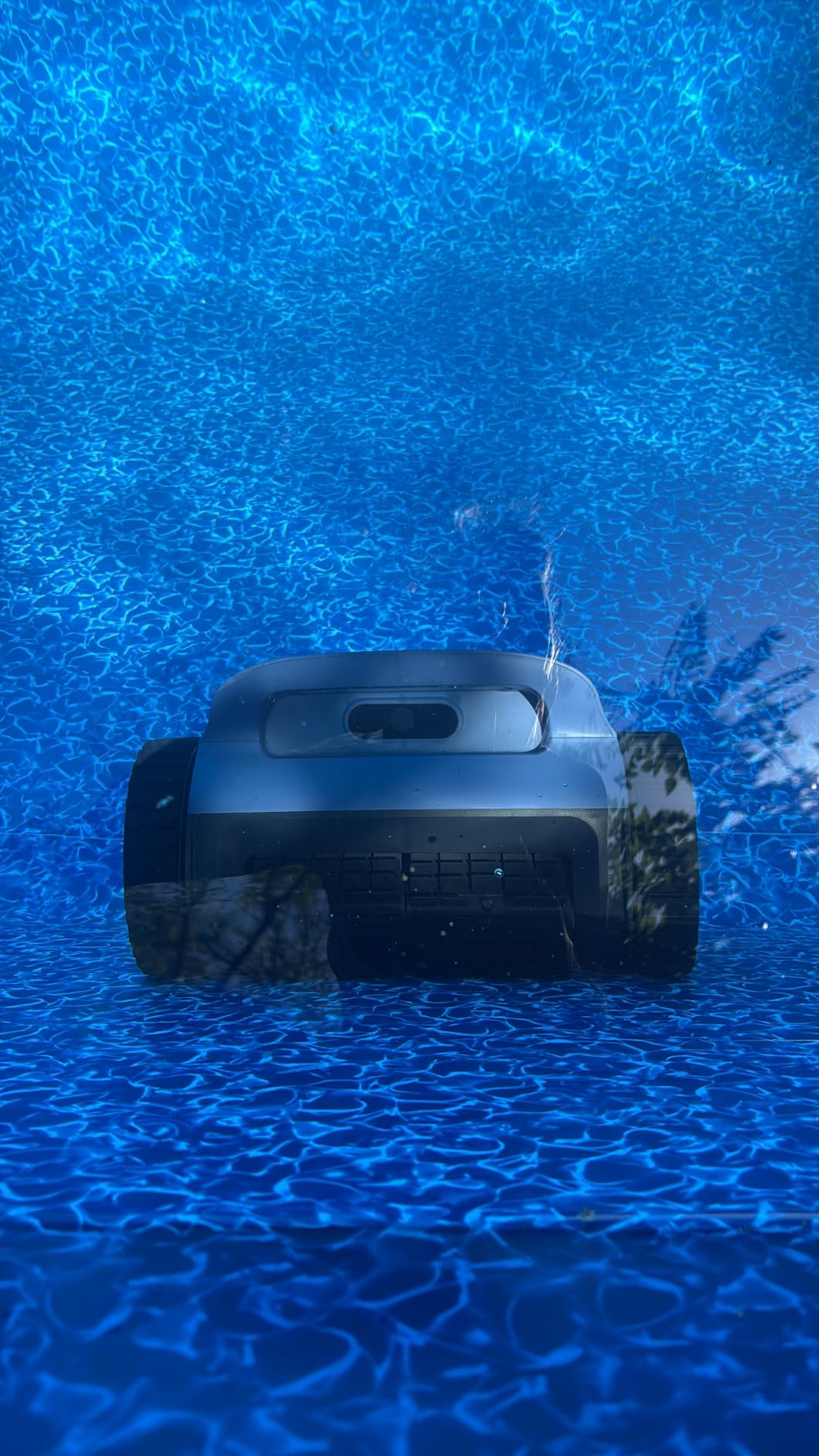
Track drive is the feature that separates this from every floor-only unit on this list. Wheels slide and skip over wrinkles and drain covers; tracks bite. Owners single out the traction over drains, steps, corners, and uneven surfaces with minimal slippage, which is exactly the geometry of a molded steel frame floor with a seam down the middle.
Two independently controlled 180W brushless motors drive it, with IP68-rated sealing for water resistance and quiet running. Sonar-based mapping charts the pool and trims redundant overlap, and there are three modes: floor, wall, and full coverage, so you can lock it to the floor on a soft-sided pool.
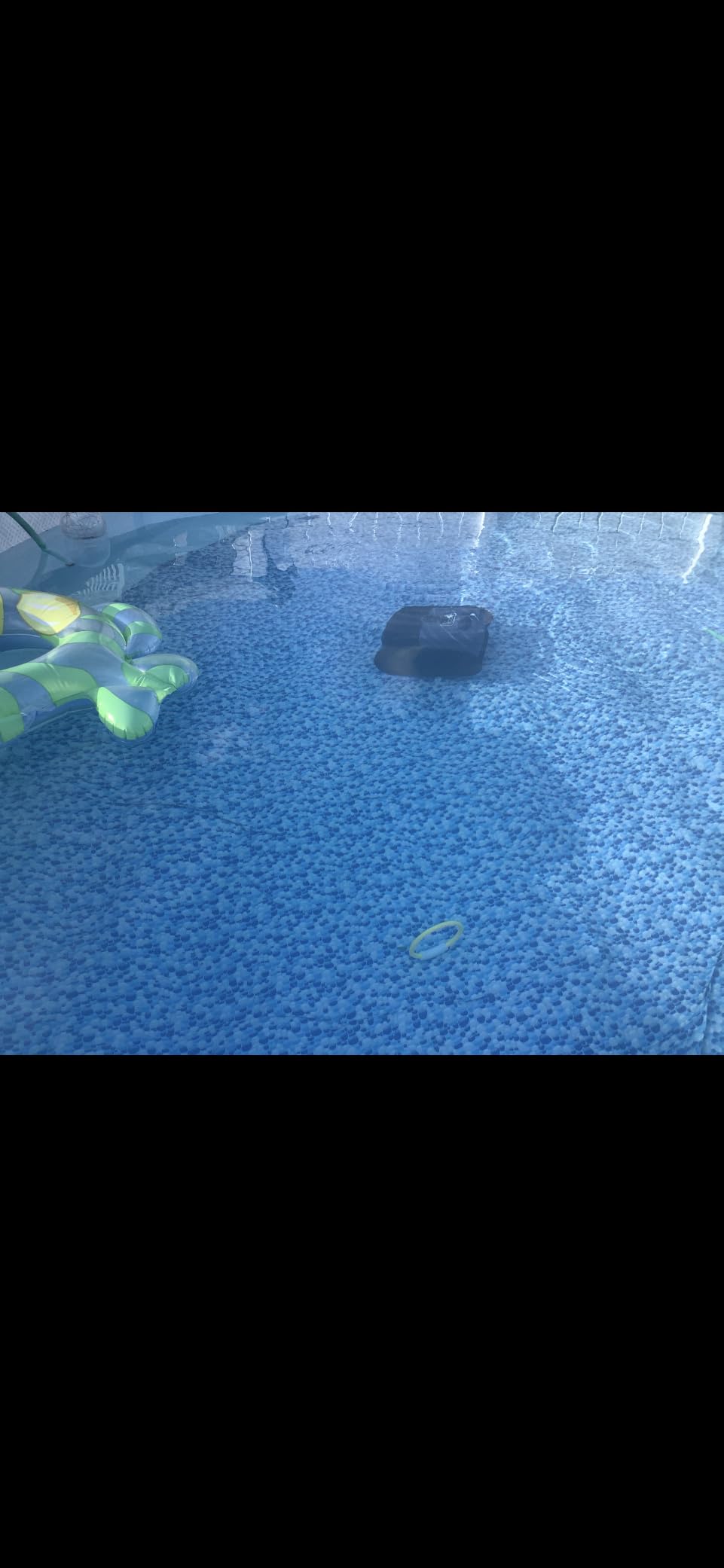
Runtime is up to 150 minutes over pools up to 2150 sq ft, and the battery holds 168.48 watt-hours with a three hour charge time. The 4 litre capacity and dual filtration are sized for that run, and adjustable suction plus automatic shut off round out the controls. Startup is genuinely one-touch: no app pairing, no syncing, no programming.
Two numbers deserve attention. The listed item weight is 19.8 pounds, one of the two heaviest bodies here, and the 5.3 by 3.3 by 2 inch dimensions appear to describe an internal component rather than the full unit. On a 48 to 54 inch wall, 19.8 lb is a two-handed lift.
When tracks earn their weight
They earn it when the floor is not flat: molded panels with a raised seam, a main drain cover, pool steps, or a liner that has stretched and buckled. Every one of those defeats a wheeled or jet-propelled robot, and the reviews are specific, with owners reporting it crossing drains and steps without stalling.
They do not earn it on a smooth vinyl floor. On a flat pool the tracks add weight and lifting effort without giving back cleaning power.
Read the review spread before you buy
At 4.2 across 434 reviews, this has the widest spread here: 71 percent five stars but 12 percent one star. Cleaning ability is not what the critical reviews attack. Durability over seasons and the quality of customer support are.
If you care most about how it cleans, this is a strong pick. If you care about it still working in year four, the Lodoba has a similar traction approach at a lighter weight and a longer rated runtime.
8. Lodoba wall climbing robot – the best value wall climber
[2026 Release] Automatic Robotic Pool Vacuum for Inground & Above Ground Pools, Wall Climbing Pool Vacuum Cleaner, Cleans Floor, Walls, Waterline, Drain & Skimmer up to 2150 Sq. Ft., 190 Min
4800 GPH suction
190 minute runtime
Wall and waterline cleaning
Track drive to 40 degrees
Pros
- 4800 GPH from dual brushless motors turning at 3200 RPM
- 190 minutes of cordless runtime - the longest rated run in this group
- Climbs walls and scrubs the waterline
- Track drive handles slopes up to 40 degrees
- One owner reports it cleaned a 14x48 ft steel pool in about 90 minutes
Cons
- Does not rise to the surface when finished
- so it needs a hook
- Can hang up behind a ladder or on an elevated drain
- One owner criticized support over a battery charging failure
Wall climbing coverage at this price is unusual, which is why the Lodoba takes the best value badge. It cleans floor, walls, waterline, drains, and the skimmer area on pools up to 2150 sq ft, and suction is 4800 GPH from dual brushless motors turning at 3200 RPM. Owners report it pulling in whole palm fronds that a standard suction vacuum cannot capture.
The traction is the other half. A track drive climbs slopes up to 40 degrees and handles steps, deep ends, and corners, and Sonar 2.0 mapping works across tile, vinyl, and concrete. It is rated for both inground and above ground installations, with a 144.3 watt-hour battery and a 2.5 hour recharge.
![[2026 Release] Automatic Robotic Pool Vacuum for Inground & Above Ground Pools, Wall Climbing Pool Vacuum Cleaner, Cleans Floor, Walls, Waterline, Drain & Skimmer up to 2150 Sq. Ft., 190 Min customer photo 1](https://austineubanks.com/wp-content/uploads/2026/09/B0GK8Q2J7M_customer_1.jpg)
Runtime is the headline: up to 190 minutes from a battery weighing 875 g, the longest rated run among the wall-climbing units here. One verified owner reports it fully cleaned a 14×48 ft steel above ground pool in about 90 minutes, which is the kind of result that shows the coverage rating is real.
It clears algae off walls and waterlines that brushing alone leaves behind, and that is where the reviews concentrate: 68 percent five stars and 13 percent four stars, with before and after reports on algae-covered above ground pools.
![[2026 Release] Automatic Robotic Pool Vacuum for Inground & Above Ground Pools, Wall Climbing Pool Vacuum Cleaner, Cleans Floor, Walls, Waterline, Drain & Skimmer up to 2150 Sq. Ft., 190 Min customer photo 2](https://austineubanks.com/wp-content/uploads/2026/09/B0GK8Q2J7M_customer_2.jpg)
The soft-sided warning you should not skip
Wall climbing works by pulling suction against a rigid surface. On a vinyl liner that flexes, that pull is the mechanism that deforms the wall, scuffs the liner, or stresses an unsupported seam. It is a real failure mode, and it is why we rank the Lodoba eighth rather than first.
Use it if you have a steel frame pool with a rigid or reinforced wall structure, or any pool where the manufacturer rates the walls for robot climbing. Not on a soft-sided or inflatable pool.
Retrieval is the real weakness
It does not rise to the surface when the cycle ends, so you need a hook to pull it out, and it can hang up behind a ladder or on an elevated drain until you nudge it. Place the ladder in a corner before a run, or retrieval takes longer than the clean.
One owner also reported heavy criticism of support over a battery charging failure. At 4.2 across 167 reviews with a 10 percent one-star share, expect to manage the product yourself if something goes wrong.
9. BOTLIFE PC10 – the best for 1500 to 1800 sq ft pools
BOTLIFE PC10 Cordless Robotic Pool Vacuum for Inground & Above Ground Pools
5000 GPH suction
120 minute runtime
Pools up to 1830 sq ft
4L basket with 150 micron mesh
Pros
- 5000 GPH from dual drive motors
- a pump and two brushes
- S-path floor and N-path wall navigation
- High-grip tracks handle slopes up to 30 degrees
- 4L top-load basket with 150 micron mesh
- Self-parks at the edge and a retrieval hook is included
Cons
- 150 micron mesh needs rinsing after each use to hold suction
- Retrieval is manual at the end of a cycle
- Not for soft-sided pools that cannot take wall climbing
The PC10 is sized for the larger end of the above ground market: 18×33 ovals, 16×32 rectangles, and 20 ft rounds past 1500 sq ft. Its 5000 GPH suction comes from dual drive motors plus a dedicated pump and two active brushes, and the navigation is mapped rather than random. It runs an S pattern on the floor and an N pattern on the wall, cutting repeated passes.
Three modes cover the full pool, floor only, or wall only with waterline scrubbing, so it can be restricted to the floor on a liner pool. High-grip tracks transition between surfaces and handle slopes up to 30 degrees, and the 4 litre top-load basket uses a 150 micron mesh.
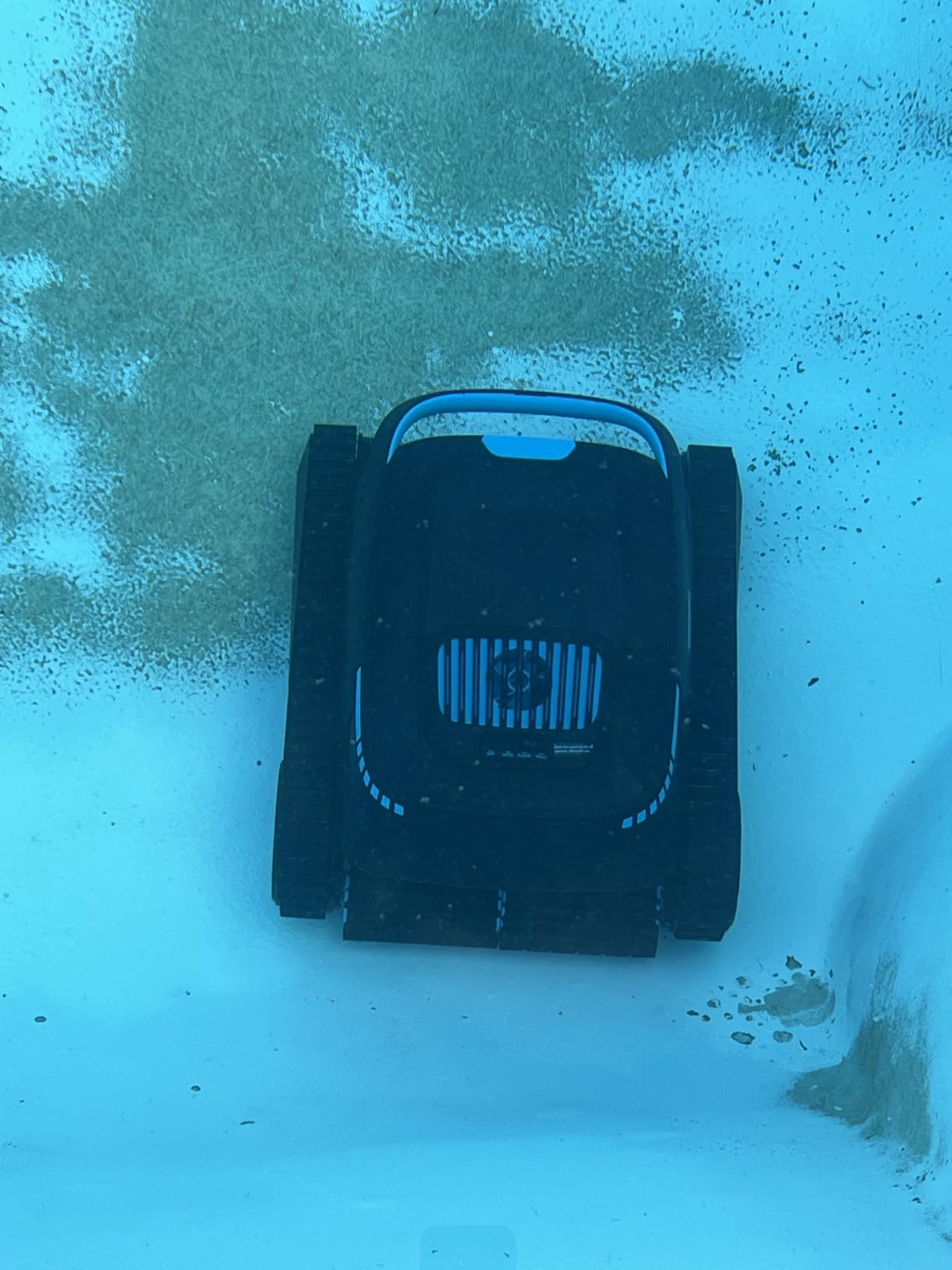
Runtime is up to 120 minutes on a 5200mAh battery over pools up to 1830 sq ft, with a recharge of about two and a half hours. At 4.5 across 123 reviews with 91 percent at four or five stars and 4 percent one star, it has one of the more consistent distributions of the wall-climbing group.
Self-parking at the edge at the end of a cycle keeps you out of the water, and a retrieval hook is included for the times it parks somewhere awkward. The body is 10 by 15 by 9 inches, and the listed battery weight is 16 ounces.
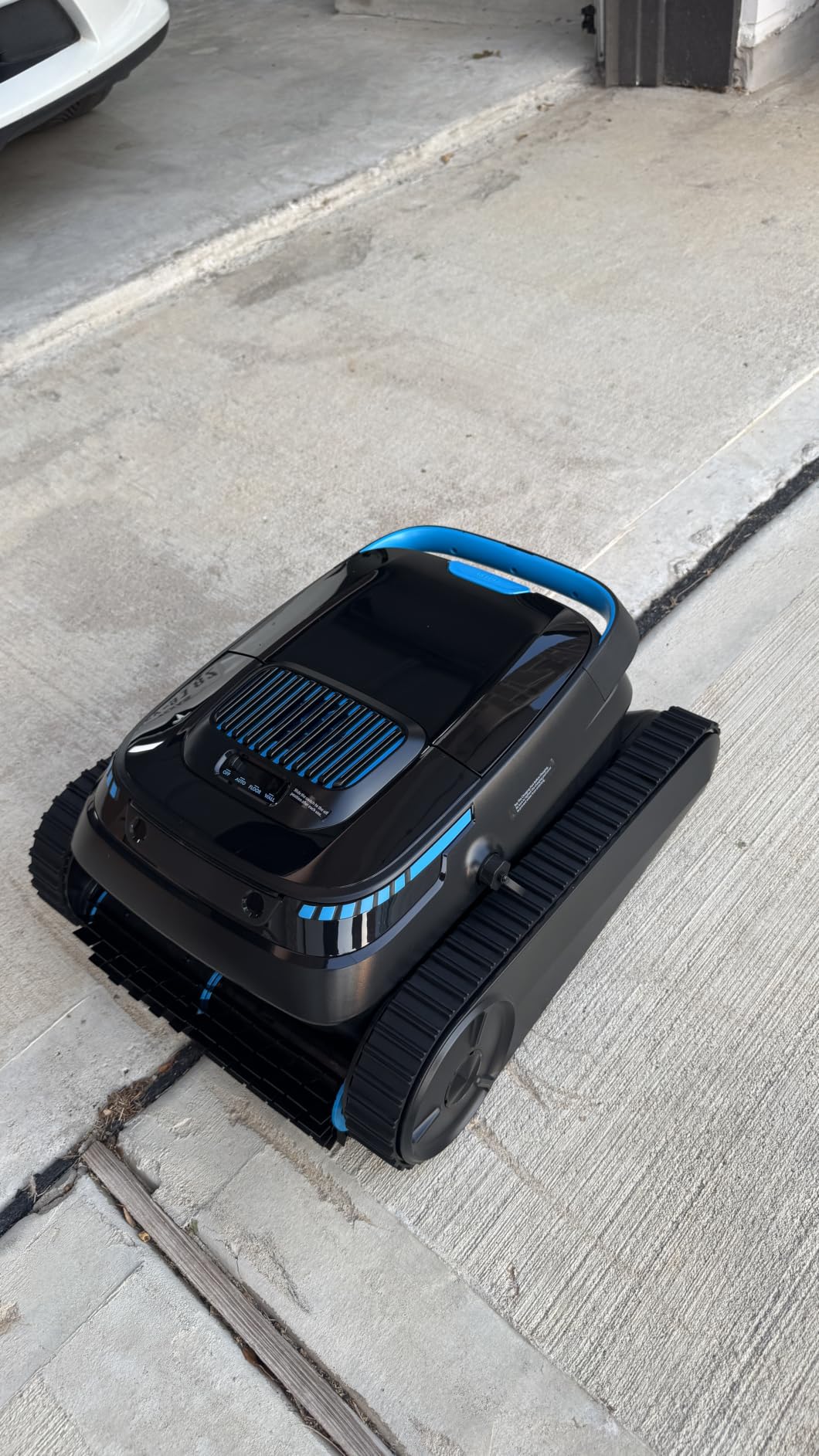
Why the basket size matters on a big pool
At 4 litres, this holds substantially more than the small floor-only units, and that is the difference between one run and two on a 1800 sq ft pool. Under heavy leaf load the capacity means you are not stopping mid-cycle to empty it.
The trade is the 150 micron mesh, coarser than the 180 micron filtration on the WYBOT A1 and the PoolMr. Fine dust passes through it, so the basket needs a rinse after each use or suction drops noticeably.
Where it does not fit
Do not put it on a soft-sided pool with wall mode enabled. The same climbing physics that make it good on a rigid wall make it a liability on a liner, and it is not restricted to floor-only use by default.
It also carries more than a small above ground pool needs. On a 16 ft round, the WYBOT A1 or the PoolMr covers the same floor with less lifting effort and a longer runtime per charge.
10. Beatbot Sora 10 – the best app control and longest runtime
Beatbot Sora 10 Cordless Pool Vacuum Robot for Inground & Above Ground Pools, 6800 GPH Suction, Floor/Wall/Waterline/Shallow Area Cleaning, Waterline Parking, 300 Mins Runtime Royal Blue
6800 GPH suction
300 minute runtime
5L debris basket
App, Wi-Fi and Bluetooth
Pros
- 6800 GPH HydroBalance suction
- Longest runtime in the group at 300 minutes
- 5L basket rated for roughly 650 leaves
- App control over Wi-Fi or Bluetooth with OTA updates
- Saltwater safe under 5000 ppm with a 2-year warranty
Cons
- Waterline parking is inconsistent and often needs fishing out
- Sometimes rides up on its rear wheels and needs dunking
- Shell and top lid scuff and dent with long-term outdoor use
The Sora 10 is the only robot here with a real app, and owners upgrading from higher-end Beatbot models say that is the reason they moved. The app paired on the first attempt for multiple reviewers, which is not a given with pool robots, and it runs over Wi-Fi or Bluetooth with over-the-air updates. On r/pools, an owner who moved up to an AquaSense cites better app modes as the deciding factor, not suction.
Suction is 6800 GPH under the HydroBalance name, and runtime is 300 minutes from a 7310mAh battery, covering pools up to 3229 sq ft. The 5 litre basket is rated for roughly 650 leaves, lifts out for rinsing, and there is an optional 3 micron ultra-fine filtration upgrade.
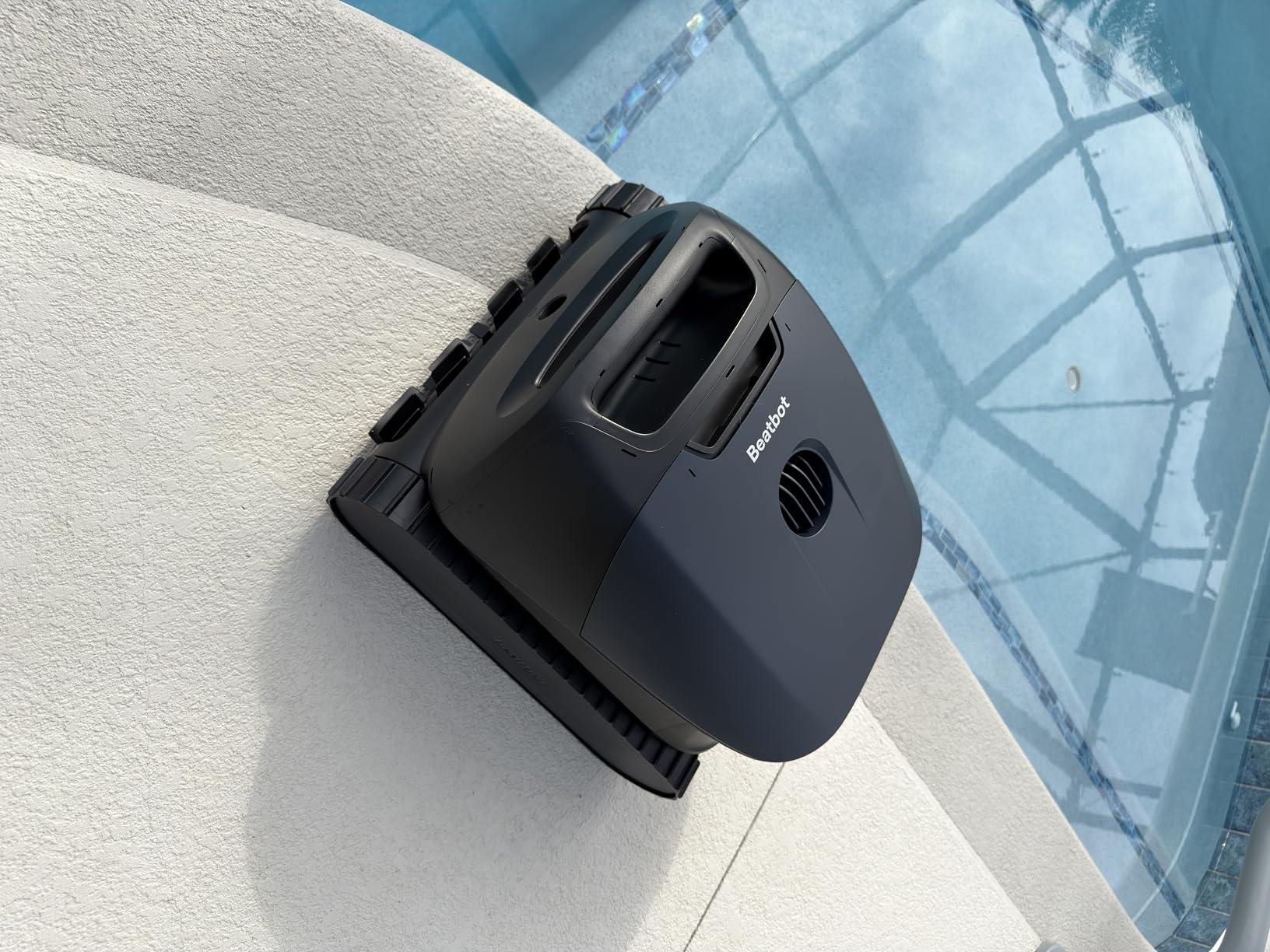
Coverage is genuinely four-zone: floor, wall, waterline, and shallow areas down to 12 inches, so tanning shelves and sun decks get attention too. At 4.6 across 65 reviews with 78 percent five stars, it has the strongest average rating of the products here, and the 2-year warranty is tied for the longest.
It is also the only one rated for saltwater, with corrosion-resistant construction specified for NaCl under 5000 ppm. That matters for anyone running a salt system, where corrosion is not academic.
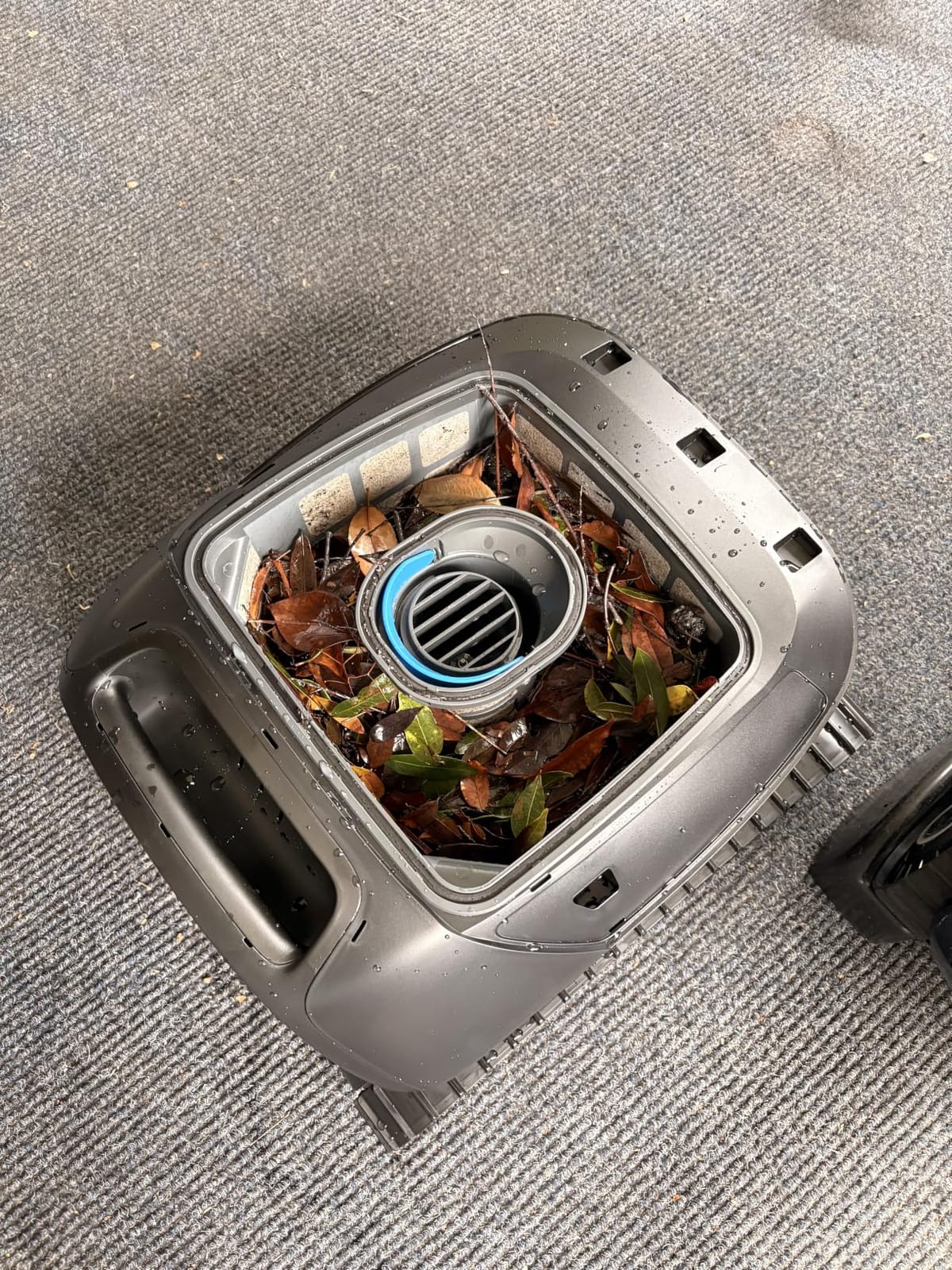
The shallow zone is the underrated feature
Most robots treat a shallow ledge as a wall they cannot climb and give up. The Sora 10 is rated to clean down to 12 inches, so the sun shelf and the top step are part of the route. On a pool with a wide shallow end, that is a meaningful share of the floor area.
Smart waterline parking is supposed to hold position for 10 minutes at the end of a cycle, so you walk over and lift it out. Owners report it is inconsistent, and you will sometimes be fishing it out of the middle of the pool instead.
Handling and long-term durability
It weighs 10.5 kg, so plan a two-handed lift, though the internal weight distribution is reported as easy to carry. Two other issues recur: it sometimes rides up on its rear wheels and needs dunking to release trapped air, and the top lid and shell scratch and dent with long-term outdoor storage.
Charge time is also short relative to the runs it attempts, so a 300 minute cycle will not happen off a full charge every time. With 65 reviews the sample is the smallest of the well-known brands here.
How to choose a robotic pool cleaner for an above ground pool
Start with the number nobody quotes: surface area in square feet. Robot coverage is rated in square feet, not gallons. A 16 ft round pool is roughly 200 sq ft while an 18×33 oval is closer to 480 sq ft, and most above ground pools sit between 150 and 600 sq ft. A robot rated far above your pool finishes early and wastes battery; one rated below it stops before it covers the floor.
The second spec is weight, and it is the one buyers most regret ignoring. Anything over 15 lb is a genuine two-handed lift over a 48 to 54 inch wall when you are alone. Between a 14.6 lb unit and a 19.8 lb unit covering the same floor, take the lighter one unless wall climbing is worth the effort.
Third is wall type. Soft-sided and inflatable pools get a floor-only cordless unit and nothing else. Steel frame and rigid-walled pools can use a wall climber, and the difference in visible cleanliness is large once a tide line forms. Owners on r/AboveGroundPools have an active thread asking for robots that will not attempt to climb, so this runs in both directions.
Fourth is corded versus cordless. Cordless is easier on an above ground deck, where the surround is often three feet wide and a cable is a trip hazard. Corded models like the Dolphin Nautilus AG never run out of power, but they need a GFCI-protected outlet within reach of the wall and they tangle with ladders and floating toys. Route the cable over a corner of the pool rather than across the entry point.
Fifth is retrieval. Self-parking at the edge or the waterline matters more than it sounds, because a robot at the bottom of an opaque blue pool is a fishing problem. The Beatbot Sora 10 and the STARRYBOT both hold position and beep; the Lodoba does not surface and needs a hook.
Sixth is whether your real problem is debris or clarity. No robot in this guide will clear cloudy water. That is a chemistry and filtration problem, and a robot in the same cloudy water for three hours will not fix it. We cover the manual side in our above ground pool vacuum guide if debris is the smaller half of your problem.
Seventh is the pool itself. If you are still choosing, our picks for above ground pools for backyards cover the sizes these robots are sized for, and our pool heater guide matters if you are extending the season and running the robot in cooler water.
Common problems with robotic pool cleaners and how to fix them
It stops early. A blocked filter is the usual cause. If the basket packed with sand or leaves mid-cycle, suction drops and the robot decides it is done. Empty and rinse it, and check the mesh for a compacted layer of fine silt.
It circles in one spot. That is almost always the drive train losing traction, or an uneven floor. Check that the wheels or tracks are free of hair and debris, and look for a wrinkle in the liner that the robot is climbing repeatedly. Reposition the pool or smooth the liner area under the robot.
It misses a strip of floor. Random path models are built this way. The WYBOT A1 and the STARRYBOT both use non-mapped routing, so a second run usually catches it. Mapped models like the Seauto and the BOTLIFE cut this by planning the path instead.
It will not climb the wall. On an above ground pool this is usually correct behavior rather than a fault, because the wall is thin and flexes and the robot cannot get a grip. On a rigid wall, the causes are a dirty or worn brush, too little weight, or the wrong mode selected.
The cable tangles. Only a corded model, and the fix is routing rather than maintenance. Run the cable over a corner of the pool rather than across the ladder, and keep the pool free of inflatable rings and floating toys during a cycle. The anti-tangle swivel helps but does not solve a bad route.
It gets stuck on the ladder or a step. Move the ladder out of the pool or place it in a corner before the run. The Lodoba owners report this most often, and the same fix applies to elevated floor drains, which the wall climbers can catch on.
The filter fills in one cycle. Under trees that is a capacity problem, not a fault. Empty it mid-cycle, or move to a model with a larger basket such as the 4 litre BOTLIFE PC10 or the 5 litre Beatbot Sora 10.
It does not move at all. Check the charge first, then confirm the unit is in the correct mode. A robot parked in floor-only mode on a wall it cannot grip will look exactly like a broken robot, which is a common source of unnecessary returns.
What pool owners say about above ground pool robots
Owner reports are more useful than spec sheets in this category, because the failure modes only show up in a real pool. On r/AboveGroundPools, one owner describes the pairing that actually produces a low-maintenance routine: a floor robot plus a surface skimmer robot, about five minutes a day total. That combination is the most realistic answer for most above ground pools, and no single robot here skims the surface.
On r/pools, an owner running an Aiper Seagull in the water alongside a skimmer robot says the same thing, which shows the pairing is not brand specific. It also explains why surface debris is often still an issue even with a good floor robot underneath.
On r/swimmingpools, owners weighing cordless upgrades cite warranty length as a hard threshold alongside suction, and durability over multiple seasons is treated as more important than first-impression cleaning power. That is why we have flagged the one-year warranties on the STARRYBOT and the Aiper Scuba SE rather than burying them.
Also on r/swimmingpools, a five-year Dolphin owner notes the robot would nearly climb out of the water on the walls but that performance degraded with age. That is the honest version of the category: cleaning quality holds, plastics and batteries age, and the wall-climbing excitement fades after a few seasons.
On TroubleFreePool, a Dolphin E10 owner reports the robot did a bang up cleanup after a winter cover failure and an algae bloom. Spring recovery after a cover failure is where a robot genuinely earns its cost, because it removes settled debris and dead algae before you start balancing chemistry.
When a pool robot is the wrong buy
Four cases, and they cover a surprising share of searches. First, a 12 ft inflatable pool with no rigid floor: a manual vacuum handles it in minutes and a robot has nowhere stable to drive. Second, a seasonal pool drained and stored for five months. Third, a pool whose problem is cloudy water rather than debris. Fourth, a small rectangular pool where a hose attachment on the existing filter pump already does the job.
There is a fifth case worth naming: if you already own a good manual vacuum and you enjoy the ten minutes, a robot mostly removes a chore you do not mind. Our manual vacuum guide is the better read there. For inflatable and kids’ pools the options are narrower still, as we cover in our kids’ pool guide.
One safety note belongs here as well. Some owners in pool forums have discussed burn and charging incidents reported on certain cordless units in this category. We found no recall data covering the ten models listed here, and every one carries at least a one-year warranty, but the practical advice is unchanged: charge on a dry non-slip surface away from the water, use the supplied charger rather than a third-party pack, and remove the unit from the pool before plugging in.
Frequently Asked Questions
Do robotic pool cleaners work in above ground pools?
Yes, and above ground pools often benefit more than inground pools because the water is shallower, warmer, and closer to trees. The robot must be rated for above ground depths and for your floor type. Most models are floor-only by design, which is safer for a soft-sided liner.
Which cordless robotic above ground pool cleaner is the best?
The WYBOT A1 is the strongest all-round cordless pick for sand and dust, with 2280 GPH suction, dual-layer 180 micron filtration, and up to 130 minutes of runtime over pools up to 1100 sq ft. The Beatbot Sora 10 wins on app control, shallow-zone cleaning, and a 300 minute rated runtime.
What are the best pool vacuums that can climb walls?
The Lodoba, the Seauto track drive model, the BOTLIFE PC10, and the Beatbot Sora 10 all climb walls and scrub the waterline. Use them only on rigid or reinforced walls. Never run a wall-climbing robot on a soft-sided or inflatable pool, where the climbing suction can distort the liner or stress an unsupported seam.
Why can’t my pool cleaner climb the walls?
On an above ground pool the wall is thin and flexes, so a suction-grip robot cannot get traction. That is correct behavior, not a fault. On a rigid wall the usual causes are a dirty or worn brush, too little weight, or the unit being left in floor-only mode.
What are some common problems with robotic pool cleaners?
The recurring ones are stopping early from a blocked filter, circling in one spot on an uneven floor, missing a strip with a random path model, failing to climb a flexible wall, cord tangles on corded units, getting stuck behind a ladder or on a drain, and a filter that fills in one cycle under leaf load. Each has a simple fix, covered above.
The verdict for 2026
The Dolphin Nautilus AG is the best robotic pool cleaner for above ground pools in 2026. It has the deepest review base of any model here at 6380 ratings, a body light enough for one person to lift, an above-ground rating well past what most pools need, and a floor-only design that will never pull at your liner.
For wall and waterline coverage on a rigid-walled pool, the Lodoba is the value pick and the Beatbot Sora 10 is the one with the app, shallow-zone reach, and a two-year warranty. For the flattest possible floor and the least effort, the STARRYBOT and the WYBOT A1 do the job for the least money.
Measure your pool’s surface area in square feet, check the wall material, and then pick. It is a five-minute calculation that will save you from buying a robot too heavy to lift or too large to finish. Start with our backyard above ground pool guide if you are still deciding on the pool itself.