
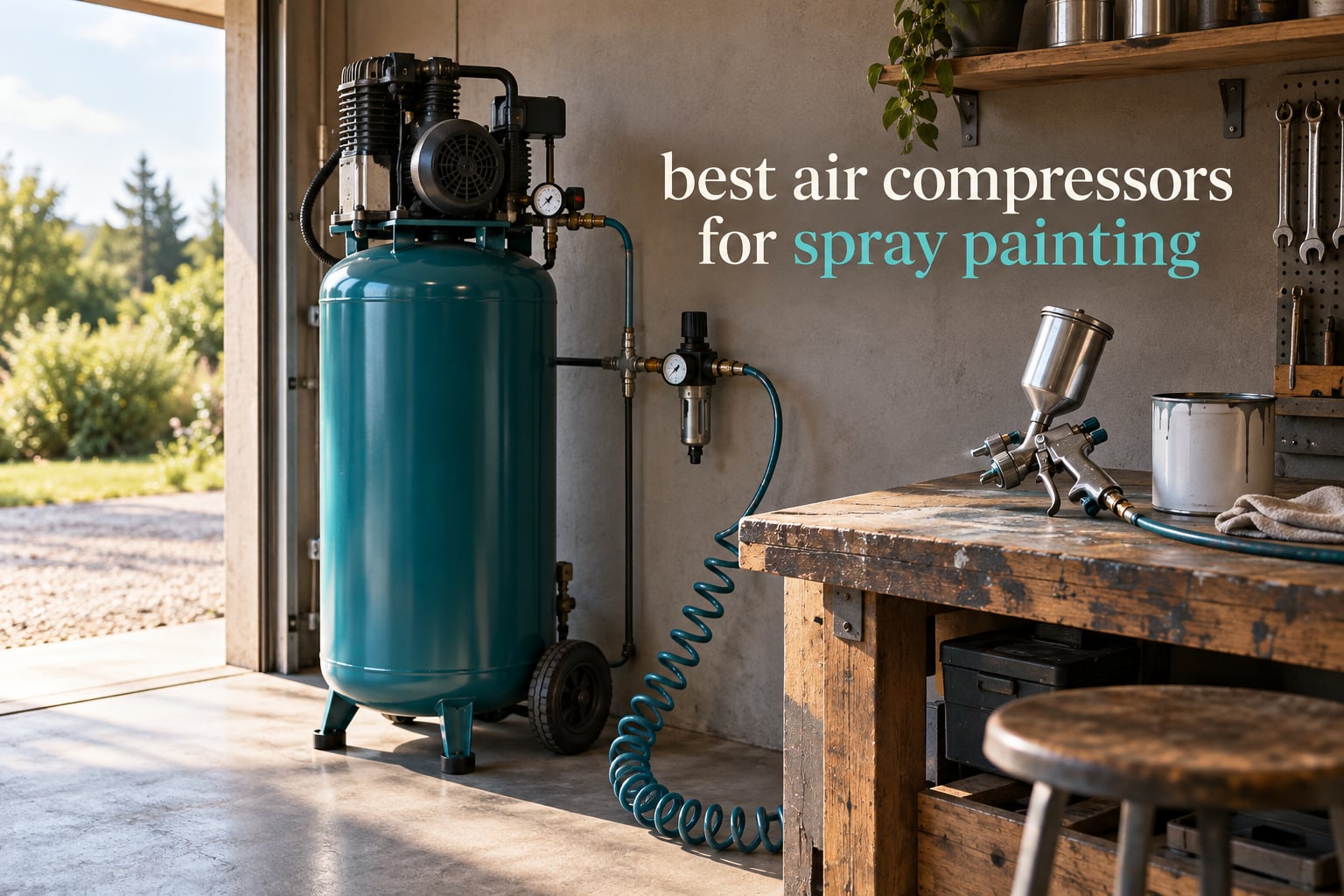
The California Air Tools 10020C is the best air compressor for spray painting overall. It pushes 5.3 CFM at 90 PSI through an oil-free dual piston pump into a 10 gallon vertical tank, and it runs at 70 dBA, which is quiet enough for a garage you share with a household.
That pick comes down to one number most roundups bury: airflow at working pressure. A spray gun does not care how big your tank is or how loud the motor is, it cares whether the pump can replace the air the trigger pulls as fast as you pull it. Too little and the coat sputters into stripes, the fan pattern collapses, and you get to redo the panel.
So here is the routing that matters before any list. An airbrush needs well under 1 CFM. A siphon-feed LVLP gun pulls roughly 2 to 3 CFM. A gravity-feed LVLP, the workhorse for cabinets and furniture, wants 3 to 4 CFM. A gravity-feed HVLP gun is the demanding one at 5.5 to 6 CFM, and a mid-pressure velocity gun sits in between at about 3.5 to 4 CFM. Buy for the number your gun asks for at 90 PSI, not for the tank size printed on the box.
One more thing to sort out early, because it trips up almost everyone: older compressors were rated at 40 PSI and modern ones at 90 PSI. A unit advertised at 8.6 CFM is almost certainly a 40 PSI figure, and at 90 PSI it delivers far less. That gap is why a compressor can look generous on a spec sheet and still starve a gun in your hand. Sawmill Creek regulars make the same point, and TalkBass posters put a floor of 20 gallons at 5.5 to 6 CFM for anyone serious about HVLP.
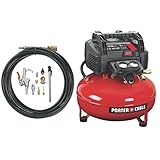
Below I cover twelve units in that order, from panel-capable tanks down to small quiet boxes for detail work, and I flag for each one the gun class it can and cannot feed. If you also need a compressor for jobs that are not spraying, our portable air compressor picks for cars cover the inflation side of the same decision.
Table of Contents
Top 3 Picks for Best Air Compressors for Spray Painting in October


All 12 Compressors at a Glance
Every unit below is oil-free, which removes oil contamination from the air line. Airflow is the figure to read first, because it decides which gun the unit can hold.
| Product | Specifications | Action |
|---|---|---|
| California Air Tools 10020C |
|
Check Latest Price |
 VEVOR 15 Gallon Oil-Free VEVOR 15 Gallon Oil-Free |
|
Check Latest Price |
 ECOMAX 6 Gallon 150 PSI ECOMAX 6 Gallon 150 PSI |
|
Check Latest Price |
| PORTER-CABLE C2002-WK |
|
Check Latest Price |
 Limodot 5 Gallon Limodot 5 Gallon |
|
Check Latest Price |
 California Air Tools 2010A California Air Tools 2010A |
|
Check Latest Price |
 CRAFTSMAN 6 Gallon 150 PSI CRAFTSMAN 6 Gallon 150 PSI |
|
Check Latest Price |
| Master Airbrush Cool Runner II |
|
Check Latest Price |
 Timbertech ABPST08 Timbertech ABPST08 |
|
Check Latest Price |
 Timbertech Airbrush Kit Timbertech Airbrush Kit |
|
Check Latest Price |
 California Air Tools CAT-1P1060S California Air Tools CAT-1P1060S |
|
Check Latest Price |
 Oasser AK2-2 Oasser AK2-2 |
|
Check Latest Price |
1. California Air Tools 10020C – 5.3 CFM at 90 PSI in a 10 Gallon Tank
California Air Tools 10020C 2.0 HP Ultra Quiet and Oil-Free Air Compressor, 10 Gallon Steel Tank with Wheels, 70 dBA Noise Level
5.3 CFM at 90 PSI
10 gallon steel tank
70 dBA
125 PSI max
Pros
- 5.3 CFM at 90 PSI covers gravity-feed LVLP and mid-pressure guns
- 10 gallon vertical tank gives real buffer between trigger pulls
- Oil-free dual piston pump rated past 3000 hours
- 70 dBA is workable indoors and in a shared garage
- Easy Start Valve cuts startup amps
Cons
- Oil-free pumps overheat under long continuous duty
- Steel tank will rust if left undrained
This is the unit I keep coming back to because the spec sheet finally tells the truth. 6.4 CFM at 40 PSI drops to 5.3 CFM at 90 PSI, and that 90 PSI number is the one that decides whether your gun starves. At 5.3 CFM it will hold a gravity-feed LVLP through a full pass of a cabinet door without the fan pattern breaking up.
Airflow is measured at the tank, so the reserve is what smooths the coat: 10 gallons of steel means several extra seconds of buffer each time the pump cycles. On furniture work, where you spray for 20 to 30 seconds and then reposition, that gap is the difference between a steady finish and a visibly pulsing one.
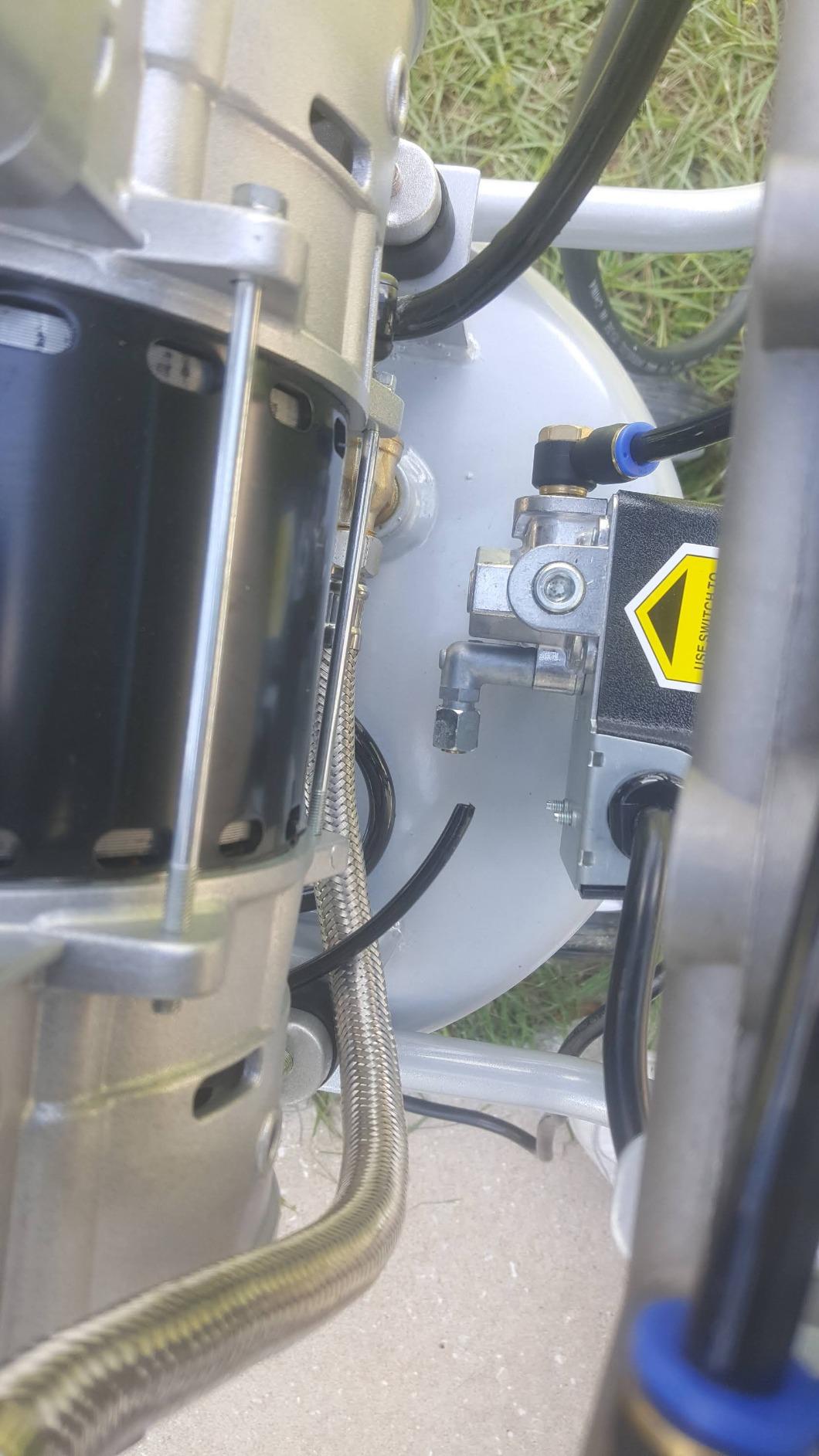
Owners report it driving a paint sprayer without drama, and the vertical footprint means it rolls into a corner instead of eating floor space, or into an SUV for a mobile repair call. At 82.5 pounds it is not a one-hand carry, but the wheels and handle make it a one-trip move.
The 2 HP motor runs at only 1680 RPM, which is where most of the 70 dBA comes from. An Easy Start Valve reduces startup amps, useful on a 110 V circuit that also has a light or a saw on it.
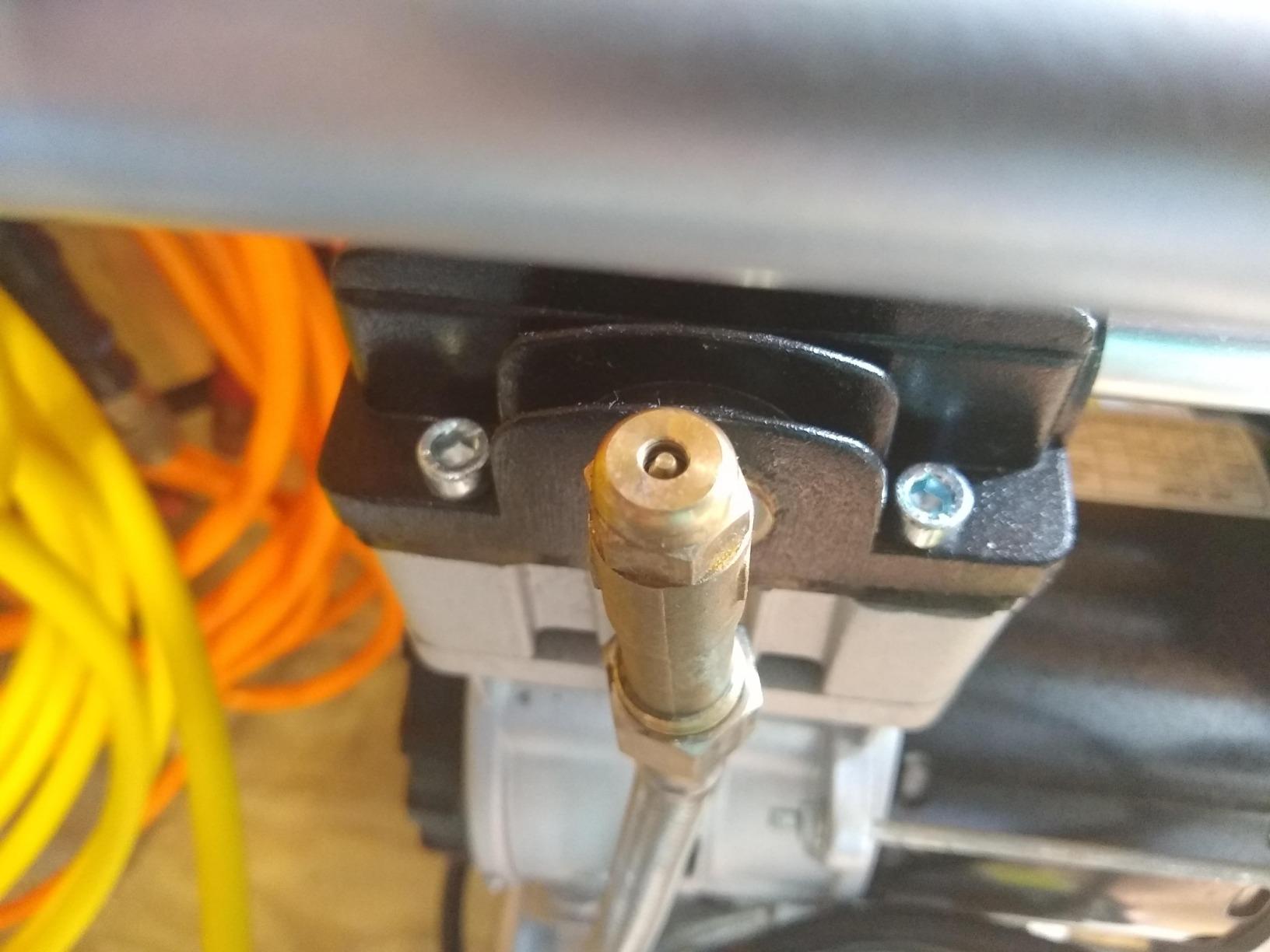
What it will and will not run
Comfortable with gravity-feed LVLP, mid-pressure velocity guns and light HVLP passes on small parts. It is borderline for a full gravity-feed HVLP session at 5.3 CFM against a 5.5 to 6 CFM demand, so expect to throttle back on trigger discipline.
Not intended for continuous duty work like sandblasting or feeding two guns at once. Plan on pauses between coats so the pump can shed heat.
Where the noise sits in your workflow
At 70 dBA it is conversation-level in a normal garage, which means you can mask and spray in the same room without shouting. It is not a bedroom unit, so keep it a room away from sleeping quarters.
The steel tank needs manual draining. Set a reminder in the first month, because rust starts quietly and a pitted tank is a permanent repair bill.
2. VEVOR 15 Gallon Oil-Free – 5.3 CFM at 90 PSI for Automotive Panels
VEVOR Air Compressor, 15 Gallon Steel Tank, 2HP 5.3 CFM@90 PSI Oil Free Air Compressor & Max. 125PSI Pressure, 78dB Ultra Quiet Portable Compressor, for Auto Repair, Tire Inflation, Spray Painting
5.3 CFM at 90 PSI
15 gallon tank
78 dBA
125 PSI max
Pros
- Largest tank in the group at 15 gallons for long panel passes
- 5.3 CFM at 90 PSI matches the editor's choice on airflow
- Oil-free 1.32 kW motor running at 1680 rpm
- Three-layer rust and wear coating on the tank
- Automatic overheat and over-pressure protection
Cons
- Power cord is only about 40 inches
- Several reports of not starting on an extension cord
- Wheels and handle feel cheap next to the tank
This is the one to buy if automotive panels are in scope. The 15 gallon tank is the largest here, and r/Tools regulars point to tank size as exactly what pushes people toward 20 gallon units once sandblasting and full panel work are on the list. For a door skin or a quarter panel, that reserve is what stops you mid-pass.
The airflow matches the 10020C at 5.3 CFM at 90 PSI, so the same gravity-feed LVLP logic applies. A large cooling fan and automatic overheat and over-pressure protection make the long sessions safer than most units in this class.
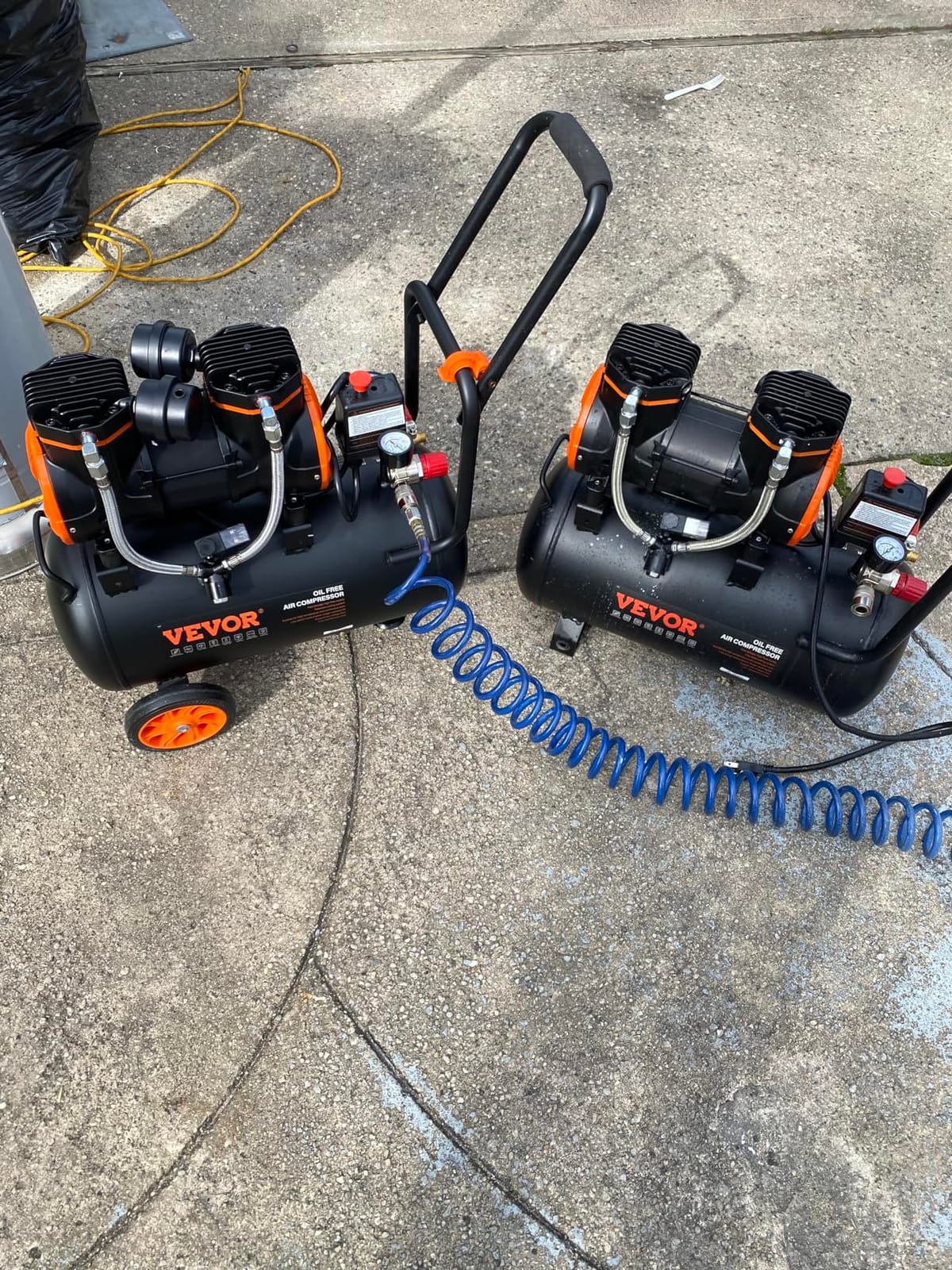
Buyers mention it driving spray guns, nailers and sanders reliably, and the Q235B steel with a three-layer coating is a sensible tank for a garage that sees damp air. At 78 dBA it is a few decibels above the California Air Tools unit, still a workshop rather than a living room.
For 2K solvent-borne work, an r/AutoPaint user runs a 20 gallon unit rated around 6 CFM with an LVLP gun successfully for DIY projects, which sets a fair expectation for what this class can do at home.
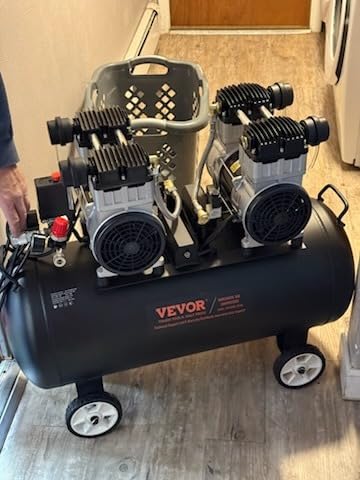
Plan your power before you unbox it
The cord is roughly 40 inches, so this unit belongs near an outlet, not across the room. Several owners report it cutting out on an extension cord, so a dedicated 15 amp circuit is the safer bet than a long run of 12 gauge.
At 81.6 pounds with cheap-feeling wheels, plan the route from the truck to the garage before you need it, not after.
Where it falls short of a shop compressor
Single-stage 125 PSI is fine for most gun work, but a true 240 V two-stage unit is the right tool for a whole car. This is a strong 120 V panel and touch-up machine, not a production booth compressor.
Quality control is the weak point in this price band, so check the wheels, handle and fittings on arrival and confirm the unit builds pressure before you start a project.
3. ECOMAX 6 Gallon 150 PSI – 3 CFM at 90 PSI for Trim and Touch-Ups
ECOMAX Air Compressor 6 Gallon 150 PSI Pancake Portable Oil-free Tank with 10 PCS Accessories Kit
3 CFM at 90 PSI
6 gallon pancake
150 PSI max
75 dBA
Pros
- Highest average rating in the group at 4.7
- 150 PSI tank pressure stores more air than most pancakes
- Only 34.17 lb with a flip-up handle
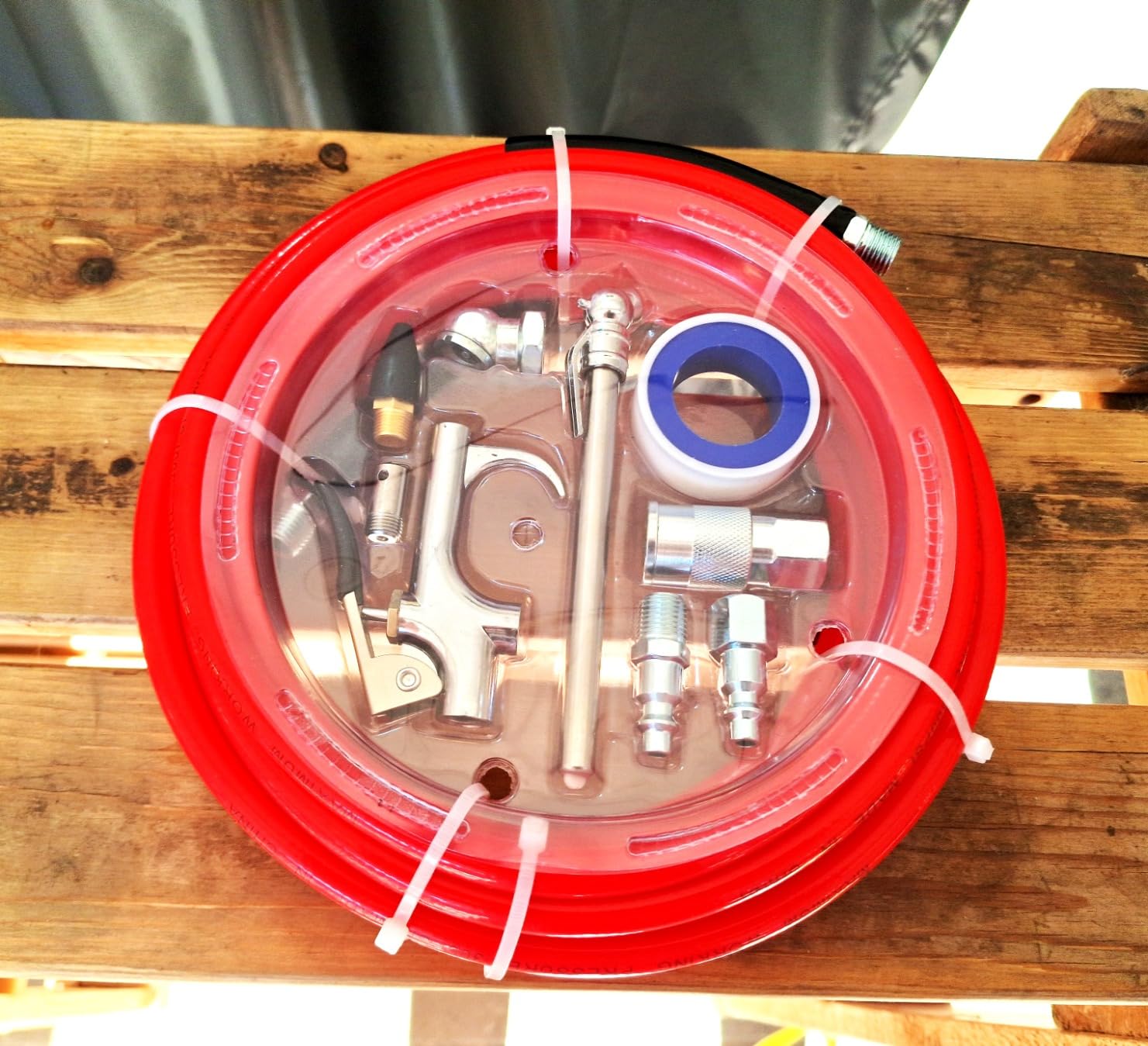
- Ten piece accessory kit with 25 ft hose and blow gun
- Low-voltage and cold-weather start
Cons
- 75 dBA is louder than dedicated ultra-quiet models
- 3 CFM is modest for sustained high-volume spraying
- Included hose is PVC and stiffens in cold weather
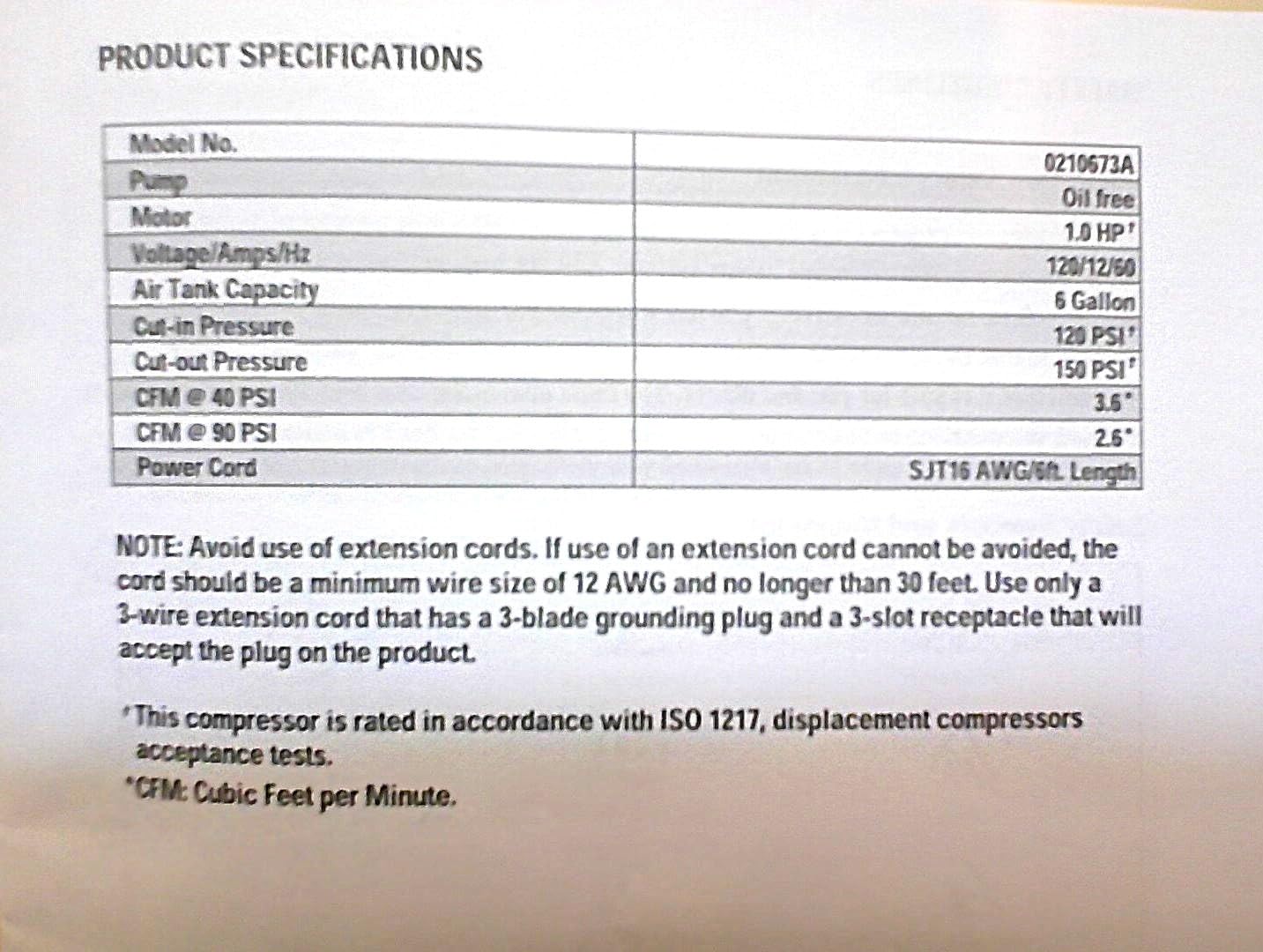
At 3 CFM at 90 PSI this is the cleanest match for a gravity-feed LVLP gun doing trim, touch-ups and small furniture pieces. That is the most common DIY spraying job there is, and plenty of users would argue 3 CFM is the number to design around rather than chasing HVLP numbers you do not need yet.
Pressure is where this unit outshines its airflow. At 150 PSI it stores more air than the 120 and 125 PSI units at similar size, which lengthens the run between pump cycles on a small trigger duty cycle. Dual quick couplers let a second tool tap in at the same time.
Owners like the flip-up handle and the low weight, which makes it the most realistic carry to a balcony, a spare room or a customer’s kitchen. Dual gauges give accurate readings instead of the vague single-dial units that force you to guess.
At 75 dBA it is not a quiet machine. It is a garage compressor that happens to be portable rather than an indoor one, and treating it as a studio unit leads to complaints.
Check the CFM number before the gallon number
3 CFM will hold a gravity-feed LVLP and a siphon gun. It will not hold a gravity-feed HVLP, and trying produces the exact sputtering that makes people blame the spray gun.
If your paint plan is HVLP from day one, step up a class rather than throttling down on this one.
Think about the accessory kit honestly
The 10 piece kit covers inflation, cleaning and blow-off work, which is more than a bare tank gives you. The 25 ft PVC hose is fine indoors and stiffens in a cold garage.
Buy a short high-pressure hose with a swivel for actual spraying, because a fixed-end hose fights you when you move around a cabinet run.
4. PORTER-CABLE C2002-WK – 2.6 CFM at 90 PSI with Dual Couplers
Black & Decker/dewalt C2002-WK Pancake Compressor
2.6 SCFM at 90 PSI
6 gallon pancake
150 PSI
82 dBA
Pros
- 2.6 SCFM at 90 PSI measured to the ISO1217 standard
- 150 PSI max stores more air for longer run times
- Two factory-installed regulated couplers support two users
- 30 lb body with 25 ft hose and 13 piece kit
- Low-amp 120V motor starts in cold weather
Cons
- 82 dBA is the loudest class here
- Modest airflow limits sustained spray gun demand
- Shroud and console cover need careful handling
This one earns its place on airflow honesty. It states 2.6 SCFM at 90 PSI per ISO1217, the current measurement standard, rather than quoting a flattering 40 PSI figure. That clarity is rarer than it should be, and it makes the unit easy to plan around.
Two factory-installed regulated couplers is the feature people underrate. One gun stays connected while you clear a hose, check a filter or run a blow gun, and r/airbrush posters regularly cite Porter-Cable as a capable low-cost option for touch-ups.
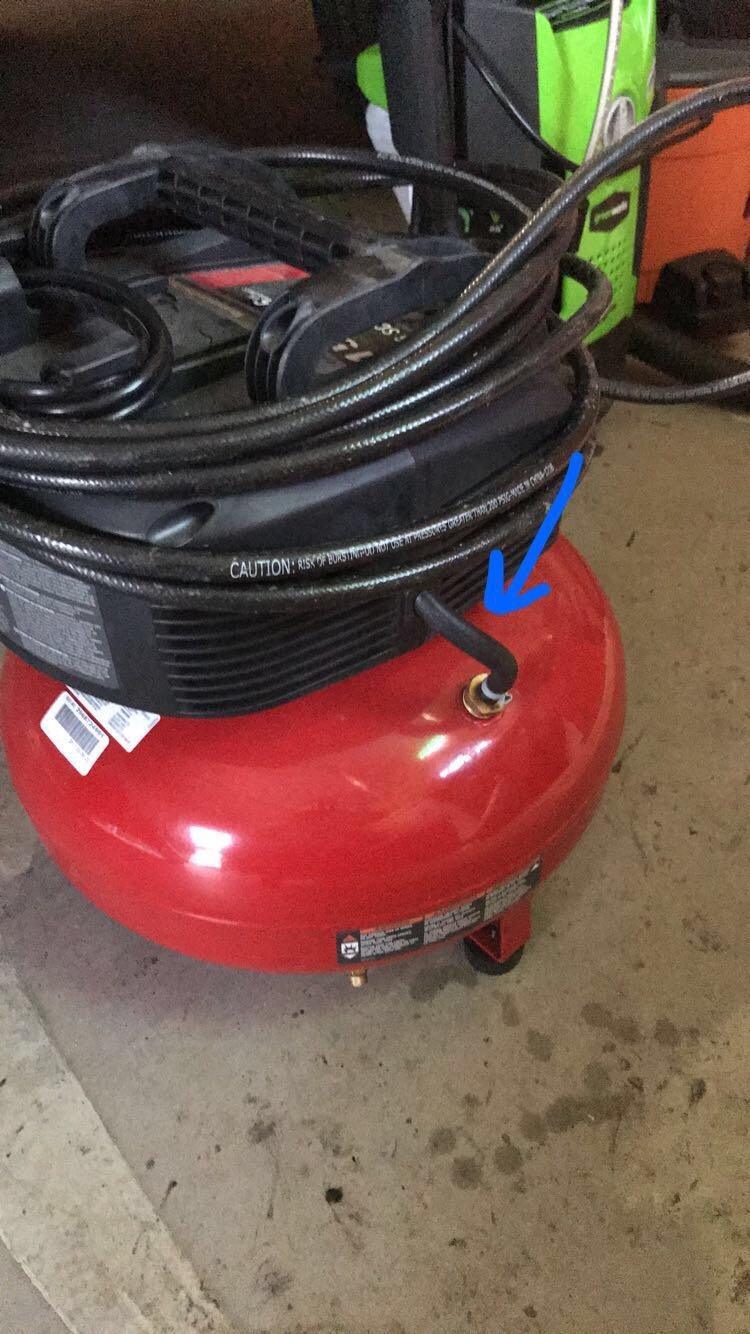
The 150 PSI rating is a genuine advantage for short trigger pulls, since more stored air means longer intervals between pump cycles. A 6 gallon pancake tank with a water drain valve and rubber feet is also more stable on a bench than a 2 gallon unit that walks.
At 82 dBA it is loud, and the low-amp 120 V motor is the trade for that. It starts reliably off an extension cord, which is rare and genuinely useful in a workshop without a nearby outlet.
Know which gun class this matches
A siphon-feed or small gravity-feed LVLP is the right pairing. Two people working at once is realistic with the dual couplers, but not two guns both pulling heavy airflow.
A HVLP gun is out of reach. If HVLP is the plan, the airflow needs to be 5.5 CFM or better.
Plan around the noise and the cord
82 dBA means this belongs in a garage or shop, not a spare room. In a shared building it will carry through a doorway.
That low-amp start is worth more than it sounds like. It is the difference between a compressor that fires up in a cold garage and one that does not.
5. Limodot 5 Gallon – 2.8 CFM at 90 PSI at 68 dB for Indoors
Quiet Oil-Free Air Compressor, 68 dB, 2.8 CFM @ 90 PSI, 5 Gallon Air Tank
2.8 CFM at 90 PSI
5 gallon tank
68 dBA
120 PSI max
Pros
- 2.8 CFM at 90 PSI pairs with a gravity-feed LVLP
- 5 gallon tank on wheels is easier to move than 6 gallon pancakes
- Includes 25 ft PVC hose and 13 piece accessory kit
- Oil-free induction motor starts in cold weather
- 80 second refill with 25 second recovery
Cons
- 120 PSI ceiling is below most pancakes
- Oil-free pump is not built for long continuous duty
- Steel tank needs regular draining
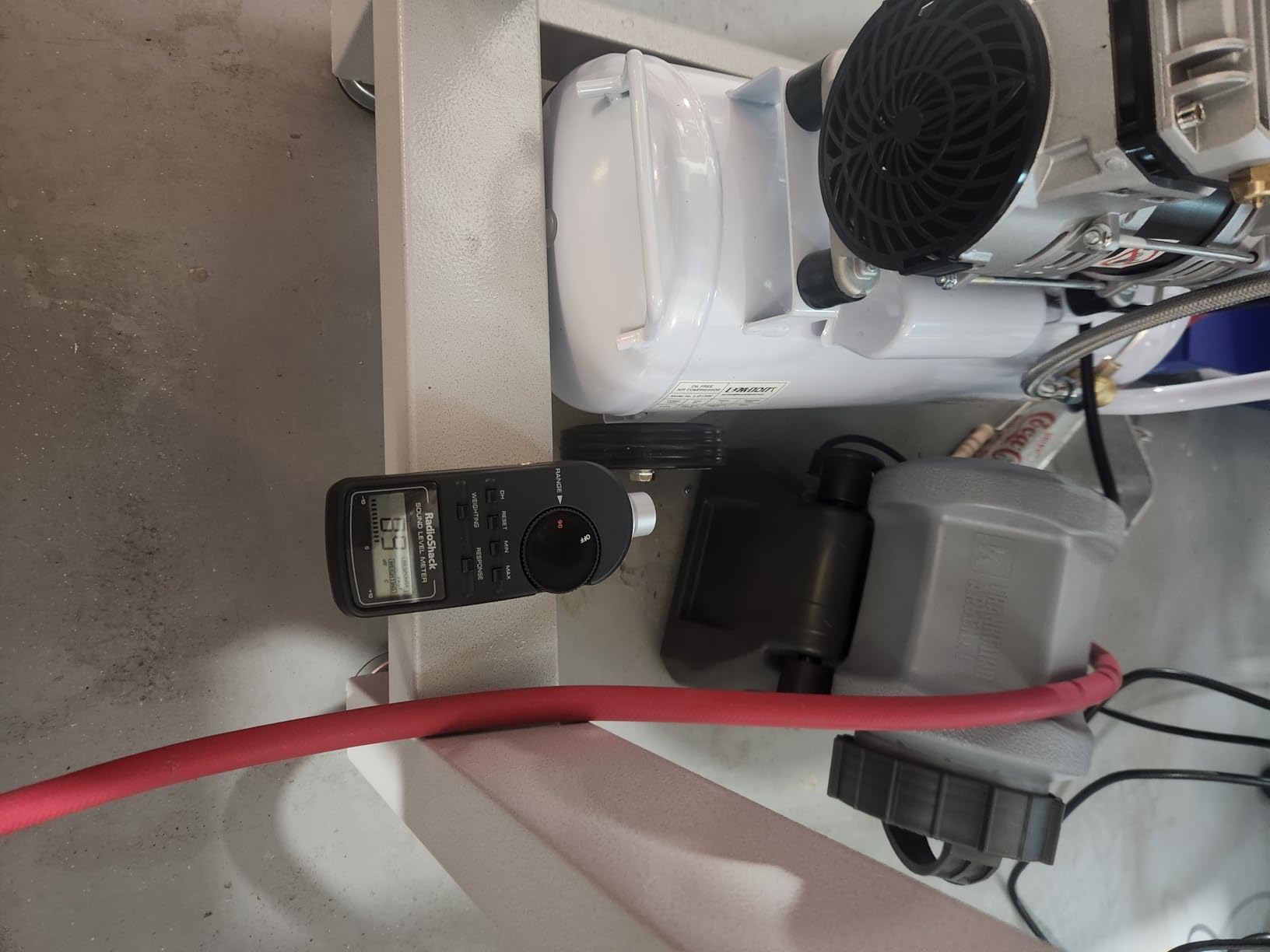
The induction motor running at a low 3400 RPM is the reason this unit is quieter than its 68 dBA label suggests, and that quietness is the entire argument for it. Indoors, the noise gap between this and an 82 dBA pancake is the difference between workable and a standoff with your household.
Airflow of 2.8 CFM at 90 PSI lands in the same band as the ECOMAX, so a gravity-feed LVLP is a safe pairing for touch-ups and small pieces. The 5 gallon tank is a sensible middle size that still rolls on a wheels kit.
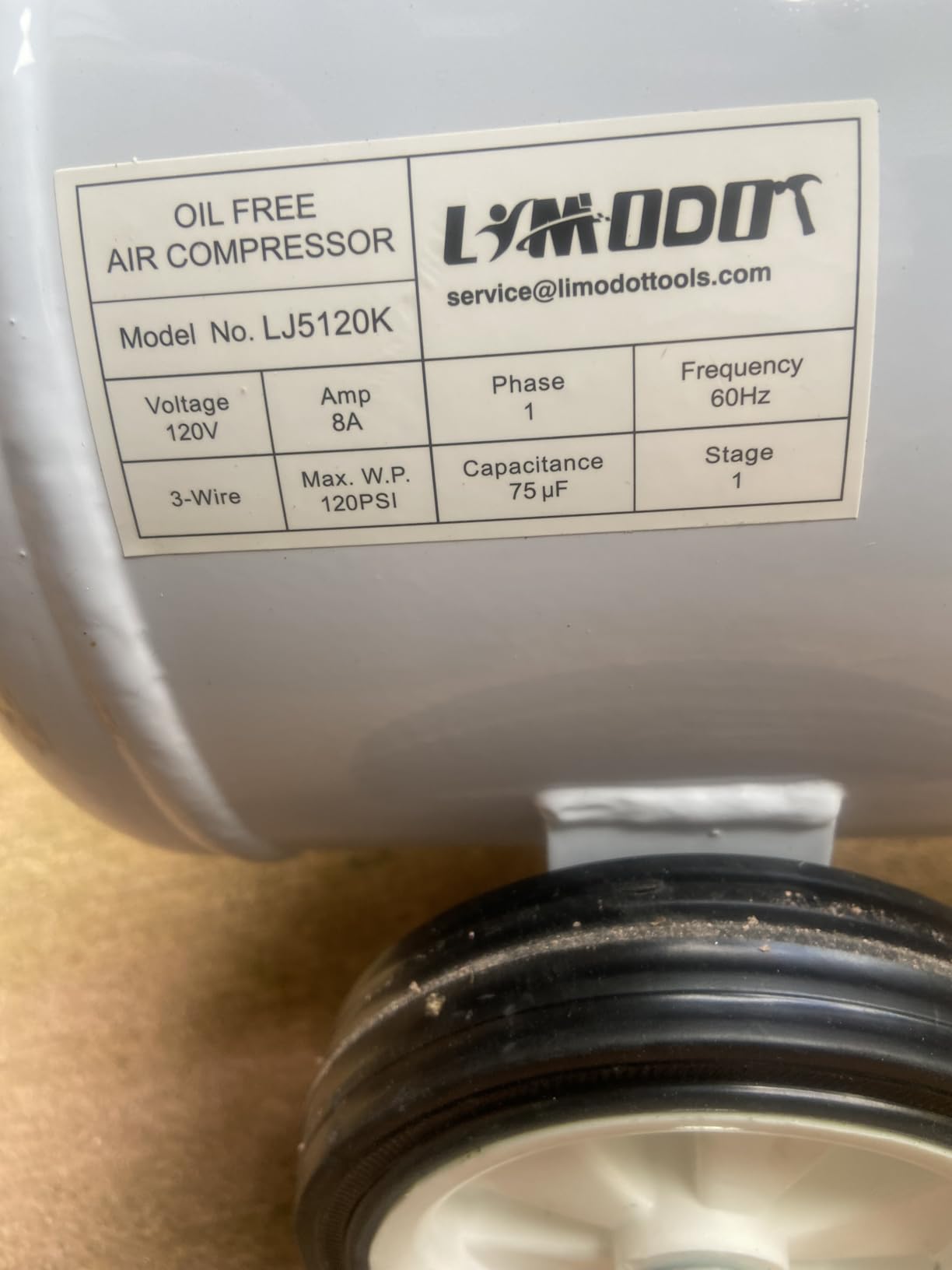
Owners like the bundle: a 25 ft hose, a quarter inch quick-connect fitting and a 13 piece kit mean you are not hunting for fittings on day one. Recovery of about 25 seconds keeps the gaps between passes short.
Refill from empty is around 80 seconds. That figure matters more than it looks if you are spraying in short bursts, because the buffer time scales with tank volume.
Set the pressure expectation first
120 PSI is a low ceiling, so run the gun at its working pressure rather than assuming a full tank. LVLP guns typically run well below that anyway, which is why the lower limit rarely costs you on furniture work.
For trim and touch-ups on a deadline, that ceiling is irrelevant. For anything needing stored air at 150 PSI, pick a pancake instead.
Know what the quietness does not buy
Quiet does not mean continuous duty. Oil-free pumps run hot over long sessions and this one is no exception, so break between coats.
It is still a 5 gallon steel tank. Drain it on a schedule or accept surface rust later.
6. California Air Tools 2010A – Rust-Free 2 Gallon Tank for Indoors
California Air Tools 2010A 1.0 HP Ultra Quiet and Oil-Free Air Compressor, 2 Gallon Aluminum Tank, 60 dBA Noise Level, Silver
2.2 CFM at 90 PSI
2 gallon aluminum tank
60 dBA
125 PSI max
Pros
- Aluminum tank removes the rust problem entirely
- 60 dBA allows normal conversation while running
- Refills in about 50 seconds with 14 second recovery
- Rubber feet dampen vibration and the frame is tip-resistant
- Compact enough to sit under a workbench
Cons
- Not intended for high-consumption tools or HVLP sprayers
- No hose or fittings included
- Short power cord limits placement
The aluminum tank is the reason to choose this over an equally quiet steel competitor. Draining discipline stops mattering because there is no steel interior to corrode, which is a real relief for a unit that lives in a damp garage or a garden shed through winter.
Airflow of 2.2 CFM at 90 PSI is a siphon-feed and small gravity-feed number, not an HVLP number. Recovery of about 14 seconds from 90 PSI is quick enough that short touch-up passes do not leave you waiting.
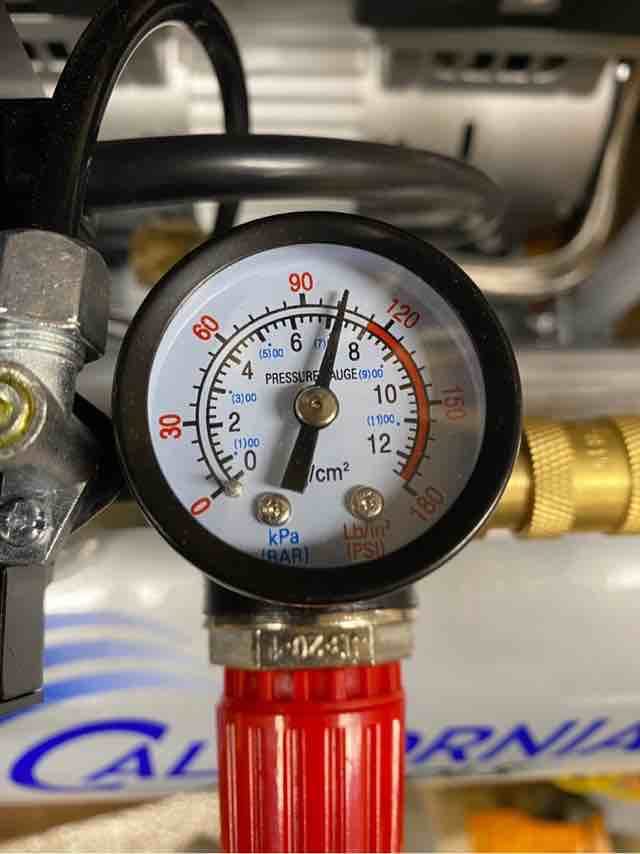
Owners report using it for airbrushing, LVLP touch-up guns and blow-off work indoors, which matches the 60 dBA figure. The dual piston oil-free pump is rated past 3000 hours, and the 1.0 HP motor runs at 1680 RPM to keep both noise and wear down.
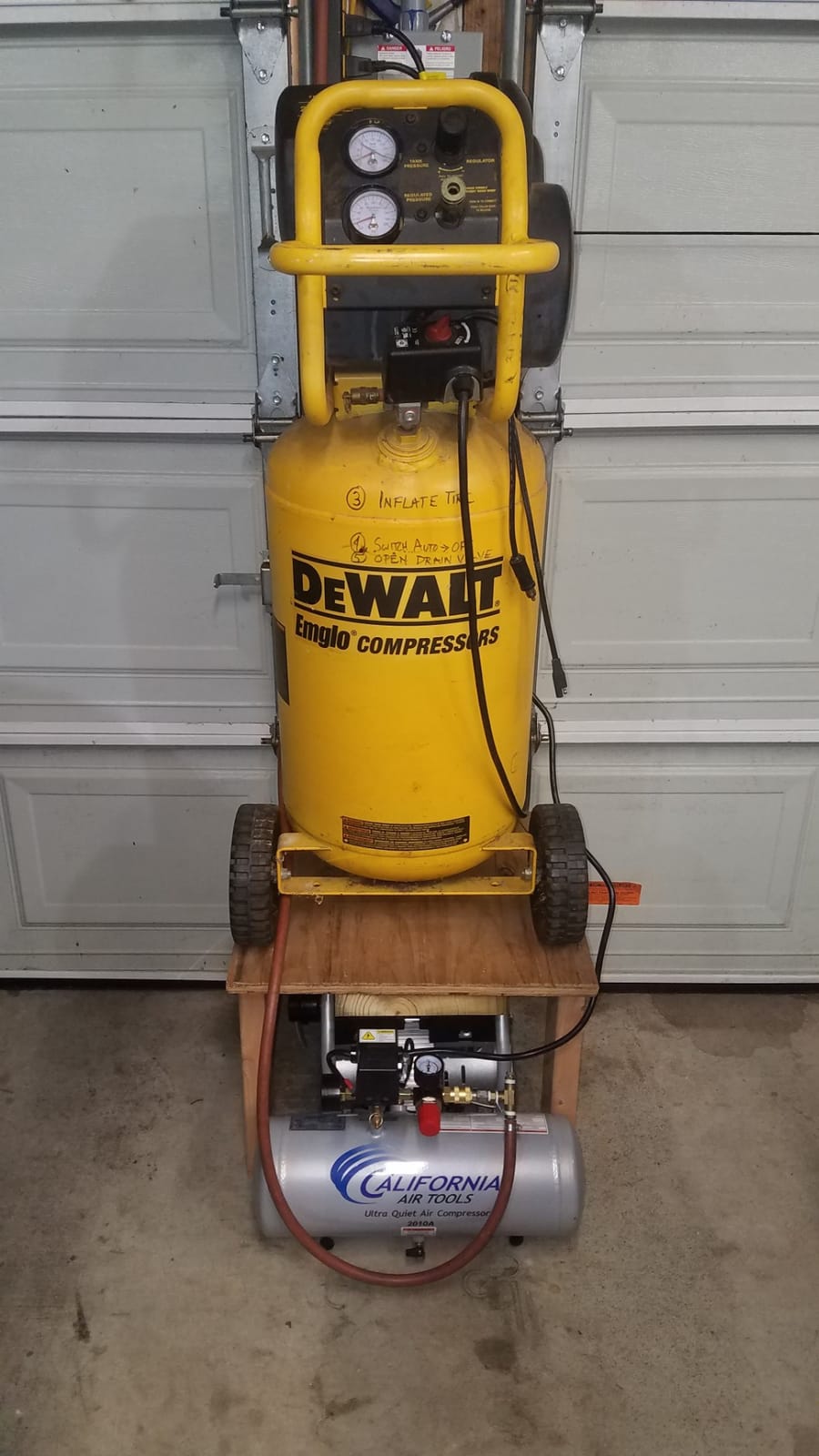
At 35 pounds it is light enough to move between a bench and a cart without a fight. One owner reported a cast pressure relief plug cracking after three years of frequent use, a rare but real long-term note.
Budget for the fittings
No hose and no fittings ship with it, so a quarter inch quick-connect male fitting is your first purchase. Add a short high-pressure hose with a swivel for spraying.
That is cheap, but it catches people out because the unit is otherwise ready to run.
Match it to small work only
Use it for airbrush work, single touch-ups, blowing out dust and inflating. A 2 gallon tank refills often during continuous spraying, and the pump is not built for that duty.
If your project list includes cabinets or panels, this is the wrong tier, not a cheaper version of the right one.
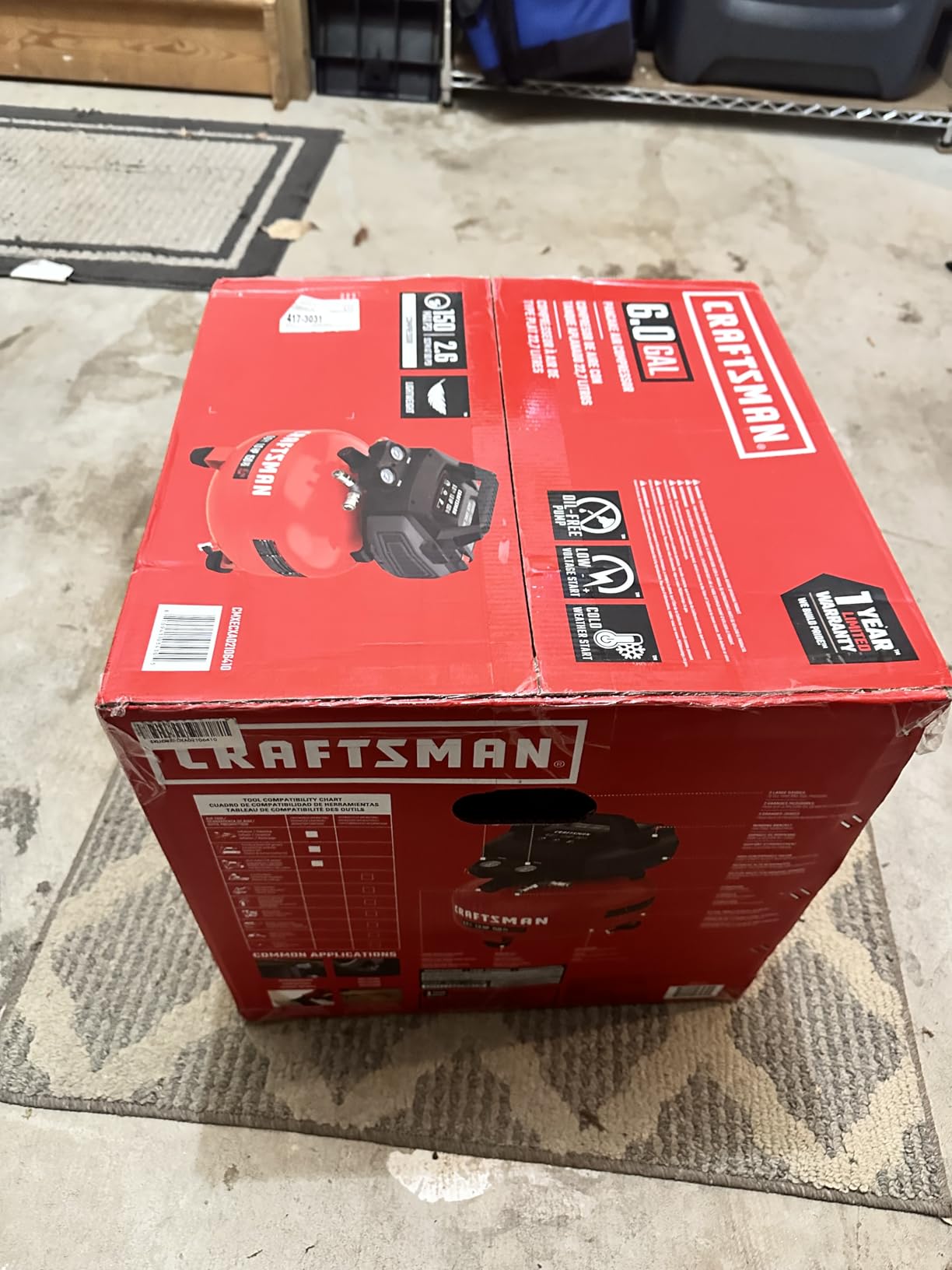
7. CRAFTSMAN 6 Gallon 150 PSI – 2.6 SCFM with Two Quick Couplers
CRAFTSMAN 6 Gallon 150 PSI Oil-Free Pancake Air Compressor CMXECXA02106410
2.6 SCFM at 90 PSI
6 gallon pancake
150 PSI
30.8 lb
Pros
- 2.6 SCFM at 90 PSI listed for paint spraying and woodworking
- 150 PSI max with dual quick couplers
- Oil-free low-voltage start motor works in cold conditions
- 30.8 lb iron body is easy to move between rooms
- Backed by a 1 year warranty and a US service team
Cons
- 82 dBA is on the loud side
- 2.6 SCFM is limited for sustained spray painting
- Some units arrived with a broken handle or gauge bracket
This is a straightforward 6 gallon pancake with a 150 PSI tank, dual quick couplers and an oil-free low-voltage start motor, and it is listed for paint spraying among other jobs. The dual couplers are the practical feature: two people can work from one unit when the guns are not both drawing heavily.
Airflow of 2.6 SCFM at 90 PSI sits with the PORTER-CABLE, so the same gun pairing applies. A siphon feed or small gravity-feed LVLP is a sensible match for trim, touch-ups and light furniture work.
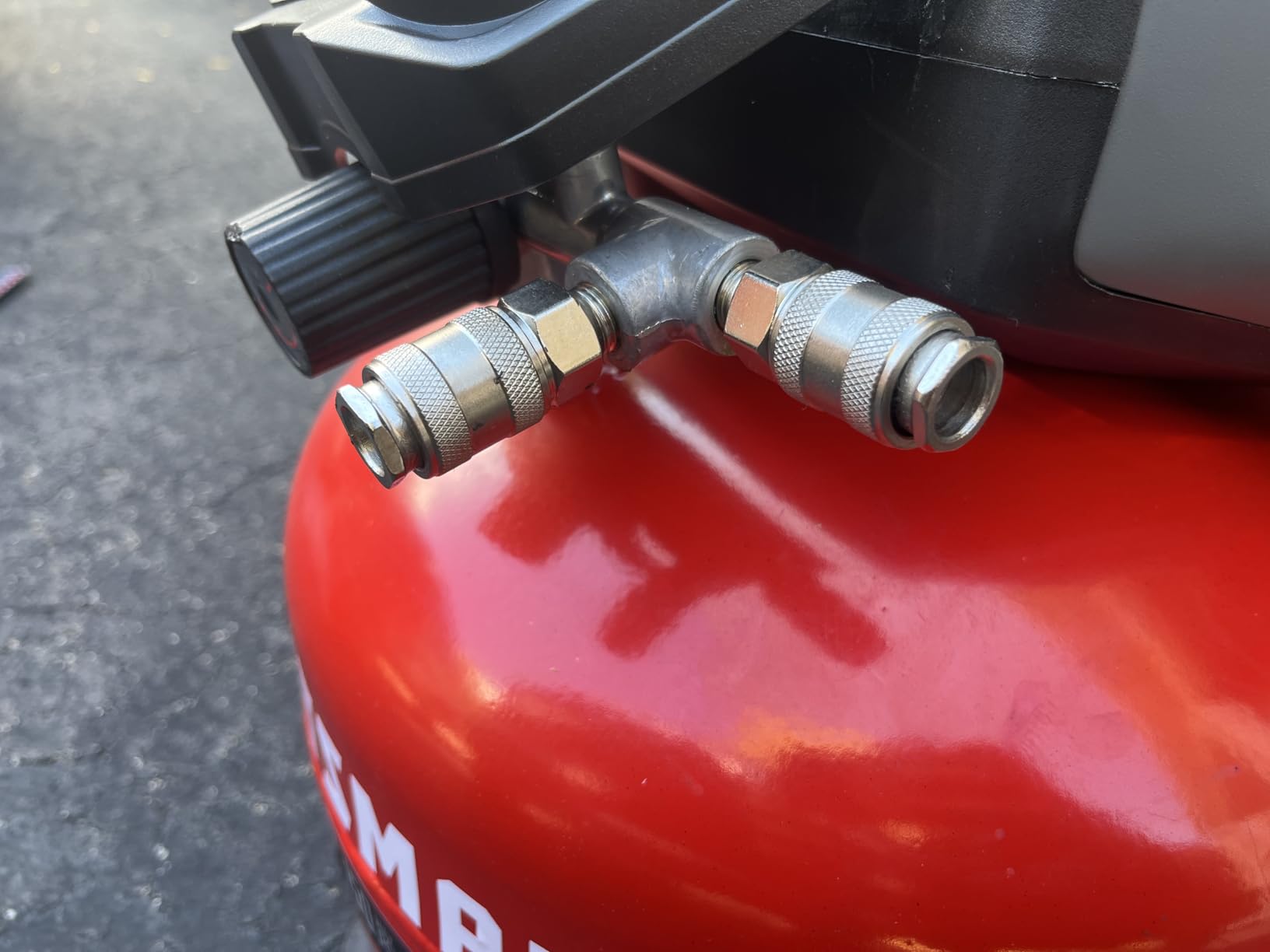
Owners describe it as not too heavy, with a small footprint, and comparatively quiet for its class despite the 82 dBA figure. A 1 year warranty and a US-based service team add a little confidence in a category where quality control varies.
The oil-free low-voltage start motor is worth noting for cold garages, since a compressor that will not turn over on a winter morning is useless for a paint project you scheduled for the weekend.
Check it on arrival
A small number of units arrive with a broken carry handle or a damaged gauge bracket. Open the box, pressurise it and confirm both before you start a project.
Handle and bracket failures are QC issues, not design flaws, but they will still cost you a day.
Know the airflow ceiling
2.6 SCFM will not sustain a gravity-feed HVLP gun. It handles LVLP work and small jobs, and it will tell you quickly when you ask beyond that.
A few buyers report losing pressure or shutting down during extended painting. Treat long sessions as outside this unit’s envelope and break them up.
8. Master Airbrush Cool Runner II – Complete Kit for Fine Detail Work
Master Airbrush Cool Runner II Air Brush Kit with Air Compressor Dual Fan
0.8 CFM airflow
Three airbrushes
0.2/0.3/0.8mm tips
9 lb
Pros
- Most reviewed unit here at over 7000 ratings
- Dual cooling fans let the single piston pump run cooler
- Includes three airbrushes plus a six colour acrylic set
- Tip range covers detail work and coverage
- Holder
- cleaning brushes and colour wheel included
Cons
- Roughly 0.8 CFM limits it to airbrushing
- Learning curve for cleaning cups and siphon bottles
- Not a spray gun compressor
This is the most reviewed product in the group, and the reason is simple: it removes every excuse to start. Airbrush, compressor, hose, tips, cleaning brushes, a holder and a learning guide all arrive in one box, so a first-time user is spraying in an afternoon rather than a weekend.
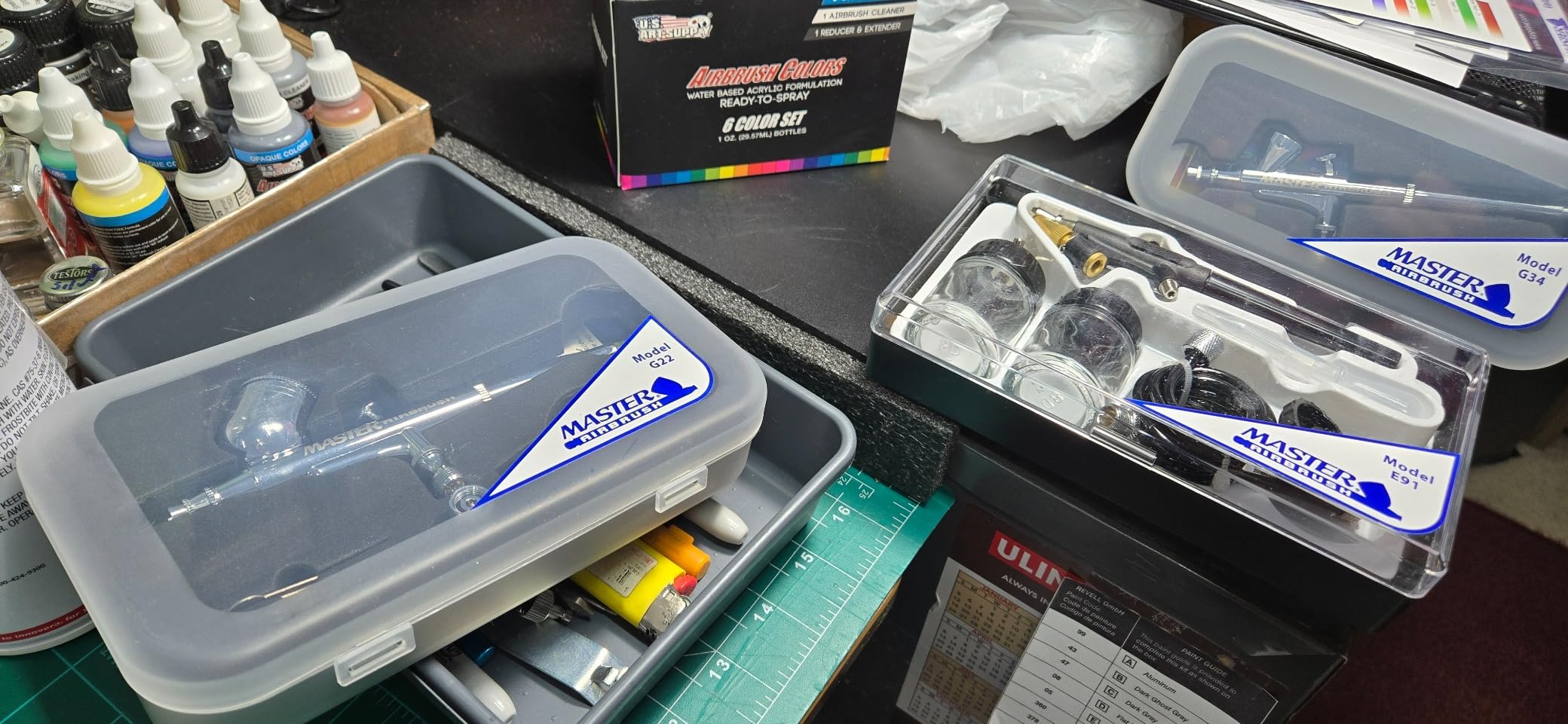
You get three airbrushes. The G22 dual-action with a one third ounce gravity cup and a 0.3mm tip handles coverage, the G25 with a 0.2mm tip handles detail, and the E91 single-action siphon feed with a 0.8mm tip and bottles covers thicker work.
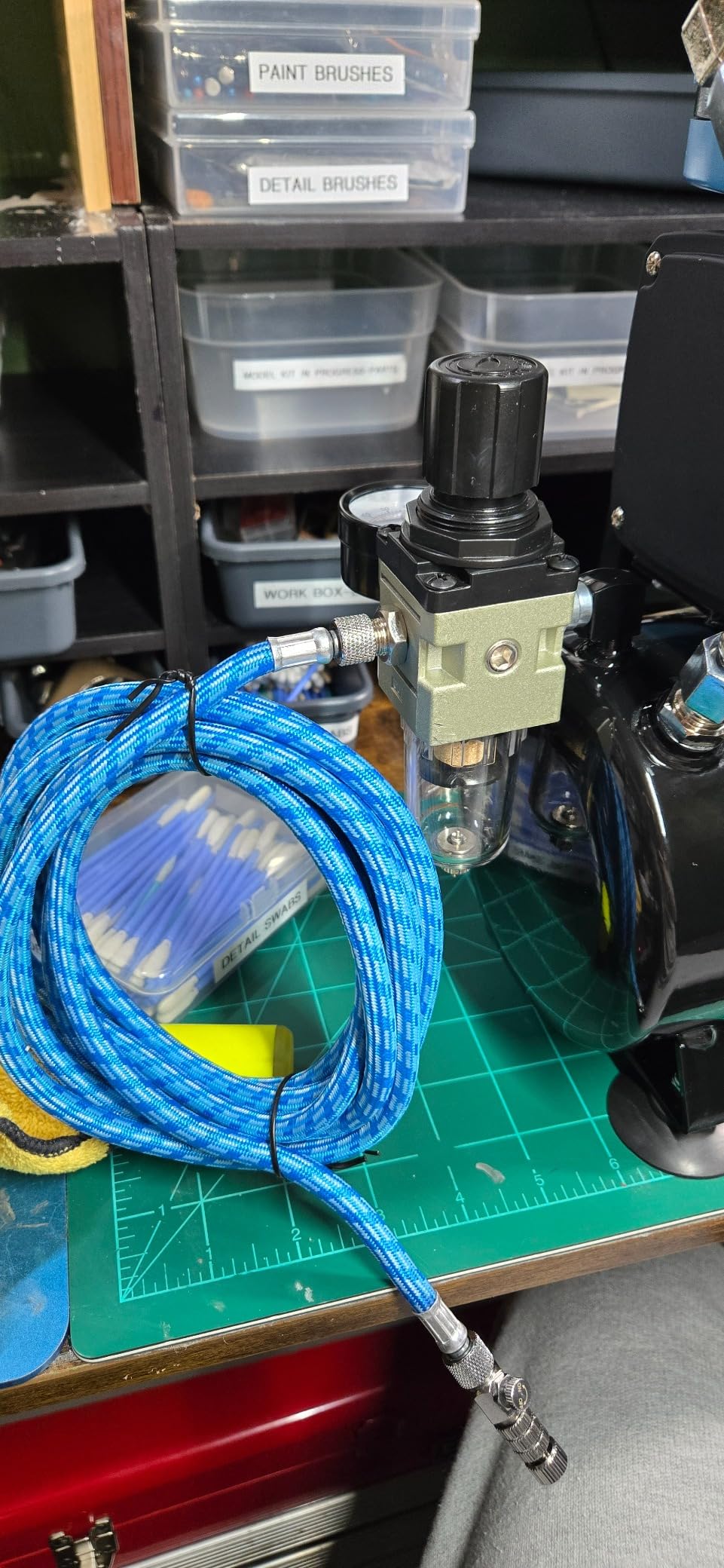
The TC-320 single piston pump runs two cooling fans, which is what lets it hold steady during a long session rather than heating up and fluctuating. Airflow of 0.8 CFM and 0.2 HP are modest, and that is the correct size for an airbrush, not a mistake.
A six colour water-based acrylic set with reducer and cleaner means you can practise without buying paint separately. At 9 pounds the whole package is genuinely portable.
Set the scope before you buy
This is an airbrush compressor, not a spray gun compressor. It will not run a Mini-HVLP or anything with a real cup on it, and forum users make the same point about small airbrush units in general.
When you outgrow it, you outgrow the hobby, not the tool. Most people who get serious move up to a 4 to 6 CFM compressor for furniture and car work.
Know the cleaning burden
Between colour changes you flush cups, bottles and passages properly, and skipping that is how airbrushes get damaged. Budget a few minutes per change.
Keep spare tips in the set you already own, since 0.2mm and 0.3mm needles bend if you push hardened paint through them.
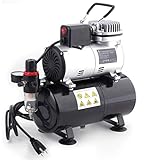
9. Timbertech ABPST08 – 3 Liter Quiet Unit with Built-In Moisture Trap
Timbertech Upgraded Airbrush Single-Piston Oil-free Mini Compressor ABPST08 with Cooling Fan, 3L Tank, Regulator, Moisture trap for Hobby, Body Tattoo, Model Painting, Automotive Graphic, Make-up
20-23 L/min
3 liter receiver tank
50 dB
Built-in water trap
Pros
- Very quiet at 47-50 dB
- Receiver tank gives pulse-free output at 20-23 L/min
- Regulator
- water trap
- filter and relief valve all built in
- Cooling fan extends unit life
- Compact body with a carry handle
Cons
- Gauge range makes low pressure hard to read accurately
- No hose included and fittings may need an adapter
- Not suitable for spray guns or pneumatic tools
The built-in water trap and filter are the feature that matters most here for painting, and they are already in the box. For fine detail work, moisture in the air line shows up immediately as bubbles or a mottled finish, and this unit removes the most common cause without a separate purchase.
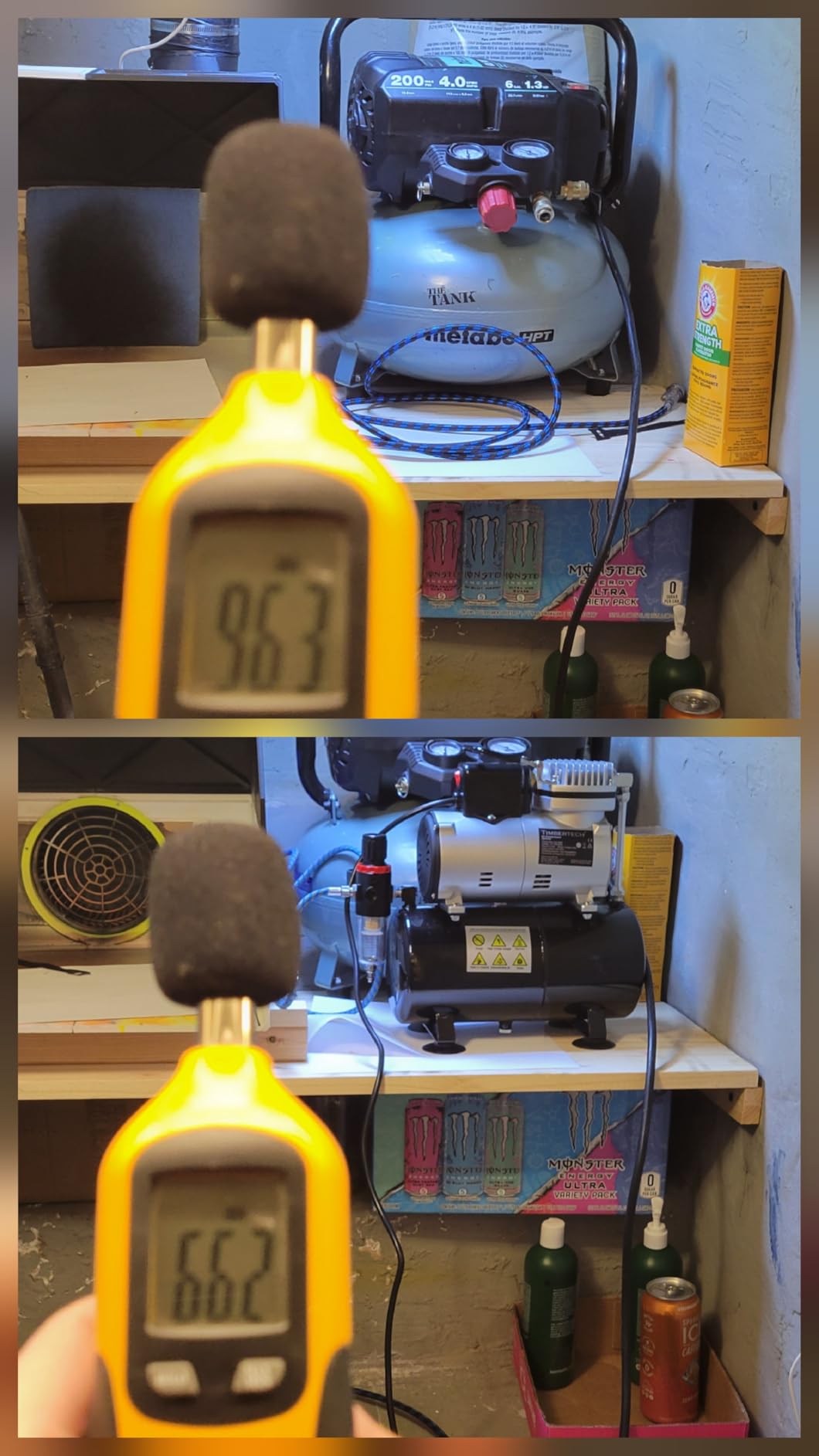
At 47 to 50 dB it is quiet enough to hold a normal conversation beside it while the tank fills. A 3 litre receiver delivers 20 to 23 L/min, which suits an airbrush working in short bursts with a steady pressure rather than a pulse.
The cooling fan reduces operating temperature and extends unit life, which matters for anyone who paints for hours rather than minutes. The regulator, air filter, pressure relief valve and overheat protection are all part of the package rather than add-ons.
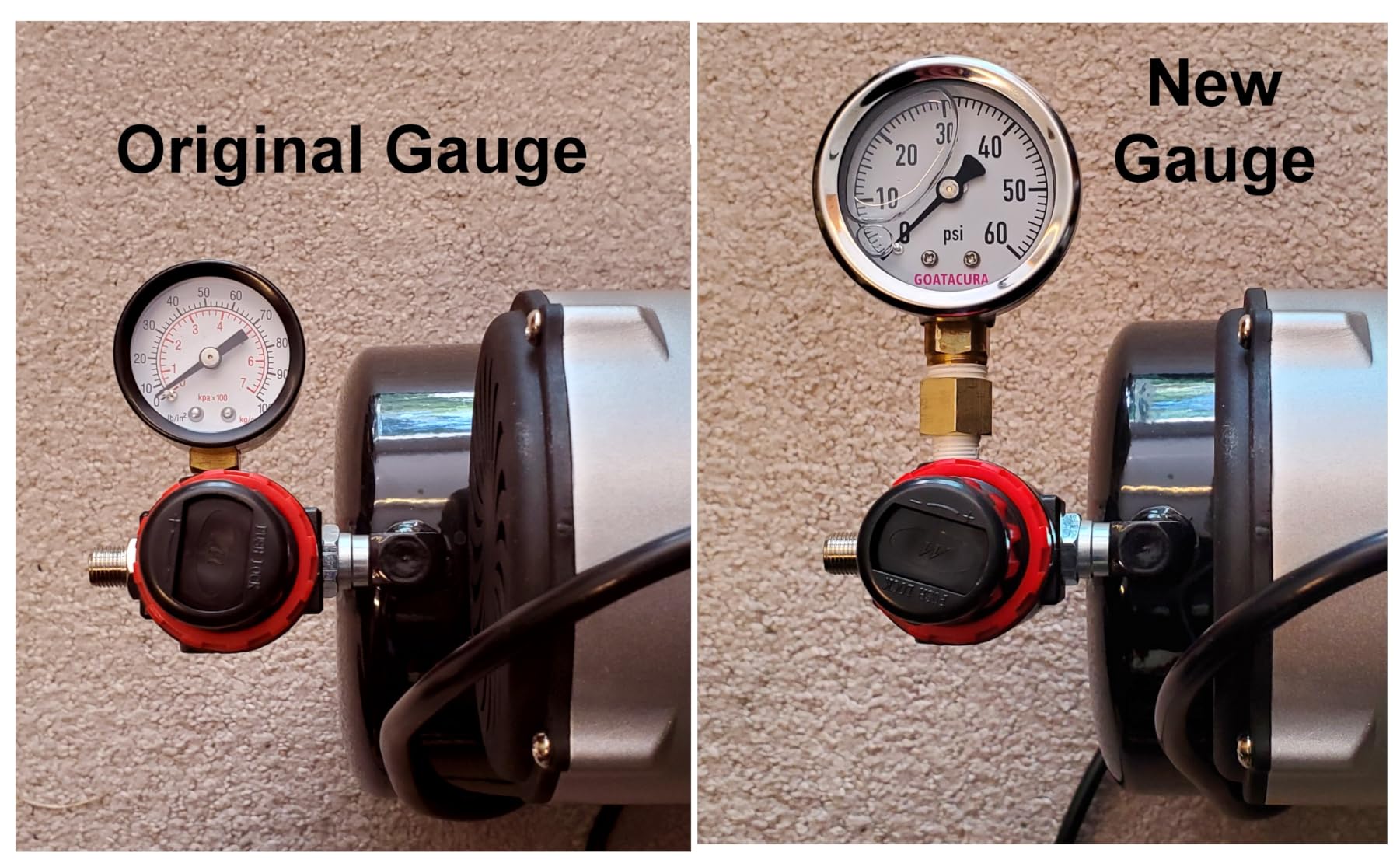
Owners commonly swap the small gauge for a 0 to 60 PSI dial, because the factory gauge spans a much wider range and is hard to read at the low pressures an airbrush runs.
This is an airbrush box, not a spray gun box
The manufacturer rates it for airbrushing, not spray guns or general pneumatic tools, and the 20 to 23 L/min ceiling confirms it. Pairing it with an LVLP gun produces sputtering, not a finish.
For an airbrush, a detail renderer or model painting, it is quietly excellent.
Plan two small purchases
No hose is included, and depending on your airbrush brand you may need a quick-disconnect adapter. Check the fitting on your gun before ordering.
The gauge swap is optional but worthwhile if you work at low pressure, which is most of what this unit is for.
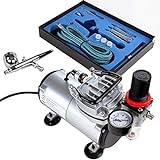
10. Timbertech Airbrush Kit – Auto Start-Stop Set with Three Nozzle Sizes
TIMBERTECH Airbrush Kit with Compressor, Multi-purpose Airbrush Compressor Set, Dual Action Gravity Feed Airbrush with Air Hose for Hobby, Body Tattoo, Model Painting, Automotive Graphic, Make-up
20-23 L/min
50 dB
Auto start and stop
7 ml cup
Pros
- Quiet 50 dB operation suits late night indoor work
- Compressor
- gun
- hose and nozzles ship as one kit
- Auto start at 3 bar and auto stop at 4 bar
- Three alternate nozzle sizes for different paint thickness
Cons
- Included airbrush struggles to atomise thicker paint
- Rubber feet do not stop it walking on a bench
- Small 7 ml cup needs frequent refills
- Some valve or o-ring failures reported early
Auto start and auto stop is a nicer way to work than a switch. The pump runs while you spray and shuts down when you stop, which cuts noise between passes and reduces how long the motor runs overall.
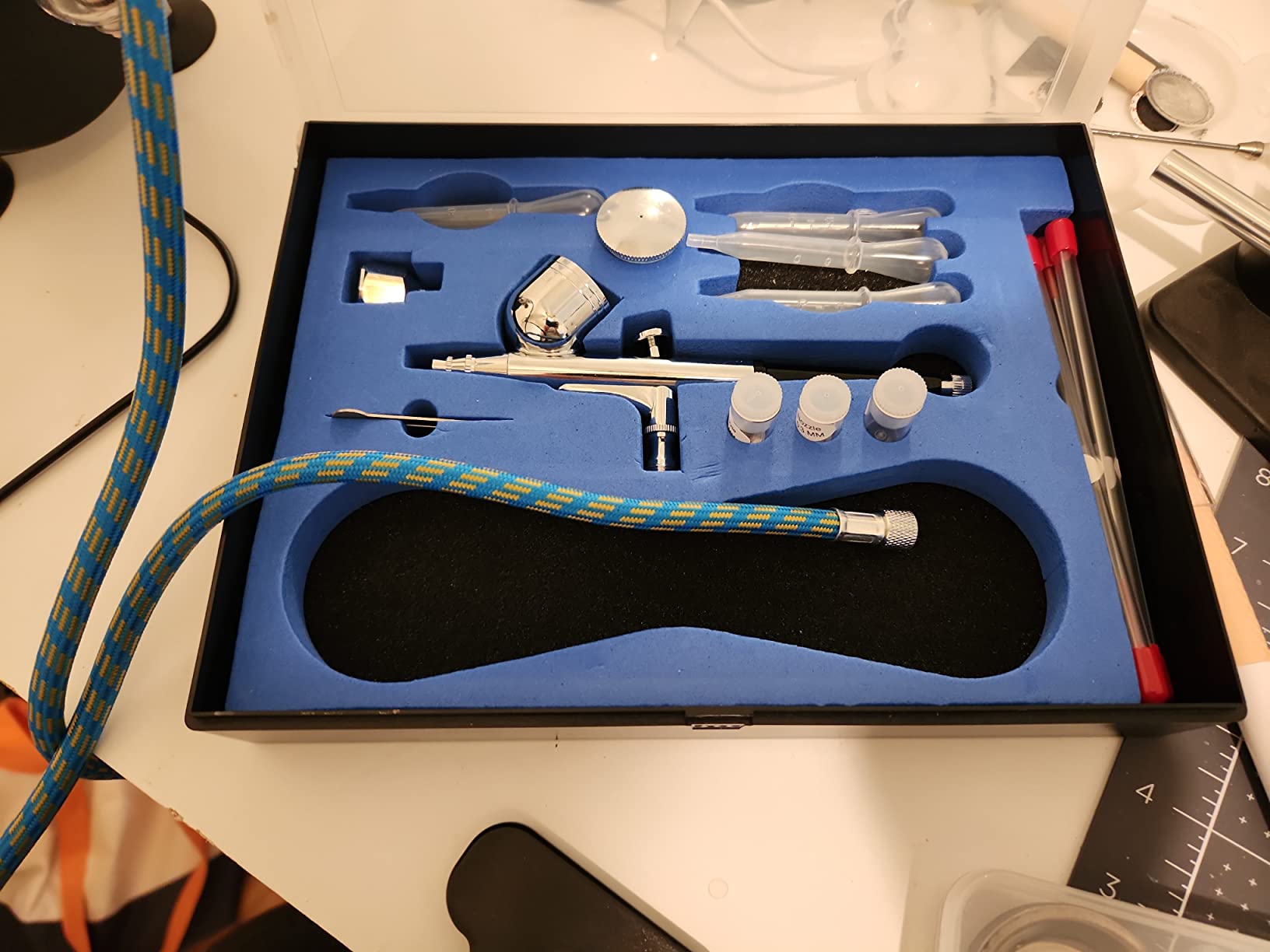
The kit ships with an oil-free reciprocating compressor, a manometer, a regulator, an air filter, a gravity feed airbrush with a 0.30mm mounted tip plus 0.2, 0.3 and 0.5mm alternates, and a hose of roughly six feet. That is a complete starting setup for someone who wants to learn without risking an expensive brush.
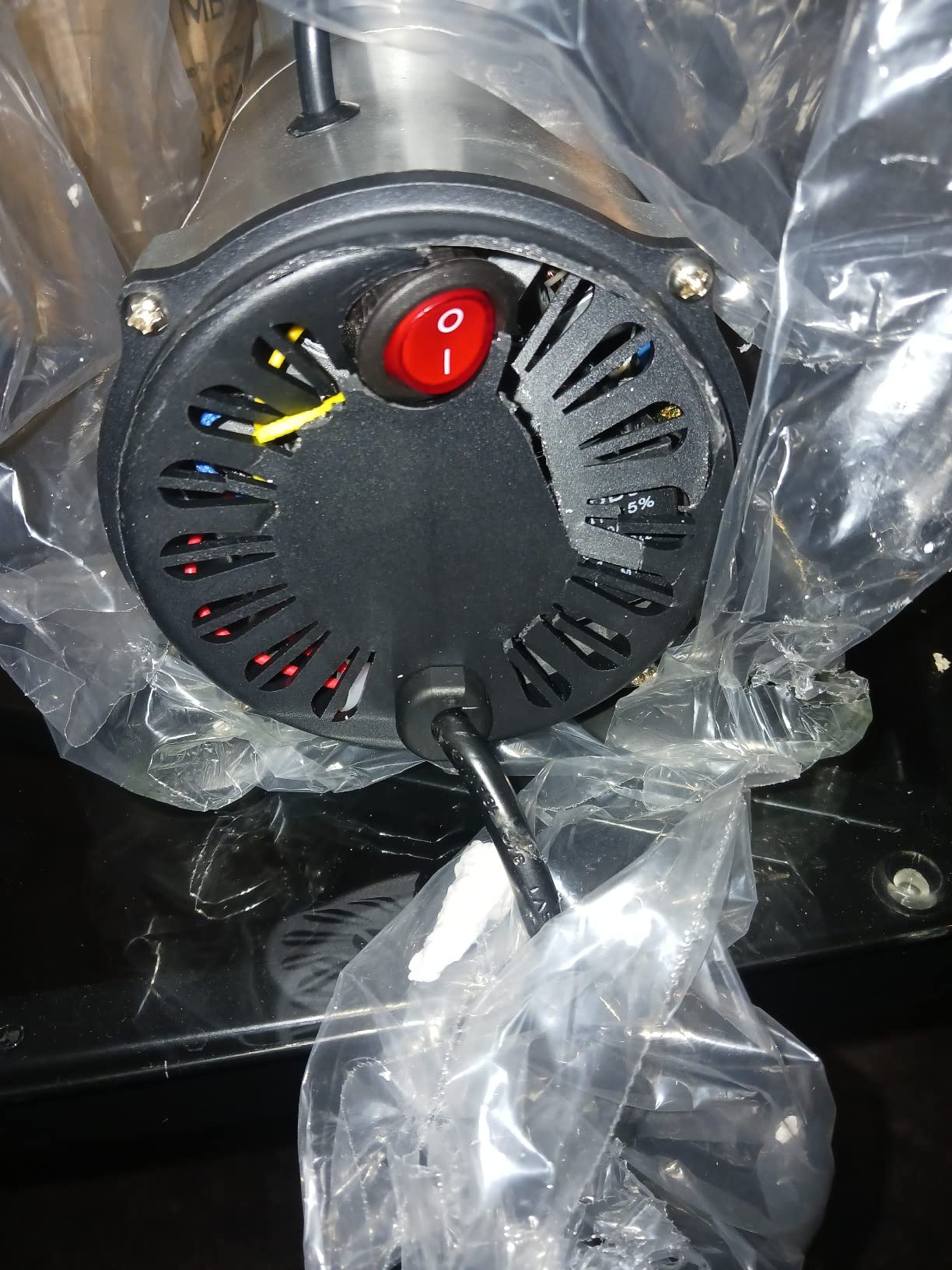
Buyers consistently call the compressor quiet and the package beginner-friendly. A minority report valve or o-ring failure within first use, so keep the small spare parts from the box.
Operating pressure runs roughly 1 to 2.5 bar, and the tiny 7 ml metal cup means frequent refills. That is normal for detail work, but it is more cleaning than a larger cup would give you.
Expect to change the airbrush eventually
The included brush struggles to atomise thicker paints. Owners using heavy bodies often thin the paint or replace the brush, and that is the single most common complaint in reviews.
If you already own a metal gravity feed brush, this kit works well as a quiet compressor. If you are buying from scratch, plan to add a better brush later.
Fix the walking problem
The rubber feet do not hold the unit steady on a bench, and a compressor that creeps while you are working on fine detail is an annoyance. Put it on a mat or a non-slip shelf.
Keep the o-rings together during reassembly. Small seals are easy to lose and awkward to reinstall.
11. California Air Tools CAT-1P1060S – 56 dBA Unit for Apartment Work
California Air Tools CAT-1P1060S Light & Quiet Portable Air Compressor, Lightweight, Ultra Quiet, Oil-Free, 1 Gallon Steel Tank, .6 HP, 56 dBA Noise Level, Silver
1.2 CFM at 90 PSI
1 gallon steel tank
56 dBA
29 lb
Pros
- 56 dBA is quiet enough for indoor and shared space
- Oil-free single piston pump rated past 3000 hours
- Only 29 lb so it moves between rooms easily
- Listed for airbrushes as well as nail guns and blow guns
Cons
- 1 gallon tank and 1.2 CFM refill constantly
- 0.6 HP motor will not support high-volume spray guns
- Steel tank can rust if left undrained
At 56 dBA this is the quietest compressor in the group, and for a flat, a rented unit or a room with a sleeping family that number matters more than any other spec. Owners centre almost all of their praise on the noise level and how easy the unit is to move.
The reality is that 1.2 CFM at 90 PSI and a 1 gallon tank put this firmly in airbrush and small-tool territory. The 0.6 HP motor running at 1680 RPM trades power for quiet, which is a deliberate engineering choice rather than a flaw.
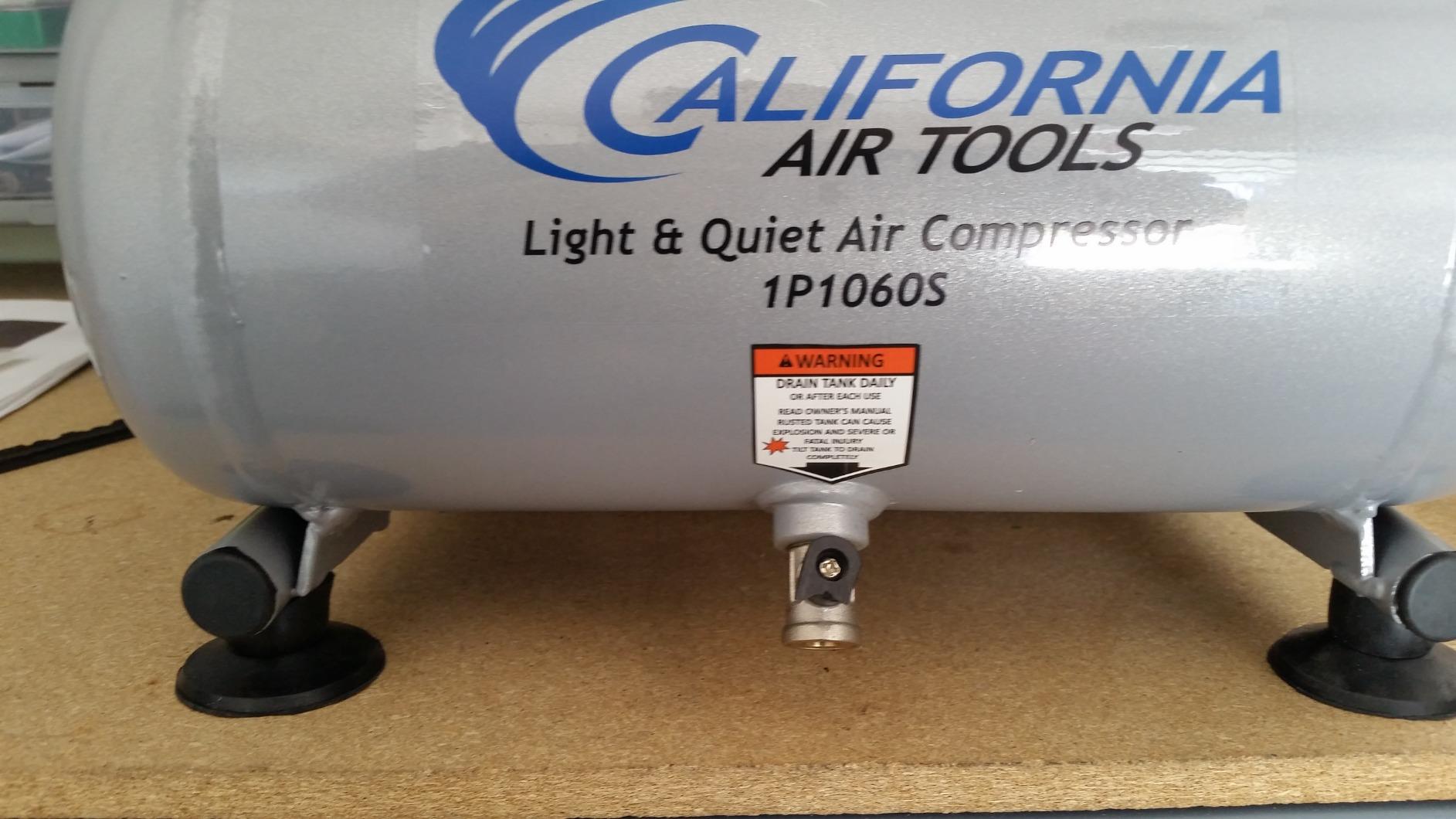
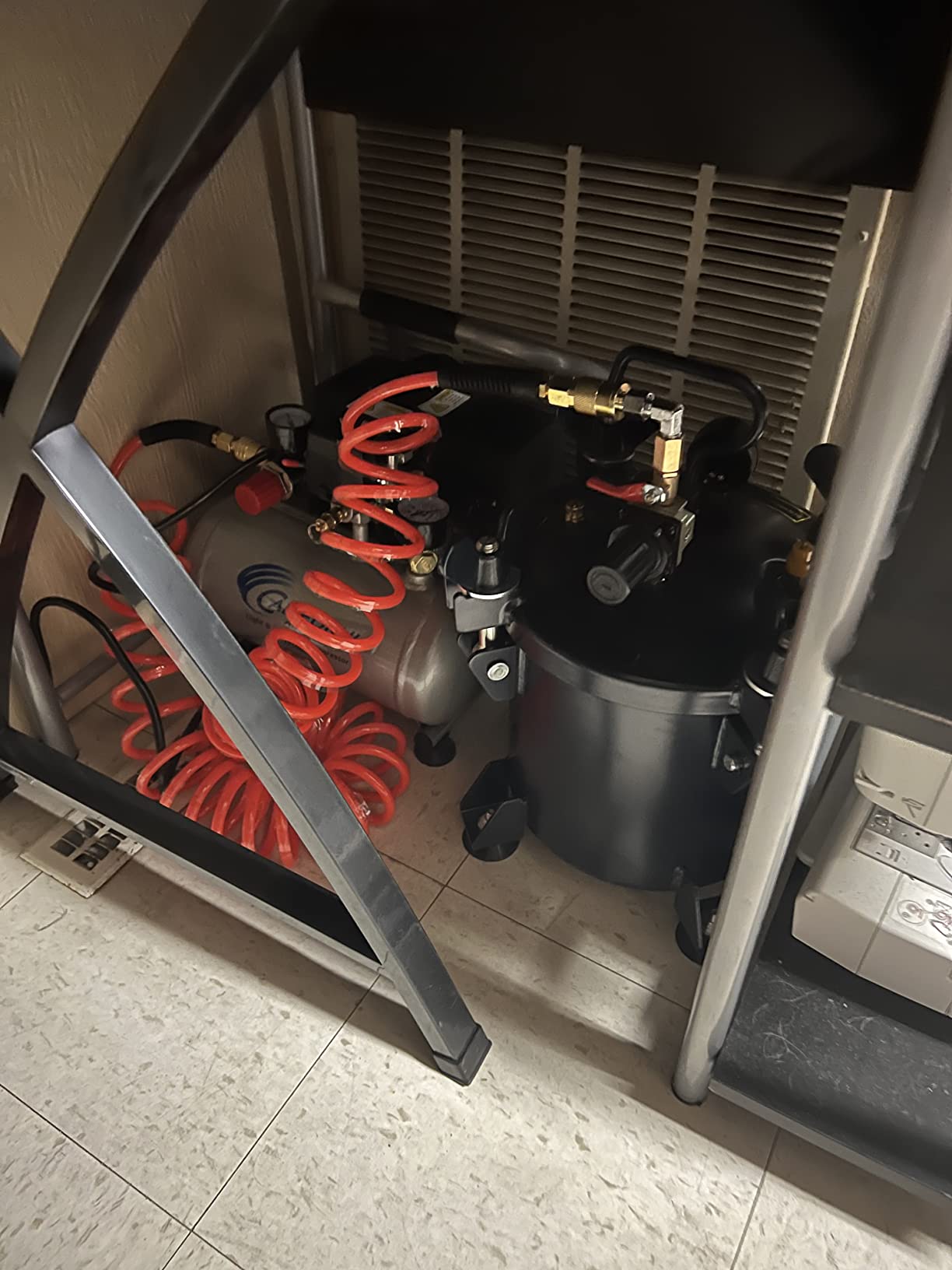
Reviewers are clear that it is a fit for intermittent airbrush work rather than sustained spray painting, and they report the tank refilling often during continuous use. Treat it as the second compressor for a quiet corner rather than the only one.
At 29 pounds with a 1 gallon steel tank, it is the easiest unit here to carry up stairs or move between a balcony and a desk. Maximum pressure of 120 PSI is ample for airbrush work.
Set honest expectations on spraying
This will not run a gravity-feed LVLP or HVLP gun. Trying produces the sputtering that leads people to blame the compressor unfairly.
Pair it with an airbrush and it is a genuinely good tool. That is the whole brief.
Protect the tank
Steel plus a small tank plus infrequent use is the recipe for condensation sitting inside. Drain it after every session and it will last years.
If the unit lives in a garage rather than a room, add the drain habit to your list before rust becomes your problem.
12. Oasser AK2-2 – 12V DC Kit for First-Time Detail Sprayers
Oasser Airbrush Kit with Compressor, Dual Action 10.5L/min Airbrush Set
10.5 L/min
30 dB
12V DC plug-in
7 cc cup
Pros
- Quietest output in the group at 30 dB
- Stepless pressure control from 2 to 40
- 12V DC supply gives consistent pressure with no battery fade
- Three nozzle sizes and a 7 cc cup
- Complete kit with cleaning tools and a 2 year warranty
Cons
- Lowest average rating here at 4.1
- 10.5 L/min is the lowest airflow in the group
- Needs thorough disassembly and cleaning after each use
- Depends on mains power through the adapter
The 12V DC approach is genuinely different from every other unit here. Instead of a mains motor cycling a tank, it runs from an adapter and delivers a steady 10.5 L/min, so pressure does not sag and drop between strokes the way a small piston pump does.
Stepless control from 2 to 40 lets you dial the exact working pressure rather than stepping through a fixed regulator, and the auto start-stop shuts the compressor down when you are not spraying. At 30 dB it is the quietest in the group by a wide margin.
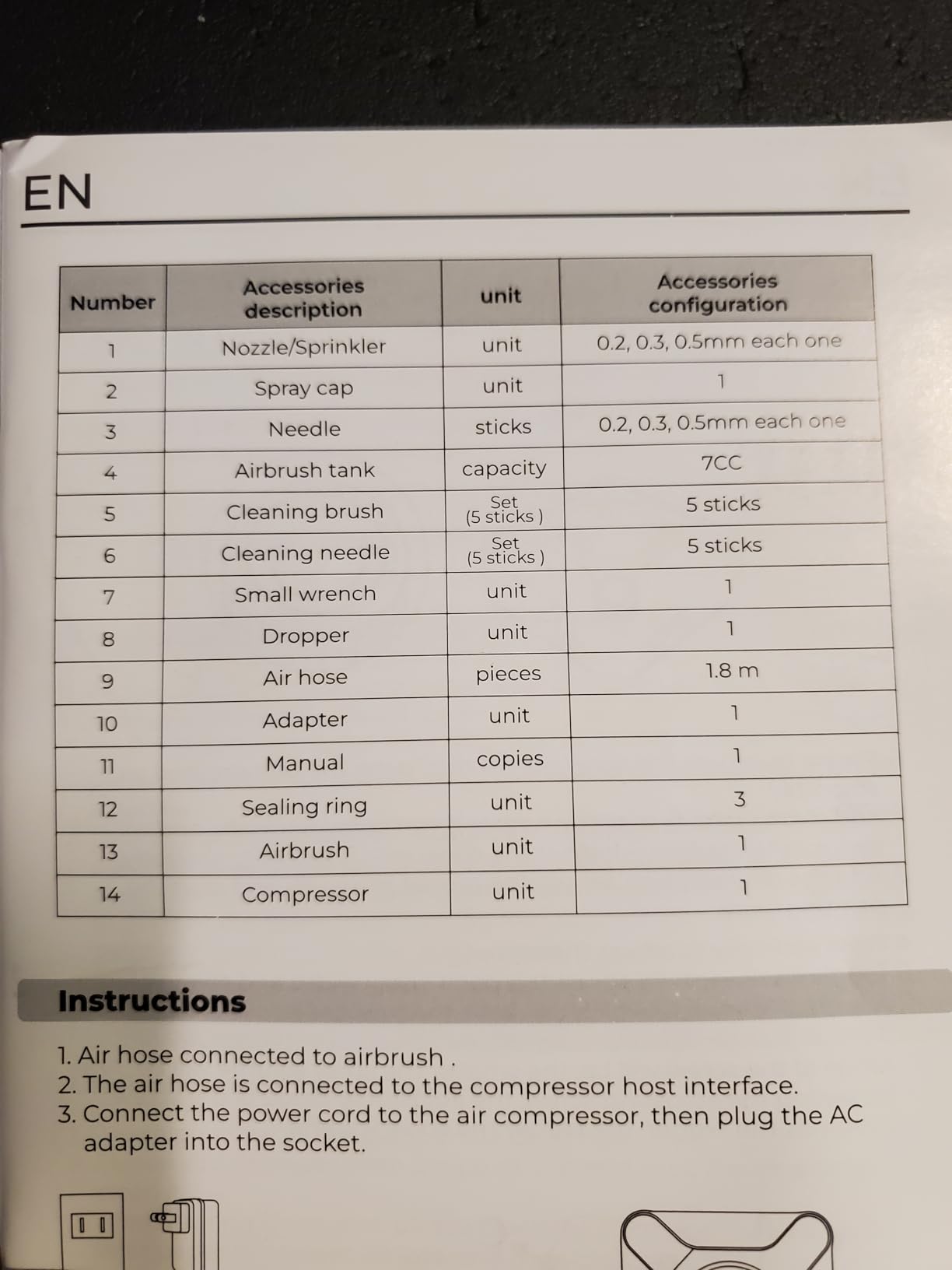
The kit includes the gun, compressor, three nozzles, cleaning brushes and needles, a wrench, a dropper, seal rings, hose and the adapter. A 2 year manufacturer warranty is longer than most in this category.
That is the honest catch: this is the lowest-rated product in the group at 4.1, with a 13 percent one-star share. Feedback splits between people who find it adequate for hobby work and people who hit its airflow ceiling quickly.
Know the ceiling before the project
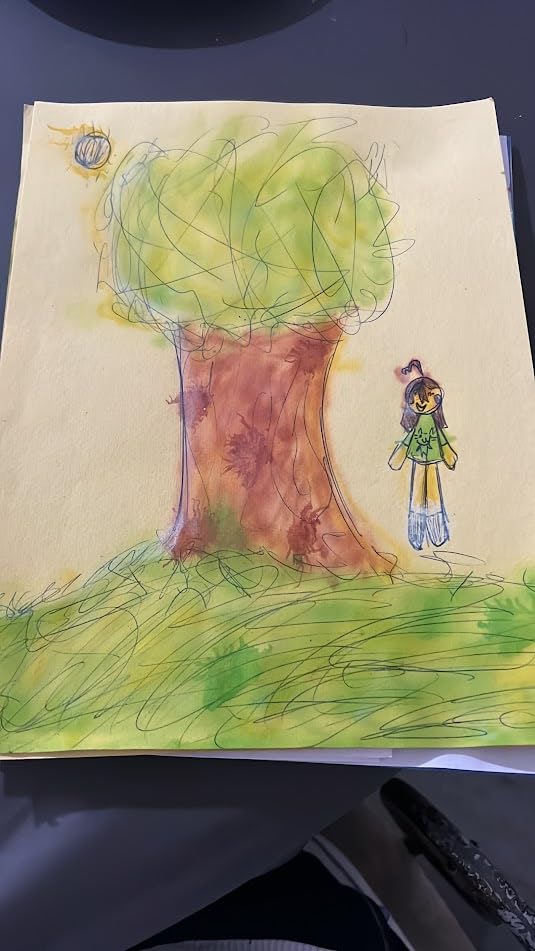
10.5 L/min is the lowest airflow here. On small areas, models, nail art, pinstriping and T-shirt designs it is fine, and it needs frequent pauses on anything larger.
It is a detail tool. The 0.2, 0.3 and 0.5 mm tips confirm that intent.
Weigh the trade-offs
The 12V dependency limits you to somewhere with a mains outlet, which rules out field work. In return you get no battery fade and no charging downtime.
Cleaning is thorough and immediate after each use, and skipping it clogs a 0.2 mm nozzle faster than you would expect.
How Much CFM Your Spray Gun Actually Needs
Match the compressor to the gun, never the other way around. A spray gun lists a pressure range and a consumption figure, usually in CFM or litres per minute, and that figure is the number that decides whether your coat comes out even.
An airbrush needs under 1 CFM and is happy with almost anything on this list, which is why half of these units exist. A siphon-feed LVLP pulls roughly 2 to 3 CFM. A gravity-feed LVLP wants 3 to 4 CFM and is the standard for cabinets, furniture and trim. A gravity-feed HVLP gun is the demanding case at 5.5 to 6 CFM, and a mid-pressure velocity gun falls between at about 3.5 to 4 CFM.
Working pressure is the second half of the match. LVLP guns are designed to run at low pressure and deliver their pattern through high-volume low-pressure atomisation, typically 10 to 30 PSI at the gun. HVLP and MPV guns run at higher pressures and use a different air path. A 120 PSI tank is not a limitation for an LVLP gun because you are not asking it for that pressure.
AutoBody101 regulars point out that HVLP averages 7 to 9 CFM at 40 PSI while LVLP needs far less intake air, which is the core of why one cheap compressor can run one gun and starve another. If your plans are still open, buy for the HVLP number and you will never be caught short.
One caution about ratings you will see everywhere: figures quoted at 40 PSI are roughly double what the same unit delivers at 90 PSI. Every product in this roundup is quoted at 90 PSI for that reason, and it is the only figure worth comparing.
If you also use your compressor for nailing or inflating alongside spraying, a mid-size unit like our framing compressor picks makes more sense than a dedicated paint box, because the airflow headroom covers both jobs.
What to Check Before You Buy a Compressor for Painting
Oil-free is the first checkbox for painting. Aerosolised oil from a lubricated pump lands in your finish as a rejectable defect, and no amount of filtering at the gun fixes it. Every unit on this list is oil-free, which is a good sign for the category as a whole.
Tank size decides how long you can spray between pump cycles rather than how much air you have in total. One to three gallons covers an airbrush. Six gallons handles touch-ups and trim. Eight to thirteen gallons is the furniture and cabinet range. Twenty gallons and up is the territory for full car panels, and 240 V single-stage or two-stage units are the ones forum users reach for there.
Duty cycle is the spec nobody reads and everybody regrets. Oil-free pumps cool by airflow rather than oil, so they run hot under continuous load. Plan on pausing between coats rather than spraying straight through.
Noise is a lifestyle decision. Anything under 60 dBA can live in a room. Sixty to seventy belongs in a garage. Above seventy and you are effectively working in a workshop, which is fine if that is your setup.
Then set up the air quality properly, because this is the number one cause of fisheyes, bubbles and rejected work. Drain the tank after every session, particularly a steel one. Mount an inline moisture trap and a water separator as close to the spray gun as you can, not close to the compressor, since every metre of hose between them is a place for water to collect. Run the filter-regulator at the pressure your gun actually needs. Check hose and fitting connections for leaks with soapy water, because a small leak starves the gun the same way a small tank does. And keep the compressor itself downwind and out of the overspray zone so you are not spraying your own machine.
If a compressor only just meets your gun’s figure, the sensible move is to step up one tier rather than work at the edge, and our compressor picks for off road tires cover the cases where airflow headroom is genuinely non-negotiable.
Which Compressors to Skip for Spray Painting
Two gallon and three gallon units under 2 CFM are airbrush machines sold in hardware aisles. They are excellent at their actual job and misleading if you buy them for a spray gun, and the spec sheet will not stop you.
Be careful with marketing that leans on litres. Forum users repeatedly describe 200 litre units advertised as car-paint capable that are dramatically smaller in practice than the number implies, and cheap off-brand machines with faulty check valves that cannot hold pressure long enough to finish a pass.
Watch for a spec sheet that only quotes airflow at 40 PSI. It is technically true and practically useless for planning a spraying setup, and it is the most common trick in the category.
Finally, avoid units with no drain valve. Condensation left in a tank is a rust problem that ends the compressor’s life early, and a compressor without a proper ball drain is telling you something about the rest of its engineering.
Frequently Asked Questions
What type of air compressor do I need for spray painting?
You need an oil-free compressor with at least 3 CFM at 90 PSI for a gravity-feed LVLP gun, which is the standard setup for furniture and cabinets. Siphon-feed guns need only 2 to 3 CFM and airbrushes need under 1 CFM. HVLP guns are the demanding case at 5.5 to 6 CFM, and those deserve a 10 gallon or larger tank so pressure stays steady between passes.
How much CFM do I need for an LVLP spray gun?
Plan on 3 to 4 CFM at 90 PSI for a gravity-feed LVLP gun and 2 to 3 CFM for a siphon-feed model. LVLP guns work at low pressures of roughly 10 to 30 PSI, so maximum tank pressure matters far less than sustained airflow. Always compare airflow quoted at 90 PSI, since figures quoted at 40 PSI roughly double the real number.
What is the best air compressor for airbrushing?
Any oil-free unit under 1 CFM handles an airbrush well. The Master Airbrush Cool Runner II combines 0.8 CFM with three airbrushes, three tip sizes and a six colour paint set, which makes it the fastest route to a first session. For the quietest option, the Timbertech ABPST08 adds a built-in moisture trap that keeps bubbles out of fine detail work.
Can I paint a car with an LVLP spray gun?
Yes, for panels and refinishing work at a DIY level, and many hobby painters do it successfully. An LVLP gun is the forgiving choice because it needs less intake air and less pressure than HVLP. Expect to spray in sections rather than one long pass, and note that full car work in 2K solvent-borne coatings is faster with a 240 V two-stage unit and a 20 gallon tank.
Is oil-free better for spray painting?
Yes for any sprayed finish. Oil carried in the compressed air lands in the paint as contamination, and a lubricated pump can reintroduce it at any time, including after a service. Oil-free pumps need no oil changes, though they run hotter under continuous load, so you will still want to pause between long passes.
Do I need a moisture trap for spray painting?
Yes, and it should sit as close to the gun as possible rather than near the compressor. Water in the air line causes fisheyes, bubbles and mottled finishes that look like paint defects but are air supply defects. Add a water separator, drain the tank after every session, and check fittings for leaks with soapy water before blaming your technique.
The Best Air Compressor for Spray Painting in 2026
The California Air Tools 10020C is the best air compressor for spray painting this year. It delivers 5.3 CFM at 90 PSI from an oil-free dual piston pump into a 10 gallon vertical tank at 70 dBA, which is the combination that covers gravity-feed LVLP work without complaint.
For automotive panels, step up to the VEVOR 15 gallon unit, which matches the airflow and adds a much larger tank. For trim and touch-ups, the ECOMAX pancake and the PORTER-CABLE C2002-WK both do the job and carry 150 PSI. For airbrush and detail work, the Master Airbrush Cool Runner II and the Timbertech ABPST08 cover you quietly and cheaply.
Whatever you choose, match the CFM at 90 PSI to your gun first, keep it oil-free, and set up a moisture trap near the gun. Those three decisions prevent almost every problem people hit with their first compressor.