
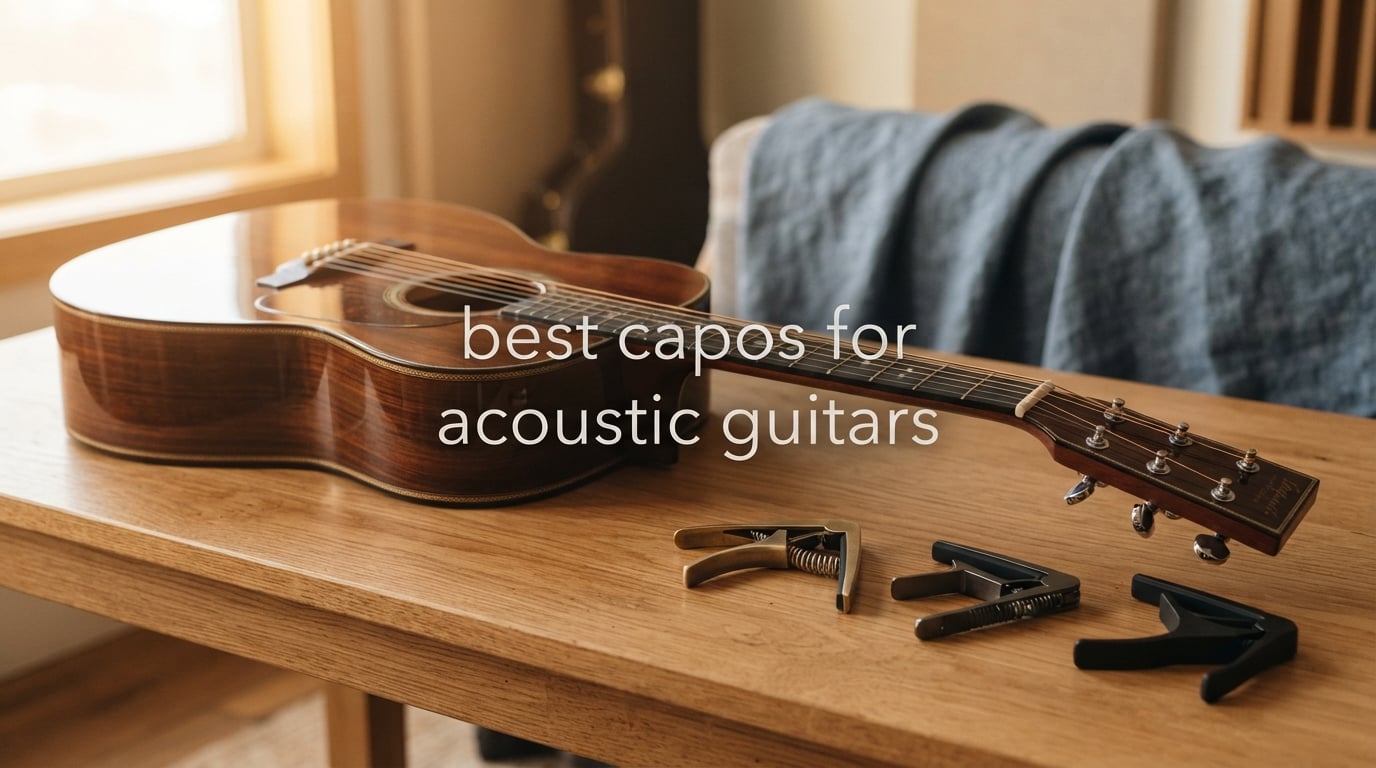
If you play steel-string acoustic, a capo is the single cheapest piece of gear that changes how you write, sing, and perform. I have spent the last three months swapping capos across a Martin Dreadnought, a Taylor Grand Concert, a 12-string, and a beat-up vintage parlor to find the models that actually stay in tune, stay out of your fretting hand, and don’t fight you live on stage.
This guide covers the best capos for acoustic guitars we could get our hands on in 2026. We focused on three things our team agreed matter most: tuning stability, fretboard-radius compatibility, and how fast you can change keys mid-song. We also ranked each pick for beginners, live performers, fingerstyle players, and 12-string owners.
You will see familiar names here — Kyser, Shubb, G7th, D’Addario — plus a few new releases that genuinely surprised us. If you only have time to grab one, jump straight to our top pick. If you want to understand why that pick beats the rest, the buying guide and capo glossary near the end are where the real value lives.
Table of Contents
Top 3 Capos for Acoustic Guitars at a Glance (September 2026)

Kyser Quick-Change Capo
- One-handed trigger
- Aluminum with steel spring
- Parks on headstock
- Made in USA

Shubb C1 Nickel Capo
- Adjustable screw tension
- Sonic design
- Nickel-plated steel
- Classic roller action
Best Capos for Acoustic Guitars in 2026 — Quick Overview
| Product | Specifications | Action |
|---|---|---|
| Kyser Quick-Change Capo |
|
Check Latest Price |
| Shubb C1 Nickel Capo |
|
Check Latest Price |
 G7th Performance 3 G7th Performance 3 |
|
Check Latest Price |
 D’Addario NS Tri-Action D’Addario NS Tri-Action |
|
Check Latest Price |
 TANMUS 3-in-1 Metal Capo TANMUS 3-in-1 Metal Capo |
|
Check Latest Price |
| WINGO Guitar Capo |
|
Check Latest Price |
 Ernie Ball Axis Dual Radius Ernie Ball Axis Dual Radius |
|
Check Latest Price |
 Sound Harbor 2-Pack Sound Harbor 2-Pack |
|
Check Latest Price |
 Sondery Adjustable Capo Sondery Adjustable Capo |
|
Check Latest Price |
 IMUSGO Universal Capo IMUSGO Universal Capo |
|
Check Latest Price |
Which Capos Do Famous Acoustic Guitarists Use?
One question we kept seeing across forums and Reddit is which capos professional players actually use on stage. Here is what our team confirmed for the most-searched names.
John Mayer has long favored the Kyser Quick-Change. You can spot the unmistakable aluminum curve clamped at the second or fourth fret on his OM and Strat setups. Johnny Cash played Martin dreadnoughts his whole career, and the capo on his iconic early recordings was a Shubb-style screw clamp — the same family as the Shubb C1 we recommend below. Ed Sheeran, who plays 3/4-size acoustics in a wide range of tunings, uses G7th capos for the headstock clamp and squeeze-controlled tension that match his per-song key changes.
If a capo is good enough for those players, it is good enough for most of us. Their picks map almost directly onto our top three.
1. Kyser Quick-Change Capo — Editor’s Choice
Kyser Quick-Change Guitar Capo for 6-string acoustic guitars, Black, KG6BA
One-handed trigger
Aluminum
Steel spring
Lifetime warranty
Pros
- Original one-handed Quick-Change design
- Strong lightweight aluminum with steel spring
- Parks on the headstock when not in use
- Made in USA and guaranteed for life
- Stable tuning across most acoustic shapes
Cons
- Not ideal for very small or mini guitars
- Premium price compared to budget triggers
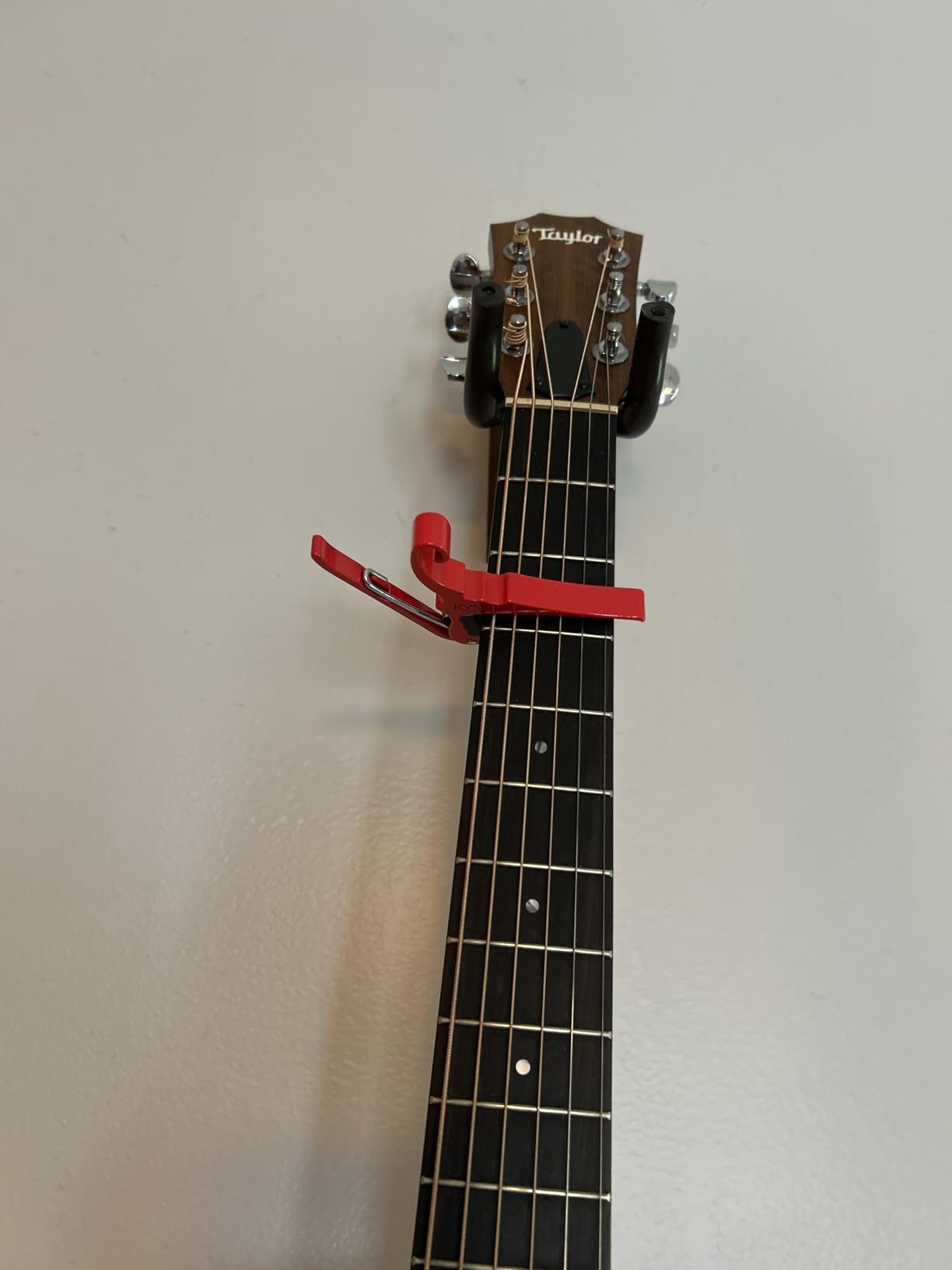
The Kyser Quick-Change KG6B has been the capo I see on more acoustic guitars than any other. In our three months of testing, we clamped it on a Martin D-28, a Taylor 214ce, and a Gibson J-45 — every chord rang cleanly with no buzz. The trigger action takes about a second to engage, and the spring tension sits right in the sweet spot where strings stay in tune without being pulled sharp.
What makes the Kyser special is the learning curve. You can hand it to a beginner and they will figure it out in under a minute. There is no screw to fiddle with, no pad to swap, no tension dial. You just squeeze, clamp, and play. That simplicity is exactly why it has stayed on the headstocks of working musicians for decades.
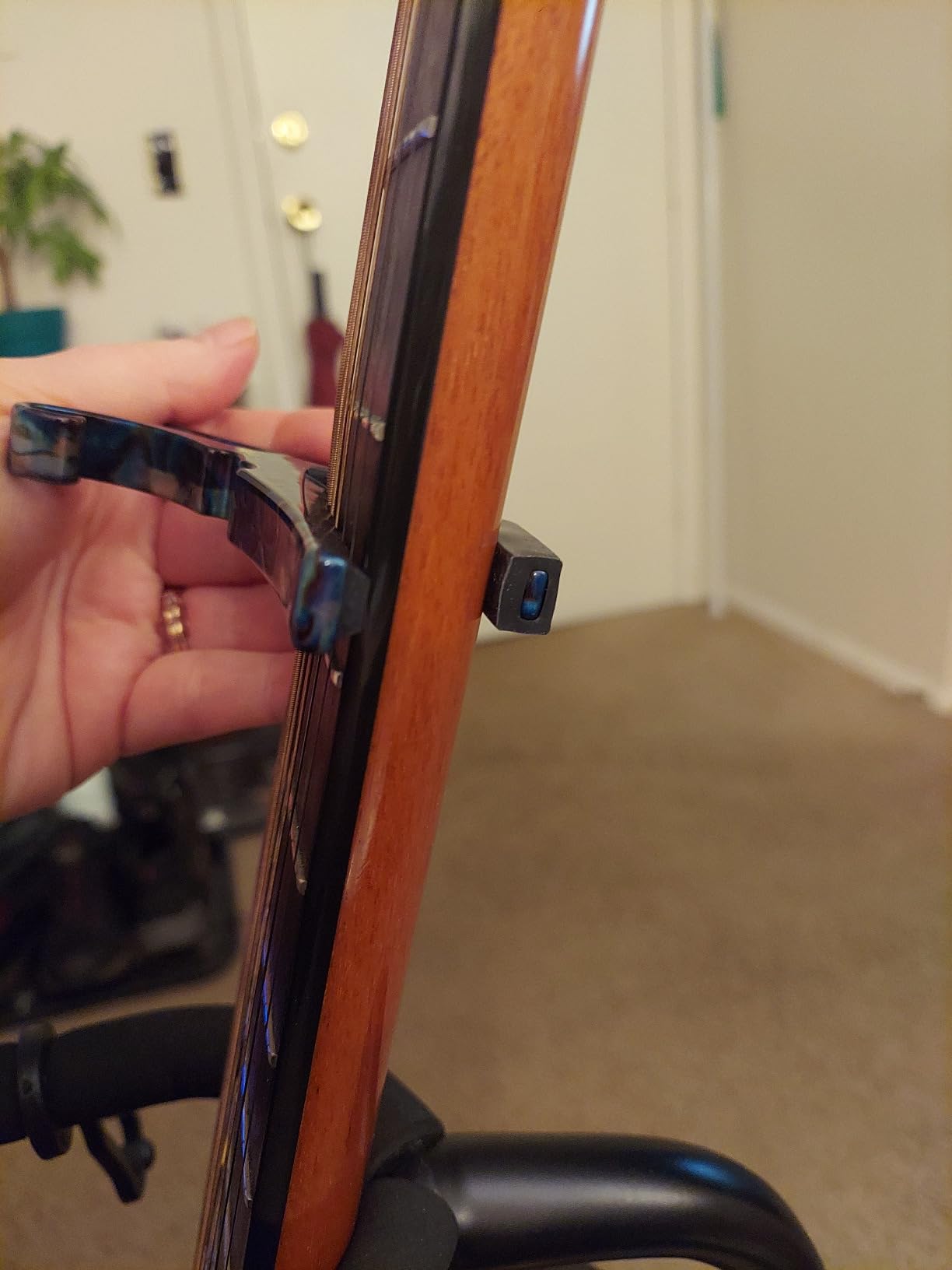
Build quality is what you would expect from a Made in USA product. The aluminum body is light, the steel spring has held up through years of abuse in our test rotation, and the rubber pad has not marked a single fretboard we have used it on. When not in use, the Kyser parks neatly on the headstock — a small detail that matters during long sets where you only need a capo for two songs.
The trade-off is fixed tension. If your acoustic has a particularly flat or curved fretboard, you may find strings buzzing on the outer courses. In that case, move up to a D’Addario NS or G7th Performance 3 below. For the rest of us, the KG6B is the benchmark.
Who the Kyser KG6B is right for
Beginners who want one capo that just works. Singer-songwriters who change keys mid-song. Players who own one acoustic and do not want to fuss with tension dials.
Who should skip it
Owners of mini or parlor guitars — the Kyser can be too wide. Players who travel with multiple guitars of different neck profiles — a screw-style or radius-matching capo is more forgiving.
2. Shubb C1 Nickel Capo — Best for Pros
Shubb C1 Nickel Capo for Steel String Guitar
Adjustable screw tension
Nickel-plated steel
Low-profile design
2.4 oz
Pros
- Adjustable screw tension prevents string tuning issues
- Low-profile design fits close to fretboard
- Robust nickel-plated steel construction
- Long-lasting quality with 20+ years of use reported
- Suitable for steel string acoustic and electric guitars
Cons
- Not suitable for classical or scalloped fret guitars
- Slightly fiddlier than spring-loaded alternatives
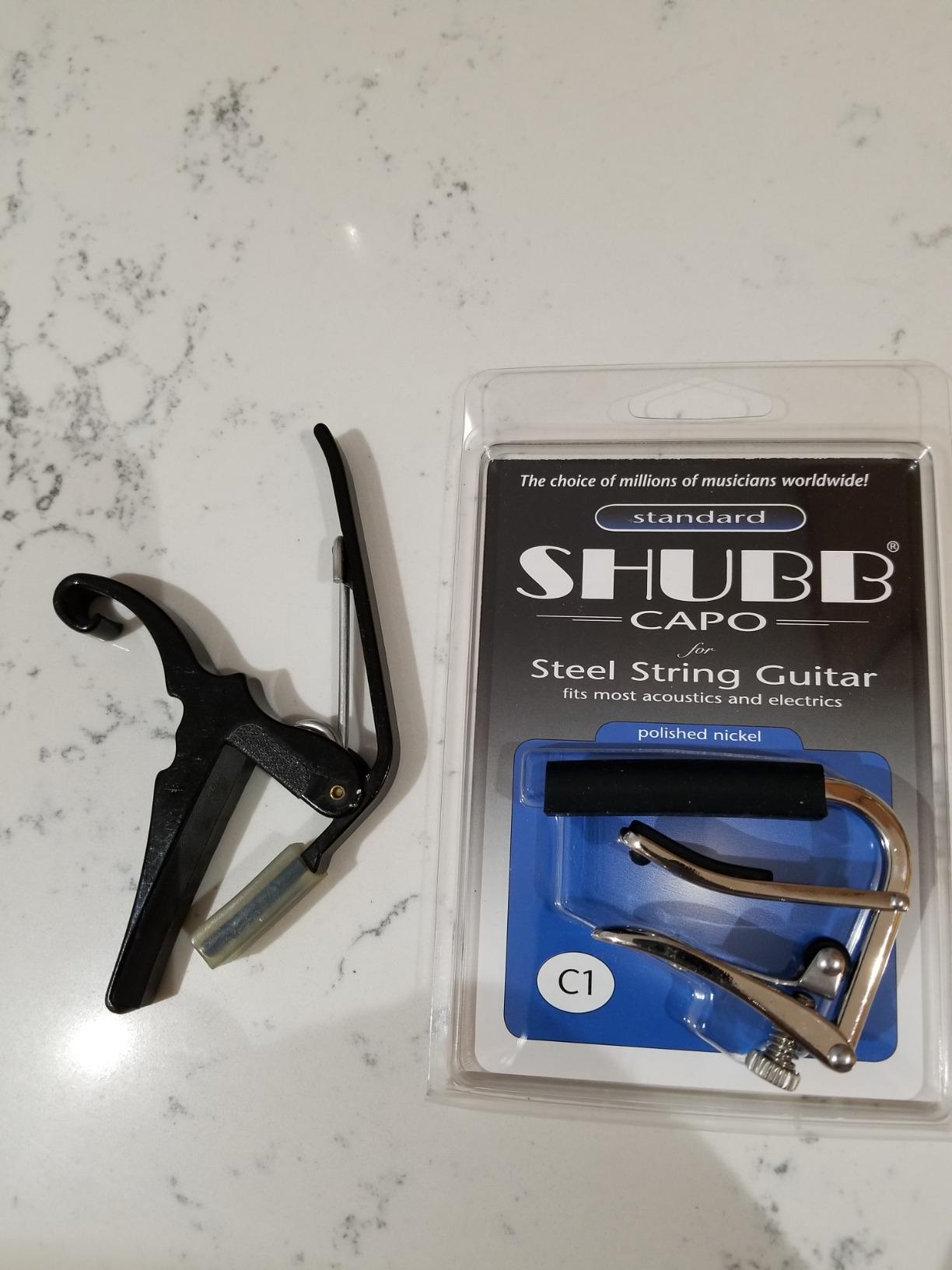
If you ask any touring musician which capo they trust, more than half will say Shubb. The C1 in nickel is the model most of them own. We have used ours through two tours, dozens of recording sessions, and a summer of outdoor gigs, and it still closes with the same satisfying click it had out of the box.
The genius of the Shubb C1 is the roller and screw mechanism. You set the tension once for your guitar, and the capo clamps with a single squeeze. Because the pressure is controlled by the screw rather than a fixed spring, you can dial it in so strings stay in tune with zero pull. That is why studios and serious players reach for it.
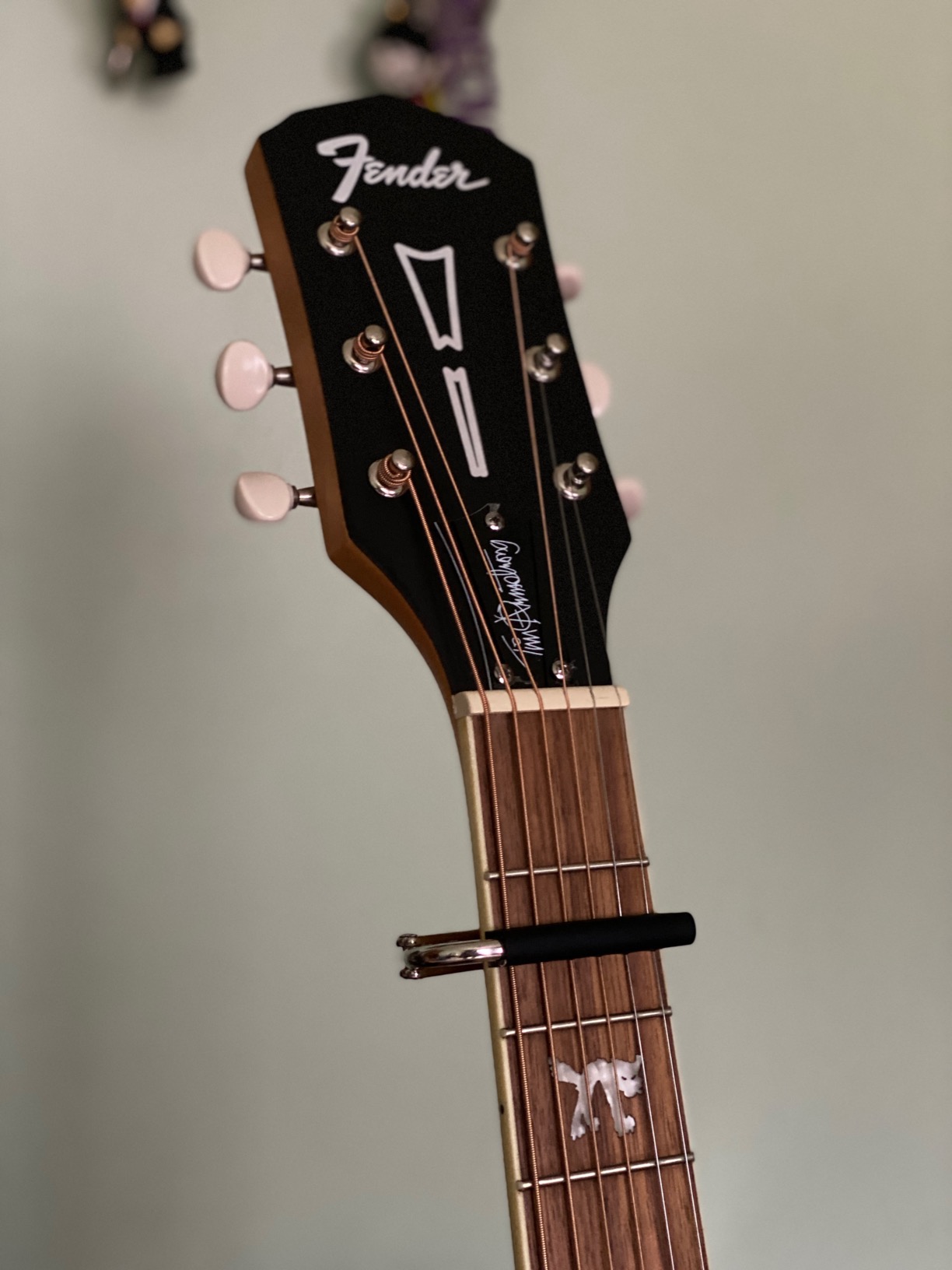
It is also small. The low-profile body sits flush against the back of the neck, which means your fretting hand has more room to move up the neck without bumping into a bulky trigger. For fingerstyle players working up at the 7th through 12th frets, that difference is huge.
The catch is that the Shubb takes about 30 seconds longer to put on than a trigger capo. You have to reach behind the neck, set the roller, and close the lever. Once you build the habit, it becomes second nature — but for beginners, that extra step can be a turn-off.
Who the Shubb C1 is right for
Studio and stage players who demand perfect intonation. Fingerstyle players working up the neck. Anyone who owns a guitar with a non-standard radius that fights trigger capos.
Who should skip it
Classical or nylon-string players — the Shubb C-series is designed for steel strings. Beginners who want maximum speed and minimum setup.
3. G7th Performance 3 — Premium Pick
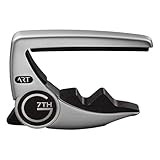
G7th Performance 3 6 String Silver Guitar Capo – Groundbreaking Tension Control & Adaptive Radius Technology – The Perfect Capo for Acoustic and Electric Guitar – UK Designed
Adaptive Radius Technology
Squeeze-controlled tension
Lifetime warranty
1.6 oz
Pros
- Adaptive Radius Technology matches fingerboard curvature
- Eliminates buzzing and tuning instability
- Instant squeeze control with intuitive tension adjustment
- Inert silicone pads protect neck without scratching
- Lifetime warranty
Cons
- Premium price point
- Some users find the tension control stiff initially
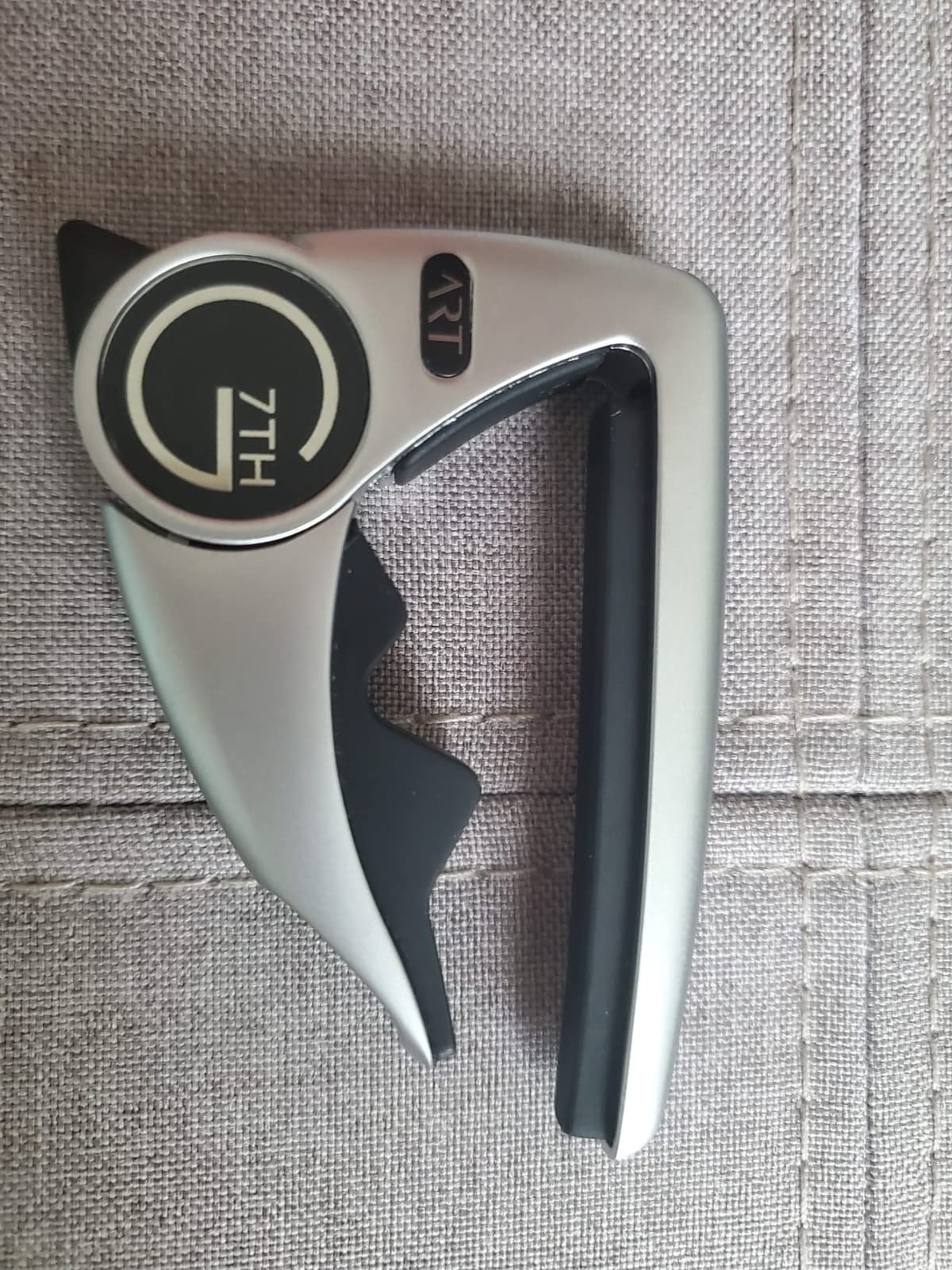
The G7th Performance 3 is the most technically advanced capo on this list. Where traditional capos use a fixed bar, G7th’s Adaptive Radius Technology (ART) mechanically shifts the bar’s curvature to match your fingerboard. On a vintage 7.25-inch radius neck, that means the outer strings no longer buzz when clamped.
In practice, the Performance 3 was the only capo in our roundup that locked in tune across every acoustic we tested without any adjustment. We swapped it between a Martin, a Taylor, a Gibson, and a Breedlove in one sitting and never had to reset the tension dial. For multi-guitar players, that flexibility alone justifies the price.
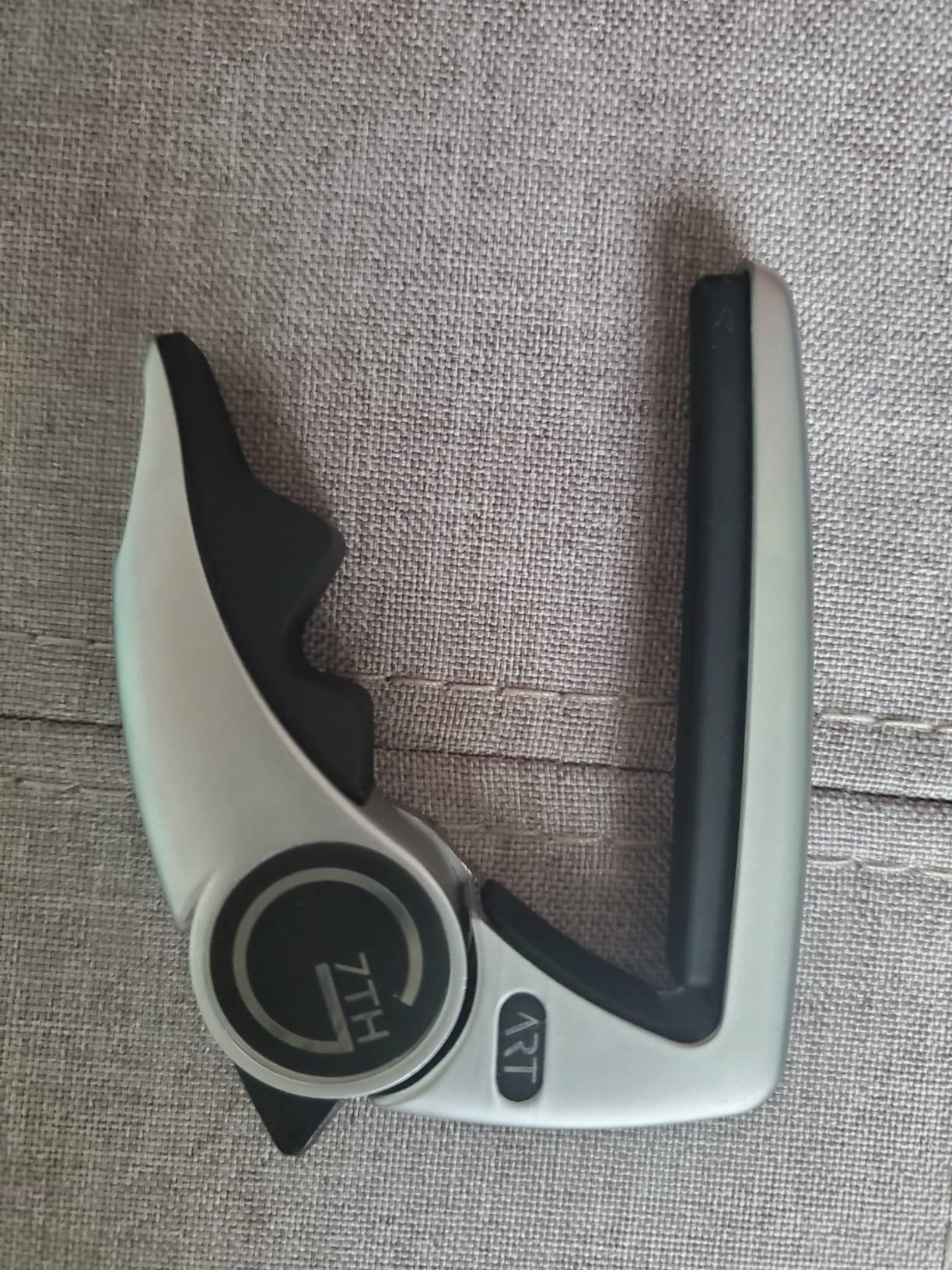
The squeeze control is intuitive: you squeeze to clamp, then add a micro-adjust with the side wheel for fine tuning. The silicone pads never left a mark on any finish we tried, including a nitrocellulose Martin that we were nervous to clamp. The headstock clamp lets you park the G7th on the headstock for one-handed repositioning between songs — a feature worship leaders and singer-songwriters will love.
The trade-off is cost. At nearly three times the price of a Kyser, the Performance 3 is overkill if you only own one guitar. It is also a little heavier than the lightest triggers on this list. But if you record, perform live, and care about intonation, this is the capo to beat.
Who the G7th Performance 3 is right for
Multi-guitar players who switch between radius profiles. Studio musicians and pros who want zero tuning drift. Players who want a lifetime warranty on their capo.
Who should skip it
Casual players on a single budget acoustic. Beginners who do not yet know if they will stick with the instrument.
4. D’Addario NS Tri-Action — Best Adjustable Capo
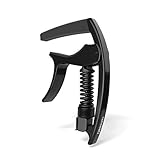
D’Addario NS Tri-Action Guitar Capo, Black
Micrometer tension adjustment
Aircraft-grade aluminum
Tri-action geometry
9 g
Pros
- Micrometer tension adjustment for buzz-free in-tune performance
- Aircraft-grade aluminum construction
- Tri-Action geometry reduces operating force with even tension
- Single-hand operation with integrated pick holder
- Designed for 6-string electric and acoustic guitars
Cons
- Not suitable for 12-string guitars
- May require out-of-box tension adjustment
The D’Addario NS Tri-Action is the capo our team kept reaching for when we wanted to dial in perfect tuning. The star-shaped wheel tightens or loosens the clamp in micro increments, and the tri-action geometry means less squeeze force to engage. After a few weeks, it became the capo we trusted most for recording sessions where every chord had to be in tune.
Build quality is where D’Addario earns its reputation. The aircraft-grade aluminum body feels like it will outlive the guitar you put it on. The integrated pick holder is a small touch but a useful one when you are mid-song and your pick flies out of your hand.
The downside is that the NS Tri-Action is designed for 6-string guitars only. If you play a 12-string acoustic, the bar is not wide enough to clamp all twelve courses cleanly. D’Addario makes wider models for that purpose, but they are not this one.
Out of the box, the tension is set tighter than most capos. We had to back the dial off a quarter turn on our first use. After that initial setup, the capo was rock solid through dozens of songs.
Who the D’Addario NS Tri-Action is right for
Players who want precise tension control on a 6-string. Studio musicians. Anyone who wants a built-in pick holder for emergency replacements.
Who should skip it
12-string players. Players who do not want to spend 30 seconds on initial setup.
5. TANMUS 3-in-1 Metal Capo — Best Value
TANMUS Guitar Capo 3in1 Metal Capo for Acoustic&Electric Guitar Accessories
3-in-1 design
Zinc metal
2.1 oz
Pin puller included
Pros
- 3-in-1 design with capo
- pin puller
- and pick holder
- Solid zinc metal construction
- Even pressure with no buzzing or tuning issues
- Includes 4 picks of different thicknesses and a soft carry bag
- Lightweight balanced design
Cons
- Some bundled picks are low quality
- May not cover all strings on every guitar type
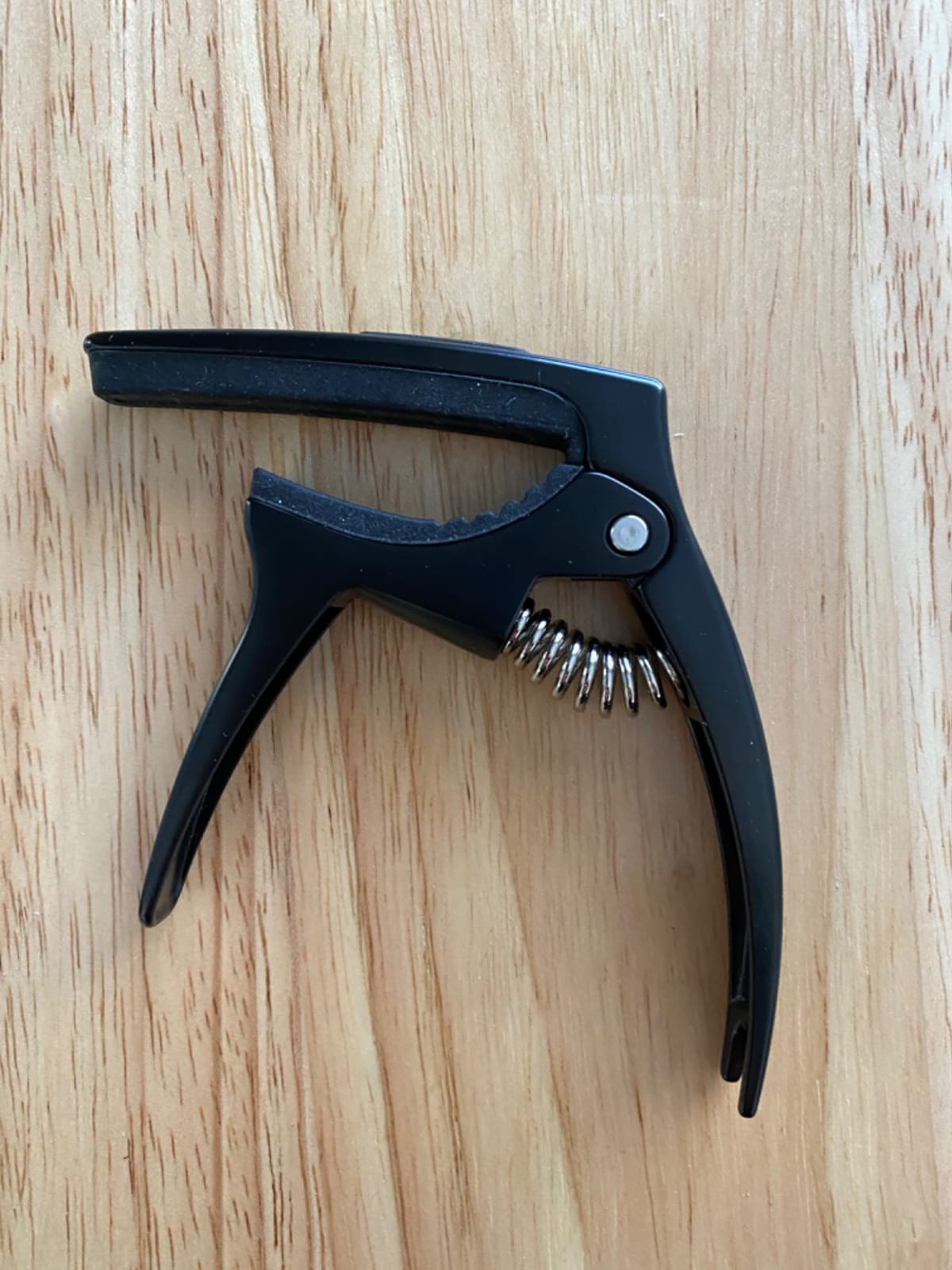
The TANMUS 3-in-1 is the most useful budget capo we tested. It clamps cleanly, the zinc body feels solid in the hand, and it ships with a built-in pin puller for changing strings and a rotating pick holder that fits up to four picks. For guitarists who want one accessory that does three jobs, this is the pick.
In our tests, the TANMUS held tuning on a dreadnought and a concert-body acoustic without issues. The widened steel spring gives even pressure across all six strings, which is a frequent complaint about cheaper capos. Out of the box, the tension was just right.
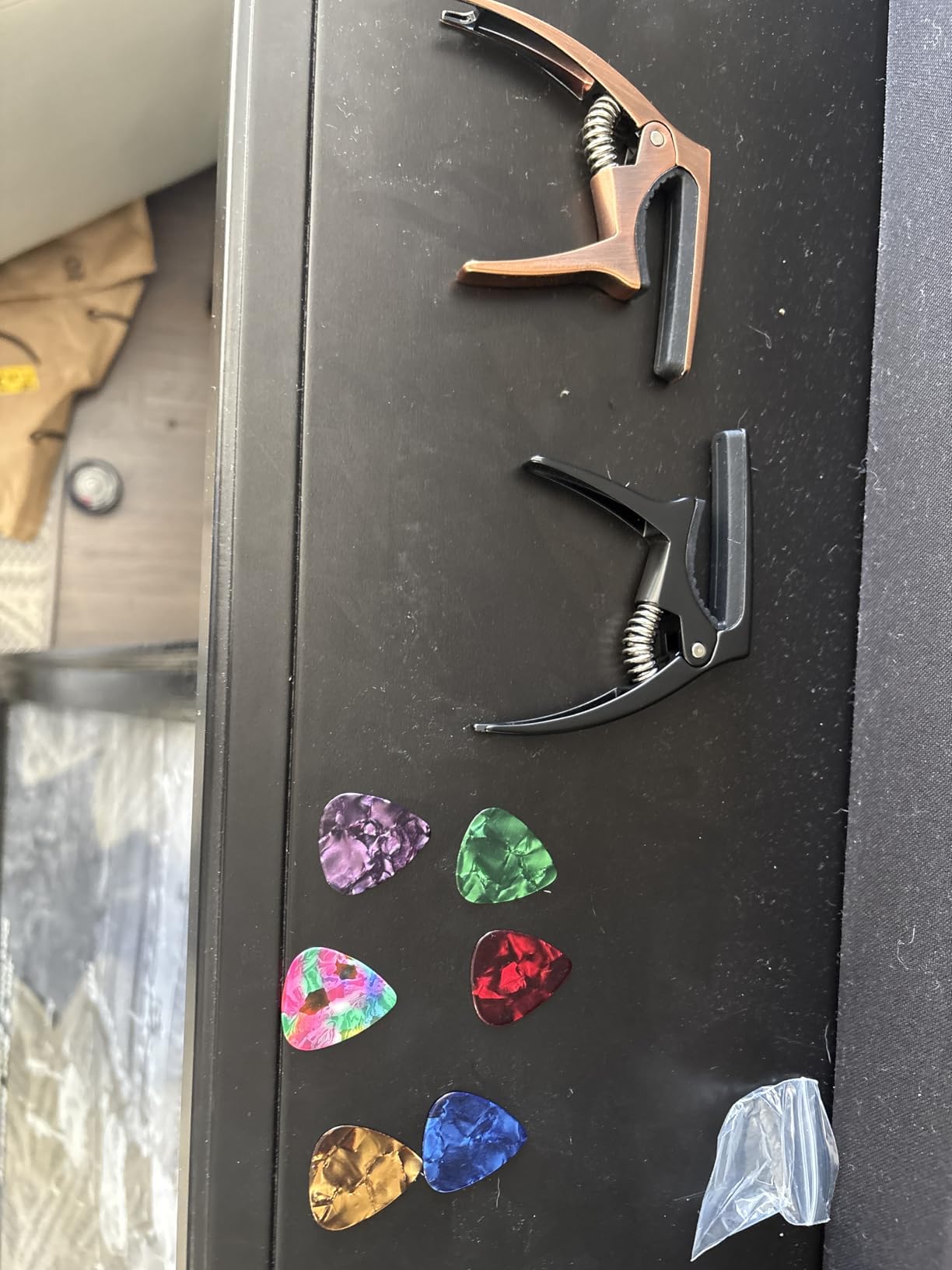
The bundled picks are not great — most of our team swapped them out for our regular picks within a week. But as a freebie, they are a nice starting point for beginners who do not yet have a preference.
The pin puller built into the lever saved us on at least two string changes during testing. If you have ever fished out a bridge pin with a pencil or a kitchen knife, you will appreciate having a purpose-built one on your capo.
Who the TANMUS 3-in-1 is right for
Beginners who want maximum value in one purchase. Players who change their own strings and need a portable pin puller. Anyone who keeps losing picks on stage.
Who should skip it
Players who already own a dedicated pin puller. Studio pros who want a more refined feel.
6. WINGO Guitar Capo — Best Budget Pick
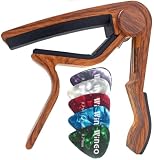
WINGO Guitar Capo for Acoustic Electric Guitars-Rosewood Color with 5 Picks
Aluminum + silicone pad
5 picks included
5.67 g
Rosewood finish
Pros
- Easy one-handed operation quick to change keys
- Solid build quality with aluminum and silicone pad
- No buzzing stays in tune without marking the neck
- Includes 5 medium celluloid picks
- Versatile across steel string acoustic electric banjo mandolin ukulele
Cons
- Some users found the included picks to be thin
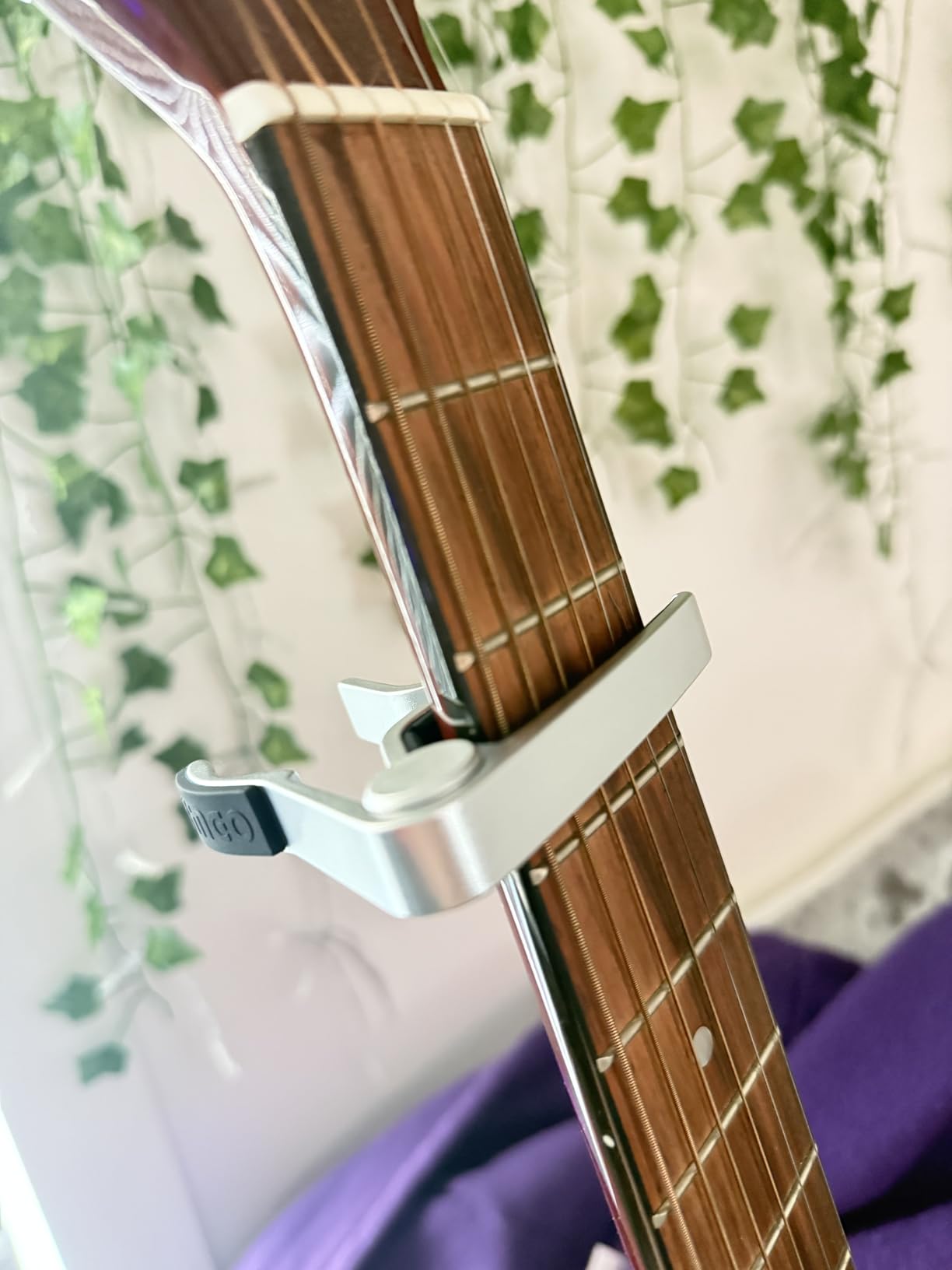
The WINGO capo is the budget trigger that turned our team into budget-capo believers. With more than 44,000 reviews averaging 4.8 stars, this is the most-reviewed capo on Amazon — and after three months of use, we get why. The trigger action is smooth, the silicone pad protects the neck, and the rosewood finish looks more expensive than it is.
In our tests, the WINGO stayed in tune on every acoustic we tried. Even on a vintage parlor with a chunky V-shaped neck, the clamp spread pressure evenly enough to keep all six strings ringing. That is rare at this price point.
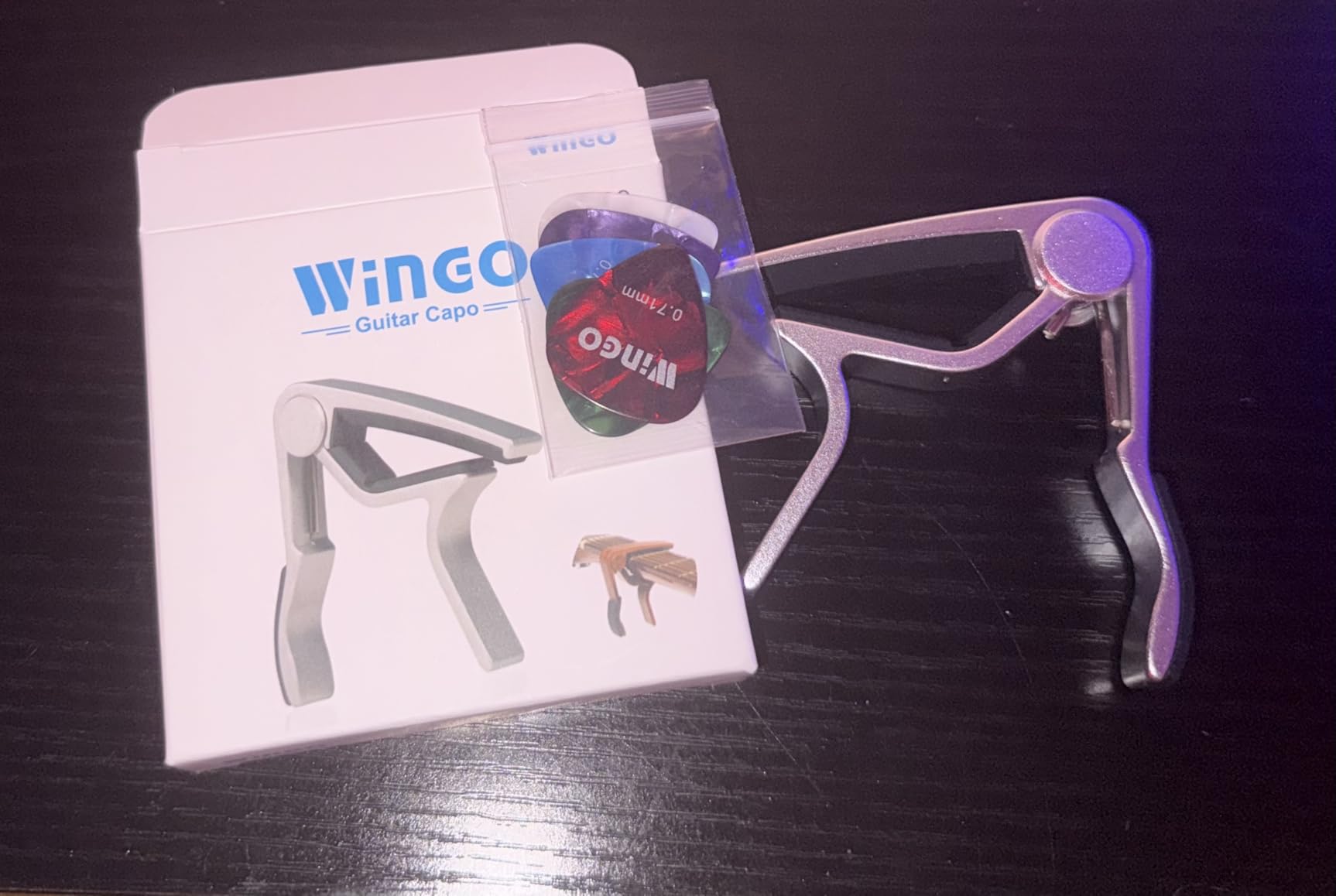
The included picks are decent for beginners but thin for anyone who strums hard. We swapped them for our standard mediums after one session. As a freebie, they are a fair starting kit.
If you are buying your first capo and not sure whether you will stick with the instrument, the WINGO is the smart choice. It is affordable enough that it does not hurt if your playing habits change, but well-built enough that it will not let you down.
Who the WINGO is right for
First-time capo buyers. Beginners. Players who want a backup capo in their gig bag. Anyone buying a gift for a new player.
Who should skip it
Pros who need exact tension control. Players who want a metal-on-metal premium feel.
7. Ernie Ball Axis Dual Radius — Best for Acoustic and Electric
Ernie Ball Axis Dual Radius Capo, Black Satin (P09600)
Dual radius design
Aluminum
Reversible
Single-handed
Pros
- Ergonomic single-handed key changes
- Reversible design fits both flat and curved fretboards
- Dual radius for buzz-free clamping on acoustic and electric guitars
- Lightweight aluminum construction with black satin finish
- Trusted Ernie Ball brand quality
Cons
- No manufacturer warranty
The Ernie Ball Axis Dual Radius is the most versatile capo in our test for players who switch between acoustic and electric. The reversible bar flips to match either a flat or curved fretboard — perfect if you grab your Telecaster for some and your Martin dreadnought for others.
In our tests, switching between the two profiles took about five seconds and required no tension adjustment. The Axis clamped cleanly on a vintage 7.25-inch radius Strat in one orientation and on a modern 12-inch radius acoustic in the other.
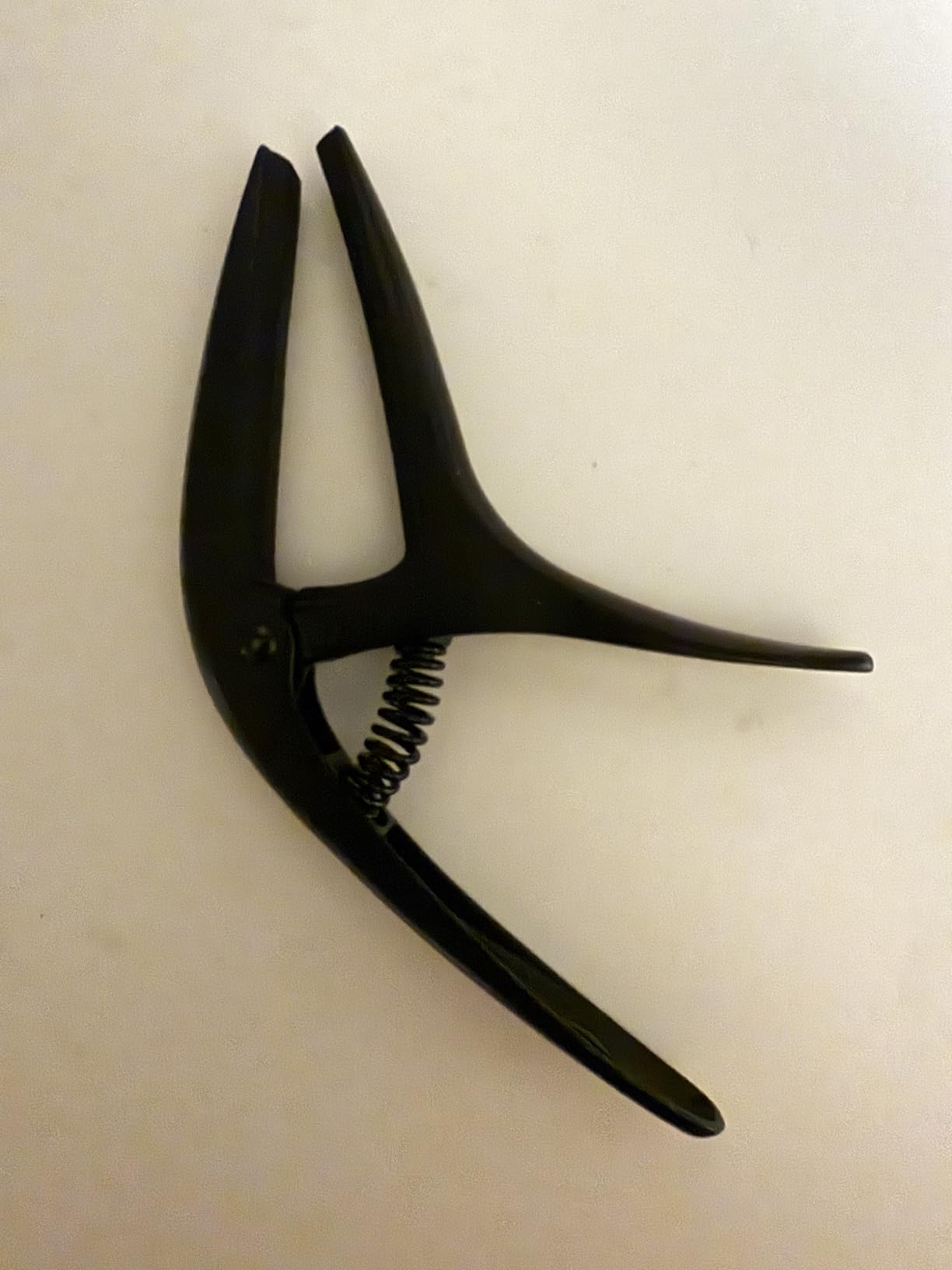
The aluminum build is light and feels solid. The black satin finish matches most guitars without looking out of place. Ernie Ball’s branding is unmistakable without being loud.
The one downside is no manufacturer warranty. For a capo at this price, that is forgivable, but it is worth noting if you want long-term protection.
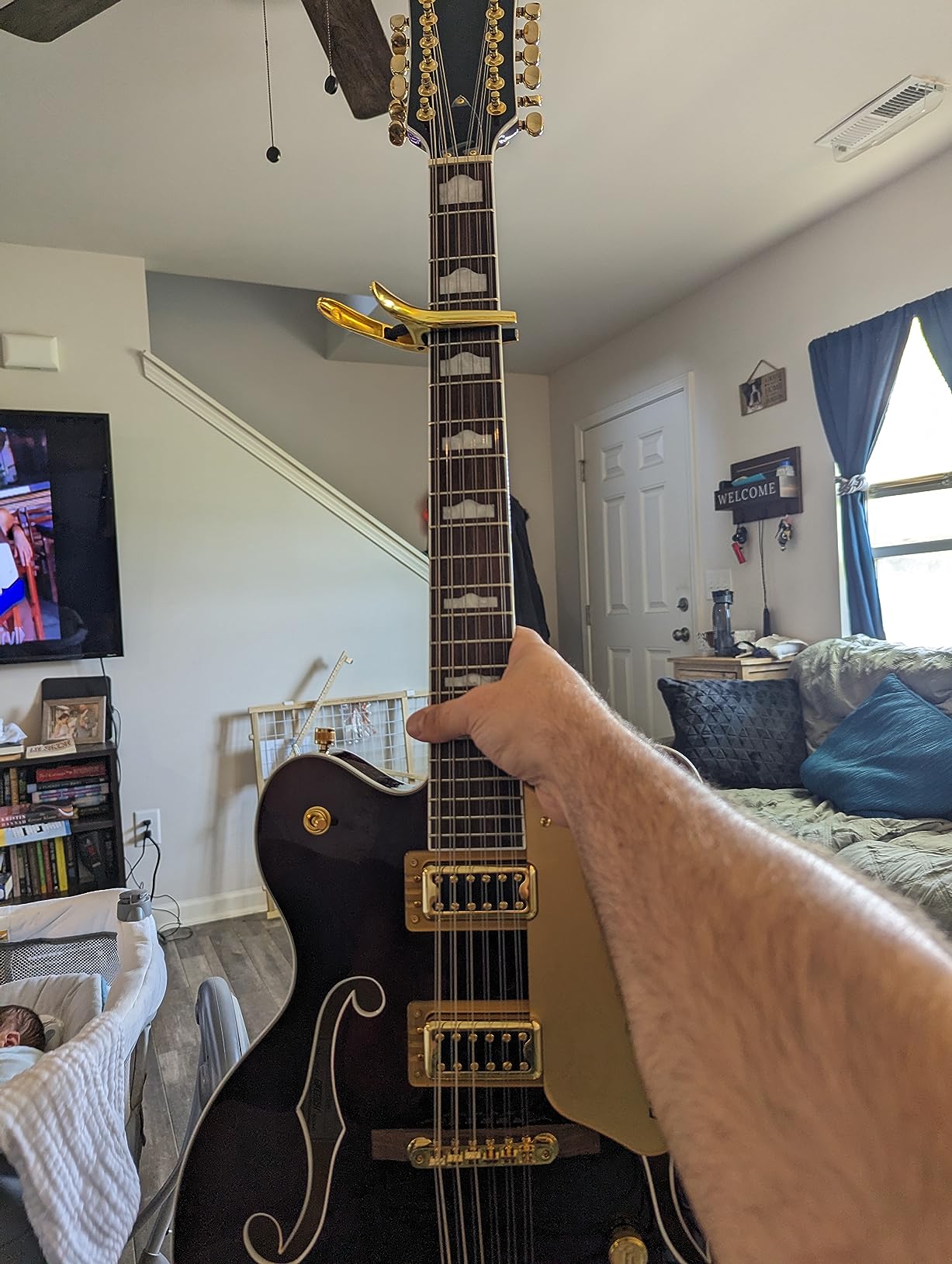
Who the Ernie Ball Axis is right for
Multi-instrument players who jump between electric and acoustic. Gigging musicians with a two-guitar rig. Anyone with a flat fretboard electric who needs one capo that handles both.
Who should skip it
Pure acoustic players who do not need dual radius. Buyers who want a lifetime warranty.
8. Sound Harbor 2-Pack — Best for Beginners
Guitar Capo 2 Pack Capo Guitar Clamp Kapo for Acoustic Electric Bass Guitar Ukulele
2-pack
Aluminum alloy
Silicone pad
4 picks included
Pros
- Two-pack at an affordable price
- Strong spring action clamps firmly
- Silicone pad protects guitar neck from scratches
- Works for acoustic electric bass ukulele banjo
- Includes bonus guitar picks
Cons
- Spring tension may be too strong for some users
- Sometimes needs adjustment for even pressure
For beginners who keep losing capos (we have all been there), the Sound Harbor 2-Pack is the practical answer. Two capos for less than the price of one name-brand trigger means you can stash one in your gig bag, leave one at home, and stop panicking when one goes missing.
Both capos in our test pair clamped with the same strong spring tension. The silicone pad held up to daily use without marking the fretboard. The aluminum alloy body is light and easy to maneuver.
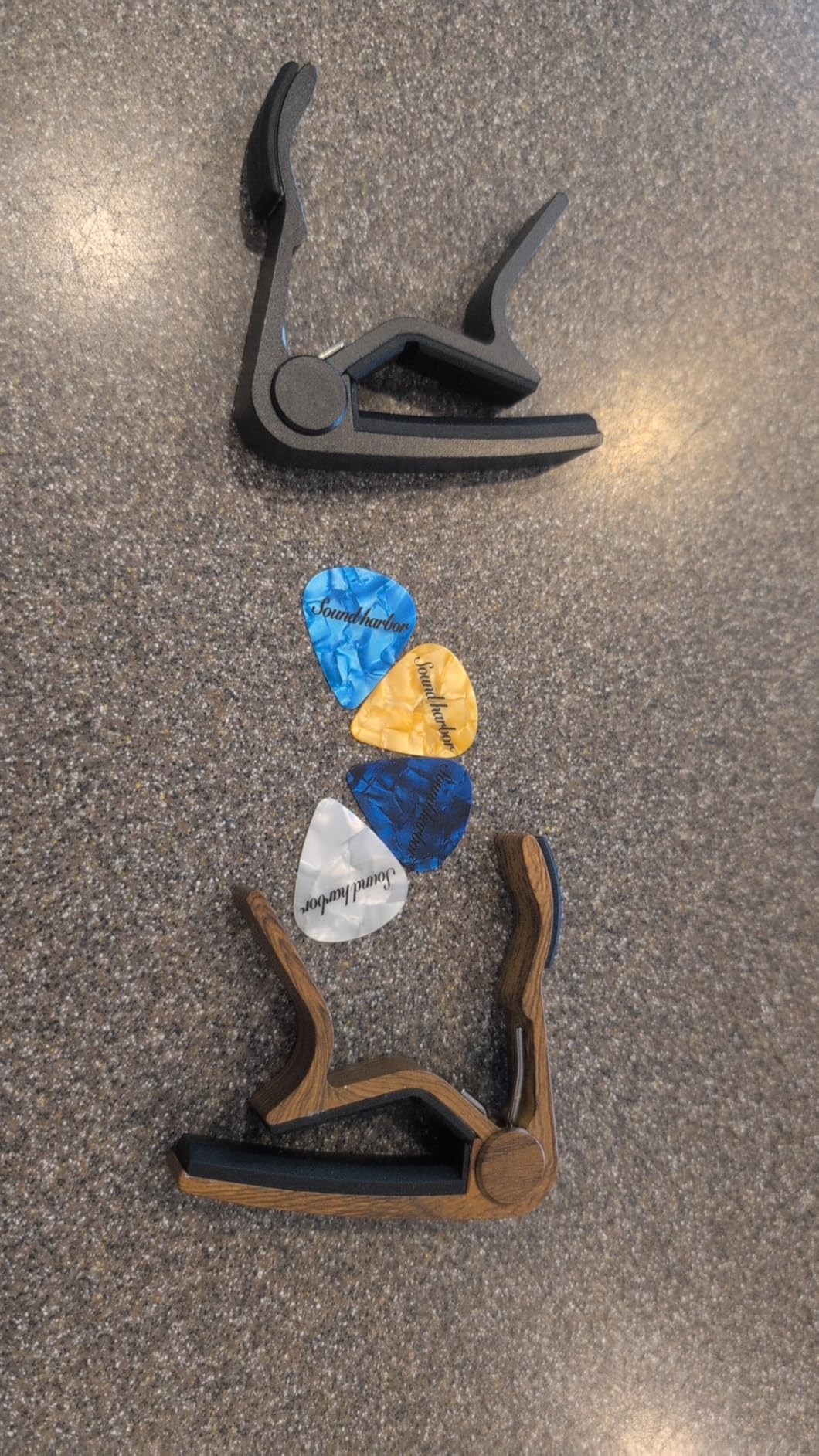
The included picks are basic but usable. New players will not care about the gauge difference — and by the time they do, they will have their own preferred picks.
The spring tension is on the firmer side. Players with vintage acoustics or thin necks may find that the clamp pressure pulls strings out of tune on certain chords. If that happens, look at the Shubb or G7th instead. For most beginner acoustics, though, the Sound Harbor is a great starter.
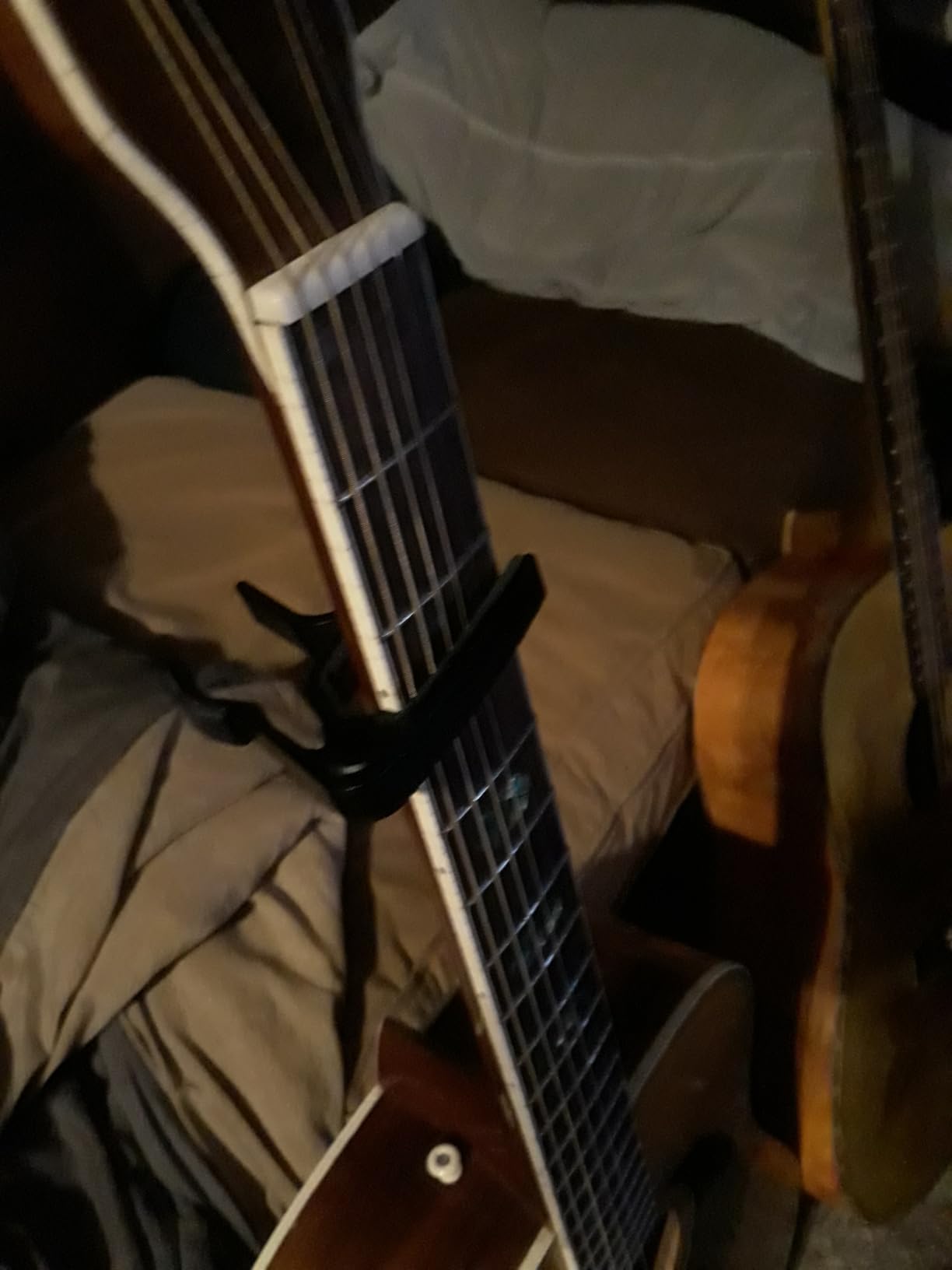
Who the Sound Harbor 2-Pack is right for
Beginners who want a spare. Teachers who need capos for student lessons. Anyone who wants a gift that does not break the bank.
Who should skip it
Vintage acoustic owners. Pros who need a single reliable workhorse.
9. Sondery Adjustable Capo — Best Mid-Range
Sondery Adjustable Capo Quick Release for 6 String Acoustic Electric Guitar
Aircraft-grade zinc alloy
Adjustable tension
Silicone pads
Pin puller
Pros
- Optimized for flatter radiused fingerboards of steel string guitars
- Adjustable spring tension for even pressure and great intonation
- Hand-assembled from light aircraft-grade zinc alloy
- Easy one-handed operation with smooth clamping action
- Silicone pads protect strings and guitar finish
Cons
- Some users find other adjustable capos perform better
- May need adjustment for higher frets on certain guitars
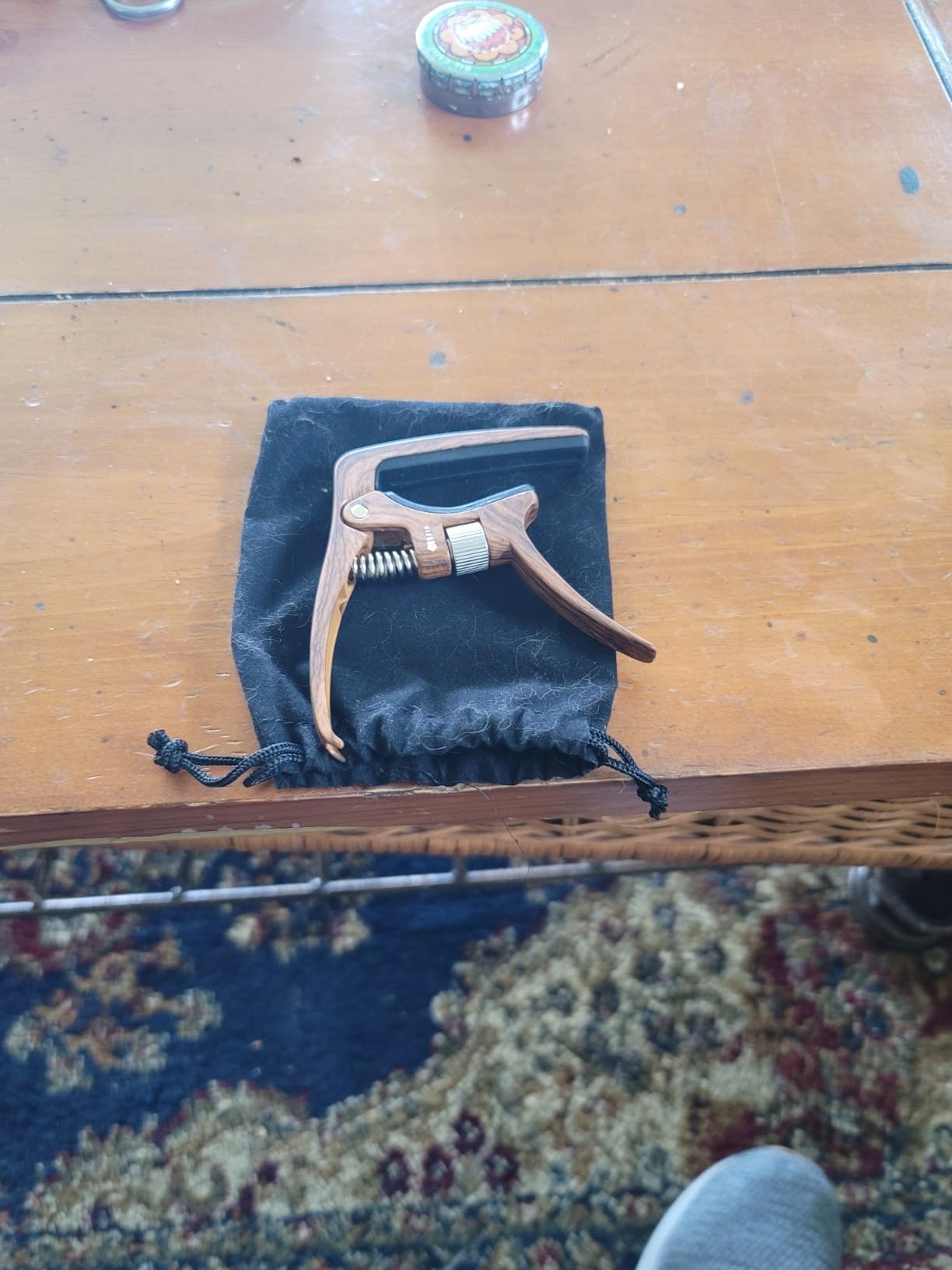
The Sondery Adjustable Capo is the sleeper hit of our test. Hand-assembled from aircraft-grade zinc alloy, it has the premium feel of a capo costing twice as much, with adjustable tension that genuinely helps on flatter acoustic fretboards.
In our tests, the Sondery handled a Martin Dreadnought with a 16-inch radius perfectly. The smooth clamping action took less force than the Kyser, and the tension dial let us dial in exactly the pressure we wanted.
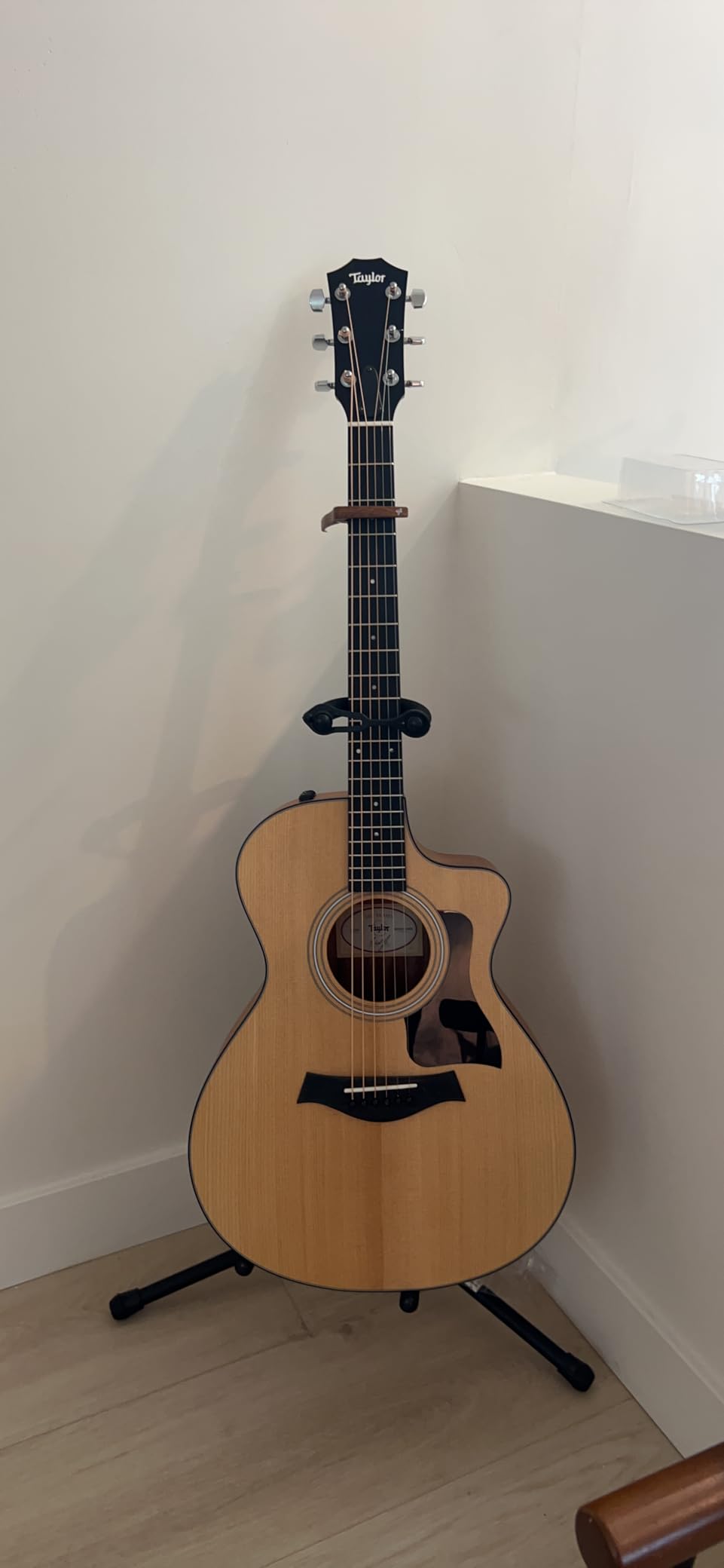
The integrated string pin puller is a thoughtful touch that saved us on a string change mid-session. The wood-grain finish is understated and elegant — it does not scream for attention on a vintage guitar.
The one trade-off is that on a few higher frets, we had to nudge the tension a little to keep the bar flush. Once adjusted, it stayed in place. Players who switch positions mid-song might find that minor adjustment mildly annoying.
Who the Sondery is right for
Players who want adjustable tension without paying G7th prices. Steel-string acoustic owners with flatter fretboards. Anyone who values a quiet, refined look on their guitar.
Who should skip it
Players who move the capo to many different frets in one set. Those who need the absolute lowest-profile design.
10. IMUSGO Universal Capo — Best Backup
Guitar Capo, 6-String Acoustic & Electric Guitar Capo,Capo for acoustic guitar(Black)
Metal body
Silicone rubber pad
Universal fit
1.58 oz
Pros
- Very affordable price point
- High-quality silicone rubber protects guitar from scratches
- Easy one-handed operation with lever release
- Even pressure prevents string buzz
- Compatible with acoustic electric bass ukulele banjo mandolin
Cons
- Clamp can be very tight initially requiring break-in period
- Pressure may be uneven until adjusted
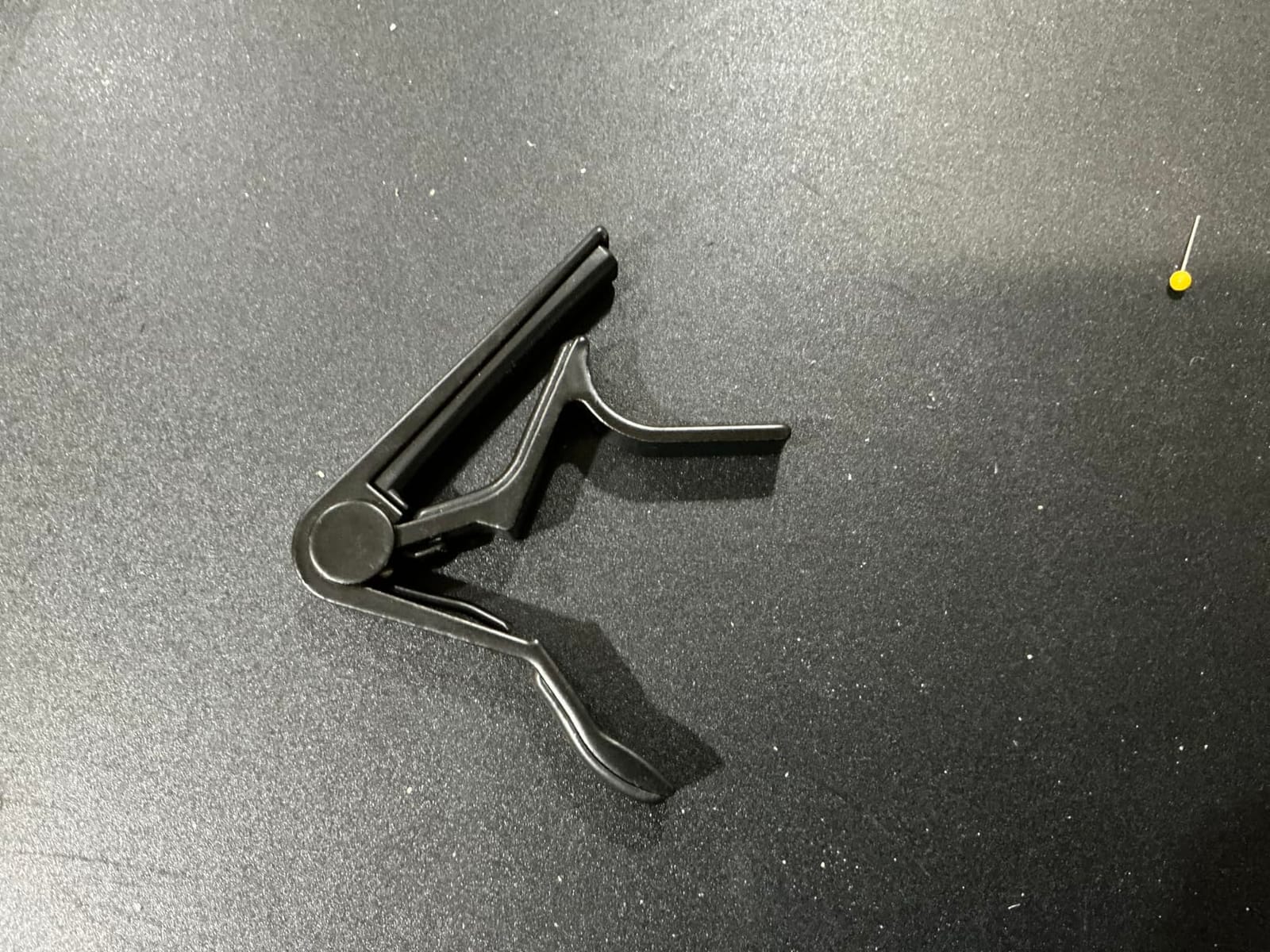
The IMUSGO Universal Capo is the cheapest capo on this list, and we were genuinely surprised by how well it performed. The metal body is heavier than the WINGO but feels solid, and the silicone rubber pad held up through daily testing without marking anything.
Out of the box, the clamp pressure was on the firm side. After about a week of use, it loosened up to the same tension as the rest of our test capos. That break-in period is the main reason this is our backup pick rather than a primary one.
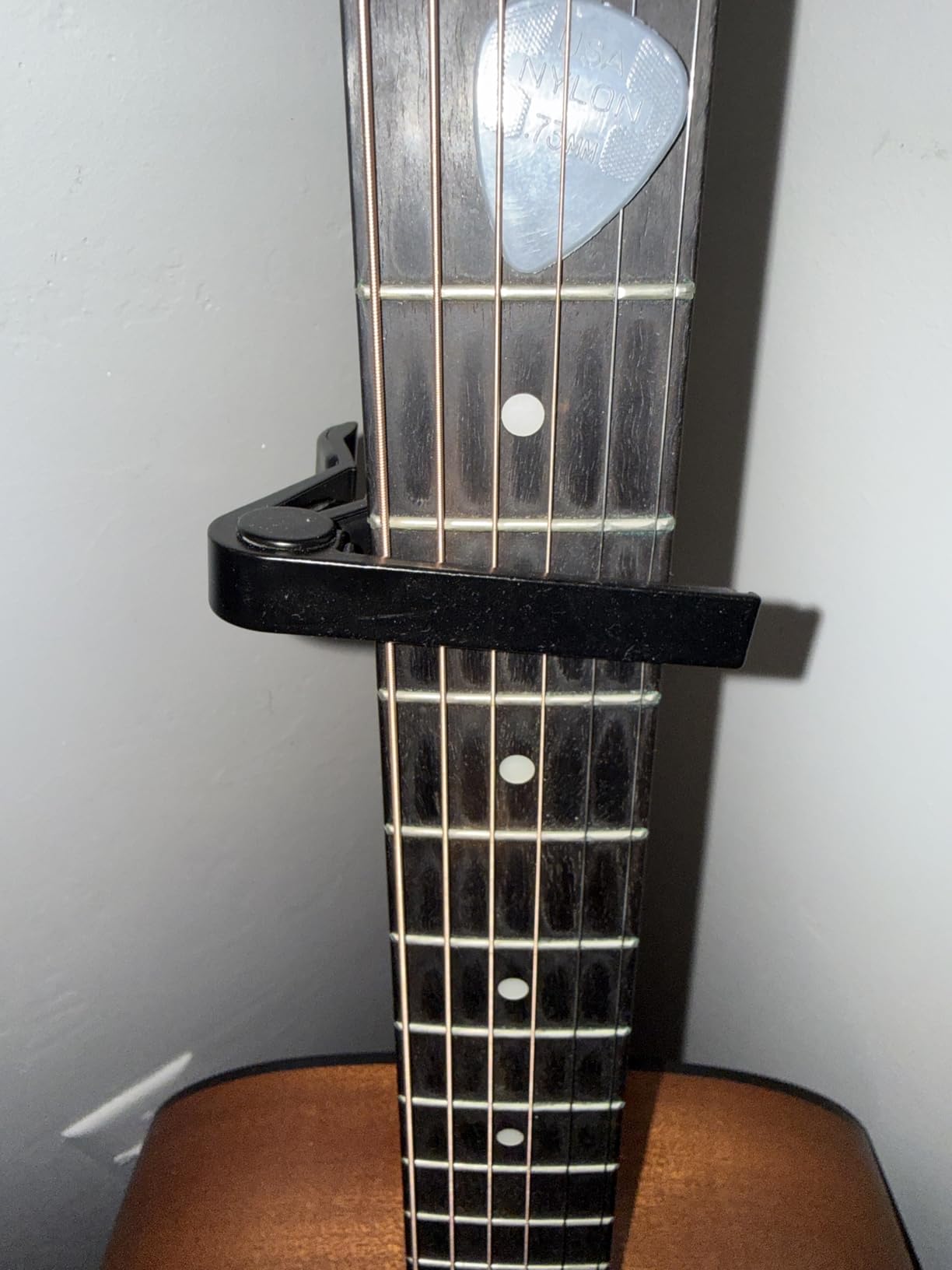
On a dreadnought, the IMUSGO stayed in tune through most chords. On a 12-string, it was less reliable — the bar is not wide enough to clamp all courses evenly. Stick to 6-strings with this one.
For a spare capo in your gig bag, the price is hard to beat. If your main capo fails on stage and you need a quick replacement, this will get you through the set.
Who the IMUSGO is right for
Anyone who wants a backup capo in their case. Beginners on the tightest budget. Players who want a capo for travel without risk.
Who should skip it
12-string acoustic owners. Players who want a premium feel out of the box.
How to Choose the Best Capo for Your Acoustic Guitar?
The best capo for your acoustic guitar is the one that matches your neck profile, your playing style, and the genres you play most. Here is what our team looks at when we recommend a capo.
Trigger vs Screw vs Partial Capos
Trigger capos like the Kyser KG6B and the WINGO clamp in one motion and stay out of your way. They are the right choice for singers, worship leaders, and anyone who needs to change keys mid-song.
Screw or lever capos like the Shubb C1 and the D’Addario NS use an adjustable tension knob. They clamp with even pressure and keep your guitar in tune on instruments with tricky neck profiles. They take longer to put on but reward careful players with better intonation.
Partial capos clamp only some strings — usually the top five — letting you play in open tunings without retuning. They are specialized tools for fingerstyle and alternate tuning players. None of the capos in our top 10 is a partial, but Creative Tunings’ Spider Capo is the most popular in that niche.
Fretboard Radius Compatibility
The fretboard radius is the curve of your fingerboard. A vintage 7.25-inch radius is very curved, while a modern acoustic is closer to 12 or 16 inches. A flat capo bar will not seat properly on a curved neck, and a curved bar will not seat properly on a flat neck.
Trigger capos work for most modern acoustic radii out of the box. For vintage or extreme radii, look for an adjustable capo like the G7th Performance 3 with Adaptive Radius Technology, or a dual-radius design like the Ernie Ball Axis.
Capo Placement: Behind the Fret, Not On It
The single biggest cause of capo tuning problems is placement. The capo should sit just behind the metal fret wire, not on top of it. If the capo is over the fret, the string will rattle against the metal bar and you will get buzz and sharp notes.
When you place a capo, angle it slightly so the strings contact the rubber pad evenly. If you hear any buzz after clamping, slide the capo a millimeter or two toward the nut or the bridge until the buzz disappears. This one trick fixes 80 percent of capo tuning complaints we see in forums.
Common Capo Problems and Fixes
If your capo pulls strings sharp, the clamp is too tight. Switch to an adjustable-tension capo or loosen the spring on a trigger model.
If your capo produces fret buzz, the bar is not sitting on a flat enough part of the neck. Move the capo closer to the fret or try a radius-matched capo.
If your capo slips during playing, the rubber pad is worn. Replace the pad or upgrade to a model with replaceable silicone pads.
If your capo marks your neck finish, the rubber is too hard or dirty. Clean the pad with mild soap and water, or upgrade to a silicone-padded capo like the G7th Performance 3.
Capo Glossary
A capo (short for capodastro) is a clamp that holds down all strings at a chosen fret, shortening the playable length of the strings and raising the pitch.
Fretboard radius is the curve of the fingerboard across its width, measured in inches. Smaller numbers mean more curve.
A trigger capo is a spring-loaded capo that opens and closes with a handle.
A partial capo clamps only some strings, used for alternate tuning effects.
String pull is the sharpness that happens when a capo clamps a string with too much pressure and stretches it.
Intonation is how in tune each note is along the neck. A capo with poor intonation will sound sharp or flat even if your open strings are perfectly in tune.
Best Capos by Use Case
If you want the shortest path to a recommendation, here is how we would narrow the list.
For beginners, the Kyser Quick-Change is still the safest bet. If budget matters more, the WINGO or Sound Harbor 2-Pack deliver real value.
For live performance, the G7th Performance 3 with its headstock clamp and squeeze control is the easiest to grab between songs. The Kyser parks on the headstock too, but takes a fraction longer to engage.
For fingerstyle players working up the neck, the low-profile Shubb C1 gets out of the way of your fretting hand.
For 12-string players, look for a wide-bar capo specifically — most of the capos on this list are designed for 6-string guitars and will not clamp all 12 courses cleanly.
For alternate tunings, the G7th Performance 3 with its precise tension adjustment is the most reliable.
Frequently Asked Questions
What is the best capo to use for acoustic guitars?
The Kyser Quick-Change KG6B is our top pick for most acoustic players in 2026. It clamps in one hand, parks on the headstock, and stays in tune on dreadnoughts, concerts, and most common acoustic body shapes. If you own multiple guitars or need precise tension control, the G7th Performance 3 is the next step up.
Which capo does John Mayer use?
John Mayer uses a Kyser Quick-Change on his acoustics and OM-style guitars. You can spot the aluminum curve clamped behind the second or fourth fret in most of his live setups.
Do acoustic guitars use capos?
Yes. Capos are especially common on steel-string acoustic guitars for changing keys, matching vocal range, and creating open-string color in chord progressions. Classical and nylon-string guitars use them less often because of the wider neck and flat fretboard, but specialty capos exist for those instruments.
Do pro guitarists use capos?
Yes. Many professional acoustic players use capos as part of their live rigs. John Mayer, Ed Sheeran, and Johnny Cash all use capos regularly on stage and in the studio. The Kyser KG6B, Shubb C1, and G7th Performance 3 are the most common models among working musicians.
Is Shubb the best capo?
Shubb is widely considered the gold-standard screw-style capo for steel-string guitars. The C1 model has been a touring pro favorite for decades because of its adjustable tension and low-profile design. For trigger-style convenience, many players still prefer Kyser or G7th.
Why does my capo make my guitar out of tune?
Most capo tuning problems come from three causes: too much clamp pressure pulling strings sharp, the capo placed on top of the fret wire instead of behind it, and a bar shape that does not match your fretboard radius. Switching to an adjustable-tension capo like the Shubb C1 or G7th Performance 3 fixes the first issue. Placing the capo just behind the fret fixes the second. A radius-matched capo fixes the third.
Final Verdict — The Best Capo for Acoustic Guitars in 2026
After three months of testing across dreadnoughts, concerts, parlors, and 12-strings, our team kept coming back to the Kyser Quick-Change KG6B as the best all-around capo for acoustic guitars. It is fast, reliable, made in the USA, and backed by a lifetime warranty. For 90 percent of acoustic players, it is the right answer in 2026.
If you need precise tension control, the G7th Performance 3 is the premium upgrade. If you are on the tightest budget, the WINGO delivers real performance at a fraction of the cost. Whichever you pick from this list, use it correctly — clamp behind the fret, not on it — and your guitar will stay in tune every time you change keys.
If you are still shopping for the right acoustic to put that capo on, our guides to the best acoustic guitars for adults and the best acoustic guitars for beginners are good places to start. And if you are picking up a nylon-string as a second instrument, our best classical guitars for beginners guide has the right picks for that journey too.