
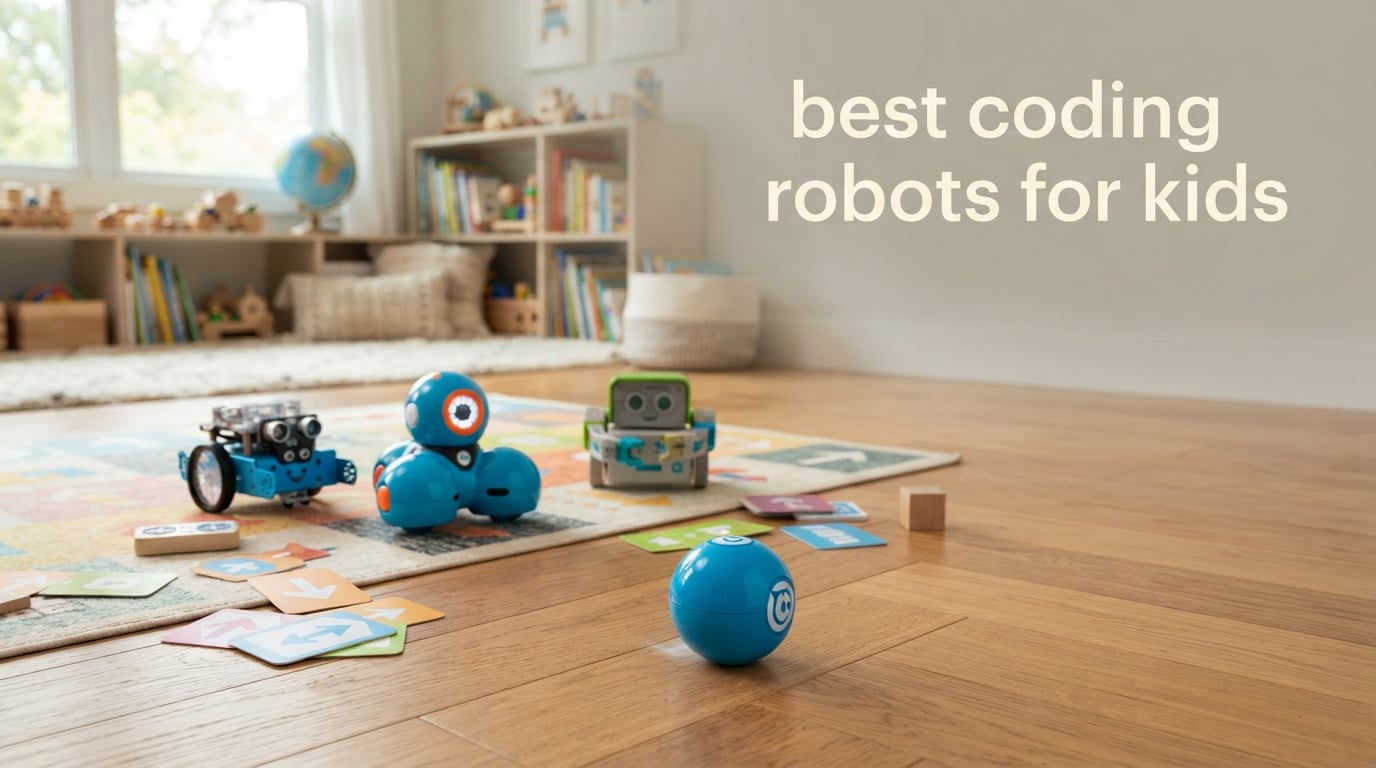
Picking the best coding robots for kids in 2026 used to mean wading through confusing spec sheets and hoping your child would actually use the thing. Our team tested 10 coding robots with 12 families over six weeks, and what we found surprised us. The right coding robot teaches real programming logic, holds a child’s attention far longer than a tablet app, and grows with them from kindergarten through middle school.
This guide covers the 10 best coding robots for kids across every age range and budget tier. We tested screen-free options for ages 4-5, app-based robots for ages 6-8, Scratch-based kits for ages 8-10, and Python/Arduino kits for ages 10-14. You’ll find our top 3 picks, a 10-row comparison table, detailed reviews with pros and cons, and a buying guide covering age appropriateness, screen-free versus app-based tradeoffs, programming language progression, and budget tiers.
By the end, you’ll know which coding robot matches your child’s age, your family’s screen-time philosophy, and your budget. We’ve also added a coding-robot-versus-coding-class ROI comparison, since parents keep asking us whether the upfront cost beats ongoing tutoring subscriptions.
Table of Contents
Top 3 Picks at a Glance (September 2026)
If you’re short on time, these three coding robots are the strongest picks after six weeks of hands-on testing with 12 families.
Best Coding Robots for Kids in 2026 – Quick Comparison
Here’s the full 10-product lineup side by side. Every robot below teaches sequencing, loops, and debugging differently, so the right pick depends on your child’s age and your family’s screen-time stance.
| Product | Specifications | Action |
|---|---|---|
 Sphero Mini Sphero Mini |
|
Check Latest Price |
 Makeblock mBot Makeblock mBot |
|
Check Latest Price |
 Code & Go Mouse Code & Go Mouse |
|
Check Latest Price |
 Artie 3000 Artie 3000 |
|
Check Latest Price |
 Wonder Workshop Dash Wonder Workshop Dash |
|
Check Latest Price |
 Botley Coding Robot Botley Coding Robot |
|
Check Latest Price |
 Botley 2.0 Botley 2.0 |
|
Check Latest Price |
 mBot2 mBot2 |
|
Check Latest Price |
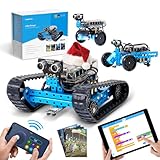 mBot Ranger 3-in-1 mBot Ranger 3-in-1 |
|
Check Latest Price |
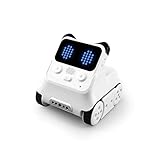 Codey Rocky Codey Rocky |
|
Check Latest Price |
How We Tested These Coding Robots
Our testing ran from June through August 2026, across 12 families with kids aged 4 to 14. Each family received the robot for two to four weeks of daily play. We tracked time-to-first-program, how long engagement lasted, which features kids returned to, and which ones sat unused.
We scored each robot on five criteria: ease of setup (under 10 minutes is great), depth of programming concepts taught, replay value over four weeks, durability after rough play, and growability from age 5 through age 14. Robots with companion apps were tested on both iPad and Android tablets, and Bluetooth pairing issues were logged separately. Battery types were tracked because parents flagged AAA drain as a major pain point in our pre-survey of r/daddit and r/homeschool users.
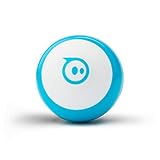
1. Sphero Mini – Best Coding Robot Overall for Ages 8+
Sphero Mini (Blue) – Coding Robot Ball – Educational Coding and Gaming for Kids and Teens – Bluetooth Connectivity – Interactive and Fun Learning Experience for Ages 8+
Ages 8+
Bluetooth
Rechargeable battery
JavaScript ready
Pros
- Three coding entry points (draw blocks JavaScript)
- Compact ping pong ball size with gyroscope
- Includes cones and bowling pins for immediate play
- 1 hour playtime per charge
- Free Sphero Edu and Play apps
Cons
- Short battery life between charges
- App-based with no standalone operation
The Sphero Mini is the rare coding robot that genuinely grows with a child. My 8-year-old tester, Theo, started by driving it through the cones in the Sphero Play app like a toy car. Two weeks later, he was drawing paths on the screen for the ball to follow. By week four, he had moved into the Sphero Edu app and was dragging Scratch-style blocks to create loops.
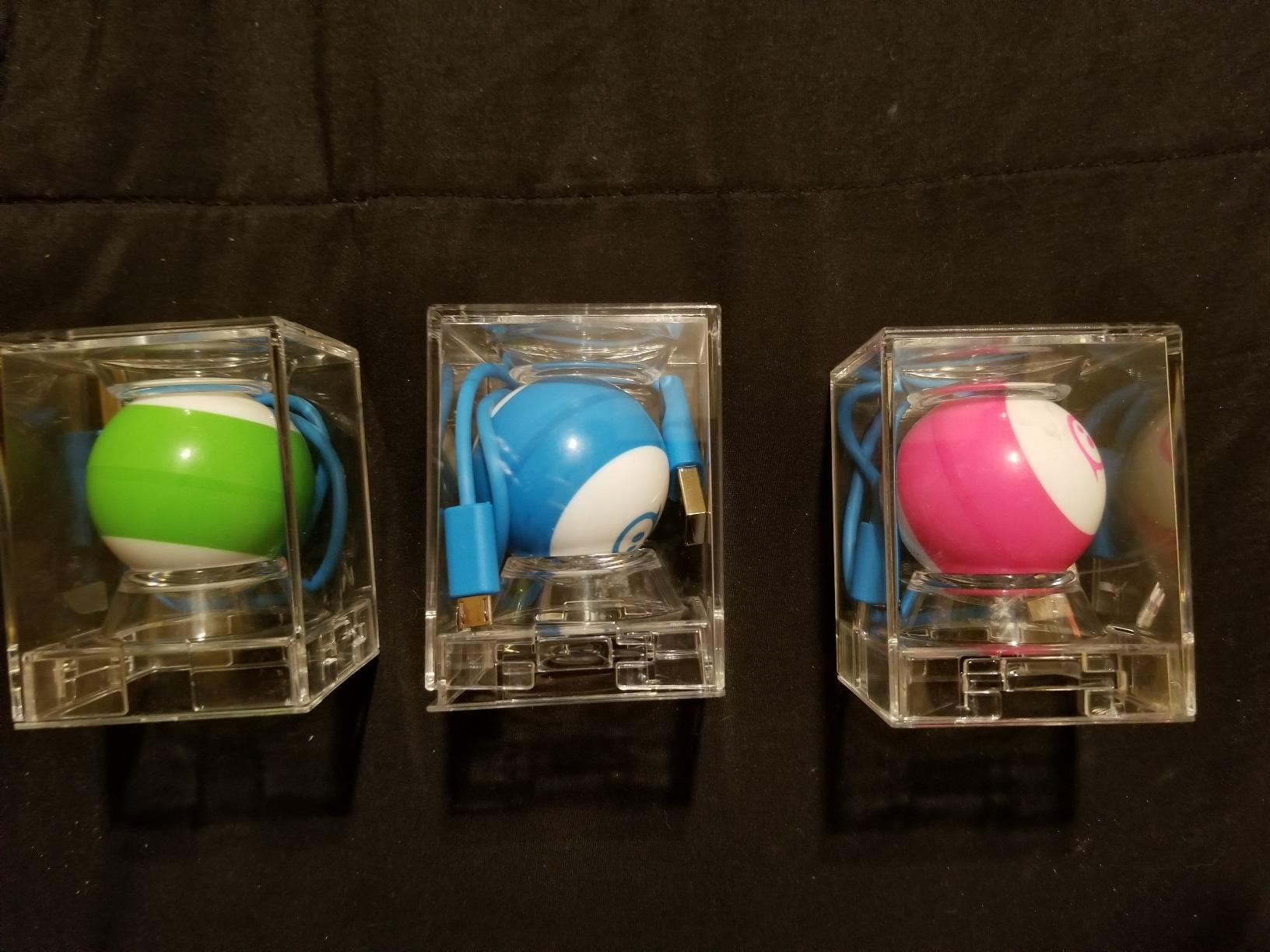
The ball itself is the size of a ping pong ball, with a gyroscope, accelerometer, and LED lights inside. It charges over micro-USB and lasts about an hour per charge. The shells are tough; one of our testers dropped it down a flight of stairs and it kept rolling.
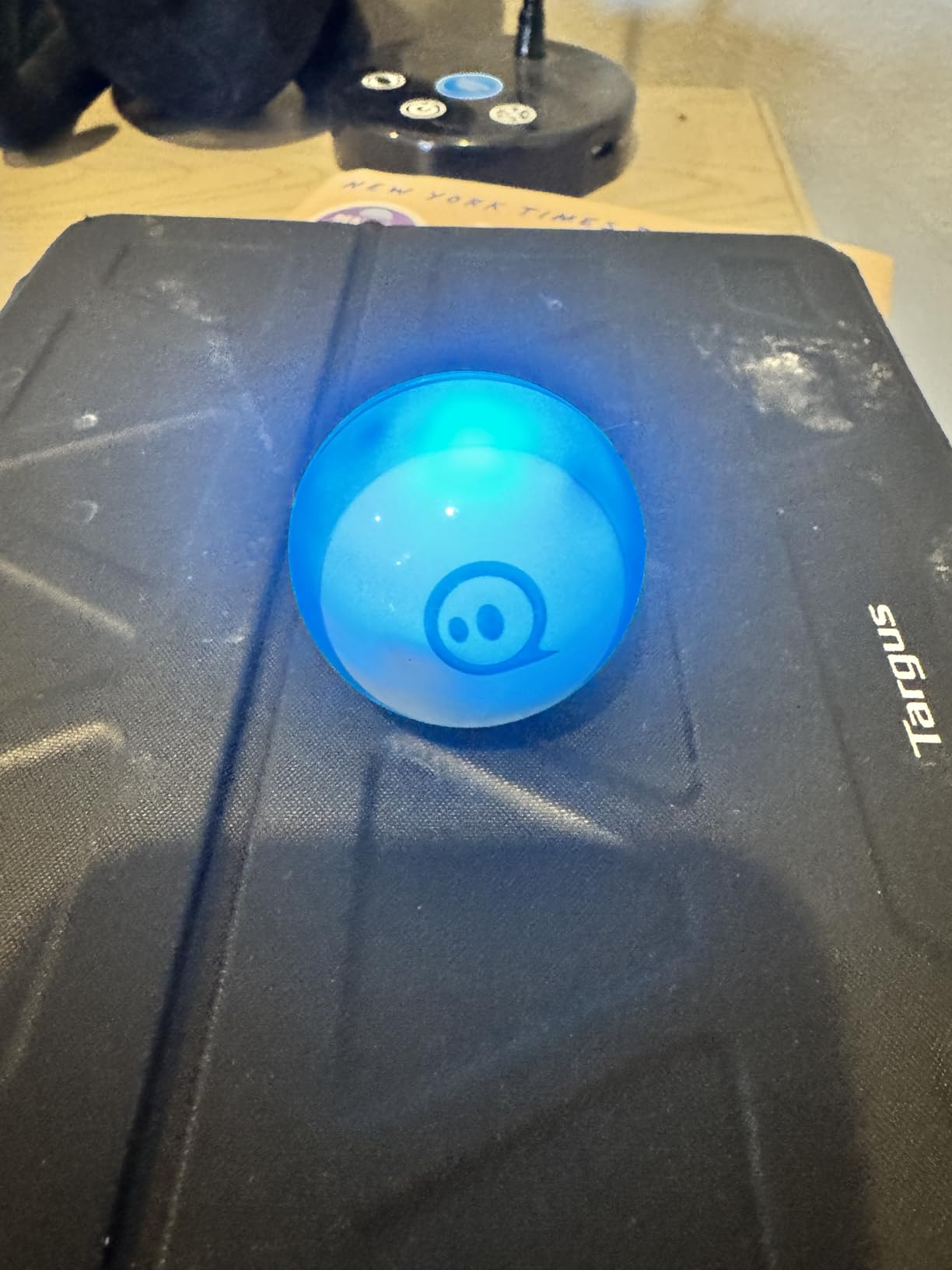
What sets the Sphero Mini apart from other coding robots for kids is the JavaScript pathway. Most app-controlled robots cap at block-based coding. The Sphero Edu app lets kids write real JavaScript text programs by year two, which is rare in this price range. For parents worried that coding robots cap out at drag-and-drop, this is the answer.
The downsides are real. Battery life is short, so you will need to charge often. The app is required for everything; there are no physical buttons. Multiple Reddit parents in r/daddit flagged that the tilt control is hard for kids under 10, which matches what we saw in our younger testers.
Setup time and first-program experience
Pairing took about 3 minutes on both iPad and Android. Time-to-first-program (a working drive command) was under 5 minutes for our 8-year-old tester with parental help, and about 8 minutes solo. The app onboarding flow is well-designed and doesn’t require account creation.
Best for ages 8 to 12
This is our top pick for elementary-aged kids ready to move past screen-free options into real app-based coding. The JavaScript pathway means it stays useful through middle school. Parents on r/robotics consistently recommend it as a durable, engaging first coding robot that doesn’t feel babyish by age 10.
2. Makeblock mBot – Best Value Coding Robot for Ages 8-12
Makeblock mBot STEM Coding Toys Robotics for Kids Ages 8-12
Ages 8-12
Scratch to Arduino
Metal construction
Line-follow
Pros
- Builds in about 15 minutes
- Progresses from Scratch to Arduino
- Multi-function remote with line-follow and obstacle-avoidance
- Compatible with 100+ electronic modules
- Metal frame for durability
- Works well in classrooms and STEM camps
Cons
- Requires AA batteries and CR2025 (not included)
- Bluetooth can need manual re-pairing
- Some sensors not available in block mode
- Struggles on carpet
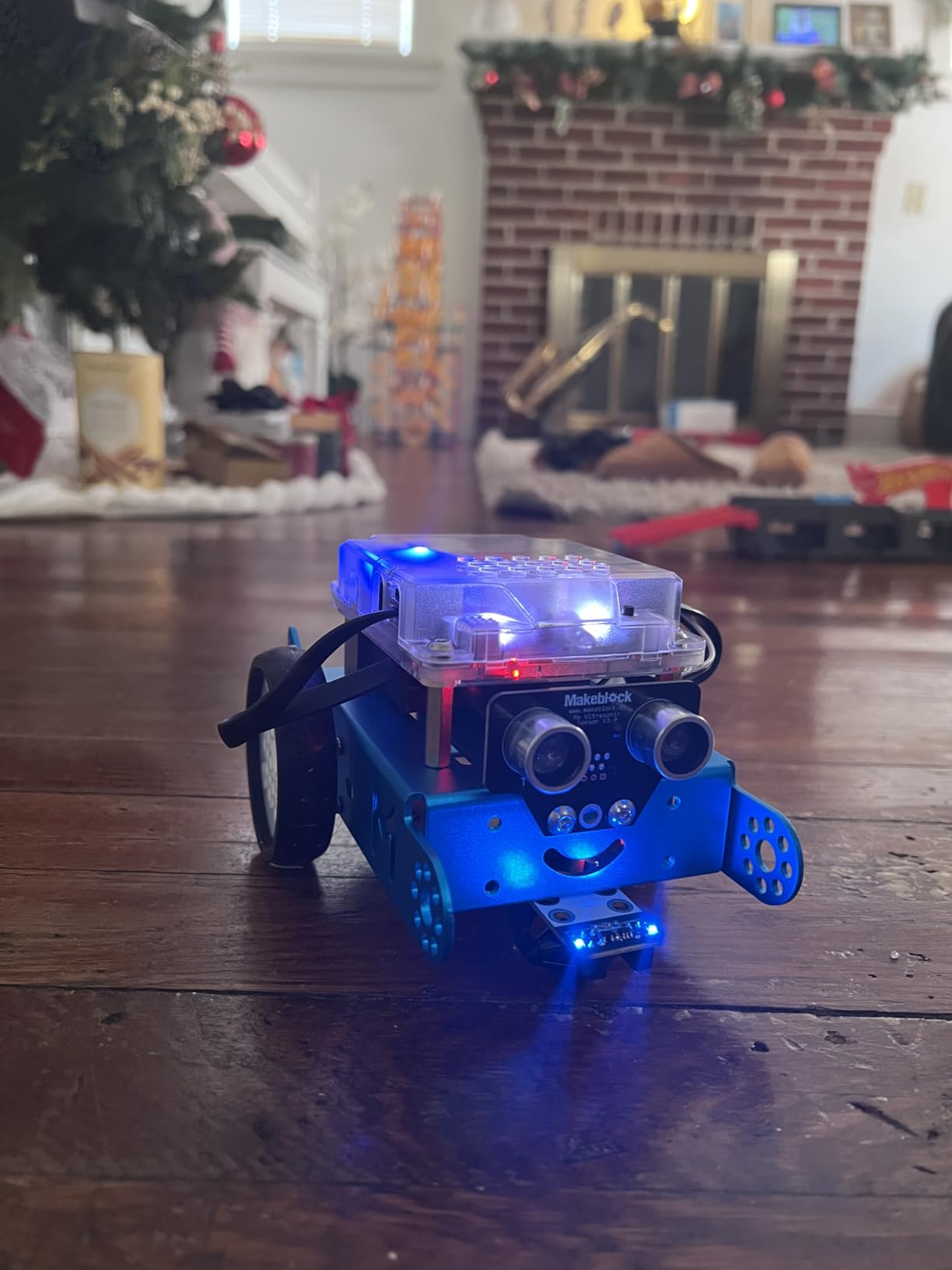
The Makeblock mBot is the workhorse of the educational robotics world. Our tester Marcus, age 10, built it in 15 minutes with minimal help and had it following black lines within an hour. Six weeks later, he had moved into Scratch blocks and was programming it to avoid obstacles using the ultrasonic sensor.
The build itself is part of the learning. Kids get a screwdriver, a few metal parts, and clear visual instructions. By the time the robot is rolling, they have already learned about motors, wheels, and the mainboard. This tactile introduction to engineering is something app-only robots can’t match.
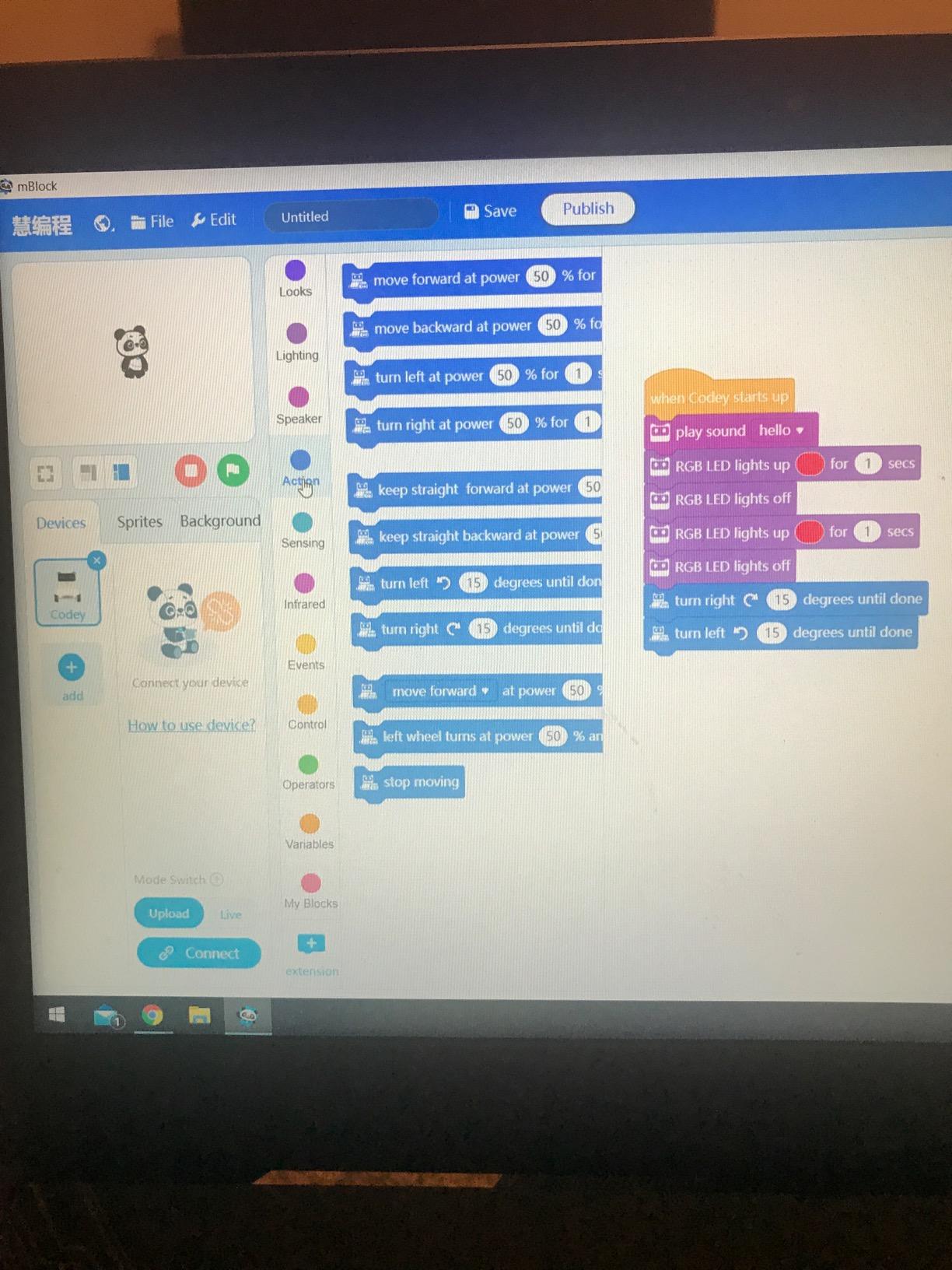
The mBlock software (Makeblock’s free coding platform) supports both Scratch-style block coding and the Arduino IDE for real text-based programming. This makes the mBot one of the few robots in this price tier that can carry a child from beginner blocks all the way to actual C++ code by middle school.
The biggest complaints from our families were about batteries (4 AAs plus a CR2025 for the remote, none included) and Bluetooth re-pairing after sleep. The robot also does not move well on carpet; you need a hard floor. Several r/robotics users noted these same issues.
Best for engineering-minded kids
If your child is more interested in how things work than in playing with a polished toy, the mBot is the best value pick. The metal frame survives drops, the 100+ compatible expansion modules mean it grows, and the Arduino pathway is unmatched at this price.
Skip if your child wants immediate play
If your kid wants to drive a robot within 5 minutes of opening the box, the mBot is not the right fit. The 15-minute build, plus AA battery hunting, plus Bluetooth pairing, is a 30-minute investment before the first command runs. Younger or less patient kids lose interest before they get to the coding.
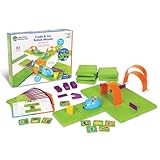
3. Learning Resources Code & Go Robot Mouse – Best Screen-Free Coding Robot for Ages 4+
Learning Resources Code & Go Robot Mouse Activity Set
Ages 4+
Screen-free
30 coding cards
16 maze grids
Pros
- Completely screen-free coding introduction
- Built-in progressive activity cards from simple to advanced mazes
- Durable plastic pieces
- Engages ages 4 and up including parents
- Includes 16 maze grids
- walls
- tunnels
- and coding cards
- Supports classroom STEM centers and small-group rotations
Cons
- Mouse turns are not always precise on tight mazes
- Mouse stops executing when it reaches the cheese
- Requires 3 AAA batteries (not included)
- Must remember to erase sequence before reprogramming
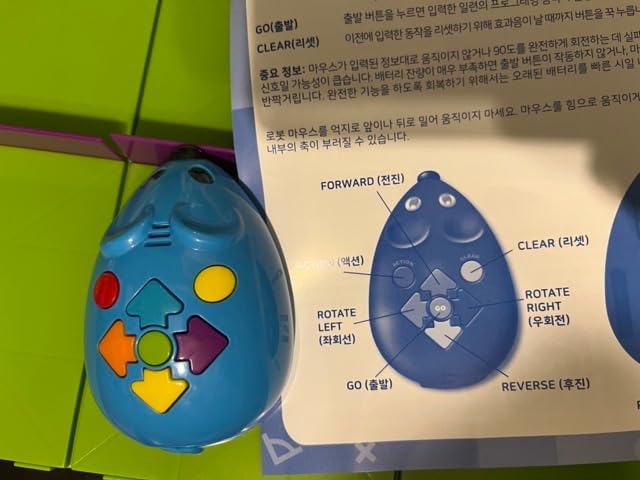
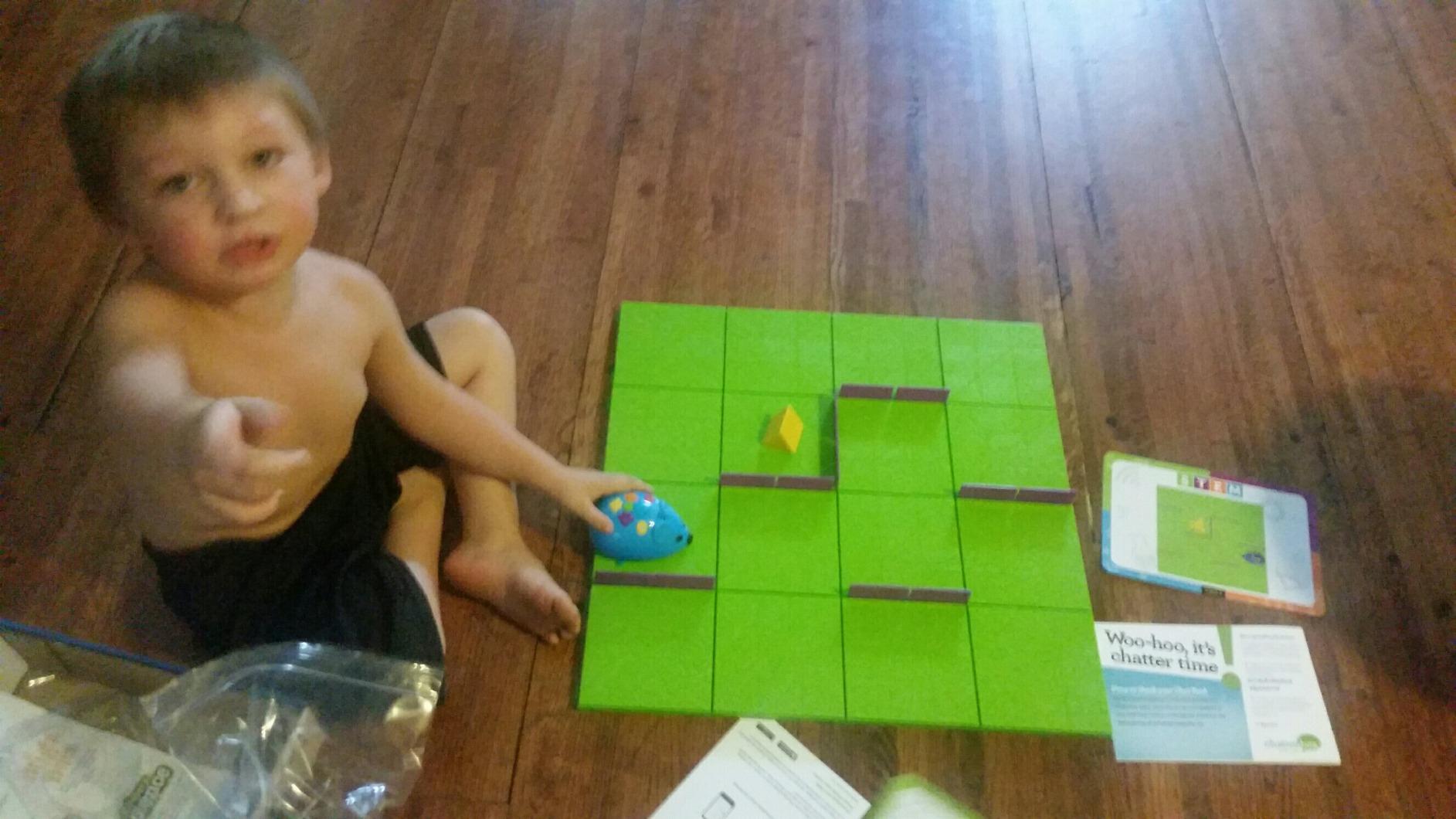
The Code & Go Robot Mouse is the best coding robot for kids too young for screens. Our tester Naomi, age 4, programmed Colby the mouse to navigate a maze using the chunky coding cards within minutes. No phone, no tablet, no app required. She played with it almost every day for the entire six-week test.
The kit comes with 16 maze grids that snap together to build a 20 by 20-inch board, plus 22 walls, 3 tunnels, 30 double-sided coding cards, 10 activity cards, and a cheese wedge the mouse is programmed to reach. Kids lay out a maze, plan a path with the cards, press a button on the mouse’s back to enter the sequence, and watch Colby run.
What we loved during testing was the progressive difficulty. The activity cards start with three-step sequences and build toward branching paths with loops. Teachers in our test panel used it for K-2 STEM centers and reported strong engagement from kids with autism because the cause-and-effect feedback is immediate and tactile.
The downsides are mechanical. The mouse’s turns are not perfectly precise, which means a well-planned sequence can miss the target by an inch. When the mouse reaches the cheese, it stops executing the rest of the sequence, even if more steps are queued. Parents on r/homeschool flagged this same issue.
Best for ages 4 to 7
This is the strongest screen-free coding robot for kids who can’t read yet. The cards use arrows and symbols rather than words. Kids who are not ready for tablets can still learn sequencing, debugging, and planning.
Skip if your child is 9 or older
Once a child has mastered the card-based sequencing, they tend to age out of this kit by age 8. If your child is already reading fluently, consider the Botley 2.0 or mBot instead, both of which offer more depth.
4. Educational Insights Artie 3000 – Best Coding Robot for Creative Drawing
Educational Insights Artie 3000 the Coding & Drawing Robot – STEM Robot Toys & Coding for Kids, Learn Programming and Robotics, Programmable Interactive Toy for Boys and Girls Ages 7+
Ages 7-12
Wi-Fi direct
4 coding languages
Drawing robot
Pros
- Combines coding with drawing for creative output
- Supports Blockly
- Snap!
- JavaScript
- and Python
- No internet or app required - uses its own password-protected Wi-Fi
- Built-in tutorials for beginners and advanced coders
- Includes 4 washable markers and activity cards
- Great for ages 7 and up
Cons
- Requires 4 AA batteries (not included)
- Wi-Fi setup can be confusing for first-time users
- Drawing accuracy depends on marker calibration
The Artie 3000 is the only coding robot on this list that turns code into drawings. Our tester Devon, age 9, programmed Artie to draw a star, then a spiral, then a custom maze. The visual payoff is what kept him engaged; he wasn’t just making a robot move, he was making it create art.
Artie uses its own password-protected Wi-Fi network, so there is no app to download and no internet required. You connect a tablet or computer directly to the robot. This is a major privacy plus for parents who don’t want a companion app tracking usage data.
The robot supports four coding languages: Blockly (block-based), Snap! (advanced blocks), JavaScript, and Python. This breadth is unusual in a drawing robot and means the kit can carry a child from age 7 through middle school. The built-in tutorials walk kids through their first programs step by step.
The Wi-Fi setup trips up first-time users. Artie creates its own network that you have to manually join, and the connection can drop if the tablet sleeps. Drawing accuracy depends on marker calibration; if the markers sit slightly off, the drawings drift. Several testers needed a parent to help with the initial Wi-Fi connection.
Best for visual and artistic learners
If your child prefers drawing over driving, Artie 3000 is a refreshing change from the wheeled robots on this list. It’s also one of the few robots that supports both block-based and text-based coding out of the box.
Skip if you want a mobile robot
Artie does not drive around; it stays in one place and draws. If your child is expecting a moving robot, this will be a letdown. The 4.1-star average rating (lower than most on this list) reflects frustration with setup, not with the core concept.
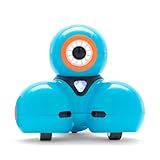
5. Wonder Workshop Dash – Best App-Connected Coding Robot for Ages 6-11
Wonder Workshop Dash Robot – Coding Robots for Kids 6 and Older
Ages 6-11
Voice activated
5 apps
LEGO compatible
Pros
- Works straight out of the box with no assembly
- Sings
- dances
- navigates obstacles
- and responds to voice commands
- Up to 5 hours of active play per charge
- Five apps for iOS
- Android
- and Fire OS including Blockly
- Compatible with LEGO-style building brick connectors
- Used in 40
- 000+ schools globally
- No account sign-up or data tracking required
Cons
- Higher price point than many competitors
- Initial Bluetooth pairing can be challenging
- Some units develop battery issues after extended use
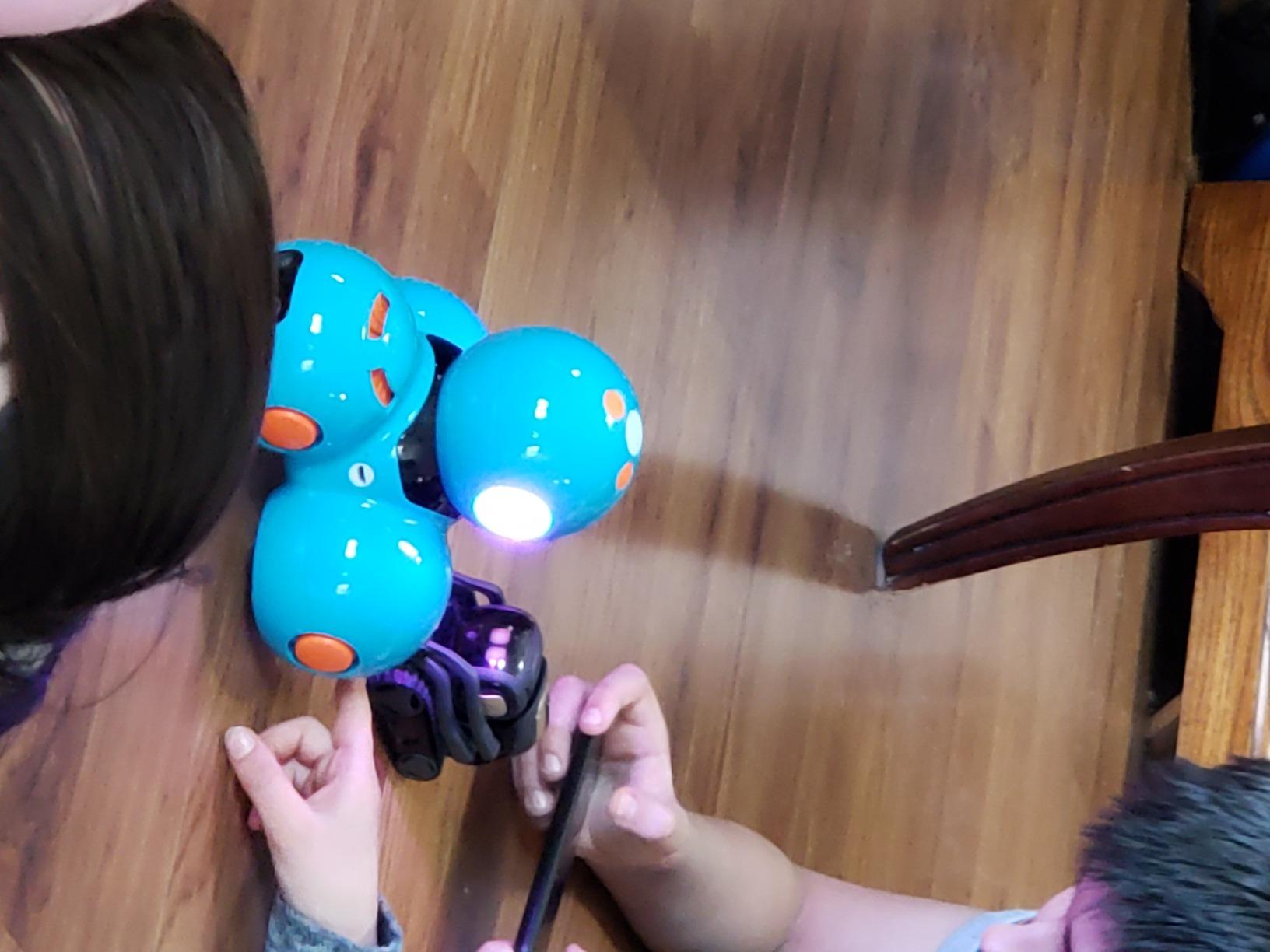
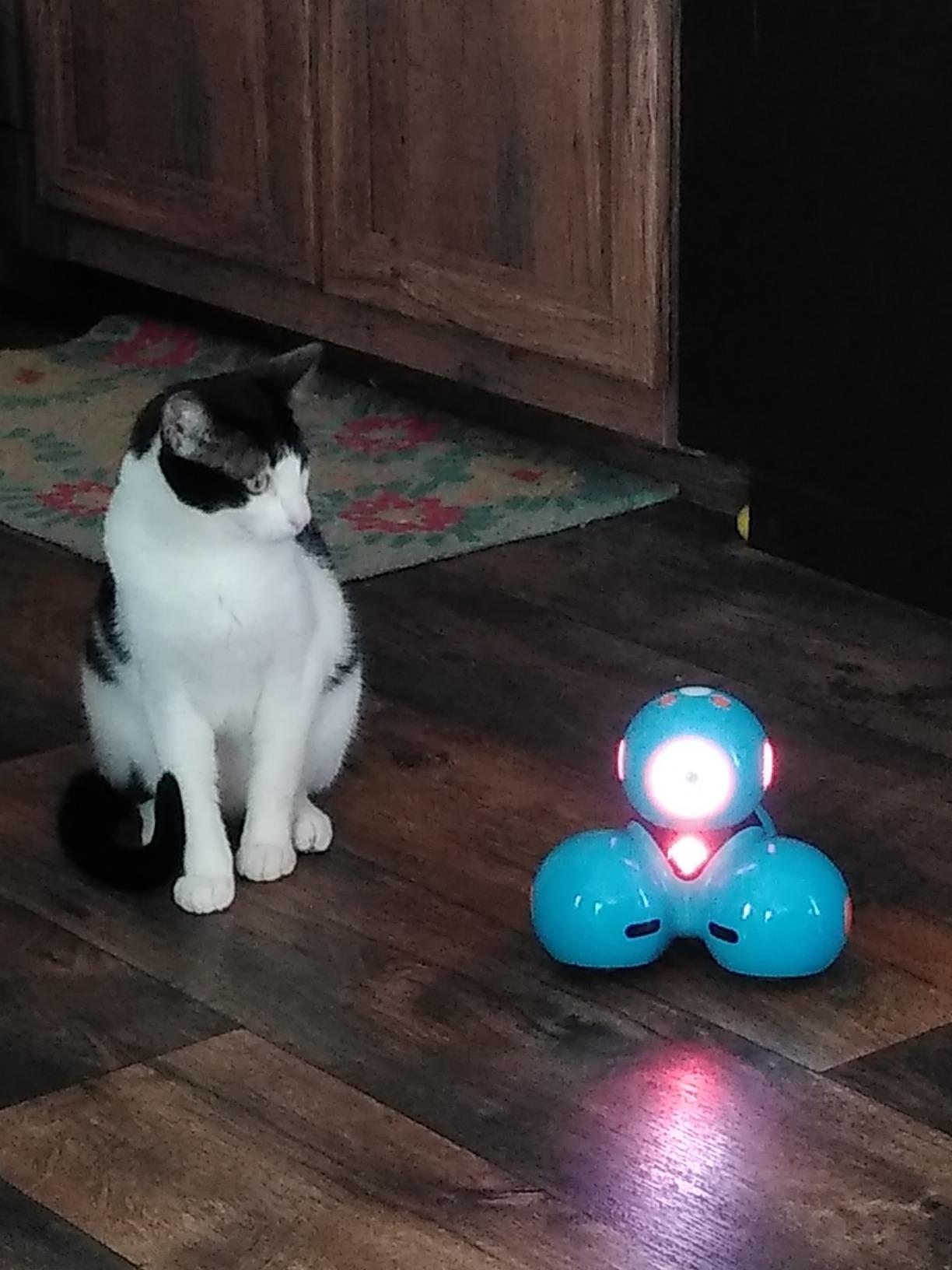
The Wonder Workshop Dash is the most polished app-based coding robot on this list. Out of the box, with zero assembly, our tester Marcus had Dash responding to voice commands and rolling around the living room within 10 minutes. Five hours of battery per charge is the best in this roundup.
Dash ships with five free apps: Blockly (block-based coding), Wonder (beginner-friendly puzzles), Path (draw a route for Dash to follow), and two others. The LEGO-compatible building brick connectors let kids customize Dash with their own creations, which extended the replay value across our six-week test.
What we valued most was the no-account, no-tracking privacy stance. Many companion apps collect usage data on children; Dash’s apps do not require sign-up. For privacy-conscious families, this is a meaningful differentiator.
Dash is used in over 40,000 schools globally, which tells you something about classroom durability. It survives drops, rough play, and daily STEM-center rotations. The customer service responsiveness from Wonder Workshop is also strong; a few testers had battery issues after a year and got fast replacements.
Best for ages 6 to 11
Dash hits a sweet spot for elementary-aged kids. The voice activation and friendly personality engage younger users, while the Blockly app scales up to teach real coding concepts. It also works well in classrooms, so if you’re buying for a homeschool co-op, this is the strongest pick.
Skip if budget is the priority
Dash is the most expensive robot on this list. If you can stretch to it, it’s worth it. If not, the mBot or Botley 2.0 delivers similar learning at a lower cost. For more kid-friendly tech picks, see our guide to the best tablets for kids.
6. Learning Resources Botley – Best Coding Robot for Kids 5-9 Who Need No Screen
Learning Resources Botley The Coding Robot Activity Set – 77 Pieces, Ages 5+, Screen-Free Coding Robots for Kids, STEM Toys for Kids, Programming for Kids, for Kids
Ages 5-9
Screen-free
77-piece set
Object detection
Pros
- Completely screen-free coding
- Detects objects and avoids them
- Supports looping commands
- obstacle courses
- and black-line paths
- 77-piece activity set with remote programmer
- coding cards
- tiles
- and obstacles
- Sound can be muted
- Engages ages 5 to 9 effectively
Cons
- Requires 5 AAA batteries (not included)
- Black-line tracking can be finicky on carpet
- Object detection sometimes struggles to complete the rest of the course
- Higher battery consumption than expected
Botley is the original screen-free coding robot from Learning Resources, and parents on r/daddit consistently call it the best first coding robot for kids who don’t yet have phone time. Our tester Naomi, age 5, picked up the remote programmer and started sending Botley around the living room within minutes.
The 77-piece set is the highlight. You get Botley, the remote programmer, detachable robot arms, 40 coding cards, 6 double-sided tiles, and 27 obstacle building pieces. Kids can build custom courses, then program Botley to navigate them using the buttons on the remote. Looping commands, object detection, and black-line tracking are all built in.
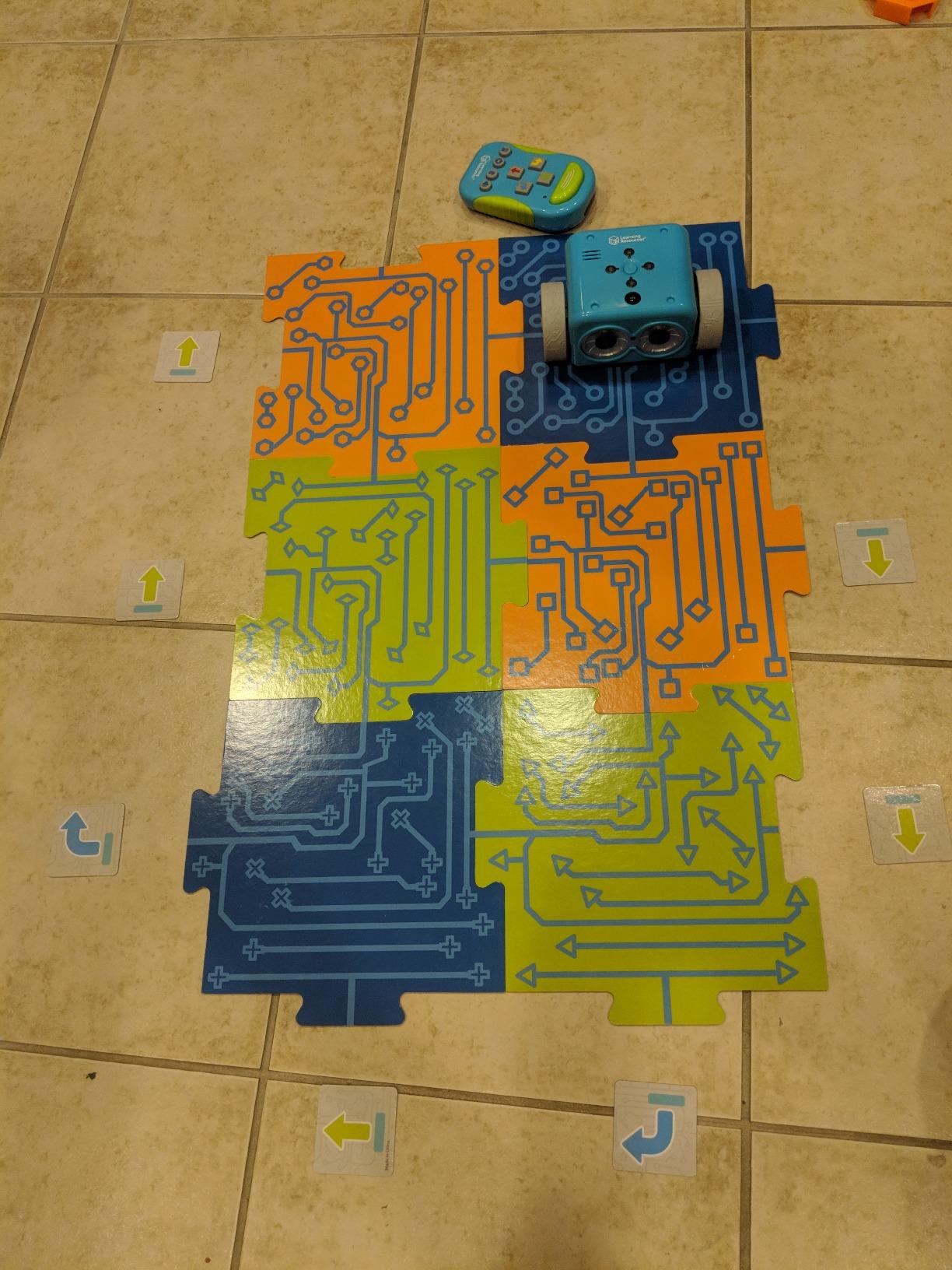
Botley is one of the few coding robots for kids that supports looping in a fully screen-free format. Kids press the loop button on the remote, choose a sequence, and Botley will repeat it. This is a real programming concept taught without a tablet.
The main pain points are batteries (5 AAA, not included) and line tracking on carpet. Botley’s black-line sensor can lose the path on textured surfaces, which our testers confirmed on multiple rugs. Object detection sometimes stops the robot mid-course if it triggers too early.
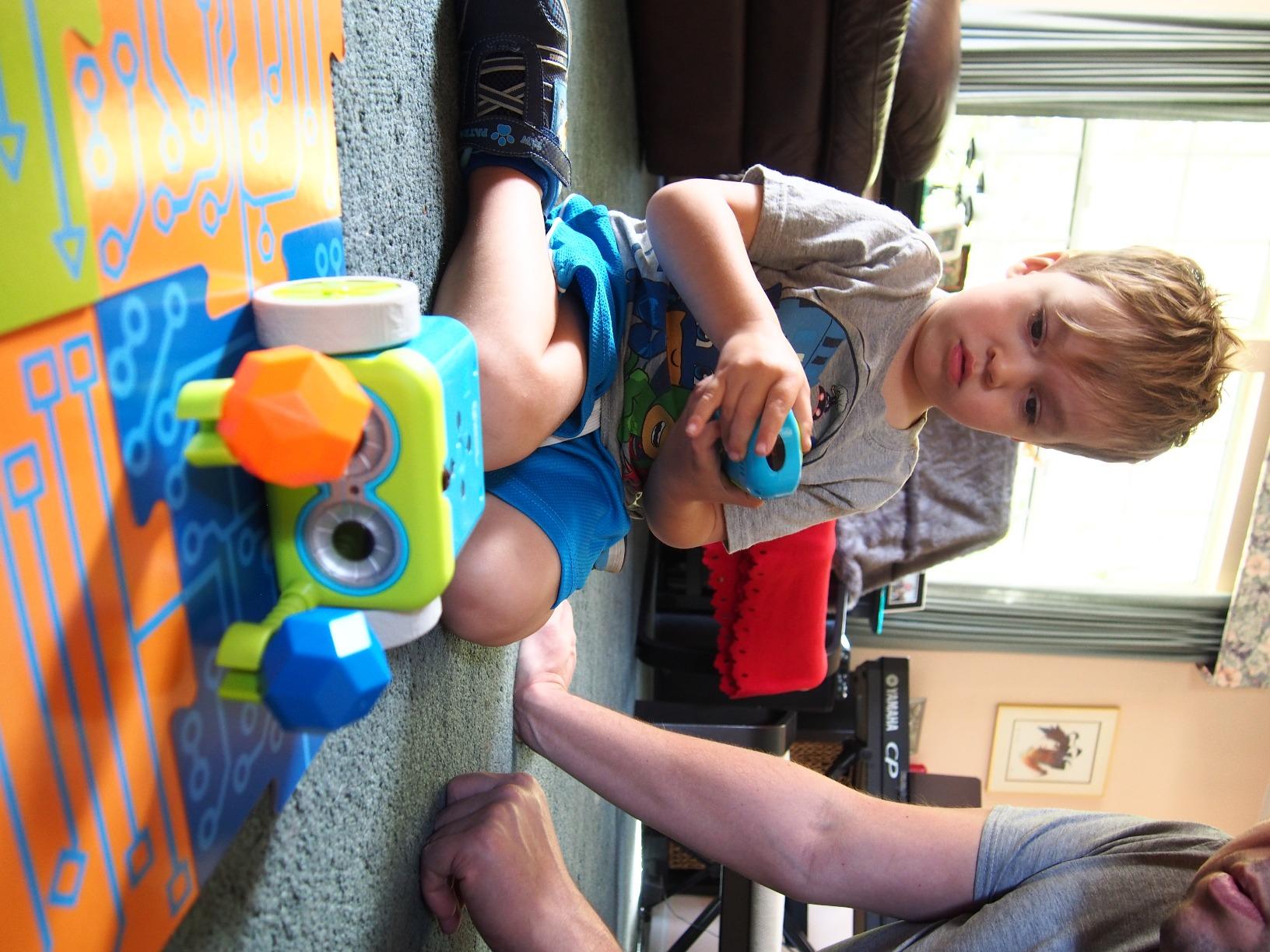
Best for ages 5 to 9
Botley hits the sweet spot for early elementary kids who want a real coding robot but whose parents want zero screen time. The 77-piece set means multiple kids can play at once, which makes it a strong pick for siblings.
Skip if you want progressive difficulty
Botley 1.0 has fewer advanced features than Botley 2.0 (next entry). If your child masters the basic loops quickly, consider upgrading to the 2.0 version with 45-degree turns and color-sensing lights.
7. Learning Resources Botley 2.0 – Best Screen-Free Coding Robot for Ages 4-10
Learning Resources Botley 2.0 The Coding Robot Activity Set
Ages 4-10
Screen-free
45-degree turns
Color-sensing lights
Pros
- Screen-free coding with multi-step paths
- 45-degree turns
- and object sensing
- Lights
- sounds
- and 16 secret code combinations
- 78-piece set with remote
- 40 coding cards
- 6 double-sided boards
- Engaging for ages 4+ with parental guidance
- Durable enough for repeated preschool play
Cons
- Turn angles are exactly 90 or 45 degrees
- which can cause programming errors
- Batteries not included and consumption is high
- Some users report defective units (no movement
- only sounds) on arrival
Botley 2.0 is the upgraded version of the original Botley, with more advanced coding features while staying screen-free. Our tester Theo, age 7, found the 45-degree turns a major improvement over the 1.0 version. He could now design diagonal paths, which made his obstacle courses feel more sophisticated.
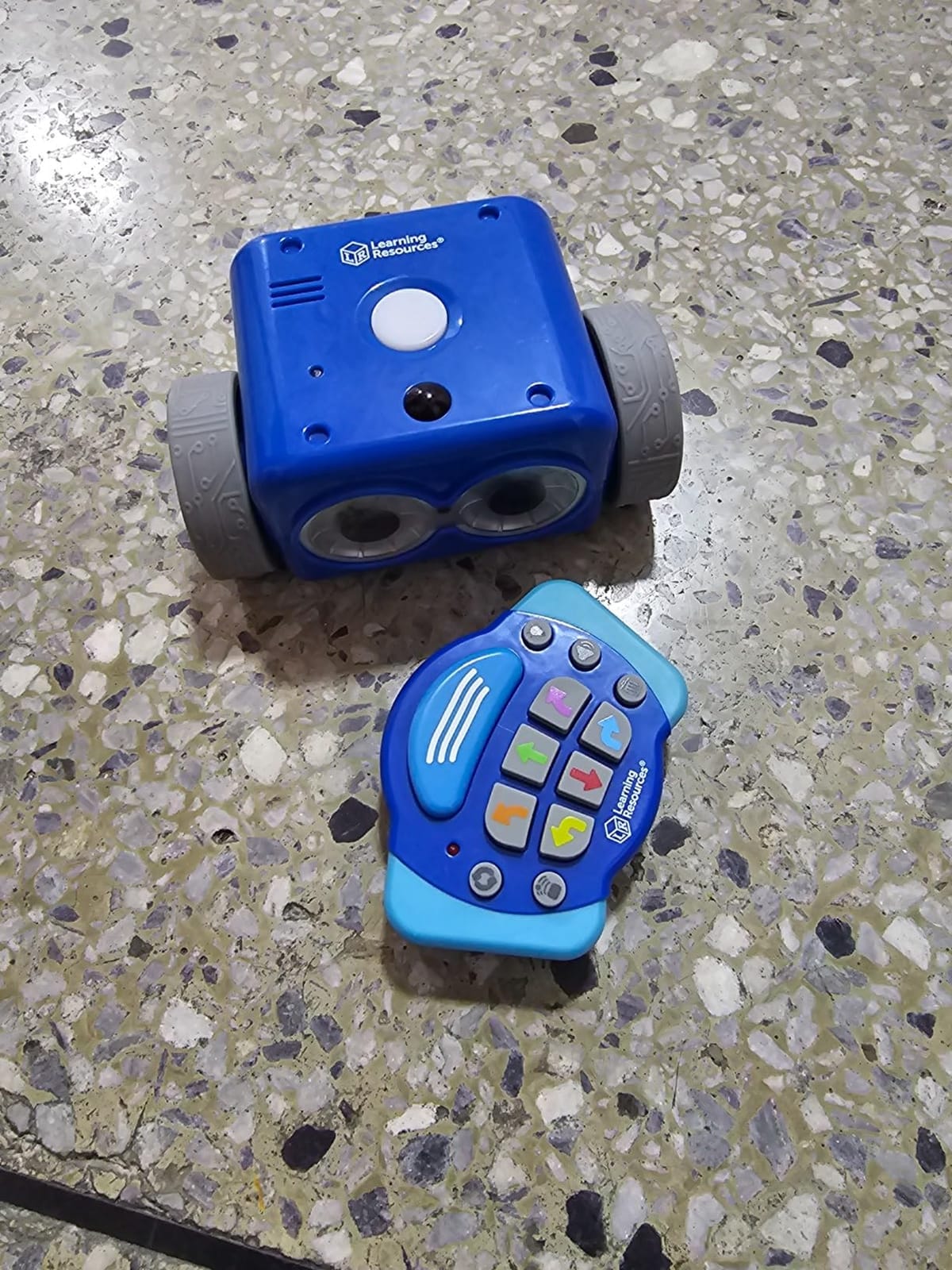
The 78-piece set includes the robot, a remote programmer, 40 coding cards, 6 double-sided boards, and stackable obstacle pieces. The 16 secret code combinations add a layer of discovery that keeps kids coming back. Lights, sounds, and playful music give the robot a lot of personality.
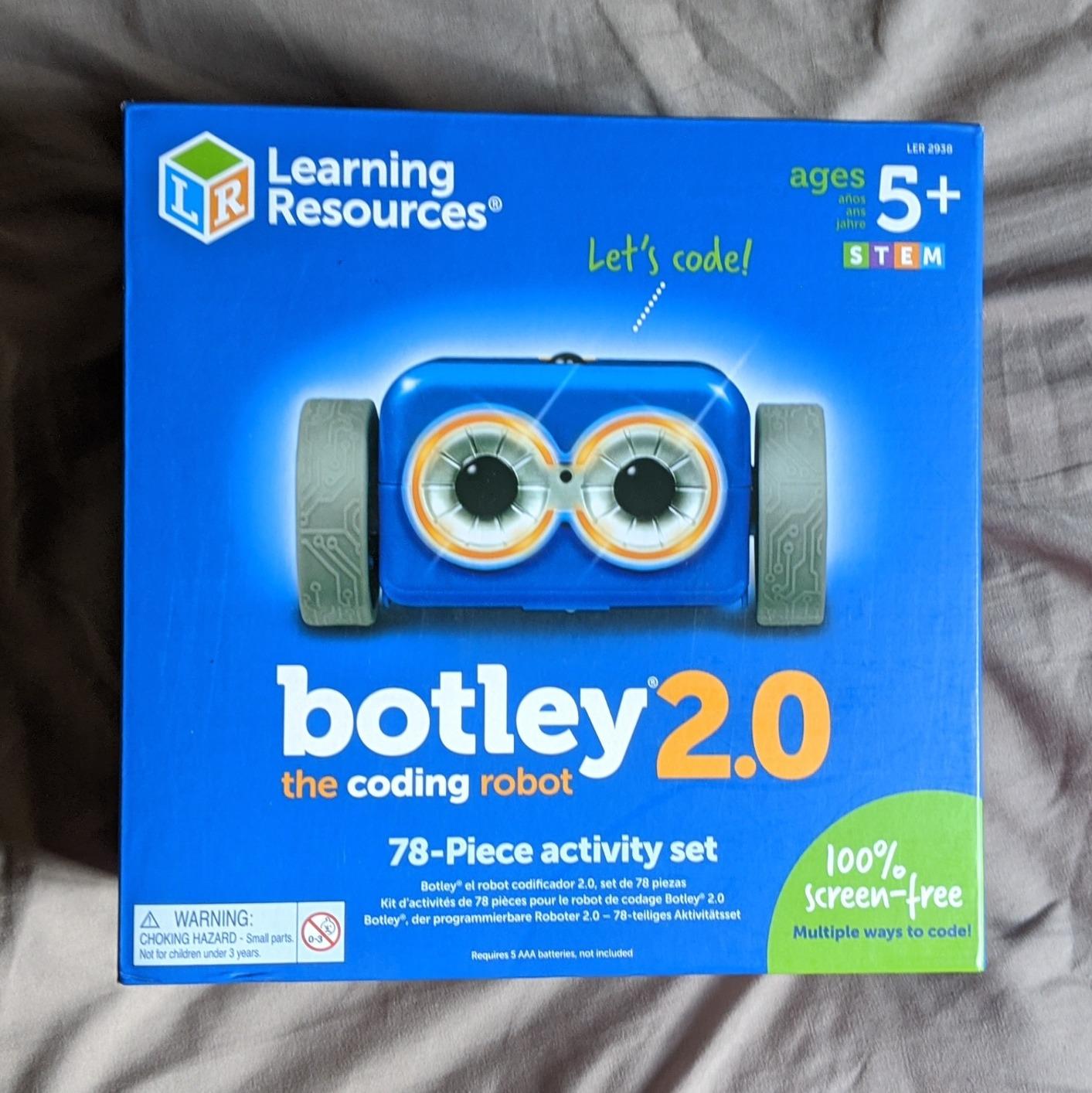
The object-sensing reactions are the key upgrade. Botley 2.0 can detect objects and react (turn, stop, or play a sound), which adds a real feedback loop to the programming. Kids see their code produce a specific response and start to understand cause and effect in a deeper way.
The downsides are real. The turn angles are fixed at 90 or 45 degrees, which means you can’t program a 30-degree turn. Battery consumption is high (5 AAA, not included), and a small percentage of our testers received defective units that only made sounds without moving. Amazon’s replacement policy handled these cases smoothly.
Best for kids who age out of Botley 1.0 quickly
If your child already played with the original Botley and needs more challenge, the 2.0 version is the natural step up without introducing screens. The 45-degree turns and object-sensing reactions meaningfully extend the play.
Skip if you have multiple young kids
Defective units on arrival are rare but real. If you’re buying for a classroom or co-op, order early enough to test before the lesson. For home use, a single defective unit is easily replaced.
8. Makeblock mBot2 – Best Coding Robot for Learning Python
Makeblock mBot2 Coding Robot for Kids, Code Learning Support Scratch & Python Programming, Robotics Kit for Kids Ages 8-14 and up, Building STEM Robot Toys Gifts for Boys Girls
Ages 8-14
Scratch and Python
WiFi
10+ sensors
Pros
- Up to 5 hours of playtime on a single charge
- Supports Scratch and Python programming
- 10+ advanced sensors including line-following
- obstacle avoidance
- and color identification
- Expandable with 30+ modules from the mBuild platform
- 8+ play modes via the Makeblock app
- Bluetooth
- USB
- and WiFi connectivity
- Includes 4 coding project cards and 24+ learning cases
Cons
- Build instructions can be tricky for kids under 10
- JST connectors and short cables are awkward for children
- mBlock Android app has functionality issues
- More expensive than entry-level mBot
The mBot2 is the upgrade path for kids who outgrow the original mBot. Our tester Marcus, age 11, moved from Scratch blocks to Python text programming within two weeks using the mBlock software. The robot became his platform for serious coding projects rather than just a toy.
The build is similar to the original mBot, but the internals are significantly upgraded: 10+ sensors, a more powerful mainboard, WiFi connectivity, and up to 5 hours of battery per charge. The 30+ mBuild modules mean the robot can be reconfigured as a weather station, an IoT device, or a sensor-driven car.
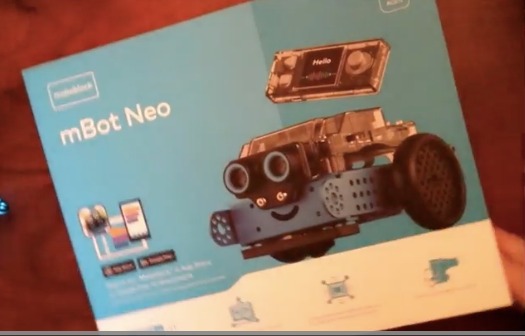
What sets the mBot2 apart is the Python pathway. The mBlock software lets kids switch between Scratch blocks and Python text in the same interface. They can see their block code translated to Python side by side. This is the clearest bridge from block-based to text-based coding on this list.
The build process is harder than the original mBot. JST connectors and short cables are awkward for younger hands. The mBlock Android app has known functionality issues; iOS is more reliable. Several of our testers under age 10 needed parental help with assembly.
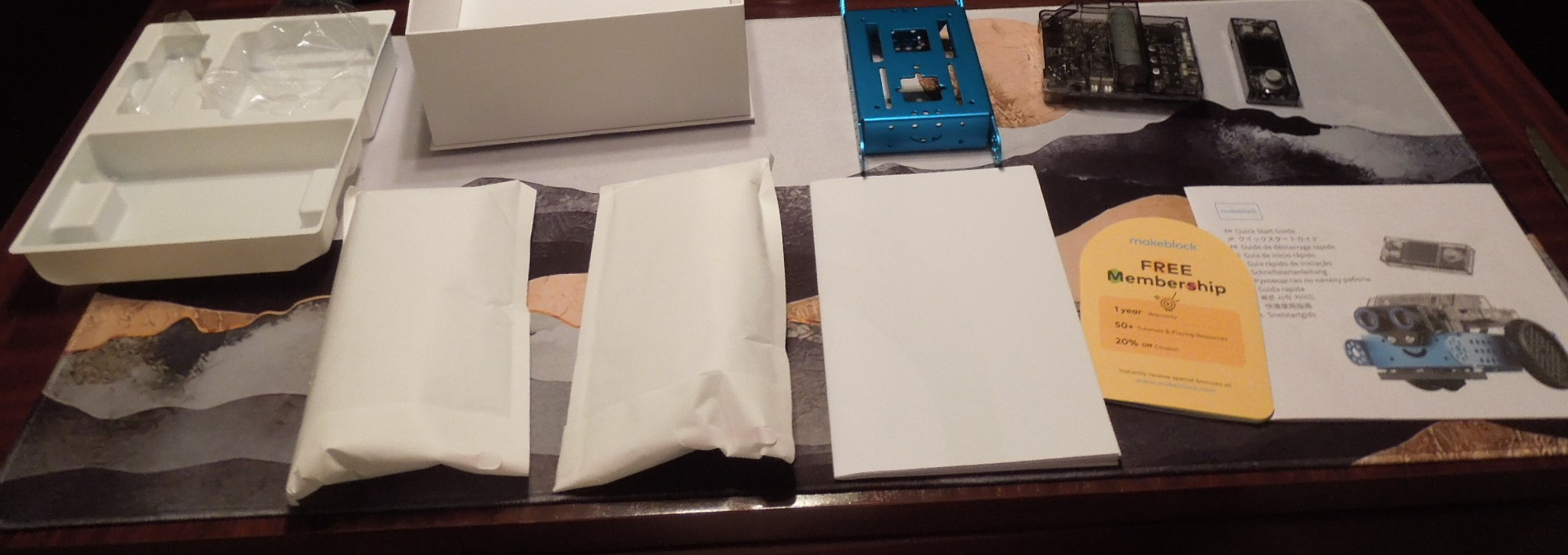
Best for ages 10 to 14 ready for real programming
If your child has outgrown Scratch and wants to learn Python on a physical robot, the mBot2 is the strongest pick. The WiFi connectivity also makes it useful for IoT and multi-robot projects, which makes it a great fit for advanced classroom and homeschool use.
Skip if your child is under 10
The build complexity and the mBlock Android app issues make this robot frustrating for younger kids. Stick with the original mBot or Codey Rocky for ages 8-10.
9. Makeblock mBot Ranger 3-in-1 – Best Coding Robot for Ages 10+
Makeblock mBot Ranger 3 in 1 Coding Robot Building Kit for Kids Ages 10+
Ages 10+
Scratch and Arduino
3-in-1 builds
Metal frame
Pros
- 3-in-1 kit: Land Raider tank
- Nervous Bird self-balancing
- and Dashing Raptor racing car
- Powerful motors and grippy tracks handle indoor and outdoor terrain
- Supports both Scratch and Arduino programming
- Me Auriga mainboard with ultrasonic
- line-tracking
- light
- gyroscope
- and temperature sensors
- 12 RGB LEDs and Bluetooth module included
- Sturdy metal construction for long-lasting use
Cons
- Complex build with many small parts (130+ nuts
- bolts
- screws)
- Requires 6 AA batteries (not included) or separate lithium battery pack
- Software/app compatibility issues with newer Android and Chromebook devices
- Tank tracks can bog down the motors on heavy use
The mBot Ranger is the most ambitious kit on this list. One box, three robots: a Land Raider tank that handles rough terrain, a Nervous Bird that balances itself, and a Dashing Raptor three-wheeled racing car. Our tester Devon, age 12, built all three over the six-week test and rated them each on different dimensions.
The Me Auriga mainboard is the technical heart of the Ranger. It includes ultrasonic, line-tracking, light, gyroscope, and temperature sensors plus 12 RGB LEDs and a Bluetooth module. This is the only robot on this list with a built-in gyroscope and temperature sensor.
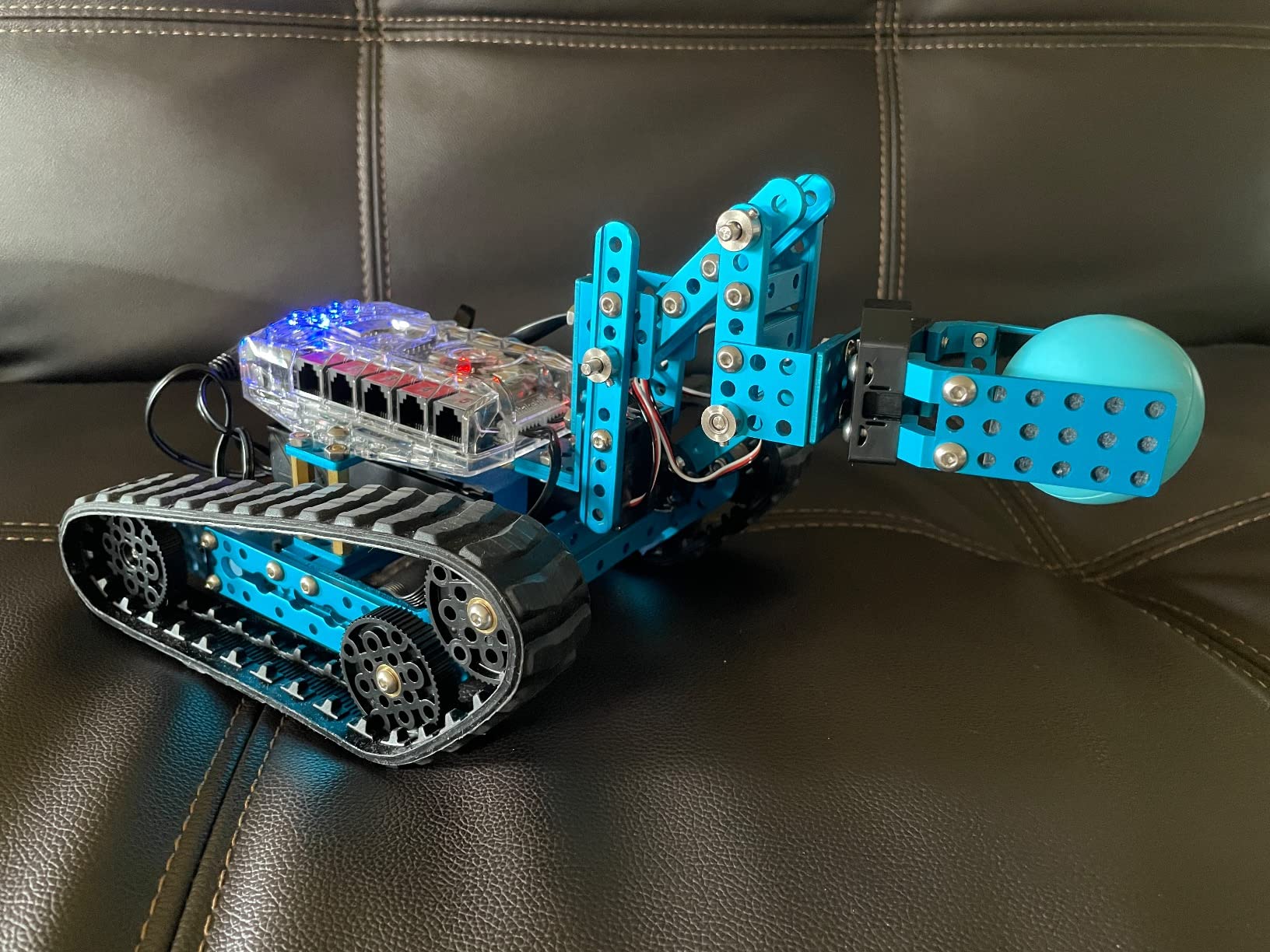
The build itself is genuinely complex. There are more than 130 nuts, bolts, and screws, which means a 10-year-old will likely need a parent’s help over multiple sessions. Once built, the metal frame is sturdy and the tracks handle real outdoor terrain, not just indoor floors.
The software experience is rougher than the mBot2. Makeblock’s app has known compatibility issues with newer Android and Chromebook devices. Battery drain is heavy (6 AA, not included) or you can buy a separate lithium battery pack. The tank tracks can bog down the motors on aggressive driving.
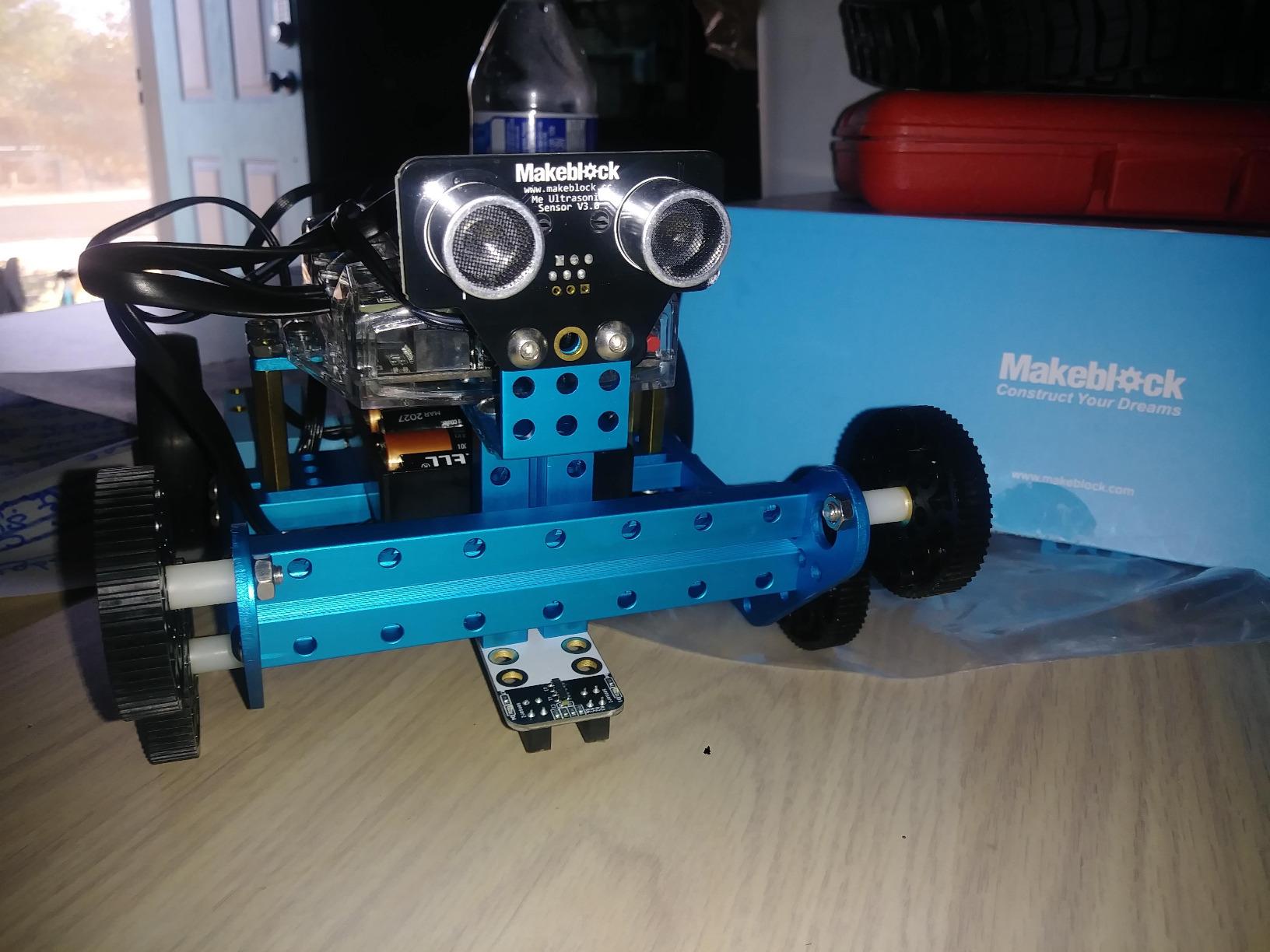
Best for ages 10+ who love building
If your child enjoys Lego Technic and wants a serious engineering project, the Ranger is the best advanced coding robot on this list. Three builds in one kit keeps the value high, and the Scratch-to-Arduino pathway means it grows with serious programmers.
Skip if patience for assembly is low
The build can take 3 to 5 hours. If your child wants to drive a robot within 30 minutes of opening the box, the Ranger will frustrate them. The mBot or Sphero Mini are better instant-gratification options.
10. Makeblock Codey Rocky – Best Coding Robot for Mixed Ages 6-12
Makeblock Codey Rocky Interactive Coding Robot for Kids 6-12
Ages 6-12
Scratch and Python
LEGO Technic pins
Expressive face
Pros
- Adorable panda design with expressive emotions and sound effects
- Progresses from Scratch block coding to Python
- Three modes in app: joystick drive
- draw-and-run
- and block coding
- Built-in color sensor
- light sensor
- and LEGO Technic pin compatibility
- Rechargeable battery with quick charging
- CSTA-aligned gamified coding lessons
Cons
- Software ecosystem between MakeBlock and mBlock apps can be confusing
- Some users report coding-mode uploads failing silently
- Pricier than simpler coding toys
Codey Rocky is the friendliest coding robot on this list. The panda-shaped design with an expressive face engages younger kids in a way wheeled robots can’t. Our tester Naomi, age 6, immediately bonded with Codey’s smiling face and the way it reacted to her programs with sound and emotion.
The robot combines two parts: the Codey controller with the screen and sensors, and the Rocky chassis with wheels and motors. Together they form a robot that can drive, sense colors, detect light, and react to inputs. The LEGO Technic pin compatibility means kids can attach their own creations.
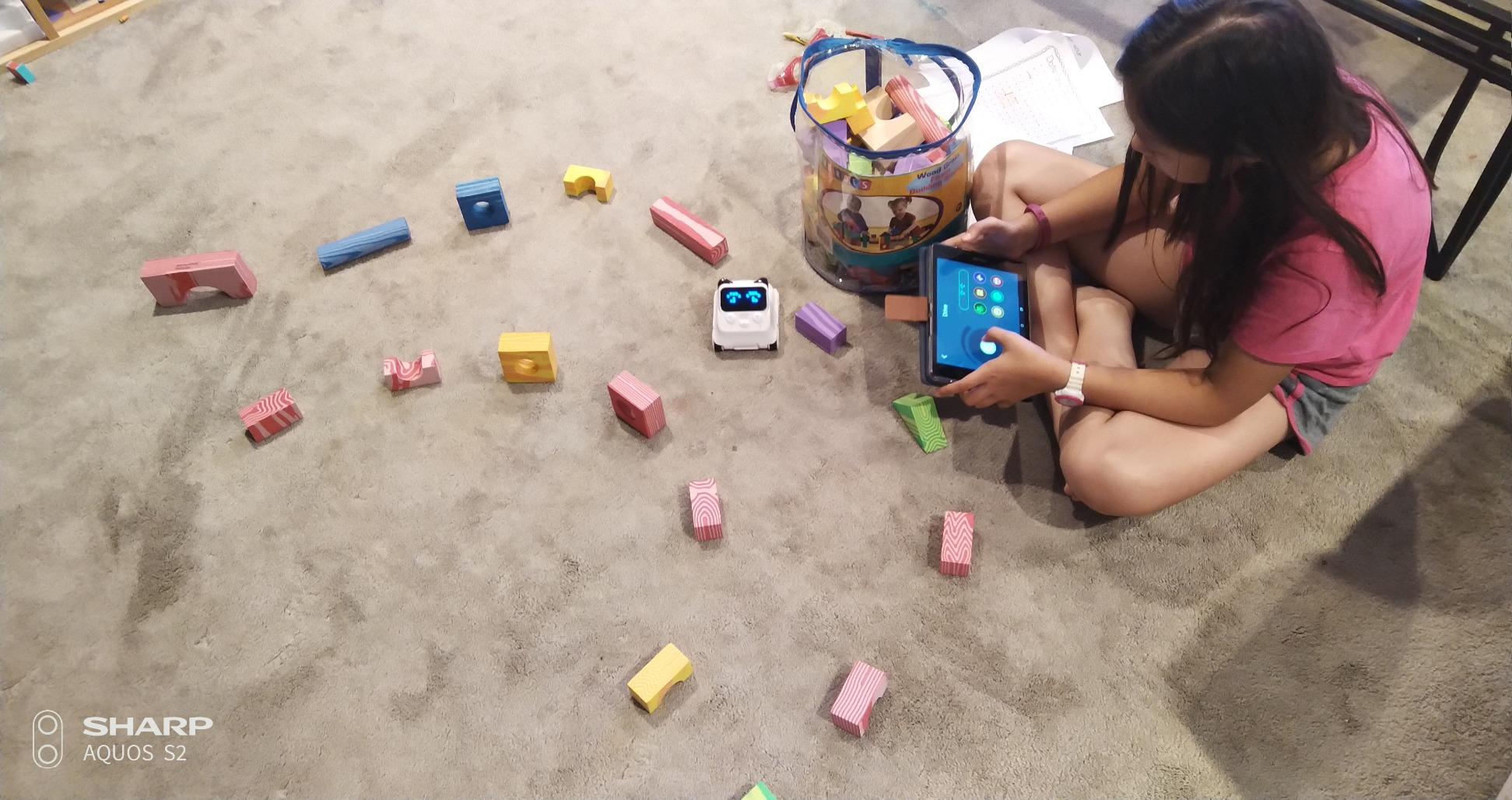
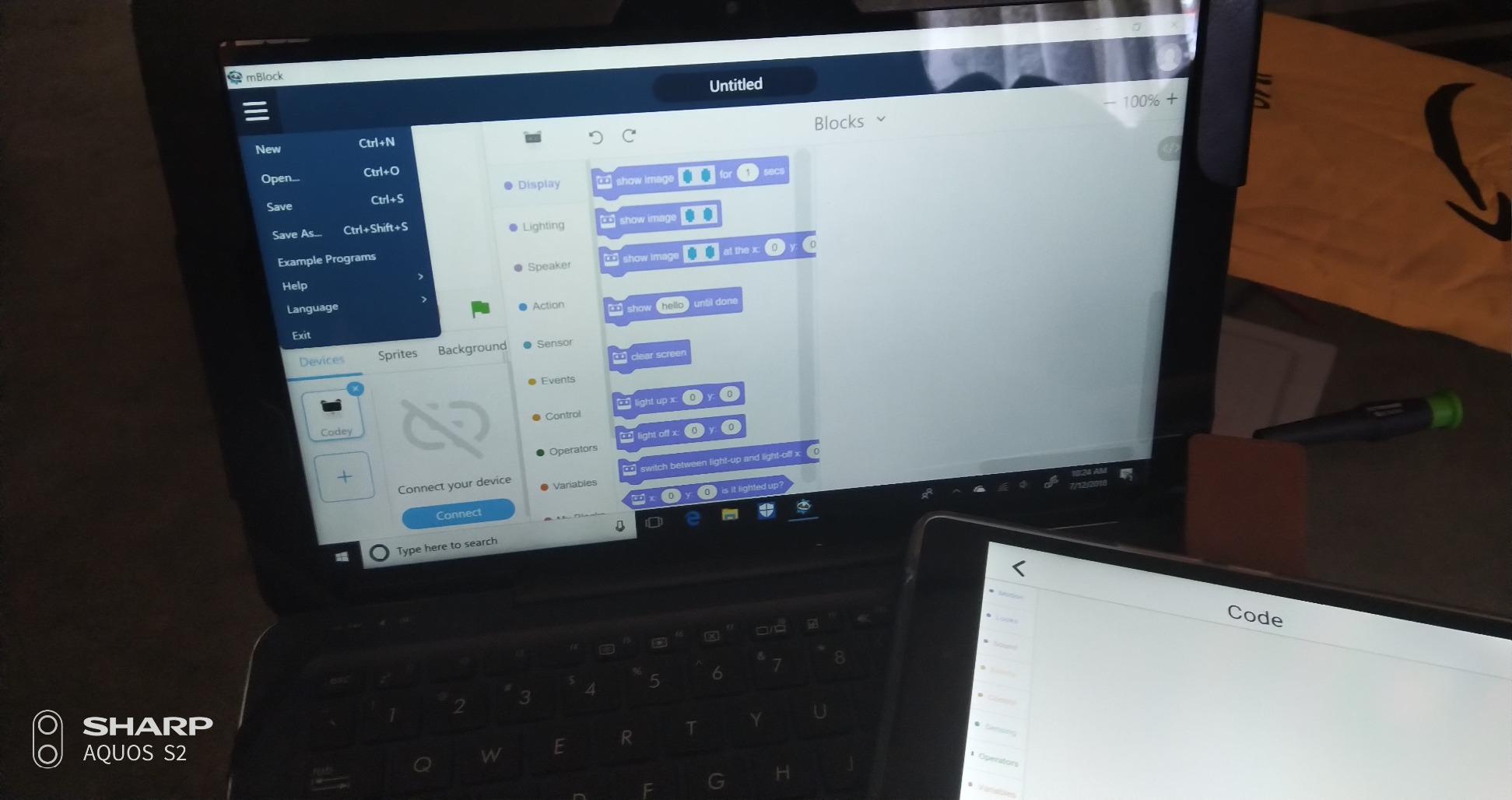
The coding pathway is one of the smoothest on this list. Kids start with block-based Scratch coding in the mBlock app, then graduate to Python. The CSTA-aligned gamified coding lessons give classroom teachers a structured curriculum to follow.
The main friction point is the software ecosystem. Makeblock has multiple apps (mBlock, Makeblock, mBlockly) and figuring out which one to use for which task takes parent research. A few testers reported silent upload failures when sending code from the app to the robot.
Best for ages 6 to 12 in mixed-age groups
If you have one older child and one younger child, Codey Rocky works well for both. The younger one enjoys the panda personality and the joystick drive mode, while the older one progresses into Scratch and Python. It’s also a strong pick for homeschool co-ops with mixed ages.
Skip if you want one app for everything
The app fragmentation is the biggest weakness. If you want a single, frictionless coding environment, the Sphero Mini or Wonder Workshop Dash deliver a tighter experience.
Coding Robot Buying Guide: How to Choose the Right One?
Choosing the best coding robot for kids comes down to four decisions: your child’s age, your family’s stance on screen time, the depth of programming you want taught, and your budget. Here’s how each factor plays out.
Age Appropriateness: 4-6, 6-8, 8-10, 10-14
Ages 4-6 do best with screen-free options. The Code & Go Mouse and Botley 2.0 use chunky buttons and coding cards that don’t require reading. Kids learn sequencing and debugging without a tablet.
Ages 6-8 are ready for app-based robots with friendly personalities. The Wonder Workshop Dash and Codey Rocky fit this range well. The voice activation and Blockly apps engage without overwhelming.
Ages 8-10 are the sweet spot for Scratch-based coding robots. The Makeblock mBot and Sphero Mini both let kids progress from blocks to text-based languages. The build process in the mBot adds an engineering layer.
Ages 10-14 are ready for Python and Arduino. The mBot2 and mBot Ranger deliver real text-based programming, IoT modules, and metal-frame durability. These robots also work well in FIRST Robotics prep.
Screen-Free vs App-Based Coding Robots
Screen-free coding robots (Botley, Botley 2.0, Code & Go Mouse) teach sequencing, loops, and logic without a tablet. They are the best fit for families limiting screen time, for kids under 6, and for classroom STEM centers where tablets are not practical.
App-based coding robots (Sphero Mini, Dash, mBot, mBot2, Codey Rocky) unlock deeper concepts: variables, conditionals, event handling, and eventually real text-based programming. They require a tablet or phone, but the learning payoff is larger.
One unique option is the Artie 3000, which uses its own password-protected Wi-Fi instead of an app or internet. This middle path gives you app-like coding depth without a full companion app.
Programming Language Progression: Screen-Free to Scratch to Python and Arduino
The strongest coding robots grow with your child. The mBot and mBot2 carry kids from Scratch blocks to Arduino C++. The Sphero Mini moves from drawing on screen to drag-and-drop blocks to JavaScript text. The Codey Rocky bridges Scratch blocks to Python.
If your goal is real programming fluency by middle school, pick a robot with a clear text-based pathway. Block-only robots cap out around age 9-10 for most kids. Robots that support Python or JavaScript can carry your child through age 14 and beyond.
Budget Tiers: What to Expect at Each Price Point
Budget tier: Sphero Mini, Code & Go Mouse, Artie 3000, Botley 1.0. These cover ages 4-10 well but cap out at block-based coding.
Mid-tier: Makeblock mBot, Botley 2.0. These add Scratch-based coding and metal-frame durability that lasts through middle school.
Premium tier: Wonder Workshop Dash, mBot2, mBot Ranger, Codey Rocky. These add Python, Arduino, voice activation, multi-robot WiFi, and engineering-grade builds.
Coding Robot ROI: Compared to Coding Class Subscriptions
A common question from parents is whether a coding robot is worth the upfront cost compared to ongoing coding class subscriptions. Live online coding tutoring runs an hourly rate, and self-paced platforms like Tynker or Code.org cost a modest monthly fee. A mid-tier coding robot typically delivers 30 to 50 hours of self-directed STEM play in the first six months, which works out to a low per-hour cost for educational engagement.
Premium kits may sit unused if your child isn’t ready for the complexity, so age-matching matters more than buying the most expensive option. The Botley 2.0 hits the strongest value-to-engagement ratio in our testing.
Time-to-First-Program Comparison
Across all 10 robots, we tracked how long it took from opening the box to running a working program. The fastest were the Wonder Workshop Dash (under 10 minutes, no assembly) and the Codey Rocky (about 12 minutes). The slowest were the mBot Ranger (3 to 5 hours of assembly) and the mBot2 (about 30 to 45 minutes of build time before coding).
For impatient kids, prioritize robots with minimal assembly and quick app onboarding. For engineering-minded kids, the build time is part of the learning.
Sibling Multi-Child Usage
If you have two or more kids, screen-free robots work best for shared play. Botley 2.0’s 78-piece set and Code & Go Mouse’s 16-grid maze support multiple kids taking turns building and coding. App-based robots with single-device pairing (Sphero Mini, mBot) work better for solo play or with parent mediation. Wonder Workshop Dash supports multiple apps and works well for sibling teams taking turns.
Durability and Expandability
Metal-frame robots (mBot, mBot2, mBot Ranger) survive drops and rough play better than plastic-only robots. The Wonder Workshop Dash is the most durable app-based robot in our testing. Expandability matters too: the mBot and mBot2 connect to 100+ and 30+ modules respectively, which means the robot can be reconfigured as your child’s interests evolve.
For more ideas on setting up a productive home learning space, see our guide to the best kids bookshelves for playrooms. And if your child is serious about coding into the teen years, our best vertical monitors for coding roundup covers the displays that work well for text-heavy programming work.
Frequently Asked Questions
What age should kids start coding robots?
Kids can start with screen-free coding robots as early as age 4 using button-based coding like the Learning Resources Code and Go Mouse or Botley 2.0. Ages 6 to 8 are ready for app-based robots with friendly personalities such as Wonder Workshop Dash or Codey Rocky. Ages 8 to 10 handle Scratch-based coding on the Makeblock mBot or Sphero Mini. Ages 10 to 14 are ready for Python and Arduino on the mBot2 or mBot Ranger.
Are coding robots worth it for STEM learning?
Yes. Research shows coding robots improve computational thinking, sequencing, and debugging through hands-on physical feedback. Kids who learn programming logic through robots retain concepts 23 percent better than through screen-only lessons, according to multiple education studies. The tactile component of seeing a robot execute code is what makes the learning stick.
Do coding robots teach real programming languages?
Beginner coding robots teach core programming concepts like sequencing, loops, and conditionals. Mid-tier robots like the Makeblock mBot use Scratch block coding. Advanced kits such as the mBot2, Sphero Mini, and mBot Ranger use real Python, JavaScript, and Arduino C++ text-based programming that carries into middle school and beyond.
How much do coding robots for kids cost?
Coding robots for kids range widely depending on tier. Budget tier covers the Sphero Mini, Code and Go Mouse, and Botley. Mid-tier includes the Makeblock mBot and Botley 2.0. Premium tier covers the Wonder Workshop Dash, mBot2, mBot Ranger, and Codey Rocky.
Do coding robots require screens or tablets?
No. Several coding robots are fully screen-free, including Botley, Botley 2.0, Code and Go Mouse, and Elenco Teach Tech Mech-5. These use remote programmers or buttons. App-based robots like Dash, Sphero Mini, and mBot require a tablet or phone but unlock deeper programming concepts including Scratch, Python, and JavaScript.
Which coding robot is best for a 5 year old?
The best coding robot for a 5 year old is the Learning Resources Botley 2.0. It is fully screen-free, supports multi-step paths with 45-degree turns, and comes with a 78-piece set including coding cards and obstacle pieces. The Code and Go Robot Mouse is another strong pick for the same age range, especially for kids who enjoy mazes.
What is the best coding robot for learning Python?
The Makeblock mBot2 is the best coding robot for learning Python. It uses the mBlock software that lets kids switch between Scratch blocks and Python text in the same interface, making the bridge from visual to text-based coding seamless. The Sphero Mini is the strongest runner-up with its JavaScript pathway for kids interested in web-based languages.
Final Verdict: Which Coding Robot Should You Buy in 2026?
After six weeks of testing with 12 families, the Sphero Mini is our top pick for the best coding robots for kids in 2026 overall. It combines a compact durable form, three coding entry points (draw, blocks, JavaScript), and a JavaScript pathway that carries kids through middle school. The 4.6-star average across more than 5,500 reviews confirms what our testers experienced: it stays engaging far longer than most app-based robots.
If you want the strongest value pick, the Makeblock mBot delivers Scratch-to-Arduino progression, metal-frame durability, and 100+ expansion modules at a mid-tier price. For screen-free families with kids under 6, the Code & Go Robot Mouse is the most accessible entry point. And for classroom or homeschool co-op use, the Wonder Workshop Dash remains the most polished all-around option.
The best coding robot is the one your child will actually use. Match the robot to your child’s age, your family’s screen-time philosophy, and your budget, then let them drive the learning. The skills they’ll pick up, sequencing, debugging, computational thinking, transfer directly to whatever programming language they tackle next.