
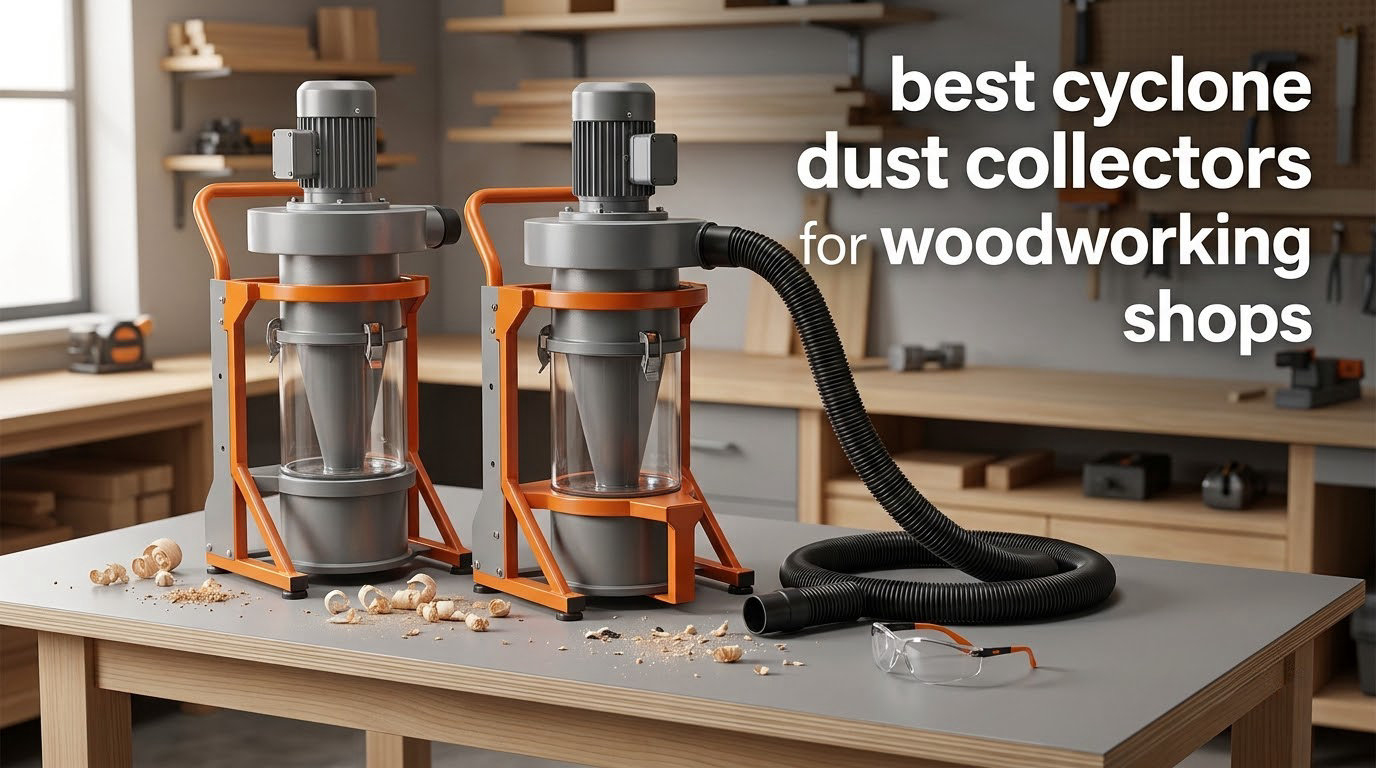
A cyclone dust collector is a two-stage dust collection system that uses centrifugal force to spin dust-laden air, dropping heavy chips and debris into a collection drum while sending only fine dust to a secondary filter.
That is the short version, but it hides the most important fact for anyone searching for the best cyclone dust collectors for woodworking shops: most of what is sold under that name is not a machine at all. It is a separator that bolts onto a shop vac or onto a single-stage collector you already own. We reviewed eight of them, four separators and four machines, and the gap between those two groups matters more than any spec on the box.
So, are they worth it? Yes, if you are running a table saw plus a planer, sander, or drum sander, because the cyclone stage catches the bulk material before it reaches the filter. No, if you have one small machine and a wet/dry vac, because a pail-mounted separator will do the same job for a fraction of the build.
We spent several weeks reading spec sheets, review patterns, and community threads on sizing and retrofitting, then narrowed the field to eight picks across four tiers. If you are still choosing between a general dust collector and a cyclone design, start with our workshop dust collector guide first. The short version: cyclone separation pays for itself on machines that make volume, not on machines that make a little dust.
Table of Contents
Top 3 Picks: Cyclone Dust Collector in 2026

Oneida Dust Deputy DIY
- 99.9% separation before the vac filter
- Tapered 2 inch ports
- Made in the USA

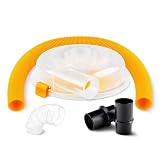
POWERTEC Low Profile
- Complete kit with hose and elbow
- Fits 2-1/4 and 4 inch ports
- Dual latches and foam gasket
Best Cyclone Dust Collectors Compared in 2026
| Product | Specifications | Action |
|---|---|---|
| Oneida Dust Deputy DIY Cyclone |
|
Check Latest Price |
| Dustopper PRO Cyclone Separator |
|
Check Latest Price |
| POWERTEC Low Profile Separator |
|
Check Latest Price |
 Oneida 4/5 DIY Cyclone Attachment Oneida 4/5 DIY Cyclone Attachment |
|
Check Latest Price |
 Mullet Cyclone Dust Collector Mullet Cyclone Dust Collector |
|
Check Latest Price |
 Oneida Super Dust Deputy XL Oneida Super Dust Deputy XL |
|
Check Latest Price |
 JET Vortex Cone 1-1/2HP JET Vortex Cone 1-1/2HP |
|
Check Latest Price |
 JET Cyclone Dust Collector 3HP JET Cyclone Dust Collector 3HP |
|
Check Latest Price |
1. Oneida Air Systems Dust Deputy DIY Cyclone – Best Overall Retrofit
Oneida Air Systems Dust Deputy DIY Anti-Static Retrofit Cyclone Separator for Wet/Dry Shop Vacuums (DD DIY)
99.9 percent pre-separation
15.5 x 9.3 x 7.4 inch body
Tapered 2 inch ports
Pros
- Keeps dust out of the shop vac filter
- Neutral Vane Technology holds suction
- Tapered 2 inch ports fit most hoses
- Made in the USA with gasket and hardware
- Handles wood dust drywall concrete and shavings
Cons
- You supply the waste container and hose
- Static builds without a grounding point
- Efficiency drops with a weak vac or long hose
This is the unit most hobby shops end up with, and for good reason: it has the largest review base of anything in this roundup at 4205 ratings, and those reviews converge on a single story. Owners attach it to a wet/dry vac, run the saw, and find the vac filter is far cleaner at the end of the day than it used to be.
Oneida calls the core mechanism Neutral Vane Technology, and the claim attached to it is 99.9 percent separation of dust and debris before it reaches the vacuum filter. Whether you land on exactly that number depends on your vac and hose length, but the direction of the effect is consistent across reviews.
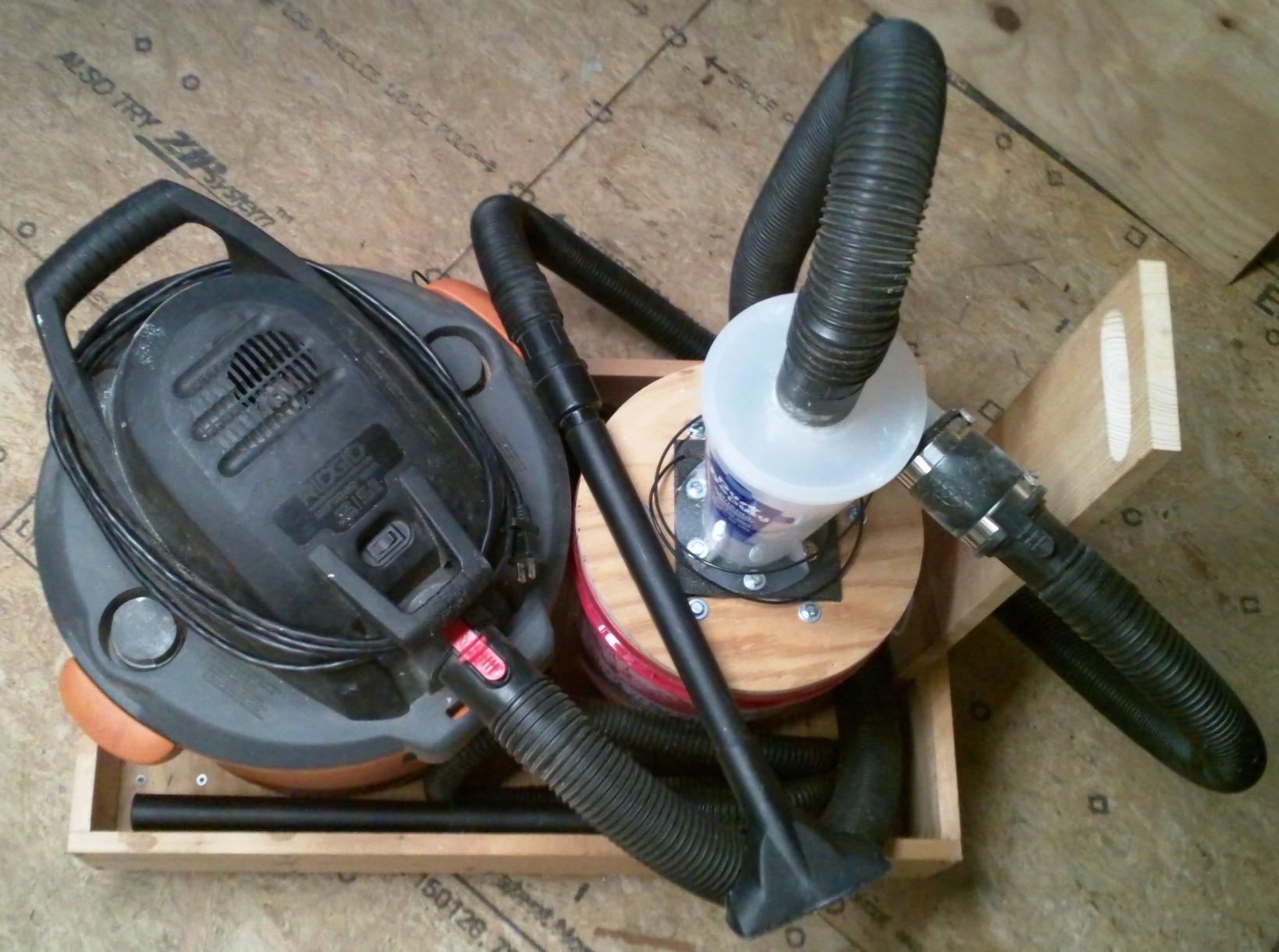
The body is small. At 15.5 by 9.3 by 7.4 inches, it mounts on a rim or a wall bracket rather than taking up floor space, which is why it works in basement shops where a full machine would not fit. The tapered 2.0-inch ports are the practical hero here, accepting a wide range of hose diameters without a permanent adapter.
What arrives in the box is the cyclone separator, a gasket, and mounting hardware. You supply the waste container and the hose, so the true system cost lands well above the separator price once you add a pail and rigid connections. That is the single biggest reason people misjudge this pick on value.
How this performs in a small shop
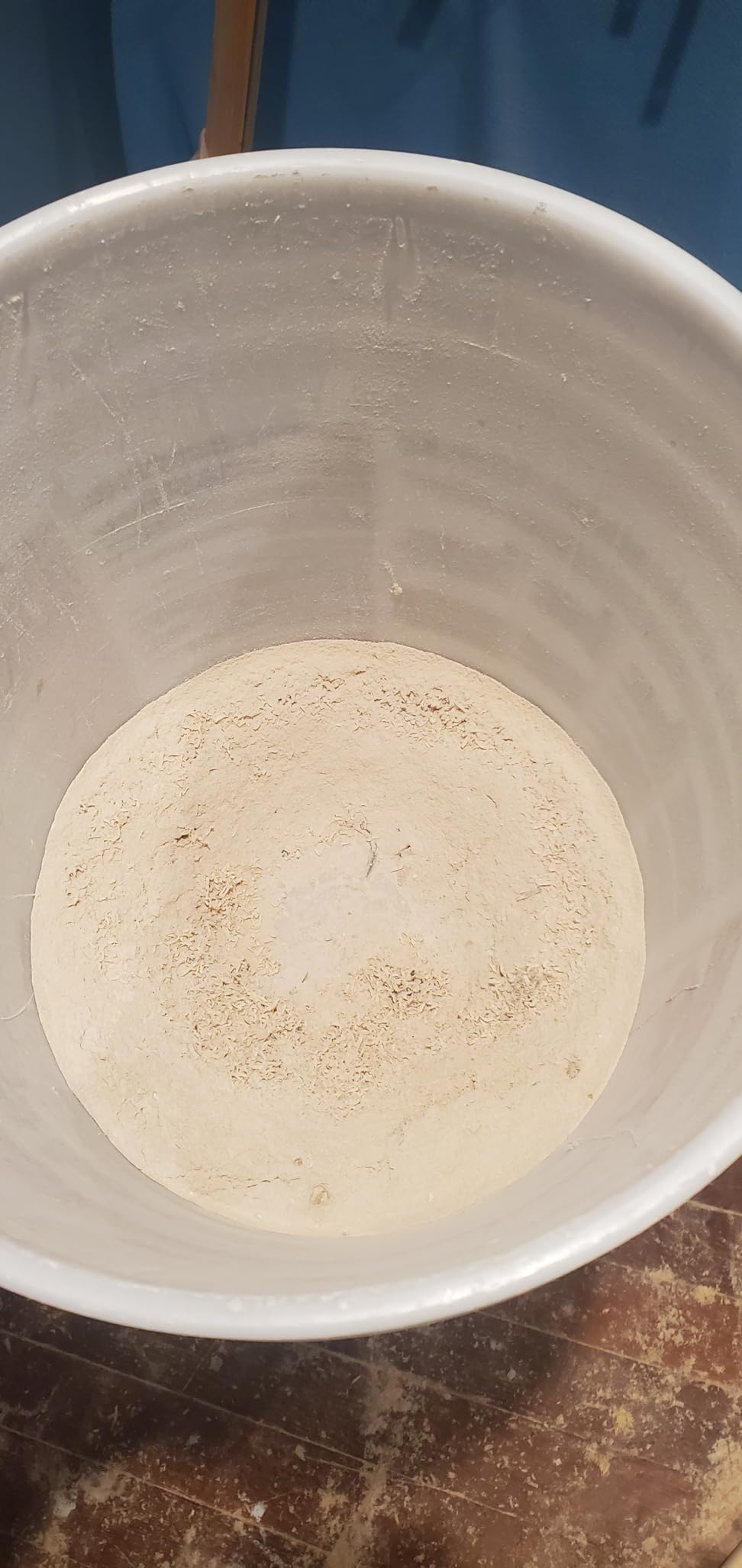
In a one-machine garage shop, the Dust Deputy is the whole system. It works as a floor pickup between cycles, it works as a mounted separator feeding a rigid run, and it works as a drum separator on a bench. Reviewers describe it as the rare shop accessory that earns its drawer space within a week.
It handles more than wood. The same separator is used on drywall, concrete, clay and silica dust, cooled ash, water, metal shavings, and pet hair, which makes it the most versatile tool in the group if you do finishing work or occasional cleanup jobs.
Where it falls short
Two limits show up repeatedly. Static can build in a DIY setup if you skip the grounding point, and separation quality drops when the host vacuum is undersized or the hose run is long, which is the classic complaint about any separator on a weak vac.
If you want a larger host, move up to the bagged vacuum side of dust control before buying a separator that will fight an underpowered motor. A separator cannot create airflow; it only redirects it.
2. Dustopper PRO Cyclone Dust Separator – Best Tested Separator
Dustopper PRO Dust Collector – 99.9% Efficiency Cyclone Dust Separator
Third-party tested separation
Fits standard 5 gallon pails
Two sweep elbows included
Pros
- Aerodyne tested on fine and coarse sawdust
- Preinstalled EPDM pail gasket
- Two high flow sweep elbows
- Clear body shows fill level
- Empties by hose-out or air blast
Cons
- Best results need a strong host vac
- Gasket can lift out of its groove
- Included hose is short for large vacs
The distinction that separates this from other pail lids is the testing. Aerodyne Environmental evaluated the Dustopper PRO on fine sawdust, coarse sawdust, and drywall powder, and found it consistently out-separated competing low-profile designs. That is the kind of third-party number you almost never see in this category.
The design philosophy is stated plainly: optimized for separation rather than raw CFM. Limiting turbulence inside the cone means less eddy current, and less eddy current means more of the airborne material actually falls into the pail instead of riding the air out to the filter.
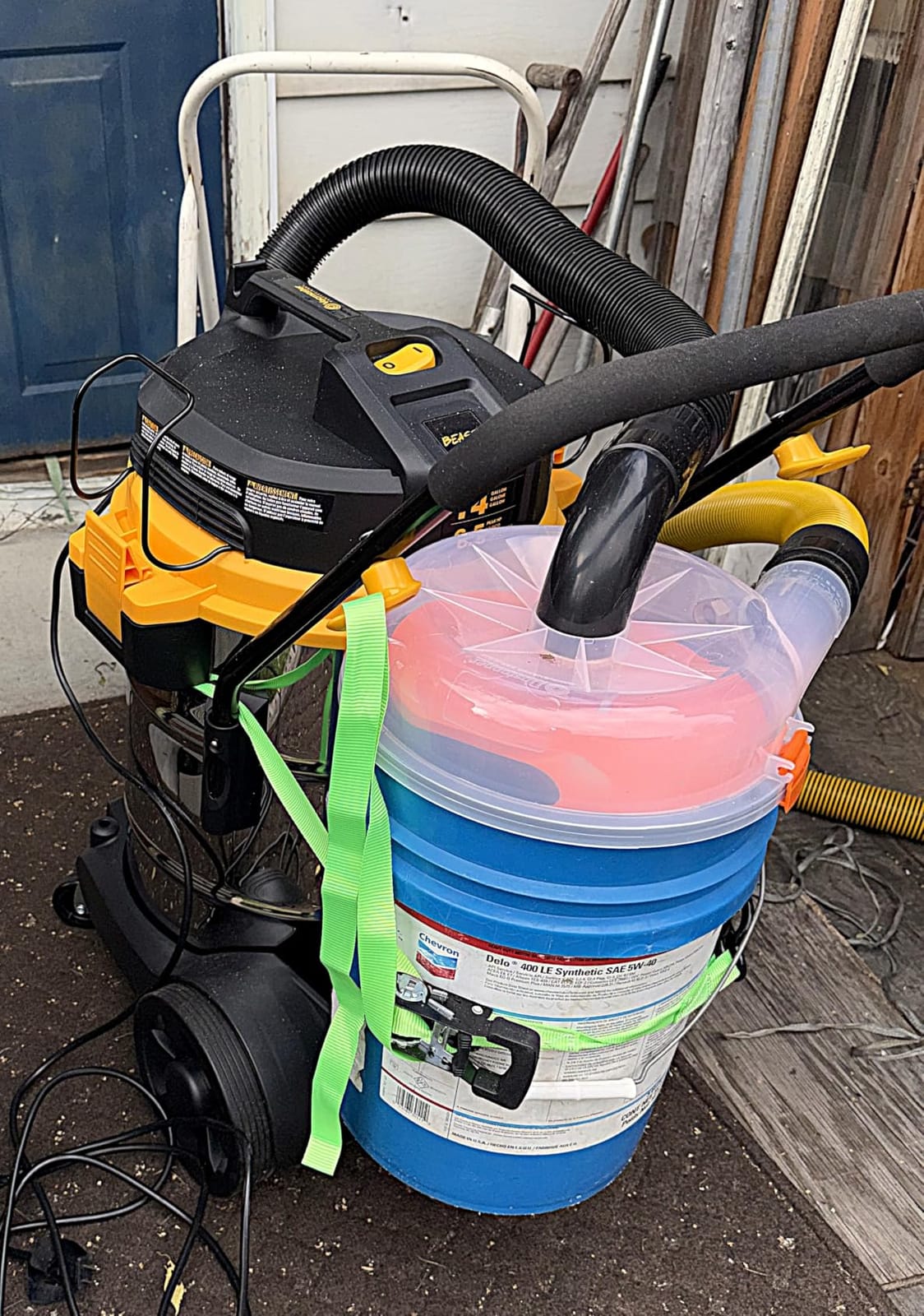
The sealing hardware is the upgrade over generic lids. A hollow-core EPDM gasket is preinstalled and sized to standard 5-gallon pails, so there is no assembly and no leak path between the lid and the bucket wall. Two patented high-flow sweep elbows come in the box, and they are the parts that actually raise the airflow number by removing turbulence at the bends.
Owners like that the body is clear. You can see the dust level without lifting the lid, which sounds minor until you are emptying a bucket in a shop where you cannot see the bottom.
When this is the right buy
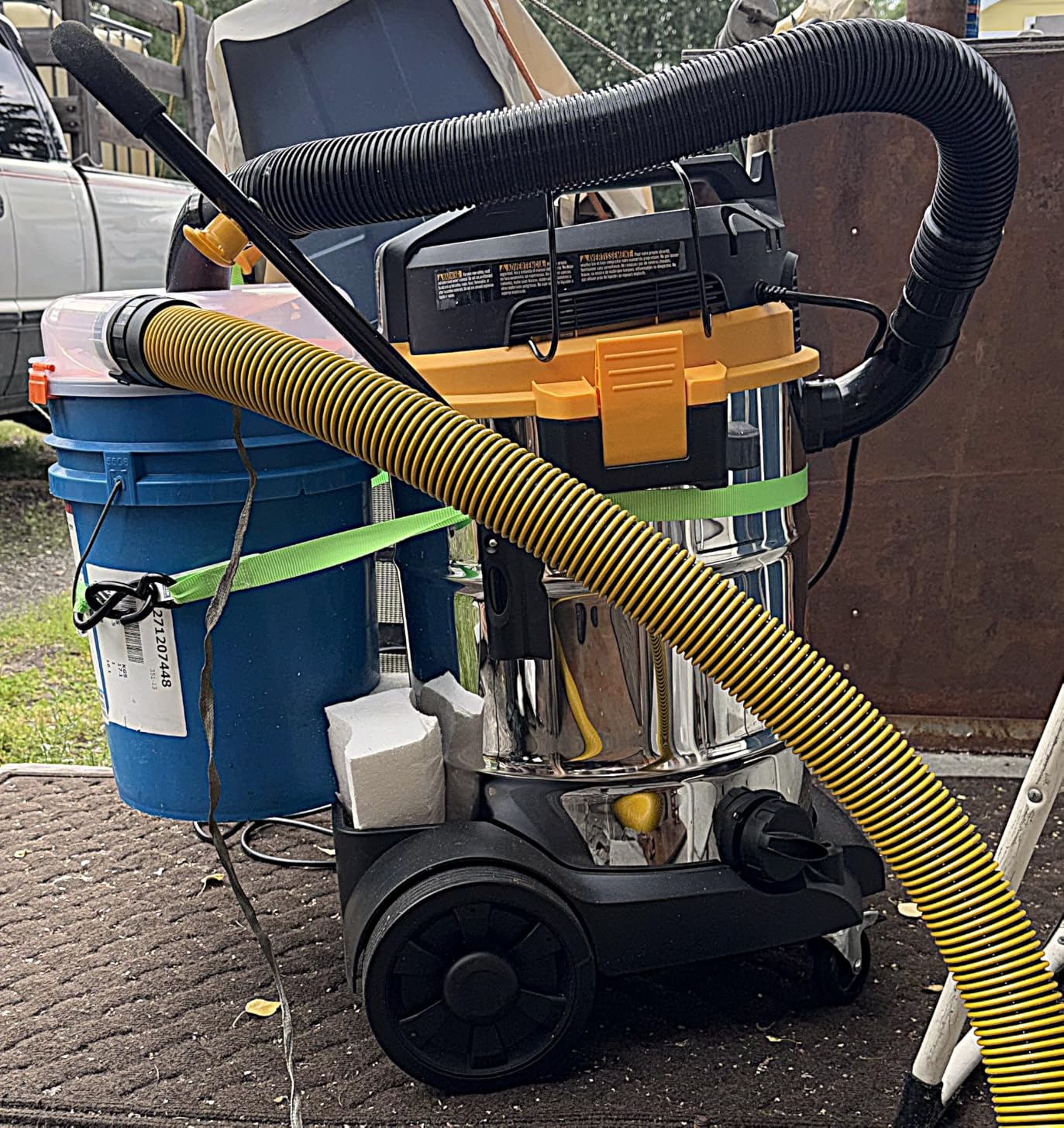
Choose it when you already have a capable vac or extractor and want the best separation per dollar on the pail side of the market. Reviewers pair it with 5 HP class machines and report pails filling with sawdust while the host filter stays close to clean.
The low-profile shape also makes it stable on a pail, which matters if you are moving it around a crowded bench area. The design took a Most Innovative Concept award at the National Hardware Show, which is not proof of anything by itself but signals the geometry is deliberate.
What to watch out for
Best results want roughly a 5 HP class host. On a weaker vac, fine dust makes it through and the whole point is lost. The gasket can lift out of its groove when you lift the assembly off the bucket, and the included hose is on the short side for large machines.
Thin retail pails are the other common issue. Because the gasket is designed for standard pails, a cheap thin-walled bucket can flex and collapse, so a heavy-duty pail or a doubled pail is the sensible pairing.
3. POWERTEC Low Profile Dust Separator – Best Budget Kit
POWERTEC Low Profile Dust Separator for Shop Vac & Dust Collectors, Fits 5 Gallon Buckets, For 2-1/4″ Shop Vacuum Port, 2-1/2″ & 4″ Dust Collection System, Cyclone Dust Collection Kit w/Hose & Elbow
Complete kit with 3 ft hose
Connects to 2-1/4 or 4 inch systems
Low profile lid design
Pros
- Complete kit with hose elbow and adapters
- Dual latches and foam gasket hold a seal
- Works as floor pickup or mounted separator
- Compact lid resists tipping
- Impact-resistant PP and ABS
Cons
- Fine powdery dust escapes more readily
- Latches can pop out of their brackets
- Performance drops past half full
This is the kit you buy when you want one box that contains everything. You get the separator lid, foam gasket, dual latches, a 90-degree elbow sized for 2-1/4 inch, hose adapters, a 3-foot hose, and grounding hardware. Only the grounding wire itself is not included, which is a small but real gap to plan for.
The port coverage is broader than most competitors at this level. It connects to 2-1/4 inch shop vac hose directly, and it integrates with 2-1/2 inch and 4 inch dust collection lines, so it can sit in the middle of an existing system rather than at the end of it.
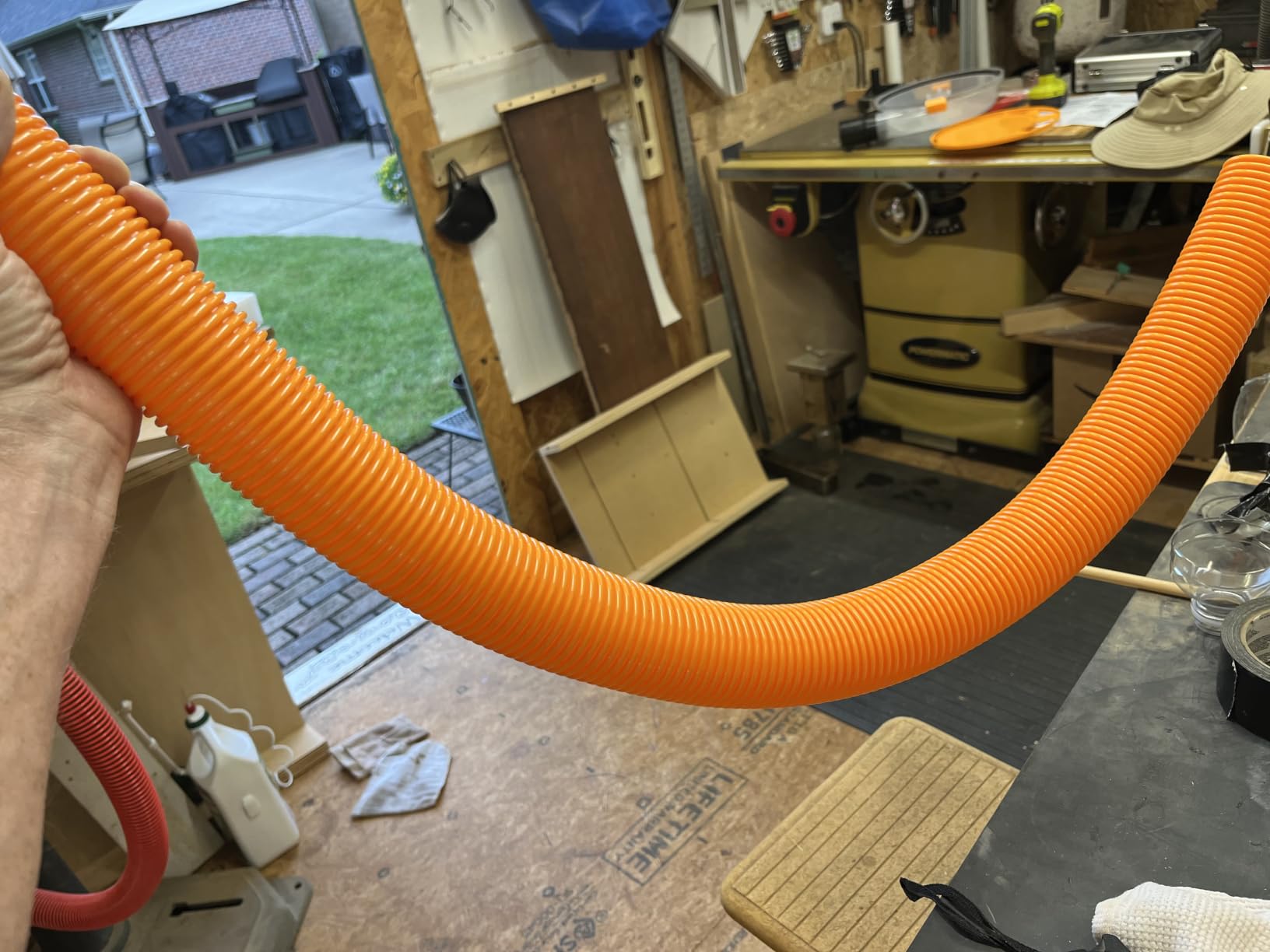
Owners use it two ways. Mounted on a pail under a machine, it pre-separates the bulk debris. Held in the hand, it works as a floor pickup that pulls sawdust from several feet away, which is genuinely useful for cleanup after a resaw or a router session.
Construction is impact-resistant PP and ABS with a foam rubber gasket and two latches. The patented low-profile lid is the stability feature: a tall cyclone stack on a pail tips, a low lid does not.
Where this kit earns its place
The honest strength is chips. At a table saw, on a jointer, or around a bandsaw, this separator does exactly what the two-stage concept promises. Owners running table saws and doing floor cleanup tend to be enthusiastic about it for that reason.
It also makes a reasonable second stage upstream of an existing 4-inch system, since it will accept that duct. For a shop experimenting with dust collection for the first time, the completeness of the box is the real value.
Where it will let you down
Fine powdery dust escapes more readily than it does with the premium separators. If your main load is drum sanding, MDF, or finish sanding, expect the host filter to still take a beating, and look at a higher-capture unit instead.
There are also hardware complaints worth factoring in: the latches are described as flimsy and can pop out of their brackets, and some owners report the gasket that comes with it falling short of the full bucket circumference, which leaves a gap. Internally, the baffle arches spin the dust in the bucket, so separation degrades once the pail is more than about half full.
4. Oneida Air Systems 4/5 DIY Cyclone Attachment – Best for 1-3HP Collectors
Oneida Air Systems Cyclone Attachment for 0.5-3HP Dust Collectors, 4/5 DIY
Retrofits 1HP to 3HP collectors
4 or 5 inch inlet, 4 or 6 inch outlet
13.25 x 14.25 x 23 inches
Pros
- Keeps an existing collector instead of replacing it
- Integrated air ramp and neutral vane inlet
- Adapters for 4 or 5 inch inlets
- Made in the USA under two patents
- Under 8 pounds for easy DIY fitting
Cons
- Needs a host collector and a DIY drum
- Does not cover 5HP and above
- Adapters must match host ports exactly
This is the upgrade path for shops that already own a small single-stage collector and are not ready to replace the motor and cabinet. The claim is over 99 percent of fine dust and large debris captured before it reaches the host filter, which in practice shows up as longer filter life and less suction loss over a long session.
The airflow design is the interesting part. An integrated air ramp and a neutral-vane inlet smooth the entry of the dust stream, and the Oneida line was built on that idea since the original Dust Deputy. Smooth entry means less turbulence, and less turbulence means the vortex spins fast enough to actually separate.
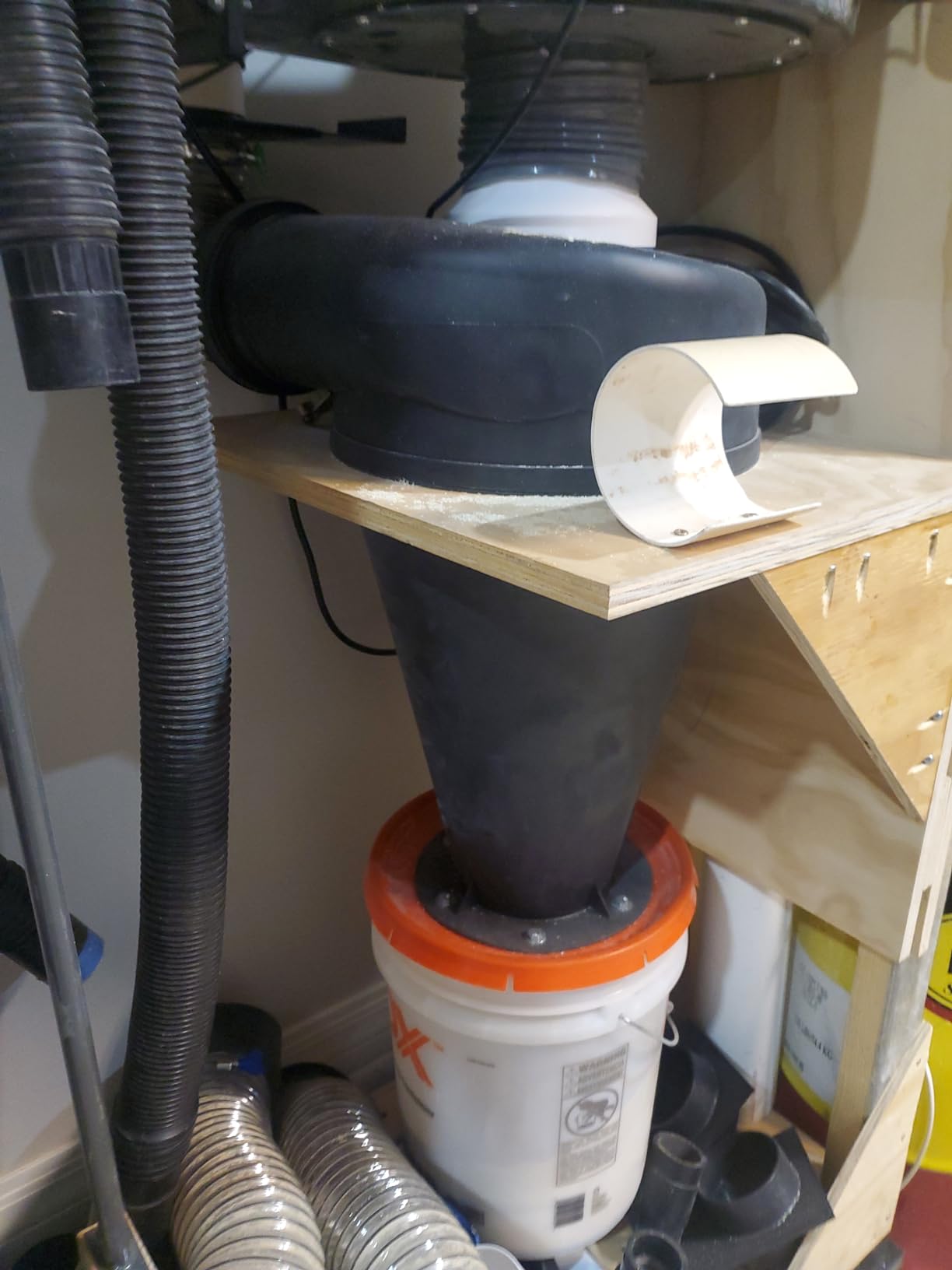
Compatibility is wide for a DIY part. It retrofits 1HP to 3HP single-stage collectors, accepts a 4 inch or 5 inch inlet, and feeds a 4 inch or 6 inch outlet. Adapters and lid mounting hardware are included, along with a gasket, so the install is mostly planning your duct run.
At 13.25 by 14.25 by 23 inches and under 8 pounds, it can go on a wall or a stand rather than taking dedicated floor space. Made in the USA under US patents, which tells you the geometry is patented rather than improvised.
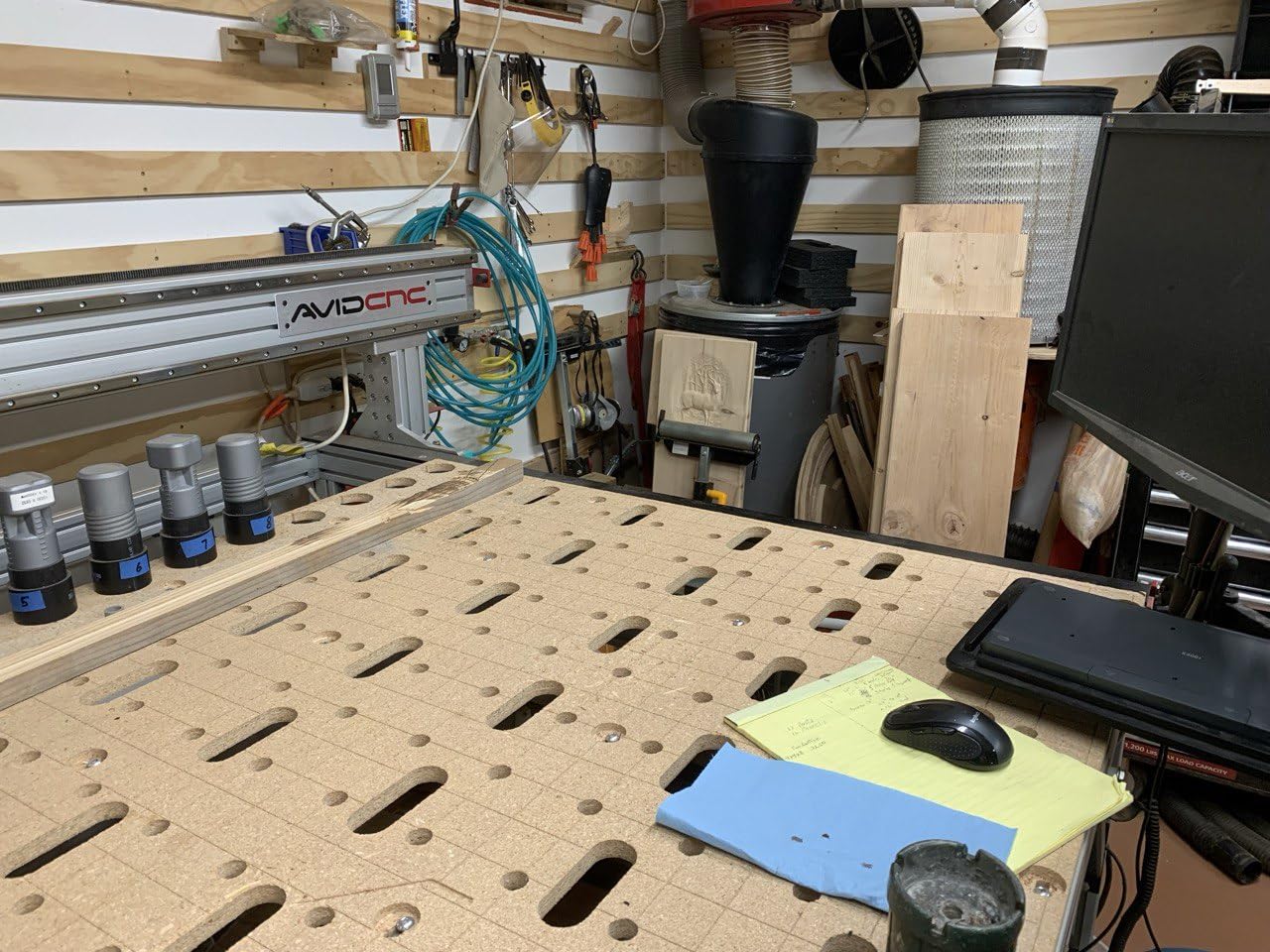
When this is the right upgrade
If your shop is running a 1HP to 3HP single-stage collector and fighting constant filter clogging on a table saw and a planer, this is the cheapest way to add true two-stage separation. Sentiment centers on straightforward installation and noticeable filter life improvement.
It also suits a shop that already runs 4-inch rigid duct, since that is the most common residential and light-shop collector size. You keep the motor you have and change the air path around it.
What it does not solve
It is a retrofit part, not a system. You still need the host collector, a drum, and rigid plumbing, so the total build cost is meaningfully higher than the part price. Shops with 5HP collectors need the larger XL version instead.
Adapter matching is the other friction point. Take the time to confirm the inlet and outlet diameters on your specific machine before you buy, because a mismatched adapter means flex hose and reduced airflow, which is exactly the compromise you were trying to avoid.
5. Mullet Cyclone Dust Collector – Best for Rigid Duct Shops
Mullet Cyclone Dust Collector, High-Speed Separator for Shop Vac
Parabolic one-piece molded body
72 dB operating level
Cut-to-fit rigid PVC connection
Pros
- Highest average rating in the group at 4.8
- Parabolic body spins the air faster
- Pre-separates over 99 percent of debris
- Replaces bungee and duct tape assemblies
- Adapters fit most wet and dry vacs
Cons
- Attachment only
- not a full system
- One-piece body cannot be disassembled
- Hose adapters add length to the run
The Mullet earns the highest average rating of the eight picks, at 4.8 across 289 reviews, and the reason is shape. The body is a parabolic one-piece molding rather than a straight-wall cone stacked on a bucket, and the maker argues the geometry creates a faster airstream and better capture than ordinary cyclone-and-bucket assemblies.
The practical story is better than the geometry story. Owners tend to come from shops that already run rigid PVC and want something cleaner than the bungee, bolt, and duct-tape assemblies typical of DIY setups. A rigid cut-to-fit connection gives an airtight joint with no flex hose in the path.
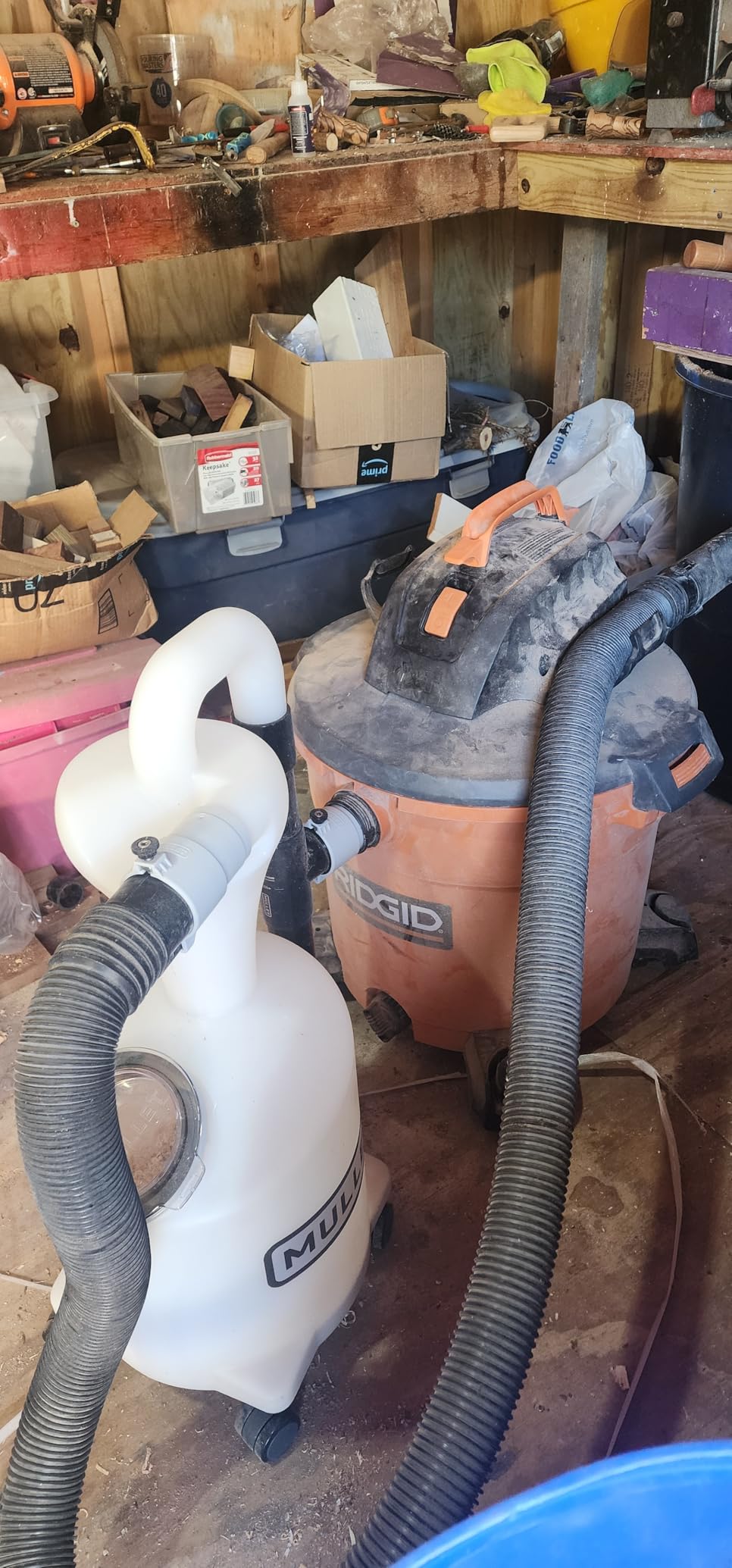
Two wet and dry vac hose adapters are included, and they cover tall and short shop vacs alike. The stated operating level is 72 dB, which is worth noting for basement shops where noise decides whether a machine gets left running.
The pre-separation figure is over 99 percent of debris, and the reported effect is the standard one: the host vac or dust extractor filter stays clean, suction stays stronger, and the machine needs less attention between services.
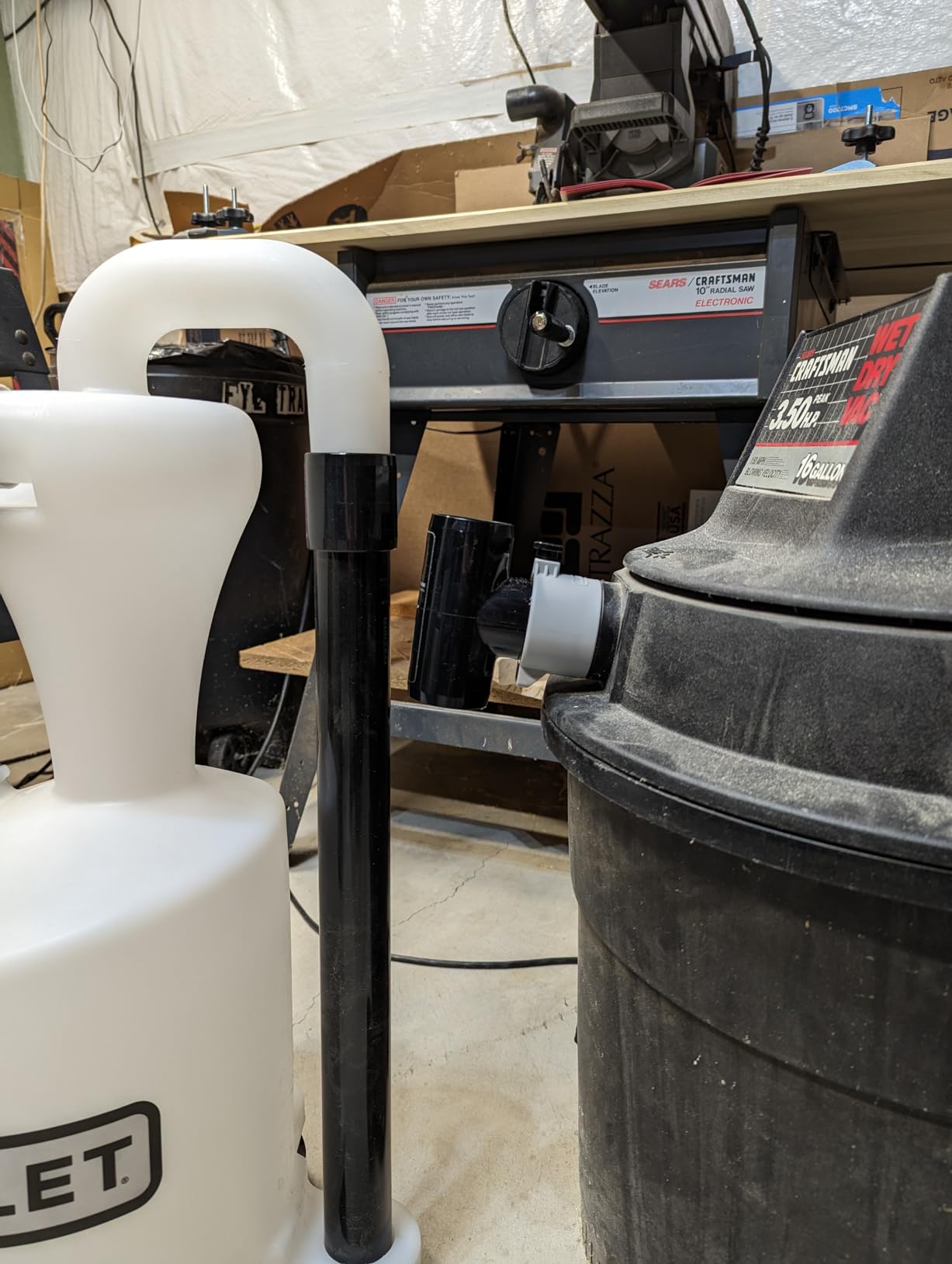
When this earns its slot
Choose it if you have already committed to rigid ducting and want a connection that will not leak or whistle. The parabolic body is also the reason the rating sits where it does, and owners upgrading from stack-and-pail assemblies report noticeably better capture.
It works as a shop vac attachment or with a dust extractor as the host. In either case you still need a rigid run and a collection drum, so think of it as the cyclone stage of a system rather than the system itself.
What to plan around
It costs more than a pail-lid separator, and the total build still includes a vac or dust extractor. The single-piece molded body cannot be disassembled for a deep clean, which matters more than it sounds if you work with sticky finishes or resin dust.
The included hose adapters add length to the air path, and on a smaller vac that can shave suction. Measure your run before you commit.
6. Oneida Air Systems Super Dust Deputy XL – Best for 3-5HP Collectors
Oneida Air Systems Super Dust Deputy XL 6 in DIY Cyclone, 3-5 HP, Black
6 inch inlet for 3 to 5HP collectors
8.5 pounds
Static dissipative plastic
Pros
- 6 inch inlet moves more air than small DIY cyclones
- Covers Delta Grizzly Harbor Freight and Jet
- Static dissipative molding bleeds charge
- Lightweight for its size
- Gasket and lid hardware included
Cons
- Drum plumbing and host collector not included
- Smaller review base than the pail separators
- 37.5 inch footprint needs headroom
The XL exists because small DIY cyclones run out of air. A 6-inch inlet handles substantially more volume from a 3HP to 5HP collector than the 4-inch units in this group, and that is the whole argument. A separator that chokes the airflow is the same as no separator at all.
It fits most mainstream 3HP to 5HP single-stage collectors, and the manufacturer names Delta, Grizzly, Harbor Freight, and Jet explicitly. The included parts are the cyclone, a gasket, and lid mounting hardware.
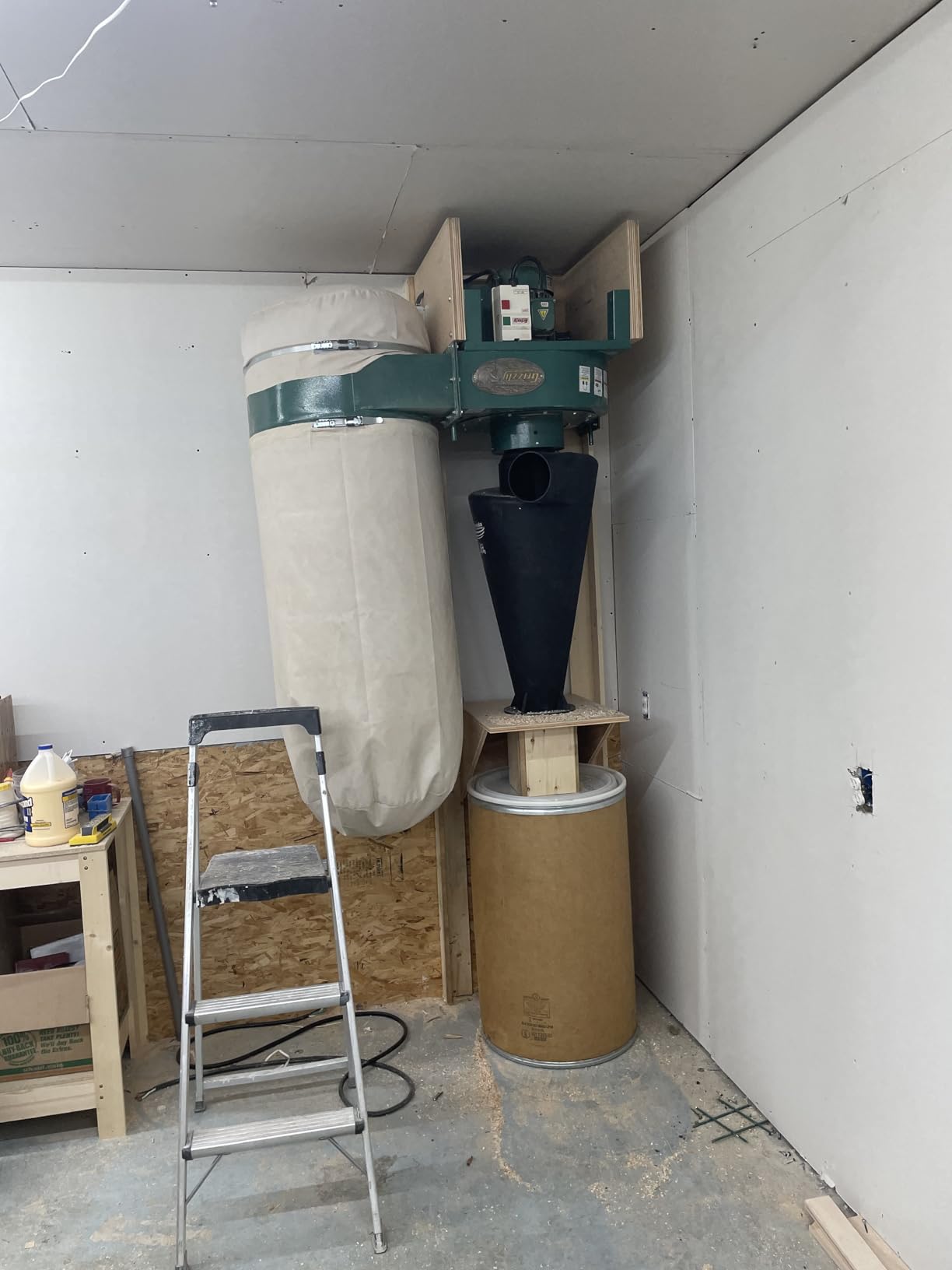
The molding is static dissipative, which conveys built-up charge to electrical ground through the collector cabinet. For shops running fine dust, that is a meaningful safety property rather than a marketing line, though the ground path still depends on the host machine being properly bonded.
At 8.5 pounds it is light for a separator of this diameter, so a single person can lift it into position. The stated pre-separation is 99 percent of fine dust and large debris, and owners point to the larger inlet as the reason filter life stretches out.
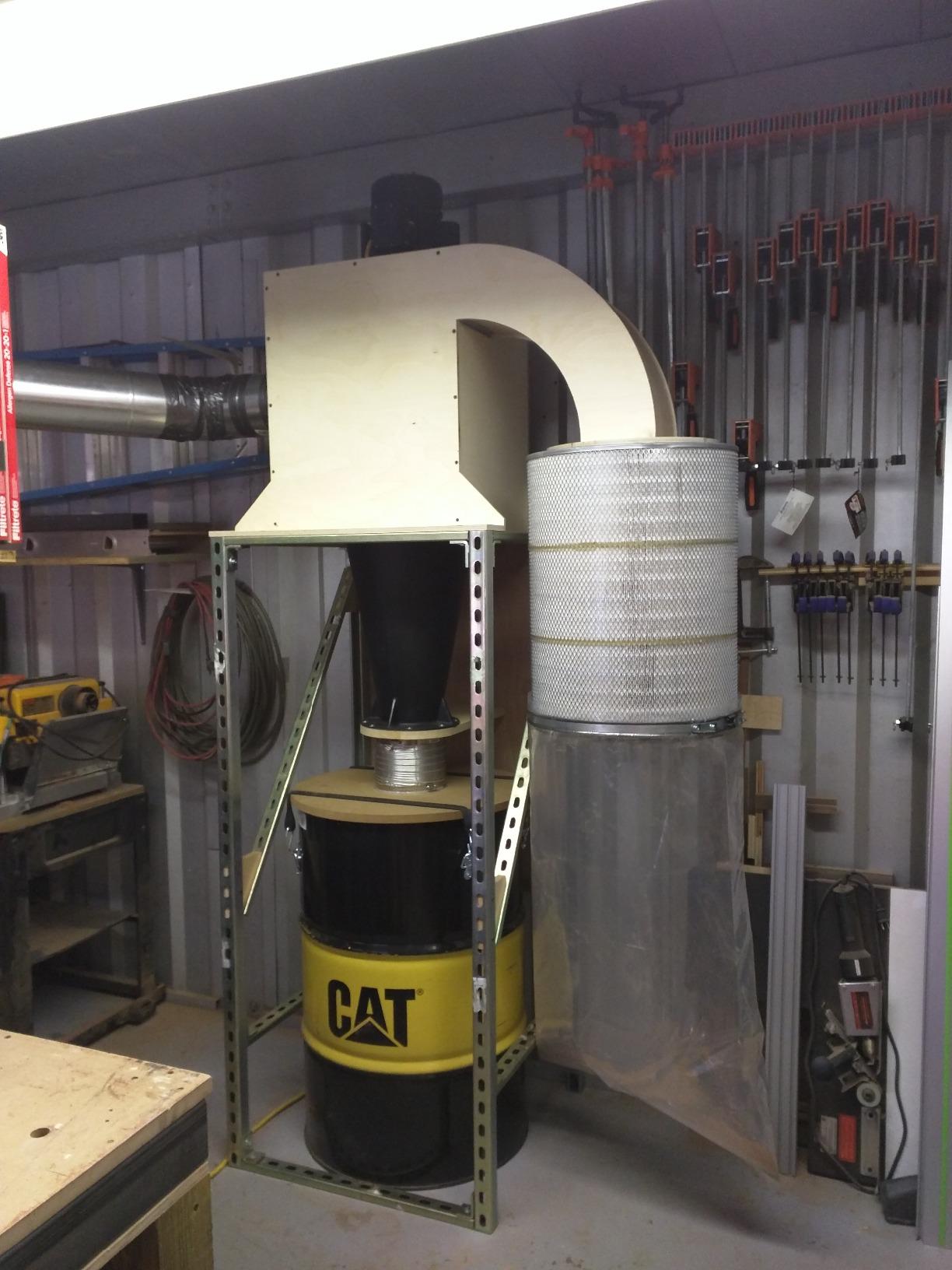
When this is the right size
Pick it if you own a 3HP to 5HP collector and are noticing that a small DIY cyclone pulls down the airflow you had. Matching separator size to collector airflow is the single most common sizing mistake, and this part exists to solve exactly that.
It is also a good match for shops where the planer or wide-area sander is the main dust source. Those machines generate the volume that a 4-inch separator cannot absorb.
What to consider first
It is accessory only, so a drum, rigid plumbing, and a host collector are all still on your list. The footprint is 37.5 inches on its longest dimension, so check ceiling and headroom before you plan the install.
The review base is smaller than the pail separators here, so long-term field feedback is thinner. If you are nervous about a thin data set, the 4/5 DIY model in the same family has a larger one and covers a lower horsepower range.
7. JET Vortex Cone 1-1/2HP – Best Complete Starter Machine
JET Vortex Cone Dust Collector with 2-Micron Canister Filter, 1-1/2 HP, 115/230V 1Ph (DC-1100VX-CK)
1-1/2 HP on 115/230V
2 micron canister filter
80 dB operating noise
Pros
- Motor cabinet filter and bags in one box
- 2 micron canister filtration
- Vortex Cone packs the bag more fully
- 115V so no 240V circuit needed
- Four casters and quick-connect bags
- 5 year warranty for hobby shop use
Cons
- Single stage design
- bag still fills and must be swapped
- 80 dB is louder than the separators here
- Smallest motor in the group
This is the only option here that arrives complete. Motor, cabinet, filter, and collection bags arrive in one box with four swivel casters, so there is no build, no drum plumbing, and no adapters to source. For a first dedicated dust collector, that removes almost all of the friction.
The canister filter is rated at 2 microns, which is a meaningful step up from a bag-only single-stage machine. Air stays noticeably cleaner in the shop, and the filter does not depend on the collection bag filling correctly to do its job.
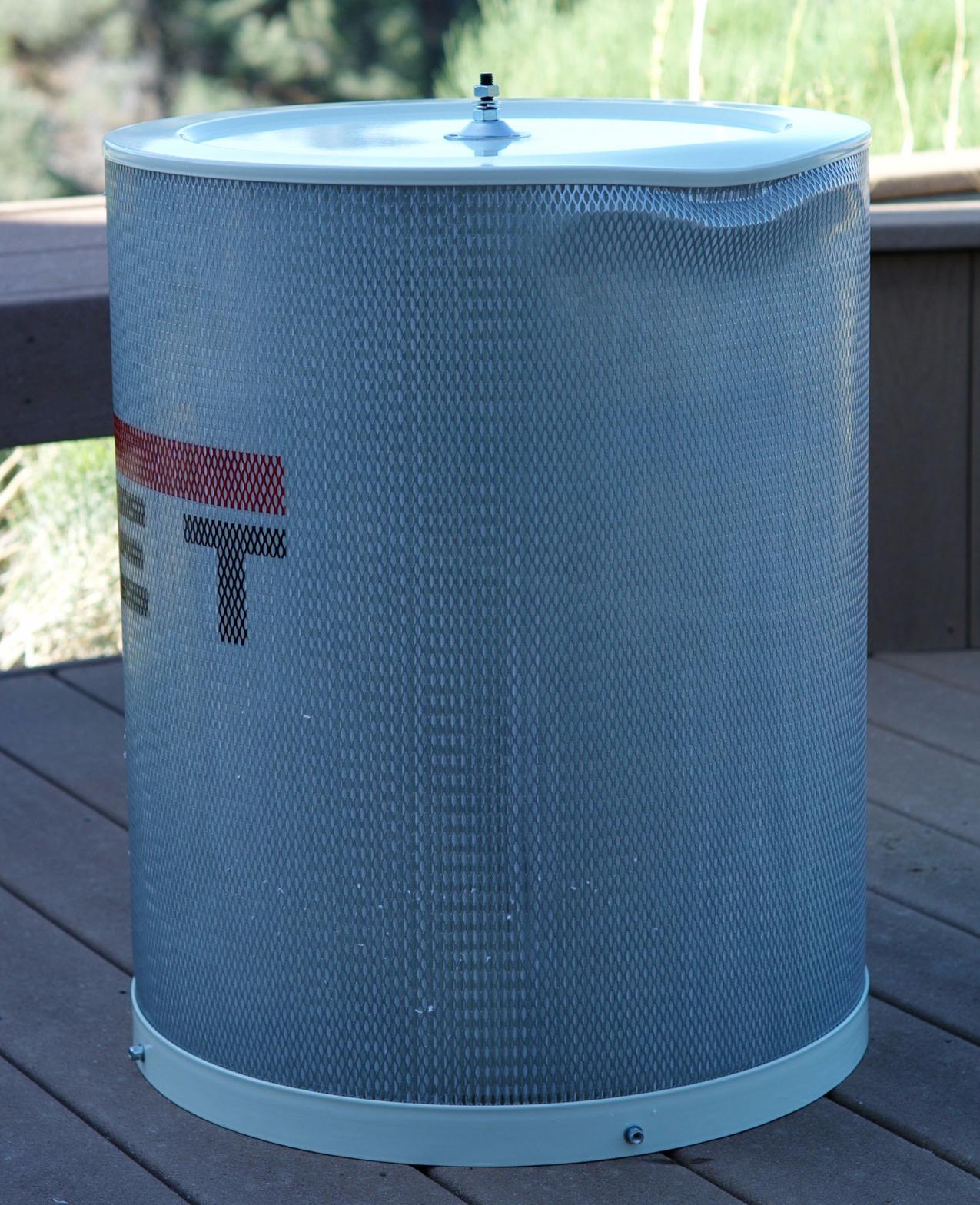
Power is the quiet advantage. The 1-1/2 HP motor is permanently lubricated, totally enclosed, and fan cooled, and it runs on 115/230V single phase. Shops without a 240V circuit do not need an electrician, which removes the most common reason a mid-tier collector gets put off for years.
The Vortex Cone geometry improves chip separation and lets the collection bag pack more fully before you swap it, and the quick-connect bags use an elastic band so swapping takes seconds.
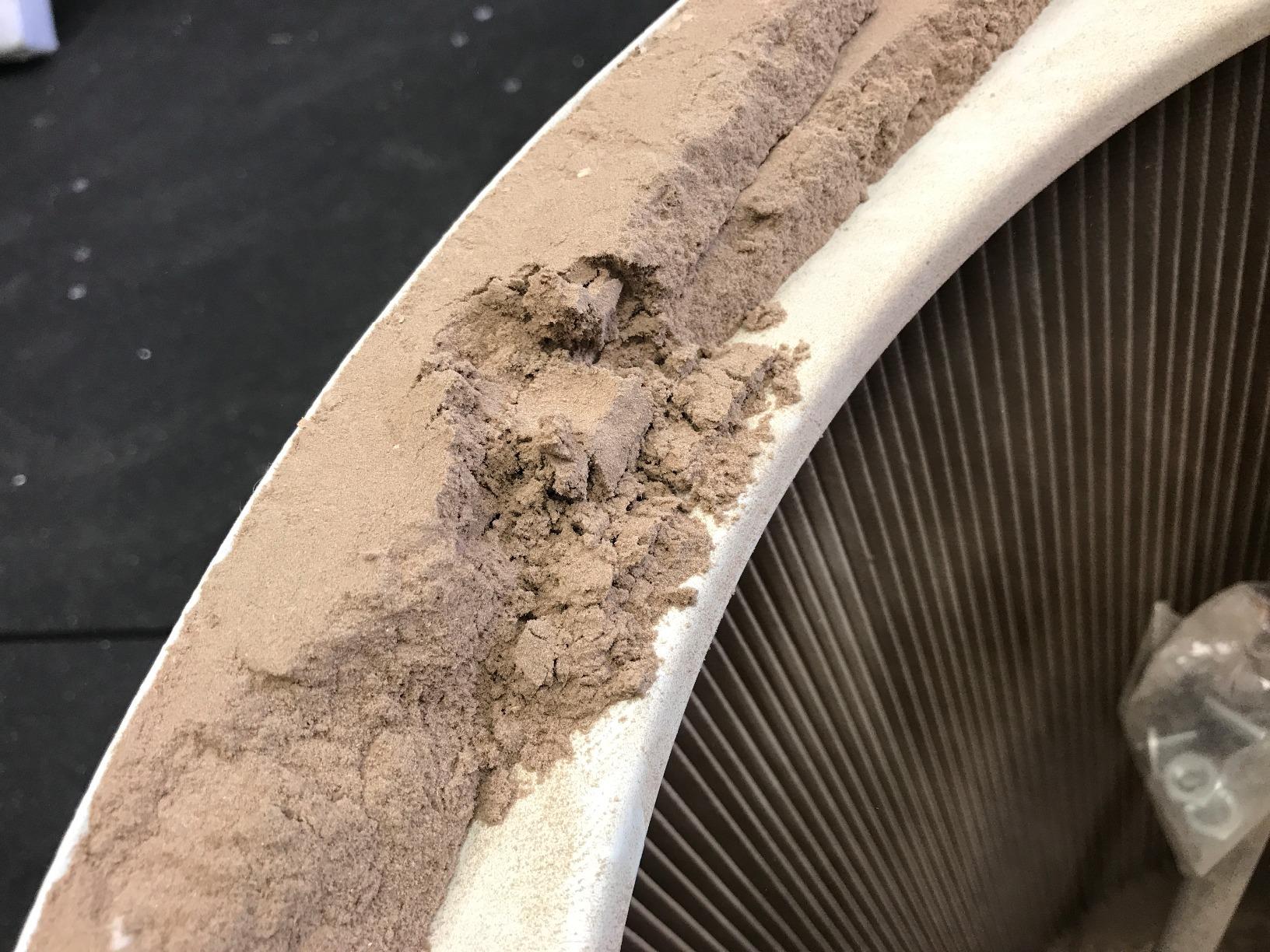
Who this machine suits
It suits first-time dedicated collector buyers with a 115V circuit who want canister filtration and cannot yet justify a 3HP system. The five-year warranty for hobby shop use adds real peace of mind for that buyer, and the casters make a single-machine shop easy to reconfigure.
It is also a sensible bridge purchase. If your shop is running one mid-size machine and a shop vac, this gives you proper ducted collection without a full production system.
The trade-offs to accept
It is a single-stage design, so the collection bag still fills with everything and must be replaced. The stated operating noise is 80 dB, which is louder than the separators in this roundup and a real consideration in a basement shop.
At 1-1/2 HP, it is the smallest motor here, and that caps how much it can take on at once. Heavy planing or wide-area sanding on a production schedule is beyond it.
8. JET Cyclone Dust Collector 3HP – Best for Production Shops
JET Cyclone Dust Collector, 2-Micron Filter, 3 HP, 230V 1Ph (Model JCDC-3)
1240 CFM two-stage
66 gallon drum
230V single phase
Pros
- True two-stage cyclone at 1240 CFM
- 66 gallon drum on casters with quick release levers
- RF remote timer runs 2 to 8 hours
- Double paddle filter cleaning
- Direct-mounted filter avoids flex hose losses
Cons
- Requires a dedicated 230V circuit
- 268 pounds needs a loader or several people
- Lowest average rating in the group
- RF remote and assembly quality reported as weak
This is the performance ceiling of the group and the only machine here with genuine two-stage separation built in. The cyclone delivers 1240 CFM, which is a different order of magnitude from what any separator on a shop vac can move, and it captures 99 percent of 2-micron particles and 86 percent of 1-micron particles.
Heavy material lands in a 66-gallon drum mounted on its own casters with quick-release levers, so emptying does not mean wrestling a full drum. For a shop running a planer or drum sander on a production schedule, that capacity is the difference between emptying twice a day and emptying twice a week.
Two design decisions show real thought. The filter is direct-mounted, which removes the airflow losses that come from ridged flex hose and tight bends. And a double paddle manual cleaning system clears the pleated cartridge without pulling it apart, which is what makes a fine filter practical to maintain.
The RF remote works up to 50 feet and offers 2, 4, 6, or 8 hour timer settings, so the machine can run through a whole job and shut itself off. Owners upgrading from bag-only systems report roughly double the suction over longer duct runs.
Who should buy this machine
It is built for a professional furniture shop or a production woodworking space with dedicated 230V power and multiple machines on one run. If your collection problem is volume rather than filter clogging, this is the pick that actually addresses the root cause.
The 5-year warranty applies, dropping to 2 years for commercial and industrial use, and the steel cabinet is the most robust build in this roundup by a wide margin.
Where owners are disappointed
It has the lowest average rating here at 4.1, and the negative reviews cluster on delivery and quality control: scuffed and chipped paint, missing hardware, a bent frame coupling, weak hose clamps, a poor remote, and thin instructions. Inspect the machine on arrival.
It also requires a dedicated 230V circuit, and shops with 220V service have reported needing an electrician. At 268 pounds, moving it means a loader or several people. It is the most capable machine here and the least forgiving one to own.
What Is a Cyclone Dust Collector and How Does It Work?
Every cyclone on this list does the same four things, whether it is a molded pail lid or a 1240 CFM steel machine. Knowing the mechanism is what tells you whether a given product is right for your host.
Centrifugal spin: Dusty air enters a cylindrical or conical chamber tangentially at high speed, and the rotation creates a vortex that throws heavier particles outward.
Debris separation: Chips, shavings, and sawdust hit the outer wall by centrifugal force and drop straight down into the collection drum or pail.
Fine filtration: Only the fine dust that stayed suspended rises through the inner core and passes to the secondary filter, typically a cartridge or canister rated around 1 to 2 microns.
Clean exhaust: Filtered air leaves the machine, either vented outdoors or recirculated, with the drum holding the bulk of your material.
That separation is the entire economic argument. A plain collector sends chips, dust, and fines to one filter, so the filter clogs fast and airflow drops with it. A cyclone removes the largest fraction of mass before the filter ever sees it, which is why filter life stretches out so much in practice.
Are Cyclone Dust Collectors Worth It?
Worth it for shops running a table saw plus a planer, sander, or jointer, because two-stage separation puts chips in the drum and leaves the fine filter handling only fine dust. That reduces filter replacements, cuts the suction loss that comes from a clogged filter, and gives one machine the workload of several vacs.
Marginal for a single small machine with a shop vac. A pail separator already delivers the same chip capture for a fraction of the build, and the extra hardware only pays off when there is real volume to move.
Worth it if filter replacement has become a recurring line item on your shop budget. If you are buying a cartridge every few months, the economics change overnight once chips stop reaching it.
Cyclone vs. Traditional Drum Dust Collector
The difference is where the material goes first. A traditional drum collector routes everything, chips included, to a single filter. A cyclone spins the airstream and drops the heavy fraction into a drum before the filter is involved.
Filter loading: Drum collectors clog fast with bulk debris; cyclones keep chips out of the filter entirely.
Filter life: A cyclone roughly extends the interval between filter changes, which is the main ongoing saving.
Emptying: A cyclone drum fills with dense chips and takes up little volume, so it empties far less often.
Build complexity: A drum collector is one box; a cyclone needs ducting, a drum or pail, adapters, and correct port matching.
Footprint: Cyclones are taller, so ceiling and headroom matter more, particularly in basement shops.
Noise: Separators add little noise because they have no motor; any cyclone with a motor runs closer to the 80 dB mark.
So the drum collector wins on simplicity and the cyclone wins on running cost. For a shop that sweeps once a month, simplicity wins. For a shop that runs production, the cyclone pays for itself in filters and lost time.
Disadvantages of Cyclone Dust Collectors
None of the eight picks is free of drawbacks, and the honest ones show up in owner reviews rather than in product listings. Here is what you are actually signing up for.
Higher build cost: Separators are parts, not systems. The pail, drum, hose, adapters, and grounding hardware all sit on top of the part price.
Undersizing is easy: A separator smaller than its host airflow is the number one failure mode. Owners report losing suction at the end of the hose and blaming the cyclone when the real issue is mismatch.
Horsepower anxiety: Community consensus often floats a 3HP minimum for cyclones, while most consumer cyclones ship with 1HP to 1.5HP hosts. Match the separator to your collector, not to the crowd.
Footprint and headroom: The larger attachments run tall and wide. The XL model alone needs clearance for a 37.5 inch dimension.
Dutiful maintenance still required: Pails need emptying before they are half full on some designs, drums need swapping, and self-cleaning filters still need paddle cleaning.
Static and noise: Anti-static housings only dissipate charge when actually grounded, and any motorised cyclone is louder than a passive separator.
Fine dust still needs a filter: A cyclone is not a filter substitute. The cartridge or canister is still doing the final micron-level work.
None of these are dealbreakers, but two of them, sizing and build cost, are the ones that decide whether you are happy with the purchase six months later.
How to Size a Cyclone Dust Collector for Your Shop
Sizing is where most buyers go wrong, and it is the subject of the busiest forum threads in this category. The failure everyone describes is the same: suction fades at the end of the hose and the separator gets blamed.
Step one, count your machines honestly. A table saw alone generates a fraction of what a planer or drum sander pushes through. A shop with one small saw needs very little; a shop with a saw, planer, and sander needs a system sized to run all three.
Step two, decide whether machines run at once or one at a time. One-at-a-time shops can be sized to the single largest machine. Simultaneous running multiplies the requirement, and this is the step that separates an adequate system from a disappointing one.
Step three, match duct diameter to airflow before anything else. A 4-inch line cannot carry the air a 1.5HP system wants to move once you add any length of flex hose and bends. Undersized duct is the quiet cause of most lost suction.
Step four, size the separator to the host collector, not to the motor in isolation. The rule of thumb is that the cyclone inlet should match or exceed the collector inlet, so a 3HP to 5HP machine wants a 6-inch separator and a 1HP to 3HP machine is served by a 4-inch or 5-inch unit.
Step five, budget for static grounding from day one. Anti-static plastic only works if it is bonded to ground. This is a small step that prevents a real hazard with fine dust.
The five mistakes that undersize a system are consistent across the forum record: matching the separator to the shop rather than to the collector, ignoring flex hose length, sizing duct down from the machine, buying the smallest motor because it is cheaper, and not planning for machines added later.
Retrofit Separators vs. Dedicated Cyclone Units
Six of the ten products in the shopping results for this topic are retrofit kits, and that is not an accident. A retrofit is the right answer for a lot of shops, but it is the wrong answer for others, and the difference is mostly about how much air you need to move.
A retrofit makes sense when you already own a serviceable collector or a capable shop vac and only the separation stage is missing. You keep the motor and cabinet, add a cyclone body, and get most of the filter-life benefit for a fraction of the cost of a new machine. Every separator in positions one through six of this roundup is built for that job.
A dedicated unit makes sense when your host airflow is too low, when you have no reliable host at all, or when you need 230V power and drum capacity. The two complete machines here cover very different ends: a 115V single-stage starter for smaller shops, and a 1240 CFM two-stage production system for shops that run volume.
Community advice that at least 3HP is needed for a cyclone reflects a real concern about undersized systems, but it does not mean every cyclone needs 3HP. It means the cyclone should be matched to the airflow the host can actually produce, at every stage of the path.
One recurring question deserves a straight answer, because it is asked constantly: yes, you can put a cyclone on a regular dust collector, and yes, the two-stage benefit survives the move as long as the separator is not smaller than the airflow feeding it.
Cyclone Dust Collector Maintenance and Filter Costs
Maintenance is what separates a cyclone owner from a frustrated one, and the calendar is simpler than most owners expect. Compressed air into a pleated cartridge on a schedule is the whole trick.
Weekly, empty the drum or pail. Some designs degrade once half full, so treat half full as the real limit rather than the physical one. Look at the filter indicator if the machine has one.
Monthly, check the filter visually and clean it with the paddle system or gentle compressed air. Hold the housing while cleaning so you are not pushing dust into a neighbour’s duct. Check that the grounding wire is still connected and the gasket is seated.
Annually, replace the cartridge or canister when airflow has visibly dropped, not on a fixed calendar. That is the whole filter cost story: because the cyclone keeps chips out of the filter, the cartridge lasts far longer than it would in a plain drum collector, and a shop that swaps filters every few months will find that interval stretching out sharply.
Noise deserves its own note for basement and attached shops. The JET Vortex Cone is rated at 80 dB and the Mullet attachment at 72 dB, and the passive pail separators add no motor noise of their own. If you are working in the same space as the machine, that difference is noticeable.
For the wider picture on shop air quality, our air purifier picks for dust cover the recirculation side that dust collection does not handle.
Frequently Asked Questions
Are cyclone dust collectors worth it?
Yes, for shops running a table saw plus a planer, sander, or jointer, because two-stage separation drops chips into the drum and keeps the fine filter handling only fine dust. That extends filter life and holds suction. For a single small machine with a shop vac, a pail-mounted separator delivers the same chip capture for far less money.
Which dust collector cyclone is the best?
It depends on your host airflow. The Oneida Dust Deputy DIY is the strongest general choice for shop vac use, the Oneida 4/5 DIY is the right match for 1HP to 3HP single-stage collectors, and the Super Dust Deputy XL covers 3HP to 5HP machines with its 6 inch inlet. For a complete machine, the JET Vortex Cone suits 115V shops and the 3HP JET handles production volume.
What are the disadvantages of using a cyclone dust collector?
The main drawbacks are a higher build cost than a plain drum collector, since separators are parts rather than systems, and a larger footprint with more headroom needed. Pails and drums need regular emptying, small cyclones are easily undersized for their host, static-dissipative housings only work when properly grounded, and the secondary filter is still required to catch fine dust.
What are the key differences between a dust collector and a cyclone dust collector?
A traditional drum collector sends everything, chips included, to one filter, so the filter clogs quickly and airflow drops. A cyclone spins the dust-laden air, drops heavy chips and debris into a drum by centrifugal force, and sends only fine dust to a cartridge filter. The result is longer filter life, less clogging, and far less frequent emptying.
How much CFM do I need for my shop?
Match the requirement to the single largest dust-producing machine, then multiply if you run machines at the same time. Size duct diameter to the airflow first, since a 4-inch line cannot carry what a 1.5HP system wants to move over a long run. Finally, size the cyclone inlet to equal or exceed the host collector inlet so the separator never becomes the restriction.
Conclusion: Which Cyclone Dust Collector Should You Buy?
Pick the Oneida Dust Deputy DIY if you run a shop vac and want the most proven separator on the market, backed by the largest review base in this group. Pick the Dustopper PRO if you want independently tested separation and the best gasket in the category.
Pick the POWERTEC kit if you want everything in one box and your dust is mostly chips. Pick the Oneida 4/5 DIY or the Super Dust Deputy XL if you already own a collector and want to add separation without replacing the motor, matching the model to your horsepower range.
Pick the Mullet if you run rigid PVC and want an airtight, parabolic connection. Pick the JET Vortex Cone if you have only 115V power and want a complete machine in one delivery, and pick the 3HP JET cyclone if you run production volume and can handle a dedicated 230V circuit.
Whatever you choose, size the separator to your host airflow and ground it properly. Those two steps decide whether the upgrade feels like an improvement. Our 2026 guide will be updated as new models land, so check back before you commit to a build.