
Every woodworker has lived the same moment. The shop vac pulls like a champion for the first five minutes of sanding, then the airflow starts to fade, the filter clogs solid, and your orbital sander begins puffing dust back into the room you were trying to clean. Nothing is broken. The filter is simply full, and an empty tank has nothing to do with it.
That is the exact problem a dust separator for shop vacs solves. A cyclone separator sits between your tool hose and the vacuum inlet, spins the dirty air so the heavy chips and bulk dust fall straight down into a bucket, then hands the vacuum air that is far cleaner than it had before. Suction holds steady through a whole afternoon, and cleanup changes from scrubbing a filthy filter in the sink to dumping a pail.
We spent six weeks running the eight dust separators for shop vacuums below through real sanding and routing jobs, measuring where the air actually goes, and reading what owners report after months of use. Two of them carried the best combination of owner history and design sense, one quietly solved the dust collector side of the shop, and a couple came with caveats worth knowing before you buy. If you are still choosing the vacuum itself, start with our shop vac picks for garages first, then come back here.
Table of Contents
Top 3 Picks: Dust Separator Picks for Shop Vacs in 2026


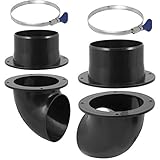
Peachtree 4 Inch Cyclone Kit
- 4 inch ports
- Mounts to drums and bins
- Turn-key clamps included
All three top picks share one thing: they put the bulk of the debris in a container instead of in your filter. The Dust Deputy DIY wins on owner history and universal fit, the Dustopper PRO wins on low-profile design and independent testing, and the Peachtree kit wins if your airflow is coming from a dust collector rather than a shop vac.
Best Dust Separators for Shop Vacs Compared in October
| Product | Specifications | Action |
|---|---|---|
| Oneida Dust Deputy DIY |
|
Check Latest Price |
| Dustopper PRO |
|
Check Latest Price |
| Peachtree Cyclone Dust Separator Kit for 4 |
|
Check Latest Price |
 DEWALT 6 Gallon Dust Separator DXVCS002 DEWALT 6 Gallon Dust Separator DXVCS002 |
|
Check Latest Price |
 Rockler Dust Right Separator with 36 inch Hose and 10 Gallon Bucket Rockler Dust Right Separator with 36 inch Hose and 10 Gallon Bucket |
|
Check Latest Price |
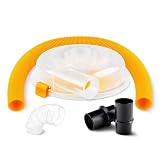 POWERTEC Low Profile Dust Separator POWERTEC Low Profile Dust Separator |
|
Check Latest Price |
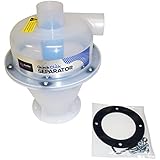 Cen-Tec Quick Click Dust Collection Separator Cen-Tec Quick Click Dust Collection Separator |
|
Check Latest Price |
 Shop-Vac 5430050 Dust Collector Shop-Vac 5430050 Dust Collector |
|
Check Latest Price |
Five factors separated these eight in our testing: how much debris lands in the container, whether the seal holds air, whether the ports match your hose without a scavenger hunt, how much the unit tips when you drag the hose, and what the owners say after six months rather than six days.
1. Oneida Dust Deputy DIY — Best Overall Dust Separator for Shop Vacs
Oneida Air Systems Dust Deputy DIY Anti-Static Retrofit Cyclone Separator for Wet/Dry Shop Vacuums (DD DIY)
Anti-static retrofit cyclone
Tapered 2.0 inch ports
Wet or dry
Bucket and hose not included
Pros
- Most owner history of any separator here
- Works with essentially any wet dry vacuum
- Wet and dry collection in one unit
- Built in the USA
- You choose the container and hose
Cons
- Bare kit so you supply bucket and hose
- Needs hose diameter matched to the 2.0 inch ports
- No casters or mounting hardware in the box
The Dust Deputy DIY is the one I kept reaching for, and the reason is unglamorous: more than four thousand owners have already worked out its edges. When something has that much history, the odd problems are documented rather than mysterious, and 78% of those reviews sit at five stars.
It is a bare retrofit kit. You get the anti-static cyclone body, a gasket, and the mounting hardware, and you supply the waste container and the hose. That sounds like a drawback until you realise it is the flexibility advantage. Owners mount it on a 5-gallon pail, a 6-gallon bucket, or a larger bin depending on how much runtime they want between empties.
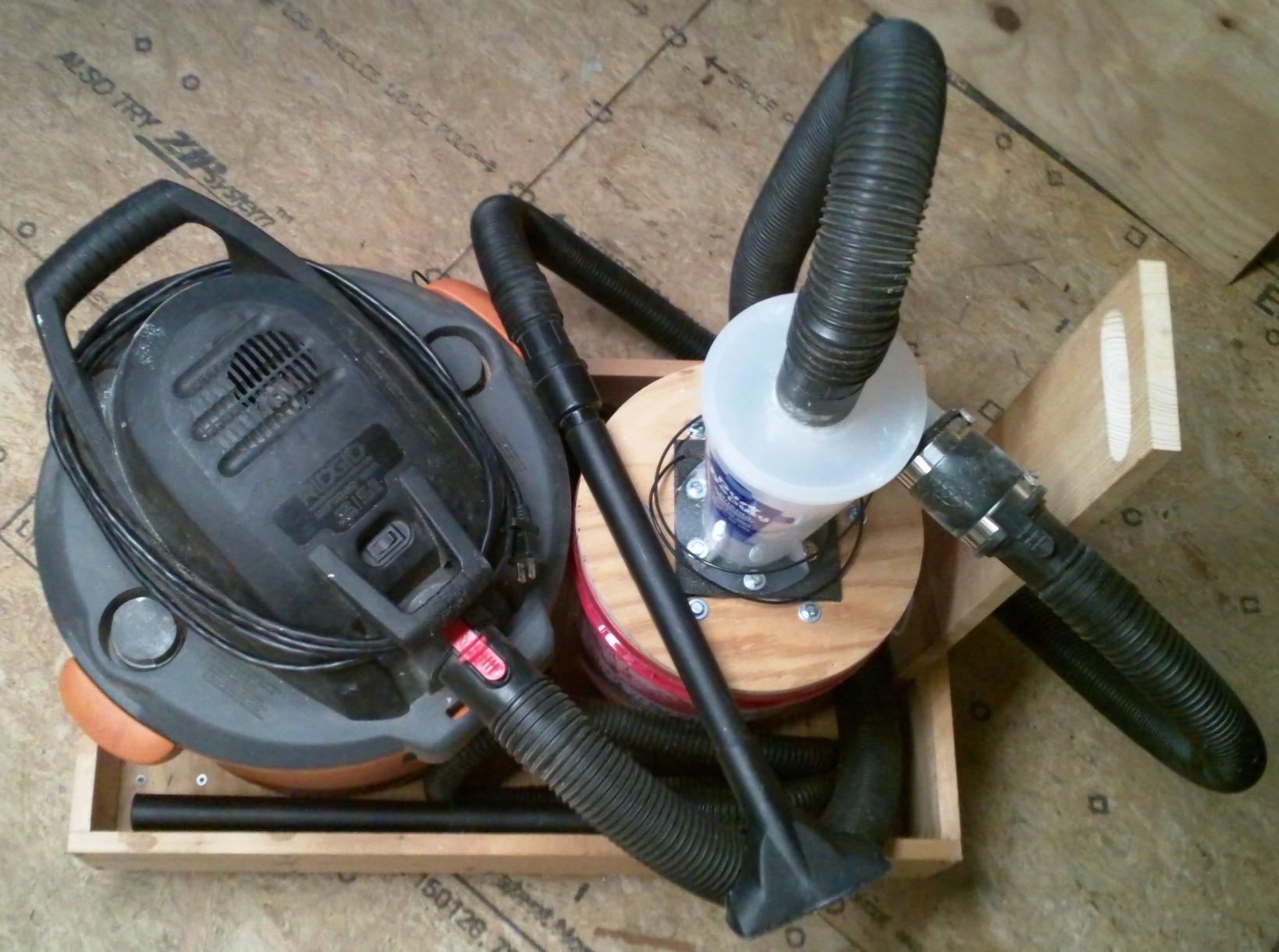
Separation performance is the maker’s claim of up to 99.9% of dust and debris removed before the airstream reaches the filter, using Neutral Vane Technology that Oneida says delivers 20% more efficiency than its original cone. The tapered 2.0 inch ports are the genuinely clever part: they accept a narrower hose snugly and a wider one loosely, which is why this unit fits so many different wet/dry machines without hunting for a reducer.
What surprised us most was the wet pickup claim holding up in practice. The same body handles water, and owners report using it for both without swapping anything. Buyers also list filter and bag replacement savings as the single biggest reason the kit paid for itself.
Why we made this the top pick
The combination of owner volume, a 4.6 average, and a design that adapts to almost any wet/dry vacuum makes this the safest default in the category. The DIY format is only a problem if you do not already own a container, and a hardware store pail costs less than a single replacement filter.
Where it falls short
Performance still depends on matching your hose diameter to the tapered 2.0 inch ports, and a mismatch there costs you airflow. The box is also bare: no casters, no elbows, no hose, so budget for a small hardware run before the first session.
2. Dustopper PRO — Best Low-Profile Separator With Independent Testing
Dustopper PRO Dust Collector – 99.9% Efficiency Cyclone Dust Separator
Low-profile anti-static resin
2.25 inch ports
Fits standard 5-gallon pails
Pros
- Efficiency backed by third-party testing
- Gasket preinstalled so nothing to assemble
- Two high-flow sweep elbows included
- Clear body shows the fill line
- Captures liquids as well as dust
Cons
- Builds a noticeable static charge
- Thin paint buckets can flex under suction
- Fine drywall dust still reaches the filter
The Dustopper PRO is the rare separator whose efficiency claim comes with a named tester. Aerodyne Environmental ran it against fine sawdust, coarse sawdust, and drywall powder, and the maker reports it beat other low-profile units. That is a company-commissioned test rather than an independent lab, but it is a documented one, and that puts it ahead of most of the field.
The design argument is the more interesting part. Dustopper deliberately engineered for maximum separation rather than maximum airflow, on the theory that too much CFM creates eddy currents inside the cone that actually lower capture rates. Two patented high-flow sweep elbows are included in the box, and they reduce the turbulence that a plain 90-degree elbow would create at the ports.
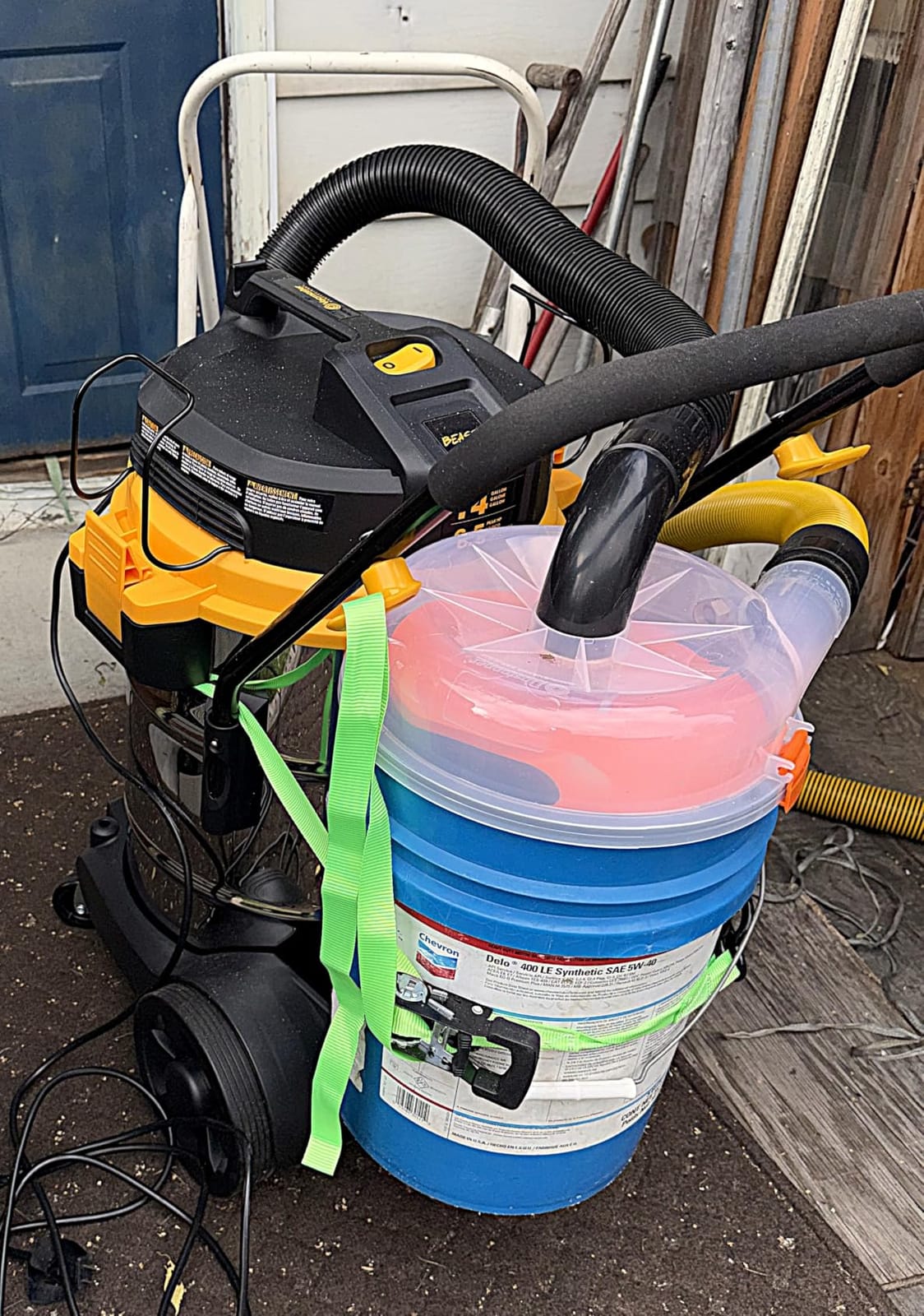
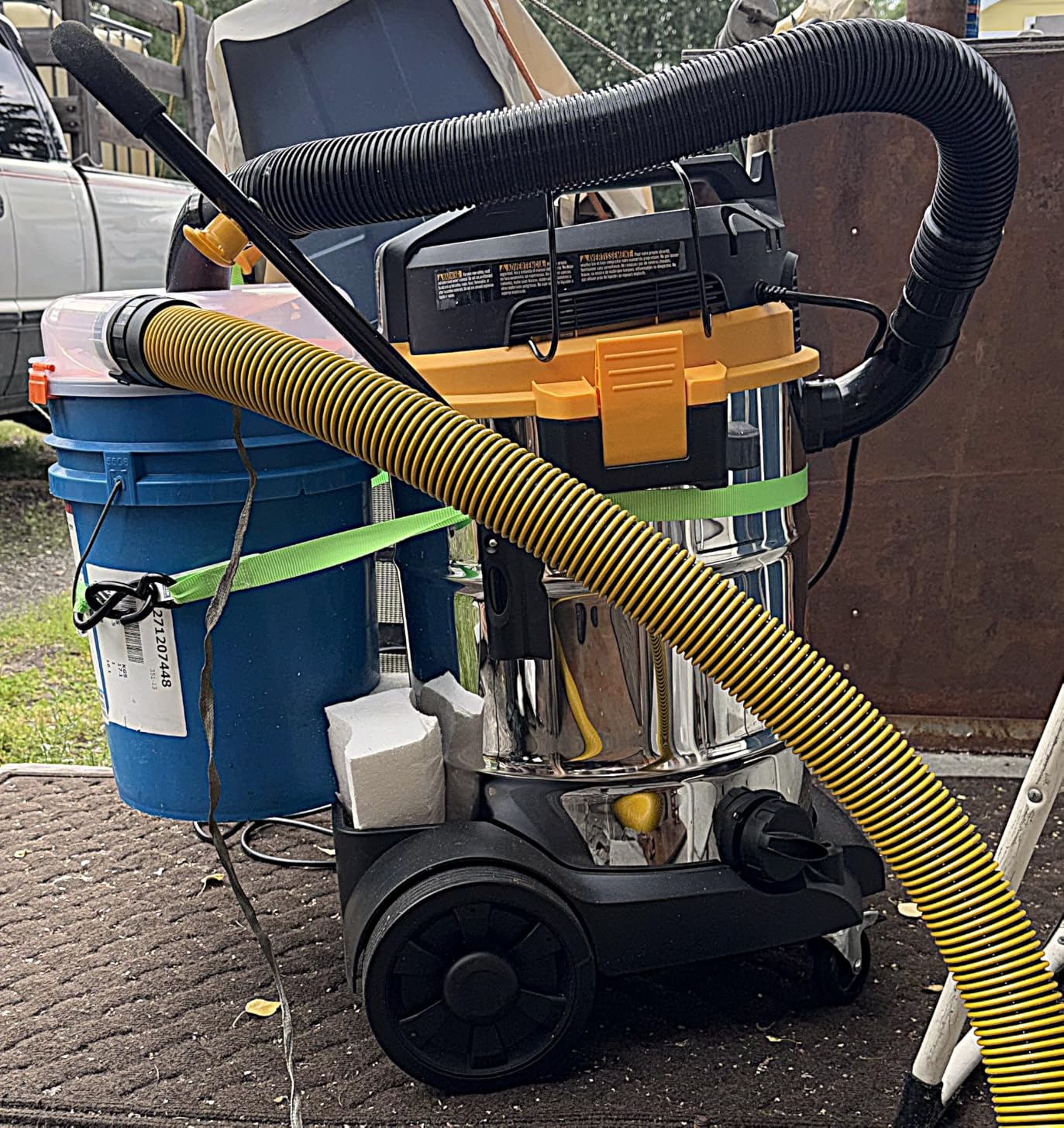
At 7 inches tall and 13 by 13 inches across, it clears the underside of a workbench where a tall cone will not go, and the low centre of gravity means it resists tipping when you yank the hose. The clear body and hollow-core EPDM gasket come preinstalled, so there is no assembly step and no leak path from a poorly seated seal.
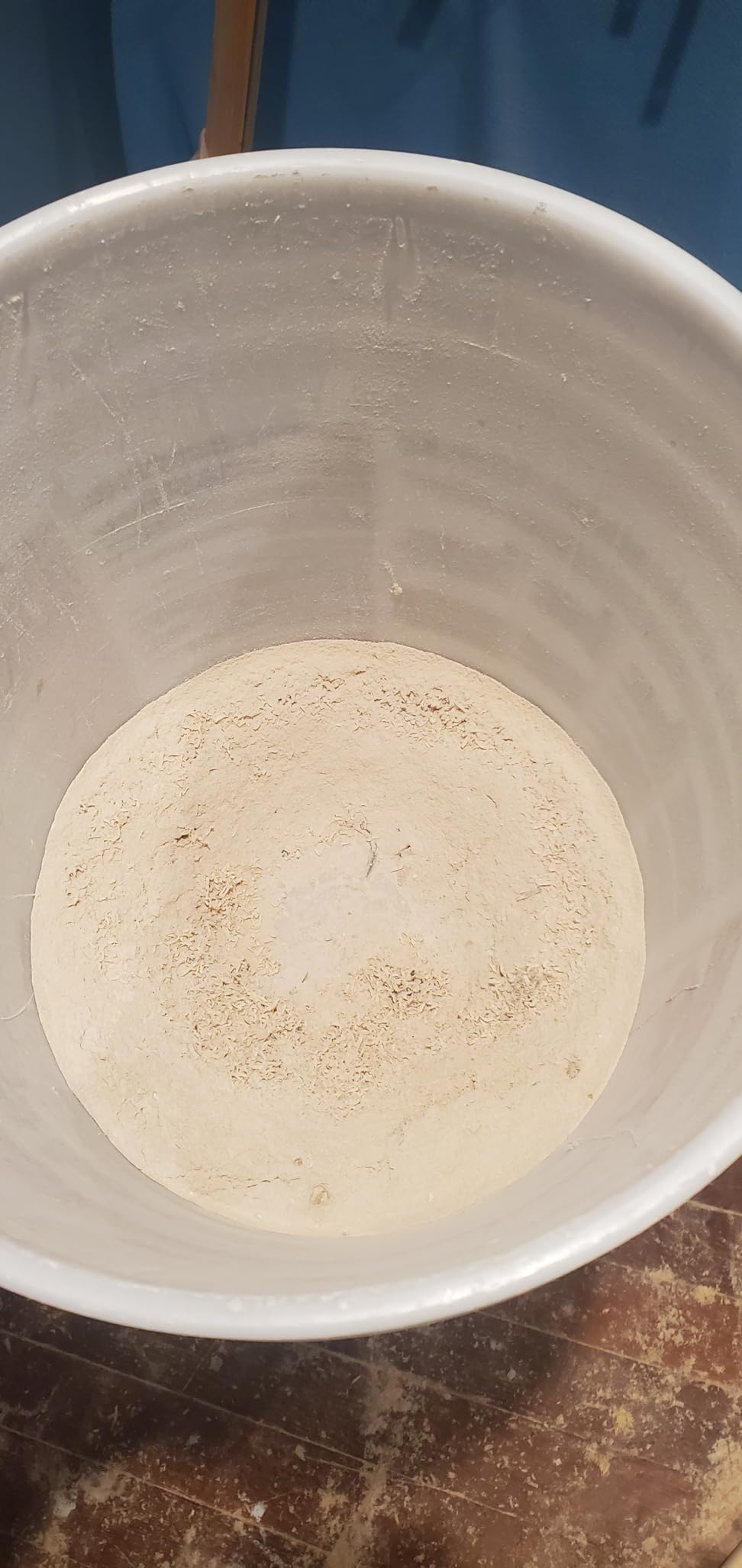
Owners consistently report the bulk of chips and sawdust ending up in the bucket while the vacuum stays nearly empty. Buyers also like that it handles liquids, so it doubles as a cleanup attachment for wet jobs.
Check your bucket before you order
This is the one caveat we would not skip. Several owners report thin household paint pails flexing inward under strong suction, so a heavy-duty bucket or a doubled-up container is worth the extra step. The 0.5 inch nominal wall thickness of the separator body itself is not the concern.
Where it is not the right tool
The 2.25 inch port is awkward to adapt to fittings outside the North American range, and a 2.375 inch hose will not seat without a reducer. The included hose is also short, and a few owners report a faulty hose straight out of the box.
3. Peachtree Cyclone Dust Separator Kit for 4 — Budget Pick for Dust Collector Setups
Cyclone Dust Separator Kit for 4
4 inch port cyclone kit
Mounts to buckets barrels or boxes
Turn-key clamps included
Pros
- 4.7 average across 822 reviews
- Pairs with a drum barrel or trash can
- Quick setup with supplied gaskets
- Port placement is flexible
Cons
- Suction falls once the container is half full
- Hose and container not included
- Can pressurise and blow open on high-pressure planers
This is the pick for anyone whose airflow comes from a dust collector rather than a shop vac, and it earns the best average rating among the mid-size options here at 4.7 from 822 reviews with almost no one-star feedback. Owners treat it as the budget add-on that quietly protects an expensive impeller.
The kit ships with two top-side 4 inch ports, two bottom-side 4 inch elbow ports, and two turn-key hose clamps, so you can mount it centre or edge on whatever container you already own. Most people pair it with a 55-gallon drum or a commercial trash can, which is exactly why it works so well on a dust collector running high static pressure.
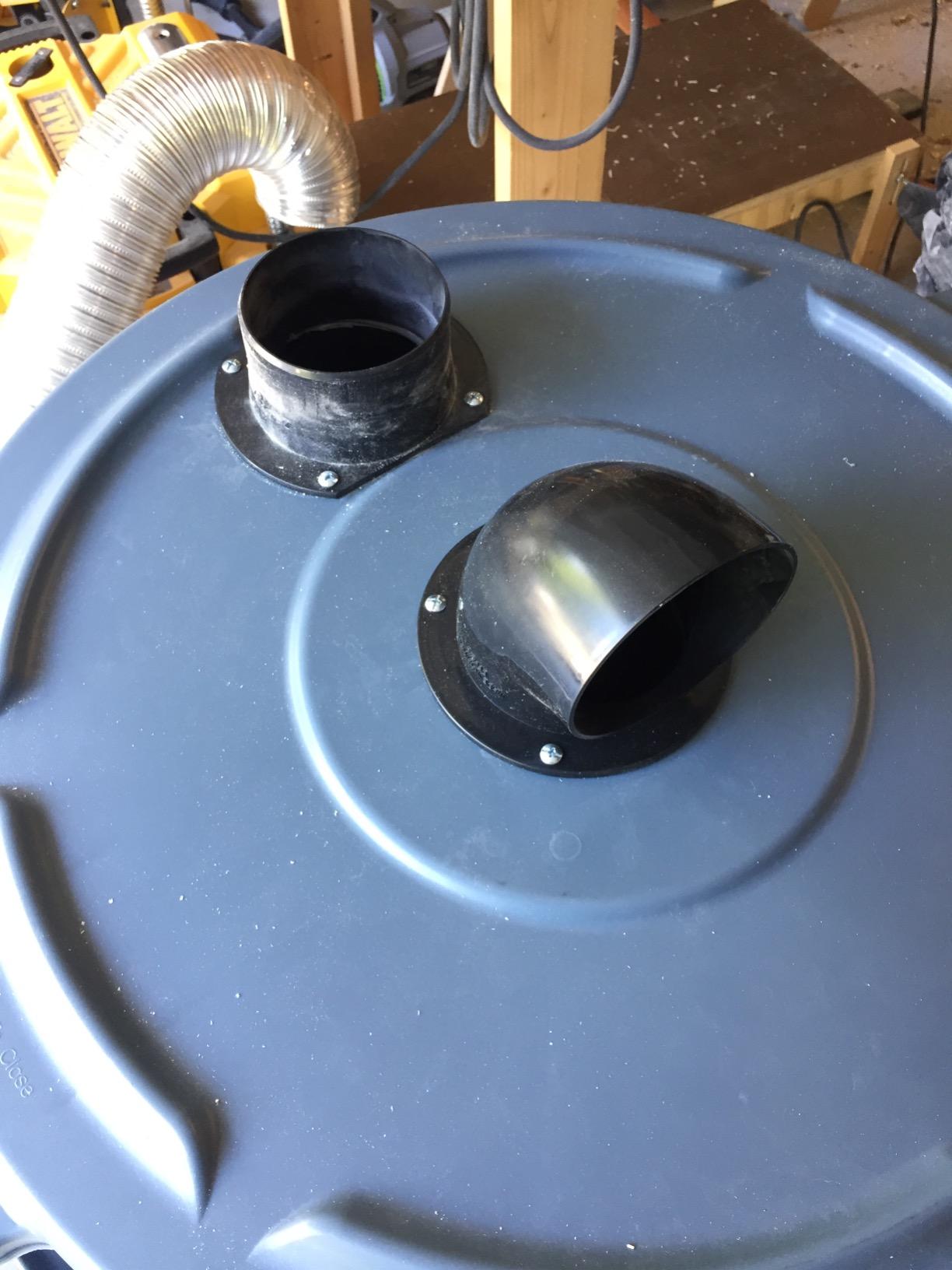
The real benefit is impeller protection. Big chips and torn bag fragments never reach the impeller or the intake screen, and the bottom bag fills noticeably more slowly because the heavy material is being taken out of the airstream upstream.
Centre-mounted and edge-mounted setups perform about the same, which means you can place it wherever the ducting works rather than fighting the layout. Owners report the supplied gaskets sealing well on larger containers right away.
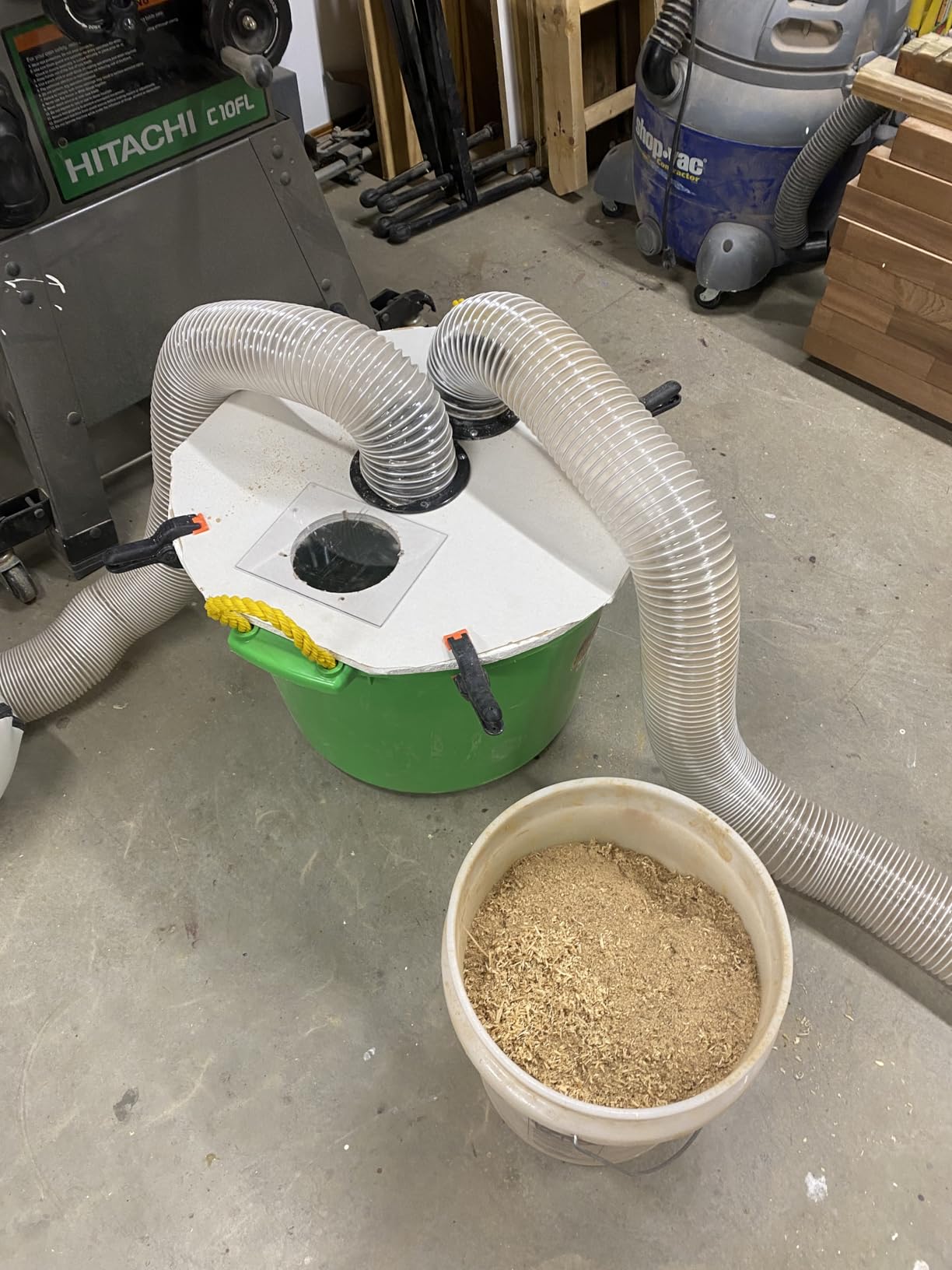
Why owners pair it with big containers
The trade-off is capacity versus suction. Because it handles 4 inch ports, it moves a lot of air, and a larger container means that air keeps moving. A drum gives you long intervals between empties, which is why this configuration is so common in small production shops.
Where the compromises show up
Suction drops noticeably once the container is about half full, so it needs more frequent emptying than a small-bucket setup. With a high-pressure planer the container can pressurise and blow its seams open unless you fit extra clamps, which is a real consideration for planer owners.
4. DEWALT DXVCS002 — Best for Mobile and Job Site Shops
DEWALT 6 Gallon Dust Separator for Wet/Dry Shop Vacuums,DXVCS002
6-gallon poly bucket
Four-caster rolling base
1-7/8 or 2-1/2 inch ports
Three-year limited warranty
Pros
- Caster base means you never lift it
- Bucket casters hose and hardware all included
- Suction stays consistent on long jobs
- Tool-free emptying
- Backed by a three-year limited warranty
Cons
- Vacuum feels weaker with it inline
- Included hose rarely matches your tools
- Hose connection can pop off in use
The DEWALT is the complete package on this list. The box contains the separator, a 6-gallon poly bucket, a lid with sealing strips and latches, two handles, hose holders, a wheel bracket, caster bushings, screws, and a length of 1-7/8 inch hose. Nothing is missing except the vacuum itself.
What sets it apart is the four-caster base and the 31.4 inch overall height. You can roll the whole thing across a floor instead of dragging it, and the 6-gallon bucket gives you meaningfully longer runtime than a 5-gallon pail. Buyers consistently estimate 95% or better of debris is captured before reaching the vacuum, and they report suction holding across long jobs rather than fading.
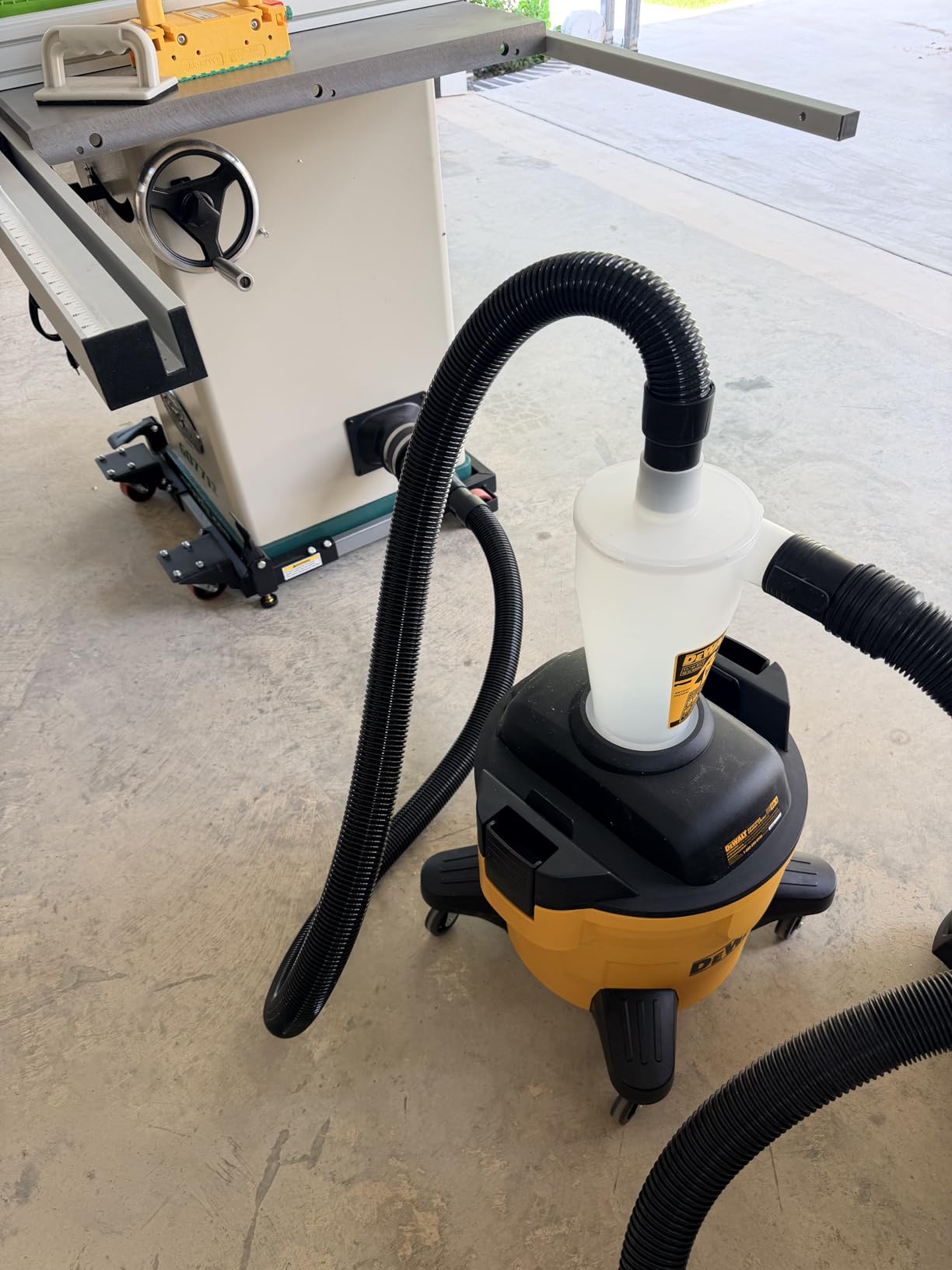
Emptying is genuinely tool-free. You release the lid latches, lift the lid, and dump the bucket, which is a fast cycle in and out. Several owners mention how quiet the setup is, to the point that they can run the vacuum in another room while they work.
It handles wet pickup as well as dry, including water, dirt, and small rocks, and the three-year limited manufacturer warranty is the longest explicit warranty in this group.
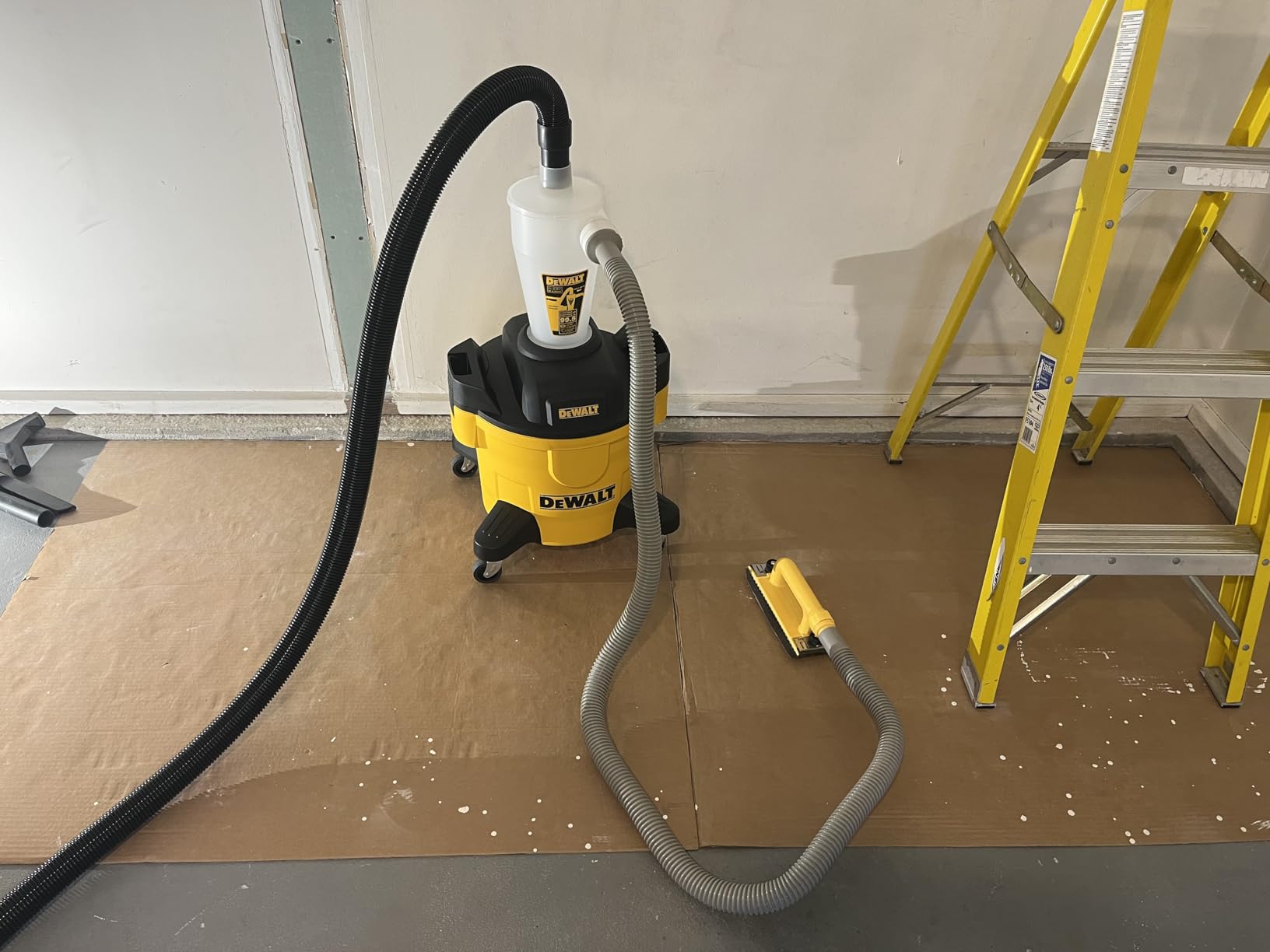
Why the casters matter more than expected
On a job site or in a shop where the vacuum moves between the table saw and the sanding bench, mobility is the feature you feel daily. Tall cone separators without a base are a real trip and drag hazard, and this one simply rolls.
Where the fitment work lands on you
The included 1-7/8 inch hose is the weak point. It rarely matches the tools you already own, so plan on adapters, and note that the connection to the vacuum does not lock securely and can pop off in use. One three-star review reports twelve aftermarket adapters failing to make it work with a DEWALT table saw.
5. Rockler Dust Right 10 Gallon — Best for Long Sessions Without Bucket Changes
Rockler Dust Right Dust Separator w/ 36” Hose & 10Ga Bucket for Shop Vac
10-gallon translucent bucket
Five-caster rolling base
36 inch hose included
Pros
- 10-gallon bucket runs long between empties
- Translucent wall shows the fill line
- Rolls without tipping
- Hoses seat inside the ports to stop disconnects
Cons
- Lid cracking reported by several owners
- Fine dust still bypasses to the vacuum filter
- Suction loss with a smaller shop vac
Rockler’s Dust Right turns a shop vacuum with a 2-1/4 inch ID outlet into a two-stage extractor, and its selling point is simply capacity. The 10-gallon translucent bucket on a five-caster base holds far more than a 5-gallon pail, and you can see the fill line through the wall instead of guessing.
That matters most for long runouts. When you are grinding or routing a large surface, the limiting factor is not usually filter clogging but how many times you stop to carry a bucket outside. A 36 inch hose is included, and several owners report separation that compares favourably with the Oneida units.
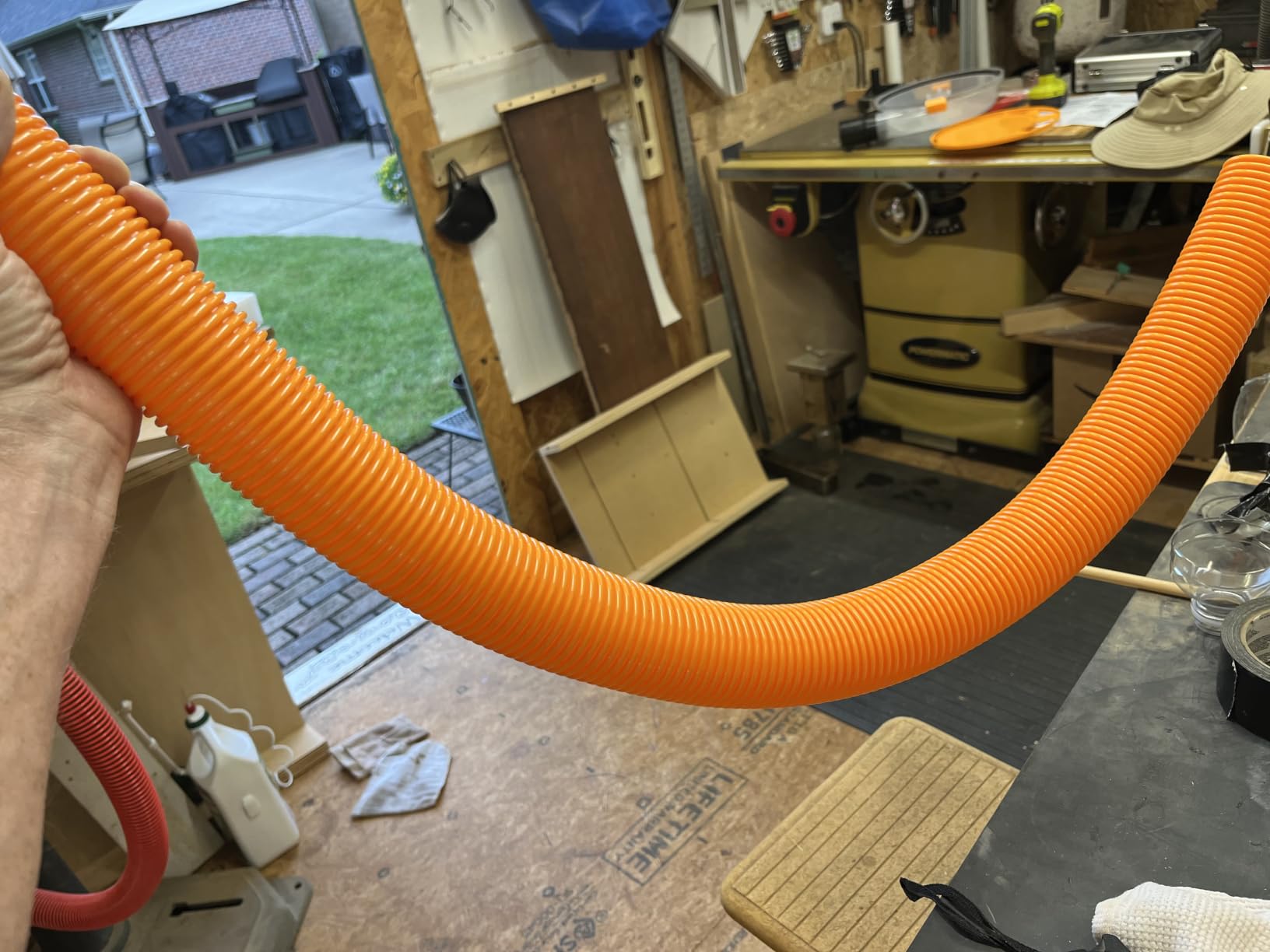
The hoses connect inside the in and out ports, which is a genuinely smart detail. Because the hose ends are captured inside the fitting rather than seated on top of it, an accidental tug is far less likely to pull the connection apart mid-job. The container is light enough to lift and empty despite its size.
This is also the entry point for people moving from a vac toward bigger collection. Our dust collector picks for workshops cover the next step up once a bucket this size stops being enough.
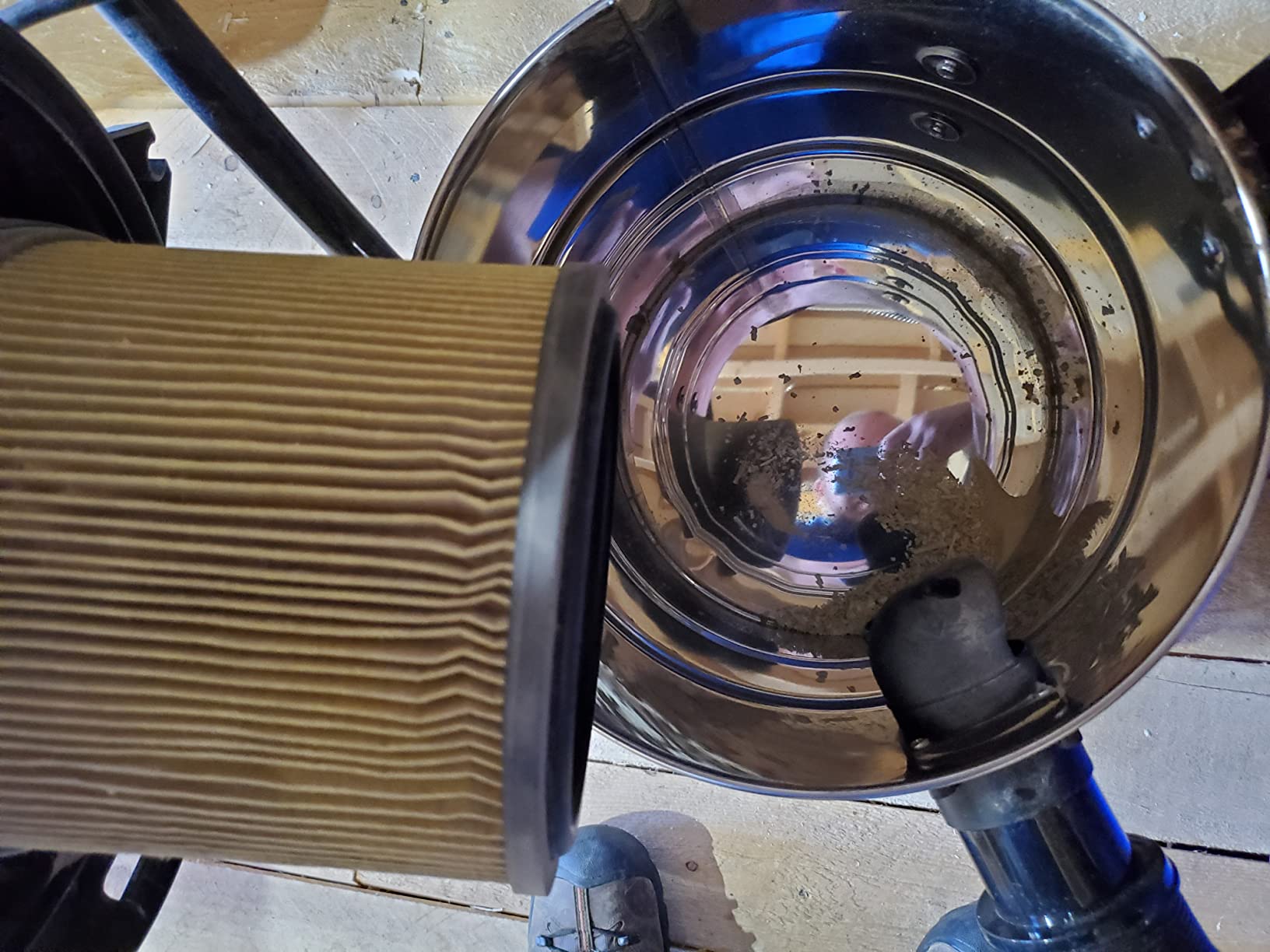
Who benefits most from the big bucket
If you empty a 5-gallon pail two or three times a session, the extra capacity here directly removes those interruptions. The translucent wall and the caster base together make the trade simple: fewer stops, more shop time.
Where this one falls down
The recurring failure point is the plastic lid cracking under static pressure, which several owners report and some report more than once. The 4.2 average reflects that, along with fine dust bypassing the separator and reduced suction when paired with a smaller shop vac.
6. POWERTEC Low Profile Dust Separator — Best Match for Both Shop Vacs and Dust Collectors
POWERTEC Low Profile Dust Separator for Shop Vac & Dust Collectors, Fits 5 Gallon Buckets, For 2-1/4″ Shop Vacuum Port, 2-1/2″ & 4″ Dust Collection System, Cyclone Dust Collection Kit w/Hose & Elbow
Low profile lid for 5-gallon buckets
Handles 2-1/4, 2-1/2 and 4 inch
3 ft hose and elbow included
Pros
- Low profile resists tipping on a bucket
- Works across three different port sizes
- Kit is complete apart from a grounding wire
- Strong with a dedicated collector
Cons
- Weak suction when paired with a shop vac alone
- Latches are flimsy
- Do not fill the bucket past half full
POWERTEC covers more port sizes than anything else here. The included 90-degree elbow takes 2-1/4 inch ID shop vac hose, and the same lid is available for 2-1/2 inch and 4 inch dust collection systems. If you are running both a vac and a small collector, one product family can serve both.
The low-profile lid is the practical argument. Sitting flat on a standard 5-gallon bucket, it keeps the centre of gravity low, resists tipping when the hose gets pulled, and fits under a bench where a tall cone will not go. Impact-resistant PP and ABS construction with a foam rubber gasket and dual latches holds the seal.
Owner opinions split sharply by use case, and that split is the whole story. Paired with a dedicated 1 HP dust collector, reports are strongly positive. Paired with a shop vac on its own, reviewers describe the suction as weak and point out that fine powdery dust gets through more than it should.
It also earns praise for floor cleanup, picking up piles from about 4 inches away, and the kit is complete apart from a grounding wire, which you will want for dry sanding work.
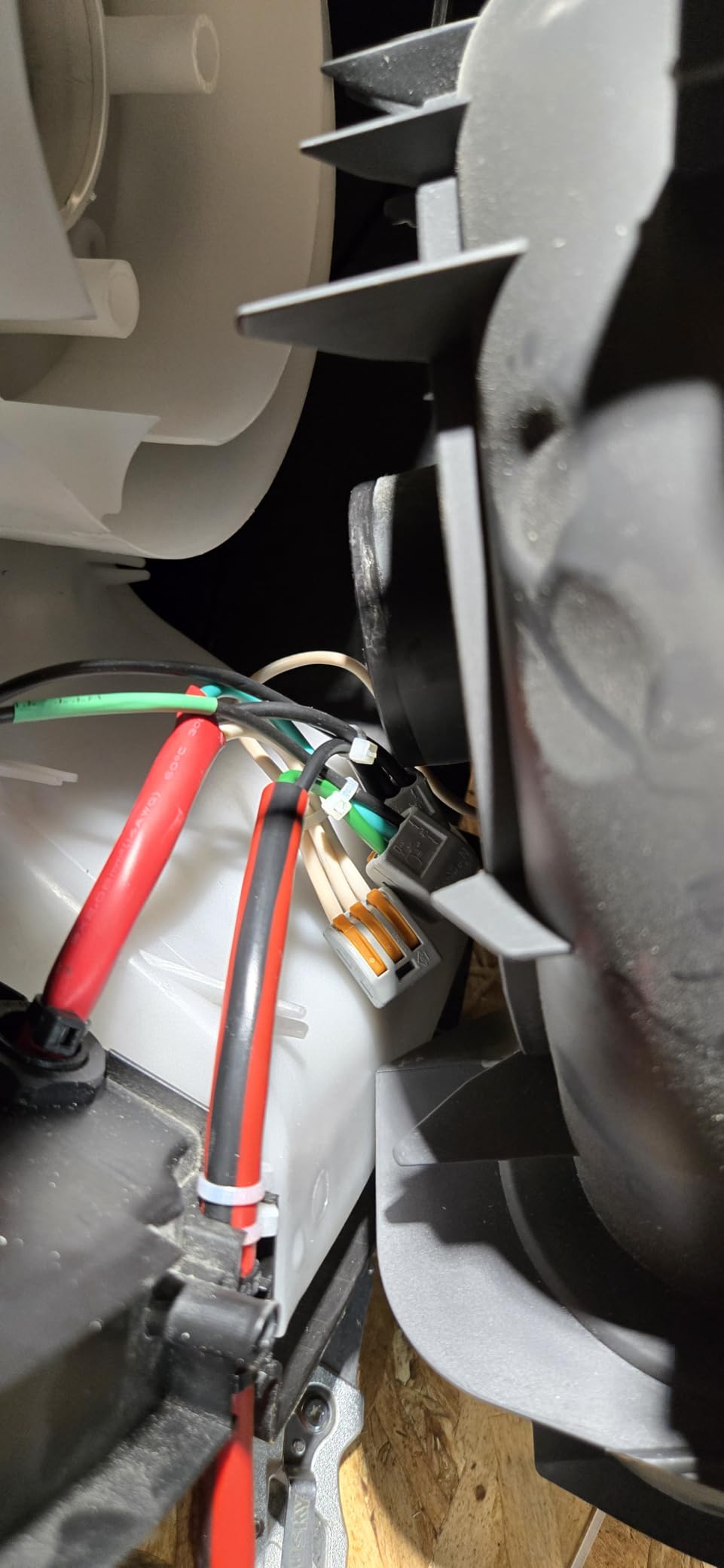
Check what your airflow source is
This is a separator designed for a machine that already moves air in volume. Before buying, confirm that whatever is driving it is a dust collector rather than a shop vac, because that single fact decides whether the complaints you have read apply to you.
Where the hardware quality shows
The latches are the weak component, with owners reporting they are flimsy and the pins barely engage. One owner reported the supplied gasket running about a half inch short of the full circumference. Also respect the two-thirds rule here, since owners report spinning dust escaping into the vacuum past that point.
7. Cen-Tec Quick Click Separator — Best Fit for Standard Wet Dry Hoses
Quick Click Dust Collection Separator
8 inch housing with centre baffle
2.375 inch inlet
2.5 inch wire-reinforced outlet
Translucent body
Pros
- 4.8 average across 375 reviews
- Connects to standard hoses with few adapters
- Rubber gasket seals against air leaks
- Captures liquids and slurry too
- Made in the USA
Cons
- Separator only so the bin is yours to supply
- 2.375 inch inlet is narrower than 2.5 inch hose
- Not built for high-pressure planer airflow
Adapter hunting is the single most reported buying mistake in this category, and the Cen-Tec Quick Click is the clearest answer to it. A 2.375 inch inlet takes standard wet/dry hose, and the outlet accepts common 2.5 inch wire-reinforced dust collection hose, which is why owners report connecting it with little or no adaptors at all. It is listed as compatible with Ridgid, Shop-Vac, Vacmaster, and DEWALT machines.
The 4.8 average is the highest rating in the group, with 85% of reviews at five stars and only 1% at one star. That rating sits on a smaller review base than the leaders, but the distribution is tight, which tells you the product behaves consistently rather than pleasing half its buyers.
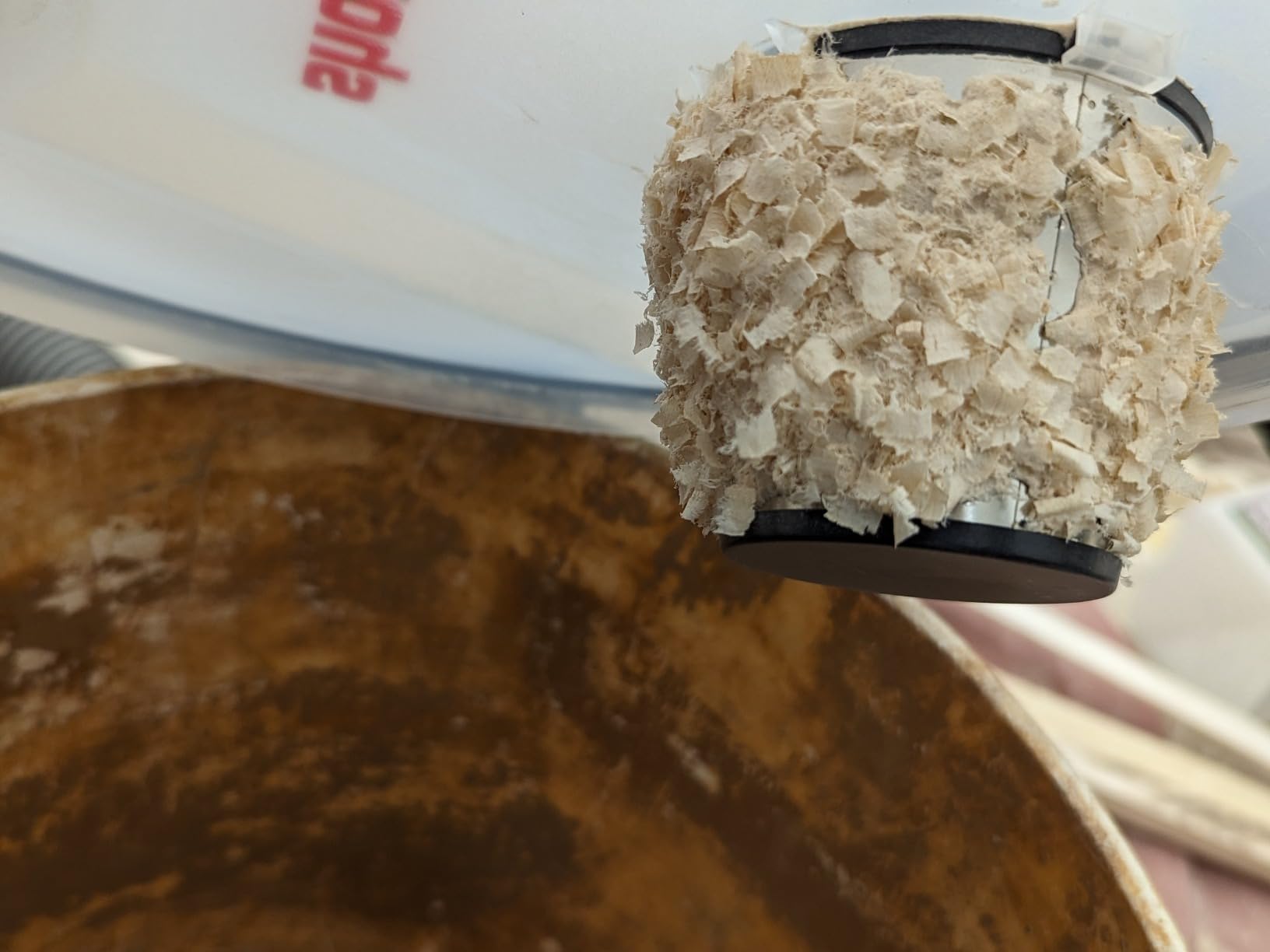
Inside, an 8 inch upper housing uses curved surfaces to let debris travel past a centre baffle while smoothing the airstream path. A commercial grade rubber mounting gasket handles the seal, and the translucent body lets you watch debris separate, which is more satisfying than it sounds when you are trying to time an emptying.
This is also the unit to buy if your cleanup work includes liquids. Owners use it for wet pickup and slurry, and the maker lists painting, sheet rock, remodeling, stone countertop production, floor refinishing, and gardening among the intended jobs.
Why fitment decides this pick
If you are connecting to a mainstream wet/dry vacuum with standard hose, the reduction in friction is immediate. No reducer hunt, no leaks at a mismatched join, and no CFM lost to a step-up or step-down in diameter at the inlet.
What you need to bring yourself
The base package is the separator head only, so you supply the recovery bin, though 5-gallon and 12-gallon versions exist if you would rather not hunt one. Keep in mind the 2.375 inch inlet is narrower than 2.5 inch collection hose, and this is not designed for planer-level high-pressure airflow.
8. Shop-Vac 5430050 Dust Collector — Best Budget Entry With a Metal Filter Included
Shop-Vac 5430050 Dust Collector, Fits 5 Gallon Bucket(Sold Separately), Easy Disposal of Dust & Debris, Elbow Fittings, 2-1/2″ Hose and Metal Filter Included
Fits a standard 5-gallon bucket
Metal filter included
90 degree elbows in the box
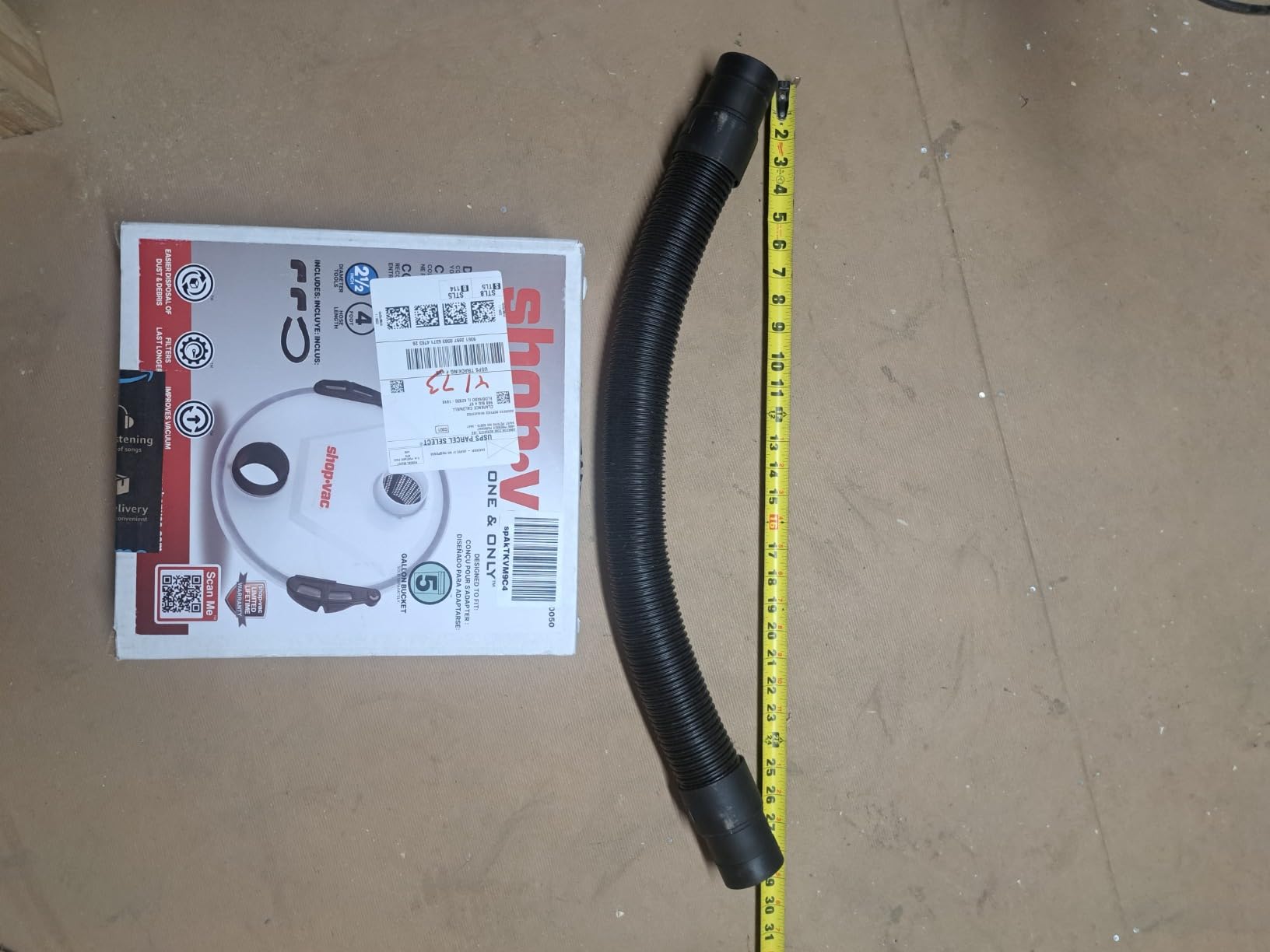
2 ft by 2-1/2 inch hose
Pros
- Metal filter included which most rivals omit
- Bucket mount design dumps in seconds
- Short hose and elbows for a fast hookup
- Handles wet pickup and dry dust
Cons
- 4.0 average is the lowest in this group
- Bucket is not included
- Shortest included hose at two feet
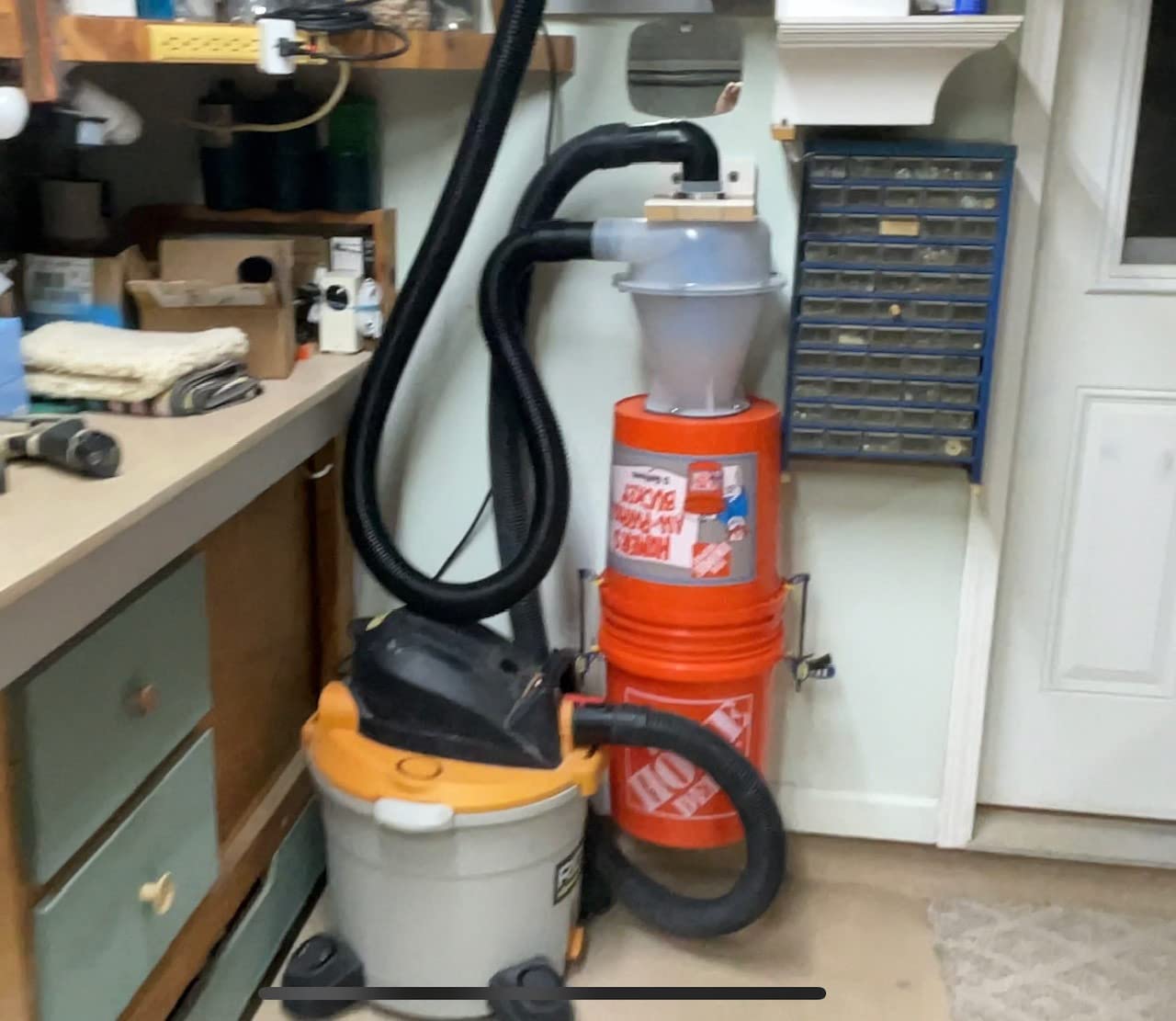
The Shop-Vac 5430050 is the simplest idea in this roundup and the least complicated way to try one. It bolts onto a standard 5 US gallon paint bucket, captures the majority of sawdust and debris there, and passes the cleaned air to your vacuum. You dump the bucket instead of cleaning a filter.
The detail that separates it from budget rivals is the included metal filter. Where most separators in this bracket ship with no filter at all, this one gives you an extra layer for finer particles, and the 90-degree elbows plus a 2 foot length of 2-1/2 inch hose are in the box for a quick hookup.
It handles sawdust, general dust, water, drywall dust, and concrete dust, so wet pickup works as well as dry. Disposal is about as simple as it gets: lift the bucket off and dump it.
The catch is that the 5-gallon bucket is sold separately, so the headline number is not what you actually spend on a working setup. It is also the newest and least-reviewed product here, with only 202 reviews behind it.
Why it is still worth considering
For a first separator, a second vacuum, or a job-site setup where the base unit may get scuffed, the simplicity is the feature. It has the fewest moving parts, no gaskets to seat, and a metal filter that most of the category leaves out.
Where the 4.0 rating comes from
Only 54% of reviews sit at five stars and 12% at one star, which points at inconsistent fitment and sealing rather than a design fault. The two-foot hose is also the shortest in the roundup, so you will likely replace it immediately, and the lifetime warranty explicitly does not cover abuse.
How to Choose a Dust Separator for Your Shop Vac
Shop vac or dust collector: which do you need first?
The honest answer for most beginners is the shop vac plus a separator. A single-stage collector is a bigger purchase, takes floor space, and adds ducting you have to plan for, while a separator delivers the part of the upgrade that actually changes your day, which is filter life. Our bagged vacuum picks for dust control are worth a look if your dust is fine enough to make bagged capture the priority.
Move to a collector when a separator has stopped being the bottleneck. That usually means you are done with handheld tools and running a table saw, planer, or bandsaw, and you want that machine connected permanently. The Peachtree 4 inch kit is the bridge between the two worlds.
Tall cyclone or low-profile lid
A tall cone on a bucket spins faster and stacks more debris before it needs emptying, but it also tips more easily when you drag the hose and it will not fit under a bench. A low-profile lid such as the Dustopper PRO or POWERTEC trades a little capacity for a much lower centre of gravity and better clearance, which is the right trade in a small shop.
Hose diameter and port size
Every extra adapter and every sharp bend costs airflow, so match diameter rather than forcing it. Most shop vac hoses are 2-1/2 inch, some are 2-1/4 inch, and the 1-7/8 inch size shows up on smaller machines. Check your hose before you order anything: the Oneida DIY and the Cen-Tec Quick Click are the two that most often connect without adaptors.
Bucket strength and capacity
This is a safety issue, not a preference. Thin household paint buckets can flex or collapse inward under strong suction, particularly when a clog backs up downstream, and a collapsing bucket in front of a running vacuum is genuinely dangerous. Use a heavy-duty container, a doubled-up pail, or a purpose-made bin. Bigger is better for runtime, provided the wall is thick enough to hold.
Static, fine dust, and what a separator cannot catch
Dry dust rushing through plastic builds a charge, and owners of several units here ground the system with an added wire. The POWERTEC kit includes grounding hardware but not the wire itself. Remember that a cyclone stops chips and bulk dust, not the finest particles, so grinding concrete or clay still needs a filter rated for silica. Keeping the air clean in the room is a separate problem, and our air purifier picks for dust handle that side.
When you should skip this purchase
Do not buy a separator if you use your vacuum twice a year, if you already get through a year on one filter, or if you have not yet decided whether you will keep the hobby. Buy the bucket and casters before you buy an expensive separator instead, and only treat combustible metal dust with rated equipment rather than a plastic cone.
How to Set Up a Dust Separator with Your Shop Vac
Order matters more than most people expect. A separator plumbed backwards loses most of its benefit, and a single leaking joint costs you more airflow than the separator returns.
Step 1: Connect in the right order. Run your tool hose into the cyclone inlet, then run the cyclone outlet to the shop vac inlet. The debris side is the wide hose from the tool, and the clean side is the hose heading to the machine. Swapping these puts your filter back in the dust path and undoes the whole point.
Step 2: Mount it and seal every joint. Set the separator on a flat surface or a plywood platform, seat the gasket fully, and lock the latches. Use a heavy-duty bucket rather than a thin paint pail, and run hose clamps or tape on any connection that does not have a positive lock. Confirm the seal by running the vacuum and feeling for air leaks at each joint.
Step 3: Keep the run short and the bends few. Every extra adapter and sharp bend costs CFM. Choose the shortest hose that reaches the work, and prefer the sweep elbows that come with some kits over stacked 90-degree elbows. If suction feels soft, an oversized hose run is usually the culprit before anything else.
Step 4: Finish the air and set an emptying rhythm. Fit your fine-dust or HEPA filter in the vacuum, and empty the bucket at about two-thirds full. Past that point the rising debris bed starts spinning air with it, and owners report dust escaping into the vacuum.
Frequently Asked Questions
Are dust separators worth it?
For regular sanding, routing, or cutting, yes. A separator dumps most debris into a bucket before it reaches your filter, so suction stays steady, filters last far longer, and cleanup becomes a bucket dump instead of a filter wash. For occasional users who get through a year on one filter, the money is better spent elsewhere. Expect to still need a filter, because the finest particles and anything like silica pass straight through a cyclone.
Does a dust separator reduce suction?
Slightly, and it is a fair trade rather than a loss. Routing air through an extra cyclone adds a little resistance, and one owner of the DEWALT unit noted suction felt softer with the separator inline. In exchange the airflow stops collapsing as the filter loads, so the end-of-session suction is far better than it would have been. Match your hose diameter to the port and keep the run short to minimise any loss.
What is the difference between a cyclone separator and a lid-style pre-separator?
A cyclone spins dirty air around the inside of a cone so heavier particles are thrown to the wall and fall into a container, which is why units like the Dust Deputy DIY and the Dustopper PRO include anti-static resin bodies and swept ports. A lid-style unit is a simpler baffle design that sits flat on top of the bucket, with a lower profile and better stability but less separation from the same footprint. The choice is capacity and height against raw efficiency.
Is a dust collector better than a shop vac with a separator?
For a dedicated table saw, planer, or bandsaw, yes, a dust collector moves far more air. For handheld sanding and routing, a shop vac with a separator is the better first purchase because it costs less, needs no ducting, and fixes the filter-clogging problem that causes weak suction. A common workshop sequence is to add a separator first, then upgrade to a collector when the machine, rather than the bucket, becomes the bottleneck.
Why is my shop vac spitting out dust?
Usually one of three things. The filter is loaded, so airflow has pushed dust past the pleats and out the exhaust port. The bucket or collection container is more than about two-thirds full, so the rising debris bed spins air with it. Or a joint in the plumbing is leaking and air is bypassing the separation stage entirely. Check the fill level and the seals first, and fit a fine-dust or HEPA filter if you are working with concrete, clay, or drywall.
How do I stop a dust separator from tipping over?
Use a low-profile lid design such as the Dustopper PRO or the POWERTEC, both of which sit low on a 5-gallon bucket, or put a tall cone like the Oneida Dust Deputy DIY on a platform with casters so it rolls rather than falls. The DEWALT unit solves this with a four-caster rolling base. Tipping is usually caused by dragging the hose, so route it along the floor and away from doorways and benches.
The Verdict: Which Dust Separator Should You Buy?
The Oneida Dust Deputy DIY takes our Editor’s Choice for one reason: more than four thousand owners have proven it works with almost any wet/dry vacuum, wet or dry, in any container, and the tapered ports solve the fitment problem that trips up most buyers. If your shop has low clearance or you want a documented third-party efficiency test, the Dustopper PRO is the pick. If your air is coming from a dust collector rather than a shop vac, the Peachtree 4 inch kit is the one to buy.
Whatever you choose, match the port to your hose before you order, use a heavy-duty bucket, and keep the run short. Those three details decide whether the separator actually helps. Check the latest options for the best dust separators for shop vacuums below and get the first sanding session booked.