
If you want the single best infrared sauna under two thousand right now, it is the OUTEXER T-50C, a compact Canadian hemlock cabin with six carbon panels, an independently controlled foot heater and the highest satisfaction score of anything we reviewed. The runner-up is the Lifepro RejuvaWrap blanket, which costs a fraction of a cabin and holds the largest review base in the group.
Here is the honest part most roundups skip. Under two thousand you are not buying a compromise, you are buying a specific, narrower version of the product. You get real far infrared heat, solid wood cabins, plug-and-play power and warranties measured in years. What you do not get is certified ultra-low EMF output, full-spectrum near and mid infrared, or a cabin that comfortably fits two tall adults. Those things start several thousand dollars higher.
We compared eight models across three formats, a wood cabin, a portable tent and an infrared blanket, against published specifications, warranty terms and the pattern across thousands of verified reviews. Below is what each one is genuinely good at, where it falls short, and who should skip it entirely. If you are still narrowing the field, our guides to portable saunas for home use and infrared sauna blankets break the sub-cabin options down on their own.
Table of Contents
How We Picked: What We Checked on All Eight Models
We did not hands-on test these units, and we are not going to pretend otherwise. Everything below comes from manufacturer-published specifications, warranty terms, and the documented pattern across thousands of verified buyer reviews.
Every model was checked against the same seven criteria. Heater type and count, since carbon fiber panels and ceramic tubes behave differently and coverage of the lower body matters more than most buyers expect. Published EMF data, because a brand that will not print a milligauss figure is telling you something. Electrical requirements, since 120V plug-and-play removes an electrician bill that can rival the sauna itself. Interior dimensions rather than exterior dimensions, since exterior numbers flatter the product. Warranty structure against warranty electronics, which are rarely the same length. Verified review volume, so we are not ranking a listing with nine reviews. And format fit, because a blanket and a cabin solve different problems.
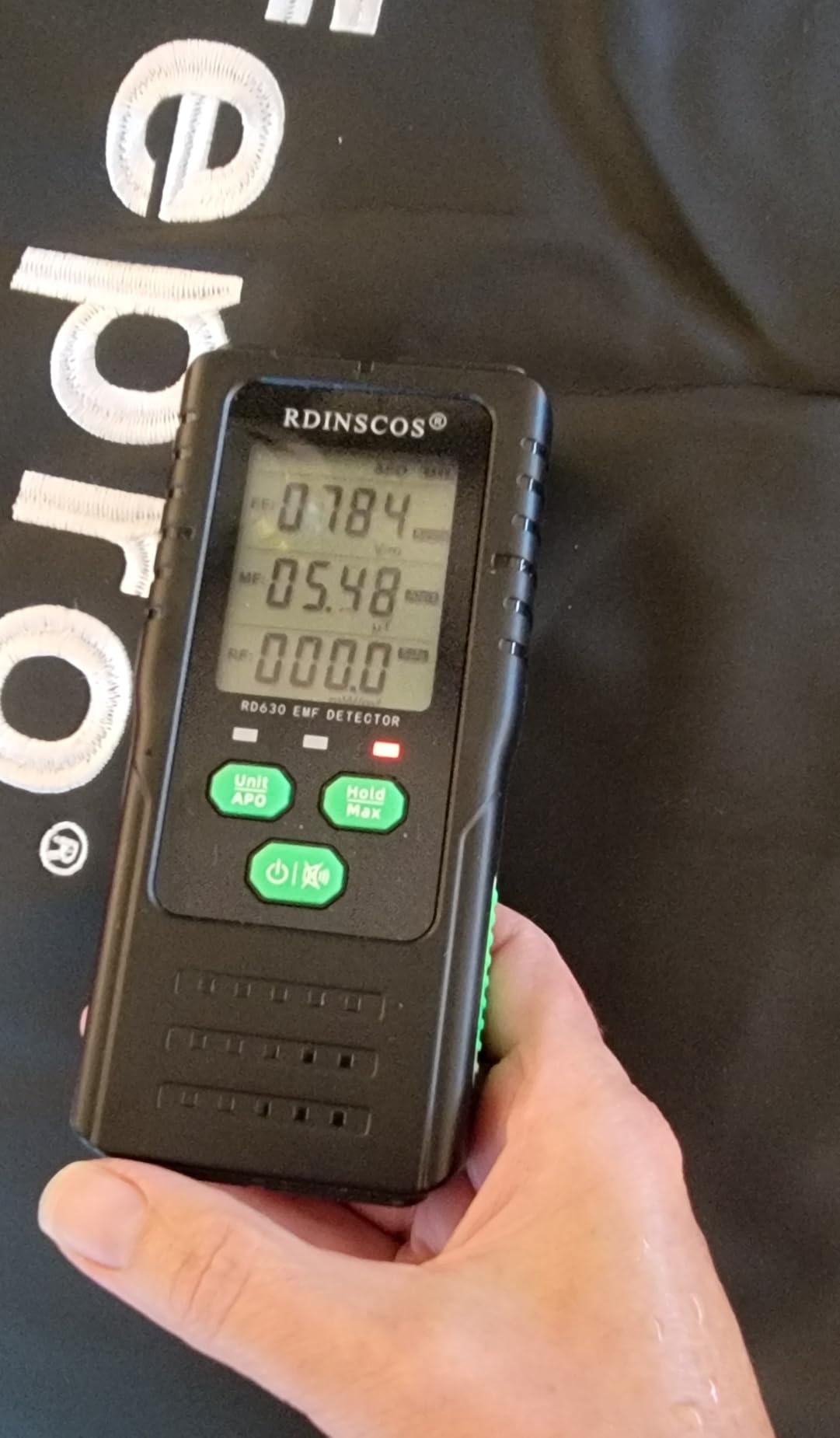
On the EMF question specifically, we took the strict position. A published milligauss number at a stated distance is data. The words “low EMF design” printed on a listing page are marketing. Of the eight models here, four make low-EMF claims in their technical documentation and none of them publishes a milligauss reading.
Top 3 Picks for the Best Infrared Saunas Under Two Thousand in October

OUTEXER T-50C Hemlock Cabin
- 6 low-EMF carbon panels
- 1200W
- Independently controlled foot heater
- 7-color chromotherapy

Lifepro RejuvaWrap Blanket
- 9 levels to 176F
- Low-EMF carbon fiber
- 71 by 36 inch full-body
- Auto shut-off

Homsido 2-Person Cabin
- 8 carbon crystal panels
- 110V 1800W
- Overhead red light panel
- Bluetooth audio
All 8 Picks at a Glance in 2026
| Product | Specifications | Action |
|---|---|---|
| OUTEXER Far Infrared Hemlock Sauna 1200W |
|
Check Latest Price |
| Lifepro RejuvaWrap Infrared Blanket |
|
Check Latest Price |
| Homsido 2-Person Hemlock Cabin |
|
Check Latest Price |
 Blue Wave Coronado 2-Person Sauna Blue Wave Coronado 2-Person Sauna |
|
Check Latest Price |
 Lifepro BioRemedy Infrared Blanket Lifepro BioRemedy Infrared Blanket |
|
Check Latest Price |
 SereneLife Portable Sauna Box SereneLife Portable Sauna Box |
|
Check Latest Price |
 HigherDOSE Infrared Blanket HigherDOSE Infrared Blanket |
|
Check Latest Price |
 KASUE Infrared Sauna Tent 3L Steamer KASUE Infrared Sauna Tent 3L Steamer |
|
Check Latest Price |
1. OUTEXER T-50C Hemlock Sauna – Best Overall
OUTEXER Far Infrared Sauna Home Sauna Spa Room Canadian Hemlock Wood 1200W
1200W
6 carbon panels
Foot heating plate
68-149F
27 x 35 x 61 inch
Pros
- Highest satisfaction profile in the group at 4.6 stars
- Canadian hemlock insulates as well as it looks
- Independent foot plate solves the cold-feet problem
- Compact 27 inch wide footprint
Cons
- At 139.7 lbs the panels and frame need a second pair of hands
- Single-person interior in this configuration
- Control panel is basic next to premium controllers
The OUTEXER T-50C is the model I would put in a house without hesitating. Its rating profile is the strongest here, with 81 percent of verified buyers at five stars and only 3 percent at one star, a consistency you do not often see in a category full of polarised reactions. Our team compared all eight units on build specification and owner feedback, and this is the one where the wood, the heater coverage and the warranty all hold up at the same time.
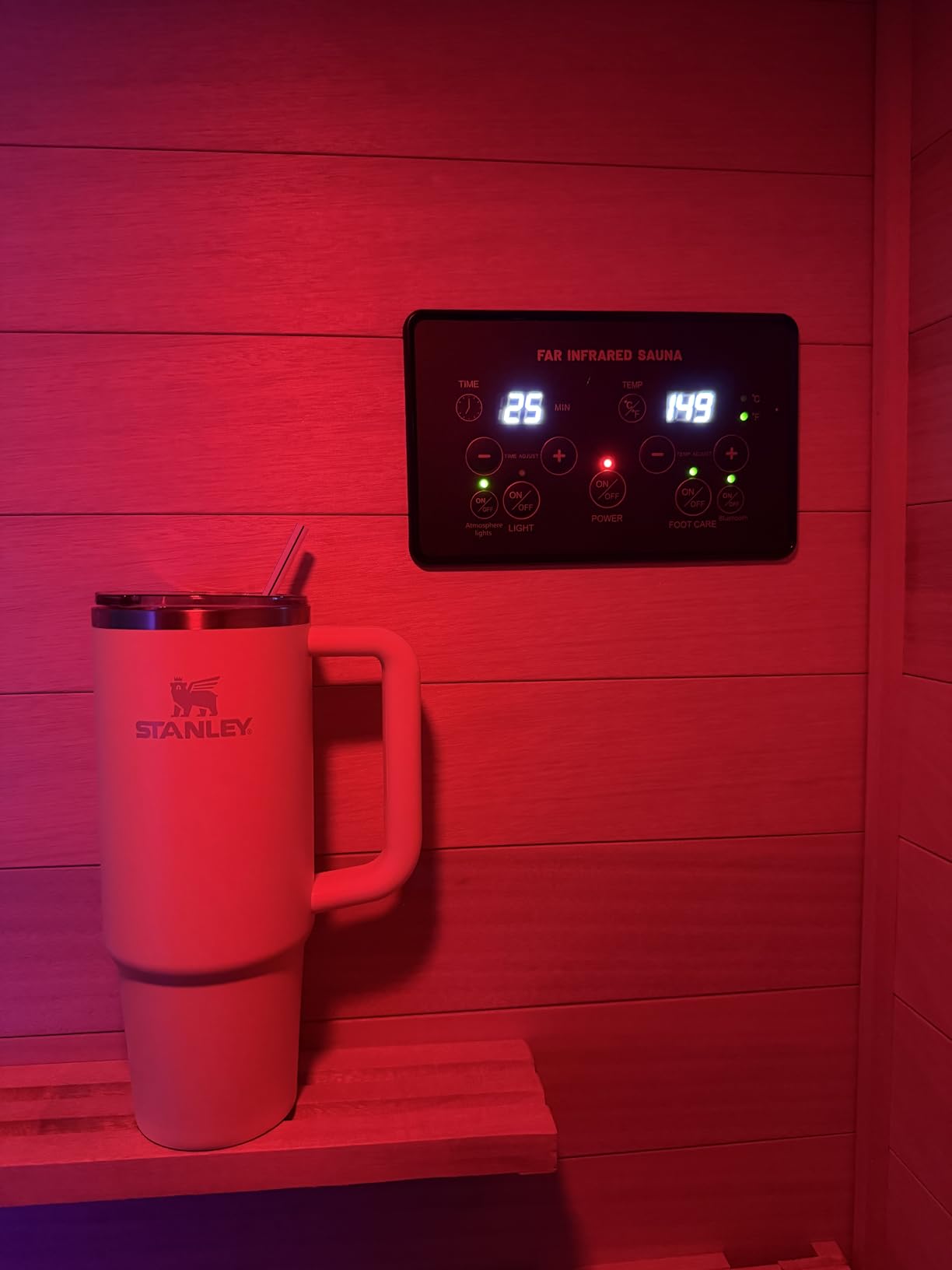
It runs 1200W, sits at 27 by 35 by 61 inches, and heats to a 68 to 149 degree Fahrenheit range. That footprint is the quiet advantage. At 27 inches wide it clears a bathroom wall, a basement corner or a condo utility space, where a 47-inch-wide two-person cabin simply will not go.
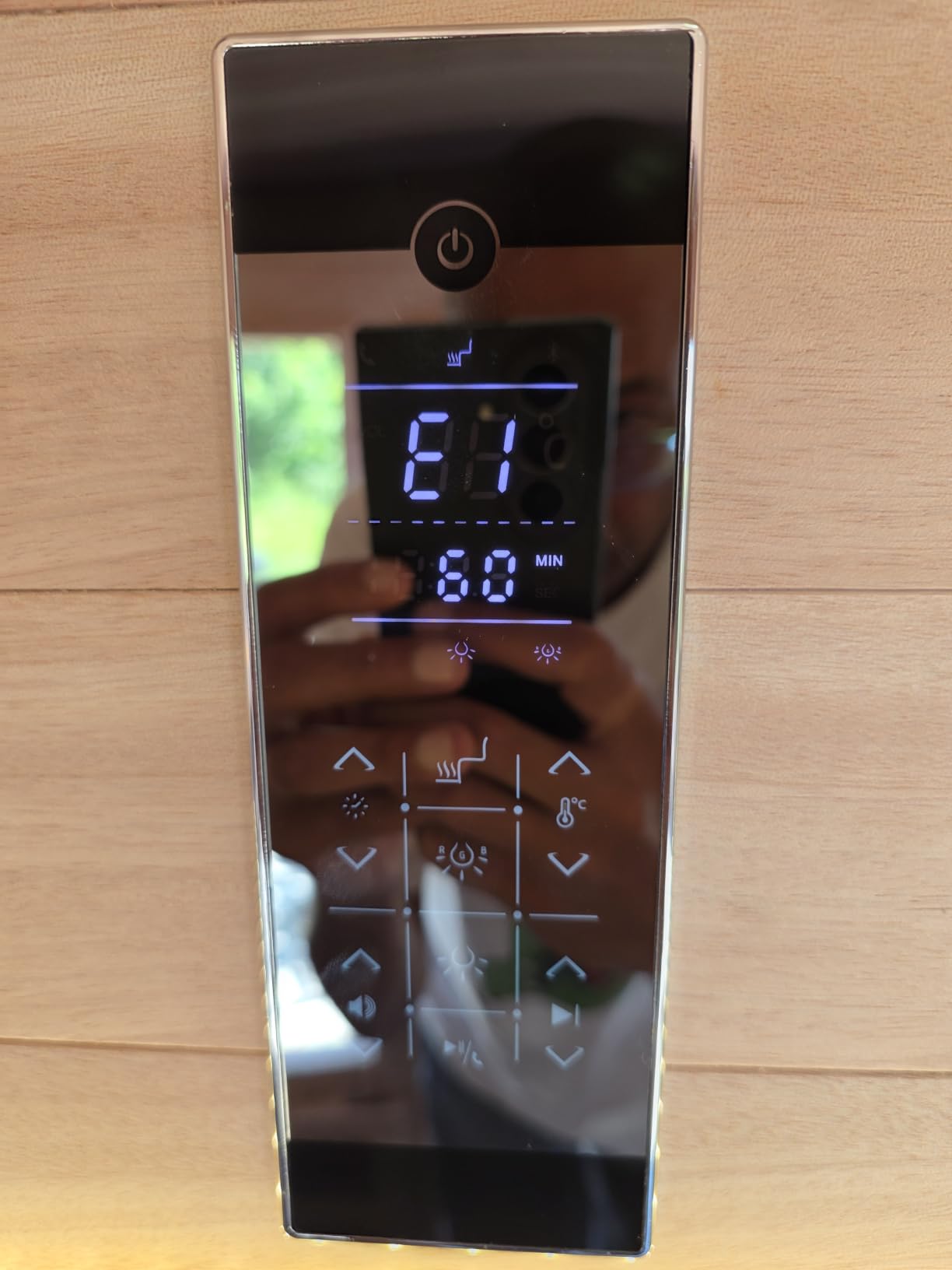
The technical story is stronger than this budget usually allows. Six low-EMF carbon heating panels surround the body rather than sitting on one wall, and the bottom foot heating plate is controlled independently of the rest. Most budget cabins leave your feet cold because heat rises and the floor gets nothing. This one treats the floor as its own zone, and owners single that feature out repeatedly in reviews as the reason sessions feel even from the start.
You also get 7-color chromotherapy lighting, two built-in speakers, a timer, power adjustment and temperature setpoint protection. The Canadian hemlock is doing real work here beyond appearance, since dense softwood is a genuinely good insulator and that shows up in how quickly the cabin holds temperature once it is up to heat.
The service commitment is the quiet differentiator. This listing carries a 7-year after-sales service term with US-based support, and it comes with water-based paint on the seats and foot grid. Over a decade of regular use that combination matters more than another Bluetooth speaker would.
Who the OUTEXER T-50C suits
It suits one person who wants a real wood cabin, in a room no wider than 35 inches, with reliable daily access. Its 1200W rating puts it in a lower electrical class than the 1800W cabins in this roundup, which is the practical reason buyers in apartments and older homes gravitate to it.
If you want color light therapy and built-in audio without bolting accessories to the wall, this is one of two models here that pairs both in the same cabin.
Who should skip it
Skip it if you plan to sit in it with another person. This configuration is a single-person interior, and adding a second person is exactly how the foot-level crowding complaints start on compact cabins.
Skip it if you are not willing to arrange a second pair of hands. At 139.7 pounds the panels and frame are genuinely heavy, and the buckle-style construction still takes real effort. Reviewers report responsive service when things go wrong, which is reassuring, but it does not assemble itself.
2. Lifepro RejuvaWrap Infrared Blanket – Best Value
Lifepro RejuvaWrap Infrared Sauna Blanket with Low EMF and 9 Temp Levels
9 levels 95-176F
Low-EMF carbon fiber
71 by 36 inch
14.7 lbs
Auto shut-off
Pros
- Largest verified review base of any pick
- Best-rated blanket in the group at 4.4 stars
- 71 by 36 inch wrap fits most body types
- Carry bag towel controller and wraps included
Cons
- At 14.7 lbs it is the heavier blanket here
- Needs 10-15 minutes to reach full temperature
- PU exterior can hold heat and odor over long sessions
The RejuvaWrap is the value answer to this entire question, and it is not a compromise answer. With 1436 verified reviews averaging 4.4 stars and 70 percent at five, it has the most evidence behind it of anything on this list, which matters when you are spending real money on a category with very little independent testing.
It is the only model here reaching 176 degrees Fahrenheit, a genuinely useful ceiling for anyone who runs warm sessions.
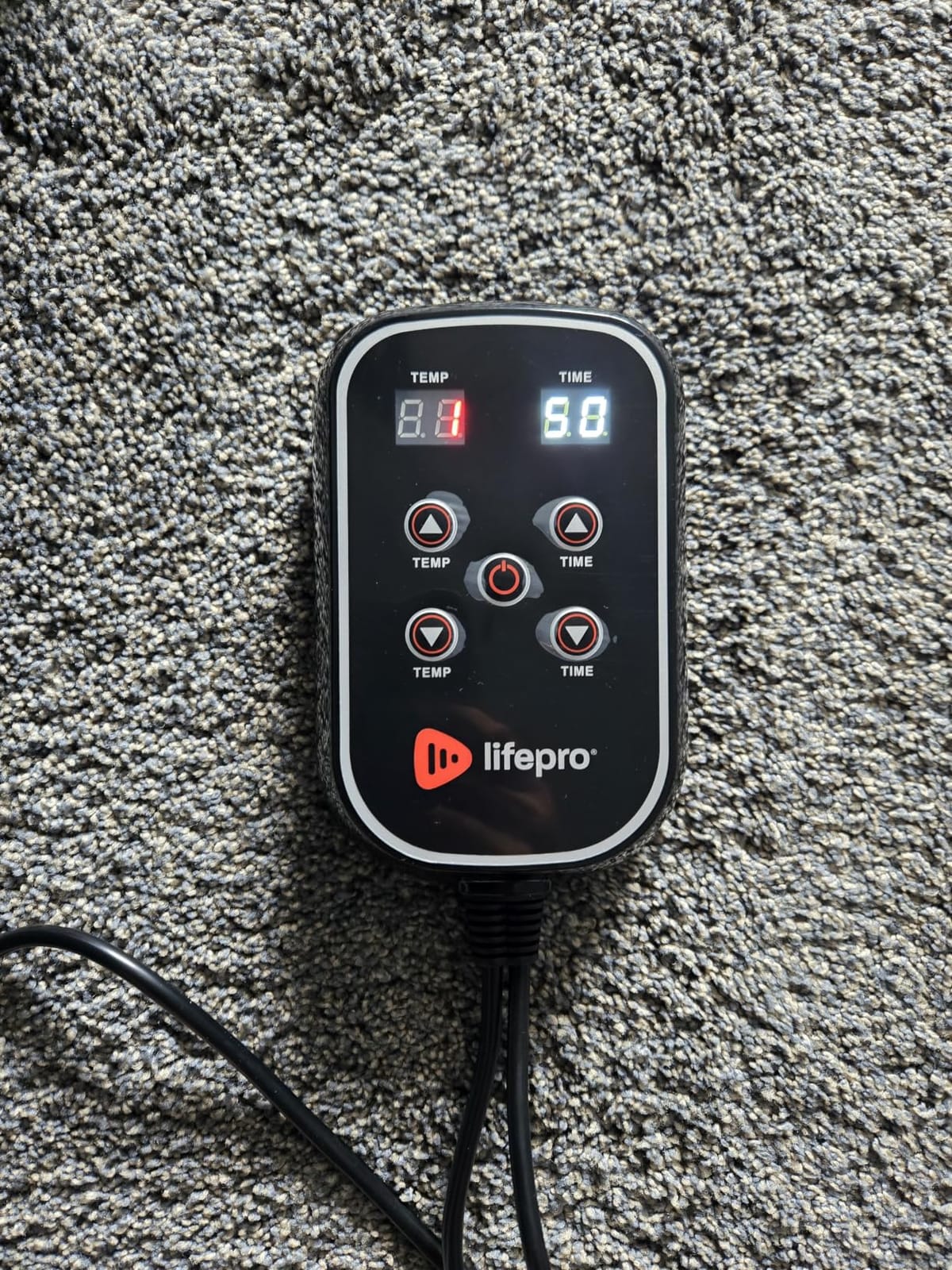
The heating is low-EMF carbon fiber across nine adjustable levels, with an outer layer of non-toxic waterproof PU and PVC. Auto shut-off and an adjustable 5 to 60 minute timer handle the safety side, which is the single most reassuring spec on a blanket where you are lying under an element with fabric between it and your skin.
Size is where it separates from the field. At 71 by 36 inches the wrap is wide enough that heat distributes across the body rather than pooling at the chest, and reviewers note that it accommodates a range of body types without the cramped feeling that narrower wraps produce, and it includes a cotton towel, five disposable thermal wraps, a controller and a carry bag, so there is nothing else to buy.
Plan the warm-up into your routine. It takes 5 to 10 minutes to start and 10 to 15 to reach full operating temperature, so this is not the model you jump into the moment you walk in the door.
Who the RejuvaWrap suits
It suits anyone who wants reliable near-daily infrared use, has no room or desire for a permanent wooden cabin, and wants the widest temperature range in this roundup. It is also the natural choice for a second person in the household who wants to use heat while the other sleeps or works.
If you are still deciding whether sauna heat is something you enjoy, this is a low-commitment way to find out. A blanket stores against a wall between uses, unlike a 329-pound cabin.
Who should skip it
Skip it if you move it between rooms often. At 14.7 pounds it sits at the heavier end of the blankets here, and while Lifepro’s own BioRemedy model is under 10, the difference shows up on stairs.
Skip it if you run long sessions back to back. The PU exterior is wipe-clean rather than machine washable, and owners report it holding heat and odor over extended use. Keep sessions inside the timer window and let it air out between uses.
3. Homsido 2-Person Hemlock Cabin – Best With Red Light Therapy
2 Person Indoor Home Infrared Sauna Room for Home Gym, Canadian Hemlock Wood, 616 * 220mm Red Light Beauty System, Fast Heating to 140°F, 110V/1800W, Bluetooth MP3, Gift for Family
110V 1800W
8 carbon crystal panels
39.4 x 47.2 x 70.9 inch
140F max
Red light panel
Pros
- Genuine two-person interior at 47.2 inches deep
- Combines a 616 x 220mm red light panel with far infrared
- Premade panels make assembly far easier
- 3-year warranty with responsive parts support
Cons
- Up to 30 minutes to reach about 125F in a cold room
- Interior feels tight for taller users
- Professional assembly is a paid add-on
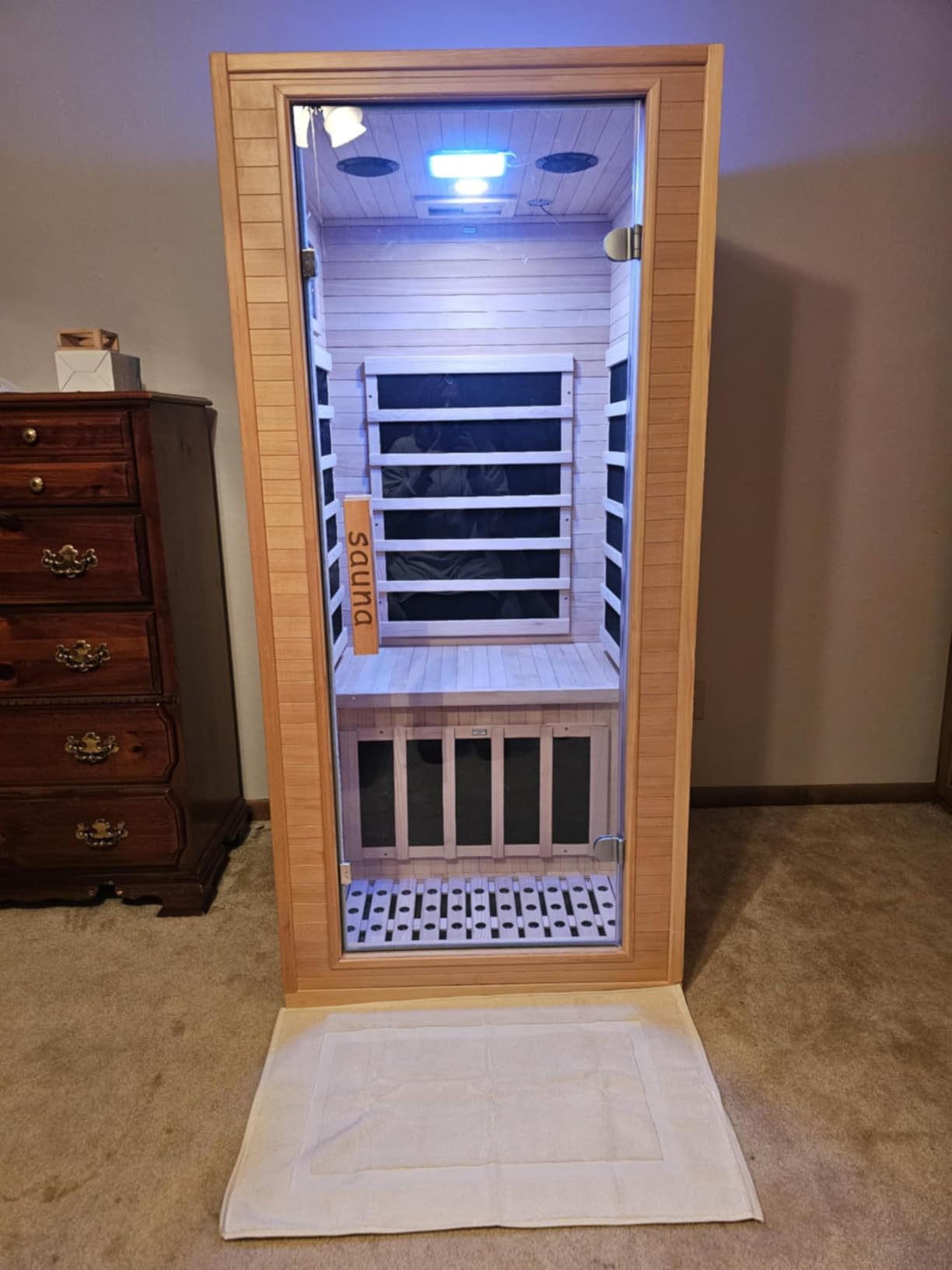
The Homsido is the pick if sauna time is a two-person activity for you. Its interior is 39.4 inches wide by 47.2 deep and 70.9 tall, and that depth is the difference between sitting next to each other and sitting across from each other, which is the complaint we see most often on compact two-person listings.
It runs on 110V at 1800W, so it plugs into a standard household circuit without an electrician. That avoids the installation work that a 240V cabin brings with it, and it is the reason this unit fits houses the higher-voltage models cannot.
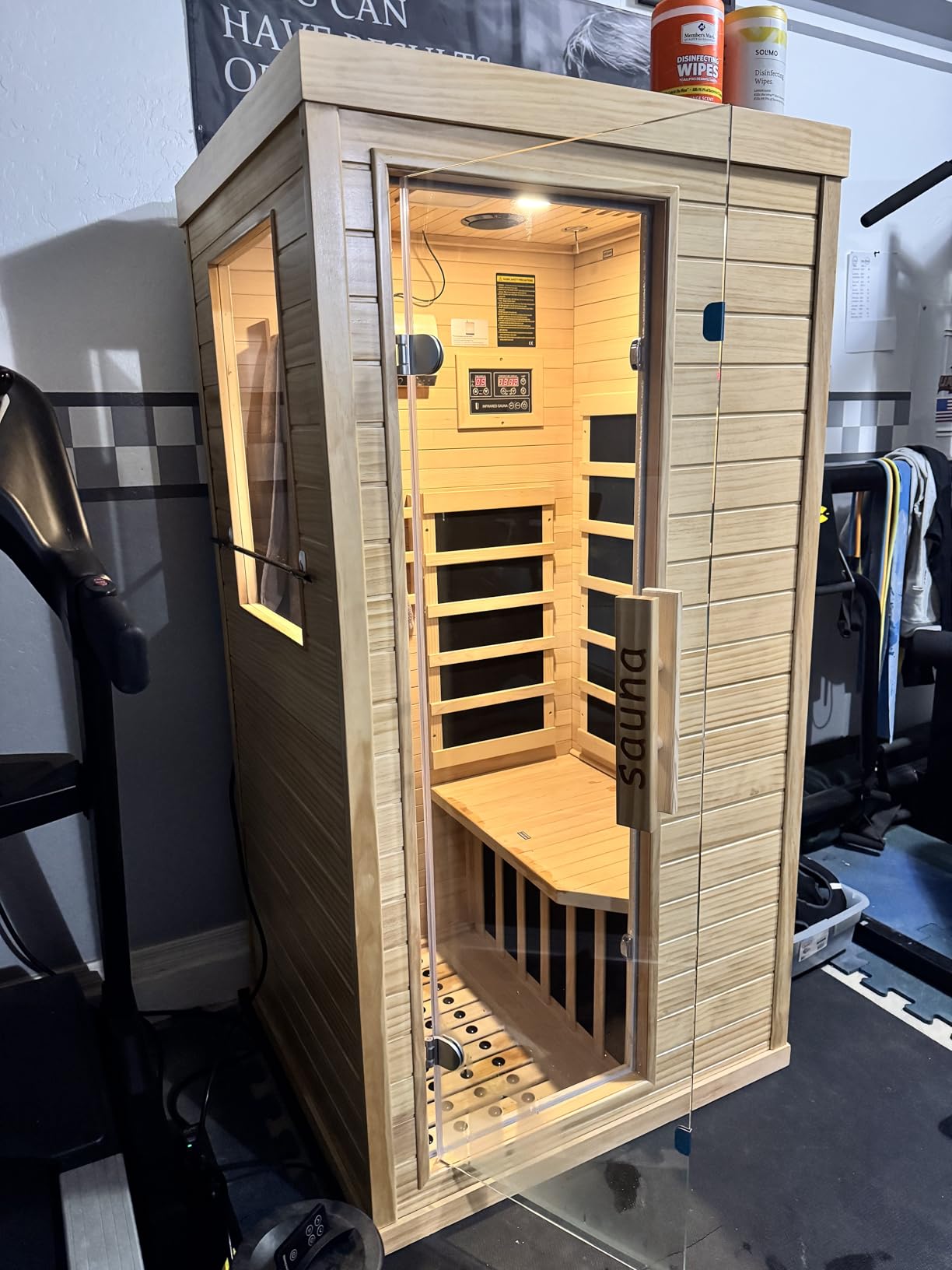
Eight carbon crystal panels are distributed around the cabin rather than mounted on a single back wall, and a 616 by 220 millimeter red light panel sits overhead. That combination is unusual in this bracket, because red light therapy is normally an add-on accessory, and folding it into the same session is convenient if you care about skin work at all.
There is also a digital controller with Bluetooth audio, and the panels arrive premade with a buckle-style connection system. Owners consistently rate the assembly as straightforward compared with flat-pack competitors, and the brand provides replacement parts quickly when something does go wrong.
Maximum temperature is 140 degrees Fahrenheit with adjustable temperature and timer. Expect roughly 20 to 30 minutes to warm up, and considerably longer in an unheated space.
Who the Homsido suits
It suits couples who want to share sessions, households that put a sauna in a basement or home gym, and anyone who wants 110V simplicity with a real wood interior. The red light panel adds a second reason to use it beyond sweating.
Check your ceiling height first. At 70.9 inches tall, it needs clearance above and around it, and you need room to open the door and assemble the panels rather than squeezing it into a finished closet.
Who should skip it
Skip it if your space is cold. This is the clearest warm-up complaint in the group, with buyers reporting up to 30 minutes to reach about 125 degrees Fahrenheit in an unheated garage. That is a property of the room, not a defect, but it will make the sauna feel slow every single time.
Skip it if you are over six feet tall or want professional assembly on the invoice. Reviewers in smaller variants describe the interior as cramped, and buyers frequently wish they had paid for the install option. One reviewer also reported a rear panel running hot on the back, so test a short session before you commit to long ones.
4. Blue Wave Coronado 2-Person Sauna – Best Two-Person Fit
Heat Wave Coronado 2-Person Hemlock Deluxe Infrared Sauna for Home Use
6 carbon heaters
47.75 x 39.25 x 75 inch
44.5 x 35 x 69 inch interior
7-year warranty
Pros
- Real interior width of 44.5 inches for two people
- Long 7-year manufacturer warranty term
- Chromotherapy plus oxygen ionizer and AUX sound
- Builds in solid Canadian hemlock with buckle connectors
Cons
- Heaviest unit here at 329 pounds
- Large footprint needs dedicated floor space
- Feature set is more basic than smaller rivals
The Coronado is the one to buy if the thing that frightens you most is the warranty. Seven years from the manufacturer, on a cabin that weighs 329 pounds and arrives in solid Canadian hemlock, is among the longest coverage terms in this roundup, and it changes the maths on a ten-year ownership horizon.
It is also one of the few models here that publishes both exterior and interior dimensions. Interior width is 44.5 inches, depth 35 inches and height 69 inches, which is the number that actually decides whether two adults fit. Listing exterior dimensions only is the most common way the two-person claim gets inflated, and this brand does not play that game.
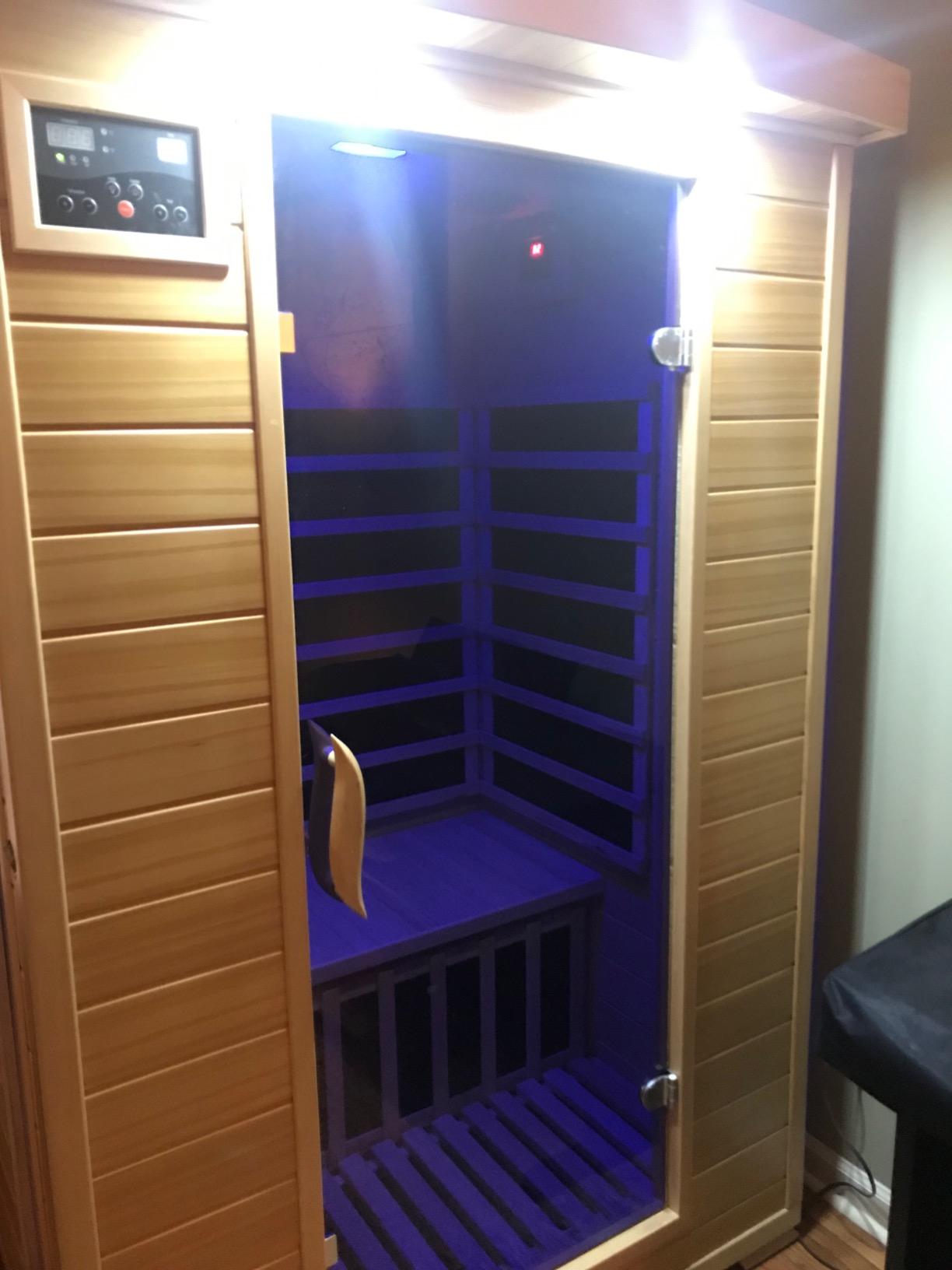
The heating side is six carbon infrared heaters positioned for even distribution, up to 140 degrees Fahrenheit, with intuitive controls. Comfort features run to chromotherapy lighting, an oxygen ionizer and a sound system with AUX input, and the door is bronze-tinted 8mm tempered glass with a solid hemlock frame and buckle connectors rather than screws.
Owners rate it at 4.4 stars across 318 verified reviews, with 75 percent at five stars. The recurring theme is solidity of build and the roominess of the interior for two people, which is exactly what you are buying at this end of the range.
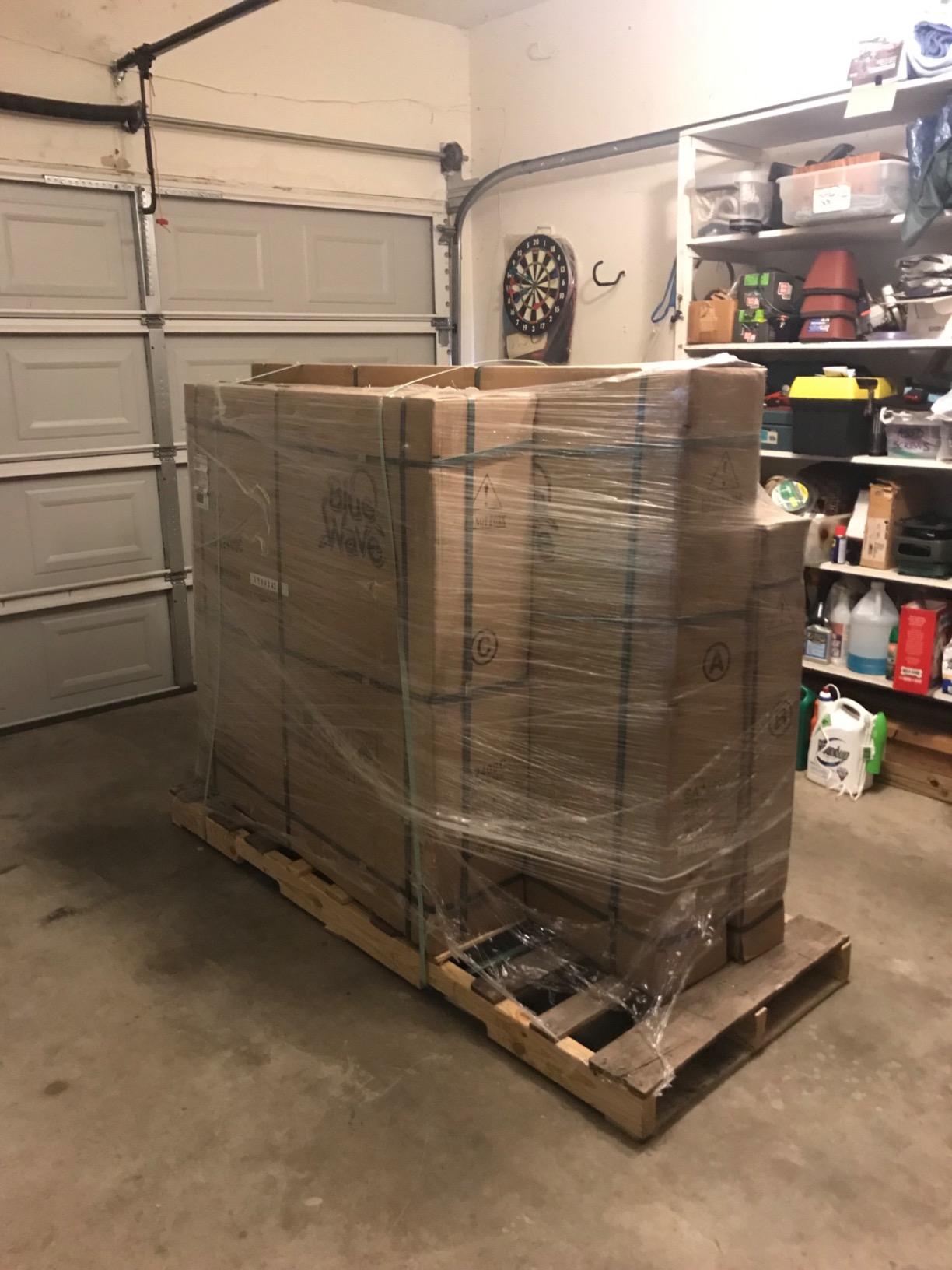
Be realistic about the footprint. Exterior dimensions are 47.75 inches wide by 39.25 deep by 75 tall. This is a dedicated piece of floor space, not a corner placement, and you should measure the delivery path into the room as well as the final position.
Who the Coronado suits
It suits two adults who genuinely want to sit together, buyers who intend to keep the sauna for a decade, and anyone who would rather not think about electronics failure five years in. Hemlock throughout is the right wood call for a long-horizon purchase.
If you want a defined, permanent room rather than a portable object, this is the most conventional build of the three wood cabins here, with solid hemlock throughout and no folding frame to fatigue.
Who should skip it
Skip it if you rent, plan to move, or have a room under 50 inches wide. At 329 pounds, relocating it later is a genuine chore and the depreciation story is not kind to heavy units, a point that comes up repeatedly in buyer discussions about reselling used saunas.
Skip it if the extras are your priority. The Homsido, a few hundred under this ceiling, adds red light therapy and Bluetooth in a much smaller footprint. You are trading features and flexibility here for width and warranty length.
5. Lifepro BioRemedy Infrared Blanket – Best for Travel
Lifepro BioRemedy Infrared Sauna Blanket for Home Relaxation Detox
Dual-layer far infrared
86-158F in 1F steps
70.87 x 30.98 inch
7.7 lbs
Timer 20-60 min
Pros
- Under 10 lbs and folds flat enough to travel with
- 1 degree Fahrenheit control from 86 to 158
- Heats from within so there is no hot air on your face
- Waterproof Oxford fabric wipes clean
Cons
- Full-body coverage limits arm and leg movement
- 158 degree ceiling is lower than the RejuvaWrap
- Heat takes time to build before early sessions
The BioRemedy is the one to take on a trip, and it comes from the same manufacturer as our value pick with a different job. At 7.7 pounds it is the lightest infrared option in this roundup by a wide margin, and at 70.87 by 30.98 inches it folds flat enough to pack in a car boot.
Temperature control is the sleeper feature. It runs from 86 to 158 degrees Fahrenheit in 1 degree or 10 degree increments, which is finer control than any cabin here offers, and the timer covers 20 to 60 minute sessions.
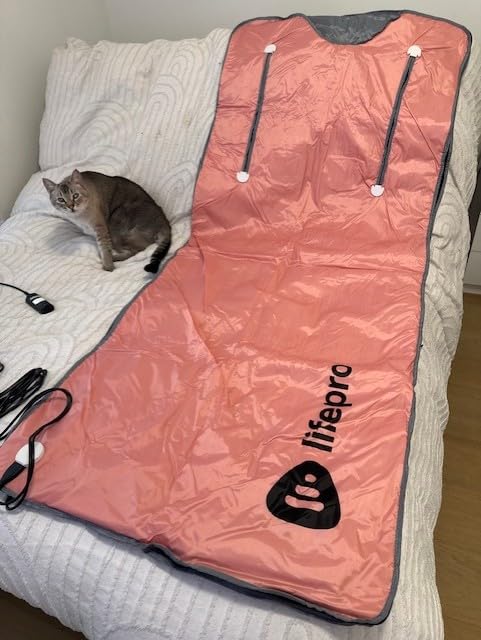
The heating is dual-layer far infrared described as penetrating up to 1.5 inches deep, built on low-EMF carbon fiber elements. Because it warms from the inside rather than pushing hot air around, the experience is gentler on the face and upper airway than a tent, which is the main reason people who dislike steam saunas tend to get on with it.
The head-out design is genuinely practical. You can read, work on a laptop or watch something during a session, which no enclosed tent or cabin allows, and it turns a 20-minute block into something that feels less like an appointment and more like downtime.
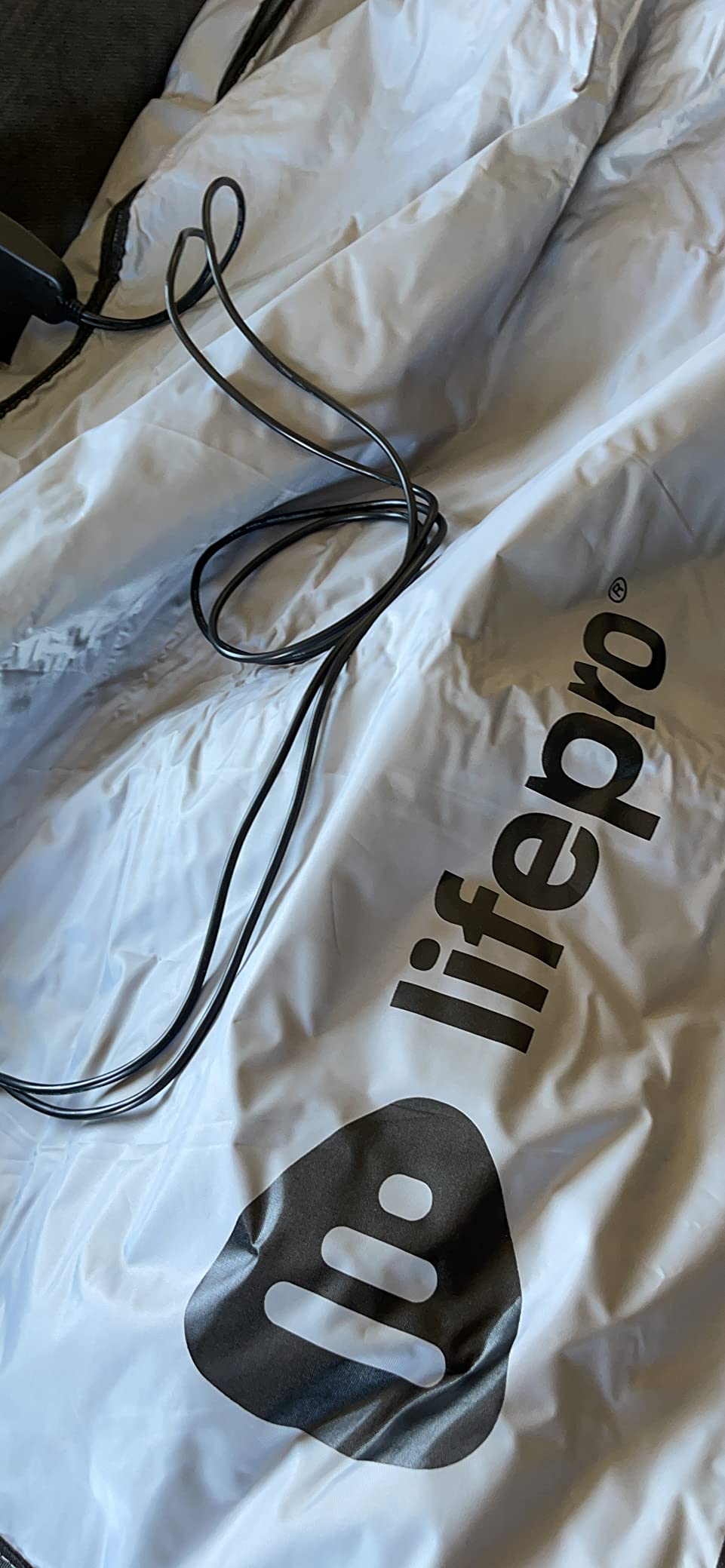
The surface is waterproof Oxford fabric that wipes clean, and the box includes a controller, two foil wraps and a printed and digital manual with safety instructions. The manual matters more than it sounds for a blanket, because safe use depends on fabric layers and timer discipline.
Who the BioRemedy suits
It suits people who travel, who live in small spaces, who want to read or work while warming up, or who simply want to test whether sauna heat suits them before committing to a full cabin. The 1 degree control also makes it the easiest to run at a gentle level, which is where first-time users should start.
It is a strong second unit for a household where one person is already using a cabin in another room.
Who should skip it
Skip it if you move freely during a session. Full-body coverage restricts arm and leg movement by design, and anyone who wants to stretch, read actively or change position will find it confining after a while.
Skip it if you want to run the hottest sessions available. The 158 degree ceiling sits below the RejuvaWrap’s 176, and heat also takes time to build in the early part of a session, so short sessions are less productive on this model than longer ones.
6. SereneLife Portable Sauna Box – Best Portable Pick
SereneLife Portable Sauna Box for Home, Infrared Sauna Tent with Heated Foot Pad and Folding Chair, Remote Control In-Home Spa, 35″ x 71″ – inch (Black)
3 carbon fiber panels
140F max
35 x 71 inch
13.18 lbs
60 minute timer
Pros
- Most-reviewed sauna in this group at 2894 ratings
- Heats quickly with three carbon fiber panels
- Folds flat for storage in a small room
- Folding chair and heated foot pad included
Cons
- Fabric construction ages faster than a wood cabin
- Single-person capacity only
- 12 percent of ratings are one star on heat consistency
The SereneLife box is the most-reviewed sauna in this roundup by a wide margin, with 2894 verified ratings. That is worth something on its own, because a large review base means the failure modes are well documented rather than discovered after your purchase.
What it documents is a 4.1 average with 12 percent one-star ratings, the largest one-star share of any model here. Read that as heat consistency rather than a broken product, since buyers who rate it low tend to be comparing it against a wood cabin they also own.
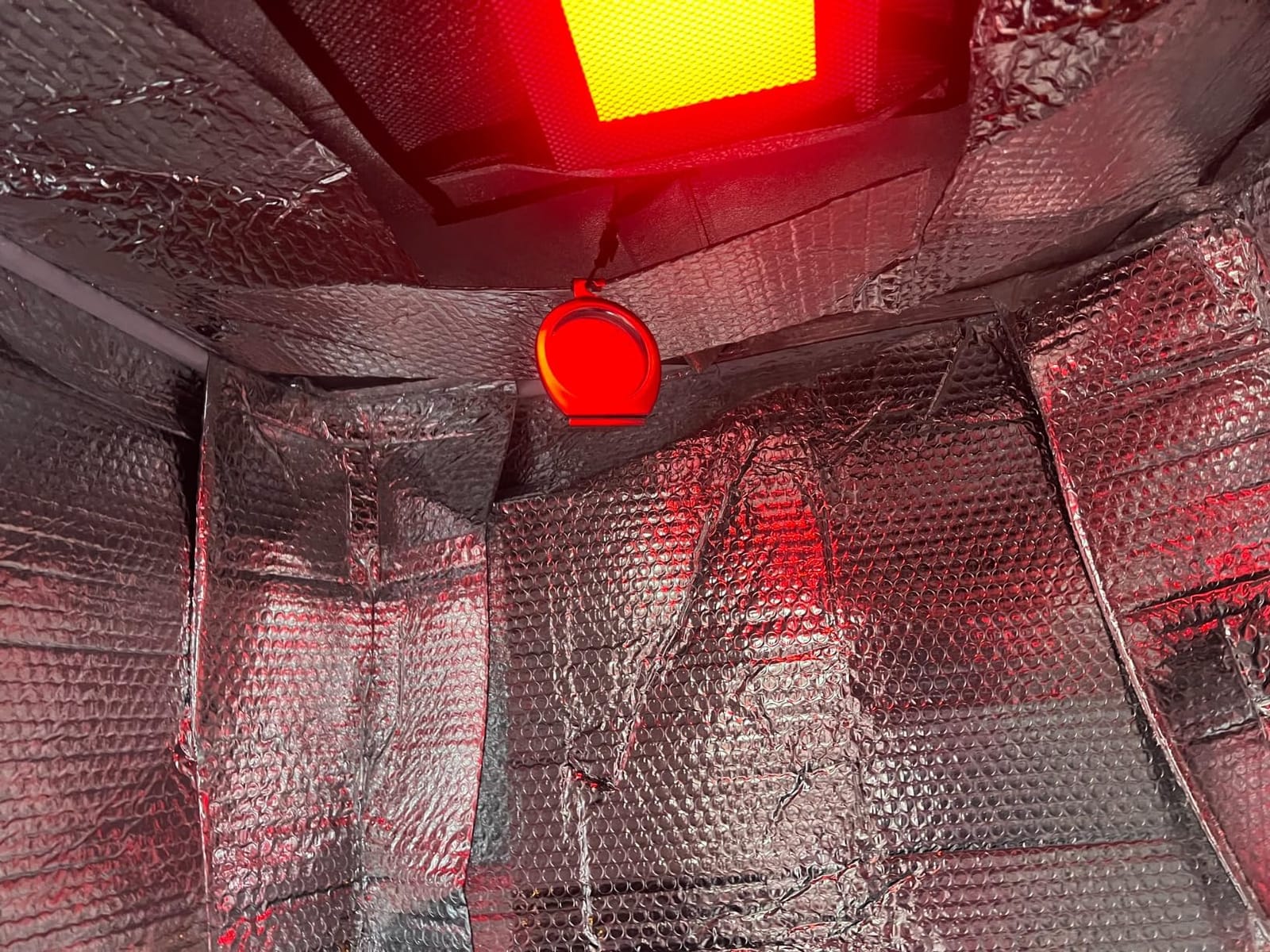
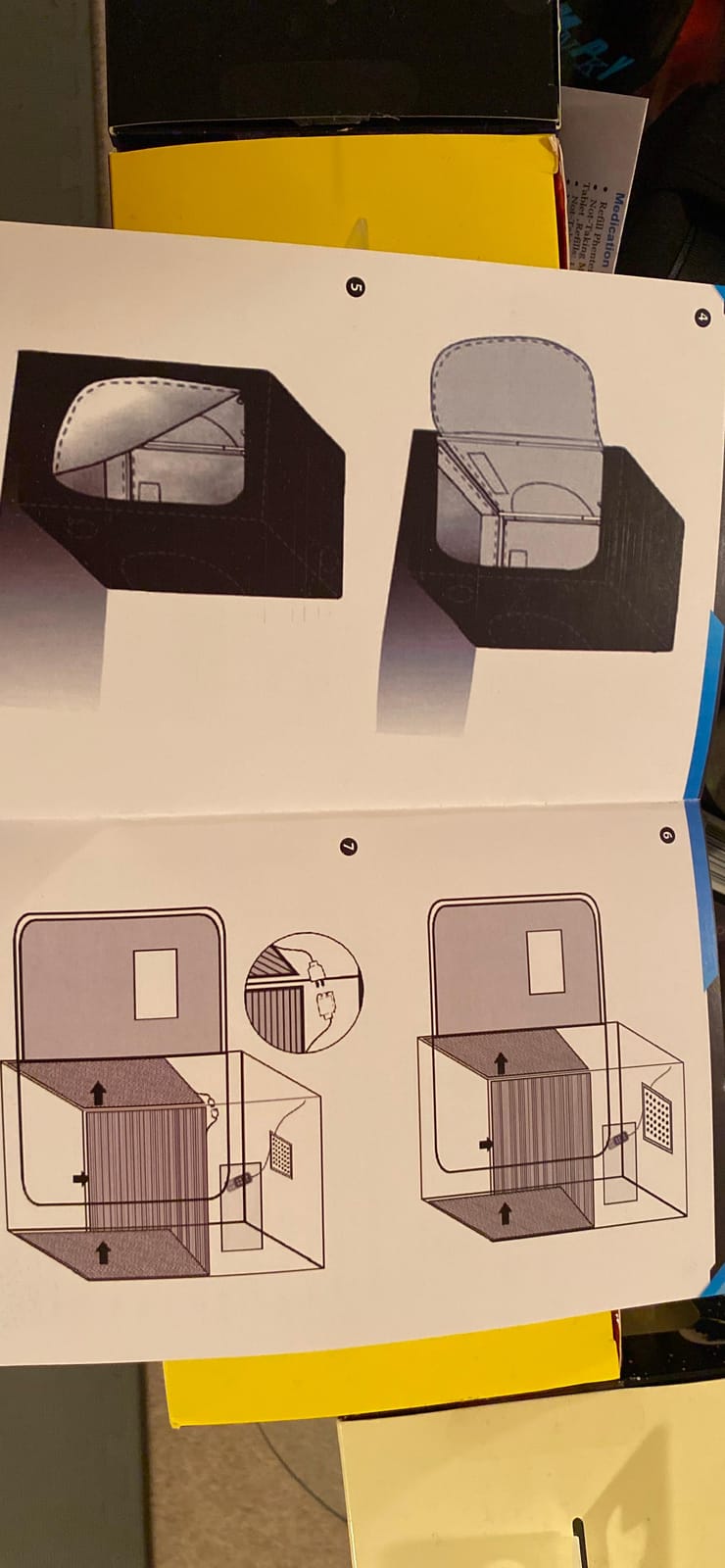
Mechanically it is simple and it works. Three carbon fiber heating panels reach a maximum of 140 degrees Fahrenheit, the remote runs sessions up to 60 minutes, and thermal insulation fabric is designed to minimise heat loss. At 35 by 71 inches and 13.18 pounds, it folds and stores between uses, which is the entire point.
It also includes more than most tents at this level. You get a folding chair, a heated foot pad, an interior pocket, a transparent window and a double-pull zipper, so it is usable straight out of the box without a separate accessory purchase.
Our broader guide to portable saunas for home use goes deeper on why fabric tents heat differently from wood cabins, but the short version is that a tent is a convection-plus-radiant compromise, not a pure infrared room.
Who the SereneLife box suits
It suits renters, anyone in a flat or condo, people with a garage or spare room but no desire for a permanent installation, and buyers who want to test the category before spending on a cabin. With 2894 reviews there is very little risk in trying it.
It also works well as a recovery tool next to a home gym, since it is the fastest to set up of anything here and stores in a closet.
Who should skip it
Skip it if you want a build that lasts two decades. Fabric and a folding frame will age faster than solid hemlock, and the frame joints are the first thing to go with repeated setup and teardown.
Skip it if you plan to use it with a second person, and skip it if heat consistency is your main criterion. The one-star share is concentrated among buyers who wanted a cabin experience, and at 140 degrees with fabric walls you will be at the lower end of what people mean by a sauna session.
7. HigherDOSE Infrared Blanket – Best for Small Rooms
HigherDOSE Infrared Sauna Blanket with Low EMF and 9 Temp Levels
9 temperature levels
Low-EMF and low-ELF
Crystal-infused lining
25 x 25 x 10 inch packed
19 lbs
Pros
- Only pick making low-EMF and low-ELF its headline claim
- Amethyst tourmaline charcoal and clay lining
- No tent or cabin footprint at all
- Industrial-grade zipper for repeated sessions
Cons
- 13 percent one-star ratings across buyers
- Heaviest blanket here at 19 pounds
- Priced above comparable Lifepro blankets
The HigherDOSE blanket earns its place for one reason: if electromagnetic exposure is the thing you are trying to minimise, it is the only pick here whose manufacturer makes low-EMF and low-ELF engineering the headline rather than a footnote. For an EMF-sensitive user, that changes the comparison.
The other angle is footprint. At 25 by 25 by 10 inches packaged, it is not a sauna room, a tent or even a large blanket footprint. It goes on a bed or a couch and it is gone when you are finished.
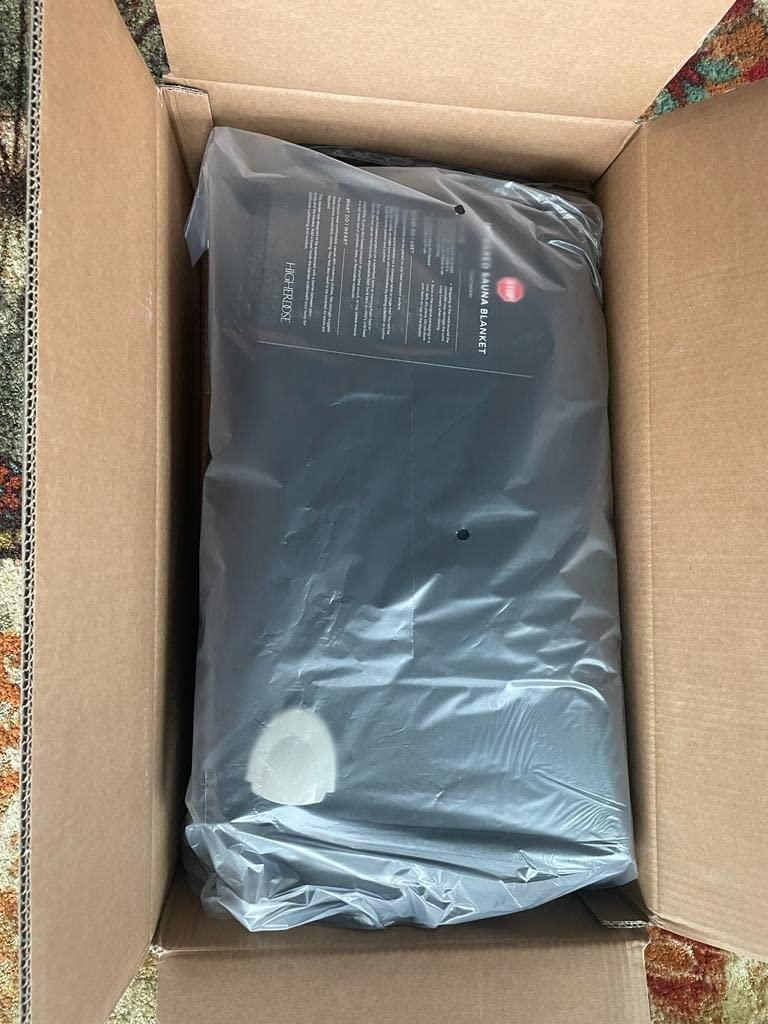
The lining is infused with amethyst, tourmaline, charcoal and clay, which the manufacturer says emit negative ions. We treat that as an unverified wellness claim rather than a measurable benefit, and we would rather say so plainly than repeat it as fact. The temperature control and the EMF engineering are the parts we can evaluate.
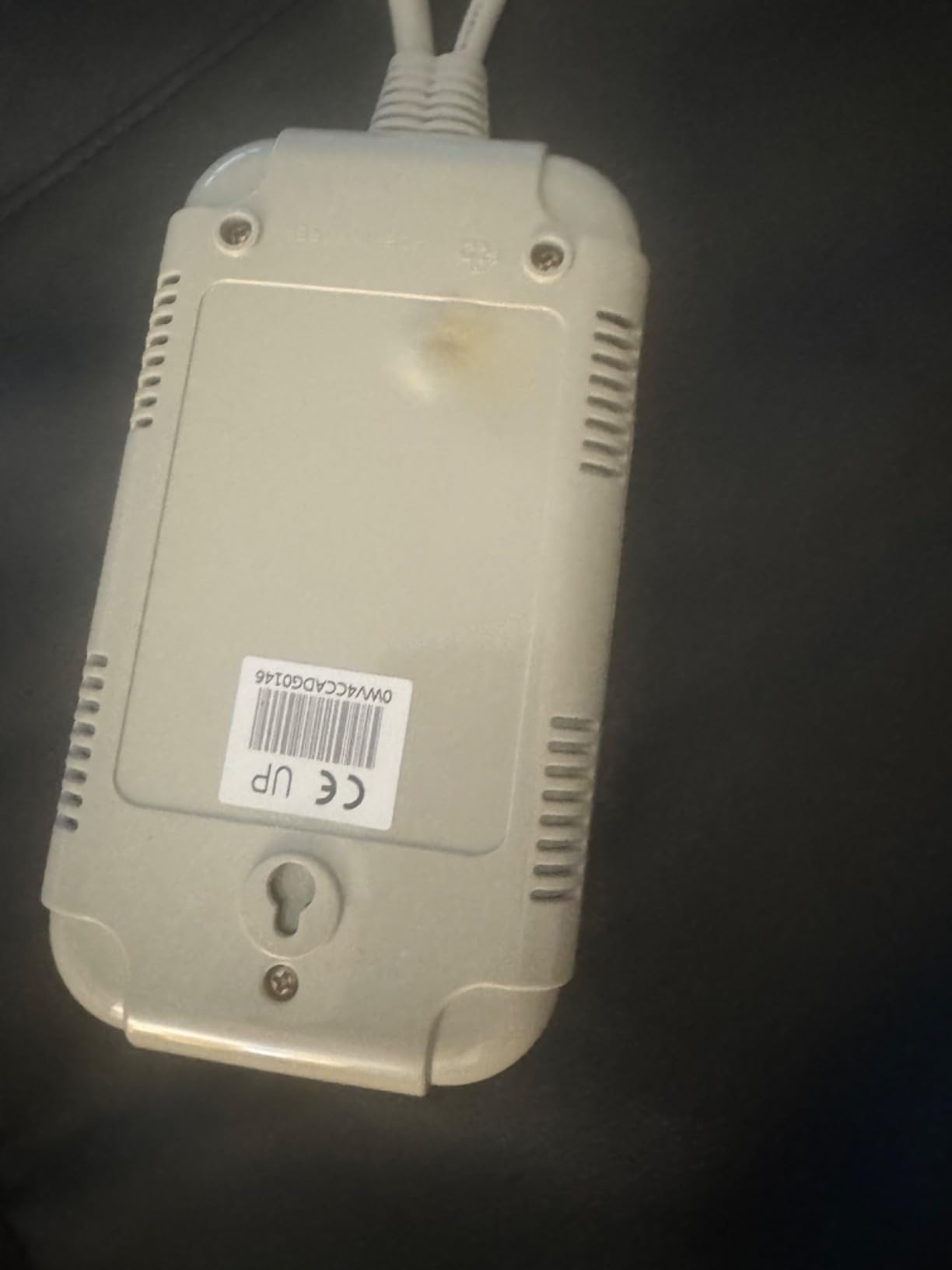
Nine temperature levels and a handheld controller are straightforward, and the industrial-grade zipper is a real upgrade over the hardware on most wraps, since zipper failure is the most common long-term complaint for this product type.
It carries a premium over comparable Lifepro wraps, and it is not backed by a large body of verified owner feedback. 277 reviews at 4.1 stars with 13 percent at one star is a polarised response rather than a settled one, and you should read those one-star reviews before committing.
Who the HigherDOSE suits
It suits users who are genuinely sensitive to electromagnetic fields and have ruled out the cabins on that basis. It also suits anyone in a studio apartment or a small bedroom where a 27-inch-wide cabin is still too much furniture.
It works as a second or travel unit alongside a cabin, since the low-EMF claim is the reason to choose it over an identical-looking cheaper wrap.
Who should skip it
Skip it if you are not prioritising EMF, because you are paying more for a blanket that other models match on temperature range and support with far more reviews. The negative ion claim is not something we would pay a premium for.
Skip it if you need to move it. At 19 pounds packaged it is the heavier end of the blankets here, and reviewers also find the wrap confining in warm rooms, which limits when you can use it.
8. KASUE 3L Steamer Tent – Budget Pick
KASUE Infrared Sauna Tent with 3L Steamer, for Home
3L steam generator
9 temperature levels
99 minute timer
30 x 30 x 70 inch
15 lbs
Pros
- 3L steamer produces strong steam in 5 to 10 minutes
- Five-layer insulated fabric holds heat better than cheap tents
- Remote control adjustable from inside the tent
- Folds flat with a folding chair included
Cons
- Steamer housing runs hot enough to burn larger users
- Instructions do not explain the red light function
- Steam tubing and foot vent are hard to keep clean
- Zippers wear with frequent setup
The KASUE tent is the entry point for finding out whether you like being in an enclosed sauna, and it is steam rather than pure infrared. That distinction matters, so treat it as a different product from the rest of this list rather than a cheaper equivalent.
Where it wins is steam output. A 3-litre generator produces consistent strong steam in about 5 to 10 minutes across nine temperature levels, with a 99-minute timer you can adjust by remote from inside the tent. That is real heat, produced fast.
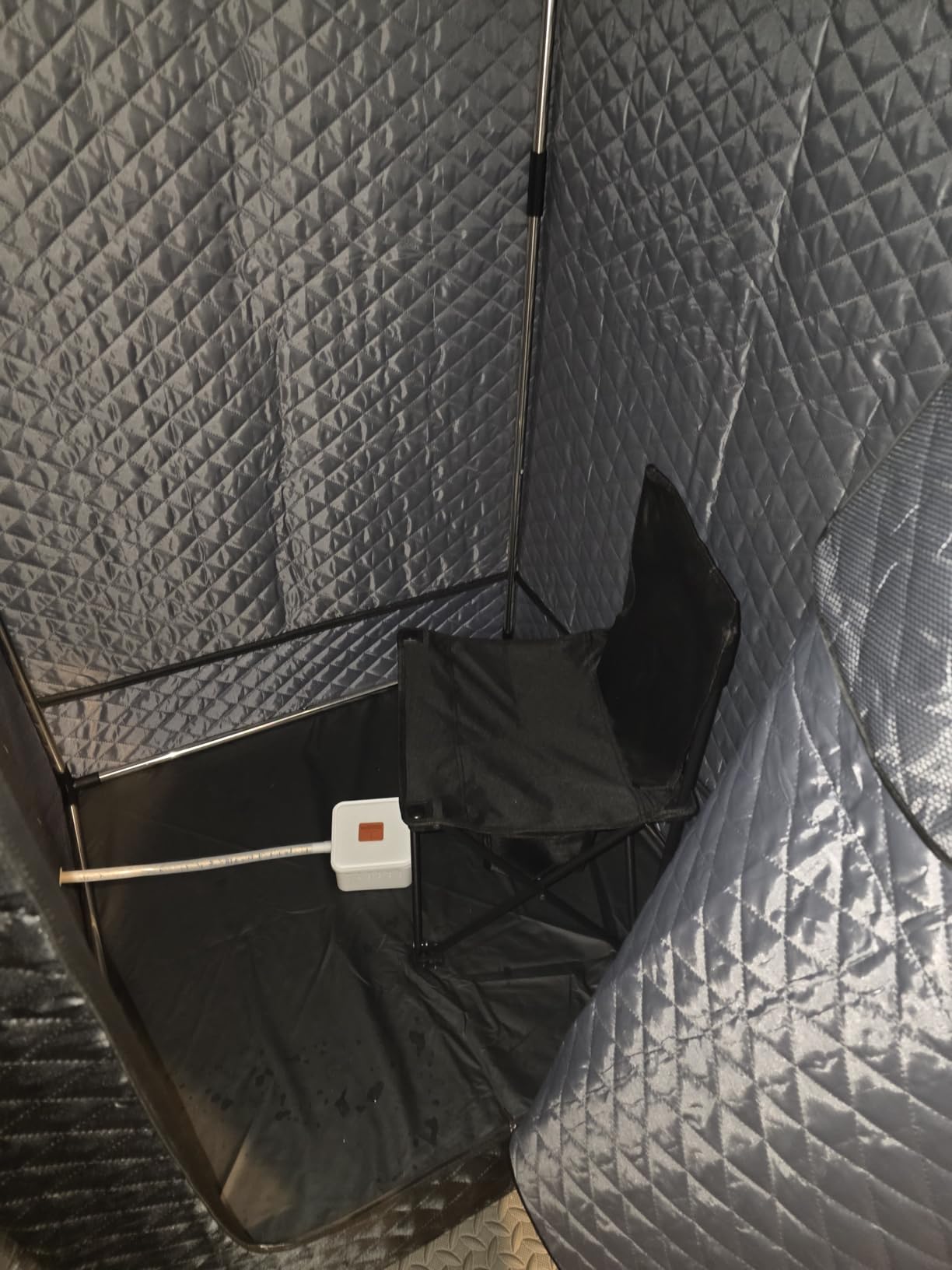
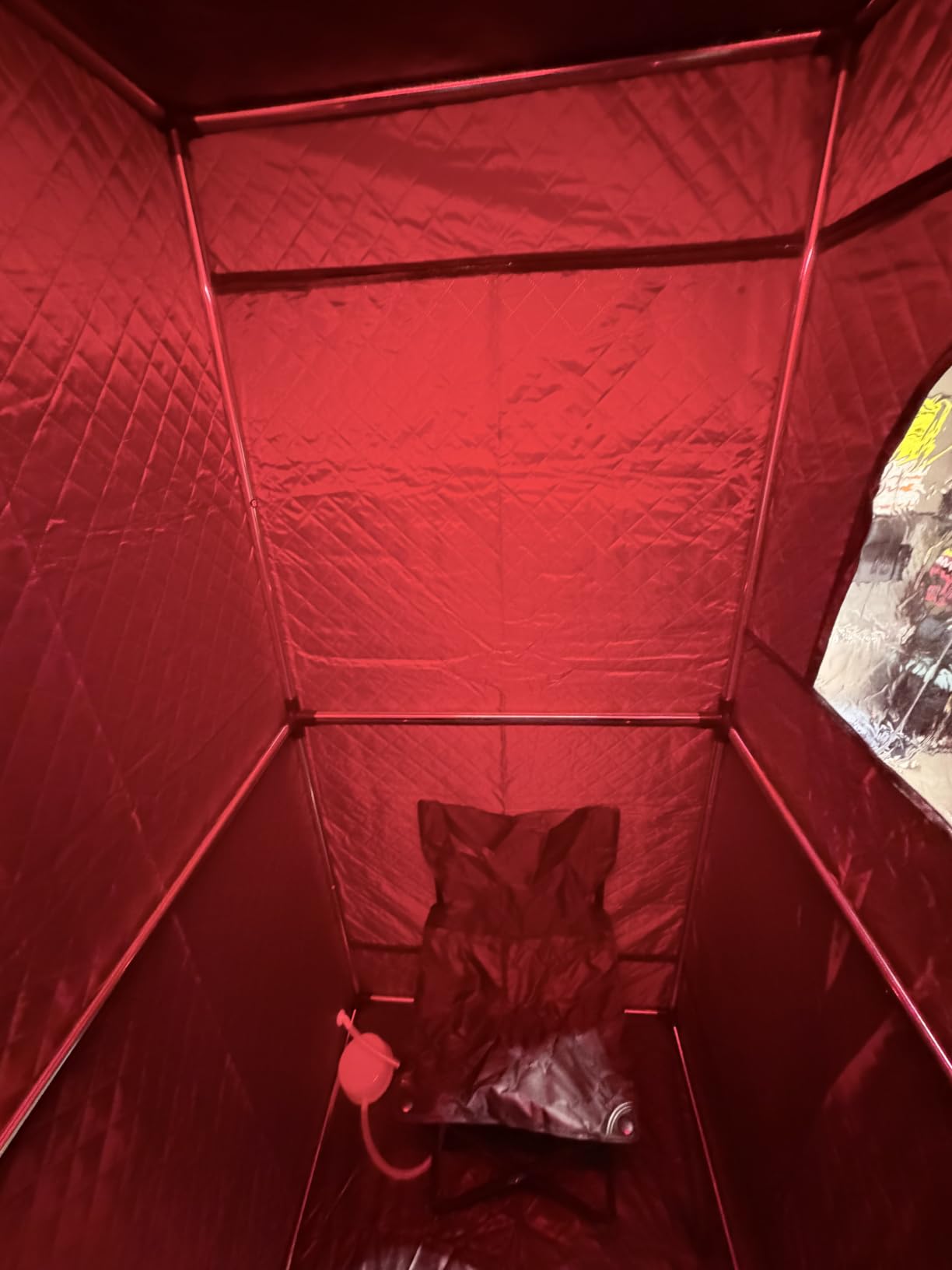
The five-layer waterproof insulated construction is the reason it holds heat better than cheaper tents, and hand openings on the frame let you read or use a phone inside. A folding chair is included, and the whole thing folds flat for storage in an apartment, bedroom or small home gym.
It is 30 by 30 by 70 inches and weighs 15 pounds, so it needs vertical clearance and a floor space of about 2.5 by 2.5 feet, which is more than people expect from a portable tent.
The rating spread here is wide, 69 percent five-star but 9 percent one-star, and the complaints are specific and consistent enough to plan around.
Who the KASUE suits
It suits buyers who specifically want the damp heat of a traditional steam session rather than the dry radiant heat of an infrared cabin. For a first purchase to test the habit, this is the smallest commitment in the roundup.
It is also reasonable for anyone who wants steam on a small budget and already understands they will manage the setup and cleaning themselves.
Who should skip it
Skip it if you are larger or taller. The steam generator housing sits inside the tent and runs hot enough to burn skin if you are close to it or on the larger side, and that is the single most consistent complaint in the reviews.
Skip it if you are not fussy about maintenance. The steam tubing routing and the foot-level vent are poorly designed and create a mess to clean, the written instructions do not explain the red light function, and the zippers around the frame bars wear quickly with frequent setup and teardown. If you want a set-and-forget sauna, our infrared heating panel guide covers the low-maintenance route instead.
What This Price Tier Does Not Get You
Under two thousand buys you real far infrared heat in solid wood, plug-and-play power, chromotherapy on some models, and warranties of three to seven years. It does not buy certified ultra-low EMF output, and that is the single most important thing to understand before you buy.
No model in this roundup publishes a milligauss figure measured at a stated distance in a form you can verify independently. Some claim low-EMF panels, one describes low-EMF and low-ELF engineering as its selling point, and the rest make no measurable claim at all. Independently certified low-EMF cabins start well above this ceiling. If that certification is the deciding factor for you, the honest answer is to save your money and move up a tier.
The second thing you give up is full spectrum. Everything here is far infrared only, which is the longest wavelength and the gentlest. Near and mid infrared, sold as tri-wave or full spectrum, run hotter and lighter wavelengths, and the cabins that combine all three start several thousand dollars higher.
The third is size. Genuine four-person cabins in this price range do not exist. The widest interior on this list is 44.5 inches, which seats two adults, not four, and no amount of marketing language changes the interior measurement.
What you do get is the part that matters day to day. A sauna you will actually use three times a week beats a better sauna you use twice a year, and the running cost difference is small enough that usage frequency should drive the decision more than specifications do.
The 200 Rule and What Temperature Actually Matters
The 200 rule for saunas is simple: 200 degrees Fahrenheit is the traditional Finnish sauna protocol, a target you approach gradually and never rush, and it refers to air temperature in a steam sauna. An infrared sauna is not trying to hit that number, and treating it as a failure is the most common reason buyers at this price feel short-changed.
Infrared panels warm your body directly rather than heating the air, so a comfortable infrared session runs between about 120 and 150 degrees Fahrenheit and still produces a full sweat. The number on the control panel is not comparable to a Finnish sauna reading, and the sensation of heat is delivered differently even at the same printed temperature.
Practical consequence: for a first ten sessions, start at 10 minutes around 120 degrees and add a couple of minutes and a few degrees every couple of sessions. Most people settle into 15 to 25 minutes by session five or six, and there is no benefit to sitting longer simply because the cabin reaches a higher number.
For warm-up, a general rule is that a cool room roughly doubles the time to therapeutic temperature compared with a heated one. Buyers regularly describe reaching only about 125 degrees after half an hour in an unheated garage, against roughly 20 to 30 minutes in a heated space. Ambient room temperature is a selection criterion here, not an afterthought.
The Downsides of Infrared Saunas
There are real drawbacks at this price, and buyers who regret their purchase usually regret an expectation rather than a product. These are the ones we heard most often.
Expectation mismatch is first. Plenty of people arrive expecting 190-degree Finnish heat and treat a comfortable 140-degree infrared session as underwhelming, when in fact the radiant heat is doing something different and often better suited to repeat use. The fix is a reset, not a refund.
Two-person capacity is routinely overstated. A cabin with a 39 to 44 inch interior width seats two adults, shoulder to shoulder, not two people lounging. Anyone over six feet tall should measure bench depth before buying, since it is the dimension buyers most often ignore.
Cold rooms punish warm-up times. Unheated garages and basements can double the time to temperature, and repeat buyers who are unpleasantly cold waiting for it are the group most likely to end up not using the sauna at all.
Foot-level drafts are common across budget cabins. Heat rises, the floor gets nothing, and cold air moves across ankles. The fix is often simple, a draft excluder at the base of the door, and buying a model with a dedicated foot heater solves it properly rather than cheaply.
Assembly is rarely one person. Even premade panel systems mean a second pair of hands, and professional assembly is a paid add-on on most cabins in this range. Budget for it before delivery day, not after.
Warranty terms are not what they look like. Structure and electronics are frequently covered for different lengths, and a one-year electronics term in an otherwise five-year warranty is a real risk. Read the electronics clause specifically, since the control panel and heating elements are the parts that fail.
There is no independent testing culture here. Almost nobody tests these units, including most reviewers. That is why we stated our methodology plainly at the top of this page, and why we treat published specifications plus large verified review bases as the best available evidence.
And resale is weak. Heavy wooden cabins depreciate hard when they need to be moved, which is why a heavy 329-pound unit bought on a whim can be hard to place later. Portable tents hold value better simply because they are easy to move.
What It Costs to Run an Infrared Sauna
Running an infrared sauna is cheap enough that it rarely changes the buying decision. A 1200W cabin used for 30 minutes four times a week draws about 2.4 kWh per week, or roughly 10.4 kWh a month, which is a couple of dollars a month at typical US residential rates.
A heavier 1800W unit doubles the wattage, so the same schedule lands around 15.6 kWh a month. Still a few dollars, still nothing, and it is worth saying plainly because running cost is a common reason people talk themselves out of a purchase they can easily afford to run.
The honest comparison is against a single spa or gym visit. A home sauna used four times a week pays for its electricity within the first few sessions. The real cost of this purchase is the purchase, not the operation.
For blankets the number is smaller again, since a wrap draws a fraction of a cabin’s wattage. The practical variable across every format is warm-up time, because a cold room means the heater runs at full power for twice as long before you get in. Heating a climate-controlled room is the cheapest efficiency upgrade available.
Buying Guide: Heaters, EMF, Wood and Power
Carbon fiber panels versus ceramic tubes is the first real decision. Carbon fiber emits lower-intensity infrared across a broad surface, which feels more even and forgiving at lower temperatures. Ceramic tubes run hotter and more concentrated, reaching higher temperatures faster but with more localised hotspots. In this price range almost everything worth buying is carbon fiber, and all three wood cabins on this list use it.
EMF needs a definition rather than a slogan. Every electric heater produces an electromagnetic field, and what matters is the field strength at the point where your body sits, measured in milligauss at a stated distance. A brand that publishes a number and a measurement distance is giving you data. A brand that writes “low EMF design” is giving you a marketing line. If you are EMF-sensitive, prioritise the second Lifepro blanket and the HigherDOSE wrap, and accept that a cabin at this budget is a compromise on that axis.
Wood species matter less than density and finish. Canadian hemlock appears on three of the eight models here because it is dense, soft, low in resin and genuinely insulating, which is a good combination for a heat chamber. Cedar smells better and resists moisture, but is lighter and resinier. Watch for water-based paint and finishes on benches and foot grids, since solvent finishes are unpleasant in a hot enclosed space.
Power decides your installation bill. Every model here runs on a standard 120V household circuit, which means a normal wall outlet and no electrician. A 240V setup removes that friction but adds installation cost, and at this budget the 120V models are the sensible choice.
Measure interior width, not exterior. Two adults need roughly 44 inches of interior width to sit opposite each other, and anyone tall needs bench depth you can actually sit on. Listing exterior dimensions and calling the result two-person is the most common way this category misleads, so do the subtraction yourself before ordering. Our picks for the sub-cabin formats are covered in the infrared sauna blankets for recovery guide.
Finally, read the electronics warranty separately from the structure warranty, and check whether replacement parts, heater elements and the control panel are covered for the full term. In a category where most manufacturers are small, how a brand handles a failed panel five years in matters as much as the wood.
Frequently Asked Questions
What is the best sauna I can buy for under 2,000 dollars?
The OUTEXER T-50C is our top pick in this range. It pairs six low-EMF carbon panels with an independently controlled foot heating plate, a 27 inch wide footprint that fits tight rooms, 7-color chromotherapy lighting, built-in speakers and a 7-year after-sales service term. If you want a cabin and have less than 35 inches of width to work with, it is the most complete unit in this roundup.
What is the downside to an infrared sauna?
The main drawbacks are expectation mismatch, since infrared runs 120 to 150 degrees rather than the 190 to 200 of a Finnish sauna, and overstated two-person capacity, because most cabins in this range offer only 39 to 44 inches of interior width. Cold rooms roughly double warm-up time, foot-level drafts are common, assembly usually needs two people, and electronics are often covered for far less time than the structure.
What is the 200 rule for saunas?
The 200 rule refers to 200 degrees Fahrenheit as the traditional Finnish sauna protocol, an air temperature you approach gradually and never rush. Infrared saunas are not built to reach it. They warm your body directly rather than heating the air, so a productive session runs around 120 to 150 degrees Fahrenheit and still produces a full sweat. Comparing the two numbers is the most common reason buyers feel short-changed.
Which infrared sauna has the lowest EMF radiation?
Among the models reviewed here, the HigherDOSE blanket is the one whose manufacturer makes low-EMF and low-ELF engineering its primary selling point, and the two Lifepro blankets specify low-EMF carbon fiber elements. No model in this price range publishes an independently verified milligauss figure at a stated measurement distance. If certified ultra-low EMF is your deciding requirement, you need to move to a higher tier.
How much will my electric bill go up with an infrared sauna?
Very little. A 1200W cabin used 30 minutes four times a week draws roughly 10.4 kWh a month, and an 1800W unit roughly 15.6 kWh, which is a few dollars monthly at typical US residential rates. Set against a single spa or gym visit, the running cost is effectively zero. The purchase is the expense, not the operation.
Is an infrared sauna worth the money?
For regular users doing three to five sessions a week, yes, because it replaces repeated per-session costs with one purchase and gives you consistent access. The value depends on having a climate-controlled room, a standard 120V outlet and realistic expectations about temperature. If your interest is casual, test a blanket or a portable tent first before committing to a full cabin, since that is the most common path buyers regret skipping.
Who Should Buy Which Sauna
Buy the OUTEXER T-50C if you want one sauna and it has to be the most complete one in this roundup. It wins on satisfaction score, heater coverage including the foot plate, build wood and a long service term, and its narrow footprint solves problems that stop bigger cabins getting through the door.
Buy the Lifepro RejuvaWrap if you want the most-used option with the most reviews behind it and no permanent installation. Buy the Homsido if you are a couple who will actually share sessions, and the Blue Wave Coronado if two-person width and a seven-year warranty matter more to you than extra features.
Buy the Lifepro BioRemedy for travel and small rooms, the SereneLife box for rental or for testing the category before committing, the HigherDOSE only if low-EMF engineering is your priority, and the KASUE if you specifically want steam heat rather than dry radiant heat.
And save your money for a higher tier if certified ultra-low EMF, full-spectrum near and mid infrared, or genuine four-person capacity is the reason you are shopping. Those are not close at this price, and buying below your requirement is where regret comes from.
For anything smaller than a cabin, our guides to infrared tower heaters and recovery-focused sauna blankets cover the complementary options.