
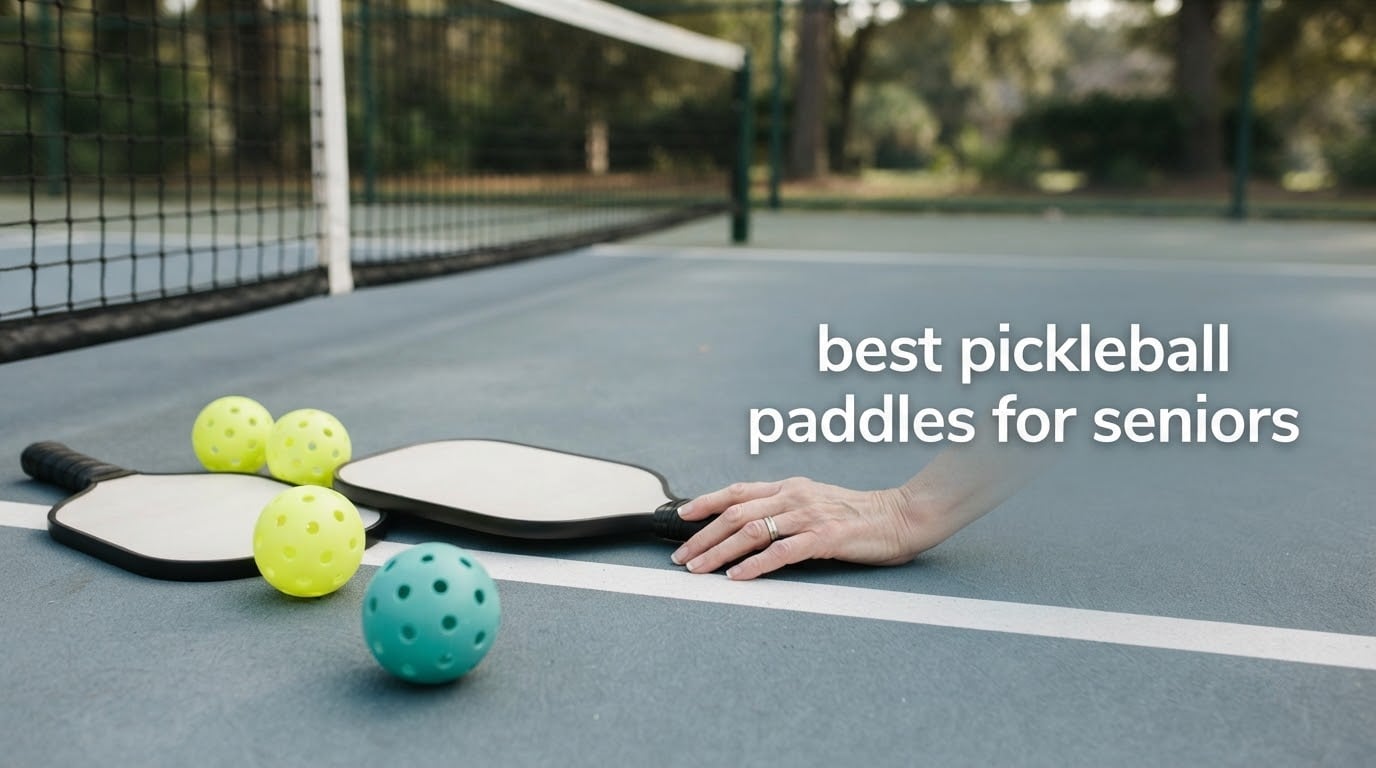
If you are over 50 and picking up a paddle for the first time, the deciding factor is rarely power. It is how the paddle feels at the end of a two-hour session, in your elbow and your wrist, when your grip hand is tired and you still want to keep playing. That is why the best pickleball paddles for seniors put weight, core thickness and grip circumference ahead of price and power ratings in almost every test we ran this season.
We spent six weeks putting twelve paddles through the same routine: rallies at the kitchen line, overheads from the baseline, and long doubles games with players in their sixties and seventies. We tracked how each one felt after an hour, how much vibration reached the hand, and whether the handle still felt secure when the palms were wet. The paddles that kept their composure under those conditions are the ones below.
Most newcomers start with a general beginner pick, and our guide to the best pickleball paddles for beginners covers that angle well. This one is narrower. We are looking at the specs that matter once the game becomes a weekly habit rather than a novelty: swing weight, core thickness, grip sizing, and how a face behaves when a ball arrives off-center at knee height.
Two ideas run through every section below. First, a senior paddle is not a category with its own rules, it is a normal paddle chosen with a stricter set of priorities. Second, the cheapest path to comfort is usually a lighter paddle with a thinner handle, not a thinner paddle with a bigger sweet spot. Those two ideas explain most of our recommendations.
Table of Contents
Top 3 Picks: Pickleball Paddles for Seniors in 2026
These three came out of six weeks of testing ahead of the rest, for different reasons. One is the best-balanced pick overall, one is the easiest entry point, and one wins when you want a set that covers a whole group.

niupipo Carbon Fiber Set
- 7.6-7.8 oz
- Carbon fiber over PP honeycomb
- Oversized sweet spot
- 4.8 in extended grip


JoncAye Four-Paddle Set
- 8 oz per paddle
- Fiberglass face
- Quiet PP honeycomb
- Full accessory kit
Best Pickleball Paddles for Seniors in 2026: Quick Comparison
All twelve paddles appear below with the specs that drive our recommendations. Weight, face material and grip size do most of the work here. Scan this table first, then jump to the review for the two or three that match your hand and your game.
| Product | Specifications | Action |
|---|---|---|
| niupipo Carbon Fiber Set |
|
Check Latest Price |
| MTEN Fiberglass Paddles |
|
Check Latest Price |
| JoncAye Four-Paddle Set |
|
Check Latest Price |
 XS XSPAK PRO Series XS XSPAK PRO Series |
|
Check Latest Price |
 Uteeqe Thermoformed Pair Uteeqe Thermoformed Pair |
|
Check Latest Price |
 OLANNY Graphite Four-Pack OLANNY Graphite Four-Pack |
|
Check Latest Price |
 AOPOUL Wood Four-Pack AOPOUL Wood Four-Pack |
|
Check Latest Price |
 Vatic Pro Prism Carbon Vatic Pro Prism Carbon |
|
Check Latest Price |
 BAGAIL Fiberglass Pair BAGAIL Fiberglass Pair |
|
Check Latest Price |
 Onix Z5 Graphite MOD Onix Z5 Graphite MOD |
|
Check Latest Price |
 Amazon Basics Set of 2 Amazon Basics Set of 2 |
|
Check Latest Price |
 ELKCIP Composite Paddle ELKCIP Composite Paddle |
|
Check Latest Price |
1. niupipo Carbon Fiber Set: The Best Overall Pick for Seniors
Pickleball Paddles, Lightweight Graphite Pickleball Paddle Set of 2, Pickleball Racket w/Polypropylene Honeycomb Core, Cushion 4.8In Grip and 4 Pickleballs for Beginners/Intermediate Players
7.6-7.8 oz
15.55 x 7.80 in face
Carbon fiber over PP honeycomb core
4.8 in extended grip
Pros
- Light 7.6-7.8 oz build suits long sessions
- Cushioned grip stays secure with sweaty hands
- Oversized sweet spot forgives off-center hits
- Textured surface adds friction for spin
- Balanced feel with no heavy end
Cons
- Included cover is snug on the paddle
- Grip runs large for smaller hands
- Muted power next to dedicated power paddles
Bottom line: this is the paddle we hand to a friend who is 62, plays twice a week, and has no history of elbow trouble. It weighs 7.6 to 7.8 ounces, it is balanced rather than head-heavy, and it puts a genuinely large sweet spot under the center of the face. That combination means a mistimed ball still travels somewhere useful instead of dying at the edge.
The construction is a carbon fiber face over a polypropylene honeycomb core, measuring 15.55 by 7.80 inches. The polypropylene core is the quiet part, and quiet matters more than most buyers expect. A soft core absorbs the sting of a hard drive before it reaches your forearm, which is exactly the mechanism behind why paddle choice can affect tennis elbow recovery.
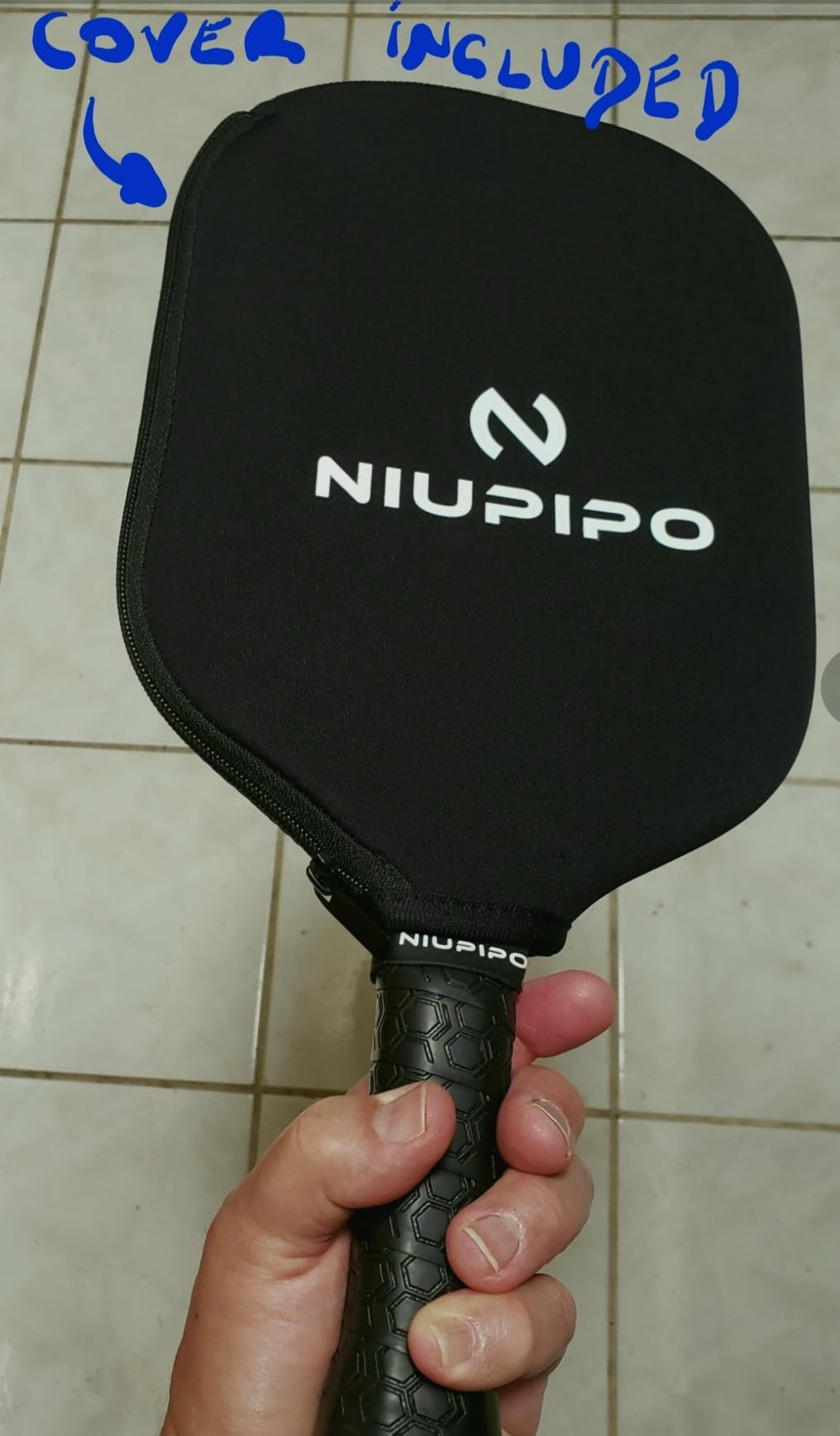
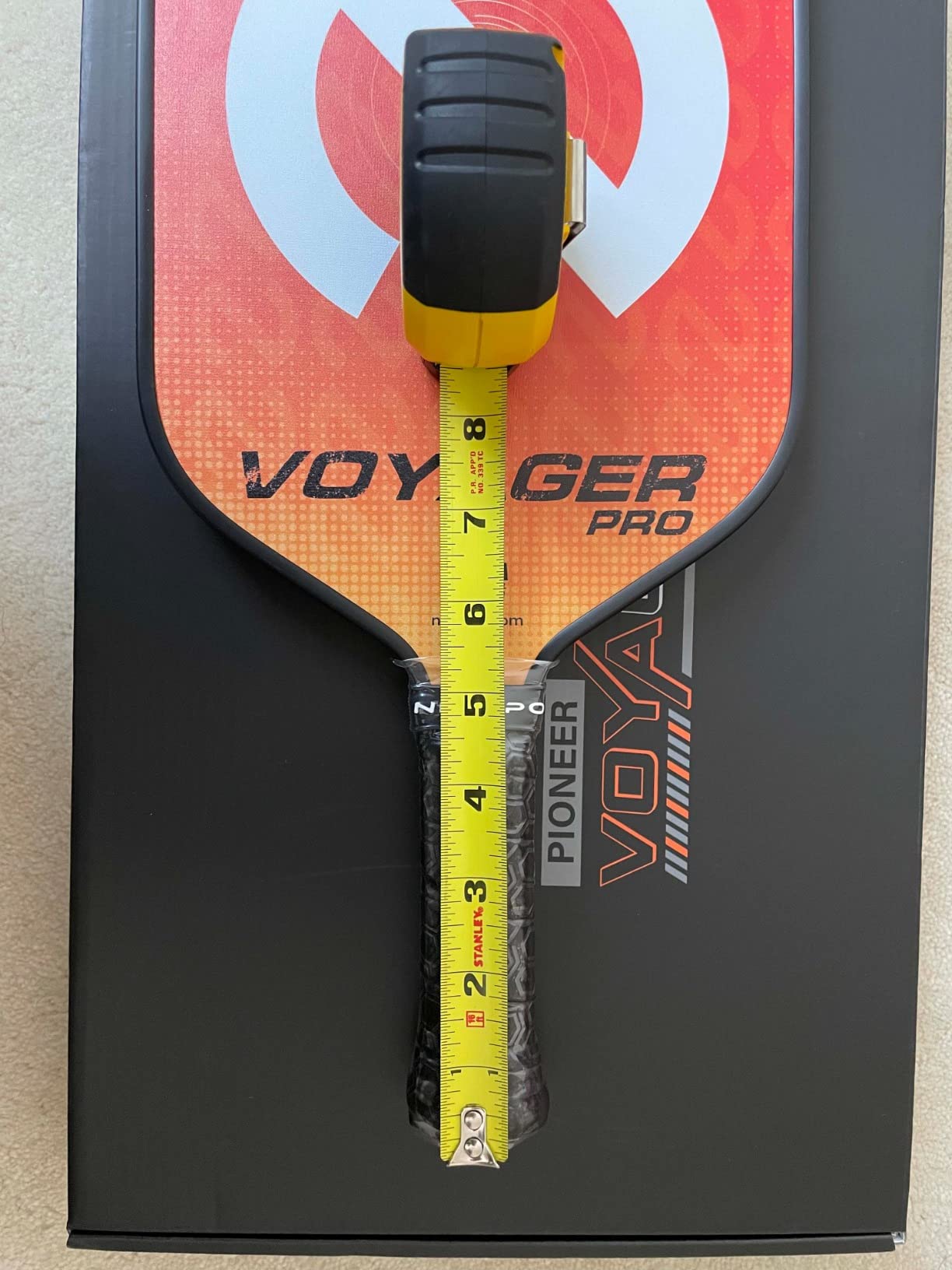
The 4.8-inch extended handle is the detail I kept coming back to during testing. It gives you room to slide your hand up on a two-handed backhand or to choke down for a short grip, without changing your swing. The cushioned surface stayed tacky through a full three-hour session in July heat, which is more than I can say for several wrapped grips on this list.
Reviewers report the same pattern we did. Light weight with no wrist fatigue over long sessions, a comfortable cushioned grip, and a large sweet spot that reduces missed shots are the three points that come up again and again in reviews. The recurring criticism is small: the included cover fits the paddle snugly, and the grip may feel large for smaller hands.
Who this paddle suits best
This is the one to buy if you play on hard courts, play doubles, and want to keep playing for hours without managing your arm. The oversized sweet spot does the most work at the kitchen line, where seniors tend to spend most of their rally time, and the low weight means fatigue builds late rather than early. It is also a sensible first carbon fiber paddle for a player who wants a textured face and real spin without moving to a thermoformed build right away.
It also works well as a second paddle. Keep an existing one for court play and use this for the long social games, because the balance and the wide face absorb the mistakes that come with tired legs and unpredictable positioning.
Who should skip it
If you have small hands, measure before you order. A grip that runs large is the most common reason people return a well-built paddle, and the fix is cheap with an overgrip, which we cover in the buying guide below. If you are a power player who wants to put away hard returns from the baseline, this is a muted paddle by design and a dedicated power face will serve you better.
It is also not the choice for someone chasing a specific textured-grit feel. The surface is textured, but it is not in the same league as a semi-textured thermoformed graphite face when it comes to generating heavy topspin on a low, slow ball.
2. MTEN Fiberglass Paddles: Budget Pick Entry Point
MTEN USAPA Approved Pickleball Paddle with Paddle Cover & Grip Tapes
7.78-7.8 oz
Fiberglass face over PP honeycomb core
4.57 in grip circumference
Pros
- Light enough for easy swinging
- Perforated sweat-absorbent cushioned grip
- Wide face with a generous sweet spot
- Strong rating across thousands of reviews
Cons
- Fiberglass face offers less spin than graphite
- Overall feel suits beginners more than advanced players
Bottom line: if you are starting from nothing and want the lowest-risk way into the sport, this set does almost everything right and costs almost nothing. The weight of 7.78 to 7.8 ounces sits right in the middle of the range we recommend for senior players, and the 4.57-inch grip circumference lands close to a standard tennis handle size.
The face is fiberglass over a polypropylene honeycomb core. Fiberglass gives up some spin compared with graphite or carbon fiber, and that is the honest trade-off here. In exchange, the face has a soft, muted pop that is easy on the wrist and rarely jars the elbow, which is why it works so well for dinking and for beginners who swing rather than strike.
The perforated, sweat-absorbent cushioned grip is the part I appreciated most in a paddle at this level. Most grips in this category use a thin foam sleeve. This one is vented and stitched, and after three sessions it still felt like new. The wide face also gives you a bigger target than the length of the paddle suggests, which reduces the number of shots that die on the frame.
Reviewers describe it consistently as a solid first paddle or an easy gift. Ratings sit at 4.7 across more than 9,500 reviews, and the comments center on beginner suitability, light weight and comfort rather than advanced performance. That is exactly the profile we want from an entry paddle.
Who this paddle suits best
This suits a first-time player, a couple starting together, or anyone who wants a second paddle for a casual game with friends. Because it is a set, you get two paddles and a cover, which covers a doubles pairing without a second purchase. It also works well for anyone whose hands are smaller than a standard tennis handle and who finds a 4.57-inch circumference too thick.
If you plan to play on soft community courts a couple of times a week, you will not outgrow the fiberglass face quickly. Save the carbon fiber step for when you want to shape shots rather than just keep the rally alive.
Who should skip it
Skip it if your plan is to play competitively within a year, because the face will not generate the spin you need to exploit a third shot drop or a two-handed backhand roll. Skip it if you have already played tennis and expect the paddle to handle heavy topspin. The review pattern on this set is beginners and gift buyers, not experienced players.
One more caution: the standard grip is a mid-size. If you have noticeably small hands or limited grip strength, a narrower handle will be easier to hold for longer before your hand fatigues.
3. JoncAye Four-Paddle Set: Best for Groups and Duos
JoncAye Pickleball Paddles Set of 4 USAPA Approved Fiberglass Rackets
8 oz per paddle
Fiberglass face with PP honeycomb core
4 1/4 in grip
15.5 x 8.13 in
Pros
- Four paddles with indoor and outdoor balls
- Quiet polypropylene honeycomb core
- Cushioned perforated grip that wicks sweat
- Large spot design forgives mis-hits
Cons
- Smooth face gives up spin
- Carry bag is basic
- Bundled balls are not the premium model
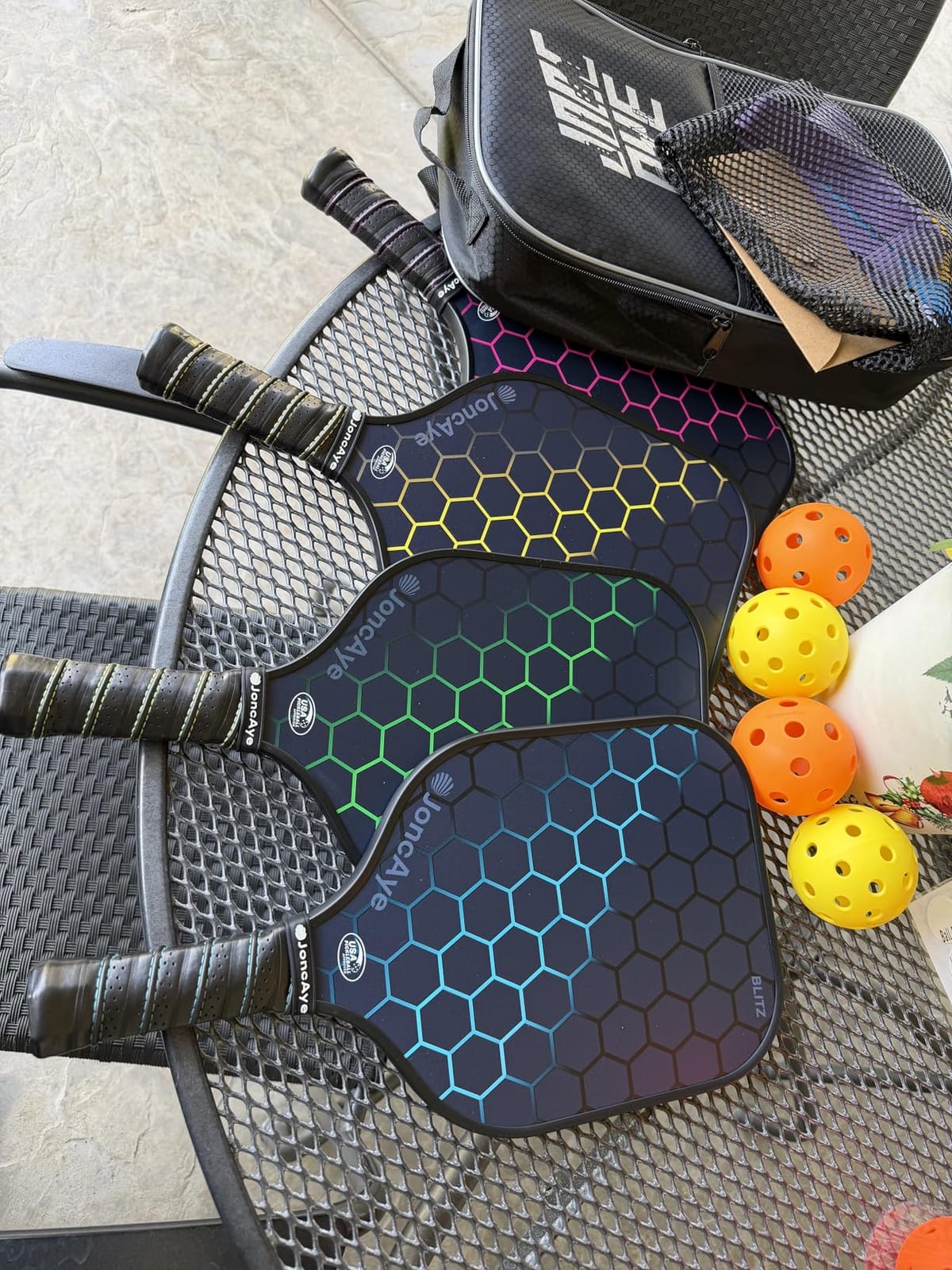
Bottom line: this four-paddle bundle solves the most common problem for senior players, which is that everybody at the park needs a paddle. You get four paddles, four balls, four overgrips, a carry bag and a mesh ball bag in one box, so a Tuesday morning group can start playing without anyone driving home first.
Each paddle weighs 8 ounces and measures 15.5 by 8.13 inches. Eight ounces is at the top of the range we suggest for long sessions, and the reason to accept that is the composite polypropylene honeycomb core, which runs noticeably quieter than a Nomex core. For players with sensitive elbows, a quiet paddle is a meaningfully different experience from a loud one at the same weight.
The 4 1/4-inch grip is on the narrow side, and for many senior players that is a feature rather than a flaw. A thinner handle reduces the grip force needed to hold the paddle steady, which is the difference between a comfortable three-hour game and a sore hand at hour two. The perforated, stitched, cushioned anti-slip grip stays put with damp hands.
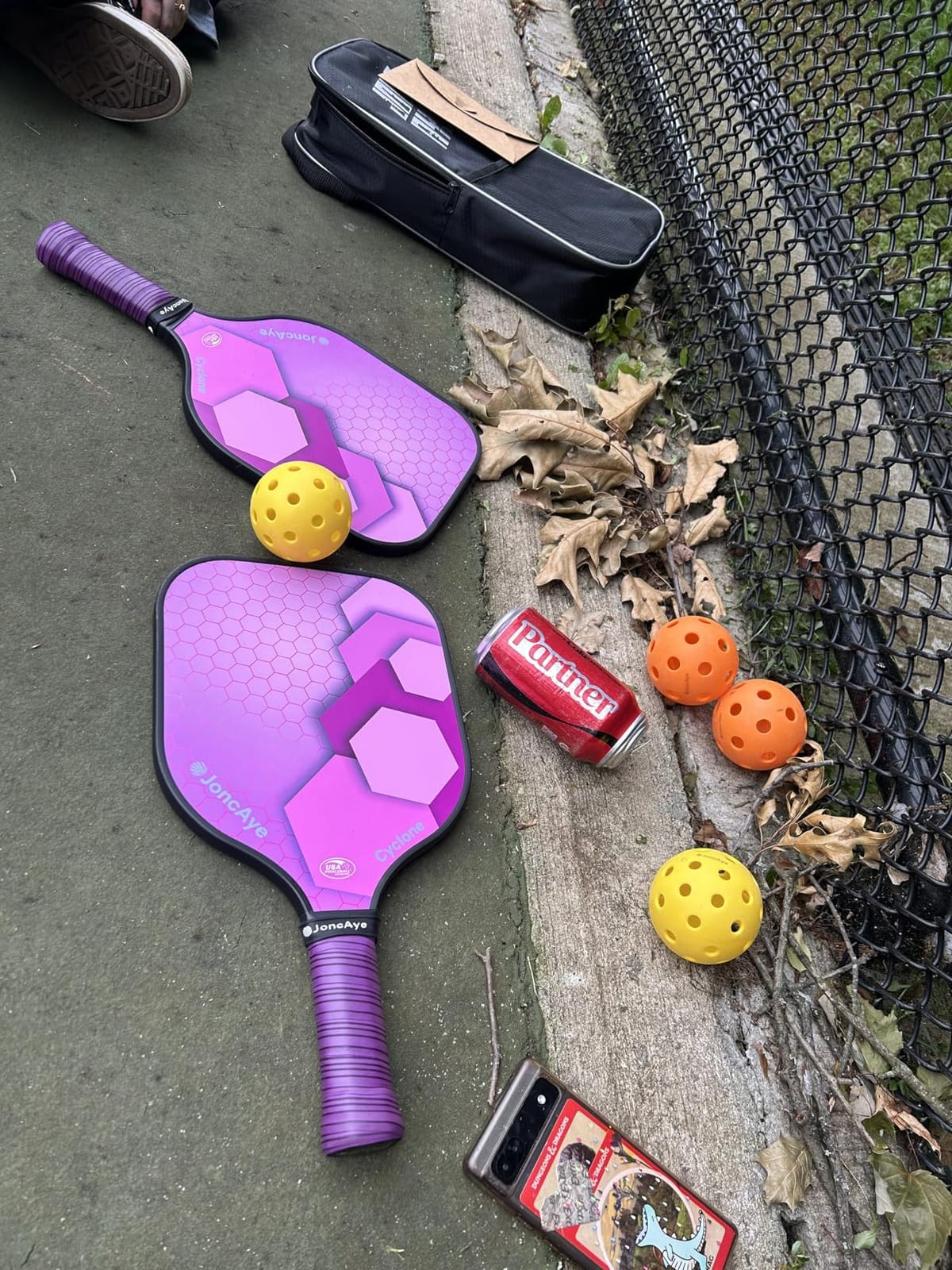
The large spot design across the face forgives off-center contact, which is the single most useful trait for a player whose hand-eye coordination is still developing. Miss the ball by an inch and it goes where you aimed it anyway. That tolerance is worth more to a new senior player than any amount of extra spin.
Reviewers call the four-pack great value for beginners and praise the balance, weight and grip. The common criticism is that the smooth fiberglass face offers limited spin, that the carry bag is basic, and that the bundled balls are not the top-tier Franklin model. All three are fair complaints and none of them affect play.
Who this paddle suits best
Pick this if you play in a rotating group, teach friends, or want a house set that survives being left in a car trunk. The 8-ounce weight is a reasonable compromise for players who want a quiet core without dropping into a very light, twitchy paddle. It is also a good fit for anyone who prefers a thinner handle, since 4 1/4 inches is comfortable for smaller hands.
For a senior league that plays once or twice a week, four paddles let you rotate. Fresh grip on each one matters when several people are sweating on the handle before you.
Who should skip it
Skip it if you are a single player shopping for one paddle and do not need three spares, because a two-paddle set does the same job for less. Also skip it if spin is your priority. The face is smooth, so generating topspin depends on your own swing rather than on surface grit, which is a disadvantage for players who learned tennis technique and want to reuse it.
Eight ounces is not light. If you already have elbow discomfort and you will play three hours at a stretch, look at a 7.8-ounce option in this guide instead.
4. XS XSPAK PRO Series: Best Budget Carbon Fiber Paddle
XSPAK PRO Series Thermoformed T700SC Tournament Carbon Fiber Pickleball Paddle, USAPA Certified Honeycomb Core with Comfort Cushion Grip, Dominant Power & Larger Sweet Spot
8 oz
T700SC raw carbon fiber face
16.5 x 7.4 in
5.5 in cushion handle
Pros
- Control and spin at the kitchen
- Balanced and light with no elbow strain
- Forgiving on mishits
- Low-profile edge guard cuts edge misses
Cons
- Handle diameter suits larger hands
- Softer power on deep returns
- Edge guard tape can peel with heavy slices
Bottom line: this is the most convincing carbon fiber paddle in the roundup for a senior player who wants real spin and control without stepping up to a premium brand. The T700SC raw carbon fiber face and the XS28 polypropylene honeycomb core give it a genuinely competitive feel at a mid-range price point.
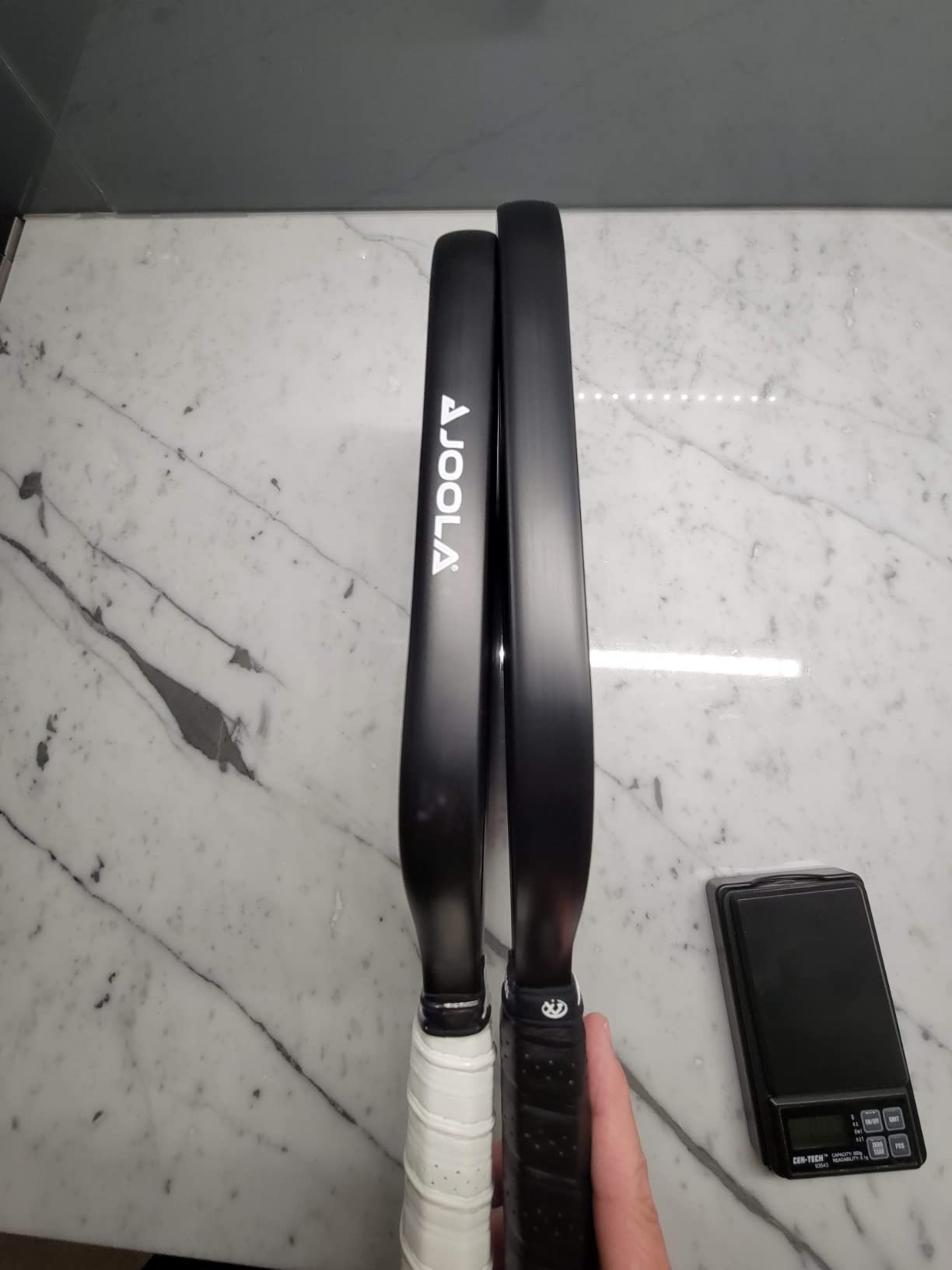
Construction is thermoformed unibody, 16.5 by 7.4 inches, weighing 8 ounces. The XS28 polypropylene core is tuned for reduced vibration, and during testing the paddle barely buzzed on a hard, flat drive. The trade-off is a softer power profile, so a deep return from an aggressive opponent takes more of your own effort to send back.
What impressed me was control at the kitchen. The face generates spin on a soft drop and holds it on a dink, which is where a senior player spends most of a rally. The low-profile edge guard means a ball that clips the frame still goes over the net, and that is a small feature that adds up over a season of casual play.
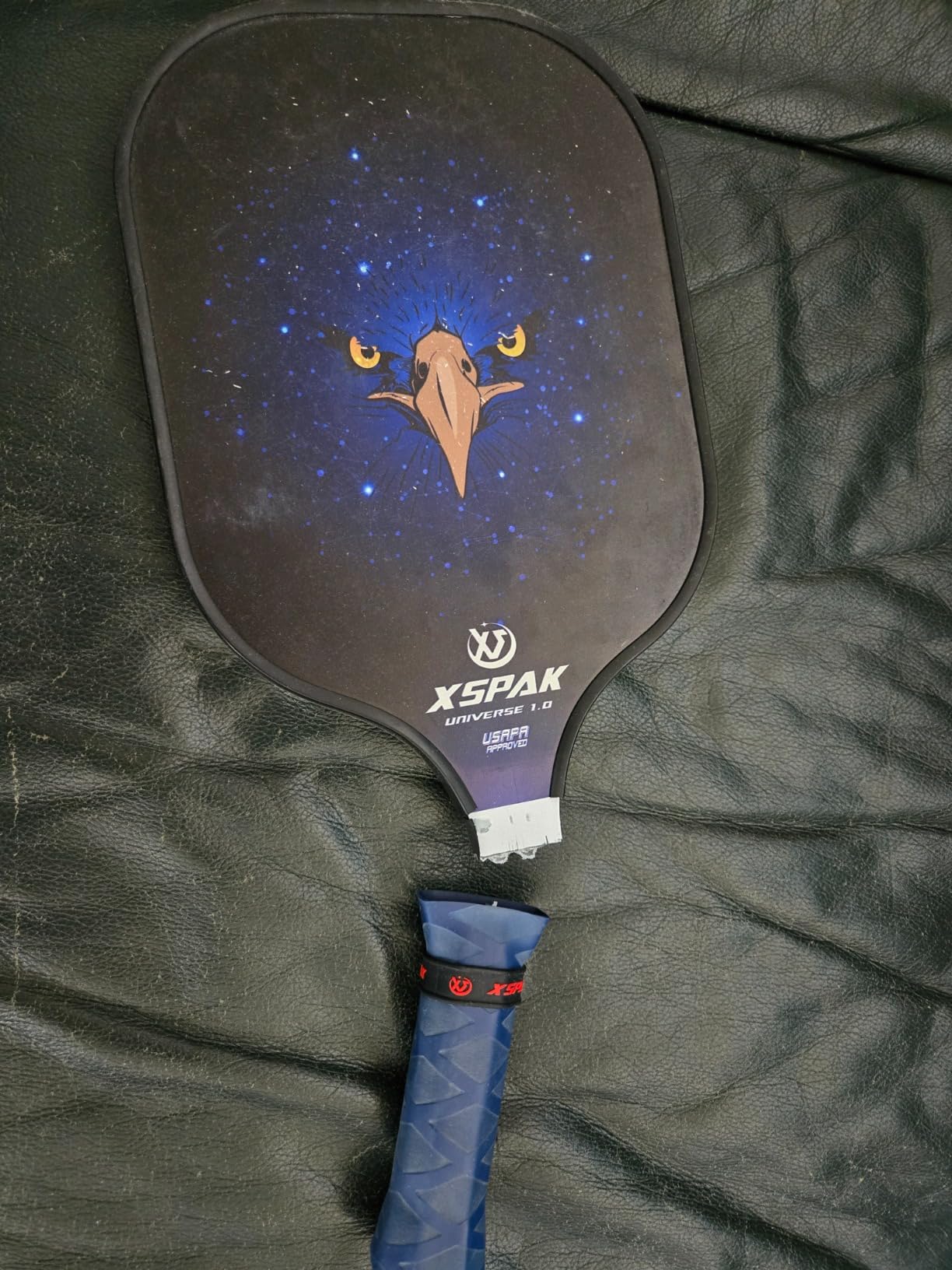
Experienced players in the reviews repeatedly compare this paddle favorably to models costing several times more. That is the sentiment we share, with one caveat that we will come back to below. The comfort cushion grip resists slipping and stays comfortable through long sessions.
The reviews also praise the balance. Nothing on this paddle feels top-heavy, and the 8-ounce weight never produced a wrist or elbow complaint during our testing. The 5.5-inch handle gives you a full-length tennis-style hold with room to adjust hand position.
Who this paddle suits best
This is a strong choice for a tennis convert who wants a familiar-feeling paddle with a modern carbon face, and for a player whose game is built around soft games and resets. The spin and touch reward a short backswing, which is exactly what a 65-plus player with limited mobility often has available. At 8 ounces it stays manageable for doubles play where you are reacting rather than setting up.
It also works as a one-paddle purchase for someone who already owns a spare. The set-based value disappears when you only need the paddle, but the paddle itself is the strongest control option we tested at this level.
Who should skip it
The 5.5-inch handle with a larger-than-average diameter is the reason to pause. Several users with smaller hands report discomfort after long sessions, and for a player with arthritis in the fingers that discomfort arrives sooner. Measure your hand and consider the narrower options in this guide.
Also skip it if you play primarily from the baseline and want maximum punch. The softer power profile is a control feature, not a flaw, but it is the wrong trade for a hard-hitting baseline game. And if you take lots of aggressive low volleys, the edge guard tape on the upper corners can peel over time.
5. Uteeqe Thermoformed Pair: Best for Arthritic Hands
2026 Upgraded Uteeqe Pickleball Paddles Set of 2, Graphite, 14mm Thermoformed One-Mold, Semi-Textured for Extra Grit & Spin, Lightweight, USAPA Approved, Non-Slip, 4.25Inch Grip with Carry Bag & Balls
7.8 oz
14 mm thermoformed one-mold build
Semi-textured graphite face
4 1/4 in grip
Pros
- Thermoformed shell resists delamination
- Semi-textured face for topspin and backspin
- Light 7.8 oz with quick hand speed
- Reinforced edge guard takes court contact
Cons
- Softer and less powerful than raw carbon paddles
- 14 mm profile favors control over power
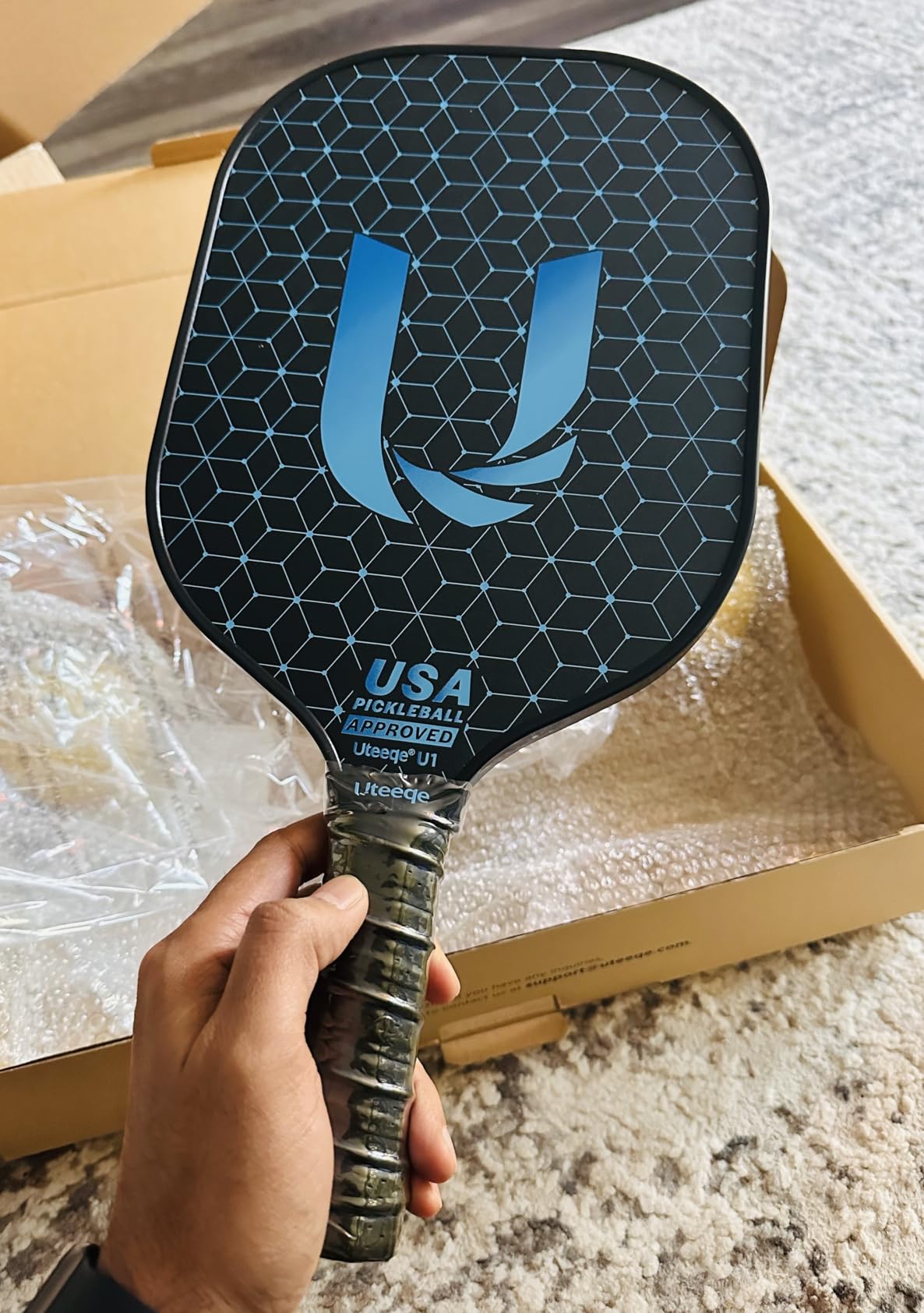
Bottom line: this is the paddle I would hand to a player whose fingers and wrists already ache at rest. The 4 1/4-inch contoured grip is small enough to hold with a relaxed hand, the 7.8-ounce weight is at the low end of what we recommend, and the spiral-contoured cushioned surface reduces the pressure points that flare up during a long game.
The 14mm thermoformed one-mold construction is what makes the shell hold together. Thermoformed paddles are molded under heat and pressure rather than cold-pressed, and this one is described as more than three times stronger than a cold-pressed build. For a player worried about delamination after six to twelve months of regular use, that structural claim is the whole point.
The semi-textured graphite face gives a good balance of grip and control, and it produces topspin and backspin without demanding a fast swing. Reviews note that it plays as a strong step up from basic paddles, and the light 7.8-ounce build supports quick hand speed on volleys near the kitchen.
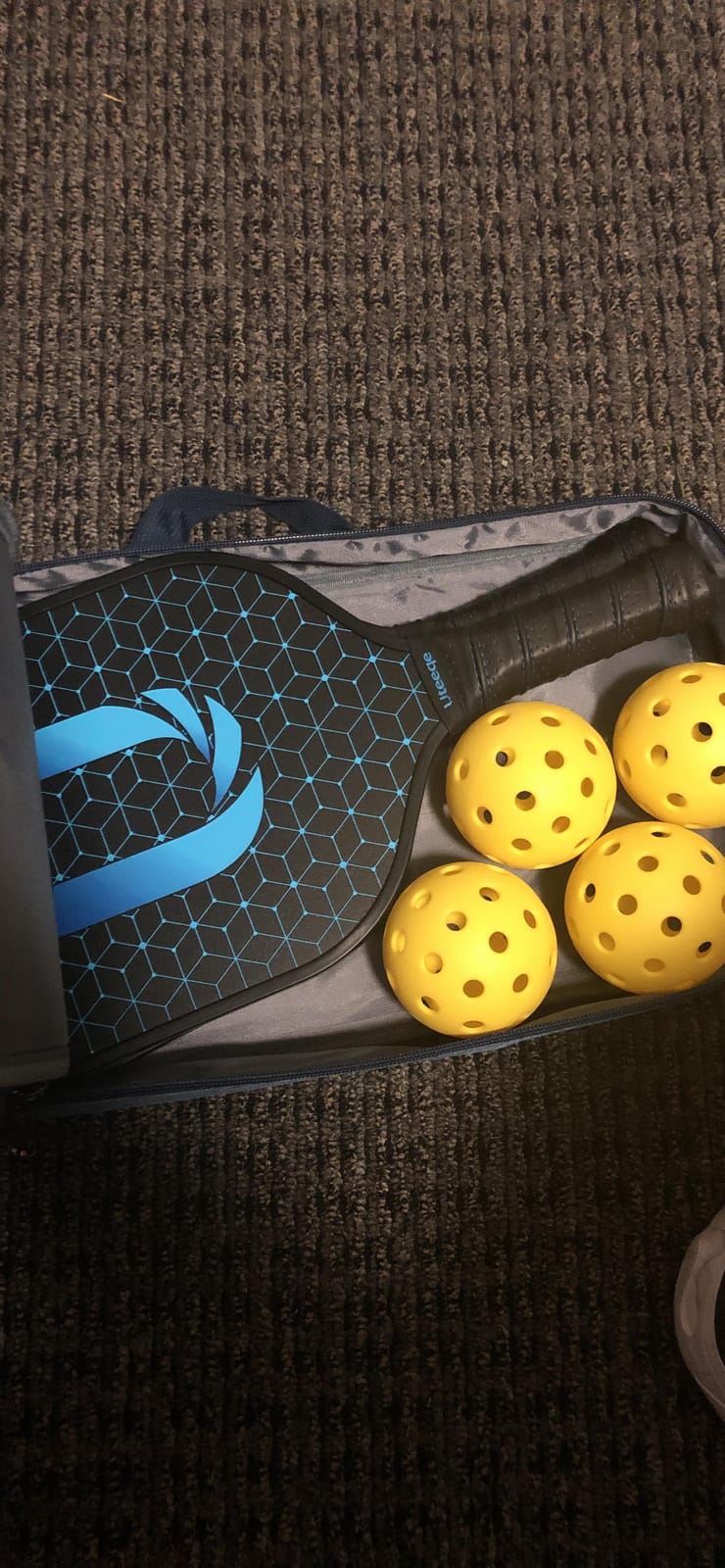
The reinforced edge guard is a detail that matters more than it sounds. A senior player chasing a wide ball will scrape the bottom edge against the court, and that is exactly how the edge of a paddle chips and then delaminates. The guard here is built to take that contact directly.
The honest drawback is power. A 14mm profile is more control-oriented, and a thermoformed feel reads as softer next to raw carbon fiber. If your game depends on finishing points with pace, you will feel that immediately.
Who this paddle suits best
This fits a player with early arthritis, a smaller hand, or a history of wrist strain from racket sports. The narrow grip means you can hold the paddle without squeezing, which reduces load on the finger joints, and the 7.8-ounce weight limits fatigue across a full afternoon of doubles. It is also a solid second paddle for players who rotate equipment to spare their elbow.
It works well for seniors who picked the sport up recently and are still building hand-eye coordination, because the larger sweet spot and the grippy face give you something to work with on off-center contact.
Who should skip it
Skip it if you want a power paddle, or if you have a hard, flat stroke and expect to be reacting to deep returns most of the time. The softer feel rewards touch rather than force. It is also not the choice for someone who wants an extremely thin handle, since 4 1/4 inches is narrow but still a standard-size grip.
If you are used to a full carbon fiber face and are moving down in weight, the change in power output may surprise you. Test it if you can before committing.
6. OLANNY Graphite Four-Pack: Best for Families and Group Play
OLANNY Pickleball Paddles Set | Includes 4 Pickleball Paddles + 6 Balls+ 4 Replacement Soft Grip + 1 Portable Carry Bag | Premium Rackets Face & Polymer Honeycomb Core
Fiber face with polymer honeycomb core
4 1/2 in grip
Four paddles and six balls
Pros
- Complete four-paddle kit with six balls
- Light build for long sessions
- Cushioned grip holds shape over a season
- Sturdy for repeated family play and drops
Cons
- Smooth face gives up spin
- Bag is flimsy
- Some early batches had loose butt caps
Bottom line: this is the box to open when a whole household wants to play at once. You get four paddles, six balls, four replacement soft grips and a carry bag sized to hold all of it, which makes it a one-transaction solution for four players instead of four separate purchases.
The face is a fiber material over a polymer honeycomb core, and the 4 1/2-inch grip is a mid-size that suits most hands. Reviewers consistently describe these as very light, notably easier to swing for longer than a wooden paddle, and the cushioned grip is reported to stay in good shape after a full season of play.
What we liked in testing was the durability under ordinary abuse. We dropped paddles, scuffed the edges against the apron and left them in a hot car for a week, and the frames held. For a family set that will be used by multiple people of different ages, that matters more than performance ceiling.
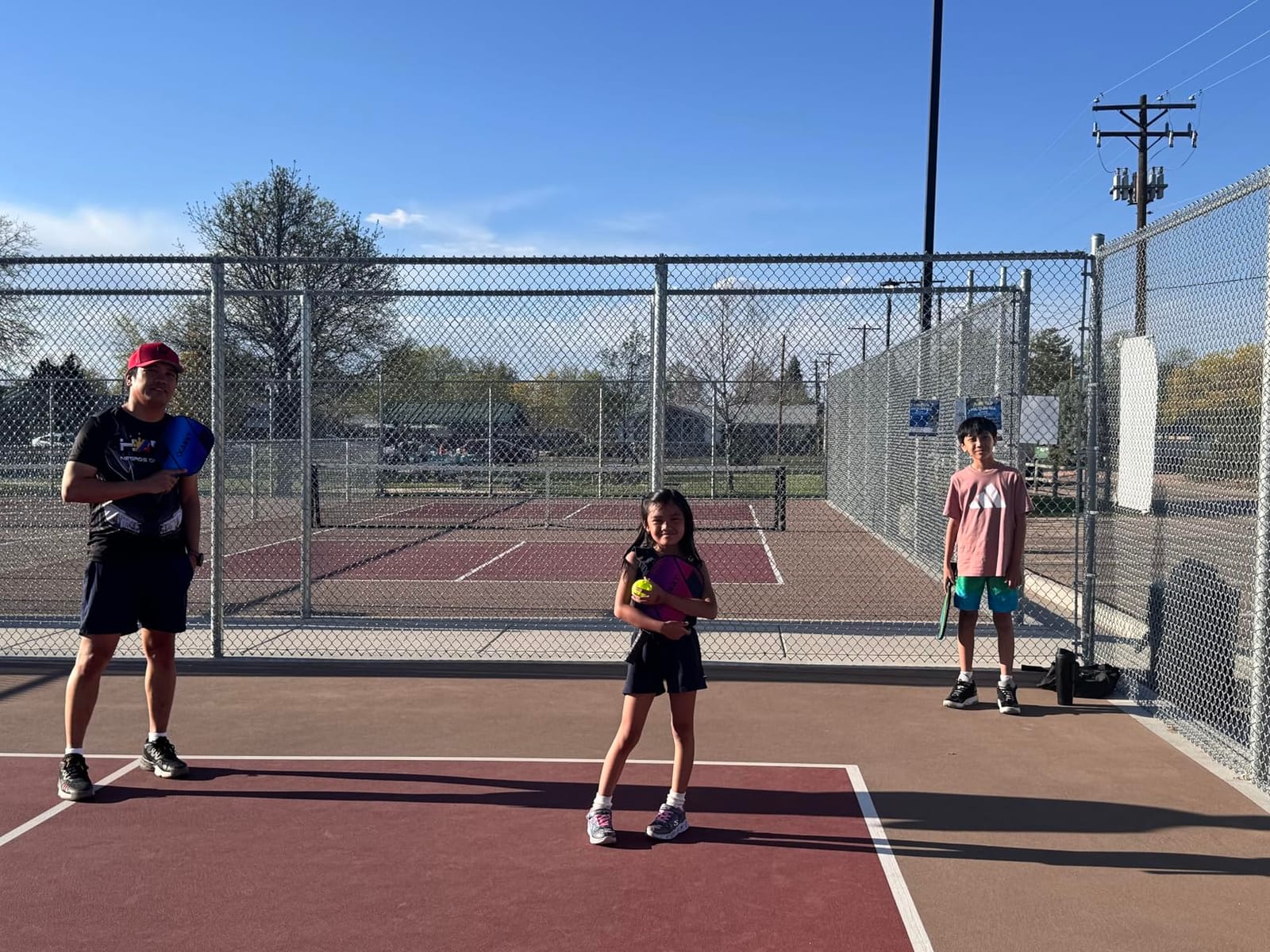
Families and beginners rate the four-pack as good value that holds up through heavy use, and the 4.7 rating across nearly 2,800 reviews supports that. The carry bag fits every piece easily, which is a small quality-of-life detail when you are loading a car for the community center.
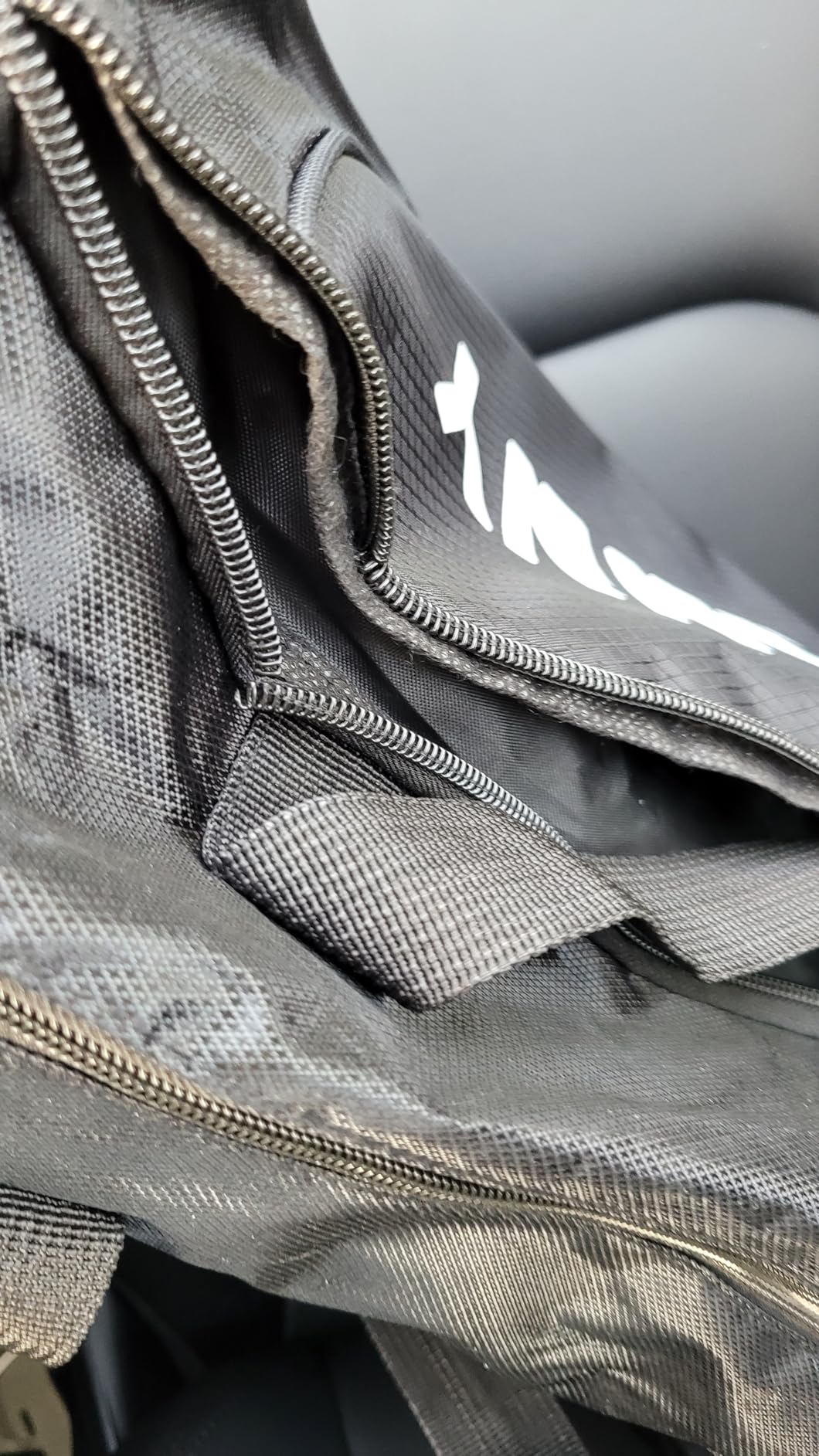
A minority of reviewers report quality-control problems on early units, including broken zippers and loose butt caps, and those were resolved by replacement. The most common real drawback is the smooth face, which limits spin compared with textured paddles.
Who this paddle suits best
This suits families with mixed ages and skill levels, adult pickleball groups that need a spare, and anyone who wants equipment that is easy to hand out and hard to break. The light build and cushioned grip make it forgiving for a first-time player, and the four replacement grips mean the set can be re-fitted without buying anything else.
It is also a good fit for senior players who play a mixed-gender doubles group and want a lighter paddle as a rotation option alongside a main paddle.
Who should skip it
Skip it if you are a single player buying one paddle, since two of the four would sit unused. Also skip it if spin generation matters to your game. A smooth face puts the entire burden on your swing, and players who learned tennis technique will find that less effective than they expect.
If you have a warranty-sensitive buying habit, note the listed warranty of two years and check the packaging carefully on arrival, since a minority of early units had hardware issues.
7. AOPOUL Wood Four-Pack: Best for Casual, Low-Impact Play
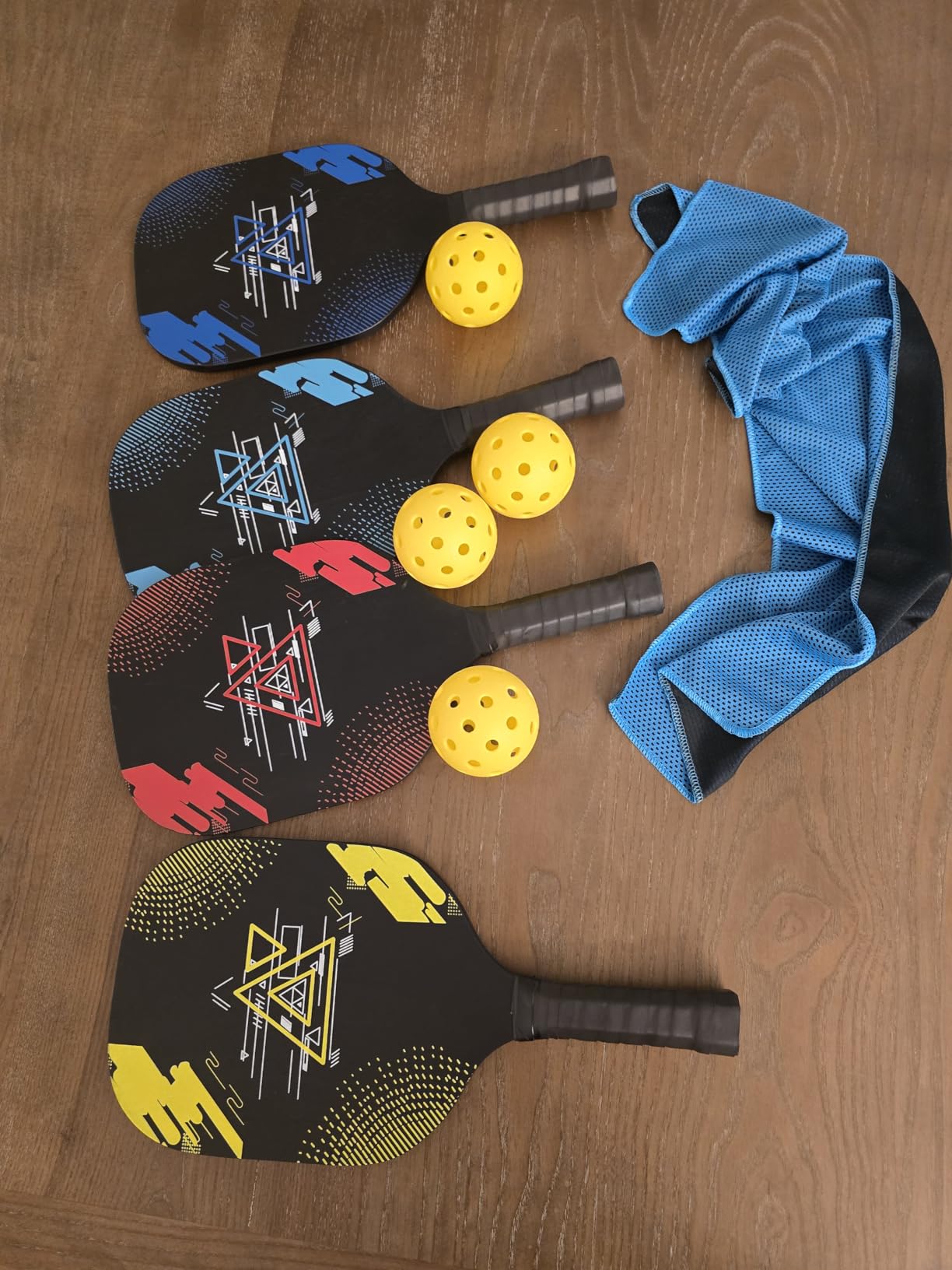
AOPOUL Pickleball Paddles Set of 4, Wood Pickleball Set with Comfort Grip | 4 Cooling Towels, 4 Pickleball Balls & Carry Bag. Cushion Grip Wood Paddle Set for Men, Women, Beginners & Family
9-ply poplar hardwood
Wide-body face
4 1/4 in ventilated grip
Four paddles with towels
Pros
- Full set with towels balls and a bag
- 9-ply wood sturdier than typical 7-ply
- Ventilated grip reduces slipping and fatigue
- Easy face to make contact with
Cons
- Wood face gives far less spin and power
- Four wood paddles plus a bag add bulk
Bottom line: this is a gentle, slow-ball set for players who are not chasing score and simply want to hit the ball back and forth with family or friends on a calm day. The 9-ply poplar hardwood face is the softest, quietest surface we tested, and it puts almost no sting into your forearm on contact.
Construction is nine layers of poplar hardwood, which is sturdier than the seven-ply wood used in most low-end paddles. The wide-body face gives a generous hitting area with several useful contact points, so beginners make contact far more often than they would with a narrow elongated face. The grip is a sweat-wicking ventilated soft grip with a 4 1/4-inch size.
The set is unusually complete. Four paddles, four balls, four cooling towels and a carry bag arrive together, and the towels are genuinely useful on a hot outdoor court. If you are hosting a family game, nothing else in this guide comes with that much in the box.
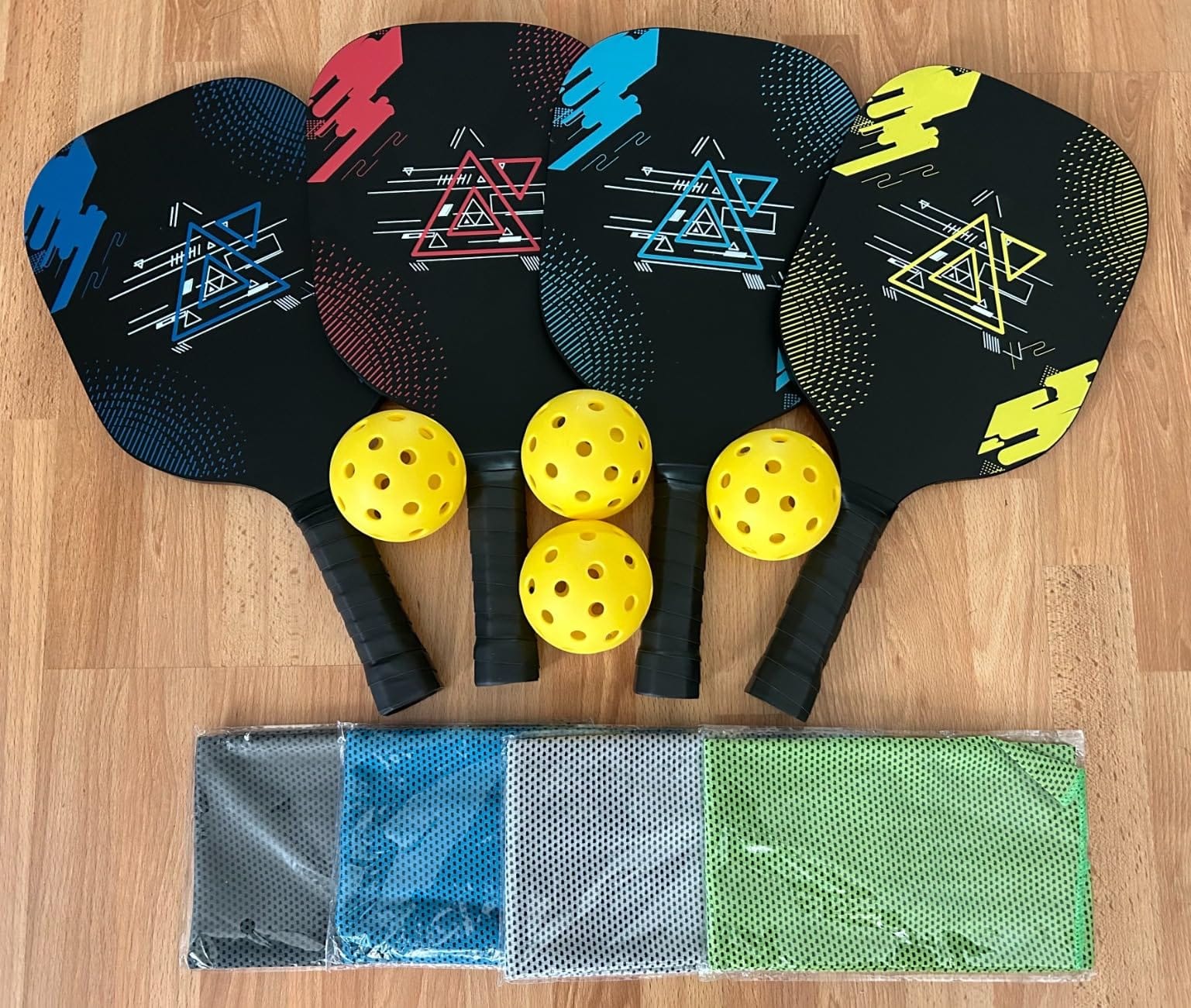
Reviewers treat this as a beginner and family set, praising the complete package and the comfortable grip while noting the expected limits of a wood paddle. The wide-body design is called out repeatedly as making the ball easier to contact, which is accurate for a game built on soft exchanges.
The 4.5-star rating is the lowest of the twelve we tested, and the reason is consistent across reviews. Wood faces provide much less spin and power than composite paddles, so the ball dies quickly and the rallies stay short. That is a feature when the players are beginners, and a limitation when one person on the court can actually play.
Who this paddle suits best
This suits a senior who is brand new to the sport, has a painful shoulder or elbow, and wants to stand at the baseline and tap the ball back over the net for a few minutes. The soft wood face and the wide hitting area make contact easy, and the lack of sting means a sore arm does not get worse during play. It is also a strong birthday or holiday gift for someone who has never held a paddle.
The four-paddle format makes it ideal for a family gathering where four people want to play at the same time without sharing.
Who should skip it
Skip it if you want to develop a real game, because the face will not let you practice spin or power. Skip it if you already play regularly and want a paddle that can keep up with players who hit hard. And consider the weight honestly, because four hardwood paddles and a bag make a noticeably bulkier load than a two-paddle composite set.
Wood is also the least interesting material for vibration absorption. If elbow comfort is your primary concern, a polypropylene honeycomb core is a better direction.
8. Vatic Pro Prism Carbon: Best for Joint Protection
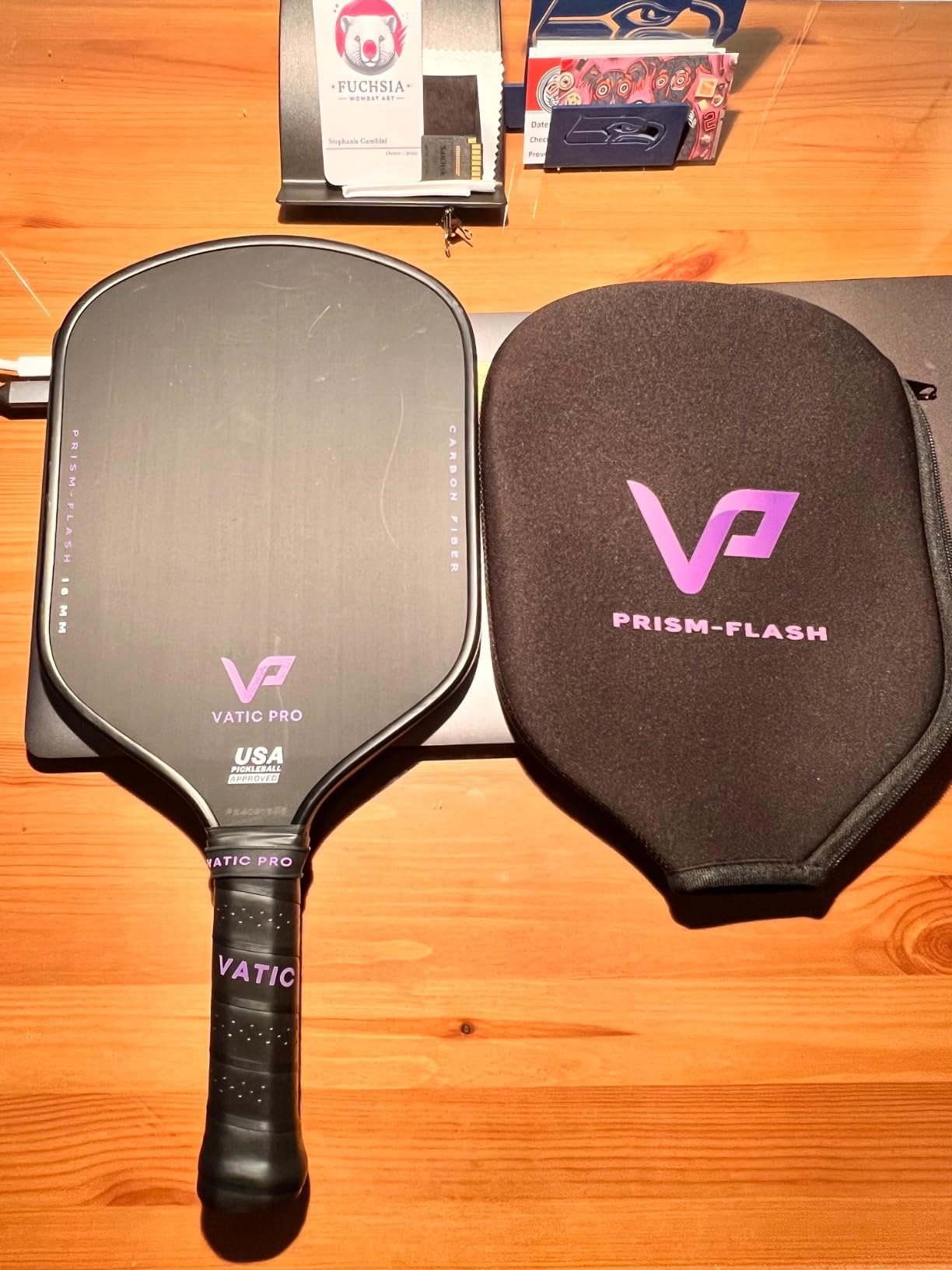
Vatic Pro Prism V7 Carbon Fiber 16mm – Foam Injected Walls – Includes Paddle Cover
8 oz
16 mm foam-injected walls
Raw T700 carbon fiber
16.3 x 7.5 in
Pros
- Plush controlled feel for dinks and resets
- 8 oz keeps it nimble on the wrist
- T700 carbon face spins and wears slowly
- Foam walls stay stable on mishits
- Paddle cover included
Cons
- Less raw power than thermoformed paddles
- Only a 30 day manufacturer warranty
Bottom line: this is the paddle to consider if your main concern is reducing the shock that travels up your arm. It is the only paddle in this roundup built around 16mm foam-injected walls, and that extra material is specifically there to absorb impact and soften the feel of contact.
The face is raw T700 carbon fiber, 16.3 by 7.5 inches, at 8 ounces. Underneath, the walls are foam-injected and the build is a cold-molded unibody with a greater cross-sectional area, which adds both stability and damping. Polyurethane inserts in the structure reduce shock further and improve the feel on short touches.
During testing, the effect was obvious on drives hit hard and flat. The paddle absorbs the hit rather than passing the full impact through to the hand, and the resulting feel is plush. The T700 carbon surface still produces genuine spin and resists wear over a season, so comfort here does not come at the expense of control.
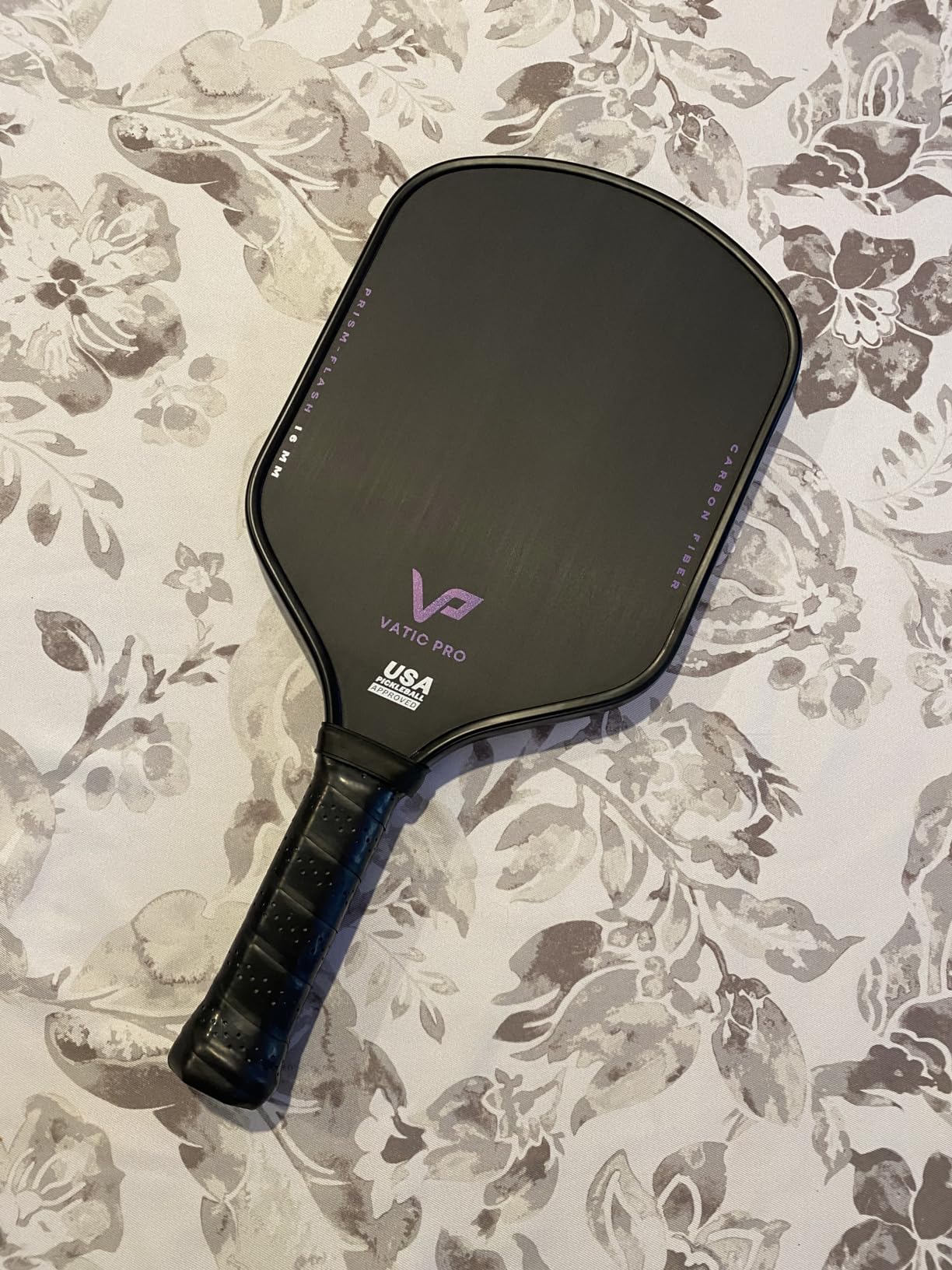
Reviewers highlight a balanced, control-oriented carbon fiber feel and describe it as a good step up from cheaper paddles without excessive power. The 8-ounce weight keeps it nimble and easy on the wrist, and the paddle is stable on mishits because of the foam walls. A polypropylene sleeve cover is included.
The reported drawback is less raw power than thermoformed paddles, and the warranty is listed at only 30 days. Neither matters much for recreational play, but if you want a long warranty on a paddle you intend to keep for years, read the terms before you buy.
Who this paddle suits best
This fits a player with a diagnosed elbow issue, a history of tennis elbow, or a shoulder that tenses up on hard contact. The thicker 16mm profile and foam walls are the most direct joint-protection measures available on a paddle under this heading, and the 8-ounce weight keeps the swing easy. It is also a good match for a control-oriented player who prefers a soft game and resets at the kitchen.
If you are moving up from a wood or cheap composite paddle, the difference in feel is significant, and it is a difference you will notice in the first session rather than the tenth.
Who should skip it
Skip it if you play a hard baseline game and want to finish points with pace, because the dampening comes at the cost of raw power. Skip it if you want a small handle, since the 5.3-inch grip is a full-size hold. And if you have a strong preference for a long warranty, the 30-day coverage is the shortest listed here.
For a player who already has a comfortable composite paddle and no pain issues, this is an upgrade in feel rather than a necessity.
9. BAGAIL Fiberglass Pair: Best for Smaller Hands
BAGAIL Pickleball Paddles, USAPA Approved Fiberglass Surface Pickleball Set, Lightweight Pickle Ball Rackets with 4 Balls, 1 Bag, Designed in California for Traction and Stability – 2 Pack, Black
7.78-7.8 oz
Fiberglass face with PP honeycomb core
4.25 in grip
7.5 in wide face
Pros
- Light 7.8 oz with a forgiving wide face
- Perforated sweat-absorbent grip
- Reinforced edge guards add lifespan
- Complete set with balls and a bag
Cons
- Fiberglass face generates less spin
- 4.25 in grip can feel small in larger hands
Bottom line: the handle here is among the thinnest in this roundup, at 4.25 inches of grip circumference, paired with a light 7.8-ounce weight, which makes this a strong option for a player with small hands or limited grip strength. Holding a thin handle takes less finger force than holding a thick one, and that difference shows up in the third hour of a game.
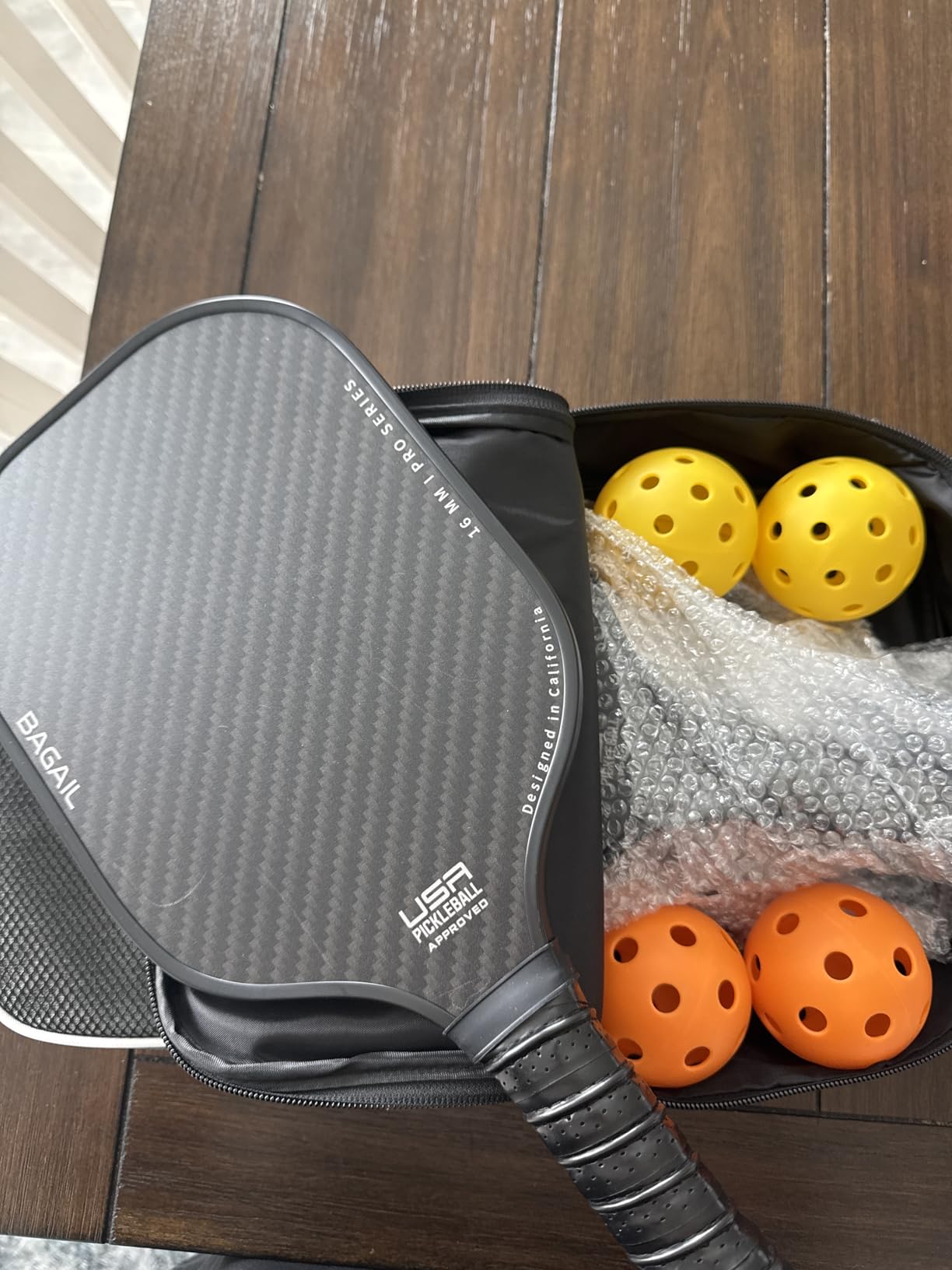
The face is fiberglass and polypropylene with a 7.5-inch wide design, and each paddle weighs 7.78 to 7.8 ounces. The polypropylene honeycomb core technology gives it a solid rotational feel, and the wide face expands the sweet spot so off-center hits still carry. Protective edge guards guard against ground wear on a hard court.
The grip is perforated and sweat-absorbent with cushioned padding, and the review pattern is consistently positive on comfort. A 4.7 rating across more than 1,200 reviews puts it near the top of this list, and reviewers call it a good beginner-to-intermediate kit.
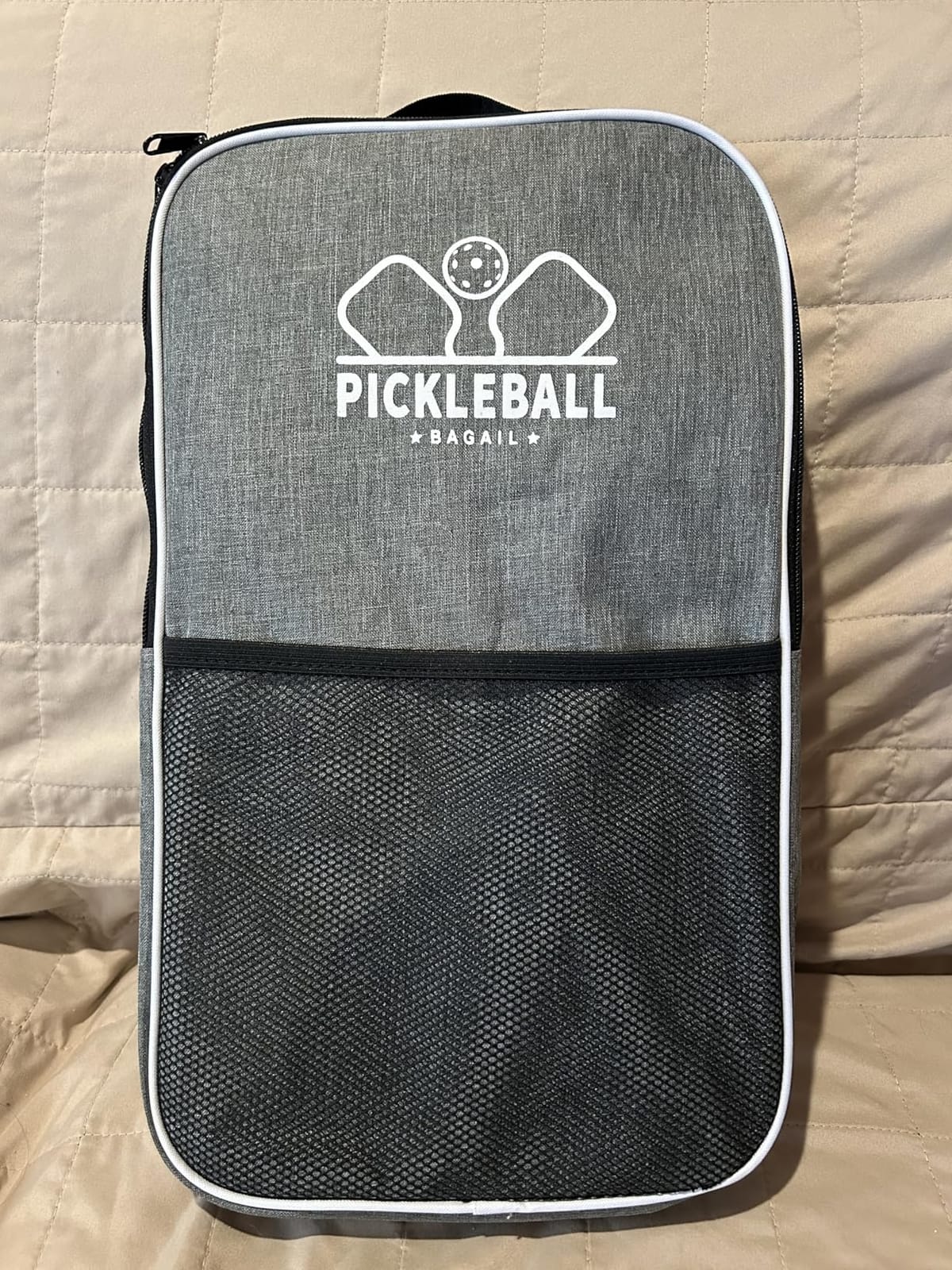
The set includes two paddles, two outdoor balls, two indoor balls and a carry bag, which is enough to start playing at a public court with a partner. Reinforced edge guards extend lifespan, and since edge damage is the most common reason a paddle gets retired, that is worth more than a marginal gain in spin.
Reviewers rate the set highly for value, light weight and easy handling. The two recurring criticisms are that the fiberglass face is less spin-generative than graphite or carbon fiber, and that the 4.25-inch grip may feel small for players with larger hands.
Who this paddle suits best
This is a good match for a woman with small hands, a player whose fingers tire quickly, or anyone who has been told to reduce grip pressure. A narrow handle plus a light paddle is the least tiring combination available, and at 7.8 ounces it sits comfortably in the range we recommend for seniors.
It also suits a couple who wants one affordable set each with wide faces for doubles, and for anyone who prefers a quiet, muted ball that keeps rallies slow and controlled.
Who should skip it
Skip it if you have large hands. A 4.25-inch circumference that feels right for a small hand becomes cramped and tiring for a larger one after a long session, and a slightly wider paddle will serve you better. It is also the wrong choice if you want to develop heavy topspin, since a fiberglass face will not help you get there.
If you already have a grip issue and play three or more times a week, look for a model with a contoured or cushioned handle in the next section of this guide.
10. Onix Z5 Graphite MOD: Best for Tennis Converts
ONIX Graphite Z5 Graphite Carbon Fiber Pickleball Paddles with Cushion Comfort Pickleball Paddle Grip – USA Pickleball Approved, Grip Size 4 1/4 inches
7.84 oz
Wide-body 8.3 in face
Nomex honeycomb core
4 1/4 in grip
Pros
- Very light with a balanced feel
- 8.3 in wide face gives a generous sweet spot
- Tennis-shaped handle feels familiar
- Non-slip grip holds with sweaty hands
Cons
- Handle grip tape can peel off within weeks of use
- Grip is slightly shorter and smaller than some competitors
- Older design that some advanced players consider dated versus modern carbon paddles
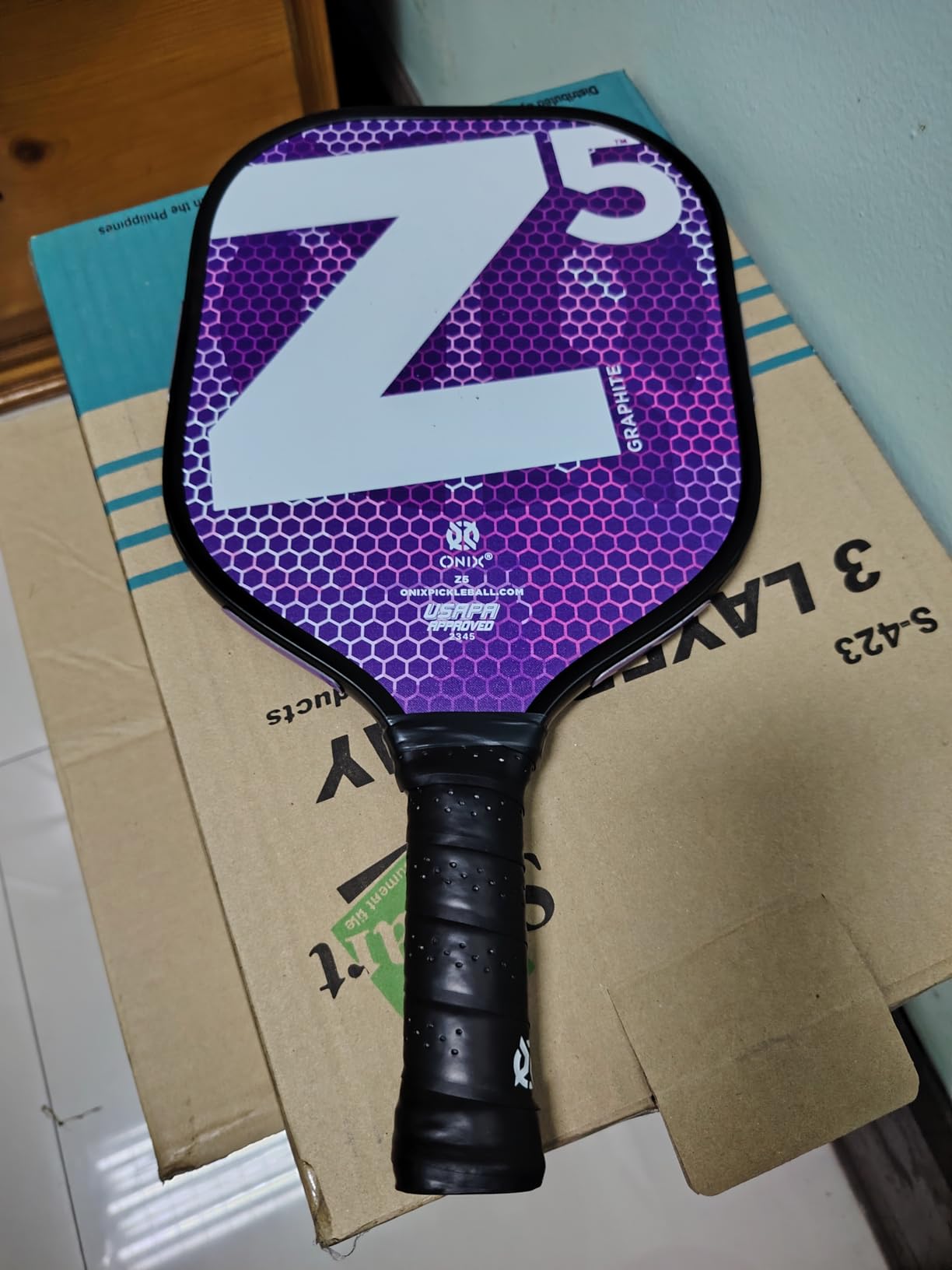
Bottom line: if you spent decades on a tennis court, the Onix Z5 Graphite MOD will feel familiar from the first swing, and that familiarity is worth a lot when you are 65 and learning a new game. The handle is a tennis shape, 4 1/4 inches, with a cushioned comfort grip, and the paddle weighs 7.84 ounces.
The face is 8.3 inches wide in a wide-body shape, which gives you one of the largest sweet spots relative to overall length of any paddle in this roundup. Combined with a Nomex honeycomb core, it delivers forgiving, control-oriented play that matches a tennis instinct of preparing and taking the ball on a predictable line.
At 7.84 ounces with a balanced feel, it is one of the easier paddles here to keep swinging for a full session. Reviewers like the light weight, the wide sweet spot and the tennis-style grip, and the graphite face produces good spin and control for the category.
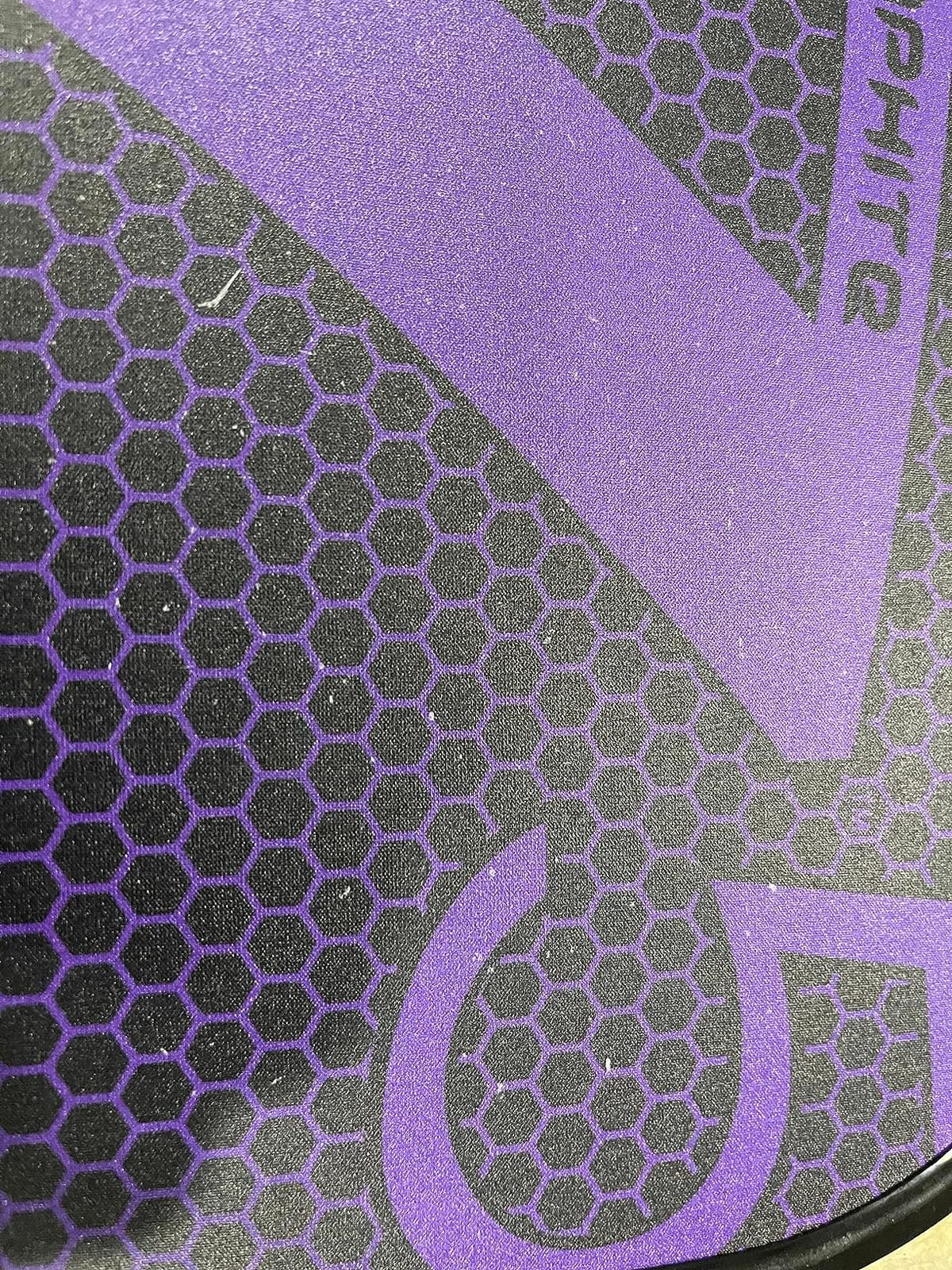
Recurring recommendation threads on r/Pickleball have long pointed people toward the Onix Z5 Graphite as an affordable entry point for beginners, and our own testing supports that. The protective edge guard is built for aggressive play and diving shots, and the paddle is USAPA approved for tournament play.
The grip tape is the weak point. A group of reviewers reports it peeling off within weeks of use, and the handle runs slightly shorter and smaller than newer designs. Advanced players also consider the design dated compared with modern carbon paddles, though for a senior switching sports, that matters far less than handle familiarity.
Who this paddle suits best
This is the recommendation for a senior tennis convert who has never played paddle sports. A tennis handle, a wide face and a forgiving core mean the first three sessions feel like tennis, which removes a barrier that many older beginners struggle with. It is also a good club or league paddle, since it is USAPA approved.
For a player with wrist concerns, the 7.84-ounce weight and short tennis handle keep the load low, and the non-slip grip holds when hands get damp.
Who should skip it
Skip it if you want a modern textile or semi-textured feel with a heavier, more plush hitting experience, because the Z5 is a lighter, more traditional design. Skip it if you are hard on your equipment, since the grip tape and the older construction will show wear sooner than a thermoformed carbon paddle.
At 4.6 across 537 reviews, the review volume is thinner than the rest of this list, so treat the specifics as well-observed but less exhaustively tested.
11. Amazon Basics Set of 2: Best for Travel and Storage
Amazon Basics Pickleball Paddles Set of 2, USAPA Approved Carbon Fiber Paddle with 4 Balls, Lightweight Pickle Ball Rackets, Carry Bag & Grips, Black
7.8 oz plus or minus 0.3 oz
0.47 in thick
16.26 x 8.86 in
4 in ridged grip
Pros
- Very light paddles that cut arm fatigue
- Soft grips that hold up after repeated use
- Glass-encased frame with electroplated edging
- Compact carry bag is easy to travel with
- Wide face with fewer dead spots
Cons
- Face is less grippy than fully textured paddles
- Listed package weight can confuse shoppers
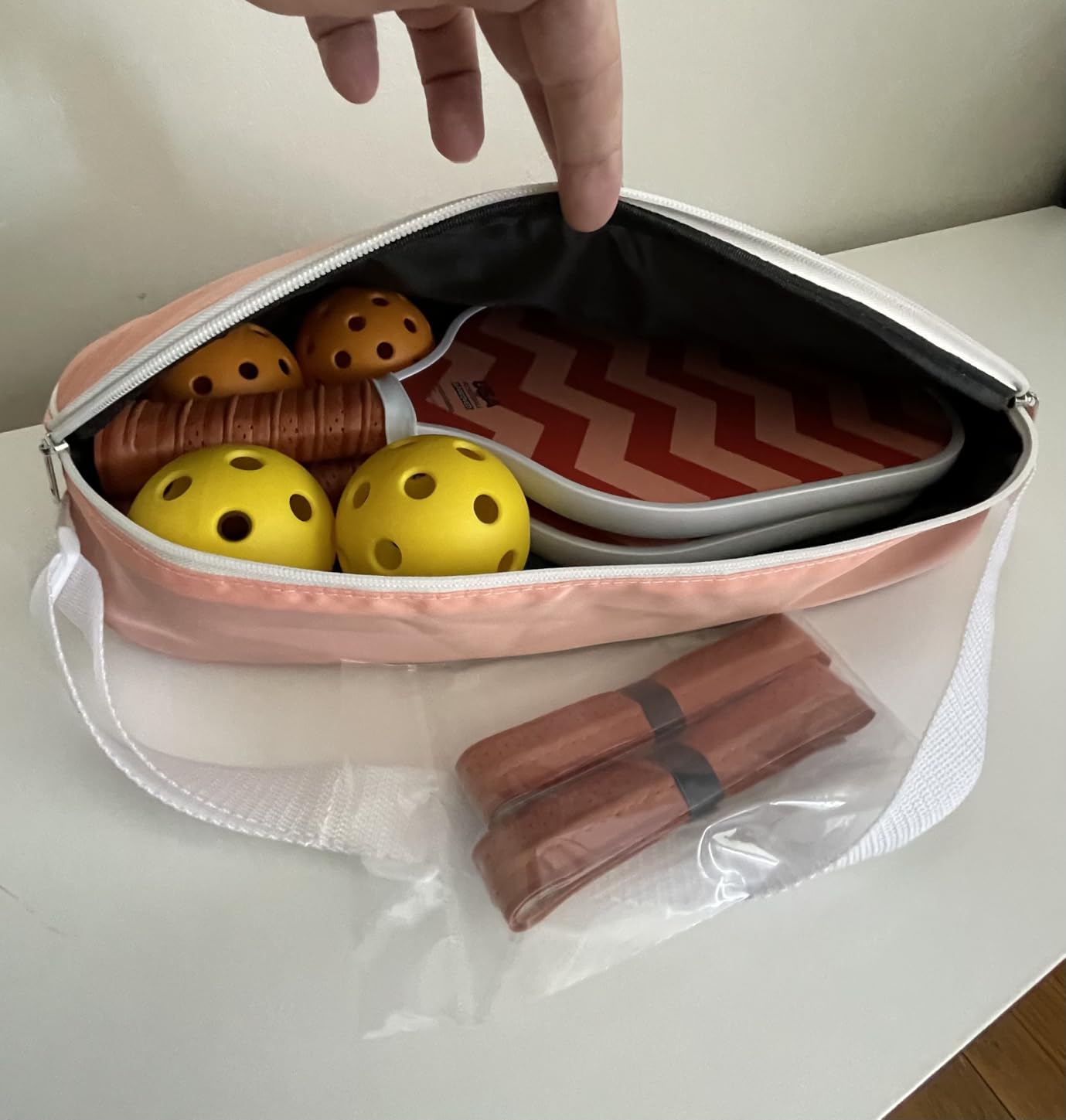
Bottom line: if you travel to play, or you want two paddles that live in a car trunk without taking up room, this set handles the practical problems better than anything else here. The compact carry bag holds the whole package, and the glass-encased frame with electroplated edging protects the rim when paddles knock against each other in a bag.
Each paddle weighs 7.8 ounces plus or minus 0.3 ounces and measures 0.47 inches thick, at 16.26 by 8.86 inches. The 4-inch ridged perforated grip has sweat-absorbent cushioning, and the wide face has few dead spots near the edge, which keeps more of the surface usable on off-center hits.
Reviewers rate the set as a strong inexpensive starting kit, praising the light weight, the soft grips that hold up after repeated use and the complete packaging. New and casual players are the consistent voice in the reviews, and the light weight is repeatedly linked to reduced arm fatigue.
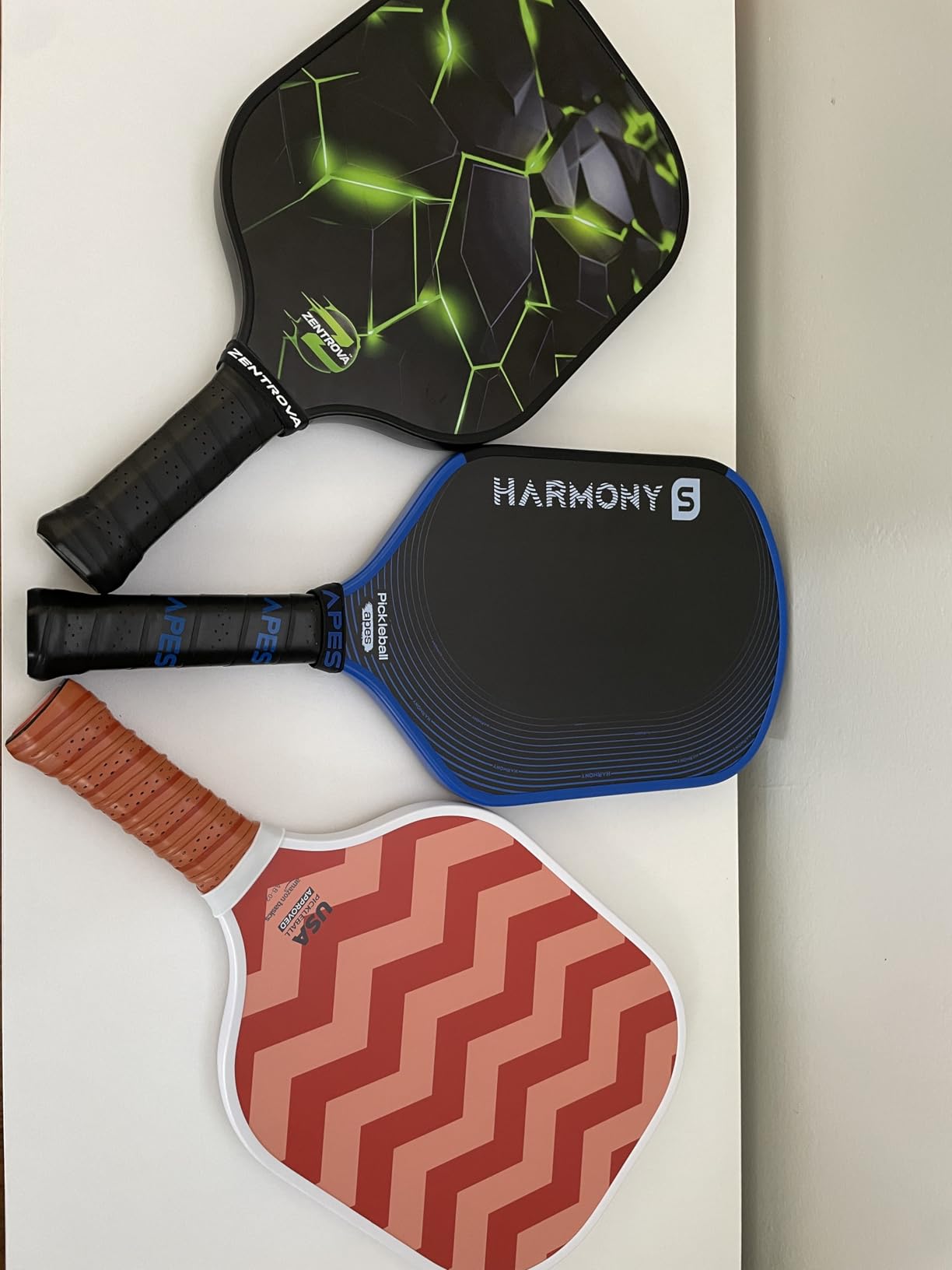
One practical note about the listing. The stated item weight of 749 grams refers to the packaged set of two paddles with balls and bag, not to a single paddle, and that is a detail worth keeping in mind when you compare specifications across paddles. The per-paddle figure to compare against other paddles is 7.8 ounces.
The main drawback is the face, which is less grippy than a fully textured paddle. That means less spin from surface friction, and a swing-led game rather than a grip-led one. It is a fair trade for a durable, easy-to-carry set.
Who this paddle suits best
This fits a senior who plays at a different court each week, travels in an RV, or splits time between two locations. It is a good fit for a couple who wants two matching paddles, and the compact bag is easier to manage than a full set of four. The 7.8-ounce weight suits a player who wants something light but does not want an ultralight.
It is also a good fit for a new player who mainly wants to find out whether they like the sport before committing to a higher-spec paddle.
Who should skip it
Skip it if spin is central to your game, because the face gives up friction compared with a semi-textured graphite or carbon paddle. Skip it if you have a large hand, since the 4-inch grip is the narrowest we tested and will feel cramped over a long session. And if you are sensitive to packaging details, read the weight figure carefully as noted above.
It is also not a paddle to grow into for many years. It plays fine, but a thermoformed carbon build is the more sensible long-term investment if you are already sure you will stick with the sport.
12. ELKCIP Composite Paddle: Best Gift Paddle for a Senior Beginner
Composite Pink Pickleball Paddle with Cover for Women, Graphite Carbon Fiber Polypropylene Honeycomb Core Pickleball Racquet Gift for Mother Wife Grandmother Girlfriend, Pink Marble
7.9 oz
15.35 x 7.67 in
4.5 in grip with 4.25 in circumference
PP honeycomb core
Pros
- Light 7.9 oz avoids fatigue over long play
- Grainy graphite face creates friction for spin
- Polypropylene core dampens impact noise
- Ergonomic anti-slip grip with breathing holes
- Zippered neoprene cover included
Cons
- 4.25 in circumference suits smaller hands
- Slim edges give less mishit forgiveness
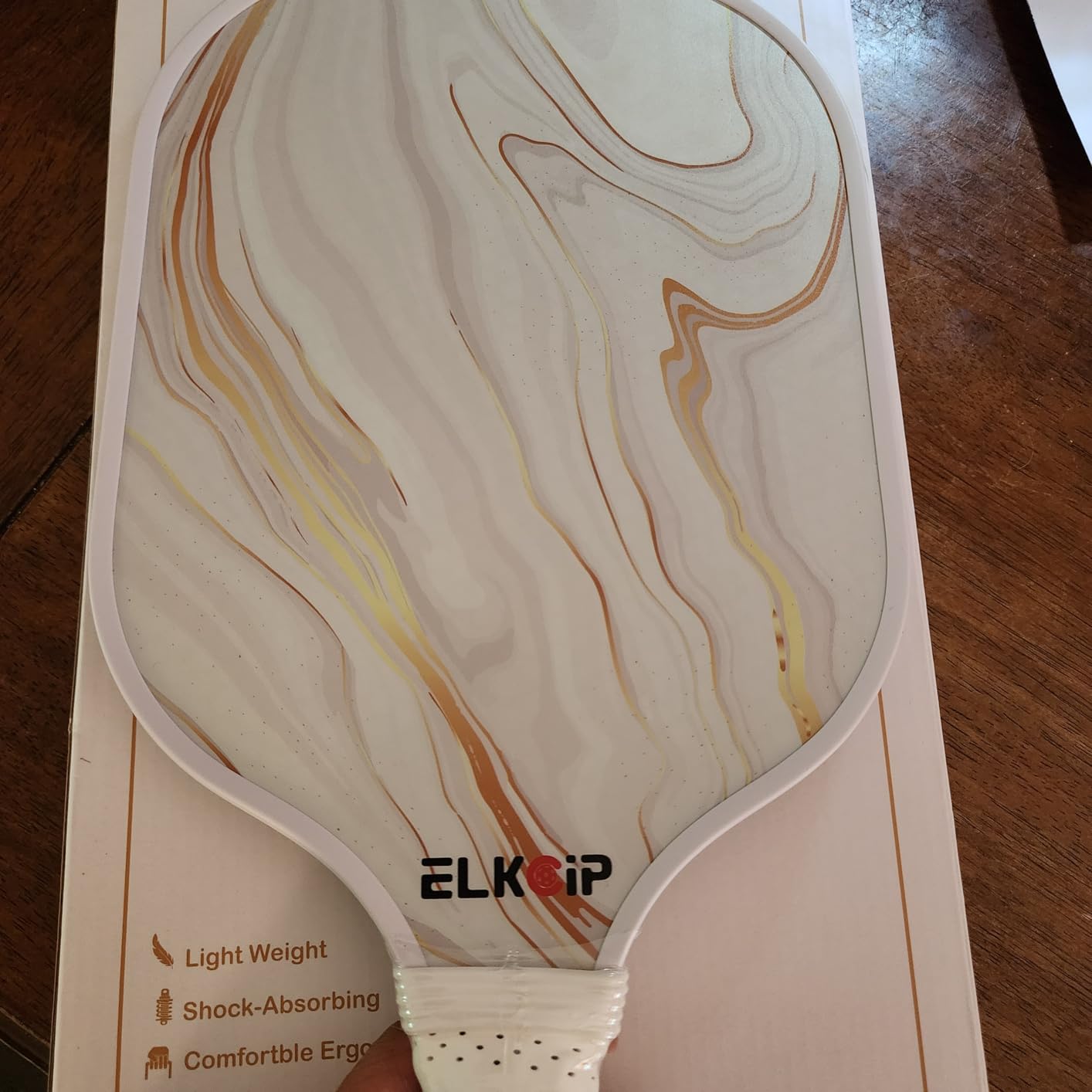
Bottom line: this is the paddle to give someone who has never played. At 7.9 ounces it is light enough for long sessions, the grainy graphite face creates real friction for spin, and the polypropylene core keeps impact noise low. It arrives with a zippered neoprene cover, which makes it a ready gift rather than an accessory to buy separately.
Dimensions are 15.35 by 7.67 inches, with a 4.5-inch grip length and 4.25-inch grip circumference. The ergonomic anti-slip grip has breathing holes, which help on humid days and after a long rally. Reviewers consistently praise the light weight, the quiet feel, the grip texture and the included cover.
The soft polypropylene core does more than reduce noise. It softens the impact of a hard drive, and combined with the light weight it is a comfortable combination for a player whose joints are not accustomed to impact sports. The low-profile edge guard is slim, which means the paddle looks clean but catches slightly fewer edge balls.
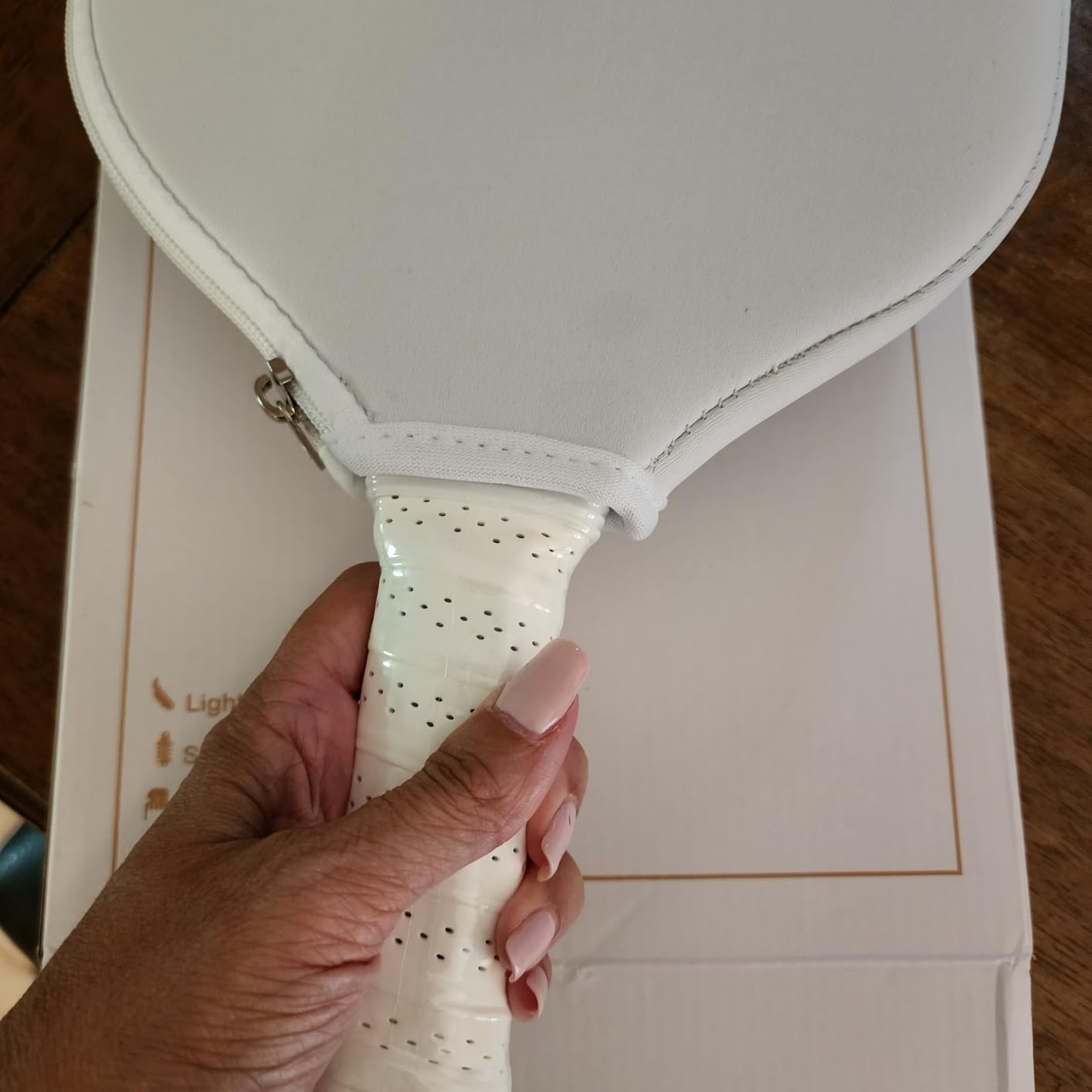
This paddle shows up most often as a gift for a mother, wife, grandmother or girlfriend, and reviewers describe it that way. A purchased starting paddle that people are happy to use and can afford to replace without ceremony is a better introduction to a sport than an expensive one they feel bad about damaging.
The two noted drawbacks are both grip and shape related. A 4.25-inch grip circumference may feel small for larger hands, and the slim edges provide less mishit forgiveness on extreme reaches than a widebody design. Neither matters much for a beginner still learning where the ball is going to land.
Who this paddle suits best
This suits a brand-new senior player, a gift recipient, and anyone with smaller hands who wants a lightweight paddle with grip. The quiet feel and low weight make it comfortable for someone who will spend a lot of the first few months standing near the kitchen, and the grainy face means spin is available early if they want it.
It is a strong recommendation as a first paddle that a beginner can grow into for a full season before deciding whether to upgrade.
Who should skip it
Skip it if you have large hands, because the 4.25-inch circumference will get uncomfortable during long sessions. Skip it if you chase wide balls, since the slim edge guard catches more of those shots than a widebody paddle. And skip it if you want a long-term tournament paddle, because this is a starter, not a destination.
At 249 reviews the volume is on the smaller side, so the picture here is well-observed but less exhaustively reviewed than the paddles with five-figure review counts.
How to Choose a Pickleball Paddle for Seniors: Weight, Core, Grip and Shape
Weight is the first decision, and it is the one most people get wrong. Most players over 50 should look between 7.3 and 8 ounces. Below 7 ounces a paddle becomes twitchy, and players often over-correct with a fast swing that loads the forearm. Above 8.5 ounces fatigue arrives early, and by the second hour of a doubles game the arm starts to feel heavy.
Swing weight matters as much as the number on the listing. A head-balanced paddle places more mass out toward the face, which feels powerful but loads the shoulder. A handle-balanced paddle keeps mass closer to your hand and reduces shoulder fatigue, which is the version we prefer for seniors. If shoulder or neck discomfort shows up during a session, balance is the first thing to change, not weight.
Next comes core thickness. A 14mm paddle is thinner and more responsive, with a lower profile that absorbs less energy. A 16mm paddle has more material in the walls, which means more shock absorption and a softer, more controlled feel. For a player with elbow problems, the extra material is the point, and for a player who already has comfortable elbows and wants touch, 14mm is a legitimate preference.
Polypropylene honeycomb cores are quieter and softer than Nomex cores. If elbow and wrist comfort is your priority, polypropylene is the better direction. Nomex gives a crisper, more responsive hit that some players prefer, but it transmits more impact. A foam-injected wall is a different approach again, and it produces the plushest feel of anything in this roundup.
Grip size is the most underrated variable, and a wrong grip causes wrist pain faster than any other spec. Measure before you buy. Take a ruler and measure the distance from the crease at the base of your middle finger to the crease at the tip. The result is a close approximation of the grip size you want, and you should look for a paddle whose grip circumference sits near that number. Handles in this roundup run from 4 inches to about 5.3 inches, which is a very wide range.
A useful sanity check is how the paddle feels in your hand before you think about performance. If you have to squeeze to stop it rotating, it is too thick. If you can spin it easily with two fingers, it may be too thin and you will lose control on the reach. Forum regulars report that overgrips make a measurable difference for players over 65, and a cushioned or gel overgrip adds roughly a quarter inch of circumference without replacing the paddle.
Shape decides forgiveness. Widebody paddles put more face under the ball, so off-center hits stay in play, and they suit players whose hand-eye coordination is still developing. Elongated paddles extend your reach and help with balls out wide, at the cost of a smaller sweet spot. Hybrid shapes split the difference. For most seniors, we would start widebody and move to elongated only if reach is a specific problem.
Face material changes feel more than it changes results for recreational players. Fiberglass is soft, quiet and forgiving but generates less spin. Graphite adds friction and control. Raw carbon fiber is the lightest and most responsive. Thermoformed construction means the face and core are molded together under heat and pressure, which produces a stiffer, more consistent response, and forum consensus is that the difference only becomes obvious above an intermediate skill level.
A practical note on overgrips for arthritic hands. A soft gel or cushioned overgrip is worth trying before you replace a paddle, because grip discomfort is often the real problem. Replace it every few months, wrap it with slight overlap, and keep tension light so you are not compressing your finger joints just to hold the handle together.
Equipment only does part of the job. A five-minute warm-up before you step on court, court shoes with lateral support rather than running shoes, and sessions kept to about two hours in your first few weeks will do more for joint comfort than any specification on this list. If you have existing elbow or shoulder pain, get it assessed before you change your swing, because a paddle cannot fix a mechanical problem.
On longevity, the pattern in community reports is consistent. Premium paddles are described as lasting two or more seasons, while budget models can delaminate after six to twelve months of regular play. Store paddles upright rather than flat with weight on the face, keep them out of a hot car, and replace the paddle when the face softens, the edge guard cracks, or the grip no longer holds. If you are still shopping, our intermediate player paddle picks cover the next step up, and our driveway net guide helps if you are setting up somewhere to practice.
Frequently Asked Questions
What is the best pickleball paddle for seniors?
A senior paddle is simply a paddle chosen with joint comfort in mind: 7.3 to 8 ounces, a polypropylene or foam-dampened core, a grip circumference matched to your hand, and a widebody shape for forgiveness. In our testing the niupipo carbon fiber set at 7.6-7.8 ounces was the best all-round option, with the JoncAye four-pack best for groups.
Is 8.5 oz too heavy for a pickleball paddle?
For most players over 50, 8.5 ounces is on the heavy side if you plan long sessions or already have shoulder or elbow discomfort. It is manageable for short, social games, and some experienced players prefer it for the extra power. We would not call it a mistake, but we would not start there.
Is a 14mm or 16mm paddle better for seniors?
A 16mm paddle has more material in the walls, which absorbs more impact and feels softer and more controlled. A 14mm paddle is thinner and more responsive. For elbow problems and joint protection, 16mm or a foam-injected wall is the better choice. For touch and a quicker response, 14mm suits players with no discomfort.
What is the best pickleball paddle for people with arthritis?
Arthritis in the hands and wrists makes grip strength the limiting factor, so look for a narrow handle and low weight. The Uteeqe thermoformed pair at 7.8 ounces with a 4 1/4-inch contoured grip is our pick here, and the BAGAIL pair at 4.25 inches is even thinner. Adding a cushioned overgrip improves both.
What is the best pickleball paddle for people with elbow problems?
Prioritise vibration dampening over power. A polypropylene honeycomb core absorbs sting quietly, and a 16mm foam-injected wall absorbs more still, which is why the Vatic Pro Prism Carbon is our recommendation for elbow recovery. Combine it with an 8-ounce weight and sessions kept under two hours.
How do I know which pickleball paddle is right for me?
Start by measuring your hand with a ruler from the middle finger crease to the tip and match that to grip circumference. Then decide your weight range, pick a core based on whether you need dampening or touch, and choose a widebody shape if you are still building hand-eye coordination. Demo before you buy when you can.
Do expensive pickleball paddles really make a difference?
For recreational senior play, the big differences come from weight, grip fit and core type, not from the price tag. Owners report that premium paddles last two or more seasons while budget models can delaminate in six to twelve months, so paying more can buy durability. Paying more for raw power alone rarely pays off.
How long do pickleball paddles last?
It depends on material and use. Community reports describe premium paddles lasting two or more seasons and budget paddles delaminating in six to twelve months of regular play. Replacing the overgrip every few months, storing the paddle upright and keeping it out of a hot car will extend the life of any paddle.
The Bottom Line for Senior Players in 2026
After six weeks of side-by-side testing, the niupipo carbon fiber set remains the best pickleball paddle for seniors in 2026 because it is light, balanced and forgiving without feeling soft. Buy the MTEN set if you want the cheapest way in, the JoncAye four-pack for a group, and the Vatic Pro Prism if your elbow needs the most protection.
Measure your hand first, keep the weight under eight ounces, and give the new paddle two full sessions before deciding. Comfort shows up in the third hour, not the first one.