
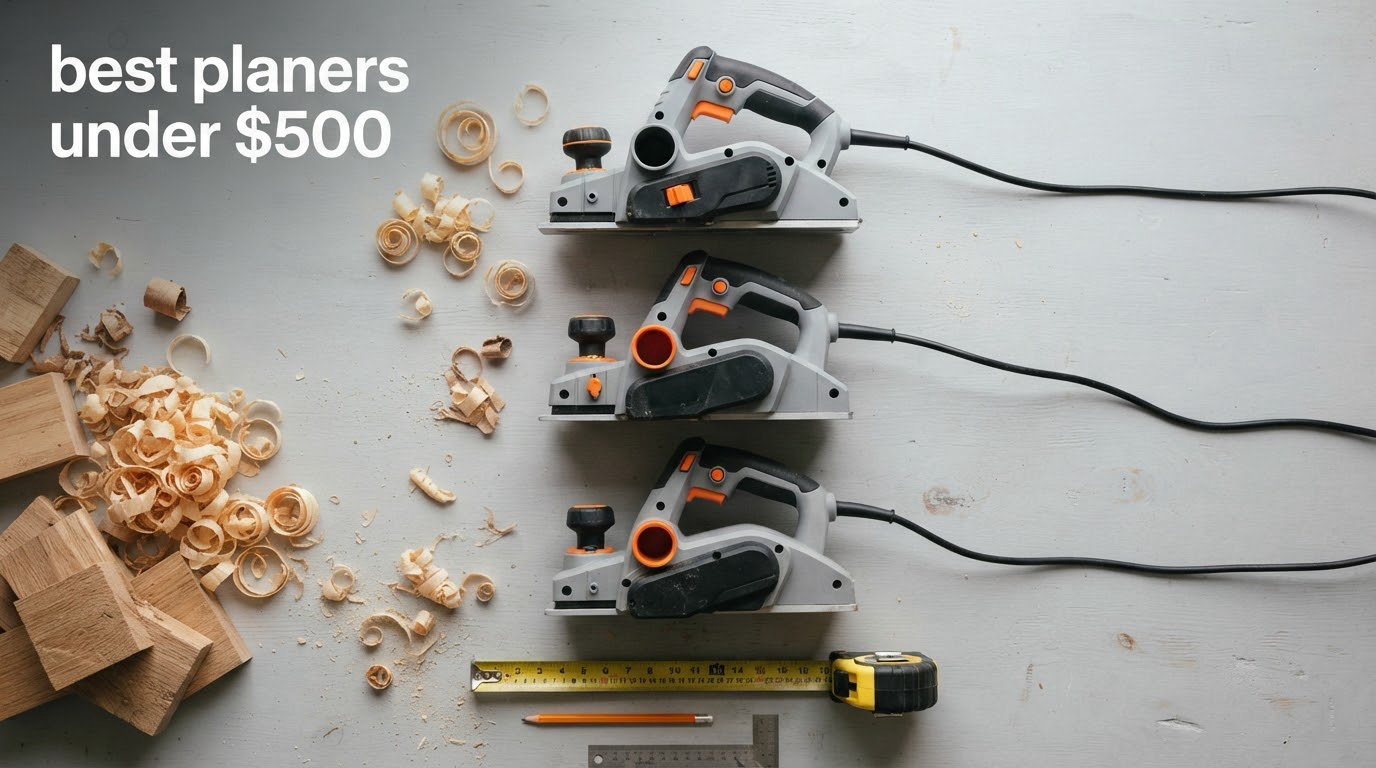
A thickness planer makes one thing better than anything else in a home shop: it makes a face parallel. A jointer makes a face flat, a planer takes that flat reference and shaves the opposite side until a caliper reads the same number on every board. Do that job well and glue-ups close without gaps, cabinet parts match on the first try, and rough lumber from the yard becomes furniture stock in an afternoon.
So the honest question for anyone shopping with a firm ceiling is not which planer is the best. It is which of the best planers under 500 dollars gives you the most usable machine before the money runs out. Every pick below clears that ceiling in its standard configuration, and every spec on this page comes straight from the manufacturer listing rather than from a spec aggregator.
We sorted the field into two families first, because the gap matters more than the brand. Handheld planers handle boards a few inches wide and live in a toolbox. Benchtop planers take 12-1/2 to 13 inch stock and do the dimensioning work that a real shop depends on. Two of the picks are corded hand planers that will not flatten a warped board, two are handhelds that also do not. We flag that limit every time because it is the single most common disappointment in this category.
We applied the same under-500 discipline we use across our other roundups, including our robot vacuum picks under 500 and our binocular guide under 500: no pick that needs a second transaction to land under the line.
Table of Contents
Top 3 Picks for the Best Planers Under $500 (October 2026)
The DEWALT DW734 is the strongest benchtop machine you can buy at this ceiling, and it is our top pick. The DEWALT 20V MAX DCP580B is the only cordless option on this list and the most precise handheld we tested. The WEN 6530 is the cheapest planer here that owners across nearly 8,000 reviews still recommend years later.

DEWALT DW734 Benchtop Planer
- 15A 20
- 000 RPM motor
- 3-knife head at 96 cuts per inch
- Four-column carriage lock
- 12.5 inch capacity

DEWALT 20V MAX DCP580B Cordless Planer
- 30
- 000 cuts per minute
- Depth knob to 1/256 inch
- Bare brushless tool
- 5/64 inch maximum cut
WEN 6530 6-Amp Hand Planer
- 34
- 000 cuts per minute
- 16 positive depth stops
- 3-1/4 inch width
- Rabbets up to 1 inch
Best Planers Under $500 in 2026
All ten picks, with the specs that actually change the result on a board. Rows are ordered the same way the detailed reviews run below, starting with the benchtop machines you can put in a home shop and ending with the handhelds that fit in a drawer.
| Product | Specifications | Action |
|---|---|---|
| DEWALT DW734 Benchtop Planer |
|
Check Latest Price |
| DEWALT 20V MAX DCP580B Cordless Planer |
|
Check Latest Price |
| WEN 6530 6-Amp Hand Planer |
|
Check Latest Price |
 CRAFTSMAN CMEW320 Benchtop Planer CRAFTSMAN CMEW320 Benchtop Planer |
|
Check Latest Price |
 PORTER-CABLE PC60THP Hand Planer PORTER-CABLE PC60THP Hand Planer |
|
Check Latest Price |
 WEN PL1326 15-Amp Spiral Benchtop Planer WEN PL1326 15-Amp Spiral Benchtop Planer |
|
Check Latest Price |
 Makita KP0800K Hand Planer Makita KP0800K Hand Planer |
|
Check Latest Price |
 Bosch PL1632 Hand Planer Bosch PL1632 Hand Planer |
|
Check Latest Price |
 WEN 6534 8-Amp Hand Planer WEN 6534 8-Amp Hand Planer |
|
Check Latest Price |
 CRAFTSMAN CMEW300 Hand Planer CRAFTSMAN CMEW300 Hand Planer |
|
Check Latest Price |
1. DEWALT DW734 Benchtop Planer – Best Overall Under $500
DEWALT Benchtop Planer, 15-Amp, 12-1/2-Inch, 3-Knife Cutter, 20,000 RPM, Corded (DW734)
15A 20,000 RPM motor
3-knife head at 96 cuts per inch
12.5 inch width
0.13 inch cut
Pros
- 15A motor handles deep hardwood cuts
- Three-knife head gives a fine 96 cuts per inch finish
- Disposable reversible knives extend knife life
- Four-column carriage lock cuts snipe
Cons
- Three knives mean more frequent blade changes
- Benchtop format cannot be carried to a job site
- External dust hood or vacuum required
This is the benchtop machine to buy if the 500 dollar ceiling is firm. A 15 amp motor spinning to 20,000 RPM drives a three-knife cutterhead turning at 10,000 RPM, and that combination produces 96 cuts per inch. On hardwood stock that is a finish you can often skip sanding on entirely.
The design detail that matters most is the four-column carriage lock. It holds the bed relationship steady under load, and that stability is what keeps the head from deflecting and cutting a wave into the board. The extra-long infeed and outfeed tables add 33-1/2 inches of total support, so a full-length board does not sag and press into the cutterhead on the way in.
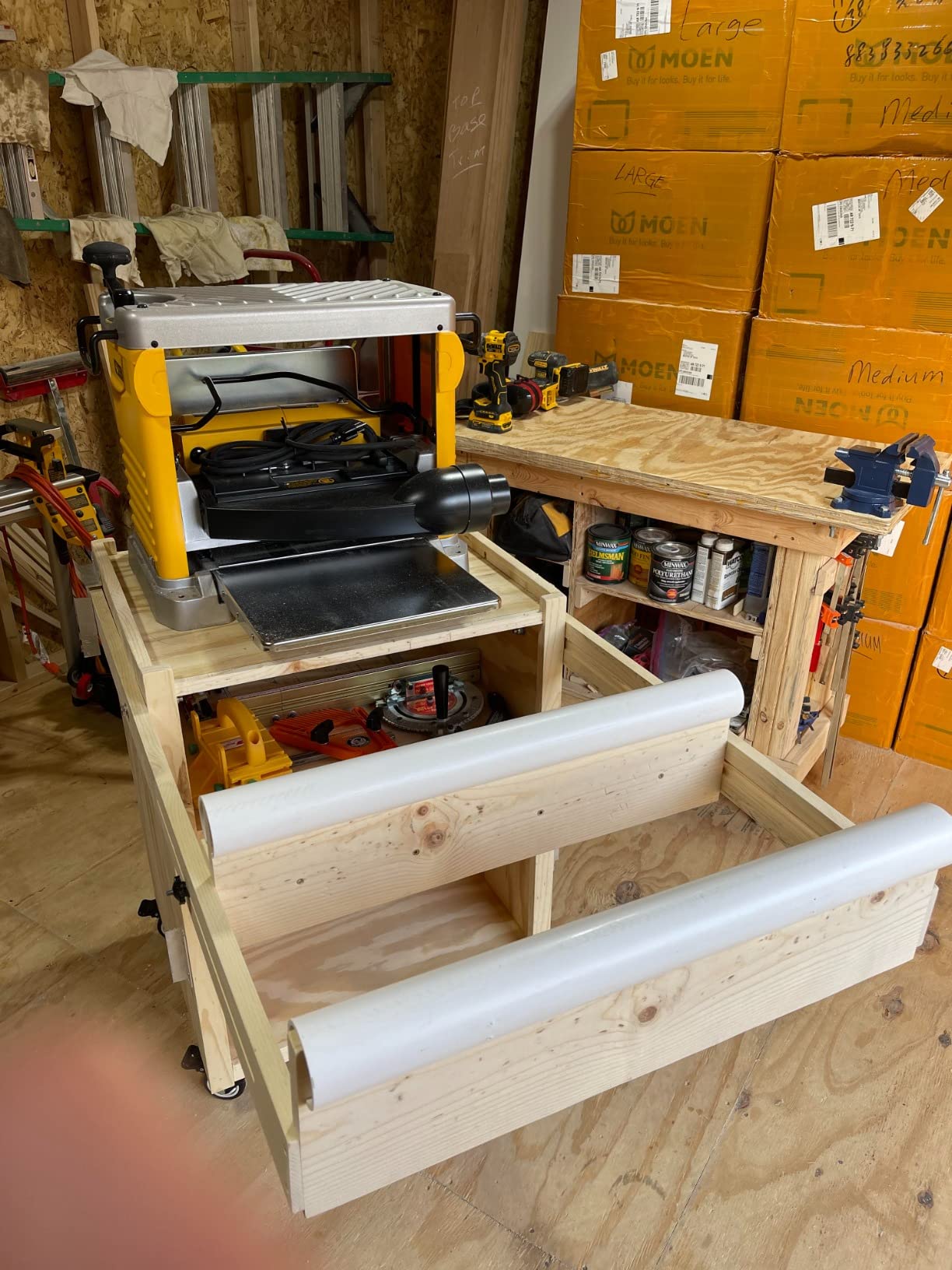
Knife handling is better than the three-knife design usually is. The blades are disposable and reversible, which means you flip to a fresh edge instead of hunting for the sharp side, and the manufacturer rates that at 30 percent more knife life. A material removal gauge and an extra-large thickness scale sit on the front, and a turret depth stop lets you park your most-used depths.
The tradeoff is honest. Three knives need three blades changed at once, so a shop that runs a planer hard will spend more time at the bench than an owner of a two-knife machine. The unit is 23.38 inches long, 16.52 wide and 20.48 high, and you will want roller stands under both ends, not a bare bench. Chips leave through a dust hood, so extraction is on you.
Who should buy the DW734
Buy it if you are dimensioning 4/4 and 5/4 rough lumber, resawing rough stock flat, or matching a stack of parts to a single caliper setting. The 12.5 inch cutting width and 0.13 inch maximum cutting depth cover common dimensional lumber and hardwood slabs without a struggle. Reviewers consistently single out hardwood power and the finish quality as the standouts across 2,759 ratings.
It also suits anyone who has hit the ceiling and still wants a machine with a wide, forgiving support system. The long tables and the carriage lock do more for consistent output than a two-speed gearbox would on softwood.
Who should skip the DW734
Skip it if your work is fitting a door, easing an edge, or cleaning up a single offcut. A handheld does those jobs in a fraction of the space for a fraction of the machine. Skip it if dust collection is optional in your shop, because uncollected chips will find the floor and your bench within a week.
Also skip it if you plan to move it regularly. Planers in this class are not portable, and the DW734 is no exception.
2. DEWALT 20V MAX DCP580B Cordless Planer – Best Cordless Hand Planer
DEWALT 20V MAX Planer, 30,000 Cuts Per Minute, 2 mm Cut Depth, Brushless Motor, Bare Tool Only (DCP580B)
Brushless motor
30,000 cuts per minute
1/256 inch depth steps
5/64 inch max cut
Pros
- Brushless motor runs smooth and lasts
- Depth knob calibrated to 1/256 inch
- No cord to snag on trim and door work
- Aluminum shoes keep the cut parallel
Cons
- 2mm maximum cut is shallow
- Batteries drain fast on heavy passes
- Bare tool means buying a battery and charger
- Throws a lot of shavings
This is the only cordless planer in our list and the best handheld for anyone trimming doors, fitting hinges and working in places a cord cannot reach. The brushless motor is the reason it feels different from a budget corded planer: it spins up fast, holds speed under load and does not have the wear parts a brushed motor has.
30,000 cuts per minute is a serious removal rate for a tool this size, and the depth knob is calibrated in 1/256 inch steps. That fine increment is what lets you take whisper-thin finish passes after a rough cut, which is exactly what you want on a face plate or a door stile.
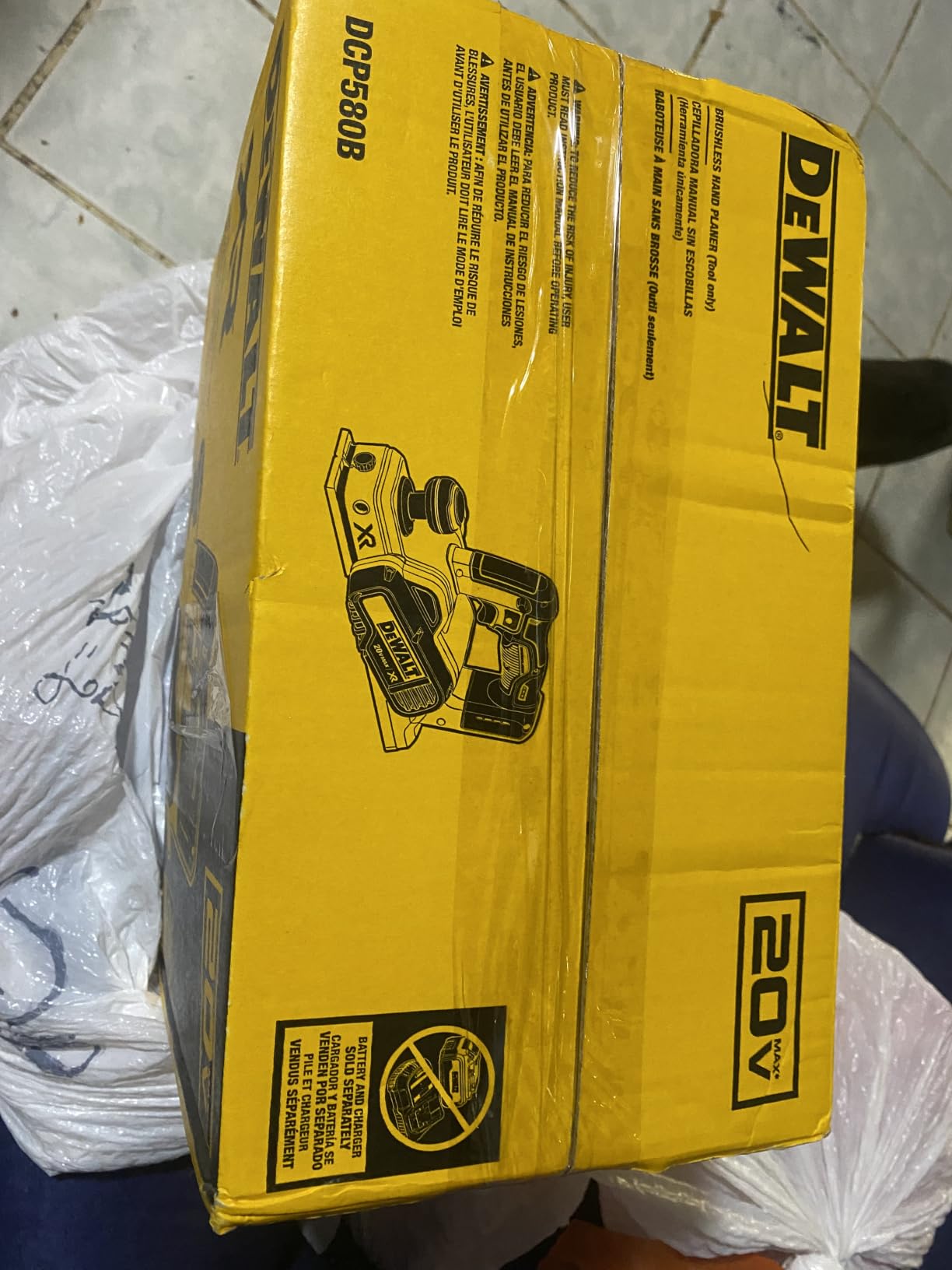
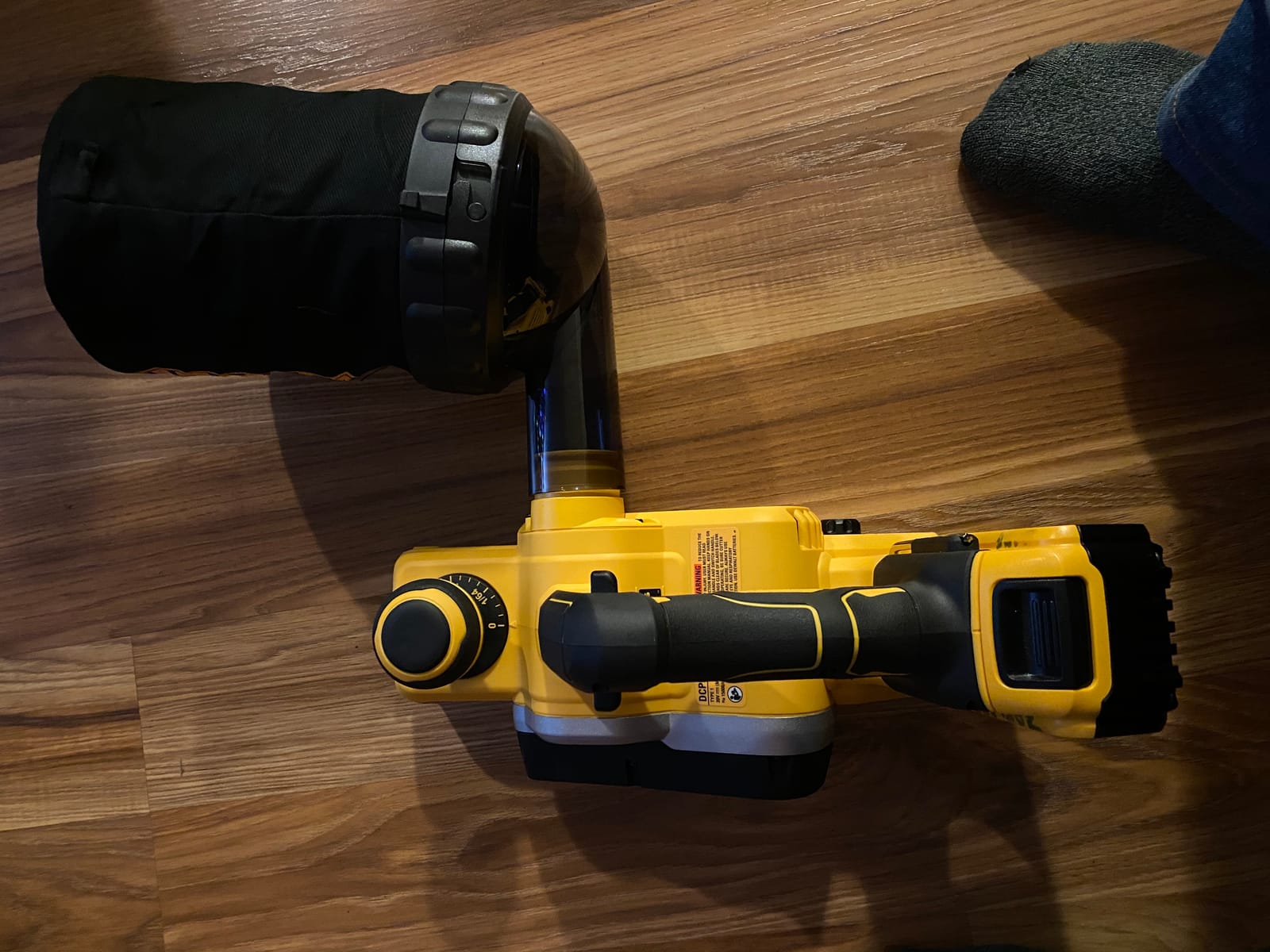
The front and rear shoes are precision machined from aluminum and cut together after assembly, so the sole stays parallel to the cut. A kickstand lifts the body when you set it down so the blade cannot gouge your work, and a chamfering groove machined into the front shoe handles edge detail without swapping tools. A Poly-V belt drives the drum, and replacement blades are part number DW6654.
It is sold as a bare tool, which is the one thing to plan for. You need a battery and a charger in the same platform before it runs. Maximum depth of cut is 5/64 inch, shallower than most corded hand planers, so this is a refinement and fitting tool rather than a stock-removal tool.
Who should buy the DCP580B
Buy it if you already own 20V MAX batteries, or if you want to own them. The cordless format removes cable drag on trim work and makes on-site fitting practical. At 7.4 pounds and 13.6 by 8 by 8.9 inches it moves around a house easily, and the calibrated depth control makes it the most precise handheld in the group.
It is also a strong choice for a beginner who will treat the tool gently. The precision adjustment rewards slow, careful passes instead of punishing fast work.
Who should skip the DCP580B
Skip it if you need to flatten thick rough stock in one pass. The 5/64 inch ceiling means more passes than a 6 amp corded planer would need. Skip it if you dislike buying batteries separately, because a bare tool plus a battery plus a charger changes the real cost of entry considerably.
Reviewers do note that heavy planing drains 2-4 amp hour batteries quickly, so keep a second pack on the charger if you have long sessions planned.
3. WEN 6530 6-Amp Hand Planer – Best Budget Pick
WEN 6530 6-Amp Electric Hand Planer, 3-1/4-Inch
6A at 34,000 cuts per minute
16 depth stops to 1/8 inch
3-1/4 inch width
6.5 pounds
Pros
- Lowest entry point with a large review base
- Very fast in softwood at 34000 cuts per minute
- Light 6.5 pound body reduces arm fatigue
- Depth stops and guides included
Cons
- Light-duty plastic build limits hardwood work
- Dust bag fills fast and is hard to empty
- Safety lock sits on one side only
The WEN 6530 is the cheapest capable planer here, and the review history is unusual for the price. With 7,966 ratings averaging 4.5 stars, owners are still reporting it works years later, which is a much better signal than a low review count on a new model.
On paper the numbers are stronger than the build suggests. A 6 amp motor at 34,000 cuts per minute is the highest removal rate of any handheld on this list, and 16 positive stops set cutting depth from zero to 1/8 inch in repeatable clicks. The 5/16 inch rabbeting guide handles rabbets up to 1 inch deep.
At 6.5 pounds and 12 by 7 by 7 inches it is the lightest machine here, and that matters on longer passes. Owners repeatedly call it capable for the money, with the fast cut rate in softwood doing most of the work. Two-year warranty coverage is included along with the dust bag, kickstand and parallel fence bracket.
The plastic body is where the compromise lives. It is not a hardwood or production tool, and it is not meant to be treated like one. New users also tend to gouge the first few passes until they learn to start the cut with the board already moving, so practise on scrap.
Who should buy the WEN 6530
Buy it if you are fitting doors, easing edges, doing picture-frame work or cleaning up trim, and you want a planer without a large purchase decision. It handles softwood quickly and the guides are all in the box, so there is nothing else to figure out before the first cut.
For a renter, a student, or anyone who wants a real electric planer to learn on, this is the low-risk place to start. The light weight means you can use it above waist height without wrecking the work or your arm.
Who should skip the WEN 6530
Skip it if you intend to run it through oak, walnut or construction lumber. The light-duty construction and the fast-filling dust bag both work against that, and replacement blades are a recurring cost on a tool this size.
Left-handed users should look elsewhere, because the safety lock is only on one side of the handle. The included directions are also thin on setting the rabbet and parallel guides, so plan a few minutes of setup before a real project.
4. CRAFTSMAN CMEW320 Benchtop Planer – Built for Board-Foot Volume
CRAFTSMAN Planer, 15 Amp, For Benchtops, Two Knife Solid Steel Cutter Head (CMEW320)
15A poly-V cutterhead drive
Two-knife solid steel head
12.25 inch width
0.13 inch cut
Pros
- Solid steel cutterhead on ball bearings
- Handles high board-foot volume without bogging
- Reversible high carbon steel knives
- Base can be bolted to the bench
Cons
- Some snipe on light passes until tuned
- Manual crank for mode changes
- Front cord placement is awkward
The CMEW320 is the benchtop pick for volume rather than for finesse. Owners working through hundreds of board feet report accurate, consistent thicknessing, and the two-knife solid steel cutterhead on ball bearings is the reason: it does not flex or loosen up the way lighter aluminum heads do.
A 15 amp motor drives a poly-V cutterhead belt for maximum stock removal, and the high carbon steel double-edged reversible knives give you a fresh edge by flipping the blade. Cutting width is 12.25 inches with a 0.13 inch maximum cutting depth, which covers standard dimensional lumber and most hardwood boards.
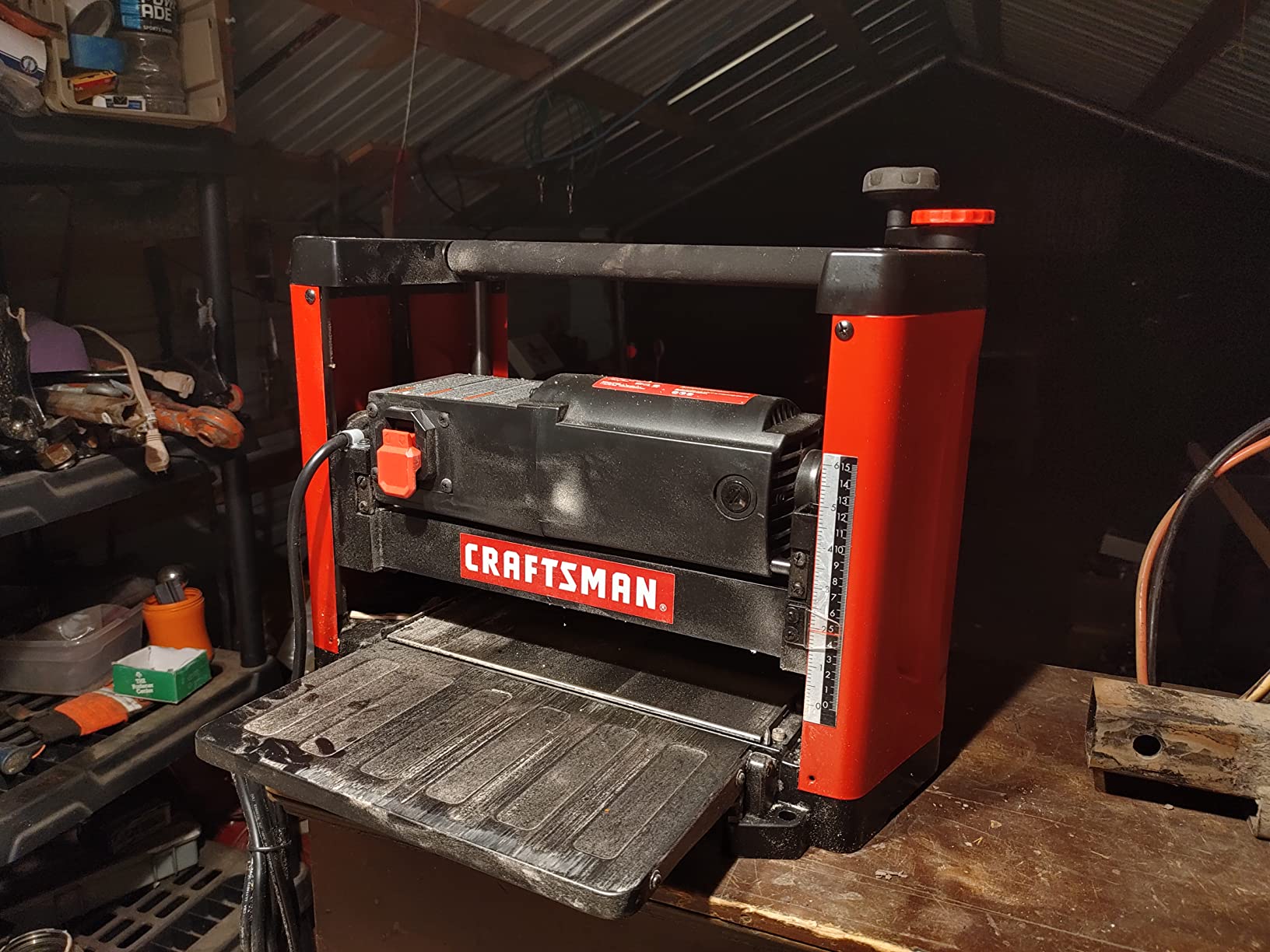
It is a big machine at 23.5 by 17.5 by 15.4 inches, and it is built to stay put. Mounting holes in the base let you bolt it down, and owners note it is heavy enough to remain stable on a bench without drifting while light enough to reposition with a second person. A vacuum port handles chip extraction.
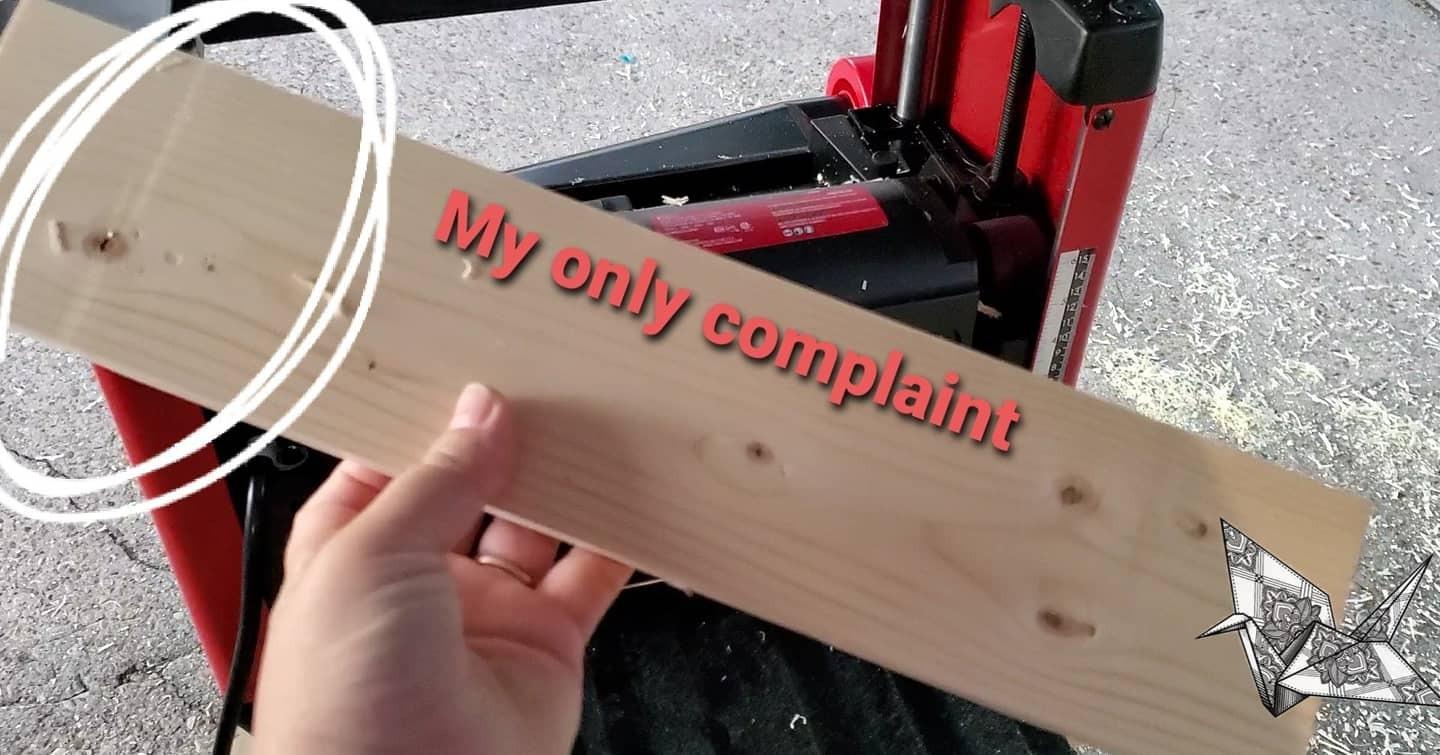
The honest complaint from owners is snipe on light passes until the machine is dialled in, plus a manual crank that makes switching between flat and edge planing fiddly. The power cord exits at the front corner, which gets in the way, and the dust shroud clogs without a properly sized collector. It is also the loudest machine in the benchtop group here.
Who should buy the CMEW320
Buy it if you process rough lumber in quantity: a stack of 4/4 boards for a table, a wall of shelving stock, or a run of cabinet parts. Two knives changed less often than three is a real advantage for someone who will change blades often.
It is also a good choice if you want to bolt the machine to a dedicated station and leave it there. The base is designed for that, and a fixed machine tunes in more easily than one you carry around.
Who should skip the CMEW320
Skip it if finish quality is the priority and the stock is figured or tearout-prone wood. A two-knife straight head at 8,000 rpm has fewer cutting edges than the DW734 or the WEN PL1326, and that shows on figured maple and ash.
Skip it if noise is a factor in a shared space, or if you do not already have dust extraction. A shop vac alone is a compromise; a proper collector keeps that shroud from clogging.
5. PORTER-CABLE PC60THP Hand Planer – Best for First-Time Buyers
PORTER-CABLE Hand Planer, 6-Amp, 5/64-Inch (PC60THP)
6A at 16,500 RPM
11.5 inch cast aluminum shoe
0.078 inch cut
Dual-side dust bag
Pros
- Build quality rivals tools costing far more
- Large cast aluminum shoe gives control
- Fine depth adjustment limits costly mistakes
- Handles rough reclaimed lumber well
Cons
- Less power than comparable Makita models
- Kickstand will not support a mid-board start
- No carrying case
- One blade set only
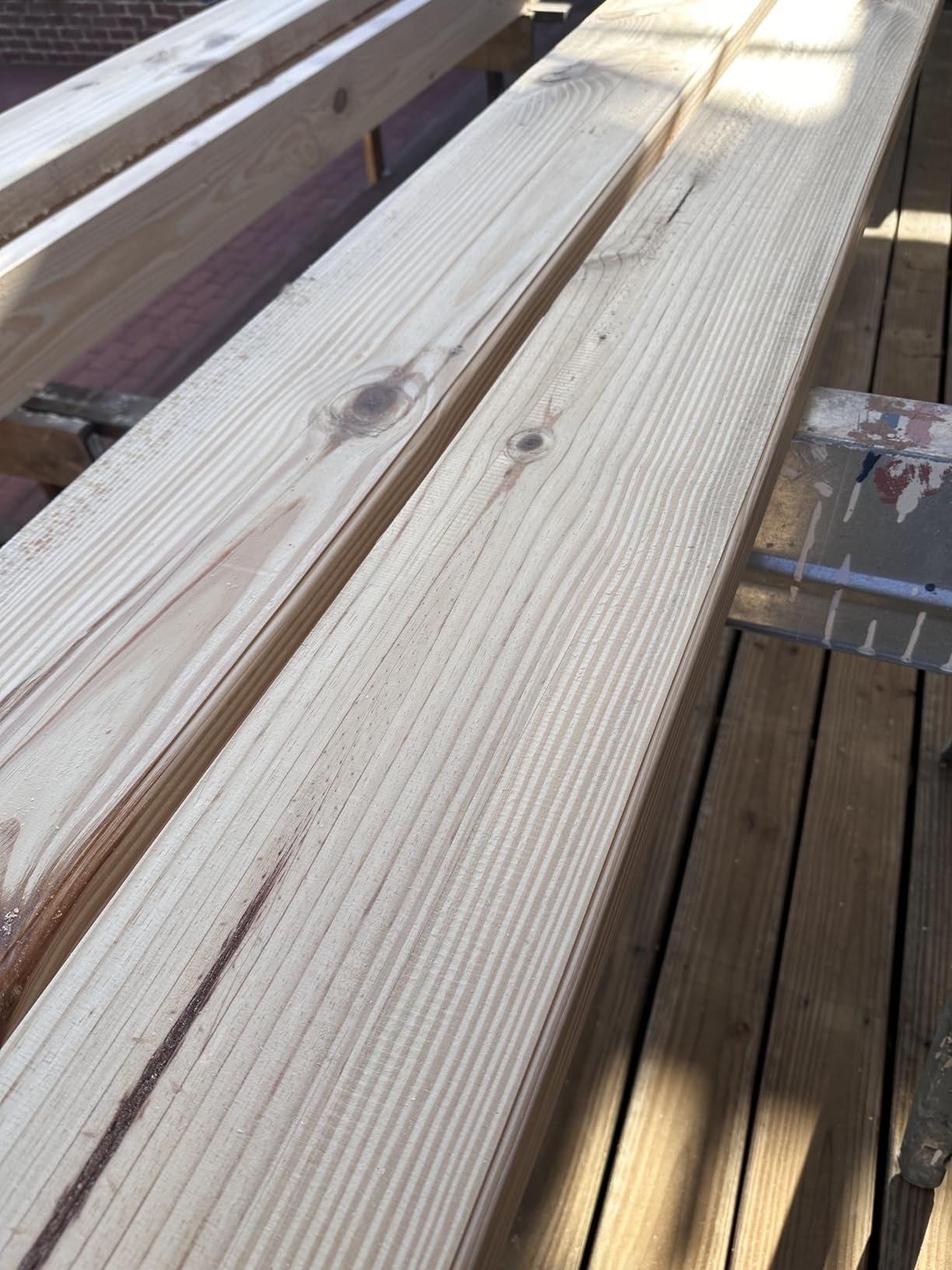
The PC60THP is the planer we would hand someone learning to use a machine. The 11.5 inch cast aluminum shoe is the feature that stands out, because it gives you a flat reference to work against and keeps the cut steady on a board that is not perfectly straight.
The 6 amp motor turns at 16,500 rpm, and the overmold depth knob has 10 positive steps. Depth of cut is 0.078 inch with a maximum rabbet of 0.47 inch per pass, so you can take a real cut but not a heroic one. Three chamfering grooves cover common edge treatments.
Owners say it punches above its price class more than any other handheld here, and they credit the heft. At 8.2 pounds the tool sits down on the work instead of skating, which is a big deal when you are learning. Reviewers also point out that it works through rough, old lumber without complaint.
Dust can go either side with the included mesh bag, and many owners connect a shop vac instead. The metal edge guide that ships with it genuinely helps hold alignment on long edges, which is more than most hand planers at this level offer.
Who should buy the PC60THP
Buy it if you want a planer that feels solid in the hand and forgives an imperfect setup. The depth adjustment takes off very small amounts, so a beginner is far less likely to blow through a board in one pass than with a coarser-dial machine.
It is also a good fit for anyone working reclaimed or pallet wood, where the shoe gives you a reference even when the stock is ugly.
Who should skip the PC60THP
Skip it if you want maximum power. It runs out of steam sooner than comparable Makita models, and the 1/32 inch ceiling on depth means more passes on thick stock. Skip it if the kickstand matters to you: it will not hold the tool steady for a start in the middle of a board, so plan your starts from the end.
No case is included, only a cardboard box, and one blade set is already installed. Budget for a spare set before you start a long job.
6. WEN PL1326 15-Amp Spiral Benchtop Planer – Best Cutterhead Under 500
WEN PL1326 15-Amp 13-Inch Spiral Benchtop Thickness Planer
26-blade spiral cutterhead
15A at 10,000 RPM
13 inch by 6 inch capacity
26 fpm feed
Pros
- 26 rotatable blades last a full rotation
- Very little snipe on properly set tables
- Handles red oak and walnut on one speed
- Best value in the benchtop class
Cons
- 120V only
- inoperable on 220-240V circuits
- Heavy at benchtop scale
- Noisy brush motor
- Partial dust collection
The PL1326 is the most interesting machine in this roundup because of its cutterhead. Twenty-six staggered HSS blades are mounted on a spiral rather than in straight slots, and each blade is rotatable, so you index to a fresh edge instead of removing and resharpening a set. There is no snipe problem of the kind that punishes straight-knife machines.
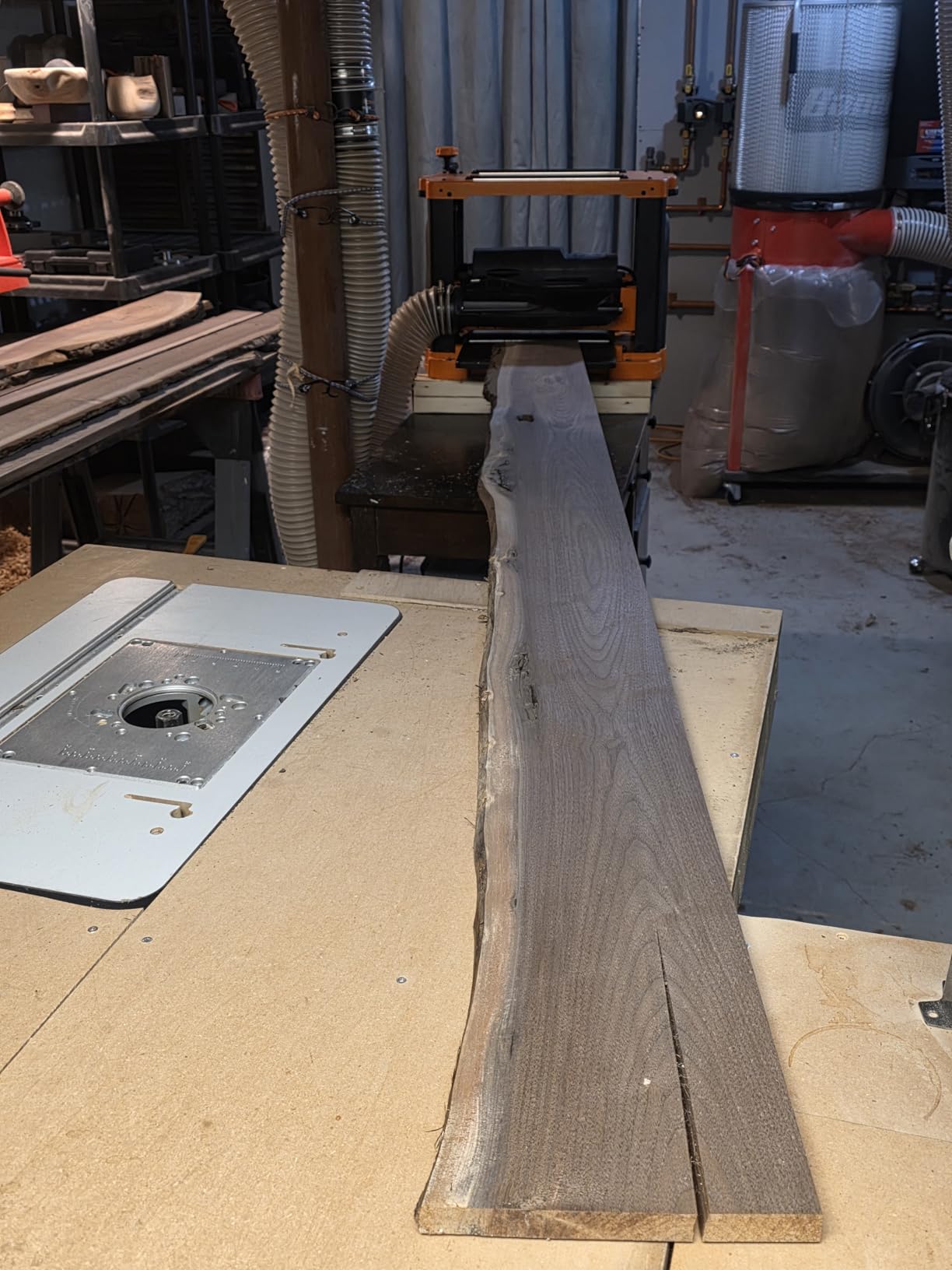
The 15 amp motor runs at 10,000 rpm with a 26 feet per minute feed rate, and the machine handles boards up to 6 inches thick and 13 inches wide. Onboard, a material removal gauge shows the depth of the current pass, and the infeed and outfeed tables adjust so you can dial out snipe yourself.
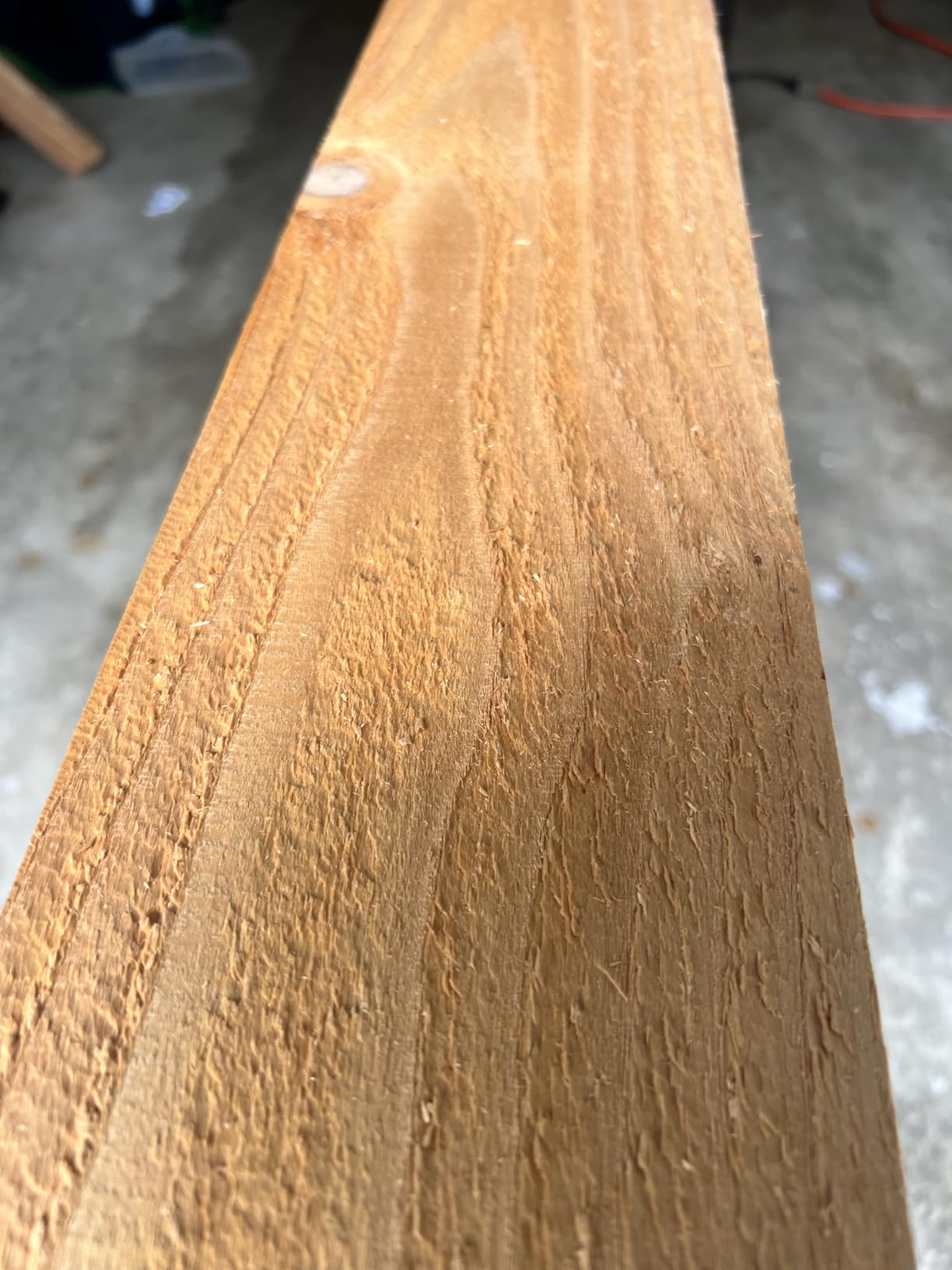
Owners with professional experience report the finish is beautiful and consistent, and they repeatedly note that rough construction lumber turns into usable stock quickly. The cast iron base and tables are the right choice for stability, and an adjustable dust port plus a depth stop are included.
It is a 120V machine only, which rules it out in 220-240V regions without a converter. The motor is loud for a spiral-head planer, closer to straight-knife noise, so hearing protection is not optional. Weight is in the 80 to 100 pound range, which makes repositioning a two-person job, and the dust port captures only part of the chips without a real collector. The depth indicator is a single round pin rather than a full-width scale.
Who should buy the PL1326
Buy it if the surface finish is the whole point of your planer. A spiral cutterhead stays sharp between blade changes, so you spend the day cutting rather than sharpening, and the snipe problem mostly disappears. It handles red oak and walnut at a single speed, which is unusual at this ceiling.
It is also the pick for anyone who resaws rough boards into flat stock. The 13 inch width and 6 inch thickness capacity cover real lumber, and the adjustable tables let you tune the feed after setup.
Who should skip the PL1326
Skip it if you are outside North America or anywhere on a 220-240V circuit. It is the one hard limitation here that cannot be worked around cheaply, and buying the wrong voltage version is a return nobody enjoys.
Skip it if you move machines often or work in a small space with neighbours. Between the weight, the noise and the partial dust capture, this is a stationary machine only.
7. Makita KP0800K Hand Planer – Best Corded Hand Planer for Hardwoods
Makita KP0800K 3-1/4″ Planer, with Tool Case , Blue
6.5A at 17,000 RPM
3-1/4 inch by 3/32 inch per pass
Spring-loaded stand
Tool case included
Pros
- Accurate and consistent cut in hardwood
- Light and easy to control
- No digging at the start or end of a run
- Sturdy case
- wrench and blade gauge included
Cons
- No dust bag or adapter included
- Shop vac adapters hard to find
- 3-1/4 inch width is narrow
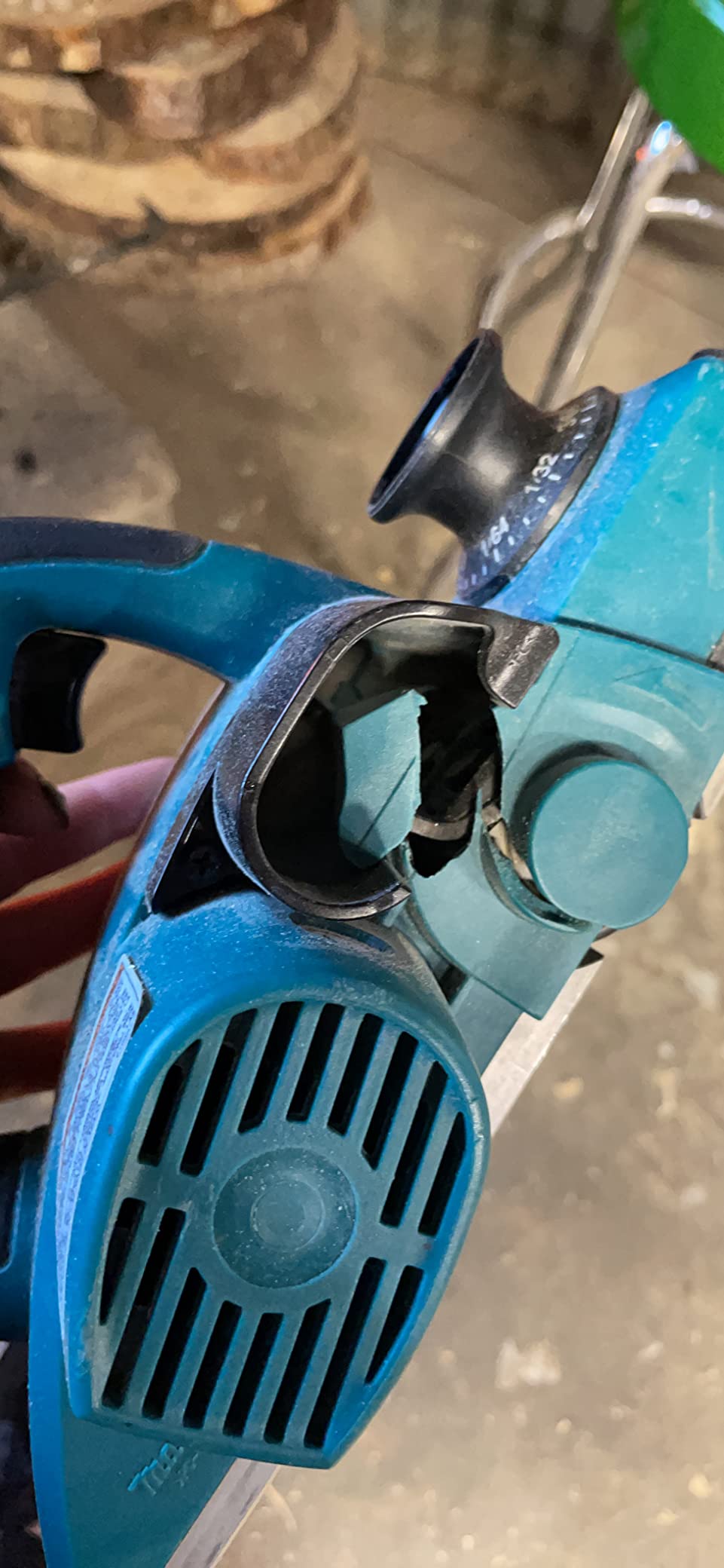
The KP0800K is the handheld that owners with hardwood projects end up on. A 6.5 amp motor at 17,000 rpm gives it more real cutting power than most tools in this class, and long-term owners report that it handles cherry without complaint and stays accurate over years.
It planes up to 3-1/4 inches wide and 3/32 inch deep in a single pass, with a two-blade cutterhead. The spring-loaded stand elevates the base when you set the tool down, protecting both the blade and your work, and the easy blade setting system speeds up changes.
The detail that gets singled out most is the absence of digging at the start and end of a run. Many hand planers gouge exactly where the cutterhead meets the board at each end, and owners of this one say it just does not. It is also quieter than expected for a corded tool, and it works with the Makita bevel guide if you want one.
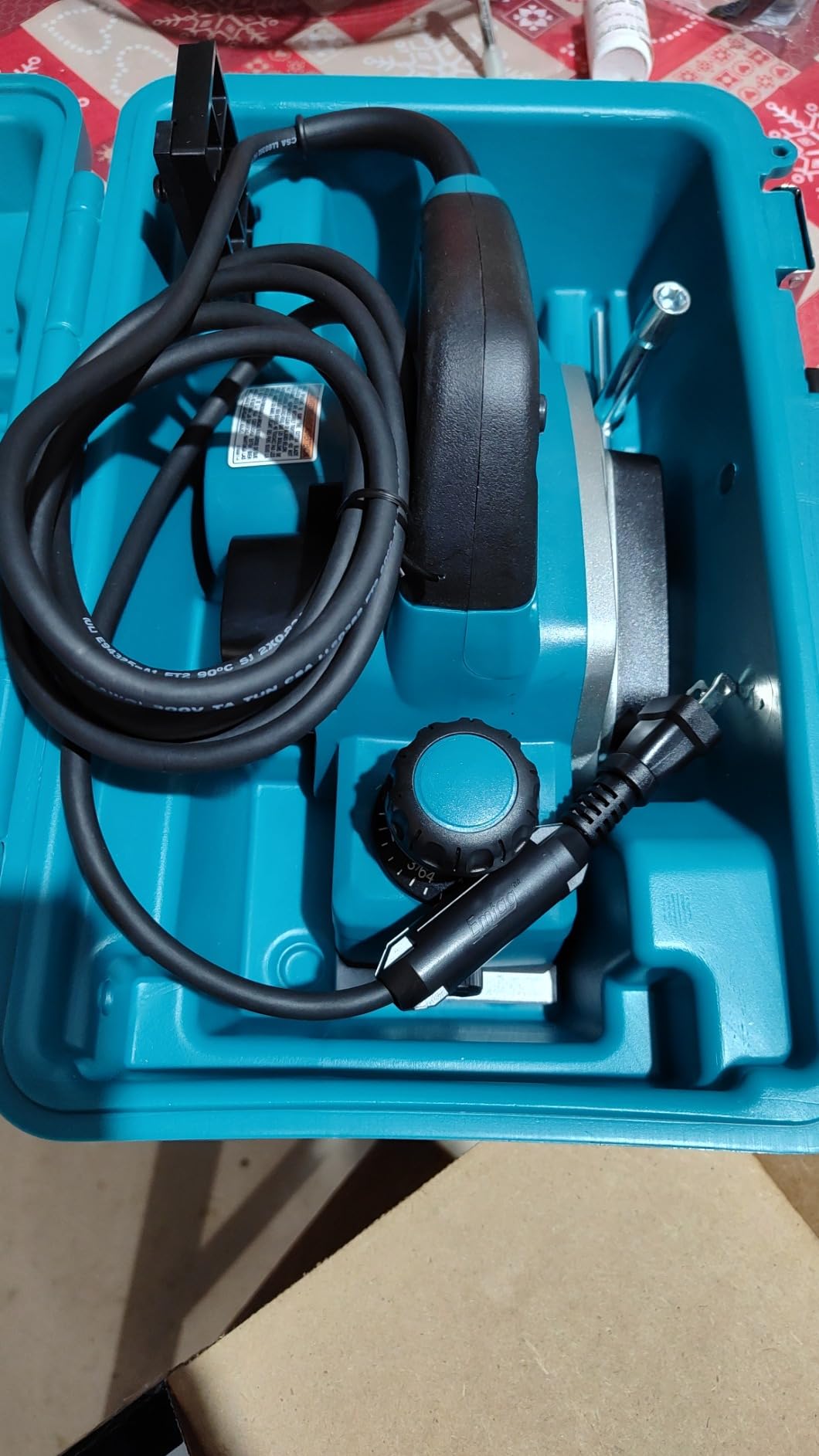
The box is unusually complete: tool case, wrench, blade gauge assembly, guide rule and a blade set. The gap is dust handling. There is no bag or adapter in the kit, and owners report difficulty finding a shop vac adapter that fits the discharge port, so plan on a workaround before you start.
Who should buy the Makita KP0800K
Buy it if you work in hardwood at handheld scale: solid wood doors, cabinet parts, small furniture components. The power, the clean cut and the light weight make it comfortable to use for long sessions, and the case makes it easy to move between the shop and a job site.
It is also the pick if you have had a hand planer that gouged the ends of boards and did not want that again. That complaint is rare with this model for a reason.
Who should skip the KP0800K
Skip it if you need to plane a full 2×4 face in one pass. At 3-1/4 inches you will make three passes across a dimensional board, which is fine for cabinets and frustrating for rough stock. Skip it if dust management matters more to you than cut quality, since the accessory situation is the weak point.
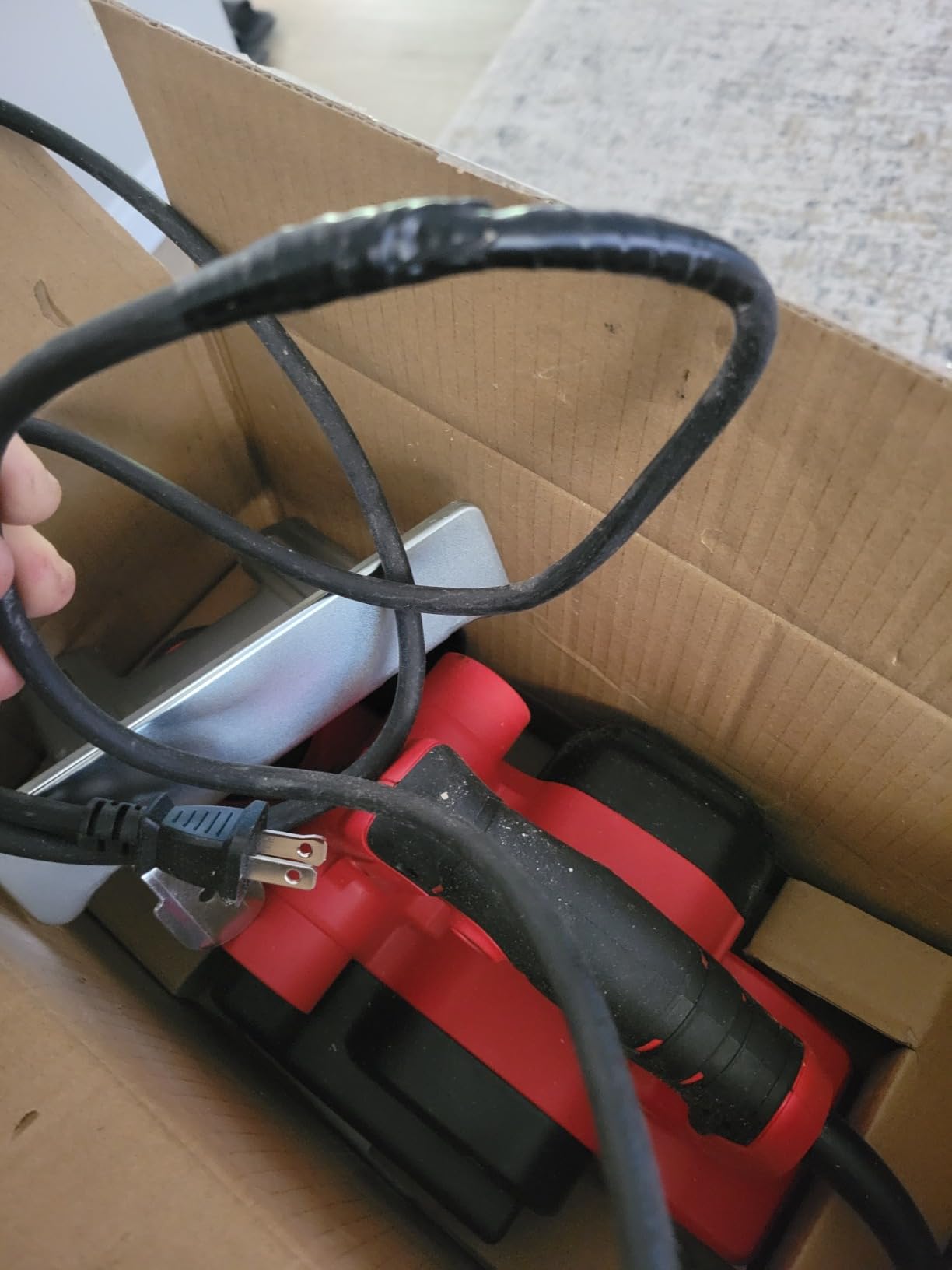
Some buyers also note the cord can arrive bent in the box, so check it before the first job.
8. Bosch PL1632 Hand Planer – Best for Doors and Slabs
Bosch PL1632 3-1/4 In. Planer
6.5A at 16,500 RPM
0 to 1/16 inch in one turn
WoodRazor reversible carbide blade
6.3 pounds
Pros
- Smooth finish with less sanding
- Enough power for hollow-core and solid doors
- Machined-together aluminum shoes for accuracy
- Works well with a shop vac attached
Cons
- Runs hot during continuous use
- Included dust bag is low quality
- Battery-style lock button can be pressed while planing
The PL1632 is built around door and slab work. The 6.5 amp motor at 16,500 rpm is powerful enough for hollow-core and solid wood doors, and users report a smooth, accurate finish that needs less sanding afterwards than most hand planers manage.
The ratcheting depth knob is the standout control. It sets zero to 1/16 inch of depth within a single revolution, so a fine finishing pass is one quick movement rather than a series of clicks. The electronically counterbalanced single-blade design keeps the cut steady, and the reversible Bosch WoodRazor Micrograin carbide blade is rated for up to 30 percent longer life.
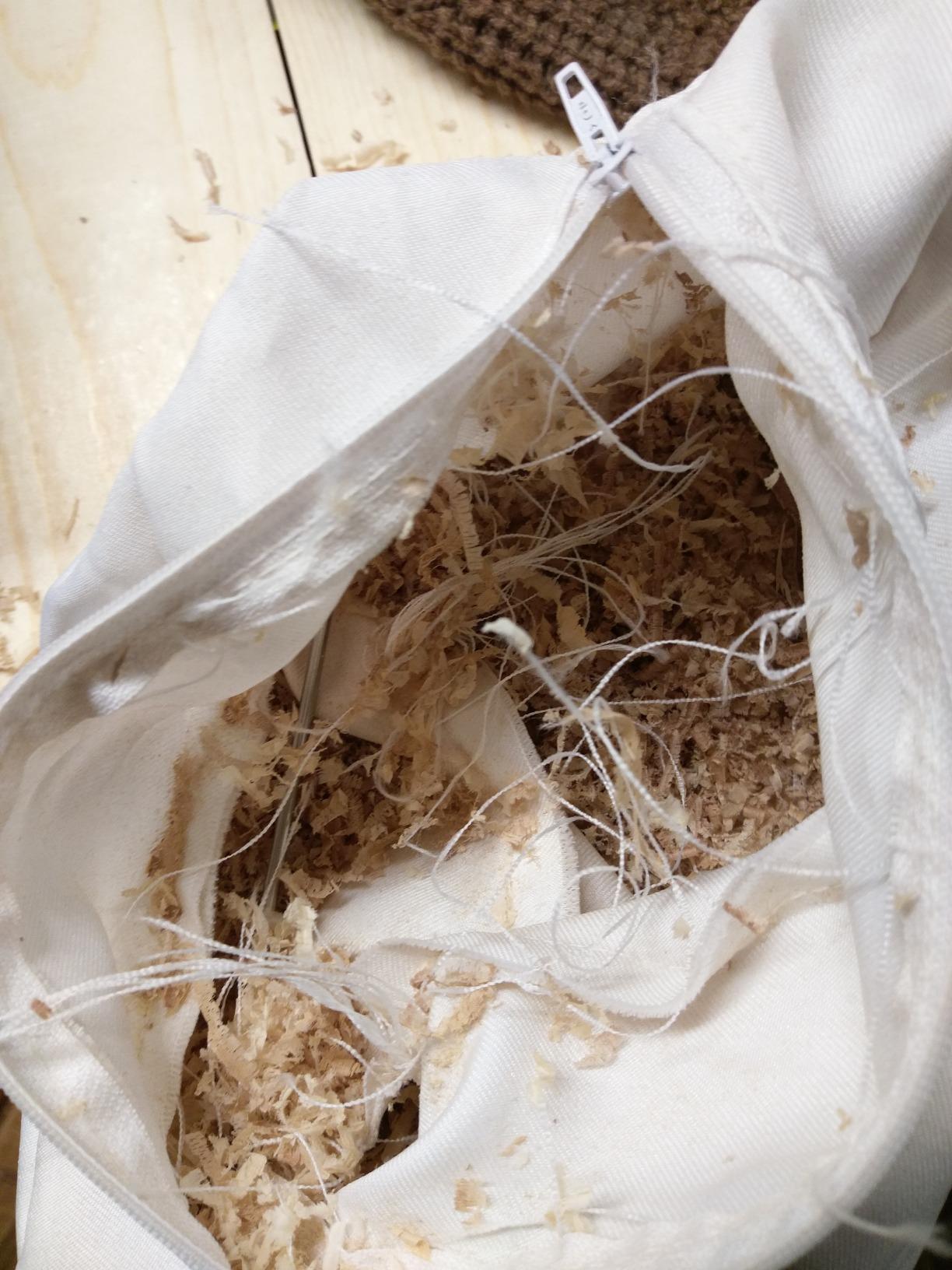
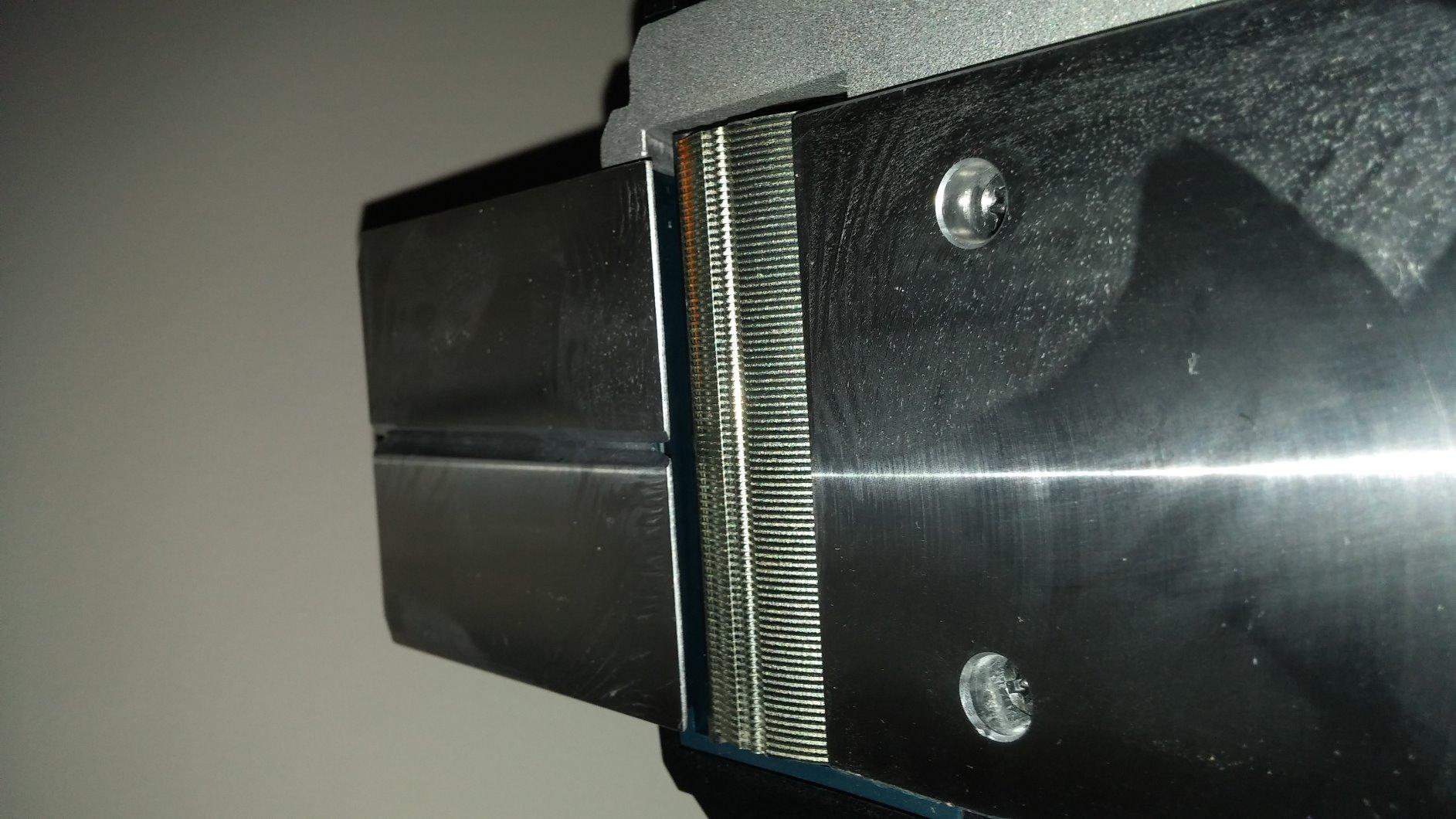
The aluminum front and rear shoes are machined together after assembly, which is why the parallelism holds. At 6.3 pounds and 11.4 by 6 by 6.5 inches this is one of the lighter tools here, and the ball-joint cord swivel makes positioning simple on a door laid flat or propped up.
Two cautions from owners. Several users report the tool running hot during continuous use, so give it breaks on long sessions. The included dust bag is low quality and frays quickly, though a shop vac connection works well and does not clog. A guide fence mounts to either side, but one reviewer found theirs not square to the planing angle, so check it before relying on it for a rabbet.
Who should buy the Bosch PL1632
Buy it if fitting doors is a regular task. The combination of power, a fine ratcheting depth control and a carbide blade suits fitting and easing work, and the reversible blade means you can keep working after the first edge dulls.
It is also a good second-hand-free choice for a beginner who wants accuracy over power, because the machined-together shoes and the quick depth setting make first passes predictable.
Who should skip the Bosch PL1632
Skip it if you run long continuous sessions. Heat builds up, and that is the most common complaint in the reviews. Skip it if you need a wide cut: the tool is built for door and slab width rather than dimensional lumber.
Some buyers prefer the kit version with a proper case and dust solution, and a few units arrive with a blade off to one side that produces uneven cuts. Check the first pass on scrap.
9. WEN 6534 8-Amp Hand Planer – Best Wide-Cut Handheld
WEN 6534 8-Amp Electric Hand Planer, 4-3/8-Inch
8A at 32,000 cuts per minute
4-3/8 inch cut width
16 stops to 1/8 inch
Two-way dust port
Pros
- Widest cut in the handheld group
- Handles 2x4s and 4x4s in fewer passes
- Weight keeps it steady on horizontal work
- Shop vac adapter included
- Reversible HSS blades
Cons
- Too heavy for overhead work
- No collection bag included
- Kickstand does not always retract
The 6534 is the widest handheld here at 4-3/8 inches, and that single number is why it earns its place. An 8 amp motor delivering up to 32,000 cuts per minute means you cover a 2×4 or a 4×4 in fewer passes than any other tool in this roundup, which matters more than peak power when you are cleaning up a stack of trim.
Sixteen positive stops set depth from zero to 1/8 inch, and a marked zero reference makes settings repeatable. The two-way dust port shoots shavings to either side, a dust adapter is included for shop vac hookup, and the reversible HSS blades plus fence bracket and rabbeting guide cover most fitting work out of the box. Rabbets go to 1/3 inch.
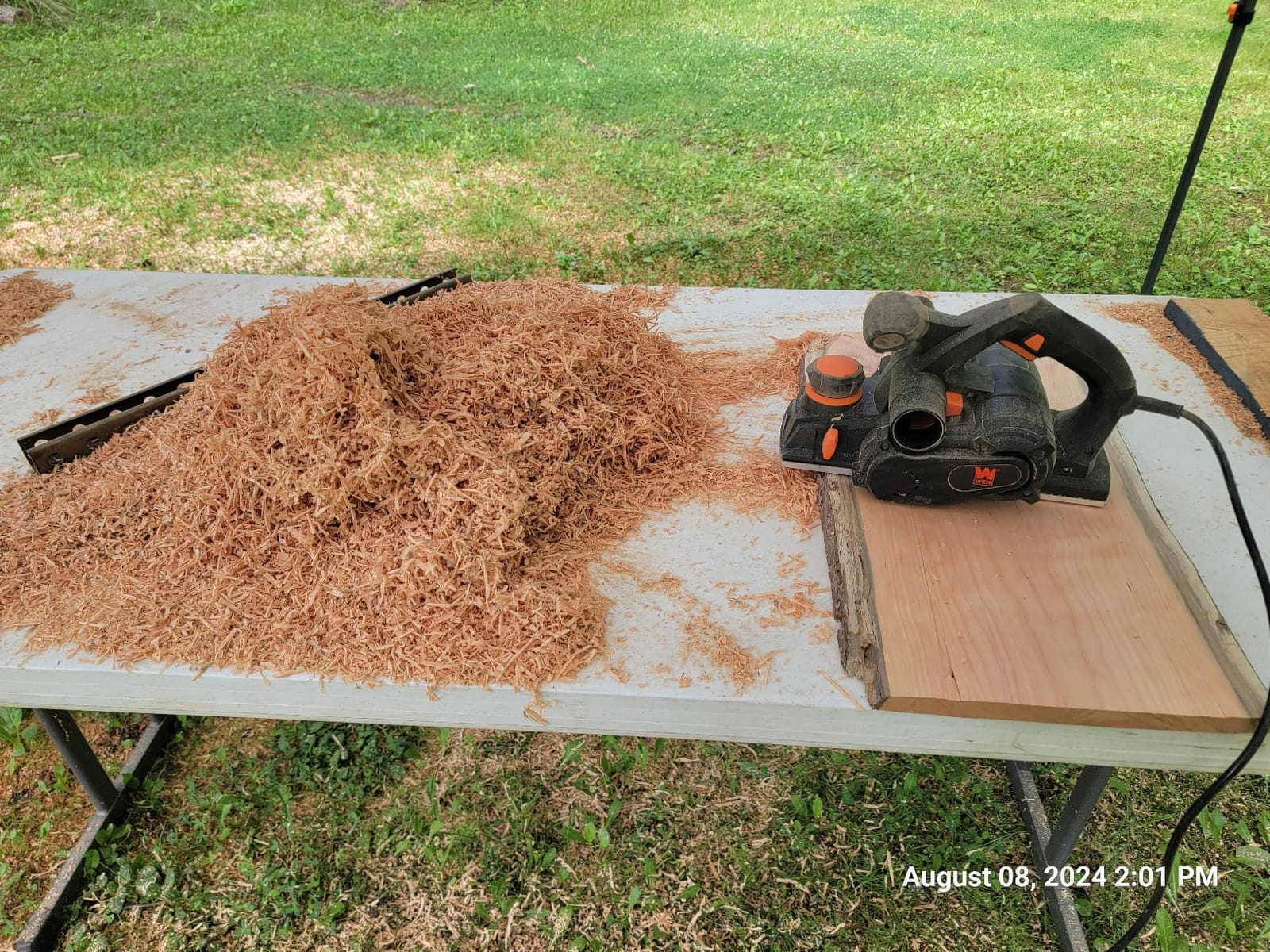
At 9.5 pounds this is the heaviest handheld in the group, and owners treat that as a feature for horizontal work because the tool stays put on the board. The automatic kickstand and the two-year warranty are both welcome additions at this level.
The same weight is a real problem above waist height, and the kickstand does not always retract reliably, which can bind a feathered mid-board start. No collection bag is included, so you need a vacuum. Some units also arrive with a blade sitting off to one side and produce uneven or cupped cuts until it is corrected, and the included adjustment wrench was reportedly poorly tooled enough to round the bolts.
Who should buy the WEN 6534
Buy it if you work on dimensional lumber rather than fine furniture parts. The 4-3/8 inch width and the 32,000 cuts per minute rate cut a full 4×4 face in a reasonable time, and the steady weight means fewer skipped passes on long boards.
It is also a good value if you want a planer for housing trim and rough carpentry work where the widest cut available matters more than fine finish control.
Who should skip the WEN 6534
Skip it for overhead, vertical or on-ladder work. Nine and a half pounds is a lot to hold above your head, and this is not a production-grade tool for a working trade. Skip it if you need a dust bag, because none is included.
Inspect the blade on arrival and plan to use a shop vac from the first session.
10. CRAFTSMAN CMEW300 Hand Planer – Most Accessories in the Kit
CRAFTSMAN Hand Planer, 6-Amp, 5/64-Inch (CMEW300) – Amazon Vine
6A at 16,500 RPM
11.5 inch cast aluminum shoe
10-step depth knob
Dual-side extraction
Pros
- Clean and even finish on softwood and hardwood
- Kit includes carbide blades
- wrench
- edge guide and vac adapter
- Cast aluminum shoe adds control
Cons
- Base needs flattening before first use
- Listed bags are not in the kit
- Can hog material fast if depth is unchecked
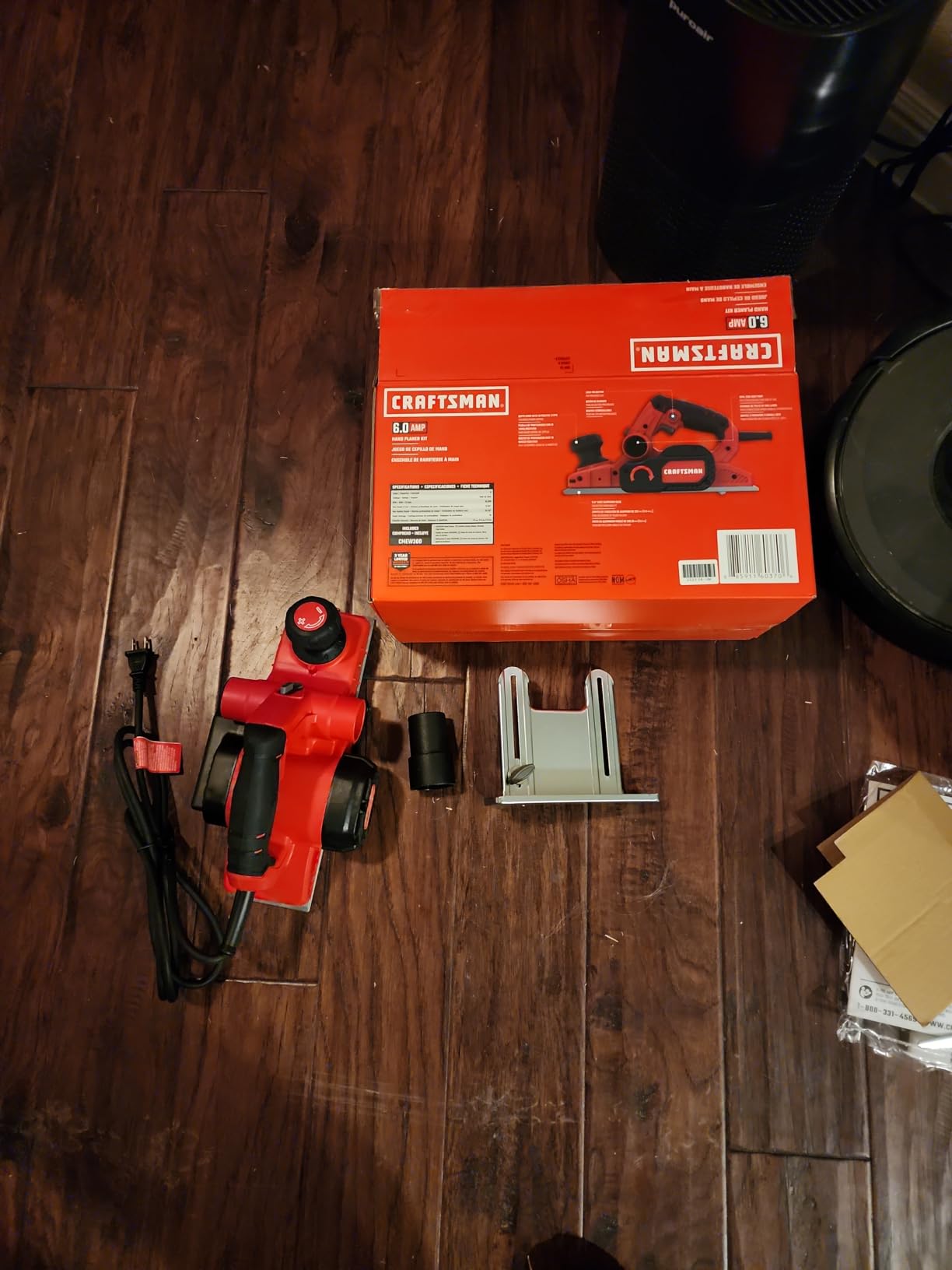
The CMEW300 is the pick when the contents of the box matter most. Carbide cutting blades, a wrench, a metal edge guide and a vacuum adapter are all included, so you are not hunting for accessories before the first cut. Owners rate the finish quality as clean and even across a fair price.
The 6 amp motor runs at 16,500 rpm and drives an 11.5 inch cast aluminum shoe that adds both control and finish quality. A 10-step overmolded depth knob gives repeatable settings, and dust extraction works from either side of the tool.
Users find it easy to handle and far faster than a hand plane, which is the honest benchmark for a tool at this level. On softwood and hardwood alike it produces a finish most people are happy to move straight to sanding on.
Two setup notes matter. Several owners report the base needs flattening before first use, so check it against a known straight edge. Some also report that accessories shown in the listing photos, such as a dust bag and a carry bag, are not part of the kit, so go by the component list rather than the pictures. And it will remove material faster than you expect, which is why you test the depth setting on scrap first.
Who should buy the CMEW300
Buy it if you want a complete handheld kit for general shop work at a low entry point. The included carbide blades last longer than plain HSS, and the edge guide helps on long edges. It suits cabinet work, trim and general clean-up around the shop.
It is a reasonable gift for a beginner too, since the accessory list covers most of what a first project needs.
Who should skip the CMEW300
Skip it if you want a premium feel or a heavy-duty body. It is an aluminum-bodied tool for light and medium work, not a machine for repeated hardwood passes on production volume. Skip it if you will not spend five minutes flattening the base, because an out-of-square base shows up immediately in the cut.
And read the component list before you buy, so you are not disappointed by missing bags at unboxing.
How to Choose a Planer Under 500: 7 Things That Matter
Start by choosing between a handheld and a benchtop, because that decision eliminates half the list before any brand matters. A handheld planer fits in a drawer, weighs under 10 pounds and handles boards a few inches wide. It is the right tool for doors, trim, edges and cleanup. A benchtop planer handles 12-1/2 to 13 inch boards and is the only option for dimensioning rough lumber or matching parts to a caliper setting. If your project involves more than a few pieces of trim, a benchtop machine is the only purchase that makes sense under this ceiling.
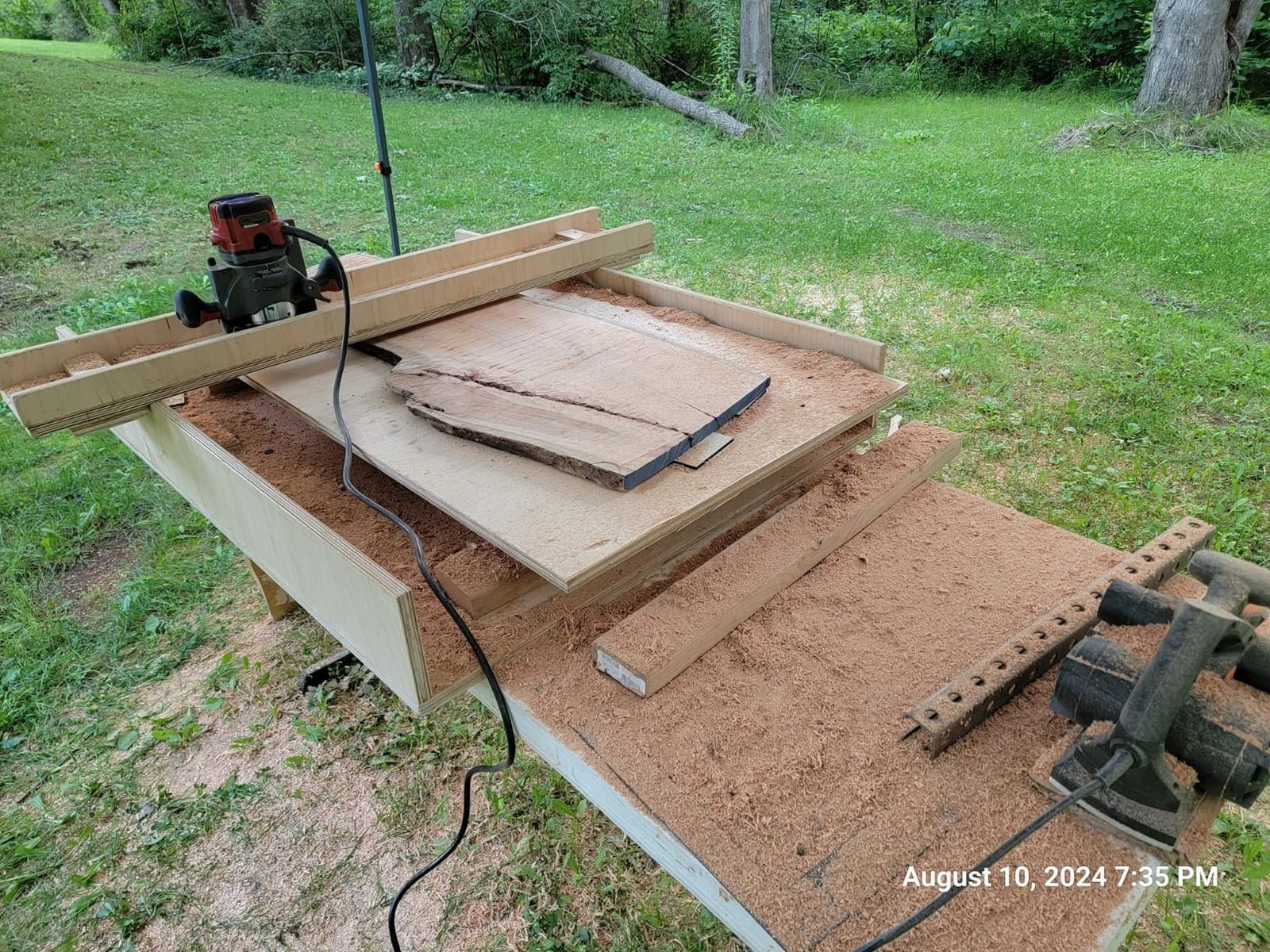
Second, understand what a planer cannot do. A planer makes faces parallel to the bed. It does not flatten cupped, bowed or twisted stock, and no machine in this roundup will. You need one flat reference face first, from a jointer, from a surfaces-and-four-sides milled board, or from a planer sled. Buying a planer and expecting a surface-smoothing machine is the most common disappointment in this category.
Third, look at the cutterhead. Straight-knife heads hold two or three blades in slots, and a dull blade leaves a visible line until you change it. Spiral heads carry many small rotatable inserts spread along the head, each taking a small bite, so they hold an edge far longer and almost never produce snipe. The WEN PL1326 is the spiral option here, and the difference shows up in how often you stop work.
Fourth, count knives. Two knives mean fewer edges to change but more work per edge and shorter intervals between changes. Three knives, as on the DW734, deliver a finer finish at 96 cuts per inch and more frequent changes. For a part-time home shop the interval rarely matters. For someone running a planer every weekend, two knives can be the calmer choice.
Fifth, read the depth and width numbers together. Maximum cutting depth of around 0.13 inch on a benchtop machine means a rough 4/4 board goes through in one or two passes. Board width decides what you can feed: a 3-1/4 inch handheld cannot face a 2×4 in one pass, and a 4-3/8 inch handheld still cannot.
Sixth, plan for chips. Every machine here throws chips or shavings, and budget units throw a lot. A dust port that fits a standard shop vac hose is the minimum; the benchtop machines need a real collector to keep shrouds from clogging. Budget owners across our other tool roundups, including our mattress buying guide under 500, learn the same lesson about accessories: a cheap tool plus no consumables becomes an expensive tool.
Seventh, check the warranty and the service network. A home centre planer can go back to a counter or a local service point. A direct-import machine has no such fallback, and that difference matters more over five years than the specifications do on day one. Heat is also a warranty-adjacent issue: units that run hot in continuous use are the ones that eventually fail.
New vs Used at the Same Price
A used planer at the same money as a new one is a genuinely good deal in some cases and a false economy in others. The deciding factor is not age, it is whether the carriage and cutterhead are still true. A planer that has been dropped, rebuilt with mismatched knives or idled with a rusted bed will never hold a consistent thickness, and no amount of adjustment fixes that.
Check five things on a used machine. Look at the infeed and outfeed tables for flatness across their width, since those set the reference for the cut. Run a board through and check the four corners with a caliper: if the readings differ by more than a few thousandths, the bed is not parallel. Count the cutterhead bearings for play, and check that the knives are the correct matched set. Confirm that the depth scale still resolves fine increments. Finally, ask whether the machine ran hot, because a motor that has already been overloaded is a future problem.
One buyer on r/Tools described wanting a thickness planer for a single project and looking for something inexpensive on a used marketplace, which is the clearest example of the used question in the wild. A one-project buyer is often better served by renting, and rental avoids the knife replacement cost entirely. A shop builder is usually better served by buying new, because the machine will be around long enough to amortise the purchase.
Clearance is the third option and often the best. One Lumberjocks thread described a haul that included a planer, tables and a mobile base together for less than our entire ceiling, with the thread title noting good performance but uncertainty about buying it again. That is a realistic way to get a full benchtop setup on a budget, and it is worth checking the clearance aisle at your local home centre before settling.
What You Cannot Get Under 500
Set expectations honestly. A planer at this ceiling is a 13 inch, single-speed or two-speed straight-and-spiral machine with two or three knives. You are not buying a 15 to 24 inch industrial planer, and you are not buying a shop-scale spiral head with a full insert set and a torque wrench kit.
You are also not buying dealer service. Home centre machines can be returned across a counter; direct-import machines cannot. And you are not buying resale value. Benchtop planers hold value unevenly, and a heavily used budget machine can be hard to sell, which matters if you expect to change machines in a few years.
The community benchmark for snipe and smoothness sits above this ceiling, which is exactly why your decision is a trade. Under 500 you choose between more knives, a spiral cutterhead, a second cutting speed or a service network. You rarely get all four, and that is the real reason the picks here feel different from each other rather than like a ranked list of the same machine.
Knife Costs, Maintenance and Snipe
Blades are where a budget planer’s cost of ownership hides. A benchtop machine with two or three straight knives needs a matched set replaced several times a year at hobby volume, and a spiral head needs inserts replaced on a similar schedule. On a hand planer, carbide blades outlast HSS blades by a wide margin, so choosing the Bosch PL1632 or the CRAFTSMAN CMEW300 over a plain HSS tool pays back faster than any other single decision you make.
Snipe is the shallow wave a planer leaves when the board moves back and forth against the feed rollers, and it was the most common complaint in every owner discussion we reviewed. Four steps fix most of it. Feed the board continuously from start to finish without stopping, because hesitation is what creates the mark. Lower the depth of cut and take a second pass, since a lighter pass leaves less to chatter. Align the outfeed table very slightly lower than the infeed table. And use clean, sharp knives, because a dull edge on a straight head is the most common cause of the ridged surface people mistake for snipe.
Maintenance is simple and skipping it is expensive. Clean chips out of the chipbreaker and hood after each session, keep the chain or belt area free of pitch, and lubricate the feed rollers periodically. Clean pitch off the rollers with a scraper and a solvent rather than a blade, and check the roller tension before blaming the planer for a bad pass. Do a finish pass with the material at the right moisture content, because wood that is too wet will fuzzy and tear regardless of how sharp the knives are.
Safety Before You Switch It On
A planer throws chips at high speed, and the cutterhead stays live after you lift the board. Wait for full speed before feeding stock, and never reach into the throat or over the feed rollers while the machine is running. Remove the power before any knife change, a brush, or a jam.
Wear eye protection every time, and hearing protection on any benchtop machine or on the WEN 6534. Tie back long hair, remove loose sleeves, and keep both hands on the work or on the controls. Feed stock with the wide boards flat and supported, and use roller stands so a long board cannot tip into the head. Do not reach across a running machine to steady stock, and do not plane stock that is bowed enough to jam the rollers. Make sure the dust path is connected before you start, and keep the floor around the machine clear so you can step back quickly.
Frequently Asked Questions
What is the best planer for the money under 500 dollars?
The DEWALT DW734 is the best planer under 500 dollars. Its 15 amp motor, 20,000 rpm speed and three-knife cutterhead deliver 96 cuts per inch across a 12.5 inch width, and the four-column carriage lock keeps the bed stable enough to avoid snipe. It is the strongest benchtop machine available at this ceiling.
Is a benchtop planer worth buying for a home shop?
Yes, if you process more than a few pieces of trim. A benchtop planer handles 12-1/2 to 13 inch boards and is the only way to dimension rough lumber or match parts to a caliper setting. The DW734 and the WEN PL1326 are both strong choices at this ceiling. If your work is doors and edges, a handheld such as the WEN 6530 is the better purchase.
Do I need a jointer before a thickness planer?
You need one flat reference face, but it does not have to come from a jointer you own. A jointer, a surface-and-four-side milled board, or a planer sled will all work. A planer makes faces parallel to the bed, not flat, so cupped, bowed or twisted stock will stay that way no matter which planer you buy.
Why does my planer leave snipe marks?
Snipe usually comes from feed technique or dull knives. Feed the board continuously without stopping, take a lighter second pass, set the outfeed table very slightly lower than the infeed, and change dull knives. On a straight-knife head a dull blade is the most common cause of the ridged surface people call snipe.
What should I look for when buying a used planer?
Check that the infeed and outfeed tables are flat across their width, test for cutterhead bearing play, confirm the machine has a matched set of correct knives, verify the depth scale resolves fine increments, and ask whether the motor ever ran hot. If a board reads differently at each corner on a caliper, the bed is not parallel and adjustments will not fix it.
Conclusion
The best planers under 500 dollars do not include the best planer on the market, and this roundup never claimed they would. What they include is the strongest machine available once the budget is fixed, and on that basis the DEWALT DW734 is the winner: 96 cuts per inch, a carriage lock that suppresses snipe, and reversible disposable knives across a 12.5 inch width.
Buy the WEN PL1326 instead if a spiral cutterhead and a near-snipe-free finish matter more to you than a second cutting speed. Buy the WEN 6530 or the PORTER-CABLE PC60THP if your work is doors, trim and edges, and buy the DEWALT DCP580B if you want cordless freedom and already use that battery platform.
Whichever one you choose, remember the limit that applies to all of them: a planer needs a flat reference face, and a dull knife will ruin the result faster than any setting. Check the current price on each listing before you order, then take the first pass on scrap.