
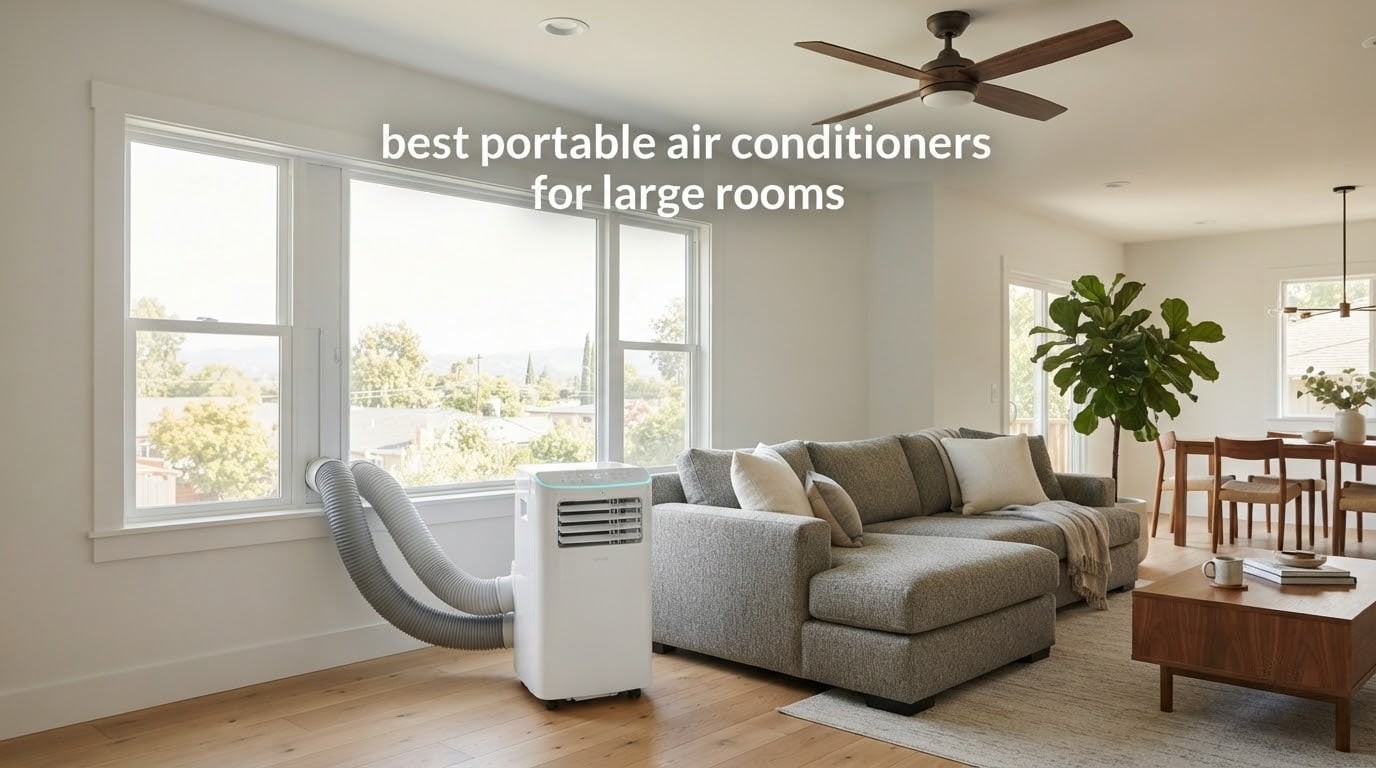
Most people shopping for the best portable air conditioners for large rooms start with a number on a box, and that is exactly where they go wrong. A 14,000 BTU label sounds impressive, but the number that predicts whether your living room actually cools is the SACC rating printed underneath it, and the difference between the two is routinely 30 percent or more.
We spent weeks reading spec sheets, owner reviews, and heatwave forum threads to put together this list, and every pick below is matched to a real room size. We also tell you plainly where each one falls short, because a portable AC that runs loud or fails to hold temperature in a 700 square foot open-plan space is a disappointment you find out about in August.
If your space is smaller, our guide to the best portable air conditioners for apartments covers tighter rooms. This one is focused on the 500 to 900 square foot range, where sizing, hose design, and placement actually decide the outcome.
Table of Contents
Top 3 Picks for Best Portable Air Conditioners for Large Rooms in October
The three below cover the widest range of large-room situations. The SereneLife leads on raw capacity and owner volume, the ZAFRO wins on efficiency and quiet running, and the Temprium is the one people pick when app and voice control matter more than raw BTU.
SereneLife 16,000 BTU Dual Hose Inverter
- 16000 BTU cooling and 11000 BTU heat
- Dual-hose inverter
- 850 sq ft coverage
- 42-49 dBA

ZAFRO 14,000 BTU Smart Inverter
- 10000 BTU SACC inverter
- Dual-hose
- CEER 12.8
- 42 dB sleep mode
Temprium 14,000 BTU Smart WiFi AC
- 14000 BTU for 750 sq ft
- 41 dB silent mode
- WiFi and voice control
- Self-evaporating
Best Portable Air Conditioners for Large Rooms at a Glance (2026)
Below is the whole list in one place, with the capacity, coverage, and noise figures for each model. Sort it by the column that matters most to your room, and read the individual reviews afterward for the tradeoffs.
| Product | Specifications | Action |
|---|---|---|
| SereneLife 16,000 BTU Dual Hose Inverter |
|
Check Latest Price |
| ZAFRO 14,000 BTU Smart Inverter |
|
Check Latest Price |
| Temprium 14,000 BTU Smart WiFi AC |
|
Check Latest Price |
 HUMHOLD 16,000 BTU Dual Hose Inverter HUMHOLD 16,000 BTU Dual Hose Inverter |
|
Check Latest Price |
 Tanoxo 14,000 BTU 3-in-1 Tanoxo 14,000 BTU 3-in-1 |
|
Check Latest Price |
 DOMANKI 16,000 BTU Inverter DOMANKI 16,000 BTU Inverter |
|
Check Latest Price |
 Garvee 14,000 BTU 3-in-1 Garvee 14,000 BTU 3-in-1 |
|
Check Latest Price |
 Gasbye 14,000 BTU DC Inverter Gasbye 14,000 BTU DC Inverter |
|
Check Latest Price |
 DOMANKI 14,000 BTU 3-in-1 DOMANKI 14,000 BTU 3-in-1 |
|
Check Latest Price |
 KoolSiln 14,000 BTU WiFi KoolSiln 14,000 BTU WiFi |
|
Check Latest Price |
1. SereneLife 16,000 BTU Dual Hose Inverter – Our Pick for 800+ Sq Ft
SereneLife 16,000 BTU Dual Hose Inverter Portable Air Conditioner | Portable Air Conditioner with Heat, Dehumidifier & Fan | Floor AC Unit for Bedroom, Living Room, & Office with Window Kit
16000 BTU cooling
11000 BTU heating
Dual-hose inverter
850 sq ft
1350W
Pros
- Cools rooms up to 850 sq ft with strong consistent airflow
- Dual-hose inverter holds steady temperature with no hot air leakage
- Four modes including heat makes it usable year-round
- Quiet operation rated 42-49 dBA
- Rolling wheels plus included window vent kit
Cons
- 49 pound weight makes it awkward to move between rooms
- Dual-hose exhaust requires a proper window kit installation
- About 9 percent of reviews are 1-star
This is the unit we keep coming back to for genuinely large spaces. It rates 16,000 BTU of cooling with 11,000 BTU of heating, covers up to 850 square feet, and runs a dual-hose exhaust so the room does not get pulled negative. That last detail is why it holds temperature in an open-plan living and dining space instead of just chilling the three feet in front of the grille.
The inverter compressor is the other reason it earned the top spot. Instead of kicking on and off at full power, it modulates, which is quieter and easier on the compressor over a long afternoon. Noise is listed at 42 to 49 dBA depending on mode, which puts it in the quieter half of this group.
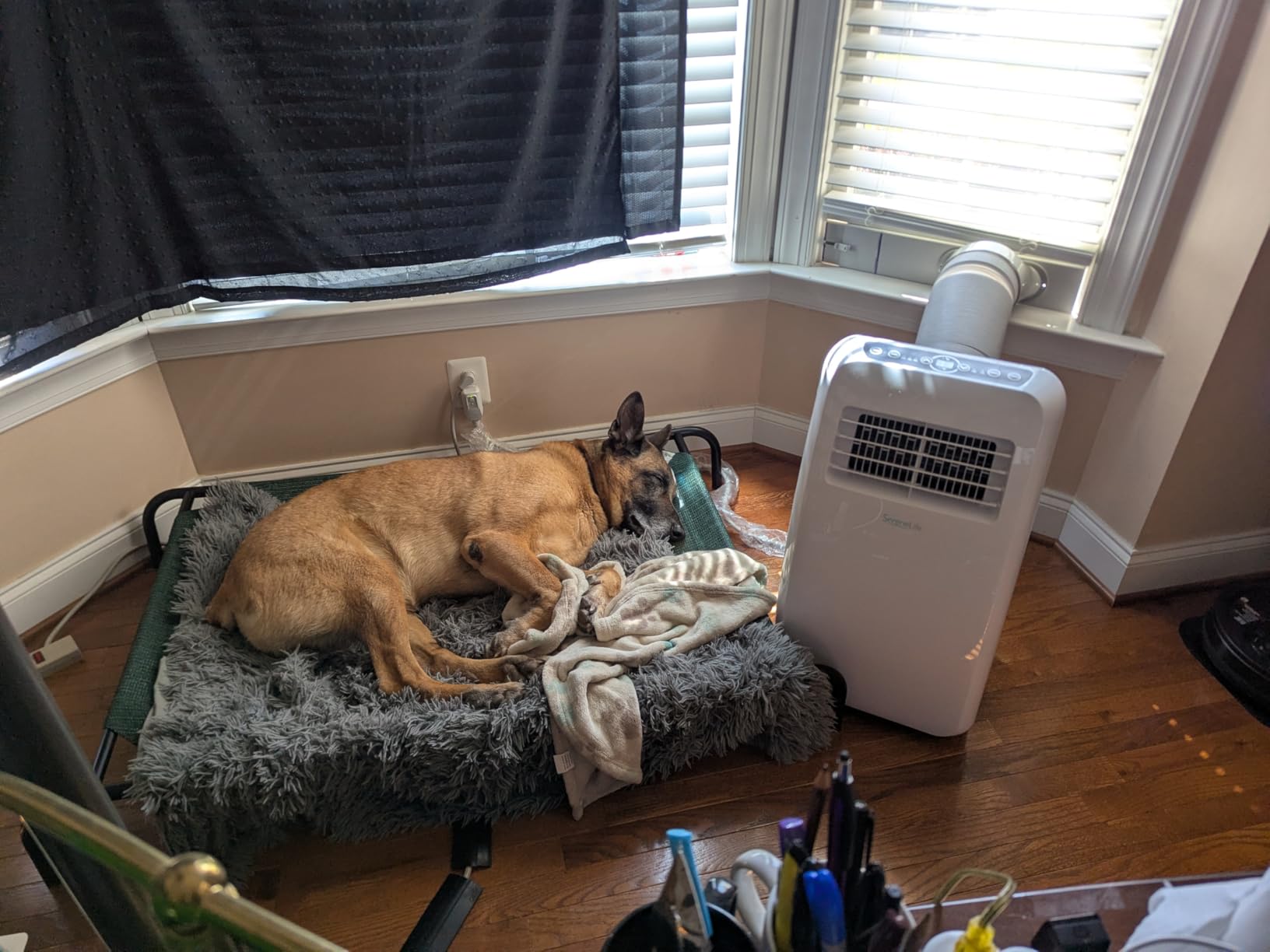
What convinced us most was the review volume. At more than 10,000 owner reviews this is the largest pool in the roundup, so the feedback is not a handful of early adopters. Owners consistently describe strong airflow across big rooms, and the same complaints repeat: it is heavy at 49 pounds, and the dual-hose setup only works properly if you seal the window kit correctly.
Roughly 9 percent of reviews are 1-star, which is a normal reliability spread for a compressor of this size and worth taking seriously. The heating mode is a genuine bonus for shoulder-season months, and the rolling wheels mean you can move it between the living room and a bedroom without a dolly.
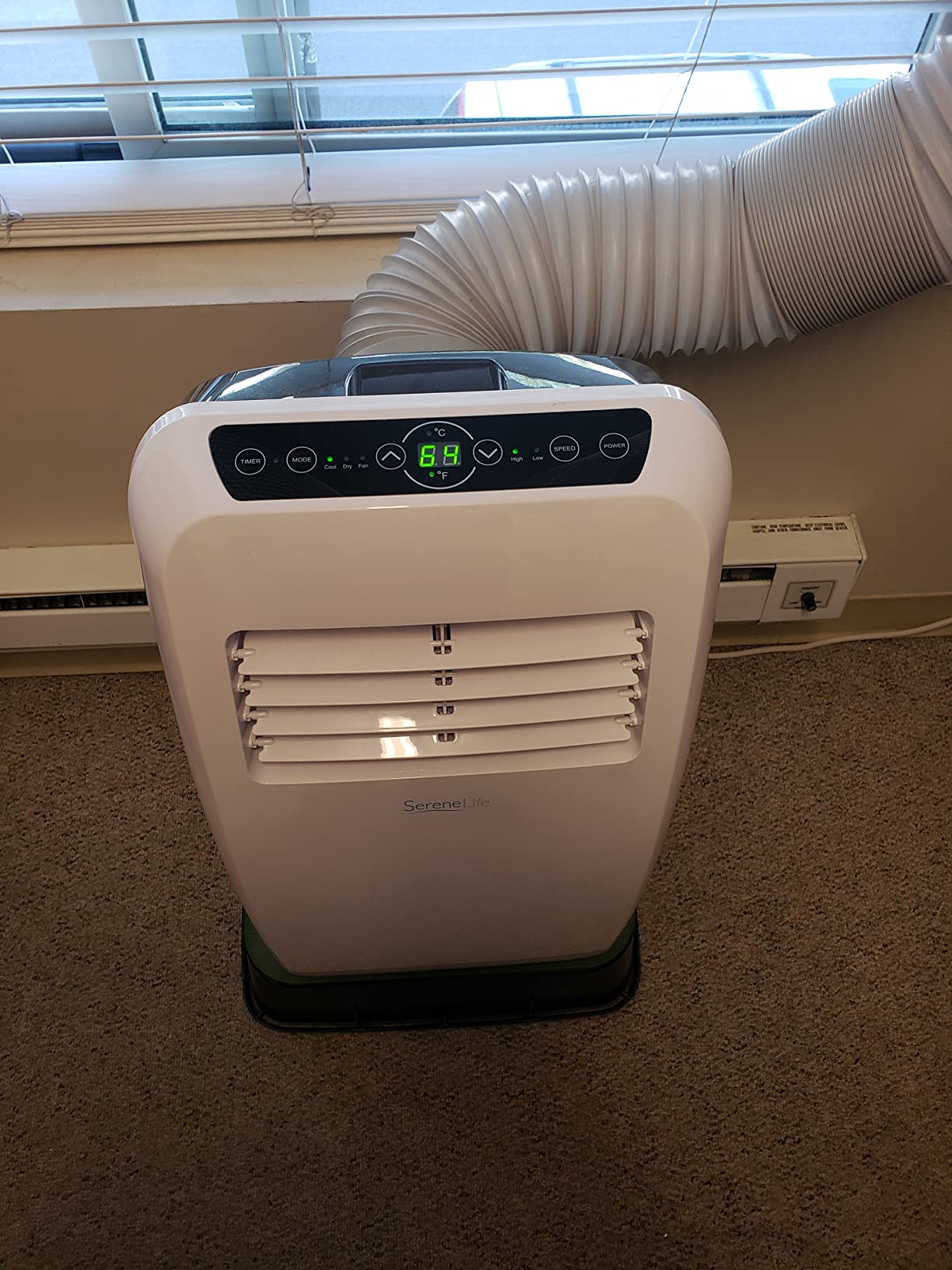
How it handles a large open-plan room
Owners running it in 700 to 800 square foot spaces report a fairly even chill rather than a directional blast. The 15 to 75 degree louver sweep helps spread that air, and the dual-hose layout means no negative pressure pulling warm outside air back in through door cracks.
The honest limit is heat. On a peak afternoon with west-facing glass, a 16,000 BTU unit works hard, and you will hear the compressor cycle. It holds far better than any 14,000 BTU single-hose model, but it is not a central system replacement.
Where it is the wrong choice
It is the wrong pick if you plan to move it between floors often. At 49 pounds it is manageable but awkward, and the wheels only help on flat floors. It is also overkill for a room under about 400 square feet, where a smaller unit would do the same job at lower power draw.
If your priority is maximum efficiency rather than maximum capacity, the Gasbye later in this list runs at a much lower wattage in inverter mode. This one prioritizes BTU first.
2. ZAFRO 14,000 BTU Smart Inverter – Quiet Efficiency Leader
ZAFRO Smart Inverter Portable Air Conditioners, 14000 BTU (10000 BTU SACC)
14000 BTU ASHRAE
10000 BTU SACC
CEER 12.8
42 dB
1250W
Pros
- CEER of 12.8 is the highest efficiency figure among the dual-hose 14000 BTU models
- 72-hour drainage-free self-evaporation in typical humidity
- As quiet as 42 dB with a dedicated sleep mode
- Six operating modes plus four-way oscillation
- App remote and touch control with 24-hour timer
Cons
- 54 pound weight sits at the heavier end for a portable
- About 10 percent of reviews are 1-star
- Drain hose still needed above 90 percent relative humidity
ZAFRO rates this unit at 14,000 BTU ASHRAE and 10,000 BTU SACC, covers rooms up to 700 square feet, and pairs a dual-hose exhaust with an inverter compressor. That combination is the sweet spot for most large living rooms, and the 12.8 CEER rating is the strongest efficiency figure we found among the 14,000 BTU dual-hose models here.
Owners single out the sleep mode most often. At 42 dB it is quiet enough to run in a bedroom or a home office overnight, and the six operating modes give you an eco setting that holds a setpoint without cycling the compressor hard.
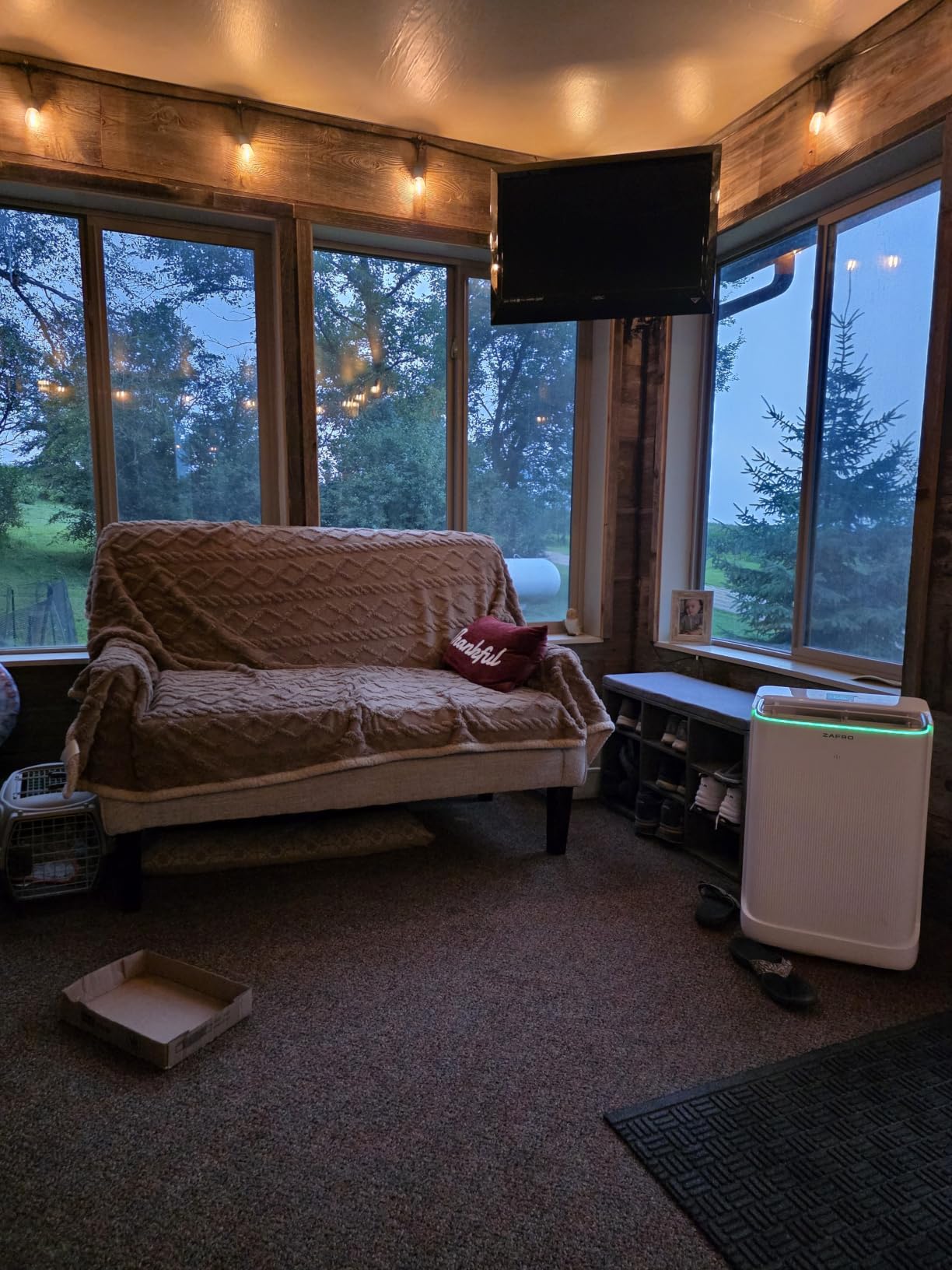
The 72-hour drainage-free claim is the feature that matters most in humid summers, and reviewers say it holds up in ordinary conditions. Above 90 percent relative humidity you still want the included drain hose, but that is an edge case rather than a daily chore.
With 466 reviews at 4.3 stars, this is a well-supported pick rather than a gamble. The main complaints are physical: at 54 pounds it is one of the heavier units, and about 10 percent of reviews are 1-star, which is the highest 1-star share among the top-rated models in this list.
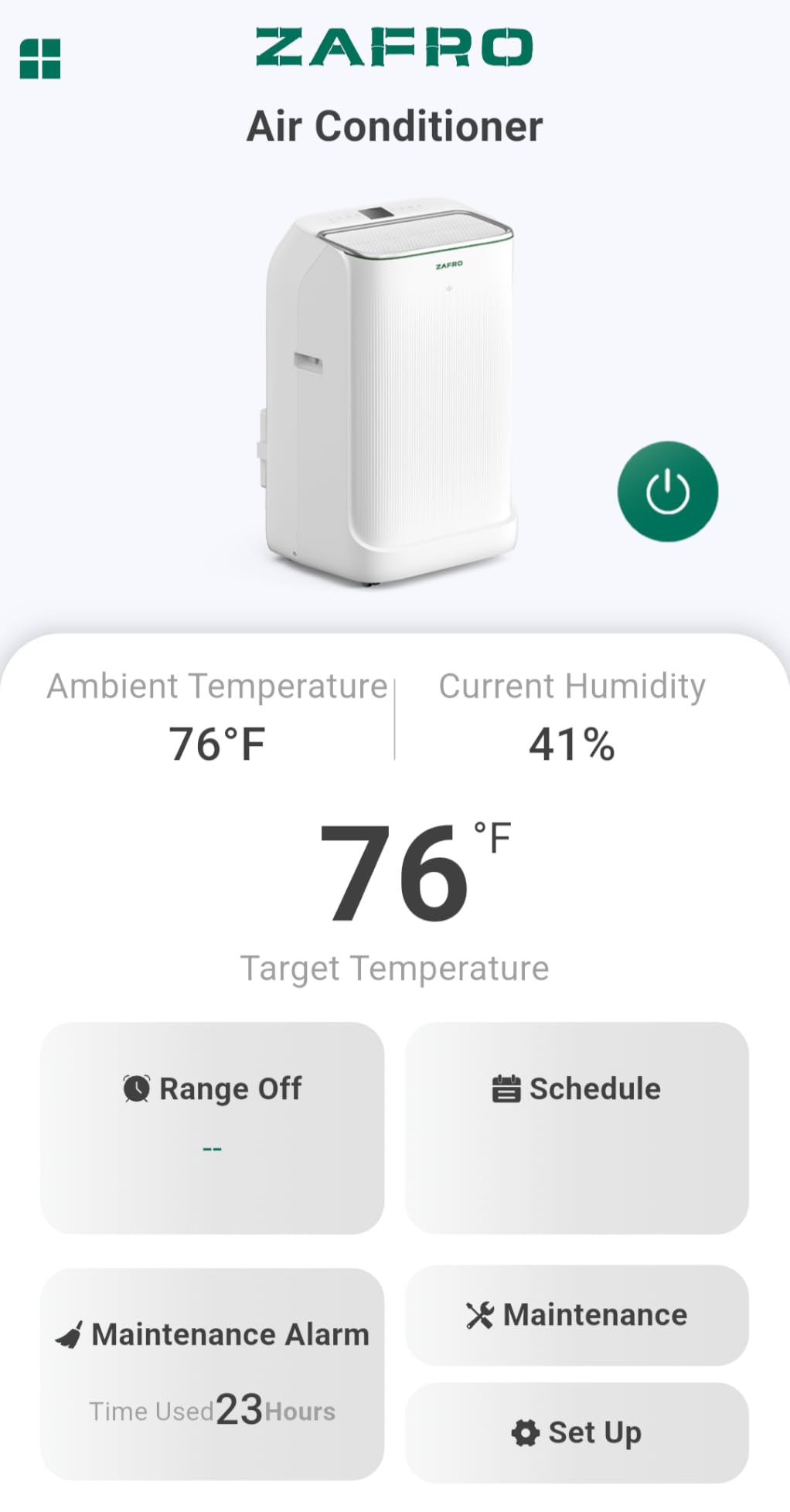
Why the efficiency rating matters in a big room
A 700 square foot room takes many hours of runtime to pull down and hold. Running hours are where a CEER of 12.8 pays off, because the compressor spends less electricity per hour of the same cooling output. Over a full summer that difference shows up on the meter.
Annual energy consumption is listed at 942 kilowatt hours, which is a useful number to have when you compare running cost against a window unit or a ductless alternative.
When to pick a different unit
It is not the right choice above roughly 700 square feet, particularly with high ceilings where hot air stratifies. It is also the wrong pick if you need a heat mode, since this one cools, dries, and fans but does not heat.
At 54 pounds, treat it as a semi-permanent installation rather than something you drag between rooms. The window panels it ships with span a wide range of openings, from 17.72 to 70.87 inches, which helps with awkward window sizes.
3. Temprium 14,000 BTU Smart WiFi – App and Voice Control
14,000 BTU Portable Air Conditioner, 4-in-1 Smart AC with WiFi
14000 BTU
750 sq ft
41 dB silent mode
1440W
Cooling fan dry
Pros
- App control plus Alexa and Google Assistant voice control
- Owners repeatedly call it the quietest unit they have used
- Several reviewers confirm it keeps a 700 sq ft room cool
- No-drill window kit setup in about 15 minutes
- Self-evaporating system with washable filters
Cons
- Owners report it struggles in extreme heat over 500-600 sq ft
- Water tray can fill every couple of hours on high fan
- 68.6 pounds is the second-heaviest unit here
- Turbo mode and app scheduler reported as underperforming
This is the pick for people who want control from a phone. It works with an app, Amazon Alexa, and Google Assistant, plus a remote and a touch panel as backup. It rates 14,000 BTU of cooling, covers up to 750 square feet, and drops to 41 dB in silent mode, the lowest published noise figure in this group.
That silence is not a marketing claim pulled from nowhere. Owners describe it as a background hum rather than something distracting, and several reviewers note they run it in an office without the fan noise becoming a problem on calls.
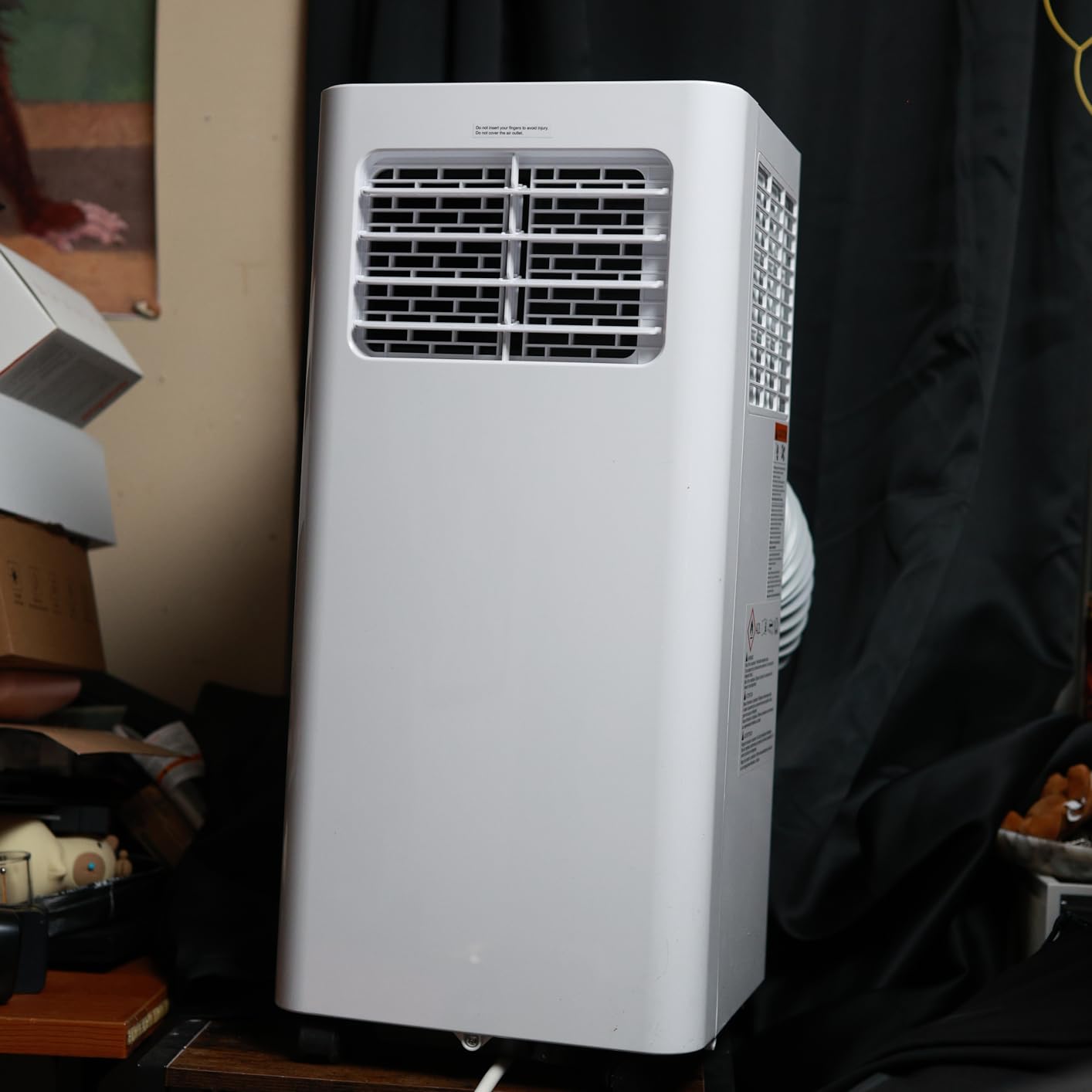
The catch is honest performance feedback. Multiple owners say it struggles to keep a 500 to 600 square foot room comfortable once outdoor temperatures reach the upper 90s or climb past 100F, and the review analysis suggests real-world capacity closer to 450 to 500 square feet than the advertised 750. If you are in a climate where the thermometer does that regularly, size up instead.
There are other friction points worth knowing. The water tray can fill every couple of hours on the highest fan setting, and reviewers report the turbo mode and the app scheduler as underperforming, with schedules that are difficult to edit once set.
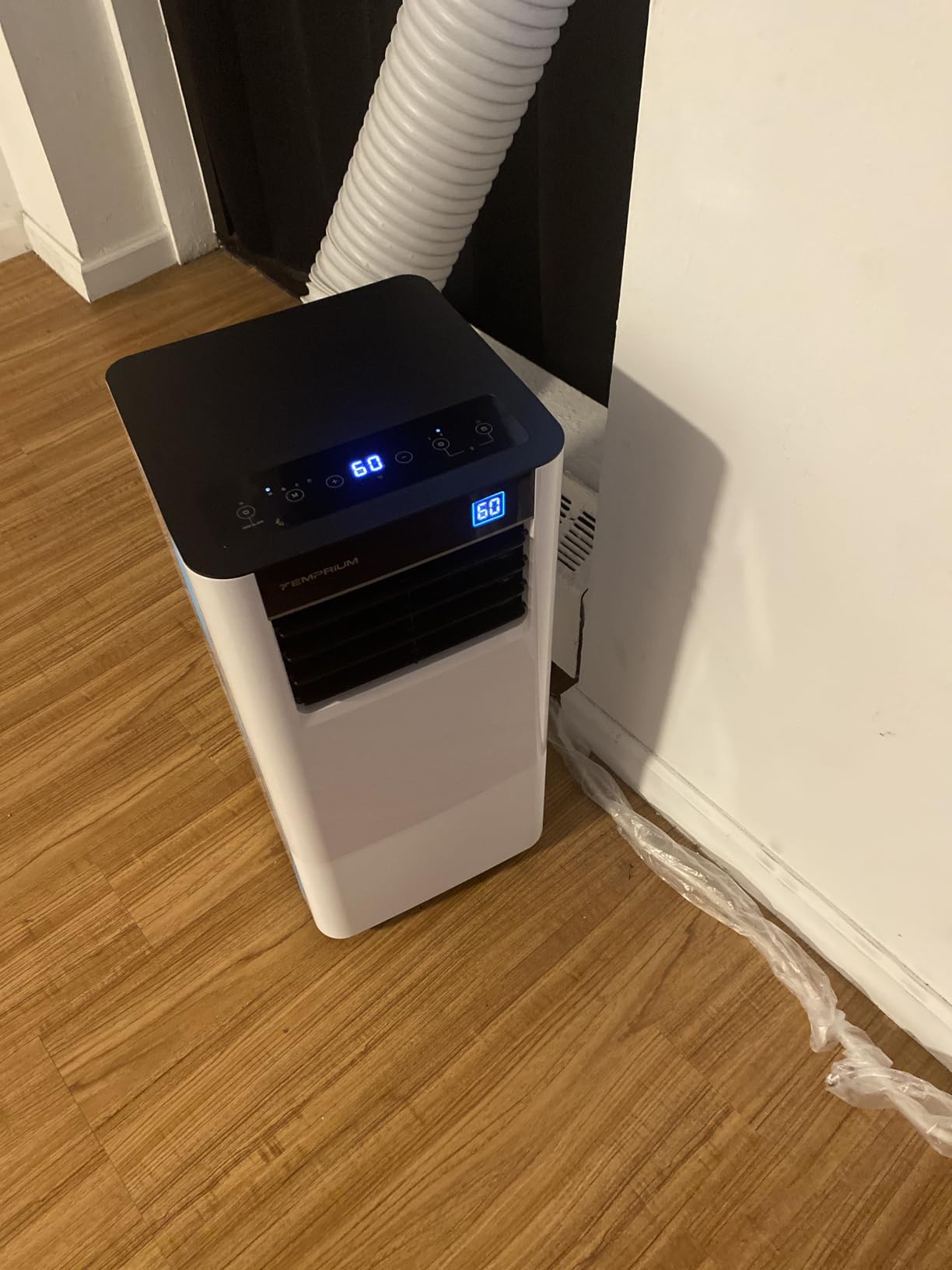
How it behaves in a 700 square foot space
Several reviewers do confirm it holds a 700 square foot room comfortably in moderate weather. The dual motor compressor moves 400 CFM of air, which is enough to keep air moving across a wide area, and the no-drill window kit fits openings from 20.5 to 50 inches for a fast setup.
In peak summer heat, the same owners report the unit running continuously without reaching setpoint. That is the honest limit of a 14,000 BTU unit against a large volume of glass and a high ceiling.
Where it falls short
At 68.6 pounds it is the second-heaviest unit we covered, and the built-in handle plus 360-degree wheels only really help on flat floors. CEER is listed at 7.8, the lowest efficiency rating among the models here, so it draws 1,440 watts at full load.
One verified review reports the unit shutting off randomly within about 40 days, and the 346-review pool is not large enough to call that a pattern. If you need the highest efficiency, look at the ZAFRO or Gasbye instead.
4. HUMHOLD 16,000 BTU Dual Hose – Strongest 12,000 SACC Pick
Humhold Inverter 16000BTU Portable Air Conditioners with Remote, Free Stand Cooling Portable AC Unit for Room up to 800 sq.ft, with Dehumidifier & Fan, Dual Hose, Quiet Sleep Mode(42dB), Windows Kit
16000 BTU ASHRAE
12000 BTU SACC
Dual-hose
600-800 sq ft
42 dB
Pros
- Owners report pulling rooms down to the low 60s within a couple of hours
- Very quiet for a 16000 BTU capacity
- Works as a primary cooler in a 600 sq ft apartment and a 30-foot fifth-wheel RV
- Condensate exits with the exhaust so no drainage routine
- Three-step installation with the included window sealing kit
Cons
- About 17 percent of reviews are 1-star
- One verified review reports it running as a fan only above 80F outdoor
- Fan mode is considered weak by some reviewers
- 61 pound weight makes it hard to move between floors
HUMHOLD rates this at 16,000 BTU ASHRAE and 12,000 BTU SACC, which makes it one of the few units here that carries a real three-digit SACC figure at the top of the range. It covers 600 to 800 square feet, uses a dual-hose intake and exhaust, and runs at 1,450 watts.
Owners report pulling rooms down to the low 60s within a couple of hours, and several describe it working as the primary cooler in a 600 square foot apartment or a 30-foot fifth-wheel RV. The dual-hose design circulates air evenly without creating an uncomfortable draft aimed at one spot.
At 42 dB in sleep mode, it is quiet for its size. Reviewers call it purring rather than humming, which is notable on a unit with this much cooling capacity. The rotary scroll compressor is rated for 95 pints of dehumidification per day, and condensate leaves with the exhaust in normal use.
This is also the most polarizing unit in the roundup. It holds a 4.0 average, the lowest here, with about 17 percent of reviews at 1-star. One verified review reports the unit stopping its cooling cycle and running as a fan only when outdoor temperatures climb above 80F, which points to overheat protection kicking in early.
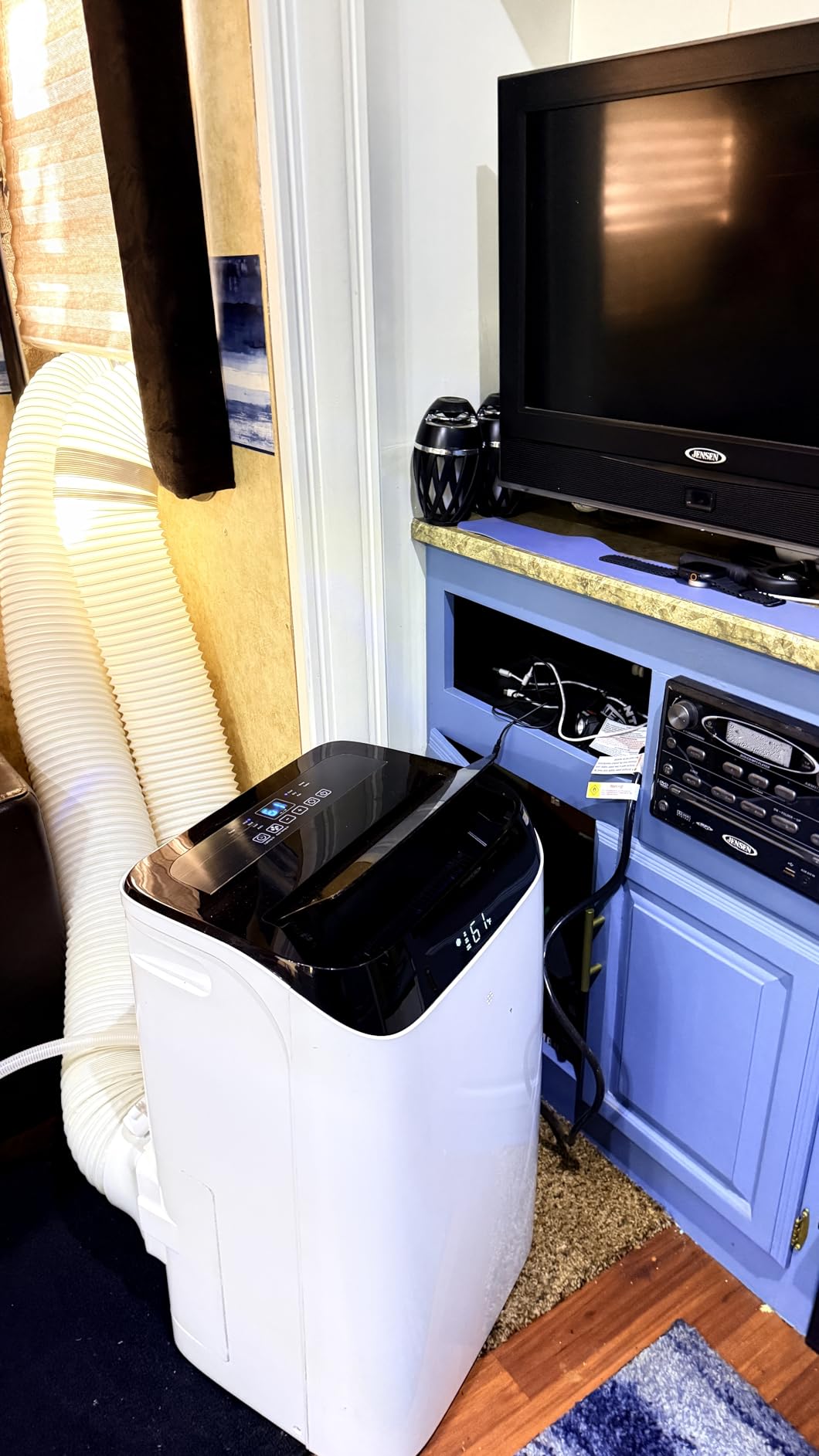
Best for RVs and non-standard spaces
Because the cooling capacity is genuine rather than aspirational, it works well in tight, insulated spaces where a 12,000 SACC rating is exactly what you need. The included window sealing kit makes setup a three-step process, and the auto-swing louver covers 15 to 75 degrees.
For a 600 to 800 square foot room in a house, it performs well provided you can keep the exhaust hose short. The listed operating range runs 61F to 86F, so very hot afternoons are its weak point.
When to skip it
Skip it if you need a hard guarantee of holding temperature through a severe heatwave, given the overheat protection reports. The 61-pound weight is also a real barrier to moving it between floors, and the remote reaches 25 feet, which you will want in a large room.
Condensate needs manual draining every 8 hours in humid rooms or when running in dry mode. If humidity is your main problem, our guide to the best humidifiers for large rooms covers a different solution.
5. Tanoxo 14,000 BTU 3-in-1 – Straightforward 700 Sq Ft Option
14000 BTU Portable Air Conditioners, Cooling,Fan,Dehumidification,Sleep Mode for Large Rooms up to 700 Sq.Ft, AC Unit with Remote Control, 24H Timer, Installation Kits Included
14000 BTU ASHRAE
10000 BTU SACC
700 sq ft
48 dB
1250W
Pros
- Lowest cost per BTU among the 14000 BTU models here
- Three-in-one design covering cooling fan and dehumidification
- Auto-oscillating vent with three fan speeds
- Condenser handles moisture automatically below 85 percent humidity
- Backlit remote plus touch display and 360-degree casters
Cons
- 48 dB is louder than the 42-45 dB models in this group
- 65 pounds despite the lower price point
- Less efficient exhaust design than the dual-hose models
- Manual drainage still needed in extreme humidity
The Tanoxo is a 14,000 BTU ASHRAE and 10,000 BTU SACC unit rated for rooms up to 700 square feet. It runs at 1,250 watts with R-32 refrigerant, and the three-in-one design covers cooling, fan, and dehumidification in a single cabinet with a window installation kit in the box.
Owners like the smart mode, which uses an internal sensor to switch between cooling and fan automatically rather than running the compressor continuously. Temperature control runs in 1 degree increments from 61F to 88F, and the 24-hour timer covers overnight scheduling.
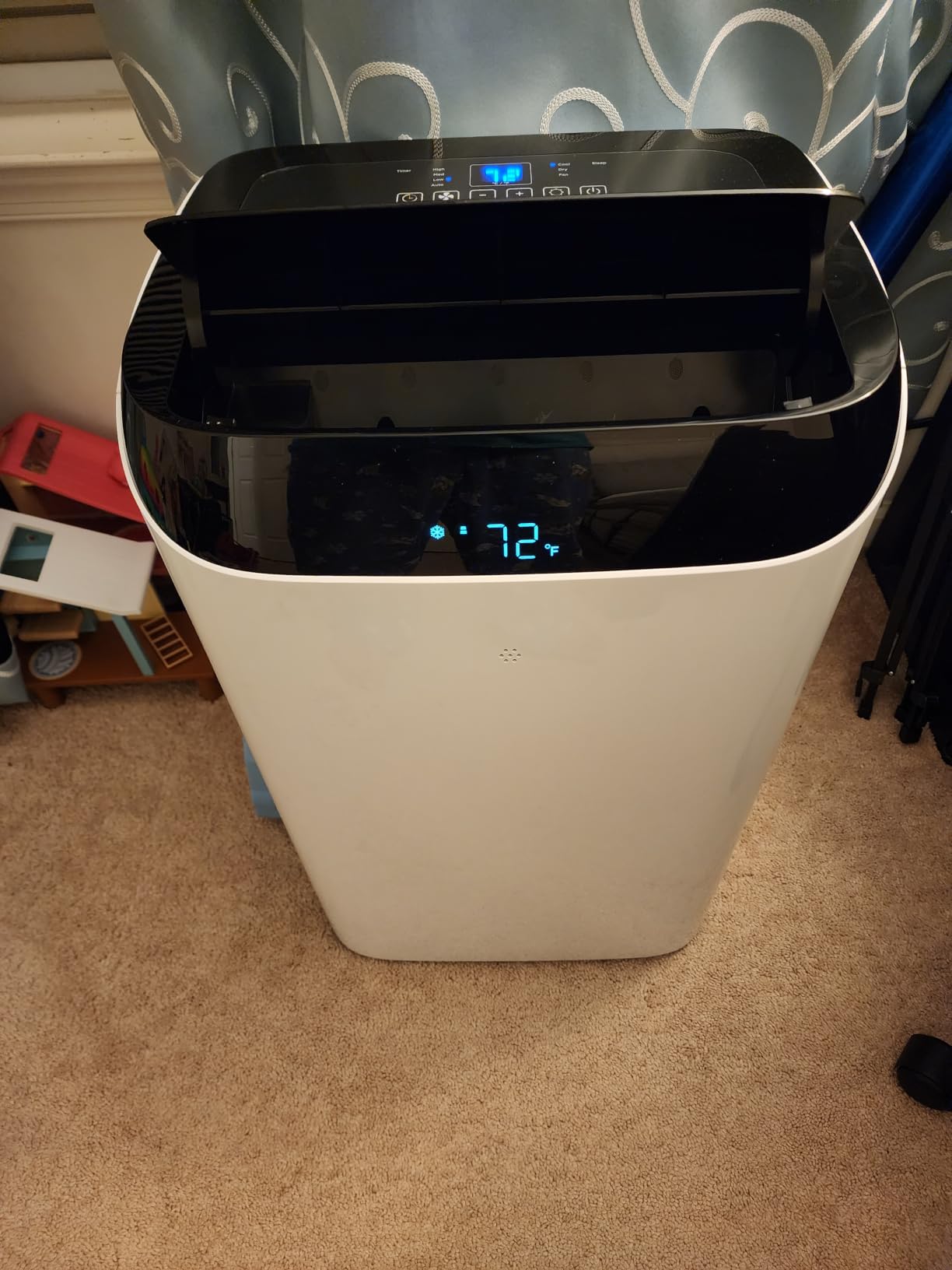
Two things stand out against the premium inverter models. The 48 dB noise rating is louder than the 42 to 45 dB units in this group, and the exhaust design is less efficient than the dual-hose models priced above it. In a quiet bedroom at night, that difference is audible.
At 65 pounds it is also heavy despite the lower price point. The condensate system handles moisture automatically below 85 percent humidity, but extreme humidity still means manual draining, and the tank is one liter.
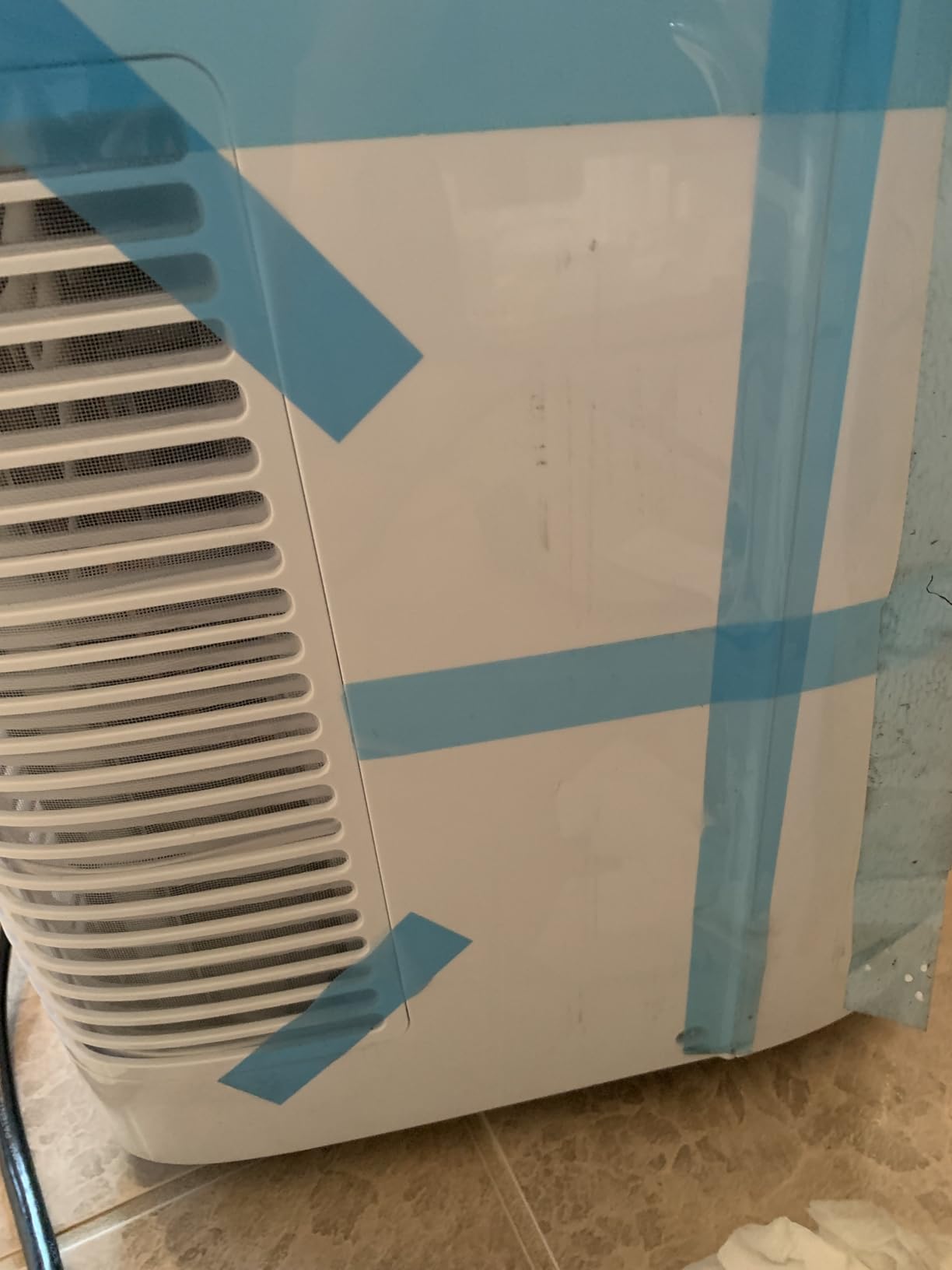
Why it suits a rental or temporary space
Everything needed to run it arrives in the box, including the remote, quick guide, and window kits with hose. There is nothing to buy separately, which matters if you are furnishing a rental, a dorm, or a guest room and want the unit back out at the end of the season.
The 360-degree casters and recessed handle make repositioning between two rooms realistic, and the backlit remote reaches 23 feet so you do not have to walk across the room to change anything.
Where it loses ground
Noise is the main compromise at 48 dB, followed by exhaust efficiency. If your large room is a home office you use during calls, the ZAFRO at 42 dB is a better fit. If you care most about energy use per hour, the CEER figure on this model is not competitive with the inverter units here.
The listing also sits well below the others in sales rank, so it is the least established of the group. Budget accordingly and check the warranty terms, which are one year and limited.
6. DOMANKI 16,000 BTU Inverter – Widest Stated Coverage
Inverter 16000 BTU Portable Air Conditioner, 3 in 1 Portable Ac Unit Cools Up for Rooms 850 Sq. Ft, Dual Hose Standing AC for Bedrooms with Dehumidifier, Fan, Quiet Sleep Mode, Remote Control
16000 BTU ASHRAE
12000 BTU SACC
850 sq ft
42 dB
1300W
Pros
- Largest stated coverage area here at 850 sq ft from a 16000 BTU capacity
- Inverter compressor claimed to save up to 40 percent electricity
- 42 dB sleep mode with automatic display dimming
- DOE ETL certified with a 4 Star BEE energy rating
- Auto-evaporation handles condensate in roughly 85 percent of environments
Cons
- Smallest review pool here at 81 reviews so long-term data is thin
- Inverter hardware costs more than comparable 14000 BTU models
- Only single-axis auto-swing
- Remote requires AAA batteries that are not included
This DOMANKI model pairs 16,000 BTU ASHRAE cooling with 12,000 BTU SACC and a stated coverage area of up to 850 square feet. It draws 1,300 watts, uses R-32 refrigerant, and carries a 4 Star BEE energy rating alongside DOE ETL certification.
That coverage figure is the reason it earns a place. For a great room or a high-ceilinged space where 700 square feet is not enough, it is one of only two units here rated above 800 square feet. The dual-hose design keeps indoor pressure balanced and supports the inverter’s claimed electricity savings of up to 40 percent.
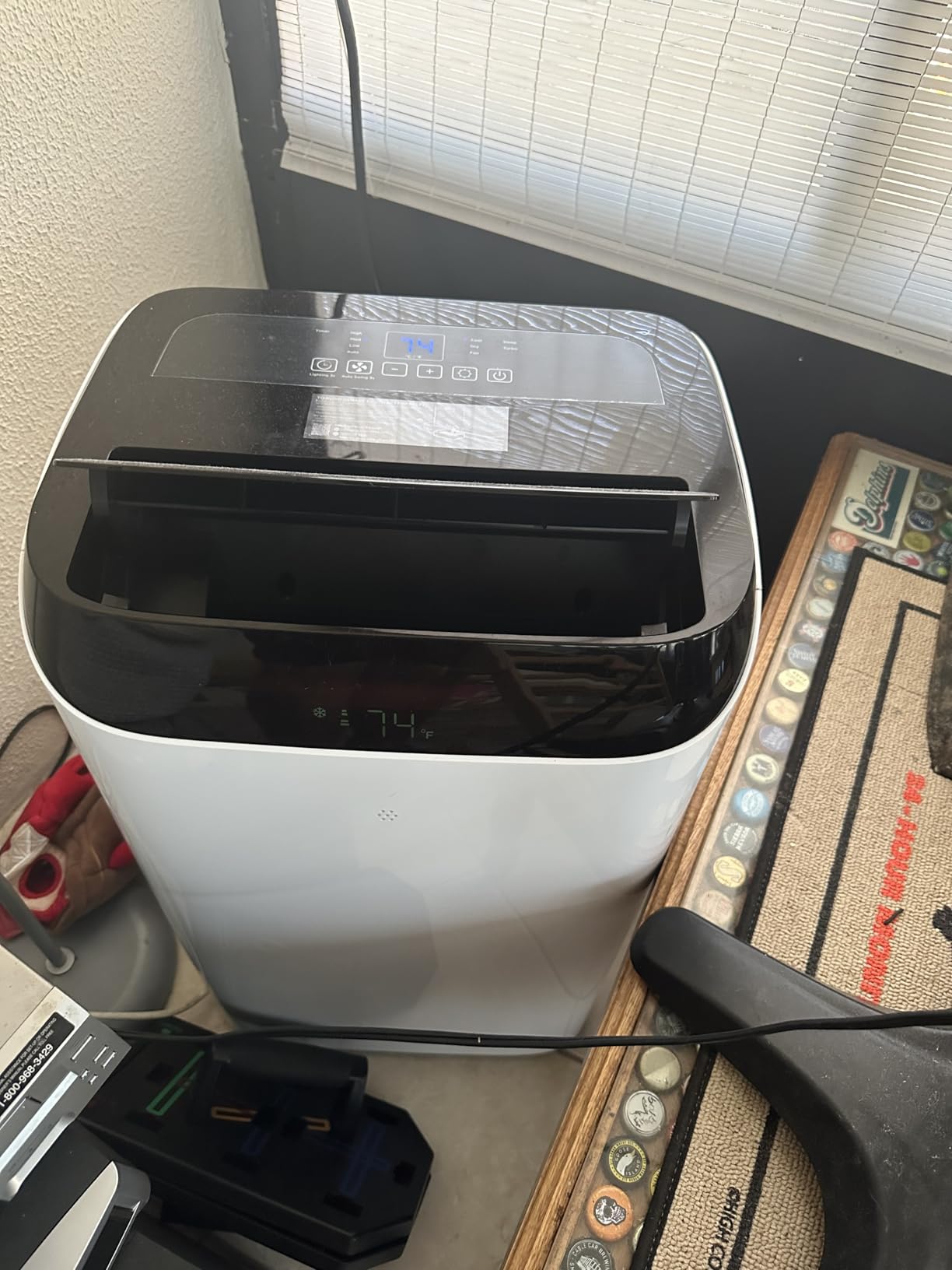
Feature-wise it is well equipped: four fan speeds, a 15 to 75 degree auto-swing louver, a 0.5 to 24-hour timer, a child lock, a removable washable filter, and a 42 dB sleep mode that dims the display automatically. The window kit fits standard windows up to 60 inches wide with no drilling.
The obvious caveat is evidence. With 81 reviews this has the smallest pool in the roundup, so the 4.3-star average and 65 percent five-star share rest on a limited number of owners. Sentiment is strongly positive, but there is not yet a long-term reliability picture, and the manufacturer does not publish the item weight.
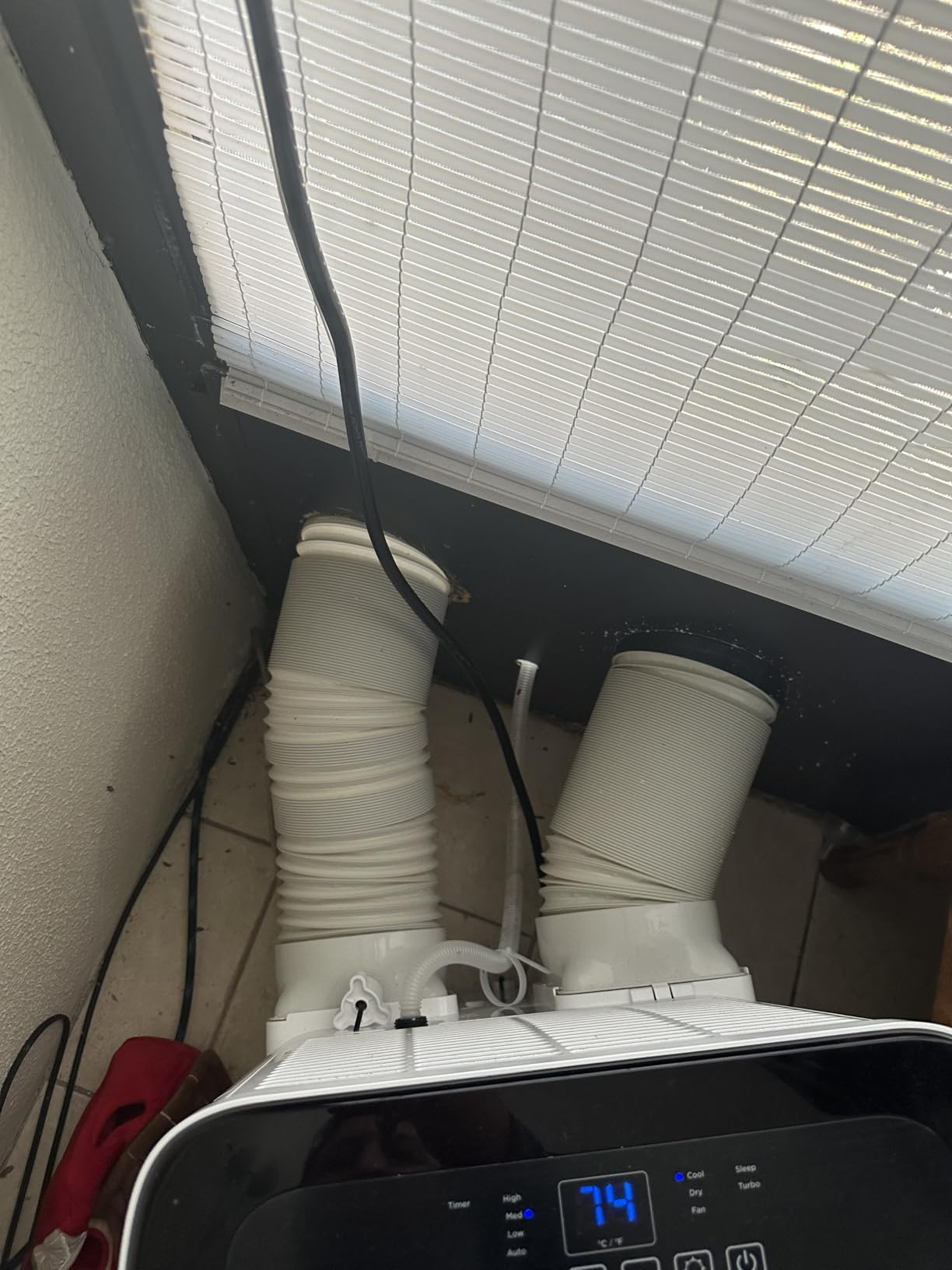
When an 850 square foot rating is worth chasing
Stated coverage numbers assume standard conditions, so treat 850 square feet as a ceiling rather than a guarantee. In a room with high ceilings, west-facing glass, or several people generating heat, plan on effective coverage closer to 650 to 700 square feet.
Even so, if your space is above 750 square feet, this and the SereneLife are the only realistic candidates in this list. Between them, the SereneLife has far more owner history behind it.
Where it falls short
The single-axis auto-swing is a step down from the four-way oscillation on the ZAFRO, which matters in a large room where you want air moving in more than one direction. The remote also needs AAA batteries that are not included, a small annoyance on day one.
Warranty terms are a limited manufacturer warranty, and the 81-review pool means you are buying on specifications more than on proven longevity. If you want an established brand and a long support history, this is not the one.
7. Garvee 14,000 BTU 3-in-1 – Budget Pick
Garvee 3-in-1 Portable Air Conditioner, 14000 BTU (9300 BTU SACC) AC Unit
14000 BTU ASHRAE
9300 BTU SACC
750 sq ft
50 dB
1155W
Pros
- Lowest cost per BTU among the 14000 BTU units here
- Rated for rooms up to 750 sq ft despite the entry-level tier
- Best star distribution relative to price with 67 percent five-star and only 3 percent one-star
- 3-in-1 operation as air conditioner fan and dehumidifier
- Rolling casters and ergonomic side handles for moving
Cons
- 85.3 pounds is by far the heaviest unit here
- Largest physical footprint at 20.16 by 18.11 by 33.66 inches
- 50 dB is the loudest rating in this group
- Remote only with no app or voice assistant support
The Garvee is rated 14,000 BTU ASHRAE and 9,300 BTU SACC, covers rooms up to 750 square feet, and runs at 1,155 watts, the lowest power draw among the models here. It sits at the entry tier of this roundup by a wide margin, and the 4.3-star average is the joint-second-highest.
What stands out in the reviews is the star distribution relative to its tier. With 67 percent five-star and only 3 percent one-star, it has the smallest 1-star share of any unit here, which is unusual for an entry-level listing. The 3-in-1 design handles air conditioning, fan, and 90 pints of dehumidification.
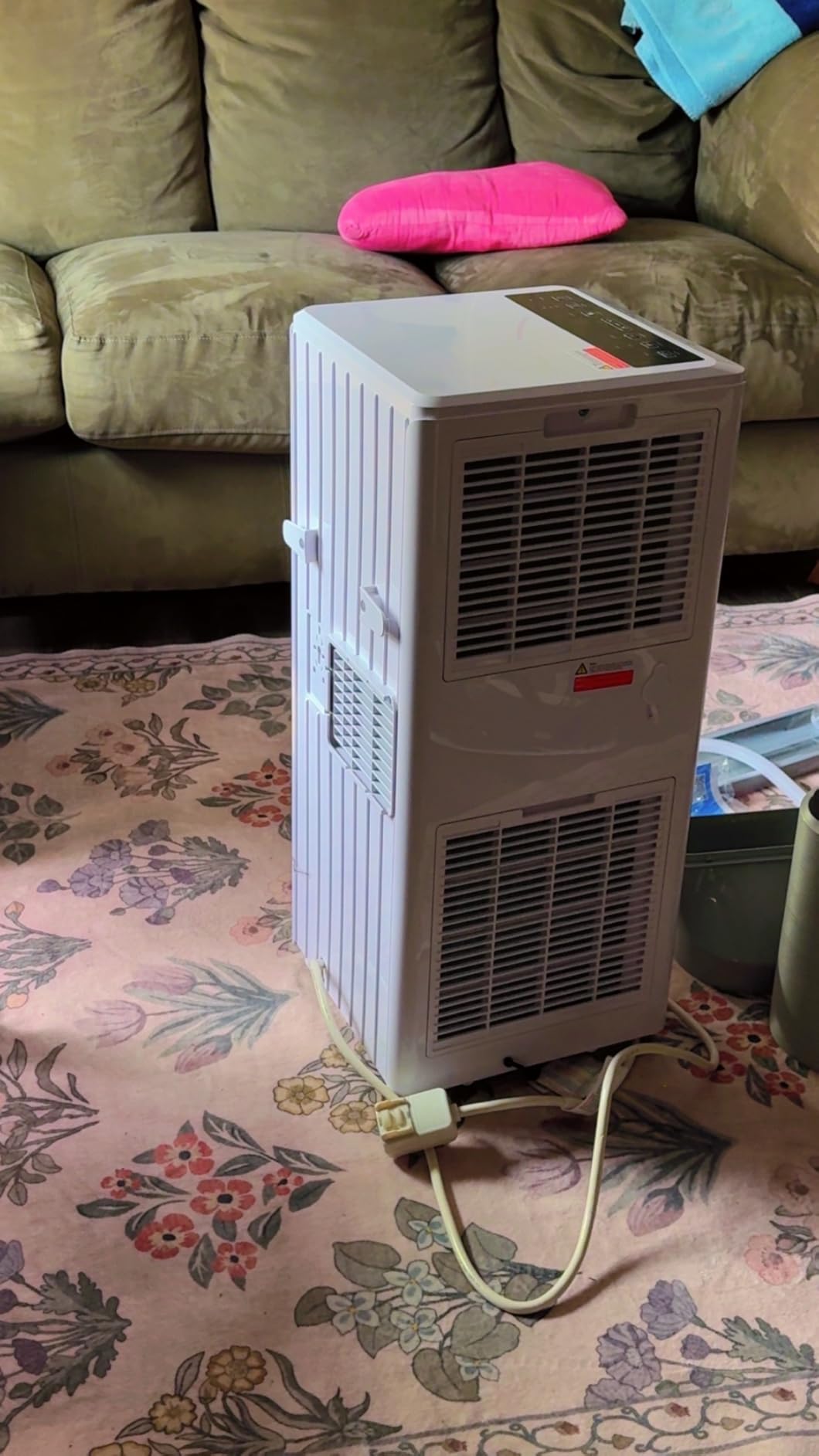
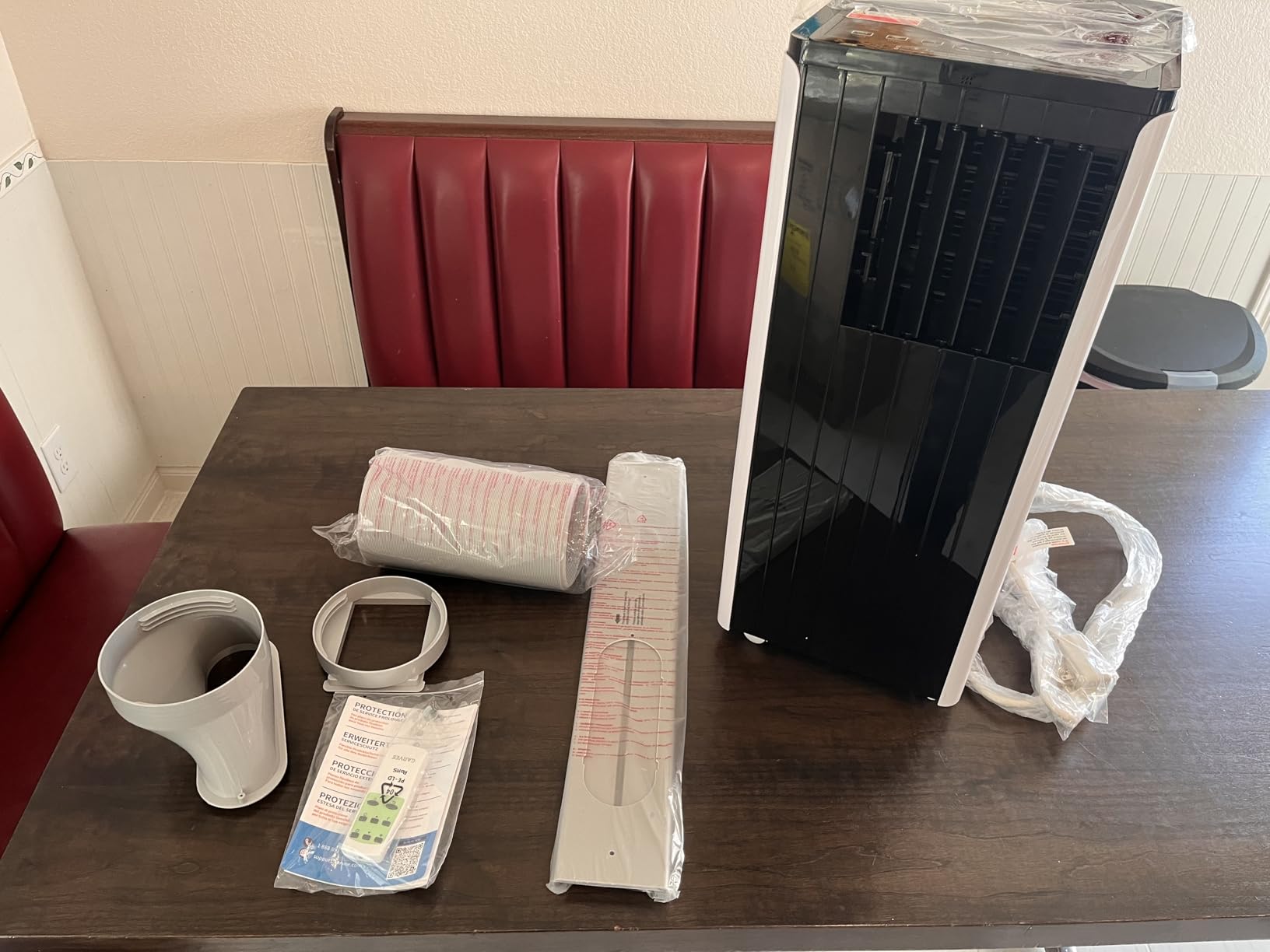
The tradeoffs are physical and audible. At 85.3 pounds this is the heaviest unit we covered, and the 20.16 by 18.11 by 33.66 inch cabinet is the largest footprint in the group, so it needs a genuinely open corner of the room. The 50 dB rating is also the loudest here.
There is no inverter compressor, so it runs at fixed output rather than modulating, and control is remote only with no app or voice assistant. The no-drill window kit with adjustable exhaust hose fits most double-hung or sliding windows, which helps with awkward installs.
Where it makes sense on a budget
If you need a large room usable in summer and you are furnishing a garage, a rental, or a secondary living space on a tight budget, this covers 750 square feet of stated capacity more economically than any other option in this list. The 1,155 watt draw also makes it inexpensive to operate relative to the 1,440 to 1,450 watt units above it.
Consolidation matters here. A single 14,000 BTU unit cooling one large area usually costs less to run than two smaller models, which is a real advantage when the purchase budget is the main constraint.
When to spend more instead
Do not buy this for a bedroom, a home office, or any space where noise matters. At 50 dB it is the loudest in the group, and the fixed-output compressor means you cannot soften it with a variable-speed setting.
The 85-pound weight is the other reason to look elsewhere if you plan to move it. Consider it a set-in-place unit rather than a portable one despite the category name.
8. Gasbye 14,000 BTU DC Inverter – Best Efficiency Per Watt
Gasbye Dual Hose Portable Air Conditioner, [2026 Upgraded] Full DC Inverter Compressor, Energy-Saving 13.6 CEER, Low Noise (45dB), Cools Room up to 500 Sq.Ft., Backlit Remote Control, 14,000BTU, White
14000 BTU ASHRAE
10500 BTU SACC
13.6 CEER
45 dB
3-year warranty
Pros
- Highest average rating here at 4.4 with 76 percent five-star reviews
- 13.6 CEER is the best efficiency figure in the group cutting to 500-800 watts in inverter mode
- Full DC inverter drops to roughly 50 percent load within two minutes
- Dual-hose design avoids negative pressure and hot air influx
- Three-year warranty is the longest in this comparison
Cons
- Honest 500 sq ft coverage rating despite the 14000 BTU headline
- Manufacturer flags this as a full-size unit so check your clearance
- Manual drainage can be required above 85 percent relative humidity
- Included window brackets may be too short for wider windows
The Gasbye is the efficiency pick of this roundup. It carries a 13.6 CEER rating, the best verified figure among the models here, and a full DC inverter compressor that drops to roughly 50 percent load within about two minutes of reaching setpoint. Power draw drops from 800 to 1,300 watts in turbo mode to 500 to 800 watts in inverter mode.
It also holds the highest average rating in the group at 4.4 stars, with 76 percent of reviews at five stars and only 5 percent at one star. That is the most consistent rating distribution of any unit we looked at.
![Gasbye Dual Hose Portable Air Conditioner, [2026 Upgraded] Full DC Inverter Compressor, Energy-Saving 13.6 CEER, Low Noise (45dB), Cools Room up to 500 Sq.Ft., Backlit Remote Control, 14,000BTU, White customer photo 1](https://austineubanks.com/wp-content/uploads/2026/09/B0DXKBG6LT_customer_1.jpg)
Here is the part that catches people out. The manufacturer rates this unit at 14,000 BTU ASHRAE and 10,500 BTU SACC but states coverage of up to 500 square feet, the smallest coverage claim in this roundup. That is not a flaw. It is honest sizing, and it reflects a real 14,000 BTU machine rather than an inflated mini-unit number.
It is also a full-size cabinet at 15.5 by 17.7 by 29.3 inches, so measure your clearance before ordering. The three-year limited warranty is the longest here, and the brand offers full refunds or replacement units rather than refurbished replacements.
![Gasbye Dual Hose Portable Air Conditioner, [2026 Upgraded] Full DC Inverter Compressor, Energy-Saving 13.6 CEER, Low Noise (45dB), Cools Room up to 500 Sq.Ft., Backlit Remote Control, 14,000BTU, White customer photo 2](https://austineubanks.com/wp-content/uploads/2026/09/B0DXKBG6LT_customer_2.jpg)
Why 500 square feet is a feature, not a bug
Most listings in this price band claim 700 to 800 square feet on far less real capacity. If you are sizing for a 450 to 550 square foot room, this unit delivers that honestly, and the 442 kilowatt hours per year listed consumption is the lowest annual figure in the group.
For a large room, the honest capacity means you would need two of these rather than one, which is exactly the tradeoff discussed later in this guide.
Where it stops working
It will not cool a 700 square foot open-plan space, and buying it for that job is the most common mistake we see in this category. Manual drainage can be required when humidity exceeds 85 percent relative humidity in a room that is not well sealed.
The included window brackets may be too short for wider windows, and the manufacturer discourages extension hoses because they reduce cooling performance. Keep the exhaust run short and this is a strong, quiet, economical machine for a mid-size room.
9. DOMANKI 14,000 BTU 3-in-1 – Heaviest Dehumidifier
14000 BTU Portable Air Conditioners for Room Cooling up to 700 Sq. Ft, 3-IN-1 Quiet Portable AC Unit with Dehumidifier Fan, Remote Control, Smart Sleep Mode, 24H Timer, Windows Kit Included
14000 BTU ASHRAE
10000 BTU SACC
700 sq ft
96.2 pints per day
48 dB
Pros
- Strong dehumidification output of 96.2 pints per day for humid rooms
- 450 cubic meters per hour airflow with 4 fan speeds including Auto
- Sleep mode uses a built-in sensor to auto-adjust fan speed
- CEC and ETL certified for efficiency and safety
- Auto-evaporation removes daily manual draining in normal conditions
Cons
- Lowest average rating here at 4.1 with 13 percent of reviews at 1 star
- 65 pounds makes it difficult to lift between floors
- 48 dB is louder than the premium inverter units
- No inverter compressor listed so cooling runs at fixed output
This DOMANKI model is the pick when moisture matters more than silence. It rates 14,000 BTU ASHRAE and 10,000 BTU SACC, covers up to 700 square feet, and dehumidifies at 96.2 pints per day, which is the highest published per-day figure in this roundup.
Airflow is listed at 450 cubic meters per hour across four fan speeds including an auto setting, and the unit is CEC and ETL certified. The digital display, touch panel, and 23-foot remote make it straightforward to run, which matters if it is living in a basement or garage rather than a living room.
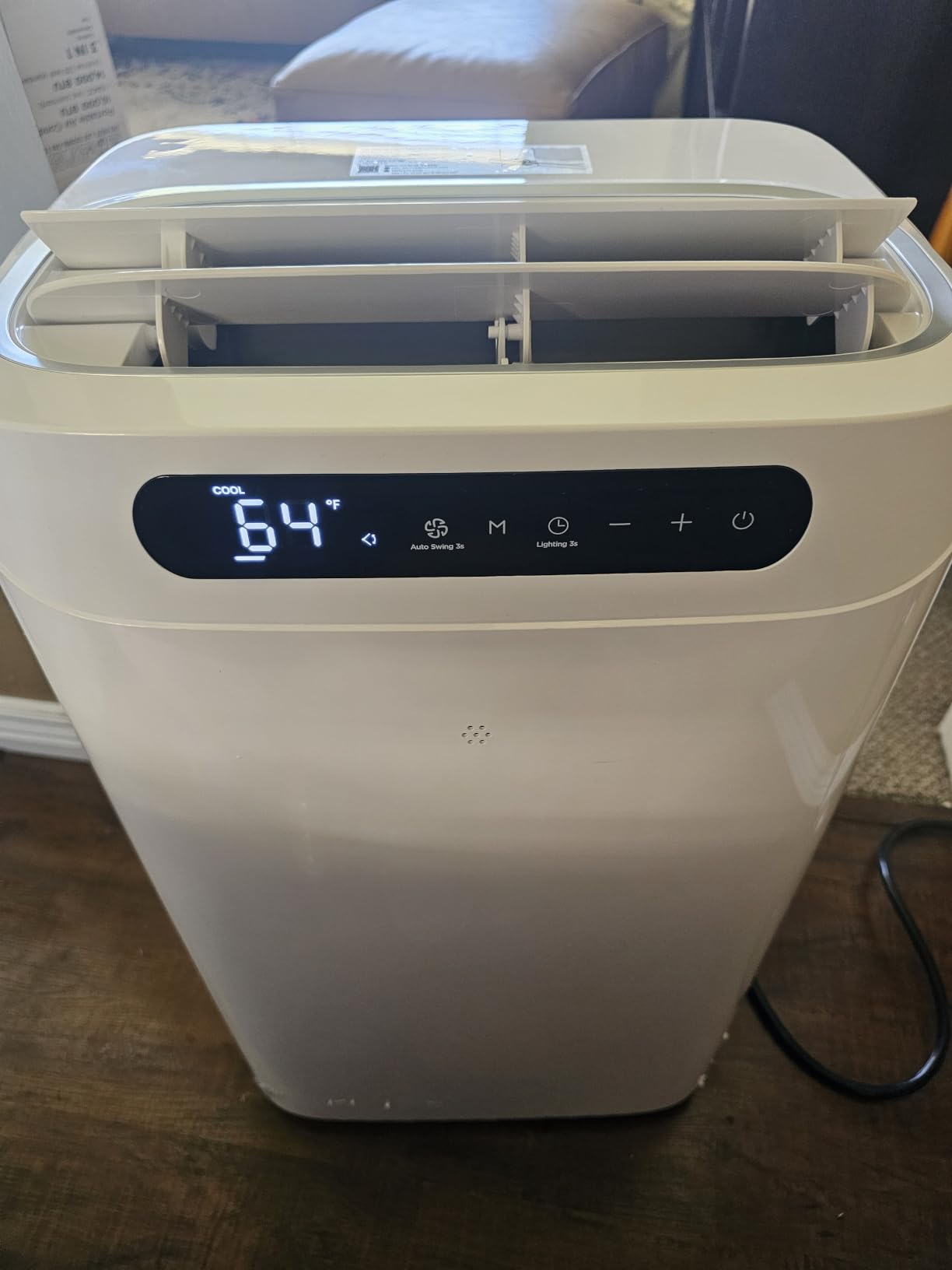
Sleep mode is sensor-driven, adjusting fan speed and temperature automatically rather than running flat out all night. Owners like the straightforward controls and the auto-evaporation system that removes the daily manual draining routine in normal conditions.
It holds a 4.1 average, the lowest rating in the group, with 13 percent of reviews at one star. Recurring complaints are the 48 dB noise level, the 65-pound weight, and the absence of an inverter compressor, so cooling runs at fixed output rather than modulating.
Why basements and garages suit it
Dehumidification rate is the deciding factor in damp spaces, and 96.2 pints per day keeps pace with a lot of moisture. The auto mode and turbo mode give you the levers to push that hard when the space needs it, and the vertical and horizontal window fitting covers most standard openings.
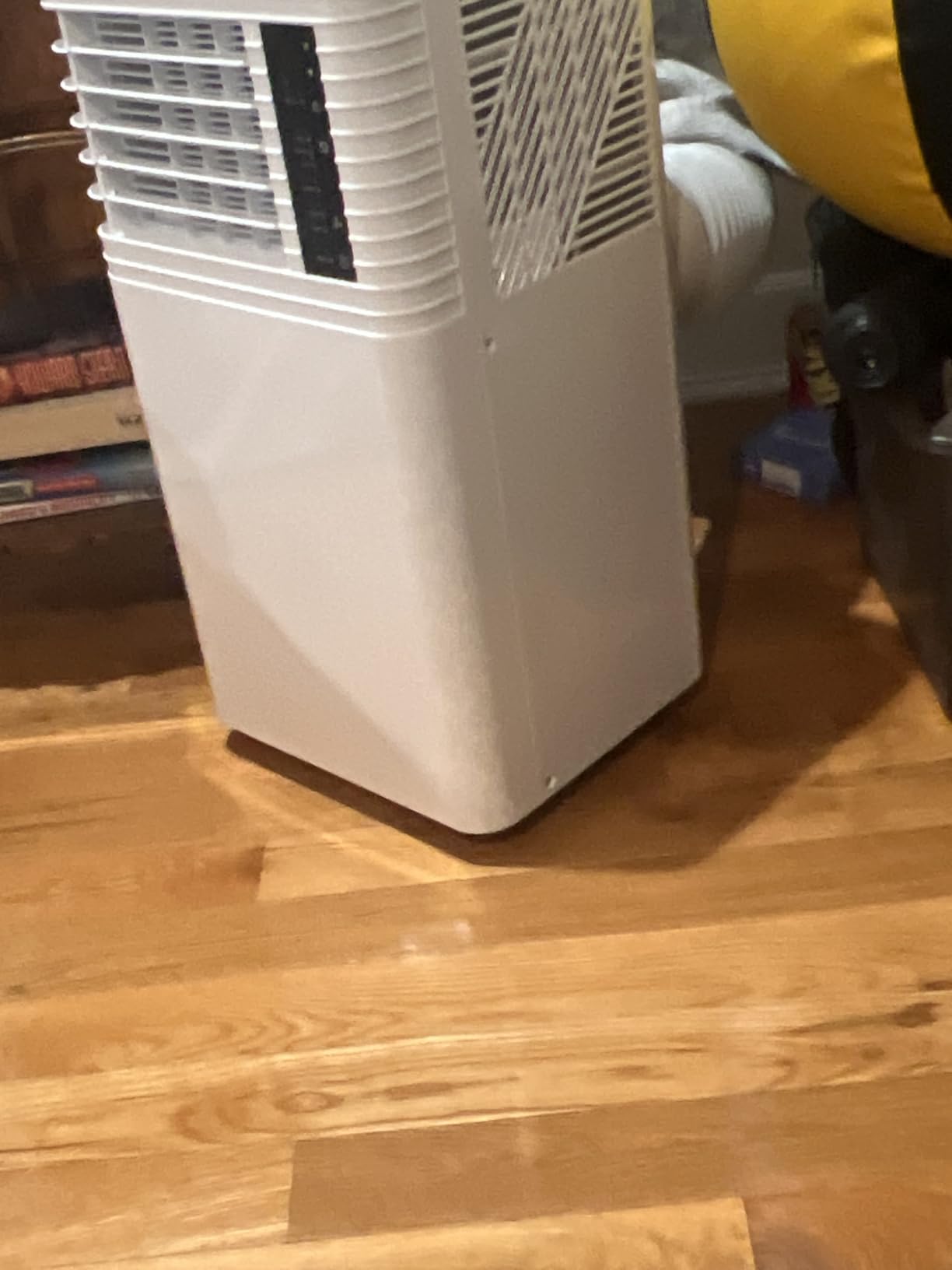
Hidden handles and four 360-degree swivel wheels help despite the 65-pound weight, though lifting it between floors is still a two-person job.
When to choose a quieter model instead
Skip it for a bedroom, home office, or any space where you will notice a constant 48 dB background. If you want the same dehumidifying capacity with a quieter inverter compressor, the DOMANKI 16,000 BTU model in this list runs at 42 dB with a 95 pints per day rating.
Drainage is required every 8 hours in basements and other high-humidity spaces, so plan where the drain hose will run. If humidity is a year-round concern rather than a seasonal one, an air purifier for large rooms addresses particulates but not moisture, so treat the two as complementary rather than alternatives.
10. KoolSiln 14,000 BTU WiFi – Smallest Footprint
14,000 BTU Portable Air Conditioner with WiFi & Remote Control, Cools Up to 700 Sq.Ft, Auto-Evaporation Low Noise Portable AC Unit for Large Room, Office, Garage, White
14000 BTU
700 sq ft
44 dB
1200W
77-degree outlet
Pros
- Smart control via app voice commands and remote for temperature speed mode and schedule
- Widest 77-degree air outlet for faster cooling from 90F down to 61F
- 360-degree auto-evaporation converts about 80 percent of excess water
- 44 dB noise with a sleep mode that dims the display
- Compact 16.7 by 15.7 by 25.5 inch footprint the smallest here
Cons
- 66.6 pounds is among the heavier units despite compact dimensions
- No inverter compressor listed so it operates at fixed output
- Dehumidification capacity of 76 pints is the lowest of the group
- 129-review pool is small for a unit with app and voice features
The KoolSiln covers rooms up to 700 square feet at 14,000 BTU and 1,200 watts, with a 44 dB noise rating. The 77-degree air outlet is the widest in this roundup, and owners credit it with pulling a room down from 90F toward 61F faster than narrower vents manage.
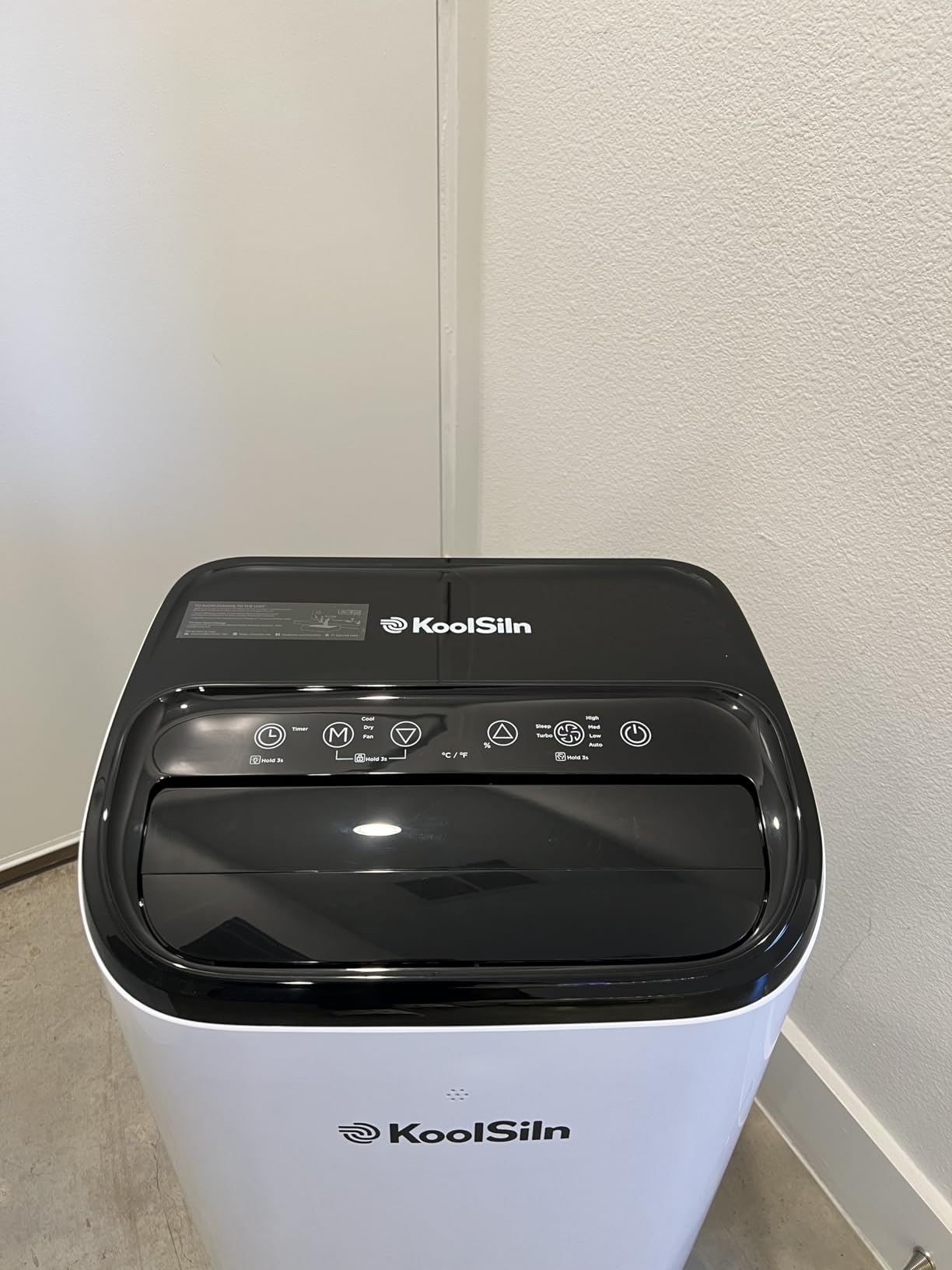
Control is the selling point: app, voice commands, and remote, all covering temperature, fan speed, mode, and scheduling. The 360-degree auto-evaporation system converts roughly 80 percent of excess water back into the room air, which supports 72-hour drainage-free operation in typical conditions.
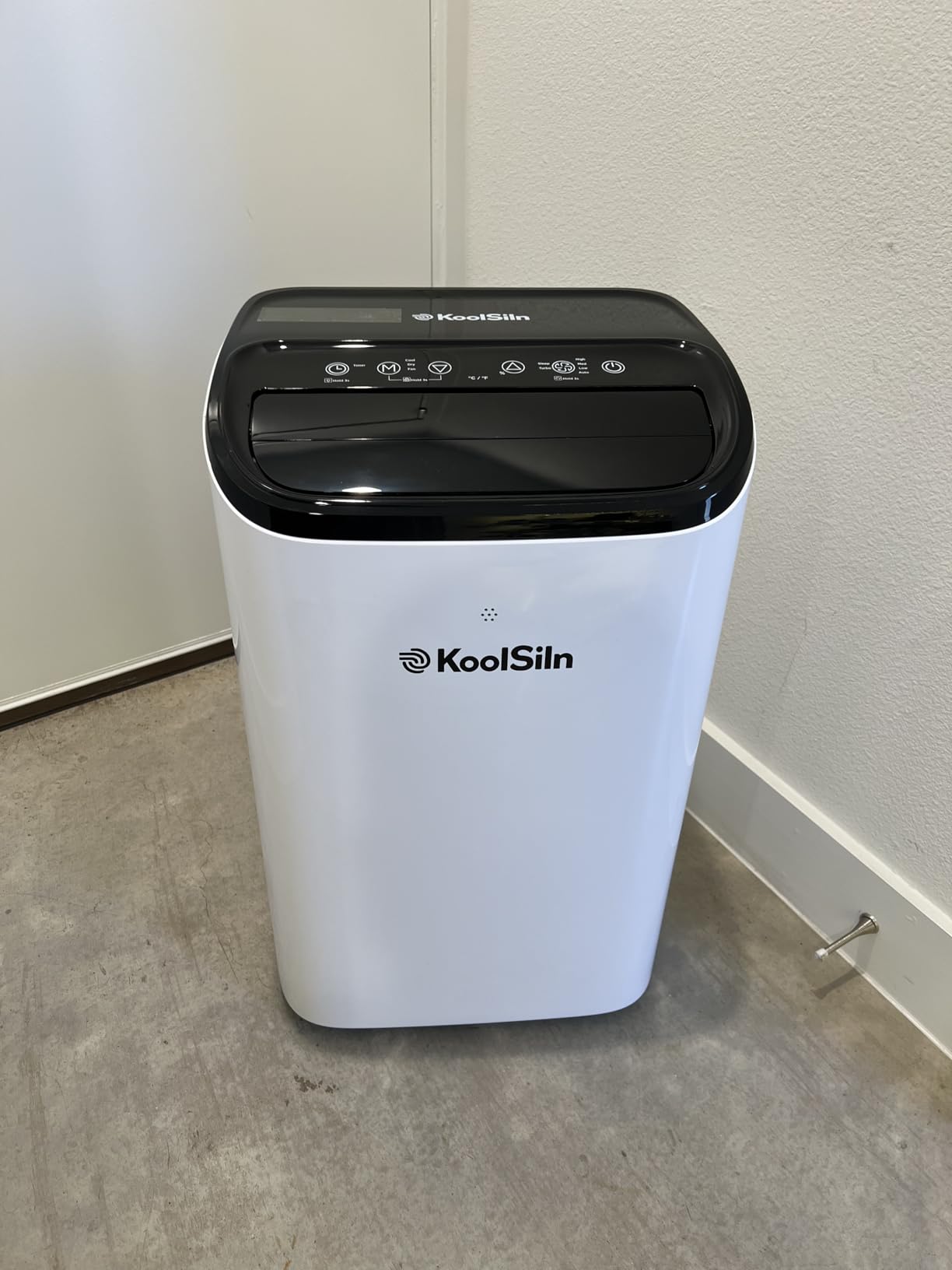
Physically it is the most compact unit here at 16.7 by 15.7 by 25.5 inches, which makes it easier to place in a room that already has furniture in it. The window fitting covers vertical and horizontal openings from 20.39 to 67 inches with no drilling.
There is no inverter compressor listed, so it runs at fixed output. At 66.6 pounds it is still heavy despite the smaller cabinet, and the 76-pint dehumidification capacity is the lowest in the group, so it is not the choice for a damp basement.
When smart controls actually matter
If you want to start cooling before you get home, or drop the setpoint two degrees at 2am without getting up, the app and voice control earn their place. Reviewers also like that the sleep mode dims the display, which removes a common source of bedroom light.
It is DOE certified, comes with a 30-day money-back guarantee, a one-year-plus warranty, and lifetime technical support, which is meaningful given the 129-review pool.
Where it does not fit
The 129-review pool is thin for a unit with app and voice features that may need software updates over time. If you are replacing a failed unit quickly and want a long support history, the Gasbye with a three-year warranty is the safer bet.
At 700 square feet stated coverage it sits at the lower end of the large-room range, so for a high-ceilinged or sun-exposed space, size up to the SereneLife or the DOMANKI 16,000 BTU model.
How Many BTUs Do You Need for a Large Room?
For a large room, size by the SACC number, not the ASHRAE headline. A 14,000 BTU ASHRAE unit is usually a 10,000 to 10,500 BTU SACC unit, and the SACC figure is the one that predicts real cooling capacity. As a rule: about 20,000 BTU of SACC per hour for a 1,000 square foot room with standard ceilings, and more for high ceilings or heavy sun exposure.
Here is how the tiers break down, and which picks from this list fit each one.
400 to 550 square feet. Look for 10,000 to 10,500 BTU SACC. The Gasbye 14,000 BTU DC Inverter is the honest fit here, with a manufacturer-stated 500 square feet and the best CEER figure in the group. Most 14,000 BTU units claim 700 to 750 square feet, but that assumes low ceiling height and modest heat gain.
600 to 750 square feet. Target 10,000 to 12,000 BTU SACC with a dual-hose exhaust. This is where most readers land, and the ZAFRO, Tanoxo, DOMANKI 14,000 BTU, and KoolSiln all sit here, with the HUMHOLD 16,000 BTU reaching 12,000 BTU SACC for the upper end.
800 square feet and above. You need 12,000 BTU SACC or more and a genuine dual-hose design. Only two units here are rated this high: the SereneLife at 16,000 BTU and 850 square feet, and the DOMANKI 16,000 BTU also at 850 square feet. Above 900 square feet with high ceilings, two units generally perform better than one oversized unit.
Which number do I actually use? If a listing gives you both, ignore the ASHRAE number entirely. SACC reflects what the unit does with real air and real humidity, and it is the number DOE uses for the EnergyGuide label. When a listing gives only one number, assume it is ASHRAE and subtract roughly 30 percent to estimate SACC.
One more sizing factor people miss: solar gain. A west-facing room with large windows, or one with a high ceiling, needs more capacity than the same floor area without them. Add a tier if your room gets direct afternoon sun.
Single-Hose vs Dual-Hose: Which One Cools a Big Room?
A dual-hose portable AC is worth it for large rooms. Single-hose units exhaust hot air out of one hose and pull replacement air in through the same hose, so they are cooling the room plus the outdoor air they draw in. Dual-hose units have a separate intake hose, which keeps indoor pressure balanced and eliminates the negative pressure problem.
That difference is not marginal in a big space. The consensus in the r/AirConditioners forum is blunt about it: dual-hose units actually cool a room, while single-hose units give you a cool breeze to sit in front of. In a 700 square foot open-plan space, the shortfall shows up as a cold zone near the unit and an unchanged room everywhere else.
Five of the ten units in this list are dual-hose designs: the SereneLife, ZAFRO, HUMHOLD, DOMANKI 16,000 BTU, and the Gasbye. The remaining single-hose designs still work, but treat their stated coverage figures as optimistic and expect a narrower comfort zone.
The carbon monoxide question nobody should skip
A single-hose unit lowers the air pressure in the room it occupies. If that room contains a gas furnace, a gas water heater, a fireplace, or a wood stove, the negative pressure can pull combustion gases back down the flue instead of out the chimney. This is a carbon monoxide backdraft risk, and it is the reason we never recommend a single-hose unit in a room with a gas appliance.
If the room has any combustion appliance, buy a dual-hose unit and keep the door to the rest of the home open while it runs so make-up air comes from elsewhere. A carbon monoxide detector in the room is a cheap addition regardless of which unit you buy. Owners in the r/homeowners forum put it plainly: a two-hose portable AC does work well, but it is worth it mainly if you cannot install a window unit.
Do Portable ACs Actually Work in Large Rooms?
Yes, with limits you should decide on before you buy. A portable air conditioner creates a genuinely comfortable zone, and a good 16,000 BTU dual-hose inverter can hold a large living room near setpoint through most of a summer day. What no portable does is cool a 700 square foot space uniformly, from wall to wall, the way a ducted system would.
The honest expectation is a 3 to 5 foot comfort zone around the unit, widening considerably when air is properly distributed with a good louver sweep and a ceiling fan turning. If you are trying to cool a sunroom and an adjoining bedroom simultaneously, you are asking one unit to do two jobs.
This is also where placement decides as much as capacity. Put the unit near the doorway to the rest of the home so cool air spills outward, keep the exhaust hose as short and straight as the window allows, and seal the window panel properly. Every extra foot of coiled hose reduces the pressure differential the unit works against.
And know when a portable is the wrong answer. If you can install a window unit, it is quieter, cheaper to run, and needs no exhaust hose. We cover those in our guide to the best window air conditioners for bedrooms. If you want whole-room cooling with no compromise, a ductless mini-split is the real solution, and our best mini split air conditioner picks explain when the install cost pays back over several summers.
Where to Put It and How to Maintain It
Placement matters more than most buyers expect. In a room with a ceiling over 9 feet, set the unit on the floor and use a ceiling fan on low to push air across the space. Hot air stratifies at the ceiling, so a tall unit alone can leave the occupied zone undercooled while the top of the room stays warm.
For an open-plan living and dining space, one large unit near the hub usually beats two smaller ones. Two units in separate corners each work against a smaller volume, while one unit means a single exhaust hose, a single window panel, and a single power circuit.
Four maintenance habits that keep output up
Clean or rinse the washable filter every two to three weeks during heavy use. A restricted filter starves the evaporator coil, and the symptom owners describe is a unit that runs constantly and never quite reaches setpoint.
Check the drain path before humid weekends. Self-evaporating systems handle ordinary humidity, but above roughly 85 to 90 percent relative humidity, expect to run the drain hose continuously rather than emptying a tank by hand.
Keep the intake grille clear and the exhaust hose unkinked. A crushed or folded hose is the most common cause of a portable AC that suddenly underperforms mid-summer, and it costs nothing to straighten.
Run the unit for 15 minutes after switching off before packing it away, and dry the filters fully. Residual moisture in the cabinet is the usual source of the musty smell people report when the unit comes out of storage the following spring.
Frequently Asked Questions
What is the best portable AC for a large room?
For a 600 to 750 square foot room, look for a dual-hose unit rated at 10,000 to 12,000 BTU SACC with an inverter compressor. Above 800 square feet you need 12,000 BTU SACC or more, and the SereneLife 16,000 BTU is our pick there. Avoid sizing from the ASHRAE headline number, which runs about 30 percent higher than real capacity.
Is there a portable AC that actually works in a large room?
Yes, if you buy on SACC capacity and choose dual-hose. A 16,000 BTU dual-hose inverter unit can hold a large living room near setpoint through most of a summer day. Expect a comfort zone of roughly 3 to 5 feet around the unit rather than uniform cooling, and improve distribution with a ceiling fan on low.
How big of a room will a 10,000 BTU portable AC cool?
A 10,000 BTU SACC unit comfortably handles a 400 to 550 square foot room with standard 8 to 9 foot ceilings. Add a tier for high ceilings, west-facing windows, or several people, because solar gain and volume both raise the load. In that case step up to 12,000 BTU SACC rather than stretching one smaller unit further.
How big of a room will a 14,000 BTU portable AC cool?
Read the SACC figure first, because a 14,000 BTU ASHRAE label usually means 10,000 to 10,500 BTU SACC. That SACC capacity supports roughly 600 to 750 square feet with a dual-hose design, and about 400 to 550 square feet realistically with a single-hose unit. Listings claiming 750 square feet on a single-hose design are optimistic.
Is a dual hose portable AC worth it?
For large rooms, yes. A dual-hose unit pulls in and exhausts air separately, so the room stays at neutral pressure and the unit does not waste capacity cooling outdoor air it just drew in. It is also the safe choice in any room with a gas furnace, water heater, or fireplace, because single-hose negative pressure can pull combustion gases back down the flue.
What is the least noisy portable air conditioner?
Among the units we compared, the quietest published figures are 41 dB in silent mode for the Temprium 14,000 BTU and 42 dB for the ZAFRO, HUMHOLD, and DOMANKI 16,000 BTU models. Noise is highest on high fan settings, so compare sleep mode ratings rather than peak figures. The loudest units here run around 50 dB.
Which Portable AC Should You Buy for a Large Room?
For the biggest rooms, the SereneLife 16,000 BTU dual-hose inverter is the pick we recommend first, because it pairs 850 square feet of stated coverage with the largest owner review base in the roundup and the only heating mode here. For the more common 600 to 750 square foot range, the ZAFRO 14,000 BTU smart inverter is the runner-up worth paying attention to, with its 10,000 BTU SACC rating, dual-hose design, 12.8 CEER figure, and 42 dB sleep mode covering the most ground with the fewest compromises. The Temprium is the choice when smart controls and the lowest published noise figure matter more than efficiency.
Go smaller only when you do not need the capacity. For a 450 to 550 square foot room, the Gasbye delivers the honest capacity and the best efficiency per watt of anything we tested, and for a damp basement the DOMANKI 14,000 BTU is the one that actually keeps up on moisture.
Whatever you pick, size on SACC, choose dual-hose if a gas appliance is anywhere in the room, keep the exhaust hose short, and set a realistic expectation. Updated for 2026, this list ranks all ten models we have reviewed so you can pick the best portable air conditioners for large rooms with the actual numbers in front of you.