
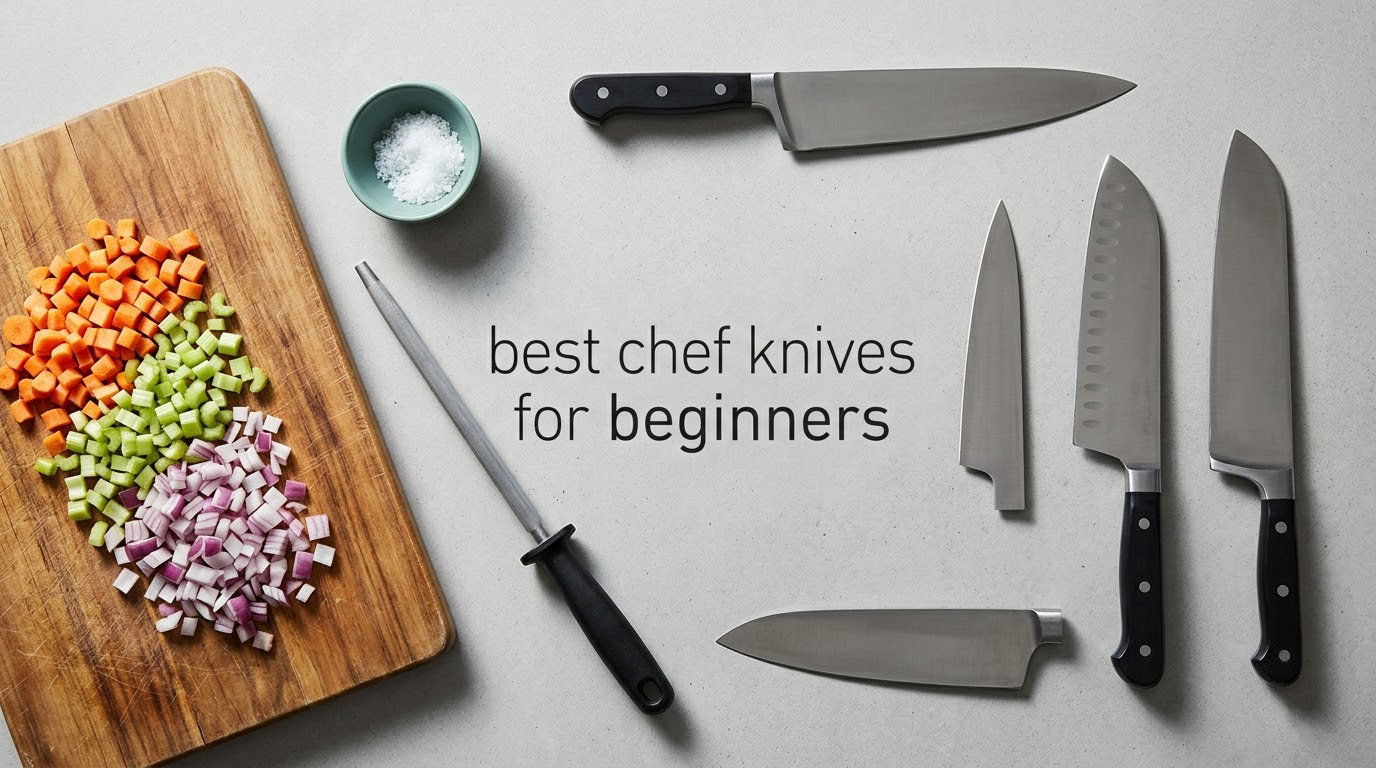
Most beginners do not need an expensive knife. They need one that is sharp, comfortable in the hand, and forgiving when the cutting technique is still forming. That is the whole argument behind this roundup of the best chef knives for beginners: we looked at ten 8-inch chef knives, read the engineering specs, and worked through what actually matters on a cutting board rather than what reads well on a product page.
A chef’s knife is the general-purpose workhorse of the kitchen, usually around 8 inches long, with a broad curved blade built for a rocking cut. The tip stays on the board while the heel lifts and falls, so one motion handles chopping, dicing, mincing, and slicing. Every other knife in a home kitchen is a specialist; this one is the tool you reach for nearly every time you prep.
For this guide we focused on the criteria that separate a good beginner knife from a disappointing one: how sharp it arrives, how long the edge holds, whether the handle suits a small or large hand, how forgiving the spine and bolster are, and how fussy the care routine is. We also weighed the review data, because a knife that thousands of home cooks have used for years tells you more than any spec sheet.
If you have never sharpened a knife, or you have been cooking on a dull blade without realising it, read the buying guide and care sections below before you pick. Those two sections will save you from the two mistakes that cost beginners the most: buying a knife too fancy to maintain, and buying a soft knife that dulls by lunch.
Table of Contents
Top 3 Picks for the Best Chef Knives for Beginners in 2026

Victorinox Fibrox Pro
- 7.9 inch stamped stainless blade
- Non-slip Fibrox Pro handle
- Dishwasher safe
- Lifetime warranty

MOSFiATA 8 Inch Forged
- German high carbon EN1.4116 steel
- Triple-riveted Micarta handle
- Hand sharpened to 16 degrees
- Finger guard and sheath

imarku 8 Inch High Carbon
- High carbon steel at HRC 56-58
- FSC Pakkawood handle
- 0.6-0.75% carbon content
- Forged gyutou profile
The Best Chef Knives for Beginners in October
The table below is the short version. Every knife here is an 8-inch chef’s knife, so you are comparing steel, construction, handle, and edge rather than size. Scroll to any row and the full review sits further down.
| Product | Specifications | Action |
|---|---|---|
| Victorinox Fibrox Pro 8 Inch Chef’s Knife |
|
Check Latest Price |
| MOSFiATA 8 Inch Forged Chef Knife |
|
Check Latest Price |
| imarku 8 Inch High Carbon Chef Knife |
|
Check Latest Price |
 PAUDIN 8 Inch High Carbon Chef Knife PAUDIN 8 Inch High Carbon Chef Knife |
|
Check Latest Price |
 HENCKELS Classic 8 Inch Chef Knife HENCKELS Classic 8 Inch Chef Knife |
|
Check Latest Price |
 Mercer Culinary M22608 Millennia 8 Inch Mercer Culinary M22608 Millennia 8 Inch |
|
Check Latest Price |
 Emojoy 67-Layer Damascus Chef Knife Emojoy 67-Layer Damascus Chef Knife |
|
Check Latest Price |
 Mercer Culinary M23510 Renaissance 8 Inch Mercer Culinary M23510 Renaissance 8 Inch |
|
Check Latest Price |
 Amazon Basics Full Tang 8 Inch Chef’s Knife Amazon Basics Full Tang 8 Inch Chef’s Knife |
|
Check Latest Price |
 Sunnecko 8 Inch Forged Chef Knife Sunnecko 8 Inch Forged Chef Knife |
|
Check Latest Price |
1. Victorinox Fibrox Pro 8 Inch — The Best Chef Knife for Beginners Overall
Victorinox Fibrox Pro 8 Inch Chef’s Knife, Dishwasher Safe, Black
Blade: 7.9 inch stainless steel
Handle: Fibrox Pro TPE grip
Stamped construction
Lifetime warranty
Pros
- Razor sharp straight from the box
- Cuts tomatoes and root vegetables with almost no pressure
- TPE handle stays secure when wet or greasy
- Lightweight and balanced through long prep
- Dishwasher safe materials
Cons
- Thin stamped blade loses its edge faster than forged steel
- Stamped build reads as disposable rather than heirloom
- Scuffing and marks show up on the blade sides
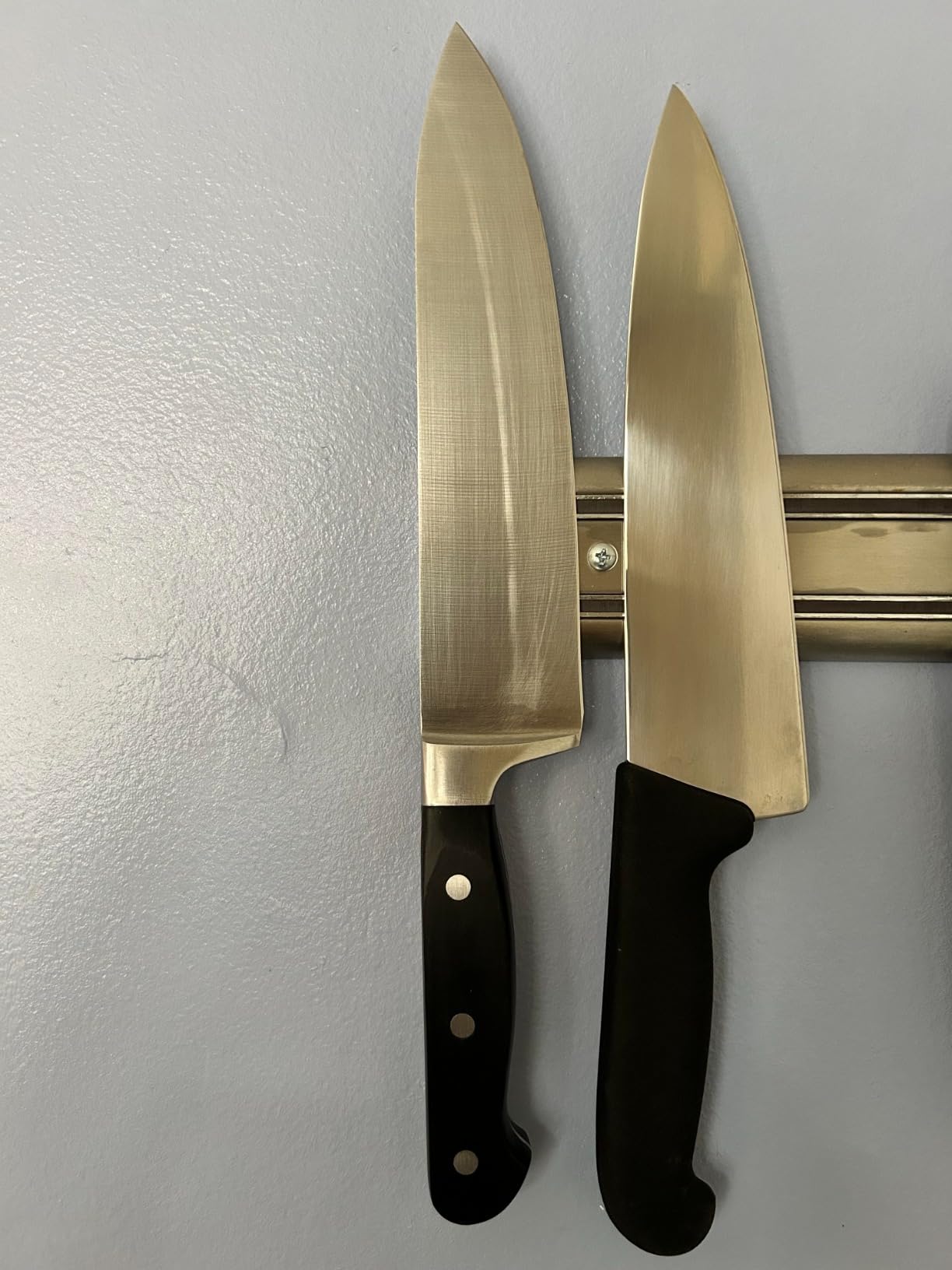
This is the knife I hand to friends who tell me they are bad at cooking. The blade is stamped stainless steel with a laser-tested tapered edge, and it arrives sharp enough to dice an onion without any set-up. I have used it across weeks of vegetable prep and it never once felt vague or unpredictable.
The handle is the real story. Fibrox Pro is a thermoplastic elastomer with a soft, moulded shape that fills the palm instead of sitting in it, and the surface grips well when your hands are wet or greasy. It is also one of the lighter knives in this roundup, which matters when you are chopping a full batch of onions and your grip starts to fatigue.
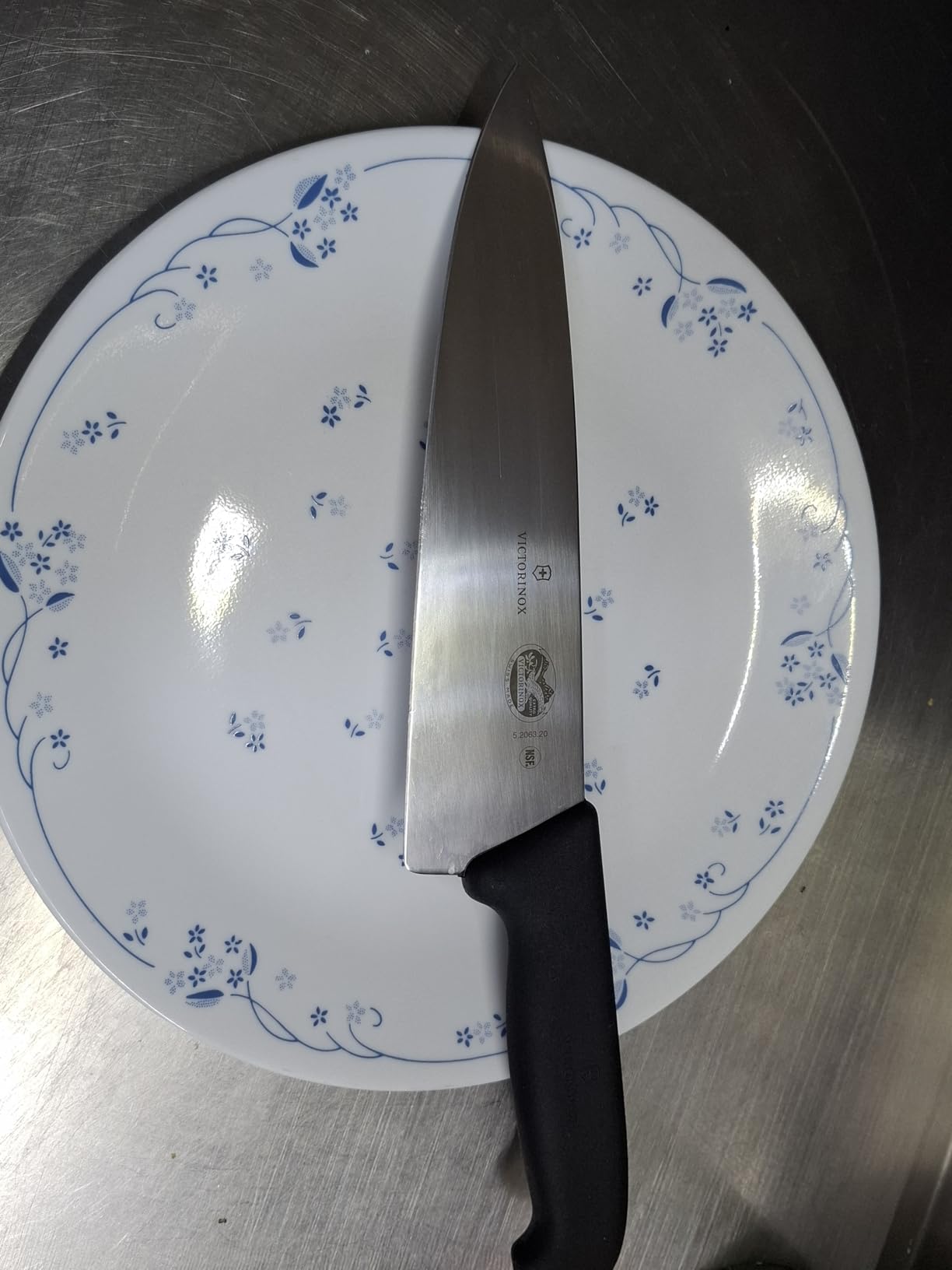
The honest weakness is that the steel is not especially hard. A thin stamped blade loses its edge sooner than a forged high-carbon one, so under heavy daily use you will be reaching for a honing steel or a stone more often than you would with the imarku or the Mercer Renaissance. The blade sides also pick up scuffing and marks from sharpening over time.
None of that matters for a beginner, because a knife that is dull is a knife that gets put in a drawer. A Victorinox that you keep sharp and actually use beats a nicer knife that dulls and collects dust. Several of the knives here also carry a lifetime warranty, which matters more for peace of mind than the sticker price would suggest.
Who should buy the Victorinox Fibrox Pro
Buy this knife if you cook a few times a week, want something you can rinse and put away without thinking, and would rather not learn whetstone technique before you own a good knife. It is the safest first purchase in this list for exactly that reason. Community cooks repeatedly name the Fibrox Pro as the standard first knife, and culinary students who later buy a Japanese knife almost always start here.
It is also the easiest to hand to someone else. The handle is neutral enough for small and large hands, the steel is forgiving of clumsy pressure, and nothing about it rewards or punishes technique.
Who should skip it
Skip it if you already know you will sharpen a knife regularly and want the edge to last longer between sessions, or if you cook so much that a monthly touch-up would annoy you. In that case look at the imarku for harder high-carbon steel or the Mercer Renaissance for a half-bolster design you can sharpen without fighting the handle.
Also skip it if a stamped blade bothers you aesthetically. Some cooks describe it as a high-quality disposable workhorse rather than a lifelong knife, and that framing is fair even if the knife outlasts most of us.
2. MOSFiATA 8 Inch Forged Chef Knife — Best for Buying as a Gift
MOSFiATA 8″ Super Sharp Professional Chef’s Knife with Finger Guard and Knife Sharpener, German High Carbon Stainless Steel EN1.4116 with Micarta Handle and Gift Box
Blade: 8 inch EN1.4116 German steel
Micarta handle, full tang
16 degree edge per side
Pros
- Sharp laser-engraved blade resists sticking
- Full tang with triple-riveted Micarta handle
- Handles potatoes
- pumpkin and meat well
Cons
- Does not hold an edge as long as harder Japanese steel
- Handle feels heavy at the back end
- Bundled sharpener is low quality
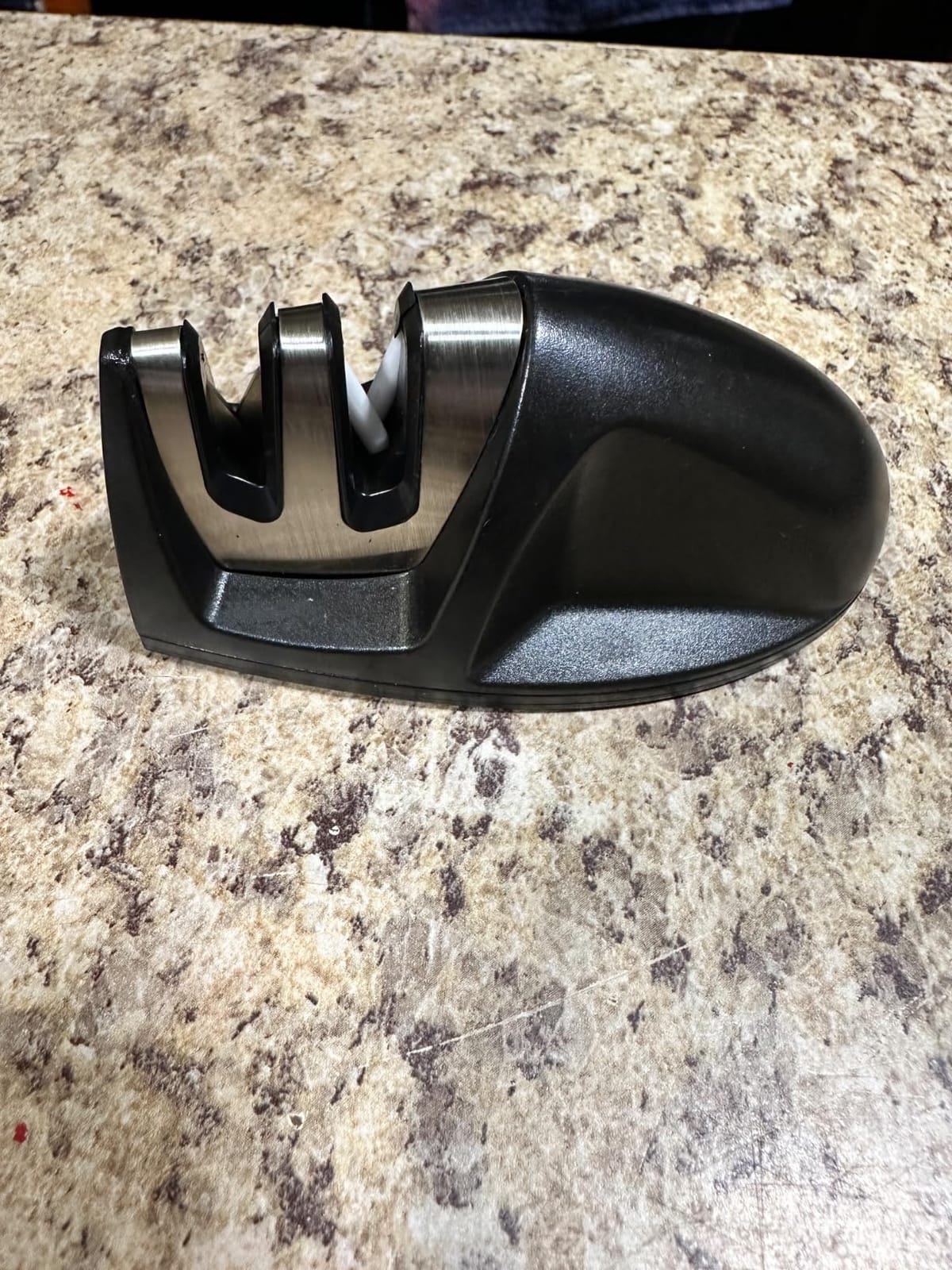
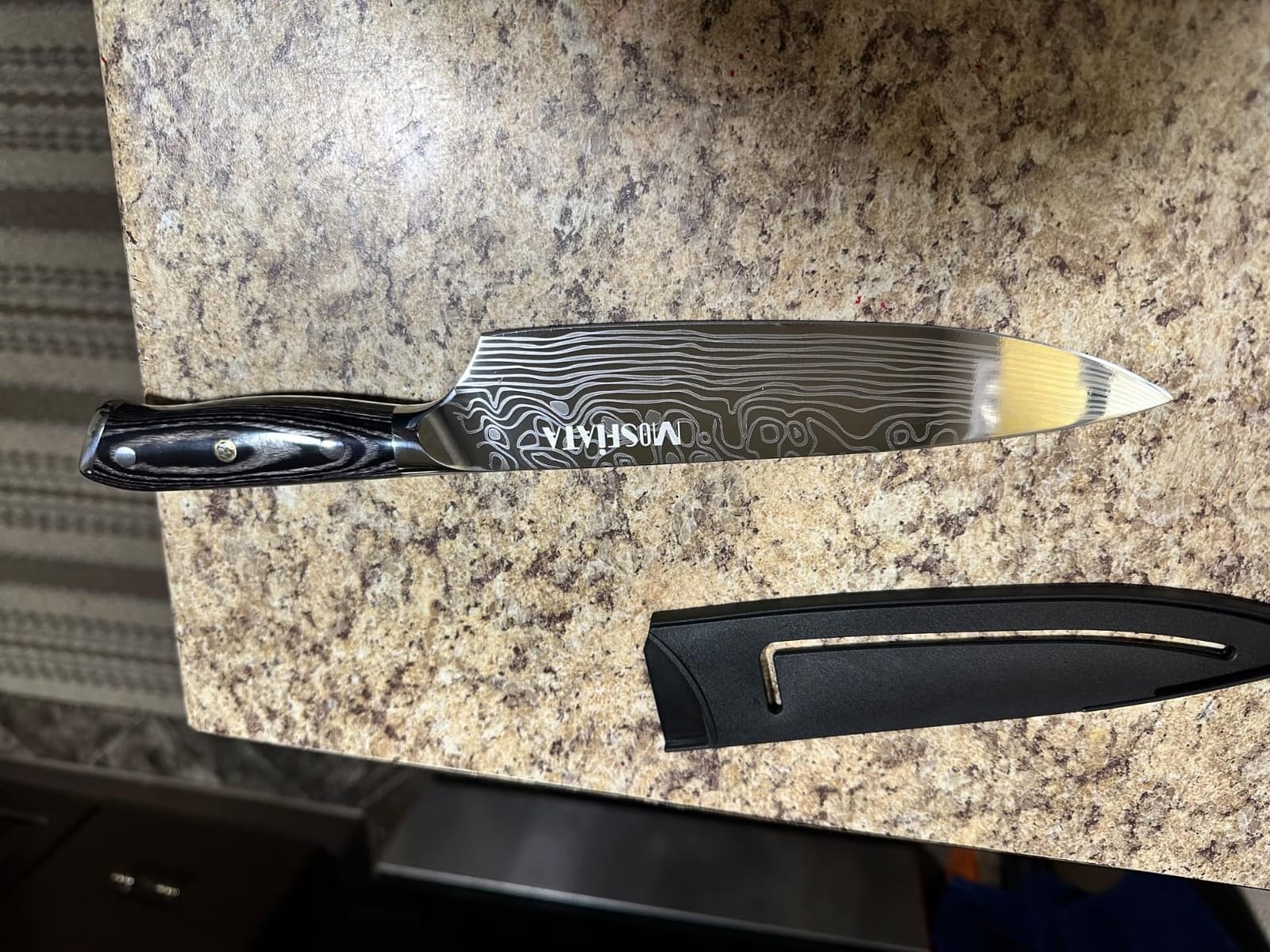
Everything about the presentation is engineered for a gift. It comes in a box with a stainless steel finger guard, a blade protector, and a small sharpener, and the Micarta handle is triple-riveted to a full tang. I have watched the box itself do half the work on birthdays and housewarmings.
The blade is EN1.4116 German high carbon stainless with 0.45-0.55% carbon, hand sharpened to 16 degrees per side. The laser-engraved pattern is decorative rather than true Damascus, but it does reduce sticking, and the edge is genuinely sharp the first time you pick it up.
Experienced owners place it in the middle of the pack. It gets the job done on potatoes, pumpkin, meat, and vegetables, but a subset of reviewers who own proper German or Japanese steel say the edge does not stay as sharp as advertised and wants more frequent sharpening. The handle also carries weight at the back end, which some hands read as solid and others read as rear-heavy.
Ignore the bundled sharpener. It is the weakest part of the package, and it is the part most likely to damage an edge that is otherwise good. If you buy this knife, plan to use a proper honing steel or stone instead.
Where this knife earns its place
Choose it when the knife is a present, or when you want a forged full-tang design with a composite handle and a knife guard in the box. The Micarta handle is moisture-stable and does not need oiling the way wood does, which makes it a good pick for a cook who will not fuss over maintenance.
It also suits anyone who wants a traditional-looking knife that looks the part on a counter, without moving into the fully forged German tier.
Where it falls short
It falls short for a cook who cares most about edge retention. A 16-degree edge is already fairly fine, and this steel does not hold that fine edge as long as harder Japanese or higher-carbon German steels. Plan on honing more often than you would with the imarku or the Emojoy Damascus.
It is also not the right knife for someone with a strong preference for a light, modern handle, or for a cook who dislikes any rear weight at all.
3. imarku 8 Inch High Carbon Chef Knife — Best Edge Retention for the Money
imarku Japanese Chef Knife-Sharp Kitchen Knife 8 Inch, Gift for Mom & Dad
Blade: 8 inch high carbon steel at HRC 56-58
Handle: FSC Pakkawood
Forged gyutou profile
Pros
- Holds a sharp edge through bone-in meat work
- Pakkawood handle reduces finger fatigue
- 16-18% chrome resists tarnishing
- Light at 6.56 ounces
- Backed by a lifetime warranty
Cons
- Logo on the delivered knife can differ from product photos
- Some buyers sharpen it more often than they expected
For a beginner who wants to taste a Japanese-style profile without crossing into specialist territory, this is the most rewarding knife here. The blade is forged high carbon stainless rated at HRC 56-58, with 0.6-0.75% carbon and 16-18% chromium, and the higher carbon is what lets it hold a fine edge longer than a budget stamped blade.
It ranks at the top of its category, and buyers consistently single out edge retention as the standout: it keeps working through meat off the bone and dense vegetables without losing its bite. The FSC-certified Pakkawood handle is shaped to reduce finger numbness during longer sessions, which is a genuine benefit when you are learning to hold a knife for a full prep block.
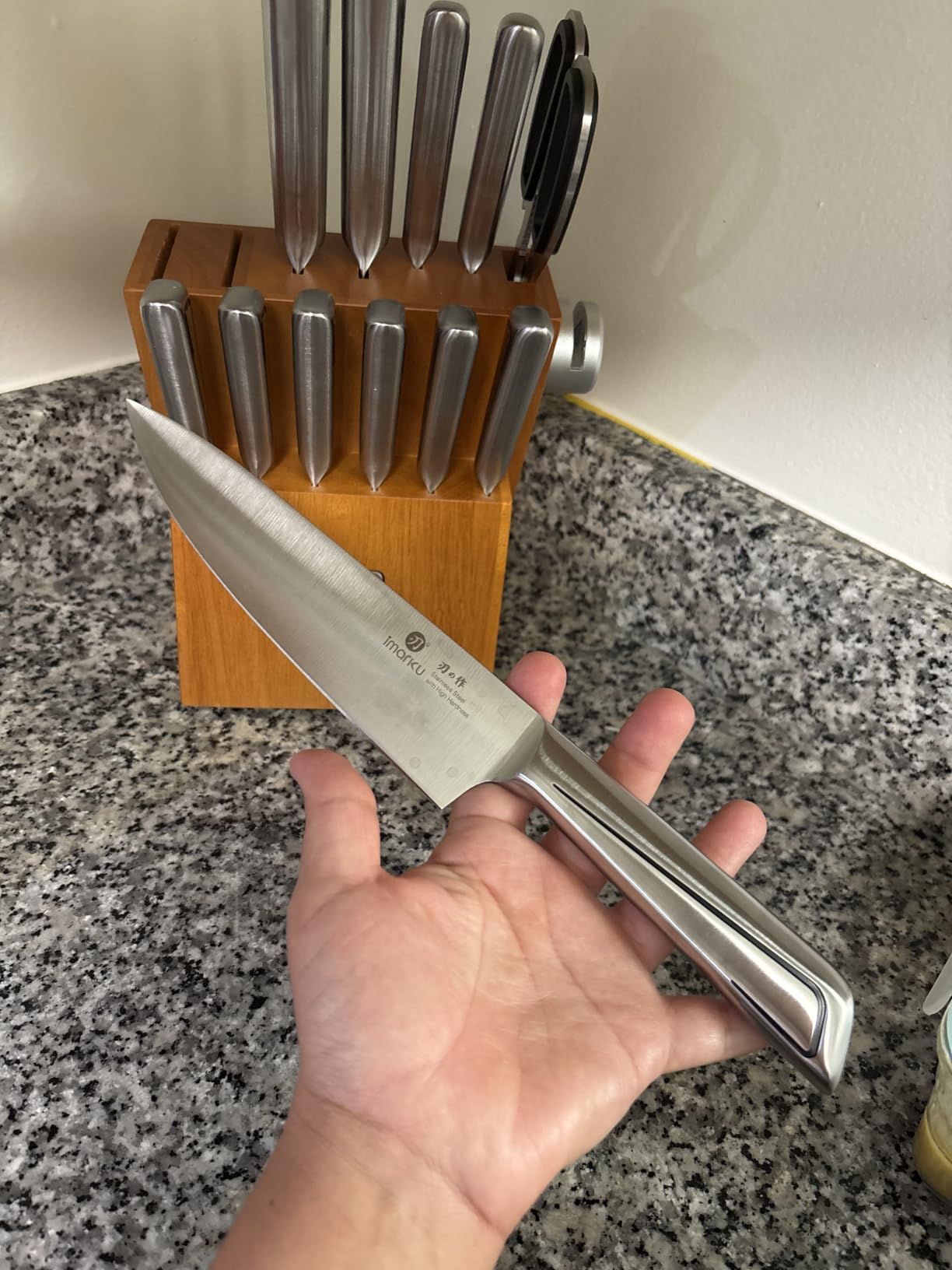
At 6.56 ounces the whole knife is light, and the gyutou profile is tall enough to give you knuckle clearance while you push-cut. The corrosion resistance from the chrome content means you do not have to rush to dry it the instant it gets wet, which removes one of the most common reasons beginners feel anxious around a knife.
The most common complaint has nothing to do with performance. Because the brand is being upgraded and goods are dispatched randomly, the logo on the knife inside the box can differ from the photo. A smaller group reports needing to sharpen the edge more often than they expected, which is a reasonable adjustment for any HRC 56-58 blade that will not tolerate misuse.
Why a beginner will get on with this knife
It forgives a beginner in three ways that most cheap knives do not. A harder steel holds its edge through the rough early weeks, a Pakkawood handle is warm and stable in wet hands, and the forged profile resists flexing when you press hard on something like a butternut squash.
It is also the natural stepping stone if you later want to move into a Japanese chef knife, because the gyutou geometry is the same family of geometry.
Where the trade-offs show up
A 56-58 HRC edge is sharper and more brittle than a soft stainless blade. It will feel more aggressive in your hands, and the tip is more likely to chip if you pry with it or hit the counter bone-first. If you tend to treat a knife like a tool for levering, go softer.
Also be aware of the logo mismatch, and note that Pakkawood, while far more stable than plain wood, still benefits from an occasional wipe-down and does not want to sit in standing water.
4. PAUDIN 8 Inch High Carbon Chef Knife — Most Versatile for Light Hands
PAUDIN Chef Knife, 8 Inch High Carbon Stainless Steel Sharp Kitchen Knife with Ergonomic Handle, Gift Box for Family & Restaurant
Blade: 2mm 5Cr15Mov stainless steel
Handle: ergonomic wood
Weight: 6.88 ounces
Pros
- Sharp 2mm blade handles bread
- vegetables
- fish and beef
- Wood handle balances the thin blade well
- Lightweight enough for long prep sessions
Cons
- Waved pattern is decorative
- not true Damascus
- Stamped construction trails forged knives on edge retention
- Wood handle can swell or crack without care
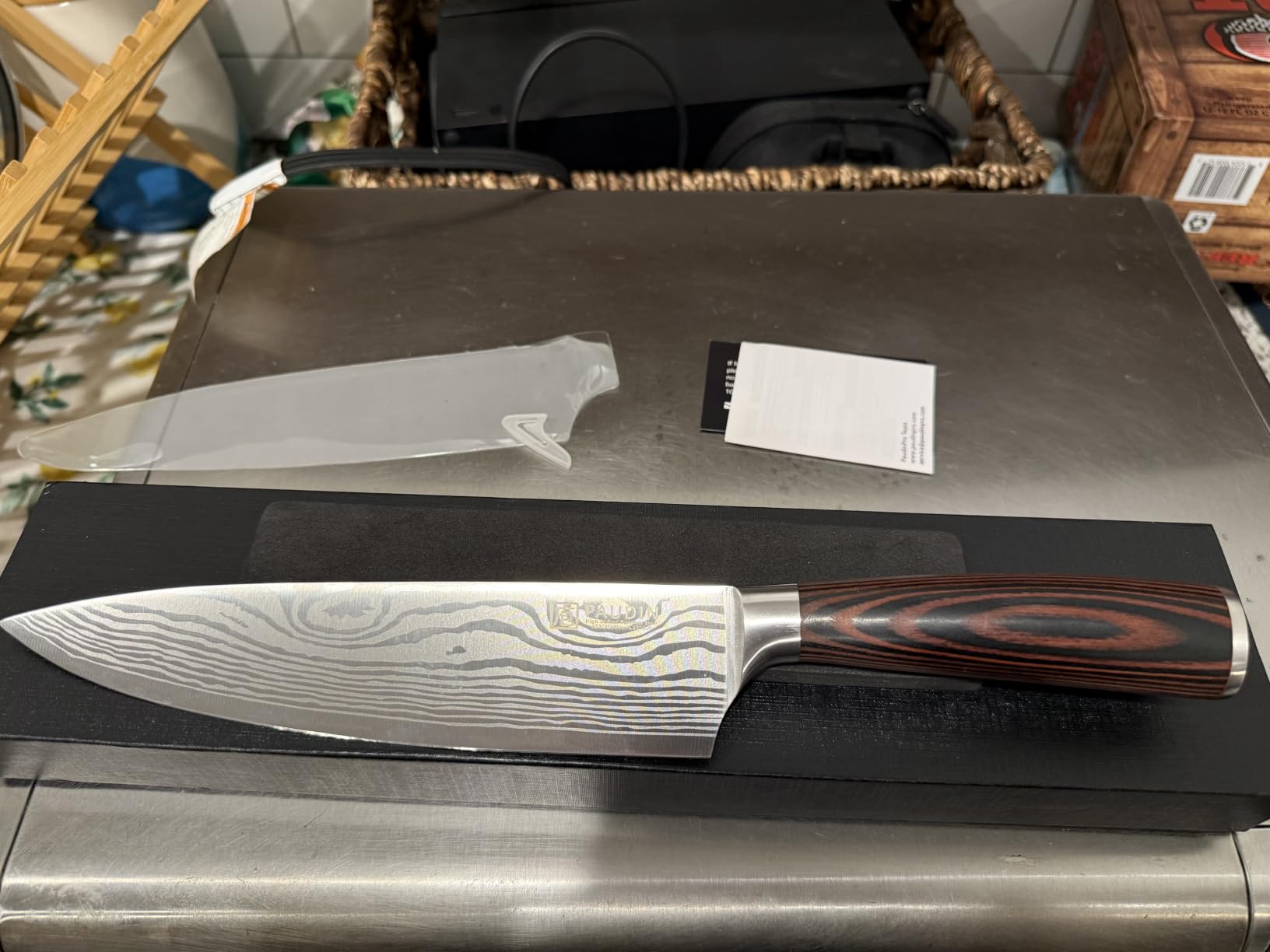
The PAUDIN is the one I recommend to cooks with smaller hands who find many Western handles too chunky. The wood handle is slim and shaped so the balance sits forward, and the total listed weight is 6.88 ounces, which keeps long prep sessions comfortable. The 2mm blade is hand-polished and sharp from the start.
It is a genuinely capable daily knife on bread, vegetables, fish, chicken, and beef. The finish looks the part too, with a waved pattern that photographs well and comes in a gift box. Buyers who know steel will tell you plainly that the wave is stamped decoration rather than a layered Damascus construction, and that is worth knowing before you buy.
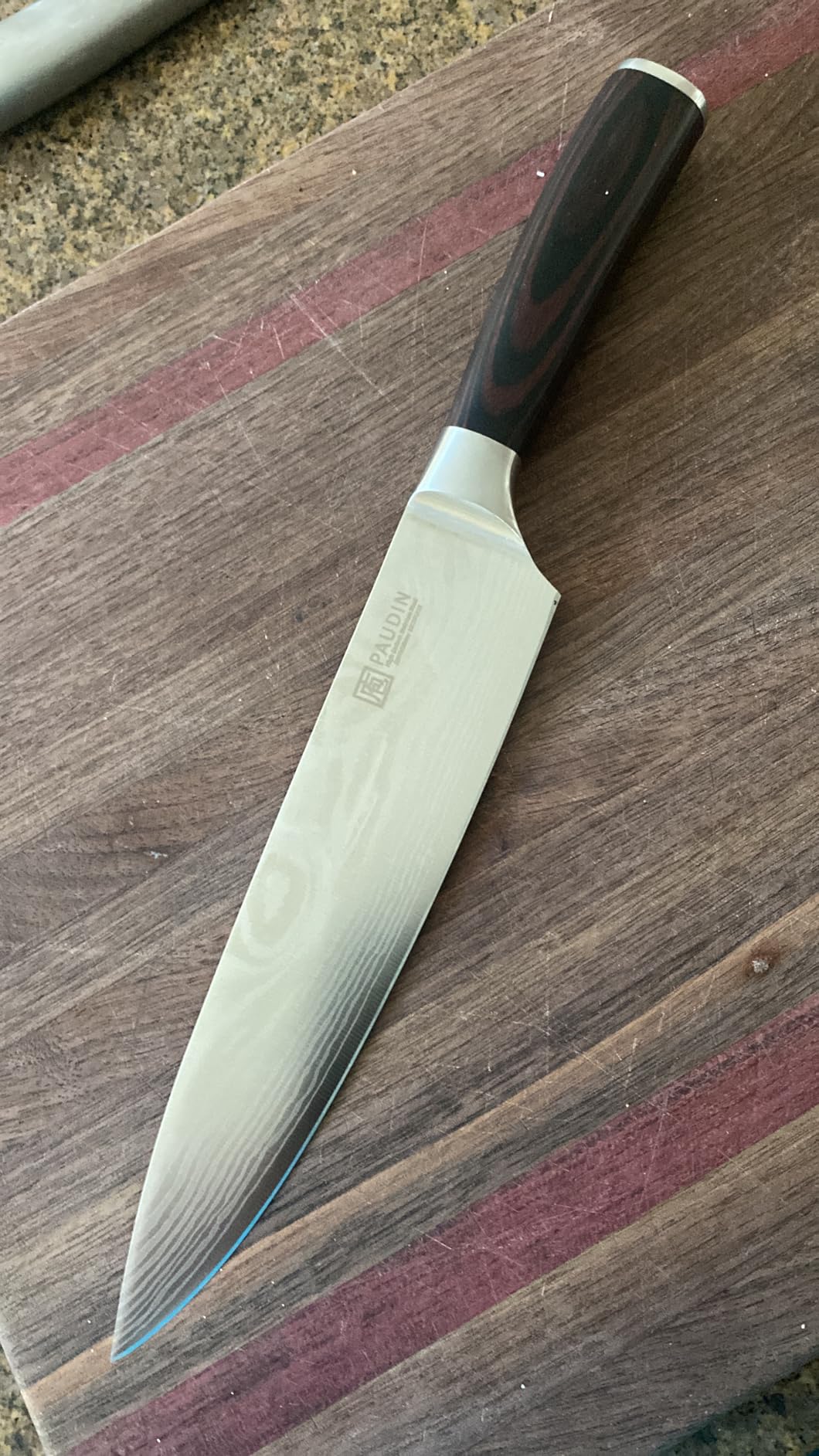
Being stamped, the blade is thinner and less demanding than a forged design, which also means it will not hold a razor edge for months. Expect to hone it more often, and expect a slightly softer, more forgiving feel when you push. For a beginner, forgiving is not a flaw; it means fewer surprises while your grip is still developing.
The other trade-off is the handle material. Plain wood is the least maintenance-friendly option in this roundup. It needs to stay dry, it can swell or crack over long periods, and it will not survive a dishwasher.
Who this knife suits
It suits a beginner who wants a traditional-looking wood-handled knife, cooks mostly on vegetables, fish, and bread, and has hands that find rubber or oversized handles uncomfortable. It also makes a good first knife for anyone who prefers a lighter tool they can move quickly.
The 24-month warranty is the shortest here, but for a knife at this level most buyers never use it.
Who should pass
Pass if you cook meat heavily, want an edge that stays sharp without touching it, or plan to put knives through a dishwasher. A wood handle plus a thin stamped blade is the wrong combination for a low-maintenance kitchen routine.
Also pass if you are drawn to Damascus layering for performance reasons. The pattern here is cosmetic, and you should choose the Emojoy instead if the layered construction is what you actually want.
5. HENCKELS Classic 8 Inch — Premium Pick Fully Forged German Knife
HENCKELS Classic 8-Inch Chef Knife, Razor-Sharp, German Engineered
Blade: 8 inch fully forged stainless steel
Handle: triple-rivet composite
Lifetime warranty
Pros
- Fully forged build blends blade into handle smoothly
- Finely honed satin blade starts razor sharp
- Lightweight design reduces effort during prep
Cons
- Fully webbed bolster gets in the way of sharpening
- Sits in a premium tier above most entry models
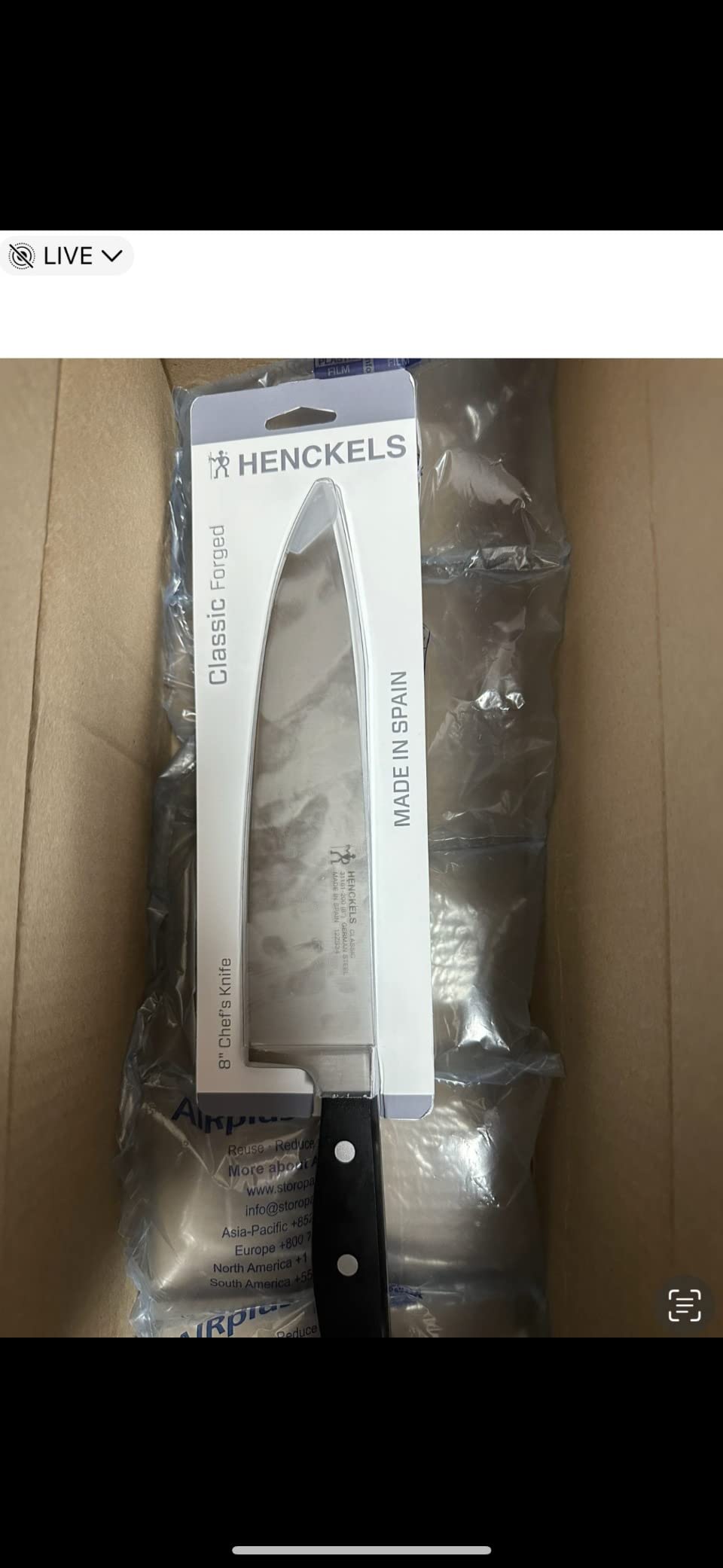
This is the knife I suggest when someone wants a proper forged German workhorse but does not want to chase a hand-forged Japanese handle profile. The blade runs fully forged with a satin finish, is finely honed before it leaves the factory, and the triple-rivet composite handle is the shape most cooks already have in their hands from restaurant kitchens.
At 4.48 ounces it is feather-light for a fully forged knife, and owners describe a seamless transition from blade to handle with no rough grind line to catch your fingers. The lifetime warranty and a stain-free, rust-free surface make it low-drama ownership.
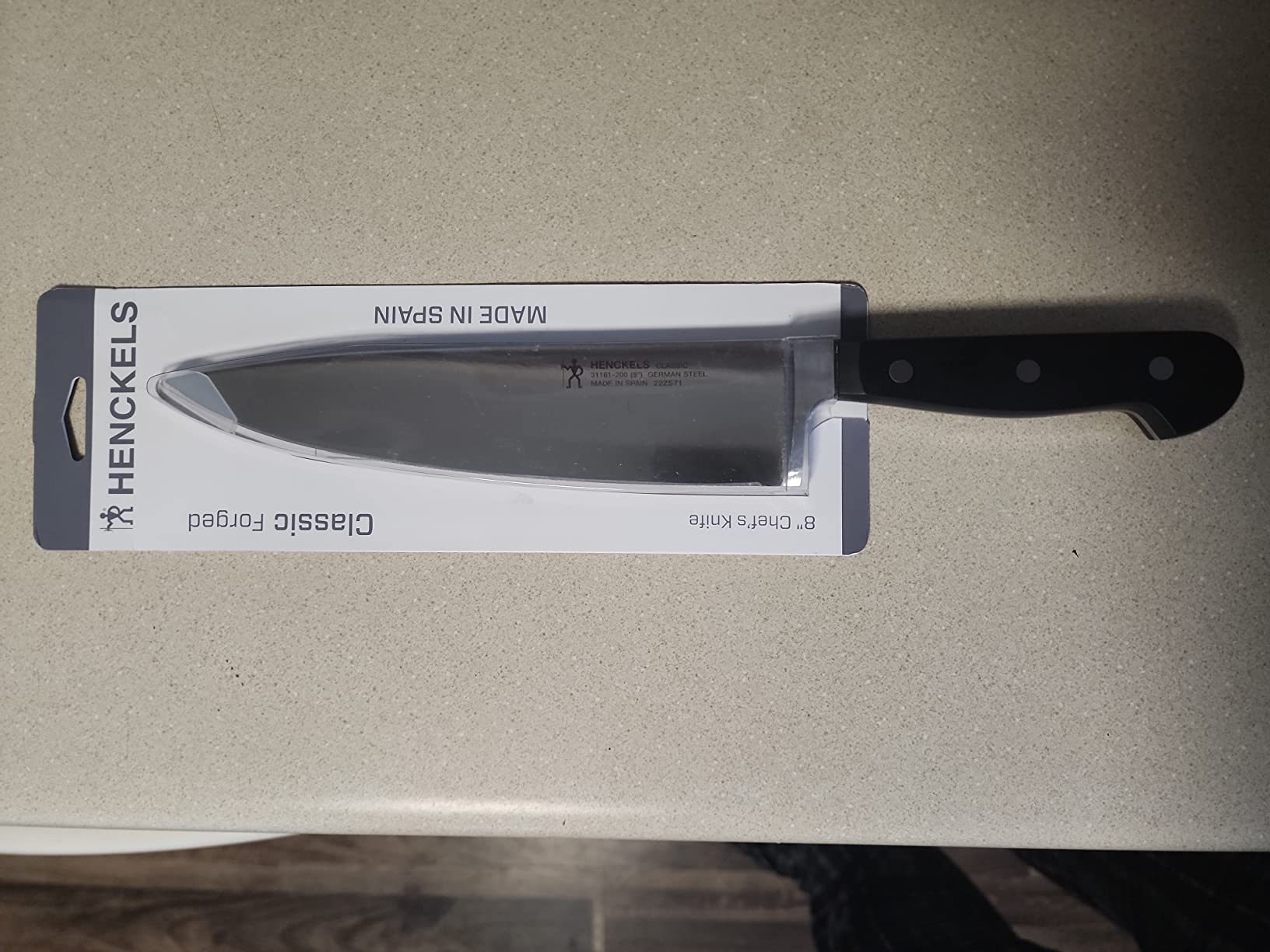
The main complaint from experienced users is the full bolster. The metal web between handle and blade is a design feature of classic German knives, and while it protects the thin heel from chipping, it also stops you from getting a honing steel flush against the edge. If you enjoy sharpening your own knives, it gets in the way. If you do not, you will never miss it.
It is also a very substantial-feeling build, so it feels heavier in the hand than the light stamped options. That is a plus if you push-cut through firm vegetables and a minus if you prefer a featherweight tool.
Why this suits a beginner
It is the knife with the fewest compromises in the way it feels. The handle is neutral, the weight is light, the steel is low-carbon and forgiving, and it cleans up in a dishwasher without drama. A lifetime warranty means the single biggest reason not to buy a premium knife, the cost of a mistake, is handled.
It is also a good knife to buy for someone else, because the traditional profile looks familiar to almost everyone.
What to know before you buy
Know that the full bolster limits sharpening access, and that this sits in a higher tier than the entry-level stamped knives. If you want a forged German profile but intend to sharpen frequently, the Mercer Renaissance gives you a shortened bolster for the same reason.
Also plan on hand washing eventually anyway, if you care about the edge over the long run, even though the blade tolerates a dishwasher.
6. Mercer Culinary M22608 Millennia — Best for Sharpening as You Learn
Mercer Culinary M22608 Millennia Black Handle, 8-Inch, Chef’s Knife
Blade: one-piece high carbon Japanese steel
Handle: Santoprene with finger points
Pros
- Japanese high carbon steel is easy to sharpen
- Textured finger points give a secure grip
- Tang provides excellent balance
- Handles dicing
- mincing and garlic crushing
Cons
- Hand wash only
- dishwasher voids the warranty
- Stamped body is less durable over decades
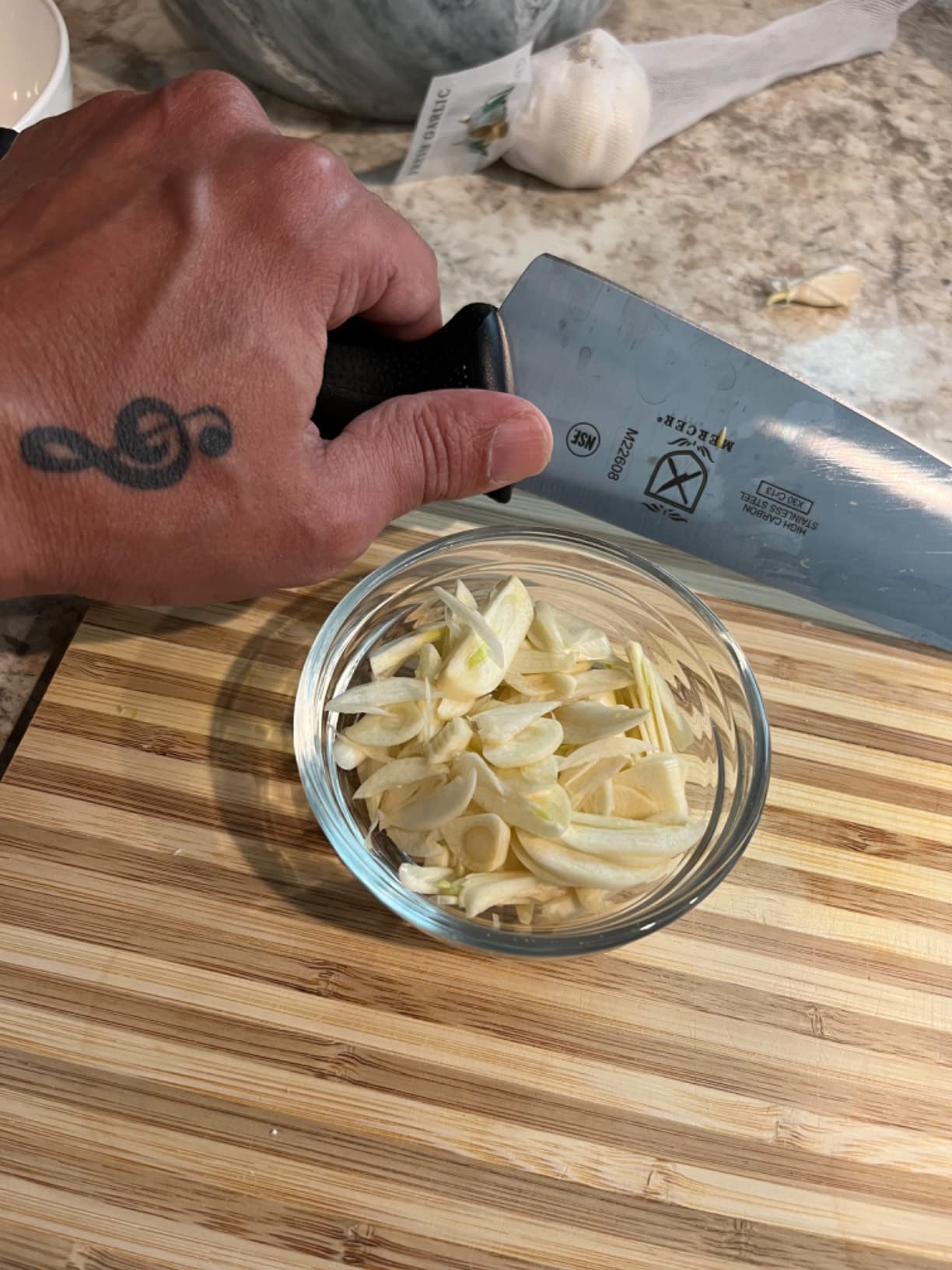
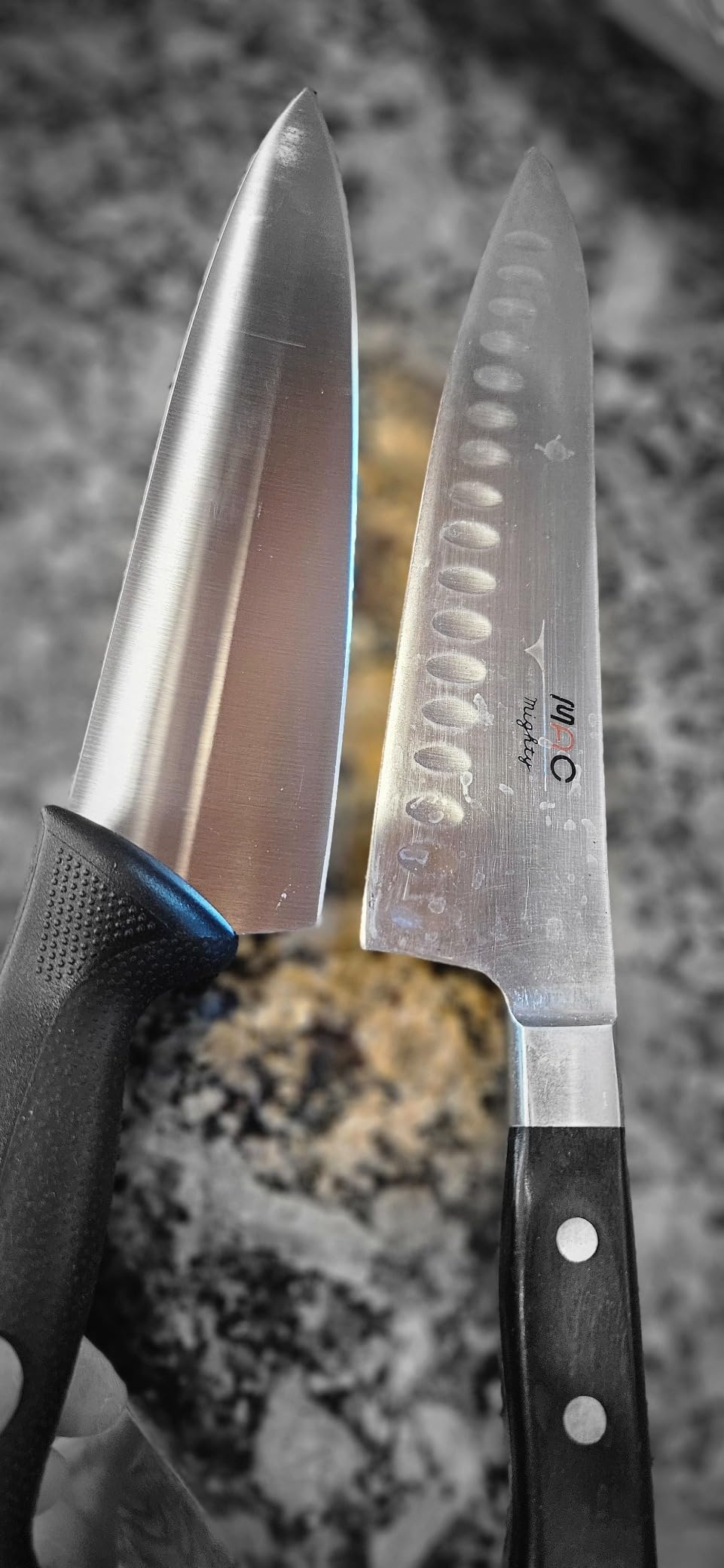
The Mercer Millennia is the knife I suggest for anyone who wants to learn to sharpen without buying expensive mistakes. The blade is one-piece high carbon Japanese stainless, which is soft enough to hone up quickly on a basic stone but still holds an edge well between sessions. The tang gives the knife a balance that stamped knives with hidden tangs cannot match.
The Santoprene handle has textured finger points that keep it from slipping, and reviewers single out how well it handles dicing onions, mincing shallots, chopping herbs, crushing garlic, and shredding cabbage. It also sits near the top of the overall best sellers list, which tells you how many home cooks rely on it.
There is one rule, and it is a real one: hand wash only. The manufacturer states plainly that dishwasher use voids the warranty and dulls the blade, and reviewers repeat it more than any other caveat. Warm water, mild soap, and a soft towel is genuinely all it needs, and it takes ten seconds.
As a stamped knife it will not outlast a forged one over decades, but high carbon steel is very easy to bring back from dull, so in practice you can keep this one sharp indefinitely.
Why it suits a first knife
It is forgiving in both directions. The steel is soft enough that a beginner with a cheap honing rod can improve the edge in seconds, and the handle is textured enough to stay put in a wet, greasy sink-side moment. The balance point near the bolster makes a pinch grip feel natural before you know what a pinch grip is.
It is also the most multipurpose of the budget options here, doing well on herbs and delicate work as well as heavy chopping.
When to pick something else
Choose elsewhere if you want a knife you can toss in a machine without thinking, or if you want a forged build you can pass down. Both are fair reasons to look at the Amazon Basics or HENCKELS instead.
Be realistic about the warranty language, which is a limited repair-or-replace policy that excludes dishwasher damage, neglect, and accident. Treat it correctly and it is not a concern.
7. Emojoy 67-Layer Damascus Chef Knife — Best Looking Option
Emojoy 8-Inch Damascus Chef Knife, 67-Layer Japan Steel, Olive Wood Handle
Blade: 67-layer Damascus at 58 HRC
Edge: 15 degrees per side
Handle: Calabrian olive wood
Pros
- Damascus pattern looks premium in person
- Very sharp out of the box across veg and meat
- Half-bolster handle suits any hand size
- Wooden box doubles as storage
- Forged steel holds its edge well
Cons
- Hand washing required
- dishwasher damages the edge
- Olive wood needs periodic mineral oil
- Sharp edge catches unwary users off guard
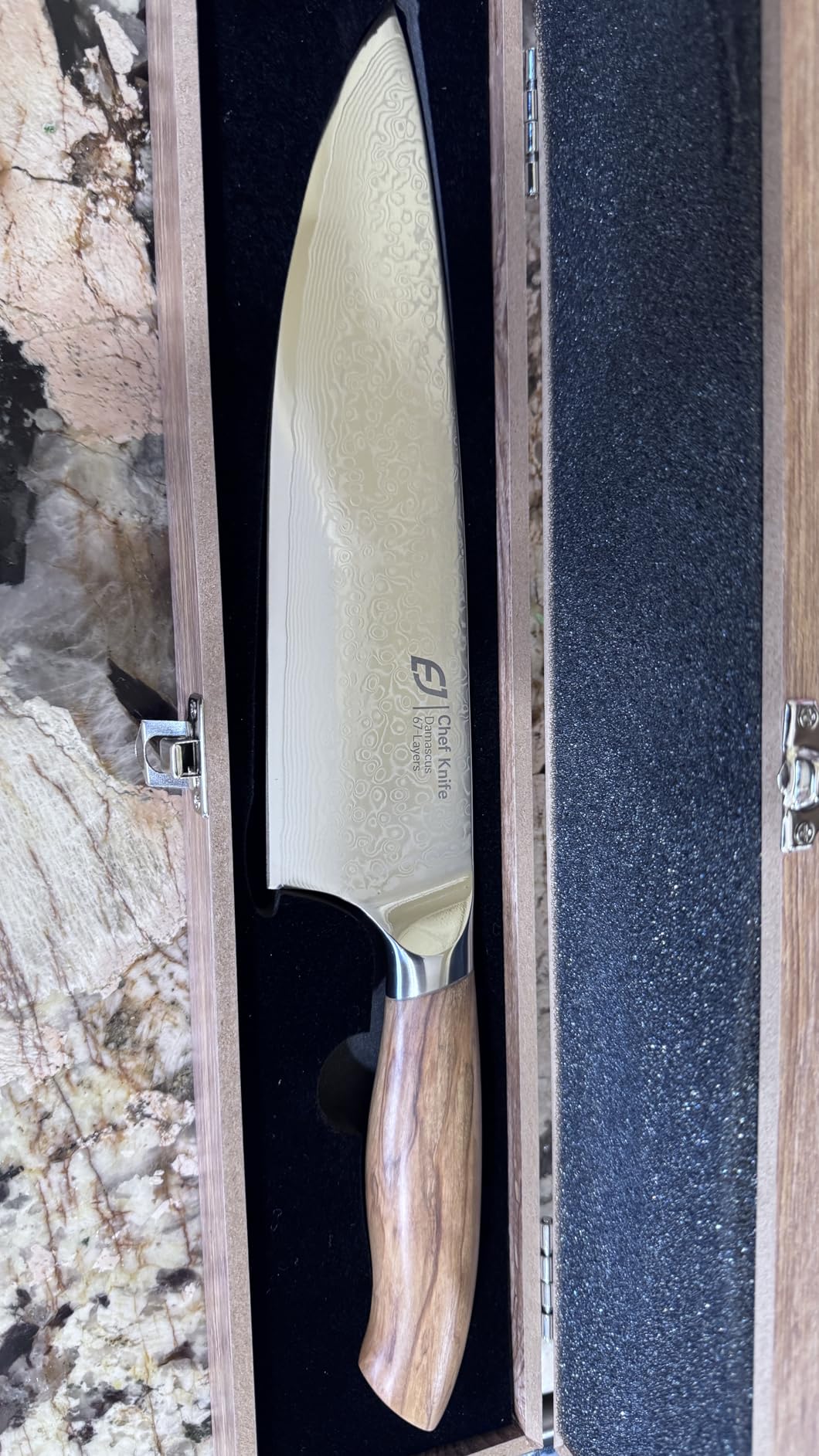
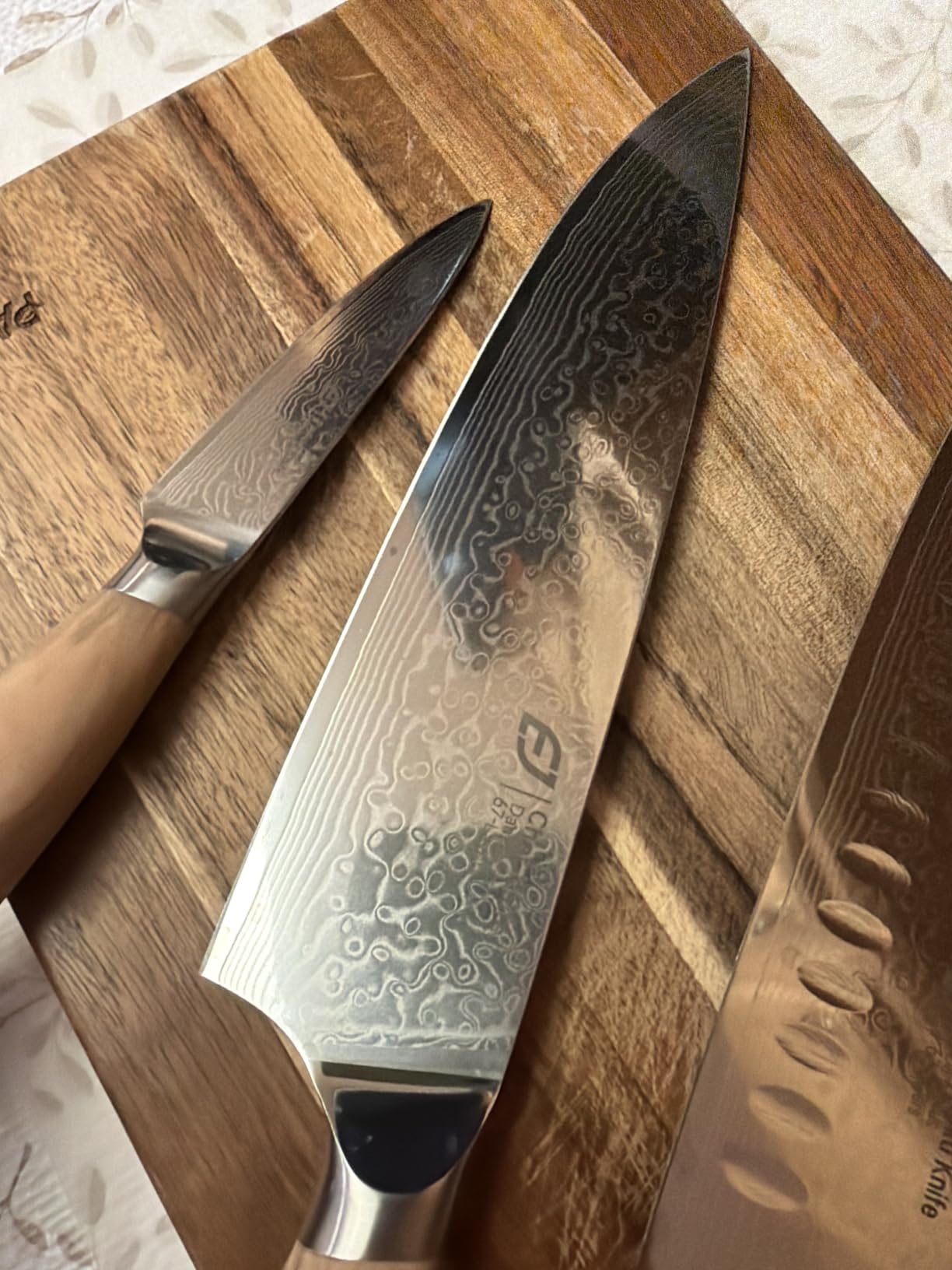
This is the Damascus option that is actually layered rather than etched. Sixty-seven layers of Japanese steel at 0.98% carbon and 18% chromium, hand-forged and sharpened by laser-controlled precision to a 15-degree edge per side. Reviewers are unapologetic about the looks, and the wooden presentation box makes it one of the easiest gifts in this list.
Underneath the finish it performs well. It is very sharp out of the box, gliding through meat, fish, and vegetables with little pressure, and the forged 58 HRC steel holds its edge longer than an ordinary kitchen knife. The half-bolster design exposes more of the blade for sharpening and gives generous knuckle clearance.
Care is where the work is. Reviewers repeat three instructions: wash by hand, because dishwasher cycles damage the blade and edge; oil the Calabrian olive wood handle periodically with food-grade mineral oil to keep it looking good and holding up; and respect the edge, because 15 degrees per side is sharper than most beginners expect. A very sharp edge catches hands that are moving too fast.
The Calabrian olive wood handle is one of the more universally comfortable shapes here, and reviewers note it fits a range of hand sizes.
Who buys this knife
It suits a beginner who wants one impressive knife that handles a full range of prep and looks good on a counter, and who will accept a hand-wash-only routine. If you like upgrading a kitchen gradually and want the first upgrade to feel like a milestone, this works well.
The half bolster also makes it a decent stepping stone toward self-sharpening, since the blade heel is more accessible than on a fully webbed design.
Where caution is needed
Do not buy it if you want low maintenance. A wood handle plus a 15-degree edge plus hand-wash-only instructions asks the most upkeep of anything in this roundup, and skipping the oiling will show on the handle within a year.
And take the first week slowly. An edge this fine will cut you before you learn to respect it, and that is the most common regret buyers report.
8. Mercer Culinary M23510 Renaissance — Best for Cooks Who Sharpen
Mercer Culinary M23510 Renaissance, 8-Inch Chef’s Knife
Blade: fully forged German high carbon steel
Edge: 15 degrees per side
Handle: Delrin
Pros
- Forged German steel rivals pricier German brands
- Shortened bolster exposes the full blade for sharpening
- Triple-riveted Delrin handle works in a pinch grip
- Sharp from the box and holds for months
- Taller profile suits people who want more blade
Cons
- Some units show surface blemishing or light rust
- Not dishwasher safe
- Taller profile may not fit an existing knife block
This is the most interesting knife in the roundup for a cook who wants to learn sharpening, and experienced cooks recommend it constantly. The blade is fully forged high carbon German steel, taper-ground to roughly 15 degrees per side, and the shortened bolster is the quiet hero: it exposes the full blade so a honing steel or stone can reach the heel without fighting the handle.
Reviewers compare the forging and finish favourably to Wusthof and Henckels knives costing far more. The triple-riveted Delrin handle and rounded spine sit well in a proper pinch grip, and the taller profile gives more blade than the standard 8 inch for cooks who push-cut.
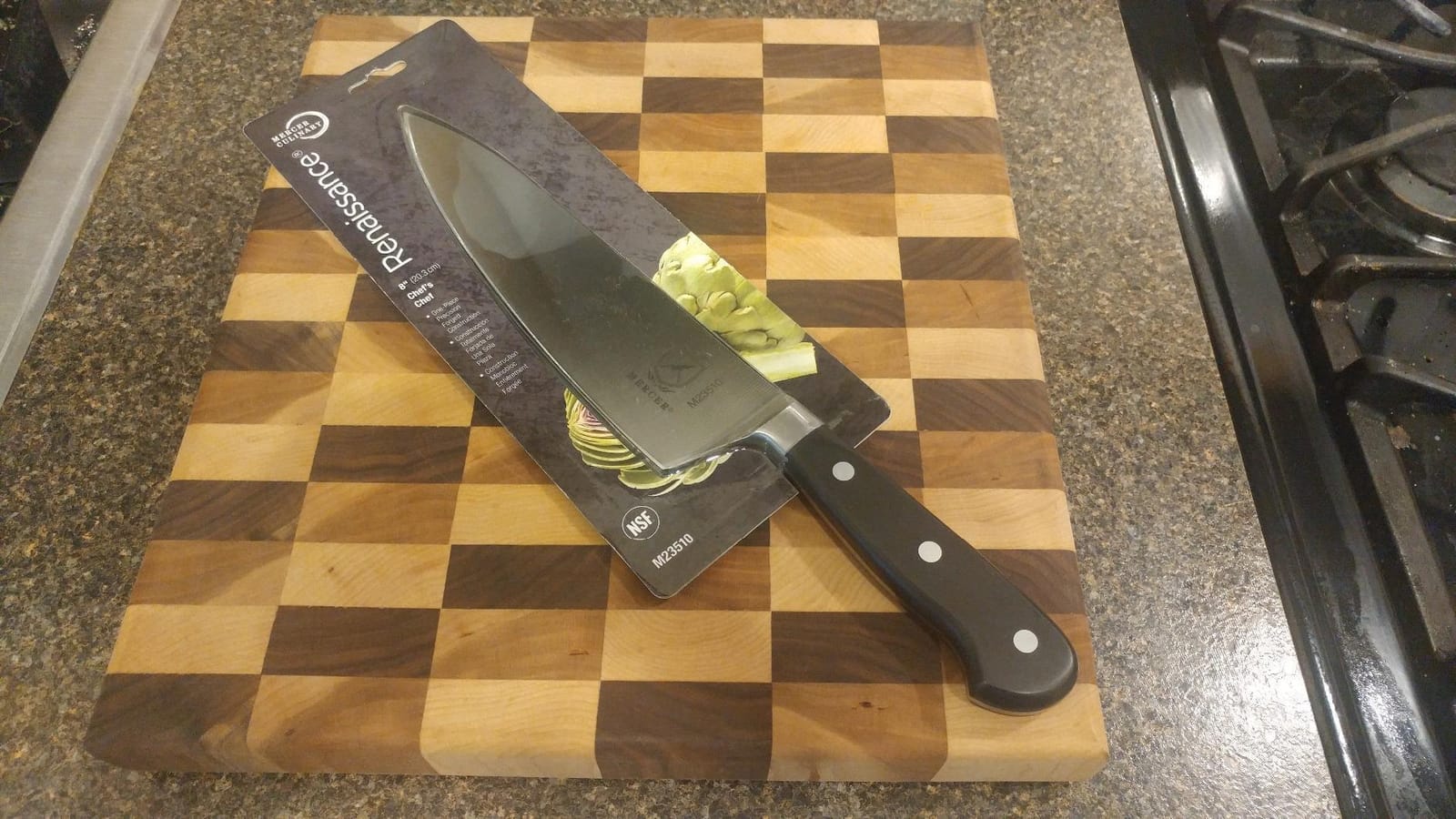
The most repeated caution is quality control on the steel. A subset of owners report cosmetic blemishing or light surface rust despite the stainless steel claim, so inspect the blade on arrival and treat it with a little care. It is also not dishwasher safe, and the edge dulls faster if washed that way.
The taller blade profile has a practical consequence: it may not fit an existing knife block without buying a new one. Check your slot width first.
Why a beginner should consider it
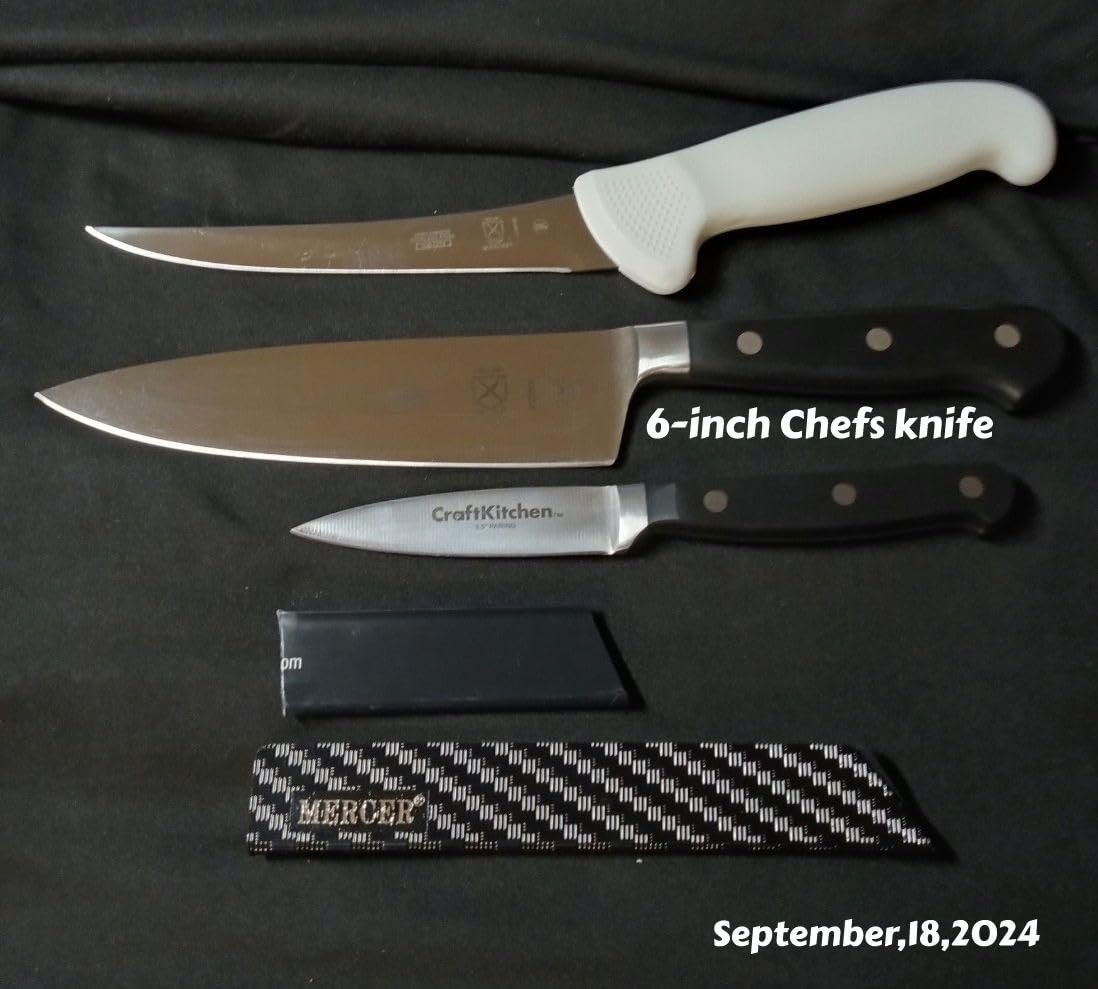
It is the best value in a true forged, high carbon German blade, and the half-bolster style is the most beginner-friendly thing in the whole list for anyone planning to own a whetstone. It is sharp out of the box, holds an edge for months of daily use with light honing, and comes with a lifetime warranty from a US-based company that is easy to contact.
It is also a common recommendation for culinary students, who need a knife that survives service and can be maintained on the way.
Who should look elsewhere
Look elsewhere if you want zero care instructions, or if you need a knife that fits a standard block without modification. It is also the heaviest option here at 8.8 ounces, which is comfortable for many cooks and tiring for others during very long prep sessions.
Inspect the blade on arrival. A cosmetic blemish is not a functional problem, but early surface rust is worth returning.
9. Amazon Basics Full Tang 8 Inch — Best Sturdy Starter
Amazon Basics Classic 8-inch Full Tang High Carbon Stainless Steel Chef’s Knife, Multipurpose Kitchen Knife with Three Rivets, Silver
Blade: 8 inch high carbon stainless
Handle: stainless steel, three rivets
Forged full tang
Pros
- Well balanced with a substantial feel
- Sharp from the box and holds an edge with light twice-weekly honing
- Forged full tang with three rivets feels sturdy
- Thin tapered blade cuts cleanly
Cons
- Inexpensive steel wants more frequent sharpening
- Slightly heavier than some cooks prefer
- Hand wash only
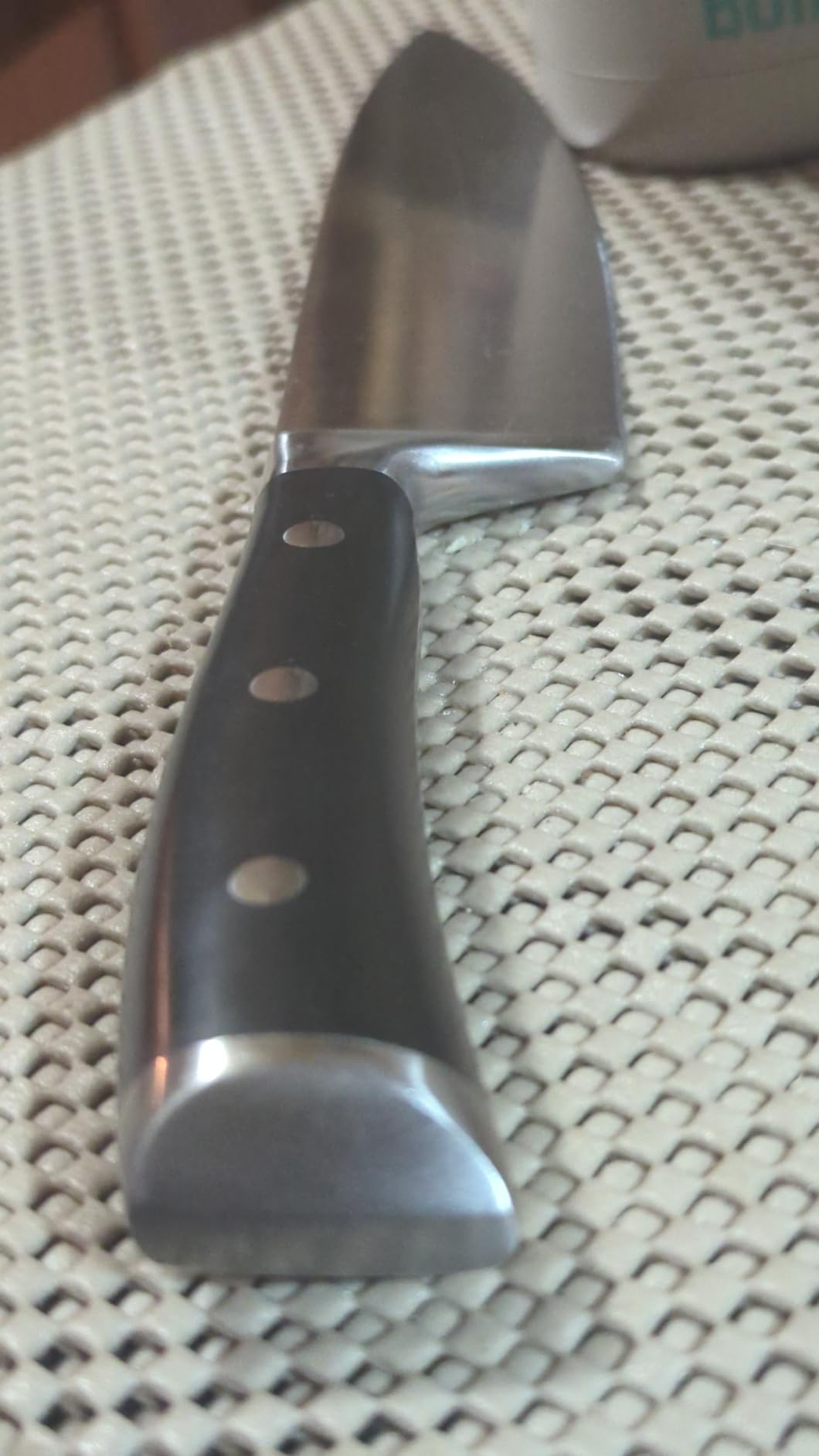
The thing that stands out here is the tang. A forged full tang with three rivets and a stainless steel handle is normally a mid-tier build, and it shows in the hand: substantial, balanced, and hard to flex. At 13.28 inches overall it feels like a proper knife rather than a stamped wafer, and buyers repeatedly say they expected little and were surprised.
The semi-bolster design adds weight and balance while keeping the full blade accessible, so you can sharpen it without a lot of ceremony. The high carbon stainless blade has a satin finish that resists stains, rust, and pitting.
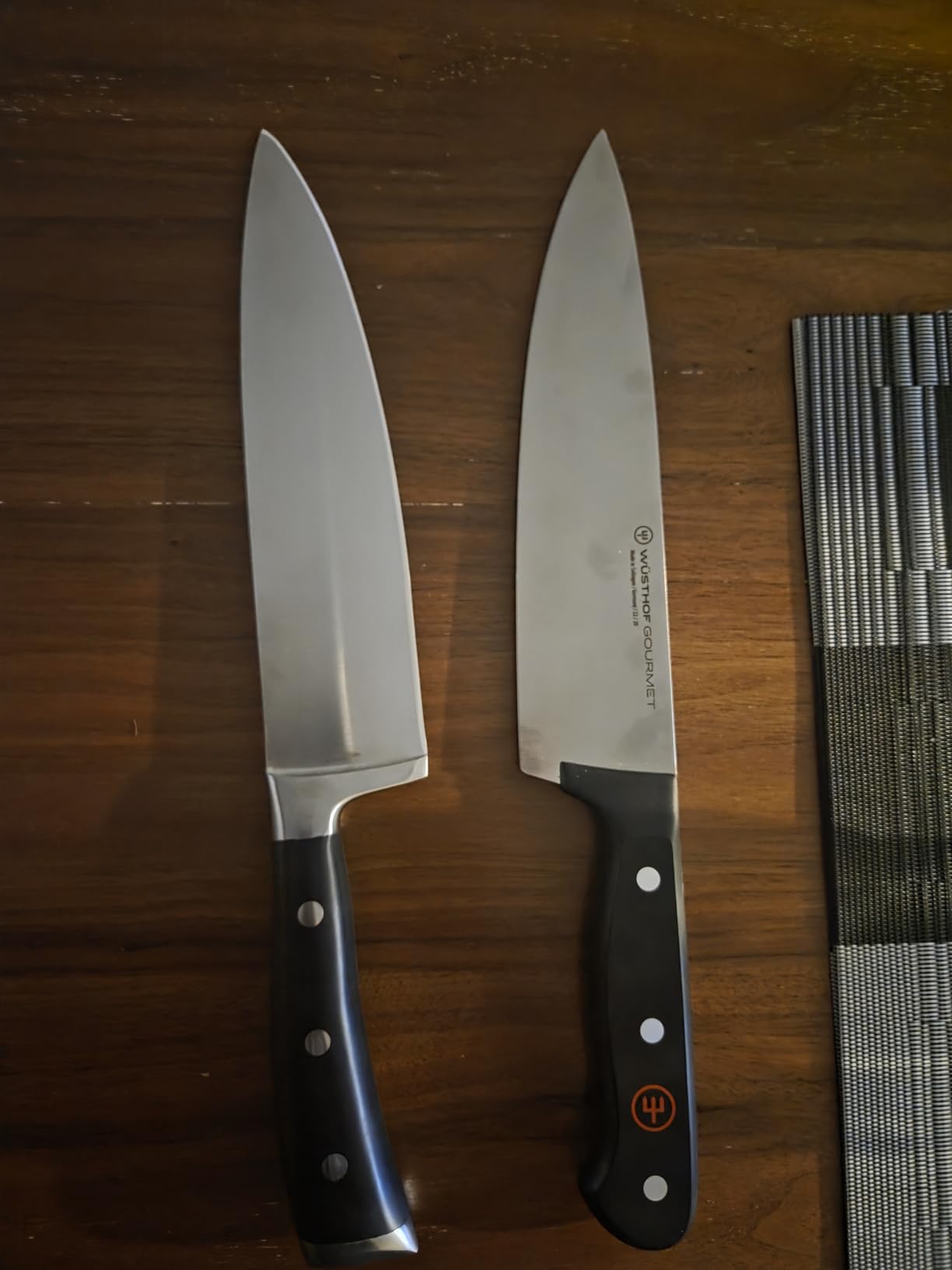
The compromise is the steel grade. It is inexpensive, and it wants sharpening more often than the forged German or Japanese options here. Light honing twice a week keeps it working, and the edge it holds is more than adequate for home prep.
It is also slightly heavier than some cooks like, and it is hand wash only. The sharp edge is sharp enough to nick inattentive fingers, so the usual beginner caution applies on day one.
What works well here
It is a good pick if you want the most solid-feeling knife in this list at the lowest tier, and you do not mind a honing routine. The full tang means it should survive a decade of ordinary use, and the satin blade hides marks better than polished steel.
It is also a good knife to hand to a teenager or a roommate who will not treat it carefully, because the build tolerates abuse better than a thin stamped blade.
What to manage
Manage the sharpening expectation. If you want a knife you barely ever touch, pick the imarku or the HENCKELS instead. And commit to hand washing, since the manufacturer states it plainly and dishwasher heat is the fastest way to ruin an edge.
Be aware of the weight too. If you are cooking for long sessions with a lot of fine prep, a lighter knife will be kinder to your wrist.
10. Sunnecko 8 Inch Forged Chef Knife — Best Fine Edge With a Sheath
Sunnecko 8 Inch Chef Knife – Ultra Sharp Vegetable Kitchen Knife
Blade: 8 inch high carbon stainless
Edge: 12-15 degrees per side
Handle: Pakkawood, steel bolster
Pros
- Takes well to both a steel and a wet stone
- Weight distribution supports a pinch grip
- Pakkawood handle stays secure when wet
- Full tang resists flexing under pressure
- Custom-fit PVC sheath and gift box included
Cons
- Some users find the laser-etched pattern is cosmetic and less refined than true Damascus finishing
- Edge dulls with use and needs periodic honing or wet stone work
- One reviewer felt the sharpness did not justify expectations at the price
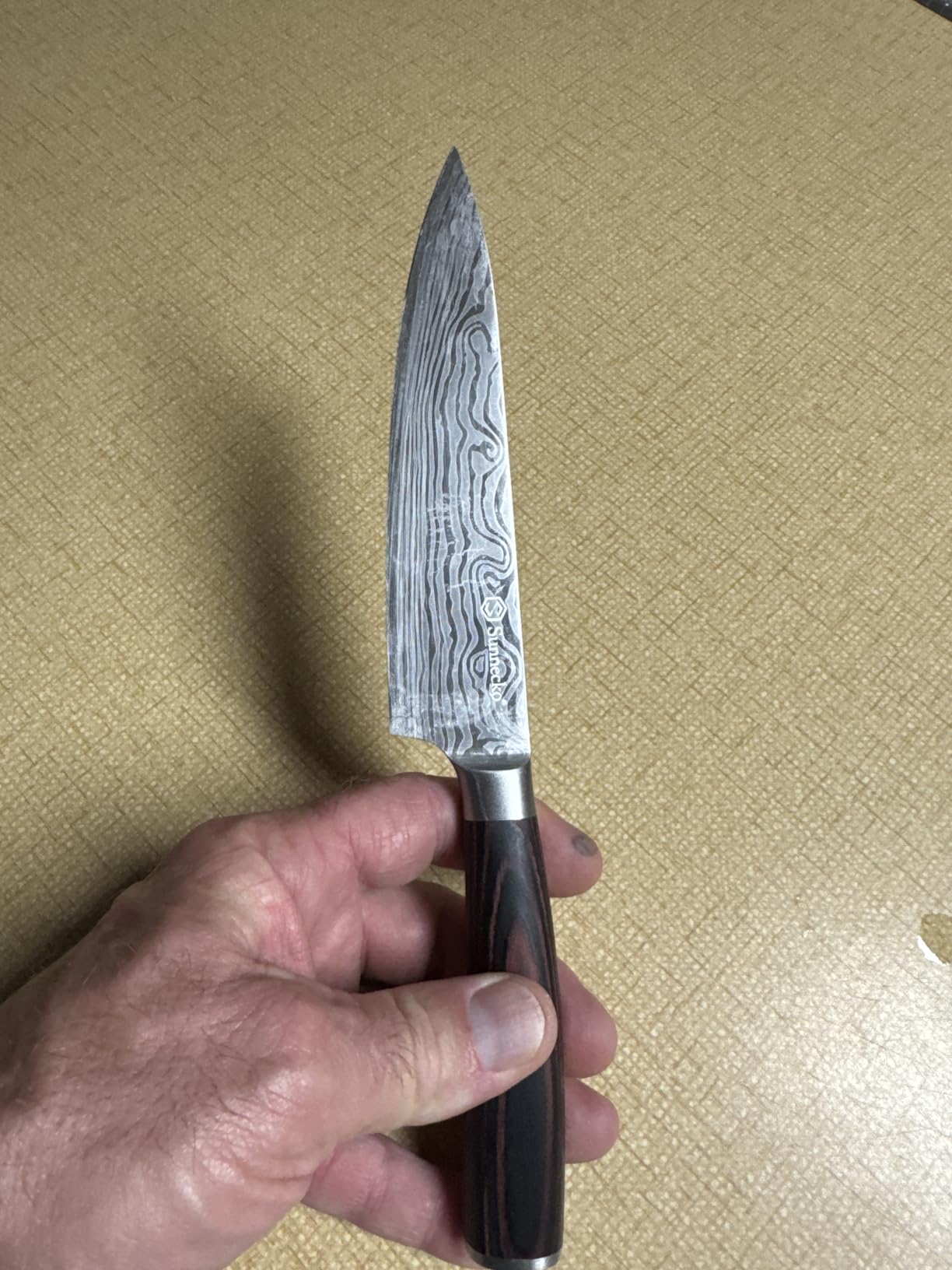
The Sunnecko is sharpened by hand to 12-15 degrees per side, the finest factory edge in this roundup, and it is also the only one that comes with a custom-fit PVC sheath for safe storage and transport. For a cook who moves between kitchens or takes a knife travelling, that is a real feature rather than a gimmick.
The forged full tang with a steel bolster resists flexing, and the weight distribution supports a proper pinch grip straight away. The Pakkawood handle stays secure when wet, and it is available in 8 inch and 5.5 inch sizes if your hands prefer something smaller.
It handles roughly ninety percent of prep tasks as a vegetable knife, fruit slicer, and meat cutter, and reviewers describe it as well made, attractive, and sharp out of the box. Some find the laser-etched pattern cosmetic rather than refined, and a minority feel the sharpness does not justify the tier.
The more common note is that the edge dulls with use and wants periodic honing or wet stone work. That is the trade for a fine starting angle: sharper now, more maintenance later.
Where it fits
It fits a beginner who wants to practise on a fine edge and does not mind the extra upkeep, or anyone who wants a knife plus a sheath as a gift. The included gift box and sheath make the whole package feel considered.
It also works as a companion piece if you have already got a workhorse and want something that handles delicate slicing with more precision.
When to choose differently
Choose differently if you want minimal maintenance, or if your kitchen routine is wet and fast. Pakkawood plus a 12-15 degree edge is the wrong pairing for a cook who will not dry the knife every time.
Also consider that with a smaller review history than the rest of this list, there is less long-term wear data available, so expect to check the edge more carefully in the first few months.
How to Choose a Chef Knife as a Beginner
Start with size. Almost every home cook should buy an 8 inch chef’s knife, and every knife in this roundup is that size. Longer blades give you more board space to work with but are harder to control; shorter blades are nimble but need more strokes for the same job. Eight inches is the compromise that almost every professional kitchen settled on for a reason.
Next, understand steel. Low-carbon stainless steel is forgiving, easy to sharpen, and rust resistant, which is why it dominates entry-level knives. High-carbon steel holds an edge far longer and takes a finer angle, but it is also more brittle, more demanding to maintain, and less tolerant of being left in a sink. For a first knife, forgiving is usually the better trade.
Then look at construction. A forged knife is machined from a solid billet and tends to be heavier, better balanced, and more durable. A stamped knife is cut from a sheet, is lighter and thinner, costs less, and holds its edge for less time. A full tang means the steel runs the entire length of the handle, which is the strongest and most durable arrangement; a partial tang stops partway and is common on cheaper knives.
Bolsers matter more than most guides admit. A full bolster is a metal collar between handle and blade that protects the heel but blocks your honing steel. A half bolster leaves more blade exposed and makes sharpening far easier. If you have any interest in maintaining your own knives, a half-bolster design like the Mercer Renaissance or the Emojoy will make your life simpler.
Handles are personal. Textured synthetic grips such as Fibrox, Santoprene, and Delrin stay secure when wet and need no maintenance. Pakkawood is stable and warm but still prefers to stay dry. Plain wood looks traditional and needs the most care. Steel handles feel substantial and clean easily, but offer less grip when wet.
Hand size is the factor most guides skip. If your hands are small, a slim handle like the PAUDIN or the Mercer Millennia will stop you fighting the tool. If your hands are large or you like a visible heft, the forged builds such as the HENCKELS or the Amazon Basics full tang will feel better. The easiest test is holding two of them: whichever you can hold in a relaxed pinch for a full minute is the one to buy. Grip style is the other half of that. A pinch grip on the bolster gives the most control, while a full handle grip is easier for a total beginner to learn first.
On budget tiers, the pattern in this roundup is clear. Entry tier gets you a stamped or simple forged steel with a synthetic handle and a serviceable edge. Mid tier, where most of these knives sit, gets you higher carbon steel, a full tang, and a handle you will still like in five years. Upper tier is where hand-forged Japanese steel and layered constructions live, and those demand more maintenance than most beginners want.
What three knives actually cover a home kitchen? A chef’s knife does roughly ninety percent of the work. Add a paring knife for peeling and detail work on small produce, and a serrated bread knife for anything with a crust. A fourth useful addition for fish is a narrow boning knife, and our guide to the best fillet knives for anglers covers that style in more depth if you cook fish often.
A knife set is almost never the right first purchase. The cheap sets contain one decent blade and several pieces you will never touch, and the good sets cost more than buying two excellent knives separately. Buy the chef’s knife first, live with it for a few months, and only then decide what is missing.
Sharpening, Honing and Care Basics for New Knife Owners
Honing and sharpening are different jobs. Honing straightens an edge that has rolled or bent over, which is what happens to a knife after a few weeks of normal use. Sharpening removes metal to create a new edge, which is what you need every year or two. A honing steel or ceramic rod does the first job. A whetstone does the second.
For a beginner, a good quality honing rod used for a few strokes before each prep session will keep a kitchen knife working far longer than most people expect. Soft steels like the low-carbon stainless in the HENCKELS or the Amazon Basics knives respond to a rod easily. Harder steels such as the 58 HRC Damascus on the Emojoy or the 56-58 HRC imarku respond even better but are less forgiving of a careless stroke.
Learn to whetstone only once you have a knife you care about. A 1000 grit stone is the sensible starting grit, and the 15-20 degree per side edge that ships on most of these knives will come back quickly. Take your time, keep the angle steady, and alternate sides evenly.
Washing is where most knives are ruined. Hand wash with warm water and mild soap, then dry immediately with a soft towel. The dishwasher uses heat, detergent, and tumbling that will dull an edge and can damage handle glue or wood. The Victorinox and the HENCKELS are the two rated for dishwasher use here, but even those last longer with a towel.
Store knives properly too. A block with slots wide enough not to touch the edge, a magnetic strip, or a sheath all work. Avoid a drawer where blades knock together, because that is the fastest way to dull an edge and chip a tip.
Pair your knife with a board that respects it. End grain wood or a high-density plastic board is far kinder to an edge than glass or stone, and a wet board is worse for your knife than a dry one. Stable, damp-resistant boards keep your fingers safer too, because a board that slides is the most common cause of a cut in a home kitchen.
Four beginner mistakes account for most injuries and dull knives. Cutting frozen food damages any edge, so thaw first. Twisting the blade sideways while cutting shears the edge, so keep the blade vertical. Dropping a knife and trying to catch it is how people lose fingertips, so set knives down flat. And skipping the hand-wash step is the one that ends a knife’s life early.
Frequently Asked Questions
What is the best chef knife for a beginner?
The Victorinox Fibrox Pro 8 inch is the best chef knife for most beginners because it arrives sharp, has a secure non-slip handle, is light in the hand, and is simple to care for. If you want an edge that holds longer between sharpening sessions, the imarku 8 inch high carbon knife rated at HRC 56-58 is the step up, and if you plan to sharpen your own knives, the Mercer Renaissance with its shortened bolster is easier to maintain.
What are the three knives every chef needs?
Most home cooks need three: an 8 inch chef’s knife for chopping, slicing, dicing, and mincing; a small paring knife for peeling, trimming, and detail work; and a serrated bread knife for anything with a crust. That covers the overwhelming majority of prep tasks without wasting money on a large set.
What are the five knives a serious cook needs?
Add a narrow boning or fillet knife for breaking down fish and meat, and a vegetable peeler or cleaver depending on your cooking style. A santoku is a useful fifth option for cooks who prefer a shorter blade with more clearance on the board, and a small utility knife covers awkward tasks that do not fit either a chef’s knife or a paring knife.
What size chef knife should a beginner get?
An 8 inch blade is the standard first choice. It gives you enough board space for real prep while staying controllable with a beginner grip, and every professional kitchen relies on it as a daily workhorse. Shorter blades are easier to handle but need more strokes, and longer blades are harder to control until your technique is solid.
How often should a beginner sharpen their knife?
Hone with a rod for a few strokes before prep whenever the edge feels draggy, which for most home cooks means a few times a week. True sharpening on a whetstone is needed roughly once or twice a year, less often if you cook lightly. Soft stainless knives lose their edge faster than harder high carbon steel, so the frequency depends as much on the knife as on your cooking.
Which Chef Knife Should You Buy First?
If you take one thing from this guide, make it the Victorinox Fibrox Pro 8 inch. It is the best chef knife for beginners because it removes every reason to be discouraged: it is sharp on day one, light in the hand, forgiving of imperfect technique, easy to wash, and backed by a lifetime warranty. Buy it, keep it sharp with a rod, and use it until you outgrow it.
When you are ready to move on, the imarku 8 inch high carbon knife is the step up for edge retention, and the Mercer Culinary M23510 Renaissance is the right pick if you want to learn whetstone sharpening because its shortened bolster makes the blade accessible. For the finest edge and the best-looking knife on the block, the Emojoy 67-layer Damascus is the one to look at, and the HENCKELS Classic is the safest fully forged German option with a lifetime warranty behind it.
Whatever you choose, buy one knife, keep it sharp, and use it. Every expert we spoke to made the same point in different words: the best chef knife for a beginner is not the sharpest or the most expensive one, it is the one still in the block in five years. Check the current options for the picks above, and go make something.