
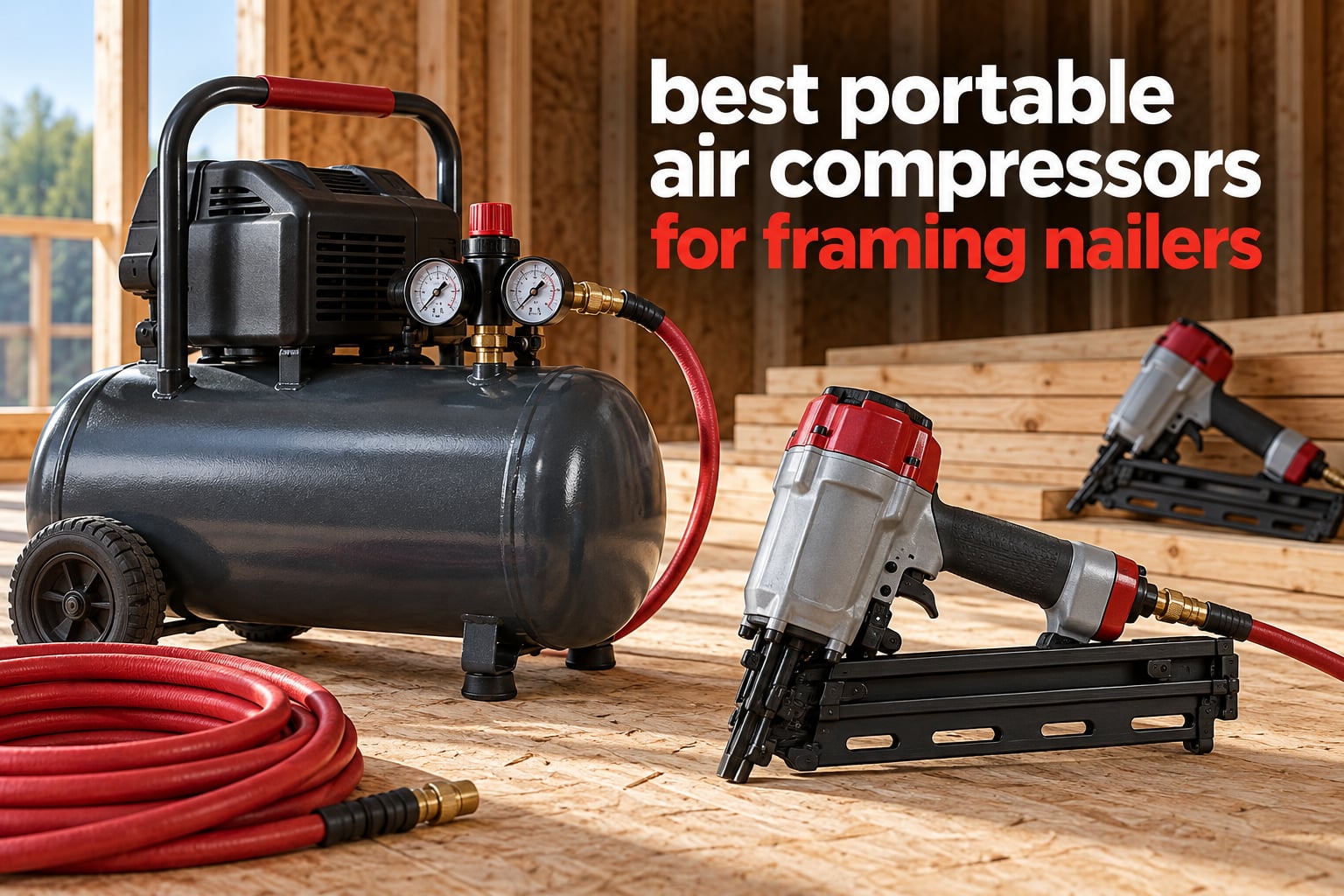
Here is the short answer most people need: for wall framing with a single pneumatic nailer, look for 2.0 to 3.0 SCFM at 90 PSI, a 6-gallon tank or larger, and a compressor rated to at least 120 PSI. That is the whole specification. Decking, subfloor and roof sheathing are a different job entirely, and they demand closer to 8.5 to 10 CFM, which pushes you into a 20-gallon machine.
Most people get this wrong by buying on tank size. A big tank tells you how long the compressor can run between restarts, not whether it can keep up. What decides whether your nailer stalls mid-run is airflow in cubic feet per minute, measured at a stated pressure. You can always turn a large compressor’s pressure down. You can never turn a small one’s airflow up.
Below are 10 portable air compressors, every one of them verified at a stated CFM figure, compared for the specific demands of framing work. We also break down the wall-framing versus decking distinction, the two-nailer math, and why a nailer that worked fine this morning suddenly slows down after a few hours. If you are still choosing the gun itself, start with our framing nailer roundup instead.
Updated October 2026. How we chose: every unit below had to be a real air compressor with a manufacturer-stated airflow figure, a tank capacity and a noise rating. We cross-checked those specs against owner reviews for real-world behavior, and we read the framing forums, where the most useful data comes from people who frame for a living. This is spec-verified and reader-report-verified research rather than lab testing, and we say so plainly. CFM figures are manufacturer-rated at a stated pressure and can vary between units from the same model.
Table of Contents
Top 3 Best Portable Air Compressor for Framing Nailers in 2026

The 10 Best Portable Air Compressors for Framing Nailers at a Glance in October
| Product | Specifications | Action |
|---|---|---|
| California Air Tools 10020C |
|
Check Latest Price |
 Metabo HPT EC914S Metabo HPT EC914S |
|
Check Latest Price |
 Makita MAC2400 Makita MAC2400 |
|
Check Latest Price |
 Klutch 20-Gallon Air Compressor Klutch 20-Gallon Air Compressor |
|
Check Latest Price |
 DEWALT D55146 DEWALT D55146 |
|
Check Latest Price |
 CRAFTSMAN CMXECXA0201041 CRAFTSMAN CMXECXA0201041 |
|
Check Latest Price |
 California Air Tools 15020C California Air Tools 15020C |
|
Check Latest Price |
 California Air Tools 20020AD California Air Tools 20020AD |
|
Check Latest Price |
 Ingersoll Rand Twin-Stack Ingersoll Rand Twin-Stack |
|
Check Latest Price |
 Stealth SAQ-11215 Stealth SAQ-11215 |
|
Check Latest Price |
1. California Air Tools 10020C: Best Overall for Framing Nailers
California Air Tools 10020C 2.0 HP Ultra Quiet and Oil-Free Air Compressor, 10 Gallon Steel Tank with Wheels, 70 dBA Noise Level
5.30 CFM at 90 PSI
10-gallon steel tank
2.0 HP oil-free
70 dBA
125 PSI max
82.5 lb
Pros
- 70 dBA lets you frame inside an occupied home
- Oil-free dual piston pump rated past 3000 hours
- 10-gallon reserve refills quickly for nailers and staplers
- Easy-start valve cuts startup amps on marginal circuits
Cons
- Not built for sustained continuous duty
- Some examples cut out near 120 PSI rather than 125
- 82.5 lb needs two people to load
This is the compressor I keep coming back to because it solves the two things that actually annoy people: noise and tank size. At 70 dBA you can hold a conversation next to it, which matters enormously when you are framing interior walls in a house somebody is living in. The 10-gallon vertical tank is the smallest size I would trust for wall framing, because it holds a real reserve of air rather than trickling.
Its 5.30 CFM at 90 PSI sits comfortably above the 2.0 to 2.5 CFM a 30-degree framing gun pulls, and above the 3.0 to 4.0 CFM a half-inch framing nailer wants. That headroom is the whole point. The motor only spins at 1680 RPM, which is why it is quiet and why the oil-free piston pump is rated past 3000 hours of service life.
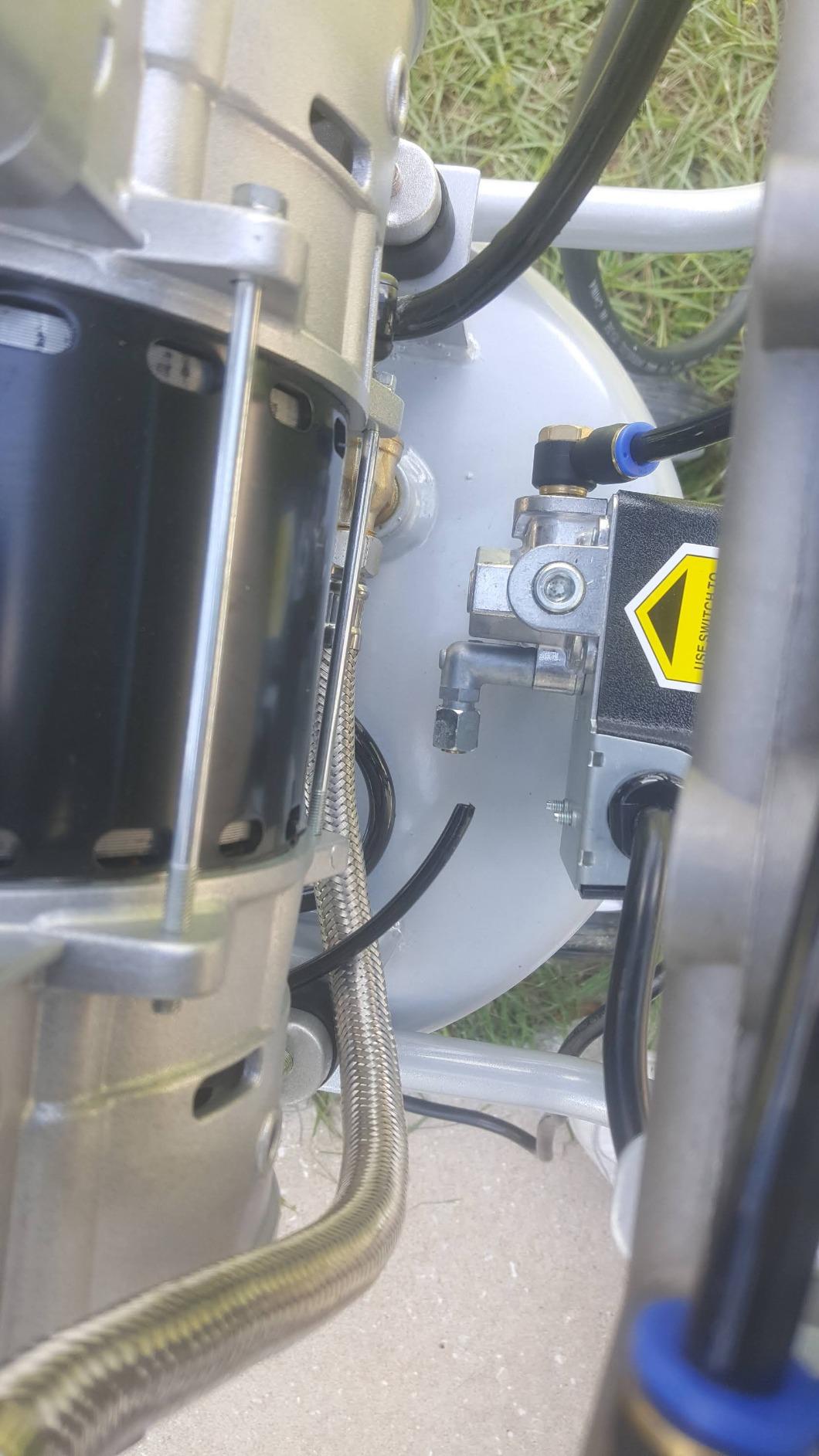
The compromise is honest and worth stating. Oil-free pumps are built for intermittent duty, and owners do report thermal cutoffs during long sanding or spray sessions, which is not what you are doing here. A few machines also cycle off closer to 120 PSI than the rated 125 unless the pressure switch gets recalibrated, and at 82.5 pounds this is a two-person lift into a truck bed.
The easy-start valve is a detail I would not skip. It bleeds pressure before the motor kicks in, which reduces the inrush that trips household breakers on marginal circuits, and it makes cold-weather starts noticeably more reliable. If your framing happens in a basement or an unheated addition, that matters more than another two gallons of tank.
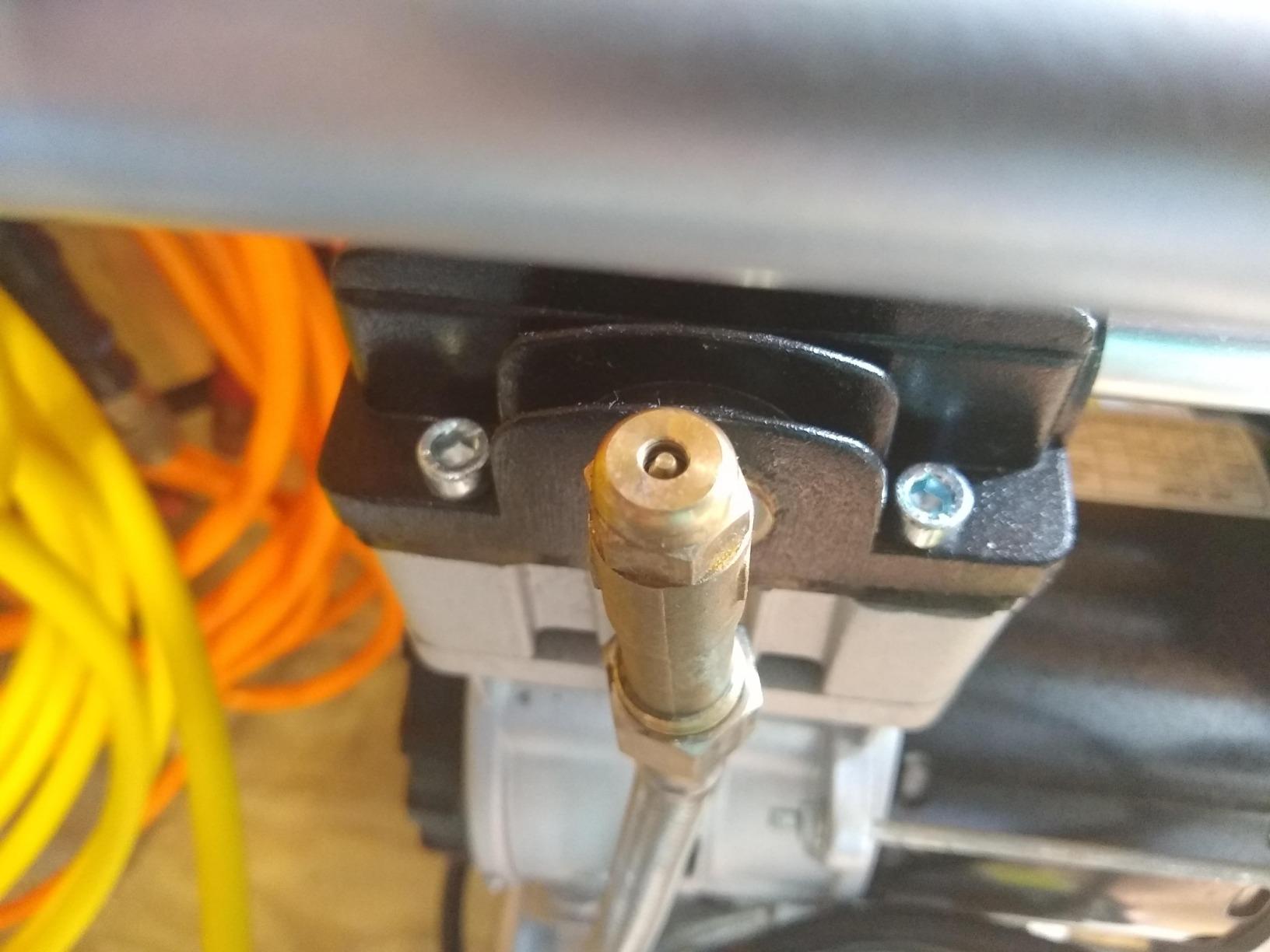
What it handles well
Wall framing, subfloor at a steady pace, interior partition work in an occupied home, and finish or brad nailers on the same circuit. At 70 dBA it is quiet enough to run beside someone working at a desk eight feet away, and the vertical footprint of 16 by 15.1 by 35.9 inches fits in a hatchback and slides under most workbenches.
Where it falls short
It is not a decking or sheathing compressor. At 5.30 CFM it handles the wall framing phase fine, but the moment you break out a coil gun for roof decking, demand climbs toward 8.5 to 10 CFM and you will be sitting in recovery pauses through the whole sheathing run.
At 82.5 pounds with no lifting frame, moving it between jobs alone is a two-person job, and the 125 PSI ceiling gives you less regulator headroom than the DEWALT or Metabo HPT units below.
2. Metabo HPT EC914S: Best Value for a Job-Site Pancake
Metabo HPT Portable Pancake Air Compressor, 6 Gallon 200 PSI, EC914S
4 CFM at 90 PSI
6-gallon vertical tank
200 PSI max
1.3 HP
73 dB
41 lb
Pros
- 41 lb is genuinely one-person carryable
- 200 PSI is 25 percent more than a basic pancake
- 4 CFM at 90 PSI covers two framing nailers at once
- Square footprint stores in a truck bed or small shop
Cons
- 6-gallon tank refills constantly on long framing runs
- Oil-free pump not rated for prolonged continuous duty
- 1.3 HP motor can starve on large sanders or finish guns
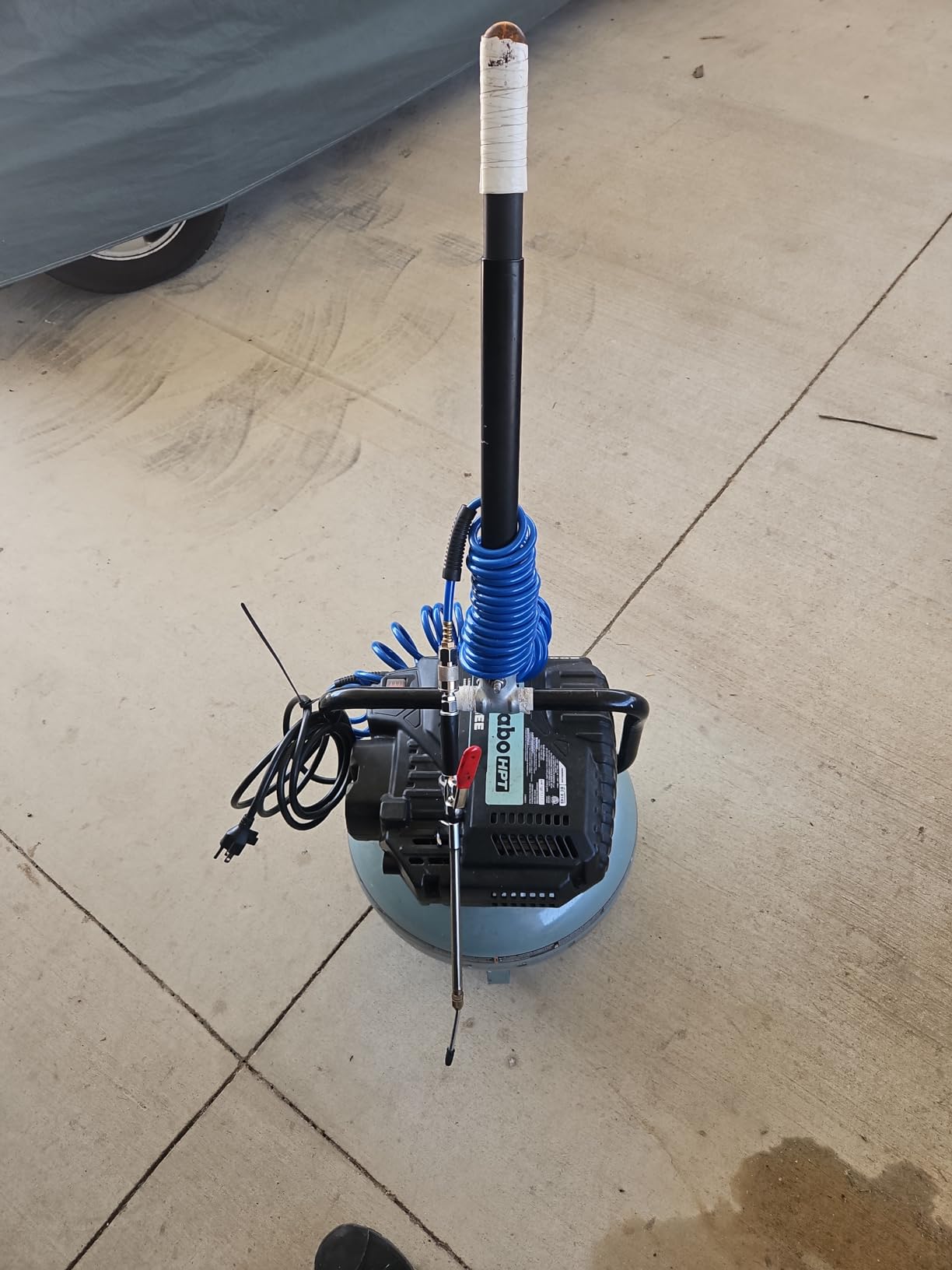
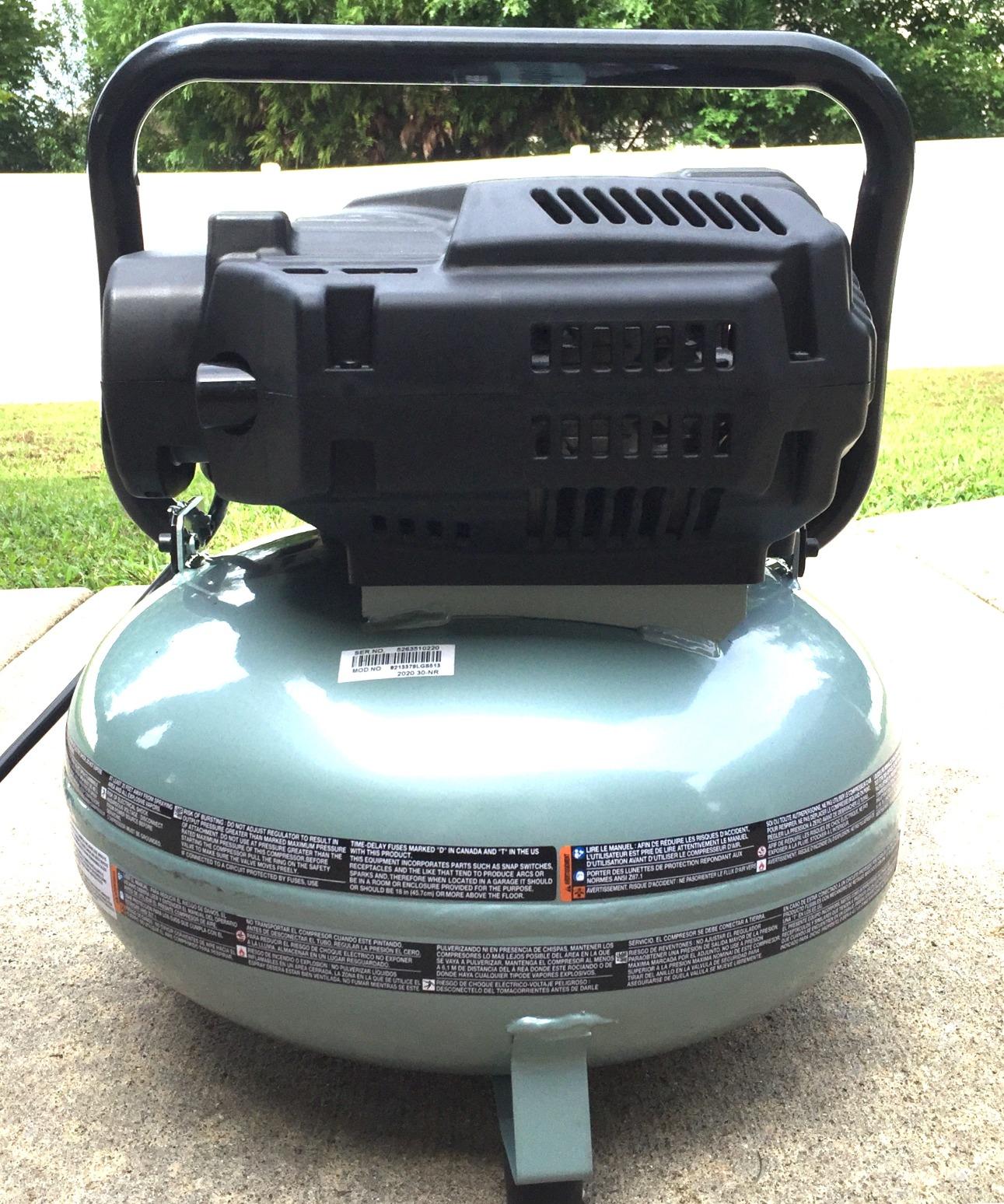
Metabo HPT is a name that comes up constantly in framing circles, and the EC914S is the pancake most often pointed at for job-site work. It is the unit I recommend to anyone who needs a compressor they can carry up a stairwell or lift into a truck by themselves. At 41 pounds it is roughly 22 percent lighter than a comparable twin-stack, and that difference decides whether you own the machine or rent it.
Two numbers carry this pick. The 200 PSI maximum tank pressure is about 25 percent more than a basic pancake, which means the regulator has real headroom instead of sitting near its ceiling. And 4 CFM at 90 PSI is enough to run two framing nailers simultaneously, which is the threshold most people asking about two-gun work are looking for.
Be clear about the tank, though. Six gallons is the smallest size I would call honest for framing, and owners are consistent about what that means in practice: the pump has to refill constantly, so you get recovery pauses during long runs. Those pauses are not a defect, they are physics, and they shorten motor life over years of daily use.
The 1.3 HP motor is the other limit. It will run brad guns, finish guns and staplers all day without complaint, and it handles one framing gun well. Pair it with a large finish nailer or a sander at the same time and it will struggle, because a 1.3 HP motor has a finite ceiling on recovery regardless of tank size.
What it handles well
One framing gun plus a second tool on the second coupler, at a job site where somebody has to carry the compressor in by themselves. The dual quick-connect couplers mean two people can work off one machine without a splitter, and the 200 PSI ceiling gives the regulator room to hold a steady 100 to 115 PSI without droop.
Where it falls short
Continuous duty first. If you frame every day for a living, a compressor that cycles nonstop for hours will age faster than one rated for continuous operation, and the oil-free pump is not designed around long uninterrupted runs.
Second, scale. Six gallons and 4 CFM is a wall-framing answer. Take it to roof decking or sheathing and the pauses become long enough to change your work rhythm, which is when the 20-gallon options later in this list become the right conversation.
3. Makita MAC2400: Top Rated for Long-Term Durability
Makita MAC2400 2.5 HP* Big Bore™ Air Compressor
4.2 CFM at 90 PSI
2.5 HP oil-lubricated
4.2-gallon tank
79 dB
12.3 amp draw
Pros
- Highest average rating in the group at 4.7 stars
- Cast iron Big Bore pump runs cooler and wears slower than oil-free
- 12.3 amp draw rarely trips household breakers
- Roll-cage frame protects the pump on rough job sites
Cons
- 4.2-gallon tank gives a short reserve between cycles
- Needs periodic oil changes unlike oil-free units
- 79 dB is average rather than quiet
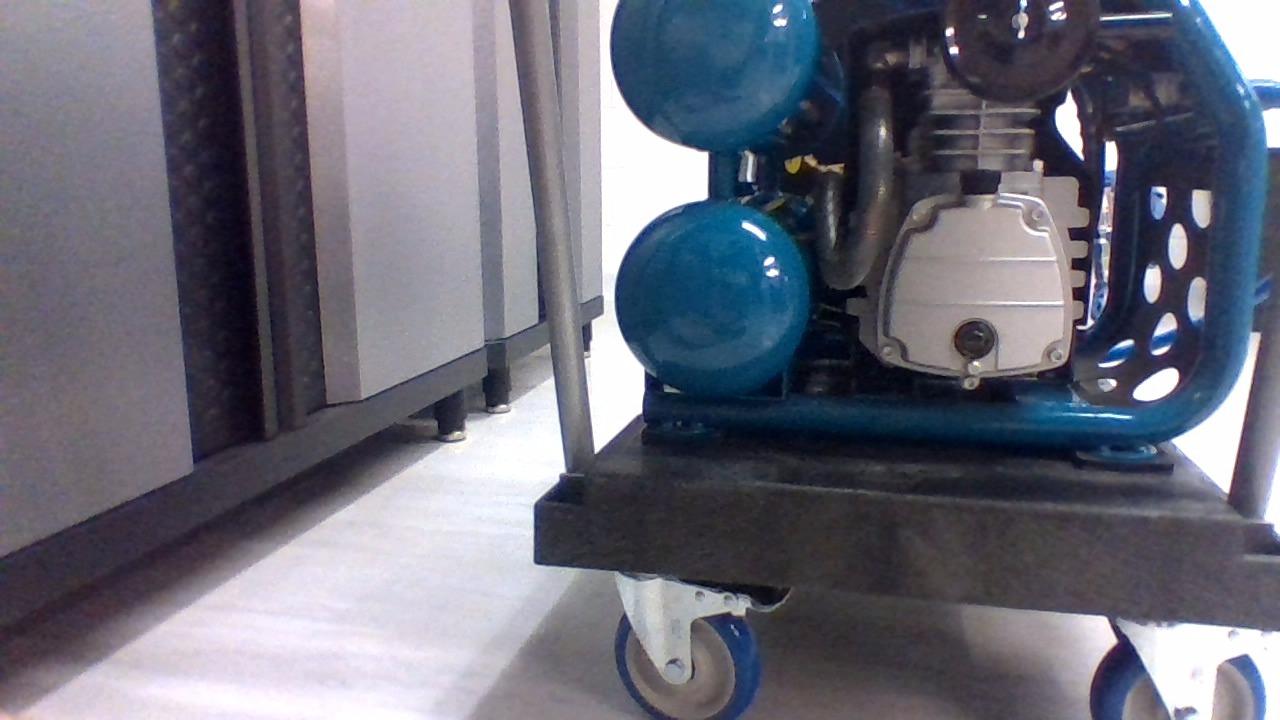
The MAC2400 has the highest average rating of anything we reviewed, and after reading enough owner reports I understand why. It is an oil-lubricated cast iron Big Bore pump, which is the opposite engineering choice from the oil-free units dominating this list. The cast iron cylinder and piston run cooler, wear slower, and tolerate the kind of abuse a framing site delivers, and longevity is the attribute reviewers bring up most.
The 2.5 HP four-pole motor produces 4.2 CFM at 90 PSI, which is a solid framing-nailer figure with headroom over a 30-degree gun and adequate for a coil gun. It runs at 1,730 RPM, giving 79 dB, and that is a fair trade: you are giving up some silence to buy pump life.
The 12.3 amp draw is the sleeper feature here. Most household circuits are 15 amps, and compressors that pull the full 15 will trip a breaker the moment you plug a saw into the same outlet. At 12.3 amps this one leaves headroom, so your compressor and your framing nailer can share a circuit without drama.
What you give up is tank size. At 4.2 gallons this has the smallest reserve in the roundup, so you will hear the motor cycling back on frequently. Owners also consistently note the oil maintenance, and the fact that you need to add and drain compressor oil before first use.
What it handles well
Full-time framing, and any job site where the compressor will be shared with other tools on the same circuit. The automotive-style industrial air filter improves intake efficiency on dusty framing sites, which is a real condition on a gutted wall.
Where it falls short
Portability and tank reserve. This is a shop compressor that happens to be carryable, not a pancake you haul up a ladder platform, and the 4.2-gallon tank means more frequent cycling than anything else here.
It is also not quiet. At 79 dB it is fine outdoors on a job site and unpleasant inside an occupied house, so if you are remodeling rather than new-framing, the California Air Tools options are a better fit. And the maintenance is real: this is a machine you service annually, not one you forget about.
4. Klutch 20-Gallon Compressor: Best for Decking and Sheathing
Klutch 20-Gallon Air Compressor, 2 HP, 120V
4.2 SCFM at 90 PSI
20-gallon vertical tank
175 PSI max
2.0 HP oil-free
80 dB
90 lb
Pros
- 20-gallon tank holds air for a week without measurable loss
- Oil-free pump holds pressure without leaks
- 175 PSI exceeds most 120V competitors
- Runs on a standard household circuit
Cons
- 90 lb needs two people to move
- Fills slowly because the tank is large
- 80 dB puts it among the loudest here
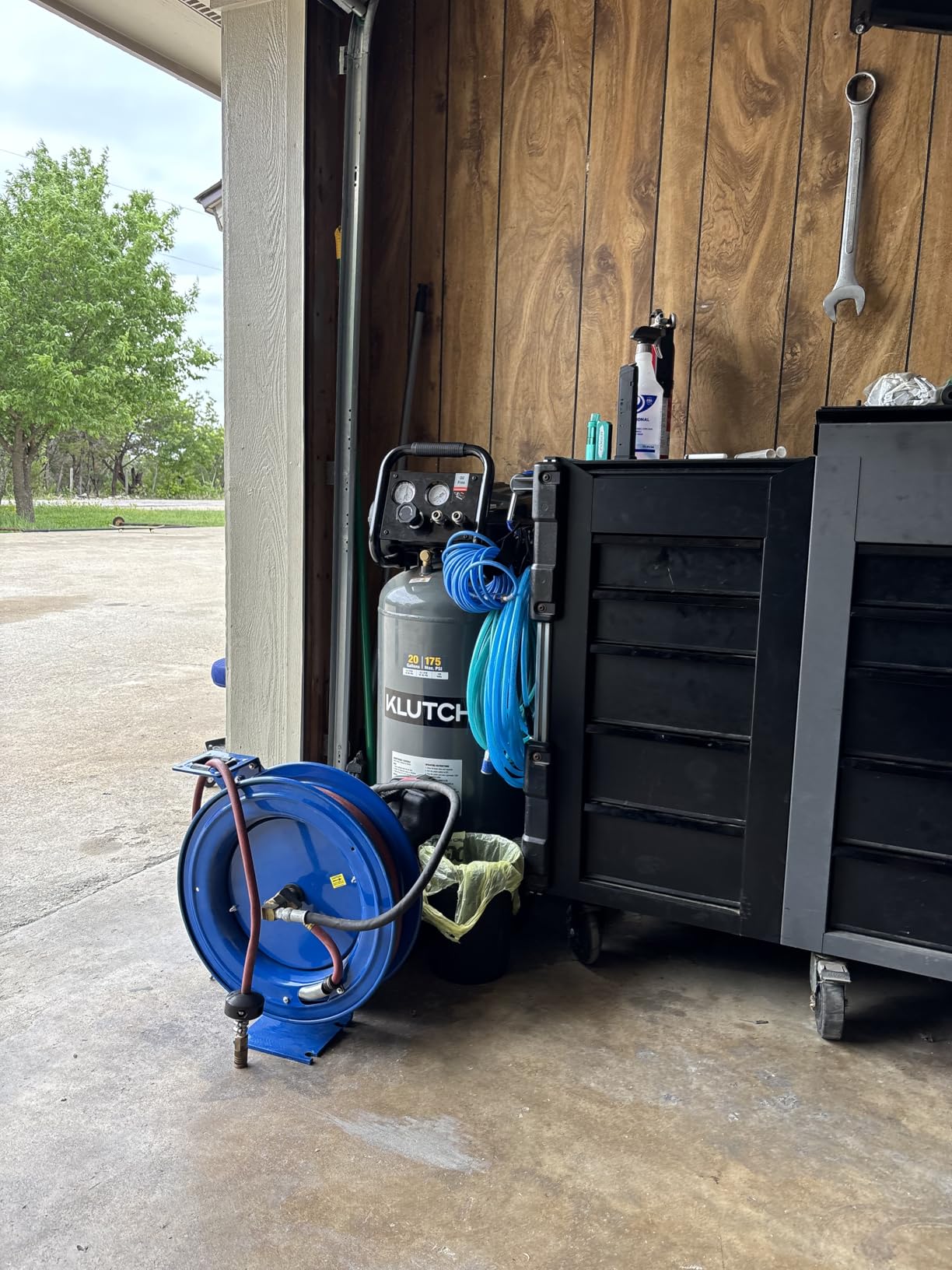
This is the pick for the second half of a framing job. Wall framing is a 2 to 3 CFM problem. Roofing, decking and sheathing run somewhere between 8.5 and 10 CFM, and no pancake on this list will touch that. The Klutch’s 20-gallon vertical tank is the cheapest path I found to a reserve big enough to absorb those spikes without a full stop every few dozen nails.
It rates 4.2 SCFM at 90 PSI with a 75 percent duty cycle and 175 PSI maximum, and it runs on 14 amps so a standard 15A circuit will carry it. Two hose outlets and rubber foot stabilizers mean you can run two tools at once and the tank does not walk across the floor while it does.
Owners are split in a useful way on this one. Several say the rated CFM feels optimistic in real use, which is exactly the skepticism I would apply to any 2 HP spec. Others report the tank holding pressure without measurable loss across a full week, which is the more important number for decking.
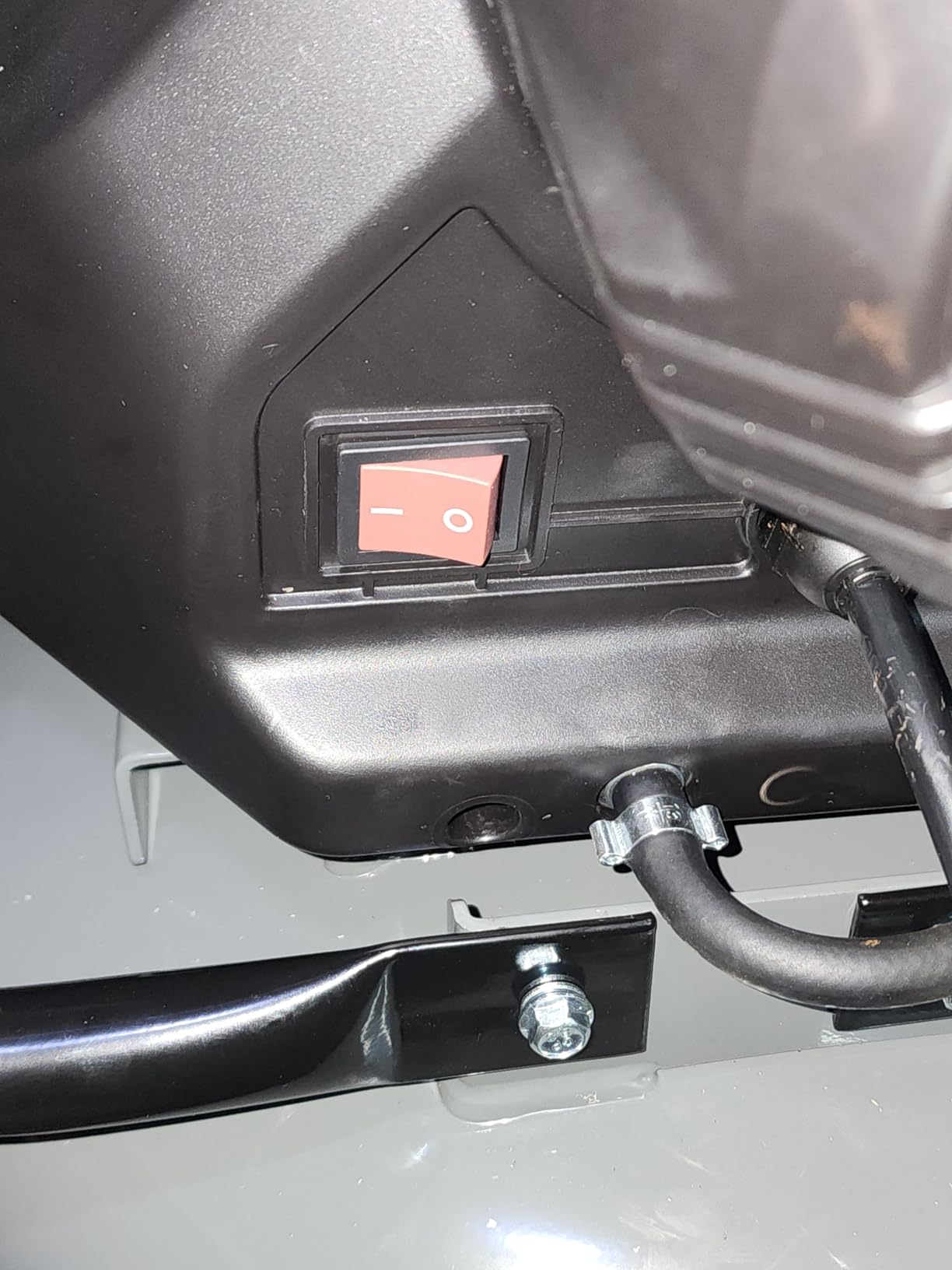
There is also a single serious safety complaint in the reviews, on a 29-gallon variant, about a power switch that was bypassed internally and would not interrupt power. It is not this model, but it is worth testing the switch on arrival rather than assuming it works.
What it handles well
Decking, roof sheathing and subfloor, which is where every smaller compressor in this roundup starts pausing badly. The 20-gallon vertical footprint fits a garage wall without eating the floor the way a horizontal tank does, and the easy-access drain and thermal overload protection are details you will thank yourself for in a year of use.
Where it falls short
It is 90 pounds and a two-person lift, with a 41.5-inch height that means a real tip hazard on stairs. The initial fill time is noticeably long, so plan on waiting for it before you start rather than mid-framing.
At 80 dB it is among the loudest things here, which rules it out for interior work in an occupied home. And while 4.2 SCFM is honest for the tank size, it is below what a two-person crew with coil guns on both guns will draw comfortably. One gun, or one gun plus a finish gun, is what this machine is sized for.
5. DEWALT D55146: Best for Two Framing Nailers at Once
DEWALT Air Compressor, 225-PSI Max, Hand Carry with Wheels, 4-1/2 Gallon (D55146)
5 CFM airflow
225 PSI max
4.5-gallon horizontal tank
1.6 HP oil-free
78 dB
88 lb
Pros
- 225 PSI is the highest tank pressure in the roundup
- 5 CFM clears two framing guns
- Oil-free pump needs no maintenance
- 10-inch non-flat tires roll over rough job sites
Cons
- Pulls a full 15 amps so it needs a dedicated circuit
- 88 lb with a non-locking handle
- Comes with 3-in-1 couplers rather than true high-flow
The number that makes this the two-nailer answer is 5 CFM, paired with the highest tank pressure in the group at 225 PSI. The consensus benchmark among framing crews is 5.0 CFM at 150 PSI to run two guns with real downtime between recovery cycles, and this is the closest we found to that target in a 120V package.
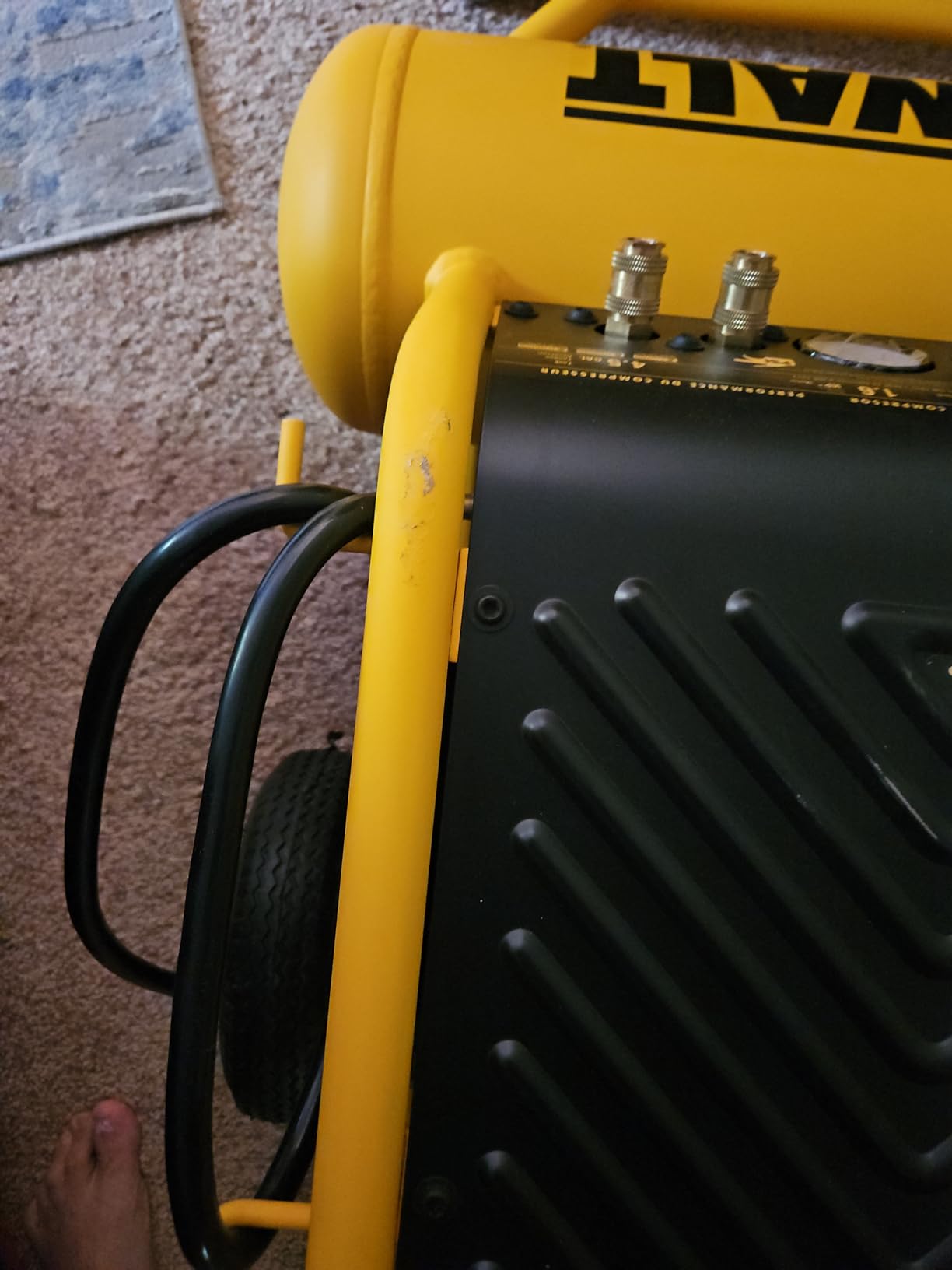
The oil-free pump means clean air with no oil carryover, which is worth more than people expect when you are nailing painted trim later in the same job. The gauge, coupler and regulator assembly sits behind a protective metal console panel, and the 2-inch gauges are readable at a glance.
Plan the electrical side before you buy. At 15 amps this needs a dedicated circuit, and on a job site where a compressor shares an outlet with a saw or a sawzall, it will trip. We also run this site’s guide to other compressor use cases if you want the wider amp-draw picture, but the short version is that this machine wants its own line.
Two smaller things catch people out. It arrives with 3-in-1 couplers, M, A and T style, rather than true high-flow couplers, so some of the fittings you already own will not connect. And the regulator is limited to roughly 150 PSI even though the tank stores 225, so pushing the regulator past that can damage it.
What it handles well
Two people framing at once, which is the scenario this machine was sized for. The horizontal layout stores upright and saves floor space in a tight shop, and the welded tubular frame plus 10-inch non-flat tires roll across gravel without the flats you get on smaller casters.
Where it falls short
Weight and handling, mostly. At 88 pounds with a handle that does not lock, stairs and truck loading are awkward even for two people, and the 4.5-gallon tank means the reserve between cycles is brief. You are relying on airflow rather than volume to keep pace.
It is also heavy in a way that adds up: the unit is mostly steel tank and frame, which is where the 225 PSI comes from. If you are moving between rooms in an occupied home rather than across a job site, that mass becomes the dominant consideration and a lighter pancake is the better tool.
6. CRAFTSMAN CMXECXA0201041: Best Lightweight Shop Compressor
Craftsman 10-Gallon Air Compressor, 1.8 HP, Max 175 PSI, 4.0 CFM @ 90PSI, 5.0 CFM@40PSI, Oil-Free, Quiet Shop Air Compressor with Wheels for Spraying Pneumatic Tool, Model: CMXECXA0201041
4.0 CFM at 90 PSI
10-gallon tank
175 PSI max
1.8 HP oil-free
78 dB
31.5 lb
Pros
- Lightest unit here at 31.5 lb and stores under a workbench
- 10-gallon tank drives a wide range of pneumatic tools
- Oil-free pump needs no regular maintenance
- Includes coupler
- cord
- gauges and filter in the box
Cons
- 4.0 CFM at 90 PSI is modest and causes refill pauses
- 1.8 HP motor limits recovery on large-volume tools
- Horizontal layout takes more floor width
At 31.5 pounds this is the lightest compressor in the roundup by a wide margin, and it is the one I would suggest to someone whose shop is a corner of a garage. You pick it up with one hand. It slides under a standard workbench. The 10-gallon horizontal tank at 175 PSI holds a real reserve, which is unusual at this weight class.
It is rated 4.0 CFM at 90 PSI and 5.0 CFM at 40 PSI from a 1.8 HP motor. That clears the 2.0 to 2.5 CFM a 30-degree framing gun needs, so a single gun framing walls is genuinely in scope. Owners also use it for staple guns, brad guns, roofing and framing nailers, airbrushes, blow guns, air drills and HVLP spray guns.
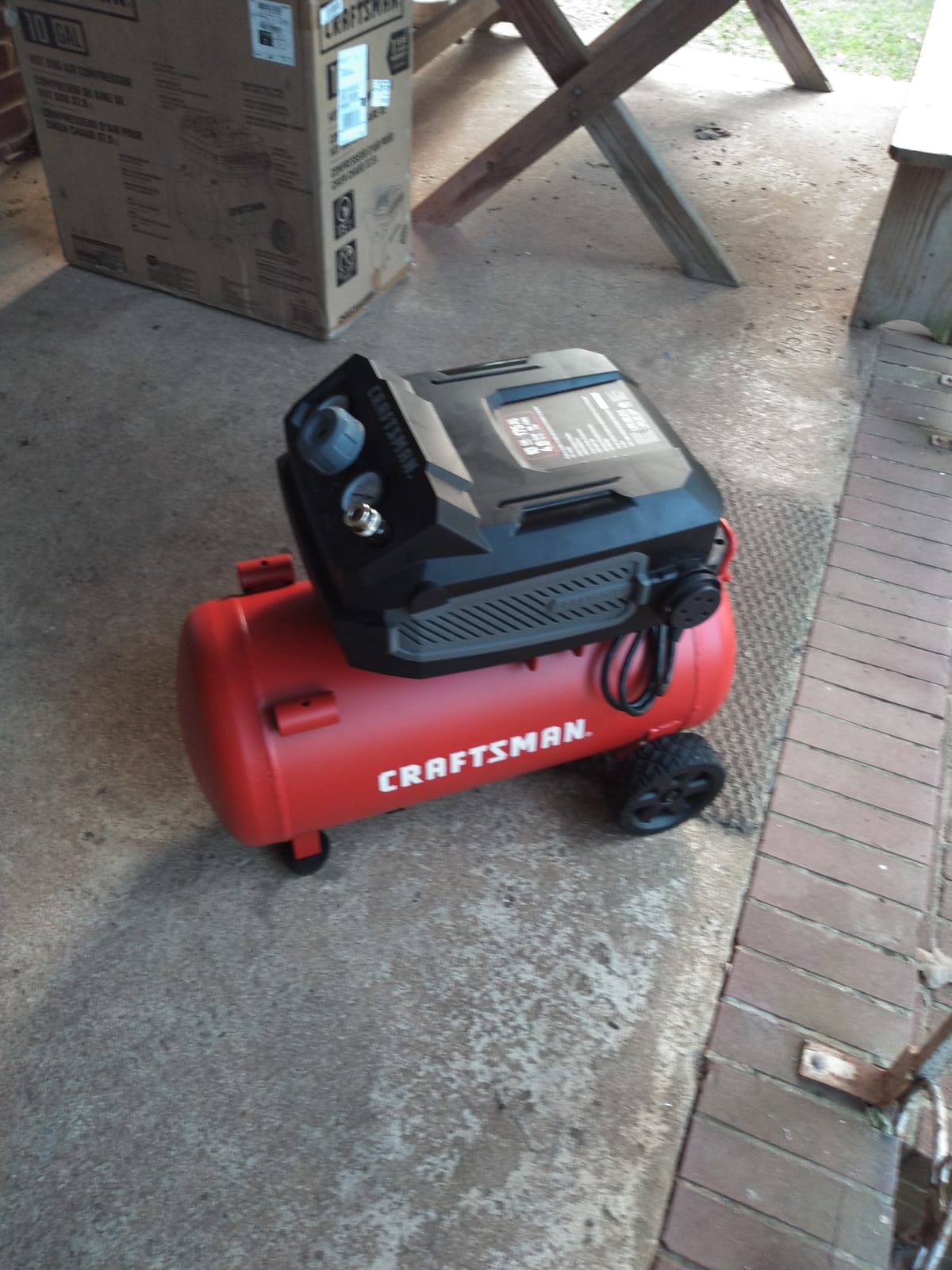
The honest limit is airflow, and reviewers say it plainly. At 4.0 CFM, a framing nailer will pause while the tank refills, and on a long framing run those pauses add up to real lost time. The 1.8 HP motor compounds it, because recovery speed is a motor property as much as a pump property.
What you get instead is a well-equipped box. It includes a quick coupler, a 6-foot cord, two 1.5-inch gauges and an air filter, so you are not hunting for parts on day one. Rubber wheels, a handle and rubber foot stabilizers handle vibration, and 78 dB is on the quiet side for a 175 PSI shop machine.
What it handles well
Multi-tool shops where one person moves the machine around. The oil-free pump needs no maintenance and delivers clean air, so you can switch from a framing gun to a finish gun to a spray gun without worrying about what is in the lines.
Where it falls short
Continuous duty and heavy volume. The oil-free design is not meant for extended continuous cycles, and 4.0 CFM is below what a coil gun on sheathing will demand. The horizontal layout also needs more floor width than a vertical tank of the same capacity, which is the one trade the weight saving buys back.
For one person doing intermittent framing plus finish work, this is close to ideal. For a crew, or for a roof, the difference in pauses with a 20-gallon tank is obvious within the first few minutes of shooting.
7. California Air Tools 15020C: Best for Indoor Remodeling
California Air Tools 15020C Powerful 2.0 HP Ultra Quiet and Oil-Free Air Compressor with Wheels, 15 Gallon Tank Capacity, 70 dB Noise Level, Electric, Portable
6.4 cfm airflow
15-gallon alloy steel tank
2.0 HP oil-free
70 dB
130 PSI
90 lb
Pros
- 70 dB allows normal conversation beside the running unit
- Fills from empty in about two minutes
- 15-gallon tank passed leak tests out of the box
- Customer service sent free parts even out of warranty
Cons
- Vertical tank only
- so it may not fit low-clearance storage
- Pressure gauges face downward and need kneeling
- Recessed drain valve is hard to reach
This is the quiet large-tank option, and the 15 gallons of reserve is what separates it from the 10-gallon version above. Owners report filling from empty to 150 PSI in roughly two minutes, and 6.4 cfm of airflow is among the highest figures in this roundup, so you get silence without giving up the ability to keep a framing gun running.
At 70 dB you can carry on a conversation beside it. That single fact is what makes this the pick for remodeling work inside a home where somebody is sleeping in the next room. If you have done trim work in an occupied house, you already know that noise, not performance, is what actually makes a compressor unusable indoors.
What it handles well
Interior remodeling where quiet is non-negotiable and the work still includes framing small partitions, blocking, and sheathing a closet or two. The oil-free pump arrived leak-free for most owners, and the drain is easy to reach, which matters because a drain you cannot reach is one you skip and then wonder why the gun is slowing down.
Where it falls short
Layout details that irritate people. The tank is vertical only, so it will not fit under a low workbench, and the gauges face downward, which means kneeling to read tank pressure. The drain valve is recessed enough that some owners add an extension to reach it.
At 90 pounds it is a two-person move, and there are reports of motor or pressure-switch failures on examples that have run for several years.
8. California Air Tools 20020AD: Best Automatic Drain for Seasonal Work
California Air Tools 20020AD 2.0 HP Ultra Quiet and Oil-Free Air Compressor with Wheels, 20 Gallon Tank Capacity, 70 dB Noise Level, Electric, Portable, with Automatic Drain Valve
5.30 CFM at 90 PSI
20-gallon tank
2.0 HP oil-free
70 dB
14 amp draw
115 lb
Pros
- Automatic drain valve purges moisture on a settable schedule with a test button
- Largest tank that still fits a 20A circuit at 14 amps
- Genuinely quiet in a concrete-walled workshop
- Customer service supplied free fittings and spares
Cons
- 115 lb is effectively a two-person lift
- Fitting bottleneck between tank and regulator cuts usable airflow
- Automatic purge is loud and the drain hose can whip on restart
The automatic drain valve is the reason this is on the list at all, and if you frame through a season rather than a weekend it may be the most important feature here. Moisture collects in a tank over time, and water in the line makes a nailer slow down and misfire. An automatic purge on a settable schedule, with a test button so you can hear it working, removes a maintenance task people reliably forget.
Otherwise the numbers are strong: 5.30 CFM at 90 PSI, a 20-gallon tank, 70 dB, and a 14-amp draw that fits a 20A circuit comfortably. Owners running it alongside a shop vacuum on the same circuit report no trouble, which tells you something about the headroom.
What it handles well
Owners with concrete-walled workshops single this out for noise, describing it as genuinely quiet in a room with no sound absorption at all. Combined with 20 gallons of reserve, it is the closest thing in this roundup to a small shop compressor that still does framing work without complaining.
Where it falls short
At 115 pounds this is a two-person lift and it will not be moving between rooms alone. It also carries the fewest reviews of anything on this list, so treat the durability claims as unproven rather than established.
There is a fitting bottleneck between the tank and the regulator that some owners work around by plumbing a tee to a second regulator, which tells you the rated CFM is not fully reaching the outlet. The automatic purge is also loud and startling, and the drain hose can whip on restart at 85 to 90 PSI. Several owners describe arriving units with dented tanks and crushed packaging foam, so inspect it carefully before powering it up.
9. Ingersoll Rand Twin-Stack: Best for Continuous Duty Work
Ingersoll Rand 42672949 2 HP Portable Twin-Stack Air Compressor
3.2 CFM at 90 PSI
4-gallon twin tank
2.0 HP oil-lubricated
79 dB
77 lb
Pros
- 100 percent continuous duty rating built for long framing and roofing days
- Two quick disconnect couplers run two tools at once
- All Season Select lubricant doubles to 2000 hours between changes
- One year package warranty plus two years on the pump
Cons
- 3.2 CFM at 90 PSI is tight for a framing nailer
- 4-gallon tank gives a small air reserve
- 135 PSI is a low ceiling for this roundup
- Needs periodic lubricant changes
This is the only unit in the roundup rated 100 percent continuous duty, and for a framing contractor working eight-hour days that single specification outweighs almost everything else on this list. Thermal cutoffs on a poorly matched compressor are what shorten pump life, and a machine that never shuts itself off is solving the problem at its root rather than managing it.
The cast iron, oil-lubricated twin-stack reciprocating pump is also the durable kind, and the All Season Select synthetic lubricant stretches service intervals to 2,000 hours, more than double a typical oil change. Coverage runs one year on the full package and two years on the pump when you use the specified lubricant.
What it handles well
Two people working, or one person plus a second tool, over long days. The two quick disconnect couplers are the practical feature here, because they are how you actually get two tools running without a splitter hanging off the tank, and the user-friendly front panel keeps the machine approachable.
Where it falls short
Airflow, honestly. At 3.2 CFM at 90 PSI, this clears the minimum for a 30-degree gun with very little margin, and it will pause on a coil gun. The 4-gallon tank gives you almost no reserve, so those pauses come quickly and often.
The 135 PSI ceiling also limits the headroom a nailer or a spray gun gets from the regulator, and at 79 to 80 dB this is not a machine for an occupied house. You are buying a duty rating and pump life, and paying for them in size, quietness and airflow.
10. Stealth SAQ-11215: Quietest at 68 Decibels
Stealth 12 Gallon Ultra Quiet Air Compressor, 1.5 HP Oil-Free Peak 150 PSI 68 Decibel,5 CFM @ 40 PSI 4 CFM @ 90 PSI Silent Portable Long Life Electric Air Compressor W/Wheel for Garage
4 CFM at 90 PSI
12-gallon oil-free tank
68 dB
150 PSI peak
1.5 HP induction motor
95 lb
Pros
- Quietest compressor in the roundup at 68 dB
- 12-gallon tank splits the difference between pancake and vertical
- Oil-free maintenance-free pump rated past 1000 hours
- Induction motor gives smooth reliable operation
- Limited lifetime warranty
Cons
- 4 CFM at 90 PSI is the weakest of the large tanks
- 1.5 HP motor means frequent pauses during nailing
- 95 lb is heavy for a unit this compact
At 68 dB this is the quietest compressor we reviewed, and that is not a marketing rounding error. It sits below the California Air Tools units at 70 dB, which matters if your garage shares a wall with a room where someone sleeps. The 12-gallon oil-free tank is a sensible middle ground, and the induction motor runs smoothly and reliably rather than buzzing.
It delivers 4 CFM at 90 PSI and 5 CFM at 40 PSI, which covers a single framing gun comfortably and handles brad guns, finish guns, airbrushing and spray work on the same machine. The Q235B steel tank and 7-inch rubber-reinforced wheels are built for a garage floor rather than a display shelf.
What it handles well
Interior work in a home where noise is the deciding factor, and garages attached to living space. The limited lifetime warranty is worth noting against its lower review count, because if you intend to keep the machine, coverage on the tank is the part that matters.
Where it falls short
Airflow relative to everything else here. A 1.5 HP motor pushing 4 CFM at 90 PSI is the weakest combination among the ten-gallon-plus tanks, and owners report the nailer pausing while it refills. It also carries the lowest average rating in the roundup, so expectations should be set accordingly.
At 95 pounds it is heavy for a unit this compact, and 150 PSI peak is modest next to the DEWALT. If you need a coil gun for sheathing, this is the wrong machine.
What Size Portable Air Compressor for a Framing Nailer Do You Actually Need?
Work through this in order. Nailer type first, then CFM, then tank gallons, then PSI ceiling. Skipping straight to tank size is the single most common mistake, and it is the reason so many people end up with a machine that stalls every twenty nails.
Match CFM to the tool, not the tank
Here is the matching list we use, expressed as required airflow at 90 PSI. This is the table no one else on the search results publishes, and it answers four of the most common questions in one place.
Brad nailer: 0.3 to 0.5 CFM. Any small pancake handles several at once.
Finish nailer: 0.5 to 1.0 CFM. Still an easy job for a 6-gallon unit.
30-degree framing gun, wall framing: 2.0 to 2.5 CFM. This is the baseline for the whole roundup.
15 or 16-degree coil framing gun: 2.2 to 2.5 CFM for walls, considerably more for sheathing.
Half-inch framing nailer: 3.0 to 4.0 CFM. Above the minimum, which is why it is the safer buy.
Decking, roof sheathing and subfloor: 8.5 to 10 CFM. A 20-gallon tank is the realistic answer here.
Half-inch impact wrench: roughly 4 CFM, and only for short bursts.
The wall-framing versus decking distinction is the real decision boundary. Roughly 2 CFM covers framing walls, and close to 10 CFM covers decking, subfloor and sheathing. A compressor that feels great framing walls will disappoint you on the roof, and no amount of extra tank gallons changes that, because the pump can only move the air it can move.
Check what pressure the CFM is quoted at
CFM is only meaningful with a pressure attached, and 90 PSI is the standard measurement point. Some manufacturers quote airflow at 40 PSI or even at zero pressure, which inflates the number considerably and makes a small unit look powerful. California Air Tools publishes both figures on several models, for example 6.40 CFM at 40 PSI and 5.30 CFM at 90 PSI on the 10020C, and that is the honest way to do it.
Take ten seconds and check that the airflow figure you are buying is quoted at 90 PSI. If it is not, treat the number as a marketing decision rather than a specification. The asymmetry rule is simple: you can turn a big compressor’s pressure down, and you cannot turn a small one’s airflow up.
Set the PSI, then check the tank ceiling
Most framing nailers operate efficiently between 70 and 120 PSI, with 90 to 120 PSI the practical working range. You never exceed your nailer’s rated maximum. What you want is a compressor whose ceiling sits above that band, so the regulator has somewhere to sit other than at its stop.
Receiver volume is the part people miss. Usable air is tank gallons multiplied by pressure, so the same 3-gallon tank holds about 30 percent more air at 150 PSI than at 100 PSI. That is why the 175 and 200 PSI machines recover more usefully than their gallon counts suggest, and why a tall skinny tank is not automatically worse than a short fat one.
Choose between oil-free and oil-lubricated honestly
Oil-free means no oil changes, clean air with no carryover, and quiet operation at low RPM. The cost is a shorter pump life, and the Teflon-style coatings used in place of lubrication eventually wear and cannot be replaced. Oil-lubricated cast iron pumps run cooler, last longer, and cost less to run over a decade, at the price of maintenance and noise.
The trade is really quietness and convenience against lifespan. If you want quiet and you are working inside an occupied home, oil-free is the answer. If you frame every day and expect the machine to outlive two nailers, the oil-lubricated option is cheaper in the long run. The Ingersoll Rand at 100 percent continuous duty is the clearest expression of that second choice.
Account for circuit load, hose size and two guns
Motor startup current is what trips breakers, not running current. A compressor pulling the full 15 amps needs a dedicated circuit, and one that runs at 12 to 14 amps can share with a nailer on a normal 15A outlet. If your compressor and your framing nailer share a circuit, that arithmetic matters more than any spec on the tank.
For one nailer, 3/8-inch hose is fine. For two, step up to 1/2-inch, because hose diameter sets how much air can flow through it and a 3/8-inch line under two guns is a restriction you cannot tune around. And if you are considering a compressor with two cylinders side by side, read the spec carefully: those are often a single tank split to save space, which matters precisely when you are trying to run two nailers.
Diagnose a nailer that slows down mid-run
If the gun worked this morning and now crawls, work through these in order. Check pressure first, because a nailer below its rated pressure will not drive nails fully. Then check the tank for water, because condensation in the lines is the most common cause of gradual slowdown and it has a two-minute fix at the drain valve. Then check airflow demand, since you may simply be on a tool that outgrew the compressor.
Finally, check the hose. A kinked 3/8-inch line or a restrictive fitting will starve a nailer that the compressor could otherwise support, and it is the cheapest thing to rule out. Constant cycling is also a symptom worth taking seriously, because a motor running nonstop has a shorter life than one that gets a break between recovery cycles.
Consider whether you need a compressor at all
If you drive one nailer on intermittent work, a cordless framing nailer removes the compressor problem entirely: no tank, no hose, no cycle pauses, and no machine to store. That is a legitimate answer for a weekend DIYer, and more crews are reaching for it. What it does not remove is the need for air if you also run a sander, a sprayer or a pneumatic tool, since a small inflator will not drive a framing gun.
Combo kits deserve a warning too. Bundles are usually paired with an 18-gauge brad nailer rather than a framing gun, which is a mismatch sold as a match. If you buy a kit, check the compressor’s CFM and the nailer’s gauge length independently, and see our portable air tank guide if you are planning to run a nailer off a receiver you already own.
Frequently Asked Questions
What size air compressor is needed for a framing nailer?
For wall framing with one nailer, you need at least 2.0-3.0 SCFM at 90 PSI, a 6-gallon tank or larger, and a compressor rated to at least 120 PSI. Decking, subfloor and roof sheathing demand closer to 8.5-10 CFM, which requires a 20-gallon machine.
What CFM do I need for a framing nailer?
A 30-degree framing gun needs 2.0-2.5 CFM, a 15 or 16-degree coil gun needs 2.2-2.5 CFM for wall framing, and a half-inch framing nailer needs 3.0-4.0 CFM. Decking, subfloor and sheathing need 8.5-10 CFM. Always compare against the compressor’s airflow quoted at 90 PSI.
Is a 6-gallon air compressor sufficient for a framing nailer?
Yes, for framing walls with one nailer. A 6-gallon tank at 150 to 200 PSI paired with at least 3.0 CFM is the practical answer for most DIYers and prosumer crews. No, for decking, subfloor or sheathing, where demand climbs toward 10 CFM and 20 gallons or more is the right call.
What is the recommended air compressor PSI for a framing nailer?
Most framing nailers operate efficiently between 70 and 120 PSI, with 90 to 120 PSI the practical working range. Never exceed your nailer’s rated maximum PSI. Matching the compressor to at least 120 PSI gives the regulator headroom to hold a steady supply.
Can I run two framing nailers off one portable air compressor?
You need at least 5.0 CFM at 150 PSI, an 8-gallon tank or larger, and 1/2-inch air hose. Below 5 CFM both guns will stall. Also verify that a two-cylinder compressor is a true twin tank, since two linked cylinders act as one receiver.
Final Verdict on the Best Portable Air Compressor for a Framing Nailer
The California Air Tools 10020C is our best portable air compressor for framing nailers because it clears the airflow requirement with room to spare, holds a real 10-gallon reserve, and runs at 70 dBA so you can frame inside an occupied home without fighting the noise. If you need two guns running at once, the DEWALT D55146 at 5 CFM and 225 PSI is the right target, and if the job includes decking or sheathing, no pancake will do it.
Everything else comes down to your job site. Metabo HPT for a machine one person can carry, Makita for daily work and long pump life, California Air Tools 20020AD for automatic draining, Ingersoll Rand for continuous duty. Check the CFM figure is quoted at 90 PSI, keep the drain valve clear, and the gun will keep up with you.