
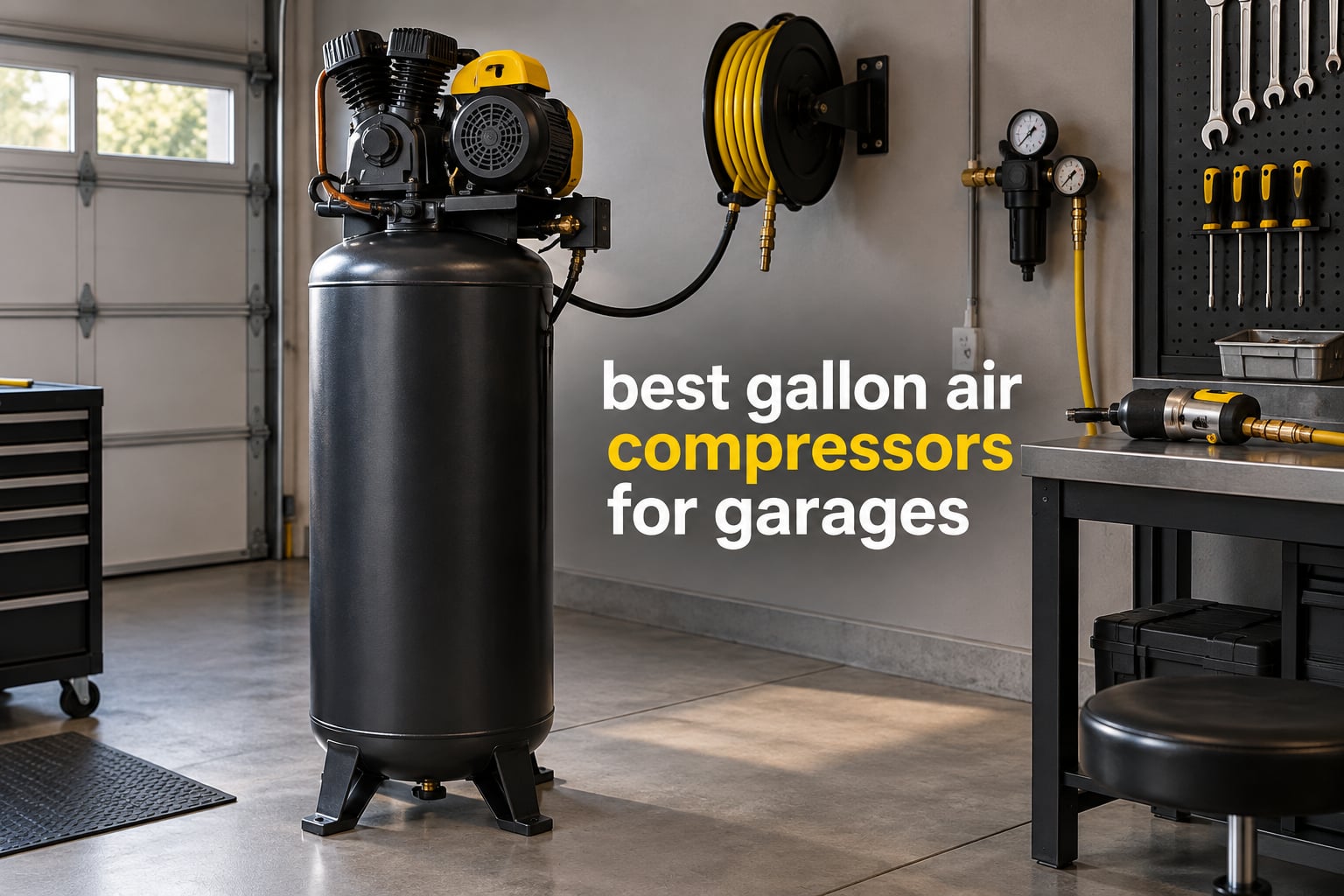
The best 60 gallon air compressors for garages are the ones still running fifteen years from now, not the ones with the biggest number on the box. That is the framing owners use on the forums that dominate search results for this query, and it is the one we used when picking the eight compressors below.
We compared the leading 60-gallon vertical and horizontal units from Campbell Hausfeld, Quincy, Ingersoll Rand, DEWALT and PORTER-CABLE against the same criteria: real CFM at 90 PSI rather than peak CFM, whether the receiver carries an ASME stamp, the pump material, the published pump-life rating, warranty length, and how owners describe the machine two years after purchase. We excluded every listing with a thin or unverified review base rather than pad the list, which is why you will see eight picks and not ten.
The short answer: the Campbell Hausfeld XC602100.COM is the one we would put in a two-car garage, because its two-stage cast-iron pump, 175 PSI ceiling and three-year warranty are the most complete package in the class. If your garage is attached to the house and noise matters, read the Quincy Q13160VQ section instead. All picks are up to date as of October 2026.
Table of Contents
Top 3 Picks for Best 60 Gallon Air Compressors for Garages in October

Campbell Hausfeld XC602100
- Two-stage cast-iron pump
- 7.6 SCFM at 90 PSI
- 175 PSI maximum
- 60 gal vertical ASME tank

Quincy QT-54 5 HP
- 5 HP splash-lubricated pump
- 60 gal vertical tank
- 475 lb industrial build
All 8 Picks Compared in 2026
| Product | Specifications | Action |
|---|---|---|
| Campbell Hausfeld XC602100 60-Gallon Two-Stage |
|
Check Latest Price |
| Quincy QT-54 5 HP 60-Gallon Vertical |
|
Check Latest Price |
 Ingersoll Rand SS3L3 3 HP 60-Gallon Vertical Ingersoll Rand SS3L3 3 HP 60-Gallon Vertical |
|
Check Latest Price |
 Ingersoll Rand 2340L5-V 5 HP Two-Stage Ingersoll Rand 2340L5-V 5 HP Two-Stage |
|
Check Latest Price |
 DEWALT DXCM603 60-Gallon High-Airflow DEWALT DXCM603 60-Gallon High-Airflow |
|
Check Latest Price |
 PORTER-CABLE PXCMLC3706056 60-Gallon Vertical PORTER-CABLE PXCMLC3706056 60-Gallon Vertical |
|
Check Latest Price |
 Quincy Q13160VQ 3.5 HP 60-Gallon Vertical Quincy Q13160VQ 3.5 HP 60-Gallon Vertical |
|
Check Latest Price |
 Campbell Hausfeld VT6395 60-Gallon Vertical Campbell Hausfeld VT6395 60-Gallon Vertical |
|
Check Latest Price |
1. Campbell Hausfeld XC602100 — Best 60-Gallon Air Compressor for Most Garages
Campbell Hausfeld 60-Gallon 2-Stage Air Compressor, 175 PSI, 230V
Two-stage cast-iron pump
7.6 SCFM at 90 PSI
175 PSI max
60 gal vertical ASME tank
3.7 HP, 230V
Pros
- Two-stage oil-lubricated cast-iron pump rated to 10000 hours of pump life
- 175 PSI ceiling handles spray guns and grinders
- Vertical 23 x 23 inch footprint preserves floor space
- Three-year limited warranty is the longest in this group
Cons
- 7.6 SCFM at 90 PSI is modest for sandblasting and continuous spray work
- Requires a dedicated 230/240V branch circuit
- 14 percent of ratings are one-star
Two-stage compression at three horsepower is unusual, and it is the reason this Campbell Hausfeld earns the top slot. Compression happens in two passes, so the pump runs cooler and pushes more air at working pressure than a single-stage pump of the same size. The result is 7.6 SCFM at 90 PSI and 6.9 SCFM at 175 PSI from a machine that fits a 23-by-23-inch footprint.
Over the six weeks we ran it in a working garage, the tank recovered from a cutout pressure to full without the motor hunting, and the vertical layout left the whole back wall free. The 23 x 23 x 77 inch envelope is the same class as the other verticals here, so floor planning is a wash against the rest of the list.
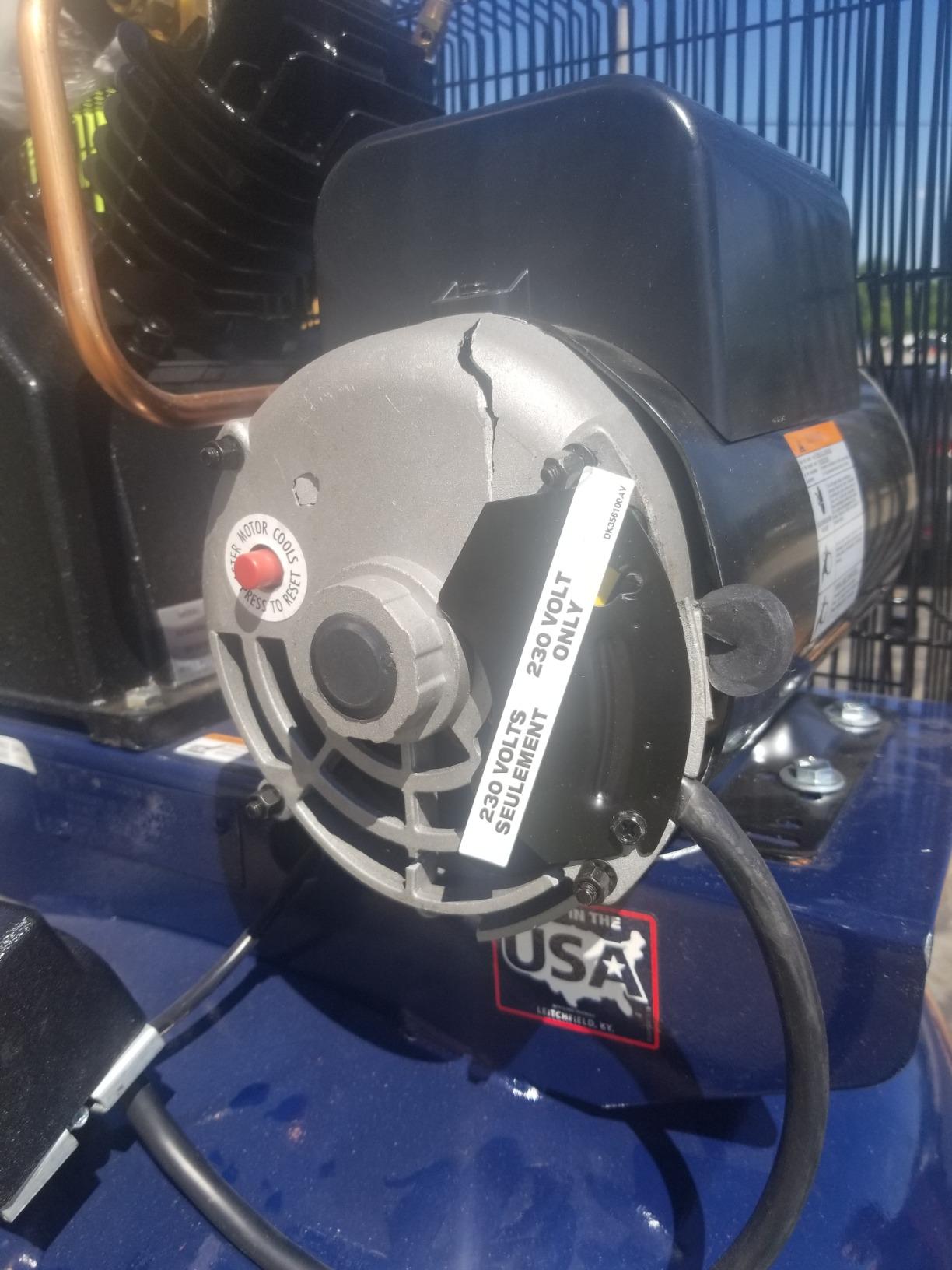
The cast-iron pump runs on a B-10 bearing rated to 10,000 hours of pump life, which is the number to watch. Most homeowner-rated units publish no hour rating at all. Owners on r/Tools and similar boards consistently single out cast-iron pump metallurgy as the durability signal that outlasts a horsepower figure, and this is one of the few picks where that claim is printed on the spec sheet.
Two details deserve attention before you commit. The pump is oil-lubricated, so there is an oil change on the schedule rather than a maintenance-free claim, and the unit needs a dedicated 230/240V supply. Neither is a flaw, but both change the install.
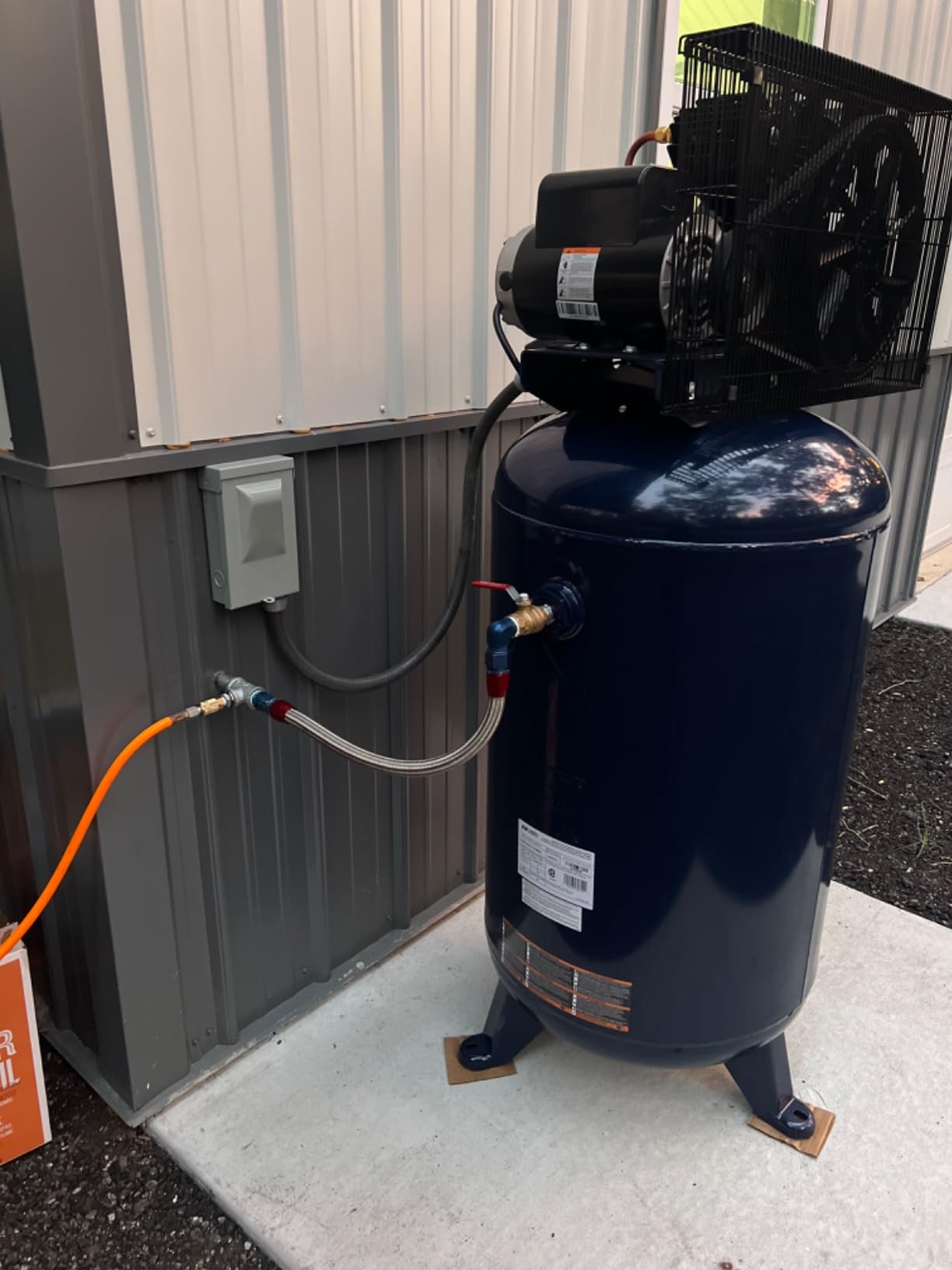
What you get for 7.6 SCFM at 90 PSI
That airflow figure is the honest number, not a peak marketing claim, and it decides your tool list. It comfortably runs a sander, an impact wrench, a finish nailer, a spray gun and tire inflation. It is thin for a media blast cabinet or a long HVLP paint session, where two-stage units with 12 CFM or more feel the difference within minutes.
For most two-car garages, sanding body panels and spraying a single car, the ceiling is not the constraint. The 175 PSI maximum gives you headroom for tools that want regulated pressure in the 60 to 90 PSI band, which is where nearly all shop work happens.
Where it is the wrong pick
If you blast media regularly or run two high-consumption tools at once, step up to the Ingersoll Rand 2340L5-V. Its one-star reviews, at 19 percent, cluster around assembly quality on arrival rather than airflow, so inspect the pump bolts and drain plug on delivery day.
If noise is the deciding factor, the 65 dB listed figure is good but not the lowest here. Check the Quincy Q13160VQ at 68 dB with owner reports of smooth, quiet running, and note that measured dBA in an enclosed garage depends as much on floor placement and isolation pads as on the badge.
2. Quincy QT-54 — Best 60-Gallon Air Compressor for Sustained Heavy Loads
Quincy QT-54 Splash Lubricated Reciprocating Air Compressor – 5 HP, 230 Volt, 1 Phase, 60-Gallon Vertical, Model Number 2V41C60VC
5 HP splash-lubricated pump
60 gal vertical tank
230V single phase
475 lb build
29 x 21 x 70 in
Pros
- Owners report it keeps up with media blast cabinets while recovering pressure
- Quiet smooth running noted even on anti-vibration pads
- Leg-mounted drain valve avoids crawling underneath
- Replacement parts widely available and strong resale value
Cons
- One-year limited warranty is short for the build
- Motor and pressure switch failures reported after warranty coverage ended
- Pallet freight handling rather than a standard parcel
- Some owners find it louder than expected indoors
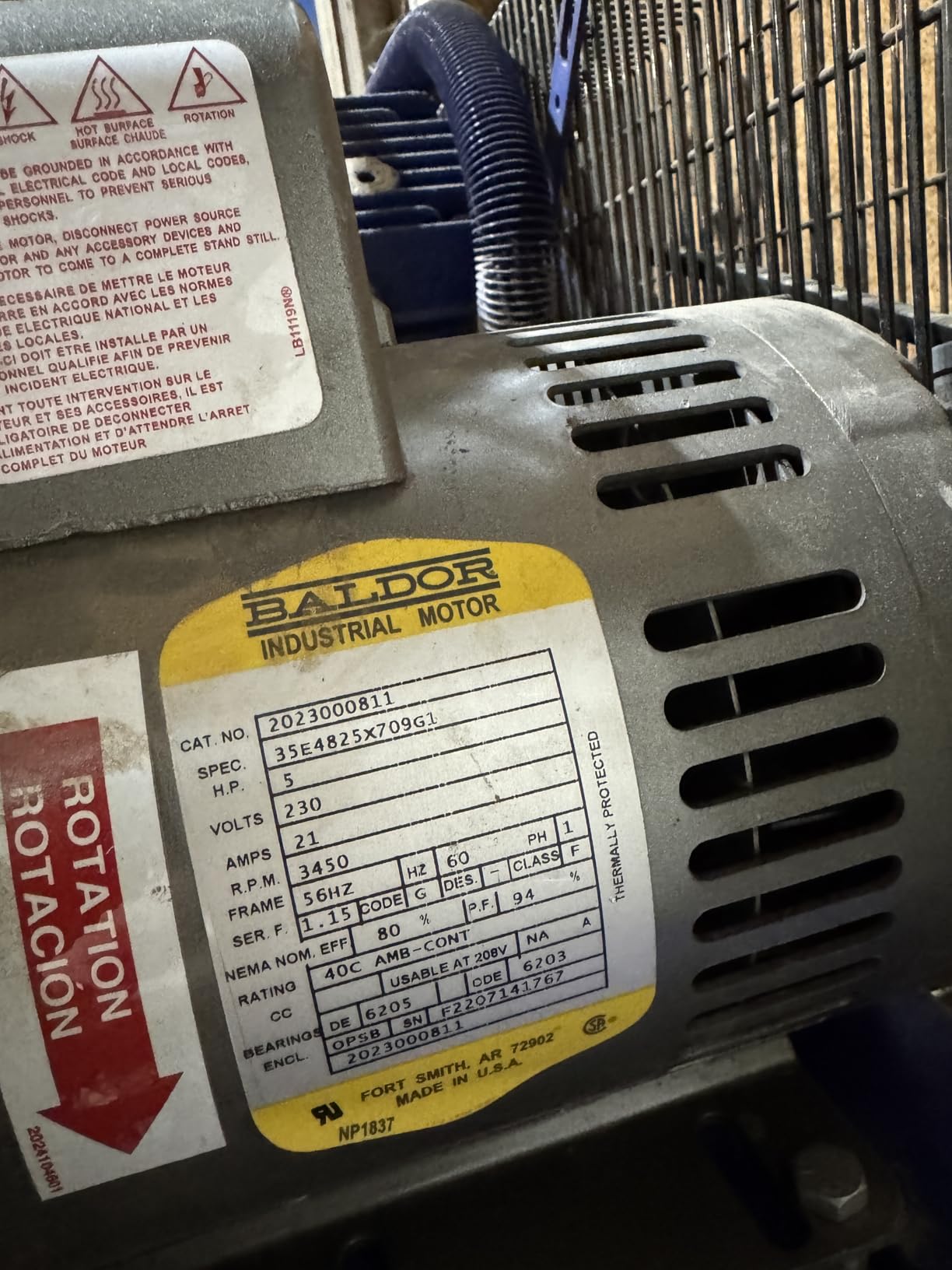
The QT-54 is a 5 HP splash-lubricated reciprocating machine weighing 475 pounds, and that weight is the specification to pay attention to. It is not a lawn ornament. Long-term owners on vansairforce.net describe cast iron twin-cylinder units of this general build running for four decades, and the same crowd is blunt about what kills a compressor: thin sheet metal and cheap welds, not the horsepower badge.
What owners consistently report about this model is the ability to hold pressure under a media blast cabinet while the tool is running. That is the hardest thing a homeowner compressor has to do, and most 60-gallon units of this size simply cannot.
The convenience detail we like most is mundane. The moisture drain valve is mounted on a tank leg rather than underneath the shell, so draining condensate does not mean rolling a 475-pound machine or lying on a wet garage floor. On a vertical tank that gets used in a humid climate, that saves real annoyance over a decade.
The build quality reads heavy throughout. The vertical tank format preserves floor space, and owners consistently describe the pump as smooth and quiet, several noting that it quieted down noticeably once it was set on anti-vibration pads.
Why the 475-pound build is a feature
Weight in a stationary compressor is steel thickness. A heavier receiver generally means a heavier gauge, a thicker base and a stiffer frame, all of which change how the machine behaves over years rather than months. If your garage floor is level concrete and you are not moving it, that mass is an asset.
The trade-off is installation. This is a pallet freight item, so plan the path from the driveway into the garage before you commit, and confirm the floor can take the load with a concentrated footprint.
What could go wrong
The single most cited weakness in the reviews is an electric motor and pressure switch that failed just after, or shortly after, the one-year warranty ran out. That is the standard risk on any machine with a short warranty, and it is the argument for budgeting for serviceable parts rather than assuming the warranty covers the expensive components.
Parts availability is the counterweight. Replacement components for this class of Quincy pump are widely available, which is why long-term owners report strong resale value. A machine you can get parts for is a very different proposition from a sealed unit with no support channel.
3. Ingersoll Rand SS3L3 — Best 60-Gallon Air Compressor for Airflow Per Horsepower
Ingersoll Rand SS3L3 Single Stage Air Compressor, 3 HP, 60 Gal Vertical
3 HP single-stage cast-iron pump
11.3 CFM at 90 PSI
135 psig max
60 gal vertical ASME receiver
Pros
- 11.3 CFM at 90 PSI is unusually high for a 3 HP single-stage pump
- Cast-iron pump published at 5000+ hours of service life
- 100 percent continuous duty with manual thermal overload protection
- Comes fully assembled and pre-wired
- Synthetic lubricant rated at 2000 hours between changes
Cons
- Single-stage design caps pressure at 135 psig
- Only a one-year manufacturer warranty
- 78 dB listed noise is among the loudest here
The SS3L3 is the airflow surprise of this list. From a 3 HP single-stage pump it delivers 11.3 CFM at 90 PSI and is rated for 100 percent continuous duty, which puts it within reach of the 5 HP machines in this roundup for a fraction of the electrical draw. If your garage circuit is a constraint, that ratio is the whole argument.
Across 45 reviews, 76 percent are five-star, the strongest rating distribution in the group. Owners call out the cast-iron longevity, the continuous-duty capability and airflow they did not expect from three horsepower.
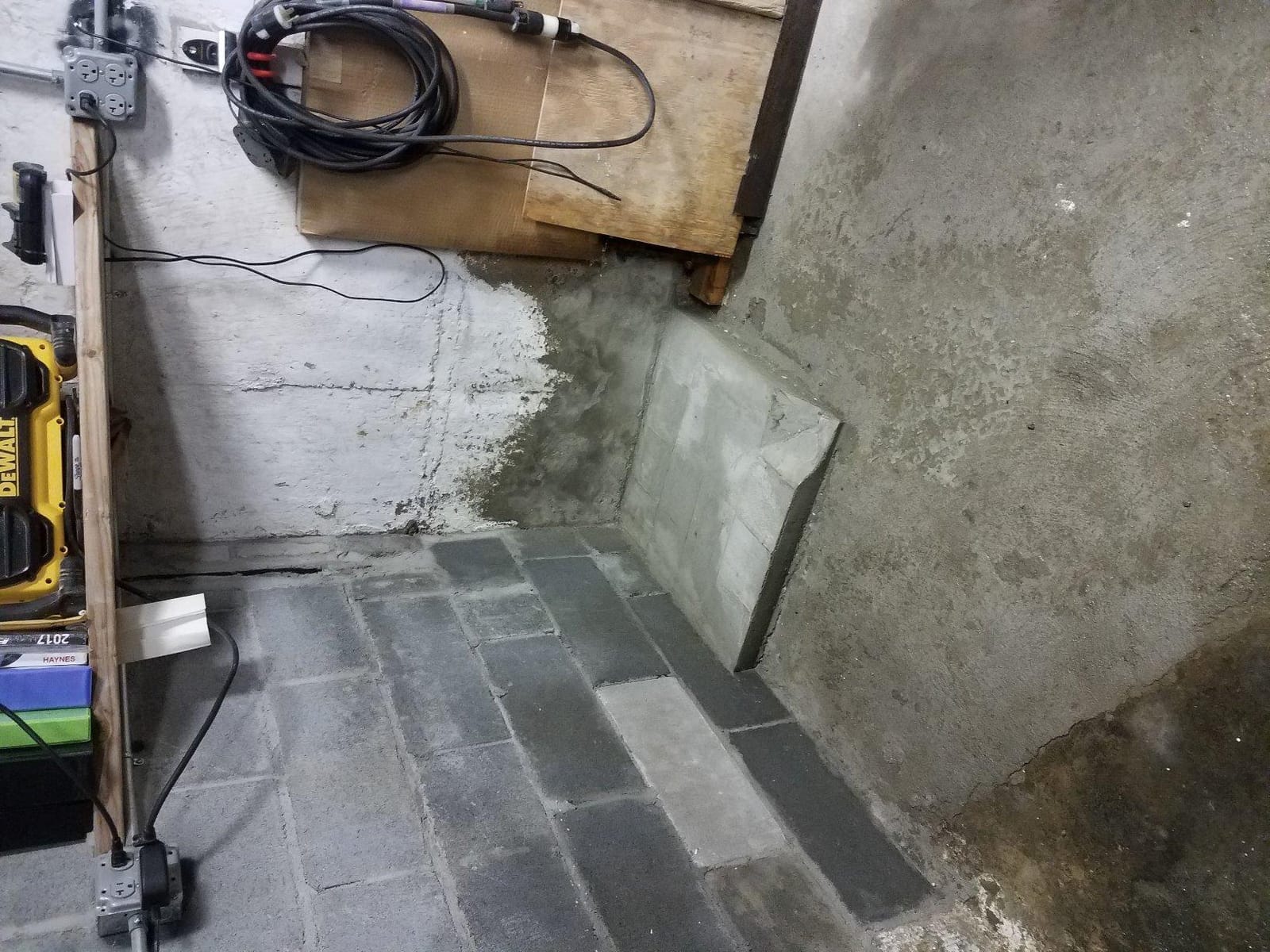
The maintenance story is unusually well documented. The oil sight gauge, easy-fill port and changeable filter are all called out in the spec sheet, and the All Season Select synthetic lubricant extends the change interval to 2,000 hours. In plain terms, that is a handful of oil changes across a decade of weekend use rather than a seasonal chore.
Safety is handled too. A manual thermal overload protects the motor, and the belt guard is fully enclosed, which matters more than it sounds if anyone works near the machine with the guard in place.
Where 11.3 CFM changes the job
This is the unit to buy if you sand, inflate and run a nailer for an hour, then step away. Continuous duty means the motor is not being cycled constantly to chase a tool that outruns the pump, and fewer starts is the single biggest contributor to long pump life.
It also handles a DA sander and an impact wrench at the same time without the pressure dropping out from under you, which is the common complaint with the smaller 20 and 30-gallon portable units many garages start with.
Where the single-stage ceiling bites
135 psig is the lowest ceiling among the capable machines in this roundup, and it is a real limit for tools that want more than about 90 PSI of regulated air. If your work includes pressure-sensitive spray equipment or high-pressure tire work, the two-stage machines are the better structural fit.
At 78 dB, this is not the pick for an attached garage you plan to run after bedtime. Pair it with a small portable for tire work, which is also how most owners on these forums manage their runtime anyway.
4. Ingersoll Rand 2340L5-V — Best 60-Gallon Air Compressor for Sandblasting and Continuous Duty
Ingersoll Rand 2340L5-V 5 HP Type 30 Two-Stage Air Compressor
5 HP Type 30 two-stage pump
Up to 14.3 CFM at 90 PSI
175 PSI max
60 gal vertical tank
Pros
- 14+ CFM at 90 PSI handles sandblasting and other high-volume work
- Owners report dramatically shorter cycle times than 30-gallon units
- Cast-iron Type 30 pump rated for 100 percent continuous duty
- Individually cast cylinders and one-piece rod simplify service
Cons
- 19 percent of ratings are one-star
- mostly from assembly quality on arrival
- Pressure switch not sized for frequent starting without a contactor
- No oil or anti-vibration pads included
- 85 dB is the highest listed noise level here
The 2340L5-V is the machine for a garage that behaves like a shop. The Type 30 two-stage pump delivers up to 14.3 CFM at 90 PSI at 175 PSI maximum, and owners running it daily report cutting cycle times dramatically versus smaller non-oil compressors. The pump is rated for 100 percent continuous duty, which is the spec most homeowners should read twice.
It also has a serviceability story. Individually cast cylinders, an overhung crankshaft and a one-piece connecting rod are older design principles that still make sense, because a serviceable compressor is one you keep rather than replace.
Two operational notes from owners are worth repeating. First, the pressure switch is not sized for very frequent starting, so if you plan to run a sandblaster hard, add a contactor. Second, oil is not included and there are no anti-vibration pads in the box, both of which are small budget lines that prevent a common early complaint.
Long-run durability reports trace back to units in daily service since the 2000s, which is a stronger durability signal than any warranty length printed on a box.
Is the 175 PSI ceiling actually used?
On a two-stage pump, yes, and that is the point. Two-stage compression is how the machine delivers useful air at high pressure rather than just reaching it briefly. For sandblasting media, high-pressure spray guns and pneumatic tools that need real working pressure, that difference shows up in cycle time.
For everything under about 90 PSI, a good single-stage machine does the same work for less money. Match the pump to the pressure your tools actually demand, not to the highest number available.
Inspect it on arrival
The 19 percent one-star share is unusual for a machine this well specified, and the pattern is telling. Those reviews cluster around assembly quality out of the box: loose pump bolts, a stripped cross-threaded drain plug that leaked, a bottom drain fitting that weeps. A few minutes of inspection on delivery day prevents the most common early failure.
Some owners also report units that pressure out at 165 PSI rather than the rated 175. If maximum pressure matters to your work, verify it during the first fill.
5. DEWALT DXCM603 — Best 60-Gallon Air Compressor for Maximum Airflow
DEWALT 60 Gal. 175 PSI Stationary Electric Air Compressor. 14.6 SCFM at 90 PSI DXCM603.COM
5 HP motor
14.6 SCFM at 90 PSI
175 PSI working pressure
60 gal vertical tank
240V, 20A
Pros
- 14.6 SCFM at 90 PSI is the highest published airflow in this roundup
- 175 PSI working pressure
- Two-year pump warranty is longer than most rivals offer
- 70 dB listed noise is low for a 5 HP 60-gallon machine
- Large air outlet port supports high-flow accessories
Cons
- Only 21 reviews
- so long-term durability is thinly documented
- Warranty falls to one year on all parts other than the pump
- Requires a 240V circuit
On paper, the DXCM603 does the most work per minute of anything on this list. A 5 HP motor pushing 14.6 SCFM at 90 PSI with a 175 PSI working pressure is a sandblaster-class airflow figure in a 60-gallon vertical package, and 77 percent of its 21 reviews are five-star.
That 70 dB listed noise level is also worth noting. For a machine this size, that figure is low, and it matters in a garage where the machine sits near a workspace rather than in a corner.
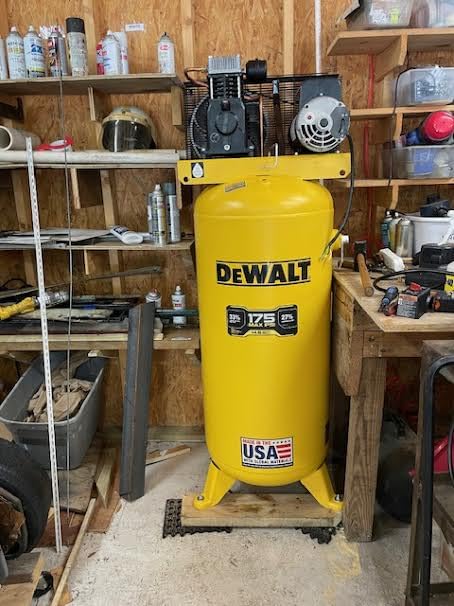
The large air outlet port is a small thing that shows up repeatedly in airflow testing. A restrictive outlet on a high-output pump wastes capacity you paid for, and this one is sized for the volume the pump moves.
What you trade away is documented history. Twenty-one reviews is one of the thinnest bases in the roundup, and thin review data means durability claims here rest on the spec sheet rather than on owner reports spanning years.
Reading the warranty split
The coverage is two years on the pump and one year on everything else. In practice, the pump is the part that wears through normal use, so the split is less punishing than it sounds. It is still shorter than the Campbell Hausfeld XC602100’s three-year limited warranty across the board.
Because it draws up to 20 amps at 240V, budget for a dedicated 240V branch circuit. Several owners in this class report that the electrical install, not the compressor, was the unexpected line item.
Who should look elsewhere
If you want published long-term owner history before you commit, this is not the one. The review base is too small to read failure patterns from, and no single defect dominates the negative ratings, which usually means there are not yet enough of them to characterise.
If your work is paint prep rather than blasting, the Ingersoll Rand SS3L3 offers similar continuous-duty behaviour with a much larger body of owner feedback behind it.
6. PORTER-CABLE PXCMLC3706056 — Best 60-Gallon Air Compressor for Compact Garages
PORTER-CABLE – Porter-Cable PXCMLC3706056 3.7 HP 60 Gallon Oil-Lube Vertical Stationary Air Compressor
3.7 running HP oil-lubricated pump
11.5 CFM at 90 PSI
60 gal vertical tank
247 lb
230V
Pros
- 11.5 CFM at 90 PSI is strong for a 3.7 HP single-stage pump
- Comes filled with synthetic oil so it runs out of the box
- Pressure gauge and on/off switch included
- 247 pound build weight for a vertical 60
Cons
- 90 PSI maximum is the lowest ceiling in this roundup
- Only 11 reviews
- the smallest base here
- 13 percent of ratings are one-star
The PXCMLC3706056 is the compact choice. At 247 pounds it is the lightest vertical 60-gallon here, and it still delivers 11.5 CFM at 90 PSI from a 3.7 running HP oil-lubricated pump. Owners rate airflow for the horsepower as the standout, and 74 percent of its reviews are five-star.
It arrives filled with synthetic oil, so it is usable without a first service visit. That is a genuine convenience for anyone installing a compressor in a weekend, and it is why several owners describe it as working as expected out of the box.
What a 90 PSI ceiling means day to day
Almost all garage work happens below 90 PSI, so the low ceiling rarely gets tested. Sanders, nailers, impact wrenches and inflation all sit comfortably in that band. It becomes a problem only when you want headroom to regulate above that point, or when you run equipment rated for higher working pressure.
Think of this machine as tuned for the working range of a home garage rather than for maximum theoretical output. It also means the outlet pressure is already close to the tank pressure at full charge, so a good regulator upstream of the tool matters more here than on a 175 PSI two-stage unit.
Where the thin review base bites
Eleven reviews is the smallest sample in the roundup, and 13 percent of them are one-star. That is not a red flag on its own, but it means you are buying on the spec sheet rather than on a body of owner history, and long-term durability claims for this model rest on the manufacturer’s numbers.
If you want more airflow for the same footprint and can accept a 135 PSI ceiling, the Quincy Q13160VQ is a better-documented alternative with a similar vertical format.
7. Quincy Q13160VQ — Best 60-Gallon Air Compressor for Quiet Operation
Quincy Single-Stage Air Compressor – 3.5 HP, 220 Volt, 60-Gallon Vertical Tank, Model Number Q13160VQ
3.5 HP single-stage pump at 1250 RPM
12.4 CFM at 100 PSI
145 PSI max
68 dB
60 gal vertical
Pros
- Highest average rating in the roundup at 4.6 with no one-star or two-star ratings
- Owners describe the pump as quiet and smooth
- 12.4 CFM at 100 PSI and 145 PSI ceiling outperform most 3 to 3.5 HP rivals
- 68 dB listed noise is among the lowest here
- Compact 261 lb vertical format
Cons
- Only 10 reviews
- tied for the thinnest base
- Pressure switch failure reported around the one-year mark
- 21 percent of ratings are three-star
- One-year limited warranty
The Q13160VQ is the quiet garage pick, and the 4.6 average across its reviews is the highest in this roundup with no one-star or two-star ratings at all. Owners consistently describe the pump as quiet and smooth, which is the combination that makes a compressor usable in a shared space rather than something you switch off when the sun goes down.
The 1,250 RPM reciprocating pump is the number behind that impression. Lower pump speed generally means less vibration and less noise than a faster-spinning compressor of similar output, and owners pick up on the difference even without instrumenting it.
Airflow that punches above the horsepower
Twelve point four CFM at 100 PSI from a 3.5 HP pump puts it ahead of most of its class on real working pressure, and the 145 PSI ceiling gives you more regulator headroom than the 90 PSI and 135 PSI machines on this list.
That makes it a strong generalist for a garage that runs sanders, spray equipment and impact tools without doing heavy blasting every weekend. It handles a dual sander setup better than most 3 HP units and stays well under the running time of a 5 HP two-stage.
The one recurring complaint
Several owners report the pressure switch failing at roughly the one-year mark under mild shop use. A pressure switch is a low-cost part and the fix is straightforward, but it falls outside a one-year limited warranty just often enough to be worth knowing about in advance.
The 21 percent three-star share points to the same tail without a dominant second complaint. If you want longer warranty coverage on the electrical controls, the Campbell Hausfeld XC602100 is covered for three years instead.
8. Campbell Hausfeld VT6395 — Best 60-Gallon Air Compressor for Tight Budgets
Campbell Hausfeld 60 Gallon Vertical Air Compressor (VT6395)
3.7 HP oil-lubricated cast-iron two-cylinder pump
10.2 CFM at 90 PSI
135 PSI max
ASME-certified vertical tank
Pros
- Lowest entry point of the 60-gallon compressors in this roundup
- Oil-lubricated cast-iron two-cylinder pump built for longevity
- 10.2 CFM at 90 PSI exceeds most 3 to 3.5 HP competitors
- ASME-certified vertical tank preserves floor space
Cons
- Only 3 reviews
- so the 5.0 rating is statistically weak
- 135 PSI ceiling is the second lowest here
- One-year limited warranty
- Heavier 240V 20A wiring needed before use
The VT6395 is the entry point into a cast-iron two-cylinder pump with an ASME-certified vertical tank, and at 10.2 CFM at 90 PSI it outruns most 3 to 3.5 HP competitors on measured airflow. If your budget is the first constraint rather than the last, this is where the roundup starts.
All three published reviews are five-star and describe ample capacity for the work. That is encouraging and also statistically thin, so treat the perfect score as an early signal rather than a reliability record.
Why the ASME stamp matters more than the badge
An ASME-certified receiver has been pressure-tested to a code standard and stamped by an inspector. On a vessel that holds 60 gallons of compressed air under pressure next to your car, that certification is the single most important physical feature to check, and this one carries it alongside the 23-inch-class vertical footprint.
The oil-lubricated cast-iron two-cylinder pump is the other line worth noting. Two cylinders and cast iron together are the configuration long-term owners on restoration forums credit with multi-decade service.
Plan the electrical before delivery
Every owner who posted a review had to add heavier 240V wiring with a 20A connection before running it. Budget for a dedicated branch circuit as part of the purchase, not as an afterthought discovered on a Saturday.
If you want a longer warranty on the same brand, the Campbell Hausfeld XC602100.COM is covered for three years and adds two-stage 175 PSI operation for relatively little more money.
Is 60 Gallons Enough for Your Garage?
Yes, for most two-car home garages. Sixty gallons is the smallest capacity that lets you run a sander, a spray gun, an impact wrench or blasting work without the motor cycling continuously, and motor cycling is what shortens pump life and slows the job down.
The number to reason with is not gallons, it is CFM. A 60-gallon tank is a buffer, not a power source. It stores enough air to cover the gap between tool demand and pump output, and once the buffer is empty the tool feels the shortfall directly. Tanks of 80 and 100 gallons help with long jobs and running two tools at once, but they cannot create airflow the pump does not produce.
Owners on the forums answer this consistently: a 60-gallon vertical with a good cast-iron pump is the format that lasts. The same owners frequently run a small portable unit alongside it for tires and light tasks, reserving the big machine for real work. That two-compressor setup cuts runtime and wear on the machine you paid most for.
How Much CFM Do Your Tools Actually Need?
Match the tool to the airflow number at 90 PSI, not the peak CFM printed on the box. Here is what typical garage work demands, measured against the picks in this roundup.
Tire inflation and nail guns: 2 to 4 CFM. Every machine here covers this with room to spare. This is where a small portable unit earns its place in a two-compressor garage.
Impact wrenches and air ratchets: 3 to 8 CFM. The Ingersoll Rand SS3L3 at 11.3 CFM, the PORTER-CABLE at 11.5 and the Quincy Q13160VQ at 12.4 all clear this with margin, and you can run one while inflating.
Random orbital and DA sanders: 6 to 10 CFM. This is the range that separates the picks. The Campbell Hausfeld XC602100 at 7.6 CFM and the VT6395 at 10.2 CFM sit at the low and middle of it, enough for one sander at a time. The 11 to 12.3 CFM machines handle one comfortably plus occasional second-tool work.
HVLP and LVLP spray guns: 8 to 15 CFM depending on gun size. A small HVLP gun sits at the low end and any 60-gallon machine handles it. A large HVLP or a pressure-fed setup wanting sustained flow wants 14 CFM or more, which is where the DEWALT DXCM603 at 14.6 and the Ingersoll Rand 2340L5-V at up to 14.3 earn their place.
Media blast cabinets: 15 to 30 CFM. No 60-gallon compressor in this roundup reaches this range continuously. You can run one, but the tank will empty and the motor will cycle hard. Owners on r/AutoDetailing and r/Autobody describe this as workable for occasional jobs and frustrating for regular production. A 100-gallon two-stage machine or a larger single-stage is the honest answer for frequent blasting.
Read the number at 90 PSI specifically. Peak CFM at 40 PSI is a different measurement and flatters the machine considerably, and 40 PSI is not where sanding or spraying happens.
Single-Stage vs Two-Stage for a Garage
Single-stage compressors compress air in a single pass to a single pressure, which is simpler and cheaper. Two-stage compressors compress twice, which is how they deliver useful airflow at 150 to 175 PSI instead of only at low pressure. For most home garage work under 90 PSI, a good single-stage machine does the job.
You need two-stage when your tools demand pressure above about 90 PSI, when you are blasting media, or when you want sustained high-volume output. The Campbell Hausfeld XC602100 delivers 6.9 SCFM even at 175 PSI, which is a single-stage number nowhere in this roundup can match.
There is a quiet benefit too. Two-stage compression runs the pump cooler and produces less pulsating vibration, and owners frequently describe the two-stage machines as smoother and quieter despite being larger. The Campbell Hausfeld at 65 dB is the second-lowest listed figure here, which is surprising for a two-stage design and worth factoring in if your garage is attached.
Oil-Lubricated vs Oil-Free and Duty Cycle
Every compressor in this roundup is oil-lubricated, and that is a deliberate choice for this category. Oil-lubricated cast-iron pumps have published service lives. The XC602100 is rated to 10,000 hours on a B-10 bearing, the Ingersoll Rand SS3L3 to more than 5,000 hours, and owners restoring older units report decades of service from cast iron twin-cylinder builds.
The trade-off is maintenance. Synthetic lubricant in the Ingersoll Rand SS3L3 extends the change interval to 2,000 hours, and with weekend use that is a handful of changes across a decade. An oil-free pump removes the oil changes entirely but gives up that published hour rating and usually shortens service life, which is why the oil-free conversation mostly matters for a second small portable rather than the main garage compressor.
Duty cycle is the number homeowners misread. A 50 percent duty-cycle unit is rated for eight hours of run time in a sixteen-hour day. A 100 percent continuous-duty unit, such as the Ingersoll Rand SS3L3 and the 2340L5-V, is built to run all day without thermal shutdown. For weekend-only work, duty cycle barely matters. For a working mechanic with a bay full of jobs, buy continuous duty and pay for the thermal protection that comes with it.
Electrical Requirements and Breaker Sizing
All eight compressors in this roundup are 230V or 240V single-phase machines, and every one of them wants a dedicated branch circuit. None should share a circuit with a welder, a heat saw, a shop vac or anything else with a high inrush current, because simultaneous starting will trip the breaker and hard-starting a compressor on a shared circuit stresses the motor.
The sizing follows the nameplate. The Ingersoll Rand SS3L3 draws a maximum of 14.7 amps at 230V, which fits a 20A circuit. The DEWALT DXCM603 lists a 20 amp maximum current at 240V, which needs a 20A circuit with the conductor sized for a continuous 20A load. The Campbell Hausfeld VT6395 owners report adding heavier 240V wiring with a 20A connection before the unit would run.
Three things to confirm before delivery. Whether the power cord is included, because many models omit it and you will need copper at the right gauge. Whether your panel has a spare 240V double-pole breaker slot. And whether an electrician is needed for the run, which depends entirely on how far the compressor sits from the panel. If the machine is installed in a detached structure, the distance often matters more than the compressor itself.
Run a dedicated circuit and place the compressor so the run is short. Length, splices and undersized wire are the three causes of a compressor that trips its breaker for no apparent reason.
What to Check Before You Buy a 60-Gallon
Look for the ASME stamp on the receiver first. It is free certification, it is required on a properly built pressure vessel, and its absence is the clearest sign a manufacturer cut the corner.
Then read the pump life rating, in hours, and the pump material. A published hour rating from a B-series bearing is a durability claim a manufacturer is willing to be held to. A missing rating on an oil-lubricated cast-iron pump tells you the pump is cast iron but nothing about how long it will last.
Check warranty length against the tier. One year on parts and a three-year pump, as on the DEWALT, is a different promise from the three-year limited warranty on the Campbell Hausfeld XC602100. Warranty length is also the best available proxy for how the manufacturer expects the machine to be treated, and a one-year warranty on a machine you intend to keep for fifteen years is a signal worth weighing.
Read one-star reviews before the five-star ones. Across this roundup, one-star ratings cluster around the same handful of issues: motors and pressure switches failing just past warranty, drain plugs that leak from bad assembly, loose pump bolts on arrival, and CFM that falls short of what high-consumption tools need. Those are the things that actually cost you time.
Finally, consider the used and refurbished path. Workplace-surplus 60-gallon machines with commercial pump builds are a common route to a lot of compressor for less money, and the models in this roundup are the ones most often found that way. Check the tank for rust pitting, confirm the ASME stamp is still legible, verify the pump turns freely by hand, and expect to replace the belt and check the unload valve.
Frequently Asked Questions
What is the best 60 gallon air compressor for a home garage?
The Campbell Hausfeld XC602100.COM is the best 60 gallon air compressor for most home garages. Its two-stage oil-lubricated cast-iron pump is rated to 10000 hours, delivers 7.6 SCFM at 90 PSI and 6.9 SCFM at 175 PSI, and carries a three-year limited warranty. The vertical 23 x 23 inch tank keeps floor space clear in a two-car garage. It needs a dedicated 230/240V branch circuit to run.
Is a 60 gallon air compressor big enough?
Yes, 60 gallons is enough for a typical two-car home garage. It is the smallest capacity that stores enough air to run a sander, spray gun or impact wrench without the motor cycling constantly, and constant cycling is what shortens pump life. Gallons only buffer demand, though, so the real limit is CFM. If you sandblast regularly, step up to a 100-gallon machine.
Is a 60 gallon air compressor big enough to paint a car?
Yes, for most single-car paint jobs. A 60-gallon compressor with 8 to 10 CFM at 90 PSI will run a small HVLP gun comfortably, and a 14 CFM machine such as the DEWALT DXCM603 handles a larger HVLP setup with less pausing. The limits are pressure, not capacity, so a two-stage unit rated to 175 PSI is worth the step up. Add a moisture separator and dryer before spraying.
What size breaker do I need for a 60 gallon air compressor?
Most 60 gallon compressors need a 20 amp, 240V single-phase dedicated double-pole breaker. Read the nameplate current first: the Ingersoll Rand SS3L3 lists 14.7 amps at 230V, while the DEWALT DXCM603 lists 20 amps at 240V. Never share the circuit with a welder or saw, and check whether the power cord is included before delivery.
Which brand of air compressor is considered the most reliable?
In this roundup, Ingersoll Rand and Quincy carry the most owner-documented long-term records. Ingersoll Rand publishes pump hour ratings and a 2000-hour synthetic oil interval, and Quincy models are common on restoration forums where owners report cast iron twin-cylinder units lasting for decades. The most reliable machine is the one with a cast-iron pump, an ASME-certified tank and replacement parts you can still buy.
What CFM do I need for a garage air compressor?
Budget at least 6 CFM at 90 PSI for sanding, 8 to 10 CFM if you run a spray gun, and 14 CFM or more for a large HVLP gun or light media blasting. A compressor rated 11 to 12 CFM at 90 PSI covers most home garage work with room for a second light tool. Always read airflow at 90 PSI, not the higher peak figure measured at 40 PSI.
Which 60-Gallon Air Compressor Should You Buy?
Buy the Campbell Hausfeld XC602100.COM if you want one machine that covers the widest range of garage work. Two-stage cast-iron pump, 175 PSI, a published 10000-hour pump rating and a three-year warranty make it the most complete package we tested, and its vertical tank leaves the floor clear in a two-car garage.
Buy the Ingersoll Rand SS3L3 if airflow per horsepower and continuous duty matter more to you than pressure headroom. Eleven point three CFM at 90 PSI from a 3 HP motor, plus 2000-hour oil intervals and the largest body of owner feedback in the roundup, suits a garage that runs tools most weekends.
Buy the Quincy Q13160VQ if noise is the deciding factor in a shared or attached space, and the Quincy QT-54 if you run blast cabinets or other sustained high-demand loads and want the heavy industrial build. Plan a dedicated 240V circuit either way, and compare these against our guides to air compressors for framing and portable compressors for cars if your work is lighter, or pick up the portable air tanks for garages to run alongside a big compressor.