
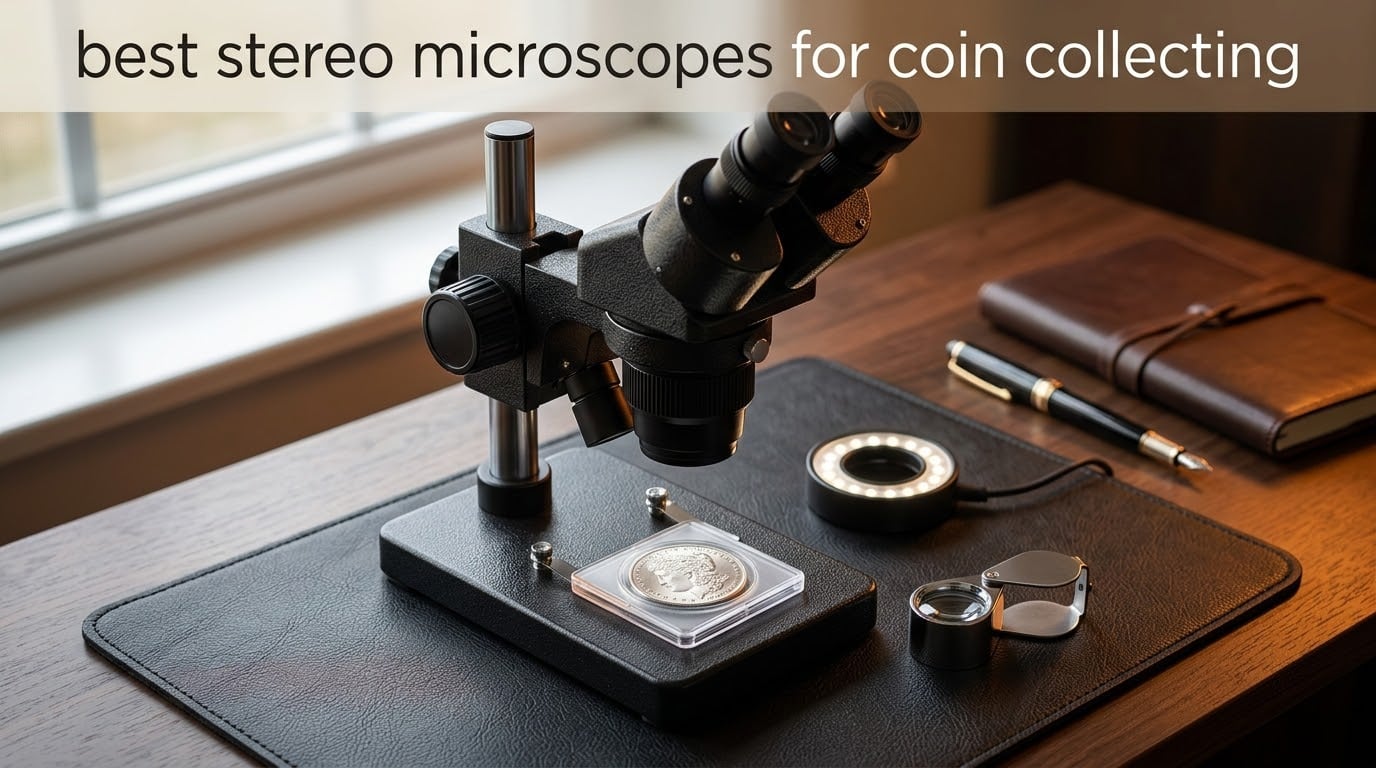
A coin microscope is a low-magnification stereo microscope that uses reflected light to show the surface detail that a loupe cannot: residues of cleaning material sitting in the recesses, hairline scratches, file marks on the rim, casting seams, and the fine red fibers left in a coin’s tray. For almost all coin work the useful optical range is 10x to 30x, and the 1200x figures printed on consumer digital microscopes are digital zoom rather than magnification you can grade with.
This roundup covers six true optical stereo microscopes, the kind with angled optical paths that keep the coin lit and your hands free to rotate it. I ordered them by how well they handle real collector tasks: authentication, surface grading, cleaning checks, and photography for listings or submission. Each entry covers the head type, the zoom range, the lighting, and the honest drawbacks that show up once the box is open.
The forum consensus is consistent. On Coin Community, collectors generally split USB microscopes for quick scans and physical measurements against stereo microscopes for detailed inspection, and the r/coincollecting thread on choosing a coin microscope is still mostly peer suggestions rather than a curated answer. If you are starting from zero, our beginner microscope guide covers the wider optical basics first.
Table of Contents
Top 3 Best Stereo Microscopes for Coin Collecting in 2026
Three scopes cover most collectors. The AmScope SM-4TZ-144A is the one I keep on the bench, because the four-zone ring light and the double-arm boom solve glare and positioning in one purchase. The DZQ ZQ-1 is the smarter money choice, and the AmScope SM-4NTP is the pick if simultaneous eyepiece and camera viewing is part of your workflow.

AmScope SM-4TZ-144A Trinocular
- 0.7X-4.5X continuous zoom for 3.5X-90X
- Four-zone 144-LED ring light with rheostat control
- Double-arm boom stand
- WH10x super-widefield eyepieces

DZQ ZQ-1 Stereo Zoom
- 7X-45X continuous zoom
- 0.5X Barlow lens included
- 95-300mm working distance
- 60-LED ring light with dimmer

AmScope SM-4NTP Simul-Focal
- Simul-focal trinocular viewing
- 7X-45X lockable zoom
- 4 inch working distance
- 3D heavy-duty boom stand
Best Stereo Microscopes for Coin Collecting in October
All six scopes below are real optical stereo microscopes. The table is ordered exactly as the reviews that follow, so the ranking and the detail match.
| Product | Specifications | Action |
|---|---|---|
| AmScope SM-4TZ-144A Trinocular Stereo Zoom |
|
Check Latest Price |
| DZQ ZQ-1 7X-45X Stereo Zoom |
|
Check Latest Price |
| AmScope SM-4NTP Simul-Focal Stereo Zoom |
|
Check Latest Price |
 AmScope SM-3T Trinocular Stereo Zoom AmScope SM-3T Trinocular Stereo Zoom |
|
Check Latest Price |
 Aomekie 20X and 50X Stereo Microscope Aomekie 20X and 50X Stereo Microscope |
|
Check Latest Price |
 Celestron Labs S10-60 Stereo Microscope Celestron Labs S10-60 Stereo Microscope |
|
Check Latest Price |
1. AmScope SM-4TZ-144A Trinocular Zoom – Best All-Round Coin Microscope
AmScope SM-4TZ-144A Professional Trinocular Stereo Zoom Microscope, WH10x Eyepieces, 3.5X-90X Magnification, 0.7X-4.5X Zoom Objective, Four-Zone LED Ring Light, Double-Arm Boom Stand, 110V-240V
Trinocular head
0.7X-4.5X zoom for 3.5X-90X
Four-zone 144-LED ring light
Double-arm boom stand
Pros
- Continuous 0.7X-4.5X zoom with 0.5X and 2.0X Barlow lenses
- Four-zone 144-LED ring light with independent intensity and direction control
- Double-arm boom stand moves in three axes
- WH10x super-widefield eyepieces with adjustable interpupillary distance
- Five-year manufacturer warranty
Cons
- No camera included so you supply the camera and adapter
- Assembly takes patience on a boom this size
- Corded electric power only
This is the scope I reach for when I want one instrument to cover authentication, surface grading and photography. The 0.7X to 4.5X continuous zoom objective with WH10x super-widefield eyepieces covers 3.5X to 90X total once the 0.5X and 2.0X Barlow lenses are in play, so I can work at the wide, orienting end of the range and then creep in toward the rim without swapping anything.
The four-zone ring light is the reason it stays on my bench. Four independently controlled zones let me kill the zone throwing a specular flare across a proof surface and keep the raking zones lit, and that is the difference between seeing a scratch and seeing a reflection of the lamp sitting on top of the scratch.
The double-arm boom with 20 inch arms on a 17 inch pillar is far more reach than a coin needs, and that is fine. It is exactly right if you also work on jewellery, watches or circuit boards, because once the head travels freely you stop dragging it across the desk to find a comfortable angle on a slab or a holder.
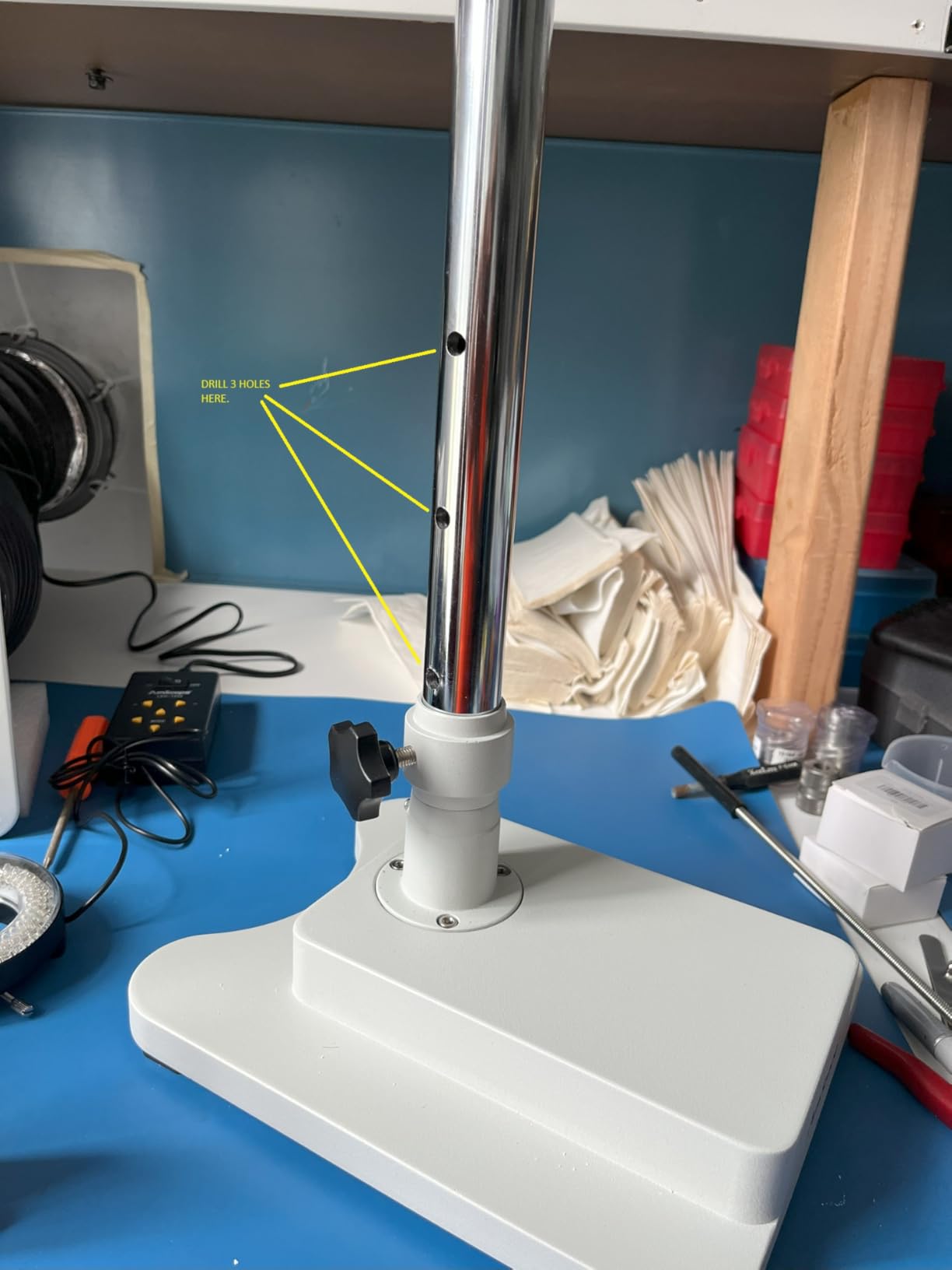
Two details worth knowing before you commit. First, there is no camera in the box. The trinocular port is there and ready, but you supply the camera, the adapter and whatever software you want to drive it, which is normal for this class of scope rather than a flaw.
Second, this head carries no reticle or calibration scale. If your collecting turns to measurement, you add a graticule eyepiece or simply photograph with a millimetre rule in frame. For submission documentation I prefer the second option anyway, because keeping the coin’s edge in the shot gives the grader a size reference for free.
Power is 110V to 240V corded electric, and the warranty runs five years from the manufacturer. For a club bench or a shared workspace that combination matters more than most buyers expect, because cheap LED rings and plastic stages are usually the first things to fail.
Who this microscope suits
It suits collectors who grade their own coins, sell online, or submit to a third-party service, and who also do other bench work where a boom arm earns its desk space. If you photograph coins regularly, the trinocular port means you can upgrade later without replacing the microscope.
It also suits anyone who cares about glare control more than raw magnification. A ring light with four zones and a rheostat is a tool for shaping light on a reflective object, and reflective objects are what numismatics is made of.
Where it falls short
The weight and footprint are the trade. A double-arm boom on a 17 inch pillar needs a genuinely stable bench, and if you are working from a kitchen table this scope will feel oversized for the task.
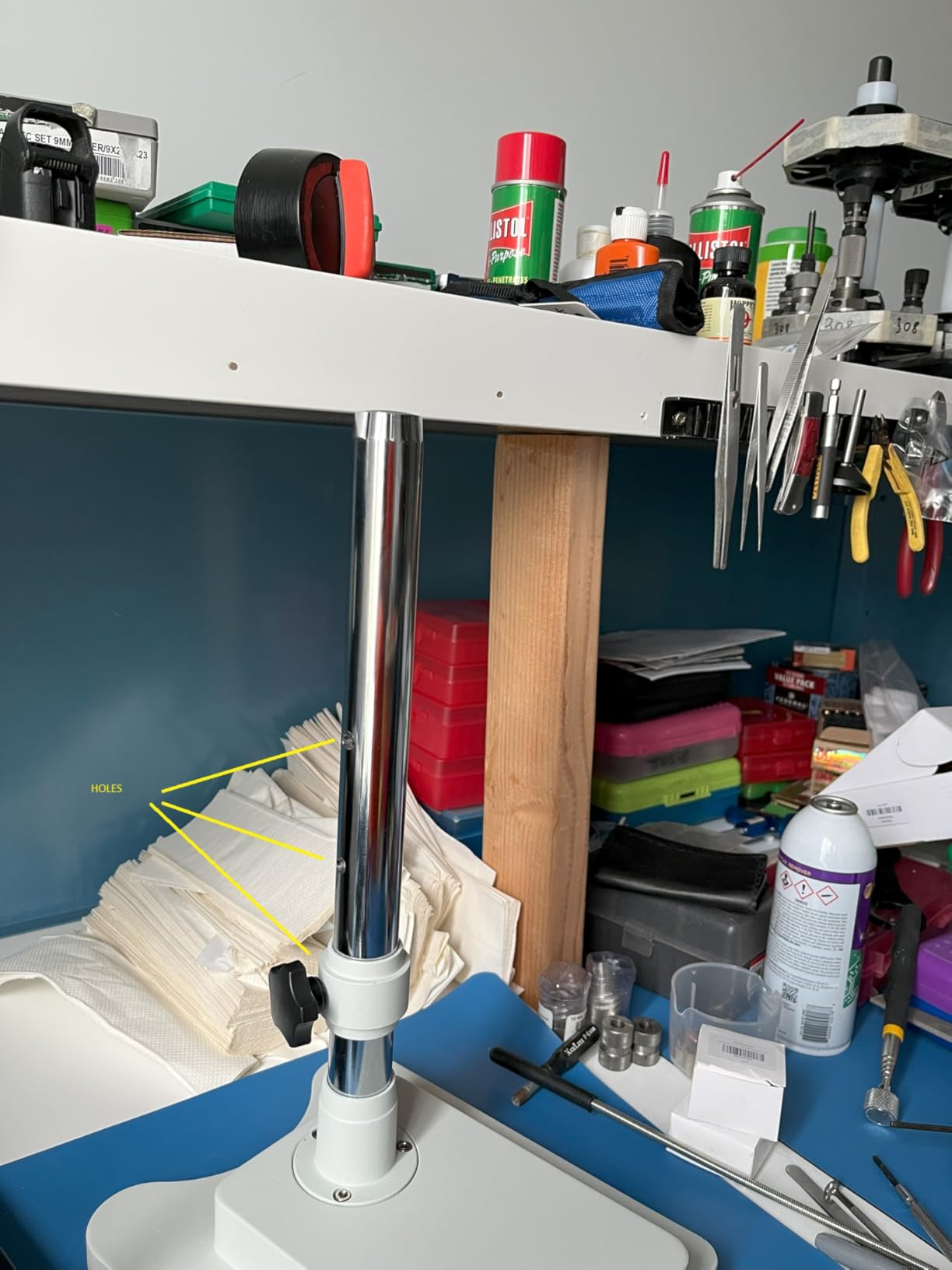
Assembly is not instant either. Reviewers mention patience with the initial build, and if you are buying this as a first microscope the setup itself is part of the learning curve. It is also worth checking the box contents against the listing, because ring light and Barlow lens versions of this model are configured differently.
2. DZQ ZQ-1 Stereo Zoom – Best Value for Coin Work
DZQ ZQ-1 Multi-Directional Microscope 7X-45X Magnification 0.5X Barlow Lens
7X-45X continuous zoom
0.5X Barlow lens included
95-300mm working distance
60-LED ring light with dimmer
Pros
- 7X-45X continuous zoom covers the whole useful coin range
- 0.5X Barlow lens included extends working distance
- 60-LED ring light with 0-100 percent dimmer is included
- Multi-directional spring bracket stand
- Aluminium alloy construction at 11.1 kg
Cons
- Newer brand with a shorter track record than AmScope
- Single spring bracket rather than a double-arm boom
- 60-LED ring is less even than a 144-LED ring
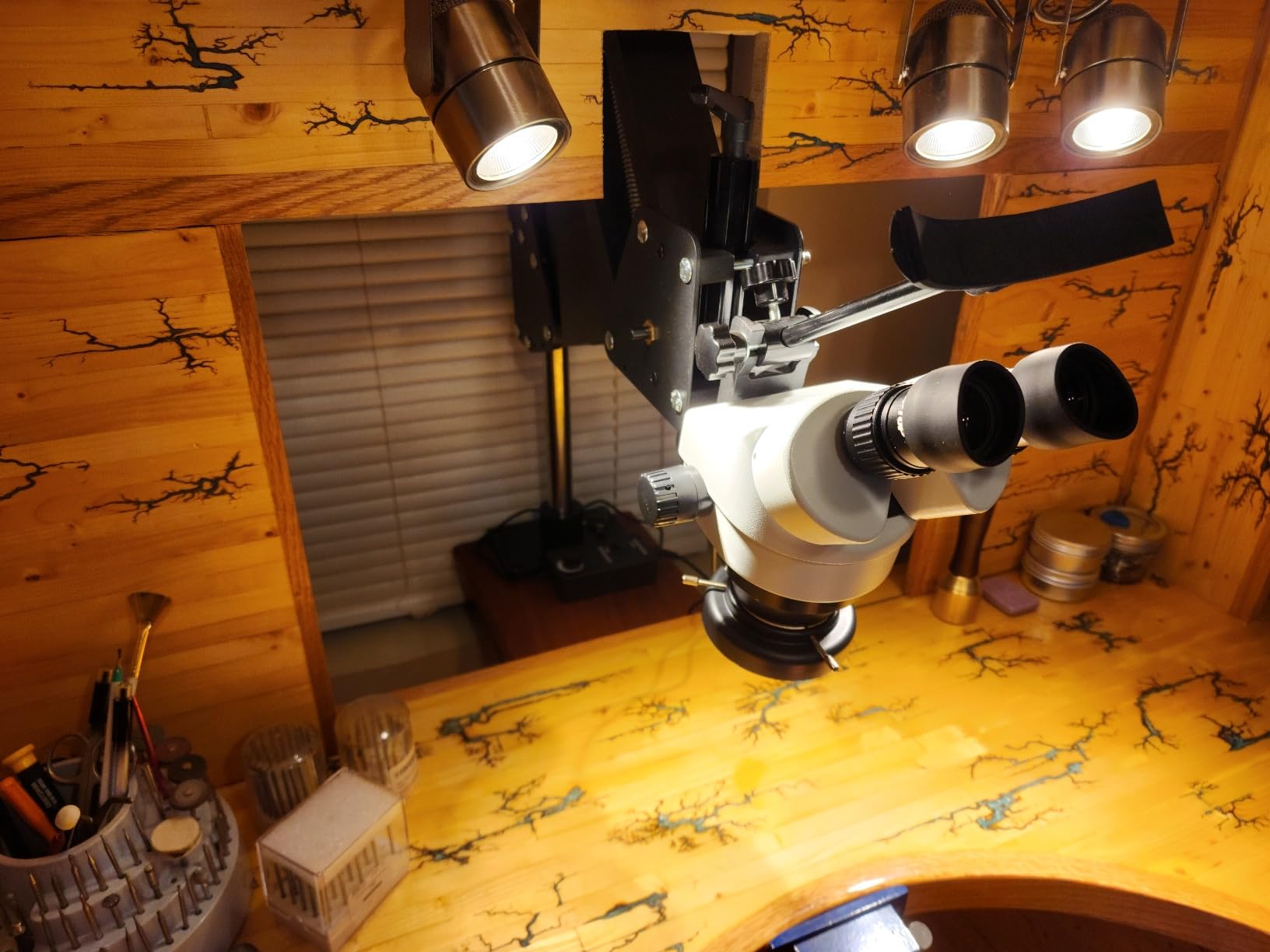
This is the scope that made me rethink how much a coin microscope actually needs. It delivers 7X to 45X continuous zoom on a 0.7X to 4.5X objective, and that range maps almost exactly onto what coin work needs: the low end for orienting on a worn coin, the middle for surface grading, the top for edge detail.
The included 0.5X Barlow lens is the feature I did not expect to value this much. It pushes working distance out to somewhere between 95mm and 300mm depending on zoom, which means a thick slab, a pile of coins, or a holder with a deep rim can sit under the objective without you tilting the whole head to get in.
The 60-LED ring light with a 0 to 100 percent dimmer is the other reason this ranks so high. A dimmer is not a luxury on a coin. Bright light on a mirror-finish or proof surface returns almost all of itself as glare, and being able to dial the intensity down until the relief reads is how you separate a real scratch from a highlight.
Weight and build are a pleasant surprise at 11.1 kg in aluminium alloy, with a footprint of 24 by 17 by 9 inches. That is lighter than the 25.38 kg simul-focal AmScope, and light enough to move between a desk and a cabinet without a second person.
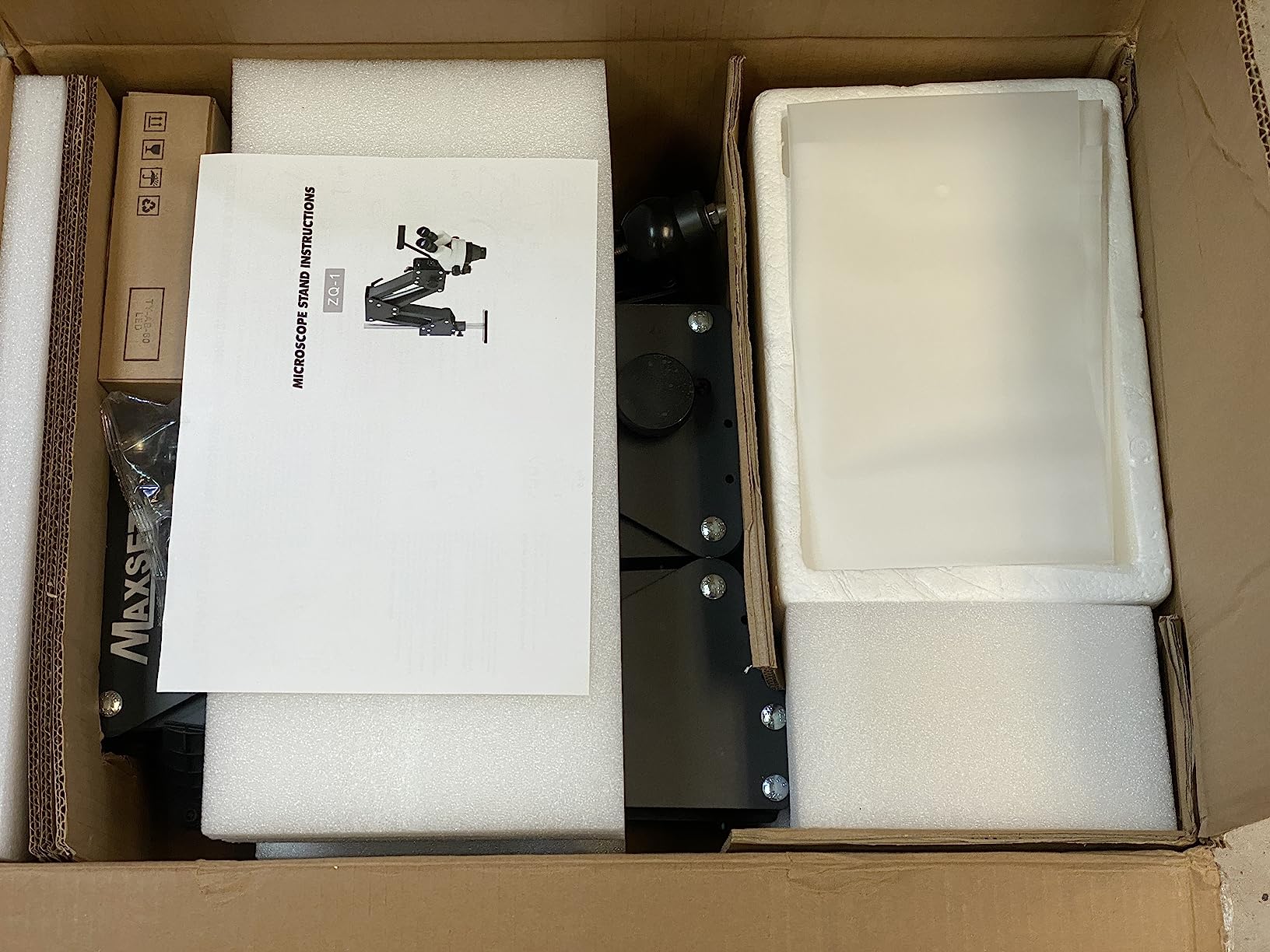
The stand is a multi-directional spring bracket with an adjustable headrest, which holds the head at a fixed comfortable height once you find the setting. It is less precise than a geared boom arm, but for inspection work where the coin is the only thing moving, it is a sensible trade.
Who this microscope suits
It suits the collector who has done a year of casual looking and now wants proper optical zoom, included lighting, and included working-distance extension without buying three accessories on day one. Nothing essential is missing from the box.
It also suits anyone sharing a bench or a classroom, because the 11.1 kg weight and the compact footprint are far easier to manage than a full boom-stand system, and the dimmer means one scope can serve several people with different light sensitivity.
Where it falls short
Brand history is the honest gap. DZQ does not have the long service record or the published parts list of an established optical maker, so long-term availability of a replacement ring or bracket is something you accept rather than verify.
The lighting is also a step down from a 144-LED ring. Sixty LEDs across a smaller ring produce a slightly harder pool of light, so on a large coin you will spend more time centring the subject. Neither of those drawbacks affects the inspection itself, but both show up on a busy bench.
3. AmScope SM-4NTP Simul-Focal – Best for Coin Photography
AmScope SM-4NTP 45X Simul-Focal Stereo Lockable Zoom Microscope on Dual
Simul-focal trinocular
7X-45X lockable zoom
4 inch working distance
3D heavy-duty boom stand
Pros
- Simul-focal head shows the coin through the eyepieces and the camera port at the same time
- 7X-45X zoom with a lockable magnification control
- 4 inch working distance suits deep holders
- Super widefield 10x eyepieces rated at 20mm
- Five-year manufacturer warranty
Cons
- Ring light and Barlow lenses are sold separately
- 25.38 kg so it needs a solid bench
- Height adjustment set-screws can dent the post over time
Simul-focal is the word that matters here, and it is the reason this scope sits above the cheaper trinoculars. The head is designed so you can look through both eyepieces and still see the camera image at the same time, which turns coin photography from guesswork into something you can actually control.
For listing photos and submission documentation that is not a small gain. You frame the coin by eye, tighten the focus ring, and the view through the eyepieces tells you immediately whether the rim of the letter is sharp. Nothing is hidden behind a blind finder, and nothing shifts when the shutter fires.
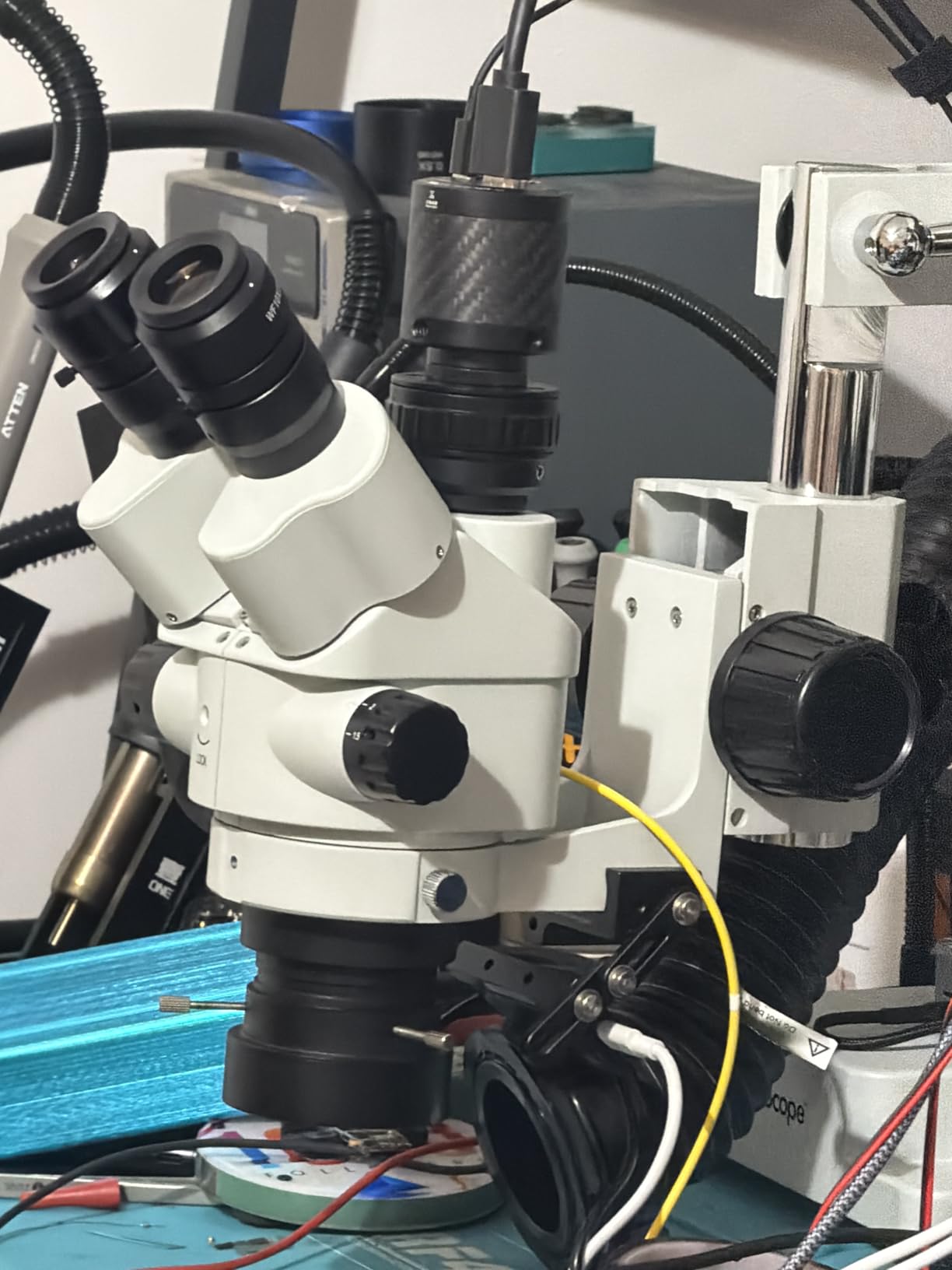
The zoom is 7X to 45X with a lockable control, so you can hold a magnification steady while you adjust light. Working distance is quoted at 4 inches with a 76mm holder ring, which is the number that tells you whether your slabs and capsules fit underneath the objective without a fight.
The eyepieces are 10x super widefield rated at 20mm, and the listing describes a 1 to 1-1/4 inch super widefield view. A wider field means you spend less time hunting for your coin, and hunting is where most of the time actually goes when you are working through a table of mixed lots.
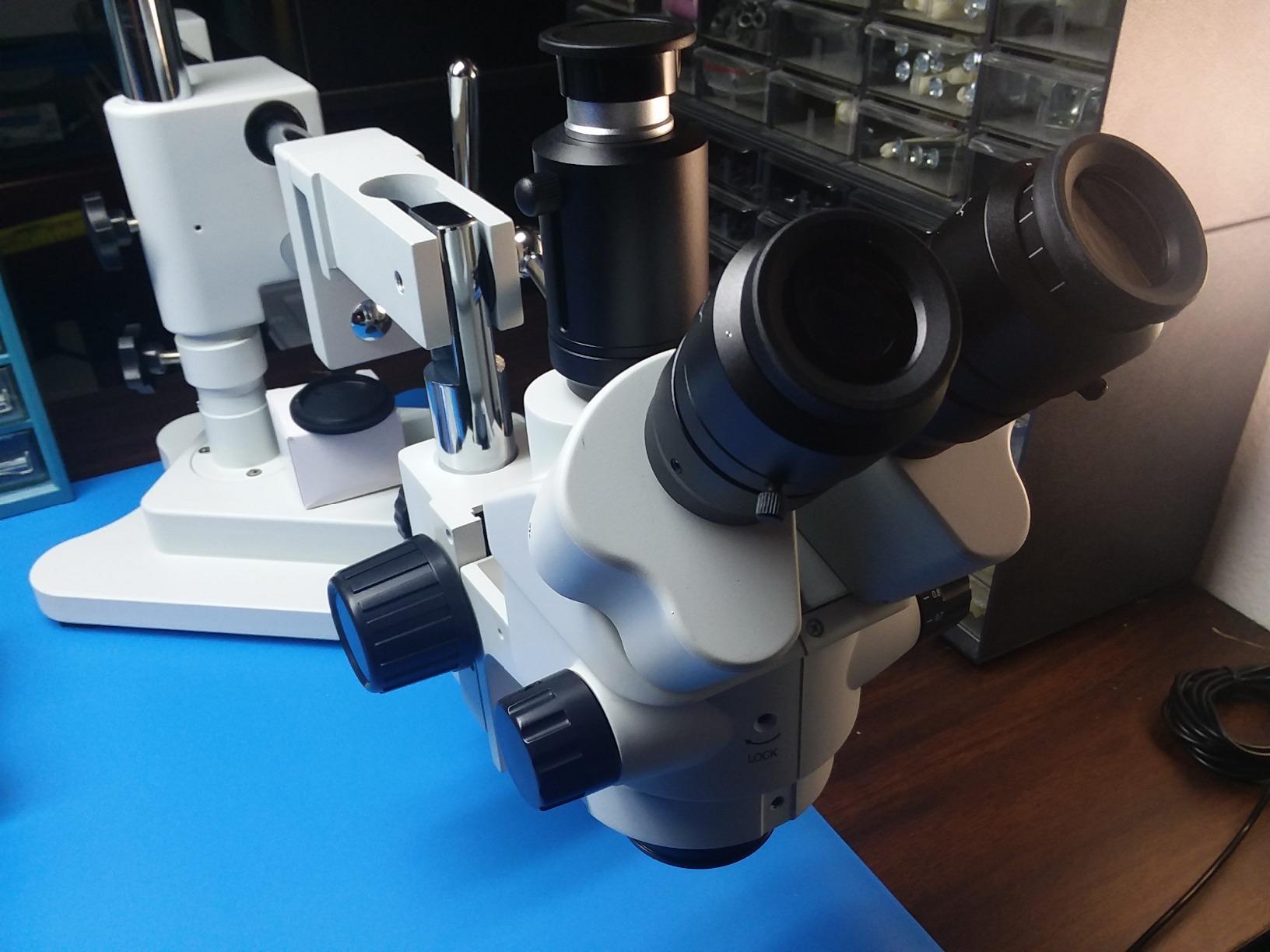
The stand is a 3D heavy-duty boom with 360 degree multi-axis rotation, and the whole unit is 25.38 kg across a 22.44 by 20.24 by 21.65 inch footprint. This is a serious bench instrument and it behaves like one, which is exactly what you want when a camera tripod is involved.
Who this microscope suits
It suits collectors who sell coins, who build submission sets, or who maintain a photographed catalogue. Simultaneous eyepiece and camera viewing is the difference between a photograph you keep and one you retake, and the lockable zoom keeps the magnification honest between shots.
It also suits anyone whose coins come in deep capsules or on thick flips. Four inches of working distance means you can examine a coin in its holder without removing it, which removes a lot of handling risk from old or fragile pieces.
Where it falls short
The ring light is not included and the Barlow lenses are not included. That is the standard way these are configured, but it means your first purchase is not your last, and you should budget for a dimmable ring before you judge how the scope handles glare.
At 25.38 kg it needs a dedicated heavy bench, and the height adjustment set-screws are reported by some owners to develop small divots in the post over years of tightening. Reviewers also mention tight eye relief for glasses wearers, so try it before committing.
4. AmScope SM-3T Trinocular – Best for Small Desks and Electronics Work
AmScope SM-3T Professional Trinocular Stereo Zoom Microscope, WH10x
Trinocular head
7X-45X continuous zoom
Single-arm boom stand
WH10x super-widefield eyepieces
Pros
- Trinocular head with WH10x super-widefield eyepieces
- 7X-45X continuous zoom covers the coin range comfortably
- Single-arm boom with 16 inch reach and 8 inch vertical travel
- Compact 19.8 by 19 by 17.5 inch footprint at 19.21 kg
- Five-year warranty and battery or mains power
Cons
- No illumination included so you need a separate ring light
- Single-arm boom is less rigid than a double-arm stand
- Camera rod blocks the left eye when the port is active
This is the AmScope trinocular I recommend when the same bench also has to handle circuit boards and small parts. The 0.7X to 4.5X zoom objective with WH10x super-widefield eyepieces gives 7X to 45X, which covers the coin range from orientation to rim detail, and the single-arm boom gives 16 inches of horizontal reach with 8 inches of vertical travel.
Compared with the double-arm systems that is a real reduction in stiffness, and I would not mount a heavy camera on it for repeated work. For coin work where the coin moves and the camera does not, it is entirely adequate, and the smaller footprint is the trade most collectors in flats or shared offices will appreciate.
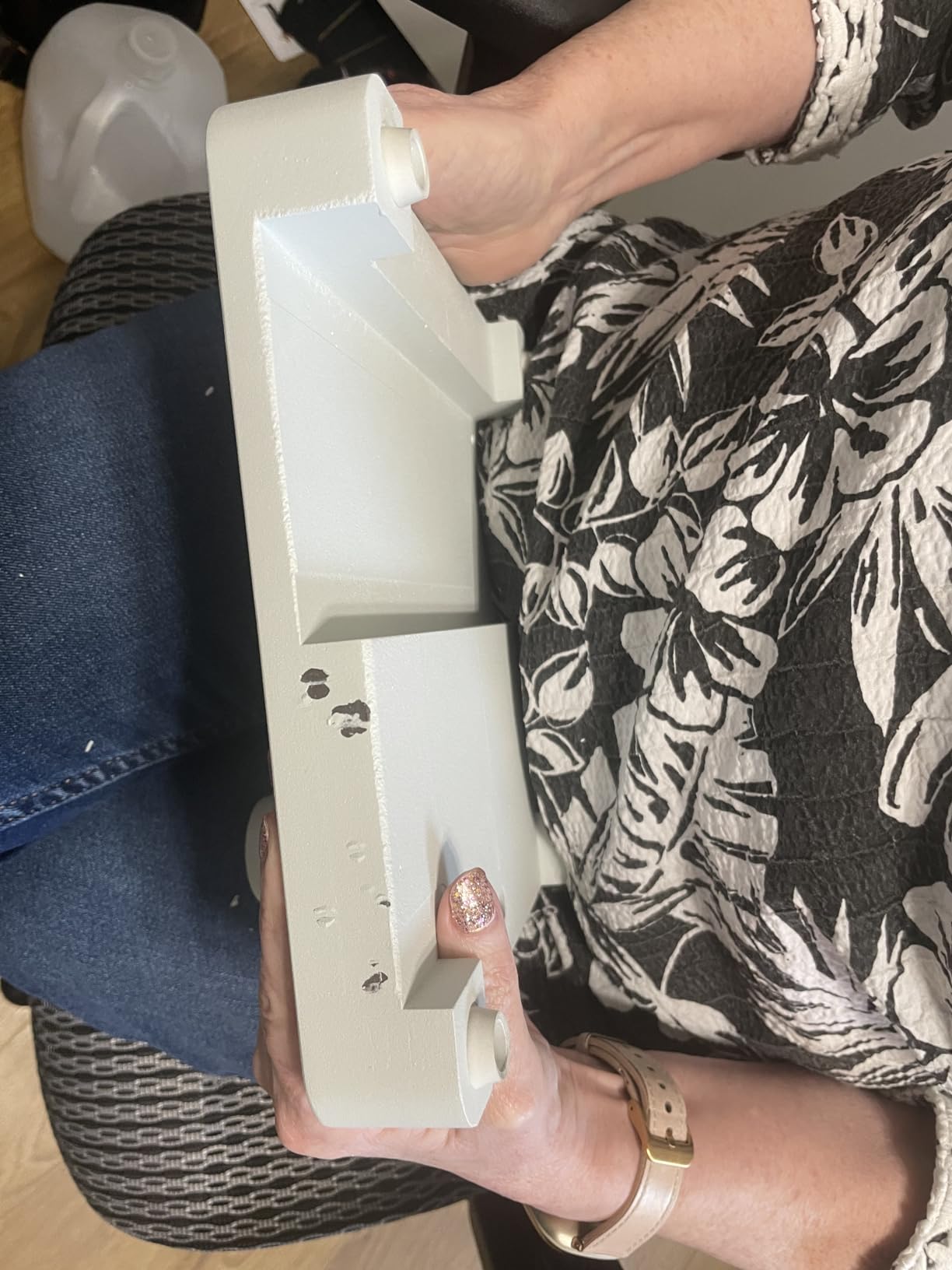
One thing to plan for is lighting. This listing specifies ambient LED with the ring light sold separately, so budget for a dimmable ring before you judge image quality. Uncontrolled ambient light is exactly the condition that flattens coin relief and hides a hairline scratch.
The head rotates 360 degrees with a 45 degree fixed inclination, and interpupillary distance adjusts, which matters more than it sounds when a second person uses the same scope. It also runs on battery or 240V mains, so it can live on a shelf between sessions rather than living plugged into the bench.
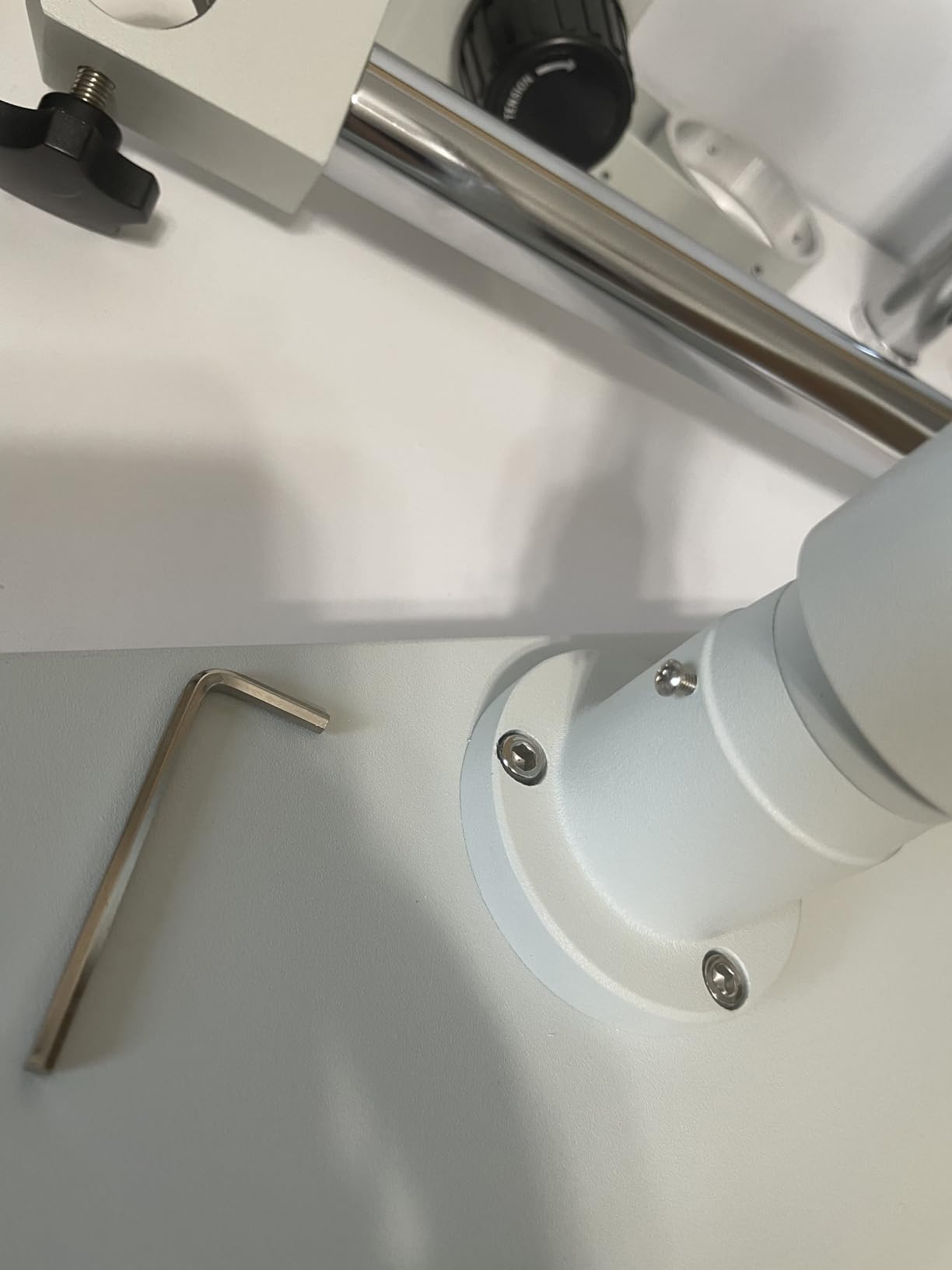
Who this microscope suits
It suits a collector who wants a trinocular head and a proper zoom range but does not want a 25 kg boom stand dominating a small work area. Nineteen kilos and a compact footprint make it lighter than the 25 kg simul-focal scope in this roundup.
It also suits people who split time between numismatics and electronics or jewellery repair, which is the pattern many buyers on the review side describe for this class of microscope. Some units even arrive with bonus Barlow lenses and a ring light, though you should not plan on it.
Where it falls short
No illumination is included, and that is the single biggest practical gap. You are buying an optical head and a stand, then sourcing the light that determines whether you can see detail or not.
The camera port uses a push-pull rod that blocks the left eyepiece while the camera is active, so it is not a simul-focal head. Quality control also draws occasional complaints, including missing eyepieces, stripped screws, and boom screws that do not lock tightly, all of which are fixable but worth knowing about on arrival.
5. Aomekie 20X and 50X Stereo Microscope – Best for Learners and First Looks
Aomekie® Microscope 20X 50X with 10Pcs Slides Insect Specimen Stereo Microscope with WF eyepieces LED Light Source Portable Stereoscope 12Pcs Mineral specimens
20X and 50X magnification
WF10X and WF25X eyepieces
Battery-powered LED
Portable at 872 g
Pros
- Two magnification steps covering 20X and 50X
- Includes WF10X and WF25X eyepieces
- Interpupillary distance adjusts from 55 to 75mm
- Battery-powered LED so it works anywhere
- Two-year warranty and 872 g weight
Cons
- Only fixed magnification steps with no continuous zoom
- Fixed vertical head with no tilt adjustment
- Batteries are not included and the LED is weak on dark surfaces
This is a learning scope, and I want to be straight about that before anyone buys it expecting a workbench instrument. It offers 20X and 50X in fixed steps using a 2X objective with WF10X and WF25X eyepieces, which gives you a real look at a coin without giving you the continuous zoom that coin grading depends on.
What it does have going for it is portability. At 872 grams and powered by two AA batteries, it moves from desk to table to a club night in a bag, and that flexibility is something no boom-stand microscope offers. Working distance of 65mm to 102mm is enough to sit under a coin in a shallow holder.
At 20X you can comfortably check a coin for obvious problems: rim damage, a cleaned surface catching the light differently, a counterfeit with the wrong relief depth. That is a genuinely useful first pass, and it is the pass most beginners do dozens of times before they know what they are looking at.
The kit aspect is not a gimmick either. Ten prepared slides, insect specimens, and twelve mineral samples mean the scope has something under it the moment you open the box, which matters when the person learning is a child or when the microscope is a shared teaching tool.
Who this microscope suits
It suits a first-time buyer who wants to learn what a magnified coin looks like before committing to a proper stereo zoom, and it suits anyone who needs a portable scope for shows, club nights, or photographing coins away from a fixed bench.
It also works as a companion instrument. Keeping a cheap portable scope in the bag and a serious stereo on the desk means you triage at shows and confirm at home, which is how a lot of experienced collectors work.
Where it falls short
The fixed vertical head cannot tilt. For inspecting a coin you must look straight down, which gets uncomfortable quickly and gives you no angle for raking light across a surface. Serious surface work wants an inclined head where you can change the light angle relative to your eye.
There is also no continuous zoom, no camera port, and the battery LED is modest. On a dark ancient bronze or a low-relief token, the light is the first thing that falls short, and 50X quickly becomes too high to locate anything useful.
6. Celestron Labs S10-60 – Best Entry Stereo Microscope
Celestron Labs S10-60 Stereo Binocular Microscope for Lab or Classroom
10x 20x 30x and 60x steps
Upper and lower LED
Two stage plates included
Two eyepiece pairs
Pros
- Four fixed magnifications including 10x 20x and 30x
- Upper and lower LED illumination
- Transparent and black and white stage plates both included
- Two eyepiece pairs at 10x and 20x
- Full-metal construction at 2.99 kg
Cons
- Fixed magnification steps instead of continuous zoom
- No trinocular port so no camera can be attached
- Reported quality control issues with screws and optics
The Celestron Labs S10-60 is the most straightforward way I know to get real optical magnification in front of a coin without buying a used scope. It steps through 10x, 20x, 30x and 60x using 1x and 3x objectives in a rotating housing, and two eyepiece pairs at 10x and 20x widefield are included in the box.
The stage plates are the detail that makes this more than a school scope. A black and white plate gives you a choice of background contrast under a coin, and a light-coloured or bright coin is genuinely harder to read against a white field than a dark one. Swapping the plate takes seconds and changes how relief reads immediately.
Upper and lower LED illumination is included, and the lower light matters for coins viewed in a holder or on a transparent stage. It is a modest light source, so on dark surfaces you will want an external lamp, but the option is there from day one.
Construction is full metal at 2.99 kg, which is light enough to carry and rigid enough to hold focus. The binocular head sits at a 45 degree inclination, which is far more comfortable over a long session than a vertical fixed head.
Who this microscope suits
It suits a collector who wants a proper stereo microscope with dual lighting and stage plates but does not need zoom or a camera. At 10x and 20x it is a solid first instrument for checking incoming purchases and photographing with a phone held against the eyepiece.
It also suits anyone who wants a second, portable instrument for a club or a classroom. At under three kilograms it moves easily, and the fact that both stage plates and both eyepiece pairs are included means nothing needs buying to get started.
Where it falls short
There is no trinocular port, so no camera can be attached. If listing photos or submission documentation are part of your collecting, this is a dead end and you would be buying twice. The 60x step is also above the useful range for whole-coin work and adds nothing but a smaller field.
Reviewers mention quality control slips such as a stripped eyepiece screw and optics they describe as fair, and note that many reviews appear to cover sibling variants. It carries a 2-year warranty rather than the 5 years on the AmScope models, which is a fair reflection of where it sits.
How to Choose a Stereo Microscope for Coin Collecting in 2026
Buy on three things: a zoom range that covers 10x to 30x, a lighting setup you can dim, and a head you will still be happy looking through after an hour. Everything else is preference, and the specifications below are how you tell the difference before the box arrives.
Magnification: 10x to 30x is the coin range
10x to 30x is the working range for coins: 10x orients you, 20x is the default inspection power, and 30x is where hairline scratches and cleaning residue read clearly. Above about 40x the field of view shrinks past the point where you can work your way around a coin, and above 300x the illumination and resolution collapse into empty magnification.
Do the field-of-view math once and it becomes obvious. With a 10x super-widefield eyepiece carrying a 20mm field number, the field at 10x total magnification is roughly 2mm across. A 39mm coin will never fit in that view at any working magnification, so you scan across the surface deliberately rather than searching blindly.
That is also why continuous zoom beats fixed steps. Clicking between 10x, 20x, 30x and 60x means refocusing at every stop, and a ring that never quite holds focus is frustrating across a table of fifty coins. A 0.7X to 4.5X continuous zoom objective covers the range in one movement.
Treat advertised magnification on digital scopes with suspicion. Figures like 1200x describe digital zoom applied to a small optical image, not magnification at the specimen, which is the single most common source of disappointment among first-time buyers.
Head type: binocular or trinocular, and when the third port pays off
A binocular head has two eyepieces and is all you need for looking. A trinocular head adds a third port above, usually on a 45 degree prism, that accepts a camera so you can photograph what you are seeing.
Buy trinocular the moment photography enters your workflow, because you cannot add a third port to a binocular scope later. On a stereo microscope the third port is how a camera attaches, and collector forums consistently treat a trinocular head as the correct choice once photos are part of the routine.
Among trinoculars, simul-focal is the upgrade that matters. A simul-focal head lets you view through the eyepieces and the camera port at the same time, so framing and focus are visible while you shoot. A standard trinocular with a pull-rod port may block one eyepiece when the camera is active.
Lighting and glare on polished metal
Lighting matters more than magnification on a coin, because a coin is a mirror and glare hides the detail you paid for. Flat, dim, or badly angled light turns a hairline scratch into an invisible surface.
Look for three things: a ring light that includes a dimmer, control over which zones are lit, and the option of raking light from an angle. A four-zone ring with a rheostat lets you kill the zone reflecting straight back at your eye, which is the most direct glare control on any stereo microscope.
A polarizer over the light source and one over the eyepiece also help, though they cost a little brightness. On heavily toned or proof surfaces, reducing intensity until the relief reads is usually more effective than adding equipment, and it is why dimmability keeps showing up as a requirement.
Working distance, stage plates and holders
Working distance is the gap between the objective and the specimen, and it decides what you can put under the scope without tilting your head. Standard mounts work with loose coins and thin flips. Deep capsules, slabs and multi-coin holders need 4 inches of working distance or a 0.5X Barlow lens, which is why the zoom trinoculars in this roundup can all be extended.
Stage plates set the background contrast. A black and white plate lets you switch between light and dark fields, which changes how relief reads on a bright silver coin versus a dark bronze one. Coins in holders need the transparent plate so light passes through from below.
Do you need a measurement scale?
If you measure, catalogue, or compare size, you need a scale, and it is the most common unmet need in this category. A coin microscope with a scale comes in three forms: an engraved stage plate with a printed rule, a graticule eyepiece with a reticle, or measurement software that calibrates against a known reference at your chosen magnification.
For submission documentation, skip the software and put a millimetre rule in frame. The grader sees the coin at true size relative to the rule, and you avoid calibrating anything. For inventory work where you want repeatable diameter and thickness figures, measurement software with a calibration step is the more useful investment.
Whichever route you take, calibrate at the magnification you will actually use. A reticle or a software scale is only correct at one zoom setting, and a coin measured against an uncalibrated scale is worse than an unmeasured coin because it looks authoritative.
Stereo microscope versus digital USB microscope
A digital USB microscope wins on price, portability and instant measurement, and it is fine for quick scans across a table. It loses on working distance, and working distance is what stops you examining a coin inside a holder without removing it.
A stereo microscope wins on image quality, lighting control, and the ability to move a coin by hand while you watch it. It loses on nothing that matters for inspection, but it costs more and it is a fixed bench instrument rather than a pocket tool.
Forum consensus lands in the same place. The pragmatic answer is that a USB microscope handles triage and a stereo microscope handles the decision, and collectors who need both often end up with both because they are answering different questions.
Submission and third-party grading photography
You do not need a particular magnification to submit to a grading service, and it is worth saying plainly that no microscope turns a coin into a grade. Surface grade is a judgement made by eye by a trained grader, and a microscope only helps you judge your own coin more accurately before you pay for someone else’s opinion.
What the microscope does help with is documentation. Photograph each coin at a low magnification that shows the full piece, then again closer in on any surface you are unsure about, with even lighting and a scale in frame. Those images let you compare against previous submissions, support a dealer conversation, or record condition before a cleaning decision.
Simul-focal viewing and a lockable zoom make this far easier, which is the practical case for a trinocular head beyond simple listing photos.
Stands, boom arms and long sessions
A single-arm boom is enough for coin work, where the subject is small and the head barely moves. A double-arm boom is for when the head travels constantly between positions, and its extra rigidity is what keeps focus stable under a camera.
Weight is the other factor. Scopes in this category run from under three kilograms to more than twenty-five, and the heavy ones genuinely need a bench that will not flex, because a flexing bench is a focusing problem you cannot fix with the focus ring. If your workspace is a table in a room you also use for other things, a mid-weight scope is the honest answer.
Long sessions also reward an inclined head. A 45 degree inclination puts the eyepieces at a natural angle and saves your neck over an evening of slab work, and that comfort is worth more to most collectors than any specification on the box.
Frequently Asked Questions
What is the best microscope for looking at coins?
A stereo microscope with continuous 7X-45X zoom and a dimmable ring light is the best general choice for coins. It keeps the coin lit and manipulable, and it shows cleaning residue, file marks, scratches and casting seams clearly. A trinocular version is worth it once you want photographs. Digital USB microscopes are fine for quick scans but weaker for detailed surface work.
What magnification is best for coins?
10x to 30x is the working range for coins. Use 10x to orient yourself on the whole coin, 20x as your default inspection power, and 30x to read hairline scratches and cleaning residue. Above roughly 40x the field of view shrinks too much to navigate a coin, and very high figures on digital microscopes are usually digital zoom rather than optical magnification.
What magnification does PCGS use to grade coins?
No collector microscope magnification is prescribed for grading, and no microscope produces a grade on its own. Graders assess surface condition directly. For your own documentation, photograph each coin at a magnification that frames the full piece and then closer on any surface you are unsure about, with even lighting and a millimetre rule in the frame.
What are the disadvantages of a stereomicroscope?
Stereo microscopes cost more than digital USB models, are fixed bench instruments rather than portable tools, and their magnification ceiling is low by design. Out of the box there is usually no measurement scale or software, and a binocular head cannot take a camera. A trinocular head fixes the camera problem but nothing fixes the price or the footprint.
Do I need a trinocular head for coin photography?
Yes, if you plan to photograph coins regularly. The third port on a trinocular head is how a camera attaches to a stereo microscope, and you cannot add it to a binocular model later. Among trinoculars, a simul-focal head is the better buy because you can view through the eyepieces and the camera port at the same time while framing and focusing.
The Best Stereo Microscope for Coin Collecting
The AmScope SM-4TZ-144A is the best stereo microscope for coin collecting overall, because the four-zone ring light and the continuous 0.7X to 4.5X zoom handle both halves of the job: seeing the detail and controlling the glare that hides it. The DZQ ZQ-1 is the pick if you want the zoom range, a dimmable ring and a Barlow lens without buying accessories separately.
For photography, choose the AmScope SM-4NTP, whose simul-focal head lets you frame and focus by eye while the camera is attached. Start with the Celestron S10-60 or the Aomekie if you are still learning what a magnified coin looks like, and move up once you know you want continuous zoom and light control. Whichever you pick, check that the illumination is included, because that is the part you cannot substitute later.