
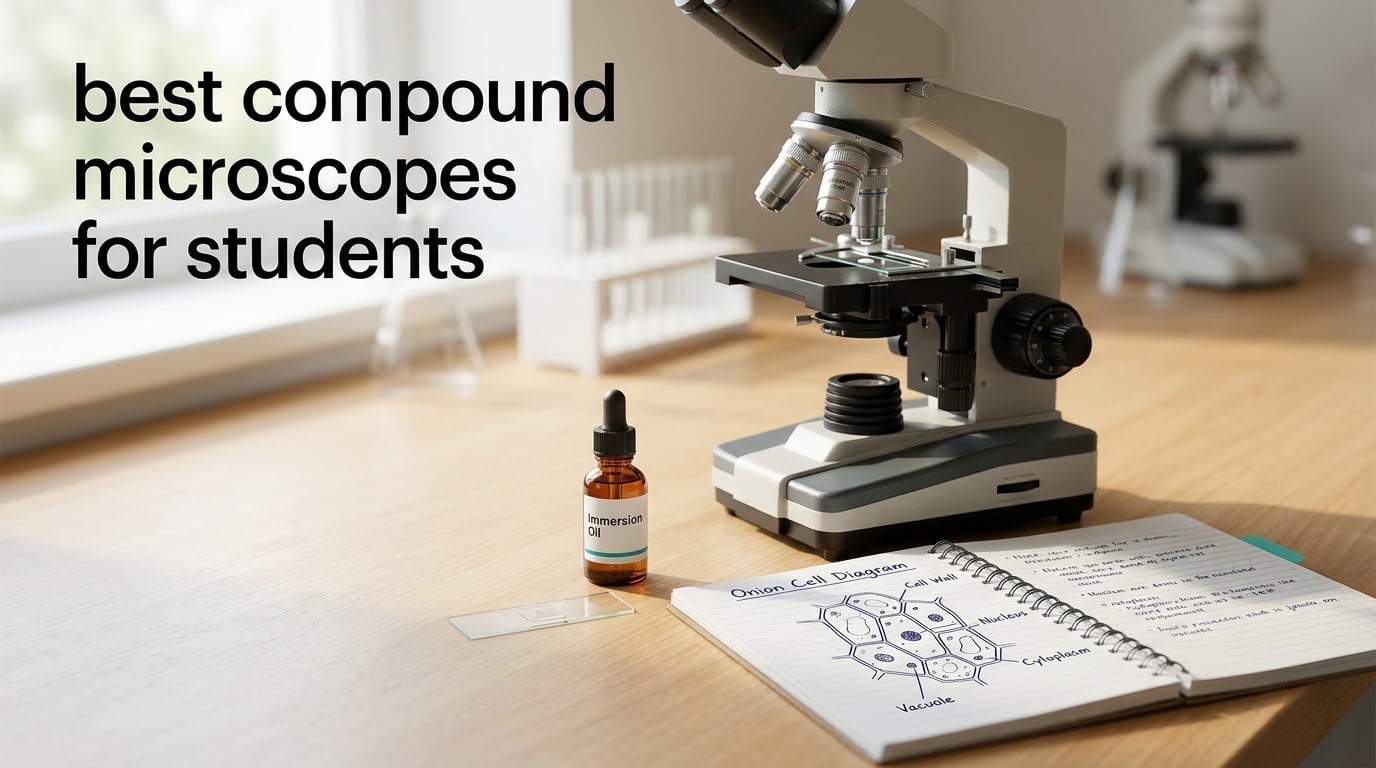
Choosing a microscope for a student used to mean picking between a plastic toy and a lab-grade instrument that cost more than a laptop. That gap has narrowed, and the best compound microscopes for students today put real glass optics, a metal frame and a mechanical stage within reach of a homeschool family or a high school lab budget. I spent the last two months working through the ten most-reviewed student scopes on the market, reading spec sheets line by line and comparing what each one actually resolves against what its listing claims.
The short answer, if you only have a minute: a monocular scope with a metal frame and 4x, 10x and 40x achromatic objectives will carry a student through middle school and most of high school. A binocular head with a mechanical stage and a real 100x oil immersion objective is what you want once lab reports, blood smears or bacteria enter the picture. Anything advertised above 1000x on a budget scope is usually eyepiece arithmetic, not extra resolution.
This guide covers everything from first onion-cell slides to a college biology lab bench. It is written for parents buying a first microscope, for students who need one for a specific course, and for anyone who has already owned a disappointing plastic scope and wants to know what went wrong. Our ranking runs from the most-reviewed entry-level metal frame to the binocular lab stands built for a fixed bench. We updated it for 2026 and you can read the full comparison table below before you decide anything.
If you have never touched a microscope at all, start with our broader guide to the best microscopes for beginners, which covers stereo and digital scopes as well. Everything below is a true compound light microscope, the kind that shows you cells on a slide.
Table of Contents
Top 3 Best Compound Microscopes for Students in October
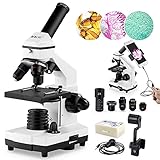
BEBANG 2000X Metal Frame Scope
- 100X-2000X across six settings
- Metal frame with coarse and fine focus
- Top and bottom LED with condenser
- Phone adapter and 15 slides

TOMLOV CM101 Coaxial Focus Scope
- Coaxial coarse and fine focus
- Achromatic 4x 10x 40x objectives
- Dual LED illumination
- Colour filters with prepared and blank slides
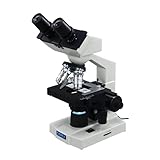
OMAX M82ES Binocular Lab Scope
- Real 100X oil immersion objective
- Double layer X-Y mechanical stage
- NA1.25 Abbe condenser
- Five year manufacturer warranty
The BEBANG takes the overall spot because it is the most reviewed student compound microscope available, sits on a metal frame rather than plastic, and ships with 15 prepared slides and a phone adapter so a first-time user can look at something real on day one. The TOMLOV CM101 is the better instrument for the money if you want a cleaner focus experience and colour filters, and the OMAX M82ES is the one to buy when a genuine 100x oil immersion objective and a mechanical stage are non-negotiable.
All 10 Student Compound Microscopes at a Glance in 2026
| Product | Specifications | Action |
|---|---|---|
| BEBANG 2000X Metal Frame Scope |
|
Check Latest Price |
| TOMLOV CM101 Coaxial Focus Scope |
|
Check Latest Price |
| OMAX M82ES Binocular Lab Scope |
|
Check Latest Price |
 PalliPartners 28-Slide Scope PalliPartners 28-Slide Scope |
|
Check Latest Price |
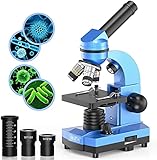 Emarth 52-Piece Kids Microscope Emarth 52-Piece Kids Microscope |
|
Check Latest Price |
 AmScope M162C 1000X Metal Kit AmScope M162C 1000X Metal Kit |
|
Check Latest Price |
 AmScope B120C-E1 USB Camera Kit AmScope B120C-E1 USB Camera Kit |
|
Check Latest Price |
 AmScope M150C Portable 1000X AmScope M150C Portable 1000X |
|
Check Latest Price |
 SWIFT SW380B Siedentopf Binocular SWIFT SW380B Siedentopf Binocular |
|
Check Latest Price |
 Herwicm Wide-Field Binocular Scope Herwicm Wide-Field Binocular Scope |
|
Check Latest Price |
Two columns deserve attention before anything else. Head type decides whether one person or two can look at a slide, and whether a camera can ever be attached. Stage type decides whether you chase your specimen around the slide at 400x or you move it with a knob. Four of the ten here use a binocular head, and only those same four have a mechanical stage; the other six are single-viewer monocular stands you move by hand.
How We Picked and Ranked These Microscopes
We ranked on five things a student actually feels in the first ten minutes of use, not on headline magnification. First, is the frame metal or plastic. Second, does the scope have coarse and fine focus rather than a single knob. Third, is there a mechanical stage for anything above 100x. Fourth, is the light source an LED with a condenser and diaphragm rather than a bare bulb. Fifth, does the listing itemise a real objective set instead of a total magnification number.
Review volume broke the ties, and we weighted it heavily. A scope with two thousand verified reviews and a 4.4 rating has survived more classrooms than one with fifty reviews, and reader reports of dropped stages or cracked coverslips only mean something when enough people have seen them. We also read the product documentation rather than the bullet points, which is how we caught scopes whose published objective set does not match their advertised ceiling.
We did not test each microscope ourselves, and we say so plainly. Everything rated below is taken from manufacturer specifications and aggregated verified buyer feedback. Where a listing contradicts itself, we say so instead of passing the claim along.
1. BEBANG 2000X Metal Frame Compound Microscope – Best Overall
2000X Compound Microscope for Kids Adults: Microscope for Biology Education
Metal frame
4x 10x 40x achromatic objectives
Top and bottom LED
2.4 lb
Pros
- Most reviewed student compound microscope available
- Metal frame with coaxial coarse and fine focus
- 15 prepared slides and a phone adapter in the box
- Top and bottom LED with a 0.65 NA condenser
Cons
- Monocular head means one viewer at a time
- No mechanical stage so slides move by hand
- The 2X lens and 2000X setting enlarge rather than resolve
The BEBANG is the scope I recommend first because it removes the three things that most often end a student’s interest: a plastic body, a missing starter set of slides, and a focus knob too coarse to work with. It puts out a 4.3 rating across 2909 reviews, which makes it the single best-evidenced purchase in this category. At 2.4 pounds it is light enough for an eleven-year-old to carry to a counter themselves.
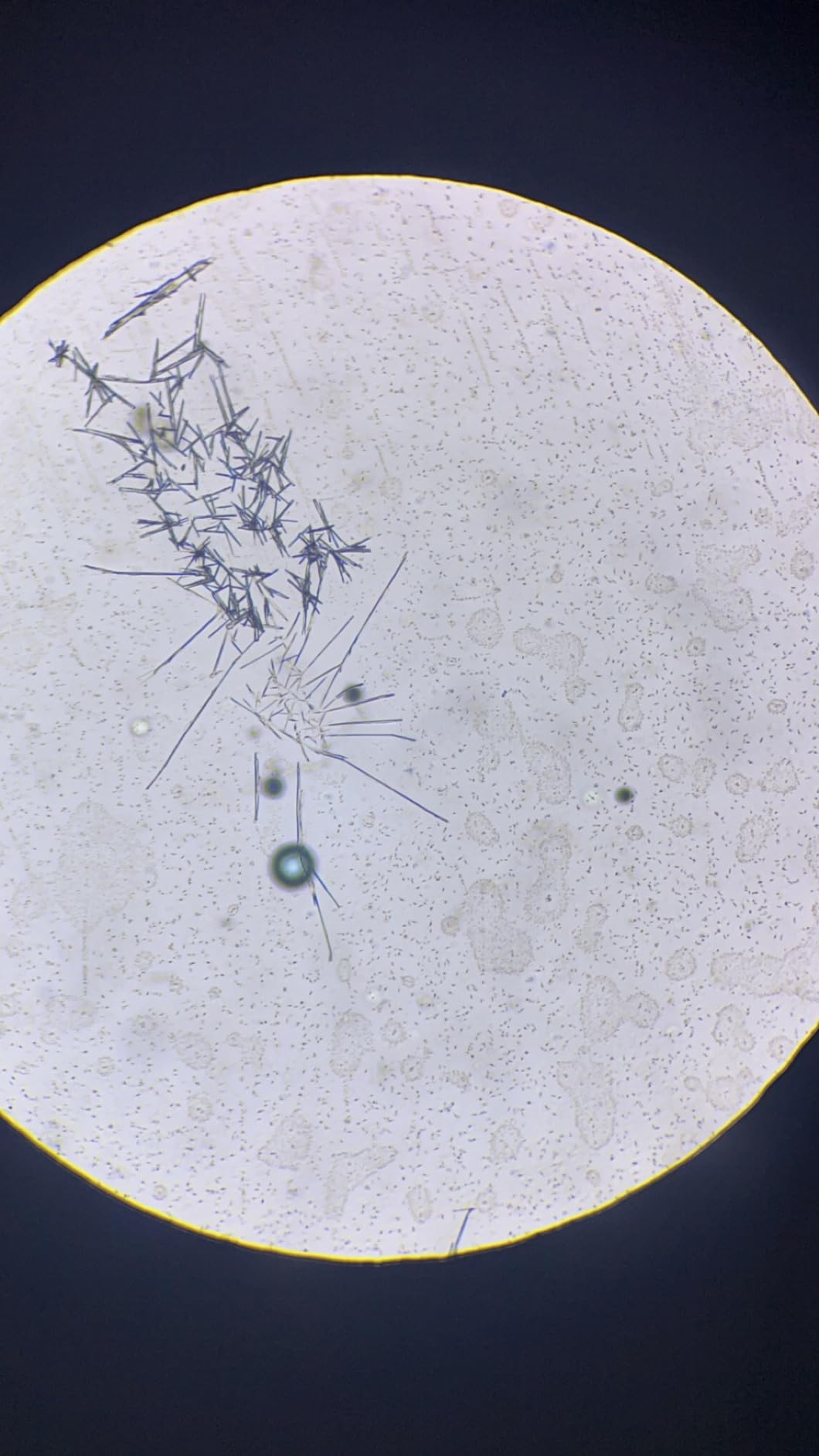
Total magnification runs across six settings from 100X to 2000X, built from a WF25X eyepiece, a 2X auxiliary lens and 4x, 10x and 40x achromatic objectives. Read that list carefully and you will see the honest ceiling: 40x objective on a 10x eyepiece is 400x, which is where all the useful work happens. The 1000X and 2000X figures come from stacking the auxiliary lens on top of the 40x objective, so you are enlarging an image that the glass cannot resolve any further.
The 0.65 NA condenser with a disc diaphragm is a genuine step above the bare LED found on cheap scopes, and the top and bottom illumination means you can look at an opaque object such as a coin or a leaf as well as a thin slide. A one-year warranty is the shortest we saw, which is the main reason this is a first microscope rather than a lifetime instrument.
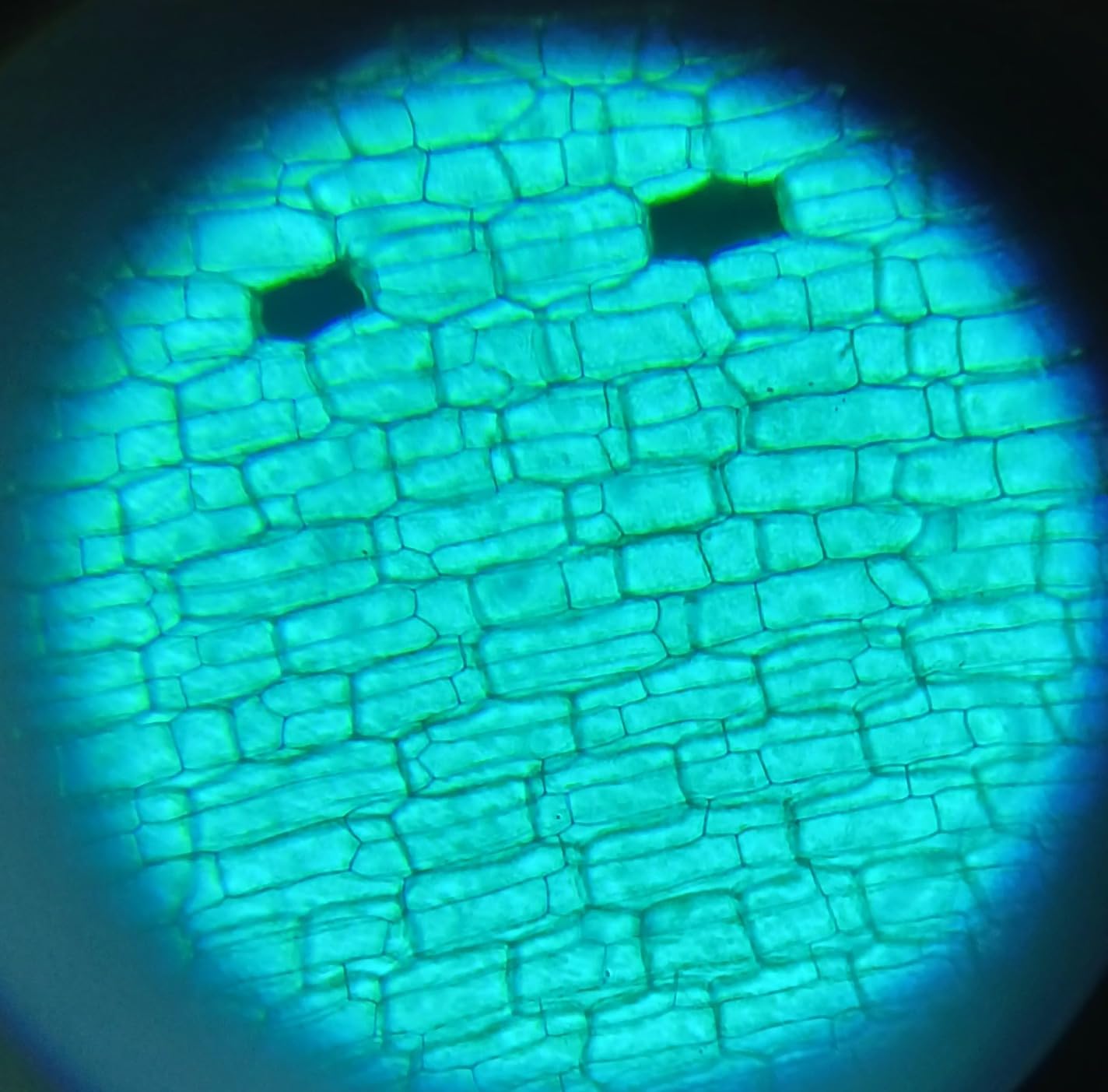
What 400x actually looks like on this scope
At 40x you see a whole onion cell wall. At 100x individual cells separate cleanly with visible nuclei. At 400x you are inside the tissue and the picture holds up well because the achromatic objectives correct the colour fringing that makes cheap images look green and fuzzy.
Cheek cells, pond water and prepared plant slides all work on the included 15 prepared slides. For wet mounts you will need your own blank slides and coverslips, which are not included in meaningful quantity.
Who should skip it
Skip it if more than one person needs to look at a slide at the same time, or if your course requires you to find and hold a moving specimen like a live protozoan at 400x. Without a mechanical stage that becomes a two-handed job with one hand on the slide and one on the focus knob.
Also skip it if you are already certain that bacteria are on your syllabus. Without a 100x oil objective and a gram stain kit, you will see smudges. Reviewers of the kit itself note this clearly, and the r/microbiology community makes the same point.
2. TOMLOV CM101 – Best Value for Everyday Student Use
TOMLOV Compound Microscope with Coarse & Fine Focus for Students, 40X-2000X
Coaxial focus
4x 10x 40x achromatic
Rotatable head
2.7 lb
Pros
- Coaxial coarse and fine focus for find-then-refine control
- Four achromatic objectives and two wide-field eyepieces
- Colour filters that help low-contrast specimens
- Five prepared plus five blank slides and coverslips
Cons
- Monocular head allows one viewer
- No mechanical stage
- The 25X eyepiece narrows the field and tires the eye
The TOMLOV CM101 is the scope I recommend to anyone who asked for the best microscope for high school biology. Its coaxial coarse and fine knobs let a beginner find a specimen with the big knob and then sharpen it with the small one without losing the specimen entirely, and that single feature does more for learning than any advertised magnification figure. It holds a 4.5 rating across 2255 reviews.
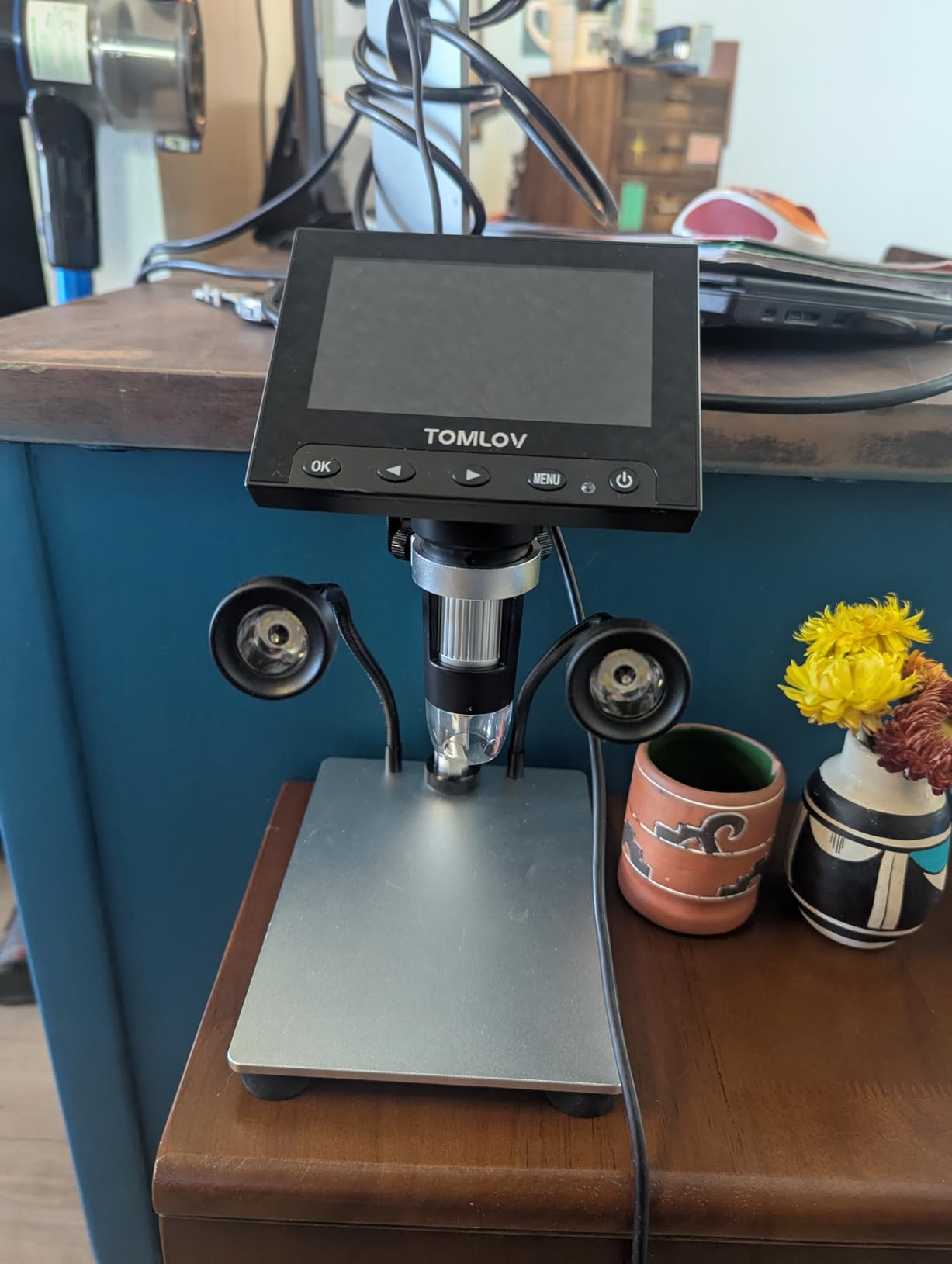
Optically it is a 4x, 10x and 40x achromatic set on a rotating nosepiece, paired with WF10X and WF25X eyepieces. Dual LED illumination covers transmitted work on slides and reflected work on opaque objects, and the six-position disc diaphragm carries clear, yellow, purple, blue, green and red filters. Those filters matter more than most buyers expect: stained and low-contrast specimens often become visible only when you cut the light down and shift its colour.
The head rotates through 360 degrees, so a younger student can work from the side without twisting their neck. At 2.7 pounds the body mixes metal with ABS and optical glass, which is heavier in the hand than a fully plastic scope without being a chore to carry.
Where the 2000X number comes from
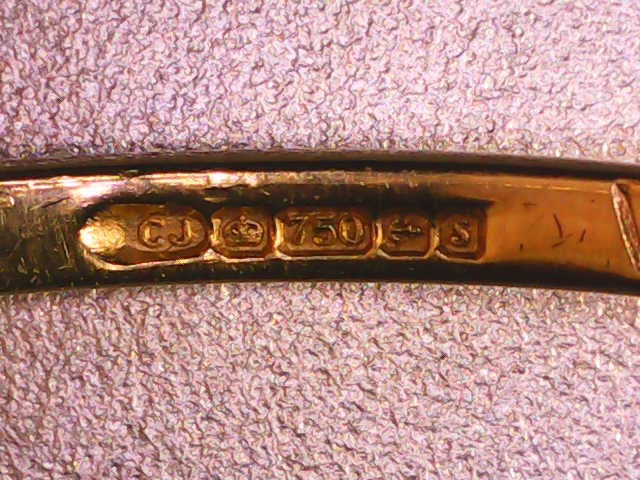
You get real magnification from the objective multiplied by the eyepiece, so 40x on a 10x eyepiece is a usable 400x. Pair that 40x objective with the 25X eyepiece and you are at 1000x, which is the top of the range where the image still carries detail. Anything beyond that is enlargement.
Reviewers consistently note that the usable ceiling sits well below the advertised 2000X. That is not a defect, it is physics, and it applies to every scope in this list that does not itemise a 100x oil objective.
Who should skip it
Skip it if a second person needs to look at the same slide, because the monocular head serves one viewer. Skip it too if your work involves finding a specific cell in a large blood smear, because there is no mechanical stage to hold position while you hunt for it.
For a shared family scope where a parent and child look together, the binocular models further down this list are a better fit.
3. OMAX M82ES – Best Compound Microscope for College Biology
Awarded Best Compound Microscope 2016 – OMAX 40X-2000X Lab LED Binocular Microscope with Double Layer Mechanical Stage w Blank Slides Covers and Lens Cleaning Paper
100X oil objective
NA1.25 Abbe condenser
X-Y mechanical stage
5 year warranty
Pros
- Itemised 100X semi-plan oil immersion objective
- Double layer X-Y mechanical stage with scales
- NA1.25 Abbe condenser with iris diaphragm
- Five year manufacturer warranty and 100 blank slides
Cons
- At 9.6 pounds it is bulky to move
- Top magnifications need immersion oil and practice
- Accessory slides are blank so prepared specimens are not supplied
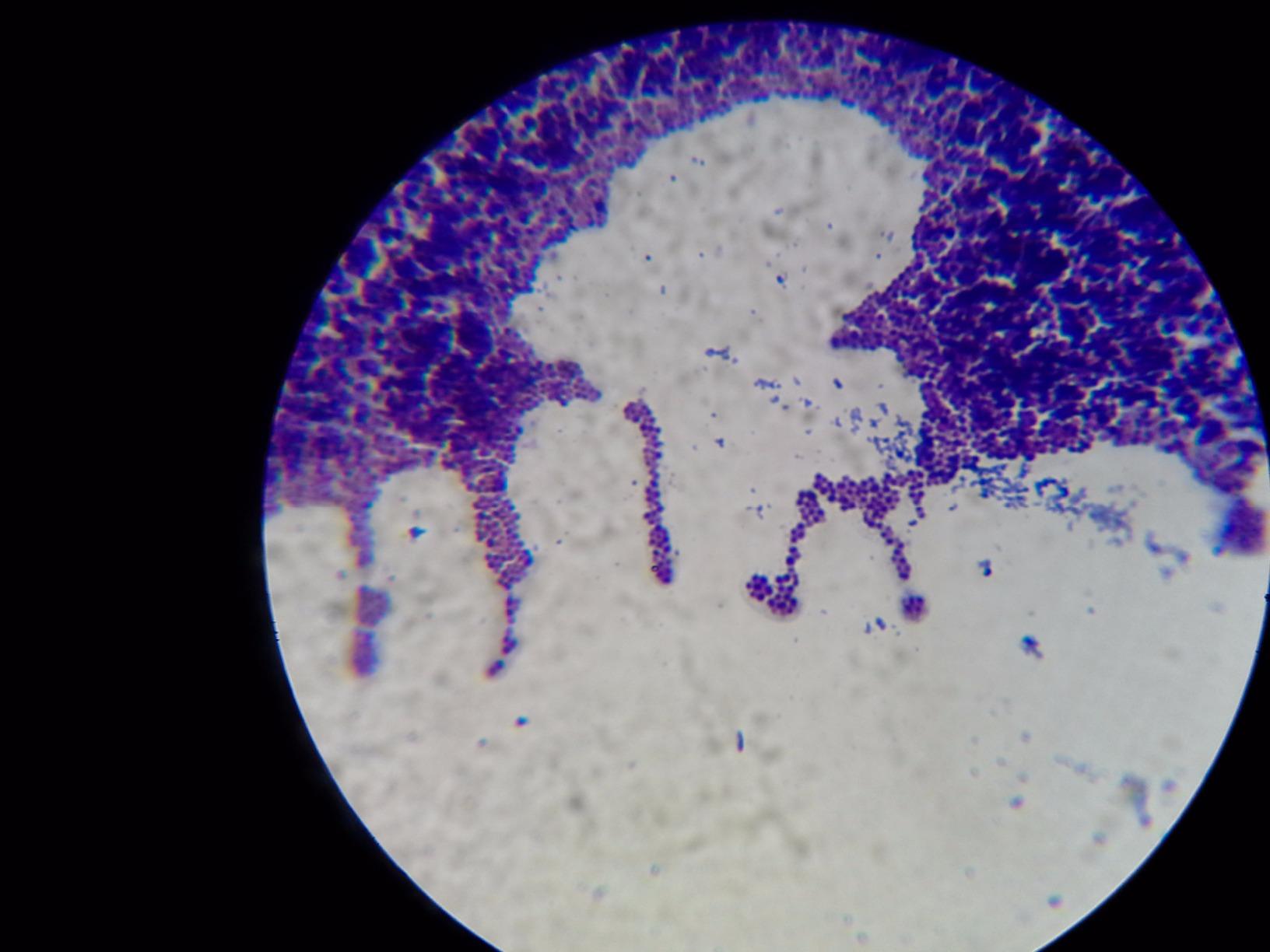
The OMAX M82ES is the best compound microscope for college students in this list, and the only one here that documents a complete 4X, 10X, 40X semi-plan and 100X oil immersion DIN objective set. With an NA1.25 Abbe condenser and iris diaphragm underneath, it is the only scope in the roundup that can actually resolve bacteria once you learn oil immersion. A 4.4 rating across 2112 reviews backs that up.
The binocular head sits at a 45-degree incline, swivels through 360 degrees and adjusts for interpupillary distance between 55 and 75mm with a diopter on both eyetubes. The double layer X-Y mechanical stage measures 115mm by 125mm with 70mm by 30mm of travel and a stage lock, so a slide stays exactly where you put it while you change objectives. Coarse and fine knobs are coaxial, which is the standard every serious lab expects.
Magnification runs 40X to 2000X using WF10X and WF20X eyepieces, so the 100X oil objective genuinely reaches 1000X and 2000X with resolution to match rather than blur. The five-year manufacturer warranty is the longest we found, and the box includes 100 blank slides, 100 cover slips and 50 lens cleaning sheets. The AC/DC adapter accepts 100-240V.
Why a college lab course deserves this scope
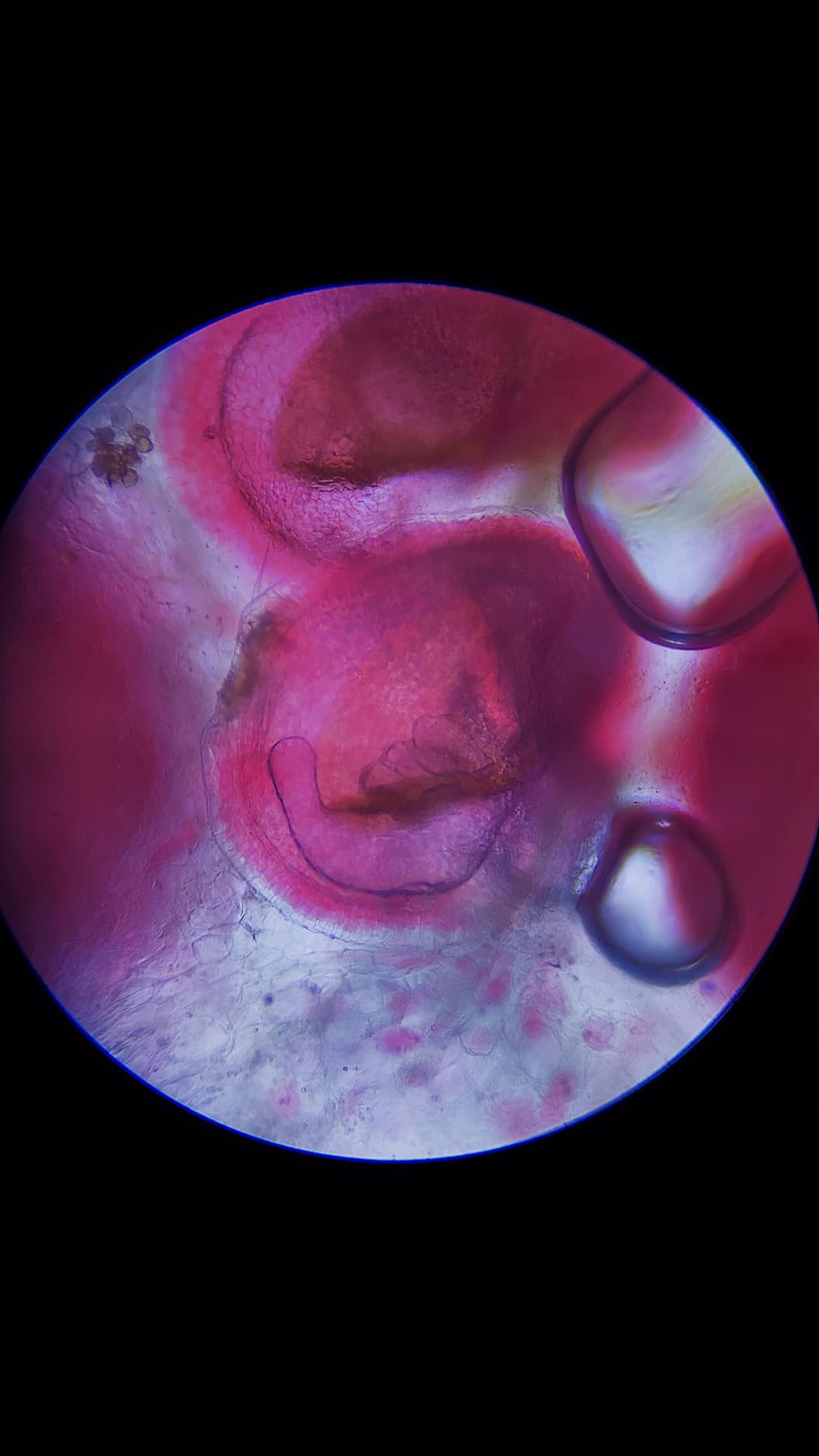
Intro biology labs ask you to look at bacterial smears, plant stem cross sections and mitosis stages in sequence, then draw and label them. Oil immersion is the difference between a cell wall and a cell. Bacteria at 1000x without oil is a guess; with oil and a gram stain it is a usable identification.
If your laptop is your lab notebook, a scope with a camera port is worth a look too, and our student laptop picks cover the hardware side of that workflow. The OMAX needs a separate camera adapter, which is an extra purchase.
Who should skip it
Skip it if the microscope has to live in a bedroom and be carried between rooms. At 9.6 pounds and 13 inches tall it wants a desk of its own, and a family sharing one space will move it constantly.
Skip it too if nobody in the house will learn the oil immersion routine. Clean the slide, drop one drop of oil, rotate the 100x objective into place and clean the oil off afterwards, every single time.
4. PalliPartners Compound Microscope – Best Budget Starter Kit
PalliPartners Compound Microscope for Adults & Students, White
28 slides included
Top and bottom LED
1.65 kg
1 year warranty
Pros
- Largest slide kit in the roundup with 28 slides
- Phone clip adapter and Bluetooth remote shutter
- Adjustable top and bottom LED for cells and objects
- SGS certified for non-toxic materials
Cons
- Body is polycarbonate and polyethylene rather than metal
- Objective lenses can wobble in rough handling
- No mechanical stage and slides can drift
The PalliPartners is the pick when the whole point is a complete science kit on a shelf. The box holds 10 prepared slides, 18 blank slides, a phone clip adapter and a Bluetooth shutter, which means a student can build their own wet mounts the same afternoon it arrives instead of waiting for a supply order. It holds a 4.3 rating across 1189 reviews and ranks at the top of its Amazon microscope category.
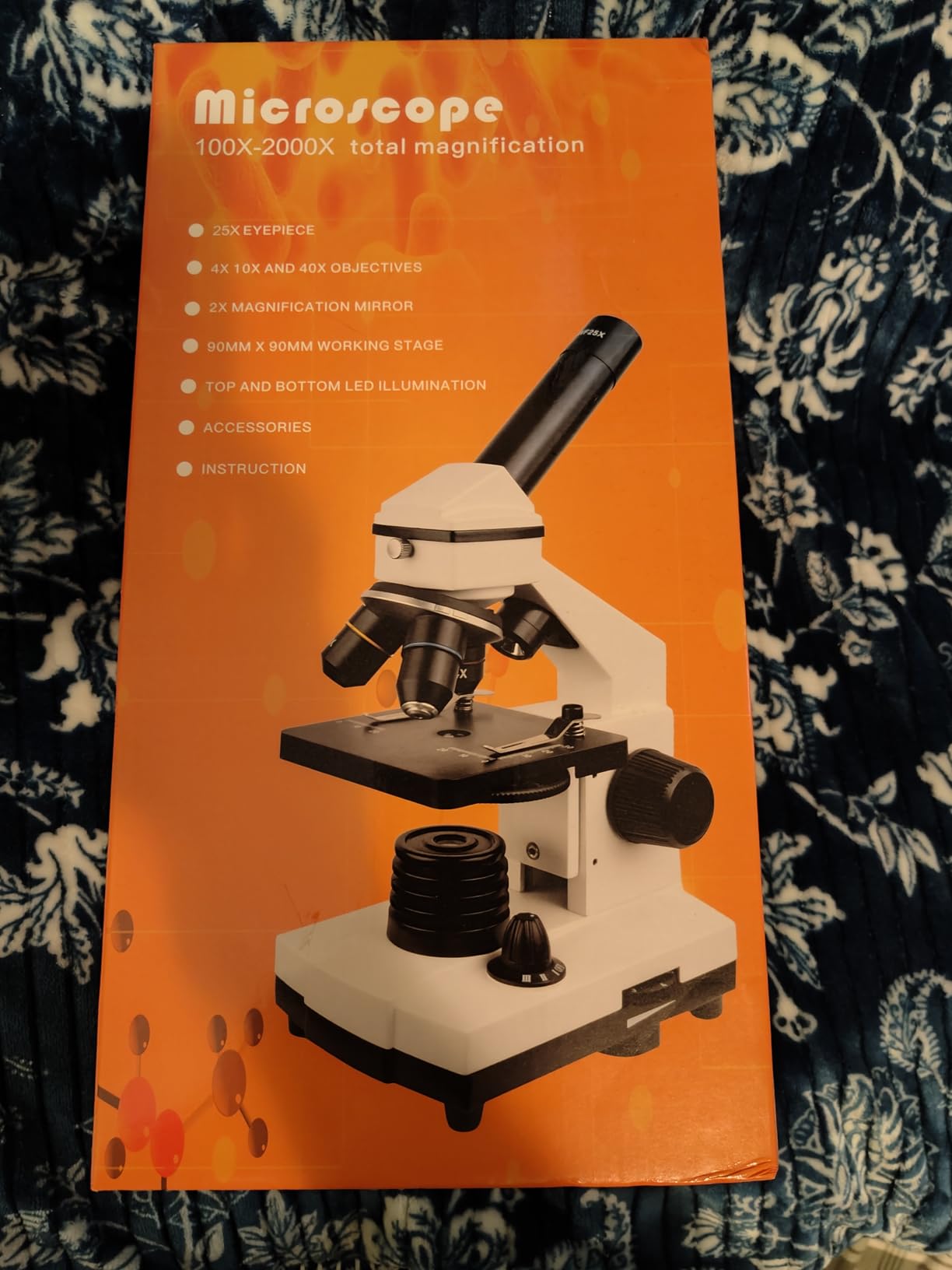
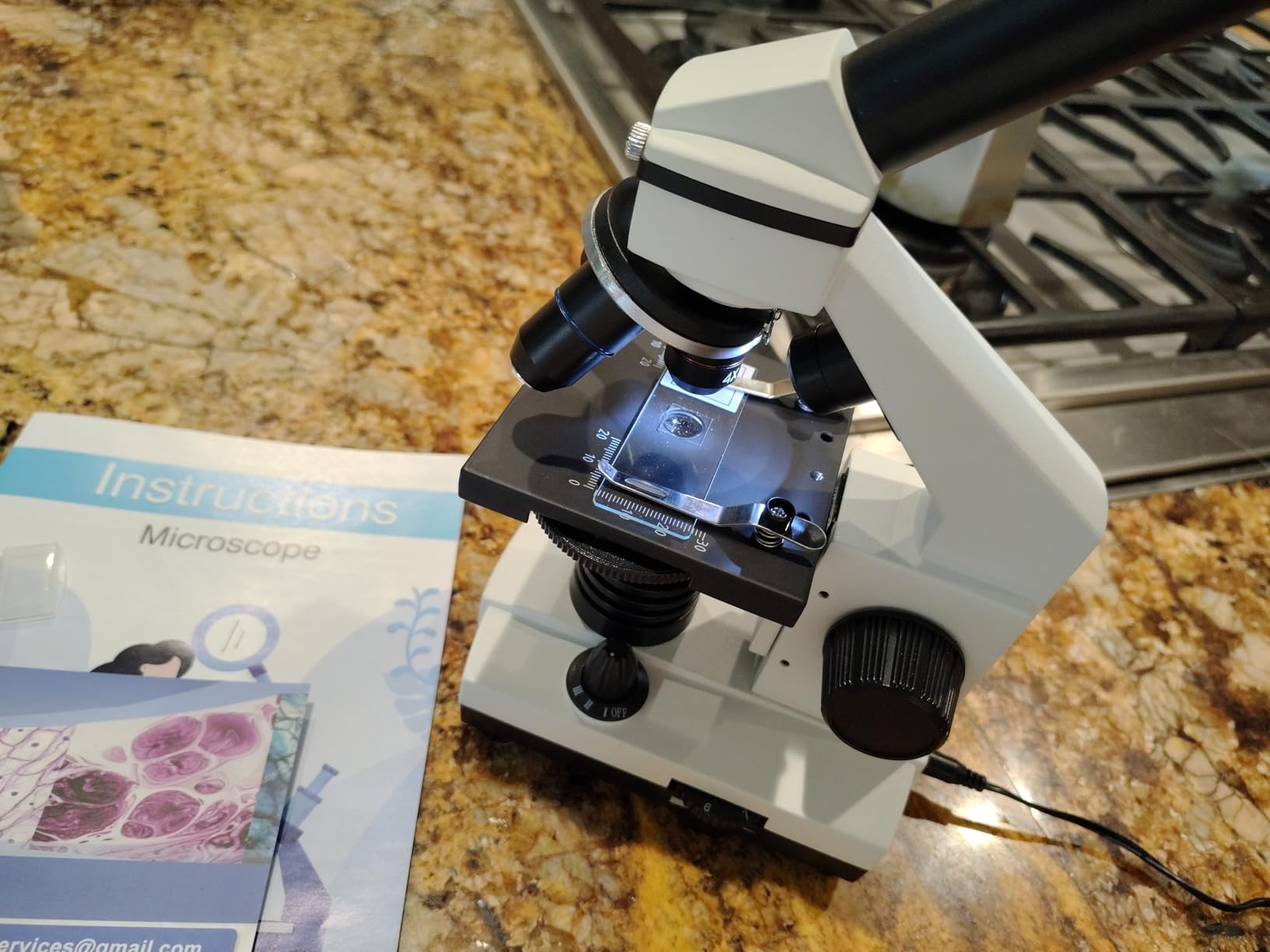
The optics are 4X, 10X and 40X achromatic objectives with a WF25X eyepiece and a 2X auxiliary lens, giving the familiar 100X to 2000X ladder. Coaxial coarse and fine focus knobs are a genuine step above the single-knob designs. Adjustable top and bottom LED illumination covers both translucent cells and opaque objects, and the body is battery powered, so it works on a kitchen table away from a wall socket.
Here is the honest catch. The body is built from polycarbonate and polyethylene rather than metal, and that is exactly where the difference from the BEBANG shows up over a year of daily handling. Reviewers also report that the objective lenses can wobble in their housings if the scope is moved roughly while an objective is engaged.
Best for a first microscope that gets used every week
The 28-slide package removes the single most common reason a student microscope ends up in a cupboard by week two, which is having nothing to look at. Combined with the phone clip, it also supports the habit of photographing a specimen for a lab journal, and those images are more than adequate for a school assignment on a modern phone.
For a homeschool family running a full year of biology, the sheer volume of consumables in the box is worth more than a slightly sturdier frame.
Who should skip it
Skip it for a shared family scope that a younger sibling will also handle, and skip it if the instrument needs to survive being moved between rooms or carried to a co-op class. Light plastic bodies flex, and flex shows up as an image that drifts out of focus.
Skip it for college lab work. There is no mechanical stage and no itemised 100x oil objective, so the top of the range is enlargement.
5. Emarth 52-Piece Microscope Kit – Best for Ages 8 to 12
Microscope for Kids Beginners Children Student, 40X- 1000X Compound Microscopes with 52 pcs Educational Kits
40X-1000X compound optics
52 piece kit
10X and 25X eyepieces
LED lighting
Pros
- True compound optics rather than a digital toy
- 52 piece kit with prepared slides and tools
- Metal objective housings hold alignment better
- Swappable 10X and 25X eyepieces for different views
Cons
- Plastic frame is less stable than metal and the stage relaxes
- Some kit slides are plastic rather than glass
- Dust cover referenced in the instructions is not included
The Emarth is the one I would hand to a child between eight and twelve, because it is a real compound light microscope rather than a USB gadget. It reaches 40X to 1000X, which covers onion cells, cheek cells and prepared insect sections, and it scores a 4.5 across 1103 reviews, the highest rating in this roundup. Reviews regularly describe it as the first real microscope for a child that age.
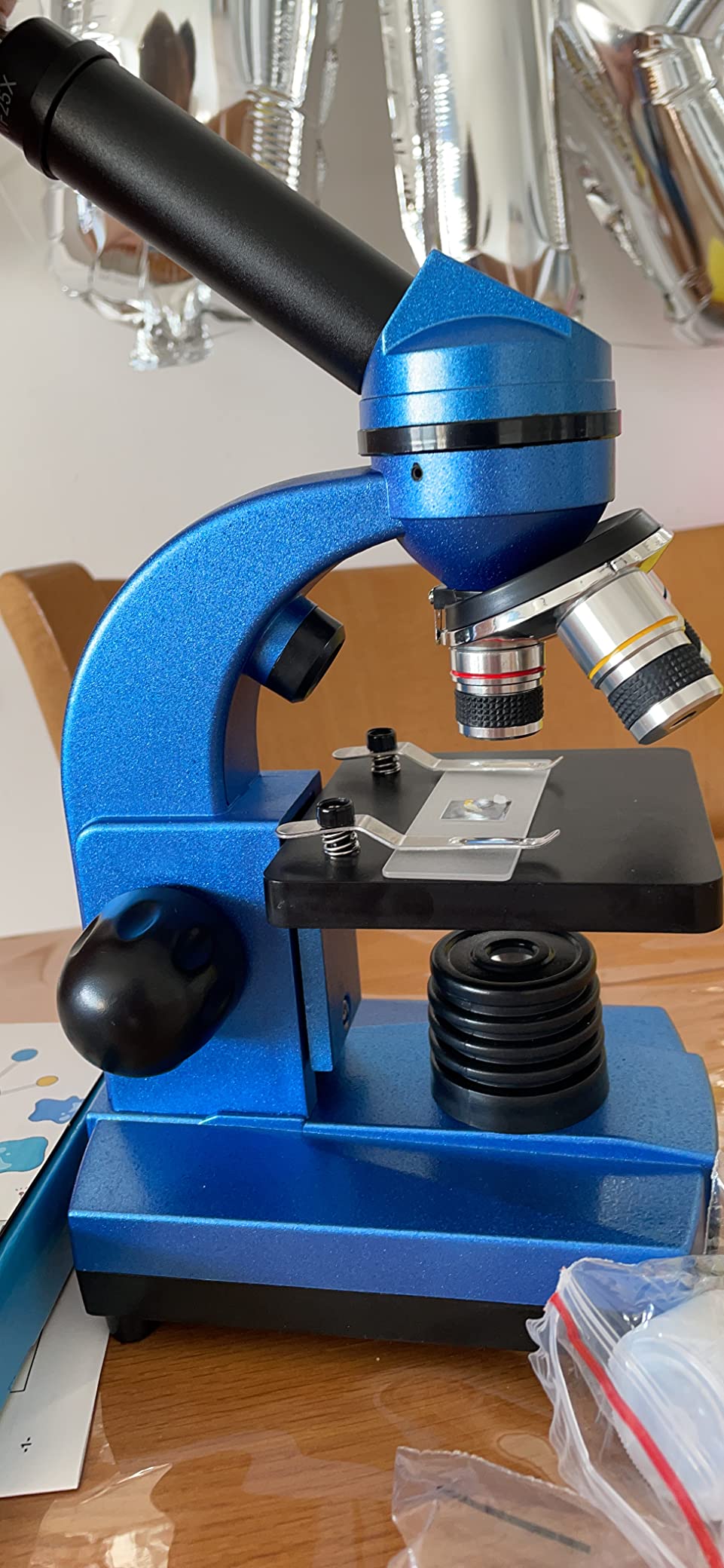
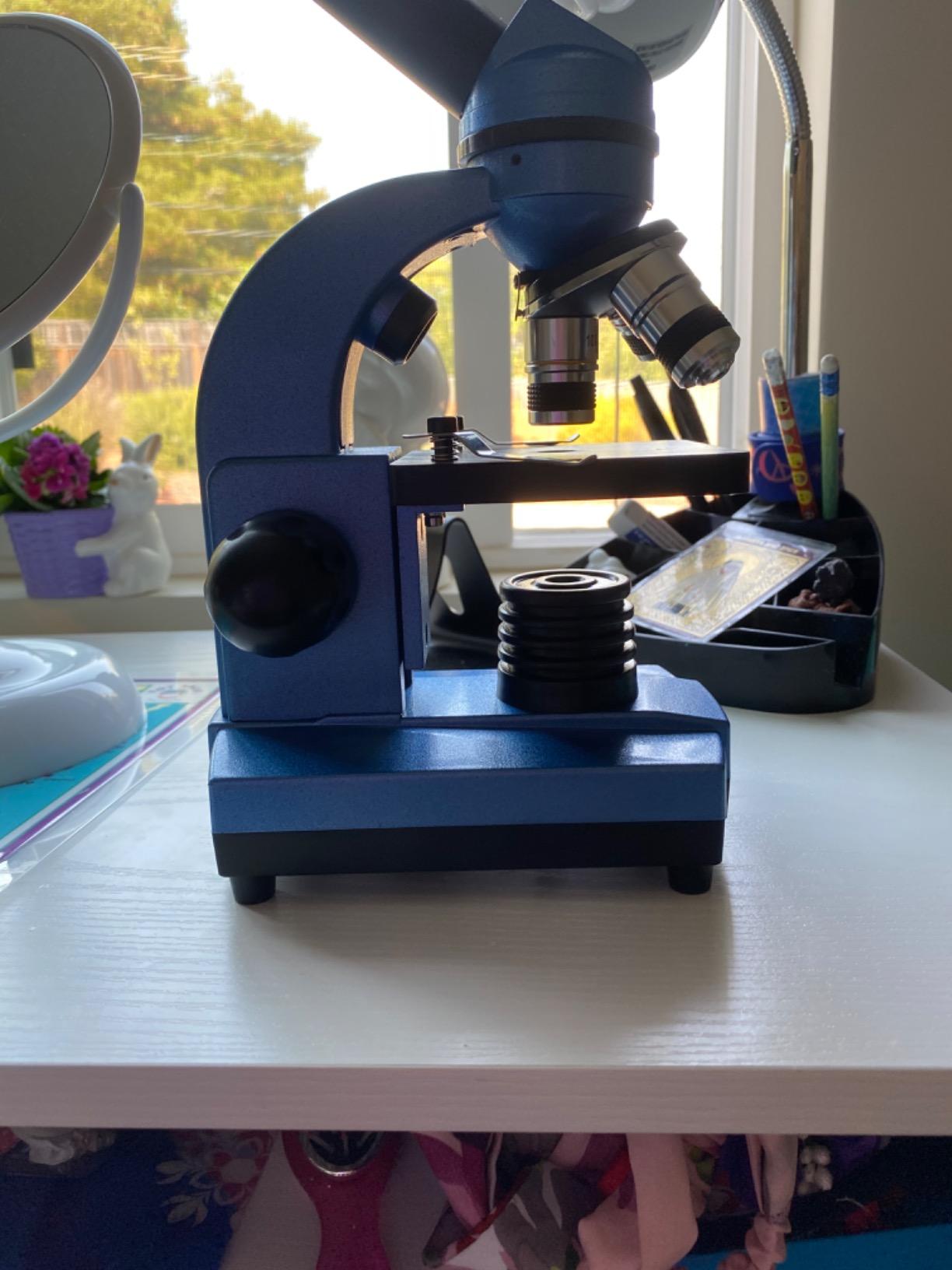
The 52-piece kit is the headline: prepared slides, blank slides and handling tools in one box, which is exactly the objection parents raise about scopes sold without specimens. Two swappable eyepieces at 10X and 25X give a visibly different field of view, and six built-in colour filters plus switchable top, bottom and combined illumination with adjustable intensity make it easy to boost contrast on a pale sample.
Metal objective lens housings are a smarter choice than the all-plastic housings on comparable kids scopes, because a lens that stays centred stays in focus. The frame itself is plastic, and reviewers are candid that the stage drifts out of position after adjustment and needs repeated fine tuning.
Whether the kit contents are worth it
Yes for a younger student. The prepared slides remove any setup barrier, and the tools mean wet mounts are possible the same day. Some slides in the kit are plastic rather than glass, so for real work you will want to add a box of glass slides and coverslips, plus a bottle of immersion oil later on.
The brightness control is shared rather than independent for top and bottom lights, which is a small limitation when you are trying to balance illumination on a thick opaque specimen.
Who should skip it
Skip it for a teenager who is already working toward a high school lab credit. The relaxing stage and plastic frame become frustrating fast once you are hunting for a specific cell at 400x, and the absence of a mechanical stage means the specimen keeps drifting.
Also skip it if you will be the one using it. This kit is built for a child, and a plastic frame is not a good match for an adult doing hour-long sessions.
6. AmScope M162C 1000X – Best Metal-Frame Starter Microscope
AmScope M162C-2L-PB10-WM-SP14-50P100S 1000X Microscope Kit
All metal frame
40X-1000X optical glass
Coaxial focus
5 year warranty
Pros
- Standard 4x 10x and 40x objective set matching school labs
- Sturdy metal frame that tolerates heavy handling
- Coaxial coarse and fine focus that feels precise
- Dual LED for slides and opaque subjects
Cons
- Top LED is dim when the objective sits close to a specimen
- Cover slips in the kit can arrive broken
- No printed manual and no carrying case
The AmScope M162C is the plainest and most honest instrument in this roundup. It is optical glass, a metal frame, coaxial coarse and fine focus and a 40X-1000X range across five wide-field magnifications, with nothing inflated in the specification. At 4.5 across 1097 reviews, it is the pick for a student who wants a tool that looks like the one in a school lab rather than a gadget.
The 4x, 10x and 40x achromatic objective set is the same trio a school lab uses, and the dual LED lighting switches between transmitted work on transparent slides and top light for opaque subjects. At 4.2 pounds with a full metal frame, it is built to be handed around. The five-year manufacturer warranty is matched only by the OMAX and the two larger binocular models here.
It also comes with a beginner microscopy book, prepared slides, cover slips and tools. That book does more for a self-taught student than any scope feature, because it gives a sequence of specimens to look for rather than a box of anonymous slides.
Whether the brand matters for long-term support
AmScope is the brand to buy if you expect to add parts later, and buyers confirm that warranty service is fast and effective when something does fail. The r/microscopy community treats AmScope and OMAX as the same manufacturer, which means the two names on the market are effectively one factory with different model lines, and judging the specific model matters more than the badge.
Parts availability is the real argument for choosing a metal-frame scope over a plastic one you might grow out of within a year.
Who should skip it
Skip it if you want to photograph your specimens. It is a monocular head with no camera port, and the top LED is not bright enough when the objective sits close to a thick opaque sample. Buyers also report that the cover slips in the accessory pack can arrive shattered because the packaging does not hold them, so keep a spare box of glass slides.
There is no printed instruction manual, only downloadable documentation, which matters if the buyer is a parent rather than the student.
7. AmScope B120C-E1 – Best Binocular Scope With a Bundled Camera
AmScope B120C-E1 LED Binocular Compound Microscope, 40X-2500X
Siedentopf binocular head
Fly-eye LED
Mechanical stage
USB camera included
Pros
- Bundled 1.0 MP USB camera and Windows software
- Substantial metal build with smooth mechanical stage
- Siedentopf head rotates eyepieces out of the way
- Fly-eye LED is bright
- even and dimmable
Cons
- Bundled camera produces low resolution images
- Stage movement couples horizontal and vertical motion
- 2500X oil immersion setting is fiddly to focus
The B120C-E1 is the pick when the microscope has to feed a lab report. It bundles a 1.0 MP USB camera with Windows imaging software, and you can see it on a screen the day it arrives instead of assembling an adapter and a separate camera. The Siedentopf binocular head, Abbe condenser and double layer mechanical stage put it firmly in lab territory at 4.4 across 803 reviews.

The fly-eye condenser LED is the detail that separates this from a school scope. It produces even, daylight-balanced light across the full field rather than a hot spot in the centre, and the brightness control lets you dial the intensity down for pale stained samples. The 40X to 2500X range runs on achromatic objectives, so treat the top two settings as oil-immersion work rather than everyday magnification.
Higher resolution camera options exist in the same range at 3.0 MP and 5.0 MP, and the bare microscope is sold without a camera, so the version you choose decides whether that first photo is usable in a submitted lab report.
Is the bundled camera actually good enough
For a lab journal, a labelled screenshot and a diagram, yes. For a presentation projected on a screen or an image you intend to measure, no. Owners describe the 1.0 MP output as having limited resolution and shallow depth of field, which is a limit of the sensor rather than the optics underneath.
There is also no calibration slide in the box, so if you want to count or measure cells you need to buy a stage micrometer separately. No case or eyepiece dust cover is included, and unused eyepieces collect dust quickly.
Who should skip it
Skip it if photography is a casual interest rather than a course requirement. Buyers find the stage controls frustrating because moving the slide horizontally also nudges it vertically, which makes framing a moving specimen a two-handed task.
The 2500X oil immersion configuration is fiddly to bring into focus and frustrates first-time users, so anyone who only wants magnification for its own sake is better served by the working 40X-1000X range.
8. AmScope M150C-PS25 – Best Portable Microscope for Shared Spaces
AmScope M150C-PS25 Series Portable Monocular Compound Microscope – 1000X
40X-1000X monocular
Metal body
LED ring light
3.3 pounds
Pros
- Compact 3.3 pound metal body that stores in a cupboard
- 25 prepared glass slides included
- Magnification matches the stated range
- Five year manufacturer warranty
Cons
- No camera included despite listing imagery suggesting one
- Monocular head for a single viewer
- Camera attachment costs extra if you want one
The M150C-PS25 is the answer when space is the constraint. At 3.3 pounds with a full metal body, it is roughly a third the weight of the binocular lab stands and stores flat between uses, which matters in a home where the microscope shares a desk with homework. It rates 4.5 across 466 reviews, and owners repeatedly call it a genuine step up from kids scopes rather than a toy.
Magnification runs 40X to 1000X on achromatic objectives, and owners with science backgrounds specifically note that the stated magnification is accurate rather than inflated. The LED ring illumination gives even transmitted light, and 25 prepared glass slides in the box, which is more starter specimens than most scopes at this level include. A five-year manufacturer warranty covers the frame.
Several owners use it well outside biology, for coins, jewellery and general specimen inspection, which tells you something about how usable the optics really are. The head is monocular, so it is a one-person instrument by design.
Whether the compact size costs you anything
You give up the binocular head, the mechanical stage and the camera port, and you get a scope a child can put away themselves without asking for help. The 25 prepared glass slides mean the first session works with zero setup, and glass slides can be cleaned and reused for wet mounts rather than being consumed.
If your workflow only needs finding a specimen and adjusting focus, none of those missing features is a real cost. If you need to document what you see on a screen, budget for a camera attachment.
Who should skip it
Skip it if a parent and child want to look at the same slide together, or if two siblings share one instrument during homework time. The most common complaint in reviews is that no camera is bundled even though the listing imagery suggests a computer attachment exists, so plan on buying one separately if screen viewing matters to you.
It is also not the scope for a high school course that requires oil immersion work, because the objective set stops at 40x.
9. SWIFT SW380B – Best Research-Grade Binocular for a Dedicated Bench
SWIFT SW380B 40X-2500X Magnification, Siedentopf Head, Research-Grade Binocular Compound Lab Microscope with Wide-Field 10X and 25X Eyepieces, Mechanical Stage, Ultra-Precise Focusing
Rotatable Siedentopf head
Swappable 10X and 25X eyepieces
Mechanical stage
11 pounds
Pros
- Rotatable Siedentopf head makes sharing easy
- Interchangeable wide-field 10X and 25X glass eyepieces
- 30 degree eyepiece tilt reduces neck strain
- Interpupillary distance adjusts without losing focus
Cons
- At 11 pounds it is heavy for younger students
- 17.3 inch height needs a dedicated shelf
- No eyepiece case or dust cover for the spare
The SW380B is the pick for a student who has a real bench at home or a lab room that stays set up. It is a research-grade binocular with a fully rotatable Siedentopf head, interchangeable wide-field 10X and 25X glass eyepieces at a 30-degree tilt and a mechanical stage with precision focusing. It rates 4.5 across 416 reviews.
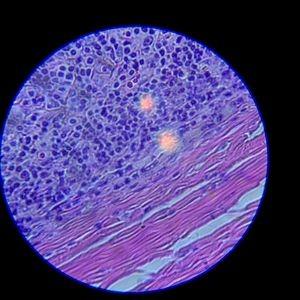
Two eyepieces that genuinely swap is a feature most students underuse and most parents overpay for, but it is the reason a 25X eyepiece is not the same as stacking an auxiliary lens on a 10X. The adjustable interpupillary distance retains focus as you set it, so two different people can sit down in turn without re-focusing from scratch. LED illumination and a metal frame complete a specification list that reads like a teaching lab tool.
Camera and phone adapter bundles are available in the same range, including a built-in digital camera variant, which makes this the natural upgrade path if your course requires photographed lab work and the bundled camera on the B120C is too coarse.

Why the Siedentopf head matters for a student
A Siedentopf head lets you rotate the eyepiece tubes up and out of the way without moving the whole head, which matters when a specimen is on the stage and you do not want to disturb it. Combined with the 30-degree tilt it makes long sessions comfortable, and the mechanical stage holds a slide still at 400x and above.
For a student with glasses, verify that the interpupillary range suits you before committing, because a binocular head that cannot be set to your face becomes a monocular head with extra cost.
Who should skip it
Skip it for a younger child or for a small bedroom. At 11 pounds and 17.3 inches tall it needs a dedicated bench or shelf rather than a desk, and moving it every time you need the surface is a fast route to disinterest. No eyepiece case or dust cover is included for the spare eyepiece, so keep it in a drawer.
The review base is also the smallest among the binocular models here, so you have less buyer evidence behind it than the AmScope and OMAX binocular stands.
10. Herwicm Wide-Field Binocular Microscope – Best Binocular Comfort on a Mid Budget
Compound Microscope,40X-2500X ,WF10x and WF25x eyepieces, Dual LED Lighting and Two-Layer Mechanical Stage,Microscope for Adults… ASIN B0CCNZFJ61
Binocular eyepieces
Dual LED with fill light
Coaxial focus both sides
Two layer stage
Pros
- Ultra wide-field all-optical eyepieces reduce eye strain over long sessions
- Adjustable top and bottom LED with integrated fill light
- Coaxial focus wheels on both sides of the base
- Telescopic protection lens helps prevent crushing slides
Cons
- Published specs contradict the 2500X headline claim
- Body and stage mix metal and plastic
- Less durable than a solid metal stand
The Herwicm is the binocular option for a family that wants two people at the eyepieces and a comfortable viewing angle without stepping up to a full lab stand. Its ultra wide-angle all-optical eyepieces give a large, clear field that stays sharp over long sessions, and it holds a 4.3 rating across 256 reviews, the smallest evidence base in this roundup.
Adjustable top and bottom LED lighting with an integrated fill light handles both transparent slides and opaque objects, and coaxial coarse and fine handwheels are fitted to both sides of the base so the control sits on either side of the body. The large two-layer stage carries a spiral moving scale, and a telescopic auto-protection lens helps stop a new user crashing an objective into a slide.
Here is the reason this sits at the bottom of the ranking. The listing claims 40X-2500X while the published objective set is only 4X, 10X and 40X, and the body and stage are a mix of metal and plastic. Judge this scope on its 40X-1000X working range and it is capable. Take the 2500X figure at face value and you will be disappointed.
Reading a specification sheet properly
This is the best example on the list of why you should read the objective set instead of the headline number. A 40x objective on a 25X eyepiece gives 1000x, and no eyepiece swap turns that into 2500x of resolved detail. When a listing contradicts itself, the itemised objectives are the reliable part.
Also check the voltage. This model lists 240 volts, which matters outside North America and for anyone using it on a different mains standard from a travelling family.
Who should skip it
Skip it if you need an instrument to survive years of shared classroom handling, because the mixed metal and plastic body is less durable than the all-metal frames in this roundup. Skip it if you are buying for a course that specifies a particular brand or a calibration slide.
With only 256 reviews behind it, you have the least buyer evidence here. The binocular comfort is real, but so is the specification inconsistency.
What to Look for in a Student Compound Microscope
Start with the frame. A metal frame tolerates being carried, bumped and set down hard, and it keeps the optical axis from shifting as the frame flexes. Plastic frames are acceptable for a first scope used gently, and become a problem the moment a sibling or a classmate picks it up. Weight is a useful proxy: scopes in this roundup range from 2.4 pounds for the BEBANG to 11 pounds for the SWIFT, and the difference is frame material and stage complexity rather than glass thickness.
Second, check the focus system. Coaxial coarse and fine knobs, where both controls share an axis, let you find a specimen quickly and then sharpen it without losing it. Separate controls are fine. A single knob is not, because at 400x you cannot resolve the image without an extremely steady hand.
Third, look for a mechanical stage if you will work above 100x. The stage is the flat platform holding the slide, and a mechanical stage adds X-Y control knobs so you can move a specimen while keeping your hands off the slide. Without one, any movement of the table or a bump moves your specimen out of the field of view, and you will spend your time chasing it rather than looking at it.
Fourth, count the objective lenses, not the magnification. Look for 4x, 10x and 40x as the minimum set, and check whether a 100x oil immersion objective is itemised rather than implied. Total magnification is simply eyepiece power multiplied by objective power, so a 10x eyepiece on a 40x objective is 400x. A 2000x figure on a scope with only 4x, 10x and 40x objectives comes from an auxiliary lens and adds enlargement, not detail.
Fifth, check the illumination and condenser. An LED light source is standard and runs cool, and a condenser with an iris diaphragm under the stage lets you control how much light reaches the specimen. Colour filters cost almost nothing and noticeably improve contrast on pale or lightly stained samples. Brightness adjustment is worth paying for if you will look at opaque objects, because a single fixed brightness either blows out or under-lights them.
Sixth, look at the head. A monocular head has one eyepiece and is cheaper and lighter. A binocular head has two, which is far more comfortable over long sessions and lets a parent and child look together. A trinocular head adds a third port on top for a camera, which is how you attach imaging hardware to a microscope that lacks a dedicated camera kit. Head type is where the price gap between tiers mostly appears.
Seventh, read the warranty as a durability proxy. A one-year warranty is typical for the plastic-bodied entry scopes, while the AmScope M150C, the M162C, the B120C-E1, the SW380B and the OMAX M82ES all carry five-year manufacturer warranties. Longer warranty on a cheap product is rarer than it looks, so treat it as a signal about the manufacturer’s confidence in the frame, the stage and the focus mechanics.
Compound vs Stereo vs Digital: Which One a Student Needs
A compound microscope shines light up through a thin transparent specimen and shows you a flat two-dimensional view of cells, smears and tissue sections. That is what biology courses require, and it is what every scope in this roundup provides. A stereo or dissecting microscope uses reflected light and gives you a three-dimensional view of something solid, which is why they sit on dissection trays and art supply shelves. If your work involves an onion skin, a cheek cell or a blood smear, you need compound.
A digital microscope plugs into a laptop or phone and shows you a magnified image on a screen. It is excellent for documenting work, troubleshooting electronics and keeping a child engaged at low magnification, and it cannot resolve anything that a good optical system cannot. Several scopes here include a phone adapter for documentation, which is a sensible hybrid rather than a replacement.
One practical warning about the family of electronic kids microscopes sold alongside these: they look like compound microscopes and share the same listings, but they are fundamentally different instruments. If a course requires you to draw what you see through an eyepiece, you need glass optics.
Magnification Reality Check: Why 1000x Is the Honest Ceiling
Resolution and magnification are different things, and separating them explains most of the disappointment in this category. Magnification is how much the image is enlarged. Resolution is how much real detail the lens gathered before it was enlarged. A 1000x image produced from a 40x objective is a bigger picture of the same information, which looks worse the more you enlarge it.
Total magnification equals eyepiece power times objective power. A 10x eyepiece on a 40x objective gives 400x, and a 10x eyepiece on a 100x oil immersion objective gives 1000x. That last combination is the honest ceiling for a student instrument, and the OMAX M82ES is the only scope in this roundup that itemises a genuine 100x oil objective alongside an NA1.25 Abbe condenser.
Oil immersion is a drop of index-matching oil between the 100x objective and the coverslip. Oil removes the refraction gap that light hits at a glass-to-air boundary, so more light enters the lens and the numerical aperture rises from roughly 0.65 to above 1.0. That extra light is what resolves two adjacent bacteria instead of one blur. Every scope here needs a bottle of immersion oil, and only the OMAX ships with the objective that uses it.
So, is 1000x enough to see sperm? With a proper 100x oil objective and a prepared smear, yes, and that is the ceiling for any student microscope. The optics alone will not separate individual bacteria without a stain, and the r/microbiology community consistently recommends a basic gram stain kit alongside the instrument rather than a more expensive scope.
Numbers above 1000x on a student listing, whether 2000x or 2500x, are reached with a 25X eyepiece, a 2X auxiliary lens, or both. They are not a lie exactly, but they are arithmetic rather than optics, and we have treated them that way in every ranking on this page.
What Else You Need to Buy Alongside the Microscope
Most student microscopes arrive with some slides and nothing else, and the missing consumables are the real reason scopes end up unused. Budget for a box of blank glass slides and a box of coverslips first, because wet mounts of pond water, cheek cells and onion skin are the first experiments any student should run, and they need both items.
Second, immersion oil. One small bottle lasts a long time, and it is required for the 100x objective on the OMAX and for the top settings on the binocular AmScope and SWIFT models. Cleaning the oil off the slide and the objective afterwards is not optional.
Third, lens cleaning paper. Dust on an eyepiece or an objective is the most common cause of a blurry image, and a few sheets of cleaning paper fix problems that students wrongly blame on the microscope. The OMAX includes 50 sheets in the box.
Fourth, a camera adapter if your course needs photographed lab work. The B120C-E1 bundles one; the OMAX, the M150C and the SWIFT require a separate purchase, and the SWIFT range also offers phone adapter bundles.
Fifth, a stage micrometer if you ever need to measure a specimen rather than just look at it. None of the scopes here includes one. If you are documenting work on a computer, a general-purpose laptop that handles a microscope feed matters more than any upgrade to the eyepieces.
How to Test a Microscope Before You Commit
Watch or request a demonstration if you can, and run four checks. First, focus at 40x, then switch to 10x and back without touching the focus knob. If the image stays roughly sharp, the objectives are parfocal, and that is a sign the optical tube and stage are well made. Second, look for an even field of view. The edges of the circle should be the same brightness as the centre, and a dark ring means a cheap condenser.
Third, push the stage sideways with a finger. Any play means the focus will drift as you move the slide. Fourth, rotate the nosepiece and listen. A smooth mechanical detent means the objectives lock into position, and a rattling turret means they will not hold alignment.
If you are buying used, r/microscopy is clear that a used mid-tier compound scope beats a new cheap one, and that a used scope which has already proven itself is a better gamble than an untested budget model. Check the objectives for haze, look for fungus in the eyepieces, and confirm the coarse focus still moves freely. Anything with a sticky focus mechanism or a bent stage has been dropped.
Which Microscope Is Best for Students at Each Stage?
For elementary and early middle school, a real compound scope with a metal frame and prepared slides is enough, and the Emarth or the AmScope M162C both fit. Children under about eight do better with a stereo scope or a digital scope, because thin transparent slides are genuinely hard work at that age.
For middle school, the BEBANG, the TOMLOV and the PalliPartners are all appropriate, with the TOMLOV’s coaxial focus the most forgiving. For high school biology with a lab credit requirement, move up to a metal frame with a mechanical stage, which points to the AmScope B120C-E1, the OMAX M82ES or the SWIFT SW380B.
For college introductory biology, the OMAX M82ES is the pick because of the itemised 100x oil immersion objective, the Abbe condenser and the mechanical stage. The binocular lab stands in this roundup are also the scopes most commonly used in school and university teaching labs, which is why so many of them share the same Siedentopf head and coaxial focus layout.
For homeschool families running a full lab curriculum, the AmScope M162C with its included book, or the PalliPartners with its 28-slide package, will keep a year of experiments supplied without repeat accessory orders.
Frequently Asked Questions
Which microscope is best for students?
The BEBANG 2000X is the best microscope for most students because it pairs a metal frame with coaxial coarse and fine focus, ships with 15 prepared slides and a phone adapter, and carries 2909 reviews. It suits middle school through most of high school. Move to a binocular model with a mechanical stage once lab reports or bacteria enter the syllabus.
Which compound microscope is the best?
The OMAX M82ES is the best compound microscope overall because it is the only scope in our roundup that itemises a genuine 100x semi-plan oil immersion objective alongside an NA1.25 Abbe condenser and a double layer X-Y mechanical stage. It also carries a five-year manufacturer warranty and 2112 reviews.
What is the best microscope for a beginner?
For a first microscope, pick a true compound light microscope with a metal frame, coaxial coarse and fine focus and at least 4x, 10x and 40x achromatic objectives. The TOMLOV CM101 is the most beginner-friendly because the coaxial knobs let you find a specimen and sharpen it without losing it, and it includes prepared and blank slides.
Is 1000x enough to see sperm?
Yes, 1000x is the honest ceiling for a student compound microscope, and it is enough to see sperm on a prepared smear. You need a genuine 100x oil immersion objective and a drop of immersion oil between the objective and the coverslip. Only the OMAX M82ES in this roundup itemises such an objective. Bacteria need a stain as well as oil.
What are the best microscope brands for students?
AmScope, OMAX, Celestron, Swift and Accu-Scope cover most of the student market. AmScope and OMAX are widely understood to be the same manufacturer, so judge the specific model rather than the badge. A five-year manufacturer warranty is a more reliable quality signal than the brand name, since it separates the metal-frame models from the plastic-bodied entry scopes.
Is a monocular microscope good enough for high school?
A monocular head is good enough for high school biology, where a single student works alone on slides. It is cheaper, lighter and easier to store. Binocular viewing becomes worthwhile when two people need to look at the same slide, when sessions run long, or when a camera needs to attach through a trinocular port.
Our Recommendation for 2026
If you are buying one microscope and nothing else, buy the BEBANG 2000X. It is the most reviewed student compound microscope available, the frame is metal, the focus is coaxial, and the box contains enough prepared slides to make the first session worthwhile. It is our pick for the best compound microscopes for students in 2026 because it solves the failure modes that end beginner interest: plastic bodies, missing slides and unusable focus.
Buy something else if your situation is specific. The TOMLOV CM101 is the better everyday instrument for a high schooler. The OMAX M82ES is the right call for a college biology course, a five-year warranty holder or anyone who will learn oil immersion. The AmScope M162C is the durable metal-frame starter with a book. The AmScope B120C-E1 is the choice when lab-report photos are a requirement.
Whichever you pick, judge it on the frame, the focus knobs, the stage and the itemised objective set. Ignore any number above 1000x, and add a box of blank slides, coverslips and lens paper to the order. Those three consumables are the difference between a microscope that gets used every week and one that ends up in a cupboard by week two.