
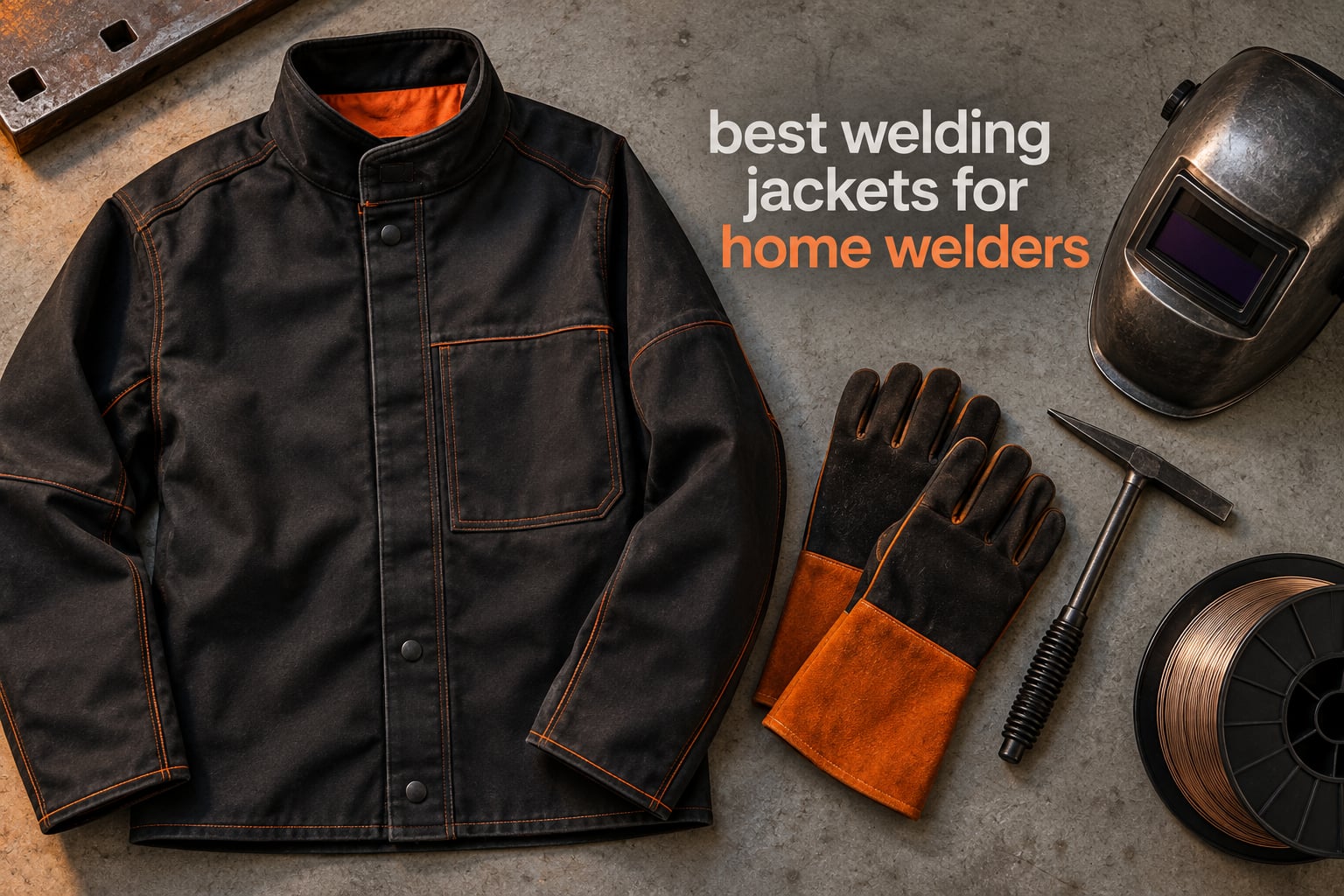
If you want one jacket that suits most home welders, the Black Stallion FN9-30C is the pick. For daily MIG and fabrication work in a garage, the Lincoln Electric K2985 is the smarter all-round buy, and for the heaviest spatter a flux-cored or dual-shield gun throws, the Lincoln Electric K3106 hybrid with full split cowhide sleeves is the one to own.
That is the short version. Below I break down 12 of the best welding jackets for home welders by material, by welding process and by how often you actually weld, so you can stop scrolling and start cutting steel.
A welding jacket is a flame-resistant work coat that shields your torso and arms from sparks, spatter and radiant heat. It is not a fashion item, and it is not a substitute for the rest of your PPE: a proper auto-darkening welding helmet, welding gloves and FR trousers each do their own separate job.
One thing to clear up before we start. Ordinary cotton is flammable, which surprises a lot of first-time welders. Flame-resistant cotton is not fireproof. It is cotton that has been chemically treated so it self-extinguishes instead of carrying a flame across your body, and that distinction matters enormously when it comes to washing.
Every rating and review count below is copied from the published customer data for that jacket, and the pros and cons come from what owners actually report. I kept the complaints in, because a training student on r/Welding described exactly what happens when a jacket is too thin for the job: my arms are getting burned like no tomorrow. Avoiding that failure mode is the whole point of this list.
Still choosing a machine? Our guides to the best welders for beginners and the best TIG welders for aluminum cover the other half of the starter kit.
Table of Contents
Top 3 Best Welding Jackets for Home Welders in October
Black Stallion FN9-30C FR Cotton Jacket
- 9 oz FR treated cotton
- Machine washable 50 washes
- Leather reinforced snaps

Lincoln Electric K3106 Hybrid Jacket
- FR cotton body
- Full split cowhide sleeves
- Flip-up neck collar

Lincoln Electric K2985 FR Cotton
- ASTM D6413 FR cotton
- Anti-static coating
- 50-cycle FR retention
All 12 Welding Jackets Compared at a Glance in 2026
Every jacket in this roundup, sorted in the order we recommend them. The material column tells you the most about which welding process each one suits.
| Product | Specifications | Action |
|---|---|---|
| Black Stallion FN9-30C 30 inch FR Cotton Welding Jacket |
|
Check Latest Price |
| Lincoln Electric K2985 Premium FR Cotton Welding Jacket |
|
Check Latest Price |
 QeeLink Split Cowhide Leather Welding Jacket QeeLink Split Cowhide Leather Welding Jacket |
|
Check Latest Price |
 Lincoln Electric Black Flame-Resistant Cloth Welding Jacket Lincoln Electric Black Flame-Resistant Cloth Welding Jacket |
|
Check Latest Price |
 YESWELDER Black Leather Welding Jacket YESWELDER Black Leather Welding Jacket |
|
Check Latest Price |
| Lincoln Electric K3106 Traditional Split Leather Sleeve Jacket |
|
Check Latest Price |
 Revco Black Stallion BXRB9C Contoured FR Cotton Jacket Revco Black Stallion BXRB9C Contoured FR Cotton Jacket |
|
Check Latest Price |
 Miller Classic Cloth Welding Jacket 9oz Navy Cotton Miller Classic Cloth Welding Jacket 9oz Navy Cotton |
|
Check Latest Price |
 QeeLink Split Leather Sleeve Hybrid Welding Jacket QeeLink Split Leather Sleeve Hybrid Welding Jacket |
|
Check Latest Price |
 LeaSeek Black Split Cowhide Leather Welding Jacket LeaSeek Black Split Cowhide Leather Welding Jacket |
|
Check Latest Price |
 Ironcat FR Treated Cotton Sateen Welding Jacket Ironcat FR Treated Cotton Sateen Welding Jacket |
|
Check Latest Price |
 MAGID SparkGuard Flame Resistant Green Welding Jacket MAGID SparkGuard Flame Resistant Green Welding Jacket |
|
Check Latest Price |
1. Black Stallion FN9-30C 30 inch FR Cotton Welding Jacket – Best Overall
Black Stallion FN9-30C 30″ 9oz. Navy FR Cotton Welding Jacket, Large
9 oz FR treated cotton
30 inch length
Machine washable, FR rated for 50 washes
Pros
- Comfortable and lightweight for long sessions
- Good fit with stretch for free movement
- Effective FR protection for MIG and TIG work
- Sturdy snaps and cuffs
- Handy scribe pocket on the sleeve
Cons
- Not thick enough for heavy overhead stick welding
- 30 inch length can run short on taller frames
- Runs slightly large for some wearers
This is the jacket I hand to friends who are welding in their own garage. It is a 30 inch, 9 ounce flame-resistant treated cotton coat, and after 3405 reviews at a 4.6 average it is the most proven thing in this entire roundup. Nothing exotic about the design, which is exactly why it works.
The fit is what separates it from budget jackets. Owners keep mentioning stretch through the shoulders and back that lets you get into the overhead and out-of-position positions without the coat fighting you. The welder’s collar sits high, the six snap closures are leather-reinforced, and the scribe pocket on the sleeve is in the right place for holding soapstone or a welding pencil.
It is also the easiest jacket here to keep clean. This one is machine washable and the manufacturer rates the FR treatment for 50 washes, so you can throw it in with the shop towels instead of hand-washing it in a sink.
On construction, the 9 ounce weight is the sweet spot between the thin welding shirts and the 12 ounce shop coats. It blocks the small spatter and stray sparks that come off a MIG gun or a stick electrode holder, and the reinforced snaps keep the front closed even when you are leaning into a bead.
Where the limits are, and they are real, all appear in the customer data. Reviewers repeatedly note it is not thick enough for heavy overhead stick welding, where sustained molten spatter lands on your forearm. The 30 inch length also comes up short on taller welders, ending above the hip bone where a longer coat would cover more.
Runs slightly large for some wearers is the third consistent note. If you are between sizes and plan to layer a hoodie underneath, take the smaller one and check the arm length first.
Who this jacket is right for
This is the pick for weekend hobbyists and part-time shop welders doing MIG, TIG and light stick work in a home garage. It handles the spatter load of a typical fabrication weekend without weighing you down in July heat.
It is also a strong first welding jacket purchase. If you are building a starter kit, pair it with one of our welding helmet picks for beginners and a pair of TIG gloves and you have covered the basics.
Who should skip this jacket
Skip it if you run flux-cored or dual-shield wire as your main process. That spatter load is hot, heavy and constant, and owners of this jacket specifically warn it is not thick enough for that work.
Also skip it if you are over six feet tall and need full thigh coverage, or if you spend your summers grinding rather than welding. A 30 inch cotton coat is the wrong tool for either of those.
2. Lincoln Electric K2985 Premium FR Cotton Welding Jacket – Best Value
Lincoln Electric Premium Flame Resistant (FR) Cotton Welding Jacket | Comfortable | Black | Medium | K2985-M
ASTM D6413 compliant 9 oz FR cotton
Anti-static coating
Machine washable for 50 cycles
Pros
- High quality FR cotton construction
- Lightweight and breathable in warm conditions
- True to size fit
- Sheds UV and slag exposure
- Maintains FR properties through 50 washes
Cons
- Black color shows shop dust and dirt fast
- Not suitable for heavy overhead welding
- Warms up in direct sunlight
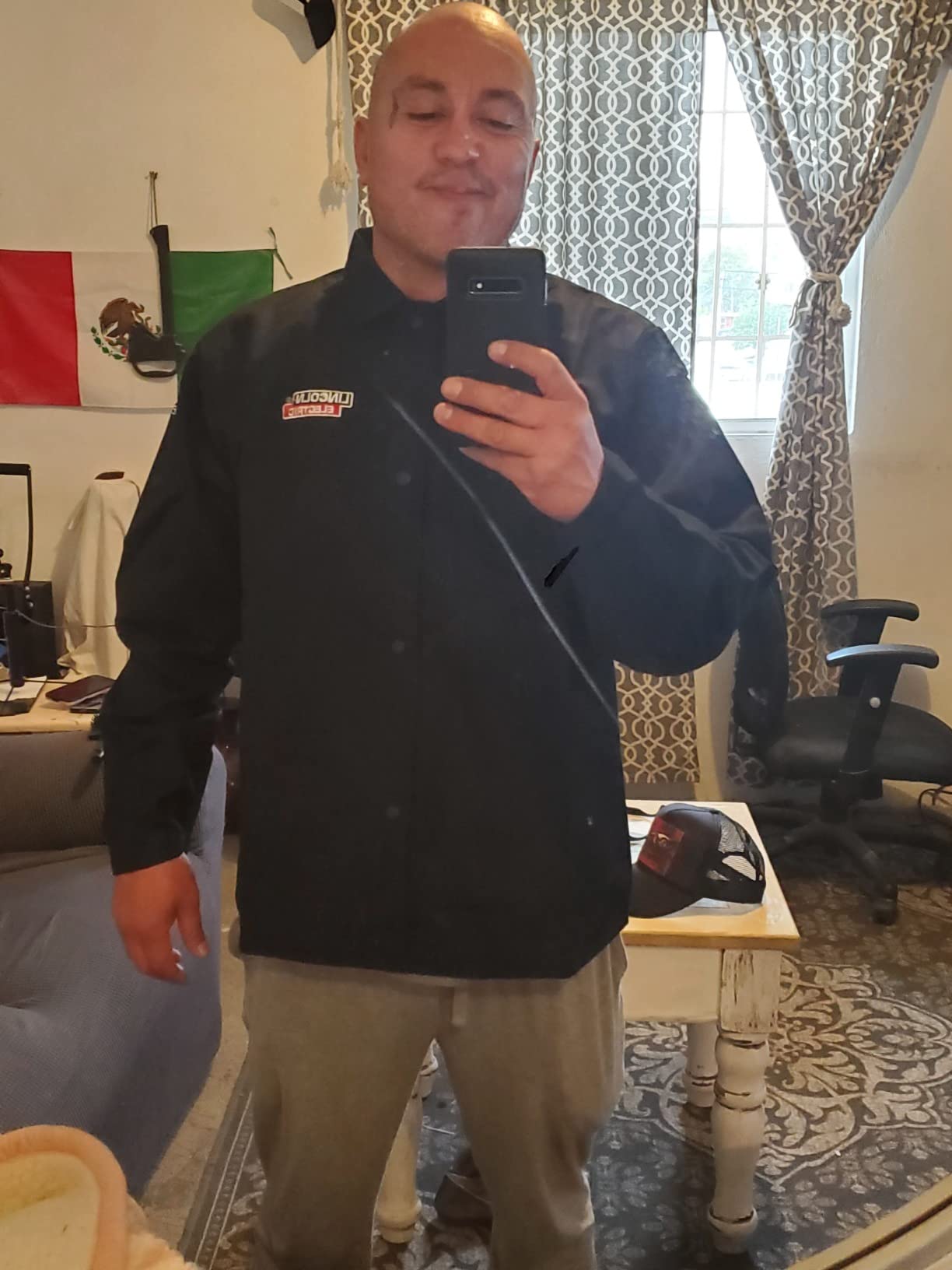
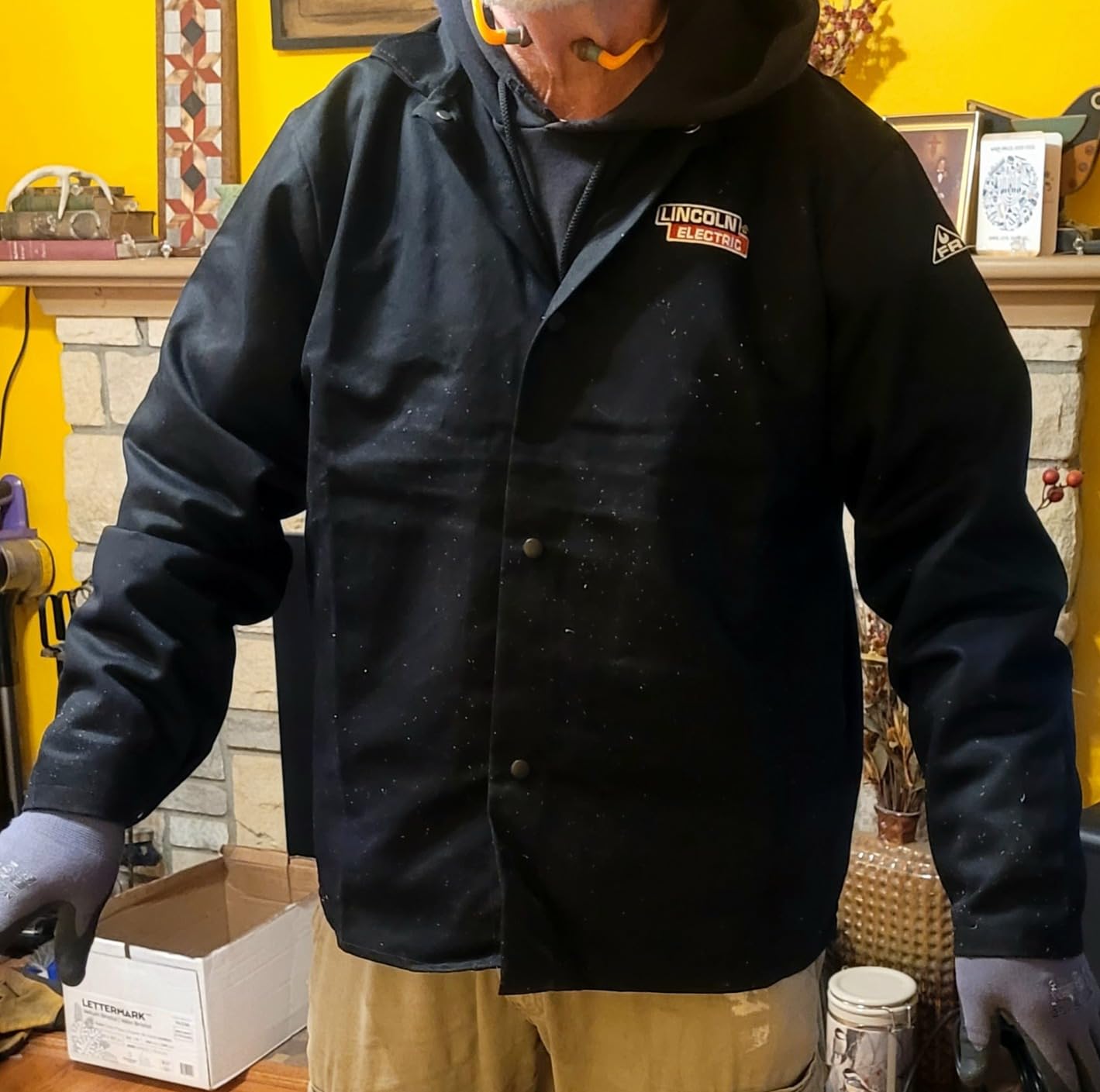
The K2985 is the one I recommend to anyone who wants a name-brand FR cotton jacket and does not want to think about it. It sits at 4.6 stars across 2722 reviews, and the specification sheet is unusually honest for a jacket at this tier: ASTM D6413 compliant 9 ounce FR black cotton with an anti-static coating.
That anti-static coating is the detail people miss. It matters on aluminum and stainless work where static can build, and it is a step up from untreated cotton shells of the same weight.
Wearers consistently call the fit true to size, which saves you the guesswork that plagues cheaper imported jackets. The flip-up collar protects the side of your neck, and the adjustable cuff snaps let you seal the sleeves down when you are working with slag and spatter.
Care and washing are handled well here. The jacket is machine washable and rated for up to 50 commercial cycles before the FR performance degrades, which is a real number rather than a marketing claim. There is one large inside pocket, so you are not fishing through six small compartments for a pair of pliers.
Reviewers also report it holds up well against UV exposure and slag, which matters if you weld outdoors or do repair work on trailers and farm equipment. Lincoln Electric builds this for real shops and the construction reflects that.
The honest negatives are about colour and heat rather than safety. Black shows dust, dirt and shop grime faster than any other colour, so expect to wash it more often. And in direct sun, particularly in a south-facing garage, the black cotton absorbs heat quickly.
Who this jacket is right for
Best for the home welder doing steady MIG, TIG and fab work through the week who wants a proven brand name and true-to-size fit. It is the default recommendation for a reason.
It also suits anyone working on aluminum or stainless, since the anti-static coating is not something every jacket in this price range offers.
Who should skip this jacket
Do not buy it for heavy overhead stick welding or for flux-cored work. Owners are clear that the 9 ounce cotton shell is not the right protection for sustained molten spatter.
Skip it if you weld outdoors in summer sun all day. It is breathable, but black cotton in direct sun gets warm, and there are lighter options in this list.
3. QeeLink Split Cowhide Leather Welding Jacket – Best Heavy-Duty Leather
Leather Welding Work Jacket by QeeLink – Flame-Resistant Heavy Duty Split Cowhide Leather (Large)
Split cowhide leather
US Kevlar heat resistant thread
Adjustable neck cuffs and waist
Pros
- Heavy duty split cowhide leather construction
- Kevlar thread stitching throughout
- Adjustable neck cuffs and waist fit
- Four tool pockets including sleeve soapstone pockets
- Good protection for overhead welding
Cons
- Strong leather odor that needs airing out
- Runs small so size up
- Hot and heavy in summer
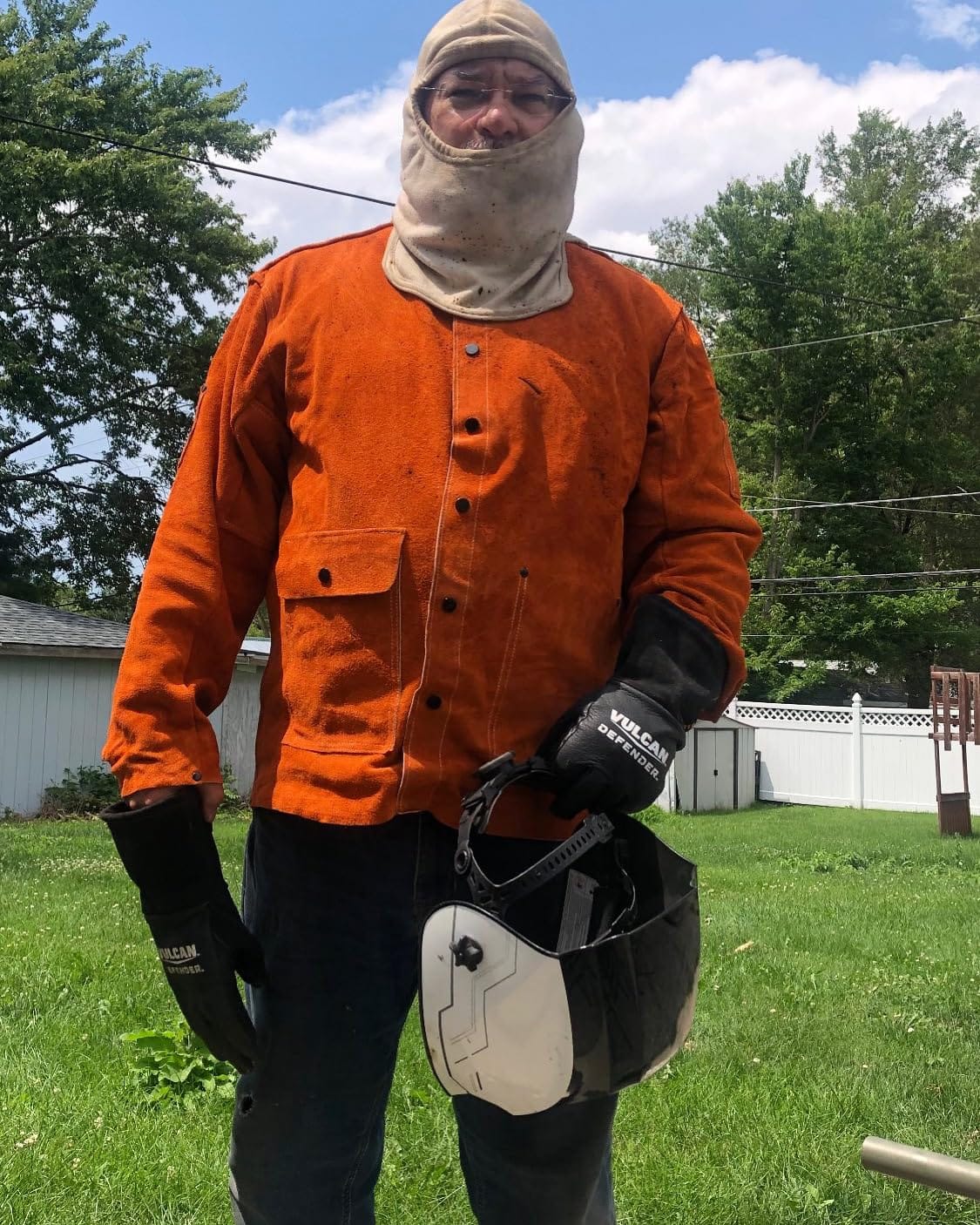
When the work is heavy, this is the jacket that solves it. The QeeLink is full split cowhide leather, stitched with US Kevlar heat-resistant thread and reinforced with corrosion-resistant rivets. At 4.6 stars from 2011 reviews, it is among the highest-rated leather options in this roundup.
Leather works differently from FR cotton. Cotton is treated to self-extinguish, while leather simply chars and forms a protective layer instead of melting onto your skin. That is why leather is the standard answer for sustained spatter, slag and out-of-position work.
Adjustability is unusually good for a jacket at this level. The neck closes with a combination of Velcro and snaps, the cuffs adjust, and the waist adjusts too, so you can cinch it down when you are crouched over a bead or dial it out for movement.
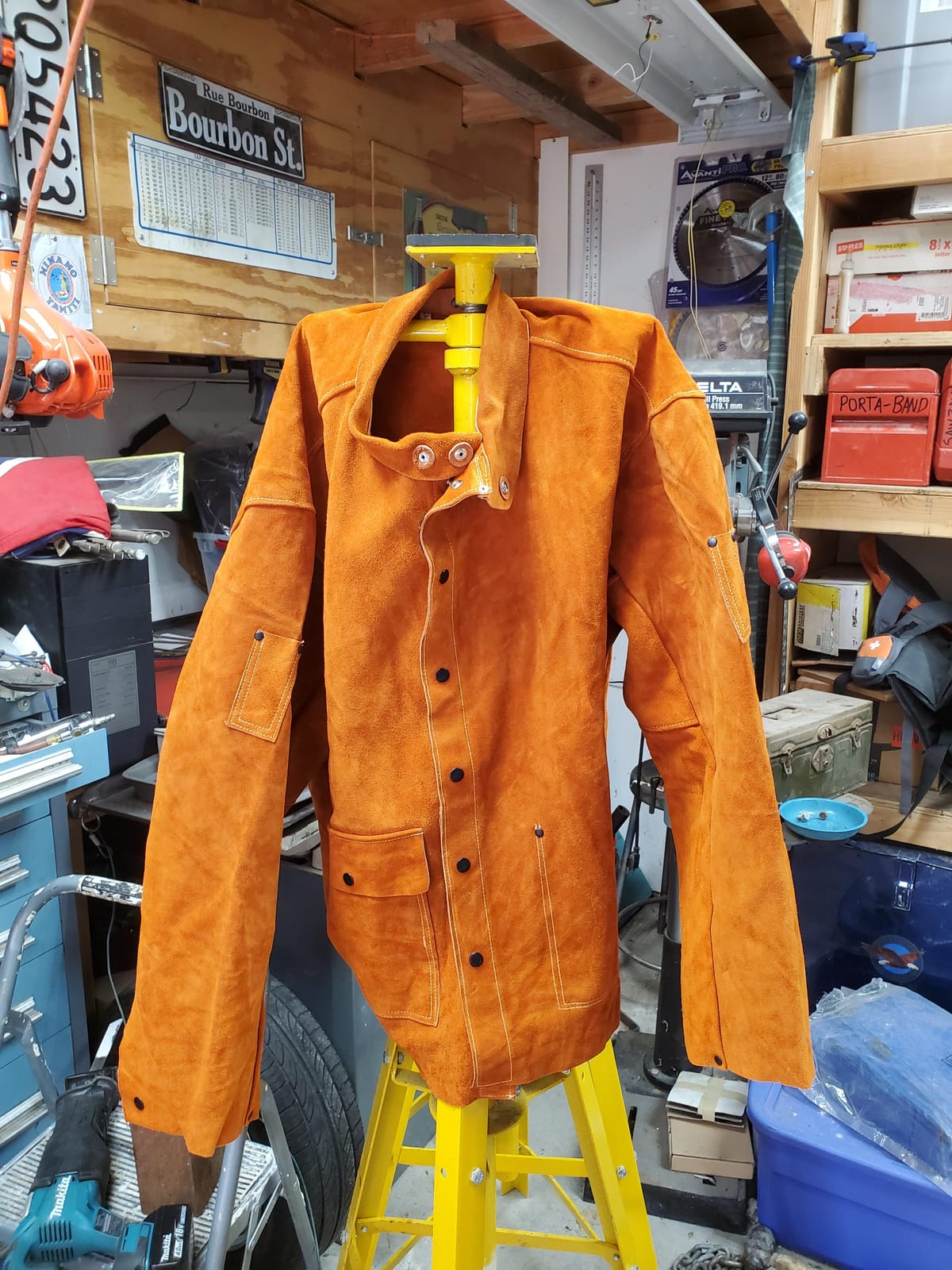
Pocket layout is practical rather than decorative. There is a large inside pocket, a large outside pocket, and two soapstone pockets on the sleeves, which is more usable storage than most jackets in this roundup offer.
It also lists welding, blacksmithing and woodworking as intended uses, and owners back that up. It is genuinely a heavy work coat, not a thin welding-specific shell, and the protection holds up on overhead welding.
The size range is a real advantage for home welders with unusual proportions. It runs from Small through 5XL, which is wider than most of the specialist jackets here, and the package weight is listed at 4.41 pounds. That weight is the jacket’s honest weakness.
Who this jacket is right for
Best for the welder running stick, flux-cored or dual-shield work, doing heavy fabrication, or working out of position where your forearms take the punishment. If burn-through is your fear, leather is the answer.
It suits anyone who also blacksmiths or grinds regularly, since the abrasion resistance carries over to those jobs.
Who should skip this jacket
Skip it in summer. Leather at this weight is genuinely hot, and owners note it as a consistent complaint. If your welding happens in an unventilated garage in July, this is not the coat.
Skip it if you are sensitive to smells. The leather odor is strong out of the packaging and needs a day or two of airing. It also runs small, so size up rather than ordering your usual.
4. Lincoln Electric Black Flame-Resistant Cloth Welding Jacket – Best for Everyday MIG
Lincoln Electric KH808L Black Large Flame-Resistant Cloth Welding Jacket
9 oz ASTM D6413 FR cotton
Pop-up welder collar
Anodized snap closures
Pros
- Lightweight and comfortable for all-day wear
- True to size fit
- Black color hides soot and spatter
- Machine washable while keeping FR properties
- Breathable in hot weather
Cons
- Runs slightly small on larger builds
- No exterior chest pocket for markers
- Not suitable for heavy overhead stick welding
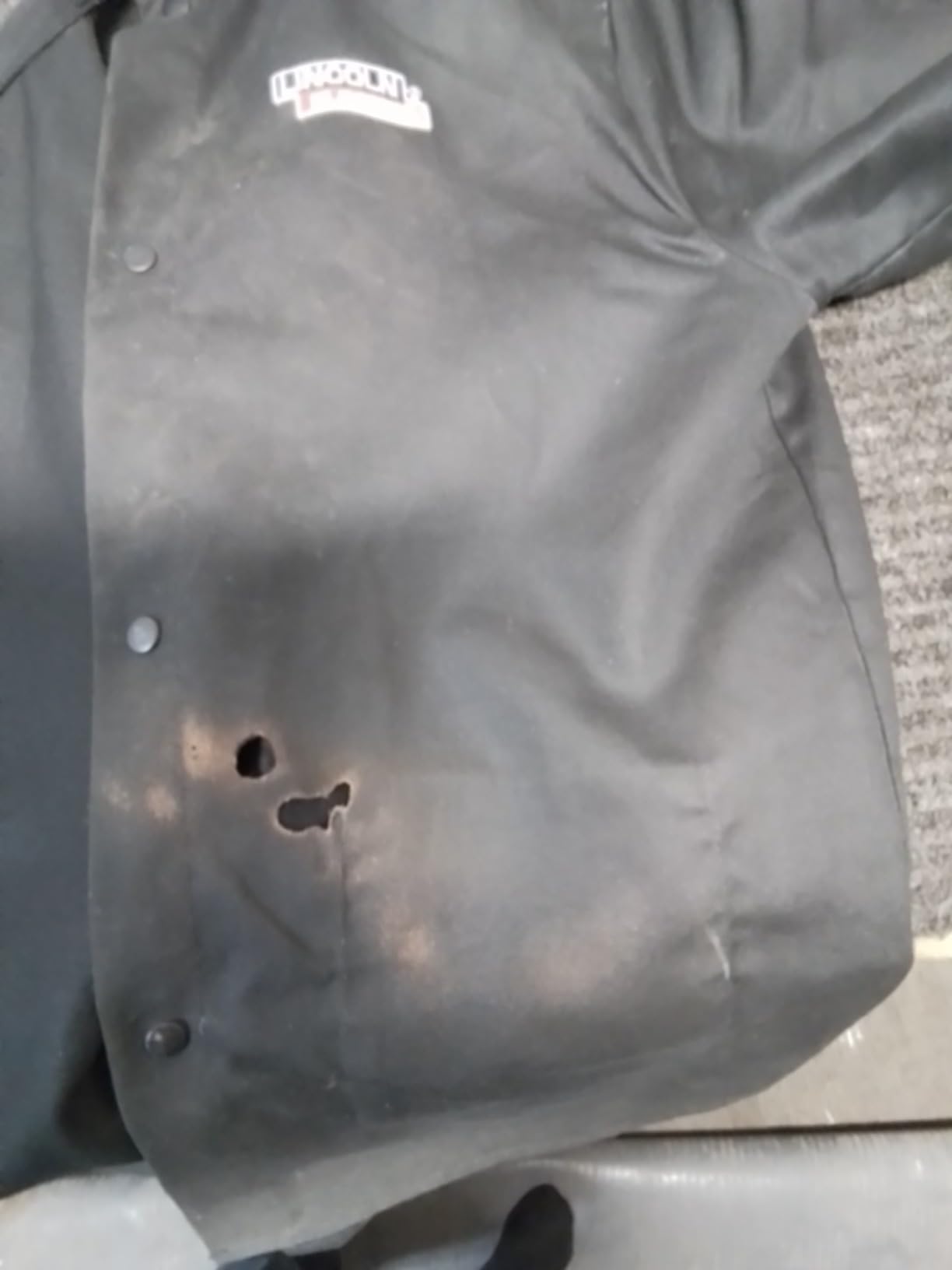
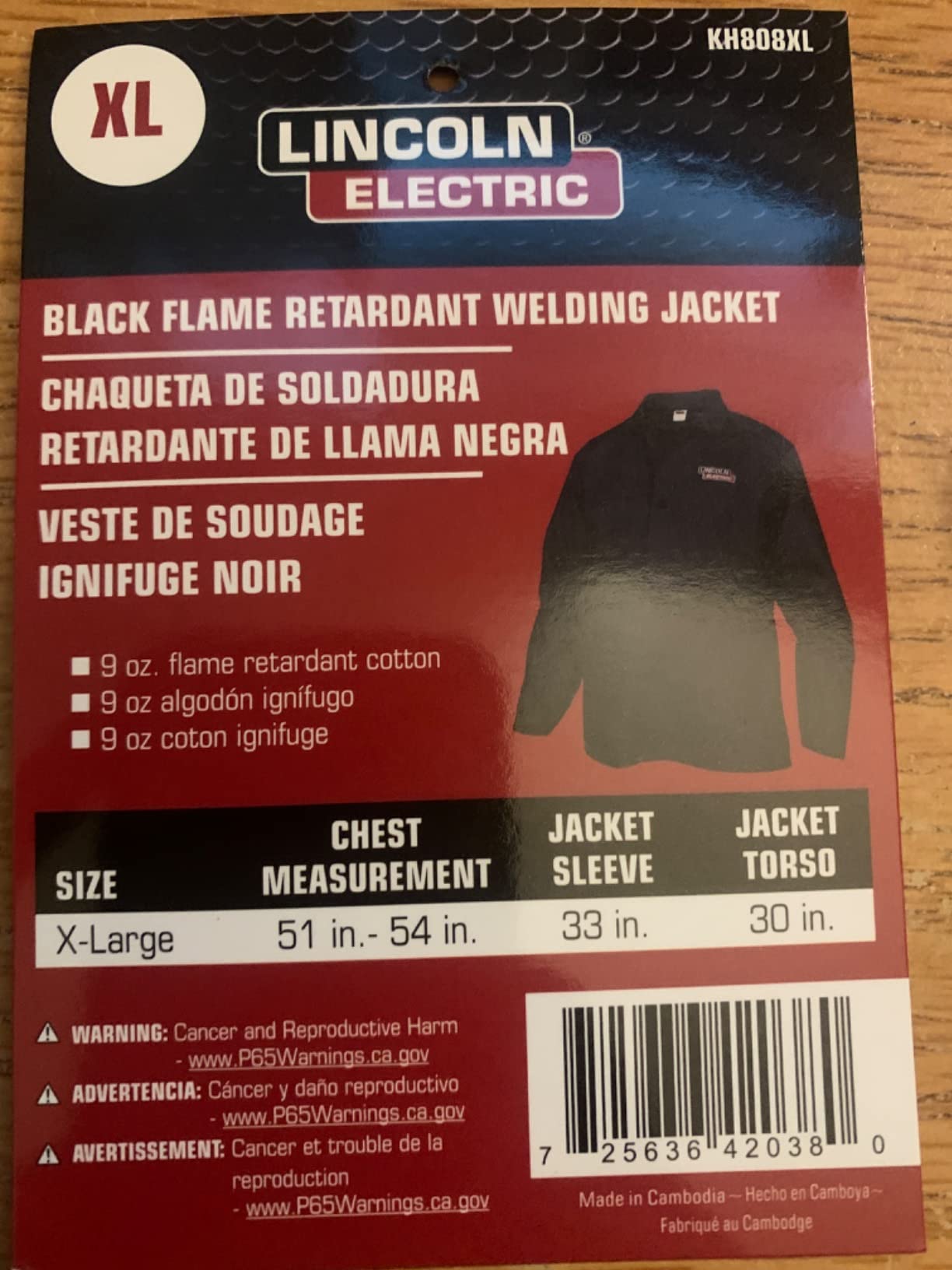
This Lincoln Electric cloth jacket is the workhorse of the group. It is 9 ounce flame-resistant cotton meeting ASTM D6413, in black, with a pop-up welder collar and anodized snap closures. It holds a 4.6 rating across 1713 reviews.
The black colour is a deliberate, practical choice. Soot, spatter marks and shop grime disappear into black in a way they never do on navy or royal blue, which means it looks presentable far longer between washes. For someone welding in a home garage rather than a commercial bay, that matters more than most spec sheets admit.
Pocket layout is better than the K2985’s. There is a dual chest pocket with flaps plus an inside pocket, so you can keep a soapstone and a marker in the chest rather than digging into the jacket.
Comfort is the headline in the reviews. Owners describe it as comfortable for all-day wear and breathable in hot weather, which tracks with the 9 ounce weight and the fact that cotton moves with you far better than a full leather shell.
Washing is straightforward. The jacket is machine washable and the FR properties hold through many cycles, so this is a jacket you can put through a laundry cycle instead of hand-washing forever.
Fit runs slightly small on larger builds, and there is no exterior chest pocket for markers, so if you keep your soapstone clipped to a strap you may prefer a different model. Owners also note it may need replacing after heavy use, which is normal for a 9 ounce cotton coat.
Who this jacket is right for
Best for daily MIG and general fabrication work in a home shop, especially for anyone who hates the look of a filthy jacket at the end of the week. The black colour is the reason it outlasts its rivals cosmetically.
It is also a good second jacket, because machine washing it between projects is genuinely easy.
Who should skip this jacket
Skip it for heavy overhead stick welding. This is the same 9 ounce cotton shell limit that applies to most of the FR cotton jackets here, and owners say so directly.
Skip it if you weld mostly out of position on heavy stock, or if you want a jacket you can grind next to without worrying about it. For that, go leather.
5. YESWELDER Black Leather Welding Jacket – Best Leather for Beginners
YESWELDER Black Leather Welding Jacket
100 percent cowhide split leather
US Kevlar double stitching
Cotton lined stand collar
Pros
- Full leather construction for maximum protection
- Kevlar thread double stitched throughout
- Cotton lining keeps the neck comfortable
- Tool pockets plus sleeve soapstone pockets
- Straight fit in black and brown
Cons
- Newer product with a shorter review history
- Heavyweight leather gets hot fast
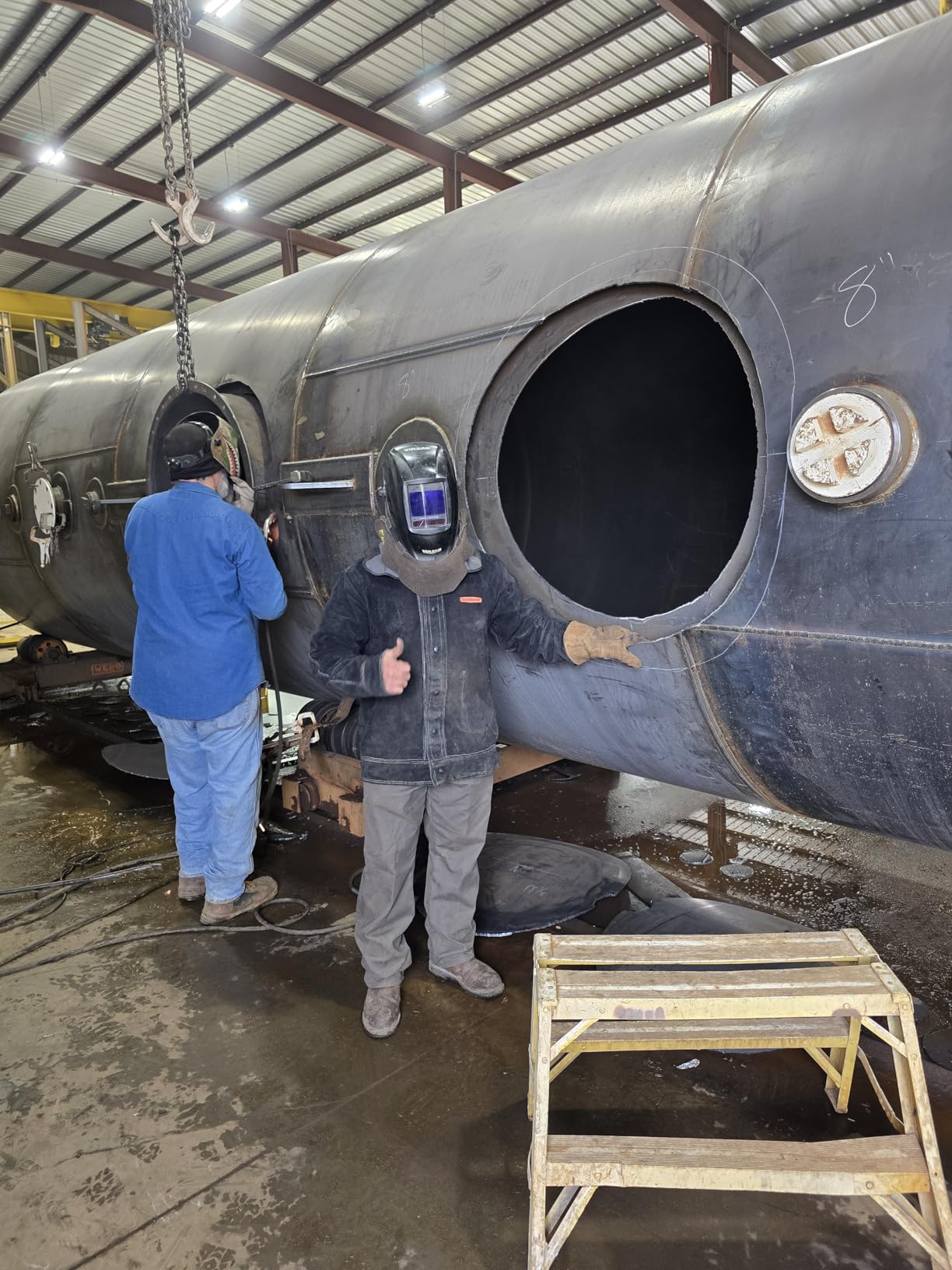
There is a specific argument for buying leather first, and this is the jacket that makes it. A beginner doing stick or MIG work generates more spatter than a beginner doing TIG, and starting in leather means you never have to think about whether your coat is thick enough.
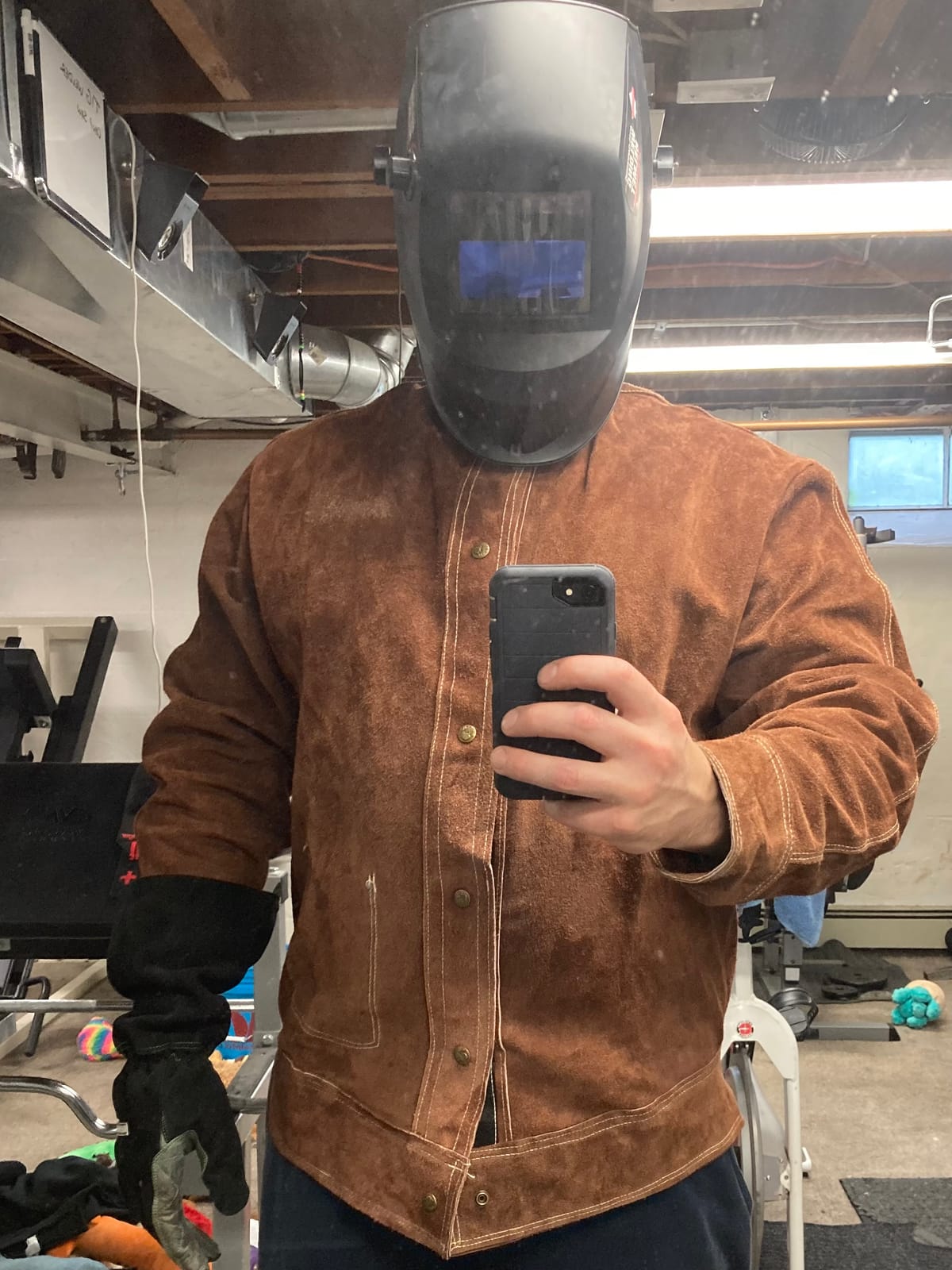
It is 100 percent cowhide split leather with a cotton lining, double stitched with US Kevlar thread and closed with copper-plated buttons. The stand collar with a cotton lining is the detail I like most, because raw leather against the neck is where most leather jackets get uncomfortable after an hour.
The straight fit and standard length keep it simple. There is nothing fussy about this jacket: it is a cover, it is fully leather, and it does its job.
Storage is sensibly laid out with tool pockets and soapstone pockets on the sleeves, which is where a TIG or MIG welder actually reaches during a bead. The jacket is listed at heavyweight, so expect a solid coat rather than a thin shell.
Sizing runs from Small through XX-Large in both black and brown, which is narrower than the QeeLink leather option but covers most home welders comfortably.
The honest caveat is that this is a newer listing with a shorter review history than the classic models in this roundup, and the jacket is hot. That second point is not a defect, it is what full leather is. Anyone buying full leather for the first time should expect to sweat through it in a hot garage.
Who this jacket is right for
Best for a first-time welder who wants maximum protection from day one and plans to grow into heavier work over time. You will not outgrow this jacket the way you outgrow a thin FR cotton shell.
It also suits anyone who wants a simpler purchase: no adjustable waist, no hybrid construction to decode, just leather and Kevlar thread.
Who should skip this jacket
Skip it if heat is your main concern. Full leather at this weight is the warmest option in the roundup, and there is no ventilation to compensate.
Skip it if you need an unusual size. The range tops out at XX-Large, so very large welders should look at the QeeLink leather jacket instead, which runs to 5XL.
6. Lincoln Electric K3106 Split Leather Sleeve Hybrid Jacket – Best All-Round Option
Lincoln Electric unisex adult Traditional Split Leather Sleeved Welding Jacket, Black, Medium US
FR cotton body with anti-static coating
Full split cowhide leather sleeves
Hand wash only
Pros
- Hybrid design puts leather exactly where spatter lands
- Leather sleeves withstand heavy abrasion
- Rated 4.7
- the highest in the roundup
- True to size fit from a major manufacturer
Cons
- Most expensive jacket in the roundup
- Hand wash only
- Length runs short on taller welders
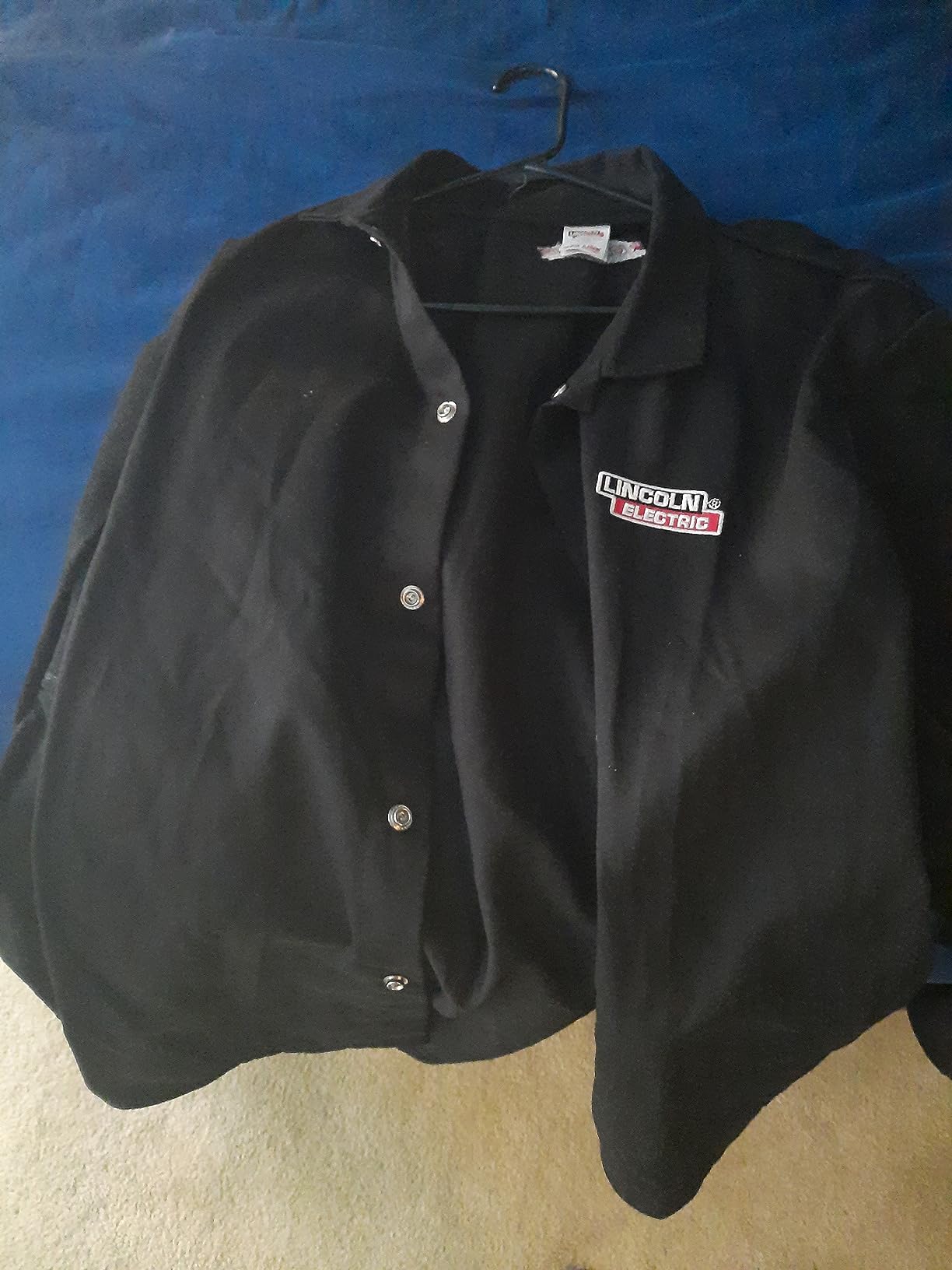
This is my answer when someone asks for the single best welding jacket for home welders who do more than one process. The K3106 combines a 9 ounce ASTM D6413 FR cotton body with an anti-static coating and full split cowhide leather sleeves, and it holds a 4.7, the highest rating in this roundup.
The hybrid logic is sound and it is why fabricators use this pattern. Spatter lands on your forearms and hands, so that is where the leather goes. Your torso runs hotter, so the FR cotton body keeps you cooler and lighter than an all-leather coat while still being flame resistant.
Owners describe it as professional-grade and used daily in shops, which is the strongest durability signal a home welder can get. The chrome-plated metal snap cuffs and flip-up collar are the same hardware Lincoln puts on their heavier lines.
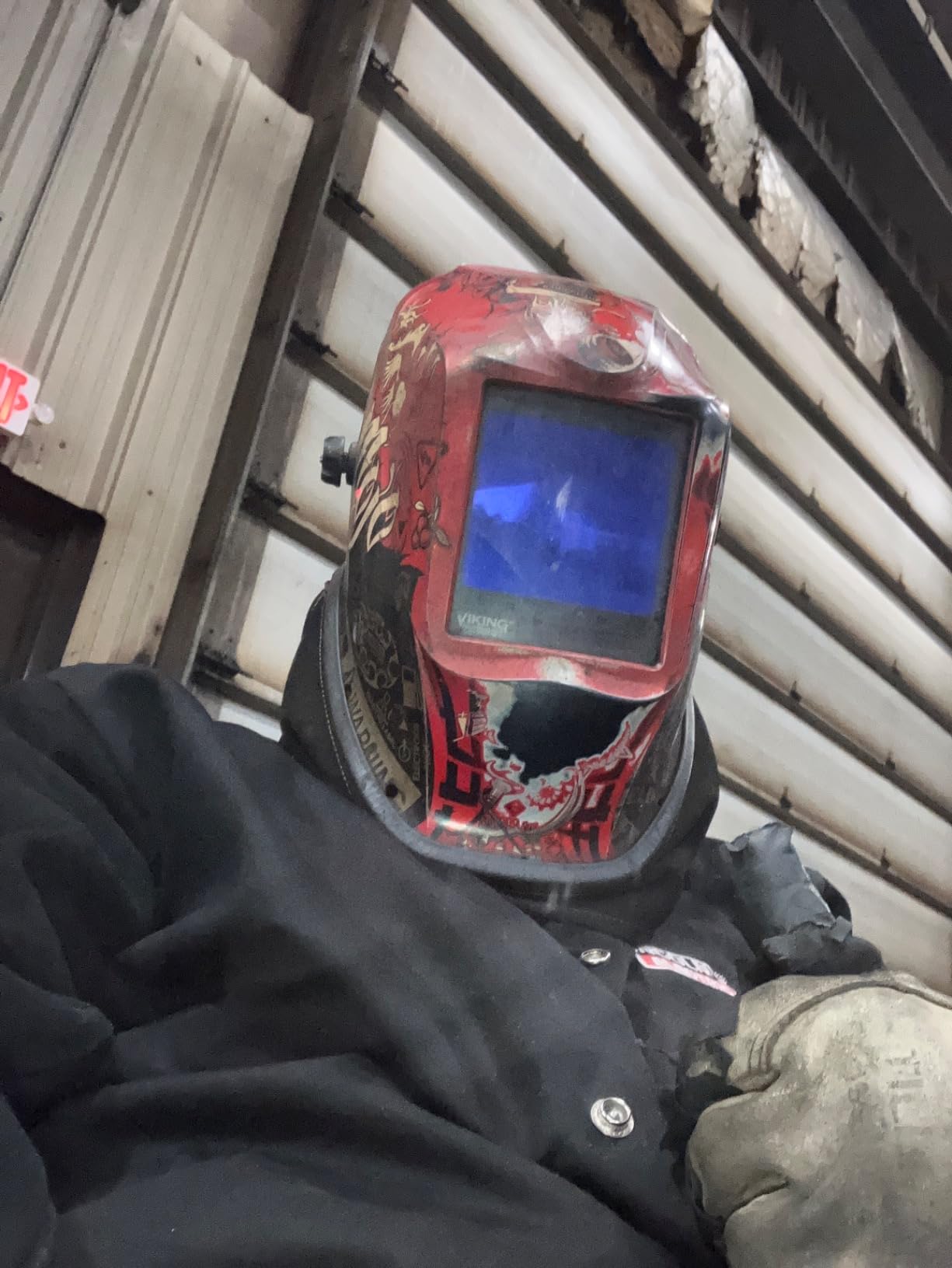
It is the jacket I recommend to someone who runs a mix of TIG, MIG and stick and refuses to buy three coats. Full leather sleeves mean the spatter side of your body is covered, and the cotton body keeps the heat down when you are doing long, slow fab work rather than grinding.
There is one large inside pocket for storage, and the fit is reported as true to size with a straight cut. Comfortable for long sessions is the recurring phrase.
The trade-offs are real. It is the most expensive jacket here, and it is hand wash only, which is a genuine inconvenience next to the machine-washable cotton models. There is also no exterior chest pocket for soapstone or markers. Owners note the length can come to the belt on taller welders, which is worth checking against your measurements.
Who this jacket is right for
Best for the multi-process home welder doing TIG, MIG and stick in the same week, and for anyone whose forearms keep getting burned in thinner jackets. It is the one I would buy if I could only own one.
It is also the safest buy for someone who will not sit down and analyse spatter loads. Whatever process you end up doing, this jacket covers it.
Who should skip this jacket
Skip it if your budget is the deciding factor. It costs more than the other options here and the hand-wash requirement adds friction to daily use.
Skip it if you are tall. The length runs to the belt on taller frames, so check the measurements before ordering, and consider the Revco BXRB9C with its extended 32 inch front length instead.
7. Revco Black Stallion BXRB9C Contoured FR Cotton Jacket – Best for Overhead Work
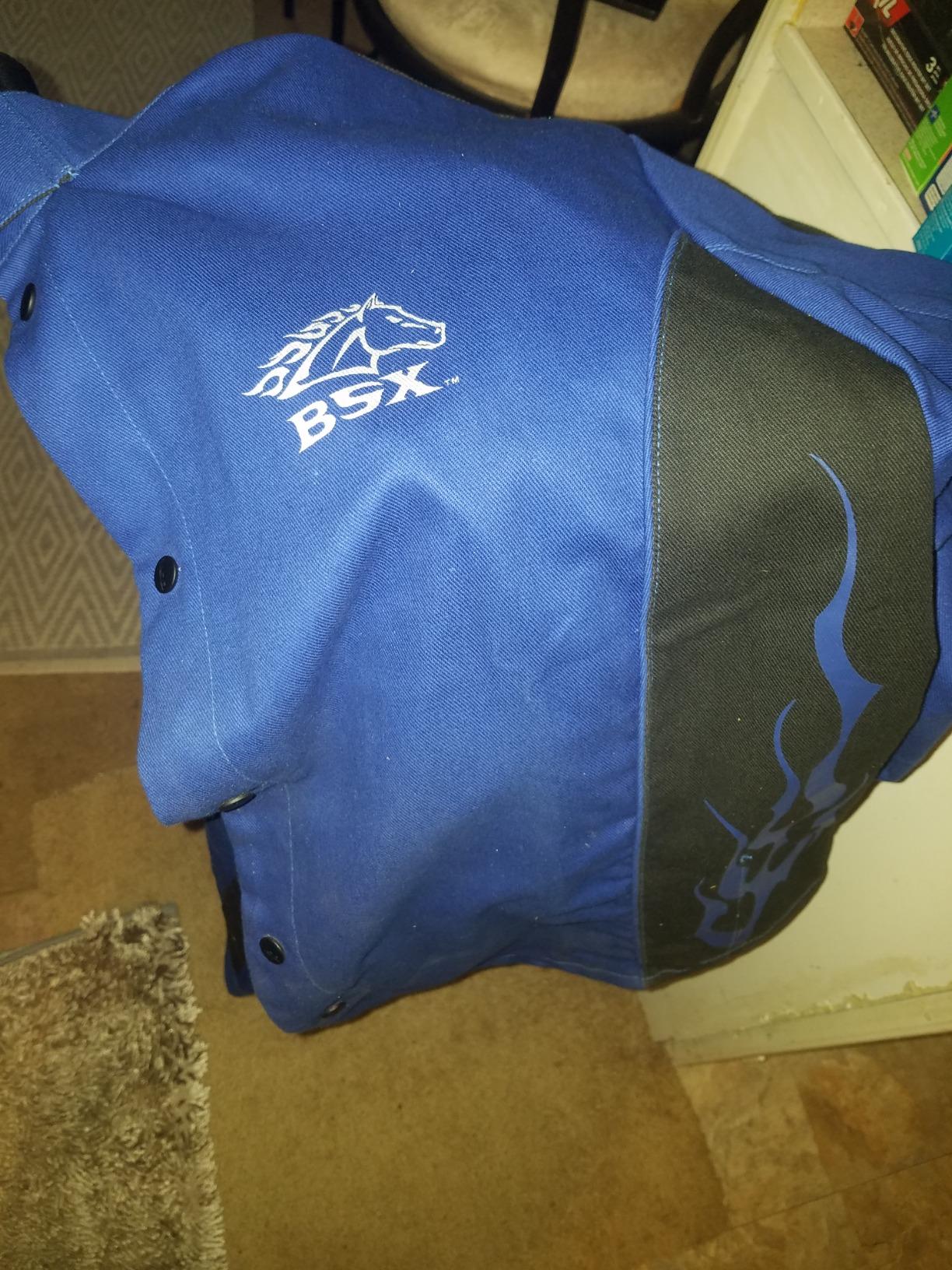
Revco Black Stallion (BXRB9C) BSX 9 oz Contoured Flame-Resistant Cotton Welding Jacket, Welder’s Collar, Dual Scribe Pockets, Leather-Reinforced Snaps, X-Large, Royal Blue
9 oz FR cotton and denim
Extended 32 inch front length
Zipper front closure
Pros
- Extended 32 inch front length for extra torso coverage
- Dual scribe pockets on both sleeves
- Adjustable waist straps and snap collar
- True to size with free movement
Cons
- Cotton is not spatter-proof for heavy overhead work
- No external pockets without unzipping
- Hand wash only
The BXRB9C solves a specific problem: coverage. While most jackets in this roundup stop at the hip, this one has an extended 32 inch front length, which means it keeps protecting your lower torso when you are welding overhead or in a tight corner.
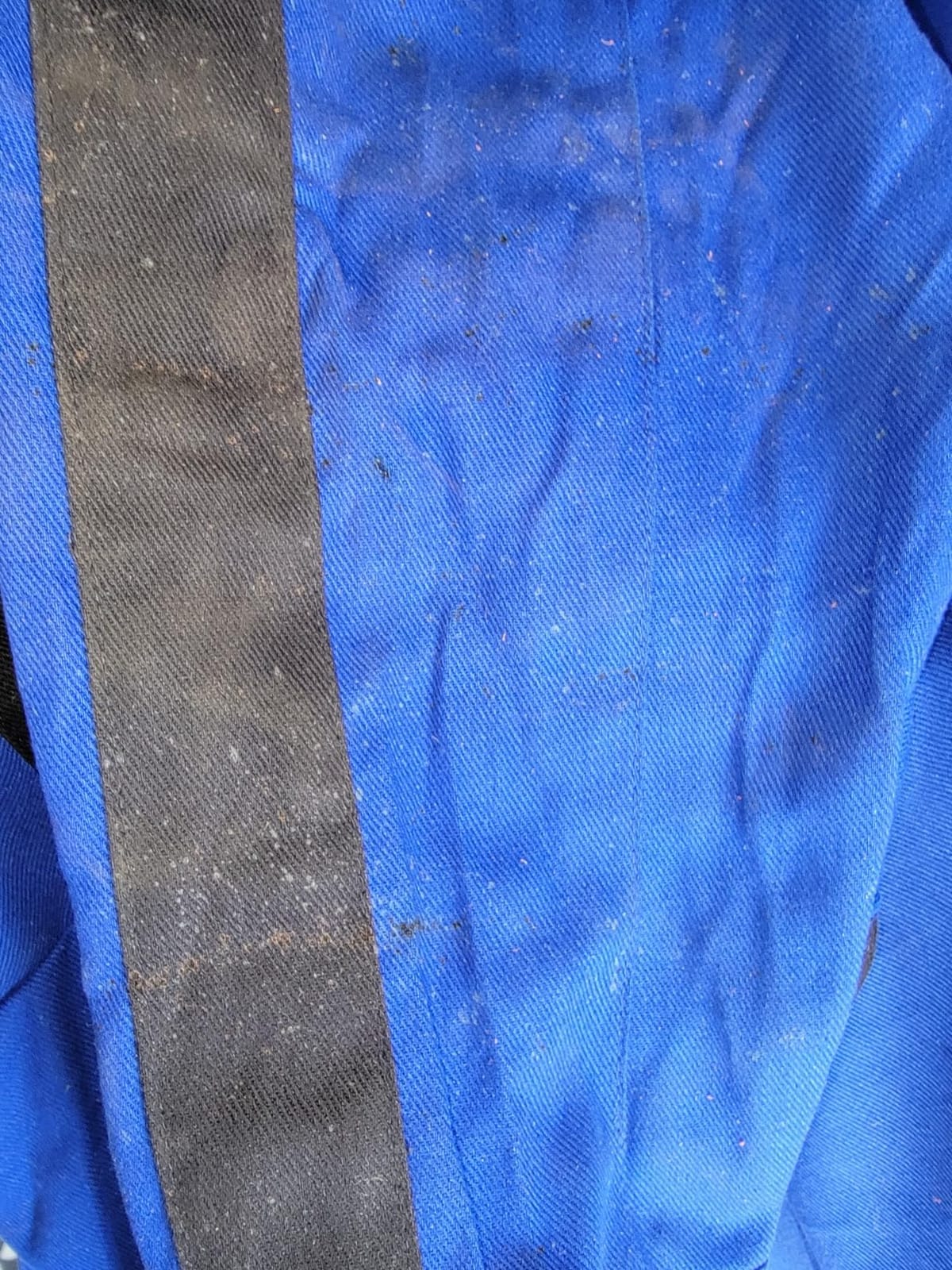
It is 9 ounce flame-resistant treated cotton and denim with a welder’s collar on adjustable snaps, and the front closes with a zipper rather than the snaps used on most welding jackets. That zipper is the reason it holds 4.7 stars from 986 reviews: it cannot pop open when you are leaning into a bead or climbing a ladder.
Fit is reported as true to size and regular, and reviewers single out the free movement through the shoulders. It weighs 1.7 pounds, so it is one of the lighter full-length options here.
Storage is unusually well thought out. There are dual scribe pockets on both sleeves, a left inside pocket, and a zippered right inside pocket, and the waist adjusts at two snap positions so you can pull the extra length snug when crouching.
That combination of extended length and adjustable waist is the reason this is the pick for anyone doing out-of-position or overhead work in a home shop where you cannot control the arc as neatly as a professional would.
Be clear about the limit: this is cotton, and cotton is not spatter-proof. Owners are explicit that heavy overhead stick work needs leather. There are also no external pockets, so reaching for a tool means unzipping the front, and it is hand wash only. Royal blue also shows shop dirt faster than black.
Who this jacket is right for
Best for welders who spend time in awkward positions: overhead, in corners, on ladders, or inside a vehicle frame. The 32 inch front length is the best torso coverage in this roundup.
It is also a good pick if you have had snaps pop open on you mid-weld, because the zipper closure cannot do that.
Who should skip this jacket
Skip it for heavy spatter processes. If you run flux-cored or dual-shield as your main work, cotton coverage is the wrong material, whatever the length.
Skip it if you need quick access to tools without breaking a seal on the jacket. All the storage is inside, which is safer and less convenient.
8. Miller Classic 9oz FR Cotton Welding Jacket – Best for TIG and Hot Garages
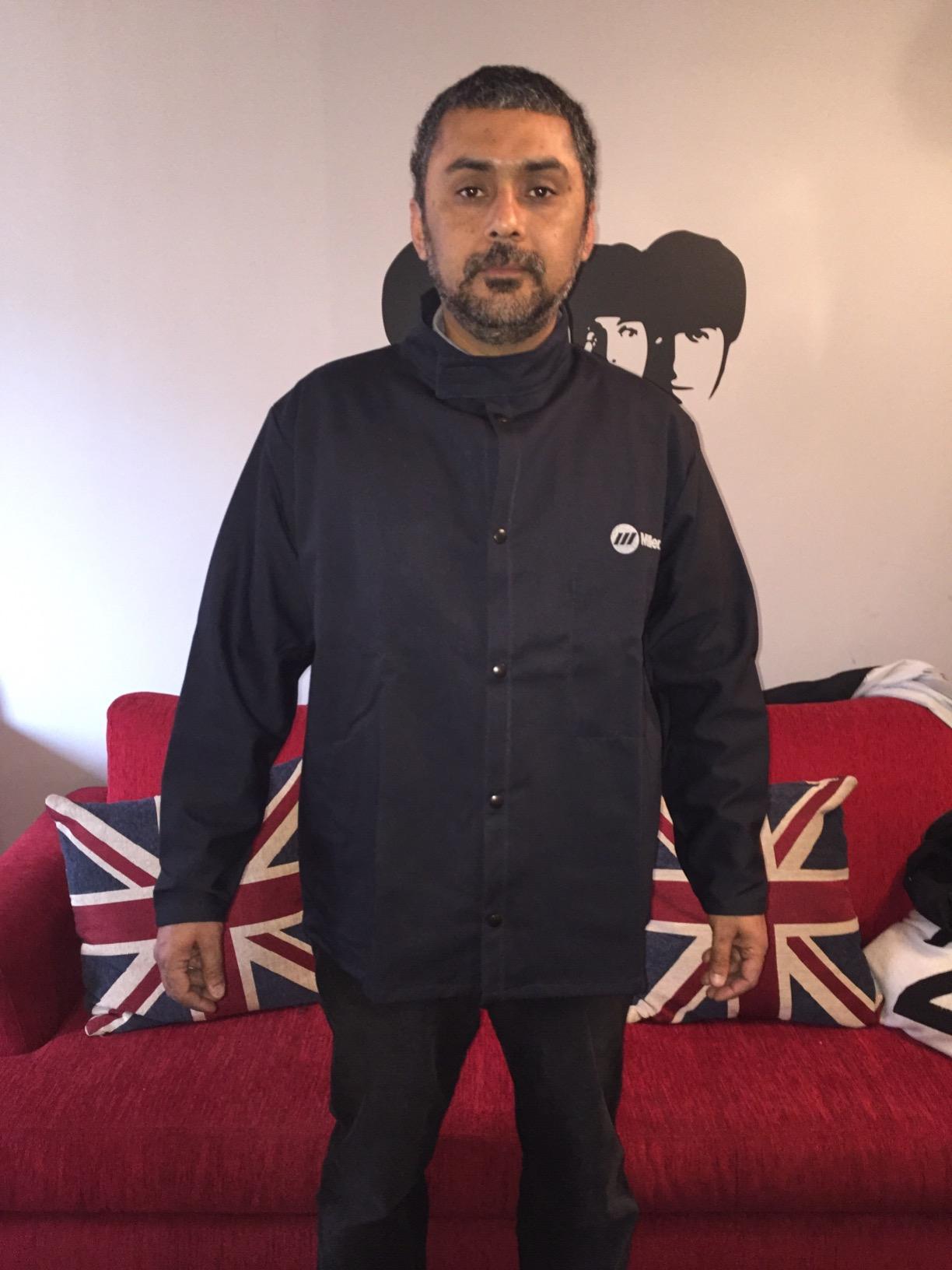
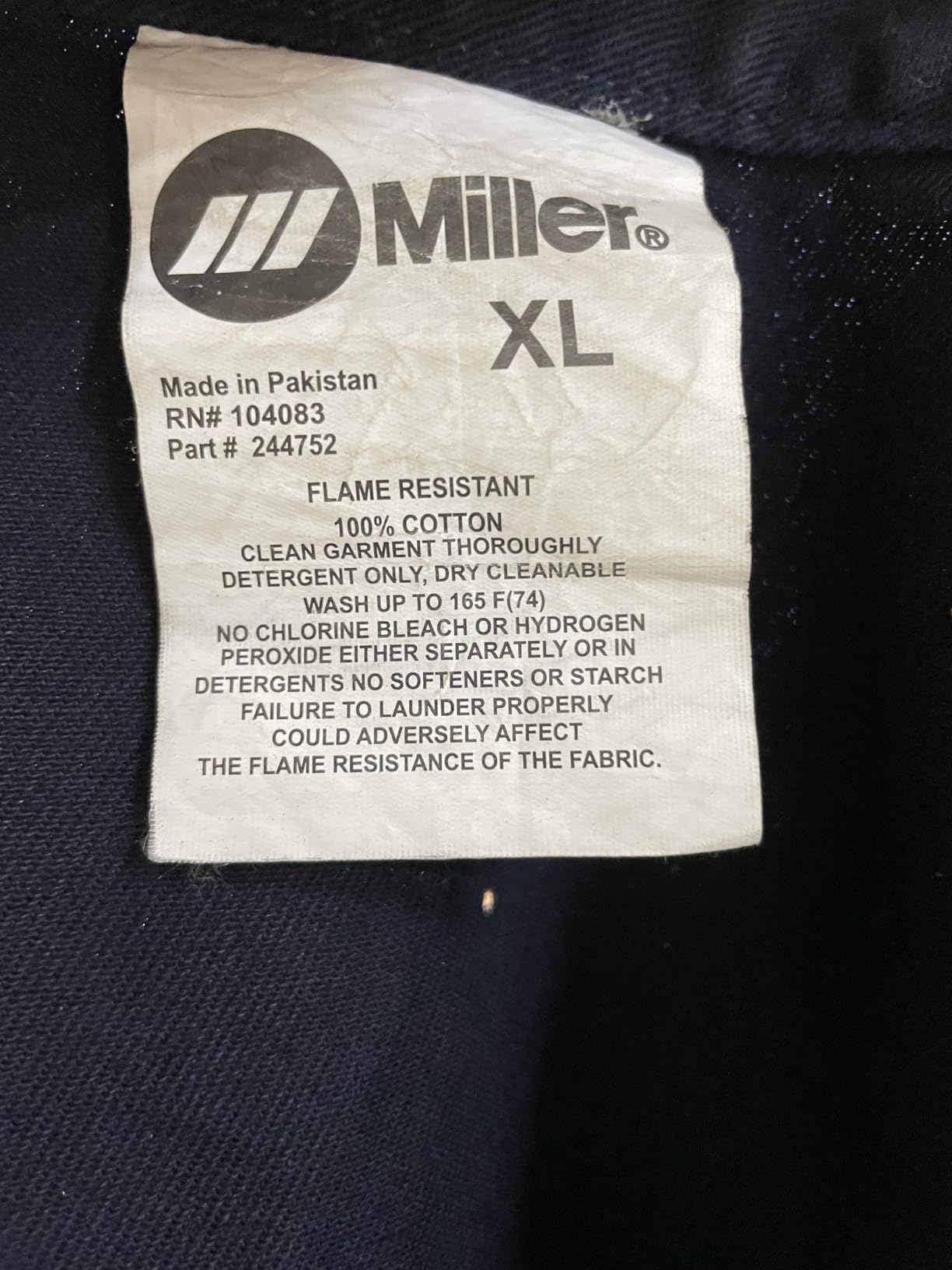
Miller Classic Cloth Welding Jacket, 9oz Navy Cotton, XL, Flame Resistant
Pre-shrunk 9 oz FR cotton
Weighs 1.5 pounds
Barracuda stand-up collar
Pros
- Lightest jacket here at 1.5 pounds
- Barracuda stand-up collar protects the neck
- Fold-in sleeve snaps keep spatter out
- Pre-shrunk cotton with reinforced stitching
- Folds compactly for transport
Cons
- Thin enough that larger sparks can burn through
- Not suitable for heavy overhead welding
- Hand wash only
The Miller Classic is the lightest jacket in this roundup at 1.5 pounds, and that single fact decides where it belongs: TIG work and hot garages. If you are doing thin stainless or aluminum with a TIG torch, you are not throwing spatter, and heat is your enemy rather than molten metal.
It is pre-shrunk 9 ounce flame-resistant cotton in navy, with the Barracuda-style stand-up collar and five snap buttons. It holds 4.7 stars across 773 reviews, and reviewers consistently praise it specifically for TIG and light welding.
The Barracuda collar is worth explaining, because it is not a marketing name for a normal collar. It is a short stand-up collar that covers the sides of the neck where spatter and stray arc light reach when you are working close to the work with your head down. Fold-in snaps at the sleeve cuffs close the wrist gap where spatter rolls down a forearm.
It folds compactly, which sounds minor until you have carried a welding jacket in a truck bed. Miller built this one with reinforced stitching and finished hems, which is why the light weight has not translated into a fragile jacket in the reviews.
The X-Large measures a 54 inch chest, 20 inch shoulders, 34 inch sleeves and 30 inch length, so if you are between sizes the published measurements are worth checking before ordering.
Now the part that matters most: owners report that larger sparks can burn through this material, and that it is not suitable for heavy overhead welding. With heavy grinding they report a lifespan as short as five to six months. It is also hand wash only. Buy it for TIG and light MIG, not for stick or flux-cored work.
Who this jacket is right for
Best for TIG welders, particularly anyone doing thin stainless or aluminum where heat is the limiting factor. The 1.5 pound weight is barely noticeable over a long session.
It is also the pick if you travel with your gear, weld outdoors where black absorbs sun, or want a jacket light enough to double as an overshirt between projects.
Who should skip this jacket
Skip it if you weld stick, flux-cored or dual-shield. The burn-through reports are specific enough that I would not put a beginner on this jacket before they know which process they are running.
Skip it if you do a lot of grinding alongside welding, because owners put its replacement interval at five to six months under those conditions.
9. QeeLink Split Leather Sleeve Hybrid Jacket – Best Hybrid for Spatter and Heat
QeeLink Welding Jacket Split Leather Sleeves | Premium Flame Resistant Cotton Body Hybrid Welder Jackets Coat, Large
Leather on sleeves shoulders and chest
10 oz FR cotton body
Kevlar thread stitching
Pros
- Leather covers arms shoulders and chest where spatter lands
- 10 oz FR cotton body keeps you cooler
- Rated well for overhead welding
- Adjustable neck cuffs and waist
- True to size fit
- Good value next to full leather
Cons
- Blue cotton areas can burn through under heavy spatter
- Heavy and hot in summer
- Velcro and snap combo can be fiddly
- Inner arm fold can rub
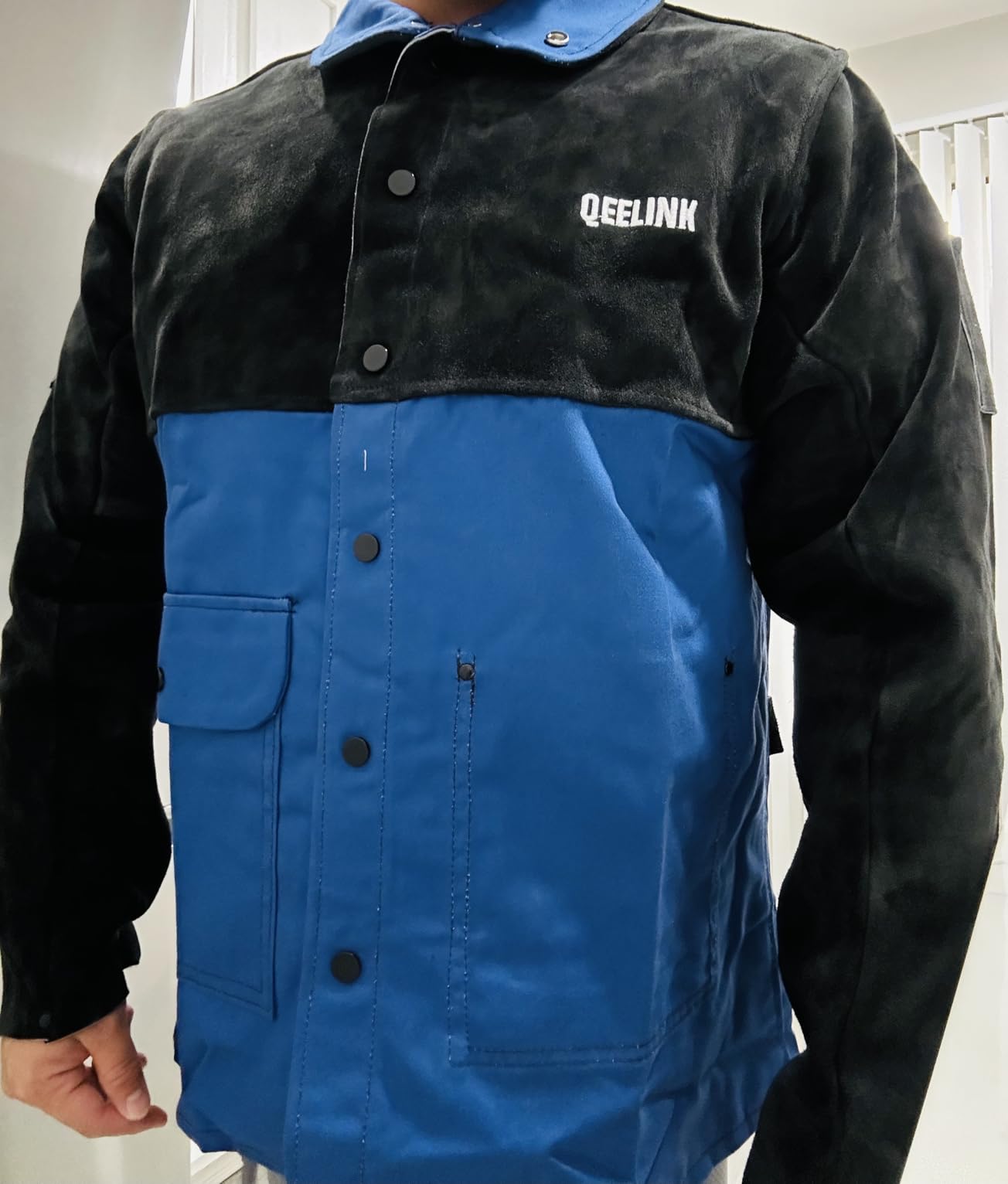
This is the hybrid with the widest leather coverage, and that is the reason to buy it. Where most hybrid jackets put leather on the sleeves alone, this one puts split cowhide on the sleeves, the shoulders and the chest, and leaves the 10 ounce FR cotton on the lower torso.
Shoulders and chest coverage is what you actually want if you weld out of position, because that is where falling spatter from an overhead bead lands. It is stitched with US Kevlar heat-resistant thread and reinforced with corrosion-resistant rivets, and it carries a 4.4 from 840 reviews.
Adjustability matches the full leather model: the neck, cuffs and waist all adjust, so you can dial the fit for a crouched position or pull it tighter against falling spatter.
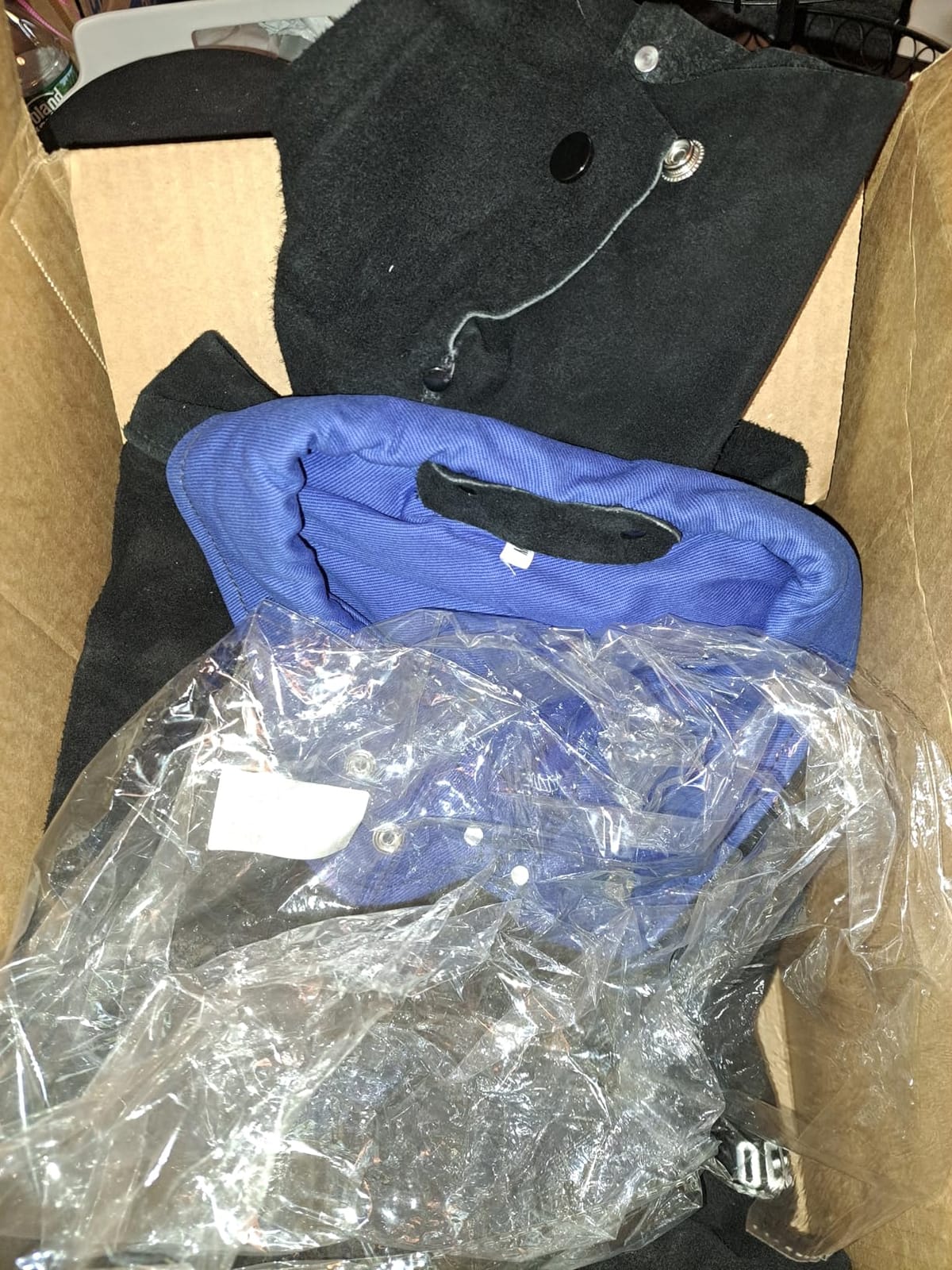
Sizes run from Small through 4X-Large, and the colour scheme is blue and black, which at least breaks up the all-black look that every other jacket here shares.
The value argument is straightforward. You are getting leather coverage across the highest-risk zones of your body for less than a full leather jacket, which is why owners call it good value next to full leather.
The 4.4 rating is the lowest among the well-reviewed options here, and the reason is consistent: the blue cotton areas can still burn through under heavy spatter. It is also heavy and hot in summer, and the Velcro and snap combination at the neck can be annoying to work one-handed with a gloved hand.
Who this jacket is right for
Best for home welders who want leather protection on the arms, shoulders and chest without paying for a full leather coat, and for anyone doing overhead or out-of-position work on a budget-conscious level.
It is a good bridge option for someone who finds full leather too hot but finds a cotton-only jacket too thin.
Who should skip this jacket
Skip it if you run flux-cored or dual-shield as your primary process. The lower torso is still cotton, and that is exactly where heavy spatter lands from a flux-cored gun. For that work, go the full leather route.
Skip it if heat is a dealbreaker, since owners rate it heavy and hot in summer.
10. LeaSeek Black Split Cowhide Leather Welding Jacket – Best for Full-Length Coverage
Black Leather Welding Jacket, Flame-Resistant Heavy Duty Weld Coat
100 percent thick cowhide split leather
Full-length Velcro and snap closure
Adjustable cuffs and collar
Pros
- Full leather construction with Kevlar thread
- Adjustable cuffs and collar
- Soapstone pockets on both sleeves
- Size range runs from S to 5XL
- Package weight listed at 2.2 pounds
Cons
- Full-length Velcro catches beards and facial hair
- Strong leather smell out of the packaging
- Runs small so size up
- Limited pocket count
- Some reports of snaps coming loose
- Heavy for extended wear
The LeaSeek is full 100 percent thick cowhide split leather with a full-length Velcro and snap closure. If you want a complete leather coat rather than a hybrid, this is the version in this roundup that weighs in at 2.2 pounds, noticeably lighter than the 4.41 pound QeeLink leather model.
That lower listed weight is the interesting part. Owners still describe it as heavy for extended wear, so the number understates the real feel, but among full leather options in this roundup it is on the lighter end.
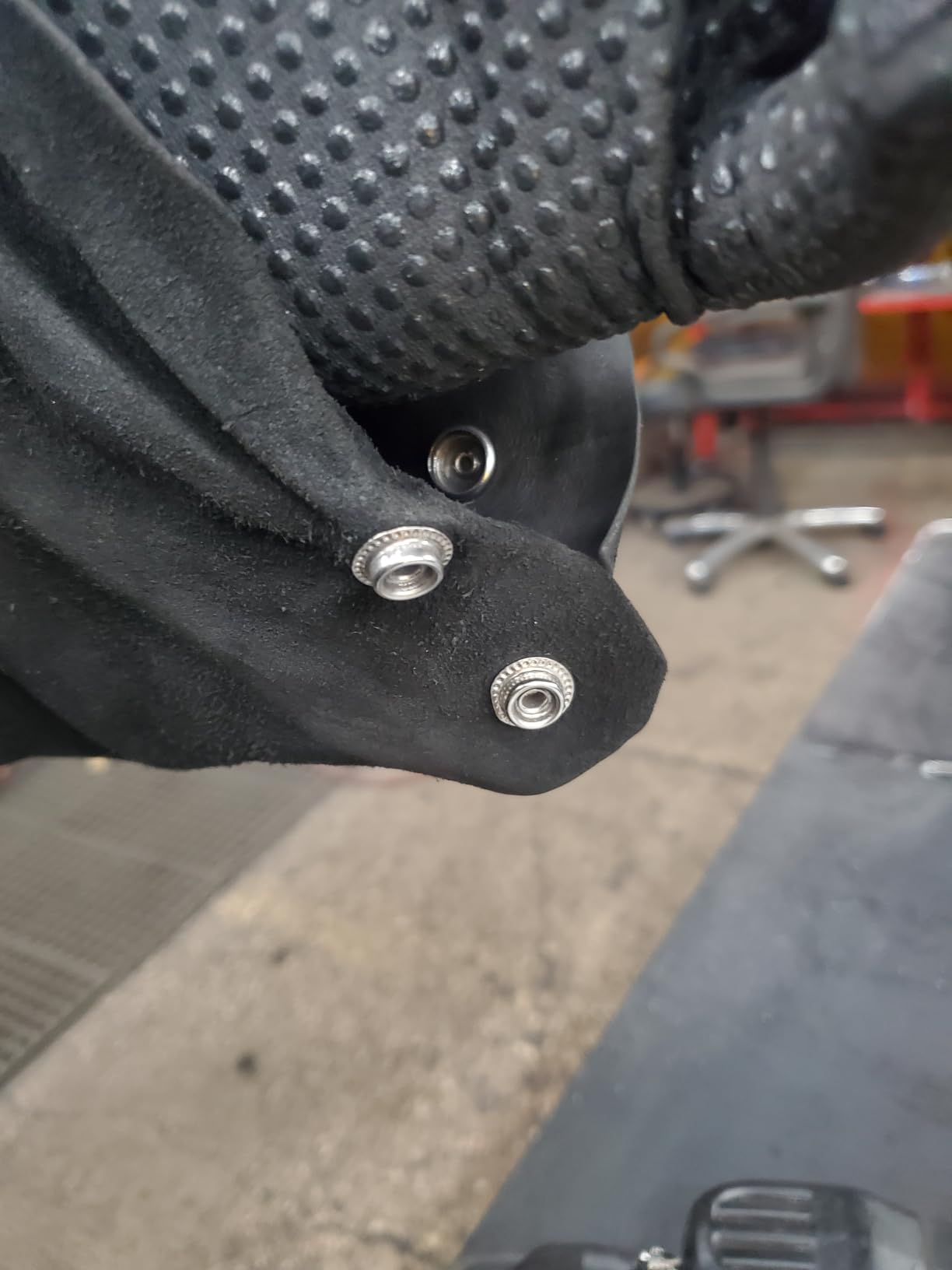
The collar and cuffs both adjust, and there is a soapstone pocket on each sleeve. The closure runs the full length of the front, Velcro with snaps over the top, which is a genuinely more secure closure than snaps alone when you are working around a grinder or a hot workpiece.
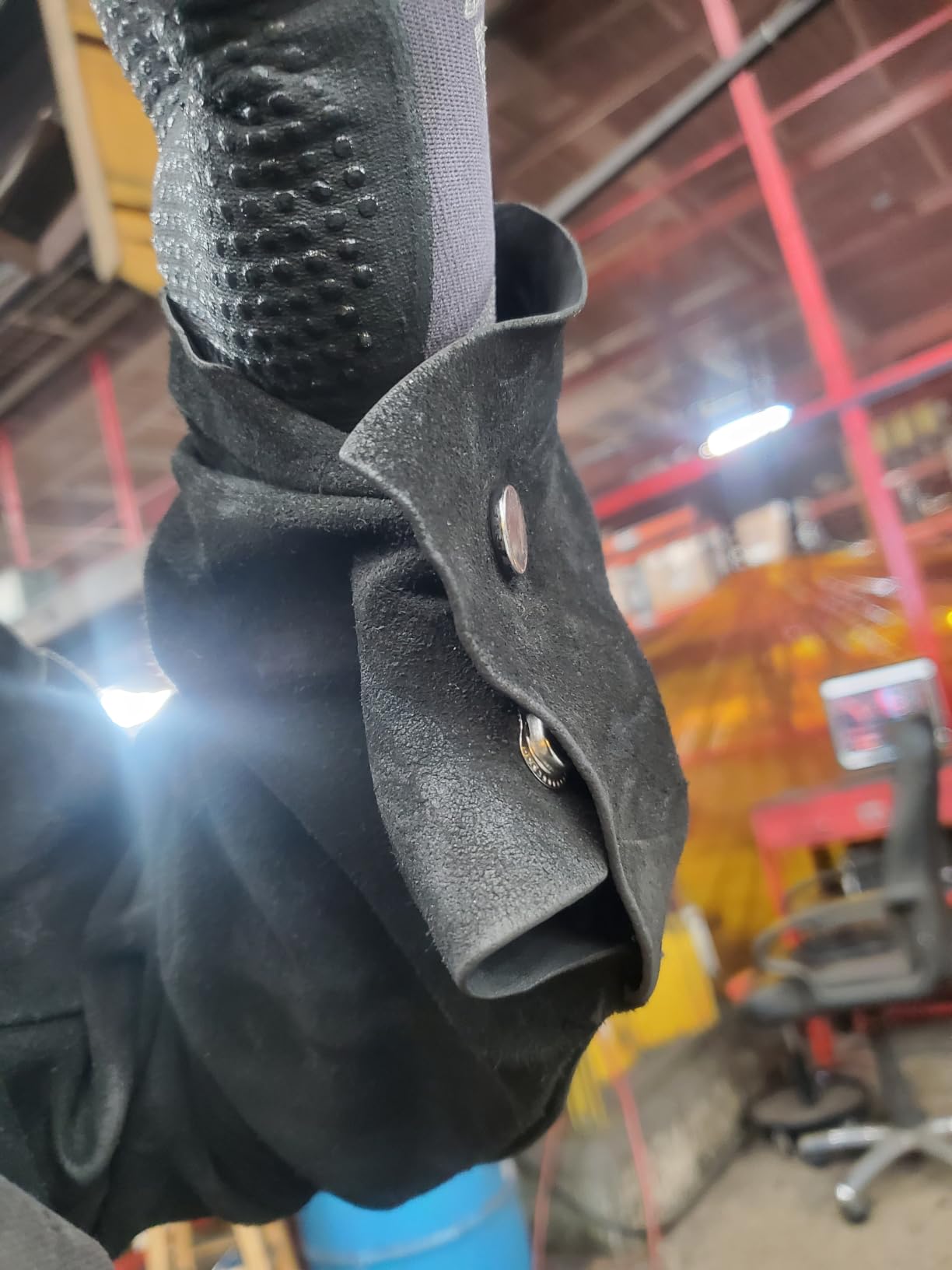
Stitching is US Kevlar heat-resistant thread, which is the detail that separates a real welding jacket from a leather work coat. Ordinary thread can fail at the seams long before the leather does.
Sizes run from Small through 5X-Large, so it covers a wider range than the YESWELDER option, and the jacket is black, which hides spatter better than any colour in this roundup.
Bearded welders should read the reviews first. The full-length Velcro catches facial hair, and owners are blunt about it. There is also a strong leather smell initially, it runs small, and some reviewers report snaps coming loose, though the seller is described as responsive with replacements.
Who this jacket is right for
Best for a home welder who plans to keep welding for years and wants one full leather coat rather than a cotton shell that gets replaced every few years. The Kevlar stitching and full leather build are the reason.
It is also a good fit for anyone welding near a grinder regularly, where abrasion rather than heat is the limiting factor.
Who should skip this jacket
Skip it if you have a beard or long facial hair, because the full-length Velcro is a genuine daily annoyance rather than a minor quirk.
Skip it if you need lots of storage, since the pocket count here is limited to the sleeve soapstone pockets. And size up if you are between sizes, because it runs small.
11. IRONCAT FR Treated Cotton Sateen Welding Jacket – Best Budget Pick
Ironcat FR Treated Cotton Sateen Jacket, 9 oz., Anodized Snaps, Interior Pocket, Pop-up Welders Collar, Scribe Pocket, Green, X-Large (7050/XL)
9 oz FR treated cotton sateen
Leather reinforced anodized snaps
Pop-up welder collar
Pros
- Lowest cost jacket in the roundup
- FR treated 9 oz cotton sateen shell
- Anodized snaps reinforced with leather
- Pop-up welder collar with snap closure
- Interior pocket plus sleeve scribe pocket
- Wide size and colour choice
Cons
- Lightweight
- so not for heavy welding
- Green color does not hide spatter as well as black
- Newer listing with a shorter review history
If you are outfitting a garage on a tight budget and doing light work, the IRONCAT is the honest floor of this list. It is 9 ounce FR treated cotton sateen with anodized snaps reinforced in leather and a pop-up welder collar, and it carries a 4.4 from 667 reviews.
The leather reinforcement on the snaps is the detail that makes a budget jacket work. Snaps are the first thing that fails on a welding jacket because you snap them shut a hundred times a week, and reinforced snaps hold up through that.
It is listed for steel mills, shipyards, manufacturing, automotive, gas welding and torch work, which tells you the intended envelope. For a home welder doing light gas and MIG work, that envelope comfortably includes you.
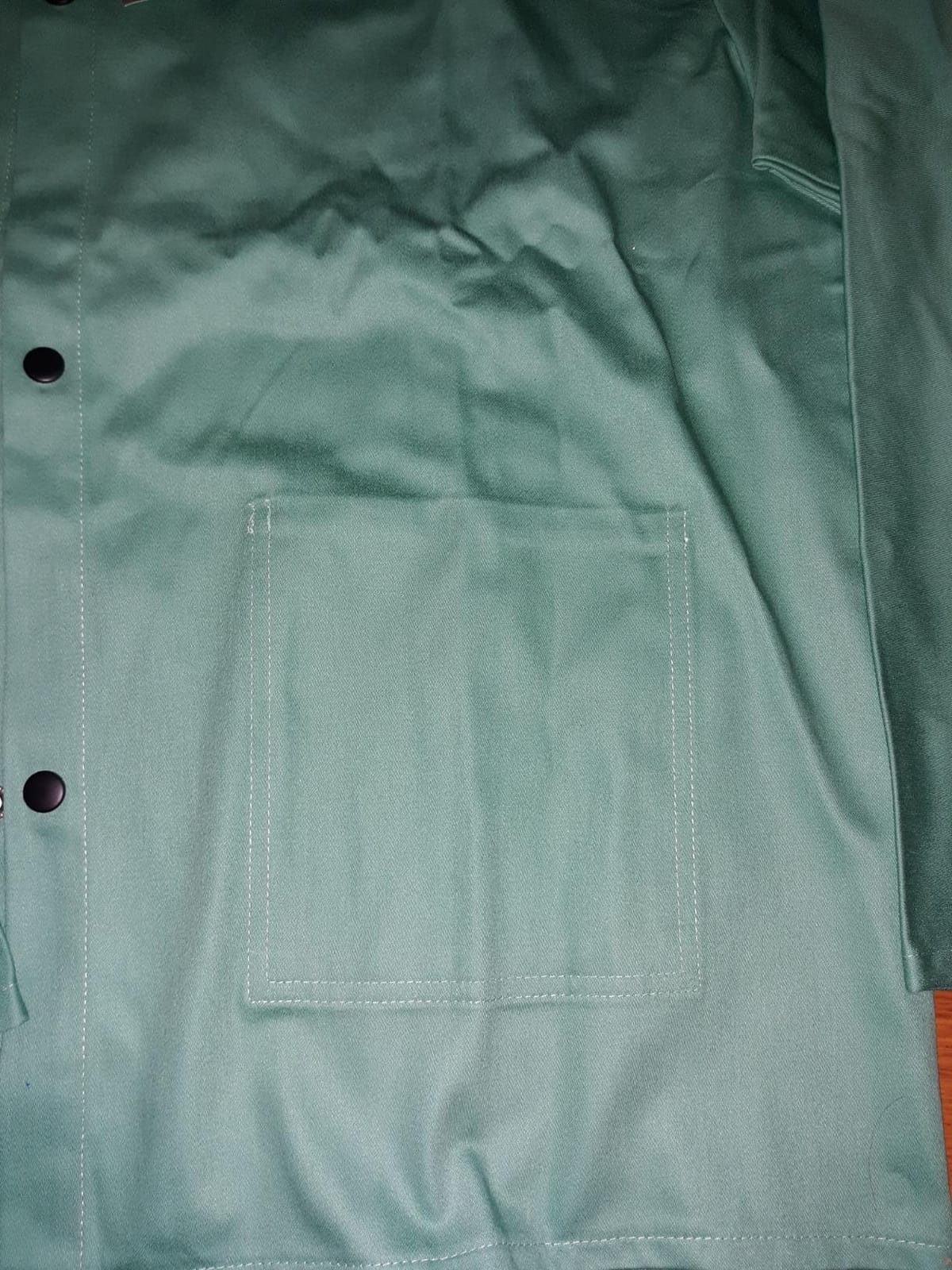
There is an interior lower pocket and a scribe pocket on the sleeve, which is enough storage for soapstone and a marker without turning the jacket into a tool belt.
One genuinely useful thing here is colour choice. This jacket is available in green, royal, red, orange, navy and black, and sizes run from Small through 5X-Large. If you work around traffic or in a yard where visibility matters, orange and red are real options rather than novelty colours.
The trade-offs are predictable at this tier. It is a lightweight 9 ounce shell, so it is not for heavy welding. The green colour does not hide spatter the way black does. And it is a newer listing with fewer long-term reviews, so the 4.4 comes from a shorter history than the 3405 reviews behind the Black Stallion.
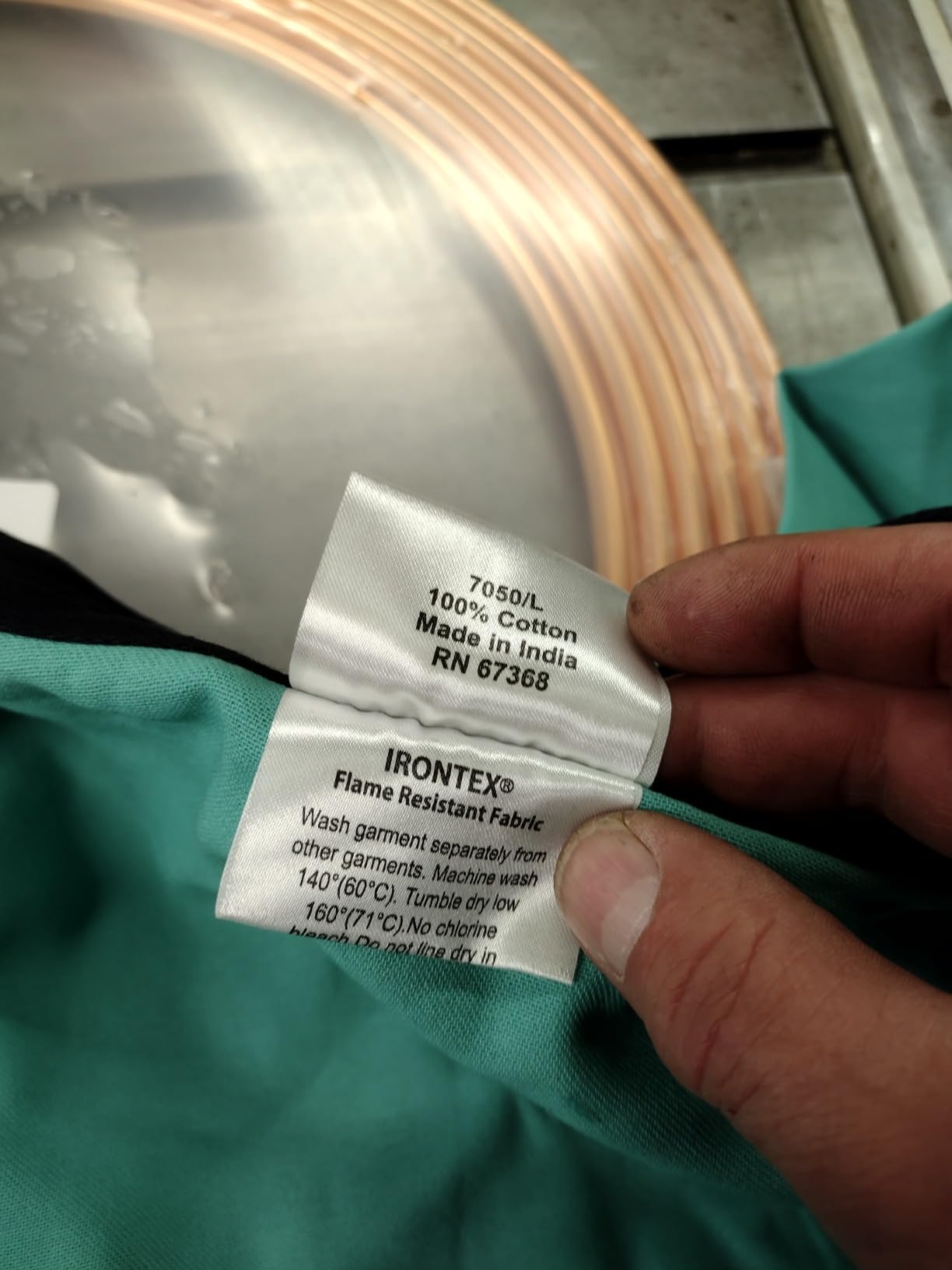
Who this jacket is right for
Best for a first welding jacket on a strict budget, a spare jacket for a second pair of hands, or anyone doing light gas, torch and maintenance work where spatter is minimal.
It is also worth a look if you work outdoors or near traffic and need high-visibility colour, because most welding jackets come in black or navy only.
Who should skip this jacket
Skip it if you weld stick, flux-cored or dual-shield. A lightweight cotton sateen shell is not going to hold against that spatter load, and the garment is not designed for it.
Skip it if you want a jacket you will keep for years. At this tier you are buying a season of light work, not a long-term coat.
12. MAGID SparkGuard 12oz FR Cotton Sateen Jacket – Best Heaviest Cotton Option
MAGID SparkGuard Flame Resistant Green Welding Jacket, 1 Jacket
12 oz Hyperon cotton sateen
FR certified through 50 plus washes
30 inch length, 1.7 pounds
Pros
- 12 oz cloth is heavier and denser than standard 9 oz
- FR certified through more than 50 industrial washes
- Green colour gives high visibility for supervisors
- Leather reinforced non-reflective snaps
- Set-in snap closure sleeves keep spatter out
Cons
- Green colour shows shop dirt and spatter fast
- Hand wash only
- Lay-down collar gives less neck protection than a pop-up collar
- Single interior pocket only
The MAGID SparkGuard is the heaviest cotton option in this roundup, and that is its entire argument. It is 12 ounce 100 percent cotton sateen rather than the 9 ounce you see on almost every other jacket here, and 12 ounces is a meaningfully denser fabric.
It holds a 4.6 across 607 reviews. The FR certification is specific: ASTM D6413-99, tested through more than 50 industrial washes. That is a stated test standard rather than a claim that the cotton is fire resistant.
For a home welder, the weight difference translates to more spatter resistance than a 9 ounce shell gives you, while still being far cooler than leather. It is the middle ground if you are not ready to commit to a leather coat.
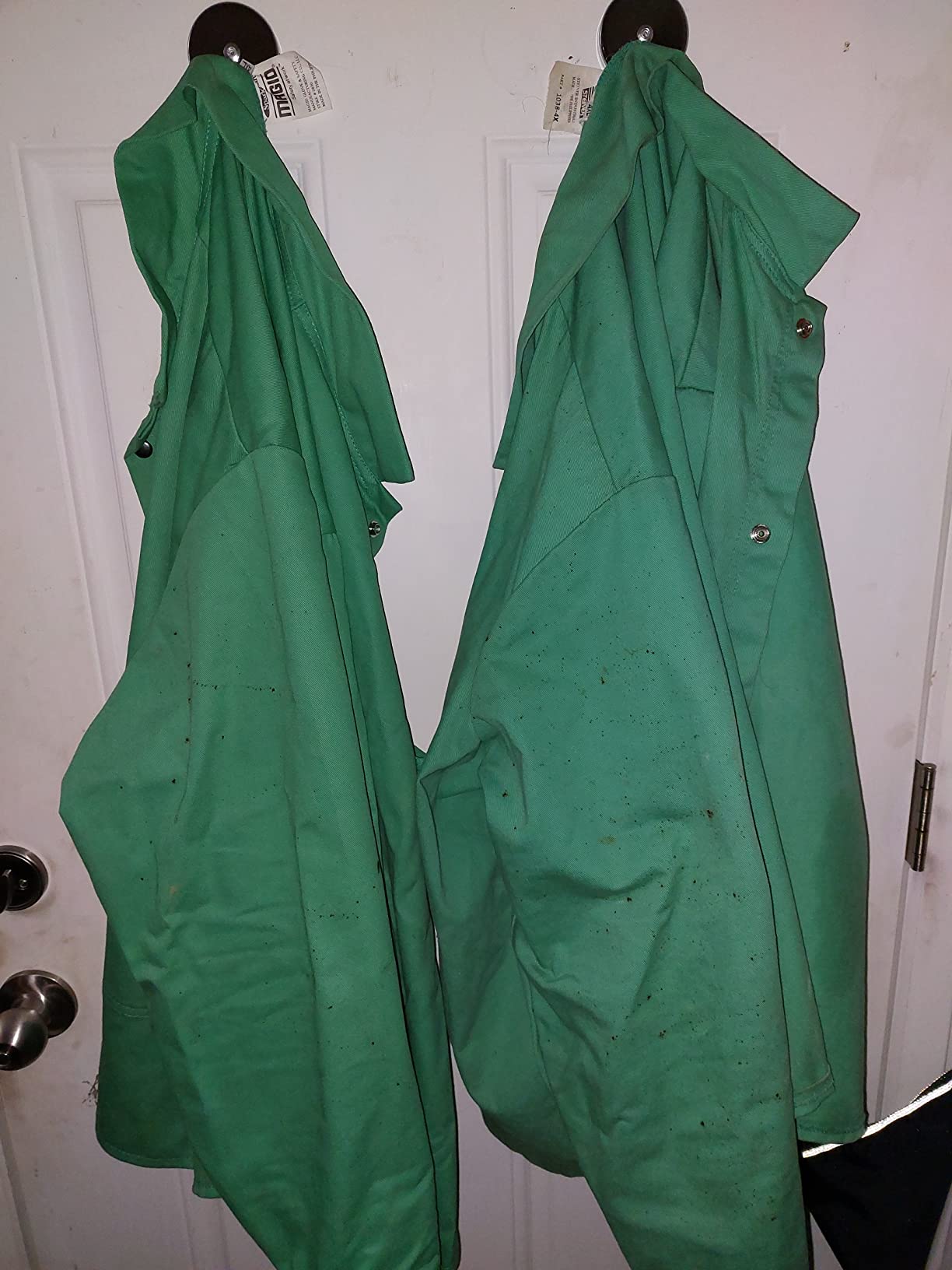
Construction details are proper: leather-reinforced non-reflective metal snaps, a riveted inside left breast pocket, and set-in snap-closure sleeves that close the wrist gap so spatter cannot roll down a forearm. The snaps are non-reflective, which is a smart choice that stops the jacket throwing arc light back at you.
It is 30 inches long at 1.7 pounds, so it is short and light for a 12 ounce coat. The green is deliberate: supervisors use it to make welders visible on a job site.
The compromises follow from the design. Green shows shop dirt and spatter faster than black, it is hand wash only, there is just one interior pocket, and the lay-down collar gives noticeably less neck protection than the pop-up collars on the Black Stallion and Lincoln models. Owners also note it is not for heavy overhead welding.
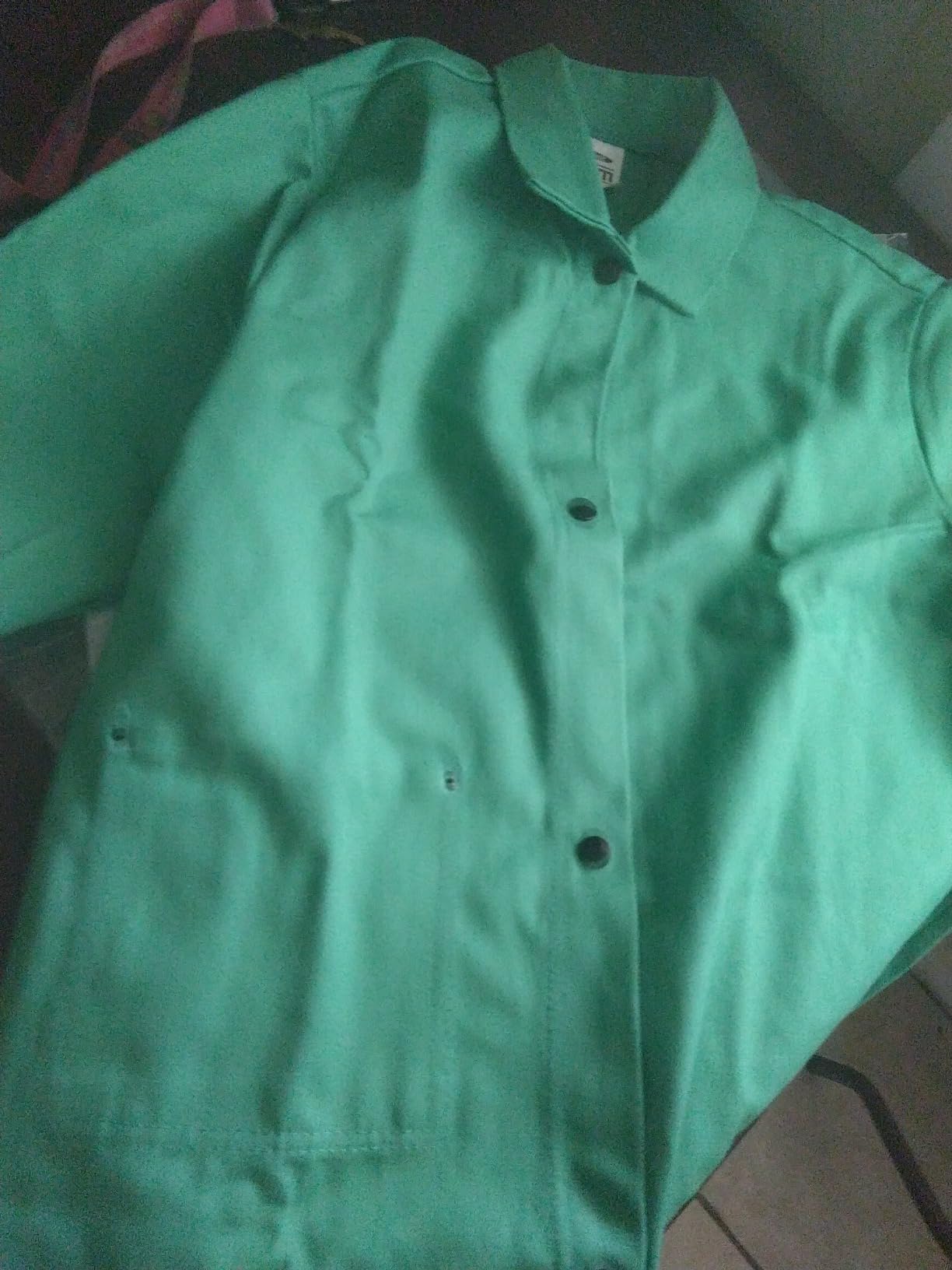
Who this jacket is right for
Best for welders who want more fabric weight than a 9 ounce cotton jacket but do not want the heat of leather. The 12 ounce sateen is the sweet spot for general shop work.
It is also the pick if you work on a crew or in a yard where the supervisor wants welders clearly visible. The green colour is doing a job here, not just decoration.
Who should skip this jacket
Skip it for heavy overhead work. Owners place it firmly in the light-to-moderate category, and 12 ounce cotton is still cotton.
Skip it if you weld a lot with your head down close to the work. The lay-down collar leaves the sides of your neck more exposed than the pop-up or Barracuda collars in this roundup.
Which Bucket Are You In? Weekend, Part-Time Shop or Daily Welder
No competitor covers this, and it is the question that actually determines your purchase. How often you weld matters more than which brand you prefer.
Weekend hobbyist, under 5 hours a month: you are doing occasional repair work, hobby fabrication and TIG on thin material. A 9 ounce FR cotton jacket is genuinely sufficient, and the Black Stallion FN9-30C or the Miller Classic will serve you for years. Do not spend more than you need to on this tier.
Part-time shop welder, 5 to 20 hours a week: you are doing regular MIG, some stick and periodic fab work. You want a proven brand with a good fit and a jacket you can machine wash. The Lincoln Electric K2985 and the Lincoln Electric black cloth jacket both fit this bucket exactly.
Daily welder, 20 hours a week or more: spatter load accumulates and cotton shells start showing burn-through within months. This is where leather or a hybrid stops being optional. The Lincoln Electric K3106 hybrid, the QeeLink full leather or the LeaSeek full leather are the right bucket.
Multi-process learner: if you are running stick, MIG and flux-cored in the same month, buy for the worst process, not the most common one. A training student on r/Welding learned this the expensive way, reporting that a thin jacket left them with arms that were getting burned like no tomorrow during dual-shield work.
One more bucket worth naming: the part-time shop welder who grinds. Grinding destroys cotton jackets far faster than welding does, and the Miller Classic owners report replacement intervals as short as five to six months when grinding is heavy. If grinding is half your time, buy leather.
How to Choose a Welding Jacket: Material, Process and Fit
Five steps, in this order. Work through them and the answer is usually obvious by step two.
1. Pick your process first. Not your brand, not your colour, your process. This single decision removes most of the options. TIG produces almost no spatter. MIG produces moderate spatter. Stick produces more. Flux-cored and dual-shield produce the heaviest and hottest spatter of any common home process.
2. Pick your material to match. Light spatter means FR cotton. Heavy spatter means split cowhide leather or a hybrid. This is the whole material argument, and it is covered properly in the next section.
3. Check the FR rating and the stitching. On cotton, look for an ASTM D6413 compliance statement. On any leather or hybrid, look for Kevlar thread, because ordinary thread fails at the seams before the material fails.
4. Size for layering and movement. If you plan to wear a hoodie or sweatshirt underneath, size up. You also need enough room in the shoulders and chest to reach overhead and out of position, which is why stretch in the back panel matters more than the chest measurement.
5. Look at what is actually inside the pockets. Scribe pockets on the sleeve, a chest pocket, an inside pocket. And check whether the jacket is machine washable, because that single fact changes how you will treat it for years.
Two design choices deserve a mention because home welders ask about them constantly. A detachable-sleeve or open-back jacket trades upper-arm and shoulder protection for airflow, which is a real trade rather than a compromise. If you only do TIG, the airflow is worth it. If you do anything with spatter, it is not.
A cape is the other option. A leather cape with sleeves gives shoulder and arm protection without the torso coverage of a full jacket, and it is a proven pattern that Miller forum users recommend pairing with an FR cotton jacket. It works well, but it is a two-piece system rather than one coat.
FR Cotton vs. Split Cowhide vs. Hybrid: What Each Material Handles
Three materials cover almost every home welding jacket, and the differences are not subtle once you understand how each one fails.
FR cotton is chemically treated so the fabric self-extinguishes. This is the point most people get wrong: cotton itself is flammable, and untreated cotton is a poor choice next to an arc. The treatment changes that behaviour so the fabric chars rather than carrying a flame. The trade-off is weight and spatter resistance, since 9 ounce cotton is light and breathable but thin against molten metal.
Split cowhide leather does not self-extinguish. It chars, and the char layer is itself insulating, so heat stops penetrating the leather. That is why leather is the standard for sustained spatter and out-of-position work. The trade-off is heat on your body, since leather does not breathe and full leather is the warmest option in this roundup.
Full-grain versus split is worth one line. Split leather is the flesh side of the hide, buffed to a suede-like finish. It is lighter, more flexible and cheaper than full grain, and it is what most welding jackets use. Full grain is the stronger outer surface and lasts longer, but it is stiffer and heavier.
Hybrids put leather where spatter lands and FR cotton where heat builds. The arms, shoulders and chest get leather; the torso gets cotton. It is the pattern fabricators use, and the Lincoln Electric K3106 is the cleanest example in this roundup with full leather sleeves.
ATPV, the arc thermal protective value, is the number that tells you how much heat an arc can put through the fabric before it reaches your skin, measured in calories per square centimetre. It is a more meaningful comparison than weight alone, but most consumer jackets do not publish it, so weight and construction details are your practical proxies.
One more material note: on any jacket, check the stitching. Kevlar thread resists heat; ordinary cotton or polyester thread is the weak point and will fail at the seams long before the panels do.
Match the Jacket to Your Welding Process
Spatter load is the variable that decides everything. Here is how it breaks down across the processes a home welder actually runs.
TIG on thin stainless or aluminum produces almost no spatter. The heat reaches you as radiant heat, not as molten droplets, so weight matters more than thickness. This is the one process where a lightweight FR cotton jacket like the Miller Classic is genuinely the right answer, and where a welding shirt would also do the job.
MIG on mild steel produces moderate spatter. Arc-on-plate work throws small hot droplets and stray sparks, and 9 ounce FR cotton handles that well. The Black Stallion FN9-30C and the Lincoln Electric K2985 are built for exactly this range, and the thousands of reviews on both come from people doing this work.
Stick (SMAW) produces more spatter than MIG, and the droplets are hotter because the electrode runs at a higher temperature. Sustained overhead stick is where 9 ounce cotton starts to disappoint, which is why owners of the cotton jackets in this roundup specifically warn against heavy overhead stick work.
Flux-cored and dual-shield produce the heaviest spatter of any common home process. The wire is self-shielded, which means more smoke, more heat and a constant shower of large molten droplets. This is the process in the training story on r/Welding where thin cotton jackets failed. Leather is the only sensible answer here, and the QeeLink and LeaSeek full leather jackets are the right bucket.
Combo work, meaning you switch processes, means you buy for the worst one. The K3106 hybrid with full leather sleeves is the cleanest solution, because it covers MIG, TIG and stick without the heat of a full leather coat.
Out-of-position and overhead work shifts the priority again. Spatter falls onto your shoulders and upper arms, which is why leather on the shoulders and chest matters, and it is why the Revco BXRB9C with its extended length is a good answer for the coverage side of the problem.
Our guides to the best MIG welders for auto body and the best TIG welders for aluminum are worth a look if you are still choosing which process to commit to.
Sizing, Layering and When a Welding Shirt Is Enough
Sizing is where home welders most often get it wrong, and the fix is simple: try it on over what you actually wear underneath.
Most of the cotton jackets in this roundup run true to size or slightly large, so ordering your usual size is reasonable. The leather models are the exception. The QeeLink full leather and the LeaSeek both run small according to their customer data, and the consistent advice is to size up one or two sizes.
Check sleeve length before anything else. A jacket with correct chest and shoulders but short sleeves leaves your inner forearm exposed, which is where most forearm burns happen. The Miller Classic publishes its measurements, with the X-Large at a 54 inch chest, 20 inch shoulders, 34 inch sleeves and 30 inch length, which is worth comparing to a jacket you already own.
On layering, a FR cotton jacket over a cotton hoodie is the common home setup and it works. Avoid layering a synthetic or fleece garment against your skin, because synthetics melt and cotton is what you actually want against your body. A moisture-wicking long sleeve underneath keeps sweat away from your skin without adding much heat.
For reach, test the jacket before you commit. Lift both arms overhead, reach across your body, and crouch the way you would over a real workpiece. If the shoulders pull across your back, it is too small. Most owners describe the Black Stallion FN9-30C as having good stretch for movement, and the K2985 as true to size, and those are the two to try first if fit is your concern.
When is a welding shirt enough? A FR shirt is sufficient for TIG and light bench work where spatter is minimal, and it is what many professional welders wear under a jacket on hot days. A jacket is not optional the moment stick, flux-cored or heavy MIG enters the picture, and it is not optional any time you work out of position.
It is also worth being clear that a jacket is one item in a set. You still need a helmet, gloves and FR trousers, and for overhead work a leather sleeve or a jacket with leather sleeves is the layer that actually stops the burn. Our welding helmet guide covers the other essential piece of that kit.
How to Care For and Wash a Welding Jacket
No competitor in this roundup covers this, and it is the question that determines whether your jacket still works in five years.
Start with what the FR treatment actually is. FR cotton is treated with a chemical that is bonded into the fibre. That treatment is what makes the fabric self-extinguishing, and it is also what a hot wash cycle strips out. This is why jackets rated for 50 washes state that number, and why exceeding it matters.
Machine washable cotton jackets: follow the stated cycle limit. The Black Stallion FN9-30C is rated for 50 washes, and the Lincoln Electric K2985 is rated for up to 50 commercial cycles. Use cold or warm water, a gentle cycle, and a mild detergent. Skip bleach, skip the dryer, and skip dry cleaning entirely, since solvents destroy the treatment.
Hand wash only cotton jackets: the Revco BXRB9C, the Miller Classic and the MAGID SparkGuard are all hand wash only. Cold water, mild soap, and hang it on a hook rather than a hanger so the shoulders do not stretch out over time.
Leather and hybrids: never machine wash leather. Wipe spatter off with a damp cloth, use a leather conditioner every few months to keep the hide supple, and air the jacket out after each session. Leather should never go in a dryer, and a hair dryer on a spatter mark will drive oil into the fibre and stain it permanently.
Two rules apply to everything. Do not dry any welding jacket over a heat source, because the heat damages both the FR treatment and the leather. And do not use bleach on anything, including the cotton, because it strips the finish and weakens the fabric.
For spatter marks specifically, let them cool completely before you touch them. Scraping hot spatter off a jacket damages the surface and, on cotton, thins the fibres.
When to Replace a Welding Jacket and How to Tell
A welding jacket has a finite life, and the failure mode is silent because you get used to the burn-through before you notice it. Here is how to check.
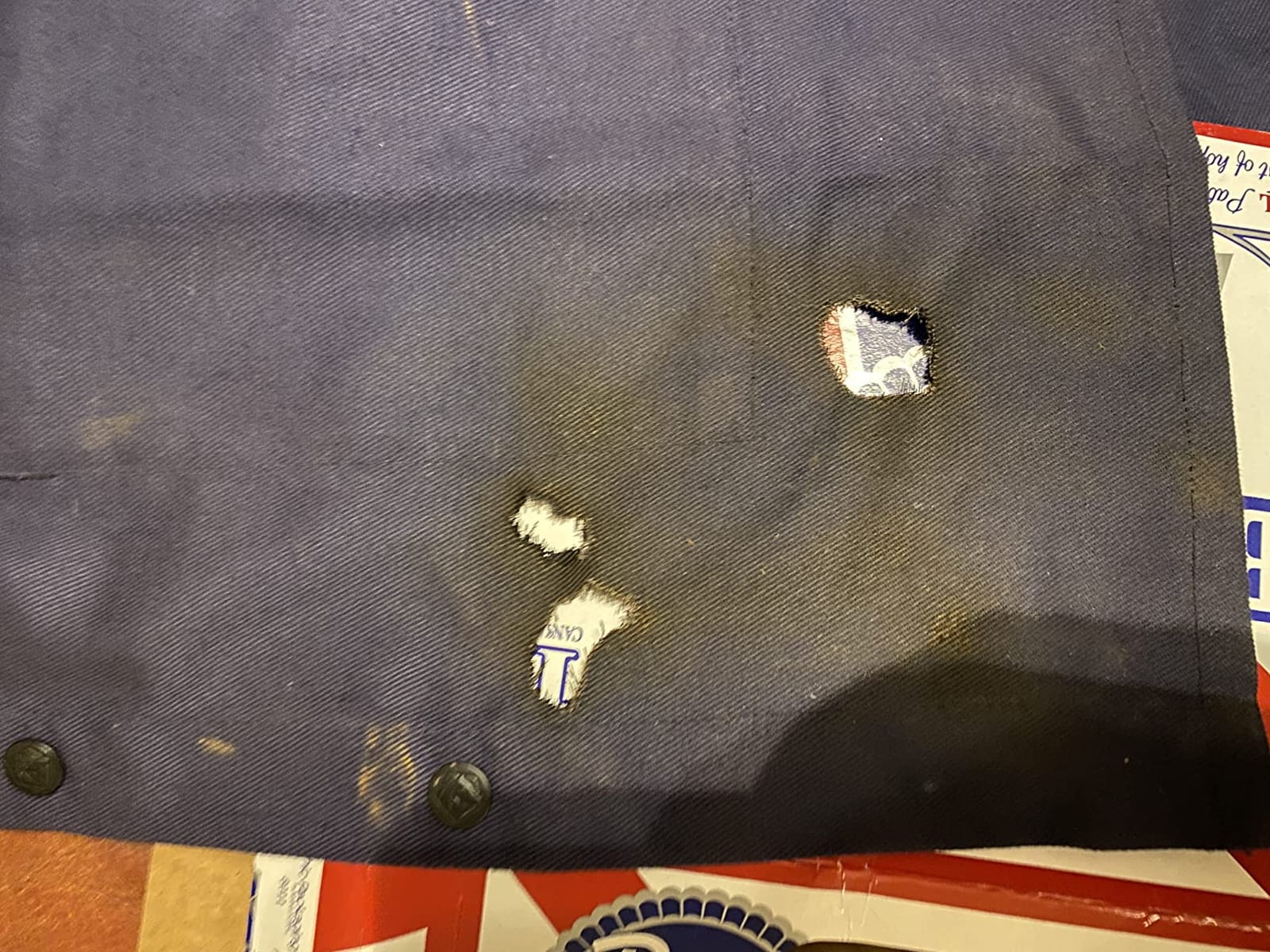
Burn-through marks are the primary signal. If you find small holes, hardened bubbles or thinned spots on the inside surface, the jacket is done. That is exactly the damage the r/Welding training student described getting on their arms, and a burn-through mark is proof the jacket already failed.
Check the inside of the shell, not the outside. Spatter pitting shows up on the interior first. Hold the jacket up to a light and look for thin spots, especially across the chest, the upper arms and the shoulders where spatter lands.
On FR cotton, look at the finish. If the fabric feels waxy, stiff or has gone smooth from washing, the treatment has degraded. Test the shape instead: hold a corner and pull gently, and treat any flaking as a stop-welding signal.
On leather, check the seams and the char layer. Crack the hide at the elbow and shoulder crease, and check that the stitching is still intact. Kevlar thread that has gone brittle or fuzzy has lost its heat resistance, and leather that has hardened to the point of cracking no longer flexes away from heat.
Check the closures. A jacket that will not stay closed is not protecting you. Snaps that will not hold, a Velcro strip that has lost its grip, or a zipper that no longer runs smooth all mean replace rather than repair.
On lifespan: a 9 ounce FR cotton jacket worn a few hours a week in light MIG and TIG work can reasonably last years, while cotton worn daily with heavy grinding has owners reporting replacement at five to six months. A leather jacket with Kevlar stitching is a multi-year purchase if you condition it, and the fabric fails rather than the seams. Judge the jacket you have, not the calendar.
If buying secondhand, inspect all of the above before you put it on. Spatter pitting on the inside, a stiff FR finish, brittle stitching or hardened leather all mean walk away, and a jacket is cheap to replace compared to a forearm burn.
Frequently Asked Questions
What are the best jackets for welding?
The best welding jackets for home welders depend on process and spatter. For light MIG and TIG work, the Black Stallion FN9-30C 9 ounce FR cotton jacket is the top pick. For multi-process work the Lincoln Electric K3106 hybrid, with an FR cotton body and full split cowhide leather sleeves, covers stick, MIG and TIG in one coat. For flux-cored and dual-shield work you need full leather.
What is the best clothing to wear while welding?
Best clothing while welding starts with a flame-resistant jacket, but the jacket is only one layer of a complete set. You also need an auto-darkening welding helmet, welding gloves matched to your process, FR trousers, and leather sleeves or a leather jacket for overhead and out-of-position work. Wear cotton against your skin rather than synthetics, which melt.
What type of welding jacket is best for hot weather?
For hot weather, a lightweight FR cotton jacket is the best answer, and the Miller Classic 9oz Navy cotton jacket is the lightest option at 1.5 pounds. FR cotton is breathable and lighter than any leather jacket, and a lighter colour like navy or green absorbs less sun than black. Welding at night or in a ventilated shop makes the difference even more noticeable.
Should I buy a leather or cotton welding jacket?
Buy FR cotton for light MIG, TIG and fabrication work where spatter is moderate, and buy split cowhide leather for stick, flux-cored and dual-shield work or any out-of-position welding. Leather chars rather than melting and handles sustained molten spatter, but it is much hotter to wear. A hybrid jacket gives leather sleeves with a cooler FR cotton body.
What size welding jacket should I buy?
Buy true to size for most FR cotton jackets, and size up one or two sizes for the leather models, which run small according to customer reports. Check sleeve length above all, since short sleeves leave your inner forearm exposed. If you plan to layer a hoodie underneath, size up. Try the jacket on with arms overhead and crouched before you commit.
Can you wash a welding jacket?
It depends on the jacket. Cotton jackets rated for 50 wash cycles can go through a gentle machine wash on cold or warm water with mild detergent, then hang dry. Never use bleach or the dryer, since both strip the flame-resistant treatment. Jackets marked hand wash only should be cold hand washed. Leather jackets must never be machine washed or heat dried.
How do I know if my welding jacket is still safe?
Turn the jacket inside out and look for burn-through holes, hardened bubbles and thinned spatter pitting, especially across the chest, upper arms and shoulders. On FR cotton, a waxy or stiff finish means the treatment has degraded. On leather, check for cracking at the elbow and shoulder crease and for brittle stitching. Replace rather than repair if the snaps will not hold.
Do I need a welding jacket if I only do TIG?
For light TIG work on thin material, a FR cotton jacket is sufficient and a flame-resistant welding shirt will handle most bench TIG jobs, because TIG produces almost no spatter. Add a jacket as soon as you start welding overhead, work out of position, run stick, or do any grinding alongside your TIG time.
Bottom Line: Which Welding Jacket Should You Buy?
The best welding jackets for home welders come down to one question: how much spatter do you throw, and how often? Get that right and the model choice is easy.
Start with the Black Stallion FN9-30C if you are doing light to moderate MIG and TIG work in a home garage. It has the deepest review history in this roundup, it is machine washable, and it moves well enough for overhead positions.
Step up to the Lincoln Electric K2985 if you want ASTM D6413 compliance, an anti-static coating for aluminum and stainless work, and a true-to-size fit from an established brand.
Move to the Lincoln Electric K3106 the moment you run stick, flux-cored or dual-shield, or the first time a thin jacket lets spatter through. The cotton body keeps you cooler than full leather, and the full leather sleeves cover where the burns actually happen.
Go full leather, either the QeeLink or the LeaSeek, if spatter is constant and heat is a problem you can live with. Add the Revco BXRB9C if your problem is coverage rather than thickness, and the Miller Classic if your problem is heat and you mostly do TIG.
Whatever you pick, check it inside out for burn-through and spatter pitting before every major project, and replace it the day you find one. A jacket is cheap compared to a forearm burn.
You can use the buttons below to check the current listing for any of these. And if you are still building out the garage, our welding table picks for fabricators will get the work clamped down properly.