
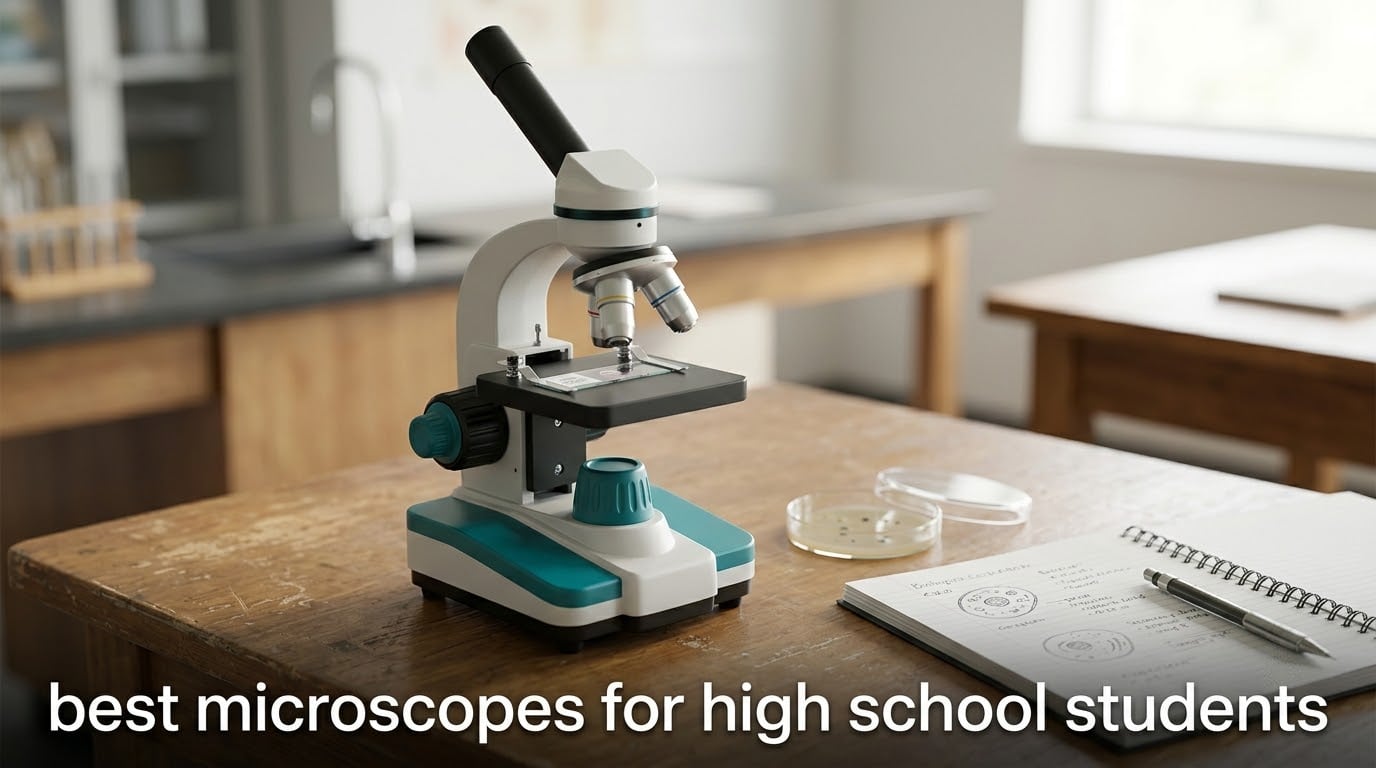
A microscope is the one piece of equipment that turns a high school biology class into something you remember ten years later. Plant cells stop being a diagram and become a wall of moving boxes. Pond water turns into a small ecosystem with Daphnia jerking across the field of view. The right scope makes that happen on the first afternoon, and the wrong one makes a student give up before lab period ends.
That is what this roundup is built around. We compared ten compound microscopes sold for students, weighing them against the actual lessons in a standard high school biology curriculum rather than against the biggest number on the box. Every pick below earns its place by what you can resolve at 400X, how the focus mechanism feels after a full term of use, and whether the stage makes it easy to hold a slide still while you hunt for a cell in mitosis.
If you are starting completely from scratch, our beginner microscope guide covers the shorter version of the same ground. If you already know what a compound scope is and want the curriculum-first version, keep reading. We have ordered these picks by who they serve best, and we have been honest about the ceiling of each one.
Table of Contents
Top 3 Picks for Best Microscopes for High School Students in 2026
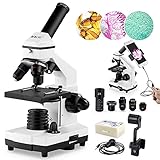
BEBANG 2000X Compound Microscope
- Metal frame
- coaxial coarse and fine focus
- 15 prepared slides
- phone adapter and carrying bag
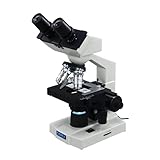
OMAX M82ES Binocular Compound Microscope
- Binocular head with diopter adjustment
- NA1.25 Abbe condenser
- X-Y mechanical stage
- 100X oil immersion objective
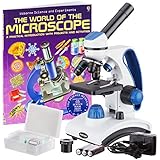
AmScope M162C Student Microscope Kit
- All-metal frame
- dual layer mechanical stage
- 10X and 25X eyepieces
- carrying case and reference book
Best Microscopes for High School Students in 2026
| Product | Specifications | Action |
|---|---|---|
| BEBANG 2000X Compound Microscope |
|
Check Latest Price |
| OMAX M82ES Binocular Compound Microscope |
|
Check Latest Price |
 PalliPartners Compound Microscope Kit PalliPartners Compound Microscope Kit |
|
Check Latest Price |
 AmScope B120C-E1 Binocular Microscope AmScope B120C-E1 Binocular Microscope |
|
Check Latest Price |
| AmScope M162C Student Microscope Kit |
|
Check Latest Price |
 AmScope M158C Rotating Head Microscope AmScope M158C Rotating Head Microscope |
|
Check Latest Price |
 Herwicm Binocular Compound Microscope Herwicm Binocular Compound Microscope |
|
Check Latest Price |
 LaMulaAuto Metal STEM Microscope Kit LaMulaAuto Metal STEM Microscope Kit |
|
Check Latest Price |
 Poothoh Binocular Compound Microscope Poothoh Binocular Compound Microscope |
|
Check Latest Price |
 JECONE 2500X Student Microscope JECONE 2500X Student Microscope |
|
Check Latest Price |
1. BEBANG 2000X Compound Microscope – The Best All-Round Student Scope
2000X Compound Microscope for Kids Adults: Microscope for Biology Education
Metal frame
4X/10X/40X achromatic objectives
WF25X eyepiece
15 slides
Pros
- Highest review volume in this group with 2909 ratings
- Solid metal frame with coaxial coarse and fine focus
- Dual top and bottom LED with a 0.65 NA condenser
- Bundle includes 15 slides a phone adapter tweezers and a carrying bag
Cons
- Monocular head allows only one viewer at a time
- Printed settings above 400X add zoom more than detail
- Large accessory pile can distract from actual observation
The BEBANG is the scope I hand to a student who has never used a real microscope before. It has the three things that matter and almost nothing that distracts: a solid metal frame, coarse and fine focus on the same axis, and light coming from both above and below the stage. That combination covers opaque objects like coins and fabric, and translucent prepared slides, without any fiddling.
Our top pick is also the most widely reviewed instrument in this group, with 2909 ratings averaging 4.3 stars. Six printed settings from 100X to 2000X come from 4X, 10X, and 40X achromatic objectives paired with a WF25X eyepiece and a 2X lens. In practice, the 400X view is where the real detail sits.
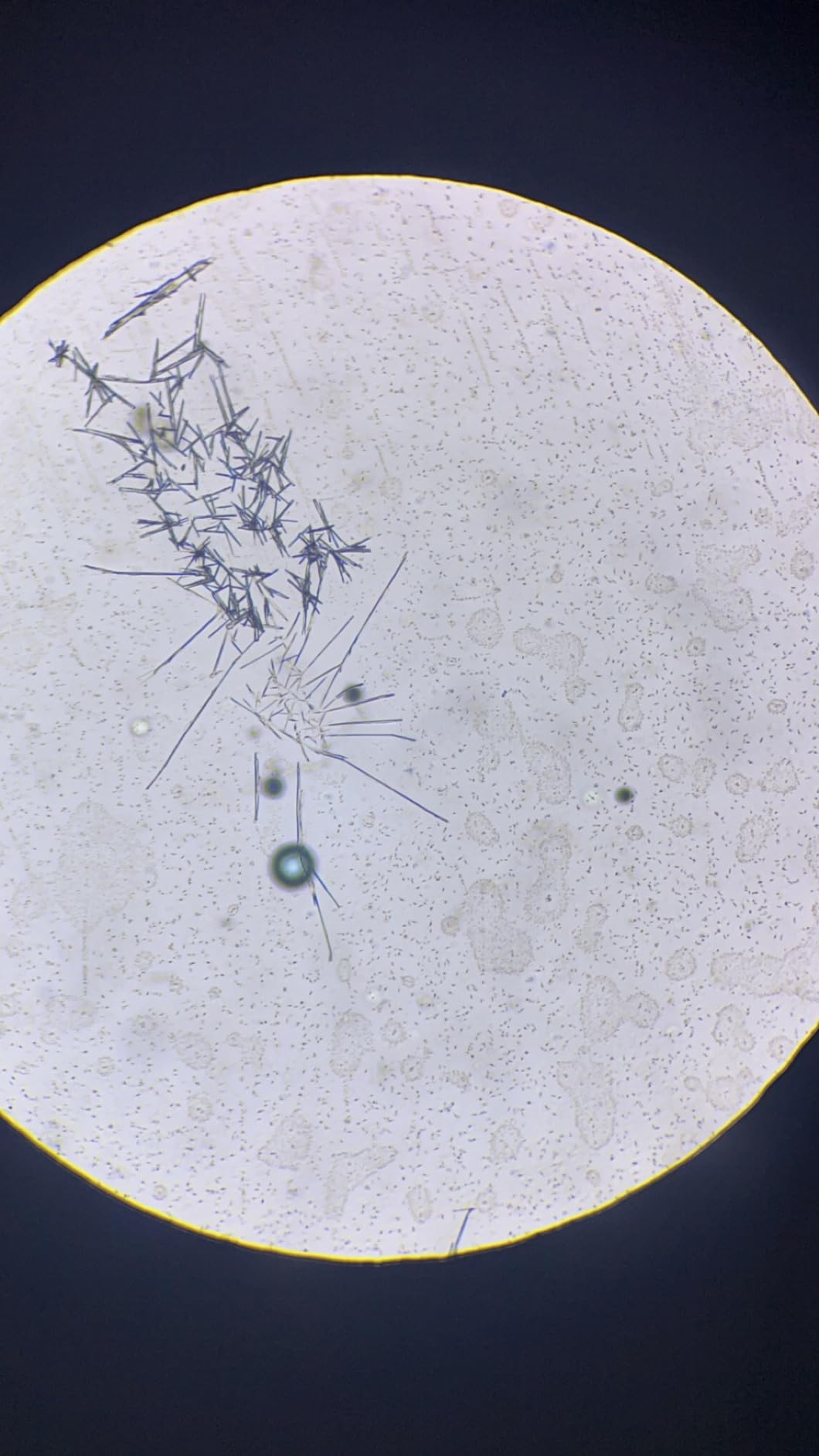
Buyers consistently point at three things: the metal frame survives being knocked on a desk, the fine focus knob is tight enough to bring a cell into sharp relief, and the box contains enough slides that a student can start on day one. The 0.65 NA condenser with a disc diaphragm sharpens transmitted light more than scopes without a condenser opening manage.
The honest limit is the eyepiece. A single monocular head means one viewer at a time, so two people cannot share the image the way they can on a binocular scope. And the jump from 400X to 2000X is almost entirely the 2X lens and the 25X eyepiece enlarging an image, not adding information.
Who It Suits and What You Can See
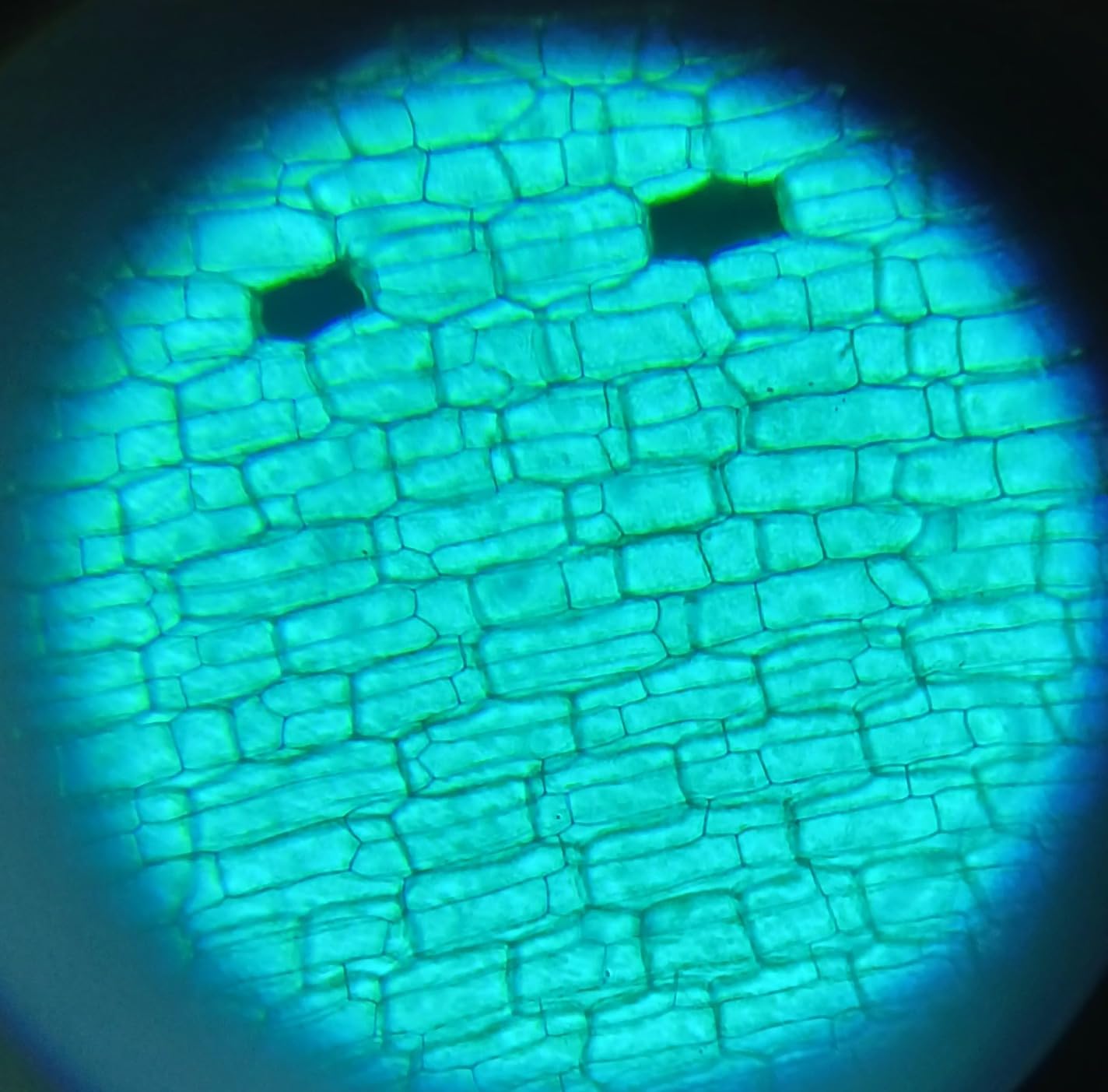
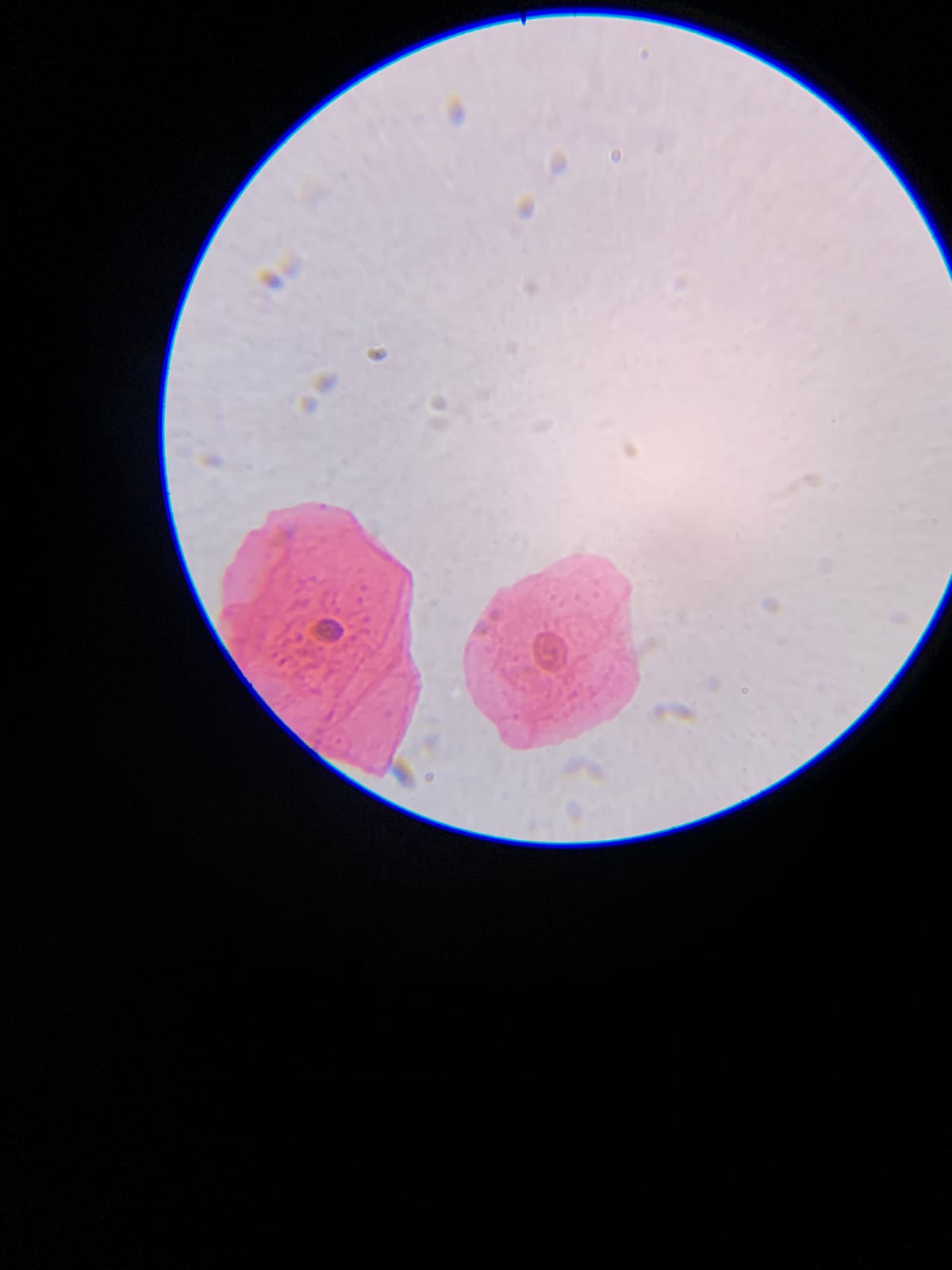
This is the right pick for a first biology course, a homeschool family with more than one child, or a school that wants a durable personal scope for students to sign up for. It handles onion epidermis, cheek cells, pond water wet mounts, Elodea, and a prepared mitosis slide without any configuration changes.
Curriculum fit: any general biology unit, a lab on plant and animal cells, and a microscopy basics assignment. It covers the first two years of high school science comfortably and needs no accessories to get started, which is why the slide bundle matters here more than it would on a bare instrument.
Where It Falls Short
It is not the scope for a student whose main assignment is photographing everything for a lab portfolio, since it has no camera port and the phone adapter needs a phone you already own. It is also not ideal for AP Biology oil immersion work, because there is no 100X oil objective in the turret.
Expect to spend your first session learning the focus knobs. There is no stage control beyond clips, so a small Daphnia will drift out of the field before you finish adjusting. That is normal for this tier and improves within a session or two.
2. OMAX M82ES Binocular Compound Microscope – The Lab Instrument Upgrade
Awarded Best Compound Microscope 2016 – OMAX 40X-2000X Lab LED Binocular Microscope with Double Layer Mechanical Stage w Blank Slides Covers and Lens Cleaning Paper
Binocular head
NA1.25 Abbe condenser
X-Y mechanical stage
100X oil objective
Pros
- True binocular head with interpupillary and diopter adjustment lets two students view together
- NA1.25 Abbe condenser with iris diaphragm and adjustable LED
- Double layer X-Y mechanical stage with scales and a stage lock
- Full DIN achromatic set including a 100X oil immersion objective
- Five year warranty with 100 slides 100 cover slips and lens paper included
Cons
- At 9.6 pounds it is heavy to move between benches
- 2000X needs correct oil immersion technique
- No camera or phone adapter included
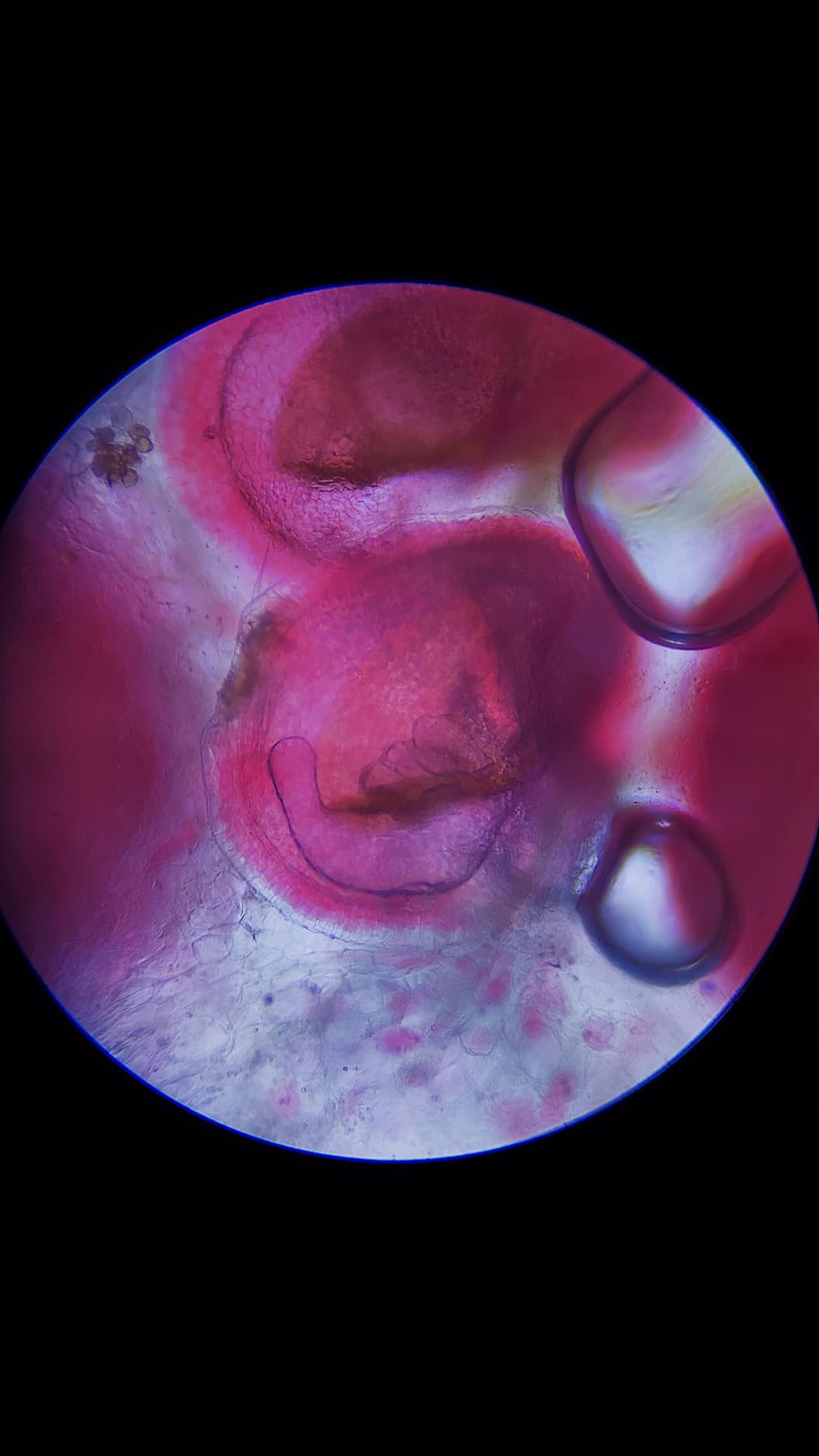
When a student moves from a home scope to this one, the first reaction is usually about the stage. The double layer X-Y mechanical stage with printed scales moves a slide in two directions under your control, so you can centre a cell and walk away without it drifting. On a clip-only stage that is a ten-minute fight every time.
This is a real binocular head with a sliding interpupillary distance of 55 to 75 millimeters and diopter adjustment on both tubes. Two students can look at the same slide at once, which is exactly the situation a family with two curious kids ends up in. The 45-degree inclined head also swivels through 360 degrees, so it can face a seated viewer rather than forcing anyone to hunch over a bench.
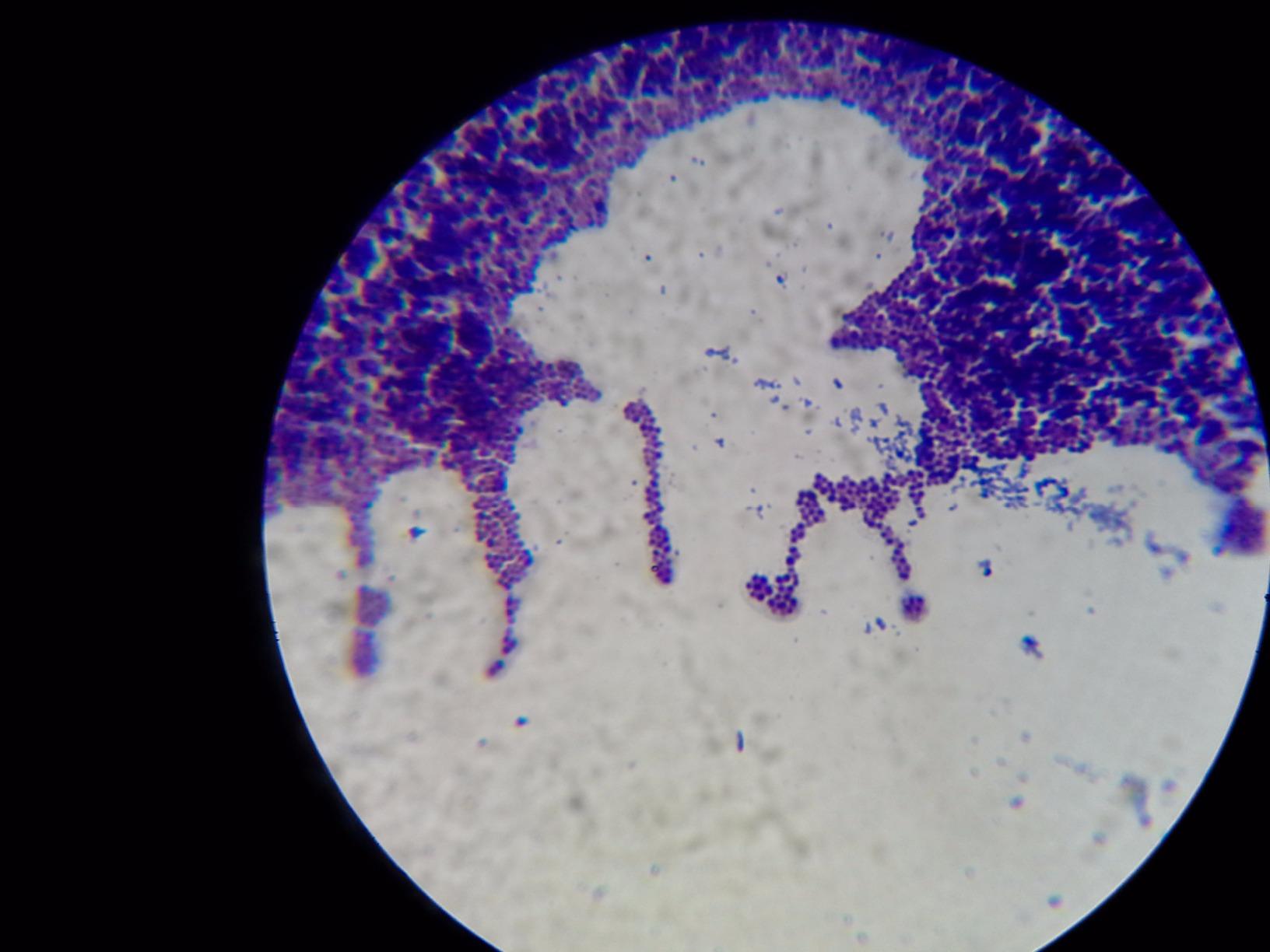
Optically, the DIN achromatic 4X, 10X, 40X, and 100X oil objectives with a NA1.25 Abbe condenser and iris diaphragm give even illumination and real condenser control in this group. WF10X and WF20X eyepieces are included. Ratings sit at 4.4 stars from 2112 reviews, with a high share of five-star ratings, and a five-year manufacturer warranty backs the instrument.
The included consumables matter more than they look. A hundred blank slides, a hundred cover slips, and fifty sheets of lens cleaning paper cover most of a school year without a second purchase, which partly offsets the difference between this scope and a student kit.
Who It Suits and What You Can See
This is the scope to buy when a student is heading into AP Biology or a college-bound independent study, because the 100X oil objective and the Abbe condenser are what make 1000X worth having. It also suits a family sharing one instrument between two children, and a classroom where students rotate through a single scope.
Curriculum fit: AP Biology cellular energetics and mitosis labs, a college preview microbiology course, and any unit where a mechanical stage makes counting or measuring cells realistic. It is genuinely capable of 1000X detail rather than 1000X zoom.
Where It Falls Short
At 9.6 pounds, this is a full-size instrument and not something a nine-year-old carries around comfortably. Oil immersion is genuinely difficult the first few times: getting the right drop, the right angle, and the right focus without touching the lens with the oil takes practice, and a beginner may abandon that power before mastering it.
There is no camera included, so lab report photography needs a separate purchase. If photo documentation is the main goal, a scope with a bundled camera is a better fit even if the optics are a step down.
3. PalliPartners Compound Microscope Kit – The Kit That Starts Immediately
PalliPartners Compound Microscope for Adults & Students, White
28 slides included
Dual LED lighting
Coaxial focus
1.65 kg body
Pros
- Includes 28 slides a phone clip a Bluetooth shutter and a power adapter
- Top and bottom LEDs handle both opaque objects and translucent slides
- Coaxial coarse and fine focus is a step up from basic single knobs
- Light at 1.65 kg so a younger student can move it
- SGS certified for non-toxic materials and electrical safety
Cons
- No movable stage so finding a specimen is slow
- Objective lenses can wobble in the housing if knocked
- Instructions explain the parts poorly
- Higher settings add zoom more than resolving detail
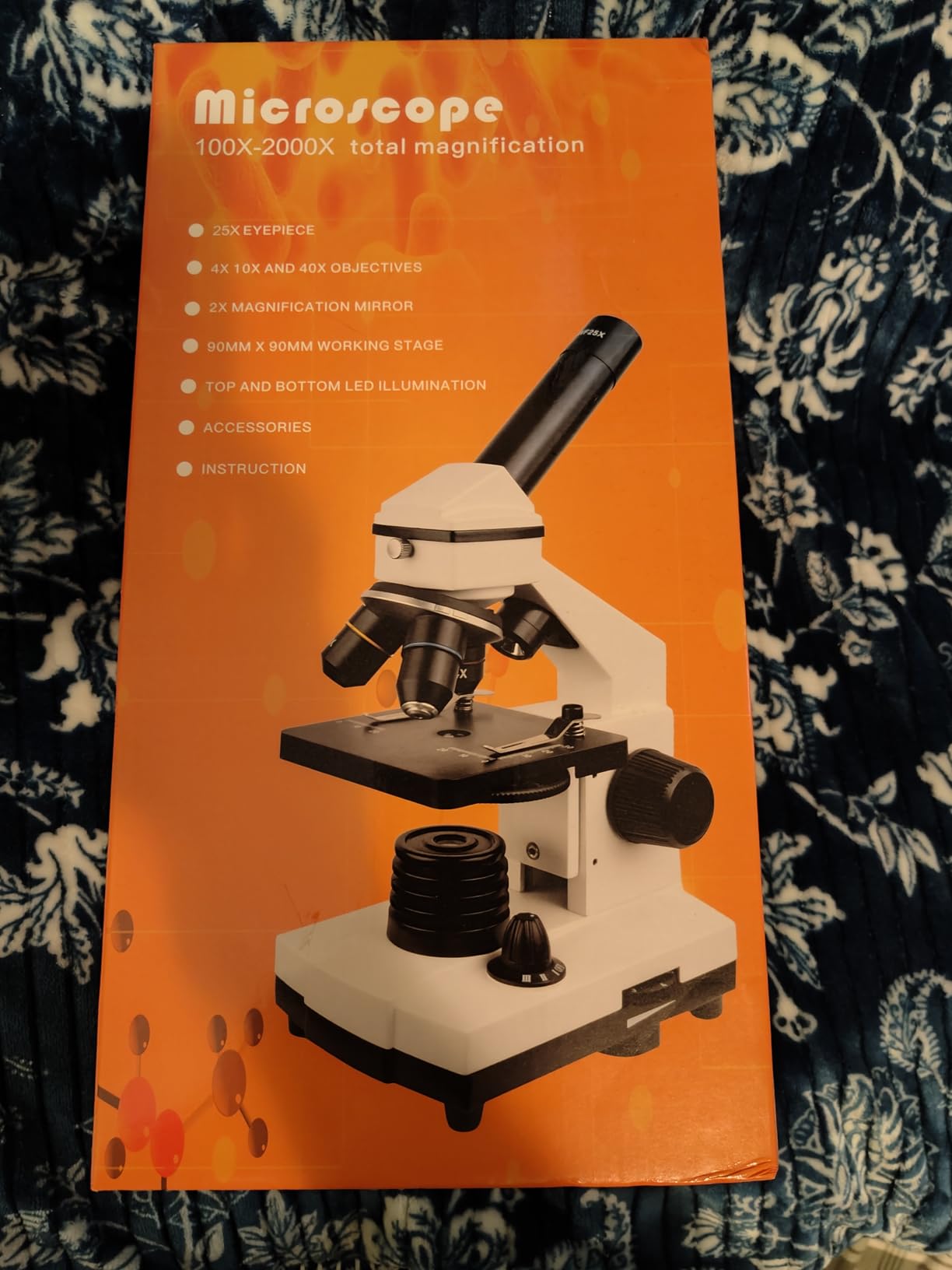
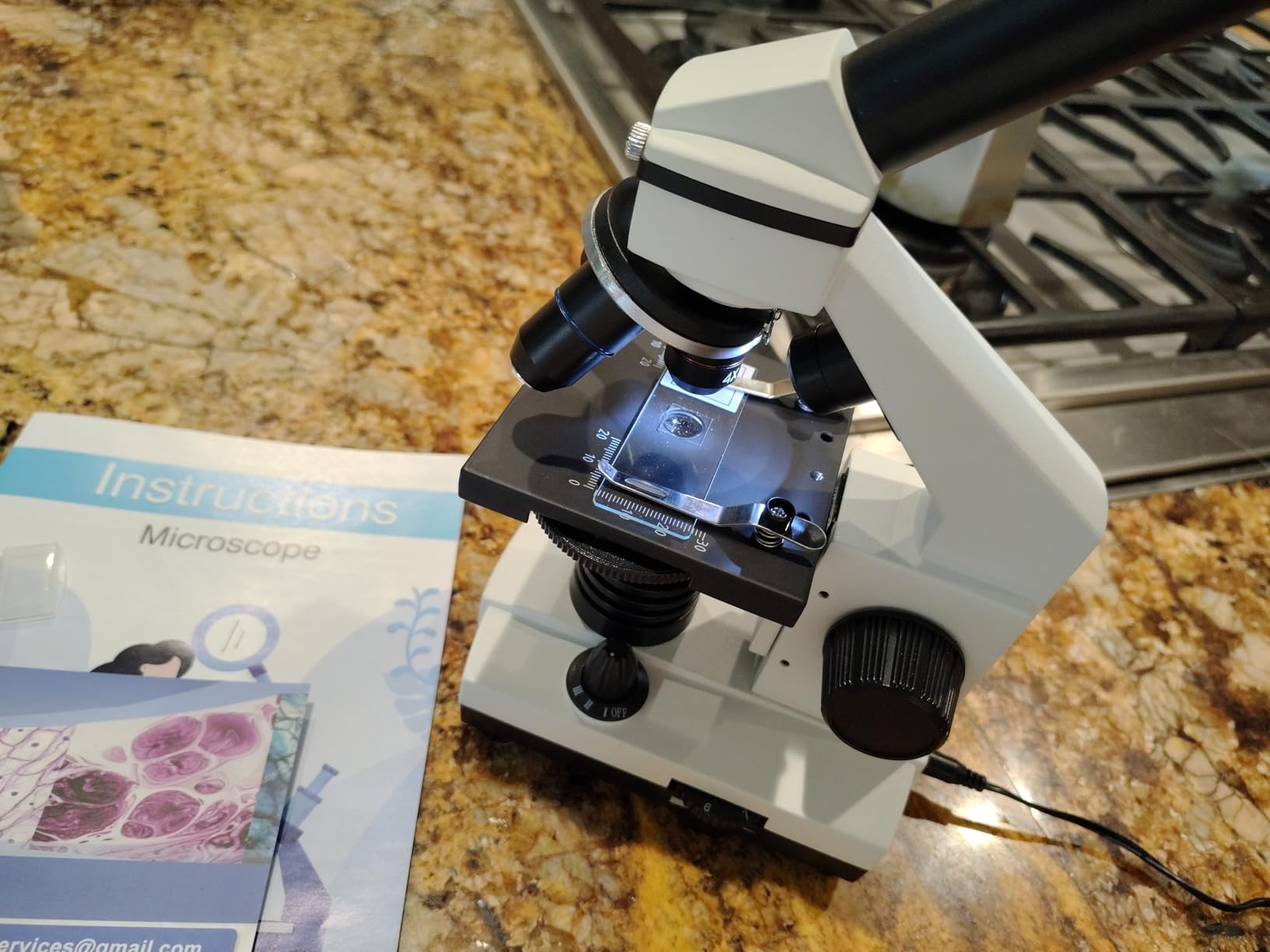
This is the kit version of the same idea, and for a student who wants to start looking at things tonight, the box is hard to argue with. Ten prepared slides, eighteen blank slides, a phone clip adapter, a Bluetooth remote shutter, and a power adapter are all in the carton. Nothing has to be bought before the first session.
The scope is built around 4X, 10X, and 40X objectives with a WF25X eyepiece and a 2X lens, giving printed settings from 100X to 2000X. Coaxial coarse and fine focus means one knob pair does both jobs, and adjustable top and bottom LEDs let you flip between looking through a slide and lighting an opaque object from above.
At 1.65 kilograms in a polycarbonate and polyethylene body, it is one of the lighter instruments here and easy for a younger student to reposition on a kitchen table. It is SGS certified for non-toxic materials and electrical safety, which matters when it ends up in a bedroom rather than a supervised lab. Ratings are 4.3 stars from 1189 reviews.
Experienced microscope users are more tempered than parents are, and they tend to land on the same two points. The stage does not move, so tracking a moving specimen is genuinely fiddly, and the objectives can develop play in the housing if the scope is carried rather than lifted. A small group of reviewers also questions whether the advertised magnification matches measured performance.
Who It Suits and What You Can See
This fits a family that wants a complete, low-friction introduction, a homeschool co-op sharing one box between families, or a teacher who wants a consumable-complete scope to hand to a student on day one. The bundled prepared slides cover the standard plant, animal, and structure set for a first unit.
Curriculum fit: the introductory biology unit, a cells and tissues lab, and a home science course where making slides comes before analysing them. It handles onion epidermis, cheek cells, and prepared structure slides comfortably at 100X and 400X.
Where It Falls Short
The static stage is the real ceiling. Once a student is hunting for a cell in a root tip slide, or following a Daphnia, a movable stage stops being a nice-to-have. For a student heading into AP Biology, the small bundle and the 40X ceiling become a constraint rather than a bargain.
The included instructions are thin, and experienced users repeatedly report learning the controls from photographs instead. Budget an afternoon of self-teaching, or an hour with an online walkthrough, before the first lab write-up.
4. AmScope B120C-E1 Binocular Microscope – Best for Documented Lab Work
AmScope B120C-E1 LED Binocular Compound Microscope, 40X-2500X
Binocular Siedentopf head
Abbe condenser
Dimmable LED
1.0 MP USB camera
Pros
- Binocular Siedentopf head with adjustable interpupillary distance
- Abbe condenser and dimmable fly-eye LED give bright even light
- Mechanical stage and dual precision focus move smoothly on a sturdy frame
- Includes a USB camera and Windows software for capturing images
- Five year warranty with reportedly fast parts replacement
Cons
- The bundled 1.0 MP camera produces soft low-contrast images
- No eyepiece storage case so spare eyepieces collect dust
- Above 400X images are empty magnification
- No calibration slide included for measuring specimens
The B120C-E1 is the pick when a microscope has to produce evidence, not just an image in the corner of the eye. It comes with a 1.0 MP USB camera and Windows microscopy software, which is the whole point for a student writing a lab report with images in it. Owners with lab experience, including medical diagnostics professionals, single out the optical clarity as closer to professional equipment than the price band suggests.
Optically it is well specified. The binocular Siedentopf head has a fully adjustable interpupillary distance, the Abbe condenser carries a pivoting blue lens, and the fly-eye LED runs on a dimmer for brightness control. A mechanical stage and dual precision focus keep the frame stable with no wobble when you move a slide. It holds a 4.4 rating across 803 reviews.
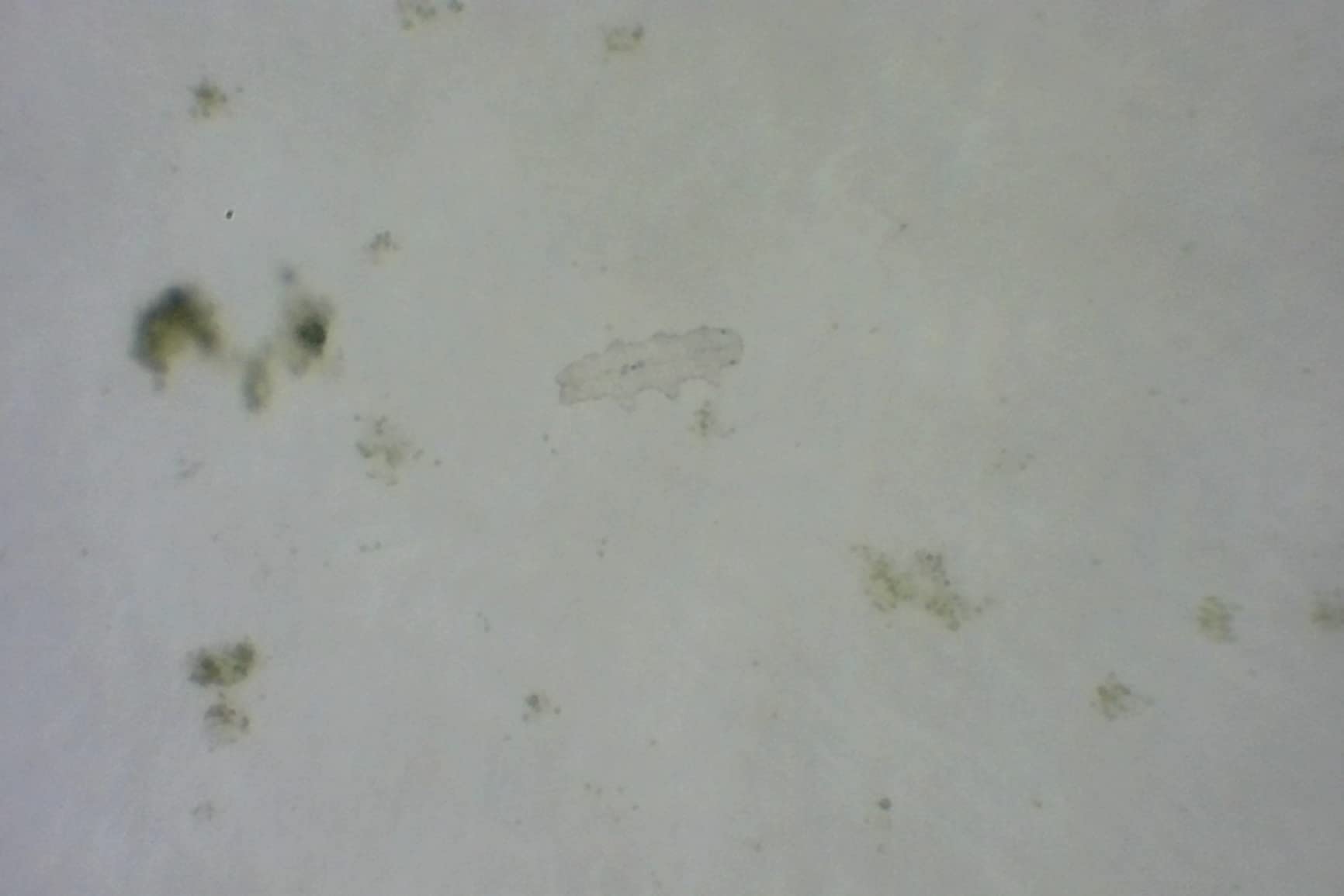
The camera is also the most repeated complaint, and it deserves a straight answer. A 1.0 MP sensor produces images that are adequate for a report illustration and soft for anything else. The same listing family comes in higher sensor versions, so if image quality is the deciding factor, check which camera variant is attached before you buy.
A few owners also report that the mechanical stage knobs cross-talk, meaning a sideways move drifts the focus slightly. It is a minor annoyance rather than a defect, and it settles once a student learns to work in small increments.
Who It Suits and What You Can See
Choose this for a student whose coursework is document-driven: a lab report requirement, a science fair project, an independent study, or a homeschool portfolio. The Abbe condenser with brightness control also makes it a stronger choice than the other binocular models here for stained or thick specimens.
Curriculum fit: AP Biology labs requiring photographic evidence, a cell biology unit with measurement, and any project where the scope has to feed a laptop. It resolves standard specimens well at 100X and 400X.
Where It Falls Short
A microscope for a student who never has to photograph anything is paying for a camera it will not use, and the 1.0 MP sensor is not the strength of the package. A dedicated scope with no bundled camera is the better buy in that case.
The 2500X oil setting is hard to focus and the camera is not designed for that power, so treat the top of the range as unused capability. There is no calibration slide in the box, so any measurement work needs an extra purchase.
5. AmScope M162C Student Microscope Kit – All-Metal Build with a Mechanical Stage
AmScope M162C-2L-PB10-WM “Awarded 2018 Best and Microscope Kit” – 1000X
All-metal frame
40X to 1000X
Mechanical stage
10X and 25X eyepieces
Pros
- Highest rated option at 4.6 stars with 75 percent five star ratings
- All-metal frame and dual layer mechanical stage stay stable in daily use
- A reviewer who taught university biology labs found the 4X and 10X objectives as crisp as far costlier scopes
- Includes 10X and 25X eyepieces a carrying case and a reference book
- Works on prepared slides and opaque objects with front and underside lighting
Cons
- The 40X objective is noticeably less sharp than the 4X and 10X
- No real instruction manual
- Only a few prepared slides included
- No oil immersion objective above 1000X
This kit carries the highest verified rating in the group at 4.6 stars from 591 reviews, and the endorsement behind it is unusual. A reviewer who formerly taught biology labs at a private university found the 4X and 10X objectives comparable to university-grade scopes. That is a specific claim from a specific person, and it is the reason this is rated above scopes with far more reviews.
Construction is all metal through the frame and optical components, with a dual layer mechanical stage driven by coaxial X-Y controls. Six printed settings run from 40X to 1000X. Both a 10X wide field eyepiece with a pointer and a 25X eyepiece are included, along with a carrying case, prepared and blank slides, specimen tools, and a book.
The monocular single eyepiece is easier for a younger student to focus than a binocular head, and the mechanical stage means you can centre a slide properly rather than chasing it under clips. Illumination from the front and underside covers both prepared slides and opaque objects, and the scope accepts optional AmScope digital cameras for documentation.
The recurring criticism is documentation rather than hardware. There is no real instruction manual in the box, and several buyers report learning the controls from listing photographs. The 40X objective is also visibly softer than the 4X and 10X, so the highest practical power here is worth less than the number suggests.
Who It Suits and What You Can See
This suits a student who cares about how the image looks rather than about gadget features, and a family that wants a microscope tough enough to pass down between siblings. The carrying case makes it straightforward to move between a classroom, a library, and a home table.
Curriculum fit: a full general biology year, plant and animal cell units, and any lab where students spend real time at 400X. The pointer eyepiece is a small detail that makes it easy to point at a feature for a group discussion.
Where It Falls Short
1000X is the ceiling with no oil immersion objective, so an AP Biology student working on bacterial or chromosomal detail will need a different instrument eventually. The included book is general background reading rather than setup guidance, so plan on learning the controls yourself.
Only a small number of prepared slides are included, which makes a second consumables order an early purchase. Budget for that when you compare it against kits that arrive with thirty.
6. AmScope M158C Rotating Head Microscope – The Sharing and Camera Hybrid
AmScope Rotating Monocular Compound Microscope, 40X-1000X Magnification
Rotating monocular head
All-metal frame
USB camera
Optical glass lenses
Pros
- Rotating head lets the scope be shared around a table without moving the base
- USB 2.0 camera with stitching video and measurement software
- All-metal frame and condenser feel sturdier than plastic body scopes
- Runs on outlet power or batteries so it is flexible away from a bench
- Software was written for middle and high school students
Cons
- 640x480 camera resolution is low by modern standards
- Monocular head means one viewer at a time
- Single lens condenser and 6-hole diaphragm are simple
- Some software features are Windows only
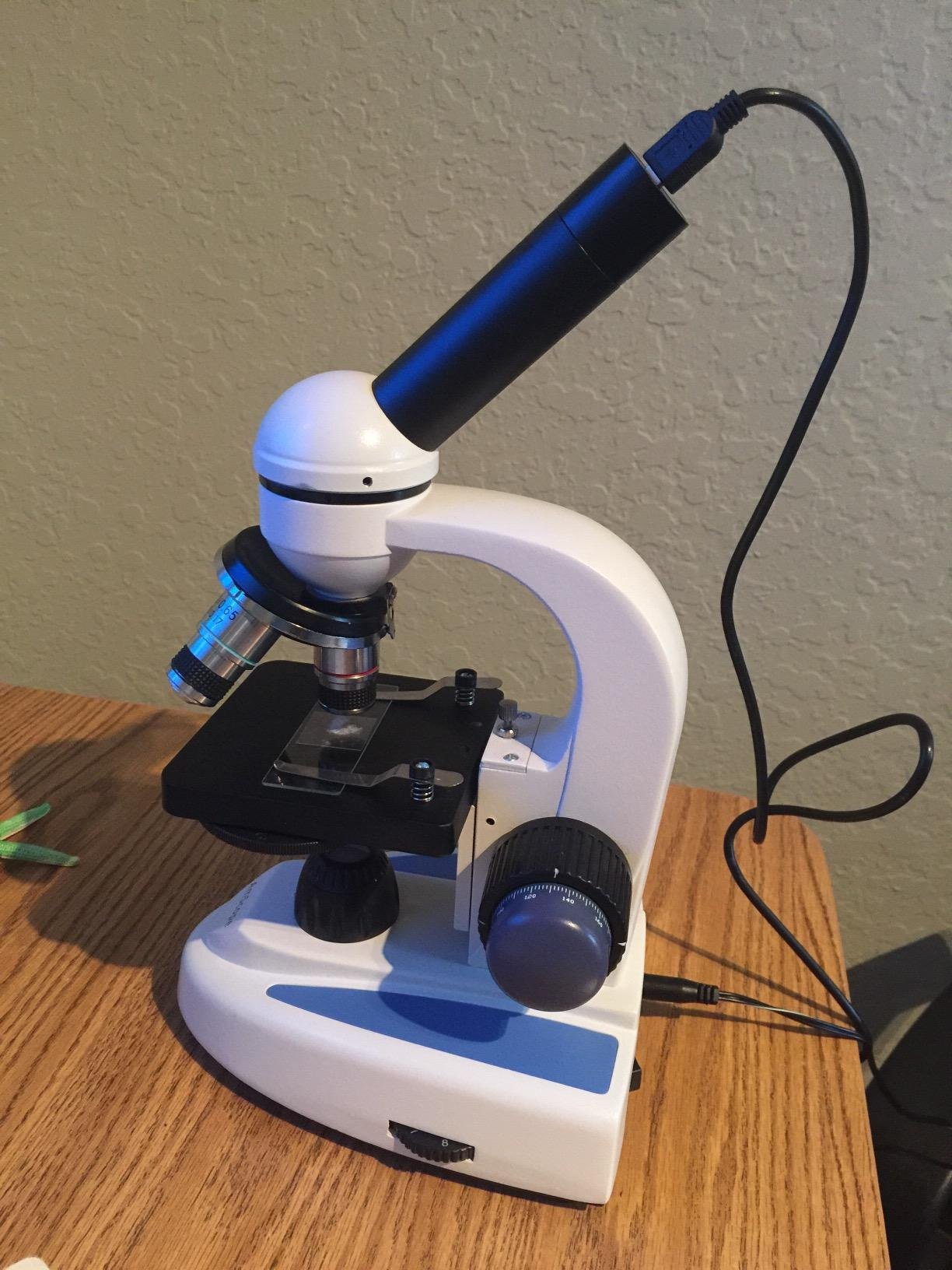
The M158C is interesting for one specific reason: the head rotates through a full 360 degrees. On a fixed monocular scope, only one position in the room sees the eyepiece comfortably. On this one, the instrument turns to face whoever is looking, which makes passing a specimen around a family table or a classroom circle much less awkward.
It also bundles a USB 2.0 camera at 640×480 with software that includes stitching, extended depth of field, video recording, and measurement. That software was written with middle and high school students in mind, which shows in the interface. A student can capture a field, stitch a mosaic, and measure a cell without installing a research package.
The frame is all metal with an optical glass lens condenser and a 6-hole disc diaphragm, running on outlet power or batteries. Five magnification levels reach 1000X. It holds 4.3 stars from 382 reviews, which is lower volume than the leaders here but consistent feedback about what it does well.
The camera is the weak point, and reviewers say so directly. At 640×480 it is enough for documentation in a report and not enough for image work, and some of the advanced software features assume Windows. The condenser and diaphragm are simple compared with an Abbe condenser with an iris.
Who It Suits and What You Can See
This is the one to pick when a student wants to try computer documentation without committing to a binocular scope and a separate camera, or when several people need to look at one scope in rotation. The battery option also opens up outdoor and garden work on pond water samples.
Curriculum fit: an introductory lab photography assignment, a wetland or pond water unit, and a science fair project where stitched field images matter more than high-power detail.
Where It Falls Short
The 640×480 sensor will disappoint anyone hoping for publication-quality images, and it cannot be upgraded because it is wired rather than ported. If photography is the goal rather than a bonus, spend the difference on a scope with a proper USB port instead.
At 1000X you are into simple condenser optics with a six-hole diaphragm, so contrast control is limited. This is a documentation scope, not a high-power one.
7. Herwicm Binocular Compound Microscope – Wide-Field Eyepieces for Long Sessions
Compound Microscope,40X-2500X ,WF10x and WF25x eyepieces, Dual LED Lighting and Two-Layer Mechanical Stage,Microscope for Adults… ASIN B0CCNZFJ61
Wide-field binocular eyepieces
Dual LED
Mechanical stage
Telescoping objective
Pros
- Wide field binocular eyepieces give a large field of view and less eye fatigue
- Dual top and bottom LED handles opaque and translucent specimens
- Coaxial coarse and fine focus knobs on both sides of the base
- Large two layer mechanical stage with a spiral moving scale
- Auto telescoping objective reduces the chance of crashing a lens into a slide
Cons
- Sits above simpler monocular scopes with similar magnification claims
- Body and stage mix plastic with metal and feel less rigid
- Listing imagery suggests three eyepieces while only two are included
- Owners report a learning curve before the adjustments feel usable
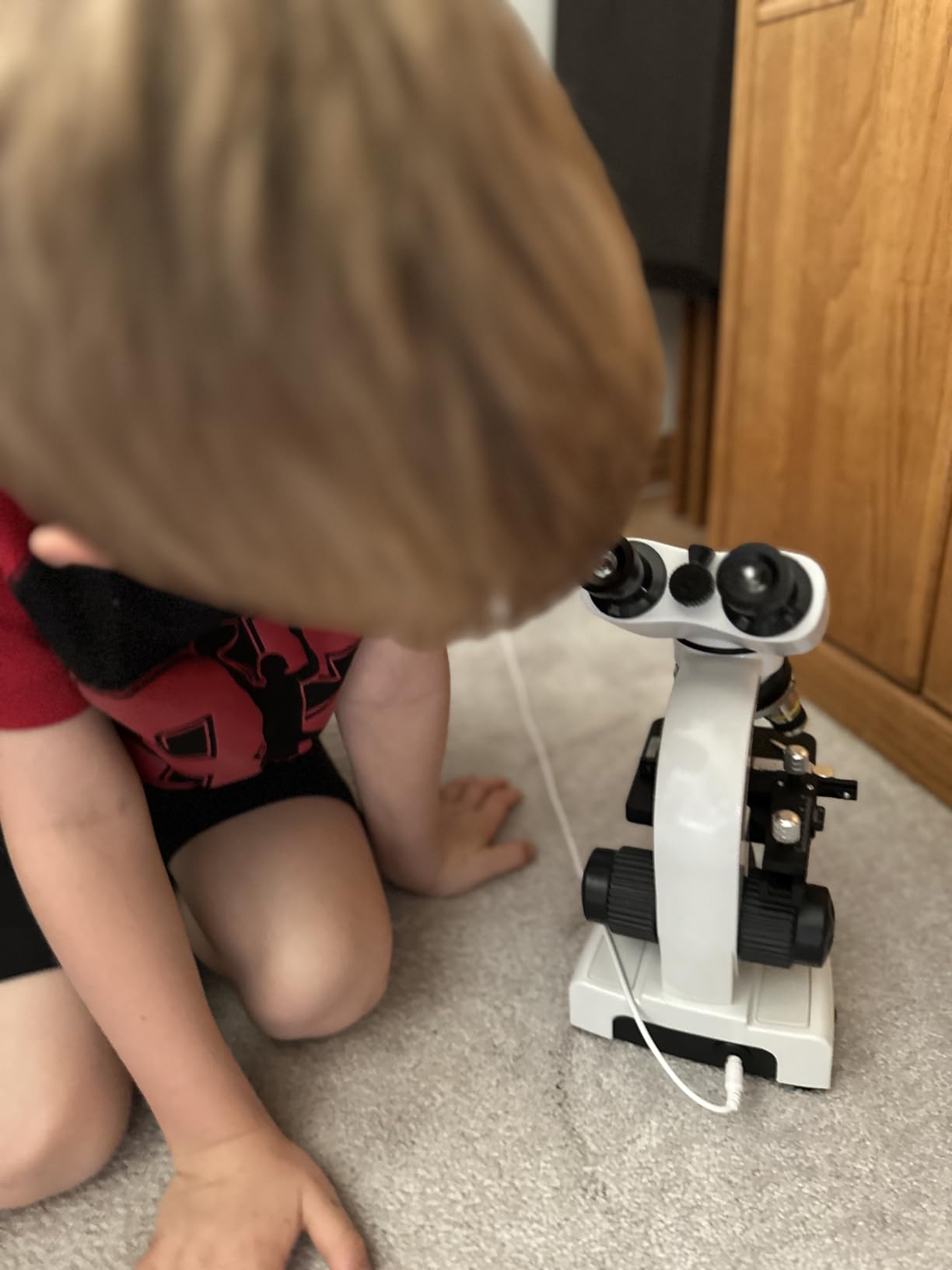
Comfort is the argument here. The all-optical ultra wide angle binocular eyepieces produce a large field of view, which means you find your specimen faster and strain your eyes less while drawing it. Buyers who put in long study sessions specifically single this out as the reason the microscope is not tiring to use.
The stage is unusually capable for the tier. A large two layer mechanical stage with a spiral moving scale lets you move a slide in two dimensions, and coaxial coarse and fine knobs sit on both sides of the base so you can focus with either hand. Dual top and bottom LED lighting with an integrated soft fill handles both translucent and opaque work, and the head sits at a 45-degree viewing angle.
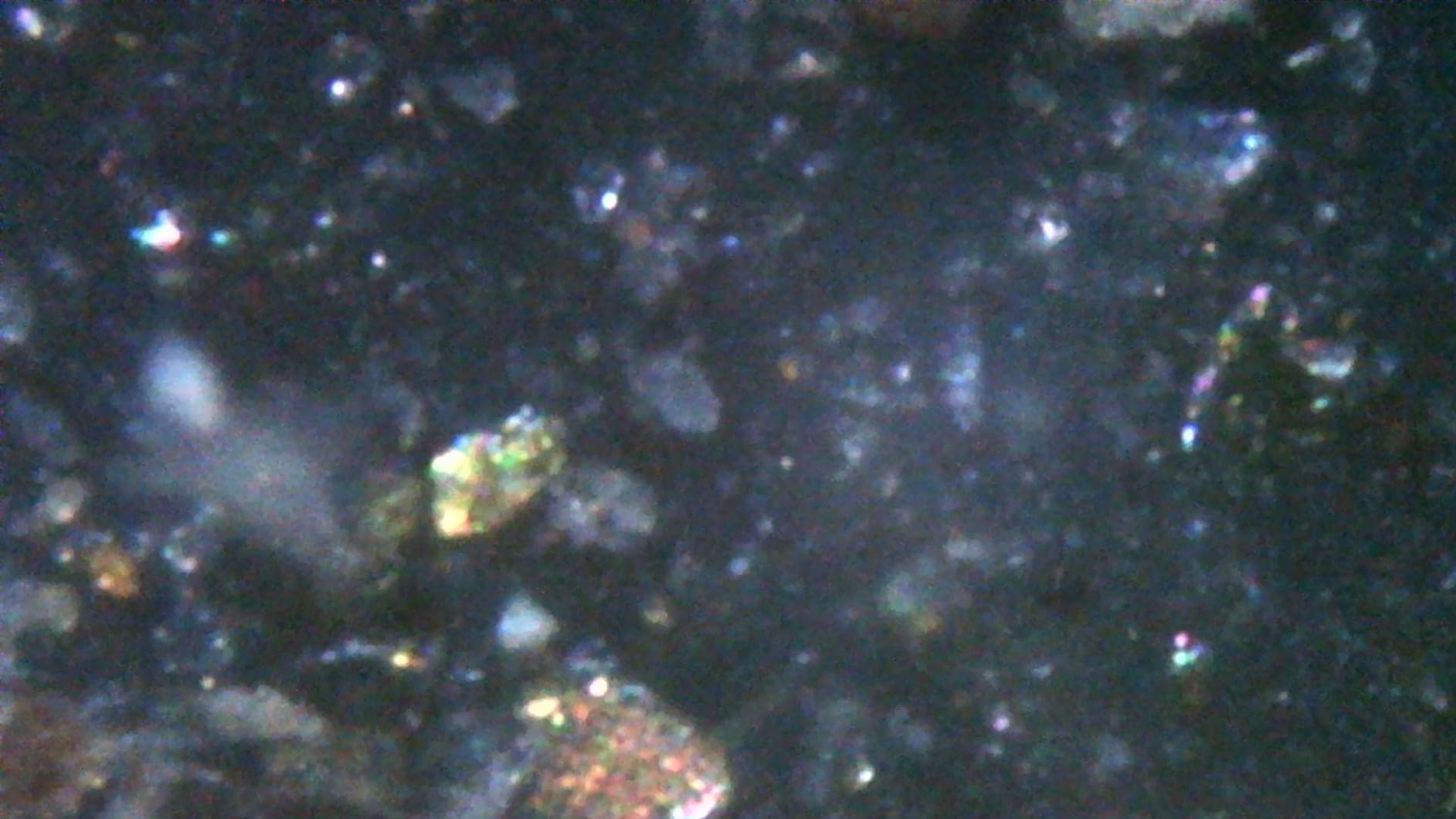
The auto telescoping objective is a small engineering touch that matters more than it sounds. The lens assembly extends above the slide and retracts as you focus down, so a beginner cannot drive a 40X objective straight into a coverslip and crack it, which protects the most fragile thing a student owns.
Build consistency is the concern. Reviewers report that the body and stage combine plastic with metal, which flexes more than an all-metal frame, and that the listing photography implies three eyepieces when only two are included. The rating is 4.3 stars from 256 reviews, a smaller and less deeply reviewed listing than the market leaders.
Who It Suits and What You Can See
This suits a student who spends long sessions drawing specimens rather than snapping quick looks, and a student with an eye prescription that makes small viewing apertures uncomfortable. The wide field also makes it a good teaching scope, because more people can see the specimen at once around a binocular head.
Curriculum fit: a full general biology year with long identification labs, a botany unit with many slides to work through, and a study session where comfort decides whether you keep going.
Where It Falls Short
It asks more than similar scopes with the same printed magnification, and the flex in the frame is noticeable compared with a metal instrument. The 4X, 10X, and 40X objectives top out at 400X of real power, so the 2500X headline rests on the eyepiece.
Owners also describe a real learning curve on the focus and stage adjustments. Budget time for it, and check the contents carefully on arrival given the reported mismatch between listing imagery and the box.
8. LaMulaAuto Metal STEM Microscope Kit – The Homeschool Pick
Microscope for Adults Students, 100X-2000X Metal STEM Microscope Kit
All-metal frame
Adjustable dual LED
5-color filter disc
360 degree head
Pros
- Metal frame and metal achromatic objectives feel sturdier than plastic kits
- Dual LED illumination covers translucent slides and opaque objects
- 360 degree head lets an adult and child view together
- 38 degree tilting eyepieces reduce eye and neck strain
- A 5-color filter disc adds a real technique students can experiment with
Cons
- LED is not bright enough for some thicker or darker specimens
- Glare in the center of the field can interfere with viewing
- Objective lenses are fiddly to swap for a first-time user
- Settings above 400X add zoom rather than new detail
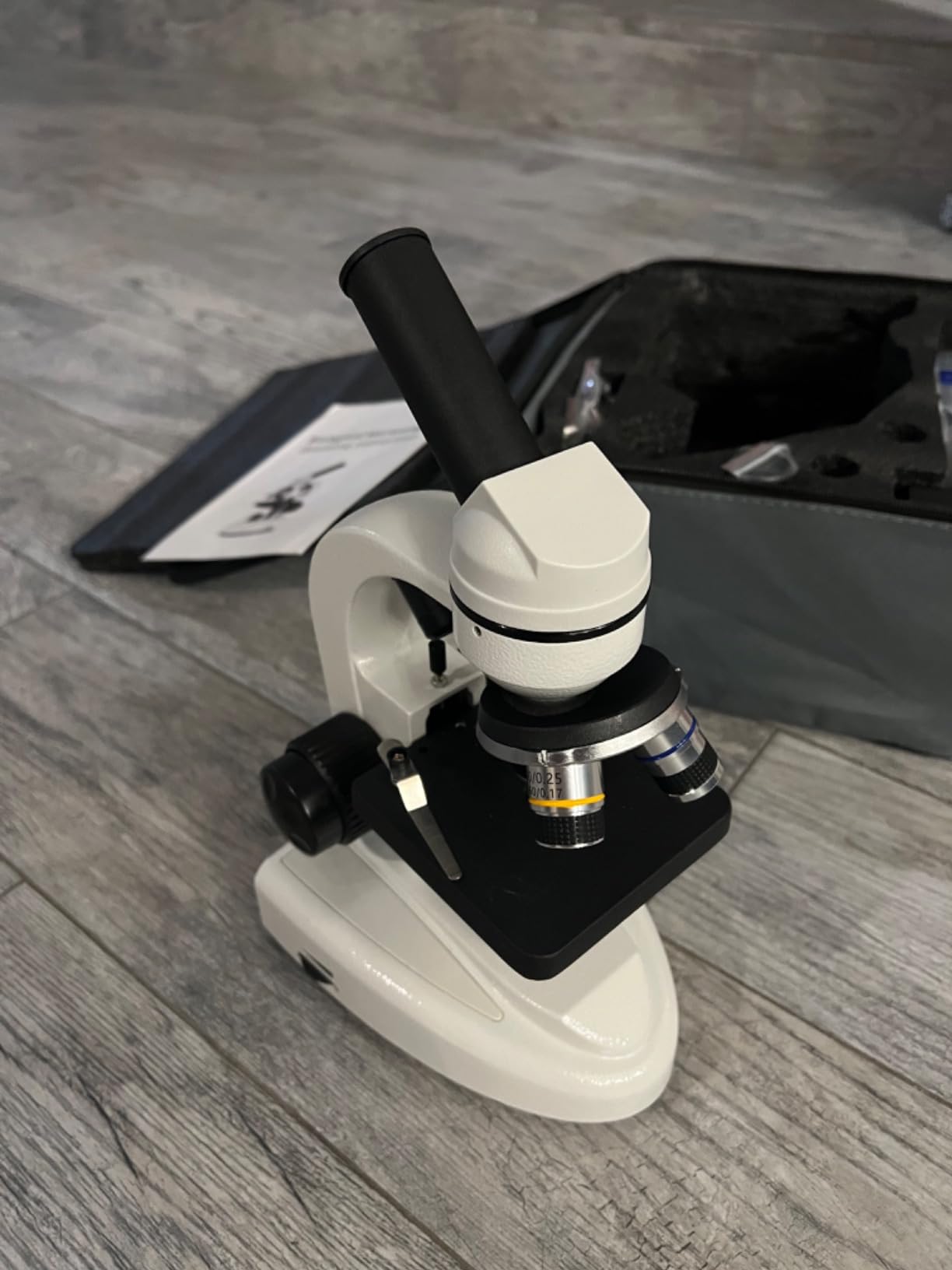
This is the kit that homeschooling families and co-op teachers gravitate to, and the reviews make the reason clear. A solid all-metal frame with sliding metal achromatic objectives survives being passed between several children aged roughly eight to thirteen, which a plastic-bodied kit of the same class often does not. It holds 4.4 stars from 196 reviews.
The 360-degree rotatable head with 38-degree tilting eyepieces is the feature that comes up most. It lets an adult and a child look at the same moment without one of them craning, and the tilt reduces neck strain on a long session. Adjustable dual LED illumination handles both slides and opaque objects like coins or fabric.
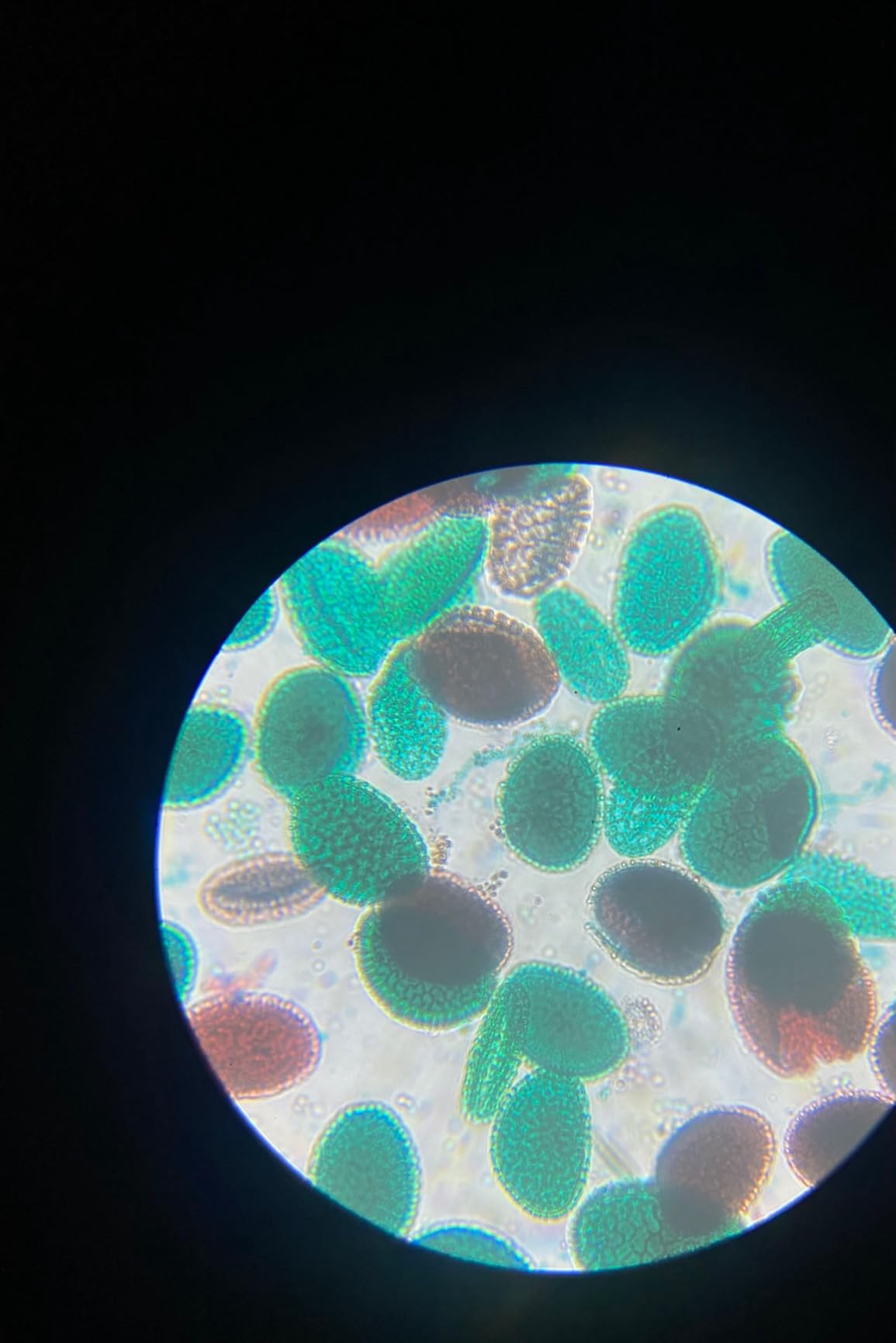
The 5-color filter disc is a genuine technique tool rather than a gimmick. A student can increase contrast, block ambient light, or cut infrared and ultraviolet from a fluorescent light source, which turns the scope into something you experiment with rather than just look through. The kit includes slides, a phone adapter, and a carrying case, and it runs on an included power adapter or three AA batteries.
The consistent weakness is light. Reviewers report that the LEDs are not strong enough for darker or thicker specimens and that glare in the middle of the field gets in the way. That limits it to an introduction to microscopy rather than deeper study, and it is the honest ceiling on this pick.
Who It Suits and What You Can See
It fits a homeschool family sharing one scope across multiple children, a co-op that needs a durable shared instrument, and any student who wants a technique to practise alongside magnification. The battery option means it can go outside for a pond water collection.
Curriculum fit: a home science course, an ecology or pond water unit, and a general biology year with an emphasis on making your own slides. It shows cells and blood smears clearly when the light cooperates.
Where It Falls Short
Weak illumination is not a small problem in a stained or thick specimen, and it is the reason this does not sit higher. Glare in the field centre also means a student may need to close the diaphragm further than expected, which costs light and resolution.
Swapping objective lenses is fiddly for a first-time user, and anything above 400X is eyepiece and Barlow lens magnification rather than extra detail. For oil immersion work, look elsewhere.
9. Poothoh Binocular Compound Microscope – Screen Viewing Without a Separate Camera
Binocular Compound Microscope 40X-2000X, Research Grade Professional Microscope with Dual Mechanical Stages and Coaxial Coarse/Fine Focus Knobs, Built-in Electronic Eyepieces, Adult Microscope
Built-in electronic eyepieces
Dual LED
Filter bar
Coaxial focus
Pros
- Built-in electronic eyepieces show the specimen on a screen without extra hardware
- Dual mechanical stages are unusual at this level and help with shared viewing
- Coaxial focus integrated into one control is smooth and quick
- Dual LED with adjustable brightness covers slides and opaque objects
- Five color filter bar helps with image clarity
Cons
- Lowest average rating here at 4.2 stars with visible quality inconsistency
- PC software for the electronic eyepieces drew reports of antivirus flags
- Some owners report the brightness toggle does not work
- Manual is hard to read and omits basic information
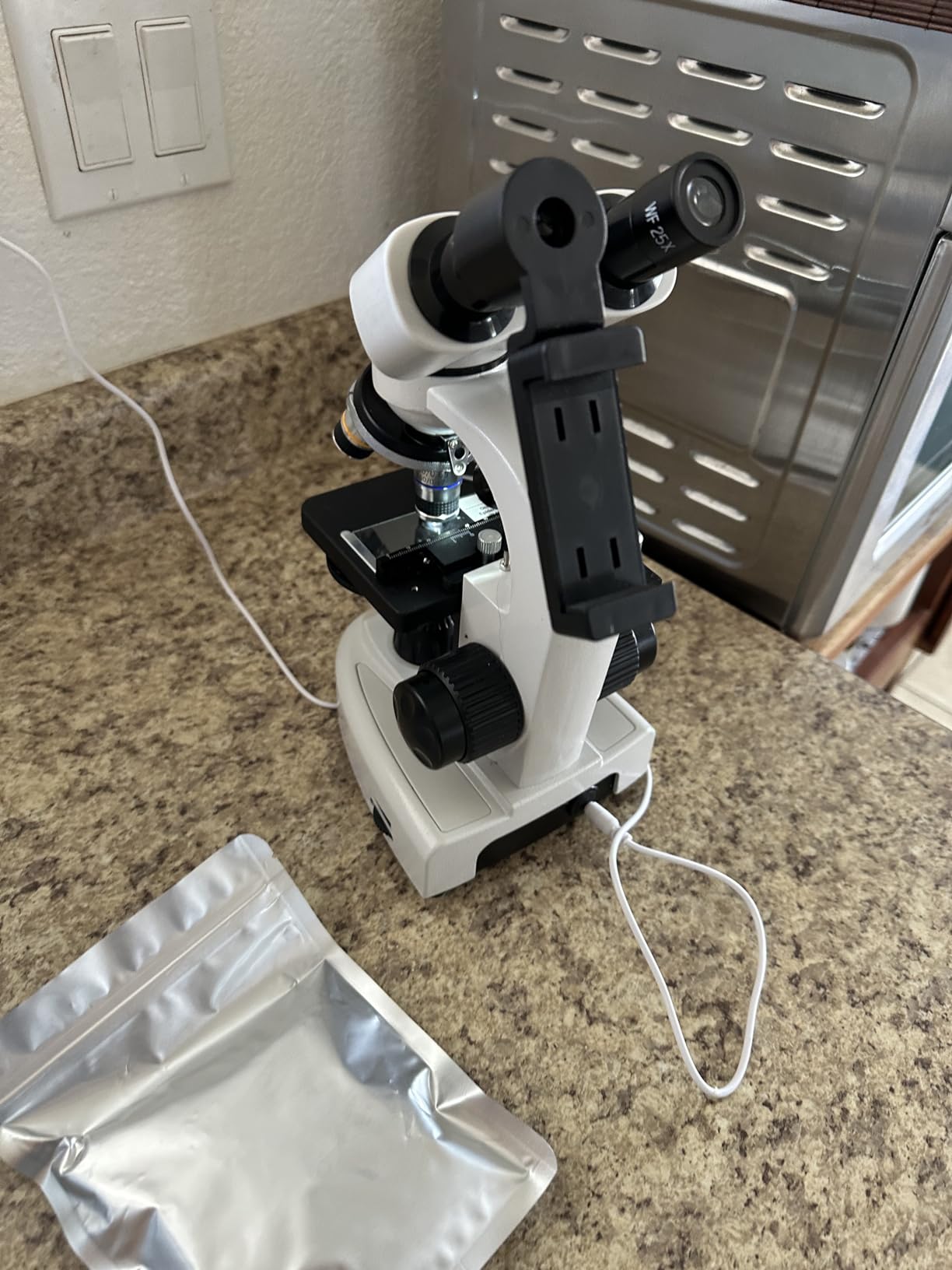
The idea here is a good one: the scope has built-in electronic eyepieces that feed a computer screen, so a whole household or a whole class can look at one specimen together without passing a monocular eyepiece around. For a Chromebook-based home lab, that is a genuinely useful capability, and forum research on school buying repeatedly raises screen sharing as the reason digital or USB scopes get chosen.
The hardware is more ambitious than the price band suggests. A binocular head with dual mechanical stages, coaxial coarse and fine focus integrated into a single handwheel, dual LED lighting with adjustable brightness, and a five-color filter bar intended to compensate for chromatic aberration. Printed magnification reaches 2000X from 4X, 10X, and 40X achromatic objectives.
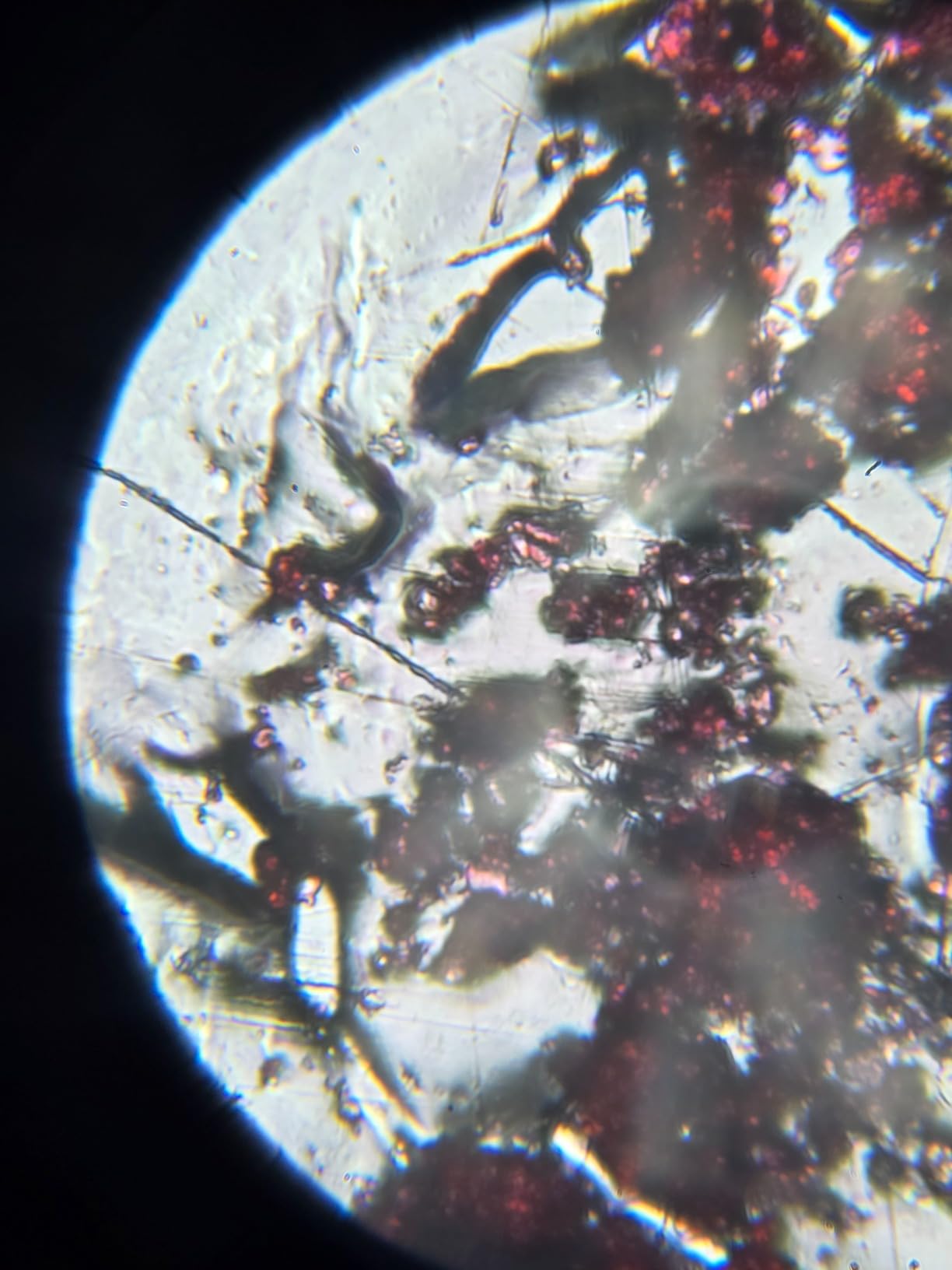
What holds it back is consistency. At 4.2 stars from 169 reviews, this is the lowest rated product in the group, and the reviews split sharply. Some buyers find it well tuned and high quality for the cost, particularly the binocular head and the electronic eyepieces. Others describe it as cheaply made with poor clarity and a lighting toggle that does nothing.
The software is the most polarizing element. Several reviewers report their antivirus flagged the driver or installer outright, which can stop a student cold on a school-managed laptop. One buyer who checked the file independently and installed it reports no problems, so treat this as a warning to verify on your own machine rather than a verdict.
Who It Suits and What You Can See
This suits a family or classroom where one screen needs to show a specimen to several people, and a student who wants to record observations as video or stills without buying a separate camera. The dual mechanical stages help when two people want to control the view separately.
Curriculum fit: a whole-class demonstration unit, a homeschool group sharing one computer, and a first electronics or materials project where seeing the object on a screen matters more than maximum optical detail.
Where It Falls Short
The rating spread is the honest warning here. Within the same listing, some owners describe a well made instrument and others describe clarity problems and a dead brightness switch, so quality control is the first thing to check on arrival.
Install the driver before your first lab rather than the night before. The manual is also hard to read and omits basics, so budget time to set it up with a video walkthrough rather than the paperwork.
10. JECONE 2500X Student Microscope – The Most Even Ratings on a Kit
Microscope for Adults & Kids, 40X-2500X High-Power Compound Microscope for Students, School Lab & Home Schooling,Equiped with Slides Set & Phone Holder (White)
Dual LED with dimmer
5-color filter wheel
4X/10X/100X objectives
1.59 kg
Pros
- Dual incident and transmitted LED with a dimmer covers slides and opaque objects
- A 5-color filter wheel in a rotating disk adds technique without extra purchases
- 360 degree rotating eyepieces make it easy to share the view
- Coarse and fine focus produces sharp detailed images
- Light 1.59 kg metal body with a full accessory kit
- An unusually even spread of 4 and 5 star reviews
Cons
- The 2500X headline overstates what the 100X objective adds beyond eyepiece zoom
- Phone holder needs a phone you already own
- Monocular head allows one viewer at a time
- No mechanical stage so locating a spot on a slide takes patience
The JECONE stands out less for a headline specification than for its review distribution. At 4.4 stars from 221 reviews, it carries a notably even spread, including a meaningful share of four-star ratings, which usually means few buyers feel seriously let down. That is a different signal from a scope with a high average and a long tail of complaints.
Its strongest practical feature is the built-in 5-color filter wheel, a rotating disk with yellow, red, blue, green, and purple filters mounted under the stage. Most scopes at this level offer no contrast control at all. Here a student can experiment with filters, which turns a routine slide into an actual technique lesson.
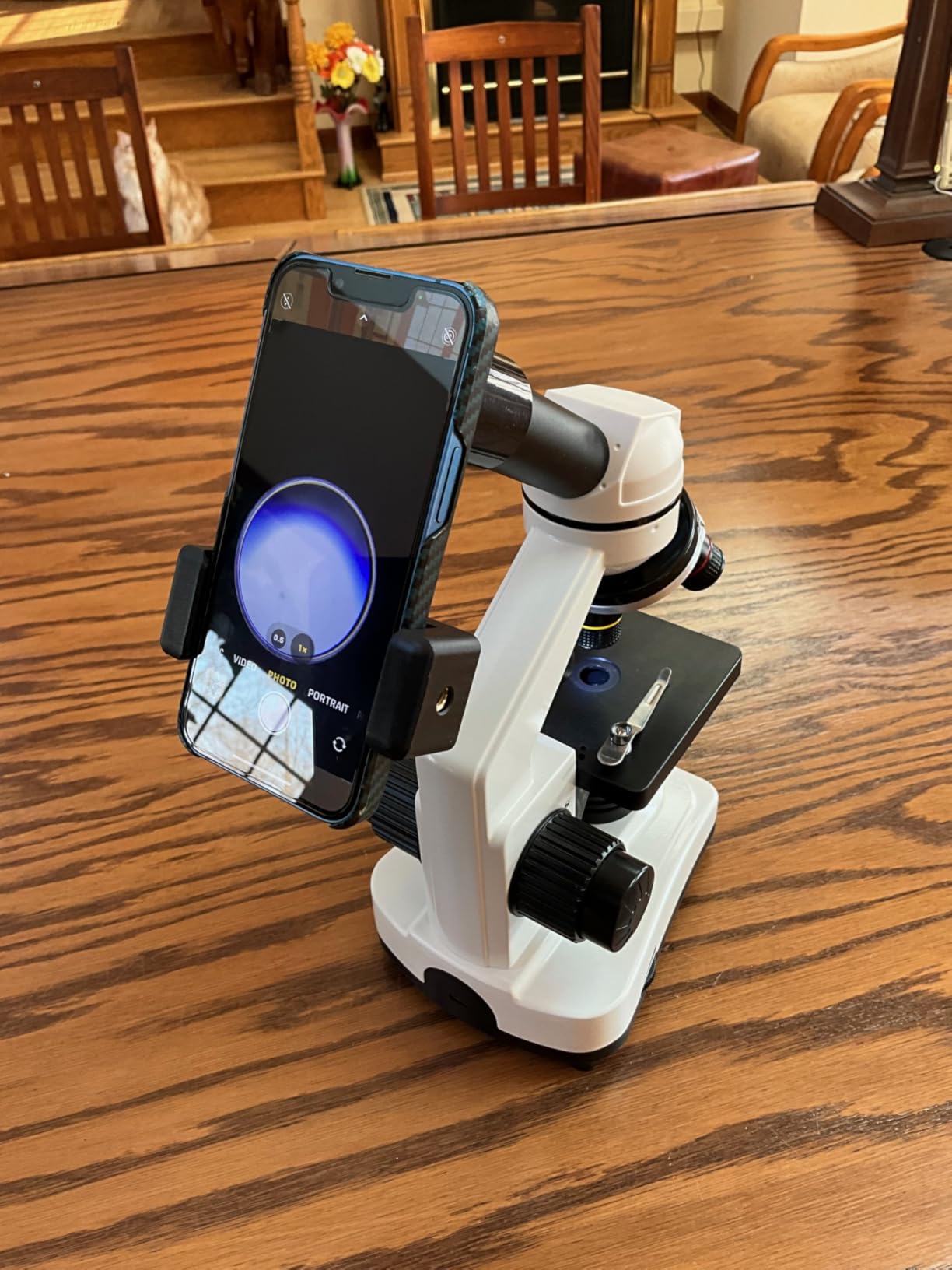
Lighting is the other strength. Dual incident and transmitted LEDs run through a dimmer knob, so brightness is adjustable rather than fixed, and the 360-degree rotating eyepieces make sharing the view or working from an odd angle straightforward. The metal body weighs 1.59 kilograms, light enough for a student to move without asking.
Two limits are worth stating plainly. There is no mechanical stage, so finding a specific spot on a slide takes real patience, and the 2500X headline is largely eyepiece and 100X objective zoom rather than additional resolving power. The accessory kit includes slides, cover slips, tweezers, droppers, a manual, and a phone holder, but not the phone.
Who It Suits and What You Can See
This suits a student and family that want a dependable first scope with a complete accessory set and no unpleasant surprises on arrival. Students who enjoy experimenting rather than only observing get a lot out of the filter wheel and the dimmer.
Curriculum fit: a first general biology unit, a cells and organelles lab, and a home schooling course covering plant cells, cheek cells, and prepared structure slides. It performs well at 100X and 400X.
Where It Falls Short
Like most monocular kits, it serves one viewer at a time, so a shared session means taking turns. The phone holder adds setup steps rather than saving them, and a student chasing a moving specimen will wish for a mechanical stage sooner rather than later.
It is a first microscope, not a final one. If you already know you will be running AP Biology with oil immersion work, skip down to a binocular scope with a real 100X objective.
Microscope Buying Guide for High School Students
Start With the Lesson, Not the Magnification Number
Write down the lessons your student will actually do this year, then pick the scope that makes those lessons work. A general biology course lives at 40X, 100X, and 400X. An AP Biology course adds oil immersion, which needs a real 100X objective and a working condenser. A botany or ecology unit adds wet mounts and needs illumination you can dim and a stage that moves. The single most common purchasing mistake is buying for a number that appears on a spec sheet and never appears in a lesson plan.
Compound, Stereo, or Digital: Which Type Fits the Lab?
A compound microscope is the standard instrument for high school biology. Light passes up through a transparent slide on the stage, through the condenser, and into the objective, so it is built for thin, prepared, transparent specimens. Every one of the ten picks in this roundup is a compound scope, because that is what a biology class needs.
A stereo microscope, also called a dissecting microscope, gives a three-dimensional view with two eyepieces and enough working distance to manipulate an object with tools underneath. It is the right instrument for an insect or flower dissection, an electronics soldering job, or examining a coin. It is not a substitute for a compound scope, because a stereo cannot resolve cells. Treat it as a companion purchase rather than an alternative.
Digital and USB microscopes are a documented third category. They are genuinely useful for a classroom where many students must watch one screen, or for a school running USB-only or Chromebook devices where a dedicated optical eyepiece scope cannot be shared. Their honest limit is image quality: a USB sensor is a camera bolted to a stand, so depth of field, contrast, and optical detail will not match glass optics, and printed digital magnification figures are marketing rather than measurement.
Glass Optics vs Plastic: The Spec That Decides Image Quality
Check whether the objectives and eyepieces are glass. Plastic lenses produce a softer, lower contrast image, and they are the single clearest reason a cheap microscope disappoints at 400X. Every pick in this roundup lists glass lenses, which is a meaningful baseline, but the correction level still matters. An achromatic objective corrects colour fringing at two wavelengths, which is enough for a school lab. Plan achromatic lenses flatten the field of view and are worth having if your student draws specimens rather than just identifying them.
Avoid any listing where resolution is described only through a magnification number. Useful resolution is a property of the optics, and no manufacturer will publish it, so use the 400X test instead: put a prepared slide on the stage and look at whether cell walls have edges or whether the image is a soft grey wash.
Mechanical Stage vs Stage Clips: The Part That Breaks First
A mechanical stage moves the slide in two dimensions with a knob and usually carries printed scales, so you can centre a specimen and return to it later. Stage clips hold a slide still but offer no controlled movement, so finding a cell in a root tip slide means sliding it around by hand. Across a school year, a mechanical stage is the difference between a microscope that stays on the desk and one that ends up in a cupboard.
The second thing to test is the focus mechanism. Coaxial coarse and fine knobs on the same axis let you make big moves with one hand and fine adjustments with the other, which is far easier to learn than separate knobs. Also check that the frame does not flex when you move the stage, because a wobbling frame makes high power unusable no matter how good the objectives are.
Monocular, Binocular, or Trinocular Heads
A monocular head has one eyepiece. It is the simplest and cheapest arrangement, and it works well for a single student, but only one person can look at a time. A binocular head has two eyepieces with an adjustable interpupillary distance and often a diopter adjustment on one tube, which is more comfortable over a long session and lets two people share a specimen. A trinocular head adds a third port for a camera, which is the standard classroom sharing solution when you want an image on a screen and a live view through the eyepieces at the same time.
For most students, monocular is fine and binocular is a real upgrade. Trinocular is worth it only when the microscope has to feed a screen or a projector.
What Your School Already Provides, and What to Buy Instead
Most high school laboratories supply monocular compound light microscopes, usually 4X, 10X, and 40X achromatic objectives on a mechanical stage or a simple stage plate, and a single built-in lamp. They are durable, serviceable, and shared. That means buying the identical instrument for home is often a duplication rather than an upgrade.
So ask what your school actually provides before you buy. If the school supplies a working monocular scope, the most useful home purchase is a stereo or dissecting scope for dissections, or a binocular compound scope for long personal sessions and photo work. If the school scope is old, cracked, or has a dead lamp, then a home binocular scope with a mechanical stage fills a genuine gap. If your student is doing an independent project, a trinocular head or a bundled USB camera is the sensible complement. The rule is simple: buy what the classroom cannot provide.
The Three Slides Every High School Student Should Make
Making your own slides teaches more than any prepared set, and the process takes about ten minutes each. For a cheek cell wet mount, scrape the inside of your cheek with a clean cotton swab, smear it in a thin film across a slide, add a drop of water, lower a cover slip at an angle to avoid air bubbles, and blot the excess. For a pond water sample, use a pipette to place a drop near the edge of the cover slip and let it draw across by capillary action, which catches the larger organisms. For an onion epidermis, peel a thin translucent layer from the inner curve of a scale, drop it in water, and cover.
Add a dropper, tweezers, a pipette, and a small supply of cover slips to your consumables order. Without a cover slip you have no reliable way to keep a specimen flat, and that matters more at 400X than most beginners expect.
What a Microscope Costs to Run Over Four Years
Budget roughly one school year per consumables top-up: blank slides, cover slips, a small stain set, and lens cleaning paper. LED illumination is a genuine running-cost advantage, because an LED source avoids the periodic lamp replacement that halogen scopes require, and the electronics in these student scopes are generally sealed rather than serviceable. A mechanical stage is the part most likely to need replacing, which is a reason to prefer metal over plastic in the stage assembly.
Two of the picks here address this directly. The OMAX includes a hundred blank slides, a hundred cover slips, and fifty lens cleaning sheets, and the AmScope models carry five-year warranties that have reportedly produced fast parts replacement. On a purely practical level, a longer warranty and a spare set of objectives matter as much to a four-year outlay as the purchase decision itself.
For a student who also needs a machine to write up lab reports and process microscope images, our student laptop guide covers the hardware side of that workflow.
Frequently Asked Questions
What is the best microscope for high school students?
The best microscopes for high school students are glass-optics compound light microscopes with a mechanical stage, coaxial coarse and fine focus, and at least 400X of genuinely useful magnification. A 10X eyepiece paired with 4X, 10X, and 40X objectives covers every specimen in a standard high school biology curriculum. Our top pick is the BEBANG 2000X compound microscope, which pairs a metal frame with a 15 prepared slide kit and a phone adapter.
What kind of microscopes are used in high school?
High school laboratories overwhelmingly use compound light microscopes, most often monocular, with 4X, 10X, and 40X achromatic objectives and LED or halogen illumination. They are durable, shared between students, and designed to be repaired rather than replaced. A stereo or dissecting microscope is often used alongside for dissections, and a USB digital microscope may be used for screen sharing on Chromebook-based labs.
What magnification do I need for high school biology?
400X total is the working minimum for a high school biology class, and 1000X with a real oil immersion objective is the ceiling worth paying for. Total magnification is the eyepiece multiplied by the objective, so a 10X eyepiece with 4X, 10X, and 40X objectives gives 40X, 100X, and 400X. Any claim far above 1000X on a light microscope usually adds image size without adding detail.
What is the difference between monocular and binocular microscopes?
A monocular microscope has one eyepiece and costs less, which suits a single student working alone. A binocular microscope has two eyepieces with an adjustable interpupillary distance and usually a diopter adjustment, which is more comfortable over long sessions and lets two people view the same slide together. Many school labs supply monocular scopes, so a home binocular scope is an upgrade rather than a duplicate.
Is a 1000x microscope good enough for high school?
Yes, provided the 1000X comes from a real 100X oil immersion objective and the scope has a working condenser. A general biology course rarely needs more than 400X. The caution is that many student scopes advertise 2000X or 2500X by adding eyepiece zoom, which enlarges the image without resolving more detail. Judge the instrument at 400X and check whether the extra power comes from an oil objective.
What is the best microscope for high school biology?
For most students, a binocular compound scope with a mechanical stage, an Abbe condenser, and a 100X oil immersion objective is the strongest choice, because it covers the general biology curriculum and the AP Biology extension. The OMAX M82ES fits that description and includes a hundred blank slides and a hundred cover slips. Students who need photographic lab reports should look instead at a scope with a bundled USB camera.
Is a digital microscope good for school?
A digital or USB microscope is a good complement rather than a replacement. It is the right choice when many students need to watch one screen, or when a school runs USB-only or Chromebook devices where a dedicated optical eyepiece cannot be shared. Its honest limit is image quality, since a USB sensor will not match glass optics for depth of field and contrast, and printed digital magnification figures are marketing rather than measurement.
The Microscope That Matches Your Biology Class
If you want one answer, take the BEBANG 2000X compound microscope. It has the metal frame, the coaxial focus, the two-sided lighting, and the fifteen prepared slides that a first biology course needs, and it is the scope in this group with the deepest pool of owner feedback behind it. Judge it at 400X and you will see the specimens a standard year requires.
Move up to the OMAX M82ES if the student is heading into AP Biology, needs a mechanical stage, or shares the scope with a sibling. Choose the AmScope B120C-E1 if lab reports need photographs, and the AmScope M162C if image sharpness matters more to them than any camera. Whatever you pick, check first whether your school already provides a working compound scope, and buy the thing your classroom cannot supply.
That is the honest version of the best microscopes for high school students in 2026: not the biggest number on the box, but the instrument that makes the lesson in front of you legible.