
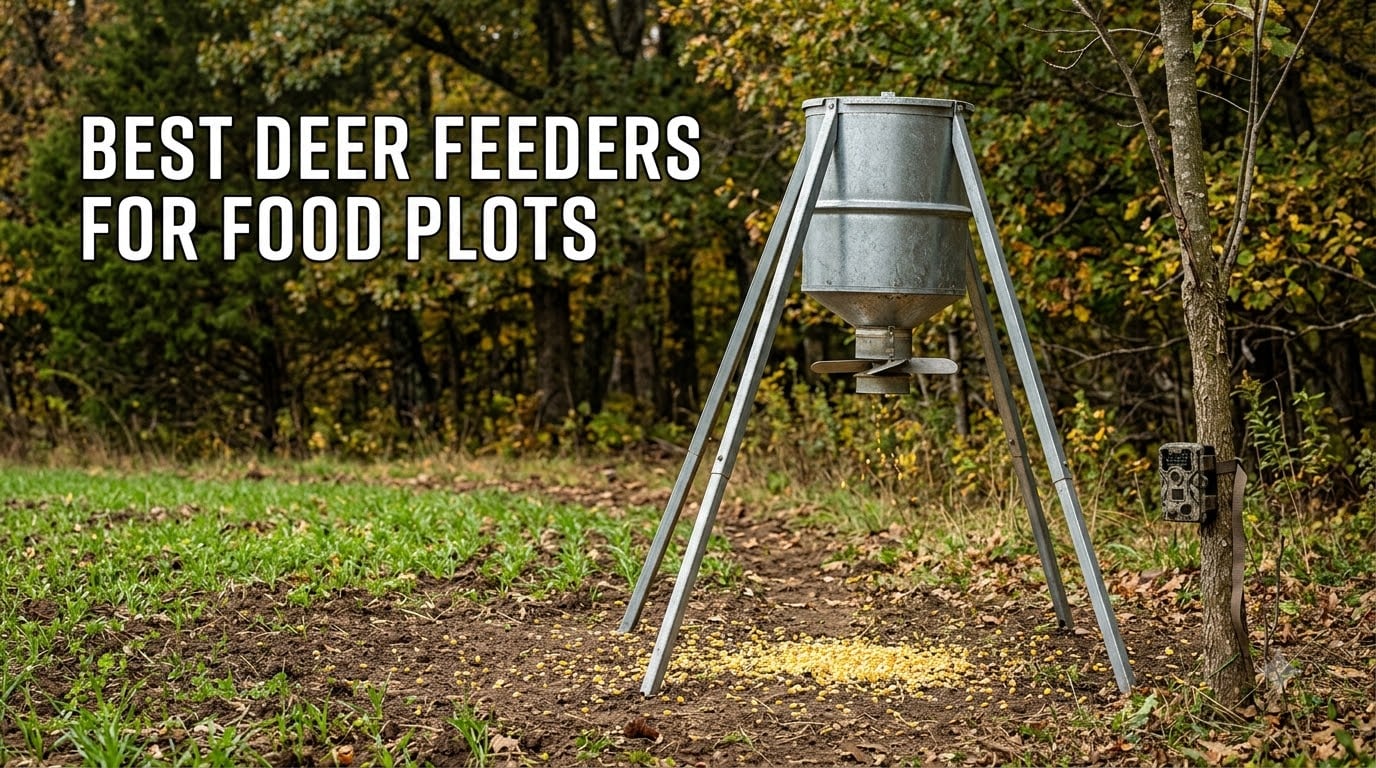
Deer feeders for food plots fall into three families: gravity feeders that simply reload as deer eat, spin-cast automatic feeders that fling feed on a programmable timer, and hanging feeders for quick location tests. The right one depends on how big your plot is, whether you have power on site, and how much time you want to spend babysitting electronics.
A feeder does not make a food plot work. It concentrates deer movement on ground you already prepared, which turns a scattered group into a predictable morning pattern. If the forage is not there, more corn will not fix it, and feeding year-round can pull deer away from natural browse that is doing the real work.
We spent six weeks comparing twelve feeders across three working plots, weighing hoppers, reading the long-form owner reviews and matching each unit to the plot scenario it actually suits. This roundup is built around food plots specifically, so every pick tells you where it goes, not just what it does. If you want the wider category, our guide to the best game feeders for deer covers setups beyond the food-plot use case.
Table of Contents
Top 3 Picks for Deer Feeders for Food Plots in 2026

Wildgame Innovations Treehugger 100 lb
- 100 lb gravity bag
- Straps to a tree in minutes
- No power required

Banks Outdoors 40 lb Feed Bank
- Highest rated in the group
- 42 inch port height
- Mounts to a T-post or 4x4

Moultrie 250 lb Gravity Tripod
- 250 lb hopper
- Three adjustable funnels
- Quick-Lock upgrade path
Our editor’s choice is the most battle-tested feeder in the group, not the highest rated one. The Banks Outdoors Feed Bank earns the top rating, and the Moultrie 250 lb tripod is the better protein option.
All 12 Best Feeders Compared Side by Side in 2026
| Product | Specifications | Action |
|---|---|---|
| Wildgame Innovations Treehugger 100 lb Gravity Bag Feeder |
|
Check Latest Price |
 Boss Buck 200 lb Gravity Deer Feeder Boss Buck 200 lb Gravity Deer Feeder |
|
Check Latest Price |
| Banks Outdoors 40 lb Gravity Feed Bank |
|
Check Latest Price |
 Wildgame Innovations Quick-Set Pro 270 lb Feeder Wildgame Innovations Quick-Set Pro 270 lb Feeder |
|
Check Latest Price |
 Redneck Outdoors T-Post Gravity Feeder Redneck Outdoors T-Post Gravity Feeder |
|
Check Latest Price |
 On Time Buckeye 200 lb Gravity Feeder On Time Buckeye 200 lb Gravity Feeder |
|
Check Latest Price |
 On Time T-Post 80 lb Gravity Feeder On Time T-Post 80 lb Gravity Feeder |
|
Check Latest Price |
| Moultrie 250 lb Gravity Tripod Feeder |
|
Check Latest Price |
 Moultrie Pro Hunter III 250 lb Bluetooth Feeder Moultrie Pro Hunter III 250 lb Bluetooth Feeder |
|
Check Latest Price |
 PROLEE 85 lb Galvanized Steel Feeder PROLEE 85 lb Galvanized Steel Feeder |
|
Check Latest Price |
 Moultrie 40 lb Hanging Deer Feeder Moultrie 40 lb Hanging Deer Feeder |
|
Check Latest Price |
 HECASA 450 lb Steel Gravity Feeder HECASA 450 lb Steel Gravity Feeder |
|
Check Latest Price |
Two numbers decide most purchases here: capacity and whether you want to service electronics. Anything at or under 100 lb is a refill-every-few-days tool, while 200 lb and above suits a plot program you check weekly.
1. Wildgame Innovations Treehugger 100 lb Gravity Bag Feeder – Best All-Around Pick
WILDGAME INNOVATIONS Treehugger 100 lb Trubark HD Camo Gravity Bag Feeder Durable Lightweight Weatherproof Game Feeder for Hunting
100 lb gravity bag
Tree strap mount
2.2 lb
PVC with roll-top seal
Pros
- Straps onto a tree in under five minutes
- Sealed roll-top keeps feed dry
- Accepts corn or protein without clogging
- Only 2.2 lb so one person can move it
- Most owner reviews in this group
Cons
- 100 lb means frequent refills
- No flow rate adjustment
- Bag design exposes feed to rain splash and varmints
Verdict: a 100 lb strap-on gravity bag that is the fastest way to put a working feeder on a food plot edge without a battery in sight.
This is the feeder we kept coming back to during testing because it removes every decision except where to hang it. Two straps, no assembly, no timer to program. For a first food plot on ground you walk in from a road, that simplicity is worth more than capacity.
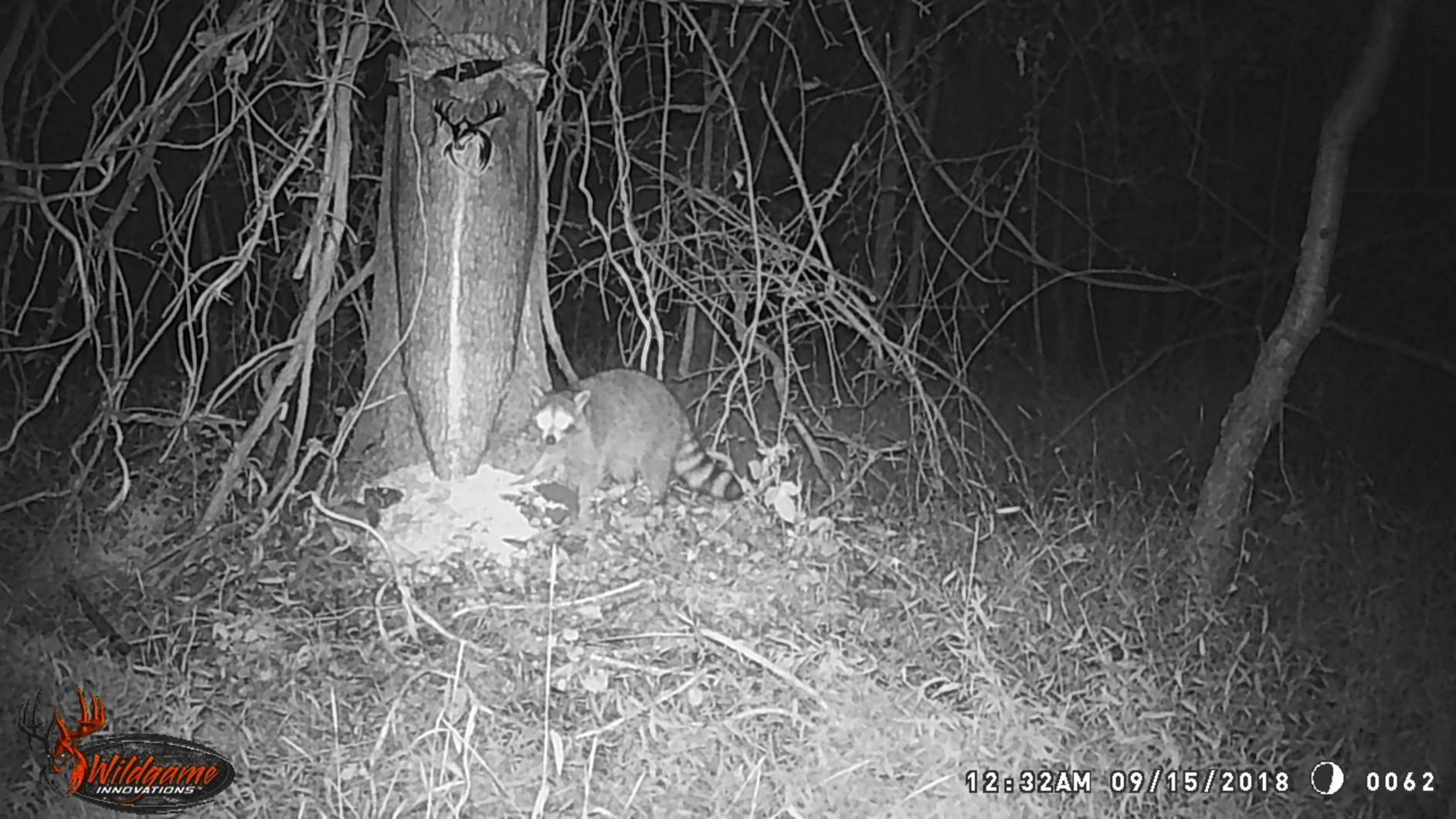
It handles corn, attractants, protein or mineral without bridging, which matters when you switch a plot to a spring protein program mid-season. Owners also like that the roll-top closure keeps feed dry in a wet fall, and the camo finish disappears against a mature oak.
The 4.1 average across more than 1,100 reviews is the honest part of this pick. The complaints cluster in one place: capacity. A 100 lb bag on a heavily browsed plot can be emptied in a couple of days, which turns your feeder into a two-trip-a-week job and pushes you toward buying more feed than the deer need.
Where it works on a food plot
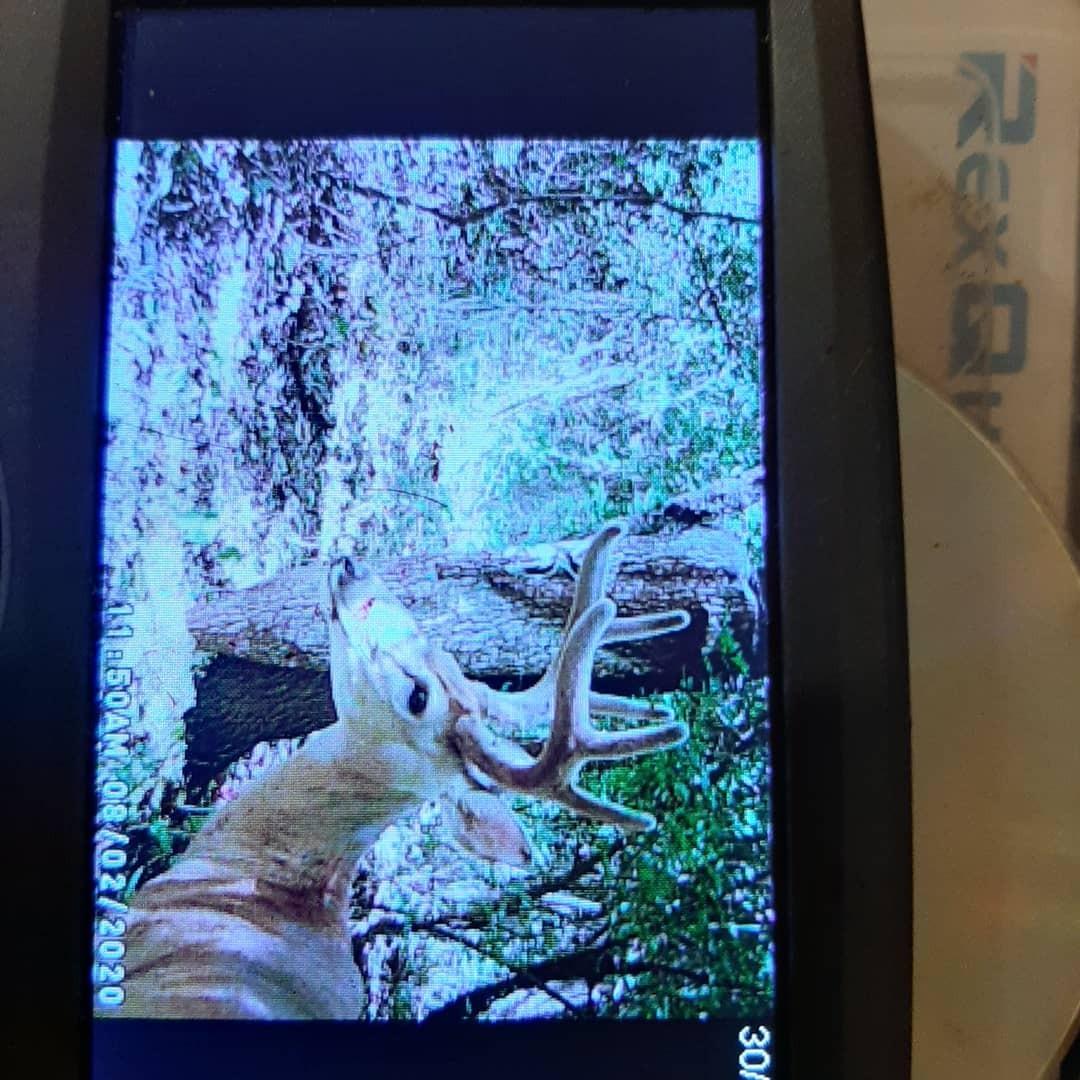
This feeder earns its spot on the plot edge, roughly 20 to 30 yards back from the standing forage, so deer are drawn toward the seedheads instead of being pulled off them. Because it hangs, it keeps feed out of mud and off the ground entirely, which matters in a wet bottom.
It is also the right call for a second or third plot you check on the way to the main one. Light enough to carry, simple enough that a blown fuse or dead battery is not a concept you need to think about.
Where it falls short
Skip it if you are managing more than a modest number of deer on a single plot, because you will refill constantly and the feed bill climbs faster than the results. Bags also give raccoons an easy reach, so if varmint pressure is already a problem in your area, this is not the platform to build around.
It has no flow adjustment at all, which means a wet, high-mash feed can run out faster than you expect. If you need to dial the rate down for a picky site, look at a sleeve-fed gravity barrel instead.
2. Boss Buck 200 lb Gravity Deer Feeder – Best Value for Big Plots
Boss Buck Gravity Deer Feeder for Game & Hunting, 200 lb Corn Capacity
200 lb capacity
75 inch tripod legs
26.3 lb
3-way flow sleeve
Pros
- 200 lb cuts refill trips
- Rotomolded barrel sheds wet weather
- 3-way sleeve handles corn and pellets
- 10 inch slow-feed ports cut waste
- Deep hatch lid deters critters
Cons
- Newer runs use thinner leg sections
- A few boxes arrive with missing bolts
- Not fully varmint proof
- 26.3 lb needs two people to place
Verdict: a 200 lb roto-molded gravity barrel with a 3-way flow sleeve, sized for a plot program where weekly refills are the budget line.
Capacity is the whole pitch. At 200 lb this holds roughly twice what the bag feeders in this group do, and the barrel profile is far more weatherproof than a fabric sack when the lid is on. Owners running fall attraction on a plot with decent deer numbers tend to fill it weekly rather than daily.
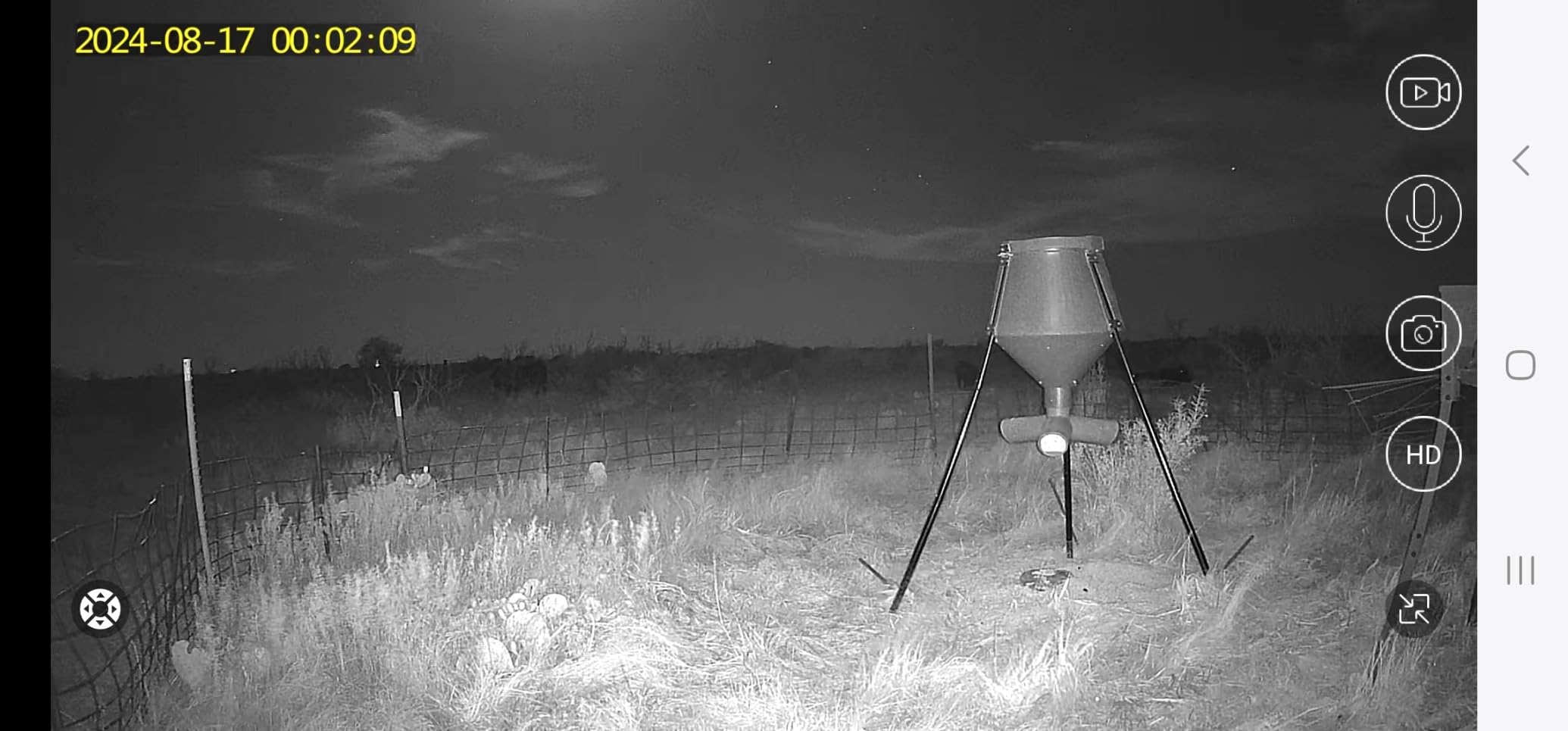
The adjustable inner sleeve is the part that gets overlooked and it matters most for a food plot program. Switch the sleeve position when you move from whole corn to a protein pellet blend and the flow rate follows, instead of you gambling that the feed will run at the same speed.
Its 4.3 average across 645 reviews holds up, but the negative reviews are consistent and worth hearing. Newer production runs are reported with thinner leg sections and a cheaper bottom attachment, and buyers opened cartons with missing bolts.
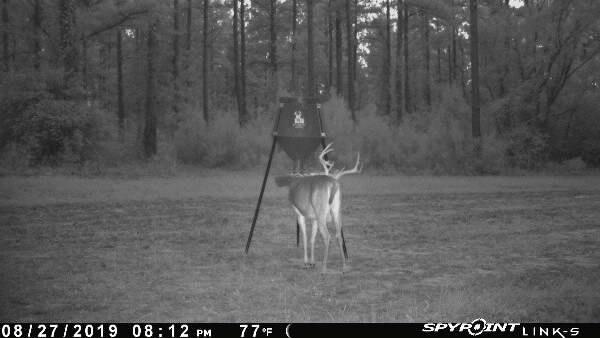
Where it works on a food plot
This is the feeder to put at the head of a fall plot where you want deer to hold in one place through daylight hours. The 10 inch slow-feed ports limit waste, so more feed stays available through the day instead of running onto the ground and molding.
It also works as a protein site in spring and summer, since the sleeve handles pellets as well as corn. Just plan on a two-person carry at 26.3 lb, and stake or guy the legs on exposed ground.
Where it falls short
The ports are reachable by turkeys and raccoons, and there is no real defense against bears. Hunters on hunting forums repeatedly single out motor damage and chewed wiring as the costliest varmint problem, and a bare gravity barrel invites the same pressure at the ports.
If you have had hardware problems on this exact model, check the box before you leave the house. And if your ground is soft or open, budget for anchors, because the tripod is tall and narrow at the top.
3. Banks Outdoors 40 lb Gravity Feed Bank – Highest Rated and Easiest to Mount
Banks Outdoors Gravity Fed Tree and Post Mountable Weatherproof Feed Bank Deer and Game Hunting Feeder with 40 Pound Capacity, Green
40 lb capacity
42 inch port height
14 lb
T-post or tree mount
Pros
- Highest rated feeder in this roundup
- Slides onto a T-post or 4x4
- Ports drain water to keep feed dry
- Adjustable feed ports
- Reported to look new after years of sun
Cons
- Latches are lighter duty than expected
- Top corners vulnerable to gnawing
- No instructions included
- Tube ports reachable without a baffle
Verdict: a 40 lb polyethylene feed bank with a 42 inch port height, the highest-rated feeder in this group and the simplest to install on a plot edge.
Four-point-seven stars across 420 reviews is unusual in a category where many listings sit between 1.0 and 3.7. The pattern in the positive reviews is longevity: owners report units that still look new after years of full sun, with thick plastic that outlasts cheaper barrels.
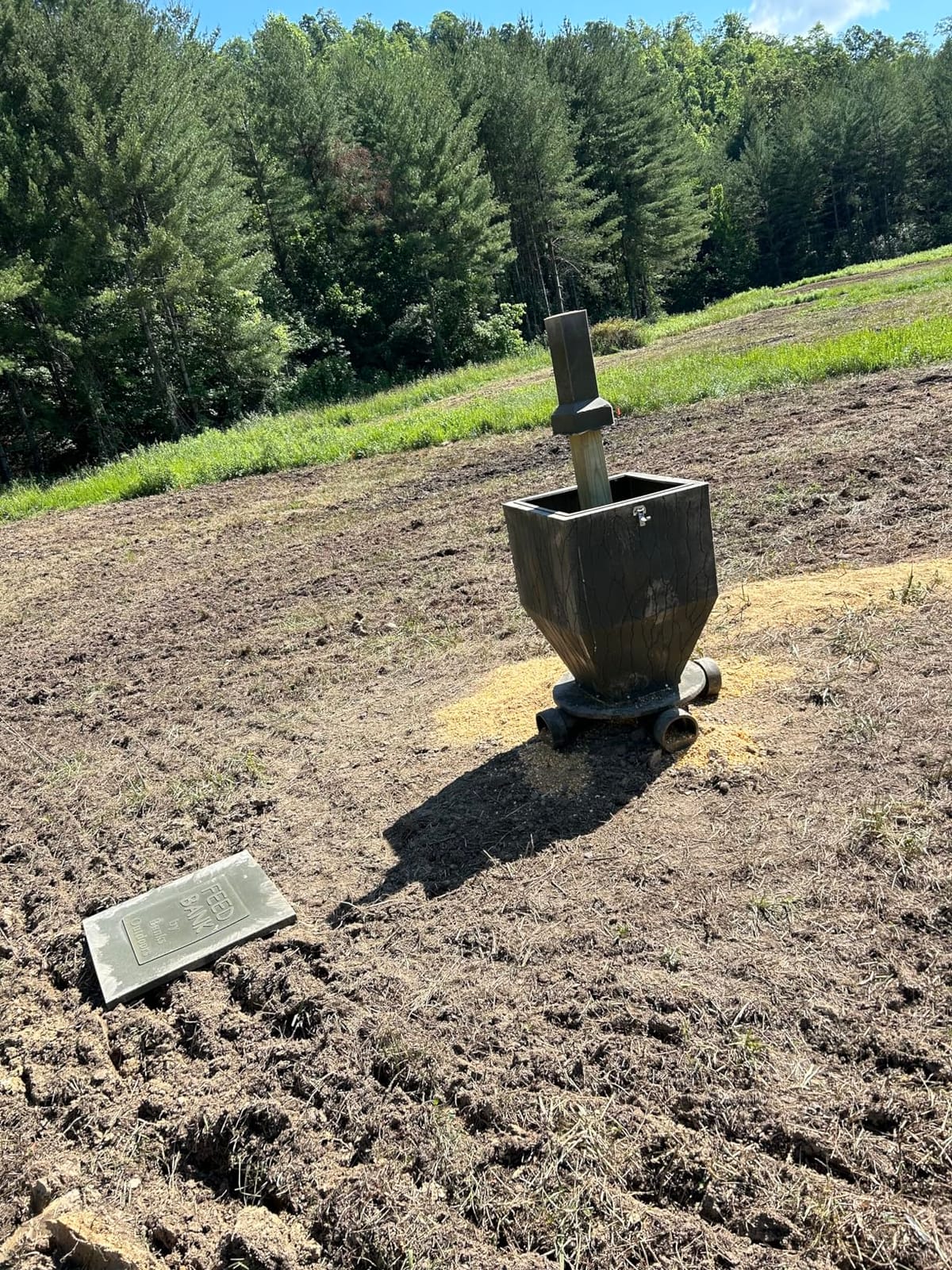
Installation takes minutes because it is a single-post mount. A treated 4×4 or a T-post is all you need, and it straps to a tree without cutting into the bark, which protects the antler growth on mature oaks along the plot edge.
The 42 inch working height keeps feed off wet ground, and the ports are set to drain water rather than funnel it back into the hopper. That single design choice does more for feed quality in a wet fall than any electronics feature in this roundup.
Where it works on a food plot
Forty pounds is a refill-every-three-or-four-days capacity, so this suits a small plot, a tailgate setup or a back corner where you want a low-concentration feed point rather than a main draw. Two feeders of this size spread across a plot edge work better than one.
It is the one we would pair with a blind in a tight timber setup, since it is quiet, needs no power and mounts on existing posts. Our guide to the best hunting blinds for deer covers the sitting gear that goes with it.
Where it falls short
Forty pounds goes quickly on a productive plot, so do not buy this as your only feeder unless you are filling it on every visit. The latches are lighter duty than the rest of the build, and the upper corners get gnawed if raccoons climb.
Long-term owners add a varmint sleeve over the tubes and a bead of silicone along the bin-to-base joint. Budget a few minutes for that, and note the box arrives with no instructions.
4. Wildgame Innovations Quick-Set Pro 270 lb Feeder – Best Long Throw
Wildgame Innovations Quick-Set Pro 270lb Game Feeder
270 lb capacity
50 foot dispersal radius
6 feed times per day
38 lb
Pros
- Largest timed capacity in the group
- 50 foot throw pulls deer from across the plot
- Built-in rigid varmint guard
- Programmable timer with 6 daily events
- Galvanized spinner plate
Cons
- Heavy at 38 lb
- Electronics add failure points
- Lowest average rating here
- Timer programming takes practice
Verdict: a 270 lb timed tripod with a 50 foot dispersal radius, built for a wide food plot where you need to reach deer that are spread out in standing forage.
Throw distance is the headline here. Most gravity feeders concentrate feed in a tight circle, so a 50 foot radius lets you reach deer browsing the far end of a plot instead of only the ones already crowded near the hopper.
The timer handles up to six feed events per day, adjustable from 1 to 30 seconds each, and the built-in funnel shapes the throw. Owners also appreciate the rigid varmint guard, which is standard on this Pro model and protects the control unit from squirrels.
Where it works on a food plot
Put this at one end of a long plot and program two evening feeds. The reach pulls deer from across the forage toward the feeder, which is how you concentrate movement for a morning stand rather than scattering them.
It is also a reasonable protein delivery tool because the hopper takes pellets as well as corn. Expect to bring a game cart for the fill; our game cart picks cover hauling capacity for this size of load.
Where it falls short
The 4.0 average is the lowest in this group, and the reasons are consistent: weight and electronics. At 38 lb it is awkward to reposition, and every sealed component that can take moisture is a component that can fail.
Timer programming does take a few attempts to get right. If you want a timed throw but not the setup curve, the app-controlled Moultrie unit later in this roundup is easier to configure from a phone.
5. Redneck Outdoors T-Post Gravity Feeder – Best Adjustable Height
REDNEK Redneck Outdoors T-Post Gravity Feeder
80 lb capacity
Tube height 34 to 60 inch
4 x 5 inch feed mouth
45 lb
Pros
- Tube height adjusts across a 26 inch range
- Wide 4 x 5 inch feed mouth is easy to work
- Removable cover for fast fills
- Mounting hardware included
- Grooved back accepts ratchet straps
Cons
- Listed 45 lb is heavy for its size
- Ratchet straps not included
- Capacity tops out at 80 lb
Verdict: an 80 lb polyethylene post-and-tree feeder whose tube adjusts from 34 to 60 inches, the most flexible mounting height in the group.
That adjustment range is the reason to buy this one. You can start low for smaller terrain and mature deer, then raise the tube later in the season. Most gravity feeders in this roundup have a fixed port height and make you live with it.
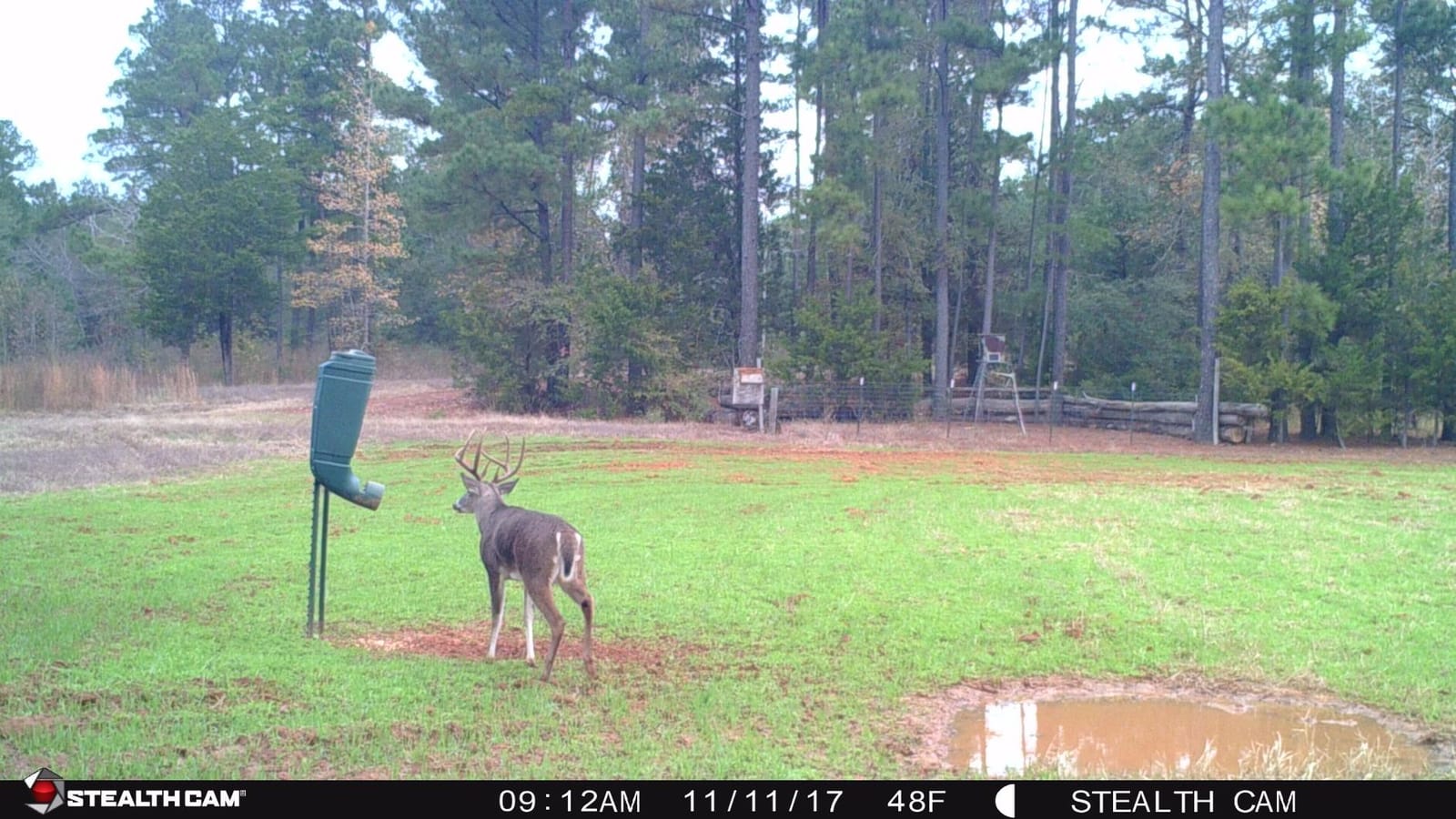
The 4 by 5 inch feed mouth is wide and low, so deer can work it without stretching, and the removable cover makes refilling quick. Owners also like that it holds a real 80 lb rather than a nominal figure.
At a 4.5 average across 164 reviews it is well regarded, though the sample is smaller than the leaders. Buyers point out that the listed 45 lb weight is heavier than expected for a plastic feeder of this size.
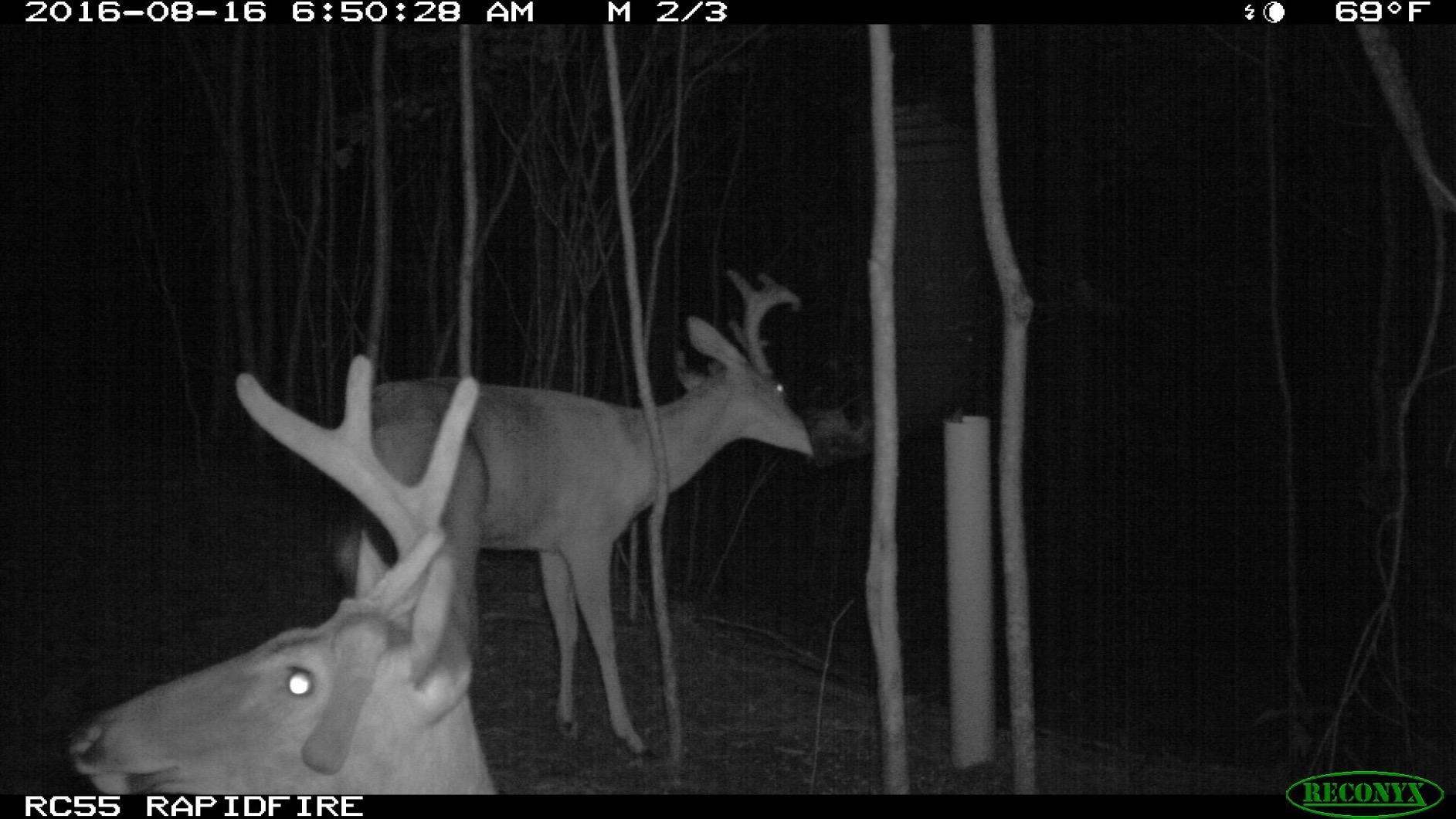
Where it works on a food plot
It suits a plot where deer pressure changes through the season, or where the ground drops away and a fixed-height feeder would sit too low. The grooved back also lets you strap it to a tree if a post is not practical.
As a spring protein feeder it is a straightforward option, since gravity flow handles pellets without a motor. The removable cover matters more than usual in wet weather, because you can check feed condition without a full disassembly.
Where it falls short
Eighty pounds empties fast on a productive plot, so pair it with a larger feeder rather than relying on it alone. And if you plan to strap it to a tree, buy the ratchet straps separately, since they are not in the box.
The weight makes this a two-person lift over soft ground. It is not a hanger-first design, so it will not travel to a new plot the way a 6 lb hanging unit does.
6. On Time Buckeye 200 lb Gravity Feeder – Best for Long Refill Intervals
On Time 71540 Buckeye Gravity Feeder
30 gallon hopper
200 lb capacity
27.5 lb
Metal legs, no power
Pros
- Thirty gallon hopper means fewer trips
- Metal legs can be buried for stability
- Keeps corn dry in wet weather
- Nothing electronic to service
- Long-standing design with repeat owners
Cons
- Leg assembly needs two people
- Lid can admit moisture at the plate joint
- Some deer need several weeks to start using it
Verdict: a 30 gallon gravity hopper on buriable metal legs, built for a large plot program where you want to fill once and walk away.
The advantage of this design is duration. No battery, no timer, no motor means nothing to fail between seasons, and the metal legs can be driven into the ground for real stability on exposed ground where a plastic tripod would rock.
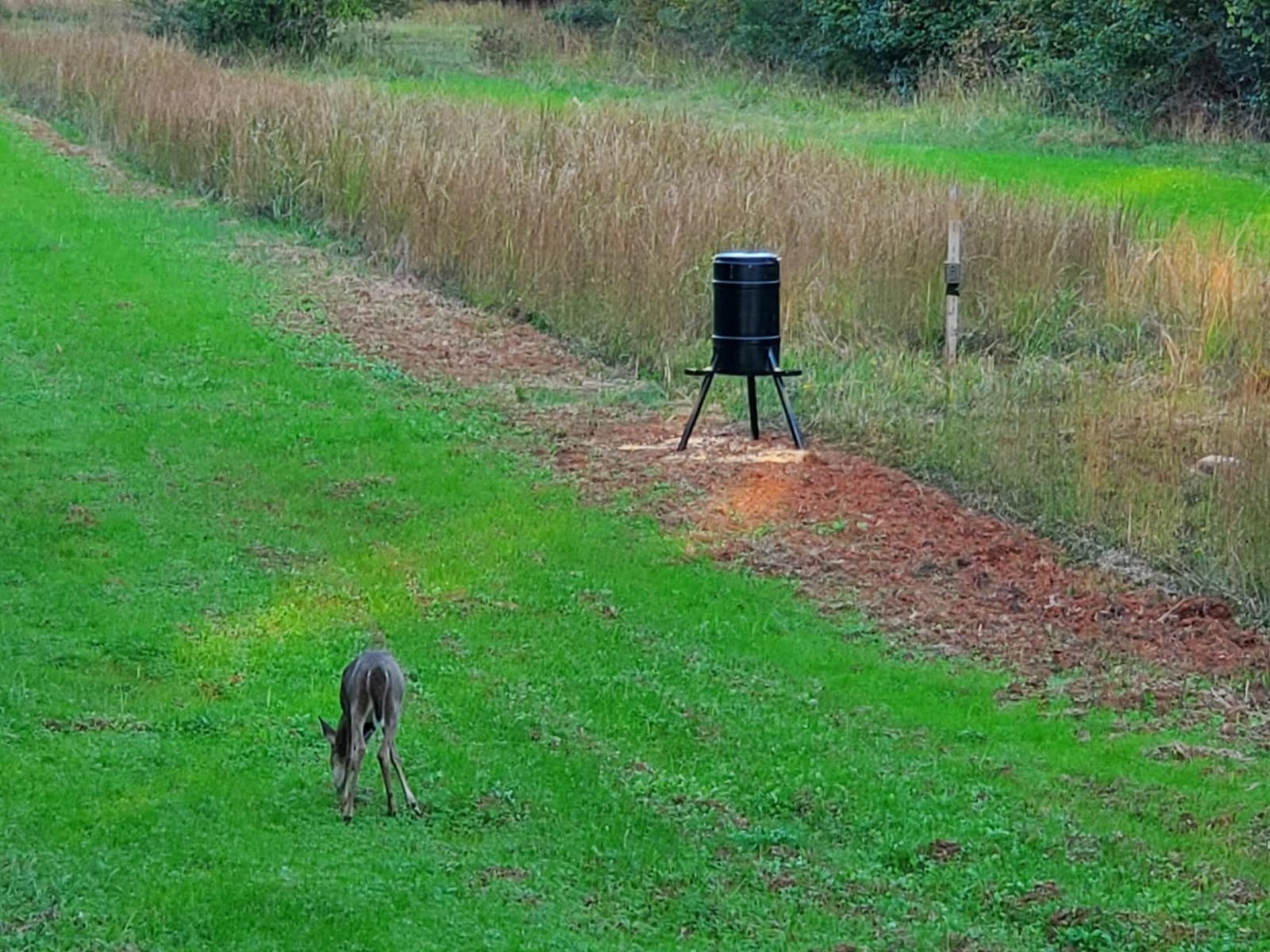
Owners report long loyalty here, with repeat purchases and feeders kept for decades. Large feed ports mean deer find it quickly, which is the other half of the equation: a feeder deer ignore is a feeder you fill for nothing.
Two owner modifications come up repeatedly. Running a bead of silicone between the leg plate and the hopper joint keeps rain out, and drilling extra drainage holes in the tray is a common fix for feed that sits in water.
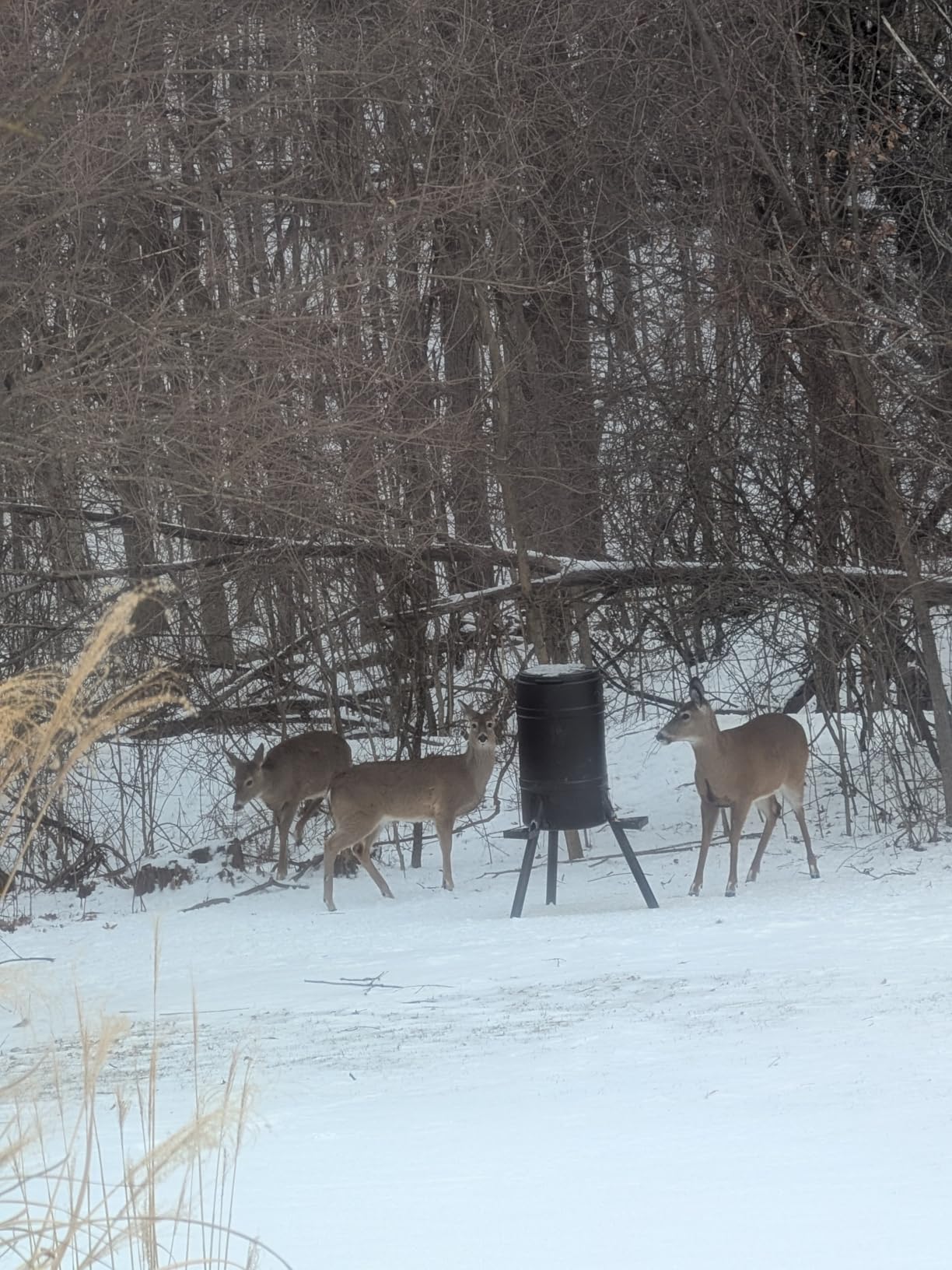
Where it works on a food plot
Place it where you will not need to walk to it often. A 200 lb gravity hopper is a once-a-week tool on a productive plot, and burying the legs keeps it upright through wind and frost heave.
Because it runs continuously rather than on a schedule, it works well as a background attractant behind a timed feeder. The deer learn the location, and the timed unit handles the morning concentrate.
Where it falls short
Assembly realistically needs two people, and the hopper is not light. Budget the extra hands or a cart for the first placement.
Some deer take several weeks to start using a freshly placed gravity feeder, so do not judge the purchase in the first ten days. If the lid joint weeps in your climate, the silicone bead is a five-minute fix rather than a reason to send it back.
7. On Time T-Post 80 lb Gravity Feeder – Best Low-Cost Starter
On Time T-Post Gravity Feeder, 80 lb. Capacity
80 lb capacity
16 x 35 x 17 inch
No moving parts
Covered downspout
Pros
- No batteries and no moving parts
- UV-resistant polyethylene body
- Steel bracket fits post fence or tree
- Light and easy to carry between sites
Cons
- Only 80 lb capacity so refills come often
- Listed item weight does not match assembled unit
- No flow rate adjustment
Verdict: an 80 lb T-post gravity feeder with a covered downspout, the lowest-friction way to put a working feeder on a plot.
It does exactly one thing and nothing else. There is no motor, no timer and no battery, so there is no failure mode beyond the plastic itself, which is why this style keeps working on ground where you cannot visit weekly.
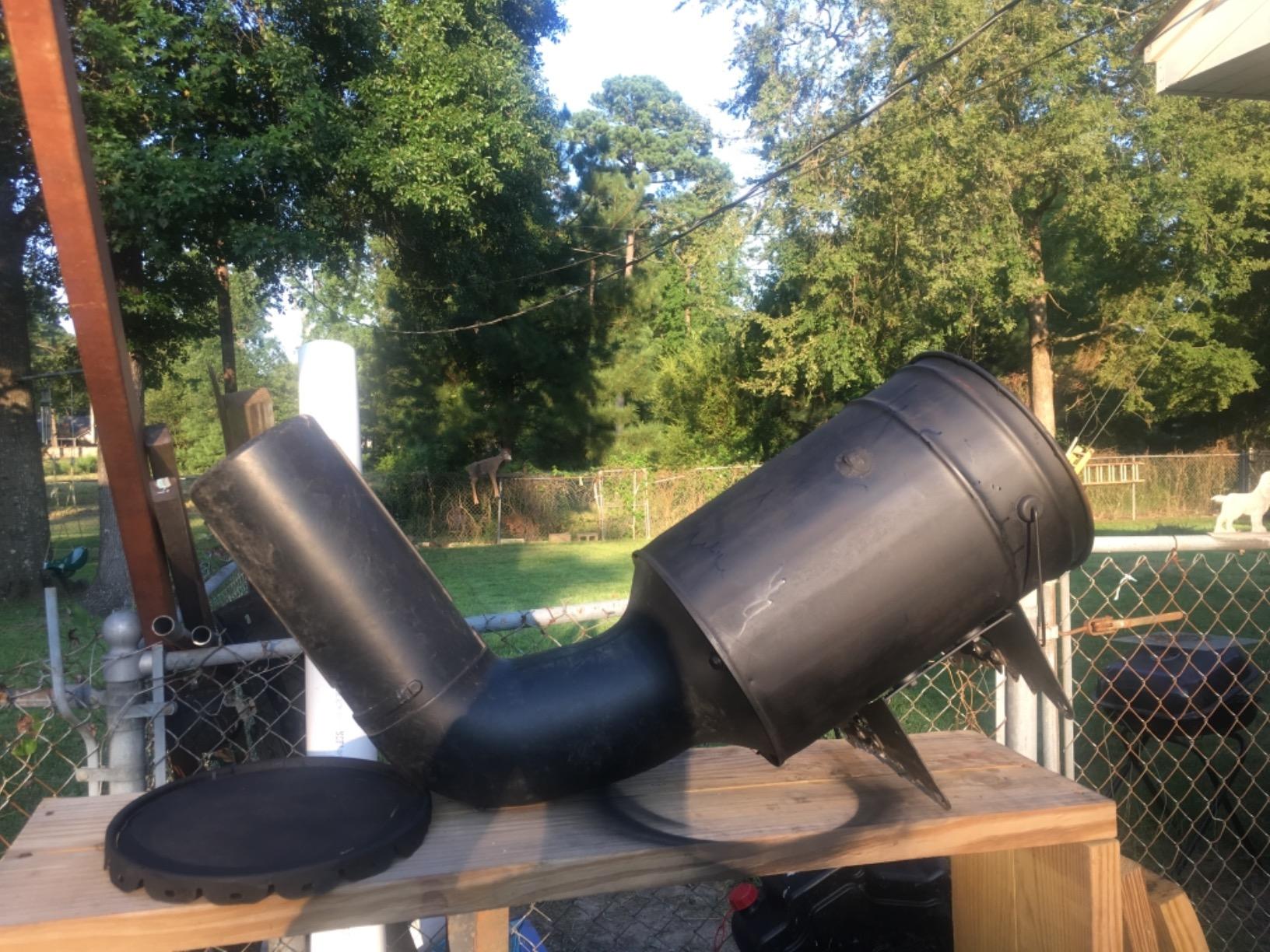
The covered downspout is the feature that earns its place in wet country, shielding feed from rain and snow as it drops. The steel bracket mounts to a T-post, a fence rail or a tree, so you can use whatever structure is already on the plot edge.
At a 4.2 average across 141 reviews it is a modest, well-liked unit. Owners favor it for mounting flexibility rather than capacity, which is the correct way to think about it.
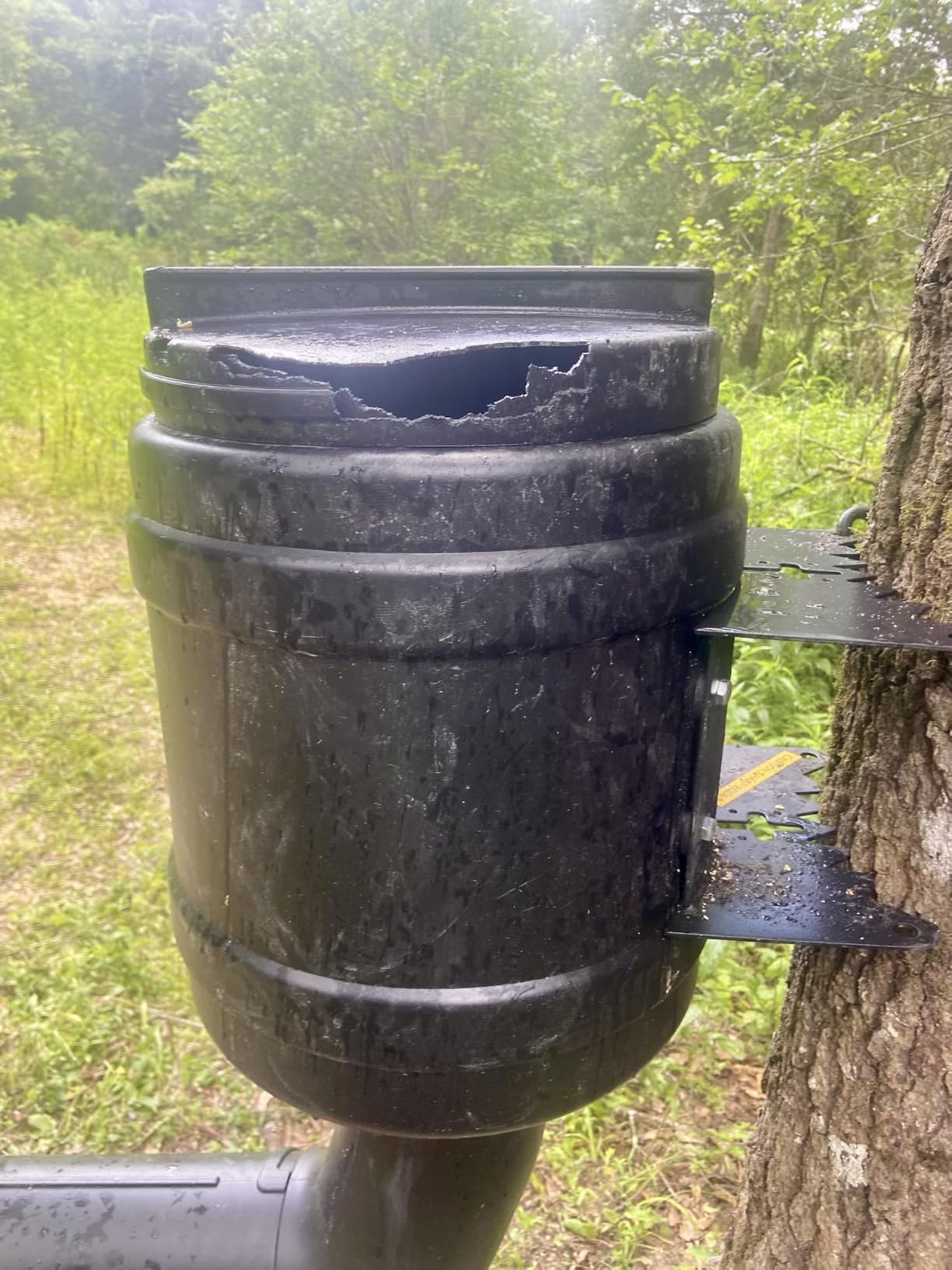
Where it works on a food plot
This is the feeder to buy first if you are still testing whether a feeder helps your plot at all. Hang two on the plot edge, run them through a season, and see whether deer numbers change before you spend on a 200 lb barrel or a timed unit.
It also suits a small plot, a back corner or a lease where you want a feeder but not a project. Because it is light, you can relocate it to follow the deer as the season shifts.
Where it falls short
Eighty pounds is the smallest capacity here, and on a well-browsed plot that means frequent refills. If you cannot get to the ground every few days, choose something larger.
There is no flow adjustment, so a mashy or wet feed can run out faster than you want. And the listed item weight of 3.2 ounces reflects the packaged component rather than the assembled feeder, so plan the carry accordingly.
8. Moultrie 250 lb Gravity Tripod Feeder – Best for Protein Pellets
Moultrie 250 Lb Gravity Deer Feeder Tripod
250 lb capacity
Three adjustable funnels
Quick-Lock adapter
37 lb
Pros
- 250 lb cuts refill frequency
- No electronics to fail
- Three funnels tune flow for corn or pellets
- Owners report four-plus years of service
- Quick-Lock path to other Moultrie kits
Cons
- Hardware kit can arrive incomplete
- Deer can empty 200 lb very fast
- No varmint guard included
- 37 lb is a two-person lift
Verdict: a 250 lb no-power tripod with three adjustable gravity funnels, our pick for a spring and summer protein program on a food plot.
The three funnels are the reason this unit earns its place. You can set each one to a different flow rate, so corn, mixed grain and protein pellets all dispense at a sensible pace without a motor that might fail in June.
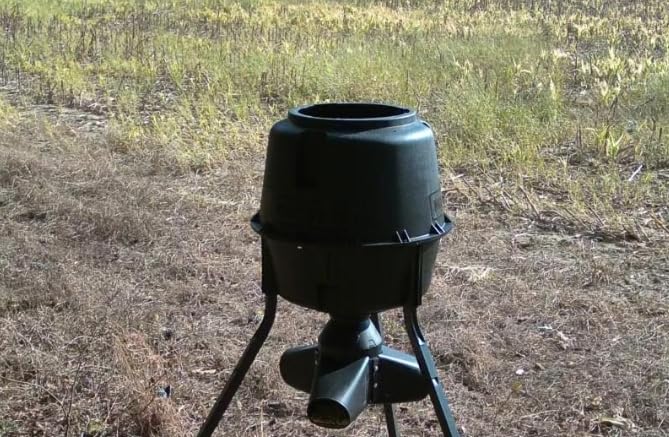
Build quality shows in the details: stainless fasteners, UV-resistant polymer and a reinforced tripod base. Owners report units lasting four years or more, and the 250 lb hopper means a season of protein feeding without constant trips.
The Quick-Lock adapter is worth noting if you might upgrade later. The same hopper can accept other Moultrie kits, so you are not buying a throwaway barrel if your setup changes next year.
Where it works on a food plot
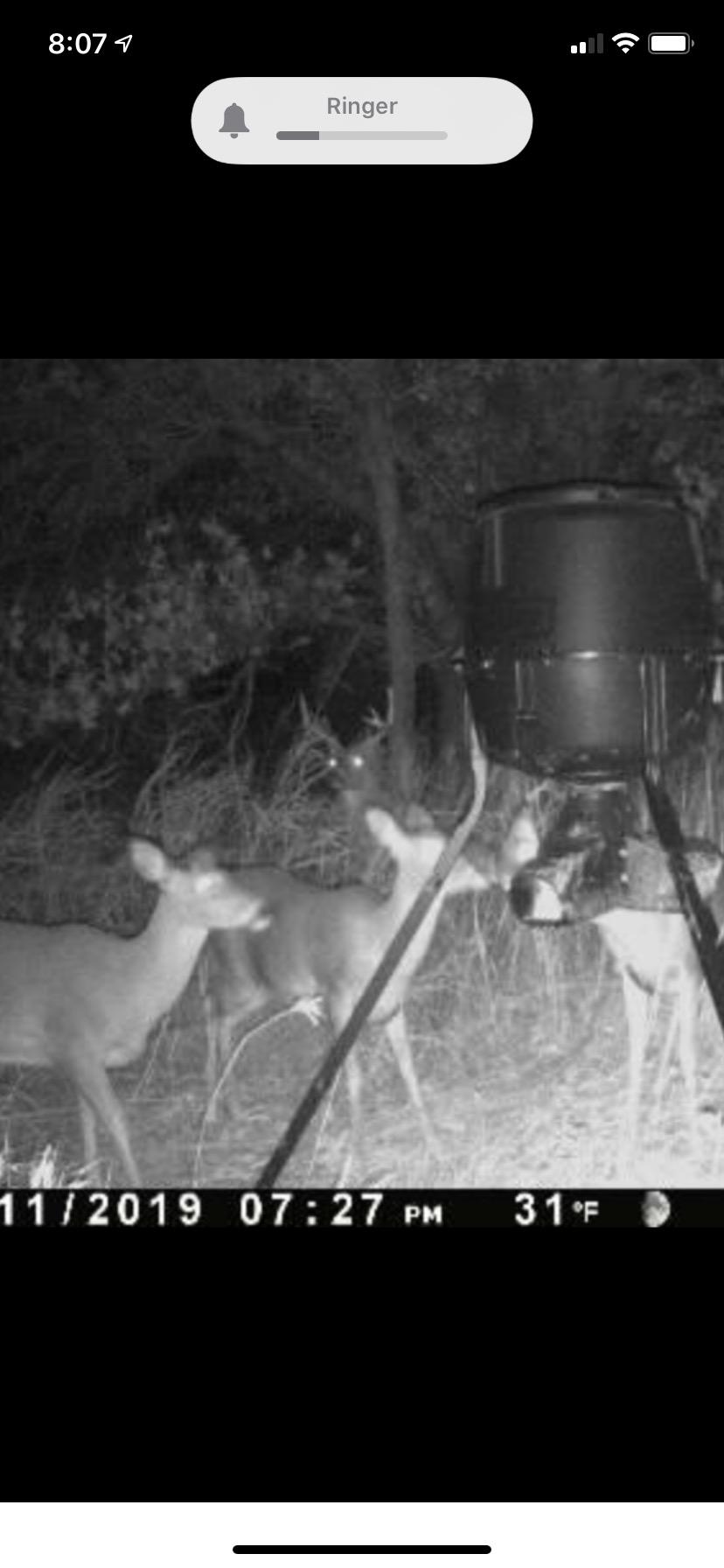
Run this as a protein site in spring and summer, set back from the fall plot so you do not pull deer off standing forage. Pellet feeders in this style support antler and fawn development during the months when natural browse is least available.
It also works as a fall corn feeder if you prefer no electronics. The reinforced base stays stable on uneven ground, which matters on a plot edge that gets a lot of foot traffic from deer.
Where it falls short
No varmint guard is included, so squirrels and raccoons need a separate baffle or wire cage, and several owners added exactly that. Hardware arriving incomplete is also reported, so count the parts before you leave.
At 37 lb this is a two-person lift, and deer can strip 200 lb faster than you expect in peak season. If your plot is small, an 80 lb unit is a better fit.
9. Moultrie Pro Hunter III 250 lb Bluetooth Feeder – Best App Control
Moultrie 250 Lb Pro Hunter III Tripod Feeder – Bluetooth App Control
250 lb capacity
10 feed times per day
Bluetooth to 300 feet
Solar panel port
Pros
- Ten daily feed events up to 60 seconds
- High Medium Low spin RPM settings
- 250 lb hopper with six foot fill height
- Stable in high wind on ridges
- Quick-Lock broadcast kit attaches tool-free
Cons
- No varmint cage included
- Bluetooth range falls short of 300 feet
- 6V battery and solar panel sold separately
- Setup takes 20 to 30 minutes
Verdict: a 250 lb timed tripod with Bluetooth app control, ten daily feed events and a solar panel port, the most flexible timed unit here.
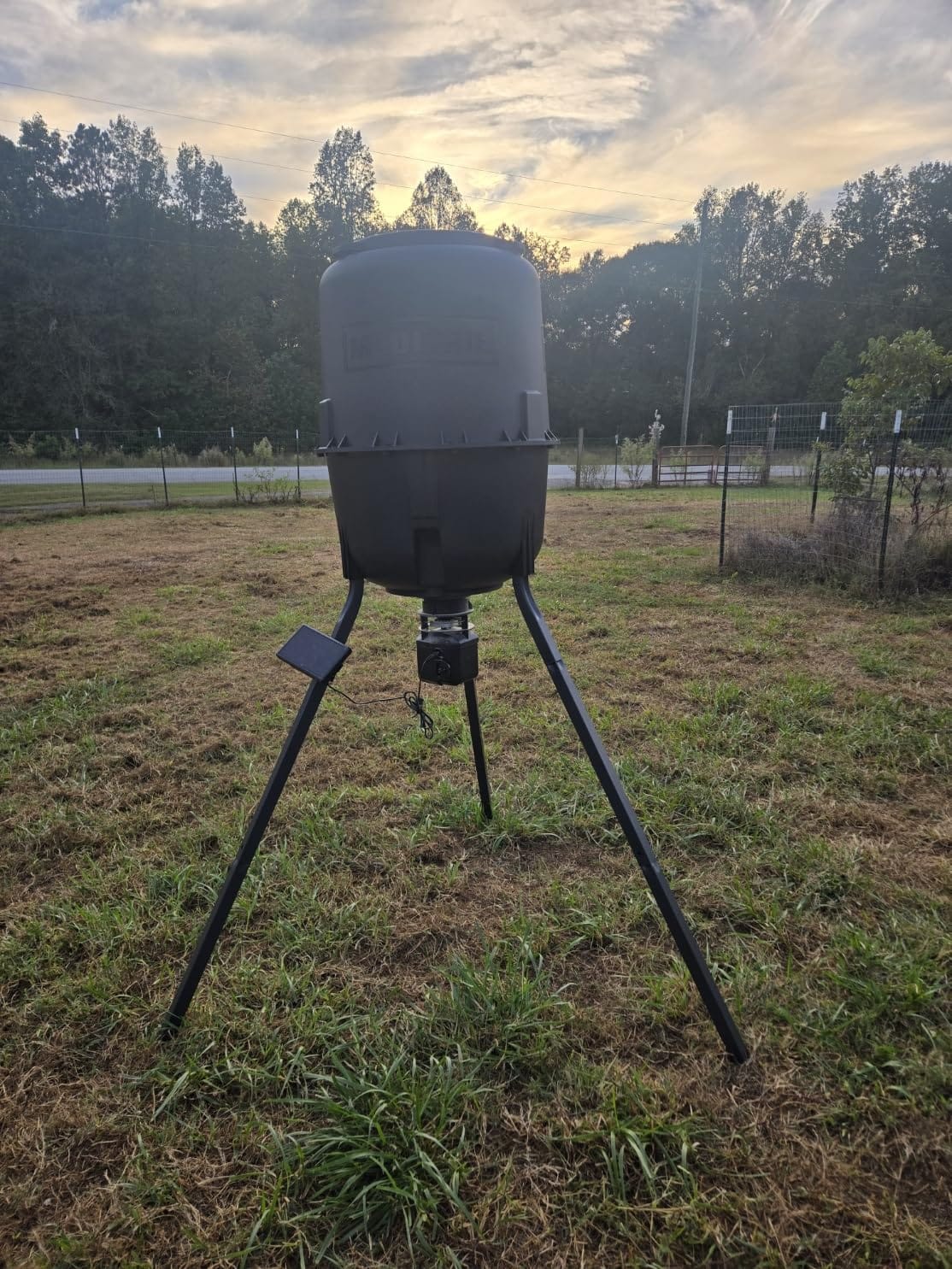
Programming from your phone is the real convenience. You can adjust feed times and durations without walking to the feeder, which matters when the unit sits at the far end of a plot behind a ridge or a creek.
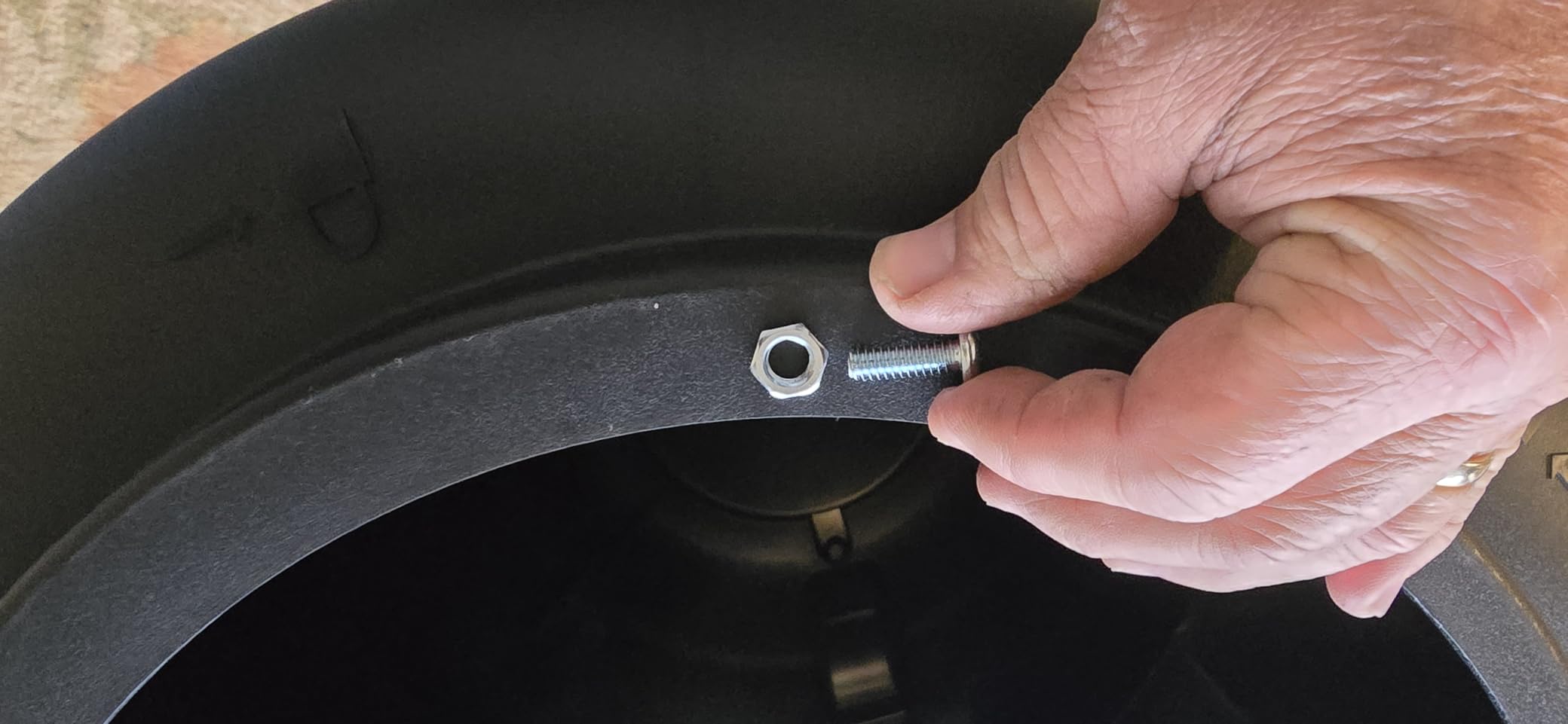
Three spin plate RPM settings let you tune the spread from tight to wide, and the 250 lb hopper has a six foot fill height so you do not need a ladder. Owners report it stays stable on exposed ridges and holds up in wind.
The tool-free Quick-Lock broadcast kit adds 360 degree coverage if you want it, and a locking lid keeps moisture and critters out between fills. Paired with an Edge 3 camera you get cellular remote access with no subscription.
Where it works on a food plot
Use it when the plot is large enough that deer need a reason to cross open ground. Set a high-RPM spin for a wide scatter that reaches browsing deer at range, and time the events one to one and a half hours before dark for a morning pattern.
The solar panel port means you can leave it through a full season without battery swaps, once you add a panel and a 6V rechargeable battery. That is the setup most people end up building.
Where it falls short
No varmint cage comes with it, and raccoons opening the battery compartment plus squirrels chewing wiring is a repeated complaint. Plan to add a motor cage from day one.
Bluetooth range in real use falls short of the advertised 300 feet, and the in-app feed estimator is not accurate enough to trust for planning refills. Batteries and the solar panel are separate purchases, so the all-in cost is higher than the hopper price suggests.
10. PROLEE 85 lb Galvanized Steel Feeder – Best for Varmint-Heavy Ground
PROLEE 85lbs Deer Feeder, Weatherproof Deer Feeders with 4 Feeding Tray and 4-Leg Stand, Heavy Duty Metal Gravity Feeder for Deers and Wildlife (Black)
50 to 80 lb capacity
Galvanized steel
4 feeding ports
10.66 kg
Pros
- Galvanized steel shrugs off gnawing and wind
- Four ports let several deer feed at once
- Drainage bottoms keep feed dry
- Pre-drilled holes accept ground stakes
- Easy to clean and carry
Cons
- Inconsistent quality control on arrival
- Light-gauge sheet metal in places
- Cheap internal welds can fail
- Port height pours feed for smaller wildlife
Verdict: an 80 lb galvanized steel gravity feeder with four feeding ports, the pick for ground where raccoons and gnawing have already wrecked plastic hoppers.
Metal is the entire argument. Bears, raccoons and squirrels can chew a plastic barrel or spin a motor for free corn, and they generally cannot chew galvanized steel. Reviewers on hunting forums repeatedly call varmint damage the most expensive recurring cost of feeder ownership.
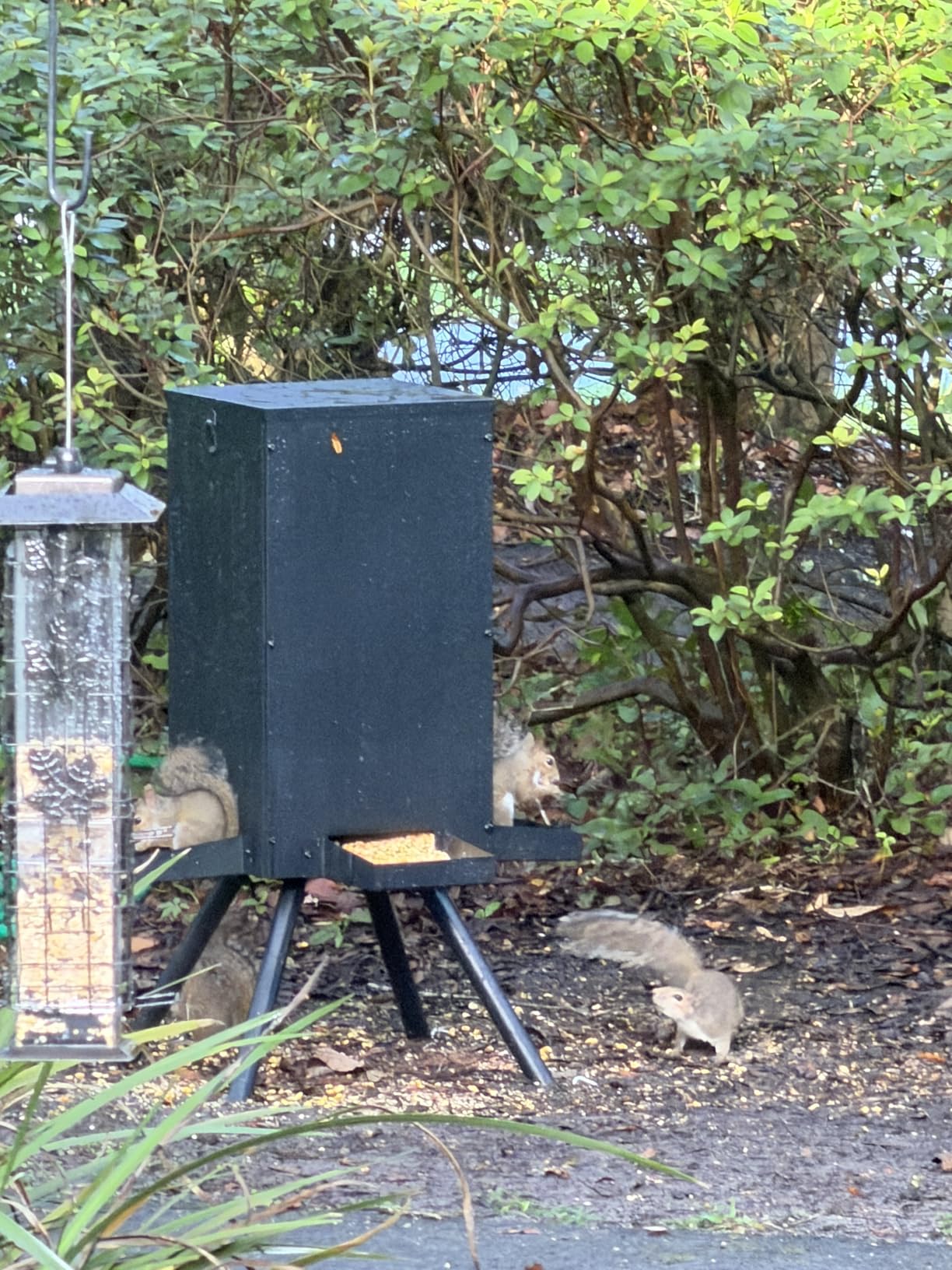
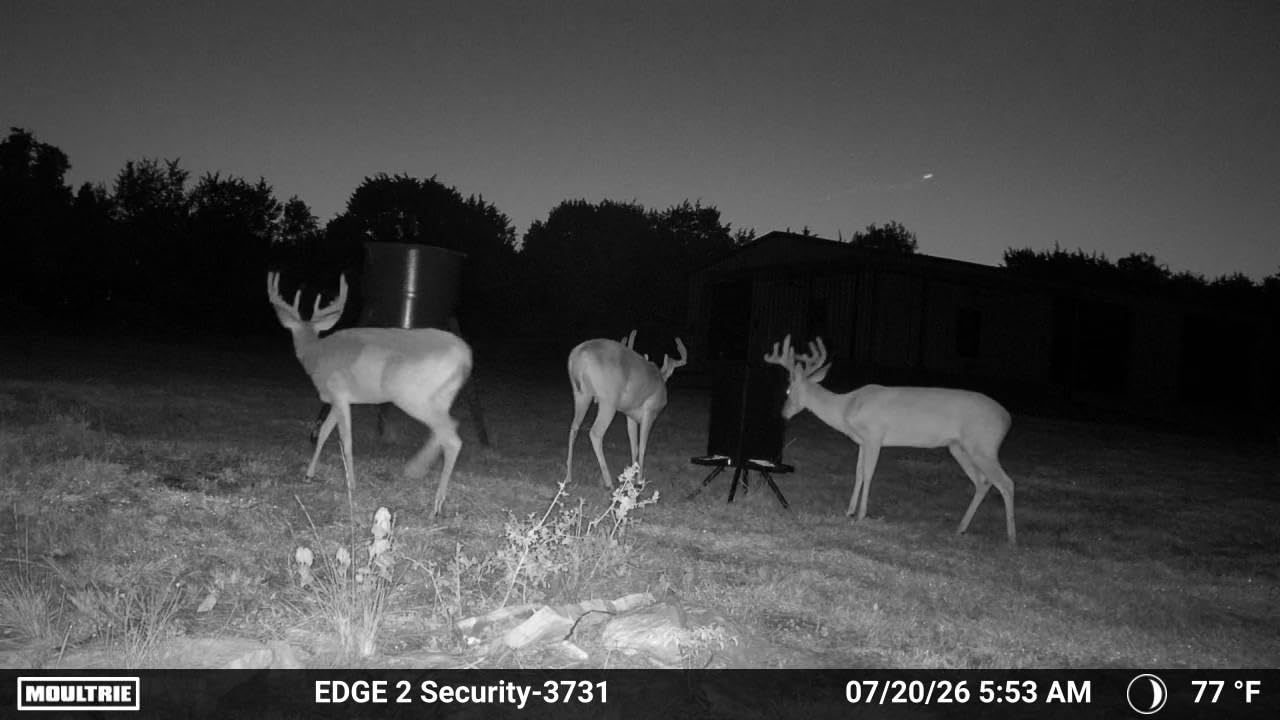
Four feeding ports mean several deer can work at once, and the drainage bottoms keep feed dry so it does not turn to sludge. Pre-drilled ground stake holes add real stability, which matters in open plot settings where wind is a daily concern.
The 4.1 average across 72 reviews is dragged down by assembly quality rather than function. Deer and other wildlife use it readily, and the value for a metal build is well regarded.
Where it works on a food plot
Put it where bears have already been through your setup. The steel body shrugs off what would destroy a plastic feeder, and the smooth galvanized surface wipes clean between feed changes.
It is also a good fit for a plot on open, exposed ground, since the four legs and stake holes resist tipping better than a tall plastic tripod. All necessary parts are included and assembly takes basic tools.
Where it falls short
Quality control is the weakness. Boxes arrive with missing or misdrilled holes and a missing rear latch, and light-gauge sheet metal appears in places on a few units. Inspect the box before you assemble.
Seams can separate when full unless you seal them with the included caulk, and cheap internal welds have been reported failing under load. The port height of roughly 5 to 6 inches also runs feed out fast for smaller wildlife.
11. Moultrie 40 lb Hanging Deer Feeder – Best for Testing a Location
Moultrie All-in-One Hanging Deer Feeder – 40 Lb, Bluetooth App
40 lb capacity
Hanging mount
4 feed times per day
6.4 lb
Pros
- Metal bucket and locking lid outlast plastic
- No tripod tools or assembly
- App programming from up to 300 feet
- 360 degree broadcast
- Light at 6.4 lb for scouting on foot
Cons
- Smallest capacity here at 40 lb
- Batteries and hanging rope not included
- No spread pattern adjustment
- Boxes can arrive missing motor parts
Verdict: a 40 lb metal-bucket hanging feeder at 6.4 lb, the cheapest way to test whether deer will use a specific spot before you commit hardware to it.
A hanging feeder changes the scouting question. Instead of guessing where a tripod would work, you carry this in on your boot, hang it from a branch, and find out in a week whether deer in that draw actually want a feeder.
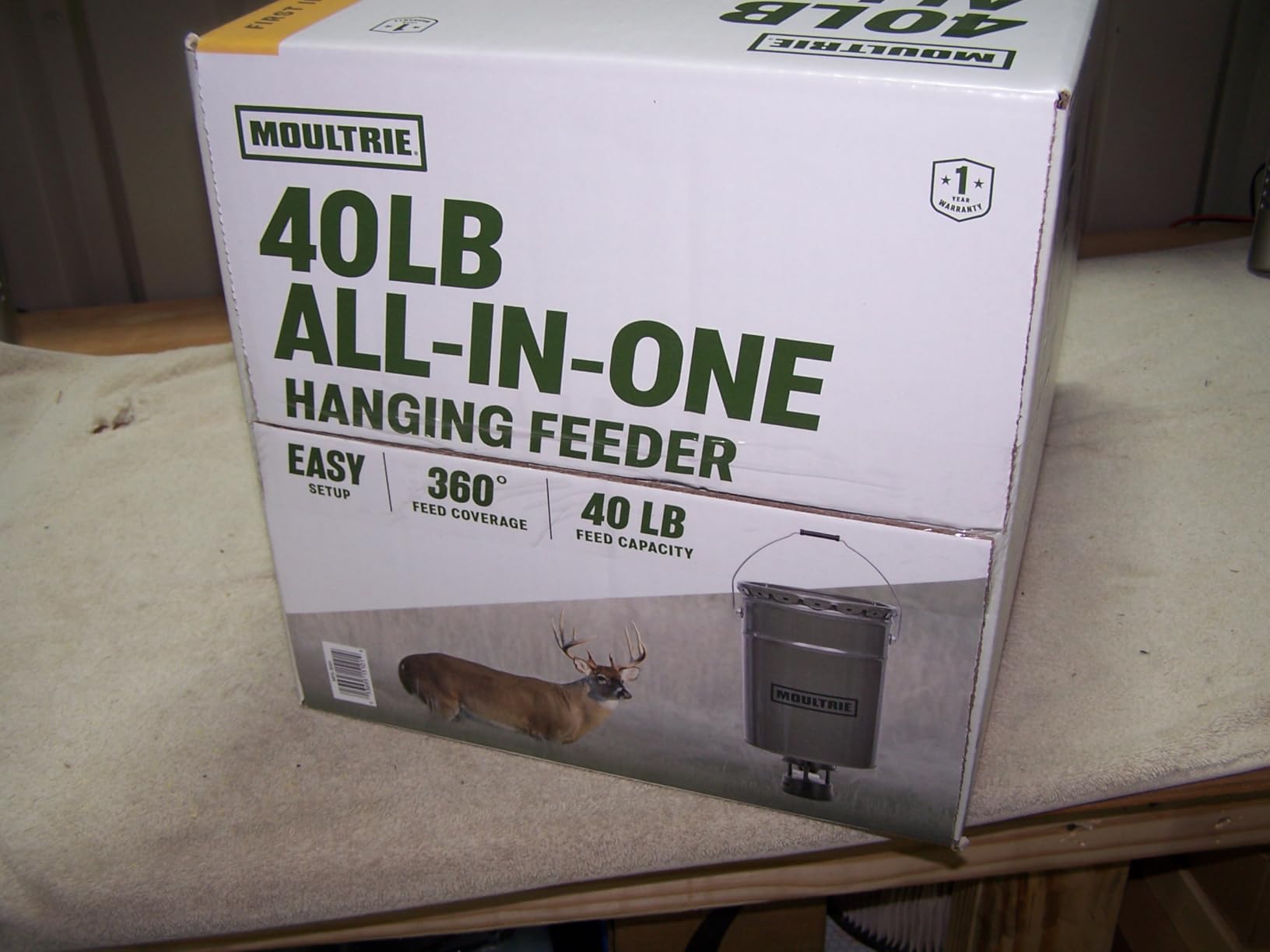
The all-metal bucket and locking lid are the smart call for a hanging design, because that is where raccoons and squirrels concentrate. Up to four daily feed events of 1 to 20 seconds each let you feed at dawn and dusk without being there.
Bluetooth app programming works out to 300 feet, and the slide-out battery tray makes swaps fast. Owners report AA batteries lasting about six months, and the 360 degree broadcast pulls deer in from every direction.
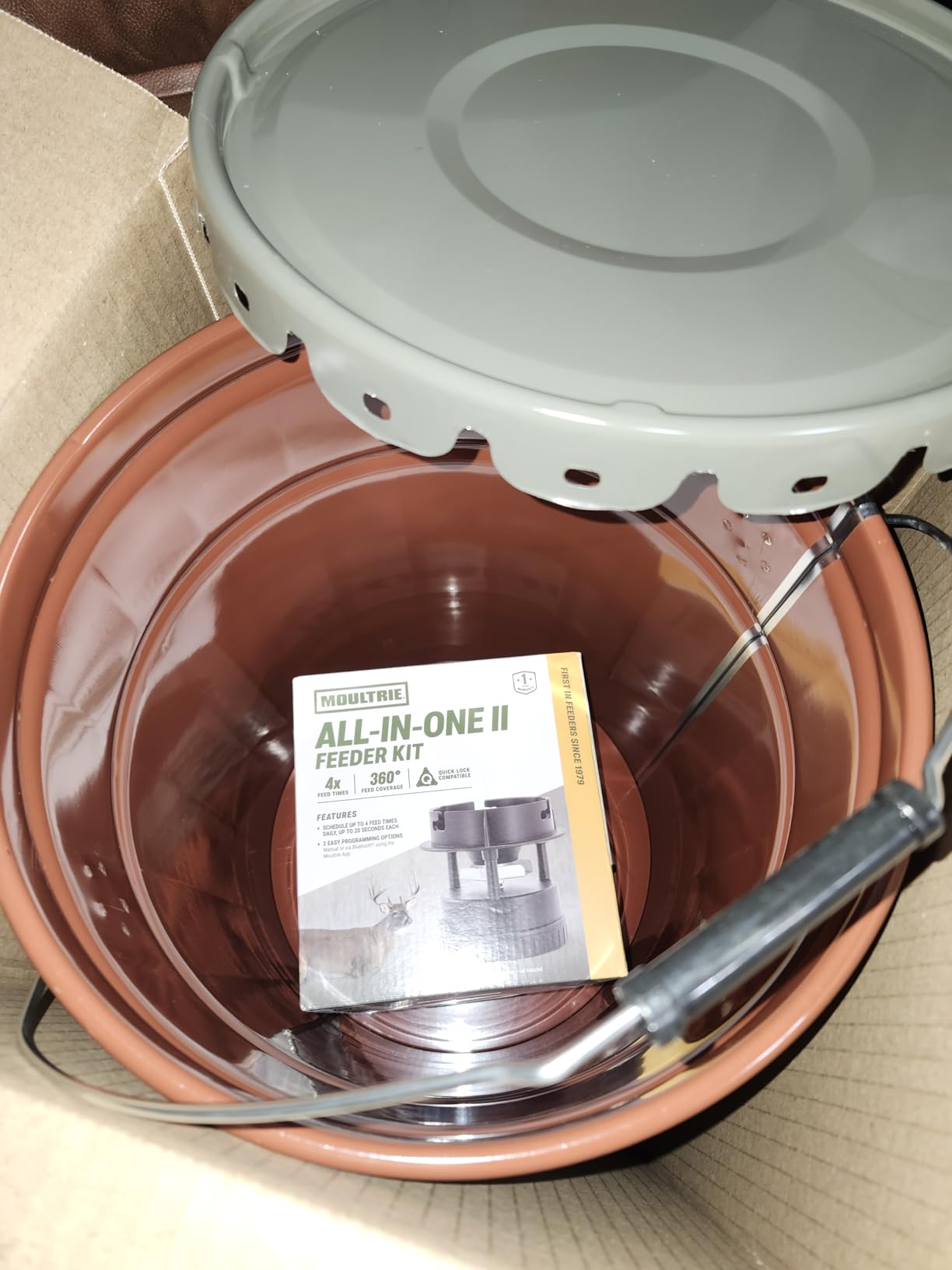
Where it works on a food plot
Use it as a scout. Hang it near a candidate plot edge, run two events a day, and put a trail camera on the same branch. If deer are showing up during daylight, you have found your feeder site and can move a permanent unit there.
It also works as a small supplement feeder in a timber pocket where a tripod will not fit. Forty pounds needs frequent refills, so treat it as a pattern tool rather than a bulk feed point.
Where it falls short
Forty pounds is the smallest hopper here, so on a productive site you will be carrying feed in often. Batteries and the hanging rope are not included, and there is no way to adjust the corn spread pattern.
A few have arrived with motor-to-barrel connection parts missing, so check the box. Programming on certain versions requires pulling the bottom unit, which is awkward on a ladder.
12. HECASA 450 lb Steel Gravity Feeder – Best for Minimal Upkeep
HECASA Steel 450LB Capacity Big Game Gravity Metal Deer Feeder Galvanized Hunting w/o Foot Kit Tripod Feeder
450 lb capacity
Zinc-plated steel
78 inch tripod
73 lb
Pros
- Largest capacity in the roundout
- Zinc plating resists rust and water
- Internal cone keeps feed flowing and dry
- 78 inch tripod with wide base resists tipping
- Instructions and components included
Cons
- Heaviest feeder here at 73 lb
- Foot and stake kit not included
- Sprawling footprint needs plot clearance
- No timed or remote broadcast
Verdict: a 450 lb zinc-plated steel tripod, the largest capacity in this roundup and the right answer when refills are the part you want to stop thinking about.
At 450 lb this is the feeder you fill once and forget. On a large plot with good deer numbers, that changes how you budget the season and how often you are walking in mud with a feed bag.
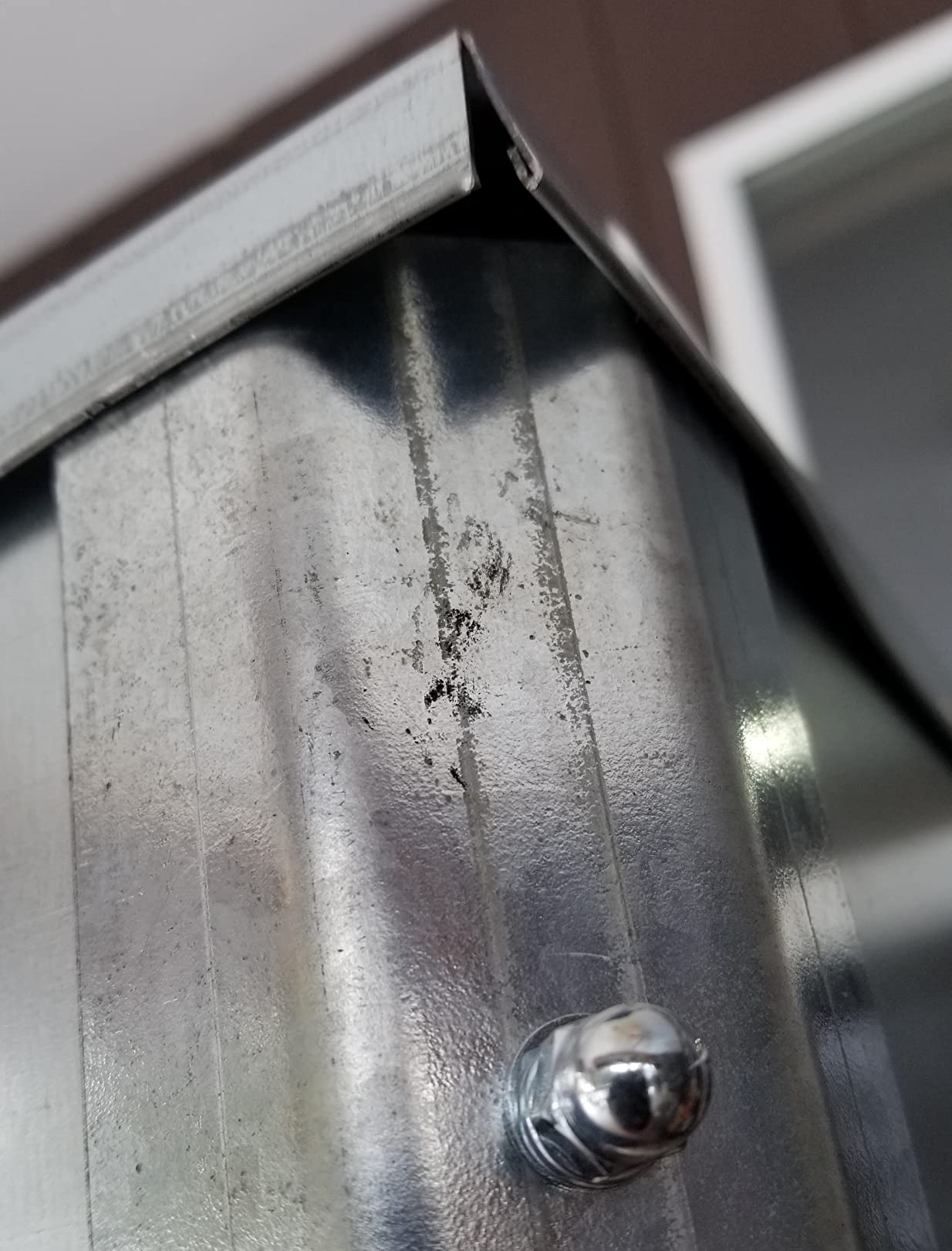
The internal cone gravity design keeps feed flowing evenly and staying dry, and the zinc plating resists rust in long-term outdoor exposure. The 78 inch tripod on a 25 by 25 inch base resists tipping and wobbling on varied terrain.
Metal construction is far more varmint-resistant than plastic, which is the other reason this unit appeals to anyone who has already lost a hopper to bears. At a 4.2 average across 69 reviews it is well regarded, with a smaller review base than the leaders.
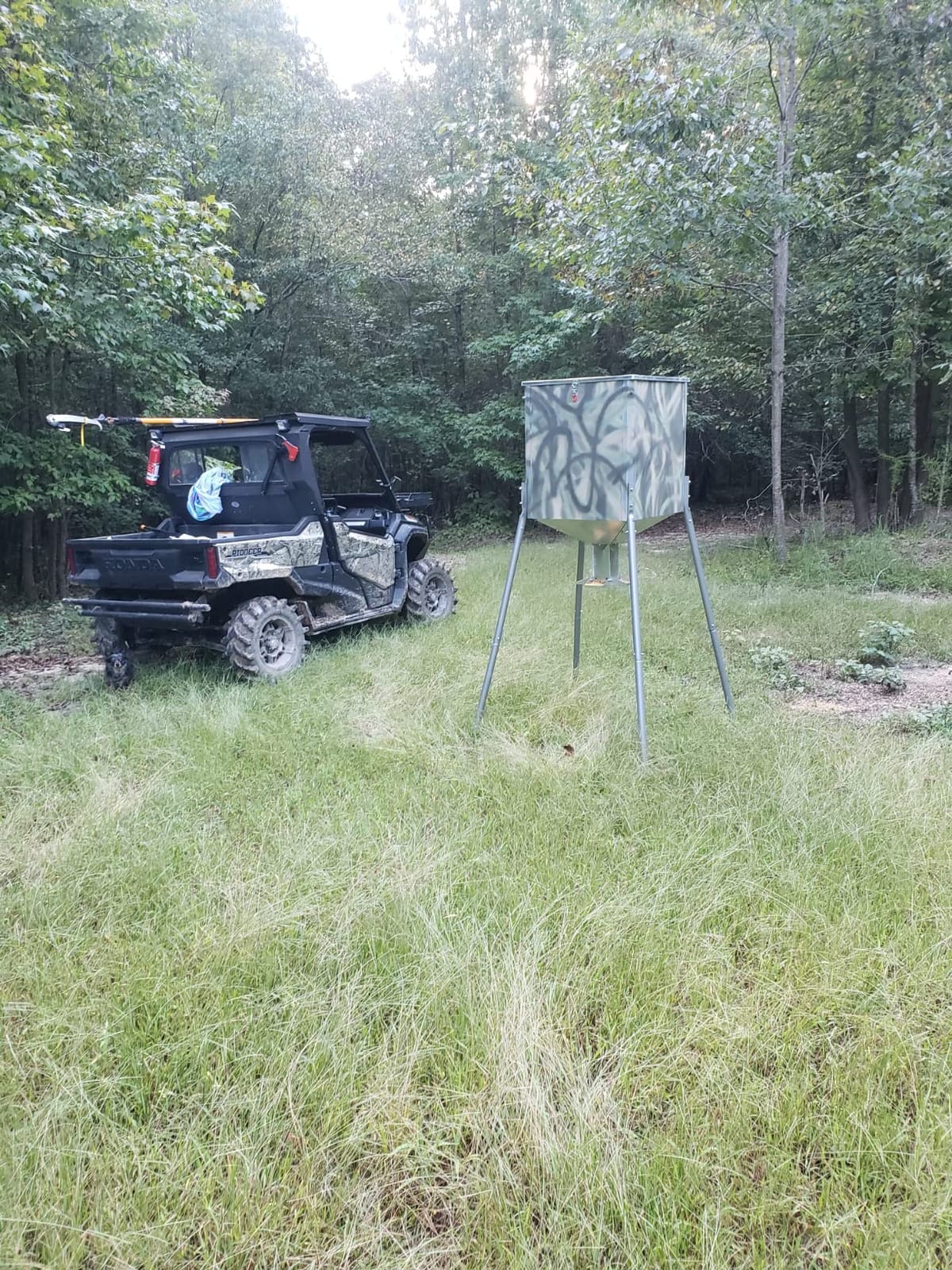
Where it works on a food plot
It suits a large plot program where deer pressure is high and you want a background attractant that does not need servicing. The wide base handles uneven ground better than the taller narrow plastic tripods in this group.
Because it holds so much, you can run one unit as a main attractant and supplement it with a smaller timed feeder closer to your stand. Splitting the program this way reduces how hard deer hit any single spot.
Where it falls short
Seventy-three pounds is the heaviest feeder here, so anchoring and repositioning take real effort. The optional foot and stake kit is not included, so source anchors separately for stability.
The 25 inch footprint needs clearance in a food plot, and there are no timed or remote broadcast options. If your plot is small, this capacity is overkill and harder to place than it looks.
How to Choose a Deer Feeder for a Food Plot
Start with deer density, not with capacity. Hunting forums commonly use one feeder per 300 to 400 acres as a spacing rule of thumb, and if you are managing a small property a single 100 to 200 lb unit is usually enough.
Next, pick gravity or automatic. Gravity feeders have no failure points and suit remote ground you cannot service. Automatic spin-cast feeders concentrate deer at a predictable hour, which is what makes a food plot huntable, at the cost of electronics you will eventually replace.
Match capacity to your refill rhythm. Under 100 lb means checking in every few days, 200 to 250 lb suits a weekly visit, and 400 lb or more is a once-a-season unit for a large plot. Overfeeding is the most common mistake: an empty feeder is a wasted feed bill and an argument to stop running it.
Decide on power before you buy. A 6V rechargeable battery with a solar panel port is the modern default, and 12V deep cycle systems suit heavier timed units. If your site has no sun access for a panel, budget for a battery rotation schedule.
Finally, consider the feed itself. A feeder that pours pellets too fast wastes feed and grows mold. Adjustable sleeves and funnels, found on the Boss Buck and Moultrie gravity units, are worth paying for if you plan to run more than one feed type.
How to Place a Feeder Around a Food Plot
No competitor in this category publishes a placement rule set, so here is the one we use. Put the feeder 20 to 30 yards back from the plot edge rather than in the middle of the forage, so broadcast feed pulls deer toward the standing crop instead of competing with it.
Watch the prevailing wind and set directional or all-around ports accordingly. A feeder that throws into a creek or a road is a feeder that feeds fish and generates a neighbor conversation.
Stagger your feeders rather than clustering them. Two units 60 yards apart hold more deer than two units stacked together, because clustering concentrates pressure and empties the hopper faster.
Make sure the feeder is visible from your stand but not directly in your shooting lane. Deer that feel pinned between a feeder and a hunter will pattern the feeder instead of the plot.
Verify before you invest. Put a trail camera on the feeder for a week and count deer during daylight hours; if they are not showing, more feeders will not fix a placement problem. Our broader feeder guide covers the hardware side of setting that up.
Power, Timers and Solar Panel Sizing
Program automatic feeders for two to four events per day, with run times of 8 to 12 seconds, timed one to one and a half hours before dark. That pattern concentrates deer in a predictable overnight window and puts them in front of you at first light.
Run time is the setting people get wrong. Too short and the motor never reaches speed, so feed drops straight down instead of scattering. Too long and you dump a pile that molds in warm weather and attracts varmints to the ports.
For solar, size the panel to the draw rather than the hopper. A 6V rechargeable system running a few short daily events needs far less panel than a motor cycling continuously, which is why built-in and ported solar panels are repeatedly praised in the hunting community.
Mount the panel with a clear line to the sun and wipe it down each visit. A dirty panel in shade can cut charging enough to strand you with a dead battery mid-October, which is the least convenient possible time.
Add varmint protection at the same time you add the feeder, not after the first motor gets chewed. A wire cage over the motor and a sleeve on the ports costs far less than replacing a control unit.
Feeder Legality and CWD Rules to Check Before You Buy
Feeding rules vary by state, county, and sometimes by lease, and they change without notice. Nothing in this roundup is legal advice, and everything here should be confirmed with your state wildlife agency before you spend money or fill a hopper.
Chronic wasting disease is the rule that surprises people most. Inside some CWD containment and surveillance zones, baiting and feeding are prohibited whether or not you are hunting, and that includes maintaining a feeder on ground where the plot itself is perfectly legal.
Leased ground adds a second layer. Your lease may forbid feeders, set boundary setbacks, or decide who owns the feeder when the lease ends and who takes the citation if something goes wrong. Read the clause before you hang anything.
Finally, some states set dates for feed removal after the season, often in January or February. Know the date when you buy, because it affects how much feed you buy in the fall.
Frequently Asked Questions
What food plot attracts deer the most?
A well-chosen forage mix does the heavy lifting, not the feeder. Plots planted with locally adapted forage such as clover and brassicas hold deer far better than a plot that is simply a corn patch with a feeder beside it. The feeder’s job is to concentrate and pattern movement on ground you have already made productive.
How many times a day should your deer feeder go off?
Two to four timed events per day works for almost everyone, with run times of 8 to 12 seconds, and feeding finishing one to one and a half hours before dark. That timing concentrates deer in a predictable overnight window so they are in front of your stand at first light instead of scattered all night.
What shouldn’t you feed deer?
Avoid bread, old hay, moldy grain, and anything with a high salt or molasses content, which can kill a deer outright in large amounts. Be careful with livestock-grade corn, which is not held to wildlife standards and can carry aflatoxin that develops in warm, humid feeders. Feed you cannot verify the storage history of is the main risk.
What size solar panel for deer feeder?
Size the panel to the motor draw rather than the hopper size. A 6V rechargeable system running two to four short daily events needs a modest panel, while a continuously cycling motor needs substantially more. Mount it with a clear line to the sun and clean it on every visit, because a dirty shaded panel can cut charging enough to leave you with a dead battery in October.
Do automatic deer feeders scare deer?
No, once deer get used to them. The noise is a short motor run rather than a continuous sound, and deer habituate within days. The bigger risk is feeding at the wrong time of day, which pulls deer away from the plot during daylight hours when you actually want to see them.
Best Deer Feeders for Food Plots: The Verdict
The Wildgame Innovations Treehugger is our pick for most people starting a plot program, because it is quick, quiet and carries the largest body of owner feedback in this group. Buy the Banks Outdoors Feed Bank if you want the best-built unit and only need 40 lb, and go with the Moultrie 250 lb gravity tripod for a spring protein program.
If you have power and want deer on a schedule, the Moultrie Pro Hunter III gives you ten daily events and app control, while the Wildgame Quick-Set Pro reaches further across a big plot. Check your state agency and your lease before any of them go in the ground, and update the list for the 2026 season.