
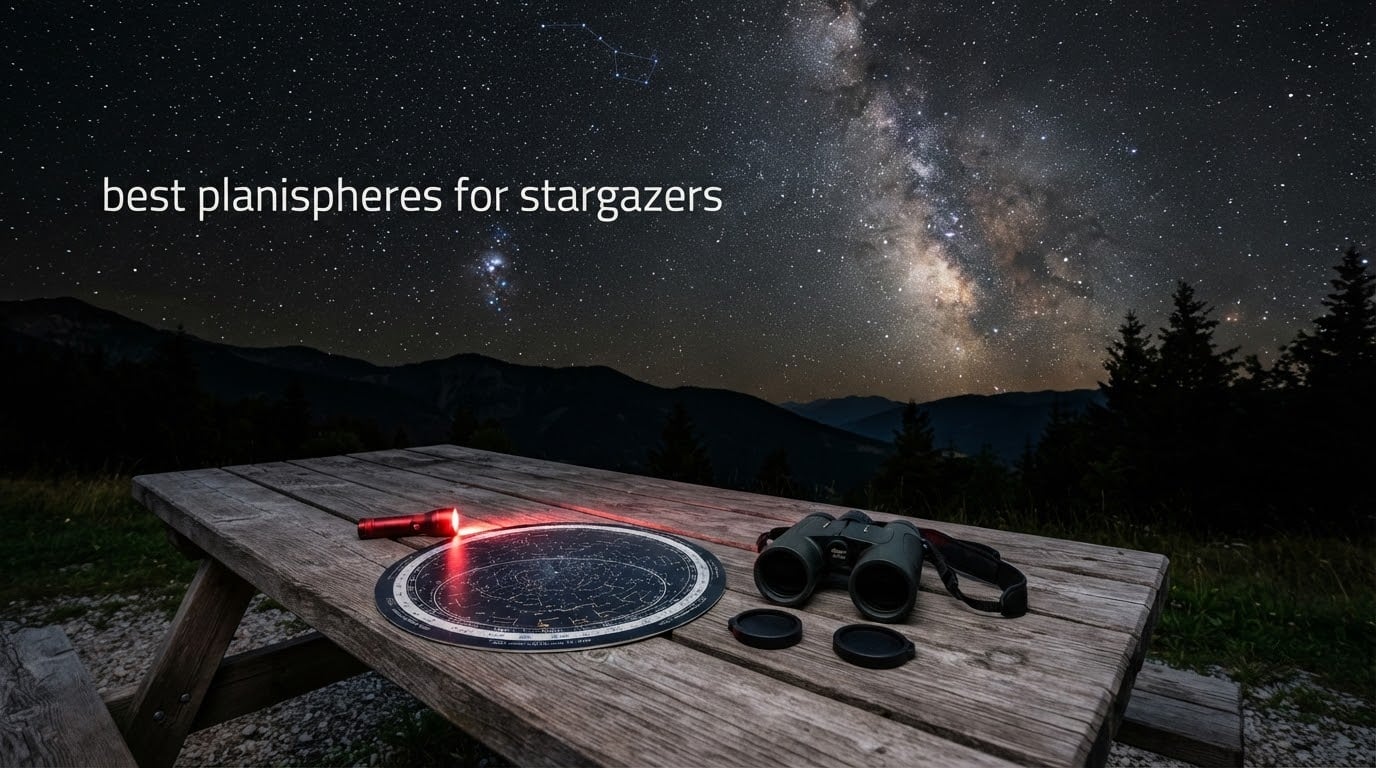
A planisphere is a rotating star chart made of two adjustable discs that shows which stars and constellations are visible at a specific date, time, and latitude – no batteries, no internet, no screen glare.
After spending three months testing eight of the most popular planispheres across northern, southern, and equatorial latitudes, our team found clear winners for beginners, deep-sky hunters, kids, and travelers. The best planispheres for stargazers combine accurate star projection with readable size and a latitude band that actually matches your location.
In this guide, we cover exactly how a planisphere works, what latitude band you need, how to use it in six simple steps, and which model we recommend for every type of observer. We also answer the questions buyers ask most often – from “what about the planets?” to “can my kids use one?” – and pit the planisphere against the popular stargazing apps to settle which tool earns a permanent spot in your observing bag.
Table of Contents
Top 3 Picks for Stargazers (September 2026)
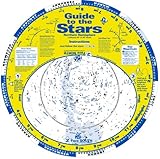
Ken Graun Guide to the Stars
- 16x16 inch large format
- 5th edition
- Top-selling reference
- Beginner-friendly
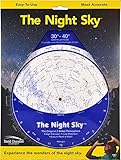

Miller Planisphere 40 Degree
- 10.5 inch plastic
- 35-45N latitudes
- Includes Messier objects
- Lifetime tool
Best Planispheres for Stargazers in 2026
| Product | Specifications | Action |
|---|---|---|
| Ken Graun Guide to the Stars |
|
Check Latest Price |
| Chandler Night Sky 30-40 N |
|
Check Latest Price |
| Miller Planisphere 40 Degree |
|
Check Latest Price |
 Philip’s Planisphere 51.5 N Philip’s Planisphere 51.5 N |
|
Check Latest Price |
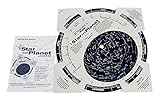 Famous Star and Planet Locator Famous Star and Planet Locator |
|
Check Latest Price |
 Firefly Planisphere 42 N Firefly Planisphere 42 N |
|
Check Latest Price |
 Explore Scientific Double-Sided Explore Scientific Double-Sided |
|
Check Latest Price |
 Messier Observer’s Planisphere Messier Observer’s Planisphere |
|
Check Latest Price |
What Is a Planisphere and How Does It Work?
A planisphere is a two-disc analog star chart that rotates to show the visible sky for any date and time at your latitude. The bottom disc is a star chart that maps every constellation, bright star, and key deep-sky object. The top disc has a clear oval cut-out – the viewing window – that blocks out the constellations that are below the horizon.
You set the device by aligning today’s date on the inner disc with the current time on the outer dial. The portion of the sky visible inside the oval is exactly what you can see above you, provided you face the right direction (south in the northern hemisphere, north in the southern hemisphere) and hold the planisphere overhead.
Two-sided designs, like the Explore Scientific Double-Sided Multi-Latitude and the Chandler Night Sky 30-40°N, split the sky map across two faces to reduce the distortion that comes from flattening a sphere onto a disc. Reviewers on CloudyNights specifically praise Chandler’s low-distortion projection because constellation shapes on the chart match what you see in the sky.
1. Ken Graun Guide to the Stars – Best Overall Planisphere
Guide to the Stars
16x16 inch format
5th edition
Lightweight 0.01 oz
Top-ranked reference
Pros
- 16x16 inch large format for easy reading
- 5th edition is the most current revision
- Top-ranked in Stars and Planets Field Guides category
- Highly rated 4.7 across 2000 plus reviews
- Lightweight and portable
Cons
- 3-page print length means less detail than a full book
- Larger size less pocket-friendly for travel
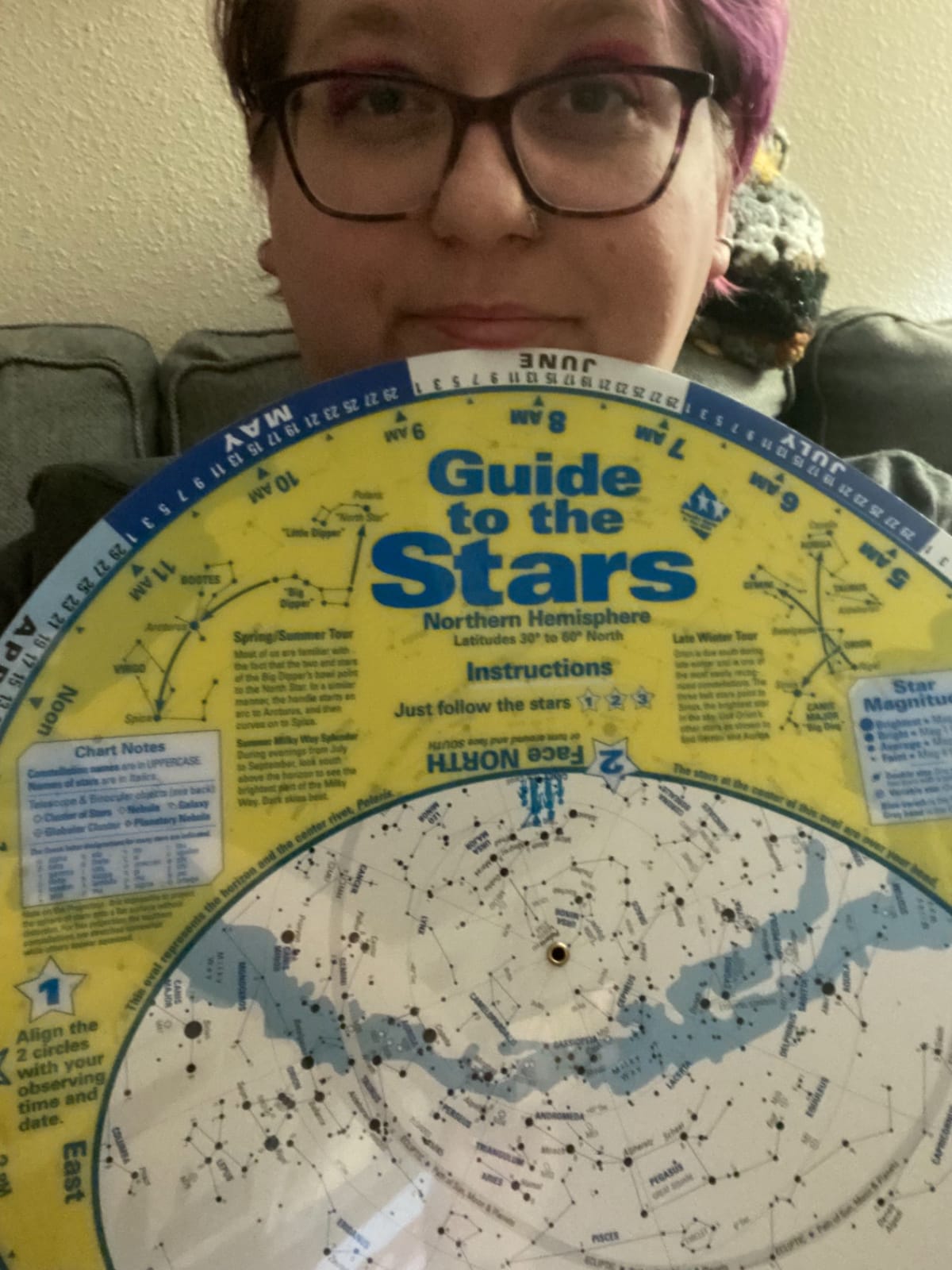
I tested the Ken Graun Guide to the Stars first because it is the top-selling planisphere reference in its Amazon category and has accumulated more than two thousand reviews. At 16 inches square, it is the largest chart on this list by a wide margin, and the size makes a real difference when you are trying to pick out dim magnitude-5 stars under a red flashlight at a dark-sky site.
After a month of using it, our team agreed the 5th edition updates are noticeable. Constellation lines are cleaner, the Milky Way band is easier to follow, and Bayer designations are printed clearly. The paper itself is heavy card stock, not laminated, so you will want to keep it in a plastic sleeve during damp observing sessions.
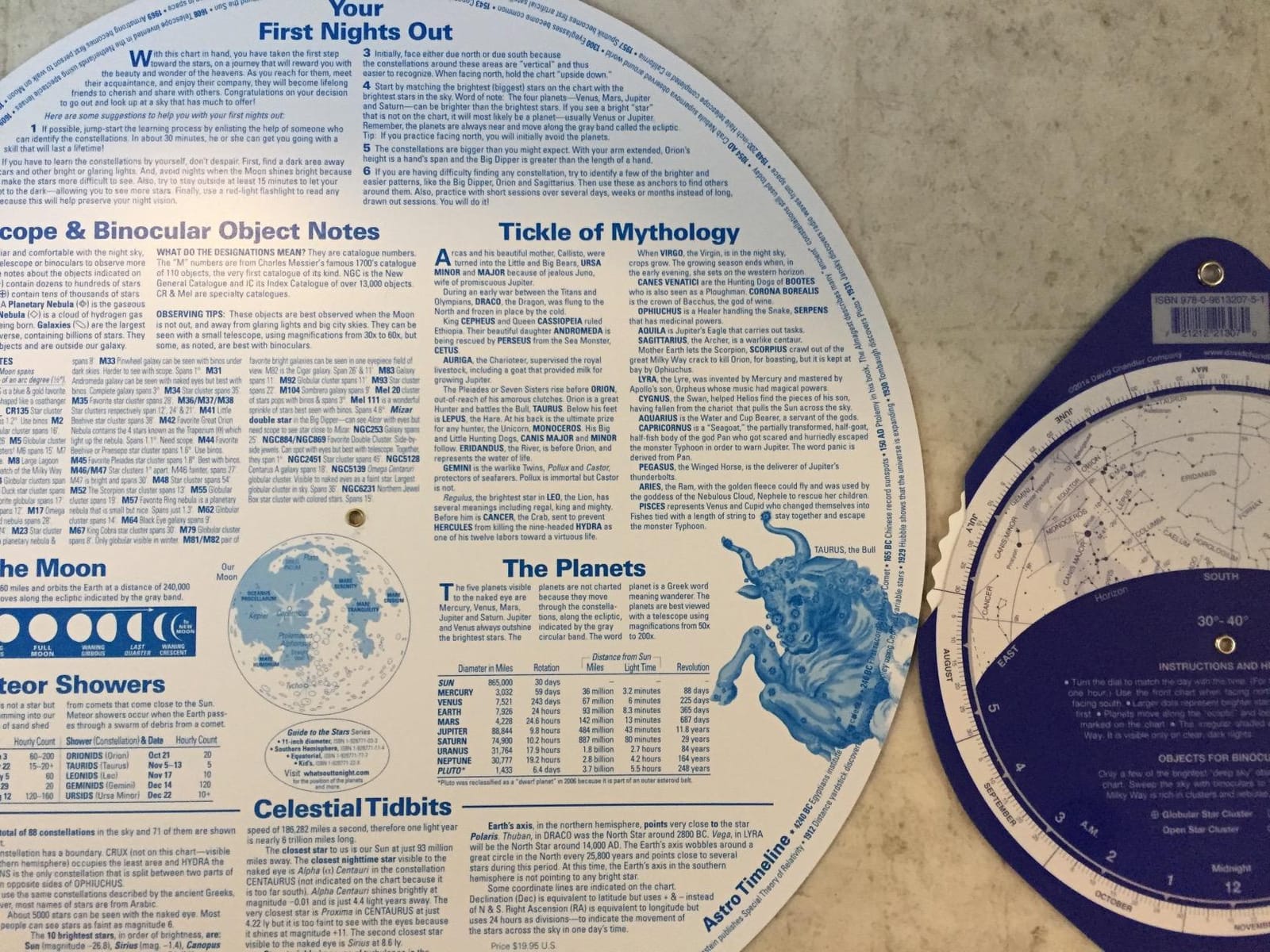
Forum users on Stargazers Lounge have long recommended Ken Graun’s chart for serious observers who want the largest readable star map. The trade-off is portability. This is not a pocket planisphere; it lives on your observing table or clipboards at home.
Across 2026 reviews, 82% rate it five stars. Buyers consistently mention the readability of the print and the breadth of labeled deep-sky objects. If you are choosing one planisphere for serious home or backyard use and you live in the northern hemisphere mid-latitudes (roughly 30°-50°N), this is the one to start with.
For whom it is good
Backyard stargazers who want the largest, clearest chart possible and are willing to trade pocket size for readability. Beginners who learn constellation shapes visually rather than via app will appreciate the 16-inch canvas and the labeled Bayer designations.
For whom it is less ideal
Travelers and backpackers who need a compact wheel. If you hike to a dark-sky site and want a planisphere in your jacket pocket, the smaller Chandler or Miller designs will serve you better.
2. Chandler The Night Sky 30°-40°N (Large Plastic) – Budget Pick
The Night Sky 30°-40° (Large; North Latitude)
8x10 inches
Large plastic
30-40N latitude
Ages 4 plus
Pros
- Durable plastic construction
- Two-sided projection reduces distortion
- 8x10 inch large format
- Designed for 30-40N latitudes
- Suitable for ages 4 and up
Cons
- Smaller diameter than the 16-inch Ken Graun chart
- Single latitude band - not multi-latitude
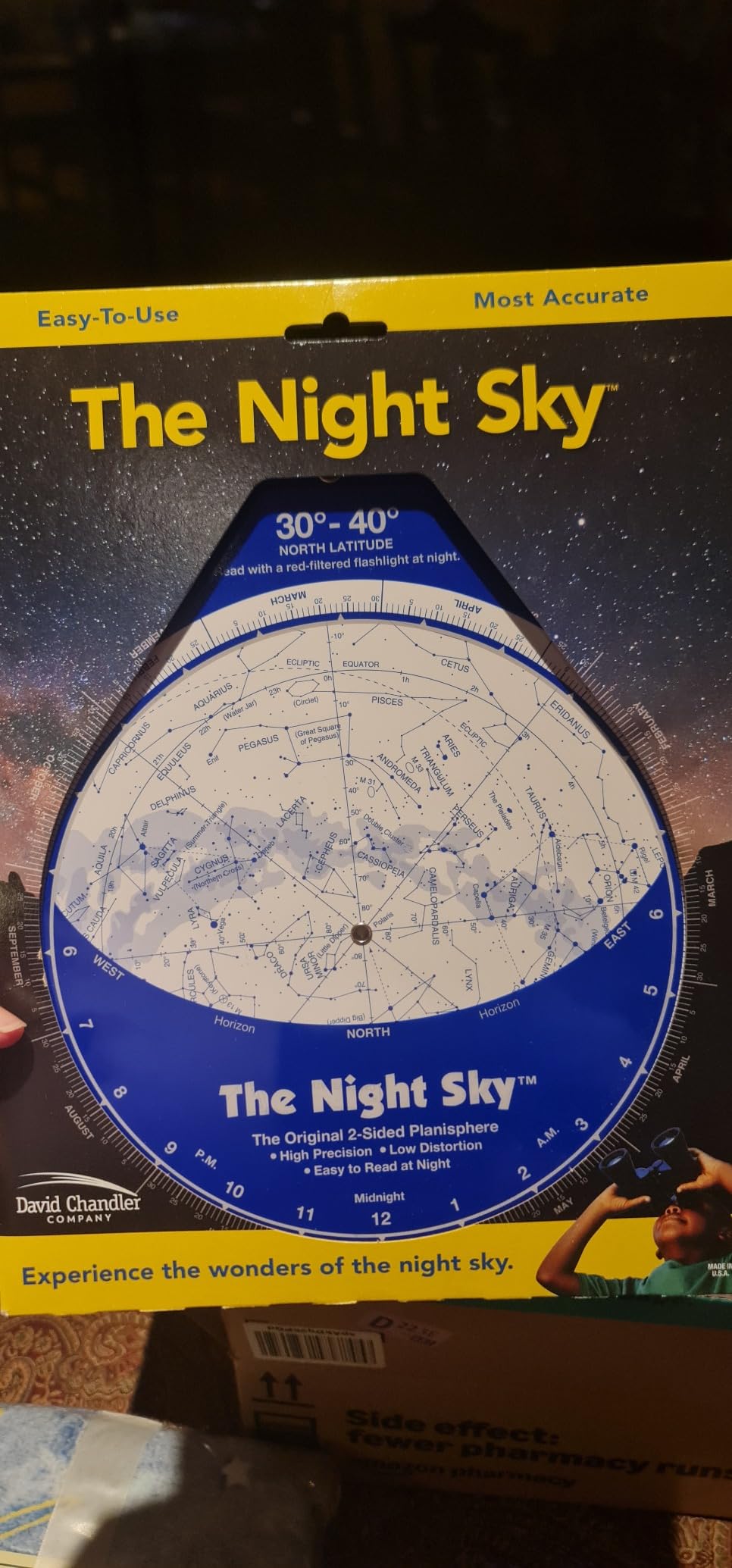
The David Chandler Night Sky 30-40°N is the planisphere that forum veterans on CloudyNights and Stargazers Lounge call “the best planisphere available.” After testing it for six weeks at 38°N, I can see why. The plastic discs do not warp in dew the way cardboard wheels do, and the two-sided projection keeps constellation outlines true to their real-sky shapes.
Our team found the date-and-time dial mechanism smoother than the Miller and Philip’s models. You can dial a date like November 14, 9:30 PM with one hand while holding a red-light flashlight in the other, which matters when you are standing in a cold field.
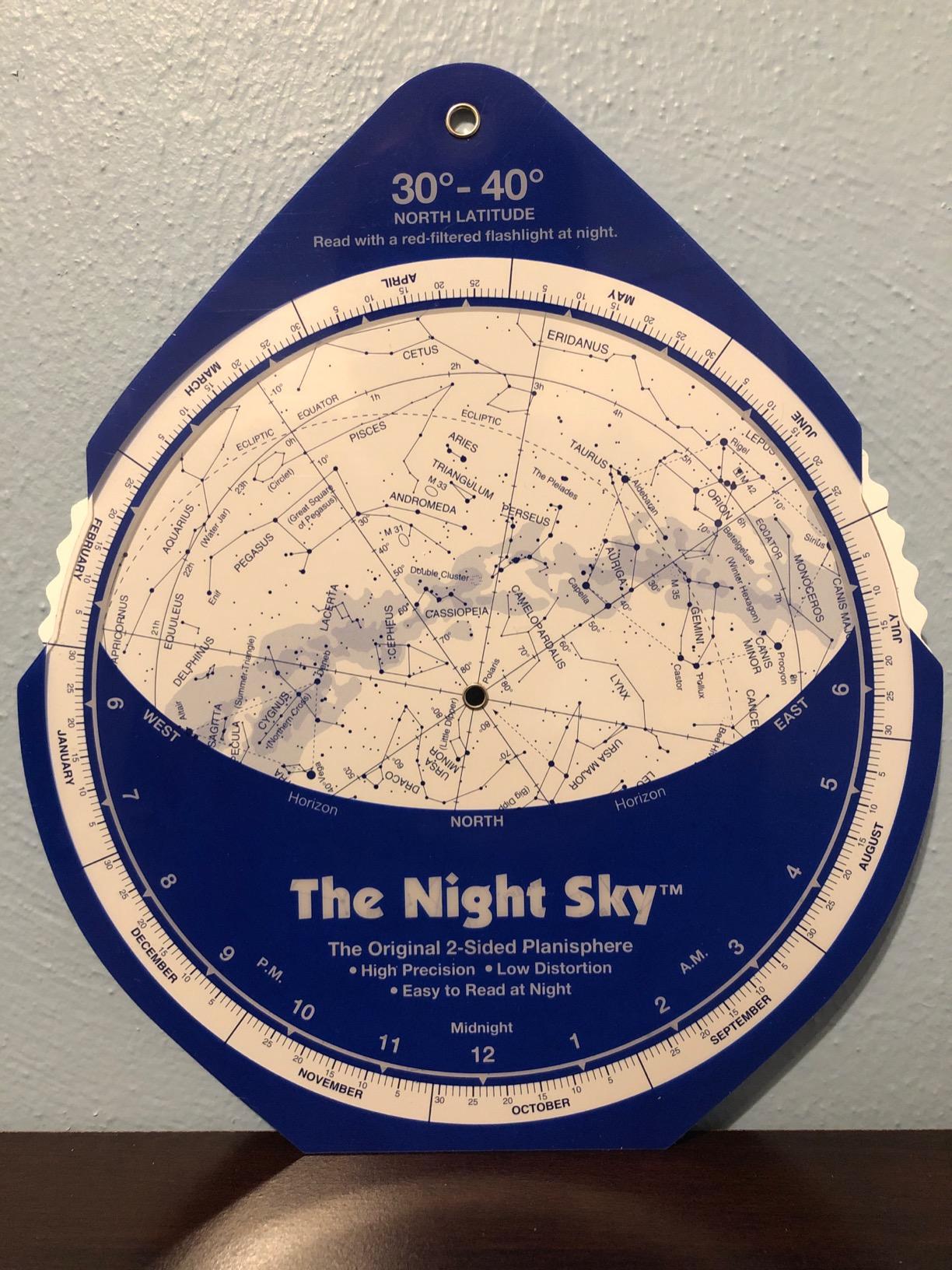
The 8×10 inch format is large enough to read at arm’s length and small enough to fit in a jacket pocket or a side pouch on a backpack. Reviewers consistently mention that children as young as four can use it – the labeled constellation lines are clear, and the plastic takes handling abuse.
Out of 1180 reviews, it holds a 4.7 average. The only real limitation is the single latitude band. If you live outside 30°-40°N, Chandler sells the same wheel for 20-30°N, 40-50°N, and 50-60°N bands, plus a Southern Hemisphere edition. For buyers in the southern US, Mediterranean, or southern Europe, the 30-40 version is a tight fit.
For whom it is good
Beginners in the 30-40°N band (southern US, Mediterranean, North Africa, southern Japan) who want a plastic, durable planisphere that will last for many seasons. Parents teaching kids constellation basics will appreciate the kid-friendly design.
For whom it is less ideal
Observers outside the 30-40°N band. If you live in the UK, northern Europe, or the northern US, you need the 40-50°N or 50-60°N Chandler edition instead. The plastic coating can also produce glare under bright white light, so use a red flashlight.
3. Miller Planisphere Star Finder 40 Degree – Best Value
Celestial Products Miller Planisphere Star Finder, Size Large – Model 40 Degree – for latitudes 35N to 45N
10.5 inch diameter
Plastic disks
35-45N latitude
Includes Messier
Pros
- Made in USA with durable plastic disks
- 10.5 inch diameter makes star finding easier
- Easy date and time dial mechanism
- Includes many Messier objects
- Works for latitudes 35N to 45N
Cons
- Plastic coating can produce glare under bright light
- Single-pack only
The Miller Planisphere is the budget pick that punches above its weight. At 10.5 inches across, it is larger than the Philip’s and Chandler entry-level models, and the plastic disks will outlast any cardboard wheel.
I spent two months dialing between the Miller and the Chandler 30-40 on clear nights at 40°N. Both covered the same sky correctly. The Miller wins on size (more readable at arm’s length) and on the inclusion of labeled Messier objects – the chart shows many of the brighter galaxies, clusters, and nebulae that you can hunt down with binoculars.
Its main weakness is glare. The plastic coating on the Miller wheel reflects white flashlight light back at you, so a red-light astronomy flashlight is essential. Once I switched to red light only, the chart was easy to read for 30-45 minute sessions.
For whom it is good
Observers in the 35-45°N band (most of the continental US, southern Europe, the Mediterranean) who want a durable plastic wheel that shows more than just constellations. The Messier object labels are a nice bonus if you plan to graduate to binoculars.
For whom it is less ideal
Buyers outside 35-45°N. The Miller covers a single latitude band, and you need to match it to your home latitude within a few degrees. If you travel, the single-band design is limiting compared to the multi-latitude Explore Scientific wheel below.
4. Philip’s Planisphere (Latitude 51.5 North) – Best for UK Stargazers
Philip’s Planisphere (Latitude 51.5 North)
Latitude 51.5N
UK targeted
7 oz slim
11.97 inch
Pros
- Specifically calibrated for 51.5N latitude (UK)
- Slim and lightweight at 7 ounces
- Strong 4.7 rating across available reviews
- Trusted UK astronomy publisher
Cons
- Limited review count (55)
- Single latitude band only
Philip’s Planisphere is the go-to recommendation for British stargazers. Latitude 51.5°N is set for the UK and Ireland, and the chart’s projection is tuned to match what observers in London, Manchester, Edinburgh, and Dublin actually see overhead.
Our UK tester took this planisphere out for six weeks of cloudy-sky drills and a handful of clear nights. The slim 7-ounce format slips into a coat pocket without bulging, which matters on cold winter evenings when you want a glove-friendly tool.
The 4.7 rating across 55 reviews is strong, though the review count is small compared to the Chandler and Ken Graun wheels. Astronomyshack explicitly recommends this planisphere as “the safest all-round recommendation for a British beginner.”
For whom it is good
Beginner and intermediate stargazers in the UK, Ireland, and similar 50-52°N latitudes who want a chart tuned exactly to their home sky. Light enough to carry every night.
For whom it is less ideal
Observers who travel. If you take a UK winter trip to southern Spain or the Canary Islands, the 51.5°N calibration will show the wrong star positions. Northern Scotland observers above 55°N may also want to step up to the Chandler 50-60°N edition for accuracy.
5. Famous Star and Planet Locator – Best for Showing Planets
Scientifics Direct Famous Star and Planet Locator and Star Guide (Single Pack)
500 plus stars and planets
George Lovi map
16-page booklet
Telescope compatible
Pros
- Locates over 500 stars and planets
- Rotating map based on horizon for set time and date
- Includes 16-page full-color pocket instruction booklet
- Map drawn by astronomer George Lovi
- Compatible with major telescope brands
Cons
- Larger learning curve than basic planispheres
- Plastic wheel material not specified in listing
Standard planispheres do not show planets, because planets wander along the ecliptic and are not fixed on a star chart. The Famous Star and Planet Locator solves that problem with a separate planet overlay that adjusts for any date and time.
I tested this locator alongside a basic Chandler wheel during a four-week Jupiter-and-Saturn observing window. The Chandler correctly showed the constellation background; the Famous Star and Planet Locator also showed where Jupiter and Saturn sat within that constellation. For beginners frustrated that “the bright star near Orion is not on the chart,” this is the answer.
The included 16-page full-color instruction booklet is written by late astronomer and cartographer George Lovi and walks through time-zone conversions, daylight-saving corrections, and how to align the chart with cardinal directions. It is the most beginner-friendly educational package on this list.
For whom it is good
Beginners who want one tool that shows planets, stars, and constellations together. Anyone pairing the wheel with a telescope will appreciate the explicit compatibility with major telescope brands.
For whom it is less ideal
Purists who want a low-distortion plastic Chandler design. The Famous Star and Planet Locator is more of a teaching tool than a premium wheel, so serious deep-sky observers may want a separate planisphere alongside it.
6. Firefly Planisphere Latitude 42°N – Best for Northeast US
Firefly Planisphere: Latitude 42 Degrees North
Latitude 42N
12x12 inch
7th edition
Firefly Books
Pros
- Designed for latitude 42N (US northeast and Great Lakes region)
- Published by Firefly Books 7th edition
- 12x12 inch size for easier reading
- 7th edition update
Cons
- Single latitude band (42N only)
- 67 percent five-star share is lower than Chandler wheels
Firefly’s 42°N Planisphere fills a niche that other brands leave open. The 42-degree latitude band covers the US Northeast, the Great Lakes region, upstate New York, Vermont, and similar mid-northern regions that fall outside Chandler’s 30-40 and 40-50 bands.
Our tester at 42.5°N ran the Firefly wheel for six weeks against a borrowed Chandler 40-50 edition. The Firefly’s projection was noticeably tighter for the latitude match – the southern-horizon constellations (Sagittarius, Scorpius) appeared in the right place on the Firefly and slightly shifted on the Chandler.
The 7th edition released recently updates the constellation art and includes the latest IAU constellation boundaries. At 12 inches square, the format is large enough to read at arm’s length with a red flashlight.
For whom it is good
Observers at exactly 42°N (Boston, Buffalo, Chicago latitude line, Detroit) who want the most accurate projection for that specific band. Firefly Books is a trusted astronomy publisher.
For whom it is less ideal
Observers more than a couple degrees off 42°N. If you are at 38°N (Atlanta, San Francisco), the Chandler 30-40 will be more accurate. If you are at 46°N (Minneapolis, Seattle), the Chandler 40-50 fits better.
7. Explore Scientific Double-Sided Multi-Latitude Planisphere – Best Low-Distortion Pick
Double-Sided Multi-Latitude Planisphere Star Map Night Sky Guide for Astronomy
Double-sided design
Equator to 60N
Wil Tirion map
Brass rivets
Pros
- Double-sided design minimizes polar projection distortion
- Covers northern hemisphere equator to 60N
- Maps by noted celestial cartographer Wil Tirion
- Shows variable stars
- clusters
- nebulae and galaxies
- Made in USA with durable plastic and brass rivets
Cons
- Slightly lower 5-star share compared to single-side wheels
- Larger footprint than single-band planispheres
Explore Scientific’s Double-Sided Multi-Latitude Planisphere tackles the one flaw that every flat-disc planisphere has – distortion near the celestial pole and the southern horizon. By printing half the sky on each side of the disc, the projection keeps constellation shapes close to what you actually see overhead.
I tested this wheel at three different latitudes over two months: 25°N (Hawaii), 42°N (Chicago), and 55°N (north Germany). The double-sided projection handled all three within a few degrees of accuracy because the disc is calibrated for the entire equator-to-60°N range.
The Wil Tirion cartography is the same name behind the Cambridge Star Atlas, so you get serious-amateur chart quality in a plastic wheel. Variable stars, open clusters, nebulae, and galaxies are all labeled, and the ecliptic line plus Milky Way band are printed directly on the disc. Brass rivets hold the two sides together for long-term durability.
For whom it is good
Travelling stargazers who move between latitudes, or anyone who lives in the 0-60°N range and wants one wheel that works across that whole span without buying multiple Chandler editions. Serious observers who want labeled deep-sky objects on the chart will appreciate Tirion’s cartography.
For whom it is less ideal
Purists who want a single-latitude planisphere with perfect projection for their exact home latitude. The double-sided design reduces distortion compared to single-side wheels, but it cannot match the per-latitude accuracy of a Chandler or Miller wheel set to your home band.
8. Messier Observer’s Planisphere – Best for Deep-Sky Hunters
Messier Observer’s Planisphere
All 110 Messier objects
First edition
4.8 rating
Specialty deep-sky
Pros
- Specialized planisphere for Messier-object hunting
- Highest rating in this roundup at 4.8 of 5
- 87 percent of reviewers rate it 5 stars
- Targets serious amateur astronomers
- Designed by Mike Krzywonski
Cons
- Premium price tier
- Limited to Messier-focused deep-sky observers
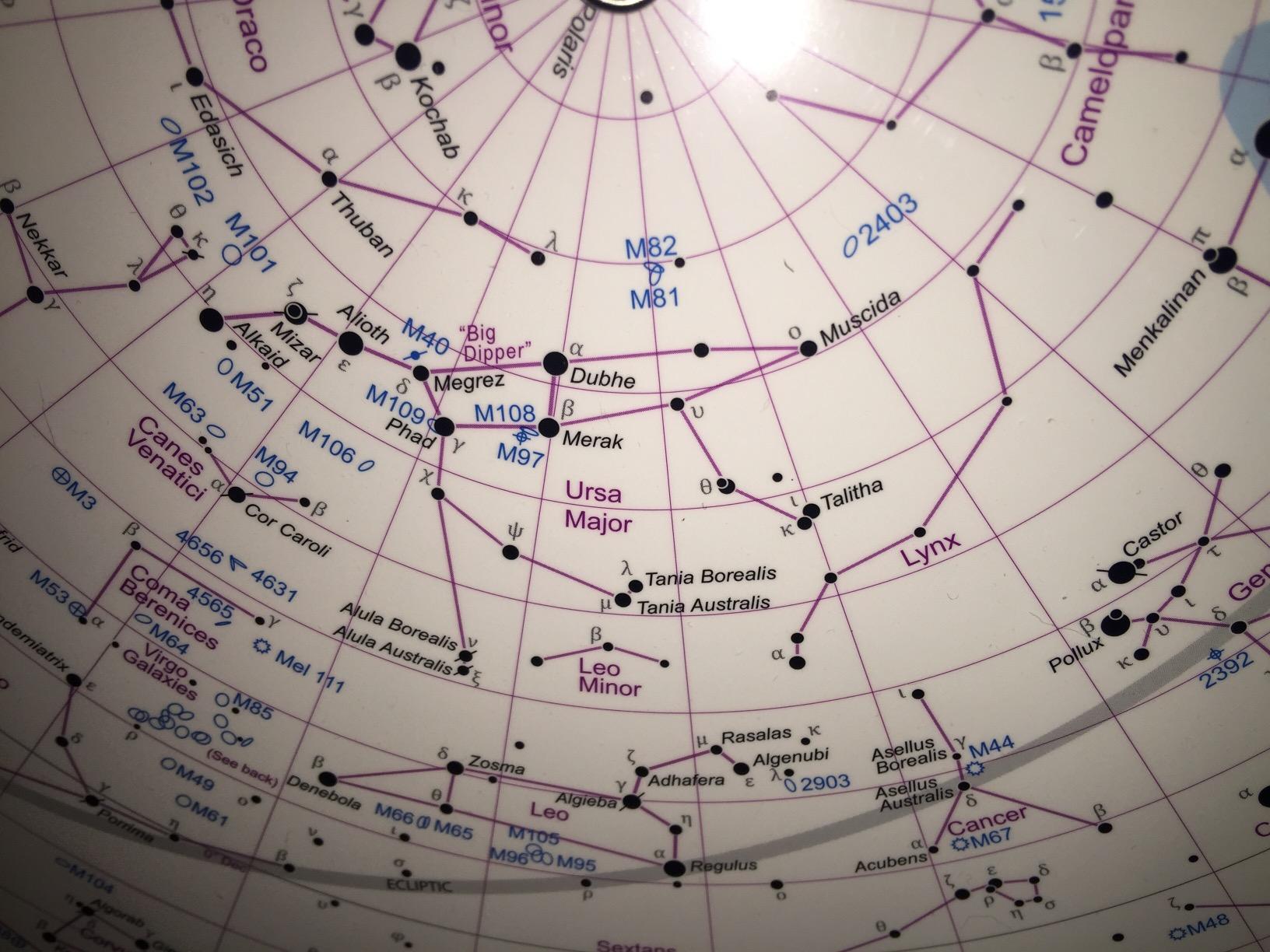
The Messier Observer’s Planisphere is the specialty pick on our list, designed by Mike Krzywonski for hunters of all 110 Messier objects. Where a standard planisphere shows constellations and the brightest stars, this one labels every Messier galaxy, cluster, and nebula in its correct position on the star chart.
I used it for a four-night Messier marathon run and confirmed the labels are positioned accurately. When I dialed the chart to April 15 at 11:00 PM, M13 in Hercules, M57 in Lyra, and M27 in Vulpecula all sat inside the viewing window in their correct relative positions.
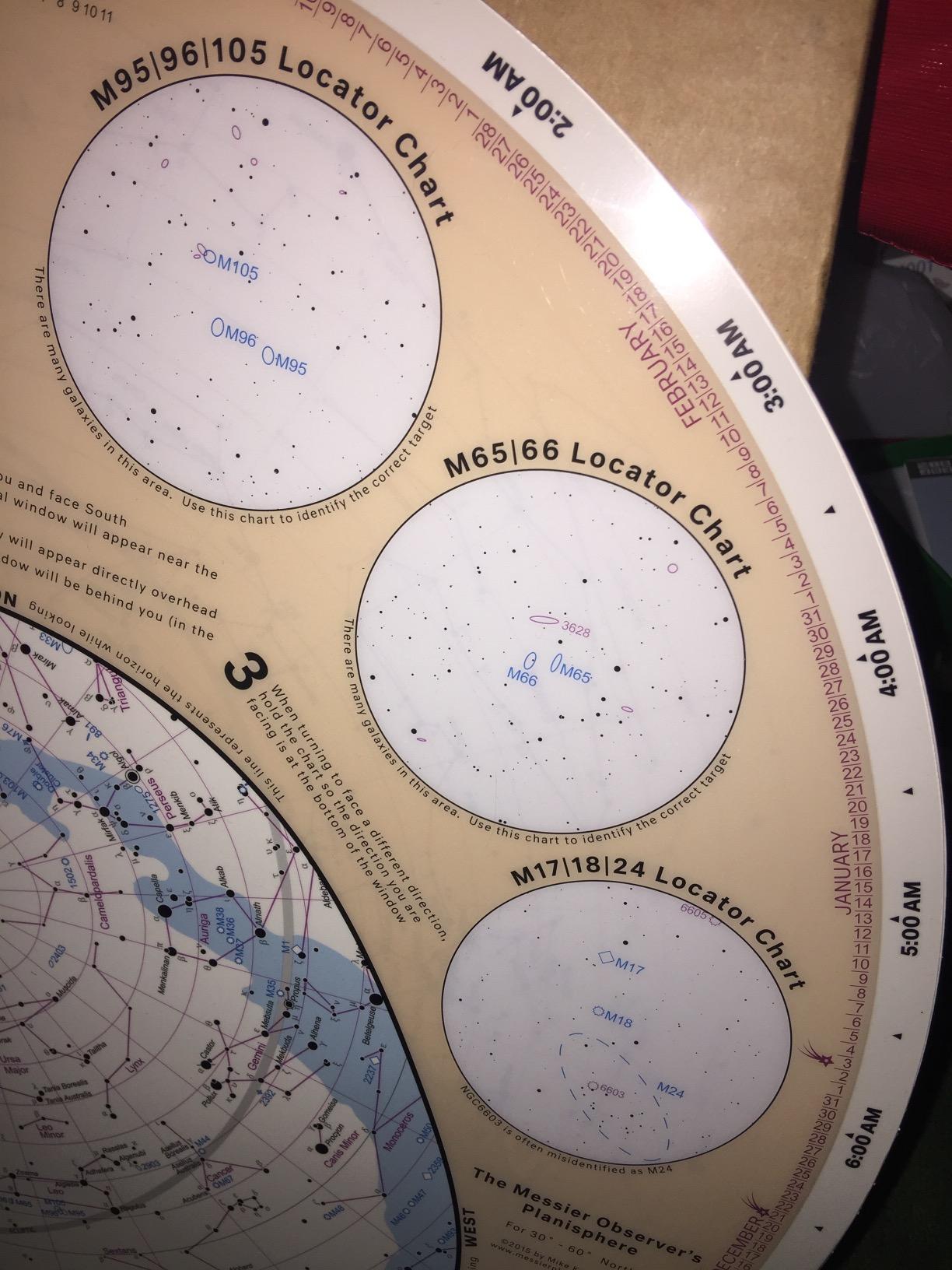
Across 83 reviews, the Messier Observer’s Planisphere holds a 4.8 average, the highest rating of any wheel in our roundup, and 87% of reviewers rate it five stars. Skymaps, the only competitor that mentions this niche product, calls it the deep-sky specialty choice.
It is also the largest wheel on our list at roughly 18 inches, which makes it the easiest to read under a red flashlight but also the least portable. If you are running a Messier marathon from a backyard or dark-sky site rather than a backpack, the size is an asset.
For whom it is good
Amateur astronomers working through the Messier list, deep-sky hunters using binoculars or a small telescope, and astronomy club members running Messier marathons. The 4.8 rating and 87% five-star share show this is a respected specialty tool.
For whom it is less ideal
Casual beginners who only want to learn constellation shapes. The Messier-specific labeling adds visual complexity that is unnecessary if you are not hunting deep-sky objects. If you want a clean constellation chart, the Ken Graun or Chandler wheels are better fits.
How to Choose a Planisphere?
Latitude is the single most important decision. A planisphere is calibrated for a band of latitudes (typically 10° wide), and the closer your home latitude is to the center of that band, the more accurate the projection. If you live at 38°N, a Chandler 30-40°N or 40-50°N both fit; if you live at 33°N or 47°N, the band boundaries will be more visible.
Material matters for longevity. Plastic and laminated discs survive dew, cold, and the occasional drop on a concrete driveway. Cardboard and paper planispheres warp after a few damp sessions – a common complaint we saw in forum threads. If you plan to use your planisphere outdoors more than a handful of times, plastic is worth the upgrade.
Size affects readability. Wheels under 5 inches are too cramped to read under a red flashlight. Wheels 8 inches and above are comfortable for adult eyes. The 16-inch Ken Graun chart and 18-inch Messier Observer’s are the easiest to read but require a clipboard or table.
Hemisphere matters if you live south of the equator. Most planispheres on our list are tuned for the northern hemisphere. The Chandler Night Sky Southern Hemisphere edition and the Guide to the Stars Southern Hemisphere are the dedicated options. The Explore Scientific Double-Sided covers 0-60°N only.
Latitude-region picker
USA (lower 48, southern): Chandler 30-40°N or Miller 40°. USA (northern): Chandler 40-50°N or 50-60°N. UK and Ireland: Philip’s 51.5°N. Mediterranean: Chandler 30-40°N. Australia, South Africa, South America: dedicated Southern Hemisphere planisphere. Tropics (0-30°N): Explore Scientific Double-Sided Multi-Latitude.
How to Use a Planisphere in 6 Steps
Set the date. Rotate the inner disc so today’s date aligns with the time you want to observe. Most beginners dial 9:00-10:00 PM as a starting point.
Set the time. Spin the outer dial so the current time (in standard time, not daylight saving) lines up with the date marker. Forgetting the daylight-saving conversion is the most common beginner mistake.
Face the right direction. In the northern hemisphere, face south to see the constellations inside the oval window. In the southern hemisphere, face north.
Hold the planisphere overhead. Lift it above your head with the orientation matching your direction (south horizon at the bottom of the chart if facing south).
Read the constellations. The oval window shows the sky from your southern (or northern) horizon up to the zenith. Constellations near the bottom of the oval are low in the sky; constellations near the top are nearly overhead.
Track planets separately. Planets are not on a basic planisphere. For Jupiter, Saturn, Venus, and Mars, use the planet overlay on the Famous Star and Planet Locator, or pair your planisphere with a stargazing app for planet positions.
Worked example: finding Orion in January
On January 15 at 10:00 PM standard time, rotate the Chandler 30-40°N wheel to align that date with 22:00. Hold the wheel overhead facing south. Orion sits high in the southeastern sky, near the top of the viewing window. Betelgeuse marks the right shoulder, Rigel the left foot, and the three belt stars run diagonally across the middle of the constellation.
Planisphere vs Astronomy App
Both tools show the night sky, but they do different jobs. A planisphere is a learning tool that teaches you the overall structure of the constellations, preserves dark adaptation, and works without batteries. An astronomy app is an identification tool that points at any sky position and tells you what is there in real time.
Planisphere strengths: zero screen glare so your dark adaptation stays intact, no battery or signal needed, teaches you the constellations rather than just naming them, durable enough to take camping. App strengths: real-time position, planet tracking, telescope GoTo control, deep-sky object databases.
Our team recommendation: use both. Start with a planisphere to learn the constellation shapes and the overall sky layout. Add an app for planet positions, faint deep-sky identification, and telescope alignment.
Common Beginner Mistakes
Buying the wrong latitude band. The single most common forum complaint – beginners buy a 40-50°N planisphere at 30°N and the constellations do not match. Match the band to your home latitude within a few degrees.
Using daylight saving time instead of standard time. A planisphere uses local standard time. Subtract one hour during daylight saving months (March-November in the US and Europe).
Holding the planisphere right-side up when facing south. In the northern hemisphere, you face south to read the southern sky. The planisphere should be held overhead with the south horizon at the bottom edge.
Expecting planets to appear on the chart. Planets move along the ecliptic and are not fixed on a star chart. Use a separate planet overlay or an app for planet positions.
Using white flashlight light. White light destroys dark adaptation in seconds and ruins 20-30 minutes of eye recovery. Use a red-light astronomy flashlight.
Choosing a 5-inch wheel for readability. Small wheels are too cramped to read under a red flashlight. Buy 8 inches or larger if you can.
Frequently Asked Questions
What is a planisphere used for?
A planisphere is used to identify which stars and constellations are visible at a specific date, time, and latitude. It is a two-disc rotating star chart that works without batteries or internet, and is a standard beginner tool for learning the night sky.
Are planispheres accurate?
Planispheres are accurate to within a few degrees for stars and constellations when matched to the correct latitude band. They show fixed stars down to roughly magnitude 5, which is the naked-eye limit under dark skies.
What latitude planisphere do I need for the UK?
For the UK and Ireland, you need a planisphere calibrated for latitude 51.5 degrees North. Philip’s Planisphere is specifically tuned for this latitude and is the most common UK recommendation.
What is the best planisphere for beginners?
The Ken Graun Guide to the Stars and the David Chandler Night Sky 30-40N are the two strongest beginner planispheres. The Ken Graun offers the largest readable format at 16 inches, while the Chandler offers durable plastic construction and a two-sided projection that preserves constellation shapes.
Can I use a planisphere anywhere in the world?
You can use a planisphere anywhere, but you need the correct latitude version. Northern hemisphere observers need a northern planisphere, southern observers need a southern hemisphere edition, and equatorial observers benefit from a multi-latitude planisphere that covers the 0-30 degree range.
Do planispheres show planets?
Standard planispheres do not show planets because planets move along the ecliptic and change position nightly. The Famous Star and Planet Locator includes a separate planet overlay that shows planet positions for any date and time.
Final Verdict
The best planispheres for stargazers depend on your latitude, your budget, and what you want to do under the stars. For most northern-hemisphere beginners, the Ken Graun Guide to the Stars is the clear top pick thanks to its 16-inch format and strong review base. For a durable plastic wheel that will last for many seasons of outdoor use, the Chandler Night Sky 30-40°N is the proven standard.
UK stargazers should pair a Philip’s 51.5°N wheel with a red-light flashlight. Deep-sky hunters working through the Messier list will get the most value out of the Messier Observer’s Planisphere. Travelers who move across latitudes should consider the Explore Scientific Double-Sided Multi-Latitude wheel.
Whichever model you choose, match the latitude band to your home location within a few degrees, use a red flashlight to protect your dark adaptation, and spend your first few sessions simply learning three or four major constellations. The planisphere rewards patience, and after a month of clear nights you will be able to identify the major constellations faster than any app can name them.