
If you have ever felt your chest tighten before a big meeting or found yourself wide awake at 2 a.m. with racing thoughts, you already know how fast anxiety can hijack your body. Breathing exercises are one of the fastest, free tools available to calm that response. But when you start looking into box breathing versus 4-7-8 breathing for anxiety, it gets confusing fast. Which one actually works? Is one better for panic attacks and the other for sleep? And what does the latest research say?
I have spent months digging into the science, reading forum discussions from real practitioners, and reviewing the clinical literature to give you a clear answer. Here is what you need to know about both techniques, how they affect your nervous system, and which one to reach for depending on the type of anxiety you are dealing with.
Table of Contents
What Is Box Breathing?
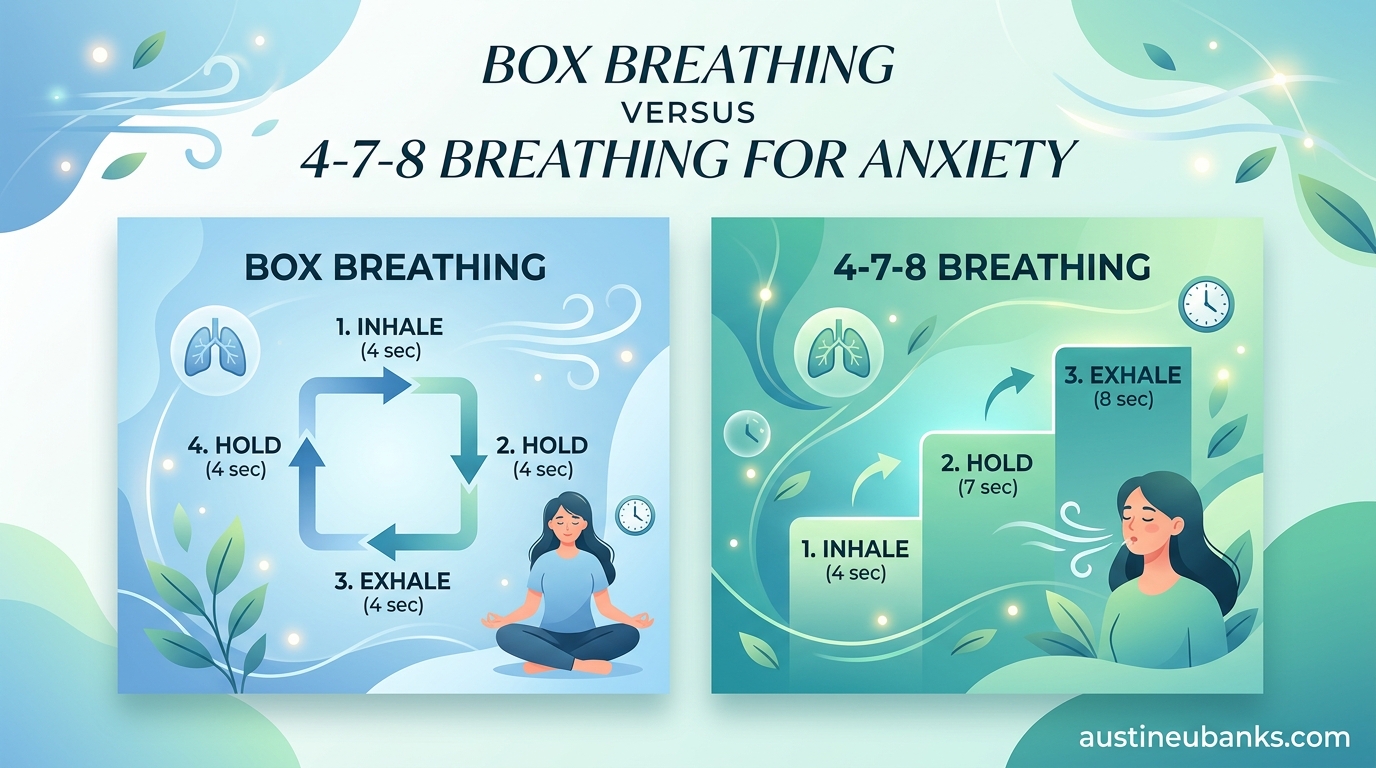
Box breathing, also called square breathing, is a structured breathing pattern where every phase of the breath lasts for the same count. You inhale for four seconds, hold for four seconds, exhale for four seconds, and hold empty for four seconds. The name comes from the visual of a square or box, where each side is equal in length.
The technique has military roots. Navy SEALs use box breathing in high-stress combat situations to stay calm and focused under pressure. It is also practiced in meditation and yoga traditions as a form of breath control. The military adoption gives it strong credibility for acute stress management.
How to Do Box Breathing: Step by Step
Follow these four steps, repeating the cycle for at least two to five minutes.
Step 1: Sit upright in a comfortable position. Slowly exhale all the air from your lungs through your mouth.
Step 2: Inhale through your nose to a slow count of four. Feel the air fill your chest and belly.
Step 3: Hold your breath gently for a count of four. Keep your jaw and shoulders relaxed.
Step 4: Exhale slowly through your mouth for a count of four, letting the air drain out steadily.
Step 5: Hold your lungs empty for a count of four. Then return to Step 2 and repeat.
Box Breathing Benefits for Anxiety
Box breathing shines when you need to regain composure quickly. The equal counts give your mind a simple, predictable rhythm to follow, which interrupts anxious thought loops. Many people in breathwork communities describe it as the better technique for centering during a panic situation because the structure keeps you anchored in the present moment. It can also improve focus and concentration, which is why soldiers and athletes rely on it before high-pressure performances.
Physiologically, box breathing helps lower heart rate and reduce blood pressure. The breath holds train your body to tolerate carbon dioxide buildup, which reduces the panic response over time. Regular practice can help you become less reactive to stress triggers throughout the day.
What Is 4-7-8 Breathing?
4-7-8 breathing is a technique developed by Dr. Andrew Weil, a Harvard-trained physician and pioneer in integrative medicine. The pattern is simple: inhale through your nose for four seconds, hold your breath for seven seconds, and exhale through your mouth for eight seconds. The long exhale is the defining feature that sets it apart from box breathing.
Dr. Weil adapted this technique from pranayama, the ancient yogic practice of breath control. He describes it as a natural tranquilizer for the nervous system. Unlike box breathing’s equal phases, 4-7-8 breathing deliberately stretches the exhale to twice the length of the inhale, which has a specific physiological purpose.
How to Do 4-7-8 Breathing: Step by Step
Dr. Weil recommends starting with just four cycles at a time. Here is how to do it.
Step 1: Place the tip of your tongue against the ridge of tissue behind your upper front teeth. Keep it there throughout the exercise.
Step 2: Exhale completely through your mouth, making a gentle whoosh sound.
Step 3: Close your mouth and inhale quietly through your nose to a mental count of four.
Step 4: Hold your breath for a count of seven.
Step 5: Exhale completely through your mouth, making the whoosh sound, to a count of eight.
Step 6: That completes one cycle. Repeat for a total of four breaths to start.
4-7-8 Breathing Benefits for Anxiety
The extended exhale in 4-7-8 breathing is what makes it particularly powerful for relaxation and sleep. When you exhale longer than you inhale, you directly stimulate the vagus nerve and activate the parasympathetic nervous system. This is the body’s rest-and-digest mode, the opposite of the fight-or-flight response that drives anxiety.
Forum users consistently report that 4-7-8 breathing lowers their heart rate by 5 to 10 beats per minute after about 10 minutes of practice. It is the technique most people reach for at bedtime when they cannot stop their mind from racing. Many practitioners say it helps them fall asleep faster than any other method they have tried.
How Both Techniques Work: The Vagus Nerve and Parasympathetic Nervous System
To understand why box breathing versus 4-7-8 breathing for anxiety works differently, you need to understand what is happening inside your body. Both techniques target the autonomic nervous system, which controls involuntary functions like heart rate, digestion, and your stress response.
The autonomic nervous system has two branches. The sympathetic nervous system triggers the fight-or-flight response, flooding your body with cortisol and adrenaline. The parasympathetic nervous system does the opposite. It calms you down, slows your heart, and brings your body back to baseline. When anxiety strikes, the sympathetic branch is in overdrive. Breathing exercises help you manually switch back to parasympathetic mode.
The Vagus Nerve Connection
The vagus nerve is the longest cranial nerve in your body, running from your brainstem down to your abdomen. It is the main highway for parasympathetic signals. When you breathe slowly and deeply, especially with long exhales, you stimulate the vagus nerve. This sends a message to your brain that you are safe, which reduces cortisol production and slows your heart rate.
Diaphragmatic breathing, where your belly expands on the inhale, is especially effective at vagal stimulation. Both box breathing and 4-7-8 breathing encourage this type of deep belly breathing, but the 4-7-8 technique’s prolonged exhale creates a stronger vagal response. That is why it tends to feel more sedating.
Heart Rate Variability and Breathwork
Heart rate variability, or HRV, is a measure of how much your heart rate fluctuates from beat to beat. Higher HRV is a sign of a healthy, adaptable nervous system that can switch between stress and relaxation efficiently. Low HRV is associated with chronic anxiety and stress. Breathing exercises are one of the most effective ways to increase HRV naturally, which is why researchers study them so closely.
Box Breathing Versus 4-7-8 Breathing: Side-by-Side Comparison
Here is where the two techniques really diverge. While both calm anxiety, they do so in different ways and are better suited for different situations. Let me break down the key differences.
Breathing pattern: Box breathing uses equal counts of 4-4-4-4. 4-7-8 breathing uses an asymmetrical pattern with a longer hold and an even longer exhale. The asymmetry in 4-7-8 creates a stronger relaxation signal.
Primary effect: Box breathing steadies and centers you. It brings you back to a calm, alert baseline. 4-7-8 breathing actively sedates the nervous system, making it more of a wind-down tool.
Best for acute situations: Box breathing excels during an active panic attack, before a stressful event, or when you need to stay sharp. The predictable rhythm helps ground you without making you drowsy. 4-7-8 breathing is better after the acute moment has passed or when you want to fully relax and let go.
Best for sleep: 4-7-8 breathing wins here. The extended exhale triggers a stronger parasympathetic response, making it ideal for falling asleep. Box breathing can help, but its equal counts are less effective at producing the deep relaxation needed for sleep onset.
Difficulty for beginners: Box breathing is generally easier to learn because all phases are equal and the counts are short. 4-7-8 breathing can feel challenging at first, especially the seven-second hold and eight-second exhale. Beginners may feel lightheaded or slightly anxious during the longer holds.
Duration per session: Box breathing sessions typically last 5 to 20 minutes of continuous cycling. 4-7-8 breathing is recommended in short sets of just four breaths initially, gradually building to eight breaths over time.
Which Technique for Which Type of Anxiety?
Not all anxiety is the same, and the right breathing technique depends on what you are experiencing. Here is specific guidance based on anxiety type.
Panic attacks: Use box breathing. The structured, equal rhythm gives your brain something predictable to focus on, which interrupts the spiral of panic. You can do it with your eyes open while walking or sitting, making it practical for sudden attacks in public.
Generalized anxiety disorder (GAD): Both techniques help, but for different reasons. Use box breathing during the day when you need to function and stay alert. Use 4-7-8 breathing in the evening or before bed to release the accumulated tension from the day.
Social anxiety and performance stress: Box breathing is your friend here. Before a presentation, interview, or social event, a few rounds of box breathing will steady your nerves without making you drowsy. It helps you stay present and focused.
Insomnia and nighttime anxiety: 4-7-8 breathing is the clear winner. The extended exhale and longer hold create a powerful sedative effect that helps quiet a racing mind. Practitioners report falling asleep faster and waking less during the night.
Acute stress and overwhelm: If you are mid-crisis and need to think clearly, box breathing. If the crisis has passed and you need to decompress, 4-7-8 breathing. You can also alternate: box breathing to stabilize, then 4-7-8 to fully relax.
The Latest Research: What a 2025 Study Found
A 2025 PubMed study (PMID 39864026) directly compared square breathing, 4-7-8 breathing, and breathing at six breaths per minute. The findings challenged some common assumptions. The study found that breathing at six breaths per minute, also known as resonance frequency breathing, was likely more effective at increasing heart rate variability than either box breathing or 4-7-8 breathing.
Does this mean box breathing and 4-7-8 breathing are ineffective? Not at all. Both still activated the parasympathetic nervous system and reduced stress markers. The study suggests that resonance breathing at around six breaths per minute may produce the strongest HRV response, which is worth considering if maximizing HRV is your goal.
However, the study also highlights an important point that forum users have been reporting for years. Individual variation matters significantly. Some people feel more stressed doing structured breathing exercises, not less. Breath holds can trigger anxiety in certain individuals, particularly those with trauma histories or respiratory conditions. If a technique makes you feel worse, it is not the right one for you.
Other research has consistently shown that the exhale length is the most important factor in calming the nervous system. Lengthening your exhale beyond your inhale duration reliably activates the vagus nerve and reduces heart rate. This is why 4-7-8 breathing, with its eight-second exhale, produces such a strong calming effect for so many people.
Beginner Tips and Common Mistakes
If you are just starting out, here are the most common pitfalls and how to avoid them.
Do not force the breath holds. If holding for seven seconds feels like a struggle, shorten the counts. You can try a 3-5-6 pattern instead of 4-7-8 and still get significant benefits. The key is keeping the exhale longer than the inhale.
Practice before you need it. Do not wait until you are mid-panic attack to try breathing exercises for the first time. Practice daily when you are calm so the technique becomes automatic when stress hits.
Watch for lightheadedness. Both techniques can cause mild dizziness, especially 4-7-8 breathing. If this happens, return to normal breathing and try fewer cycles next time. Sit down while practicing until you know how your body responds.
Keep your shoulders relaxed. A common mistake is tensing the upper body during breath holds. Let your jaw, shoulders, and hands stay loose throughout the exercise. Tension defeats the purpose.
Expect your mind to wander. Mind wandering during practice is completely normal and does not mean the exercise is failing. When you notice your thoughts drifting, gently bring your attention back to the count. This act of refocusing is part of what makes breathing exercises effective.
Safety Considerations
Both box breathing and 4-7-8 breathing are safe for most healthy adults. However, if you have a heart condition, asthma, COPD, or any respiratory disorder, talk to your doctor before starting breath-hold exercises. Pregnant women should also consult their healthcare provider, as breath holding affects oxygen levels.
If you have a history of panic disorder, the breath holds in both techniques can sometimes trigger more anxiety rather than less. Start with shorter holds and gradually work up. Never push through discomfort. Breathing exercises should feel calming, not distressing.
FAQs
What is the best breathing pattern for anxiety?
The best breathing pattern for anxiety is one that lengthens your exhale beyond your inhale, such as 4-7-8 breathing (inhale 4, hold 7, exhale 8). The extended exhale stimulates the vagus nerve and activates the parasympathetic nervous system. For acute panic, box breathing (4-4-4-4) is also highly effective because its predictable rhythm grounds you quickly.
Which breathing style is best for anxiety?
It depends on the situation. Box breathing is best for acute stress, panic attacks, and situations where you need to stay alert. 4-7-8 breathing is best for relaxation, winding down, and falling asleep. For generalized anxiety, many people benefit from using both at different times of day.
Does box breathing lower anxiety?
Yes, box breathing lowers anxiety by slowing your heart rate, reducing blood pressure, and giving your mind a structured rhythm to follow. Navy SEALs use it in combat situations for this exact reason. Studies confirm it activates the parasympathetic nervous system and reduces stress markers.
Does 4-7-8 breathing help with anxiety?
Yes, 4-7-8 breathing helps with anxiety by stimulating the vagus nerve through its extended eight-second exhale. This triggers a strong parasympathetic response that lowers cortisol and heart rate. It is particularly effective for nighttime anxiety and insomnia, though it can be used any time you need to calm down.
Is 4-7-8 breathing dangerous?
4-7-8 breathing is safe for most healthy adults. It can cause mild lightheadedness, especially in beginners or those who hold the breath too forcefully. People with heart conditions, respiratory disorders, or panic disorder should consult a doctor first and start with shorter holds. If it causes more anxiety, stop and try a gentler technique.
How many times should you do 4-7-8 breathing?
Dr. Andrew Weil recommends starting with just four breath cycles per session, twice a day. After a week of practice, you can increase to eight breath cycles per session. Do not exceed eight cycles at one time, especially as a beginner. The technique is potent in small doses.
Conclusion
When it comes to box breathing versus 4-7-8 breathing for anxiety, there is no single winner. Box breathing is your go-to for acute stress, panic, and moments when you need to stay sharp. 4-7-8 breathing is your tool for deep relaxation, winding down, and sleep. Try both, notice how your body responds, and build a simple routine around whichever technique fits your life. The best breathing exercise is the one you actually practice consistently.