
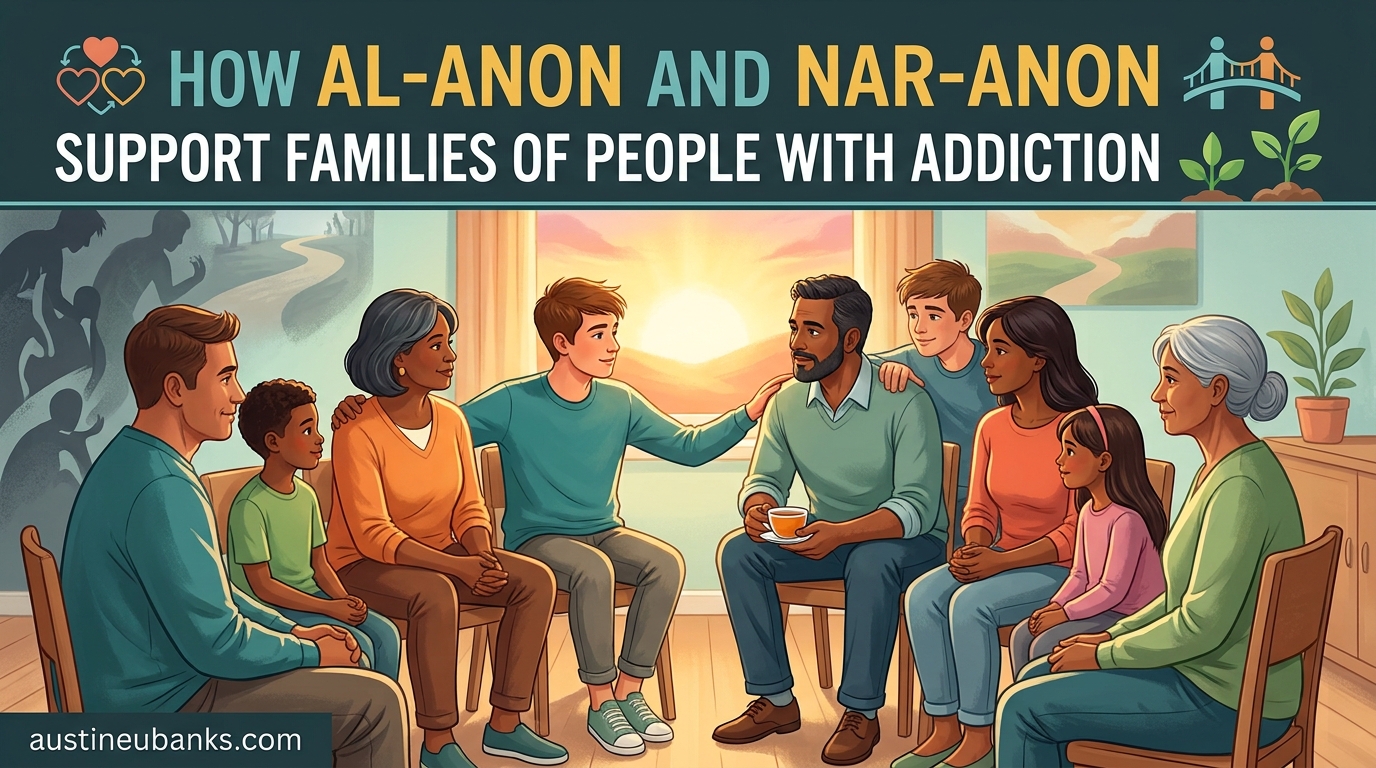
Al-Anon and Nar-Anon are free, peer-led 12-step mutual support programs designed specifically for the families and friends of people struggling with addiction. Al-Anon (founded in 1951) focuses on those affected by someone else’s drinking, while Nar-Anon serves those dealing with a loved one’s drug use. Both programs help family members stop trying to control the addict’s behavior, learn to set healthy boundaries, and focus on their own recovery through a principle called “detachment with love.”
If you have ever felt helpless, exhausted, or alone because of a loved one’s substance use, these programs exist for you. Addiction is widely recognized as a family disease, meaning it affects everyone close to the person using, not just the person themselves. When we understand how Al-Anon and Nar-Anon support families of people with addiction, we discover that recovery is possible for family members even if their loved one never stops using.
I have spent years researching and connecting with family members who have walked through the doors of these meetings for the first time. Their stories share a common thread: relief at finding people who truly understand, tools for coping with chaos, and a path back to their own lives. In this guide, our team breaks down exactly how both programs work, what to expect, and how to decide which one is right for your situation.
Whether your loved one struggles with alcohol, prescription pills, heroin, methamphetamine, or any combination of substances, there is a place for you here. Let us walk through everything you need to know about these two life-changing programs.
Table of Contents
How Al-Anon and Nar-Anon Support Families: Quick Answer
Al-Anon and Nar-Anon support families in five core ways: they provide free peer-led meetings where members share experience and hope, teach the principle of detachment with love so families stop enabling destructive behavior, offer a structured 12-step recovery program adapted for loved ones, create confidential communities where anonymity is protected, and supply conference-approved literature and online resources for ongoing growth.
Both programs require no dues, fees, registration, or appointment. You simply show up. Meetings are held in person, online, and by telephone, making them accessible virtually anywhere in the world. The only requirement for membership is that your life has been affected by someone else’s drinking or drug use.
Members consistently report that the most powerful support comes from hearing others describe the exact same feelings they have carried alone for years. That shared experience, combined with practical tools for boundary setting and self-care, is what makes these programs effective for millions of family members worldwide.
What Is Al-Anon?
Al-Anon Family Groups is a worldwide fellowship founded in 1951 by Lois Wilson, the wife of Alcoholics Anonymous co-founder Bill Wilson. After watching her husband achieve sobriety through AA, Lois realized that she and other family members needed their own recovery program. She started holding meetings in her home, and the organization has since grown to include tens of thousands of groups across more than 130 countries.
Al-Anon operates on a simple premise: alcoholism is a family disease. The people closest to an alcoholic develop their own patterns of coping, including enabling, people-pleasing, controlling, and codependency. These patterns persist even after the alcoholic stops drinking, which is why Al-Anon encourages family members to work their own recovery program regardless of whether their loved one is sober.
The program is spiritual rather than religious. Members are encouraged to find a “Power greater than ourselves” in whatever form makes sense to them, whether that is the group itself, nature, a traditional deity, or something else entirely. Al-Anon has no affiliation with any religion, sect, denomination, political organization, or institution.
One of the most important things to understand is that Al-Anon is not only for families of alcoholics. According to official membership surveys, approximately 35 percent of Al-Anon members joined because of a loved one’s drug addiction rather than alcohol. The program recognizes that the family dynamics of addiction are essentially the same whether the substance is alcohol, opioids, stimulants, or anything else.
Al-Anon also includes Alateen, a parallel program specifically for teenagers aged 13 to 18 who are affected by someone else’s drinking. Alateen meetings are often held at the same time and location as Al-Anon meetings, with separate rooms and age-appropriate discussion.
What Is Nar-Anon?
Nar-Anon Family Groups is a 12-step fellowship created specifically for families and friends of people addicted to drugs. While Al-Anon originated around alcoholism, Nar-Anon was established to address the growing crisis of drug addiction, including prescription medications, heroin, cocaine, methamphetamine, and other substances. The organization formally adopted its structure in 1968 and has expanded globally since then.
Nar-Anon operates on the same 12-step principles as Al-Anon and AA. Members attend peer-led meetings where they share their experiences, read from conference-approved literature, and support one another in applying the steps to their daily lives. The program teaches families how to stop enabling, set boundaries, and focus on their own well-being instead of obsessively trying to manage or control the addicted person’s behavior.
Many people ask whether Nar-Anon is really different from Al-Anon or if they can just attend Al-Anon. The honest answer is that the two programs are extremely similar in structure, principles, and approach. The primary difference is the specific focus: Nar-Anon meetings center on drug addiction, which means discussions often involve different challenges such as overdose risk, illegal activity, involvement with the criminal justice system, and the unpredictability of drug-seeking behavior.
Members of Nar-Anon frequently describe the relief of being in a room where everyone understands the particular terror of finding paraphernalia, waiting for a call from a hospital or morgue, or watching a loved one disappear into addiction. That shared context creates a powerful bond and a safe space for honesty.
Like Al-Anon, Nar-Anon is completely free, requires no registration, and protects member anonymity. Meetings are available in person, online, and by phone worldwide.
Al-Anon vs Nar-Anon: Key Differences
Many families wonder which program to attend. The short answer is that both follow the same 12-step framework and teach identical principles. The main differences lie in the specific addiction focus and the types of situations discussed in meetings. Here is a side-by-side comparison to help you decide.
Founded: Al-Anon was established in 1951, while Nar-Anon was formally structured in 1968.
Primary Focus: Al-Anon centers on alcoholism (though 35 percent of members deal with drug addiction). Nar-Anon focuses specifically on drug addiction including prescription pills, heroin, meth, cocaine, and other substances.
Meeting Topics: Al-Anon discussions often involve drinking behaviors, blackouts, and alcohol-fueled conflict. Nar-Anon meetings frequently address overdose risk, drug-seeking behavior, legal consequences, and the presence of drug paraphernalia.
Availability: Al-Anon has a larger footprint with more meetings worldwide due to its longer history. Nar-Anon has fewer meetings overall but continues to grow, with robust online and phone meeting options.
Youth Program: Al-Anon includes Alateen for teenagers. Nar-Anon does not have a separate teen program at the same scale.
The Bottom Line: If your loved one drinks alcohol, Al-Anon is the natural fit. If your loved one uses drugs, Nar-Anon may feel more relevant. But because addiction often involves both, many people attend meetings in both fellowships. You are welcome at either program regardless of what substance your loved one uses.
The 12-Step Framework for Family Recovery
Both Al-Anon and Nar-Anon are built on the same 12 steps originally developed by Alcoholics Anonymous. However, the steps have been adapted to address the family member’s experience rather than the addict’s. Instead of admitting powerlessness over alcohol, family members admit powerlessness over the alcoholic or addict, meaning they cannot control, cure, or cause the other person’s addiction.
Here is how the steps apply to family recovery in practical terms:
Step 1 (Powerlessness): Family members admit they are powerless over the addicted person and that their lives have become unmanageable. This means accepting that no amount of arguing, pleading, hiding money, or monitoring behavior will stop the addiction.
Steps 2 and 3 (Higher Power): Members come to believe that a Power greater than themselves can restore them to sanity and make a decision to turn their will and lives over to that Power. For many, this is the first time they admit they need help for themselves.
Step 4 (Moral Inventory): Family members take a searching and fearless moral inventory of themselves. This step often reveals patterns of enabling, controlling, and people-pleasing that have developed over years.
Steps 5 through 9 (Action Steps): Members admit their shortcomings, become willing to let go of character defects, make amends for harm caused, and forgive others. These steps help repair relationships damaged by years of addiction-related conflict.
Steps 10 through 12 (Maintenance): Members continue daily inventory, seek through prayer and meditation to improve their conscious contact with their Higher Power, and carry the message to other family members still suffering.
The steps are not a quick fix. Most members work through them slowly, often with the guidance of a sponsor, a more experienced member who has already worked the steps. The process typically takes months or years, not weeks. But the transformation members describe is profound: moving from constant anxiety and crisis management to a life built on acceptance, boundaries, and genuine peace.
Detachment With Love: The Core Principle
Detachment with love is perhaps the single most important concept taught in both Al-Anon and Nar-Anon. It means caring deeply about your loved one while refusing to take responsibility for their choices, their addiction, or their recovery. You stop trying to control, fix, manage, or rescue them, and you start focusing on your own life and well-being.
Many family members confuse detachment with abandonment. They fear that stepping back means they do not care. In reality, detachment with love is the opposite of abandonment. It means saying: “I love you, I care about you, and I will no longer enable your self-destruction or lose myself in the process.”
Practicing detachment with love looks different for every family. It might mean refusing to lend money, not lying to cover for the addicted person’s absences, allowing natural consequences to unfold, or setting clear boundaries about what behavior is acceptable in your home. It always involves shifting energy away from the addict and toward your own healing.
Here are practical steps to start practicing detachment with love:
1. Identify your enabling behaviors. Are you paying bills, making excuses, buying groceries, or shielding the person from consequences? Write down everything you do that makes the addicted person’s life easier while they continue using.
2. Choose one behavior to stop. You do not have to change everything at once. Pick one enabling pattern and commit to stopping it this week.
3. Set a clear, specific boundary. Decide what you will and will not tolerate, and communicate it calmly without negotiating.
4. Allow consequences. When the addicted person faces natural results of their behavior, resist the urge to rescue. This is painful but necessary.
5. Focus on yourself. Reconnect with your own interests, relationships, and goals that addiction has pushed aside.
Detachment is not something you do once. It is a daily practice, often an hourly one. Members frequently share that detachment with love took them months or years to genuinely embody, but once they did, it changed everything.
Types of Support: Meetings, Literature, and Community
Al-Anon and Nar-Anon offer several layers of support beyond the weekly meeting. Understanding all the available resources helps families get the most out of their participation.
In-Person Meetings: These are the traditional format, held in churches, community centers, treatment facilities, and other accessible locations. Meetings typically last one hour and follow a structured format: a moment of silence, reading of the 12 steps and traditions, introduction of newcomers, sharing of experience, and a closing statement. You can attend on a walk-in basis with no appointment or registration.
Online Meetings: Since 2020, virtual meetings have become a major part of both fellowships. Video meetings via Zoom, text-based chat meetings, and even app-based meetings make it possible to attend from anywhere. Online meetings are especially valuable for people in rural areas, those with mobility issues, or anyone who feels too anxious to attend in person initially.
Telephone Meetings: Both programs offer phone-based meetings for those without internet access or who prefer voice-only interaction. These meetings follow the same format as in-person gatherings.
Conference-Approved Literature: Al-Anon and Nar-Anon publish books, pamphlets, and daily readers written by and for members. Titles like “One Day at a Time in Al-Anon,” “How Al-Anon Works for Families and Friends of Alcoholics,” and “Courage to Change” provide daily inspiration and practical guidance. Literature is available for purchase at meetings, online, or through the official bookstores. Many groups also maintain lending libraries.
Sponsorship: A sponsor is an experienced member who guides you through the 12 steps on a one-on-one basis. Finding a sponsor is one of the most impactful steps in recovery, as it provides personalized support and accountability.
Service and Community: Both programs encourage members to give back through service, such as setting up chairs, leading meetings, or answering helpline calls. This service work builds connection, purpose, and a sense of belonging that counters the isolation addiction creates.
Who Should Attend Al-Anon or Nar-Anon?
Anyone whose life has been affected by someone else’s drinking or drug use is welcome at Al-Anon or Nar-Anon. There are no eligibility requirements, no age limits for adults, and no need to prove your loved one is “bad enough” to qualify. If you are hurting because of someone else’s addiction, you belong.
Common attendees include spouses and partners of people with addiction. Many arrive exhausted from years of trying to manage their partner’s behavior, covering for broken promises, and living with constant uncertainty about what each day will bring.
Parents of addicted children, whether teenagers or adults, form a large portion of both fellowships. Parents often carry intense guilt, wondering where they went wrong, and struggle with the line between supporting their child and enabling their addiction. Al-Anon and Nar-Anon help parents find that difficult balance.
Adult children of alcoholics and addicts frequently attend to address long-standing patterns that originated in childhood. Even decades after leaving an addicted parent’s home, many adults continue to struggle with trust, boundaries, people-pleasing, and codependency. The program helps them understand and change these deep-rooted patterns.
Siblings, friends, employers, and coworkers of people with addiction also attend. Addiction affects entire social networks, not just immediate family. If you have lost sleep, changed plans, or made compromises because of someone else’s substance use, these meetings can help.
What to Expect at Your First Meeting
Walking into your first Al-Anon or Nar-Anon meeting can feel terrifying. Almost every member describes feeling nervous, skeptical, or convinced they do not really belong. That reaction is completely normal, and it passes. Here is what actually happens so you can arrive knowing what to expect.
You will be greeted but not pressured. Most meetings have a greeter at the door who will welcome you, hand you any literature being read, and point you to a seat. You will not be asked to introduce yourself by name or explain why you are there.
The meeting follows a set format. A chairperson opens the meeting, reads the 12 steps and traditions, and introduces the topic. Members then share one at a time. You are under absolutely no obligation to speak. Many newcomers attend for weeks or months before saying a word, and that is perfectly accepted.
People will share honestly. Members talk about their experiences, their struggles, and their progress through the steps. You will hear stories that may sound exactly like your own. This is often the most powerful moment for newcomers, the realization that they are not alone.
Anonymity is strictly protected. One of the program’s core traditions states: “Who you see here, what you hear here, when you leave here, let it stay here.” Members take this seriously. Your attendance is confidential, and no one will contact you outside the meeting without your permission.
You do not have to donate. A basket is passed for voluntary contributions, typically a dollar or two. If you have nothing to give, simply pass the basket along. No one will notice or care.
You can try multiple meetings. Every group has its own personality. If your first meeting does not feel right, try a different one at another time or location. Most members recommend attending at least six different meetings before deciding whether the program is for you.
Alateen: Support for Teenagers in Affected Families
Alateen is a vital part of the Al-Anon family, designed specifically for teenagers aged 13 to 18 who are affected by someone else’s drinking. Growing up in a home with addiction shapes a teenager’s development, relationships, and self-image in profound ways. Alateen gives young people a safe, age-appropriate space to process their experiences and learn coping skills.
Alateen meetings are peer-led, often with the support of an adult Al-Anon member who serves as a sponsor. The format mirrors Al-Anon meetings but uses literature and discussion topics tailored to teenagers. Young people learn about the family disease concept, how to identify and stop enabling behaviors, and how to build their own healthy identities separate from the chaos at home.
For many teens, Alateen is the first place they can talk openly about what is really happening without fear of judgment or consequences. Research has shown that adolescents who participate in Alateen report improvements in self-esteem, family relationships, and academic performance.
How to Find and Attend a Meeting
Finding a meeting is straightforward, and you can start today if you want to. Both Al-Anon and Nar-Anon maintain online directories that let you search by location, day of the week, and meeting format.
For Al-Anon: Visit al-anon.org and use the “Find a Meeting” tool. You can search for in-person meetings in your area, browse online meeting schedules, or find phone meetings. The site also offers a self-quiz to help you decide whether Al-Anon is right for you.
For Nar-Anon: Go to nar-anon.org and use the meeting search function. The site lists in-person, virtual, and phone meetings worldwide. Nar-Anon also has a mobile app that helps you locate and join meetings.
Steps to attend:
1. Choose a meeting format that feels comfortable (online is great for first-timers).
2. Note the meeting time and any access information.
3. Arrive 5 to 10 minutes early if in person, or log on 5 minutes early if virtual.
4. You do not need to bring anything. Literature is usually provided.
5. Sit, listen, and absorb. There is no pressure to participate.
Both organizations also maintain phone helplines if you want to talk to someone before attending a meeting. These helplines are staffed by experienced members who can answer questions and help ease your anxiety about attending.
Common Misconceptions About 12-Step Family Programs
Many people hesitate to attend Al-Anon or Nar-Anon because of misconceptions they have heard or assumed. Let us address the most common ones directly.
Misconception: “It is a religious program.” Al-Anon and Nar-Anon are spiritual, not religious. Members come from every faith tradition and no faith tradition. Your Higher Power can be the group, nature, love, or anything that gives you strength. No one will ask you to adopt specific beliefs.
Misconception: “I have to speak or share.” You never have to speak at a meeting. Many members attend silently for months before sharing anything. You can simply listen.
Misconception: “It is only for people whose loved one is actively using.” Many members attend even after their loved one has achieved sobriety or passed away. The family patterns of addiction persist and need to be addressed in their own right.
Misconception: “It will not work because my situation is different.” Every member believed their situation was unique. The program works precisely because the family dynamics of addiction are remarkably consistent, regardless of the specific details.
Misconception: “I am betraying my loved one by going.” Attending Al-Anon or Nar-Anon is not about betraying or giving up on your loved one. It is about getting help for yourself so you can make clear, healthy decisions about the relationship.
FAQs
Does Al-Anon help families of drug addicts?
Yes. According to official Al-Anon membership surveys, approximately 35 percent of members joined because of a loved one’s drug addiction rather than alcohol. Al-Anon welcomes anyone affected by someone else’s substance use, regardless of the specific substance. Many members also attend Nar-Anon meetings for drug-specific support.
Is there a support group for parents of addicts?
Yes. Both Al-Anon and Nar-Anon have large numbers of parent members. Parents of addicted children find peer support, practical tools for setting boundaries, and a community of people who understand the guilt, fear, and grief that come with loving a child struggling with addiction.
What is the difference between Al-Anon and Nar-Anon?
Al-Anon was founded in 1951 and originally focused on families of alcoholics, while Nar-Anon was established in 1968 specifically for families of drug addicts. Both follow the same 12-step framework. The main difference is meeting focus: Nar-Anon discussions center on drug-related challenges like overdose risk and legal issues, while Al-Anon discussions often involve alcohol-specific behaviors.
Is Al-Anon really free?
Yes. Al-Anon and Nar-Anon have no dues or fees for membership. Meetings pass a basket for voluntary contributions, typically one or two dollars, but giving is completely optional. No one is ever turned away or treated differently for not contributing.
Do I have to speak at Al-Anon meetings?
No. You are never required to speak, share, or introduce yourself at an Al-Anon or Nar-Anon meeting. Many newcomers attend silently for weeks or months. You can simply sit and listen. The only thing asked of you is to respect the anonymity of others.
Is Al-Anon religious or spiritual?
Al-Anon and Nar-Anon are spiritual programs, not religious ones. They have no affiliation with any religion, denomination, or political organization. Members are encouraged to understand a Power greater than themselves in whatever way makes sense to them, whether that is God, the group, nature, or another concept entirely.
What is detachment with love in Al-Anon?
Detachment with love means caring deeply about your addicted loved one while refusing to take responsibility for their choices, their addiction, or their recovery. It involves stopping enabling behaviors, setting healthy boundaries, allowing natural consequences, and focusing on your own well-being rather than trying to control or fix the other person.
Conclusion
Understanding how Al-Anon and Nar-Anon support families of people with addiction opens a door that millions have already walked through. These free, confidential, peer-led programs offer something that no amount of individual willpower can provide: a community of people who truly understand what you are going through and a proven framework for rebuilding your own life.
Whether your loved one is actively using, in recovery, or no longer in your life, the patterns addiction has created in you deserve attention. You do not have to wait for the addict to change before your healing begins. Detachment with love, the 12 steps, and the support of fellow members can start transforming your life today.
If you have been searching for how Al-Anon and Nar-Anon support families of people with addiction, you have already taken the first step. Find a meeting near you this week. You do not have to speak. You do not have to pay. You just have to show up.