
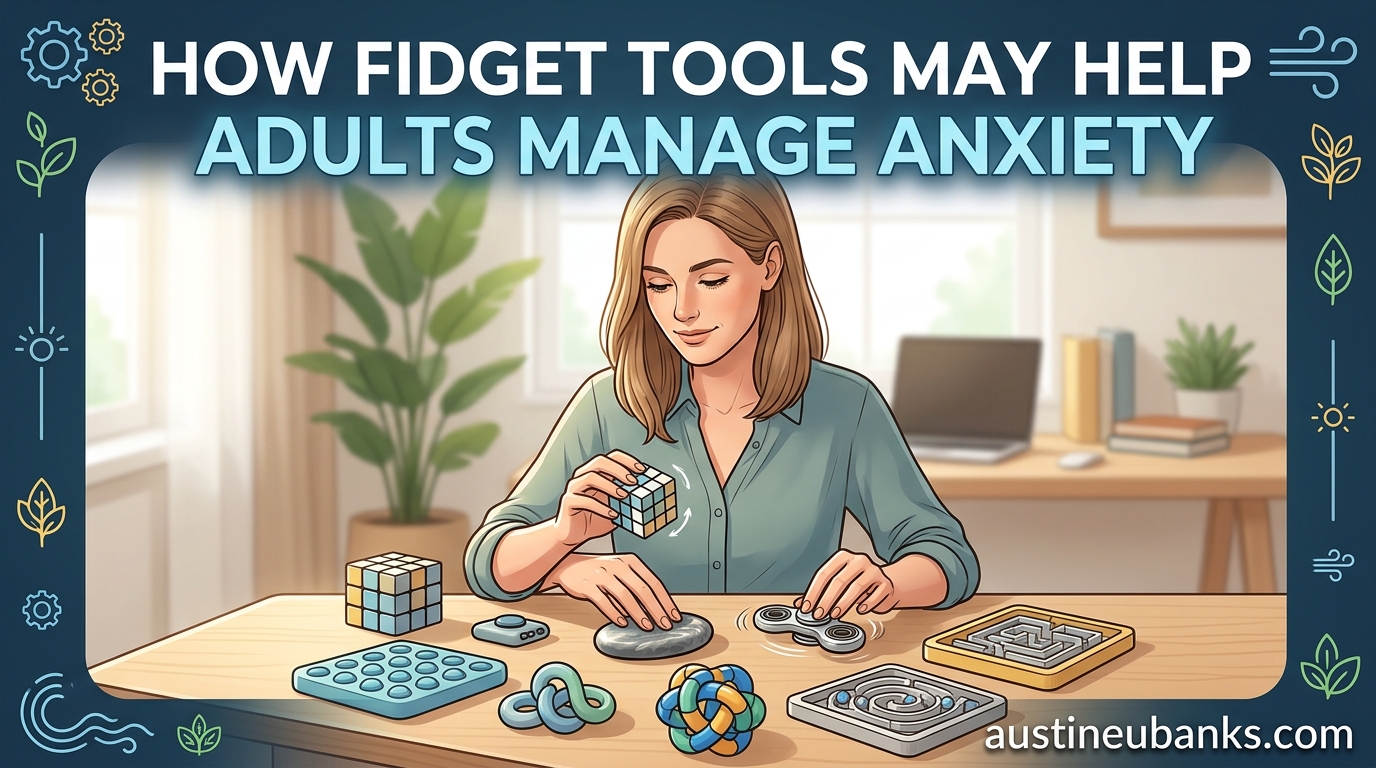
Anxiety does not always look like panic attacks and racing thoughts. For many adults, it shows up as restless hands, tapping feet, and a constant need to move. If you have ever clicked a pen through an entire meeting or picked at your cuticles during a difficult phone call, you already understand the instinct. Your body is searching for an outlet.
Fidget tools for anxiety adults are designed to give that restless energy somewhere productive to go. These small, handheld objects provide tactile stimulation that can calm your nervous system, sharpen your focus, and ground you when anxious thoughts spiral. They are discreet, portable, and do not require a prescription.
Fidget tools are small tactile objects designed for repetitive manipulation that help adults manage anxiety by providing sensory input which calms the nervous system, redirects restless energy, and improves focus without drawing attention.
In this guide, we break down how fidget tools may help adults manage anxiety, what the science actually says, which types work best for different situations, and how to choose one that fits your daily life. Whether you are dealing with workplace stress, generalized anxiety, or just need something to keep your hands busy during tense moments, this guide covers it all.
We pulled insights from occupational therapists, clinical research, and real user experiences from communities like r/ADHD, r/fidgettoys, and r/AuDHDWomen to give you a grounded, evidence-informed perspective rather than hype.
Table of Contents
What Are Fidget Tools?
Fidget tools are handheld objects built for repetitive, mindless manipulation. Think stress balls, textured rings, click cubes, tangle toys, and worry coins. You squeeze, spin, click, roll, or twist them while your mind focuses on something else entirely.
The term “fidget tools” matters more than you might expect. Many adults resist the idea because they associate these items with children’s toys. There is a real distinction here. A fidget toy is designed primarily for entertainment, like the spinner craze that swept through schools a few years ago. A fidget tool is designed with a purpose, which is self-regulation, grounding, and sensory input.
Occupational therapists have used fidget tools in clinical settings for decades. They originally appeared in therapy for children with autism, ADHD, and sensory processing disorders. Over time, adults began adopting them, and the market responded with options designed for grown hands, professional environments, and quieter operation.
The shift toward adult use accelerated during and after the pandemic. Anxiety rates among adults climbed significantly between 2020 and 2026, and people started looking for accessible, non-medication-based coping strategies. Fidget tools filled a gap that breathing apps and meditation could not always reach.
Reddit communities like r/ADHD and r/fidgettoys are filled with adults sharing their favorite tools and trading recommendations. One recurring theme in these discussions stands out clearly. Adults want quality, not cheap plastic novelties that break after a week. They also want tools that look professional and can pass as office supplies or jewelry in a workplace setting.
How Fidget Tools May Help Adults Manage Anxiety: The Science
The research on fidget tools and anxiety is still developing, but the existing evidence points to several clear mechanisms. Understanding these can help you decide whether a fidget tool belongs in your anxiety management toolkit.
Dopamine Release and the Prefrontal Cortex
Repetitive physical movements can stimulate the release of dopamine and norepinephrine in the brain. These are the same neurotransmitters targeted by many ADHD medications. When you manipulate a fidget tool, the rhythmic motion helps maintain baseline stimulation in your prefrontal cortex, the area responsible for attention, decision-making, and emotional regulation.
This is particularly relevant for adults with anxiety. An under-stimulated prefrontal cortex struggles to regulate emotional responses, which means anxious thoughts can spiral unchecked. The low-level sensory input from a fidget tool keeps that region engaged without being demanding.
Research from the University of Auckland and UC Davis has explored how small, rhythmic physical movements engage the brain’s attention networks in ways that support concentration rather than scatter it. A study published on PubMed examined how supplemental movement and tactile input affect cognitive performance and stress markers. The findings suggested that small, repetitive motor activities improved attention and reduced physiological stress indicators in participants who experienced restlessness.
Grounding and Sensory Regulation
Grounding is a well-established anxiety management technique. It works by pulling your attention away from anxious thoughts and anchoring it in physical sensation. Therapists often teach the 5-4-3-2-1 grounding method, where you identify five things you can see, four you can touch, and so on.
Fidget tools provide continuous, passive grounding. The tactile input from squeezing a stress ball or rolling a textured ring between your fingers gives your brain a physical anchor. When your thoughts start racing, the sensation in your hands pulls you back to the present moment.
Occupational therapists describe this as sensory regulation. Your nervous system takes in constant input from your environment. For some adults, especially those with anxiety or sensory processing differences, that input can feel overwhelming. A fidget tool provides predictable, controllable sensory input that helps regulate the nervous system’s response and prevent sensory overload.
This is why therapists increasingly keep fidget tools in their offices. A client who is grounded through tactile input can often process difficult emotions more effectively during talk therapy sessions.
Psychomotor Agitation and Displacement Behavior
Psychomotor agitation is the medical term for the physical restlessness that often accompanies anxiety. It is the leg bouncing, the nail biting, the skin picking, and the pen clicking. Your body is responding to internal tension by producing movement.
Left unmanaged, this agitation can escalate into harmful behaviors like compulsive skin picking, nail biting until bleeding, or hair pulling. Fidget tools offer what psychologists call a displacement behavior. They redirect that restless energy into a harmless, repetitive action.
This is why many therapists recommend fidget tools for clients with OCD-related behaviors and anxiety-driven habits. The tool does not replace therapy, but it gives your hands something to do besides the destructive behavior.
Understanding the Link Between Anxiety and Fidgeting
People with anxiety fidget more than people without it. That is not just an observation, it is a documented pattern in clinical research. When your fight-or-flight system activates, your body produces cortisol and adrenaline. These stress hormones prime your muscles for action. When there is no actual threat to fight or flee from, that energy has nowhere to go.
This is where fidgeting enters the picture. Your body is trying to burn off excess arousal. The bouncing leg, the clicking pen, the wandering hands are all signs that your nervous system is in overdrive.
There is an important distinction to make here. Fidgeting is both a symptom of anxiety and a potential tool for managing it. When it happens unconsciously, it is your body reacting to stress. When you deliberately direct that energy into a fidget tool, you are using the same instinct strategically.
Is Fidgeting ADHD or Anxiety?
This question comes up constantly, and the answer is that it can be either, or both. Fidgeting related to ADHD typically stems from the brain’s need for additional stimulation to maintain focus. The fidgeting helps the person stay engaged with a task.
Fidgeting related to anxiety is more about releasing nervous energy and self-soothing. The movement itself provides comfort and a sense of control.
Many adults have both conditions. Research shows significant overlap between anxiety disorders and ADHD in adults. If you have both, a fidget tool can serve double duty. It provides the stimulation your brain needs for focus and the grounding your nervous system needs for anxiety relief.
Key Benefits of Fidget Tools for Adult Anxiety
The benefits of fidget tools go beyond simply keeping your hands busy. Here is what adults consistently report when using them as part of an anxiety management strategy.
1. Rapid Calming During Acute Stress
When anxiety spikes, you need something that works fast. Breathing exercises and meditation are effective, but they require focus and practice. A fidget tool works in seconds. You squeeze it, and the physical sensation immediately gives your brain something else to process.
Many Reddit users in anxiety communities describe reaching for their fidget tool the moment they feel panic building. The repetitive motion creates a rhythm that their nervous system can sync to, which helps slow down the fight-or-flight response.
2. Improved Focus and Concentration
Anxiety and poor focus often go together. When your mind is preoccupied with worry, concentrating on work or conversations becomes difficult. Fidget tools free up mental bandwidth by handling the restlessness in the background.
The key is choosing the right tool. Active fidget tools like stress balls and tangles enhance focus because they are mindless. Distracting tools like complex puzzles or noisy spinners can have the opposite effect.
3. Reduced Harmful Repetitive Behaviors
Adults with anxiety frequently develop repetitive behaviors that cause physical harm. Nail biting, cuticle picking, skin picking, and hair pulling are all common. These behaviors spike during stressful moments and are notoriously hard to stop.
A fidget tool gives your hands an alternative. It does not cure the underlying anxiety, but it interrupts the behavioral loop. Every time you reach for the tool instead of picking at your skin, you reinforce a healthier habit.
4. Discreet Self-Regulation in Any Environment
This is the benefit adults mention most. Unlike deep breathing exercises or progressive muscle relaxation, a fidget tool can be used anywhere without anyone noticing. In a tense meeting, during a difficult conversation, or while waiting for a medical appointment, your hands simply have something in them.
The discreet options designed for adults look like jewelry, desk accessories, or pens. Nobody in a professional setting needs to know you are actively managing your anxiety.
5. Complementary to Other Strategies
Fidget tools work best as part of a broader anxiety management approach. They pair well with therapy, breathing exercises, physical activity, and medication. They fill the gaps when you cannot stop what you are doing to practice a full coping technique.
Types of Fidget Tools Suitable for Adults
Not all fidget tools are created equal. The type you choose matters enormously based on your specific anxiety patterns, your environment, and your sensory preferences. Here is a breakdown of the most popular categories for adults.
Stress Balls and Squeeze Tools
Stress balls are the original anxiety relief tool for adults. They are simple, effective, and almost universally accepted in professional settings. Squeezing a stress ball engages the muscles in your hands and forearms, which releases tension and provides proprioceptive feedback.
Reddit users consistently recommend stress balls as a starting point. They are quiet, affordable, and effective for anxiety that manifests as muscle tension or restlessness in the hands.
Variations include textured balls, gel-filled options, and adjustable-resistance grips. Some adults prefer the firmer resistance of a grip-strengthening tool over a soft foam ball. Therapy putty is a close cousin that allows stretching and shaping for wider sensory feedback.
Fidget Cubes
Fidget cubes feature different tactile elements on each side, including buttons, switches, dials, and textured surfaces. They are designed to give you options depending on what kind of sensory input you need in the moment.
The advantage of a cube is variety. You can click, roll, flip, and press, all with one small device. The disadvantage is that some sides produce noise, which may not work in quiet offices.
Adults in the r/fidgettoys community praise high-quality metal cubes over cheaper plastic versions. The weight and tactile feedback of metal feel more satisfying and last longer.
Tangles and Twistable Tools
Tangle toys are interconnected curved pieces that twist and pivot infinitely. They are silent, smooth, and endlessly manipulable. Many adults describe them as meditative.
Wearable tangles in bracelet and ring form have become popular among professionals. They look like jewelry but function as fidget tools, allowing constant access to tactile stimulation without pulling something out of your pocket.
Worry Coins and Spinners
Worry coins are small, smooth discs designed to be spun between the fingers. They are deeply rooted in history, with variations found in cultures worldwide as tools for contemplation and stress relief.
For adults, metal worry coins offer a premium feel that does not look like a toy. They are small enough to carry in any pocket and discreet enough to use in any setting.
Traditional fidget spinners deserve a cautionary note. While popular, many Reddit users report that spinners can be more distracting than helpful for anxiety. The visual component draws attention rather than freeing it. They also tend to be noisy and are often banned in workplaces.
Weighted and Compression Tools
Weighted fidget tools provide deep pressure stimulation, which is a different kind of sensory input. Instead of active manipulation, these tools deliver steady, calming pressure that signals safety to the nervous system.
Weighted lap pads, compression gloves, and heavy putty are all options in this category. They are particularly useful for adults whose anxiety includes a need for physical grounding and body awareness.
Chewable Fidgets
Chewable fidget tools are designed for adults who manage anxiety through oral fixation. Chewing on pens, biting nails, and grinding teeth are all anxiety-driven behaviors that can cause dental damage.
Silicone chewable pendants and pencil toppers provide a safe alternative. They are especially recommended for adults with sensory processing needs, autism, or high anxiety that manifests as jaw tension.
Sensory Strips
Sensory strips are adhesive textured strips that attach to a phone case, laptop, or desk surface. They provide tactile stimulation through touch without any moving parts.
These are the ultimate discreet option for workplace environments where even a small handheld device might be noticed. They are completely silent and invisible to anyone not actively looking for them.
Discreet Fidget Tools for the Workplace
One of the biggest pain points adults face with fidget tools is finding options that are appropriate for professional environments. Many users on Reddit express frustration that most fidget products are marketed toward children, with bright colors and noisy designs that stand out in a corporate setting.
What Makes a Fidget Tool Workplace-Appropriate
A workplace fidget tool should meet three criteria. It should be silent or nearly silent. It should look like a normal object rather than a toy. And it should be small enough to use without drawing attention.
Wearable options are the top choice for offices. Fidget rings that spin, textured bracelets, and beaded rings provide constant access to tactile input without being visible to colleagues. You can use them during meetings, presentations, and phone calls without anyone noticing.
Magnetic desk toys and metal sliders are popular for home offices and remote work where noise and appearance matter less. The quietest options are fabric-based. Textured worry stones, putty, and sensory strips produce zero noise while still providing rich tactile feedback.
Managing Stigma and Self-Consciousness
Many adults feel judged or stigmatized for using fidget tools. There is still a lingering perception that fidgeting is unprofessional or a sign of immaturity.
The reality is that anxious habits already exist in every workplace. People click pens, tap feet, chew on pen caps, and fiddle with paper clips. A purpose-built fidget tool is simply a more intentional version of those behaviors.
If you are worried about how coworkers might perceive your fidget tool, start with something invisible like a spinner ring or a sensory strip on your phone case. Nobody will know unless you tell them.
Fidget Tools for Virtual Meetings
Remote work has made fidget tools even more practical. During Zoom calls, only your upper body is visible, which means you can use almost any handheld fidget tool without anyone noticing.
Many adults report that having a fidget tool during virtual meetings helps them stay engaged during long calls and manage the social anxiety that video conferencing can trigger.
Fidget Tools vs Other Anxiety Management Techniques
Fidget tools are one option among many. Understanding how they compare to other strategies helps you build a well-rounded anxiety management toolkit.
Fidget Tools vs Breathing Exercises
Structured breathing techniques like box breathing and 4-7-8 breathing are backed by strong research. They directly affect heart rate variability and activate the parasympathetic nervous system, which counteracts the fight-or-flight response.
Fidget tools cannot match the depth of physiological regulation that breathing provides. However, they have a major advantage in accessibility. You can use a fidget ring during a meeting without anyone noticing. You cannot break into a box breathing exercise mid-presentation.
The best approach is using both. Reach for the fidget tool for immediate, discreet relief. Use breathing exercises when you have the space and privacy to practice them fully.
Fidget Tools vs Meditation and Mindfulness
Meditation builds long-term anxiety resilience. Regular practice changes brain structure, reduces baseline cortisol, and improves emotional regulation. No fidget tool can replicate these benefits.
However, many adults with anxiety find meditation extremely difficult. Sitting still with anxious thoughts can be unbearable. Fidget tools can actually serve as a bridge to meditation. Having something to do with your hands makes sitting still more tolerable for restless adults.
Fidget Tools vs Medication
Fidget tools are not a replacement for anti-anxiety medication. If you have been prescribed medication by a psychiatrist or doctor, continue taking it. Fidget tools are a complementary strategy, not an alternative treatment.
That said, for adults with mild to moderate anxiety, fidget tools offer a zero-side-effect option that can reduce reliance on as-needed anxiety medication. Many people use them between doses or during situations where they prefer not to take medication.
Fidget Tools vs Physical Exercise
Exercise is one of the most effective anxiety management strategies available. It burns off stress hormones, releases endorphins, and improves overall mental health. Fidget tools do not compete with this.
But you cannot always exercise when anxiety hits. A fidget tool bridges the gap between the onset of anxiety and your next opportunity to move your body.
Fidget Tools vs Therapy
Cognitive behavioral therapy (CBT) remains the gold standard for treating clinical anxiety disorders. Fidget tools cannot replace professional therapy, and no responsible source would claim otherwise.
What fidget tools can do is complement professional treatment by providing an accessible, low-cost tool for managing symptoms between sessions or alongside medication.
How to Choose the Right Fidget Tool for Your Anxiety
Choosing a fidget tool is a personal process. What works perfectly for one person may do nothing for another. Here is a practical framework for finding the right fit.
Step 1: Identify Your Anxiety Pattern
Pay attention to how your anxiety manifests physically. Do your hands get restless? Do you pick at your skin or nails? Does your jaw clench? Do you need to be doing something with your hands at all times?
If your anxiety shows up as hand restlessness, stress balls, cubes, and tangles are your best starting point. If it manifests as skin picking or nail biting, look for textured tools that occupy your fingers. If jaw tension is your main issue, chewable options address that directly.
Step 2: Consider Your Environment
Where will you use the tool most? If you need it for office meetings and professional settings, discretion and silence are non-negotiable. Wearable options like rings and bracelets are ideal.
If you work from home, you have more freedom. Louder, more engaging tools like magnetic sliders and metal cubes work well in private spaces.
For travel and commuting, portability matters. Small worry coins, pocket-sized tangles, and compact stress balls fit easily in a bag or pocket.
Step 3: Determine Your Sensory Preferences
Every person responds differently to sensory input. Some find soft, squeezable textures most calming. Others prefer firm resistance, smooth metal surfaces, or clicking mechanisms.
Think about what already soothes you. Do you find yourself rubbing smooth surfaces? Worry stones and metal coins will suit you. Do you squeeze things when stressed? Stress balls and resistance putty are your match. Do repetitive clicking sounds calm you? Fidget cubes with quiet buttons are ideal.
Step 4: Factor in Material Quality
One of the strongest themes from Reddit communities is that adults care about quality. Cheap plastic fidget tools break, feel unsatisfying, and end up abandoned. Premium materials like stainless steel, solid wood, and medical-grade silicone offer better tactile feedback and last significantly longer.
Metal tools have a satisfying weight that enhances the grounding effect. Wooden tools offer warmth and texture. High-quality silicone is durable, washable, and appropriate for chewable options.
Step 5: Start Simple and Experiment
Do not buy ten different fidget tools at once. Start with one or two that match your primary anxiety pattern and environment. Use them consistently for two weeks before judging their effectiveness.
It takes time for the brain to associate a new tool with calm. The first few days, you may not notice a difference. By week two, reaching for the tool during stressful moments becomes an automatic, helpful response.
If the first tool does not work, try a different sensory category. A stress ball non-user might love a tangle. A cube enthusiast might discover that a worry coin works even better.
Step 6: Know When Fidget Tools Are Not Enough
Fidget tools are a coping strategy, not a treatment for anxiety disorders. If your anxiety is severe enough to interfere with daily functioning, relationships, or sleep, professional help is essential.
Signs that you need more than a fidget tool include panic attacks that occur more than occasionally, anxiety that prevents you from attending work or social events, physical symptoms like chest pain or chronic insomnia, and intrusive thoughts you cannot manage on your own.
A licensed therapist can help you develop a comprehensive treatment plan that may include cognitive behavioral therapy, medication, and lifestyle changes. Fidget tools fit within that plan, but they should never be your only strategy for managing significant anxiety.
FAQs
Do fidgets actually help with anxiety?
Yes, fidget tools can help with anxiety by providing tactile stimulation that redirects restless energy, triggers calming sensory regulation, and grounds you in the present moment. While research is still developing, many adults report real benefits for managing everyday stress and acute anxiety episodes.
Do people with anxiety fidget a lot?
Yes, fidgeting is a common physical symptom of anxiety. When your fight-or-flight system activates, your body produces stress hormones that prime your muscles for action. When there is no actual threat, that excess energy comes out as fidgeting, leg bouncing, pen clicking, and other repetitive movements.
Do people with PTSD fidget?
Yes, people with PTSD often fidget as part of hypervigilance and heightened arousal. The nervous system stays in an elevated state, producing physical restlessness. Fidget tools can help by providing grounding sensory input that anchors the person in the present moment during episodes of dissociation or flashbacks.
Is fidgeting ADHD or anxiety?
Fidgeting can be either ADHD or anxiety, and it is often both. ADHD-related fidgeting stems from the brain needing additional stimulation to maintain focus. Anxiety-related fidgeting is about releasing nervous energy and self-soothing. Many adults have both conditions, and a fidget tool can address both needs simultaneously.
Can fidget tools help with panic attacks?
Fidget tools can help during a panic attack by providing grounding sensory input that interrupts the spiral of anxious thoughts. The repetitive physical motion gives your brain something tangible to focus on, which can help you regain a sense of control. However, they work best as a complement to breathing techniques, not a replacement.
What is the best fidget tool for workplace anxiety?
The best fidget tools for the workplace are discreet, silent options like fidget rings, textured bracelets, worry stones, and pocket-sized tangles. These tools look like regular jewelry or accessories and produce no noise, making them perfect for meetings, presentations, and open office environments.
Conclusion
Understanding how fidget tools may help adults manage anxiety comes down to one core principle. Your body needs an outlet for nervous energy, and giving it a purposeful one is better than letting it find its own. Whether that means a stress ball at your desk, a fidget ring on your finger, or a worry coin in your pocket, the right tool can make anxious moments more manageable.
We recommend starting simple. Pick one tool that matches your anxiety pattern and your environment. Try it for two weeks. Adjust from there. The beauty of fidget tools is that they ask nothing of you except to use your hands.
If your anxiety feels overwhelming, persistent, or debilitating, please reach out to a mental health professional. Fidget tools are a wonderful complement to treatment, but they are not a substitute for professional care. Your mental health deserves comprehensive support.