
Have you ever wondered why you keep ending up in the same relationship patterns, no matter how hard you try to change them? Maybe you feel panicked when a partner doesn’t text back for a few hours, or perhaps you find yourself pulling away just when things start getting serious. These aren’t random quirks or personality flaws. They are deeply rooted patterns called attachment styles, and they silently direct how you give and receive love.
Understanding how attachment styles shape adult relationships is one of the most powerful things you can do for your emotional well-being and your romantic life. The way you connect with a partner today traces back to the emotional bond you formed with your primary caregiver decades ago. That early relationship built a mental template that still governs how you handle intimacy, conflict, trust, and vulnerability.
Attachment styles are enduring patterns of expectations, emotions, and behaviors that people develop in close relationships based on the emotional bond they formed with their primary caregiver during infancy. These four styles (secure, anxious, avoidant, and disorganized) shape how individuals view themselves and others, and they profoundly influence how people navigate emotional connection in adult romantic relationships.
Research consistently shows that attachment patterns affect relationship satisfaction, conflict resolution, emotional regulation, and even physical health outcomes like sleep quality and chronic pain. People with insecure attachment styles experience higher rates of anxiety and depression, while those with secure attachment tend to build more stable, fulfilling partnerships.
In this guide, we will walk through exactly what attachment styles are, where they come from, how each one shows up in your relationships, and most importantly, what you can do to move toward a more secure way of loving. Whether you are trying to understand your own patterns, make sense of a partner’s behavior, or break a cycle of unsatisfying relationships, this information can change how you approach connection.
Table of Contents
Quick Summary: The Four Attachment Styles at a Glance
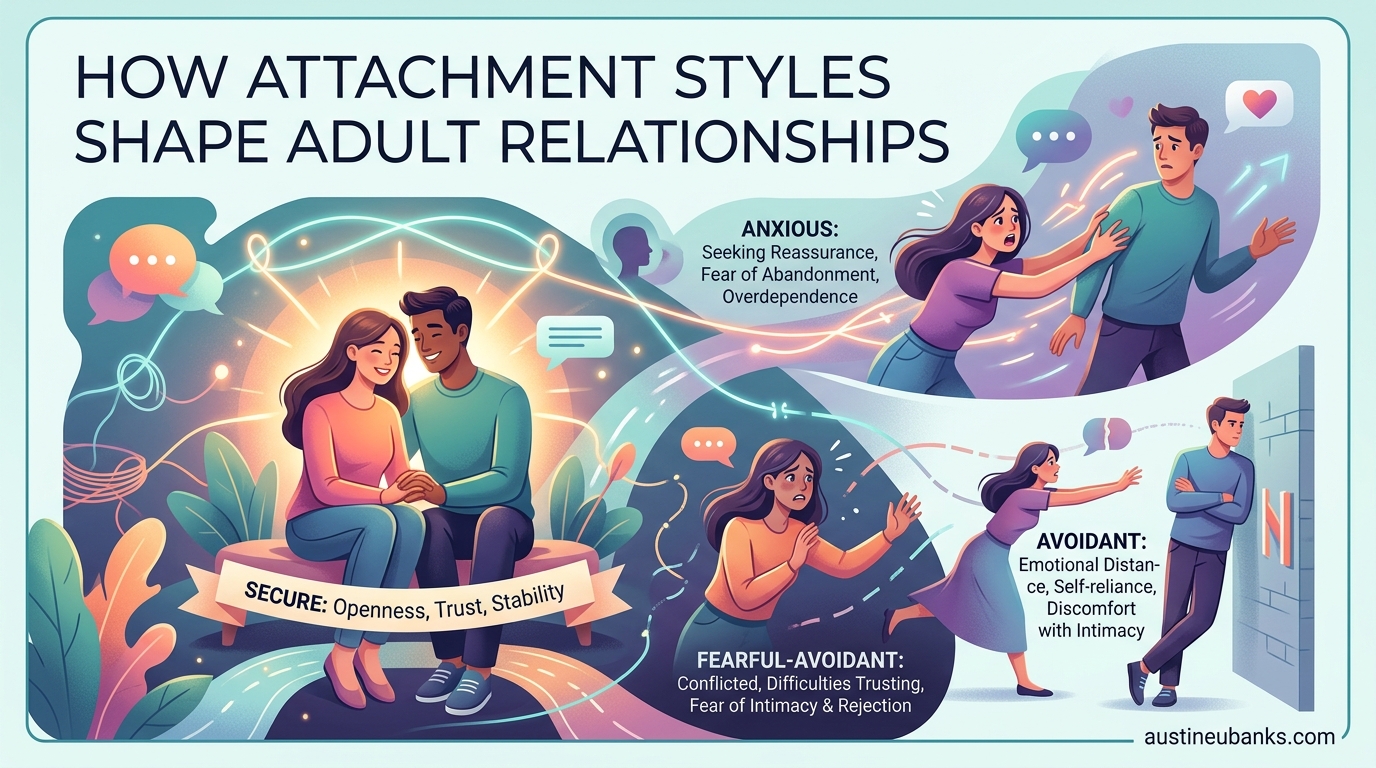
If you want the short version before diving into the details, here is a quick snapshot of the four attachment styles and how each one tends to behave in adult relationships.
- Secure attachment — You feel comfortable with intimacy and autonomy. You trust your partner, communicate openly, and handle conflict without feeling threatened. About 55 percent of adults fall into this category.
- Anxious (preoccupied) attachment — You crave deep closeness but fear abandonment. You may seek frequent reassurance, worry about your partner’s commitment, and feel hypersensitive to signs of rejection.
- Avoidant (dismissive) attachment — You value independence over intimacy. You may pull away when things get emotionally close, suppress your feelings, and prefer self-reliance over vulnerability.
- Disorganized (fearful-avoidant) attachment — You want intimacy but also fear it. You may swing between clinging and withdrawing, feeling torn between a desire for closeness and a need to protect yourself.
Research from developmental psychology suggests that roughly 55 percent of people are secure, 20 percent are anxious, 25 percent are avoidant, and about 5 percent fall into the disorganized category. These percentages shift depending on the population studied and the measurement tool used, but the overall pattern holds across decades of research.
It is worth noting that attachment exists on a spectrum. Many people do not fit neatly into one box, and your style can vary slightly depending on the relationship and life circumstances. Reddit users in communities like r/attachment_theory frequently discuss how they identify with aspects of multiple styles, which researchers fully acknowledge as normal.
The Origins of Attachment Theory
To understand how attachment styles shape adult relationships, it helps to know where the theory came from. Attachment theory did not originate in a dating advice column or a self-help book. It was born from decades of rigorous scientific research starting in the mid-twentieth century.
John Bowlby: The Father of Attachment Theory
British psychologist John Bowlby first introduced attachment theory in the 1950s and 1960s after studying the effects of maternal deprivation on children separated from their parents during World War II. Bowlby proposed that humans are biologically wired to seek proximity to a primary caregiver for survival. When a caregiver responds consistently and warmly to a child’s needs, the child develops a sense of safety and trust.
Bowlby called this mental framework the internal working model. This is a cognitive-emotional blueprint that answers two fundamental questions: Am I worthy of love? And can I rely on others to be there for me? The answers to these questions, formed in early childhood, become the lens through which you interpret every relationship for the rest of your life.
Mary Ainsworth and the Strange Situation
American-Canadian psychologist Mary Ainsworth built on Bowlby’s work in the 1960s and 1970s by designing the Strange Situation Procedure. In this landmark experiment, a mother and her toddler (aged 12 to 18 months) were observed in a room. The mother briefly left the child with a stranger and then returned. Researchers watched how each child reacted to the separation and reunion.
Ainsworth identified three distinct response patterns that corresponded to different attachment styles. A fourth pattern was later added by her colleague Mary Main. These patterns became the foundation of the four attachment styles we use today to understand adult relationships. What Ainsworth discovered was that a child’s reaction to being separated from and reunited with their caregiver revealed their internal working model in action.
From Children to Adults: Hazan and Shaver
In 1987, psychologists Cindy Hazan and Phillip Shaver made a groundbreaking leap. They proposed that the same attachment system that bonds children to caregivers also bonds adults to romantic partners. They found that adults who were secure in their romantic relationships were more likely to recall positive, supportive childhood relationships with parents.
This insight opened the door to decades of adult attachment research. Psychologists like Mario Mikulincer and Phillip Shaver (working together) expanded the field dramatically, mapping how attachment anxiety and attachment avoidance operate as two independent dimensions rather than rigid categories. Their work showed that attachment is not a fixed label but a dynamic system that can shift with experience, therapy, and relationship quality.
How Attachment Styles Shape Adult Relationships: The Four Styles Explained
Now let us look at each attachment style in depth. For each one, we will explore what it looks like, how it develops, how it shows up in romantic relationships, and what real people experience when they live with it.
1. Secure Attachment
Secure attachment is the foundation of healthy adult relationships. People with this style generally feel worthy of love and believe others can be trusted. They are comfortable with both emotional closeness and personal independence, and they do not view the two as being in conflict.
In romantic relationships, securely attached individuals communicate their needs clearly and directly. They do not play games or test their partner’s commitment. When conflict arises, they approach it as a problem to solve together rather than a threat to the relationship. They can offer comfort to a partner without feeling overwhelmed, and they can receive comfort without feeling weak.
Secure partners also serve as what Bowlby called a secure base. This means they provide a reliable emotional anchor that allows their partner to explore the world, take risks, and grow, knowing they have someone to return to. Reddit users in r/attachment_theory frequently describe how being with a securely attached partner helped them feel safe enough to heal their own insecure patterns over time.
Signs of secure attachment in a relationship include trusting your partner without needing constant proof, being able to discuss difficult emotions without shutting down or lashing out, and maintaining your own identity and friendships while being deeply connected to your partner. Secure individuals also recover more quickly from breakups and are more likely to form healthy new relationships.
Secure attachment develops when a primary caregiver consistently responds to a child’s emotional and physical needs. The caregiver does not need to be perfect. Research by psychologist Edward Tronick showed that caregivers only need to be attuned and responsive about 30 percent of the time for a child to develop secure attachment. This concept, known as good enough parenting, means that occasional missteps are fine as long as the caregiver repairs the connection afterward.
2. Anxious (Preoccupied) Attachment
Anxious attachment, also called preoccupied attachment, is characterized by a deep fear of abandonment paired with an intense desire for closeness. People with this style often feel that they are not enough on their own and need a relationship to feel whole. They crave intimacy but are haunted by the worry that their partner will leave.
In romantic relationships, anxiously attached individuals are often the ones who text first, who notice the slightest change in their partner’s tone, and who lie awake at night replaying conversations for signs of trouble. They have what researchers call a hyperactivating strategy. Their attachment system stays switched on at high alert, constantly scanning the environment for threats to the relationship.
This hypervigilance can be exhausting, both for the anxious person and for their partner. Anxiously attached people may seek frequent reassurance, become upset when their partner needs space, and interpret a delayed text response as evidence of waning interest. They may also idealize their partner while devaluing themselves, believing that their partner is wonderful and they are lucky to be loved.
Common signs of anxious attachment include feeling a physical sense of panic when a partner pulls away, needing constant validation that the relationship is okay, checking a partner’s phone or social media for signs of betrayal, and feeling jealous or threatened by a partner’s friendships or independence. People with this style often describe their relationships as all-consuming and emotionally intense.
Anxious attachment typically develops when a primary caregiver was inconsistent in their responsiveness. Sometimes they were warm and available, and other times they were emotionally absent, preoccupied, or unpredictable. The child learned that love was available but never guaranteed, so they developed a strategy of staying close and staying vigilant to keep the caregiver’s attention.
Users in r/AnxiousAttachment describe this experience vividly. Many talk about hypervigilance to perceived abandonment cues, constant rumination about relationship status, and a feeling that their nervous system is always bracing for rejection. One common theme is the painful awareness that their reactions are disproportionate to the situation, combined with an inability to calm the internal alarm.
3. Avoidant (Dismissive) Attachment
Avoidant attachment, also known as dismissive attachment, is characterized by a strong preference for self-reliance and emotional distance. People with this style often appear independent, self-sufficient, and composed. Underneath that exterior, they have learned to suppress their emotional needs because expressing them feels unsafe.
In romantic relationships, avoidant individuals use what researchers call a deactivating strategy. They dial down their attachment system to avoid the vulnerability of depending on someone else. This can look like needing a lot of alone time, feeling suffocated when a partner wants closeness, or ending relationships when emotional intimacy starts to deepen.
Avoidant partners are often described as emotionally unavailable, distant, or hard to read. They may avoid conversations about feelings, deflect with humor or intellectualization, and prioritize work, hobbies, or friendships over the relationship. Reddit users with avoidant attachment describe ending relationships when they start feeling emotionally vulnerable, even when they genuinely care about the person.
Signs of avoidant attachment in relationships include feeling uncomfortable when a partner wants to talk about emotions, preferring to handle problems alone rather than asking for help, feeling irritated or smothered by a partner’s need for connection, and maintaining a sense of emotional distance even in long-term relationships. Avoidant individuals may also struggle to express affection verbally, though they may show care through practical actions.
It is important to understand that avoidant behavior is not about not caring. Avoidant people feel emotions just as intensely as anyone else. The difference is that their nervous system learned early in life that expressing needs led to disappointment or rejection, so it developed a strategy of turning those needs off. This is a survival mechanism, not a character flaw.
Avoidant attachment develops when a primary caregiver was emotionally unavailable, dismissive, or rejecting of the child’s emotional needs. The caregiver may have been physically present but emotionally checked out, or they may have punished emotional expression with criticism or withdrawal. The child learned that the safest strategy was to stop needing emotional connection from others.
4. Disorganized (Fearful-Avoidant) Attachment
Disorganized attachment, also called fearful-avoidant attachment, is the most complex and painful of the four styles. People with this style simultaneously crave intimacy and fear it. They want to be close to someone, but closeness itself feels dangerous. This creates a painful push-pull dynamic where they alternate between clinging and retreating.
In romantic relationships, disorganized individuals often feel trapped in an internal war. One moment they desperately want connection and reassurance. The next moment they feel overwhelmed by the vulnerability and push their partner away. Partners of disorganized individuals often describe the relationship as confusing and unpredictable, never knowing which version of the person they will get.
This unpredictability stems from a fundamental conflict in the internal working model. The person learned that the source of comfort (the caregiver) was also the source of fear. This creates an impossible situation for the nervous system: the biological drive to seek safety points toward the caregiver, but the caregiver is also the one causing distress. The result is behavioral disorganization, where approach and avoidance responses fire simultaneously.
Signs of disorganized attachment include wanting deep connection but sabotaging it when it gets too close, swinging between emotional extremes in relationships, feeling unworthy of love while also distrusting others, having a history of volatile or chaotic relationships, and struggling to self-soothe during emotional distress. People with this style often describe feeling broken or fundamentally different from others.
Reddit users in r/Disorganized_Attach describe this push-pull dynamic with painful honesty. They talk about craving intimacy but feeling panicked when it gets too close, and about the devastating cycle of reaching out for love and then running from it. Many describe a lifelong pattern of chaotic relationships that feel impossible to break without professional help.
Disorganized attachment develops when a primary caregiver was both a source of fear and a source of comfort. This often happens in homes where there was abuse, neglect, trauma, or severe parental mental illness. The caregiver may have been frightening, unpredictable, or unable to provide consistent safety. The child could not solve the problem of how to get comfort from someone who was also scary, and this unresolved conflict became wired into their attachment system.
Attachment Styles Comparison: How Each Style Differs
To make these differences crystal clear, here is a side-by-side comparison of the four attachment styles. This comparison looks at how each style views the self, views others, handles conflict, and experiences emotional intimacy.
Secure attachment: Positive view of self, positive view of others. Comfortable with both closeness and autonomy. Handles conflict through open communication and collaboration. Trusts partners and does not fear abandonment. Recovers well from relationship setbacks.
Anxious attachment: Negative view of self, positive view of others. Wants maximum closeness and fears distance. Handles conflict by escalating, seeking reassurance, or becoming clingy. Constantly worried about abandonment. Tends to merge identity with partner.
Avoidant attachment: Positive view of self (on the surface), negative view of others. Prefers distance and independence. Handles conflict by withdrawing, shutting down, or leaving. Dismisses the importance of close relationships. Keeps emotional walls up even with long-term partners.
Disorganized attachment: Negative view of self, negative view of others. Wants closeness but fears it simultaneously. Handles conflict erratically, sometimes escalating and sometimes withdrawing. Does not trust self or others. Often experiences relationships as chaotic and destabilizing.
The key difference between anxious and avoidant attachment comes down to strategy. Anxious people solve the problem of insecurity by moving toward their partner, seeking more connection and reassurance. Avoidant people solve the same problem by moving away, reducing their need for connection so they cannot be hurt. Disorganized people do both, switching between the two strategies unpredictably.
Understanding these differences matters enormously in practice. If you are anxiously attached and your partner is avoidant, recognizing these patterns can help you stop taking their withdrawal personally. If you are avoidant and your partner is anxious, understanding their clinginess as an attachment response rather than manipulation can change how you respond.
The Childhood Roots of Insecure Attachment
Understanding how attachment styles shape adult relationships requires understanding how these patterns form in the first place. Insecure attachment does not happen because parents are bad people. It happens because of specific patterns in the caregiver-child relationship that teach the child particular lessons about love, safety, and trust.
What Causes Anxious Attachment in Childhood
Anxious attachment forms when a caregiver’s responsiveness is inconsistent. The caregiver might be loving and attentive one day and distracted, overwhelmed, or emotionally unavailable the next. This inconsistency teaches the child that love is real but unreliable. To cope, the child ramps up their emotional signaling, crying louder, clinging harder, and staying vigilant to keep the caregiver engaged.
Common contributors to anxious attachment include a caregiver dealing with their own unmanaged anxiety or depression, a caregiver who was inconsistent due to work stress or personal instability, or a family situation where the child felt they had to earn love through achievement or behavior.
What Causes Avoidant Attachment in Childhood
Avoidant attachment forms when a caregiver consistently rejects or dismisses the child’s emotional needs. The caregiver may have believed that expressing emotion was weak, may have been uncomfortable with vulnerability themselves, or may have been too stressed and overwhelmed to respond to emotional cues. Over time, the child learned to stop expressing needs because doing so led to rejection or discomfort.
Common contributors include a caregiver who valued independence over emotional connection, a family culture where feelings were not discussed, or a situation where the child was expected to be self-sufficient at an age where they still needed emotional support.
What Causes Disorganized Attachment in Childhood
Disorganized attachment forms when the caregiver is both a source of comfort and a source of fear. This typically occurs in homes where there is abuse, neglect, domestic violence, severe parental mental illness, or substance abuse. The child’s biological drive pushes them toward the caregiver for safety, but the caregiver is also the person causing the fear. This creates an unsolvable dilemma that wires disorganization into the attachment system.
Research also shows that caregivers who themselves experienced unresolved trauma or loss are more likely to raise children with disorganized attachment. This is known as intergenerational continuity, where unresolved attachment patterns are passed from one generation to the next. The good news is that this cycle can be broken through therapy, self-awareness, and intentional parenting.
It Is Not About Blaming Parents
It is essential to understand attachment origins without falling into the trap of blaming your parents or caregivers. Most parents did the best they could with the resources, awareness, and emotional tools they had. Many insecure attachment patterns are passed down through generations because caregivers were parented in the same way.
Understanding the childhood roots of your attachment style is not about assigning fault. It is about developing compassion for yourself and recognizing that your patterns are adaptations, not defects. They were intelligent survival strategies that helped you navigate a difficult emotional environment. The goal now is not to dwell on the past but to use that understanding to create new, healthier patterns in the present.
Attachment Style Combinations: How Different Styles Pair in Relationships
One of the most under-covered topics in attachment theory content is what happens when two specific attachment styles come together in a relationship. The interaction between styles creates predictable dynamics that can either support growth or reinforce insecurity.
The Anxious-Avoidant Trap
The anxious-avoidant pairing is one of the most common and painful relationship dynamics. It is so prevalent that attachment researchers have given it a name: the anxious-avoidant trap. Here is how it works.
The anxiously attached person wants closeness and reassurance. The avoidantly attached person wants space and independence. When the anxious person moves toward the avoidant person, the avoidant person feels overwhelmed and pulls back. When the avoidant person pulls back, the anxious person feels abandoned and pursues harder. This creates a self-reinforcing cycle where each person’s coping strategy triggers the other’s deepest fear.
The anxious person interprets the avoidant partner’s withdrawal as proof that they are unloved. The avoidant person interprets the anxious partner’s pursuit as proof that relationships are suffocating. Both people feel validated in their worst beliefs about relationships, and the cycle accelerates.
Breaking this trap requires both partners to understand what is happening at the attachment level. The anxious partner needs to learn self-soothing techniques so they do not overwhelm the avoidant partner with pursuit. The avoidant partner needs to practice staying present during emotional moments rather than automatically withdrawing. Couples therapy, particularly Emotionally Focused Therapy (EFT), is highly effective for this dynamic.
Secure Plus Anxious
When a securely attached person partners with an anxiously attached person, the dynamic is much more workable. The secure partner provides consistent reassurance, clear communication, and emotional stability. Over time, this consistency can help the anxious partner feel safer and reduce their hypervigilance.
This is one example of what researchers call partner-facilitated attachment change. A secure partner serves as a new, corrective relational experience. The anxious person’s internal working model gradually updates as they experience repeated evidence that this person will not abandon them.
Secure Plus Avoidant
A secure person paired with an avoidant person can also work well, though it requires patience. The secure partner respects the avoidant partner’s need for space without interpreting it as rejection. Over time, the avoidant partner may learn that emotional vulnerability is safe with this person, gradually opening up more than they have in previous relationships.
Two Insecurely Attached Partners
When two insecurely attached people form a relationship, the dynamic depends on the specific combination. Two anxiously attached people may create a relationship that is intensely close but also volatile and exhausting, with both partners feeding each other’s anxiety. Two avoidantly attached people may have a relationship that is stable but emotionally distant, with both partners tacitly agreeing to keep things on the surface.
Two disorganized partners may create a relationship marked by extreme highs and lows, with frequent crises and reconciliations. These relationships can feel passionate and alive but are often destabilizing for both people. Professional support is especially important in these pairings.
Attachment Styles Beyond Romance: Friendships and the Workplace
Most attachment theory content focuses exclusively on romantic relationships, but attachment styles influence every meaningful connection in your life. Understanding how your attachment style plays out in friendships and professional relationships can improve those dynamics too.
Attachment in Friendships
Securely attached people tend to have stable, long-lasting friendships built on mutual trust and emotional availability. They can be there for friends during difficult times without feeling drained, and they can ask for support when they need it.
Anxiously attached people often form intense friendships quickly. They may worry about whether friends are upset with them, overanalyze social interactions, and feel hurt if a friend does not respond promptly. They may also fear losing friendships and cling to relationships that are no longer healthy.
Avoidantly attached people may have friendships that are enjoyable but stay on the surface. They tend to avoid emotional vulnerability with friends, prefer activities over deep conversations, and may disappear when a friend is going through a crisis that requires emotional engagement.
Disorganized attachment in friendships can look like a pattern of making close friends quickly, then suddenly cutting them off after a perceived slight. The push-pull dynamic that shows up in romance also appears in platonic bonds.
Attachment in the Workplace
Attachment styles also shape professional relationships. Securely attached employees tend to collaborate well, give and receive feedback constructively, and maintain healthy boundaries with colleagues.
Anxiously attached employees may overwork to prove their value, fear negative feedback intensely, and become distressed by perceived rejection from managers or colleagues. They may also struggle with workplace conflict, taking it personally rather than seeing it as a professional difference.
Avoidantly attached employees often prefer independent work over teamwork. They may resist asking for help even when they need it, feel uncomfortable with workplace socializing, and keep professional relationships strictly transactional. They tend to be competent and self-reliant but may struggle with collaborative projects.
Understanding attachment in the workplace is an emerging area of research that very few resources cover. Recognizing these patterns can help you navigate office dynamics, improve your working relationships, and create a more supportive professional environment.
Can Your Attachment Style Actually Change?
This is one of the most frequently asked questions about attachment theory, and the answer is a resounding yes. Your attachment style is not a life sentence. Research consistently shows that attachment patterns can and do change over the course of a person’s life.
Studies on attachment stability suggest roughly a 70/30 split. About 70 percent of people maintain the same attachment classification over time, while about 30 percent shift from one category to another. This means that nearly one in three people experience a meaningful change in their attachment style during adulthood.
Earned Secure Attachment
Psychologists use the term earned secure attachment to describe people who started with an insecure attachment style but, through intentional work, developed a secure way of relating. This is one of the most hopeful concepts in all of psychology. It means that no matter what happened in your childhood, you can build a secure internal working model as an adult.
Earned security is not about pretending to be secure. It is about genuinely rewiring your attachment system through new experiences, self-awareness, and sometimes professional support. People with earned security function just as well in relationships as people who were securely attached from the start. In some ways, they may even have an advantage because they have conscious awareness of attachment dynamics that natural-secure people take for granted.
How Attachment Change Happens
Research has identified several pathways through which attachment style can shift. The first is through a therapeutic relationship. Therapy provides a consistent, attuned, and emotionally safe relationship that can serve as a corrective attachment experience. Over time, the therapist becomes a secure base from which the client can explore and heal old wounds.
The second pathway is through a healthy romantic relationship. As mentioned earlier, being with a securely attached partner can gradually shift an insecure person’s internal working model. This is not a quick fix. It requires time, consistency, and a partner who is both secure and patient. The Attachment Security Enhancement Model (ASEM), developed by attachment researchers, describes how a partner can provide both short-term emotional buffering and long-term revision of insecure attachment patterns.
The third pathway is through intentional self-work. This includes developing emotional awareness, practicing self-regulation techniques, learning to identify and challenge old beliefs about worthiness and trust, and gradually taking emotional risks in safe contexts.
Therapy Modalities That Help
Several evidence-based therapy approaches are particularly effective for attachment work. Emotionally Focused Therapy (EFT), developed by Sue Johnson, is specifically designed to help couples understand and change their attachment dance. It has one of the strongest evidence bases of any couples therapy approach.
Eye Movement Desensitization and Reprocessing (EMDR) helps process traumatic memories that may be driving disorganized attachment patterns. Internal Family Systems (IFS) therapy helps people understand and integrate the different parts of themselves that may be in conflict around intimacy and vulnerability. These modalities are frequently recommended in attachment-focused communities on Reddit.
Individual psychodynamic therapy and schema therapy can also be effective for addressing deep-seated attachment patterns. The key is finding a therapist who understands attachment theory and works with it explicitly in session.
Practical Steps to Develop More Secure Attachment
Understanding attachment theory is important, but knowledge alone does not change patterns. Here are specific, actionable steps you can take to move toward a more secure way of relating.
Step 1: Build Emotional Awareness
Before you can change a pattern, you have to be able to see it. Start by simply noticing your emotional reactions in relationships without judgment. When you feel the urge to text your partner for the fifth time, pause. What emotion is driving that urge? Is it fear? Loneliness? Insecurity? Naming the emotion is the first step to responding differently.
Keep a relationship journal where you record moments of emotional intensity. Note what triggered the feeling, what thought accompanied it, and how you responded. Over time, patterns will emerge that can help you understand your attachment system in action.
Step 2: Practice Self-Soothing
If you have an anxious attachment style, one of the most valuable skills you can build is the ability to calm your own nervous system without needing your partner to do it for you. Self-soothing techniques include deep breathing, progressive muscle relaxation, mindfulness meditation, physical exercise, and grounding exercises.
The goal is not to never need your partner for comfort. It is to expand your toolkit so that your partner is one option among many rather than the only option. When you can self-soothe even partially, you reduce the intensity of your pursuit behavior, which gives an avoidant partner more room to breathe.
Step 3: Practice Emotional Vulnerability
If you have an avoidant attachment style, the most important practice is allowing yourself to be emotionally seen. Start small. Share one genuine feeling with your partner each day, even if it feels uncomfortable. Let them know when you are stressed, sad, or uncertain, rather than handling it all internally.
This will feel unnatural at first. Your deactivating strategy will tell you that vulnerability is dangerous. Push through that discomfort gradually. Each time you share and receive a positive response, your internal working model gets a small piece of evidence that emotional openness is safe.
Step 4: Learn to Identify Your Triggers
Attachment responses are often triggered by specific cues. For anxious people, common triggers include delayed responses, a partner needing space, ambiguous communication, or perceived emotional distance. For avoidant people, common triggers include a partner wanting to talk about feelings, feeling pressured for commitment, or sensing that someone needs something from them emotionally.
Once you know your triggers, you can create a plan for how to respond when they fire. Instead of reacting automatically, you can pause, remind yourself what is happening at the attachment level, and choose a response that aligns with your values rather than your fear.
Step 5: Seek Out Secure Relationships
Surround yourself with people who model secure attachment. This includes friends, romantic partners, mentors, and even therapists. Being around secure people gives your nervous system repeated experiences of what secure relating feels like. Over time, these experiences help recalibrate your internal working model.
If you are dating, pay attention to consistency. Does this person follow through on what they say? Do they communicate clearly? Do they respect your boundaries while also expressing their own needs? These are signs of secure attachment, and choosing partners with these qualities can support your own growth.
Step 6: Consider Professional Support
If you find yourself stuck in the same patterns despite your best efforts, professional support can make a transformative difference. A therapist trained in attachment-focused work can help you understand your patterns, process old wounds, and practice new ways of relating in a safe environment. Therapy is not a sign of weakness. It is one of the most effective pathways to earned secure attachment.
How to Identify Your Own Attachment Style
Before you can work on your attachment patterns, it helps to know where you currently stand. The following self-reflection questions are designed to help you identify which style resonates most strongly with you. Remember that attachment exists on a spectrum, so you may recognize yourself in more than one category.
Signs You May Be Securely Attached
You generally trust your partner and do not worry excessively about them leaving. You are comfortable sharing your feelings and hearing about your partner’s feelings. You can be alone without feeling abandoned and can be close without feeling smothered. You handle disagreements by talking through them rather than shutting down or escalating. You believe you are worthy of love and that relationships can be safe.
Signs You May Be Anxiously Attached
You often worry that your partner will lose interest or leave. You feel a strong need for closeness and reassurance, and you may become upset when your partner needs space. You tend to notice small changes in your partner’s behavior and interpret them as negative. You may feel incomplete or unworthy without a relationship. You sometimes check your partner’s phone, social media, or whereabouts for signs of trouble.
Signs You May Be Avoidantly Attached
You value your independence highly and may feel uncomfortable when a partner wants a lot of emotional closeness. You prefer to handle problems on your own rather than asking for help. You may feel irritated or overwhelmed by a partner’s emotional needs. You tend to keep conversations on the surface rather than going deep. You have ended relationships when they started feeling too emotionally intense.
Signs You May Have Disorganized Attachment
You want deep connection but also feel afraid of it. You find yourself alternating between clinging to a partner and pushing them away. You may have a history of volatile or chaotic relationships. You sometimes feel unworthy of love while also distrustful of others. You struggle to calm yourself during emotional storms and may act in ways that surprise even you.
For a more formal assessment, researchers use validated tools like the Experiences in Close Relationships (ECR) scale, which measures attachment anxiety and attachment avoidance along two independent dimensions. Many free online versions of this questionnaire are available. While online quizzes are not diagnostic tools, they can give you a helpful starting point for self-understanding.
How Attachment Styles Affect Communication and Conflict
Communication breakdowns are one of the most common reasons couples seek help, and attachment style is often at the root of these difficulties. Each style has a characteristic communication pattern that can either facilitate or undermine connection.
Securely attached individuals communicate directly and respectfully. They express their needs clearly, listen to their partner’s perspective, and work toward mutually satisfying solutions. They can stay regulated during difficult conversations and do not view disagreement as a threat to the relationship.
Anxiously attached individuals may communicate indirectly, dropping hints or testing their partner rather than stating what they need. During conflict, they may become emotionally flooded, bringing up past grievances and struggling to stay focused on the present issue. Their communication is driven by a need to reestablish connection, which can come across as demanding or critical.
Avoidantly attached individuals may minimize problems, change the subject, or withdraw from conversations that feel emotionally charged. They may use logic and rationality to deflect emotional content, leaving their partner feeling unheard. Their communication is driven by a need to reduce emotional intensity, which can come across as dismissive or cold.
Disorganized individuals may communicate erratically during conflict, alternating between emotional outbursts and complete shutdown. They may struggle to articulate what they need or feel, and their behavior can seem contradictory or confusing to their partner.
Improving communication starts with understanding these patterns. If you know that your avoidant partner shuts down during conflict, you can give them time to process before expecting a response. If you know that your anxious partner needs verbal reassurance during disagreements, you can provide that even while setting boundaries around behavior.
Attachment Across Relationship Stages
Attachment dynamics do not stay static throughout a relationship. They shift and evolve as a relationship moves through different stages, from early dating to long-term commitment.
In the early dating phase, attachment styles may be less visible. The excitement and novelty of a new connection can temporarily mask insecure patterns. Anxiously attached people may feel their best during the honeymoon phase when the partner is attentive and available. Avoidantly attached people may enjoy the early stages because emotional intimacy has not yet deepened.
As the relationship deepens and emotional vulnerability increases, attachment patterns typically emerge more clearly. This is often the stage where the anxious-avoidant trap activates. The anxious partner starts wanting more closeness and commitment, the avoidant partner starts feeling pressured, and the cycle begins.
In long-term committed relationships, attachment dynamics can either stabilize or intensify. A relationship with a secure partner can provide the consistency needed for an insecure partner to gradually heal. Without that stability, insecure patterns may become more entrenched over time.
Major life transitions, such as moving in together, getting married, having children, or experiencing a crisis, can reactivate attachment insecurities. These are moments when the attachment system is under increased stress, and old patterns may resurface even in people who have done significant healing work. Recognizing this as normal can reduce shame and prevent unnecessary relationship crisis.
The Mental and Physical Health Impact of Attachment Styles
Research has consistently shown that attachment style is not just a relationship issue. It has significant implications for both mental and physical health. Understanding these connections can motivate you to take your attachment work seriously.
Mental Health Connections
Insecurely attached individuals are at higher risk for a range of mental health challenges. Anxious attachment is associated with higher rates of generalized anxiety disorder, social anxiety, and depression. The constant hypervigilance and fear of abandonment take a toll on the nervous system over time.
Avoidant attachment is associated with difficulties in emotional processing, which can contribute to alexithymia (difficulty identifying and describing emotions), substance use as a form of emotional numbing, and a tendency to delay seeking help for mental health concerns.
Disorganized attachment is associated with the most significant mental health risks, including higher rates of PTSD, borderline personality traits, dissociative symptoms, and complex trauma responses. This reflects the severe early experiences that typically underlie this attachment pattern.
Physical Health Connections
Research has also found connections between attachment style and physical health outcomes. Studies have shown that insecurely attached individuals are more likely to experience sleep disturbances, with anxious attachment being particularly linked to insomnia and poor sleep quality. The hypervigilant nervous system that characterizes anxious attachment makes it difficult to relax enough for restful sleep.
Chronic pain is another area where attachment plays a role. Research on pain catastrophizing (the tendency to amplify and ruminate on pain) has found links to insecure attachment, particularly anxious attachment. The same emotional regulation difficulties that affect relationships also influence how people experience and cope with physical discomfort.
Insecure attachment has also been associated with weaker immune function, higher stress hormone levels, and greater cardiovascular reactivity to stress. These findings suggest that the quality of our closest relationships has measurable effects on our physical bodies, not just our emotional lives.
Secure attachment, by contrast, is associated with better overall health outcomes, faster recovery from illness, and greater longevity. This is likely because secure relationships provide consistent emotional support, which buffers the effects of stress on the body.
What are the four attachment styles?
The four attachment styles are secure, anxious (preoccupied), avoidant (dismissive), and disorganized (fearful-avoidant). Secure attachment involves comfort with both closeness and independence. Anxious attachment involves fear of abandonment and a strong need for reassurance. Avoidant attachment involves emotional distance and self-reliance. Disorganized attachment involves a conflicting desire for and fear of intimacy.
How does anxious attachment affect relationships?
Anxious attachment affects relationships by creating a constant fear of abandonment, leading to behaviors like seeking frequent reassurance, monitoring a partner’s behavior for signs of withdrawal, and becoming emotionally flooded during conflict. People with anxious attachment often merge their identity with their partner and struggle to feel secure without constant validation that the relationship is stable.
How does avoidant attachment affect relationships?
Avoidant attachment affects relationships by creating a pattern of emotional distance and self-reliance. People with this style may pull away when intimacy deepens, avoid conversations about feelings, and prioritize independence over connection. Their partners often feel shut out or unimportant, even though the avoidant person may care deeply but lack the tools to express it comfortably.
Can you change your attachment style?
Yes, you can change your attachment style. Research shows that about 30 percent of people experience a meaningful shift in their attachment classification over time. This change, known as earned secure attachment, can happen through therapy (especially Emotionally Focused Therapy, EMDR, or IFS), a healthy relationship with a securely attached partner, and intentional self-awareness and emotional regulation practice.
What causes insecure attachment?
Insecure attachment is caused by patterns in the early caregiver-child relationship. Anxious attachment develops when a caregiver is inconsistently responsive. Avoidant attachment develops when a caregiver is emotionally dismissive or rejecting of the child’s needs. Disorganized attachment develops when a caregiver is both a source of comfort and a source of fear, often due to abuse, neglect, trauma, or severe parental mental illness.
How does disorganized attachment affect relationships?
Disorganized attachment affects relationships by creating a painful push-pull dynamic where the person craves intimacy but fears it at the same time. This can lead to volatile relationship patterns, sudden withdrawal after periods of closeness, difficulty trusting both self and others, and intense emotional reactions that feel impossible to control. People with this style often benefit significantly from trauma-informed therapy.
What is the difference between anxious and avoidant attachment?
The main difference is their coping strategy. Anxiously attached people cope with insecurity by moving toward their partner, seeking more closeness and reassurance. Avoidantly attached people cope by moving away, reducing their need for connection so they cannot be hurt. Anxious people fear abandonment, while avoidant people fear engulfment. Both stem from insecure attachment but express it in opposite ways.
Conclusion
Understanding how attachment styles shape adult relationships gives you a powerful lens for making sense of your own patterns and those of the people you love. Whether you are securely attached and trying to understand a partner who is not, or you are working toward earned security yourself, this knowledge is the foundation for lasting change.
Your attachment style is not your identity and it is not your destiny. It is a pattern, and patterns can change. With self-awareness, the right support, and a willingness to practice new ways of relating, you can build the kind of secure, fulfilling relationships that you deserve. The journey toward secure attachment takes time and courage, but every step forward creates more freedom, deeper connection, and a richer experience of love.