
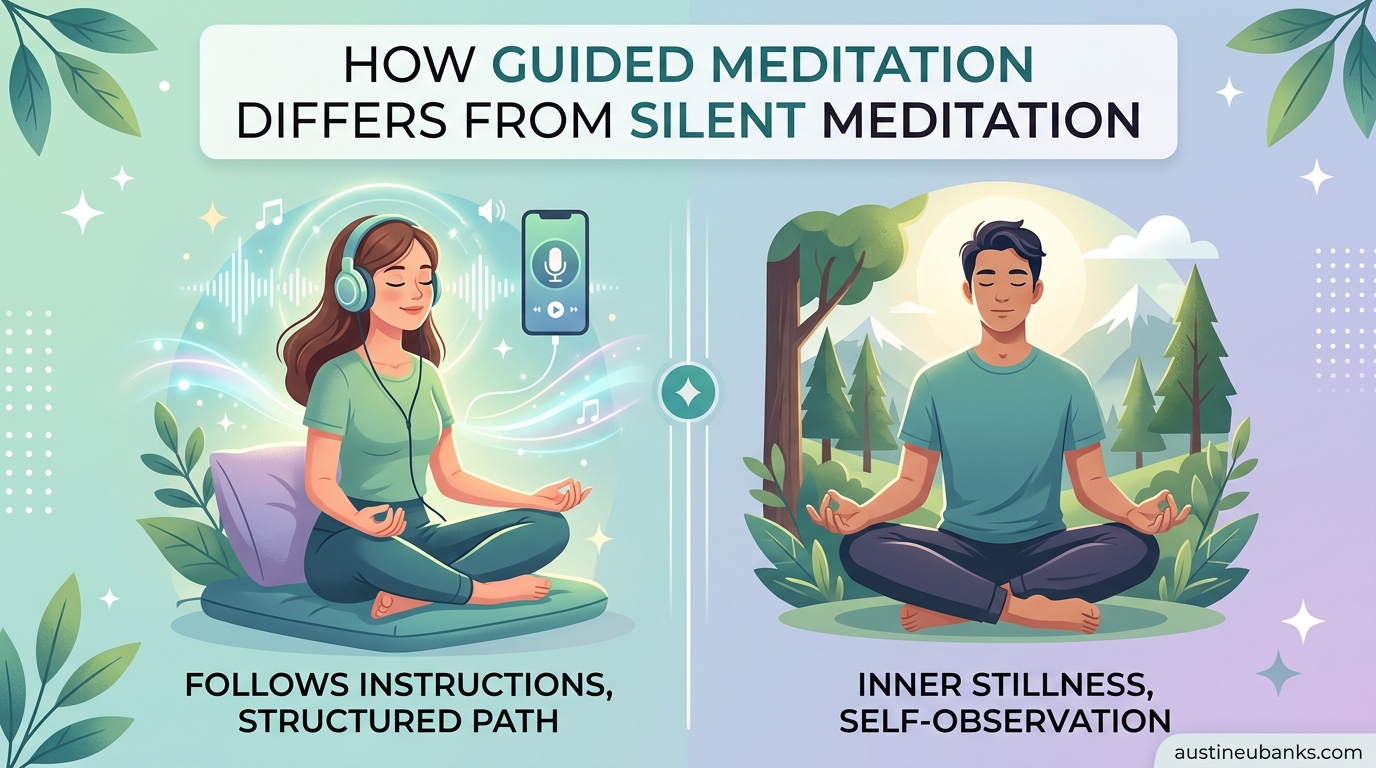
If you have ever sat down to meditate and wondered whether you should press play on an audio guide or sit in complete silence, you are not alone. Understanding how guided meditation differs from silent meditation is one of the most common questions people face when building a meditation practice. I have spent years experimenting with both approaches, and the differences go far beyond whether someone is talking in your ear.
The distinction matters because it shapes your entire experience. Guided meditation gives you a teacher’s voice to follow, while silent meditation asks you to find your own way. Neither is objectively better, but each serves different needs, experience levels, and goals.
In this guide, I will break down exactly how guided meditation differs from silent meditation, covering how each works, their unique benefits and drawbacks, what science says about them, and how to choose the right approach for your practice in 2026.
Table of Contents
Quick Answer: How Guided Meditation Differs From Silent Meditation
Guided meditation involves an instructor or recorded audio leading you through a meditation session with spoken instructions, visualizations, and prompts. Silent meditation is a self-directed practice where you meditate in quiet without external guidance, relying on your own technique like breath awareness or mantra repetition.
Here are the core differences at a glance:
- Guidance source: Guided meditation uses an external teacher; silent meditation relies on self-direction.
- Best for beginners: Guided meditation provides structure that most beginners need; silent meditation typically requires prior experience.
- Technology required: Guided meditation needs an app, recording, or live teacher; silent meditation needs nothing but a timer.
- Depth of practice: Silent meditation often leads to deeper self-reliance and introspection over time; guided meditation excels at teaching specific techniques.
- Flexibility: Silent meditation can happen anywhere with no preparation; guided meditation requires selecting and setting up content.
- Mind wandering: Guided meditation gently redirects your attention; silent meditation teaches you to catch and redirect wandering yourself.
What Is Guided Meditation?
Guided meditation is a practice where a teacher, instructor, or recorded audio leads you through a meditation session step by step. The guide speaks throughout, offering instructions on where to focus, what to visualize, and how to direct your attention.
Think of it like having a personal coach for your mind. The teacher’s voice acts as an anchor, gently pulling your attention back whenever it drifts. This external structure is what makes guided meditation so accessible for people just starting out.
Guided sessions come in many forms. A body scan meditation walks you through noticing sensations in each part of your body, from your toes to your head. Visualization meditation asks you to picture calming scenes or outcomes. Mantra meditation guides you to repeat a word or phrase silently. Loving-kindness meditation directs you to send compassion to yourself and others.
You can access guided meditations through apps like Headspace, Calm, Insight Timer, and dozens of others. You can also find them on YouTube, podcasts, or attend live sessions at meditation centers and yoga studios. Sessions range from 3 minutes for a quick reset to 60 minutes for deep immersion.
The defining feature is that someone else holds the container. You do not have to decide what to focus on or worry about whether you are doing it right. You simply follow along and let the guide lead the way.
What Is Silent Meditation
Silent meditation is a self-directed practice where you sit in quiet awareness without any external guidance, audio, or spoken instructions. You choose your technique, set your timer, and navigate the session on your own.
This is where meditation becomes deeply personal. Without a voice telling you what to do, you develop an inner trust and self-reliance that guided meditation cannot fully replicate. You learn to notice when your mind has wandered and gently bring it back, over and over, using whatever anchor you have chosen.
Common silent meditation techniques include breath awareness, where you focus on the sensation of breathing in and out. Breath counting involves silently counting each exhale up to ten, then starting over. Open awareness asks you to notice whatever arises in your field of consciousness without fixating on any single thing. Mantra repetition silently repeats a word or phrase to steady the mind.
Silent meditation has deep roots in traditional practices. Vipassana, meaning “to see things as they really are,” is one of India’s most ancient meditation techniques and is practiced in 10-day silent retreats worldwide. Zen meditation, or zazen, involves sitting in precise posture with eyes open, observing thoughts without engagement. Mindfulness meditation, popularized in the West by teachers like Jon Kabat-Zinn, traces back to Buddhist practices but has been adapted for secular settings.
The hallmark of silent meditation is that the responsibility falls entirely on you. There is no guide to redirect your attention, no app to tell you what comes next. This freedom can feel uncomfortable at first, but it builds a level of meditation self-reliance that pays dividends over a lifetime of practice.
Key Differences Between Guided and Silent Meditation
Understanding how guided meditation differs from silent meditation comes down to several concrete dimensions. Here is a breakdown of the most important distinctions:
1. Structure vs Freedom
Guided meditation provides a clear structure. The guide tells you when to start, what to focus on, when to shift attention, and when the session ends. Silent meditation offers complete freedom but demands more internal discipline. You decide everything, from technique to duration.
2. Attention Management
In guided meditation, the teacher’s voice continuously redirects your attention when your mind wanders. In silent meditation, you must catch the wandering yourself and bring your focus back. This self-monitoring is a skill that strengthens with practice.
3. Learning Curve
Guided meditation has a gentle learning curve. You can start benefiting from your very first session because the guide handles the hard work of keeping you on track. Silent meditation has a steeper curve, with most people needing 2 to 4 weeks of consistent effort before it feels comfortable, according to practitioners on meditation forums.
4. Dependency Risk
Guided meditation can create a subtle dependency where you feel unable to meditate without an audio guide. Silent meditation builds self-sufficiency from day one. Many Reddit users in the r/Meditation community report feeling “stuck” on guided apps and unable to sit in silence without anxiety.
5. Depth of Introspection
Silent meditation tends to produce deeper self-awareness over time because there are no external distractions, not even a soothing voice. Guided meditation excels at teaching techniques and providing emotional support but may not reach the same depth of inner stillness.
6. Accessibility and Convenience
Silent meditation requires zero equipment. You can do it anywhere with no preparation. Guided meditation requires selecting content, having headphones or speakers, and depending on an app or recording.
Side-by-Side Comparison
Here is a quick reference comparison to help you see the differences side by side:
- Guidance: Guided = external teacher or recording | Silent = self-directed
- Best for: Guided = beginners, learning new techniques, stress relief | Silent = experienced meditators, deep introspection, building self-reliance
- Attention redirect: Guided = teacher’s voice | Silent = self-monitoring
- Equipment needed: Guided = phone, app, headphones | Silent = just a timer
- Risk of dependency: Guided = moderate | Silent = low
- Typical session length: Guided = 5 to 30 minutes | Silent = 10 to 60 minutes
- Flexibility: Guided = limited to available content | Silent = unlimited, fully customizable
- Emotional support: Guided = high, teacher guides you through difficult emotions | Silent = self-managed, can be challenging without tools
Benefits of Guided Meditation
Guided meditation offers several distinct advantages that make it the ideal starting point for most people:
- Lower barrier to entry. You can start with zero experience and still have a productive session. The guide handles the structure so you can focus on actually meditating rather than figuring out what to do.
- Built-in accountability. Having a voice leading you makes it harder to quit early or give up when your mind gets restless. The session continues whether you are focused or not.
- Technique variety. You can explore body scans, visualizations, loving-kindness practices, breath work, and sleep stories all in one app. This variety keeps practice fresh and helps you discover what resonates.
- Emotional regulation support. Guides often include soothing instructions for working with difficult emotions, anxiety, or stress. This makes guided meditation particularly effective for anxiety management and sleep improvement.
- Community and connection. Live guided sessions at meditation centers or group classes create a sense of shared practice that many people find motivating and comforting.
Many people I have spoken with report that guided meditation feels more relaxing, especially when they are dealing with acute stress or racing thoughts. The teacher’s voice provides a steady anchor that is easier to hold onto than your own breath when your mind is in overdrive.
Benefits of Silent Meditation
Silent meditation rewards practitioners with benefits that deepen over time and cannot be fully replicated by guided sessions:
- Deep self-reliance. You learn to guide yourself, which means you can meditate anytime, anywhere, without depending on an app or recording. This independence is liberating.
- Stronger self-awareness. Without external input, you become intimately familiar with your own thought patterns, emotional triggers, and mental habits. This self-knowledge transfers to daily life.
- Deeper concentration. Silent practice builds concentration muscles more intensely because you must generate and maintain focus entirely on your own. Over time, this leads to deeper absorption states.
- Inner trust. Silent meditation cultivates a profound trust in your own ability to navigate your inner world. You stop needing outside validation that you are meditating correctly.
- Complete freedom. No subscription fees, no phone battery concerns, no WiFi needed. Your practice becomes entirely portable and self-sustaining.
Reddit users who have maintained silent practice for months or years consistently report that it feels more authentic and transformative than guided sessions. One user described it as “the difference between riding a bike with training wheels and riding free.”
Drawbacks of Each Approach
No meditation approach is perfect. Being honest about the downsides helps you make an informed choice.
Drawbacks of Guided Meditation
- Dependency risk. Many users report feeling unable to meditate without an audio guide after months of app-based practice.
- Distraction from the voice. Some people find the guide’s voice inherently distracting, pulling them out of meditation rather than deeper into it.
- Limited depth. Constant verbal cues can prevent you from reaching deeper states of stillness and absorption that silence allows.
- Cost and access. Quality guided content often requires paid subscriptions, and you need a device and internet connection.
Drawbacks of Silent Meditation
- Steep learning curve. The first few weeks can feel frustrating and uncomfortable as you confront constant mind wandering without a guide to redirect you.
- Self-doubt. Without feedback, many beginners wonder if they are doing it right or if the practice is even working.
- Emotional intensity. Silence can surface difficult emotions or memories with no guide to help you process them, which can be overwhelming for some practitioners.
- Discipline required. It is easier to skip a session or cut it short when no one is leading you through it.
The Science Behind Guided vs Silent Meditation
Research on meditation has grown significantly, and while most studies examine meditation broadly rather than comparing guided versus silent practice directly, the findings offer valuable insights into how each approach may affect the brain and body differently.
Brain Activity and Brainwave States
Meditation in general has been shown to increase alpha and theta brainwave activity, which are associated with relaxation and deep meditative states. Guided meditation tends to produce more consistent alpha wave patterns because the teacher’s voice keeps practitioners engaged and prevents the mind from drifting into sleep or agitation.
Silent meditation, particularly in experienced practitioners, can produce deeper theta wave activity associated with profound relaxation and insight. A landmark study by Richard Davidson at the University of Wisconsin found that long-term meditation practitioners in silent retreat settings showed dramatic increases in gamma wave activity, linked to heightened awareness and cognitive processing.
Cortisol and Stress Reduction
Both guided and silent meditation have been shown to reduce cortisol, the body’s primary stress hormone. A meta-analysis published in JAMA Internal Medicine found that mindfulness meditation programs produced moderate improvements in anxiety, depression, and pain. Guided meditation may offer faster initial cortisol reduction because the soothing voice and structure activate the parasympathetic nervous system more quickly in beginners.
Silent meditation appears to produce more sustained changes in stress reactivity over time. Practitioners who maintain silent practice for 8 weeks or longer show measurable changes in amygdala reactivity, the brain’s fear center, according to research from Harvard Medical School.
Nervous System Regulation
Both practices support nervous system regulation, but through slightly different mechanisms. Guided meditation often incorporates body scans and breathing instructions that directly stimulate the vagus nerve, activating the body’s relaxation response. Silent meditation builds this capacity internally, training your nervous system to self-regulate without external cues.
For people dealing with dysautonomia or other nervous system conditions, guided meditation may be a gentler entry point because the structured support reduces the likelihood of becoming overwhelmed. Silent practice can then be introduced gradually as nervous system resilience builds.
How to Transition From Guided to Silent Meditation
One of the biggest questions I see in meditation forums is how to move from guided practice to sitting in silence. Many people feel stuck on guided apps but do not know how to make the switch. Based on community experiences and established meditation teaching, here is a step-by-step 4-week transition plan.
Week 1: Shorten the Guidance
Start by using shorter guided sessions. If you normally meditate for 20 minutes guided, try a 10-minute guided session followed by 10 minutes of silence. Use the guided portion to settle in, then let the audio end and continue on your own. This bridges the gap between full guidance and complete silence.
Week 2: Use Bell Intervals
Replace the spoken guide with a timer that sounds a gentle bell at set intervals. Many meditation apps offer this feature. Set bells every 5 minutes during a 20-minute sit. The bell serves as a gentle reminder to return to your breath or chosen anchor without the constant input of a voice. This technique was recommended by multiple experienced meditators on Reddit as the perfect middle ground.
Week 3: Full Silence with a Technique
Now sit in complete silence with a single technique. Breath counting is ideal for this stage. Silently count each exhale from 1 to 10, then start over. When your mind wanders and you lose count, simply start again from 1 without judgment. This gives your mind something to do without relying on external guidance.
Week 4: Open Silent Practice
By now, you should feel more comfortable in silence. Sit without counting and simply rest your attention on the breath. When thoughts arise, notice them without engagement and return to breathing. Sessions of 15 to 20 minutes are a good target. If your mind feels particularly busy, return to breath counting for that session.
Tips for Dealing With Mind Wandering
Mind wandering is the number one frustration for new silent meditators. Here is what experienced practitioners recommend:
- Expect your mind to wander. It is not a sign of failure; it is the nature of the mind.
- When you notice you have drifted, that moment of noticing IS the meditation. Celebrate it.
- Gently label thoughts as “thinking” and return to your breath. No need to analyze or judge.
- Start with shorter sessions. Ten minutes of focused silent practice is more valuable than 30 minutes of mental chaos.
- Be consistent. Daily 10-minute sessions will serve you better than sporadic hour-long ones.
How to Combine Both Practices
You do not have to choose one approach and abandon the other. Many experienced meditators use a hybrid approach that gets the best of both worlds. Here are three effective ways to combine guided and silent meditation:
Alternating Days
Use guided meditation one day and silent the next. This keeps your practice fresh, prevents app dependency, and builds your silent meditation muscles gradually. Many Reddit users report this as their preferred long-term strategy.
Hybrid Sessions
Start with a 5 to 10 minute guided meditation to settle your mind, then turn off the audio and continue in silence for another 10 to 20 minutes. This combines the grounding effect of guidance with the depth of silent practice in a single session. It is one of the most popular approaches among meditators who have been practicing for a year or more.
Guided for New Techniques, Silent for Daily Practice
Use guided sessions whenever you want to learn a new technique, such as loving-kindness, body scan, or visualization. Once you understand the method, transition to practicing it silently. Return to guided sessions periodically for refreshers or when you feel your practice has gone stale.
Which Is Right for You?
Choosing between guided and silent meditation depends on your experience level, goals, and personal preferences. Here are some signs to help you decide:
Signs You Should Start With Guided Meditation
- You are completely new to meditation and do not know where to begin.
- Your mind feels overwhelmingly busy and you need external support to focus.
- You want to explore different techniques before committing to one.
- You are dealing with acute anxiety, stress, or sleep issues and need immediate relief.
- You enjoy the structure and accountability of having a teacher lead you.
Signs You Should Try Silent Meditation
- You have been practicing guided meditation for a few months and feel ready for more independence.
- You feel distracted by guide voices and crave deeper stillness.
- You want to build self-reliance in your practice.
- You travel frequently or want a practice that requires no equipment.
- You are seeking deeper self-awareness and introspection.
Remember that these are not permanent choices. Your needs will change as your practice evolves. Many people start with guided meditation, transition to silent practice, and return to guided sessions occasionally when they want to learn something new.
FAQs
Is guided meditation as good as silent meditation?
Yes, guided meditation is equally effective as silent meditation, especially for beginners. Both approaches reduce stress, improve focus, and promote emotional well-being. Guided meditation excels at teaching techniques and providing structure, while silent meditation builds deeper self-reliance over time. Most experienced meditators use both approaches depending on their needs.
What are the 4 types of meditation?
The four most common types of meditation are mindfulness meditation (observing thoughts without judgment), concentration meditation (focusing on a single point like breath or mantra), loving-kindness meditation (cultivating compassion for self and others), and body scan meditation (systematically noticing physical sensations). Both guided and silent formats can be used for all four types.
Can meditation help with cortisol?
Yes, research shows that meditation lowers cortisol levels, the body’s primary stress hormone. A meta-analysis in JAMA Internal Medicine found mindfulness programs produce moderate reductions in anxiety and stress. Guided meditation may reduce cortisol faster for beginners due to its soothing structure, while silent practice produces more sustained changes in stress reactivity over time.
Does meditation help with dysautonomia?
Meditation can support nervous system regulation, which may benefit people with dysautonomia. Guided meditation is often a gentler starting point because the structured support reduces the risk of becoming overwhelmed. Silent practice can be introduced gradually as nervous system resilience builds. Always consult with a healthcare provider before starting any new practice for a medical condition.
Conclusion
Understanding how guided meditation differs from silent meditation empowers you to choose the right practice for where you are right now. Guided meditation offers structure, support, and accessibility that make it perfect for beginners or anyone learning new techniques. Silent meditation builds self-reliance, deeper concentration, and profound self-awareness that unfolds over years of practice.
Neither approach is superior. The best meditation practice is the one you will actually do consistently. Start where you feel comfortable, remain open to evolving, and remember that most experienced meditators use both guided and silent meditation throughout their journey.
Ready to begin? Try a 5-minute guided session today, then experiment with 5 minutes of silence afterward. That small step is how every lasting meditation practice begins.
1 thought on “How Guided Meditation Differs From Silent Meditation (October 2026) Guide”