
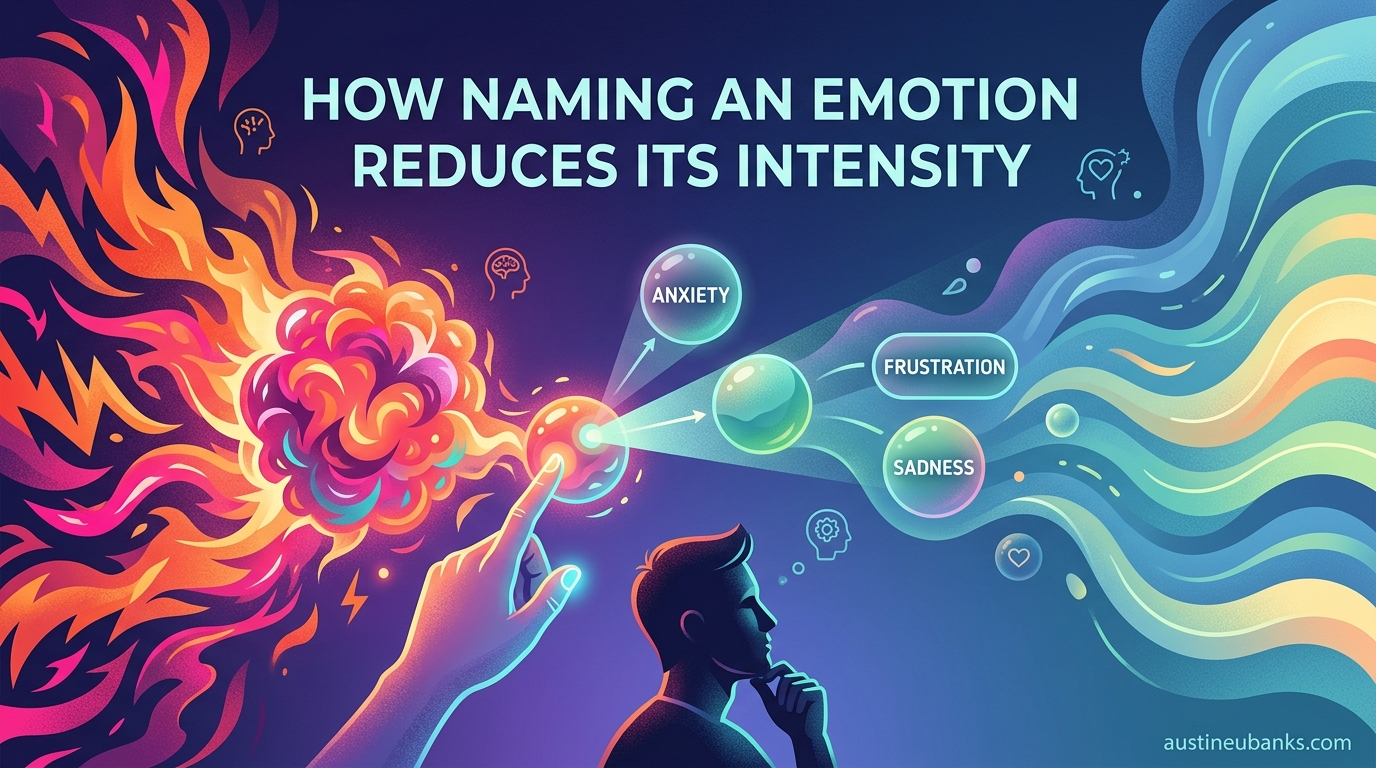
You are sitting in your car after a brutal meeting. Your chest is tight, your jaw is clenched, and something is burning in your stomach. A friend texts to check in, and you type back: “I am feeling really frustrated and a little embarrassed.” Almost immediately, something shifts. The knot loosens just a fraction. You exhale.
That is not a coincidence. It is neuroscience. Understanding how naming an emotion reduces its intensity can change the way you handle stress, conflict, anxiety, and even everyday frustration. The practice is called affect labeling, and it is one of the most accessible emotion regulation tools backed by brain imaging research.
In this guide, we will break down exactly what happens in your brain when you put feelings into words, what the research actually shows (including when it backfires), and how you can start using this technique today. No therapy degree required.
Table of Contents
How Naming an Emotion Reduces Its Intensity: The Short Answer
Naming an emotion reduces its intensity by activating the ventrolateral prefrontal cortex (vlPFC), the brain region responsible for language and executive control. This activation simultaneously dampens activity in the amygdala, the brain’s alarm system. The result is a measurable drop in emotional distress, stress hormones, and physiological arousal. Psychologists call this process affect labeling, and UCLA neuroimaging studies have documented the brain mechanism behind it using fMRI scans.
Dr. Dan Siegel, clinical professor of psychiatry at UCLA, coined the phrase “name it to tame it” to describe this phenomenon. The idea is simple: when you label what you feel, you engage the thinking part of your brain, which automatically calms the reactive part.
What Is Affect Labeling?
Affect labeling is the practice of explicitly identifying and naming your emotional state. Instead of saying “I feel bad,” you get specific: “I feel disappointed,” or “I feel anxious about this presentation.” The more precise the label, the stronger the regulatory effect tends to be.
The concept has deep roots in psychology. Psychoanalyst Anny Katan explored the idea in the 1960s while working with children, observing that helping kids verbalize their feelings reduced acting-out behavior. The modern neuroscience framework, however, comes from Dr. Matthew Lieberman’s lab at UCLA, where researchers used fMRI scans to watch what happens in the brain when people name their emotions.
It is important to distinguish affect labeling from a few similar-sounding practices. Venting means expressing emotion intensely, often without reflection. Suppression means pushing the feeling away or hiding it. Affect labeling is neither of those. It is a calm, deliberate act of identifying what you feel using language.
Think of it as shining a flashlight into a dark room. The emotion does not disappear, but it becomes visible, and visibility gives you choices.
The Neuroscience Behind Naming Emotions
When you name an emotion, your brain does something remarkable. Two regions interact in a way that directly lowers the intensity of what you are feeling. Here is how it works.
The Amygdala: Your Brain’s Alarm System
The amygdala is a small, almond-shaped cluster of neurons deep inside the temporal lobe. Its job is to detect threats and trigger emotional responses. When you encounter something stressful, a critical comment, a near-miss in traffic, a looming deadline, the amygdala fires rapidly. It sends signals that release stress hormones like cortisol and adrenaline, ramping up your heart rate, tightening your muscles, and narrowing your focus.
This response is useful if you are being chased by a predator. It is less useful when the “threat” is an email from your boss. The amygdala does not distinguish well between physical danger and psychological discomfort.
The Ventrolateral Prefrontal Cortex (vlPFC): The Brake Pedal
The ventrolateral prefrontal cortex, or vlPFC, sits in the lower side of the front of your brain. It is involved in language processing, selecting words, and inhibiting impulses. When you engage this region by naming an emotion, it acts like a brake pedal on the amygdala.
In Lieberman’s landmark 2007 fMRI study, participants looked at emotional images and either labeled the emotion they saw or simply identified a gender name. When participants engaged in affect labeling (saying “this is fear” or “this is anger”), their amygdala activity dropped significantly compared to the control condition. At the same time, their vlPFC activity increased.
The key finding was the inverse relationship: as the prefrontal cortex lit up, the amygdala quieted down. The brain was literally regulating itself through language.
The 90-Second Rule for Emotions
Neuroanatomist Dr. Jill Bolte Taylor, author of “My Stroke of Insight,” popularized what she calls the 90-second rule. According to Taylor, the chemical cascade triggered by an emotion, the flood of neurotransmitters and hormones that create the physical sensation of anger, fear, or sadness, takes about 90 seconds to cycle through your body.
After those 90 seconds, the initial chemical surge is gone. If the emotion persists beyond that window, it is because your thinking is re-triggering the circuit. You are telling yourself stories, replaying the event, or feeding the emotion with new thoughts.
Naming an emotion helps you ride out that 90-second wave without adding fuel. By putting words to the feeling, you shift processing from the reactive limbic system toward the prefrontal cortex. You give the neurochemicals time to flush through your system naturally.
What the Brain Imaging Shows
Here is what brain scans reveal about the key regions involved when you name an emotion:
- Amygdala: Decreases activity during affect labeling, reducing threat signaling and stress hormone release.
- Ventrolateral prefrontal cortex (vlPFC): Increases activity, driving language processing and top-down control of emotional responses.
- Dorsomedial prefrontal cortex (dmPFC): Shows increased activity, associated with self-reflection and emotional awareness.
- Right ventrolateral prefrontal cortex (RVLPFC): Specifically linked to the dampening effect on the amygdala during emotional labeling.
- Insula: Modulates activity during interoception, your awareness of internal body states tied to emotion.
The communication between these regions is not just theoretical. Researchers using dynamic causal modeling, a statistical method for analyzing brain connectivity, found that the vlPFC has a direct inhibitory effect on the amygdala during affect labeling. That means naming emotions does not just distract you. It creates a measurable, physical change in how your brain processes threat.
Affect Labeling vs Other Emotion Regulation Strategies
Affect labeling is one of several emotion regulation techniques. Understanding how it compares to others helps you choose the right tool for the situation. No single strategy works in every context.
Affect Labeling vs Cognitive Reappraisal
Cognitive reappraisal involves reinterpreting the meaning of an emotional event. If you feel anxious about a presentation, you might reframe it as excitement. Reappraisal is effortful and conscious. You are actively changing the story.
Affect labeling, by contrast, is simpler. You do not need to change anything. You just identify what you feel. The regulation happens implicitly as a byproduct of engaging the language centers of your brain.
Interestingly, these two strategies use different brain networks. Reappraisal recruits the dorsolateral and dorsomedial prefrontal cortex more heavily, while affect labeling specifically engages the ventrolateral prefrontal cortex. They can complement each other, but labeling is generally easier and faster.
Affect Labeling vs Distraction
Distraction works by shifting your attention away from the emotional stimulus entirely. It can be effective in the short term, especially during acute distress. But it does not process the emotion. When the distraction ends, the feeling often returns.
Affect labeling keeps you engaged with the emotion but changes how your brain processes it. The emotion gets acknowledged and regulated rather than avoided.
Affect Labeling vs Suppression
Expressive suppression means hiding or inhibiting your emotional response. Research consistently shows that suppression increases physiological arousal, raises blood pressure, and impairs memory. It also reduces social connection because others can sense something is off.
Affect labeling is the opposite of suppression. You are not hiding anything. You are bringing the emotion into conscious awareness, which paradoxically reduces its grip on you.
The Four Proposed Mechanisms
Researchers have proposed four possible explanations for why affect labeling works. It is likely a combination of all four rather than any single one:
- Distraction: The cognitive effort of finding the right word shifts attention away from the emotional stimulus.
- Self-reflection: Labeling encourages you to step back and observe your experience, creating psychological distance.
- Uncertainty reduction: Vague, unidentified emotions are inherently threatening to the brain. Naming resolves ambiguity, which itself reduces distress.
- Symbolic conversion: Translating a raw emotional experience into a word transforms it from a physical sensation into a symbolic concept, reducing its intensity.
What Research Shows About Naming Emotions
The evidence base for affect labeling goes well beyond a single study. Multiple experiments have tested the technique across different emotional contexts, from spider phobias to social media behavior.
The UCLA Tarantula Study
One of the most cited studies on affect labeling was conducted by UCLA researchers who recruited participants with a fear of spiders. Participants were placed near a live tarantula and asked to do one of several things: label their fear, reappraise the situation, distract themselves, or simply observe.
The group that engaged in affect labeling, saying things like “I feel anxious and terrified looking at this tarantula,” showed the strongest reduction in physiological fear responses. Their skin conductance response (a measure of sweat gland activity linked to emotional arousal) dropped more than any other group. They also approached the spider more closely on follow-up tests.
This finding was counterintuitive. Many people assume that talking about fear amplifies it. The data showed the opposite.
The Twitter Study: Accidental Affect Labeling
A fascinating large-scale study analyzed over 74,000 Twitter posts and found that users who used more specific emotional language showed decreasing emotional intensity over the course of their posting sessions. In other words, the act of putting feelings into words on social media appeared to regulate those emotions over time.
This suggests that affect labeling does not require a formal setting. The everyday act of writing about how you feel, whether in a journal, a text to a friend, or a social media post, can trigger the same regulatory mechanism.
Intensity Matters: High vs Low Emotion
A 2022 study published in PMC examined how the intensity of the emotional stimulus affects the outcome of affect labeling. The results revealed an important nuance. Affect labeling reduced distress when participants faced high-intensity aversive stimuli. But when the stimuli were low-intensity, labeling actually increased distress slightly.
This makes sense when you think about it. If you are mildly annoyed, stopping to analyze and name that annoyance might amplify it. But if you are in the grip of a strong emotional reaction, naming it provides relief by breaking the amygdala’s feedback loop.
The practical takeaway: affect labeling works best when you genuinely need it. For low-grade irritation, a simple shift of attention may be more effective.
Skin Conductance and Physiological Evidence
Across multiple studies, affect labeling consistently reduces skin conductance response, a measure of sympathetic nervous system activation. This is objective, physical evidence that the body is calming down, not just subjective self-reporting. Heart rate variability also improves, indicating better parasympathetic (rest-and-digest) engagement.
Threads users and Reddit contributors in emotional intelligence communities have echoed these findings. One user noted that naming emotions creates a measurable “pause” between feeling and reaction. Another shared that their anxiety dropped by what felt like 40 percent after a few weeks of regular labeling practice.
When Naming Emotions Can Backfire
It would be misleading to present affect labeling as a universal cure. The research contains important nuances that most popular articles gloss over.
The Nook 2021 Study: Naming Can Impede Regulation
A 2021 study by Dr. Erik Nook and colleagues at Harvard found that naming emotions can sometimes interfere with more effective regulation strategies. In their experiments, participants who labeled their emotions showed less effective emotional recovery than those who engaged in cognitive reappraisal alone.
The researchers suggested that labeling might sometimes lock you into the emotional category you identified. If you say “I am angry,” you may reinforce that emotional identity rather than moving through it. This is especially relevant when labeling is used as a standalone strategy rather than a first step before reappraisal.
The Low-Intensity Problem
As mentioned earlier, affect labeling can increase distress in low-intensity emotional situations. If you are only slightly uncomfortable, drawing attention to the feeling and analyzing it can amplify it unnecessarily. Not every emotion needs to be named. Some just need to pass.
Alexithymia: When Naming Is Hard
Alexithymia is a trait characterized by difficulty identifying and describing emotions. People with alexithymia, who make up roughly 10 percent of the population, often find affect labeling frustrating or impossible. They may feel physical sensations associated with emotion but cannot connect those sensations to a word.
For these individuals, affect labeling is still possible, but it requires building emotional vocabulary from scratch. Tools like emotion wheels, body-sensation mapping, and structured journaling can help bridge the gap. Progress is gradual, but studies show that emotional literacy can improve with consistent practice.
When to Skip Labeling
Based on the research, here are situations where affect labeling may not be the best first choice:
- When emotional intensity is low and the feeling is already fading on its own.
- When you are in an active trauma response or dissociative state (grounding techniques may be more appropriate first).
- When labeling becomes rumination, repeatedly naming the same feeling without moving forward.
- When you need immediate behavioral action (for example, removing yourself from a dangerous situation).
How to Practice Naming Emotions: A Step-by-Step Guide
Ready to try affect labeling? Here is a practical, step-by-step process you can use in real time, whether you are dealing with a stressful work situation, relationship tension, or a wave of anxiety.
Step 1: Pause and Notice the Physical Sensation
Emotions live in the body before they reach conscious awareness. Start by scanning yourself physically. Is your chest tight? Is your stomach churning? Are your shoulders raised? These sensations are your early warning system.
Do not try to change anything yet. Just notice. This act of noticing begins engaging the prefrontal cortex.
Step 2: Name the Emotion Out Loud or in Writing
Say it or write it: “I am feeling anxious.” Use first person and present tense. Be as specific as possible. “I am feeling embarrassed because I made a mistake in the meeting” is more effective than “I feel bad.”
If you are struggling to find the right word, use an emotion wheel or feelings chart. These tools expand your emotional vocabulary beyond the basic categories of happy, sad, angry, and scared. They help you distinguish between, say, disappointment (when expectations are not met) and regret (when you wish you had acted differently).
Step 3: Validate the Emotion Without Judgment
After naming, resist the urge to evaluate it. Do not say “I should not feel this way” or “this is stupid.” Instead, acknowledge the legitimacy of the feeling: “It makes sense that I feel anxious about this. Anyone would.”
Self-compassion researcher Dr. Kristin Neff has shown that self-judgment amplifies emotional distress, while self-validation reduces it. Naming plus validation is more powerful than naming alone.
Step 4: Create Psychological Distance
Language itself creates distance. There is a meaningful difference between “I am angry” and “I notice that I am experiencing anger right now.” The second formulation creates what psychologists call cognitive defusion, a separation between you and the emotion.
Some people find it helpful to say “a part of me feels angry” rather than “I am angry.” This acknowledges the emotion without making it your entire identity.
Step 5: Choose Your Response
Once you have named the emotion and created space, you can decide how to respond. You might reappraise the situation, take a specific action, or simply let the feeling pass. The point is that now you have a choice rather than a reaction.
This is where the “name it to tame it” technique transitions into what Austin EU Banks readers might think of as emotional mastery. The goal is not to eliminate emotions. It is to relate to them skillfully.
The 4 R’s of Emotion Regulation
If you prefer a memory-friendly framework, the 4 R’s capture the core process:
- Recognize: Notice that an emotional response is happening. Pay attention to physical cues and behavioral changes.
- Reframe: Name the emotion accurately and reframe your relationship to it. It is information, not a command.
- Release: Allow the emotion to move through you. Let the 90-second neurochemical cycle complete without feeding it with new thoughts.
- Respond: Choose an intentional action based on your values and goals rather than your immediate emotional impulse.
Daily Practice: Building Emotional Vocabulary
Like any skill, affect labeling improves with practice. Here are ways to build the habit:
- Emotion journaling: Spend three minutes each evening writing down the emotions you experienced during the day and what triggered them.
- Real-time labeling: When you notice a strong emotion during the day, pause for ten seconds and silently name it.
- Feelings check-in: Use a wheel of emotions once a day to identify what you are feeling. Aim for at least three specific words.
- Body scanning: Before trying to name an emotion, scan your body for sensations. Heat often maps to anger. Tightness often maps to fear. Heaviness often maps to sadness.
Reddit users in the r/Alexithymia and r/emotionalintelligence communities report that consistent daily practice over 4 to 6 weeks leads to noticeably faster emotional identification and reduced reactivity. The brain builds stronger neural pathways between emotional experience and language.
The Schachter-Singer Two-Factor Theory and Arousal Labeling
The arousal labeling theory connects to the classic Schachter-Singer two-factor theory of emotion, proposed in 1962. This theory states that emotions are the product of two things: physiological arousal and a cognitive label. Your body reacts first (heart racing, palms sweating), and then your brain interprets that arousal based on context.
This means the label you assign to physiological arousal shapes the emotional experience itself. If you label a racing heart as “panic,” you feel fear. If you label the same sensation as “excitement,” you feel anticipation. Affect labeling taps into this mechanism. By deliberately choosing a word for what you feel, you influence how the emotion unfolds.
Frequently Asked Questions
Does naming emotions reduce their intensity?
Yes. Research using fMRI brain imaging shows that naming an emotion activates the ventrolateral prefrontal cortex while reducing amygdala activity, resulting in a measurable decrease in emotional distress. Multiple studies, including the UCLA tarantula experiment, have confirmed this effect across different emotional contexts.
How does the name it to tame it technique work?
The name it to tame it technique works by engaging the language centers of your brain when you label an emotion. This activates the ventrolateral prefrontal cortex, which has an inhibitory effect on the amygdala, the brain region that drives emotional reactivity. The result is a reduction in stress hormones and emotional intensity.
What is the 90 second rule for emotions?
The 90 second rule, popularized by neuroanatomist Dr. Jill Bolte Taylor, states that the chemical cascade of an emotion takes approximately 90 seconds to cycle through the body. If the emotion lasts longer, it is because your thoughts are re-triggering the emotional circuit. Naming the emotion helps you ride out the 90-second wave without adding fuel through rumination.
How to lower intensity of emotions?
Several evidence-based techniques can lower emotional intensity: name the emotion specifically using affect labeling, practice cognitive reappraisal by reframing the situation, use deep breathing to activate the parasympathetic nervous system, create psychological distance by saying you notice the feeling rather than you are the feeling, and engage in physical movement to help process stress hormones.
What is the arousal labeling theory?
The arousal labeling theory connects to the Schachter-Singer two-factor theory of emotion, which states that emotions result from both physiological arousal and a cognitive label. The word you assign to a physical sensation shapes the emotional experience. By deliberately choosing a label, you can influence how the emotion unfolds and reduce its intensity.
What are the 4 R’s of emotion regulation?
The 4 R’s of emotion regulation are Recognize (notice the emotional response through physical and behavioral cues), Reframe (name the emotion accurately and see it as information), Release (allow the 90-second neurochemical cycle to complete without feeding it), and Respond (choose an intentional action based on values rather than impulse).
Can naming emotions make things worse?
Yes, in certain situations. Research shows that naming emotions can increase distress in low-intensity emotional situations. A 2021 study by Nook and colleagues also found that naming can sometimes impede more effective regulation strategies like cognitive reappraisal. Additionally, people with alexithymia may find labeling frustrating. Affect labeling works best for high-intensity emotions.
What brain regions are activated when naming emotions?
Naming emotions activates the ventrolateral prefrontal cortex (vlPFC), which is responsible for language processing and impulse control. It also engages the dorsomedial prefrontal cortex for self-reflection. Simultaneously, activity decreases in the amygdala, the brain region that triggers emotional reactivity and stress hormone release.
How long does it take for naming an emotion to reduce its intensity?
The physiological effects of naming an emotion begin almost immediately as the prefrontal cortex engages and the amygdala quiets. However, the full emotional cycle, including the neurochemical flush described by the 90-second rule, takes about 90 seconds to complete. With consistent practice over 4 to 6 weeks, most people report faster emotional identification and reduced reactivity overall.
Is affect labeling the same as venting?
No. Venting involves expressing emotions intensely, often without reflection, and can actually amplify emotional arousal. Affect labeling is a calm, deliberate act of identifying what you feel using specific language. Research shows that venting tends to increase physiological stress markers, while affect labeling reduces them.
Wrapping Up: The Power of Putting Feelings Into Words
The science is clear. How naming an emotion reduces its intensity is not magic or wishful thinking. It is a measurable neurological process in which the language centers of your brain calm the alarm system that drives emotional reactivity. The ventrolateral prefrontal cortex lights up, the amygdala quiets down, and you gain the space to choose your response.
The technique has limitations. It works better for high-intensity emotions than low ones. It can sometimes interfere with reappraisal. And for people with alexithymia, it takes patience and practice. But for the vast majority of situations, putting feelings into words is one of the fastest, most accessible emotion regulation tools available.
Start small. Next time you feel a strong emotion building, pause for ten seconds. Scan your body. Find the most specific word you can for what you are experiencing. Say it out loud or write it down. Then notice what happens. That ten-second investment might be the most practical emotional intelligence skill you ever learn.