
It hits you on a Tuesday afternoon. Maybe it is a wave of anxiety that comes out of nowhere, or a depressive fog that settles in before you even open your eyes. Maybe it is grief that sneaks up on you in the grocery store aisle, or burnout that finally boils over after weeks of pushing through. On days like these, your brain is not in problem-solving mode. It is in survival mode. And that is exactly why learning how to build a mental health toolkit for hard days before you actually need it can change everything.
A mental health toolkit is a personalized, pre-assembled collection of coping strategies, physical items, and resources that help you manage stress, regulate your nervous system, and navigate emotional overwhelm when it strikes. Think of it like a first-aid kit, but for your mind instead of your body. You do not wait until you are bleeding to go looking for bandages. You stock the shelf ahead of time so that when the moment comes, everything you need is right there.
In this guide, I will walk you through exactly how to build a mental health toolkit for hard days, step by step. We will cover what to put in it, why specific techniques actually work (the science behind them), how to customize your toolkit for different types of hard days, and how to maintain it over time. Whether you deal with anxiety, depression, chronic stress, grief, or simply want to be better prepared for life’s rough patches, this guide will give you a practical, actionable plan you can start using today.
Table of Contents
Your Mental Health Toolkit at a Glance
Before we get into the deep dive, here is a quick overview of what a complete mental health toolkit includes. I have organized everything into three categories because I have found that mixing physical items, in-the-moment techniques, and long-term practices gives you the most flexibility on hard days.
Category 1: Physical Items (Sensory Reset Tools)
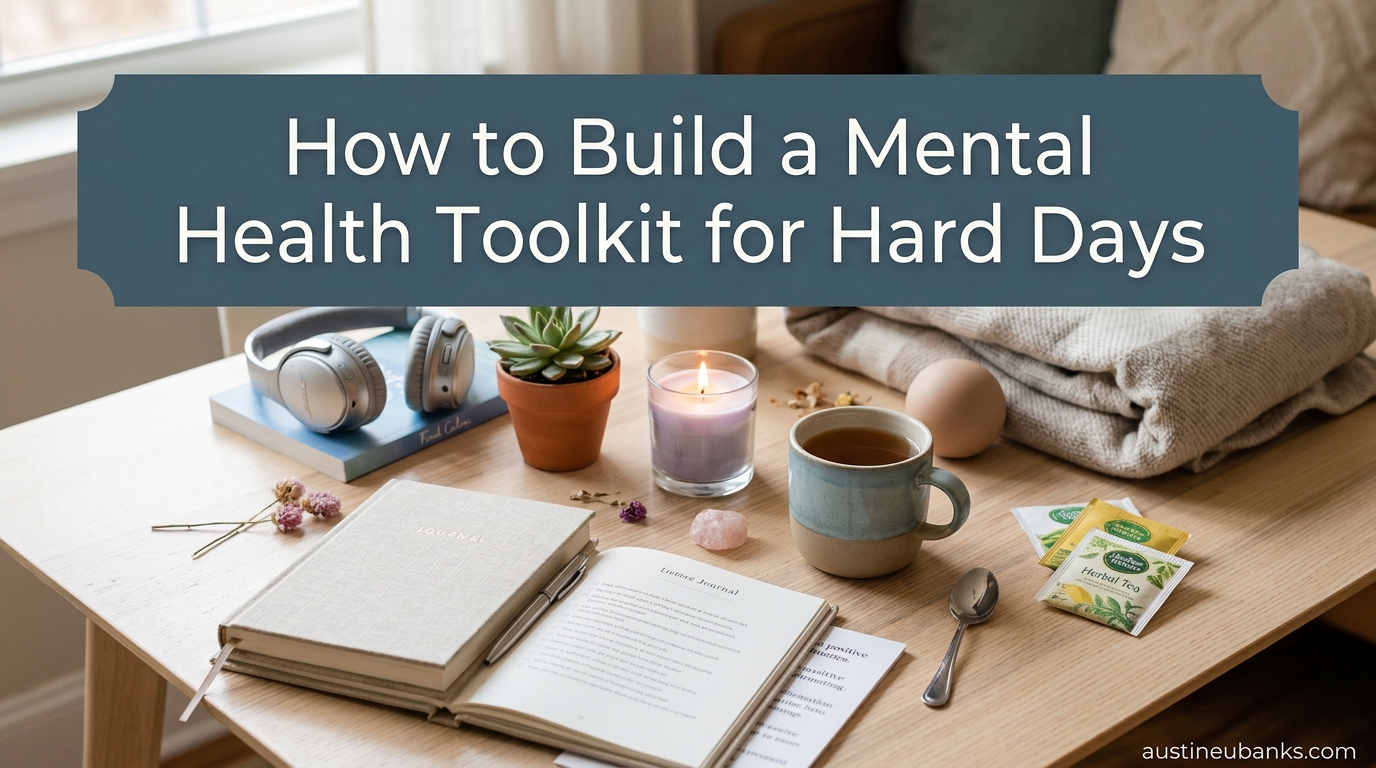
These are tangible objects you can touch, smell, taste, or hold. They engage your senses to pull your brain out of an emotional spiral. Examples include sour candy, essential oils, a stress ball, a weighted blanket, photos of people you love, a journal, and protein bars. The key is that these items require zero thinking. You just grab them and use them.
Category 2: In-the-Moment Techniques (Nervous System Regulation)
These are practiced skills you can deploy anywhere, without any physical items. Think of them as mental tools you carry inside your head. The 5-4-3-2-1 grounding method, box breathing, physiological sighs, cold water exposure, and the 3-3-3 rule all fall into this category. Each one works by directly signaling your nervous system to shift out of fight-or-flight mode.
Category 3: Long-Term Practices (Resilience Building)
These are habits and routines you practice regularly, not just on hard days. They include journaling, regular movement, mindfulness meditation, therapy, maintaining social connections, and getting consistent sleep. Long-term practices are what reduce the frequency and intensity of your hard days over time.
A well-rounded toolkit has at least three to five items in each category. You do not need everything on this list. What matters is that you have tested your tools and know they work for you.
What Is a Mental Health Toolkit?
A mental health toolkit is a personalized collection of coping strategies, physical items, and support resources that you assemble ahead of time to help you manage difficult emotional moments. It is not a generic list of self-care tips. It is a specific, curated set of tools that you have tested and know work for your unique brain and your unique stress responses.
The best analogy I have heard is a fire extinguisher. You do not keep a fire extinguisher in your kitchen because you expect a fire every day. You keep it there because if a fire ever starts, you will not have time to research which extinguisher to buy or read the instructions. You need to grab it and act. A mental health toolkit works the same way. You build it during calm periods so that when a hard day hits, you do not have to figure out what helps. You already know.
Here is why this matters from a biological perspective. When you experience intense stress, anxiety, or emotional pain, your brain’s threat detection system (the amygdala) activates what psychologists call the “threat brain.” This triggers your autonomic nervous system into fight, flight, or freeze mode. At the same time, your prefrontal cortex, the part of your brain responsible for rational thinking, problem-solving, and planning, partially shuts down. This is not a character flaw. It is an evolutionary survival mechanism.
The problem is that this same mechanism makes it nearly impossible to think clearly during a hard day. When your threat brain is in charge, you cannot easily remember what helps. You cannot brainstorm coping strategies. You cannot make careful decisions about what to do next. This is why generic advice like “just practice self-care” falls flat for people dealing with real mental health challenges. Your brain literally cannot problem-solve its way out of the moment.
A pre-built mental health toolkit solves this problem. Instead of relying on your prefrontal cortex to come up with solutions mid-crisis, you have already done the thinking ahead of time. Your toolkit is a set of instructions you wrote for yourself when you were calm and rational. All you have to do on a hard day is follow them.
This is also why the toolkit must be physical or at least written down somewhere easily accessible. If your tools only exist in your head, your overwhelmed brain will struggle to access them. A physical box, a note in your phone, or index cards on your nightstand can make the difference between using your tools and forgetting they exist.
How to Build a Mental Health Toolkit for Hard Days: Step by Step
Building your toolkit does not have to be complicated, but it does require some upfront effort. Here is a seven-step process I recommend. If executive dysfunction is part of your challenge, take these one at a time. Even completing one step per week will get you there.
Step 1: Identify your hard-day patterns. Before you gather any tools, spend a few minutes reflecting on what your hard days actually look like. Do you wake up with a pit of anxiety in your stomach? Do you feel heavy and unmotivated in the afternoons? Does grief hit you in waves? Write down what triggers your hard days, what physical sensations you experience, and what thoughts tend to loop. This self-awareness is the foundation of your toolkit because it tells you exactly what you are building tools for.
Step 2: Gather your sensory reset items. Start collecting physical objects that engage your five senses. These are items that can interrupt an emotional spiral by forcing your brain to pay attention to sensory input instead of looping thoughts. Head to a store or order online: sour or spicy candy, a stress ball or fidget toy, a small bottle of essential oil (lavender and peppermint are popular), a weighted blanket or weighted lap pad, and a water bottle you actually enjoy drinking from. Keep these items together in one place, like a basket or a dedicated drawer.
Step 3: Write down your in-the-moment techniques. Choose three to five techniques you can use without any physical items. I recommend starting with the 5-4-3-2-1 grounding method, box breathing, and physiological sighs (all explained later in this guide). Write each one on a separate index card with simple, step-by-step instructions. During a hard day, you will not want to remember a complex process. Having it written out in plain language makes it easy to follow.
Step 4: Build your crisis contact list. Write down the names and phone numbers of people you can reach out to on hard days. Include at least one friend or family member, your therapist if you have one, and crisis resources like the 988 Suicide and Crisis Lifeline (call or text 988 in the US). Store this list both physically (in your toolkit box) and digitally (in your phone contacts under a name you will remember). On hard days, reaching out can feel impossible. Having the numbers already written down removes one barrier.
Step 5: Choose your long-term practices. Pick two or three practices you can do regularly to build resilience over time. These might include a daily five-minute journaling habit, a short walk three times a week, a mindfulness meditation practice, or regular therapy sessions. Long-term practices are what reduce the intensity of your hard days over months and years. They are not quick fixes, but they are the backbone of long-term mental health.
Step 6: Assemble and organize everything. Put all your physical items, index cards, and written resources in one designated container. This could be a shoebox, a basket, a drawer, or a tote bag. The container itself does not matter. What matters is that everything lives in one place that you can access easily on a hard day. Add a label or a visual cue so you know exactly where it is.
Step 7: Practice using your tools during calm moments. This is the step most people skip, and it is the most important one. Your brain needs to build neural pathways associated with each tool so that using it becomes automatic. Practice your breathing exercises when you feel fine. Test your grounding techniques during a lunch break. Try your sensory items on a neutral day. By practicing during calm periods, you train your nervous system to respond to these tools, making them far more effective when you actually need them.
Grounding Techniques for Immediate Relief
Grounding techniques are exercises that pull your attention away from anxious thoughts and back into your physical body and present environment. They work by engaging your senses and interrupting the thought loops that fuel anxiety and panic. When your threat brain is activated, grounding techniques help signal to your nervous system that you are safe in the present moment.
Here are five grounding techniques I recommend including in your toolkit. Practice each one during calm periods to see which works best for you.
The 5-4-3-2-1 Grounding Method. This is one of the most widely recommended grounding techniques, and for good reason. It engages all five senses to anchor you in the present. Look around and name out loud or in your head: 5 things you can see, 4 things you can physically feel, 3 things you can hear, 2 things you can smell, and 1 thing you can taste. The counting gives your brain a structured task, and the sensory engagement pulls you out of your thoughts. This takes about two minutes and can be done anywhere.
Box Breathing. Used by Navy SEALs and recommended by therapists worldwide, box breathing is a simple pattern that calms your autonomic nervous system. Inhale through your nose for 4 seconds, hold your breath for 4 seconds, exhale through your mouth for 4 seconds, and hold empty for 4 seconds. Repeat this cycle at least four times. The equal-count pattern activates your parasympathetic nervous system, which is responsible for rest and digestion, counteracting the fight-or-flight response.
Physiological Sighs. This technique, popularized by neurobiologist Dr. Andrew Huberman, is one of the fastest ways to calm your nervous system. Take two quick inhales through your nose (the second one shorter than the first), then one long, slow exhale through your mouth. Repeat this three to five times. The double inhale expands tiny air sacs in your lungs called alveoli, and the long exhale releases carbon dioxide buildup that can contribute to feelings of anxiety. Research shows physiological sighs can reduce stress within seconds.
The 3-3-3 Rule. This is a simplified grounding technique that works especially well during acute anxiety. Name 3 things you can see, 3 things you can hear, and 3 things you can move or touch. It is quicker than the 5-4-3-2-1 method, making it ideal for moments when you need immediate relief and cannot focus on a longer exercise. Many people find it particularly helpful during panic attacks or in socially overwhelming situations.
Body Scan. A body scan involves slowly moving your attention through your body from head to toe, noticing physical sensations without trying to change them. Start at the top of your head and slowly move down: notice your forehead, your jaw, your shoulders, your chest, your stomach, your hands, your legs, and your feet. This practice builds interoception, which is your ability to sense what is happening inside your body. Improved interoception is linked to better emotional regulation because you catch physical signs of stress earlier.
One important note: grounding techniques are skills, not magic tricks. The first few times you try them, they might feel awkward or only partially effective. With practice, they become more powerful because your brain learns to associate them with a shift toward calm. Give each technique at least a few practice sessions before deciding whether it works for you.
Physical Items for Your Mental Health Toolkit
Physical items are the backbone of a mental health toolkit because they require zero cognitive effort to use. When your brain is overwhelmed, you can simply reach for an object and let your senses do the work. Forum discussions on Reddit consistently show that people who actually use their toolkits on hard days rely heavily on physical items rather than trying to remember techniques.
Here are the physical items I recommend, organized by how they help:
Sensory Reset Items. These items force your brain to shift attention to a strong physical sensation, interrupting thought loops. Sour candy (like Warheads or sour gummy worms) is surprisingly effective because the intense sour taste is nearly impossible to ignore. Ice water or an ice pack held against your face activates the mammalian dive reflex, which automatically slows your heart rate and signals your nervous system to calm down. Essential oils like lavender, peppermint, or eucalyptus engage your sense of smell, which has a direct pathway to the emotional centers of your brain.
Tactile Items. These are objects you can squeeze, fidget with, or hold. Stress balls, fidget cubes, textured stones, and putty give your hands something to do when anxiety creates physical restlessness. A weighted blanket or weighted lap pad provides deep pressure stimulation, which research shows can reduce anxiety and improve sleep quality by mimicking the feeling of being held. Keep at least two tactile items in your toolkit so you have options.
Comfort Items. These are objects that bring you genuine comfort or joy. Printed photos of people you love, a favorite tea bag, a soft sweater or scarf, or a handwritten note from someone who cares about you. Forum users consistently report that real photos of loved ones work far better than generic inspirational quotes. The emotional connection matters. Avoid filling your toolkit with items that feel performative or generic. Choose things that genuinely resonate with you.
Practical Support Items. Hard days often come with neglected basic needs. Keep protein bars, electrolyte packets, or shelf-stable snacks in your toolkit for moments when eating feels impossible but your body needs fuel. A water bottle ensures you stay hydrated. If you take medication, a pill organizer can help you remember doses on days when your routine falls apart. These items are not glamorous, but they address the physiological foundation that mental health depends on.
Written Resources. Include index cards with your pre-written techniques, a crisis contact list, and a pre-written list of your personal strengths and accomplishments. On depressive days when your brain tells you that nothing you do matters, reading a list of things you have actually achieved can counter all-or-nothing negative thinking. Write this list during a good day when you can think clearly about your strengths.
Budget-Friendly Options. You do not need to spend much to build a toolkit. Many effective items are free or cost very little. Ice water is free. A shoebox as your container is free. Writing techniques on index cards costs about two dollars. Sour candy is under five dollars. A stress ball is under three dollars. Free guided meditations are available on YouTube. If budget is a barrier, start with free items and add paid ones over time. The most expensive toolkit is not the most effective one. The most effective one is the one you actually use.
Emotional Regulation and Cognitive Tools
Emotional regulation tools are strategies that help you identify, understand, and manage intense emotions. Cognitive tools are techniques that help you work with your thoughts rather than being controlled by them. Together, they form the mental layer of your toolkit, the skills you practice during calm periods and deploy during hard ones.
Cognitive Reframing. This technique comes from cognitive behavioral therapy (CBT) and involves identifying unhelpful thought patterns and replacing them with more balanced ones. When you notice a thought like “I cannot handle this,” reframe it as “This is really hard, and I have gotten through hard things before.” You are not lying to yourself or practicing toxic positivity. You are offering your brain a more accurate perspective. Write down your most common negative thoughts on one side of an index card and your reframed versions on the other side.
Thought Challenging. Similar to cognitive reframing, this technique involves questioning the accuracy of your thoughts. When a negative thought arises, ask yourself: What evidence supports this thought? What evidence contradicts it? Would I say this to a friend? Is there another way to interpret this situation? This process helps you see that your thoughts are not facts. They are interpretations, and interpretations can be wrong.
Emotion Labeling. Research shows that simply naming an emotion reduces its intensity. When you feel overwhelmed, pause and try to name what you are feeling beyond just “bad.” Are you feeling anxious, sad, angry, lonely, embarrassed, jealous, disappointed, or overwhelmed? You can use a feelings wheel (available free online) if you struggle to find the right word. Labeling activates your prefrontal cortex and helps it come back online, partially counteracting the threat brain response.
Journaling Prompts for Hard Days. Keep a small journal or notebook in your toolkit with these prompts written on the first page: What am I feeling right now? What happened today that contributed to how I feel? What is one thing I can do in the next ten minutes to help myself? What would I tell a friend who felt this way? What is one thing I am grateful for, even on a hard day? Writing forces your thoughts out of the looping, spiraling patterns in your head and onto paper where you can see them more objectively.
Positive Self-Talk. This is not about reciting generic affirmations that feel hollow. Effective positive self-talk is specific, personal, and grounded in reality. Instead of “I am amazing and can do anything,” try “I have survived 100 percent of my worst days.” Instead of “Everything will be fine,” try “I do not need to figure everything out right now. I just need to get through the next hour.” Write down phrases that genuinely resonate with you and keep them in your toolkit.
The Pre-Written Strengths List. This is one of the most underrated tools in any mental health toolkit. During a good day, write down a list of specific challenges you have overcome, compliments people have given you, skills you have developed, and moments you are proud of. On a hard day, your brain will try to convince you that you have never accomplished anything and never will. Having a physical, written record of your strengths combats this directly. You do not have to believe the list emotionally. You just have to read it and let the facts do the work.
Social Support and Crisis Resources
Social connection is one of the most powerful protective factors for mental health. Humans are wired for connection, and isolation amplifies every negative emotion. But on hard days, reaching out can feel like the hardest thing in the world. Building your support network into your toolkit ahead of time removes the friction of figuring out who to contact and how.
Identify your support people. Write down the names of two to four people you could text or call on a hard day. These do not need to be trained therapists. They just need to be people who will listen without judging, trying to fix everything, or making you feel guilty for struggling. If you do not have people like this in your life right now, that is okay. Support groups (both in-person and online) can fill this role. The Reddit communities r/MentalHealthSupport and r/mentalhealth are active spaces where people share struggles and support each other.
Prepare scripts for reaching out. One of the biggest barriers to seeking support on a hard day is not knowing what to say. Write down a few text message templates you can copy and paste. For example: “Hey, I’m having a rough day today. I don’t need advice, I just wanted to let someone know.” Or: “Can we talk? I’m struggling and could use a distraction.” Having these pre-written removes the decision fatigue of figuring out what to say when your brain is already overwhelmed.
Build a crisis contact card. This is a physical card or note in your phone that contains emergency resources. Include the 988 Suicide and Crisis Lifeline (call or text 988, available 24/7 in the United States), the Crisis Text Line (text HOME to 741741), your therapist’s number, and at least one trusted friend or family member. Also include your own address and the nearest emergency room, in case you need to direct someone to help you quickly. On the back of the card, write down your personal warning signs, the specific thoughts, feelings, or behaviors that tell you things are getting serious.
Create a safety plan. A safety plan is a written document that outlines what you will do when things escalate beyond a typical hard day. It should include: your personal warning signs, internal coping strategies you can use alone, people and social settings that provide distraction, people you can ask for help, professionals and agencies to contact during a crisis, and steps to make your environment safe. The Stanley Brown Safety Plan template is a free, widely used format you can find online. Fill it out during a calm period and keep a copy in your toolkit.
Know when to seek professional help. A mental health toolkit is not a replacement for professional support. If your hard days are becoming more frequent, lasting longer, or interfering with your daily functioning, it is time to talk to a mental health professional. Other signs include thoughts of self-harm, substance use as a coping mechanism, inability to maintain relationships or work responsibilities, or feeling like your toolkit tools are no longer effective. Reaching out for professional help is not a failure of your toolkit. It is the toolkit working exactly as intended by telling you that you need a higher level of care.
Customizing Your Toolkit for Different Hard Days
Not all hard days are the same. An anxiety attack and a depressive episode require very different tools. Grief needs something different than burnout. One size does not fit all, which is why I recommend customizing your toolkit for the specific types of hard days you experience most often. This is an area where most guides fall short, so let me break it down.
Anxiety and Panic Attack Toolkit. When anxiety spikes, your nervous system is in overdrive. You need tools that rapidly signal safety to your body. Prioritize cold exposure (ice water on your face, holding an ice cube, or a cold shower), physiological sighs for fast nervous system calming, intense sour or spicy candy to jolt your senses, and the 5-4-3-2-1 method to anchor you in the present. Movement can also help, try ten jumping jacks or a brisk walk to burn off the adrenaline. Avoid tools that require sitting still if your anxiety manifests as physical restlessness.
Depression and Low Motivation Toolkit. Depression often comes with heaviness, low energy, and the feeling that nothing matters. Your toolkit should focus on reducing friction and countering negative thoughts. Include your pre-written strengths list, a protein bar or simple snack for when cooking feels impossible, a gentle body scan audio you can play while lying down, and a single small task written on an index card (like “drink one glass of water” or “step outside for two minutes”). Avoid tools that require high energy or complex steps. The goal is to do one tiny thing, not to fix everything.
Grief and Loss Toolkit. Grief does not follow a schedule. It can hit you in waves, often triggered by reminders of what you have lost. Your toolkit should include items that provide comfort without requiring you to process anything intellectually. Soft textures like a favorite blanket or sweater, photos of the person or pet you lost (only if looking at them brings comfort, not distress), a journal for writing memories or letters, and contact information for a grief support group or counselor. Give yourself permission to use your tools without trying to fix or shorten the grieving process.
Burnout and Workplace Stress Toolkit. Burnout builds slowly from chronic stress, overwork, and feeling disconnected from purpose. Your toolkit should address both the immediate symptoms and the underlying patterns. Include a boundaries script (pre-written phrases for saying no or asking for help), a list of activities that help you disconnect from work mode, noise-canceling headphones or earplugs for sensory relief, and a reflection prompt about what is draining you most. Long-term practices like regular time off, sleep prioritization, and reassessing your workload are especially important for burnout recovery.
Digital vs. Physical Toolkit: Which Works Better?
One question I see come up often is whether to build a digital toolkit, a physical one, or both. The answer depends on your lifestyle and preferences, but here is how I think about the trade-offs.
A physical toolkit (a box or basket with tangible items) has distinct advantages. Physical items engage your senses in ways that digital tools cannot replicate. Holding a stress ball, smelling essential oils, or wrapping yourself in a weighted blanket creates a full-body sensory experience that more effectively interrupts thought loops. Physical tools also work when your phone is dead, when you are trying to reduce screen time, or when digital notifications are part of what is stressing you out. The main downside is that a physical toolkit stays in one place and is not portable unless you deliberately carry items with you.
A digital toolkit (apps, saved playlists, notes on your phone) shines in its portability and convenience. You always have your phone with you, which means your tools are always accessible. Useful digital tools include guided meditation apps like Insight Timer or Calm, pre-saved Spotify playlists for different moods (calming, energizing, nostalgic), digital journaling apps like Day One, and notes on your phone with your grounding technique instructions and crisis contacts. The downside is that using your phone for mental health tools can lead to distraction, and screen-based grounding is generally less effective than physical sensory engagement.
My recommendation is to build both. Use a physical box at home for your main toolkit, and keep a lightweight digital version on your phone for when you are at work, school, or traveling. Even having two or three grounding techniques saved as a note on your phone can make a big difference when you are away from your physical kit. The goal is accessibility. Your tools are useless if they are always somewhere else when you need them.
How to Maintain and Update Your Mental Health Toolkit
A mental health toolkit is not a build-it-once-and-forget-it project. Your needs change over time, the techniques that worked six months ago might lose their edge, and you will discover new tools along the way. Regular maintenance keeps your toolkit effective and relevant.
The 3-Month Rule. In mental health, the 3-month rule suggests giving new coping strategies at least three months of consistent practice before evaluating whether they work. This is because the brain needs time to build new neural pathways. A technique that feels awkward in week one might become your most reliable tool by month three. Do not abandon a technique too quickly just because it does not produce instant results.
Schedule regular check-ins. Every few months, set aside fifteen minutes to review your toolkit. Ask yourself: Which tools have I actually used? Which ones have been sitting untouched? Are there new stressors in my life that my toolkit does not address? Have any items been used up or worn out (like empty snack stashes or dried-out markers)? This review keeps your toolkit fresh and ensures it evolves with your needs.
Know when a tool stops working. Sometimes a technique that worked for months suddenly stops being effective. This is normal. Your brain can habituate to familiar tools, meaning they lose their novelty and impact. When this happens, do not panic. It does not mean you are getting worse. It means you need to add a new tool to your rotation. Keep a running list of techniques you want to try so you always have options when your current ones lose their edge.
Replace used items promptly. If you ate your emergency protein bars or used up your essential oil, replace them within a few days. A toolkit with empty slots is not a toolkit you can rely on. Make restocking part of your regular grocery or shopping routine so it does not become a chore you keep putting off.
FAQs
What is the 3-3-3 rule in mental health?
The 3-3-3 rule is a grounding technique for managing anxiety. You name 3 things you can see, 3 things you can hear, and 3 things you can move or touch. This simple exercise pulls your attention away from anxious thoughts and back into the present moment by engaging your senses.
How to create a mental health toolkit?
To create a mental health toolkit: 1) Identify your hard-day patterns and triggers. 2) Gather physical items that engage your senses (sour candy, essential oils, stress balls). 3) Write down specific techniques (breathing exercises, grounding methods) on index cards. 4) Create a crisis contact list with trusted people and hotlines. 5) Choose long-term practices like journaling or meditation. 6) Organize everything in one accessible container. 7) Practice using your tools during calm periods so they become automatic.
What are the 5 C’s of mental health activities?
The 5 C’s of mental health activities typically refer to: Connect (building social support), Care (practicing self-care routines), Cope (developing coping strategies), Contribute (finding purpose and meaning), and Consistency (maintaining regular routines). These five categories create a balanced approach to mental wellness.
What is the 3 month rule in mental health?
The 3-month rule in mental health suggests giving new coping strategies or treatments at least three months of consistent practice before evaluating their effectiveness. This allows the brain enough time to build new neural pathways and adapt to new patterns. It encourages patience and consistency rather than abandoning helpful tools too quickly.
What should you put in a mental health toolkit?
A mental health toolkit should include sensory items (sour candy, essential oils, stress balls), written coping techniques (breathing exercises, grounding methods), a crisis contact list with phone numbers for trusted people and the 988 lifeline, comfort items (photos, favorite tea, weighted blanket), practical items (protein bars, water bottle, medications), and a pre-written list of personal strengths and accomplishments.
How do I know if my mental health toolkit is working?
Your toolkit is working if you notice a reduction in the intensity of your emotional reactions on hard days, a shorter recovery time when difficult emotions arise, and an increased sense of confidence that you have tools to handle tough moments. If your hard days become more frequent, last longer, or your tools stop being effective, it may be time to update your toolkit or seek professional support.
Final Thoughts on Building Your Mental Health Toolkit
Learning how to build a mental health toolkit for hard days is one of the most practical investments you can make in your own well-being. You are not trying to eliminate hard days entirely, that is not realistic. You are building a system that helps you navigate them with more stability, more self-compassion, and more confidence.
Start small. Pick one item from each category in this guide. Gather a sensory item, write down one grounding technique, and add one crisis contact to your phone. That is a toolkit. You can always add more over time, but having even three basic tools ready is infinitely better than having none.
Remember that your toolkit is personal. What works for someone else might not work for you, and that is fine. The goal is to experiment, practice, and discover the specific combination of tools that helps you feel more grounded on the days when everything feels overwhelming. You deserve to have support ready, and building that support for yourself is an act of care that your future self will thank you for.
If you are in crisis or having thoughts of self-harm, please call or text 988 (Suicide and Crisis Lifeline) in the United States, or text HOME to 741741 to connect with the Crisis Text Line. Help is available right now.