
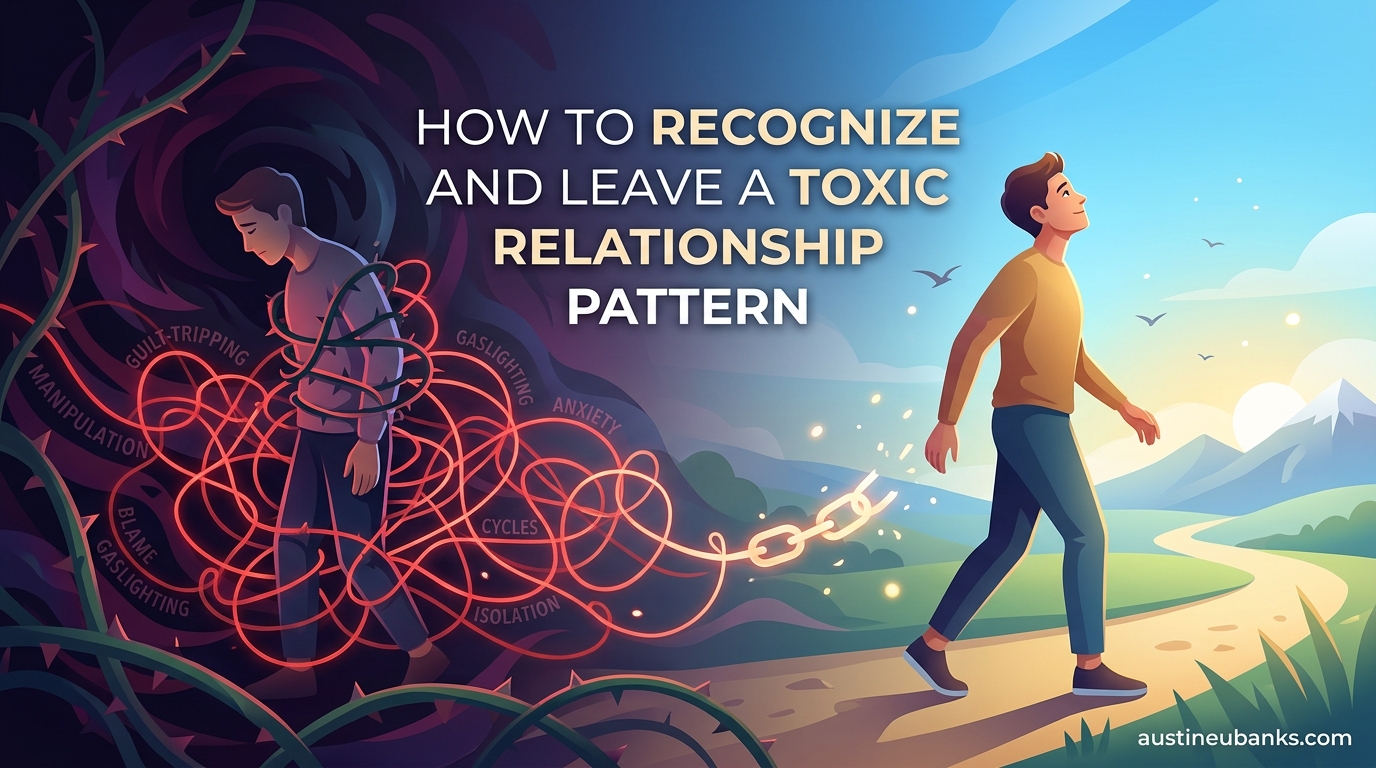
You know that knot in your stomach when their name lights up your phone. The way you rehearse what you say before you say it, running every word through a filter to avoid setting them off. The slow, quiet erosion of the person you used to be.
If any of that feels familiar, you are not crazy, and you are not alone. Learning how to recognize and leave a toxic relationship pattern is one of the hardest things a person can do. But it is also one of the most important.
A toxic relationship pattern is a recurring cycle of unhealthy behaviors between partners where one or both people consistently prioritize their own needs over mutual respect, trust, and affection, creating an environment of emotional harm, control, or manipulation. These patterns rarely start with obvious red flags. They build slowly, often disguised as passion or care, until one day you realize you barely recognize yourself.
In this guide, I want to walk you through the entire process. We will cover what toxic patterns actually look like, why they keep repeating, why it is so hard to walk away, and a practical, step-by-step plan for leaving and rebuilding your life afterward. Whether you are questioning your relationship right now or trying to understand why you keep ending up in the same situation with different people, this is for you.
Table of Contents
What Is a Toxic Relationship Pattern?
A toxic relationship pattern is not just one bad fight or a difficult season. It is a cycle that repeats itself over weeks, months, or years. The behaviors feel different at first, maybe even exciting, but they consistently damage your emotional wellbeing, your sense of self, and your ability to trust your own judgment.
Here is the key difference: every relationship goes through rough patches. A rough patch has an endpoint. You and your partner communicate, adjust, and move forward together. A toxic pattern does not resolve. It loops. The same conflict surfaces again and again with different packaging but the same underlying damage.
Many people in toxic relationships do not realize what they are experiencing because the behaviors build gradually. What started as your partner wanting to spend all their time with you slowly becomes isolation from friends. What felt like protectiveness becomes controlling surveillance. The slow shift makes it easy to rationalize each new behavior.
Toxic Behaviors vs. Healthy Behaviors
One of the fastest ways to evaluate your relationship is to compare what you are experiencing against what healthy actually looks like. People who have been in toxic dynamics for a long time often lose their baseline for normal.
| Toxic Behavior | Healthy Behavior |
|---|---|
| Monitoring your phone, location, and social interactions | Trusting you without needing constant proof |
| Making you feel guilty for spending time with others | Encouraging your friendships and independence |
| Using silence or withdrawal as punishment | Taking space and coming back to talk things through |
| Shifting blame so nothing is ever their fault | Taking responsibility for their own actions |
| Criticizing your appearance, intelligence, or choices | Supporting and building up your confidence |
| Keeping score of every mistake you have ever made | Addressing issues as they happen and letting them go |
| Making threats to leave when they do not get their way | Working through problems with commitment |
If you read through that table and felt your stomach drop because you recognized multiple behaviors on the left side, that reaction is valid. It is information. Your body has been telling you something your mind has been trying to rationalize.
10 Signs of a Toxic Relationship You Need to Take Seriously
Toxic relationship signs often feel normal when you are living inside them. The people I have spoken with who left toxic relationships almost all say the same thing: they did not realize how bad it was until they were out. Here are ten warning signs that consistently show up in toxic dynamics.
1. You feel like you are walking on eggshells. You change your behavior, your tone, your plans, and your words to avoid triggering a negative reaction. Your nervous system is in a constant state of alert. This is one of the most commonly reported experiences in support forums for people in unhealthy relationships.
2. Gaslighting makes you doubt your own reality. Your partner denies things they said or did, twists your words, or tells you that you are overreacting when you raise a concern. Over time, you stop trusting your own memory and judgment. Gaslighting is a form of emotional manipulation that systematically erodes your confidence in your own perception.
3. You have been isolated from friends and family. It may have started subtly. Your partner made comments about your friends. They created conflict when you made plans. They made you feel guilty for wanting time apart. Slowly, your world shrank until they became your primary or only social connection.
4. Everything is your fault. Blame shifting is constant. If they lose their temper, it is because you provoked them. If they break a promise, it is because you made it impossible to keep. You find yourself apologizing for things that were not your doing, just to keep the peace.
5. Jealousy is used as a tool of control. Jealousy gets reframed as love or protectiveness. But it shows up as monitoring who you talk to, accusing you of things you did not do, and making you feel like you have to earn their trust over and over again for no legitimate reason.
6. The love bombing cycle never stops. After every blowup, there is an intense period of affection, gifts, and promises. This is called love bombing, and it is designed to pull you back in. The cycle looks like this: huge fight with hurtful words, followed by breakup threats, then intense apologies and over-the-top romance, then a calm period, and then the cycle repeats. This is not love. It is a pattern of emotional manipulation.
7. The relationship scorecard is always running. Your partner keeps a mental tally of every mistake, every sacrifice, and every favor. This scorecard gets pulled out during arguments to justify their behavior or minimize yours. It creates a dynamic where nothing is ever truly forgiven.
8. Stonewalling and the silent treatment are regular weapons. When they are upset, they shut down completely. They refuse to talk, respond, or engage. The silence can last hours or days. This is not taking space to cool off. It is a form of emotional punishment designed to make you chase them and feel desperate for connection.
9. Emotional blackmail keeps you trapped. Threats to harm themselves if you leave, guilt about what the breakup will do to them, or reminders of everything they have done for you. Emotional blackmail weaponizes your empathy and sense of responsibility against you.
10. Arguments go in circles and never resolve. You have the same fight over and over. The words change, but the core issue never gets addressed. Nothing is resolved because resolution is not the goal. Control is. Repetitive arguments that never lead to understanding or change are a hallmark sign of toxic relationship dynamics.
If you recognized yourself in four or more of these signs, that is significant. You do not need all ten to be in a toxic situation. Even two or three of these patterns, especially if they are persistent, can cause serious harm to your mental health and self-worth.
Recognizing Your Own Toxic Patterns
Most articles about toxic relationships focus entirely on the other person. But here is something that took me a long time to understand: if you keep ending up in the same type of relationship with different people, the common denominator is you. That is not blame. It is awareness, and it is the key to breaking the cycle.
People who grow up in chaotic, emotionally unpredictable, or abusive households often internalize certain beliefs about love. If love in your childhood home came with conditions, fear, or inconsistency, your brain learned that those elements are part of what love feels like. You may unconsciously seek out partners who recreate that familiar dynamic because your nervous system interprets the intensity as connection.
Your attachment style plays a major role in the patterns you repeat. Anxious attachment can lead you to tolerate poor treatment because any connection feels better than abandonment. Avoidant attachment can lead you to pick partners who are emotionally unavailable because true intimacy feels threatening. Neither of these is a life sentence, but both require awareness to change.
Self-Reflection Questions to Identify Your Patterns
Grab a journal or open the notes app on your phone. Be honest with yourself, even when it is uncomfortable.
- What traits do all of your past partners have in common?
- What did love look like in the home where you grew up?
- When you feel attracted to someone, is it their kindness that draws you in, or is it a sense of intensity and unpredictability?
- Do you tend to fall into the role of fixer, rescuer, or peacemaker in your relationships?
- What would it feel like to be with someone who is consistently kind, predictable, and emotionally safe? Does that sound boring?
- Do you stay in relationships longer than you should because you fear being alone?
- Have friends or family ever expressed concern about your relationship choices?
- What is the earliest point in a past relationship where you noticed a red flag, and how long did you stay after that?
If the idea of being with someone stable sounds boring or unexciting, that is incredibly telling. It means your brain has associated drama and unpredictability with love. Recognizing that is the first step toward retraining what you are drawn to.
Many people describe being attracted to traits in a partner that later become the very thing that destroys the relationship. The confidence that felt magnetic becomes arrogance. The protectiveness that felt loving becomes control. The intensity that felt like passion becomes volatility. Understanding this pattern can help you catch it before it plays out again.
Why You Stay: Understanding What Keeps You Trapped
One of the most common questions people ask is: why can I not just leave? If you have never been in a toxic relationship, the answer seems obvious. If you have, you know it is anything but.
Leaving a toxic relationship is not a single decision. It is a process that involves overcoming psychological, emotional, financial, and sometimes physical barriers. Understanding what is holding you in place is essential to building a plan to get out.
Trauma Bonding
Trauma bonding is a psychological response to cycles of abuse followed by periods of intense affection. The intermittent reinforcement, getting love and approval in unpredictable bursts, creates a bond that functions like an addiction in your brain. The same dopamine pathways involved in substance addiction are activated when your toxic partner shows you kindness after a period of cruelty.
This is why people describe leaving a toxic relationship as feeling like withdrawal. The physical and emotional pain is real. Your brain is literally craving the chemical hit of the reconciliation phase. Understanding trauma bonding removes the shame of feeling unable to leave. You are not weak. Your brain is responding to a pattern designed to keep you attached.
Fear in All Its Forms
Fear shows up in multiple layers. There is fear of being alone, especially if your partner has isolated you from your support network. There is financial fear if you depend on them for housing, income, or shared assets. There is fear of the unknown, because even a painful situation can feel safer than uncertainty. And in some cases, there is legitimate fear for your physical safety if your partner has been violent or has threatened harm.
All of these fears are valid. Naming them is the first step toward addressing each one individually rather than letting them combine into one overwhelming wall.
Hope and the Promise of Change
After every blowup, your partner seems genuinely sorry. They cry. They promise to do better. They might even start therapy or read a book. For a few days or weeks, things are good. You see the person you fell in love with, and you think maybe this time will be different.
This is one of the cruelest parts of the cycle. The person who hurt you is often the same person who can make you feel most loved. But without sustained, professional work on their behavior, the pattern will repeat. Apologies without changed behavior are just manipulation.
Guilt and Responsibility
If you are the kind of person who feels deeply responsible for others, toxic partners often exploit that quality. They may tell you that you are the only one who understands them. They may imply or state that they will fall apart without you. They may use threats of self-harm.
Here is the truth: you are not responsible for another adult’s emotional state or choices. Staying in a relationship out of guilt is not love. It is self-abandonment. And it enables the other person to avoid dealing with their own issues.
Erosion of Self-Worth
Over time, constant criticism, blame shifting, and emotional manipulation chip away at your self-esteem. You start to believe that you are difficult, that no one else would want you, that you should be grateful they stay. This erosion happens so gradually that you may not realize how much confidence you have lost until you are out of the relationship.
Low self-esteem makes leaving feel impossible because you have stopped believing you deserve better. Rebuilding that belief, even in small increments, is part of the preparation process.
How to Leave a Toxic Relationship: A Step-by-Step Guide
Learning how to recognize and leave a toxic relationship pattern means having a concrete plan. Leaving is not something you do in the heat of an argument or on impulse. It requires preparation, support, and strategy. Here is a step-by-step approach.
Step 1: Stop minimizing and start documenting. Write down what has happened. Keep a private record, not on a shared device, of incidents, dates, and what was said or done. When you are in the cycle, your mind will try to convince you it was not that bad. Having a written record anchors you in reality and combats the gaslighting you have internalized.
Step 2: Build your support system quietly. Reach out to one or two trusted people. If your partner has isolated you from friends and family, this step may mean reconnecting with people you have lost touch with. You can also contact a domestic violence hotline even if you are not sure your situation qualifies. They talk to people in all types of unhealthy relationships and can help you think through your options.
Step 3: Get your finances in order. Financial dependence is one of the most common barriers to leaving. Start by opening a separate bank account if you do not have one. Begin setting aside money, even small amounts. Gather important documents like your passport, birth certificate, social security card, insurance information, and any shared financial records. Store copies somewhere your partner cannot access.
Step 4: Create a safety plan. This is a critical step that most guides skip entirely. If your partner has ever been physically violent, has threatened violence, or has shown escalating controlling behavior, your safety is the top priority. A safety plan includes knowing where you will go, having a packed bag with essentials stored outside the home, arranging a code word with a trusted friend, and memorizing emergency numbers. Contact the National Domestic Violence Hotline at 1-800-799-7233 or text START to 88788 for help creating a personalized safety plan.
Step 5: Choose your moment and have the conversation. If you live together, plan the logistics in advance. Have a place to go lined up. Consider whether having a friend or family member present or nearby is appropriate for your situation. Keep the conversation brief and do not get drawn into a debate about whether the relationship is toxic. You are not seeking agreement. You are communicating a decision.
Step 6: Establish no contact or limited contact. After leaving, your partner will likely reach out. They may use guilt, anger, grand romantic gestures, or threats. Every form of contact is designed to pull you back into the cycle. No contact, blocking phone numbers and social media, is the most effective approach for breaking a trauma bond. If you share children or assets, work through a mediator or lawyer rather than communicating directly.
Step 7: Prepare for the emotional aftermath. The first weeks and months after leaving are often the hardest. You may feel relief one moment and intense grief the next. You may question your decision. This is normal. The trauma bond is breaking, and that process involves real emotional and even physical discomfort. Having a therapist, support group, or trusted friends to lean on during this period makes a significant difference.
Healing and Recovery After Leaving
Leaving is the beginning, not the end, of the process. Healing from a toxic relationship takes time, and understanding what to expect can help you be patient with yourself along the way.
What to Expect Emotionally
The recovery timeline varies for everyone, but there are common patterns. In the first few weeks, many people feel a mix of shock, relief, and intense emotional pain. The withdrawal from the trauma bond is at its peak. You may experience anxiety, disrupted sleep, and intrusive thoughts about the relationship.
Over the following months, the acute pain typically begins to ease. You may start to notice moments of clarity, times when you feel more like yourself than you have in a long time. But healing is not linear. You will have days where you miss your partner intensely, and that does not mean you made the wrong decision. It means your brain is still recalibrating.
Somewhere around the six-month mark, many people begin to experience a more stable sense of self. They start reconnecting with parts of their identity that got lost in the relationship. They rediscover interests, friendships, and confidence. This does not mean the pain is gone, but it means the foundation is rebuilding.
Rebuilding Your Self-Esteem
Toxic relationships damage self-worth at a fundamental level. Rebuilding it is not about positive affirmations. It is about actions. Start small. Keep promises to yourself, even tiny ones like going for a walk or cooking a meal. Each time you follow through, you are proving to yourself that you are trustworthy and capable.
Surround yourself with people who reflect back the version of you that you want to be. Avoid anyone who minimizes what you went through or tells you to just get over it. You need people who validate your experience and support your growth.
Therapy and Professional Support
Working with a therapist who understands toxic relationship dynamics, trauma bonding, and attachment patterns can accelerate your healing significantly. Therapy provides a safe space to process what happened, understand why you stayed, and develop strategies to avoid repeating the pattern.
If therapy is not financially accessible, look for sliding-scale clinics, community mental health centers, or online therapy platforms. Support groups, both in-person and online, can also be incredibly valuable. Connecting with others who have been through similar experiences reduces isolation and provides practical wisdom.
Redefining What Healthy Love Looks Like
After a toxic relationship, your definition of love has been distorted. Part of healing is consciously redefining what you want and need. Healthy love is not constantly intense. It does not involve anxiety, scorekeeping, or conditional affection. It feels calm, supportive, and safe.
Write down what a healthy relationship looks like to you. Be specific. Think about communication, conflict resolution, independence, trust, and mutual respect. This becomes your roadmap for evaluating future relationships.
Breaking the Cycle Before the Next Relationship
One of the biggest mistakes people make after leaving a toxic relationship is jumping into a new one before they have healed. The pattern repeats because the underlying wounds have not been addressed. Take time to be alone. Learn to tolerate the discomfort of solitude without rushing to fill it.
When you do start dating again, go slowly. Watch for early signs. If someone seems too good to be true early on, if the intensity feels familiar, pay attention. That familiarity is often a red flag dressed as chemistry. The right relationship should feel almost boring at first compared to the chaos you are used to. That calmness is the point.
FAQs
How can I identify what my toxic patterns are in relationships?
Start by examining what your past partners have in common and what role you typically play in relationships. Ask yourself whether you tend to be the fixer, the peacemaker, or the one who tolerates poor treatment. Reflect on what love looked like in your childhood home, as early experiences shape what feels normal. Journaling about these questions with total honesty is the fastest way to identify your own toxic patterns.
What is the 3 6 9 rule in relationships?
The 3 6 9 rule is a dating guideline suggesting you assess a relationship at three months, six months, and nine months. At three months, evaluate whether the person is consistent. At six months, look at whether they have introduced you to their life and shown sustained behavior. At nine months, decide whether the relationship is moving toward long-term commitment. It is a framework for evaluating compatibility over time rather than rushing into commitment.
What is the 7 7 7 rule in relationships?
The 7 7 7 rule suggests that couples should go on a date every seven days, take a weekend trip every seven weeks, and take a week-long vacation every seven months. The goal is to maintain consistent quality time and connection throughout the relationship. While it is a helpful guideline for healthy couples, no rule can fix a fundamentally toxic dynamic.
Why can’t I leave a toxic relationship?
Several factors make leaving extremely difficult. Trauma bonding creates an addiction-like attachment through cycles of abuse followed by intense affection. Fear of being alone, financial dependence, concern for your partner’s wellbeing, and the erosion of self-esteem all contribute. Additionally, intermittent hope that things will change keeps people trapped in the cycle. Leaving is a process that requires support, planning, and often professional help.
Is my relationship toxic or am I overreacting?
If you are asking this question, your instincts are telling you something. Toxic behaviors include consistent disrespect, controlling behavior, gaslighting, isolation from loved ones, and patterns that repeat without resolution. A healthy relationship does not make you constantly question your own perception. Trust your gut and compare your experience against objective warning signs rather than dismissing your feelings.
How long does it take to heal from a toxic relationship?
Healing timelines vary, but many people experience acute emotional pain for the first few weeks, gradual improvement over three to six months, and significant recovery within a year. Healing is not linear, and you may have setbacks along the way. Working with a therapist who understands trauma bonding and relationship patterns can significantly speed up the process. The goal is not just to recover but to break the cycle so you do not repeat it.
Moving Forward: You Deserve More
Learning how to recognize and leave a toxic relationship pattern is not a one-time event. It is an ongoing process of unlearning what you thought love was and rebuilding a definition based on respect, trust, and genuine care. The fact that you are reading this means a part of you already knows what you need to do.
Start where you are. If you are still in the relationship, begin with documentation and building your support system. If you have already left, focus on healing and understanding your patterns so the cycle stops with you. If you are somewhere in between, trust that every step forward counts, even the small ones.
You do not have to do this alone. Reach out to the National Domestic Violence Hotline at 1-800-799-7233 or text START to 88788. Find a therapist who specializes in relationship trauma. Connect with others who have been through it. The path out of a toxic pattern is hard, but it leads to a version of yourself you may not have seen in a very long time.
You deserve healthy love. And it starts with choosing yourself.