
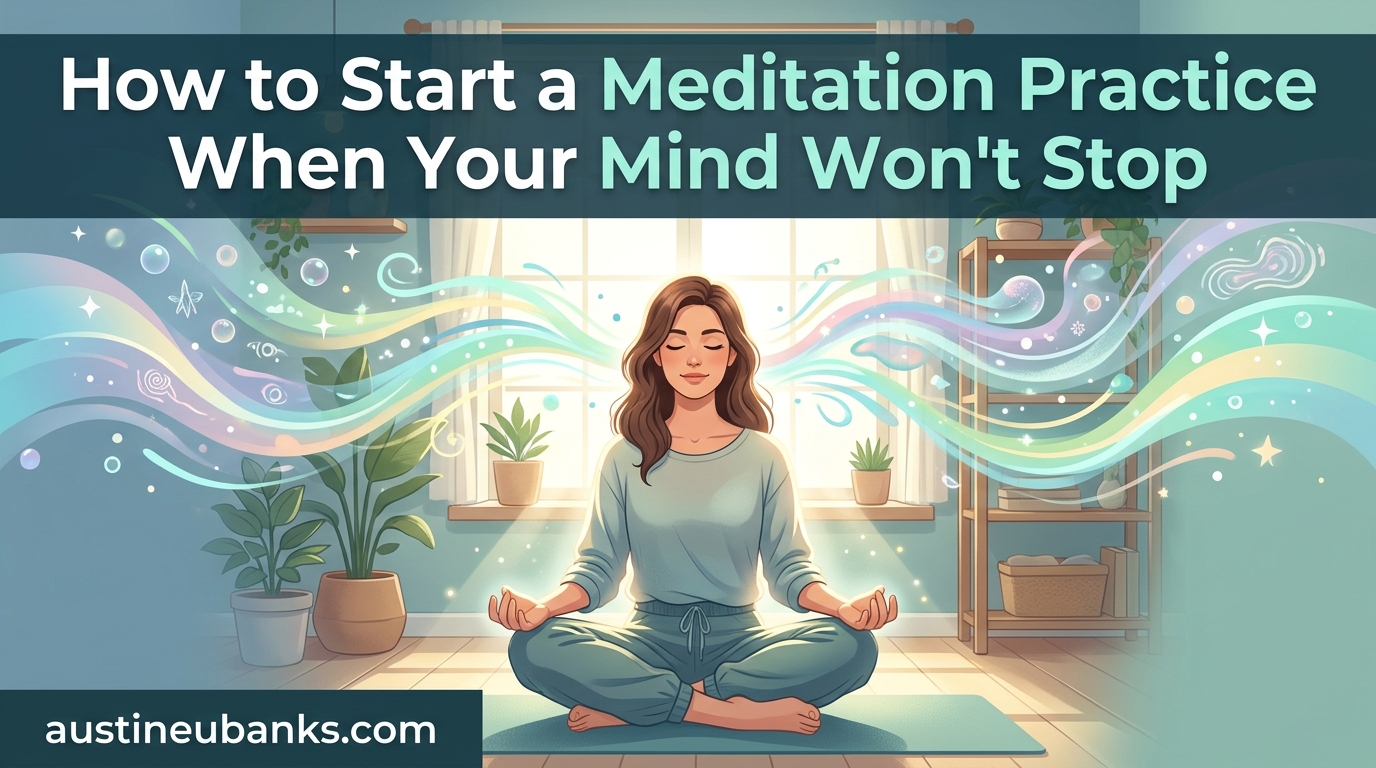
If you have ever sat down to meditate and within thirty seconds found yourself reorganizing your grocery list, replaying an awkward conversation from 2019, and wondering if you left the stove on, you are in the right place. Learning how to start a meditation practice when your mind won’t stop is one of the most common challenges beginners face. It is also one of the most misunderstood.
Here is the truth nobody tells you upfront: having a mind that refuses to quiet down does not mean you are bad at meditation. It means you have a normally functioning human brain. The racing thoughts, the mental chatter, the jumping from one worry to the next, that is not a sign you should quit. It is the exact reason meditation is worth learning.
I have spent years working with people who describe themselves as “too wired to meditate.” Overthinkers, perfectionists, people with ADHD, people whose minds kick into overdrive at 3 AM. Nearly every one of them believed they were uniquely unsuited for meditation. Nearly every one of them was wrong.
This guide walks you through everything you need to know to build a meditation practice from scratch, even if your mind feels like a browser with 47 tabs open at all times. You will learn what meditation actually is, why your brain fights it, step-by-step instructions you can follow today, specific techniques for racing minds, and how to build a daily habit that sticks.
No incense required. No expensive retreat. No sitting in a pretzel position for an hour. Just practical, science-backed strategies that work for busy, overactive minds in 2026.
Table of Contents
What Meditation Actually Is (And What It Isn’t)
Before we get into technique, we need to clear up the single biggest misconception that trips people up. Because if you believe meditation means emptying your mind completely, you will feel like a failure every single time you sit down to practice.
The Myth of the Empty Mind
Here is what most people think meditation looks like: you sit down, close your eyes, and your mind goes blank. A serene, thought-free state washes over you. If any thoughts pop up, you have failed.
This could not be more wrong. No experienced meditator has a thought-free mind. The goal of meditation is not to stop thinking. The goal is to change your relationship with your thoughts. You notice them, acknowledge them, and gently bring your attention back to your chosen focus. That act of noticing and returning, that is the actual meditation.
Think of it like a rep at the gym. Every time your mind wanders and you bring it back, you have completed one repetition. You are strengthening the muscle of attention. A mind that wanders a hundred times during a session gives you a hundred reps. That is not failure. That is a full workout.
What Meditation Really Means
Meditation is a practice that involves training your attention and awareness. You pick a focal point (called an anchor), rest your attention there, and when your mind inevitably drifts, you bring it back without judgment. That cycle of focusing, drifting, and refocusing is the core of every meditation tradition on Earth.
It does not require any particular spiritual belief, though many traditions incorporate one. It does not require special equipment, though some people find a cushion or bench helpful. It does not require an hour of free time, though longer sessions do deepen the practice over time.
What it does require is consistency and a willingness to be bad at it at first. Because you will be bad at it. Everyone is. The mind does not want to sit still. It has evolved to plan, worry, remember, and problem-solve. Asking it to stop is like asking a river to stop flowing. Meditation is not about stopping the river. It is about learning to sit on the bank and watch it go by.
Key Terms You Should Know
A few terms will come up throughout this guide, and understanding them now will make everything that follows much clearer.
Monkey Mind: This is a term from Buddhist tradition that describes the restless, unsettled, constantly chattering nature of the human mind. Your mind jumps from thought to thought like a monkey swinging from branch to branch. Sound familiar? Congratulations, you have met your monkey mind. Every human being on the planet has one. Naming it is the first step to working with it.
Anchor: An anchor is whatever you choose to rest your attention on during meditation. Your breath is the most common anchor, but you can also use a word or phrase (mantra), bodily sensations (body scan), sounds, or even a visual object. The anchor gives your mind something to do so it is less likely to spiral into rumination.
Present Moment Awareness: This is the state of being fully attentive to what is happening right now, rather than dwelling on the past or projecting into the future. It is the natural result of meditation practiced over time. When your attention rests in the present moment, the mental chatter loses much of its grip.
Noting: This is a technique where you mentally label thoughts as they arise. You might silently say “thinking” or categorize the thought as “planning,” “worrying,” or “remembering.” Noting creates a tiny bit of distance between you and the thought, which reduces its pull.
Why Your Mind Races When You Try to Meditate (The Science)
Understanding the neuroscience behind why your mind fights meditation can be profoundly reassuring. You are not doing something wrong. Your brain is doing exactly what it evolved to do. Here is what is actually happening up there.
The Default Mode Network Explained
Your brain has a system called the Default Mode Network, or DMN. This is a cluster of brain regions that becomes highly active when you are not focused on any specific task. When you sit down to meditate and suddenly start thinking about your childhood, your to-do list, and whether you responded to that email, that is your DMN at work.
The DMN is responsible for mind-wandering, self-referential thinking, daydreaming, and rumination. It is the brain’s default state when external stimulation drops. And it is incredibly active in people who tend to overthink.
Research has shown that experienced meditators have reduced DMN activity compared to non-meditators. This is not because they were born with quieter minds. It is because meditation literally trains the brain to dial down this network over time. The structural changes are measurable, and they begin within weeks of consistent practice.
Why Meditation Makes Thoughts Louder at First
One of the most frustrating experiences for new meditators is that thoughts seem to get louder, not quieter, when they start practicing. People frequently report that their minds race more during meditation than during normal daily life.
This is actually normal and has a straightforward explanation. During your day, your brain is bombarded with external stimulation: conversations, screens, traffic, tasks. All of that input drowns out the underlying stream of mental chatter. When you sit down, close your eyes, and remove those external distractions, you strip away the noise that was masking your thoughts.
The thoughts were always there. You can finally hear them now. It feels worse because you are more aware, but awareness is the first step toward change. Stick with it, and the volume will gradually decrease as your brain adapts.
What Neuroscience Says About Overcoming Mental Chatter
A landmark 2011 study by researchers at Massachusetts General Hospital found that just eight weeks of meditation practice produced measurable changes in brain structure. The amygdala, which processes stress and fear, became smaller. The prefrontal cortex, which handles attention and decision-making, became thicker. These changes corresponded to participants reporting less stress and better focus.
Subsequent research has confirmed that meditation strengthens the connection between the prefrontal cortex and the DMN. Think of it as building a manager that can gently redirect the wandering mind. The more you practice, the stronger that manager gets, and the less time you spend lost in thought.
This is why consistency matters more than duration. Five minutes daily will rewire your brain faster than an hour once a week. Your brain adapts to repeated patterns, and a daily practice, even a short one, sends a clear signal that this is a pattern worth investing in.
How to Start a Meditation Practice When Your Mind Won’t Stop: 7 Steps
Now we get to the practical part. These seven steps are designed specifically for people whose minds resist sitting still. Follow them in order, and you will have a complete meditation session by the end. The whole sequence takes five to ten minutes. That is it.
Step 1: Set Up Your Space (No Fancy Gear Needed)
You do not need a dedicated meditation room, a special cushion, or a perfectly quiet environment. You need a spot where you can sit relatively undisturbed for a few minutes. A chair in your bedroom, the corner of your couch, a spot on the floor against a wall. Any of these work.
The one thing that does help is consistency with location. When you meditate in the same spot each day, your brain starts to associate that place with settling down. It becomes a cue. After a few weeks, just sitting in that spot will begin to shift your mental state.
Temperature matters more than you might think. If you are cold, your mind will fixate on it. Grab a blanket. If your environment is noisy, earplugs or a white noise track can help. Do not let perfectionism about the setup prevent you from starting. Good enough is the goal.
Step 2: Pick Your Anchor
Your anchor is what you will rest your attention on during the session. The breath is the most popular anchor for a reason: it is always with you, it is always happening in the present moment, and it has a natural rhythm that calms the nervous system.
If the breath does not work for you, and for some people with anxiety it can actually increase anxious focus on breathing, there are excellent alternatives. A repeated word or phrase (mantra), the sensation of your hands resting in your lap, ambient sounds in the room, or a gentle body scan from head to toe can all serve as anchors.
For your first few sessions, pick one and stick with it. Switching anchors mid-session gives a racing mind more to chew on. Commit to one for at least a week before experimenting.
Step 3: Set a Timer (Start Absurdly Small)
Here is where most beginners sabotage themselves. They set a timer for 20 or 30 minutes, suffer through every second, and never come back. The secret to building a meditation habit is to start so small that it feels ridiculously easy.
Set your timer for two minutes. Or even one minute. The goal at this stage is not to achieve deep states of calm. It is to show up. Once showing up becomes automatic, extending the time is easy. But if you never show up in the first place, the duration does not matter.
Use a gentle alarm sound, not a jarring buzzer. The timer should be a kind signal that your session is ending, not a stressor. Many meditation apps offer soft chimes specifically for this purpose. Your phone’s default alarm will work, too, just change the sound to something pleasant.
Step 4: Get Into Position
Sit in a way that is comfortable but alert. You can sit in a chair with your feet flat on the floor, on a cushion on the floor with your legs crossed, or even on a meditation bench. The key principles are the same regardless of position.
Keep your spine upright but not rigid. Imagine a string gently pulling the crown of your head toward the ceiling. Let your shoulders relax down and back. Rest your hands on your thighs or in your lap. You do not need to form any special hand positions unless you want to.
If sitting still is genuinely painful or impossible for you, you can meditate standing, walking, or lying down. Walking meditation is an excellent option for people with physical restlessness or ADHD tendencies. We will cover specific techniques later in this guide.
Your eyes can be closed or slightly open with a soft, downward gaze. Closing your eyes reduces visual distraction but can make sleepiness more likely. Experiment and see what works for you.
Step 5: Notice Your Anchor
Take a few deeper breaths to settle in, then let your breathing find its natural rhythm. Direct your attention to whatever anchor you chose. If it is the breath, notice the sensation of air moving in and out of your nostrils, or the rise and fall of your chest or belly.
Do not try to control your breathing. You are not doing a breathing exercise. You are simply observing the breath as it happens on its own. This distinction matters. Trying to control the breath creates tension. Observing it creates spaciousness.
If you are using a mantra, silently repeat your chosen word or phrase at a comfortable pace. If you are doing a body scan, move your attention slowly through different parts of your body, noticing whatever sensations are present without trying to change them.
Rest your attention on the anchor the way you might rest your hand on a table. Gentle, light contact. Not gripping, not forcing. Just resting there.
Step 6: When Your Mind Wanders, Come Back
This step is the meditation. Everything else is setup.
At some point (probably within seconds), your mind will wander. You will start thinking about dinner, or work, or that weird thing you said in a meeting. This is not a problem. This is the practice.
When you notice that your mind has wandered, do the following: pause briefly, acknowledge that thinking happened (without judging yourself for it), and gently bring your attention back to your anchor. That is it. One rep completed.
The tone you use when returning matters enormously. If you snap at yourself (“Come on, focus!”), you create stress, which feeds more racing thoughts. If you are kind (“Ah, I wandered. Let me come back.”), you create a sense of safety that actually calms the mind. Treat yourself the way you would treat a puppy learning to sit. Patiently, with humor, and without harshness.
Your mind will wander dozens of times during a two-minute session. Each return is a victory. Each return strengthens the neural pathway that makes the next return easier. You are literally rewiring your brain, one gentle return at a time.
Step 7: End Gently and Reflect
When your timer sounds, do not jump up immediately. Take a moment to notice where you are and how you feel. Take one or two deeper breaths. Wiggle your fingers and toes. Slowly open your eyes.
Before you move on with your day, take five seconds to acknowledge that you showed up. Whether your mind was calm or chaotic, you sat down and practiced. That is what counts. Do not grade the session. Do not compare it to yesterday. Just note that it happened and move on.
This reflective pause does two things. It prevents the jarring transition from meditation to daily activity, and it reinforces the habit by giving your brain a small dose of positive reinforcement. Over time, this tiny moment of acknowledgment becomes the reward that keeps you coming back.
What to Do When Your Mind Won’t Stop Racing During Meditation
Even with perfect technique, some sessions will feel like a mental war zone. Your mind will refuse to settle. Thoughts will come fast and relentless. This section gives you specific, battle-tested strategies for those moments.
Label Your Thoughts (The Naming Technique)
When thoughts arise, instead of getting swept away by their content, give them a simple label. If you are thinking about work, silently say “work.” If you are replaying a conversation, say “replaying.” If you are worrying about the future, say “worrying.”
Do not elaborate. Do not follow the thought down its path. Just name it in one or two words and return to your anchor. The label creates a tiny gap between you and the thought. In that gap, you have a choice. You can either follow the thought or let it go.
Over time, this practice reveals something powerful: your thoughts fall into predictable categories. Most of what your mind produces during meditation is variations on planning, worrying, remembering, and judging. Seeing this pattern clearly reduces the thoughts’ emotional charge. They start to feel familiar rather than urgent.
The Noting Method for Busy Minds
Noting is a close cousin of labeling, and it comes from the Theravada Buddhist tradition. When a thought, feeling, or sensation arises, you note it with a single word. Common notes include “thinking,” “feeling,” “hearing,” “pain,” “pleasure,” or “restlessness.”
The difference between noting and labeling is subtle. Noting tends to be more bare-bones and sensory, while labeling tends to be more about the content of the thought. Both work well for racing minds. Try both and see which resonates.
One powerful variation is to note the type of thinking rather than the content. Instead of noting “thinking about my mortgage,” you note “planning.” Instead of “thinking about what my boss said,” you note “judging.” This strips away the story and leaves only the mental process, which is much easier to let go of.
RAIN Practice: When Emotions Run High
Sometimes what arises during meditation is not just thinking but intense emotion. Anxiety, sadness, anger, or frustration can surface powerfully when you finally slow down. For these moments, the RAIN technique, developed by meditation teacher Michele McDonald and popularized by Tara Brach, is remarkably effective.
Recognize what is happening. Name the emotion or experience. “There is anxiety.” “There is frustration.”
Allow it to be there. Do not try to push it away or fix it. Give it permission to exist. “It is okay that this is here.”
Investigate with kindness. Gently turn your attention toward the felt experience in your body. Where do you feel it? What is its texture? Is it tight, hot, heavy, buzzing? Approach it with curiosity, not analysis.
Non-identification. Recognize that you are experiencing this emotion, but you are not this emotion. It is a passing weather pattern, not the sky itself. “I am aware of anxiety, but I am not the anxiety.”
RAIN can transform a difficult meditation session into a meaningful one. Instead of fighting the experience, you move toward it with awareness. Often, the simple act of allowing an emotion to be present reduces its intensity significantly.
When Sitting Still Feels Impossible
For some people, sitting still is not just difficult. It is genuinely agonizing. This is common for people with ADHD, trauma histories, or high levels of physical tension. If sitting meditation feels like torture, do not force it. There are alternatives.
Walking meditation involves moving slowly and deliberately, bringing full attention to the sensation of each step. Walk at about half your normal pace. Feel your foot lifting, moving through the air, touching the ground, pressing down. Then the other foot. This gives a racing mind and a restless body something to focus on simultaneously.
Standing meditation is another option. Stand with your feet hip-width apart, knees slightly bent, and bring your attention to the sensations in your feet and legs. Some people find it much easier to stay alert and present when standing.
Even lying-down meditation, often called the body scan, can work well. Lie on your back on a comfortable surface and systematically move your attention through your body from toes to head. The risk of falling asleep is higher, but for exhausted, overstimulated minds, this can be the right starting point.
The 3 AM Racing Mind
One of the most common scenarios people describe is waking up at 3 AM with their mind racing and being unable to get back to sleep. Meditation principles can help here, but the approach needs to be adapted.
First, do not lie in bed for hours fighting your mind. If you have been awake for more than twenty minutes, get up and move to a different spot. Do something low-stimulation: read a physical book, drink warm water, or do a gentle body scan in a chair.
Second, try a specific technique called “4-7-8 breathing.” Inhale through your nose for four counts, hold for seven counts, and exhale through your mouth for eight counts. The extended exhale activates your parasympathetic nervous system, which signals to your body that it is safe to relax. Four to five rounds can be enough to shift your nervous system out of alarm mode.
Third, try not to engage with the content of your racing thoughts. At 3 AM, your prefrontal cortex (the logical, problem-solving part of your brain) is partially offline. Your thoughts are likely catastrophizing in ways they would not at noon. Remind yourself that nighttime thoughts are not to be trusted. Write down anything urgent on a piece of paper to deal with in the morning, then return to your body or your breath.
Meditation Techniques Compared: Which One Works for a Racing Mind?
Not all meditation techniques are equally suited for a busy mind. Some require more focus than a beginner can muster. Others are specifically designed to work with mental chatter rather than against it. Here is a comparison of the six most effective techniques for racing minds, so you can choose the one that fits your personality.
Breath Awareness. The most widely taught technique. You rest your attention on the natural rhythm of your breathing. Best for: people who want a simple, portable practice they can do anywhere. Challenge: people with anxiety may find that focusing on breath increases anxious feelings about breathing. If this happens, switch to a different anchor.
Body Scan. You move your attention slowly through your body, from the top of your head to the tips of your toes, noticing sensations in each area. Best for: overthinkers who need to get out of their heads and into their bodies. Also excellent for sleep when done lying down. Challenge: can induce sleepiness if done in a comfortable position.
Mantra Meditation. You silently repeat a word or phrase, such as “peace,” “let go,” or a traditional Sanskrit phrase. The repetition occupies the verbal processing part of your mind, leaving less room for racing thoughts. Best for: people whose mental chatter is primarily verbal. Challenge: some people find repetition boring, which can lead to mind-wandering.
Walking Meditation. You walk slowly and deliberately, bringing full attention to the physical sensation of each step. Best for: restless bodies, people with ADHD, and anyone who falls asleep during seated meditation. Challenge: requires a space where you can walk back and forth without feeling self-conscious.
Loving-Kindness Meditation (Metta). You silently repeat phrases of goodwill, first toward yourself, then gradually expanding to others. Common phrases include “May I be happy. May I be healthy. May I be at peace.” Best for: people whose racing thoughts are dominated by self-criticism, anger, or interpersonal stress. Challenge: can feel forced or inauthentic at first, especially for people who are hard on themselves.
Sound Meditation. You rest your attention on ambient sounds, either natural environmental sounds or a recorded track like singing bowls or rain. Best for: people who find internal anchors like breath too subtle. Sound is external and easy to locate, which can help ground a scattered mind. Challenge: requires either a suitable environment or an audio track.
If you are not sure where to start, begin with breath awareness for one week. If it does not click, try body scan for the next week. Keep experimenting until you find a technique that feels like a fit. There is no universally best technique. There is only the technique that works best for your particular mind.
Meditation for Overthinkers, Perfectionists, and ADHD Minds
Some minds need more specialized approaches. If you fall into one of these categories, standard meditation advice may not be enough. Here are strategies tailored to your particular wiring.
Meditation for Overthinkers and Perfectionists
Overthinkers and perfectionists face a specific challenge during meditation: they treat it as a performance to be optimized. They judge themselves for wandering, set unrealistic goals, and turn meditation into another arena for self-criticism. This completely defeats the purpose.
The antidote is to drop the idea of doing it “right.” There is no right. There is only showing up and practicing. A messy session where your mind raced the entire time but you stayed seated is just as valuable as a calm session. Maybe more valuable, because it gave you more practice with returning.
Perfectionists should specifically practice self-compassion during meditation. When you notice self-judgment arising (and it will), label it gently: “judging.” Then return to your anchor. Over time, this teaches the mind that mistakes are not emergencies, which carries over into the rest of your life.
One technique that works well for overthinkers is counting breaths. Count each exhale silently from one to ten, then start over. If you lose count, start back at one. This gives the analytical mind a simple task, which keeps it occupied enough to allow some stillness.
ADHD and Neurodivergent Meditation Strategies
People with ADHD often find traditional seated meditation extremely difficult. The ADHD brain craves stimulation, and sitting still in silence can feel agonizingly under-stimulating. But meditation is not impossible with ADHD. It just needs to be adapted.
Shorter sessions are non-negotiable. Two minutes is plenty. Three minutes is ambitious. The goal is to build the habit first and extend the duration later, once the brain has adapted.
Moving meditation is often the best starting point for ADHD minds. Walking meditation, gentle stretching with mindful awareness, or even slow, deliberate movement practices like tai chi or qigong can provide enough stimulation to hold attention while still training awareness.
Guided meditations are also powerful for ADHD. Having a voice to follow provides external structure that helps anchor a wandering mind. Many people with ADHD find that they can meditate much longer with a guide than they can in silence.
Background audio can help, too. Binaural beats, singing bowls, or ambient music give the brain something to engage with, which paradoxically allows it to settle. Experiment with different audio backgrounds until you find one that supports your focus rather than competing with it.
Common Beginner Mistakes That Make Racing Thoughts Worse
Certain approaches to meditation actually amplify the problem you are trying to solve. If your mind feels worse after meditating, check whether you are making one of these common mistakes.
1. Trying to force thoughts away. The more you resist a thought, the louder it gets. This is called ironic process theory, and it is why telling yourself “don’t think about a white bear” guarantees you will think about a white bear. Instead of pushing thoughts away, let them be there and return your attention to your anchor.
2. Starting with sessions that are too long. A thirty-minute session as a beginner is like trying to run a marathon on your first day of training. You will end up frustrated and unlikely to return. Start with one to three minutes. Build the habit first.
3. Judging yourself for wandering.
Self-judgment during meditation is a thought like any other. When you catch yourself criticizing your performance, label it (“judging”) and come back to your anchor. Harshness creates stress, and stress feeds racing thoughts.
4. Meditating only when you are already stressed. If you only meditate when your mind is in full crisis mode, you are practicing under the worst possible conditions. Meditate when you are calm, too. That way, when stress hits, you already have the skill.
5. Constantly switching techniques. Every new technique has a learning curve. If you switch methods every few days, you never get past the awkward beginner phase with any of them. Pick one technique and commit to it for at least two weeks before evaluating.
Building a Daily Meditation Habit That Actually Sticks
The hardest part of meditation is not the sitting. It is the showing up. Day after day, especially when you do not feel like it, especially when life is busy. Here is how to make meditation a habit that survives real life.
Anchor it to an existing habit. Pick something you already do every day and meditate immediately before or after it. After you brush your teeth in the morning. Before you check your phone. After your morning coffee. The existing habit becomes a trigger that reminds you to meditate, so you do not have to rely on willpower or memory.
Make it absurdly easy to start. Reduce the friction to zero. If you meditate in the morning, put your cushion or chair out the night before. If you use a guided app, have it open and queued up before you go to bed. The fewer decisions you have to make in the moment, the more likely you are to follow through.
Track your streak, but do not worship it. A simple calendar where you mark an X for each day you meditate can be motivating. But if you miss a day, do not let guilt spiral into quitting. Missing one day is normal. The goal is not perfection. The goal is returning.
Use the “never miss twice” rule. If you miss a day, that is fine. Just do not miss two days in a row. This simple rule keeps a single missed day from becoming a abandoned practice. The day after a miss, lower the bar. One minute is enough. Just get back on the horse.
Find community support. Meditating with others, even virtually, dramatically increases consistency. Join a local meditation group, use an app with community features, or partner with a friend. Knowing that others are practicing alongside you provides accountability and encouragement.
Your 7-Day Beginner Meditation Plan
Here is a simple one-week plan to get you started. Each day builds slightly on the previous one. By the end of the week, you will have a solid foundation.
Day 1: Sit for two minutes. Focus on your breath. Count each exhale from one to five, then start over. When your mind wanders, come back without judgment.
Day 2: Sit for two minutes. Focus on your breath. Instead of counting, try noting. When thoughts arise, silently label them “thinking” and return to the breath.
Day 3: Sit for three minutes. Focus on the sensation of your breath in your nostrils. If you get restless, that is fine. Just notice the restlessness and return.
Day 4: Sit for three minutes. Today, try a body scan instead of breath focus. Move your attention from the top of your head to your toes, spending a few breaths on each area.
Day 5: Sit for four minutes. Go back to breath awareness. Notice whether your mind is any calmer than Day 1. It might be. It might not be. Either way, keep going.
Day 6: Sit for five minutes. Try walking meditation for the first three minutes, then sit for two. Notice how the movement affects your ability to focus.
Day 7: Sit for five minutes using whichever technique you liked best this week. Reflect on the week. What changed? What did you notice? Decide on your plan for next week.
FAQs
How to meditate when you can’t stop thinking?
When you can’t stop thinking during meditation, stop trying to silence your mind. Instead, acknowledge each thought without judgment, label it briefly (such as ‘planning’ or ‘worrying’), and gently return your attention to your anchor, such as your breath. The act of noticing the thought and coming back IS the meditation. Every return strengthens your attention. A wandering mind is not a sign of failure; it is the raw material you are working with.
Is it normal to have racing thoughts during meditation?
Yes, having racing thoughts during meditation is completely normal. When you remove external distractions by sitting still and closing your eyes, you become more aware of the mental chatter that was always running in the background. This can make thoughts feel louder at first. With consistent practice over weeks, the volume of racing thoughts gradually decreases as your brain adapts.
How long should a beginner meditate?
A beginner should start with just one to three minutes per session. The goal at first is to build the daily habit, not to achieve deep calm. Once showing up becomes automatic, gradually increase the duration. Most experienced practitioners meditate 10 to 20 minutes daily, but there is no rush to get there. Consistency at a short duration beats inconsistency at a long duration every time.
Why does my mind race more when I try to meditate?
Your mind races more during meditation because you have removed the external distractions that normally mask your thoughts. During the day, conversations, screens, and tasks drown out your underlying mental chatter. When you sit in silence, that chatter becomes audible. It was always there; you are simply hearing it clearly for the first time. This is a normal phase that passes with practice.
Can meditation help with cortisol?
Yes, research has shown that regular meditation practice can reduce cortisol levels. Cortisol is the body’s primary stress hormone, and chronically elevated cortisol is linked to anxiety, sleep problems, and immune system suppression. Studies have found that meditation activates the parasympathetic nervous system, which counteracts the stress response and lowers cortisol over time. Benefits typically become measurable after several weeks of consistent daily practice.
How do I know if I’m meditating correctly?
You are meditating correctly if you are sitting with the intention to be present, noticing when your mind wanders, and bringing it back without judgment. There is no special feeling that indicates success. A session full of racing thoughts where you kept returning to your anchor is a successful session. The only way to meditate incorrectly is to not show up at all.
Can people with ADHD meditate?
Yes, people with ADHD can absolutely meditate, though they often need adapted approaches. Shorter sessions of one to three minutes, walking meditation instead of seated practice, guided audio meditations, and background sounds like binaural beats can all help. The ADHD brain craves stimulation, so providing just enough external input while training awareness is key. Many people with ADHD find meditation significantly improves their focus and emotional regulation over time.
Is meditation good for people with schizophrenia?
People with schizophrenia should consult a mental health professional before starting meditation. While mindfulness-based practices can benefit some individuals with schizophrenia by reducing anxiety and stress, certain intensive meditation retreats or practices have been associated with psychological distress in vulnerable individuals. A qualified therapist familiar with meditation can help determine safe, appropriate approaches, such as gentle, short, guided practices.
Can meditation get rid of tinnitus?
Meditation cannot eliminate tinnitus, but it can change your relationship with the sound. Mindfulness practice teaches you to notice the ringing without reacting to it with stress or frustration, which can reduce the emotional distress tinnitus causes. Some studies suggest that meditation may help lower the perceived intensity of tinnitus by reducing the anxiety that amplifies it. It is a coping tool, not a cure.
How long does it take for meditation to work for an overactive mind?
Most people begin noticing subtle benefits within two to four weeks of consistent daily practice. These early changes include slightly better focus, less reactivity to stress, and improved sleep. More significant changes in brain structure and sustained attention are typically measurable after eight weeks. However, meditation is a lifelong practice rather than a quick fix, and benefits continue to deepen over months and years.
Conclusion
If there is one thing I want you to take away from this guide on how to start a meditation practice when your mind won’t stop, it is this: your racing mind is not a problem to be fixed. It is the raw material of your practice. Every wandering thought, every moment of frustration, every time you catch yourself planning tomorrow’s lunch instead of focusing on your breath, that is the practice working.
You do not need to empty your mind. You do not need to sit for an hour. You do not need to be a certain type of person. You just need to show up, notice where your attention is, and bring it back. Gently, repeatedly, day after day.
Start with two minutes today. Not tomorrow. Not next Monday. Today. Sit down, set a timer, and follow the seven steps in this guide. Your mind will race. That is fine. The fact that you noticed it racing means you are already meditating.
And if you are reading this at 3 AM with your mind refusing to slow down, take one breath. Then another. You do not have to solve anything right now. You just have to breathe. The rest will come.