
If you have ever scrolled through a meditation app, read a wellness blog, or sat in a therapist’s office, you have probably heard the words “mindfulness” and “meditation” used almost interchangeably. I used to think they were the same thing myself. When I first started exploring mental wellness practices a few years ago, I signed up for a meditation app expecting to become “more mindful” without really understanding what either term meant.
That confusion is incredibly common. A psychotherapist on a Reddit AMA noted that many of their clients struggle with the exact same question: are mindfulness and meditation the same thing, or is there a real difference? After diving into the research, talking to practitioners, and testing both practices myself for months, I can tell you that the distinction matters more than most people realize.
Understanding the difference between mindfulness and meditation helps you pick the right tool for the right moment. It prevents the frustration of sitting down to meditate when all you needed was a mindful breath. It also helps you cut through the marketing noise from apps and courses that blur the lines intentionally.
In this guide, our team breaks down exactly what sets these two practices apart, where they overlap, and how to choose the right approach for your goals. Whether you are dealing with anxiety, looking to sleep better, or simply curious about what all the fuss is about, this article will give you clarity. We will cover definitions, science-backed benefits, common misconceptions, a practical decision framework, and answers to the questions people ask most.
Table of Contents
Quick Answer: The Difference Between Mindfulness and Meditation in One Minute
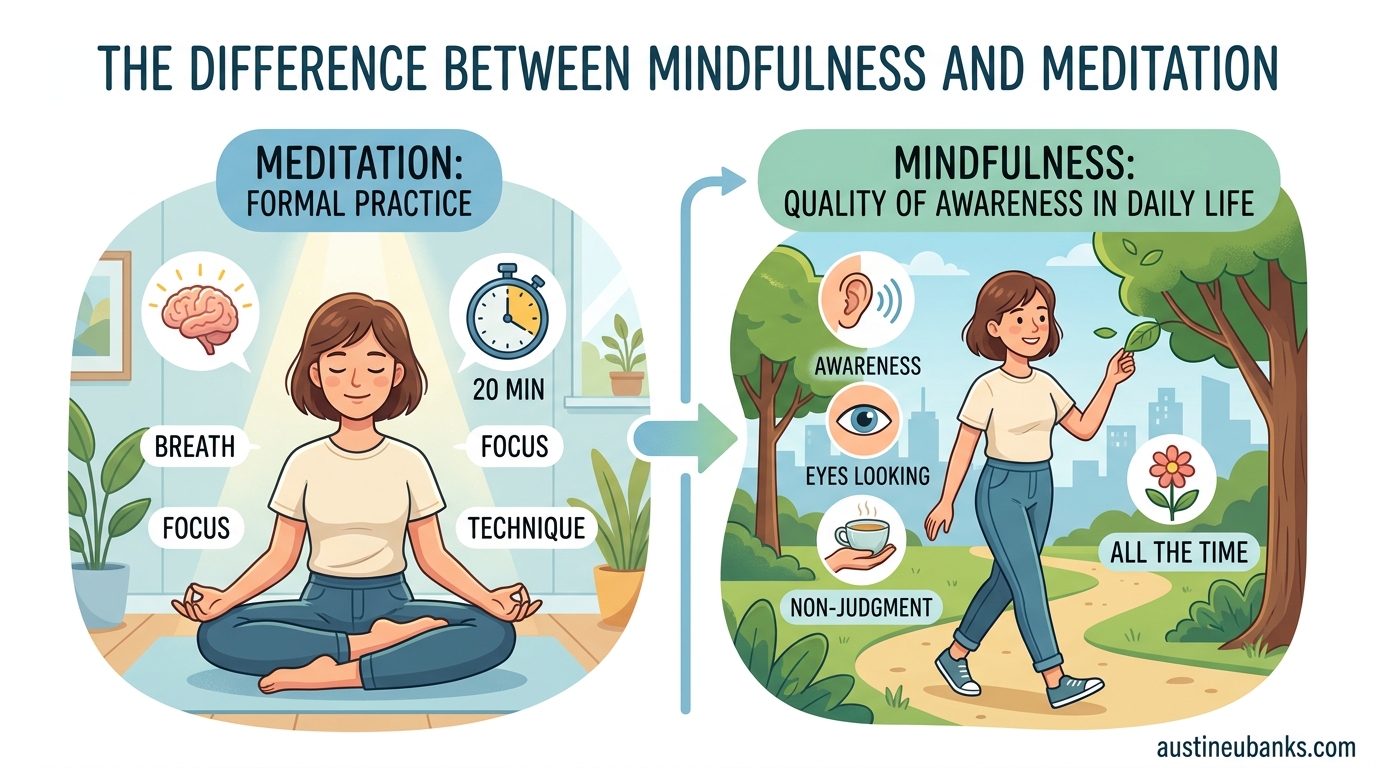
Here is the short version: mindfulness is a quality of awareness you bring to any moment, while meditation is a structured practice you do to train and develop that awareness. Think of it this way: meditation is the workout, and mindfulness is the fitness you build through that workout. You can be mindful without ever meditating, but meditation is one of the most effective ways to strengthen your capacity for mindfulness.
The NIH Wellness program puts it well: mindfulness is a quality describing a specific way of living that can be cultivated through practices, while meditation is a practice that can help develop that quality. Put even more simply: meditation involves mindfulness, but mindfulness does not require meditation.
Here is a quick side-by-side breakdown:
- What it is: Mindfulness is a state of being; meditation is an activity you do
- How you practice: Mindfulness happens during everyday activities; meditation requires setting aside dedicated time
- The goal: Mindfulness aims for present-moment awareness in daily life; meditation aims to train attention and cultivate mental qualities
- Time needed: Mindfulness can happen in seconds; meditation typically requires 5 to 30 minutes of dedicated practice
- Structure: Mindfulness is informal and spontaneous; meditation follows a structured technique with an anchor like breath, mantra, or body sensations
Now let us dig deeper into each one.
What Is Mindfulness?
Mindfulness is the practice of paying attention to the present moment on purpose and without judgment. Jon Kabat-Zinn, the scientist who created Mindfulness-Based Stress Reduction (MBSR) at the University of Massachusetts Medical School in 1979, defines it as “awareness that arises through paying attention, on purpose, in the present moment, non-judgmentally.” That definition has become the gold standard in both clinical and mainstream contexts.
What makes mindfulness distinctive is its quality of non-judgmental observation. You are not trying to change your thoughts, suppress your emotions, or achieve a particular state. You are simply noticing what is happening right now, whether that is the sensation of your feet on the floor, the taste of your morning coffee, or the sound of traffic outside your window.
The NIH describes mindfulness as a way of relating directly to whatever is happening in your life, including your own body, emotions, and thoughts. It is a quality of being that you can bring to anything you do.
The 3 C’s of Mindfulness
Many mindfulness teachers use the “3 C’s” framework to describe the attitude you bring to mindful awareness. The most common version comes from acceptance and commitment therapy traditions:
- Curious: Approaching your experience with genuine interest rather than assuming you already know what you will find. Instead of thinking “here goes my anxious mind again,” you might wonder, “what does this anxiety feel like in my body right now?”
- Compassionate: Meeting your thoughts and feelings with kindness rather than criticism. When your mind wanders during a mindful moment, you gently bring it back instead of berating yourself.
- Clear (or Non-judgmental): Observing things as they are rather than labeling them good or bad. You notice “I am having the thought that I failed” rather than “I am a failure.”
Some frameworks, particularly in cognitive-behavioral approaches, use a different set of 3 C’s: Catch it, Check it, Change it. You catch a negative thought, check whether it is accurate, and change it to something more balanced. Both frameworks point toward the same core idea: mindful, deliberate engagement with your inner experience.
Everyday Examples of Mindfulness
One of the best things about mindfulness is that it does not require any special equipment, posture, or setting. Here are some ways I practice mindfulness throughout a typical day:
Mindful eating: Instead of scrolling through my phone while eating lunch, I focus on the taste, texture, and temperature of each bite. I notice when I feel full. This simple shift has been shown to improve digestion and reduce overeating.
Mindful walking: On my commute or a walk around the block, I pay attention to the sensation of my feet hitting the ground, the rhythm of my breathing, and the sights and sounds around me. It turns a boring walk into a grounding reset.
Mindful conversation: When someone is talking to me, I give them my full attention instead of planning my response. I notice their body language and tone. This has genuinely improved my relationships.
Mindful brushing teeth: This sounds trivial, but focusing on the sensation of brushing, the taste of toothpaste, and the sound of the bristles is a two-minute mindfulness exercise hiding in your daily routine.
What Is Meditation?
Meditation is a formal, intentional practice where you set aside dedicated time to train your attention and awareness. Unlike mindfulness, which you can sprinkle throughout your day, meditation involves stopping what you are doing, finding a quiet space, and engaging in a structured technique for a set period.
The NIH Wellness program describes meditation as a mind-body practice with a long history of use for increasing calmness and physical relaxation, improving psychological balance, coping with illness, and enhancing overall health and well-being. Research reviewed by the National Center for Complementary and Integrative Health (NCCIH) has shown that meditation can produce measurable changes in the brain associated with attention, emotional regulation, and self-awareness.
Most meditation practices work by giving your mind an anchor: something to focus on when it inevitably wanders. That anchor could be your breath, a repeated word or phrase (mantra), a visualization, or bodily sensations. Every time your mind drifts and you bring it back to the anchor, you are doing a “rep” of mental training. Over time, this strengthens your ability to direct and sustain attention.
What Happens During Meditation?
When you sit down to meditate, you typically follow a cycle that repeats many times over the course of a session. First, you settle into your posture and set your intention. Then you bring your attention to your chosen anchor. Within seconds, your mind will wander to a thought, memory, emotion, or physical sensation. You notice the wandering, and you gently redirect your attention back to the anchor. That is one cycle.
This cycle of anchoring, drifting, noticing, and returning is the core of meditation practice. It is not a failure when your mind wanders; the noticing and returning is where the training happens. A common misconception is that meditation means stopping all thoughts. In reality, it is about changing your relationship with your thoughts.
According to research from Johns Hopkins Medicine, regular meditation practice can reduce symptoms of anxiety and depression, improve attention, and enhance overall well-being. The key word is “regular.” Like physical exercise, meditation produces its most significant benefits through consistent practice over time.
Key Differences Between Mindfulness and Meditation
Now that we have defined both terms, let us examine the specific differences that set them apart. I have identified seven core distinctions that will help you understand when to use each practice and what to expect from them.
1. Quality of Being vs Structured Practice
This is the most fundamental distinction. Mindfulness is a quality or state of awareness. It is something you are. Meditation is a practice or activity. It is something you do. The NIH practitioner’s lens frames this perfectly: mindfulness is a quality that describes a specific way of living, while meditation is a practice that can help develop that quality.
An analogy that helped me: think of mindfulness as being physically fit, and meditation as going to the gym. You can be fit without ever going to a gym (through hiking, sports, or physical labor). But going to the gym is one of the most reliable ways to build fitness. Similarly, you can be mindful in daily life without ever formally meditating, but meditation is one of the most effective ways to build your capacity for mindfulness.
2. Informal vs Formal
Mindfulness is inherently informal. It can be woven into any activity you are already doing: washing dishes, walking the dog, eating lunch, or listening to a friend. There is no special setup required. You simply bring present-moment awareness to whatever is already happening.
Meditation is formal by design. You set aside a specific time, find a relatively quiet space, adopt a particular posture (sitting, lying down, or walking slowly), and follow a defined technique. This formality is not a drawback. It is what makes meditation such an effective training method. The structured container helps you go deeper than you typically can while also doing the dishes.
3. Continuous vs Dedicated Time
Mindfulness has no time requirement. A mindful moment can last two seconds (taking a conscious breath before responding to a stressful email) or extend through an entire activity (a 30-minute mindful walk). You can practice mindfulness from the moment you wake up to the moment you fall asleep.
Meditation requires dedicated, uninterrupted time. Most teachers recommend starting with 5 to 10 minutes per day and gradually increasing to 20 or 30 minutes. The time commitment is part of what makes meditation powerful. Sitting still with your mind for 20 minutes, without distractions, forces you to confront and work with whatever arises in your awareness.
4. Applied Awareness vs Attention Training
Mindfulness is applied awareness. You are taking the quality of present-moment attention and applying it to real-life situations in real time. This makes it immediately useful for things like managing stress, improving communication, and savoring positive experiences.
Meditation is attention training in a controlled environment. By removing external distractions and giving your mind a single anchor, you create conditions that are ideal for building the underlying skill of sustained, directed attention. The benefits of this training then spill over into everyday life, making you naturally more mindful.
5. Accessibility and Learning Curve
Mindfulness is more immediately accessible. You can start right now, wherever you are, by simply noticing three things you can see, two things you can hear, and one thing you can feel. There is no learning curve, no technique to master, and no barrier to entry.
Meditation has a steeper learning curve. Beginners often feel frustrated, bored, or restless during their first few sessions. It takes time to find a technique that works for you, to build the habit of sitting regularly, and to understand what meditation is and is not. This is why many people quit meditation within the first few weeks. However, those who persist through the initial discomfort often report profound benefits.
6. Goal Orientation
Mindfulness has a paradoxical relationship with goals. The practice itself involves letting go of goals and simply being present with what is. However, people typically practice mindfulness to achieve real-world outcomes: less stress, better relationships, more enjoyment of daily life, improved emotional regulation.
Meditation has clearer process goals that are achievable within each session. Depending on the technique, those goals might include maintaining focus on an anchor, observing thoughts without attachment, cultivating a specific emotion like compassion, or achieving a state of deep relaxation. These session-level goals make progress more measurable.
7. Relationship Between the Two
This is where it gets interesting. The relationship between mindfulness and meditation is not symmetrical. Meditation is a primary method for cultivating mindfulness, but meditation can also serve purposes beyond mindfulness. Some meditation techniques aim for transcendence (going beyond ordinary awareness) rather than present-moment mindfulness. Transcendental Meditation, for example, uses a mantra to settle the mind into a state of restful alertness that practitioners describe as fundamentally different from ordinary waking mindfulness.
Conversely, mindfulness does not require meditation at all. You can cultivate mindfulness through informal practices alone: paying attention while eating, walking, listening, and working. Programs like Dialectical Behavior Therapy (DBT) teach mindfulness skills to clients without requiring formal meditation practice. This clinical application of mindfulness, developed by psychologist Marsha Linehan, demonstrates that the benefits of mindful awareness can be accessed without ever sitting on a cushion.
How Mindfulness and Meditation Overlap
Despite their differences, mindfulness and meditation are deeply interconnected. In practice, most people who are serious about mental wellness end up doing both, and the combination is more powerful than either alone.
The simplest way to understand their relationship is this: meditation is one of the most effective tools for building mindfulness, and mindfulness is one of the most common goals (or byproducts) of meditation. They feed each other in an upward spiral. As you meditate regularly, you become more naturally mindful throughout the day. As you practice mindfulness in daily life, you bring more awareness and intention to your meditation sessions.
There is also a specific practice called “mindfulness meditation” that sits at the intersection of both. This is what Jon Kabat-Zinn’s MBSR program teaches. In mindfulness meditation, you sit in formal meditation and use your breath (or another anchor) to train present-moment, non-judgmental awareness. It is meditation (formal, structured, time-bound) in service of mindfulness (present-moment, non-judgmental attention).
As one Reddit user on r/Mindfulness insightfully put it: “Mindfulness is a skill developed through meditation. Meditation is the practice and mindfulness is one of the many skills resulting from that practice.” That framing resonated with many users on the forum, and it captures the core relationship well.
Mindfulness-Based Stress Reduction (MBSR)
MBSR deserves special mention because it is the most widely researched mindfulness program in the world. Developed by Jon Kabat-Zinn in 1979, MBSR is an 8-week structured program that combines formal mindfulness meditation, body awareness, and yoga. It has been studied in hundreds of clinical trials and has demonstrated effectiveness for conditions ranging from chronic pain to anxiety to depression.
MBSR illustrates how meditation and mindfulness work together in a structured program. The formal meditation practice (body scans, sitting meditation, mindful movement) builds the capacity for mindful awareness, which participants then apply to daily life situations (stressful work events, difficult conversations, pain management). The program explicitly teaches both the formal practice (meditation) and the informal application (mindfulness).
Types of Meditation Explained
One reason people get confused about mindfulness versus meditation is that there are many different types of meditation, and not all of them focus on mindfulness. Understanding the major meditation traditions helps clarify where mindfulness fits in the broader landscape.
Mindfulness Meditation
This is the most popular form of meditation in the West today, and it is what most apps and courses teach. You sit quietly and focus your attention on your breath, bodily sensations, or the present moment. When your mind wanders, you gently bring it back. The goal is not to stop thinking but to develop awareness of your mental patterns. Mindfulness meditation is the foundation of MBSR and Mindfulness-Based Cognitive Therapy (MBCT).
Transcendental Meditation (TM)
TM involves silently repeating a specific mantra (a word or sound) for 20 minutes, twice a day. Unlike mindfulness meditation, which emphasizes present-moment awareness, TM aims to transcend ordinary thinking and access a state of deep restful alertness. Practitioners often describe it as feeling distinctly different from mindfulness. Some Reddit users have noted that TM makes them feel drowsy, while mindfulness meditation leaves them feeling alert and energized.
Mantra Meditation
Mantra meditation uses a repeated word, phrase, or sound to focus the mind. It overlaps with TM but is broader. You can use any meaningful word or phrase. The repetition gives the mind something to anchor to, similar to how breath serves as an anchor in mindfulness meditation. Some traditions, like Kundalini yoga, use mantra alongside breathwork and movement.
Zen Meditation (Zazen)
Zazen is the meditation practice of Zen Buddhism. It involves sitting in a specific posture and observing the breath and mind with a quality of open, non-grasping awareness. Unlike some mindfulness practices that emphasize focused attention, Zazen often cultivates “open monitoring” awareness, where you let attention rest on whatever arises without directing it toward a specific object. Zen practice also incorporates koans (paradoxical questions) in some traditions.
Loving-Kindness Meditation (Metta)
Loving-kindness meditation involves silently repeating phrases of goodwill, first toward yourself, then toward loved ones, neutral people, difficult people, and eventually all beings. Typical phrases include “May you be happy, may you be healthy, may you be safe, may you live with ease.” Research has shown that metta practice increases positive emotions, social connectedness, and compassion while reducing implicit bias.
Body Scan Meditation
A body scan involves mentally sweeping through your body from head to toe, noticing sensations in each area without trying to change them. It is a core practice in MBSR and is particularly effective for developing body awareness, releasing physical tension, and improving sleep. Many people use body scans as a relaxation technique before bed.
Mindfulness vs Awareness: A Related Distinction
While we are clarifying terms, there is another distinction that few articles address but that many practitioners wonder about: what is the difference between mindfulness and awareness? This question appears in related searches, and no major competitor covers it well.
Awareness is the broader concept. It is simply the capacity to perceive, sense, or experience anything. You are aware of the temperature in the room, aware of hunger, aware that a car is approaching. Awareness is continuous and automatic. You cannot turn it off completely (though sleep and anesthesia come close).
Mindfulness is a specific quality of awareness. It is awareness that is intentional, present-focused, and non-judgmental. You might be aware that you are anxious (you feel the knot in your stomach), but being mindful of that anxiety means you observe it with curiosity and acceptance rather than resisting it, catastrophizing about it, or trying to suppress it.
Think of it this way: awareness is the raw data of your experience, and mindfulness is the lens through which you process that data. Everyone has awareness. Mindfulness is a skill you develop to bring a particular quality to that awareness. And meditation is one of the most effective training methods for developing that skill.
Benefits of Mindfulness and Meditation
Both practices have been extensively studied, and the research paints a compelling picture. Here is what the science says about the benefits of mindfulness and meditation, separately and together.
Stress Reduction
This is the most well-documented benefit. MBSR was literally designed for stress reduction, and decades of research support its effectiveness. A meta-analysis of 209 studies found that mindfulness-based therapies produce significant reductions in stress, anxiety, and depression. The mechanism appears to involve activation of the parasympathetic nervous system, which counteracts the fight-or-flight response.
Mindfulness helps in real time. When you notice stress arising (tight shoulders, shallow breathing, racing thoughts), you can take a mindful breath, observe the physical sensations, and respond intentionally rather than reactively. Meditation helps over time by training your nervous system to return to calm more quickly after a stress response.
Anxiety Relief
Research from Johns Hopkins Medicine found that meditation programs can reduce anxiety symptoms with a effect size similar to that of antidepressant medications. For people with generalized anxiety disorder, MBCT has shown effectiveness comparable to cognitive behavioral therapy.
The mindfulness approach to anxiety is counterintuitive but powerful. Instead of trying to eliminate anxious thoughts (which usually makes them stronger), you learn to observe them as passing mental events rather than threats. This “decentering” from anxious thoughts reduces their emotional impact over time.
Sleep Improvement
Mindfulness and meditation both improve sleep quality, though through slightly different mechanisms. Meditation helps by training the mind to let go of the racing thoughts that keep you awake. A body scan or guided relaxation before bed can ease the transition from wakefulness to sleep.
Mindfulness helps by improving your overall relationship with rest. Many people with sleep issues develop anxiety about not sleeping, which creates a vicious cycle. Mindfulness teaches you to accept wakefulness without fighting it, which paradoxically makes it easier to fall asleep.
Emotional Regulation
Both practices strengthen emotional regulation, but they do so at different levels. Mindfulness gives you real-time tools: you notice an emotion arising, you create a pause between stimulus and response, and you choose how to act rather than reacting automatically.
Meditation builds the underlying neural circuitry for emotional regulation. Regular meditation has been associated with increased gray matter density in the prefrontal cortex (involved in executive function and emotional regulation) and decreased amygdala reactivity (the brain’s alarm system). These structural changes make you more resilient to emotional stressors over time.
Neuroplasticity and Brain Changes
One of the most exciting areas of research involves neuroplasticity, the brain’s ability to reorganize itself by forming new neural connections. Harvard neuroscientist Sara Lazar found that just 8 weeks of mindfulness meditation produced measurable changes in brain structure, including increased thickness in regions associated with attention and sensory processing.
Research has also examined BDNF (brain-derived neurotrophic factor), a protein that supports neuron growth and survival. Some studies suggest that regular meditation may increase BDNF levels, which could contribute to the cognitive and emotional benefits of practice. While more research is needed in this area, the neuroplasticity findings underscore that meditation produces real, measurable changes in the brain.
Physical Health Benefits
The American Heart Association has reviewed evidence suggesting that meditation may reduce cardiovascular risk factors, including blood pressure. The NCCIH notes that meditation can help manage chronic pain, with some studies showing effectiveness comparable to cognitive behavioral therapy for pain. Mindfulness-based interventions have also shown promise for managing symptoms of conditions like irritable bowel syndrome, fibromyalgia, and PTSD.
It is worth noting that while the research is promising, neither mindfulness nor meditation should replace professional medical treatment for serious health conditions. They are complementary practices that can enhance overall well-being alongside appropriate medical care.
Common Misconceptions and Beginner Mistakes
From my research into forum discussions and my own experience, here are the most common misconceptions that trip people up when they start exploring mindfulness and meditation.
Myth 1: Meditation means clearing your mind completely. This is probably the number one misconception. People try to stop thinking, fail, and conclude they are bad at meditating. In reality, no meditation tradition teaches that you should stop all thoughts. The goal is to change your relationship with thoughts, not eliminate them. Mind wandering is a normal part of the process.
Myth 2: You must sit cross-legged on the floor. You can meditate in a chair, on a couch, or even lying down (though lying down increases the risk of falling asleep). The important thing is to be comfortable enough that physical discomfort does not distract you, but alert enough that you do not drift off.
Myth 3: You need to meditate for 20 minutes or more for it to count. Research suggests that even short sessions produce benefits. Starting with 5 minutes daily is far more effective than attempting 30 minutes and quitting after a week. Consistency matters more than duration, especially in the beginning.
Myth 4: Mindfulness is just relaxation. Relaxation is often a byproduct, but mindfulness is not the same as chilling out. Sometimes being mindful means sitting with uncomfortable emotions, noticing physical pain, or acknowledging difficult truths. Mindfulness is about honest, present-moment awareness, whether that moment is pleasant or unpleasant.
Myth 5: There is one “right” way to practice. Different techniques work for different people. Some thrive with breath-focused mindfulness meditation. Others prefer mantra-based practices like TM. Some connect most with movement-based practices like walking meditation or yoga. The best practice is the one you will actually do consistently.
Myth 6: If you practice mindfulness, you do not need meditation (or vice versa). While you can absolutely practice one without the other, they complement each other powerfully. Meditation builds the mental fitness that makes everyday mindfulness easier and more natural.
Which Should You Start With?
This is the question I hear most often from beginners, and it is one that most articles do not address directly. After researching forum discussions, consulting the literature, and reflecting on my own experience, here is a decision framework.
Start With Mindfulness If…
You want immediate, practical benefits without a big time commitment. If you are feeling overwhelmed and need tools you can use right now, today, mindfulness is the faster on-ramp. You do not need to learn a technique, buy anything, or set aside time. You can start by simply paying attention to your next three breaths.
Mindfulness is also ideal if the idea of sitting still and doing nothing sounds miserable. Many people (especially those with ADHD or high anxiety) find formal meditation initially uncomfortable. Starting with informal mindfulness practices lets you build the skill of present-moment attention without the friction of a formal sit.
Start With Meditation If…
You want deeper, more systematic training. If you are dealing with chronic stress, anxiety, or sleep issues and want a structured approach, meditation offers a clearer path. The daily practice creates a dedicated container for mental training that informal mindfulness alone cannot match.
Meditation is also better if you are the type of person who thrives with routine and structure. Having a set time, place, and technique gives you accountability and makes progress more tangible. Many people find that the ritual of daily meditation becomes a cherished anchor in their day.
The Best Approach: Combine Both
For most people, the ideal approach is a combination. Start with a short daily meditation practice (even 5 to 10 minutes) to build the foundation. Then layer mindfulness throughout your day by bringing intentional awareness to routine activities. This combination gives you the depth of formal practice and the breadth of everyday application.
A Reddit user captured this well when they said that over time, the difference between mindfulness and meditation becomes less important. They blend together into a way of living that is more present, more aware, and more intentional. But having clarity about the distinction in the beginning helps you make smart choices about how to spend your time and energy.
How to Practice Both in Your Daily Life
Here is a practical framework for integrating mindfulness and meditation into a typical day. I have tested this routine myself and adjusted it based on what actually works.
Morning (5 to 10 minutes): Start with a short meditation before checking your phone. Sit comfortably, close your eyes, and focus on your breath. When your mind wanders, gently return to the breath. This sets a grounded tone for the day and trains your attention before the demands of daily life take over.
Throughout the day (micro-moments): Build mindfulness triggers into your routine. Every time you wash your hands, notice the sensation of the water and soap. When you eat, put down your phone and focus on the taste and texture. When you walk from your car to your office, notice the air, the sounds, and the feeling of movement. These micro-meditations, as some apps call them, take no extra time but significantly increase your daily mindfulness.
Transitions (1 to 2 minutes): Use transition points between activities as mindfulness cues. Before starting a meeting, take three conscious breaths. When you finish a work task, pause and notice how your body feels before moving to the next one. These brief check-ins prevent the autopilot mode that drains energy and increases stress.
Evening (5 to 15 minutes): Wind down with a body scan or guided meditation. Lie in bed and mentally scan from your head to your feet, noticing and releasing tension in each area. This practice not only builds mindfulness of bodily sensations but also promotes the relaxation response that improves sleep quality.
The key is consistency over intensity. Ten minutes of daily practice will produce more benefit than a single hour-long session once a week. Start small, build the habit, and gradually increase as the practice becomes a natural part of your routine.
FAQs
Is mindfulness better than meditation?
Neither is universally better. Mindfulness excels for real-time stress management, daily presence, and situations where you cannot set aside dedicated time. Meditation excels for deeper mental training, sustained attention development, and systematic emotional regulation. Most practitioners benefit from combining both rather than choosing one over the other.
Can you practice mindfulness without meditation?
Yes. Mindfulness can be cultivated entirely through informal practices like mindful eating, mindful walking, and present-moment awareness during daily activities. Clinical programs like Dialectical Behavior Therapy (DBT) teach mindfulness skills without requiring formal meditation practice. However, meditation is one of the most effective accelerators for developing mindfulness.
What are the 3 C’s of mindfulness?
The most common 3 C’s framework refers to Curious, Compassionate, and Non-judgmental (Clear) attention. You approach your experience with genuine curiosity, meet your thoughts and feelings with compassion, and observe without judgment. An alternative framework from cognitive-behavioral traditions uses Catch it, Check it, Change it for working with negative thoughts.
What type of meditation is best for OCD?
Mindfulness-based approaches that incorporate exposure and response prevention (ERP) principles have shown the most promise for OCD. Practices that train non-judgmental observation of intrusive thoughts, without engaging or fighting them, can help reduce the cycle of obsessions and compulsions. The International OCD Foundation recommends working with a qualified therapist trained in ERP. Always consult a mental health professional for OCD treatment.
Does meditation help with dysautonomia?
Meditation may help manage dysautonomia symptoms by activating the parasympathetic nervous system, which regulates involuntary bodily functions including heart rate and blood pressure. Stress reduction through meditation can reduce symptom flare-ups triggered by sympathetic nervous system activation. However, research specifically on meditation and dysautonomia is limited. Consult your healthcare provider before starting any new practice for a medical condition.
How long should I meditate each day?
For beginners, 5 to 10 minutes daily is an excellent starting point. Research suggests that consistency matters more than duration. As your practice develops, you may naturally gravitate toward 15 to 30 minute sessions. Many experienced practitioners meditate 20 minutes once or twice daily. The best duration is the one you can sustain consistently over the long term.
Conclusion: Bringing It All Together
Understanding the difference between mindfulness and meditation gives you a clearer roadmap for your mental wellness journey. Mindfulness is a quality of present-moment, non-judgmental awareness you can bring to any activity. Meditation is a formal practice that trains the attention and mental qualities underlying that awareness. They are distinct but deeply connected, and the most effective approach for most people combines both.
Start where you are. If that means taking three conscious breaths right now, do that. If it means committing to a 5-minute daily meditation tomorrow morning, do that instead. The most important step is the first one. Your mind is the one tool you use for everything else in your life, and investing in its training pays dividends across every domain.
As you explore these practices, remember that there is no single right way to do it. The best practice is the one you return to consistently. Whether you gravitate toward formal meditation, informal mindfulness, or a combination of both, the goal is the same: living with more awareness, more intention, and more presence in the moments that make up your life.