
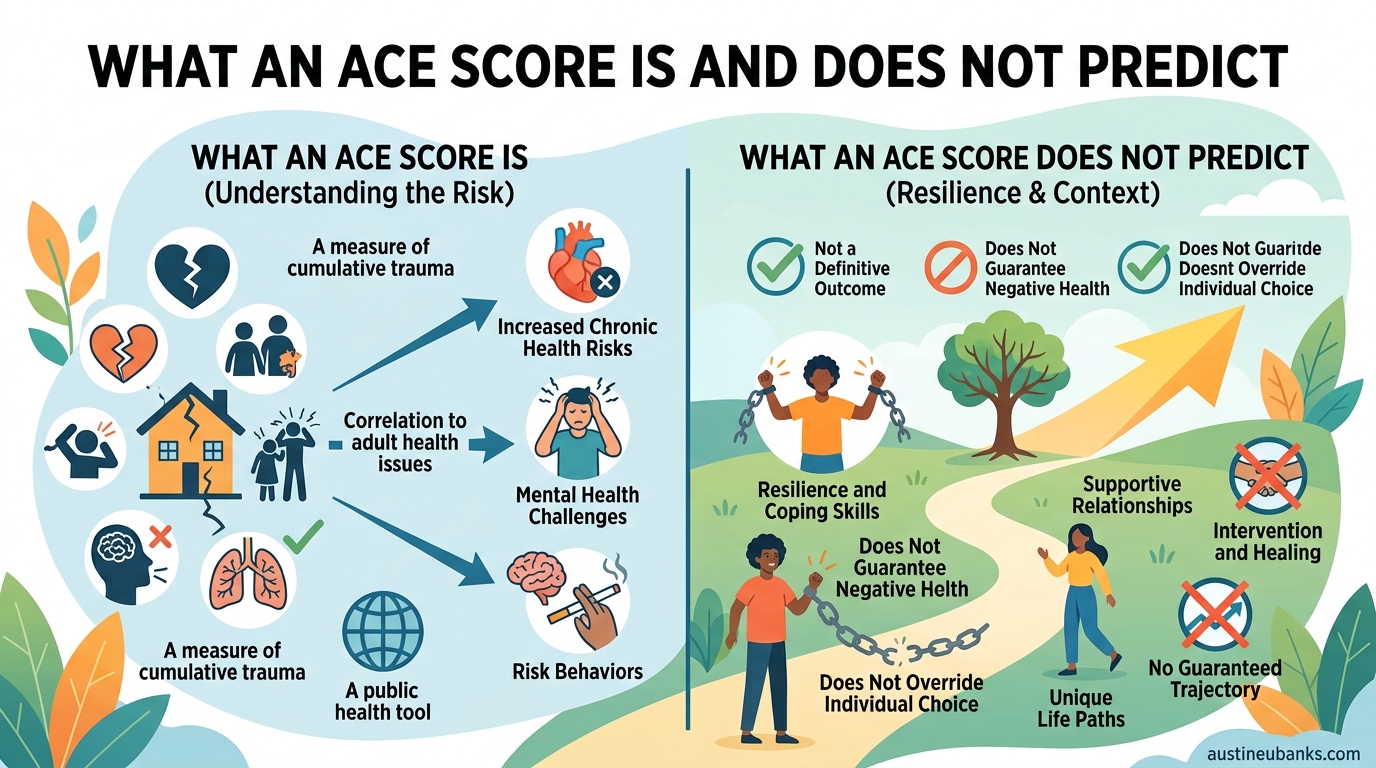
An ACE score is a tally of different types of abuse, neglect, and household dysfunction experienced before age 18, and it serves as a rough indicator of risk for certain health problems later in life. The higher the score, the greater the statistical likelihood of chronic disease, mental health challenges, and behavioral risks. But here is the part most people misunderstand: an ACE score predicts population-level trends, not individual outcomes.
If you have taken the ACE quiz and landed on a number that scared you, you are not alone. I have seen people in therapy rooms, online forums, and community workshops react to their scores with everything from relief to dread. The confusion is understandable because the messaging around ACE scores often sounds deterministic, as if a number from childhood seals your fate.
In this guide, our team breaks down exactly what an ACE score measures, what the research says it can predict, and just as importantly, what it cannot. We will cover the 10 ACEs, how toxic stress affects the body, how to interpret your score, and why resilience science offers a very different story than the one most people hear. By the end, you will understand your ACE score in context rather than in fear.
Table of Contents
What Is an ACE Score?
An ACE score is a number from 0 to 10 that represents how many categories of adverse childhood experiences a person faced before turning 18. It comes from a landmark public health study conducted between 1995 and 1997 by Kaiser Permanente and the Centers for Disease Control and Prevention (CDC). The original study surveyed over 17,000 middle-class Americans, making it one of the largest investigations of childhood abuse and neglect ever conducted.
The ACE quiz itself is simple. It asks 10 yes-or-no questions about your first 18 years of life. Each “yes” answer adds one point to your score. A score of 0 means you experienced none of the listed adversities, while a 10 means you experienced all of them. There is no partial credit, and the quiz does not ask about frequency or severity of any single experience.
What made the original study groundbreaking was the discovery of a dose-response relationship. As ACE scores climbed, so did the risk for a wide range of health and social problems. This was not a minor correlation. People with an ACE score of 4 or higher were dramatically more likely to develop chronic diseases, struggle with addiction, and face mental health challenges compared to those with a score of 0.
The CDC now considers ACEs a leading public health concern. According to their data, preventing ACEs could reduce chronic disease, mental illness, and behavioral health issues at a population level. But the CDC also emphasizes that ACEs are common, preventable, and not a life sentence, a point we will return to throughout this article.
The 10 ACEs: What the Quiz Asks
The 10 ACEs fall into three broad categories: abuse, neglect, and household dysfunction. Each represents a specific type of adversity experienced before age 18. Here is the complete list as defined by the original CDC-Kaiser study.
Abuse
The quiz asks about three forms of abuse. These include whether a parent or adult in the household often or very often swore at you, insulted you, or put you down (emotional abuse). It asks whether a parent or adult often pushed, grabbed, slapped, or threw something at you, or physically abused you in any way (physical abuse). Finally, it asks whether an adult or person at least five years older ever touched you sexually or attempted to have sexual contact with you (sexual abuse).
Neglect
The quiz covers two forms of neglect. It asks whether you felt that no one in your family loved you or thought you were important, or whether your family did not look out for each other or feel close (emotional neglect). It also asks whether you did not have enough to eat, had to wear dirty clothes, or had no one to protect you (physical neglect).
Household Dysfunction
The remaining five questions focus on the environment you grew up in. These ask whether a household member was depressed, mentally ill, or attempted suicide. Whether your mother or stepmother was treated violently. Whether anyone in the household had a problem with alcohol or drugs. Whether your parents were separated or divorced. And whether a household member went to prison.
Each of these 10 experiences contributes equally to your total score. The quiz does not weigh one type of adversity as more harmful than another. A score of 3 from emotional abuse, physical abuse, and parental divorce carries the same numerical weight as a score of 3 from sexual abuse, substance abuse in the home, and incarceration of a parent.
This equal weighting is one of the first limitations worth noting. Not all adversities affect children the same way, and the number alone cannot tell you anything about severity, duration, or context.
What an ACE Score Predicts
An ACE score predicts statistical risk at the population level for a range of health conditions, behaviors, and social outcomes. The original study and decades of follow-up research have established strong correlations between higher ACE scores and numerous negative health outcomes.
Physical Health Outcomes
The research links high ACE scores to increased risk for chronic diseases including heart disease, cancer, diabetes, chronic obstructive pulmonary disease (COPD), and liver disease. The original study found that people with an ACE score of 4 or more had a significantly higher risk of ischemic heart disease compared to those with a score of 0. Those with a score of 6 or more faced a reduced life expectancy of roughly 20 years compared to those with a score of 0.
Autoimmune conditions also show a strong correlation. People with high ACE scores are more likely to develop conditions like rheumatoid arthritis and lupus, suggesting that early stress affects immune system function long-term.
Mental Health Outcomes
Mental health correlations are among the strongest in the ACE research. Higher scores correlate with increased rates of depression, anxiety, post-traumatic stress disorder, and suicidal ideation. People with an ACE score of 4 or higher were found to be 4 to 12 times more likely to experience alcoholism, drug abuse, and depression compared to those with a score of 0.
The risk of suicide attempts increases dramatically with ACE scores. According to the original study data, someone with an ACE score of 7 or more was 30 times more likely to have attempted suicide than someone with a score of 0. This is one of the most striking findings in the entire body of ACE research.
Behavioral and Social Risks
ACE scores also predict behavioral risks. Higher scores correlate with increased rates of substance use, smoking, risky sexual behavior, and unintended pregnancies. The theory is that many of these behaviors serve as coping mechanisms for unresolved trauma and toxic stress.
Social outcomes show correlations too. Research links higher ACE scores to lower academic achievement, reduced employment stability, and greater likelihood of involvement with the criminal justice system. These patterns reflect how childhood adversity can cascade through every area of adult life.
The Dose-Response Relationship
What makes these predictions powerful is the dose-response pattern. This means that as the number of ACEs increases, the risk for negative outcomes increases in a roughly proportional way. A score of 4 carries more risk than 3, which carries more risk than 2. This gradient held true across nearly every health category studied, which is why the ACE framework gained so much traction in public health.
However, and this is critical, a dose-response relationship at the population level does not mean the same thing for any one individual. We will explore this distinction in depth in the next section.
How Toxic Stress Works in the Body
To understand why ACE scores correlate with health outcomes, you need to understand toxic stress. When a child faces a threatening situation, their body activates the fight-or-flight response, releasing stress hormones like cortisol and adrenaline. This is a normal, healthy reaction to short-term danger.
Toxic stress is different. It happens when a child experiences prolonged, frequent, or severe adversity without adequate adult support to help them cope. The stress response system stays activated, flooding the developing brain and body with stress hormones over weeks, months, or years. This constant activation literally changes how the brain develops.
The amygdala, which processes fear and threats, becomes more reactive. The prefrontal cortex, which handles decision-making and impulse control, can be impaired. The hippocampus, involved in learning and memory, may shrink. These structural changes help explain why high ACE scores correlate with difficulties in emotional regulation, learning, and impulse control.
Harvard’s Center on the Developing Child describes this as the difference between positive stress, which builds resilience, and toxic stress, which damages developing systems. The presence of a stable, supportive adult is the single most important buffer against toxic stress, which is why two children can experience the same adversity and have very different outcomes.
What an ACE Score Does NOT Predict
This is where most resources fall short, so let us be direct. An ACE score does not predict your individual health destiny, your character, your intelligence, your capacity to love, or your ability to live a fulfilling life. It is a population-level screening tool, not a crystal ball.
It Does Not Predict Individual Outcomes
The ACE score was designed as a public health epidemiological tool. It works well for identifying patterns across large groups. But population statistics cannot predict what will happen to any single person. Two people with the same ACE score can have completely different life trajectories based on dozens of factors the quiz never measures.
I have seen this play out repeatedly in clinical settings. People with ACE scores of 7 or 8 who are thriving, healthy, and deeply connected. And people with scores of 1 or 2 who struggle significantly. The score is a starting point for understanding risk, not a verdict on your future.
It Does Not Account for Positive Experiences
The ACE quiz asks only about what went wrong. It asks nothing about what went right. A child who experienced abuse but also had a deeply loving grandparent, an inspiring teacher, or a safe community may process adversity very differently than a child who experienced the same abuse in total isolation.
Researchers at Johns Hopkins have studied Positive Childhood Experiences (PCEs) and found that they have a powerful buffering effect. Their research showed that adults who reported more PCEs, such as feeling safe, supported, and connected in childhood, showed significantly lower rates of depression and mental health issues, even when they also had high ACE scores. The ACE quiz completely misses this counterbalancing data.
It Does Not Capture Every Type of Adversity
The 10 ACEs reflect what researchers could measure in a mostly white, middle-class, insured population in the 1990s. The quiz does not ask about poverty, racism, community violence, bullying, food insecurity, housing instability, or losing a parent to deportation. It does not ask about medical trauma, displacement, or living in a war zone.
This means a child growing up in circumstances the quiz never mentions could score a 0 and still carry enormous toxic stress. The ACE score is not a comprehensive measure of childhood adversity. It is a measure of 10 specific experiences, and many important adversities are absent.
It Does Not Determine Your Capacity for Healing
Perhaps the most important thing an ACE score does not predict is your ability to heal. Neuroscience has shown that the brain remains plastic throughout adulthood. Trauma-informed therapy, supportive relationships, mindfulness practices, physical exercise, and meaningful purpose can all rewire stress response systems that were shaped by early adversity.
As Dr. Jack Shonkoff of Harvard’s Center on the Developing Child has emphasized, the most important finding from ACE research is not that high scores predict poor outcomes. It is that building resilience through supportive relationships and targeted interventions can change outcomes dramatically, regardless of a person’s starting score.
It Does Not Define Your Identity
In forums like Reddit’s CPTSD community, one of the most common discussions is about people feeling labeled or defined by their ACE score. Some users describe feeling fatalistic, as if a high score means their health problems are inevitable. Others use the score to validate experiences they had long minimized.
Both reactions miss the point. Your ACE score is a data point, not an identity. It can help you understand patterns in your life and guide you toward appropriate support. But it cannot tell you who you are.
How to Interpret Your ACE Score
Score interpretation matters because context changes everything. Here is how the research generally frames different score ranges, along with the caveats you need to keep in mind.
A Score of 0
A score of 0 means you did not experience any of the 10 listed adversities. This suggests a lower statistical risk for the health conditions studied. However, it does not mean you had a perfect childhood or that you are immune to health problems. Remember, the quiz does not capture every possible adversity.
A Score of 1 to 3
Scores in this range indicate moderate exposure to childhood adversity. Research shows some elevated risk for health and behavioral outcomes compared to a score of 0, but the risks are generally manageable. Many people in this range never develop significant problems, especially when protective factors were present.
A Score of 4 or Higher
A score of 4 or above is where researchers see the sharpest increase in risk. The original study found that people with scores of 4 or more were at substantially higher risk for chronic disease, mental illness, addiction, and other negative outcomes. This is generally considered the threshold that healthcare providers flag for closer attention.
If you have a score in this range, it is worth discussing with a healthcare provider or mental health professional. Not because anything is guaranteed to go wrong, but because awareness lets you take preventive steps. Early intervention, therapy, and lifestyle changes can significantly reduce the risks associated with high ACE scores.
What ACE Score Is Concerning?
There is no official cutoff for what constitutes a “bad” score. However, the research consistently shows that 4 is the inflection point where risks rise sharply. Scores of 6 or 7 indicate even greater statistical risk. But again, these numbers describe population averages, not your personal future. A concerning score is simply a signal to pay attention, seek support, and take proactive steps.
Limitations and Criticisms of the ACE Score
Researchers and clinicians have raised several important critiques of the ACE framework. Understanding these limitations helps you use the score appropriately rather than treating it as gospel.
The original study population was not representative. Participants were mostly white, middle-class, college-educated, and privately insured. This means the findings may not translate perfectly to other demographics, cultures, or economic circumstances. Researchers have called for expanded ACE studies that include more diverse populations and broader categories of adversity.
The quiz relies on retrospective self-reporting. Adults are asked to recall experiences from decades earlier, and memory is not always reliable. Some people minimize or forget painful experiences, while others may over-report due to current emotional states. This introduces measurement error that the score cannot account for.
The quiz treats all adversities equally. A parental divorce and ongoing sexual abuse both count as one point. This equal weighting ignores differences in severity, duration, and developmental timing. A child who experienced neglect at age 2 may face different developmental impacts than one who experienced it at age 15.
Cultural context is entirely absent. The ACE framework was developed in a Western cultural context and may not capture adversities that are most relevant in other cultural settings. Forced migration, caste discrimination, community-level violence, and historical trauma are all absent from the quiz but deeply impactful.
Individual sensitivity varies enormously. Due to genetic factors, temperament, and epigenetics, some children are naturally more resilient to adversity while others are more sensitive. The ACE score cannot tell you where any individual falls on this sensitivity spectrum.
Resilience and Protective Factors
Resilience is the ability to adapt and recover from adversity, and it is the most important counterbalance to a high ACE score. The good news from decades of research is that resilience can be built at any age.
The single most powerful protective factor in childhood is a stable, responsive relationship with at least one caring adult. Harvard’s research consistently shows that this relationship, whether with a parent, grandparent, teacher, or mentor, acts as a buffer against toxic stress. It helps regulate the child’s stress response and builds the neural architecture for future resilience.
Positive Childhood Experiences deserve attention alongside ACEs. The Johns Hopkins PCE study identified seven positive experiences, such as feeling able to talk to family about feelings, feeling supported by family during difficult times, having a sense of belonging in school, and having at least two non-parent adults who cared. Each of these PCEs reduced the odds of depression in adulthood, even in people with high ACE scores.
For adults who already have high ACE scores, resilience-building is still very much possible. Practices that calm the nervous system, including mindfulness meditation, yoga, breathwork, and time in nature, can help regulate an overactive stress response. Physical exercise, adequate sleep, and nutrition all support brain health and emotional regulation. And perhaps most importantly, building secure adult relationships helps repair the relational patterns that early adversity may have disrupted.
Healing From a High ACE Score
Healing from childhood trauma is not about erasing the past. It is about changing how your body and mind respond to it in the present. If you have a high ACE score, several evidence-based approaches can help.
Trauma-focused therapy is often the most effective starting point. Approaches like EMDR (Eye Movement Desensitization and Reprocessing), trauma-focused cognitive behavioral therapy, and somatic experiencing all target how trauma is stored in the body and brain. A therapist trained in trauma-informed care can help you process experiences safely and at your own pace.
Body-based practices are especially relevant for people with high ACE scores because toxic stress lives in the nervous system. Modalities like yoga, somatic therapy, and regulated breathing help calm the fight-or-flight response and build tolerance for difficult emotions. Research on these approaches specifically for trauma survivors is growing steadily.
Building supportive connections may be the most important healing factor of all. Support groups, community organizations, faith communities, and trusted friendships all contribute to recovery. Healing from early adversity rarely happens in isolation. It happens in relationship, which is exactly where the original wounds occurred.
If you are struggling, do not wait to reach out. A mental health professional who understands trauma can help you make sense of your experiences and develop a personalized plan. Your ACE score can open the door to understanding, but it is the work of healing that actually changes your life trajectory.
FAQs
What do ACE scores predict?
ACE scores predict population-level risk for chronic diseases like heart disease and cancer, mental health conditions including depression and anxiety, substance use disorders, and certain behavioral risks. Higher scores correlate with greater statistical risk, but they do not predict outcomes for any specific individual.
How do you interpret your ACE score?
A score of 0 indicates none of the 10 listed adversities. Scores of 1 to 3 suggest moderate exposure with some elevated risk. A score of 4 or higher marks the threshold where research shows a sharp increase in health risks. No score is a guarantee of any outcome, and scores should be discussed with a healthcare provider for personalized context.
Is an ACE score of 7 bad?
An ACE score of 7 indicates significant childhood adversity and statistically elevated risk for health and mental health challenges. However, it does not mean poor outcomes are guaranteed. Many people with scores of 7 or higher lead healthy, fulfilling lives, especially with appropriate support, therapy, and resilience-building practices.
How to heal from a high ACE score?
Healing approaches include trauma-focused therapy such as EMDR or trauma-focused CBT, body-based practices like yoga and somatic therapy, building supportive relationships, mindfulness and stress regulation practices, and addressing physical health through exercise, nutrition, and sleep. Professional guidance from a trauma-informed provider is recommended.
What ACE score is concerning?
A score of 4 or higher is generally considered the threshold for concern based on the original CDC-Kaiser research, which showed a sharp increase in health risks at this level. Scores of 6 or more indicate even greater statistical risk. However, concern simply means it is worth paying attention and seeking support, not that negative outcomes are inevitable.
Does an ACE score determine your future?
No. An ACE score reflects statistical risk at the population level, not individual destiny. Protective factors, positive experiences, therapy, resilience, and supportive relationships all influence outcomes independently of ACE scores. Many people with high scores live healthy, successful lives.
How accurate is the ACE quiz?
The ACE quiz is a validated screening tool, but it has limitations. It relies on retrospective self-reporting, does not capture all forms of adversity, treats all 10 experiences equally regardless of severity, and was developed on a non-diverse population. It is best used as a conversation starter and screening indicator, not as a diagnostic tool.
What are the 10 ACEs?
The 10 ACEs cover three categories. Abuse includes emotional, physical, and sexual abuse. Neglect includes emotional and physical neglect. Household dysfunction includes having a household member with mental illness, witnessing domestic violence against the mother, household substance abuse, parental separation or divorce, and having an incarcerated household member.
Conclusion
Understanding what an ACE score is and what it does and does not predict gives you power instead of fear. Your score is a data point that can guide you toward better self-awareness, preventive healthcare, and healing. It is not a verdict, a diagnosis, or a prediction of your future.
The strongest takeaway from decades of ACE research is this: childhood adversity matters, but so do relationships, resilience, and the brain’s lifelong capacity to change. Whether your score is 0 or 10, what you do next matters more than the number itself.
If you found this article helpful and want to explore related topics on trauma, mental health, and healing, we encourage you to continue learning and, if needed, to reach out to a qualified professional who can support you on your journey.