
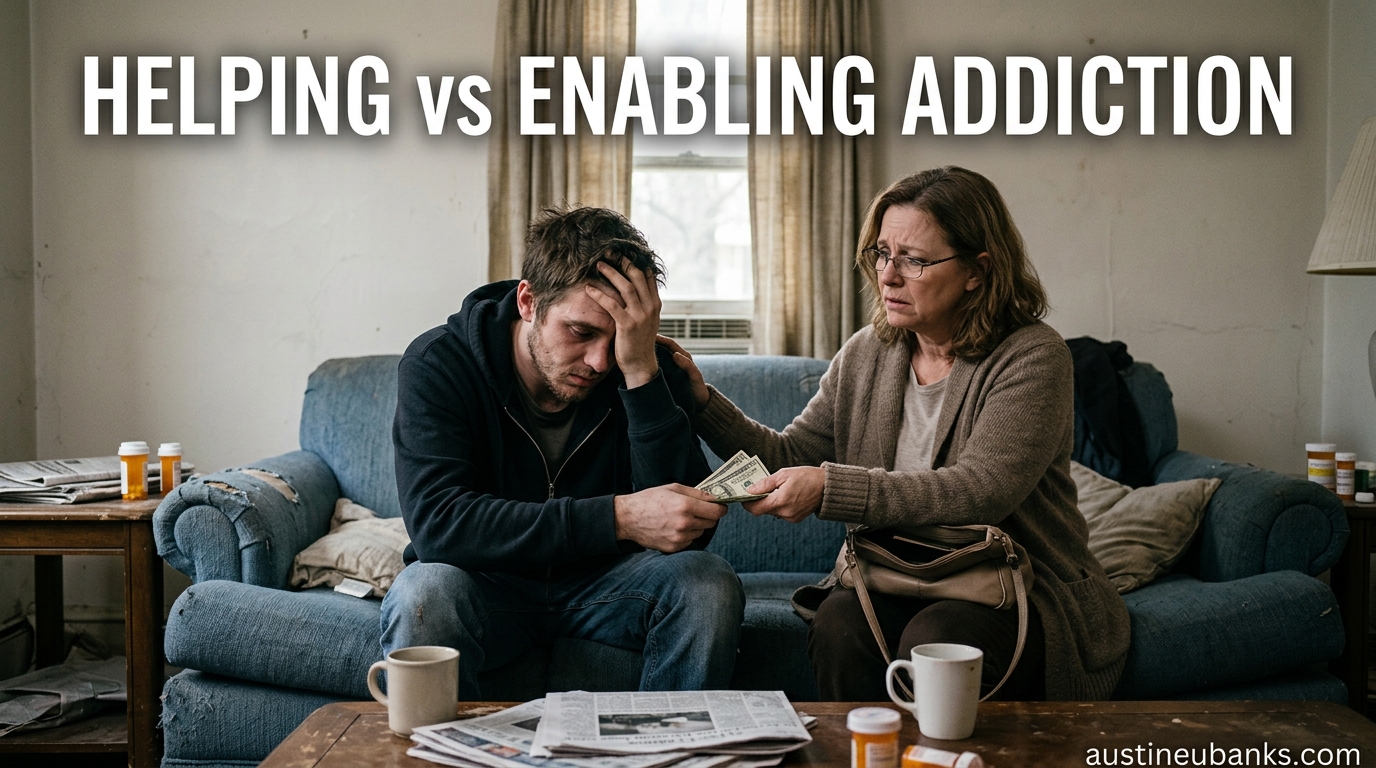
When someone you love is struggling with substance use disorder, every instinct tells you to step in and protect them. You lend money, cover their rent, call in sick for them at work, or make excuses to family members. You tell yourself you are helping. But somewhere along the way, a question starts to nag at you: are your actions actually keeping them stuck?
Understanding the difference between helping vs enabling addiction is one of the most painful and important realizations a family member can have. The line between love and harm is blurry, and most people who enable genuinely believe they are doing the right thing. I have talked with countless spouses, parents, and friends who felt confused, guilty, and emotionally drained, wondering whether their support was helping or hurting.
This guide breaks down exactly what enabling looks like, why it happens, and how to help an addict without enabling. You will find concrete examples, conversation scripts, boundary-setting strategies, and the evidence-based CRAFT method that researchers recommend for family members. Everything here is designed to help you support your loved one’s addiction recovery while protecting your own well-being.
Table of Contents
What Does It Mean to Enable an Addiction?
Enabling addiction means doing things for someone that they could and should do for themselves, especially when those actions shield them from the natural consequences of their substance use. The American Psychiatric Association defines enabling as contributing to another person’s self-destructive or compulsive behavior, whether intentionally or not. In simple terms, enabling removes the friction that might otherwise push someone toward change.
Think about it this way. When you bail your loved one out of every crisis, pay off their debts, or lie to their employer about why they missed work, you are absorbing the consequences that addiction creates. Without those consequences, the person has less reason to seek addiction treatment. The discomfort that could serve as a catalyst for change never arrives because you intercepted it first.
Enabling is rarely malicious. It almost always comes from love, fear, or guilt. A parent who pays their adult child’s phone bill while they spend their own money on drugs is not trying to worsen the addiction. They are terrified of what might happen if they stop. But the result is the same: the substance use continues without interruption, and the family member grows more exhausted.
One person in recovery from alcoholism put it perfectly on a support forum: “Enabling is basically cleaning up someone else’s mess. Being supportive is having compassion while allowing others the dignity to deal with their own problems.” That distinction sits at the heart of everything we cover in this article.
Helping vs Enabling: Understanding the Core Difference
The difference between helping and enabling comes down to one question: does your action move your loved one toward taking responsibility for their own recovery, or does it allow them to avoid it? Helping empowers. Enabling shields. Helping asks someone to grow. Enabling asks nothing of them.
Helping means connecting your loved one to resources, listening without judgment, and offering emotional support that does not depend on them being sober. It means driving them to a treatment center, researching therapists, or sitting with them during withdrawal. Helping is active, honest, and sometimes uncomfortable. It involves having difficult conversations and setting limits that feel painful in the short term but protective in the long run.
Enabling, on the other hand, keeps the system running smoothly so the addiction never has to be confronted. It looks like giving cash when you know where it will go, lying to protect their reputation, or taking over responsibilities they abandoned months ago. Enabling feels easier in the moment because it avoids conflict. But it quietly teaches the person that someone else will always catch them.
Here is a side-by-side comparison that makes the distinction clearer:
- Helping: Offering to research treatment programs and making initial calls together. Enabling: Calling in sick for them so they do not lose their job after a bender.
- Helping: Listening to them talk about their struggles without trying to fix everything. Enabling: Paying their rent every month so they never face eviction.
- Helping: Setting a boundary that you will not lend money but will help them budget. Enabling: Giving them cash repeatedly and pretending not to know what it funds.
- Helping: Encouraging them to talk to a therapist or attend a support group. Enabling: Making excuses to family members about why they missed another holiday.
- Helping: Letting them experience the discomfort of a natural consequence. Enabling: Bailing them out of jail immediately without any conditions.
As one forum member described it, helping is usually the more challenging option. It requires you to delay gratification, have difficult conversations, and set and enforce boundaries. Enabling is what happens when you choose the path of least resistance.
Signs You Are Enabling: Four Categories
Enabling behaviors do not all look the same. Researchers and clinicians generally group them into four categories: denial and acceptance, justification and excusing, caretaking and overcompensation, and avoidance. Recognizing which pattern you fall into is the first step toward changing it.
1. Denial and Acceptance
Denial looks like minimizing the problem or refusing to see it at all. You might tell yourself that their drinking is just a phase, that they can stop whenever they want, or that things are not really that bad. Acceptance means resigning yourself to the situation as if it is permanent and unchangeable. Both responses keep you from taking action that could lead to real family addiction support.
Common denial behaviors include ignoring obvious signs of substance use, avoiding conversations about treatment, and accepting broken promises as just part of how things are. You might find yourself thinking, “This is just how our family operates now.”
2. Justification and Excusing Behavior
Justification is the mental gymnastics of finding reasons why their substance use is understandable. Maybe they had a hard week at work. Maybe they are stressed about finances. Maybe their father was an alcoholic too, so it is not really their fault. These explanations may contain grains of truth, but they serve a dangerous purpose: they normalize the behavior and remove accountability.
Excusing behavior in practice means lying to others on their behalf. You might tell their boss they have the flu when they are actually hungover. You might tell relatives they are “just tired” when they nod off at dinner. Every excuse you make reduces the external pressure that might otherwise motivate change.
3. Caretaking and Overcompensation
Caretaking is probably the most common form of enabling, and it is the hardest to recognize because it feels so productive. You take over their responsibilities: paying their bills, doing their laundry, picking up their kids from school, buying their groceries. You are holding their life together, and it feels like the right thing to do.
But overcompensation teaches a devastating lesson: someone else will always manage the consequences. If the rent gets paid, the fridge stays stocked, and the kids get picked up regardless of what the addicted person does, there is no urgency to change. The caretaker burns out while the addiction continues uninterrupted.
4. Avoidance
Avoidance means steering clear of any conversation or situation that might force you to confront the addiction. You walk on eggshells to avoid conflict. You change the subject when friends ask how your loved one is doing. You drink with them to keep the peace, or you simply withdraw into your own world because engaging feels too painful.
Avoidance also includes refusing to seek help for yourself. Many family members avoid therapy, support groups, or even honest conversations with friends because acknowledging the problem out loud makes it real. But silence protects the addiction, not the family.
Why Do Family Members Enable?
If enabling is so harmful, why do so many loving people do it? The answer is rarely simple. Most family members enable because they are caught in a web of guilt, fear, and hope, and these emotions are powerful enough to override logic.
Guilt is often the starting point. Parents wonder if they caused the addiction by working too much, divorcing, or being too strict. Spouses feel guilty for not noticing sooner or for staying silent for too long. This guilt makes setting boundaries feel like punishment. When you already blame yourself, saying “no” to your loved one feels like another failure.
Fear is equally powerful. You might fear that stopping financial support will push your loved one into dangerous situations. You might fear violence, abandonment, or the relationship falling apart entirely. These fears are valid, and they deserve acknowledgment. But fear-driven decisions rarely lead to healthy outcomes. They lead to more enabling, more codependency, and deeper entrenchment in the cycle.
Hope is perhaps the most seductive enabler of all. Every time your loved one promises to cut back, start therapy, or attend a meeting, you want to believe them. So you keep paying the rent one more month, lending the car one more time, covering one more shift. The hope that this time will be different keeps the enabling going long after the pattern is clear.
Clinicians sometimes describe this dynamic using the concept of homeostasis. Families develop an equilibrium around the addiction, even when that equilibrium is destructive. Everyone has a role, and change, even positive change, disrupts the balance. Stopping enabling means disrupting the system, and that feels threatening to everyone in it.
At What Point Does Helping Become Enabling?
The line between helping and enabling is not always obvious in the moment. It becomes clearer when you ask yourself a few honest questions about what your actions are actually accomplishing.
Ask yourself: if I stopped doing this, would my loved one face a consequence that might push them toward change? If the answer is yes, you may be enabling. Ask yourself: am I doing something they are capable of doing themselves? If yes, you may be enabling. Ask yourself: am I acting out of fear of what happens if I stop, rather than because this action genuinely supports recovery? If yes, that is enabling.
Consider a concrete scenario. Your adult son loses his job because he kept showing up intoxicated. Helping looks like helping him update his resume and offering to drive him to interviews. Enabling looks like paying his full rent and groceries indefinitely while he continues to drink at home. The first option keeps him engaged with the world and moving forward. The second removes all urgency to change.
Helping becomes enabling at the point where your involvement starts shielding the person from the reality of their situation. It is not about cutting them off or abandoning them. It is about refusing to stand between them and the consequences that could ultimately save their life.
How to Help an Addict Without Enabling
Learning how to help an addict without enabling is a process, not a single decision. It takes practice, self-awareness, and support. Here are the steps our team recommends based on clinical guidance and the lived experience of families who have navigated this path.
Step 1: Get educated about substance use disorder. Addiction is a chronic condition, not a moral failing. Understanding the science behind it helps you respond with compassion instead of anger. Knowledge also helps you distinguish between behaviors that support recovery and behaviors that perpetuate the cycle.
Step 2: Stop shielding them from consequences. This is the hardest step and the most important one. Let natural consequences unfold. If they miss work, do not call in for them. If they spend their rent money, do not cover it. This does not mean you stop caring. It means you stop catching them.
Step 3: Communicate openly and without judgment. Talk to your loved one about your concerns using “I” statements. Say “I am worried about your health” rather than “You are ruining your life.” Open communication builds trust and keeps the door open for when they are ready to accept help.
Step 4: Offer specific, recovery-oriented support. Instead of giving cash or covering bills, offer to help them find a therapist, attend a support group meeting, or research treatment programs. Make it clear that your support is available for recovery-related actions.
Step 5: Explore the CRAFT method. Community Reinforcement and Family Training is an evidence-based approach specifically designed for family members of people with addiction. Studies show that CRAFT helps roughly 65 to 75 percent of concerned family members successfully engage their loved one in treatment. Unlike traditional confrontation-based interventions, CRAFT teaches communication strategies, positive reinforcement, and how to allow natural consequences in a structured, supportive way.
Step 6: Encourage professional addiction treatment. Offer to help them explore options, from outpatient therapy to residential programs. Provide transportation, moral support, and logistical help during the admissions process. But remember that the decision to enter treatment must be theirs.
Step 7: Set and maintain clear boundaries. Boundaries are not punishments. They are statements of what you will and will not do. More on this in the next section.
Setting Boundaries: Practical Examples
Boundaries are the practical application of stopping enabling behaviors. They define what you are willing to do and what falls outside your role. The key is to set boundaries you can actually keep, because a boundary you cannot enforce is worse than no boundary at all.
Here are sample boundaries that family members have found effective in supporting recovery without enabling:
- I will not lend you money under any circumstances, but I will help you create a budget or find financial counseling.
- I will not lie to your employer, family members, or friends about your behavior or whereabouts.
- I will not allow substance use in my home, but you are always welcome here when you are sober.
- I will not bail you out of legal trouble, but I will help you find legal resources and attend court dates with you.
- I will not engage in conversations when you are under the influence, but I am ready to talk whenever you are sober and willing.
- I will attend family therapy or a support group with you if you would like the company.
Having the conversation is often the hardest part. Here is a simple script you can adapt: “I love you, and I want to support your recovery. But I have realized that some of the things I have been doing are actually making it easier for you to keep using. Starting now, I am going to make some changes. I will not give you money anymore. I will not cover your rent or call your work for you. I am not doing this to punish you. I am doing it because I believe you are capable of more, and I want to see you get better.”
Expect pushback. Your loved one may react with anger, guilt trips, or promises to change. Stay calm, stay consistent, and remember that their reaction does not mean your boundary is wrong. It means the system is adjusting to a new reality.
Self-Care for the Caregiver
If you have been enabling someone with addiction, you have likely neglected your own needs for a long time. Emotional exhaustion, anxiety, and resentment build up when your entire life revolves around someone else’s choices. Self-care is not selfish. It is essential.
Support groups like Al-Anon, Nar-Anon, and Co-Dependents Anonymous (CoDA) are free, widely available, and specifically designed for family members affected by someone else’s addiction. Adult Children of Alcoholics (ACA) is another valuable resource for those who grew up in addictive households. These groups provide community, practical tools, and the reminder that you are not alone.
Individual therapy can also be transformative. A therapist who specializes in addiction and family dynamics can help you process guilt, develop healthier patterns, and practice the communication skills that CRAFT emphasizes. The concept of “detaching with love” is central to this work. It means stepping back from the compulsion to control your loved one’s behavior while maintaining compassion and connection. You stop trying to manage their addiction and start focusing on what you can control: your own responses, your own boundaries, and your own healing.
You cannot pour from an empty cup. Taking care of yourself is not abandoning your loved one. It is making sure you have the strength and clarity to be truly helpful when the moment for real support arrives.
FAQs
How does enabling differ from helping?
Helping empowers your loved one to take responsibility for their recovery, while enabling shields them from the consequences of their addiction. Helping connects them to resources, offers emotional support, and sets healthy boundaries. Enabling pays their bills, makes excuses for them, and removes the natural discomfort that might motivate change. The core difference is that helping asks the person to grow, while enabling asks nothing of them.
How to support an addict without enabling?
To support an addict without enabling, stop shielding them from natural consequences, communicate openly without judgment, and offer recovery-oriented help like researching treatment programs or attending support groups together. Set clear boundaries about what you will and will not do, avoid giving cash or covering responsibilities they can handle themselves, and consider learning the CRAFT method, an evidence-based approach that helps family members encourage treatment in about 65 to 75 percent of cases.
What does it mean to enable an addiction?
Enabling an addiction means doing things for someone that they could and should do for themselves, particularly when those actions allow their substance use to continue without consequences. Examples include paying their bills, making excuses to their employer, lying to family members, giving them cash, or taking over their daily responsibilities. Enabling removes the friction that might otherwise motivate someone to seek treatment.
At what point does helping become enabling?
Helping becomes enabling when your actions start shielding the person from the consequences of their addiction rather than supporting their recovery. Ask yourself: if I stopped doing this, would my loved one face a natural consequence that might push them toward change? If the answer is yes, you may be enabling. The tipping point is when your involvement keeps the addiction comfortable rather than uncomfortable.
Moving Forward With Healthy Support
Understanding the difference between helping and enabling someone with addiction is not a one-time realization. It is an ongoing practice of self-awareness, honesty, and courage. The fact that you are reading this means you are already asking the right questions.
Stopping enabling behaviors does not mean you love your family member less. It means you love them enough to let them face what they need to face in order to change. Support their recovery by connecting them to professional addiction treatment, learning the CRAFT method, setting boundaries you can keep, and seeking your own support through Al-Anon, therapy, or a family program.
You cannot control whether your loved one chooses recovery. But you can control how you show up, what you are willing to do, and how you protect your own well-being in the process. That is what real helping looks like, and it is the most powerful thing you can do for someone you love.