
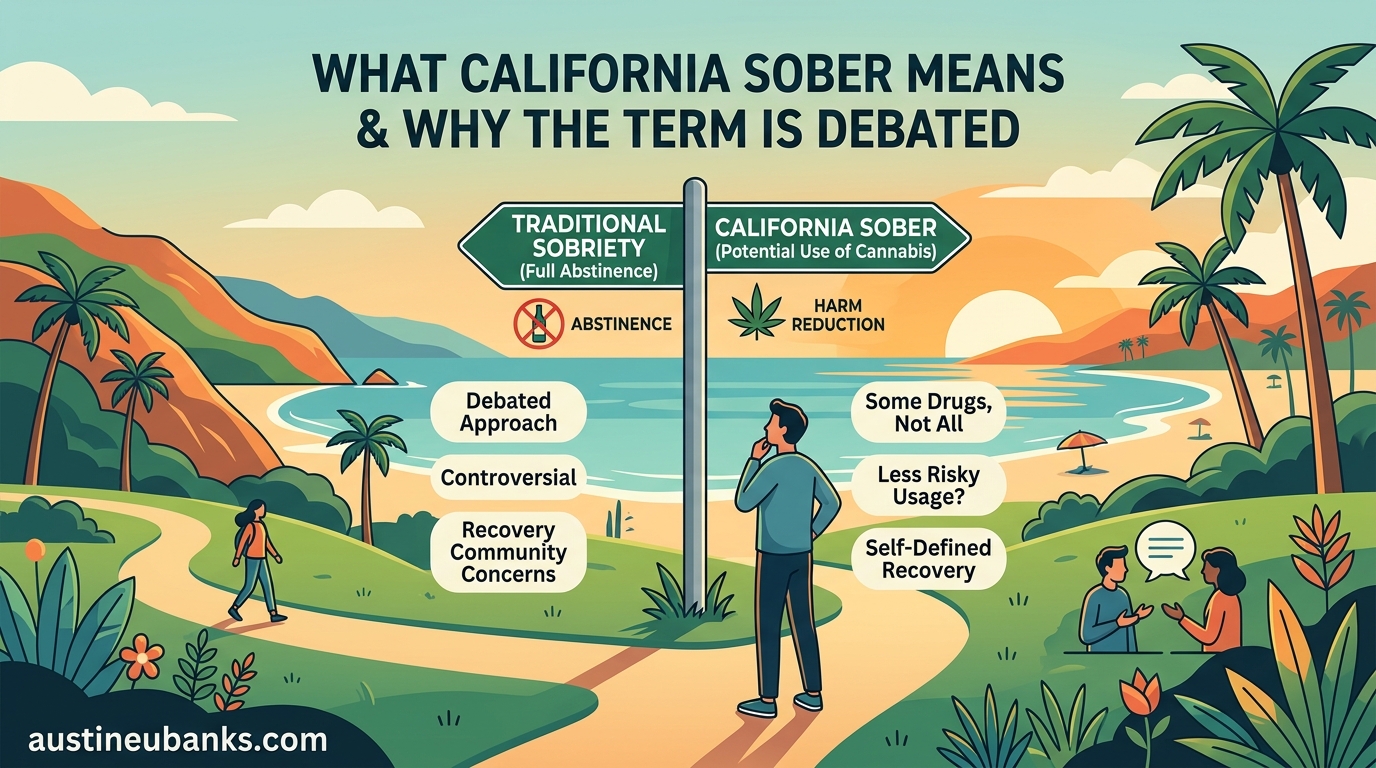
Being “California sober” means abstaining from alcohol and hard drugs while continuing to use cannabis, and sometimes psychedelics, as part of a harm reduction approach rather than complete abstinence. If you have heard the phrase thrown around on social media, in podcasts, or in recovery circles, you are not alone in wondering what it actually involves.
The term has become one of the most discussed and divisive concepts in modern recovery culture. Some people swear by it as a flexible, realistic path away from dangerous substances. Others, including many addiction medicine professionals, see it as a relabeling of addiction rather than a legitimate recovery strategy.
Understanding what California sober means matters because it sits at the center of a genuine debate about how we define sobriety, recovery, and harm reduction in 2026. Whether you are exploring your own relationship with substances, supporting a loved one, or simply curious about the cultural conversation, getting the full picture helps you make sense of conflicting advice.
In this article, our team breaks down the definition, traces where the term came from, explains why it is so hotly debated, and gives you the research-backed context you need to form your own opinion.
Table of Contents
What California Sober Actually Means
At its core, the California sober definition refers to a lifestyle where a person avoids alcohol, opioids, cocaine, methamphetamine, and other “hard” substances, but continues to use cannabis. Some people who identify with this approach also use psychedelics like psilocybin or ayahuasca, though this varies widely from person to person.
The concept is rooted in selective sobriety, the idea that not all substances carry the same risk profile and that eliminating the most dangerous ones while allowing less harmful ones can reduce overall harm. Think of it as a risk-reduction ladder rather than an all-or-nothing switch.
There is no single, agreed-upon rulebook for what California sober includes. For some people, it means no alcohol at all but regular cannabis use. For others, it means occasional cannabis and rare psychedelic use while staying away from everything else. This flexibility is part of why the term is so debated, because the definition shifts depending on who you ask.
The common thread is that someone identifying as California sober has made a deliberate choice to stop using the substances they consider most harmful to their life while maintaining access to cannabis as a substitute, a coping tool, or a recreational outlet.
Where the Term California Sober Came From
The phrase “California sober” was coined by journalist Michelle Lhooq in a 2019 article published on her website. She wrote about her personal decision to abstain from alcohol and the most addictive and dangerous substances while continuing to use cannabis. Her framing was practical rather than ideological: she wanted to reduce the harm in her life without committing to total abstinence.
Lhooq’s article struck a nerve. The term spread quickly through social media, lifestyle blogs, and eventually mainstream media coverage. It resonated particularly with younger adults who felt alienated by the rigid expectations of traditional recovery programs but still wanted to change their relationship with substances.
The concept exploded into broader public awareness in 2021 when singer and actor Demi Lovato released a documentary series titled “Dancing With the Devil.” In it, Lovato publicly identified as California sober after a near-fatal overdose, saying that allowing moderate cannabis use helped them avoid the all-or-nothing thinking that had fueled past relapses.
What made the story compelling was what happened next. Lovato later reversed course and announced they had returned to complete abstinence, saying that the California sober approach was not working for them personally. This full-arc trajectory, from endorsement to abandonment, became one of the most cited case studies in the debate over whether the approach is sustainable.
The term has since taken on a life beyond its origin. It appears in Reddit threads, recovery forums, therapist offices, and pop culture discussions. People now search for “cali sober meetings,” “cali sober reddit,” and related phrases looking for community around this particular approach to substance use.
California Sober vs Other Recovery Approaches
To understand what California sober means in context, it helps to compare it directly with the other major frameworks people use to manage substance use. Each approach has a different philosophy, evidence base, and risk profile.
California Sober vs Complete Abstinence
Complete abstinence, the model championed by programs like Alcoholics Anonymous and Narcotics Anonymous, requires eliminating all intoxicating substances. The philosophy is that any mind-altering substance can trigger the addiction cycle and lead back to the most destructive behaviors. Abstinence has the strongest evidence base for long-term recovery in people with diagnosed substance use disorder.
California sober differs by keeping cannabis, and sometimes psychedelics, on the table. The argument is that these substances are less dangerous than alcohol or hard drugs and can serve as a gentler transition away from more harmful patterns.
California Sober vs Harm Reduction
Harm reduction is a broader public health framework that includes needle exchanges, supervised consumption sites, and medication-assisted treatment. It focuses on reducing the negative consequences of drug use rather than demanding immediate cessation.
California sober overlaps with harm reduction philosophy but applies it at the individual lifestyle level rather than the policy level. Some experts consider California sober a form of personal harm reduction, while others argue that without clinical oversight, it lacks the structure that makes harm reduction effective.
California Sober vs Moderation Management
Moderation Management is a specific program designed for people who want to reduce their drinking rather than quit entirely. It uses behavioral tracking, goal-setting, and peer support to help people moderate alcohol intake.
The key difference is that Moderation Management primarily addresses alcohol and focuses on reducing quantity, not substituting substances. California sober, by contrast, typically eliminates alcohol entirely and substitutes cannabis in its place.
Key Differences at a Glance
The main philosophical divide comes down to this: abstinence-based approaches treat any substance use as a risk, harm reduction treats substance use as a reality to be made safer, moderation management treats substance use as something to be controlled, and California sober treats cannabis as a safer substitute for more dangerous substances. Understanding these distinctions helps explain why the California sober controversy is so intense: it challenges the foundational assumption of mainstream recovery culture.
Why California Sober Is Debated
The California sober debate is not just a semantic argument over the word “sobriety.” It reflects a deep philosophical divide in how addiction treatment professionals, recovery communities, and individuals think about substance use and recovery.
The Argument For: Harm Reduction and Flexibility
Supporters of the California sober approach argue that demanding complete abstinence from everyone sets many people up for failure. They point to relapse statistics showing that a significant percentage of people who complete traditional rehab will relapse within the first year. If someone can stay away from the substance that was destroying their life by substituting cannabis, the argument goes, that is a net positive.
On Reddit’s recovery communities, we found users reporting real success with this approach. One person shared that they had been alcohol-free for ten months while using cannabis occasionally and felt it was working well for them. Another described switching from daily alcohol use to occasional THC drinks with zero alcohol cravings, calling it a life-changing substitution.
The flexibility argument also resonates with people who do not identify with the spiritual framework of 12-step programs. For these individuals, California sober offers a non-religious, self-directed approach that feels more aligned with their values and lifestyle.
The Argument Against: Addiction Transfer and Risk
Opponents raise a sharp concern: is California sober just a sophisticated way of describing addiction transfer? Addiction transfer, sometimes called cross-addiction, happens when someone stops using one substance but substitutes another that activates the same reward pathways in the brain.
The concern is not theoretical. Research on cannabis use disorder shows that approximately 9 percent of people who use cannabis will develop a use disorder, and that number rises to about 17 percent for those who start using as adolescents. Modern high-potency cannabis products, with THC concentrations far exceeding what was available in past decades, may carry higher addiction potential than many people realize.
On the same Reddit threads, we found equally powerful counter-stories. One user reported that weed was more addictive for them personally than alcohol had ever been. Another described the feeling of “swapping one addiction for another” and said it eventually led them back to full abstinence.
What Addiction Medicine Professionals Say
The clinical consensus among addiction medicine specialists leans strongly against recommending California sober for people with diagnosed substance use disorder. Major organizations, including the American Society of Addiction Medicine, advocate for evidence-based treatment that may include medication-assisted therapy, counseling, and complete abstinence depending on the individual’s needs.
Addiction psychiatrists like Dr. Jared Harp, who spoke with Cleveland Clinic about the topic, point out that cannabis carries real health consequences including memory impairment, concentration problems, paranoia, and in some cases psychosis. These risks are amplified with high-THC products.
Professionals also note that cannabis is not an FDA-approved treatment for substance use disorder. While some preliminary research explores cannabis as a potential tool for managing cravings or easing withdrawal, the evidence base is thin compared to well-studied treatments like buprenorphine for opioid use disorder or naltrexone for alcohol use disorder.
The 12-Step Community Perspective
Within traditional 12-step recovery communities, California sober is generally viewed with skepticism. Alcoholics Anonymous and similar programs are built on the principle of complete abstinence from all mind-altering substances, and many members see cannabis use as incompatible with genuine recovery.
However, this stance is not universal. Some meetings and members are more open-minded, particularly in areas where cannabis is legal and culturally normalized. The debate within recovery circles themselves mirrors the broader cultural divide: older members and more traditional groups tend to reject the concept, while younger people and newer recovery communities are more willing to entertain flexible definitions of sobriety.
One of the most common questions in recovery forums is whether someone can be California sober and still attend AA. The practical answer is that AA does not police its members, but the program’s literature and traditions clearly advocate for complete abstinence. People who use cannabis are unlikely to feel fully welcomed in all meetings, even if some individual groups are accepting.
The Science: Cannabis Potency and Real Risk
One of the biggest blind spots in the California sober conversation is how dramatically cannabis has changed over the past few decades. This matters enormously for anyone evaluating the risk profile of this approach.
In the 1990s, the average THC concentration in seized cannabis samples was around 4 percent. Today, legally dispensary-sold cannabis flower routinely tests at 20 percent THC or higher. Concentrates like waxes, shatters, and vape oils can exceed 80 percent THC. This is not the same substance that previous generations used, and the addiction and mental health risk profile is substantially different.
Research on high-potency cannabis has linked it to increased rates of cannabis use disorder, greater risk of psychosis in vulnerable individuals, and more severe withdrawal symptoms when people try to quit. A study referenced by Cleveland Clinic (PMC11347081) specifically examined the relationship between cannabis use and relapse risk in people recovering from other substance use disorders.
The data on cannabis as a recovery tool remains limited and mixed. Some small studies suggest that cannabis might help reduce opioid cravings or ease alcohol withdrawal. But these findings are preliminary and have not been replicated in large, well-controlled trials. No major medical organization currently recommends cannabis as a treatment for substance use disorder.
What the research does show clearly is that cannabis is not risk-free. For someone with a history of addiction, the brain’s reward pathways are already sensitized to substance use. Introducing a substance that activates those same pathways, even a “safer” one, carries a real risk of developing a new dependence or lowering inhibitions around the original substance of abuse.
This is why addiction specialists emphasize that relapse risk is not just about the specific substance involved. It is about the behavioral pattern of using an intoxicating substance to cope, celebrate, escape, or self-medicate. That pattern does not necessarily disappear just because someone switches from alcohol to cannabis.
Regional Variants: LA Sober, Miami Sober, Portland Sober
As the California sober concept spread, it spawned a wave of city-specific sobriety labels that no competitor has thoroughly explored. These regional variants reflect how cultural attitudes toward substance use vary across different parts of the country.
LA Sober
LA sober generally follows the same framework as California sober but tends to emphasize wellness culture alongside cannabis use. People identifying as LA sober often pair their cannabis use with practices like meditation, yoga, clean eating, and holistic health routines. The emphasis is on optimizing lifestyle rather than simply replacing one substance with another.
Miami Sober
Miami sober typically involves abstaining from alcohol and party drugs while allowing cannabis, and in some cases plant-based psychedelics. Given Miami’s nightlife-centric culture, the term often carries a specific connotation of someone stepping away from the club and party scene while maintaining a social life centered around cannabis.
Portland Sober
Portland sober takes on a slightly different flavor, often incorporating craft cannabis culture, microdosing, and a strong emphasis on natural or plant-based substances. The Portland variant tends to be the most open to psychedelics as part of the recovery and wellness toolkit.
These regional labels illustrate something important: the California sober concept is not monolithic. It adapts to local cannabis cultures, wellness trends, and community norms. This flexibility is part of why it has resonated so broadly, and part of why it resists a single clean definition.
When California Sober May Become a Problem
Not everyone who identifies as California sober is headed for trouble. But there are clear warning signs that this approach may be masking a deeper issue rather than resolving one. Being honest about these red flags is essential for anyone considering or currently practicing this approach.
Warning Signs to Watch For
Tolerance is increasing. If you find yourself needing more cannabis to achieve the same effect over time, this is a sign of physical dependence developing. The same reward pathway adaptation that occurs with other substances can occur with cannabis.
Cannabis use is becoming daily or near-daily. What starts as occasional use can creep into a daily habit without you noticing. If cannabis becomes the default coping mechanism for stress, boredom, social anxiety, or sleep, it has taken on the same role that the original substance played.
You are using cannabis to manage cravings for other substances. If the main function of cannabis use is to suppress urges for alcohol or hard drugs, this suggests the underlying addiction drive has not been addressed. Substitution is not the same as recovery.
Your use is causing life problems. If cannabis is affecting your motivation, relationships, work performance, or mental health, the approach is not reducing harm. It is simply shifting the harm to a different category.
A Four-Question Self-Assessment
If you are practicing California sober or considering it, ask yourself these four questions honestly. First, have you tried to cut back on cannabis use and found you could not? Second, do you experience withdrawal symptoms like irritability, insomnia, or loss of appetite when you stop? Third, is cannabis use interfering with responsibilities, relationships, or goals? Fourth, do you feel you need cannabis to function normally?
If you answered yes to any of these, it is worth speaking with an addiction medicine professional. These are signs that cannabis use has moved beyond moderate use into territory that may require support.
When to Seek Professional Help
If you find that California sober is not working, that is not a personal failure. It is data. Recovery is not one-size-fits-all, and the fact that one approach did not work simply means you need a different strategy. Evidence-based treatment options, including medication-assisted treatment, cognitive behavioral therapy, and professional counseling, have strong research support and can be tailored to your specific situation.
Alternatives Worth Considering
If you are reconsidering your relationship with substances but are not sure that California sober, complete abstinence, or any single approach is right for you, there are several evidence-based alternatives worth exploring.
The Sober Curious Movement
Sober curious is a broader cultural movement that encourages people to question their relationship with alcohol and other substances without necessarily committing to permanent abstinence. It focuses on mindfulness, self-experimentation, and curiosity rather than rigid rules. The key difference from California sober is that sober curious typically encourages reducing or eliminating all substance use rather than substituting one substance for another.
SMART Recovery
SMART Recovery is a science-based, secular alternative to 12-step programs. It uses cognitive behavioral therapy techniques and motivational strategies to help people manage addictive behaviors. SMART does not require participants to identify as addicts or alcoholics and does not insist on a spiritual framework, making it accessible to people who feel alienated by traditional programs.
Medication-Assisted Treatment
For people recovering from opioid or alcohol use disorder, medication-assisted treatment is the gold standard in evidence-based care. Medications like buprenorphine, methadone, and naltrexone have decades of research supporting their effectiveness in reducing cravings, preventing relapse, and improving long-term outcomes. This is a clinical approach supervised by medical professionals, not a self-directed lifestyle choice.
Professional Therapy and Counseling
Working one-on-one with an addiction counselor or therapist can help you understand the root causes of substance use, develop personalized coping strategies, and create a recovery plan that fits your specific needs and circumstances. This is often the most effective starting point for anyone unsure about which path to take.
FAQs
What does California sober actually mean?
California sober means abstaining from alcohol and hard drugs like opioids, cocaine, and methamphetamine while continuing to use cannabis, and sometimes psychedelics, as part of a harm reduction approach rather than complete abstinence.
Who came up with the term California sober?
Journalist Michelle Lhooq coined the term California sober in a 2019 article where she described her personal decision to abstain from alcohol and the most dangerous substances while continuing to use cannabis. The phrase spread through social media and gained mainstream visibility after Demi Lovato discussed it in a 2021 documentary.
Is California sober actually safe?
California sober carries real risks. While eliminating alcohol and hard drugs reduces certain harms, cannabis itself can lead to cannabis use disorder in roughly 9 percent of users. Modern high-potency cannabis products carry higher addiction potential than many people realize, and addiction medicine professionals generally do not recommend this approach for people with diagnosed substance use disorder.
Can you be California sober and still go to AA?
AA does not police its members, but the program’s literature and traditions clearly advocate for complete abstinence from all mind-altering substances. People who use cannabis may feel welcomed in some meetings but not all. Traditional 12-step recovery communities generally view cannabis use as incompatible with genuine recovery.
Does California sober lead to relapse?
There is no definitive research showing that California sober directly causes relapse, but addiction specialists warn that substituting one substance for another can keep the behavioral pattern of substance use active. Demi Lovato, the most famous public example, initially endorsed California sober but later returned to complete abstinence, saying the approach was not sustainable for them.
What is the difference between California sober and sober curious?
California sober involves eliminating certain substances while continuing to use cannabis as a substitute. Sober curious is a broader movement encouraging people to question and reduce their relationship with all substances, including cannabis, through mindfulness and self-experimentation rather than substitution.
What to Take Away From the California Sober Debate
Understanding what California sober means requires looking past the catchy label and examining the real questions underneath. Is substituting cannabis for alcohol and hard drugs a legitimate form of harm reduction, or is it addiction transfer with better branding? The honest answer is that it depends on the individual, their substance use history, and how they are using cannabis in practice.
The strongest criticism from addiction medicine is not that cannabis use is inherently evil. It is that for people with diagnosed substance use disorder, any intoxicating substance can reactivate addiction pathways and undermine long-term recovery. The strongest defense from supporters is that demanding perfection from everyone leads many people to abandon recovery entirely, and that reducing harm is better than achieving nothing.
Both points have merit. The mistake is treating California sober as either a universal solution or a universal failure. Like every approach to substance use, it works for some people and fails others. The key is honesty about your own patterns, awareness of the risks, and willingness to seek professional help if the approach stops working.
If you take away one thing from this article, let it be this: the word “sober” is less important than the substance of your recovery. Whether you choose complete abstinence, harm reduction, medication-assisted treatment, or something else entirely, what matters is that your approach is genuinely improving your life and not simply relocating the problem to a different substance. Talk to an addiction medicine professional if you are unsure which path is right for you.